
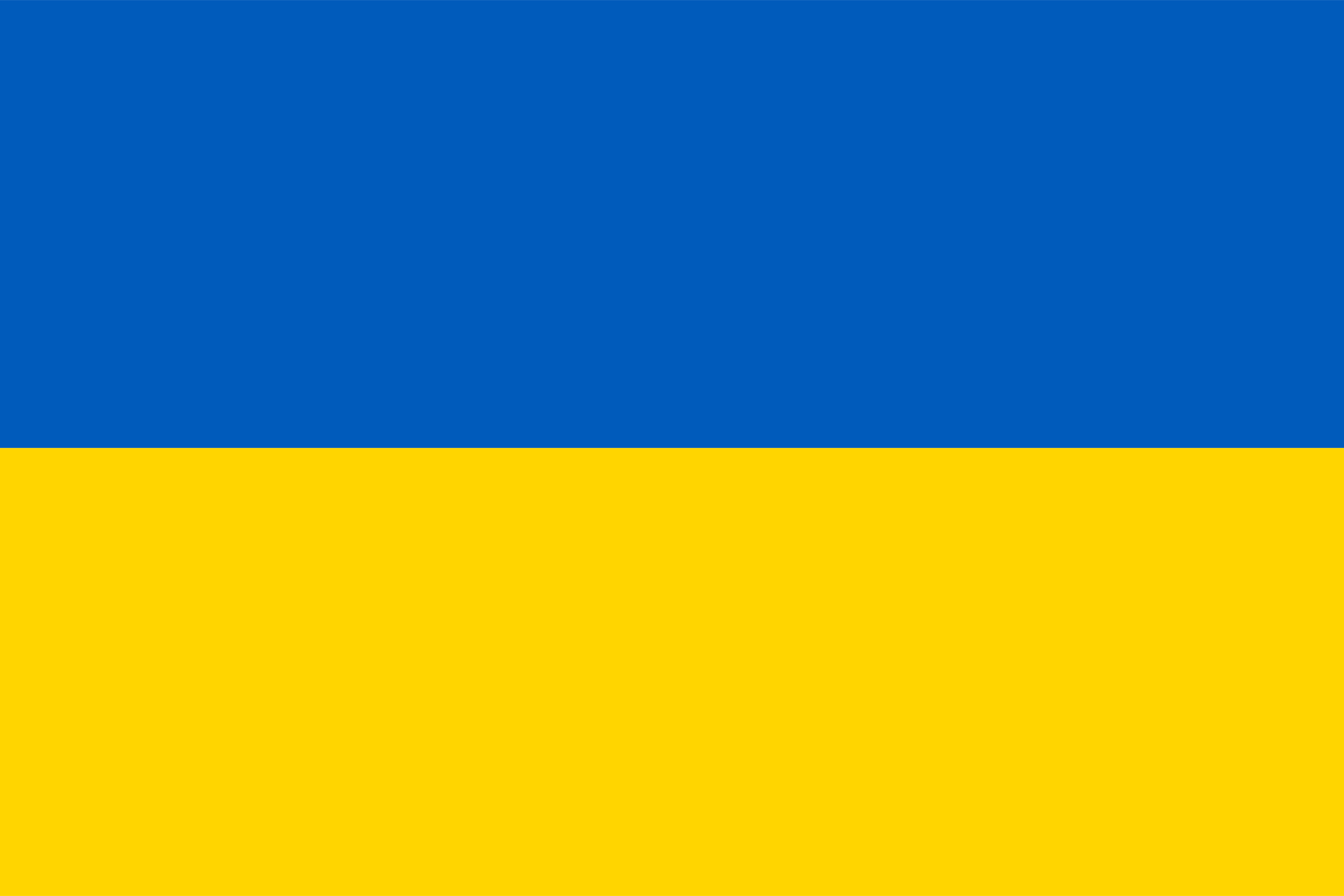
Ukraine flag picture
Explore the flag and coat of arms, proportions, and picture gallery.
| Official name | State Flag of UkraineДержавний Прапор України. |
|---|---|
| Composition | Two equal horizontal bandsBlue above yellow; no emblem. |
| Official ratio | Height:length = 2:3The master is 9,000 × 6,000. |
| Formally adopted | January 28, 1992Verkhovna Rada resolution 2067-XII. |
| Constitution | Article 20Constitution adopted June 28, 1996. |
| National Flag Day | August 23Established by Decree 987/2004. |
| Digital palette | #005BBB and #FFD500RGB from UINP recommendations, August 2026. |
| Technical standard | DSTU 4512:2006Manufacturing requirements remain separate. |
The national flag and the trident coat of arms are separate state symbols.
What does the Ukraine flag look like?
The State Flag of Ukraine is a plain rectangular bicolor with two equal horizontal bands: blue above yellow. Its official height:length ratio is 2:3. The current design was formally approved on January 28, 1992, drawing on a much older national color tradition. The ordinary flag has no trident or other emblem.
This article brings together the flag’s legal definition, popular meanings, historical development, practical display guidance, and precise construction. The illustrations include a clean national flag, measured diagrams, a timeline, vertical and reverse views, and a separate comparison with the small coat of arms. Dates, source types, and reproduction choices are identified so that students can distinguish documented facts from familiar but unsupported claims.
What is the Ukraine flag called, and what is its emoji?
Its formal English name is the State Flag of Ukraine; “Ukrainian flag” and “Ukraine flag” refer to the same national design. In Ukrainian it is Державний Прапор України. The familiar blue-and-yellow description identifies its two colors, while the legal design specifies which color belongs above the other. Its flag emoji is 🇺🇦.
Ukraine’s flag is a horizontal bicolor: a rectangle divided into two differently colored bands. Both bands have equal height and run from the attachment edge to the free edge. There is no central symbol, text, shield, star, or decorative border in the standard state design.
The attachment side is called the hoist, and the free side is the fly. A conventional diagram places the hoist at the viewer’s left. Because the flag contains only full-width horizontal bands, changing the viewing side does not change its appearance, provided the top remains the top.
Unicode identifies the flag emoji as the regional-indicator sequence U+1F1FA U+1F1E6, corresponding to the letters U and A. Its on-screen appearance depends on the platform and font. An emoji is useful in text, while the downloadable SVG supplies explicit dimensions and colors for educational graphics.
What are the Ukraine flag colors and their digital codes?
The colors are blue and yellow. This package uses blue #005BBB, or RGB 0, 91, 187, and yellow #FFD500, or RGB 255, 213, 0. These values follow the Ukrainian Institute of National Memory’s August 2026 recommendations. They are identified here as the chosen digital reproduction palette.

The same recommendations cite Pantone Blue 2935 C and Yellow 012 C with reference to DSTU 4512:2006. They also give CMYK 100, 47, 0, 0 for blue and 0, 4, 100, 0 for yellow. The table records these published specifications side by side; it does not calculate one color system from another.
RGB describes screen channels, CMYK describes process-ink proportions, and Pantone identifies a reference within a named color system. A screen display, printed sheet, and dyed textile can look different even when their production instructions refer to the same national colors. The Constitution and 1992 resolution themselves name the colors without giving HEX codes.
| Color | HEX / RGB | Pantone reference | Published CMYK |
|---|---|---|---|
| Blue | #005BBB / 0, 91, 187 | 2935 C | 100, 47, 0, 0 |
| Yellow | #FFD500 / 255, 213, 0 | 012 C | 0, 4, 100, 0 |
What does the Ukraine flag symbolize?
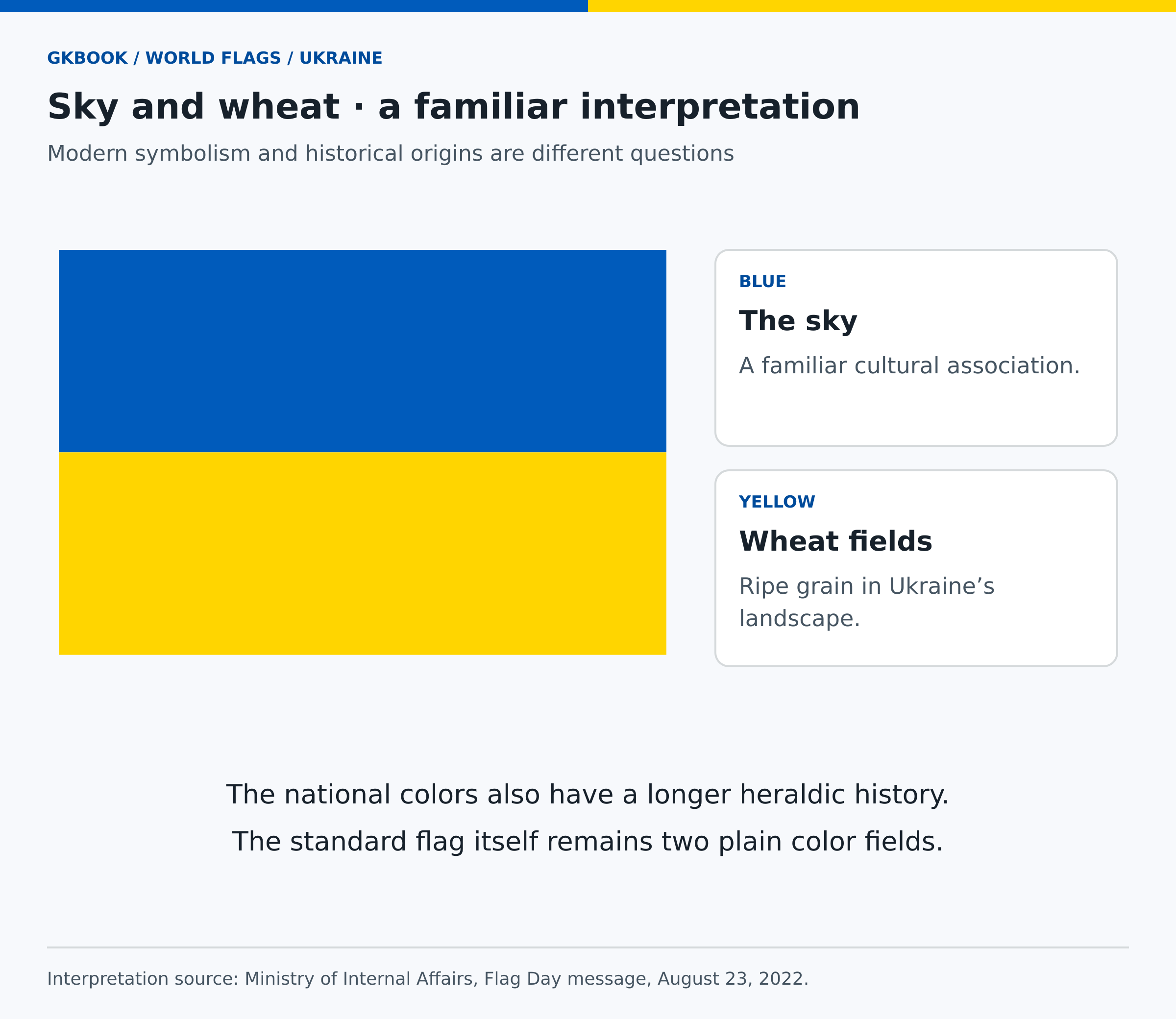
A familiar interpretation connects blue with the sky and yellow with ripe wheat fields. Ukrainian government explanations also associate the flag with peace, freedom, and national unity. This landscape reading helps explain its modern symbolism, while the blue-and-yellow color tradition has a longer history in heraldry and national movements.

The Ministry of Internal Affairs used the sky-and-wheat explanation in its 2022 Flag Day message. It is a recognizable cultural interpretation, rather than a sentence in the legal design definition. The flag’s two rectangles remain plain color fields; they do not contain a painted landscape.
Historical meaning and present-day interpretation answer different questions. Blue fields with golden heraldic devices preceded the nineteenth-century national bicolor, while later generations attached civic and emotional meanings to the same colors. A responsible account can describe both without claiming that one farmer, landscape painting, or single event invented the flag.
What does the blue band represent?
Blue is the upper half of Ukraine’s flag and is commonly associated with the sky. Official public explanations connect the combined blue-and-yellow design with peace and freedom. The adopted flag uses a blue field of equal size to the yellow field, with a straight horizontal boundary between them.
The Ukrainian legal description uses the word синій for blue. Historical sources also use блакитний, often translated as light blue or sky blue. Such vocabulary must be read in context; it does not authorize changing the current design into an arbitrary pale cyan or reversing the band order.
In this edition the chosen blue has RGB values 0, 91, and 187. That is the digital value published in the 2026 institutional recommendations. A photograph may show lighter or darker blue because of lighting, fabric, exposure, or editing, so an uncalibrated photograph is a poor source for sampling an official production color.
What does the yellow band represent?
Yellow forms the lower half and is commonly associated with ripe wheat fields. It also belongs to the older blue-and-gold heraldic tradition associated with Ukrainian lands. On the present state flag, yellow is a plain, continuous band, equal in height and area to the blue band above it.
Heraldic descriptions often use gold for the metal represented by yellow. That terminology explains historical references to golden lions or tridents on blue backgrounds. The current flag description names a yellow band; it does not require metallic foil, glitter, shading, or a gradient.
The supplied yellow is #FFD500, following the cited 2026 RGB recommendation. White margins around a picture, gold fringe on ceremonial equipment, and decorative frames belong outside the national design. For a clean download, preserve the entire yellow half rather than cropping it to make a square thumbnail.
What is the official ratio of the Ukraine flag?
The official proportion is height:length 2:3. A flag two units high is three units long, and each horizontal band is one unit high. The resolution adopted on January 28, 1992 states this ratio explicitly. The supplied master follows it at 9,000 pixels wide by 6,000 pixels high.

The Ukrainian resolution describes the ratio of the cloth’s width to its length. In an English flag diagram, height:length avoids confusing that shorter dimension with a screen image’s horizontal width. The equivalent digital width:height expression is 3:2.
For example, a 150-centimeter-long flag is 100 centimeters high, with two 50-centimeter-high bands. A 90-by-60-centimeter version preserves the same proportions. Scaling both dimensions together changes the size while preserving the design; stretching only one dimension produces a different rectangle.
Which color goes on top, and how are the bands arranged?
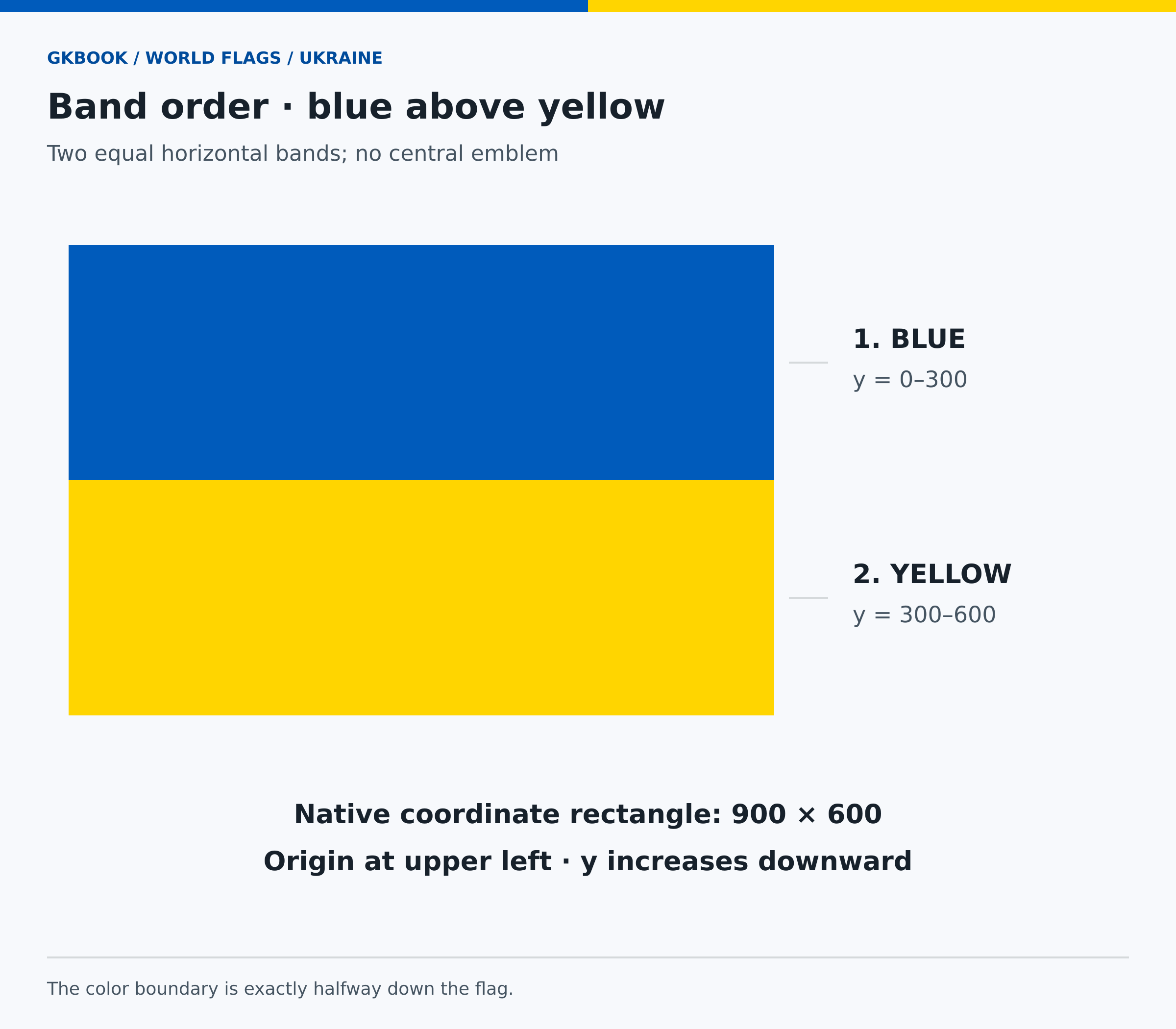
Blue goes on top and yellow goes below. Both horizontal bands are equal in height and extend across the full length. On a 900-by-600 construction drawing, blue occupies y = 0 to 300 and yellow occupies y = 300 to 600. Their boundary lies exactly halfway down.
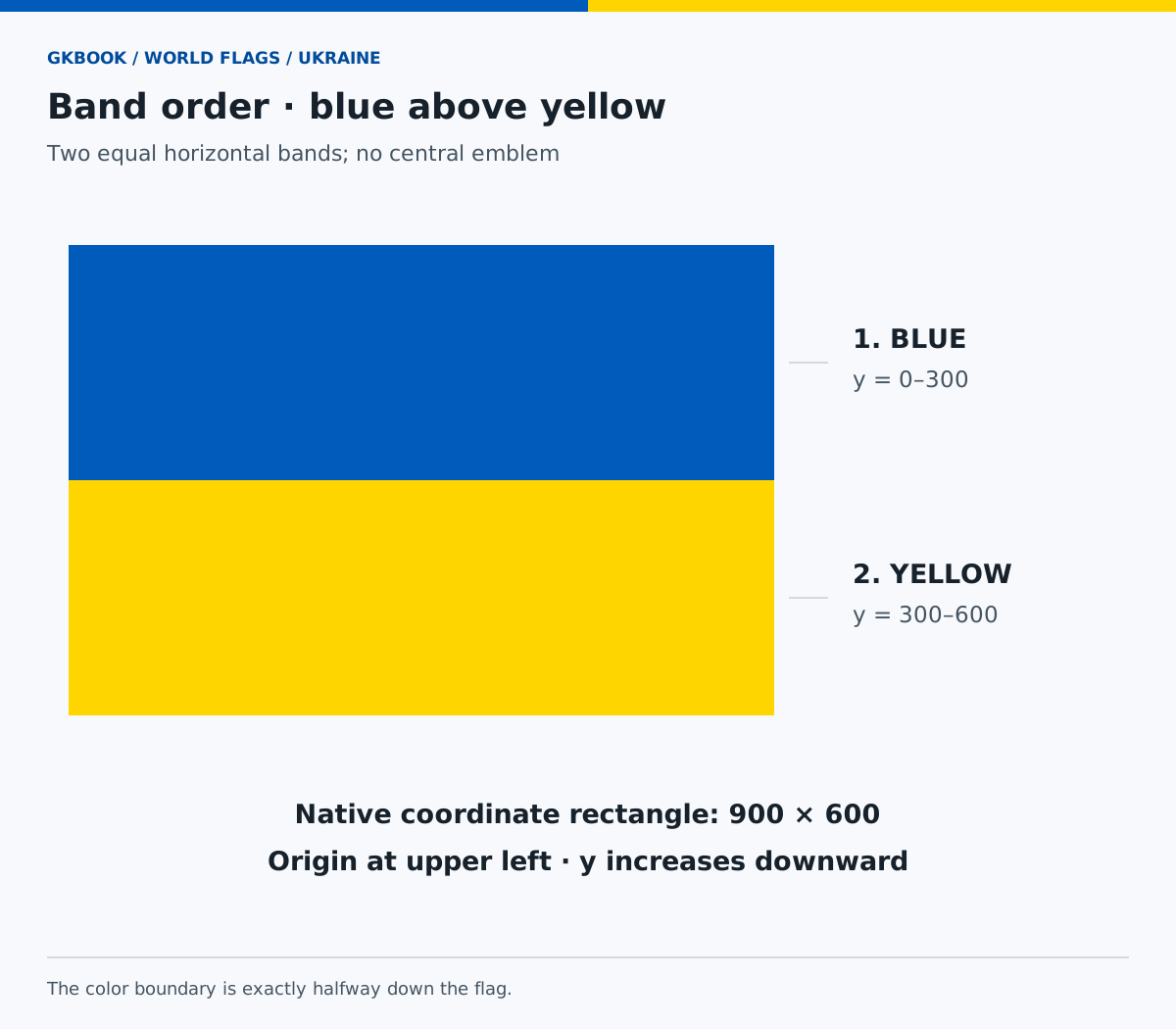
The upper-left corner is the origin of the drawing coordinates. The x coordinate increases to the right, and y increases downward. This convention makes the design easy to reproduce with two filled rectangles and removes ambiguity about where the division belongs.
The formal 1992 description settles the modern order. Historical terminology such as “yellow-blue” can refer loosely to the national colors and should not automatically be treated as evidence that a particular flag had yellow on top. Use dated images and documents when interpreting an older object.
| Band | Color | x range | y range | Size |
|---|---|---|---|---|
| Upper | Blue | 0–900 | 0–300 | 900 × 300 |
| Lower | Yellow | 0–900 | 300–600 | 900 × 300 |
Do blue and yellow occupy equal areas?
Yes. Each color occupies exactly one half of the clean flag’s area. The flag has no emblem covering either band. In the 9,000-by-6,000 PNG, the total is 54 million pixels: 27 million blue and 27 million yellow. These totals describe the supplied flat image without a border or shadow.
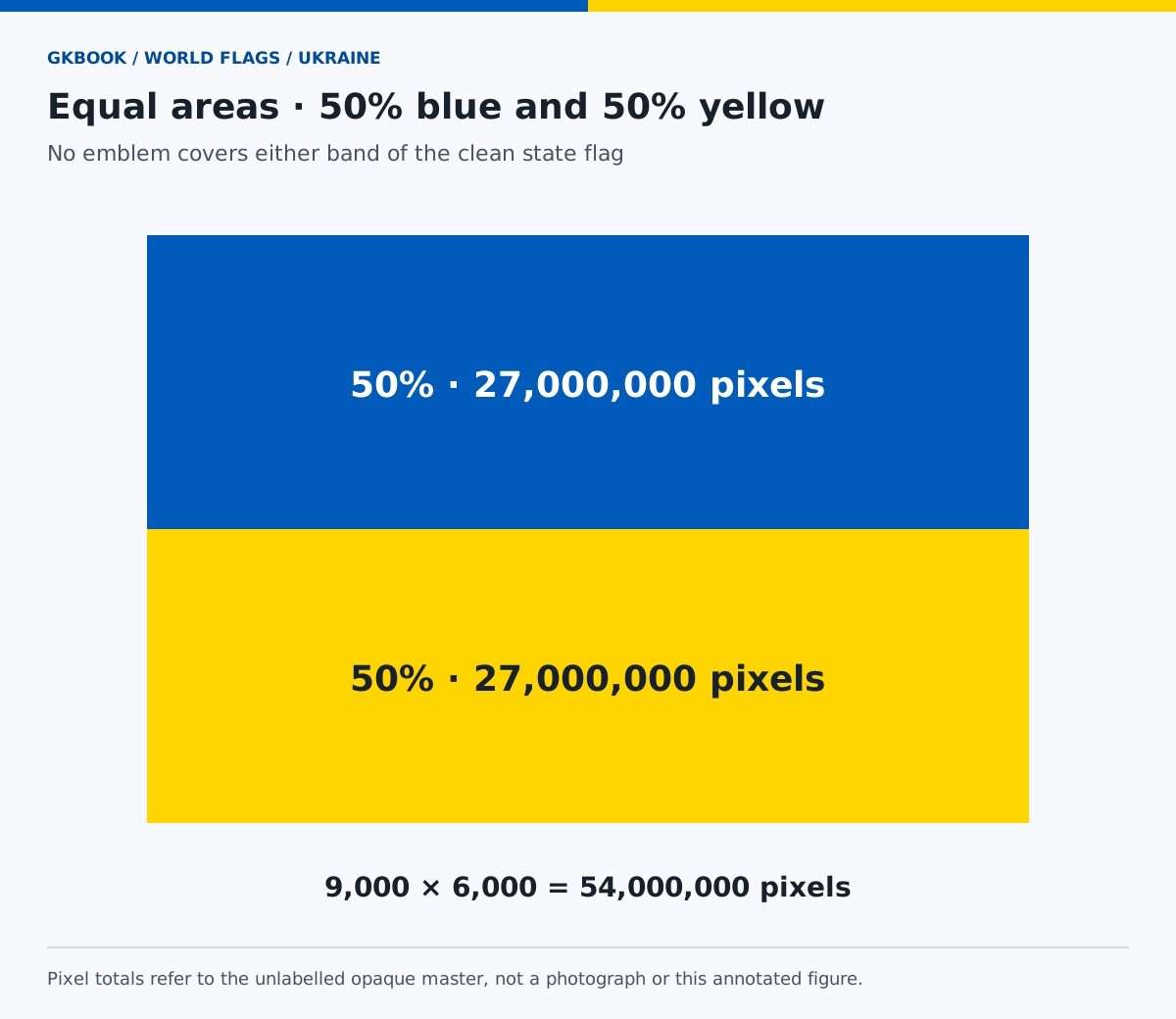
For a flag of length L and height H, the total area is L × H. Each band has area L × H/2. The native 900-by-600 drawing therefore contains 540,000 square units, split into two equal areas of 270,000 square units.
Folded fabric and perspective photographs can show unequal visible amounts of blue and yellow even though the cloth was made correctly. Antialiasing, shadows, and text overlays can also change image color counts. The clean master avoids those additions, allowing an exact pixel-level check against the mathematical construction.
How can the Ukraine flag be drawn accurately?
Draw a landscape rectangle three units long and two units high. Divide it horizontally into two equal halves. Fill the upper half blue and the lower half yellow. Keep the dividing line straight and use solid colors. The standard national design requires no emblem, lettering, outline, or additional stripe.
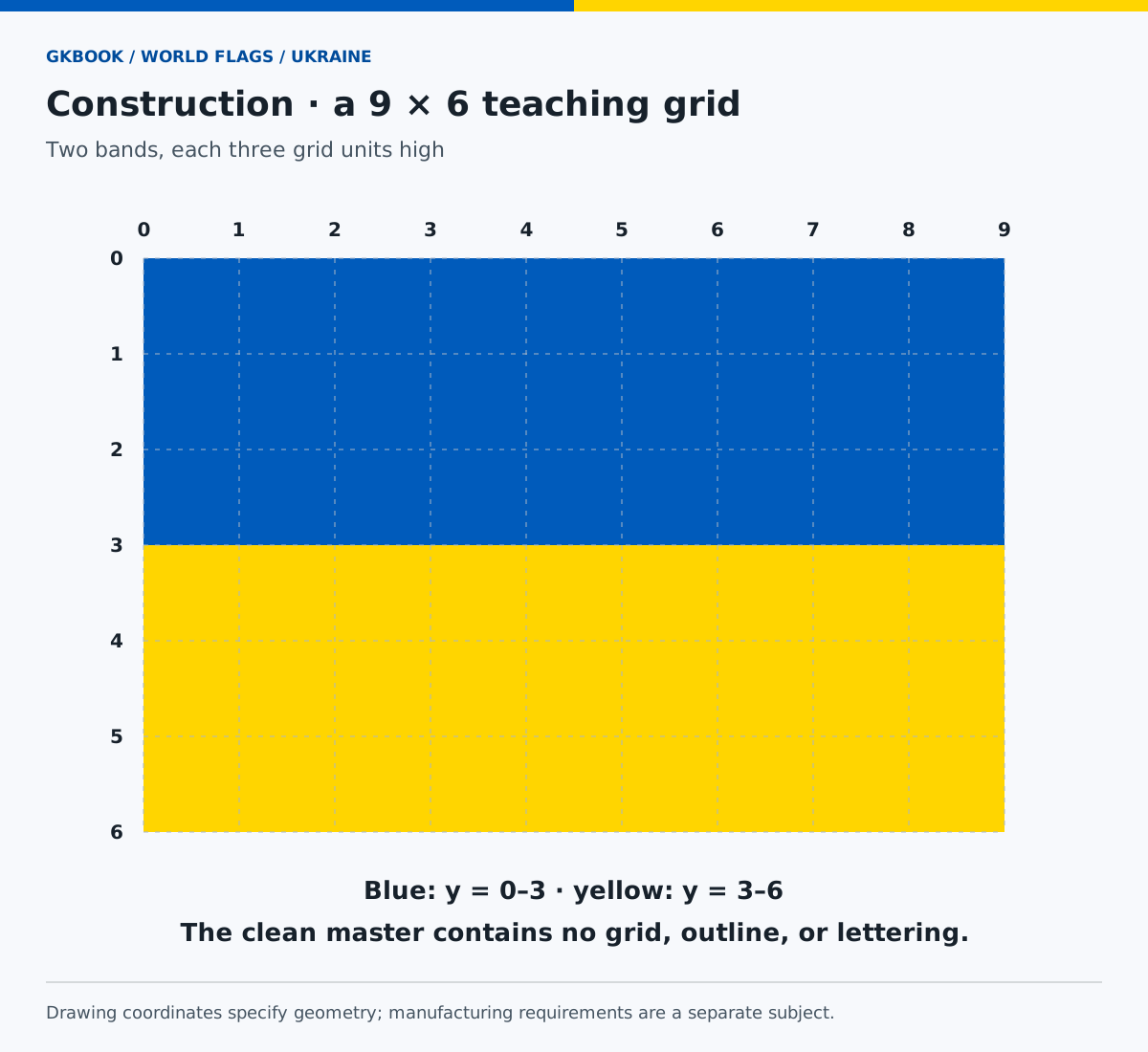
A 9-by-6 teaching grid gives the same ratio: the division falls three units below the top. The supplied SVG uses a 900-by-600 viewBox, which scales directly to the 9,000-by-6,000 PNG. A vector drawing can be enlarged without introducing a new set of geometric proportions.
Place dimension marks and explanations outside the clean flag when possible. The construction diagram includes a grid for learning, while the downloadable master omits every guide. For sewing or commercial procurement, use the applicable technical standard as well as the drawing; attachment details and fabric performance are separate production questions.
How old are Ukraine’s blue-and-yellow national colors?
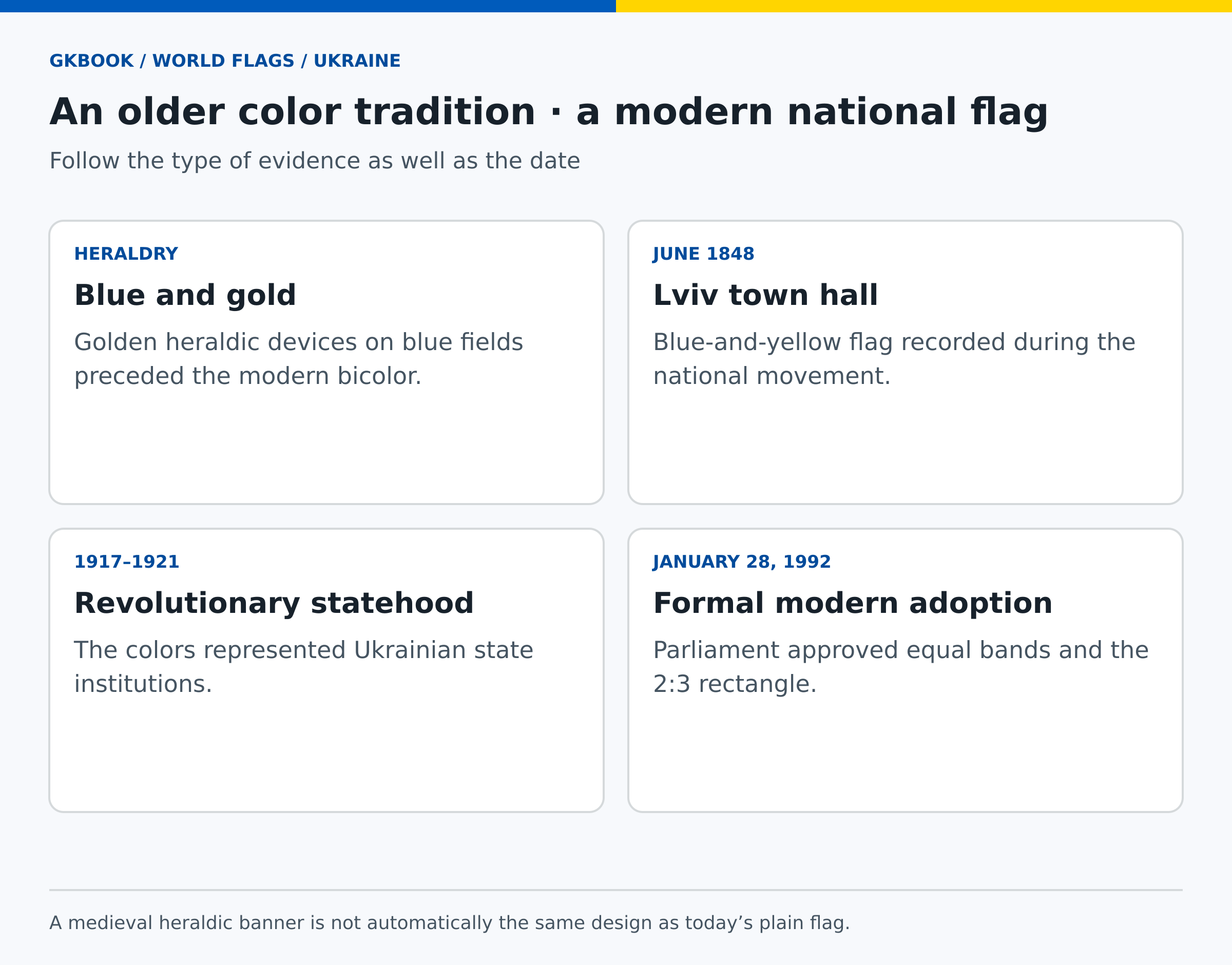
Their history is older than the present state flag. Blue and gold appear in heraldry associated with Ukrainian lands, including the golden lion on a blue field. Blue-and-yellow flags became established symbols of the Ukrainian national movement during the revolutions of 1848, including a documented appearance at Lviv’s town hall.

The Ukrainian Institute of National Memory places the Lviv town-hall appearance in June 1848. This is an important milestone in the modern national flag tradition. Older heraldic banners could contain lions, shields, or other devices; they were not necessarily identical to today’s plain two-band rectangle.
The colors spread through cultural celebrations and political organization during the nineteenth and early twentieth centuries. Distinguishing the history of a color combination from the history of a precise flag design prevents anachronism. The modern 2:3 specification should not be projected onto every medieval or nineteenth-century banner.
Was the flag used during the Ukrainian Revolution of 1917–1921?
Yes. Blue-and-yellow flags represented Ukrainian statehood during the revolution of 1917–1921. Early popular displays included variations in band order, but the documented government flag provisions examined by historians used blue above yellow. The story that Pavlo Skoropadskyi simply reversed an officially yellow-over-blue national flag is not supported by those records.

The temporary fleet law of January 27, 1918, corresponding to January 14 in the old calendar, specified blue-and-yellow cloth for the merchant fleet. The Western Ukrainian People’s Republic named a blue-and-yellow state flag in its temporary basic law of November 13, 1918. These are concrete legal references rather than inferences from monochrome photographs.
Heraldry scholar Andrii Hrechylo identifies a frequently repeated mistake: March 22, 1918 concerned designs for the arms and seal, not a newly adopted yellow-over-blue flag law. Some later institutional summaries repeat that error. This article follows his documentary analysis, corroborated by the Institute of National Memory’s teaching materials.
How did the blue-and-yellow flag return in 1990–1992?
The national colors returned to public prominence during the movement for independence. A flag was raised at Kyiv’s city council on July 24, 1990. It entered parliament’s chamber on August 24, 1991 and flew over the parliamentary building on September 4. Formal state-flag approval followed on January 28, 1992.

Ukraine’s Soviet-era republican flag was a different design associated with the Ukrainian Soviet Socialist Republic. The reappearance of the national bicolor was therefore a restoration of an older national tradition, rather than the invention of a new pair of colors in 1991.
Parliament’s account distinguishes the August chamber ceremony, the September roof raising, and the January resolution. It also records a September 18, 1991 decision permitting blue-and-yellow use in protocol events. A local raising, a ceremonial use, and formal adoption are different events and should receive different timeline labels.
When was the present Ukraine flag officially adopted?
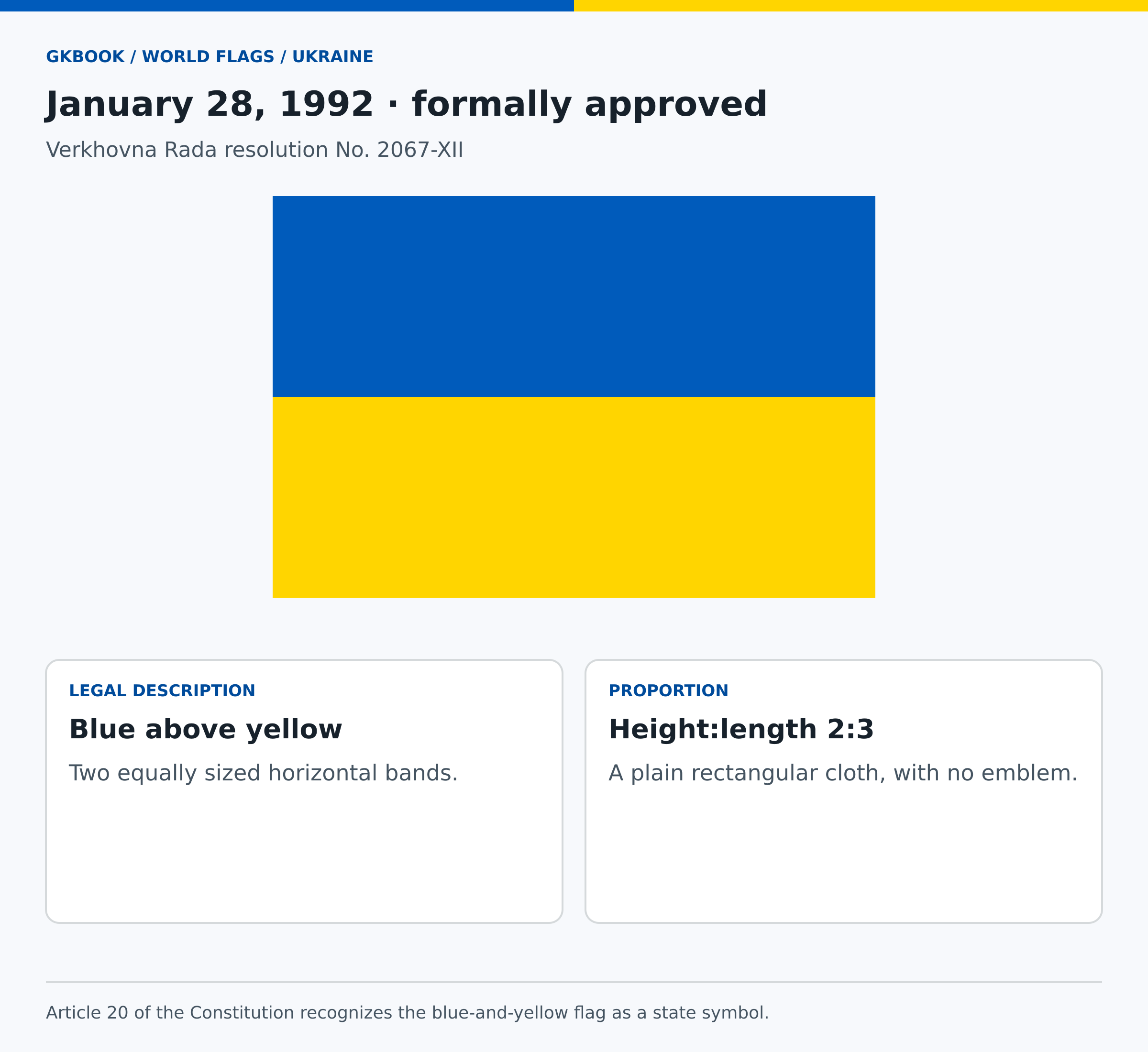
The present State Flag of Ukraine was formally approved on January 28, 1992 by Verkhovna Rada resolution No. 2067-XII. It specifies blue above yellow, equal horizontal bands, and a 2:3 ratio. The national colors had already returned to public and official use before that formal design resolution.

Ukraine declared independence on August 24, 1991. The flag’s 1992 adoption date belongs to the subsequent legal consolidation of state symbols. Article 20 of the Constitution, adopted on June 28, 1996, recognizes the flag as two equally sized horizontal bands of blue and yellow.
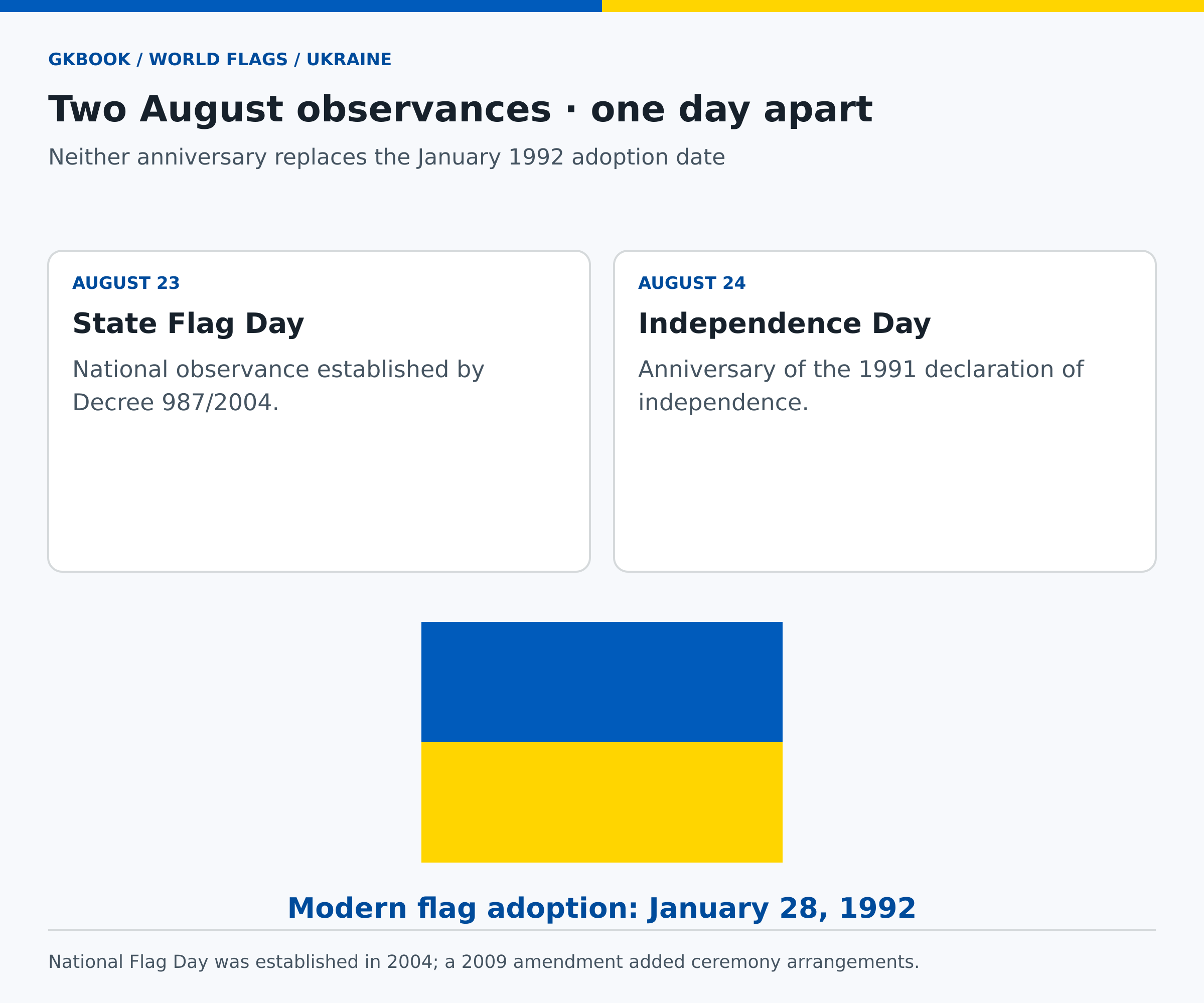
Use January 28, 1992 in a concise modern-adoption caption, while explaining the earlier national tradition in historical text. Neither Flag Day on August 23 nor Independence Day on August 24 replaces that legal adoption date. This distinction is particularly useful when comparing countries whose independence and flag adoption occurred on different days.
Who designed the Ukraine flag?
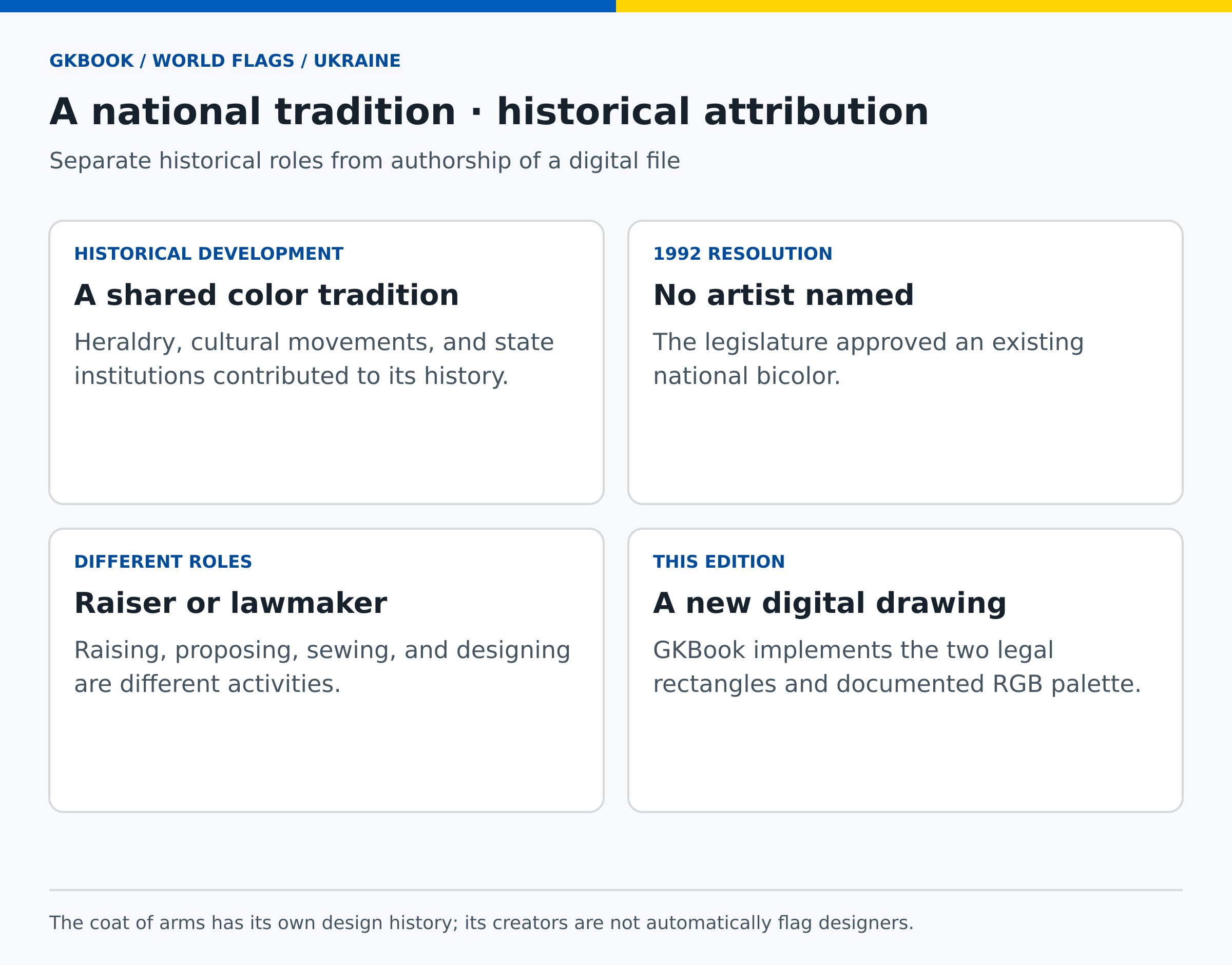
The modern flag is rooted in an established national color tradition rather than a documented single designer’s new invention in 1992. The adoption resolution approves the national bicolor without naming an artistic author. It is more accurate to explain its historical development than to assign a designer without reliable evidence.
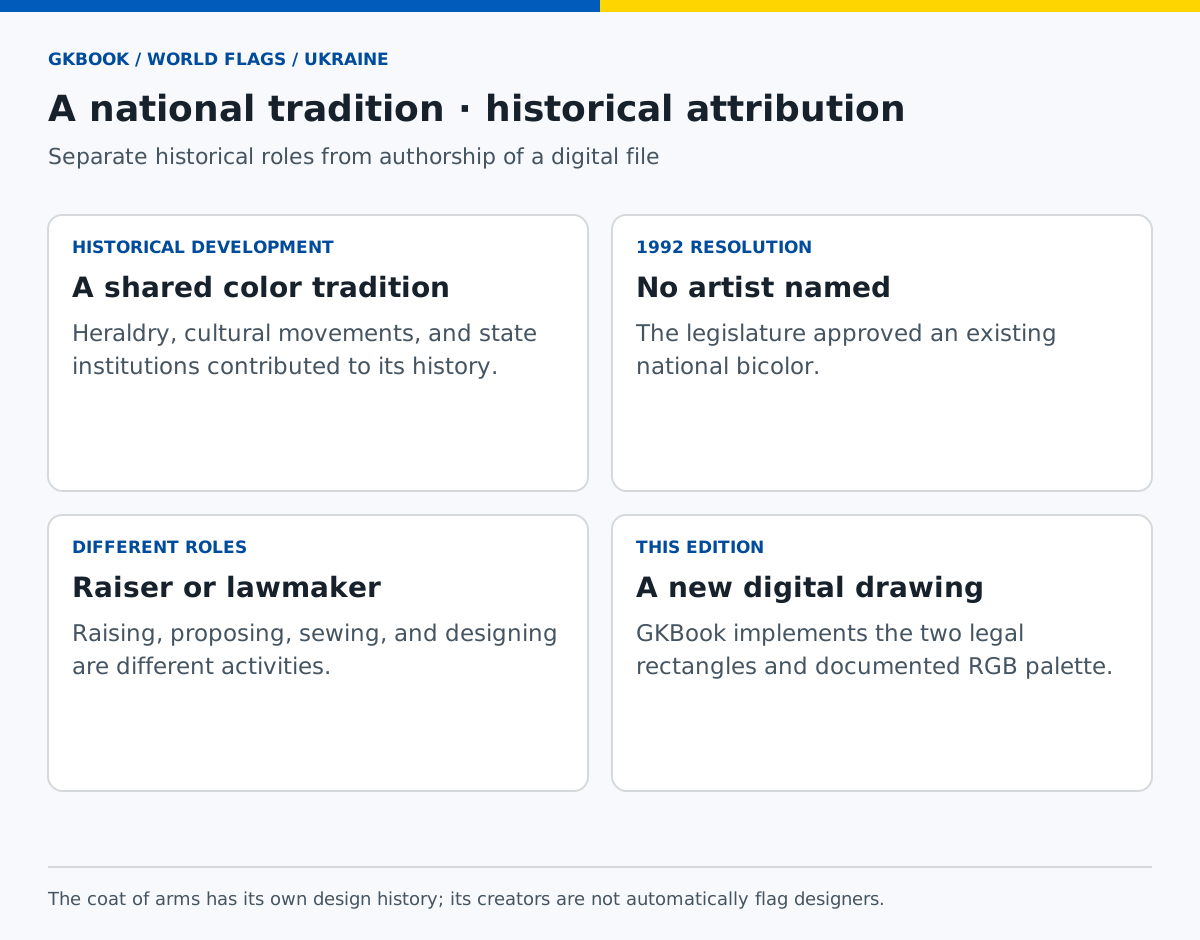
The 1848 national movement, revolutionary-era state institutions, independence activists, and the 1992 legislature played different roles in its history. A person who raised a flag, proposed legislation, or manufactured a ceremonial example did not necessarily design the national bicolor.
Names associated with Ukraine’s trident and coat of arms belong to a separate design history. Likewise, the creator of a modern SVG is the maker of a digital representation, not the inventor of the national symbol. This package’s flag geometry is an original two-rectangle implementation of the legal description.
When is Ukraine’s National Flag Day?
Ukraine celebrates the Day of the State Flag on August 23 each year. Presidential Decree No. 987/2004 established the national observance in 2004. It falls one day before Independence Day. The holiday celebrates the national symbol and its history; it is not the date of the 1992 flag-adoption resolution.
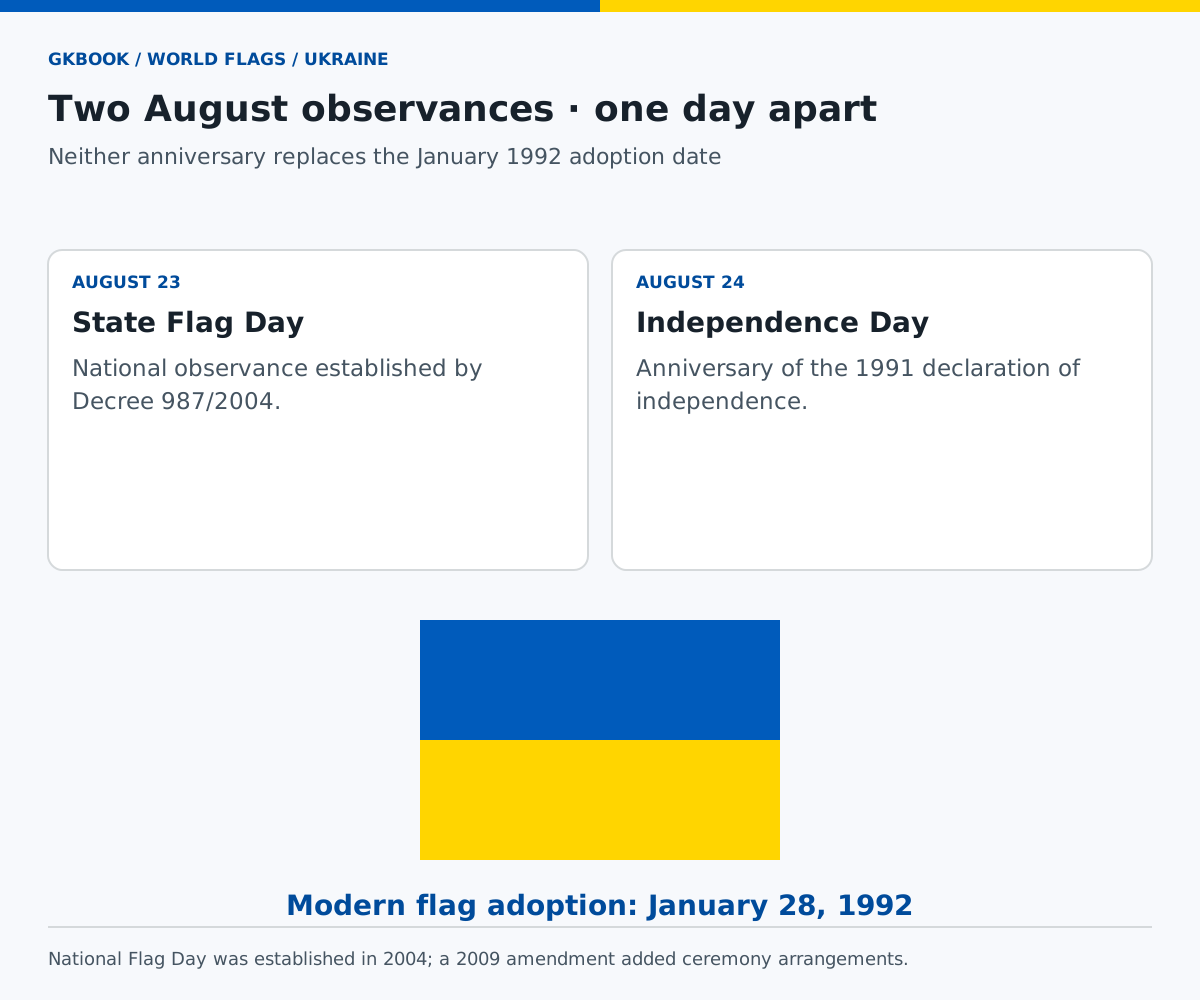
A 2009 amendment added arrangements for an official flag-raising ceremony. Annual programmes and individual venues require their own announcements, so this article records the recurring date without inventing a fixed nationwide timetable for every event.
Parliament’s historical account dates the entry of the large independence flag into its chamber to August 24, 1991. It should not be moved to August 23 merely to match today’s holiday. Kyiv also has a local July 24 observance linked to the 1990 city-council raising; that local commemoration is distinct from the national day.
How are Flag Day and Independence Day different?
Flag Day is August 23; Independence Day is August 24. Independence Day commemorates the 1991 declaration of independence, while Flag Day honors the national flag through an observance established in 2004. The present design was formally approved on January 28, 1992. These three dates describe three different events.
The declaration of independence and the return of the bicolor are closely connected in public memory. Their connection does not make every date interchangeable. A timeline should identify what happened, where it happened when relevant, and whether the entry describes an original event or an annual anniversary.
Ukraine’s United Nations membership is another separate history: the Ukrainian Soviet Socialist Republic was a founding member in 1945, and the UN records the name change to Ukraine in 1991. Modern independence did not create an entirely new UN admission date, and membership did not determine the flag’s design.
Which legal documents define and protect the Ukraine flag?
The January 28, 1992 parliamentary resolution specifies the design and ratio. Article 20 of the Constitution identifies the State Flag among Ukraine’s national symbols, and Article 65 makes respect for state symbols a citizen’s duty. Criminal Code Article 338 addresses public desecration. Technical production requirements belong to a separate standard.

These sources serve different purposes. The resolution provides a compact geometric description; the Constitution establishes constitutional status; the criminal provision concerns particular conduct; and DSTU 4512:2006 addresses manufacturing and color reproduction. A recommendation on ceremonies is not automatically equivalent to a new statute.
The article avoids reducing all of flag law to a slogan such as “every alteration is illegal.” Legal responsibility depends on the applicable provision and facts. For a legal dispute or regulated use, consult the current official text and appropriate advice. The research record identifies the documents and distinguishes original instruments from explanatory publications.
Is there a technical standard for manufacturing Ukraine’s flag?
Yes. DSTU 4512:2006, State Flag of Ukraine — General Technical Specifications, addresses flags made from fabric and color reproduction in specified production processes. The 2026 Ukrainian Institute of National Memory guidance cites it for Pantone references. This digital package follows the legal geometry and the guidance’s RGB values, without claiming textile certification.

The standard’s published scope covers fabric flags and reproduction of colors in printing and coatings. Its existence matters: a geometrically correct screen image does not establish fabric strength, colorfastness, seam quality, attachment construction, or acceptance testing. Those characteristics require appropriate production specifications and inspection.
The inspected government recommendations supply the practical color references used here. A catalogued standard and a reproduced text were also consulted, but this package does not provide an independently authenticated current copy of the complete standard or reproduce all its requirements. Obtain the applicable official edition when procuring flags.
Does Ukraine’s national flag include the trident?
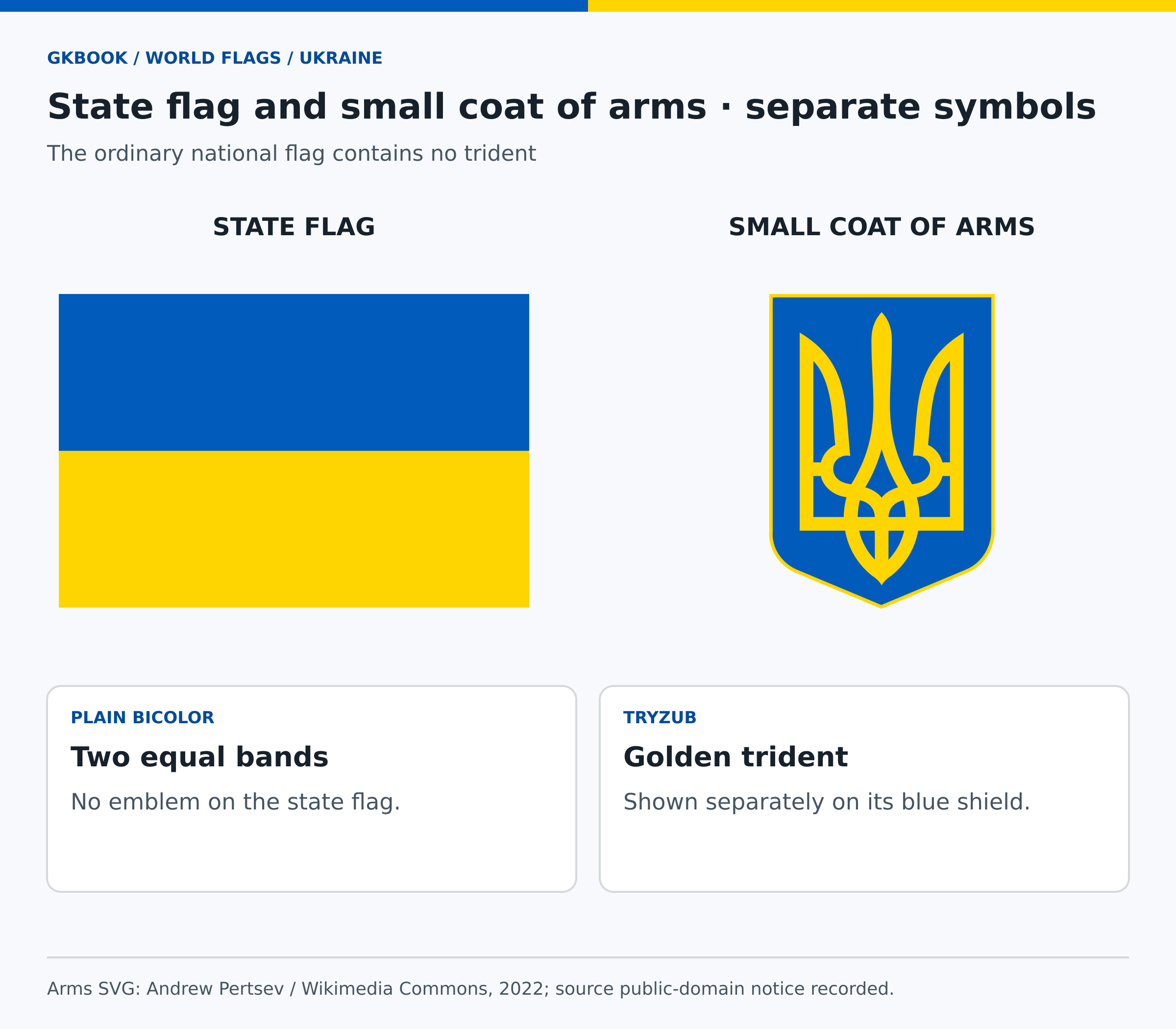
The standard State Flag of Ukraine has no trident or other emblem. The golden trident, called the Tryzub, belongs to the small State Coat of Arms and appears in other official designs. A blue-and-yellow banner carrying a trident is therefore an embellished version, not the plain national flag defined in the resolution.

Article 20 treats the flag and coat of arms as distinct state symbols. The small coat of arms was approved separately on February 19, 1992. The accompanying comparison displays the plain flag beside a separately credited shield illustration so that their relationship is clear.
The presidential standard is also different: it is a blue square bearing the golden state emblem, with ceremonial detailing described in its own regulations. Military and naval flags have their own designs. Use the plain horizontal bicolor when a general country flag is required, and identify special standards or decorated banners precisely.
How should the Ukraine flag be shown vertically?
In the documented vertical convention illustrated here, blue is on the viewer’s left and yellow on the right. This matches Ukrainian educational guidance and the International Judo Federation’s flag manual. Geometrically, it is the ordinary front-view flag rotated ninety degrees counterclockwise, with its proportions preserved and its entire surface visible.
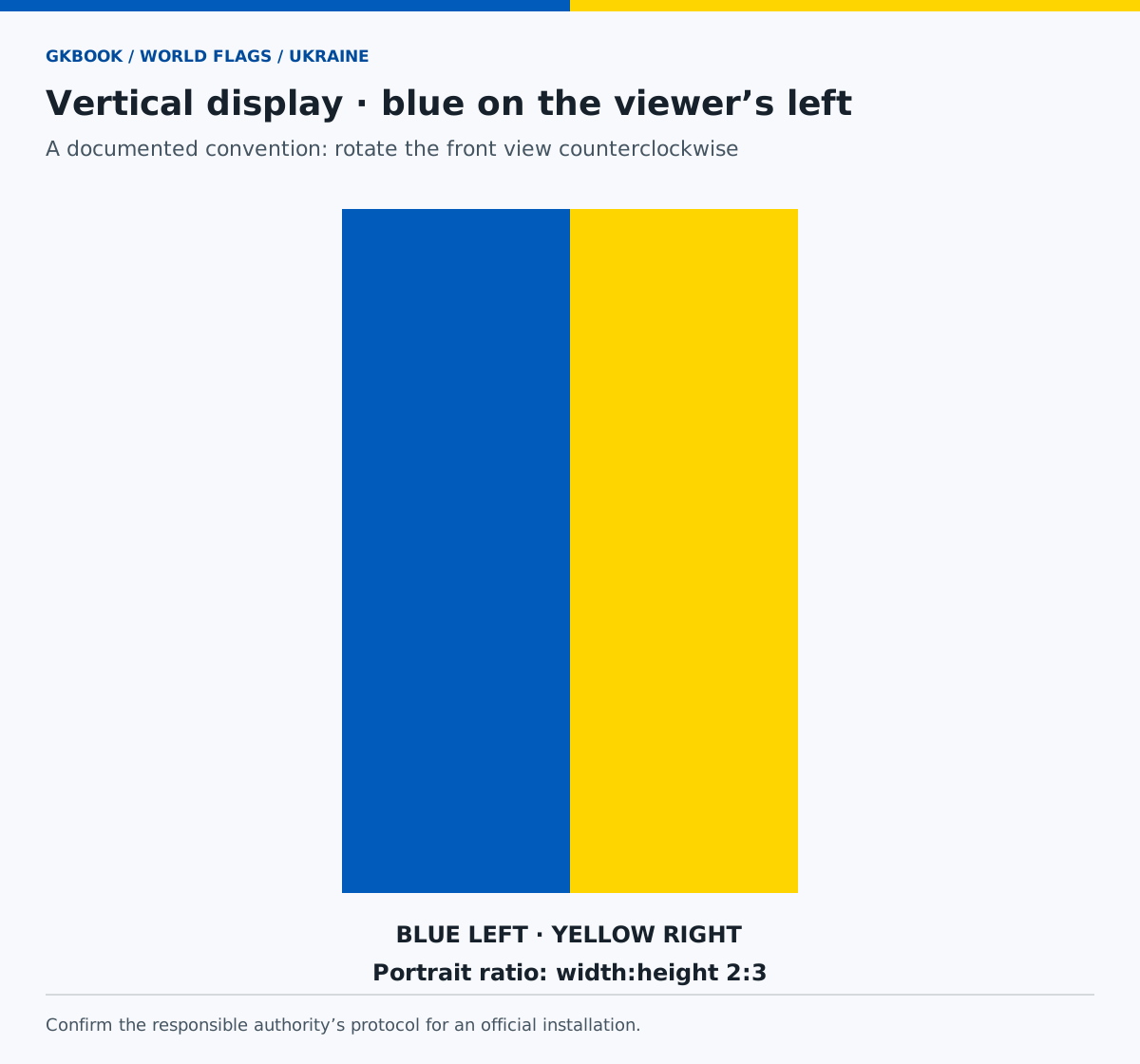
The resulting portrait rectangle is two units wide and three units high. Each vertical color field occupies half its width. A clockwise rotation of the same front view would put yellow on the left, so the direction of rotation should be stated when explaining the construction.
The 1992 legal description defines the standard horizontal flag. A vertical hanging arrangement adds a display convention; it does not amend that definition. Confirm the responsible authority’s protocol for an official installation. The illustration labels its sources and avoids stretching a horizontal image into a narrow banner.
What does the reverse side of the Ukraine flag look like?
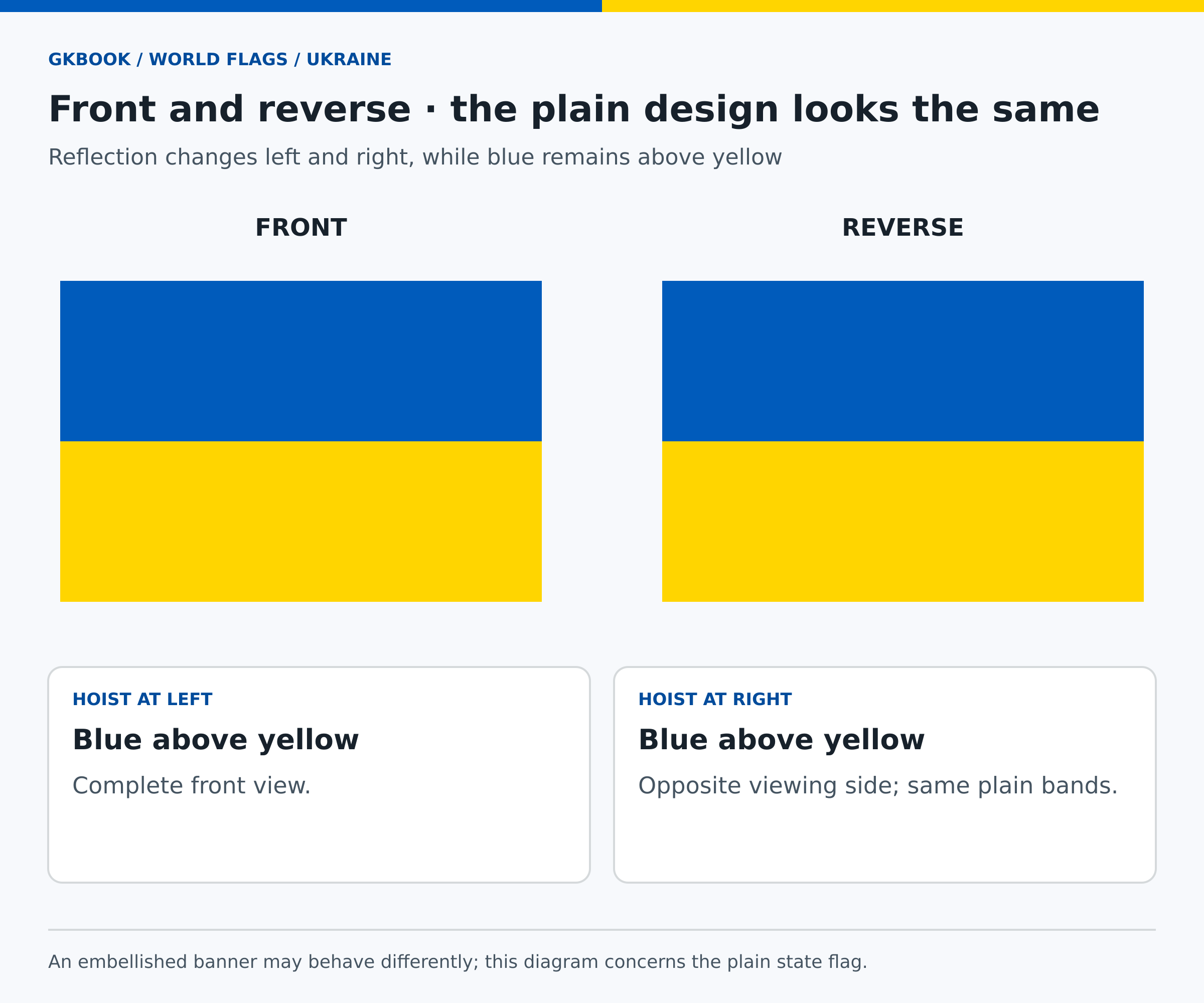
For the plain national design, the reverse looks the same as the front: blue remains above yellow. Viewing the cloth from its opposite side reverses left and right, but full-width horizontal bands are unchanged by that reflection. This differs from flags that contain directional animals, lettering, or an asymmetric emblem.
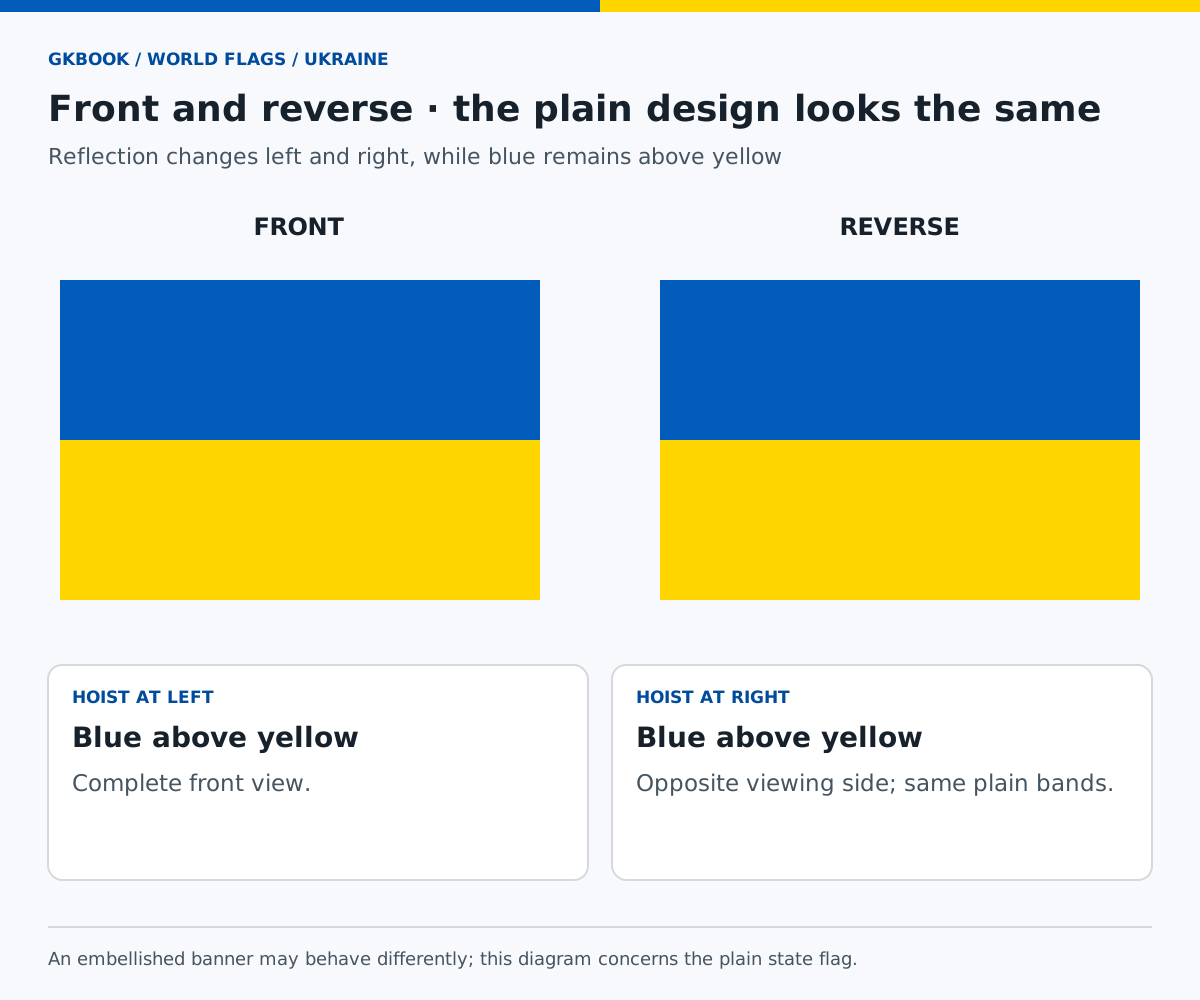
The hoist remains the actual attachment edge even when it appears on the viewer’s right. Reversing the viewing side does not exchange the top and bottom. The paired drawing shows the complete bicolor on both sides, with the attachment position labeled separately.
A decorated souvenir or military banner may contain writing or symbols that behave differently on its reverse. Those additions should not be used to infer a special reverse for the plain state flag. Fabric opacity and double-sided printing are manufacturing choices rather than changes to the national band order.
Is the Ukraine flag symmetrical?
The plain flag is symmetric about a vertical line through its center. Reflecting left and right leaves both bands unchanged. It is not symmetric about a horizontal centerline, because that exchanges blue and yellow. A half-turn also puts yellow above blue, so the design does not have 180-degree rotational symmetry.

The rectangle’s outline has more symmetries than the colored design. Geometry must consider the color of each point as well as the boundary of the cloth. Equal band areas do not make the two different colors interchangeable.
This distinction explains why a mirrored front view looks correct while an upside-down view does not. The symmetry diagram separates reflection from rotation and labels the transformed example as a geometry test, not as an alternative official flag.
How should Ukraine’s flag be displayed with other flags?
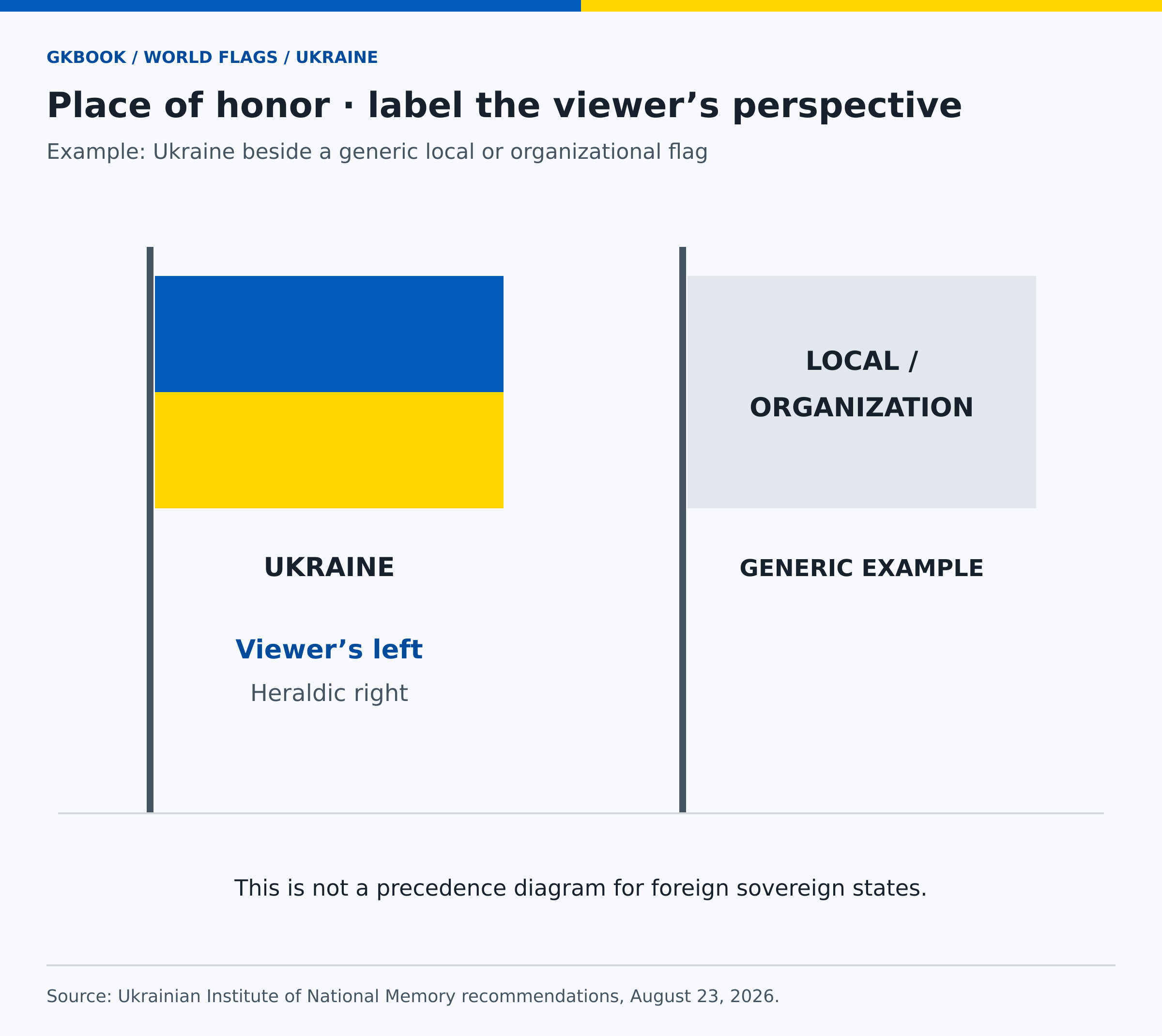
The Ukrainian Institute of National Memory recommends a place of honor for the State Flag when displayed in Ukraine. Its guidance identifies the heraldic right, which appears on the viewer’s left, for a frontal arrangement. Official international events also require their applicable diplomatic or organizational protocol rather than an improvised hierarchy.
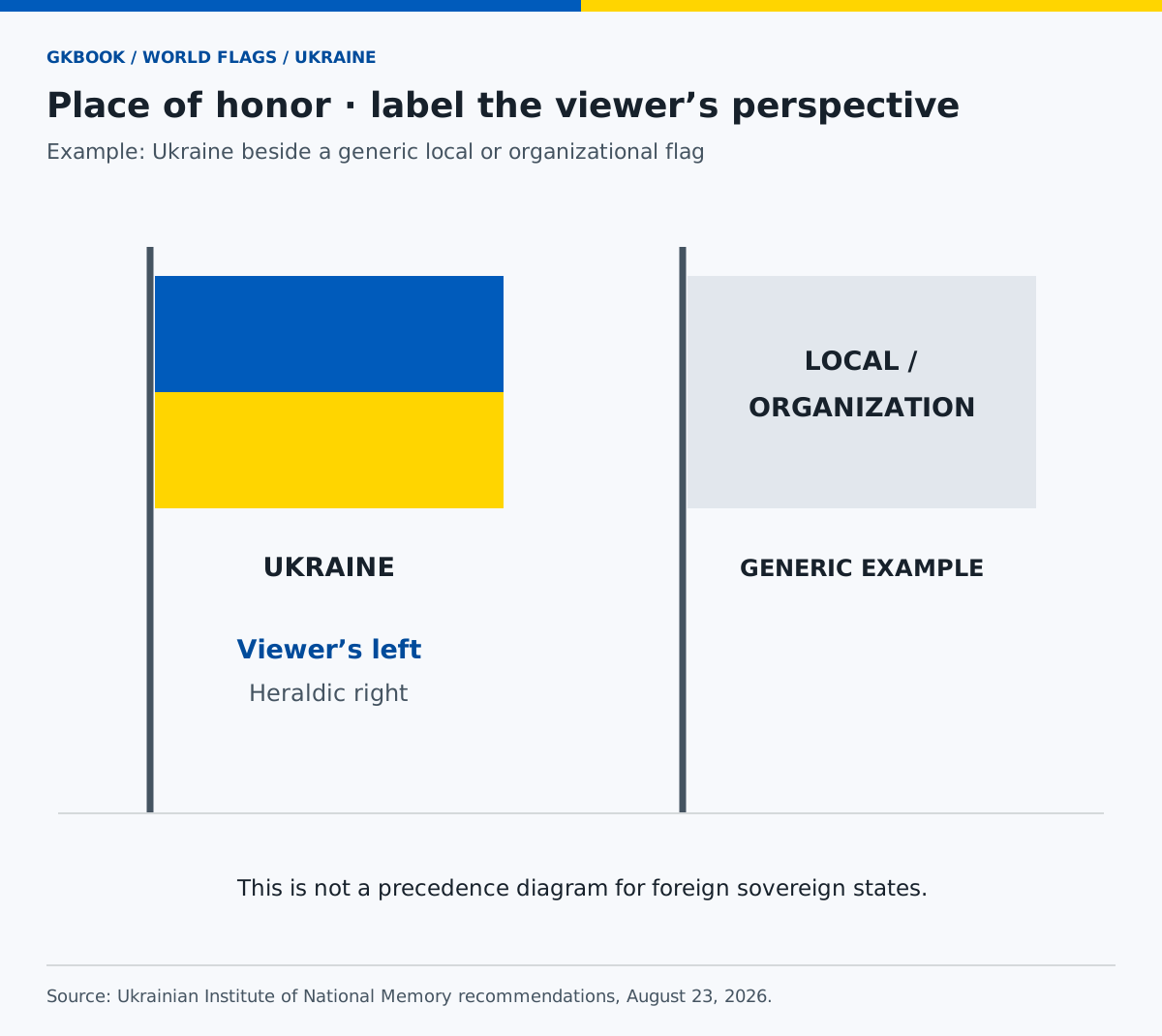
The illustrated two-flag example pairs Ukraine with a clearly labeled generic local or organizational flag. It shows the viewer’s perspective and keeps both poles at the same height. It is not a diagram placing Ukraine above another sovereign country’s flag.
The guidance also asks that flags have compatible dimensions and remain unobstructed by decorations, furniture, or screens. For a larger group, the order and venue matter. An event organizer should confirm the actual arrangement rather than applying a simple two-position illustration to every procession, stage, or international ceremony.
What are the main rules of respectful flag handling?
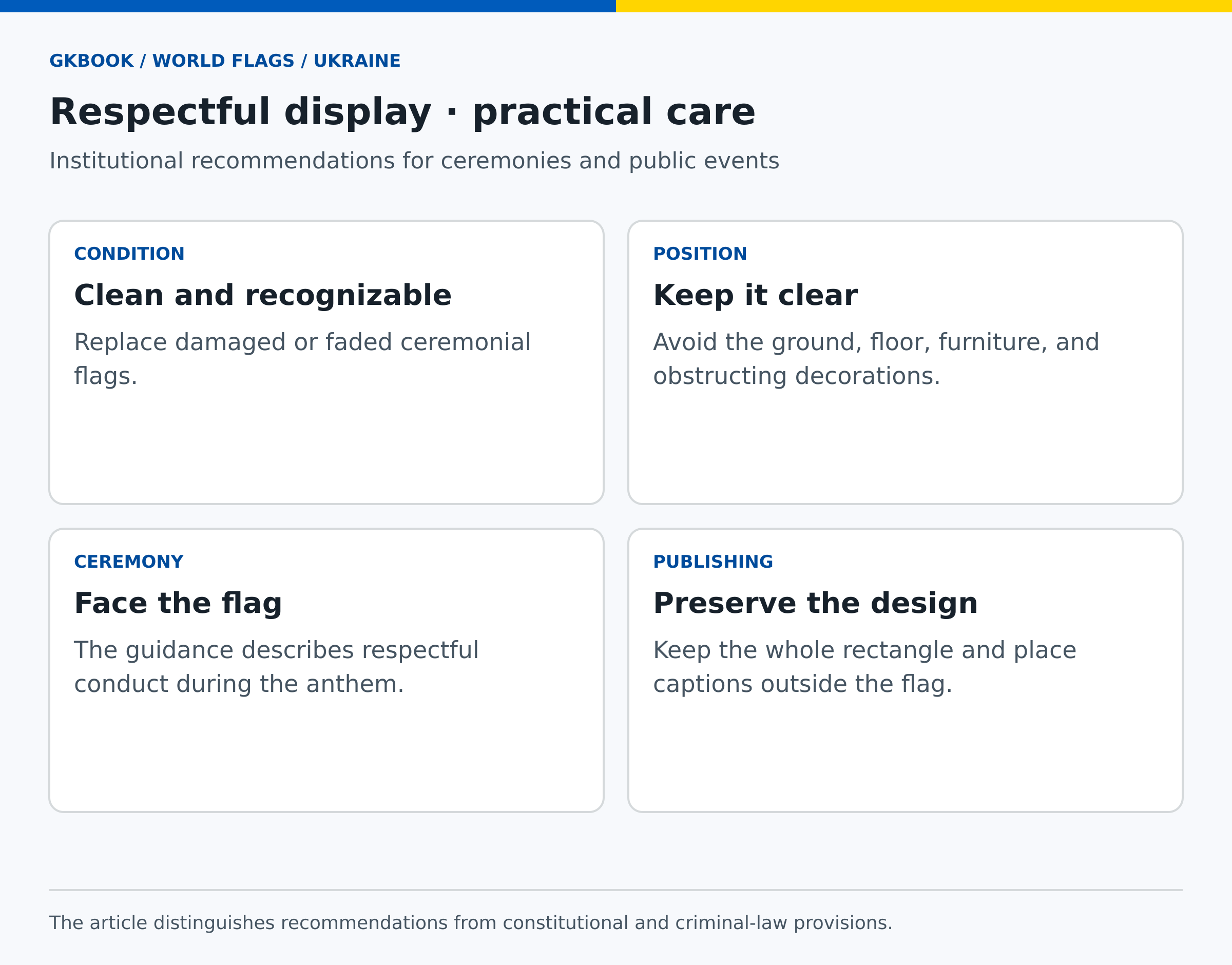
Keep the flag clean, recognizable, and in good condition, and prevent it from touching the ground or floor. Ukrainian institutional guidance calls for respectful treatment during ceremonies and discourages uses that demean the symbol. Keep decorations and unauthorized additions off the ceremonial flag, while placing explanatory captions outside the flag image.

The 2026 recommendations ask participants to face the flag during the national anthem, or face forward if it is absent. They describe placing the right hand over the heart as a recommended ceremonial gesture. Their wording should be preserved as guidance rather than expanded into an invented universal legal penalty.
For educational publishing, use a complete flag, an accurate caption, and clear separation between the national design and surrounding layout. Photographs of historic or damaged flags can document real objects, but the downloadable reference should remain clean and undistorted. Institutions should handle replacement and retirement under their applicable procedures.
How is the Ukraine flag displayed during mourning?
The 2026 Ukrainian Institute of National Memory recommendations describe lowering or inclining the State Flag during mourning and using a black mourning ribbon. The blue-over-yellow order stays unchanged. The occasion, duration, and exact ceremonial arrangement should follow the responsible authority’s announcement; the illustration is a schematic explanation of the change in position.
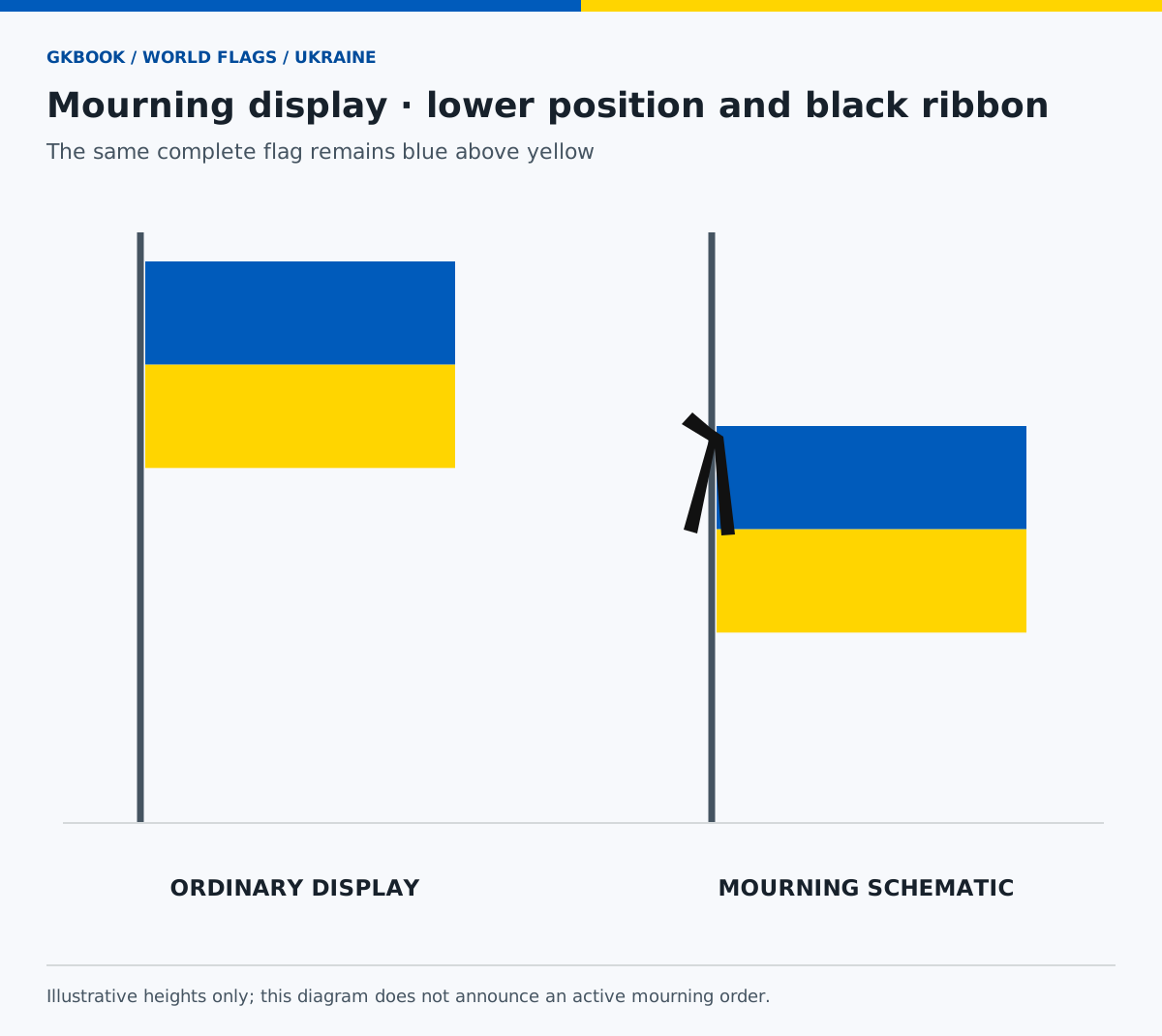
Lowering a flag does not mean turning it upside down, changing its colors, or painting a black stripe onto its cloth. A ribbon is an external mourning accessory. The diagram keeps the full bicolor visible and shows the ribbon attached near the hoist.
A photograph of a lowered flag cannot by itself establish the event being commemorated or how long the instruction remains in force. Those details require a dated notice. A static teaching page should explain the method without claiming that a mourning order is currently active.
Can the Ukraine flag be used commercially or changed in a design?
A downloadable flag image does not grant official endorsement or resolve every legal use question. Ukrainian law protects state symbols against public desecration, and trademark rules separately restrict protection of designs depicting or imitating state flags. Educational reproduction, branding, ceremonial use, and conduct alleged to insult the symbol require different assessments.
The Ministry of Economy explains that state symbols cannot themselves receive trademark protection and that inclusion as unprotected elements may require consent from the competent authority. This is a trademark rule, not a claim that every photograph, classroom drawing, or respectful private display needs a license.
Article 338 concerns public desecration, as explained in the Ministry of Justice’s June 2026 guidance. The article does not provide a blanket legal clearance for merchandise or an exact penalty guide. For a commercial mark or regulated campaign, check the current requirements in the relevant jurisdiction and the intended context.
Why is Ukraine’s flag used as a symbol of solidarity?
The flag represents Ukraine and its people, and it is also used to express solidarity with their sovereignty and freedom. Its visibility increased during Russia’s full-scale invasion in 2022. The design itself was not created for that war: it carries an older national tradition and was formally approved decades earlier.
The Ministry of Internal Affairs’ August 2022 message explicitly connected the flag with peace, freedom, and international solidarity. The United Nations records the start of the full-scale attack on February 24, 2022. These dated sources explain a modern context without replacing the flag’s earlier history.
A blue-and-yellow building illumination, ribbon, or social-media frame can refer to Ukraine without being a literal flag. A clean national-flag image should still preserve the two equal bands and 2:3 rectangle. Separate the country symbol from any accompanying slogan, organization logo, donation appeal, or commentary.
Which other flags use blue and yellow?
Sweden and Palau are two examples, but their arrangements are different. Sweden has a yellow Nordic cross on blue; Palau has a yellow disc on a pale blue field. Ukraine has two equal horizontal bands. Shared colors alone do not establish a shared design, historical origin, or symbolic meaning.
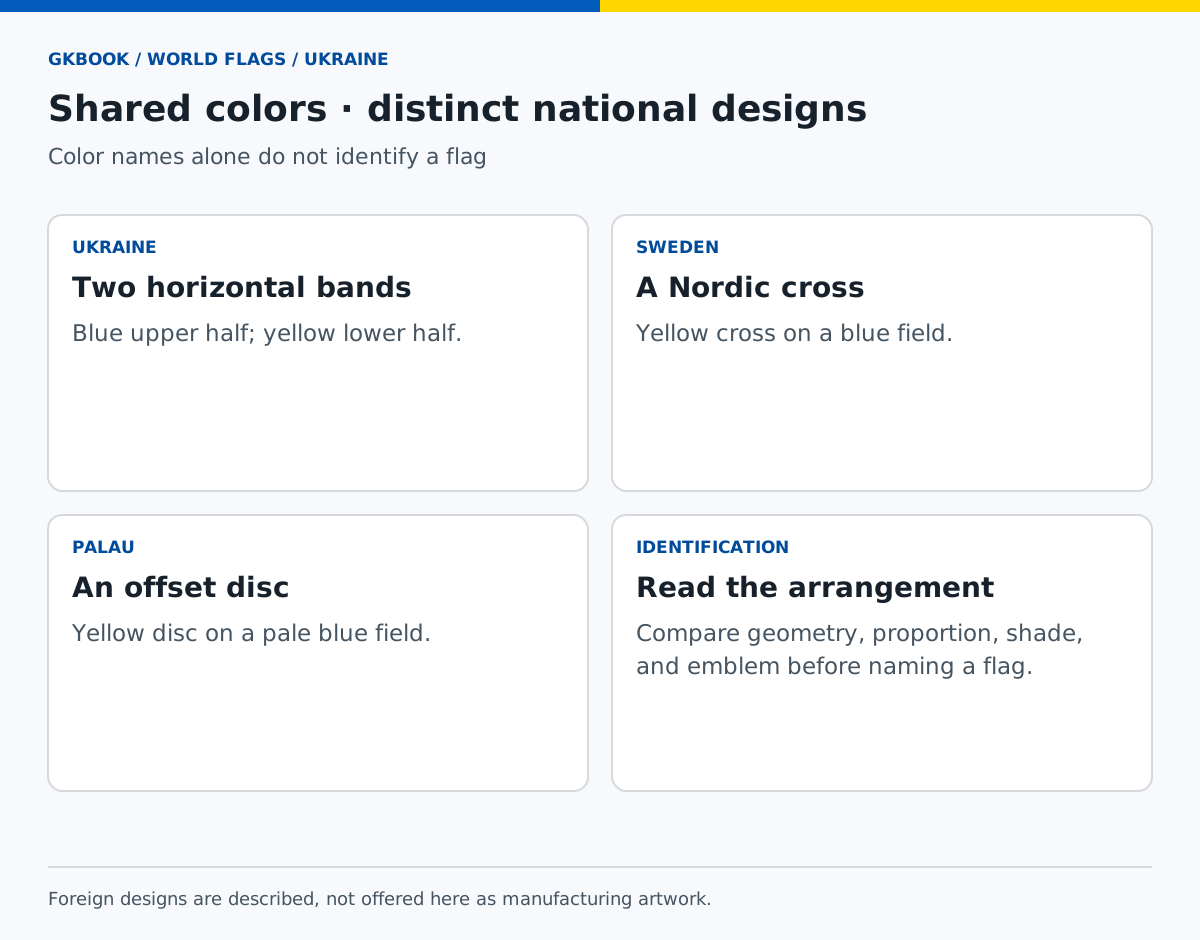
Nordic cooperation’s official description identifies Sweden’s cross and its distinct color references. Palau’s government describes its disc as slightly toward the hoist and associates its colors with the surrounding ocean and the full moon. Those meanings should not be transferred to Ukraine’s sky-and-wheat explanation.
For recognition, check the arrangement first, then proportion, shade, and any emblem. The comparison illustration uses text descriptions rather than presenting casually redrawn foreign flags as production references. A blue-and-yellow palette is not enough to identify a national flag accurately.
What downloadable Ukraine flag files and print sizes are included?
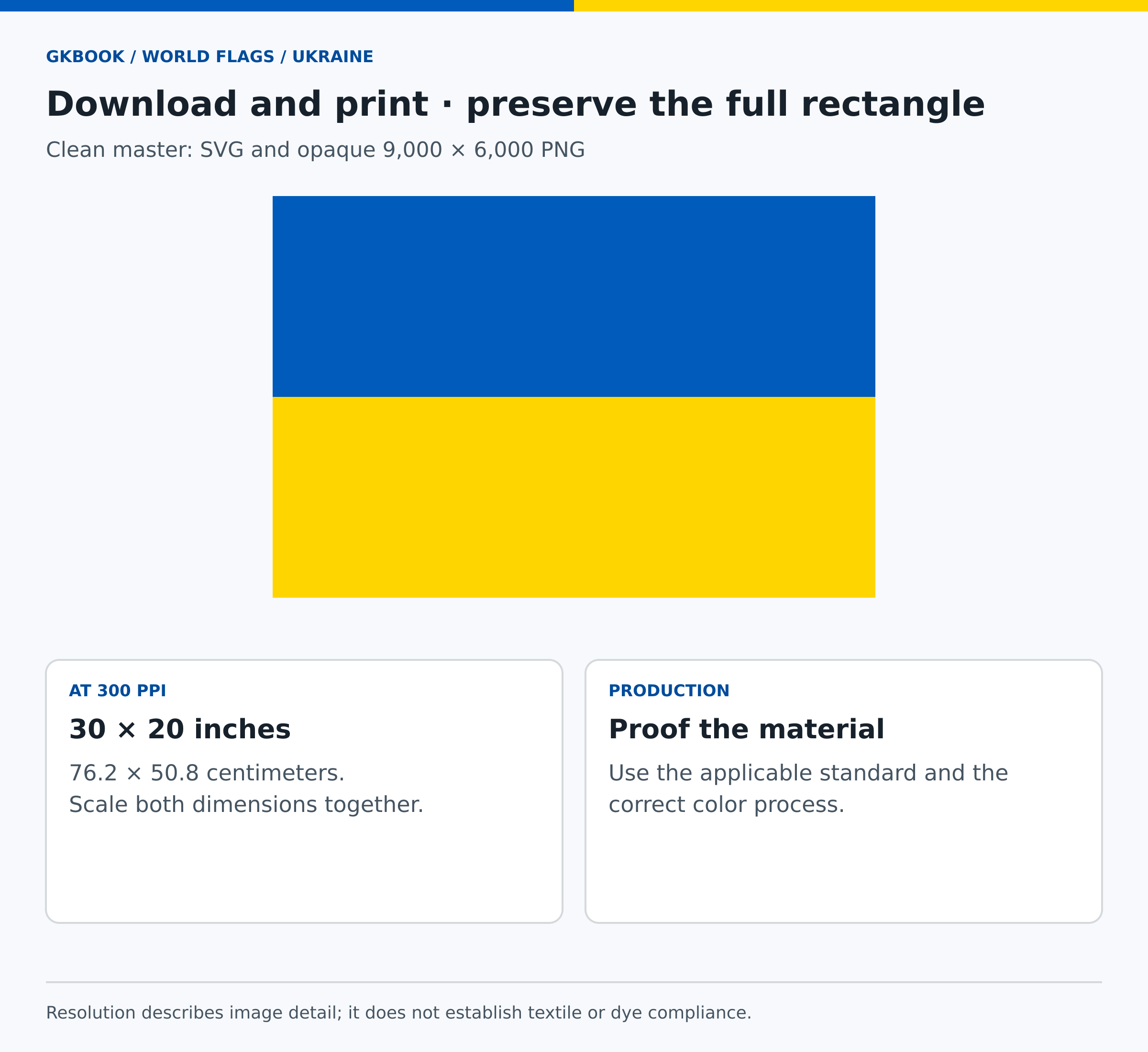
The clean flag is supplied as SVG and as an opaque 9,000-by-6,000-pixel PNG. At 300 pixels per inch, the PNG supports a 30-by-20-inch reference print without enlargement. Twenty-four gallery subjects have SVG and PNG versions, and a separate social-sharing card preserves the complete national flag beside its title.

Keep the aspect ratio locked when resizing. On a square poster or profile canvas, place the full rectangle inside the available space instead of cropping a band or stretching the image. The SVG preserves exact geometric proportions at different output sizes.
For physical flags or commercial print, use the applicable manufacturing standard, correct color process, and a proof on the intended material. Pixel dimensions describe image detail; they do not certify fabric or dye. The download bibliography identifies the legal design, the published RGB palette, and the separately credited coat-of-arms illustration.
| Resolution | Width | Height |
|---|---|---|
| 300 pixels/inch | 30 in / 76.2 cm | 20 in / 50.8 cm |
| 200 pixels/inch | 45 in / 114.3 cm | 30 in / 76.2 cm |
| 150 pixels/inch | 60 in / 152.4 cm | 40 in / 101.6 cm |
Sources and research notes
This article draws on Ukraine’s adoption resolution and Constitution, parliamentary and city records, the Ukrainian Institute of National Memory, specialist heraldic research, government guidance, UN records, and technical-standard references. The source bibliography and image credits identify the documents and the reference artwork.
The legal definition, historical evidence, cultural meanings, and display recommendations answer different questions. The flag drawing follows the statutory geometry and identified RGB palette; captions distinguish teaching illustrations from the clean national design.
Download Ukraine flag pictures
Download the complete national flag as SVG or 9,000 × 6,000 PNG. Both preserve the official 2:3 ratio and two equal bands, blue above yellow. The PNG contains opaque colors.
The gallery includes 24 subjects, each available as SVG and PNG. The separate 1,200 × 630 social-sharing card places a complete flag beside its title. Use the clean master for a country flag and labeled illustrations for teaching. Read the technical-standard note before using a screen reference for physical production.
Continue exploring national designs in World Flags.
World Flags/Ukraine
Ukraine flag pictures
Two equal horizontal bands, blue above yellow, with official height:length ratio 2:3. No emblem belongs on the plain state flag.
Flag construction and explanatory layout: GKBook. Design: resolution 2067-XII (1992); RGB: Ukrainian Institute of National Memory (2026).Download SVGDownload PNGThis edition uses #005BBB and #FFD500. Pantone and CMYK entries reproduce the published recommendations; they are not calculated conversions.
Flag construction and explanatory layout: GKBook. Design: resolution 2067-XII (1992); RGB: Ukrainian Institute of National Memory (2026).Download SVGDownload PNGGovernment explanations use the sky-and-wheat interpretation and connect the flag with peace and freedom.
Flag construction and explanatory layout: GKBook. Design: resolution 2067-XII (1992); RGB: Ukrainian Institute of National Memory (2026).Download SVGDownload PNGThe master is 9,000 × 6,000 with two 3,000-pixel-high bands. Height:length 2:3 is the same as digital width:height 3:2.
Flag construction and explanatory layout: GKBook. Design: resolution 2067-XII (1992); RGB: Ukrainian Institute of National Memory (2026).Download SVGDownload PNGBlue occupies the upper 300 units of a 600-unit height; yellow occupies the lower 300 units.
Flag construction and explanatory layout: GKBook. Design: resolution 2067-XII (1992); RGB: Ukrainian Institute of National Memory (2026).Download SVGDownload PNGThe clean raster has exactly 27 million pixels of each color. The labels in this teaching diagram are not part of the clean download.
Flag construction and explanatory layout: GKBook. Design: resolution 2067-XII (1992); RGB: Ukrainian Institute of National Memory (2026).Download SVGDownload PNGThe 9-by-6 grid preserves the official 2:3 ratio and equal band heights.
Flag construction and explanatory layout: GKBook. Design: resolution 2067-XII (1992); RGB: Ukrainian Institute of National Memory (2026).Download SVGDownload PNGThe history of the colors is longer than the history of the present legal specification.
Flag construction and explanatory layout: GKBook. Design: resolution 2067-XII (1992); RGB: Ukrainian Institute of National Memory (2026).Download SVGDownload PNGDocumentary research does not support a simple story that Skoropadskyi reversed an officially yellow-over-blue national flag.
Flag construction and explanatory layout: GKBook. Design: resolution 2067-XII (1992); RGB: Ukrainian Institute of National Memory (2026).Download SVGDownload PNGThe sequence is based on Kyiv city records, parliament’s historical account, and the adoption resolution.
Flag construction and explanatory layout: GKBook. Design: resolution 2067-XII (1992); RGB: Ukrainian Institute of National Memory (2026).Download SVGDownload PNGThe modern adoption date is distinct from independence in 1991 and constitutional recognition in 1996.
Flag construction and explanatory layout: GKBook. Design: resolution 2067-XII (1992); RGB: Ukrainian Institute of National Memory (2026).Download SVGDownload PNGThe legal adoption document does not identify a single artistic designer of the national bicolor.
Flag construction and explanatory layout: GKBook. Design: resolution 2067-XII (1992); RGB: Ukrainian Institute of National Memory (2026).Download SVGDownload PNGState Flag Day is August 23; Independence Day is August 24. The large flag entered parliament on August 24, 1991.
Flag construction and explanatory layout: GKBook. Design: resolution 2067-XII (1992); RGB: Ukrainian Institute of National Memory (2026).Download SVGDownload PNGStatutory description, constitutional status, criminal protection, and production specifications should not be conflated.
Flag construction and explanatory layout: GKBook. Design: resolution 2067-XII (1992); RGB: Ukrainian Institute of National Memory (2026).Download SVGDownload PNGThe inspected publications support the drawing and cited colors, while physical manufacture requires the applicable full specification.
Flag construction and explanatory layout: GKBook. Design: resolution 2067-XII (1992); RGB: Ukrainian Institute of National Memory (2026).Download SVGDownload PNGThe flag and arms are distinct state symbols. The shield is a credited source illustration and is not placed on the flag.
Flag construction and explanatory layout: GKBook. Design: resolution 2067-XII (1992); RGB: Ukrainian Institute of National Memory (2026). Small coat of arms: Andrew Pertsev, Wikimedia Commons, October 15, 2022; source public-domain notice retained.Download SVGDownload PNGA ninety-degree counterclockwise rotation puts blue on the viewer’s left. Ukrainian educational guidance and the IJF manual show this arrangement.
Flag construction and explanatory layout: GKBook. Design: resolution 2067-XII (1992); RGB: Ukrainian Institute of National Memory (2026).Download SVGDownload PNGThe national bicolor has no directional device or lettering; a horizontal reflection leaves it unchanged.
Flag construction and explanatory layout: GKBook. Design: resolution 2067-XII (1992); RGB: Ukrainian Institute of National Memory (2026).Download SVGDownload PNGThe design has vertical mirror symmetry, but no horizontal mirror symmetry and no half-turn symmetry.
Flag construction and explanatory layout: GKBook. Design: resolution 2067-XII (1992); RGB: Ukrainian Institute of National Memory (2026).Download SVGDownload PNGThe national flag occupies the viewer’s left in this local or organizational example. Diplomatic and international events require their own applicable protocol.
Flag construction and explanatory layout: GKBook. Design: resolution 2067-XII (1992); RGB: Ukrainian Institute of National Memory (2026).Download SVGDownload PNGThese practical points summarize the cited institutional recommendations and distinguish publishing layout from the national design.
Flag construction and explanatory layout: GKBook. Design: resolution 2067-XII (1992); RGB: Ukrainian Institute of National Memory (2026).Download SVGDownload PNGThe cited guidance describes lowering or inclining the flag with a black mourning ribbon. Exact arrangements follow the responsible authority’s direction.
Flag construction and explanatory layout: GKBook. Design: resolution 2067-XII (1992); RGB: Ukrainian Institute of National Memory (2026).Download SVGDownload PNGSweden and Palau use blue and yellow in arrangements different from Ukraine’s bicolor, with different national meanings.
Flag construction and explanatory layout: GKBook. Design: resolution 2067-XII (1992); RGB: Ukrainian Institute of National Memory (2026).Download SVGDownload PNGThe clean raster can produce a 30-by-20-inch reference print at 300 pixels per inch without enlargement.
Flag construction and explanatory layout: GKBook. Design: resolution 2067-XII (1992); RGB: Ukrainian Institute of National Memory (2026).Download SVGDownload PNGFrequently asked questions
What does the Ukraine flag look like?
The State Flag of Ukraine is a plain rectangular bicolor with two equal horizontal bands: blue above yellow. Its official height:length ratio is 2:3. The current design was formally approved on January 28, 1992, drawing on a much older national color tradition. The ordinary flag has no trident or other emblem.
What is the Ukraine flag called, and what is its emoji?
Its formal English name is the State Flag of Ukraine; “Ukrainian flag” and “Ukraine flag” refer to the same national design. In Ukrainian it is Державний Прапор України. The familiar blue-and-yellow description identifies its two colors, while the legal design specifies which color belongs above the other. Its flag emoji is 🇺🇦.
What are the Ukraine flag colors and their digital codes?
The colors are blue and yellow. This package uses blue #005BBB, or RGB 0, 91, 187, and yellow #FFD500, or RGB 255, 213, 0. These values follow the Ukrainian Institute of National Memory’s August 2026 recommendations. They are identified here as the chosen digital reproduction palette.
What does the Ukraine flag symbolize?
A familiar interpretation connects blue with the sky and yellow with ripe wheat fields. Ukrainian government explanations also associate the flag with peace, freedom, and national unity. This landscape reading helps explain its modern symbolism, while the blue-and-yellow color tradition has a longer history in heraldry and national movements.
What does the blue band represent?
Blue is the upper half of Ukraine’s flag and is commonly associated with the sky. Official public explanations connect the combined blue-and-yellow design with peace and freedom. The adopted flag uses a blue field of equal size to the yellow field, with a straight horizontal boundary between them.
What does the yellow band represent?
Yellow forms the lower half and is commonly associated with ripe wheat fields. It also belongs to the older blue-and-gold heraldic tradition associated with Ukrainian lands. On the present state flag, yellow is a plain, continuous band, equal in height and area to the blue band above it.
What is the official ratio of the Ukraine flag?
The official proportion is height:length 2:3. A flag two units high is three units long, and each horizontal band is one unit high. The resolution adopted on January 28, 1992 states this ratio explicitly. The supplied master follows it at 9,000 pixels wide by 6,000 pixels high.
Which color goes on top, and how are the bands arranged?
Blue goes on top and yellow goes below. Both horizontal bands are equal in height and extend across the full length. On a 900-by-600 construction drawing, blue occupies y = 0 to 300 and yellow occupies y = 300 to 600. Their boundary lies exactly halfway down.
Do blue and yellow occupy equal areas?
Yes. Each color occupies exactly one half of the clean flag’s area. The flag has no emblem covering either band. In the 9,000-by-6,000 PNG, the total is 54 million pixels: 27 million blue and 27 million yellow. These totals describe the supplied flat image without a border or shadow.
How can the Ukraine flag be drawn accurately?
Draw a landscape rectangle three units long and two units high. Divide it horizontally into two equal halves. Fill the upper half blue and the lower half yellow. Keep the dividing line straight and use solid colors. The standard national design requires no emblem, lettering, outline, or additional stripe.
How old are Ukraine’s blue-and-yellow national colors?
Their history is older than the present state flag. Blue and gold appear in heraldry associated with Ukrainian lands, including the golden lion on a blue field. Blue-and-yellow flags became established symbols of the Ukrainian national movement during the revolutions of 1848, including a documented appearance at Lviv’s town hall.
Was the flag used during the Ukrainian Revolution of 1917–1921?
Yes. Blue-and-yellow flags represented Ukrainian statehood during the revolution of 1917–1921. Early popular displays included variations in band order, but the documented government flag provisions examined by historians used blue above yellow. The story that Pavlo Skoropadskyi simply reversed an officially yellow-over-blue national flag is not supported by those records.
How did the blue-and-yellow flag return in 1990–1992?
The national colors returned to public prominence during the movement for independence. A flag was raised at Kyiv’s city council on July 24, 1990. It entered parliament’s chamber on August 24, 1991 and flew over the parliamentary building on September 4. Formal state-flag approval followed on January 28, 1992.
When was the present Ukraine flag officially adopted?
The present State Flag of Ukraine was formally approved on January 28, 1992 by Verkhovna Rada resolution No. 2067-XII. It specifies blue above yellow, equal horizontal bands, and a 2:3 ratio. The national colors had already returned to public and official use before that formal design resolution.
Who designed the Ukraine flag?
The modern flag is rooted in an established national color tradition rather than a documented single designer’s new invention in 1992. The adoption resolution approves the national bicolor without naming an artistic author. It is more accurate to explain its historical development than to assign a designer without reliable evidence.
When is Ukraine’s National Flag Day?
Ukraine celebrates the Day of the State Flag on August 23 each year. Presidential Decree No. 987/2004 established the national observance in 2004. It falls one day before Independence Day. The holiday celebrates the national symbol and its history; it is not the date of the 1992 flag-adoption resolution.
How are Flag Day and Independence Day different?
Flag Day is August 23; Independence Day is August 24. Independence Day commemorates the 1991 declaration of independence, while Flag Day honors the national flag through an observance established in 2004. The present design was formally approved on January 28, 1992. These three dates describe three different events.
Which legal documents define and protect the Ukraine flag?
The January 28, 1992 parliamentary resolution specifies the design and ratio. Article 20 of the Constitution identifies the State Flag among Ukraine’s national symbols, and Article 65 makes respect for state symbols a citizen’s duty. Criminal Code Article 338 addresses public desecration. Technical production requirements belong to a separate standard.
Is there a technical standard for manufacturing Ukraine’s flag?
Yes. DSTU 4512:2006, State Flag of Ukraine — General Technical Specifications, addresses flags made from fabric and color reproduction in specified production processes. The 2026 Ukrainian Institute of National Memory guidance cites it for Pantone references. This digital package follows the legal geometry and the guidance’s RGB values, without claiming textile certification.
Does Ukraine’s national flag include the trident?
The standard State Flag of Ukraine has no trident or other emblem. The golden trident, called the Tryzub, belongs to the small State Coat of Arms and appears in other official designs. A blue-and-yellow banner carrying a trident is therefore an embellished version, not the plain national flag defined in the resolution.
How should the Ukraine flag be shown vertically?
In the documented vertical convention illustrated here, blue is on the viewer’s left and yellow on the right. This matches Ukrainian educational guidance and the International Judo Federation’s flag manual. Geometrically, it is the ordinary front-view flag rotated ninety degrees counterclockwise, with its proportions preserved and its entire surface visible.
What does the reverse side of the Ukraine flag look like?
For the plain national design, the reverse looks the same as the front: blue remains above yellow. Viewing the cloth from its opposite side reverses left and right, but full-width horizontal bands are unchanged by that reflection. This differs from flags that contain directional animals, lettering, or an asymmetric emblem.
Is the Ukraine flag symmetrical?
The plain flag is symmetric about a vertical line through its center. Reflecting left and right leaves both bands unchanged. It is not symmetric about a horizontal centerline, because that exchanges blue and yellow. A half-turn also puts yellow above blue, so the design does not have 180-degree rotational symmetry.
How should Ukraine’s flag be displayed with other flags?
The Ukrainian Institute of National Memory recommends a place of honor for the State Flag when displayed in Ukraine. Its guidance identifies the heraldic right, which appears on the viewer’s left, for a frontal arrangement. Official international events also require their applicable diplomatic or organizational protocol rather than an improvised hierarchy.
What are the main rules of respectful flag handling?
Keep the flag clean, recognizable, and in good condition, and prevent it from touching the ground or floor. Ukrainian institutional guidance calls for respectful treatment during ceremonies and discourages uses that demean the symbol. Keep decorations and unauthorized additions off the ceremonial flag, while placing explanatory captions outside the flag image.
How is the Ukraine flag displayed during mourning?
The 2026 Ukrainian Institute of National Memory recommendations describe lowering or inclining the State Flag during mourning and using a black mourning ribbon. The blue-over-yellow order stays unchanged. The occasion, duration, and exact ceremonial arrangement should follow the responsible authority’s announcement; the illustration is a schematic explanation of the change in position.
Can the Ukraine flag be used commercially or changed in a design?
A downloadable flag image does not grant official endorsement or resolve every legal use question. Ukrainian law protects state symbols against public desecration, and trademark rules separately restrict protection of designs depicting or imitating state flags. Educational reproduction, branding, ceremonial use, and conduct alleged to insult the symbol require different assessments.
Why is Ukraine’s flag used as a symbol of solidarity?
The flag represents Ukraine and its people, and it is also used to express solidarity with their sovereignty and freedom. Its visibility increased during Russia’s full-scale invasion in 2022. The design itself was not created for that war: it carries an older national tradition and was formally approved decades earlier.
Which other flags use blue and yellow?
Sweden and Palau are two examples, but their arrangements are different. Sweden has a yellow Nordic cross on blue; Palau has a yellow disc on a pale blue field. Ukraine has two equal horizontal bands. Shared colors alone do not establish a shared design, historical origin, or symbolic meaning.
What downloadable Ukraine flag files and print sizes are included?
The clean flag is supplied as SVG and as an opaque 9,000-by-6,000-pixel PNG. At 300 pixels per inch, the PNG supports a 30-by-20-inch reference print without enlargement. Twenty-four gallery subjects have SVG and PNG versions, and a separate social-sharing card preserves the complete national flag beside its title.
Every general-knowledge topic and the A-to-Z lists.
The world A to Z: flags, countries, the sciences, places, people, subjects.













We Value Your Opinion Comments