
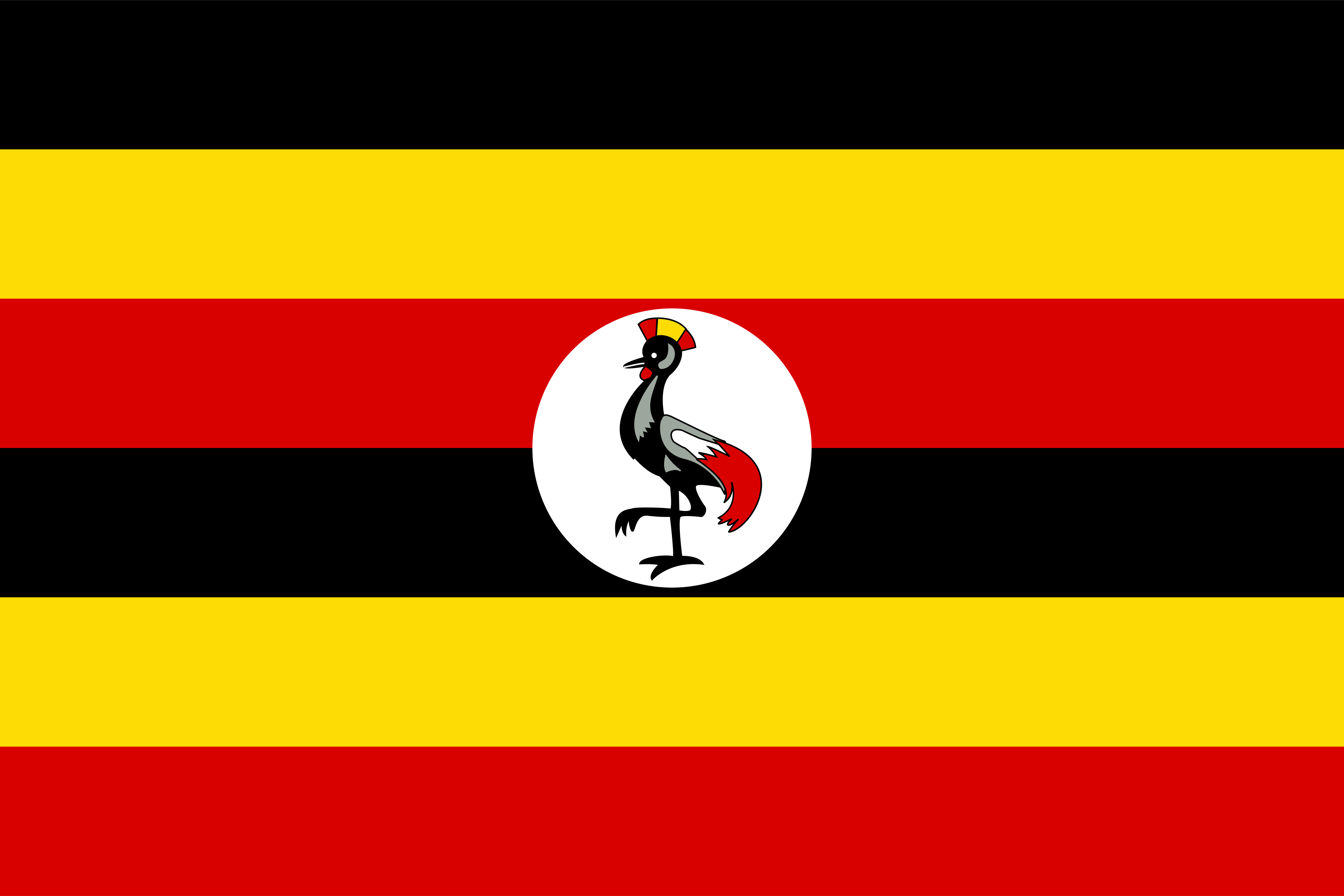
Uganda flag picture
Explore the national bird, proportions, and picture gallery.
| Official name | National Flag of UgandaRepresents the Republic of Uganda. |
|---|---|
| Composition | Six equal horizontal bandsBlack, yellow, red, black, yellow, red. |
| Central device | Crested crane on a white discThe bird faces the hoist. |
| Reference ratio | Height:length = 2:3The supplied master is 9,000 × 6,000. |
| Adopted | October 9, 1962Independence and commencement of the flag Act. |
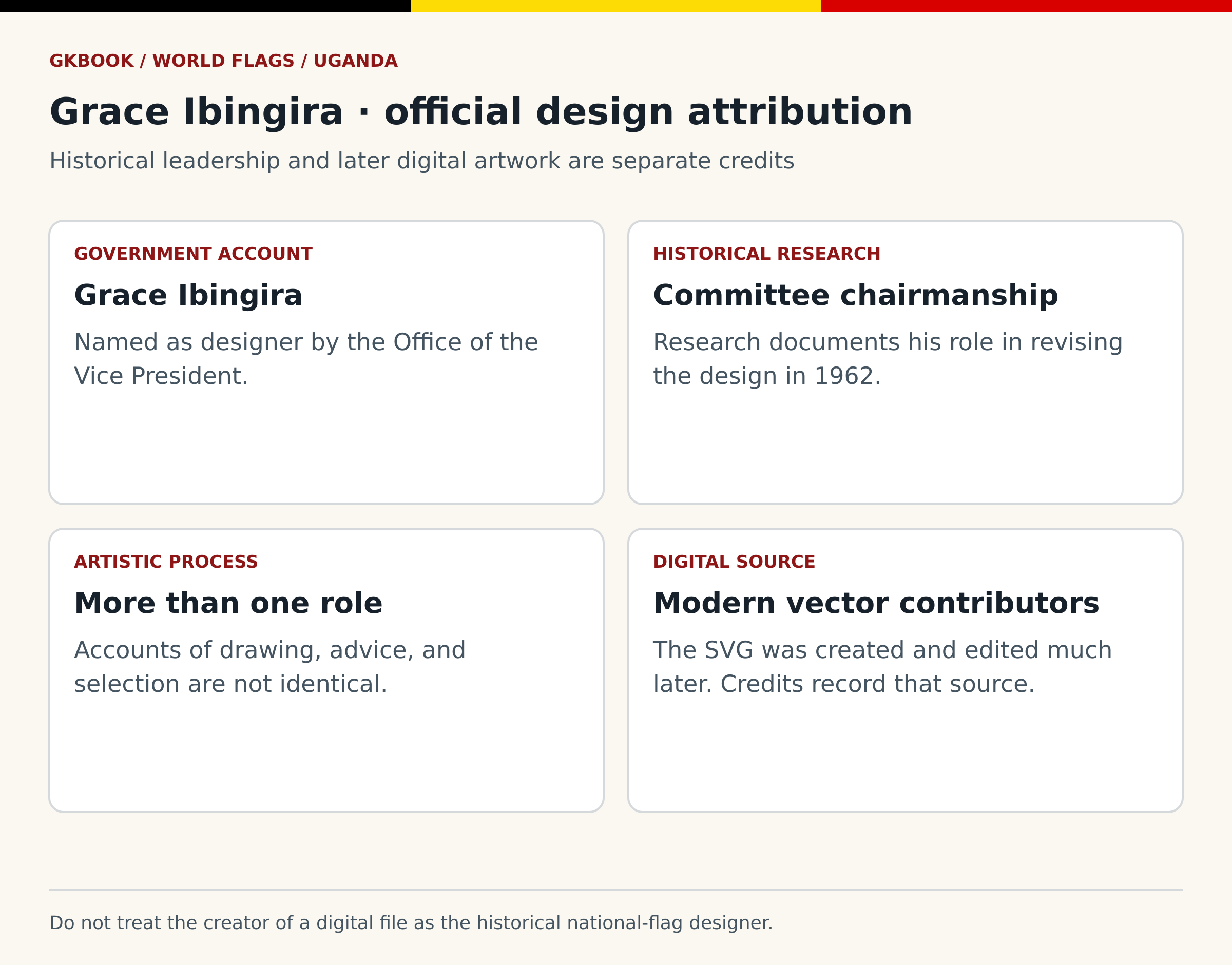
| Design attribution | Grace IbingiraOfficial attribution; committee context explained below. |
| Flag law | Chapter 1722023 revised edition; previously Chapter 254. |
| Technical standard | US 1:2011Manufacturing specification; full text not inspected. |
The central bird is a crane, not the complete national coat of arms.
What does the Uganda flag look like?
The Uganda flag has six equal horizontal bands in the order black, yellow, red, black, yellow, and red. A white disc at the center contains a crested crane facing the hoist. The standard reference proportion is height:length 2:3, and the flag was adopted at independence on October 9, 1962.
The repeated three-color sequence makes Uganda’s flag easy to recognize, while the crane gives it a distinctive national emblem. This article explains its history, symbolism, proportions, and display, and supplies clean flag artwork alongside labeled teaching diagrams. Official descriptions, historical evidence, technical standards, and the measurements of the chosen digital reference are distinguished throughout.
What is the Uganda flag called?
The formal English name is the National Flag of Uganda. It represents the Republic of Uganda, an East African country whose capital is Kampala. Uganda’s national flag should be distinguished from the presidential standard, military flags, political-party banners, and the flags associated with particular kingdoms or cultural institutions.
“Uganda flag” and “Ugandan flag” are ordinary English descriptions of the same national design. The National Flag and Armorial Ensigns Act declares the national flag and the national coat of arms separately. Their shared use of a crane does not make those two symbols interchangeable.
In flag terminology, the hoist is the edge attached to a pole or rope; the fly is the opposite, free edge. The standard front view puts the hoist at the viewer’s left. These terms make it easier to describe the crane’s direction without confusing the front and back of a flag.
What are the Uganda flag colors and digital values?
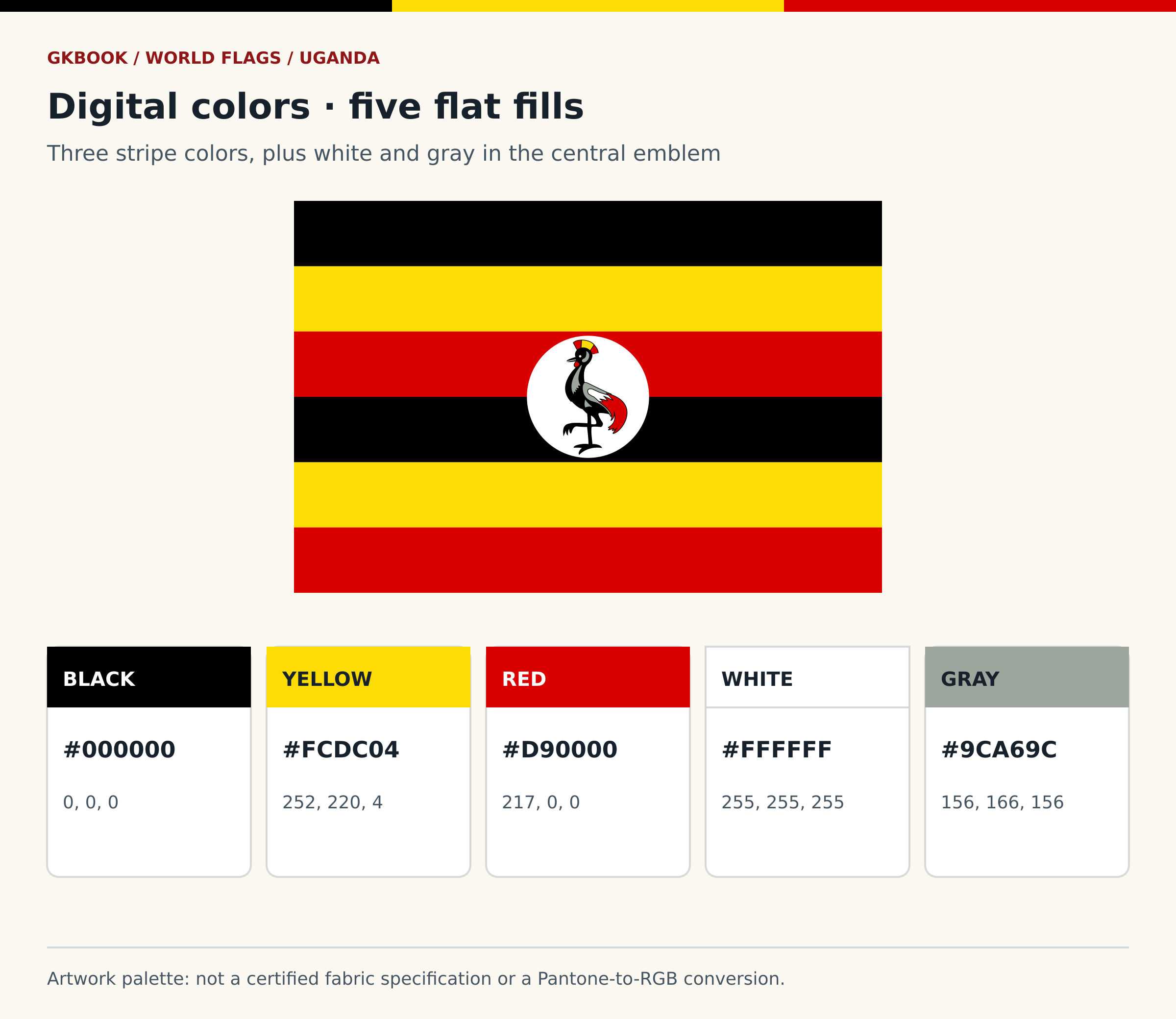
The stripes are black, yellow, and red, repeated twice. White forms the central disc, and gray appears in the crane. The supplied reference artwork uses black #000000, yellow #FCDC04, red #D90000, white #FFFFFF, and gray #9CA69C. These are measured digital fills, not a certified national textile palette.
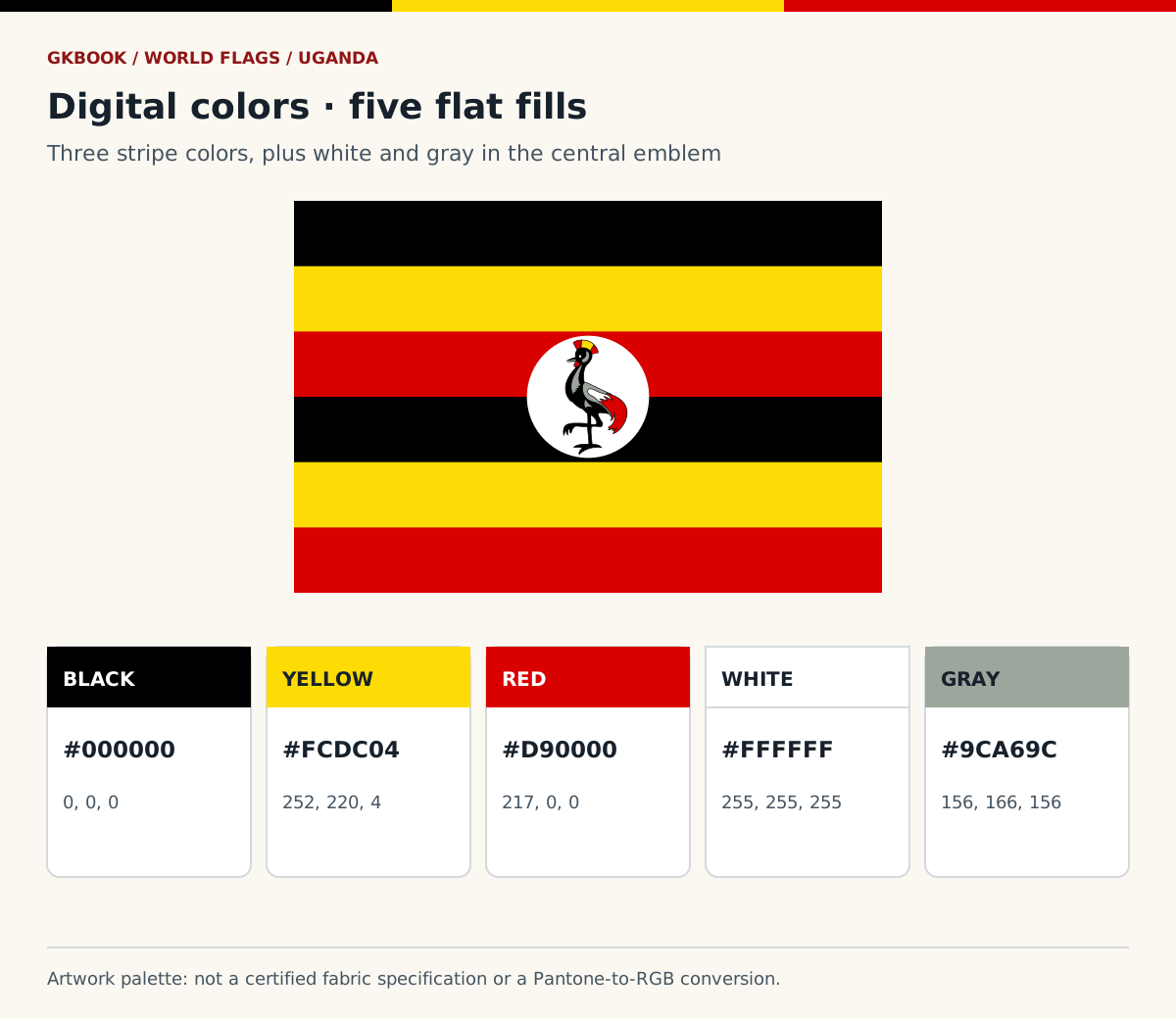
The three stripe colors and the colors inside the emblem answer different questions. Saying that Uganda has three national flag colors usually refers to the repeated bands. Counting the flat colors in this particular digital drawing gives five; antialiased edges in a raster image can introduce many additional intermediate pixel values.
The Commons description page lists slightly different yellow, red, and gray values from its actual SVG. This edition follows the downloaded vector file consistently. The 2026 International Judo Federation manual gives Pantone references 109, 032, 430, and Black for its event artwork. Those references are not presented here as equivalent RGB conversions or Ugandan manufacturing certification.
| Color | HEX | RGB |
|---|---|---|
| Black | #000000 | 0, 0, 0 |
| Yellow | #FCDC04 | 252, 220, 4 |
| Red | #D90000 | 217, 0, 0 |
| White | #FFFFFF | 255, 255, 255 |
| Gray | #9CA69C | 156, 166, 156 |
What does the Uganda flag symbolize?
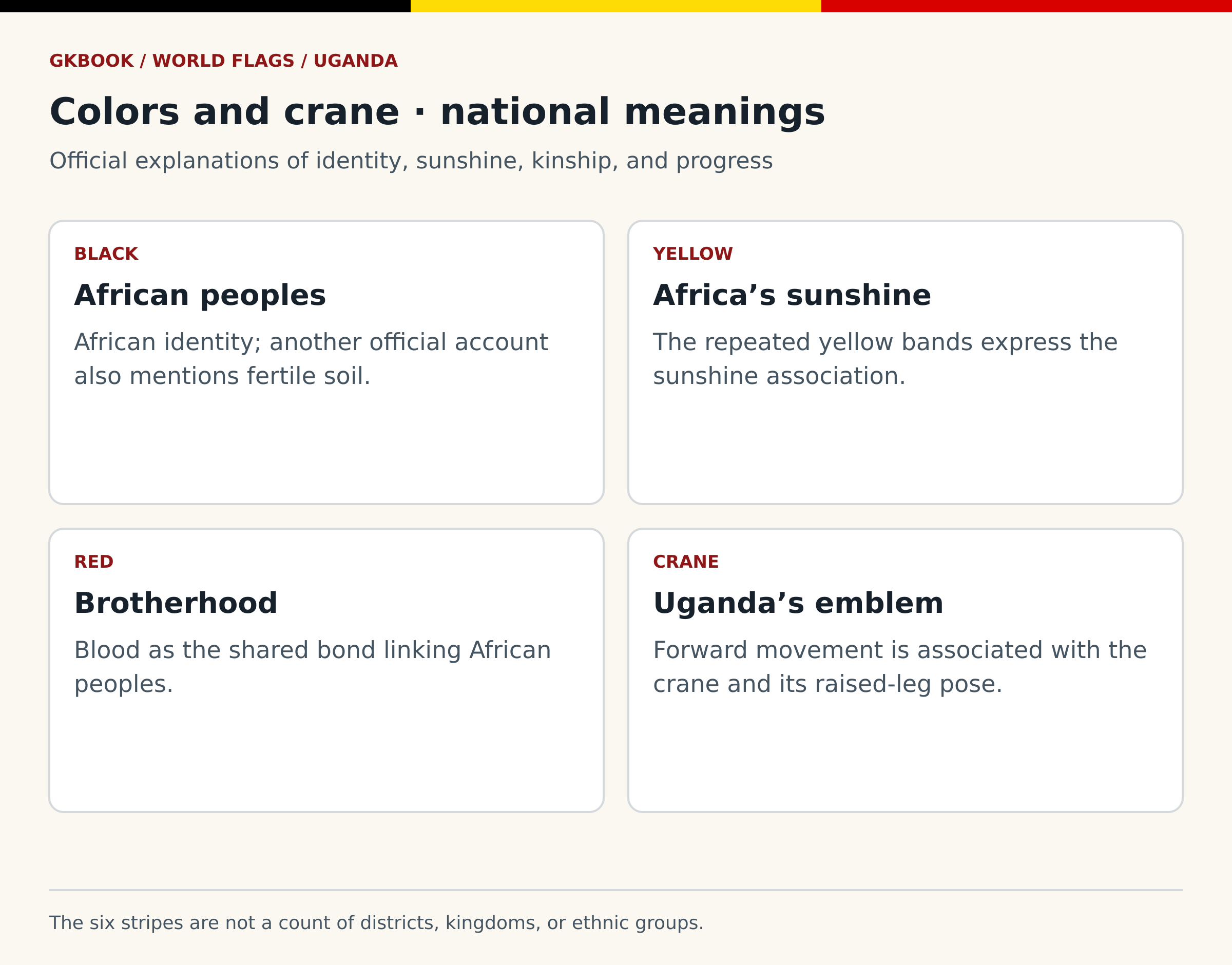
The flag brings together African identity, sunshine, and brotherhood. Uganda’s official national-symbol descriptions associate black with African peoples, yellow with Africa’s sunshine, and red with the shared blood that connects Africans. The central crested crane identifies Uganda, while its raised leg is commonly explained as a sign of forward movement.
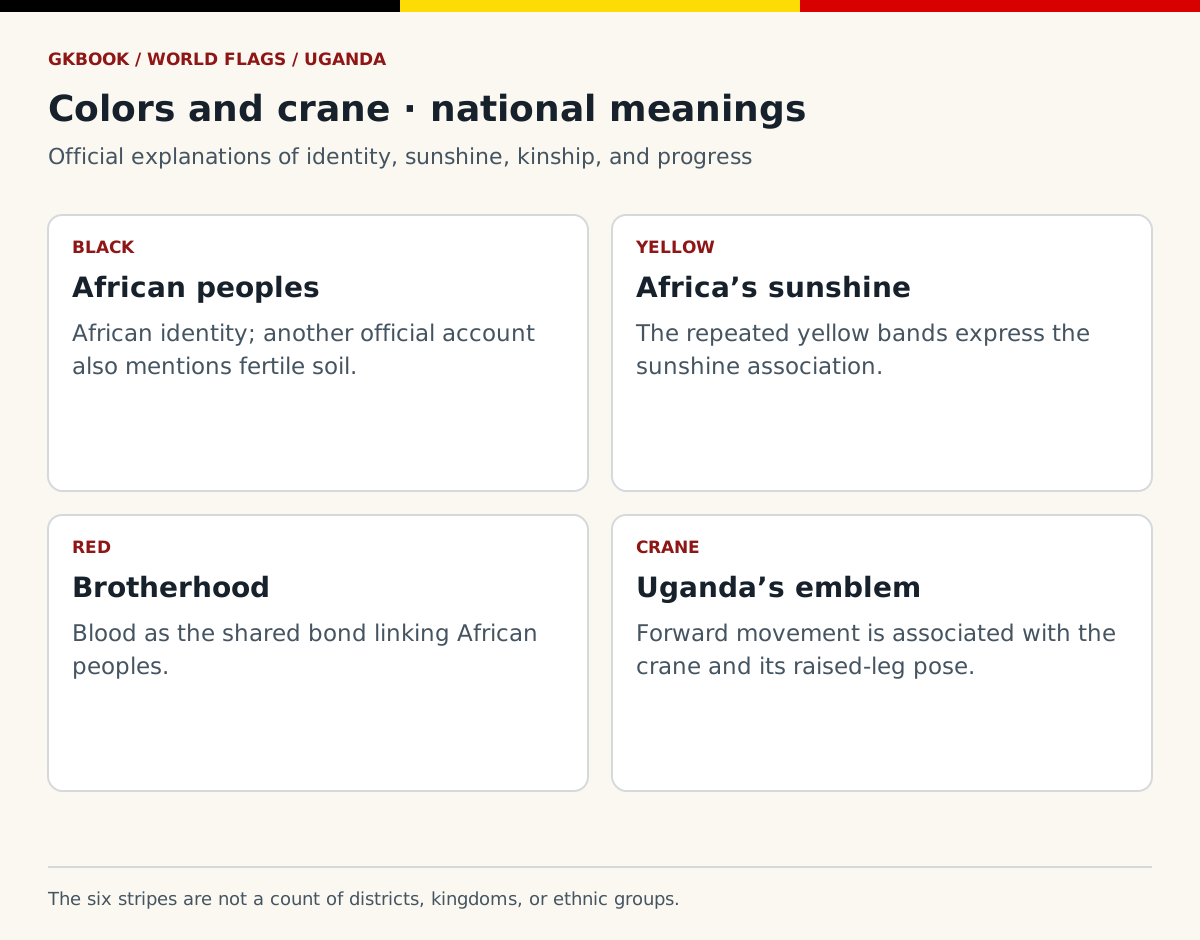
The national interpretation emphasizes a shared identity rather than a separate stripe for each district, ethnic community, or historical kingdom. Each of the three band colors occurs twice. Nothing in the Act’s design description assigns the six bands to six administrative regions or six stages of independence.
Official explanatory texts do not use completely identical wording. Uganda’s NAM website also connects black with African heritage and fertile soil, and describes red in terms of human kinship more broadly. The core associations remain recognizable. A historical explanation of party colors and a civic explanation of national values address different aspects of the same flag.
What do the black stripes mean?
Black represents African peoples in the Ugandan government’s principal explanation of the flag. It appears in the first and fourth horizontal bands, counting from the top. Another government description also associates it with African heritage and fertile soil. Black is therefore more than a dark background behind the central bird.
The upper black band forms the top edge of the standard landscape flag. The second black band starts at the horizontal midpoint, immediately below the upper red band. The white disc overlaps that central boundary, which is why the emblem sits partly against red and partly against black.
Black also outlines and fills portions of the stylized crane. A color-area calculation must distinguish those small emblem shapes from the background bands. Simply multiplying two bands by their height describes the underlying layout; it does not measure every visible black shape after the central emblem has been added.
What do the yellow stripes mean?
Yellow represents Africa’s sunshine in official explanations of Uganda’s flag. It occupies the second and fifth bands from the top. Both have the same height as the black and red bands. In the supplied drawing, the central white disc fits between the two yellow stripes without covering either one.
The yellow bands help separate the repeated black and red regions. To remember the arrangement, read downward in two identical groups: black, yellow, red; then black, yellow, red again. A yellow band is not placed at either outer horizontal edge.
Yellow also appears in the illustrated crown of the crane. That small part of the emblem is separate from the yellow stripes. In an enlarged teaching image it is useful to show the crown clearly, while retaining the complete national flag beside the detail so that the emblem’s scale is not mistaken for a new flag design.
What do the red stripes mean?
Red stands for African brotherhood in Uganda’s official explanation: blood is the shared link between people. It forms the third and sixth bands from the top. The lower red band reaches the bottom edge. Describing red only as blood shed in war omits the documented emphasis on kinship and unity.
The upper red band meets the central black band at the flag’s halfway line. The white disc covers part of both. Red is also used in several details of the stylized crane, so the visible red area is not confined to the two large rectangles.
Color symbolism should be explained in the context of the country concerned. A meaning associated with red on another national flag cannot automatically be transferred to Uganda. The government account supports brotherhood; an unsupported list of courage, revolution, martyrdom, or sacrifice would obscure that specific explanation.
What bird is on the Uganda flag?
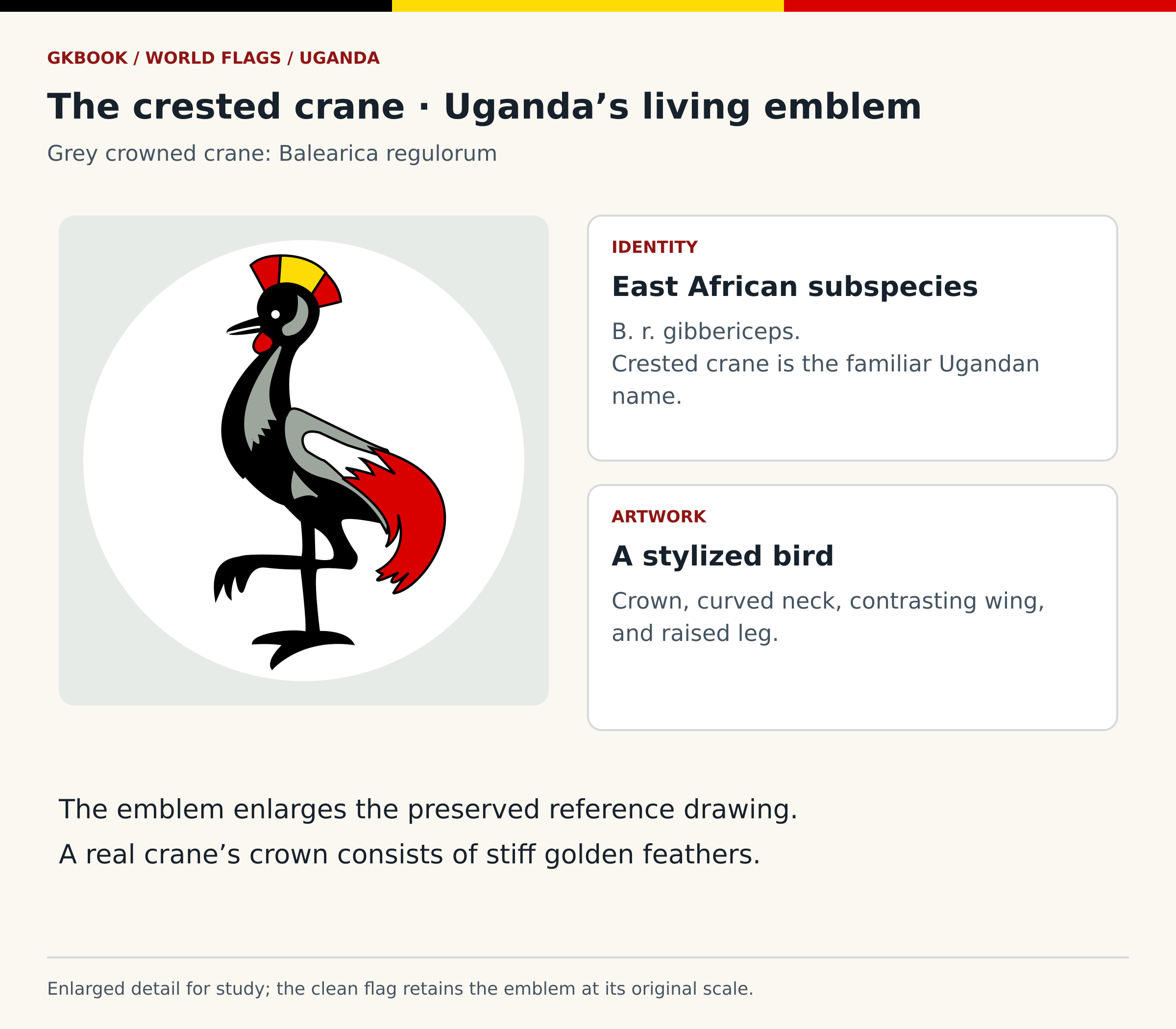
The bird is the grey crowned crane, commonly called the crested crane in Uganda. Its scientific species name is Balearica regulorum; the East African subspecies is B. r. gibbericeps. The flag shows a stylized crane in a white disc, facing the hoist, with one leg lifted.
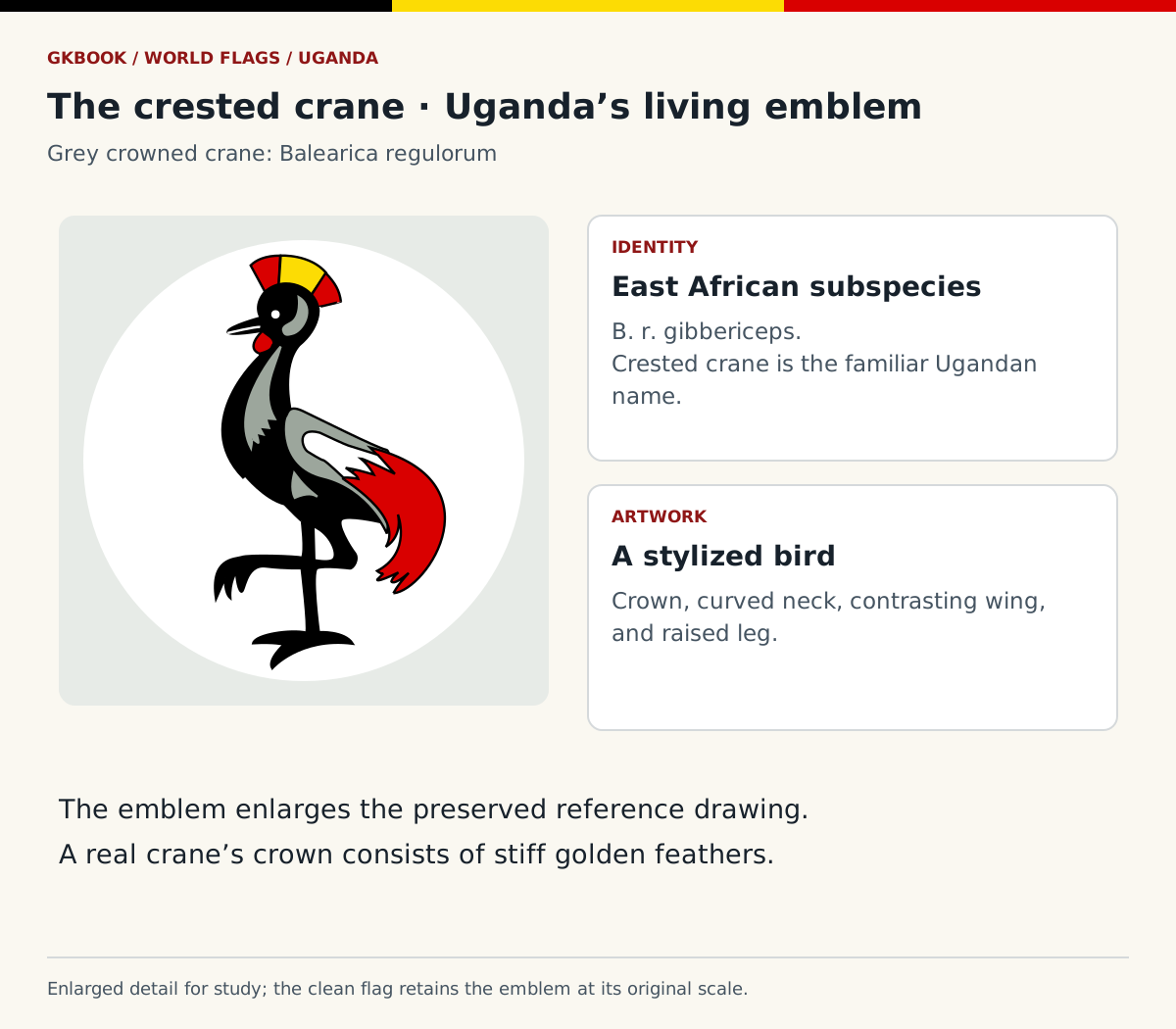
The real bird has a conspicuous crown of stiff golden feathers, a gray body, contrasting wing feathers, pale cheek patches, and a red throat sac. The emblem simplifies these features into a small, recognizable drawing. It should not be replaced by an eagle, rooster, flamingo, or generic bird silhouette.
The International Crane Foundation identifies wetland degradation, disturbance, capture, poisoning, and power-line collisions among the species’ threats, and lists it as Endangered. This connects the emblem with a living conservation concern. The same foundation identifies the East African subspecies accurately; shortened scientific names on some government pages are not complete modern species names.
Why does the crane have one leg raised?
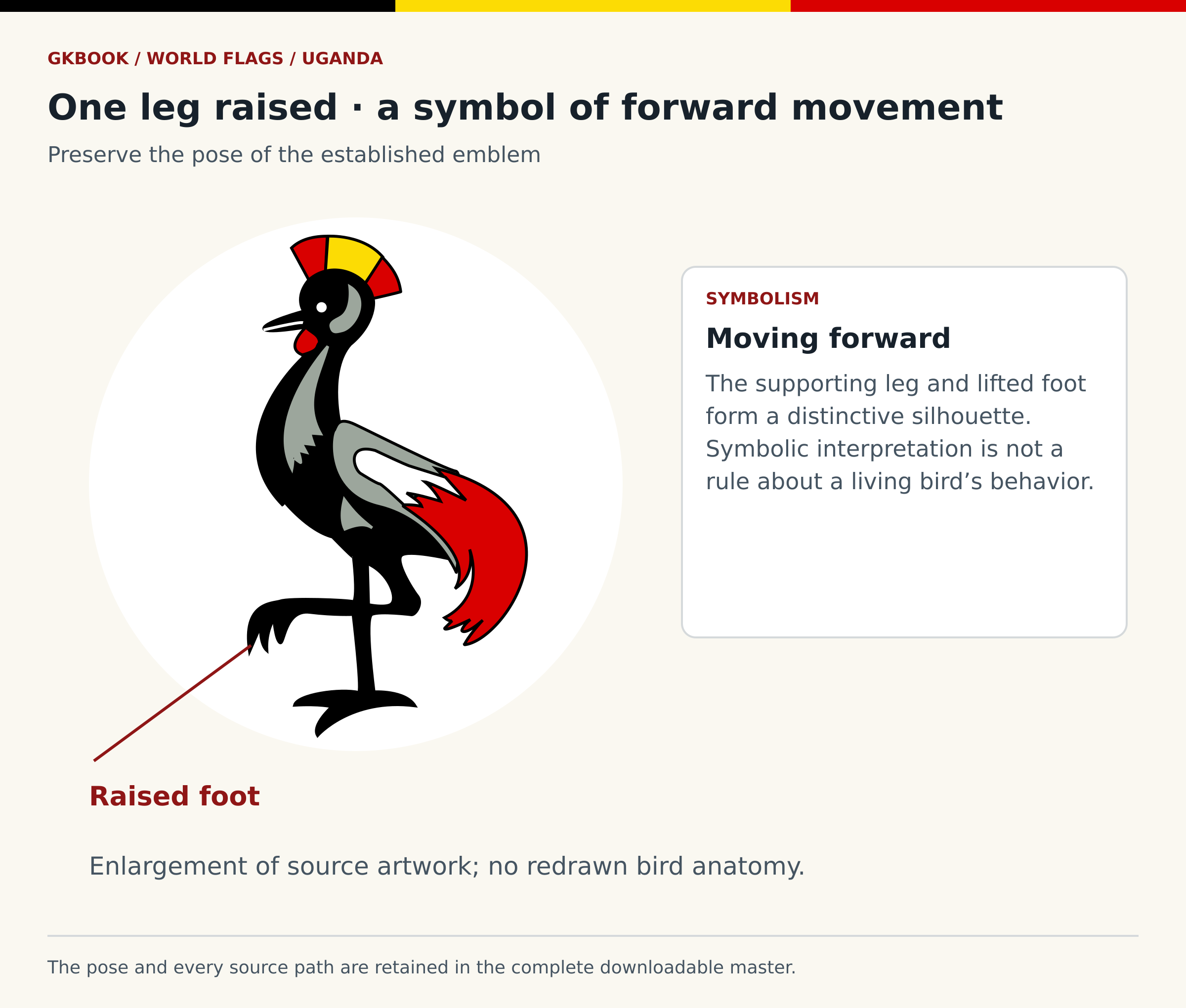
The crane’s raised leg is commonly interpreted as Uganda moving forward. Uganda’s official NAM description associates the crane with the nation’s forward movement. The pose also makes the small emblem distinctive: a long-necked bird with a crown, a supporting leg, and another leg lifted in front of its body.
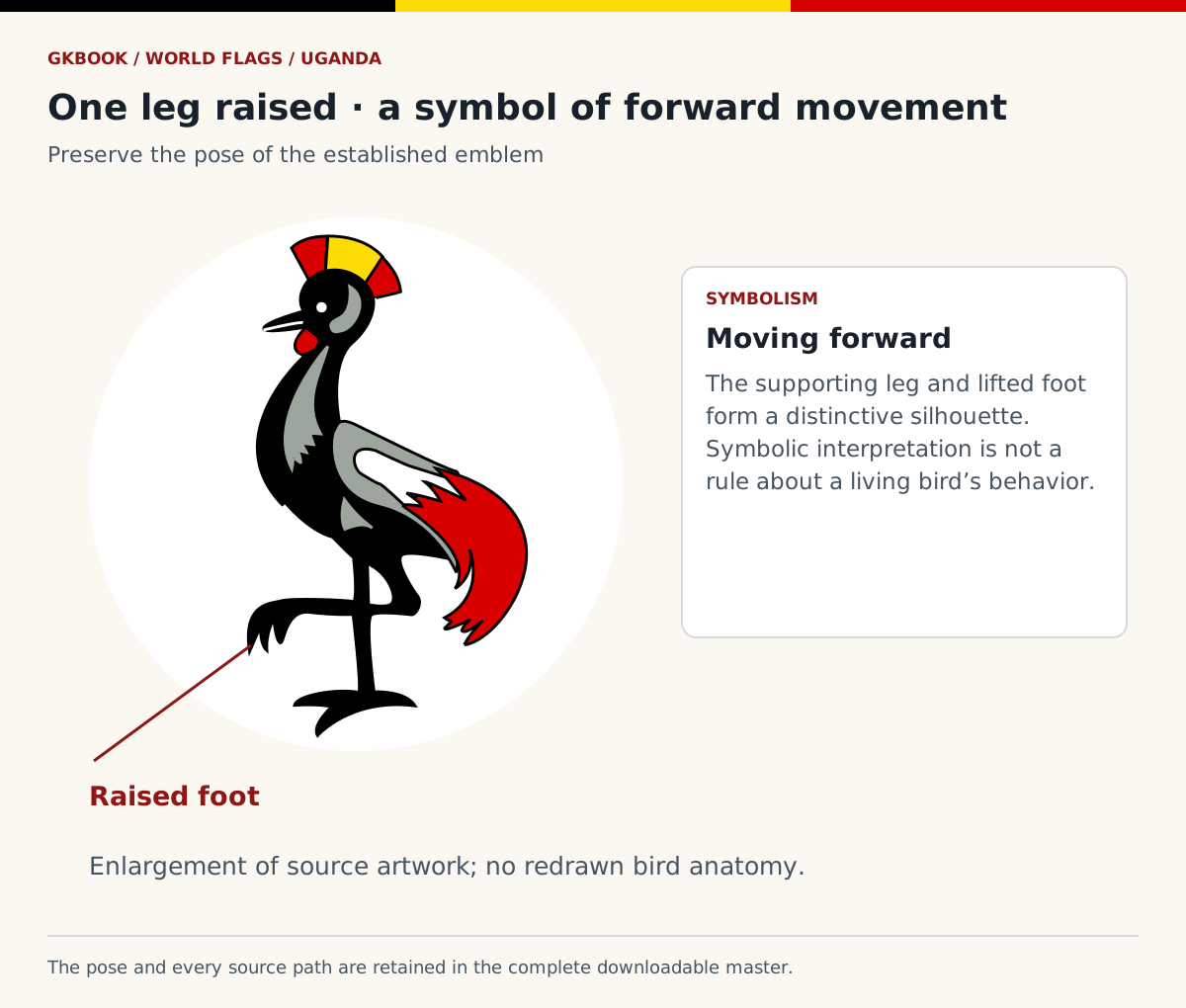
This symbolism describes the emblem rather than a biological rule about how a crane must stand. Living cranes walk, forage, display, and rest in a variety of positions. An illustration should preserve the established pose instead of changing the legs to make the bird appear more naturalistic.
For recognition, follow the outline of the whole bird. The crown, curved neck, raised foot, and contrasting wing all contribute to its identity. The accompanying enlargement preserves the source drawing rather than inventing new feather shapes or assigning a left-or-right anatomical label that the small stylized profile does not establish reliably.
What does the white circle contain, and how large is it?
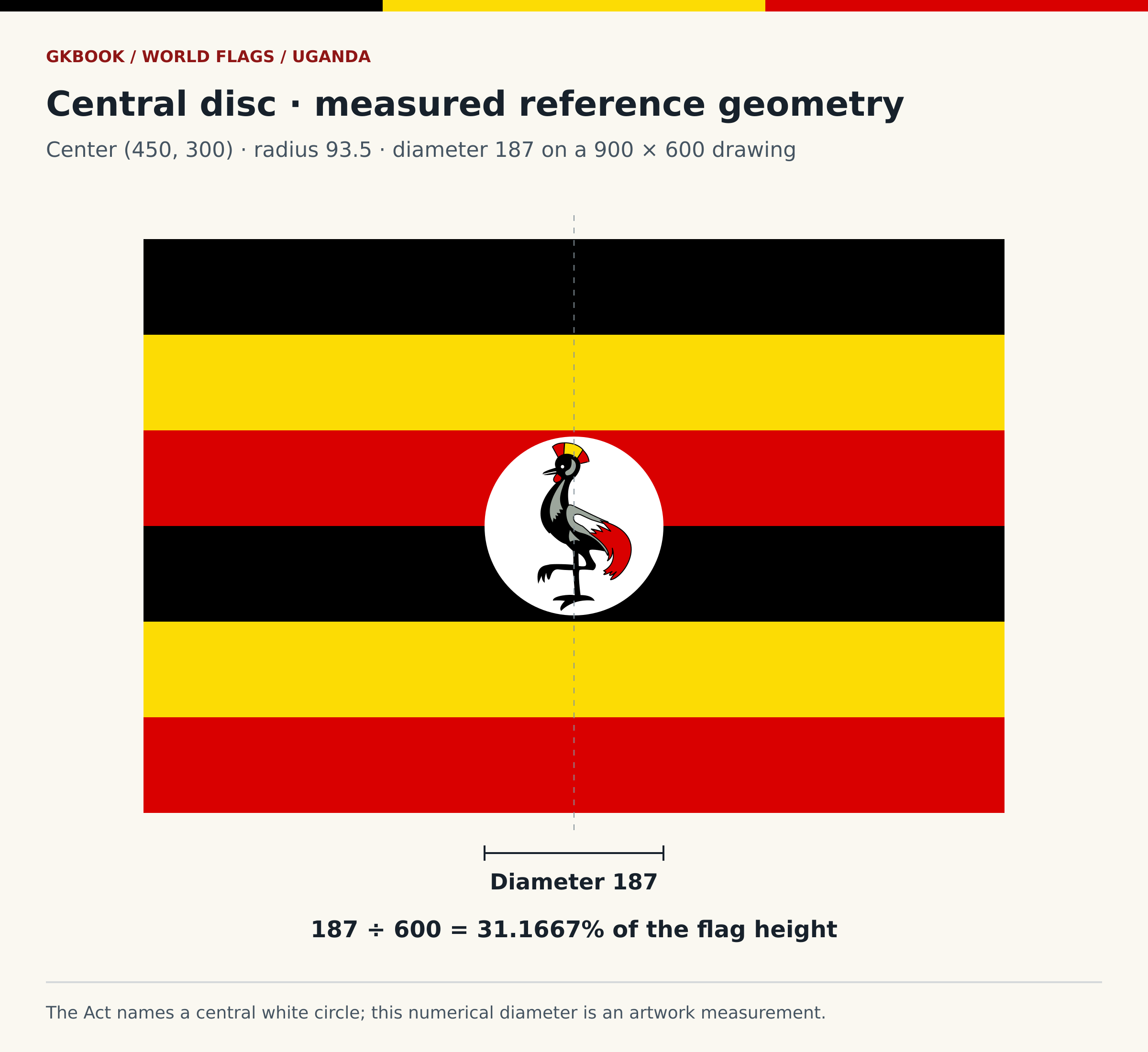
The white circle contains Uganda’s crested crane and is centered on the flag. The Act specifies a central white circle but gives no numerical diameter in its design paragraph. In the supplied 900-by-600 reference, its center is (450, 300), and its diameter is 187 units, or about 31.17% of the height.
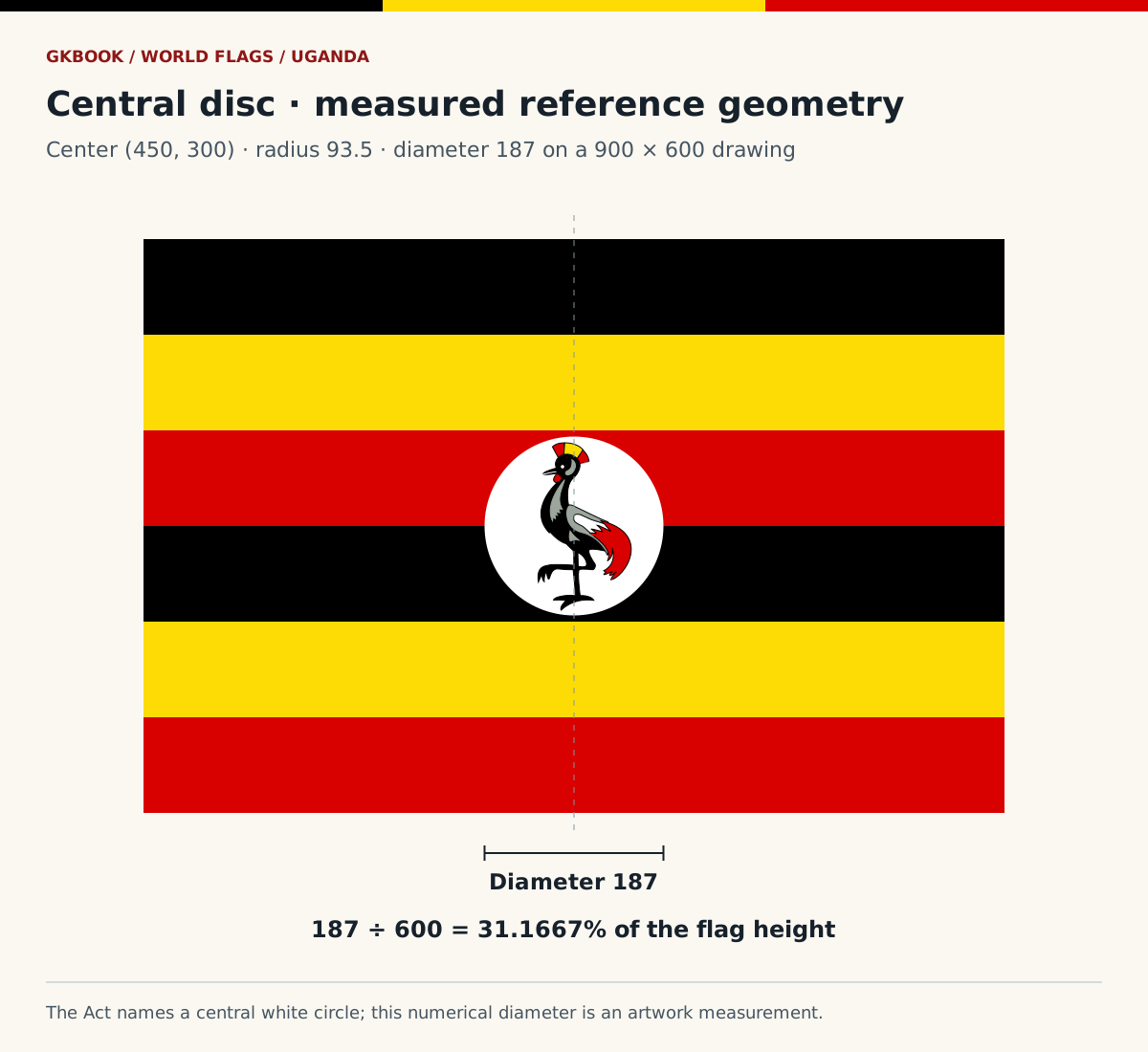
The white field keeps the bird visible against the red and black background bands. It is an opaque circle, not an opening or a transparent cutout. The whole circle remains white when the flag is placed on a colored webpage, slide, or poster.
The often-used “one third of the height” approximation is not the exact measurement of this source SVG: one third of 600 is 200, whereas the file uses 187. The package preserves the source geometry and labels that measurement as an artwork convention. It does not infer that an uninspected manufacturing standard specifies the same diameter.
What are the proportions of the Uganda flag?
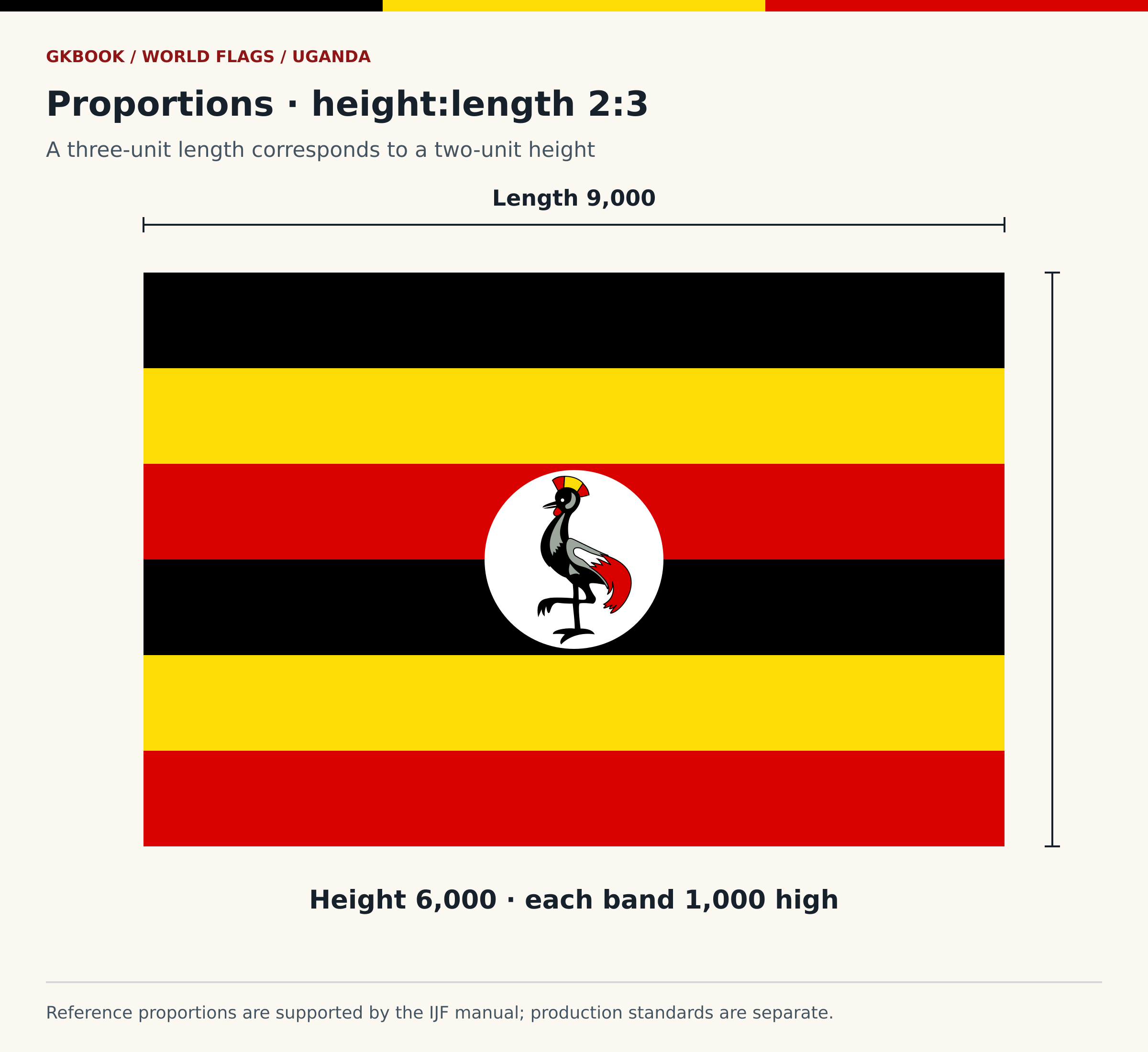
The established reference proportion is height:length 2:3, also recorded as the original ratio in the International Judo Federation’s flag manual. A flag three units long is two units high. Each of the six bands is one sixth of the height. The supplied large master measures 9,000 by 6,000 pixels.
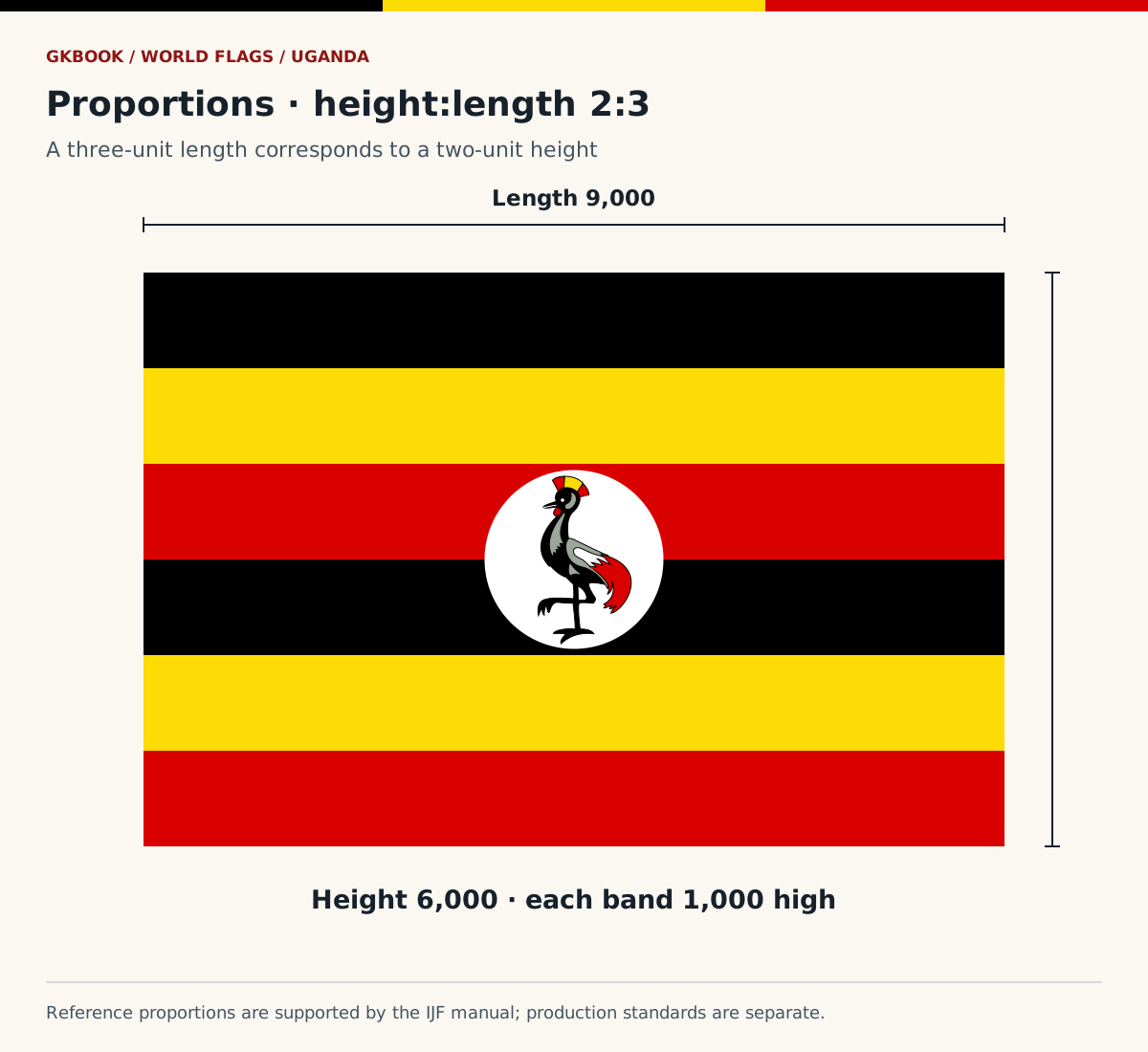
Both dimensions must change by the same scale factor. For example, a 90-centimeter-long reference reproduction is 60 centimeters high, with bands 10 centimeters high. These are proportional examples, not a claim that only one set of physical sizes is permitted.
The Act’s short design paragraph describes the arrangement but does not state an overall numeric ratio. The 2:3 reference is therefore supported here by established flag usage and the IJF manual, while manufacturing questions are directed to the separate Ugandan standard. Avoid stretching the rectangle into a square to fit a thumbnail.
What is the correct order of the six stripes?
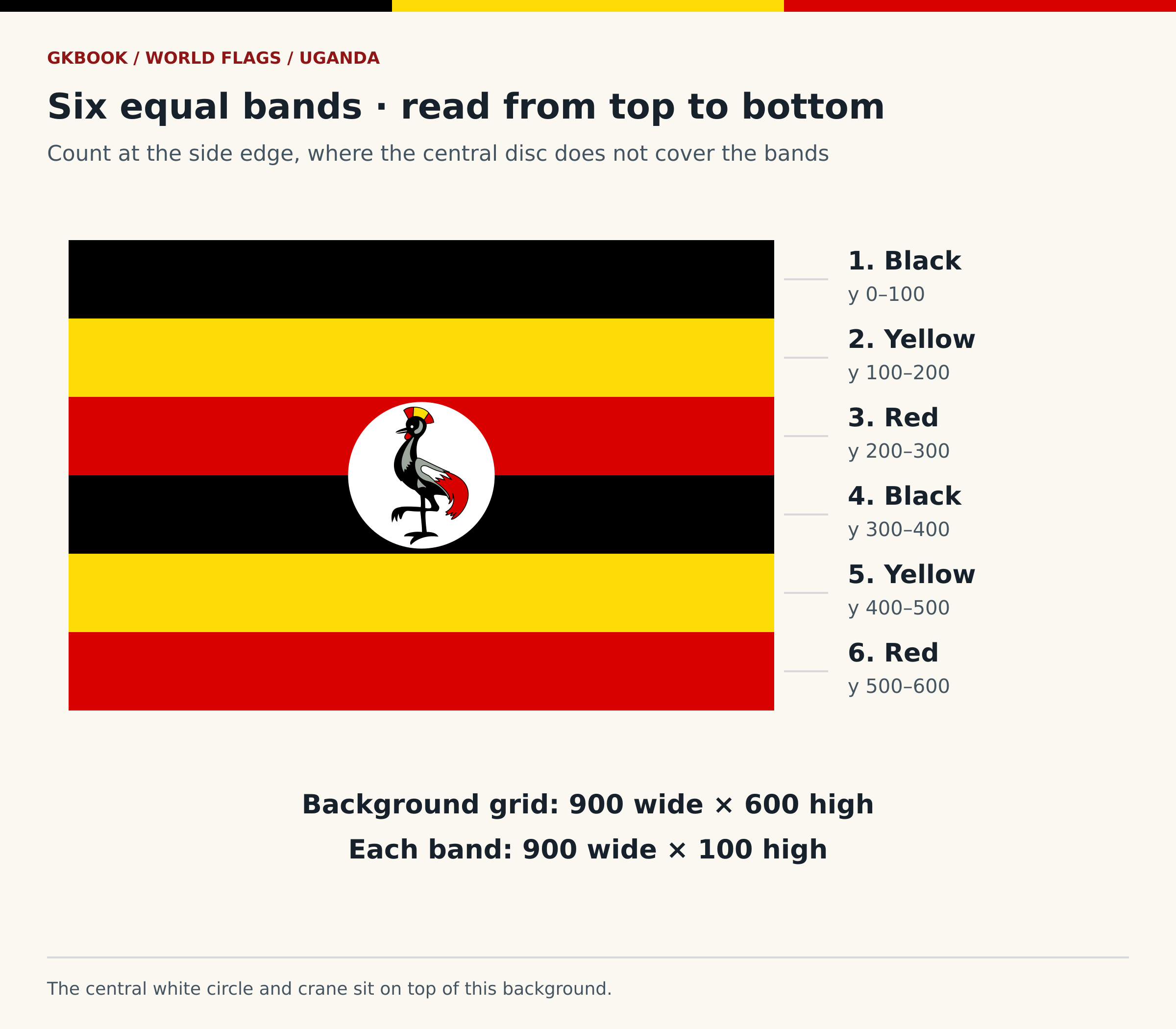
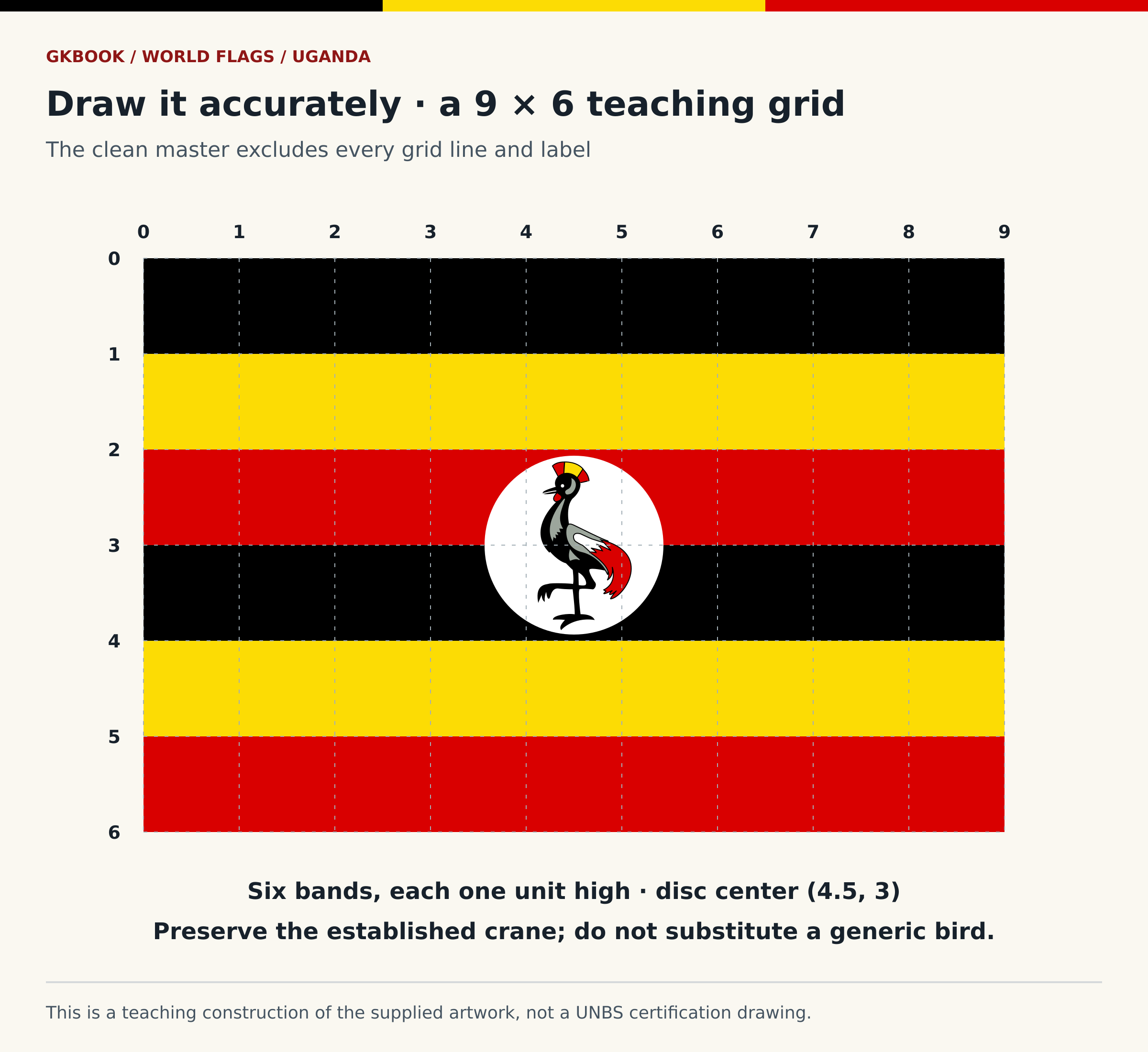
From top to bottom, the stripes are black, yellow, red, black, yellow, and red. All six have equal height and extend across the flag before the central emblem is added. On a 900-by-600 drawing, their boundaries fall at y = 0, 100, 200, 300, 400, 500, and 600.
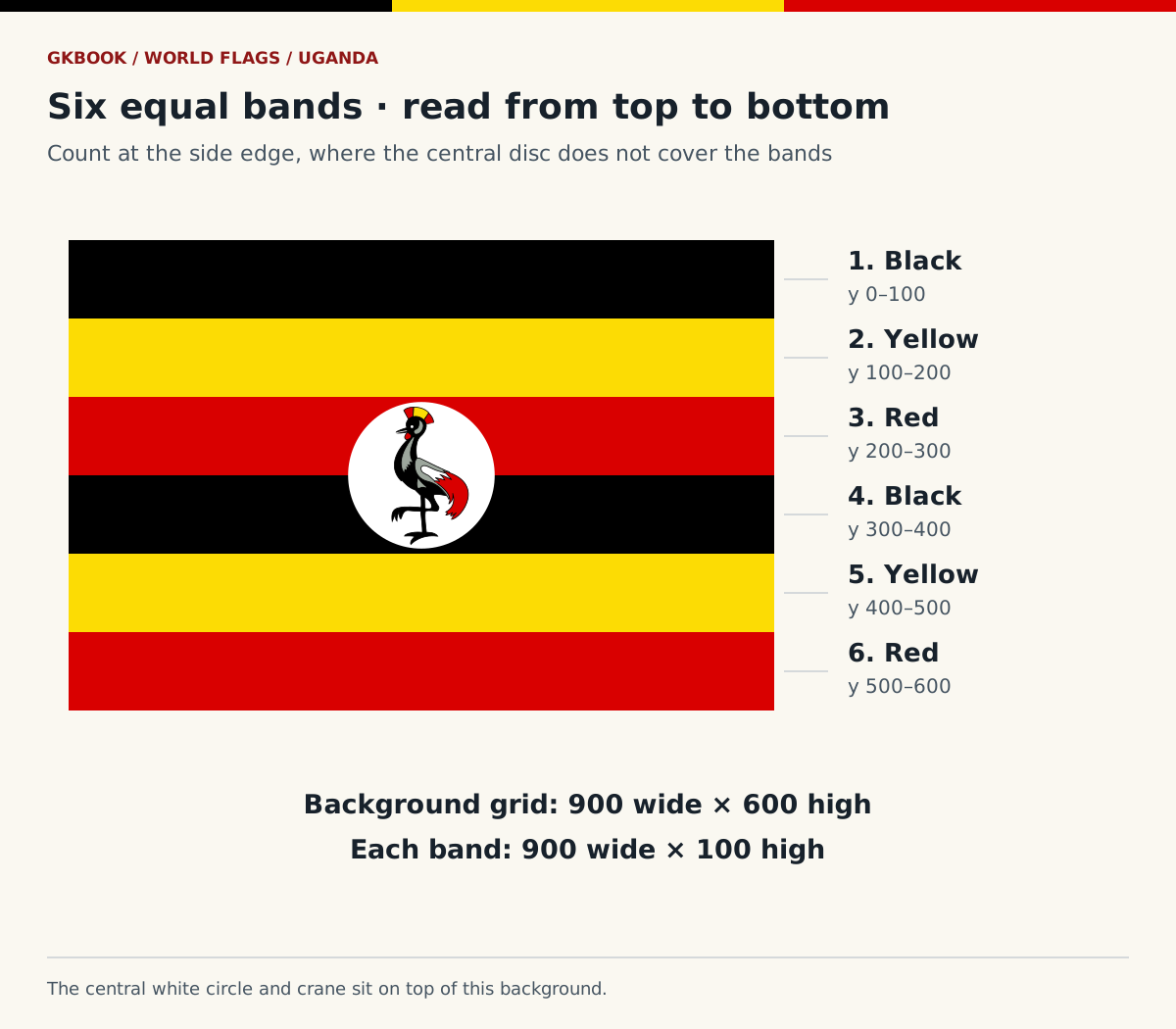
The coordinate system begins at the upper-left corner, with x increasing rightward and y increasing downward. Each background band is 900 units long and 100 units high. The circle’s center lies where the vertical centerline meets the boundary between bands three and four.
Count the bands at either side edge, where the white circle cannot hide them. The supplied SVG uses overlapping fills internally, but its visible background has exactly the six equal bands shown in the table. Hidden portions of those paths are construction details, not additional stripes.
| Band | Color | Top y | Bottom y |
|---|---|---|---|
| 1 | Black | 0 | 100 |
| 2 | Yellow | 100 | 200 |
| 3 | Red | 200 | 300 |
| 4 | Black | 300 | 400 |
| 5 | Yellow | 400 | 500 |
| 6 | Red | 500 | 600 |
Do the three stripe colors occupy equal areas?
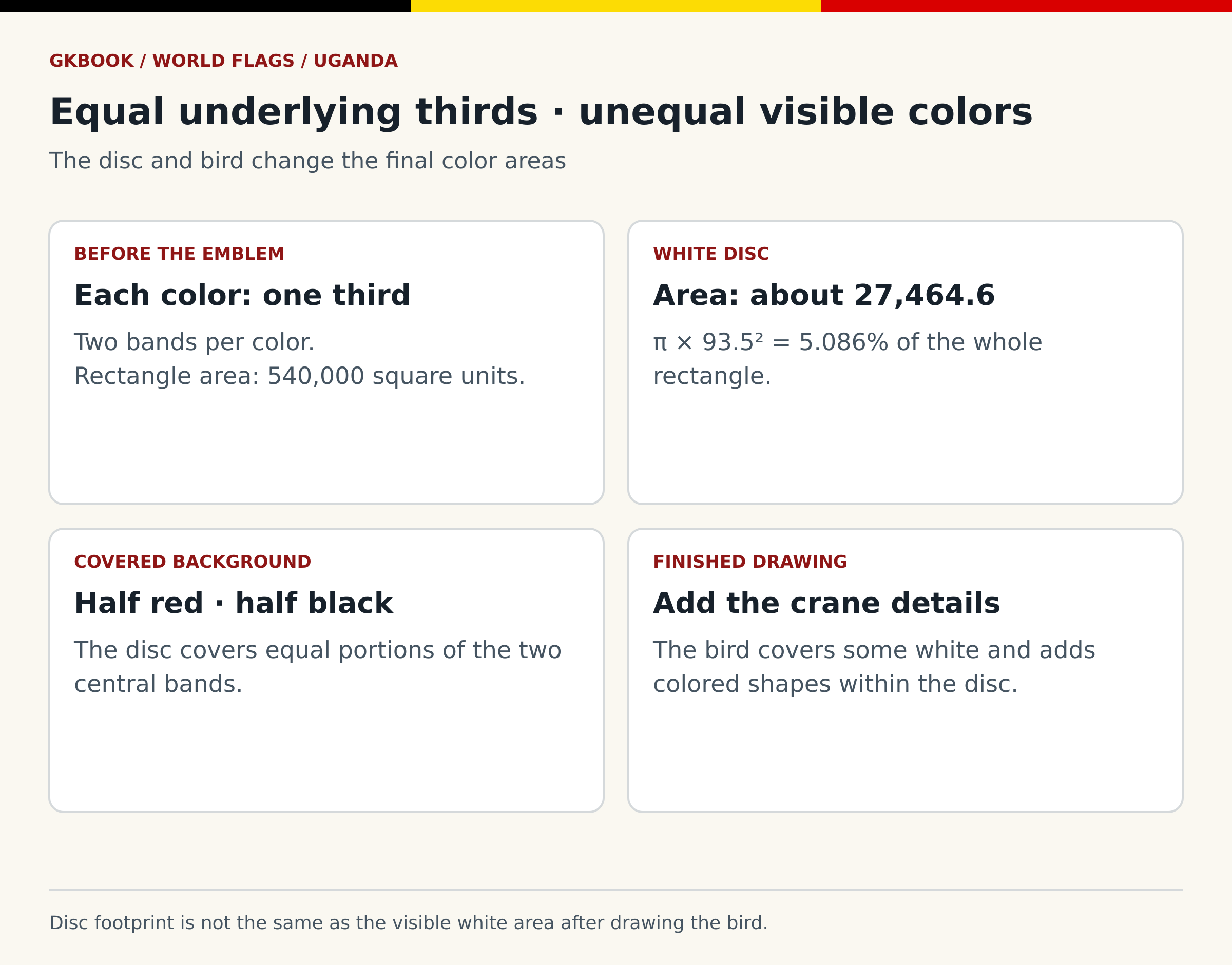
Before the emblem is added, black, yellow, and red each cover one third of the flag. In the finished image their visible areas are different because the central white disc covers parts of the middle red and black bands, and the crane adds colored details inside that disc.
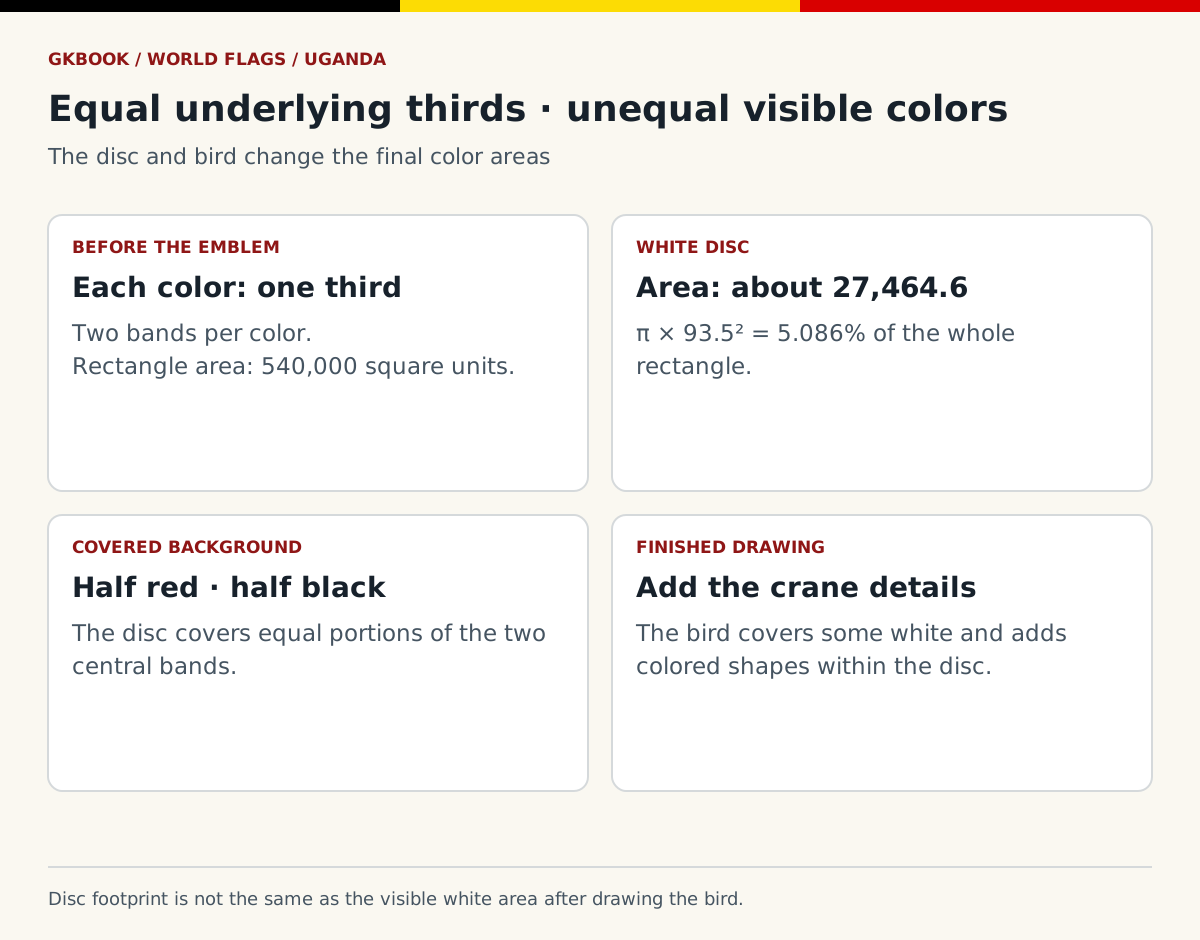
The reference rectangle has an area of 900 × 600 = 540,000 square units. Its white disc has area π × 93.5², approximately 27,464.6 square units, or 5.086% of the rectangle. Half of that disc covers the upper red band and half covers the central black band; neither yellow band is covered.
That calculation describes the whole disc before drawing the bird. It is not the amount of visible white, because the crane occupies some of the disc. The raster verification record separately counts actual flat-color pixels and blended edge pixels. Geometry, exposed background, and final pixel totals are three different measurements.
How can the Uganda flag be drawn accurately?
Draw a 3:2 landscape rectangle and divide its height into six equal horizontal bands. Fill them black, yellow, red, black, yellow, red. Center a white disc and place the established crested-crane artwork inside it, facing the hoist. For an accurate reproduction, preserve the complete reference rather than sketching a substitute bird.
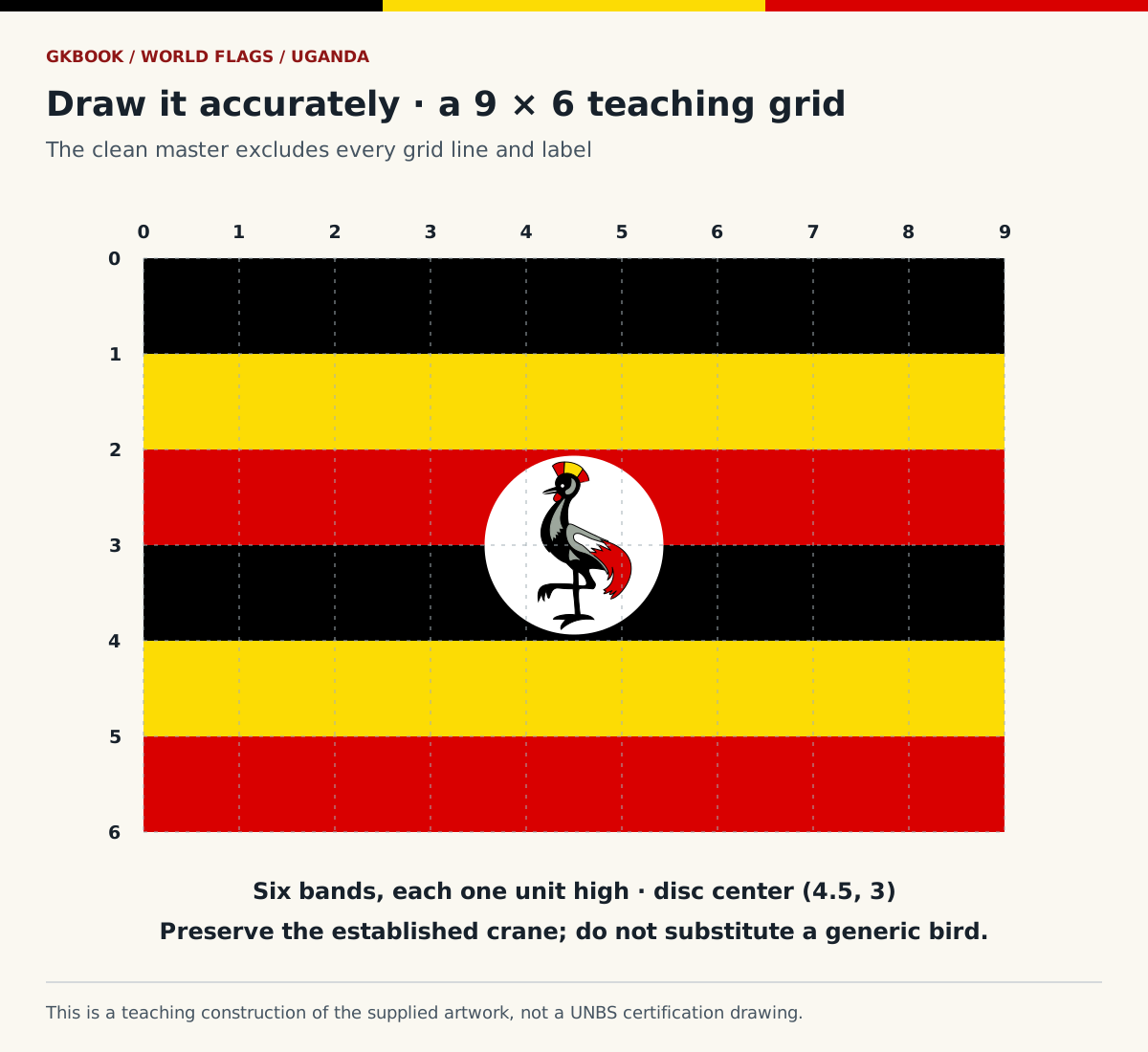
A useful classroom grid is nine units long by six units high, with each band one unit high. The source artwork scales to that grid without changing its ratio. Its disc diameter becomes 1.87 units, and its center is at (4.5, 3). These dimensions reproduce this file, not an independently certified standard drawing.
Keep explanatory labels, arrows, and dimension lines outside the clean flag wherever possible. Do not add a black circle outline, a decorative border, a caption across the bands, or a photographic bird in place of the emblem. A construction illustration may contain guides, but the downloadable master should contain only the national design.
What is the history of the Uganda flag?
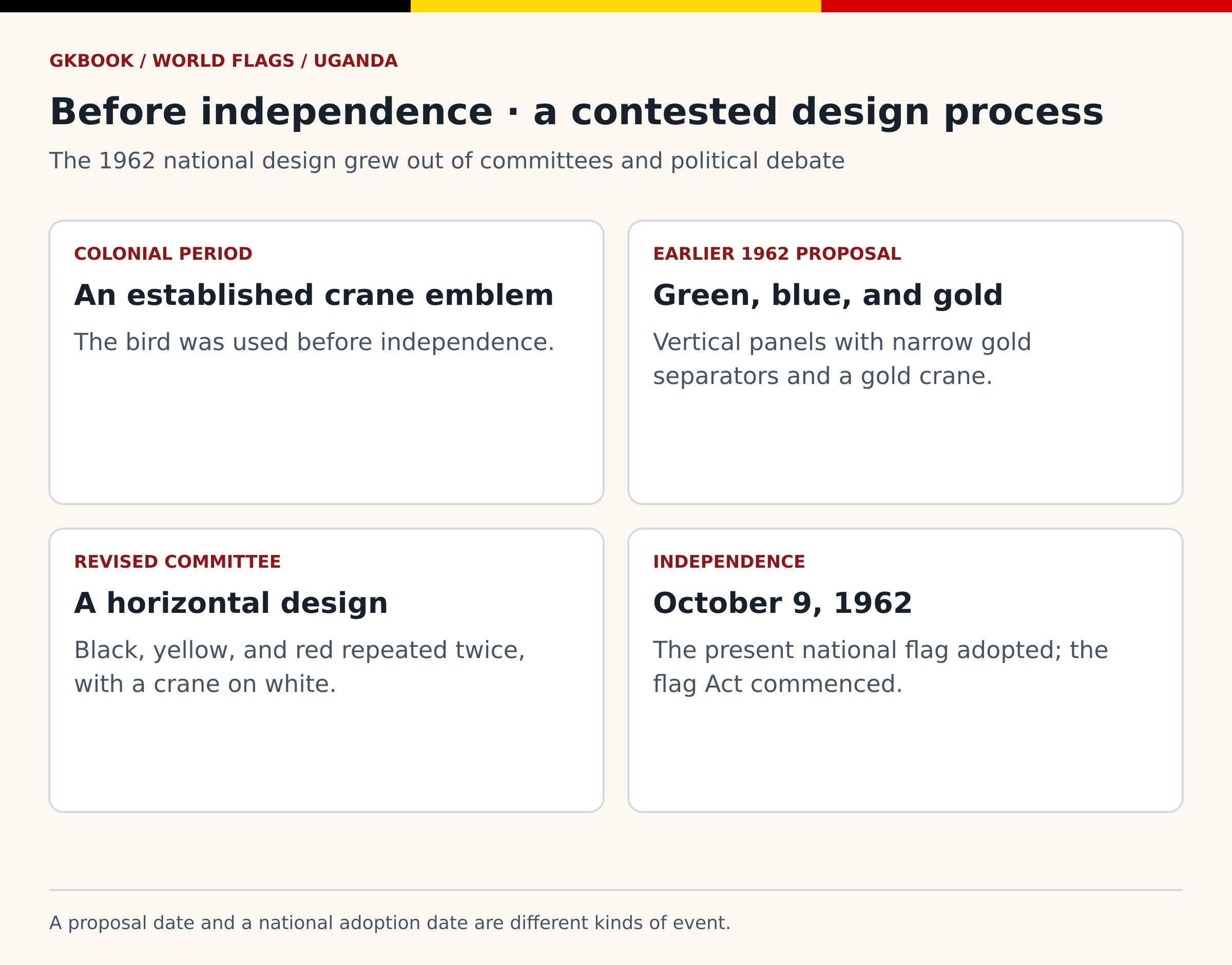
The present flag emerged during Uganda’s transition from British rule to independence in 1962. The crane had already been used as an emblem in the colonial period. An earlier 1962 proposal used green, blue, and gold with vertical bands; a later committee produced the black, yellow, and red horizontal design.
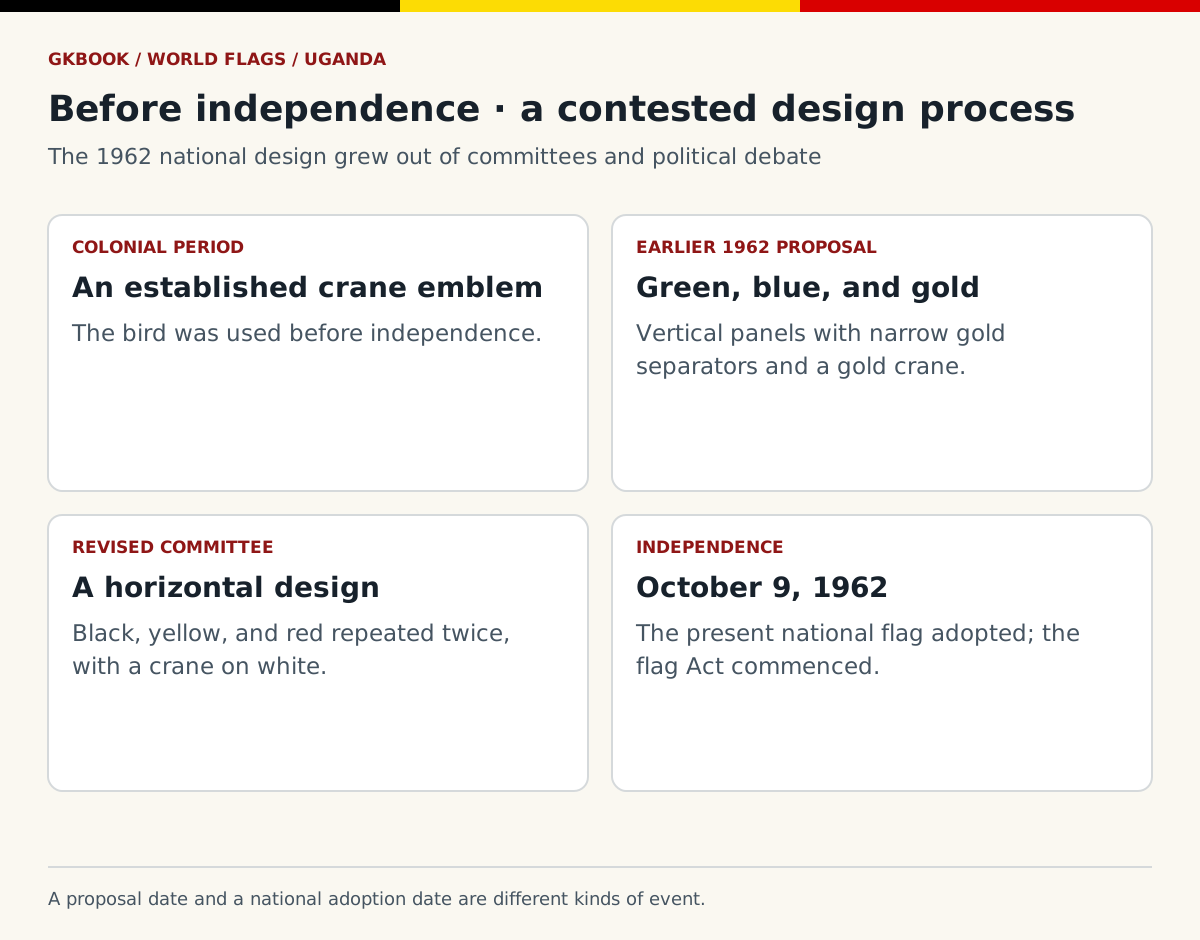
Historian Jonathon L. Earle traces the debate through contemporary newspapers, political papers, and parliamentary records. His study describes a National Flag Committee under the Democratic Party government, followed by a revised process after the Uganda People’s Congress and Kabaka Yekka gained power. Colors carried political associations as well as proposed national meanings.
The earlier proposal had green outer panels, a blue center, narrow gold separators, and a gold crane. The design adopted at independence replaced that arrangement. The timeline therefore labels the earlier design as a proposal in the 1962 transition, without treating every later account of its exact period of use as settled.
When was the Uganda flag adopted?
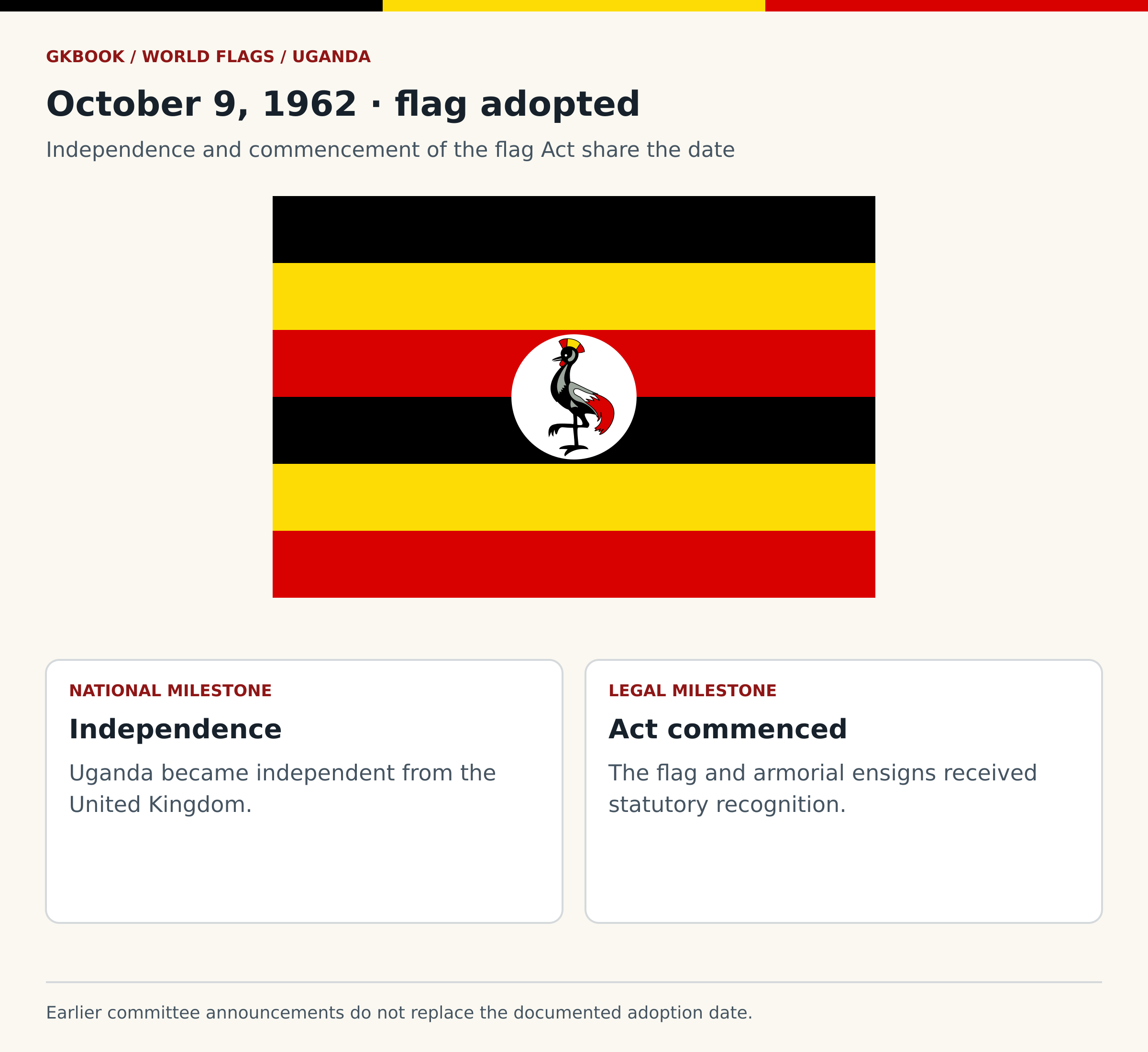
Uganda adopted its national flag on October 9, 1962, the date of independence from the United Kingdom. The National Flag and Armorial Ensigns Act also commenced that day. Earlier design discussions and announcements belong to the preparation for independence; they are distinct from the date normally used for the flag’s adoption.
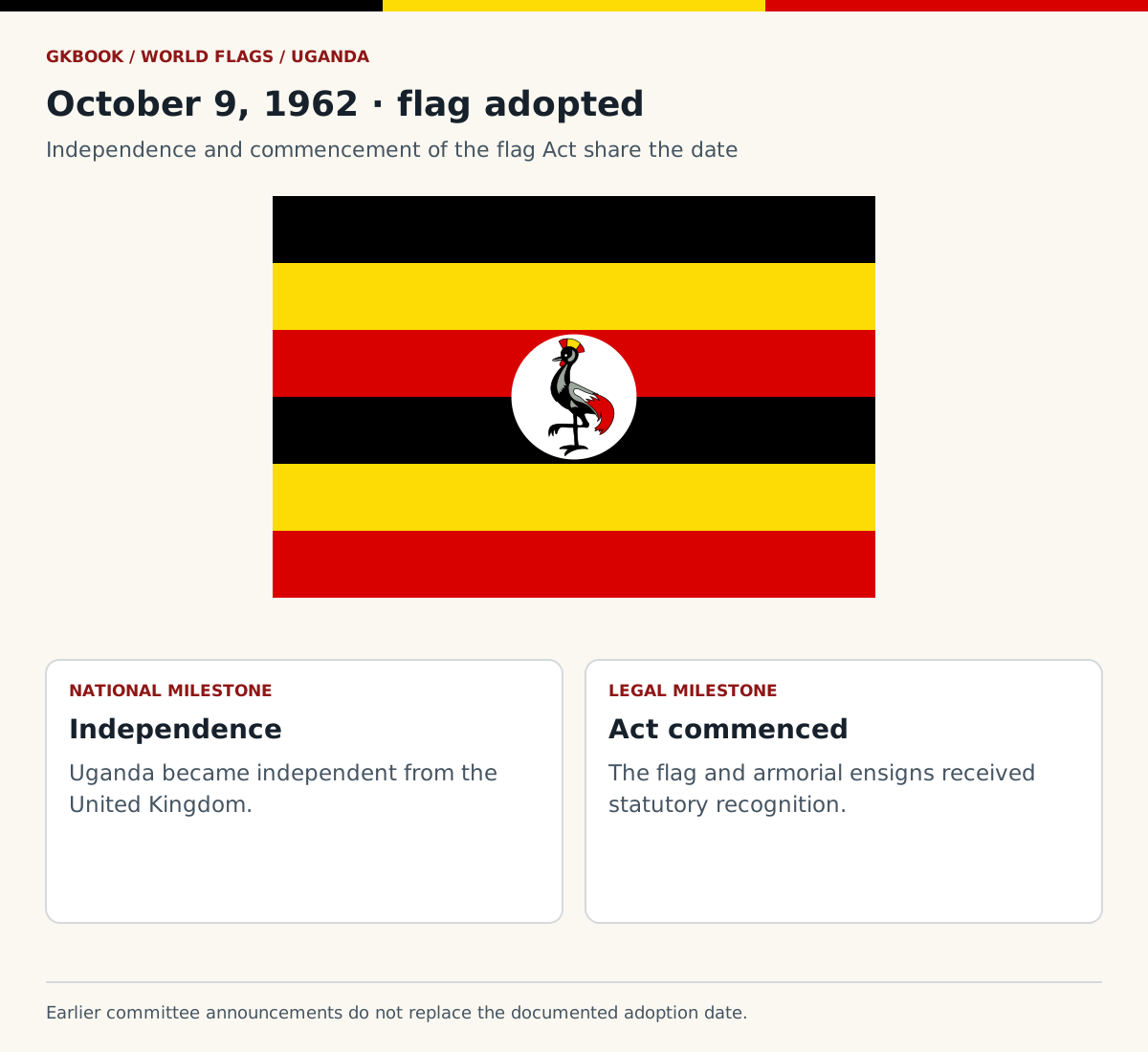
The adoption date is corroborated by Uganda’s Ministry of Foreign Affairs protocol handbook and diplomatic national-symbol pages. WIPO’s legal catalogue and the revised Act record the same commencement date. This agreement is stronger evidence than an undated flag chart repeating a date without explaining it.
The independence ceremony at Kololo spans the night of October 8–9 in historical accounts. Its clock time and the identity of individual flag raisers have been described differently in later reporting. The article anchors the chronology in the documented independence and commencement date rather than presenting an uncertain ceremonial detail as indisputable.
Who designed the Uganda flag?
Ugandan government pages credit Grace Ibingira with designing the national flag. Historical research also documents his chairmanship of the committee that revised the design in 1962. The flag emerged through a political and artistic process, so this official attribution should not be confused with proof that one person executed every drawing and production detail.
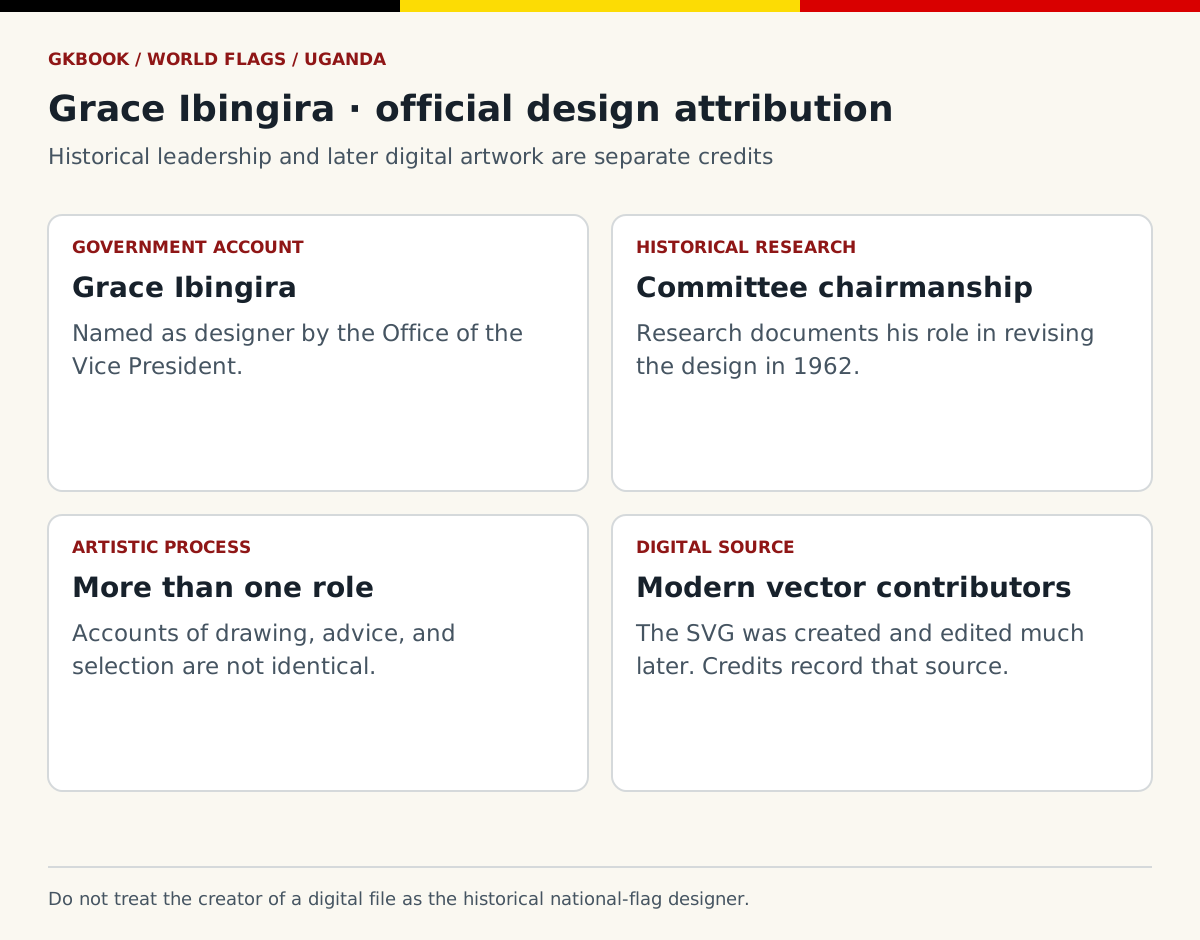
The Office of the Vice President names Ibingira, and diplomatic pages repeat that attribution. Earle’s study supports his central role in the committee process and in debates over the replacement design. These accounts justify identifying him prominently while explaining the collaborative setting.
Journalistic accounts also discuss artists and committee members, including Cecil Todd, and do not always distinguish design proposals, the coat of arms, and the final flag artwork clearly. Historical authorship must also be separated from the much later creators and editors of a digital SVG. The image credits identify the modern source independently.
When is Uganda Independence Day, and is it the flag anniversary?
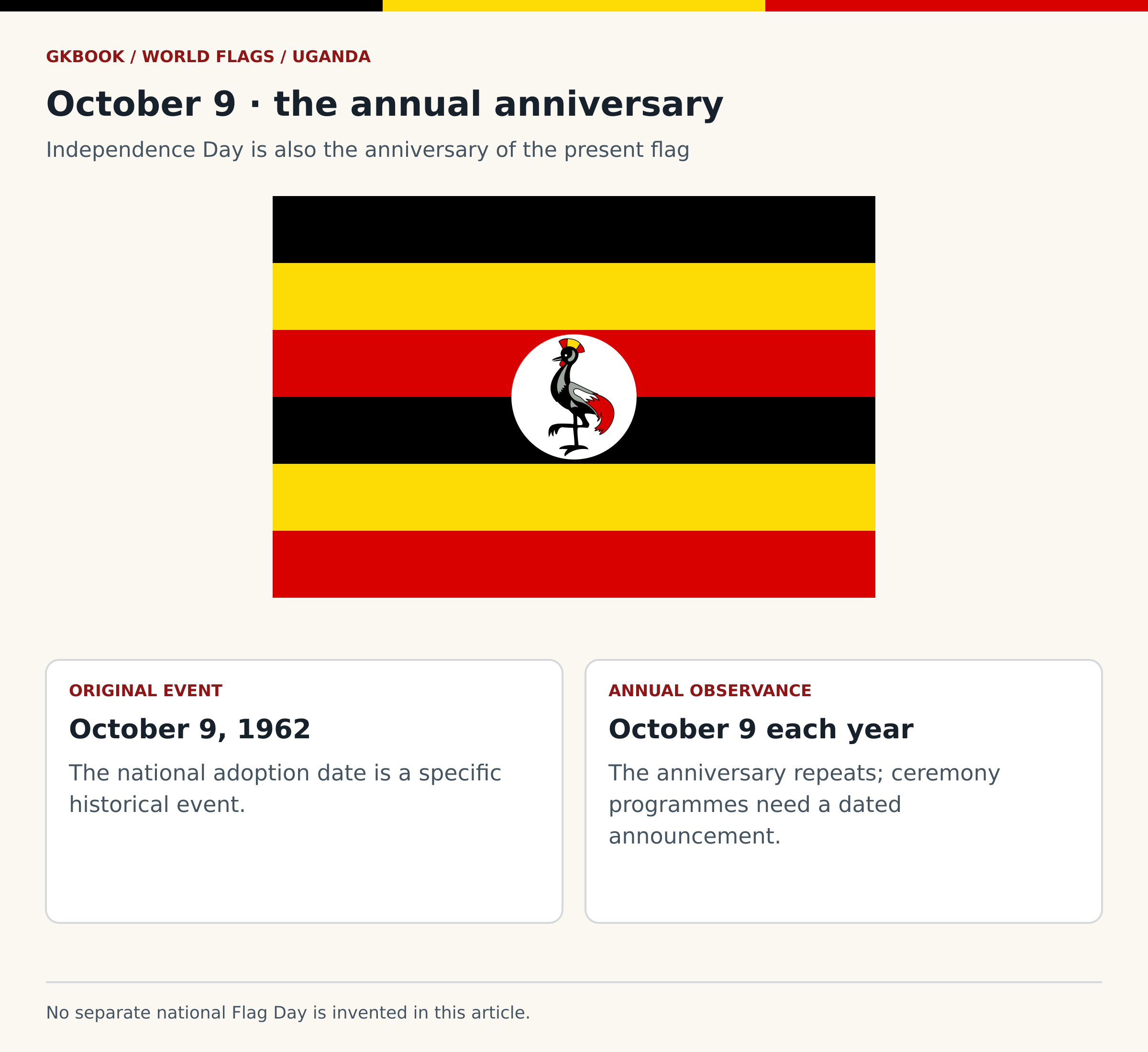
Uganda’s Independence Day is October 9, marking independence in 1962. It is also the anniversary of adoption of the present national flag. The date should not be confused with Uganda’s later admission to the United Nations, and this article does not assign a separate national Flag Day without a verified official basis.
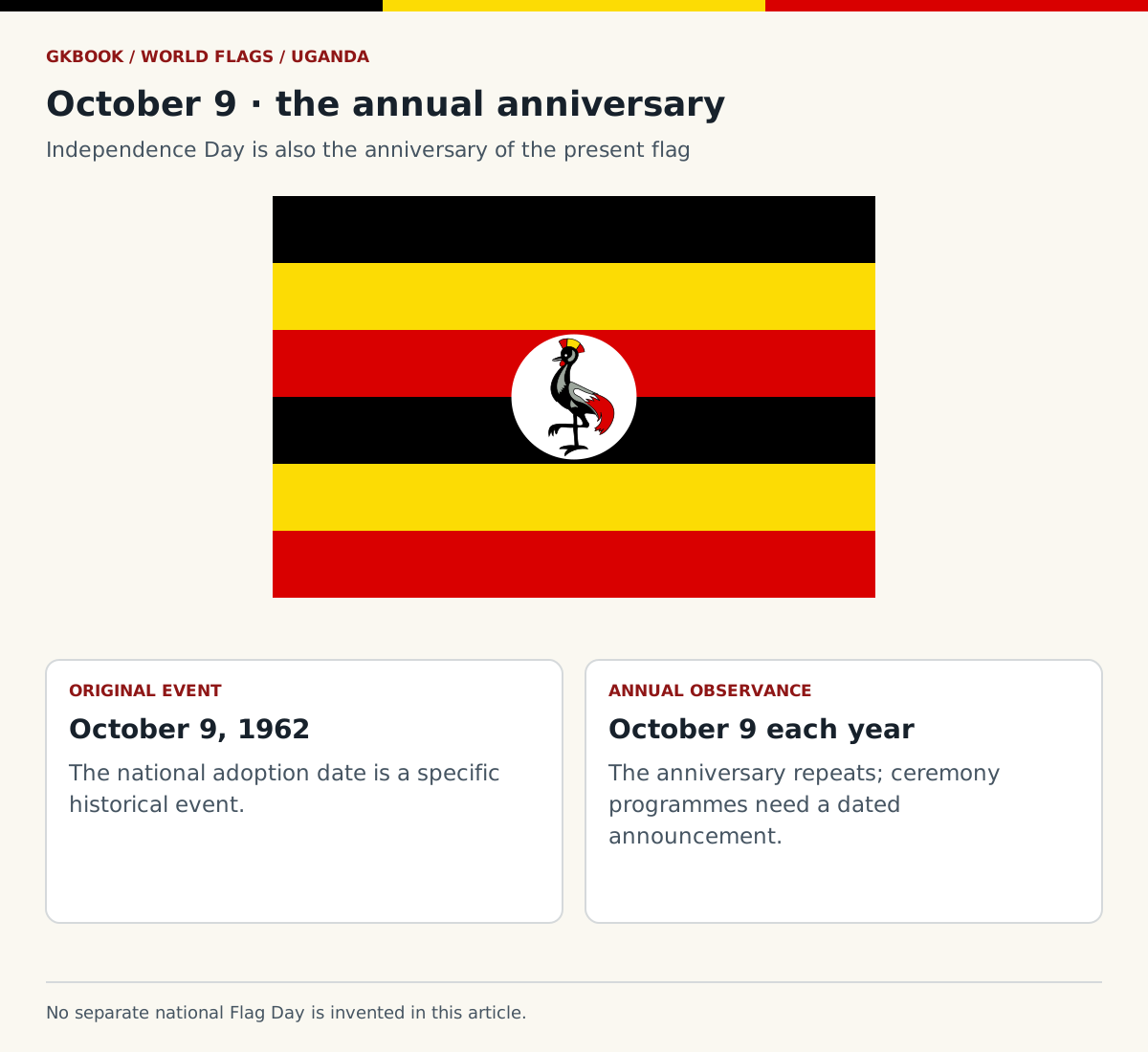
An anniversary repeats each year, while the adoption date identifies the original event. A caption saying “adopted October 9, 1962” can therefore remain accurate long after a particular anniversary celebration. Any programme, venue, or ceremonial time for a current celebration needs its own dated announcement.
The flag is a national symbol throughout the year, not only during the anniversary. It appears in civic, diplomatic, sporting, and educational settings. The historical connection with independence explains its importance without making every display a commemoration of a specific ceremony.
When did Uganda join the United Nations?
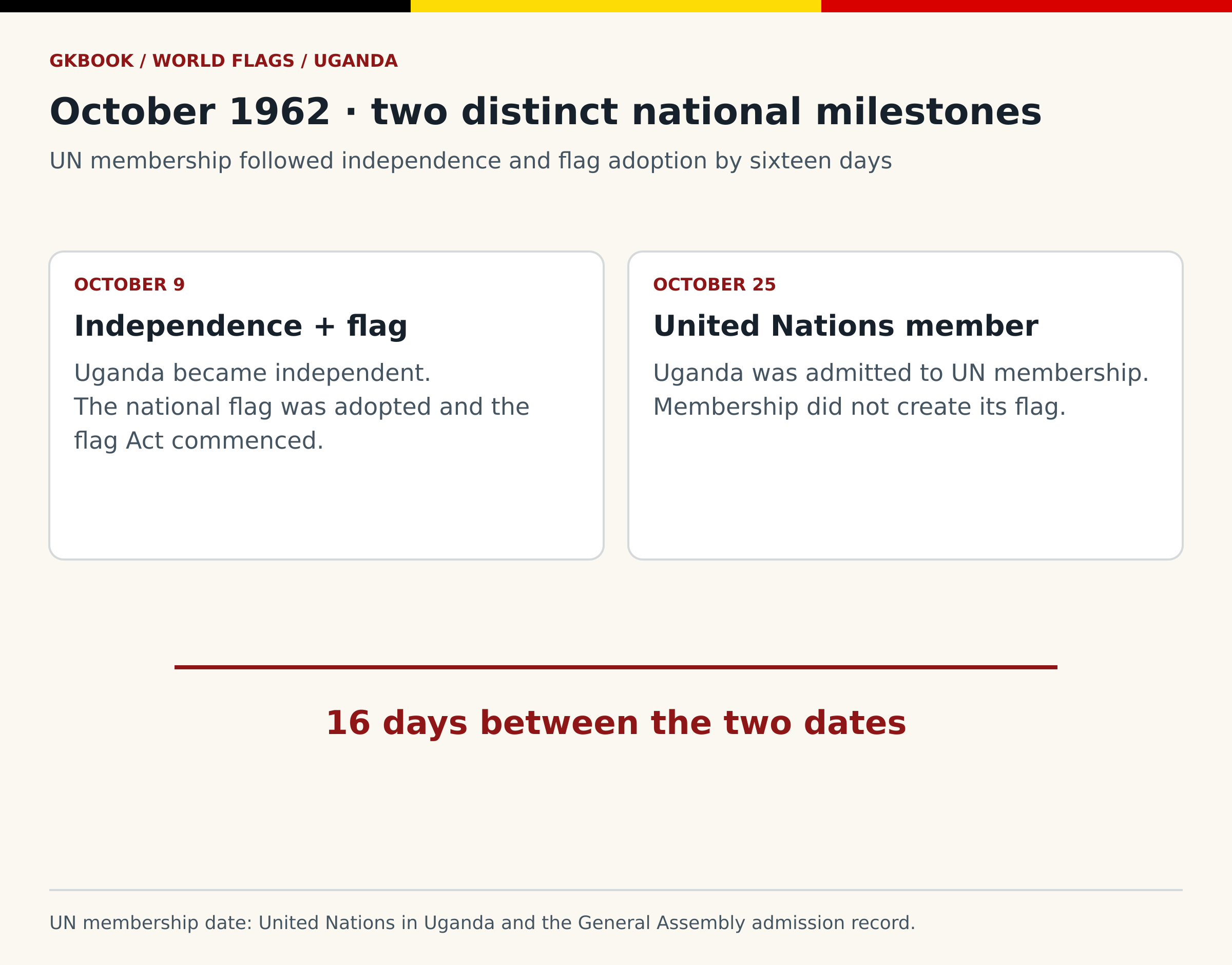
Uganda became a member of the United Nations on October 25, 1962, sixteen days after independence and flag adoption. United Nations membership and national independence are related but separate milestones. The later date should not replace October 9, 1962 in a flag’s adoption caption or an independence timeline.
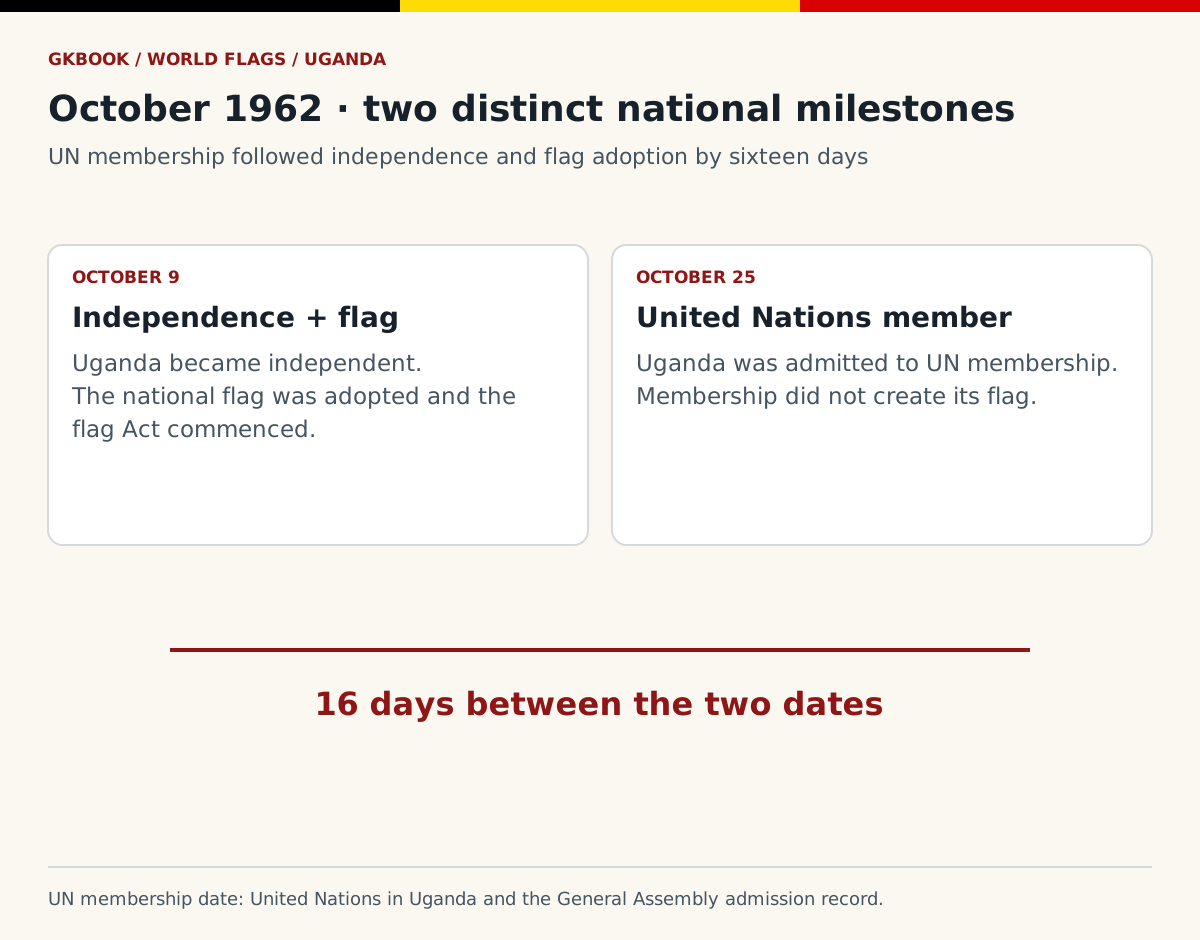
The UN’s own account of its work in Uganda records the membership date. The General Assembly’s admission resolution is a separate institutional record. Those sources establish an international milestone without implying that the United Nations designed, approved, or created Uganda’s national flag.
The timeline keeps three concepts distinct: choosing a national design, bringing the flag law into effect, and joining an international organization. This distinction helps students compare flags without assuming that every country’s flag adoption, independence, and UN membership occurred on the same day.
What law defines the Uganda national flag?
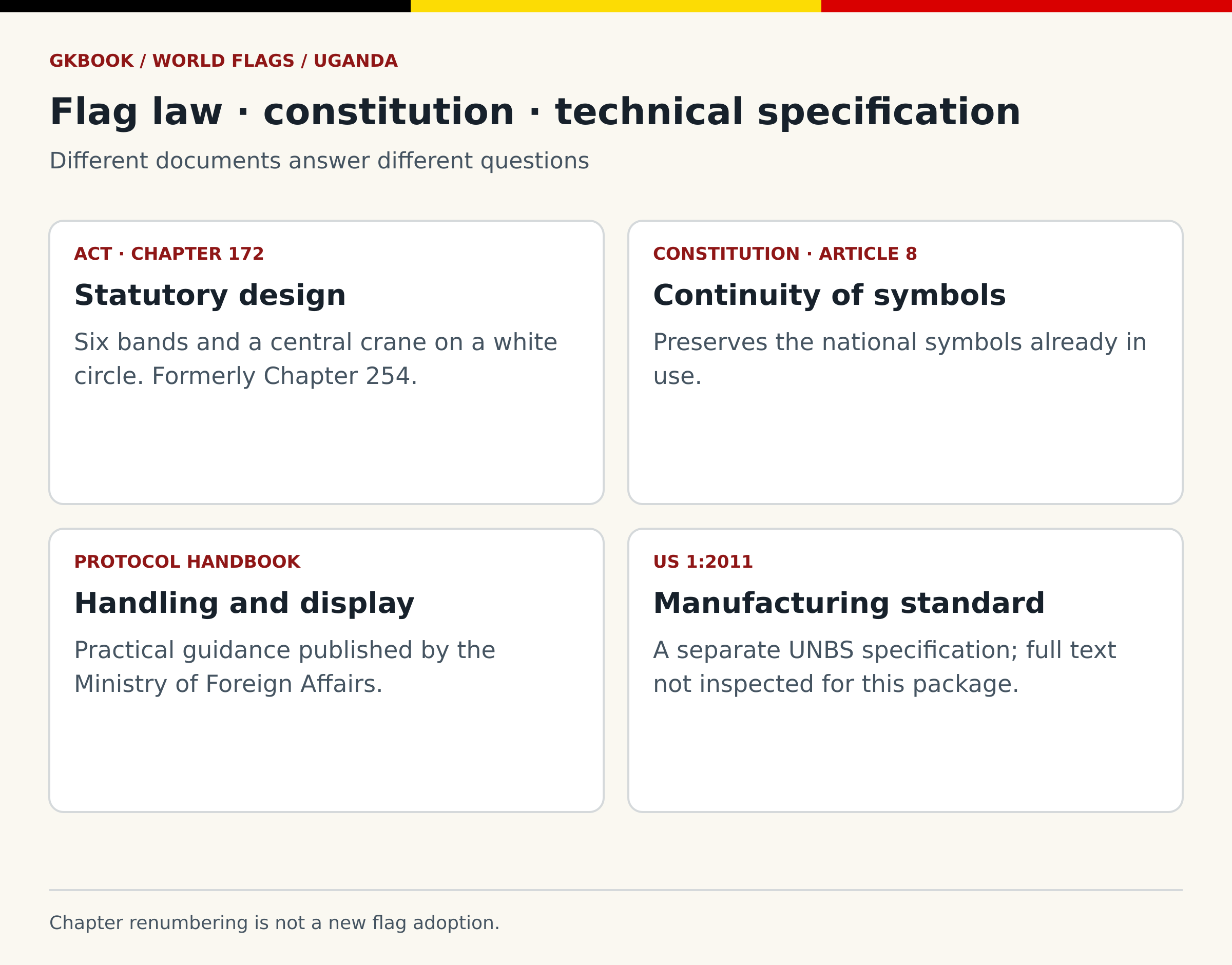
The National Flag and Armorial Ensigns Act defines the flag’s design and regulates specified misuse. In the 2023 revised laws it is Chapter 172; older references call it Chapter 254. Schedule 2, Part I describes the six equal stripes and central crane. Article 8 of the Constitution preserves the national symbols.
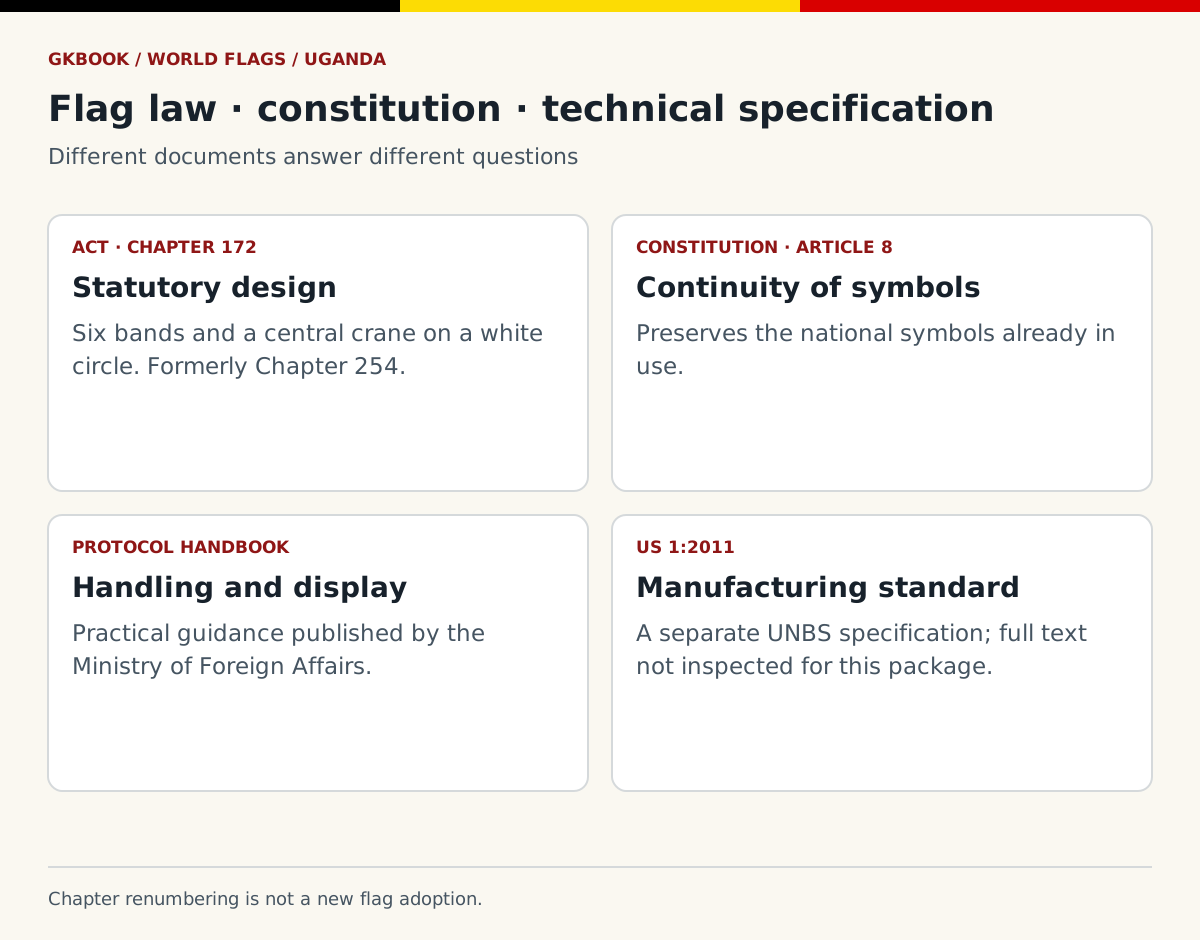
The schedule establishes the arrangement by naming the band colors in order and placing a crested crane on a white circle at the center. Its wording does not provide HEX values, a detailed crane outline, or numerical measurements for the overall ratio and disc diameter. Those matters must not be invented as quotations from the Act.
The Act also addresses intentional insult, certain unauthorized uses, and the minister’s regulation-making powers. Chapter renumbering does not mean the flag was adopted again in 2023. The commencement remains October 9, 1962. Commercial use and protocol should be considered under the relevant provisions and current official requirements.
Is there a Ugandan manufacturing standard for the flag?
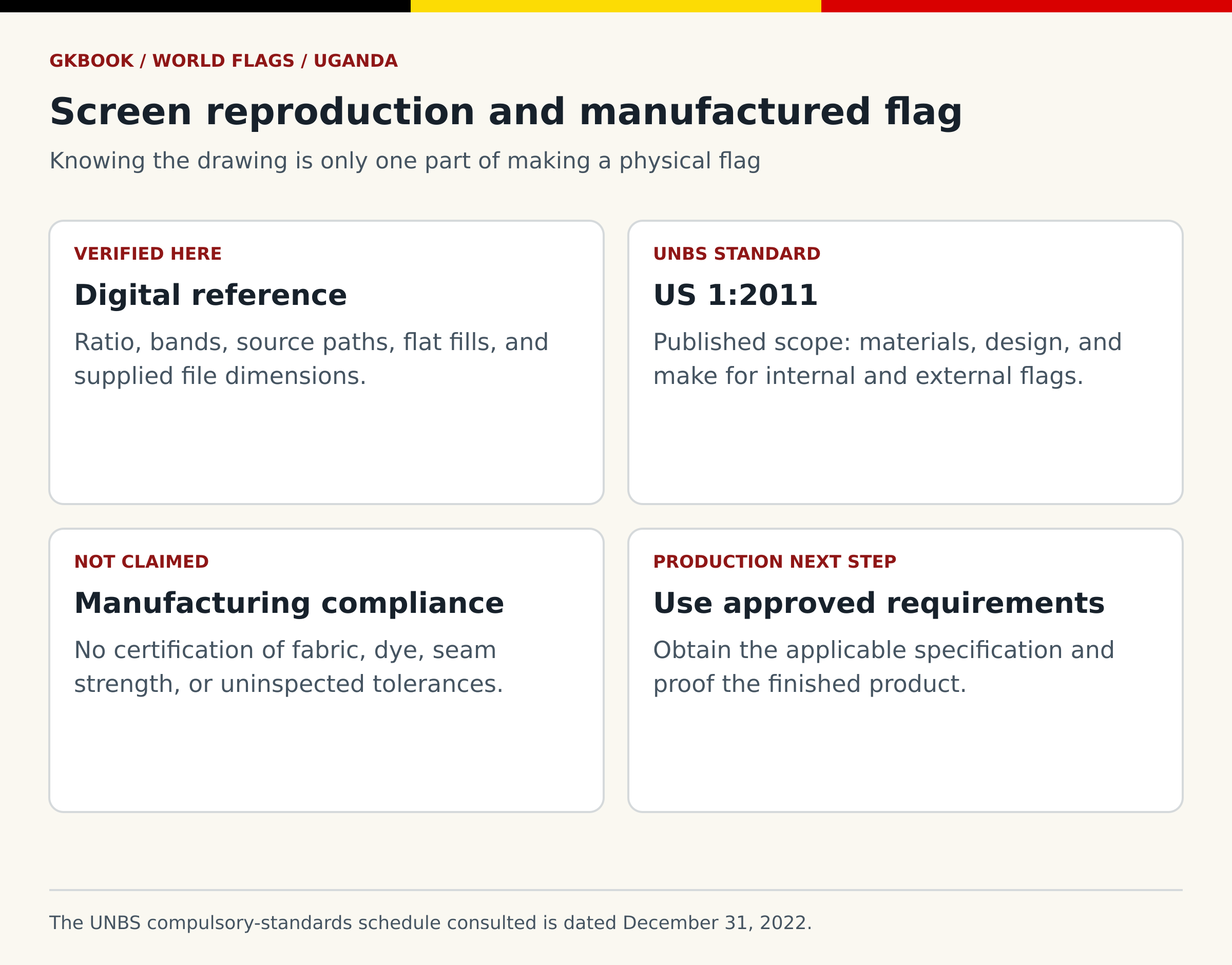
Yes. Uganda National Bureau of Standards lists US 1:2011, National flag of Uganda — Specification. Its published scope covers materials, design, and manufacture for internal and external flags. The full standard was not available among the materials inspected for this article, so the downloadable artwork is not represented as a certified manufacturing template.
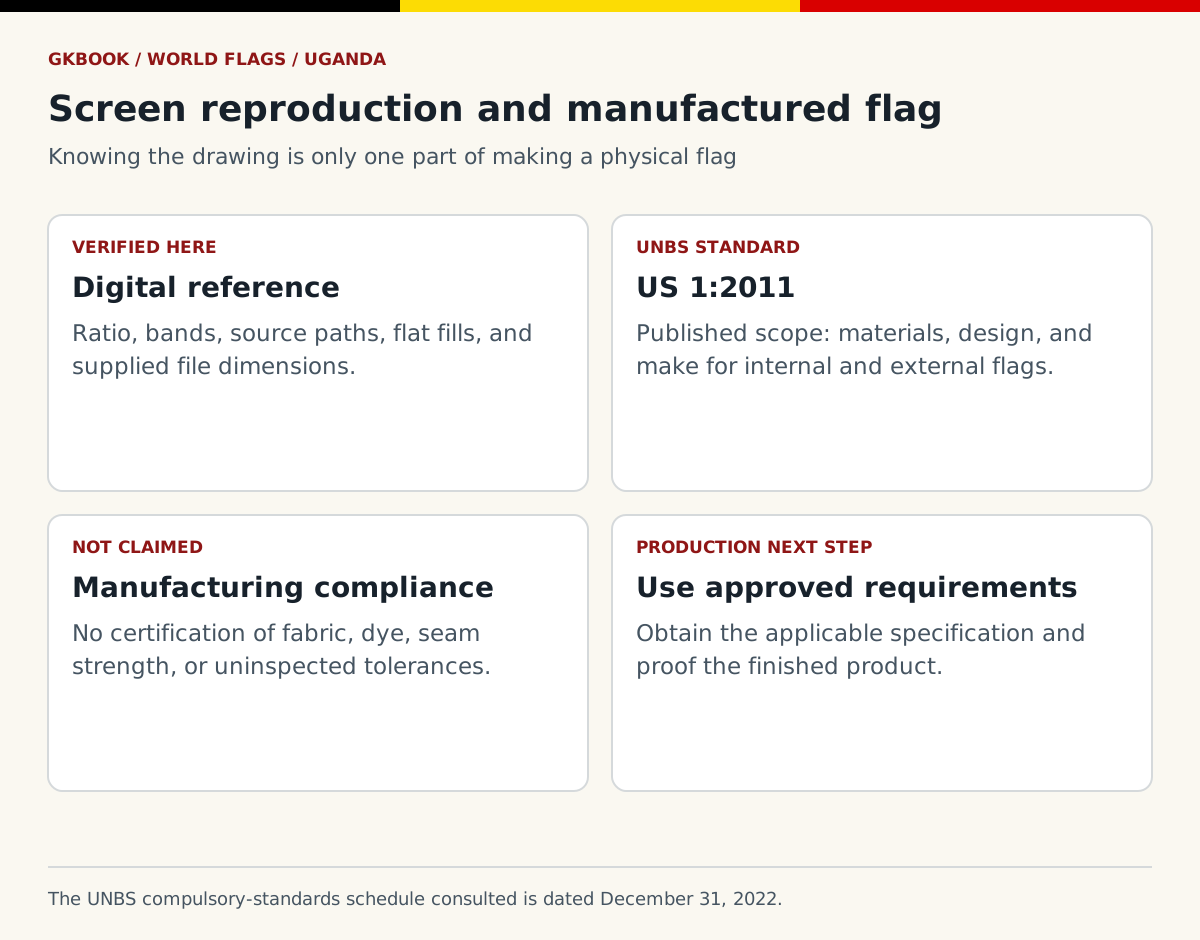
The standard appears in the Uganda Gazette’s 2012 standards notice and in UNBS’s published compulsory-standards schedule dated December 31, 2022. These records establish that a technical specification exists. They do not allow its unseen tolerances, fabric grades, test methods, or color requirements to be reconstructed from ordinary flag illustrations.
For procurement, obtain the applicable standard and approved production requirements from UNBS or the responsible authority. A screen illustration can explain the design, but it cannot establish the durability of a fabric, the strength of a seam, or the colorfastness of a printed flag. Indoor and outdoor conditions also create different production needs.
Is the crane on the flag the same as Uganda’s coat of arms?
The crane appears in both symbols, but the flag does not display the full coat of arms. Its central device is a single crane on a white circle. The arms include a shield, spears, a Uganda kob, a crane, plants, and a motto. The presidential standard is a separate flag associated with the presidency.
The coat of arms is described separately in Part II of the Act’s design schedule. Its heraldic composition is considerably more complex than the flag’s central disc. Replacing the crane with the full arms would therefore change the ordinary national design.
The Foreign Affairs protocol handbook describes a red presidential flag bearing the coat of arms and specifies uses connected with the president. A national flag, a presidential flag, and a cultural or party flag communicate different identities. For a general country illustration, use the six-band national flag reproduced on this page.
How should the Uganda flag be treated?
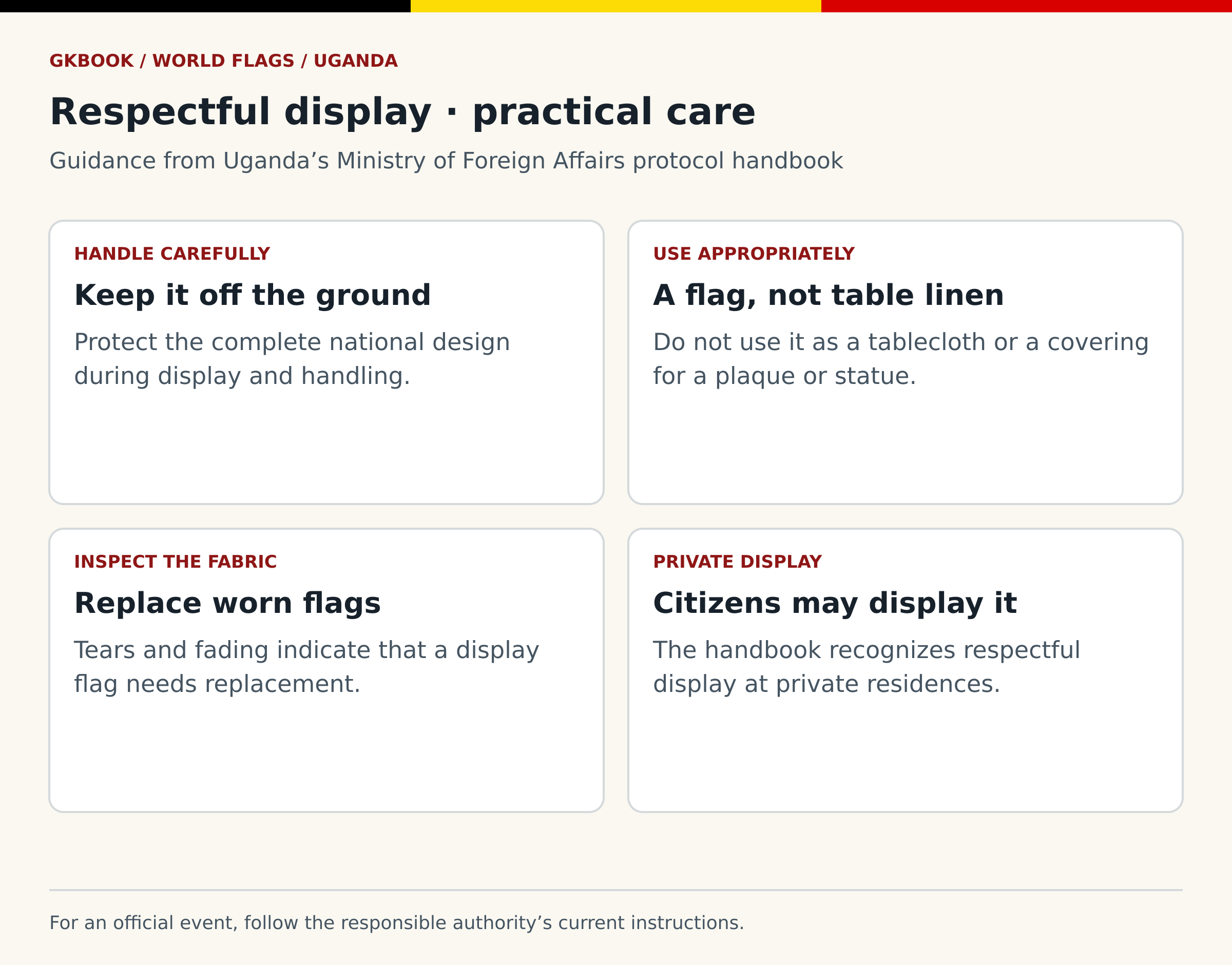
Uganda’s protocol handbook calls for dignified treatment of the national flag. It should not touch the ground or serve as a tablecloth, platform drape, or covering for a statue or plaque. Damaged and faded flags should be replaced. For official events, follow the responsible authority’s current protocol instructions.
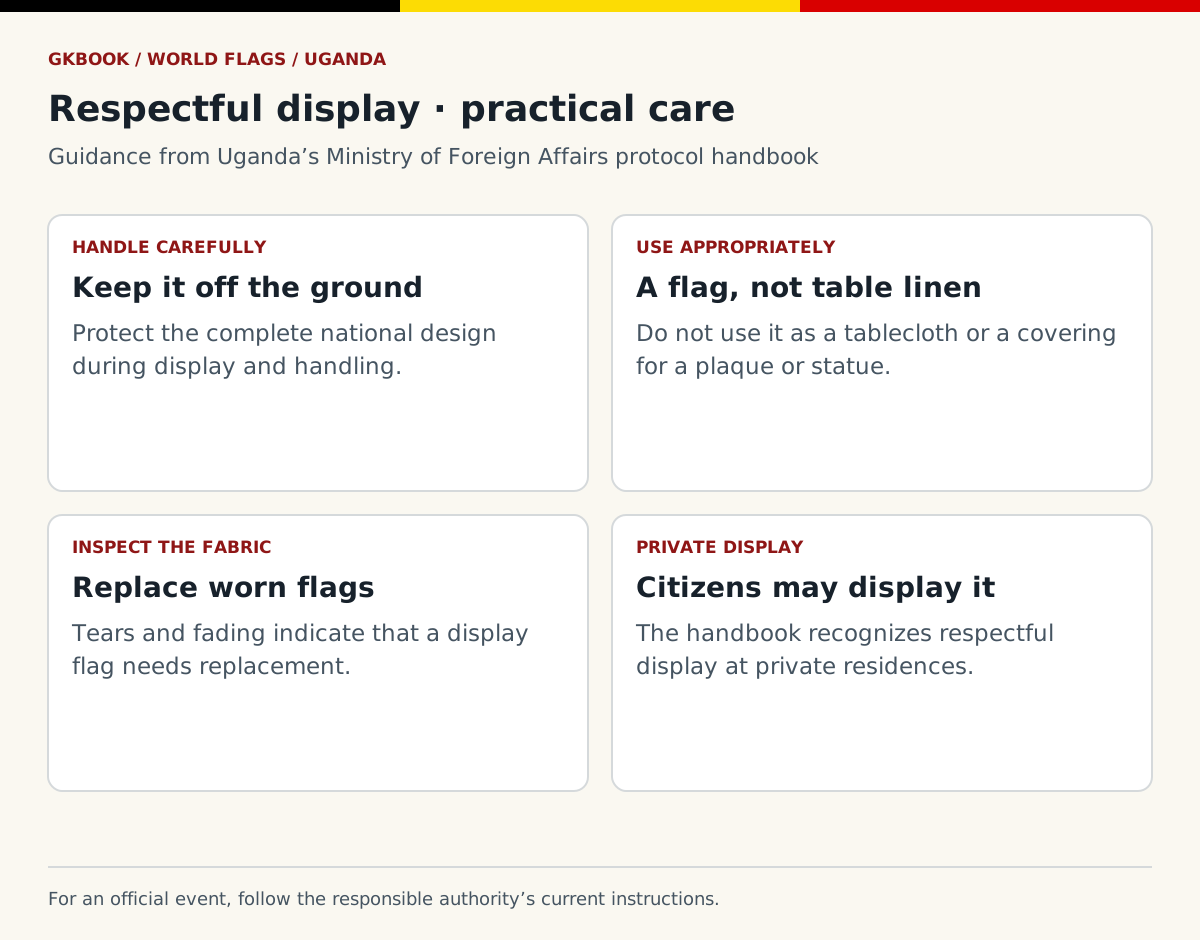
The handbook recognizes respectful display by citizens, including at private residences and on vehicles, as well as at government institutions. A discussion of national respect should therefore not be rewritten as a claim that only officials may display the flag.
Keep the emblem recognizable and the fabric in suitable condition. An educational picture can carry a separate caption or frame, while the flag itself remains intact. Where a specific ceremonial or regulated use is planned, the event’s protocol arrangements matter more than a general-purpose illustration on a webpage.
How should Uganda’s flag be displayed with other flags?
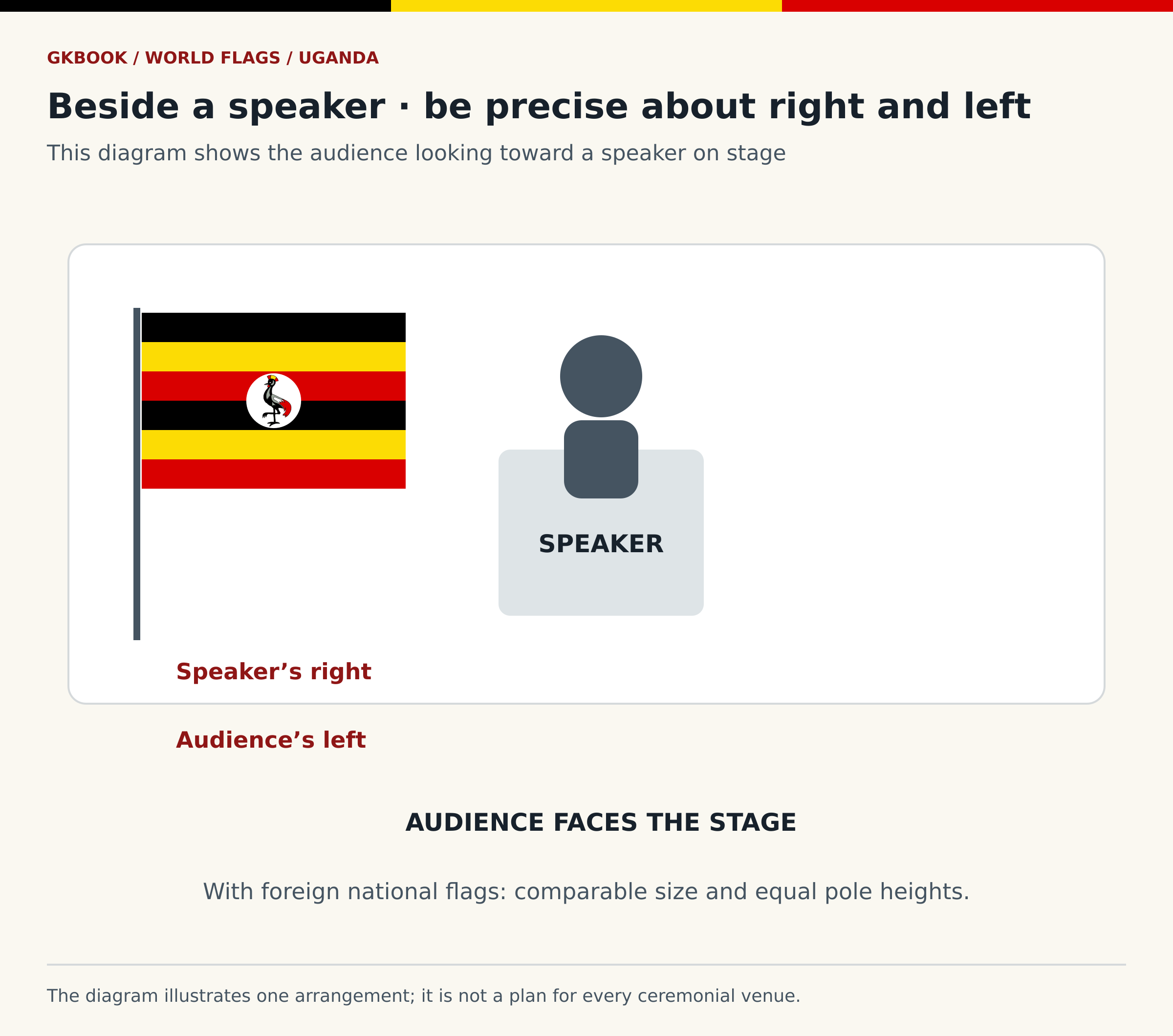
The protocol handbook specifies comparable sizes and equal pole heights when Uganda’s flag appears with foreign national flags. Beside or behind a speaker, it places Uganda’s flag on the speaker’s right. That is the audience’s left when the speaker faces them. Distinguish this arrangement from a flag placed elsewhere in the hall.
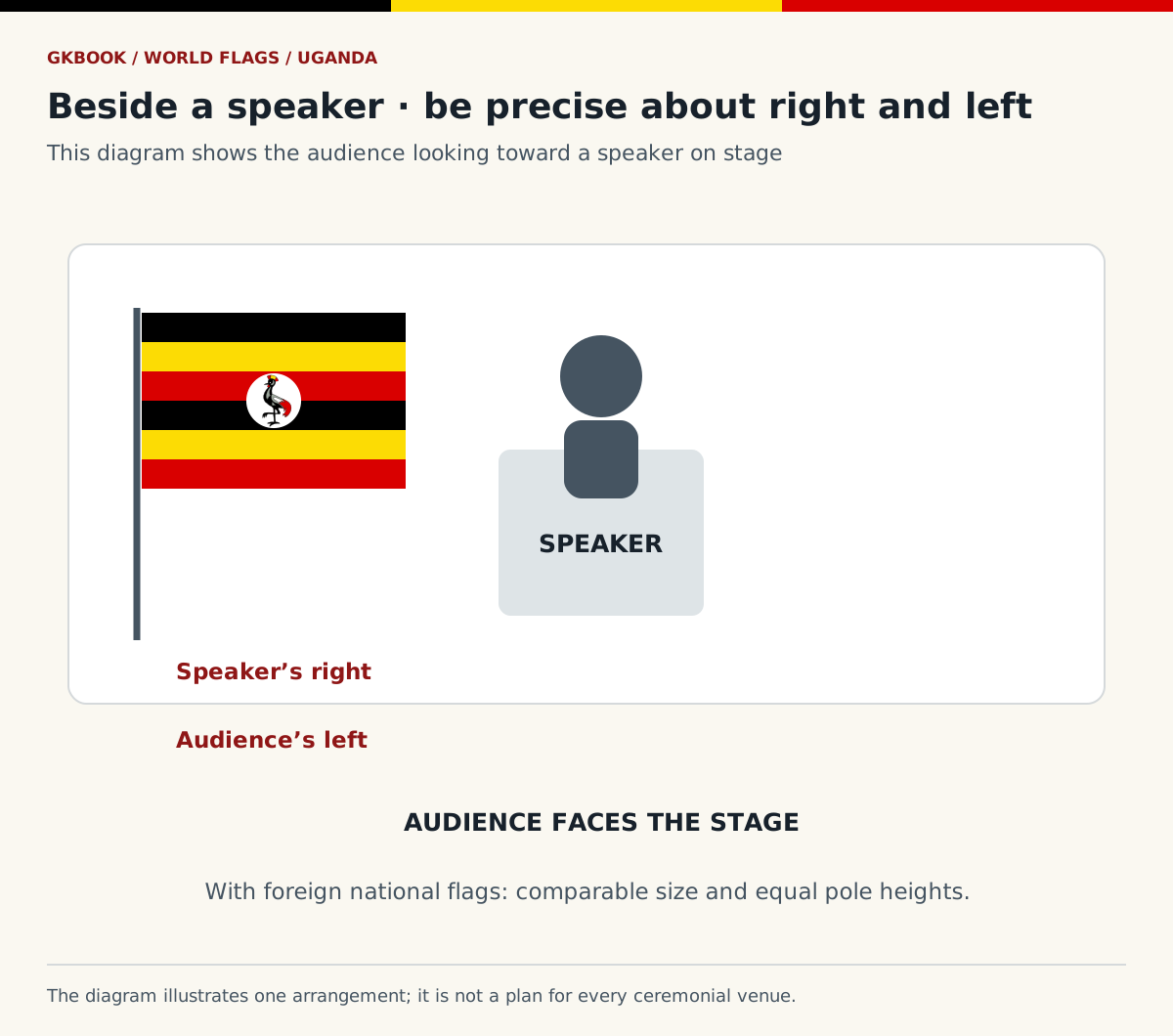
Perspective is essential: “right” without identifying the observer can produce the opposite layout. The accompanying stage diagram labels both speaker and audience positions. It illustrates only the beside-the-speaker arrangement, not every possible arrangement in a hall.
The handbook also addresses national precedence among local or company flags. That guidance should not erase its specific equal-height instruction for foreign national flags. For a diplomatic ceremony, confirm the full line-up, venue arrangement, and applicable event protocol before translating a general rule into a seating or flag plan.
When is the Uganda flag flown at half-mast?
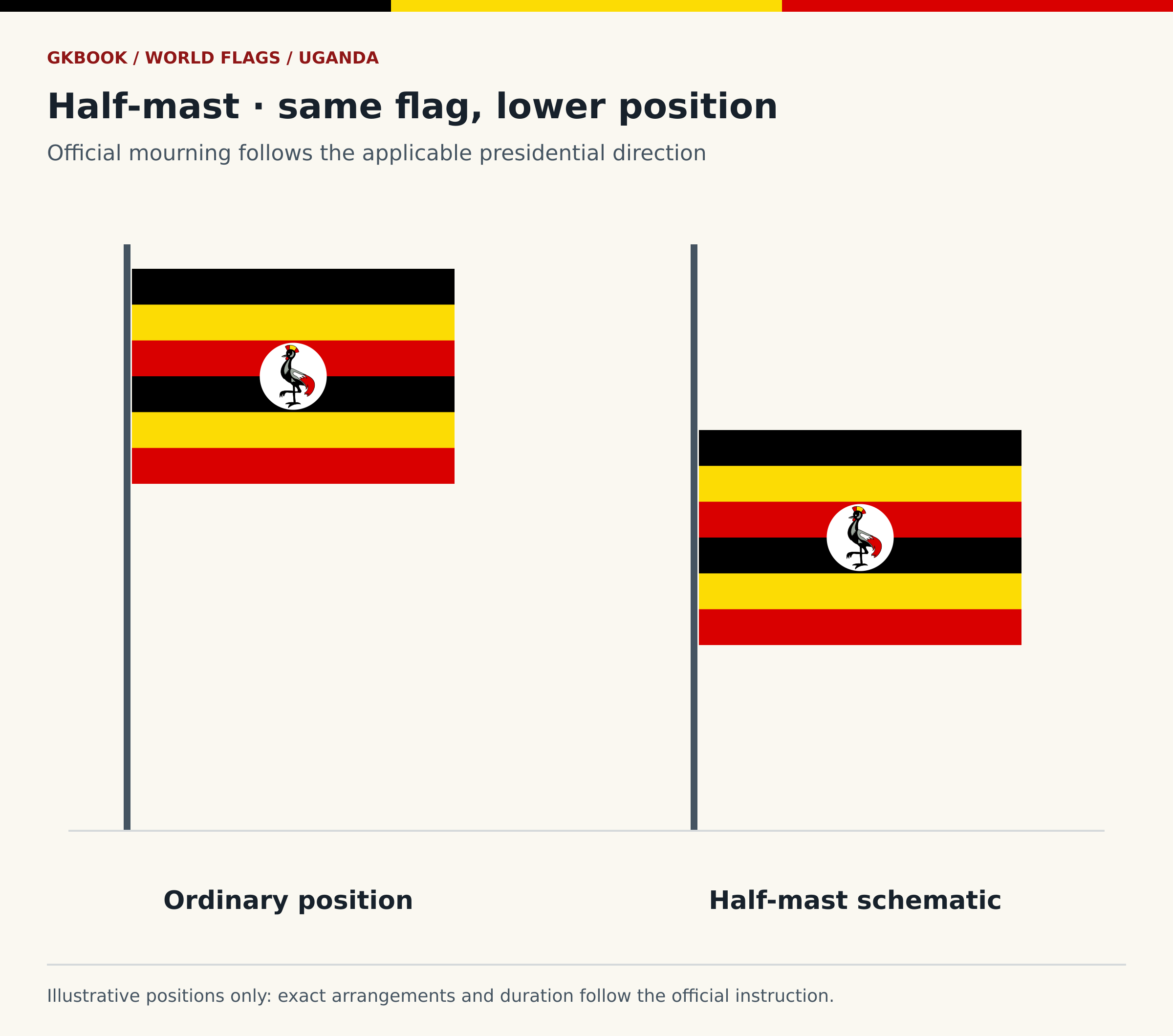
Uganda’s protocol handbook provides for half-masting by order of the president as a mark of respect after the deaths of specified public figures and dignitaries. The flag remains correctly oriented while its position on the pole is lowered. The applicable announcement determines the occasion and period of official mourning.
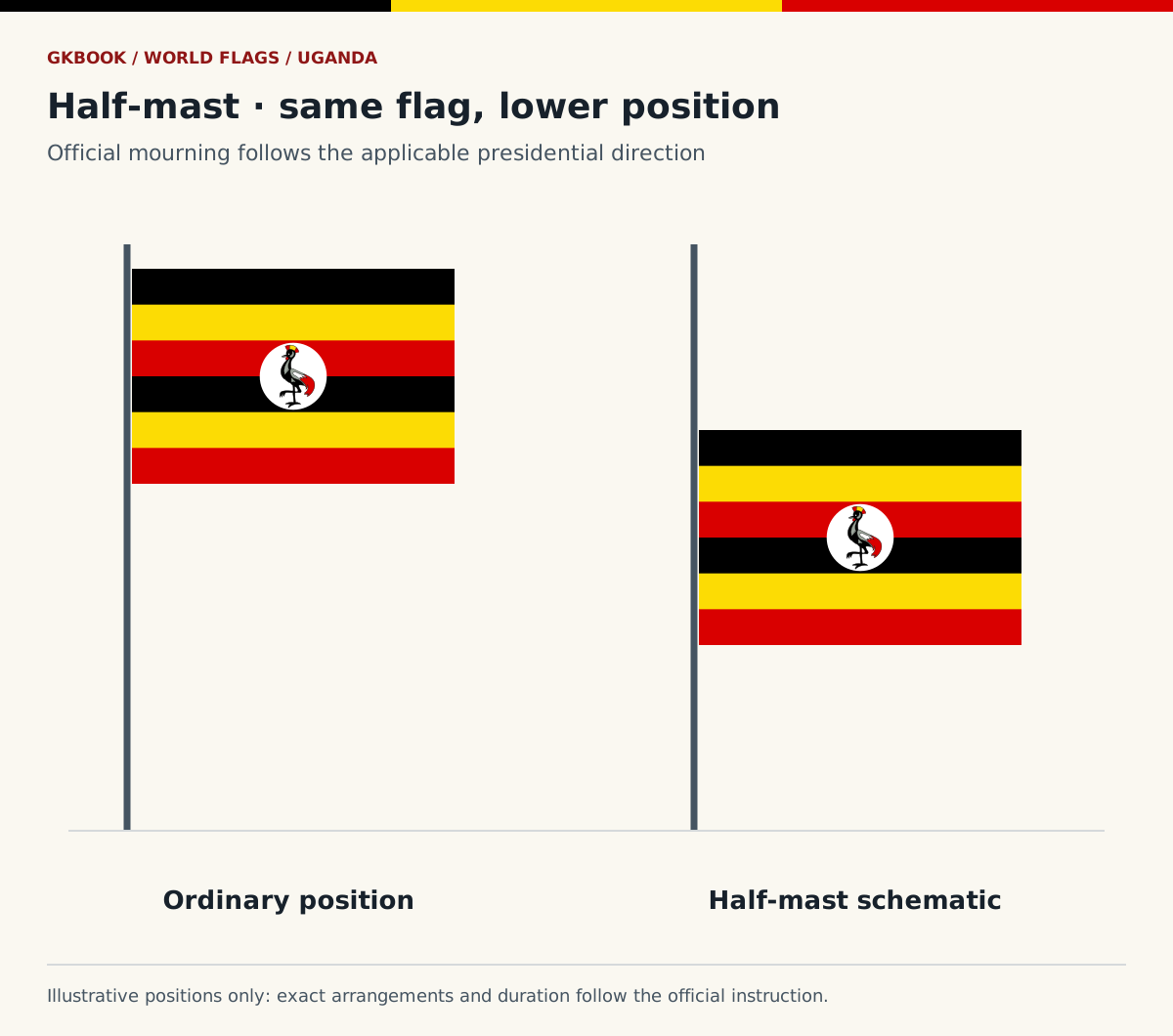
Half-masting changes the flag’s position, not its stripe order or emblem. The explanatory picture therefore uses the same complete national artwork at two different heights. It is a schematic comparison, not a specification of the exact distance to lower a flag on every mast.
A photograph of a lowered flag does not, by itself, establish which person is being honored or when the mourning period ends. Those details should be checked against the relevant official notice. Ordinary display and a formally directed mourning display are separate situations.
Can the Uganda flag be used in a logo or advertisement?
Copyright status alone does not settle that question. Section 4 of the Act regulates specified business, trade, calling, or professional uses that imply official authorization without the minister’s authority. A public-domain image is therefore not an official endorsement or a blanket permission for every commercial use of Uganda’s national symbols.
The wording matters: the provision concerns use in a manner calculated to make people believe the user is duly authorized in that connection. It should not be reduced to either “all commercial pictures are automatically allowed” or “every private display is prohibited.” Different contexts require different assessments.
The credits identify the digital artwork’s source and recorded copyright notices. They do not grant governmental approval, trademark clearance, or manufacturing certification. Before making the flag part of branding, merchandise, an official-looking seal, or an advertising campaign, check the intended use with the appropriate Ugandan authority and obtain qualified advice where needed.
How is the Uganda flag shown vertically?
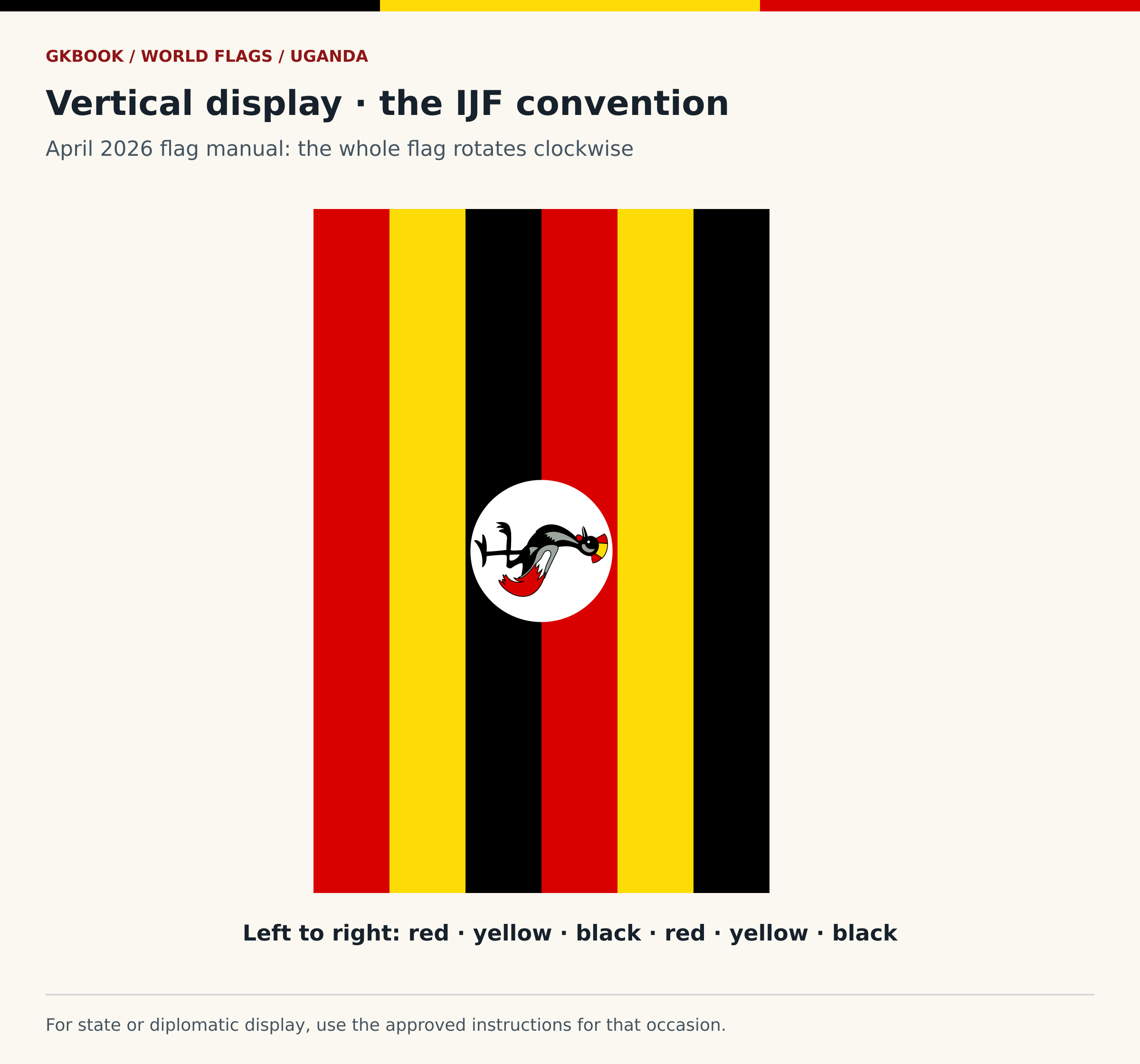
The International Judo Federation’s April 2026 manual shows a vertical version made by rotating the whole flag clockwise. Its bands read red, yellow, black, red, yellow, black from left to right, and the crane rotates with the cloth. This is a documented sporting-display convention, not a universal rule inferred from the flag Act.
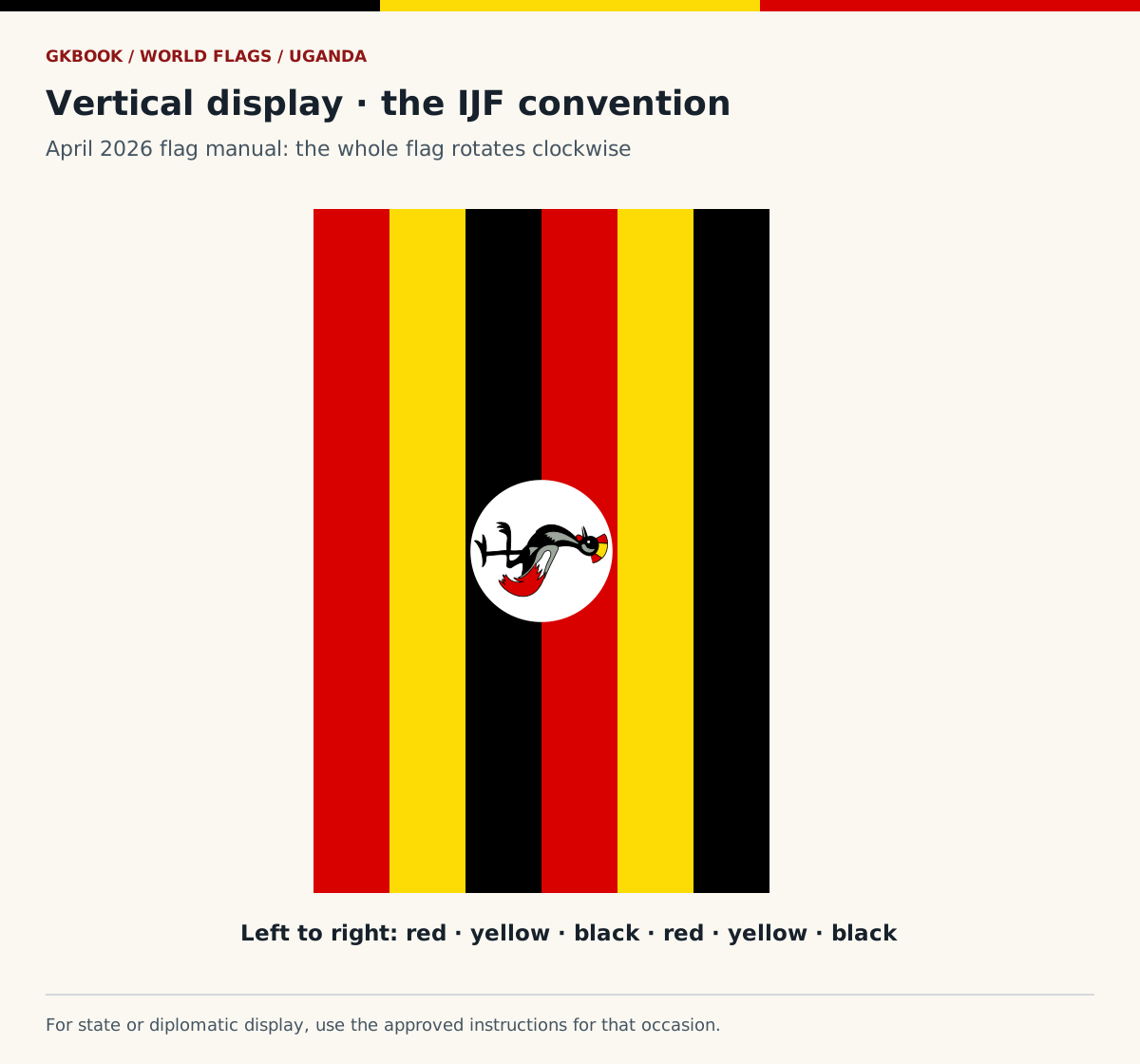
With that rotation, the former left-hand hoist becomes the top edge. The white disc stays circular because both dimensions are rotated together; the emblem is not separately redrawn upright. The diagram labels the source and transformation so that readers can distinguish a real display convention from an arbitrary redesign.
The reviewed Ugandan Act and protocol passage do not supply a comparable dimensioned vertical construction drawing. For a state or diplomatic venue, use the approved arrangement for that occasion. Do not describe the IJF event illustration as proof that every Ugandan ceremonial authority has adopted the same instruction.
What does the reverse of the Uganda flag look like?
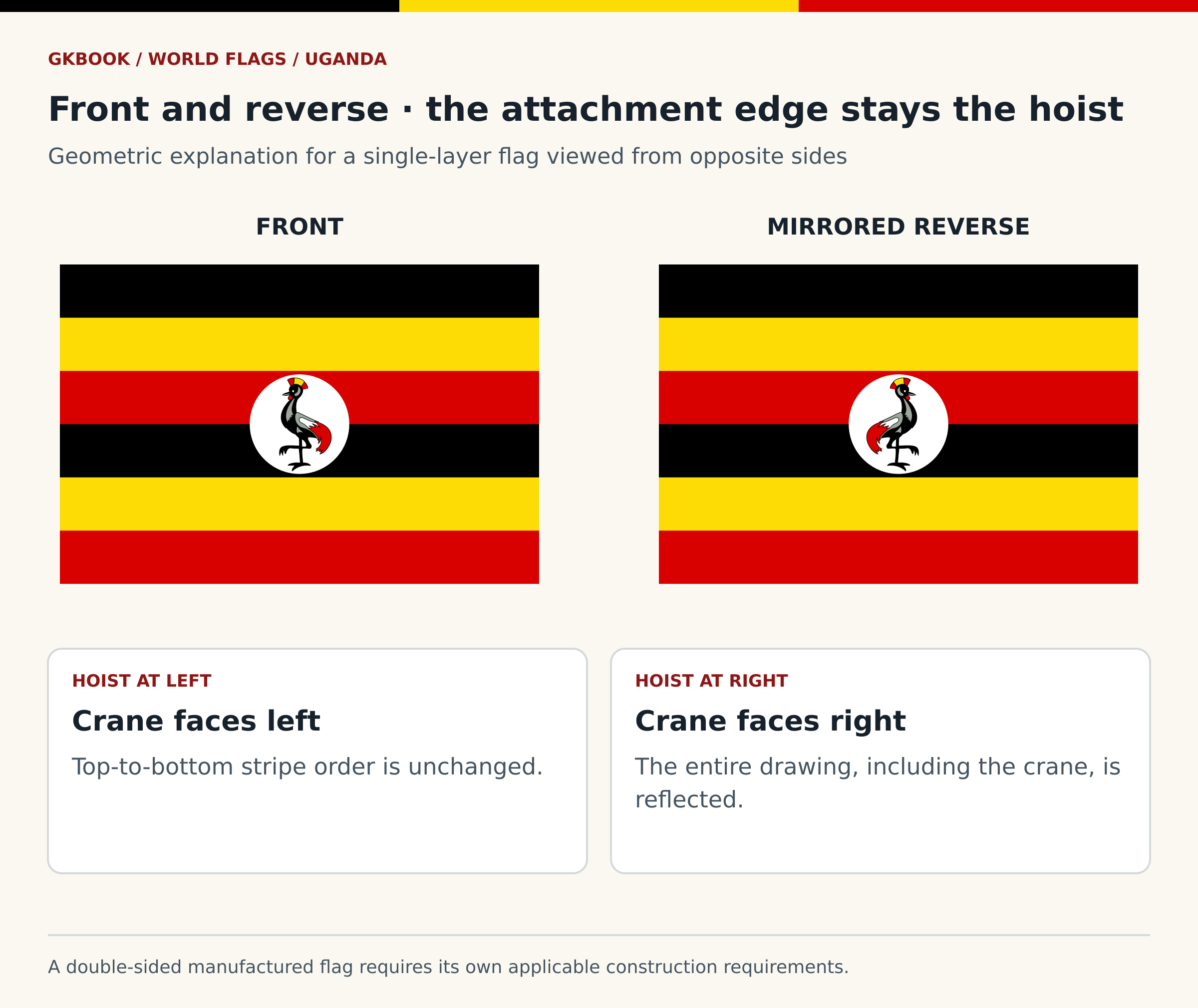
Viewed through an ordinary single-layer flag from the other side, the design is horizontally mirrored. The band order remains black, yellow, red, black, yellow, red, but the crane appears to face right when the hoist is on the viewer’s right. The bird still faces the physical attachment edge.
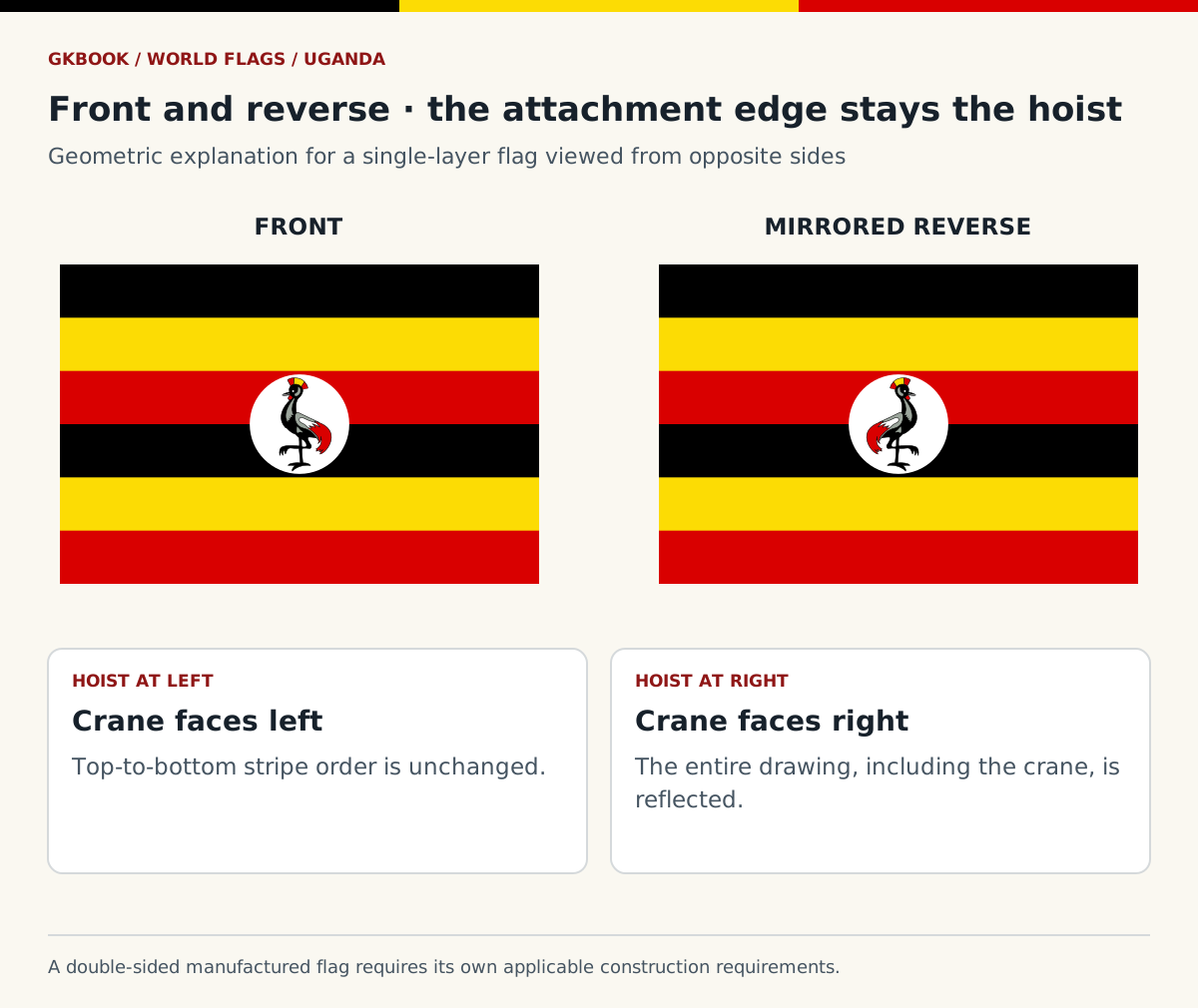
This is a geometric explanation of a translucent flag, not a separately legislated reverse design. A photograph taken from the back can therefore look different from the familiar front view without having its bands incorrectly arranged.
Purpose-made double-sided flags may use separate printed panels. Their construction should be checked against the applicable specification rather than inferred from the mirror example. In digital publishing, retain the standard front-view asset unless a caption explicitly explains that a reverse view is being shown.
Is the Uganda flag symmetrical?
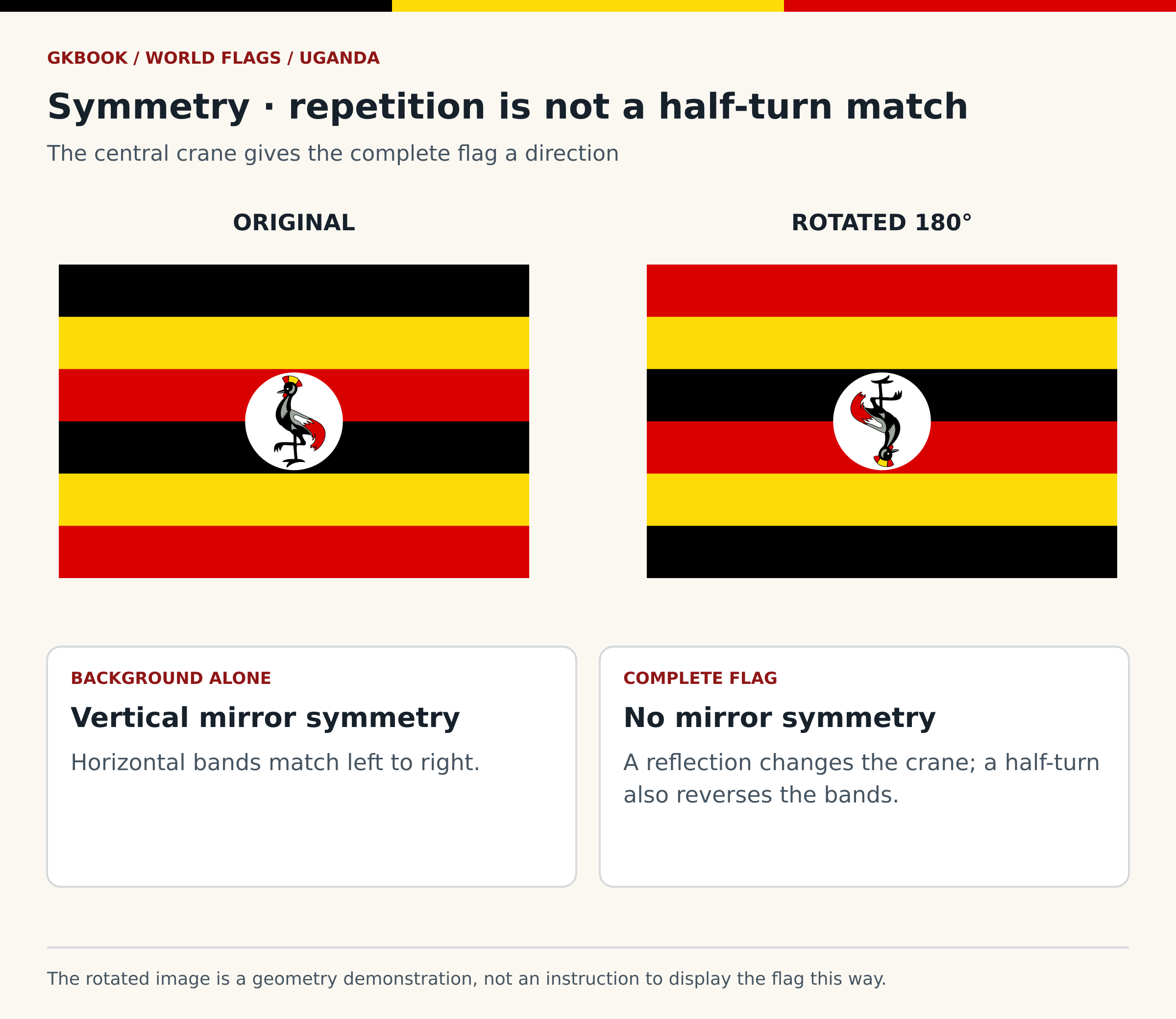
The complete flag has no mirror symmetry because the crane has a direction and an asymmetric pose. Its striped background alone is symmetric about a vertical centerline, but not about a horizontal centerline. A half-turn also changes the stripe order. The repeated three-color sequence is repetition, not rotational symmetry.
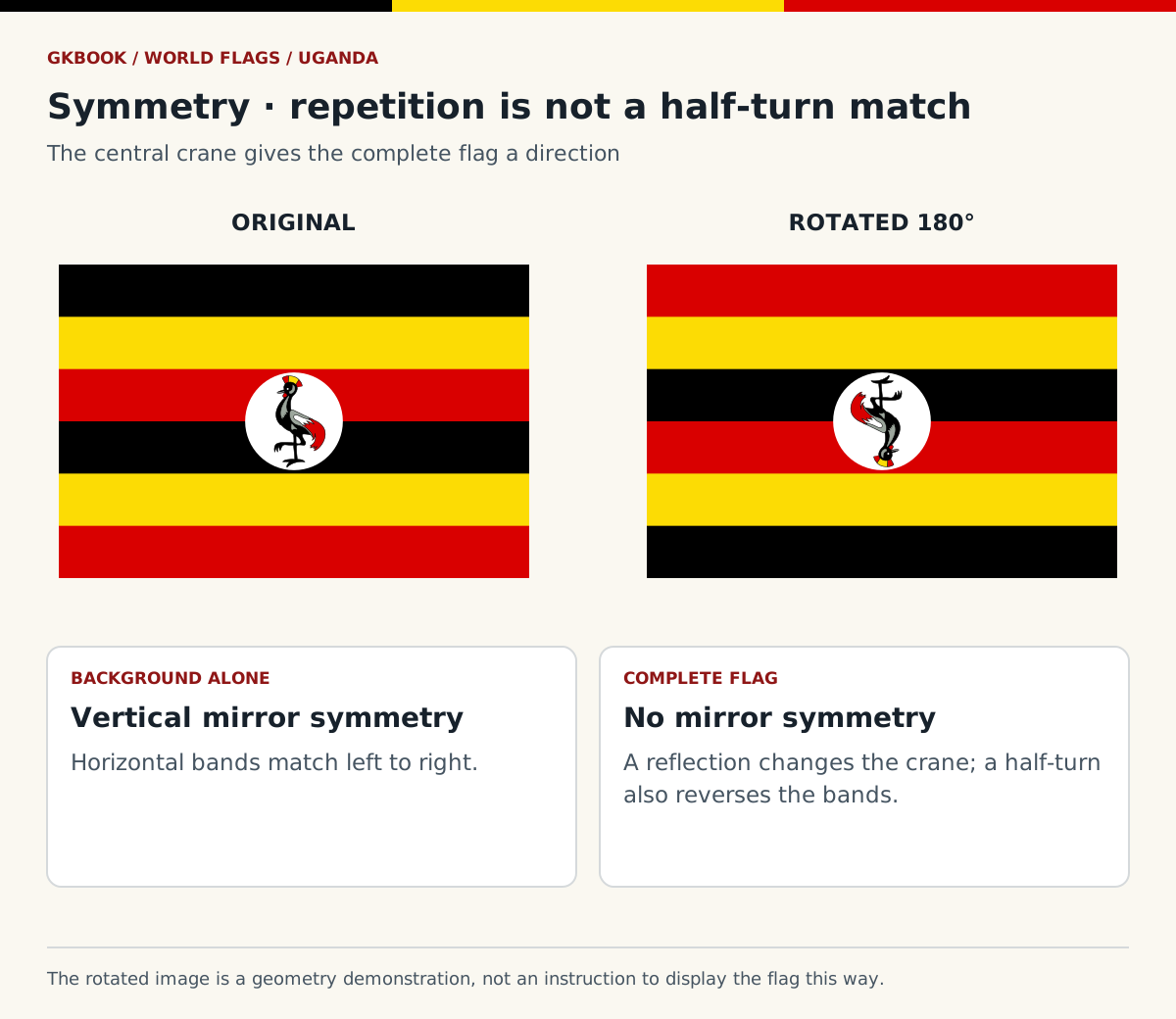
Reflecting the whole image left to right leaves the background unchanged but reverses the bird. Reflecting it top to bottom swaps the outer black and red bands. Rotating the image by 180 degrees reverses the band sequence and turns the crane upside down.
A central circle is symmetric on its own, yet placing a directional bird inside it removes that symmetry from the complete emblem. This is a useful distinction in geometry: the properties of one component do not necessarily describe the properties of the finished composition.
What Uganda flag files and print sizes are supplied?
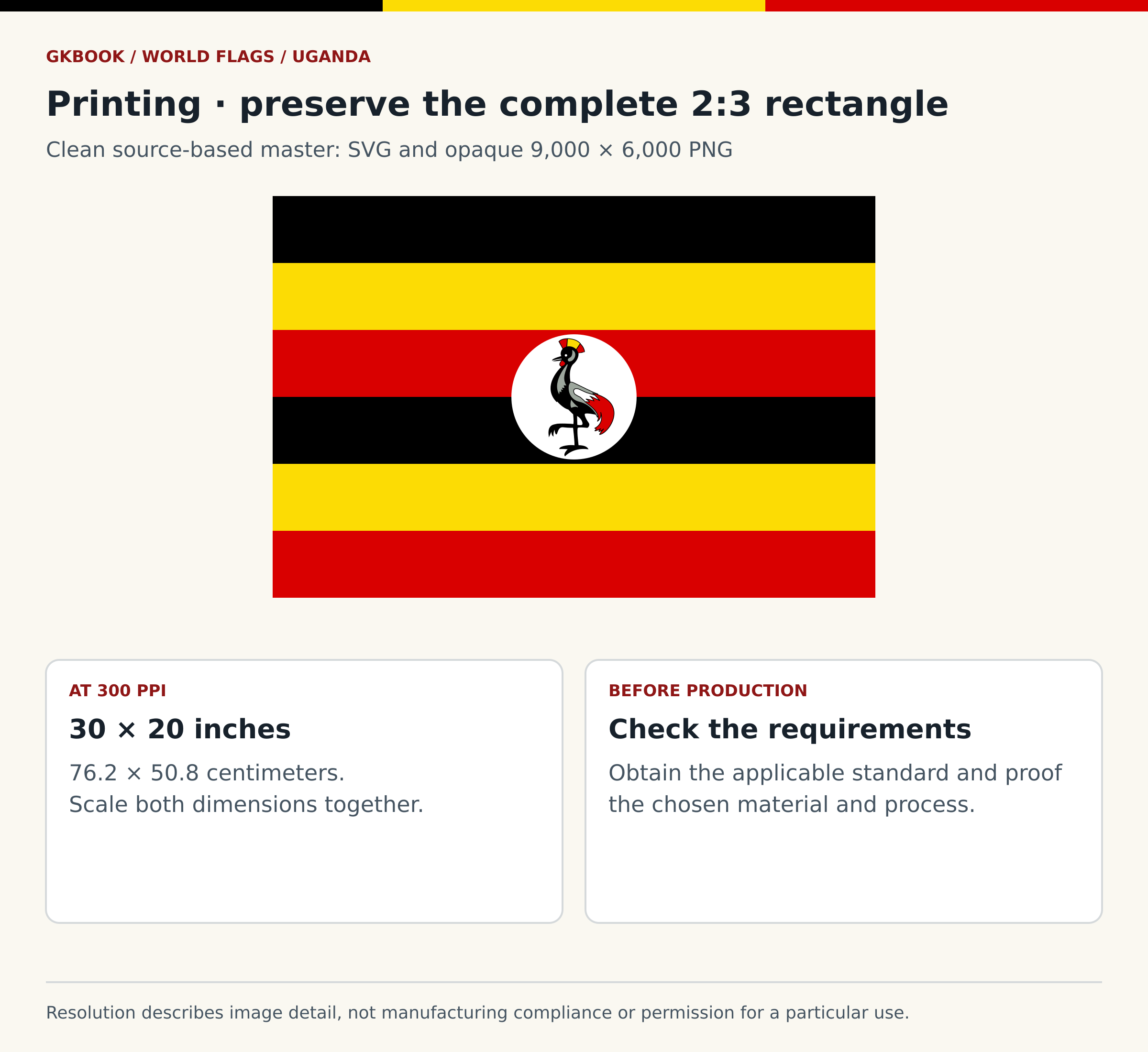
The clean flag is supplied as an editable SVG and a 9,000-by-6,000-pixel PNG with opaque colors. At 300 pixels per inch, that PNG supports a 30-by-20-inch reference print without enlargement. The gallery also provides explanatory SVG and PNG diagrams, plus a separate social-sharing image that preserves the complete flag.
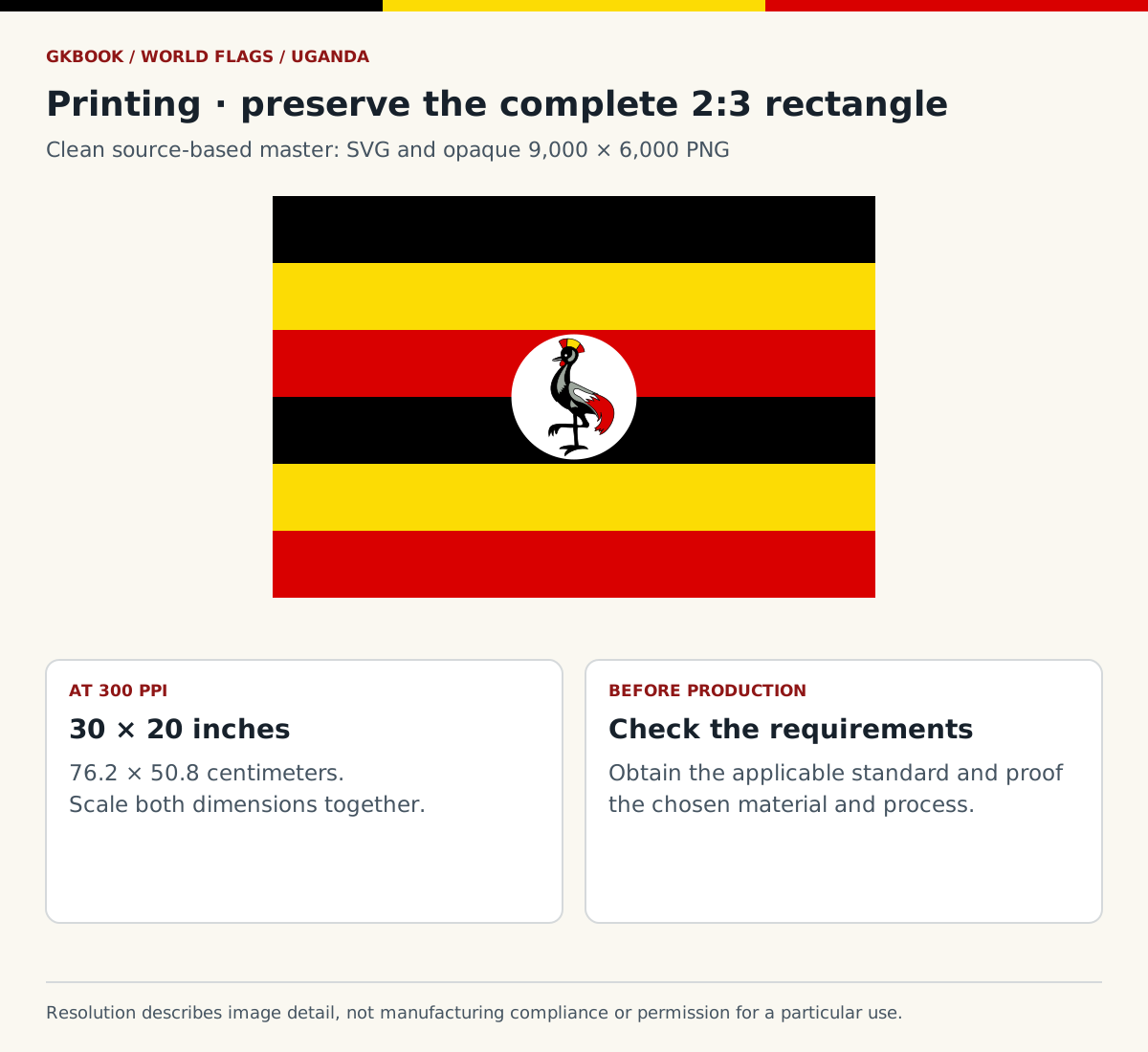
Use the clean master when a national flag is required; use a labeled illustration when teaching proportions, symbolism, history, or display. Keep the aspect ratio locked when resizing. On a square canvas, leave space around the flag instead of cropping bands or stretching the bird.
For commercial print or fabric production, confirm the applicable technical standard, color process, proof, and finish. Pixels per inch describes image detail, not textile quality. The supplied files preserve a documented digital reference and do not claim to satisfy uninspected manufacturing requirements. Downloads and source credits are available below.
| Resolution | Width | Height |
|---|---|---|
| 300 pixels/inch | 30 in / 76.2 cm | 20 in / 50.8 cm |
| 200 pixels/inch | 45 in / 114.3 cm | 30 in / 76.2 cm |
| 150 pixels/inch | 60 in / 152.4 cm | 40 in / 101.6 cm |
Sources and research notes
This article draws on Uganda’s flag Act and Constitution, the Ministry of Foreign Affairs protocol handbook, government national-symbol descriptions, archival historical research, UN records, the International Crane Foundation, and technical-standard listings. The source bibliography and image credits identify the documents and the reference artwork.
Legal descriptions, documented event conventions, and measurements of a digital illustration serve different purposes. The supplied images preserve the chosen reference, while their captions identify teaching additions and the limits of manufacturing claims.
Download Uganda flag pictures
Download the complete national flag as SVG or 9,000 × 6,000 PNG. Both preserve the 2:3 reference ratio, all six bands, the white disc, and the complete crane drawing. The PNG contains opaque colors.
The gallery includes 24 subjects, each available as SVG and PNG. The separate 1,200 × 630 social-sharing card places a complete flag beside its title. Use the clean master for a country flag and labeled illustrations for teaching. Read the technical-standard note before using a screen reference for physical production.
Continue exploring national designs in World Flags.
World Flags/Uganda
Uganda flag pictures
Six equal bands in the order black, yellow, red, black, yellow, red; a centered white disc with a hoist-facing crested crane. Reference ratio 2:3.
Flag vector: Wikimedia Commons / Open ClipArt, tobias and subsequent contributors; public-domain notices recorded. Explanatory layout: GKBook.Download SVGDownload PNGValues are read from the supplied SVG, not from the different color table on its Commons description page.
Flag vector: Wikimedia Commons / Open ClipArt, tobias and subsequent contributors; public-domain notices recorded. Explanatory layout: GKBook.Download SVGDownload PNGThe flag’s national meanings are distinct from historical arguments about party colors.
Flag vector: Wikimedia Commons / Open ClipArt, tobias and subsequent contributors; public-domain notices recorded. Explanatory layout: GKBook.Download SVGDownload PNGThe central bird is a stylized grey crowned crane, not a rooster or an eagle.
Flag vector: Wikimedia Commons / Open ClipArt, tobias and subsequent contributors; public-domain notices recorded. Explanatory layout: GKBook.Download SVGDownload PNGThe raised-leg pose is commonly associated with Uganda’s forward movement.
Flag vector: Wikimedia Commons / Open ClipArt, tobias and subsequent contributors; public-domain notices recorded. Explanatory layout: GKBook.Download SVGDownload PNGThe circle is centered; its exact diameter in this source is 187/600 of the height, rather than precisely one third.
Flag vector: Wikimedia Commons / Open ClipArt, tobias and subsequent contributors; public-domain notices recorded. Explanatory layout: GKBook.Download SVGDownload PNGThe 2:3 reference scales to a 9,000 by 6,000 master with six 1,000-pixel-high background bands.
Flag vector: Wikimedia Commons / Open ClipArt, tobias and subsequent contributors; public-domain notices recorded. Explanatory layout: GKBook.Download SVGDownload PNGThe background repeats black, yellow, red twice, in six equal horizontal bands.
Flag vector: Wikimedia Commons / Open ClipArt, tobias and subsequent contributors; public-domain notices recorded. Explanatory layout: GKBook.Download SVGDownload PNGThese geometric areas distinguish the underlying bands, the disc footprint, and the finished artwork.
Flag vector: Wikimedia Commons / Open ClipArt, tobias and subsequent contributors; public-domain notices recorded. Explanatory layout: GKBook.Download SVGDownload PNGA nine-by-six grid reproduces the reference aspect ratio and equal band heights. The source disc is 1.87 grid units in diameter.
Flag vector: Wikimedia Commons / Open ClipArt, tobias and subsequent contributors; public-domain notices recorded. Explanatory layout: GKBook.Download SVGDownload PNGA schematic history based on archival scholarship and official adoption records; no speculative historic crane reconstruction is supplied.
Flag vector: Wikimedia Commons / Open ClipArt, tobias and subsequent contributors; public-domain notices recorded. Explanatory layout: GKBook.Download SVGDownload PNGOfficial protocol and legal sources agree on October 9, 1962.
Flag vector: Wikimedia Commons / Open ClipArt, tobias and subsequent contributors; public-domain notices recorded. Explanatory layout: GKBook.Download SVGDownload PNGIbingira is the official attribution; committee leadership is supported by historical research, while individual production roles require care.
Flag vector: Wikimedia Commons / Open ClipArt, tobias and subsequent contributors; public-domain notices recorded. Explanatory layout: GKBook.Download SVGDownload PNGIndependence and flag adoption are commemorated on the same calendar date.
Flag vector: Wikimedia Commons / Open ClipArt, tobias and subsequent contributors; public-domain notices recorded. Explanatory layout: GKBook.Download SVGDownload PNGOctober 9 and October 25, 1962 mark separate events and should not be interchanged.
Flag vector: Wikimedia Commons / Open ClipArt, tobias and subsequent contributors; public-domain notices recorded. Explanatory layout: GKBook.Download SVGDownload PNGThe statutory design paragraph does not contain a full digital color and coordinate specification.
Flag vector: Wikimedia Commons / Open ClipArt, tobias and subsequent contributors; public-domain notices recorded. Explanatory layout: GKBook.Download SVGDownload PNGThe UNBS standard exists; this package does not claim to reproduce its unseen manufacturing requirements.
Flag vector: Wikimedia Commons / Open ClipArt, tobias and subsequent contributors; public-domain notices recorded. Explanatory layout: GKBook.Download SVGDownload PNGThe handbook emphasizes dignity and recognizes respectful private as well as institutional display.
Flag vector: Wikimedia Commons / Open ClipArt, tobias and subsequent contributors; public-domain notices recorded. Explanatory layout: GKBook.Download SVGDownload PNGThe handbook places the national flag on the speaker’s right, which is the facing audience’s left. Other hall arrangements have separate instructions.
Flag vector: Wikimedia Commons / Open ClipArt, tobias and subsequent contributors; public-domain notices recorded. Explanatory layout: GKBook.Download SVGDownload PNGThe complete flag remains correctly oriented; the schematic changes only its height on the mast.
Flag vector: Wikimedia Commons / Open ClipArt, tobias and subsequent contributors; public-domain notices recorded. Explanatory layout: GKBook.Download SVGDownload PNGThe complete reference is rotated 90 degrees clockwise, matching the transformation shown in the IJF manual. This is not presented as a universal Ugandan ceremonial rule.
Flag vector: Wikimedia Commons / Open ClipArt, tobias and subsequent contributors; public-domain notices recorded. Explanatory layout: GKBook.Download SVGDownload PNGA reverse-side view can show a right-facing crane while it still faces the physical hoist. This is not a separate legal reverse specification.
Flag vector: Wikimedia Commons / Open ClipArt, tobias and subsequent contributors; public-domain notices recorded. Explanatory layout: GKBook.Download SVGDownload PNGThe full flag fails both mirror tests and the half-turn test; the striped background alone has a vertical mirror axis.
Flag vector: Wikimedia Commons / Open ClipArt, tobias and subsequent contributors; public-domain notices recorded. Explanatory layout: GKBook.Download SVGDownload PNGThe raster supports 30 by 20 inches at 300 pixels per inch; vector geometry scales without changing the aspect ratio.
Flag vector: Wikimedia Commons / Open ClipArt, tobias and subsequent contributors; public-domain notices recorded. Explanatory layout: GKBook.Download SVGDownload PNGFrequently asked questions
What does the Uganda flag look like?
The Uganda flag has six equal horizontal bands in the order black, yellow, red, black, yellow, and red. A white disc at the center contains a crested crane facing the hoist. The standard reference proportion is height:length 2:3, and the flag was adopted at independence on October 9, 1962.
What is the Uganda flag called?
The formal English name is the National Flag of Uganda. It represents the Republic of Uganda, an East African country whose capital is Kampala. Uganda’s national flag should be distinguished from the presidential standard, military flags, political-party banners, and the flags associated with particular kingdoms or cultural institutions.
What are the Uganda flag colors and digital values?
The stripes are black, yellow, and red, repeated twice. White forms the central disc, and gray appears in the crane. The supplied reference artwork uses black #000000, yellow #FCDC04, red #D90000, white #FFFFFF, and gray #9CA69C. These are measured digital fills, not a certified national textile palette.
What does the Uganda flag symbolize?
The flag brings together African identity, sunshine, and brotherhood. Uganda’s official national-symbol descriptions associate black with African peoples, yellow with Africa’s sunshine, and red with the shared blood that connects Africans. The central crested crane identifies Uganda, while its raised leg is commonly explained as a sign of forward movement.
What do the black stripes mean?
Black represents African peoples in the Ugandan government’s principal explanation of the flag. It appears in the first and fourth horizontal bands, counting from the top. Another government description also associates it with African heritage and fertile soil. Black is therefore more than a dark background behind the central bird.
What do the yellow stripes mean?
Yellow represents Africa’s sunshine in official explanations of Uganda’s flag. It occupies the second and fifth bands from the top. Both have the same height as the black and red bands. In the supplied drawing, the central white disc fits between the two yellow stripes without covering either one.
What do the red stripes mean?
Red stands for African brotherhood in Uganda’s official explanation: blood is the shared link between people. It forms the third and sixth bands from the top. The lower red band reaches the bottom edge. Describing red only as blood shed in war omits the documented emphasis on kinship and unity.
What bird is on the Uganda flag?
The bird is the grey crowned crane, commonly called the crested crane in Uganda. Its scientific species name is Balearica regulorum; the East African subspecies is B. r. gibbericeps. The flag shows a stylized crane in a white disc, facing the hoist, with one leg lifted.
Why does the crane have one leg raised?
The crane’s raised leg is commonly interpreted as Uganda moving forward. Uganda’s official NAM description associates the crane with the nation’s forward movement. The pose also makes the small emblem distinctive: a long-necked bird with a crown, a supporting leg, and another leg lifted in front of its body.
What does the white circle contain, and how large is it?
The white circle contains Uganda’s crested crane and is centered on the flag. The Act specifies a central white circle but gives no numerical diameter in its design paragraph. In the supplied 900-by-600 reference, its center is (450, 300), and its diameter is 187 units, or about 31.17% of the height.
What are the proportions of the Uganda flag?
The established reference proportion is height:length 2:3, also recorded as the original ratio in the International Judo Federation’s flag manual. A flag three units long is two units high. Each of the six bands is one sixth of the height. The supplied large master measures 9,000 by 6,000 pixels.
What is the correct order of the six stripes?
From top to bottom, the stripes are black, yellow, red, black, yellow, and red. All six have equal height and extend across the flag before the central emblem is added. On a 900-by-600 drawing, their boundaries fall at y = 0, 100, 200, 300, 400, 500, and 600.
Do the three stripe colors occupy equal areas?
Before the emblem is added, black, yellow, and red each cover one third of the flag. In the finished image their visible areas are different because the central white disc covers parts of the middle red and black bands, and the crane adds colored details inside that disc.
How can the Uganda flag be drawn accurately?
Draw a 3:2 landscape rectangle and divide its height into six equal horizontal bands. Fill them black, yellow, red, black, yellow, red. Center a white disc and place the established crested-crane artwork inside it, facing the hoist. For an accurate reproduction, preserve the complete reference rather than sketching a substitute bird.
What is the history of the Uganda flag?
The present flag emerged during Uganda’s transition from British rule to independence in 1962. The crane had already been used as an emblem in the colonial period. An earlier 1962 proposal used green, blue, and gold with vertical bands; a later committee produced the black, yellow, and red horizontal design.
When was the Uganda flag adopted?
Uganda adopted its national flag on October 9, 1962, the date of independence from the United Kingdom. The National Flag and Armorial Ensigns Act also commenced that day. Earlier design discussions and announcements belong to the preparation for independence; they are distinct from the date normally used for the flag’s adoption.
Who designed the Uganda flag?
Ugandan government pages credit Grace Ibingira with designing the national flag. Historical research also documents his chairmanship of the committee that revised the design in 1962. The flag emerged through a political and artistic process, so this official attribution should not be confused with proof that one person executed every drawing and production detail.
When is Uganda Independence Day, and is it the flag anniversary?
Uganda’s Independence Day is October 9, marking independence in 1962. It is also the anniversary of adoption of the present national flag. The date should not be confused with Uganda’s later admission to the United Nations, and this article does not assign a separate national Flag Day without a verified official basis.
When did Uganda join the United Nations?
Uganda became a member of the United Nations on October 25, 1962, sixteen days after independence and flag adoption. United Nations membership and national independence are related but separate milestones. The later date should not replace October 9, 1962 in a flag’s adoption caption or an independence timeline.
What law defines the Uganda national flag?
The National Flag and Armorial Ensigns Act defines the flag’s design and regulates specified misuse. In the 2023 revised laws it is Chapter 172; older references call it Chapter 254. Schedule 2, Part I describes the six equal stripes and central crane. Article 8 of the Constitution preserves the national symbols.
Is there a Ugandan manufacturing standard for the flag?
Yes. Uganda National Bureau of Standards lists US 1:2011, National flag of Uganda — Specification. Its published scope covers materials, design, and manufacture for internal and external flags. The full standard was not available among the materials inspected for this article, so the downloadable artwork is not represented as a certified manufacturing template.
Is the crane on the flag the same as Uganda’s coat of arms?
The crane appears in both symbols, but the flag does not display the full coat of arms. Its central device is a single crane on a white circle. The arms include a shield, spears, a Uganda kob, a crane, plants, and a motto. The presidential standard is a separate flag associated with the presidency.
How should the Uganda flag be treated?
Uganda’s protocol handbook calls for dignified treatment of the national flag. It should not touch the ground or serve as a tablecloth, platform drape, or covering for a statue or plaque. Damaged and faded flags should be replaced. For official events, follow the responsible authority’s current protocol instructions.
How should Uganda’s flag be displayed with other flags?
The protocol handbook specifies comparable sizes and equal pole heights when Uganda’s flag appears with foreign national flags. Beside or behind a speaker, it places Uganda’s flag on the speaker’s right. That is the audience’s left when the speaker faces them. Distinguish this arrangement from a flag placed elsewhere in the hall.
When is the Uganda flag flown at half-mast?
Uganda’s protocol handbook provides for half-masting by order of the president as a mark of respect after the deaths of specified public figures and dignitaries. The flag remains correctly oriented while its position on the pole is lowered. The applicable announcement determines the occasion and period of official mourning.
Can the Uganda flag be used in a logo or advertisement?
Copyright status alone does not settle that question. Section 4 of the Act regulates specified business, trade, calling, or professional uses that imply official authorization without the minister’s authority. A public-domain image is therefore not an official endorsement or a blanket permission for every commercial use of Uganda’s national symbols.
How is the Uganda flag shown vertically?
The International Judo Federation’s April 2026 manual shows a vertical version made by rotating the whole flag clockwise. Its bands read red, yellow, black, red, yellow, black from left to right, and the crane rotates with the cloth. This is a documented sporting-display convention, not a universal rule inferred from the flag Act.
What does the reverse of the Uganda flag look like?
Viewed through an ordinary single-layer flag from the other side, the design is horizontally mirrored. The band order remains black, yellow, red, black, yellow, red, but the crane appears to face right when the hoist is on the viewer’s right. The bird still faces the physical attachment edge.
Is the Uganda flag symmetrical?
The complete flag has no mirror symmetry because the crane has a direction and an asymmetric pose. Its striped background alone is symmetric about a vertical centerline, but not about a horizontal centerline. A half-turn also changes the stripe order. The repeated three-color sequence is repetition, not rotational symmetry.
What Uganda flag files and print sizes are supplied?
The clean flag is supplied as an editable SVG and a 9,000-by-6,000-pixel PNG with opaque colors. At 300 pixels per inch, that PNG supports a 30-by-20-inch reference print without enlargement. The gallery also provides explanatory SVG and PNG diagrams, plus a separate social-sharing image that preserves the complete flag.
Every general-knowledge topic and the A-to-Z lists.
The world A to Z: flags, countries, the sciences, places, people, subjects.

We Value Your Opinion Comments