
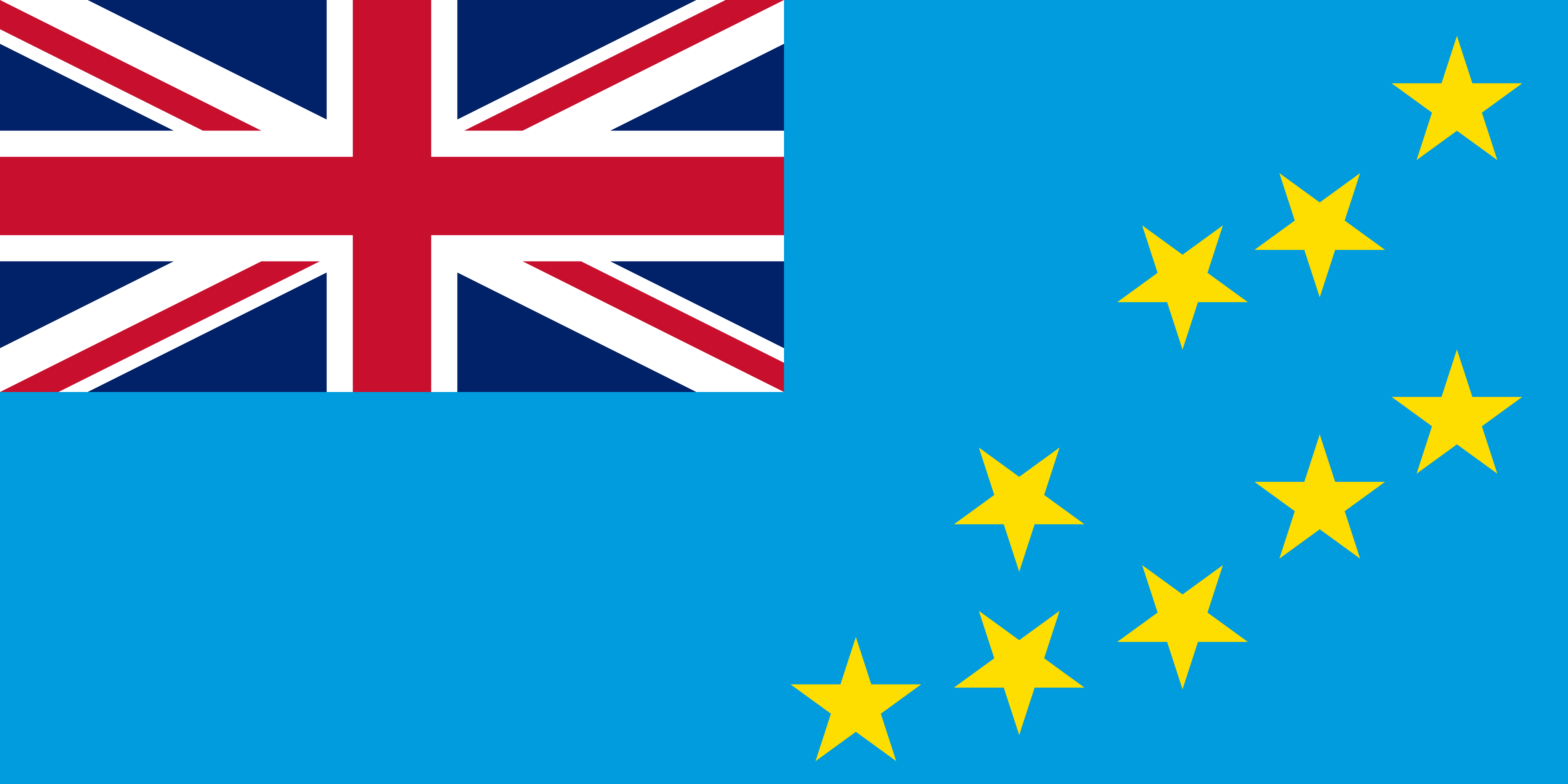
Tuvalu flag picture
Explore the proportions, adoption history, and picture gallery.
| National design | Tuvalu National FlagDefined through descriptive and pictorial schedules. |
|---|---|
| Composition | Azure field · Union Jack · nine starsYellow stars form a stylized island arrangement. |
| Proportions | Height:length = 1:2Landscape reference convention; printed legal labels are ambiguous. |
| First adopted | October 1, 1978Independence-era national design. |
| Restored | April 11, 1997Commencement of the amendment replacing both schedules. |
| Star orientations | Four up · five downAll nine five-pointed stars have equal horizontal spans. |
| Digital colors | Azure · navy · red · yellow · whiteDeclared reference palette; not a physical color certification. |
| Main image sizes | SVG and PNG: 9,000 × 4,500Complete flag; opaque RGB PNG. |
The stars are a stylized island map. The Union Jack recalls Tuvalu’s historical British connection.
What does the Tuvalu flag look like?
The Tuvalu flag has an azure blue field, the Union Jack in the upper hoist quarter, and nine yellow five-pointed stars across the right half. The stars represent the country’s nine principal island groups. Its familiar landscape proportions are height:length 1:2, with four stars pointing upward and five downward.
Begin with the complete rectangle, then identify its two distinct arrangements. The Union Jack occupies the corner nearest the top of the pole, while the yellow stars form a loose diagonal group toward the fly, or free edge. Blue continues beneath the canton. The downloadable master preserves the reference drawing’s star positions, orientations, and offset diagonal crosses. Explanatory pictures add labels outside the clean flag. Dates in the article distinguish independence, first adoption, a short replacement period, and restoration of the familiar design.
What is the Tuvalu flag called?
The official legislation calls it the Tuvalu National Flag. In ordinary English, Tuvalu flag and national flag of Tuvalu describe the same national symbol. The country’s name is commonly interpreted as eight islands standing together, although the present flag represents all nine principal island groups with nine yellow stars.
The Museum of New Zealand Te Papa Tongarewa explains that the country’s name predates Niulakita’s official recognition as one of its islands. The traditional name therefore does not require today’s flag to have only eight stars. Language history and the present national design answer different questions.
Use the country name in image captions and filenames so that the picture can be identified outside its original page. A blue ensign is a broad design family, rather than a unique name for this flag. Tuvalu’s yellow island stars distinguish its version within that family.
What colors appear on the Tuvalu flag?
The flag contains azure blue, dark blue, red, yellow, and white. This edition retains the reference SVG palette: #009CDE, #012169, #C8102E, #FEDD00, and #FFFFFF respectively. These are declared digital reproduction values. The flag law describes colors but does not establish those exact HEX values as a manufacturing standard.

Azure fills the main field, yellow fills the nine stars, and the Union Jack contributes dark blue, red, and white. The two blues have different jobs. Replacing them with one blue changes the contrast between the canton and the surrounding field and loses an important visual distinction.
The color table reports what is actually present in the supplied vector, rather than treating a screen sample as a physical specification. A printed result also depends on paper, ink, color management, and lighting. Textile manufacture requires its own approved color reference and a suitable production proof.
| Color | HEX | RGB |
|---|---|---|
| Azure | #009CDE | 0, 156, 222 |
| Navy | #012169 | 1, 33, 105 |
| Red | #C8102E | 200, 16, 46 |
| Yellow | #FEDD00 | 254, 221, 0 |
| White | #FFFFFF | 255, 255, 255 |
What does the Tuvalu flag symbolize?
The nine stars represent Tuvalu’s nine principal island groups, while their arrangement evokes the islands’ geography. The Union Jack recalls the country’s historical connection with Britain. The surrounding blue is commonly associated with the Pacific setting. These explanations provide context; they do not turn every color or star orientation into a separate legal message.

The clearest connection is the relationship between the stars and the islands. Te Papa’s educational material explicitly identifies all nine fenua with the flag’s stars. That collective representation matters more than assigning an unsupported moral quality, political office, or religious meaning to each individual point.
Interpretation should remain separate from construction. A statement that blue evokes the ocean does not determine an exact blue pigment, and a statement that stars represent islands does not supply precise coordinates. The law, the historical account, and the measured digital drawing each contribute different kinds of evidence.
How many stars are on the Tuvalu flag?
The current flag has nine yellow five-pointed stars. Each represents one of Tuvalu’s nine principal island groups, including Niulakita. They form an irregular arrangement across the right half of the flag. They are not a Southern Cross constellation, and the current design must not be reduced to eight stars.

Count separate star shapes, rather than their points: nine stars contain forty-five outer tips altogether. None belongs inside the Union Jack. The westernmost star in the conventional island mapping sits low and close to the middle of the flag, while the others extend toward the free edge.
A small preview can make neighboring points hard to distinguish, especially when the picture has been compressed or photographed on moving cloth. The clean vector gives each star a separate placement. The enlarged diagram preserves all nine shapes and their mixed orientations without adding a tenth decorative star.
Which islands do the nine stars represent?
The stars represent Nanumea, Niutao, Nanumanga, Nui, Vaitupu, Nukufetau, Funafuti, Nukulaelae, and Niulakita. These names identify Tuvalu’s nine principal island groups, including atolls with multiple islets. The conventional star labels explain the maplike arrangement, but the Act itself does not provide a table assigning exact coordinates to named islands.
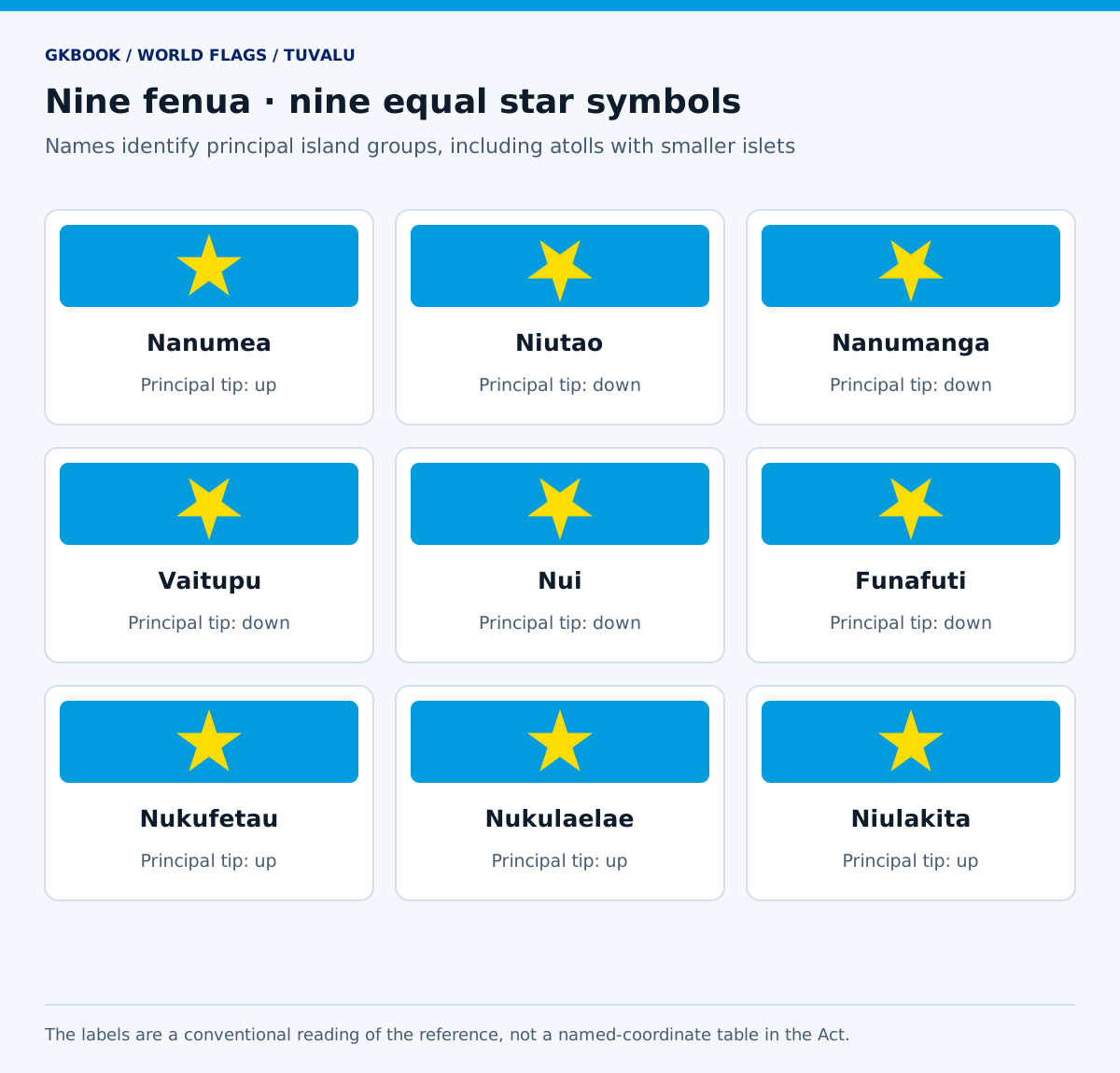
The term island is convenient in a short flag description, but it should not imply that the country consists of exactly nine individual pieces of land. Several fenua comprise an atoll and its smaller islets. The flag represents those principal communities collectively through nine equal-sized symbols.
Nanumanga also appears as Nanumaga in geographic sources. This article uses Nanumanga consistently in its labeled construction table. Equal star size is a design choice, not a claim that the island groups have equal land areas, populations, or distances from one another in the Pacific Ocean.
Does the star arrangement form an accurate map?
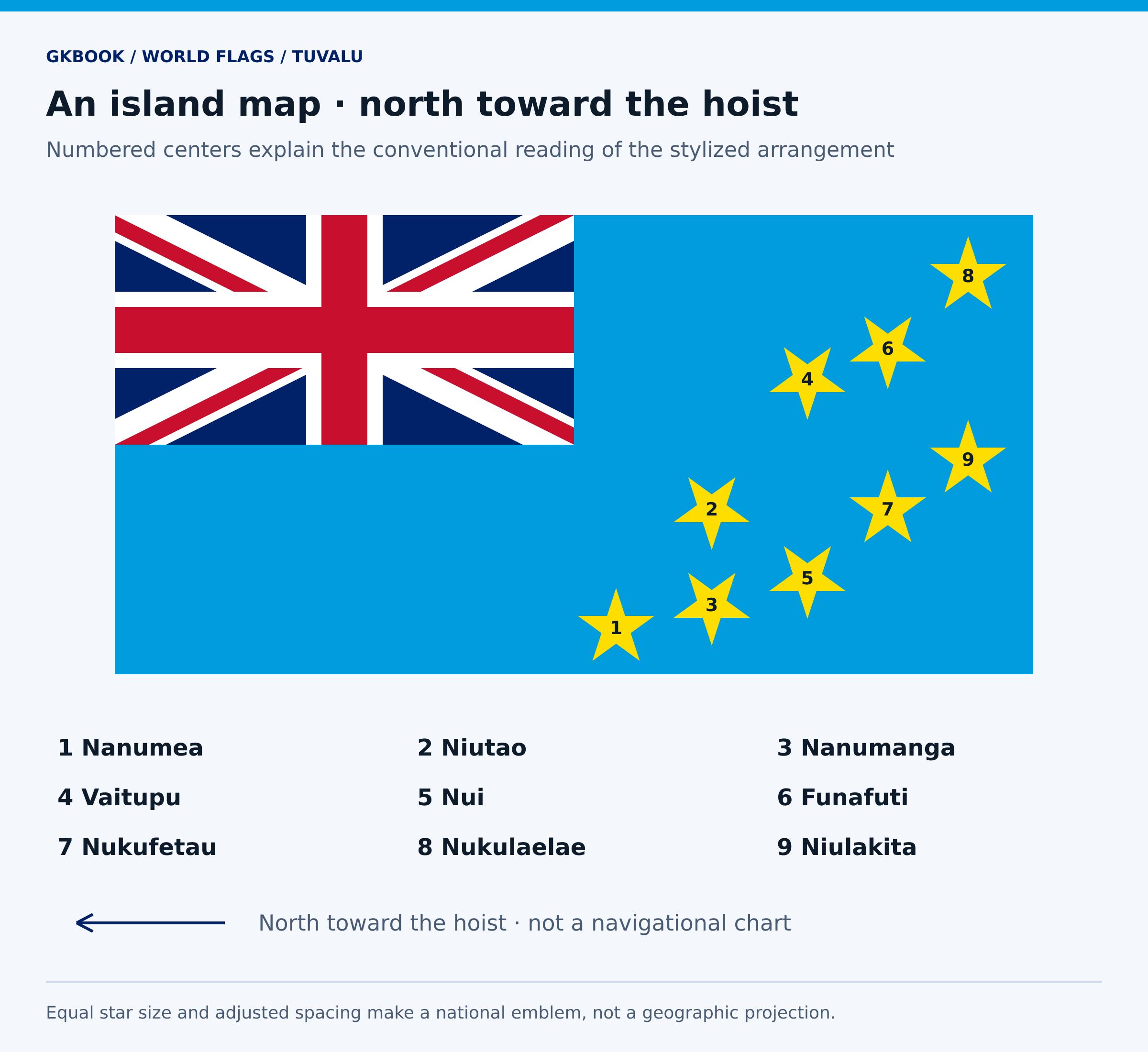
The stars form a stylized island map, with north generally toward the hoist rather than the top of the flag. Their conventional identities follow the islands’ broad relative arrangement. The picture is not a geographic projection: equal star sizes and adjusted spacing make a recognizable emblem rather than an accurate navigational chart.

To read the symbolic map, imagine the usual northward direction turned toward the left edge of the horizontal flag. Nanumea is near that side of the star group; Niulakita lies toward its other end. The arrangement is easier to understand when the island names accompany the symbols.
Do not measure a star separation and convert it into kilometers. The flag drawing is deliberately simplified, and some centers share the same horizontal coordinate despite the islands occupying different geographic positions. The labeled illustration identifies a conventional reading of the artwork, not a government-issued map with surveyed coordinates.
Why do some Tuvalu stars point downward?
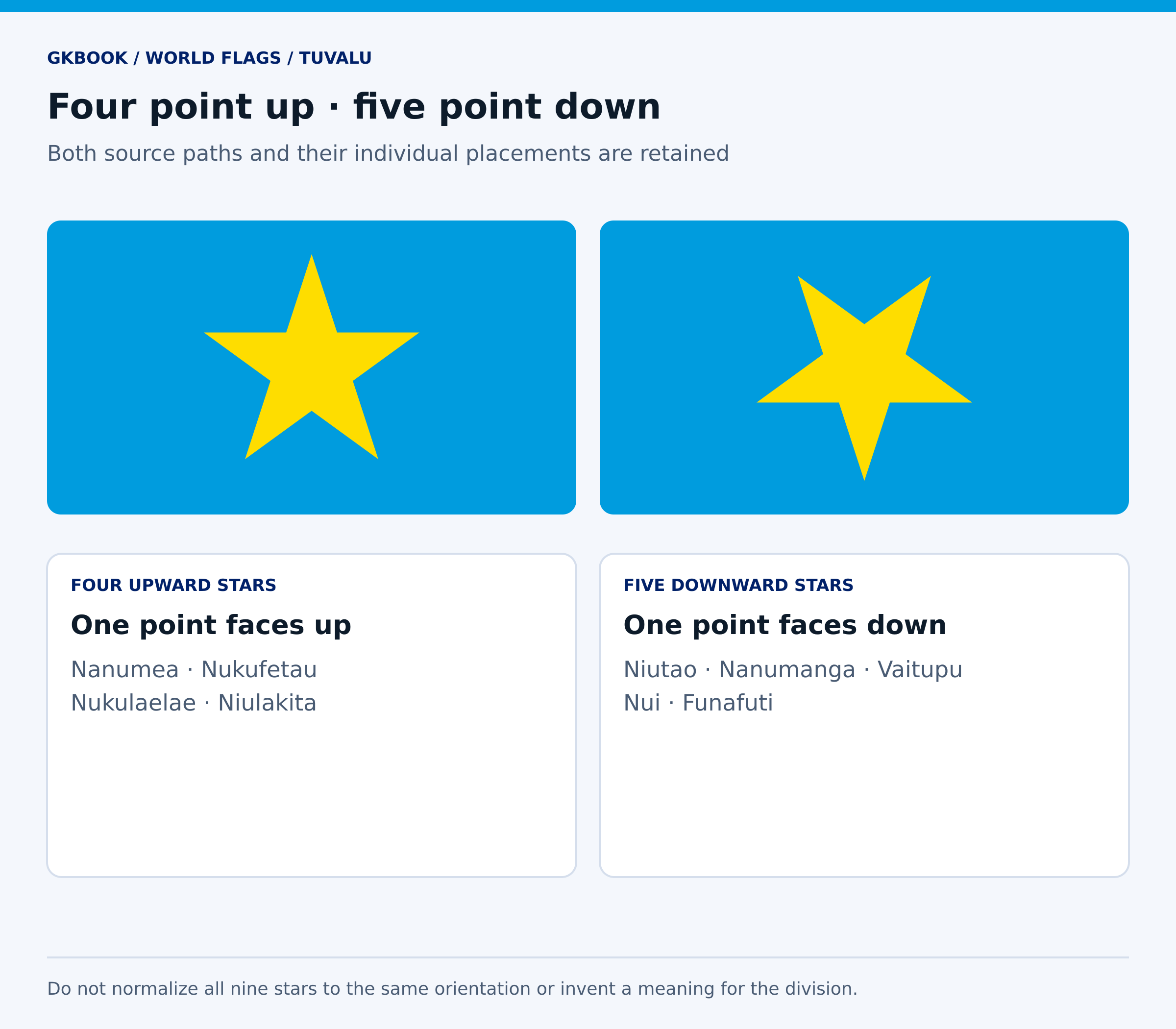
The preserved reference drawing has four upward-pointing stars and five downward-pointing stars. Their orientations form part of the established pictorial arrangement. The sources checked do not establish an official symbolic explanation for this division, so it should not be presented as a code distinguishing island types, regions, or political status.

The upward-pointing stars conventionally identify Nanumea, Nukufetau, Nukulaelae, and Niulakita. Niutao, Nanumanga, Vaitupu, Nui, and Funafuti use downward-pointing stars in this reference. These associations describe the drawing as reproduced; they do not add a hidden hierarchy to the nine equally sized national symbols.
A replacement font character can accidentally normalize every star to the same orientation. Rotating the entire flag is also different from rotating just one star. Preserve each shape together with its center when resizing or embedding the drawing, and inspect the full arrangement after any software conversion.
Where is the Union Jack placed on the flag?
The Union Jack occupies the upper hoist quarter of the Tuvalu flag. In the normal front view, that is the upper-left rectangle. It spans half the flag’s length and half its height, making its area one quarter of the whole. The azure field continues underneath it and across the entire fly.

Hoist names the edge attached to a pole, and fly names the free edge opposite it. Canton identifies the upper corner beside the hoist. These terms remain useful when the flag is viewed from behind, because the attachment edge does not physically change when an observer changes sides.
The corner emblem should meet the top and hoist boundaries without a separate outer margin. Its right and lower edges align with the flag’s midlines. A frame used around an illustration belongs outside the flag and must not reduce the canton or introduce a new white border.
How should the Union Jack detail be drawn?
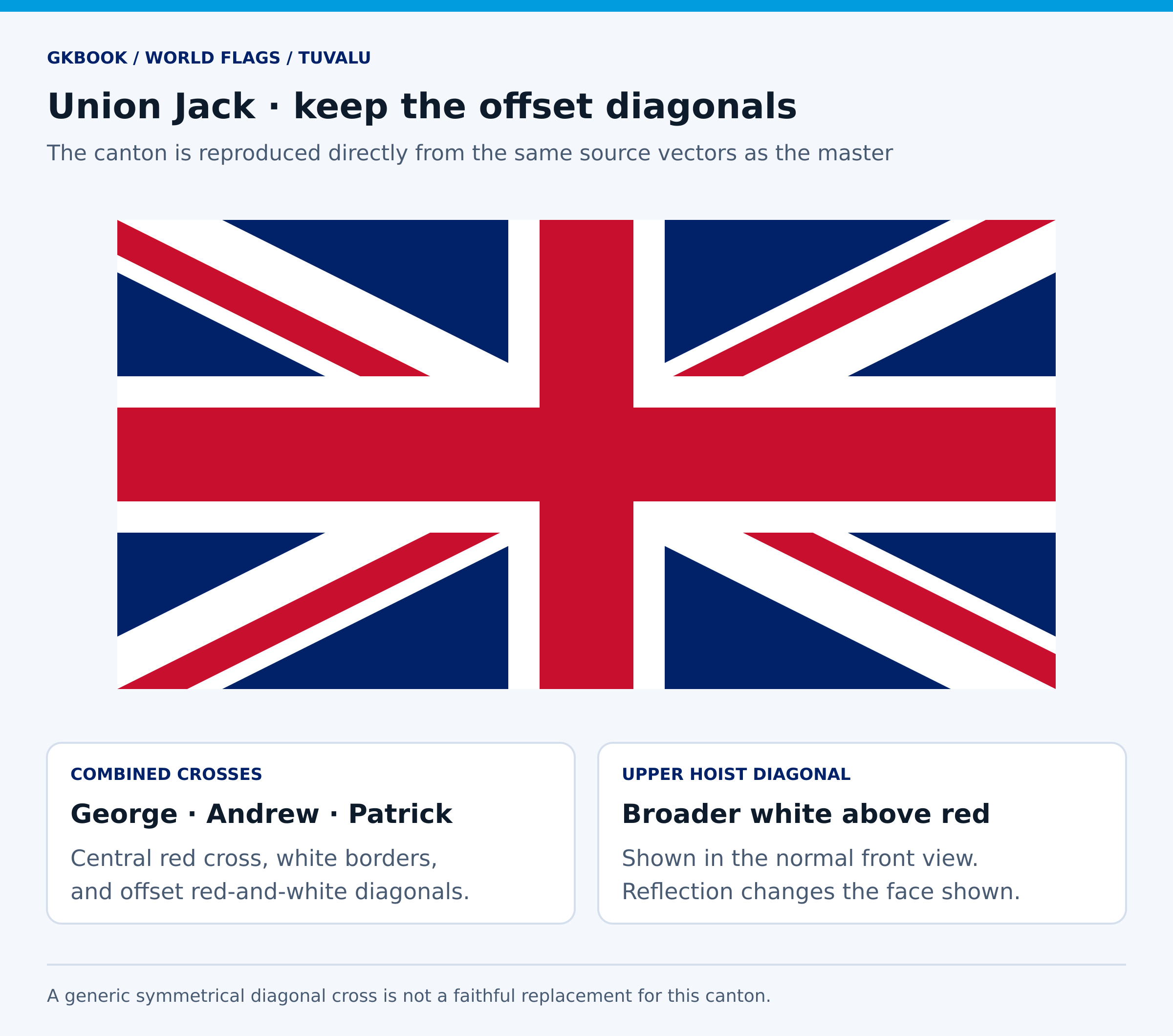
The canton preserves the Union Jack’s red central cross, white borders, dark blue ground, and offset red and white diagonals. Those diagonal bands are not all centered on one another. A correct reproduction retains the asymmetry of the inherited design rather than replacing it with a generic symmetrical red-and-white cross.

The Union Flag combines the crosses associated with Saint George, Saint Andrew, and Saint Patrick. The Royal Household’s historical explanation identifies these components. Their combined arrangement is already a complete emblem, so the Tuvalu canton should be copied faithfully instead of reconstructed from loosely positioned diagonal stripes.
In this front-view reference, the upper diagonal nearest the hoist has the broader white portion above the red. Mirroring that detail changes the face being shown. The enlarged canton comes directly from the same vectors as the clean master, including the clipping that keeps every stripe inside its boundary.
What is the Tuvalu flag ratio?
The familiar Tuvalu flag is twice as long as it is high: height:length 1:2. The supplied master measures 9,000 by 4,500 units. The Act’s printed dimensional labels are ambiguous, but its landscape illustration and the reference drawing establish the format reproduced here. Detailed construction claims are therefore qualified.

Expressing the ratio as height:length avoids confusion over whether width refers to the horizontal dimension or the hoist. The Schedule prints “Width: Height - 1:2,” while its picture is a wide landscape rectangle. This article identifies the convention it actually uses instead of silently presenting that wording as unambiguous.
Equivalent sizes include 1,200 by 600, 900 by 450, and 300 by 150. Always scale both dimensions together. Stretching a square thumbnail into a wide rectangle after editing individual symbols can distort the stars and canton even when the final outer dimensions happen to be correct.
What measurements define this digital flag layout?
This reference uses a 120 by 60 coordinate grid, enlarged uniformly seventy-five times for the 9,000 by 4,500 master. The canton occupies the first 60 by 30 units. Star centers follow the preserved SVG coordinates. Those detailed measurements describe this reproduction, rather than an official dimensioned annex to the flag law.

Coordinates begin at the upper-left corner. Horizontal values increase toward the fly and vertical values increase downward. The accompanying table uses that convention throughout. A construction sheet that measures vertical distances upward from the bottom must be converted before its numbers can be compared directly with this file.
The star region occupies the right-hand half, but the stars themselves do not cover half the flag in yellow paint. Likewise, the canton’s quarter-area statement describes its rectangular footprint, not the amount of red, white, or dark blue inside it. Keeping those distinctions avoids misleading area calculations.
| Island group | x | y | Principal tip |
|---|---|---|---|
| Nanumea | 65.5 | 54.0 | Up |
| Niutao | 78.0 | 38.5 | Down |
| Nanumanga | 78.0 | 51.0 | Down |
| Vaitupu | 90.5 | 21.5 | Down |
| Nui | 90.5 | 47.5 | Down |
| Funafuti | 101.0 | 17.5 | Down |
| Nukufetau | 101.0 | 38.5 | Up |
| Nukulaelae | 111.5 | 8.0 | Up |
| Niulakita | 111.5 | 32.0 | Up |
How large are the stars on the Tuvalu flag?
Each star spans ten horizontal units in the 120-unit reference, equivalent to one twelfth of the flag’s length or one sixth of its height. The master span is 750 units. The law’s wording about approximately one twelfth of the width is ambiguous; this edition follows the pictured reference convention.

A star’s horizontal span is different from its outer-circle diameter. For an ideal upright five-pointed star with this span, the outer radius is approximately 5.257311 native units. The source uses rounded coordinates, including 5.2573, and those original values are retained rather than replaced with newly calculated vertices.
This distinction matters when comparing drawings based on a radius with drawings based on tip-to-tip width. Using the same numerical value for both produces different shapes. The explanatory diagram labels the horizontal span, while the master preserves the complete source path and its very small coordinate rounding.
How are the star shapes constructed?
The reference defines two five-pointed star paths, one with its principal tip upward and the other downward, then places nine instances at their individual centers. The supplied SVG preserves both paths. A geometric explanation can describe their near-regular form, but it does not replace the original rounded path coordinates.
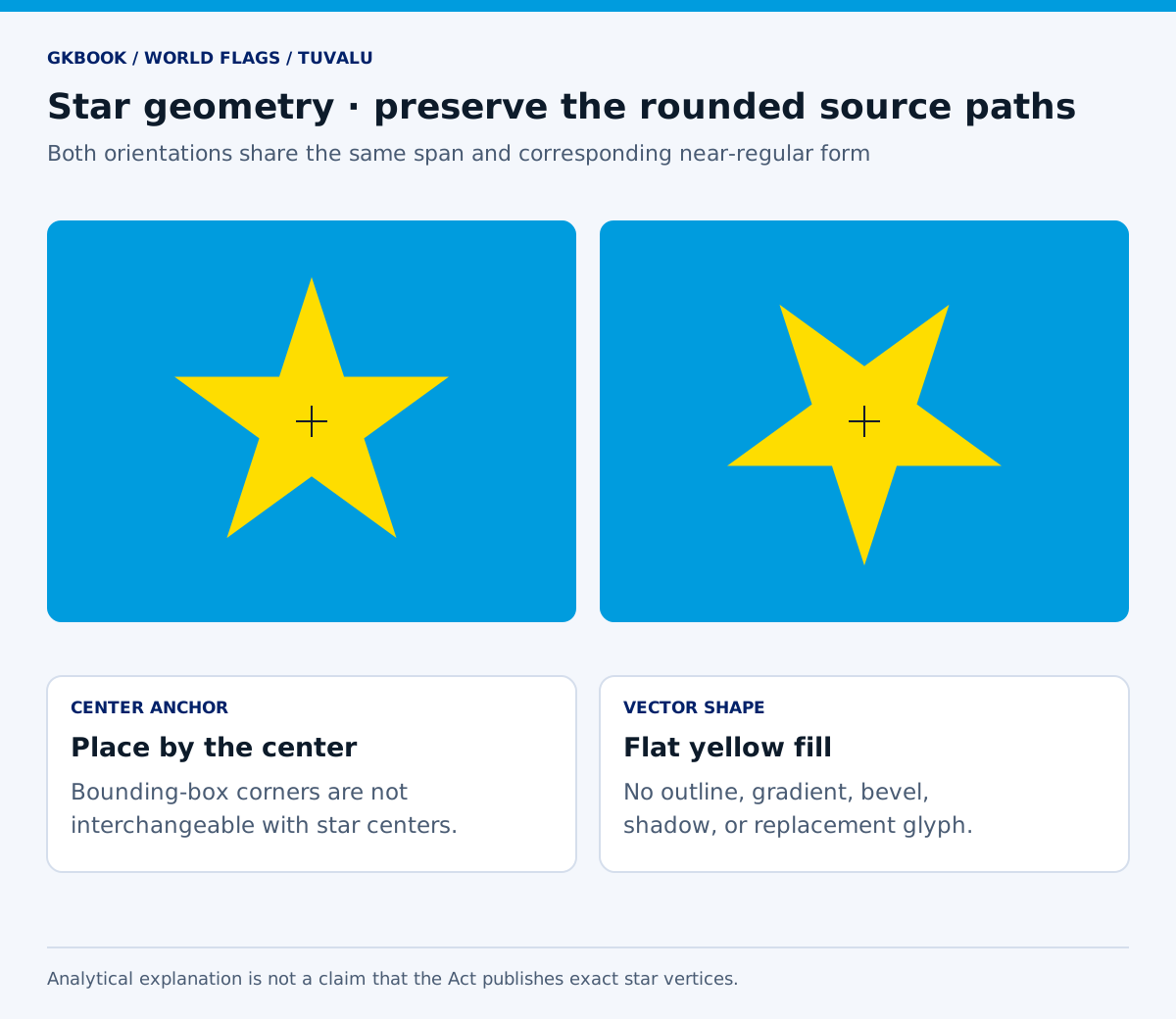
The upward and downward versions have the same horizontal span and corresponding geometry. Their centers provide useful placement anchors even though the outline extends farther toward a principal tip than toward the opposite gap. Aligning stars by their bounding-box corners instead would shift their intended positions.
Use filled vector shapes for the yellow areas. Outlines, shadows, gradients, and bevels belong to decorative illustrations rather than the clean national design. The geometry picture enlarges the two actual source paths so that their orientation is clear without implying that the government published this exact analytical construction.
What is the history of the Tuvalu flag?
Tuvalu adopted its familiar blue flag with the Union Jack and nine yellow stars at independence on October 1, 1978. Changes followed in 1995, and a different national design was used during the 1995–97 period. The nine-star Union Jack flag was restored by an amendment commencing April 11, 1997.

The short transition period is a source of conflicting dates in summaries. Specialist accounts distinguish an eight-star variation from the later striped replacement, while other histories compress those events. The 1995 Act’s commencement and the 1997 amendment provide firmer legal milestones than an undifferentiated statement that the flag changed once.
The current consolidated Act retains its original 1995 title history even though its descriptive and pictorial schedules were replaced in 1997. A later revised edition collects that law; it is not a new independence flag. The timeline therefore labels the event attached to each date rather than listing years alone.
When was the Tuvalu flag first adopted?
The familiar national design was first adopted on October 1, 1978, when Tuvalu became independent. April 11, 1997 is its restoration date after a period with another flag. The December 22, 1995 commencement of the National Flag Act belongs to that intervening legal history, not to the first adoption.
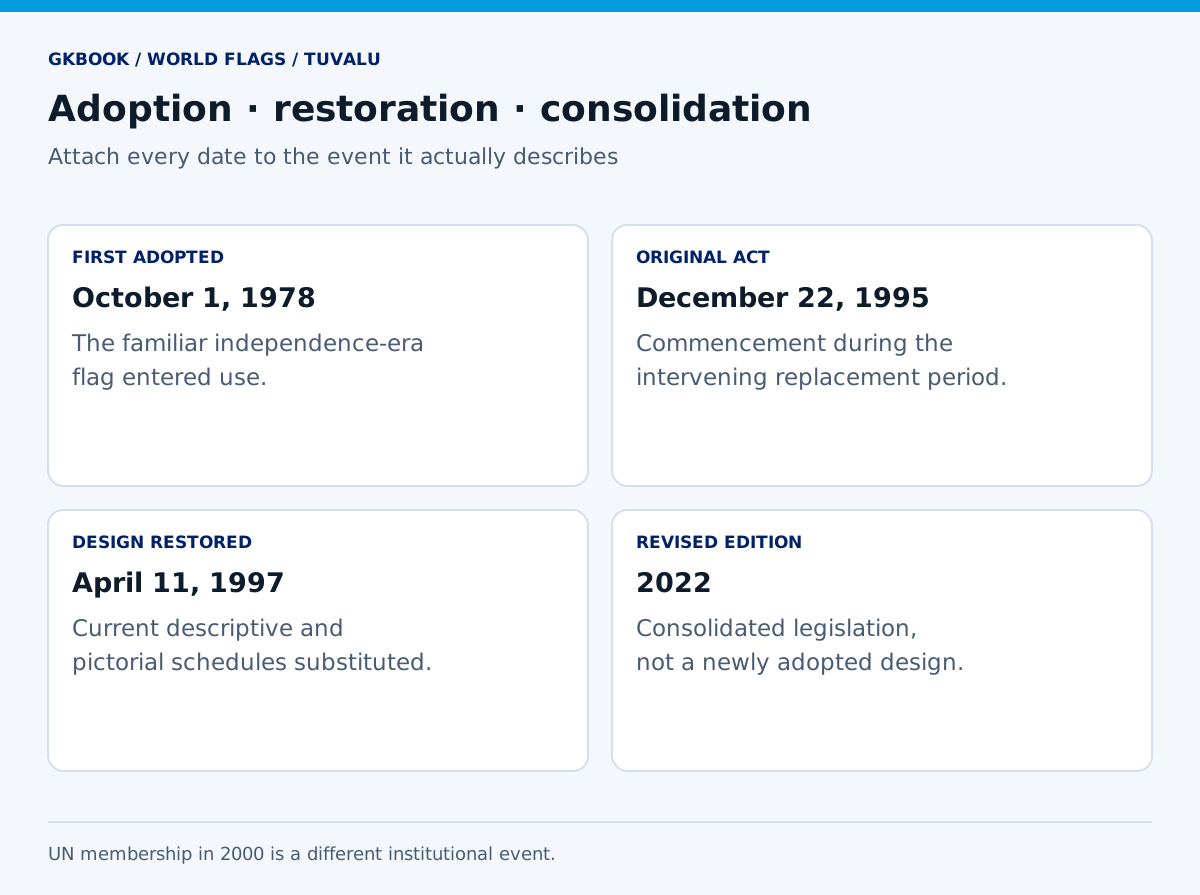
An adoption date answers when a design became the national flag. A restoration date answers when an earlier design returned after replacement. Both dates are useful for Tuvalu, but neither should be relabeled as the date on which the country entered the United Nations or established a particular diplomatic relationship.
The 2022 revised edition is a consolidated legal reference, and the 2026 Rules concern use and display. Neither document creates a new nine-star design in those years. Captions that simply say “adopted 2022” because that date appears on a legal PDF would therefore misrepresent the flag’s history.
Why was the Tuvalu flag replaced in the 1990s?
The 1990s changes reflected debate about national identity and the British symbol in the canton. A replacement removed the Union Jack and used stripes, stars, and a hoist triangle containing the coat of arms. Accounts differ over transitional dates, so this article separates the 1995 law from the later practical introduction.
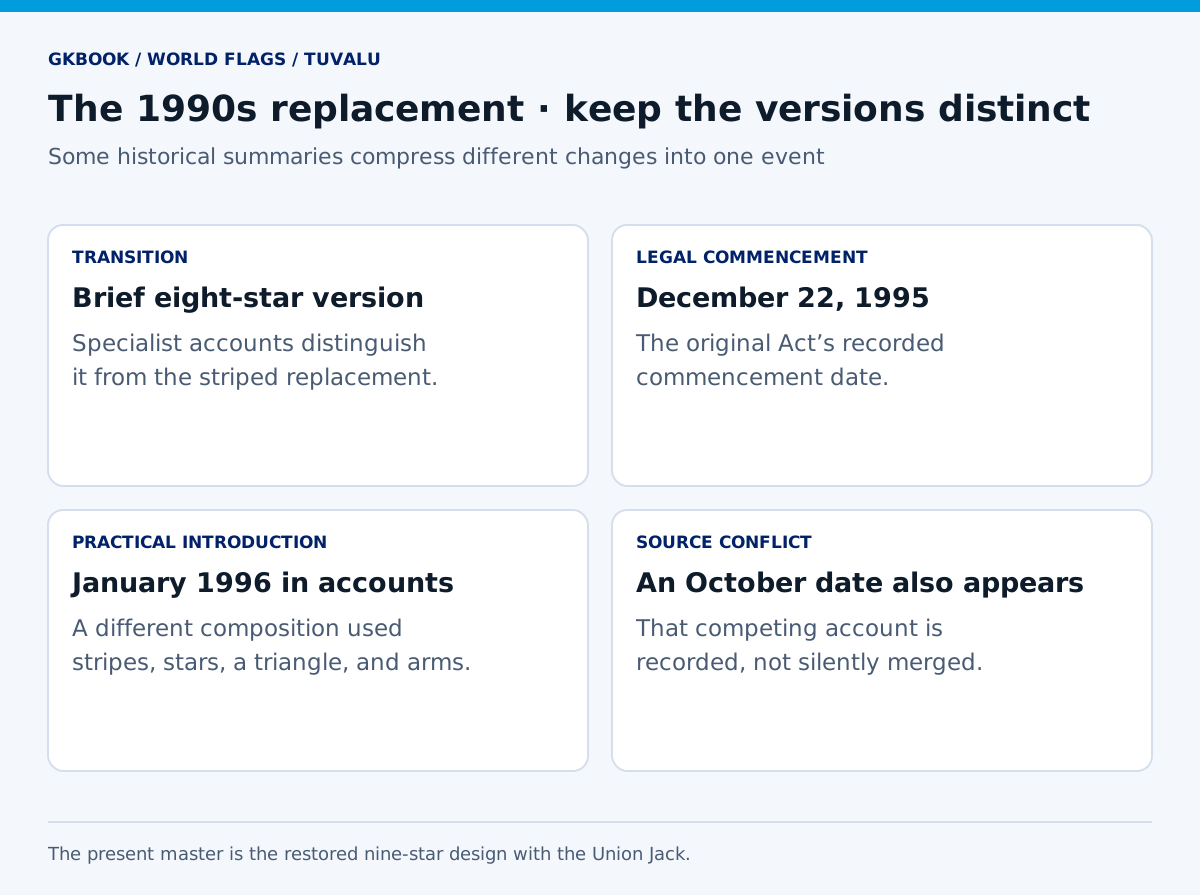
Specialist flag histories describe a brief eight-star change before the more extensive replacement. They place the latter’s practical introduction in January 1996, following the Act’s December 22, 1995 commencement. Britannica gives a different October date for the striped design; that conflict is recorded rather than silently merged.
The replacement was short-lived, and the familiar canton-and-stars composition returned in 1997. The historical illustration here uses a dated explanatory timeline, not an invented reconstruction of an earlier flag. A historical image should be matched to its precise version before it is labeled as Tuvalu’s current national symbol.
When was the nine-star flag restored?
The amendment restoring the present descriptive and pictorial schedules commenced on April 11, 1997. The consolidated National Flag Act records that date for Act 2 of 1997. It is the clearest legal restoration milestone for the familiar azure flag with the Union Jack and nine yellow stars.

Restoration returned a recognizable earlier composition rather than creating an unrelated new emblem. This explains why references may give both 1978 and 1997 beside the current flag. The first concerns original adoption, while the second concerns the return of the design after the intervening replacement period.
The current legal text marks both schedules as substituted by the 1997 amendment. Reading only the Act’s original year would miss that change. The article pairs the dated commencement record with the present illustration, keeping the historical sequence separate from the date of the downloaded digital reference file.
Who designed the Tuvalu flag?
Vione Natano is credited as the designer of Tuvalu’s national flag. Pātaka Art + Museum’s Tuvalu Language Week material identifies him as a flag designer, teacher, and writer. That historical credit is separate from the people who later drew or revised the digital SVG used for this educational reproduction.
A designer attribution concerns the national composition, not every subsequent tracing, photograph, or file conversion. The Commons drawing has its own revision history and digital contributors. Keeping those credits separate avoids presenting a modern vector editor as the person who originated Tuvalu’s independence-era flag design.
This package does not contain a signed original design submission or claim access to Natano’s complete working papers. It uses the museum’s direct attribution alongside the historical reference account. The public credits identify the digital artwork’s provenance, while the article identifies the person associated with the national design.
Which law defines the Tuvalu flag?
The Tuvalu National Flag Act defines the flag through a descriptive schedule and a pictorial schedule. The 2022 revised edition records the original 1995 Act and the 1997 amendment replacing both schedules. Section 5 authorizes rules about use and flying; the Tuvalu National Flag Rules 2026 now provide additional guidance.

Section 3 connects the legal declaration with both the written description and the picture. Reading them together is especially important because the dimensional terminology is not completely clear. The picture supplies the recognizable landscape composition, while the text identifies the azure background, nine yellow stars, and Union flag.
Section 4 addresses ministerial authorization to use the design with a specified defacement, meaning an added distinguishing device in flag terminology. It should not be read as permission to alter the standard national image at will. Exact digital colors and detailed center coordinates are not supplied by these provisions.
What changed with the Tuvalu National Flag Rules 2026?
The Tuvalu National Flag Rules 2026 took effect on July 1, 2026. They address dignity, designated places for flying, official vehicles and vessels, mourning, national delegations, and commercial use. They do not introduce a replacement flag design. The commencement stated in Rule 1 takes precedence here over inconsistent catalogue metadata.
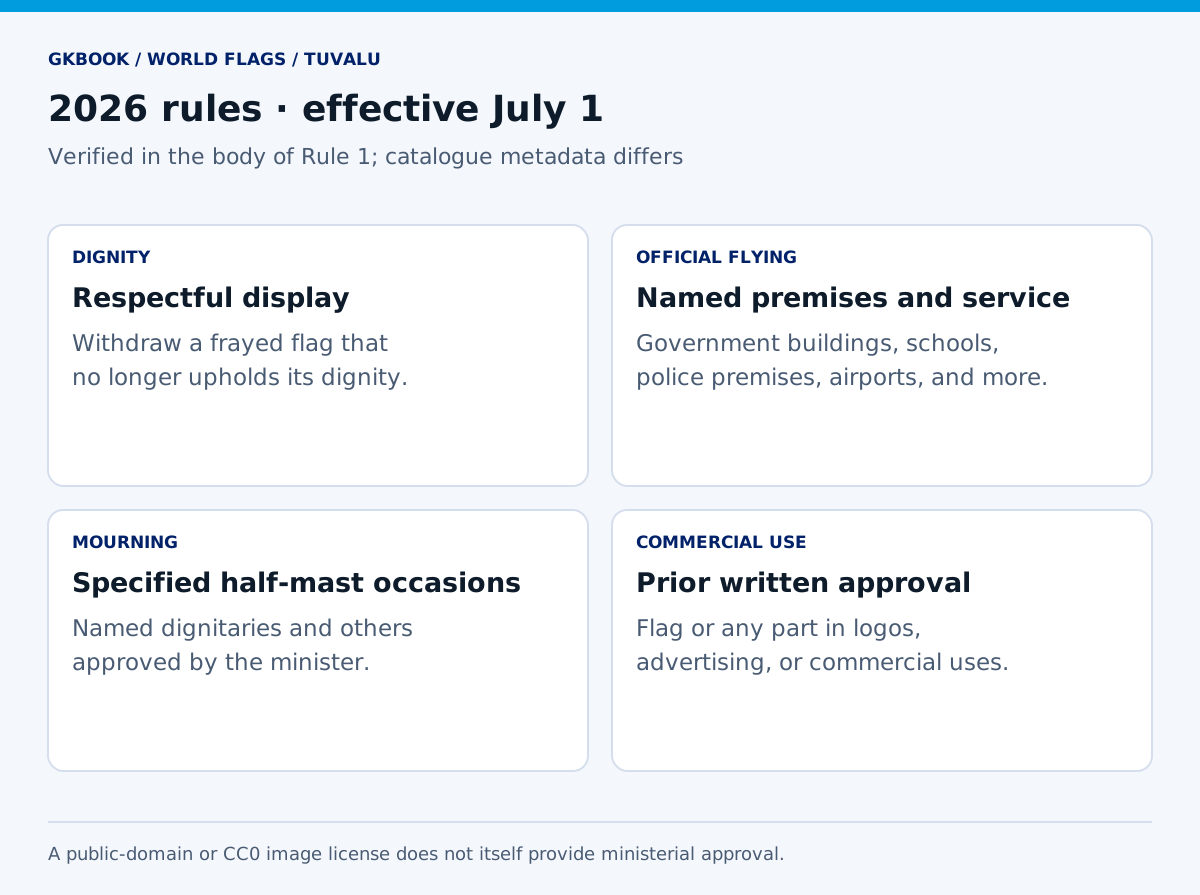
The rules name government residences, Kaupule offices, schools, police premises, and airports among the places where the flag is to be flown. They also provide for official government vessels and vehicles. Sporting and cultural delegations representing Tuvalu are to use the flag respectfully as a national identifier.
For qualifying deaths, the rules specify half-mast observance and provisions concerning the ceremonial flag and diplomatic missions. Commercial uses receive a separate prior-approval requirement. These provisions should be checked for the actual occasion; the rules do not supply a new color formula or a different arrangement of stars.
How do independence and international recognition dates differ?
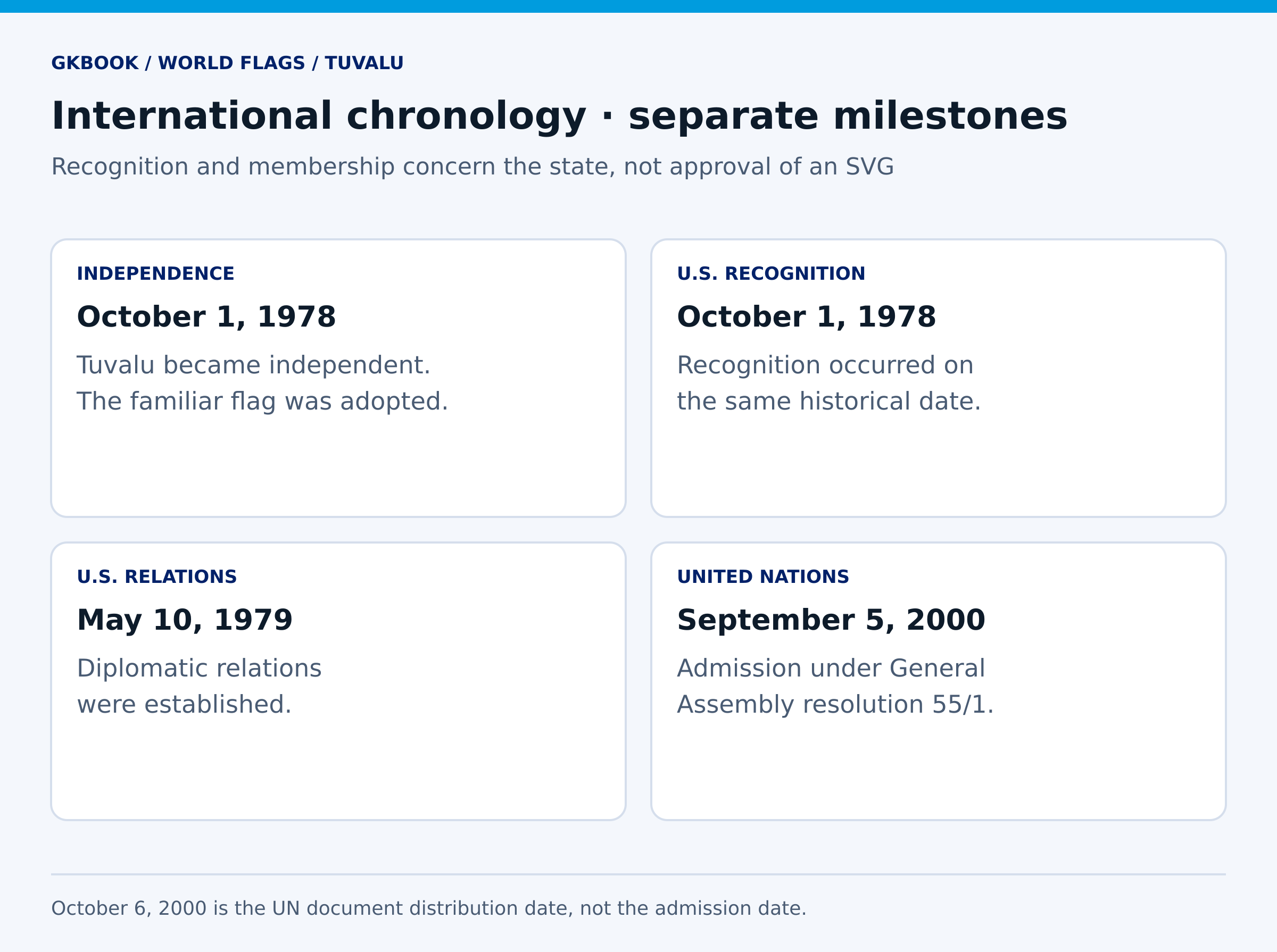
Tuvalu became independent on October 1, 1978, and the United States recognized it that day. U.S. diplomatic relations began on May 10, 1979. United Nations membership followed on September 5, 2000, through General Assembly resolution 55/1. Those events concern the state’s international relationships rather than approval of a particular flag drawing.
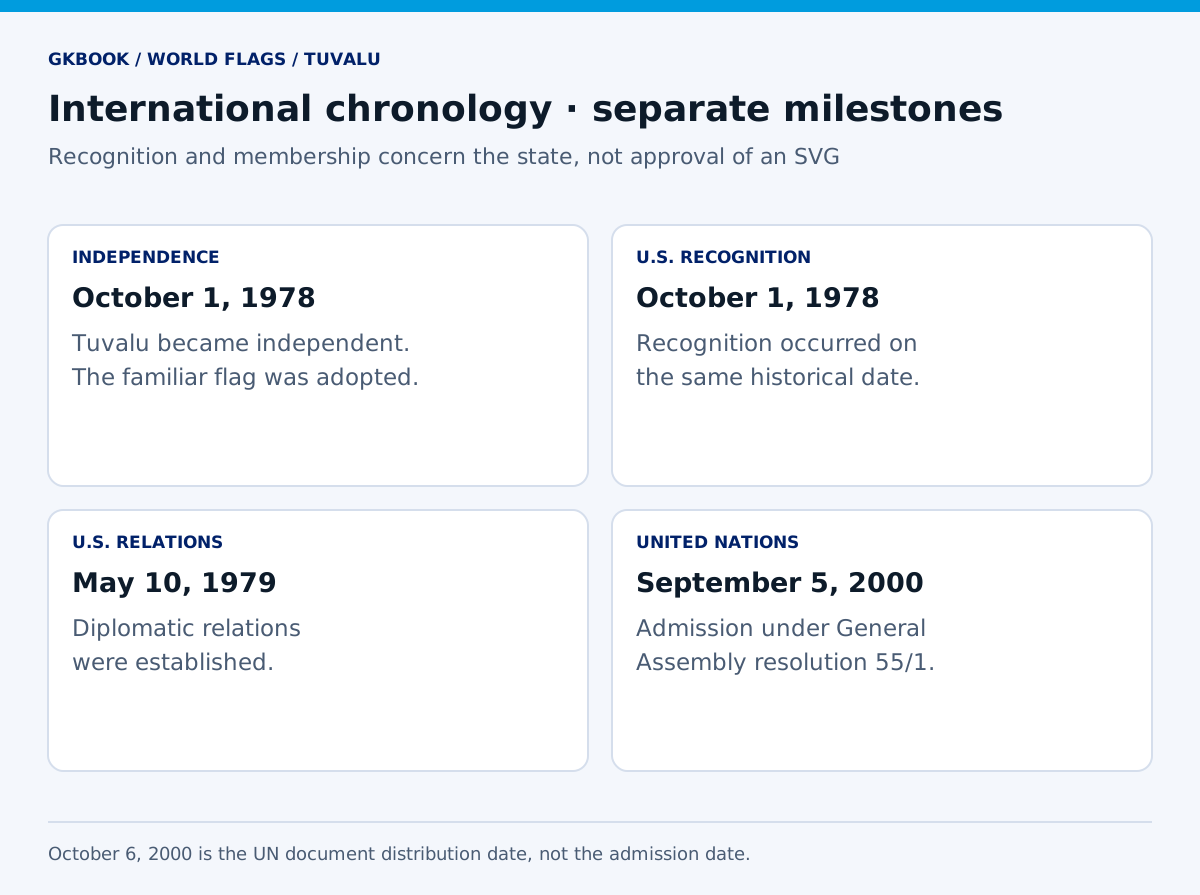
The U.S. Department of State’s historical record separates recognition from the establishment of diplomatic relations. The UN resolution independently records the decision to admit Tuvalu. Neither institution’s date should be substituted for the original 1978 flag adoption or the 1997 restoration of its familiar national design.
The UN document was distributed on October 6, 2000, but its decision was adopted on September 5. A document’s publication or distribution date can therefore differ from the event it records. The chronology uses the operative event date and identifies the institutional action attached to it.
How does Tuvalu’s flag differ from other Pacific flags?
Tuvalu’s flag combines a light blue field, a Union Jack canton, and nine yellow island stars. Similar canton arrangements appear on other flags, but the star count, color, placement, and meaning distinguish Tuvalu’s design. Its stars should not be replaced by a Southern Cross pattern or a coat of arms.
A useful comparison starts with observable features: field color, canton, number of stars, star orientation, and any shield or other emblem. Comparing only the blue background can obscure major differences. Tuvalu’s nine stars spread across the fly in an island arrangement, rather than forming a small compact constellation.
When preparing a collection of national flags, maintain each flag’s own proportions instead of stretching every image into the same box. A neutral surrounding frame can make different ratios align visually without modifying the actual designs. Country labels and accessible descriptions should remain attached to the correct image.
Does the current national flag include Tuvalu’s coat of arms?
The current national flag does not include the coat of arms, a motto, or lettering. Its identifying elements are the azure field, Union Jack, and nine yellow stars. The coat of arms appears in other national contexts and in the intervening historical flag, but it should not be added to this master.
National flags, coats of arms, official standards, and historical ensigns are related subjects rather than interchangeable pictures. An illustration of the arms may be entirely accurate while still being the wrong asset for a national-flag download. Check the caption and intended role before combining two official symbols.
The Act allows ministerial authorization for a specified defacement of the design. That provision does not change the standard image reproduced here. This gallery focuses on the current national flag and explanatory diagrams; it does not claim to catalogue every authorized institutional, maritime, or personal flag used in Tuvalu.
How should the Tuvalu flag be treated and displayed?
The 2026 Rules require respectful treatment and dignified display. A frayed flag that no longer upholds that dignity should be withdrawn and retired respectfully. The rules also specify official flying locations and mourning provisions. Apply the relevant instruction to the occasion rather than borrowing an unrelated country’s flag code.
For physical display, begin with a complete, recognizable flag in suitable condition. Attachment and hardware should support the fabric without concealing its principal symbols. The rules’ concern with dignity extends beyond whether a digital file has correct dimensions; weather, wear, and the circumstances of display also matter.
Half-mast provisions concern named categories of dignitaries and other persons approved by the minister. Diplomatic missions have an express period running from death to interment or cremation. A general educational diagram cannot determine whether a particular ceremony falls within those provisions, so event organizers should consult the applicable direction.
Can the Tuvalu flag be used in logos or commercial products?
Rule 5 of the Tuvalu National Flag Rules 2026 requires prior written ministerial approval for using the flag, or any part of it, in trademarks or logos, advertising, or commercial purposes. Public-domain artwork and a CC0 dedication do not themselves provide that approval. The intended use must be considered separately.
Copyright status answers who controls copying of an image. National-symbol rules address the circumstances in which the depicted flag may be used. Those questions can overlap in a project but are not identical. An editable SVG therefore should not be advertised as unrestricted permission for every branding or merchandise application.
The supplied credits preserve the reference’s public-domain provenance and dedicate only the original explanatory additions controlled by GKBook. They also identify the current ministerial-approval provision. This educational package does not certify a proposed commercial use, represent that approval has been obtained, or replace a decision from the competent authority.
How does the Tuvalu flag look when rotated vertically?
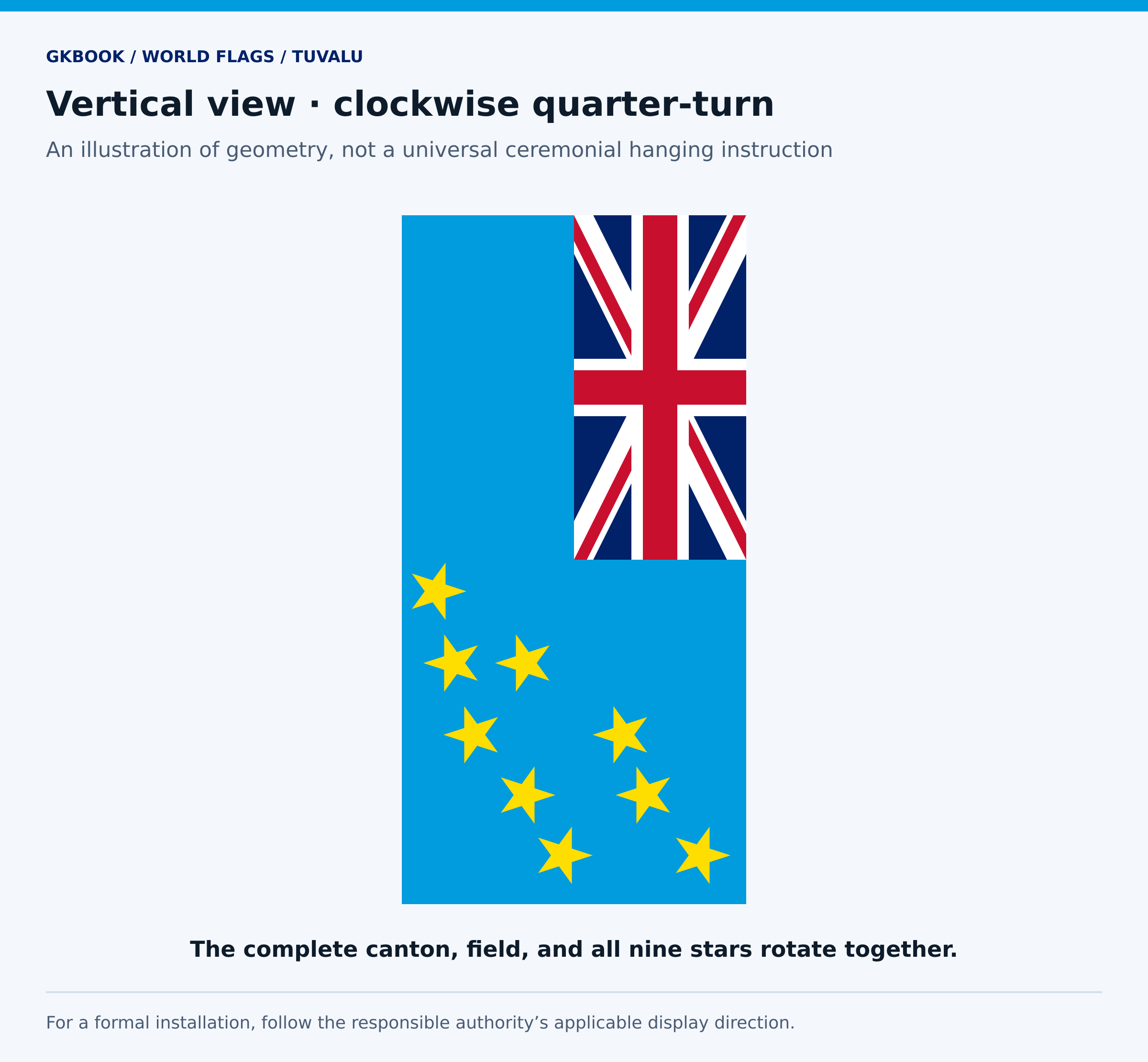
A clockwise quarter-turn of the complete flag produces a tall rectangle with the original canton at the upper right. Every star rotates with the field, preserving its relationship to the other elements. The gallery labels this as a geometric rotation, not as a universal official instruction for ceremonial vertical display.
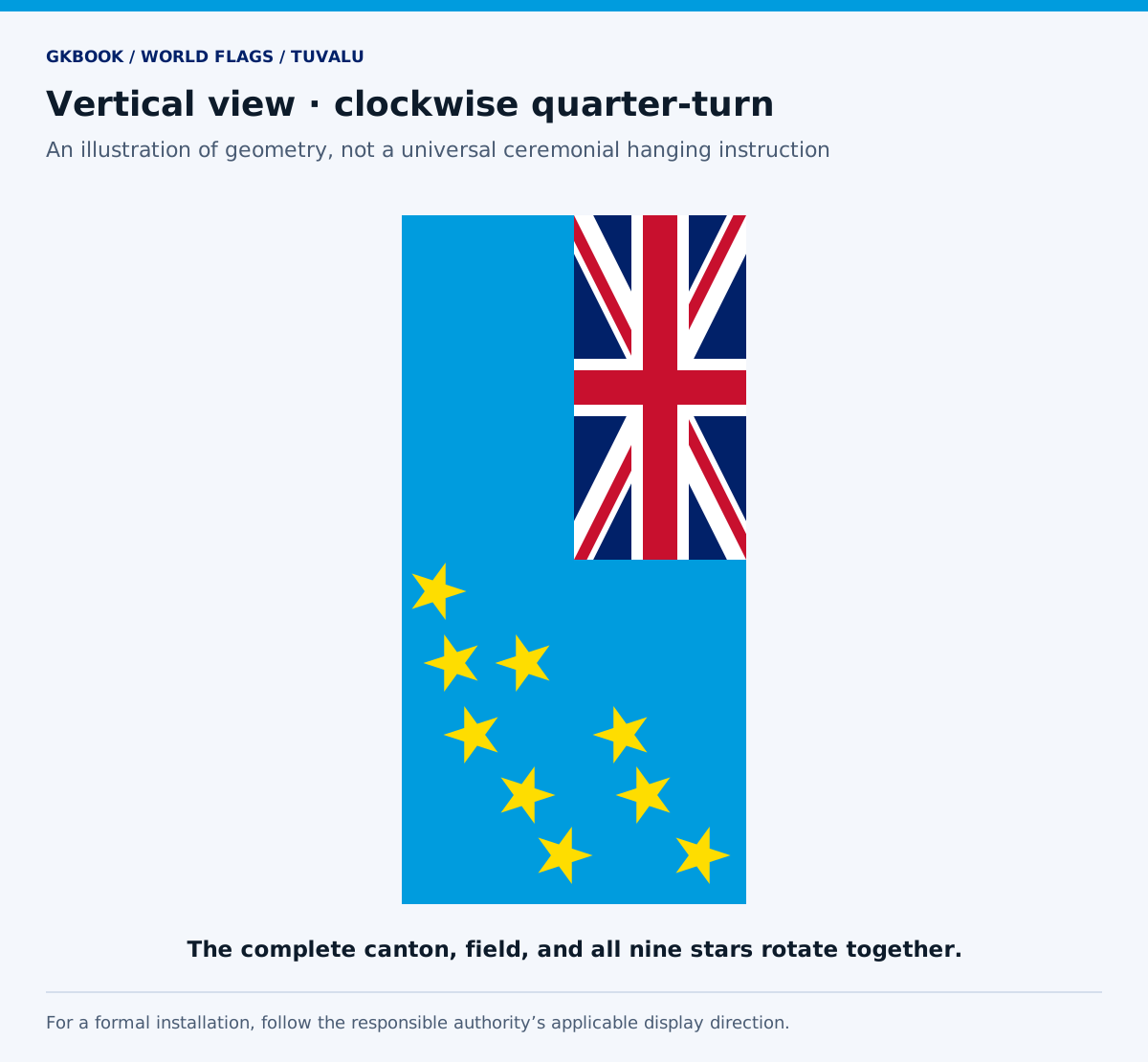
Rotate the whole composition as one object. Turning only the outer rectangle while leaving the canton or stars upright creates a different design. Likewise, cropping a wide flag into a narrow banner can remove island symbols and change the canton’s share of the visible image.
The rules checked address respectful display but do not provide a detailed vertical-hanging construction in the passages used here. For a formal installation, follow the responsible organizer’s applicable instruction. The diagram is useful for understanding transformation and preserving geometry without presenting one rotation as a statutory hanging protocol.
What does the reverse of the Tuvalu flag look like?
The reverse of an ordinary single-layer flag is the horizontal mirror of its front when viewed from the other side. The canton appears at the upper right and the star group is reflected. The gallery shows that complete transformation rather than moving the canton alone or redrawing individual stars.

The observer’s left and right change across the cloth, but the physical hoist remains the attachment edge. That is why descriptions using hoist and fly are more reliable than directions without a stated viewpoint. The front-view download follows the usual convention with the hoist shown on the left.
A double-sided manufactured display may be assembled differently from a single piece of cloth, depending on its purpose and approved specification. The reverse diagram explains ordinary reflection only. It does not assert a separate legally prescribed reverse design or guarantee how a particular commercial flag has been sewn.
Is the complete Tuvalu flag symmetrical?
The complete flag has neither horizontal-axis nor vertical-axis symmetry, and a half-turn does not reproduce its original appearance. The canton occupies one specific corner, while the stars form an uneven island arrangement. Individual star shapes have geometric regularity, but that does not make the whole national composition symmetrical.

Reflecting the image across its vertical axis moves the canton to the opposite side. Reflecting across a horizontal axis moves it below the midpoint. A half-turn places it in the opposite lower corner. Each transformation changes the relationship of the principal elements to the normal front-view orientation.
Symmetry checks are useful for catching accidental flips in a publishing workflow. A file may still contain nine yellow stars after being mirrored, yet depict the reverse rather than the intended front. Compare the canton position and the island arrangement together before accepting an exported image.
What files and sizes are supplied for printing?
The clean master is supplied as a scalable SVG and an opaque RGB PNG measuring 9,000 by 4,500 pixels. At 300 pixels per inch, that PNG corresponds to 30 by 15 inches. The package also includes twenty-three explanatory subjects and a separate social card, with SVG and PNG versions.
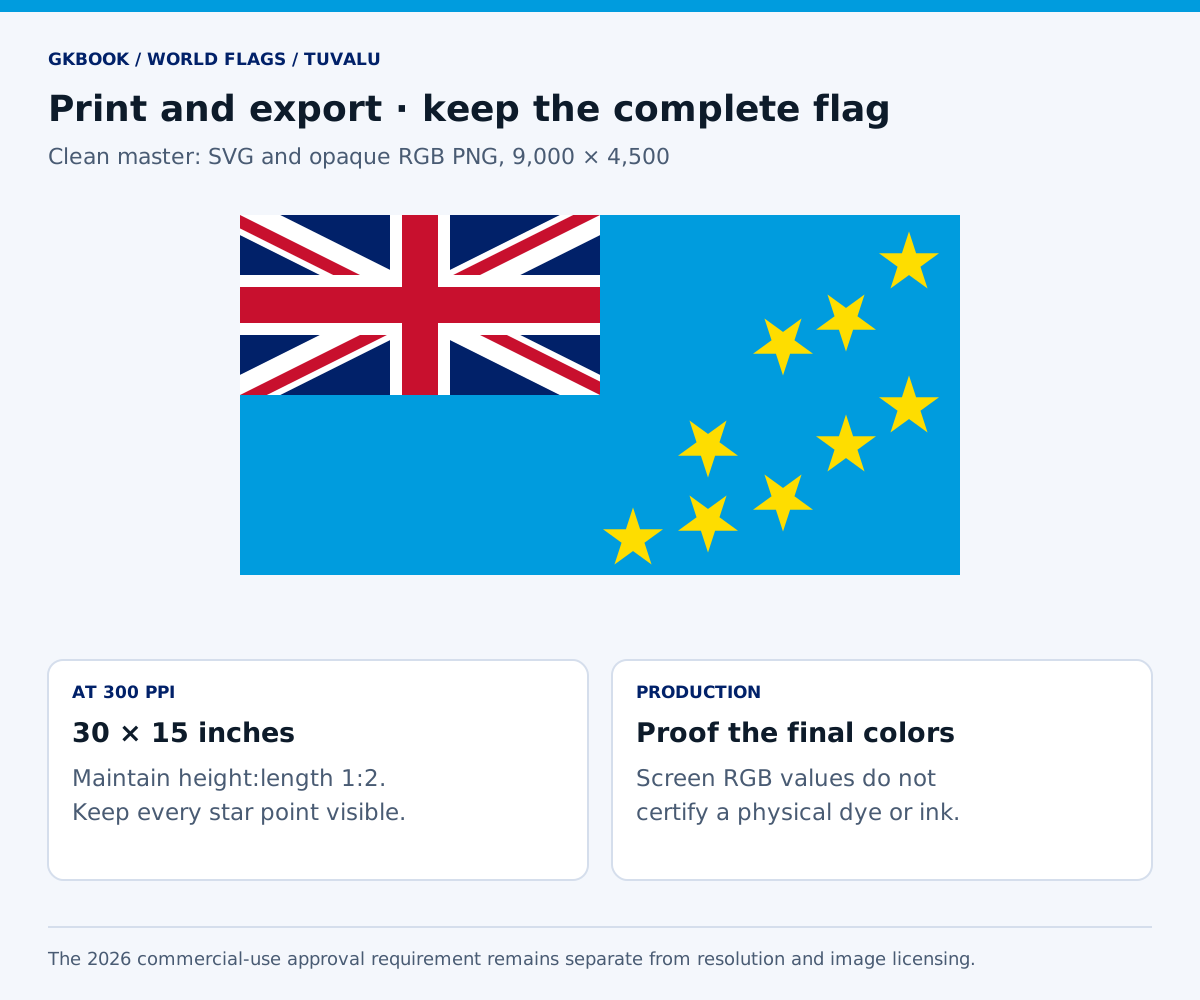
Use the clean flag for a plain reproduction and the labeled diagrams for teaching. Resizing the SVG preserves its vector geometry, but the final production process still controls sharpness and physical color. Maintain the full rectangle, including the blue below the canton and every point of all nine stars.
The 1,200 by 630 social card contains a complete 540 by 270 flag face within its layout. Its surrounding text and frame are editorial additions, not part of the flag. Before commercial manufacture or advertising, consider the current approval rules separately from image resolution and printing quality.
Download Tuvalu flag pictures
Download the complete national flag as SVG or 9,000 × 4,500 PNG. Its height:length ratio is 1:2. The complete Union Jack, nine yellow stars, their mixed orientations, and the surrounding azure field remain intact. Reference vectors are preserved.
The gallery contains 24 subjects, each with an SVG and PNG. Captions distinguish the clean flag from construction guides, historical explanations, and geometric transformations. Image credits and reproduction notes identify the sources, palette, and scope of the original explanatory additions. The separate 1,200 × 630 social card contains a complete digital flag face measuring 540 × 270 units.
Continue exploring national designs in World Flags.
World Flags/Tuvalu
Tuvalu flag pictures
Complete landscape flag, height:length 1:2, with the Union Jack and nine yellow stars; all source paths and positions preserved.
Reference: Commons / Open Clip Art, public-domain / CC0 provenance; current revision Odder, drawing work MapGrid. Explanatory additions: GKBook, CC0 1.0.Download SVGDownload PNGAzure #009CDE, navy #012169, red #C8102E, yellow #FEDD00, and white #FFFFFF are the actual reference colors.
Reference: Commons / Open Clip Art, public-domain / CC0 provenance; current revision Odder, drawing work MapGrid. Explanatory additions: GKBook, CC0 1.0.Download SVGDownload PNGThe stars represent the nine principal island groups; the canton recalls the British connection, and blue is commonly associated with the Pacific.
Reference: Commons / Open Clip Art, public-domain / CC0 provenance; current revision Odder, drawing work MapGrid. Explanatory additions: GKBook, CC0 1.0.Download SVGDownload PNGAll nine stars are preserved in this square crop of the flag’s right half.
Reference: Commons / Open Clip Art, public-domain / CC0 provenance; current revision Odder, drawing work MapGrid. Explanatory additions: GKBook, CC0 1.0.Download SVGDownload PNGThe nine conventional island labels are paired with the orientations in the preserved drawing.
Reference: Commons / Open Clip Art, public-domain / CC0 provenance; current revision Odder, drawing work MapGrid. Explanatory additions: GKBook, CC0 1.0.Download SVGDownload PNGNumbers match the conventional star-to-island labels. The star centers and spacing remain unchanged.
Reference: Commons / Open Clip Art, public-domain / CC0 provenance; current revision Odder, drawing work MapGrid. Explanatory additions: GKBook, CC0 1.0.Download SVGDownload PNGFour stars point up and five point down in this reference; no official symbolic code for that division was established.
Reference: Commons / Open Clip Art, public-domain / CC0 provenance; current revision Odder, drawing work MapGrid. Explanatory additions: GKBook, CC0 1.0.Download SVGDownload PNGGuides mark the midlines of the full rectangle. The Union Jack occupies the upper-left quarter.
Reference: Commons / Open Clip Art, public-domain / CC0 provenance; current revision Odder, drawing work MapGrid. Explanatory additions: GKBook, CC0 1.0.Download SVGDownload PNGThe enlarged canton preserves its red and white diagonal offsets and dark blue ground.
Reference: Commons / Open Clip Art, public-domain / CC0 provenance; current revision Odder, drawing work MapGrid. Explanatory additions: GKBook, CC0 1.0.Download SVGDownload PNGThe master is 9000 by 4500. The Act’s dimensional wording is ambiguous; this edition follows its landscape picture and the preserved reference.
Reference: Commons / Open Clip Art, public-domain / CC0 provenance; current revision Odder, drawing work MapGrid. Explanatory additions: GKBook, CC0 1.0.Download SVGDownload PNGThe table records actual reference-file centers, using conventional island labels and top-origin vertical coordinates.
Reference: Commons / Open Clip Art, public-domain / CC0 provenance; current revision Odder, drawing work MapGrid. Explanatory additions: GKBook, CC0 1.0.Download SVGDownload PNGThe reference’s horizontal star span is one twelfth of the flag length. The printed legal width terminology is ambiguous.
Reference: Commons / Open Clip Art, public-domain / CC0 provenance; current revision Odder, drawing work MapGrid. Explanatory additions: GKBook, CC0 1.0.Download SVGDownload PNGThe two actual reference paths are enlarged with added center marks; the clean master contains no center marks.
Reference: Commons / Open Clip Art, public-domain / CC0 provenance; current revision Odder, drawing work MapGrid. Explanatory additions: GKBook, CC0 1.0.Download SVGDownload PNGThe chronology separates the familiar design’s adoption, intervening replacement, restoration, and later use rules.
Reference: Commons / Open Clip Art, public-domain / CC0 provenance; current revision Odder, drawing work MapGrid. Explanatory additions: GKBook, CC0 1.0.Download SVGDownload PNGFirst adoption, original Act commencement, restoration, and revised-edition publication are distinct.
Reference: Commons / Open Clip Art, public-domain / CC0 provenance; current revision Odder, drawing work MapGrid. Explanatory additions: GKBook, CC0 1.0.Download SVGDownload PNGThe timeline distinguishes a brief star-count change from the more extensive replacement and records conflicting introduction dates.
Reference: Commons / Open Clip Art, public-domain / CC0 provenance; current revision Odder, drawing work MapGrid. Explanatory additions: GKBook, CC0 1.0.Download SVGDownload PNGThe complete current flag is paired with the verified restoration milestone.
Reference: Commons / Open Clip Art, public-domain / CC0 provenance; current revision Odder, drawing work MapGrid. Explanatory additions: GKBook, CC0 1.0.Download SVGDownload PNGThe Act defines the national image and authorizes additional guidance, while detailed digital measurements remain qualified.
Reference: Commons / Open Clip Art, public-domain / CC0 provenance; current revision Odder, drawing work MapGrid. Explanatory additions: GKBook, CC0 1.0.Download SVGDownload PNGThe 2026 Rules concern use and display; they do not change the flag’s design. Rule 5 separately addresses commercial uses.
Reference: Commons / Open Clip Art, public-domain / CC0 provenance; current revision Odder, drawing work MapGrid. Explanatory additions: GKBook, CC0 1.0.Download SVGDownload PNGThe U.S. historical record and UN admission resolution establish distinct international milestones.
Reference: Commons / Open Clip Art, public-domain / CC0 provenance; current revision Odder, drawing work MapGrid. Explanatory additions: GKBook, CC0 1.0.Download SVGDownload PNGThe complete flag rotates ninety degrees clockwise, producing a 1:2 width:height rectangle.
Reference: Commons / Open Clip Art, public-domain / CC0 provenance; current revision Odder, drawing work MapGrid. Explanatory additions: GKBook, CC0 1.0.Download SVGDownload PNGThe second image is a true horizontal reflection of the complete first image.
Reference: Commons / Open Clip Art, public-domain / CC0 provenance; current revision Odder, drawing work MapGrid. Explanatory additions: GKBook, CC0 1.0.Download SVGDownload PNGAn actual half-turn demonstrates why the whole national flag is not rotationally symmetric.
Reference: Commons / Open Clip Art, public-domain / CC0 provenance; current revision Odder, drawing work MapGrid. Explanatory additions: GKBook, CC0 1.0.Download SVGDownload PNGThe master provides a complete 1:2 flag. The printing calculation describes raster resolution, not commercial-use authorization.
Reference: Commons / Open Clip Art, public-domain / CC0 provenance; current revision Odder, drawing work MapGrid. Explanatory additions: GKBook, CC0 1.0.Download SVGDownload PNGFrequently asked questions
What does the Tuvalu flag look like?
The Tuvalu flag has an azure blue field, the Union Jack in the upper hoist quarter, and nine yellow five-pointed stars across the right half. The stars represent the country’s nine principal island groups. Its familiar landscape proportions are height:length 1:2, with four stars pointing upward and five downward.
What is the Tuvalu flag called?
The official legislation calls it the Tuvalu National Flag. In ordinary English, Tuvalu flag and national flag of Tuvalu describe the same national symbol. The country’s name is commonly interpreted as eight islands standing together, although the present flag represents all nine principal island groups with nine yellow stars.
What colors appear on the Tuvalu flag?
The flag contains azure blue, dark blue, red, yellow, and white. This edition retains the reference SVG palette: #009CDE, #012169, #C8102E, #FEDD00, and #FFFFFF respectively. These are declared digital reproduction values. The flag law describes colors but does not establish those exact HEX values as a manufacturing standard.
What does the Tuvalu flag symbolize?
The nine stars represent Tuvalu’s nine principal island groups, while their arrangement evokes the islands’ geography. The Union Jack recalls the country’s historical connection with Britain. The surrounding blue is commonly associated with the Pacific setting. These explanations provide context; they do not turn every color or star orientation into a separate legal message.
How many stars are on the Tuvalu flag?
The current flag has nine yellow five-pointed stars. Each represents one of Tuvalu’s nine principal island groups, including Niulakita. They form an irregular arrangement across the right half of the flag. They are not a Southern Cross constellation, and the current design must not be reduced to eight stars.
Which islands do the nine stars represent?
The stars represent Nanumea, Niutao, Nanumanga, Nui, Vaitupu, Nukufetau, Funafuti, Nukulaelae, and Niulakita. These names identify Tuvalu’s nine principal island groups, including atolls with multiple islets. The conventional star labels explain the maplike arrangement, but the Act itself does not provide a table assigning exact coordinates to named islands.
Does the star arrangement form an accurate map?
The stars form a stylized island map, with north generally toward the hoist rather than the top of the flag. Their conventional identities follow the islands’ broad relative arrangement. The picture is not a geographic projection: equal star sizes and adjusted spacing make a recognizable emblem rather than an accurate navigational chart.
Why do some Tuvalu stars point downward?
The preserved reference drawing has four upward-pointing stars and five downward-pointing stars. Their orientations form part of the established pictorial arrangement. The sources checked do not establish an official symbolic explanation for this division, so it should not be presented as a code distinguishing island types, regions, or political status.
Where is the Union Jack placed on the flag?
The Union Jack occupies the upper hoist quarter of the Tuvalu flag. In the normal front view, that is the upper-left rectangle. It spans half the flag’s length and half its height, making its area one quarter of the whole. The azure field continues underneath it and across the entire fly.
How should the Union Jack detail be drawn?
The canton preserves the Union Jack’s red central cross, white borders, dark blue ground, and offset red and white diagonals. Those diagonal bands are not all centered on one another. A correct reproduction retains the asymmetry of the inherited design rather than replacing it with a generic symmetrical red-and-white cross.
What is the Tuvalu flag ratio?
The familiar Tuvalu flag is twice as long as it is high: height:length 1:2. The supplied master measures 9,000 by 4,500 units. The Act’s printed dimensional labels are ambiguous, but its landscape illustration and the reference drawing establish the format reproduced here. Detailed construction claims are therefore qualified.
What measurements define this digital flag layout?
This reference uses a 120 by 60 coordinate grid, enlarged uniformly seventy-five times for the 9,000 by 4,500 master. The canton occupies the first 60 by 30 units. Star centers follow the preserved SVG coordinates. Those detailed measurements describe this reproduction, rather than an official dimensioned annex to the flag law.
How large are the stars on the Tuvalu flag?
Each star spans ten horizontal units in the 120-unit reference, equivalent to one twelfth of the flag’s length or one sixth of its height. The master span is 750 units. The law’s wording about approximately one twelfth of the width is ambiguous; this edition follows the pictured reference convention.
How are the star shapes constructed?
The reference defines two five-pointed star paths, one with its principal tip upward and the other downward, then places nine instances at their individual centers. The supplied SVG preserves both paths. A geometric explanation can describe their near-regular form, but it does not replace the original rounded path coordinates.
What is the history of the Tuvalu flag?
Tuvalu adopted its familiar blue flag with the Union Jack and nine yellow stars at independence on October 1, 1978. Changes followed in 1995, and a different national design was used during the 1995–97 period. The nine-star Union Jack flag was restored by an amendment commencing April 11, 1997.
When was the Tuvalu flag first adopted?
The familiar national design was first adopted on October 1, 1978, when Tuvalu became independent. April 11, 1997 is its restoration date after a period with another flag. The December 22, 1995 commencement of the National Flag Act belongs to that intervening legal history, not to the first adoption.
Why was the Tuvalu flag replaced in the 1990s?
The 1990s changes reflected debate about national identity and the British symbol in the canton. A replacement removed the Union Jack and used stripes, stars, and a hoist triangle containing the coat of arms. Accounts differ over transitional dates, so this article separates the 1995 law from the later practical introduction.
When was the nine-star flag restored?
The amendment restoring the present descriptive and pictorial schedules commenced on April 11, 1997. The consolidated National Flag Act records that date for Act 2 of 1997. It is the clearest legal restoration milestone for the familiar azure flag with the Union Jack and nine yellow stars.
Who designed the Tuvalu flag?
Vione Natano is credited as the designer of Tuvalu’s national flag. Pātaka Art + Museum’s Tuvalu Language Week material identifies him as a flag designer, teacher, and writer. That historical credit is separate from the people who later drew or revised the digital SVG used for this educational reproduction.
Which law defines the Tuvalu flag?
The Tuvalu National Flag Act defines the flag through a descriptive schedule and a pictorial schedule. The 2022 revised edition records the original 1995 Act and the 1997 amendment replacing both schedules. Section 5 authorizes rules about use and flying; the Tuvalu National Flag Rules 2026 now provide additional guidance.
What changed with the Tuvalu National Flag Rules 2026?
The Tuvalu National Flag Rules 2026 took effect on July 1, 2026. They address dignity, designated places for flying, official vehicles and vessels, mourning, national delegations, and commercial use. They do not introduce a replacement flag design. The commencement stated in Rule 1 takes precedence here over inconsistent catalogue metadata.
How do independence and international recognition dates differ?
Tuvalu became independent on October 1, 1978, and the United States recognized it that day. U.S. diplomatic relations began on May 10, 1979. United Nations membership followed on September 5, 2000, through General Assembly resolution 55/1. Those events concern the state’s international relationships rather than approval of a particular flag drawing.
How does Tuvalu’s flag differ from other Pacific flags?
Tuvalu’s flag combines a light blue field, a Union Jack canton, and nine yellow island stars. Similar canton arrangements appear on other flags, but the star count, color, placement, and meaning distinguish Tuvalu’s design. Its stars should not be replaced by a Southern Cross pattern or a coat of arms.
Does the current national flag include Tuvalu’s coat of arms?
The current national flag does not include the coat of arms, a motto, or lettering. Its identifying elements are the azure field, Union Jack, and nine yellow stars. The coat of arms appears in other national contexts and in the intervening historical flag, but it should not be added to this master.
How should the Tuvalu flag be treated and displayed?
The 2026 Rules require respectful treatment and dignified display. A frayed flag that no longer upholds that dignity should be withdrawn and retired respectfully. The rules also specify official flying locations and mourning provisions. Apply the relevant instruction to the occasion rather than borrowing an unrelated country’s flag code.
Can the Tuvalu flag be used in logos or commercial products?
Rule 5 of the Tuvalu National Flag Rules 2026 requires prior written ministerial approval for using the flag, or any part of it, in trademarks or logos, advertising, or commercial purposes. Public-domain artwork and a CC0 dedication do not themselves provide that approval. The intended use must be considered separately.
How does the Tuvalu flag look when rotated vertically?
A clockwise quarter-turn of the complete flag produces a tall rectangle with the original canton at the upper right. Every star rotates with the field, preserving its relationship to the other elements. The gallery labels this as a geometric rotation, not as a universal official instruction for ceremonial vertical display.
What does the reverse of the Tuvalu flag look like?
The reverse of an ordinary single-layer flag is the horizontal mirror of its front when viewed from the other side. The canton appears at the upper right and the star group is reflected. The gallery shows that complete transformation rather than moving the canton alone or redrawing individual stars.
Is the complete Tuvalu flag symmetrical?
The complete flag has neither horizontal-axis nor vertical-axis symmetry, and a half-turn does not reproduce its original appearance. The canton occupies one specific corner, while the stars form an uneven island arrangement. Individual star shapes have geometric regularity, but that does not make the whole national composition symmetrical.
What files and sizes are supplied for printing?
The clean master is supplied as a scalable SVG and an opaque RGB PNG measuring 9,000 by 4,500 pixels. At 300 pixels per inch, that PNG corresponds to 30 by 15 inches. The package also includes twenty-three explanatory subjects and a separate social card, with SVG and PNG versions.
Every general-knowledge topic and the A-to-Z lists.
The world A to Z: flags, countries, the sciences, places, people, subjects.








We Value Your Opinion Comments