

Turkmenistan flag picture
Explore the proportions, adoption history, and picture gallery.
| National design | State Flag of TurkmenistanTürkmenistanyň Döwlet baýdagy. |
|---|---|
| Composition | Green field · patterned red stripWhite crescent and five stars; yellow olive branches. |
| Proportions | Height:length = 2:3Article 2: length is one and a half times height. |
| First adopted | February 19, 1992Revised flag law: January 24, 2001, No. 57-II. |
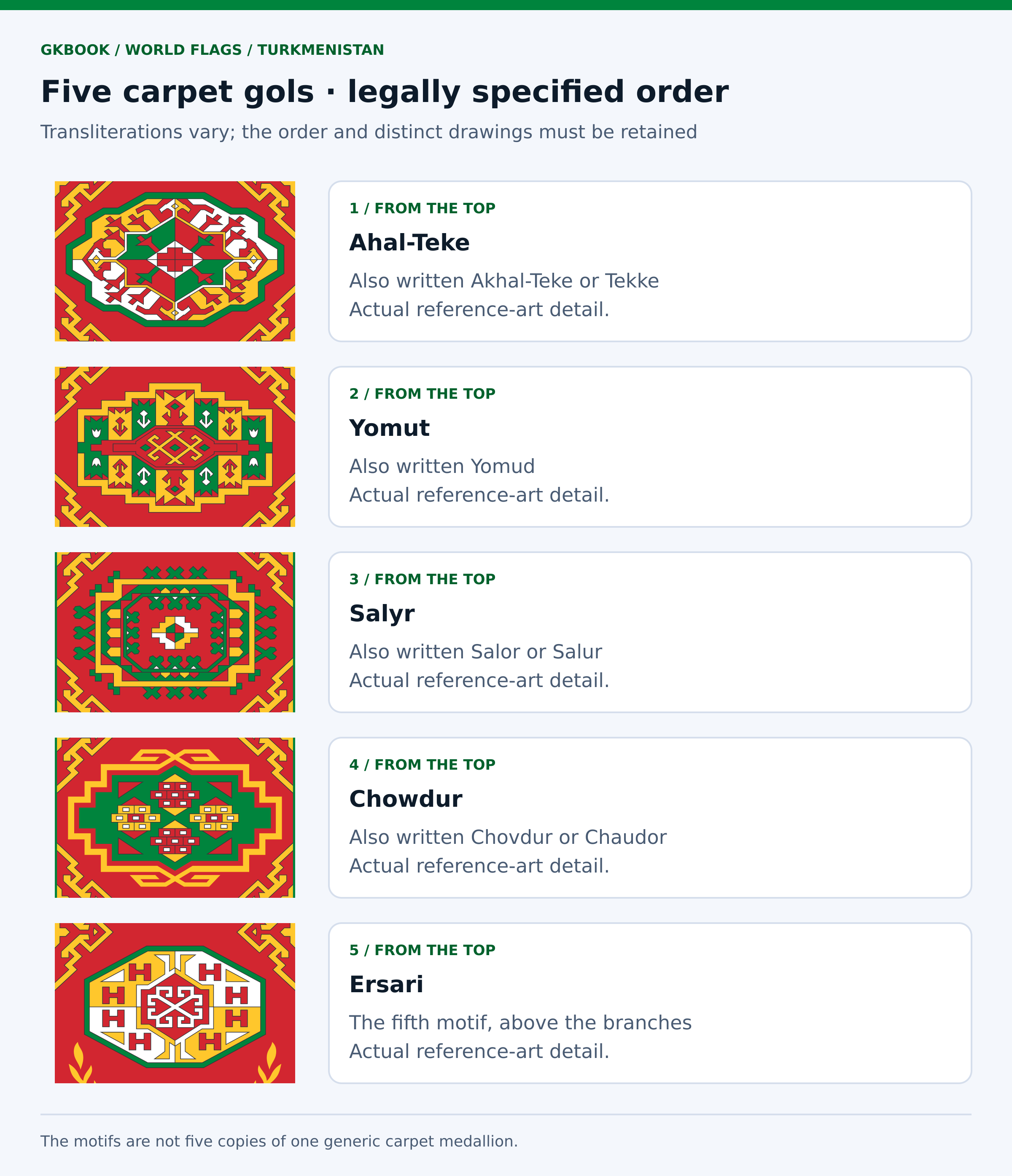
| Carpet gols, top to bottom | Ahal-Teke · Yomut · Salyr · Chowdur · ErsariFive distinct motifs in the order specified by the law. |
| Current Flag Day | May 18Joint Constitution and State Flag Day. |
| Digital colors | Green · red · yellow · black · whiteActual reference SVG palette; physical color certification is separate. |
| Main image sizes | SVG and PNG: 9,000 × 6,000Complete detailed flag; opaque RGB PNG. |
The law identifies unity, independence, and neutrality as national meanings. Yellow and black complete the detailed ornamental palette.
What does the Turkmenistan flag look like?
The Turkmenistan flag has a green field, an inset red carpet-pattern strip, a white crescent, and five white five-pointed stars. Five distinct carpet gols run down the strip above crossed olive branches. Its current height:length ratio is 2:3, and the detailed ornamental artwork is essential to the design.
Read the flag from the hoist, the edge attached to a pole, toward the free edge called the fly. A narrow green margin comes before the patterned strip. The crescent and stars occupy the upper part of the larger green area. This arrangement makes the flag recognizable even before its smaller details are examined. The supplied master preserves the complete reference vectors, while enlarged illustrations explain the motifs and their order. Legal descriptions, historical dates, and measurements taken from the digital drawing are identified separately throughout the article.
What is the Turkmenistan flag called?
The national flag is the State Flag of Turkmenistan, called Türkmenistanyň Döwlet baýdagy in Turkmen. Its familiar carpet-pattern strip is part of the national design, not a separate provincial flag. Descriptions should identify the complete green rectangle and its symbols rather than using the crescent alone as the country’s flag.
The official law uses the state flag’s name when describing its status, appearance, and display. In English, Turkmenistan flag and Turkmen national flag both identify the same national symbol. The country name is useful in captions because crescents and stars occur on several unrelated flags.
The word gol, also written göl or gül in discussions of carpets, identifies a principal ornamental motif. It does not mean that every carpet design is interchangeable. On this flag, the five named gols have a specified sequence and individual drawings that must remain recognizable.
What colors appear on the Turkmenistan flag?
The flag uses green, red, yellow, black, and white. This edition retains the actual reference SVG values: #00843D, #D22630, #FFC72C, #383739, and #FFFFFF respectively. These are declared digital colors, not independently certified textile specifications. The reference webpage’s color table gives a different green from the file itself.

Green fills the main field and appears within the carpet ornaments. Red provides the strip’s ground, with yellow, black, white, and green defining its intricate patterns. The crescent and five stars are white; the olive branches are yellow. Keeping all five colors preserves details that a two-color summary misses.
The actual SVG uses green #00843D, while its description-page table lists #00853A. This edition follows the downloaded drawing without silently changing its palette. Screen values do not establish an exact ink, dye, Pantone, or CMYK equivalent. Physical production requires the appropriate standard and a suitable proof.
| Color | HEX | RGB |
|---|---|---|
| Green | #00843D | 0, 132, 61 |
| Red | #D22630 | 210, 38, 48 |
| Yellow | #FFC72C | 255, 199, 44 |
| Black | #383739 | 56, 55, 57 |
| White | #FFFFFF | 255, 255, 255 |
What does the Turkmenistan flag symbolize?
Article 1 of the flag law identifies the flag as a symbol of the Turkmen people’s unity and independence and the state’s neutrality. Article 2 connects the five carpet gols with friendship and cohesion. Official commemorative explanations also associate the design with cultural continuity, renewal, and national solidarity.

The legal meaning concerns the flag as a whole. It should not be replaced by a universal color dictionary that assigns an identical meaning to green, red, or white wherever those colors appear. National history and the words of the relevant institutions provide more specific context.
Individual viewers may also attach religious, family, or regional associations to the imagery. Those associations can coexist with the legal description, but they are not measurements or evidence of a single original design decision. The illustrations distinguish the stated national meanings from the artwork’s observable structure.
Why does the flag have a green field?
Green has strong associations with life, renewal, and Islamic cultural tradition. Official Turkmen explanations emphasize spring, tranquility, and renewal, while general flag accounts discuss the Islamic association. These interpretations should be attributed carefully: the law specifies a green field but does not make one short explanation the exclusive origin of its color.
A cultural association is different from proof of what every designer intended. An official historical account places the design in national traditions and describes a collaborative selection process. That context is more reliable than assuming that a familiar religious association explains every element of the flag.
For reproduction, green is also a concrete visual feature. It surrounds the ornamental strip on both sides and remains visible behind the white celestial group. Removing the narrow margin beside the hoist or filling the whole background red would change the arrangement, whatever symbolic explanation accompanied it.
Where is the red carpet strip placed?
The red ornamental strip stands vertically near the hoist, separated from the flag’s edge by a green margin. It contains five different carpet gols in a fixed top-to-bottom order, surrounding carpet ornament, and two olive branches below. The complete strip must be retained when the flag is scaled or reproduced.

The strip is not simply a row of five decorative diamonds. Each gol has its own internal divisions and colors, and repeated border ornament connects the composition. These details explain why an accurate master needs considerably more vector information than a flag made only from plain bands.
In the inspected drawing, the strip begins about twelve percent of the flag’s length from the hoist and occupies eighteen percent of that length. Those percentages describe this reference file. The statutory 2:3 rectangle is verified separately; the full detailed manufacturing standard was not obtained.
Which five carpet motifs appear on the flag?
From top to bottom, Article 2 names the Ahal-Teke, Yomut, Salyr, Chowdur, and Ersari carpet gols. Transliteration varies, so Tekke, Yomud, Salor, and Chovdur may appear in English accounts. The names identify five distinct patterns; substituting another group or repeating one generic medallion would change the legal sequence.

The enlarged details follow the order in the official law. Ahal-Teke is the uppermost motif, followed by Yomut, Salyr, Chowdur, and Ersari above the branches. Alternate spellings can refer to the same name, but they should not be used to conceal a different list of motifs.
Some general summaries provide inconsistent names. For this reason, the primary legal sequence takes precedence here. The illustrations retain the actual reference patterns and nearby strip context rather than inventing isolated emblems. Their labels describe positions on the flag, not a ranking of communities or traditions.
How does the flag relate to Turkmen carpet making?
The five gols connect the national flag with Turkmen carpet traditions and their distinctive ornamental vocabulary. UNESCO inscribed Traditional Turkmen carpet making art in Turkmenistan in 2019. That recognition concerns a living cultural practice; it does not certify this digital flag, establish its exact colors, or replace the national flag law.

A woven carpet carries knowledge through materials, technique, pattern, and the people who make it. The flag brings selected motifs into a national setting where they express collective identity. Studying the flag can introduce that heritage, but the small drawings cannot convey everything involved in the craft.
The inscription date belongs to the history of international heritage recognition, not to the flag’s adoption chronology. The carpet-pattern flag was already in use before 2019. Keeping those dates separate avoids the mistaken impression that UNESCO introduced the motifs or approved a particular computer drawing of them.
Which way does the white crescent face?
In the standard front view, the white crescent opens obliquely toward the upper left, toward the five stars. Its shape and tilt are preserved from the inspected reference vectors. It should not be replaced by a generic horizontally opening crescent, which would alter the relationship between the celestial symbols.

The crescent stands in the upper part of the broad green field, to the right of the carpet strip. The stars occupy the open side of its curve. The enlarged illustration keeps them together so that the opening direction can be understood from their actual placement.
This edition preserves the source’s curved path instead of claiming independently verified exact circles or a statutory center coordinate. The flag law describes the white crescent and stars, while the unavailable full technical standard limits stronger construction claims. Preserving a reference shape and certifying a manufacturing geometry are different tasks.
How many stars are on the Turkmenistan flag?
There are five white five-pointed stars, each with one outer point facing downward in the standard front view. They form an offset group beside the crescent rather than a straight row. Explanations commonly connect them with regional unity, but this article does not assign a named region to each star.

Count the individual stars rather than the points of a single star. The reference uses one star drawing and four translated copies, preserving a consistent size and orientation. Rotating them all upright may look familiar from other flags, but it would change this particular national design.
A common explanation associates the five stars with five regions, while official messages emphasize unity and brotherhood. Those interpretations do not establish a documented star-by-star map. The positions shown in the detail illustration are visual coordinates, not labels for particular territories, populations, or administrative capitals.
What are the branches below the carpet motifs?
Two yellow olive branches cross at their bases below the fifth carpet gol. Article 2 describes each branch as having ten leaves and extending upward in an opposite direction. Official historical accounts connect the branches, added in 1997, with Turkmenistan’s permanent neutrality and its recognition by the United Nations.

The foliage belongs below the five gols and should not be mistaken for a sixth carpet motif. Its position completes the vertical strip. The enlarged detail includes the nearby edge of the lowest gol so that the branches can be located within the full composition.
Olive branches also occur in the United Nations emblem, but the complete UN emblem is not reproduced on this flag. There is no world map inside these branches. The historical association explains the addition without suggesting that the United Nations approved every line or color of this digital reproduction.
What are the proportions of the Turkmenistan flag?
The current flag has height:length proportions of 2:3. Article 2 states that the length is one and a half times the height. The supplied master measures 9,000 by 6,000 units or pixels. Earlier 1:2 versions and outdated summaries should not be used to stretch the current design.

Equivalent dimensions include 900 by 600, 450 by 300, and 300 by 200. These keep the rectangle and all its contents in proportion. Changing only the width or height distorts the carpet ornaments, the crescent, and the star shapes even if the outer image still looks plausible.
A wide banner, square tile, or social card can contain the complete flag with surrounding space. It does not require cropping the field or removing a motif. The separate social image follows that approach, fitting a full 540 by 360 flag inside a larger composition.
What measurements does the digital reference use?
The inspected SVG has a 900 by 600 viewport. Its red strip starts at x = 107.998 and is 162 units wide, leaving 630.002 units on the right. The supplied 9,000 by 6,000 master scales every coordinate uniformly by ten; these detailed measurements describe the reference, not an independently certified statutory diagram.
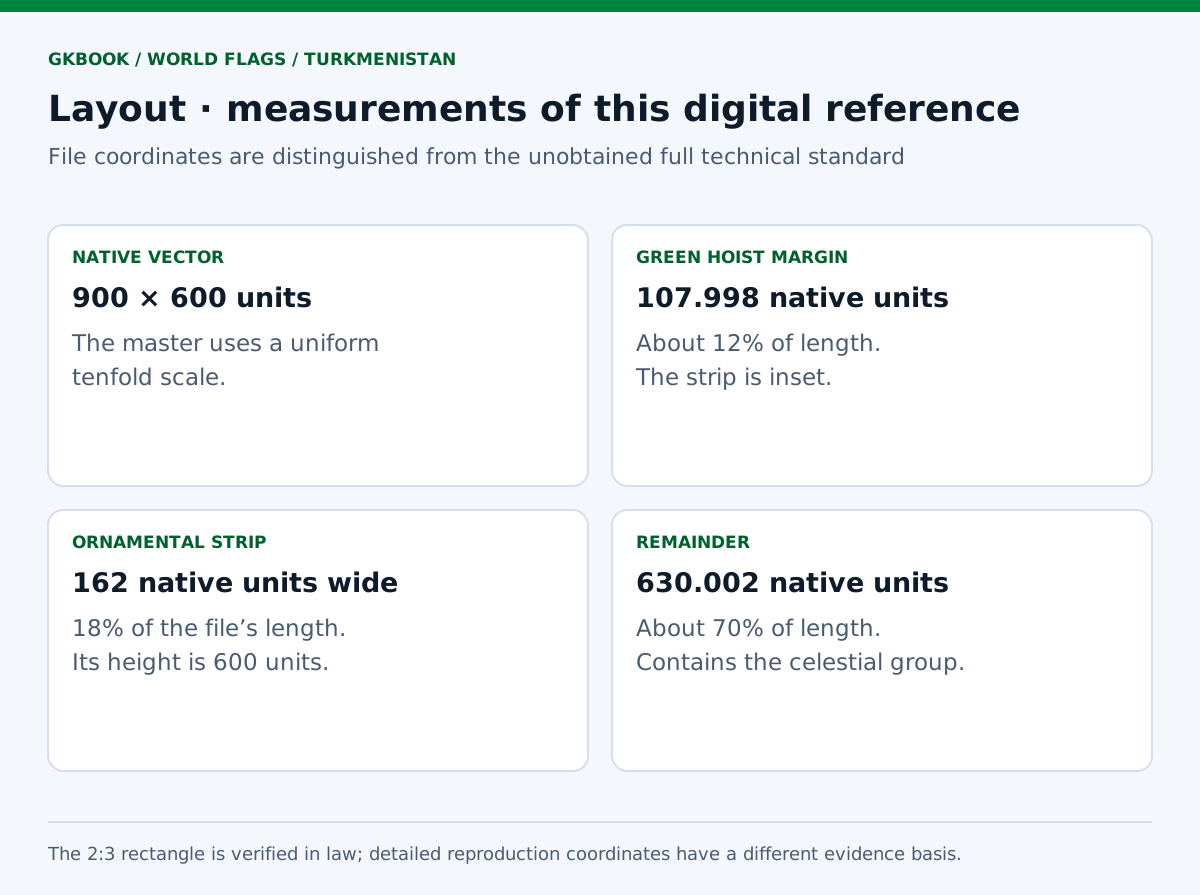
The coordinate origin is the upper-left corner, with horizontal values increasing toward the fly and vertical values downward. At master scale, the strip begins at x = 1,079.98 and spans 1,620 units. No motif is individually repositioned to make these figures appear rounder or more convenient.
A construction account in a secondary flag reference gives a slightly different subdivision. Without the full technical standard, those detailed ratios cannot all be asserted as identical official requirements. This edition declares which drawing it preserves while relying on the primary law for the current overall proportion.
Why are the small carpet details preserved?
The five gols and their border ornament distinguish this flag from a generic green crescent-and-star design. The master retains the reference’s complete paths, colors, and repeated elements. Simplifying the strip into five identical diamonds would remove identifying information, even if the resulting picture remained recognizable from a distance.

Vector artwork can retain detail at many scales, but the final display still has finite resolution. Narrow separations and small colored shapes may merge in a tiny thumbnail. Inspecting the intended output size helps determine whether an image is adequate for a label, a lesson, or a larger illustration.
The explanatory crops enlarge existing artwork rather than redraw the patterns. The clean master contains no captions, dimension lines, shadows, or fabric effects. Keeping those additions outside the flag allows the same complete reference to serve both as a downloadable image and as the basis of instructional diagrams.
How did the modern Turkmenistan flag develop?
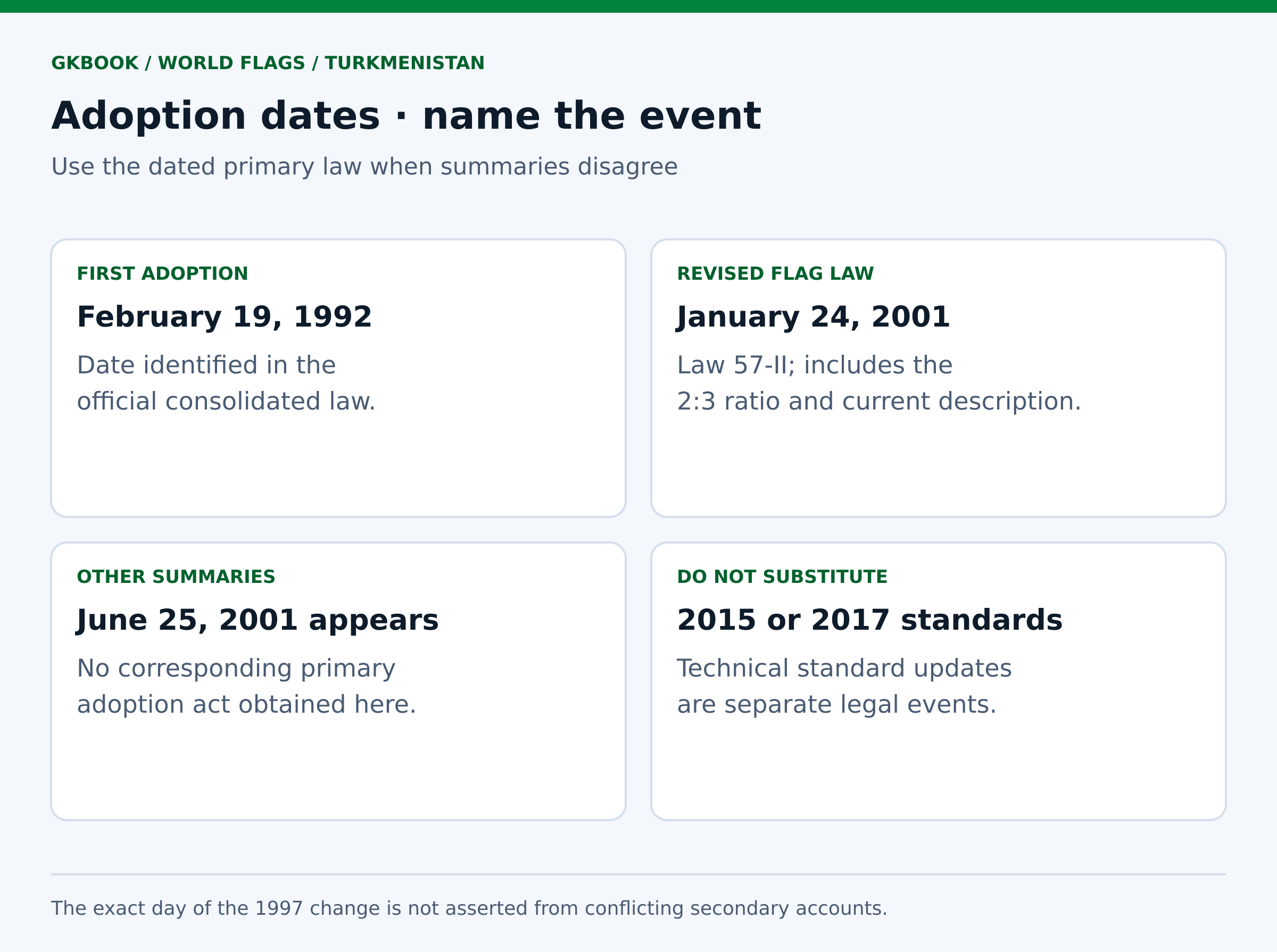
Turkmenistan became independent in 1991 and adopted its national flag on February 19, 1992. Olive branches were added in 1997 in connection with permanent neutrality. The revised flag law dated January 24, 2001 describes the current 2:3 proportion. These milestones concern different stages of the flag’s development.

The modern green design belongs to the period after Soviet independence. Carpet motifs connect the new national symbol with established cultural traditions, while the later branches connect it with the neutrality policy. Neither a later technical standard nor a revision of a computer file should replace this historical sequence.
Secondary accounts disagree about the exact day of the 1997 change, so only the year is asserted here. The original flag date and the revised law date have direct primary support. Separating established dates from unresolved details produces a more useful chronology than presenting every repeated online date as equally certain.
When was the Turkmenistan flag adopted?
The first national flag adoption date is February 19, 1992, identified in the official consolidated law. Its revised edition is dated January 24, 2001, Law 57-II. Some summaries give June 25, 2001 for the current design, but a corresponding primary adoption act was not obtained for this article.

A useful answer names the event as well as the date. First adoption, a revised legal description, a technical amendment, and an annual holiday are not interchangeable. The official heading preserves the 1992 origin while identifying the 2001 revision and listing subsequent amendments to the law.
This article therefore anchors the chronology to the dated primary text and qualifies the competing June date. It also avoids inventing an exact day for the 1997 addition from conflicting secondary accounts. The current ratio is supported by Article 2 regardless of how a brief timeline labels the revision.
Who designed the Turkmenistan flag?
The inspected sources do not establish one verified individual as the sole designer of the national flag. An official historical account describes a selection process involving artists, designers, and groups. The named contributors to the reference SVG are digital reproduction authors; they should not be presented as the original national flag’s designers.
A national design and a later computer drawing have separate authorship histories. The downloadable reference credits its source and digital contributors because they explain where the reproduced vectors came from. Those credits do not prove participation in the original governmental selection of the flag.
Assigning a single historical designer without an authoritative record would add unsupported certainty. The documented features and legal milestones are enough to explain the national symbol accurately. If a signed design record becomes available, it can be evaluated separately rather than inferred from a familiar filename or upload account.
What laws define the Turkmenistan flag?
Article 22 of the current Constitution identifies the flag, state emblem, and anthem as state symbols. The flag law describes the design and use, with Article 2 specifying its ratio and ordered elements. Article 5 refers conformity in color, image, dimensions, and material to a presidentially approved regulation.

The constitutional article number matters because older editions and summaries can use different numbering. The current text inspected here places the state-symbol provision in Article 22. The detailed flag law has a separate history, including its original 1992 date, the 2001 revised edition, and later amendments.
The constitutional provision establishes status; the flag law supplies a description; technical instruments address more detailed requirements. Reading one layer does not mean every manufacturing rule has been checked. The article explains that division without treating a community SVG or a web color table as the legislation itself.
Is there an official technical standard for the flag?
Yes. The national standards catalogue lists TDS 562-2015, National flag of Turkmenistan: Technical conditions. An official September 3, 2017 report discusses amendments affecting large fabric flags. The complete technical standard was not obtained here, so the supplied artwork is not certified as meeting every material, sewing, or physical color requirement.

The amendment report identifies a standard approved in 2015 and describes later production provisions. That establishes a technical framework beyond the short legal description. It does not provide enough information to reconstruct every clause, tolerance, or inspection method from a brief news report alone.
The digital palette is consequently reported as the actual SVG palette, with its webpage mismatch disclosed. No automatic conversion from HEX to a supposedly exact official ink or dye is asserted. A manufacturer needs the applicable full specification, suitable materials, and production checks for the intended flag size.
How does flag adoption relate to independence?
Turkmenistan’s historical independence date is October 27, 1991, while the national flag was adopted on February 19, 1992. The current annual Independence Day is September 27. A changed commemoration date does not move the historical event, and neither date should be confused with the present May 18 flag holiday.

Statehood and the adoption of national symbols can have separate milestones. A country may establish a flag after independence and later revise its details or observance calendar. Reporting these events with their names prevents a single date from being used to answer several different historical questions.
The Ministry of Foreign Affairs lists the current holidays, while historical accounts describe the 1991 independence event. The distinction is especially useful in school timelines: October 27, 1991 explains when independence occurred; September 27 identifies the annual observance now used; February 19, 1992 identifies the flag’s first adoption.
When was Turkmenistan recognized internationally?
The United States recognized Turkmenistan on December 25, 1991 and established diplomatic relations on February 19, 1992. Turkmenistan joined the United Nations on March 2, 1992. These are specific diplomatic milestones, distinct from the December 12, 1995 resolution recognizing and supporting permanent neutrality and from approval of any flag artwork.
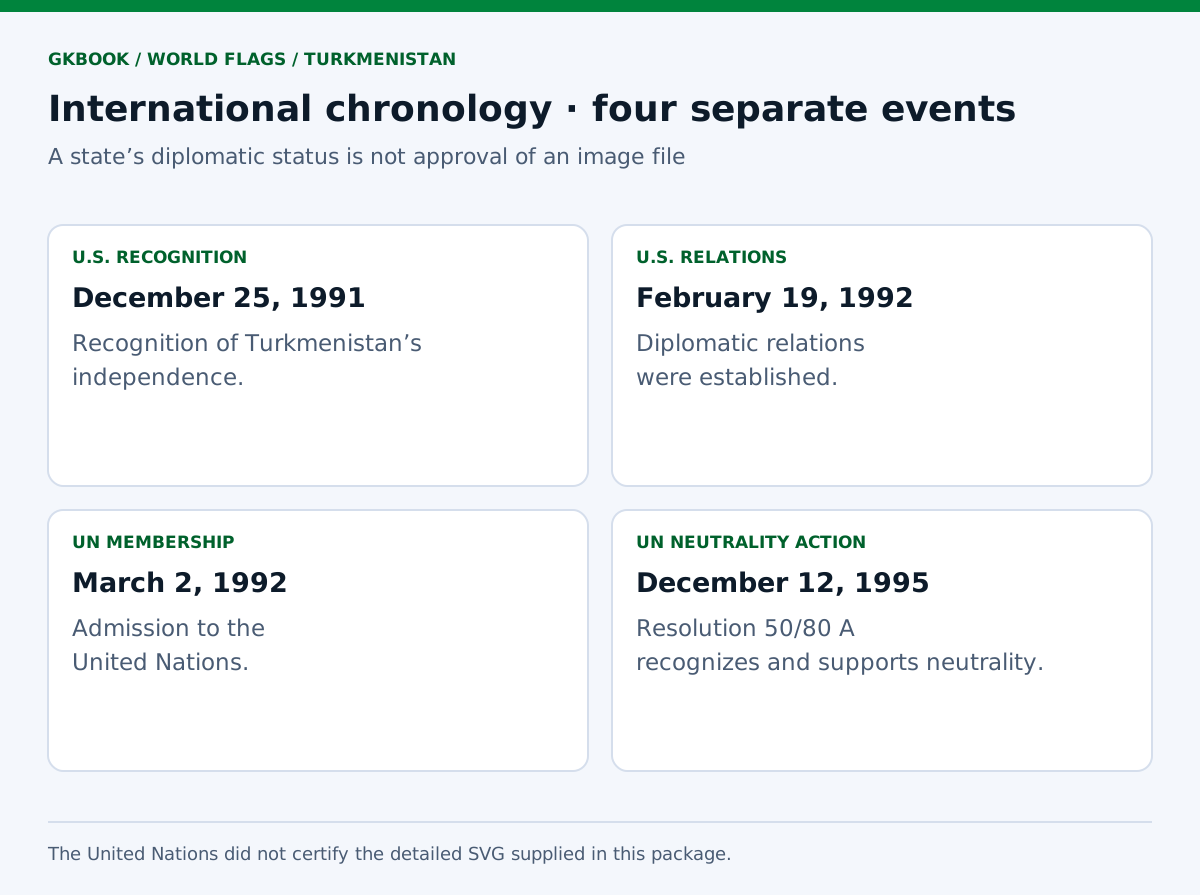
Recognition by one state is a bilateral event, while United Nations membership is an institutional event. They should not be compressed into a claim that the entire world recognized the country on one date. The coincidence between the U.S. relations date and the first flag date does not merge their meanings.
The neutrality resolution came later and concerned the country’s declared status. It did not establish United Nations membership, which already existed. These distinctions also prevent international recognition from being mistaken for a certificate that a particular drawing, screen color, or commercial flag product has official approval.
How is permanent neutrality represented on the flag?
Neutrality is expressly included in Article 1’s description of the flag’s meaning. The olive branches added in 1997 are linked in official historical accounts to that status. United Nations General Assembly resolution 50/80 A, adopted December 12, 1995, recognizes and supports the permanent neutrality declared by Turkmenistan.

The resolution’s adoption date must be distinguished from the January 1996 date printed on its distributed document. Part A addresses Turkmenistan’s permanent neutrality, while another part of the same numbered resolution concerns a different subject. Naming the part avoids an ambiguous reference to the document as a whole.
A symbol can represent a policy without summarizing all of its diplomatic or legal implications. The branches provide a visual connection to neutrality and international peace imagery. Their presence does not mean that the entire UN emblem appears on the flag or that every later policy question is answered by the design.
When is Turkmenistan’s State Flag Day celebrated?
Turkmenistan currently observes Constitution and State Flag Day on May 18, as listed by the Ministry of Foreign Affairs. February 19 remains the first flag adoption date in 1992 and was associated with an earlier flag observance. The present holiday and the historical adoption anniversary should be labeled separately.

A calendar can combine commemorations without changing the dates of the events they remember. Here, the joint observance connects the constitution and the state flag. An article or classroom calendar should use the current holiday name so readers understand why both national symbols and constitutional history are discussed together.
Older captions and reference pages may still identify February 19 as Flag Day. Their wording should be checked against the current official list before reuse. Keeping the original adoption date in the history section preserves that milestone while allowing the annual observance to be reported accurately.
How is this flag different from other crescent-and-star flags?
Turkmenistan is distinguished by its inset vertical carpet strip, five ordered gols, crossed olive branches, and five downward-pointing stars beside an oblique crescent. A green field or crescent alone is not enough to identify it. Compare the entire composition, including the margin at the hoist and the number of stars.
Shared symbols do not imply identical histories or construction rules. A crescent can face a different direction, and stars can differ in number, orientation, size, or placement. Copying a celestial emblem from another national flag would therefore produce an approximation even if the colors seemed suitable.
The carpet strip provides a particularly strong identifying feature. When a small picture makes the fine ornament hard to see, the strip’s location and the celestial group still help recognition. A country label and useful alternative text can make the intended identification clearer without altering the national artwork.
Does the national flag include the state emblem or lettering?
The national flag described in the law contains the carpet strip, olive branches, crescent, and stars; it does not include the separate state emblem or an inscription. A presidential standard, institutional banner, or commemorative graphic should be identified separately. Adding an emblem or slogan would create a different image from this national flag.
The Constitution lists the flag and state emblem as distinct state symbols. Their shared national association does not make them interchangeable in a drawing. The downloadable master follows the flag’s composition and does not add another symbol simply because it is also connected with Turkmenistan.
Photographs of ceremonies can contain several banners, emblems, and signs at once. Context helps identify each object, but a crop should not be labeled as the ordinary national flag solely because it appears at an official event. This package provides the national design and explanatory views of that design.
What should readers know about respectful flag display?
The flag law specifies official display settings, formal honors, and respectful treatment. It provides for lowering the flag on October 6, Remembrance Day, and on other occasions determined by the Cabinet of Ministers. Practical arrangements should follow the applicable current rules; a downloadable image does not itself establish a complete ceremonial protocol.
The legal text addresses both the national symbol’s dignity and its use by institutions. Those provisions are separate from the copyright status of a digital drawing. An image described as public domain can still depict a national symbol whose display is subject to rules in a particular setting.
For a formal installation, confirm the requirements of the responsible institution and the event. The illustrations here explain the flag’s appearance and geometric transformations. They are not a substitute for instructions on pole arrangements, precedence among flags, mourning procedures, or the material condition expected of a physical flag.
How should the flag be understood in a vertical illustration?
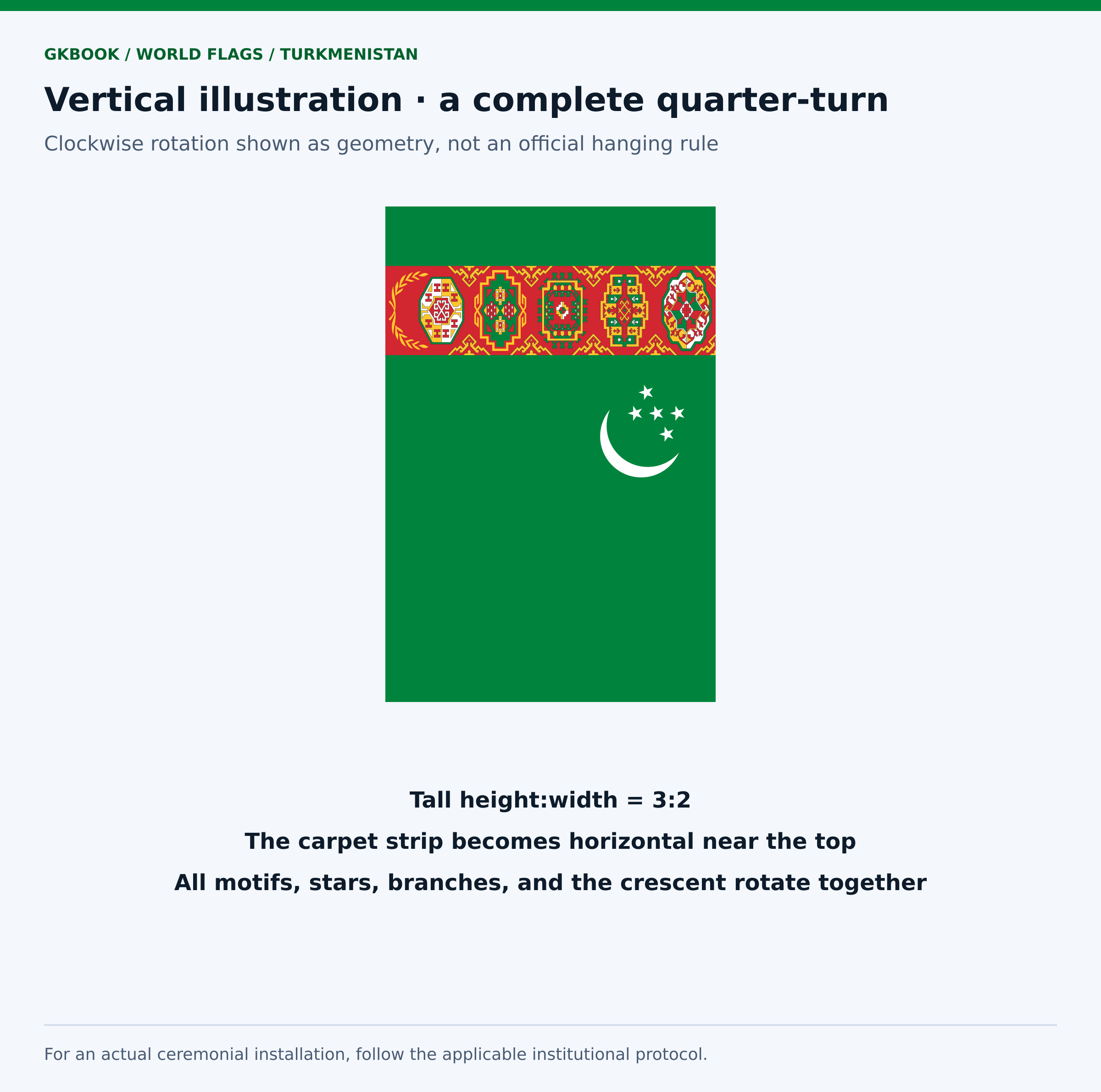
The vertical diagram rotates the complete flag clockwise by ninety degrees. The carpet strip becomes horizontal near the top, and every motif, branch, star, and the crescent rotates with it. This is a geometric illustration, not an asserted universal hanging rule; actual ceremonial installations should follow the responsible institution’s applicable protocol.

A quarter-turn changes the rectangle from a wide 2:3 height:length format to a tall 3:2 height:width format. It does not rearrange the original components inside a newly invented layout. The five gols keep their order along the rotated strip rather than being stacked again by hand.
The star orientation changes with the whole image: a tip that originally faced down now faces left after the clockwise turn. The crescent also turns. These consequences make the illustration a useful check that a designer has rotated the complete flag rather than selectively moving its most obvious elements.
What does the reverse of the flag look like?
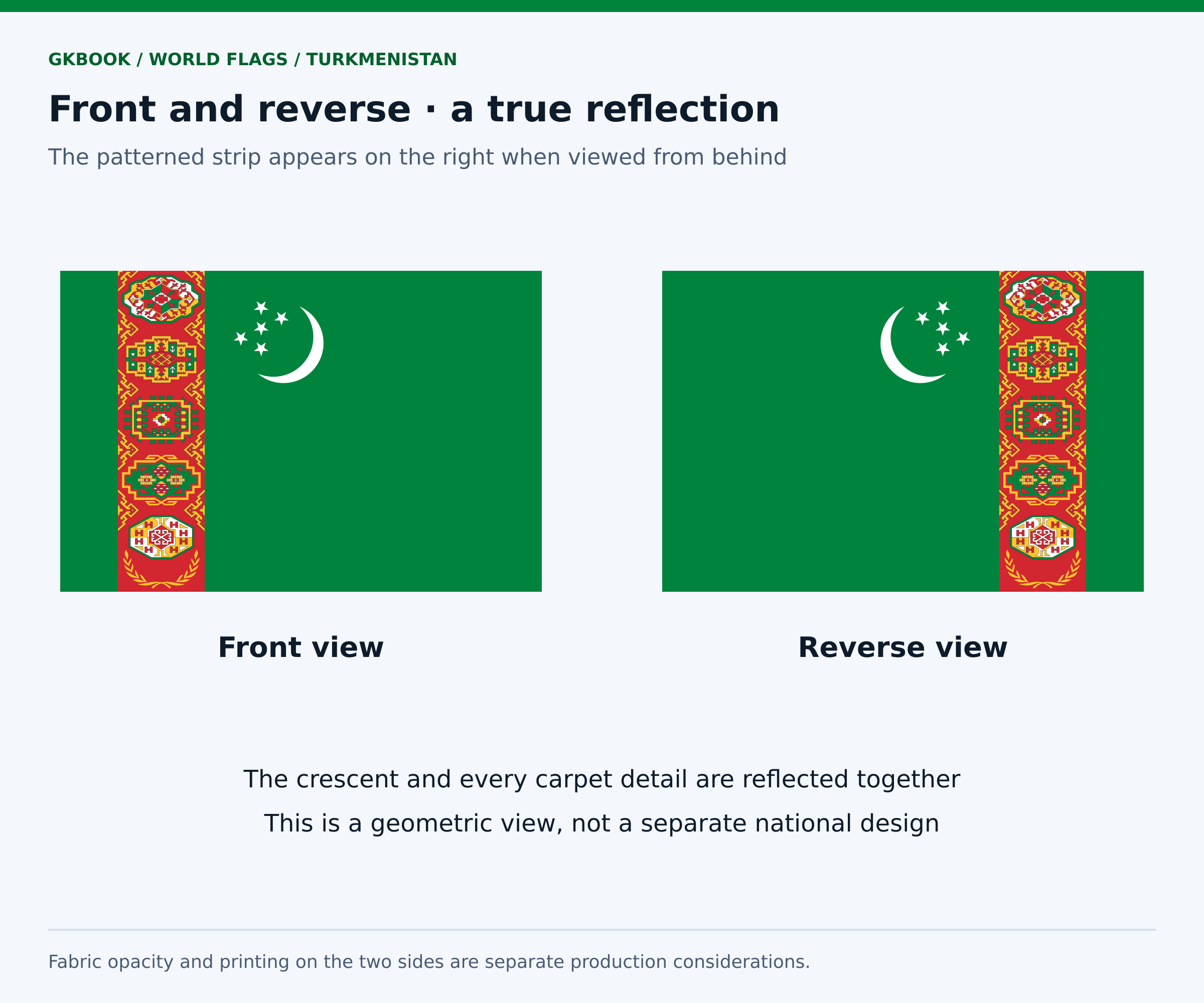
A geometric reverse is a horizontal reflection of the complete front view. The patterned strip appears on the right, the crescent opens toward the upper right, and all carpet details are reflected together. This view does not introduce a second national design; actual fabric opacity and printing methods are separate production considerations.
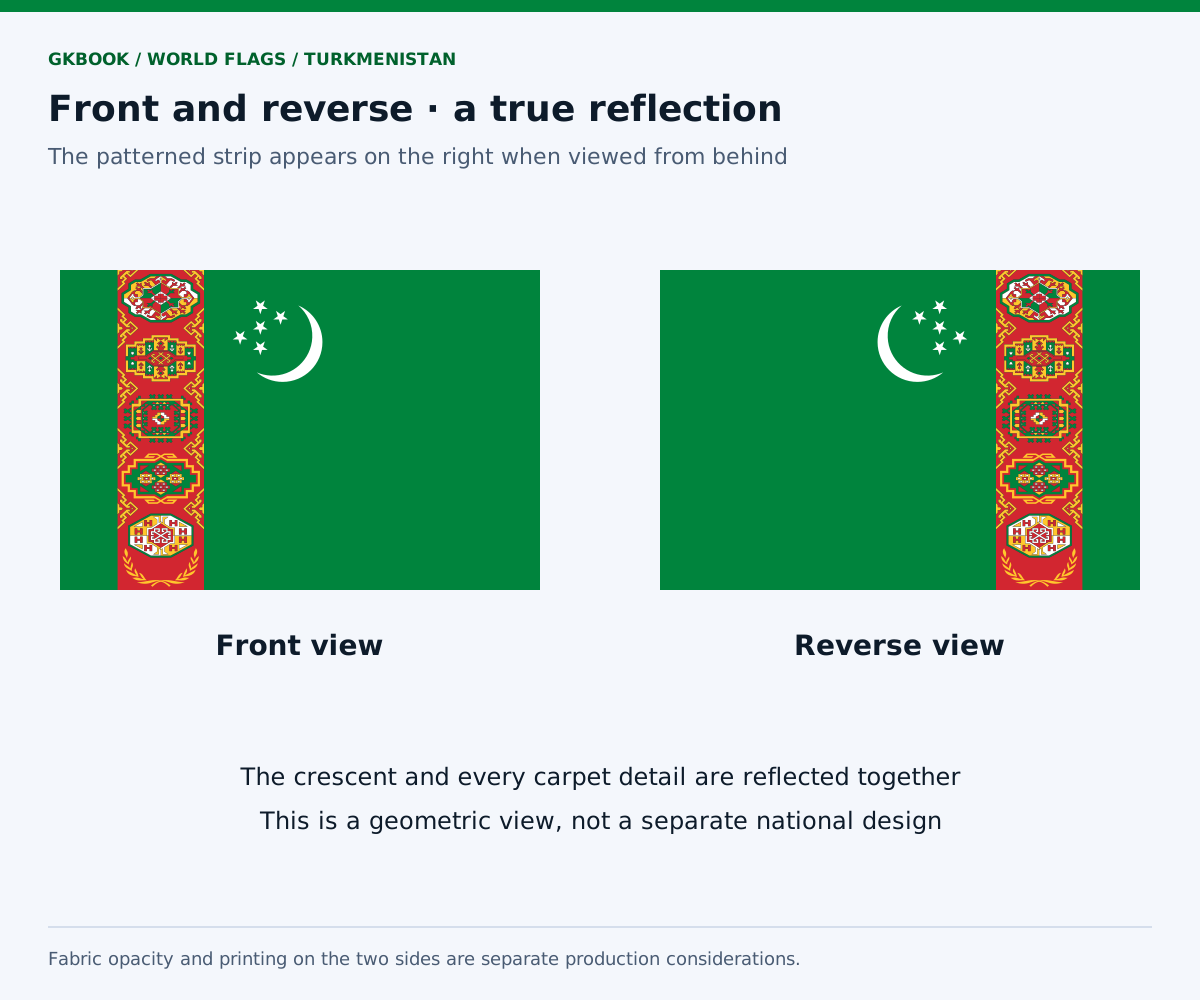
Reflection preserves the top-to-bottom order of the five gols but reverses their left-right details. The five stars still have downward-pointing tips because a horizontal reflection does not exchange top and bottom. The illustration applies the same transformation to every component, including the small ornamental border.
A two-sided manufactured flag may require decisions about fabric, ink penetration, and viewing conditions. Those questions cannot be settled by showing a reflected SVG alone. The diagram explains what looking through an ordinary single design from behind means geometrically, without certifying a particular sewing or printing process.
Is the Turkmenistan flag symmetrical?
The complete flag has neither horizontal-axis nor vertical-axis reflection symmetry, and it is not unchanged by a half-turn. The inset strip, ordered different gols, lower branches, and upper celestial group prevent those symmetries. Individual ornamental elements may have their own symmetries, but those do not make the whole composition symmetrical.

A top-bottom reflection would move the branches above the gols and the celestial group toward the lower field. A left-right reflection would move the strip toward the opposite edge. A half-turn combines positional changes and reverses the motif order, producing a visibly different arrangement.
The rectangular boundary alone is therefore insufficient for judging the flag’s symmetry. Examine the colored design inside it, including the locations of smaller elements. The comparison illustration shows a real half-turn of the complete vector artwork, making these differences visible without changing any motif individually.
How should the Turkmenistan flag be resized or printed?
Resize the complete flag proportionally and retain every carpet motif, branch, star, and the green margins. The 9,000 by 6,000 PNG corresponds to 30 by 20 inches at 300 pixels per inch. Use the SVG for scalable detail; physical production also requires appropriate materials, color proofing, and the applicable technical requirements.

Place any decorative border outside the flag rectangle. For a different layout shape, add surrounding space instead of stretching the pattern or cropping the field. At small sizes, inspect whether narrow details remain legible. Repeatedly enlarging a thumbnail cannot recover the detail that its limited pixel grid has already lost.
The supplied colors describe a screen reference, not a universal recipe for fabric or printing ink. A production proof should be evaluated at the intended size and on the intended material. Keep the credits and reproduction notes with reused files so the source palette and limits remain clear.
Download Turkmenistan flag pictures
Download the complete national flag as SVG or 9,000 × 6,000 PNG. Its height:length ratio is 2:3. The green margins, all five carpet motifs, olive branches, crescent, and five stars remain complete. Detailed vectors are preserved.
The gallery contains 24 subjects, each with an SVG and PNG. Captions distinguish the clean flag from construction guides, historical explanations, and geometric transformations. Image credits and reproduction notes identify the sources, palette, and scope of the original explanatory additions. The separate 1,200 × 630 social card contains a complete digital flag face measuring 540 × 360 units.
Continue exploring national designs in World Flags.
World Flags/Turkmenistan
Turkmenistan flag pictures
Complete 2:3 flag with all five distinct carpet gols, five stars, crescent, and crossed olive branches; detailed reference vectors preserved.
GKBook explanatory artwork; detailed flag vectors retained from the credited Commons/Open Clip Art reference.Download SVGDownload PNGGreen #00843D, red #D22630, yellow #FFC72C, black #383739, and white #FFFFFF are the actual reference SVG fills.
GKBook explanatory artwork; detailed flag vectors retained from the credited Commons/Open Clip Art reference.Download SVGDownload PNGThe law explicitly connects the flag with unity, independence, and neutrality; official messages also discuss cultural continuity and renewal.
GKBook explanatory artwork; detailed flag vectors retained from the credited Commons/Open Clip Art reference.Download SVGDownload PNGEnlarged complete ornamental strip, extracted from the unchanged detailed reference artwork.
GKBook explanatory artwork; detailed flag vectors retained from the credited Commons/Open Clip Art reference.Download SVGDownload PNGThe ordered sequence follows Article 2: Ahal-Teke, Yomut, Salyr, Chowdur, Ersari. Crops include nearby strip context.
GKBook explanatory artwork; detailed flag vectors retained from the credited Commons/Open Clip Art reference.Download SVGDownload PNGUNESCO inscribed traditional Turkmen carpet making art in Turkmenistan in 2019; the flag’s motifs belong to that wider cultural context.
GKBook explanatory artwork; detailed flag vectors retained from the credited Commons/Open Clip Art reference.Download SVGDownload PNGThe crescent and neighboring stars are shown directly from the complete reference vectors.
GKBook explanatory artwork; detailed flag vectors retained from the credited Commons/Open Clip Art reference.Download SVGDownload PNGAll five stars retain the orientation and positions of the inspected reference artwork.
GKBook explanatory artwork; detailed flag vectors retained from the credited Commons/Open Clip Art reference.Download SVGDownload PNGLower-strip detail preserves the two branches and the nearby edge of the fifth gol.
GKBook explanatory artwork; detailed flag vectors retained from the credited Commons/Open Clip Art reference.Download SVGDownload PNGThe current statutory ratio is 2:3, not the 1:2 ratio of earlier versions and some outdated summaries.
GKBook explanatory artwork; detailed flag vectors retained from the credited Commons/Open Clip Art reference.Download SVGDownload PNGThese are observed reference-file measurements. The complete TDS 562-2015 standard was not obtained, so they are not claimed as an independently certified statutory construction.
GKBook explanatory artwork; detailed flag vectors retained from the credited Commons/Open Clip Art reference.Download SVGDownload PNGThe detailed reference vectors are retained throughout the clean master and every complete flag illustration.
GKBook explanatory artwork; detailed flag vectors retained from the credited Commons/Open Clip Art reference.Download SVGDownload PNGThe sequence distinguishes independence, first flag adoption, added branches, and the revised legal description.
GKBook explanatory artwork; detailed flag vectors retained from the credited Commons/Open Clip Art reference.Download SVGDownload PNGThe article anchors adoption to February 19, 1992 and the revised law to January 24, 2001. A competing June date is qualified rather than silently substituted.
GKBook explanatory artwork; detailed flag vectors retained from the credited Commons/Open Clip Art reference.Download SVGDownload PNGCurrent Constitution Article 22 identifies the state symbols; the flag law and technical standard have more detailed roles.
GKBook explanatory artwork; detailed flag vectors retained from the credited Commons/Open Clip Art reference.Download SVGDownload PNGThe catalogue and official amendment report establish that a technical standard exists. Digital reproduction is distinguished from its full manufacturing requirements.
GKBook explanatory artwork; detailed flag vectors retained from the credited Commons/Open Clip Art reference.Download SVGDownload PNGThe historical independence date, current Independence Day, flag adoption, and current Flag Day answer four different questions.
GKBook explanatory artwork; detailed flag vectors retained from the credited Commons/Open Clip Art reference.Download SVGDownload PNGRecognition, diplomatic relations, UN membership, and the neutrality resolution are distinct milestones.
GKBook explanatory artwork; detailed flag vectors retained from the credited Commons/Open Clip Art reference.Download SVGDownload PNGThe legal meaning and the official historical account connect the branches with permanent neutrality.
GKBook explanatory artwork; detailed flag vectors retained from the credited Commons/Open Clip Art reference.Download SVGDownload PNGMay 18 is the current joint Constitution and State Flag Day; February 19 is the original adoption date.
GKBook explanatory artwork; detailed flag vectors retained from the credited Commons/Open Clip Art reference.Download SVGDownload PNGA clockwise quarter-turn of the complete flag preserves all elements and produces a tall 3:2 rectangle.
GKBook explanatory artwork; detailed flag vectors retained from the credited Commons/Open Clip Art reference.Download SVGDownload PNGThe reverse is an actual horizontal reflection of the complete detailed master.
GKBook explanatory artwork; detailed flag vectors retained from the credited Commons/Open Clip Art reference.Download SVGDownload PNGThe whole flag is not preserved by either central-axis reflection or a half-turn.
GKBook explanatory artwork; detailed flag vectors retained from the credited Commons/Open Clip Art reference.Download SVGDownload PNGProportional scaling preserves the complete composition, while the intended output size determines how much detail remains visible.
GKBook explanatory artwork; detailed flag vectors retained from the credited Commons/Open Clip Art reference.Download SVGDownload PNGFrequently asked questions
What does the Turkmenistan flag look like?
The Turkmenistan flag has a green field, an inset red carpet-pattern strip, a white crescent, and five white five-pointed stars. Five distinct carpet gols run down the strip above crossed olive branches. Its current height:length ratio is 2:3, and the detailed ornamental artwork is essential to the design.
What is the Turkmenistan flag called?
The national flag is the State Flag of Turkmenistan, called Türkmenistanyň Döwlet baýdagy in Turkmen. Its familiar carpet-pattern strip is part of the national design, not a separate provincial flag. Descriptions should identify the complete green rectangle and its symbols rather than using the crescent alone as the country’s flag.
What colors appear on the Turkmenistan flag?
The flag uses green, red, yellow, black, and white. This edition retains the actual reference SVG values: #00843D, #D22630, #FFC72C, #383739, and #FFFFFF respectively. These are declared digital colors, not independently certified textile specifications. The reference webpage’s color table gives a different green from the file itself.
What does the Turkmenistan flag symbolize?
Article 1 of the flag law identifies the flag as a symbol of the Turkmen people’s unity and independence and the state’s neutrality. Article 2 connects the five carpet gols with friendship and cohesion. Official commemorative explanations also associate the design with cultural continuity, renewal, and national solidarity.
Why does the flag have a green field?
Green has strong associations with life, renewal, and Islamic cultural tradition. Official Turkmen explanations emphasize spring, tranquility, and renewal, while general flag accounts discuss the Islamic association. These interpretations should be attributed carefully: the law specifies a green field but does not make one short explanation the exclusive origin of its color.
Where is the red carpet strip placed?
The red ornamental strip stands vertically near the hoist, separated from the flag’s edge by a green margin. It contains five different carpet gols in a fixed top-to-bottom order, surrounding carpet ornament, and two olive branches below. The complete strip must be retained when the flag is scaled or reproduced.
Which five carpet motifs appear on the flag?
From top to bottom, Article 2 names the Ahal-Teke, Yomut, Salyr, Chowdur, and Ersari carpet gols. Transliteration varies, so Tekke, Yomud, Salor, and Chovdur may appear in English accounts. The names identify five distinct patterns; substituting another group or repeating one generic medallion would change the legal sequence.
How does the flag relate to Turkmen carpet making?
The five gols connect the national flag with Turkmen carpet traditions and their distinctive ornamental vocabulary. UNESCO inscribed Traditional Turkmen carpet making art in Turkmenistan in 2019. That recognition concerns a living cultural practice; it does not certify this digital flag, establish its exact colors, or replace the national flag law.
Which way does the white crescent face?
In the standard front view, the white crescent opens obliquely toward the upper left, toward the five stars. Its shape and tilt are preserved from the inspected reference vectors. It should not be replaced by a generic horizontally opening crescent, which would alter the relationship between the celestial symbols.
How many stars are on the Turkmenistan flag?
There are five white five-pointed stars, each with one outer point facing downward in the standard front view. They form an offset group beside the crescent rather than a straight row. Explanations commonly connect them with regional unity, but this article does not assign a named region to each star.
What are the branches below the carpet motifs?
Two yellow olive branches cross at their bases below the fifth carpet gol. Article 2 describes each branch as having ten leaves and extending upward in an opposite direction. Official historical accounts connect the branches, added in 1997, with Turkmenistan’s permanent neutrality and its recognition by the United Nations.
What are the proportions of the Turkmenistan flag?
The current flag has height:length proportions of 2:3. Article 2 states that the length is one and a half times the height. The supplied master measures 9,000 by 6,000 units or pixels. Earlier 1:2 versions and outdated summaries should not be used to stretch the current design.
What measurements does the digital reference use?
The inspected SVG has a 900 by 600 viewport. Its red strip starts at x = 107.998 and is 162 units wide, leaving 630.002 units on the right. The supplied 9,000 by 6,000 master scales every coordinate uniformly by ten; these detailed measurements describe the reference, not an independently certified statutory diagram.
Why are the small carpet details preserved?
The five gols and their border ornament distinguish this flag from a generic green crescent-and-star design. The master retains the reference’s complete paths, colors, and repeated elements. Simplifying the strip into five identical diamonds would remove identifying information, even if the resulting picture remained recognizable from a distance.
How did the modern Turkmenistan flag develop?
Turkmenistan became independent in 1991 and adopted its national flag on February 19, 1992. Olive branches were added in 1997 in connection with permanent neutrality. The revised flag law dated January 24, 2001 describes the current 2:3 proportion. These milestones concern different stages of the flag’s development.
When was the Turkmenistan flag adopted?
The first national flag adoption date is February 19, 1992, identified in the official consolidated law. Its revised edition is dated January 24, 2001, Law 57-II. Some summaries give June 25, 2001 for the current design, but a corresponding primary adoption act was not obtained for this article.
Who designed the Turkmenistan flag?
The inspected sources do not establish one verified individual as the sole designer of the national flag. An official historical account describes a selection process involving artists, designers, and groups. The named contributors to the reference SVG are digital reproduction authors; they should not be presented as the original national flag’s designers.
What laws define the Turkmenistan flag?
Article 22 of the current Constitution identifies the flag, state emblem, and anthem as state symbols. The flag law describes the design and use, with Article 2 specifying its ratio and ordered elements. Article 5 refers conformity in color, image, dimensions, and material to a presidentially approved regulation.
Is there an official technical standard for the flag?
Yes. The national standards catalogue lists TDS 562-2015, National flag of Turkmenistan: Technical conditions. An official September 3, 2017 report discusses amendments affecting large fabric flags. The complete technical standard was not obtained here, so the supplied artwork is not certified as meeting every material, sewing, or physical color requirement.
How does flag adoption relate to independence?
Turkmenistan’s historical independence date is October 27, 1991, while the national flag was adopted on February 19, 1992. The current annual Independence Day is September 27. A changed commemoration date does not move the historical event, and neither date should be confused with the present May 18 flag holiday.
When was Turkmenistan recognized internationally?
The United States recognized Turkmenistan on December 25, 1991 and established diplomatic relations on February 19, 1992. Turkmenistan joined the United Nations on March 2, 1992. These are specific diplomatic milestones, distinct from the December 12, 1995 resolution recognizing and supporting permanent neutrality and from approval of any flag artwork.
How is permanent neutrality represented on the flag?
Neutrality is expressly included in Article 1’s description of the flag’s meaning. The olive branches added in 1997 are linked in official historical accounts to that status. United Nations General Assembly resolution 50/80 A, adopted December 12, 1995, recognizes and supports the permanent neutrality declared by Turkmenistan.
When is Turkmenistan’s State Flag Day celebrated?
Turkmenistan currently observes Constitution and State Flag Day on May 18, as listed by the Ministry of Foreign Affairs. February 19 remains the first flag adoption date in 1992 and was associated with an earlier flag observance. The present holiday and the historical adoption anniversary should be labeled separately.
How is this flag different from other crescent-and-star flags?
Turkmenistan is distinguished by its inset vertical carpet strip, five ordered gols, crossed olive branches, and five downward-pointing stars beside an oblique crescent. A green field or crescent alone is not enough to identify it. Compare the entire composition, including the margin at the hoist and the number of stars.
Does the national flag include the state emblem or lettering?
The national flag described in the law contains the carpet strip, olive branches, crescent, and stars; it does not include the separate state emblem or an inscription. A presidential standard, institutional banner, or commemorative graphic should be identified separately. Adding an emblem or slogan would create a different image from this national flag.
What should readers know about respectful flag display?
The flag law specifies official display settings, formal honors, and respectful treatment. It provides for lowering the flag on October 6, Remembrance Day, and on other occasions determined by the Cabinet of Ministers. Practical arrangements should follow the applicable current rules; a downloadable image does not itself establish a complete ceremonial protocol.
How should the flag be understood in a vertical illustration?
The vertical diagram rotates the complete flag clockwise by ninety degrees. The carpet strip becomes horizontal near the top, and every motif, branch, star, and the crescent rotates with it. This is a geometric illustration, not an asserted universal hanging rule; actual ceremonial installations should follow the responsible institution’s applicable protocol.
What does the reverse of the flag look like?
A geometric reverse is a horizontal reflection of the complete front view. The patterned strip appears on the right, the crescent opens toward the upper right, and all carpet details are reflected together. This view does not introduce a second national design; actual fabric opacity and printing methods are separate production considerations.
Is the Turkmenistan flag symmetrical?
The complete flag has neither horizontal-axis nor vertical-axis reflection symmetry, and it is not unchanged by a half-turn. The inset strip, ordered different gols, lower branches, and upper celestial group prevent those symmetries. Individual ornamental elements may have their own symmetries, but those do not make the whole composition symmetrical.
How should the Turkmenistan flag be resized or printed?
Resize the complete flag proportionally and retain every carpet motif, branch, star, and the green margins. The 9,000 by 6,000 PNG corresponds to 30 by 20 inches at 300 pixels per inch. Use the SVG for scalable detail; physical production also requires appropriate materials, color proofing, and the applicable technical requirements.
Every general-knowledge topic and the A-to-Z lists.
The world A to Z: flags, countries, the sciences, places, people, subjects.









We Value Your Opinion Comments