
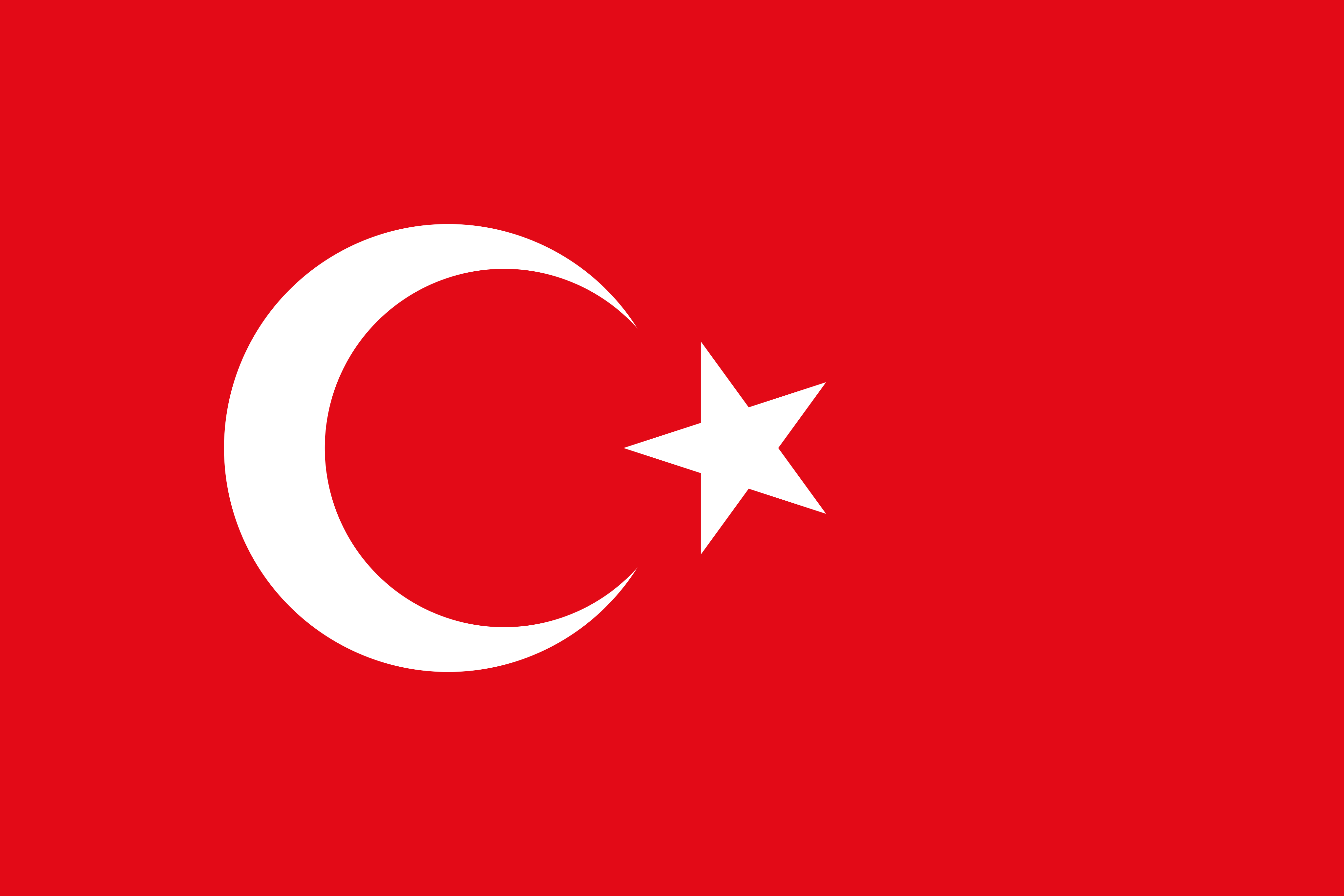
Turkey flag picture
Explore the proportions, adoption history, and picture gallery.
| National design | Republic of TürkiyeTurkey is retained in the requested page path and filenames. |
|---|---|
| Design | Red field · white crescent and starCrescent opens toward the fly; one star point faces the hoist. |
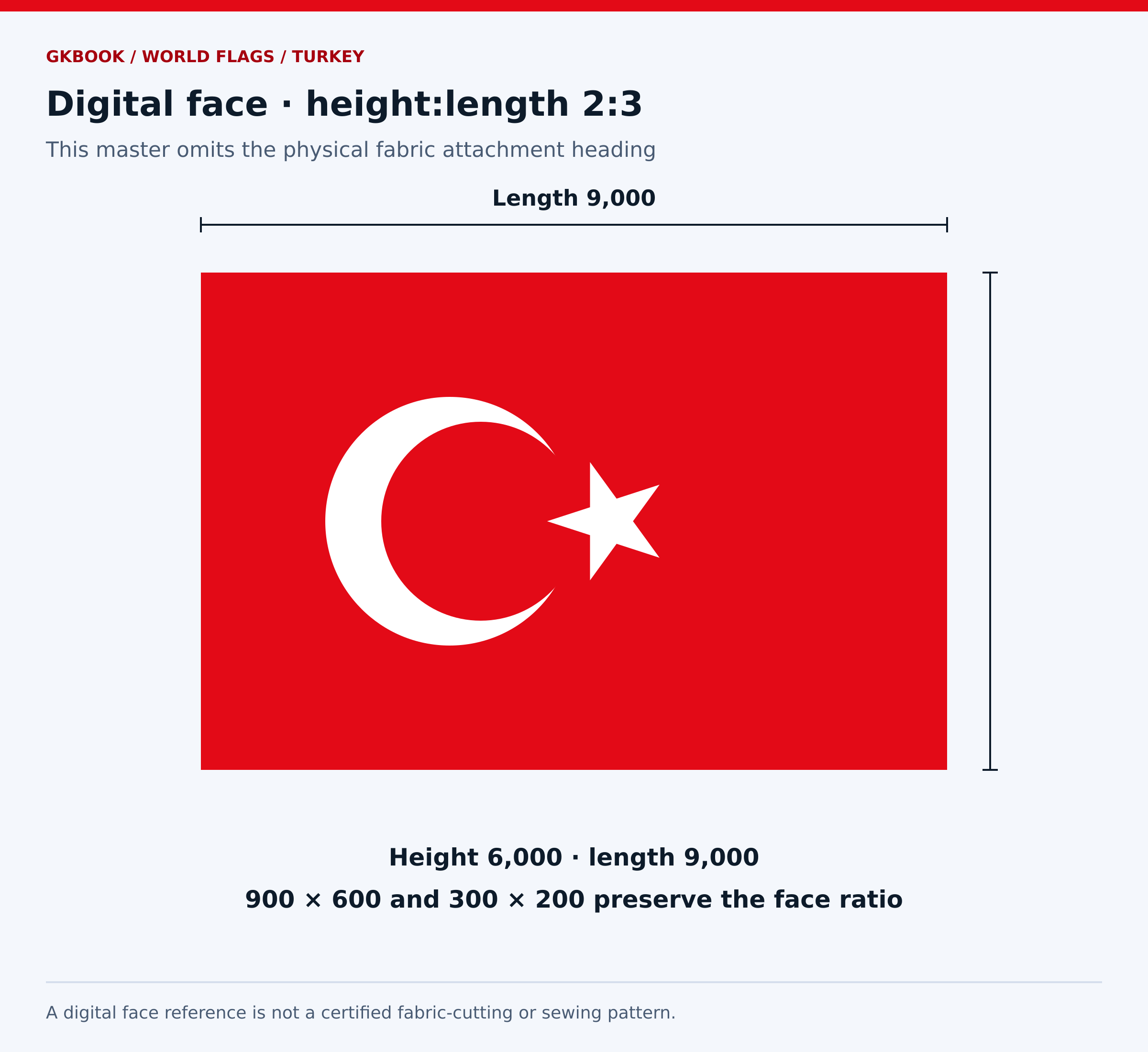
| Digital proportions | Height:length = 2:3Conventional face without a physical attachment heading. |
| Historical form | Five-pointed form around 1844Law 2994 adopted May 29, 1936; published June 5, 1936. |
| Current flag law | Law 2893, September 22, 1983Constitution Article 3; detailed Regulation 85/9034. |
| Construction choice | Numerical annex spacingThe wording about alignment with the crescent tips differs slightly. |
| Declared digital colors | Red #E30A17 · white #FFFFFFReference-SVG values; physical color tests are separate. |
| Main image sizes | SVG and PNG: 9,000 × 6,000Complete digital face; opaque RGB PNG. |
The crescent and star carry Islamic and Ottoman associations. Historical interpretation, numerical construction, and physical color testing remain distinct.
What does the Turkey flag look like?
The Turkey flag has a red field bearing a white crescent and a white five-pointed star. The crescent opens toward the fly, shown at the right, while one star point faces left. The supplied digital face has height:length proportions of 2:3 and uses numerical dimensions from the official construction table.
Read the design from the hoist, the edge attached to a pole, toward the free edge called the fly. The crescent sits toward the hoist; the star occupies its open side. Neither the crescent nor the combined emblem should be moved to the rectangle’s center by eye. This reference keeps their positions explicit. It also separates a conventional digital face from a physical flag’s attachment heading, and explains a small discrepancy between the numerical star-spacing table and one sentence of the regulation. Those qualifications matter when precision is the goal.
What is the Turkey flag called?
The national flag is the Turkish flag, called Türk Bayrağı in Turkish. Türkiye is the country name now used at the United Nations, following the request received on June 1, 2022. That naming change did not replace the familiar red flag with its white crescent and five-pointed star.
A country label helps distinguish this design from other flags that use similar symbols. Turkey remains a familiar English search term, while Türkiye is appropriate in the country’s current international naming context. The page and downloadable filenames retain the requested Turkey label so that the article and its assets remain easy to locate.
Names identify the country; they do not change the geometry. A crescent-and-star icon alone may also appear on a seal, badge, or decorative object. Label a national flag picture with the country and describe its complete arrangement rather than treating every related emblem as the same object.
What are the colors of the Turkey flag?
The flag is red and white. This digital edition uses red #E30A17, RGB 227, 10, 23, and white #FFFFFF, RGB 255, 255, 255, from the inspected reference SVG. These screen values are not statutory HEX specifications; the regulation separately defines physical color measurements, tolerance, and a whiteness test.
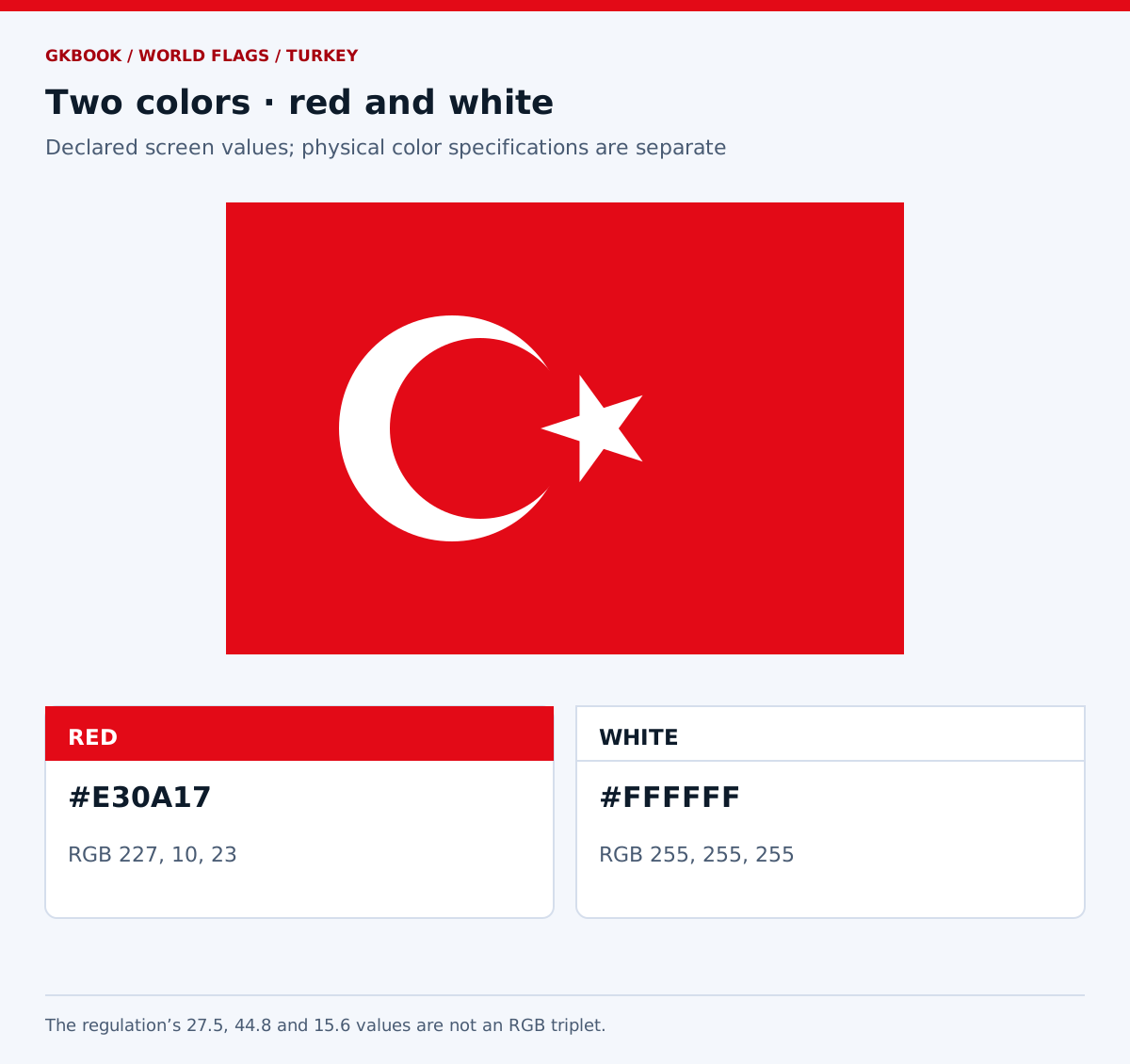
The same red fills the rectangular field and the circular cutout that forms the crescent. Both the crescent and star are opaque white. Consequently, placing the file over a dark page does not change the emblem’s color, as it would if the white areas were accidentally made transparent.
Physical color depends on a material and a measurement process. The regulation’s brightness, red-green, and yellow-blue values must not be copied into RGB channels. Nor does converting the declared screen red establish an exact official Pantone or CMYK match. A textile or print job requires an appropriate production specification and proof.
| Color | HEX | RGB |
|---|---|---|
| Red | #E30A17 | 227, 10, 23 |
| White | #FFFFFF | 255, 255, 255 |
What does the Turkey flag symbolize?
The flag represents the Republic of Türkiye and carries associations with national identity and Ottoman history. Its crescent and star are widely associated with Islam, although these symbols have older histories. The legal construction rules describe the design; they do not establish a single documented original meaning for every element.
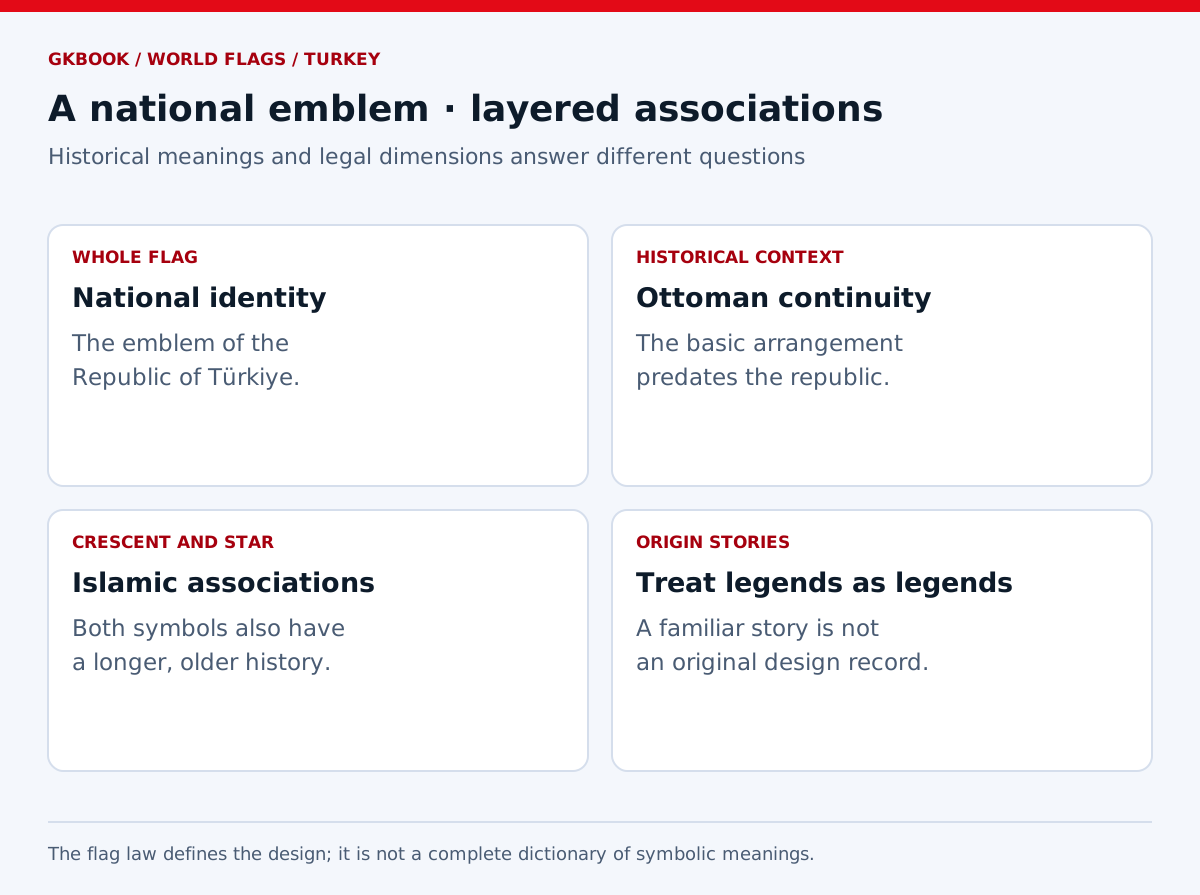
Symbolic interpretation and historical origin are different questions. A symbol can acquire religious, political, and commemorative associations over centuries without having been created for every later meaning attached to it. The continuing national design therefore should not be reduced to one short story or a supposedly universal color code.
For identification, the complete arrangement is more reliable than a symbolic explanation. The red rectangle, white crescent, white star, and their relative placement distinguish the national flag. Recognizing those features does not require assuming that every person who displays it assigns precisely the same personal meaning to each shape.
Does the Turkey flag come from a battlefield legend?
Stories about a crescent and star reflected in blood on a battlefield are origin legends, not a verified construction record for this flag. Such accounts may express sacrifice and national memory, but they do not establish the date, designer, or measured geometry of the modern national emblem.
The emotional importance of a story does not make it a dated design document. Different retellings may attach a similar image to different episodes. Assigning one battle and year without dependable contemporary evidence would give a level of certainty that the available historical account does not support.
The documented discussion is clearer when divided into historical development and later law. Earlier Ottoman flags provide context for the crescent-and-star arrangement; republican legislation supplies identifiable legal dates and dimensions. Those records can be studied without presenting a poetic explanation as the literal event that generated the modern drawing.
How is the white crescent constructed?
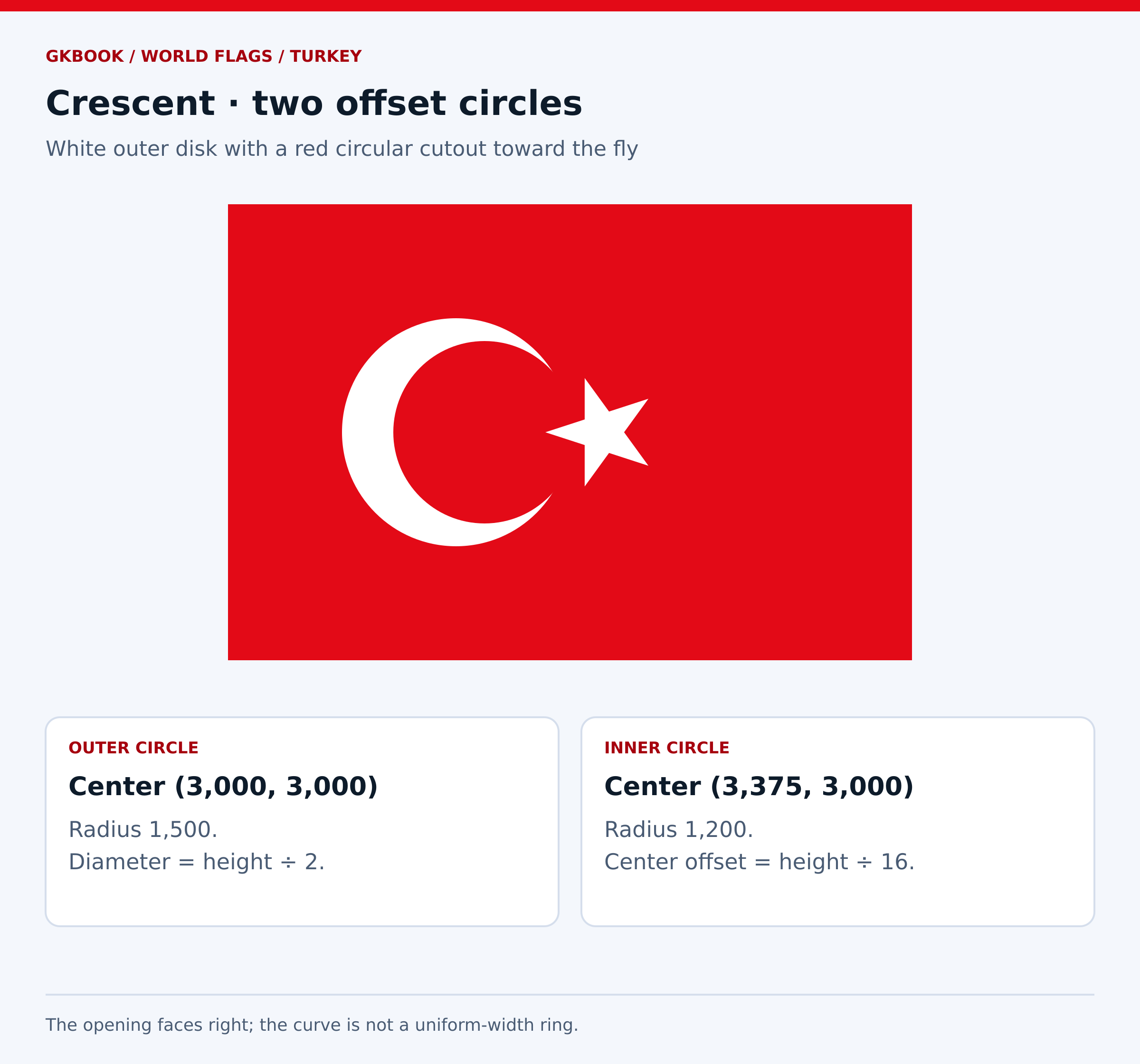
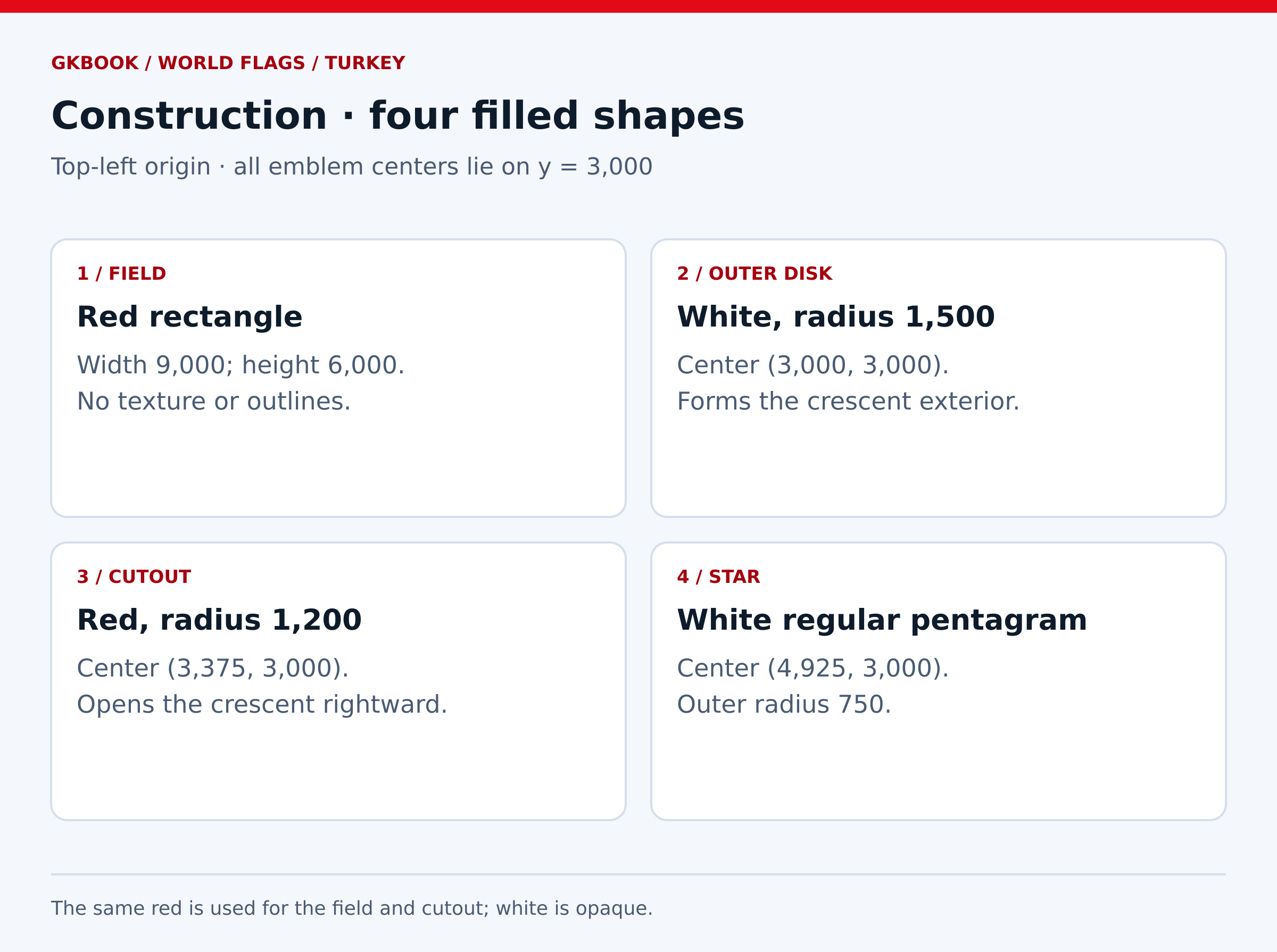
The crescent is formed from two overlapping circles. On a 9,000 by 6,000 digital face, the outer white circle has center (3,000, 3,000) and radius 1,500. A red circle with center (3,375, 3,000) and radius 1,200 cuts into it, leaving a white crescent opening toward the right.
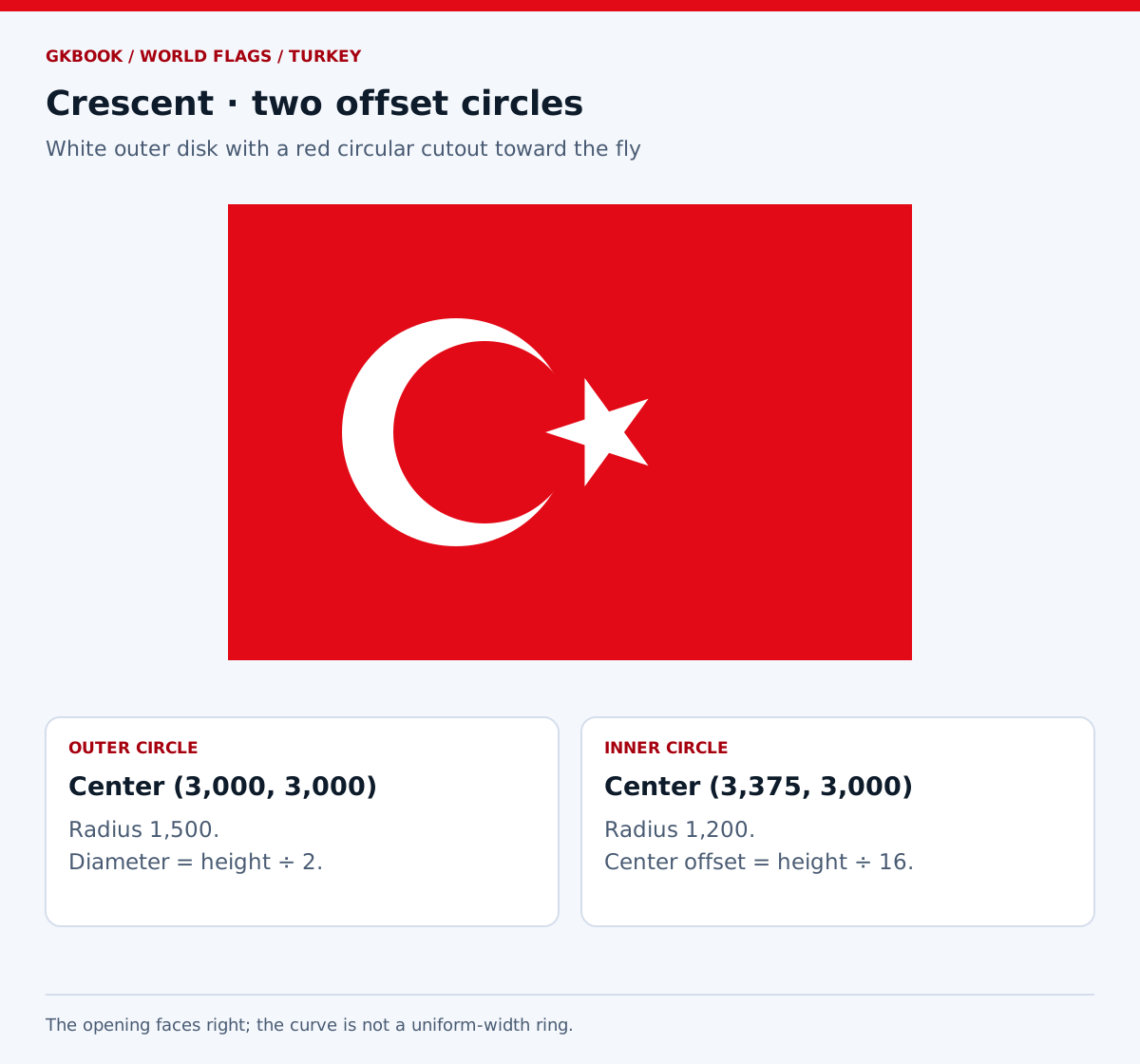
The centers share the horizontal median but are separated by 375 units. That offset is essential: concentric circles would produce a ring instead of the required crescent. The red cutout extends slightly beyond the outer circle on the fly side, where it merges seamlessly into the red field.
Because only the uncovered part of the white disk is visible, the crescent’s area is not found by subtracting two complete disk areas. The circles overlap only partly. Their intersection also determines the two pointed ends, providing a useful mathematical check on the spacing discussion later in the article.
How is the five-pointed star drawn and oriented?
The white star is a regular pentagram with one outer tip facing left along the horizontal median. Its outer diameter is one quarter of the flag height, giving a radius of 750 in this master. The inward radius, about 286.474508, is derived from regular pentagram geometry rather than separately quoted from the statute.
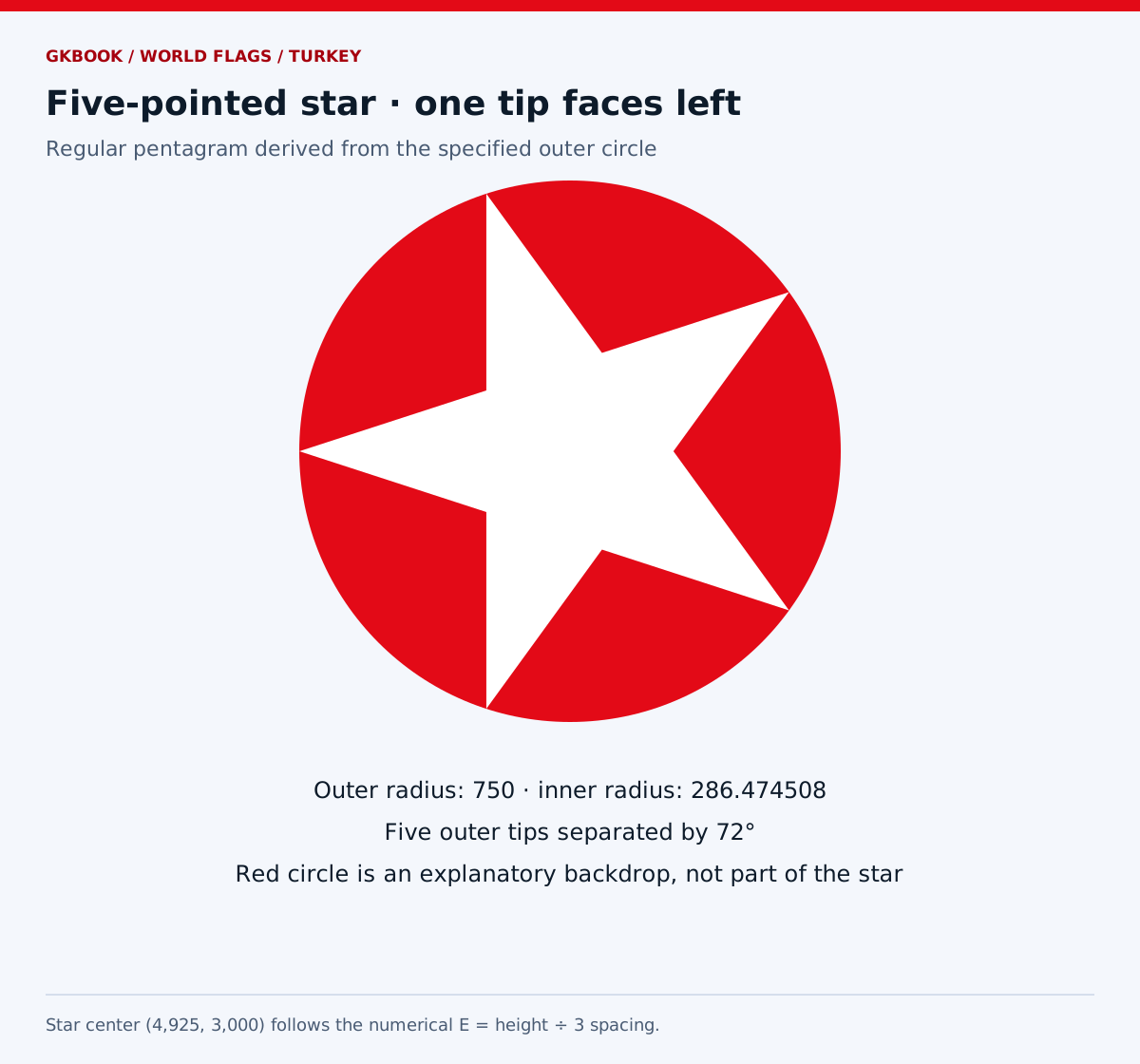
Five outer tips lie at equal angular intervals of 72 degrees. Connecting alternate tips produces the familiar five-pointed form; the intersections determine its inward corners. A filled ten-vertex outline reproduces that shape without visible crossing lines or an added border. The construction circle remains an explanatory aid only.
The star center is (4,925, 3,000) under the numerical spacing convention used here. Its leftmost tip is therefore (4,175, 3,000). Rotating a generic upright star into the wrong position, or placing its center at the crescent cutout’s center, changes the design even when its size appears plausible.
What are the proportions of the Turkey flag?
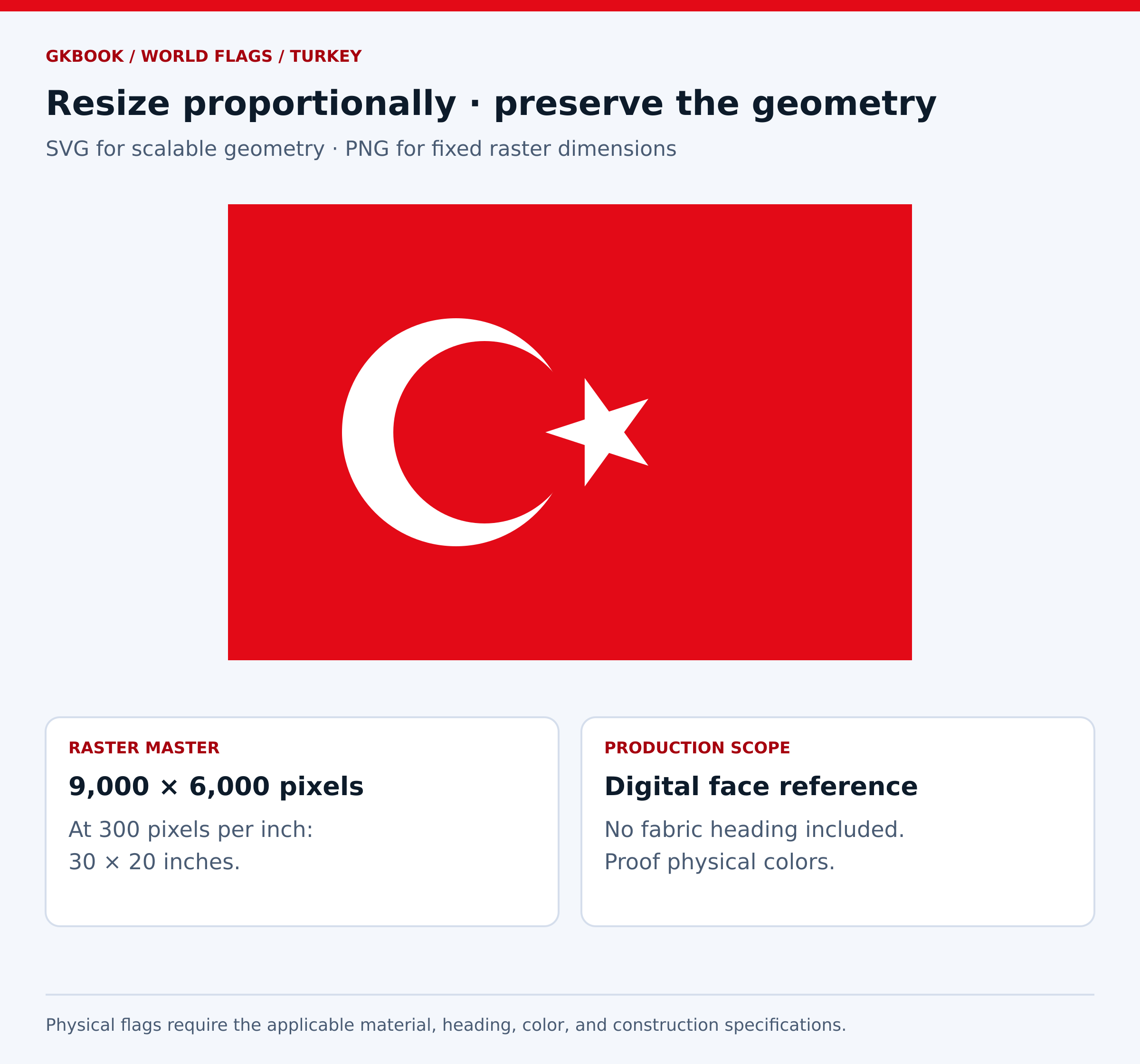
The conventional digital flag face has a height:length ratio of 2:3, so its length is one and a half times its height. The supplied master measures 9,000 by 6,000. A physical attachment heading is omitted, and the file should not be treated as a certified cutting pattern for a finished fabric flag.
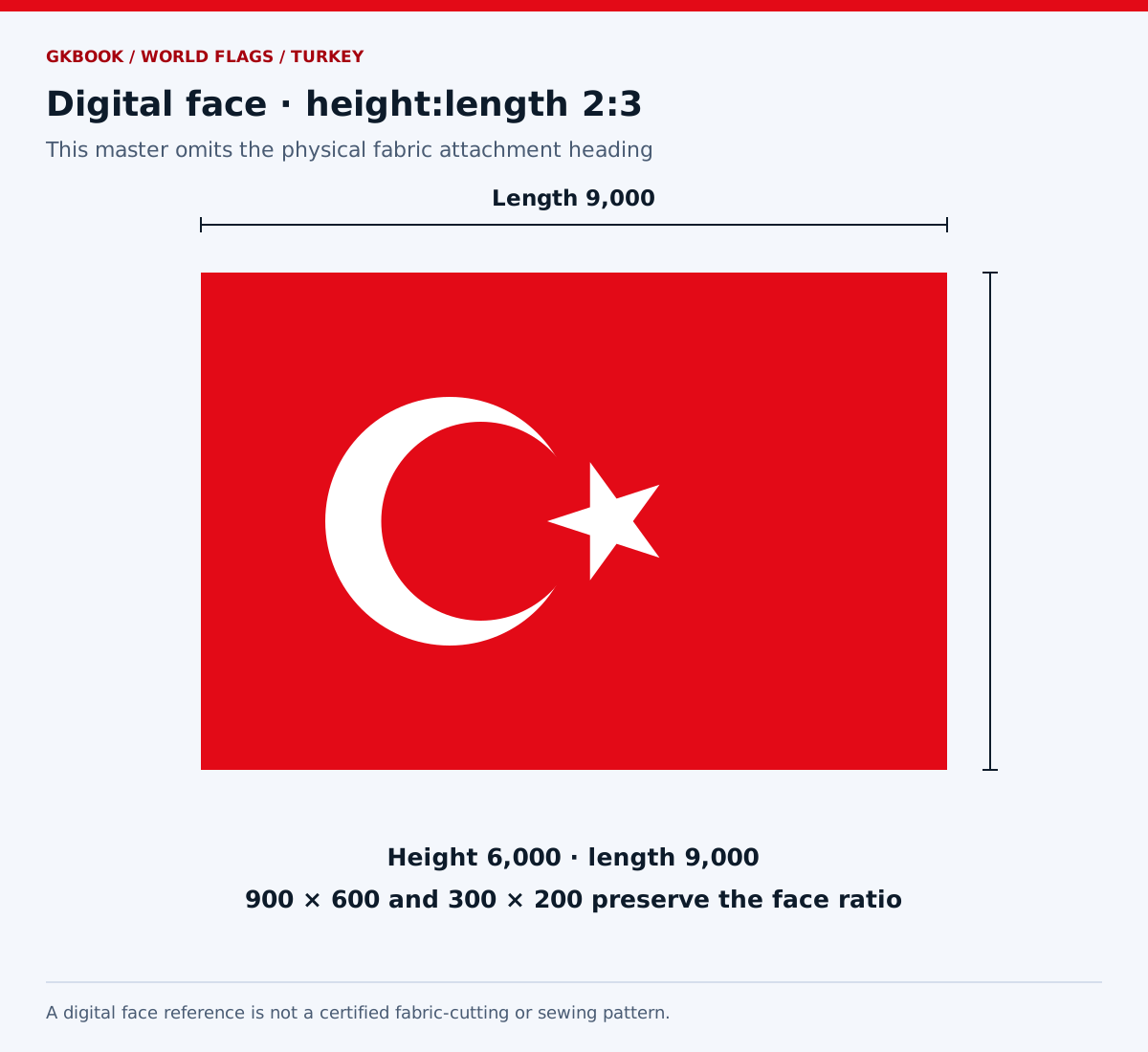
Use width and height together when resizing: 900 by 600 and 300 by 200 preserve the same rectangle. Stretching only one dimension changes both circular boundaries into ellipses and distorts the star. Cropping a wider layout to fit a frame can also remove meaningful space around the emblem.
The physical regulation distinguishes the outside and inside edges of the heading when defining length and emblem placement. A screen rectangle does not resolve every sewing measurement. The separate heading section explains that boundary so the familiar digital ratio is not mistaken for a complete set of manufacturing instructions.
What shapes make up the digital flag master?
The digital master uses four opaque filled shapes in order: a red rectangle, a white circle, an offset red circle, and a white regular star. The overlapping circles create the crescent. No central white background disk, outlines, gradients, shadows, labels, or decorative texture belong inside this clean national flag face.
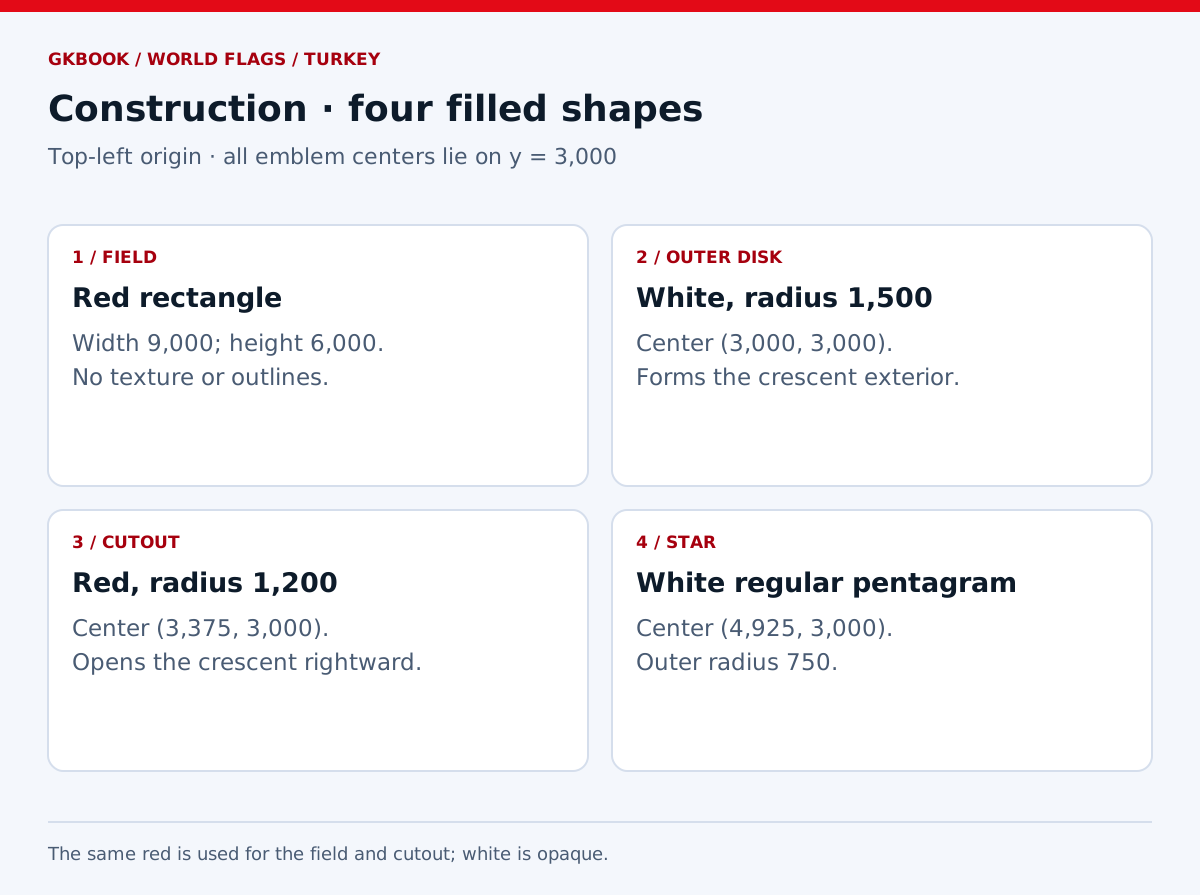
The drawing uses a top-left origin, with horizontal coordinates increasing toward the fly and vertical coordinates increasing downward. All emblem centers lie at y = 3,000. Stating the coordinate convention removes ambiguity when the same construction is reproduced in another drawing application or programming language.
The red cutout needs no transparency because it has exactly the field’s color. That makes the construction simple to inspect and preserves an opaque result. Explanatory diagrams may show dimensions or surrounding panels, but their guides remain separate from the downloadable master used as the flag reference.
Where are the crescent and star centers?
The outer crescent circle is centered at (3,000, 3,000), its inner cutout at (3,375, 3,000), and the star at (4,925, 3,000). These are three distinct centers on one horizontal line. The rectangle’s center is (4,500, 3,000), so neither the outer crescent nor the star is centered on the flag itself.
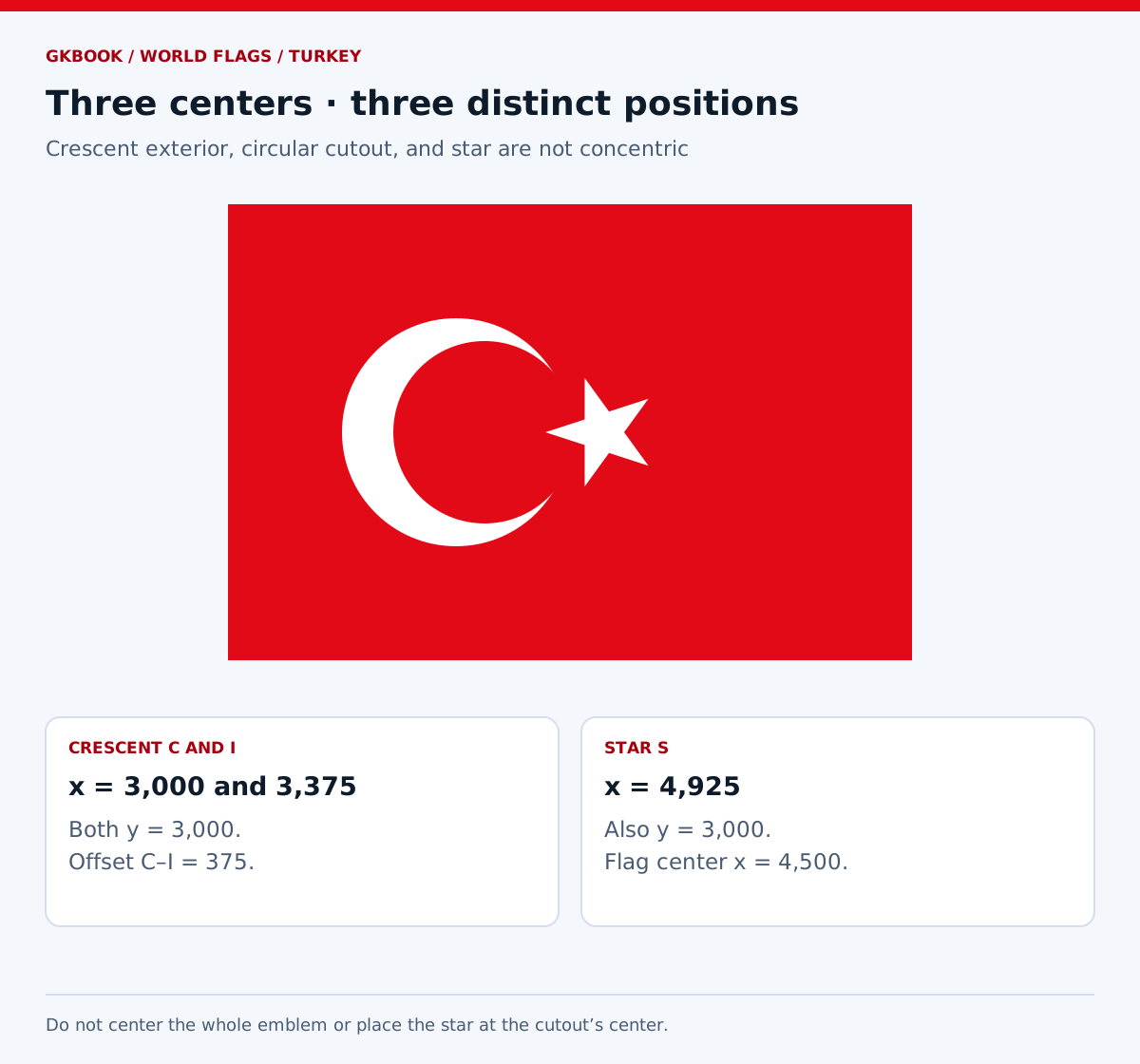
The outer center lies half a flag height from the inner hoist reference. The cutout center is another one sixteenth of the height toward the fly. The star’s position then follows from the tabulated spacing and its radius; it is not obtained by aligning it with either circle center.
These distinctions prevent a common approximation: moving the whole emblem until it seems visually balanced in the rectangle. Optical judgment can be useful in decorative composition, but this national construction already specifies its relationships. Keep the full set of centers when scaling, reflecting, or rotating the reference image.
Does the star tip align exactly with the crescent tips?
Not under every stated rule simultaneously. The numerical table places the left star tip at x = 4,175, while the exact crescent tips lie on x = 4,267.5. Article 4(G) describes an alignment between them. This reconstruction follows the explicit numerical spacing and discloses the resulting 92.5-unit difference.
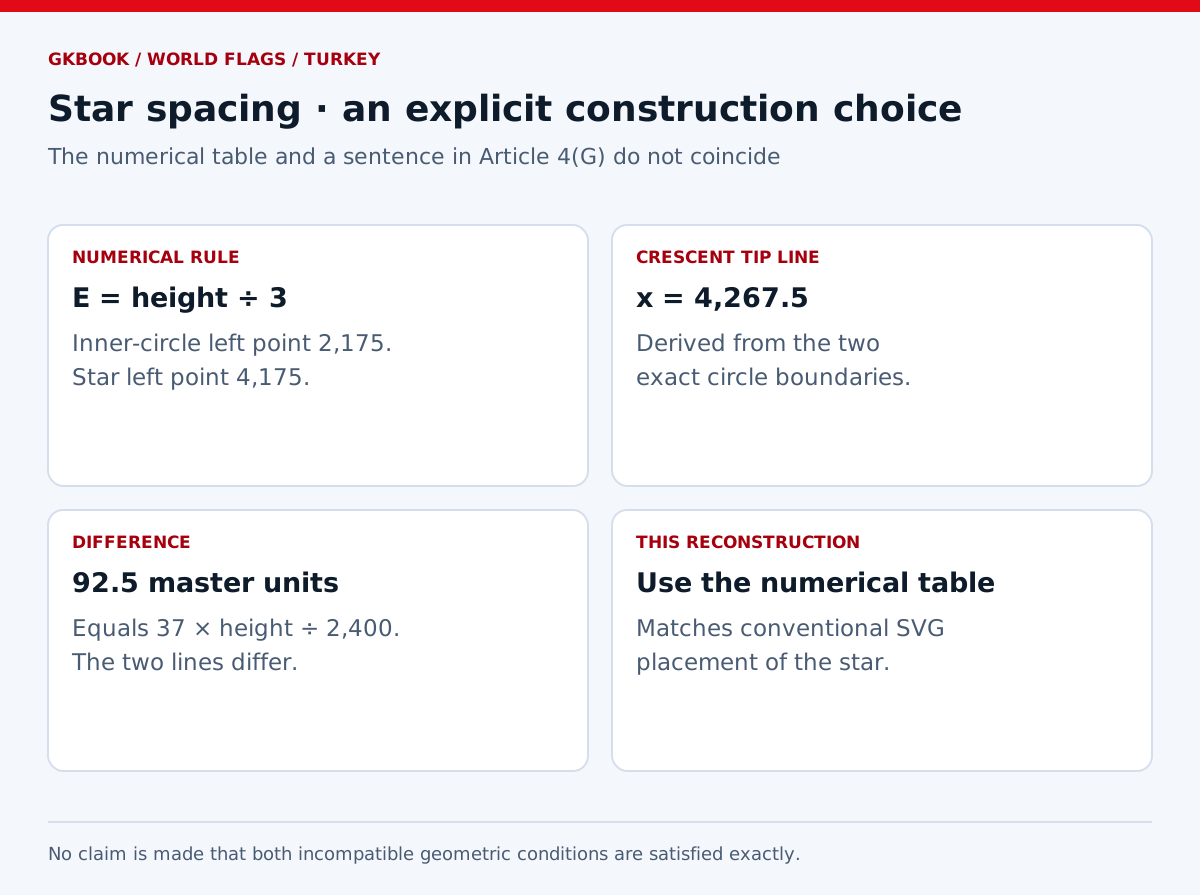
The table’s E measurement begins at the inner circle’s hoist-side intersection with the horizontal axis, x = 2,175. Adding one third of the height, or 2,000 units, gives the star circle’s leftmost point. The star center is another 750 units toward the fly.
The crescent tip line is derived independently from the two circle equations. Its difference from the star tip is 37G/2400, where G is the height. Treating the wording as an additional exact constraint would require changing a numerical dimension. The conventional reference SVG agrees with the tabulated star placement used here.
What is the white strip at the hoist of a physical flag?
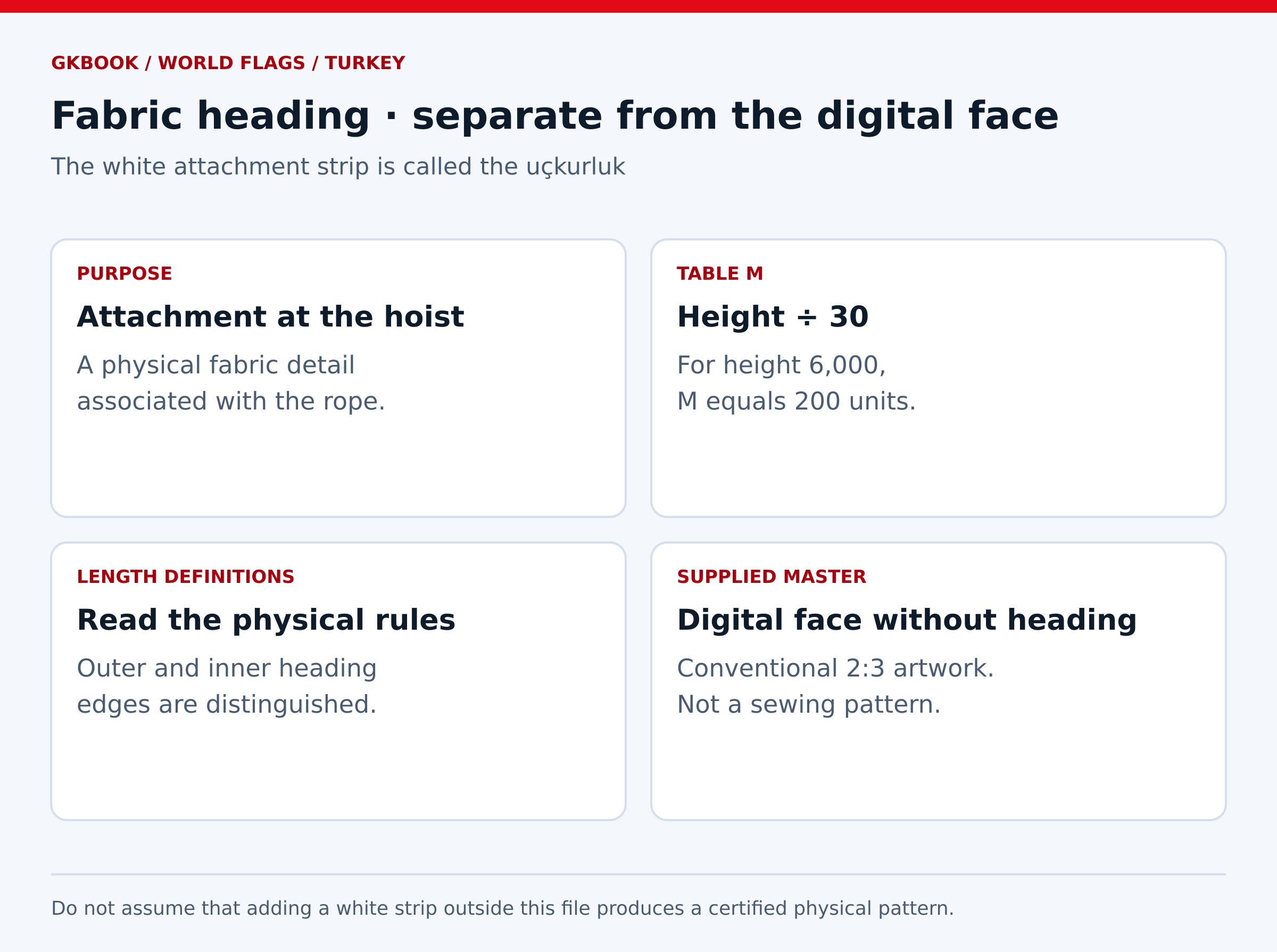
The regulation describes a white fabric attachment heading called the uçkurluk and gives its width as one thirtieth of the flag height. It relates to the flag’s rope attachment. The supplied digital face omits this manufacturing feature, following the conventional screen representation, and does not claim to be a complete physical sewing specification.
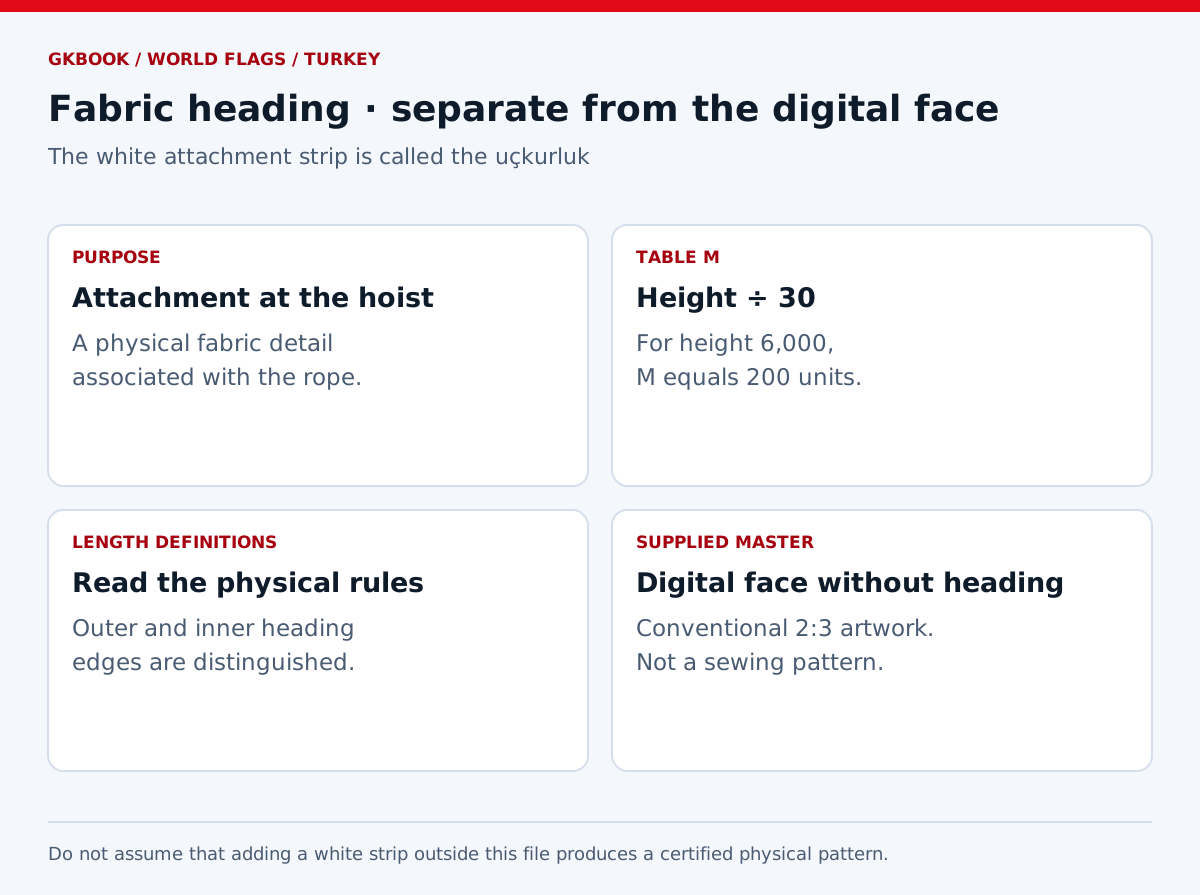
At a height of 6,000 units, the tabulated heading width M would be 200 units. That calculation explains the size of the attachment feature, but it does not authorize simply appending a strip outside the supplied rectangle and calling the result a fully compliant fabric pattern.
The regulation’s definitions distinguish the outer heading edge in the length measurement and the inner heading edge in emblem placement. A manufacturer must interpret the physical assembly using those rules and the relevant production requirements. This article identifies the distinction instead of concealing it inside an apparently universal digital template.
How much of the digital flag is red or white?
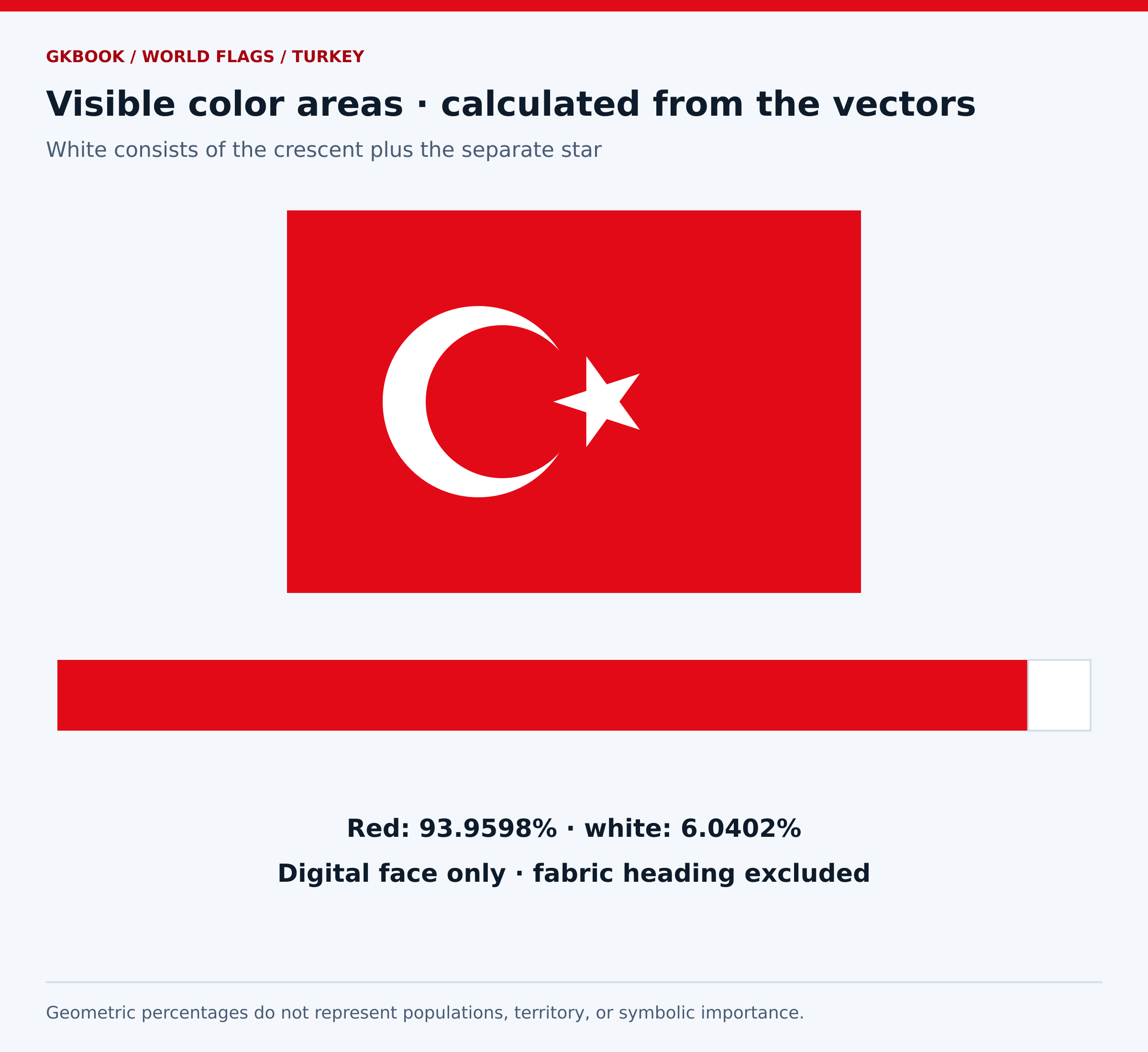
The white area is the visible crescent plus the separate five-pointed star; the remainder of the digital face is red. The accompanying diagram gives calculated percentages from the exact vector geometry. These shares exclude any physical fabric heading and describe the image itself, not population, territory, or official symbolic importance.
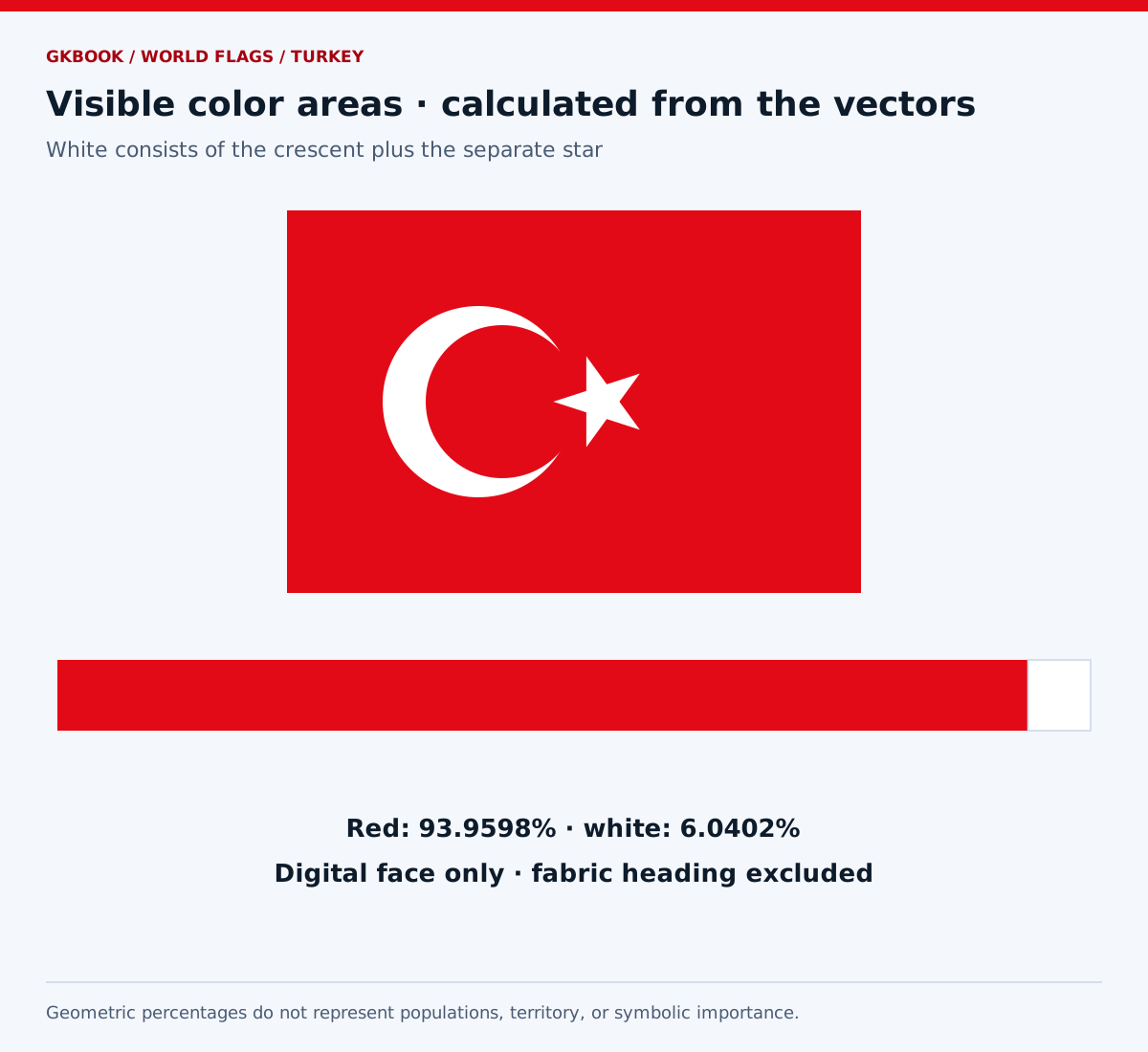
The crescent calculation uses the overlap of two unequal circles with different centers. The star calculation uses its ten-vertex outline. Because these white shapes do not overlap, their areas can be added directly before dividing by the rectangle’s total area of 54 million square units.
The percentages are best calculated from vectors rather than counted from a reduced preview. Antialiasing introduces intermediate edge colors that can make a simple pixel count depend on image size and threshold. A proportional enlargement changes every area by the same factor, leaving the geometric red-white shares unchanged.
How did the Turkey flag develop historically?
The modern design developed from Ottoman flags. Britannica describes a red naval flag with a white crescent and eight-pointed star in 1793, followed by a five-pointed form around 1844. The republic retained the familiar basic design in 1923, and later laws defined its official form and use more precisely.
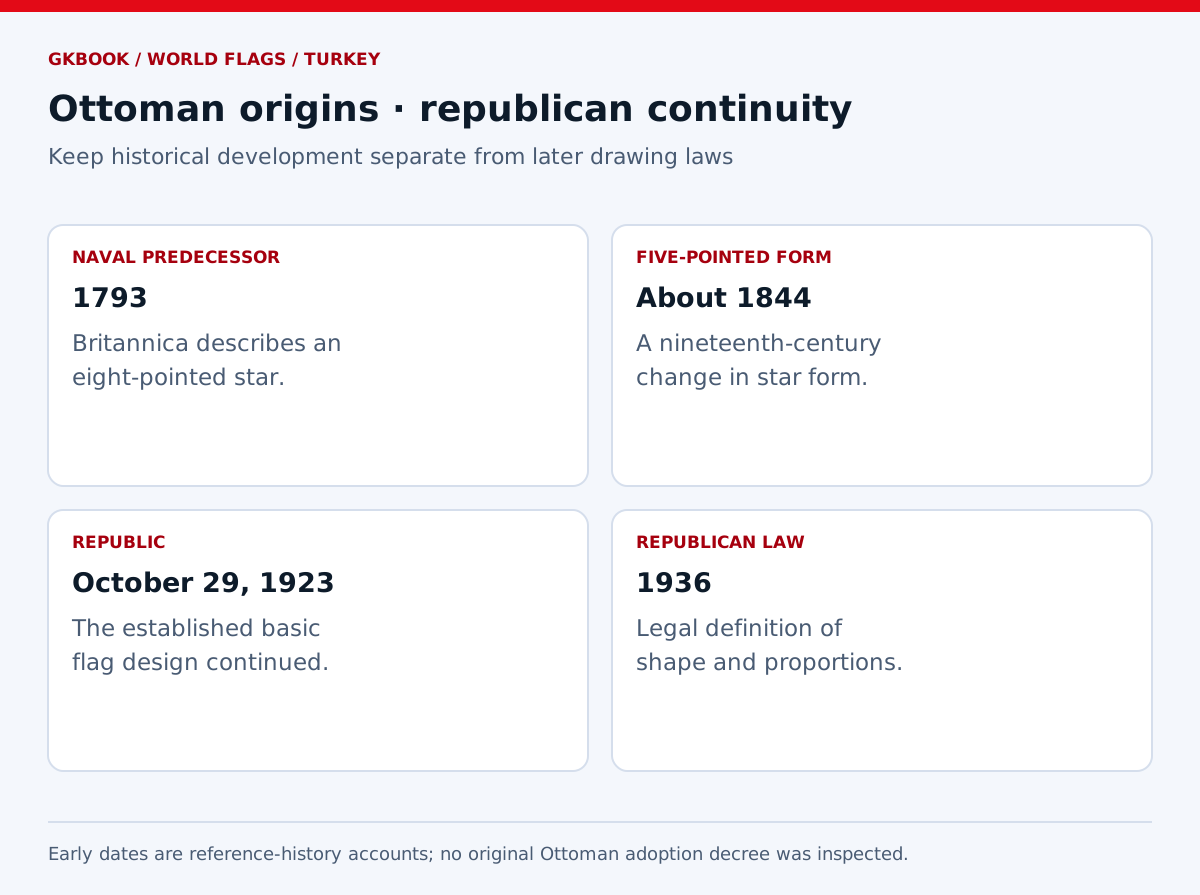
This is a sequence of related designs, not proof that every early flag had today’s exact measurements. Historical depictions can differ in star shape, crescent thickness, or proportions. An illustration of a predecessor should therefore be dated and sourced rather than silently presented as the current national master.
The nineteenth-century dates here come from a historical reference account; no original Ottoman adoption decree was inspected. The republican laws provide firmer documentary dates for their own enactment and publication. Keeping those evidence types distinct allows a useful chronology without attributing modern geometric precision to every stage of the flag’s development.
When was the Turkey flag adopted?
The answer depends on the milestone. The recognizable five-pointed form is commonly dated to about 1844. Republican Law 2994 was adopted on May 29, 1936 and published on June 5, 1936. The current Flag Law 2893 was adopted on September 22, 1983 and published two days later.
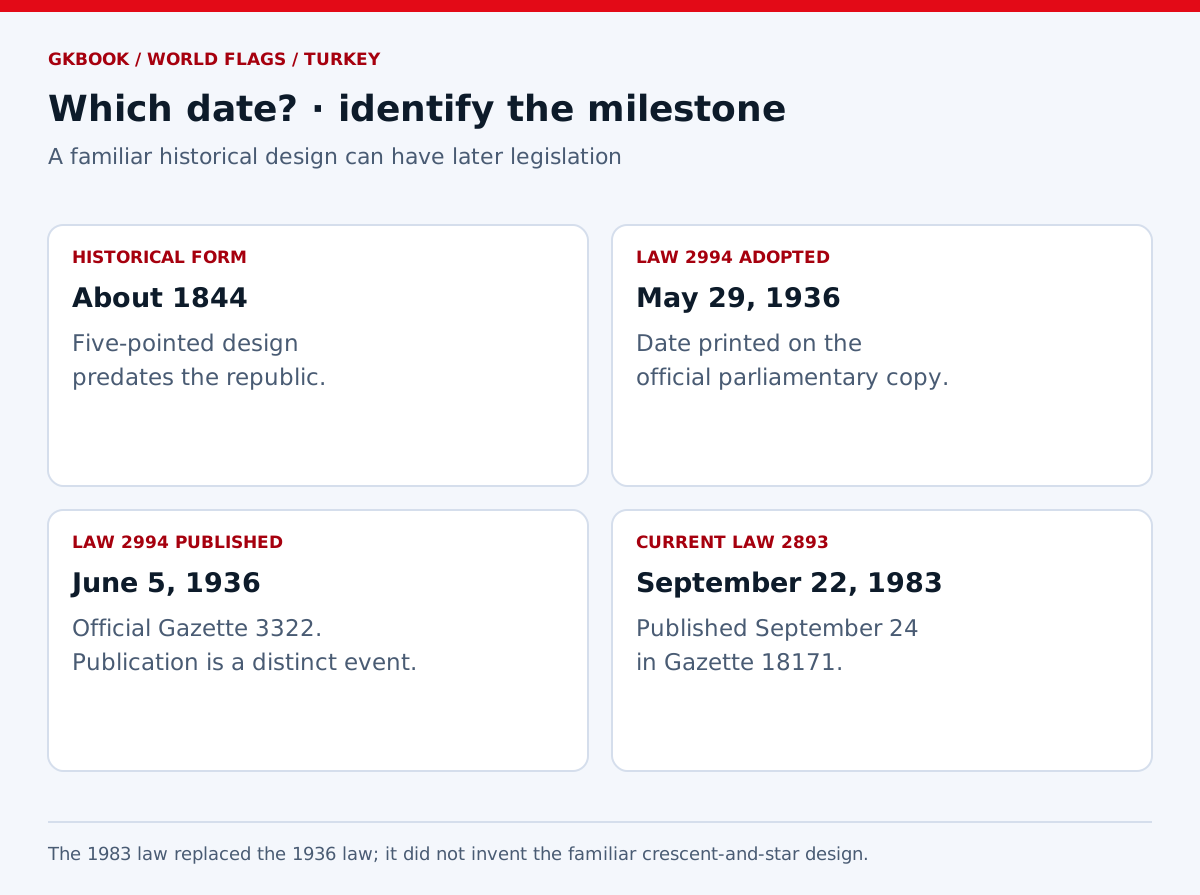
The inspected parliamentary copy explicitly separates the 1936 adoption and publication dates, with publication in Official Gazette 3322. These dates need not be treated as competing answers to one event. Its commencement provision also differs from both dates: Article 8 provided effectiveness one year after publication.
Law 2893 replaced Law 2994 and was published on September 24, 1983 in Gazette 18171. It likewise contains a separate commencement provision. An adoption summary should identify whether it means historical design development or a particular law, rather than calling a later legal revision the first appearance of the flag.
Who designed the Turkey flag?
No single modern individual is established here as the original designer of the national flag. Its recognizable form developed through Ottoman usage and later republican standardization. The author of a present-day SVG is a reproduction contributor, not automatically the historical designer of the crescent-and-star arrangement or the legislator who defined its proportions.
A government can prescribe a design without identifying one artist who invented all its elements. Likewise, retaining an existing flag during a political transition does not demonstrate that the new head of state personally drew it. Historical attribution needs a relevant design record, not just an association with national leadership.
The digital reference has its own contributor history, beginning with an original SVG credited to David Benbennick and continuing through later revisions. Those credits belong in reproduction notes. They explain the file’s provenance while leaving the much older development of the national design as a separate historical question.
What laws define the Turkey flag?
Article 3 of the Constitution describes a red flag with a white crescent and star, with its shape specified by law. Flag Law 2893 and Regulation 85/9034 provide further rules. Their numerical annex governs this reconstruction, with the documented star-tip wording discrepancy and physical-heading distinction explicitly retained.
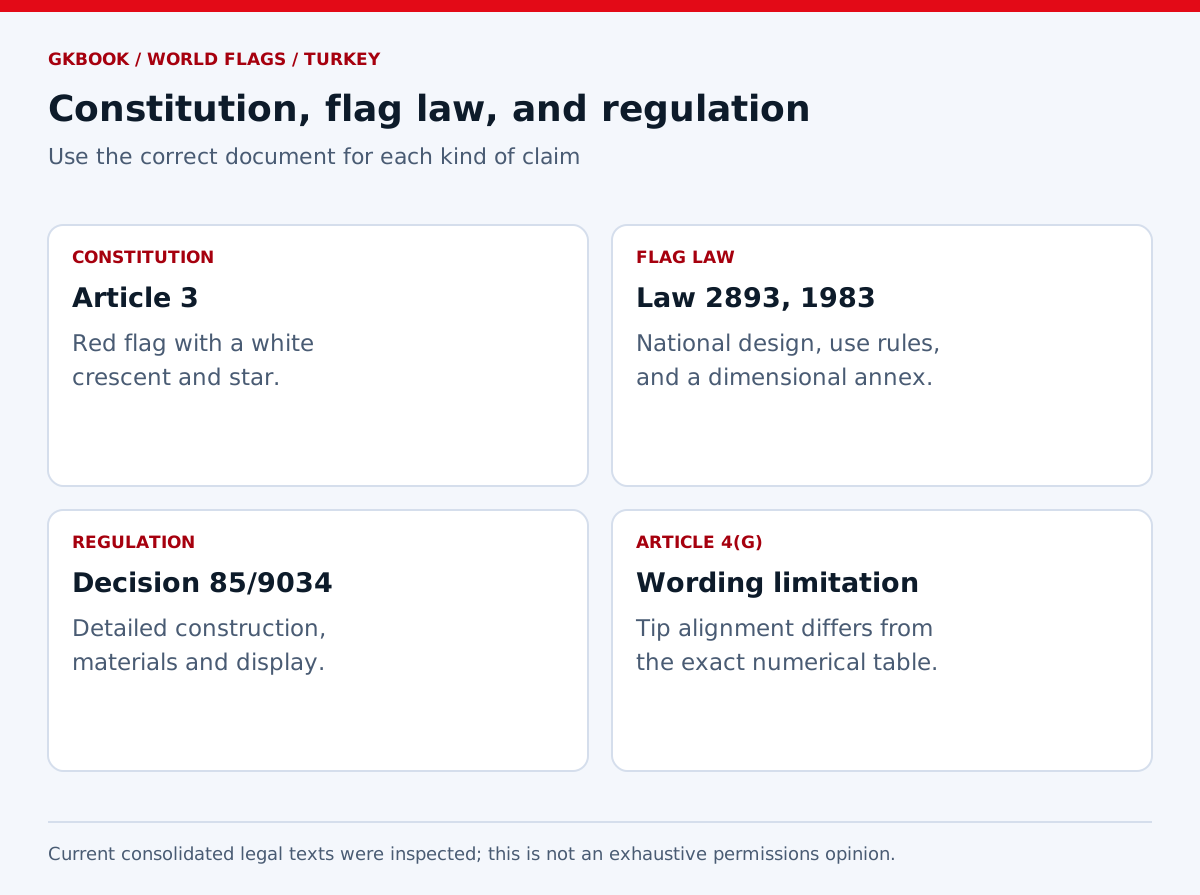
The Constitution establishes the national symbol at the constitutional level. The flag law and regulation address more detailed subjects, including form, use, materials, and construction. A short constitutional description alone is not enough to locate every center or reproduce the star at the specified scale.
The consulted law is a consolidated text, so later terminology and amendments must be distinguished from an untouched 1983 printing. For a particular manufacture, sale, ceremony, or installation, the applicable current provisions need their own context. This article supplies an evidenced reference drawing without presenting itself as an exhaustive legal permissions opinion.
How are construction and color standardized?
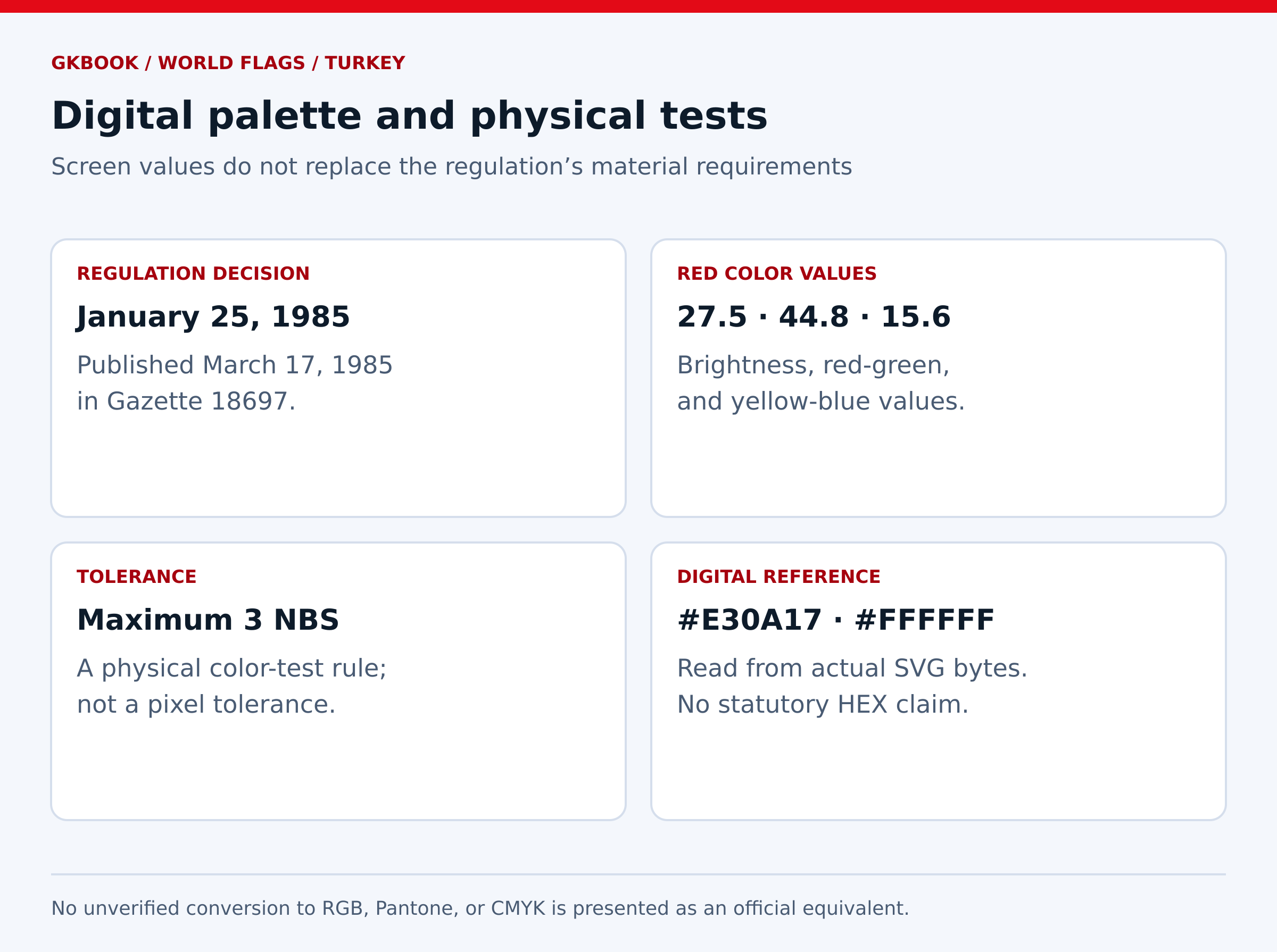
The regulation approved on January 25, 1985 and published on March 17, 1985 details construction and material requirements. Its red color values are brightness 27.5, red-green 44.8, and yellow-blue 15.6, with a maximum 3 NBS difference. These physical measurements are distinct from the digital RGB palette declared for this package.
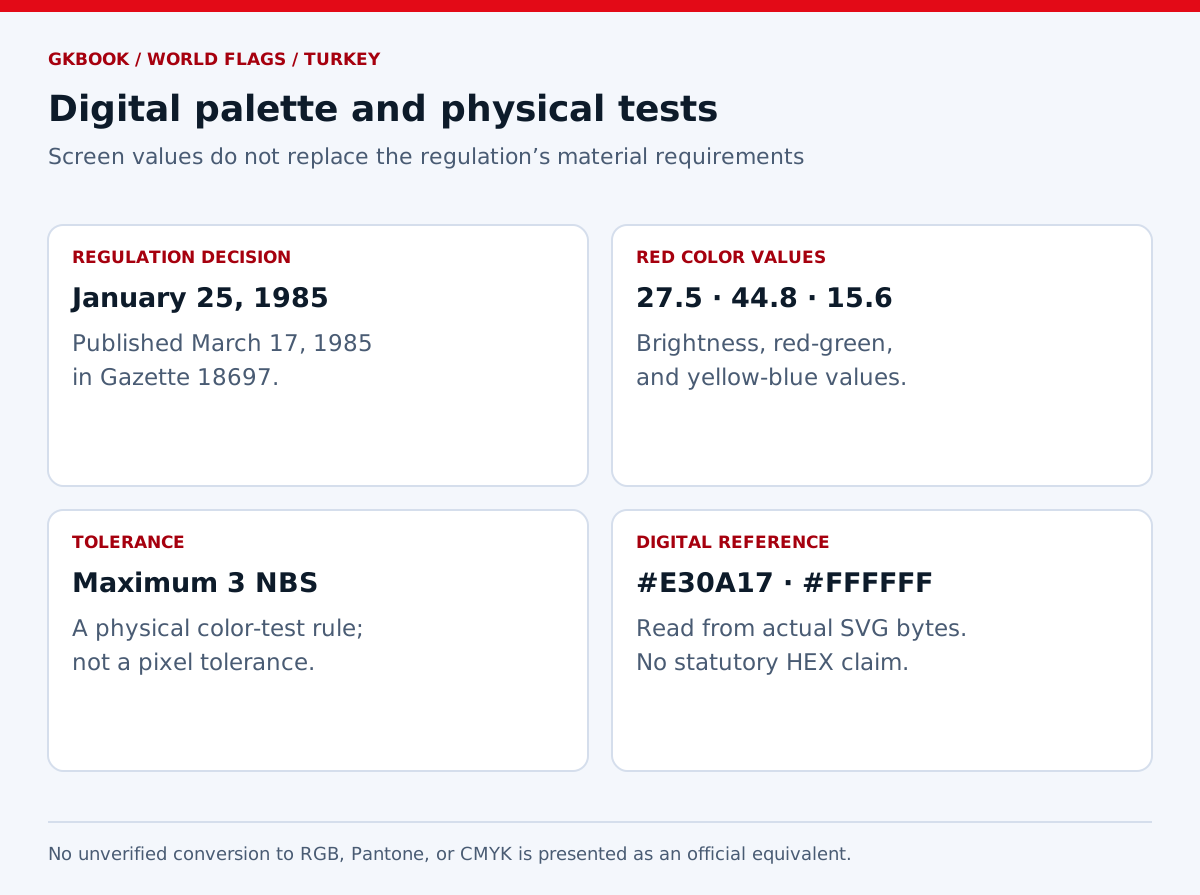
The regulation’s Article 3 also defines a whiteness test using reflectance at specified wavelengths, with different thresholds for material categories. A white screen pixel is not a measurement of cloth under that test. The page therefore does not equate its white HEX value with a completed physical compliance assessment.
For geometry, the numerical annex is reproduced through explicit coordinates and derived star vertices. For color, the actual reference SVG supplies the declared screen values. Keeping those two sources visible avoids a false inference that an accurately measured vector file also certifies the dye, fabric, or printed result.
Did the flag change when the republic was proclaimed?
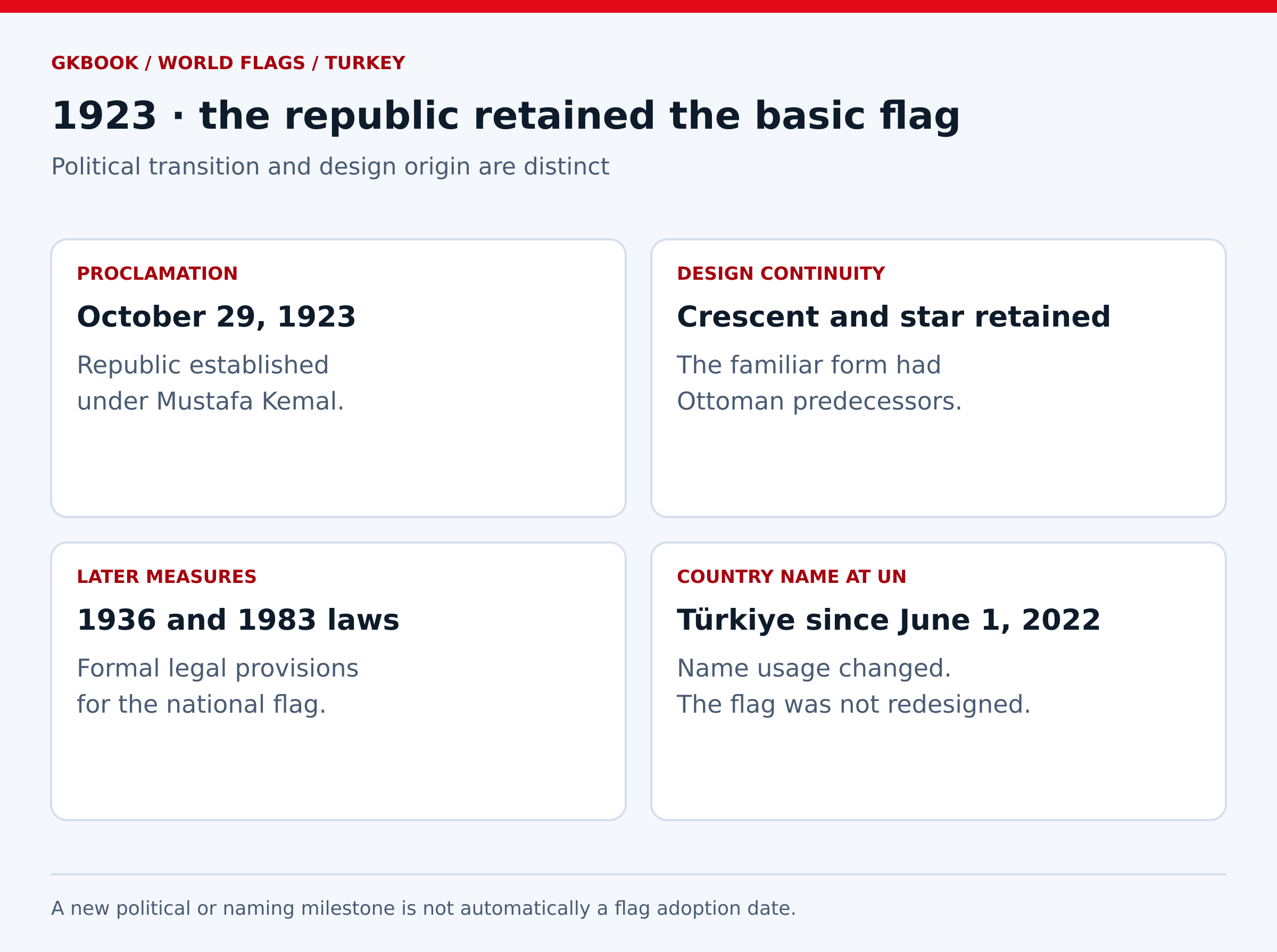
The republic proclaimed on October 29, 1923 retained the familiar red crescent-and-star flag rather than introducing an entirely new basic design. The five-pointed form had Ottoman predecessors. Later flag laws standardized the national emblem, while the 2022 adoption of Türkiye in UN naming likewise did not require a new flag design.
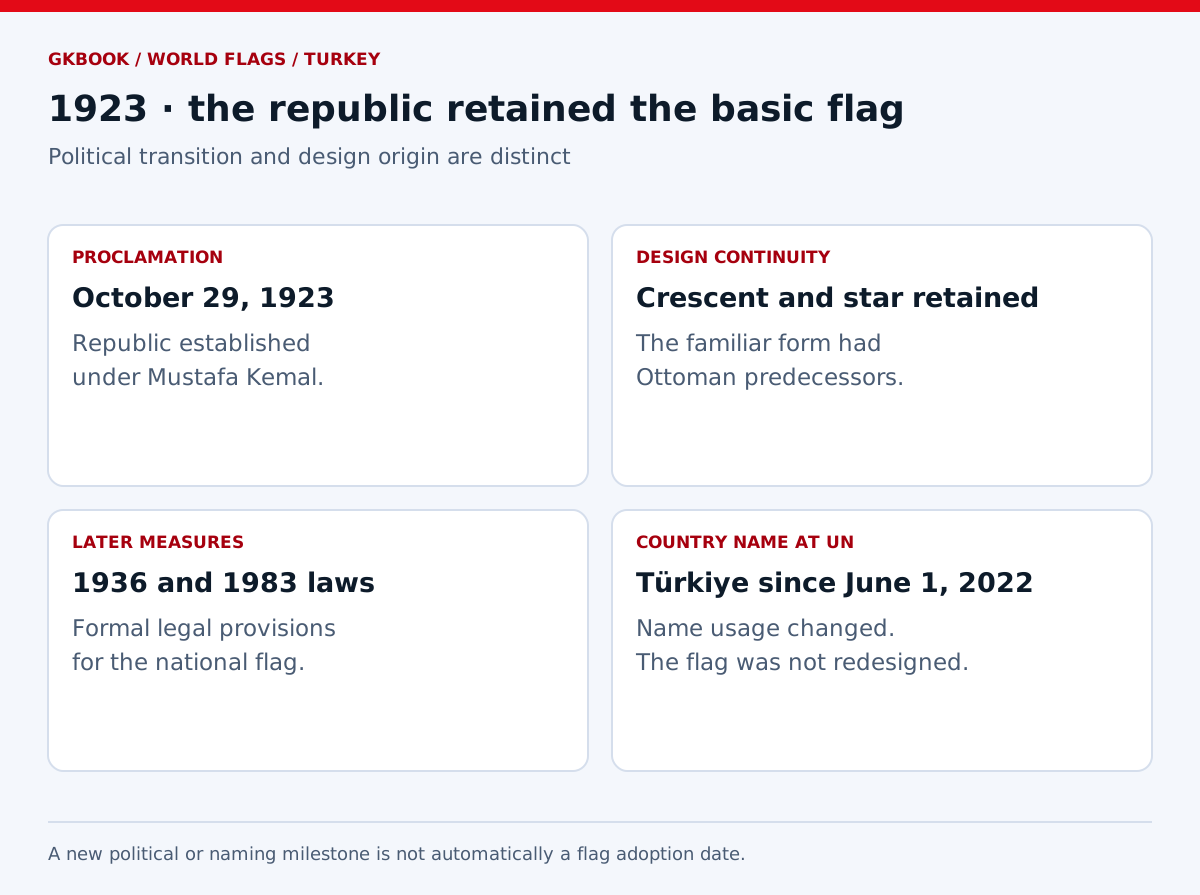
The Ministry of Culture’s chronology dates the proclamation of the republic and the election of Mustafa Kemal as president to October 29, 1923. That political event belongs in the national story, but it should not erase the earlier development of the flag’s recognizable appearance.
Continuity of design does not mean every historical rendering was geometrically identical. Precise statutory construction and consistent digital reproduction are separate matters. When comparing images across periods, distinguish a retained basic emblem from a claim that all surviving flags used exactly the same star coordinates, fabric colors, and manufacturing details.
How do international milestones relate to the flag?
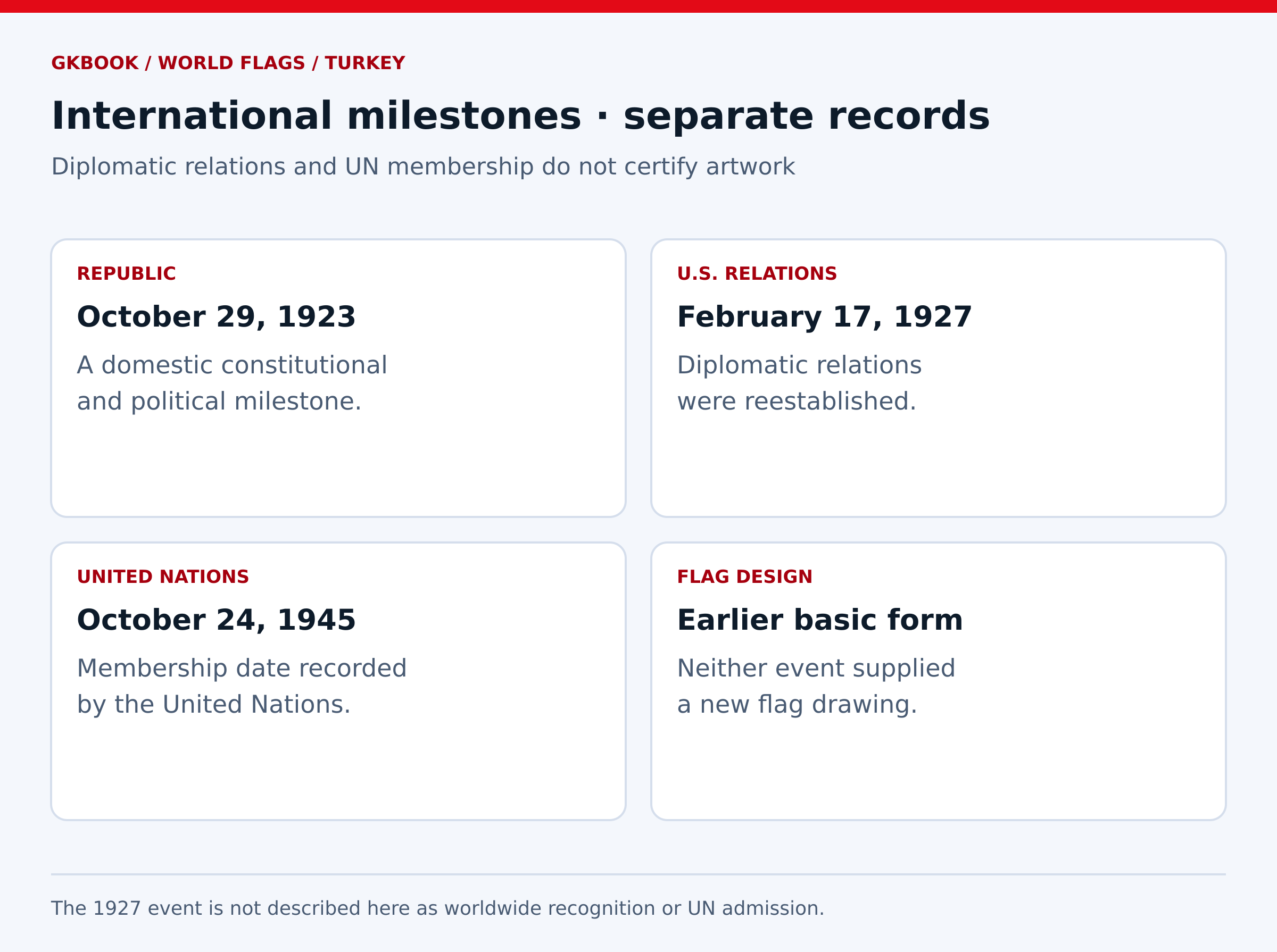
Diplomatic history and flag adoption are separate. The U.S. Office of the Historian records reestablished diplomatic relations on February 17, 1927. The United Nations lists membership from October 24, 1945. Neither date is the origin of the familiar national design, and neither institution’s record certifies a particular downloadable flag image.
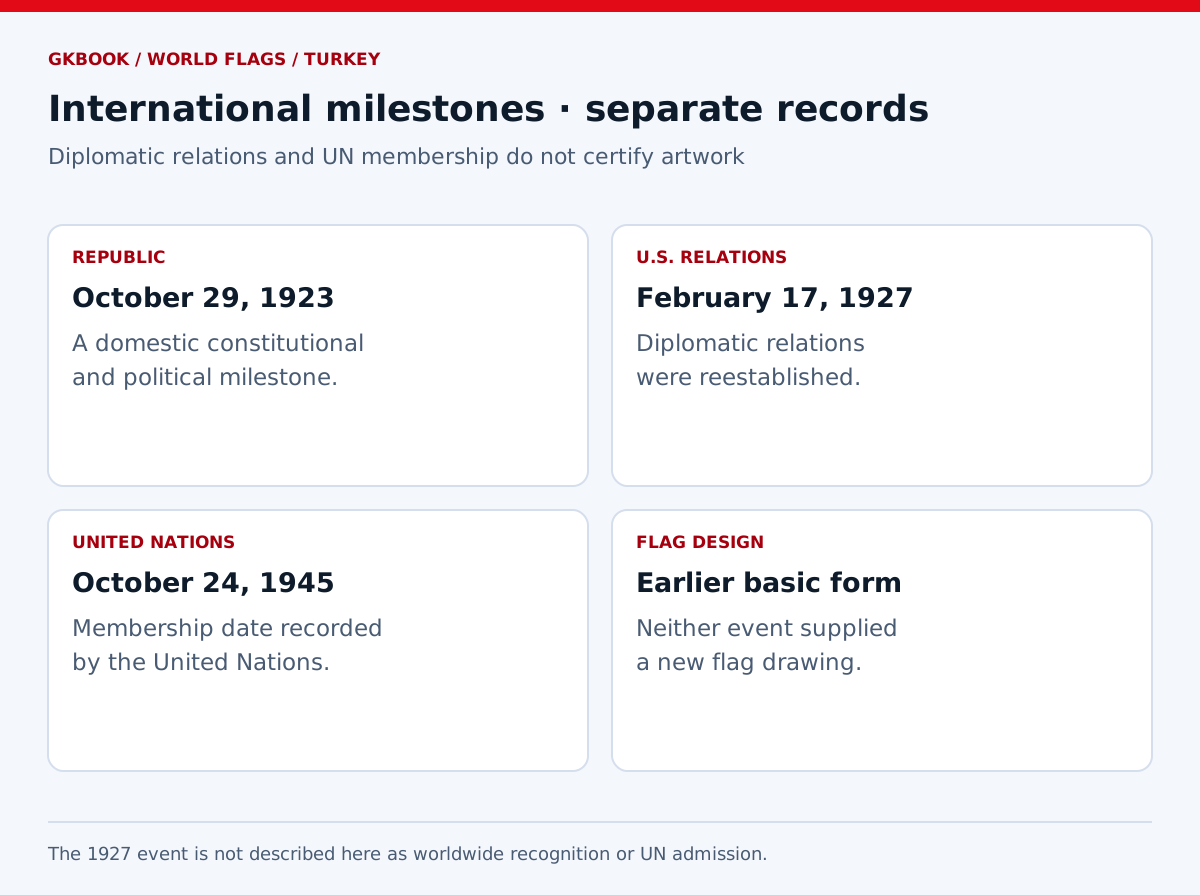
The wording matters: reestablishing relations is not the same statement as first recognition of a state or universal recognition by all countries. A bilateral historical account records that relationship’s milestones. It should not be expanded into a worldwide diplomatic claim without evidence from the relevant parties.
The UN membership date answers another specific question. It can help place the country in international chronology, but it does not replace the republic’s proclamation date or the dates of flag legislation. Captions should name the event associated with each date so that readers do not have to infer its meaning.
How does the Turkey flag differ from the Tunisia flag?
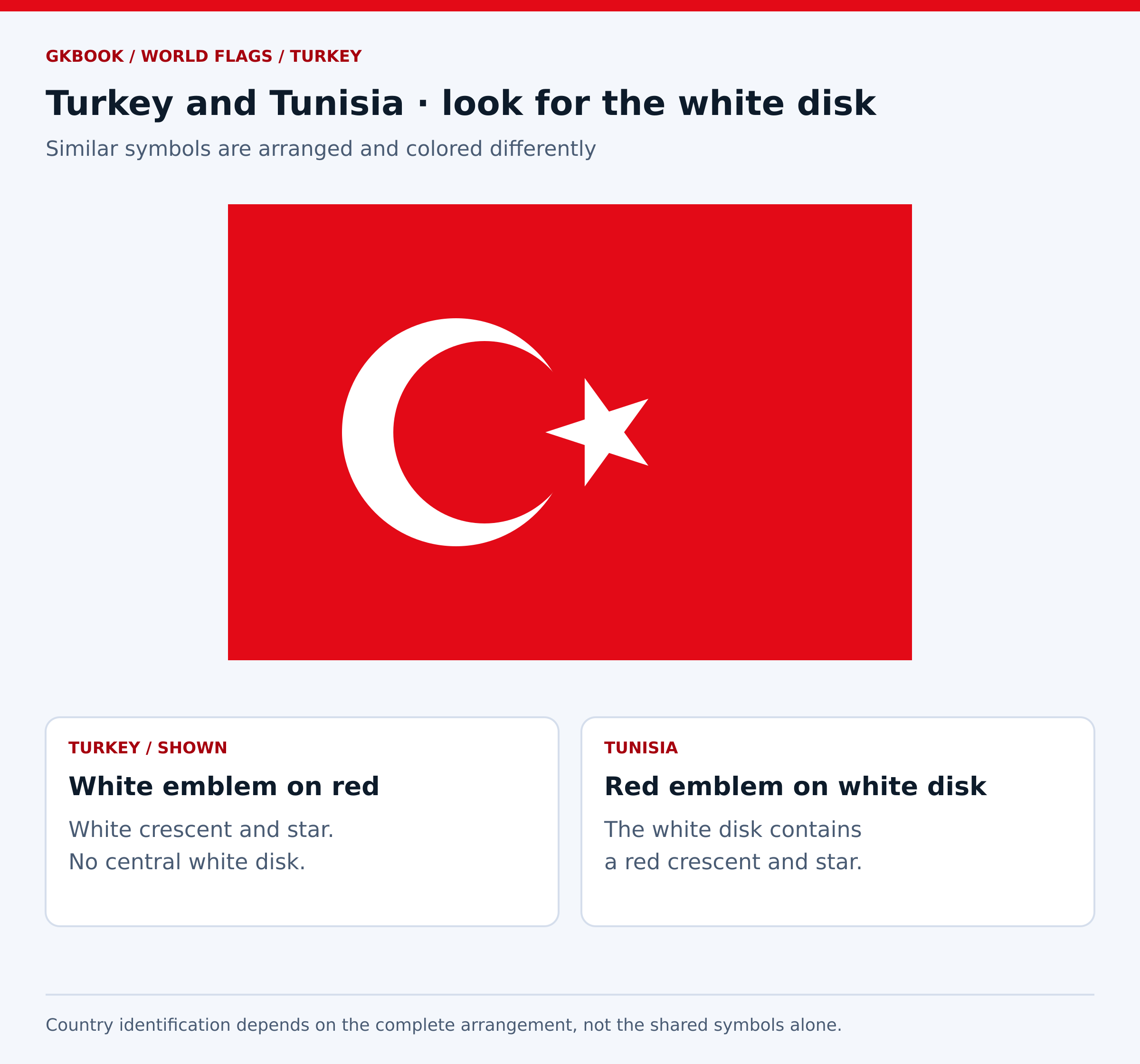
Turkey places a white crescent and white star directly on a red field. Tunisia places a red crescent and red star inside a centered white disk on its red field. The white disk and reversed emblem colors are the quickest distinguishing features; the two national constructions also use different measurements and positions.
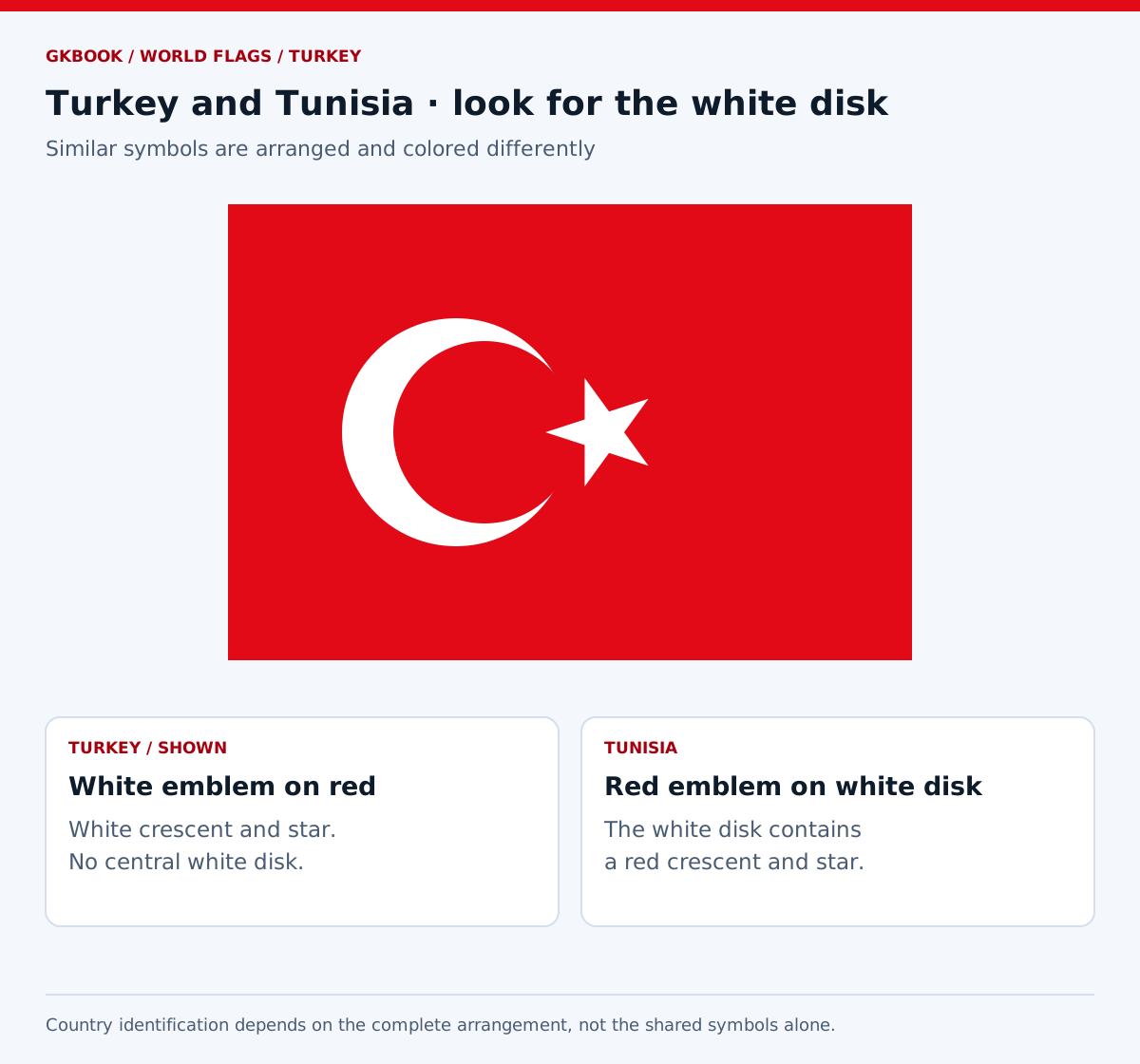
A shared crescent-and-star vocabulary does not make the designs interchangeable. Removing Tunisia’s disk would not by itself produce an exact Turkish flag, because the crescent dimensions and star placement must also change. Likewise, adding a disk around the Turkish emblem would not reproduce Tunisia’s prescribed geometry.
The comparison diagram shows the Turkish digital face and describes the other arrangement beside it. It does not offer an unverified foreign production master. When labeling a gallery or choosing a small icon, compare the complete national layout rather than recognizing only the two familiar symbols.
Was every Ottoman flag the same as today’s Turkish flag?
No. Ottoman flags varied across periods and functions, and historical crescent-and-star designs were not all identical to today’s national construction. The eight-pointed naval predecessor described for 1793 differs visibly from the later five-pointed form. A historical flag needs a date and context instead of being treated as a universal Ottoman design.
The current national master is useful as a reference for the present digital face, but it should not be retroactively assigned to every historical scene. A depiction of a ship, military unit, ruler, or ceremony may require a different source and a more specific identification.
The gallery therefore explains the earlier sequence in labeled text instead of supplying speculative historical flag files. This preserves the distinction between a documented current construction and a historical reconstruction that would need additional evidence. A modern image editor’s version date also must not be mistaken for the historical design’s date.
Is the presidential standard the same as the national flag?
The presidential standard is a distinct official design that adds a golden sun and sixteen stars in the upper hoist area. The presidency explains the sun as representing the republic and the stars as historical Turkish states. Those additional elements do not belong on the ordinary national flag master supplied here.
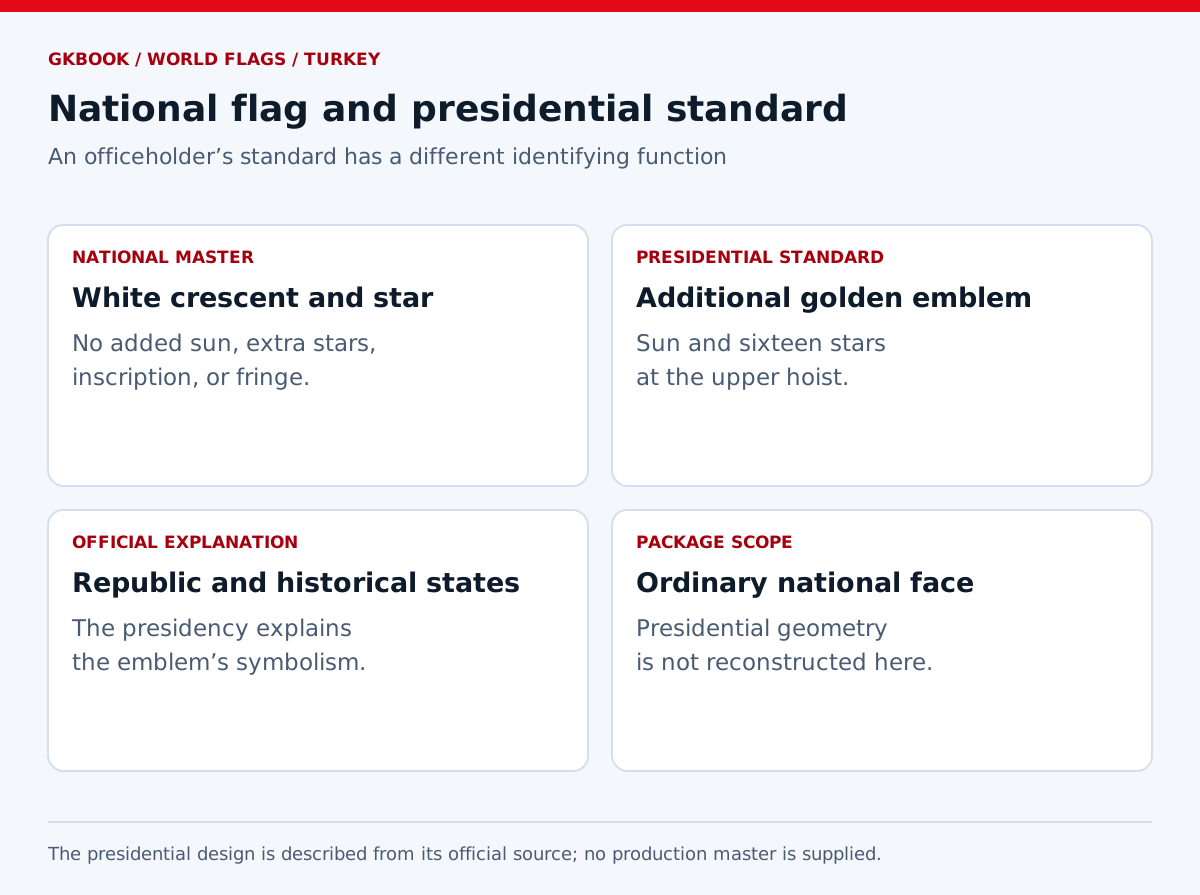
An officeholder’s standard identifies an official role and has its own presentation requirements. Its appearance should therefore not be generalized to every national flag used at a school, public building, or international event. The ordinary red-white flag remains identifiable without the additional presidential emblem.
The official presidential account describes the standard and its history; this package uses it for explanation only. It does not reconstruct the sun, the smaller stars, or their detailed layout. Keeping that scope clear avoids distributing an apparently precise presidential production file that has not received the same independent geometric verification.
Does the national flag include a coat of arms?
The ordinary national flag does not include a coat of arms, shield, inscription, or presidential sun emblem. Its specified face consists of the red field and white crescent and star. A seal, institutional badge, or decorative national emblem may serve another purpose, but should not be added to the clean flag master.
A country can use related symbols in several visual forms without making those forms identical. Government stationery, official seals, and flags have different layouts and functions. An emblem encountered in one setting is not sufficient evidence that it belongs inside the national flag rectangle.
For this reason, the supplied master remains free of surrounding words and additional insignia. A title or caption can identify the flag outside its boundary, as in the social card. This preserves the complete national face while allowing useful explanation in the page or document that displays it.
How should the Turkey flag be presented respectfully?
Present an intact, clean flag with the correct proportions, colors, and emblem orientation. Law 2893 addresses respectful use and specifies half-staff on November 10, with other mourning arrangements determined separately. For a real ceremony or installation, follow the applicable protocol; a digital illustration alone cannot establish every handling or display requirement.
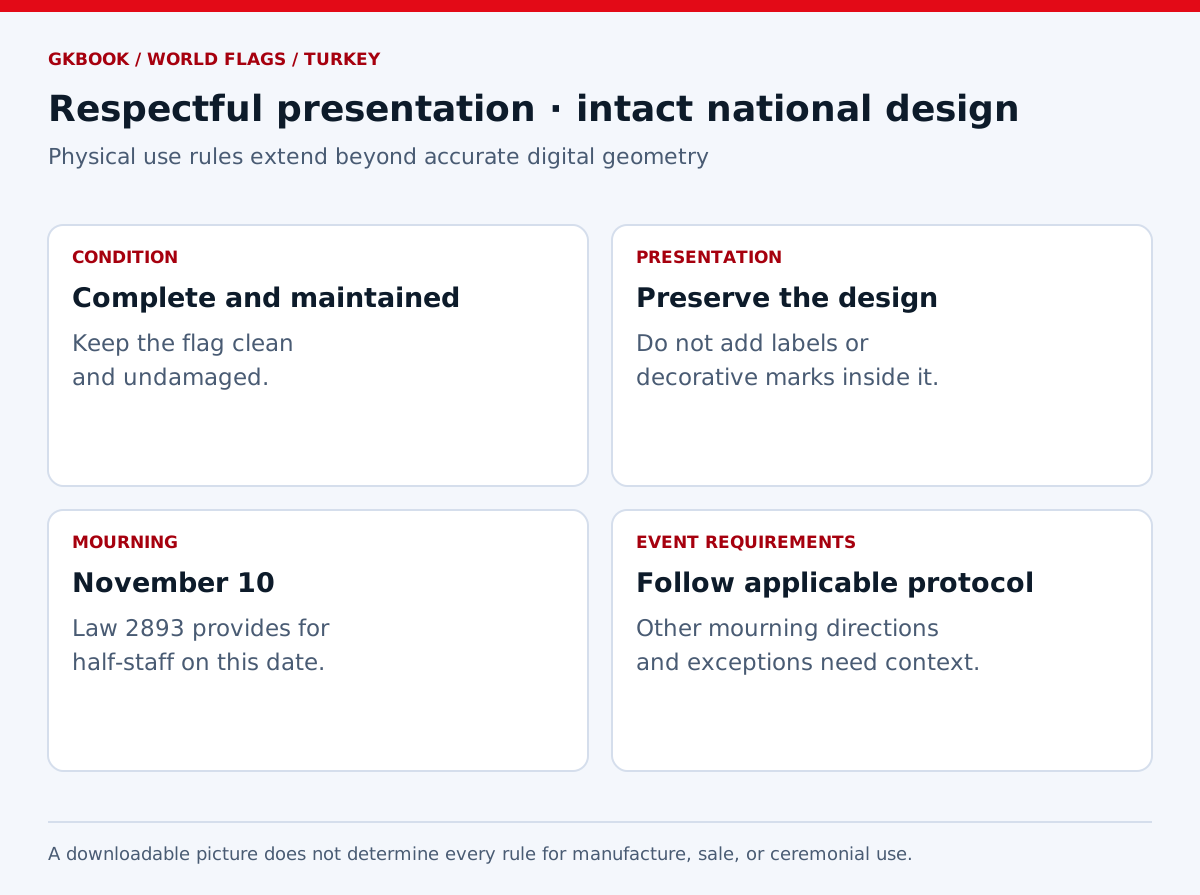
The law’s use restrictions include unsuitable condition and certain uses as clothing or coverings, with contextual exceptions that must be read in the actual provisions. An accurate picture does not by itself settle whether a proposed physical use is permitted. Condition, setting, and purpose remain relevant.
In explanatory publishing, keep labels, arrows, and page decoration outside the clean flag rectangle. A diagram may show transformations or measurements when clearly identified as such. That distinction helps readers recognize the national reference and prevents an educational graphic from being mistaken for an instruction to alter an official display.
How does the flag look when rotated vertically?
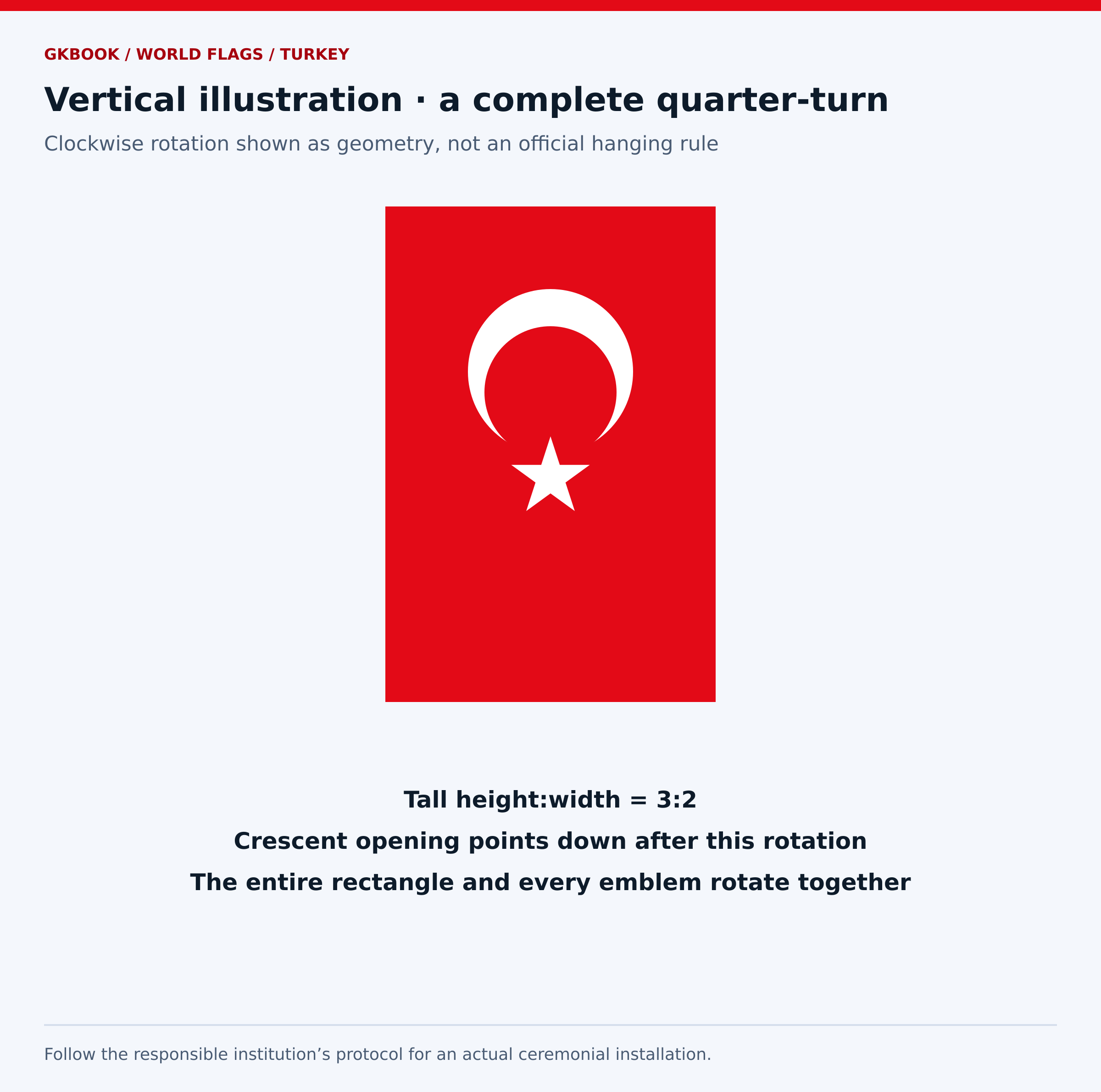
A clockwise quarter-turn of the complete horizontal digital face produces a tall rectangle with height:width 3:2. The crescent opening then points downward, and the star rotates with the rest of the flag. This is a geometric illustration, not a universal instruction for hanging the Turkish flag in an official installation.
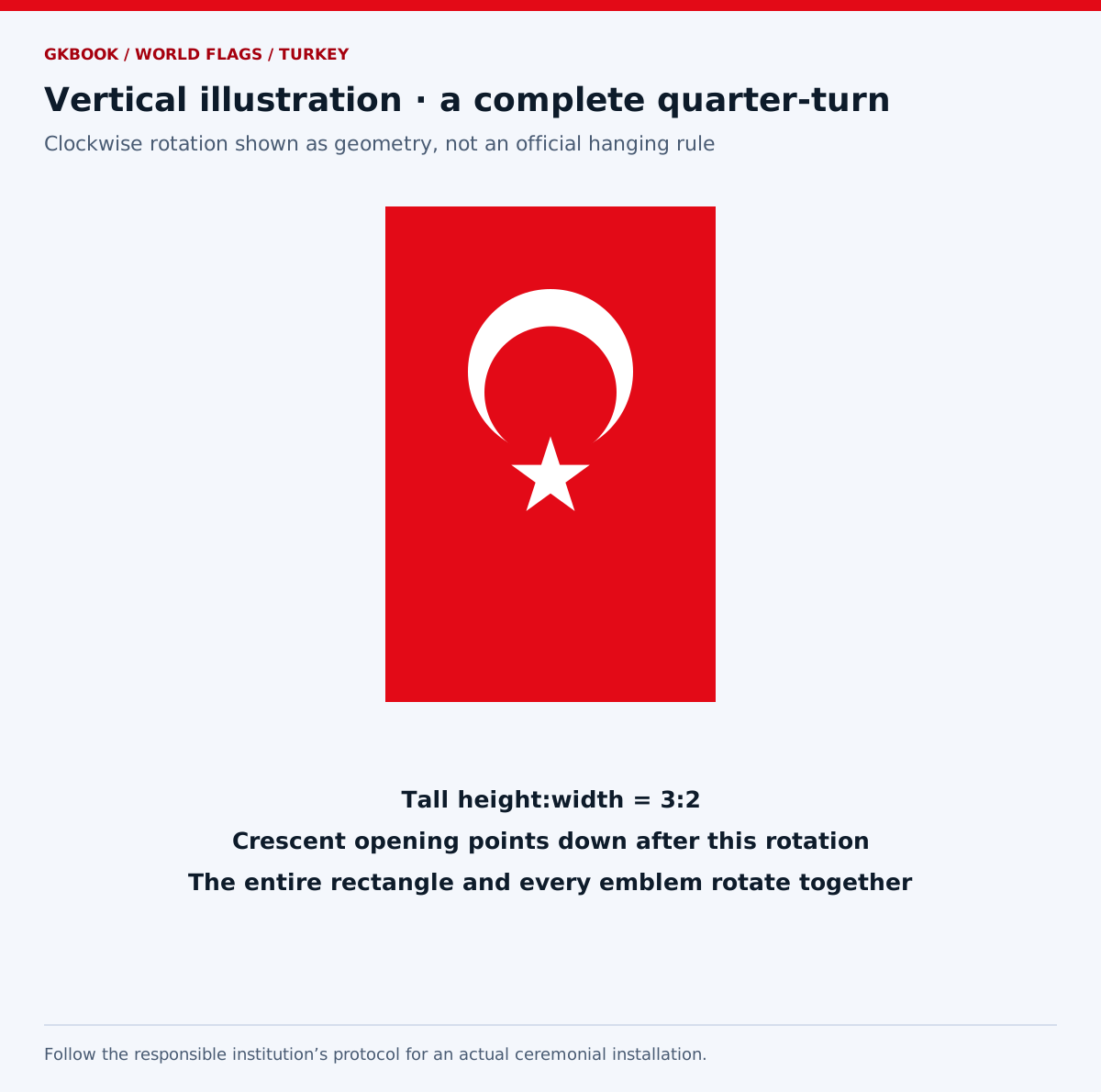
The original left edge becomes the top edge in the illustrated rotation. Distances between the circles and the star remain unchanged, and neither circular boundary becomes elliptical. Turning only the emblem while leaving the red rectangle fixed would be a different operation and would misrepresent the example.
A physical installation may have requirements for attachment, orientation, surroundings, and ceremony that are not inferable from a vector transformation. The gallery labels its rotation explicitly so that the mathematical example is useful without presenting an unverified protocol rule as part of the national design.
What does the reverse of the Turkey flag look like?
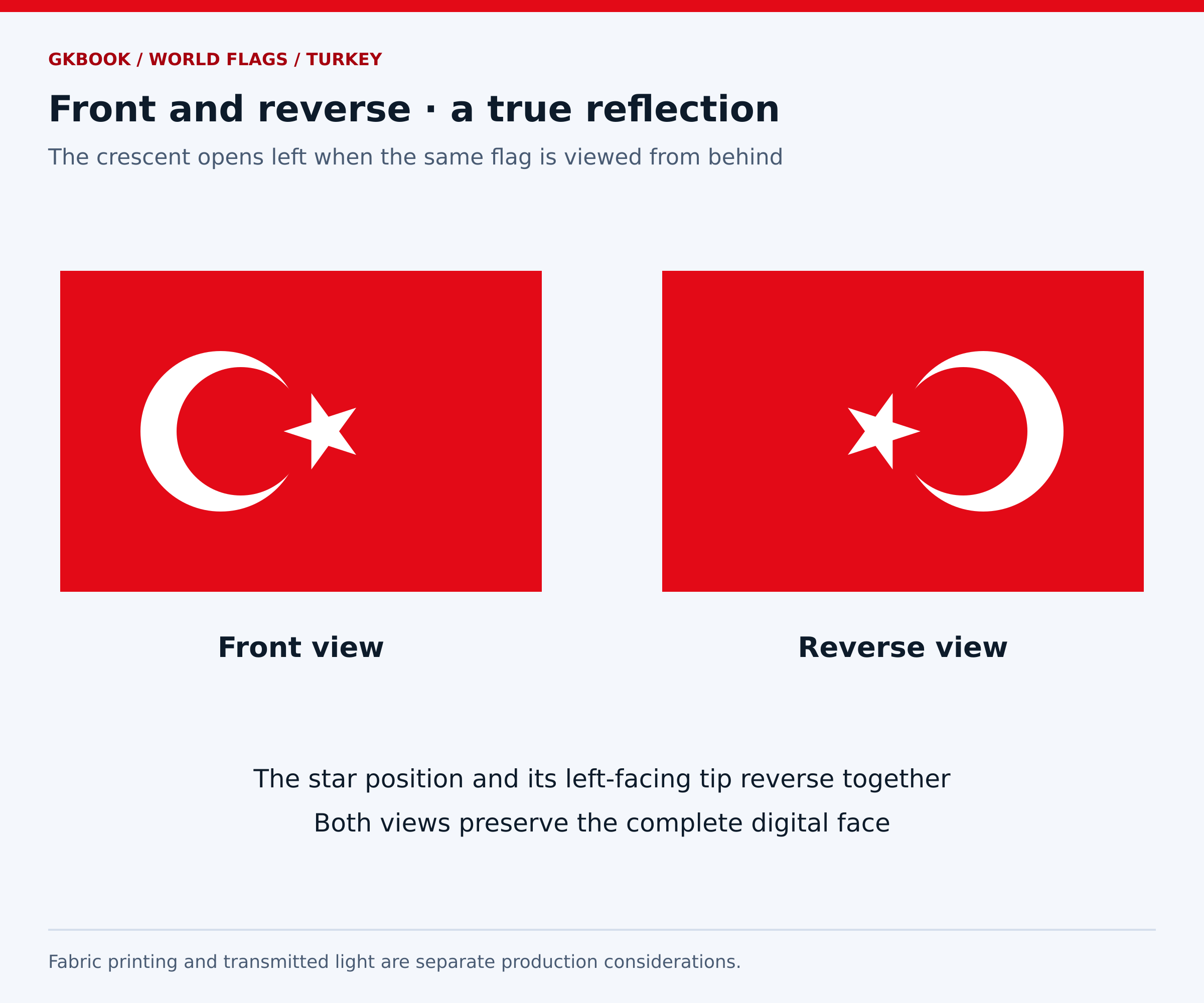
Viewed from behind in a flat geometric model, the flag is the horizontal reflection of its front. The crescent opens left, and the star’s position and point direction reverse with it. This is a change of viewpoint on the same design, not a second national flag with separate colors or symbols.
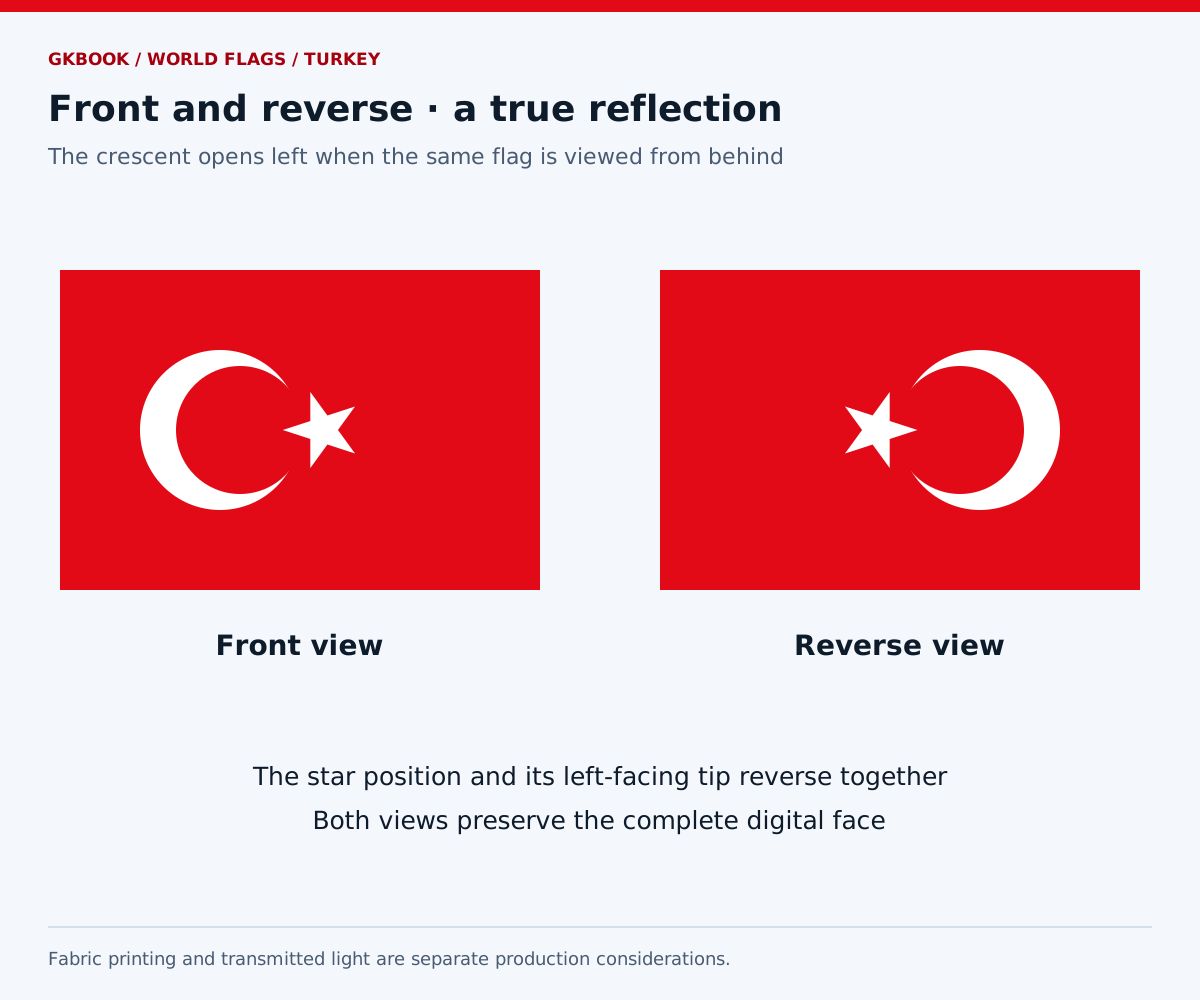
Imagine moving around a flag while keeping its top edge uppermost. The hoist that appears on the left in the standard front reference appears on the right from behind. Reflecting the entire master reproduces that relationship more reliably than redrawing the crescent and shifting the star by eye.
The illustration concerns geometry, not the opacity of real cloth or the method used to print its two sides. Seams, transmitted light, and separate layers can affect a manufactured reverse view. Those production details should be considered independently when making an actual flag or evaluating a photograph.
Is the Turkey flag symmetrical?
The ideal digital face has reflection symmetry across its horizontal centerline, so exchanging top and bottom preserves the design. It does not have left-right reflection symmetry or half-turn symmetry. Those operations reverse the crescent opening and star orientation, and also change the emblem’s horizontal position within the red rectangle.

Both crescent circles have their centers on the same horizontal median as the star. The star’s left-facing tip lies on that line, while its remaining vertices form matching pairs above and below it. Together these properties explain the exact top-bottom correspondence without requiring a centered emblem.
The rectangle alone has more symmetries than the complete colored design. A half-turn preserves the rectangle but moves the crescent toward the opposite side and reverses its opening. Evaluate the whole flag, including the positions and orientation of its smaller shapes, rather than judging only its outer boundary.
How should the Turkey flag be resized or printed?
Resize both dimensions together and retain the entire digital face. The 9,000 by 6,000 PNG corresponds to 30 by 20 inches at 300 pixels per inch. Use the SVG for scalable geometry. Physical production additionally requires appropriate color proofing, materials, attachment heading, and the applicable construction specifications beyond this screen reference.

When a layout has another aspect ratio, fit the complete flag inside it instead of cropping the field or stretching the emblem. Place any border outside the rectangle. The separate social card follows that approach, preserving a complete 540 by 360 flag within a wider composition.
The declared RGB palette describes the digital artwork. It is not a universal ink or dye recipe and does not replace the regulation’s physical color tests. Keep the credits and construction notes with reused files so that the numerical-spacing choice and the omission of a fabric heading remain clear.
What matters when the flag is displayed very small?
At small sizes, preserve the crescent opening, recognizable five-pointed star, and complete 2:3 digital face. Antialiasing blends pixels along curved and diagonal edges, so inspect the intended display size rather than only the large master. Avoid adding outlines or changing the star’s position to compensate for a cramped layout.
The crescent’s narrow ends and the star’s inward notches can soften when reduced to a few pixels. Those changes are limitations of raster display, not evidence that the official geometric relationships should be redrawn. A clean proportional reduction is a better reference than an embellished miniature.
Provide a concise alternative description and, where useful, a visible country label. Flat artwork keeps the distinguishing shapes readable, while folds, lighting effects, and perspective can hide them. Retain the source vector for future resizing instead of repeatedly enlarging a small raster thumbnail whose detail has already been lost.
Download Turkey flag pictures
Download the complete national flag as SVG or 9,000 × 6,000 PNG. Its height:length ratio is 2:3. The red field, white crescent, and white star remain complete. The physical fabric heading is omitted.
The gallery contains 24 subjects, each with an SVG and PNG. Captions distinguish the clean flag from construction guides, historical explanations, and geometric transformations. Image credits and reproduction notes identify the sources, palette, and scope of the original explanatory additions. The separate 1,200 × 630 social card contains a complete digital flag face measuring 540 × 360 units.
Continue exploring national designs in World Flags.
World Flags/Turkey
Turkey flag pictures
Complete conventional digital flag face, height:length 2:3; numerical annex geometry with a regular five-pointed star.
GKBook reconstruction and explanatory artwork; sources and construction conventions documented in credits.Download SVGDownload PNGDigital red #E30A17 and white #FFFFFF follow the inspected reference SVG. Regulation Article 3 supplies distinct physical color tests.
GKBook reconstruction and explanatory artwork; sources and construction conventions documented in credits.Download SVGDownload PNGThe national flag carries historical and cultural associations; a precise original meaning for every element is not established here.
GKBook reconstruction and explanatory artwork; sources and construction conventions documented in credits.Download SVGDownload PNGThe white crescent is the part of the outer disk outside the offset inner disk.
GKBook reconstruction and explanatory artwork; sources and construction conventions documented in credits.Download SVGDownload PNGThe five outer tips are equally spaced; one faces the hoist. The inward radius follows regular pentagram geometry.
GKBook reconstruction and explanatory artwork; sources and construction conventions documented in credits.Download SVGDownload PNGThe conventional digital face is 9,000 × 6,000; physical heading conventions are discussed separately.
GKBook reconstruction and explanatory artwork; sources and construction conventions documented in credits.Download SVGDownload PNGFour opaque shapes reproduce the digital face; the crescent is constructed by layering two circles.
GKBook reconstruction and explanatory artwork; sources and construction conventions documented in credits.Download SVGDownload PNGAll three centers share the horizontal median but occupy different horizontal positions.
GKBook reconstruction and explanatory artwork; sources and construction conventions documented in credits.Download SVGDownload PNGThe tabulated E gives x=4,175 for the left star tip; exact crescent tips lie on x=4,267.5. Article 4(G) describes alignment that is not numerically exact.
GKBook reconstruction and explanatory artwork; sources and construction conventions documented in credits.Download SVGDownload PNGThe regulation defines a white attachment heading and gives its width as G/30; it is omitted from the conventional digital master.
GKBook reconstruction and explanatory artwork; sources and construction conventions documented in credits.Download SVGDownload PNGArea shares are derived from circle overlap and the regular star; they apply to the digital face without a fabric heading.
GKBook reconstruction and explanatory artwork; sources and construction conventions documented in credits.Download SVGDownload PNGThe historical sequence distinguishes an eight-pointed naval predecessor, the five-pointed form, the republic, and later legal standardization.
GKBook reconstruction and explanatory artwork; sources and construction conventions documented in credits.Download SVGDownload PNGMay 29 and June 5, 1936 are adoption and publication dates of Law 2994, not two conflicting dates for the same event.
GKBook reconstruction and explanatory artwork; sources and construction conventions documented in credits.Download SVGDownload PNGConstitution Article 3, Law 2893, and Regulation 85/9034 have different roles. The numerical/wording discrepancy is documented.
GKBook reconstruction and explanatory artwork; sources and construction conventions documented in credits.Download SVGDownload PNGRegulation Article 3 gives physical color values and tests. The package declares a separate RGB reproduction palette.
GKBook reconstruction and explanatory artwork; sources and construction conventions documented in credits.Download SVGDownload PNGThe republic’s proclamation and the later UN name change did not create a new red-white flag design.
GKBook reconstruction and explanatory artwork; sources and construction conventions documented in credits.Download SVGDownload PNGThe U.S. Office of the Historian records reestablished relations in 1927; the UN records membership from October 24, 1945.
GKBook reconstruction and explanatory artwork; sources and construction conventions documented in credits.Download SVGDownload PNGThe complete Turkish digital flag face is shown; Tunisia’s contrasting arrangement is described in the neighboring panel.
GKBook reconstruction and explanatory artwork; sources and construction conventions documented in credits.Download SVGDownload PNGThe presidency describes its sun-and-sixteen-stars standard separately from the ordinary national flag.
GKBook reconstruction and explanatory artwork; sources and construction conventions documented in credits.Download SVGDownload PNGLaw 2893 addresses respectful condition and use, including half-staff on November 10; actual installations require their applicable protocol.
GKBook reconstruction and explanatory artwork; sources and construction conventions documented in credits.Download SVGDownload PNGA clockwise quarter-turn produces a 360 × 540 tall digital flag face in this diagram.
GKBook reconstruction and explanatory artwork; sources and construction conventions documented in credits.Download SVGDownload PNGThe reverse is a horizontal reflection of the whole digital master.
GKBook reconstruction and explanatory artwork; sources and construction conventions documented in credits.Download SVGDownload PNGThe exact digital face is symmetric across its horizontal centerline but not under a half-turn.
GKBook reconstruction and explanatory artwork; sources and construction conventions documented in credits.Download SVGDownload PNGA proportional resize preserves both circular boundaries and the regular star.
GKBook reconstruction and explanatory artwork; sources and construction conventions documented in credits.Download SVGDownload PNGFrequently asked questions
What does the Turkey flag look like?
The Turkey flag has a red field bearing a white crescent and a white five-pointed star. The crescent opens toward the fly, shown at the right, while one star point faces left. The supplied digital face has height:length proportions of 2:3 and uses numerical dimensions from the official construction table.
What is the Turkey flag called?
The national flag is the Turkish flag, called Türk Bayrağı in Turkish. Türkiye is the country name now used at the United Nations, following the request received on June 1, 2022. That naming change did not replace the familiar red flag with its white crescent and five-pointed star.
What are the colors of the Turkey flag?
The flag is red and white. This digital edition uses red #E30A17, RGB 227, 10, 23, and white #FFFFFF, RGB 255, 255, 255, from the inspected reference SVG. These screen values are not statutory HEX specifications; the regulation separately defines physical color measurements, tolerance, and a whiteness test.
What does the Turkey flag symbolize?
The flag represents the Republic of Türkiye and carries associations with national identity and Ottoman history. Its crescent and star are widely associated with Islam, although these symbols have older histories. The legal construction rules describe the design; they do not establish a single documented original meaning for every element.
Does the Turkey flag come from a battlefield legend?
Stories about a crescent and star reflected in blood on a battlefield are origin legends, not a verified construction record for this flag. Such accounts may express sacrifice and national memory, but they do not establish the date, designer, or measured geometry of the modern national emblem.
How is the white crescent constructed?
The crescent is formed from two overlapping circles. On a 9,000 by 6,000 digital face, the outer white circle has center (3,000, 3,000) and radius 1,500. A red circle with center (3,375, 3,000) and radius 1,200 cuts into it, leaving a white crescent opening toward the right.
How is the five-pointed star drawn and oriented?
The white star is a regular pentagram with one outer tip facing left along the horizontal median. Its outer diameter is one quarter of the flag height, giving a radius of 750 in this master. The inward radius, about 286.474508, is derived from regular pentagram geometry rather than separately quoted from the statute.
What are the proportions of the Turkey flag?
The conventional digital flag face has a height:length ratio of 2:3, so its length is one and a half times its height. The supplied master measures 9,000 by 6,000. A physical attachment heading is omitted, and the file should not be treated as a certified cutting pattern for a finished fabric flag.
What shapes make up the digital flag master?
The digital master uses four opaque filled shapes in order: a red rectangle, a white circle, an offset red circle, and a white regular star. The overlapping circles create the crescent. No central white background disk, outlines, gradients, shadows, labels, or decorative texture belong inside this clean national flag face.
Where are the crescent and star centers?
The outer crescent circle is centered at (3,000, 3,000), its inner cutout at (3,375, 3,000), and the star at (4,925, 3,000). These are three distinct centers on one horizontal line. The rectangle’s center is (4,500, 3,000), so neither the outer crescent nor the star is centered on the flag itself.
Does the star tip align exactly with the crescent tips?
Not under every stated rule simultaneously. The numerical table places the left star tip at x = 4,175, while the exact crescent tips lie on x = 4,267.5. Article 4(G) describes an alignment between them. This reconstruction follows the explicit numerical spacing and discloses the resulting 92.5-unit difference.
What is the white strip at the hoist of a physical flag?
The regulation describes a white fabric attachment heading called the uçkurluk and gives its width as one thirtieth of the flag height. It relates to the flag’s rope attachment. The supplied digital face omits this manufacturing feature, following the conventional screen representation, and does not claim to be a complete physical sewing specification.
How much of the digital flag is red or white?
The white area is the visible crescent plus the separate five-pointed star; the remainder of the digital face is red. The accompanying diagram gives calculated percentages from the exact vector geometry. These shares exclude any physical fabric heading and describe the image itself, not population, territory, or official symbolic importance.
How did the Turkey flag develop historically?
The modern design developed from Ottoman flags. Britannica describes a red naval flag with a white crescent and eight-pointed star in 1793, followed by a five-pointed form around 1844. The republic retained the familiar basic design in 1923, and later laws defined its official form and use more precisely.
When was the Turkey flag adopted?
The answer depends on the milestone. The recognizable five-pointed form is commonly dated to about 1844. Republican Law 2994 was adopted on May 29, 1936 and published on June 5, 1936. The current Flag Law 2893 was adopted on September 22, 1983 and published two days later.
Who designed the Turkey flag?
No single modern individual is established here as the original designer of the national flag. Its recognizable form developed through Ottoman usage and later republican standardization. The author of a present-day SVG is a reproduction contributor, not automatically the historical designer of the crescent-and-star arrangement or the legislator who defined its proportions.
What laws define the Turkey flag?
Article 3 of the Constitution describes a red flag with a white crescent and star, with its shape specified by law. Flag Law 2893 and Regulation 85/9034 provide further rules. Their numerical annex governs this reconstruction, with the documented star-tip wording discrepancy and physical-heading distinction explicitly retained.
How are construction and color standardized?
The regulation approved on January 25, 1985 and published on March 17, 1985 details construction and material requirements. Its red color values are brightness 27.5, red-green 44.8, and yellow-blue 15.6, with a maximum 3 NBS difference. These physical measurements are distinct from the digital RGB palette declared for this package.
Did the flag change when the republic was proclaimed?
The republic proclaimed on October 29, 1923 retained the familiar red crescent-and-star flag rather than introducing an entirely new basic design. The five-pointed form had Ottoman predecessors. Later flag laws standardized the national emblem, while the 2022 adoption of Türkiye in UN naming likewise did not require a new flag design.
How do international milestones relate to the flag?
Diplomatic history and flag adoption are separate. The U.S. Office of the Historian records reestablished diplomatic relations on February 17, 1927. The United Nations lists membership from October 24, 1945. Neither date is the origin of the familiar national design, and neither institution’s record certifies a particular downloadable flag image.
How does the Turkey flag differ from the Tunisia flag?
Turkey places a white crescent and white star directly on a red field. Tunisia places a red crescent and red star inside a centered white disk on its red field. The white disk and reversed emblem colors are the quickest distinguishing features; the two national constructions also use different measurements and positions.
Was every Ottoman flag the same as today’s Turkish flag?
No. Ottoman flags varied across periods and functions, and historical crescent-and-star designs were not all identical to today’s national construction. The eight-pointed naval predecessor described for 1793 differs visibly from the later five-pointed form. A historical flag needs a date and context instead of being treated as a universal Ottoman design.
Is the presidential standard the same as the national flag?
The presidential standard is a distinct official design that adds a golden sun and sixteen stars in the upper hoist area. The presidency explains the sun as representing the republic and the stars as historical Turkish states. Those additional elements do not belong on the ordinary national flag master supplied here.
Does the national flag include a coat of arms?
The ordinary national flag does not include a coat of arms, shield, inscription, or presidential sun emblem. Its specified face consists of the red field and white crescent and star. A seal, institutional badge, or decorative national emblem may serve another purpose, but should not be added to the clean flag master.
How should the Turkey flag be presented respectfully?
Present an intact, clean flag with the correct proportions, colors, and emblem orientation. Law 2893 addresses respectful use and specifies half-staff on November 10, with other mourning arrangements determined separately. For a real ceremony or installation, follow the applicable protocol; a digital illustration alone cannot establish every handling or display requirement.
How does the flag look when rotated vertically?
A clockwise quarter-turn of the complete horizontal digital face produces a tall rectangle with height:width 3:2. The crescent opening then points downward, and the star rotates with the rest of the flag. This is a geometric illustration, not a universal instruction for hanging the Turkish flag in an official installation.
What does the reverse of the Turkey flag look like?
Viewed from behind in a flat geometric model, the flag is the horizontal reflection of its front. The crescent opens left, and the star’s position and point direction reverse with it. This is a change of viewpoint on the same design, not a second national flag with separate colors or symbols.
Is the Turkey flag symmetrical?
The ideal digital face has reflection symmetry across its horizontal centerline, so exchanging top and bottom preserves the design. It does not have left-right reflection symmetry or half-turn symmetry. Those operations reverse the crescent opening and star orientation, and also change the emblem’s horizontal position within the red rectangle.
How should the Turkey flag be resized or printed?
Resize both dimensions together and retain the entire digital face. The 9,000 by 6,000 PNG corresponds to 30 by 20 inches at 300 pixels per inch. Use the SVG for scalable geometry. Physical production additionally requires appropriate color proofing, materials, attachment heading, and the applicable construction specifications beyond this screen reference.
What matters when the flag is displayed very small?
At small sizes, preserve the crescent opening, recognizable five-pointed star, and complete 2:3 digital face. Antialiasing blends pixels along curved and diagonal edges, so inspect the intended display size rather than only the large master. Avoid adding outlines or changing the star’s position to compensate for a cramped layout.
Every general-knowledge topic and the A-to-Z lists.
The world A to Z: flags, countries, the sciences, places, people, subjects.











We Value Your Opinion Comments