
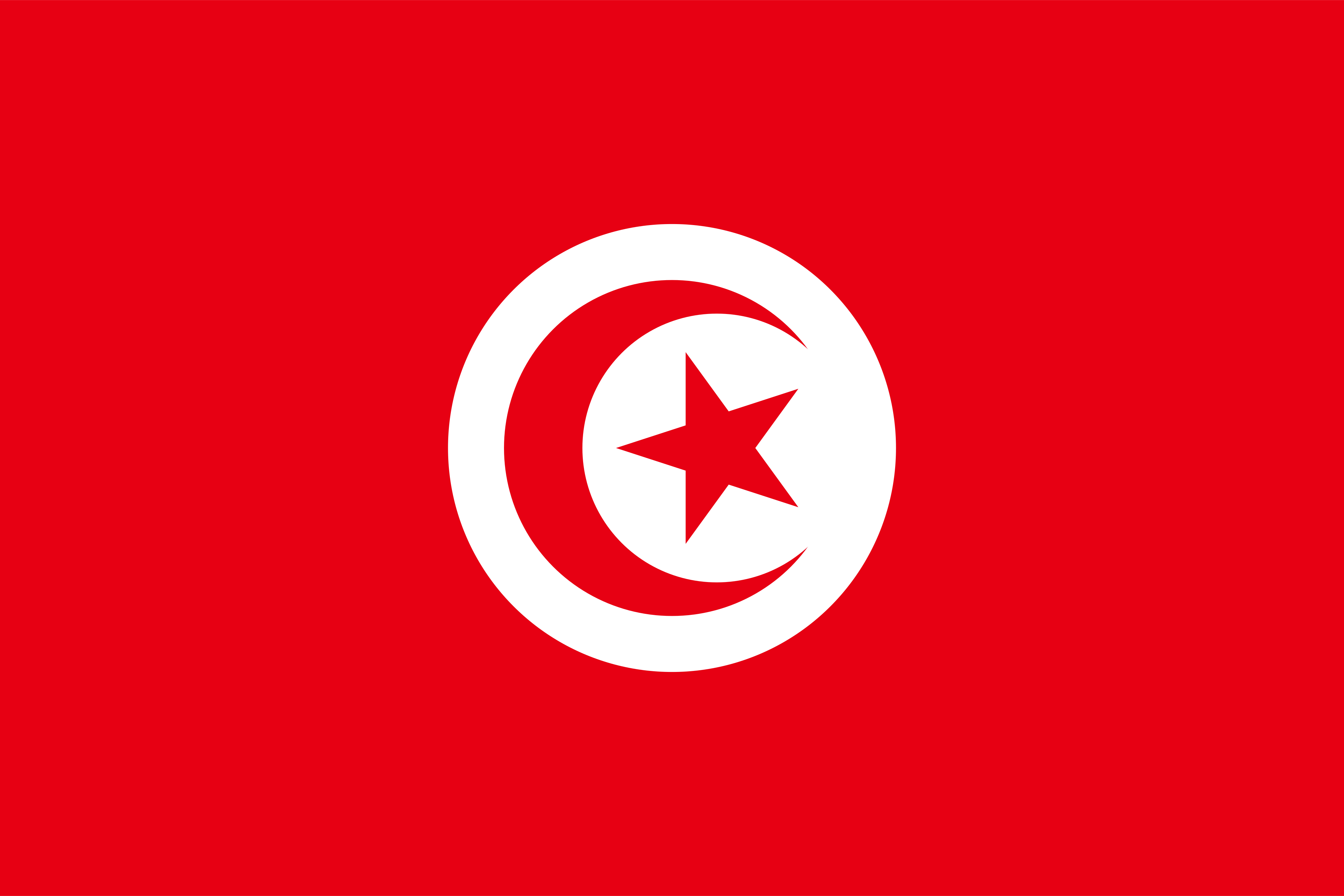
Tunisia flag picture
Explore the proportions, adoption history, and picture gallery.
| National design | Republic of TunisiaNorth African country; the ordinary national flag has no inscription. |
|---|---|
| Design | Red field · white disk · red crescent and starCrescent opens toward the fly; one star point faces the hoist. |
| Proportions | Height:length = 2:3Disk diameter is one third of the length. |
| Adoption history | Usually dated 1831Institutional accounts commonly give 1831; Britannica gives 1835. |
| Construction law | Organic Law 99-56, June 30, 1999Current constitutional flag description: Article 8 of the 2022 Constitution. |
| Declared digital colors | Red #E70013 · white #FFFFFFReference-SVG values; official technical color dossier not obtained. |
| Main image sizes | SVG and PNG: 9,000 × 6,000Complete rectangle; opaque RGB PNG. |
The crescent and star carry Islamic and Ottoman associations. These interpretations are distinct from the legal measurements and declared digital palette.
What does the Tunisia flag look like?
The Tunisia flag has a red field with a centered white disk containing a red crescent and a red five-pointed star. Its height:length ratio is 2:3. In the standard front view, the crescent opens toward the right, while one star point faces left and its center sits slightly right of the disk’s center.
Begin with the complete rectangle and the white disk at its center. The hoist is the edge attached to the pole, conventionally shown at the left; the fly is the free edge opposite it. The crescent occupies the hoist side of the disk and opens around the star. Small differences in star rotation or placement can change a seemingly familiar drawing. The supplied master therefore keeps the circles, offset, and star geometry explicit, while separate illustrations explain the design without placing measurement guides on the clean flag.
What is the Tunisia flag called?
The formal national designation is the flag of the Republic of Tunisia, also commonly called the Tunisian flag. That name identifies the ordinary national design: a red rectangle with the white disk, red crescent, and red star. It distinguishes the flag from a presidential version or another institutional emblem.
Use the country name when labeling a picture, download, or map legend. The crescent and star appear in several national traditions, so a caption that names only those symbols is incomplete. A short description of the white disk makes the Tunisian arrangement easier to recognize beside similar flags.
The ordinary national flag has no lettering. An image carrying a motto, added crest, or commemorative message should therefore be identified more specifically. A decorative banner may refer to Tunisia without being an exact national flag, and an officeholder’s standard serves a different purpose from the general national emblem.
What are the colors of the Tunisia flag?
The national flag uses red and white. This digital edition declares red #E70013, or RGB 231, 0, 19, and white #FFFFFF, or RGB 255, 255, 255, matching the inspected reference SVG. These are reproduction values; the official technical color dossier mentioned in the 1999 law was not obtained.

Red fills the background, crescent, and star consistently. White fills the central disk and the open space around the red emblem. The white is opaque rather than transparent, so placing the image on a colored page should not change the appearance of its central area.
Keep the stated screen palette separate from physical production specifications. Ink, cloth, lighting, and display settings can change a color’s appearance. Converting an RGB value to another color system does not by itself establish a legally specified dye or an exact match on every material used to manufacture a flag.
| Color | HEX | RGB |
|---|---|---|
| Red | #E70013 | 231, 0, 19 |
| White | #FFFFFF | 255, 255, 255 |
What does the Tunisia flag symbolize?
The flag represents Tunisian national identity and sovereignty. Common reference explanations connect red with sacrifice in resisting oppression and white with peace. The crescent and star carry Islamic and Ottoman associations. These interpretations should be distinguished from the legal construction rules, which specify the design rather than a complete symbolic glossary.
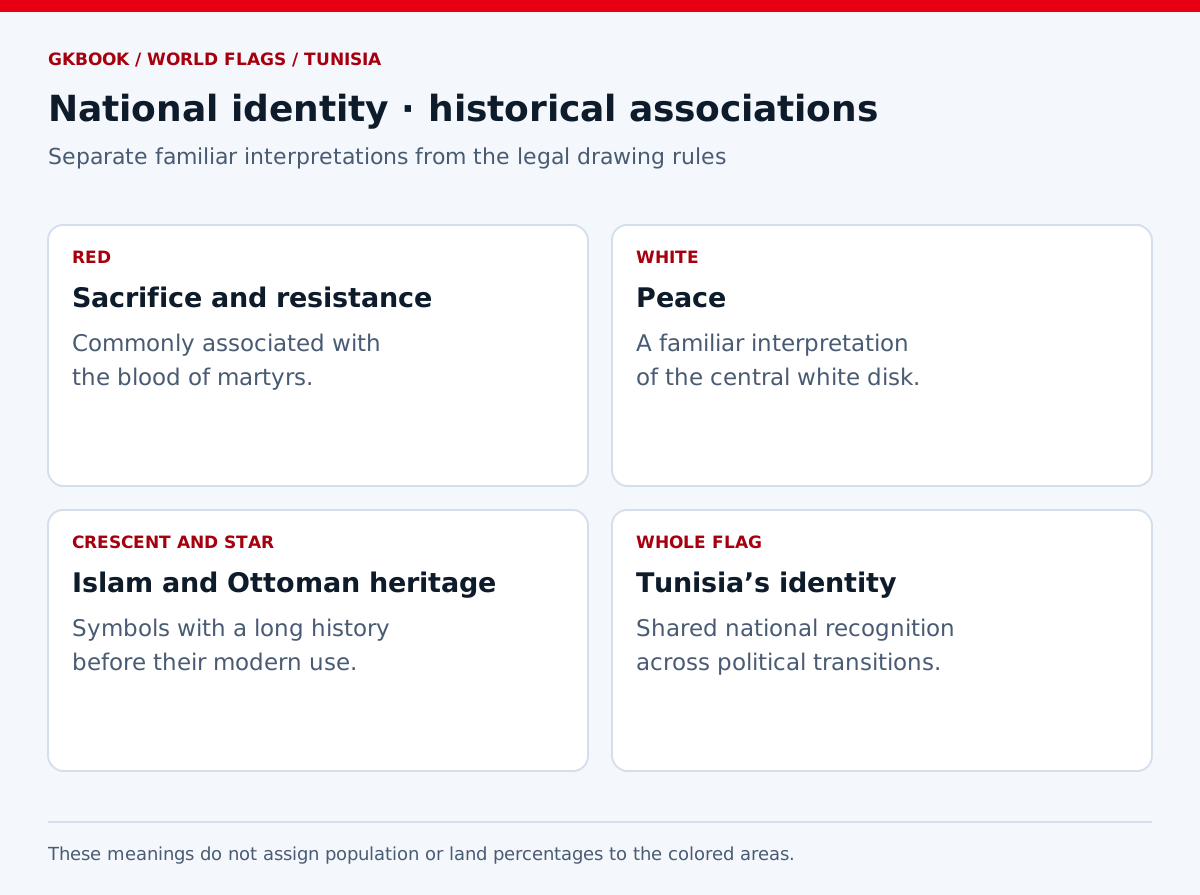
A national emblem can gather meaning through the events in which people use it. The familiar explanations of individual colors are useful introductions, but they need not prove that each association was written into the original commission. Historical interpretation and statutory measurements answer different kinds of questions.
Read the crescent, star, disk, and red field as one arrangement. Their combination identifies Tunisia more precisely than any isolated element. Similarly, the percentage of the picture occupied by a color does not measure a share of the population, the territory, or the importance of a particular national value.
What does the red on the flag represent?
Red is commonly interpreted as recalling the blood and sacrifice of those who resisted oppression. It also belongs to the flag’s historical relationship with Ottoman red ensigns. In the actual design, one red appears throughout the field, crescent, and star; the law does not assign each red shape a separate meaning.
The red background covers the entire rectangle before the white disk is added. The crescent and star then restore red within that disk, producing three visible components in the same color. Their positions are geometric features, not separate shades or gradients that should be adjusted for emphasis.
Photographs of folded cloth may show darker red in shadow and brighter red where light passes through the fabric. Those variations belong to the photograph, not to the flat reference design. A clean educational image keeps the fill consistent so that readers can compare shape and proportion without lighting effects.
Why does the Tunisia flag have a white disk?
The white disk provides the contrasting central area containing the red crescent and star and is commonly associated with peace. Its center is exactly at the rectangle’s center, and its diameter is one third of the flag’s length. In this 2:3 rectangle, that diameter also equals half the flag’s height.

A disk is a filled circle, not an outlined ring. The red emblem covers part of its white surface, but the circular outer boundary remains intact. The white region visible after the emblem is added is consequently smaller than the area of the original complete disk.
The centered disk is one of the strongest visual clues distinguishing Tunisia from other crescent-and-star flags. Preserve its roundness when resizing the image. Stretching the flag into a different rectangle creates an ellipse and changes the emblem even if the central position and general colors still appear familiar.
How is the red crescent constructed?
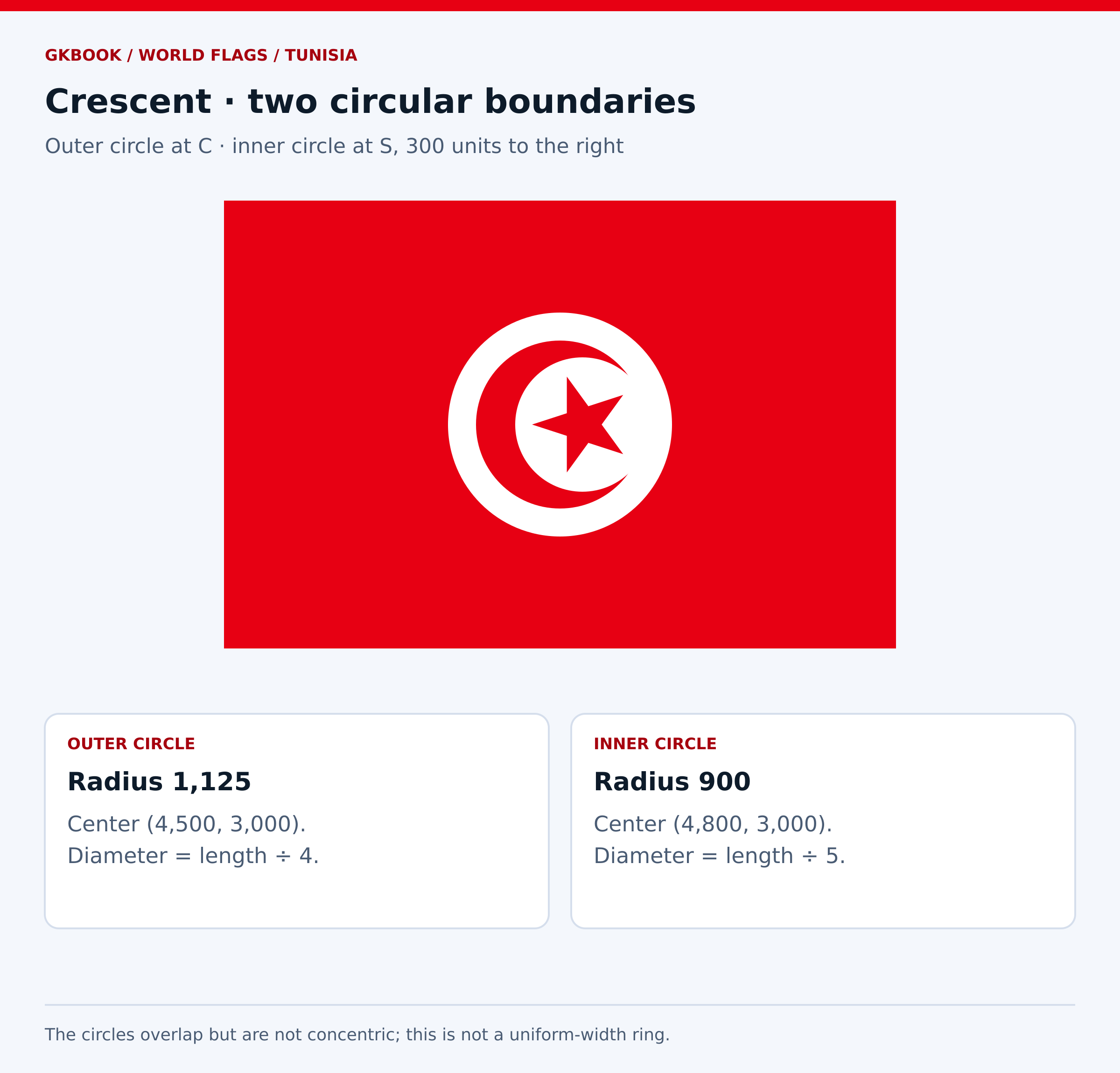
The crescent is formed between two circular arcs. The outer circle shares the white disk’s center and has diameter one quarter of the flag’s length. The inner circle shares the star’s offset center and has diameter one fifth of the length. Their overlap leaves the red crescent on the hoist side.
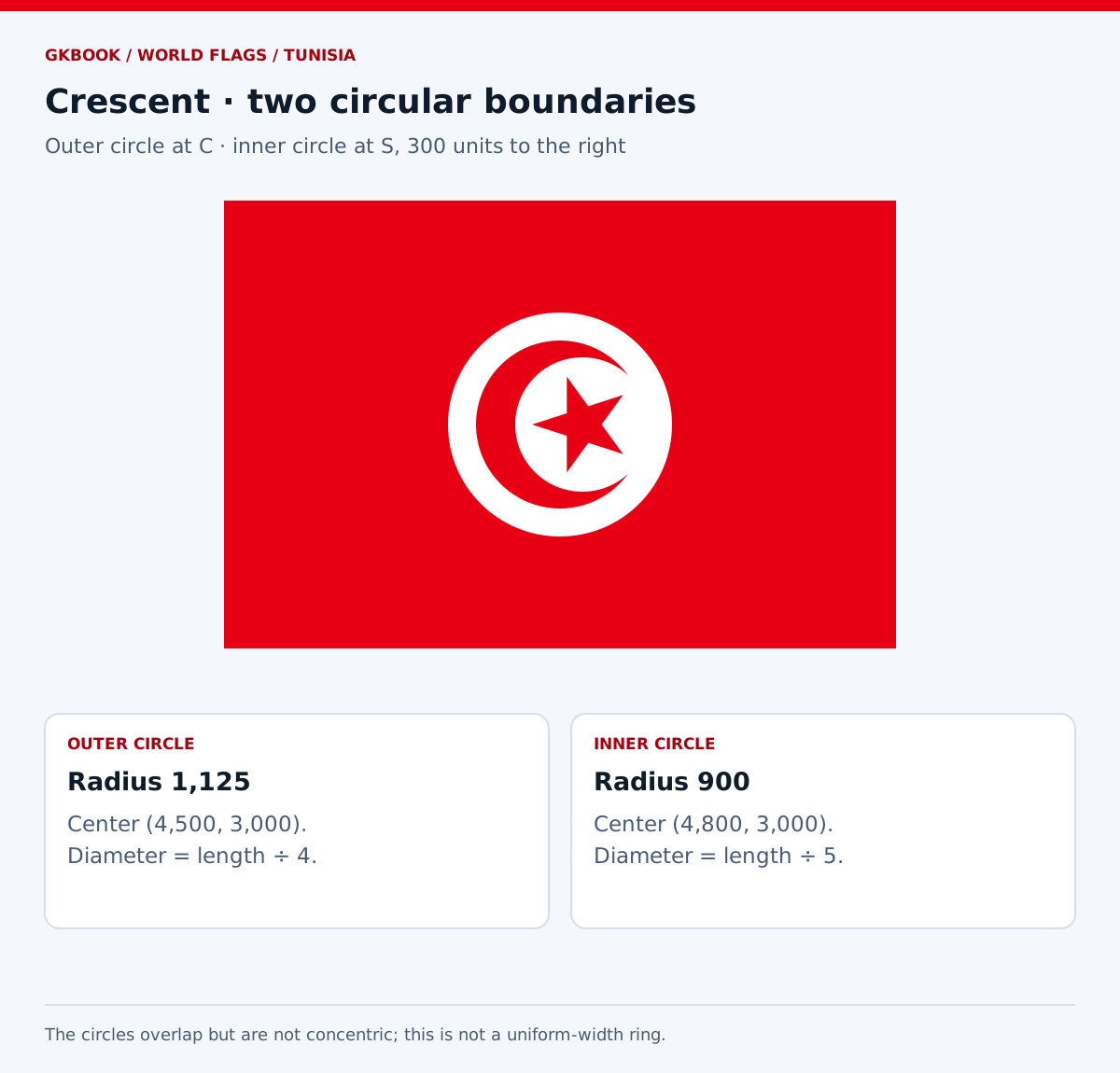
For the supplied 9,000-unit length, the outer radius is 1,125 and the inner radius is 900. Their centers are 300 units apart horizontally. Subtracting the overlapping inner region from the outer circle produces the two pointed ends and the opening toward the fly.
The result is not a ring of uniform thickness. Drawing a thick circular stroke and erasing an arbitrary wedge would produce different curves and tips. The construction diagram therefore identifies the two circles separately, while the clean master uses solid fills to make the final crescent without visible guide lines.
How many points does the star have?
The Tunisian flag has one red star with five evenly spaced outer points. Their enclosing circle has diameter 15 percent of the flag’s length. This reconstruction uses a regular pentagram, with one point directed left along the horizontal median, and keeps the star separate from the surrounding crescent.
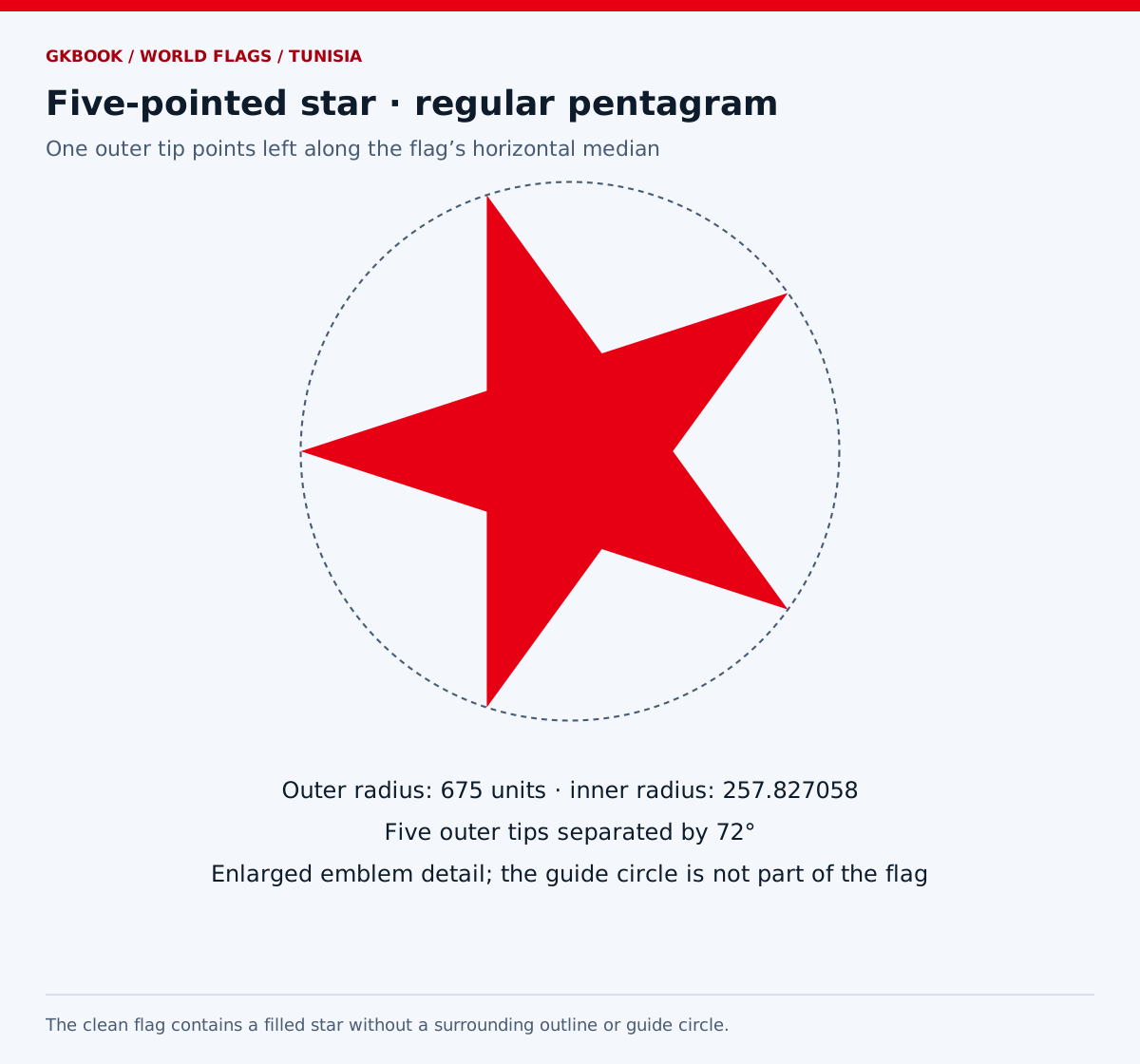
The clean SVG traces the ten alternating outer and inner vertices of the filled star. The outer radius is 675 units in this master. Its inner radius, approximately 257.827058 units, follows from the geometry of a regular pentagram rather than an additional numerical radius quoted in the law.
A five-pointed star is not fully specified by its point count alone. Its rotation, size, center, and inward notches all affect the drawing. Here, the mathematical construction preserves those relationships at every scale. The dashed circle in the explanatory image is a measuring aid and is absent from the national flag.
What are the proportions of the Tunisia flag?
The flag’s height:length ratio is 2:3, meaning that its length is one and a half times its height. The supplied master is 9,000 by 6,000 units. The 1999 law describes the shorter dimension as two thirds of the length and places the pole attachment along the left short edge.

Always state which dimension comes first. Height:length 2:3 and length:height 3:2 describe the same horizontal rectangle. An unlabeled pair can cause confusion when specifications are copied between languages or drawing programs, especially when a document uses width to mean the shorter dimension.
Proportional resizing keeps every part of the emblem consistent. A 900 by 600 image and a 300 by 200 image both preserve the national ratio. A generic widescreen slot does not: fit the complete flag within that slot and leave surrounding space instead of cropping or stretching the national rectangle.
How can the Tunisia flag be drawn accurately?
Start with a 9,000 by 6,000 red rectangle. Add the white disk at 4,500, 3,000 with radius 1,500. Place the red outer crescent circle there with radius 1,125, then the white inner circle at 4,800, 3,000 with radius 900. Finish with the regular red star centered at that second point.
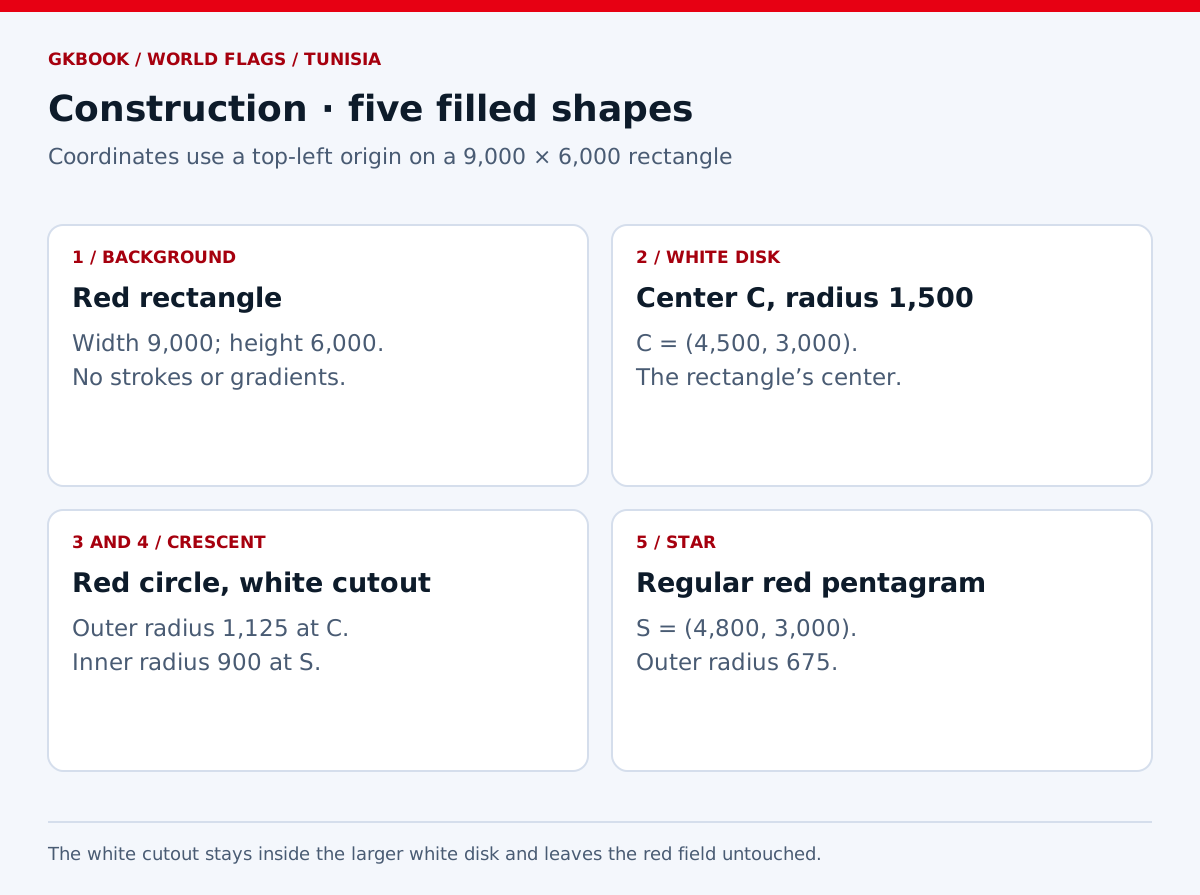
This layered construction needs only five filled shapes: one rectangle, three circles, and the star outline. The inner white circle extends slightly beyond the outer red circle but stays entirely inside the white disk. It therefore removes the correct crescent opening without erasing any of the surrounding red field.
Coordinates begin at the top-left corner, with x increasing rightward and y downward. The master retains precise decimal star vertices while explanatory labels use rounded values. Do not add strokes around the circles or star: an outline would increase their apparent dimensions and introduce a feature absent from the national design.
Are the disk, crescent, and star centered at the same point?
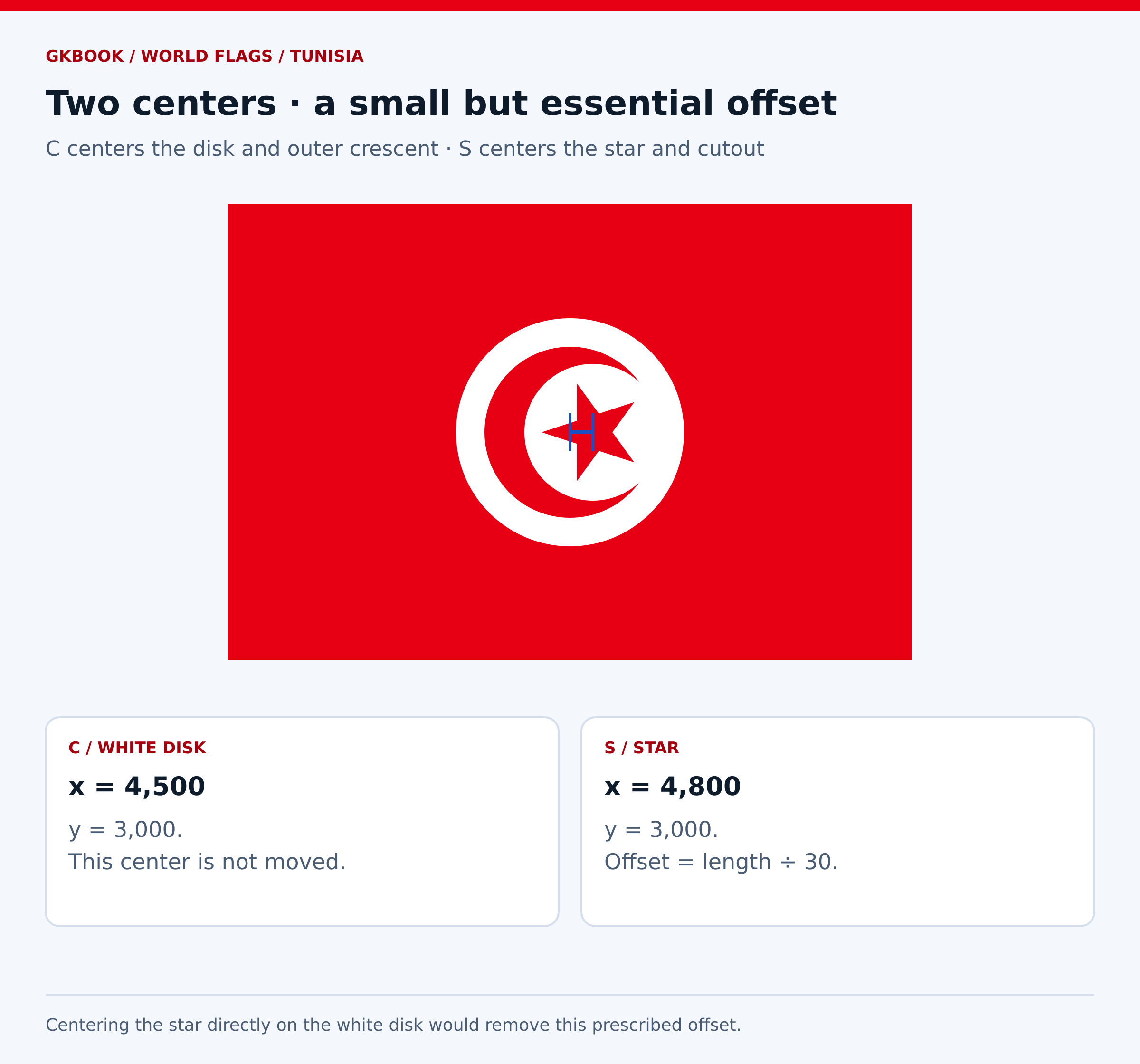
No. The white disk and the crescent’s outer circle share the flag’s center, but the star and the inner circle sit one thirtieth of the flag’s length toward the fly. In this master, the two centers are 4,500, 3,000 and 4,800, 3,000, respectively, a horizontal separation of 300 units.
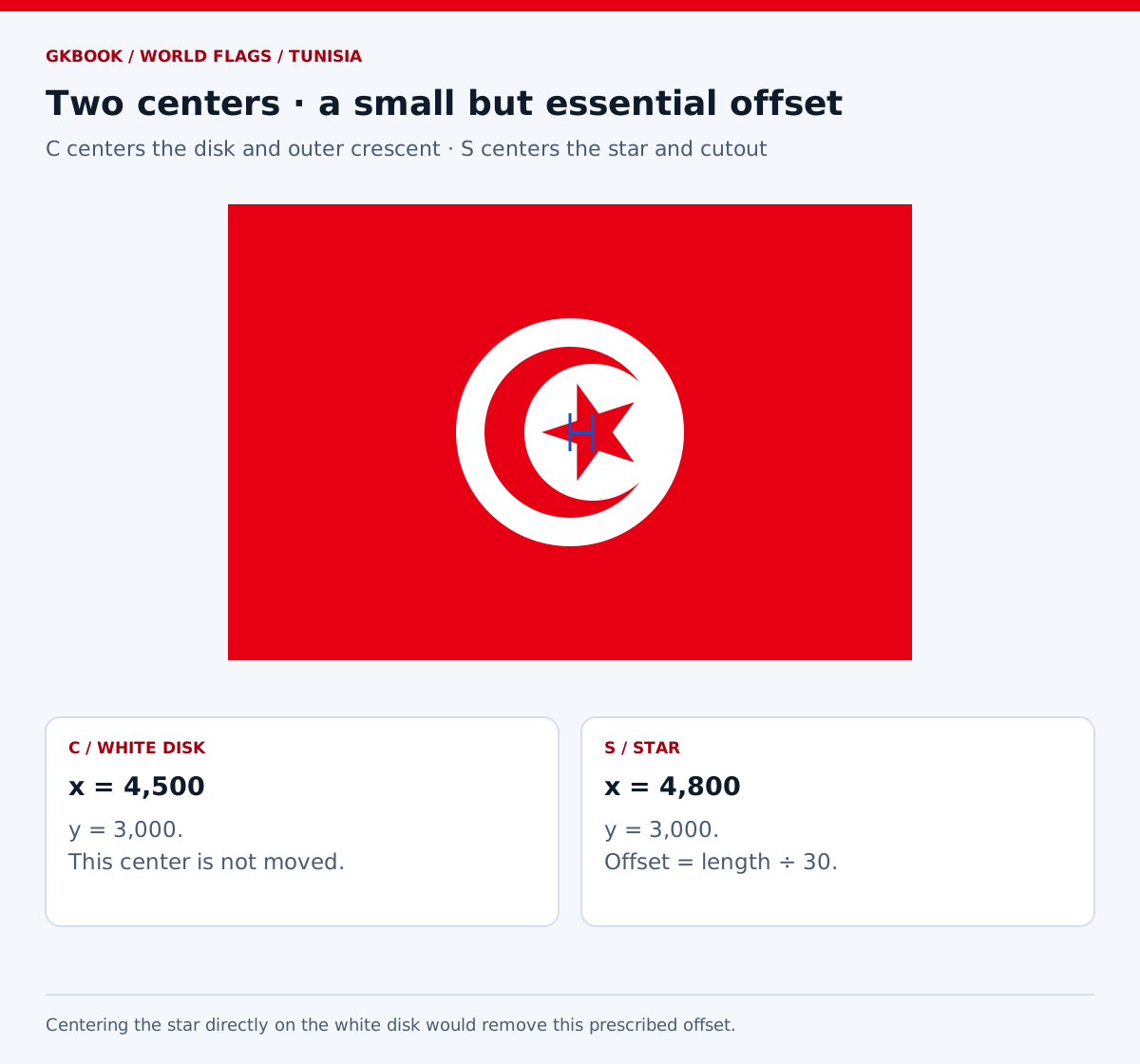
This offset gives the crescent its asymmetrical thickness and places the star inside the opening. Both centers remain on the same horizontal median. The change is small compared with the complete rectangle, which makes it easy to overlook when reproducing the flag from memory or a tiny preview.
Centering every shape on the disk would create a different emblem. It would also turn the two crescent circles into concentric circles, eliminating the intended pointed opening. Use separate named centers when preparing a drawing so that a convenient alignment command does not accidentally remove this essential relationship.
Which way do the crescent and star face?
In the usual front view with the hoist at the left, the crescent opens toward the right, or fly. One outer point of the star faces left along the horizontal median. The star’s center is slightly right of the disk center, so its left-facing point extends back toward the crescent.

The leftmost star tip is at x 4,125 and y 3,000 in the supplied master. This makes the orientation easy to check without judging by eye alone. A generic star icon with one point straight up does not match the required arrangement even if it has five points.
Orientation descriptions depend on viewpoint. The front reference image, a reverse view seen through the opposite side, and a drawing rotated vertically are different presentations. Caption them explicitly and transform the whole flag together; changing only the crescent or star would break the relationship between its parts.
How much of the Tunisia flag is red or white?
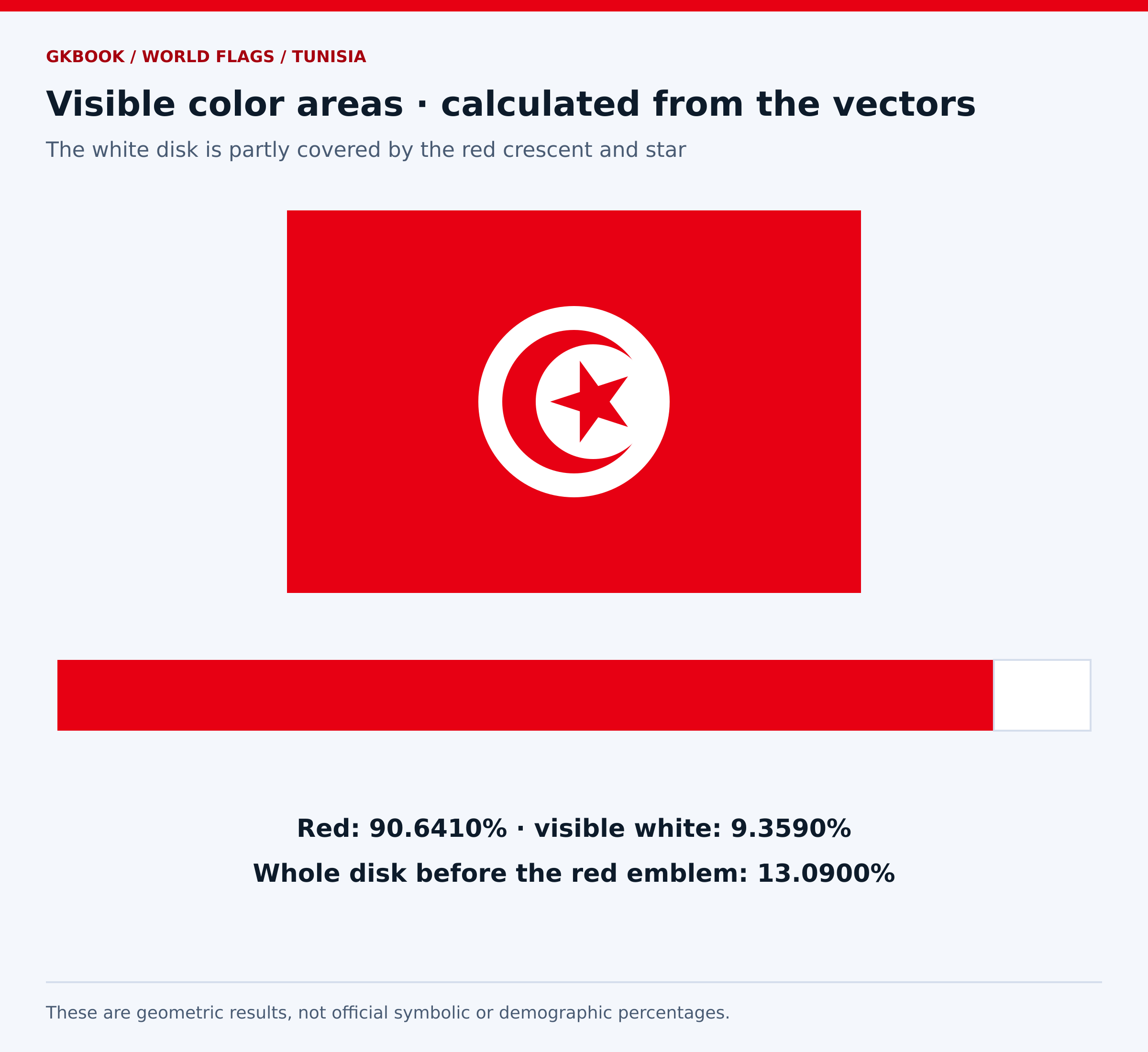
In the supplied exact vector construction, red covers approximately 90.6410 percent of the rectangle and visible white covers 9.3590 percent. The complete white disk would occupy 13.0900 percent before the red crescent and star are placed over it. These are calculated geometric shares, not official symbolic percentages.

Calculating the white area requires subtracting both red shapes inside the disk. The crescent’s area comes from the overlap of two offset circles, rather than simply subtracting their full circle areas. The regular star’s area follows from its alternating radii and evenly spaced vertices.
The red total includes the background as well as the crescent and star. In a raster image, antialiasing adds blended edge pixels, so counting only pure white pixels does not reproduce the exact vector area. Keep area calculations separate from image-quality checks and describe the chosen construction when reporting percentages.
How did the Tunisia flag develop?
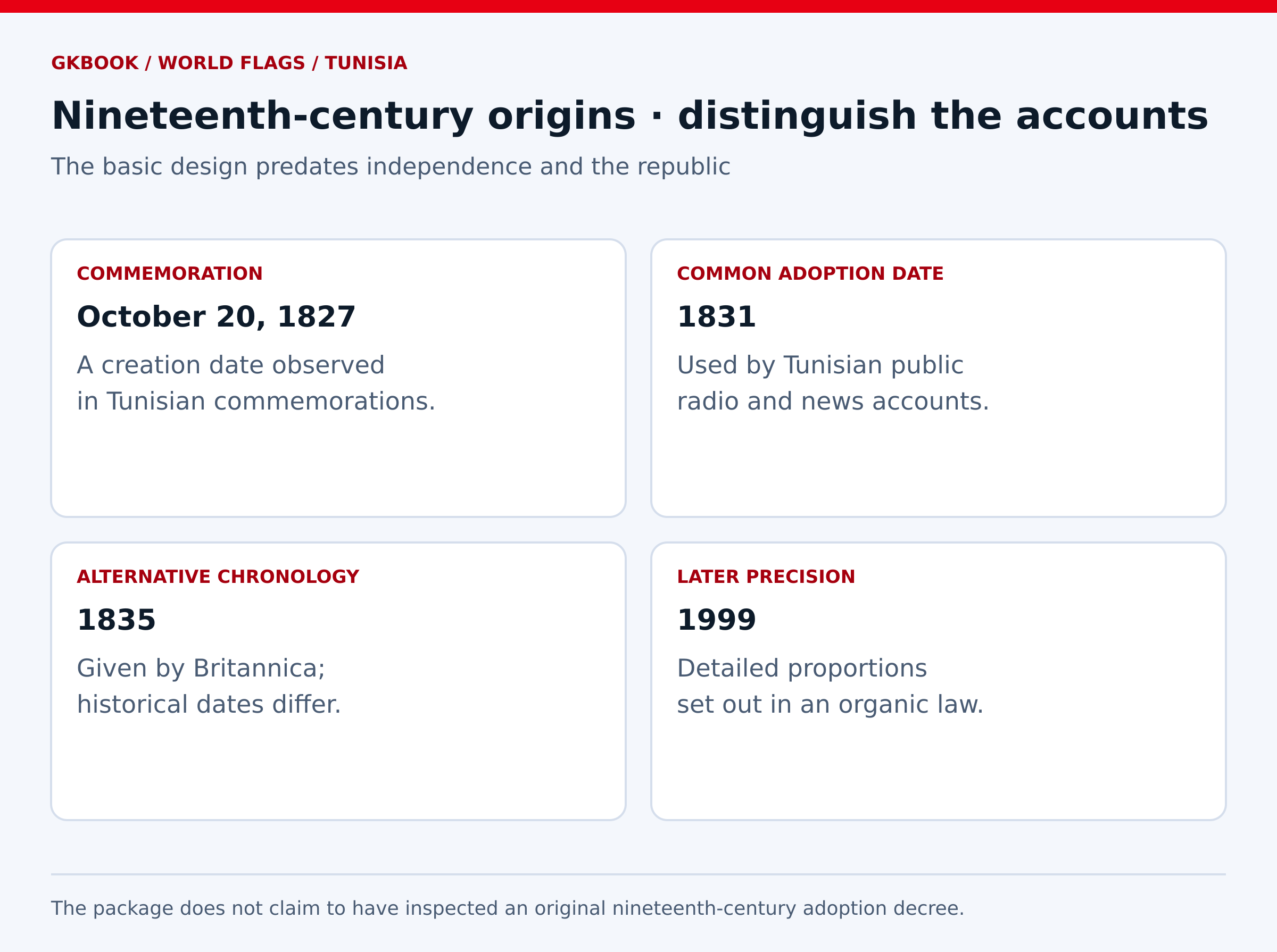
The flag developed under Hussein II Bey in the nineteenth century, within Tunisia’s Ottoman-era political and maritime setting. Tunisian commemorations associate its creation with October 20, 1827, and institutional summaries commonly give 1831 for adoption. Other accounts give 1835; a recent TAP historical report explicitly acknowledges disagreement among historians.

The red background and crescent-and-star vocabulary connected the design with an existing regional tradition, while the central white disk made the Tunisian arrangement distinctive. This broad historical relationship is clearer than a claim that one surviving modern drawing documents every detail of its earliest appearance.
Keep commemorative dates, proposed first appearances, and adoption claims attached to their sources. A contemporary anniversary report can describe how an event is remembered without settling every archival question. This package does not present an original nineteenth-century adoption decree, and it avoids turning the differing historical accounts into a falsely precise single chronology.
When was the Tunisia flag adopted?
The adoption is usually dated to 1831 in Tunisian institutional accounts, while Britannica gives 1835. The package retains that difference instead of claiming an undisputed exact day. Independence in 1956 did not introduce a wholly new national design, and the detailed construction law of June 30, 1999 is a later standardization milestone.

A flag can be commissioned, used at sea, adopted more broadly, and later described in legislation at different times. A year attached to one of those stages need not identify all the others. That distinction helps explain why a concise adoption label requires a little historical qualification.
For a short caption, use the conventional 1831 date with a note that accounts differ. In a fuller history, explain the alternative chronology. Neither the 1999 measurement law nor a recent digital-file revision should replace the nineteenth-century origin merely because those later events have more readily accessible documentation.
Who is credited with establishing the Tunisia flag?
Hussein II Bey is associated with ordering the flag’s creation in Tunisian historical accounts. That attribution concerns a ruler’s commission and the establishment of a national emblem, rather than proof of a surviving signed drawing by an individual artist. Modern SVG contributors are credited separately for preparing later digital reproductions.
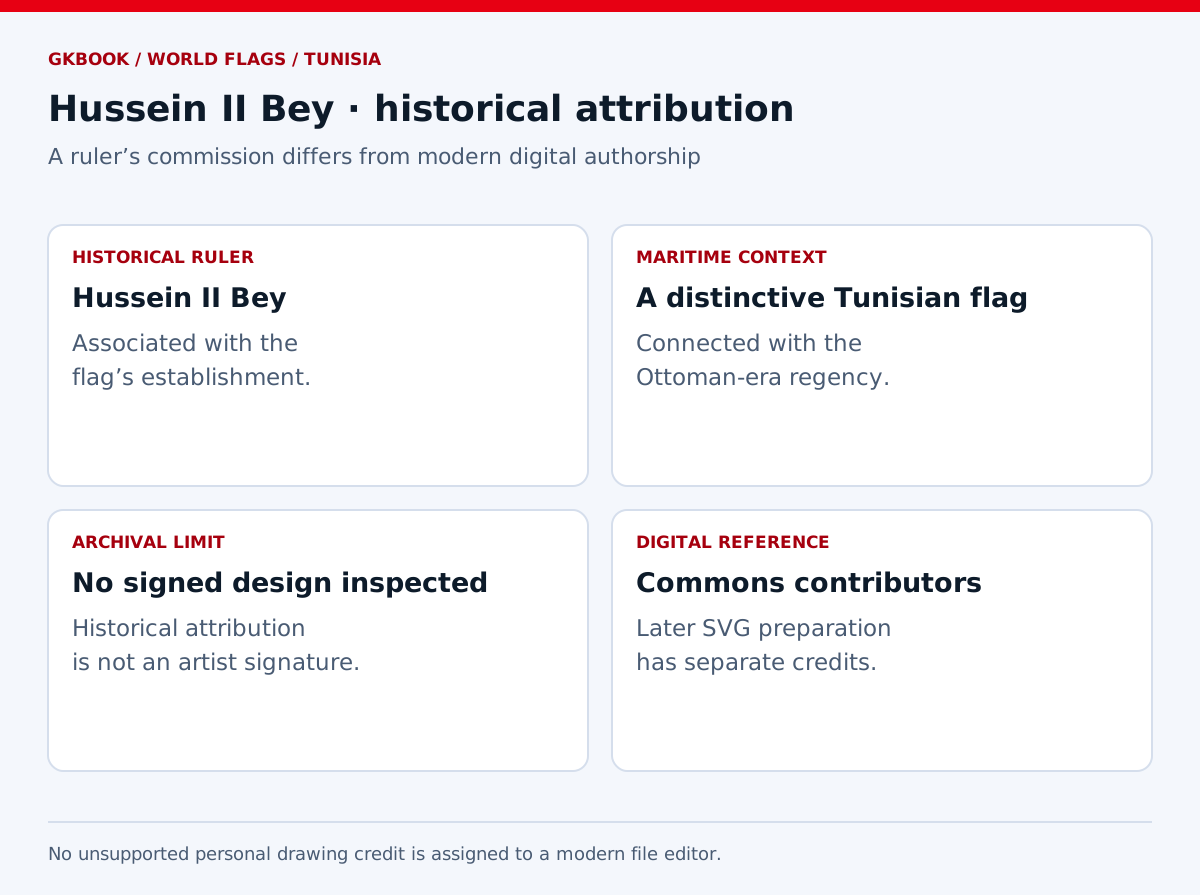
Historical design attribution needs to distinguish a commissioner, an approving authority, and the person who physically drew an early model. They can be different people. The sources reviewed connect the flag with the bey, but this package does not claim direct inspection of a signed original design sheet.
The downloadable SVG is a new mathematical reconstruction using the documented proportions. Its preparation does not replace the historical attribution, and the reference file’s editing history is not a list of nineteenth-century designers. Keeping those credits separate makes both the history and the digital reproduction easier to understand.
What does Tunisia’s current constitution say about the flag?
Article 8 of the 2022 Constitution describes the red flag with a central white circle containing a red five-pointed star surrounded by a red crescent, as specified by law. Organic Law 99-56 of June 30, 1999 provides the detailed construction. Older constitutional article numbers should not be mistaken for the current provision.
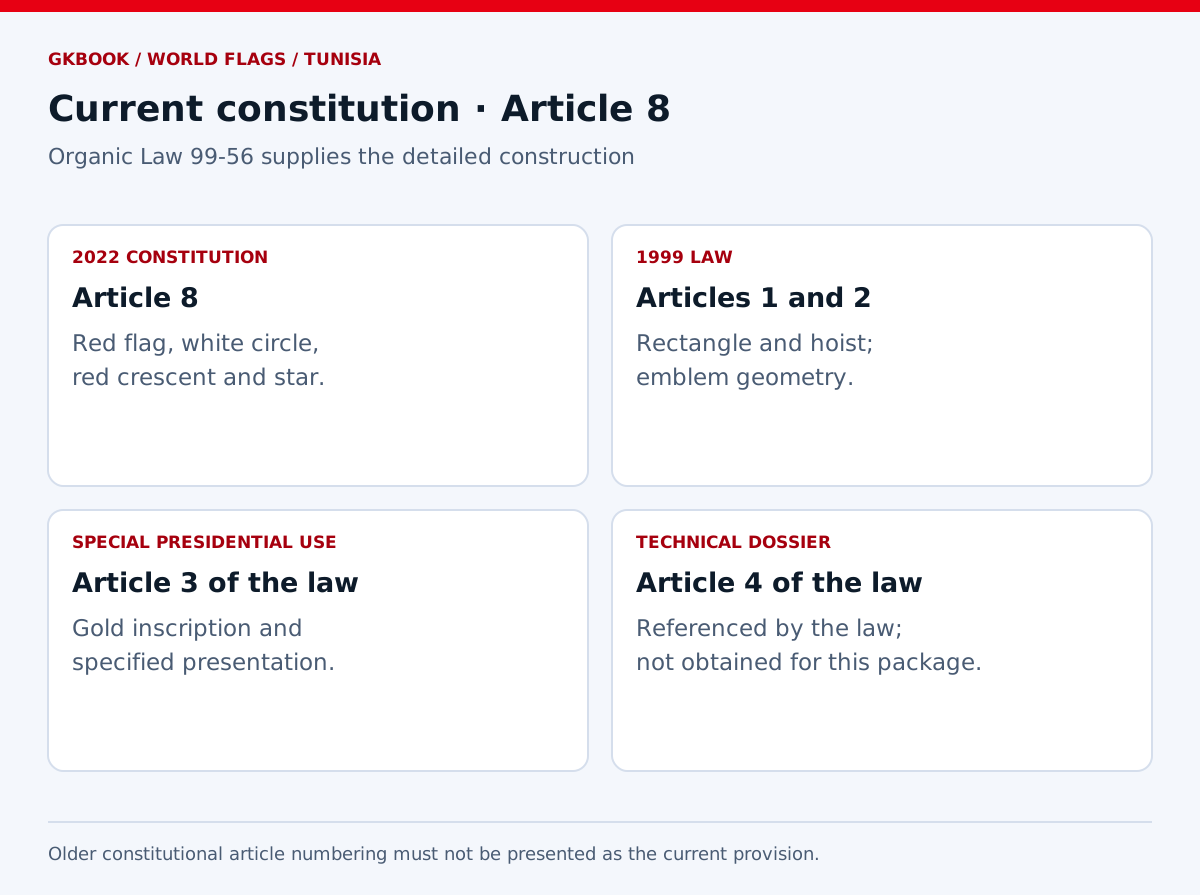
The constitutional description identifies the national emblem at a broad level. The separate flag law supplies the geometry used to reproduce it consistently. Reading these documents together avoids assuming that every measurement appears in the constitution or that a general constitutional description is a complete drawing manual.
Article 4 of the 1999 law refers to an accompanying technical dossier, including color specifications. That is a statutory article, not the current constitutional flag provision. The inspected Gazette page contains the law text, but the referenced dossier was not obtained, so this edition does not claim its digital red is dossier-certified.
What did the 1999 flag law standardize?
The 1999 law specifies the rectangular proportions, disk, star position and size, and the two crescent arcs. Its Gazette footnote records parliamentary adoption on June 29; the law is dated June 30 and appears in the July 6 issue. These dates concern formal construction rules, not the flag’s nineteenth-century origin.
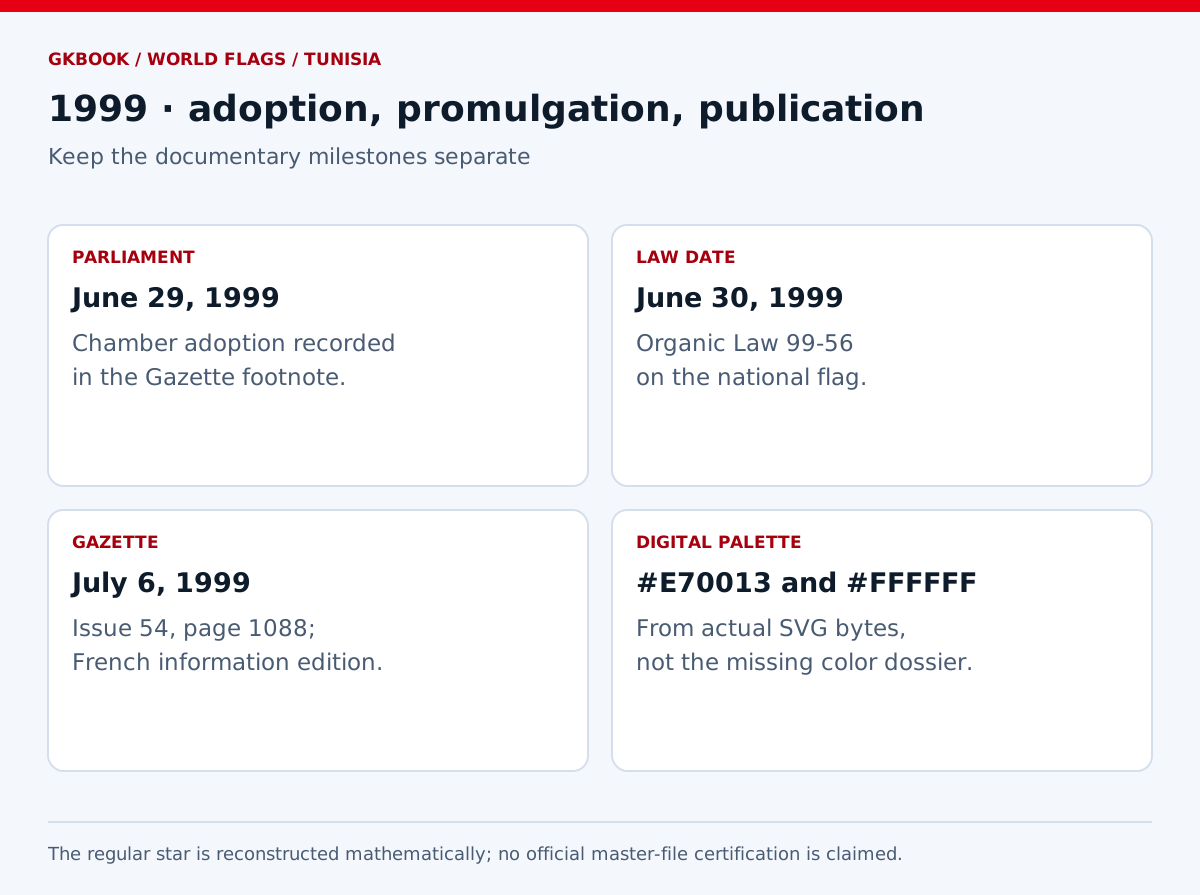
The inspected French information edition is Gazette number 54, page 1088. Its numerical relationships support a scalable drawing rather than a single fixed physical size. A small desk flag and a larger flag can therefore share the same proportions while using different materials and production processes.
The law’s named red and white are distinct from this package’s declared screen values. The latter follow the actual downloaded community SVG. The regular pentagram is reconstructed mathematically, with its inward radius derived from that geometry; it is not presented as a separately quoted measurement from the unexamined technical dossier.
Did independence or the republic change the national flag?
Tunisia retained the recognizable national design when it became independent on March 20, 1956 and when the republic was proclaimed on July 25, 1957. These are separate political milestones. The 1959 Constitution later described the republican flag, while the 1999 law supplied detailed measurements for reproducing the established emblem.
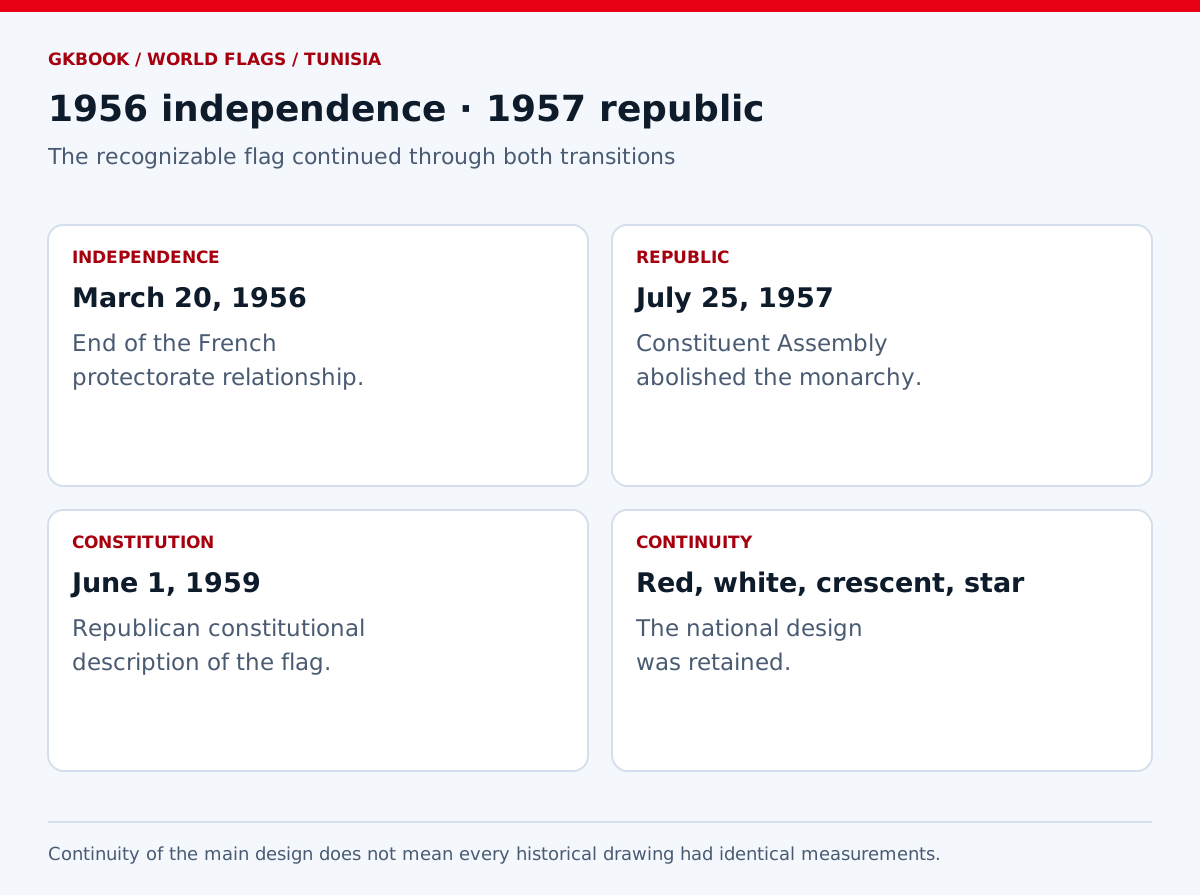
The flag’s continuity helped connect different periods of the country’s history. A change from monarchy to republic did not require the national picture to acquire a crown, a portrait, or an entirely new palette. The white disk, red crescent, and red star remained central to its identity.
Continuity should not be overstated as proof that every historical flag had mathematically identical curves and vertices. Older illustrations and manufactured examples can vary. The clean image supplied here follows the later specified geometry, while the historical account concerns the enduring arrangement and its use across the political transitions.
When did independent Tunisia gain international recognition?
The United States recognized Tunisia’s independence from France on March 22, 1956, and Tunisia entered the United Nations on November 12, 1956. These diplomatic milestones followed independence on March 20. They are distinct from the flag’s much earlier origins and do not constitute approval of a particular modern flag drawing.
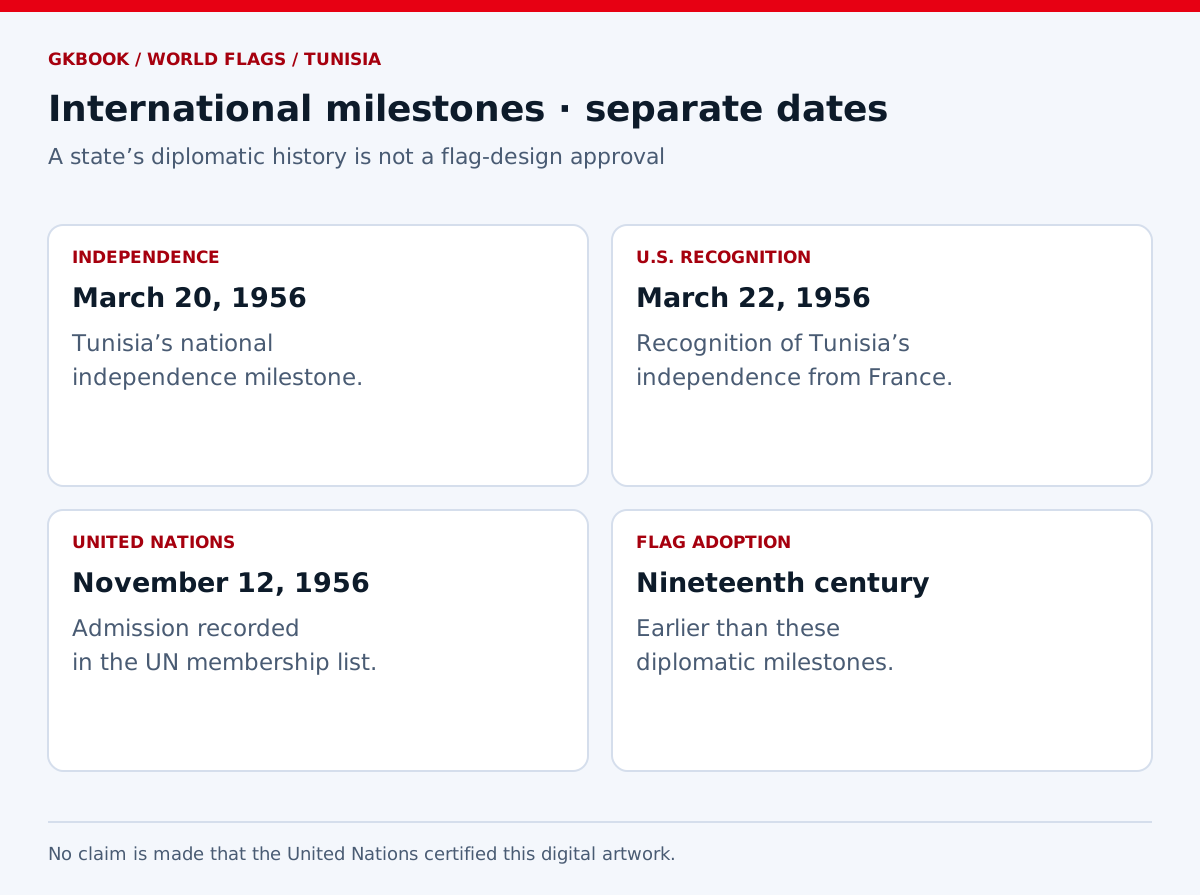
Recognition by one government and membership in an international organization are different acts. The U.S. historical record identifies its own recognition event, while the UN membership list records admission. Neither source should be used to imply that every other country recognized Tunisia on the same date.
For a timeline, show independence, recognition, and UN admission as separate entries. The flag can accompany all of them as a national symbol without being newly adopted each time it is displayed. This distinction is especially useful when a flag article also summarizes the country’s modern diplomatic history.
How does Tunisia’s flag differ from Türkiye’s flag?
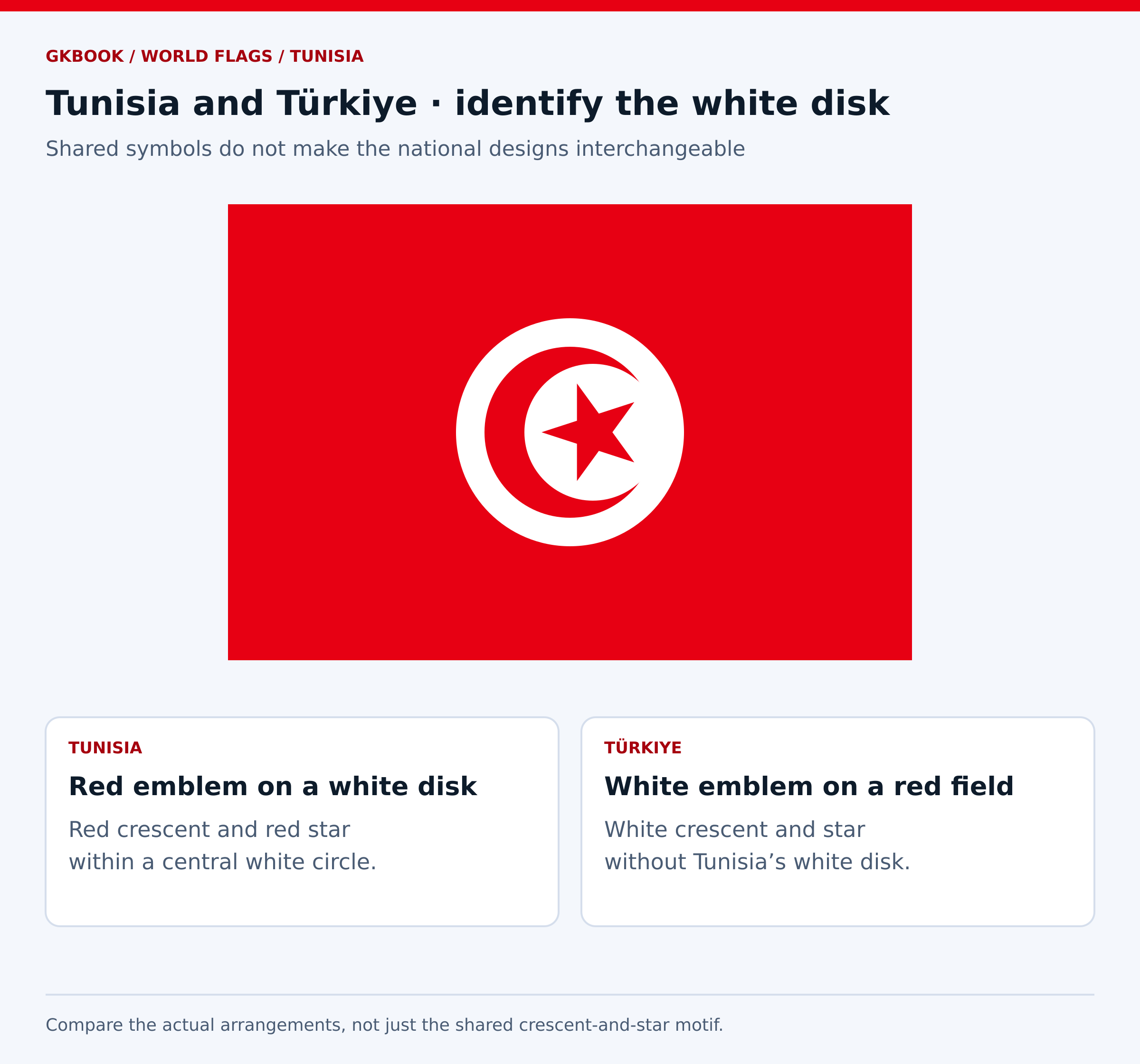
Tunisia places a red crescent and red star inside a centered white disk on a red field. Türkiye uses a white crescent and white star directly on a red field, without Tunisia’s white disk. The countries share a historical visual vocabulary, but the actual national arrangements are distinct and should not be interchanged.

The central disk is the quickest identifying feature when comparing small pictures. Look next at the color of the crescent and star. A white emblem directly against red points to a different arrangement from Tunisia’s red emblem surrounded by white, even before precise proportions are examined.
The comparison graphic supplies the complete Tunisian flag and describes the other arrangement in text. It does not pretend to provide a verified Turkish production master. Shared symbols occur across many flags, so identification should rely on their placement, colors, and surrounding shapes as well as the country label.
What flags preceded the modern Tunisian national design?
Earlier Tunisian history includes dynastic, maritime, military, and religious banners that served different purposes. They should not all be treated as successive versions of one modern national flag. The nineteenth-century red-white crescent-and-star design emerged from that wider setting, and historical reports describe several traditions rather than one simple replacement sequence.
A ruler’s personal standard can coexist with flags used by ships or other institutions. That makes a single row of alleged predecessors potentially misleading unless each banner’s role and period are documented. Historical illustrations also differ in detail, and their survival does not automatically establish official nationwide use.
This article describes the context without supplying invented historical production files. An accurate reconstruction of an earlier banner would require its own evidence for colors, dimensions, charges, and date. A picture copied from a later chart should be labeled as such rather than silently promoted into an original contemporary artifact.
Is the presidential flag the same as the ordinary national flag?
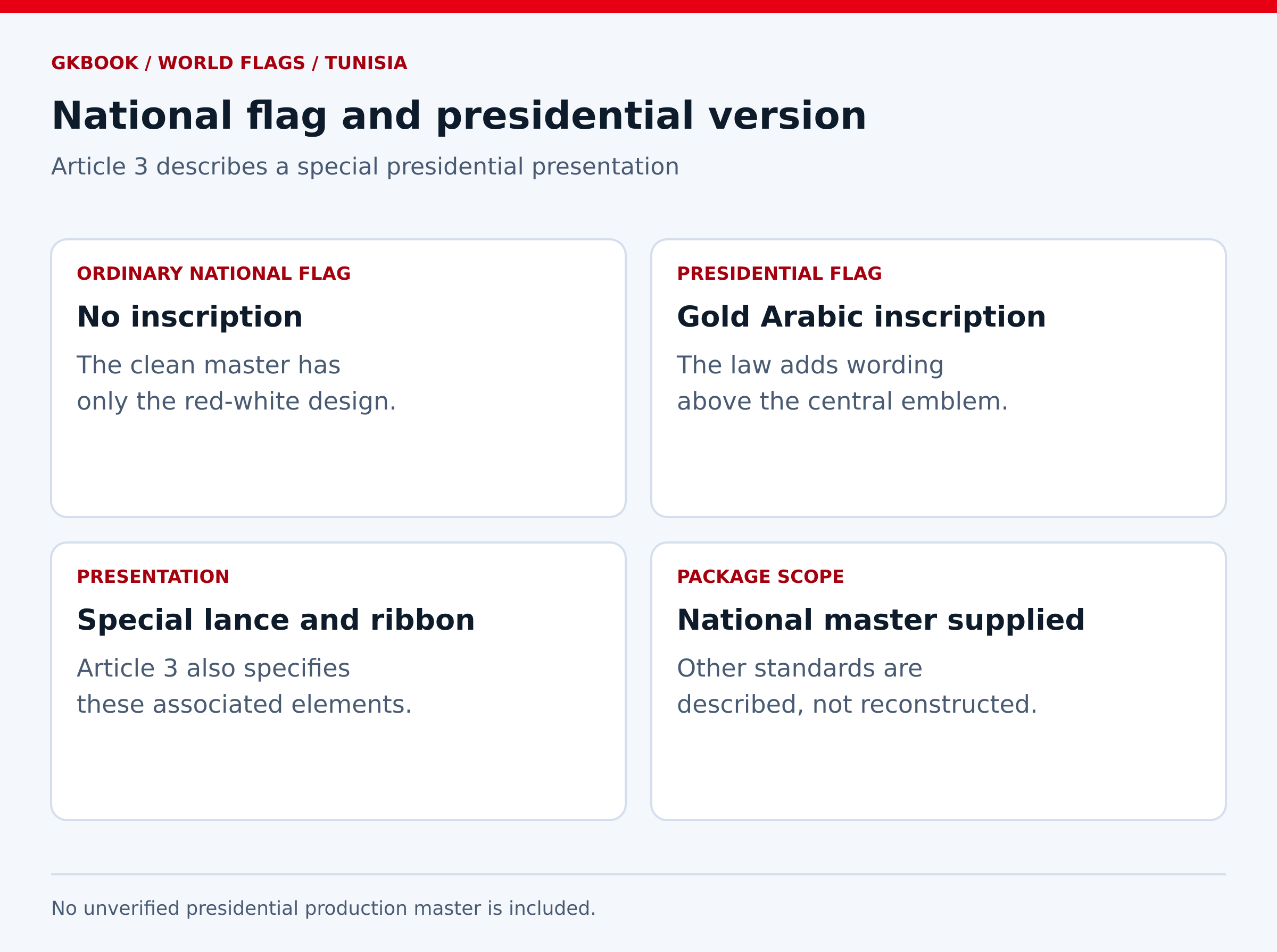
The ordinary national flag has no inscription. Article 3 of the 1999 law describes a special flag for the president with a gold Arabic inscription and associated presentation details. That version should be identified separately. The clean files in this package depict the ordinary national flag, without the additional presidential elements.
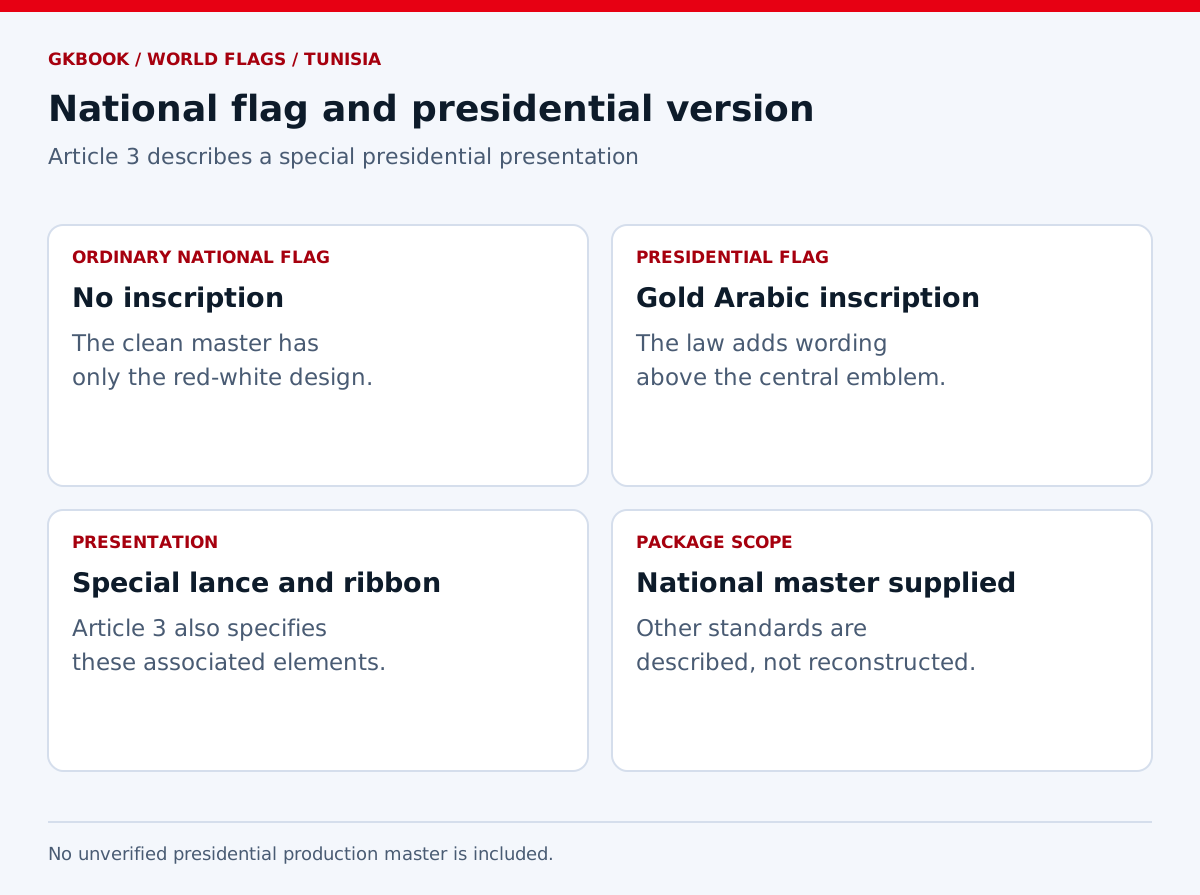
The law also describes the lance and ribbon associated with the presidential presentation. These physical features are different from the colored shapes within the ordinary flag rectangle. A photograph of a ceremonial flag may therefore show attachments that are not part of the basic national drawing.
Use the correct caption when an officeholder’s flag appears in an illustration. Adding presidential wording to a general national download would change the subject of the file. This package explains the distinction but does not supply a presidential production master based on unverified lettering, placement, or construction details.
Does the Tunisia flag include the national coat of arms?
No. The ordinary Tunisian national flag consists of the red field, white disk, red crescent, and red five-pointed star; it does not include the coat of arms. The 2022 Constitution treats the flag and arms in separate provisions. Adding a shield or other heraldic artwork would alter this national flag design.
The crescent and star may appear in other national contexts, but their presence does not make every emblem interchangeable. A government seal, a coat of arms, and a flag are separate forms of identification. Each needs its own source and construction rather than borrowing parts simply because they represent the same country.
For the clean downloadable flag, retain only the specified shapes. A surrounding title or explanatory caption can belong to the page layout, provided it stays outside the flag rectangle. The gallery’s annotated diagrams make that separation visible, while the master itself remains free of labels, badges, and decorative additions.
How should the Tunisia flag be presented respectfully?
Use a complete, correctly proportioned flag with the proper emblem orientation and colors, and keep explanatory labels outside its rectangle. For official ceremonies, follow the responsible institution’s applicable protocol. This article provides an accurate reference drawing; it does not establish a universal order of precedence, mourning schedule, or vertical display rule.
Practical display involves the object as well as its picture. Fabric condition, secure attachments, lighting, and the location of neighboring flags can matter to an installation. Those choices should be resolved for the particular event instead of inferred from the geometry of a downloadable SVG.
The ordinary horizontal front view is the reference used throughout the package. When a diagram shows another view, its caption identifies the transformation. Clear labeling prevents an educational illustration from being mistaken for an instruction to change the national design or a claim that one installation method suits every setting.
How does the Tunisia flag look when rotated vertically?
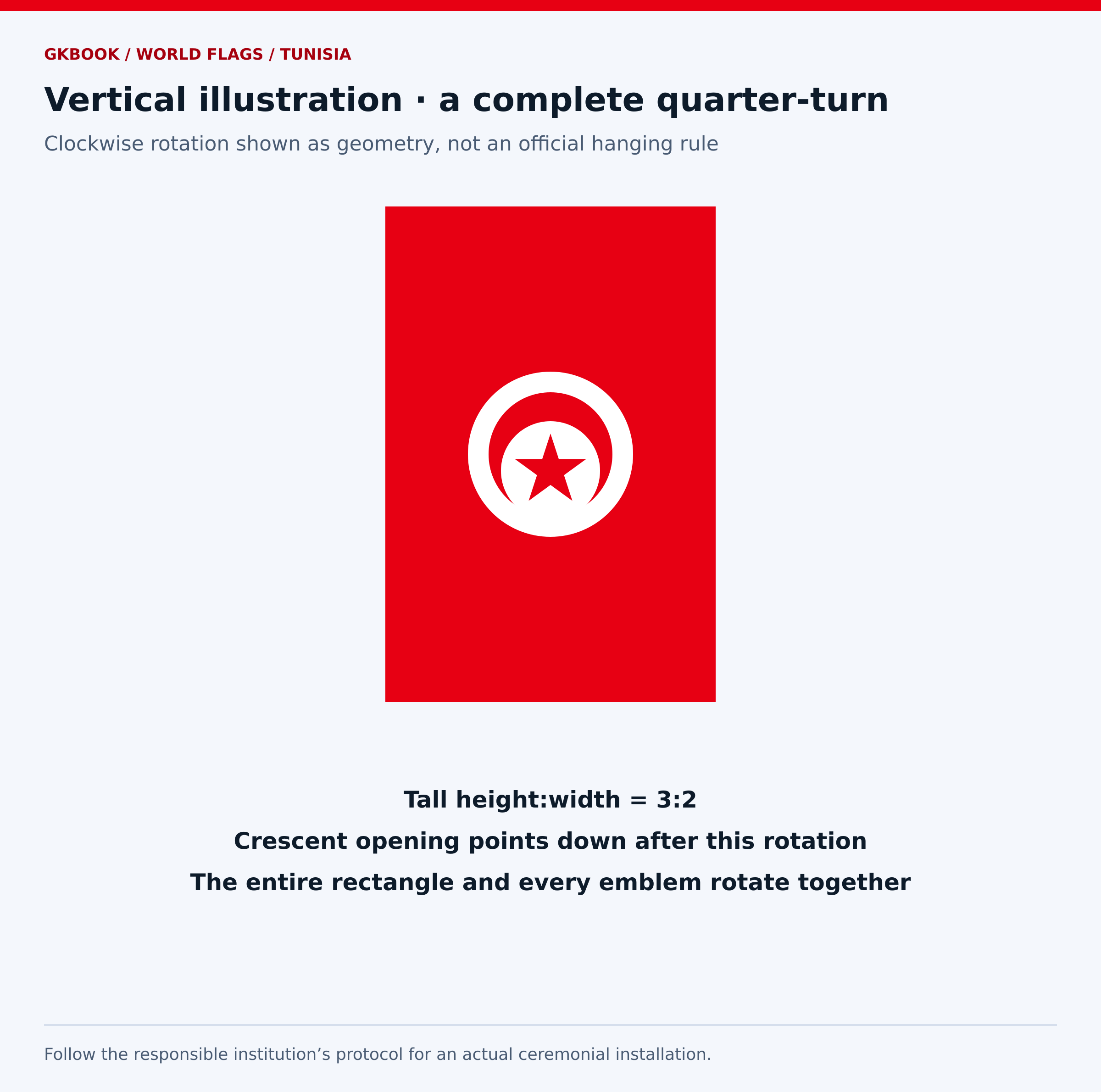
A clockwise quarter-turn of the complete horizontal flag produces a tall rectangle with height:width 3:2. In that geometric illustration, the crescent opening points downward and the star rotates with it. This demonstrates the transformation of the design; it is not a universal instruction for an official vertical installation.
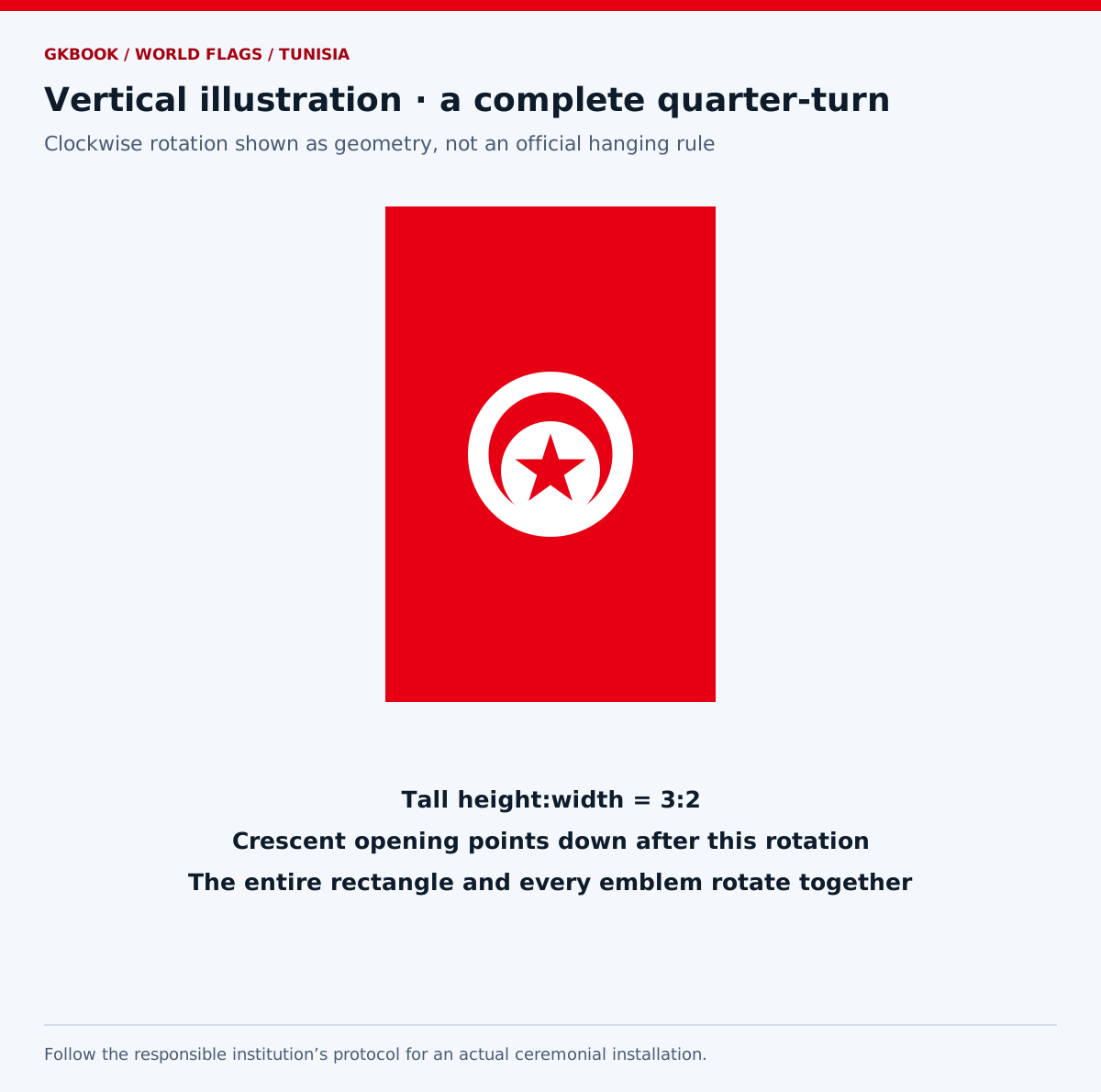
Rotate the whole rectangle rather than turning only the emblem. The disk remains circular because the image is rotated without stretching, and all distances between its parts remain unchanged. The original hoist edge becomes the top edge in the clockwise illustration included with this article.
A real hanging arrangement may be governed by institutional instructions and the way a flag is manufactured or attached. The drawing alone cannot determine those requirements. Its purpose is narrower: it shows how the complete national geometry behaves under a clearly labeled rotation, preserving every shape and the original proportions.
What does the reverse of the Tunisia flag look like?
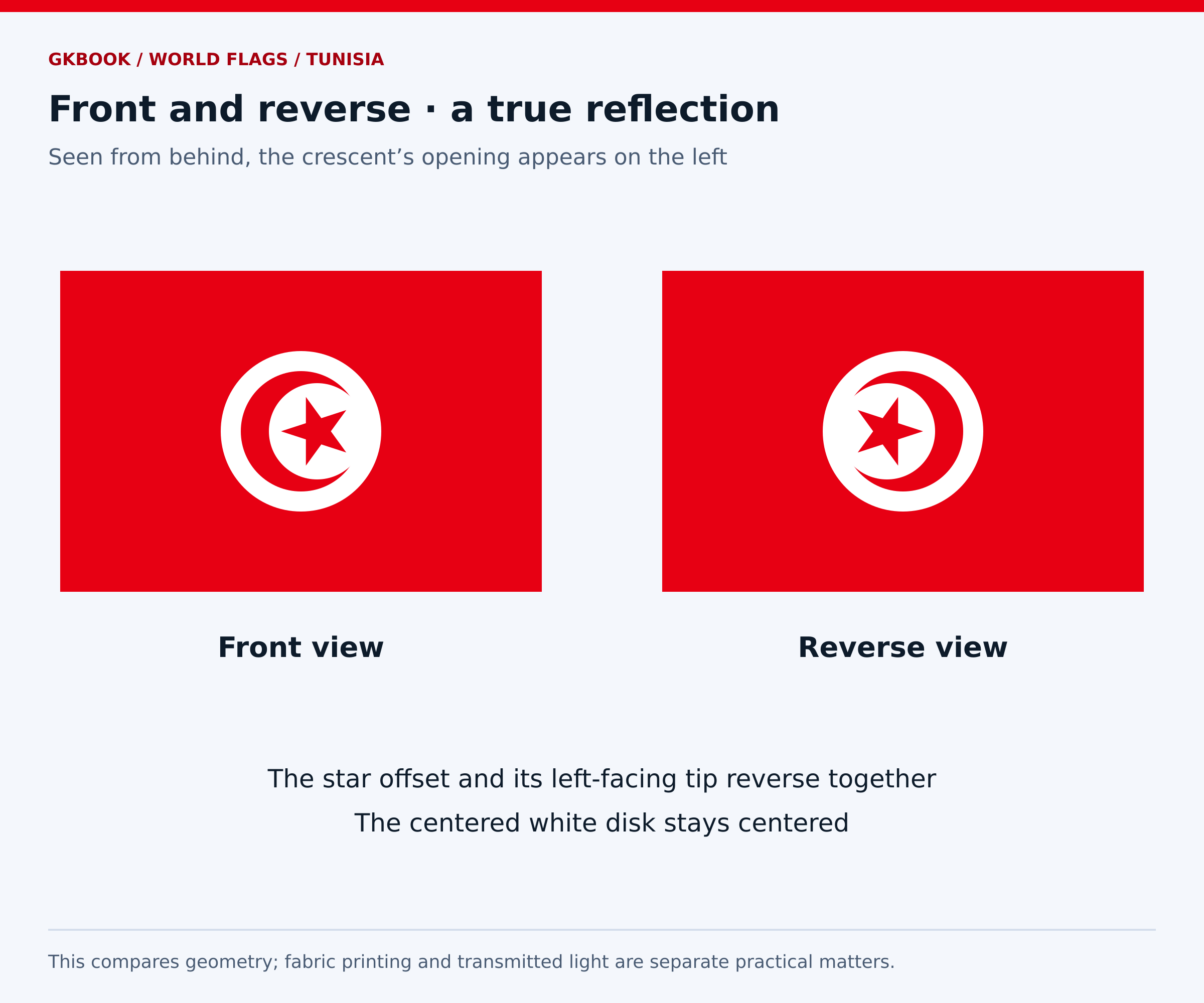
In a flat geometric model, the reverse is the left-right reflection of the front. The crescent then opens to the left, and the star’s offset and point orientation reverse with it. The white disk remains centered. This change of viewpoint does not introduce a second national design or a different palette.
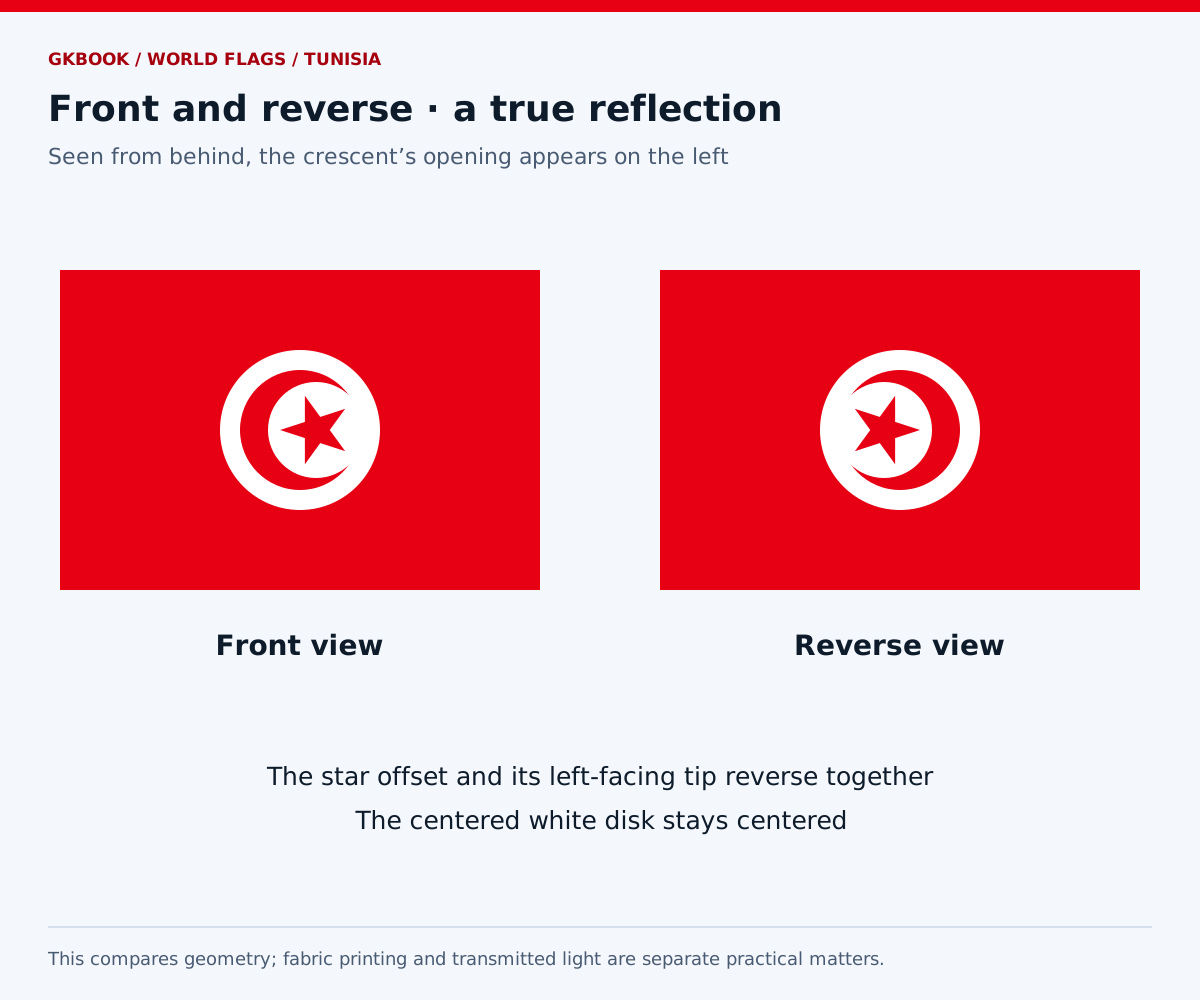
Imagine walking around the flag while keeping its top edge uppermost. The pole that appears at the left in the front reference appears at the right from behind. The emblem’s apparent direction changes accordingly, while its size and relationship to the surrounding disk remain the same.
The illustration reflects the same complete master rather than redrawing the crescent by eye. Printing on cloth, seams, and light transmission can affect a physical reverse view, but those production details do not change the geometric comparison. A mirrored picture should be labeled clearly when placed beside the standard front.
Is the Tunisia flag symmetrical?
The ideal design has reflection symmetry across its horizontal centerline: flipping top and bottom preserves the arrangement. It does not have left-right reflection symmetry or half-turn symmetry, because those operations reverse the crescent opening and star orientation. The centered white disk alone has more symmetry than the complete national flag.

The star’s left-facing point lies on the horizontal median, and its other points form matching pairs above and below it. Both crescent circles also have centers on that line. These properties make the upper and lower halves correspond without requiring the emblem to be centered at just one point.
A half-turn moves the crescent opening to the opposite side. This is visibly different even though the red rectangle and white disk still coincide with their starting positions. Judge the symmetry of the whole colored arrangement, not just the outer rectangle or its largest circular component.
How should the Tunisia flag be resized or printed?
Resize both dimensions together and keep the complete 2:3 rectangle, circular disk, offset star, and crescent opening. The 9,000 by 6,000 PNG corresponds to 30 by 20 inches at 300 pixels per inch. Use the SVG when scalable geometry is needed, and proof physical colors on the intended material.

Place borders, titles, and page margins outside the flag rather than over its corners or emblem. When a layout has a different aspect ratio, fit the entire national rectangle inside it. The separate social card follows this approach, showing a complete proportional flag within a wider composition.
The declared RGB palette describes the digital image, not a universal print or textile recipe. A production workflow should account for its color profile, substrate, and intended viewing conditions. Keep the image credits with reusable files so that the sources, construction choices, and distinction between official design rules and digital reproduction remain available.
What matters when the Tunisia flag is displayed very small?
At small sizes, preserve the white disk, visible crescent opening, and recognizable five-pointed star. Antialiasing blends pixels along curved and diagonal edges, so inspect the actual display size instead of judging only the large master. Keep the 2:3 rectangle and avoid sharpening that introduces outlines or closes the white gaps.
A star that is clear in a large image may lose its inward notches when reduced to a few pixels. The crescent’s pointed ends can also soften. Those effects are raster limitations, not reasons to invent a different official emblem or enlarge one feature without changing the others.
Use a concise alternative description that identifies the country and the red-white arrangement. In a compact interface, pair the image with a country label when possible. A flat vector reference is useful for studying the exact design because decorative folds, shadows, and perspective can obscure the geometry that a small icon already compresses.
Download Tunisia flag pictures
Download the complete national flag as SVG or 9,000 × 6,000 PNG. Its height:length ratio is 2:3. The red field, white disk, crescent, and star remain complete.
The gallery contains 24 subjects, each with an SVG and PNG. Captions distinguish the clean flag from construction guides, historical explanations, and geometric transformations. Image credits and reproduction notes identify the sources, palette, and scope of the original explanatory additions. The separate 1,200 × 630 social card contains a complete flag measuring 540 × 360 units.
Continue exploring national designs in World Flags.
World Flags/Tunisia
Tunisia flag pictures
Complete national flag, height:length 2:3; exact circular geometry and a regular five-pointed star.
GKBook reconstruction and explanatory artwork; historical and digital sources documented in credits.Download SVGDownload PNGRed #E70013 and white #FFFFFF are the declared digital values; an official technical color dossier was not obtained.
GKBook reconstruction and explanatory artwork; historical and digital sources documented in credits.Download SVGDownload PNGCommon reference explanations associate red with sacrifice and white with peace; the law defines the design, not this symbolic glossary.
GKBook reconstruction and explanatory artwork; historical and digital sources documented in credits.Download SVGDownload PNGThe disk center is the flag center, while the star center is slightly farther toward the fly.
GKBook reconstruction and explanatory artwork; historical and digital sources documented in credits.Download SVGDownload PNGThe red crescent is the part of the outer circle outside the offset inner circle.
GKBook reconstruction and explanatory artwork; historical and digital sources documented in credits.Download SVGDownload PNGThe regular pentagram uses the legally specified outer diameter and orientation; the inner radius is a mathematical derivation.
GKBook reconstruction and explanatory artwork; historical and digital sources documented in credits.Download SVGDownload PNGThe 9,000 × 6,000 master has height:length 2:3.
GKBook reconstruction and explanatory artwork; historical and digital sources documented in credits.Download SVGDownload PNGThe SVG uses an opaque red field, three circles, and a filled ten-vertex star outline.
GKBook reconstruction and explanatory artwork; historical and digital sources documented in credits.Download SVGDownload PNGThe two centers are 300 units apart in the master; the blue marker is an explanatory guide.
GKBook reconstruction and explanatory artwork; historical and digital sources documented in credits.Download SVGDownload PNGIn the standard front view, the crescent opens right and the star has a left-facing point.
GKBook reconstruction and explanatory artwork; historical and digital sources documented in credits.Download SVGDownload PNGThe calculated shares include all red in the field, crescent, and star.
GKBook reconstruction and explanatory artwork; historical and digital sources documented in credits.Download SVGDownload PNGThe creation commemoration, competing adoption years, and later construction law refer to different historical claims.
GKBook reconstruction and explanatory artwork; historical and digital sources documented in credits.Download SVGDownload PNGThe conventional 1831 adoption date is presented with the documented 1835 alternative.
GKBook reconstruction and explanatory artwork; historical and digital sources documented in credits.Download SVGDownload PNGInstitutional accounts associate the flag’s creation with Hussein II Bey, while the SVG has modern contributors.
GKBook reconstruction and explanatory artwork; historical and digital sources documented in credits.Download SVGDownload PNGThe current constitutional provision is Article 8; Article 4 of the 1999 law refers to a technical dossier.
GKBook reconstruction and explanatory artwork; historical and digital sources documented in credits.Download SVGDownload PNGThe inspected Gazette distinguishes parliamentary adoption, law date, and publication.
GKBook reconstruction and explanatory artwork; historical and digital sources documented in credits.Download SVGDownload PNGIndependence and proclamation of the republic are distinct events in the flag’s continuing history.
GKBook reconstruction and explanatory artwork; historical and digital sources documented in credits.Download SVGDownload PNGU.S. recognition and UN admission are distinguished from independence and the flag’s origins.
GKBook reconstruction and explanatory artwork; historical and digital sources documented in credits.Download SVGDownload PNGThe diagram shows the complete Tunisian flag and describes the contrasting color arrangement of Türkiye.
GKBook reconstruction and explanatory artwork; historical and digital sources documented in credits.Download SVGDownload PNGThe special presidential flag described in Article 3 is not substituted for the ordinary national flag.
GKBook reconstruction and explanatory artwork; historical and digital sources documented in credits.Download SVGDownload PNGA clockwise quarter-turn produces a 360 × 540 tall flag in this diagram.
GKBook reconstruction and explanatory artwork; historical and digital sources documented in credits.Download SVGDownload PNGThe reverse is a horizontal reflection of the entire master.
GKBook reconstruction and explanatory artwork; historical and digital sources documented in credits.Download SVGDownload PNGThe exact design is symmetric across its horizontal centerline but not under a half-turn.
GKBook reconstruction and explanatory artwork; historical and digital sources documented in credits.Download SVGDownload PNGA proportional resize preserves the circular disk, curved crescent, and regular star.
GKBook reconstruction and explanatory artwork; historical and digital sources documented in credits.Download SVGDownload PNGFrequently asked questions
What does the Tunisia flag look like?
The Tunisia flag has a red field with a centered white disk containing a red crescent and a red five-pointed star. Its height:length ratio is 2:3. In the standard front view, the crescent opens toward the right, while one star point faces left and its center sits slightly right of the disk’s center.
What is the Tunisia flag called?
The formal national designation is the flag of the Republic of Tunisia, also commonly called the Tunisian flag. That name identifies the ordinary national design: a red rectangle with the white disk, red crescent, and red star. It distinguishes the flag from a presidential version or another institutional emblem.
What are the colors of the Tunisia flag?
The national flag uses red and white. This digital edition declares red #E70013, or RGB 231, 0, 19, and white #FFFFFF, or RGB 255, 255, 255, matching the inspected reference SVG. These are reproduction values; the official technical color dossier mentioned in the 1999 law was not obtained.
What does the Tunisia flag symbolize?
The flag represents Tunisian national identity and sovereignty. Common reference explanations connect red with sacrifice in resisting oppression and white with peace. The crescent and star carry Islamic and Ottoman associations. These interpretations should be distinguished from the legal construction rules, which specify the design rather than a complete symbolic glossary.
What does the red on the flag represent?
Red is commonly interpreted as recalling the blood and sacrifice of those who resisted oppression. It also belongs to the flag’s historical relationship with Ottoman red ensigns. In the actual design, one red appears throughout the field, crescent, and star; the law does not assign each red shape a separate meaning.
Why does the Tunisia flag have a white disk?
The white disk provides the contrasting central area containing the red crescent and star and is commonly associated with peace. Its center is exactly at the rectangle’s center, and its diameter is one third of the flag’s length. In this 2:3 rectangle, that diameter also equals half the flag’s height.
How is the red crescent constructed?
The crescent is formed between two circular arcs. The outer circle shares the white disk’s center and has diameter one quarter of the flag’s length. The inner circle shares the star’s offset center and has diameter one fifth of the length. Their overlap leaves the red crescent on the hoist side.
How many points does the star have?
The Tunisian flag has one red star with five evenly spaced outer points. Their enclosing circle has diameter 15 percent of the flag’s length. This reconstruction uses a regular pentagram, with one point directed left along the horizontal median, and keeps the star separate from the surrounding crescent.
What are the proportions of the Tunisia flag?
The flag’s height:length ratio is 2:3, meaning that its length is one and a half times its height. The supplied master is 9,000 by 6,000 units. The 1999 law describes the shorter dimension as two thirds of the length and places the pole attachment along the left short edge.
How can the Tunisia flag be drawn accurately?
Start with a 9,000 by 6,000 red rectangle. Add the white disk at 4,500, 3,000 with radius 1,500. Place the red outer crescent circle there with radius 1,125, then the white inner circle at 4,800, 3,000 with radius 900. Finish with the regular red star centered at that second point.
Are the disk, crescent, and star centered at the same point?
No. The white disk and the crescent’s outer circle share the flag’s center, but the star and the inner circle sit one thirtieth of the flag’s length toward the fly. In this master, the two centers are 4,500, 3,000 and 4,800, 3,000, respectively, a horizontal separation of 300 units.
Which way do the crescent and star face?
In the usual front view with the hoist at the left, the crescent opens toward the right, or fly. One outer point of the star faces left along the horizontal median. The star’s center is slightly right of the disk center, so its left-facing point extends back toward the crescent.
How much of the Tunisia flag is red or white?
In the supplied exact vector construction, red covers approximately 90.6410 percent of the rectangle and visible white covers 9.3590 percent. The complete white disk would occupy 13.0900 percent before the red crescent and star are placed over it. These are calculated geometric shares, not official symbolic percentages.
How did the Tunisia flag develop?
The flag developed under Hussein II Bey in the nineteenth century, within Tunisia’s Ottoman-era political and maritime setting. Tunisian commemorations associate its creation with October 20, 1827, and institutional summaries commonly give 1831 for adoption. Other accounts give 1835; a recent TAP historical report explicitly acknowledges disagreement among historians.
When was the Tunisia flag adopted?
The adoption is usually dated to 1831 in Tunisian institutional accounts, while Britannica gives 1835. The package retains that difference instead of claiming an undisputed exact day. Independence in 1956 did not introduce a wholly new national design, and the detailed construction law of June 30, 1999 is a later standardization milestone.
Who is credited with establishing the Tunisia flag?
Hussein II Bey is associated with ordering the flag’s creation in Tunisian historical accounts. That attribution concerns a ruler’s commission and the establishment of a national emblem, rather than proof of a surviving signed drawing by an individual artist. Modern SVG contributors are credited separately for preparing later digital reproductions.
What does Tunisia’s current constitution say about the flag?
Article 8 of the 2022 Constitution describes the red flag with a central white circle containing a red five-pointed star surrounded by a red crescent, as specified by law. Organic Law 99-56 of June 30, 1999 provides the detailed construction. Older constitutional article numbers should not be mistaken for the current provision.
What did the 1999 flag law standardize?
The 1999 law specifies the rectangular proportions, disk, star position and size, and the two crescent arcs. Its Gazette footnote records parliamentary adoption on June 29; the law is dated June 30 and appears in the July 6 issue. These dates concern formal construction rules, not the flag’s nineteenth-century origin.
Did independence or the republic change the national flag?
Tunisia retained the recognizable national design when it became independent on March 20, 1956 and when the republic was proclaimed on July 25, 1957. These are separate political milestones. The 1959 Constitution later described the republican flag, while the 1999 law supplied detailed measurements for reproducing the established emblem.
When did independent Tunisia gain international recognition?
The United States recognized Tunisia’s independence from France on March 22, 1956, and Tunisia entered the United Nations on November 12, 1956. These diplomatic milestones followed independence on March 20. They are distinct from the flag’s much earlier origins and do not constitute approval of a particular modern flag drawing.
How does Tunisia’s flag differ from Türkiye’s flag?
Tunisia places a red crescent and red star inside a centered white disk on a red field. Türkiye uses a white crescent and white star directly on a red field, without Tunisia’s white disk. The countries share a historical visual vocabulary, but the actual national arrangements are distinct and should not be interchanged.
What flags preceded the modern Tunisian national design?
Earlier Tunisian history includes dynastic, maritime, military, and religious banners that served different purposes. They should not all be treated as successive versions of one modern national flag. The nineteenth-century red-white crescent-and-star design emerged from that wider setting, and historical reports describe several traditions rather than one simple replacement sequence.
Is the presidential flag the same as the ordinary national flag?
The ordinary national flag has no inscription. Article 3 of the 1999 law describes a special flag for the president with a gold Arabic inscription and associated presentation details. That version should be identified separately. The clean files in this package depict the ordinary national flag, without the additional presidential elements.
Does the Tunisia flag include the national coat of arms?
No. The ordinary Tunisian national flag consists of the red field, white disk, red crescent, and red five-pointed star; it does not include the coat of arms. The 2022 Constitution treats the flag and arms in separate provisions. Adding a shield or other heraldic artwork would alter this national flag design.
How should the Tunisia flag be presented respectfully?
Use a complete, correctly proportioned flag with the proper emblem orientation and colors, and keep explanatory labels outside its rectangle. For official ceremonies, follow the responsible institution’s applicable protocol. This article provides an accurate reference drawing; it does not establish a universal order of precedence, mourning schedule, or vertical display rule.
How does the Tunisia flag look when rotated vertically?
A clockwise quarter-turn of the complete horizontal flag produces a tall rectangle with height:width 3:2. In that geometric illustration, the crescent opening points downward and the star rotates with it. This demonstrates the transformation of the design; it is not a universal instruction for an official vertical installation.
What does the reverse of the Tunisia flag look like?
In a flat geometric model, the reverse is the left-right reflection of the front. The crescent then opens to the left, and the star’s offset and point orientation reverse with it. The white disk remains centered. This change of viewpoint does not introduce a second national design or a different palette.
Is the Tunisia flag symmetrical?
The ideal design has reflection symmetry across its horizontal centerline: flipping top and bottom preserves the arrangement. It does not have left-right reflection symmetry or half-turn symmetry, because those operations reverse the crescent opening and star orientation. The centered white disk alone has more symmetry than the complete national flag.
How should the Tunisia flag be resized or printed?
Resize both dimensions together and keep the complete 2:3 rectangle, circular disk, offset star, and crescent opening. The 9,000 by 6,000 PNG corresponds to 30 by 20 inches at 300 pixels per inch. Use the SVG when scalable geometry is needed, and proof physical colors on the intended material.
What matters when the Tunisia flag is displayed very small?
At small sizes, preserve the white disk, visible crescent opening, and recognizable five-pointed star. Antialiasing blends pixels along curved and diagonal edges, so inspect the actual display size instead of judging only the large master. Keep the 2:3 rectangle and avoid sharpening that introduces outlines or closes the white gaps.
Every general-knowledge topic and the A-to-Z lists.
The world A to Z: flags, countries, the sciences, places, people, subjects.










We Value Your Opinion Comments