

Trinidad and Tobago flag picture
Explore the proportions, 1962 adoption, and picture gallery.
| National design | Republic of Trinidad and TobagoCaribbean nation with Trinidad and Tobago as its principal islands. |
|---|---|
| Design | Red field · white-edged black diagonalUpper hoist toward lower fly in the standard front view. |
| Proportions | Land height:length = 3:5Official guidance gives height:length 1:2 for flags at sea. |
| Adoption milestone | August 31, 1962Introduced at independence; design approval preceded the official hoisting. |
| Declared digital colors | Red #DA1A35 · black #000000 · white #FFFFFFInspected reference-SVG palette; no statutory HEX-code claim. |
| Main image sizes | SVG and PNG: 9,000 × 5,400Complete land rectangle; opaque RGB PNG. |
The diagonal is divided white:black:white as 1:4:1. Exact construction, declared digital color values, and official design requirements are distinguished.
What does the Trinidad and Tobago flag look like?
The Trinidad and Tobago flag has a red field crossed by a black diagonal band with narrow white borders. In the standard front view, the band descends from the upper hoist toward the lower fly. The land flag has a height-to-length ratio of 3:5; flags at sea use 1:2.
Identify the complete rectangle before examining its stripe. The hoist is the edge attached to the pole, conventionally shown on the left; the fly is the free end. Both white borders remain visible beside the black band. The red regions on either side complete the national design. A picture cropped to the diagonal alone therefore loses essential information. The supplied master shows the land flag, while separate diagrams explain its proportions, history, meanings, and orientation without adding guides to the clean national image.
What is the Trinidad and Tobago flag called?
Its formal description is the national flag of Trinidad and Tobago, or the national flag of the Republic of Trinidad and Tobago. That wording identifies the country and avoids confusing its national design with a presidential standard, a government minister’s flag, or a service ensign used for a particular function.
Use the full country name in a formal caption, especially when the image appears beside other Caribbean flags. An abbreviated label may be convenient in a small interface, but accompanying text should still make clear that the flag represents the entire country, including both principal islands.
A nickname is not needed to explain the design. Clear descriptions of the red field, black diagonal, and white edging work across contexts and are easier to verify against official documents. The national flag also differs from the coat of arms, which is a separate emblem rather than an additional part of this flag.
What are the colors of the Trinidad and Tobago flag?
The flag’s colors are red, black, and white. This digital edition uses red #DA1A35, black #000000, and white #FFFFFF, matching the inspected reference SVG. The legal description names colors but does not provide those HEX codes. The 2014 guide’s detailed color chart is labeled for the coat of arms.

The red is a single consistent fill across both exposed regions, and the central band is solid black. Its white borders are opaque white rather than transparent gaps. Shadows in photographs, fading in cloth, and screen brightness can change appearances without defining a different national palette.
Keep the source of numerical values separate from the source of the design. An RGB triplet is useful for reproducing a screen image, but it does not certify a textile dye or a printed ink. This package declares its digital reference rather than asserting an exact universal conversion between color systems.
| Color | HEX | RGB |
|---|---|---|
| Red | #DA1A35 | 218, 26, 53 |
| Black | #000000 | 0, 0, 0 |
| White | #FFFFFF | 255, 255, 255 |
What do the Trinidad and Tobago flag’s colors mean?
Official explanations associate red with vitality, sunlight, courage, and friendliness; black with dedication, strength, unity, and the land’s wealth; and white with the sea, equal standing, and pure aspirations. The colors also express fire, earth, and water. Their meaning emphasizes a shared nation across its people’s cultural differences.

Read the symbolism as a connected explanation of the national design. The three colors work together; they do not divide citizens into separate populations. Their arrangement creates a recognizable common emblem, while the official account describes values and natural elements associated with the country.
Symbolic associations are not measurements. A color’s share of the flag does not indicate a percentage of land, sea, wealth, or population. Likewise, the order of colors in a written list need not match their placement in the picture. Describe each visible element first, then connect it to the documented meaning.
What does the red on the flag represent?
Red represents the vitality of the country and its people, the sun’s warmth and energy, and courage and friendliness in official explanations. It is also linked with fire. Visually, red forms the background on both sides of the white-edged black diagonal, rather than a separate horizontal or vertical stripe.
A red rectangle is the first layer in this construction. The diagonal is then placed across it, leaving two exposed red regions. The geometry gives those regions equal areas, even though they occupy different corners and can seem unequal when the flag is folded, photographed obliquely, or partly hidden.
The official explanation is more specific than generic claims about red representing blood on every national flag. Meanings must be checked for the particular country. Here, the documented emphasis is vitality, sunlight, courage, and friendliness; importing another country’s symbolism would replace that explanation with an unsupported assumption.
What does the black diagonal represent?
Black represents the people’s dedication, their strength and shared purpose, and the wealth of the land. It is associated with earth in the official explanation. The black band is the broad central portion of the diagonal, flanked by two narrower white strips; it is not an outline around the entire flag.
The band connects the upper and lower edges through the middle of the rectangle. It is bounded by straight, parallel lines. Its broad shape makes it readable at a distance, but it should not be enlarged until the white borders disappear or reduced to a thin line.
The supplied drawing uses equal white borders and a black width four times that of either border. This relationship concerns construction, not the relative importance of the colors’ meanings. Treating a wider band as a larger demographic group would add an interpretation absent from the official symbolism.
Why does the black band have white borders?
The white borders separate the black diagonal from the red field and are part of the national design. This narrow edging is called fimbriation. White represents the sea, equality, and purity of aspirations in official explanations. Each white strip is one quarter as wide as the central black strip.

Fimbriation is a descriptive design term, not another emblem placed on the flag. Both white strips follow the same slope as the black band and have equal perpendicular widths. Their spacing must remain consistent throughout the image, including where the diagonal meets the top and bottom edges.
A dark outline around the flag cannot replace these internal borders. Nor should white be treated as missing background that lets a page color show through. When exporting a transparent image for a layout, preserve the flag’s white itself and keep any transparency outside the complete national rectangle.
Which way does the diagonal stripe run?
In the usual front view, the white-edged black stripe slopes downward from the upper left toward the lower right. These are the upper hoist and lower fly sides. The legal description uses the heraldic term “bend dexter.” A mirrored reverse view naturally shows the opposite apparent slope.

Heraldic directions are described from the bearer’s viewpoint, which can differ from the viewer’s left and right. For an accessible caption, identify the hoist and fly and describe the visible slope. That avoids relying on a specialized term without explaining how it appears on the page.
The corner-touching outer white boundary and the central black band are different lines. In the precise construction, the black strip does not begin at the exact corner. A quick diagonal stroke drawn directly between opposite corners would place the band differently and produce the wrong red and white regions.
What are the proportions of the Trinidad and Tobago flag?
The flag flown on land has height:length 3:5, equivalent to length:height 5:3 in official guidance. Flags carried at sea use height:length 1:2. The supplied land-flag master is 9,000 by 5,400 units, so its width is five thirds of its height rather than twice its height.

Always label the order of dimensions. A ratio written as 5:3 in a government document may describe length before height, while an atlas may write the same rectangle as 3:5. The numbers agree once their order is made explicit; they do not describe competing land flags.
To resize the master, multiply both dimensions by the same factor. For example, a 900 by 540 image and a 300 by 180 image preserve the land ratio. Cropping the sides or independently changing the height alters the flag even if its colors and general diagonal remain recognizable.
How can the Trinidad and Tobago flag be drawn accurately?
Start with a 9,000 by 5,400 red rectangle. Add parallel diagonal strips whose combined perpendicular width is 1,800 units, divided white:black:white as 300:1,200:300. Position the outer white strip boundaries through the upper-left and lower-right corners. The resulting slope and edge intersections follow from these conditions.

Use a coordinate system with the origin at the top left, x increasing rightward, and y increasing downward. The white outer parallelogram reaches about x 2,752.579786 along the top and begins about x 6,247.420214 along the bottom. Its opposite corners are the flag’s two specified corners.
The black parallelogram lies within that white shape, leaving the equal borders visible. All pieces use solid fills without strokes, gradients, or rounded corners. The explanatory construction chart includes measurements, but the clean SVG contains only the red rectangle and the two filled parallelograms.
How wide are the black and white stripes?
The combined stripe width is one fifth of the flag’s length, measured perpendicular to the stripe edges in this construction. Each white border takes one sixth of that total, while black takes four sixths. Thus the white:black:white ratio is 1:4:1, and either white border equals one thirtieth of the length.

For the 9,000-unit master, the three perpendicular widths are 300, 1,200, and 300 units. Together they make 1,800 units. Measuring the band horizontally along the top edge gives a longer distance because that edge cuts across the diagonal at an angle rather than at a right angle.
This is a common source of incorrect drawings. Setting the top-edge span to 1,800 units would make the band too narrow. Use a line normal to the parallel edges for width measurements, and reserve horizontal edge distances for locating the polygon’s vertices. The diagram shows the distinction explicitly.
What is the angle of the flag’s diagonal band?
The supplied exact land-flag construction gives an angle of approximately 40.838718 degrees to the horizontal. This is a calculated consequence of the 3:5 rectangle, the one-fifth perpendicular band width, and the corner contacts. It is not the roughly 30.963757-degree diagonal joining the rectangle’s opposite corners.

The outer strip edges run parallel to a direction whose horizontal span is about 6,247.420214 units for a vertical rise of 5,400. Taking the arctangent of height divided by that span gives the stated angle. The construction therefore determines the angle without an additional freely chosen rotation.
Use sufficient precision when preparing a scalable drawing, then round labels for readability. Rounding every vertex to a whole pixel before building the SVG can introduce small inconsistencies between borders. A vector master can retain decimal coordinates even when the exported image has an integer number of pixels.
How much of the flag is red, black, or white?
For the supplied exact construction, red occupies approximately 69.4158 percent of the rectangle, black 20.3895 percent, and the two white borders together 10.1947 percent. Each white border therefore covers about 5.0974 percent. These are calculated geometric areas, not official symbolic percentages or measurements taken from a photograph.

The outer parallelogram has a horizontal top-edge span of about 2,752.579786 units and a height of 5,400. Multiplying those quantities gives its area. One third of that area remains white, two thirds becomes black, and the rest of the enclosing rectangle remains red.
Both red triangles have equal areas because a half-turn exchanges them. Antialiasing introduces blended pixels along raster edges, so a count of only pure-color pixels need not equal the exact vector percentages. Use the geometry for area calculations and evaluate raster edge behavior as a separate rendering question.
How was the national flag developed in 1962?
The flag emerged from preparations for independence in 1962. A government committee considered national emblems and public suggestions, then submitted recommendations for approval. The contemporary government booklet records its report on June 26 and immediate Cabinet approval. The flag entered national use at independence on August 31, 1962.

The committee’s task formed part of a wider effort to establish recognizable symbols for the new nation. Design preparation, approval, publication, and ceremonial introduction were successive events. A useful historical account keeps those stages distinct instead of describing every date as the moment the flag was first flown.
The archived booklet is especially useful because it was published in the independence period. Later summaries do not give identical dates for every preparatory step: Britannica identifies June 28 for selection. That difference is recorded without silently changing the booklet’s June 26 report date or shifting the independence milestone.
When was the Trinidad and Tobago flag adopted?
August 31, 1962 is the flag’s national adoption and introduction date associated with independence from Britain. Preparatory selection and approval took place earlier that year. The flag was officially raised as independence began at midnight, so an account describing the night of August 30 refers to the transition into August 31.

Separate the legal and ceremonial milestones from the work of producing a design. The contemporary booklet discusses the committee and Cabinet stages in June; later histories describe the official independence hoisting. These accounts concern different points in the same process rather than requiring a single date for every action.
The year 1962 should also remain separate from the later legislation governing national emblems and the publication of reproduction guidance. Those documents explain protection and presentation after introduction. A modern SVG upload date marks an online file revision, not the country’s adoption of a new national flag.
Who designed the Trinidad and Tobago flag?
Carlisle Chang is credited with designing the flag within the work of the Independence Committee. Government accounts describe the committee’s selection, while the National Archives identifies Chang’s design role. These statements are complementary: an artist’s contribution, a committee’s recommendation, and the government’s approval are different parts of the process.
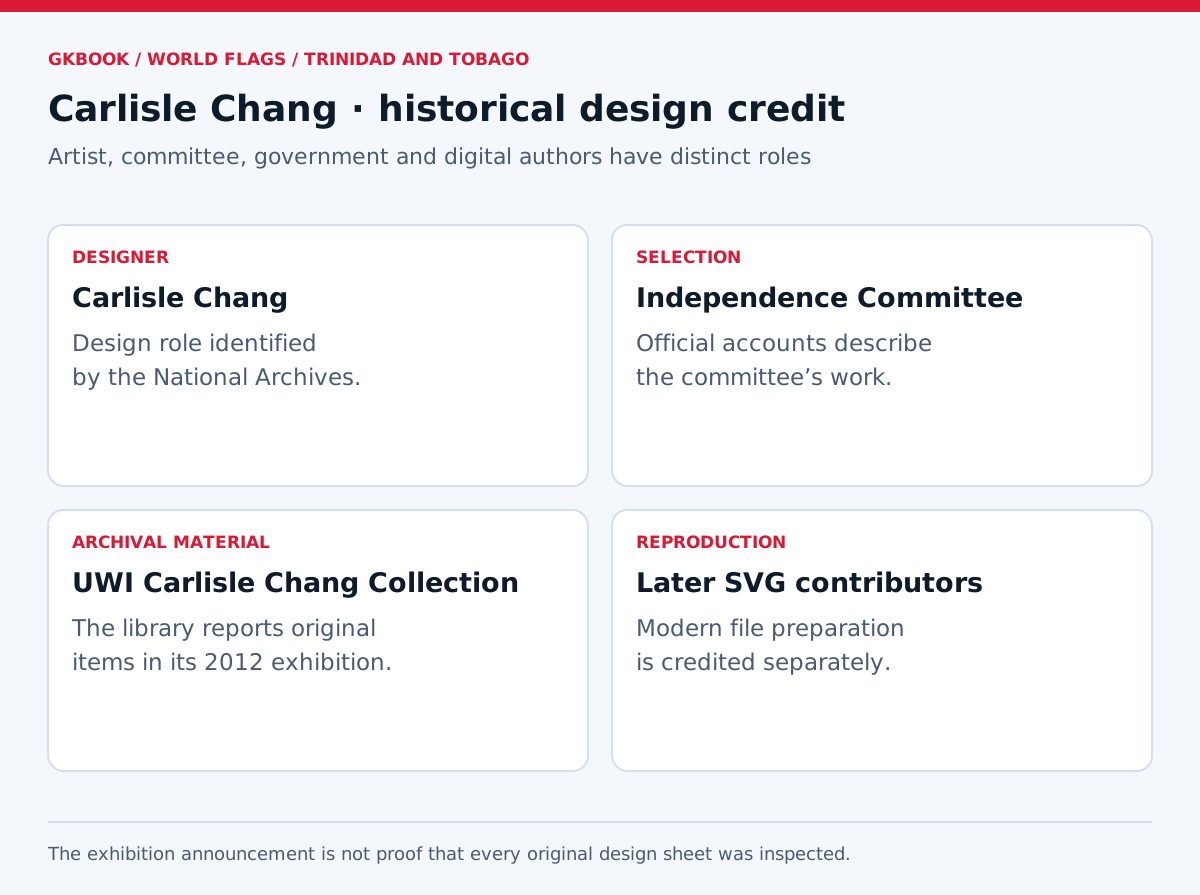
Attribution should distinguish the historical designer from people who later digitized the flag. The contributors named in an SVG file’s history prepared or corrected a modern drawing; they did not thereby design the national symbol in 1962. This package records those reproduction credits separately.
The University of the West Indies reports that its Carlisle Chang Collection supplied original materials for an independence exhibition. That collection provides an archival route for further study. Reviewing the exhibition announcement, however, is not the same as inspecting every original design sheet, so no such complete examination is claimed here.
What legal document describes the national flag?
Part II of the Schedule to the National Emblems of Trinidad and Tobago (Regulation) Act, Chapter 19:04, describes the red field and white-bordered black diagonal and specifies the band-width relationship. The inspected consolidation is labeled updated through December 31, 2013. Later amendments and practical guidance must be identified separately.

The Act is identified as Act 14 of 1967, with commencement recorded as December 1, 1980 in the inspected text. Neither date replaces the flag’s introduction at independence in 1962. Dates on a legal consolidation indicate the edition reviewed, which is different again from a design’s historical origin.
The reviewed 2025 amendment changes Part I concerning the coat of arms, not Part II’s flag description. The accompanying proclamation supplies its commencement date. Keeping those provisions separate prevents a change to one national emblem from being misreported as a redesign of the red, white, and black flag.
How are official rules different from digital flag specifications?
Official documents establish the design, proportions, band relationship, and use guidance. A digital specification translates those requirements into coordinates, files, and a declared palette. This edition uses exact mathematical geometry and the inspected SVG’s red #DA1A35. It does not claim that the statute prescribes that HEX value or these pixel dimensions.

The 2014 National Identity Guidelines were issued to improve consistency in national-emblem presentation. Their flag section gives ratios and illustrations. Their detailed numerical color chart is explicitly headed for the coat of arms, so copying one of its swatches into a supposedly statutory flag palette would confuse two subjects.
The drawing specification included here names the chosen dimensions, coordinate formulas, and rounding policy. That makes the supplied illustration reproducible without presenting an arbitrary raster size as a legal rule. A manufacturer still needs the applicable official requirements and appropriate physical color references for the intended material and use.
Did becoming a republic change the national flag?
Trinidad and Tobago retained its national flag when it became a republic on August 1, 1976. Republic Day is observed on September 24, the date of the first parliamentary meeting under the republican Constitution. Neither date should be substituted for the flag’s independence-era introduction on August 31, 1962.

Independence and republican status describe different constitutional developments. In 1962 the country became independent while retaining the monarch as head of state. In 1976 a president became head of state. A change in that office did not require the country to replace its national flag.
The presidential standard and the national flag nevertheless have different roles. When reading a photograph or ceremonial account, identify which one is shown. A later illustration of a presidential flag should not be treated as evidence that the familiar national design was withdrawn or that its adoption year changed.
When did Trinidad and Tobago join the United Nations?
Trinidad and Tobago joined the United Nations on September 18, 1962, shortly after independence. The United States records its own recognition and establishment of diplomatic relations on August 31, 1962. UN admission, bilateral recognition, and national flag introduction are distinct events, even when some dates coincide.
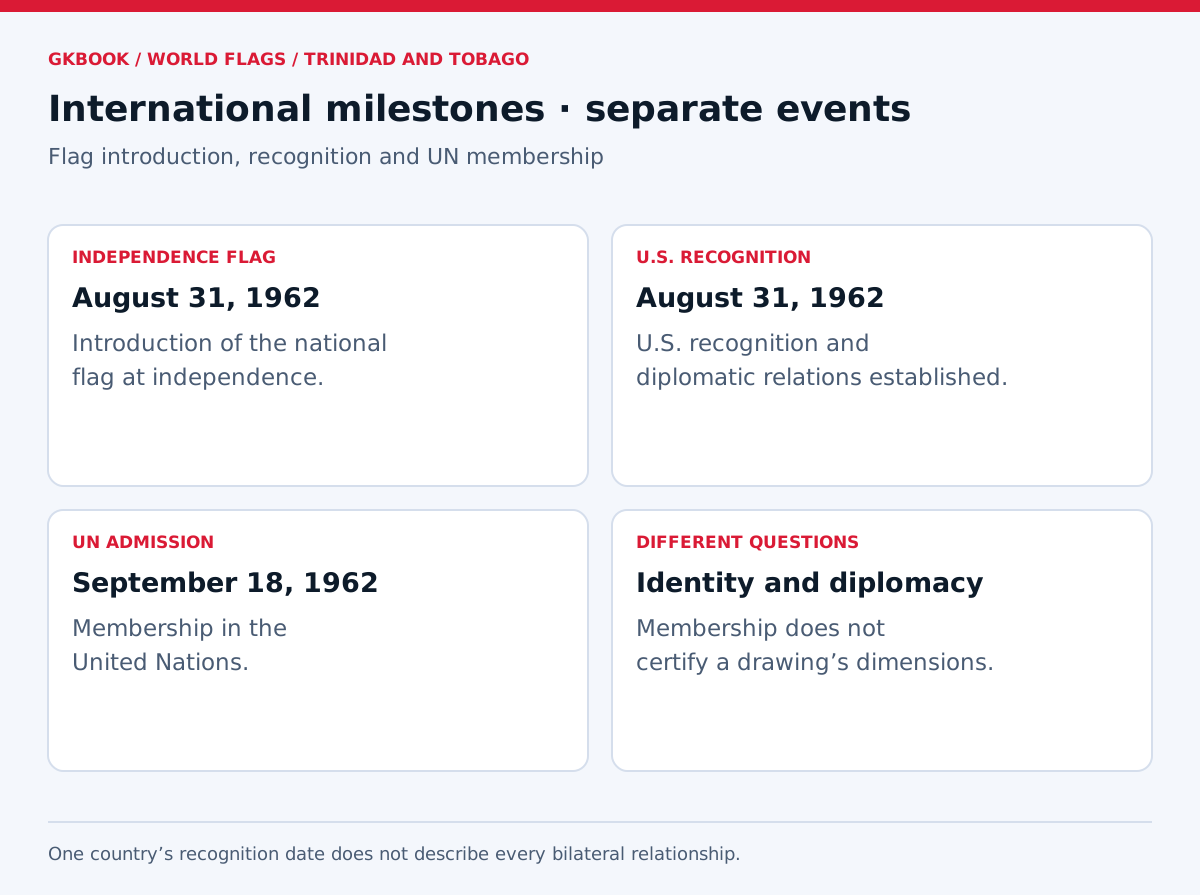
Membership in an international organization is not the same process as one government recognizing another state. A timeline should therefore label the institution or government responsible for each event. There is no single date that automatically represents every country’s diplomatic recognition of Trinidad and Tobago.
These international milestones explain the setting in which the flag began appearing at diplomatic venues. They do not supply its construction coordinates or certify a particular SVG. For that information, use the national description and documented reproduction specifications, rather than inferring measurements from a flag in a group photograph.
Is the flag used at sea a different shape?
Yes. Official guidance gives flags flown on land a length:height ratio of 5:3 and flags flown at sea a ratio of 2:1. Both refer to the red, black, and white national design. The downloadable clean master in this package is the land version, with height:length 3:5.

A longer maritime rectangle should be identified explicitly in a caption, so it is not mistaken for a stretched land flag. Different proportions can be appropriate to different uses. The presence of a correct 1:2 version does not make the ordinary 3:5 land version inaccurate.
The comparison diagram shows the two outer ratios and labels the maritime frame as a proportion guide. It is not a separately certified production ensign. A service ensign or another specialized maritime flag requires its own authoritative identification; the national ratio rule alone does not establish every naval detail.
What flags were used before independence?
Before independence, British colonial symbols included the Union Flag and a Blue Ensign carrying a local badge. The 1962 national flag replaced that colonial visual identity for the independent country. Historical badges and their periods require separate identification; a generic blue flag with any island emblem is not a reliable reconstruction.
The archived 1962 booklet discusses earlier seals, badges, and flags, including differences between Trinidad and Tobago before their combined administration. Those illustrations belong to a historical sequence. Their existence does not mean that every earlier emblem was used simultaneously or had the same governmental function.
This package explains that transition without supplying newly invented colonial production files. An accurate historical master would require the correct dated badge, colors, arrangement, and proportions. The present flag’s simple diagonal should not be projected backward into colonial periods, and a historical badge should not be added to the modern national flag.
How does the national flag differ from official standards?
The national flag represents the country, while presidential and ministerial flags identify particular offices. The 2014 government guide illustrates them separately and assigns their own proportions and arrangements. These specialized flags do not replace the red-field national design and should not be relabeled simply as alternative versions of the same download.

An office-specific flag can be appropriate in a formal setting without becoming a general national flag. Its use depends on the role represented and the applicable rules. Identify the emblem’s function before choosing an image for a classroom chart, news caption, event display, or website.
Only the national land flag is supplied as a clean production-style master here. The explanatory gallery distinguishes the other roles in words rather than inventing their artwork. This keeps the download useful while avoiding unsupported details in standards whose specifications would need a separate review.
Does the national flag include the coat of arms?
No. The ordinary national flag consists of the red field and white-edged black diagonal; it does not include the coat of arms. The flag and coat of arms are separate national emblems with separate descriptions. Adding an emblem, slogan, name, or illustration changes the clean national design supplied here.
The shared national colors can make the two emblems feel closely related, but that does not merge them into one image. In a publication, the coat of arms may be displayed separately with its own caption. It should not be inserted into the flag rectangle merely to make the graphic more elaborate.
The distinction also matters when laws or design changes are discussed. The reviewed 2025 amendment addresses the coat of arms in Part I of the Act’s Schedule. Reading it as a change to Part II’s diagonal flag would confuse separate legal descriptions and produce an incorrect national image.
How should the national flag be displayed respectfully?
Government guidance calls for careful, dignified display: raise the flag briskly, lower it slowly, and keep it clear of the ground. Placement among other flags depends on the setting and viewpoint. Rules for international groups, local groups, platforms, and streets should be read in their particular context.

For example, the guide distinguishes a group of national flags from a group of local institutional flags. It also explains the difference between the flag’s own right and the observer’s left. Omitting those qualifications can turn a short rule about precedence into a misleading instruction for a different arrangement.
A diagram can explain an orientation without granting approval for every real installation. For an official ceremony, consult the responsible authority’s applicable instructions and identify the location, audience, and other flags involved. The clean download supports accurate depiction; it is not a substitute for event-specific protocol.
Can the Trinidad and Tobago flag be displayed vertically?
Yes, official guidance describes particular vertical displays, including flags suspended over sidewalks and streets. Orientation depends on the setting and the upper dexter quarter’s position. The gallery’s clockwise quarter-turn demonstrates the geometry of a complete flag; it is not a universal instruction for every vertical installation.

Rotating the entire rectangle preserves the relative widths and the complete diagonal design. The resulting tall picture has height:length 5:3. Redrawing just the band inside a tall rectangle would instead create a new arrangement and would not be the same operation as turning the existing flag.
The government guide specifies different reference directions for different street alignments and for a sidewalk display. Those location-dependent details cannot be settled by a generic rotate button. Establish the correct viewing side and placement first, then use a complete proportional image consistent with the relevant guidance.
What does the reverse side of the flag look like?
In a flat geometric model, the reverse is the horizontal mirror image of the front. The diagonal then appears to descend from the upper right toward the lower left. The red, black, and white remain unchanged. This change of viewpoint should not be confused with rotating the whole flag by 180 degrees.

Imagine walking around a flag while keeping its top edge uppermost. What was at the left of the front view moves to the right in the reverse view. The picture still includes the complete white-edged black strip and both red regions, without letters or separate emblems to reverse.
The illustration performs a true reflection of the same master rather than manually redrawing another stripe. Fabric construction, printing on two sides, and transmitted light involve additional practical details. The geometric comparison establishes only how the visible arrangement changes when the flag is viewed from the opposite side.
Is the Trinidad and Tobago flag symmetrical?
The ideal geometric design has half-turn symmetry: rotating the whole rectangle by 180 degrees leaves the same arrangement. It does not have horizontal or vertical mirror symmetry, because either reflection reverses the diagonal’s slope. A quarter-turn also changes the rectangular orientation, so rotational and reflection symmetry must be distinguished.

A half-turn exchanges the two equal red regions and swaps the matching white borders while retaining the black band. Each point moves to the opposite position through the flag’s center. Because the shapes and colors correspond, the overall image remains the same in the exact mathematical construction.
That visual property does not remove the practical distinction between hoist and fly on a sewn flag. Attachments, seams, and protocol still identify how an actual flag is handled. Small raster-edge differences can also arise from rendering; symmetry is defined here by the vector geometry rather than printing artifacts.
How should the flag be resized or printed?
Resize both axes together and preserve the complete 3:5 land-flag rectangle, the straight diagonal, and the equal white borders. The 9,000 by 5,400 PNG corresponds to 30 by 18 inches at 300 pixels per inch. SVG supports proportional scaling without fixing the artwork to a particular pixel size.

Keep page margins, labels, and frames outside the flag. Do not crop a corner to fill a social card or stretch the rectangle to match a generic image slot. The separate social graphic in this package uses a complete proportional flag within its surrounding layout.
For physical output, proof the chosen inks or dyes on the intended material. The declared RGB colors describe the digital master, not every printing process. National-emblem rights and use requirements also remain separate from the ability to download a file; the accompanying credits identify those distinctions.
What should be checked when the flag is shown very small?
Keep both white borders visible and preserve the correct falling diagonal in the front view. At small sizes, antialiasing blends edge pixels, so a mathematically correct stripe can look uneven. Use a clean vector or a suitably sized raster, inspect the result, and retain the complete 3:5 rectangle.
Test the final display size rather than judging only a large master. A border that is clear at full resolution may become hard to distinguish after a browser or image editor resamples it. Avoid sharpening settings that create dark halos, false outlines, or colored fringes around the diagonal.
A concise alternative description helps readers who cannot see the picture: identify the country, red field, and white-bordered black diagonal. Decorative fabric folds are optional illustration effects, but they obscure exact geometry. For factual reference and educational diagrams, the flat complete flag is the clearest starting point.
Download Trinidad and Tobago flag pictures
Download the complete land flag as SVG or 9,000 × 5,400 PNG. Its height:length ratio is 3:5. The red field and white-bordered black diagonal remain complete.
The gallery contains 24 subjects, each with an SVG and PNG. Captions distinguish the clean flag from construction guides, historical explanations, and geometric transformations. Image credits and reproduction notes identify the sources, palette, national-emblem rights, and scope of the original explanatory additions. The separate 1,200 × 630 social card contains a complete flag 540 units wide at the land ratio.
Continue exploring national designs in World Flags.
World Flags/Trinidad and Tobago
Trinidad and Tobago flag pictures
Complete land flag, height:length 3:5; exact mathematical band construction and declared digital palette.
GKBook reconstruction and explanatory artwork; official descriptions and digital reference contributors documented in credits.Download SVGDownload PNGRed #DA1A35, black #000000, white #FFFFFF; numerical reproduction values are distinguished from statutory color names.
GKBook reconstruction and explanatory artwork; official descriptions and digital reference contributors documented in credits.Download SVGDownload PNGOfficial explanations connect the colors with national values and natural elements.
GKBook reconstruction and explanatory artwork; official descriptions and digital reference contributors documented in credits.Download SVGDownload PNGBoth white borders are part of the flag; they are not an outer frame.
GKBook reconstruction and explanatory artwork; official descriptions and digital reference contributors documented in credits.Download SVGDownload PNGThe black band lies between the white borders and does not begin at the exact corner.
GKBook reconstruction and explanatory artwork; official descriptions and digital reference contributors documented in credits.Download SVGDownload PNGThe master is 9,000 × 5,400, equivalent to height:length 3:5.
GKBook reconstruction and explanatory artwork; official descriptions and digital reference contributors documented in credits.Download SVGDownload PNGTop-left origin; the figure labels rounded coordinates while the master retains higher precision.
GKBook reconstruction and explanatory artwork; official descriptions and digital reference contributors documented in credits.Download SVGDownload PNGThe blue cross-section measures across the band at a right angle to its parallel boundaries.
GKBook reconstruction and explanatory artwork; official descriptions and digital reference contributors documented in credits.Download SVGDownload PNGThe band slope follows from the ratio, perpendicular width, and corner contacts.
GKBook reconstruction and explanatory artwork; official descriptions and digital reference contributors documented in credits.Download SVGDownload PNGCalculated shares apply to the exact supplied land-flag construction.
GKBook reconstruction and explanatory artwork; official descriptions and digital reference contributors documented in credits.Download SVGDownload PNGThe 1962 booklet and a later reference differ on a preparatory date; both are distinguished from independence.
GKBook reconstruction and explanatory artwork; official descriptions and digital reference contributors documented in credits.Download SVGDownload PNGIntroduction at independence is separated from preparatory selection and later standardization.
GKBook reconstruction and explanatory artwork; official descriptions and digital reference contributors documented in credits.Download SVGDownload PNGHistorical design and later digital reconstruction are different contributions.
GKBook reconstruction and explanatory artwork; official descriptions and digital reference contributors documented in credits.Download SVGDownload PNGThe flag’s historical adoption and the dates of legislation or consolidation are different.
GKBook reconstruction and explanatory artwork; official descriptions and digital reference contributors documented in credits.Download SVGDownload PNGThe exact digital master is documented without assigning its HEX code to the statute.
GKBook reconstruction and explanatory artwork; official descriptions and digital reference contributors documented in credits.Download SVGDownload PNGRepublican status, Republic Day, and flag introduction are distinct milestones.
GKBook reconstruction and explanatory artwork; official descriptions and digital reference contributors documented in credits.Download SVGDownload PNGUN membership is distinct from bilateral diplomatic recognition and flag adoption.
GKBook reconstruction and explanatory artwork; official descriptions and digital reference contributors documented in credits.Download SVGDownload PNGThe land flag is complete; the empty maritime frame illustrates only its 1:2 outer ratio.
GKBook reconstruction and explanatory artwork; official descriptions and digital reference contributors documented in credits.Download SVGDownload PNGOfficial standards serve particular roles and do not replace the national flag.
GKBook reconstruction and explanatory artwork; official descriptions and digital reference contributors documented in credits.Download SVGDownload PNGDisplay rules need their setting and viewpoint; one short rule cannot explain every arrangement.
GKBook reconstruction and explanatory artwork; official descriptions and digital reference contributors documented in credits.Download SVGDownload PNGClockwise rotation of the complete land flag; sidewalk and street orientation must follow the relevant guidance.
GKBook reconstruction and explanatory artwork; official descriptions and digital reference contributors documented in credits.Download SVGDownload PNGThe reverse is produced by horizontally reflecting the complete master.
GKBook reconstruction and explanatory artwork; official descriptions and digital reference contributors documented in credits.Download SVGDownload PNGA half-turn preserves the exact vector design; a horizontal or vertical reflection does not.
GKBook reconstruction and explanatory artwork; official descriptions and digital reference contributors documented in credits.Download SVGDownload PNGA complete flag stays proportional when inserted in a page, printed sheet, or social card.
GKBook reconstruction and explanatory artwork; official descriptions and digital reference contributors documented in credits.Download SVGDownload PNGFrequently asked questions
What does the Trinidad and Tobago flag look like?
The Trinidad and Tobago flag has a red field crossed by a black diagonal band with narrow white borders. In the standard front view, the band descends from the upper hoist toward the lower fly. The land flag has a height-to-length ratio of 3:5; flags at sea use 1:2.
What is the Trinidad and Tobago flag called?
Its formal description is the national flag of Trinidad and Tobago, or the national flag of the Republic of Trinidad and Tobago. That wording identifies the country and avoids confusing its national design with a presidential standard, a government minister’s flag, or a service ensign used for a particular function.
What are the colors of the Trinidad and Tobago flag?
The flag’s colors are red, black, and white. This digital edition uses red #DA1A35, black #000000, and white #FFFFFF, matching the inspected reference SVG. The legal description names colors but does not provide those HEX codes. The 2014 guide’s detailed color chart is labeled for the coat of arms.
What do the Trinidad and Tobago flag’s colors mean?
Official explanations associate red with vitality, sunlight, courage, and friendliness; black with dedication, strength, unity, and the land’s wealth; and white with the sea, equal standing, and pure aspirations. The colors also express fire, earth, and water. Their meaning emphasizes a shared nation across its people’s cultural differences.
What does the red on the flag represent?
Red represents the vitality of the country and its people, the sun’s warmth and energy, and courage and friendliness in official explanations. It is also linked with fire. Visually, red forms the background on both sides of the white-edged black diagonal, rather than a separate horizontal or vertical stripe.
What does the black diagonal represent?
Black represents the people’s dedication, their strength and shared purpose, and the wealth of the land. It is associated with earth in the official explanation. The black band is the broad central portion of the diagonal, flanked by two narrower white strips; it is not an outline around the entire flag.
Why does the black band have white borders?
The white borders separate the black diagonal from the red field and are part of the national design. This narrow edging is called fimbriation. White represents the sea, equality, and purity of aspirations in official explanations. Each white strip is one quarter as wide as the central black strip.
Which way does the diagonal stripe run?
In the usual front view, the white-edged black stripe slopes downward from the upper left toward the lower right. These are the upper hoist and lower fly sides. The legal description uses the heraldic term “bend dexter.” A mirrored reverse view naturally shows the opposite apparent slope.
What are the proportions of the Trinidad and Tobago flag?
The flag flown on land has height:length 3:5, equivalent to length:height 5:3 in official guidance. Flags carried at sea use height:length 1:2. The supplied land-flag master is 9,000 by 5,400 units, so its width is five thirds of its height rather than twice its height.
How can the Trinidad and Tobago flag be drawn accurately?
Start with a 9,000 by 5,400 red rectangle. Add parallel diagonal strips whose combined perpendicular width is 1,800 units, divided white:black:white as 300:1,200:300. Position the outer white strip boundaries through the upper-left and lower-right corners. The resulting slope and edge intersections follow from these conditions.
How wide are the black and white stripes?
The combined stripe width is one fifth of the flag’s length, measured perpendicular to the stripe edges in this construction. Each white border takes one sixth of that total, while black takes four sixths. Thus the white:black:white ratio is 1:4:1, and either white border equals one thirtieth of the length.
What is the angle of the flag’s diagonal band?
The supplied exact land-flag construction gives an angle of approximately 40.838718 degrees to the horizontal. This is a calculated consequence of the 3:5 rectangle, the one-fifth perpendicular band width, and the corner contacts. It is not the roughly 30.963757-degree diagonal joining the rectangle’s opposite corners.
How much of the flag is red, black, or white?
For the supplied exact construction, red occupies approximately 69.4158 percent of the rectangle, black 20.3895 percent, and the two white borders together 10.1947 percent. Each white border therefore covers about 5.0974 percent. These are calculated geometric areas, not official symbolic percentages or measurements taken from a photograph.
How was the national flag developed in 1962?
The flag emerged from preparations for independence in 1962. A government committee considered national emblems and public suggestions, then submitted recommendations for approval. The contemporary government booklet records its report on June 26 and immediate Cabinet approval. The flag entered national use at independence on August 31, 1962.
When was the Trinidad and Tobago flag adopted?
August 31, 1962 is the flag’s national adoption and introduction date associated with independence from Britain. Preparatory selection and approval took place earlier that year. The flag was officially raised as independence began at midnight, so an account describing the night of August 30 refers to the transition into August 31.
Who designed the Trinidad and Tobago flag?
Carlisle Chang is credited with designing the flag within the work of the Independence Committee. Government accounts describe the committee’s selection, while the National Archives identifies Chang’s design role. These statements are complementary: an artist’s contribution, a committee’s recommendation, and the government’s approval are different parts of the process.
What legal document describes the national flag?
Part II of the Schedule to the National Emblems of Trinidad and Tobago (Regulation) Act, Chapter 19:04, describes the red field and white-bordered black diagonal and specifies the band-width relationship. The inspected consolidation is labeled updated through December 31, 2013. Later amendments and practical guidance must be identified separately.
How are official rules different from digital flag specifications?
Official documents establish the design, proportions, band relationship, and use guidance. A digital specification translates those requirements into coordinates, files, and a declared palette. This edition uses exact mathematical geometry and the inspected SVG’s red #DA1A35. It does not claim that the statute prescribes that HEX value or these pixel dimensions.
Did becoming a republic change the national flag?
Trinidad and Tobago retained its national flag when it became a republic on August 1, 1976. Republic Day is observed on September 24, the date of the first parliamentary meeting under the republican Constitution. Neither date should be substituted for the flag’s independence-era introduction on August 31, 1962.
When did Trinidad and Tobago join the United Nations?
Trinidad and Tobago joined the United Nations on September 18, 1962, shortly after independence. The United States records its own recognition and establishment of diplomatic relations on August 31, 1962. UN admission, bilateral recognition, and national flag introduction are distinct events, even when some dates coincide.
Is the flag used at sea a different shape?
Yes. Official guidance gives flags flown on land a length:height ratio of 5:3 and flags flown at sea a ratio of 2:1. Both refer to the red, black, and white national design. The downloadable clean master in this package is the land version, with height:length 3:5.
What flags were used before independence?
Before independence, British colonial symbols included the Union Flag and a Blue Ensign carrying a local badge. The 1962 national flag replaced that colonial visual identity for the independent country. Historical badges and their periods require separate identification; a generic blue flag with any island emblem is not a reliable reconstruction.
How does the national flag differ from official standards?
The national flag represents the country, while presidential and ministerial flags identify particular offices. The 2014 government guide illustrates them separately and assigns their own proportions and arrangements. These specialized flags do not replace the red-field national design and should not be relabeled simply as alternative versions of the same download.
Does the national flag include the coat of arms?
No. The ordinary national flag consists of the red field and white-edged black diagonal; it does not include the coat of arms. The flag and coat of arms are separate national emblems with separate descriptions. Adding an emblem, slogan, name, or illustration changes the clean national design supplied here.
How should the national flag be displayed respectfully?
Government guidance calls for careful, dignified display: raise the flag briskly, lower it slowly, and keep it clear of the ground. Placement among other flags depends on the setting and viewpoint. Rules for international groups, local groups, platforms, and streets should be read in their particular context.
Can the Trinidad and Tobago flag be displayed vertically?
Yes, official guidance describes particular vertical displays, including flags suspended over sidewalks and streets. Orientation depends on the setting and the upper dexter quarter’s position. The gallery’s clockwise quarter-turn demonstrates the geometry of a complete flag; it is not a universal instruction for every vertical installation.
What does the reverse side of the flag look like?
In a flat geometric model, the reverse is the horizontal mirror image of the front. The diagonal then appears to descend from the upper right toward the lower left. The red, black, and white remain unchanged. This change of viewpoint should not be confused with rotating the whole flag by 180 degrees.
Is the Trinidad and Tobago flag symmetrical?
The ideal geometric design has half-turn symmetry: rotating the whole rectangle by 180 degrees leaves the same arrangement. It does not have horizontal or vertical mirror symmetry, because either reflection reverses the diagonal’s slope. A quarter-turn also changes the rectangular orientation, so rotational and reflection symmetry must be distinguished.
How should the flag be resized or printed?
Resize both axes together and preserve the complete 3:5 land-flag rectangle, the straight diagonal, and the equal white borders. The 9,000 by 5,400 PNG corresponds to 30 by 18 inches at 300 pixels per inch. SVG supports proportional scaling without fixing the artwork to a particular pixel size.
What should be checked when the flag is shown very small?
Keep both white borders visible and preserve the correct falling diagonal in the front view. At small sizes, antialiasing blends edge pixels, so a mathematically correct stripe can look uneven. Use a clean vector or a suitably sized raster, inspect the result, and retain the complete 3:5 rectangle.
Every general-knowledge topic and the A-to-Z lists.
The world A to Z: flags, countries, the sciences, places, people, subjects.



We Value Your Opinion Comments