
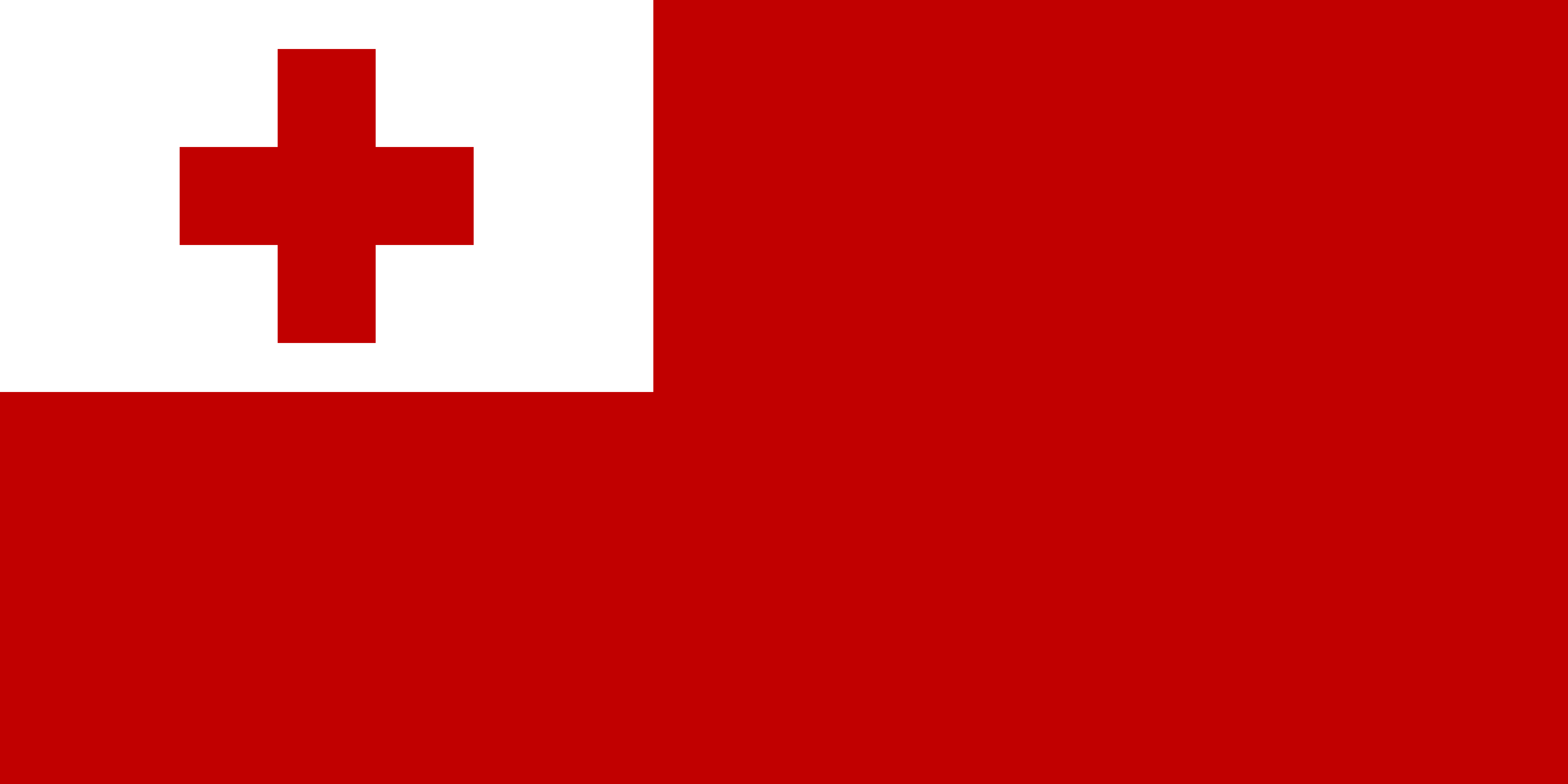
Tonga flag picture
Explore the proportions, 1875 adoption, and picture gallery.
| National design | Kingdom of TongaPolynesia, in the South Pacific. |
|---|---|
| Design | Red field · white canton · red crossEqual-arm cross centered inside the canton. |
| Declared proportions | Height:length = 1:2Internal dimensions follow the inspected reference SVG, not numerical constitutional provisions. |
| Constitutional adoption | November 4, 1875Present design reported in use before constitutional protection. |
| Digital palette | Red #C10000 · white #FFFFFFDeclared reference colors; no statutory HEX or Pantone claim. |
| Main image sizes | SVG and PNG: 9,600 × 4,800Complete rectangle; opaque RGB PNG. |
Constitutional protection, historical accounts, and numerical reproduction choices are distinguished. The chosen canton and cross dimensions follow the inspected SVG.
What does the Tonga flag look like?
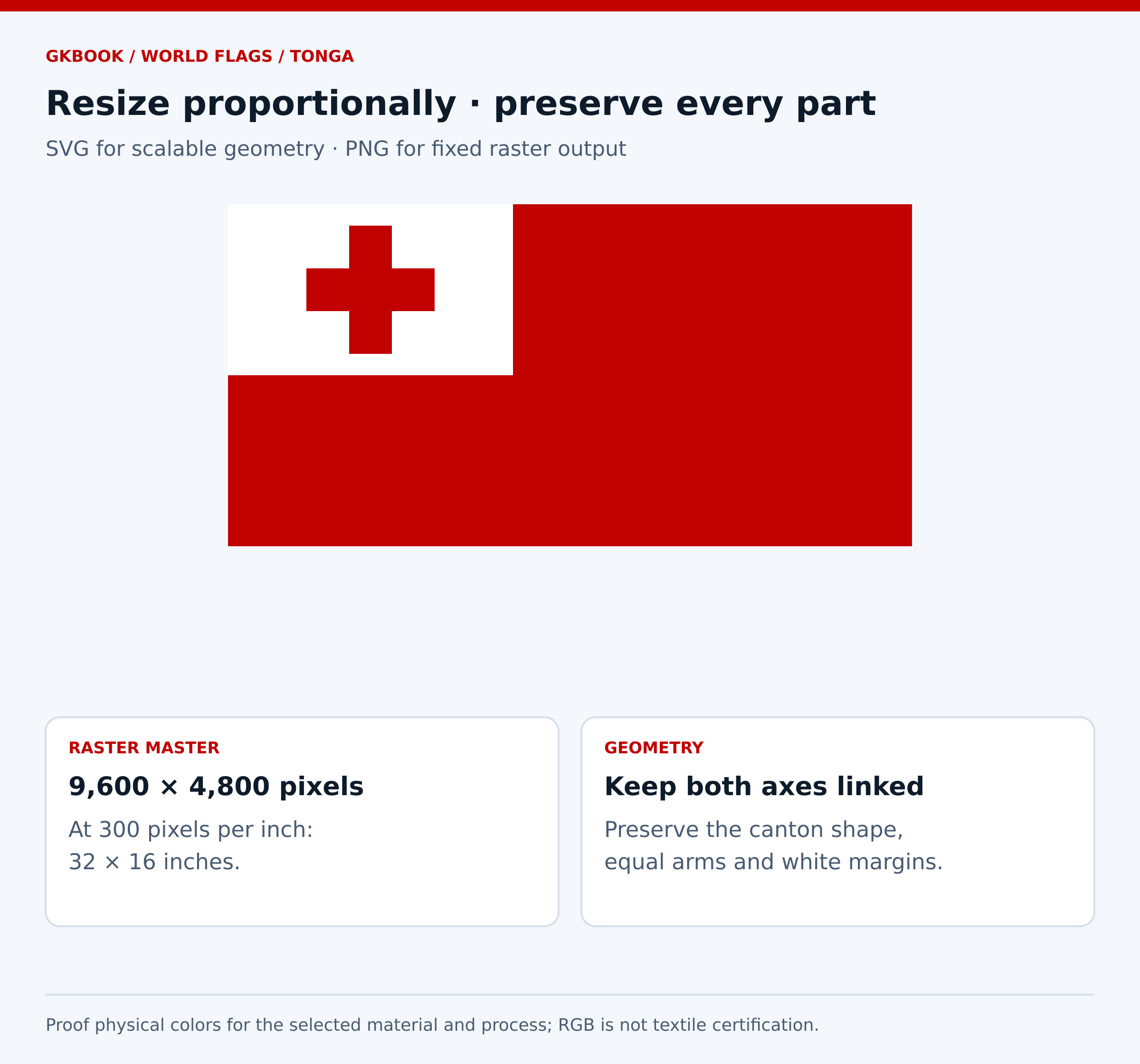
The Tonga flag has a red field with a white rectangle in the upper hoist corner and a red cross centered inside that rectangle. Its usual height-to-length ratio is 1:2. The cross has equal arms and stops short of the white rectangle’s edges, leaving clear white margins around it.
Start with the whole flag, rather than the cross alone. The hoist is the edge attached to the pole; in a standard front view it appears at the left. The white canton touches the top and hoist edges, while the red field continues below it and across the fly, the free end of the flag. These relationships distinguish Tonga’s national flag from a white flag carrying only a red cross. This collection supplies a clean rectangle and separate explanatory diagrams, so construction guides never become part of the national design.
What is the national flag of Tonga called?
It is the national flag of Tonga, formally the Kingdom of Tonga. The Constitution identifies it as the flag of King George and distinguishes it from the Royal Ensign. A clear English caption should say “Tonga flag” or “national flag of Tonga,” because several other Tongan flags have different functions.
The country name and the description of the image serve different purposes. The name identifies the nation; a description of the red field, white canton, and red cross tells the reader which composition is shown. This is especially useful when several flags appear together in an atlas or classroom display.
“National flag” should not be treated as another name for the monarch’s personal standard. Constitutional clause 47 mentions both, preserving their separate identities. A caption attached to a royal or military flag needs to identify that particular role instead of assuming that every Tongan emblem is interchangeable.
What are the colors of the Tonga flag?
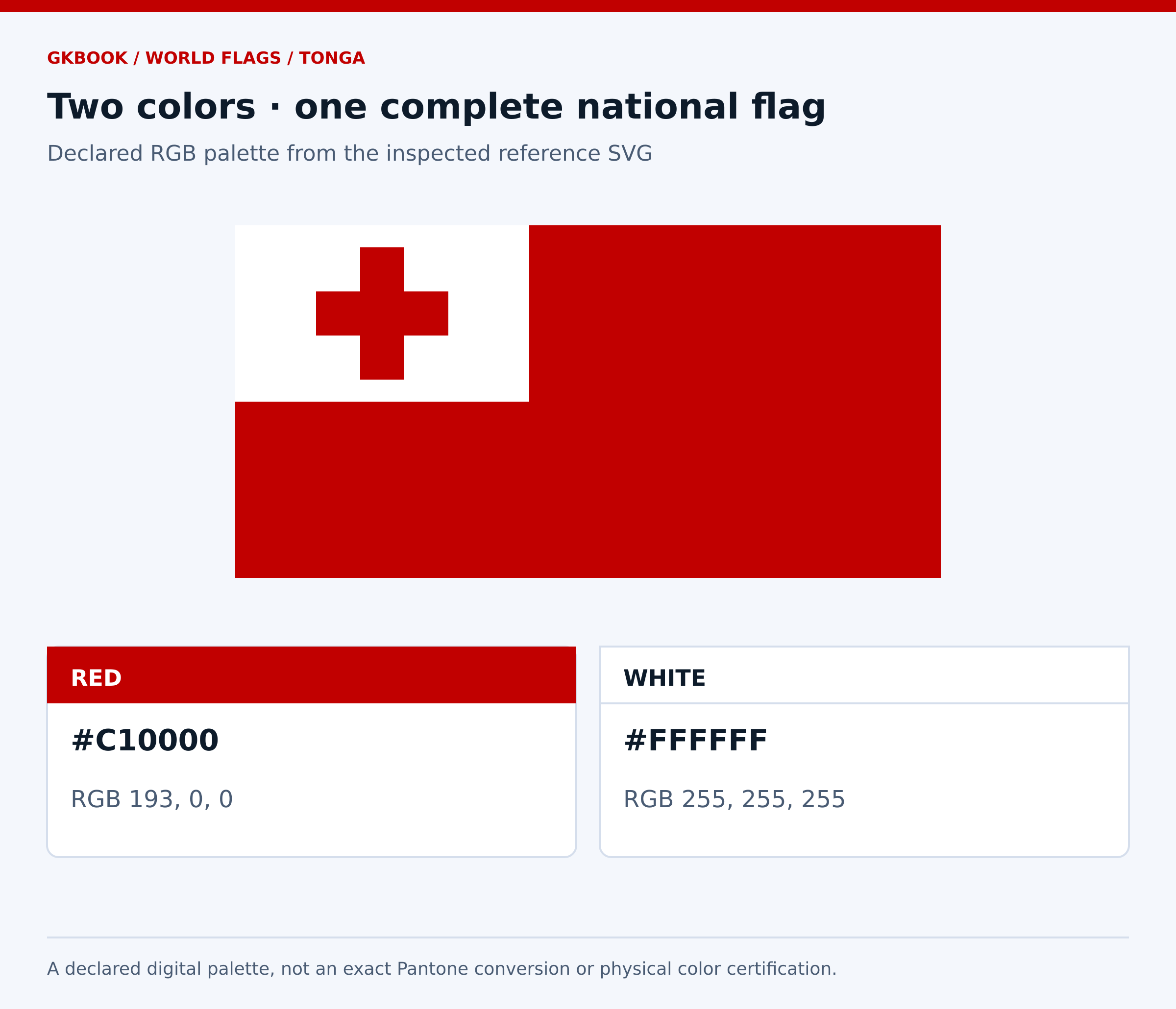
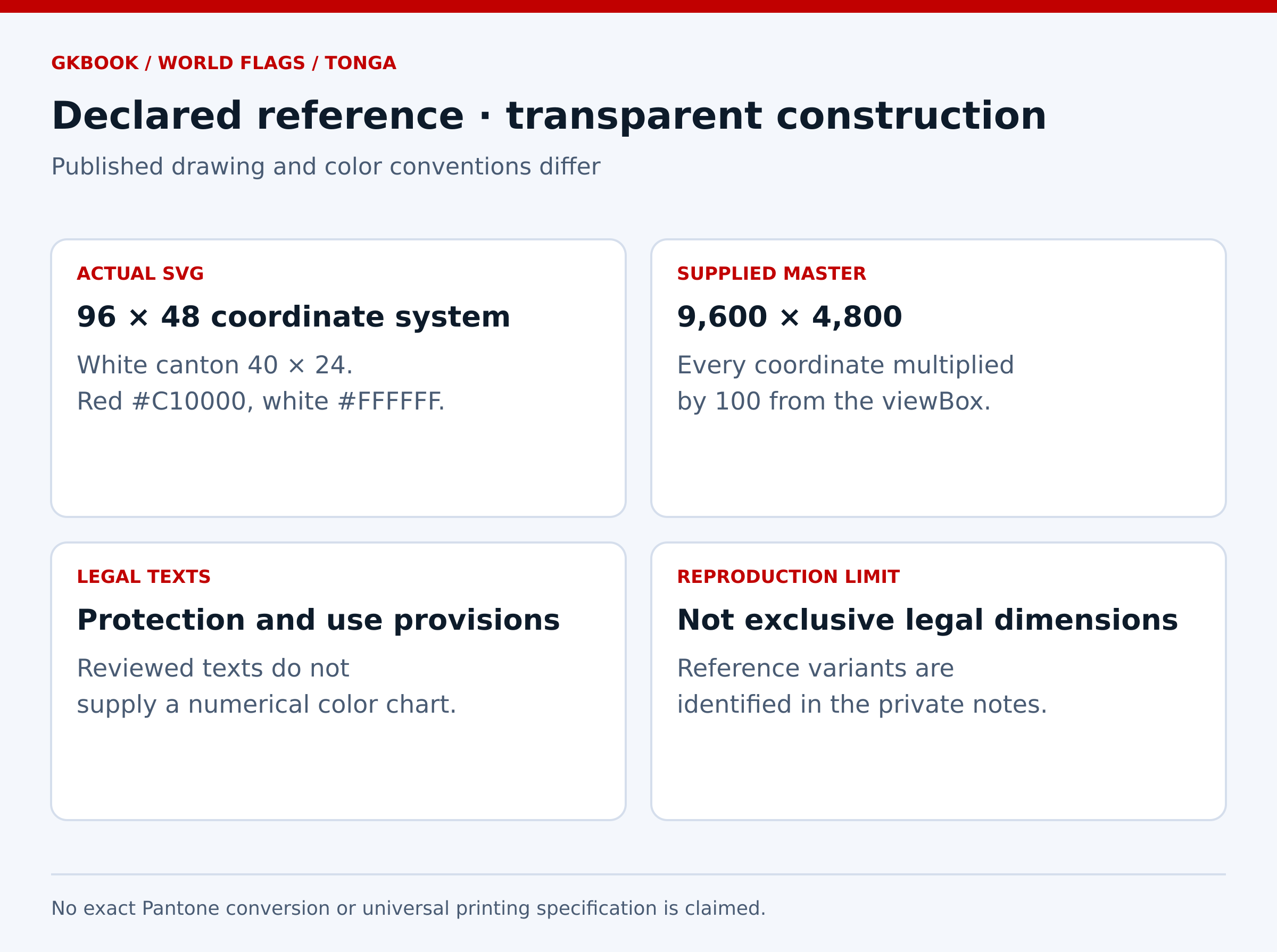
The flag has two colors, red and white. This digital edition uses red #C10000, or RGB 193,0,0, and white #FFFFFF, or RGB 255,255,255, matching the inspected reference SVG. These are declared reproduction values; constitutional clause 47 supplies neither numerical color codes nor a Pantone or printing specification.
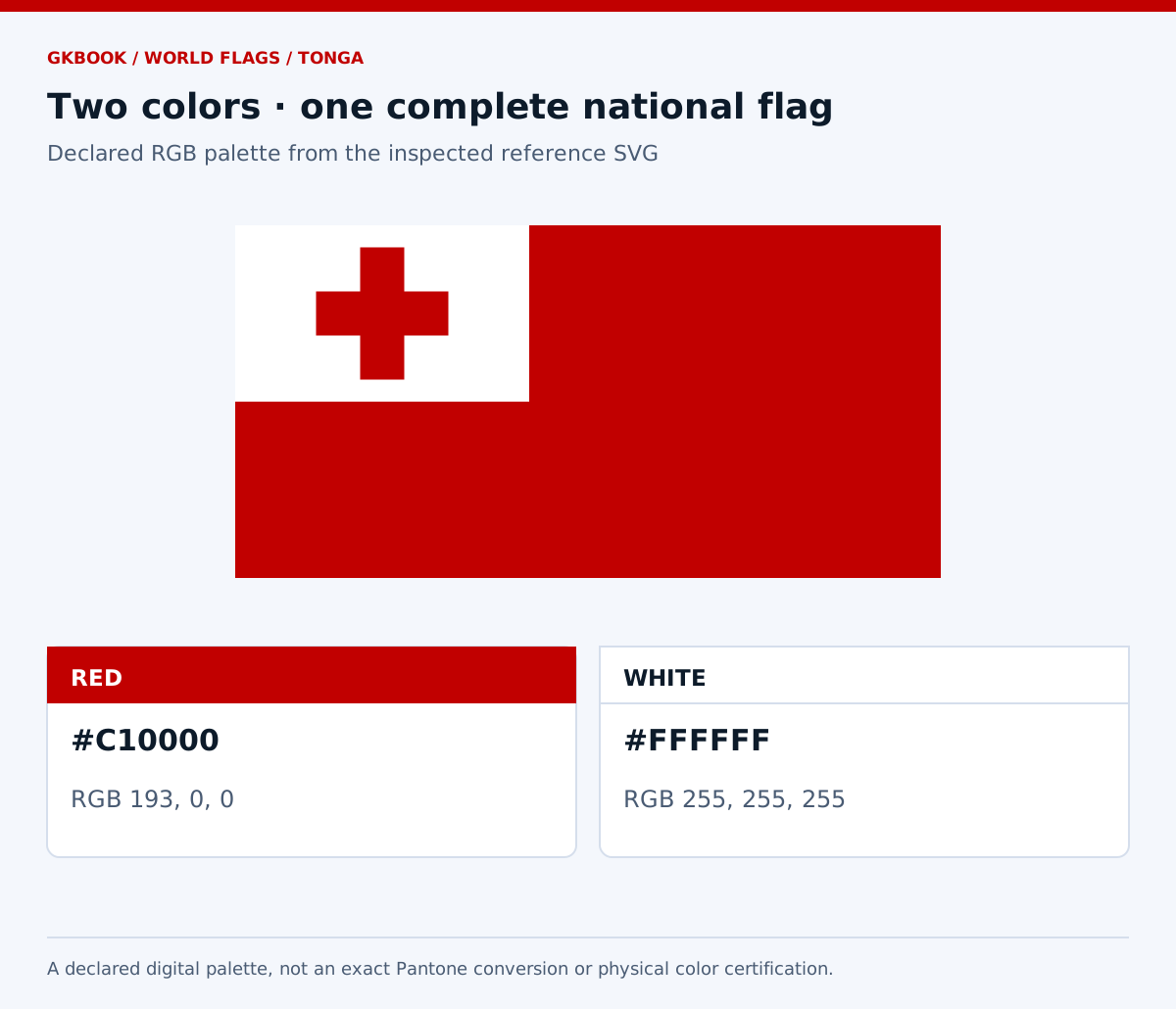
The red cross and the surrounding red field use the same fill. The white area is an opaque rectangle beneath the cross, not a transparent cutout. Because the cross covers part of that rectangle, the visible white area is smaller than the entire canton.
Published flag references use differing red specifications. A HEX value therefore needs a named digital source rather than an unsupported claim of universal legal authority. Keep the chosen red consistent across illustrations, but distinguish screen values from textile dyes, inks, paper, and the color management needed for physical output.
What do the Tonga flag’s colors and cross mean?
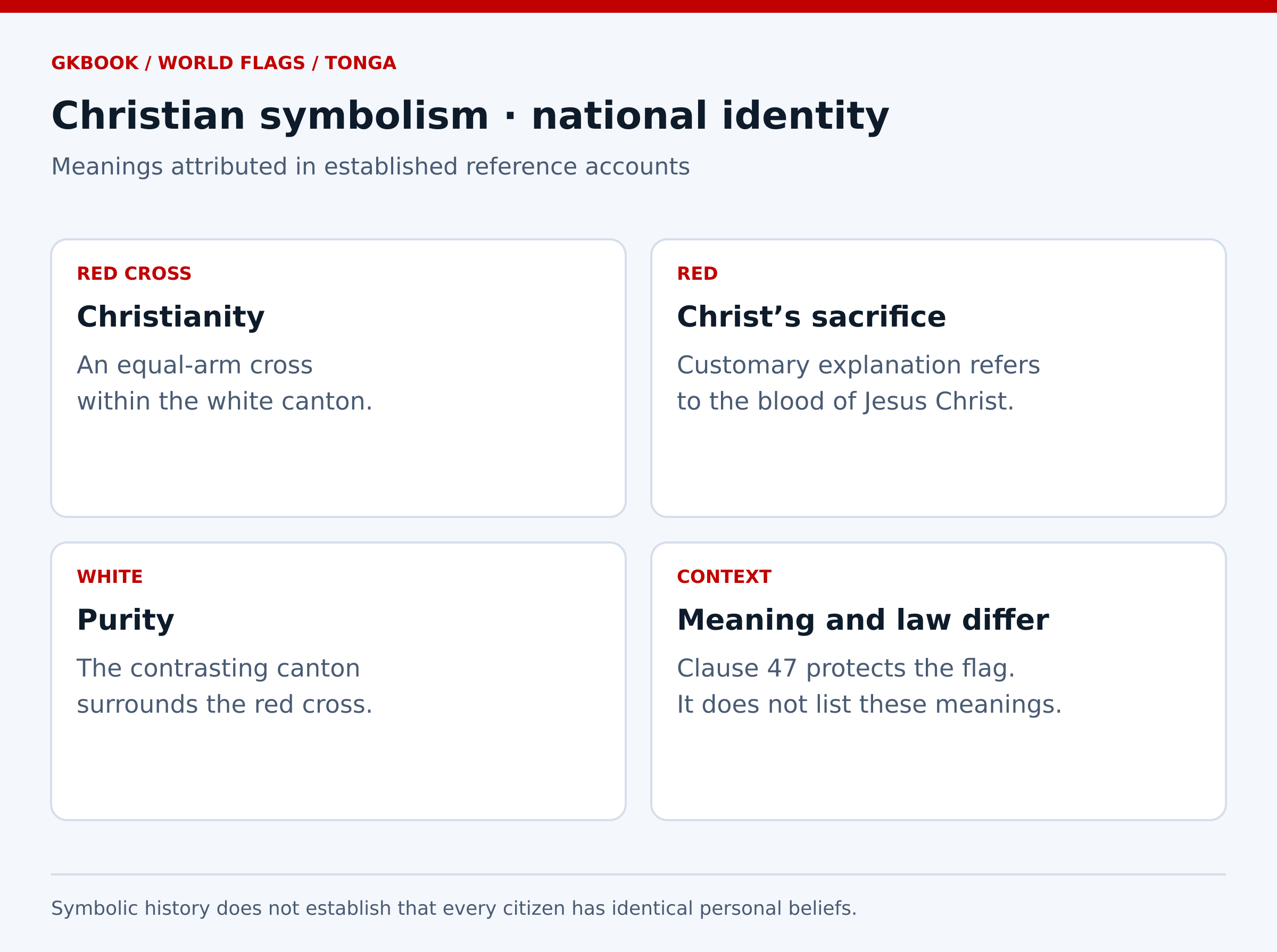
The cross is associated with Christianity, red with the blood and sacrifice of Jesus Christ, and white with purity. These familiar explanations appear in flag references and the archived World Factbook description. They explain the symbol’s religious context; they are not numerical color standards or a statement of every individual Tongan’s beliefs.
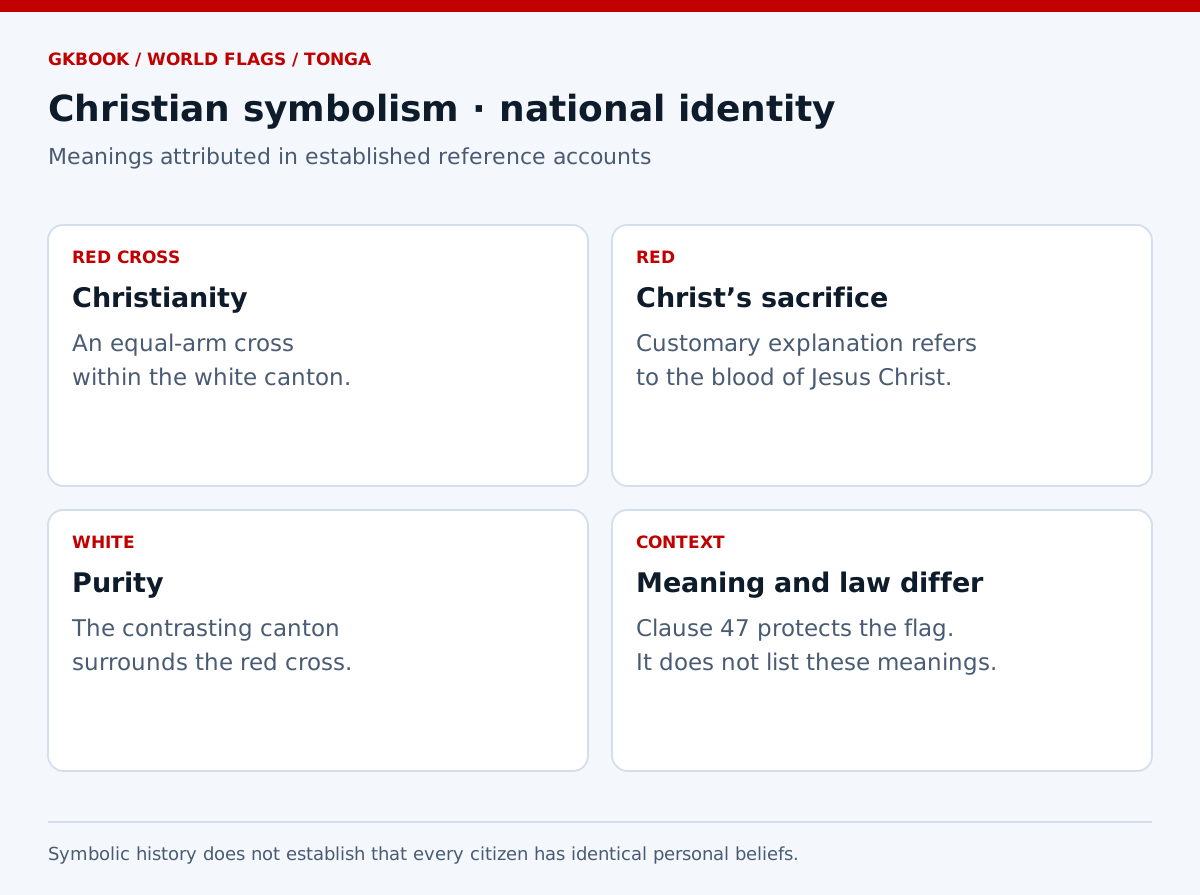
A useful explanation begins by identifying the visible elements before assigning meanings. Red forms both the field and cross, while white provides the contrasting canton. The cross’s position within that canton makes the religious symbol prominent without placing it in the center of the entire flag.
Symbolism and legal wording answer different questions. A historical or reference account may explain why a color was chosen, while a constitution protects an existing flag without listing those meanings. This distinction avoids presenting a later explanatory summary as though it were a verbatim definition enacted in 1875.
Why is most of the Tonga flag red?
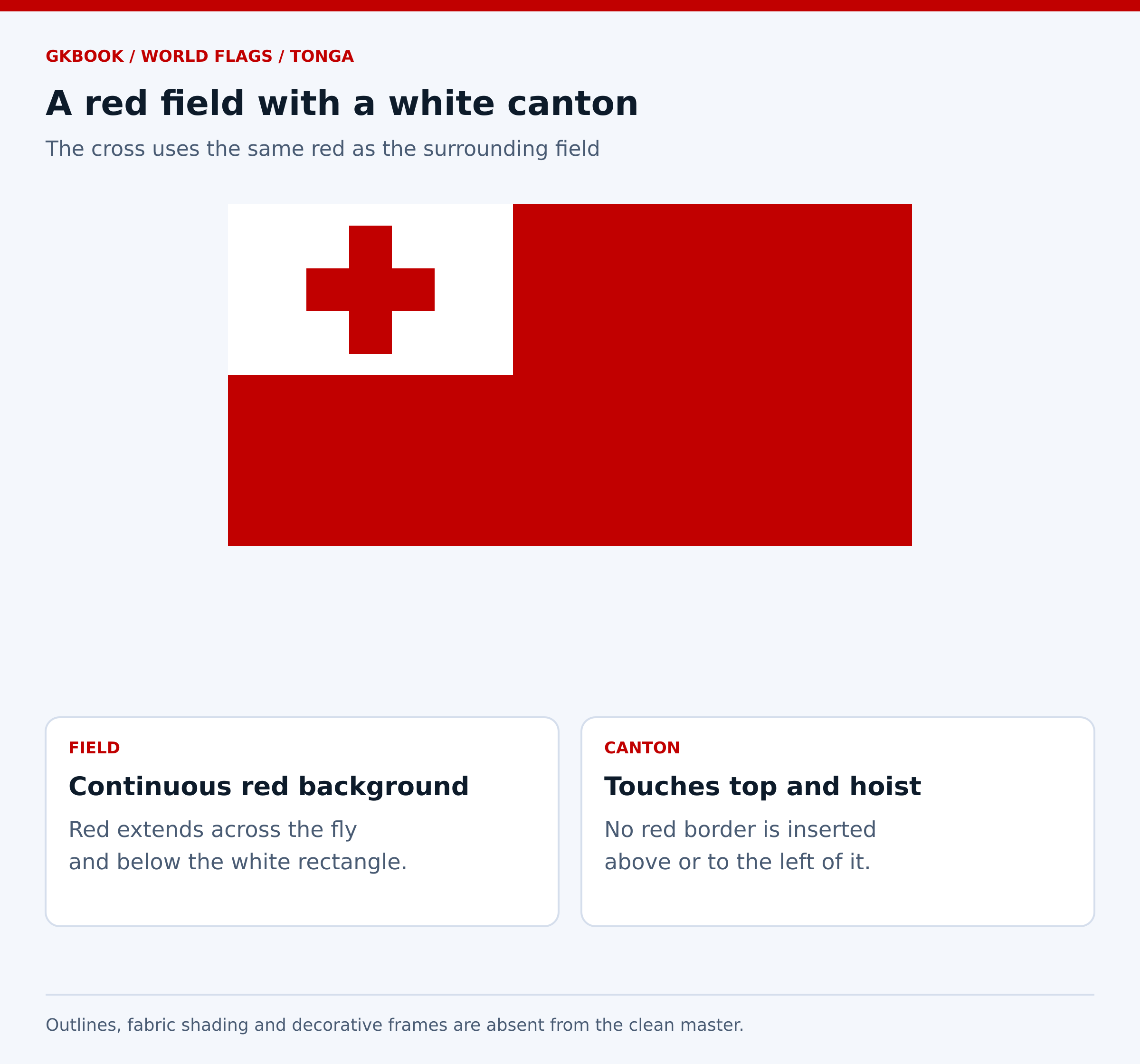
Red forms the flag’s main field and the cross inside its white canton. In the customary religious explanation, it recalls the blood and sacrifice of Jesus Christ. The field surrounds the canton on its right and below; it does not appear as a border along the canton’s top or hoist edge.
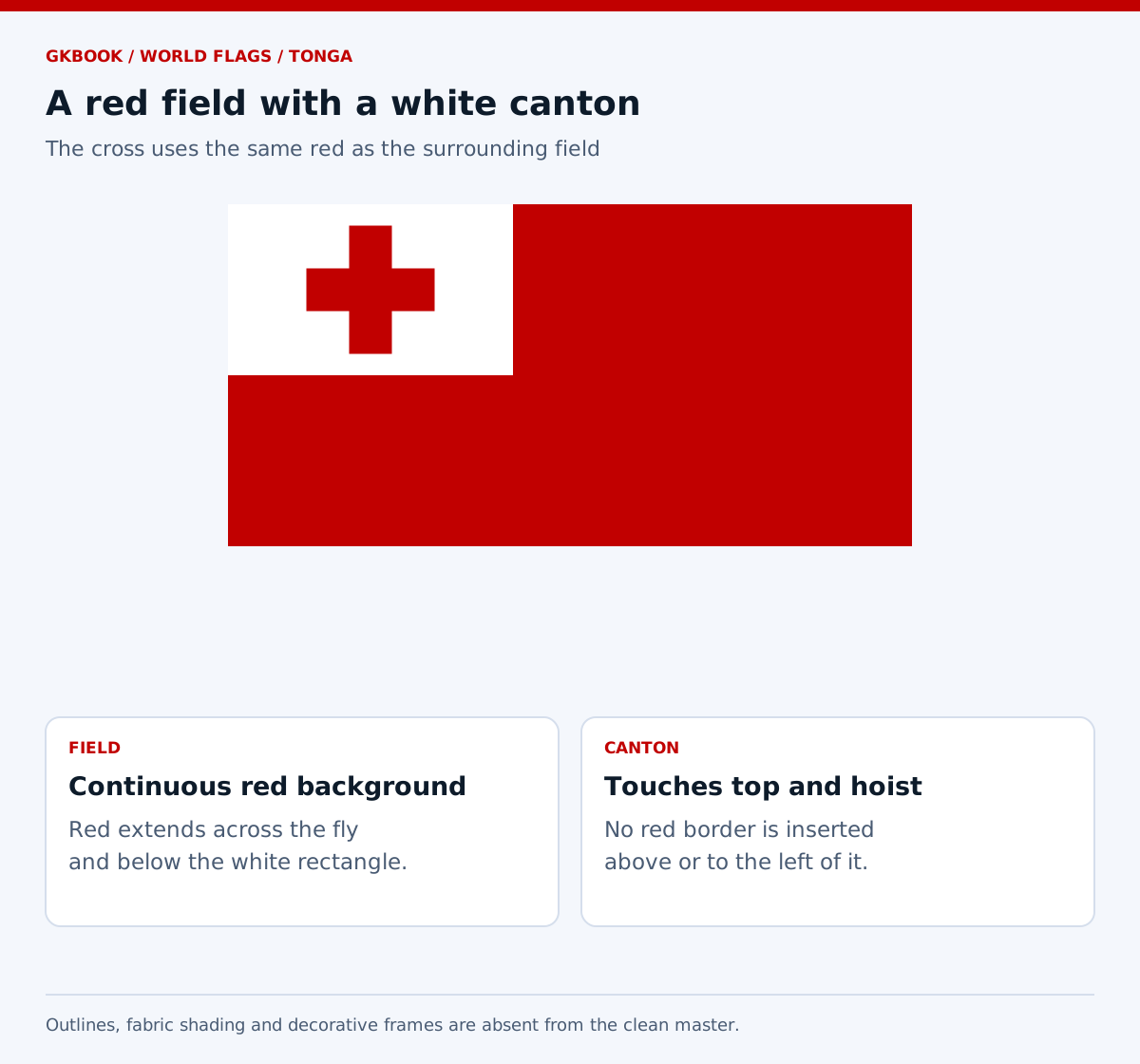
In the declared drawing, the background begins as a complete red rectangle. A white rectangle covers its upper-left portion, and two red bars form the cross over that white area. This layered construction explains the finished picture without requiring separate red pieces around every edge.
The large visible red area is a property of the design, not a statistical measure of religion, population, land, or historical sacrifice. Its exact percentage depends on the canton and cross dimensions used. The area calculation later in this guide applies to the supplied master rather than every published reproduction.
What does the white canton represent?
White is commonly explained as purity. Visually, it creates the contrasting canton that makes the red cross distinct from the red field. The canton is a rectangle in the upper hoist corner, and the cross lies fully inside it. Its white margins remain visible above, below, and beside the cross.
The canton and the visible white shape are related but not identical. The canton is the full rectangular region, including the part covered by the cross. The visible white consists of everything in that region that remains after the red cross has been drawn.
This distinction helps when interpreting dimensions and area diagrams. Measuring only the exposed white pieces does not establish the canton’s overall size. Start with its outer rectangular boundary, then locate the cross within it. In a clean digital flag, both the white canton and red cross should be solid, opaque fills.
What kind of cross appears on the Tonga flag?
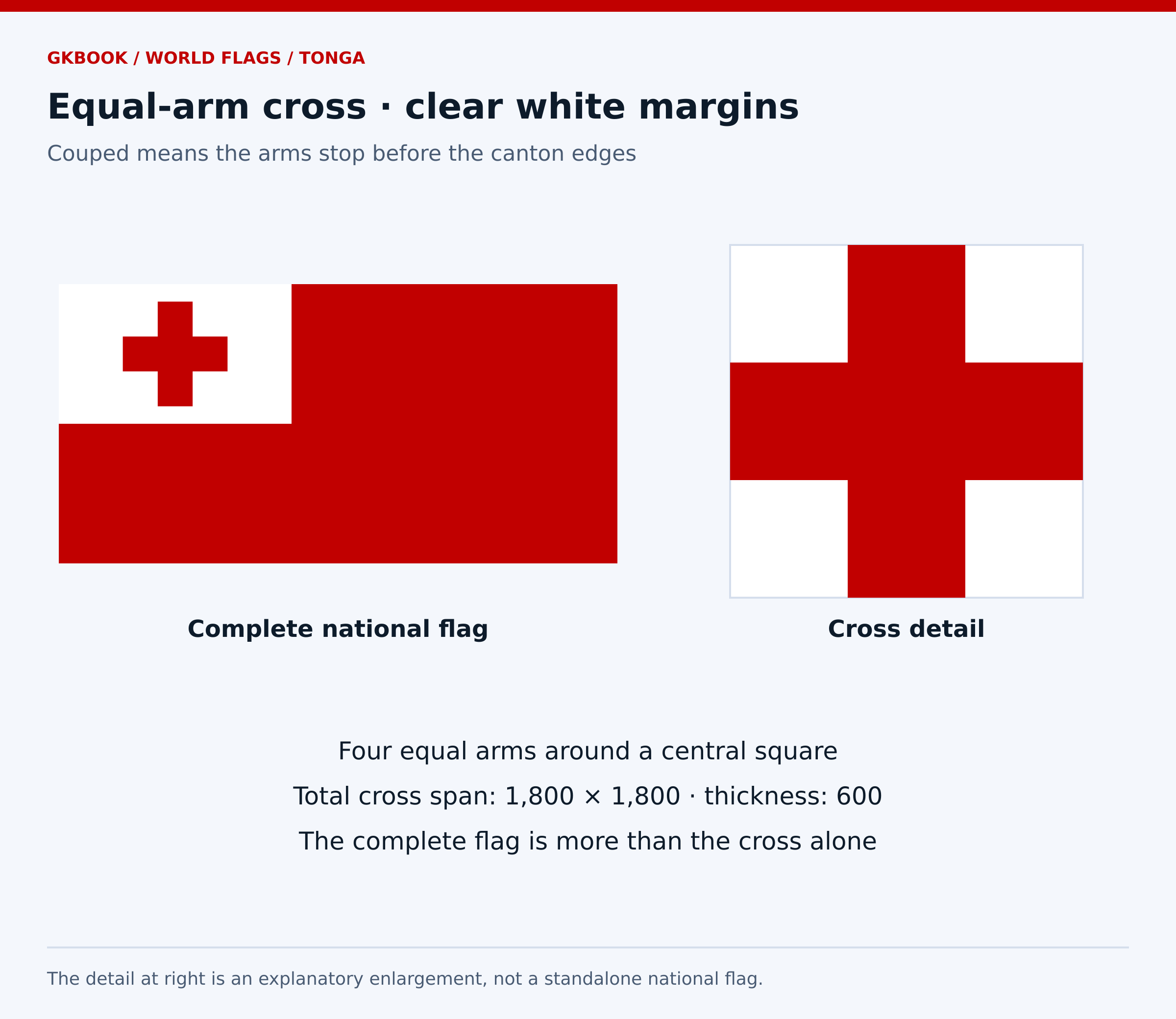
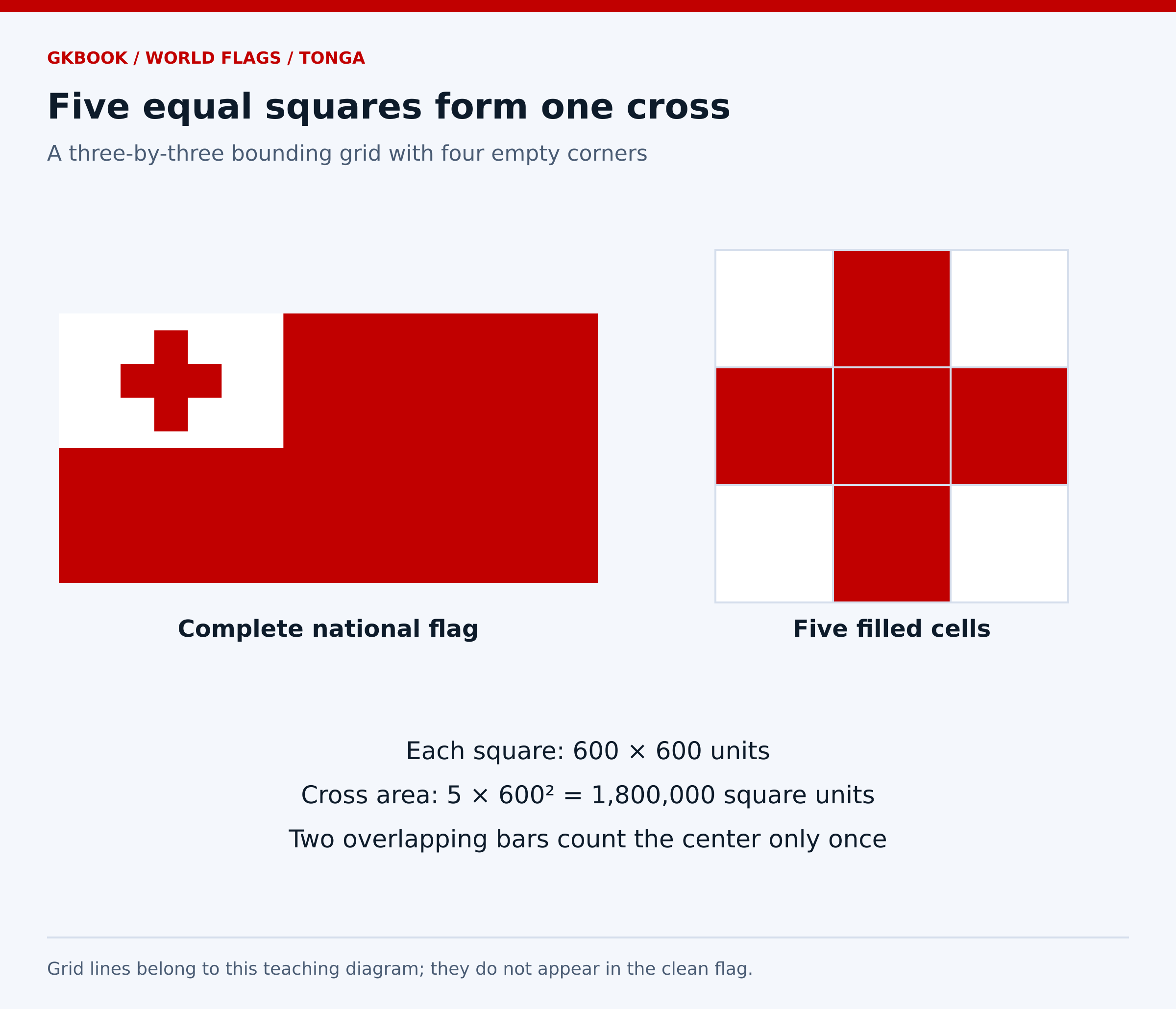
The flag carries a red couped cross with equal arms, often called a Greek cross. “Couped” means its arms end before reaching the surrounding canton’s edges. In this reconstruction, the cross consists of five equal squares arranged around a central square, giving equal horizontal and vertical spans and uniform arm thickness.
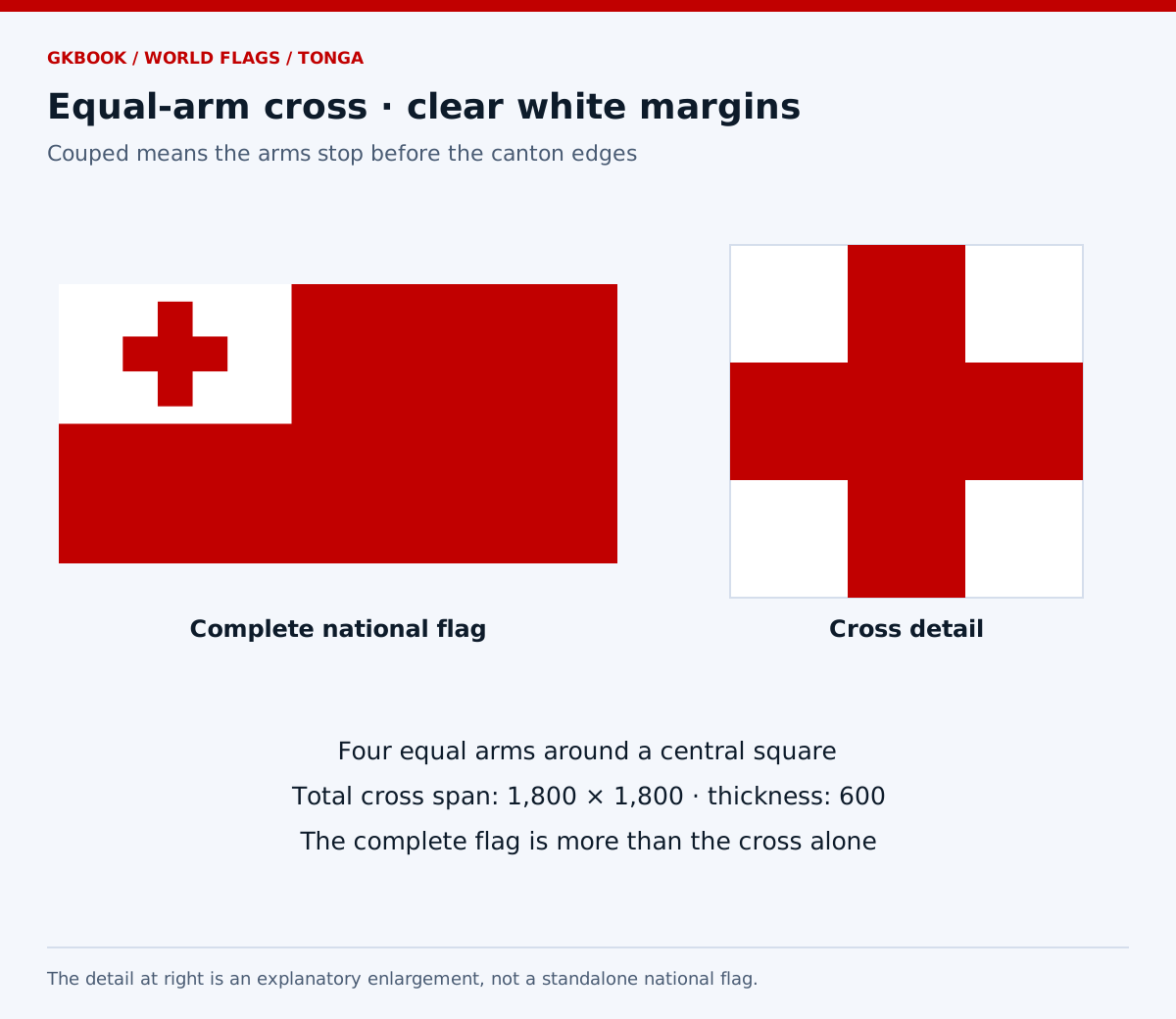
The descriptive term refers to the shape, not to a connection with modern Greece. Four arms project equally from the central square. Their ends are flat, their corners are right angles, and the cross is aligned with the rectangle rather than tilted diagonally.
A stretched lower arm would change the cross into a different shape. Extending the arms to the canton edges would also remove the clear white margins. The supplied master preserves the equal-arm construction in the inspected SVG, while the detail diagram adds removable guides only to explain that geometry.
How large is the white canton on the Tonga flag?
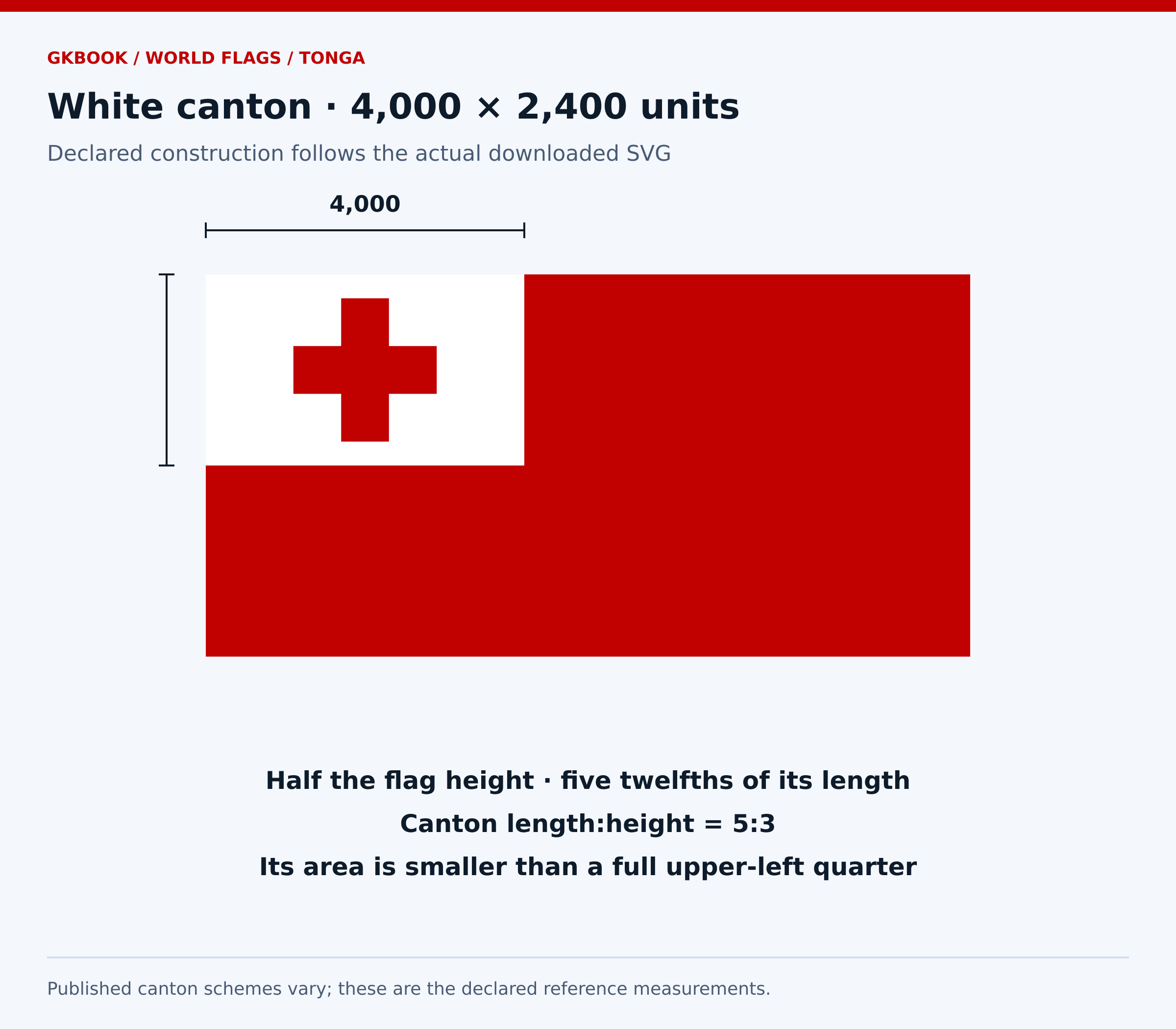
In this edition, the white canton measures 4,000 by 2,400 units within a 9,600 by 4,800 flag. It is half the flag’s height and five twelfths of its length, following the inspected SVG. Other published construction schemes differ, so these measurements are identified as a reproduction choice rather than constitutional dimensions.
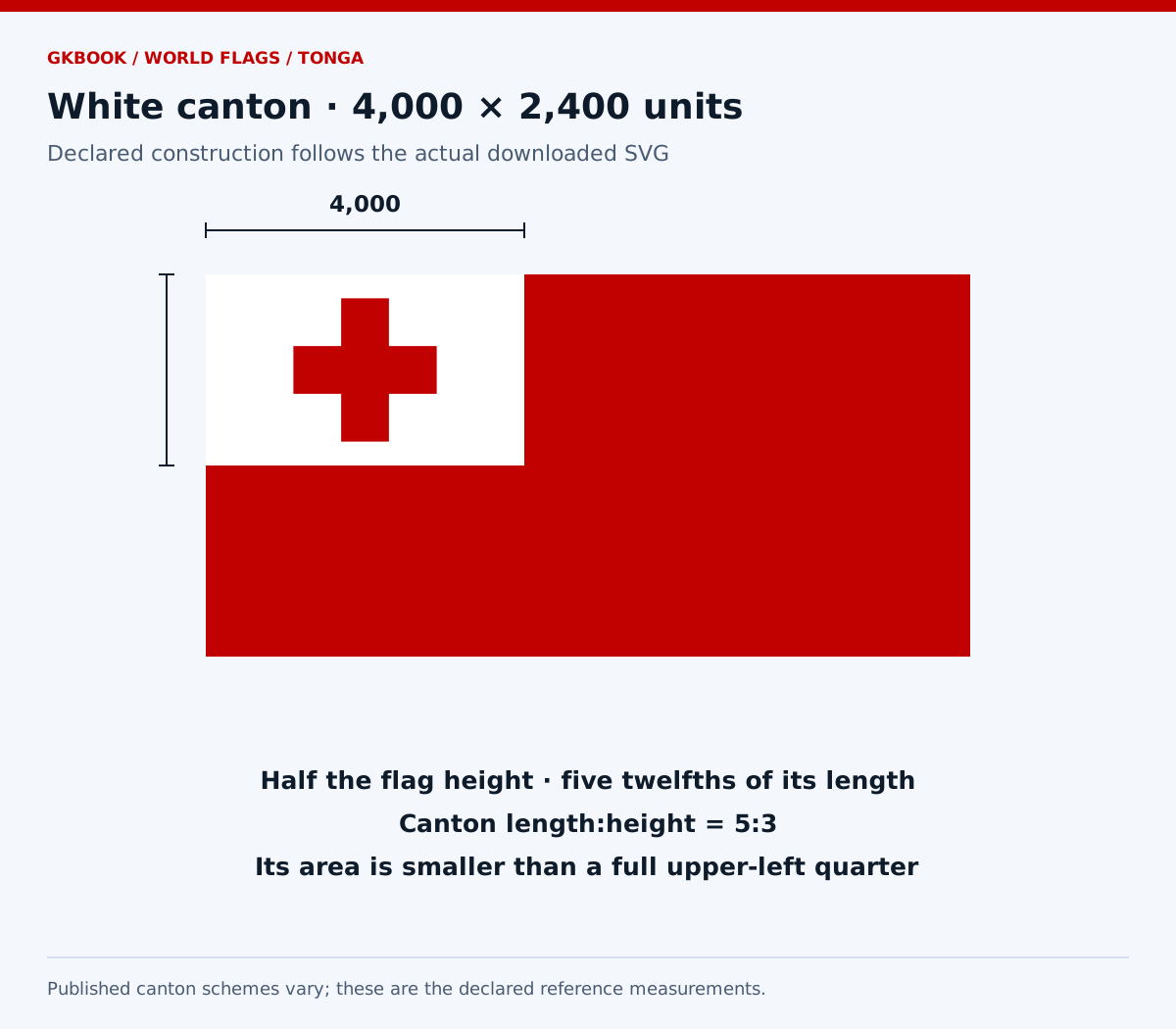
The canton’s own length-to-height ratio is five to three. It is therefore neither a square nor the entire upper-left quarter of the flag. That quarter would extend halfway along the flag’s length, whereas this canton stops sooner and leaves more red visible toward the fly.
Treat the outer rectangle, canton, and cross as one connected construction. Changing only the canton width changes its side margins and the cross’s apparent position. If a publication adopts a different documented construction, its accompanying measurements and area percentages must be recalculated instead of borrowed from this edition.
What are the proportions of the Tonga flag?
The usual height-to-length ratio is 1:2, meaning the flag is twice as long as it is high. The supplied SVG and PNG use 9,600 by 4,800 dimensions. This matches the overall ratio in the inspected reference artwork and established flag references; the constitutional flag clause itself does not state those numbers.
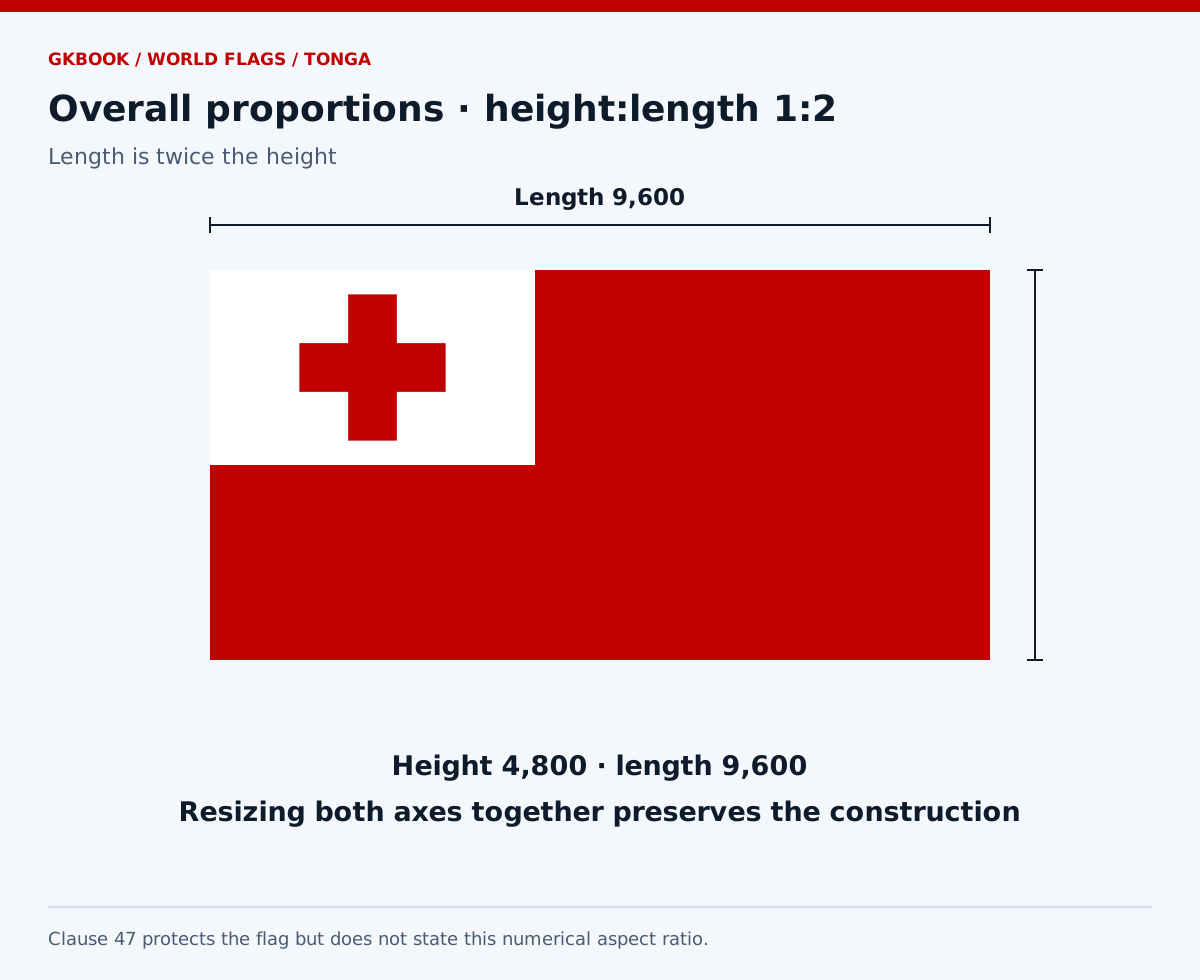
Always identify the order of a ratio. Height:length 1:2 is the same relationship as length:height 2:1, but reversing the labels without reversing the numbers creates a tall rectangle. The master uses the ordinary horizontal front view, with the canton at the upper left.
A correct overall ratio does not settle every internal measurement. Two flags can both be 1:2 yet use different canton widths or cross sizes. For a reproducible illustration, state the outer dimensions and the internal construction together. Resize the finished flag proportionally rather than stretching it to fit a convenient box.
How can the Tonga flag be drawn accurately?
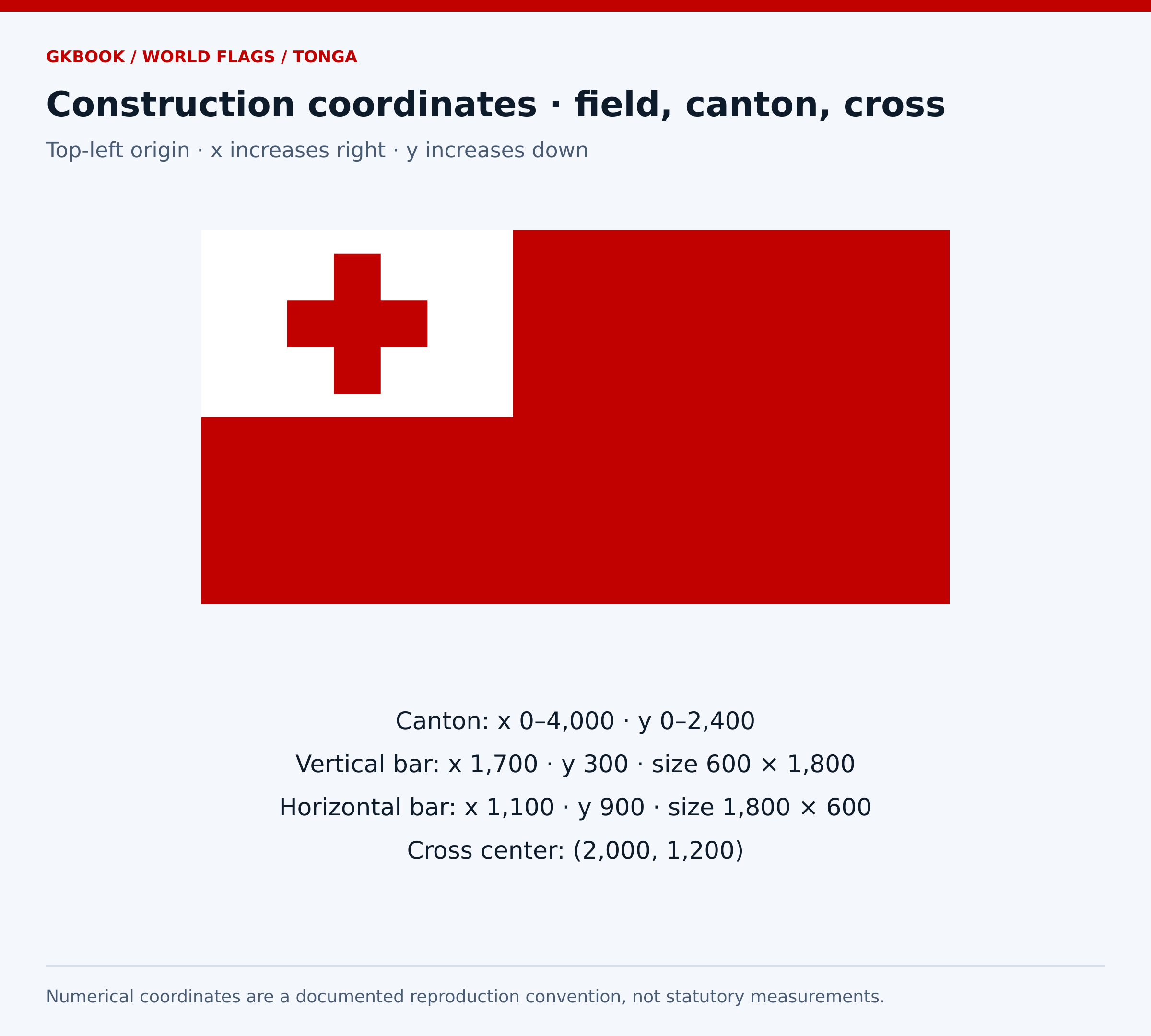
Draw a 9,600 by 4,800 red rectangle, then a 4,000 by 2,400 white rectangle at its upper left. Center the cross at coordinates 2,000,1,200. Form it from a 600 by 1,800 vertical red bar and a 1,800 by 600 horizontal red bar, using the same red as the field.
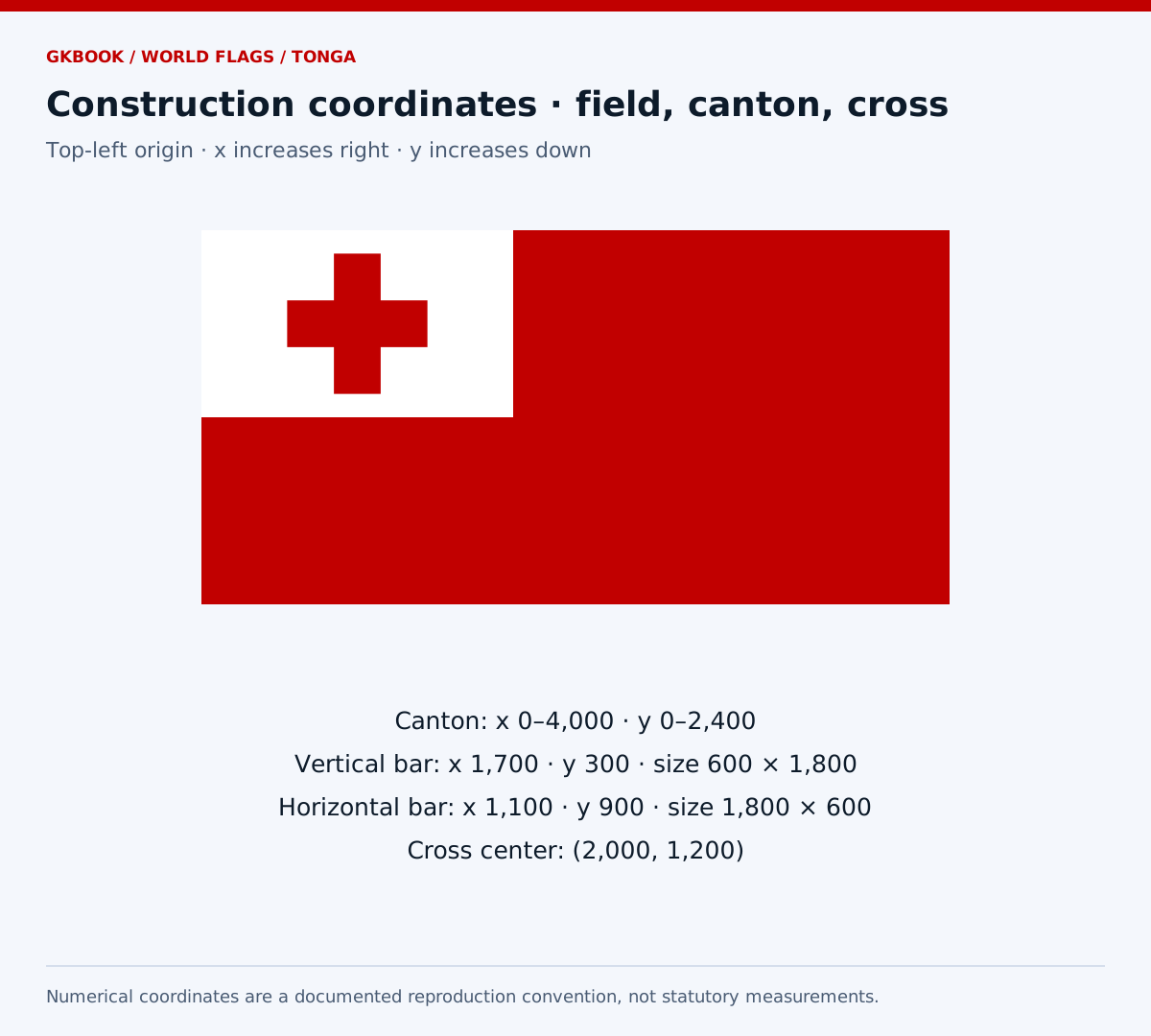
Coordinates begin at the top-left corner, with x increasing rightward and y increasing downward. The vertical cross bar begins at x 1,700 and y 300. The horizontal bar begins at x 1,100 and y 900. Their overlapping centers merge into one solid red cross.
Use filled rectangles without outlines, shadows, textures, or rounded corners. Keeping every major boundary on an integer coordinate makes this native-size raster straightforward to verify. Construction labels belong in separate educational diagrams; the clean national flag should contain only the red field, white canton, and red cross.
How do five squares form the cross?
The cross can be understood as five equal 600-unit squares: one central square with another attached to each side. Its total span is three square-widths in either direction, or 1,800 units. The bounding square contains nine such cells, but the four corner cells remain white rather than becoming part of the cross.
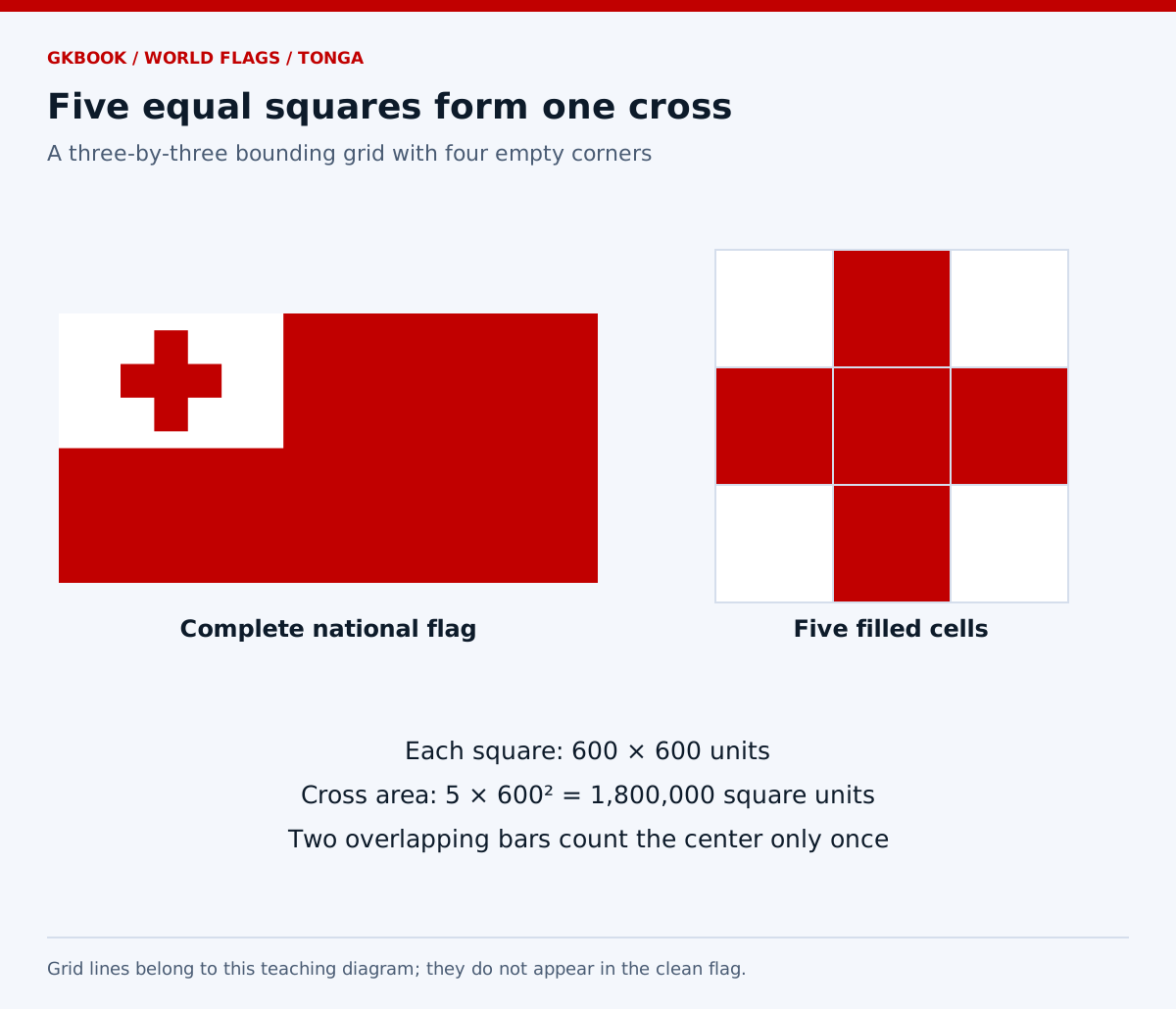
This five-square model is a useful check on equal arms. Each projection beyond the central square has the same length and width. Counting a solid three-by-three block would overestimate the cross because it would incorrectly fill the four corners between the arms.
The implementation uses two overlapping rectangles because that is a compact way to draw the same shape. When calculating area, subtract their central overlap once. Adding both bar areas without subtraction would count the middle square twice and give the wrong red and white totals.
What margins surround the red cross?
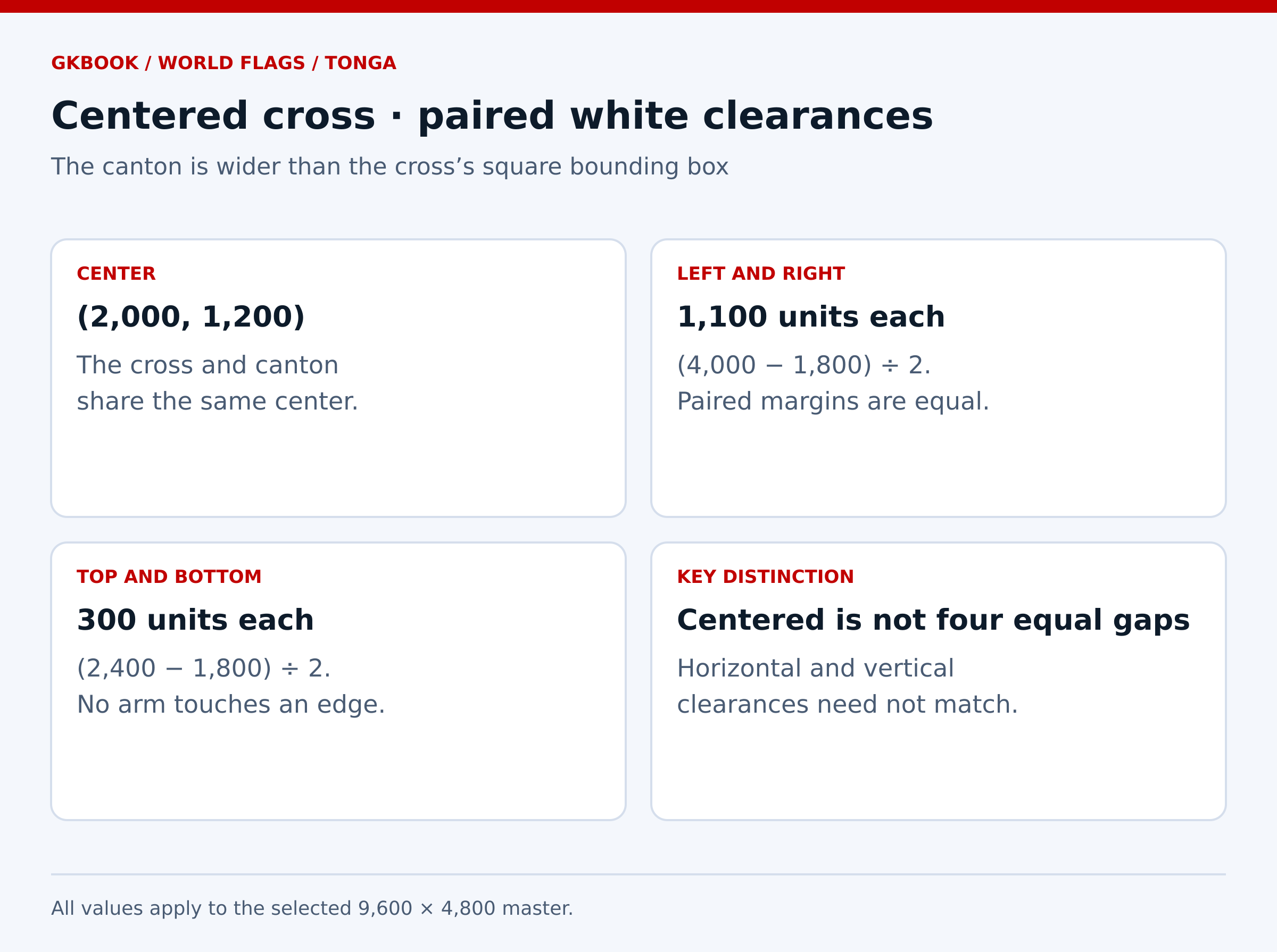
For the supplied construction, the cross has 300 units of white clearance above and below and 1,100 units on each side. Its center coincides with the canton’s center. The different horizontal and vertical clearances are expected because the canton is wider than it is high, while the cross’s bounding square has equal sides.
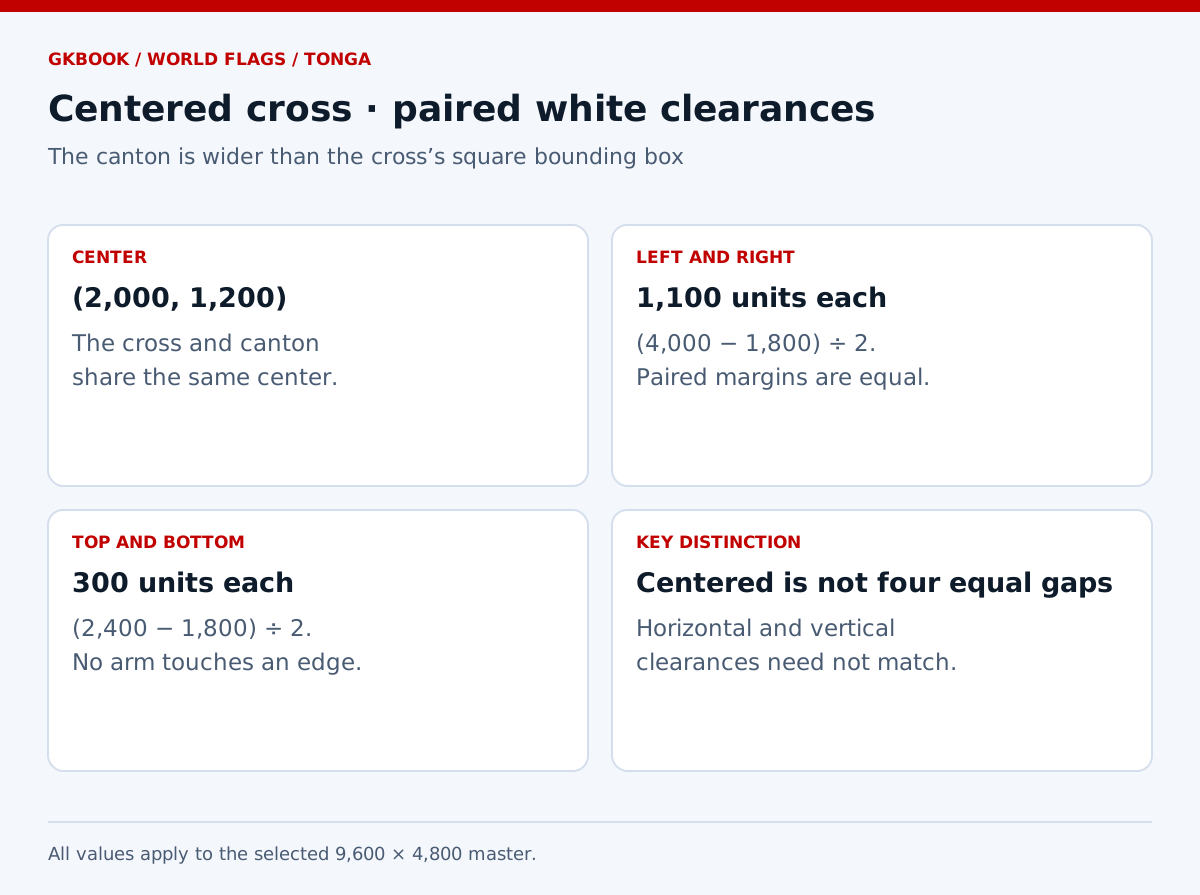
Equal centering does not require equal margins on all four sides. It requires matching left and right clearances, and matching top and bottom clearances. Subtract the cross’s 1,800-unit span from each canton dimension, then divide the remaining space equally between the two opposite edges.
The result is a generous horizontal margin and a narrower vertical margin. Moving the cross until every margin looks identical would distort either the canton or the cross. Check the center coordinates and paired clearances directly instead of relying on the apparent balance of a small or folded photograph.
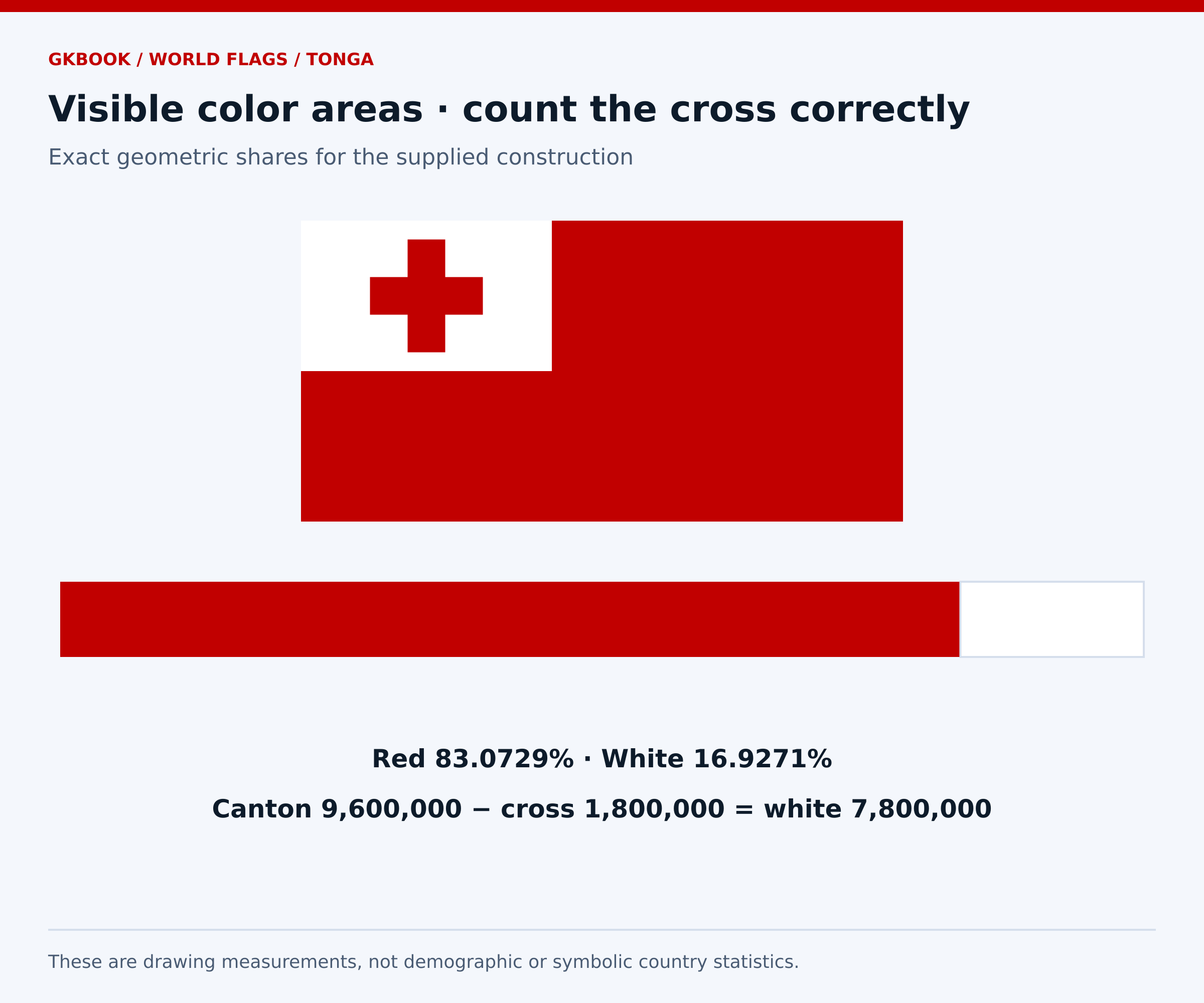
How much of the Tonga flag is red or white?
In this declared construction, red occupies about 83.0729 percent and visible white about 16.9271 percent. The canton itself occupies 20.8333 percent, but part of it is covered by the red cross. These percentages are calculated from the supplied geometry and are not symbolic allocations or numerical requirements in the Constitution.
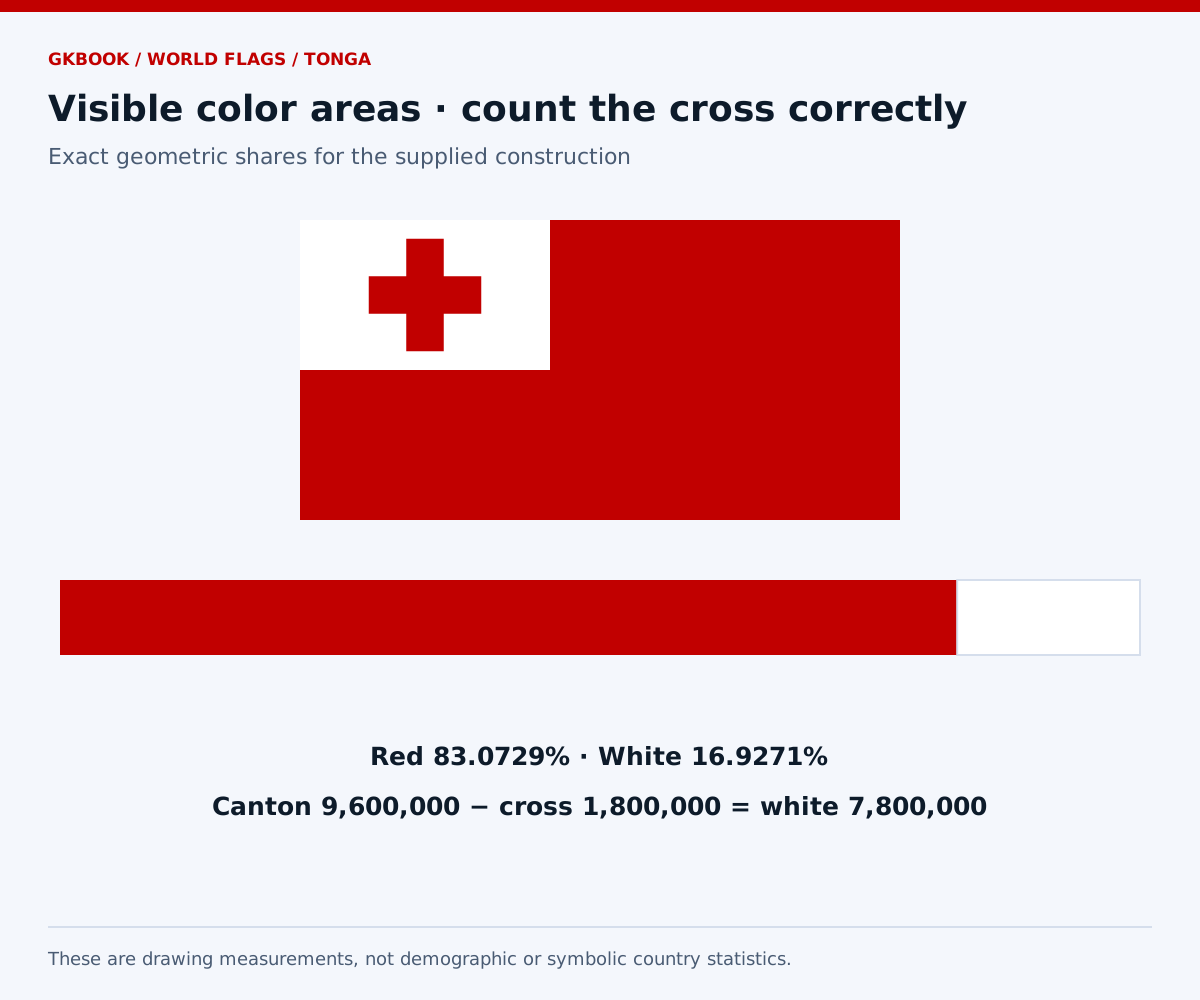
The full rectangle contains 46,080,000 square units. Its canton contains 9,600,000, and the five-square cross contains 1,800,000. Subtracting the cross from the canton leaves 7,800,000 visible white square units; everything else in the flag is red.
Do not confuse the cross’s red area with the entire red field, or the canton’s area with visible white. These calculations also depend on the selected internal measurements. A different canton scheme produces different shares even when the outer flag remains 1:2. Raster antialiasing at reduced sizes is a separate rendering issue.
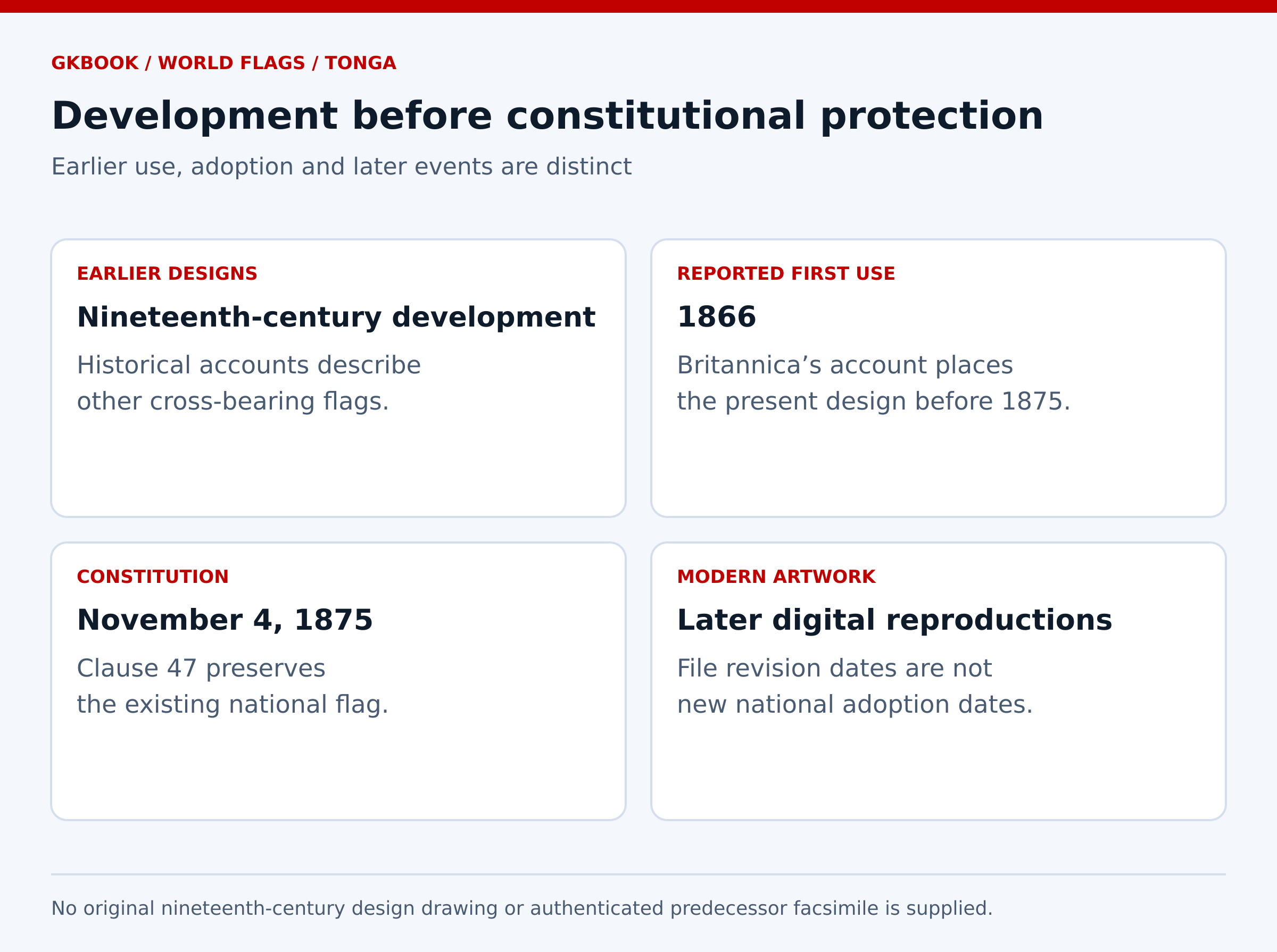
How did the present Tonga flag develop?
The present design developed during King George Tupou I’s reign, before its constitutional protection in 1875. Historical references describe earlier flags and report the present form in use in 1866. The Constitution later preserved the existing national flag, so the first use of the design and its constitutional adoption should remain separate milestones.
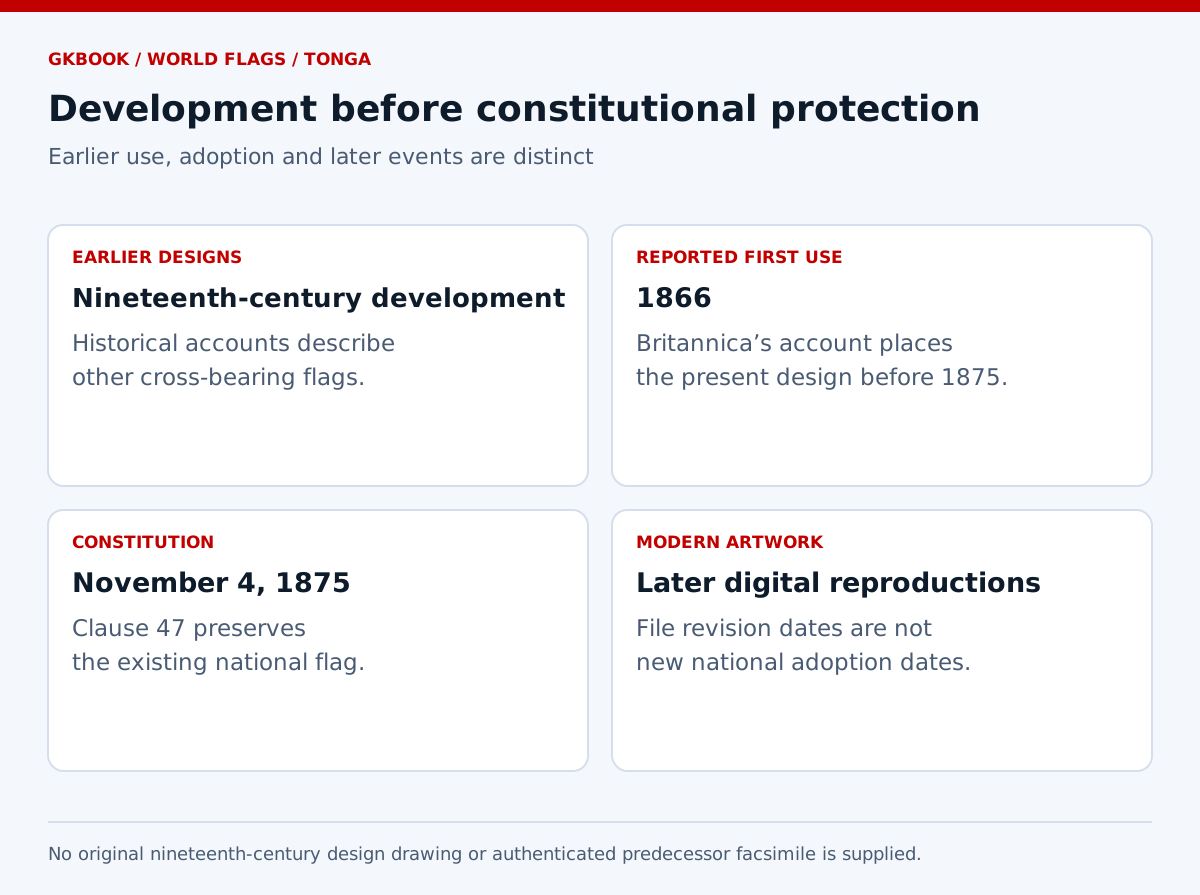
Tonga’s nineteenth-century national symbols emerged alongside the development of its monarchy and institutions. A timeline is clearest when it distinguishes earlier designs, the familiar red-field flag, and the constitutional settlement. The dates attached to modern SVG revisions belong to a different history: the reproduction of the symbol online.
The historical diagrams here are labeled stages rather than authenticated facsimiles of every earlier flag. An exact reconstruction of a predecessor would require evidence for its period, colors, lettering, and dimensions. A general description of an earlier flag does not supply every detail needed to manufacture one faithfully.
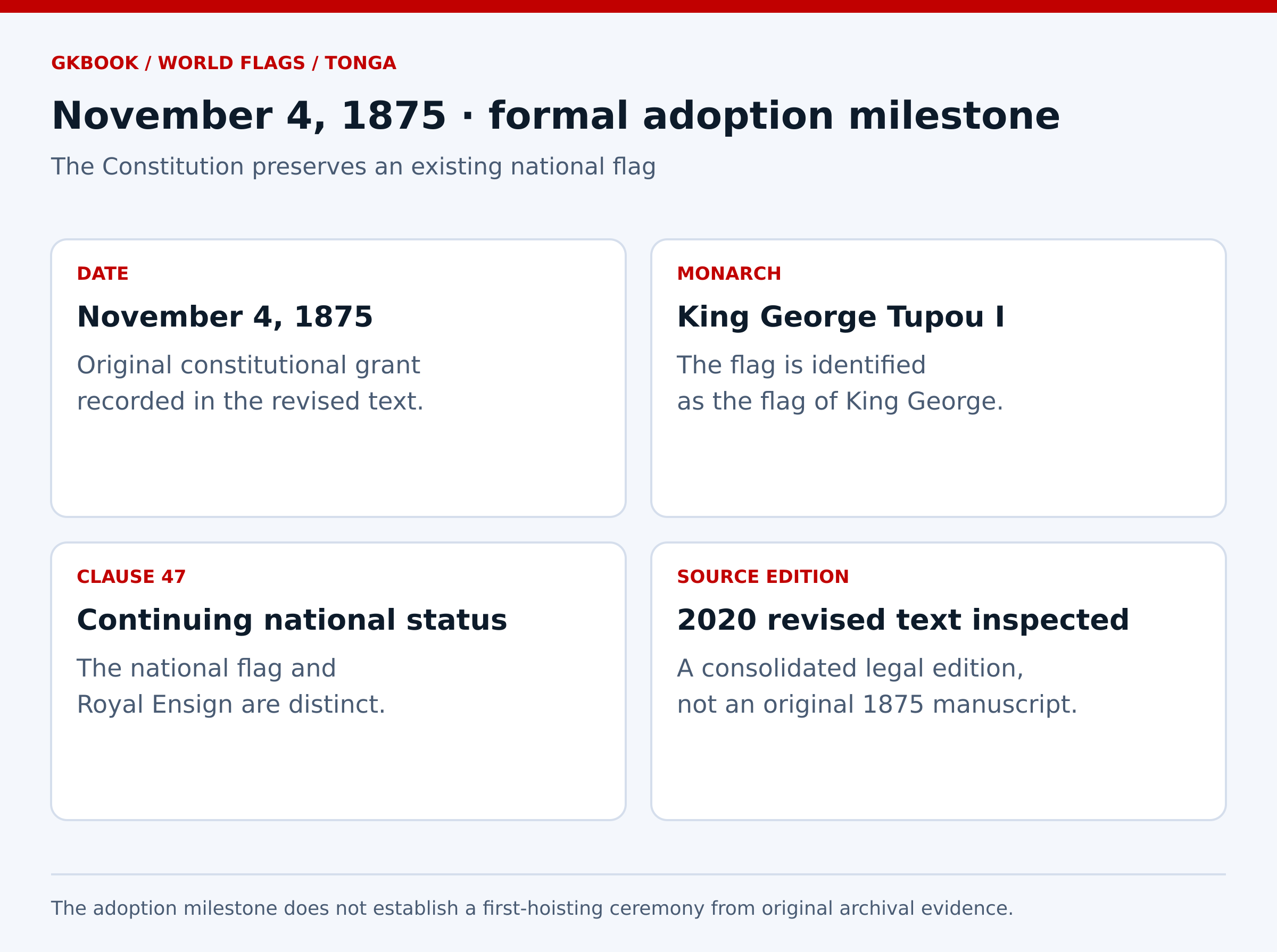
When was the Tonga flag officially adopted?
November 4, 1875 is the conventional formal adoption date, tied to the granting of Tonga’s Constitution by King George Tupou I. Clause 47 protects the existing flag. Historical references report the design in use before that date, so 1875 should not be described as the first time anyone had seen or flown it.
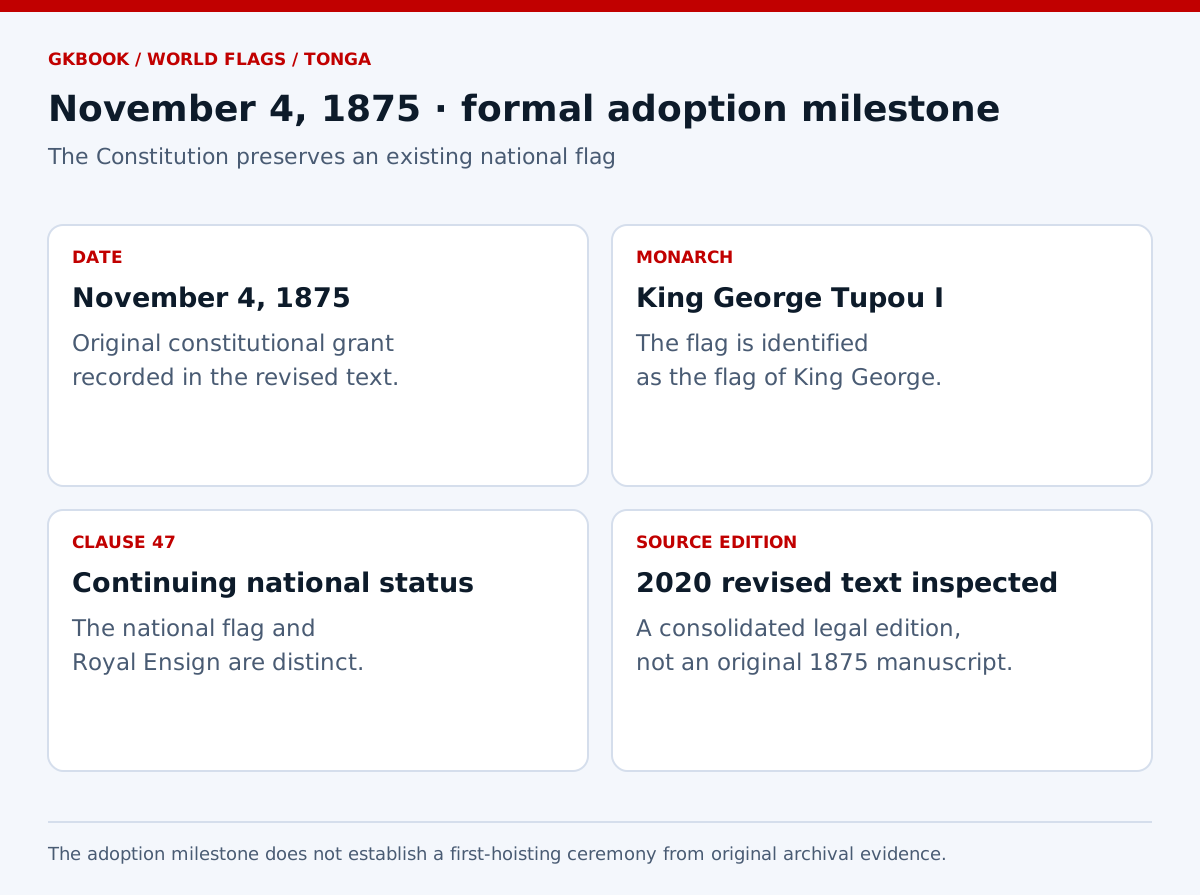
The inspected 2020 revised constitutional text records the original grant date in its opening heading. It is a later consolidated edition, not an original 1875 manuscript. Its flag clause identifies the flag of King George and preserves its status without presenting a new measured drawing.
Keep the date attached to the event it describes. Constitutional adoption in 1875 differs from earlier use, a later publication of the laws, and a modern digital file’s creation. It also differs from the end of British protection in 1970 and Tonga’s admission to the United Nations in 1999.
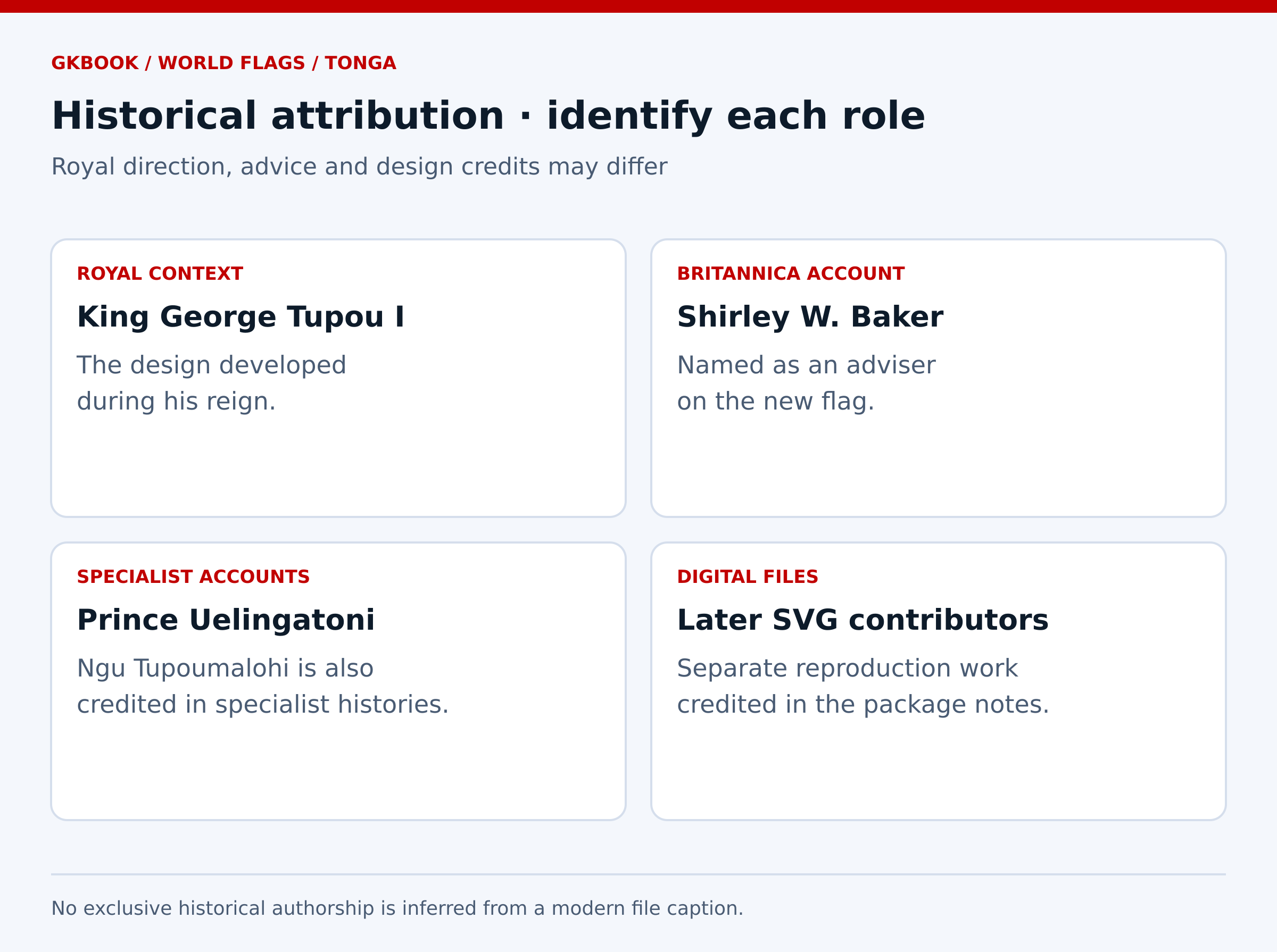
Who designed the Tonga flag?
The design belongs to the reign of King George Tupou I. Britannica describes advice from Shirley W. Baker, while specialist accounts also credit Prince Uelingatoni Ngu Tupoumalohi. The evidence consulted does not establish a single inspected original drawing signed by one designer, so the historical attribution is presented with that distinction.
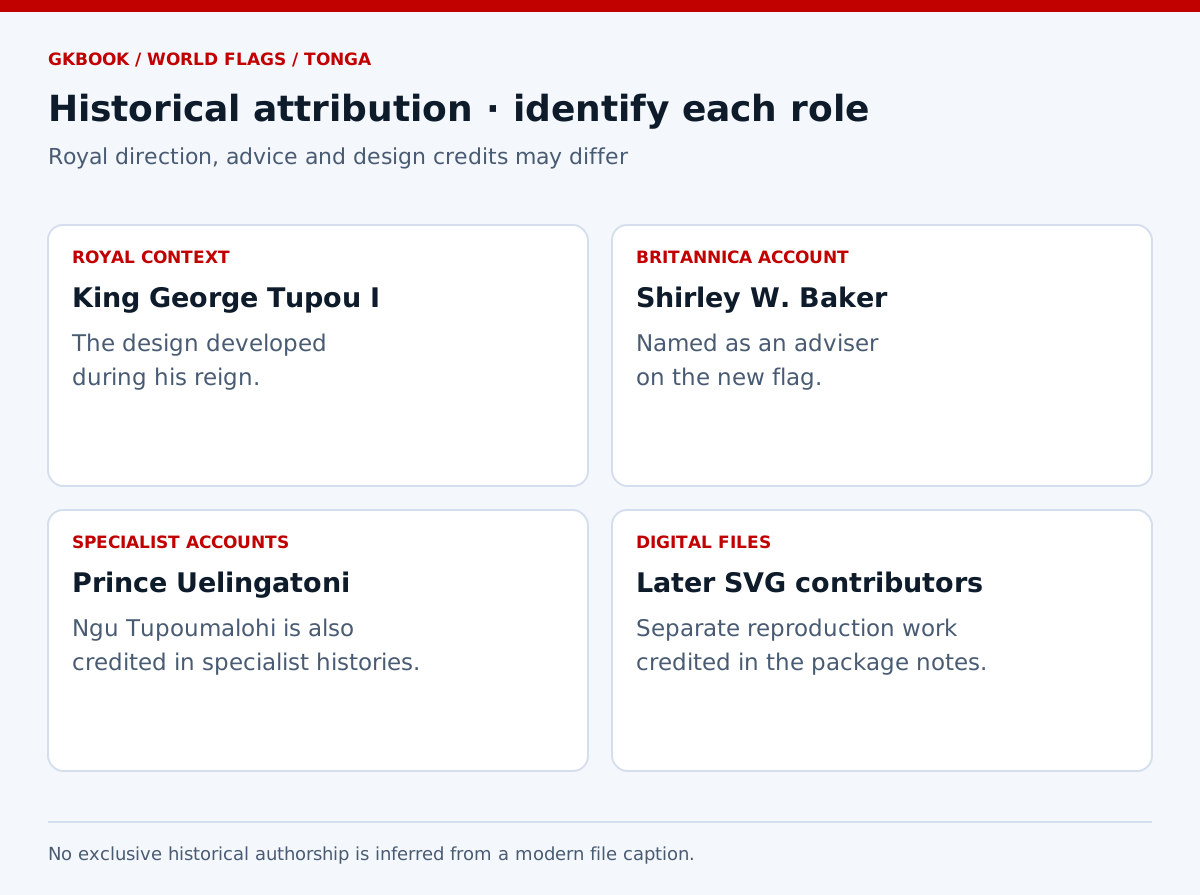
Royal direction, advice, and preparation of a design can be different contributions. Condensing every role into a single modern designer field may hide that complexity. The article therefore identifies the reign and the names reported by the consulted historical references rather than claiming exclusive authorship from a recent file caption.
Modern SVG editors performed a separate task: encoding and refining an existing national symbol. Their names belong in digital artwork credits, not in the original adoption story. The supplied reconstruction likewise documents its coordinates and reference file without claiming to be a newly adopted flag or an official nineteenth-century drawing.
What does Tonga’s Constitution say about the flag?
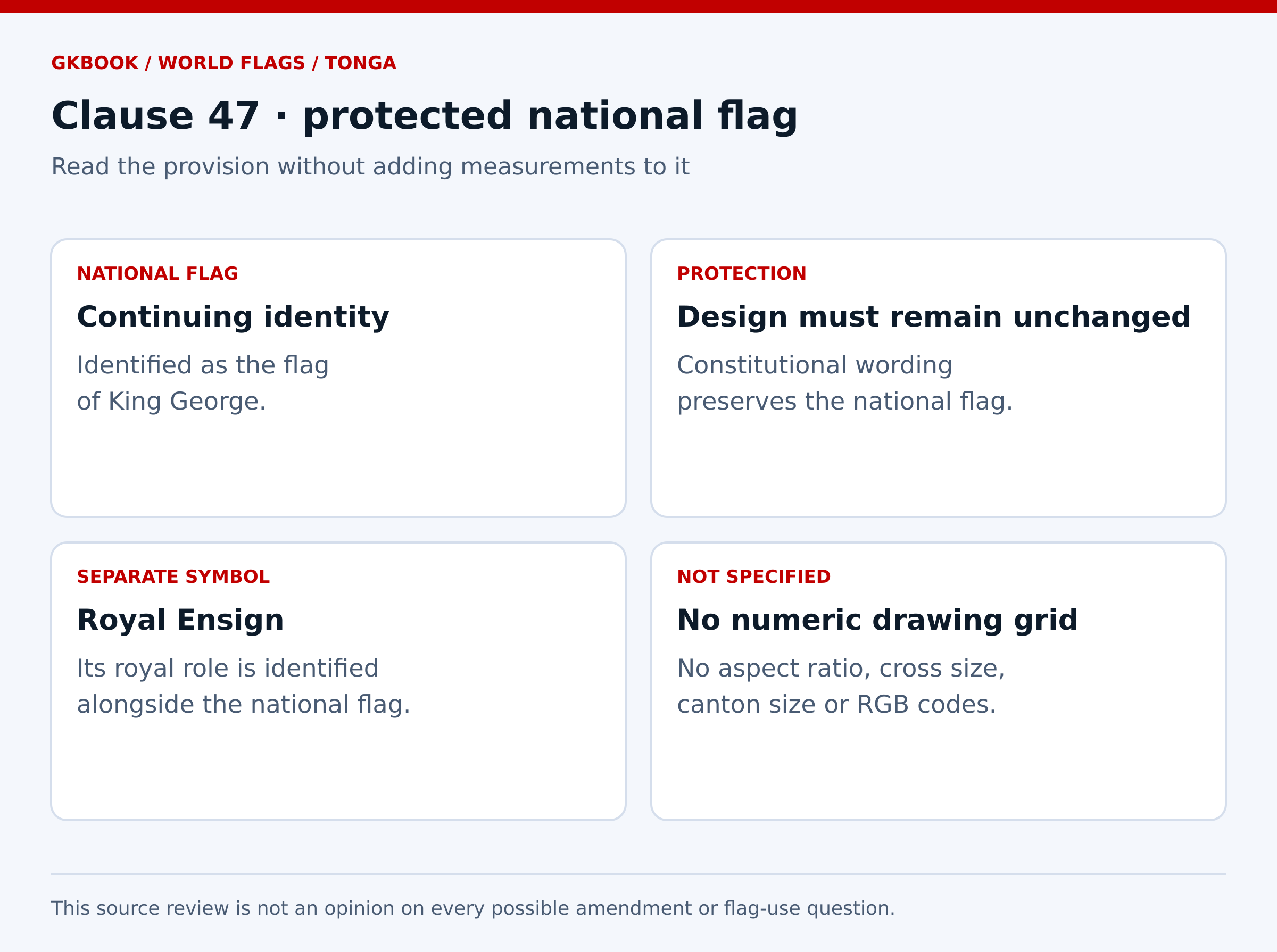
Clause 47 says the national flag, identified as the flag of King George, must remain unchanged and remain the kingdom’s flag. It also preserves the Royal Ensign’s separate role. The reviewed clause does not describe colors, cross dimensions, canton proportions, or an overall aspect ratio; it protects an already identifiable flag.
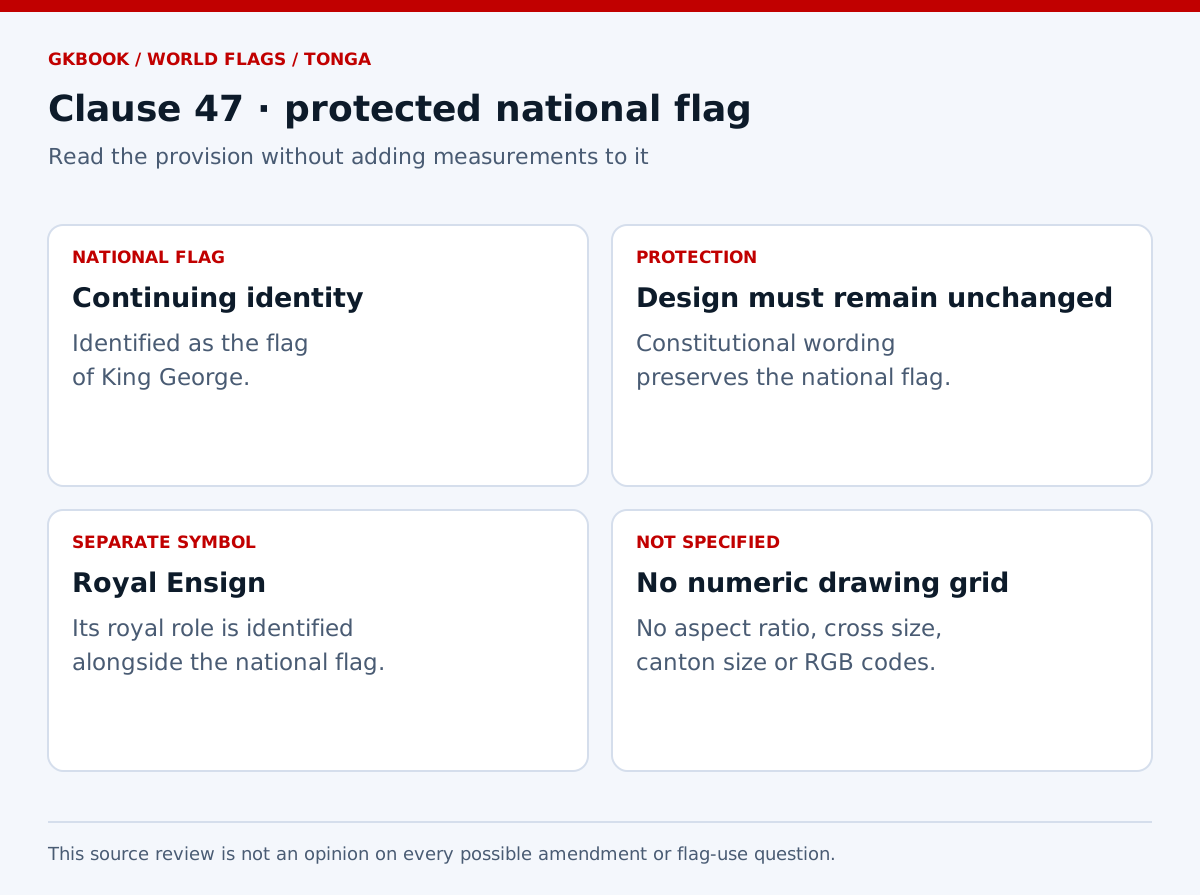
The distinction matters when reading claims that the Constitution specifies a particular HEX code or construction grid. Those measurements are absent from the clause. A modern drawing can reproduce the protected design while still requiring an explicitly identified reference for its numerical geometry and digital colors.
The 2020 revised edition was inspected directly, including its separate amendment provision. This guide reports the flag clause’s wording and scope without turning it into a broader legal opinion about every hypothetical amendment or use. Later publication dates should not be mistaken for the original constitutional grant in 1875.
Are the flag’s exact dimensions and color codes fixed by law?
The reviewed constitutional clause and Royal Arms and Flag Act do not provide a numerical construction sheet or RGB palette. Published references offer differing details. This edition therefore identifies its own source: the inspected 960-by-480 SVG, with a 40-by-24 canton in its 96-by-48 coordinate system and red #C10000.
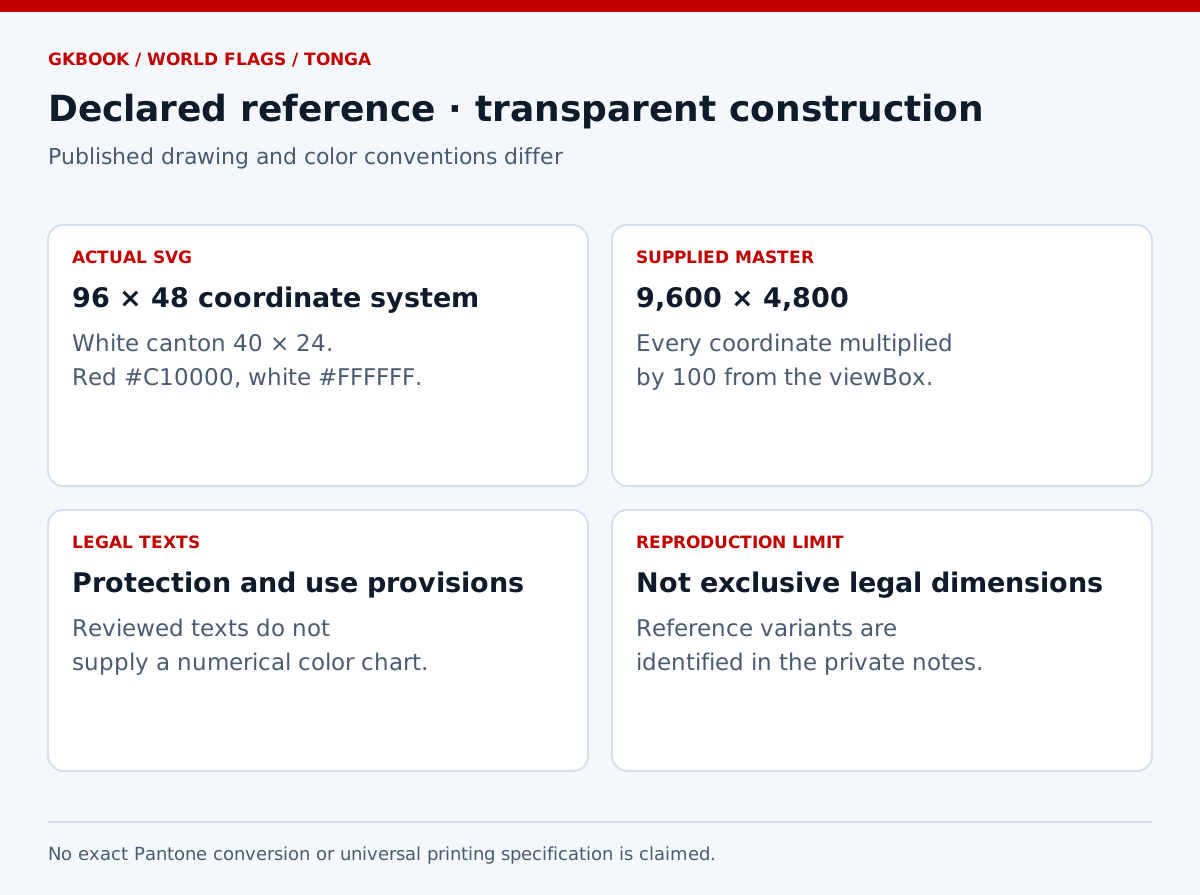
The Royal Arms and Flag Act addresses use of national and royal symbols, rather than providing a drawing specification. Its 2020 revised text includes restrictions concerning business use and the Royal Ensign. A downloadable image should not be presented as a general legal authorization to use those symbols commercially.
Drawing conventions and permissions are separate questions. This collection documents its geometry and credits, while the research notes identify the legislative texts and access limits. A claim that a color is legally mandatory needs the actual instrument that sets it; a supplier’s swatch or community file alone does not establish that status.
Was the Tonga flag introduced when British protection ended?
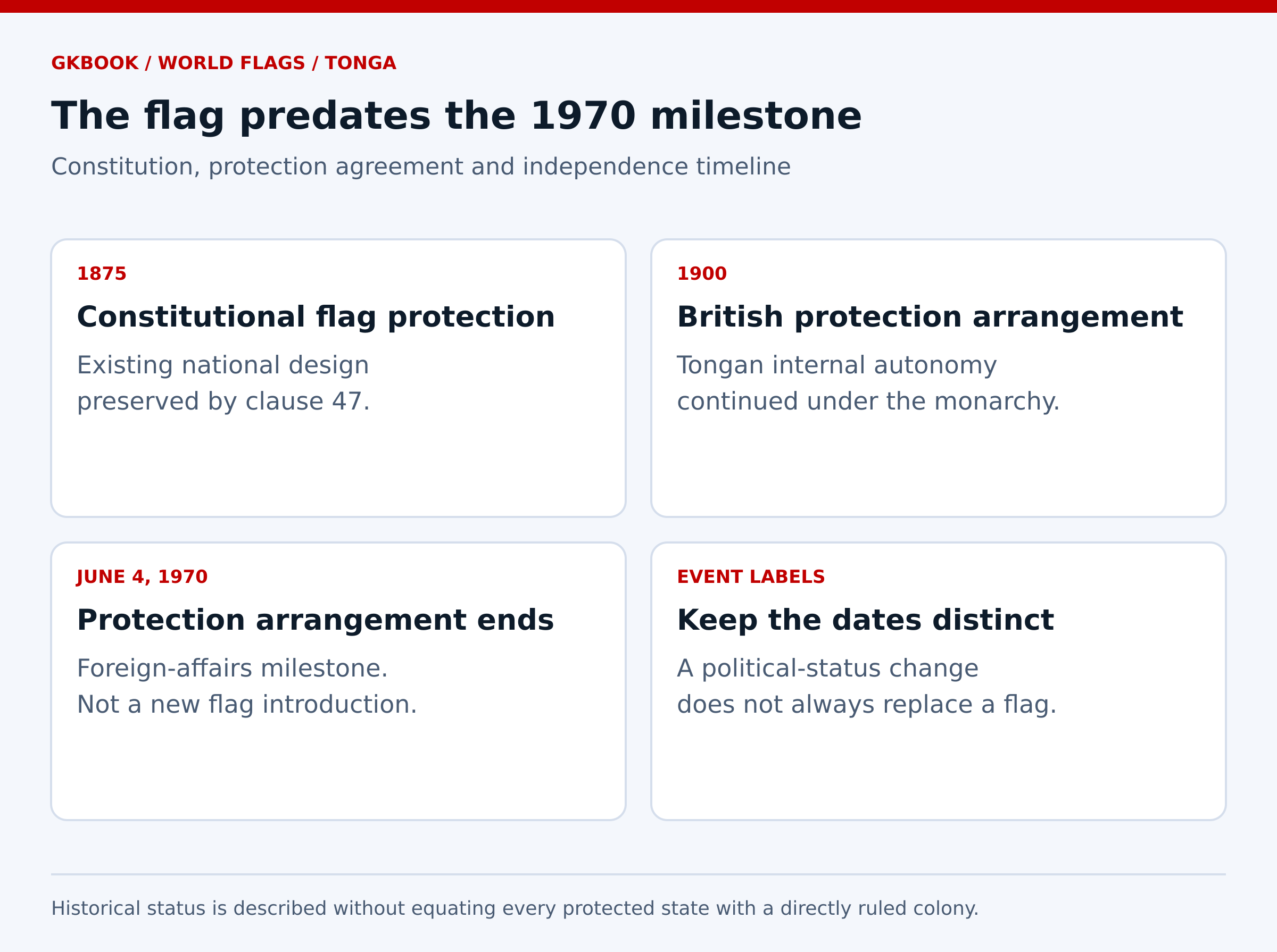
No. The flag’s constitutional adoption in 1875 predates both the British protection arrangement of 1900 and its end on June 4, 1970. Tonga retained its monarchy and internal autonomy during that arrangement. The 1970 milestone concerns international status and foreign affairs, not the introduction of the present national flag.
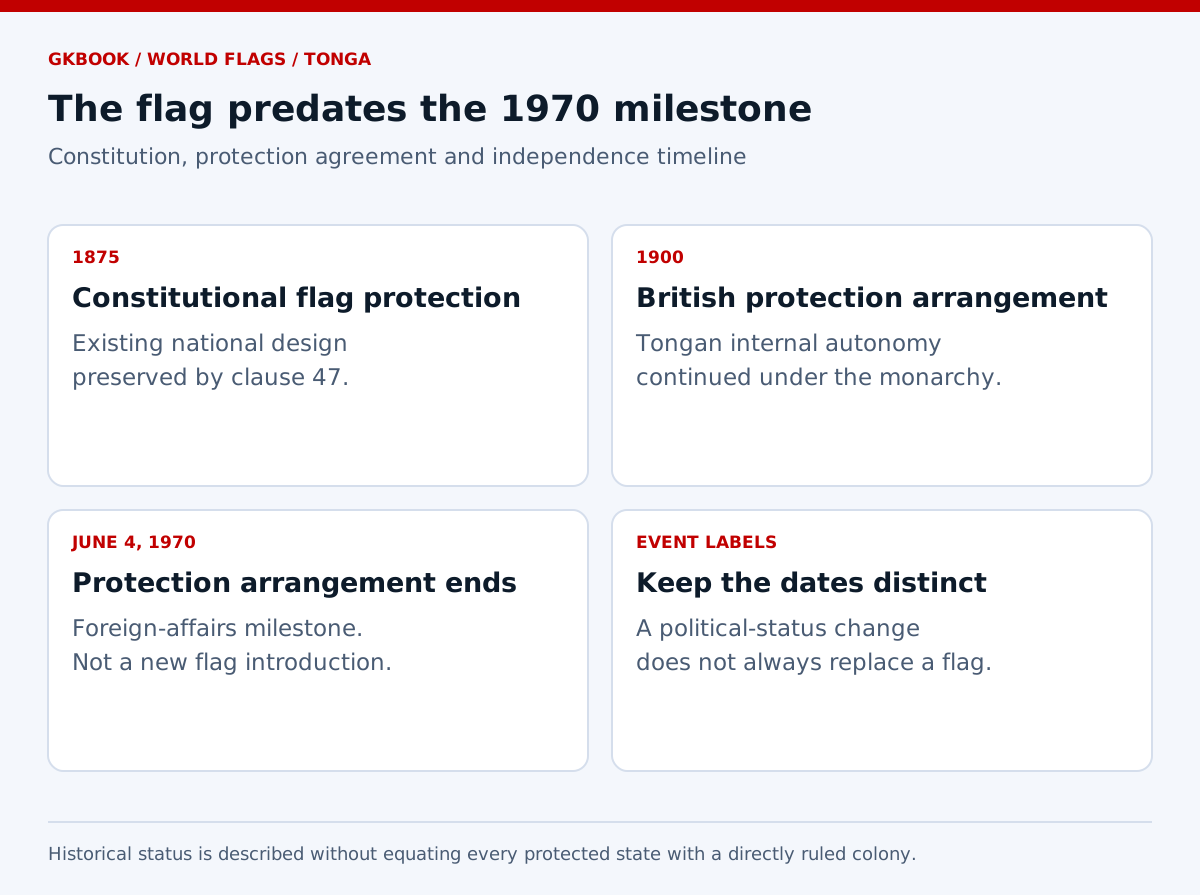
This chronology prevents a familiar mistake in country timelines: assuming that every present flag began with a twentieth-century independence date. Tonga’s national institutions and flag already existed before the protection agreement. A later change in external relations did not automatically require a replacement national design.
Use precise event labels when comparing countries. The granting of a constitution, the beginning or ending of a protection agreement, and recognition by another state are different actions. The accompanying timeline keeps those developments separate, making the flag’s long continuity understandable without treating Tonga’s history as identical to that of every colonial territory.
When did Tonga join the United Nations?
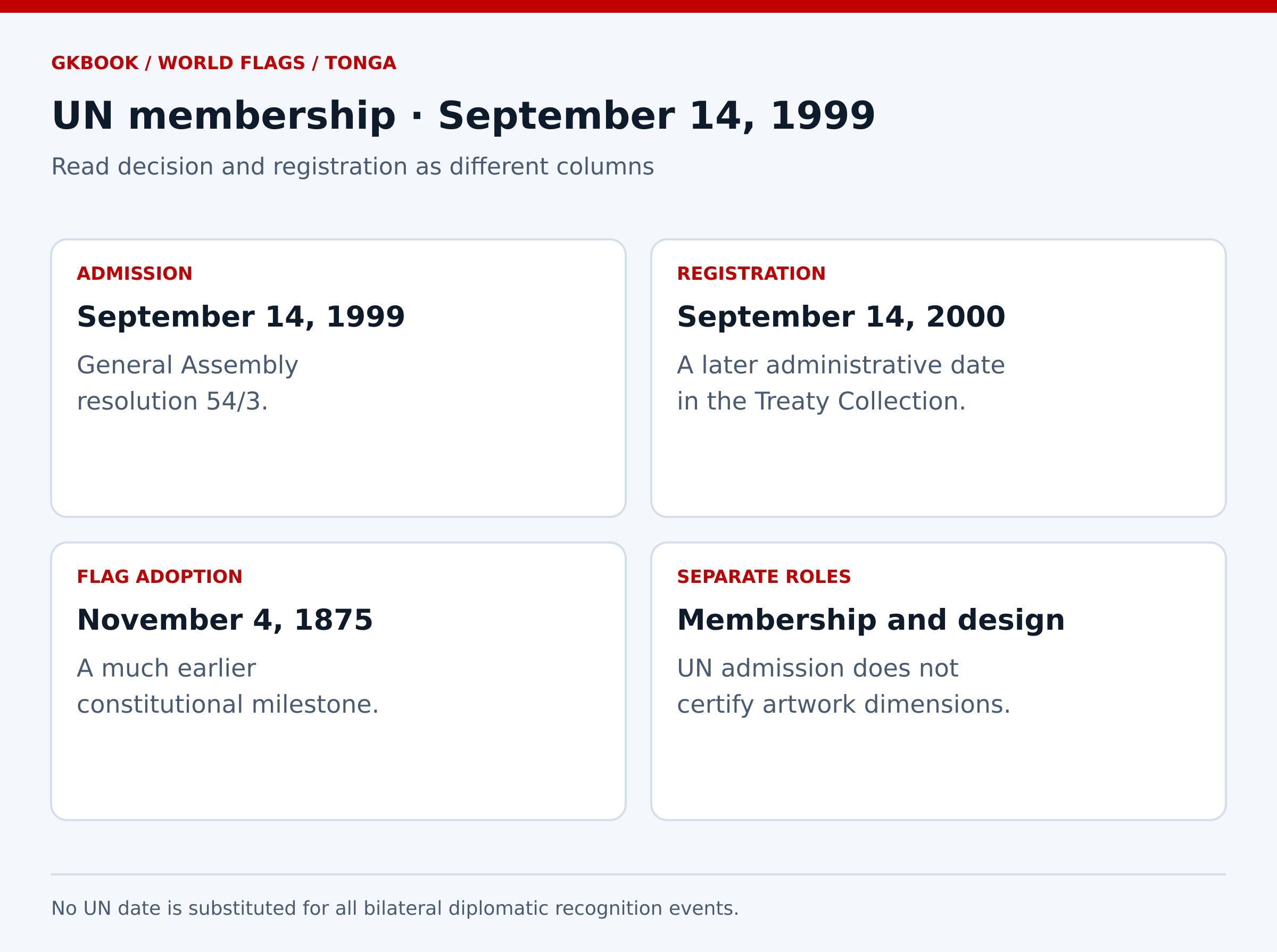
Tonga became a United Nations member on September 14, 1999, under General Assembly resolution 54/3. This was much later than the flag’s constitutional adoption in 1875. The Treaty Collection separately records registration on September 14, 2000; that later administrative date should not be substituted for the actual membership date.
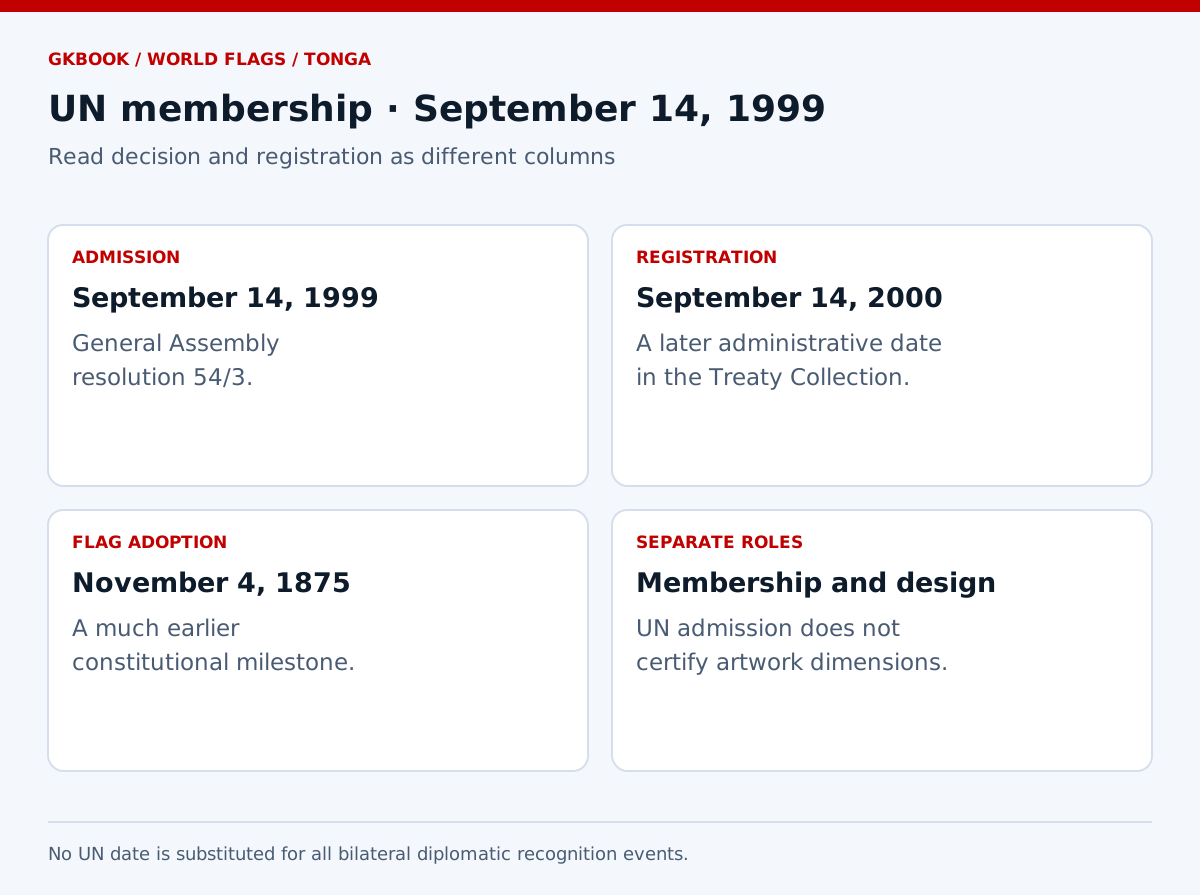
The official table distinguishes the Assembly’s decision from registration and publication details. Its explanatory note makes membership effective on the decision date for Tonga’s admission. Reading the column headings is therefore essential; two nearby dates in a treaty record do not necessarily describe the same event.
UN membership is also different from diplomatic recognition by an individual country. It does not constitute international approval of a particular red value, canton measurement, or manufacturing method. The flag represents Tonga at the organization, while its constitutional history and reproduction details remain separate subjects.
Is Tonga’s flag the same as the Red Cross emblem?
No. Tonga’s national flag has a large red field and a white canton containing a red cross. The humanitarian red-cross emblem is a red cross on white. Their visual resemblance does not give them the same meaning or function: one identifies a country, while the other serves a distinct humanitarian role.
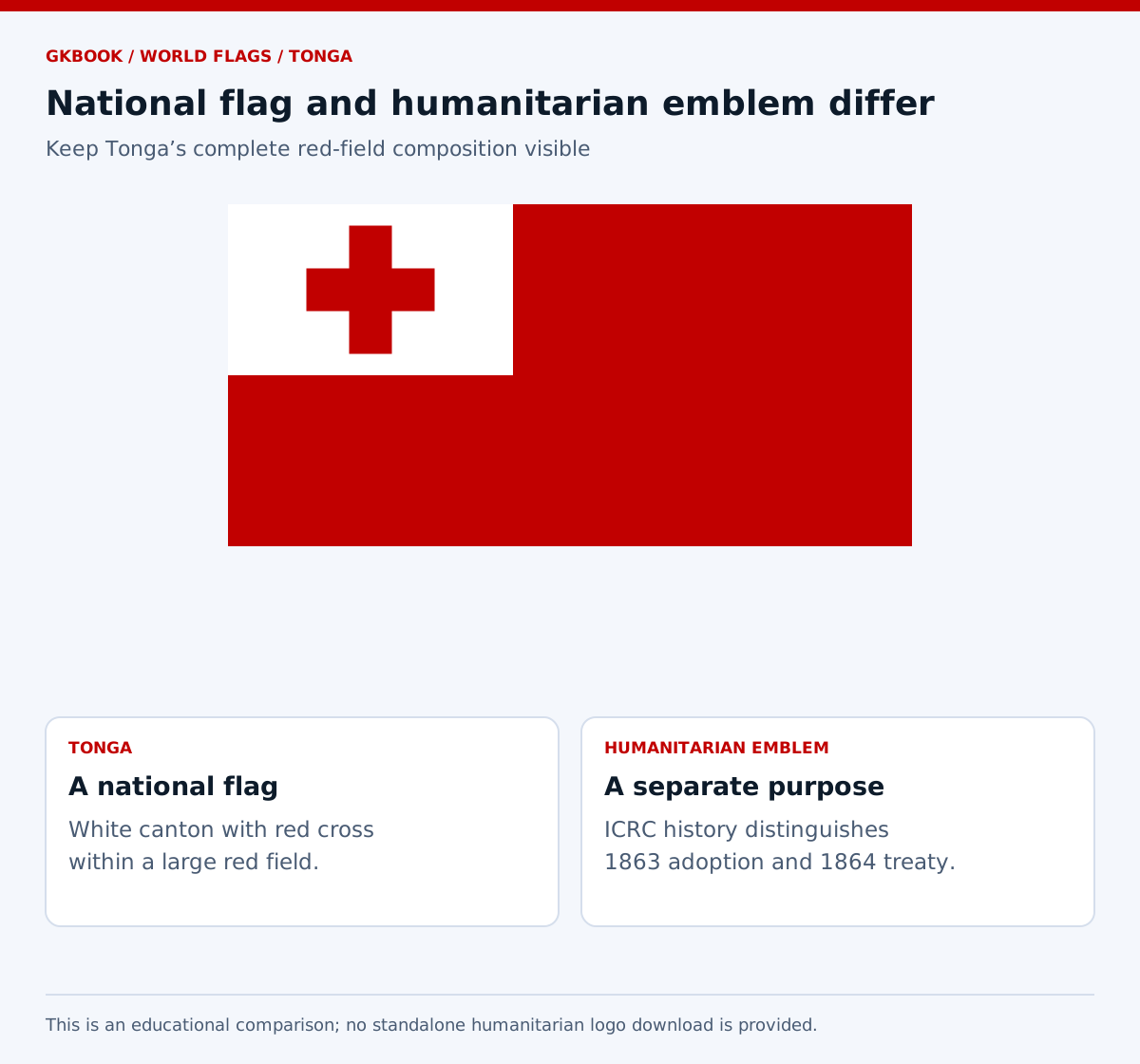
The ICRC records adoption of the red-cross emblem by the 1863 international conference and its recognition in the 1864 Geneva Convention. That documented humanitarian chronology should be distinguished from later accounts linking Tonga’s earlier flag changes to the resemblance between the two symbols.
The illustration compares their roles through labeled text rather than offering a humanitarian emblem as a general-purpose logo. Cropping Tonga’s flag down to its canton removes the red field that helps distinguish the national composition. Preserve the entire flag when the purpose is to identify the country.
What did Tonga’s earlier flags look like?
Historical references describe earlier white-field designs, including flags with crosses and lettering and a simpler red-cross design. Exact dates and reproductions vary across accounts. This package uses a documentary timeline rather than claiming authenticated facsimiles, because the original artifacts and complete production specifications for those earlier designs were not inspected.
A historical flag needs more than an approximate picture and a broad date range. Its purpose, user, period, and source all matter. A royal flag, a territorial symbol, and a later reconstruction can look related while representing different stages or institutions.
The current national flag remains the subject of the clean downloadable master. Earlier designs are discussed to explain development, not to supply unsupported production artwork. A separate historical atlas could add them after matching each illustration to a dated artifact, original instrument, or other sufficiently detailed visual evidence.
Is the national flag the same as Tonga’s Royal Ensign?
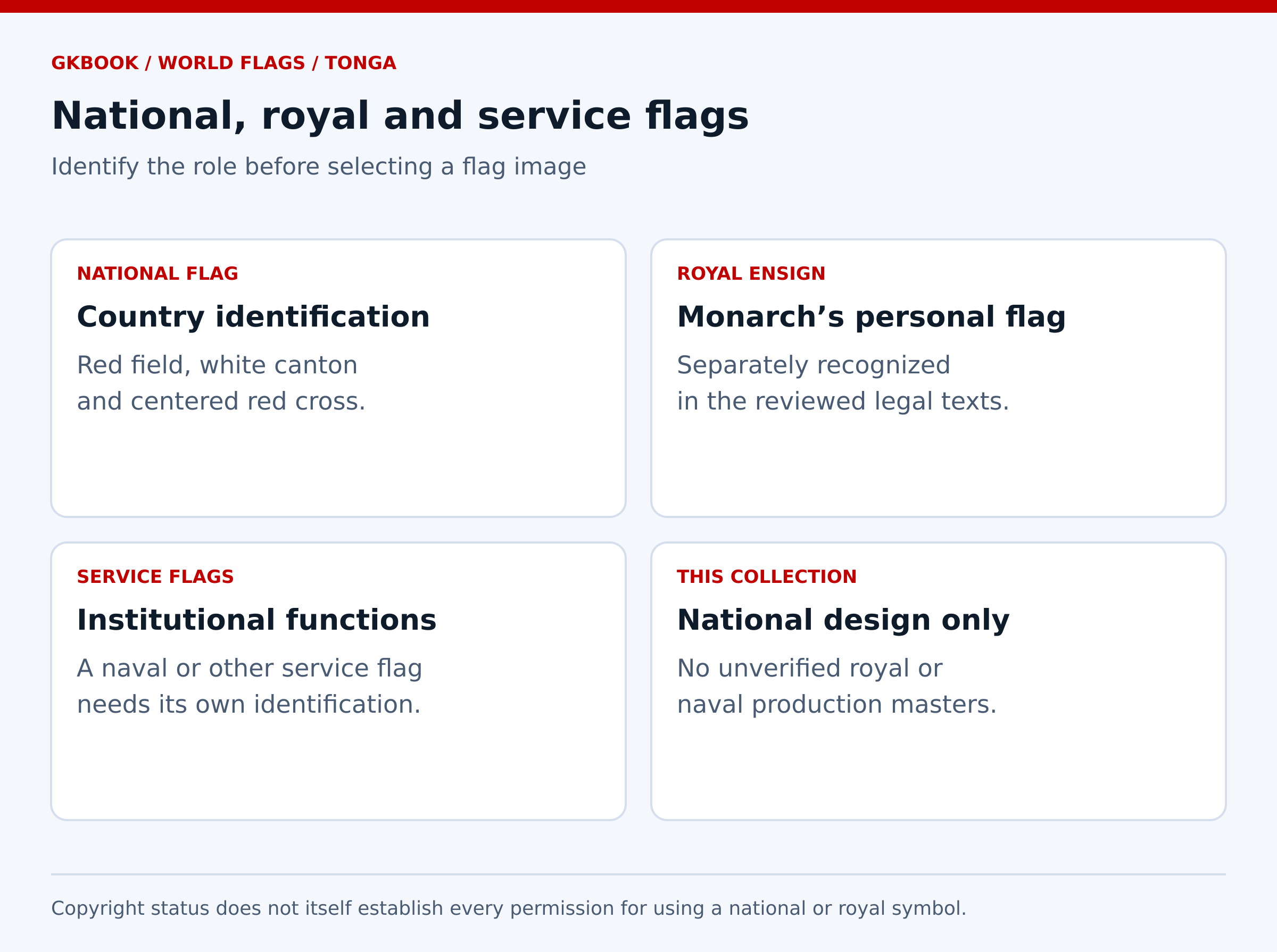
No. Constitutional clause 47 identifies the national flag and Royal Ensign separately. The Royal Arms and Flag Act also describes the Royal Ensign as the monarch’s personal flag. Royal, naval, and other service flags should be labeled by their specific roles; the red-field national flag is not a substitute name for all of them.
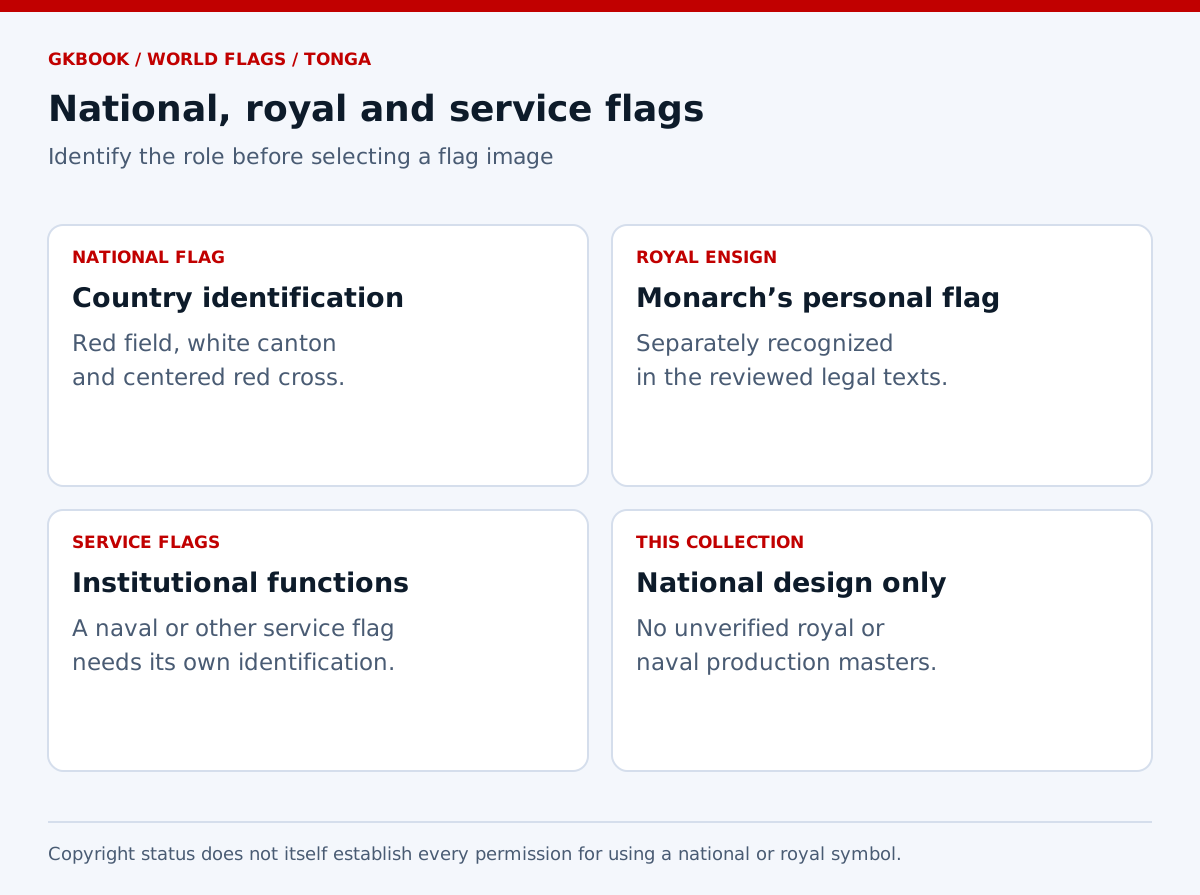
A state can use several flags without changing its national flag. A personal standard identifies a sovereign, while a service ensign identifies a particular institutional function. Those distinctions are especially important when a photograph shows a ceremonial occasion or a vessel carrying more than one flag.
The gallery here provides the national design and explanatory panels, not a full official inventory of present service flags. It avoids introducing detailed royal or naval reconstructions without their own source review. When another Tongan flag is needed, verify its identity and applicable context before selecting an image.
Does Tonga’s national flag include the coat of arms?
No. The national flag shown here contains only the red field, white canton, and red cross. Tonga’s coat of arms is a separate national symbol. Adding a crown, shield, motto, or the complete arms to this plain flag changes the pictured composition and should not be presented as the standard national design.
Official documents may display the arms alongside the name of the kingdom, while other settings use the national flag. Their appearance in related governmental contexts does not make them the same image. The constitutional document itself provides an example of an arms illustration used within a publication.
For a country-identification icon, the complete national flag is sufficient. If an educational page also needs the arms, give that image a separate caption and a verified source. Keeping their identities clear helps readers understand why different symbols can legitimately represent the same country in different settings.
Why does the flag matter beyond its geometry?
The flag connects national identity with the monarchy’s constitutional history and a prominent Christian symbol. Its meaning is therefore broader than a red-and-white pattern. Geometry helps reproduce it consistently, while historical context explains why the design is recognizable and significant; neither requires assuming that all Tongans interpret it in exactly the same way.
A classroom discussion can move from observation to interpretation: identify the field and canton, explain the cross’s shape, then place the design within the nineteenth-century constitutional story. This sequence lets students distinguish what the image contains from the accounts explaining its significance.
Contemporary photographs may show flags at celebrations, sporting events, or community gatherings. Such images document those occasions, not necessarily the circumstances of original adoption. A careful caption identifies the event and date rather than treating every recent display as historical evidence for the flag’s first appearance.
How does the Tonga flag look when rotated vertically?
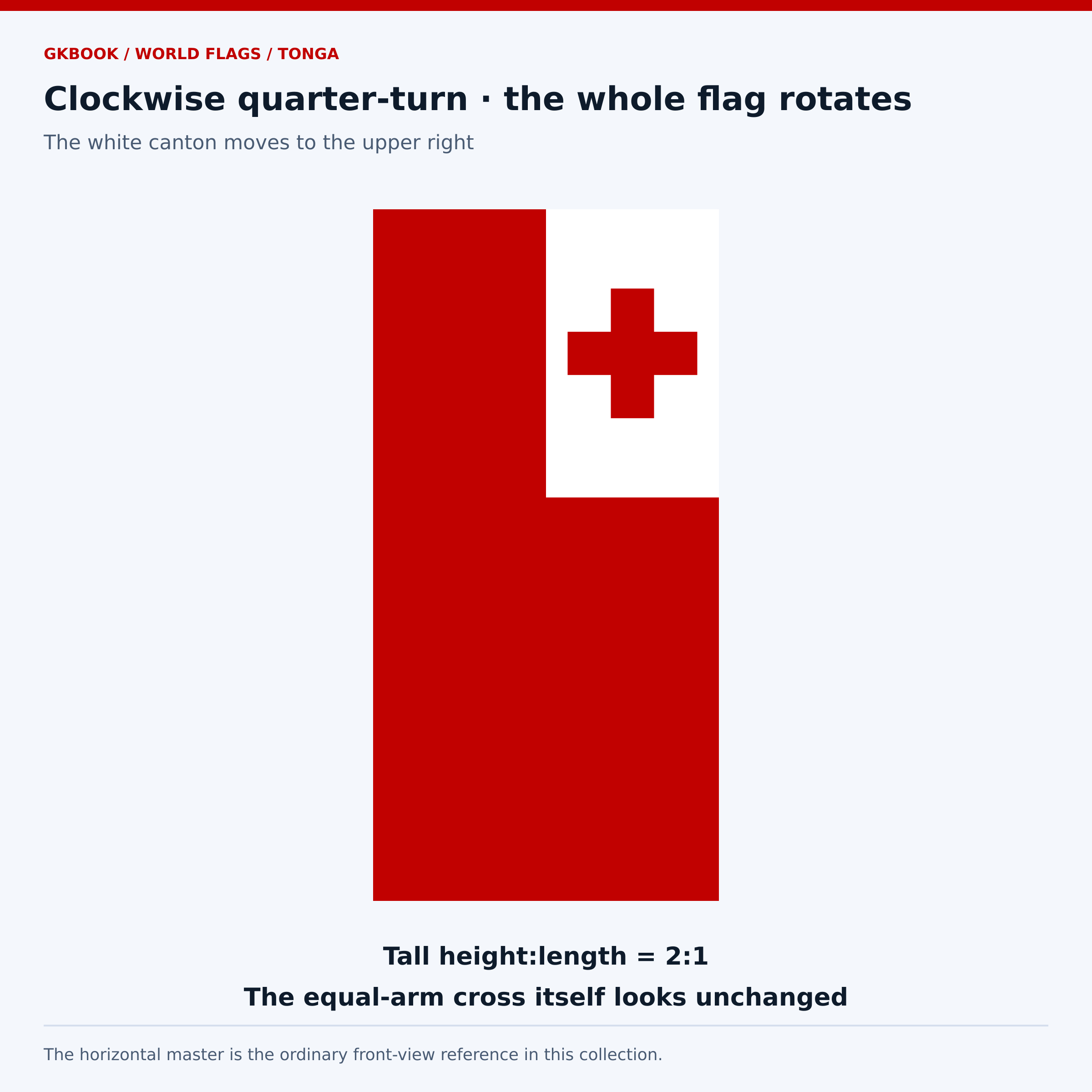
A clockwise quarter-turn makes the complete flag a tall 2:1 rectangle in height-to-length terms and places the white canton at the upper right. The cross rotates with the flag, but its equal-arm shape looks unchanged. This diagram demonstrates a geometric rotation; it is not presented as a verified national hanging instruction.
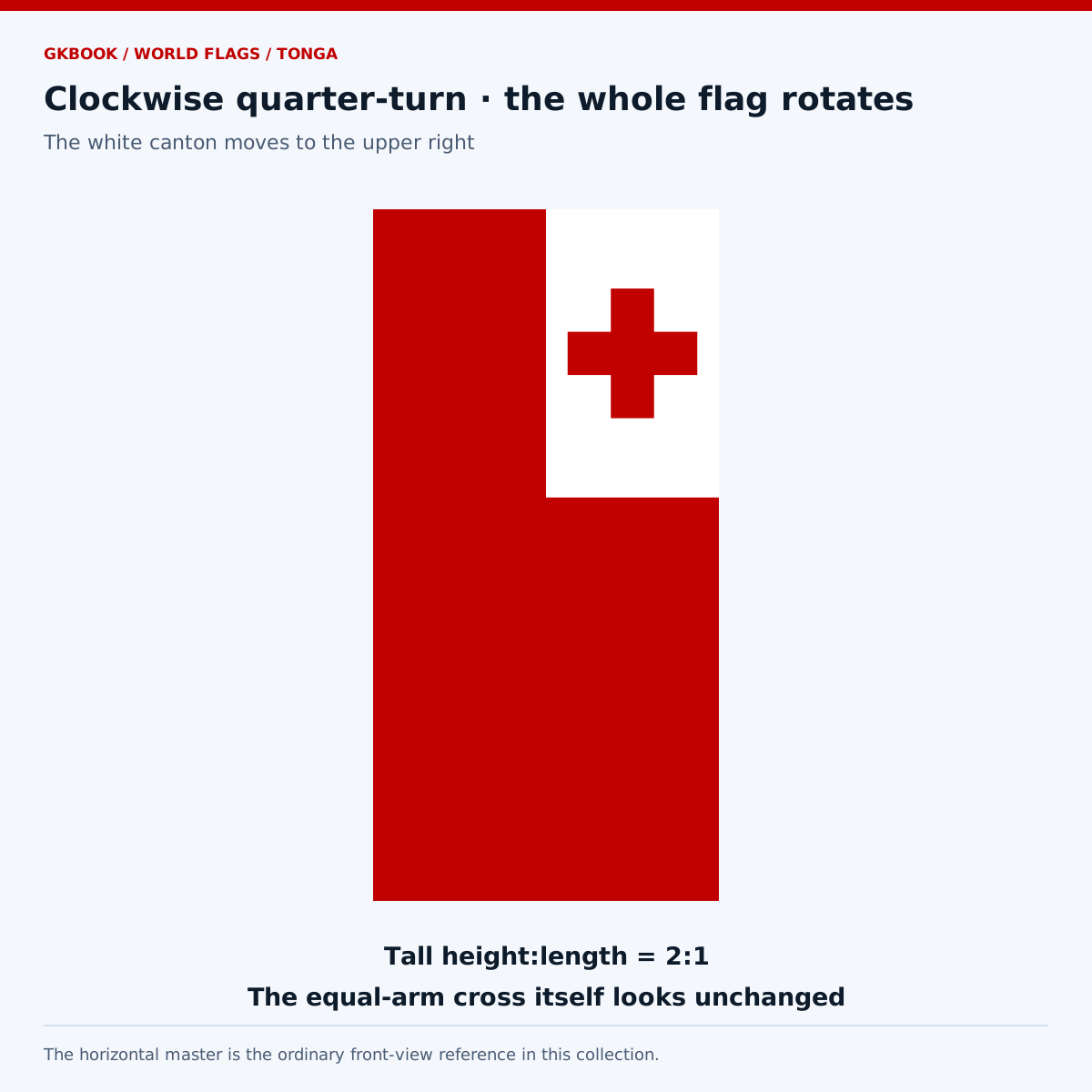
Rotate the entire composition as one object. The canton keeps its shape and relative area, while the field remains connected around it. Because the cross has fourfold rotational symmetry, it can appear unchanged even though the surrounding canton and outer flag have visibly changed orientation.
That visual effect does not make rotation and reflection the same operation. A tall display example should state which transformation was applied. A venue needing a prescribed physical arrangement must follow the relevant protocol for that setting rather than treating an educational rotation diagram as an authoritative instruction.
What does the reverse side of the Tonga flag look like?
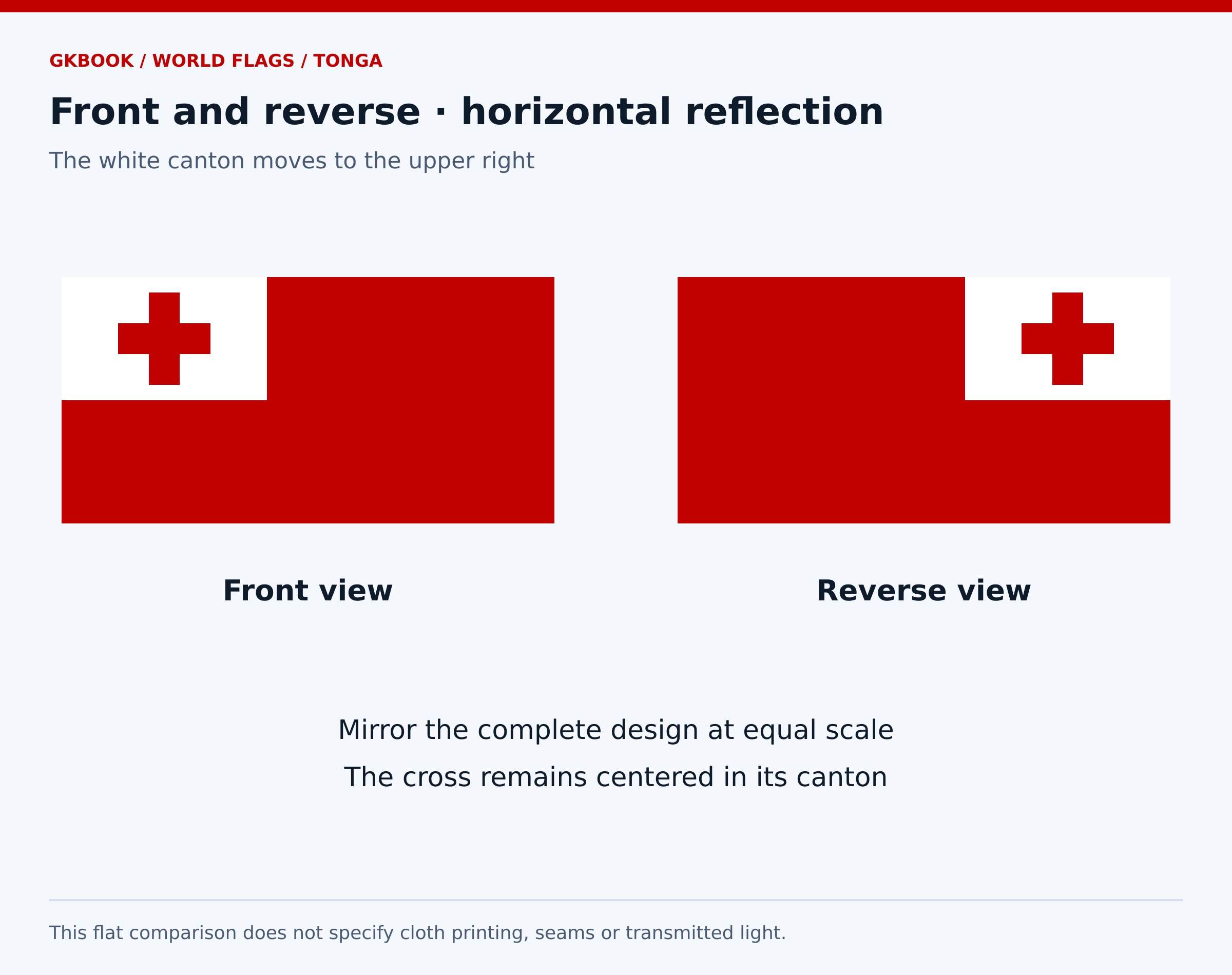
A flat reverse view is a left-right reflection of the front. The white canton appears at the upper right and the red cross stays centered inside it. Since the cross is horizontally symmetric, its shape looks unchanged. This illustration models image geometry rather than specifying seams, printing methods, or the construction of cloth.
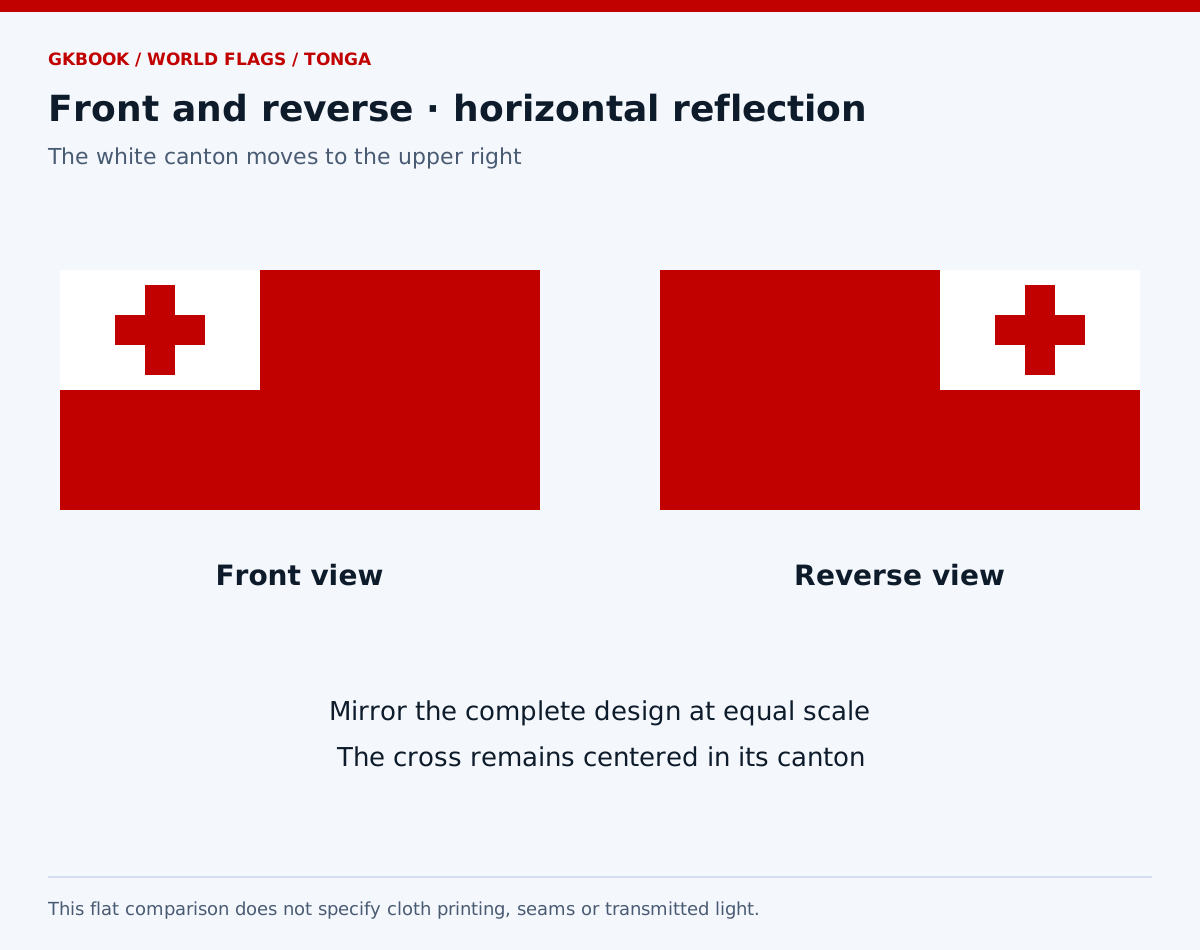
The paired diagram mirrors the actual complete master at the same scale. It does not redraw the cross separately or move it independently of its canton. That approach preserves every dimension and the relationship between the white rectangle and the surrounding red field.
The upper-right canton can therefore indicate a reverse view rather than an incorrectly designed flag. Context matters: a flat front-view reference normally places the hoist at the left, whereas a person standing on the opposite side of a physical flag sees the corresponding mirrored arrangement.
Does the Tonga flag look the same upside down?
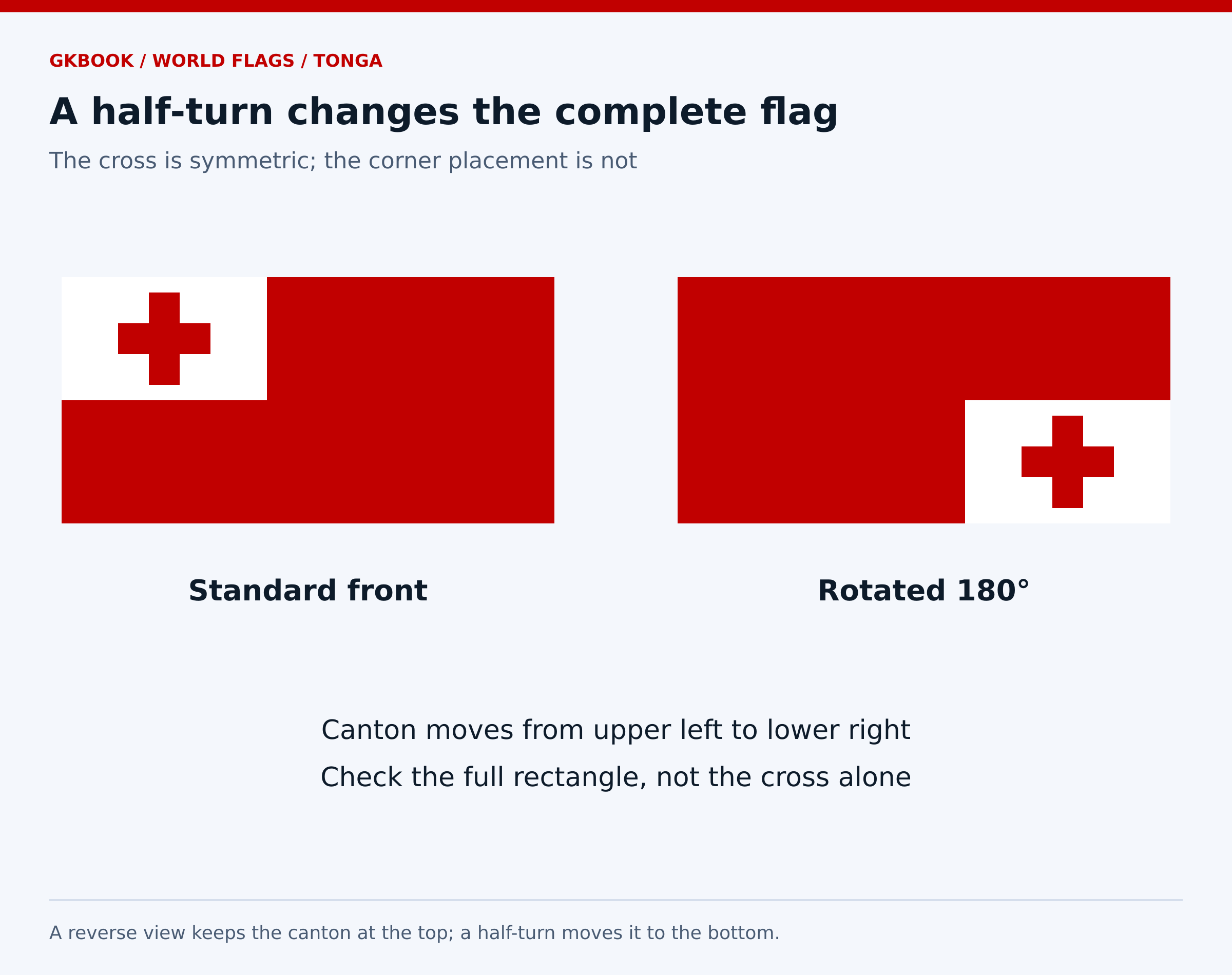
No. A half-turn moves the white canton from the upper left to the lower right. The equal-arm cross itself looks unchanged after a 180-degree rotation, but the complete flag does not. Judge orientation from the canton’s position within the full rectangle, not from the cross alone.

This is an example of a component having more symmetry than the whole design. The cross is unchanged by quarter-turns and reflections, while its placement in one corner makes the surrounding flag asymmetric. Removing the red field from consideration would hide that important positional information.
A reverse view and a half-turn also differ. Reflection keeps the canton at the top, while the half-turn moves it to the bottom. The comparison panels label both the original front view and rotated result so students can track which parts move and which shapes happen to look the same.
How should the Tonga flag artwork be resized or printed?
Scale both axes together to preserve the 1:2 ratio and internal construction. Use the SVG for scalable artwork or the 9,600 by 4,800 PNG for fixed raster output. At 300 pixels per inch, the PNG corresponds to 32 by 16 inches, before any separate page margins, caption, or frame is added.
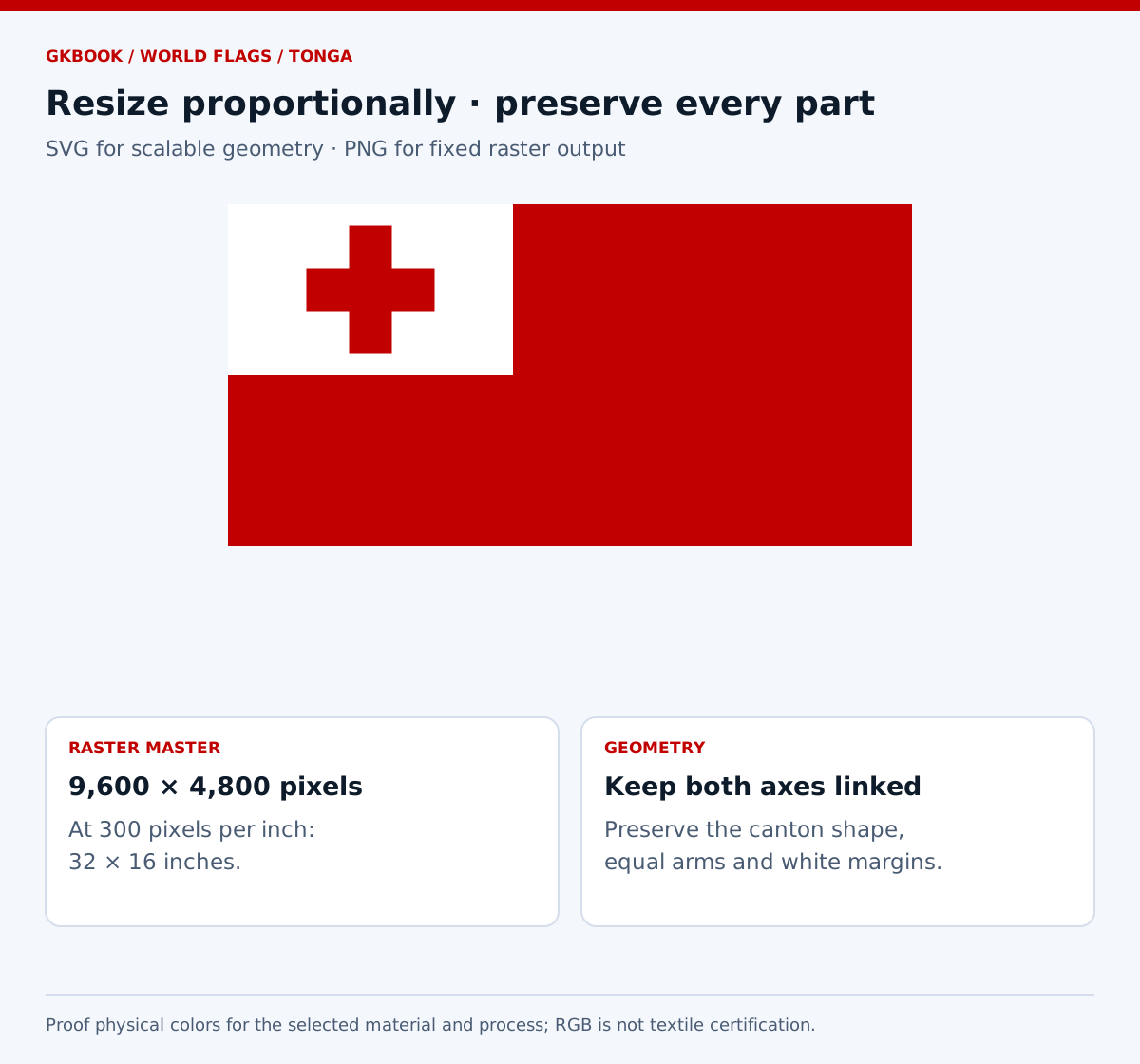
Keep decorative framing outside the actual flag rectangle. Cropping the red fly or widening the canton to fill a different box alters the selected drawing. A proportional resize preserves the equal cross arms and paired margins without needing to reconstruct them manually at each new size.
Physical color output depends on the printing process, material, ink, and viewing conditions. The documented RGB red is a reproducible digital choice, not certification of a finished textile. Copyright credits, reproduction accuracy, and any rules governing a particular use are separate matters and should not be collapsed into one claim.
How can the Tonga flag remain clear at small sizes?
Keep the full rectangle, white canton, and equal-arm cross intact. Do not reduce the country symbol to its cross alone or force it into a square. Small raster images may blend edge pixels, so inspect the result at its intended display size and include a readable country label when needed.
For this construction, a 96-by-48 image places the major boundaries on whole pixels. A 192-by-96 image doubles those measurements exactly. Other sizes remain possible, but fractional coordinates can require antialiasing, especially around the cross and the edge of the canton.
A blurred thumbnail is not evidence that the vector geometry is wrong. Conversely, a crisp image can still have the wrong proportions. Check both the original construction and the actual small rendering. If the cross becomes difficult to distinguish, increase the image size rather than replacing it with a dot or another simplified shape.
Download Tonga flag pictures
Download the complete flag as SVG or 9,600 × 4,800 PNG. The declared height:length ratio is 1:2. A white upper-hoist canton contains a red equal-arm cross against the surrounding red field.
The gallery contains 24 subjects, each with an SVG and PNG. Captions distinguish the clean flag from construction guides, historical explanations, and geometric transformations. Image credits and reproduction notes identify the palette, construction, source distinctions, and limits. The separate 1,200 × 630 social card contains a complete flag 540 units wide at the declared ratio.
Continue exploring national designs in World Flags.
World Flags/Tonga
Tonga flag pictures
Complete 1:2 reconstruction using the declared reference geometry and digital palette.
GKBook reconstruction and educational layouts, CC0 1.0; digital reference contributors credited in the notes. No official certification.Download SVGDownload PNGRed #C10000 and white #FFFFFF match the inspected SVG; constitutional clause 47 gives no numeric color codes.
GKBook reconstruction and educational layouts, CC0 1.0; digital reference contributors credited in the notes. No official certification.Download SVGDownload PNGTraditional meanings are explanatory accounts, not numerical drawing rules.
GKBook reconstruction and educational layouts, CC0 1.0; digital reference contributors credited in the notes. No official certification.Download SVGDownload PNGThe background and cross are the same solid red; the white canton touches two outer edges.
GKBook reconstruction and educational layouts, CC0 1.0; digital reference contributors credited in the notes. No official certification.Download SVGDownload PNGA red Greek cross with equal arms; its ends do not reach the canton edges.
GKBook reconstruction and educational layouts, CC0 1.0; digital reference contributors credited in the notes. No official certification.Download SVGDownload PNGThis white rectangle is 5/12 of the length and 1/2 of the height, not an entire quarter of the flag.
GKBook reconstruction and educational layouts, CC0 1.0; digital reference contributors credited in the notes. No official certification.Download SVGDownload PNGThe supplied rectangle has a 1:2 height-to-length ratio.
GKBook reconstruction and educational layouts, CC0 1.0; digital reference contributors credited in the notes. No official certification.Download SVGDownload PNGFour filled rectangles create the complete master with no outlines or gaps.
GKBook reconstruction and educational layouts, CC0 1.0; digital reference contributors credited in the notes. No official certification.Download SVGDownload PNGThe cross covers five of nine equal cells in its bounding square.
GKBook reconstruction and educational layouts, CC0 1.0; digital reference contributors credited in the notes. No official certification.Download SVGDownload PNGThe rectangular canton produces equal opposite margins, not four identical margins.
GKBook reconstruction and educational layouts, CC0 1.0; digital reference contributors credited in the notes. No official certification.Download SVGDownload PNGThe cross is red and must be subtracted from the canton to calculate visible white.
GKBook reconstruction and educational layouts, CC0 1.0; digital reference contributors credited in the notes. No official certification.Download SVGDownload PNGA documentary timeline separates historical development from legal protection.
GKBook reconstruction and educational layouts, CC0 1.0; digital reference contributors credited in the notes. No official certification.Download SVGDownload PNGThe constitutional date is distinguished from earlier use and the date of the inspected consolidated text.
GKBook reconstruction and educational layouts, CC0 1.0; digital reference contributors credited in the notes. No official certification.Download SVGDownload PNGAttributions are presented with their source context, without claiming an inspected signed original.
GKBook reconstruction and educational layouts, CC0 1.0; digital reference contributors credited in the notes. No official certification.Download SVGDownload PNGConstitutional protection and modern numerical construction are separate kinds of information.
GKBook reconstruction and educational layouts, CC0 1.0; digital reference contributors credited in the notes. No official certification.Download SVGDownload PNGThis edition names the inspected reference instead of presenting its numbers as statute.
GKBook reconstruction and educational layouts, CC0 1.0; digital reference contributors credited in the notes. No official certification.Download SVGDownload PNGThe present flag was already established before the British protection period.
GKBook reconstruction and educational layouts, CC0 1.0; digital reference contributors credited in the notes. No official certification.Download SVGDownload PNGThe official table’s admission and registration dates must not be confused.
GKBook reconstruction and educational layouts, CC0 1.0; digital reference contributors credited in the notes. No official certification.Download SVGDownload PNGVisual resemblance does not make the country flag and humanitarian emblem interchangeable.
GKBook reconstruction and educational layouts, CC0 1.0; digital reference contributors credited in the notes. No official certification.Download SVGDownload PNGDifferent official flags serve different roles without replacing the national design.
GKBook reconstruction and educational layouts, CC0 1.0; digital reference contributors credited in the notes. No official certification.Download SVGDownload PNGClockwise rotation of the complete master, a geometric demonstration rather than a national hanging prescription.
GKBook reconstruction and educational layouts, CC0 1.0; digital reference contributors credited in the notes. No official certification.Download SVGDownload PNGThe reverse is a left-right reflection of the actual master.
GKBook reconstruction and educational layouts, CC0 1.0; digital reference contributors credited in the notes. No official certification.Download SVGDownload PNGThe cross retains its shape but the complete flag changes orientation.
GKBook reconstruction and educational layouts, CC0 1.0; digital reference contributors credited in the notes. No official certification.Download SVGDownload PNGUse proportional resizing; add page margins outside the complete national flag rectangle.
GKBook reconstruction and educational layouts, CC0 1.0; digital reference contributors credited in the notes. No official certification.Download SVGDownload PNGFrequently asked questions
What does the Tonga flag look like?
The Tonga flag has a red field with a white rectangle in the upper hoist corner and a red cross centered inside that rectangle. Its usual height-to-length ratio is 1:2. The cross has equal arms and stops short of the white rectangle’s edges, leaving clear white margins around it.
What is the national flag of Tonga called?
It is the national flag of Tonga, formally the Kingdom of Tonga. The Constitution identifies it as the flag of King George and distinguishes it from the Royal Ensign. A clear English caption should say “Tonga flag” or “national flag of Tonga,” because several other Tongan flags have different functions.
What are the colors of the Tonga flag?
The flag has two colors, red and white. This digital edition uses red #C10000, or RGB 193,0,0, and white #FFFFFF, or RGB 255,255,255, matching the inspected reference SVG. These are declared reproduction values; constitutional clause 47 supplies neither numerical color codes nor a Pantone or printing specification.
What do the Tonga flag’s colors and cross mean?
The cross is associated with Christianity, red with the blood and sacrifice of Jesus Christ, and white with purity. These familiar explanations appear in flag references and the archived World Factbook description. They explain the symbol’s religious context; they are not numerical color standards or a statement of every individual Tongan’s beliefs.
Why is most of the Tonga flag red?
Red forms the flag’s main field and the cross inside its white canton. In the customary religious explanation, it recalls the blood and sacrifice of Jesus Christ. The field surrounds the canton on its right and below; it does not appear as a border along the canton’s top or hoist edge.
What does the white canton represent?
White is commonly explained as purity. Visually, it creates the contrasting canton that makes the red cross distinct from the red field. The canton is a rectangle in the upper hoist corner, and the cross lies fully inside it. Its white margins remain visible above, below, and beside the cross.
What kind of cross appears on the Tonga flag?
The flag carries a red couped cross with equal arms, often called a Greek cross. “Couped” means its arms end before reaching the surrounding canton’s edges. In this reconstruction, the cross consists of five equal squares arranged around a central square, giving equal horizontal and vertical spans and uniform arm thickness.
How large is the white canton on the Tonga flag?
In this edition, the white canton measures 4,000 by 2,400 units within a 9,600 by 4,800 flag. It is half the flag’s height and five twelfths of its length, following the inspected SVG. Other published construction schemes differ, so these measurements are identified as a reproduction choice rather than constitutional dimensions.
What are the proportions of the Tonga flag?
The usual height-to-length ratio is 1:2, meaning the flag is twice as long as it is high. The supplied SVG and PNG use 9,600 by 4,800 dimensions. This matches the overall ratio in the inspected reference artwork and established flag references; the constitutional flag clause itself does not state those numbers.
How can the Tonga flag be drawn accurately?
Draw a 9,600 by 4,800 red rectangle, then a 4,000 by 2,400 white rectangle at its upper left. Center the cross at coordinates 2,000,1,200. Form it from a 600 by 1,800 vertical red bar and a 1,800 by 600 horizontal red bar, using the same red as the field.
How do five squares form the cross?
The cross can be understood as five equal 600-unit squares: one central square with another attached to each side. Its total span is three square-widths in either direction, or 1,800 units. The bounding square contains nine such cells, but the four corner cells remain white rather than becoming part of the cross.
What margins surround the red cross?
For the supplied construction, the cross has 300 units of white clearance above and below and 1,100 units on each side. Its center coincides with the canton’s center. The different horizontal and vertical clearances are expected because the canton is wider than it is high, while the cross’s bounding square has equal sides.
How much of the Tonga flag is red or white?
In this declared construction, red occupies about 83.0729 percent and visible white about 16.9271 percent. The canton itself occupies 20.8333 percent, but part of it is covered by the red cross. These percentages are calculated from the supplied geometry and are not symbolic allocations or numerical requirements in the Constitution.
How did the present Tonga flag develop?
The present design developed during King George Tupou I’s reign, before its constitutional protection in 1875. Historical references describe earlier flags and report the present form in use in 1866. The Constitution later preserved the existing national flag, so the first use of the design and its constitutional adoption should remain separate milestones.
When was the Tonga flag officially adopted?
November 4, 1875 is the conventional formal adoption date, tied to the granting of Tonga’s Constitution by King George Tupou I. Clause 47 protects the existing flag. Historical references report the design in use before that date, so 1875 should not be described as the first time anyone had seen or flown it.
Who designed the Tonga flag?
The design belongs to the reign of King George Tupou I. Britannica describes advice from Shirley W. Baker, while specialist accounts also credit Prince Uelingatoni Ngu Tupoumalohi. The evidence consulted does not establish a single inspected original drawing signed by one designer, so the historical attribution is presented with that distinction.
What does Tonga’s Constitution say about the flag?
Clause 47 says the national flag, identified as the flag of King George, must remain unchanged and remain the kingdom’s flag. It also preserves the Royal Ensign’s separate role. The reviewed clause does not describe colors, cross dimensions, canton proportions, or an overall aspect ratio; it protects an already identifiable flag.
Are the flag’s exact dimensions and color codes fixed by law?
The reviewed constitutional clause and Royal Arms and Flag Act do not provide a numerical construction sheet or RGB palette. Published references offer differing details. This edition therefore identifies its own source: the inspected 960-by-480 SVG, with a 40-by-24 canton in its 96-by-48 coordinate system and red #C10000.
Was the Tonga flag introduced when British protection ended?
No. The flag’s constitutional adoption in 1875 predates both the British protection arrangement of 1900 and its end on June 4, 1970. Tonga retained its monarchy and internal autonomy during that arrangement. The 1970 milestone concerns international status and foreign affairs, not the introduction of the present national flag.
When did Tonga join the United Nations?
Tonga became a United Nations member on September 14, 1999, under General Assembly resolution 54/3. This was much later than the flag’s constitutional adoption in 1875. The Treaty Collection separately records registration on September 14, 2000; that later administrative date should not be substituted for the actual membership date.
Is Tonga’s flag the same as the Red Cross emblem?
No. Tonga’s national flag has a large red field and a white canton containing a red cross. The humanitarian red-cross emblem is a red cross on white. Their visual resemblance does not give them the same meaning or function: one identifies a country, while the other serves a distinct humanitarian role.
What did Tonga’s earlier flags look like?
Historical references describe earlier white-field designs, including flags with crosses and lettering and a simpler red-cross design. Exact dates and reproductions vary across accounts. This package uses a documentary timeline rather than claiming authenticated facsimiles, because the original artifacts and complete production specifications for those earlier designs were not inspected.
Is the national flag the same as Tonga’s Royal Ensign?
No. Constitutional clause 47 identifies the national flag and Royal Ensign separately. The Royal Arms and Flag Act also describes the Royal Ensign as the monarch’s personal flag. Royal, naval, and other service flags should be labeled by their specific roles; the red-field national flag is not a substitute name for all of them.
Does Tonga’s national flag include the coat of arms?
No. The national flag shown here contains only the red field, white canton, and red cross. Tonga’s coat of arms is a separate national symbol. Adding a crown, shield, motto, or the complete arms to this plain flag changes the pictured composition and should not be presented as the standard national design.
Why does the flag matter beyond its geometry?
The flag connects national identity with the monarchy’s constitutional history and a prominent Christian symbol. Its meaning is therefore broader than a red-and-white pattern. Geometry helps reproduce it consistently, while historical context explains why the design is recognizable and significant; neither requires assuming that all Tongans interpret it in exactly the same way.
How does the Tonga flag look when rotated vertically?
A clockwise quarter-turn makes the complete flag a tall 2:1 rectangle in height-to-length terms and places the white canton at the upper right. The cross rotates with the flag, but its equal-arm shape looks unchanged. This diagram demonstrates a geometric rotation; it is not presented as a verified national hanging instruction.
What does the reverse side of the Tonga flag look like?
A flat reverse view is a left-right reflection of the front. The white canton appears at the upper right and the red cross stays centered inside it. Since the cross is horizontally symmetric, its shape looks unchanged. This illustration models image geometry rather than specifying seams, printing methods, or the construction of cloth.
Does the Tonga flag look the same upside down?
No. A half-turn moves the white canton from the upper left to the lower right. The equal-arm cross itself looks unchanged after a 180-degree rotation, but the complete flag does not. Judge orientation from the canton’s position within the full rectangle, not from the cross alone.
How should the Tonga flag artwork be resized or printed?
Scale both axes together to preserve the 1:2 ratio and internal construction. Use the SVG for scalable artwork or the 9,600 by 4,800 PNG for fixed raster output. At 300 pixels per inch, the PNG corresponds to 32 by 16 inches, before any separate page margins, caption, or frame is added.
How can the Tonga flag remain clear at small sizes?
Keep the full rectangle, white canton, and equal-arm cross intact. Do not reduce the country symbol to its cross alone or force it into a square. Small raster images may blend edge pixels, so inspect the result at its intended display size and include a readable country label when needed.
Every general-knowledge topic and the A-to-Z lists.
The world A to Z: flags, countries, the sciences, places, people, subjects.



We Value Your Opinion Comments