

Togo flag picture
Explore the proportions, 1960 adoption, and picture gallery.
| National design | Togolese RepublicWest Africa; designer credited by the presidency: Paul Ahyi. |
|---|---|
| Design | Green · yellow · red · whiteFive equal bands and an upright five-pointed star in a red square. |
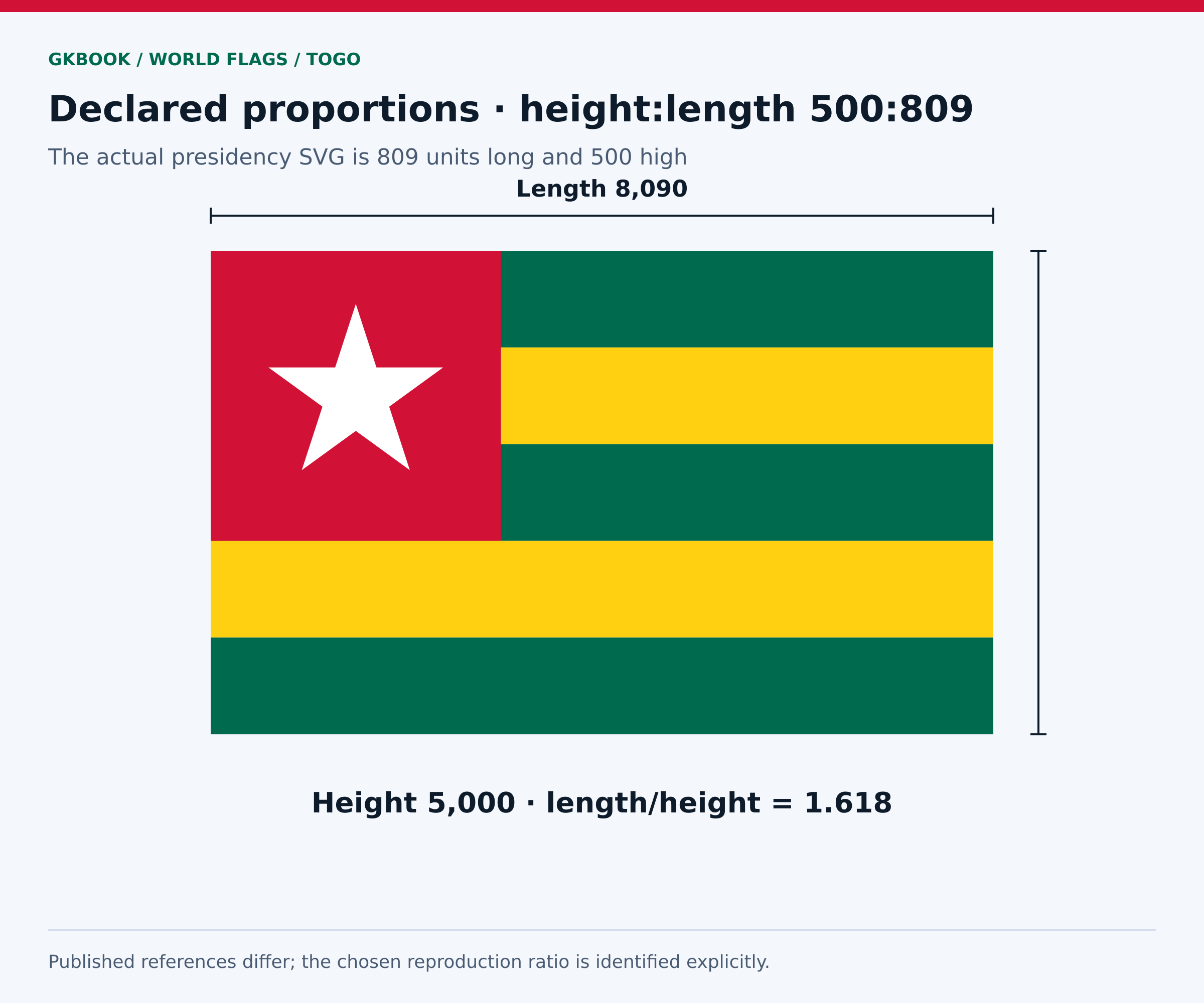
| Declared proportions | Height:length = 500:809Follows presidency SVG, approximately the golden ratio; overall ratio not specified in the reviewed 1960 law. |
| Adoption and legal effect | April 27, 1960Law 60-11 signed April 23 and published April 25. |
| Digital palette | Government graphic charter RGBWritten colors differ slightly from the downloadable reference SVG. |
| Main image sizes | SVG and PNG: 8,090 × 5,000Complete rectangle; opaque RGB PNG. |
The legal layout, reference-image dimensions, and graphic charter palette are documented separately. The star radius and overall ratio are declared reproduction choices.
What does the Togo flag look like?
The Togo flag has five equal horizontal bands, alternating green and yellow, with green at the top and bottom. A red square occupies the upper hoist corner and contains a centered white five-pointed star. The square is three band-heights tall. This collection follows the presidency’s illustrated proportions, approximately height:length 1:1.618.
Begin with the complete rectangle and locate the hoist, the edge attached to a flagpole. In the standard front view that edge is at the left. The red square covers the left portions of the first three bands, while the lower yellow and green bands run across the whole flag. The star belongs inside the red square, not at the center of the full rectangle. These relationships make the design recognizable even when folds or small image sizes make individual colors harder to distinguish.
What is the Togo flag called?
It is the national flag of Togo, formally the Togolese Republic. French official descriptions use “drapeau togolais” or “emblème national.” These terms identify the complete striped flag with its red square and white star. The national emblem in this legal description should not be confused with the separate coat of arms.
Country names and visual descriptions do different jobs in an image caption. “Togo flag” identifies the subject, while a description of five green and yellow bands and a starred red canton explains its appearance. Both are useful when a reader compares several national symbols or cannot see the image.
The French wording appears in the original legislation and current official explanations. Translating it requires attention to context: an emblem can mean the national flag in one provision, while another section discusses the arms or the state seal. A familiar English label should preserve those distinctions.
What are the colors of the Togo flag?
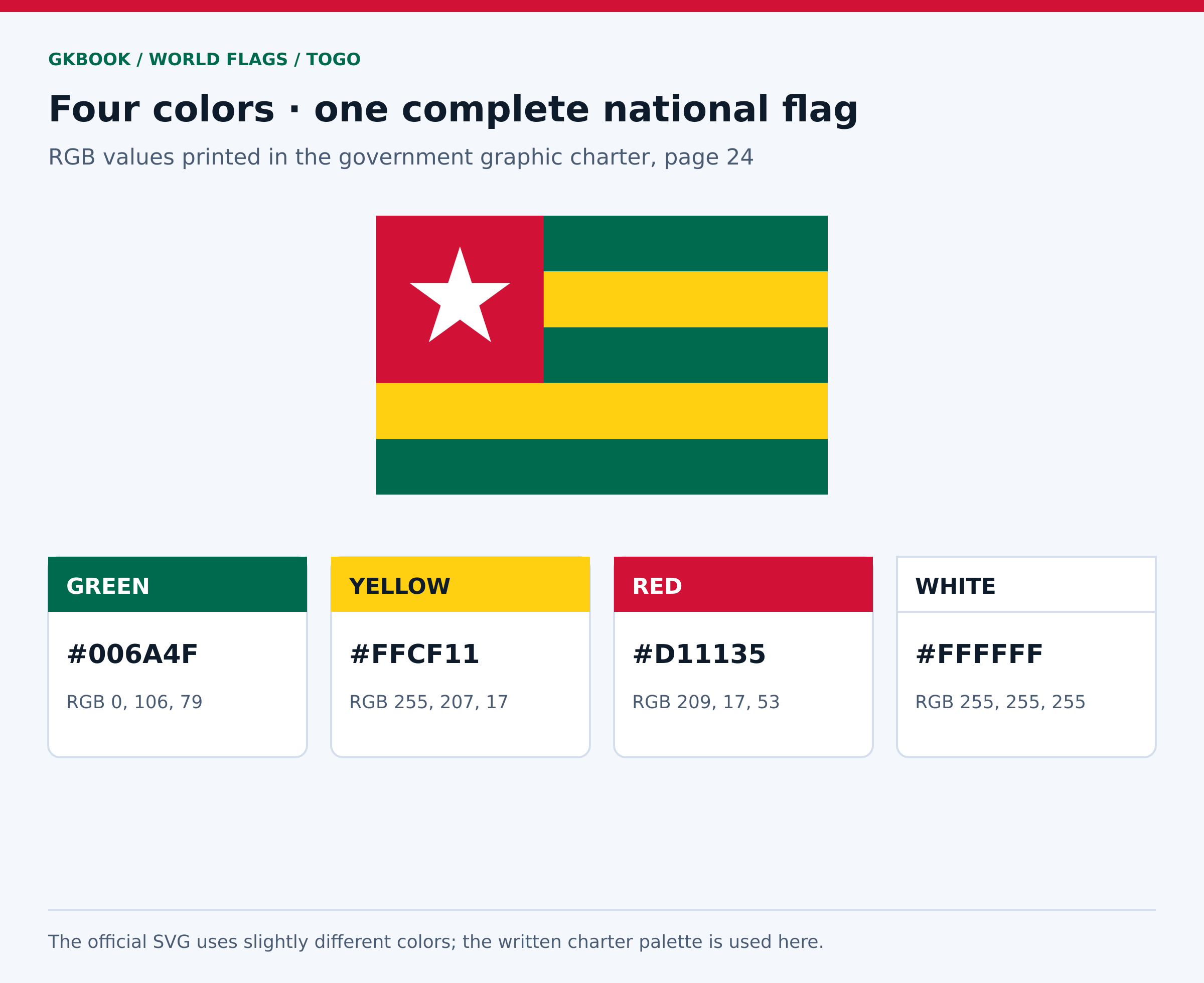
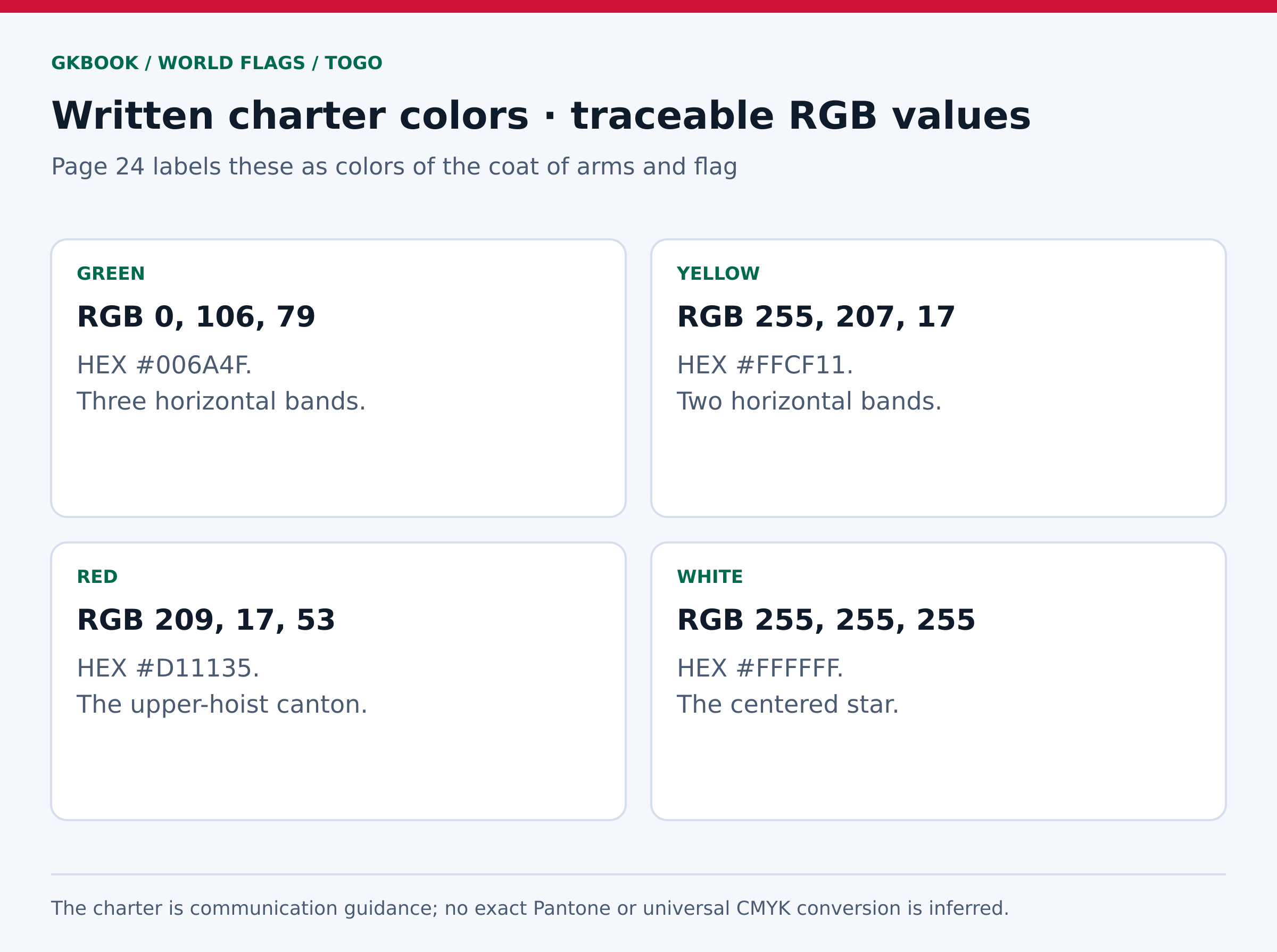
Togo’s flag uses green, yellow, red, and white. This edition follows the RGB numbers in the government graphic charter: green #006A4F, yellow #FFCF11, red #D11135, and white #FFFFFF. These differ slightly from the presidency’s downloadable SVG, so the chosen palette and the reference-image difference are documented explicitly.

The charter labels its principal palette as colors of the coat of arms and flag. Converting the printed RGB integers into hexadecimal notation gives the values used here directly, without estimating colors from a screenshot. The chart also contains black, which is not an additional color in the national flag.
The same palette is used throughout the clean master and explanatory illustrations. A consistent digital file does not guarantee identical fabric or printed output, because materials and color management affect appearance. The listed RGB values are taken from the charter; no exact Pantone conversion or universal printing recipe is asserted.
| Color | HEX | RGB |
|---|---|---|
| Green | #006A4F | 0, 106, 79 |
| Yellow | #FFCF11 | 255, 207, 17 |
| Red | #D11135 | 209, 17, 53 |
| White | #FFFFFF | 255, 255, 255 |
What does the Togo flag mean?
The presidency associates green with forests, agriculture, and hope; yellow with faith, underground resources, and readiness for a shared future; red with sacrifice in struggles for independence and democratic government; and the white star with peace, light, and intelligence. These are attributed explanations of the national symbol, not measurements of the country.

The meanings can be taught alongside the positions of the colors. Green and yellow form the alternating background, red supplies the prominent upper corner, and white appears only in the star. Their roles in the composition are distinct even though all contribute to the same national symbol.
Historical explanations do not always use precisely the same wording as present official summaries. The explanatory text printed with the 1960 law emphasizes land, confidence in a better future, defending liberty, purity, and peace. Reading those ideas in their documentary setting is more informative than presenting one expanded list as a timeless legal formula.
What does green represent on the Togo flag?
Green represents forests, agriculture, and hope in the presidency’s explanation. It forms the first, third, and fifth horizontal bands. Each band has the same height as a yellow band, but the red canton covers the left portions of the upper two green bands. Green therefore does not occupy three fifths of the visible flag.
The lower green band extends across the entire bottom edge. The first and third green bands remain visible to the right of the red square. That difference between underlying stripes and visible colored regions is important when estimating how much green is actually present in the finished design.
The original explanatory statement connects green with attachment to fields and the country’s sustaining land. That historical emphasis is consistent with the agricultural theme in modern official descriptions. It does not mean that the green area is a miniature map or a numerical representation of forest cover or agricultural production.
What does yellow represent on the Togo flag?
Yellow is associated with faith, underground resources, and maturity in facing a common future in the presidency’s account. It occupies the second and fourth bands. The upper yellow band is partly covered by the red canton, while the lower yellow band extends across the full length of the rectangle.
Both yellow bands have equal vertical thickness and the same solid color. Their different visible lengths result from the canton, not from a difference in band construction. A diagram that redraws the upper yellow stripe below the red square instead of behind it changes the intended five-band arrangement.
The 1960 explanatory text stresses confidence in brighter days and determination to reach them. Later summaries give additional emphasis to resources and shared purpose. These meanings should remain attributed to their accounts, while the geometry stays straightforward: two equal-height yellow bands alternate with three equal-height green bands.
What does the red square represent?
The red square recalls sacrifice for independence and, in the presidency’s current explanation, people who died for democracy and the rule of law. It occupies the upper hoist corner. Its side equals three band heights, making it a square rather than a full-height vertical stripe or an arbitrary rectangular panel.
The white star is placed on this red field, so the square’s full geometric area is larger than the visible red area. That distinction matters in an area calculation but does not change the name of the canton. The complete corner device consists of the red square together with its star.
The original explanatory statement links red with determination to preserve liberty even at the cost of blood. This historical wording and the later official account describe related themes. Neither requires adding a pictorial scene, lettering, or extra symbols inside the plain red square used in the national design.
What does the white star on Togo’s flag mean?
The presidency describes the white star as a symbol of peace, light, and intelligence. The 1960 explanatory statement also associates white with purity and a desire to live peacefully with other nations. The star has five points and appears at the center of the red square, rather than in the center of the flag.

Shape, color, and meaning should be identified separately. There is one white star, its outline has five outer points, and one point faces upward in the standard front view. Those observations establish what is drawn before a caption explains the ideas associated with it.
The graphic charter discusses hospitality in its explanation of the state’s visual identity, while other official accounts use different symbolic language. These descriptions belong to their respective contexts. The article’s main summary follows the presidency’s flag-specific account and distinguishes it from the wording preserved with the original law.
How many stripes are on the Togo flag?
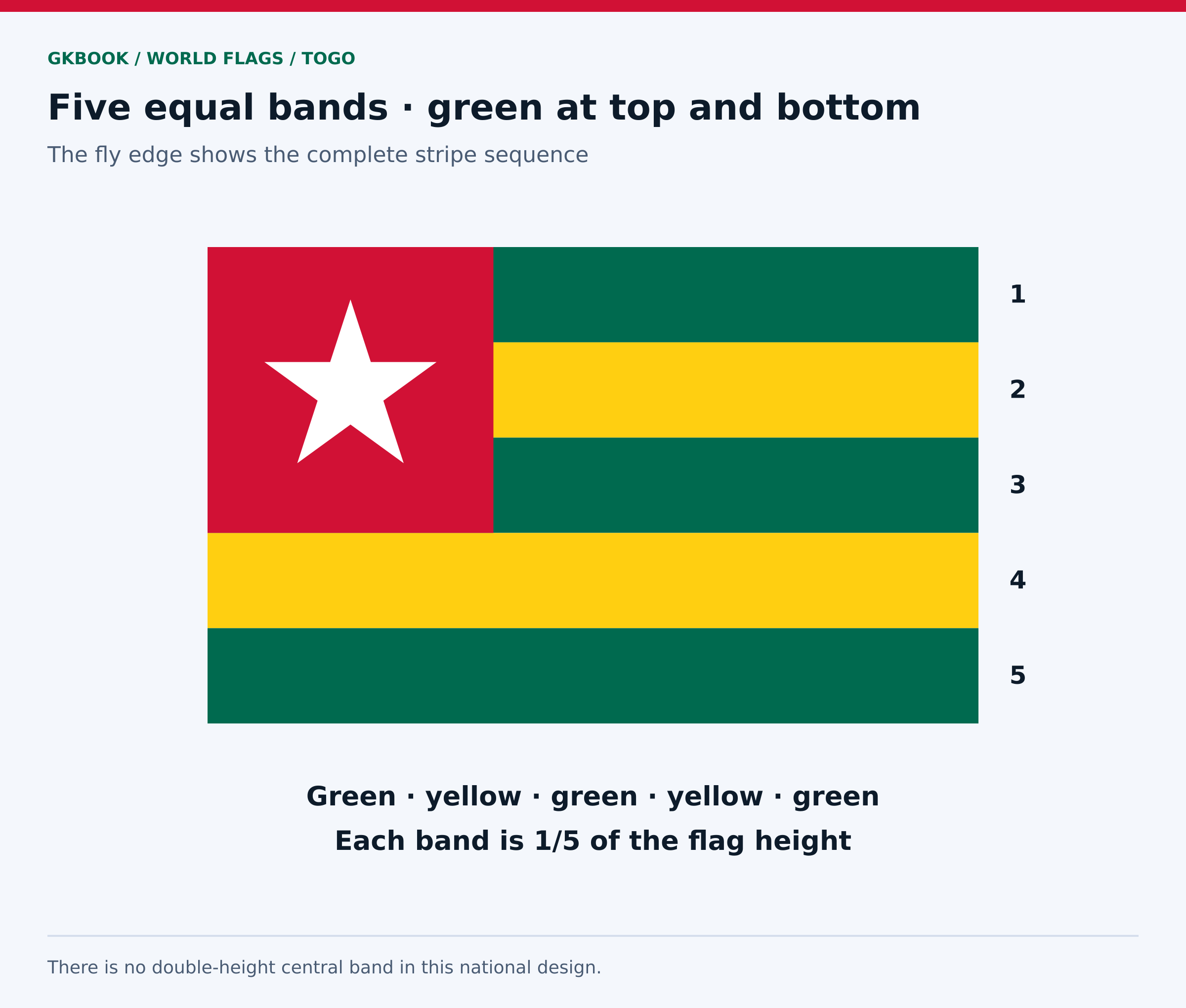
There are five equal horizontal stripes: green, yellow, green, yellow, and green from top to bottom. Each takes one fifth of the flag’s height. The red square covers the hoist-side portions of the first three stripes, but it does not turn the flag into a design with fewer underlying bands.
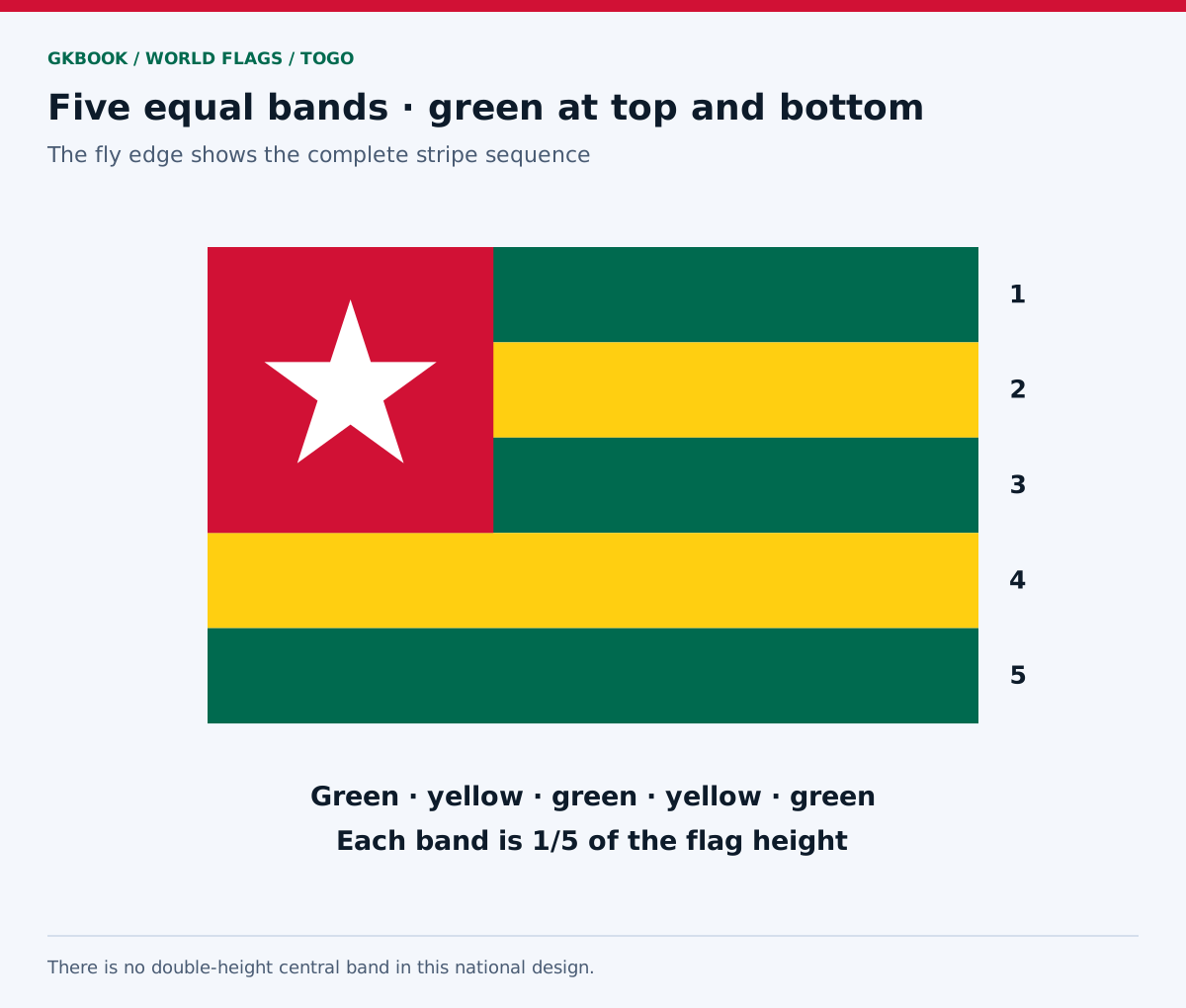
The fly edge, opposite the pole, gives the simplest place to count them because no canton interrupts that edge. Reading downward there reveals all five colors in sequence. At the hoist edge, the red square occupies the upper three fifths, followed by a yellow fifth and a green fifth.
Use the right edge to verify equal heights when evaluating a flat image. A large green middle band or an unusually thin yellow stripe indicates a drawing error. Unlike some five-band national flags, Togo does not have a double-height center stripe; all five bands have the same thickness.
How large is the red canton on Togo’s flag?
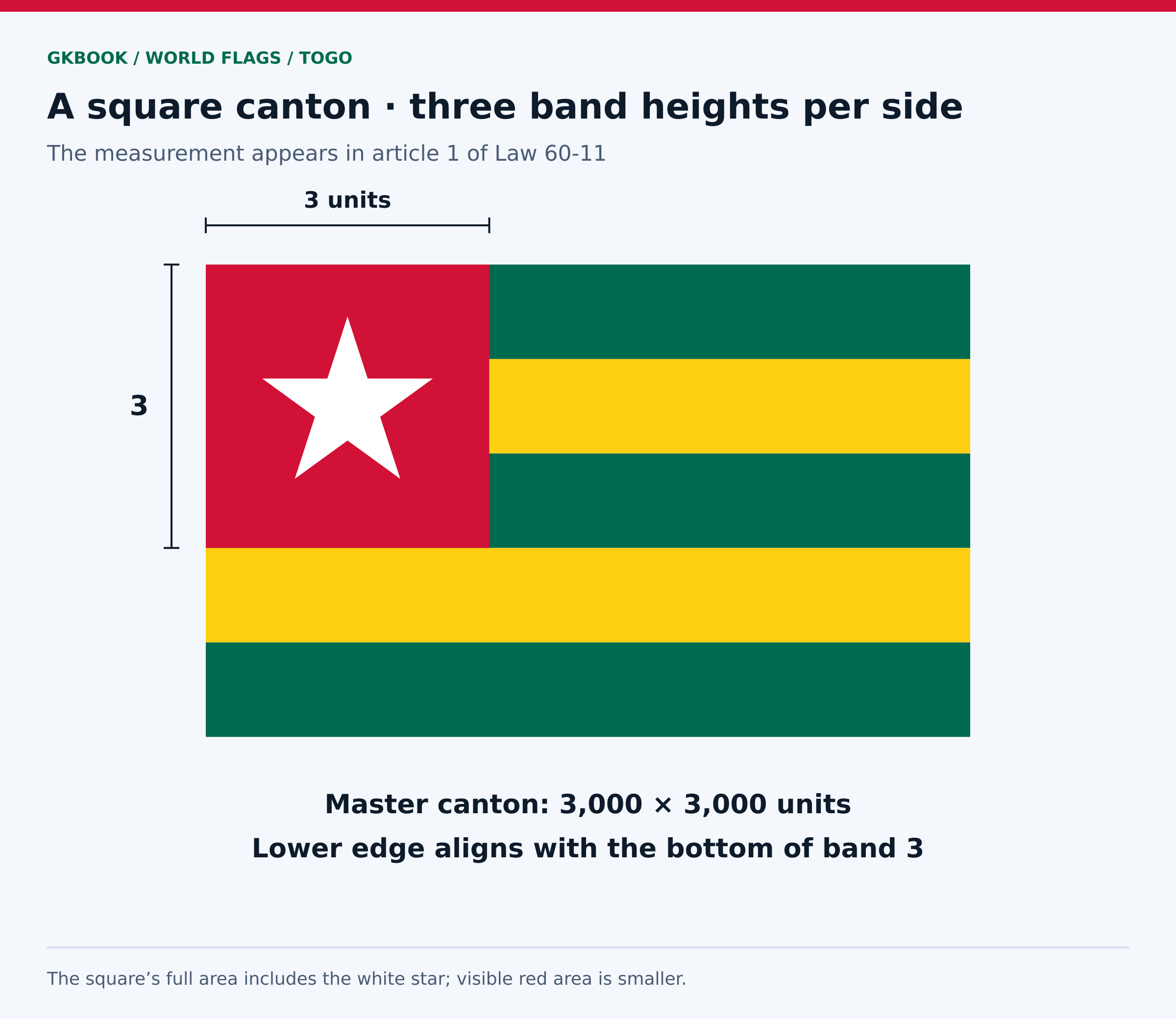
The 1960 law specifies a red square whose side equals three stripe widths, measured vertically across the horizontal bands. Since the five bands are equal, the square is three fifths of the flag’s height on each side. In this 8,090 by 5,000 master, the canton measures 3,000 by 3,000 units.
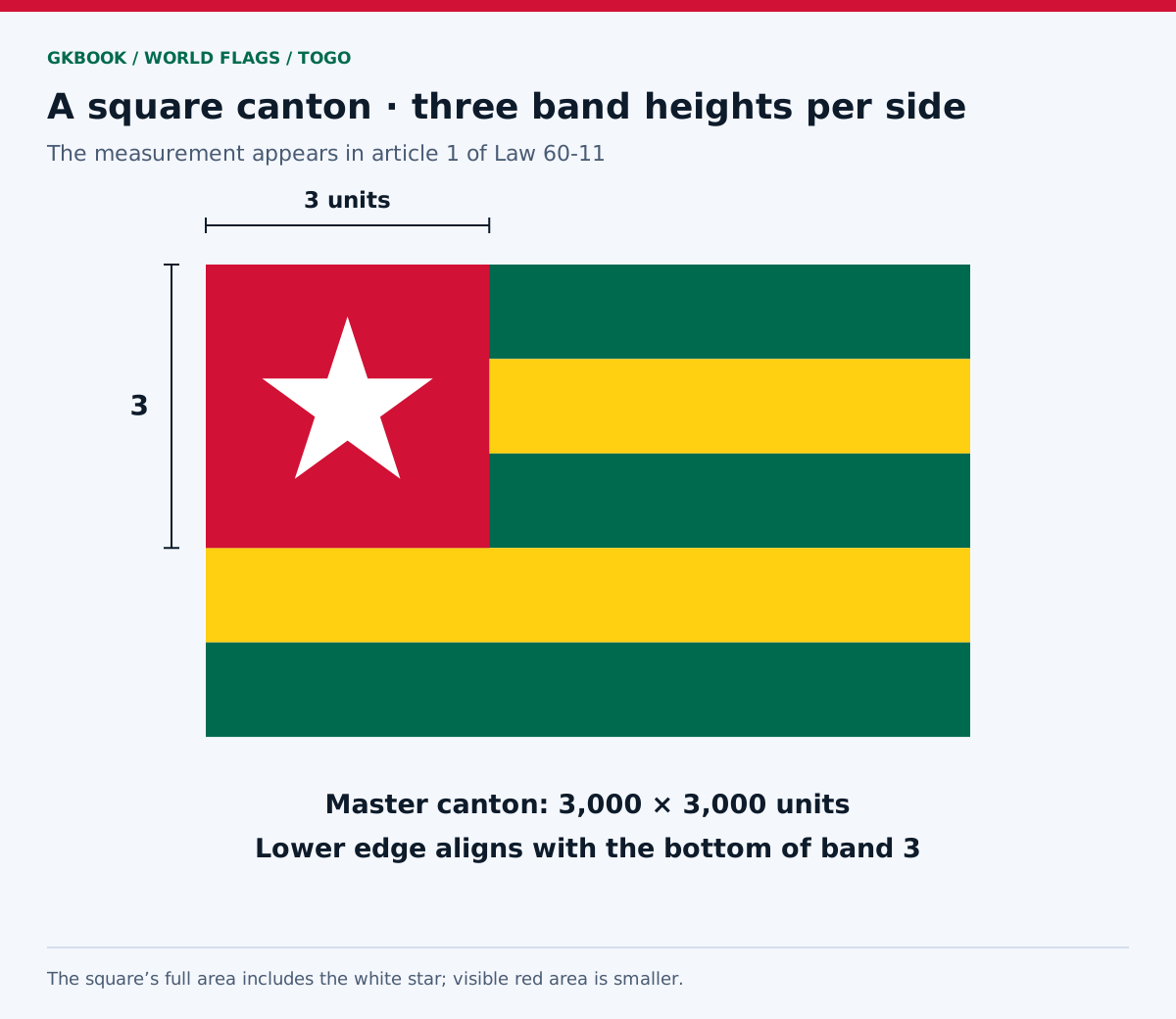
A square has equal height and width. The canton’s lower edge aligns with the bottom of the third band, while its right edge lies 3,000 units from the hoist in this master. It therefore covers two green portions and one yellow portion of the striped background.
Its size is fixed relative to band height, not relative to half the flag’s length. Treating it as a quarter of the entire rectangle would produce a different shape or scale. Establish the five equal bands first, then use three of their heights to construct the square.
How is the five-pointed star positioned and sized?
The star is centered in the red square with one outer point upward. This reconstruction follows the presidency’s SVG: on a 500-unit flag height, its center is at 150,150 and its outer radius is 95. The law specifies a centered five-pointed star but does not supply that numerical radius.
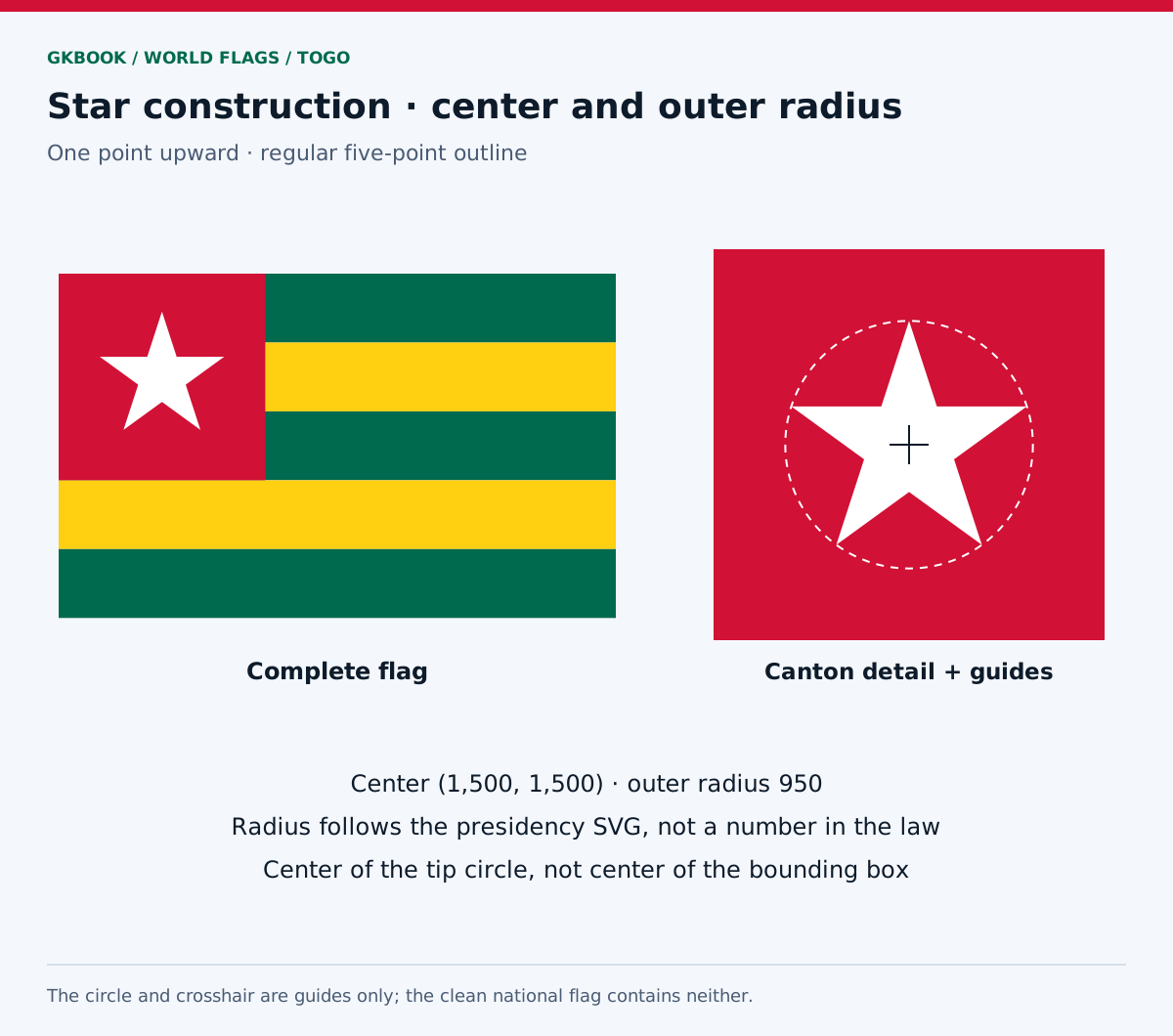
The geometric center of a regular star is the center of the circle through its five outer tips. It is not the midpoint of the star’s top-to-bottom bounding box. Moving the star to make its top and bottom clearances identical would shift that geometric center away from the canton center.
Here the full-size center is at 1,500,1,500 and the outer radius is 950. Ten alternating outer and inner vertices form the filled outline. The radius is a documented reproduction convention from the inspected official illustration, while the center, five points, and red square are features explicitly described in the legislation.
What are the proportions of the Togo flag?
Published proportions vary. This collection uses height:length 500:809, or 1:1.618, matching the actual SVG supplied on the presidency’s website. The inspected 1960 law specifies the bands and canton but gives no overall aspect ratio. The chosen dimensions are therefore identified as a documented reproduction choice, not an exclusive statutory ratio.

Some references show approximately 3:5, others use 2:3, and the golden-ratio interpretation is also widely reported. Those rectangles are not mathematically identical. Naming the chosen source prevents a drawing convention from being presented as though every consulted document agreed on one precise national production specification.
The downloadable master is 8,090 units long and 5,000 units high, with a PNG at those same dimensions. This preserves the presidency illustration’s 809-by-500 relationship exactly. The canton and five equal band heights are then constructed within that declared rectangle, rather than adjusted independently by eye.
Is the Togo flag an exact golden rectangle?
The 809:500 rectangle used here closely approximates the golden ratio but is not mathematically exact. Its length divided by height is 1.618; the golden ratio is approximately 1.618033989. The difference is about 0.0021 percent. The reviewed law does not state a golden-ratio requirement, so that historical design interpretation is kept distinct.
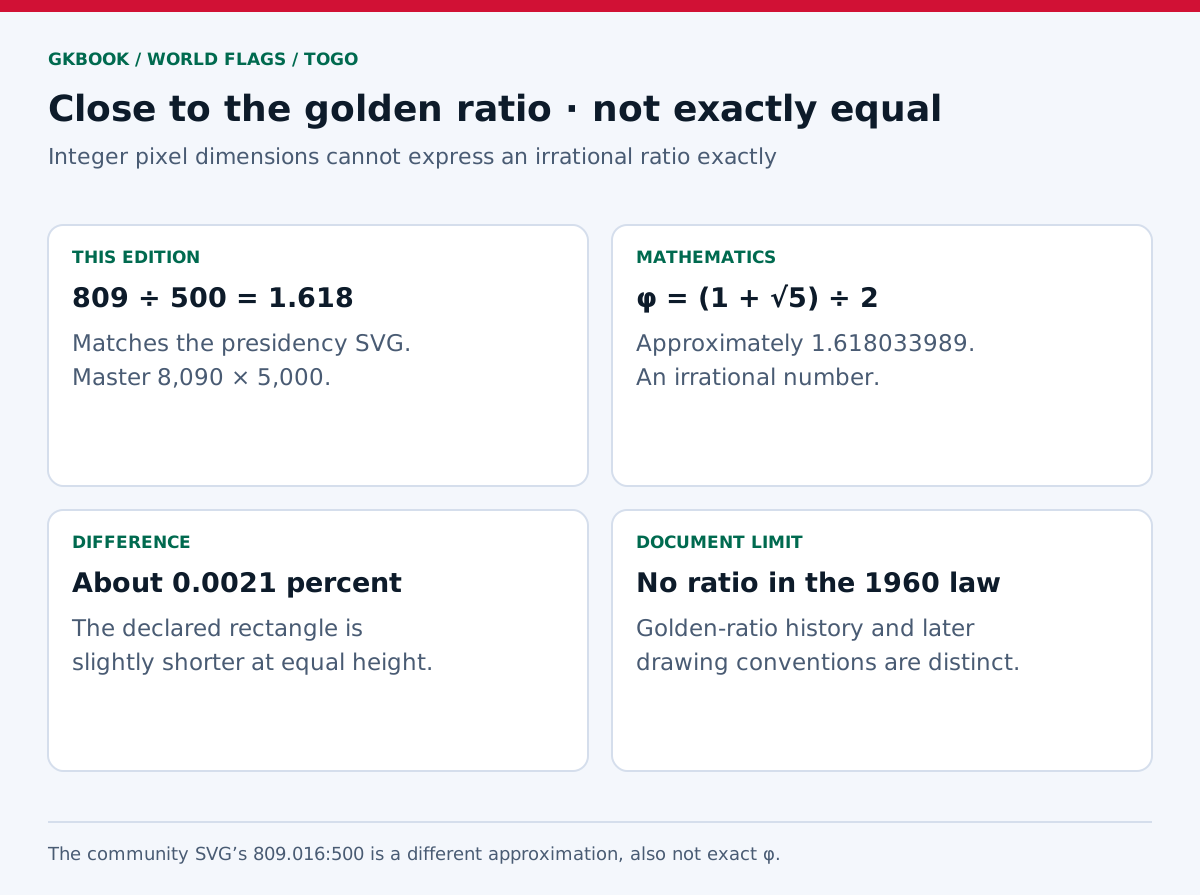
An exact golden ratio is irrational and cannot be expressed as a ratio of two whole pixel counts. A raster image must use integer dimensions, so any such image can only approximate it. That mathematical limitation is separate from the historical question of what proportions a designer intended.
The primary online illustration provides a practical, reproducible 809-by-500 rectangle. The community SVG uses 809.016 by 500, which is a closer numerical approximation but still not exact. Neither digital width should be silently quoted as a measurement printed in the original legislation when that legislation supplies no overall ratio.
How can the Togo flag be drawn accurately?
For this master, draw an 8,090 by 5,000 rectangle and divide its height into five 1,000-unit bands, alternating green and yellow. Add a 3,000-unit red square at the upper left. Center a regular white five-pointed star at 1,500,1,500 with outer radius 950, keeping one point upward.
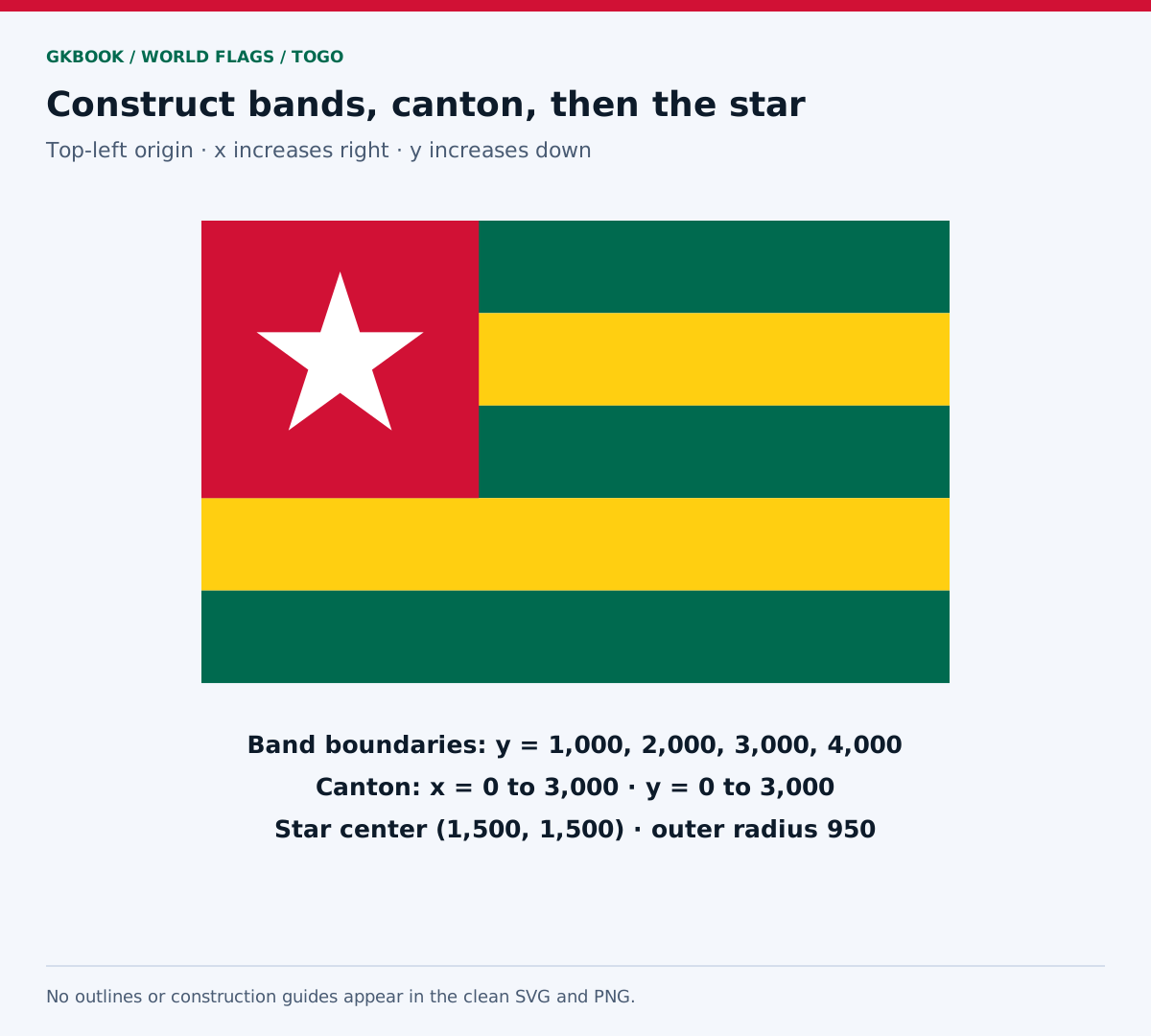
The stripe boundaries lie at y equals 1,000, 2,000, 3,000, and 4,000 when coordinates increase downward from the top. The red square runs from zero to 3,000 in both directions. Its lower boundary coincides with the transition from the third green band to the fourth yellow band.
Use closed filled shapes without outlines, gaps, gradients, or shadows. Draw the star as a single filled polygon so that its interior stays opaque. Construction circles and centerlines are useful in a teaching diagram, but they should be absent from the clean flag exported for ordinary country identification.
What percentage of the flag is each color?
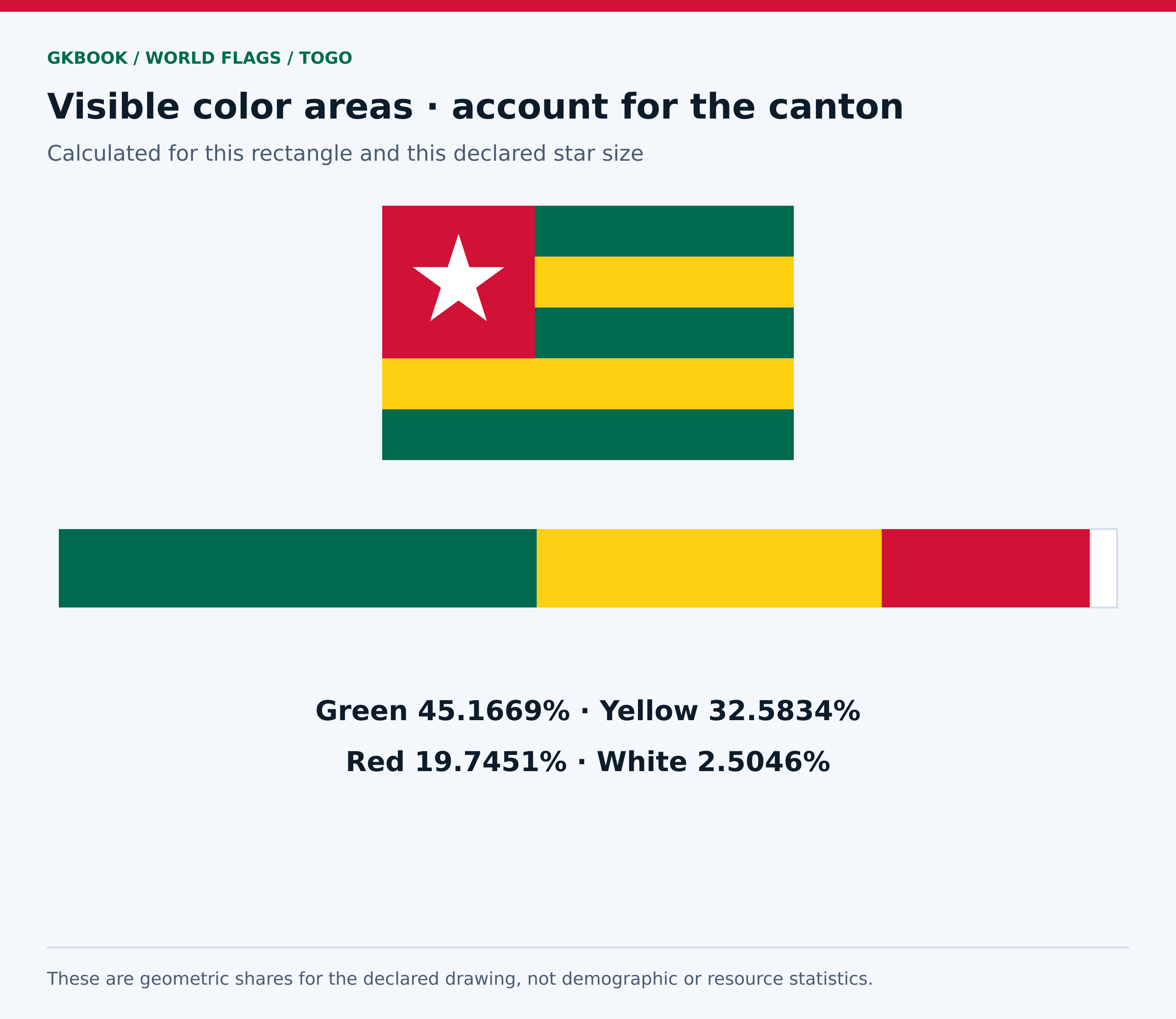
For the declared 809:500 rectangle and star construction, green occupies about 45.1669 percent, yellow 32.5834 percent, visible red 19.7451 percent, and white 2.5046 percent. These are calculated vector areas. The canton covers parts of three stripes, and the white star replaces part of the red square’s visible area.

Counting three green bands and two yellow bands is not enough to calculate the finished color shares. First subtract the portions hidden by the canton: two green rectangles and one yellow rectangle. Then calculate the white star and subtract its area from the red square.
These percentages depend on the declared overall rectangle and star size, which is why they are not presented as universal legal figures. Antialiasing can introduce blended edge pixels in a raster image without adding a new flag color. The areas also say nothing about population, regional territory, agricultural output, or mineral reserves.
What is the history of the Togo flag?
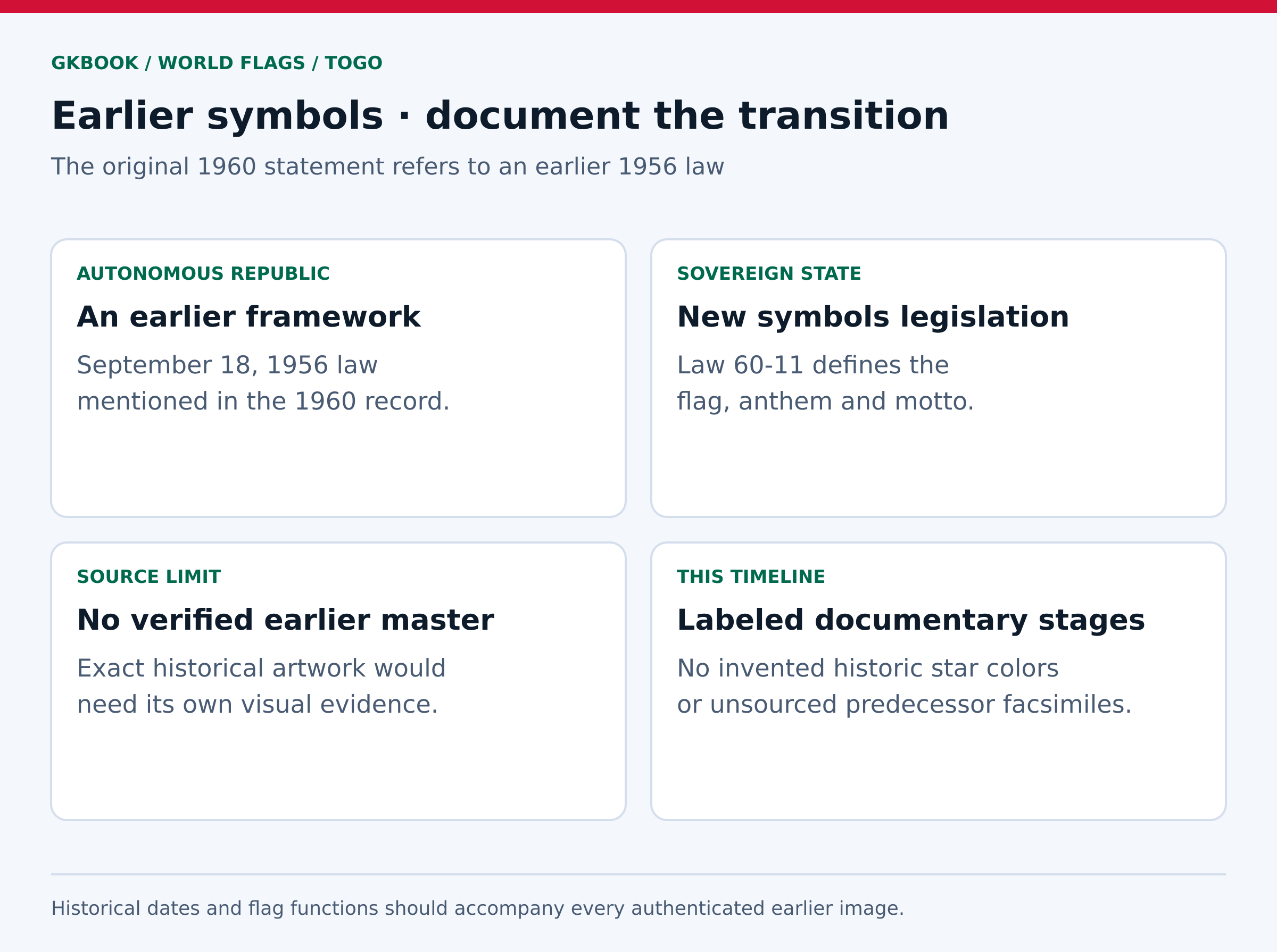
The present design belongs to Togo’s transition to independence in 1960. Law 60-11 defined the flag, anthem, and motto shortly before independence, replacing an earlier symbols framework associated with the autonomous republic. Later constitutions and the government graphic charter document the continuing national symbols, without making those later dates the original flag adoption.

The explanatory statement printed with the 1960 law refers to a September 18, 1956 law concerning national symbols. It presents the new measure in the context of becoming a sovereign state. That original account provides a firmer chronological foundation than an undated gallery of earlier flag images.
A flag timeline should separate the design’s introduction, the law’s signature and commencement, later constitutional references, and modern reproduction guidance. Those records serve different functions. The illustrations here show that sequence with labeled events rather than supplying an unverified reconstruction of every historical flag used in the territory.
When was the current Togo flag adopted?
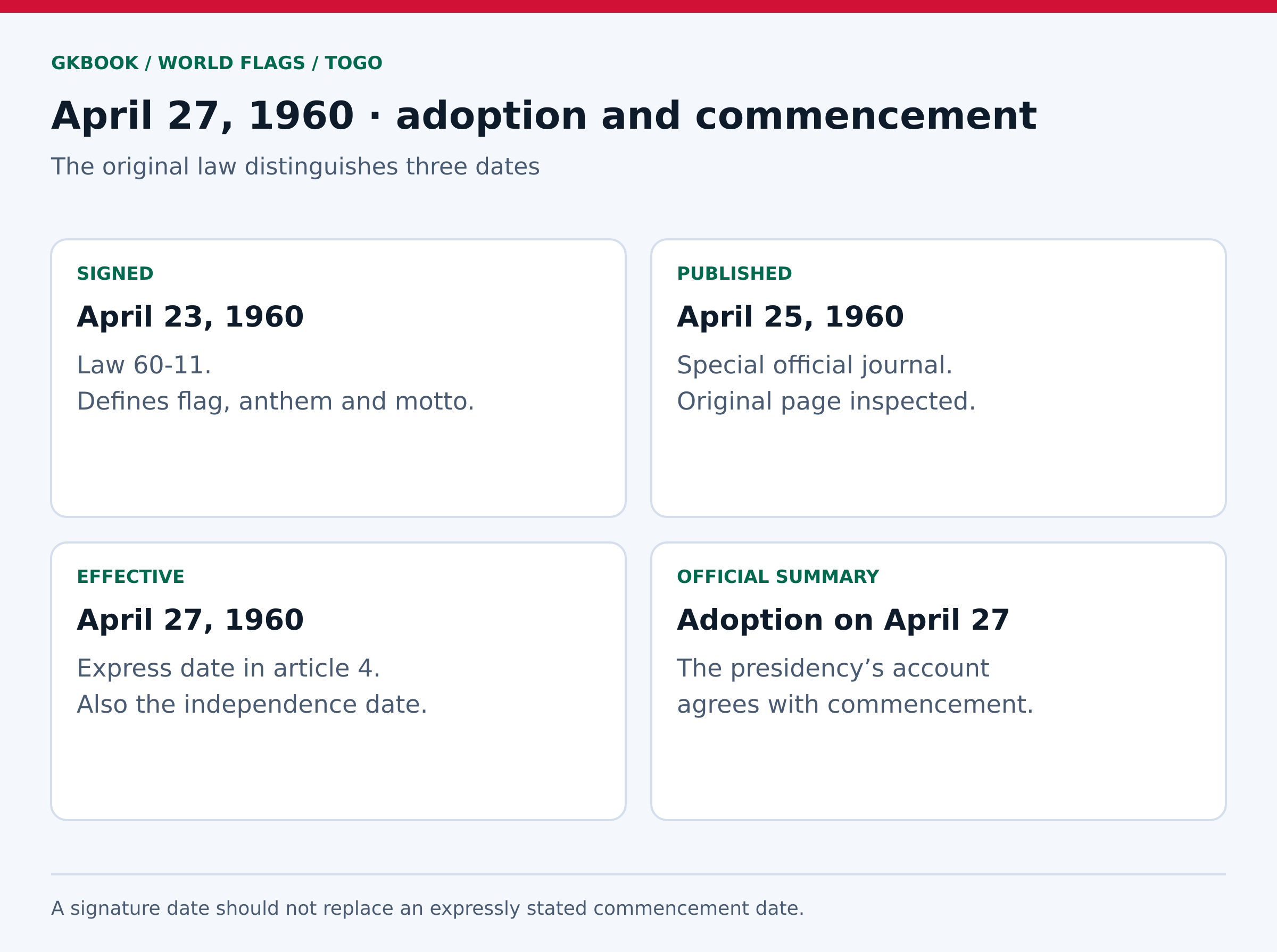
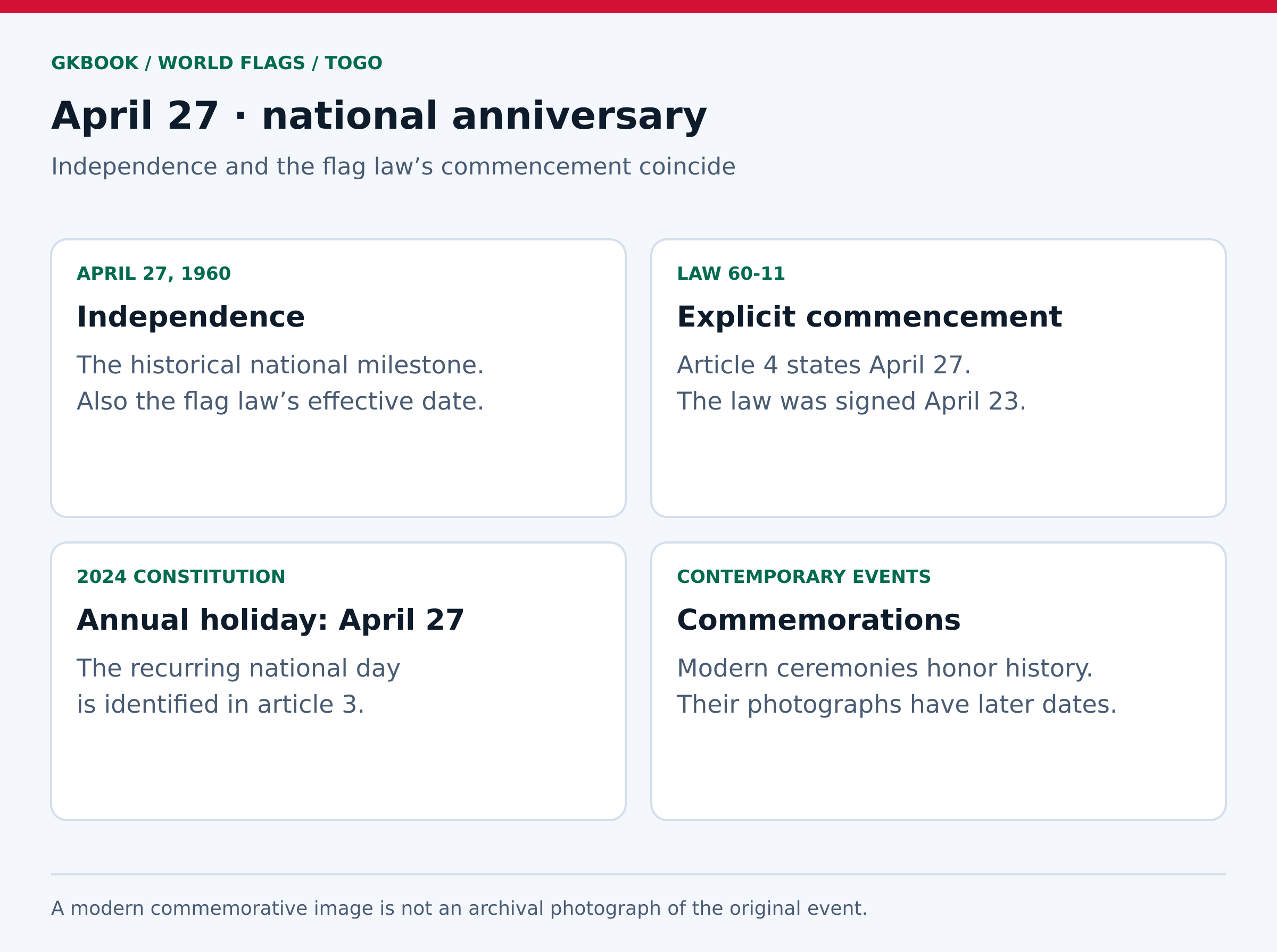
The present flag was adopted for independence on April 27, 1960. The original legal record makes the sequence precise: Law 60-11 was signed on April 23, published in the special official journal dated April 25, and expressly entered into force on April 27. These are three documentary dates for related steps.
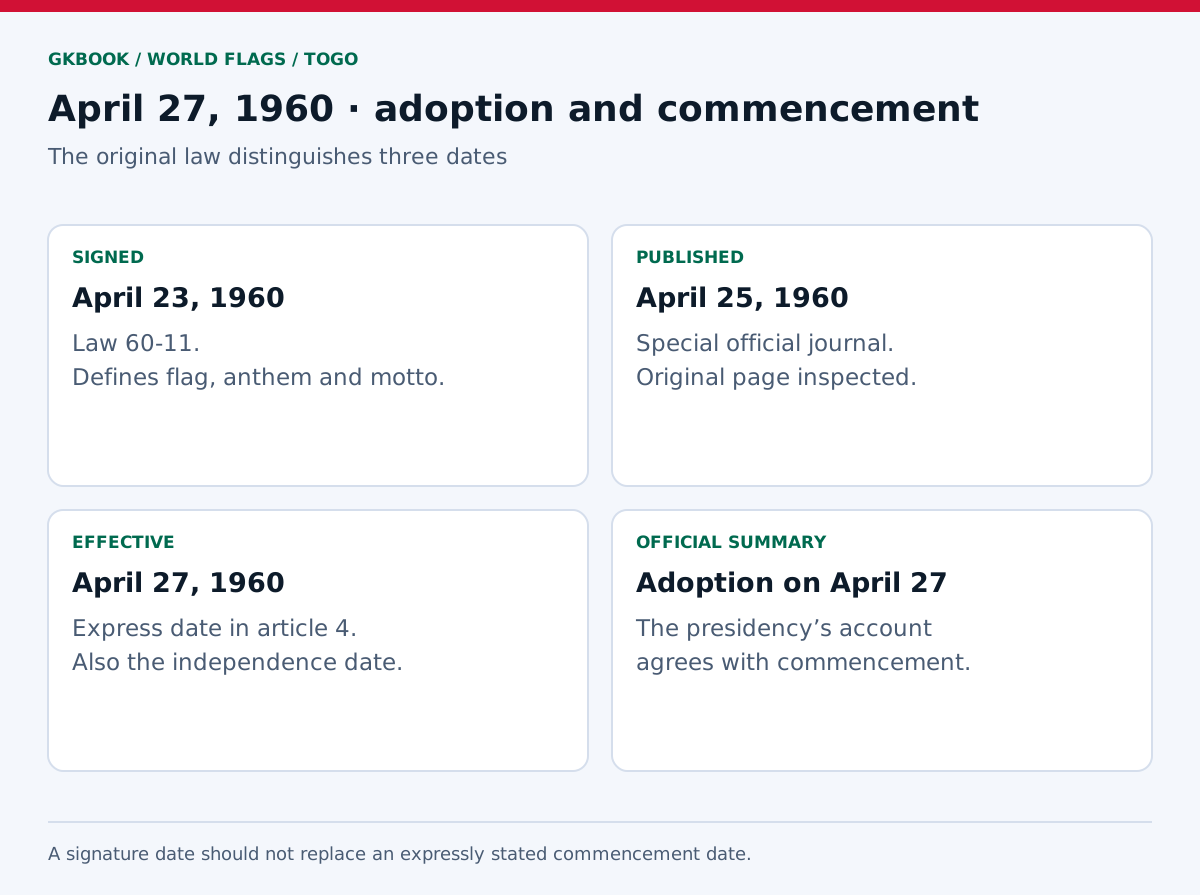
The presidency’s historical summary identifies April 27 as the adoption date, and article 4 of the original law supplies the matching commencement date. The signed law and its publication therefore support the familiar national anniversary while explaining why April 23 and April 25 also appear in documentary research.
Keep the event label attached to each date. Signing a measure, printing it in an official journal, and bringing it into force are not interchangeable actions. A caption that simply says “adopted April 23” would lose the distinction established by the document’s explicit April 27 commencement clause.
Who designed the Togo flag?
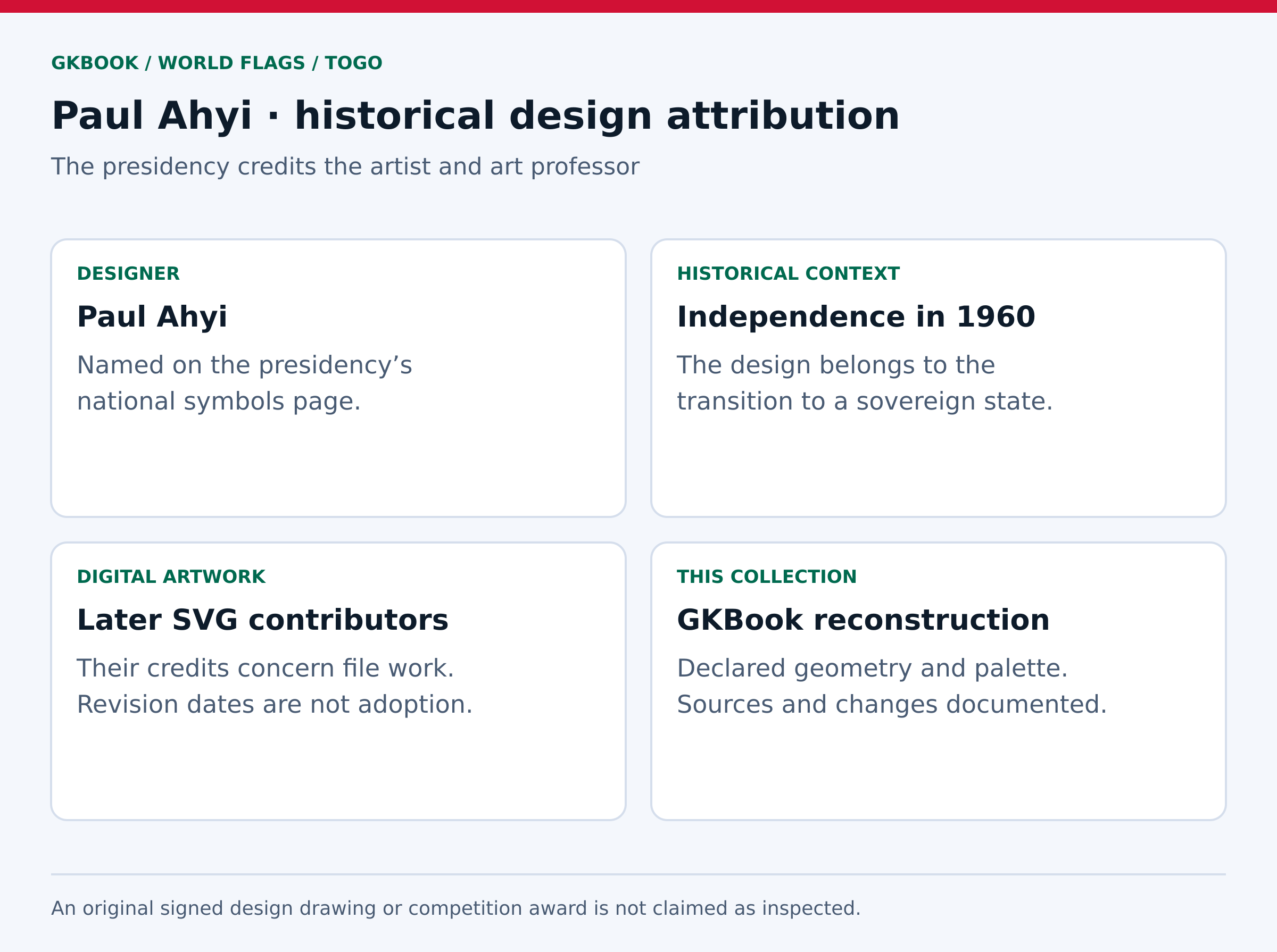
The presidency credits the Togolese artist and art professor Paul Ahyi with designing the national flag. The design was adopted at independence in 1960. Modern SVG contributors and educational illustrators reproduce that national design; their names and file revision dates should be distinguished from the historical designer and adoption date.
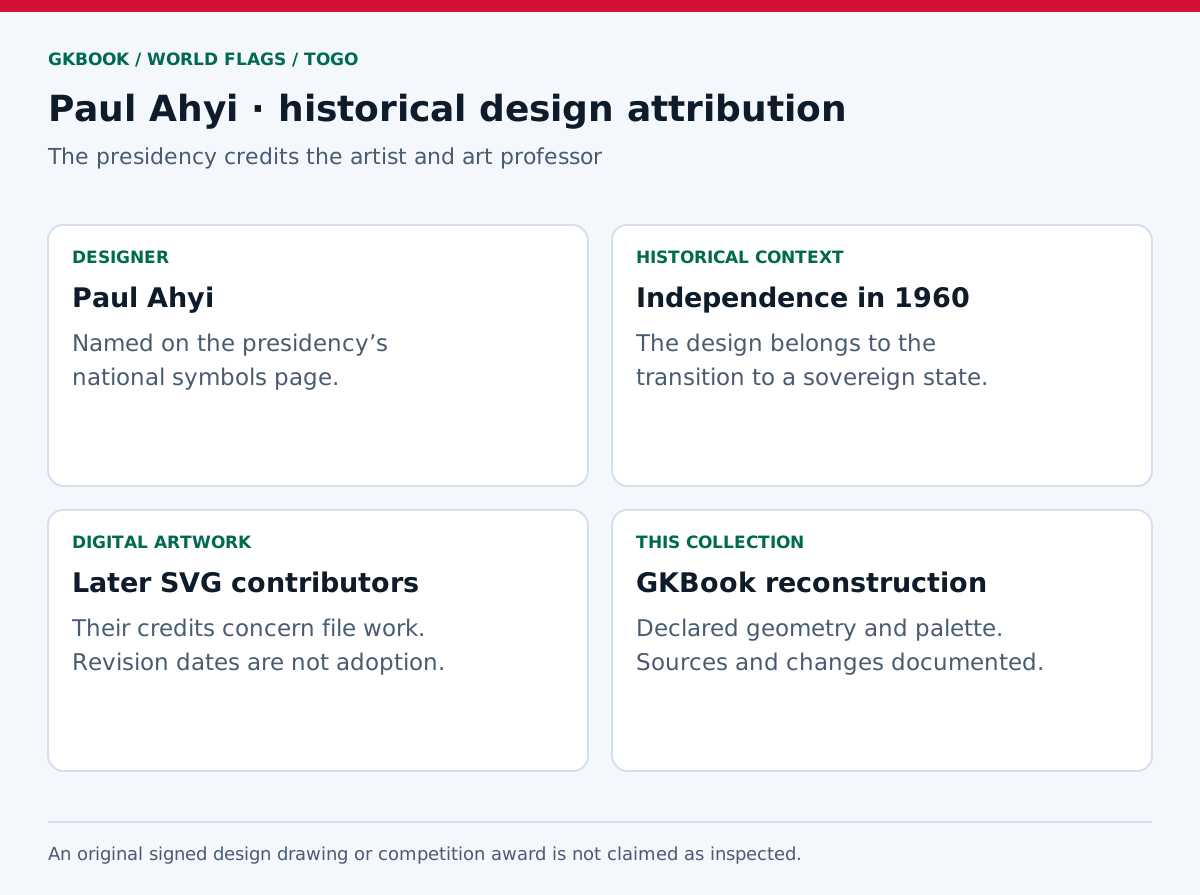
A digital reference file can have a long editing history involving changes to code, proportions, or color notation. Those contributions belong in artwork credits, but they do not establish that a new national flag was created on the latest upload date. The historical and digital layers deserve separate descriptions.
This collection follows the presidency’s attribution to Ahyi without presenting an original signed design drawing or competition award as inspected evidence. Secondary accounts contain additional competition details, but the private notes distinguish those claims from the primary sources actually used for the design and its legal dates.
Is the flag adoption date the same as Togo’s independence day?
Yes. April 27, 1960 is both Togo’s independence date and the commencement date stated for the law defining the present flag. The 2024 Constitution identifies April 27 as the annual national holiday. Independence, the flag’s legal introduction, and the recurring commemoration are connected events, though each still deserves its own description.
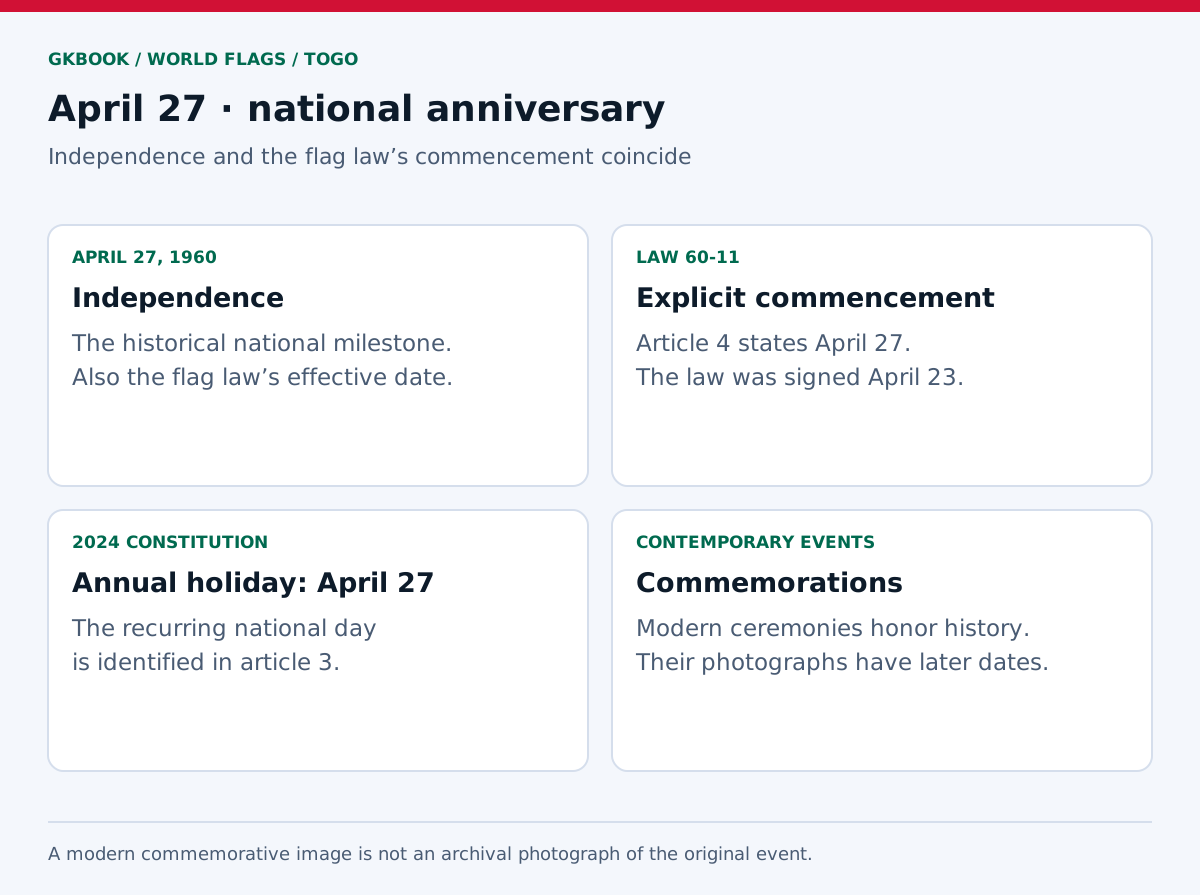
An annual holiday repeats the calendar day without repeating the original historical event. A modern independence celebration may use the national flag in ceremonies, publications, and educational displays, but those contemporary uses should not be mistaken for archival evidence of a particular ceremony held in 1960.
For a concise timeline, place independence and the flag law’s commencement together under April 27, 1960, then identify later commemorations separately. This makes the connection clear while preserving the distinction between the country becoming independent and the continuing ways its national symbols are displayed or explained.
When did Togo join the United Nations?
Togo became a United Nations member on September 20, 1960, under General Assembly resolution 1477 (XV). That was after independence and the flag’s introduction on April 27. UN membership is an international institutional milestone; it is not a second adoption of the flag or certification of its dimensions and colors.

The United Nations Treaty Collection records the resolution and admission date. Those entries answer when Togo entered the organization, not when its flag was designed. A country’s flag appearing at the United Nations reflects its representation there and should not be treated as a universal approval of every reproduction detail.
Separating these milestones is useful in comparative national histories. Independence, domestic legislation, diplomatic recognition by individual states, and membership in an international organization are different kinds of events. This guide gives the documented UN admission date without substituting it for all of those other historical or legal questions.
Which law defines the Togo flag?
Law 60-11 of April 23, 1960 defines the national flag in article 1 and gives April 27 as its commencement date. It specifies three green and two yellow equal bands, a red square three band-heights per side, and a centered white five-pointed star. It does not specify exact RGB values or an overall ratio.

The original official journal was inspected, including the text of the law and its accompanying explanatory statement. That is stronger evidence for its contents than a later paraphrase or a search snippet. It also allows the square’s three-band measurement to be distinguished from the additional star radius used in this reconstruction.
The current constitutional text, promulgated on May 6, 2024, places provisions defining the national emblem within the domain of legislation. It does not repeat the older constitution’s full flag description. The legal discussion here identifies these documents accurately without claiming an exhaustive review of every subsequent regulation governing flag use.
What does the government graphic charter standardize?
The graphic charter provides guidance for consistent state communication and publishes RGB, CMYK, and Pantone references for the colors of the arms and flag. This collection uses its printed RGB values. The charter is later reproduction guidance, not the 1960 adoption instrument, and its older constitutional quotation must be read in historical context.
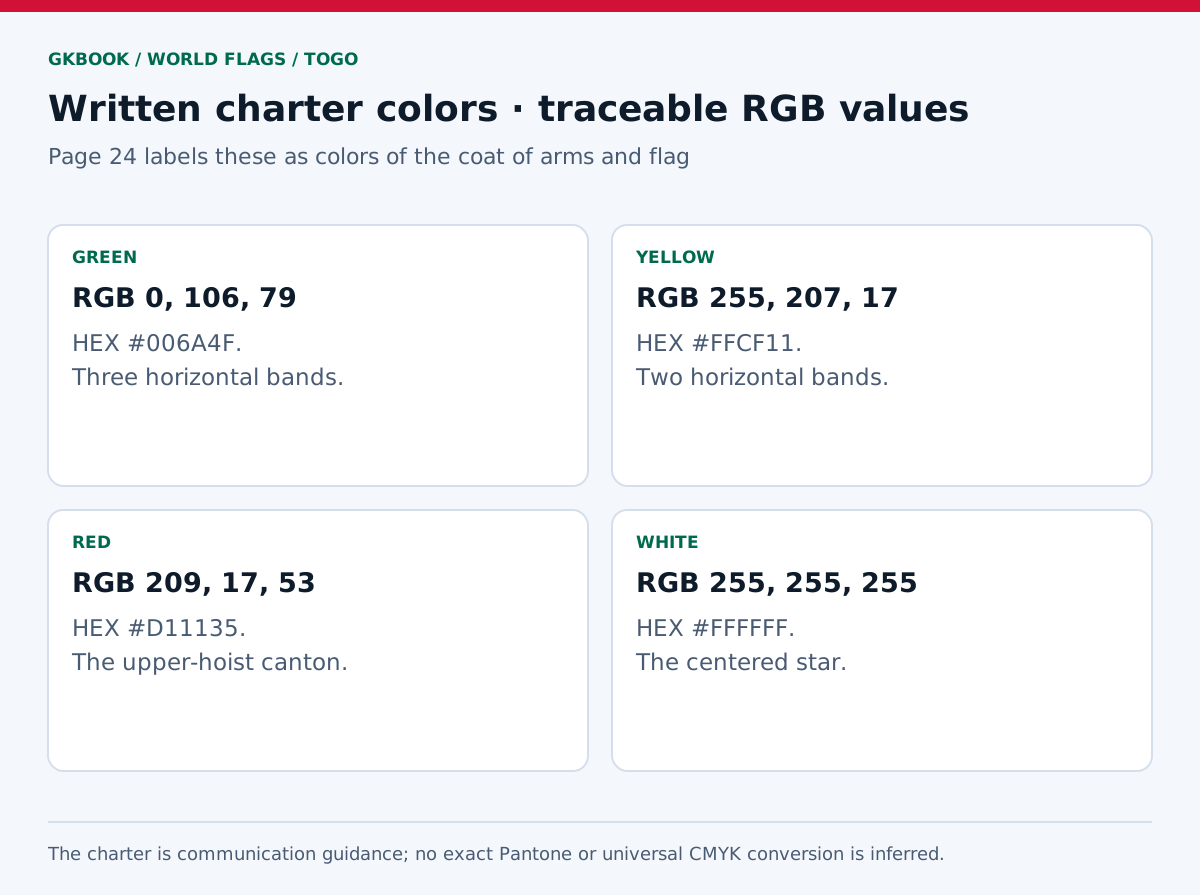
Page 24 gives red as 209,17,53, green as 0,106,79, yellow as 255,207,17, and white as 255,255,255. These are the numbers transcribed into the downloadable artwork. Sampling the colored PDF squares would be a different procedure because embedded color spaces and rendering can affect their displayed appearance.
The charter’s principal subject includes the institutional coat-of-arms block and its use on communications. Its dimensions for that block should not be transferred to the national flag. Likewise, publishing color references does not establish an overall flag ratio or a numerical star radius that the reviewed text does not supply.
What came before the present Togo flag?
An earlier national-symbols framework existed for the Autonomous Republic of Togo before independence. The explanatory statement accompanying the 1960 law specifically refers to a law of September 18, 1956 and explains the need for symbols of a sovereign state. This guide distinguishes that predecessor framework without inventing an authenticated historical flag drawing.

Historical flag lists can differ over dates, colors, and intermediate designs. A reliable facsimile would need an identified instrument or artifact for the exact period being illustrated. The original 1960 discussion establishes that an earlier framework existed, but it does not by itself supply all the measurements of an earlier flag.
The timeline therefore uses text panels to show the transition from autonomy to independence. This keeps the current national flag clear while avoiding unsupported artwork. A separate historical collection could add earlier designs after verifying each one’s period, purpose, proportions, and visual source individually.
Does the Togo flag contain the coat of arms?
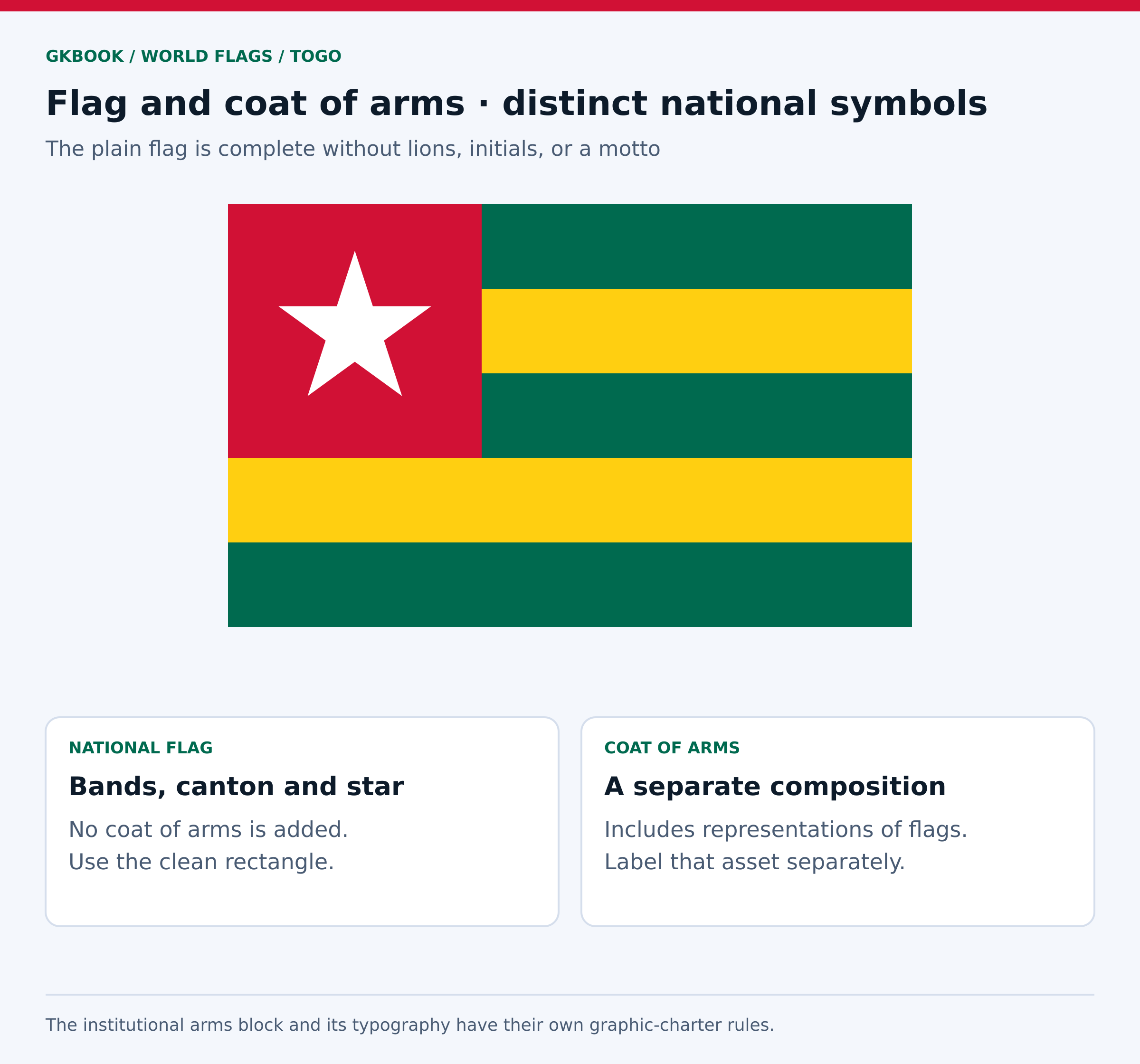
No. The national flag contains only its alternating bands, red square, and white star. Togo’s coat of arms is a separate composition that includes flag representations alongside other elements. The presence of flags within the arms does not mean that the complete arms should be added to the national flag.

The presidency presents the flag and arms in separate sections, and the graphic charter explains the institutional arms block in detail. That block can appear on official communications with the country name and other prescribed elements. It is a different asset from the simple flag rectangle supplied here.
For ordinary country identification, the clean starred and striped flag is complete. Adding lions, initials, a motto, or a shield changes the composition. If a publication needs the coat of arms as well, label it separately so readers understand which national symbol they are seeing and why both might appear together.
Do the five stripes represent five regions?
Some later descriptions associate the five stripes with five regions, but the inspected 1960 law does not make that assignment. A secondary historical discussion also reports a different explanation based on action and unity. The regional interpretation should therefore be attributed as an interpretation, not presented as a verified requirement of the original design law.
The legally specified number is unambiguous: five equal bands, with three green and two yellow. That geometric fact can be stated directly. Assigning each band to a named region would be an additional symbolic claim and would require evidence beyond the construction language in the original text.
A useful classroom distinction is between what an image visibly contains and what an account says it represents. Both can be discussed, but they should not be confused. This guide uses the presidency’s documented color meanings for its main explanation and avoids inventing a region-by-region stripe key.
How does the Togo flag look when rotated vertically?
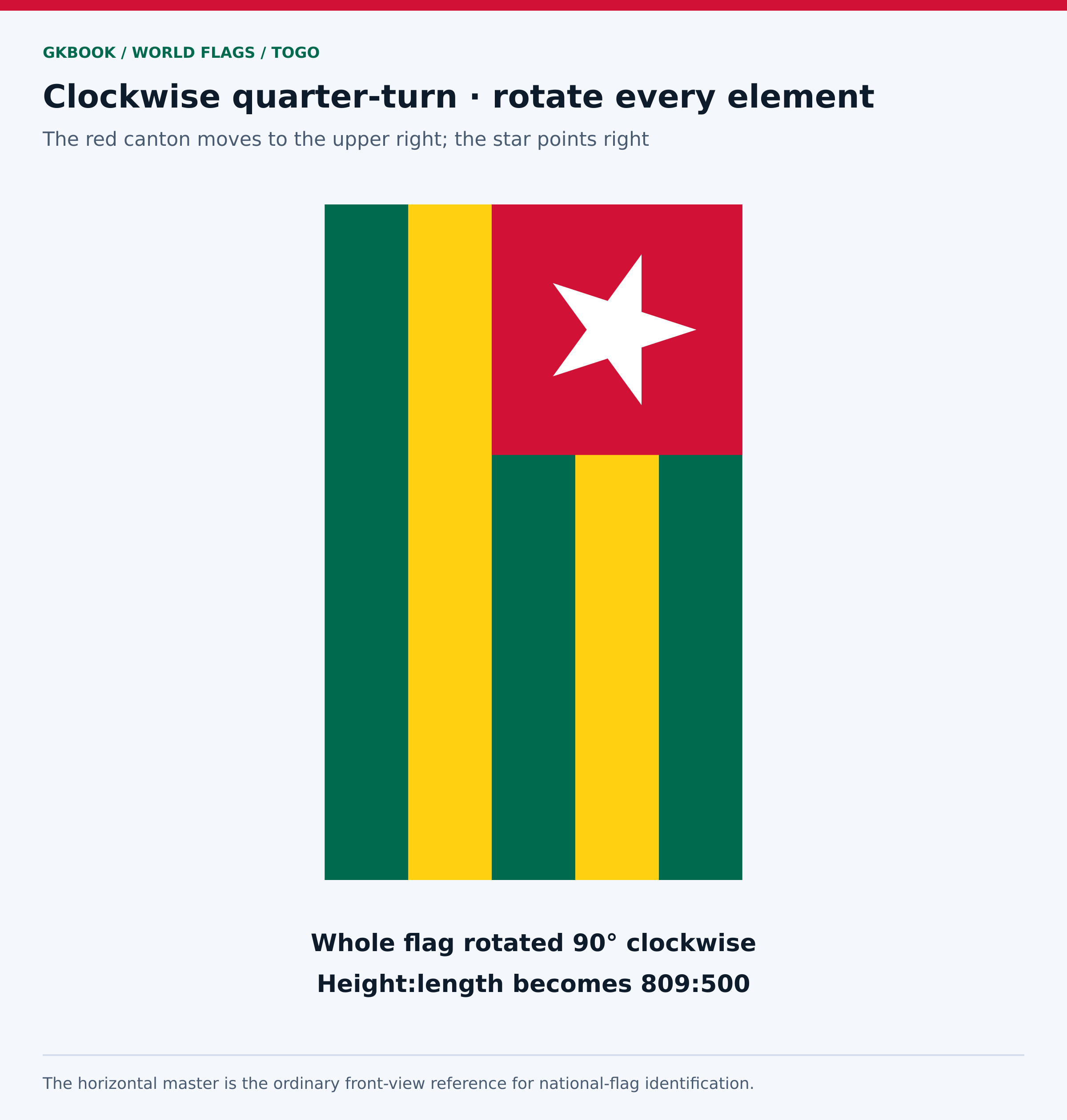
A clockwise quarter-turn makes the flag a tall rectangle and moves the red canton to the upper right. The star rotates with the flag, so its formerly upward point faces right. The illustration is a geometric transformation of the complete design, not a verified official instruction for hanging the national flag vertically.
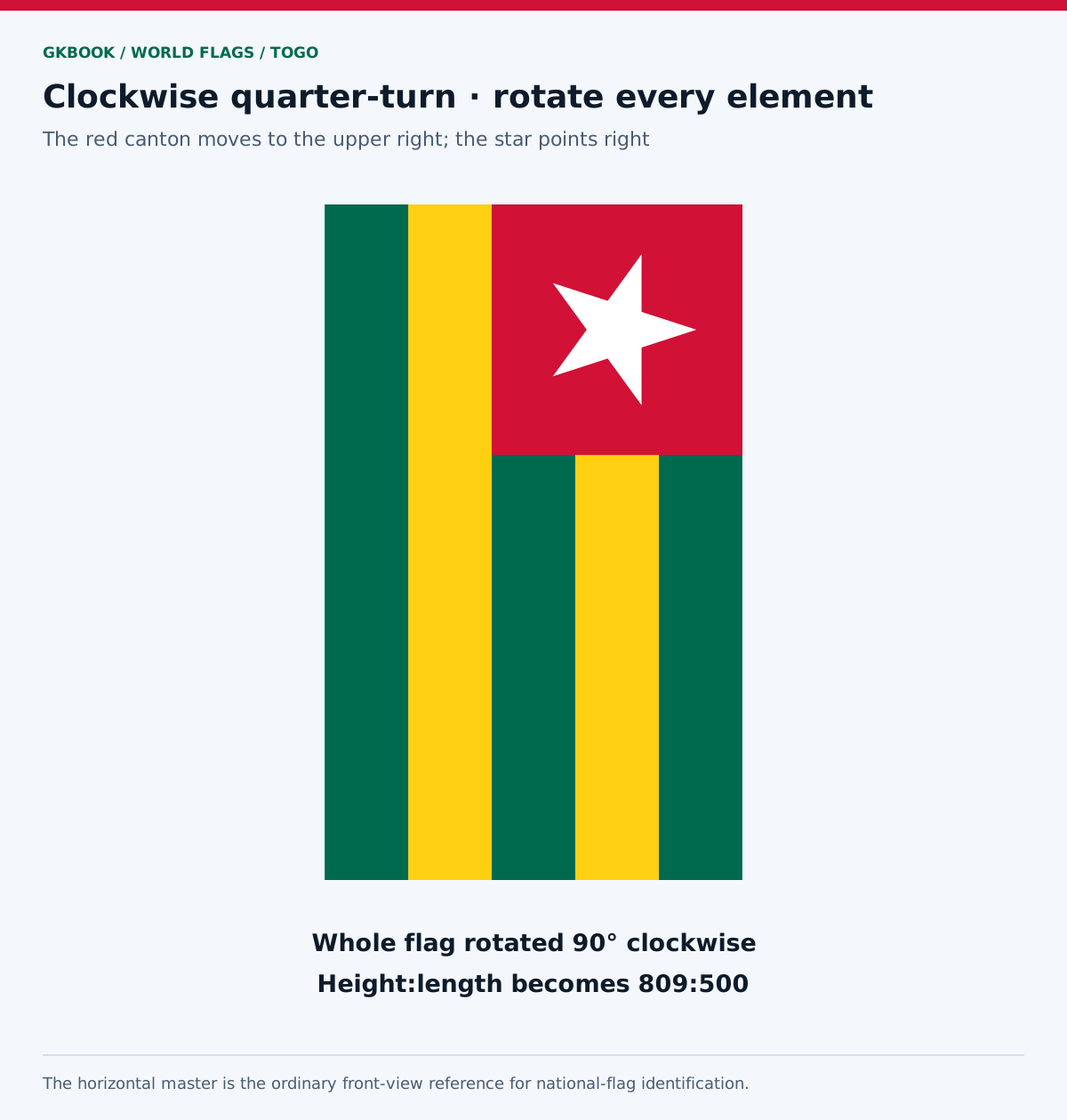
Rotate every part as one object: rectangle, bands, red square, and star. Keeping the star upright while rotating the rest would create a different transformed composition. The canton remains square, each band retains its relative thickness, and the total color areas remain unchanged under a genuine rotation.
A display protocol is a separate question from a geometry exercise. The horizontal master is the standard front-view reference in this collection. For a physical venue requiring an authoritative vertical arrangement, applicable instructions would need to be checked specifically rather than inferred from the rotated teaching diagram.
What does the reverse side of the Togo flag show?
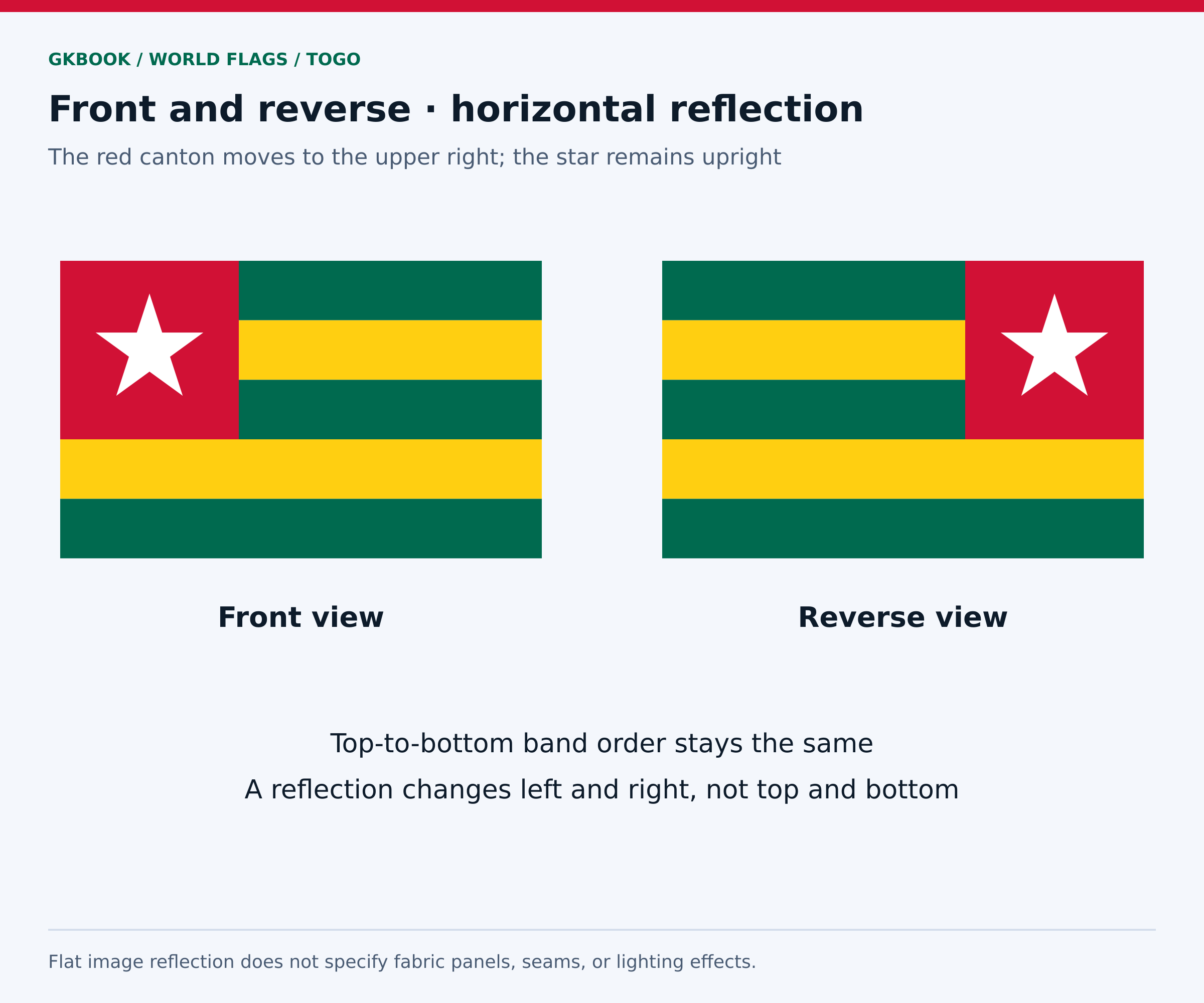
A flat reverse view is a left-right reflection of the front. The red canton appears in the upper right, while the green and yellow bands keep their top-to-bottom order. The white star still has one point upward. This model describes the image’s geometry and does not specify how a physical cloth flag is manufactured.
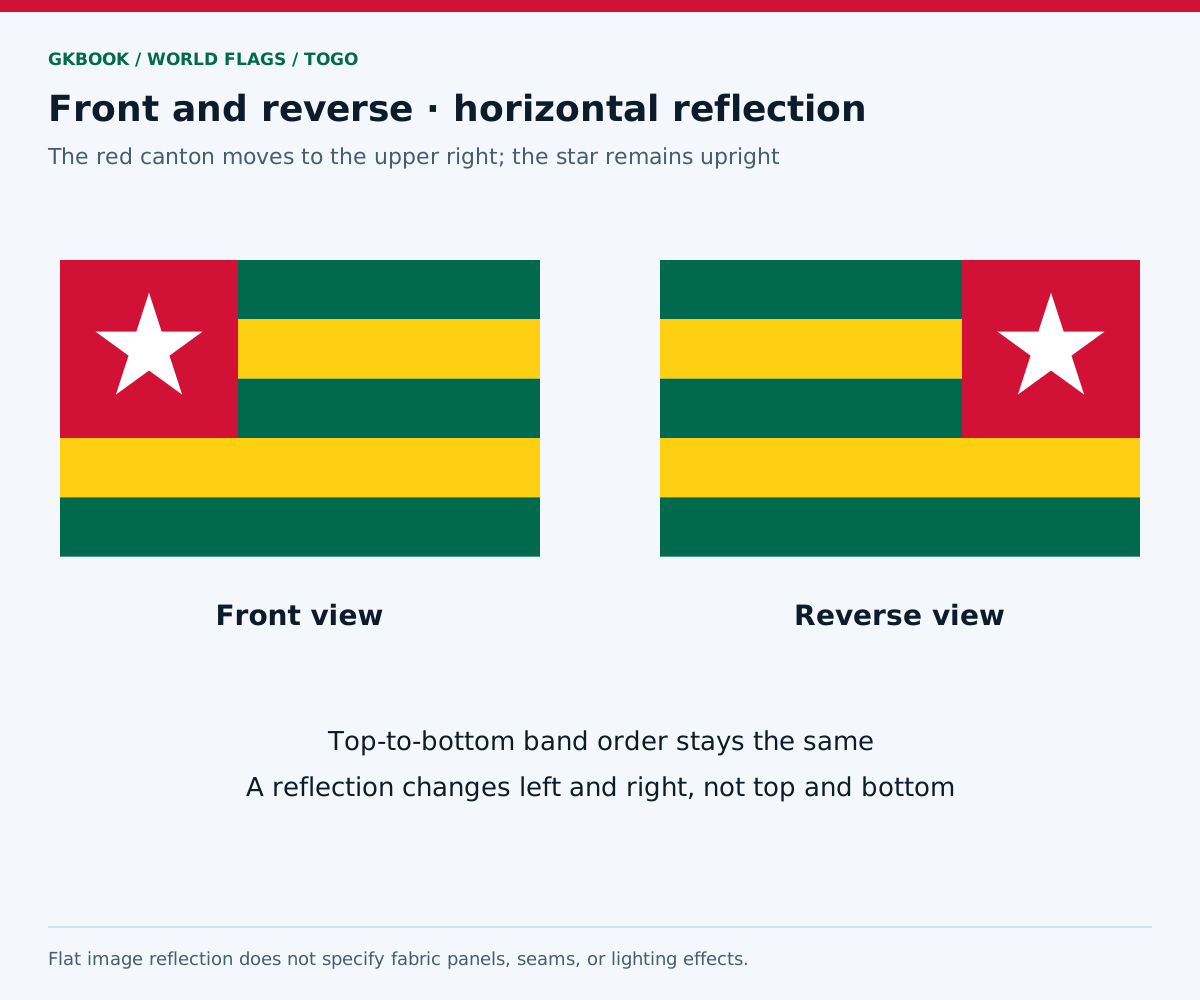
Reflection exchanges the hoist-side position as seen by the viewer, but it does not exchange top and bottom. The regular upright star has left-right symmetry, so its outline appears unchanged within the relocated canton. An apparent upper-right square can therefore be consistent with viewing the reverse of a flag.
The paired illustration mirrors the actual complete master at the same scale. It does not create a second design by placing an independently drawn star in another corner. Real fabric can show seams, transmitted light, or differently printed faces, so those material details should be considered separately from this flat comparison.
Is the Togo flag unchanged when turned upside down?
No. A 180-degree rotation moves the red canton from the upper left to the lower right and turns the star’s upward point downward. The alternating stripe sequence alone is symmetric, but the complete colored flag is not. Check the canton and star as well as the band order when judging orientation.
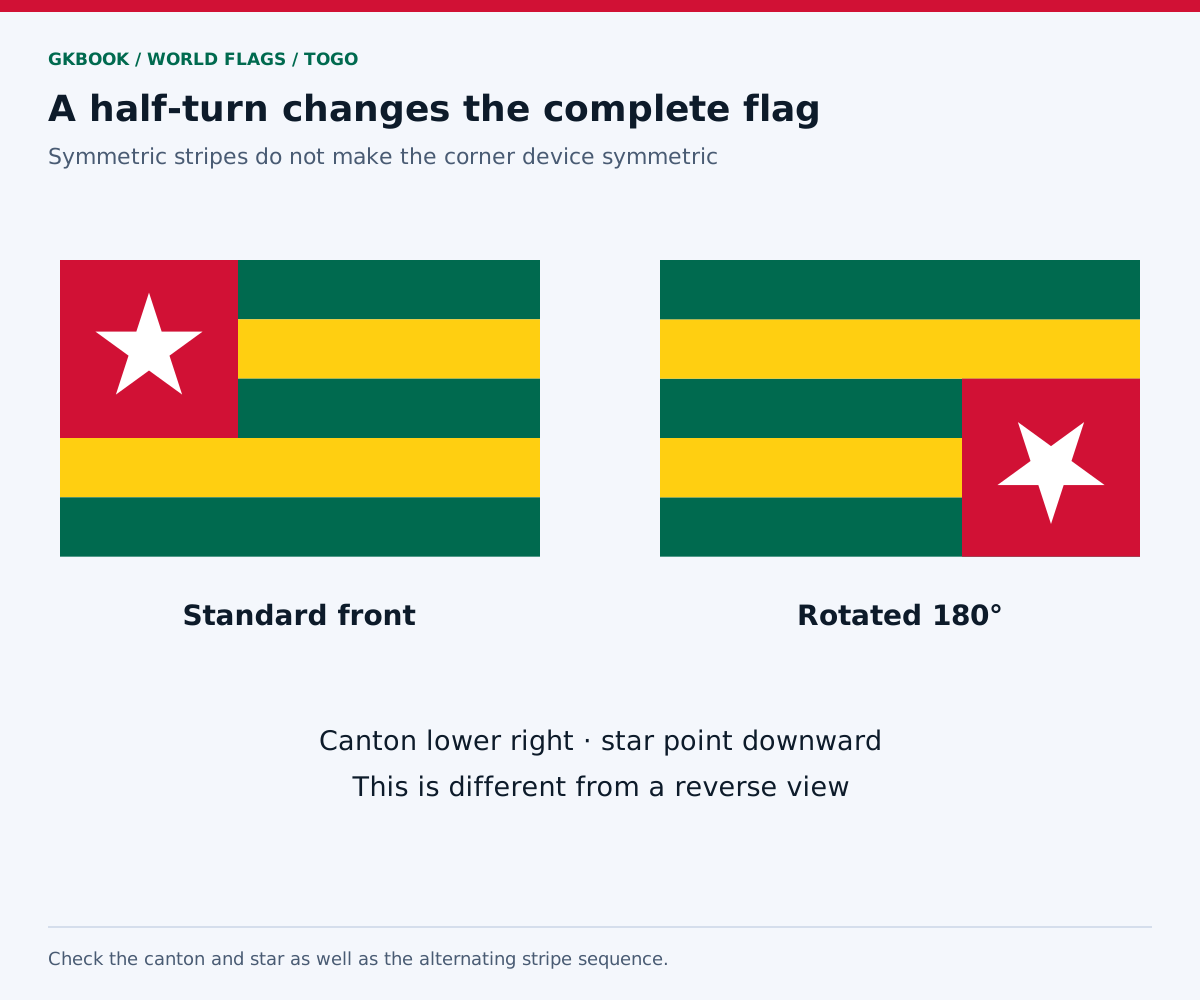
This is a useful example of a design whose background has more symmetry than the whole image. Green-yellow-green-yellow-green reads the same in either vertical direction. The corner square and the orientation of its star remove that symmetry from the complete national composition.
A half-turn is also different from a reverse view. The reverse keeps the canton at the top, whereas the half-turn moves it to the bottom. Giving each comparison a clear label prevents a viewer from confusing a reflected physical view with an upside-down front image.
How should the Togo flag be resized or printed?
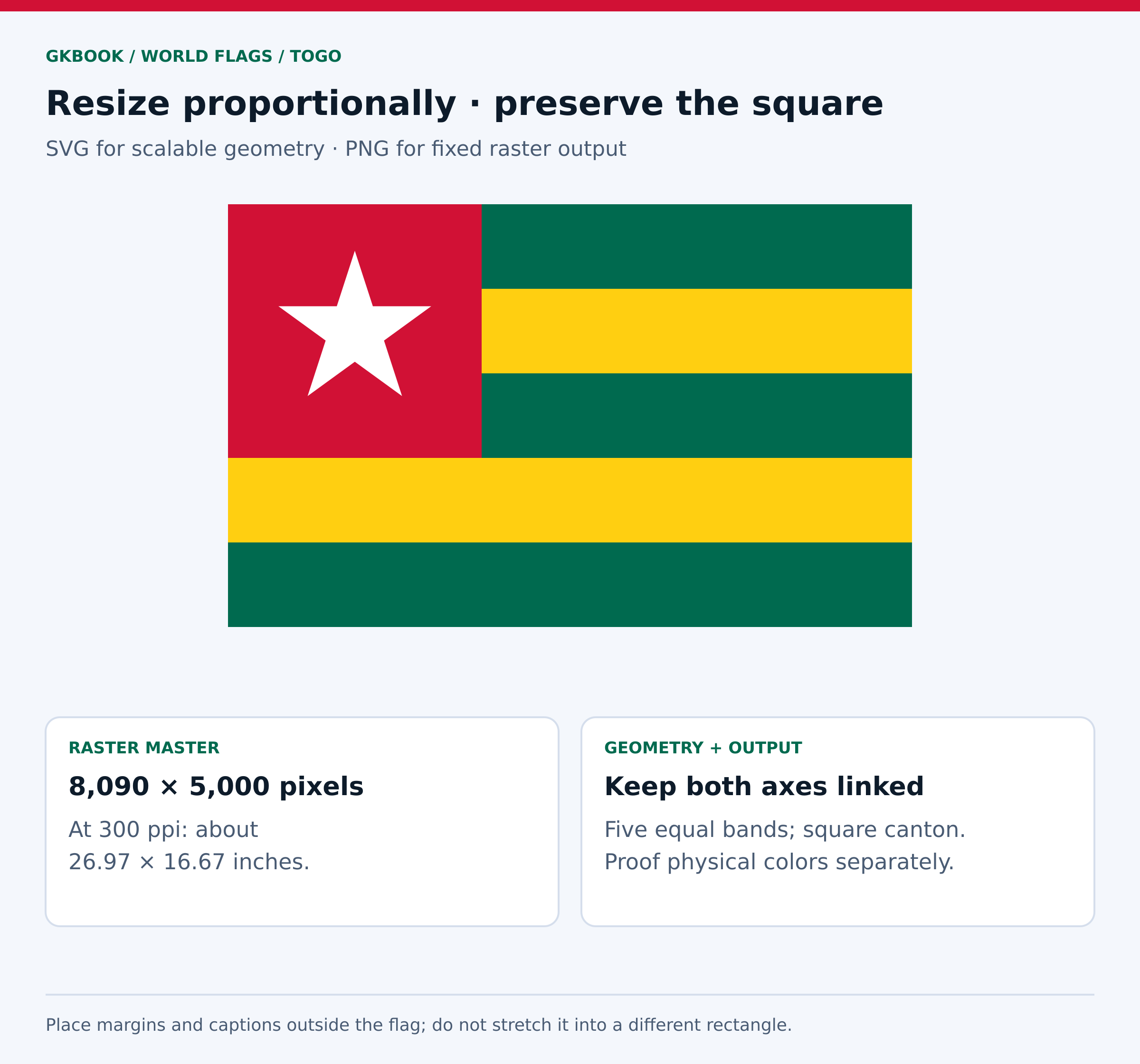
Scale both axes together to preserve the declared 809:500 ratio, five equal bands, square canton, and star geometry. Use the SVG for scalable artwork or the 8,090 by 5,000 PNG for fixed raster output. At 300 pixels per inch, that PNG corresponds to approximately 26.97 by 16.67 inches.

Place page margins, captions, or decorative frames outside the national flag rectangle. Stretching the image into a convenient standard box changes both its proportions and the canton’s square shape. Resizing the whole object proportionally preserves the documented relationships without needing to redraw the star at each size.
For physical output, use an appropriate proof and color-management workflow for the chosen ink, paper, or cloth. The charter’s printed RGB values make the digital palette traceable, but they do not make every printer reproduce the same appearance. Do not assume that an arbitrary screen preview certifies a finished textile.
How can the Togo flag stay recognizable at small sizes?
Retain all five bands, the full red square, and all five star points. A small image should preserve the chosen aspect ratio rather than forcing the flag into a square icon. Inspect antialiasing around the star and the canton boundary, and provide a clear text label when the picture becomes too small to resolve comfortably.
The star is the smallest major feature and is usually the first to lose definition during reduction. Removing it or turning it into a round dot simplifies away an essential part of the flag. If space is limited, a slightly larger image or a nearby country name is preferable to altered geometry.
The vector master scales consistently, but a raster display must distribute fractional boundaries across pixel rows and columns. That can produce blended edge pixels even in a correct rendering. Evaluate the complete icon at its actual display size and avoid judging accuracy only from a magnified preview.
Download Togo flag pictures
Download the complete flag as SVG or 8,090 × 5,000 PNG. The declared height:length ratio is 500:809. Five equal green and yellow bands are partly covered by a red square containing a centered white star.
The gallery contains 24 subjects, each with an SVG and PNG. Captions distinguish the clean flag from construction guides, historical explanations, and geometric transformations. Image credits and reproduction notes identify the palette, construction, source distinctions, and limits. The separate 1,200 × 630 social card contains a complete flag 540 units wide at the declared ratio.
Continue exploring national designs in World Flags.
World Flags/Togo
Togo flag pictures
Complete reconstruction using the legal five-band and square-canton layout, presidency SVG proportions, and graphic charter RGB palette.
GKBook reconstruction and educational layouts; references credited in the notes; CC BY-SA 4.0. No official certification.Download SVGDownload PNGGreen #006A4F, yellow #FFCF11, red #D11135, white #FFFFFF follow the charter’s written RGB numbers.
GKBook reconstruction and educational layouts; references credited in the notes; CC BY-SA 4.0. No official certification.Download SVGDownload PNGThe presidency’s explanations are attributed symbolism, not numerical country statistics.
GKBook reconstruction and educational layouts; references credited in the notes; CC BY-SA 4.0. No official certification.Download SVGDownload PNGOne centered white star carries attributed meanings that vary in wording across official explanations.
GKBook reconstruction and educational layouts; references credited in the notes; CC BY-SA 4.0. No official certification.Download SVGDownload PNGThe red canton covers the hoist portions of the first three bands; all five remain equal in height.
GKBook reconstruction and educational layouts; references credited in the notes; CC BY-SA 4.0. No official certification.Download SVGDownload PNGThe canton is a square, three fifths of the full flag height on each side.
GKBook reconstruction and educational layouts; references credited in the notes; CC BY-SA 4.0. No official certification.Download SVGDownload PNGThe star is centered geometrically; its numerical radius is a documented illustration convention.
GKBook reconstruction and educational layouts; references credited in the notes; CC BY-SA 4.0. No official certification.Download SVGDownload PNGThis edition follows 809:500 from the presidency SVG; the inspected law does not state an overall ratio.
GKBook reconstruction and educational layouts; references credited in the notes; CC BY-SA 4.0. No official certification.Download SVGDownload PNGThe declared ratio approximates the golden ratio with a relative difference of about 0.0021 percent.
GKBook reconstruction and educational layouts; references credited in the notes; CC BY-SA 4.0. No official certification.Download SVGDownload PNGThe master uses five equal bands, a square canton, and a regular star with the documented reference radius.
GKBook reconstruction and educational layouts; references credited in the notes; CC BY-SA 4.0. No official certification.Download SVGDownload PNGThe star is subtracted from the red square and the canton covers parts of three bands.
GKBook reconstruction and educational layouts; references credited in the notes; CC BY-SA 4.0. No official certification.Download SVGDownload PNGHistorical milestones are labeled by the type of event or document they represent.
GKBook reconstruction and educational layouts; references credited in the notes; CC BY-SA 4.0. No official certification.Download SVGDownload PNGSigning, publication and legal commencement are separated using the inspected original record.
GKBook reconstruction and educational layouts; references credited in the notes; CC BY-SA 4.0. No official certification.Download SVGDownload PNGHistorical authorship is separated from later reference-file work and educational illustration.
GKBook reconstruction and educational layouts; references credited in the notes; CC BY-SA 4.0. No official certification.Download SVGDownload PNGThe independence anniversary connects the 1960 milestone with a recurring national holiday.
GKBook reconstruction and educational layouts; references credited in the notes; CC BY-SA 4.0. No official certification.Download SVGDownload PNGUN admission is distinct from flag adoption and does not certify reproduction geometry.
GKBook reconstruction and educational layouts; references credited in the notes; CC BY-SA 4.0. No official certification.Download SVGDownload PNGThe law’s explicit geometry is distinguished from later digital reproduction measurements.
GKBook reconstruction and educational layouts; references credited in the notes; CC BY-SA 4.0. No official certification.Download SVGDownload PNGHEX values are arithmetic notation for the RGB numbers printed in the government charter.
GKBook reconstruction and educational layouts; references credited in the notes; CC BY-SA 4.0. No official certification.Download SVGDownload PNGThe earlier legal framework is identified without claiming a complete historical flag reconstruction.
GKBook reconstruction and educational layouts; references credited in the notes; CC BY-SA 4.0. No official certification.Download SVGDownload PNGFlag representations within the arms do not put the complete arms inside the national flag.
GKBook reconstruction and educational layouts; references credited in the notes; CC BY-SA 4.0. No official certification.Download SVGDownload PNGA whole-flag quarter-turn, shown as geometry rather than a verified hanging instruction.
GKBook reconstruction and educational layouts; references credited in the notes; CC BY-SA 4.0. No official certification.Download SVGDownload PNGThe reverse panel reflects the actual complete master at equal scale.
GKBook reconstruction and educational layouts; references credited in the notes; CC BY-SA 4.0. No official certification.Download SVGDownload PNGThe complete flag is not invariant under a 180-degree rotation.
GKBook reconstruction and educational layouts; references credited in the notes; CC BY-SA 4.0. No official certification.Download SVGDownload PNGThe supplied dimensions retain 809:500, and the print-size calculation is approximate to two decimals.
GKBook reconstruction and educational layouts; references credited in the notes; CC BY-SA 4.0. No official certification.Download SVGDownload PNGFrequently asked questions
What does the Togo flag look like?
The Togo flag has five equal horizontal bands, alternating green and yellow, with green at the top and bottom. A red square occupies the upper hoist corner and contains a centered white five-pointed star. The square is three band-heights tall. This collection follows the presidency’s illustrated proportions, approximately height:length 1:1.618.
What is the Togo flag called?
It is the national flag of Togo, formally the Togolese Republic. French official descriptions use “drapeau togolais” or “emblème national.” These terms identify the complete striped flag with its red square and white star. The national emblem in this legal description should not be confused with the separate coat of arms.
What are the colors of the Togo flag?
Togo’s flag uses green, yellow, red, and white. This edition follows the RGB numbers in the government graphic charter: green #006A4F, yellow #FFCF11, red #D11135, and white #FFFFFF. These differ slightly from the presidency’s downloadable SVG, so the chosen palette and the reference-image difference are documented explicitly.
What does the Togo flag mean?
The presidency associates green with forests, agriculture, and hope; yellow with faith, underground resources, and readiness for a shared future; red with sacrifice in struggles for independence and democratic government; and the white star with peace, light, and intelligence. These are attributed explanations of the national symbol, not measurements of the country.
What does green represent on the Togo flag?
Green represents forests, agriculture, and hope in the presidency’s explanation. It forms the first, third, and fifth horizontal bands. Each band has the same height as a yellow band, but the red canton covers the left portions of the upper two green bands. Green therefore does not occupy three fifths of the visible flag.
What does yellow represent on the Togo flag?
Yellow is associated with faith, underground resources, and maturity in facing a common future in the presidency’s account. It occupies the second and fourth bands. The upper yellow band is partly covered by the red canton, while the lower yellow band extends across the full length of the rectangle.
What does the red square represent?
The red square recalls sacrifice for independence and, in the presidency’s current explanation, people who died for democracy and the rule of law. It occupies the upper hoist corner. Its side equals three band heights, making it a square rather than a full-height vertical stripe or an arbitrary rectangular panel.
What does the white star on Togo’s flag mean?
The presidency describes the white star as a symbol of peace, light, and intelligence. The 1960 explanatory statement also associates white with purity and a desire to live peacefully with other nations. The star has five points and appears at the center of the red square, rather than in the center of the flag.
How many stripes are on the Togo flag?
There are five equal horizontal stripes: green, yellow, green, yellow, and green from top to bottom. Each takes one fifth of the flag’s height. The red square covers the hoist-side portions of the first three stripes, but it does not turn the flag into a design with fewer underlying bands.
How large is the red canton on Togo’s flag?
The 1960 law specifies a red square whose side equals three stripe widths, measured vertically across the horizontal bands. Since the five bands are equal, the square is three fifths of the flag’s height on each side. In this 8,090 by 5,000 master, the canton measures 3,000 by 3,000 units.
How is the five-pointed star positioned and sized?
The star is centered in the red square with one outer point upward. This reconstruction follows the presidency’s SVG: on a 500-unit flag height, its center is at 150,150 and its outer radius is 95. The law specifies a centered five-pointed star but does not supply that numerical radius.
What are the proportions of the Togo flag?
Published proportions vary. This collection uses height:length 500:809, or 1:1.618, matching the actual SVG supplied on the presidency’s website. The inspected 1960 law specifies the bands and canton but gives no overall aspect ratio. The chosen dimensions are therefore identified as a documented reproduction choice, not an exclusive statutory ratio.
Is the Togo flag an exact golden rectangle?
The 809:500 rectangle used here closely approximates the golden ratio but is not mathematically exact. Its length divided by height is 1.618; the golden ratio is approximately 1.618033989. The difference is about 0.0021 percent. The reviewed law does not state a golden-ratio requirement, so that historical design interpretation is kept distinct.
How can the Togo flag be drawn accurately?
For this master, draw an 8,090 by 5,000 rectangle and divide its height into five 1,000-unit bands, alternating green and yellow. Add a 3,000-unit red square at the upper left. Center a regular white five-pointed star at 1,500,1,500 with outer radius 950, keeping one point upward.
What percentage of the flag is each color?
For the declared 809:500 rectangle and star construction, green occupies about 45.1669 percent, yellow 32.5834 percent, visible red 19.7451 percent, and white 2.5046 percent. These are calculated vector areas. The canton covers parts of three stripes, and the white star replaces part of the red square’s visible area.
What is the history of the Togo flag?
The present design belongs to Togo’s transition to independence in 1960. Law 60-11 defined the flag, anthem, and motto shortly before independence, replacing an earlier symbols framework associated with the autonomous republic. Later constitutions and the government graphic charter document the continuing national symbols, without making those later dates the original flag adoption.
When was the current Togo flag adopted?
The present flag was adopted for independence on April 27, 1960. The original legal record makes the sequence precise: Law 60-11 was signed on April 23, published in the special official journal dated April 25, and expressly entered into force on April 27. These are three documentary dates for related steps.
Who designed the Togo flag?
The presidency credits the Togolese artist and art professor Paul Ahyi with designing the national flag. The design was adopted at independence in 1960. Modern SVG contributors and educational illustrators reproduce that national design; their names and file revision dates should be distinguished from the historical designer and adoption date.
Is the flag adoption date the same as Togo’s independence day?
Yes. April 27, 1960 is both Togo’s independence date and the commencement date stated for the law defining the present flag. The 2024 Constitution identifies April 27 as the annual national holiday. Independence, the flag’s legal introduction, and the recurring commemoration are connected events, though each still deserves its own description.
When did Togo join the United Nations?
Togo became a United Nations member on September 20, 1960, under General Assembly resolution 1477 (XV). That was after independence and the flag’s introduction on April 27. UN membership is an international institutional milestone; it is not a second adoption of the flag or certification of its dimensions and colors.
Which law defines the Togo flag?
Law 60-11 of April 23, 1960 defines the national flag in article 1 and gives April 27 as its commencement date. It specifies three green and two yellow equal bands, a red square three band-heights per side, and a centered white five-pointed star. It does not specify exact RGB values or an overall ratio.
What does the government graphic charter standardize?
The graphic charter provides guidance for consistent state communication and publishes RGB, CMYK, and Pantone references for the colors of the arms and flag. This collection uses its printed RGB values. The charter is later reproduction guidance, not the 1960 adoption instrument, and its older constitutional quotation must be read in historical context.
What came before the present Togo flag?
An earlier national-symbols framework existed for the Autonomous Republic of Togo before independence. The explanatory statement accompanying the 1960 law specifically refers to a law of September 18, 1956 and explains the need for symbols of a sovereign state. This guide distinguishes that predecessor framework without inventing an authenticated historical flag drawing.
Does the Togo flag contain the coat of arms?
No. The national flag contains only its alternating bands, red square, and white star. Togo’s coat of arms is a separate composition that includes flag representations alongside other elements. The presence of flags within the arms does not mean that the complete arms should be added to the national flag.
Do the five stripes represent five regions?
Some later descriptions associate the five stripes with five regions, but the inspected 1960 law does not make that assignment. A secondary historical discussion also reports a different explanation based on action and unity. The regional interpretation should therefore be attributed as an interpretation, not presented as a verified requirement of the original design law.
How does the Togo flag look when rotated vertically?
A clockwise quarter-turn makes the flag a tall rectangle and moves the red canton to the upper right. The star rotates with the flag, so its formerly upward point faces right. The illustration is a geometric transformation of the complete design, not a verified official instruction for hanging the national flag vertically.
What does the reverse side of the Togo flag show?
A flat reverse view is a left-right reflection of the front. The red canton appears in the upper right, while the green and yellow bands keep their top-to-bottom order. The white star still has one point upward. This model describes the image’s geometry and does not specify how a physical cloth flag is manufactured.
Is the Togo flag unchanged when turned upside down?
No. A 180-degree rotation moves the red canton from the upper left to the lower right and turns the star’s upward point downward. The alternating stripe sequence alone is symmetric, but the complete colored flag is not. Check the canton and star as well as the band order when judging orientation.
How should the Togo flag be resized or printed?
Scale both axes together to preserve the declared 809:500 ratio, five equal bands, square canton, and star geometry. Use the SVG for scalable artwork or the 8,090 by 5,000 PNG for fixed raster output. At 300 pixels per inch, that PNG corresponds to approximately 26.97 by 16.67 inches.
How can the Togo flag stay recognizable at small sizes?
Retain all five bands, the full red square, and all five star points. A small image should preserve the chosen aspect ratio rather than forcing the flag into a square icon. Inspect antialiasing around the star and the canton boundary, and provide a clear text label when the picture becomes too small to resolve comfortably.
Every general-knowledge topic and the A-to-Z lists.
The world A to Z: flags, countries, the sciences, places, people, subjects.










We Value Your Opinion Comments