
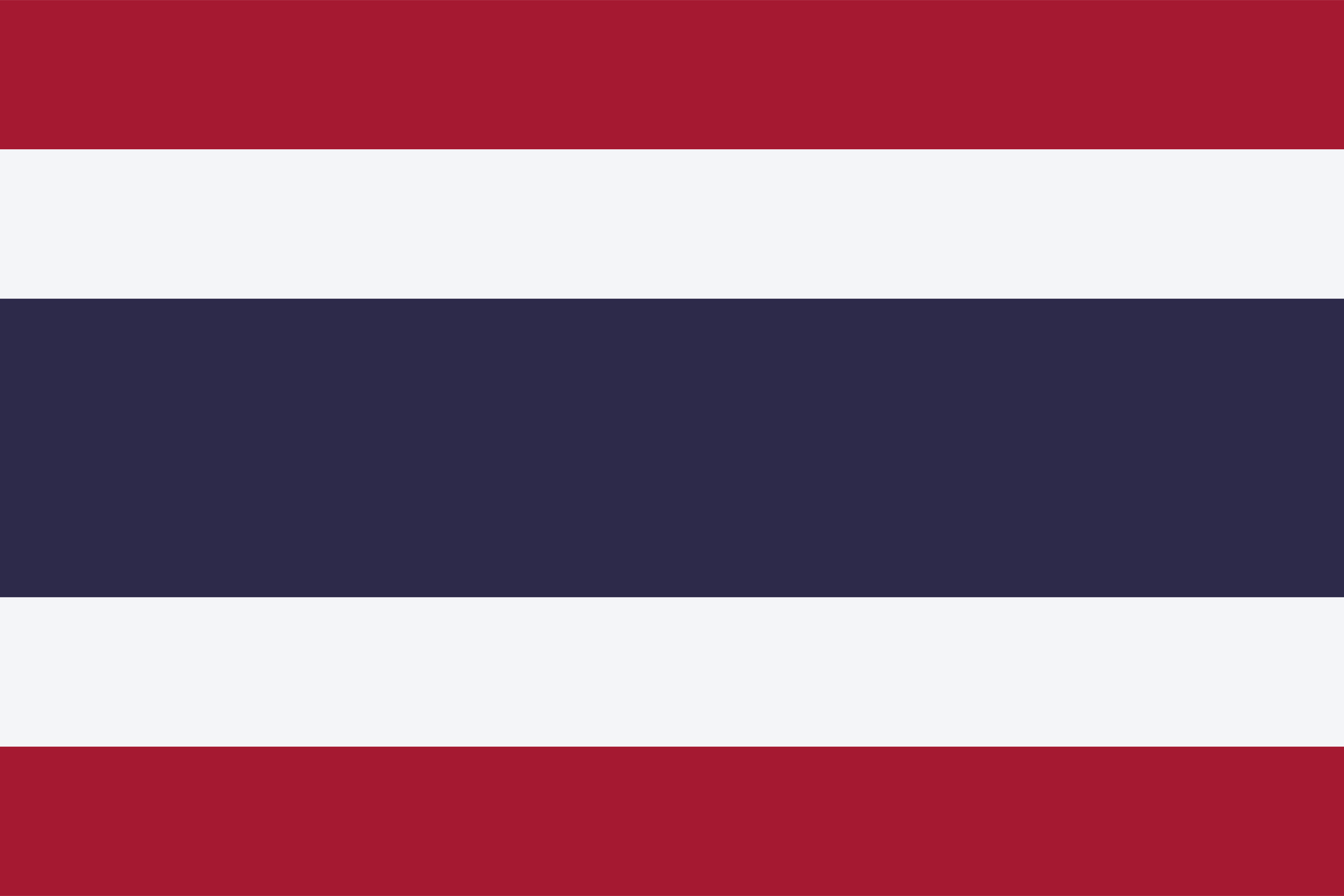
Thailand flag picture
Explore the proportions, 1917 adoption, and picture gallery.
| National design | Kingdom of ThailandSoutheast Asia; commonly called Thong Trairong. |
|---|---|
| Design | Red · white · blue · white · redFive bands, three colors, no added emblem. |
| Proportions | Height:length = 2:3Band heights from top: 1:1:2:1:1. |
| Adoption | September 28, 1917Introduced under King Vajiravudh, Rama VI. |
| Physical color notice | Gazette publication: October 4, 2017Instrument dated September 30; cloth targets are separate from web values. |
| Main image sizes | SVG and PNG: 7,200 × 4,800Complete rectangle; opaque RGB PNG. |
The artwork follows the government portal web palette. Physical cloth measurements are documented separately; no exact conversion or production certification is claimed.
What does the Thailand flag look like?
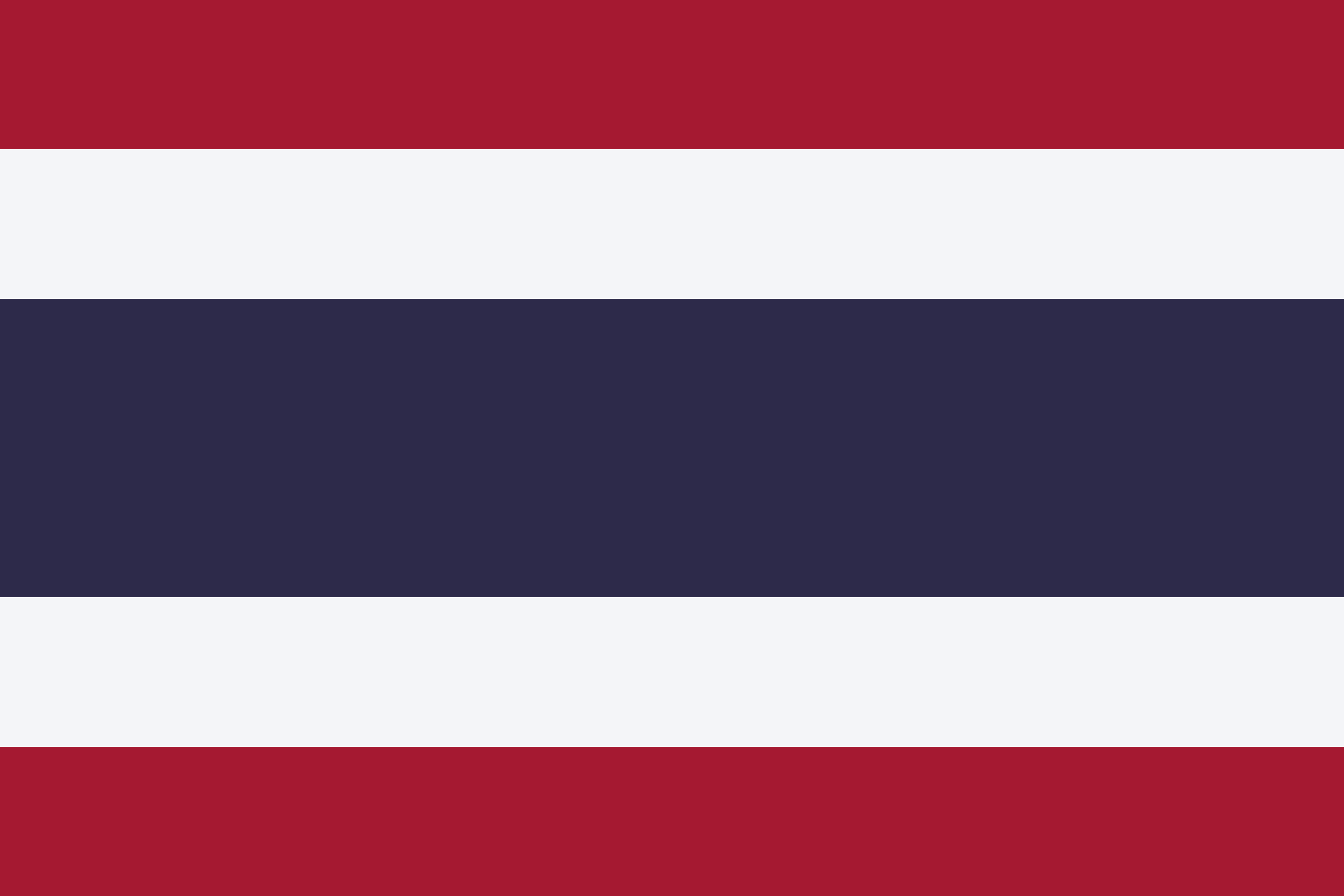
The Thailand flag has five horizontal bands: red, white, deep blue, white, and red. The blue center band is twice the height of each other band. Its height:length ratio is 2:3. The plain national flag contains no elephant, coat of arms, stars, or lettering.
Read the design from the top edge downward, keeping the complete rectangle in view. The two red bands form the outer edges, the white bands sit just inside them, and blue fills the middle third. All five bands extend across the full length. A fold can hide one of these bands, while a tight crop can make the center look disproportionately large. The clean image therefore provides a useful reference for recognizing the same design on a moving cloth flag, in a small icon, or beside other national flags.
What is the Thailand flag called?
The flag is commonly called Thong Trairong, meaning the tricolor flag. The Thai name is ธงไตรรงค์. “Tricolor” describes its three colors, although the design has five separate horizontal bands. “National flag of Thailand” is a clear English caption for the complete red, white, and blue rectangle.
A tricolor does not necessarily consist of three equal stripes. Thailand repeats red and white on opposite sides of the blue center, producing five visible bands from three colors. Counting colors and counting bands answer different questions, so both numbers belong in a careful description of the design.
English transliterations can vary in spacing, including Thong Trai Rong. The national name is more useful than treating those spelling differences as different flags. In an accessible caption, combine the country name with the band order and wider center so that the image can be understood without relying on color alone.
What are the colors of the Thailand flag?
Thailand’s flag uses red, white, and deep blue. This collection follows the government portal’s web values: red #A51931, white #F4F5F8, and blue #2D2A4A. These screen colors are separate from the physical cloth measurements published in 2017; they are not presented as numerical HEX provisions of the 1979 Flag Act.

The published white is slightly below pure digital white, and the blue is a dark shade rather than a bright primary blue. Keeping the same values in every file avoids accidental changes between the clean flag, the explanatory diagrams, and the image prepared for social sharing.
HEX and RGB describe the same screen channels in different notation. A fabric standard instead concerns measured color under defined conditions. This distinction matters when a screen image is sent to a printer: copying three HEX values alone does not establish that the resulting ink or cloth meets the physical specification.
| Color | HEX | RGB |
|---|---|---|
| Red | #A51931 | 165, 25, 49 |
| White | #F4F5F8 | 244, 245, 248 |
| Deep blue | #2D2A4A | 45, 42, 74 |
What does the Thailand flag mean?
Official explanations associate red with the nation and the unity of its people, white with religion, and blue with the monarchy. These three themes are expressed through the five-band composition. The meanings describe national symbolism; they do not turn the area of each color into a population or territorial statistic.
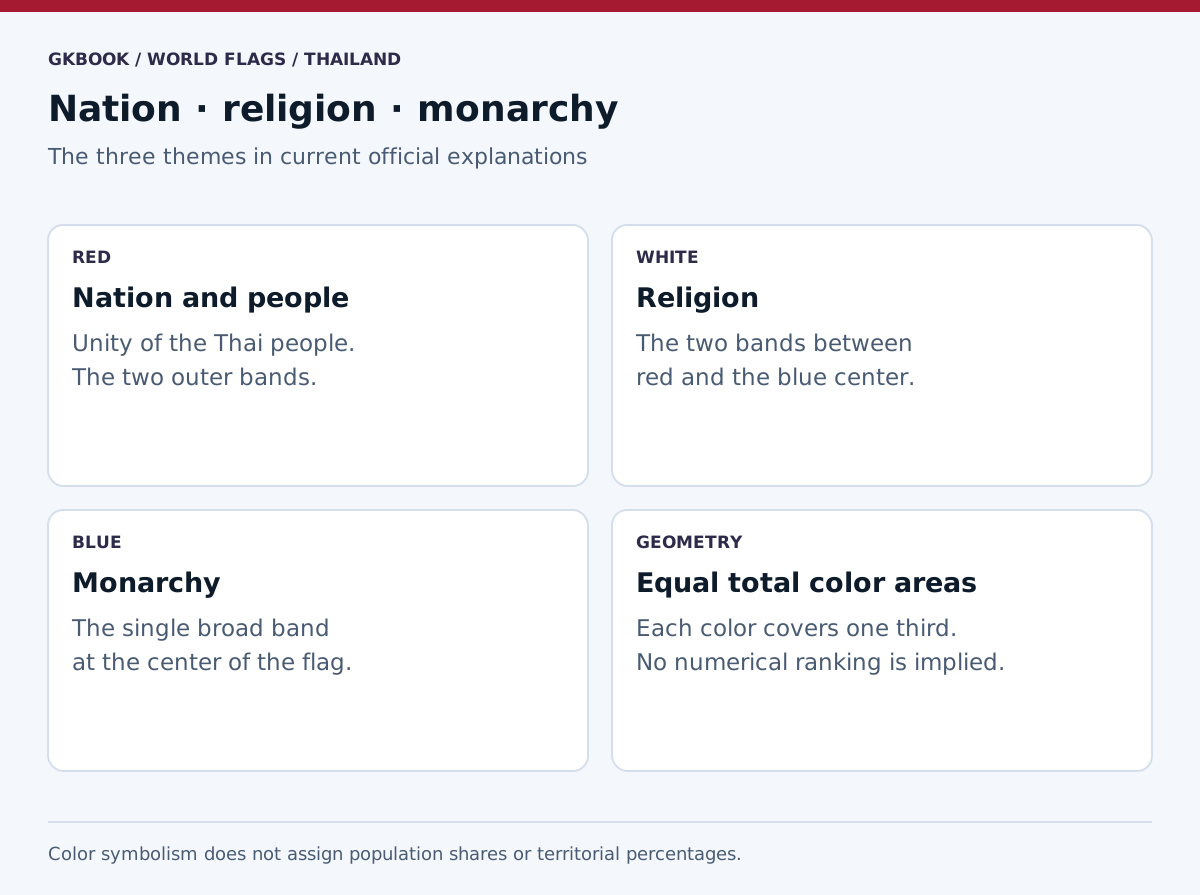
The arrangement makes the three themes easy to identify together. Red appears at both outside edges, white separates red from blue, and the broad blue band anchors the center. A teaching diagram can connect each color to its meaning while preserving the complete flag beside the labels.
Symbolism and construction should remain distinct. The blue band is twice as tall as either individual red band, but the two red bands together cover as much area as blue. That mathematical relationship follows from the drawing and should not be converted into an unsupported ranking of the three national themes.
What does red represent on the Thailand flag?
Red represents the nation and the unity of the Thai people in current official explanations. It appears in the uppermost and lowermost bands. Each red band occupies one sixth of the flag’s height, so the two together cover one third of the complete rectangular flag.
The red bands are equal in height and use the same solid fill. Neither is an ornamental border added around an otherwise complete flag. They are integral parts of the national composition and extend to both the hoist edge and the fly edge of the rectangle.
A useful drawing check begins with the top and bottom edges. Both should be red all the way across, with white immediately inside them. If one red band is thinner than the other, the image has lost the vertical balance of the national design even if its overall dimensions are correct.
What does white represent on the Thailand flag?
White represents religion in current official explanations of Thailand’s national flag. Its two bands lie between the outer red bands and the deep blue center. Each white band has the same height as a red band. The two white bands therefore occupy one third of the flag’s total area.
The present official summary uses the broad term religion. Historical interpretations can provide additional religious context, but they should be attributed to their own period rather than silently replacing that current wording. A concise introduction can accurately explain the color without making claims about the beliefs of every individual.
In this digital palette, the white bands use #F4F5F8. They remain opaque colored regions, including in the SVG and PNG downloads. A transparent gap would behave differently on a colored background and would no longer reproduce the intended white bands consistently across websites, slides, and printed layouts.
What does blue represent on the Thailand flag?
Blue represents the monarchy in current official explanations. It forms the single central band, which is twice the height of each red or white band. Historical explanations of its introduction in 1917 also connect blue with King Vajiravudh’s royal birth-day color and solidarity with the Allied powers.
The blue band touches both vertical edges and is centered precisely between the top and bottom of the flag. It has no embedded emblem or text. Its dark color creates a strong visual anchor, but darkness and width are separate properties that both need to be preserved.
The historical reasons for choosing blue and its familiar modern meaning answer related questions. One concerns the circumstances of the design change; the other concerns how the national symbol is explained today. Keeping both in view gives a fuller account than reducing the center band to only one historical association.
How many stripes are on the Thailand flag?
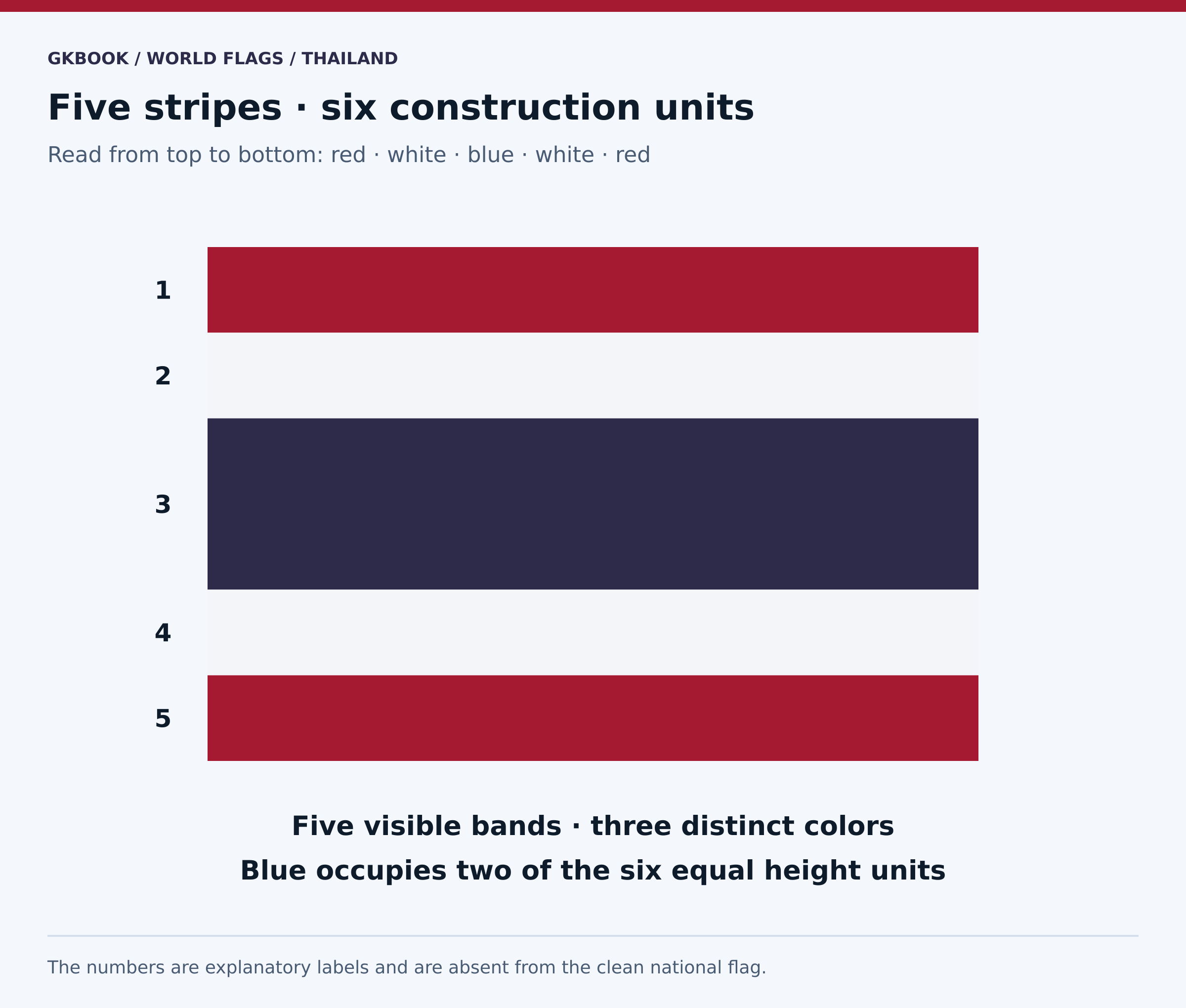
There are five horizontal stripes, ordered red, white, blue, white, and red from top to bottom. Only the central blue stripe is double height. The design therefore has five bands and three colors, with six equal units of height used to construct the complete flag.
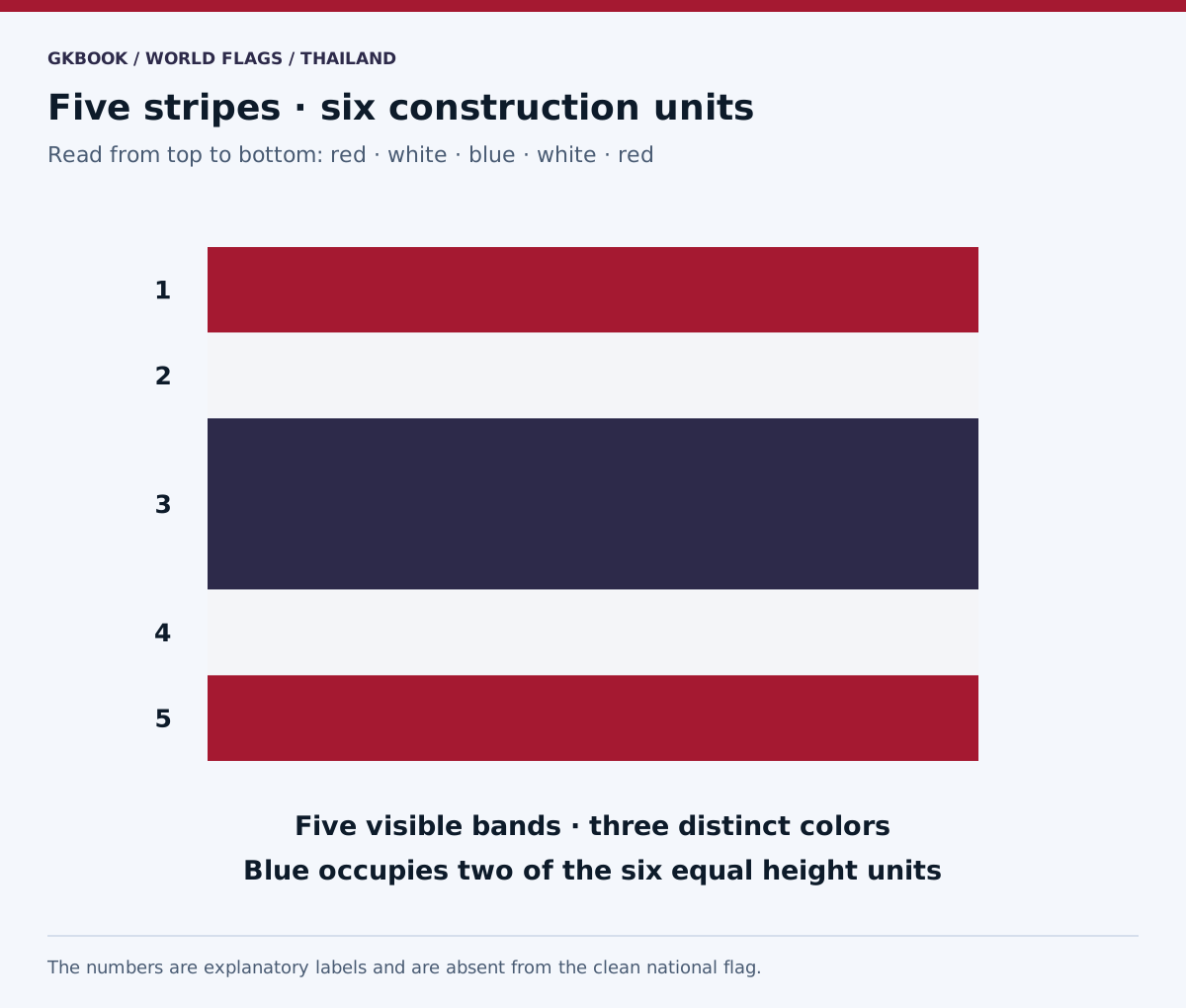
Imagine dividing the height into six equal rows. Red fills the first row, white the second, blue the third and fourth, white the fifth, and red the sixth. The two blue rows merge visually into one uninterrupted band because there is no line or color change between them.
This counting method prevents a common drawing mistake: making all five visible bands equally tall. Equal fifths would narrow the blue center and enlarge the others. It would still resemble the flag at a glance, but it would not follow the prescribed relationships shown in the national flag drawing.
What are the proportions of the Thailand flag?
The flag’s height:length ratio is 2:3, equivalent to six units high and nine units long. A flag 60 centimeters high is therefore 90 centimeters long. The downloadable master measures 4,800 units high by 7,200 units long and preserves the same proportions without cropping or stretching.
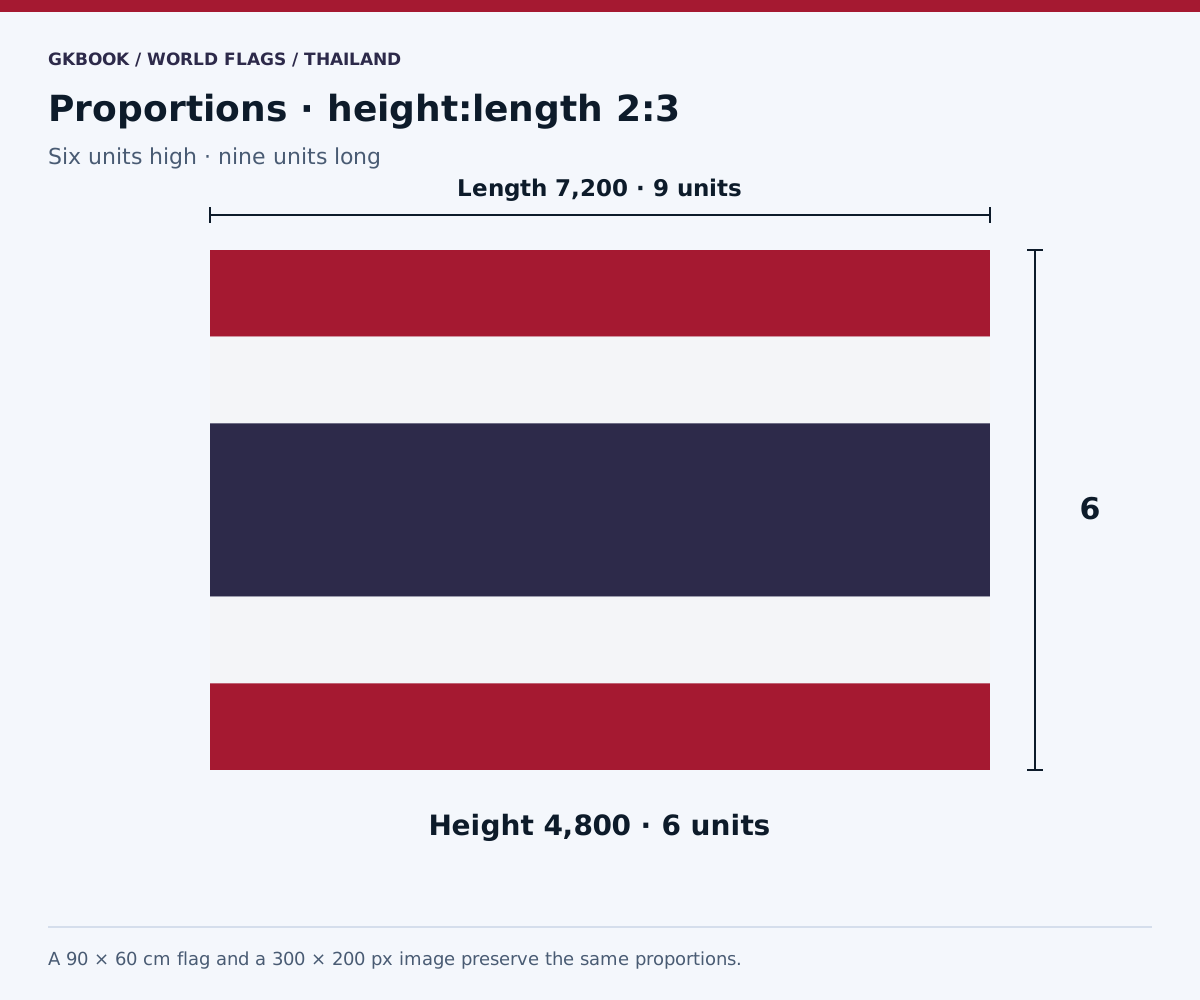
State the order of the dimensions when quoting a ratio. Height:length 2:3 and length:height 3:2 describe the same horizontal rectangle, not two different designs. The six by nine construction is especially convenient because each narrow band can be assigned one of the six height units.
For a layout with a fixed available width, calculate height as two thirds of that width. A 300-pixel-wide image should therefore be 200 pixels high. Additional space for a caption or a border belongs outside the flag rectangle, so the national design retains its own correct proportions.
How wide should the five flag bands be?
Measured vertically, the five band heights are in the ratio 1:1:2:1:1. Each red or white band takes one sixth of the total height, while blue takes one third. On the 4,800-unit-high master, the heights are 800, 800, 1,600, 800, and 800 units respectively.

Here, band height means the distance between its horizontal boundaries. It does not mean the full horizontal length of the stripe, because every band stretches across the entire flag. Naming the measurement direction makes instructions easier to follow when constructing the image in a drawing program.
For a physical example, a flag 60 centimeters high has narrow bands 10 centimeters high and a blue band 20 centimeters high. The five measurements add back to 60 centimeters. Checking that total catches rounding or transcription errors before the finished rectangle is assembled or resized.
| Position | Color | Height | Share of total height |
|---|---|---|---|
| 1 — top | Red | 800 | 1/6 |
| 2 | White | 800 | 1/6 |
| 3 — center | Blue | 1,600 | 1/3 |
| 4 | White | 800 | 1/6 |
| 5 — bottom | Red | 800 | 1/6 |
Why is the blue center band wider?
The national design specifies a blue center twice as tall as any individual outer band. That gives blue a broad central position while making its total area equal to the combined red area and the combined white area. The width is a construction requirement, not an invitation to vary the design.

The center band begins one third of the way down the flag and ends two thirds of the way down. Its midpoint therefore coincides with the rectangle’s midpoint. This is a straightforward way to check centering without measuring the top and bottom red bands separately.
Do not infer a numerical hierarchy of national values from the central placement. The familiar symbolism identifies monarchy with blue, but the geometry alone does not establish an official claim that one theme has twice the importance of another. It simply fixes the visible relationship among the five bands.
How can the Thailand flag be drawn accurately?
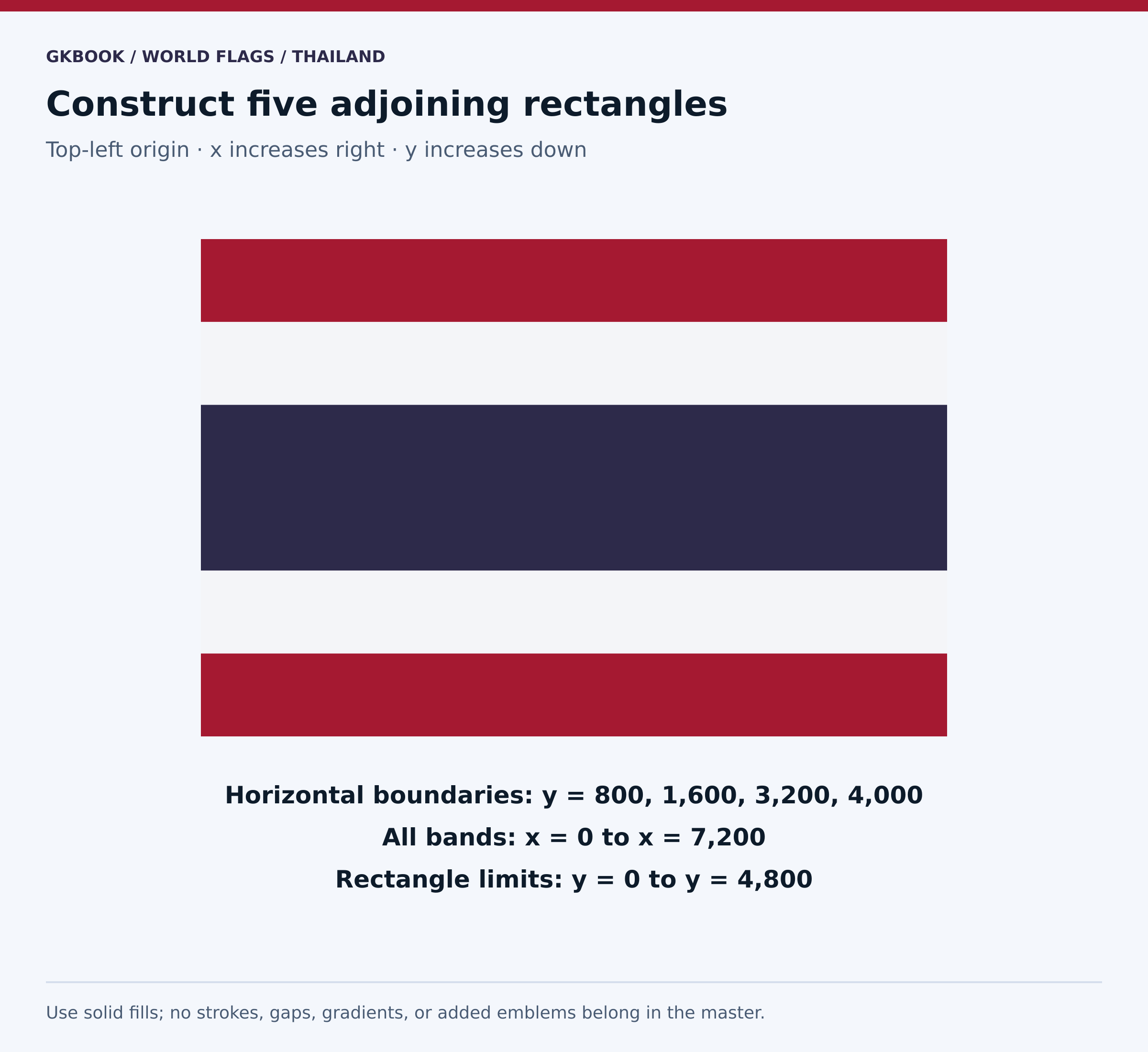
Draw a rectangle 7,200 units wide and 4,800 units high. Place horizontal boundaries at y = 800, 1,600, 3,200, and 4,000, measured downward from the top. Fill the resulting bands red, white, blue, white, and red. Every band extends from x = 0 to x = 7,200.
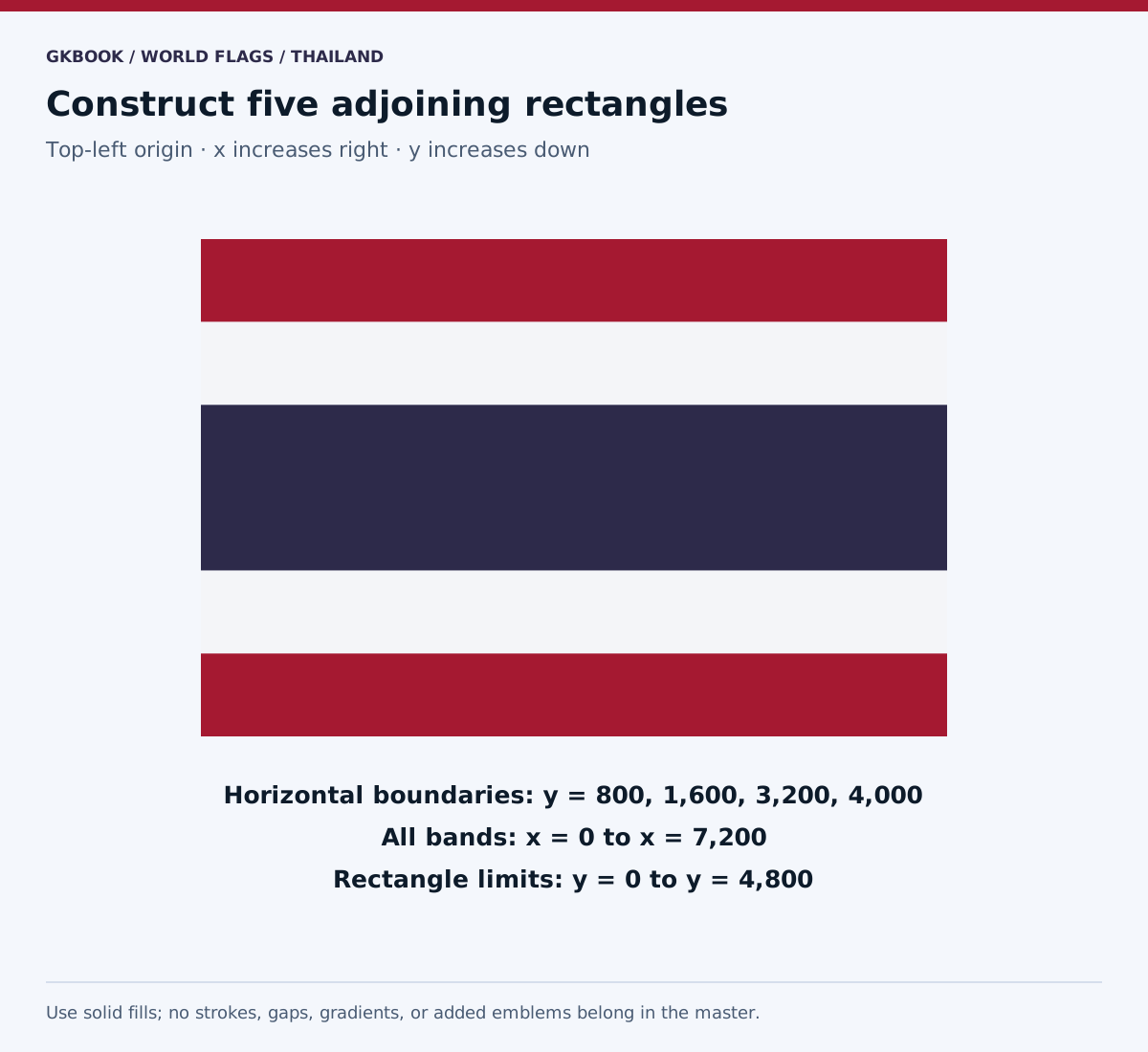
The construction needs only five adjoining rectangles. Their edges meet without gaps, and no outlines are added between colors. A black hairline between red and white would introduce an extra visual element, even if it arose accidentally from an export setting or an outline applied to each shape.
Keep all measurements in one coordinate system until the master is complete. It can then be scaled uniformly for a web image or a larger drawing. Because the boundaries are horizontal and the dimensions are integral, the supplied raster master places each transition cleanly between whole pixel rows.
How much of the Thailand flag is each color?
Red, white, and blue each occupy exactly one third of the flag’s area. Red and white each achieve that share through two equal narrow bands; blue achieves it through one double-height band. On the 7,200 by 4,800 master, each color covers 11,520,000 square units.
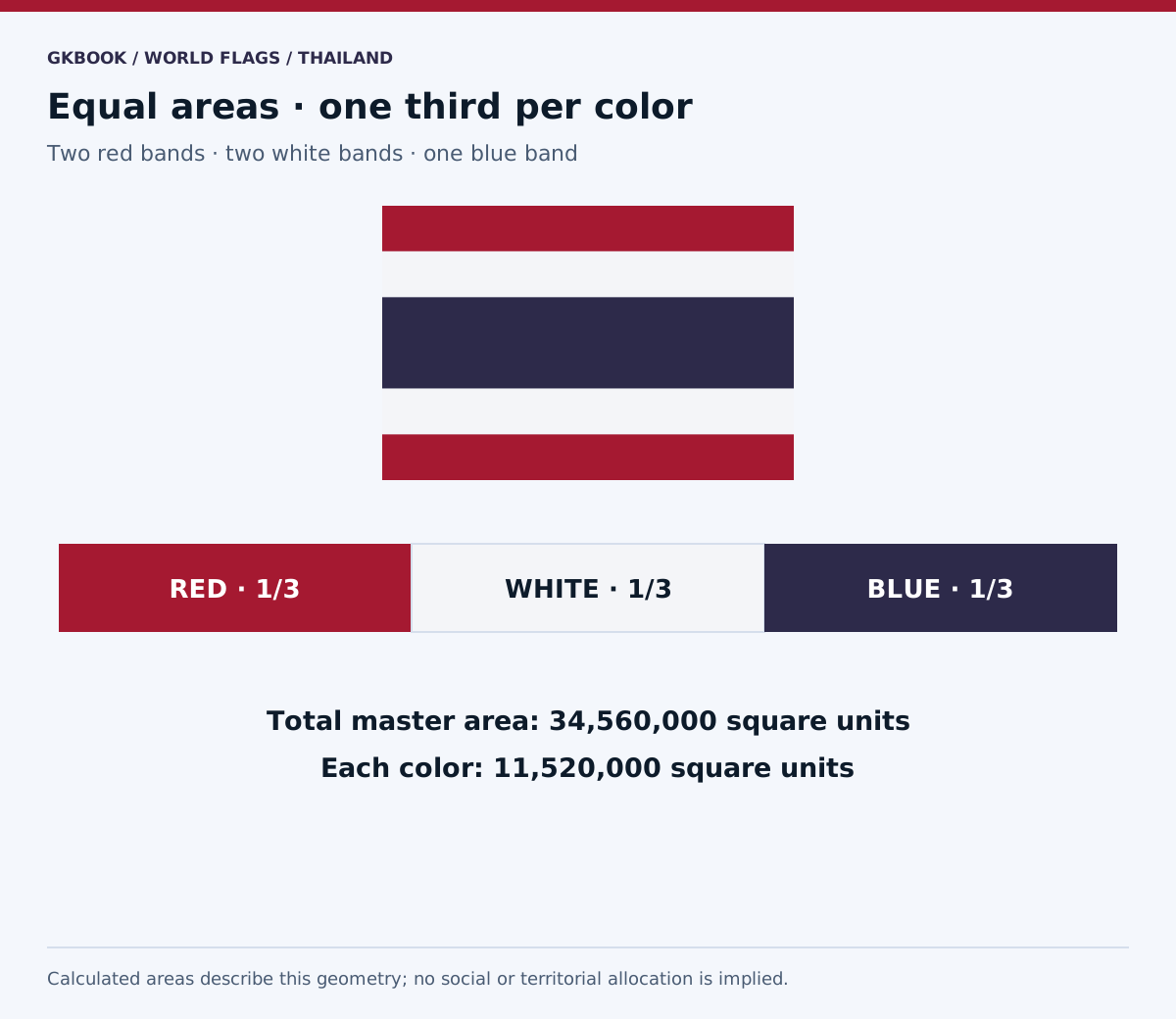
Area is length multiplied by height. Since all bands have the same full length, their area shares follow their height shares directly. Adding the two red sixths gives one third, adding the two white sixths gives one third, and the blue middle already occupies one third.
These are mathematical results for a flat, complete rectangle. A photograph may show different visible proportions because of folds, perspective, or cropping. The equal shares also carry no claim about demographic groups, religious participation, royal authority, or land area; those interpretations would go beyond what the calculation establishes.
Is the Thailand flag the same upside down?
Yes. A flat Thailand flag looks unchanged after a 180-degree rotation because its band order is symmetric from top to bottom. It also looks unchanged under left-right or top-bottom reflection. These properties belong to the plain colored design; a pole attachment, label, or seam can still reveal physical orientation.

A half-turn exchanges the top red band with the bottom red band and exchanges the two white bands. The blue center maps onto itself. Since each exchanged pair has the same color and height, the complete colored image is identical after the transformation has finished.
This visual symmetry is useful for identification, but it does not mean every physical object bearing the flag is interchangeable in orientation. Lettering on an accompanying sign would turn upside down, for example. Separate the geometry of the national flag from any surrounding text, hardware, or decorative framing.
What is the history of the Thailand flag?
Thailand’s flag history includes white-elephant designs on red, a red-and-white striped predecessor in 1916, and the present tricolor adopted in 1917 under King Vajiravudh. Later flag legislation and the 2017 color notice concern the continuing national design. They should be distinguished from the original introduction of the blue-centered tricolor.
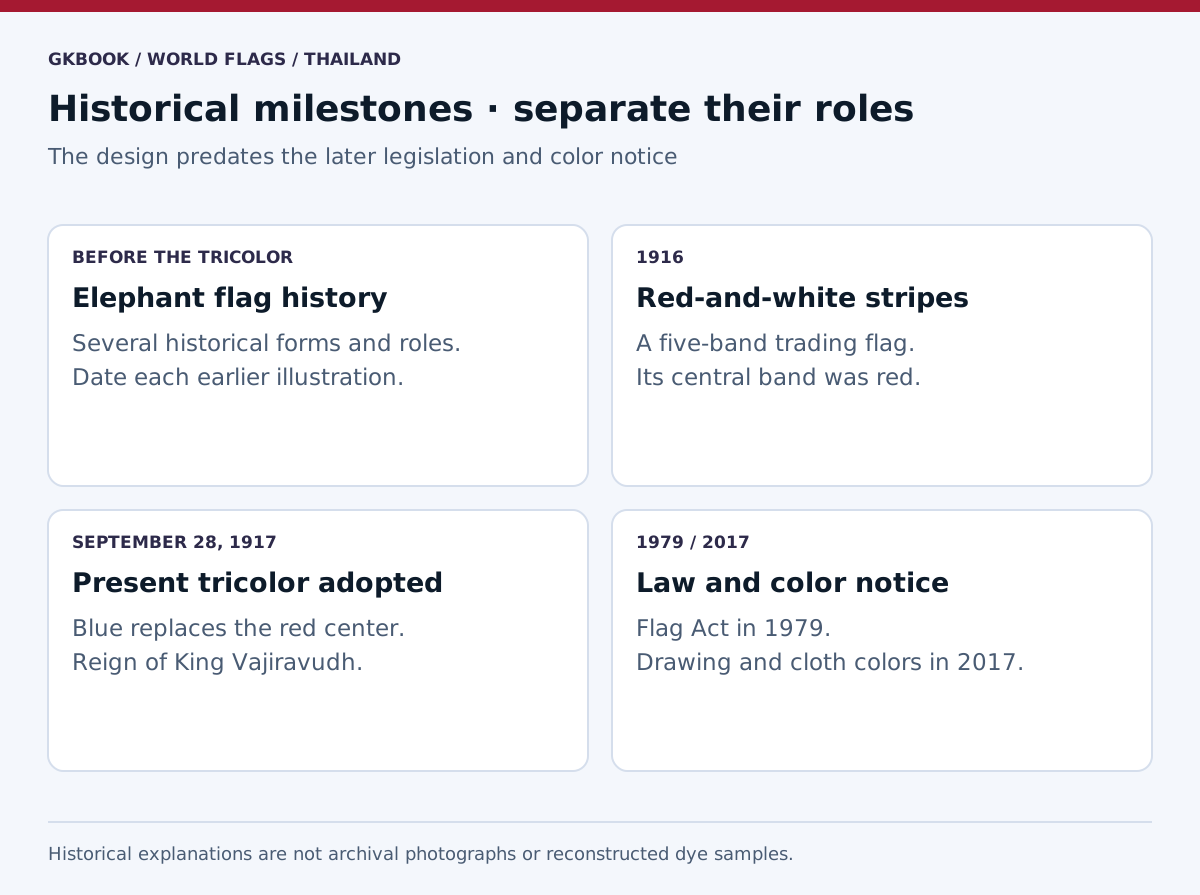
The country was known internationally as Siam when the tricolor was introduced. Earlier flags had different functions and sometimes coexisted, so a single row of undated pictures can oversimplify the transition. The red-and-white striped flag was described as a trading flag, while official elephant designs also remained in use.
The timeline here identifies the major stages without treating every earlier elephant illustration as the same standardized flag. It also separates a change in design from a later law or color measurement. That distinction helps explain why a flag associated with 1917 can also appear in documents dated 1979 and 2017.
When was the current Thailand flag adopted?
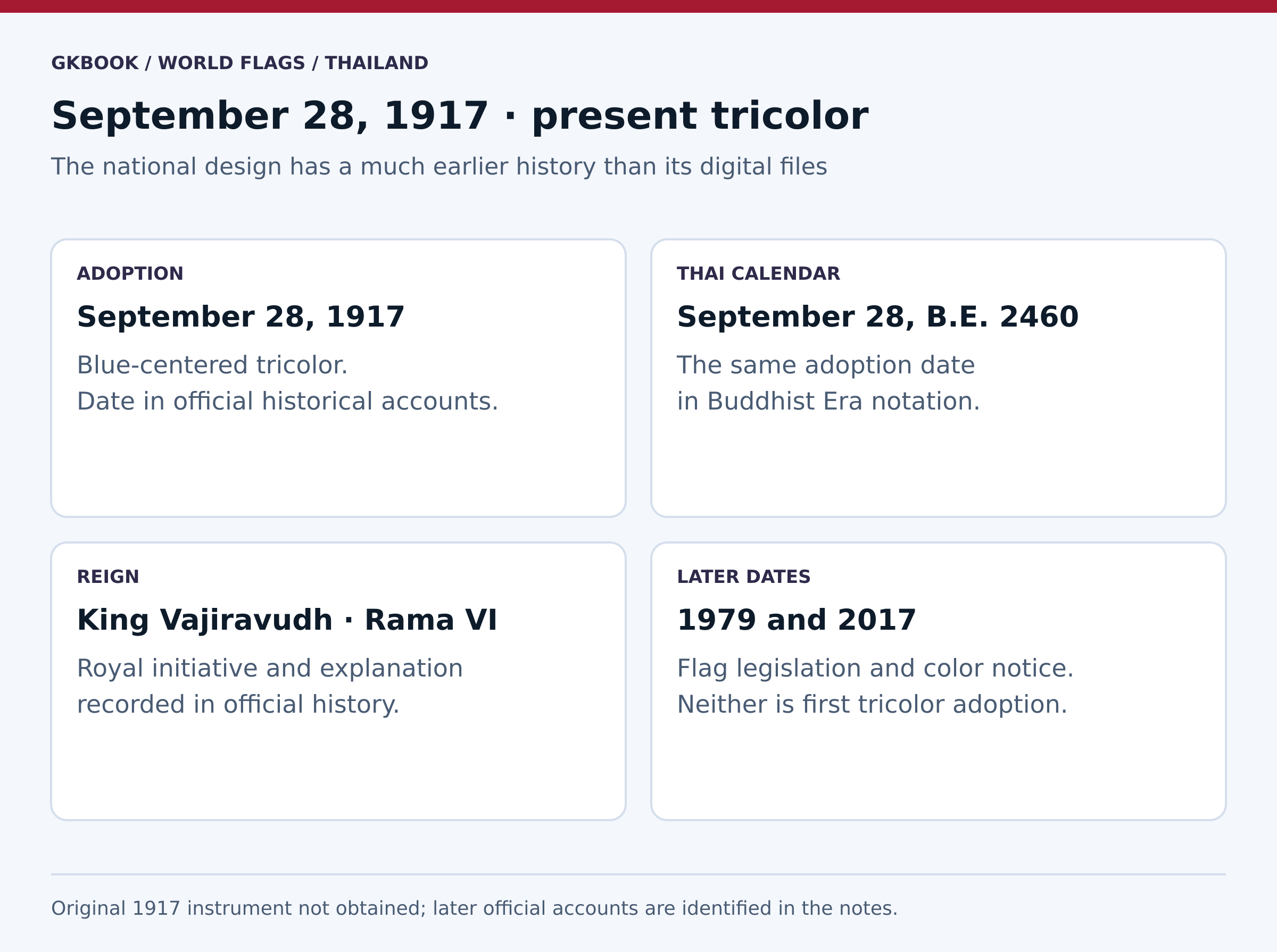
The present tricolor was adopted on September 28, 1917, during the reign of King Vajiravudh, Rama VI. That date corresponds to September 28, B.E. 2460 in the Thai Buddhist calendar. It marks the introduction of the blue-centered design, rather than the later Flag Act or the 2017 color notice.
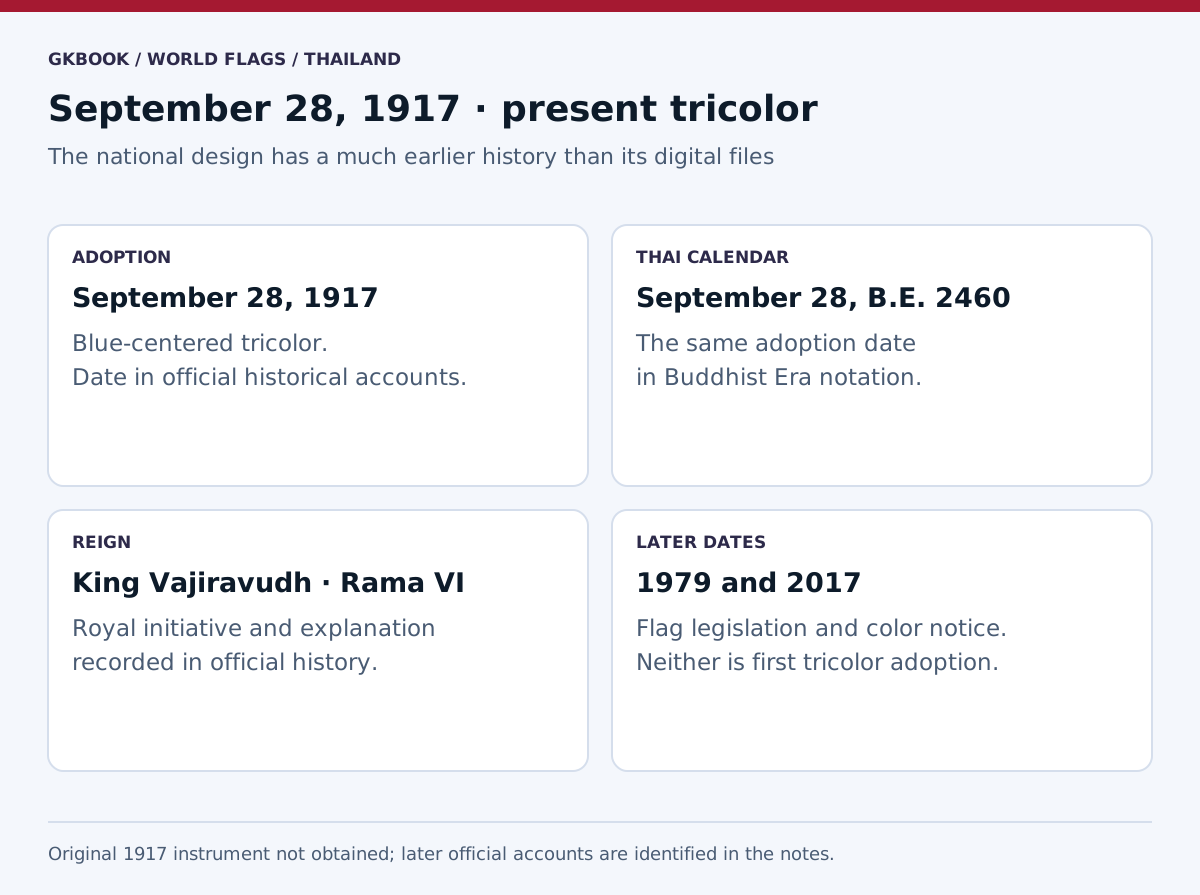
The royal institutional history and government commemorative accounts identify September 28 as the important adoption date. The original 1917 instrument was not obtained for this collection, so the account relies on those later official descriptions rather than claiming a direct inspection of the original gazette issue.
Keep a full event label beside the date when preparing a timeline. “Present tricolor adopted, September 28, 1917” is more informative than an unexplained year. It also prevents the centenary in 2017 from being mistaken for the first appearance of the familiar red, white, and blue composition.
Who introduced the Thailand tricolor?
King Vajiravudh, also known as Rama VI, introduced the tricolor in 1917. Official historical accounts connect the change with his royal decision and explanation of the new blue band. A modern illustrator who creates an SVG of the flag is reproducing that national design, not becoming its original designer.
Historical authorship and digital file authorship deserve separate credits. The national design belongs to its documented historical context; the paths, export settings, captions, and educational diagrams in a modern collection are later work. A file’s recent revision date does not change the date of the national flag itself.
This separation is particularly useful when reading an online image repository. A contributor name can identify who uploaded or corrected the artwork, while the page also describes the flag’s much older history. Both details may be accurate, but they answer different questions about who made what and when.
What flag came before the present tricolor?
A five-band red-and-white trading flag appeared in 1916, with red at the center as well as at the top and bottom. The 1917 tricolor replaced that central red with deep blue. Historical elephant flags also formed part of the preceding system, so the transition should not be reduced to one undated image.
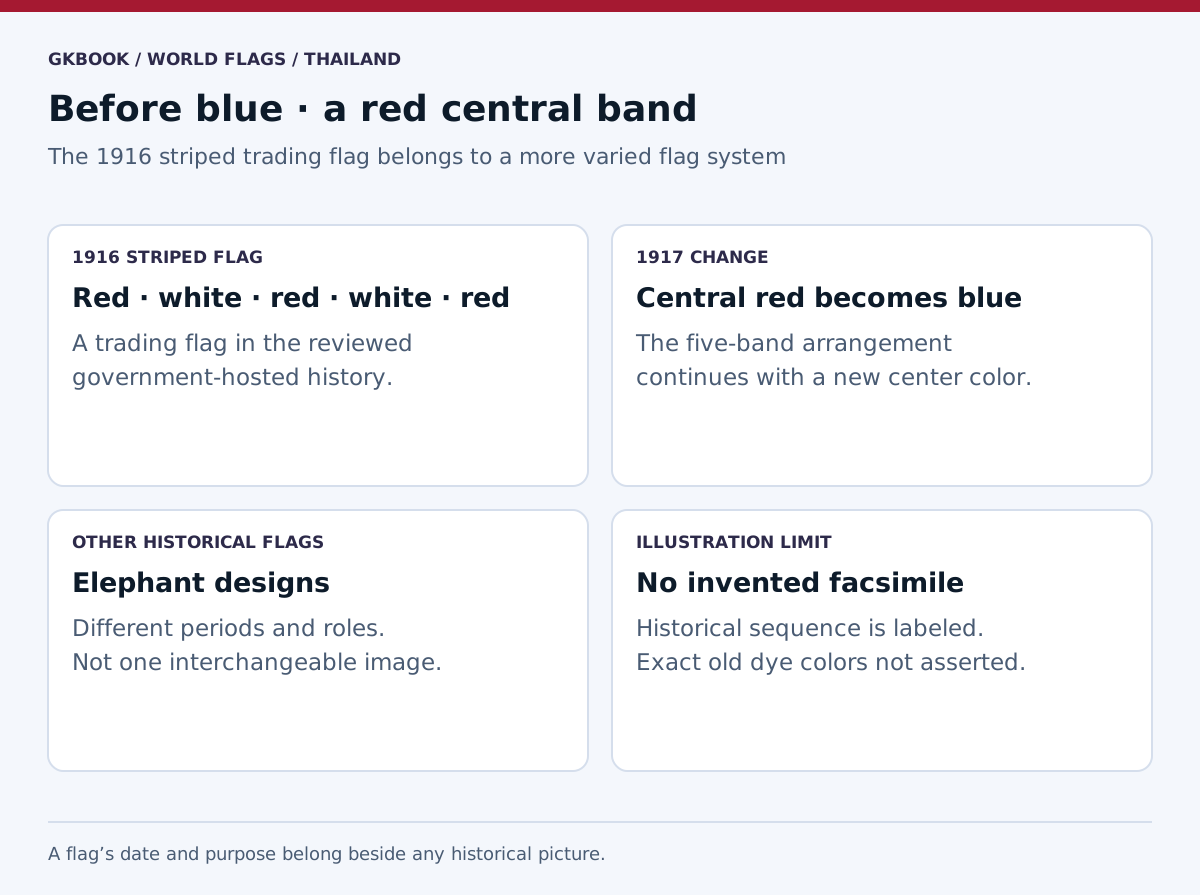
The local government history distinguishes the striped trading flag from an official elephant flag used in the same period. That distinction matters because “the old flag” can refer to different purposes. A dated caption should identify both the design and its role rather than assuming one image covered every official use.
The predecessor diagram explains the sequence through labeled historical stages. It does not supply an invented elephant drawing or claim exact historic dye values. The modern clean master remains the current tricolor, while the earlier red center is described as a historical feature rather than offered as an alternative present-day flag.
Why was blue added to the flag in 1917?
The royal historical account explains blue through two connections: solidarity with the Allied powers during the First World War and an auspicious color associated with King Vajiravudh’s birth day. Blue replaced the central red of the striped predecessor. These historical explanations complement the modern association between blue and the monarchy.

The official royal account reproduces the reasoning attached to the 1917 change. Its emphasis on both international solidarity and a royal association is more specific than saying the colors were chosen only because other countries used them. Shared colors alone cannot establish the full history of a design.
The change retained a simple striped composition and placed the new color in its broadest band. A historical explanation can therefore connect the circumstances of the decision with the visible result. It need not rely on a dramatic anecdote when the official account already provides a documented rationale for adding blue.
Which law describes Thailand’s national flag?
The Flag Act B.E. 2522, or 1979, is the law referenced by the 2017 official flag notice. The national layout is a six-by-nine rectangle with five horizontal bands and a double-height blue center. The later notice supplies a drawing and cloth color recommendations; it is not a new adoption of the tricolor.

The 2017 notice explicitly cites the 1979 Act and displays the familiar construction. Its official ministry-hosted copy was inspected for this collection. Direct retrieval of the full 1979 Act was unsuccessful, so the research notes distinguish that access limit from the legal drawing that was actually available.
A general flag article can identify the governing instrument without presenting itself as a complete guide to regulated uses, penalties, or ceremonial procedures. Those questions require their own current legal review. Here, the legal discussion is limited to the documented design, the later notice, and the distinction between those records and 1917 adoption.
What changed in the 2017 flag color notice?
The 2017 notice published a flag drawing and recommended measured colors for cloth used for the national flag. It did not introduce the tricolor for the first time. The notice was signed on September 30, 2017 and published in the Royal Gazette on October 4, 2017; those dates have different roles.

The gazette page heading supplies the publication date, while the end of the notice supplies the date of the instrument. Some later summaries blur that distinction. Keeping the two labels explicit avoids changing an October publication into a September publication simply because both dates appear on the same page.
The accompanying color table uses a measurement system for physical materials. The government portal also publishes convenient web colors, but the two sets of numbers should not be treated as interchangeable instructions. A producer assessing cloth needs the measurement conditions and tolerance as well as the target values themselves.
What physical color values does the 2017 notice specify?
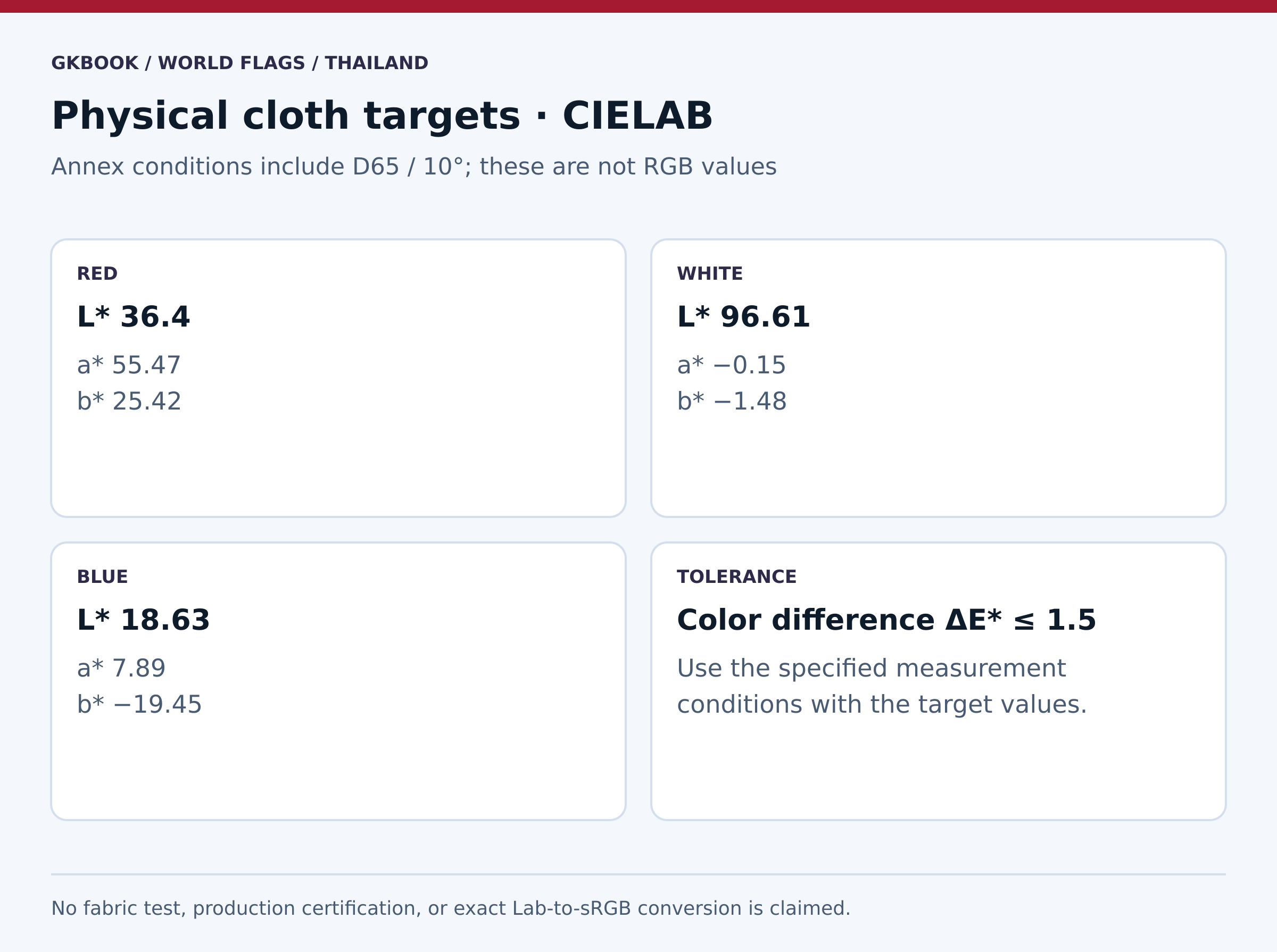
The notice gives CIELAB targets under D65 conditions: red L* 36.4, a* 55.47, b* 25.42; white 96.61, −0.15, −1.48; and blue 18.63, 7.89, −19.45. It allows a color difference ΔE* no greater than 1.5. The annex also specifies measurement conditions, including a 10-degree observer; these values are not RGB channels.
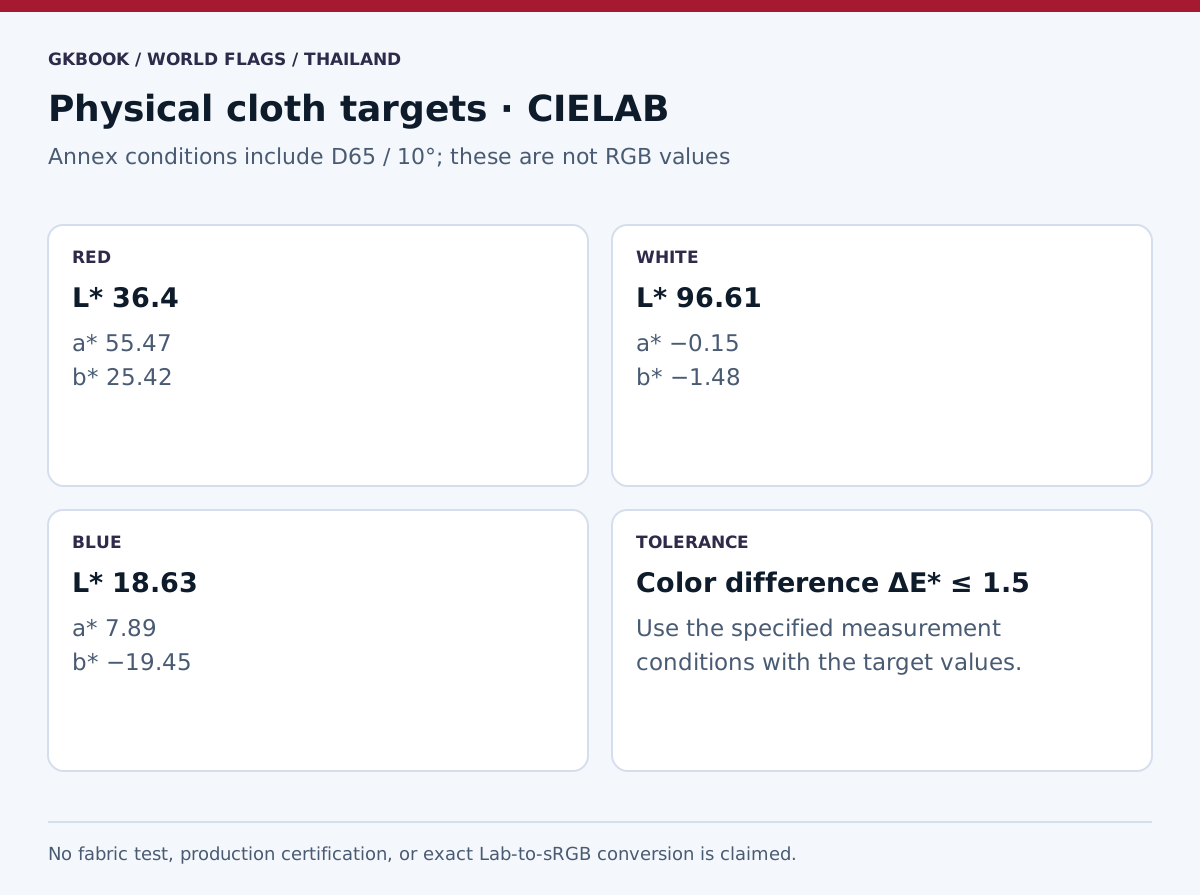
CIELAB describes lightness and two color axes relative to defined viewing and measurement conditions. Negative values are normal on the color axes, which is another reason not to read this table as a three-channel screen code. The instrument setup forms part of the physical recommendation, not an optional caption.
The annex identifies spectrophotometer arrangements and controls that belong with the target table. This collection records those details privately but does not claim an instrument test of fabric. Its web palette is the government portal’s published palette, rather than an asserted exact conversion of the cloth measurements into sRGB.
| Color | L* | a* | b* |
|---|---|---|---|
| Red | 36.4 | 55.47 | 25.42 |
| White | 96.61 | −0.15 | −1.48 |
| Blue | 18.63 | 7.89 | −19.45 |
When is Thailand’s National Flag Day?
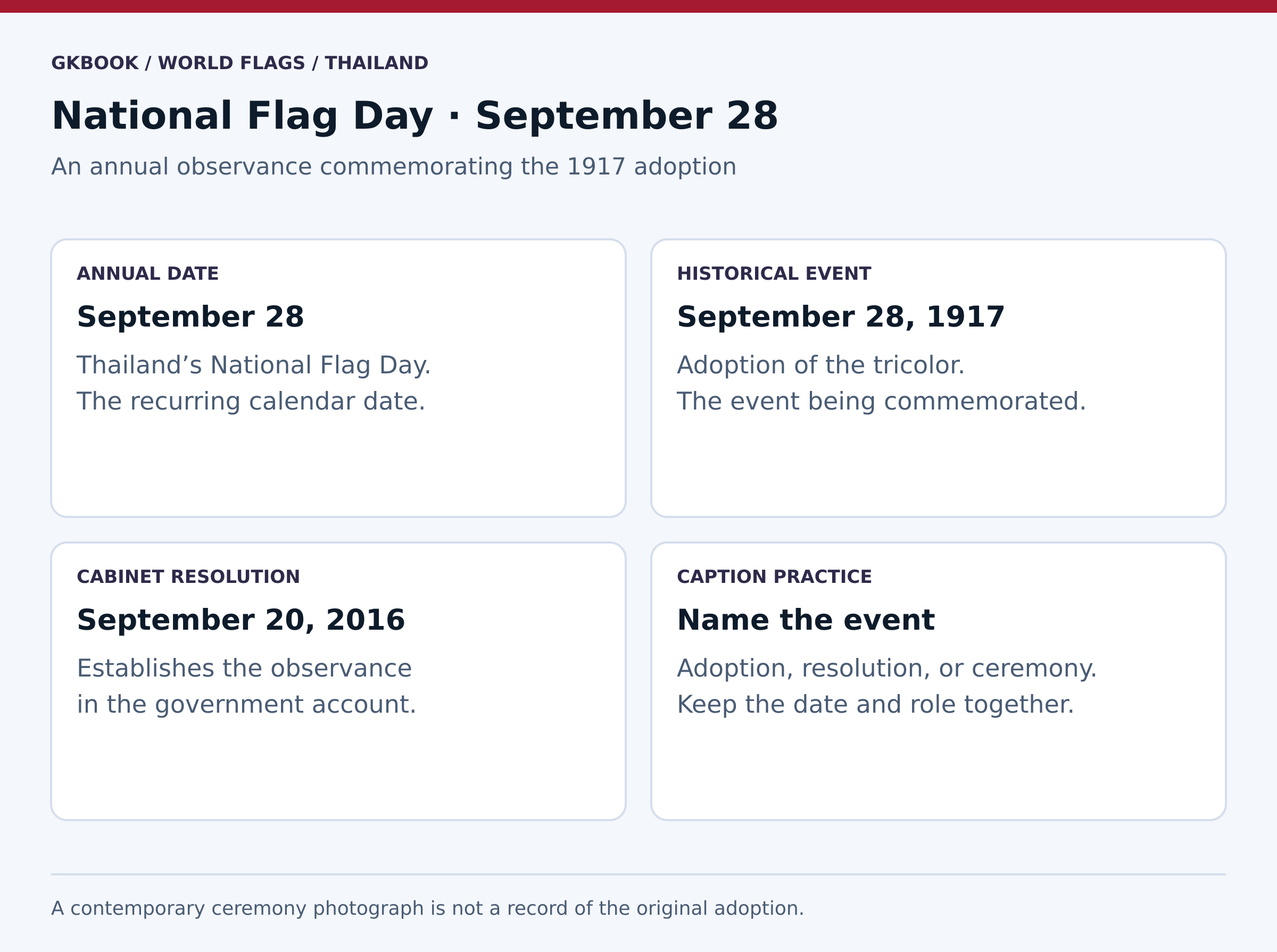
Thailand’s National Flag Day is September 28, commemorating the adoption of the tricolor in 1917. The government records a cabinet resolution of September 20, 2016 establishing the observance. The commemoration and the historical adoption are related, but the date of the resolution is a separate event.

An annual observance can commemorate something that happened long before the observance itself was established. September 28 therefore identifies the recurring day on the calendar, while 1917 identifies the historical design change. The 2016 resolution belongs in a different timeline entry with its own description.
For an educational calendar, a short label can state “National Flag Day, September 28” and add the connection to the tricolor’s adoption. Avoid using a recent ceremony photograph as evidence for what an original 1917 ceremony looked like. A contemporary commemoration and an archival record serve different purposes.
Did Thailand adopt its flag when it joined the United Nations?
No. The tricolor dates from September 28, 1917, while Thailand’s United Nations membership took effect on December 16, 1946. The UN treaty record distinguishes that effective date from an earlier resolution date. Membership in an international organization is a separate milestone and does not establish when a national flag was designed.

The United Nations record includes procedural dates as well as the date on which admission became effective. Reading the relevant note matters: a nearby resolution date should not automatically replace the effective membership date in a national chronology. The two events describe different stages of the admission process.
Likewise, a photograph of Thailand’s flag at an international meeting shows the design in use at that meeting. It does not demonstrate its first adoption or a separate international approval of its geometry. A clear timeline labels national design history and institutional membership as distinct kinds of information.
Does the present Thailand flag have an elephant?
The plain national flag has no elephant or other emblem. Its complete design consists of five colored bands. White elephants appear in earlier Thai flag history and in distinct special flag designs, which can cause confusion. An elephant-bearing flag should be identified by its specific historical period or official role.

The historical association is real, but it does not authorize adding an elephant to the present national flag master. A historical illustration, a specialized flag, and the ordinary national flag can share several colors while remaining different designs. Their captions should make those distinctions visible to the reader.
When selecting an image for an ordinary country label, use the plain red, white, blue, white, red rectangle. If a picture includes an elephant, investigate what it depicts before replacing or correcting it. The absence of an emblem is an identifying feature of the current national design, not missing artwork.
How does Thailand’s flag differ from Costa Rica’s?
Thailand has a broad blue center and red outer bands; Costa Rica has a broad red center and blue outer bands. Both use white between the center and outer colors. Their proportions also differ: Thailand is 2:3 in height:length, while Costa Rica’s prescribed rectangle is 3:5.

Start with the center color because it is usually visible even in a small image. Then inspect the upper and lower edges to confirm the complementary outer color. A comparison based only on the presence of red, white, and blue will miss the most useful distinction between these two designs.
The aspect ratio provides a second independent clue when a complete rectangle is visible. Preserve that difference in a comparison display instead of stretching both flags into identical boxes. The diagram uses textual band orders and ratios, so it does not imply that the countries share identical shades or physical color specifications.
How does the Thailand flag look when rotated vertically?
A clockwise quarter-turn produces a tall rectangle with vertical bands ordered red, white, blue, white, and red from left to right. Its new height:length ratio is 3:2. The illustration shows a geometric rotation of the whole flag, not a verified official instruction for hanging the national flag vertically.
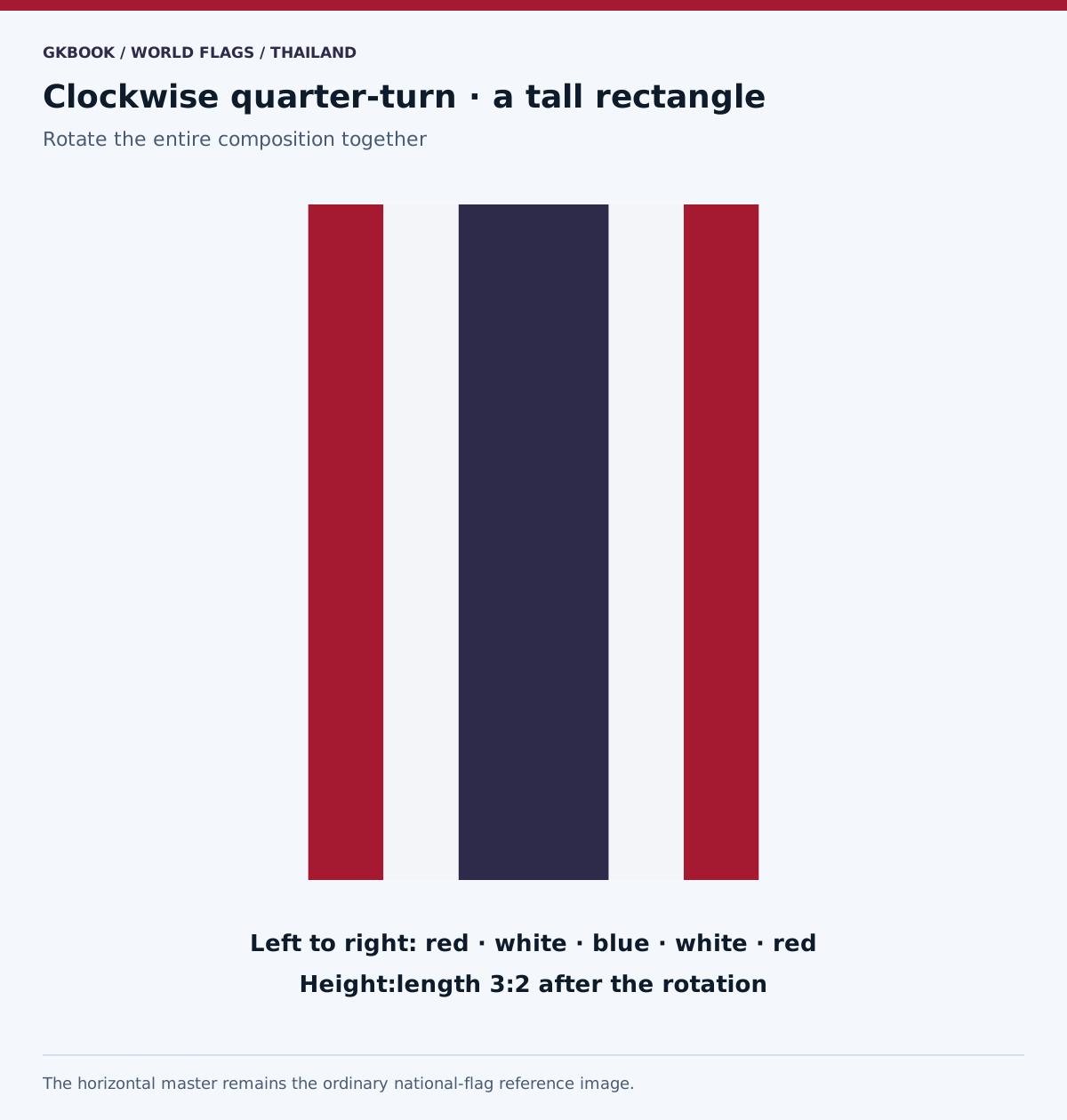
Every band rotates together with the rectangle, retaining its share of the total area. The broad blue region remains centered, and the two narrow red and two narrow white regions remain equal in their respective positions. Rotating only an outer frame while leaving the bands horizontal would produce a different image.
Because the band sequence is symmetric, clockwise and counterclockwise quarter-turns look alike as flat colored patterns. That geometric observation does not settle a venue’s display protocol. Use the horizontal master for ordinary flag identification, and consult the applicable instructions when a physical installation requires an authoritative hanging arrangement.
What does the reverse side of the Thailand flag show?
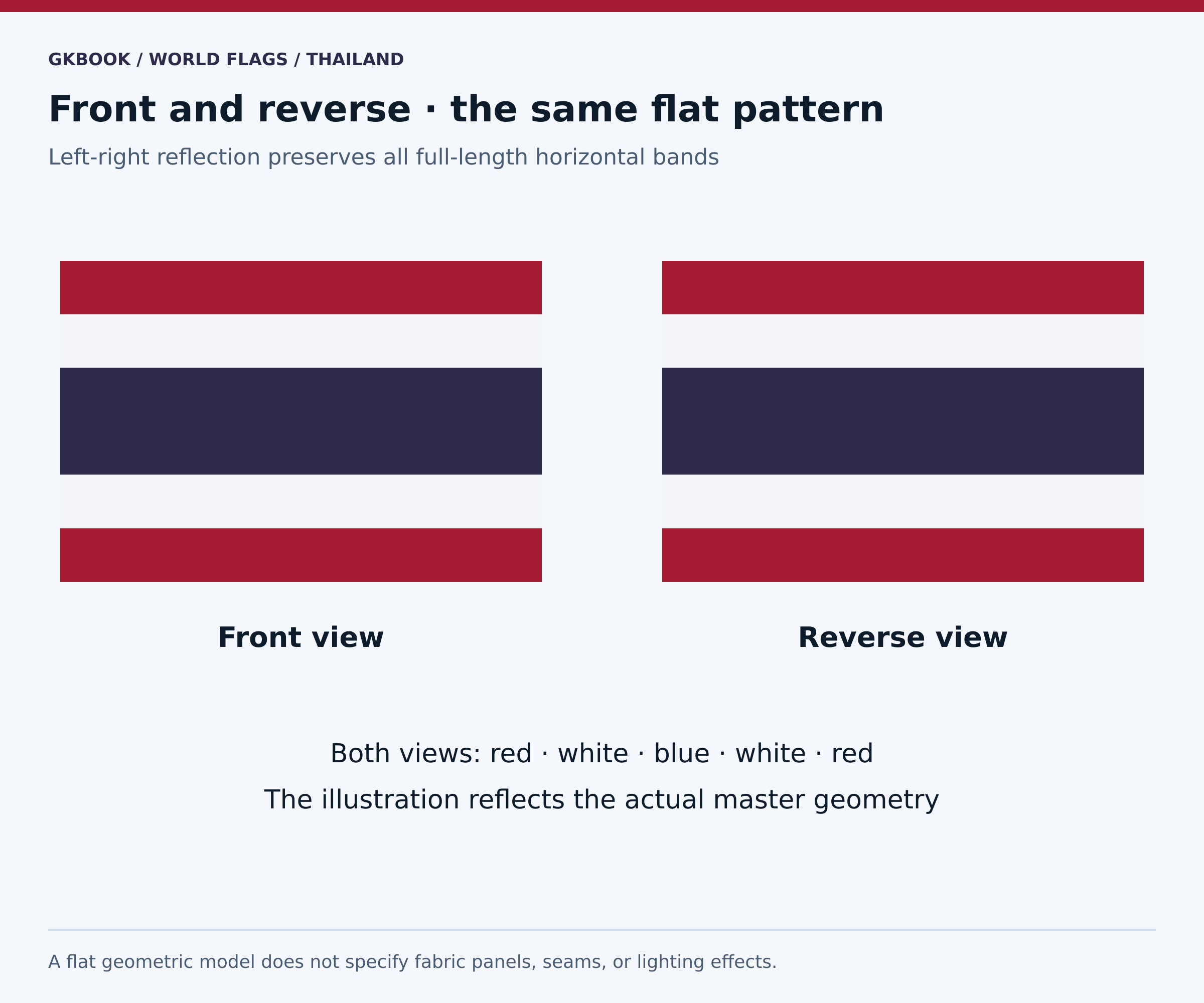
The flat reverse view shows the same red, white, blue, white, and red pattern as the front. A left-right reflection does not change horizontal bands that extend across the whole rectangle. This geometric model describes the colored design; it does not specify seams, separate fabric panels, or other manufacturing details.

Unlike an asymmetric emblem or a diagonal design, these uninterrupted horizontal bands do not reveal a left-right reversal. The hoist attachment can still identify the physical side attached to a pole, but that hardware is outside the colored rectangle used in the clean national flag illustration.
The comparison diagram reflects the actual master rather than drawing a loosely similar second flag. Both complete rectangles have identical dimensions and colors. On real cloth, transmitted light and the construction of the material may change appearance from one side to the other without changing the underlying five-band design.
How should the Thailand flag be resized or printed?
Scale width and height together, preserving height:length 2:3 and band heights 1:1:2:1:1. Use the SVG for scalable shapes or the 7,200 by 4,800 PNG for fixed raster output. At 300 pixels per inch, that PNG corresponds to 24 by 16 inches. Check physical colors separately for the intended printing process.

For a clean print, place margins outside the flag and keep any captions separate from the colored rectangle. Do not add outlines between the bands to make them appear sharper. The supplied master already has exact adjoining boundaries, and a suitable export size should preserve those boundaries without additional decoration.
The image dimensions determine available detail, not a guarantee of fabric or ink color. Paper, textile, ink, profiles, and viewing conditions all affect the result. Where compliance with the physical cloth recommendation matters, use the specified measurement process and an appropriate proof rather than judging only a screen preview.
How can the Thailand flag stay accurate at small sizes?
Keep all five bands and preserve the double-height blue center. For exact whole-pixel band heights, choose a raster height divisible by six and a width one and a half times that height, such as 36 by 24 pixels. At other sizes, inspect the renderer’s antialiasing without changing the underlying vector geometry.
A small icon still needs two separate white bands. Removing one or blending it into red can make the design harder to identify. Larger source images should be reduced proportionally, with attention to the full rectangular boundary so that the top and bottom red bands are not clipped.
Examples with integral band heights include 18 by 12, 36 by 24, and 90 by 60 pixels. Each keeps the six-unit construction aligned to pixel rows. These are convenient rendering choices rather than additional national standards; the SVG remains suitable for other display sizes when the software handles fractional pixels well.
Download Thailand flag pictures
Download the complete flag as SVG or 7,200 × 4,800 PNG. The height:length ratio is 2:3. The five full-length bands are red, white, deep blue, white, and red, with blue twice the height of each other band.
The gallery contains 24 subjects, each with an SVG and PNG. Captions distinguish the clean flag from construction guides, historical explanations, and geometric transformations. Image credits and reproduction notes identify the palette, construction, source distinctions, and limits. The separate 1,200 × 630 social card contains a complete 540 × 360 flag.
Continue exploring national designs in World Flags.
World Flags/Thailand
Thailand flag pictures
Complete national flag: height:length 2:3, five bands in 1:1:2:1:1 heights, and the government portal web palette.
GKBook geometric reconstruction and educational layout; government web palette and legal drawing documented in the credits. No official certification.Download SVGDownload PNGRed #A51931, white #F4F5F8, and blue #2D2A4A are published government web values; cloth measurements are separate.
GKBook geometric reconstruction and educational layout; government web palette and legal drawing documented in the credits. No official certification.Download SVGDownload PNGCurrent official meanings are distinguished from geometric area calculations.
GKBook geometric reconstruction and educational layout; government web palette and legal drawing documented in the credits. No official certification.Download SVGDownload PNGThe center is one uninterrupted blue band even though it takes two construction units.
GKBook geometric reconstruction and educational layout; government web palette and legal drawing documented in the credits. No official certification.Download SVGDownload PNGSix by nine reduces to height:length 2:3; the master is 7,200 wide by 4,800 high.
GKBook geometric reconstruction and educational layout; government web palette and legal drawing documented in the credits. No official certification.Download SVGDownload PNGEach narrow band is one sixth of the height; the blue band is one third.
GKBook geometric reconstruction and educational layout; government web palette and legal drawing documented in the credits. No official certification.Download SVGDownload PNGThe center band is twice the height of an individual red or white band and centered vertically.
GKBook geometric reconstruction and educational layout; government web palette and legal drawing documented in the credits. No official certification.Download SVGDownload PNGFive full-length adjoining rectangles reproduce the complete national geometry without outlines.
GKBook geometric reconstruction and educational layout; government web palette and legal drawing documented in the credits. No official certification.Download SVGDownload PNGAll three colors cover exactly one third of the flat complete rectangle.
GKBook geometric reconstruction and educational layout; government web palette and legal drawing documented in the credits. No official certification.Download SVGDownload PNGA 180-degree rotation preserves all five bands and colors.
GKBook geometric reconstruction and educational layout; government web palette and legal drawing documented in the credits. No official certification.Download SVGDownload PNGThe timeline distinguishes historical designs, present adoption, legislation, and measured colors.
GKBook geometric reconstruction and educational layout; government web palette and legal drawing documented in the credits. No official certification.Download SVGDownload PNGOfficial later accounts identify September 28, 1917 as adoption of the current tricolor.
GKBook geometric reconstruction and educational layout; government web palette and legal drawing documented in the credits. No official certification.Download SVGDownload PNGThe predecessor is explained without inventing an elephant drawing or an authenticated historic palette.
GKBook geometric reconstruction and educational layout; government web palette and legal drawing documented in the credits. No official certification.Download SVGDownload PNGThe royal account connects the blue band to Allied solidarity and the king’s birth-day color.
GKBook geometric reconstruction and educational layout; government web palette and legal drawing documented in the credits. No official certification.Download SVGDownload PNGThe later notice references the 1979 Flag Act and includes the national drawing.
GKBook geometric reconstruction and educational layout; government web palette and legal drawing documented in the credits. No official certification.Download SVGDownload PNGThe original notice page separates September 30 signing from October 4 Gazette publication.
GKBook geometric reconstruction and educational layout; government web palette and legal drawing documented in the credits. No official certification.Download SVGDownload PNGThe 2017 annex supplies CIELAB targets, tolerance, and physical measurement conditions.
GKBook geometric reconstruction and educational layout; government web palette and legal drawing documented in the credits. No official certification.Download SVGDownload PNGThe observance commemorates 1917; the later cabinet resolution is a separate milestone.
GKBook geometric reconstruction and educational layout; government web palette and legal drawing documented in the credits. No official certification.Download SVGDownload PNGThe UN effective admission date is distinct from national flag adoption and the procedural resolution date.
GKBook geometric reconstruction and educational layout; government web palette and legal drawing documented in the credits. No official certification.Download SVGDownload PNGElephant flags belong to distinct historical or special contexts, not this plain national master.
GKBook geometric reconstruction and educational layout; government web palette and legal drawing documented in the credits. No official certification.Download SVGDownload PNGThailand has a blue center and 2:3 proportions; Costa Rica has a red center and 3:5 proportions.
GKBook geometric reconstruction and educational layout; government web palette and legal drawing documented in the credits. No official certification.Download SVGDownload PNGClockwise 90-degree rotation of the complete flag; a geometric demonstration, not a verified hanging instruction.
GKBook geometric reconstruction and educational layout; government web palette and legal drawing documented in the credits. No official certification.Download SVGDownload PNGA left-right reflection leaves the colored design unchanged.
GKBook geometric reconstruction and educational layout; government web palette and legal drawing documented in the credits. No official certification.Download SVGDownload PNGThe master preserves the 2:3 ratio and exact band heights; print color depends on the output process.
GKBook geometric reconstruction and educational layout; government web palette and legal drawing documented in the credits. No official certification.Download SVGDownload PNGFrequently asked questions
What does the Thailand flag look like?
The Thailand flag has five horizontal bands: red, white, deep blue, white, and red. The blue center band is twice the height of each other band. Its height:length ratio is 2:3. The plain national flag contains no elephant, coat of arms, stars, or lettering.
What is the Thailand flag called?
The flag is commonly called Thong Trairong, meaning the tricolor flag. The Thai name is ธงไตรรงค์. “Tricolor” describes its three colors, although the design has five separate horizontal bands. “National flag of Thailand” is a clear English caption for the complete red, white, and blue rectangle.
What are the colors of the Thailand flag?
Thailand’s flag uses red, white, and deep blue. This collection follows the government portal’s web values: red #A51931, white #F4F5F8, and blue #2D2A4A. These screen colors are separate from the physical cloth measurements published in 2017; they are not presented as numerical HEX provisions of the 1979 Flag Act.
What does the Thailand flag mean?
Official explanations associate red with the nation and the unity of its people, white with religion, and blue with the monarchy. These three themes are expressed through the five-band composition. The meanings describe national symbolism; they do not turn the area of each color into a population or territorial statistic.
What does red represent on the Thailand flag?
Red represents the nation and the unity of the Thai people in current official explanations. It appears in the uppermost and lowermost bands. Each red band occupies one sixth of the flag’s height, so the two together cover one third of the complete rectangular flag.
What does white represent on the Thailand flag?
White represents religion in current official explanations of Thailand’s national flag. Its two bands lie between the outer red bands and the deep blue center. Each white band has the same height as a red band. The two white bands therefore occupy one third of the flag’s total area.
What does blue represent on the Thailand flag?
Blue represents the monarchy in current official explanations. It forms the single central band, which is twice the height of each red or white band. Historical explanations of its introduction in 1917 also connect blue with King Vajiravudh’s royal birth-day color and solidarity with the Allied powers.
How many stripes are on the Thailand flag?
There are five horizontal stripes, ordered red, white, blue, white, and red from top to bottom. Only the central blue stripe is double height. The design therefore has five bands and three colors, with six equal units of height used to construct the complete flag.
What are the proportions of the Thailand flag?
The flag’s height:length ratio is 2:3, equivalent to six units high and nine units long. A flag 60 centimeters high is therefore 90 centimeters long. The downloadable master measures 4,800 units high by 7,200 units long and preserves the same proportions without cropping or stretching.
How wide should the five flag bands be?
Measured vertically, the five band heights are in the ratio 1:1:2:1:1. Each red or white band takes one sixth of the total height, while blue takes one third. On the 4,800-unit-high master, the heights are 800, 800, 1,600, 800, and 800 units respectively.
Why is the blue center band wider?
The national design specifies a blue center twice as tall as any individual outer band. That gives blue a broad central position while making its total area equal to the combined red area and the combined white area. The width is a construction requirement, not an invitation to vary the design.
How can the Thailand flag be drawn accurately?
Draw a rectangle 7,200 units wide and 4,800 units high. Place horizontal boundaries at y = 800, 1,600, 3,200, and 4,000, measured downward from the top. Fill the resulting bands red, white, blue, white, and red. Every band extends from x = 0 to x = 7,200.
How much of the Thailand flag is each color?
Red, white, and blue each occupy exactly one third of the flag’s area. Red and white each achieve that share through two equal narrow bands; blue achieves it through one double-height band. On the 7,200 by 4,800 master, each color covers 11,520,000 square units.
Is the Thailand flag the same upside down?
Yes. A flat Thailand flag looks unchanged after a 180-degree rotation because its band order is symmetric from top to bottom. It also looks unchanged under left-right or top-bottom reflection. These properties belong to the plain colored design; a pole attachment, label, or seam can still reveal physical orientation.
What is the history of the Thailand flag?
Thailand’s flag history includes white-elephant designs on red, a red-and-white striped predecessor in 1916, and the present tricolor adopted in 1917 under King Vajiravudh. Later flag legislation and the 2017 color notice concern the continuing national design. They should be distinguished from the original introduction of the blue-centered tricolor.
When was the current Thailand flag adopted?
The present tricolor was adopted on September 28, 1917, during the reign of King Vajiravudh, Rama VI. That date corresponds to September 28, B.E. 2460 in the Thai Buddhist calendar. It marks the introduction of the blue-centered design, rather than the later Flag Act or the 2017 color notice.
Who introduced the Thailand tricolor?
King Vajiravudh, also known as Rama VI, introduced the tricolor in 1917. Official historical accounts connect the change with his royal decision and explanation of the new blue band. A modern illustrator who creates an SVG of the flag is reproducing that national design, not becoming its original designer.
What flag came before the present tricolor?
A five-band red-and-white trading flag appeared in 1916, with red at the center as well as at the top and bottom. The 1917 tricolor replaced that central red with deep blue. Historical elephant flags also formed part of the preceding system, so the transition should not be reduced to one undated image.
Why was blue added to the flag in 1917?
The royal historical account explains blue through two connections: solidarity with the Allied powers during the First World War and an auspicious color associated with King Vajiravudh’s birth day. Blue replaced the central red of the striped predecessor. These historical explanations complement the modern association between blue and the monarchy.
Which law describes Thailand’s national flag?
The Flag Act B.E. 2522, or 1979, is the law referenced by the 2017 official flag notice. The national layout is a six-by-nine rectangle with five horizontal bands and a double-height blue center. The later notice supplies a drawing and cloth color recommendations; it is not a new adoption of the tricolor.
What changed in the 2017 flag color notice?
The 2017 notice published a flag drawing and recommended measured colors for cloth used for the national flag. It did not introduce the tricolor for the first time. The notice was signed on September 30, 2017 and published in the Royal Gazette on October 4, 2017; those dates have different roles.
What physical color values does the 2017 notice specify?
The notice gives CIELAB targets under D65 conditions: red L* 36.4, a* 55.47, b* 25.42; white 96.61, −0.15, −1.48; and blue 18.63, 7.89, −19.45. It allows a color difference ΔE* no greater than 1.5. The annex also specifies measurement conditions, including a 10-degree observer; these values are not RGB channels.
When is Thailand’s National Flag Day?
Thailand’s National Flag Day is September 28, commemorating the adoption of the tricolor in 1917. The government records a cabinet resolution of September 20, 2016 establishing the observance. The commemoration and the historical adoption are related, but the date of the resolution is a separate event.
Did Thailand adopt its flag when it joined the United Nations?
No. The tricolor dates from September 28, 1917, while Thailand’s United Nations membership took effect on December 16, 1946. The UN treaty record distinguishes that effective date from an earlier resolution date. Membership in an international organization is a separate milestone and does not establish when a national flag was designed.
Does the present Thailand flag have an elephant?
The plain national flag has no elephant or other emblem. Its complete design consists of five colored bands. White elephants appear in earlier Thai flag history and in distinct special flag designs, which can cause confusion. An elephant-bearing flag should be identified by its specific historical period or official role.
How does Thailand’s flag differ from Costa Rica’s?
Thailand has a broad blue center and red outer bands; Costa Rica has a broad red center and blue outer bands. Both use white between the center and outer colors. Their proportions also differ: Thailand is 2:3 in height:length, while Costa Rica’s prescribed rectangle is 3:5.
How does the Thailand flag look when rotated vertically?
A clockwise quarter-turn produces a tall rectangle with vertical bands ordered red, white, blue, white, and red from left to right. Its new height:length ratio is 3:2. The illustration shows a geometric rotation of the whole flag, not a verified official instruction for hanging the national flag vertically.
What does the reverse side of the Thailand flag show?
The flat reverse view shows the same red, white, blue, white, and red pattern as the front. A left-right reflection does not change horizontal bands that extend across the whole rectangle. This geometric model describes the colored design; it does not specify seams, separate fabric panels, or other manufacturing details.
How should the Thailand flag be resized or printed?
Scale width and height together, preserving height:length 2:3 and band heights 1:1:2:1:1. Use the SVG for scalable shapes or the 7,200 by 4,800 PNG for fixed raster output. At 300 pixels per inch, that PNG corresponds to 24 by 16 inches. Check physical colors separately for the intended printing process.
How can the Thailand flag stay accurate at small sizes?
Keep all five bands and preserve the double-height blue center. For exact whole-pixel band heights, choose a raster height divisible by six and a width one and a half times that height, such as 36 by 24 pixels. At other sizes, inspect the renderer’s antialiasing without changing the underlying vector geometry.
Every general-knowledge topic and the A-to-Z lists.
The world A to Z: flags, countries, the sciences, places, people, subjects.












We Value Your Opinion Comments