

Tanzania flag picture
Explore the proportions, adoption-date distinction, and picture gallery.
| National design | United Republic of TanzaniaEast Africa; a national symbol of the union. |
|---|---|
| Design | Green · blue · black · yellowRising black diagonal with two equal yellow edges. |
| Proportions | Height:length = 2:3Declared perpendicular bands: yellow:black:yellow = 3:13:3 on height 48. |
| Legal effect | April 26, 1964Date stated in the reviewed National Emblems Act. |
| Reported adoption | June 30, 1964Date reported by the Tanzanian embassy’s Rome website; distinguished from legal effect. |
| Main image sizes | SVG and PNG: 7,200 × 4,800Complete rectangle; opaque RGB PNG. |
The artwork uses a declared reference palette and corroborated band construction. Numerical colors and widths are not presented as statutory codes.
What does the Tanzania flag look like?
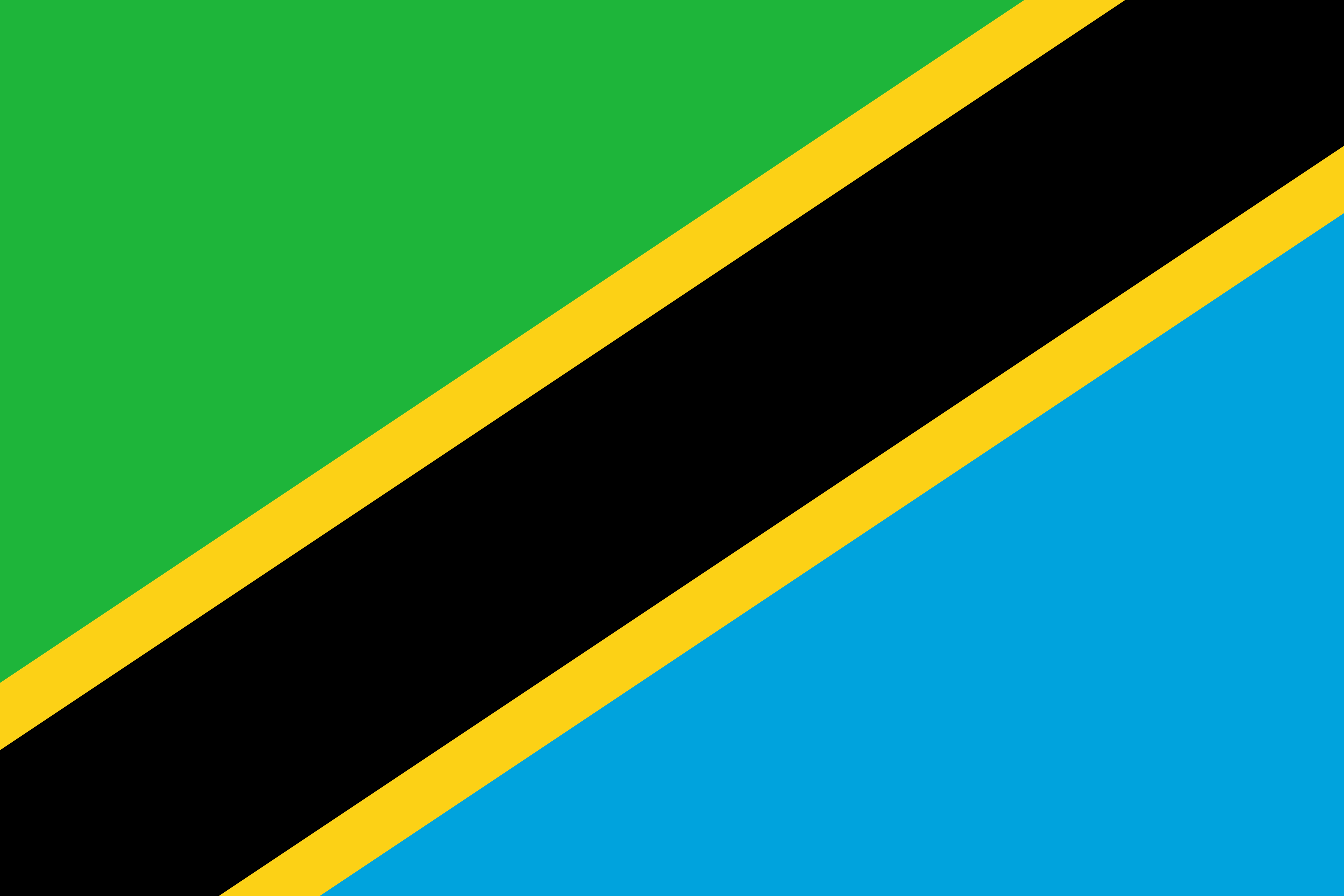
The Tanzania flag is a rectangle with a green upper hoist triangle and a blue lower fly triangle. A broad black diagonal rises from the lower hoist to the upper fly, bordered by two narrow yellow bands. Its height:length ratio is 2:3, and it has no central emblem.
Start by locating the hoist, the edge attached to a flagpole. In the standard front view, that edge is on the left. Green therefore occupies the upper left, while blue occupies the lower right. The black diagonal reaches both opposite corners and separates the two colored fields. Yellow outlines both sides of that diagonal rather than the outside of the rectangle. This arrangement is easier to recognize as a complete composition than as a list of four colors, especially when comparing small images or photographs of folded fabric.
What is the Tanzania flag called?
The national flag belongs to the United Republic of Tanzania. “Tanzania flag” is the usual short English label, while the government’s Swahili description uses “Bendera ya Taifa,” meaning national flag. The name refers to the complete green, blue, black, and yellow design, rather than to an isolated diagonal motif.
The country name is useful in captions because several national flags use diagonals or related colors. “National flag of Tanzania” is clear for an educational display, an image description, or a catalog entry. A more formal introduction can use the full country name before adopting the shorter wording.
Names and visual descriptions serve different purposes. A filename can identify the country, but an accessible image description should also explain the colored triangles and rising diagonal. Keeping those roles distinct helps readers understand the flag even when they cannot see the illustration or are comparing several similar thumbnails.
What are the colors of the Tanzania flag?
The four colors are green, blue, black, and yellow or gold. This edition uses green #1EB53A, blue #00A3DD, black #000000, and yellow #FCD116 from the inspected reference SVG. These are declared digital reproduction values, not statutory HEX codes or a verified conversion from a physical color standard.
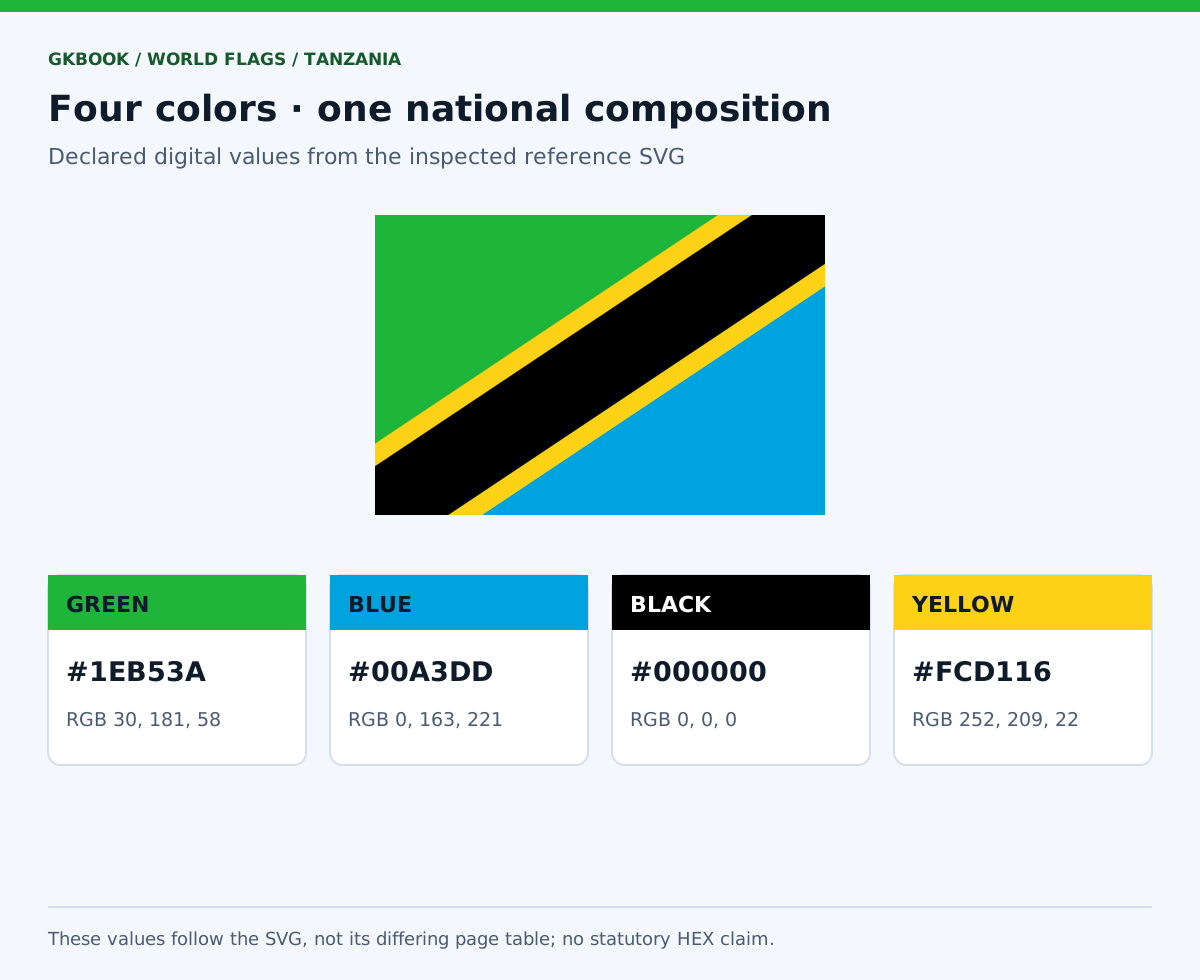
The legal description calls the narrow bands golden, while many explanatory accounts use yellow. Both descriptions refer to the same two edging bands. The digital palette is recorded consistently across the clean flag and diagrams. HEX and RGB are two ways of expressing the same channel values in these files.
The reference file’s page displays a color table that differs slightly from the SVG itself. This collection follows the actual file values and records that discrepancy. An archived government page also lists Pantone references, but no exact conversion from those references to these screen values is claimed.
| Color | HEX | RGB |
|---|---|---|
| Green | #1EB53A | 30, 181, 58 |
| Blue | #00A3DD | 0, 163, 221 |
| Black | #000000 | 0, 0, 0 |
| Yellow / gold | #FCD116 | 252, 209, 22 |
What does the Tanzania flag mean?
Official explanations associate green with fertile land and agriculture, blue with water including the Indian Ocean, black with the people of Tanzania, and yellow with mineral resources. These meanings accompany the complete national design. They do not assign numerical population shares or territorial percentages to its colored areas.

Position and meaning can be taught together without confusing them. First identify green above the diagonal and blue below it; then explain the associated land and water themes. Black and yellow belong to the dividing band system, with black much broader than either of its yellow edges.
A symbolic explanation answers why a color matters, while a construction drawing answers where that color appears. The two kinds of information complement each other. Area calculations later in this guide are measurements of this drawing and should not be interpreted as statements about Tanzania’s land, population, or natural wealth.
What does green represent on the Tanzania flag?
Green represents fertile land and agriculture in official explanations of the flag. It fills the triangle above the diagonal toward the hoist. Its location is part of the design: moving green to the lower right would change the standard front view, even if the other colors were preserved.
The green field touches the top edge and the upper portion of the hoist edge. It stops at the outer boundary of the upper yellow band. Because that yellow band has a measurable width, the visible green triangle is smaller than one half of the complete flag rectangle.
A useful identification exercise is to cover the lower part of a flat flag image and inspect the top corners. Green reaches the upper left corner, while black reaches the upper right. That corner pattern gives a quick orientation check without requiring the viewer to estimate the exact band widths.
What does blue represent on the Tanzania flag?
Blue represents water, including the Indian Ocean, in official explanations. It occupies the lower fly triangle, opposite the green field. In the standard front view it reaches the bottom and right edges of the rectangle, while the lower yellow band separates it from the broad black diagonal.
The blue region is congruent to the green region in this construction. A half-turn maps the outline of one triangle onto the outline of the other, although their colors remain different. That geometric equality does not imply that land and water occupy equal shares of the country’s territory.
Water symbolism should not be reduced to a single decorative wave or map outline. The national flag expresses it through a plain blue field. Adding a wave, coastline, or photograph may suit an explanatory poster, but those additions should remain outside the clean flag image used for identification.
What does the black diagonal represent?
Black represents the people of Tanzania in official explanations. It forms the broad central diagonal between the two yellow edges. The band runs from the bottom left to the top right in the standard front view, and its width is measured perpendicular to that direction rather than vertically.
The central stripe is a continuous solid shape. It contains no stars, words, shield, or other device. Its two long sides are parallel, and the rectangle clips the stripe at the outer boundary. The resulting black corner areas belong to the same band as the broad central portion.
At small sizes the dark stripe is usually the strongest recognition feature, but it should not overwhelm the yellow edging. An excessively wide black band leaves too little green and blue visible. Check its measured perpendicular width against the recorded construction instead of adjusting it solely by eye.
What do the yellow stripes represent?
The two yellow or golden stripes represent mineral resources in official explanations. They border the black diagonal on both sides and have equal widths. Each is considerably narrower than the black band. They are internal diagonal borders, not an outer fringe around the entire flag or a separate emblem.
A flat digital flag represents gold with a solid color. It does not require metallic texture, highlights, or a gradient. Those effects can describe a particular physical material, but they obscure the simple geometry when incorporated into a reference drawing. Both narrow bands should use the same uniform fill.
Follow each yellow band across the visible rectangle to check continuity. A stray yellow sliver outside the intended parallel boundaries can indicate a faulty clipping operation. The supplied vector uses closed geometric shapes, and the clean master keeps the complete composition within its rectangular outer boundary.
What is the ratio of the Tanzania flag?
The Tanzania flag has a height:length ratio of 2:3. Its horizontal length is therefore one and a half times its height. The supplied master measures 7,200 by 4,800 units, with a PNG at the same pixel dimensions. Scaling both axes together preserves the rectangle and all internal geometry.

State the order of dimensions when writing a ratio. Height to length is two to three, whereas length to height is three to two. The archived government description gives the latter order and illustrates it with a six-foot length and four-foot height. These describe the same rectangular shape.
For example, a flag sixty centimeters tall would be ninety centimeters long. A web image three hundred pixels wide would be two hundred pixels tall. Those are convenient proportional examples, not compulsory product sizes. Cropping the rectangle into a square removes part of the national design rather than creating an equivalent format.
Which way does the black diagonal run?
In the standard front view, the black diagonal rises from the lower left corner at the hoist to the upper right corner at the fly. Green is above it and blue below it. On a 2:3 rectangle, the diagonal makes approximately 33.6901 degrees with a horizontal edge.

The angle follows from the overall rectangle: the rise is two units for every three units of horizontal run. It is consequently shallower than a forty-five-degree diagonal. A square illustration with a forty-five-degree stripe may resemble the design but changes both the outer proportions and the internal direction.
The central line passes exactly through the rectangle’s midpoint. Its two endpoints are opposite corners, even though the band itself has substantial width around that line. Distinguishing the centerline from either yellow edge is essential when placing the stripe or measuring its angle in drawing software.
How wide are the black and yellow bands?
This edition uses perpendicular widths of yellow:black:yellow = 3:13:3 on a flag forty-eight units high. Black is therefore 13/48 of the height, and each yellow edge is 1/16. This corroborated construction is declared explicitly because the legal schedule itself does not provide these numerical band widths.

At the master scale, the black band is 1,300 units wide and each yellow band is 300 units wide. Together they form a 1,900-unit strip, measured across its direction. The inspected reference SVG and construction sheet use the same relationships, providing directly comparable geometric evidence.
A historical government description quoted by flag researchers gives thirteen-inch black and three-inch yellow bands on a forty-eight-inch height. The original booklet was not obtained. A later archived government webpage prints an inconsistent 13/18 fraction; this guide records that apparent typo rather than silently presenting it as 13/48.
How should diagonal band widths be measured?
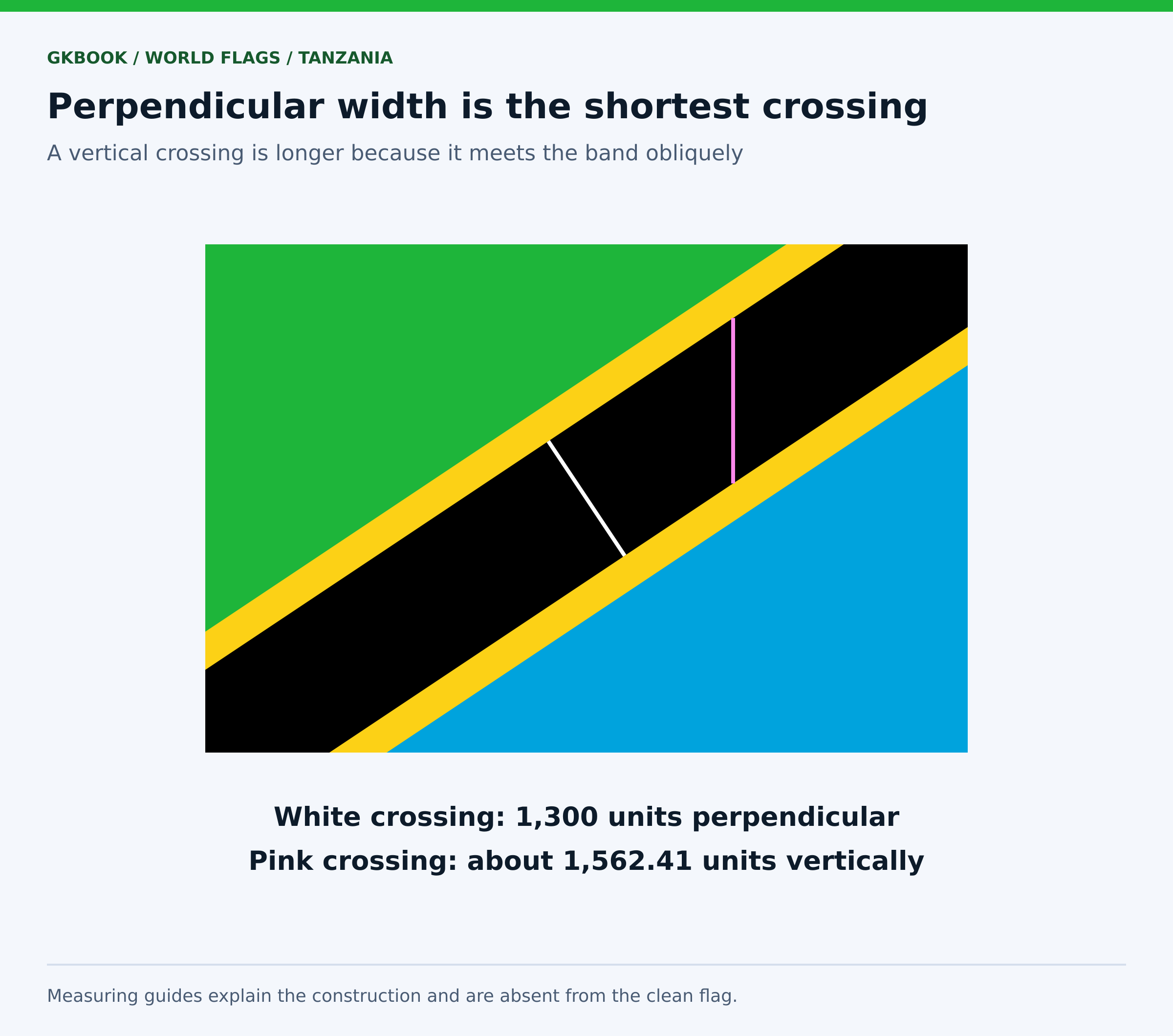
Measure each band along a line perpendicular to its parallel edges. A vertical measurement or a horizontal measurement crosses the band obliquely and produces a larger number. The 3:13:3 proportions in this guide describe perpendicular distances, so they should not be copied directly onto the flag’s vertical edge.

Imagine walking straight across the stripe by the shortest route between its long sides. That route is perpendicular to the stripe, regardless of how the complete flag is rotated on a page. A measuring guide following the diagonal instead measures length along the stripe and answers a different question.
For the 7,200 by 4,800 master, the central band’s perpendicular width is 1,300 units. Its vertical separation between parallel boundary lines is about 1,562.41 units where both boundaries are present. This difference is expected geometry, not evidence that the band changes width as it crosses the flag.
Are the green and blue triangles equal?
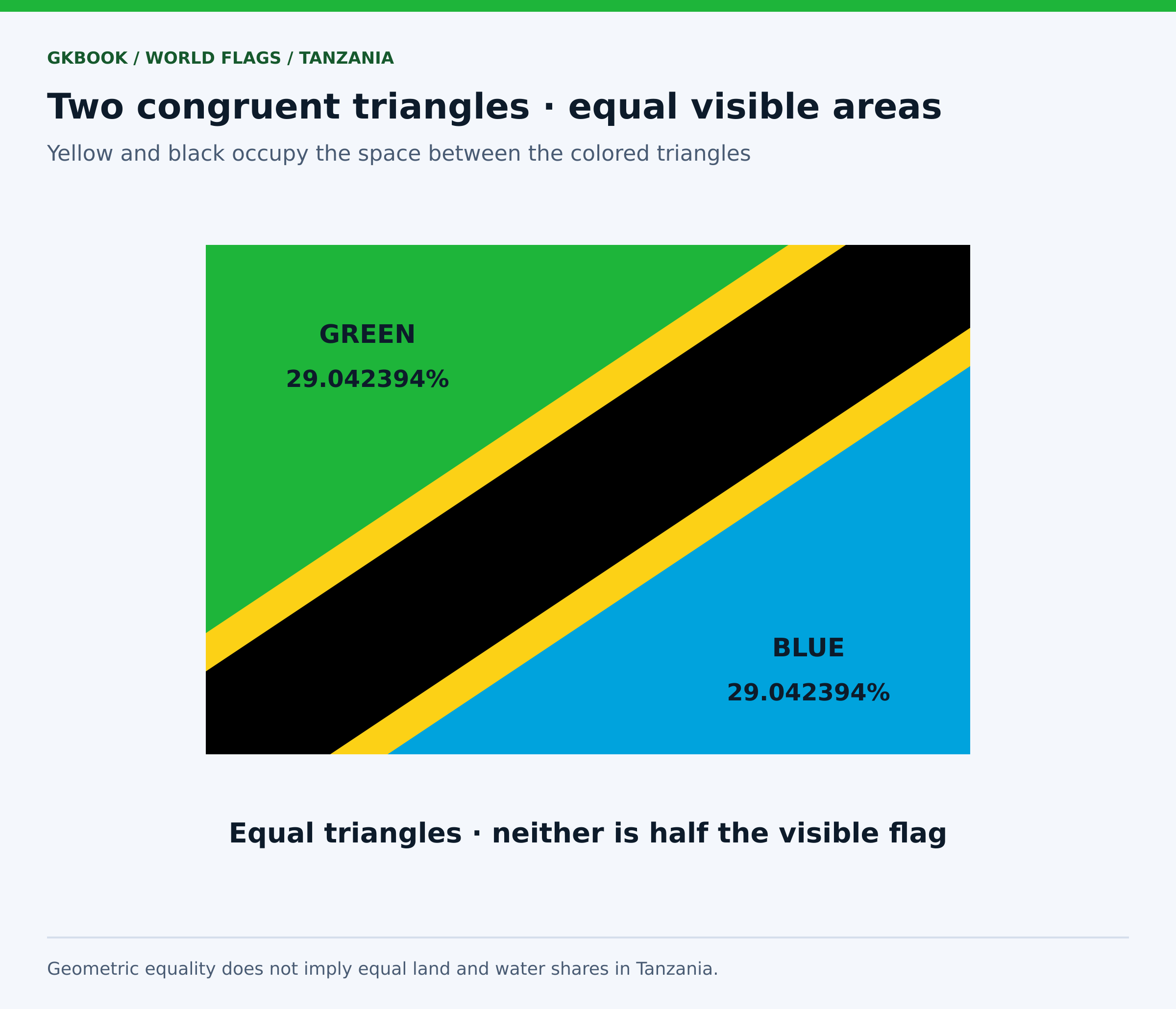
Yes. In the declared symmetrical construction, the green and blue triangles have equal areas and matching shapes. Each occupies approximately 29.042394 percent of the complete rectangle. Neither occupies half of the visible flag, because the black band and its two yellow borders cover part of the diagonal division.

The phrase “two equal portions” in the legal description explains the diagonal division before accounting for the intervening bands. The clean artwork preserves that balance with parallel edges equally spaced around the central diagonal. Green and blue have the same dimensions even though they carry different symbolic associations.
Their equal areas can be checked from their horizontal and vertical legs. Both are right triangles, with those legs shortened by the same band system at opposite corners. The black and yellow regions must be included when adding up the complete flag’s visible areas; otherwise a substantial portion is omitted.
How can the Tanzania flag be constructed accurately?
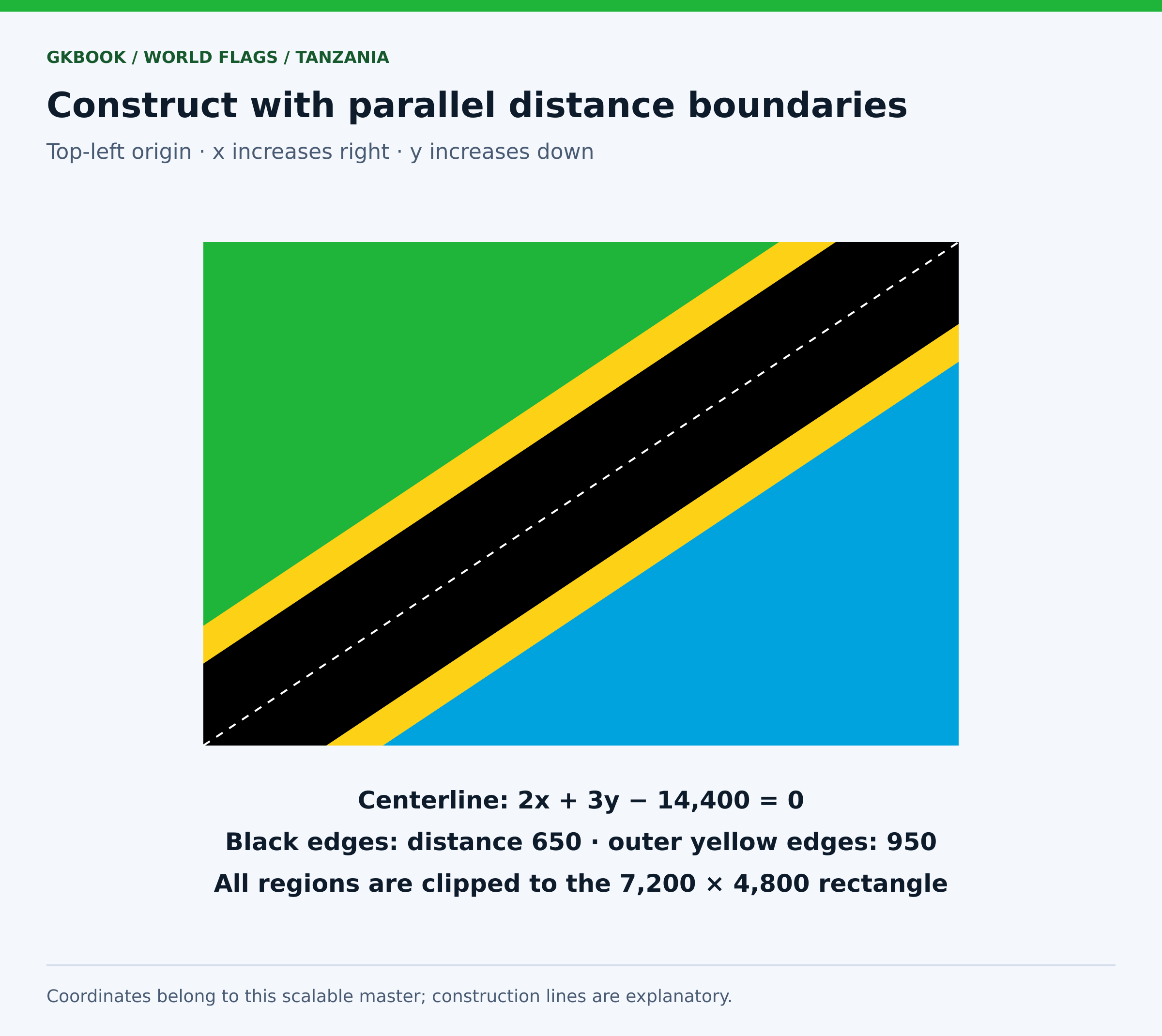
Begin with a 7,200 by 4,800 rectangle and a diagonal through the lower left and upper right corners. Place parallel boundaries 650 and 950 units from that line on both sides. Fill the center black, the next strips yellow, the upper triangle green, and the lower triangle blue.

Using a top-left origin with vertical coordinates increasing downward, the centerline has equation 2x + 3y − 14,400 = 0. Divide that expression by the square root of thirteen to obtain signed perpendicular distance. The sign distinguishes the green side from the blue side of the line.
All coordinates scale together. The boundary at a distance of 650 units marks a black edge, while the boundary at 950 marks the outer yellow edge. Clip every region to the rectangle. These steps produce reproducible shapes without adding a visible outline or relying on a font, photograph, or freehand trace.
What percentage of the flag is each color?
In this construction, green and blue each occupy approximately 29.042394 percent, black occupies 29.901341 percent, and the two yellow bands together occupy 12.013871 percent. Each yellow band therefore contributes half of that yellow total. These are geometric results for the declared widths, not official symbolic allocations.

Calculate the triangular fields first, then subtract their areas from the complete rectangle to obtain the combined diagonal strip. A second calculation using the black boundary gives the black area. The difference between the outer strip and the black band is the combined yellow area.
Pixel counts at edges can differ slightly from these exact vector calculations because antialiasing blends neighboring colors. Such blended pixels are a rendering effect, not extra flag colors. For comparisons, retain enough decimal places to avoid rounding errors and make clear that the displayed percentages describe flat artwork.
How did the Tanzania flag develop?
The flag belongs to the union formed by Tanganyika and Zanzibar in 1964. Its history should be read alongside that political transition, while distinguishing union, flag adoption accounts, and later legislation. The present diagonal composition combines four colors in one national symbol rather than displaying two complete predecessor flags side by side.

A compact history begins with the two territories’ separate independence milestones and then identifies their union in April 1964. Those events establish the context for a common national flag. They do not, by themselves, settle every question about the precise date on which a particular design was first displayed.
Later legal text gives the described flag effect from the union date, while an embassy history reports a June adoption date. Keeping those statements separate makes the chronology more useful than collapsing them into one unexplained year. Historical captions should identify the event associated with each date.
When was the Tanzania flag adopted?
Two dates need different labels. The National Emblems Act gives the flag legal effect from April 26, 1964, the union date. The Tanzanian embassy’s Rome website reports adoption on June 30, 1964. This guide preserves that distinction instead of treating a later historical account and retrospective legal effect as identical evidence.
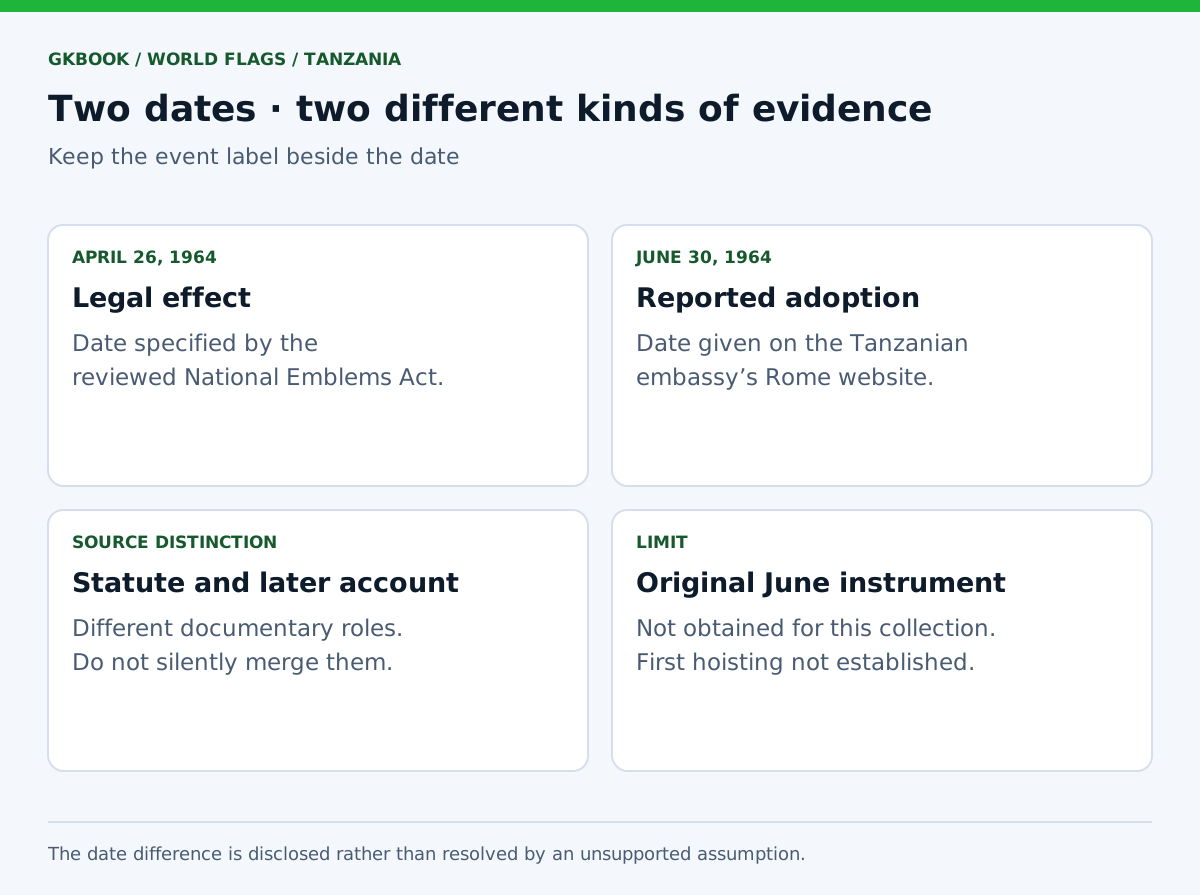
For a short caption, “national flag associated with the 1964 union” avoids implying that every source uses the same adoption date. Where space allows, state both the reported June adoption and the April legal effect. The legislative provision is a direct legal statement; the embassy page is a historical account.
The original adoption instrument establishing the embassy’s June date was not obtained for this collection. Nor does the later statute establish the first occasion on which a flag was physically raised. Those limits matter when writing an exact chronology, even though the reviewed sources agree on the familiar national composition.
What does Tanzania’s flag law specify?
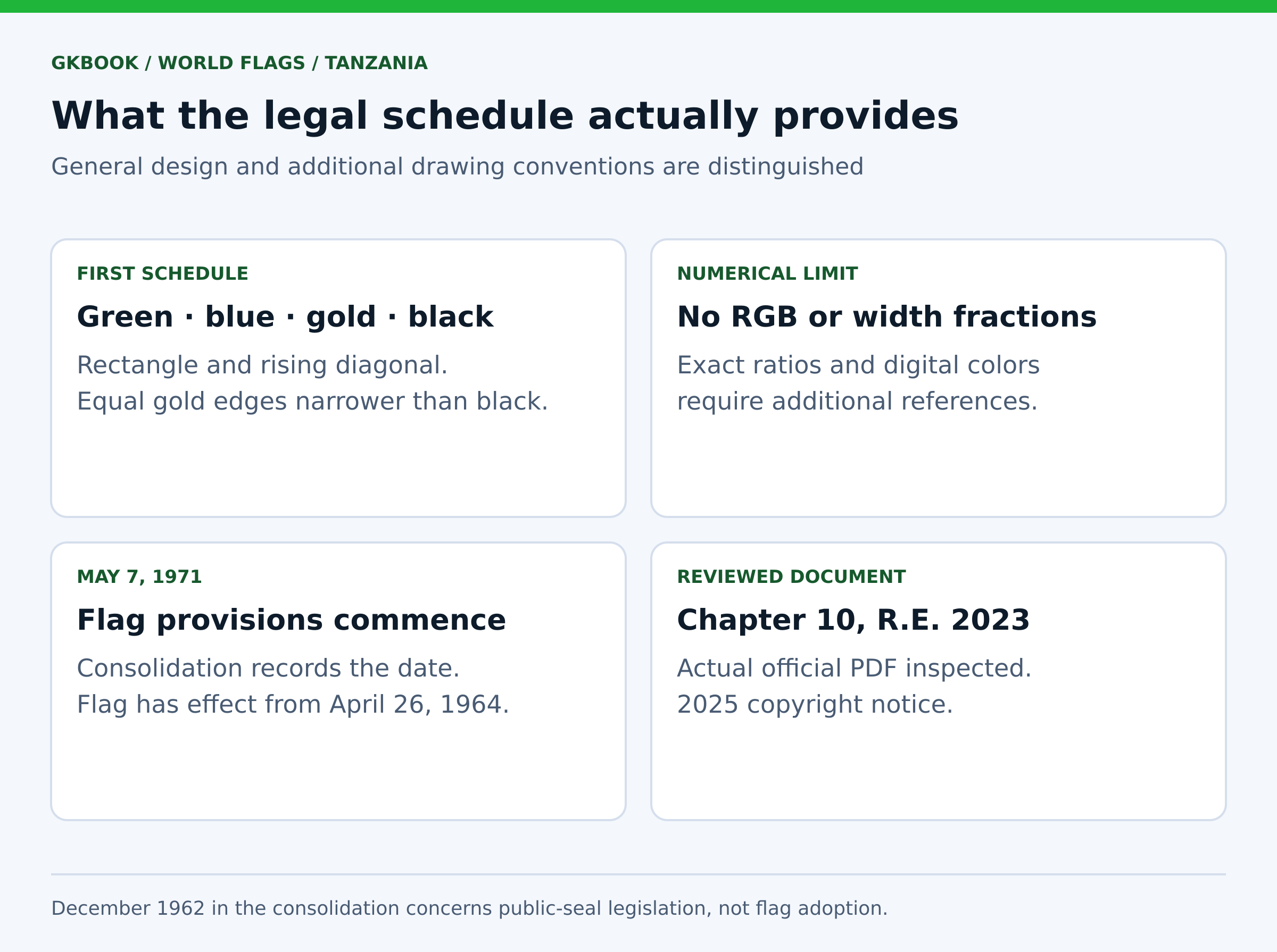
The reviewed National Emblems Act describes the rectangle, diagonal direction, green and blue fields, and golden-black-golden dividing bands. It requires equal golden bands narrower than black. The consolidated text records the flag provisions’ commencement on May 7, 1971, while giving the flag itself effect from April 26, 1964.
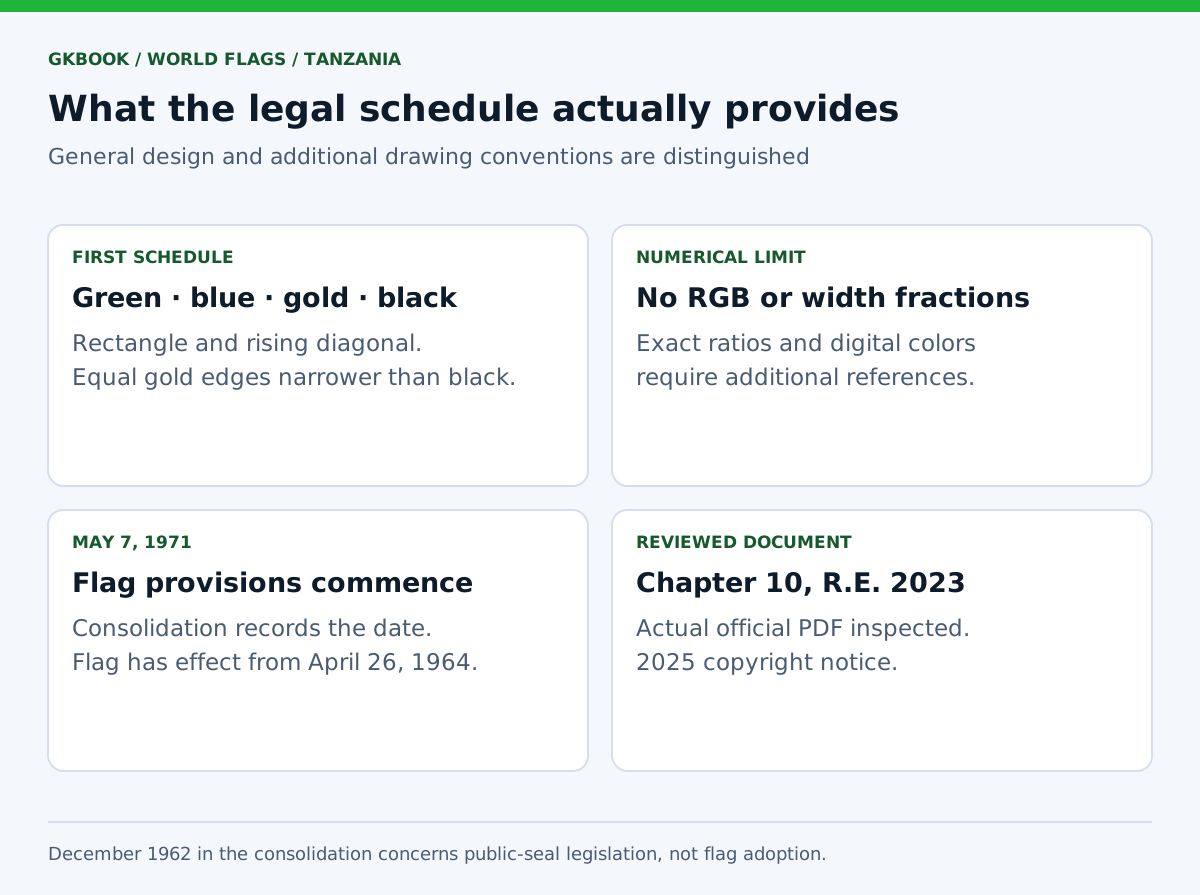
The inspected document is Chapter Ten, Revised Edition 2023, in an official government PDF carrying a 2025 copyright notice. Its First Schedule includes a labeled diagram. The text does not provide a numerical overall ratio, exact stripe fractions, RGB values, or a complete color-management specification.
A separate December 1962 commencement note concerns the public-seal legislation incorporated into the consolidation. It should not be presented as the national flag’s adoption date. This collection distinguishes what the legal schedule actually states from the additional numerical construction conventions used to make consistent downloadable artwork.
Is Tanzania’s flag date the same as independence?
No single independence date describes all the events involved. Tanganyika became independent on December 9, 1961, and Zanzibar on December 10, 1963. Their union followed on April 26, 1964. These milestones concern political history; they should not all be labeled as the adoption date of the present national flag.

A timeline can show each event in its own row with its own subject. That prevents a reader from assuming that the united country already existed at Tanganyika’s earlier independence ceremony. It also avoids treating Zanzibar’s separate history as merely another date for the same event.
A modern flag displayed beside an older anniversary is a contemporary commemorative choice. It does not demonstrate that this exact design flew at the original ceremony. When illustrating the earlier period, identify whether the image is a present-day reference flag, a verified historical flag, or an explanatory timeline.
What does April 26 mean in the flag’s history?
April 26, 1964 marks the union of Tanganyika and Zanzibar. It is also the date from which the reviewed National Emblems Act gives the national flag legal effect. Those connections make the date central to the flag’s history, while remaining distinct from the embassy’s reported June adoption date.
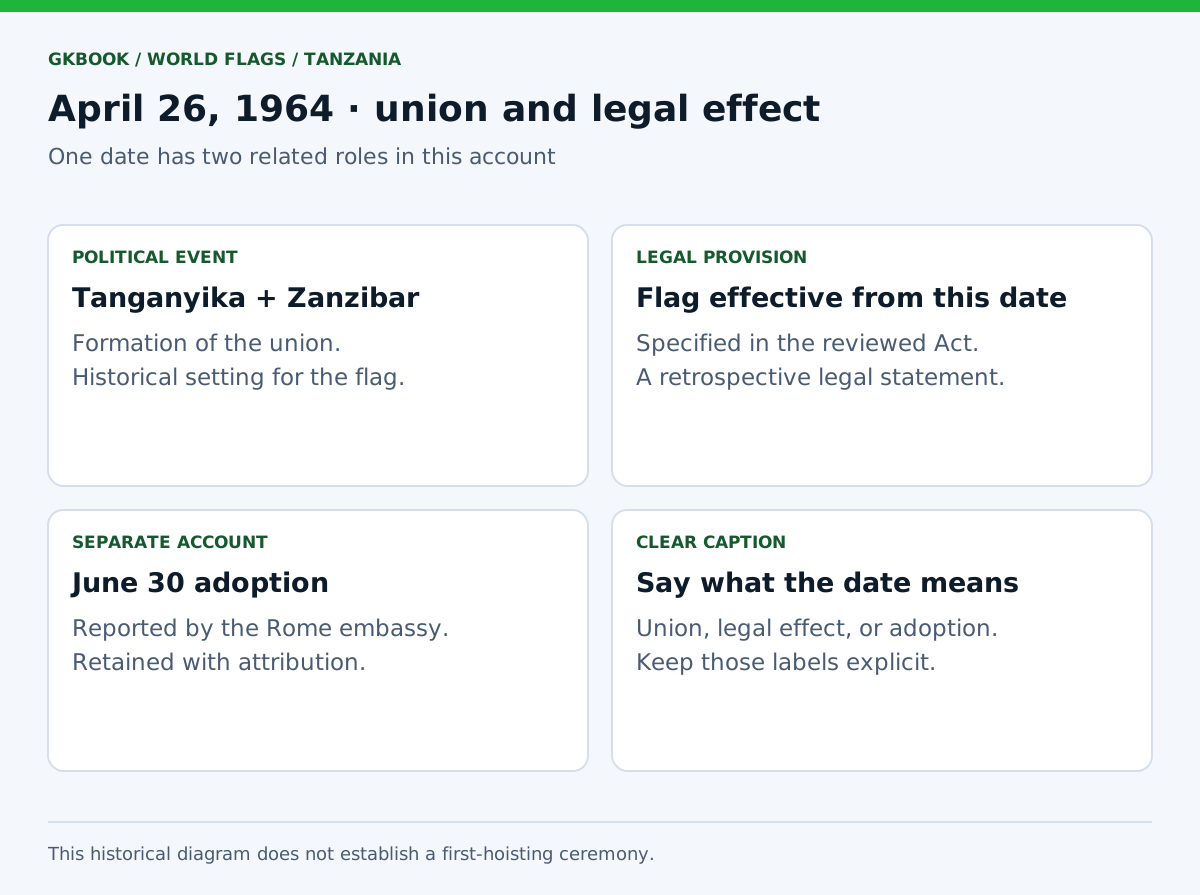
The union supplies the historical setting for a shared national symbol. A flag can express that relationship through a single composition without drawing a map of either constituent part. The Tanzania design uses a strong diagonal division and four colors rather than literal geographic outlines or separate labeled compartments.
When preparing an anniversary display, use a date label that says what is being commemorated. “Union, April 26, 1964” communicates a specific historical event. A bare “flag adopted April 26” conceals the difference between legal effect and the alternative adoption account discussed in this guide.
When did Tanzania become a United Nations member?
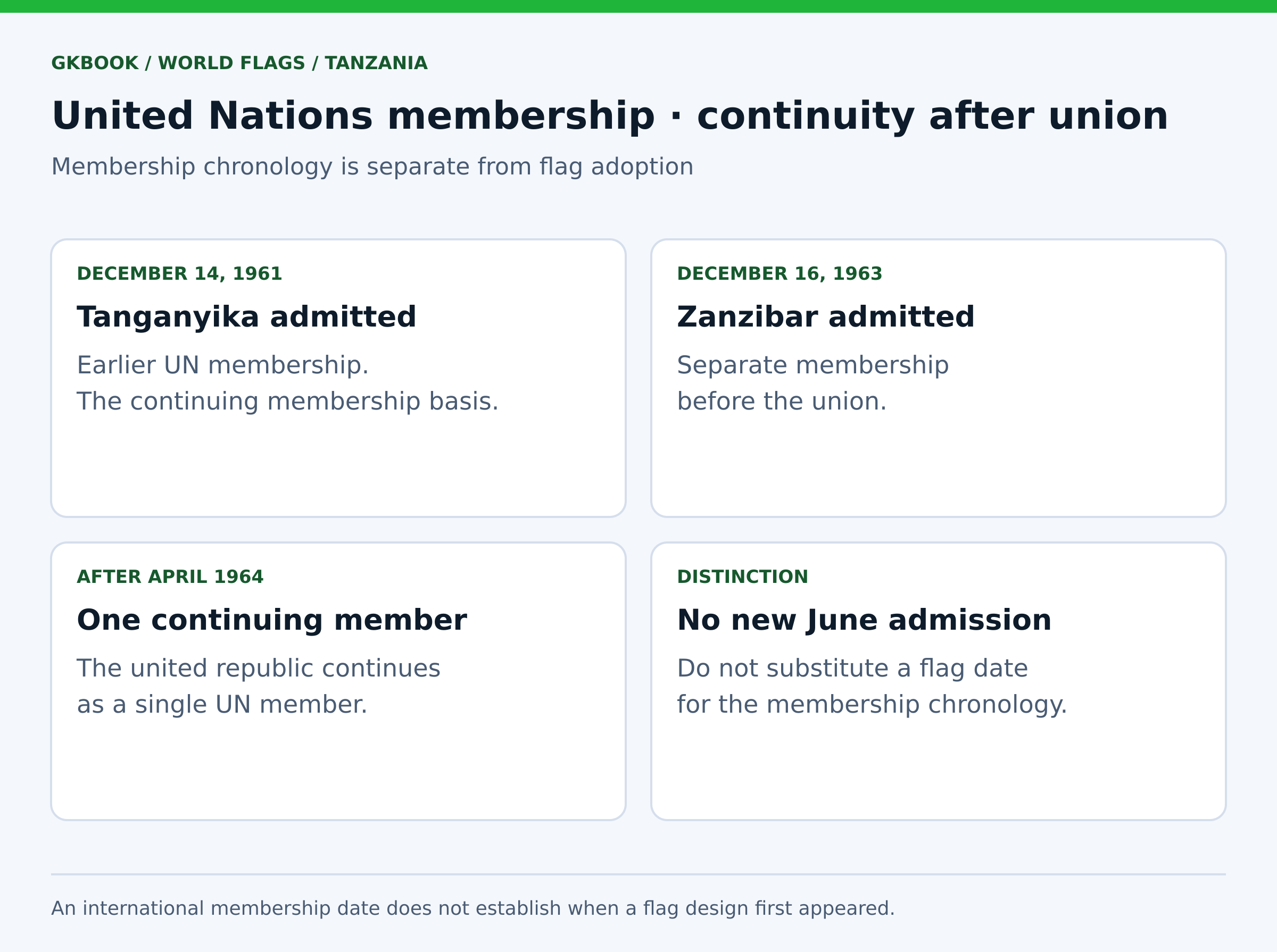
Tanzania’s UN membership history continues Tanganyika’s admission on December 14, 1961. Zanzibar joined separately on December 16, 1963. After their April 1964 union, the United Republic continued as one member. This was not a fresh admission of a newly separate UN member on the flag’s reported June adoption date.

Membership records and flag histories answer different questions. The former describe representation in an international organization; the latter describe a national symbol. A flag photograph at the United Nations therefore needs its own date and context rather than being treated as proof of when the design originated.
The Tanzanian mission’s account explicitly describes continuity after the union. A concise chronology should retain the two earlier admissions and the later single membership, rather than replacing the entire sequence with 1964. This distinction is useful when comparing national independence, diplomatic participation, and changes in flags across different countries.
Does the current flag simply combine two earlier flags?
The current design belongs to the union of Tanganyika and Zanzibar, but it should not be read as two complete earlier flags stitched together. Its four colors form a new diagonal arrangement. Historical comparisons require the specific predecessor design and date, since a territory may have used several flags over time.

A simple color genealogy can be helpful, but it is not a substitute for dated historical artwork. Shared green, black, yellow, or blue does not prove that two flags have the same layout. Orientation, stripe widths, emblems, and overall proportions remain part of each flag’s identity.
This collection uses a historical relationship diagram rather than inventing undated predecessor illustrations. That choice keeps the present national flag clear while showing the two political components of the union. A separate historical gallery would need individually sourced designs and captions for each period it intends to represent.
Does the Tanzania flag contain the coat of arms?
No. The national flag consists of the four-color diagonal arrangement and contains no coat of arms, shield, stars, or lettering. Tanzania’s coat of arms is a separate national symbol. The legal document describes the flag and the coat of arms in different schedules, so the two should not be substituted.
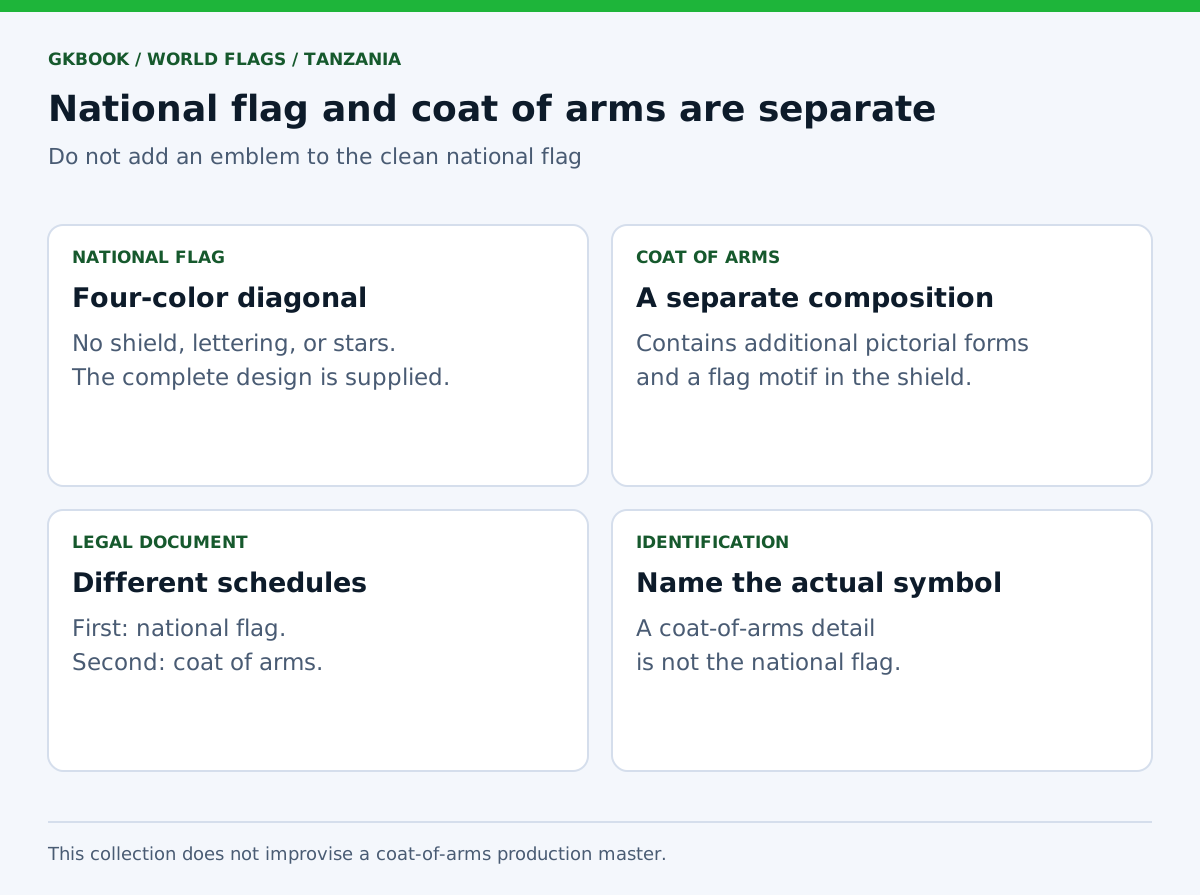
The coat of arms includes additional pictorial elements and incorporates a representation of the national flag within its shield. That relationship runs in one direction: the arms can contain a flag motif without the national flag containing the complete arms. A small emblem image is therefore a different asset.
Keep identification captions precise when using extracted details. A shield or supporter taken from the arms should not be labeled the Tanzania flag. Conversely, the clean diagonal rectangle needs no additional emblem to become official-looking; adding one changes the composition supplied in the flag schedule.
Can the Tanzania flag be used freely in any design?
The reviewed National Emblems Act regulates specified uses of the flag and its likeness, including commercial contexts. A downloadable image or a public-domain copyright label does not itself establish permission for every use. For a proposed regulated use, check the applicable requirements and any authorization relevant to that particular situation.
Separate three questions: whether the picture accurately depicts the flag, what copyright terms apply to the artwork, and what national-symbol rules govern its use. A correct answer to one does not automatically answer the others. This educational collection supplies drawings and provenance, not a blanket authorization for merchandise or advertising.
The private notes identify the legal text reviewed and the limits of the research. They do not claim that every later instrument, exemption, or administrative instruction was examined. A project requiring a formal determination should resolve its own intended use against the rules that apply to it.
How can Tanzania’s flag be recognized quickly?
Check the complete combination: a 2:3 rectangle, green at the upper hoist, blue at the lower fly, and a rising black diagonal with two narrow yellow edges. The absence of stars or a central emblem is also useful. Recognizing all these features is more reliable than matching colors alone.
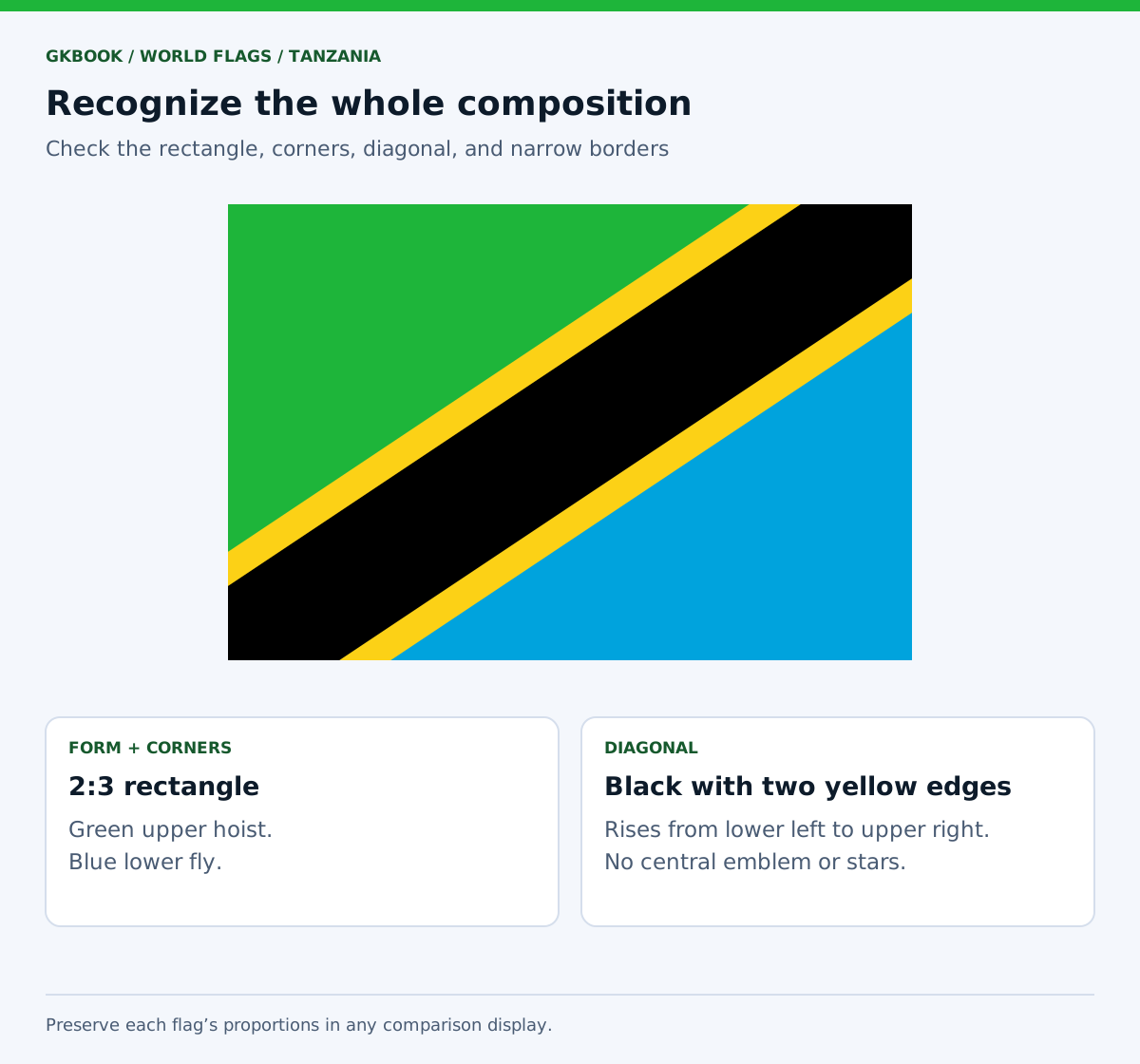
A good comparison display preserves the original proportions of every flag and gives each enough space to show its internal details. Stretching all designs into identical boxes can conceal useful differences. For Tanzania, the rising diagonal and the two narrow borders deserve particular attention in a crowded gallery.
Use color descriptions alongside positional language in accessible captions. “Green upper left, blue lower right, yellow-edged black diagonal” communicates the arrangement efficiently. If the image shows a reverse view or a rotated flag, say so explicitly because the apparent direction will differ from the standard front view.
How does the flag look when rotated vertically?
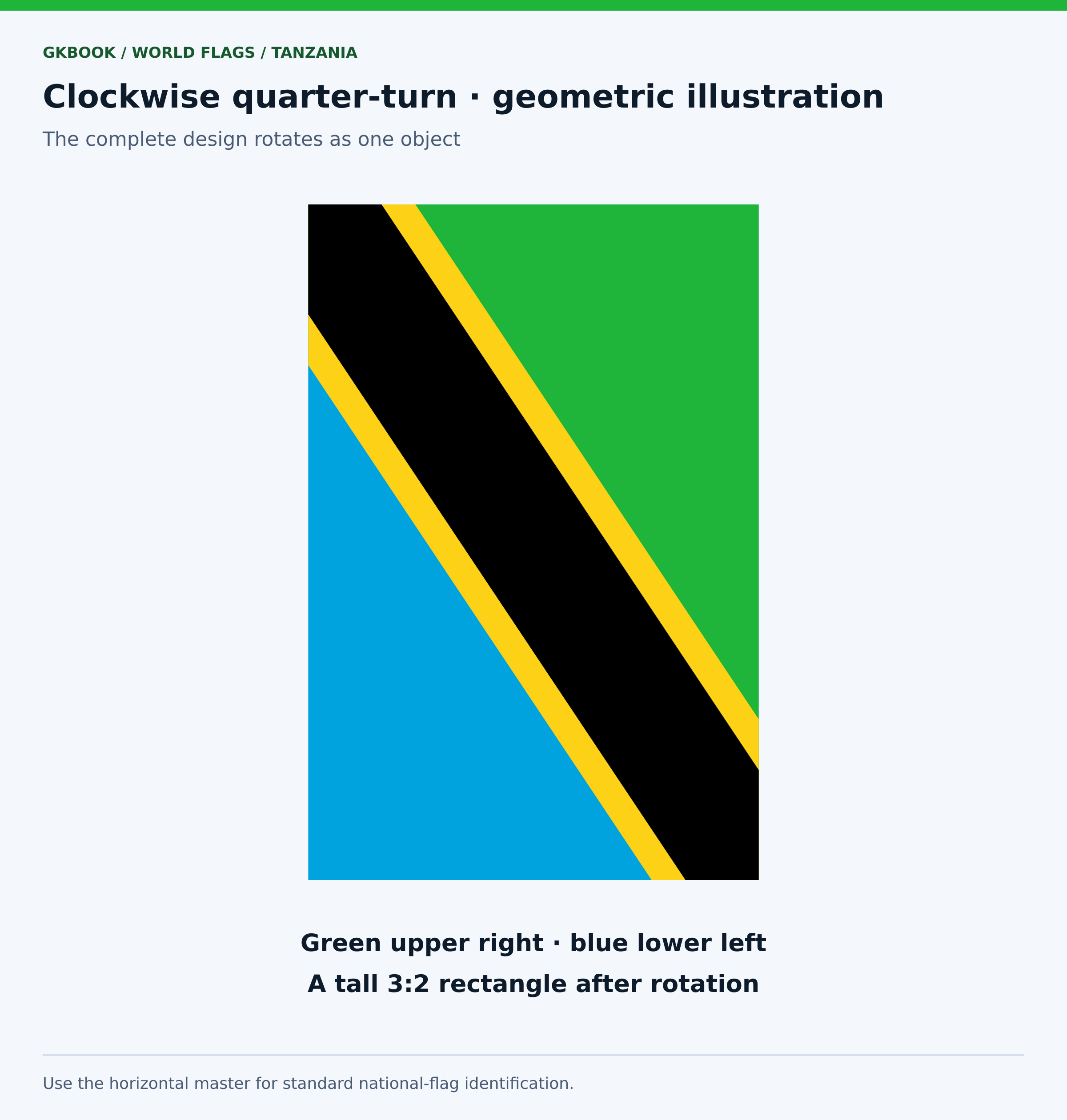
A clockwise quarter-turn changes the rectangle to height:length 3:2 and moves green to the upper right and blue to the lower left. The diagonal then descends from upper left to lower right. The illustration here shows a geometric rotation of the whole flag, not a verified official hanging prescription.

Rotate the entire composition as one object. Moving only the outer rectangle while leaving the diagonal or colored fields in their previous orientation produces a different design. The same proportional relationships remain intact under a true rotation, including the equality of the two yellow bands.
Geometric transformations are useful for teaching orientation, but they do not establish ceremonial rules. A venue may have its own applicable display instructions. The horizontal clean master remains the reference image for ordinary identification in this collection, while the vertical illustration is clearly captioned as a transformation.
What does the reverse side of the Tanzania flag show?
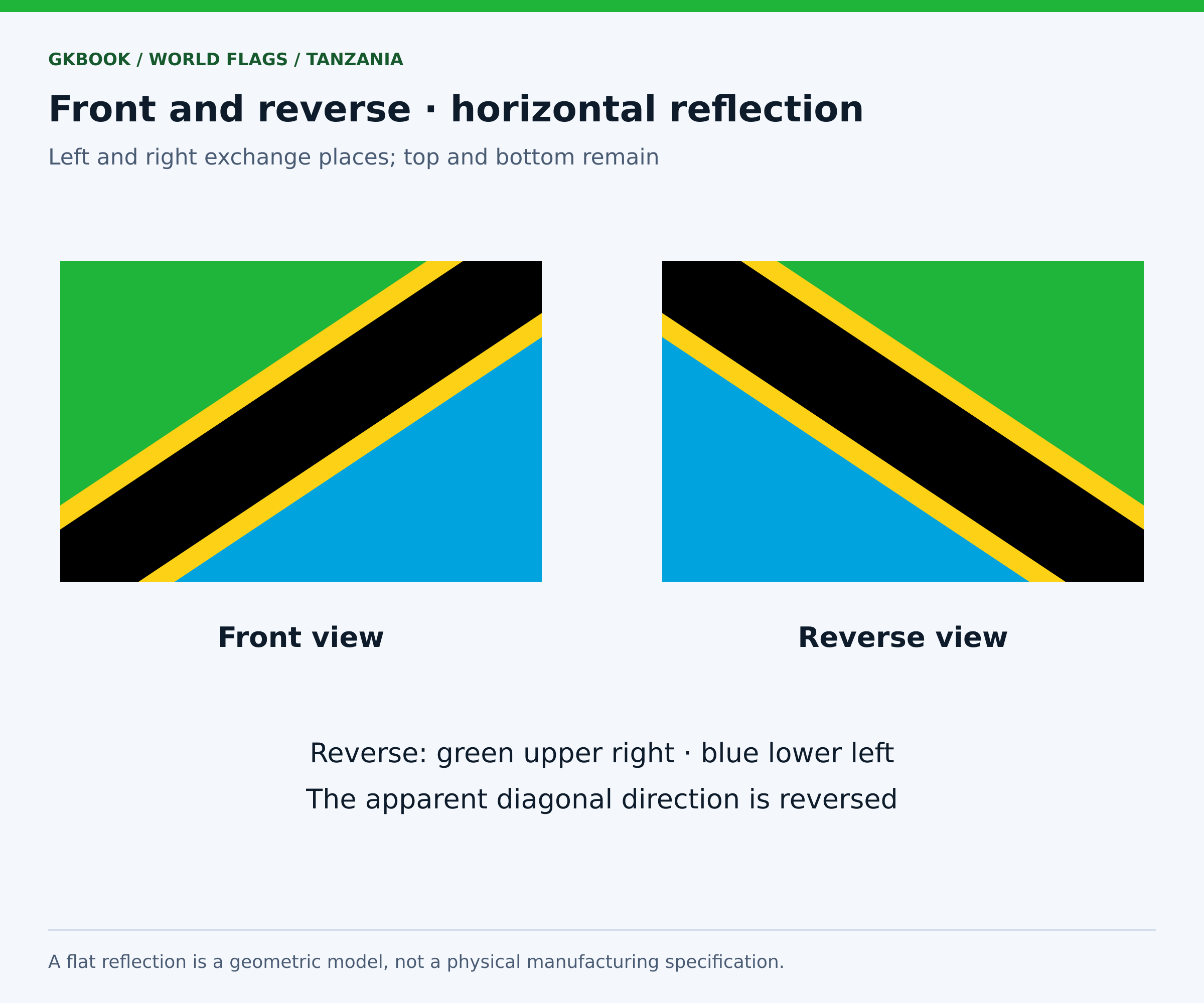
A flat reverse view is a horizontal reflection of the front. With the image framed the same way, green appears at the upper right, blue at the lower left, and the black diagonal descends from upper left to lower right. This geometric model does not specify how a physical flag is manufactured.

Reflection changes left and right while preserving top and bottom. That is why a reverse view should not be judged incorrect merely because its diagonal runs in the opposite apparent direction. The viewer’s position relative to the flag and its hoist must be understood before comparing the two images.
The downloadable comparison shows two complete rectangles at the same scale. It mirrors the actual artwork rather than redrawing a similar stripe arrangement. For a real cloth flag, seams, separate panels, and light passing through the fabric can affect appearance without changing the underlying national design.
Is the Tanzania flag unchanged by a half-turn?
No. A 180-degree rotation preserves the diagonal’s rising direction but exchanges the green and blue fields. Green moves to the lower right and blue to the upper left. The black and yellow geometry remains aligned, yet the complete colored flag is different from the standard front view.
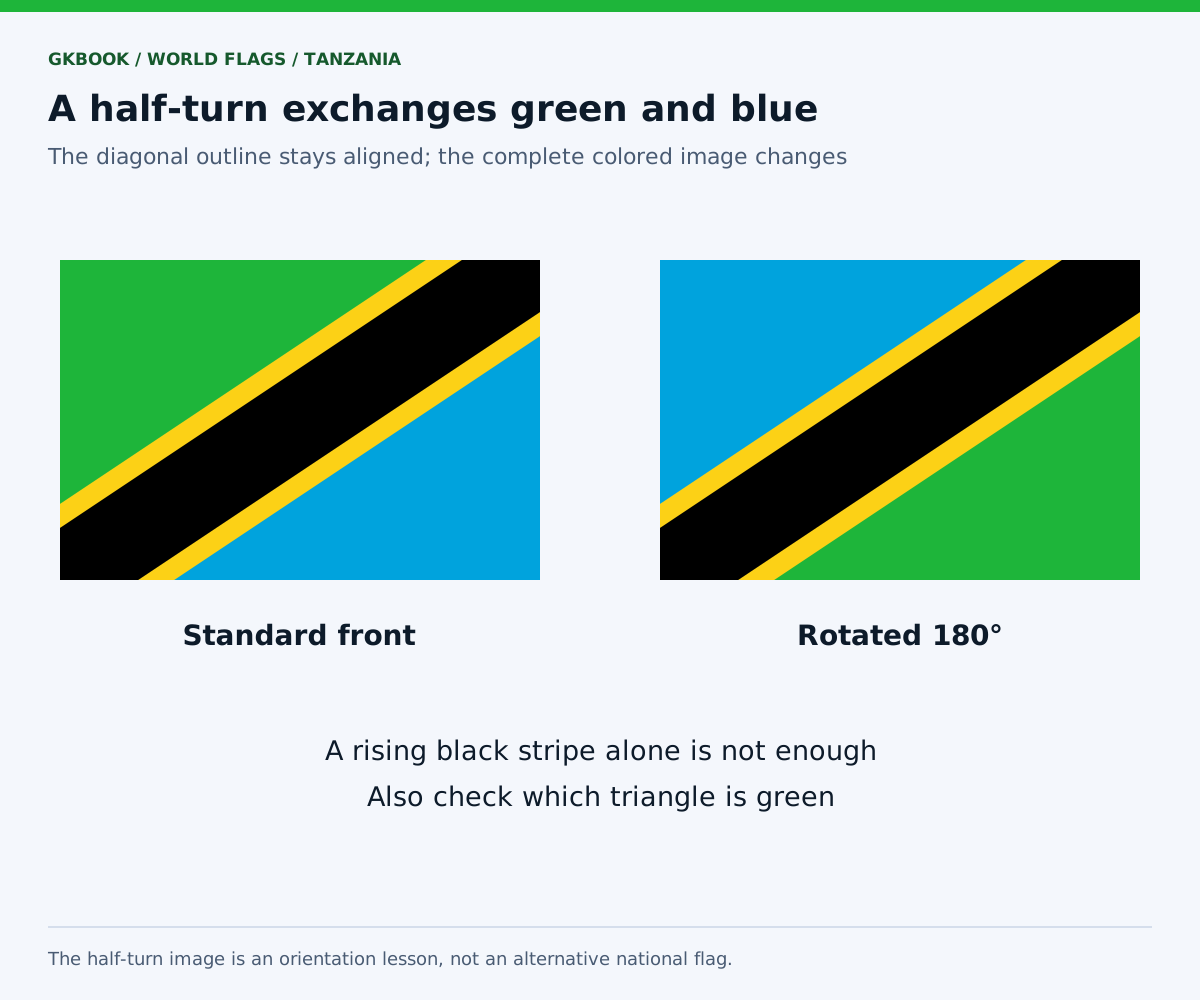
This example separates symmetry of outlines from symmetry of colors. The rectangle and band system are unchanged by a half-turn, and the two triangular outlines exchange places. Because the triangles have different fills, the full image does not have that same rotational symmetry.
A quick orientation check should therefore include both the diagonal direction and the green corner. Looking only at the dark stripe could miss an upside-down image. The half-turn comparison is an educational diagnostic, not an alternative national flag or an approved arrangement for ordinary display.
How should the Tanzania flag be resized or printed?
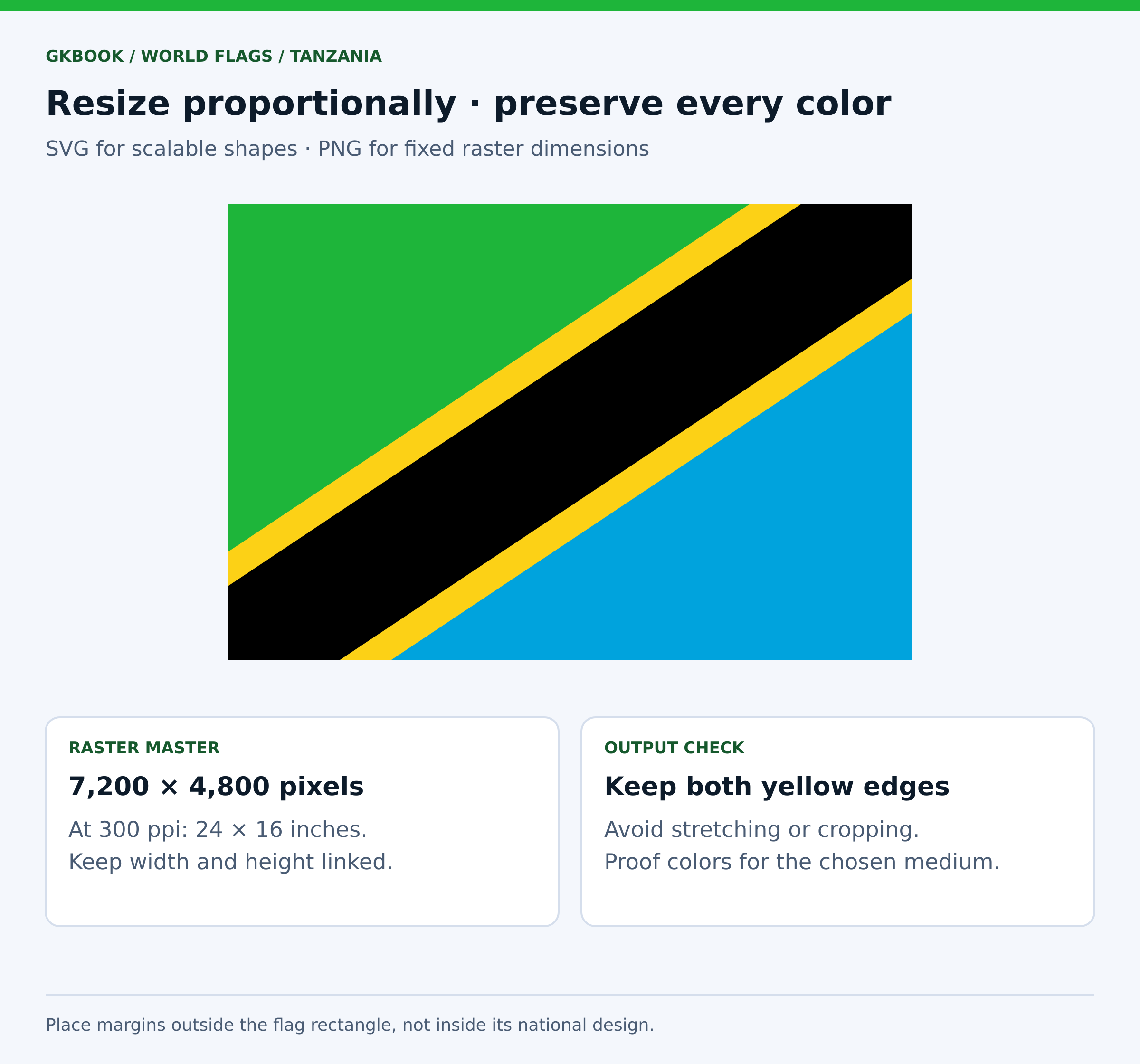
Keep the height:length ratio at 2:3 and scale both axes together. Use the SVG for scalable geometry or the 7,200 by 4,800 PNG for fixed raster output. At 300 pixels per inch, that PNG corresponds to 24 by 16 inches. Physical color matching still requires an appropriate proof.
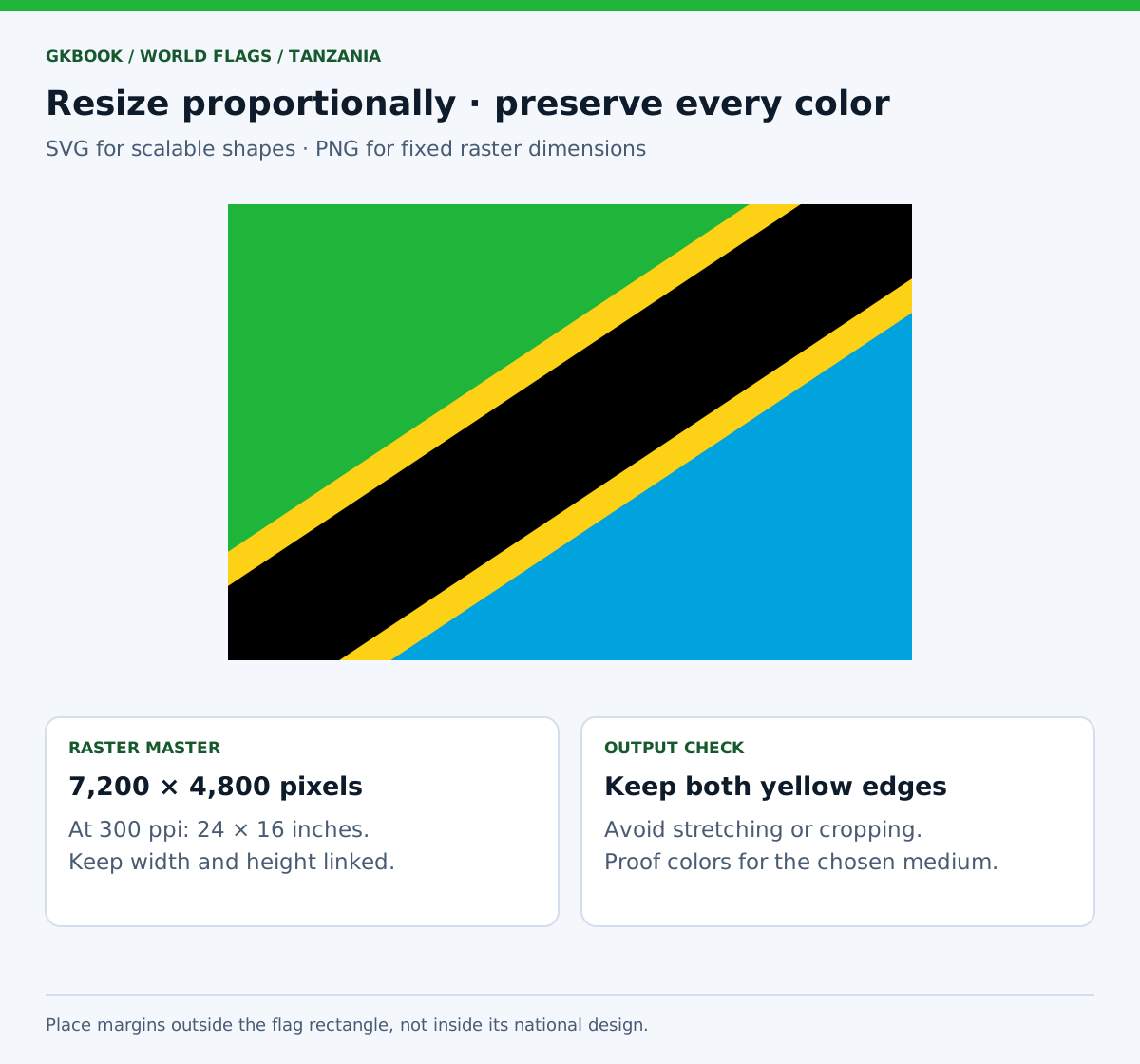
Do not add padding inside the national rectangle to fit a different page shape. Place the complete flag within the larger layout instead, leaving any surrounding margin outside it. The separate social card follows this principle by displaying an intact flag inside a wider composition.
Screen RGB values are not a universal recipe for ink or dye. Paper, fabric, lighting, and production methods affect appearance. Preserve the documented colors as the digital starting point, then evaluate the intended output with the production process in mind rather than assuming every device will reproduce identical visible shades.
What should be checked in a small flag icon?
Keep the complete rectangle, the correct green and blue corners, and both yellow edges visible. At very small sizes, antialiasing can soften the narrow bands, so use a proportional export and inspect the result. A small icon should simplify its surrounding layout rather than remove a color or change the diagonal.
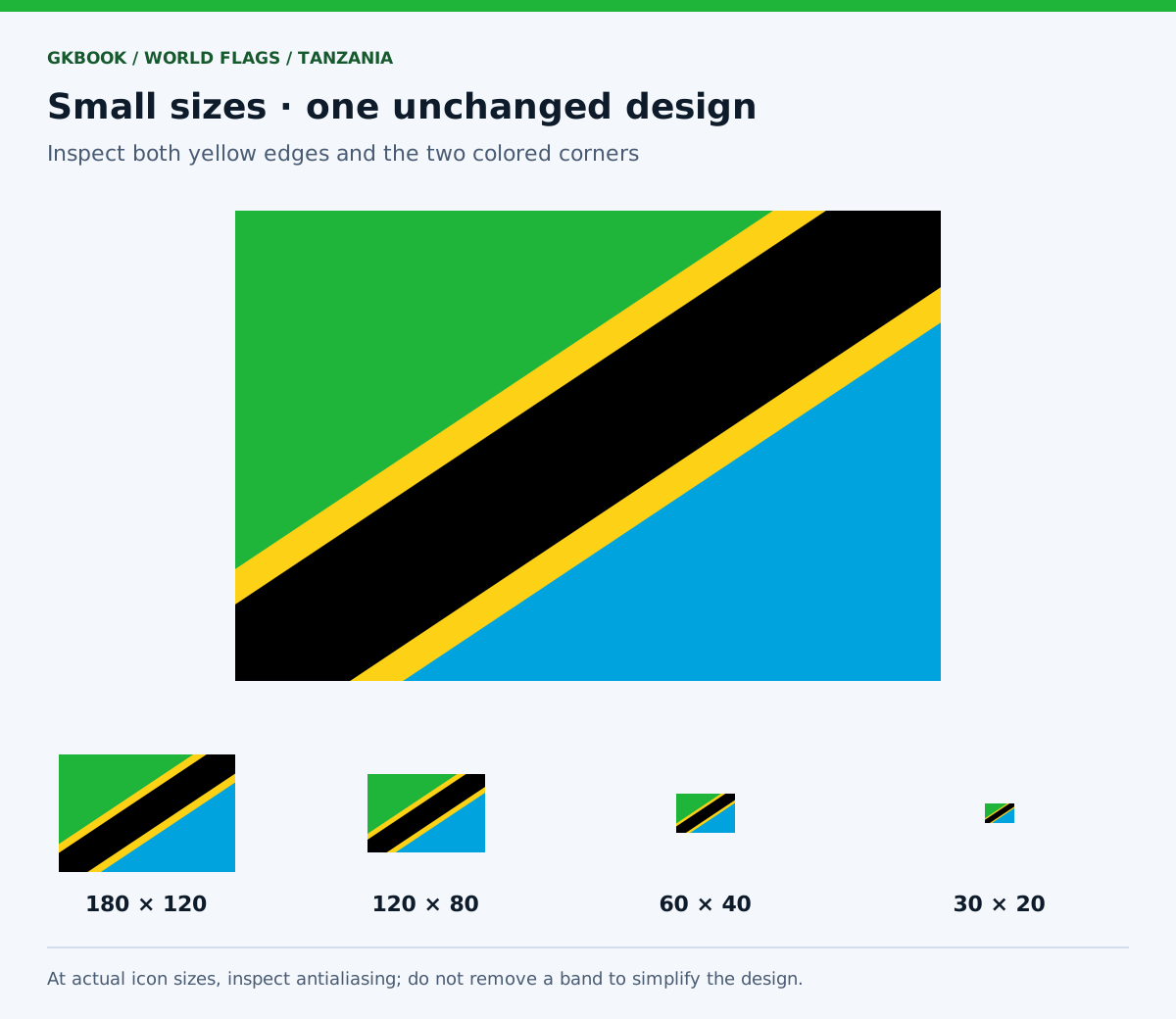
A vector image can scale smoothly, but its display still lands on a finite pixel grid. Some edges fall between pixel centers and become blended. Exporting directly at the intended size usually gives more predictable results than repeatedly shrinking an already reduced image through several intermediate files.
Use a plain nearby background and adequate spacing so the yellow edges remain readable. Avoid placing text over the flag when it is serving as a country identifier. The size comparison below keeps the same drawing at several scales, making loss of detail visible without inventing a special miniature flag design.
Download Tanzania flag pictures
Download the complete flag as SVG or 7,200 × 4,800 PNG. The height:length ratio is 2:3. Green occupies the upper hoist and blue the lower fly, separated by a black diagonal with two narrow yellow edges.
The gallery contains 24 subjects, each with an SVG and PNG. Captions distinguish the clean flag from construction guides, historical explanations, and geometric transformations. Image credits and reproduction notes identify the palette, construction, source discrepancies, and limits. The separate 1,200 × 630 social card contains a complete 540 × 360 flag.
Continue exploring national designs in World Flags.
World Flags/Tanzania
Tanzania flag pictures
Complete flag using the declared 2:3 rectangle, 3:13:3 band widths, and reference SVG palette.
GKBook geometric reconstruction and educational layout; reference artwork credited in the reproduction notes. No official certification.Download SVGDownload PNGGreen #1EB53A, blue #00A3DD, black #000000, and yellow #FCD116 are digital reproduction choices.
GKBook geometric reconstruction and educational layout; reference artwork credited in the reproduction notes. No official certification.Download SVGDownload PNGOfficial explanations associate the colors with land, water, people, and mineral resources.
GKBook geometric reconstruction and educational layout; reference artwork credited in the reproduction notes. No official certification.Download SVGDownload PNGHeight:length 2:3 is equivalent to length:height 3:2.
GKBook geometric reconstruction and educational layout; reference artwork credited in the reproduction notes. No official certification.Download SVGDownload PNGThe centerline rises at about 33.6901 degrees; it is not a 45-degree line.
GKBook geometric reconstruction and educational layout; reference artwork credited in the reproduction notes. No official certification.Download SVGDownload PNGDeclared perpendicular construction: each yellow band is 3/48 of height, black is 13/48.
GKBook geometric reconstruction and educational layout; reference artwork credited in the reproduction notes. No official certification.Download SVGDownload PNGPerpendicular width and vertical separation are different measurements of parallel boundaries.
GKBook geometric reconstruction and educational layout; reference artwork credited in the reproduction notes. No official certification.Download SVGDownload PNGEach triangle occupies about 29.042394% for the declared 3:13:3 construction.
GKBook geometric reconstruction and educational layout; reference artwork credited in the reproduction notes. No official certification.Download SVGDownload PNGSigned perpendicular distance is (2x + 3y − 14,400) divided by the square root of 13.
GKBook geometric reconstruction and educational layout; reference artwork credited in the reproduction notes. No official certification.Download SVGDownload PNGDerived vector percentages for the declared construction; antialiasing is separate.
GKBook geometric reconstruction and educational layout; reference artwork credited in the reproduction notes. No official certification.Download SVGDownload PNGA selective timeline distinguishes independence, union, reported adoption, and later legislation.
GKBook geometric reconstruction and educational layout; reference artwork credited in the reproduction notes. No official certification.Download SVGDownload PNGThe legal-effect date and the embassy’s adoption date are presented separately.
GKBook geometric reconstruction and educational layout; reference artwork credited in the reproduction notes. No official certification.Download SVGDownload PNGThe legal schedule fixes the general arrangement without supplying exact numerical band widths or digital colors.
GKBook geometric reconstruction and educational layout; reference artwork credited in the reproduction notes. No official certification.Download SVGDownload PNGSeparate independence milestones precede the union and must retain their own labels.
GKBook geometric reconstruction and educational layout; reference artwork credited in the reproduction notes. No official certification.Download SVGDownload PNGApril 26 is the union date and the statute’s legal-effect date, distinguished from the reported June adoption.
GKBook geometric reconstruction and educational layout; reference artwork credited in the reproduction notes. No official certification.Download SVGDownload PNGThe Tanzanian mission describes two earlier admissions and one continuing membership after union.
GKBook geometric reconstruction and educational layout; reference artwork credited in the reproduction notes. No official certification.Download SVGDownload PNGThe two constituent histories are related to the current national flag without supplying unsourced predecessor drawings.
GKBook geometric reconstruction and educational layout; reference artwork credited in the reproduction notes. No official certification.Download SVGDownload PNGThe coat of arms contains a flag motif, but the flag does not contain the complete coat of arms.
GKBook geometric reconstruction and educational layout; reference artwork credited in the reproduction notes. No official certification.Download SVGDownload PNGFour structural checks identify the complete national design more reliably than matching colors alone.
GKBook geometric reconstruction and educational layout; reference artwork credited in the reproduction notes. No official certification.Download SVGDownload PNGClockwise 90-degree rotation of the complete front view; no official hanging prescription is claimed.
GKBook geometric reconstruction and educational layout; reference artwork credited in the reproduction notes. No official certification.Download SVGDownload PNGThe reverse illustration is a horizontal reflection of the same complete artwork.
GKBook geometric reconstruction and educational layout; reference artwork credited in the reproduction notes. No official certification.Download SVGDownload PNGA 180-degree rotation preserves band outlines but exchanges the green and blue positions.
GKBook geometric reconstruction and educational layout; reference artwork credited in the reproduction notes. No official certification.Download SVGDownload PNGThe master retains the 2:3 ratio; digital color values do not guarantee an identical physical print.
GKBook geometric reconstruction and educational layout; reference artwork credited in the reproduction notes. No official certification.Download SVGDownload PNGIdentical vector geometry at several labeled layout sizes; PNG export doubles diagram units.
GKBook geometric reconstruction and educational layout; reference artwork credited in the reproduction notes. No official certification.Download SVGDownload PNGFrequently asked questions
What does the Tanzania flag look like?
The Tanzania flag is a rectangle with a green upper hoist triangle and a blue lower fly triangle. A broad black diagonal rises from the lower hoist to the upper fly, bordered by two narrow yellow bands. Its height:length ratio is 2:3, and it has no central emblem.
What is the Tanzania flag called?
The national flag belongs to the United Republic of Tanzania. “Tanzania flag” is the usual short English label, while the government’s Swahili description uses “Bendera ya Taifa,” meaning national flag. The name refers to the complete green, blue, black, and yellow design, rather than to an isolated diagonal motif.
What are the colors of the Tanzania flag?
The four colors are green, blue, black, and yellow or gold. This edition uses green #1EB53A, blue #00A3DD, black #000000, and yellow #FCD116 from the inspected reference SVG. These are declared digital reproduction values, not statutory HEX codes or a verified conversion from a physical color standard.
What does the Tanzania flag mean?
Official explanations associate green with fertile land and agriculture, blue with water including the Indian Ocean, black with the people of Tanzania, and yellow with mineral resources. These meanings accompany the complete national design. They do not assign numerical population shares or territorial percentages to its colored areas.
What does green represent on the Tanzania flag?
Green represents fertile land and agriculture in official explanations of the flag. It fills the triangle above the diagonal toward the hoist. Its location is part of the design: moving green to the lower right would change the standard front view, even if the other colors were preserved.
What does blue represent on the Tanzania flag?
Blue represents water, including the Indian Ocean, in official explanations. It occupies the lower fly triangle, opposite the green field. In the standard front view it reaches the bottom and right edges of the rectangle, while the lower yellow band separates it from the broad black diagonal.
What does the black diagonal represent?
Black represents the people of Tanzania in official explanations. It forms the broad central diagonal between the two yellow edges. The band runs from the bottom left to the top right in the standard front view, and its width is measured perpendicular to that direction rather than vertically.
What do the yellow stripes represent?
The two yellow or golden stripes represent mineral resources in official explanations. They border the black diagonal on both sides and have equal widths. Each is considerably narrower than the black band. They are internal diagonal borders, not an outer fringe around the entire flag or a separate emblem.
What is the ratio of the Tanzania flag?
The Tanzania flag has a height:length ratio of 2:3. Its horizontal length is therefore one and a half times its height. The supplied master measures 7,200 by 4,800 units, with a PNG at the same pixel dimensions. Scaling both axes together preserves the rectangle and all internal geometry.
Which way does the black diagonal run?
In the standard front view, the black diagonal rises from the lower left corner at the hoist to the upper right corner at the fly. Green is above it and blue below it. On a 2:3 rectangle, the diagonal makes approximately 33.6901 degrees with a horizontal edge.
How wide are the black and yellow bands?
This edition uses perpendicular widths of yellow:black:yellow = 3:13:3 on a flag forty-eight units high. Black is therefore 13/48 of the height, and each yellow edge is 1/16. This corroborated construction is declared explicitly because the legal schedule itself does not provide these numerical band widths.
How should diagonal band widths be measured?
Measure each band along a line perpendicular to its parallel edges. A vertical measurement or a horizontal measurement crosses the band obliquely and produces a larger number. The 3:13:3 proportions in this guide describe perpendicular distances, so they should not be copied directly onto the flag’s vertical edge.
Are the green and blue triangles equal?
Yes. In the declared symmetrical construction, the green and blue triangles have equal areas and matching shapes. Each occupies approximately 29.042394 percent of the complete rectangle. Neither occupies half of the visible flag, because the black band and its two yellow borders cover part of the diagonal division.
How can the Tanzania flag be constructed accurately?
Begin with a 7,200 by 4,800 rectangle and a diagonal through the lower left and upper right corners. Place parallel boundaries 650 and 950 units from that line on both sides. Fill the center black, the next strips yellow, the upper triangle green, and the lower triangle blue.
What percentage of the flag is each color?
In this construction, green and blue each occupy approximately 29.042394 percent, black occupies 29.901341 percent, and the two yellow bands together occupy 12.013871 percent. Each yellow band therefore contributes half of that yellow total. These are geometric results for the declared widths, not official symbolic allocations.
How did the Tanzania flag develop?
The flag belongs to the union formed by Tanganyika and Zanzibar in 1964. Its history should be read alongside that political transition, while distinguishing union, flag adoption accounts, and later legislation. The present diagonal composition combines four colors in one national symbol rather than displaying two complete predecessor flags side by side.
When was the Tanzania flag adopted?
Two dates need different labels. The National Emblems Act gives the flag legal effect from April 26, 1964, the union date. The Tanzanian embassy’s Rome website reports adoption on June 30, 1964. This guide preserves that distinction instead of treating a later historical account and retrospective legal effect as identical evidence.
What does Tanzania’s flag law specify?
The reviewed National Emblems Act describes the rectangle, diagonal direction, green and blue fields, and golden-black-golden dividing bands. It requires equal golden bands narrower than black. The consolidated text records the flag provisions’ commencement on May 7, 1971, while giving the flag itself effect from April 26, 1964.
Is Tanzania’s flag date the same as independence?
No single independence date describes all the events involved. Tanganyika became independent on December 9, 1961, and Zanzibar on December 10, 1963. Their union followed on April 26, 1964. These milestones concern political history; they should not all be labeled as the adoption date of the present national flag.
What does April 26 mean in the flag’s history?
April 26, 1964 marks the union of Tanganyika and Zanzibar. It is also the date from which the reviewed National Emblems Act gives the national flag legal effect. Those connections make the date central to the flag’s history, while remaining distinct from the embassy’s reported June adoption date.
When did Tanzania become a United Nations member?
Tanzania’s UN membership history continues Tanganyika’s admission on December 14, 1961. Zanzibar joined separately on December 16, 1963. After their April 1964 union, the United Republic continued as one member. This was not a fresh admission of a newly separate UN member on the flag’s reported June adoption date.
Does the current flag simply combine two earlier flags?
The current design belongs to the union of Tanganyika and Zanzibar, but it should not be read as two complete earlier flags stitched together. Its four colors form a new diagonal arrangement. Historical comparisons require the specific predecessor design and date, since a territory may have used several flags over time.
Does the Tanzania flag contain the coat of arms?
No. The national flag consists of the four-color diagonal arrangement and contains no coat of arms, shield, stars, or lettering. Tanzania’s coat of arms is a separate national symbol. The legal document describes the flag and the coat of arms in different schedules, so the two should not be substituted.
Can the Tanzania flag be used freely in any design?
The reviewed National Emblems Act regulates specified uses of the flag and its likeness, including commercial contexts. A downloadable image or a public-domain copyright label does not itself establish permission for every use. For a proposed regulated use, check the applicable requirements and any authorization relevant to that particular situation.
How can Tanzania’s flag be recognized quickly?
Check the complete combination: a 2:3 rectangle, green at the upper hoist, blue at the lower fly, and a rising black diagonal with two narrow yellow edges. The absence of stars or a central emblem is also useful. Recognizing all these features is more reliable than matching colors alone.
How does the flag look when rotated vertically?
A clockwise quarter-turn changes the rectangle to height:length 3:2 and moves green to the upper right and blue to the lower left. The diagonal then descends from upper left to lower right. The illustration here shows a geometric rotation of the whole flag, not a verified official hanging prescription.
What does the reverse side of the Tanzania flag show?
A flat reverse view is a horizontal reflection of the front. With the image framed the same way, green appears at the upper right, blue at the lower left, and the black diagonal descends from upper left to lower right. This geometric model does not specify how a physical flag is manufactured.
Is the Tanzania flag unchanged by a half-turn?
No. A 180-degree rotation preserves the diagonal’s rising direction but exchanges the green and blue fields. Green moves to the lower right and blue to the upper left. The black and yellow geometry remains aligned, yet the complete colored flag is different from the standard front view.
How should the Tanzania flag be resized or printed?
Keep the height:length ratio at 2:3 and scale both axes together. Use the SVG for scalable geometry or the 7,200 by 4,800 PNG for fixed raster output. At 300 pixels per inch, that PNG corresponds to 24 by 16 inches. Physical color matching still requires an appropriate proof.
What should be checked in a small flag icon?
Keep the complete rectangle, the correct green and blue corners, and both yellow edges visible. At very small sizes, antialiasing can soften the narrow bands, so use a proportional export and inspect the result. A small icon should simplify its surrounding layout rather than remove a color or change the diagonal.
Every general-knowledge topic and the A-to-Z lists.
The world A to Z: flags, countries, the sciences, places, people, subjects.











We Value Your Opinion Comments