

Tajikistan flag picture
Explore the proportions, history, and picture gallery.
| National design | Republic of TajikistanCentral Asia; formal designation: State Flag of the Republic of Tajikistan. |
|---|---|
| Design | Red · white · green · goldCrown and seven five-pointed stars in the wider white stripe. |
| Proportions | Height:length = 1:2Stripe heights: red:white:green = 2:3:2. |
| Adoption | November 24, 1992Sixteenth session of the Supreme Council. |
| Flag Day | November 24Annual observance established in 2009. |
| Main image sizes | SVG and PNG: 8,400 × 4,200Complete rectangle; opaque RGB PNG. |
The digital edition uses a published government web palette and declared crown and star-arc construction. It is not an officially certified production master.
What does the Tajikistan flag look like?
The Tajikistan flag has three horizontal bands: red at the top, a wider white band in the middle, and green below. A gold crown and seven gold stars occupy the center. Its height:length ratio is 1:2, while the stripe heights follow a 2:3:2 pattern.
The broad white stripe is the first useful recognition clue. It gives the crown and stars room without making them touch either colored band. Read the design as a complete rectangle: the arrangement, proportions, and central device work together. A cropped crown is a detail of the flag, while an empty red, white, and green tricolor loses its most distinctive feature. The drawings below separate the finished national flag from measurements and explanatory annotations.
What is the official name of the Tajikistan flag?
The formal designation is the State Flag of the Republic of Tajikistan. In Tajik it is Парчами давлатии Ҷумҳурии Тоҷикистон. “Tajikistan flag” is a convenient English index label for the same national design. The name identifies the complete flag, including its unequal bands, crown, and seven stars.
The wording appears in the legal description and helps distinguish the flag from other state symbols. “State flag” describes its national institutional role; it does not make every red, white, and green object a flag. Captions should identify the country before moving to historical context or decorative interpretation.
For a school display or reference collection, use the short English name in headings and the formal designation when introducing the subject. Preserve the Tajik spelling when quoting the title. A transliteration can aid pronunciation, but it should not replace the original text in a precise identification.
What are the colors of the Tajikistan flag?
The flag uses red, white, green, and gold. This collection uses red #DC161D, white #FFFFFF, green #197B30, and gold #F7BF00, matching the indexed government website palette. These digital values describe the supplied artwork; they are not presented as statutory numerical colors or a universal textile standard.

HEX and RGB describe the same digital channel values in different notation. For example, the red is RGB 220, 22, 29, while the green is RGB 25, 123, 48. Keeping one recorded palette throughout a collection avoids accidental shifts between the main flag, thumbnails, and instructional diagrams.
A screen value does not specify an ink, fabric dye, or lighting condition. Different displays and print processes can change the apparent shade even when the file remains identical. Use the supplied vector for shape accuracy, and evaluate a physical proof when color matching matters for a particular output medium.
| Color | HEX | RGB |
|---|---|---|
| Red | #DC161D | 220, 22, 29 |
| White | #FFFFFF | 255, 255, 255 |
| Green | #197B30 | 25, 123, 48 |
| Gold | #F7BF00 | 247, 191, 0 |
What does the Tajikistan flag mean?
Official explanations connect the flag with sovereignty, national identity, and aspirations for a flourishing country. Red is associated with struggle for freedom, white with happiness and hope, and green with prosperity. The crown and seven stars add themes of statehood and good fortune, expressed through an established national composition.

Symbolism is best read as an attributed explanation rather than a hidden mathematical code. The National Bank’s published historical account discusses freedom, well-being, and flourishing life. A Khovar cultural explanation also emphasizes sovereignty and the cultural significance of seven. These accounts overlap without making every association identical.
The design can therefore support several related ideas without assigning each stripe to a fixed population group. Its measured areas describe the drawing, not the size of a community or region. When explaining the flag to readers, distinguish the visible elements from the meanings that official or cultural accounts attach to them.
Why is there a crown on the Tajikistan flag?
The gold crown represents statehood and sovereignty in official cultural explanations of the flag. It is a stylized national symbol placed beneath seven stars in the white stripe. Its presence does not indicate that modern Tajikistan is a monarchy, and the crown is not the entire national coat of arms.

The crown has a curved lower band, a raised central feature, and three small decorative forms inside its lower portion. Those features make it more specific than a generic crown icon. Replacing it with an emoji, a medieval European crown, or a text character changes the design substantially.
The illustrated master retains detailed crown curves from a credited vector reference and scales them to the stated crown height. The closed outline was compared with the actual parliamentary annex issued in 2024. This is a documented drawing adaptation; it is not a claim that every curve is fixed by an independently verified mathematical formula.
Why are there seven stars on the Tajikistan flag?
The flag has seven five-pointed gold stars arranged above the crown. Khovar’s cultural explanation links seven with happiness, completeness, and good fortune in Tajik tradition. The stars form a symbolic group; this article does not assign them to seven present-day administrative units or treat them as an astronomical constellation.

Count the stars themselves, not their points. Seven stars with five outward points each produce thirty-five outward tips in total. That arithmetic is a visual check, not an additional official meaning. The stars are separate shapes, with white space between them and the crown below their arch.
In this drawing every star faces upward. The positions move around the semicircular arrangement, but the individual stars do not rotate to point away from a common center. Keeping orientation and placement separate is useful when constructing a clean image or diagnosing an illustration that looks subtly different from the reference.
What does the red stripe represent?
The red stripe is associated with the struggle and sacrifice for freedom and independence in the National Bank’s published explanation. It forms the upper two sevenths of the flag’s height. Its meaning is historical and symbolic; the precise area of red is a separate consequence of the stripe proportions.
The red band runs uninterrupted from the hoist edge to the fly edge. Neither the crown nor any star crosses into it. This clear separation creates a strong top boundary for the white central band and makes the national design readable even when the flag is reproduced at a modest size.
A photograph may make red look darker near folds or brighter under direct light. Such variation does not establish a different flag. For a flat reference image, use a uniform fill and keep lighting effects out of the construction master so that the stripe boundary remains easy to inspect.
What does the white stripe represent?
The white stripe is associated with happiness, hope, and well-being in official explanations. It is the widest stripe and carries the gold crown and stars. Its height is three sevenths of the total flag height, making it one and a half times as tall as either the red or green stripe.
The white stripe supplies both a symbolic color and the clear space surrounding the central device. A diagram should distinguish the stripe’s full rectangular area from the white area that remains visible after the gold shapes are placed over it. Those two quantities answer different questions about the composition.
White can disappear against a white page if the flag boundary is unclear. A surrounding figure frame can help readers see the rectangle, provided that the frame belongs to the page layout. It should not be baked into the national flag as an invented border or an extra band.
What does the green stripe represent?
The green stripe is associated with prosperity and flourishing life in official explanations of the flag. It occupies the lower two sevenths of the rectangle and matches the red stripe in height. The green is a solid band, without lettering, a crescent, or any additional emblem inside it.
The equal outer stripes balance the larger white middle stripe. If green is made narrower than red, the result loses this structural balance even though all four colors may still be present. Measuring the band boundaries is more dependable than judging the proportions from a small thumbnail alone.
For classroom explanations, it helps to name the position and the symbolism separately: green is below, and prosperity is one attributed meaning. That phrasing allows a reader to identify the flag first and understand its interpretation second, without confusing a cultural association with a technical drawing instruction.
What is the official ratio of the Tajikistan flag?
The official height:length ratio is 1:2. The flag is therefore twice as long as it is tall, measured as a flat rectangle. This collection uses an 8,400 × 4,200 master. Enlarging or reducing both dimensions by the same factor preserves the ratio and the shape of every internal element.
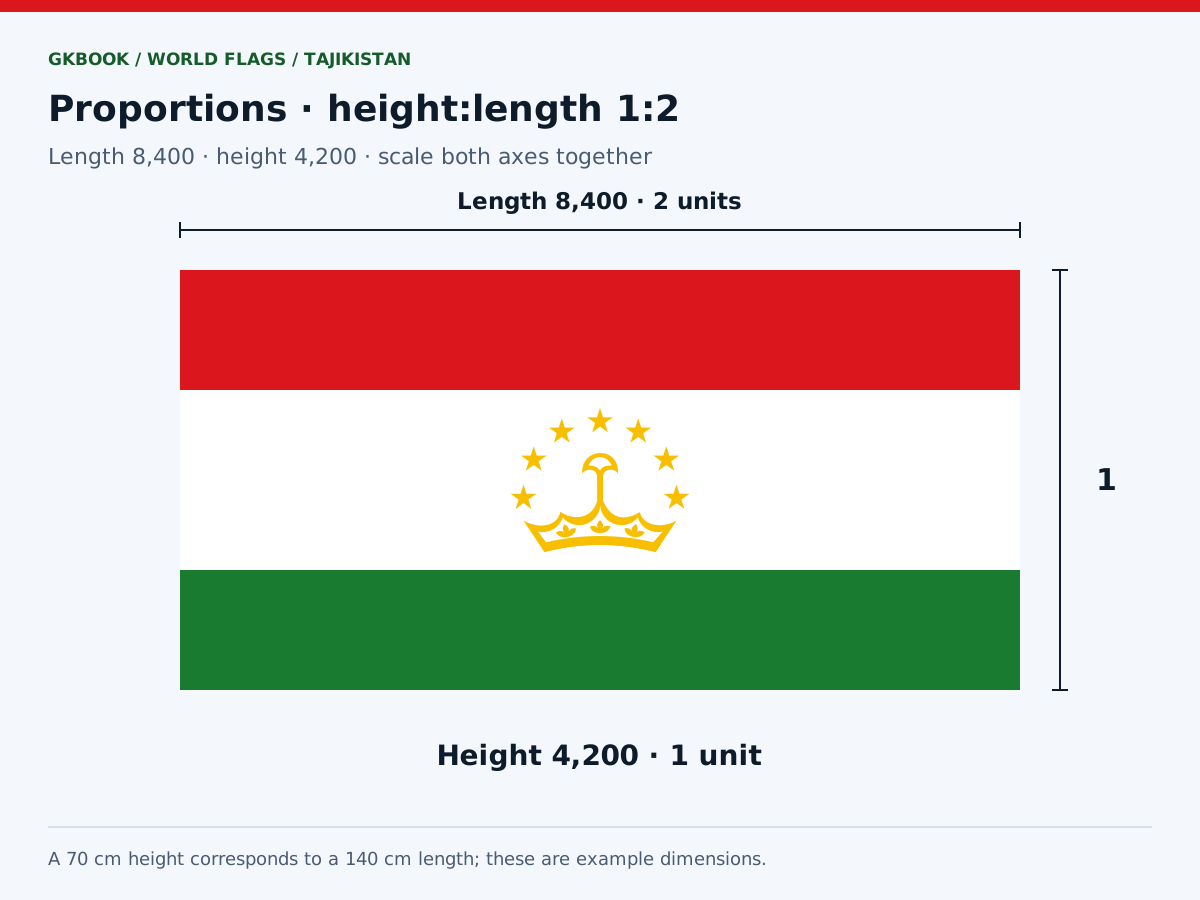
Always identify which dimension comes first. “One to two” means height to length here, while length to height would be written as two to one. A width field in software usually refers to the horizontal dimension, which can create confusion when a translated legal description uses width for the shorter side.
A flag 70 centimeters tall would be 140 centimeters long. A digital image 1,200 pixels long would be 600 pixels tall. These are examples of proportional scaling, not mandatory product sizes. The relationship stays constant whether the output is a small illustration, a classroom poster, or a fabric flag.
How wide are the three stripes?
The stripe heights are red:white:green = 2:3:2. Divide the overall height into seven equal units: red receives two, white receives three, and green receives two. In the 4,200-unit master, those heights are 1,200, 1,800, and 1,200 units respectively, with each stripe spanning the full 8,400-unit length.

The first boundary lies two sevenths of the way down from the top. The second lies five sevenths of the way down. Working from those boundary coordinates avoids accumulated rounding when a small raster image cannot express every seventh as an integer number of pixels. The vector retains the exact relationships.
For a 70-centimeter-high flag, the stripe heights become 20, 30, and 20 centimeters. Equal thirds would instead give approximately 23.33 centimeters to each stripe and would be incorrect. The broad middle stripe is part of the national design, not an optional visual adjustment made to accommodate the crown.
How large is the crown-and-stars group?
The legal description places the crown and stars within a rectangle whose width equals the white stripe’s height and whose height is 0.8 of that measurement. With a white stripe 1,800 units tall, the reference envelope is 1,800 × 1,440. This drawing centers that envelope within the complete flag.

Treat this rectangle as a construction envelope rather than a printed box. Its edges are absent from the clean flag. In the supplied master it extends from x = 3,300 to 5,100 and from y = 1,380 to 2,820, using a top-left origin with vertical coordinates increasing downward.
The envelope leaves 180 units above and below inside the white stripe. The outer corners remain empty because the crown and the arch of stars do not fill a rectangle. An envelope states where shapes can fit; it does not mean that gold occupies its entire area or reaches every edge.
How are the individual five-pointed stars constructed?
Each star fits a circle whose diameter is 0.15 of the white stripe’s height. In this master that diameter is 270 units, so the outer radius is 135. The supplied drawing uses regular five-pointed stars with one point upward and a smaller alternating inner radius to form the five notches.

The inner radius used here is approximately 51.565412 units. It follows the regular pentagram relationship: outer radius multiplied by the sine of eighteen degrees divided by the sine of fifty-four degrees. This construction is explicitly recorded so that a rebuilt SVG produces the same points rather than relying on a font.
The circumcircle is a measurement aid, not a white outline around the star. The star’s visible horizontal extent is slightly smaller than its circle’s diameter because no outward tip points directly left or right. Distinguishing the circle from the filled polygon prevents small but systematic errors in spacing calculations.
How are the seven stars arranged above the crown?
The stars follow a semicircular arrangement. This edition places their centers at equal 30-degree intervals on a radius of 765 master units, or 0.425 of the white stripe height. Their circumcircles then fit an outer envelope of radius 0.5 of that height. This is a declared interpretation of the legal wording.

The description gives a half-stripe arc radius but does not explicitly say whether that arc passes through star centers or their outside envelope. Placing the centers on that larger radius would extend the stars beyond the separately stated group width. The drawing therefore records its interpretation instead of concealing the ambiguity.
The central star is highest, while three stars descend on each side. Their center coordinates can be generated from one circle and seven angles, which makes the arrangement reproducible. The crown’s detailed curves remain a separate construction problem; regular star positions do not establish a unique mathematical solution for the whole emblem.
Are all of the crown’s curves mathematically specified?
The legal description supplies several crown measurements, including a height of 0.55 of the white stripe height, a base-arc radius of 1.2, and a central circular feature of diameter 0.2. It does not provide a complete digital path. This collection preserves reference-based curves and identifies that limitation explicitly.

The master crown is 990 units tall, matching the stated height when the white stripe is 1,800 units tall. Its detailed outline and interior openings come from seven filled vector paths. The drawing retains those curves under one uniform scale, rather than changing their width and height independently.
The supplied paths are not certified exact circular solutions for the other nominal measurements. Readers should use the dimension panel to understand what the text specifies and the clean flag to see this edition’s artwork. A fabrication project requiring formally approved production geometry would need the applicable authoritative production drawing.
Where should the central device be placed?
The crown-and-stars group belongs at the horizontal midpoint of the flag, inside the white stripe. This master uses x = 4,200 as its central reference and centers its 1,800 × 1,440 construction envelope vertically at y = 2,100. The gold shapes remain clear of both colored outer bands.

The coordinate origin is the top-left corner of the complete flag, not the center of the crown. The white band begins at y = 1,200 and ends at y = 3,000. Using a consistent origin makes the stripe boundaries, star centers, and envelope margins directly comparable in one drawing.
Centering the envelope does not mean every individual gold shape is centered on the flag’s midpoint. The stars occupy its upper portion and the crown occupies the lower portion. The arrangement is balanced as a group, while each component has a different location and a different visible outline.
What fraction of the flag does each stripe occupy?
The red and green stripes each occupy two sevenths of the complete rectangle, approximately 28.5714 percent. The white stripe’s underlying rectangle occupies three sevenths, approximately 42.8571 percent. Because gold covers part of that white rectangle, the amount of visible white is smaller. These stripe fractions are geometric, without an additional symbolic allocation.
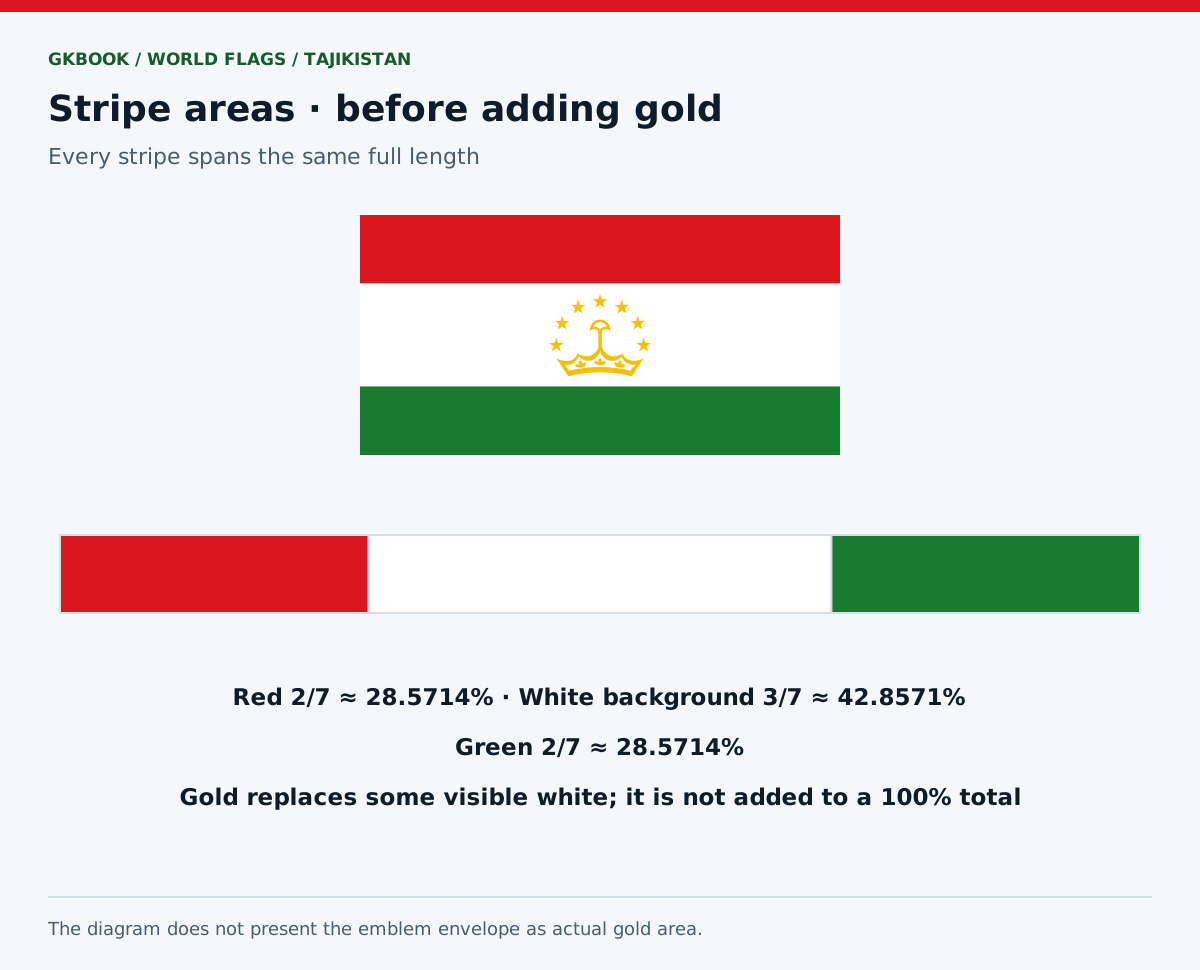
The calculation is straightforward because all three stripes have the same length. Their area ratio therefore matches their height ratio. Multiplying each stripe height by 8,400 gives areas of 10,080,000, 15,120,000, and 10,080,000 square master units before the central device is added over the middle stripe.
Do not add a gold percentage to the three background percentages without subtracting the same area from white. That would count part of the flag twice. This guide gives exact background fractions and avoids presenting a nominal bounding rectangle as the actual area of the crown and stars.
How did the Tajikistan flag develop?
The current design emerged after Tajikistan’s independence, replacing the earlier Soviet-era flag in 1992. The National Bank’s historical account distinguishes the 1953 Tajik Soviet flag from the present crown-and-stars design. Red, white, and green appear in that earlier history, but the complete compositions and their political contexts are different.

A useful timeline separates independence in September 1991, United Nations admission in March 1992, and adoption of the present flag in November 1992. These events concern different aspects of state history. Their sequence shows why a country’s independence date should not automatically be used as its current flag’s adoption date.
The historical diagram uses labeled milestones instead of invented archival facsimiles. Reconstructing a particular older flag would require its own dated artwork and specifications. The present master should not be pasted into an earlier scene merely because the national name is familiar; a historical illustration needs to match the period it describes.
When was the current Tajikistan flag adopted?
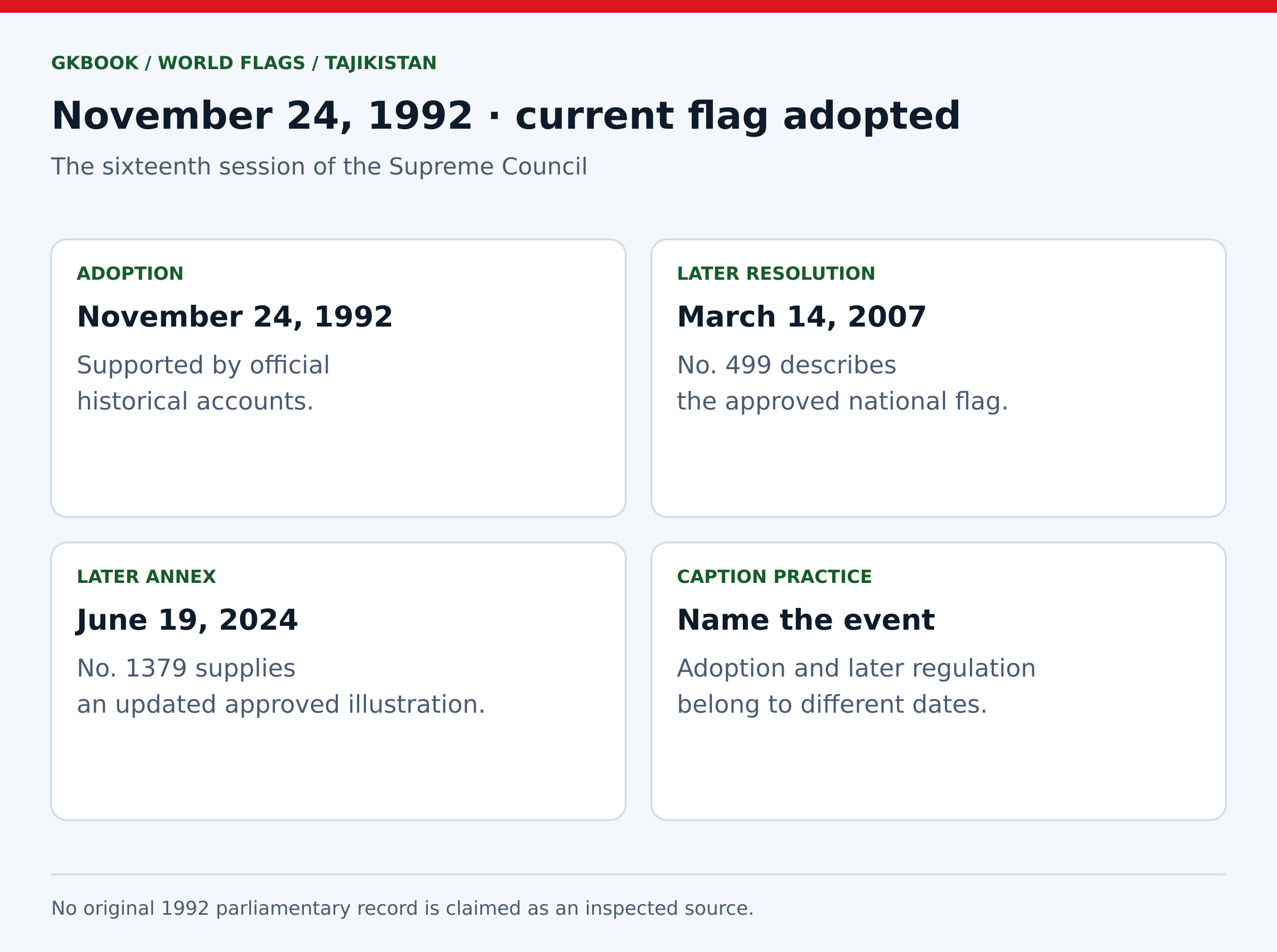
The current flag was adopted on November 24, 1992, during the sixteenth session of the Supreme Council. That date is supported by official historical accounts and is also the calendar date commemorated by Flag Day. It should be distinguished from independence in 1991 and later legislation regulating the state symbols.

The date can be written unambiguously as November 24, 1992 in an English caption. A bare numerical date can be read differently across countries. Pairing the date with the event, such as “adoption of the current national flag,” makes its significance clear even when the image appears outside this article.
Later regulations and revised illustrations do not move the original adoption into a new year. The 2007 approval resolution and its 2024 amendment belong to the design’s regulatory history. Keeping these layers separate allows a reference entry to be both historically useful and transparent about the documents behind its present drawing.
Who designed the Tajikistan flag?
An official Khovar report about a National Museum exhibition identifies artist Zuhur Habibulloev as a designer of the first state flag. That supports naming him in the design history. This article does not turn the museum attribution into an unsupported claim that every stage of development was the work of one person.
The report describes an exhibition opened in January 2023 and attributes its information to a museum representative. It is a retrospective institutional account, not the original design commission’s archive. The distinction matters when a brief biographical statement is used to answer a broader question about a collaborative national design process.
Also separate the historical designer from the people who encoded later digital files. A modern SVG contributor may repair a curve or recolor an image without becoming the national flag’s designer. The credits for this collection identify the artwork adaptation independently of the historical attribution given here.
Which official documents describe the flag?
The detailed flag description appears in parliamentary Resolution No. 499 of March 14, 2007, as amended by Resolution No. 1379 of June 19, 2024. The actual 2024 annex includes an approved illustration. The broader State Symbols Law establishes the legal framework, while the drawing and numerical reproduction choices require separate documentation.
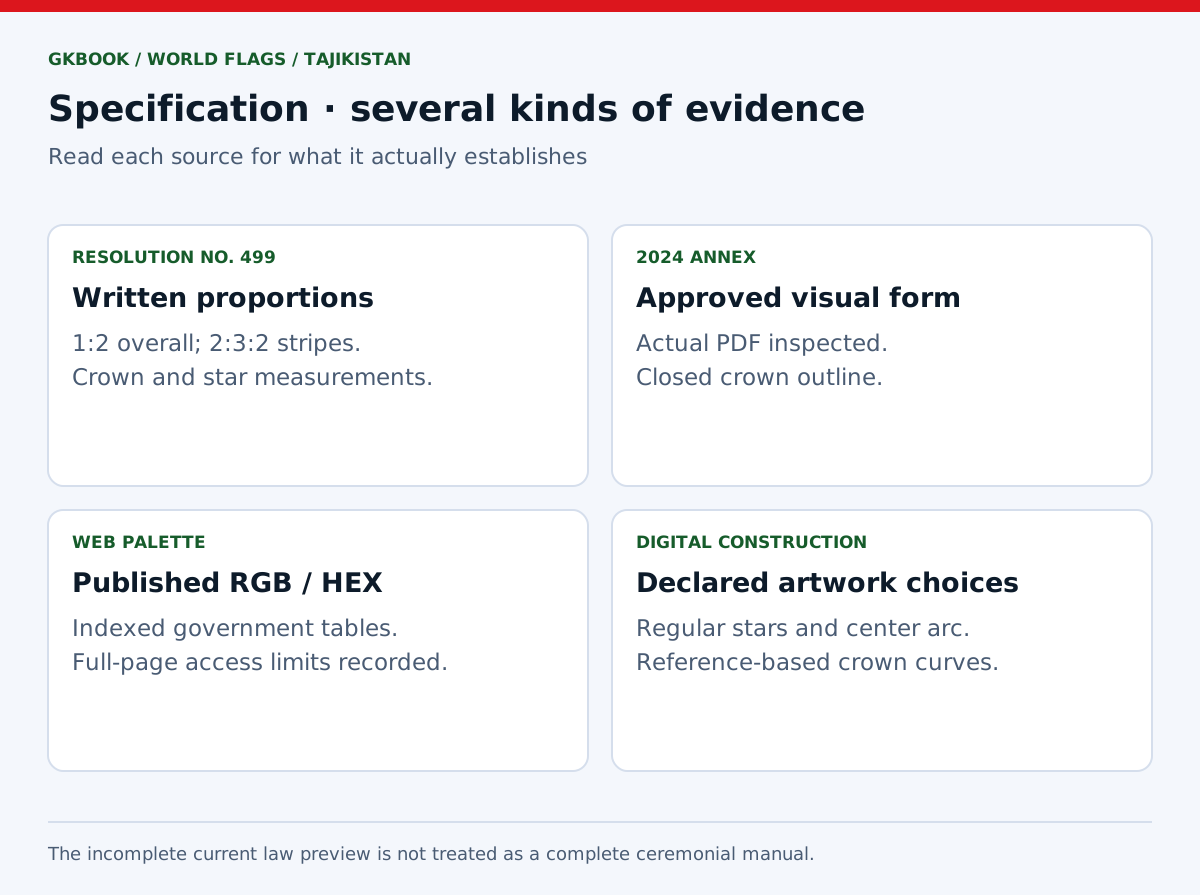
The description specifies the overall rectangle, unequal stripes, crown, seven stars, and several relative measurements. The illustrated annex helps resolve the visible closed-crown form. It is a shaded raster illustration within a document page, however, so measuring its displayed page width or sampling its lighting effects would not improve the legal proportions.
The accessible current State Symbols Law preview is incomplete and lists later amendments. Accordingly, this article does not claim to reproduce a complete current display manual. It focuses on the verified design description and keeps ceremonial interpretation, legal use, published digital colors, and the supplied artwork’s construction choices distinct.
When is Tajikistan Flag Day?
Tajikistan Flag Day is observed on November 24, the anniversary of the current flag’s adoption. The annual observance was established in 2009. These are two separate dates: 1992 belongs to the adoption of the flag, while 2009 belongs to the creation of the recurring commemorative day.

The National Bank published an explanation in November 2009 discussing the new observance and the significance of the flag. That contemporary account is useful for distinguishing the holiday’s origin from later anniversary reporting. A caption should name the year of the particular celebration rather than presenting an undated crowd scene as current.
An anniversary tells readers what is being commemorated, but it does not establish a fixed event program for every year. The flag illustration here is a reference image. Any account of a particular ceremony should separately identify its date, location, organizer, and the actual flags or standards visible in the scene.
Was the current flag adopted on Independence Day?
No. Tajikistan declared independence on September 9, 1991, while the current flag was adopted on November 24, 1992. Independence Day and Flag Day therefore commemorate different events on different dates. Both can involve the national flag, but their shared visual symbol does not make their historical origins the same.

This distinction is especially useful in timelines. The flag’s adoption followed independence by more than a year. An illustration of the present flag beside the independence date can be appropriate as a modern national identifier, provided the caption does not imply that the design itself was adopted on that earlier day.
For educational material, place the event name directly beside each date. “Independence” and “current flag adopted” are clearer than a row of years without explanations. The same principle applies to later laws: readers should be able to tell whether a date refers to a state event, a flag design, or its regulation.
Was the current flag already in use when Tajikistan joined the UN?
Tajikistan joined the United Nations on March 2, 1992, before the current flag’s adoption that November. The UN country office records the membership date. Membership and flag adoption are separate historical events, so the current design should not automatically be treated as the flag shown in every photograph of that earlier milestone.
The present flag often appears in modern summaries of a country’s international participation. That editorial use identifies the country today; it does not date the design to the beginning of membership. A historical photograph needs its own caption and visual identification, especially when a national symbol changed within the same year.
An international display also has a specific institutional setting. National flags, organizational flags, and special standards can appear together while serving different purposes. The March date establishes the membership milestone here; it is not evidence for a different stripe ratio, a special UN version, or a separate national flag design.
Is the crown-and-stars device the national coat of arms?
The crown and seven stars are shared national motifs, but the flag’s central device is not the complete coat of arms. The state emblem has a larger surrounding composition. The clean flag uses only the prescribed crown-and-stars group within its white stripe, without importing the emblem’s additional surrounding elements.

Related symbols often reuse a distinctive central motif. That relationship does not make their outer shapes interchangeable. When labeling an enlarged flag detail, “crown and stars from the national flag” is more precise than calling the isolated detail the entire state emblem. It tells readers exactly what has been extracted.
The comparison panel is explanatory and does not supply an improvised coat-of-arms drawing. Reproducing that emblem would require its own authoritative artwork, proportions, and color checks. Keeping the flag master focused on its actual contents prevents accidental additions when it is reused in a page, poster, or reference collection.
How does the presidential standard differ from the national flag?
Tajikistan’s presidential standard is a separate official symbol. The law describing it retains the unequal red, white, and green bands but places a more elaborate Derafsh Kaviani composition in the center, including a winged lion. The national flag instead has the simpler crown-and-seven-stars group shown throughout this collection.

The relevant law is No. 192 of July 28, 2006. Its description also includes gold edging and fringe, features associated with the standard rather than the clean national flag artwork. A photograph near a presidential setting should therefore be checked for the central composition before the flag is identified.
This collection explains the distinction without fabricating a second production master. The shared colors alone are insufficient to identify the symbol. Look at the central device and the object’s role in the ceremony, then use a caption that distinguishes the national flag from the standard associated with the presidential office.
How can the Tajikistan flag be distinguished from similar tricolors?
Identify Tajikistan by the combination of horizontal red, white, and green bands, the wider white middle stripe, and the gold crown with seven stars. Color order alone is insufficient. The unequal stripe proportions and the central device are the strongest checks when comparing small images that use a similar palette.

Begin with the complete rectangle before zooming into the emblem. A thumbnail can hide small symbols, and a cropped image can remove the proportions that distinguish one design from another. The 1:2 outer ratio and 2:3:2 stripe pattern provide two independent structural clues alongside the gold central group.
For a reference chart, keep every flag inside a clearly labeled area and avoid forcing all designs into one shared shape. Equal display boxes can contain different flag proportions without stretching them. A precise comparison respects each design’s own boundaries and keeps decorative backgrounds separate from the flags being compared.
What happens if the Tajikistan flag is rotated vertically?
A clockwise quarter-turn makes the original red top stripe appear on the right, the green bottom stripe on the left, and the crown and stars turn sideways with the whole rectangle. This collection shows that geometric rotation only. It does not present the result as a verified official instruction for vertical ceremonial display.
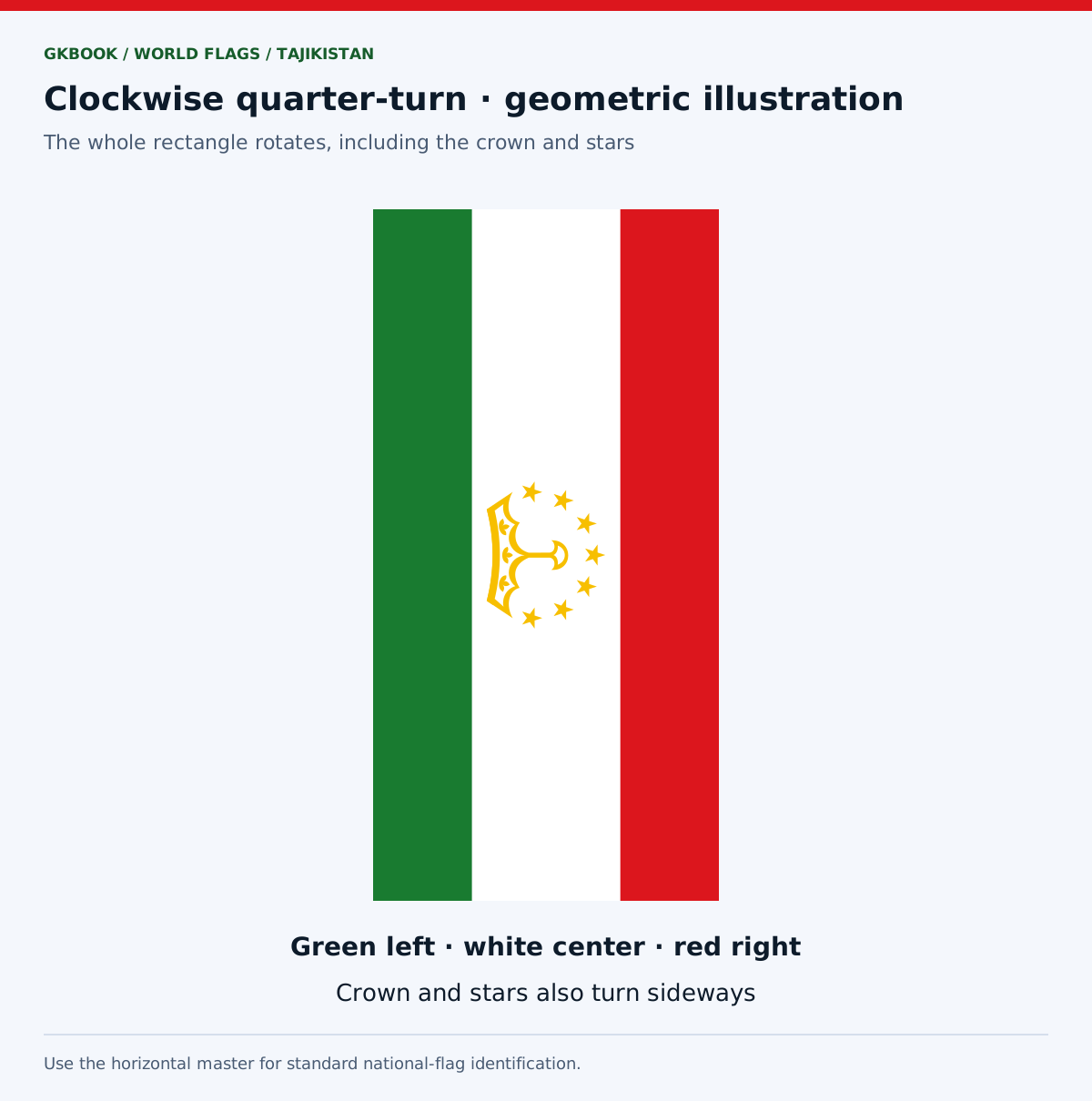
A rotation preserves distances and angles because every point moves through the same turn. The finished tall rectangle has width:height 1:2, while its original horizontal version has height:length 1:2. Those statements describe the same physical rectangle in different orientations, so label the axes when discussing a vertical diagram.
Do not rotate only the stripes and independently keep the crown upright unless an authoritative design instruction requires that separate treatment. Such a change creates a new arrangement rather than a simple rotation. The horizontal front-view master remains the reference image for identifying the national design in this collection.
Does the reverse look the same as the front?
A reverse view is a horizontal reflection of the complete flag. The stripe order remains red, white, and green from top to bottom, and the central group remains recognizable. This edition’s retained crown curves have small asymmetries, so its mirrored artwork is not claimed to be pixel-identical to the front.

The idealized arrangement of evenly spaced upright stars has bilateral symmetry around the vertical midpoint. Reflection swaps the three stars on the left with the three on the right while leaving the central star in place. The detailed crown paths are a separate matter and retain the source’s minor irregularities.
A flat reflection is different from a half-turn, which would put green at the top and invert the crown. It is also different from a photograph through moving fabric, where folds and light affect appearance. The paired diagram demonstrates the geometric relationship without claiming a complete cloth-manufacturing specification.
How should the Tajikistan flag files be resized or printed?
Use the SVG for scalable vector artwork and the 8,400 × 4,200 PNG for a large fixed raster image. Keep the full 1:2 height:length rectangle and scale both axes together. At 300 pixels per inch, the PNG corresponds to 28 × 14 inches. Proof the chosen output process for color.

The SVG keeps the stripe edges, star vertices, and crown curves independent of a particular pixel grid. The PNG provides an opaque RGB image without requiring an SVG renderer. When preparing a smaller thumbnail, inspect the crown openings and the spaces between stars because fine details can merge at very small sizes.
The gallery supplies twenty-four subjects in both formats. Choose the clean flag for identification and the labeled diagrams for explanation. Construction lines, captions, comparison panels, and the separate social card serve educational layouts; they are not extra features to copy onto a national flag or a fabric production pattern.
Download Tajikistan flag pictures
Download the complete current flag as SVG or 8,400 × 4,200 PNG. The height:length ratio is 1:2, with red, white, and green stripe heights of 2:3:2. The gold crown and seven stars use documented construction choices and a government web palette.
The gallery contains 24 subjects, each with an SVG and PNG. Captions distinguish the clean flag from construction guides, historical explanations, and geometric transformations. Image credits and reproduction notes identify the artwork basis and its limits. The separate 1,200 × 630 social card contains a complete 540 × 270 flag.
Continue exploring national designs in World Flags.
World Flags/Tajikistan
Tajikistan flag pictures
National flag with exact overall and stripe proportions, a government web palette, and declared central-device construction.
GKBook educational layout; crown paths adapted from credited Commons artwork, checked against the 2024 official annex. No official certification.Download SVGDownload PNGRed #DC161D, white #FFFFFF, green #197B30, and gold #F7BF00. Published web values are distinguished from statutory numerical colors and physical production standards.
GKBook educational layout; crown paths adapted from credited Commons artwork, checked against the 2024 official annex. No official certification.Download SVGDownload PNGThe National Bank and Khovar explain national aspirations through the flag’s colors and symbols.
GKBook educational layout; crown paths adapted from credited Commons artwork, checked against the 2024 official annex. No official certification.Download SVGDownload PNGEnlarged crown with closed sides, a central raised feature, and three internal decorative forms; reference curves are a declared adaptation.
GKBook educational layout; crown paths adapted from credited Commons artwork, checked against the 2024 official annex. No official certification.Download SVGDownload PNGNumbers count stars from left to right through the upper arch; numbering is an explanatory addition.
GKBook educational layout; crown paths adapted from credited Commons artwork, checked against the 2024 official annex. No official certification.Download SVGDownload PNGThe flag is twice as long as it is tall. The 8,400 × 4,200 master is one scalable example.
GKBook educational layout; crown paths adapted from credited Commons artwork, checked against the 2024 official annex. No official certification.Download SVGDownload PNGRed 1,200, white 1,800, and green 1,200 master units; every stripe is 8,400 units long.
GKBook educational layout; crown paths adapted from credited Commons artwork, checked against the 2024 official annex. No official certification.Download SVGDownload PNGThe centered construction envelope is 1,800 units wide and 1,440 high; it is absent from the clean flag.
GKBook educational layout; crown paths adapted from credited Commons artwork, checked against the 2024 official annex. No official certification.Download SVGDownload PNGThe star circumcircle is 270 units across. This edition uses regular pentagram geometry for the ten alternating vertices.
GKBook educational layout; crown paths adapted from credited Commons artwork, checked against the 2024 official annex. No official certification.Download SVGDownload PNGThe stated half-stripe arc is interpreted as an outer circumcircle envelope; centers use 0.425B. The legal wording does not explicitly identify the center path.
GKBook educational layout; crown paths adapted from credited Commons artwork, checked against the 2024 official annex. No official certification.Download SVGDownload PNGThe stated crown height is enforced; the retained Bezier curves are not certified exact solutions for every nominal circle.
GKBook educational layout; crown paths adapted from credited Commons artwork, checked against the 2024 official annex. No official certification.Download SVGDownload PNGThe envelope is centered on the complete rectangle and stays inside the white stripe. Guides are explanatory.
GKBook educational layout; crown paths adapted from credited Commons artwork, checked against the 2024 official annex. No official certification.Download SVGDownload PNGThese are underlying stripe fractions. Visible white is smaller after the crown and stars are placed over it.
GKBook educational layout; crown paths adapted from credited Commons artwork, checked against the 2024 official annex. No official certification.Download SVGDownload PNGA selective timeline distinguishes the earlier flag, independence, UN admission, and adoption of the current national design.
GKBook educational layout; crown paths adapted from credited Commons artwork, checked against the 2024 official annex. No official certification.Download SVGDownload PNGThe adoption date is separate from later legislation and the inspected 2024 annex.
GKBook educational layout; crown paths adapted from credited Commons artwork, checked against the 2024 official annex. No official certification.Download SVGDownload PNGLegal ratios, inspected illustration, published web palette, and reconstruction choices are separately documented.
GKBook educational layout; crown paths adapted from credited Commons artwork, checked against the 2024 official annex. No official certification.Download SVGDownload PNGThe design dates to 1992; the recurring observance dates to 2009.
GKBook educational layout; crown paths adapted from credited Commons artwork, checked against the 2024 official annex. No official certification.Download SVGDownload PNGIndependence Day and Flag Day have different dates and commemorate different historical events.
GKBook educational layout; crown paths adapted from credited Commons artwork, checked against the 2024 official annex. No official certification.Download SVGDownload PNGThe central motif appears in related national symbols, but the isolated flag device is not the complete coat of arms.
GKBook educational layout; crown paths adapted from credited Commons artwork, checked against the 2024 official annex. No official certification.Download SVGDownload PNGThe presidential standard has a separately described elaborate composition; this collection supplies the national flag.
GKBook educational layout; crown paths adapted from credited Commons artwork, checked against the 2024 official annex. No official certification.Download SVGDownload PNGThe unequal stripes, long rectangle, and gold central device distinguish the complete design.
GKBook educational layout; crown paths adapted from credited Commons artwork, checked against the 2024 official annex. No official certification.Download SVGDownload PNGA clockwise 90-degree rotation preserves the whole drawing. It is not a verified official hanging prescription.
GKBook educational layout; crown paths adapted from credited Commons artwork, checked against the 2024 official annex. No official certification.Download SVGDownload PNGThe reverse is an actual horizontal reflection; the source crown’s minor asymmetries are retained.
GKBook educational layout; crown paths adapted from credited Commons artwork, checked against the 2024 official annex. No official certification.Download SVGDownload PNGThe main flag preserves the 1:2 height:length ratio; digital colors do not guarantee a physical print match.
GKBook educational layout; crown paths adapted from credited Commons artwork, checked against the 2024 official annex. No official certification.Download SVGDownload PNGFrequently asked questions
What does the Tajikistan flag look like?
The Tajikistan flag has three horizontal bands: red at the top, a wider white band in the middle, and green below. A gold crown and seven gold stars occupy the center. Its height:length ratio is 1:2, while the stripe heights follow a 2:3:2 pattern.
What is the official name of the Tajikistan flag?
The formal designation is the State Flag of the Republic of Tajikistan. In Tajik it is Парчами давлатии Ҷумҳурии Тоҷикистон. “Tajikistan flag” is a convenient English index label for the same national design. The name identifies the complete flag, including its unequal bands, crown, and seven stars.
What are the colors of the Tajikistan flag?
The flag uses red, white, green, and gold. This collection uses red #DC161D, white #FFFFFF, green #197B30, and gold #F7BF00, matching the indexed government website palette. These digital values describe the supplied artwork; they are not presented as statutory numerical colors or a universal textile standard.
What does the Tajikistan flag mean?
Official explanations connect the flag with sovereignty, national identity, and aspirations for a flourishing country. Red is associated with struggle for freedom, white with happiness and hope, and green with prosperity. The crown and seven stars add themes of statehood and good fortune, expressed through an established national composition.
Why is there a crown on the Tajikistan flag?
The gold crown represents statehood and sovereignty in official cultural explanations of the flag. It is a stylized national symbol placed beneath seven stars in the white stripe. Its presence does not indicate that modern Tajikistan is a monarchy, and the crown is not the entire national coat of arms.
Why are there seven stars on the Tajikistan flag?
The flag has seven five-pointed gold stars arranged above the crown. Khovar’s cultural explanation links seven with happiness, completeness, and good fortune in Tajik tradition. The stars form a symbolic group; this article does not assign them to seven present-day administrative units or treat them as an astronomical constellation.
What does the red stripe represent?
The red stripe is associated with the struggle and sacrifice for freedom and independence in the National Bank’s published explanation. It forms the upper two sevenths of the flag’s height. Its meaning is historical and symbolic; the precise area of red is a separate consequence of the stripe proportions.
What does the white stripe represent?
The white stripe is associated with happiness, hope, and well-being in official explanations. It is the widest stripe and carries the gold crown and stars. Its height is three sevenths of the total flag height, making it one and a half times as tall as either the red or green stripe.
What does the green stripe represent?
The green stripe is associated with prosperity and flourishing life in official explanations of the flag. It occupies the lower two sevenths of the rectangle and matches the red stripe in height. The green is a solid band, without lettering, a crescent, or any additional emblem inside it.
What is the official ratio of the Tajikistan flag?
The official height:length ratio is 1:2. The flag is therefore twice as long as it is tall, measured as a flat rectangle. This collection uses an 8,400 × 4,200 master. Enlarging or reducing both dimensions by the same factor preserves the ratio and the shape of every internal element.
How wide are the three stripes?
The stripe heights are red:white:green = 2:3:2. Divide the overall height into seven equal units: red receives two, white receives three, and green receives two. In the 4,200-unit master, those heights are 1,200, 1,800, and 1,200 units respectively, with each stripe spanning the full 8,400-unit length.
How large is the crown-and-stars group?
The legal description places the crown and stars within a rectangle whose width equals the white stripe’s height and whose height is 0.8 of that measurement. With a white stripe 1,800 units tall, the reference envelope is 1,800 × 1,440. This drawing centers that envelope within the complete flag.
How are the individual five-pointed stars constructed?
Each star fits a circle whose diameter is 0.15 of the white stripe’s height. In this master that diameter is 270 units, so the outer radius is 135. The supplied drawing uses regular five-pointed stars with one point upward and a smaller alternating inner radius to form the five notches.
How are the seven stars arranged above the crown?
The stars follow a semicircular arrangement. This edition places their centers at equal 30-degree intervals on a radius of 765 master units, or 0.425 of the white stripe height. Their circumcircles then fit an outer envelope of radius 0.5 of that height. This is a declared interpretation of the legal wording.
Are all of the crown’s curves mathematically specified?
The legal description supplies several crown measurements, including a height of 0.55 of the white stripe height, a base-arc radius of 1.2, and a central circular feature of diameter 0.2. It does not provide a complete digital path. This collection preserves reference-based curves and identifies that limitation explicitly.
Where should the central device be placed?
The crown-and-stars group belongs at the horizontal midpoint of the flag, inside the white stripe. This master uses x = 4,200 as its central reference and centers its 1,800 × 1,440 construction envelope vertically at y = 2,100. The gold shapes remain clear of both colored outer bands.
What fraction of the flag does each stripe occupy?
The red and green stripes each occupy two sevenths of the complete rectangle, approximately 28.5714 percent. The white stripe’s underlying rectangle occupies three sevenths, approximately 42.8571 percent. Because gold covers part of that white rectangle, the amount of visible white is smaller. These stripe fractions are geometric, without an additional symbolic allocation.
How did the Tajikistan flag develop?
The current design emerged after Tajikistan’s independence, replacing the earlier Soviet-era flag in 1992. The National Bank’s historical account distinguishes the 1953 Tajik Soviet flag from the present crown-and-stars design. Red, white, and green appear in that earlier history, but the complete compositions and their political contexts are different.
When was the current Tajikistan flag adopted?
The current flag was adopted on November 24, 1992, during the sixteenth session of the Supreme Council. That date is supported by official historical accounts and is also the calendar date commemorated by Flag Day. It should be distinguished from independence in 1991 and later legislation regulating the state symbols.
Who designed the Tajikistan flag?
An official Khovar report about a National Museum exhibition identifies artist Zuhur Habibulloev as a designer of the first state flag. That supports naming him in the design history. This article does not turn the museum attribution into an unsupported claim that every stage of development was the work of one person.
Which official documents describe the flag?
The detailed flag description appears in parliamentary Resolution No. 499 of March 14, 2007, as amended by Resolution No. 1379 of June 19, 2024. The actual 2024 annex includes an approved illustration. The broader State Symbols Law establishes the legal framework, while the drawing and numerical reproduction choices require separate documentation.
When is Tajikistan Flag Day?
Tajikistan Flag Day is observed on November 24, the anniversary of the current flag’s adoption. The annual observance was established in 2009. These are two separate dates: 1992 belongs to the adoption of the flag, while 2009 belongs to the creation of the recurring commemorative day.
Was the current flag adopted on Independence Day?
No. Tajikistan declared independence on September 9, 1991, while the current flag was adopted on November 24, 1992. Independence Day and Flag Day therefore commemorate different events on different dates. Both can involve the national flag, but their shared visual symbol does not make their historical origins the same.
Was the current flag already in use when Tajikistan joined the UN?
Tajikistan joined the United Nations on March 2, 1992, before the current flag’s adoption that November. The UN country office records the membership date. Membership and flag adoption are separate historical events, so the current design should not automatically be treated as the flag shown in every photograph of that earlier milestone.
Is the crown-and-stars device the national coat of arms?
The crown and seven stars are shared national motifs, but the flag’s central device is not the complete coat of arms. The state emblem has a larger surrounding composition. The clean flag uses only the prescribed crown-and-stars group within its white stripe, without importing the emblem’s additional surrounding elements.
How does the presidential standard differ from the national flag?
Tajikistan’s presidential standard is a separate official symbol. The law describing it retains the unequal red, white, and green bands but places a more elaborate Derafsh Kaviani composition in the center, including a winged lion. The national flag instead has the simpler crown-and-seven-stars group shown throughout this collection.
How can the Tajikistan flag be distinguished from similar tricolors?
Identify Tajikistan by the combination of horizontal red, white, and green bands, the wider white middle stripe, and the gold crown with seven stars. Color order alone is insufficient. The unequal stripe proportions and the central device are the strongest checks when comparing small images that use a similar palette.
What happens if the Tajikistan flag is rotated vertically?
A clockwise quarter-turn makes the original red top stripe appear on the right, the green bottom stripe on the left, and the crown and stars turn sideways with the whole rectangle. This collection shows that geometric rotation only. It does not present the result as a verified official instruction for vertical ceremonial display.
Does the reverse look the same as the front?
A reverse view is a horizontal reflection of the complete flag. The stripe order remains red, white, and green from top to bottom, and the central group remains recognizable. This edition’s retained crown curves have small asymmetries, so its mirrored artwork is not claimed to be pixel-identical to the front.
How should the Tajikistan flag files be resized or printed?
Use the SVG for scalable vector artwork and the 8,400 × 4,200 PNG for a large fixed raster image. Keep the full 1:2 height:length rectangle and scale both axes together. At 300 pixels per inch, the PNG corresponds to 28 × 14 inches. Proof the chosen output process for color.
Every general-knowledge topic and the A-to-Z lists.
The world A to Z: flags, countries, the sciences, places, people, subjects.





We Value Your Opinion Comments