
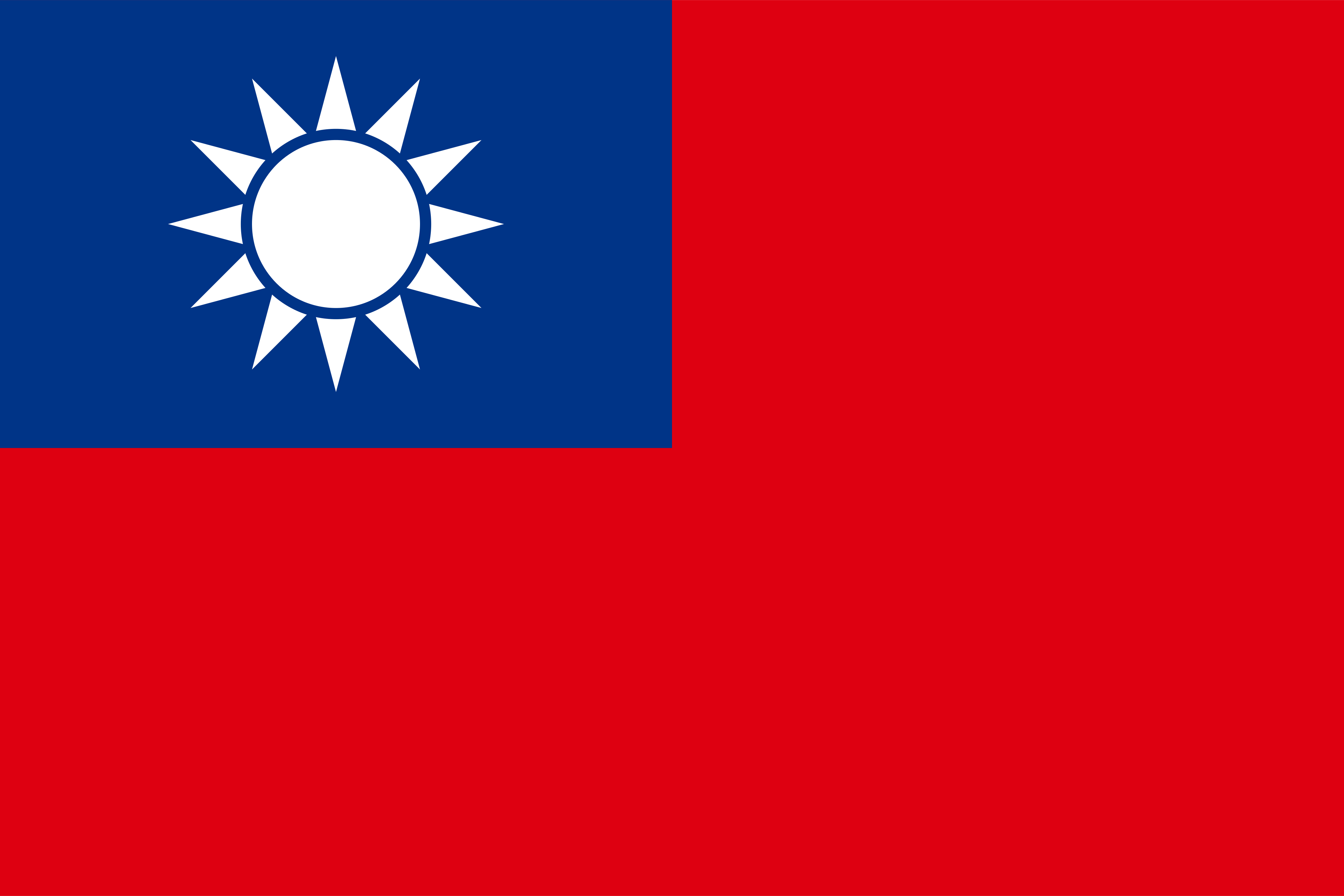
Taiwan flag picture
Explore the proportions, history, and picture gallery.
| National design | Republic of China (Taiwan)East Asia; formal constitutional name distinguished from the short index label. |
|---|---|
| Design | Red field · blue canton · white sunTwelve rays with a blue separation ring around the disk. |
| Proportions | Height:length = 2:3Canton: half the complete length and half the complete height. |
| Governmental adoption | May 5, 1921Sun Yat-sen’s government in Guangzhou. |
| Nationwide flag law | December 17, 1928Later statutory revision: October 23, 1954. |
| Main image sizes | SVG and PNG: 7,200 × 4,800Complete rectangle; opaque RGB PNG. |
Numerical RGB colors are sampled from the official Presidential Office JPEG; they are declared reproduction values, not statutory HEX codes.
What does the Taiwan flag look like?
Taiwan’s familiar national flag is the flag of the Republic of China: a red rectangle with a blue canton in the upper hoist corner. A white sun with twelve pointed rays sits inside the canton. Its height-to-length ratio is 2:3, and the canton occupies one quarter of the rectangle.
Begin with the complete arrangement: a large red field, a smaller blue rectangle, and a single white sun. The canton touches the top edge and the edge nearest the pole. On the front view shown here, that means the upper left. Its sun is centered within the canton, rather than within the whole flag. The illustrations distinguish the clean national design from enlarged details, measurements, and historical explanations.
What is the Taiwan flag called?
The formal name is the national flag of the Republic of China, often identified internationally as the Taiwan flag. Its descriptive Chinese name, Qing Tian Bai Ri Man Di Hong, refers to a blue sky, a white sun, and a red field. The complete three-color composition matters when identifying it.
“Taiwan flag” is a convenient country-index label, while “Republic of China flag” identifies the constitutional name associated with this design. Use the fuller wording when explaining official documents, historical adoption, or international sporting arrangements.
The phrase blue sky and white sun can also describe the earlier blue-and-white motif without the red field. Adding the red-field description removes that ambiguity. In captions, identify whether an image shows the complete national flag, its canton, or a separate emblem.
What are the colors of the Taiwan flag?
The flag has a red field, a blue canton, and a white sun. This collection uses red #DE0011, blue #003487, and white #FFFFFF, sampled from flat areas of the Presidential Office’s published JPEG. These are documented digital reproduction values; the governing law does not prescribe those numerical screen codes.
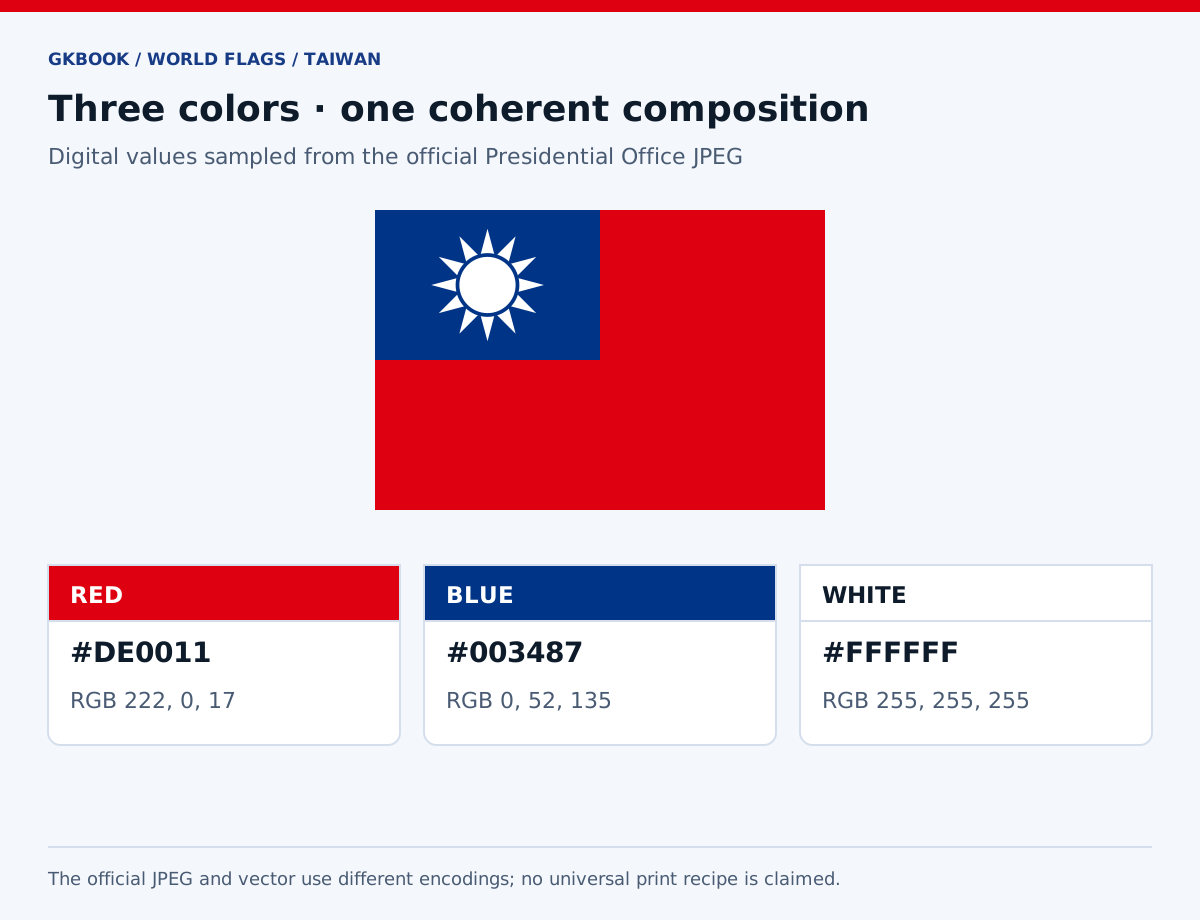
Color names and numerical encodings answer different questions. The statute establishes red, blue, and white as parts of the composition. A screen file must additionally choose channel values. The official JPEG and downloadable vector artwork use different encodings, so a single sampled palette should not be presented as the only legally permitted set.
White is an opaque fill in these exports. It is not a transparent hole through which a website background should show. For printing, keep the source file and obtain a proof appropriate to the chosen material. An RGB triplet alone cannot guarantee identical appearance on a monitor, paper, and woven fabric.
| Part | HEX | RGB |
|---|---|---|
| Red field | #DE0011 | 222, 0, 17 |
| Blue canton | #003487 | 0, 52, 135 |
| White sun | #FFFFFF | 255, 255, 255 |
What does the Taiwan flag represent?
The complete flag represents the Republic of China, commonly identified with Taiwan. Official explanations connect blue, white, and red with freedom, equality, and fraternity, and also associate them with Sun Yat-sen’s Three Principles of the People. These are attributed interpretations of the colors, distinct from the law’s construction measurements.
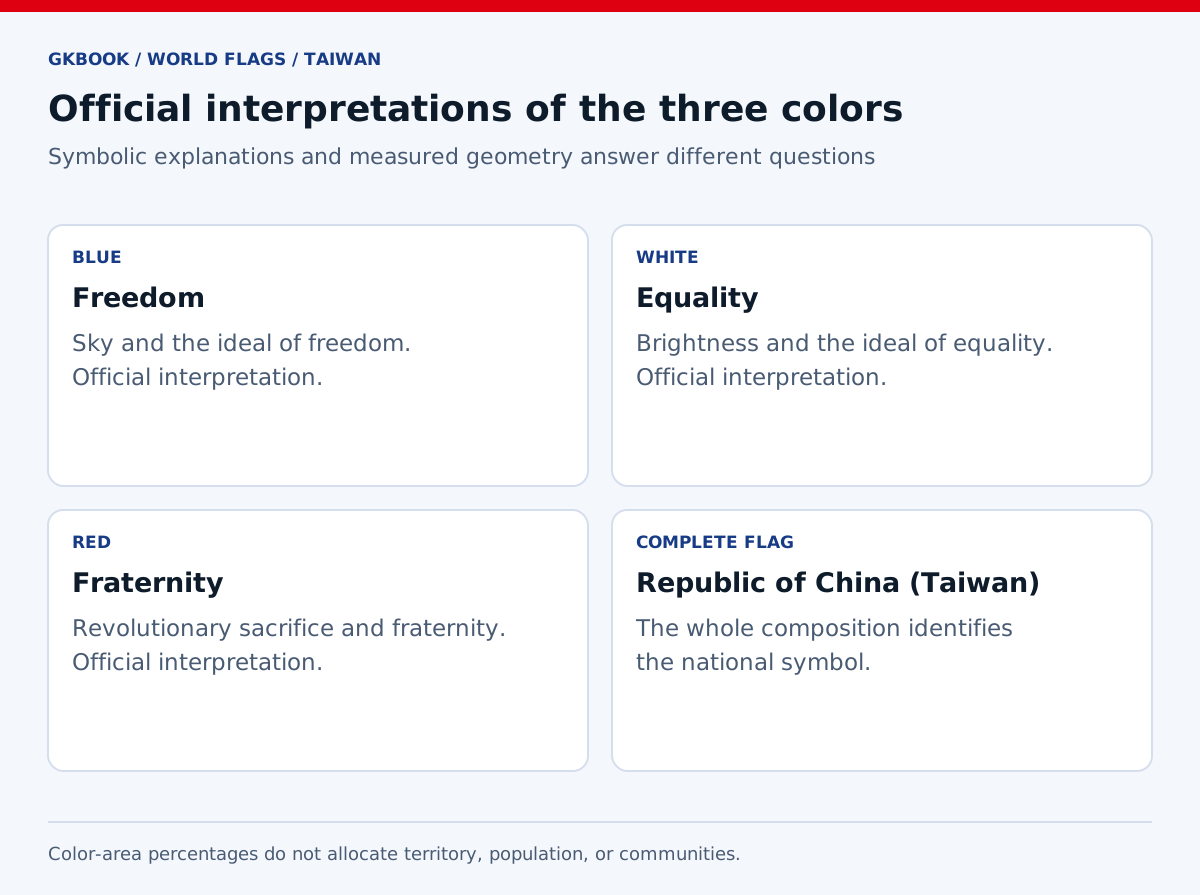
The Ministry of the Interior explains the colors through ideals and historical associations. They should be presented as an official interpretation, rather than as a claim that every individual expresses an identical political or emotional response to the flag.
Geometry provides another kind of information. A canton occupying one quarter of the rectangle does not mean that one quarter of the population belongs to a particular group. Likewise, calculated color areas are drawing measurements, not allocations among communities. Keep symbolic explanations beside their context and mathematical statements beside their definitions.
What does the white sun on the Taiwan flag mean?
The white sun is the central symbol within the blue canton. Presidential Office explanations associate its brightness with progress, while the surrounding twelve rays refer to twelve months and twelve traditional two-hour periods. Its white disk, blue separation ring, and pointed rays are distinct geometric parts of one sun motif.
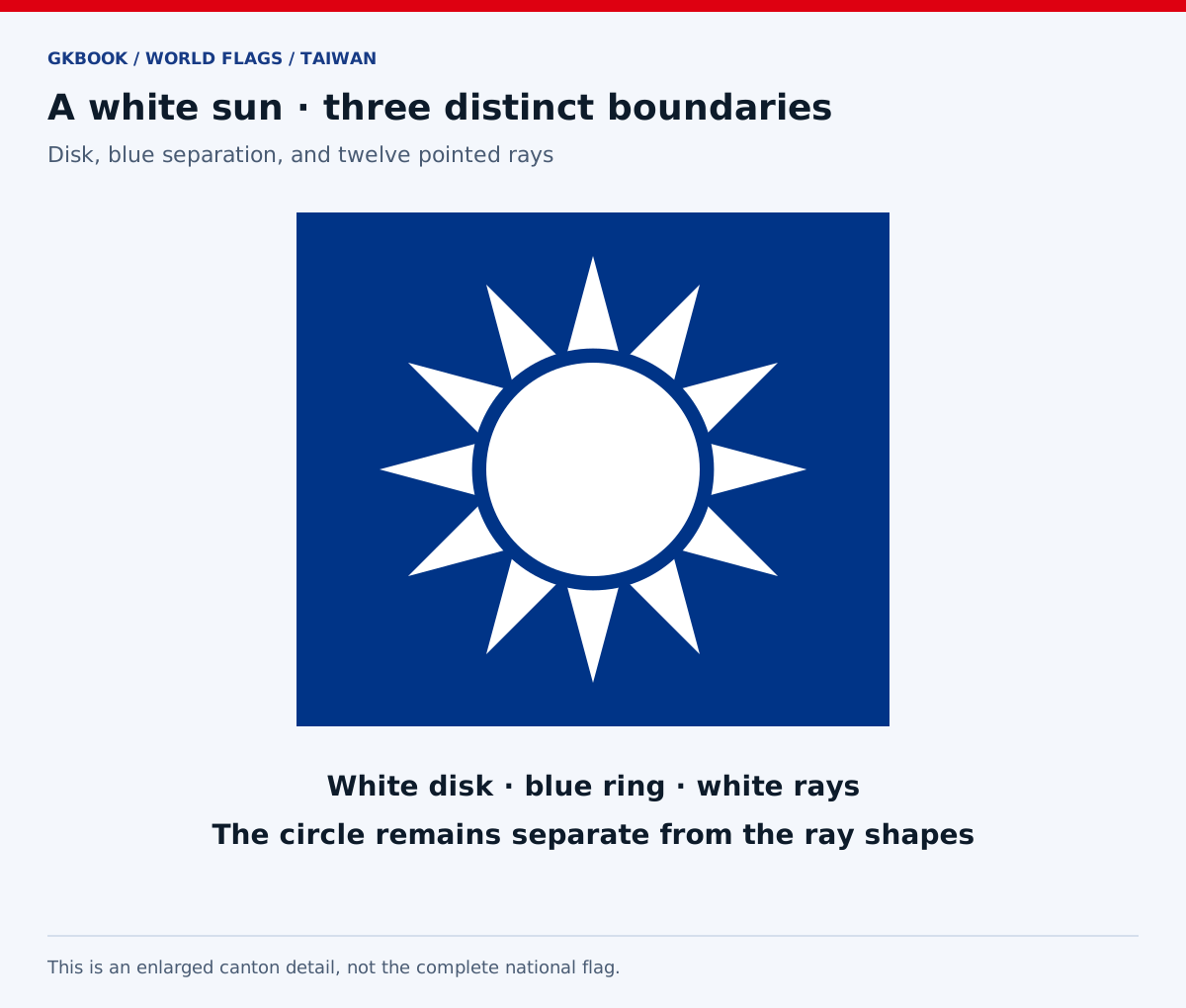
A sun can be recognized at a glance, but a faithful drawing requires more than placing a generic sun icon on a rectangle. The central disk is circular. The ray tips are evenly arranged, and a narrow blue ring separates the disk from the surrounding white ray shapes.
The motif should not be replaced by a white star with twelve uninterrupted points. That substitution would erase the blue separation around the disk. At small sizes, the gap may become difficult to see, which is a rendering limitation rather than permission to remove it from the underlying vector artwork.
Why does the Taiwan flag have twelve sun rays?
The twelve rays correspond, in the Presidential Office’s explanation, to the twelve months of the year and the twelve traditional divisions of a day. Each traditional division lasts two modern hours. The rays therefore should not be described as twelve ordinary clock hours, and their count is not a province count.
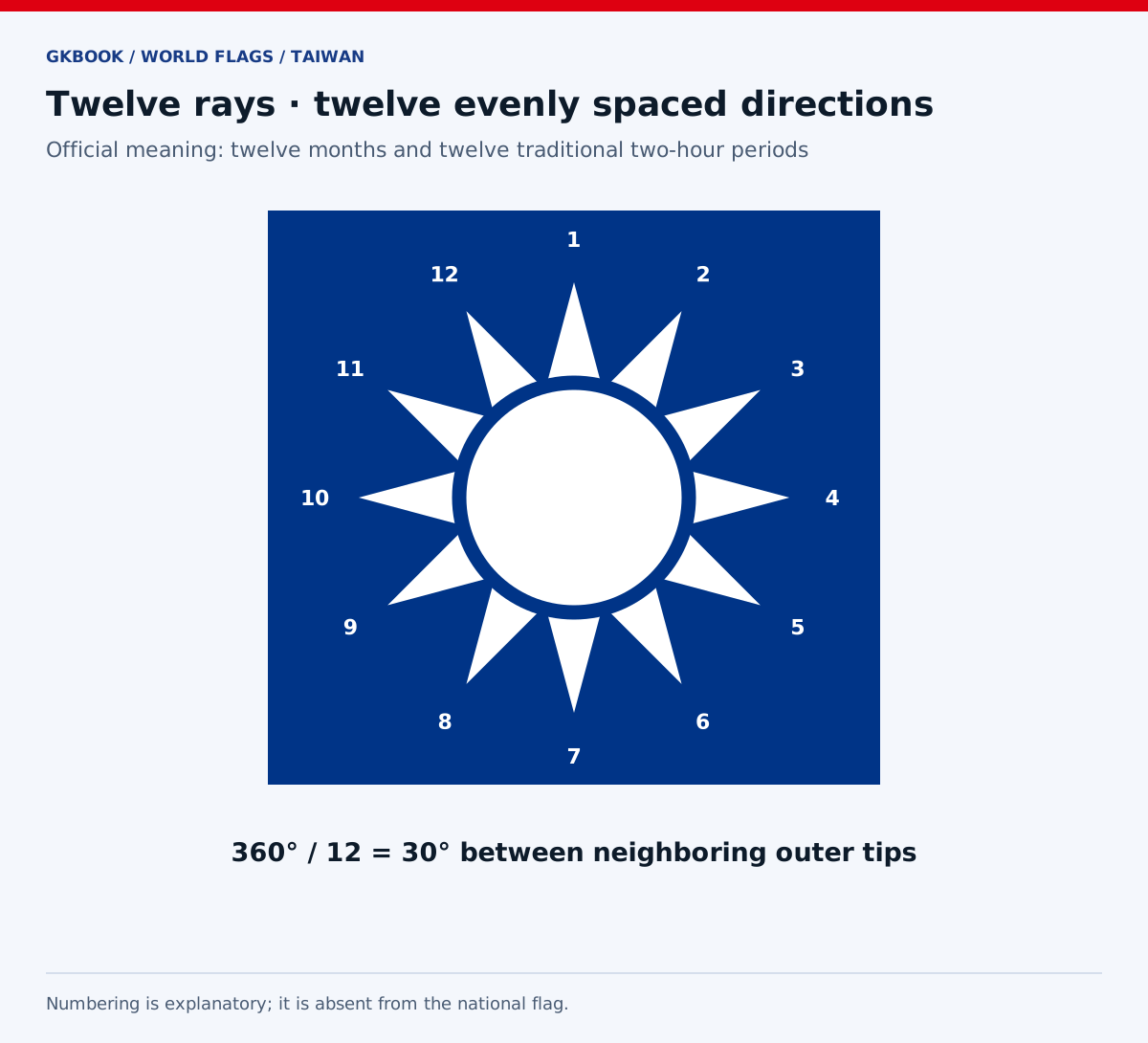
The interpretation links the passing of time with continued progress. It concerns the set of twelve rays as a whole; the official explanation used here does not assign a named month to a particular point. Numbered rays in an educational drawing are counting aids and are not printed on the national flag.
Twelve evenly spaced tips divide a full turn into thirty-degree intervals. This spacing also explains the four cardinal points visible at the top, right, bottom, and left. Counting the inward corners instead of the outward tips can produce confusion, so begin at the upper tip and follow the circle in one direction.
What does the blue canton symbolize?
The blue canton is the rectangular upper hoist quarter containing the white sun. Official interpretations associate blue with the sky and with freedom; the Presidential Office also connects the color with nationalism among the Three Principles of the People. These meanings concern interpretation, while the canton’s size follows the construction rules.
Canton is a flag-design term for a distinct area at an upper corner, usually at the hoist. Here it is not a full-height stripe and not a square. Its width is greater than its height because both of its dimensions are half the corresponding dimensions of the complete rectangular flag.
The blue around the sun remains a single visual background even though the white disk and rays cover parts of it. When calculating visible color area, subtract those white shapes from the canton. When describing the canton’s dimensions, retain the complete underlying blue rectangle.
What is the official Taiwan flag ratio?
The flag’s height-to-length ratio is 2:3, equivalently length-to-height 3:2. The law specifies that relationship, and the construction diagrams preserve it. This collection’s master measures 7,200 units along the horizontal length and 4,800 along the height. A resized copy should multiply both dimensions by the same factor.

Always state the order of the axes when writing a ratio. A bare “three to two” can confuse readers who are accustomed to listing height first. Here, the horizontal flag is wider than it is tall. Its 7,200 by 4,800 raster dimensions follow exactly the same relationship as its vector viewBox.
A square thumbnail can contain the complete flag with space around it, but it cannot fill the square without cropping or distortion. Choose containment when displaying the flag in a fixed image frame. Stretching only one axis changes the rectangle, the canton, and the supposedly circular sun at the same time.
How large is the blue canton?
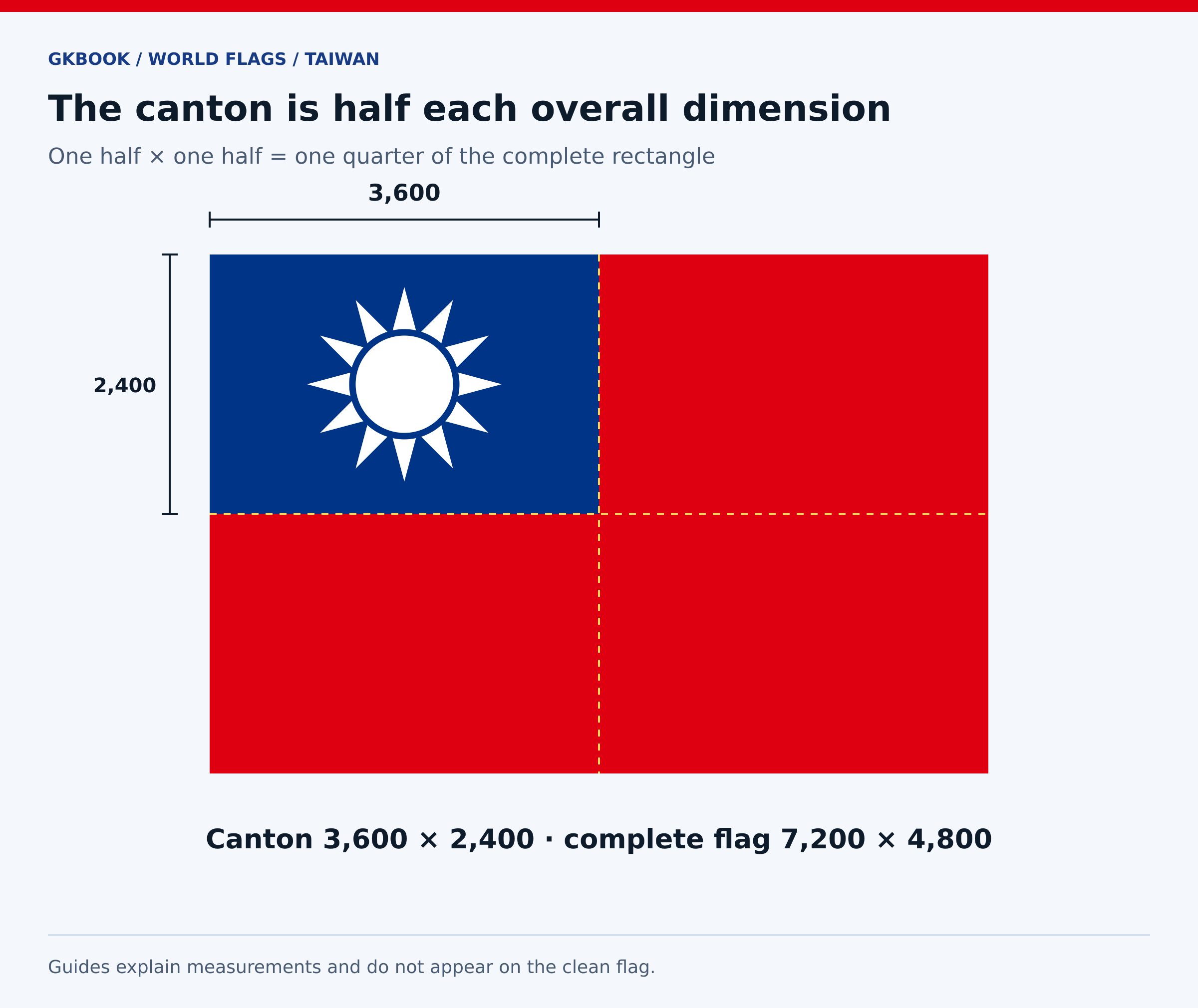
The blue canton is half the flag’s length and half its height, so its underlying rectangle covers one quarter of the total area. In the 7,200 by 4,800 master, it measures 3,600 by 2,400. It sits flush against the upper and hoist edges, with no surrounding red border.
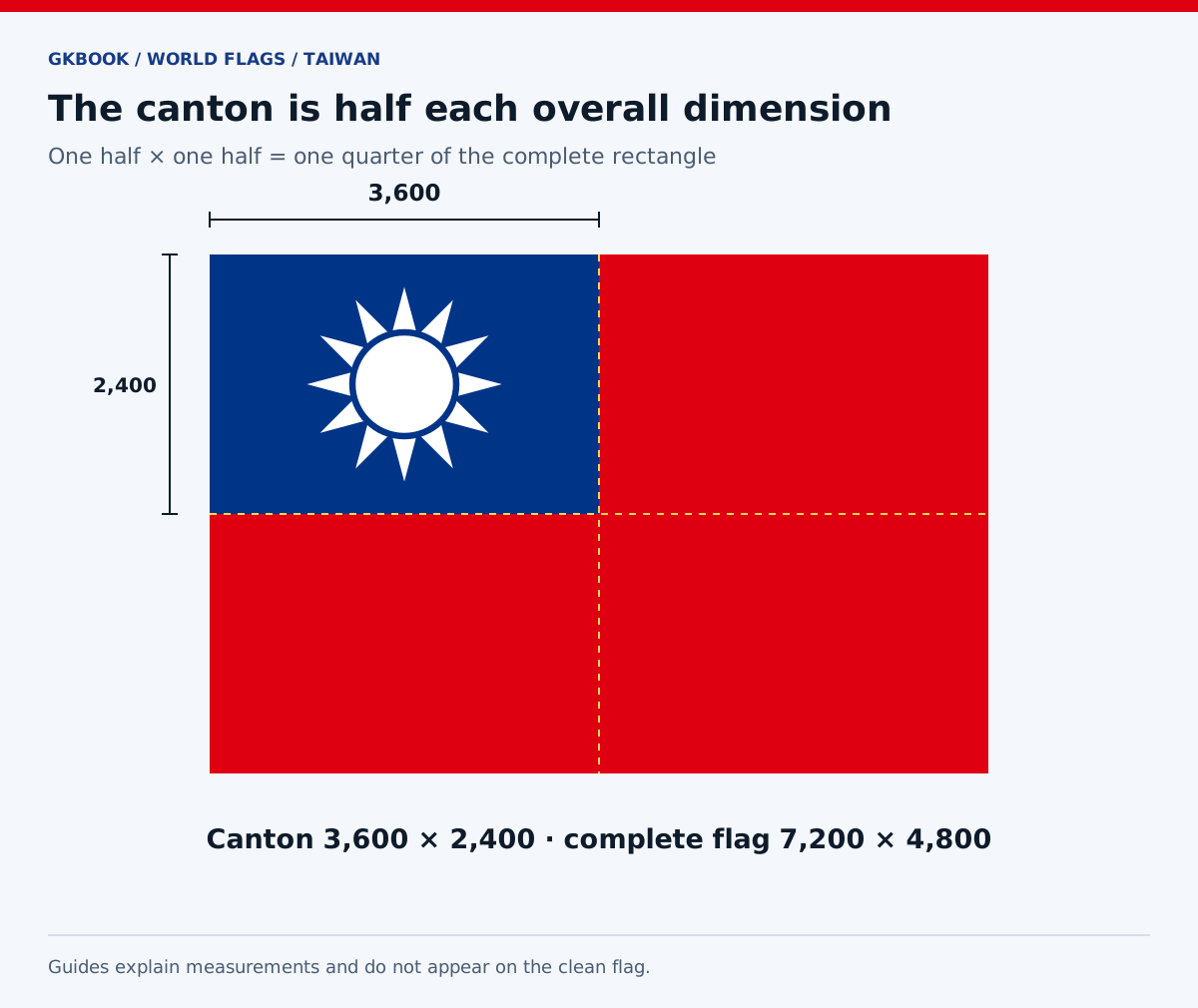
The law describes the canton’s quarter-area relationship, and the attached construction diagram makes the two half-dimension relationships explicit. Area alone would not determine a unique rectangle: several shapes could occupy the same total area. Reading the diagram alongside the text removes that possible ambiguity and fixes the canton’s actual proportions.
The remaining red field extends across the whole lower half and across the fly-side half of the upper half. These two regions meet without a seam or separating line in the clean artwork. The edge between blue and red is a color boundary, not an additional white or black outline.
How big is the white sun disk?
The white disk’s radius is one eighth of the canton’s length, which equals one sixteenth of the complete flag’s length. In this master, the radius is 450 and the diameter is 900. The outer ray-tip radius is twice the disk radius, making the complete sun’s tip-to-tip diameter 1,800.

Distinguish the circular disk from the entire sun with its rays. Measuring the complete motif and calling that the disk diameter doubles the intended dimension. The enlarged diagram labels both circles so that the same word is not used for two different boundaries. Neither construction circle becomes an outline on the flag.
For a smaller example with a flag length of 144 centimeters, the disk radius becomes 9 centimeters and its diameter becomes 18. The outer ray-tip radius becomes 18 centimeters. Those relationships scale together, allowing a maker to choose an appropriate overall flag size without independently guessing the sun’s dimensions.
How wide is the blue ring around the sun?
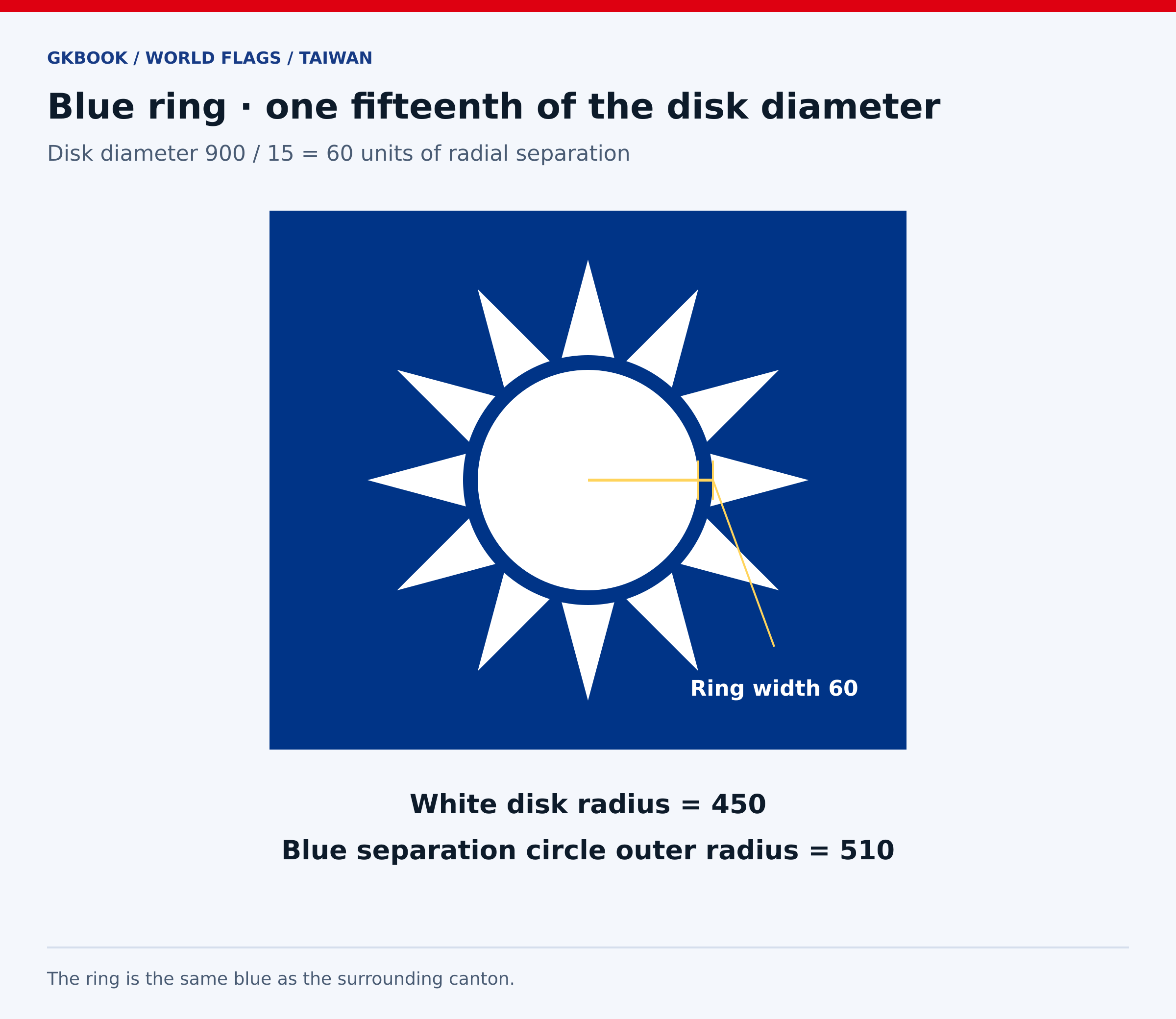
The blue separation ring has a width equal to one fifteenth of the white disk’s diameter. With a disk diameter of 900 in this master, the ring is 60 units wide. Its outer radius is therefore 510, compared with the white disk radius of 450. The ring uses the canton’s blue.
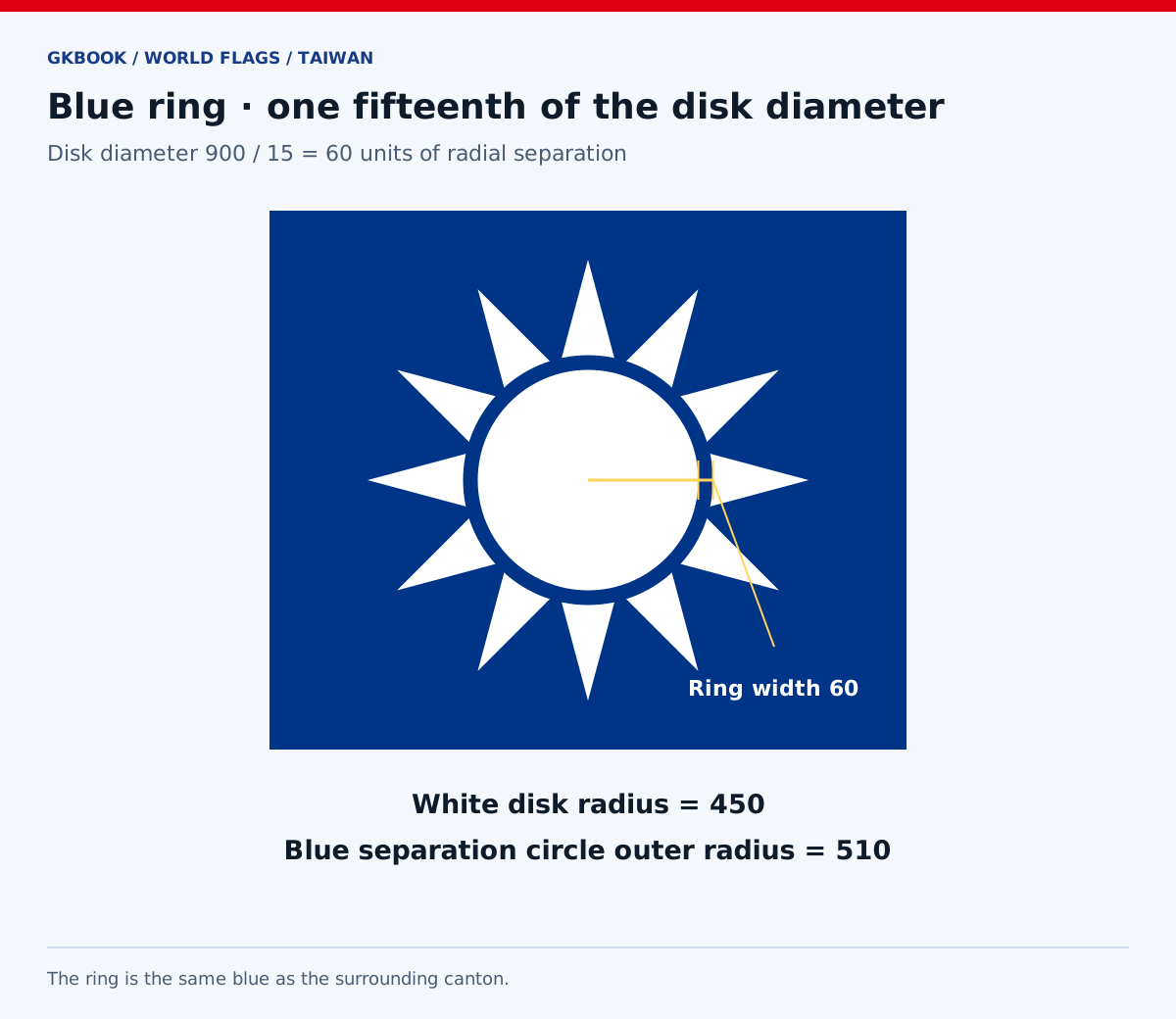
The visible blue gap separates the circular white center from the white rays. Drawing the disk directly over an uninterrupted white star would hide this distinction. The construction places a blue circle over the inner ray polygon and then places the smaller white disk above that circle, producing the required separation.
Ring width is a radial measurement, not the diameter of the blue circle and not a percentage of the whole flag. Doubling the ring width would make the gap too wide even if the disk and ray tips stayed in place. At reduced sizes, inspect the exported image to ensure the gap still reads clearly.
How are the twelve sun rays constructed?
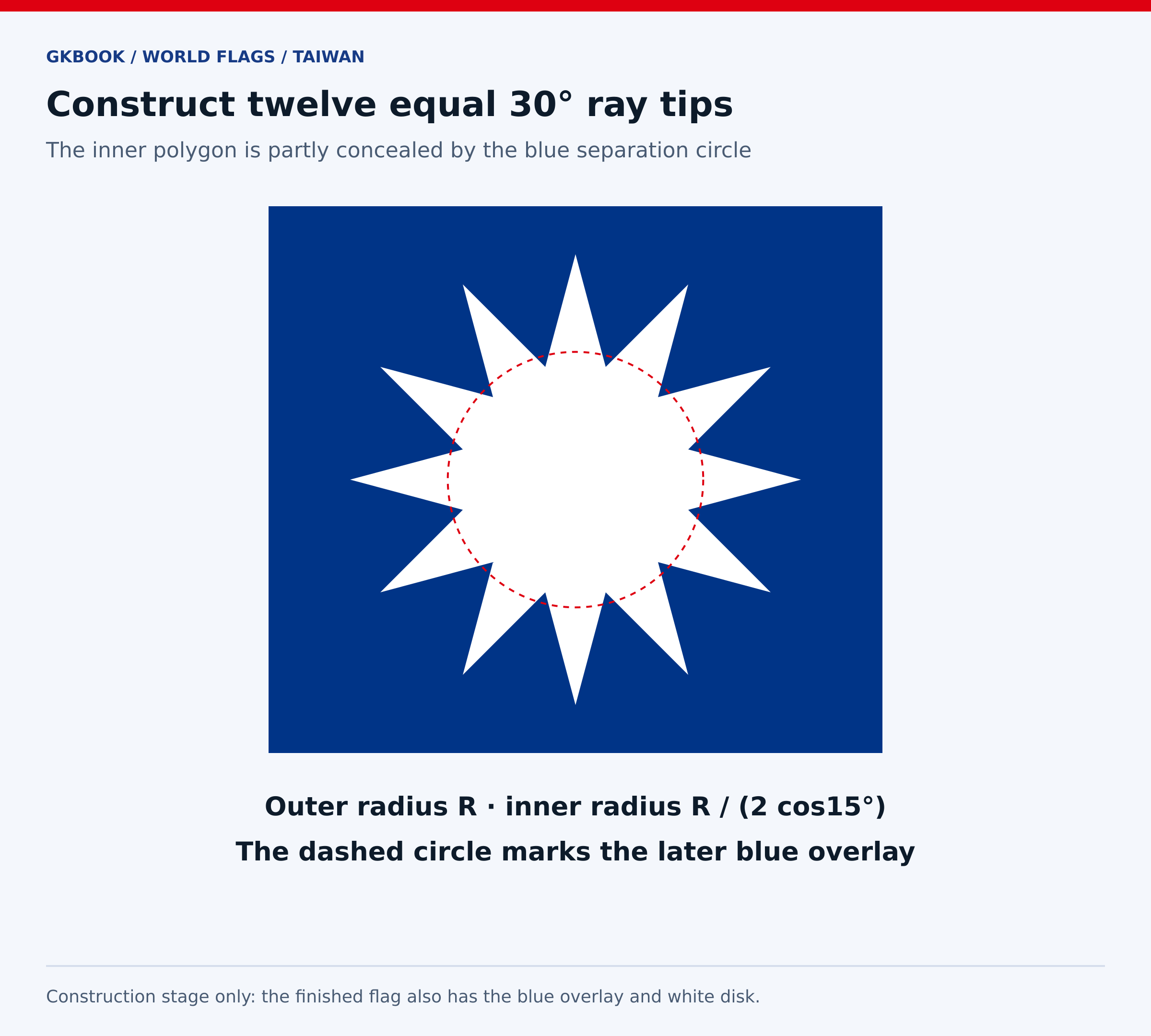
The twelve rays are equally spaced, with thirty degrees between adjacent outer tips and a thirty-degree angle at each tip. Four tips align with the vertical and horizontal axes. The drawing uses a regular twenty-four-vertex outline beneath the blue separation circle and white disk, keeping the visible ray geometry consistent.

The alternating outline has twelve outer tips and twelve inward vertices. If the outer radius is R, the inward-vertex radius is R divided by twice the cosine of fifteen degrees. That relationship makes each pointed tip thirty degrees wide. The blue circle then covers the inner portion of this supporting polygon.
Rounded shortcuts can produce a similar appearance without preserving the exact angle. This reconstruction uses the mathematical relationship directly, with decimal coordinates retained to sufficient precision in the vector. It follows the statutory construction rather than claiming that every downloaded reference image has perfectly exact points or identical raster edges.
Where is the white sun positioned?
The sun is centered in the blue canton. For this master, its center is 1,800 units from the hoist edge and 1,200 from the top edge. Its outer tips reach x coordinates 900 and 2,700, and y coordinates 300 and 2,100. It is not centered in the entire flag.
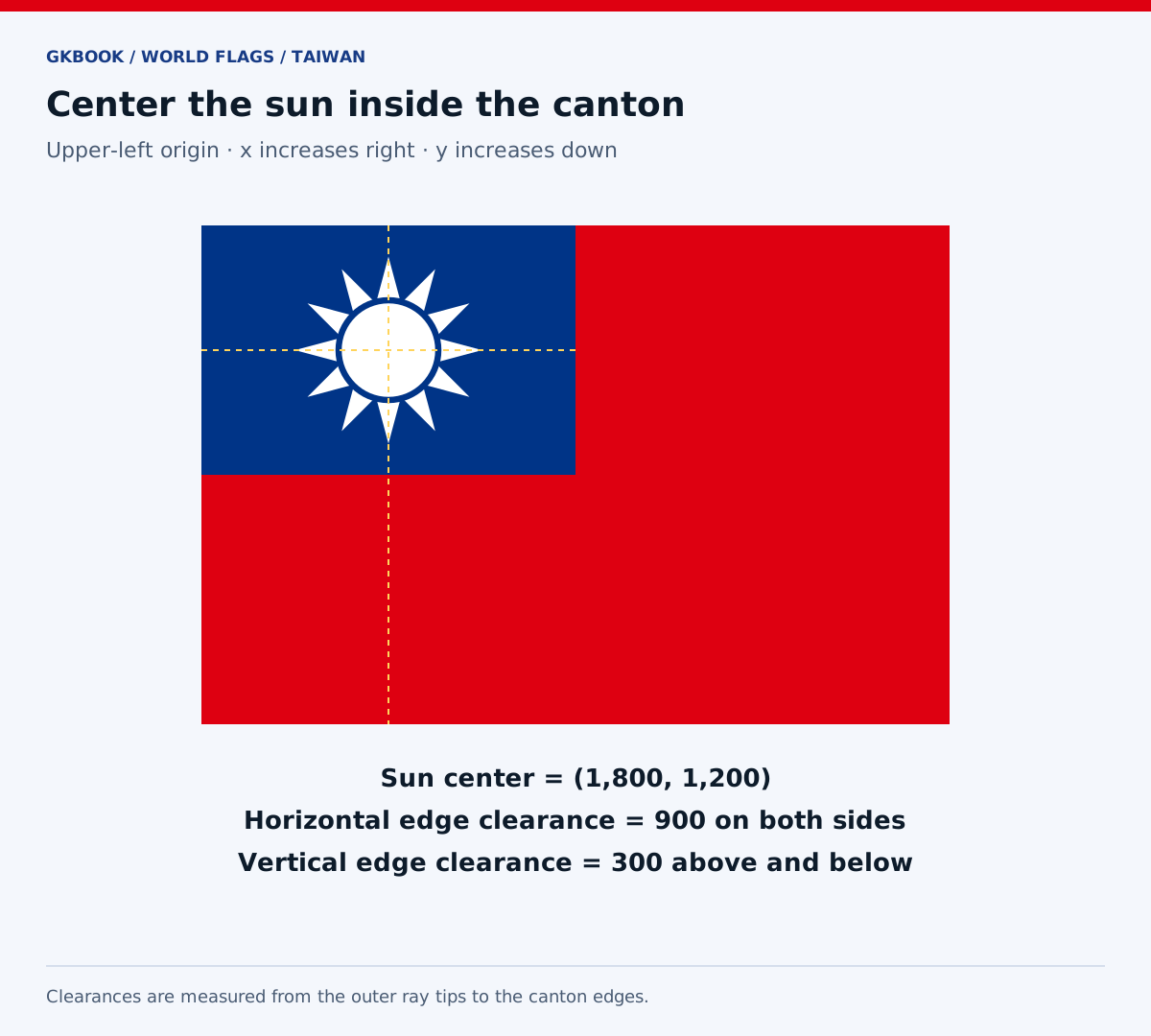
Centering within a rectangle means using the midpoint of each of that rectangle’s dimensions. The canton’s midpoint differs from the complete flag’s midpoint because the canton occupies only the upper hoist quarter. A perfectly drawn sun placed at the center of the red field would therefore still produce the wrong composition.
The horizontal clearance between each side tip and its nearest canton edge is 900 units. The vertical clearance above and below the outer tips is 300 units. These clearances are equal in opposing pairs, but horizontal and vertical clearances differ because the canton is a wide rectangle rather than a square.
What percentage of the flag is each color?
Red occupies exactly 75 percent of the flag. The underlying canton covers 25 percent, but part of it is white. For the exact construction used here, visible white covers approximately 3.283102 percent and visible blue approximately 21.716898 percent. These calculated areas describe geometry and should not be interpreted as symbolic allocations.
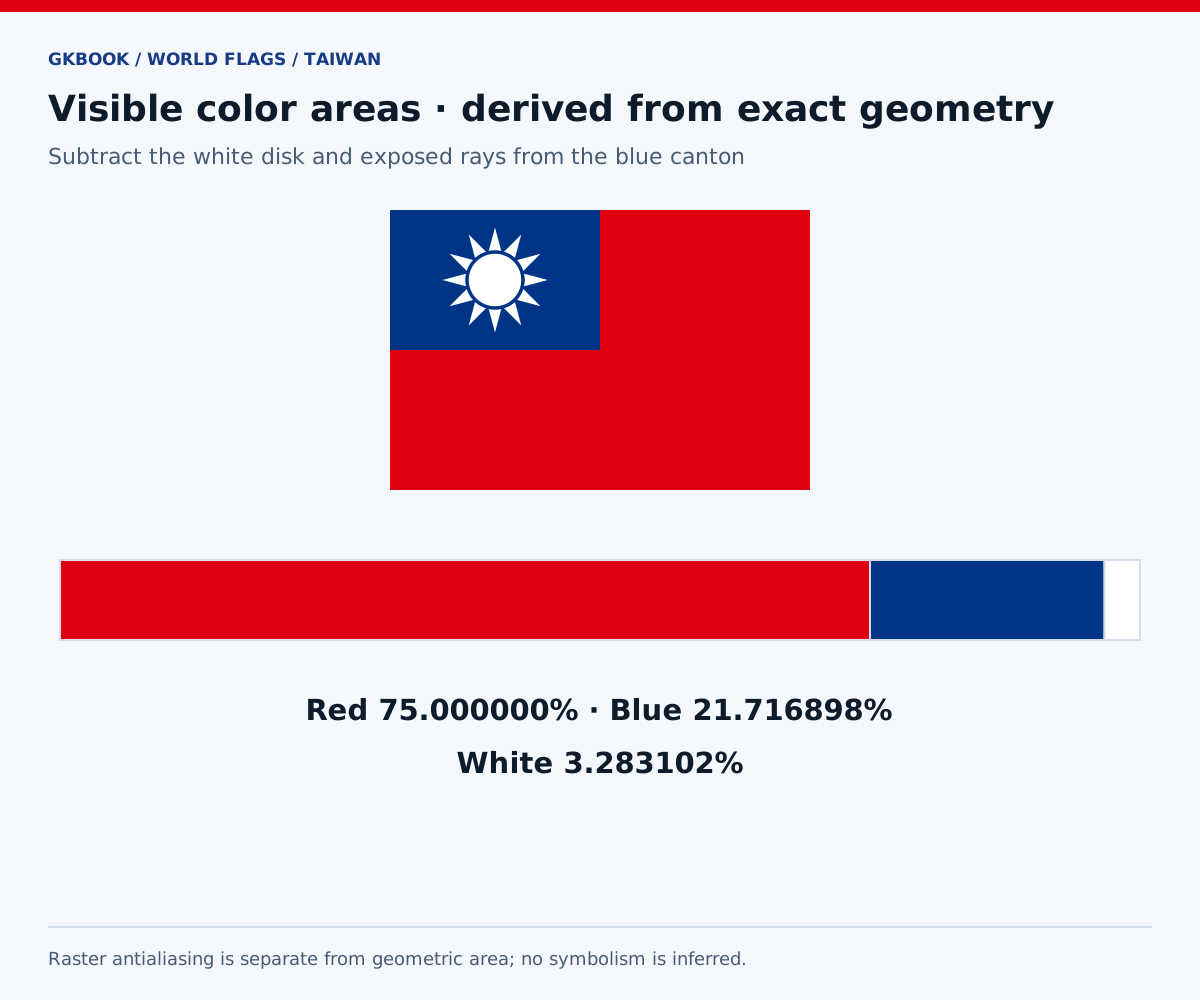
The white total includes the circular disk and the exposed portions of all twelve rays. The blue ring is excluded from that total because it is visibly blue. Counting the full white polygon underneath the ring would overstate the amount of white actually seen in the finished design.
An exact vector calculation treats edges as mathematical boundaries with no thickness. A raster image instead uses partially blended edge pixels to make diagonals and circles look smooth. Consequently, counting only pure white pixels in a PNG gives a slightly different result. The percentages shown here come from the underlying geometry, not that pixel-count shortcut.
What is the history of the Taiwan flag?
The design developed from Lu Hao-tung’s blue-sky-and-white-sun motif of 1895, with Sun Yat-sen adding the red field. Sun’s Guangzhou government adopted the complete flag in 1921; nationwide legal adoption followed in 1928. The Republic of China government relocated to Taiwan in 1949, carrying an already established national flag.

The design’s history begins before its familiar modern association with Taiwan. Its revolutionary origins, adoption by a particular government, wider legal establishment, and later use in Taiwan are separate stages. A timeline should name those stages instead of using one date to stand for every event in the flag’s development.
Historical photographs may show earlier designs, different contexts, or variations in manufacture. Keep their dates and original compositions intact when illustrating an earlier period. The present mathematical reconstruction is a contemporary educational rendering of the defined design; it is not a facsimile of a surviving flag sewn for an event in 1895 or 1921.
When was the Taiwan flag officially adopted?
Two dates need context: May 5, 1921 marks adoption by Sun Yat-sen’s government in Guangzhou, while December 17, 1928 marks nationwide promulgation of the national emblem and flag law. The current statute records a later revision on October 23, 1954. These dates describe different stages, rather than competing versions of one event.
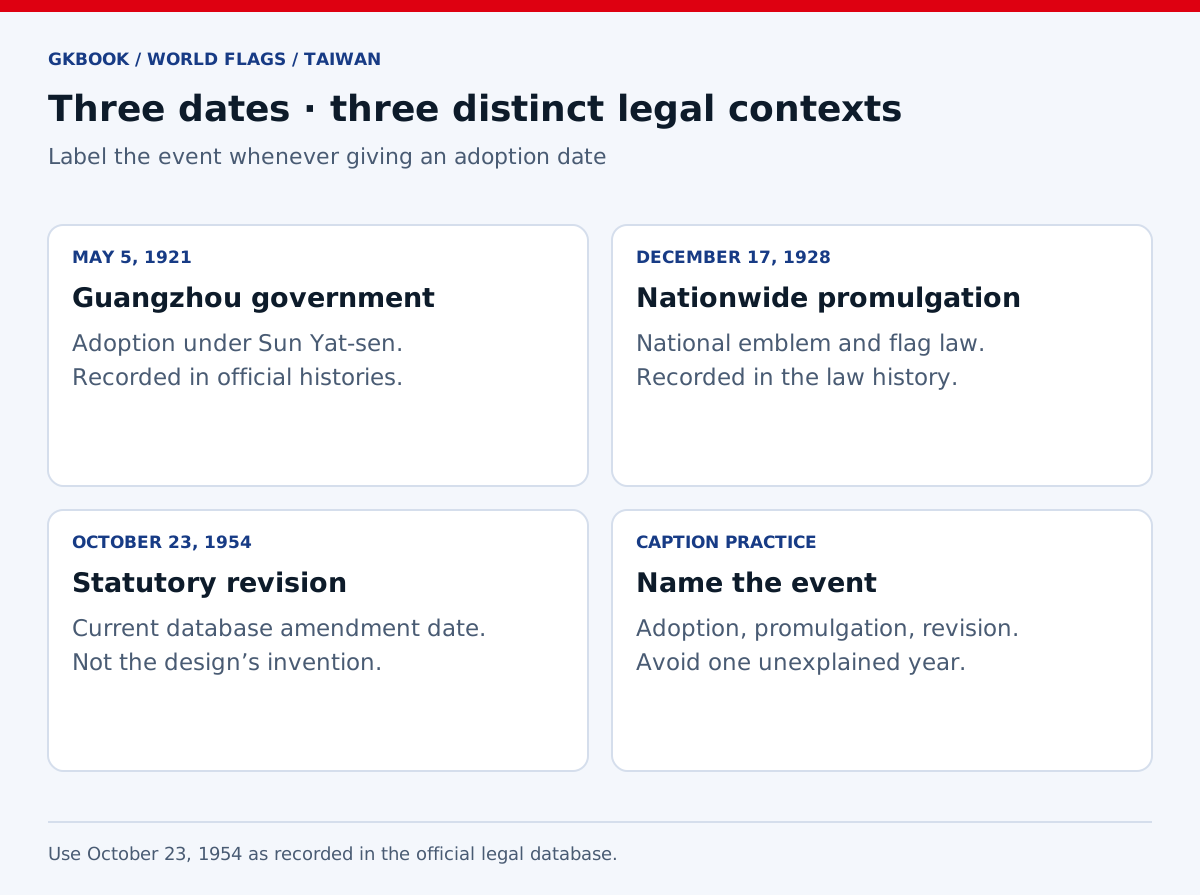
The English Presidential Office overview gives the 1921 date. The National Sun Yat-sen Memorial Hall’s historical account identifies the Guangzhou setting, while the law’s official history records the 1928 promulgation. Together, these sources explain why a concise reference may give different dates depending on the question it is answering.
The 1954 date concerns revision of the governing statute and its detailed rules. It does not mean that the red field and blue canton were first invented that year. For a short caption, identify the event alongside the date: governmental adoption, nationwide law, or statutory revision. That wording is more informative than an unexplained year.
Who designed the Taiwan flag?
Official Presidential Office accounts credit Lu Hao-tung, also romanized Lu Haodong, with the blue-sky-and-white-sun design, and Sun Yat-sen with adding the red field. This division of contributions is more precise than assigning every part of the finished flag to one person. Modern digital artists reproduce that historical composition.
The blue-and-white motif and the completed red-field flag belong to connected stages of design history. Distinguishing them gives each contributor the role described in the official account. It also avoids treating the later drafting of geometric standards as though it were the original invention of the symbol.
A downloadable SVG may have its own author, editor, or upload history. Those credits describe work on a particular digital file. They do not replace the historical attribution for the flag itself. This collection separately identifies its geometric reconstruction and educational layouts so that file production is not confused with national-symbol authorship.
Which rules define the Taiwan flag’s design?
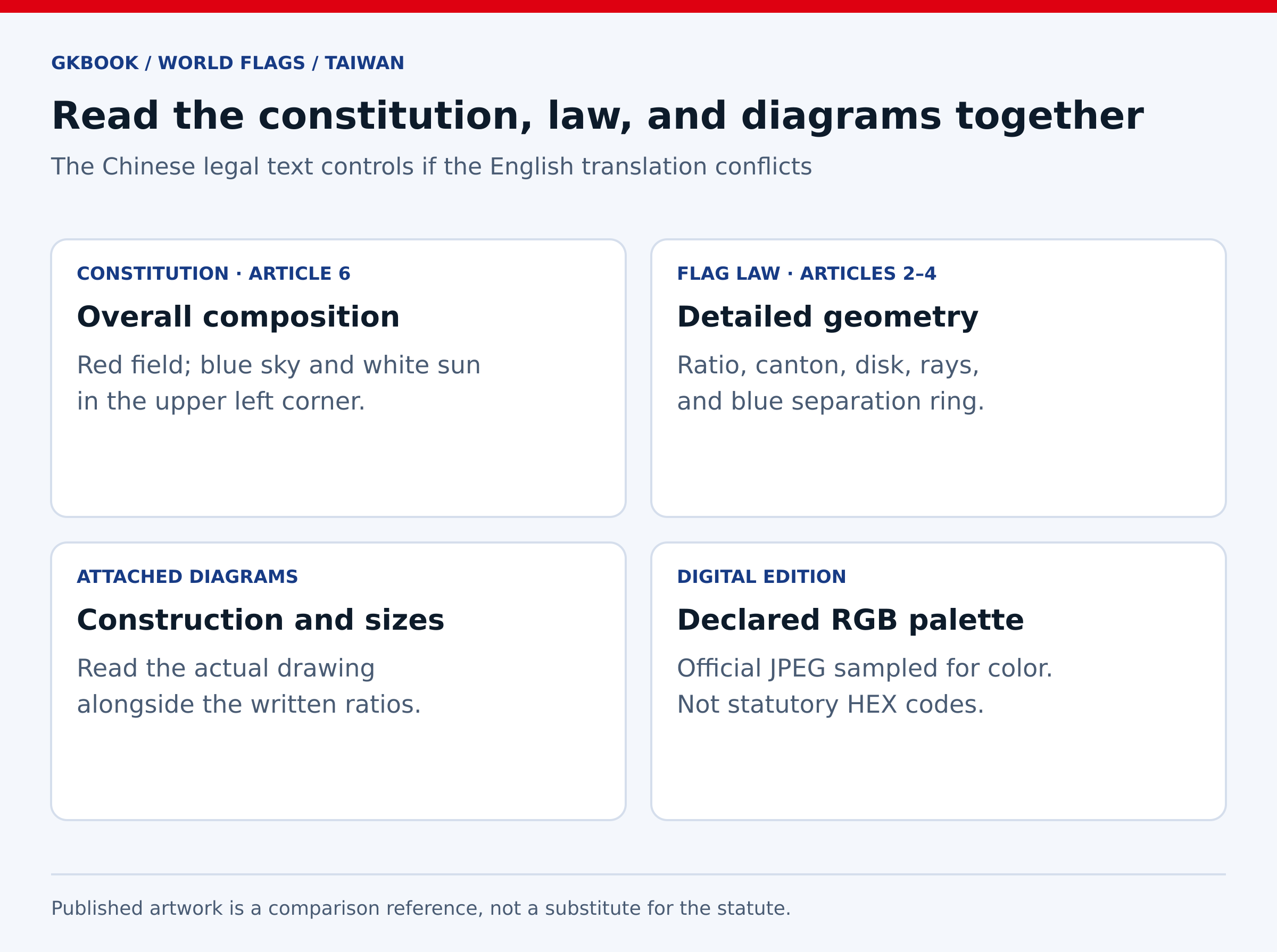
Article 6 of the Constitution describes a red field with a blue sky and white sun in the upper left corner. The National Emblem and National Flag of the Republic of China Act and its attached diagrams provide the detailed proportions, sun construction, and sizes. The Chinese legal text controls over conflicting English translation.
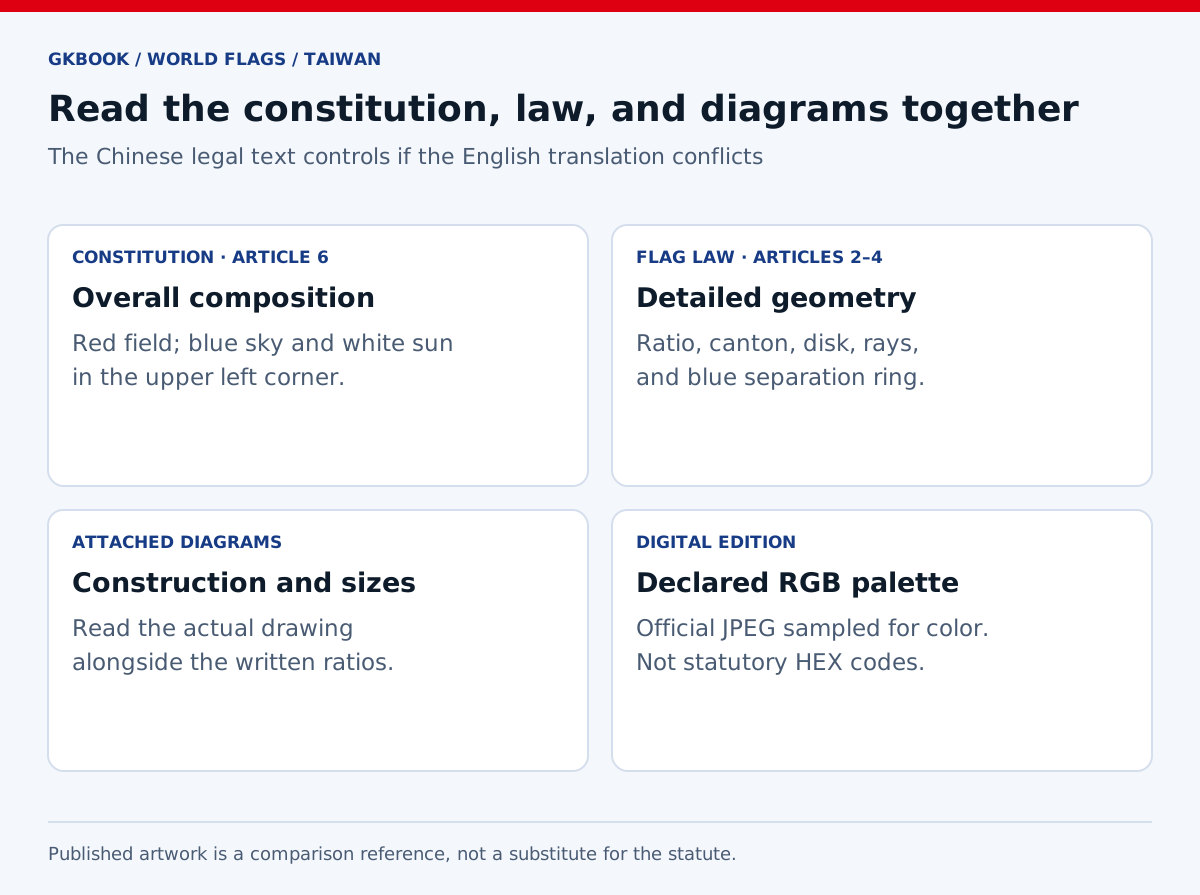
The constitutional sentence establishes the recognizable composition. The separate statute supplies the measurements needed to reproduce it, including the overall ratio, canton relationship, disk radius, ray dimensions, and blue ring. Consult both text and diagrams because a brief verbal description cannot communicate all the information contained in a construction drawing.
Translation requires particular care with dimensional labels and ceremonial measurements. The official database expressly gives priority to the Chinese text if the English differs. This collection uses explicit height and length labels and checks the Chinese annex. Published digital artwork remains useful for comparison, but it does not override the statutory geometry.
Was there an earlier Republic of China flag?
Yes. The early Republic of China used a five-colored flag with horizontal red, yellow, blue, white, and black bands. That design belongs to the republic’s earlier history on the mainland. It should not be labeled simply as “Taiwan’s 1912 flag,” because Taiwan was then under Japanese rule and the historical settings differ.
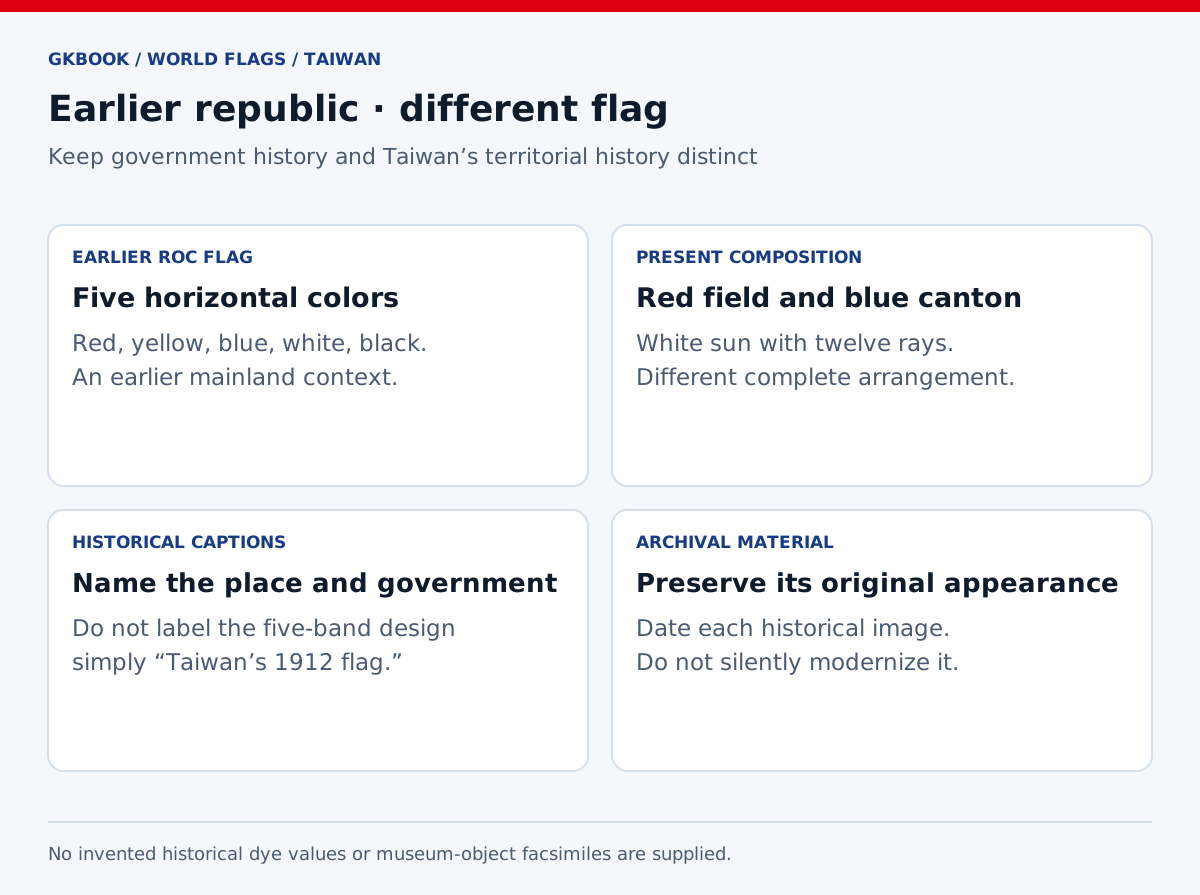
A flag chronology should identify the government and territory associated with each entry. A sequence of national designs used by the Republic of China is not automatically a complete sequence of flags flown in Taiwan during the same years. The distinction becomes especially important when making teaching timelines or captioning archival images.
The current flag is easy to distinguish from the five-band design: it has a large uninterrupted red field and a blue canton containing a white sun. The historical comparison here describes those features without inventing period fabric, exact historical dye values, or a newly drawn object presented as an authentic museum specimen.
Why is the flag displayed on October 10?
October 10 is the Republic of China’s National Day, often called Double Ten. It commemorates the Wuchang Uprising of October 10, 1911, an event in the revolution that led to the republic. Flag displays on that date mark the commemoration; the date is not the flag law’s 1928 promulgation date.

The two tens refer to the tenth day of the tenth month. National Day ceremonies and street displays place the flag in a commemorative setting that differs from everyday institutional use. A photograph of an annual celebration should include its year, since the same recurring date can accompany many different events.
Keep the uprising, the establishment of the republic, and the adoption of the present flag separate in an educational timeline. Calling October 10 the flag’s birthday would collapse those events into one. A clear caption can instead say that the flag is being displayed for National Day, without making an unsupported adoption claim.
Does the flag’s use settle international recognition?
No. Identifying the flag used by the Republic of China in Taiwan does not by itself settle diplomatic recognition or disputed political status. United Nations General Assembly Resolution 2758, adopted on October 25, 1971, concerns China’s representation at the United Nations. That event is separate from the flag’s design and adoption history.
Different questions call for different evidence. A construction law tells a reader how a flag is defined. An international organization’s decision explains representation within that organization. A government’s diplomatic statement concerns its own policy. Treating any one of these as a substitute for all the others would obscure their actual scope.
This article identifies the symbol and explains the dates relevant to its history. It does not convert a flag illustration into a legal ruling on sovereignty or a count of present diplomatic partners. When describing an event photograph, identify the location, participating institution, and date rather than inferring universal recognition from the presence of a flag.
Why does Chinese Taipei use a different Olympic flag?
At the Olympics, the participating National Olympic Committee is recognized by the IOC as Chinese Taipei, with the code TPE. Its delegation uses a separate committee flag under the Olympic arrangements. That sporting flag should not replace the red-field national flag in a country-design article, because the two symbols identify different contexts.

An Olympic delegation’s name and flag belong to the rules and agreements governing its participation. The IOC’s committee listing identifies Chinese Taipei, while official delegation ceremonies refer to its committee flag. These sources support a distinction between sporting representation and the national design described by the constitution and flag statute.
Caption sports images with the competition and delegation context. A national flag displayed by a spectator, a committee flag carried in a ceremony, and an event logo can appear in related coverage without becoming interchangeable. This collection explains that distinction but does not supply an improvised Olympic emblem or a replacement committee-flag master.
Is the white sun also the national emblem?
Yes. The same blue-sky-and-white-sun motif forms the national emblem, which the law defines separately from the complete flag. The emblem uses a circular blue background; the flag places the sun inside a rectangular blue canton on a red field. A standalone emblem is therefore not the whole national flag.
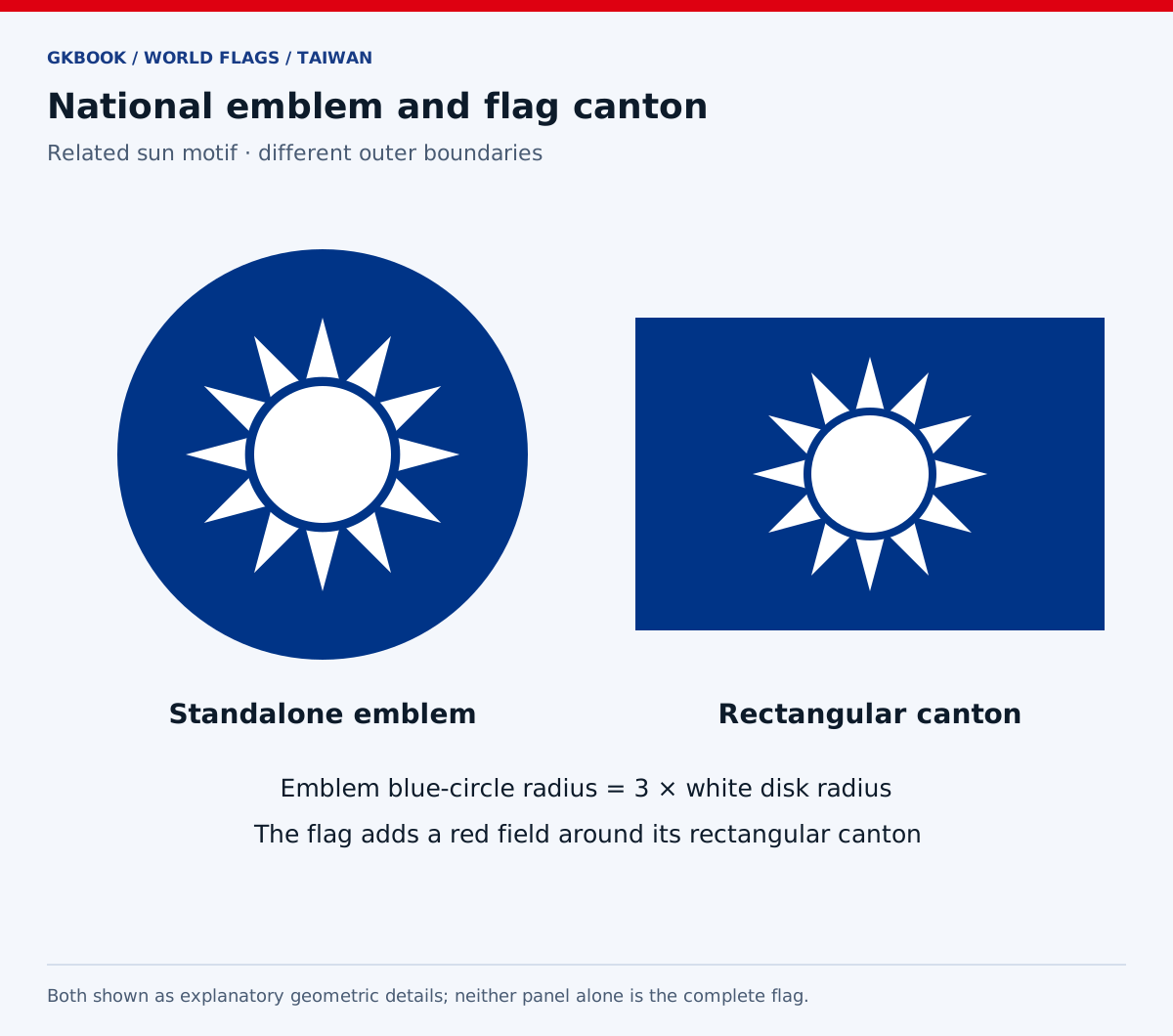
The common motif explains why a close-up can look familiar in several settings. Boundaries still matter: a circular emblem, a rectangular canton, and the complete flag have different outlines and surrounding fields. A label should state which object is being shown, particularly when an educational layout enlarges the sun for inspection.
The statute makes the emblem’s outer blue-circle radius three times the white disk radius. That outer circle is not added as a visible border inside the flag’s rectangular canton. The comparison illustrates the relevant geometric distinction without introducing lettering, a shield, or any other element absent from the defined national flag.
How can this flag be distinguished from similar designs?
Look for the complete combination: a red field, an upper hoist blue canton, and one white sun with twelve rays and a blue separation ring. A blue flag containing only the white sun is not the complete red-field national flag. Shared colors or a similar sun motif do not make different flags interchangeable.
Start with the large areas before counting small details. The canton occupies only a quarter of the flag, while red covers the remaining three quarters. Then inspect the sun’s central disk, the surrounding blue gap, and its twelve evenly spaced tips.
At small sizes, compression can blur the sun into a white patch or merge the ring with neighboring edges. Consult a larger reference before deciding that an image shows the same symbol. Do not correct an unfamiliar historical or organizational flag by silently converting it into the national design; first identify what the original image represents.
How is the flag displayed outdoors?
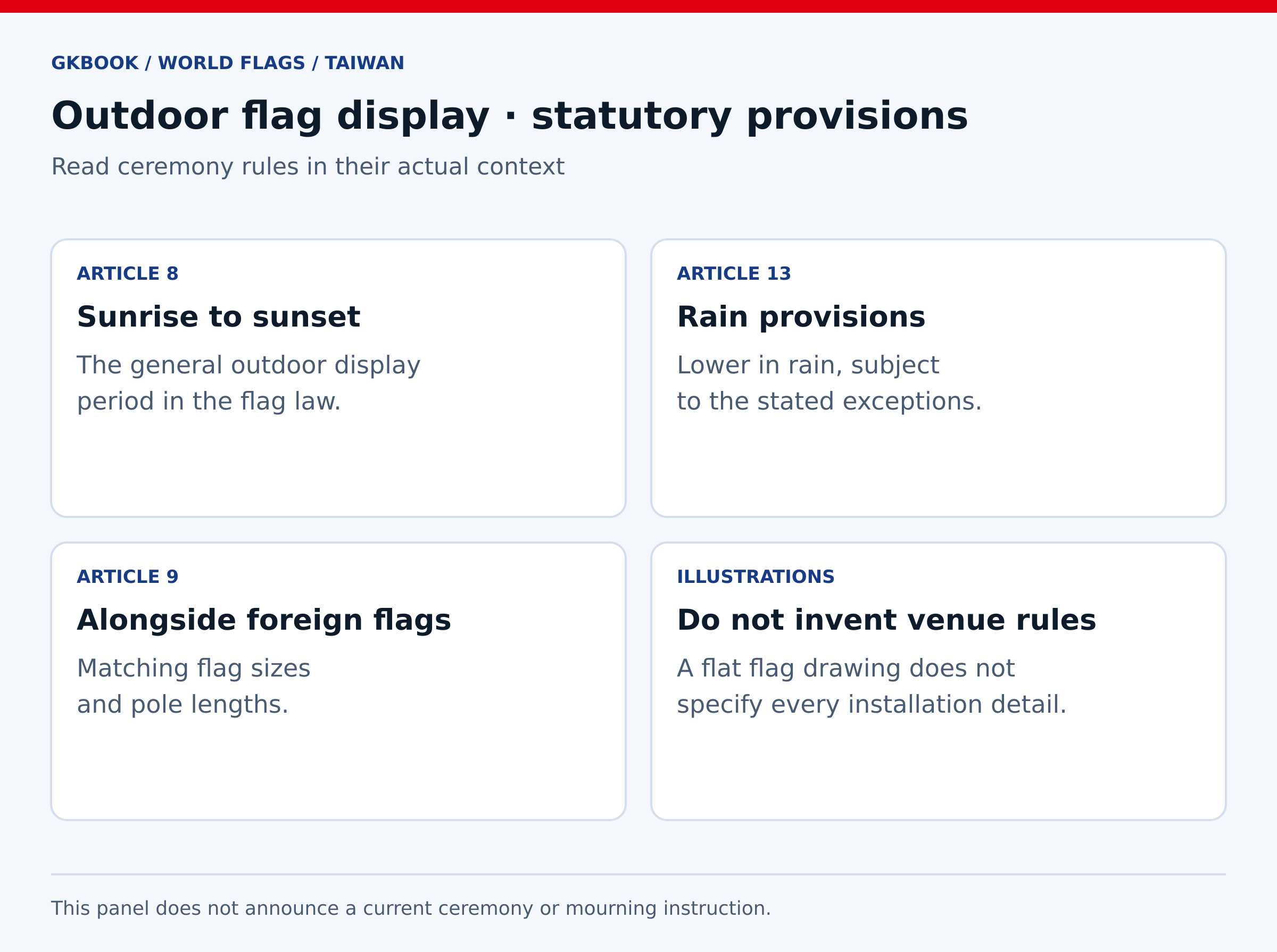
The national flag law provides for outdoor display from sunrise to sunset and addresses lowering the flag in rain, subject to specified exceptions. It also sets rules for displaying it with foreign flags. These are ceremonial provisions; a clean drawing alone does not establish how every venue or event must arrange its display.
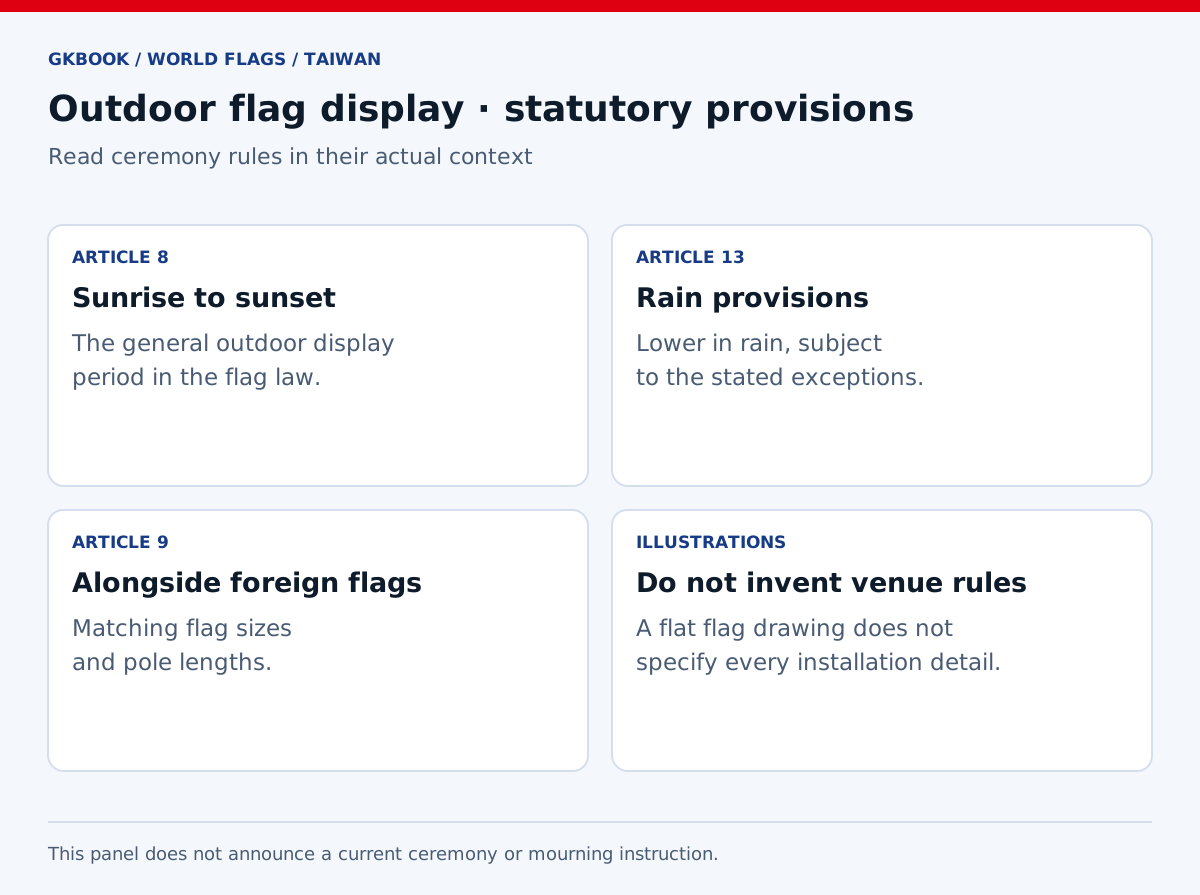
For general illustration, show the complete rectangle and keep the hoist side clearly identifiable. A picture of a pole can explain where the canton lies, but it should not invent an official pole height, hardware specification, or ceremonial sequence beyond the provisions actually checked. Site-specific arrangements may require additional current instructions.
The law calls for matching flag sizes and pole lengths when displaying the national flag alongside foreign flags. Avoid inferring equal visual area from unrelated flags with different proportions unless a relevant rule explains the treatment. In captions, describe the arrangement seen in the image rather than claiming that a photograph proves compliance with every protocol rule.
How is the Taiwan flag flown at half-mast?
The Chinese rule and the Interior Ministry’s explanation require raising the flag to the top, then lowering it by a distance equal to half the flag’s long side. Before final lowering, raise it to the top again. This distance is not half the pole’s height, despite a misleading English translation of the statute.

Use the flag’s horizontal length as the reference measurement. For a flag 144 centimeters long, the prescribed lowering distance is 72 centimeters from its top position. The illustration labels this travel distance separately from the pole, preventing the common mistake of placing the flag halfway down an arbitrarily tall mast.
The diagram explains the movement after a valid half-mast instruction; it does not announce a current mourning order. The Ministry of the Interior explicitly illustrates incorrect alternatives, including half the pole length and half the flag’s shorter side. Following the Chinese wording resolves the discrepancy without turning the English mistranslation into a competing rule.
What happens when the flag is turned vertically?
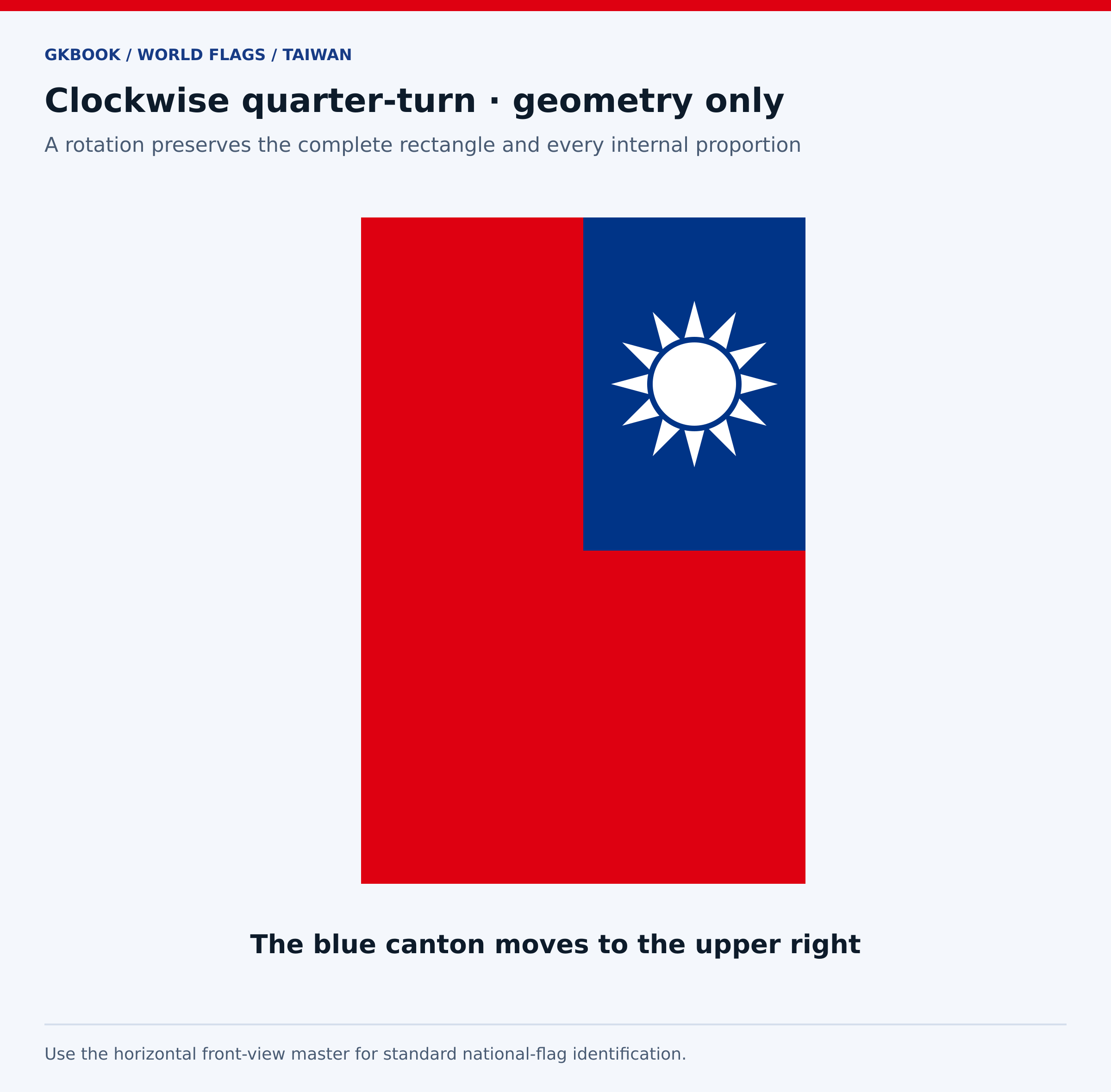
A clockwise quarter-turn of the complete front-view flag produces a tall rectangle with the blue canton at the upper right and the same white sun intact. This is a geometric rotation, not a verified official vertical-hanging prescription. Keep the distinction clear when using a rotated image for a banner, diagram, or layout.
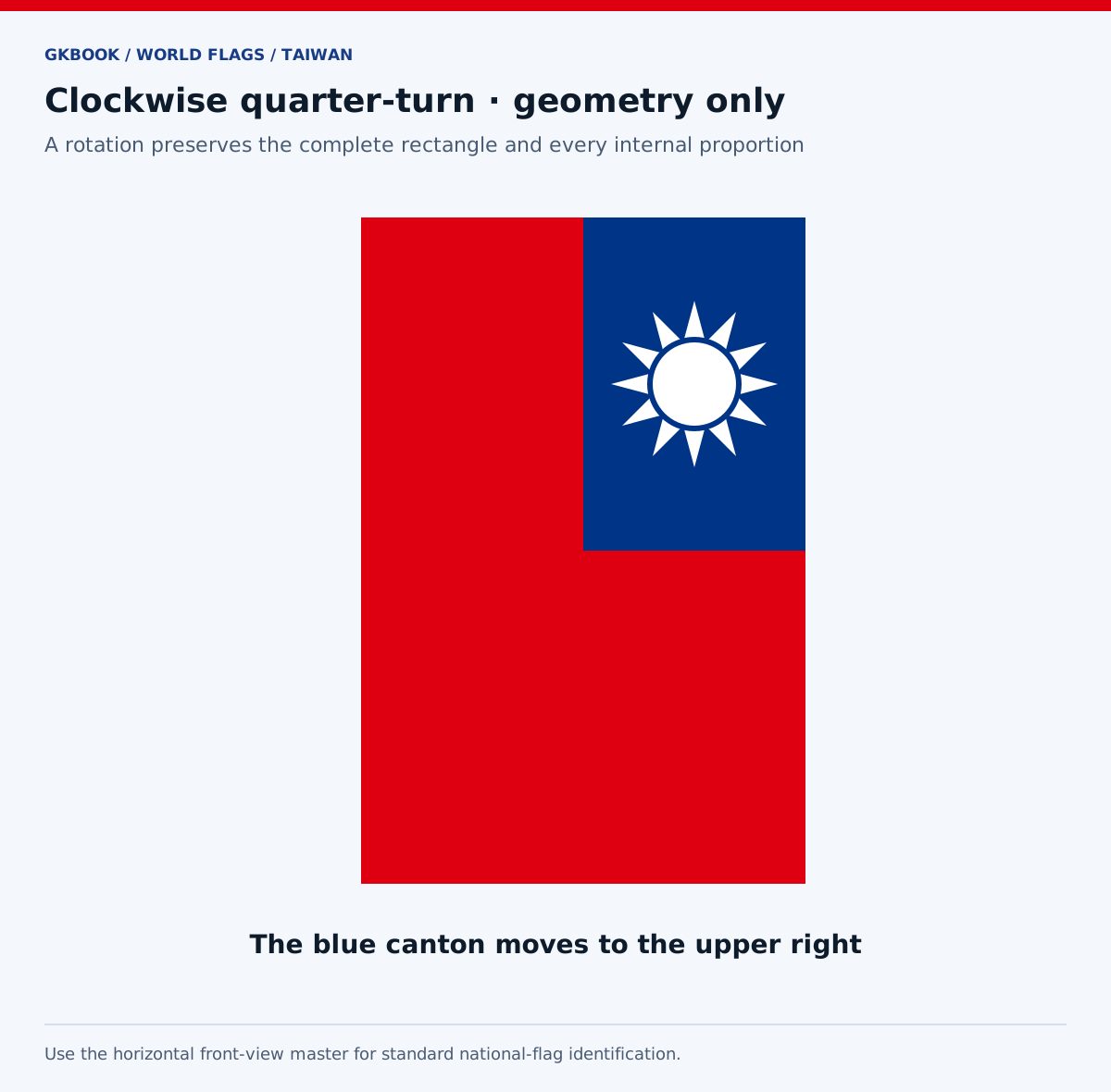
Rotation moves the entire composition together. It does not stretch the horizontal flag into a narrow vertical shape or independently reposition the sun. The resulting rectangle has a height-to-width ratio of 3:2, because the original length and height have exchanged directions. The canton remains one quarter of the area.
A counterclockwise turn would place the canton elsewhere, so the direction of rotation should be stated in any explanatory caption. A real installation may have a viewing side, pole attachment, or local protocol that a flat drawing cannot determine. The download retains the standard horizontal front view as the clean master.
What does the reverse of the flag look like?
Viewed through an ordinary single-layer flag from its reverse side, the composition is horizontally mirrored: the blue canton appears at the upper right instead of the upper left. The sun remains visually symmetric. The whole flag is therefore not identical under reflection, even though its circular sun motif has that symmetry.
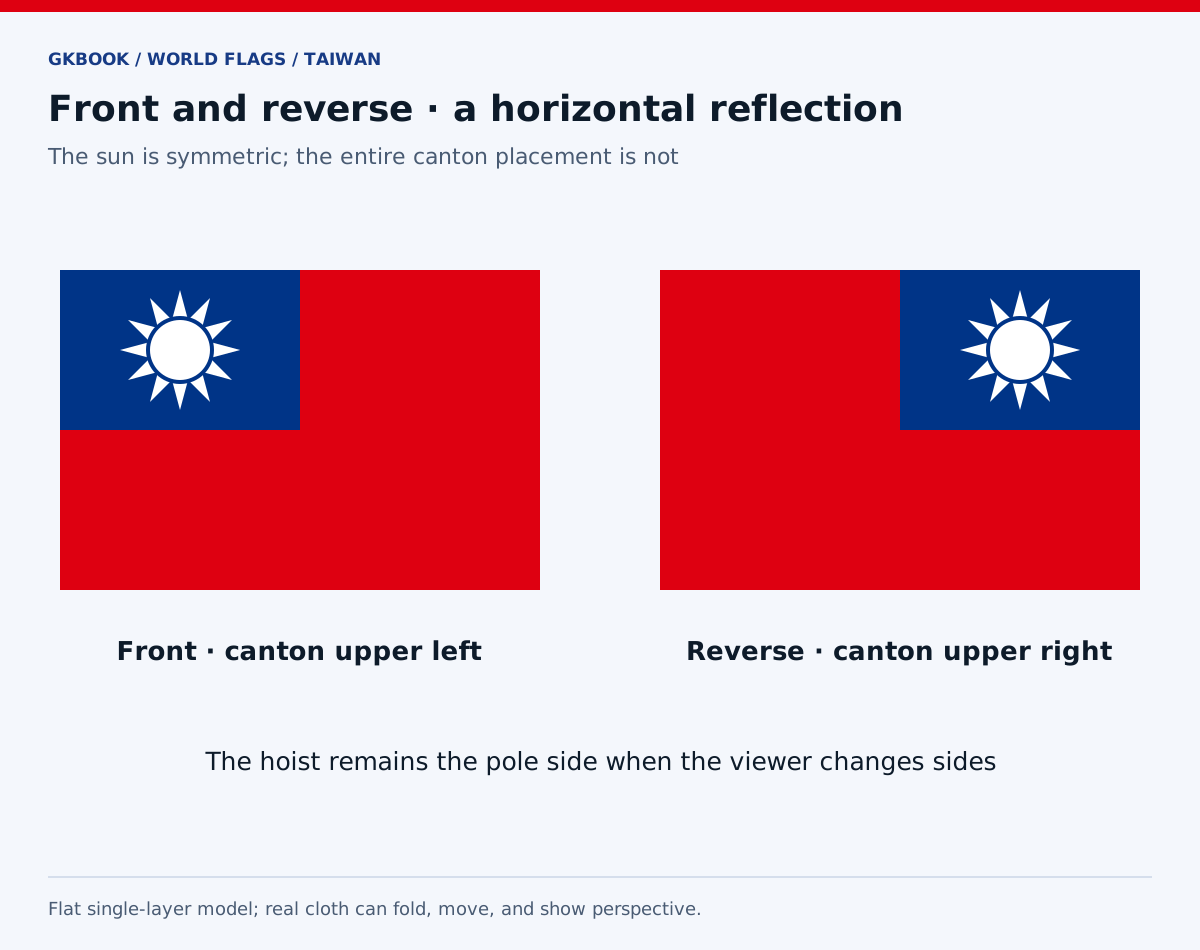
The hoist is still the edge attached to the pole; only the viewer’s side has changed. A reverse-view diagram should explain this relationship instead of labeling the upper-right canton as an error in every photograph. Movement, perspective, and the side of the cloth being photographed can change the apparent position.
For a website’s standard flag icon, use the front view with the canton at the upper left. For a photograph or diagram showing the other side, preserve the appropriate reflection. Turning the image upside down is a different transformation and should not be used as a substitute for showing the reverse.
How should the Taiwan flag image be resized or printed?
Use the SVG when a scalable vector is appropriate, or the 7,200 by 4,800 PNG for a fixed raster image. At 300 pixels per inch, that PNG corresponds to 24 by 16 inches. Preserve the 2:3 height-to-length ratio, keep the complete rectangle visible, and proof the colors for the chosen output process.

Pixel dimensions and physical dimensions are related by the selected output resolution. Changing a resolution label alone does not create additional image detail. The SVG stores shapes mathematically, so it can be scaled without relying on a larger pixel grid, although the final printer or display still has its own resolution.
The sun’s ring is a useful detail to inspect in a small proof. If it disappears, increase the displayed size or choose an output method that preserves the geometry more clearly. Keep explanatory labels, construction circles, borders, shadows, and captions outside the clean flag artwork.
Which Taiwan flag pictures are included?
The collection contains twenty-four subjects, each supplied as SVG and PNG, plus a separate social sharing card. It includes the clean national flag, construction diagrams, color and symbolism explanations, historical milestones, and display comparisons. Captions distinguish exact flag artwork from educational layouts so readers can choose the appropriate file for their purpose.
Use the clean master when the task is simply to show the flag. Use a labeled diagram when explaining proportions, sun radii, the blue ring, or a transformation. A timeline or comparison panel provides context but should not be cropped and reused as though its labels were part of the national symbol.
The gallery offers both formats beside each subject and includes descriptive alternative text. The social card contains a complete flag inside a wider presentation frame. Image credits and reproduction notes accompany the collection, while the article’s navigation connects readers with its own explanations and the wider World Flags index.
Download Taiwan flag pictures
Download the complete current flag as SVG or 7,200 × 4,800 PNG. The height:length ratio is 2:3, with a red field, blue canton, and white sun with twelve rays. The geometry follows the statutory construction; the numerical palette is a declared digital reproduction choice.
The gallery contains 24 subjects, each with an SVG and PNG. Captions distinguish the clean flag from geometry guides, historical explanations, and display comparisons. Image credits and reproduction notes identify the artwork basis and its limits. The separate 1,200 × 630 social card contains a complete 540 × 360 flag.
Continue exploring national designs in World Flags.
World Flags/Taiwan
Taiwan flag pictures
Republic of China (Taiwan) flag reconstructed from statutory geometry, with a documented digital palette.
GKBook geometric reconstruction and original educational layouts. Source artwork credited in the notes. No official certification or endorsement.Download SVGDownload PNGRed #DE0011, blue #003487, white #FFFFFF are declared reproduction values, not statutory numerical codes.
GKBook geometric reconstruction and original educational layouts. Source artwork credited in the notes. No official certification or endorsement.Download SVGDownload PNGThe Interior Ministry and Presidential Office explain the colors through ideals and historical associations.
GKBook geometric reconstruction and original educational layouts. Source artwork credited in the notes. No official certification or endorsement.Download SVGDownload PNGEnlarged sun detail with the central white disk, blue separation ring, and twelve rays.
GKBook geometric reconstruction and original educational layouts. Source artwork credited in the notes. No official certification or endorsement.Download SVGDownload PNGNumbers count outward tips; each traditional time division lasts two modern hours.
GKBook geometric reconstruction and original educational layouts. Source artwork credited in the notes. No official certification or endorsement.Download SVGDownload PNGThe complete flag has length:height 3:2, equivalently height:length 2:3.
GKBook geometric reconstruction and original educational layouts. Source artwork credited in the notes. No official certification or endorsement.Download SVGDownload PNGThe upper hoist rectangle is half the total length and half the total height.
GKBook geometric reconstruction and original educational layouts. Source artwork credited in the notes. No official certification or endorsement.Download SVGDownload PNGDisk radius equals canton length divided by eight; ray-tip radius is twice the disk radius.
GKBook geometric reconstruction and original educational layouts. Source artwork credited in the notes. No official certification or endorsement.Download SVGDownload PNGThe blue ring is 60 master units wide; its outer radius is 510 and the disk radius is 450.
GKBook geometric reconstruction and original educational layouts. Source artwork credited in the notes. No official certification or endorsement.Download SVGDownload PNGA regular 24-vertex supporting polygon gives twelve equally spaced tips with 30-degree apex angles.
GKBook geometric reconstruction and original educational layouts. Source artwork credited in the notes. No official certification or endorsement.Download SVGDownload PNGThe sun center is the canton midpoint, not the complete flag midpoint.
GKBook geometric reconstruction and original educational layouts. Source artwork credited in the notes. No official certification or endorsement.Download SVGDownload PNGExact vector areas for this construction: red 75%, blue approximately 21.716898%, and white approximately 3.283102%.
GKBook geometric reconstruction and original educational layouts. Source artwork credited in the notes. No official certification or endorsement.Download SVGDownload PNGA selective timeline separates the motif’s origin, governmental adoption, national legislation, and relocation.
GKBook geometric reconstruction and original educational layouts. Source artwork credited in the notes. No official certification or endorsement.Download SVGDownload PNGThe 1921, 1928, and 1954 dates refer to different stages; they are not interchangeable.
GKBook geometric reconstruction and original educational layouts. Source artwork credited in the notes. No official certification or endorsement.Download SVGDownload PNGLegal geometry and a digital color choice are documented separately.
GKBook geometric reconstruction and original educational layouts. Source artwork credited in the notes. No official certification or endorsement.Download SVGDownload PNGThe five-band flag belongs to earlier Republic of China history; Taiwan was under Japanese rule in 1912.
GKBook geometric reconstruction and original educational layouts. Source artwork credited in the notes. No official certification or endorsement.Download SVGDownload PNGNational Day commemorates the Wuchang Uprising; it is separate from the 1928 flag-law promulgation.
GKBook geometric reconstruction and original educational layouts. Source artwork credited in the notes. No official certification or endorsement.Download SVGDownload PNGOlympic representation uses a separate committee identity and does not alter the national flag drawing.
GKBook geometric reconstruction and original educational layouts. Source artwork credited in the notes. No official certification or endorsement.Download SVGDownload PNGThe statute defines a circular national emblem separately from the complete rectangular flag.
GKBook geometric reconstruction and original educational layouts. Source artwork credited in the notes. No official certification or endorsement.Download SVGDownload PNGSelected outdoor-display provisions from the current flag law; specific arrangements may require additional instructions.
GKBook geometric reconstruction and original educational layouts. Source artwork credited in the notes. No official certification or endorsement.Download SVGDownload PNGThe lowering distance is half the flag’s long side, not half the pole height. For L = 144 cm, lower 72 cm.
GKBook geometric reconstruction and original educational layouts. Source artwork credited in the notes. No official certification or endorsement.Download SVGDownload PNGClockwise 90-degree rotation of the complete front view; not a verified official vertical-hanging prescription.
GKBook geometric reconstruction and original educational layouts. Source artwork credited in the notes. No official certification or endorsement.Download SVGDownload PNGThe reverse view is mirrored horizontally; it is not a half-turn or an unchanged front view.
GKBook geometric reconstruction and original educational layouts. Source artwork credited in the notes. No official certification or endorsement.Download SVGDownload PNGThe master keeps the statutory 2:3 height:length ratio; numerical colors remain a declared digital palette.
GKBook geometric reconstruction and original educational layouts. Source artwork credited in the notes. No official certification or endorsement.Download SVGDownload PNGFrequently asked questions
What does the Taiwan flag look like?
Taiwan’s familiar national flag is the flag of the Republic of China: a red rectangle with a blue canton in the upper hoist corner. A white sun with twelve pointed rays sits inside the canton. Its height-to-length ratio is 2:3, and the canton occupies one quarter of the rectangle.
What is the Taiwan flag called?
The formal name is the national flag of the Republic of China, often identified internationally as the Taiwan flag. Its descriptive Chinese name, Qing Tian Bai Ri Man Di Hong, refers to a blue sky, a white sun, and a red field. The complete three-color composition matters when identifying it.
What are the colors of the Taiwan flag?
The flag has a red field, a blue canton, and a white sun. This collection uses red #DE0011, blue #003487, and white #FFFFFF, sampled from flat areas of the Presidential Office’s published JPEG. These are documented digital reproduction values; the governing law does not prescribe those numerical screen codes.
What does the Taiwan flag represent?
The complete flag represents the Republic of China, commonly identified with Taiwan. Official explanations connect blue, white, and red with freedom, equality, and fraternity, and also associate them with Sun Yat-sen’s Three Principles of the People. These are attributed interpretations of the colors, distinct from the law’s construction measurements.
What does the white sun on the Taiwan flag mean?
The white sun is the central symbol within the blue canton. Presidential Office explanations associate its brightness with progress, while the surrounding twelve rays refer to twelve months and twelve traditional two-hour periods. Its white disk, blue separation ring, and pointed rays are distinct geometric parts of one sun motif.
Why does the Taiwan flag have twelve sun rays?
The twelve rays correspond, in the Presidential Office’s explanation, to the twelve months of the year and the twelve traditional divisions of a day. Each traditional division lasts two modern hours. The rays therefore should not be described as twelve ordinary clock hours, and their count is not a province count.
What does the blue canton symbolize?
The blue canton is the rectangular upper hoist quarter containing the white sun. Official interpretations associate blue with the sky and with freedom; the Presidential Office also connects the color with nationalism among the Three Principles of the People. These meanings concern interpretation, while the canton’s size follows the construction rules.
What is the official Taiwan flag ratio?
The flag’s height-to-length ratio is 2:3, equivalently length-to-height 3:2. The law specifies that relationship, and the construction diagrams preserve it. This collection’s master measures 7,200 units along the horizontal length and 4,800 along the height. A resized copy should multiply both dimensions by the same factor.
How large is the blue canton?
The blue canton is half the flag’s length and half its height, so its underlying rectangle covers one quarter of the total area. In the 7,200 by 4,800 master, it measures 3,600 by 2,400. It sits flush against the upper and hoist edges, with no surrounding red border.
How big is the white sun disk?
The white disk’s radius is one eighth of the canton’s length, which equals one sixteenth of the complete flag’s length. In this master, the radius is 450 and the diameter is 900. The outer ray-tip radius is twice the disk radius, making the complete sun’s tip-to-tip diameter 1,800.
How wide is the blue ring around the sun?
The blue separation ring has a width equal to one fifteenth of the white disk’s diameter. With a disk diameter of 900 in this master, the ring is 60 units wide. Its outer radius is therefore 510, compared with the white disk radius of 450. The ring uses the canton’s blue.
How are the twelve sun rays constructed?
The twelve rays are equally spaced, with thirty degrees between adjacent outer tips and a thirty-degree angle at each tip. Four tips align with the vertical and horizontal axes. The drawing uses a regular twenty-four-vertex outline beneath the blue separation circle and white disk, keeping the visible ray geometry consistent.
Where is the white sun positioned?
The sun is centered in the blue canton. For this master, its center is 1,800 units from the hoist edge and 1,200 from the top edge. Its outer tips reach x coordinates 900 and 2,700, and y coordinates 300 and 2,100. It is not centered in the entire flag.
What percentage of the flag is each color?
Red occupies exactly 75 percent of the flag. The underlying canton covers 25 percent, but part of it is white. For the exact construction used here, visible white covers approximately 3.283102 percent and visible blue approximately 21.716898 percent. These calculated areas describe geometry and should not be interpreted as symbolic allocations.
What is the history of the Taiwan flag?
The design developed from Lu Hao-tung’s blue-sky-and-white-sun motif of 1895, with Sun Yat-sen adding the red field. Sun’s Guangzhou government adopted the complete flag in 1921; nationwide legal adoption followed in 1928. The Republic of China government relocated to Taiwan in 1949, carrying an already established national flag.
When was the Taiwan flag officially adopted?
Two dates need context: May 5, 1921 marks adoption by Sun Yat-sen’s government in Guangzhou, while December 17, 1928 marks nationwide promulgation of the national emblem and flag law. The current statute records a later revision on October 23, 1954. These dates describe different stages, rather than competing versions of one event.
Who designed the Taiwan flag?
Official Presidential Office accounts credit Lu Hao-tung, also romanized Lu Haodong, with the blue-sky-and-white-sun design, and Sun Yat-sen with adding the red field. This division of contributions is more precise than assigning every part of the finished flag to one person. Modern digital artists reproduce that historical composition.
Which rules define the Taiwan flag’s design?
Article 6 of the Constitution describes a red field with a blue sky and white sun in the upper left corner. The National Emblem and National Flag of the Republic of China Act and its attached diagrams provide the detailed proportions, sun construction, and sizes. The Chinese legal text controls over conflicting English translation.
Was there an earlier Republic of China flag?
Yes. The early Republic of China used a five-colored flag with horizontal red, yellow, blue, white, and black bands. That design belongs to the republic’s earlier history on the mainland. It should not be labeled simply as “Taiwan’s 1912 flag,” because Taiwan was then under Japanese rule and the historical settings differ.
Why is the flag displayed on October 10?
October 10 is the Republic of China’s National Day, often called Double Ten. It commemorates the Wuchang Uprising of October 10, 1911, an event in the revolution that led to the republic. Flag displays on that date mark the commemoration; the date is not the flag law’s 1928 promulgation date.
Does the flag’s use settle international recognition?
No. Identifying the flag used by the Republic of China in Taiwan does not by itself settle diplomatic recognition or disputed political status. United Nations General Assembly Resolution 2758, adopted on October 25, 1971, concerns China’s representation at the United Nations. That event is separate from the flag’s design and adoption history.
Why does Chinese Taipei use a different Olympic flag?
At the Olympics, the participating National Olympic Committee is recognized by the IOC as Chinese Taipei, with the code TPE. Its delegation uses a separate committee flag under the Olympic arrangements. That sporting flag should not replace the red-field national flag in a country-design article, because the two symbols identify different contexts.
Is the white sun also the national emblem?
Yes. The same blue-sky-and-white-sun motif forms the national emblem, which the law defines separately from the complete flag. The emblem uses a circular blue background; the flag places the sun inside a rectangular blue canton on a red field. A standalone emblem is therefore not the whole national flag.
How can this flag be distinguished from similar designs?
Look for the complete combination: a red field, an upper hoist blue canton, and one white sun with twelve rays and a blue separation ring. A blue flag containing only the white sun is not the complete red-field national flag. Shared colors or a similar sun motif do not make different flags interchangeable.
How is the flag displayed outdoors?
The national flag law provides for outdoor display from sunrise to sunset and addresses lowering the flag in rain, subject to specified exceptions. It also sets rules for displaying it with foreign flags. These are ceremonial provisions; a clean drawing alone does not establish how every venue or event must arrange its display.
How is the Taiwan flag flown at half-mast?
The Chinese rule and the Interior Ministry’s explanation require raising the flag to the top, then lowering it by a distance equal to half the flag’s long side. Before final lowering, raise it to the top again. This distance is not half the pole’s height, despite a misleading English translation of the statute.
What happens when the flag is turned vertically?
A clockwise quarter-turn of the complete front-view flag produces a tall rectangle with the blue canton at the upper right and the same white sun intact. This is a geometric rotation, not a verified official vertical-hanging prescription. Keep the distinction clear when using a rotated image for a banner, diagram, or layout.
What does the reverse of the flag look like?
Viewed through an ordinary single-layer flag from its reverse side, the composition is horizontally mirrored: the blue canton appears at the upper right instead of the upper left. The sun remains visually symmetric. The whole flag is therefore not identical under reflection, even though its circular sun motif has that symmetry.
How should the Taiwan flag image be resized or printed?
Use the SVG when a scalable vector is appropriate, or the 7,200 by 4,800 PNG for a fixed raster image. At 300 pixels per inch, that PNG corresponds to 24 by 16 inches. Preserve the 2:3 height-to-length ratio, keep the complete rectangle visible, and proof the colors for the chosen output process.
Which Taiwan flag pictures are included?
The collection contains twenty-four subjects, each supplied as SVG and PNG, plus a separate social sharing card. It includes the clean national flag, construction diagrams, color and symbolism explanations, historical milestones, and display comparisons. Captions distinguish exact flag artwork from educational layouts so readers can choose the appropriate file for their purpose.
Every general-knowledge topic and the A-to-Z lists.
The world A to Z: flags, countries, the sciences, places, people, subjects.











We Value Your Opinion Comments