

Russia flag picture
Explore the proportions, history, and picture gallery.
| Design | White, blue, and redThree equal horizontal bands, read from the top down. |
|---|---|
| Proportions | Height:length = 2:3Each band is one third of the total height. |
| Screen palette | #FFFFFF · #0039A6 · #D52B1EEditorial digital fills, not statutory RGB codes. |
| Modern milestones | 1991 · 1993 · 2000Restoration; current specification; federal constitutional law. |
| National Flag Day | August 22Established by a decree dated August 20, 1994. |
| Image sizes | SVG and PNGSVG: 2,700 × 1,800; PNG: 5,400 × 3,600. |
What does the Russia flag look like?
Russia’s national flag has three equal horizontal bands: white at the top, blue in the middle, and red at the bottom. Its height to length ratio is 2:3. The ordinary national flag is a plain tricolor, without a coat of arms, star, lettering, or other central emblem.
This guide connects the tricolor’s appearance with its maritime history, modern restoration, and legal description. The gallery pairs a clean reference with labeled diagrams; the answers distinguish early artifacts, the 1991 restoration, the 1993 specification, and the 2000 flag law.
What are the colors of Russia’s flag?
The legal colors are white, blue, and red, arranged from top to bottom. This package uses #FFFFFF, #0039A6, and #D52B1E as its declared screen palette. Article 1 of the flag law specifies the color names, arrangement, and proportions; it does not prescribe those numerical RGB or hexadecimal values.
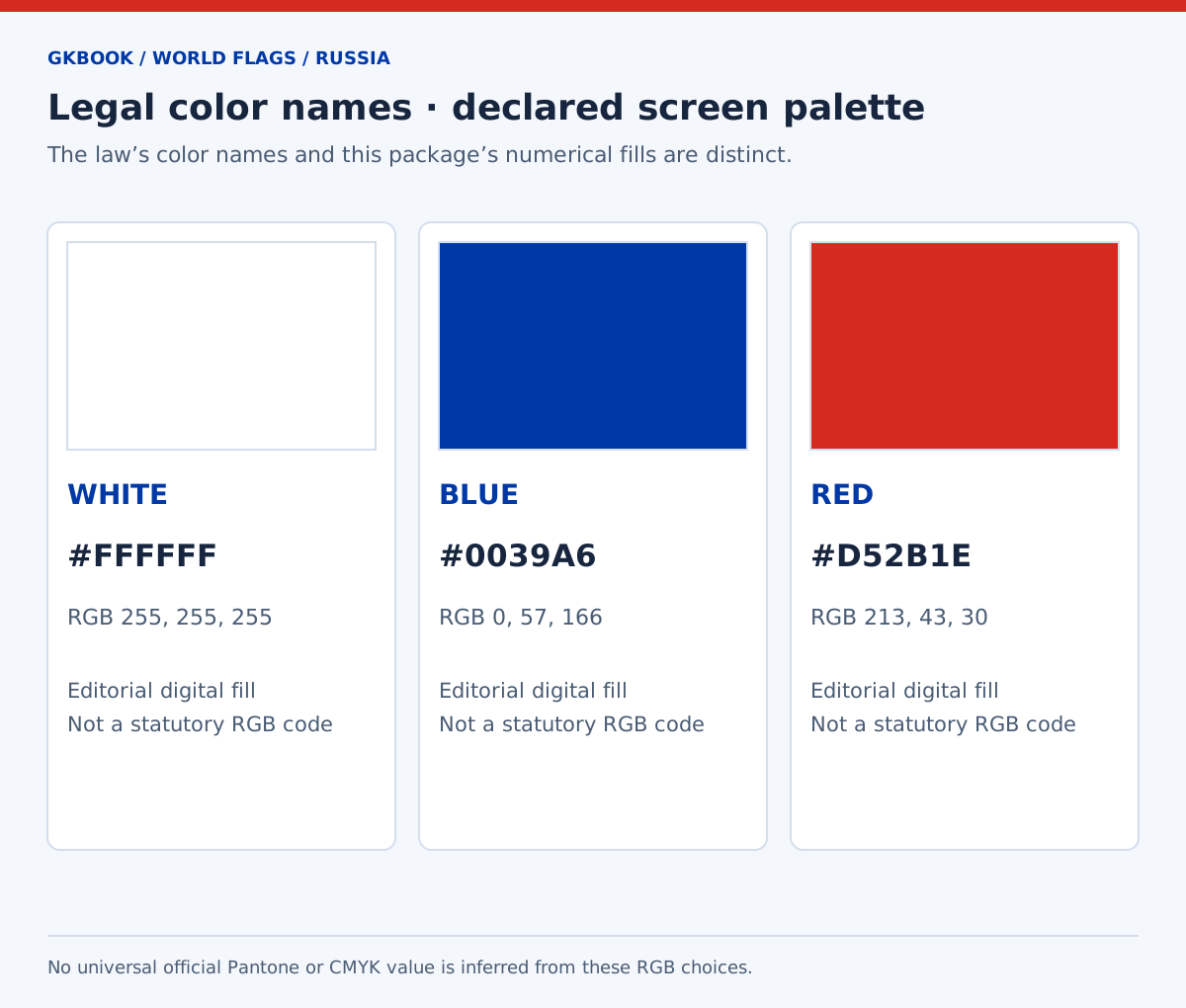
A digital drawing needs numerical fills even when its legal description uses ordinary color names. The values here are therefore documented reproduction choices, not a newly discovered statutory color table. White uses RGB 255, 255, 255; blue uses 0, 57, 166; red uses 213, 43, 30.
Keep this distinction when reusing the images in a classroom, website, or printed guide. A sampled photograph, an unrelated naval specification, or an award’s enamel color reference should not become an alleged universal standard for the national flag. Physical reproduction also depends on materials, illumination, and the production process.
| Band | RGB | Hexadecimal | Status |
|---|---|---|---|
| White | 255, 255, 255 | #FFFFFF | Editorial screen palette |
| Blue | 0, 57, 166 | #0039A6 | Editorial screen palette |
| Red | 213, 43, 30 | #D52B1E | Editorial screen palette |
What do the colors of Russia’s flag mean?
There is no single official interpretation assigning a meaning to each color of the current Russian flag. Popular explanations associate white with peace or purity, blue with faithfulness or constancy, and red with strength or sacrifice. These are interpretations, not definitions established by the national flag law.
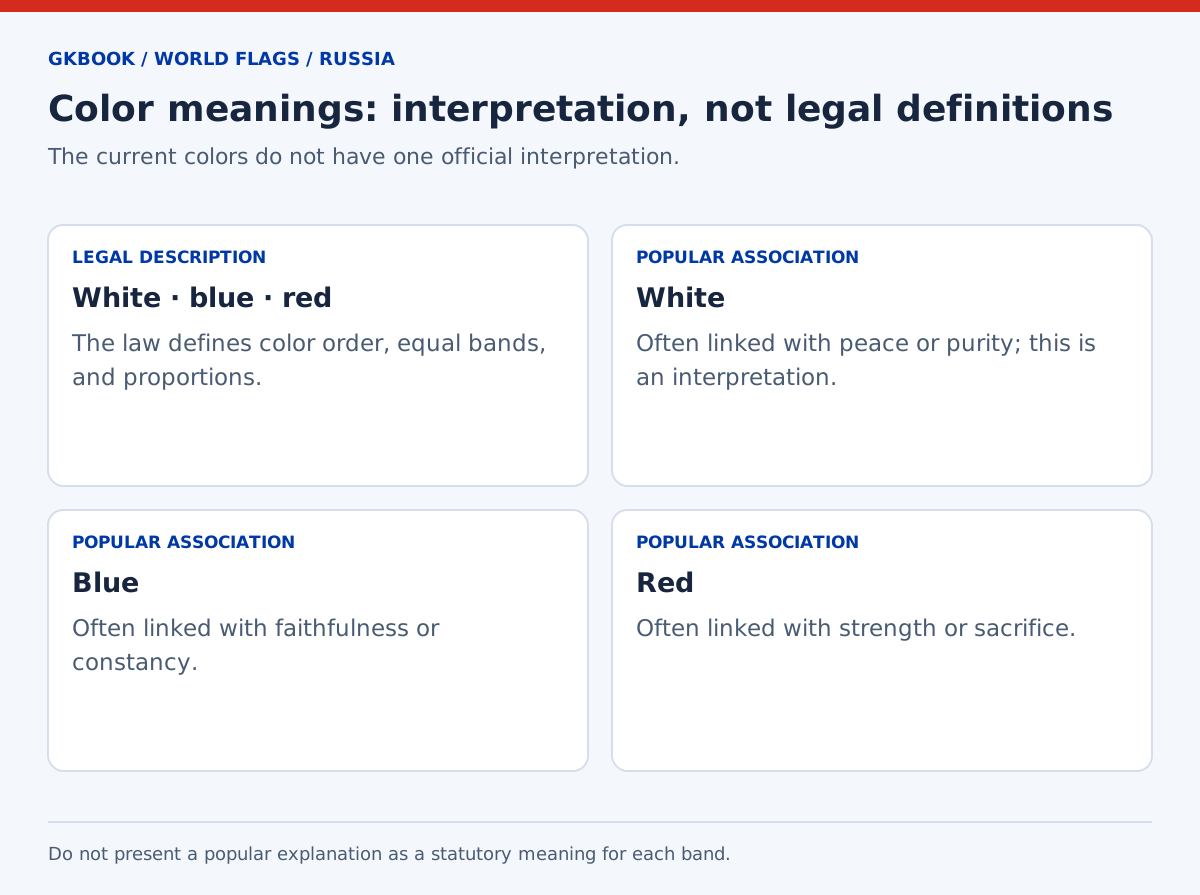
The Presidential Library explicitly distinguishes present popular explanations from an official interpretation. Historical writers have also offered different accounts, reflecting their own periods and purposes. A meaning associated with an imperial ceremony should not automatically be presented as the legal meaning of today’s national symbol.
For a concise caption, describe the design first and identify symbolism as interpretation if it is included. Avoid treating a regional, religious, or ethnic mapping as settled fact without a specific source and historical context. The gallery’s meaning card separates the legal color order from several commonly repeated associations rather than merging them.
What is the aspect ratio of Russia’s flag?
Russia’s national flag has a height to length ratio of 2:3. Expressed as image width by height, that is 3:2. A rectangle 150 centimeters long is therefore 100 centimeters high. The ratio measures the flag’s colored rectangle, excluding its pole, surrounding page margins, and any display frame.

Always identify the order of the two measurements. Writing only “2:3” without saying height first can lead someone to create a portrait rectangle. The supplied reference is a landscape image: its horizontal dimension is one and a half times its vertical dimension, as required by the current description.
To calculate height from length, multiply by two thirds. To calculate length from height, multiply by three halves. A 120 centimeter height gives a 180 centimeter length. These calculations are examples of uniform scaling; the law’s ratio does not require every physical flag to use one particular centimeter size.
Are all three stripes on Russia’s flag equal?
Yes. Each horizontal stripe occupies one third of the flag’s height and extends across its entire length. All three bands therefore have equal areas. On the supplied 2,700 × 1,800 SVG master, each band is 2,700 units wide and 600 units high, with boundaries at y = 600 and 1,200.
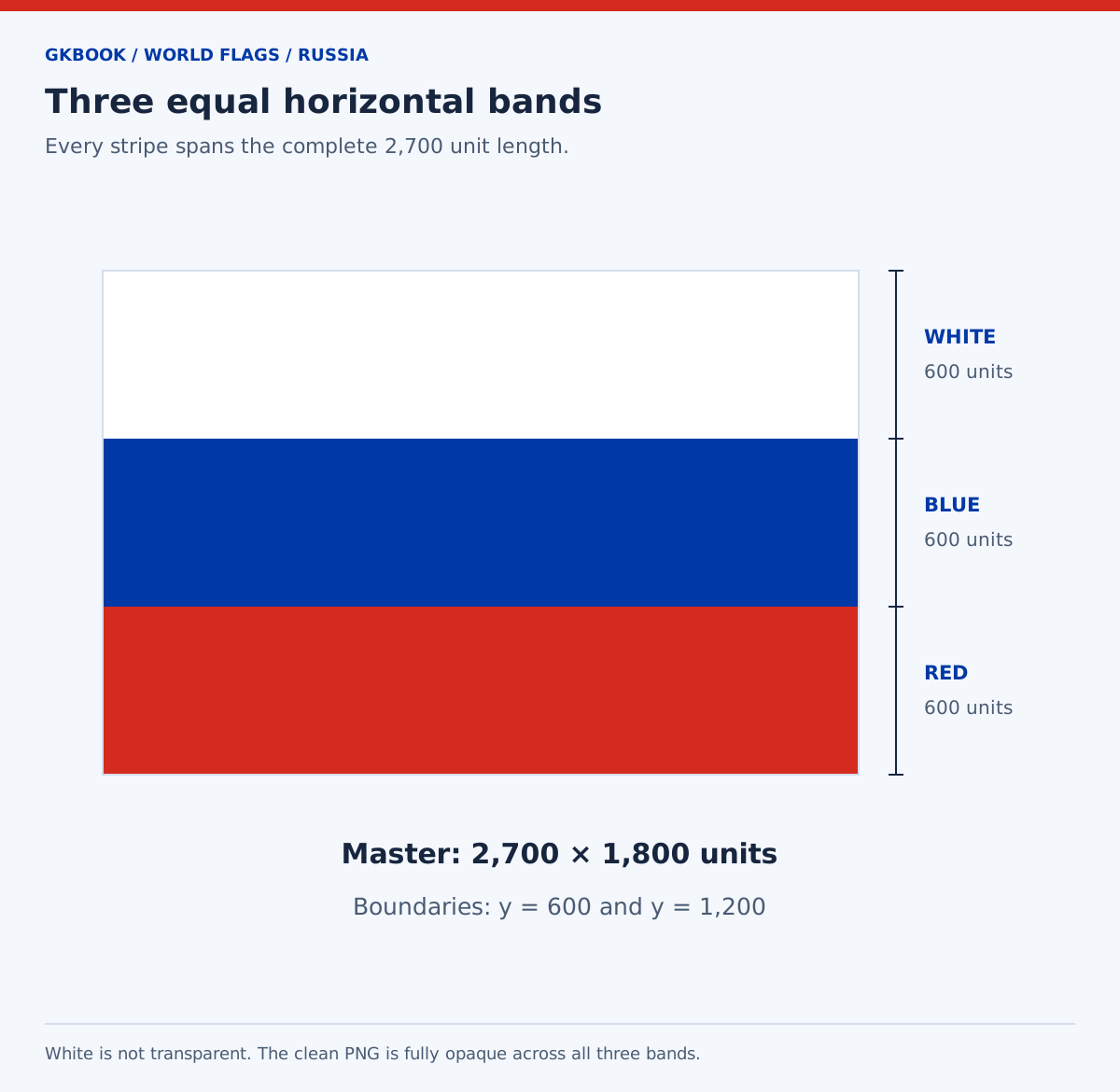
Equal bands are a geometric requirement, not a visual estimate based on how bright each color appears. The white region can seem larger against a pale background, but it must not be reduced to compensate. A surrounding teaching frame may help reveal the outer edge without changing the clean artwork.
For a raster export, choose a height divisible by three so the two boundaries fall on complete pixel rows. The main PNG is 3,600 pixels high, giving exactly 1,200 rows to each color. This is a practical image production choice, not a resolution prescribed by the national flag law.
Which color belongs at the top of Russia’s flag?
White belongs at the top, blue in the middle, and red at the bottom in the standard horizontal display. The bands run across the flag’s length. A normal reference image places the hoist at the left, but looking from the opposite side does not change this vertical color order.
Start at the upper edge and read downward. This is different from a vertical tricolor, where the order is normally described outward from the hoist. On Russia’s flag, all three colors meet both the hoist and the fly, so no single band is exclusively the pole side color.
Turning the image upside down produces red, blue, white and is not the standard orientation. Rotating it a quarter turn creates vertical bands and should not silently replace the horizontal reference. A special hanging arrangement needs its own instructions; the clean download represents the ordinary landscape design with white uppermost.
How can you draw Russia’s flag accurately?
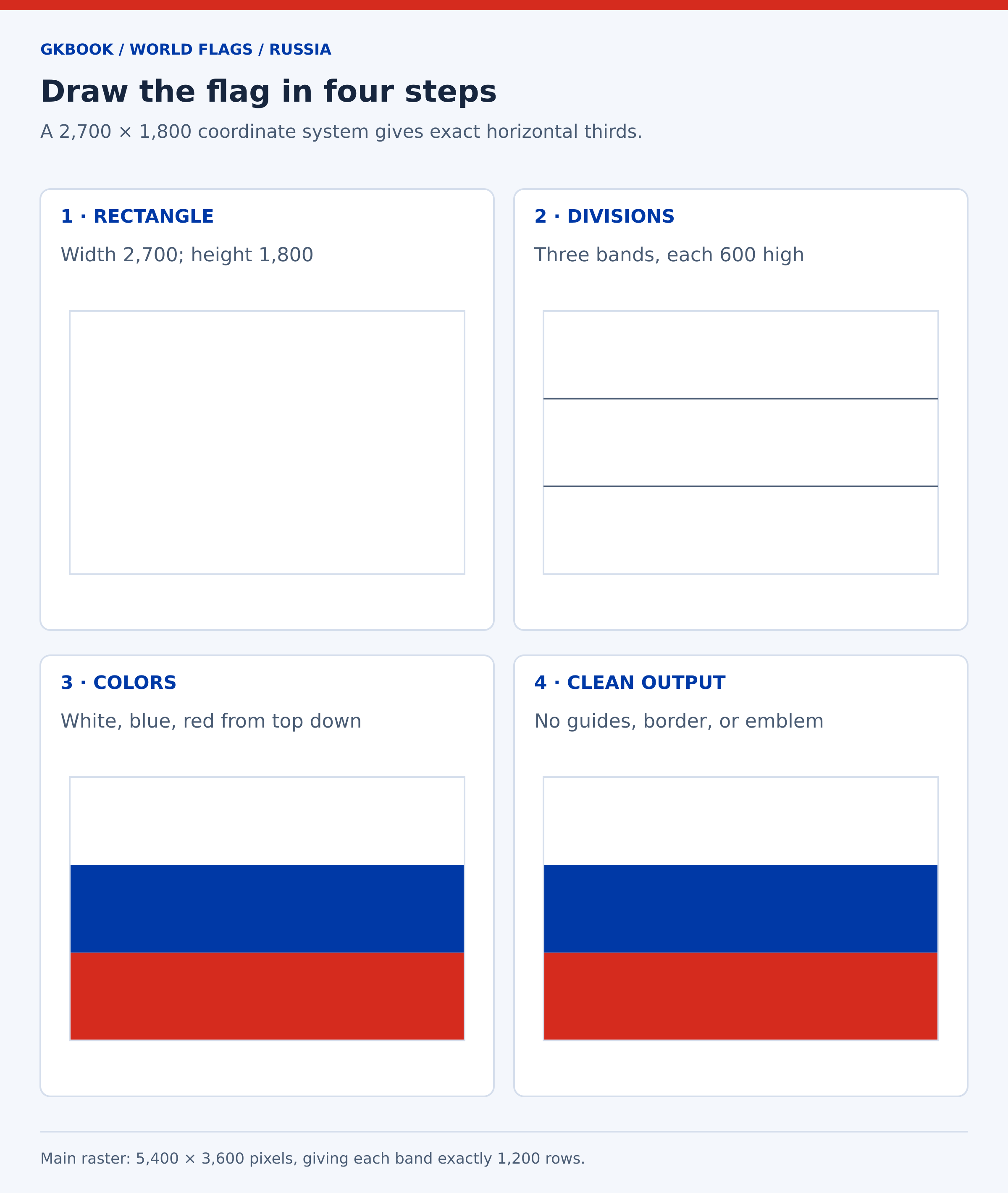
Draw a rectangle three units long and two units high. Divide its height into three equal horizontal bands and fill them white, blue, and red from top to bottom. Keep the finished flag plain, with no border, emblem, text, gaps, shadows, or unequal stripe heights inside the rectangle.

For the supplied SVG, use a 2,700 by 1,800 coordinate system. Place three rectangles at y coordinates 0, 600, and 1,200. Each has width 2,700 and height 600, with x equal to zero. The rectangles meet exactly, without stroke widths that would distort their shared boundaries.
Export the main raster at 5,400 by 3,600 pixels to retain integer boundaries and the correct ratio. Keep measurement lines and captions on a separate explanatory canvas. The clean file should contain only the three fills, while a teaching diagram can show the construction stages and identify its digital palette.
What are the main milestones in Russia’s flag history?
The tricolor developed through maritime use, imperial recognition, Soviet replacement, and modern restoration. Important milestones include Peter I’s surviving 1693 flag, the 1705 merchant shipping decree, recognition in 1896, restoration in 1991, the current design specification in 1993, and the federal constitutional flag law dated December 25, 2000.

These dates answer different questions. An early surviving textile shows a historical object; a merchant decree identifies a particular use; later state decisions establish national status or formal specifications. Combining all these functions into one “adoption date” hides the development of the symbol and can mislabel a historical illustration.
The gallery therefore uses a dated timeline and separate explanation cards. It does not present a newly drawn modern flag as an authenticated seventeenth century artifact. The current plain rectangle is reproduced consistently, while older flags with arms, inscriptions, or different proportions are discussed in their own historical and institutional settings.
How is the ship Oryol connected with the Russian tricolor?
Accounts of the flag’s origins often connect white, blue, and red with the ship Oryol, launched in 1668 during the reign of Alexei Mikhailovich. This maritime association concerns the early use of the colors. It does not by itself establish every detail of a modern three stripe flag design.
The Presidential Library describes the colors in connection with the ship and places their development in the wider need to identify vessels at sea. Historical references to cloth colors are useful evidence, but they should not be treated as complete technical drawings with modern dimensions, color codes, and construction coordinates.
For that reason, this package does not invent an “exact 1668 flag” for the gallery. A cautious historical caption can name the ship, the period, and the color association while leaving uncertain layout details unstated. This also prevents an early maritime milestone from being confused with the modern restoration of the national flag.
What is the significance of Peter I’s 1693 flag?
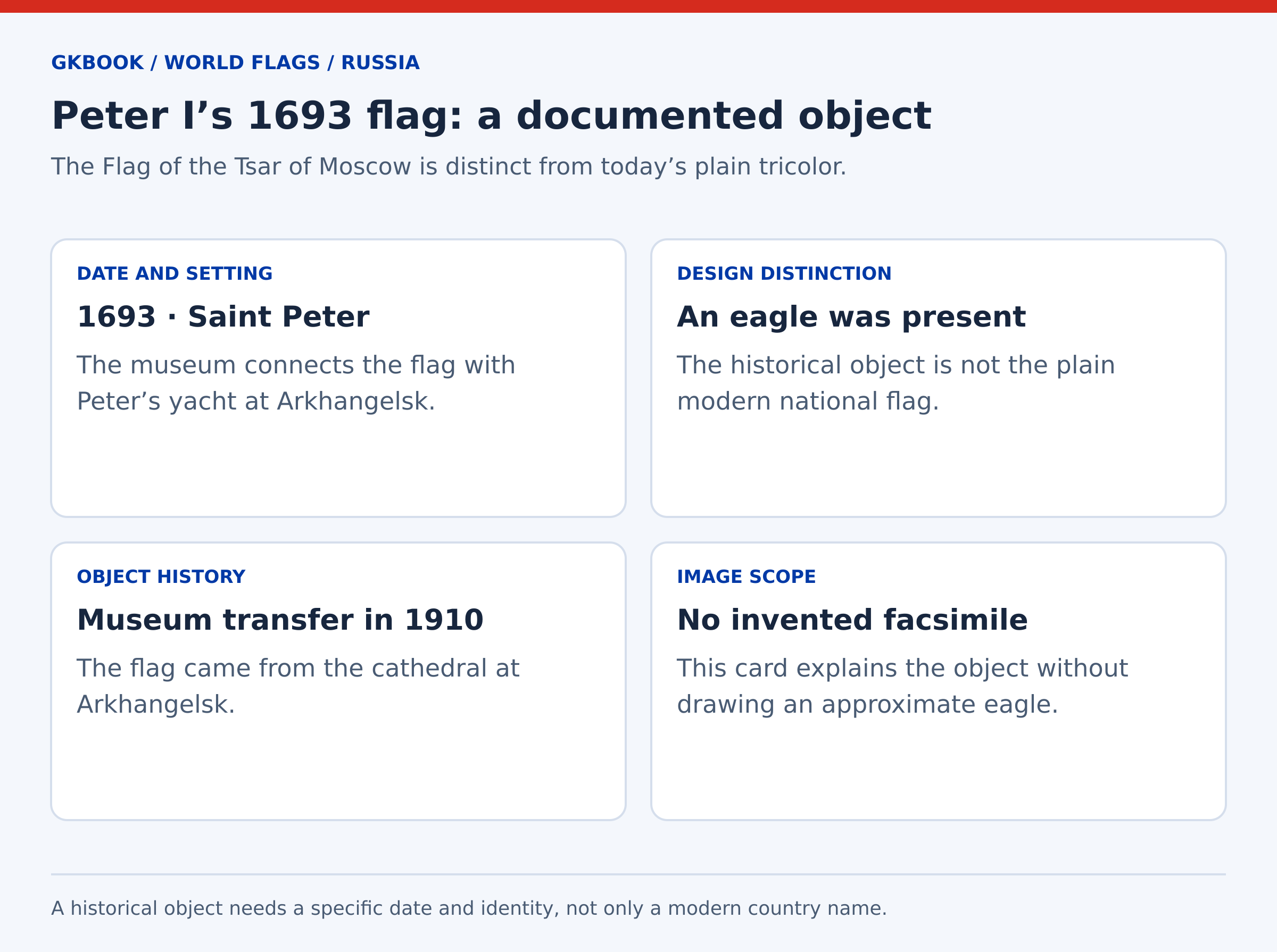
The Central Naval Museum identifies a surviving flag used by Peter I on the yacht Saint Peter in 1693 as one of the oldest Russian tricolors. This “Flag of the Tsar of Moscow” included a golden double headed eagle. It is a historical object, distinct from today’s plain national flag.

The museum’s account connects the object with Peter’s voyage at Arkhangelsk and records its transfer from the cathedral there to the museum in 1910. That documented object history is more useful than a generic modern image labeled only “Peter the Great’s flag.” It identifies which particular artifact is being discussed.
The gallery explains the object through a text card instead of drawing an approximate eagle and claiming a facsimile. A historical standard can share the tricolor’s broad arrangement while differing in emblem, manufacture, condition, and purpose. None of those artifact details should be inferred from the clean modern reference supplied here.
What did Peter I’s 1705 flag decree establish?
Peter I’s 1705 decree directed merchant vessels to use the white, blue, and red flag. The Presidential Library connects the decree with his drawing of the horizontal arrangement. This is an important merchant shipping milestone, but it should not be described as the first adoption of today’s complete national flag law.

A merchant flag identifies a vessel in a commercial maritime setting. Royal standards, military flags, and other naval signals can exist alongside it, each with a different function. The presence of a tricolor on a trading ship therefore does not mean every official institution used precisely the same flag at that date.
For a timeline, “1705: merchant shipping decree” is a concise and accurate label. It explains why maritime history matters without collapsing several centuries of later changes. The package uses the year alone here, avoiding an unexplained conversion between historical calendar conventions when a day and month are unnecessary to the answer.
How did imperial Russian flags differ from the current tricolor?
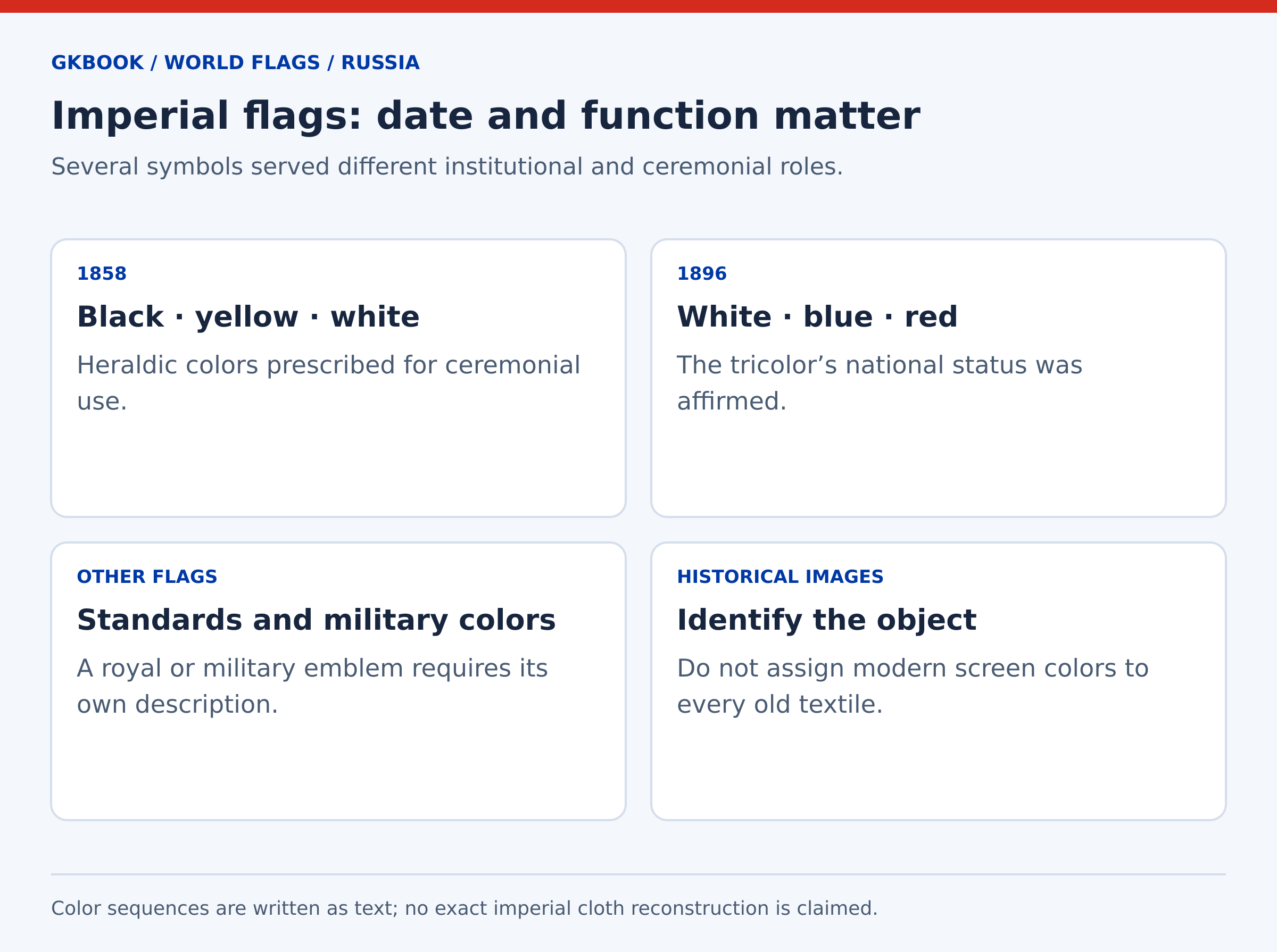
Imperial Russia used several flags for different purposes. Black, yellow, and white heraldic colors were prescribed for ceremonial use in 1858, while the white, blue, and red tricolor was affirmed as the national flag in 1896. Imperial standards and flags bearing arms should be distinguished from the present plain rectangle.
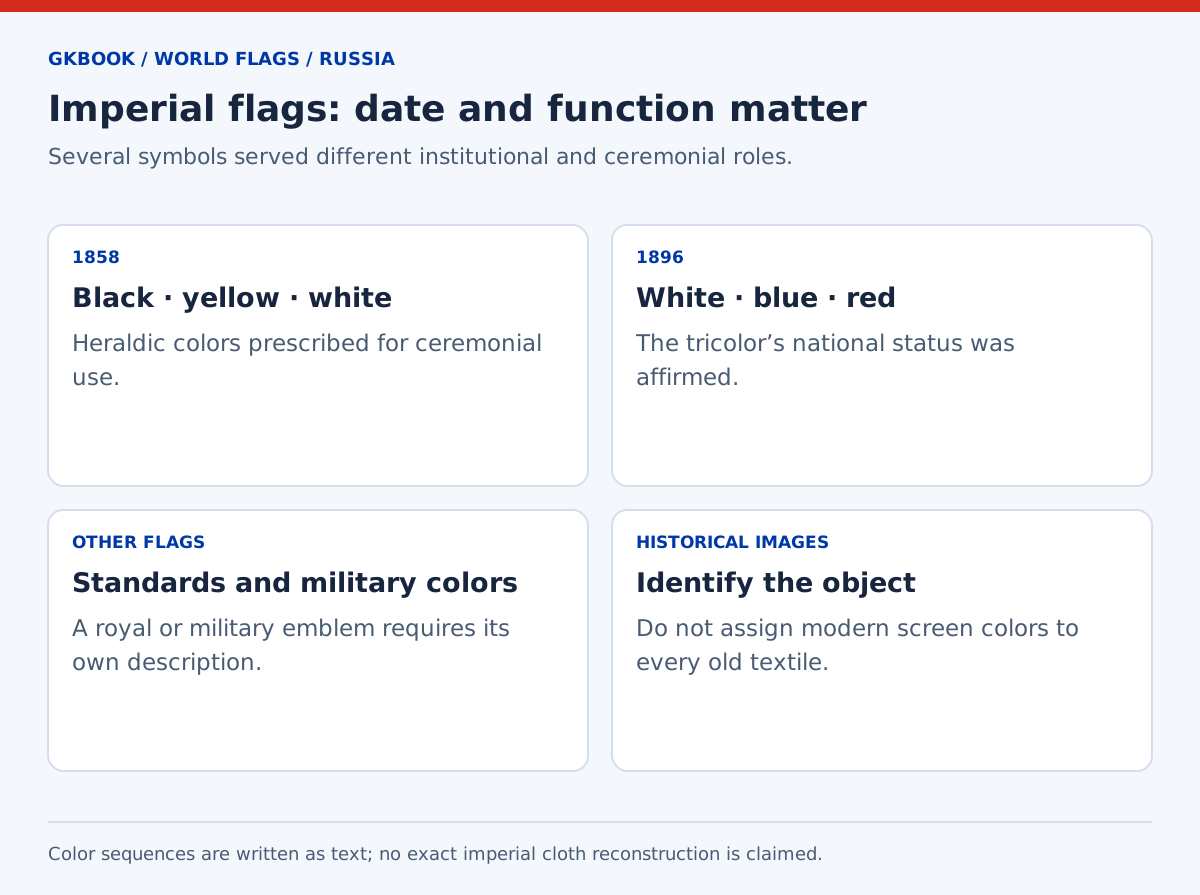
The history is not a simple sequence in which every flag of one design disappeared whenever another received recognition. Merchant identification, dynastic symbolism, military colors, and public decoration served different needs. A caption should specify the relevant function as well as the date instead of calling every historical banner “the Russian flag.”
The imperial comparison card records the two color sequences in words and explains the milestones. It does not reconstruct a particular nineteenth century textile or attach today’s screen values to an old flag. This keeps the comparison useful while avoiding unsupported claims about exact shades, embroidery, proportions, or the appearance of a surviving object.
Was the Soviet flag the same as Russia’s current flag?
No. Soviet flags used red fields and revolutionary emblems or inscriptions, unlike the present white, blue, and red national tricolor. The Russian Soviet republic and the Soviet Union were different political entities with their own flag histories. A historical picture needs a date and an institutional label to identify its design accurately.

The Presidential Library’s account describes the Russian republic’s 1918 flag legislation and its red field with a country name or abbreviation. Later Soviet Union designs are associated with the hammer and sickle and star. These details should not be merged into one supposedly unchanged flag covering every Soviet institution and year.
For readers comparing images, the main distinction is straightforward: the modern national reference has three equal horizontal bands and no emblem. A red historical flag belongs to a different period and requires its own specification. The gallery uses an explanatory card rather than a guessed composite of Soviet symbols and lettering.
When was Russia’s tricolor restored?
The Supreme Soviet of the Russian Soviet republic recognized the historic tricolor for official use on August 22, 1991. The constitutional amendment dated November 1, 1991 described white, azure, and scarlet bands in a 1:2 rectangle. That restoration should be distinguished from the current 2:3 specification adopted in 1993.

August 22 is the key restoration milestone and later became the annual Flag Day date. The November amendment supplies a separate legal description from that same year. Its height to length ratio is important: a 1991 illustration should not automatically be assigned the present proportions merely because the color sequence looks familiar.
The comparison diagram uses outlines to contrast a 1:2 rectangle with a 2:3 rectangle at equal height. It does not manufacture numerical azure and scarlet values for the older flag. Historical wording, shape, and date are kept together, allowing readers to distinguish the restored symbol from its subsequent technical specification.
What changed in the Russian flag specification in 1993?
Presidential Decree No. 2126 of December 11, 1993 established the present description: three equal horizontal bands of white, blue, and red, with height to length 2:3. The earlier 1991 constitutional wording had used white, azure, and scarlet and a 1:2 ratio. The tricolor itself was not newly invented in 1993.

The December decree is therefore the clearest milestone for the current rectangular proportions and color terminology. It belongs after the 1991 restoration in the chronology and before the federal constitutional law of 2000. Using these separate labels prevents a later law date from being mistaken for the first appearance of the design.
For image production, the distinction is practical. A modern reference uses the shorter 2:3 rectangle, while a specifically dated 1991 legal comparison uses 1:2. The gallery explains that change without pretending to recover precise historical cloth shades from the words azure and scarlet or assigning undocumented screen codes to them.
Which law defines Russia’s national flag today?
Federal Constitutional Law No. 1-FKZ of December 25, 2000 defines the national flag and regulates its use. Article 1 describes equal horizontal white, blue, and red bands and a 2:3 height to length ratio. The law consolidates a design already specified in 1993; it is not the tricolor’s earliest historical adoption.

The State Duma adopted the legislation on December 8, and the Federation Council approved it on December 20, 2000. Those parliamentary steps are distinct from the December 25 date carried by the law. They should not be presented as competing dates for the origin of the colors or the 1991 restoration.
The current text checked for this guide includes the June 26, 2026 amendment concerning sports facilities and official sports activities. That amendment changes display provisions, not the stripe order or ratio. Older official reproductions remain useful for unchanged design wording, but their amendment lists should be checked before relying on them for present display requirements.
What does Russia’s Constitution say about the flag?
Article 70 of Russia’s Constitution provides that the state flag, coat of arms, and anthem, their descriptions, and their official use are established by federal constitutional law. The detailed flag arrangement and proportions are therefore found in the flag law. Article 70 should not be quoted as a numerical color specification.
This distinction separates a constitutional framework from the technical description made under it. A reader looking for stripe order should consult Article 1 of the national flag law; a reader examining the constitutional status of the state symbols should look to Article 70. The two sources answer related but different questions.
The same separation helps when writing short educational captions. “Recognized within the constitutional framework” does not mean every measurement is printed in the Constitution. Nor does a state coat of arms named in the same article automatically belong on the flag. Each symbol has its own description and role.
When is Russia’s National Flag Day?
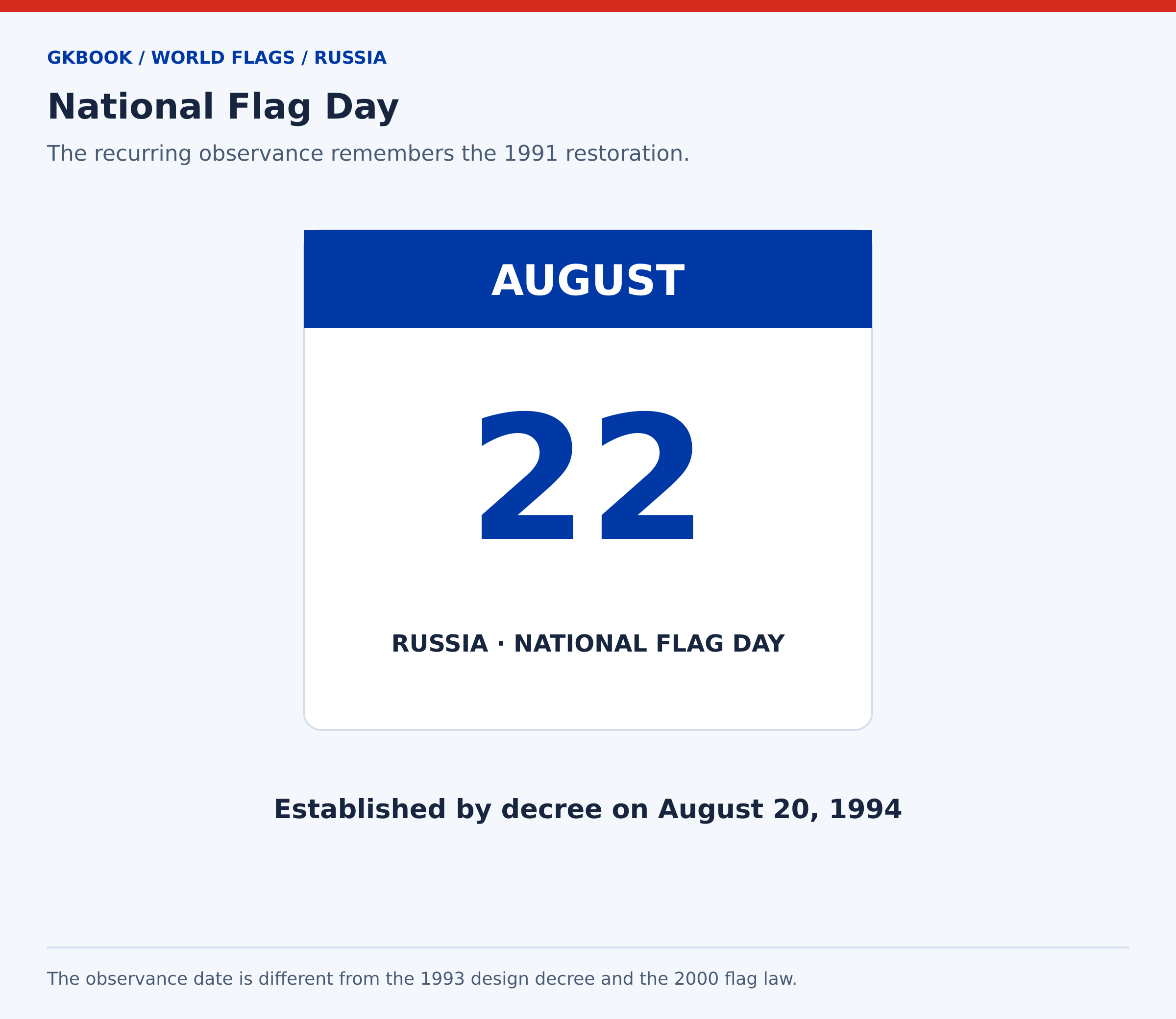
Russia observes National Flag Day on August 22. A presidential decree dated August 20, 1994 established the observance, recalling the tricolor’s restoration on August 22, 1991. The annual commemorative date is different from the December 11, 1993 design decree and the December 25, 2000 federal constitutional flag law.

A date can refer to the event being remembered, the decision creating an observance, or a later annual celebration. Here those first two roles are August 22, 1991 and August 20, 1994. Keeping them separate avoids the misleading claim that the national tricolor originated in 1994 simply because Flag Day was established then.
The gallery’s calendar card shows the recurring month and day without inventing a current event schedule. Ceremonies, locations, and public programs can vary by year and place. A photograph from a celebration needs its own date and caption; the presence of a tricolor alone does not establish that it was taken on Flag Day.
Does Russia’s national flag include the double headed eagle?
The ordinary national flag does not include the double headed eagle, a coat of arms, or any other emblem. It is the plain white, blue, and red tricolor described in Article 1. An eagle on a Russian tricolor can indicate a different standard, a historical object, or a decorative adaptation.

The state coat of arms and the state flag are separate symbols. Their association with the same country does not make them interchangeable graphic elements. Adding arms to a clean flag download changes the image’s identity and should not be done silently in a reference chart or country selection icon.
Two examples explain much of the confusion: the historical 1693 flag included an eagle, and the presidential standard has the state arms at its center. Both need their own labels. The clean national artwork in this package intentionally contains only three rectangles, with no hidden emblem, inscription, fringe, or ornamental border.
How is the presidential standard different from the national flag?
Russia’s presidential standard is square and carries the state coat of arms at the center of the white, blue, and red bands. It was established by decree on February 15, 1994. The ordinary national flag is a plain 2:3 rectangle. The two designs should not be substituted for each other.

The square shape provides an immediate distinction even before the central arms are considered. A photograph connected with the presidency may contain a standard, a national flag, or both, so the surrounding event alone cannot identify which object appears. Look at the actual proportions and whether an emblem is present.
The gallery explains these differences in text rather than presenting an approximate official coat of arms. Reconstructing a presidential standard would require its own detailed specification and heraldic artwork. For this guide, the relevant comparison is its separate institutional role and square format, while the downloadable national reference remains the plain horizontal tricolor.
How is Russia’s naval ensign different from the national flag?
Russia’s naval ensign uses a blue diagonal Saint Andrew’s cross on a white field. It is a different maritime symbol from the national flag’s three horizontal white, blue, and red bands. A vessel’s flags must be identified by their function; not every Russian flag seen at sea is the national tricolor.
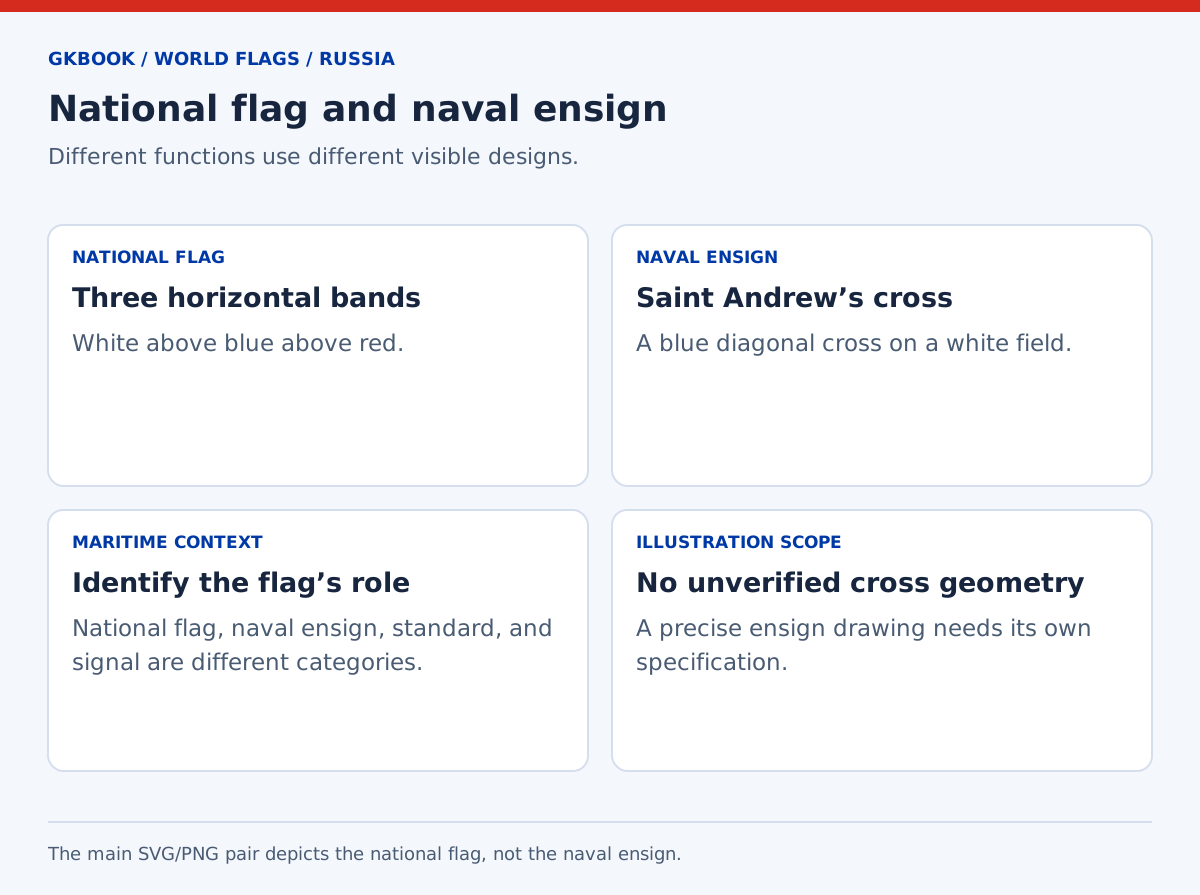
The Central Naval Museum describes the Saint Andrew’s flag within the history of naval symbolism. Its diagonal cross gives a useful visual distinction from the horizontal stripe pattern. A merchant flag, naval ensign, personal standard, and signal flag can serve different purposes even when displayed in the same broader maritime setting.
This package focuses on the national flag and does not invent exact ensign construction measurements. The comparison card names the main design features and their different roles without supplying a potentially inaccurate substitute for a naval reference. A detailed ensign drawing would need a separately verified specification for the particular version being illustrated.
How does Russia’s flag differ from the Netherlands flag?
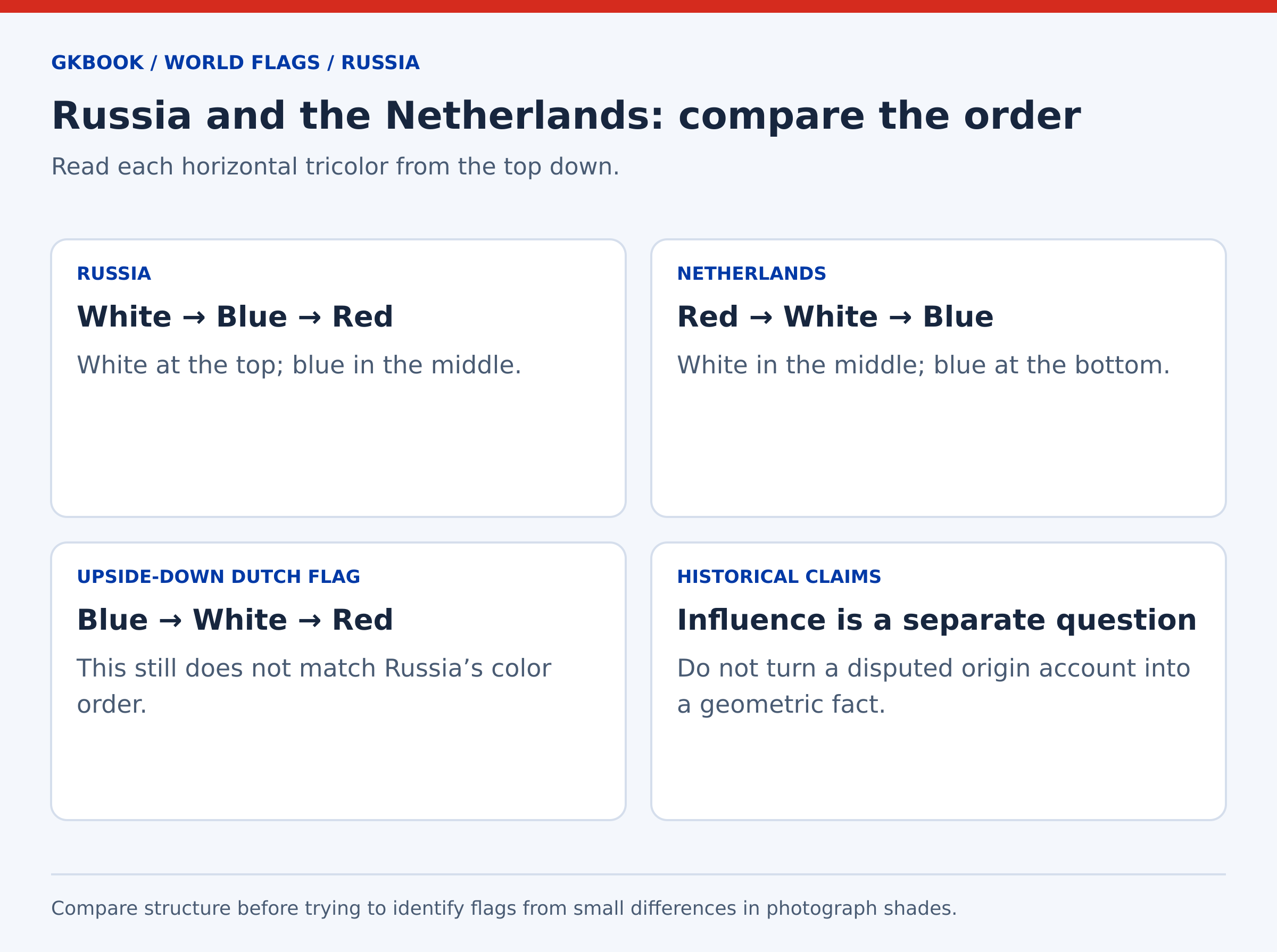
Russia’s flag is white, blue, and red from top to bottom; the Netherlands flag is red, white, and blue. Both are horizontal tricolors, but their band orders differ. Turning the Dutch flag upside down gives blue, white, and red, which still does not produce the Russian national flag.
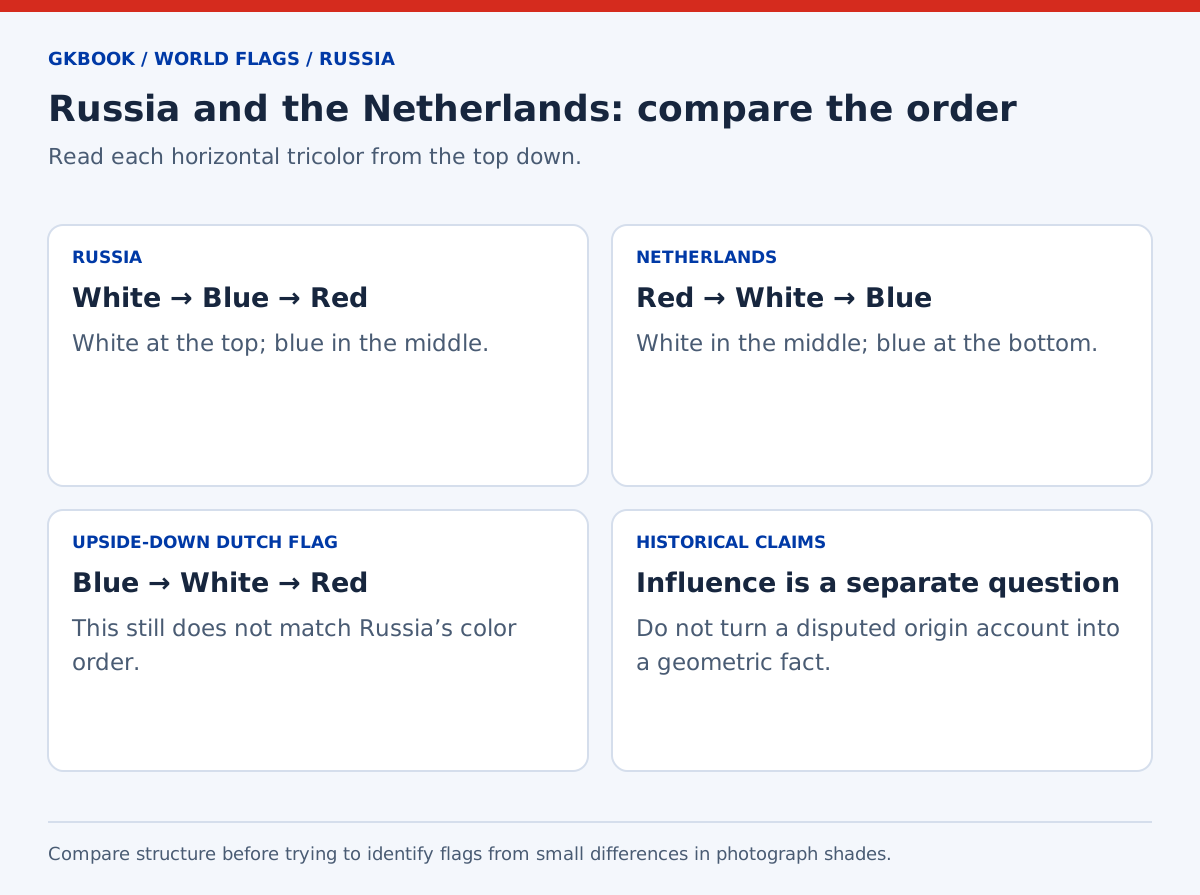
Compare positions before comparing shades. Russia has white uppermost and blue in the center, while the Dutch flag has white in the center and blue at the bottom. These structural differences remain clear even when a small photograph, screen setting, or printing process makes the exact colors difficult to judge.
Historical discussions sometimes connect the Russian tricolor with Dutch maritime influence, but the origin story should not be reduced to an unquestioned copying claim. The Presidential Library notes disagreement among historians and heraldists. The gallery therefore compares the documented color orders directly and keeps the disputed historical explanation separate from the modern identification task.
How does Russia’s flag differ from Slovenia’s flag?
Russia and Slovenia both use horizontal white, blue, and red bands, but Slovenia’s national flag includes its coat of arms near the hoist and has a 1:2 height to length ratio. Russia’s ordinary national flag has no emblem and uses 2:3. Check the complete image, including its proportions and upper hoist area.

A cropped thumbnail may remove the emblem or hide the longer Slovenian rectangle, making a quick color only identification unreliable. Look for the whole flag before deciding which country it represents. A caption and the source of the picture are especially useful when an image is small, folded, partly obscured, or poorly reproduced.
The comparison uses Slovenia’s official description and explains the differences without drawing a simplified replacement coat of arms. Shared color names do not make two national flags identical, nor do they establish a common legal color table. The supplied clean artwork is specifically Russia’s plain national flag at its current proportions.
Where is Russia’s national flag displayed?
The flag law provides for official display at specified institutions, ceremonies, and other settings, and permits citizens and organizations to use the flag or its image subject to its provisions. The text checked through June 2026 includes educational settings, specified sports facilities, and official sports activities. These uses retain the same national design.
Articles 2 through 6 cover different display situations rather than one universal list for every occasion. The 2026 amendment adds state and municipal sports facilities to the permanent display provisions and official physical culture and sports events to the relevant event provisions. It does not introduce a special sports version of the national flag.
Article 9.1 also allows other uses by citizens and organizations provided they do not constitute desecration. This general summary is not an event schedule or a complete ceremony manual. For a particular institution or organized occasion, the applicable current text and specific official instructions supply the detailed setting.
Where does Russia’s flag go beside domestic institutional flags?
Article 8 gives Russia’s flag precedence beside the listed regional, municipal, association, business, and institutional flags. With two flags, Russia is on the viewer’s left; with an odd total, it is central; with an even total above two, it is left of center. These are not blanket rules for all foreign national flags.

The same article says that the other listed flags must not exceed the national flag’s size and that Russia’s flag must not be positioned lower. Equal sizes and equal heights are therefore a valid teaching example, but the text should not be paraphrased as requiring every accompanying flag to have identical dimensions.
The gallery uses neutral labeled slots to illustrate two, three, and four flag arrangements from the front. Gray slots represent the domestic categories covered by the article, not foreign countries. This scope matters: importing another country’s international ceremony rules would give readers an incorrect impression of what the cited Russian provision actually says.
How is Russia’s flag displayed during mourning?
Article 7 provides for a black ribbon at the top of the staff, with its length equal to the flag’s length, and for flags on masts or flagpoles to be lowered to half the mast’s height. These mourning arrangements do not alter the national flag’s three equal white, blue, and red bands.
The black ribbon is an accompanying element rather than a fourth stripe sewn into the flag. Likewise, lowering concerns the flag’s position on its support, not its proportions or color order. A reference image of the national design should remain the same plain tricolor even when a separate illustration explains mourning display.
The general provision does not establish that a particular date is currently a mourning day. A real ceremony needs its relevant official decision and setting. This guide records the law’s stated relationship and half height instruction without inventing additional universal distances, ribbon width, or a current event that was not part of the research.
Does the reverse of Russia’s flag have different colors?
No separate reverse design is needed for the ordinary plain tricolor. A horizontal reflection changes the apparent side of the hoist but leaves white above blue above red. The gallery illustrates that geometric relationship. It does not prescribe a particular method of sewing, layering, printing, or dyeing a physical flag.
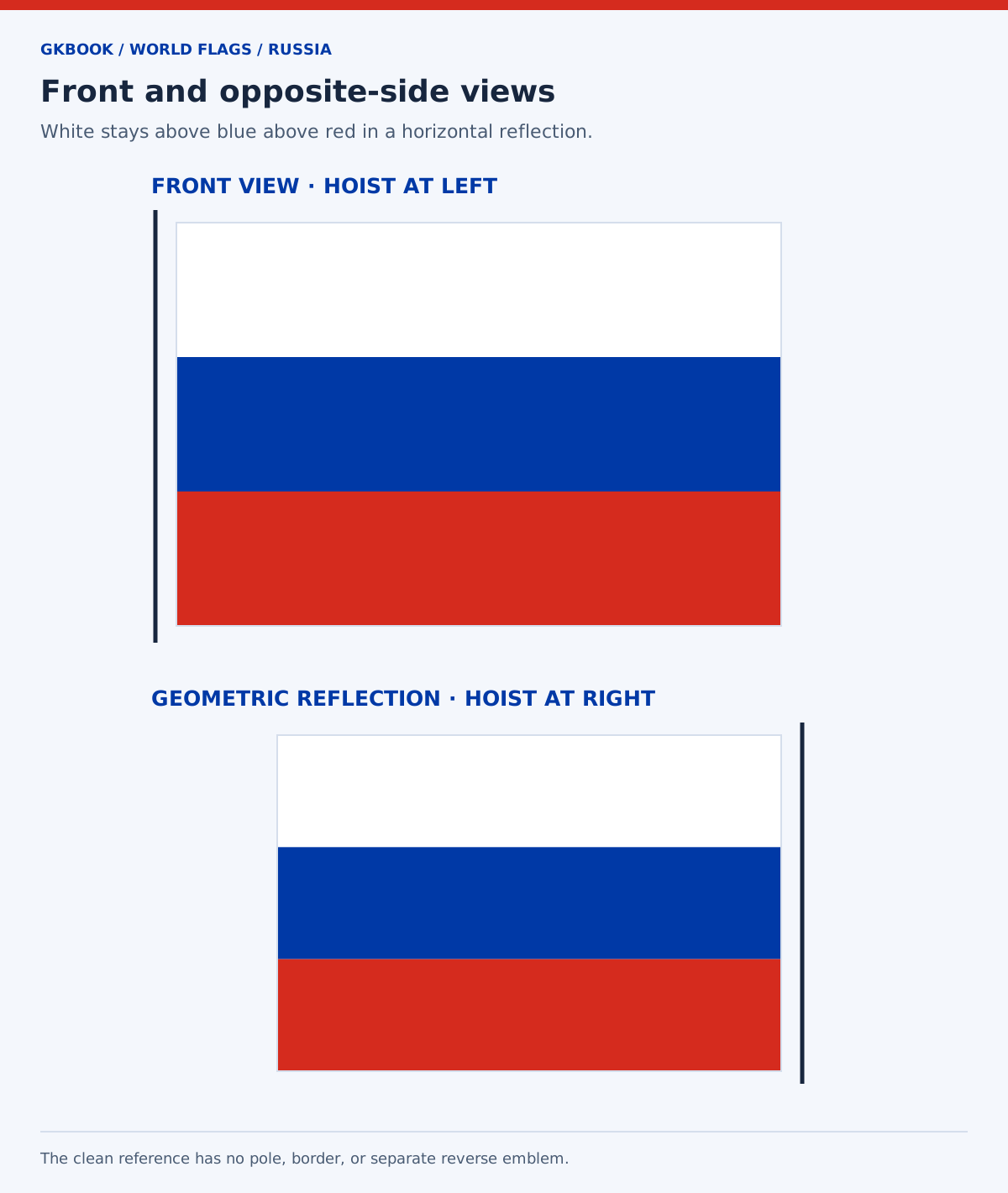
Imagine standing on the opposite side while the top edge stays uppermost. The pole changes from your left to your right, but horizontal color bands retain their top to bottom order. This differs from flags whose vertical stripes or asymmetric emblems look visibly different when viewed from the other side.
The reflection diagram labels both viewpoints and keeps the pole outside the colored rectangle. It is an explanation of flat geometry, not a claim about cloth transparency or the manufacturing details of a particular product. The main download uses the conventional reference view, with no drawn pole and no added reverse emblem.
What image dimensions preserve Russia’s flag proportions?
Use image width and height in a 3:2 relationship. This package supplies a 2,700 × 1,800 SVG master and a 5,400 × 3,600 PNG. For perfectly aligned raster stripes, also choose a height divisible by three. Diagram and social card canvases can have other shapes while containing a correctly proportioned flag.

Convenient exact pixel examples include 450 by 300, 900 by 600, and 1,350 by 900. Each preserves the landscape ratio and gives the three horizontal bands an integer number of rows. Other 3:2 sizes preserve the outer shape but may require rasterization across fractional stripe boundaries at very small resolutions.
A square avatar or a wide sharing card should contain the full flag with surrounding space rather than stretching or cropping it. The separate social card measures 1,200 by 630, but that is the card’s size, not a new flag ratio. Measure the colored rectangle inside a diagram independently of its labels and margins.
What mistakes should you avoid in Russia flag pictures?
Common mistakes include changing the white, blue, red order, making unequal bands, using the wrong ratio, adding an eagle to the ordinary national flag, and describing editorial color codes as statutory values. Historical captions also need care: the 1991 restoration, 1993 specification, and 2000 flag law are distinct milestones.

Check the basic drawing first: a complete landscape rectangle, three horizontal bands of equal height, and no added emblem or lettering. Then review the image’s intended use. A historical standard, a presidential standard, and a naval ensign should not silently replace the ordinary national reference simply because they are also Russian symbols.
Finally, check the caption and palette note. The supplied numerical colors are a consistent digital reproduction choice, not values quoted from Article 1. The six point review card brings geometry, order, plain design, color status, and dates together so readers can assess both the visible artwork and the claims accompanying it.
Which Russia flag pictures can I download here?
The gallery contains 24 subjects, each supplied as an SVG and PNG. They include the clean national flag, color and construction diagrams, historical timelines, comparison cards, and display explanations. A separate social sharing card is also included. Historical cards explain documented distinctions without presenting invented old flags as authenticated artifacts.
Choose the clean tricolor when you need the national flag alone. Choose an explanatory diagram when the purpose is to teach proportions, compare designs, or distinguish dates. Measurement lines, headings, and notes belong to the educational canvas and should not be mistaken for features inside the flag’s colored rectangle.
The SVG versions retain vector artwork and editable labels; the PNG versions provide fixed size images for common applications. Each subject has a descriptive caption and accessible alternative text. Browse the full picture gallery, or continue through World Flags for related national flag guides and comparisons.
Download Russia flag pictures
Download the clean national flag as SVG or 5,400 × 3,600 PNG. Its SVG coordinate system is 2,700 × 1,800, with three bands exactly 600 units high.
The gallery contains 24 subjects, each with an SVG and PNG. All artwork is vector in the SVG files. The ordinary national flag follows the legal arrangement and dimensions. Its numerical screen colors are an explicitly declared editorial palette, not codes prescribed by Article 1. Image credits and reproduction notes explain the specifications, historical diagrams, and physical reproduction limits. The separate social card is 1,200 × 630 and contains the full flag at its correct proportions.
Explore more in World Flags, including the Netherlands flag and Slovenia flag.
World Flags/Russia
Russia flag pictures
Three equal horizontal bands, white above blue above red; height:length 2:3. Numerical colors are the declared editorial screen palette.
Original GKBook vector composition. Geometry follows Article 1 of Federal Constitutional Law 1-FKZ of December 25, 2000; numerical screen colors are an editorial reproduction palette.Download SVGDownload PNGArticle 1 names white, blue, and red. The RGB and hex values shown here are an explicit editorial reproduction palette, not numerical values mandated by that article.
Original GKBook vector composition. Geometry follows Article 1 of Federal Constitutional Law 1-FKZ of December 25, 2000; numerical screen colors are an editorial reproduction palette.Download SVGDownload PNGPopular symbolic associations are kept separate from the legal design. The Presidential Library states that the current colors have no official interpretation.
Original GKBook vector composition. Geometry follows Article 1 of Federal Constitutional Law 1-FKZ of December 25, 2000; numerical screen colors are an editorial reproduction palette.Download SVGDownload PNGThe height is two thirds of the length. The thin external teaching frame makes the white upper edge visible; it is not part of the flag.
Original GKBook vector composition. Geometry follows Article 1 of Federal Constitutional Law 1-FKZ of December 25, 2000; numerical screen colors are an editorial reproduction palette.Download SVGDownload PNGEach band is 2,700 by 600 units and covers one third of the flag area. All labels and dimension marks are outside the flag.
Original GKBook vector composition. Geometry follows Article 1 of Federal Constitutional Law 1-FKZ of December 25, 2000; numerical screen colors are an editorial reproduction palette.Download SVGDownload PNGThe first two panels are construction aids. Fine teaching frames identify the white upper edge; the downloadable clean flag contains only three filled rectangles.
Original GKBook vector composition. Geometry follows Article 1 of Federal Constitutional Law 1-FKZ of December 25, 2000; numerical screen colors are an editorial reproduction palette.Download SVGDownload PNGThe timeline separates early objects and merchant use from modern restoration, the present design specification, and later legislation.
Original GKBook vector composition. Geometry follows Article 1 of Federal Constitutional Law 1-FKZ of December 25, 2000; numerical screen colors are an editorial reproduction palette.Download SVGDownload PNGThe Central Naval Museum supplies the object’s history. The card does not reconstruct its exact cloth, dimensions, or heraldic details.
Original GKBook vector composition. Geometry follows Article 1 of Federal Constitutional Law 1-FKZ of December 25, 2000; numerical screen colors are an editorial reproduction palette.Download SVGDownload PNGThe decree and Peter’s drawing are described by the Presidential Library. No speculative contemporary cloth or printed facsimile is supplied.
Original GKBook vector composition. Geometry follows Article 1 of Federal Constitutional Law 1-FKZ of December 25, 2000; numerical screen colors are an editorial reproduction palette.Download SVGDownload PNGThe card summarizes two imperial milestones without claiming a simple exclusive succession or reproducing an unverified historic flag.
Original GKBook vector composition. Geometry follows Article 1 of Federal Constitutional Law 1-FKZ of December 25, 2000; numerical screen colors are an editorial reproduction palette.Download SVGDownload PNGThe card distinguishes institutions and periods. It does not draw a composite Soviet flag or imply that all Soviet designs were identical.
Original GKBook vector composition. Geometry follows Article 1 of Federal Constitutional Law 1-FKZ of December 25, 2000; numerical screen colors are an editorial reproduction palette.Download SVGDownload PNGThe November 1, 1991 amendment used a 1:2 rectangle. The December 11, 1993 specification uses 2:3. Both outlines here are 450 units high; their lengths are 900 and 675.
Original GKBook vector composition. Geometry follows Article 1 of Federal Constitutional Law 1-FKZ of December 25, 2000; numerical screen colors are an editorial reproduction palette.Download SVGDownload PNGThe decree established the current description after the 1991 restoration. The displayed flag uses the package’s declared screen palette.
Original GKBook vector composition. Geometry follows Article 1 of Federal Constitutional Law 1-FKZ of December 25, 2000; numerical screen colors are an editorial reproduction palette.Download SVGDownload PNGThe chronology distinguishes the law’s parliamentary stages and date from a later display amendment. It is not a chronology of the first appearance of the tricolor.
Original GKBook vector composition. Geometry follows Article 1 of Federal Constitutional Law 1-FKZ of December 25, 2000; numerical screen colors are an editorial reproduction palette.Download SVGDownload PNGThe annual observance recalls August 22, 1991. The decree establishing Flag Day was dated August 20, 1994. No current event schedule is claimed.
Original GKBook vector composition. Geometry follows Article 1 of Federal Constitutional Law 1-FKZ of December 25, 2000; numerical screen colors are an editorial reproduction palette.Download SVGDownload PNGThe national flag is plain. Historical and presidential flags with arms need their own labels and specifications.
Original GKBook vector composition. Geometry follows Article 1 of Federal Constitutional Law 1-FKZ of December 25, 2000; numerical screen colors are an editorial reproduction palette.Download SVGDownload PNGThe national rectangle and presidential square are distinct designs. The card identifies the difference without inventing detailed heraldic artwork.
Original GKBook vector composition. Geometry follows Article 1 of Federal Constitutional Law 1-FKZ of December 25, 2000; numerical screen colors are an editorial reproduction palette.Download SVGDownload PNGThe card compares the national tricolor with the naval ensign at the level of verified design features. It does not claim detailed ensign measurements.
Original GKBook vector composition. Geometry follows Article 1 of Federal Constitutional Law 1-FKZ of December 25, 2000; numerical screen colors are an editorial reproduction palette.Download SVGDownload PNGThe card compares documented color order without claiming shared numerical palettes or an unquestioned copying history.
Original GKBook vector composition. Geometry follows Article 1 of Federal Constitutional Law 1-FKZ of December 25, 2000; numerical screen colors are an editorial reproduction palette.Download SVGDownload PNGSlovenia’s emblem and 1:2 ratio distinguish its national flag from Russia’s plain 2:3 tricolor. No simplified Slovenian coat of arms is drawn.
Original GKBook vector composition. Geometry follows Article 1 of Federal Constitutional Law 1-FKZ of December 25, 2000; numerical screen colors are an editorial reproduction palette.Download SVGDownload PNGThe examples concern Russia with the domestic regional, municipal, association, business, and institutional flags listed in Article 8. They are not a general foreign-national-flag protocol.
Original GKBook vector composition. Geometry follows Article 1 of Federal Constitutional Law 1-FKZ of December 25, 2000; numerical screen colors are an editorial reproduction palette.Download SVGDownload PNGA horizontal reflection leaves the top to bottom order unchanged. The illustration explains viewpoint rather than prescribing cloth layers or a printing method.
Original GKBook vector composition. Geometry follows Article 1 of Federal Constitutional Law 1-FKZ of December 25, 2000; numerical screen colors are an editorial reproduction palette.Download SVGDownload PNGAll listed sizes preserve height:length 2:3 and integer horizontal thirds. The social card and diagram canvases have their own separate dimensions.
Original GKBook vector composition. Geometry follows Article 1 of Federal Constitutional Law 1-FKZ of December 25, 2000; numerical screen colors are an editorial reproduction palette.Download SVGDownload PNGThe checklist covers stripe order, equality, ratio, numerical color status, emblem absence, and distinct modern milestones.
Original GKBook vector composition. Geometry follows Article 1 of Federal Constitutional Law 1-FKZ of December 25, 2000; numerical screen colors are an editorial reproduction palette.Download SVGDownload PNGFrequently asked questions
What does the Russia flag look like?
Russia’s national flag has three equal horizontal bands: white at the top, blue in the middle, and red at the bottom. Its height to length ratio is 2:3. The ordinary national flag is a plain tricolor, without a coat of arms, star, lettering, or other central emblem.
What are the colors of Russia’s flag?
The legal colors are white, blue, and red, arranged from top to bottom. This package uses #FFFFFF, #0039A6, and #D52B1E as its declared screen palette. Article 1 of the flag law specifies the color names, arrangement, and proportions; it does not prescribe those numerical RGB or hexadecimal values.
What do the colors of Russia’s flag mean?
There is no single official interpretation assigning a meaning to each color of the current Russian flag. Popular explanations associate white with peace or purity, blue with faithfulness or constancy, and red with strength or sacrifice. These are interpretations, not definitions established by the national flag law.
What is the aspect ratio of Russia’s flag?
Russia’s national flag has a height to length ratio of 2:3. Expressed as image width by height, that is 3:2. A rectangle 150 centimeters long is therefore 100 centimeters high. The ratio measures the flag’s colored rectangle, excluding its pole, surrounding page margins, and any display frame.
Are all three stripes on Russia’s flag equal?
Yes. Each horizontal stripe occupies one third of the flag’s height and extends across its entire length. All three bands therefore have equal areas. On the supplied 2,700 × 1,800 SVG master, each band is 2,700 units wide and 600 units high, with boundaries at y = 600 and 1,200.
Which color belongs at the top of Russia’s flag?
White belongs at the top, blue in the middle, and red at the bottom in the standard horizontal display. The bands run across the flag’s length. A normal reference image places the hoist at the left, but looking from the opposite side does not change this vertical color order.
How can you draw Russia’s flag accurately?
Draw a rectangle three units long and two units high. Divide its height into three equal horizontal bands and fill them white, blue, and red from top to bottom. Keep the finished flag plain, with no border, emblem, text, gaps, shadows, or unequal stripe heights inside the rectangle.
What are the main milestones in Russia’s flag history?
The tricolor developed through maritime use, imperial recognition, Soviet replacement, and modern restoration. Important milestones include Peter I’s surviving 1693 flag, the 1705 merchant shipping decree, recognition in 1896, restoration in 1991, the current design specification in 1993, and the federal constitutional flag law dated December 25, 2000.
How is the ship Oryol connected with the Russian tricolor?
Accounts of the flag’s origins often connect white, blue, and red with the ship Oryol, launched in 1668 during the reign of Alexei Mikhailovich. This maritime association concerns the early use of the colors. It does not by itself establish every detail of a modern three stripe flag design.
What is the significance of Peter I’s 1693 flag?
The Central Naval Museum identifies a surviving flag used by Peter I on the yacht Saint Peter in 1693 as one of the oldest Russian tricolors. This “Flag of the Tsar of Moscow” included a golden double headed eagle. It is a historical object, distinct from today’s plain national flag.
What did Peter I’s 1705 flag decree establish?
Peter I’s 1705 decree directed merchant vessels to use the white, blue, and red flag. The Presidential Library connects the decree with his drawing of the horizontal arrangement. This is an important merchant shipping milestone, but it should not be described as the first adoption of today’s complete national flag law.
How did imperial Russian flags differ from the current tricolor?
Imperial Russia used several flags for different purposes. Black, yellow, and white heraldic colors were prescribed for ceremonial use in 1858, while the white, blue, and red tricolor was affirmed as the national flag in 1896. Imperial standards and flags bearing arms should be distinguished from the present plain rectangle.
Was the Soviet flag the same as Russia’s current flag?
No. Soviet flags used red fields and revolutionary emblems or inscriptions, unlike the present white, blue, and red national tricolor. The Russian Soviet republic and the Soviet Union were different political entities with their own flag histories. A historical picture needs a date and an institutional label to identify its design accurately.
When was Russia’s tricolor restored?
The Supreme Soviet of the Russian Soviet republic recognized the historic tricolor for official use on August 22, 1991. The constitutional amendment dated November 1, 1991 described white, azure, and scarlet bands in a 1:2 rectangle. That restoration should be distinguished from the current 2:3 specification adopted in 1993.
What changed in the Russian flag specification in 1993?
Presidential Decree No. 2126 of December 11, 1993 established the present description: three equal horizontal bands of white, blue, and red, with height to length 2:3. The earlier 1991 constitutional wording had used white, azure, and scarlet and a 1:2 ratio. The tricolor itself was not newly invented in 1993.
Which law defines Russia’s national flag today?
Federal Constitutional Law No. 1-FKZ of December 25, 2000 defines the national flag and regulates its use. Article 1 describes equal horizontal white, blue, and red bands and a 2:3 height to length ratio. The law consolidates a design already specified in 1993; it is not the tricolor’s earliest historical adoption.
What does Russia’s Constitution say about the flag?
Article 70 of Russia’s Constitution provides that the state flag, coat of arms, and anthem, their descriptions, and their official use are established by federal constitutional law. The detailed flag arrangement and proportions are therefore found in the flag law. Article 70 should not be quoted as a numerical color specification.
When is Russia’s National Flag Day?
Russia observes National Flag Day on August 22. A presidential decree dated August 20, 1994 established the observance, recalling the tricolor’s restoration on August 22, 1991. The annual commemorative date is different from the December 11, 1993 design decree and the December 25, 2000 federal constitutional flag law.
Does Russia’s national flag include the double headed eagle?
The ordinary national flag does not include the double headed eagle, a coat of arms, or any other emblem. It is the plain white, blue, and red tricolor described in Article 1. An eagle on a Russian tricolor can indicate a different standard, a historical object, or a decorative adaptation.
How is the presidential standard different from the national flag?
Russia’s presidential standard is square and carries the state coat of arms at the center of the white, blue, and red bands. It was established by decree on February 15, 1994. The ordinary national flag is a plain 2:3 rectangle. The two designs should not be substituted for each other.
How is Russia’s naval ensign different from the national flag?
Russia’s naval ensign uses a blue diagonal Saint Andrew’s cross on a white field. It is a different maritime symbol from the national flag’s three horizontal white, blue, and red bands. A vessel’s flags must be identified by their function; not every Russian flag seen at sea is the national tricolor.
How does Russia’s flag differ from the Netherlands flag?
Russia’s flag is white, blue, and red from top to bottom; the Netherlands flag is red, white, and blue. Both are horizontal tricolors, but their band orders differ. Turning the Dutch flag upside down gives blue, white, and red, which still does not produce the Russian national flag.
How does Russia’s flag differ from Slovenia’s flag?
Russia and Slovenia both use horizontal white, blue, and red bands, but Slovenia’s national flag includes its coat of arms near the hoist and has a 1:2 height to length ratio. Russia’s ordinary national flag has no emblem and uses 2:3. Check the complete image, including its proportions and upper hoist area.
Where is Russia’s national flag displayed?
The flag law provides for official display at specified institutions, ceremonies, and other settings, and permits citizens and organizations to use the flag or its image subject to its provisions. The text checked through June 2026 includes educational settings, specified sports facilities, and official sports activities. These uses retain the same national design.
Where does Russia’s flag go beside domestic institutional flags?
Article 8 gives Russia’s flag precedence beside the listed regional, municipal, association, business, and institutional flags. With two flags, Russia is on the viewer’s left; with an odd total, it is central; with an even total above two, it is left of center. These are not blanket rules for all foreign national flags.
How is Russia’s flag displayed during mourning?
Article 7 provides for a black ribbon at the top of the staff, with its length equal to the flag’s length, and for flags on masts or flagpoles to be lowered to half the mast’s height. These mourning arrangements do not alter the national flag’s three equal white, blue, and red bands.
Does the reverse of Russia’s flag have different colors?
No separate reverse design is needed for the ordinary plain tricolor. A horizontal reflection changes the apparent side of the hoist but leaves white above blue above red. The gallery illustrates that geometric relationship. It does not prescribe a particular method of sewing, layering, printing, or dyeing a physical flag.
What image dimensions preserve Russia’s flag proportions?
Use image width and height in a 3:2 relationship. This package supplies a 2,700 × 1,800 SVG master and a 5,400 × 3,600 PNG. For perfectly aligned raster stripes, also choose a height divisible by three. Diagram and social card canvases can have other shapes while containing a correctly proportioned flag.
What mistakes should you avoid in Russia flag pictures?
Common mistakes include changing the white, blue, red order, making unequal bands, using the wrong ratio, adding an eagle to the ordinary national flag, and describing editorial color codes as statutory values. Historical captions also need care: the 1991 restoration, 1993 specification, and 2000 flag law are distinct milestones.
Which Russia flag pictures can I download here?
The gallery contains 24 subjects, each supplied as an SVG and PNG. They include the clean national flag, color and construction diagrams, historical timelines, comparison cards, and display explanations. A separate social sharing card is also included. Historical cards explain documented distinctions without presenting invented old flags as authenticated artifacts.
Explore all general-knowledge topics and the A-to-Z lists.











We Value Your Opinion Comments