

Poland flag picture
Explore the proportions, history, and picture gallery.
| Design | White above redTwo equal horizontal bands; the plain flag has no emblem. |
|---|---|
| Proportions | Height:length = 5:8SVG: 2,400 × 1,500; PNG: 4,800 × 3,000. |
| Modern adoption | August 1, 1919Earlier national-color resolution: February 7, 1831. |
| With the coat of arms | A second recognized variantCrowned White Eagle on a red shield within the white band. |
| Current specification | 1980 Act, as amended2025 consolidated text includes color measurements and flag patterns. |
| Flag Day | May 2Annual observance established in 2004. |
What does the Poland flag look like?
Poland’s flag has two equal horizontal bands: white above red. Its official height:length ratio is 5:8. The plain flag has no emblem, while another legally recognized version places Poland’s crowned White Eagle on a red shield in the center of the white band. The modern flag was adopted in 1919.
This guide connects the flag’s geometry with its heraldic origins, distinguishes the two rectangular variants, and explains the dates and display rules. The gallery pairs clean reference flags with labeled educational diagrams.
What is the design of the Poland flag?
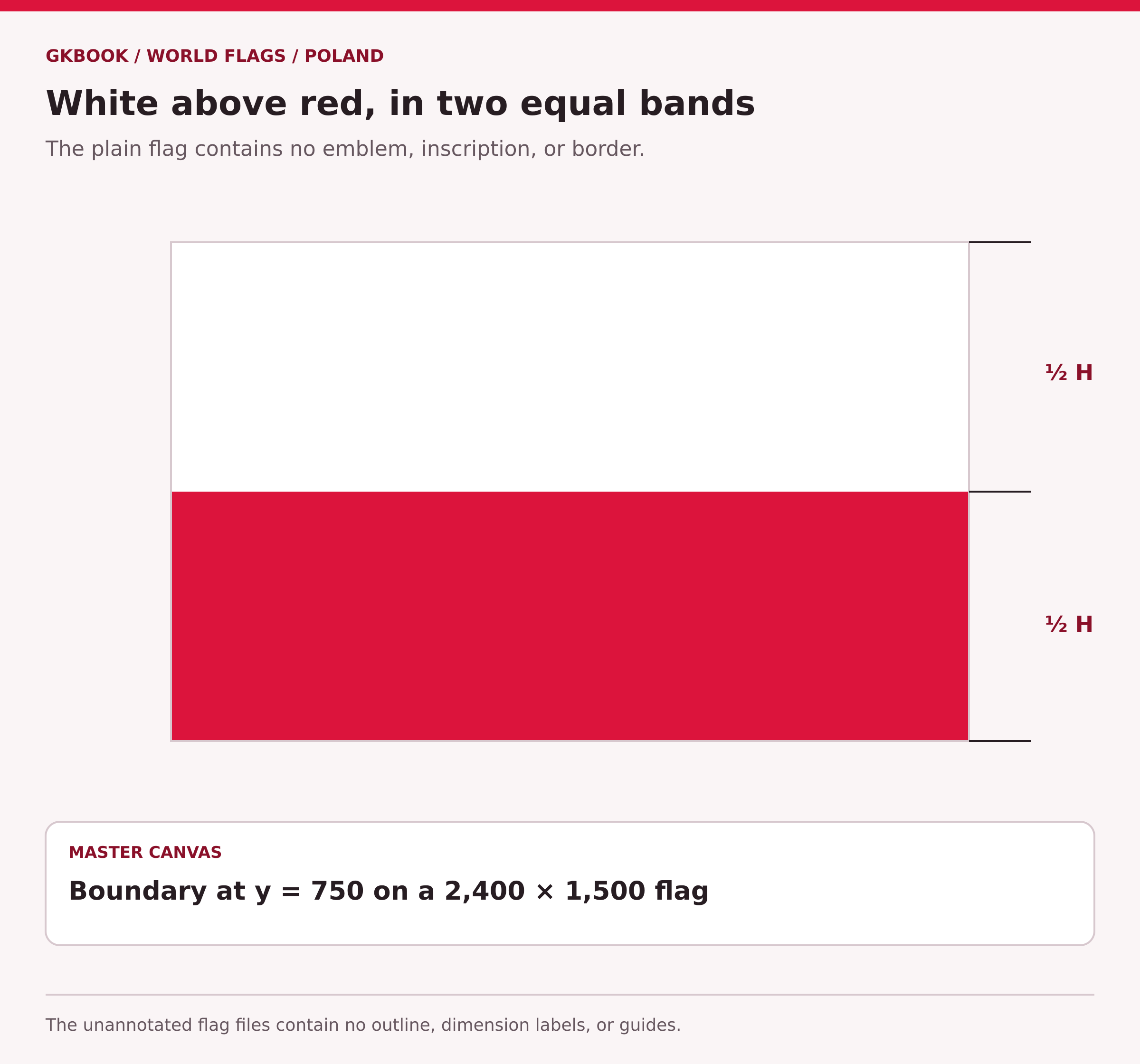
The plain Polish flag is a rectangle divided horizontally into two equal bands, white on top and red underneath. It contains no lettering, border, star, or eagle. The dividing line lies halfway down the flag. Both bands extend across its full length, producing a simple and balanced horizontal bicolor.
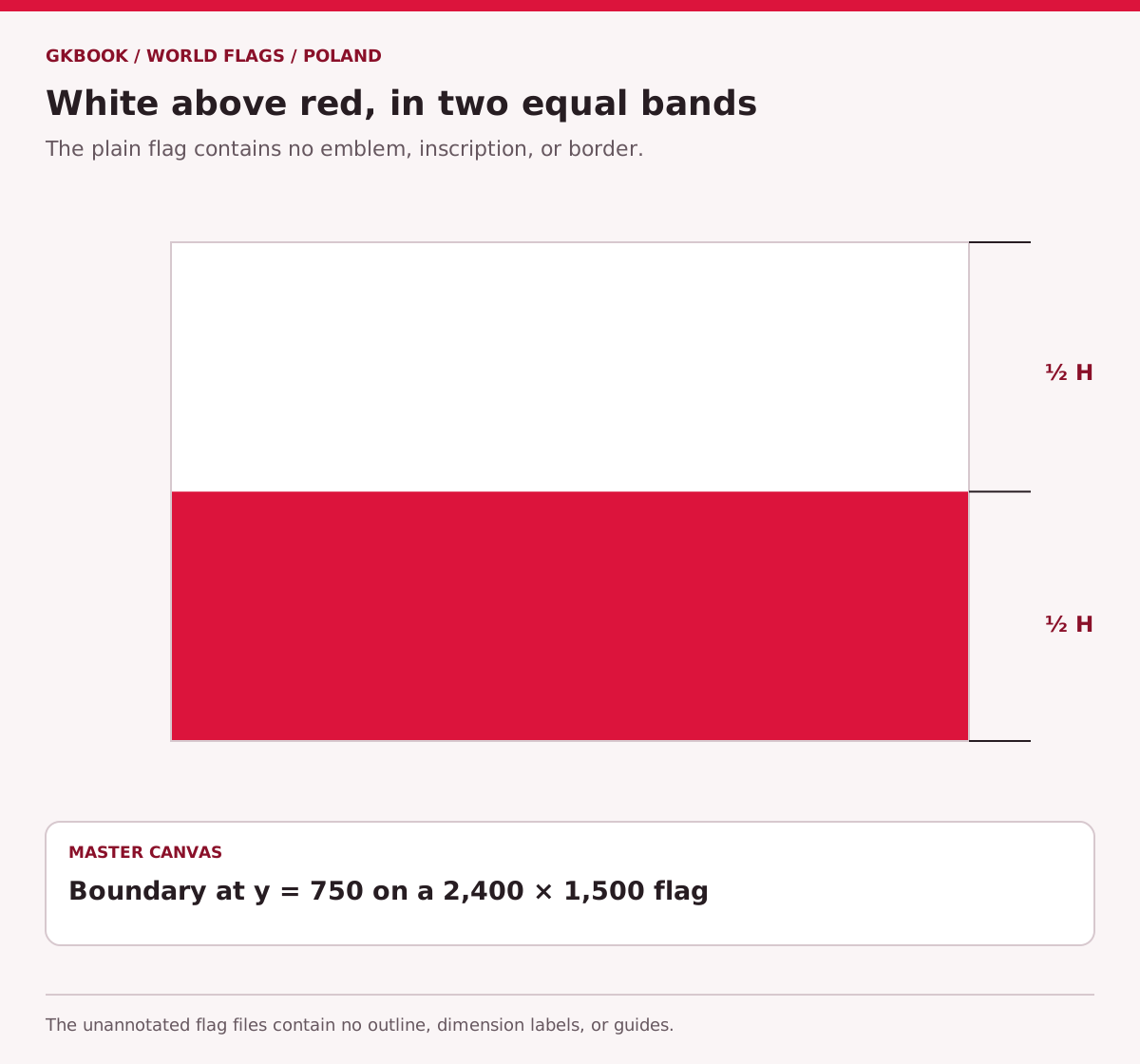
The upper and lower regions have identical dimensions. On the supplied 2,400 × 1,500 master, white occupies the first 750 units of height and red the remaining 750. Their common edge is straight, and neither band overlaps the other. These measurements describe the complete flag rather than a cropped photograph.
The faint boundary around a flag in a teaching diagram belongs to the diagram, not the national design. It helps the white band remain visible against a light page. The unannotated downloads omit that boundary, along with every label, shadow, watermark, and dimensional guide used in the explanatory pictures.
What are the official proportions of the Polish flag?
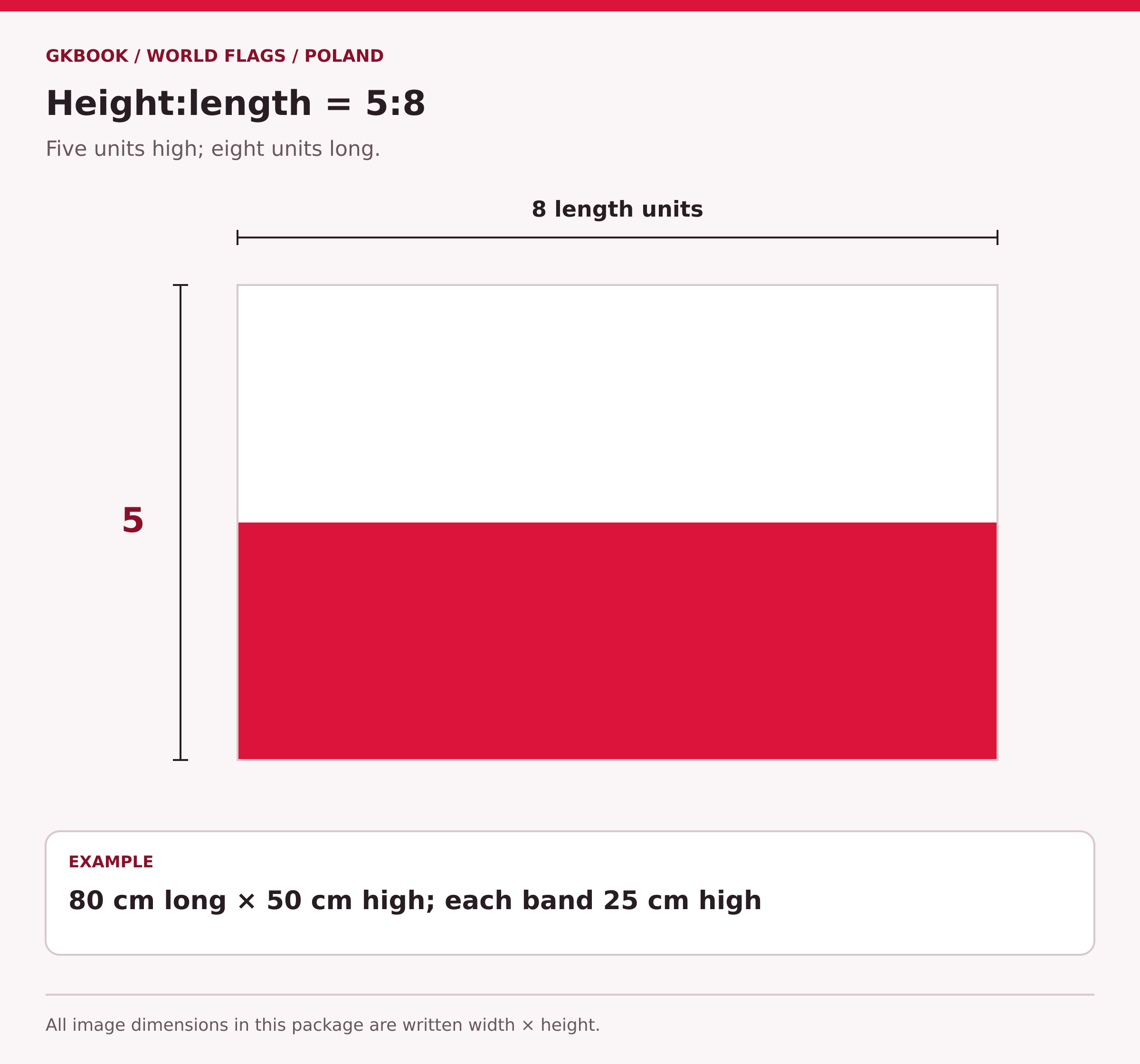
The official height:length ratio is 5:8. A flag 50 centimeters high is therefore 80 centimeters long, and each horizontal band is 25 centimeters high. Both the plain flag and the flag with the coat of arms use this same rectangular proportion, as shown in Annex 3 of the current law.

Polish specifications describe the shorter dimension as the flag’s width. Image software normally uses width for the horizontal dimension, which is longer in a landscape picture. This article labels the physical relationship height:length and writes image dimensions as width × height, avoiding an accidental reversal of the ratio.
For any chosen height H, calculate the length as 8H/5. The standard does not require one universal physical size. A large outdoor flag and a small classroom flag can share the same geometry. Resizing should preserve that relationship instead of forcing the artwork into a convenient but differently shaped frame.
What are the official white and red color specifications?
Polish law defines the colors through CIE measurements, not hexadecimal web codes. Annex 2 gives white as x 0.315, y 0.320, Y 82.0, and red as x 0.570, y 0.305, Y 16.0. These downloads use white #FFFFFF and red #DC143C as explicitly declared, uncertified screen approximations for the two bands.
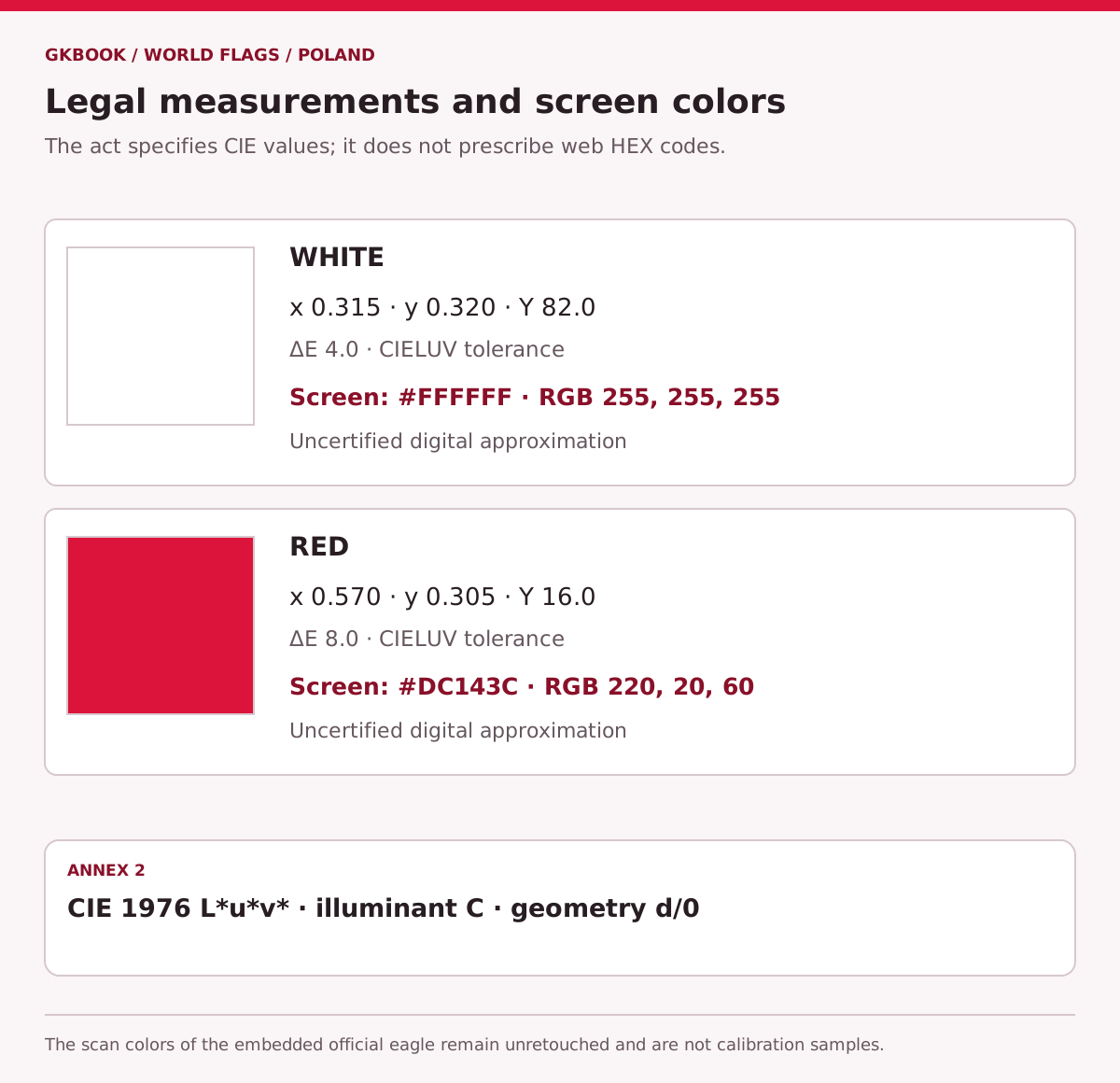
The annex specifies permissible color differences in CIE 1976 L*u*v* space, calculated using CIELUV, illuminant C, and d/0 measurement geometry. The stated ΔE tolerances are 4.0 for white and 8.0 for red. Those measurement conditions belong with the numbers; removing them would make the specification less meaningful.
A scanned page, a monitor, a printed sheet, and dyed cloth do not reproduce color identically. In particular, the bright red visible in a government PDF illustration is not a calibrated sample to pick with an eyedropper. The palette records the actual digital fills used here without claiming statutory HEX, RGB, CMYK, or Pantone equivalence.
| Color | x | y | Y | ΔE | Screen HEX |
|---|---|---|---|---|---|
| White | 0.315 | 0.320 | 82.0 | 4.0 | #FFFFFF |
| Red | 0.570 | 0.305 | 16.0 | 8.0 | #DC143C |
What does the white band represent?
The white band has a heraldic origin in the White Eagle of Poland. Official historical explanations also connect the shared colors to Lithuania’s white mounted knight. Cultural interpretations associate white with virtues such as purity or friendship, but these meanings should be distinguished from the documented heraldic source of the color.

In heraldry, a white depiction can represent silver. Transferring the emblem’s principal color into a horizontal band creates a simpler national sign without requiring an eagle on every flag. The plain white stripe therefore remains meaningful even though the bird itself appears only on the separate emblem-bearing version.
Interpretive lists vary between institutions and periods. The Polish History Museum discusses purity, order, and nobility; a Senate explanation emphasizes gentleness, friendship, and prosperity. These are ways of interpreting the color, not competing instructions for drawing it. A careful caption can identify the interpretation while keeping the heraldic explanation at the center.
What does the red band represent?
Red comes from the heraldic field behind the White Eagle and from the shared white-and-red heraldry invoked in the history of the national colors. Later cultural explanations connect red with courage, blood, and the struggle for independence. The historical origin and these patriotic interpretations describe different aspects of the same color.
The red stripe is not a map, a numerical record of battles, or a literal representation of a particular event. Its heraldic ancestry provides a more secure explanation than attaching one unsupported story to every detail. The meaning of a national color can broaden as communities use it across successive generations.
The Polish History Museum discusses bravery and valor, while the Senate links red with the struggle for sovereignty and independence. Such explanations help readers understand the flag’s emotional significance. They do not determine a precise digital shade, which is a separate reproduction question addressed by the statutory color measurements and the declared screen palette.
Why is Poland’s flag called Biało-Czerwona?
Biało-Czerwona means the white-and-red and is a familiar Polish name for the flag. It follows the color order of the ordinary horizontal design: white above red. The formal name flaga państwowa Rzeczypospolitej Polskiej identifies the state flag of the Republic of Poland; the emblem-bearing form adds the words z godłem.
The familiar name is useful because it describes what most people recognize immediately. In formal descriptions, however, naming the variant matters. A caption that specifies the plain flag or the flag with the coat of arms communicates more than a generic reference to a Polish flag picture.
The distinction also improves a collection of downloads. A plain national flag, a maritime use of the emblem-bearing flag, and an explanatory drawing of the eagle are different subjects even when all use familiar national colors. Here each file has a descriptive title, and the gallery keeps the complete flags separate from detached details.
Does Poland have a flag with an eagle?
Yes. Polish law recognizes both the plain white-over-red flag and a version with the national coat of arms centered in the white band. The latter includes a crowned White Eagle on a red shield. It serves specified official and maritime uses; the plain flag is also used by state institutions.

Calling one version civilian and the other government can be misleading if those labels imply that public authorities never use the plain flag. The act itself calls both forms state flags and describes their uses separately. The useful visual distinction is whether the coat of arms is present.
The emblem-bearing version retains the same two bands and 5:8 proportions. Its shield sits entirely within the white band, leaving the red band uninterrupted. It is not simply an eagle floating directly on white, and it is not a shield centered across both colors. Those shortcuts produce recognizable but inaccurate pictures.
How do the national colors differ from the state flag?
Poland’s national colors are white and red arranged in equal bands, but they can appear in forms without the flag’s fixed proportions. The rectangular state flag has the specified 5:8 ratio. A long ribbon, a vertical banner, and a cockade can display national colors without being interchangeable with that statutory flag.
This distinction explains why two familiar white-and-red objects may have different shapes without either being an attempted drawing of the standard flag. The Ministry’s guide explicitly separates national colors from the flag’s defined proportions. A long decorative ribbon should be described as a ribbon instead of being measured against a rectangular flag canvas.
For a reference collection, the label should tell readers what they are seeing. A national-color decoration can illustrate cultural use, while a flag download should retain the complete prescribed geometry. The drawings here preserve that difference: the plain reference has two exact bands, and the separate cockade is identified as a simplified educational diagram.
What does the Polish White Eagle look like?
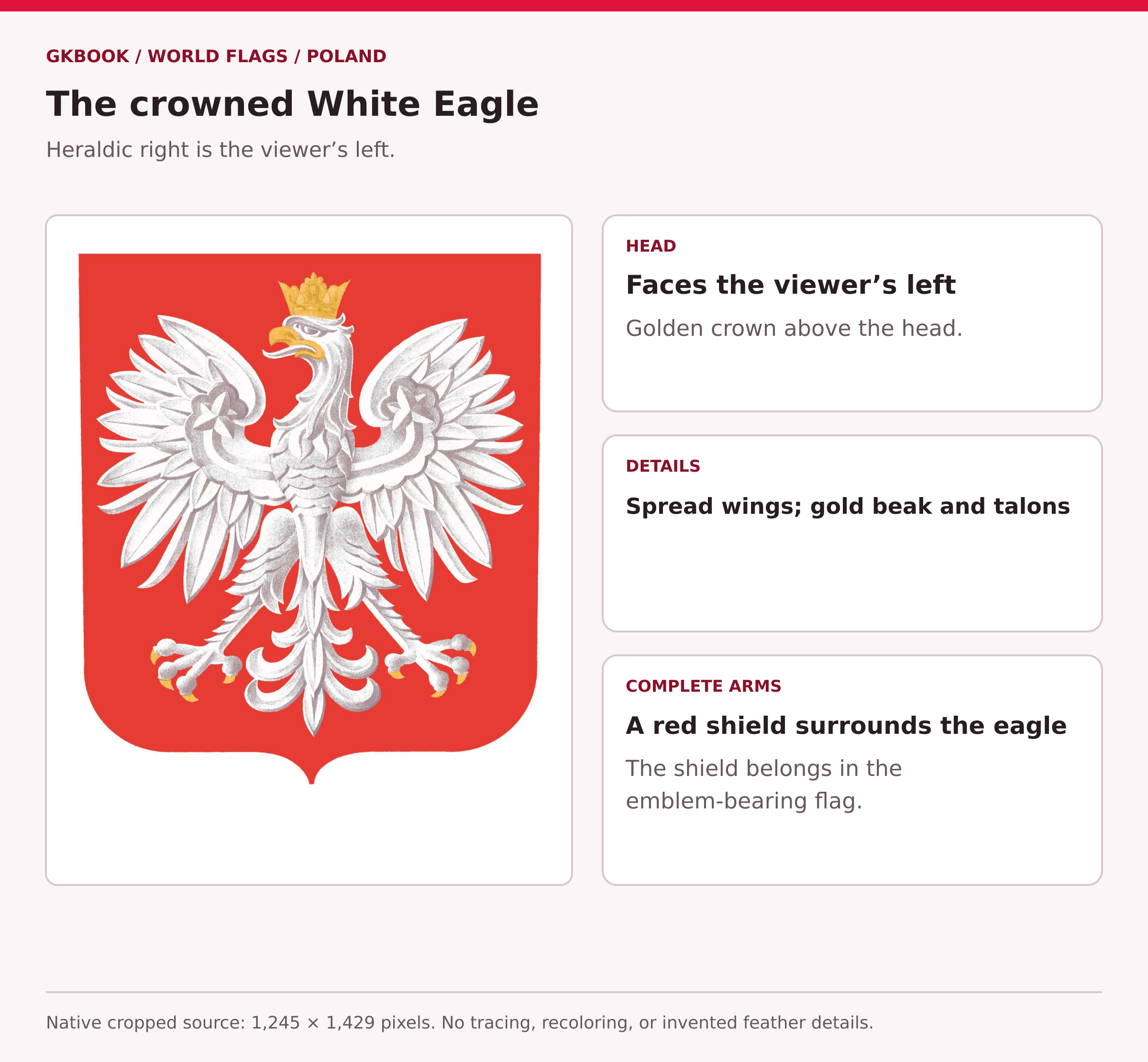
The national coat of arms depicts a white eagle with spread wings, a golden crown, and a golden beak and talons, on a red shield. Its head faces heraldic right, which is the viewer’s left. The official artwork contains detailed feathers and shading that a generic bird icon would not reproduce.
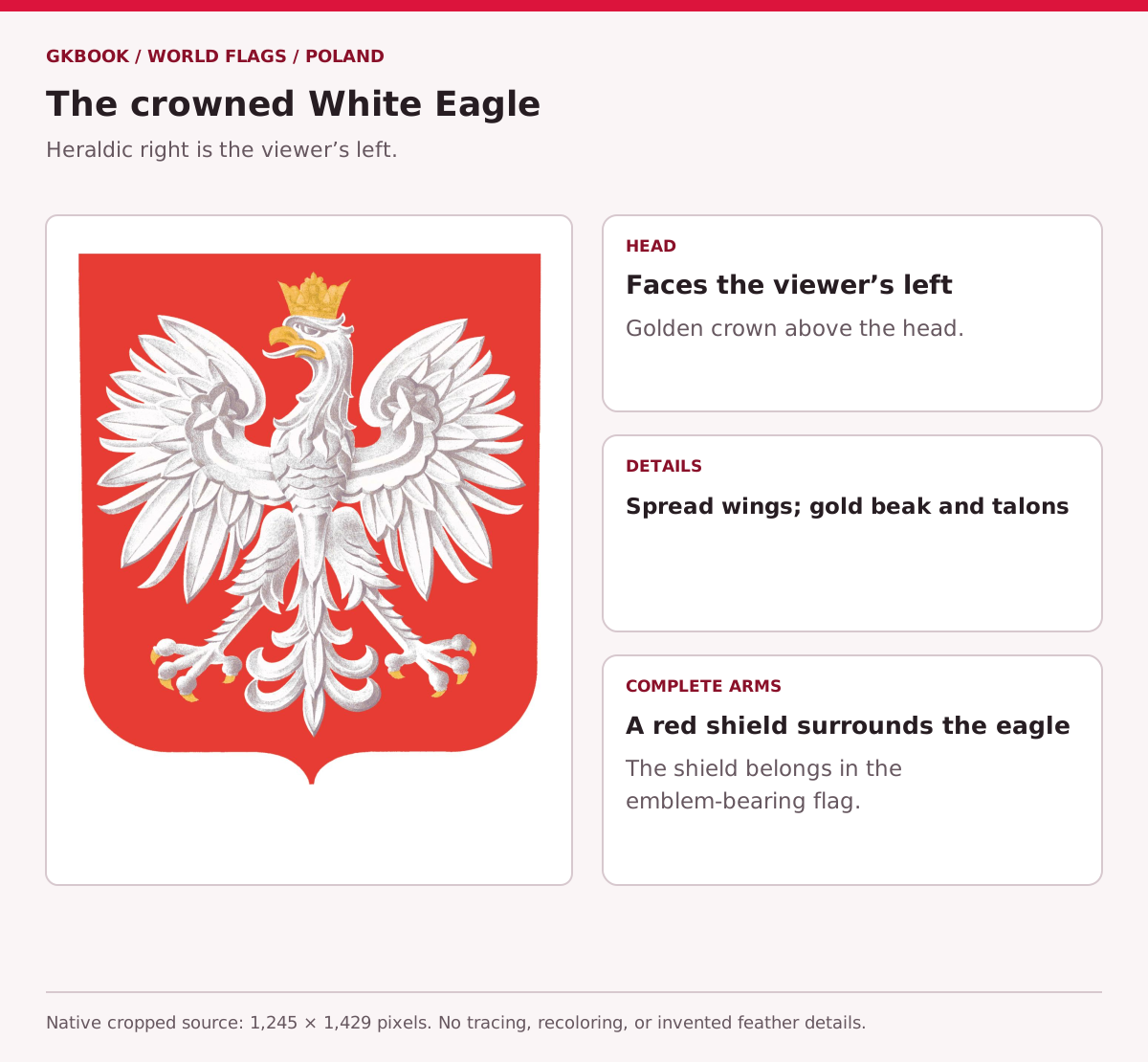
Heraldic directions are described from the bearer’s viewpoint, so the eagle’s right is not the viewer’s right. This convention explains an otherwise confusing feature of written descriptions. The front-facing reference illustration should show the head turned toward the left side of the page.
The emblem in these files is a crop of the artwork published with the current consolidated act. It preserves the original details and raster pixels. The surrounding flag geometry is vector artwork, but the embedded eagle remains a finite-resolution image. Enlarging its SVG container cannot create additional feather detail beyond that source.
Where does the coat of arms go on the flag?
The coat of arms is centered horizontally and vertically within the white band. Annex 3 sets its height at two fifths of the flag’s overall height. For the 1,500-unit-high master, the emblem is 600 units high, centered at y = 375, with 75 units of white clearance above and below.

The 2:5 relationship refers to the complete coat of arms, including its shield, rather than the eagle alone. Measuring just the bird would enlarge the shield beyond the intended space. The white band itself is half the flag height, so subtracting the emblem height leaves a combined clearance of one tenth of the height.
The remaining clearance is shared equally between the upper edge and the band boundary. Horizontally, the emblem’s center lies halfway along the flag. Its width follows the proportions of the published artwork; it is not squeezed into a square. The placement diagram labels the bounding box without altering the downloaded flag.
Who uses the Polish flag with the coat of arms?
The act assigns the emblem-bearing flag to Polish diplomatic and consular representations, specified overseas missions, civil airports and airfields, civil transport aircraft on foreign flights, and harbor authorities. It also provides for maritime and certain military contexts. These uses do not mean that every government building should replace the plain flag with this version.
The distinction concerns the setting as well as the institution. Diplomatic residences and vehicles are addressed with reference to international law and custom. Military use in international ceremonies has its own implementing rules. A general educational description should preserve that context instead of turning the list into a universal instruction for every occasion.
The plain flag appears at the Sejm, Senate, presidency, and government institutions under the act’s separate provisions. Accordingly, an eagle is not a visual test of whether a flag is official. When captioning a photograph, identify the actual variant first and explain its setting only when that setting is known.
Is the flag with the eagle also a maritime ensign?
Yes. Article 9 provides for Polish seagoing vessels to fly the flag with the coat of arms as an ensign, subject to the applicable maritime rules. The ordinary rectangular emblem-bearing flag should be distinguished from the swallow-tailed naval ensign. The plain state flag is also prescribed for Polish inland-waterway vessels.

An ensign indicates a vessel’s national affiliation. The same rectangular design can therefore appear in a gallery as the flag with the coat of arms and in a maritime account as an ensign. The name describes its use; it does not necessarily identify a different arrangement of colors or symbols.
Special-service and military flags require their own identification. A photograph of a notched naval ensign should not be cropped into a rectangle and labeled as the plain national flag. This package supplies the two rectangular national variants. Its maritime diagram explains the categories without inventing a construction drawing for additional service flags.
What are the key dates in the history of Poland’s flag?
The colors have heraldic roots, gained national prominence in 1792, and received formal recognition in the national-cockade resolution of February 7, 1831. The modern state flag was adopted on August 1, 1919. Later legislation standardized national symbols, restored the crowned eagle, and established Flag Day in 2004.

These dates answer different historical questions. The use of colors, a rule governing a cockade, adoption of a state flag, and an annual commemorative day are separate milestones. Labeling each event prevents an apparent contradiction between an early date for the colors and a later date for the flag.
The gallery’s historical panels show modern educational graphics rather than supposed facsimiles of early cloth. Their purpose is to organize the documentary sequence. A photograph or reconstruction of a specific historical flag would need its own evidence about fabric, dimensions, shade, and the period’s eagle design, which can differ from today’s published emblem.
How did heraldry influence the white-and-red flag?
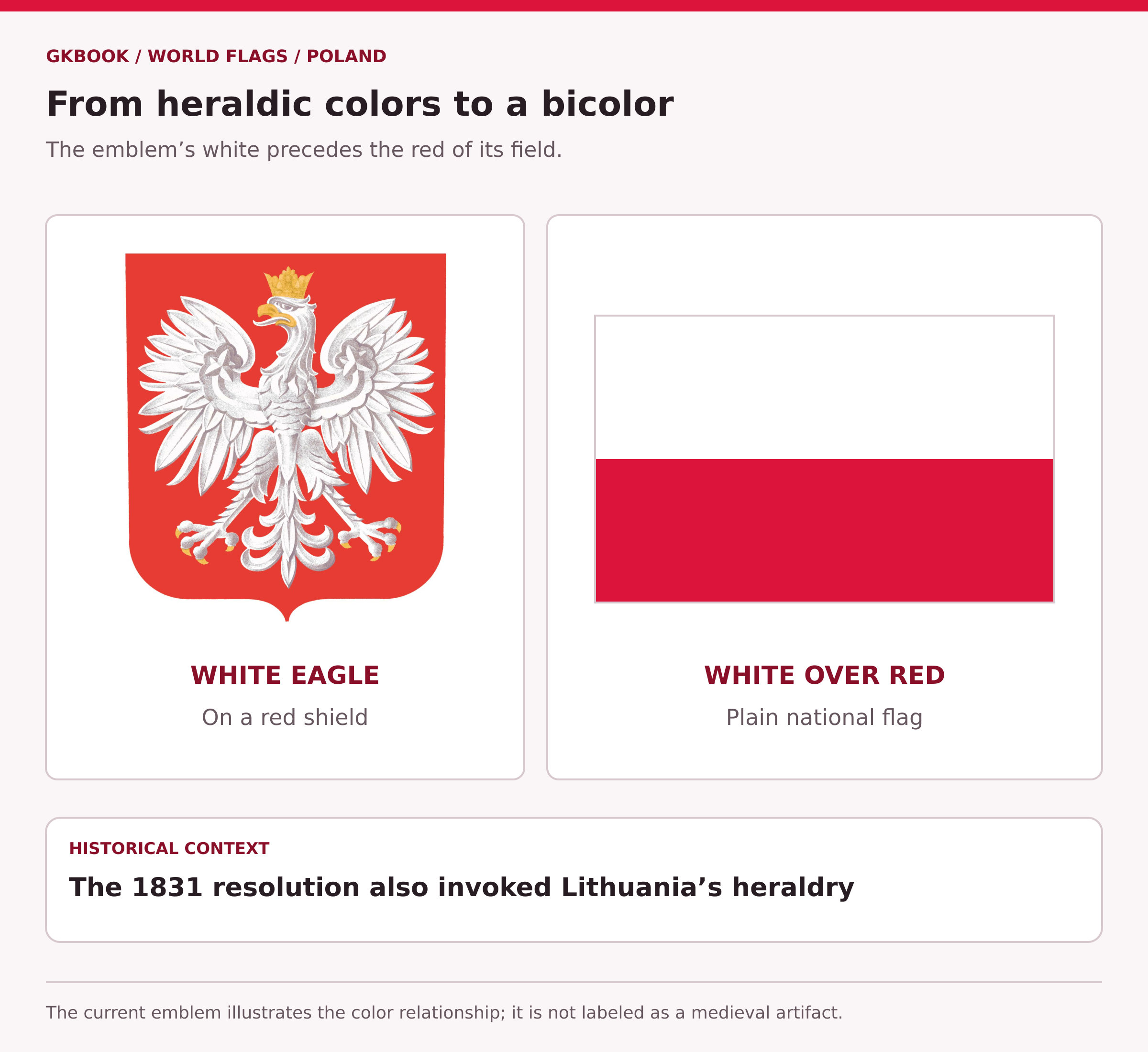
The flag’s colors derive from heraldry: a white eagle against red in Poland’s arms, with official historical accounts also referring to Lithuania’s white mounted knight on red. White appears above red because the emblem’s color precedes the field’s color. The ordering preserves that relationship between the emblem and its background.
A coat of arms combines an emblem with its background, called the field. A bicolor can carry those principal tinctures into a simpler arrangement that remains easy to recognize from a distance. The relationship is historical and symbolic; the flag is not a flattened map or a literal diagram of the bird.
References to the Polish-Lithuanian tradition belong to the history of the shared colors, particularly the 1831 resolution. They do not place a mounted knight on the present Polish flag. Likewise, the plain version remains a complete national design even though its heraldic origin is expressed through colors rather than a visible eagle.
What happened to the national colors in 1831?
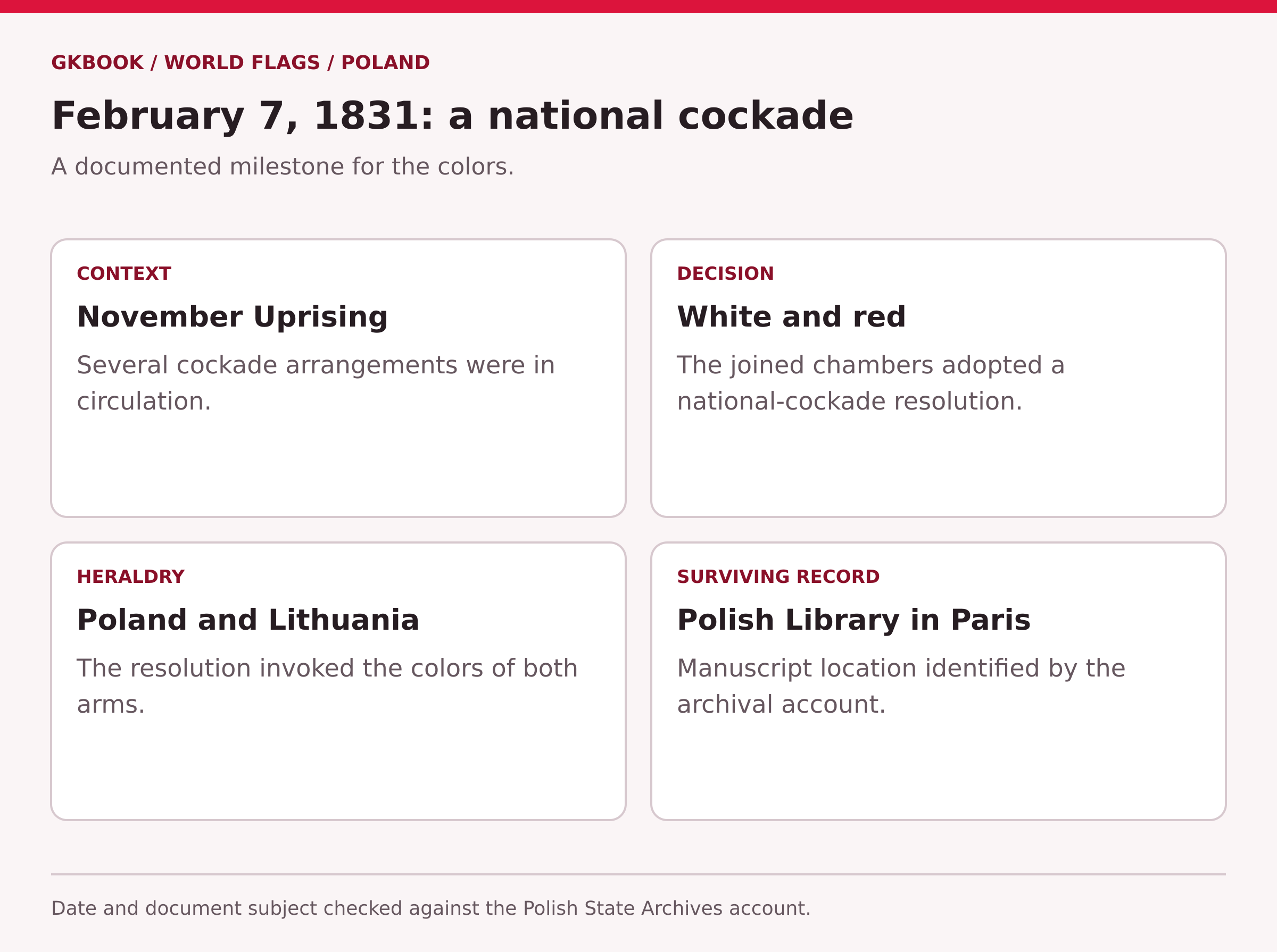
On February 7, 1831, the joined parliamentary chambers adopted a resolution establishing a white-and-red national cockade during the November Uprising. It referred to the colors of the arms of the Kingdom of Poland and the Grand Duchy of Lithuania. This was recognition of the national colors, not adoption of today’s complete flag specification.

The Polish State Archives’ account places the resolution in a setting where several cockade arrangements were in use. A common emblem helped express national affiliation. The document is therefore evidence about the standardization of national colors and a wearable sign, rather than a construction sheet specifying the modern rectangle.
Its manuscript survives in the Polish Library in Paris, according to the archival description. That surviving document helps anchor the date in evidence rather than recollection. The historical panel names the resolution and its subject explicitly, while the separate 1919 panel deals with the later state-flag legislation after independence was regained.
When was the modern Polish flag adopted?
The Legislative Sejm adopted the modern white-over-red state flag on August 1, 1919, after Poland regained independence. The act defined white and red in parallel horizontal bands, with white above. Its accompanying patterns included official flag forms. The date should be distinguished from the earlier history of the national colors.

The 1919 act belongs to the rebuilding of Polish state institutions. It addressed arms, colors, and several official signs, so its historical role extends beyond a single flag picture. Reading it alongside the earlier cockade resolution shows both continuity in the colors and a different legal setting.
The present gallery uses today’s published emblem where an eagle-bearing flag is shown. It does not label that image as an exact copy of the 1919 arms. Historical changes in the eagle’s drawing can matter even when the broad white-over-red arrangement remains familiar, which is why dates and artwork should be matched carefully.
When was the eagle’s crown restored?
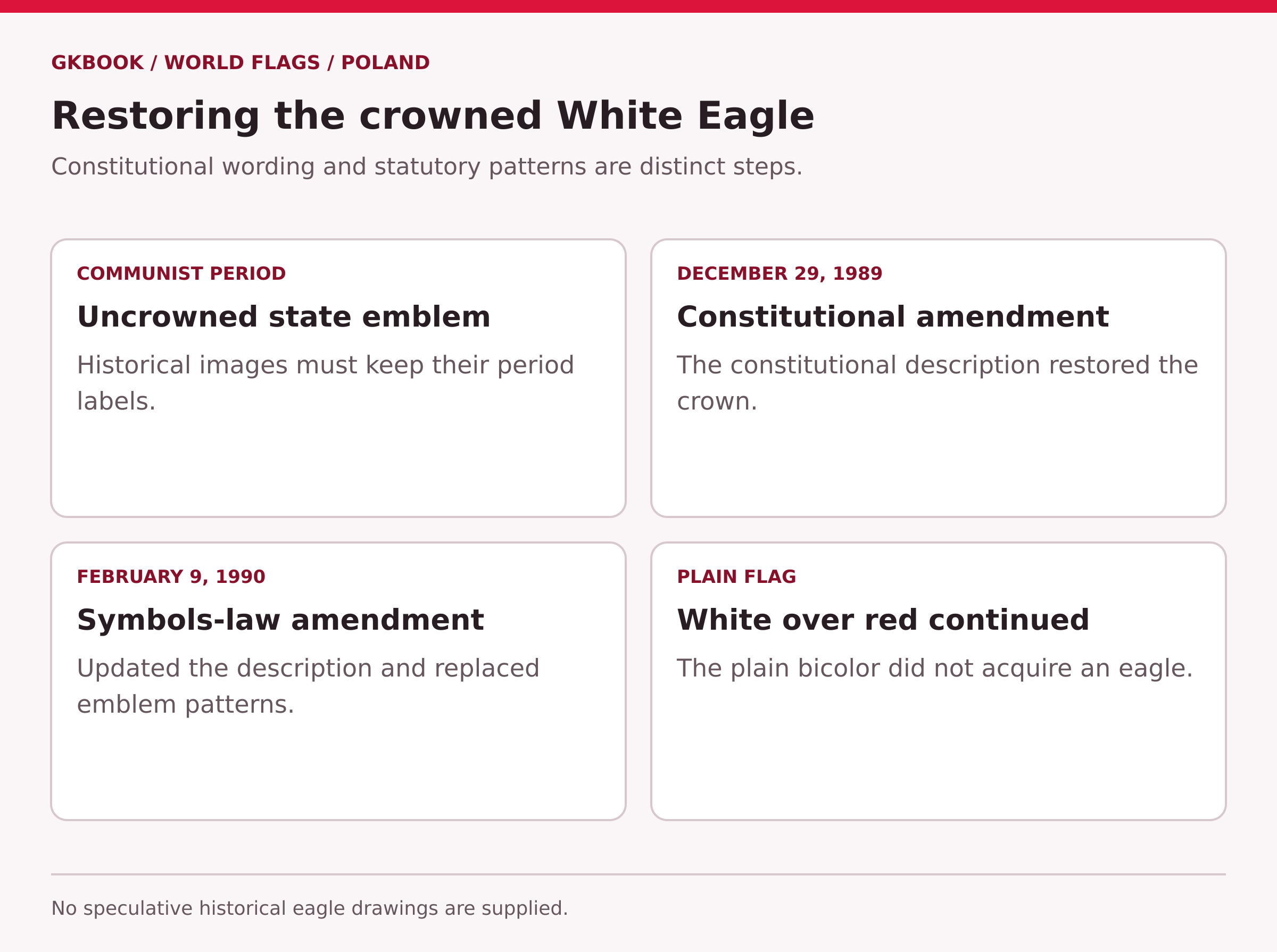
The constitutional amendment of December 29, 1989 restored the crowned White Eagle in the constitutional description. The act of February 9, 1990 then amended the symbols law and replaced the relevant emblem patterns. These changes concerned the arms and the eagle-bearing flag; the plain white-over-red bicolor did not acquire an eagle.

The crown had been absent from the state emblem used in the communist period. Its restoration signaled a change in the national emblem, while the white-and-red colors continued. Distinguishing the constitutional wording from the later statutory artwork avoids treating the transition as one undifferentiated date.
A historical picture of an uncrowned eagle should therefore be identified in its own period rather than silently edited to match the current emblem. The timeline uses text to mark the changes and shows only the current published arms as the present-day reference. No invented intermediate emblem is offered as an official historical design.
Which law defines the Polish flag today?
The Constitution identifies Poland’s national colors and crowned White Eagle, while the Act of January 31, 1980, as amended, provides detailed rules and annexed patterns. The consolidated text published in 2025 contains the color measurements and flag proportions used here. Its publication did not create a new flag or a new adoption date.
Article 28 of the Constitution establishes the national symbols and leaves their detailed treatment to statute. The symbols act supplies the practical definitions: color order, the two rectangular variants, specified uses, and reference illustrations. The constitutional statement and the statutory annexes therefore serve complementary purposes.
A consolidated text collects the law with its amendments for convenient reading. It should not be confused with the original act or with a proposed replacement law. For historical captions, retain the date of the event being described; for current construction, use the applicable pattern rather than an attractive but outdated illustration found online.
When is Poland’s Flag Day?
Poland celebrates Flag Day on May 2. The observance was established by the act of February 20, 2004 and is now stated in Article 6a of the symbols law. It encourages recognition of the national flag and colors. May 2 is also observed as the Day of the Polish Diaspora and Poles Abroad.

Flag Day sits between May 1 and the May 3 Constitution observance, but its subject is distinct. It focuses attention on a national symbol that appears in everyday life as well as at ceremonies. The date is an annual observance, separate from the August anniversary of the 1919 flag legislation.
A commemorative calendar should identify each event rather than presenting a string of unexplained dates. The picture here pairs May 2 with the 2004 establishment year, making that difference clear. A particular year’s local events may have their own program, which does not alter the annual date or the underlying flag design.
Can private citizens display Poland’s flag?
Yes. The plain white-and-red flag is used by citizens as well as public institutions, and everyone may use the national colors respectfully. Display is not confined to Flag Day. State holidays, anniversaries, community occasions, and personal expressions of national belonging can all provide contexts for respectful use of the plain flag.
The 2004 amendment broadened the statutory wording on public use of national colors. The current act also encourages flag display at homes and other premises for state and local occasions. This is different from suggesting that a private person needs a special ceremony before showing the national colors.
Choose the form appropriate to the setting. A plain flag, a white-and-red ribbon, and a cockade can express the same affiliation through different objects. The emblem-bearing flag has specified official uses, so it should not be treated as a more complete or more patriotic upgrade to the ordinary flag at a private home.
How should the Polish flag be displayed vertically?
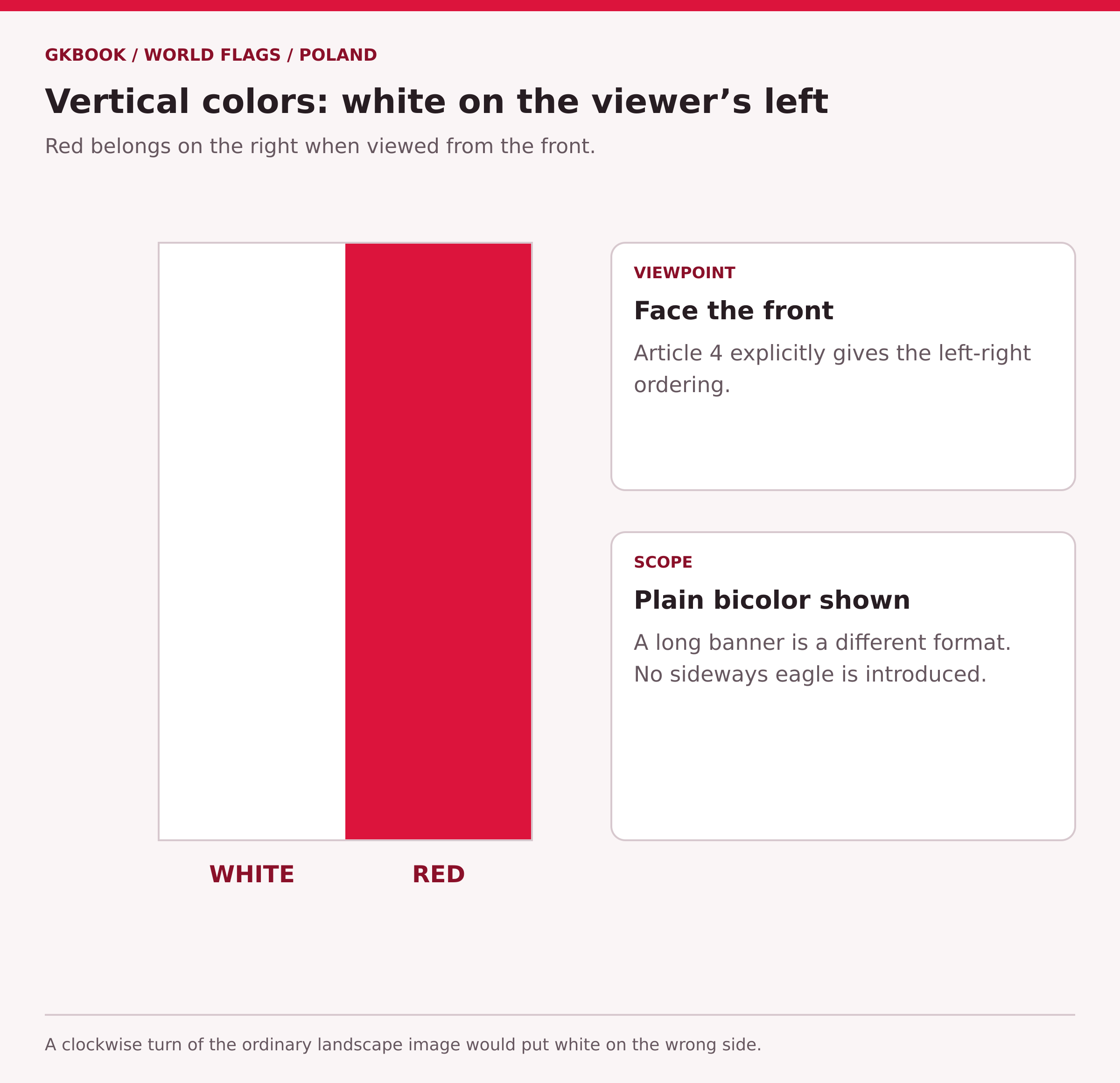
When Poland’s national colors are arranged vertically and viewed from the front, white belongs on the viewer’s left and red on the right. Article 4 states that ordering explicitly. The gallery shows a vertical arrangement of the plain bicolor; it does not rotate the eagle sideways or invent a separate emblem-bearing banner pattern.

A clockwise rotation of an ordinary white-over-red picture moves white to the right, which produces the wrong viewer-facing order. Turning it the other way gives white on the left. This makes the viewpoint worth stating explicitly rather than relying on a vague instruction to rotate the flag.
A long vertical banner can have different overall dimensions from a rectangular flag. National colors and a statutory flag are related but distinct forms. In the diagram, the upright rectangular example preserves the same cloth proportions by exchanging its horizontal and vertical dimensions; the labels outside it explain the observer’s perspective.
Does the plain Polish flag look different from the back?
The plain flag has the same white-over-red appearance from either side when its top stays uppermost. A left-to-right reflection moves the hoist to the opposite edge but leaves the two horizontal bands unchanged. Turning the flag upside down is a different operation and reverses the required order of the colors.
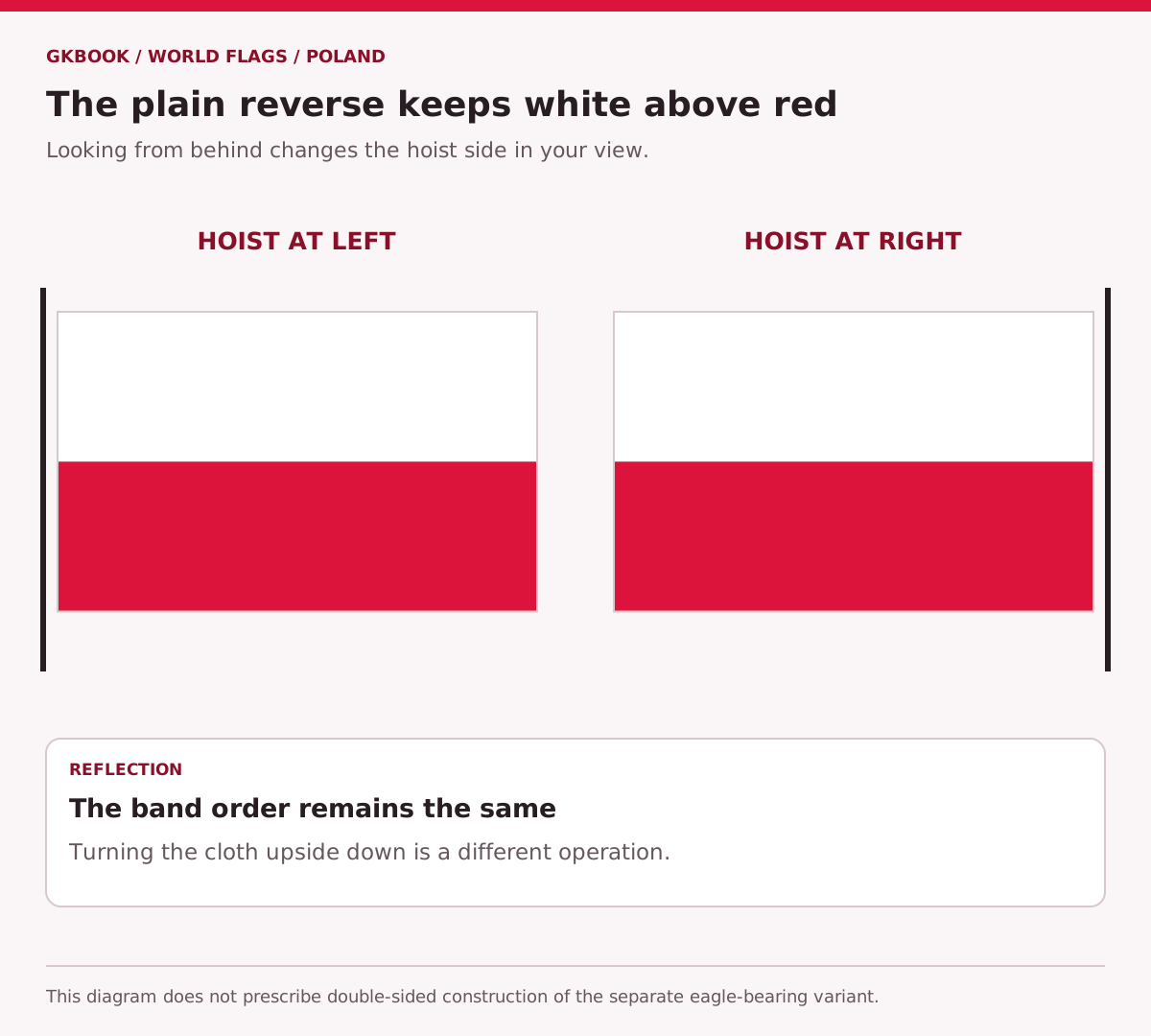
This follows from the plain design’s symmetry. Every point in the white upper half has a matching white point at the same height on the opposite side; the same is true of red below. A photograph taken from behind the cloth can therefore remain an entirely correct view of the flag.
The comparison diagram shows an external pole marker on each side so that the change in viewpoint is visible. Those markers are not part of the flag. This explanation concerns the plain bicolor; it does not prescribe how a manufacturer must construct, mirror, or separately apply the detailed emblem on a two-sided physical flag.
How should Poland’s flag be treated respectfully?
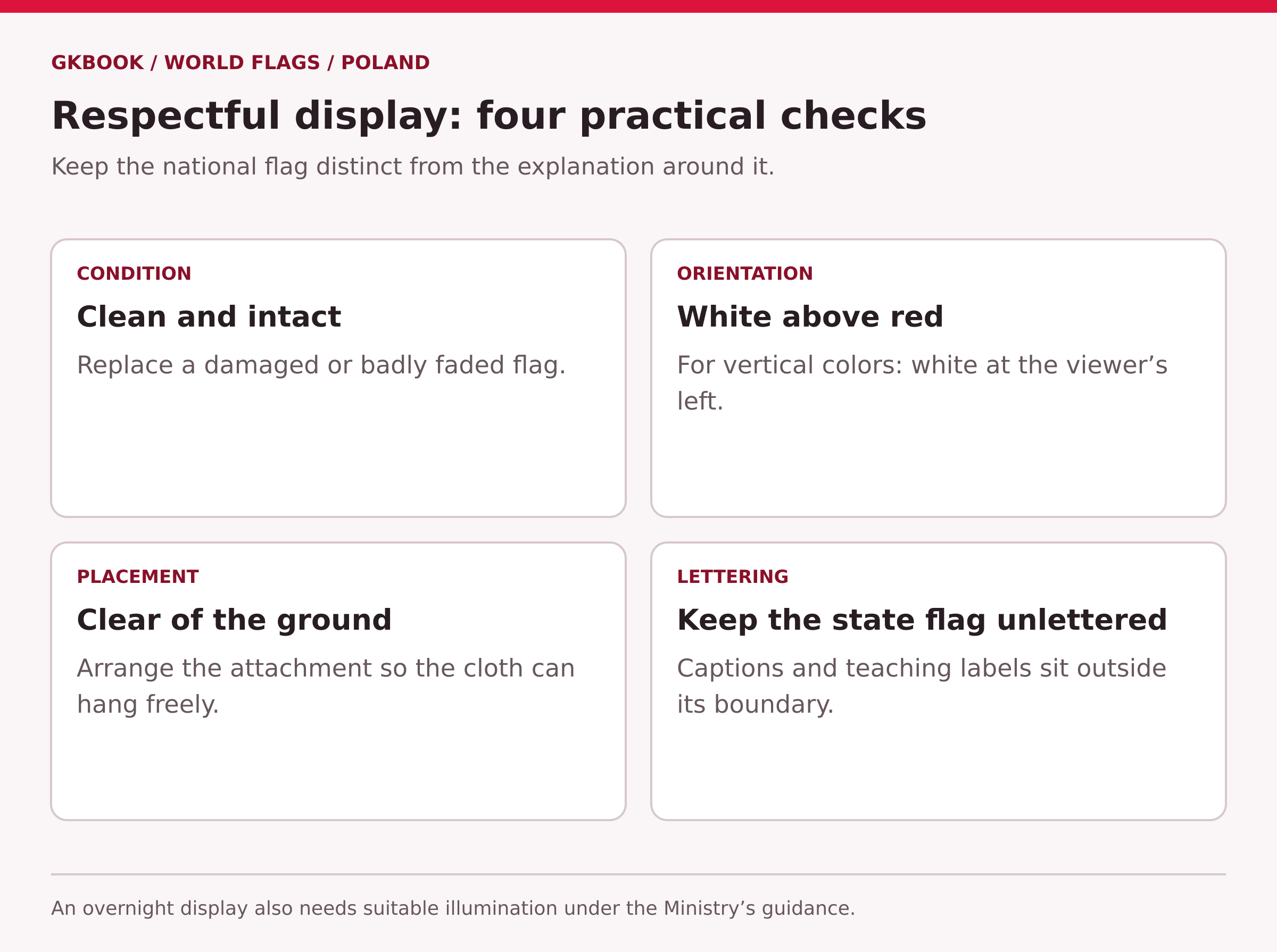
Keep the flag clean, intact, correctly oriented, and clear of the ground. Ministry guidance advises suitable lighting for overnight display and distinguishes flags from decorative uses of national colors. It also says that the state flag should carry no added writing or drawings. Explanatory captions belong beside the flag image.
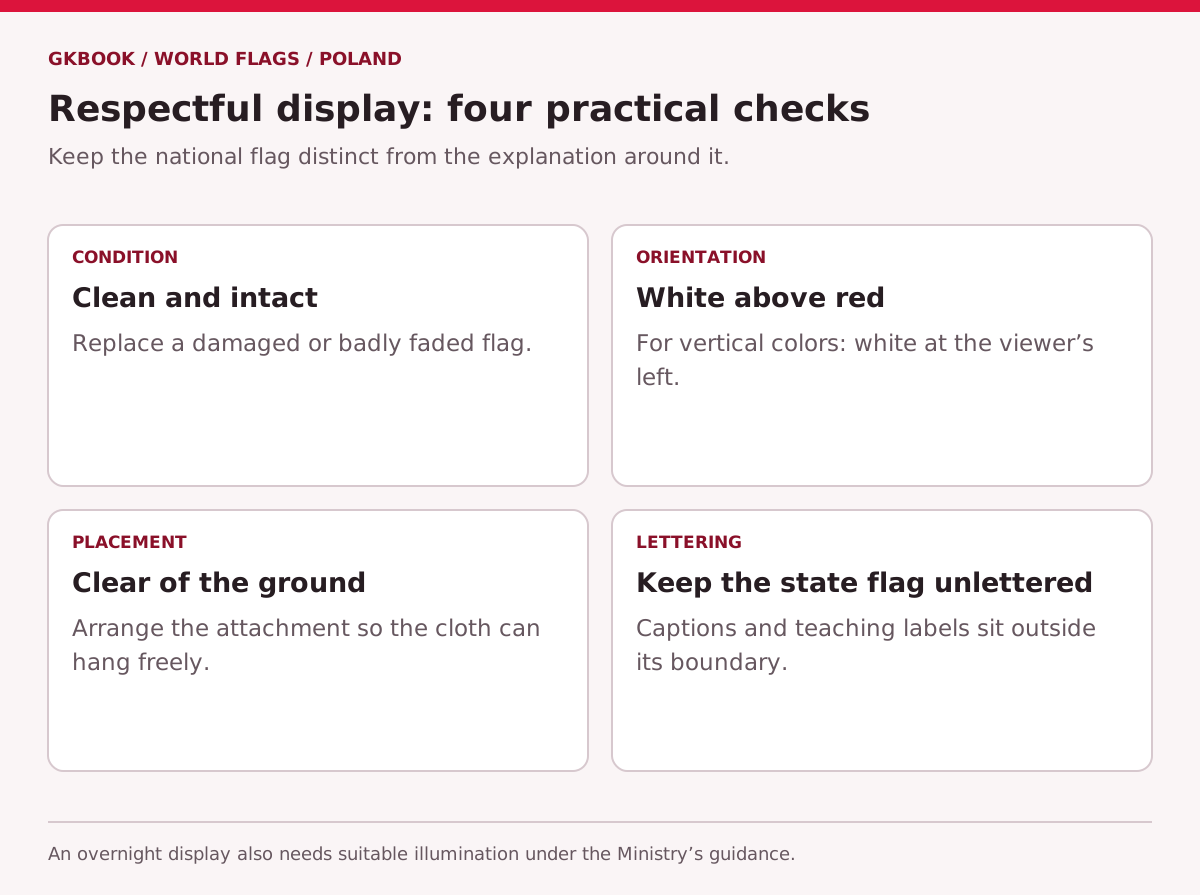
Begin with the object itself: check whether the colors are clear, the fabric is in good condition, and the attachment is secure. A correct design can still be displayed poorly if it is tangled, damaged, or allowed to drag. These practical checks are easy to understand without turning a reference picture into a ceremony manual.
The Ministry’s guidance also distinguishes a national flag from a supporter’s banner bearing a place name. A decorative use of the national colors is not automatically the statutory 5:8 flag. In the downloads, the complete flags remain unlettered; teaching labels and dimension lines are confined to clearly identified explanatory compositions.
How is the flag used during national mourning?
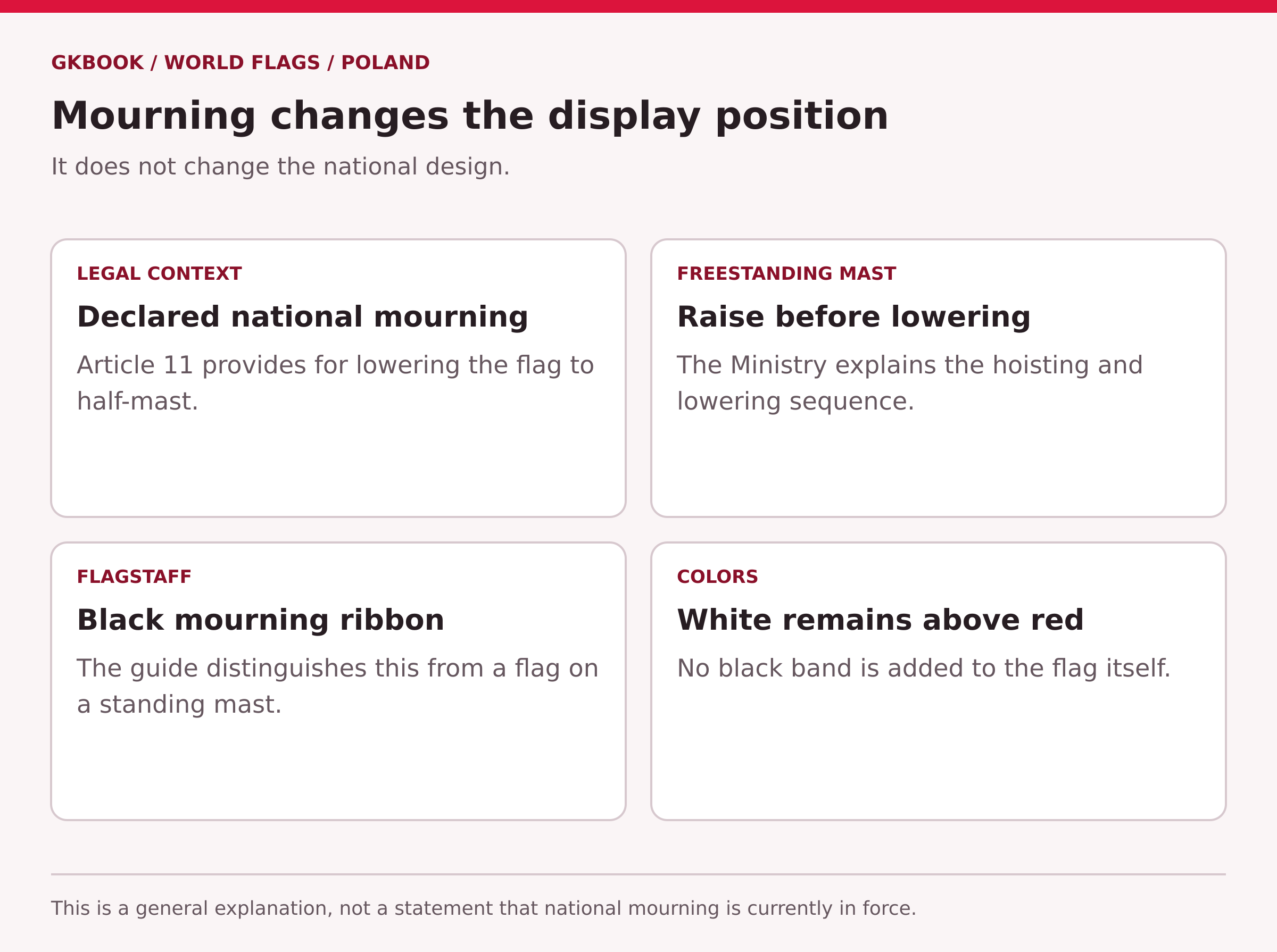
During officially declared national mourning, the symbols act calls for the state flag to be lowered to half-mast. Ministry guidance explains the hoisting and lowering sequence and distinguishes this from a black ribbon on a flagstaff. The white and red bands remain unchanged; mourning does not turn the flag into a different national design.

The legal provision concerns a declared period, not an inference drawn from a photograph. Article 11 authorizes the president to introduce national mourning and specifies the lowered position. A caption should identify a documented occasion before claiming that an image records such an observance.
The Ministry’s guide describes raising a flag to the top before lowering it and distinguishes freestanding masts from flagstaffs with mourning ribbons. The gallery summarizes those categories in words. It avoids a rigid diagram that might falsely prescribe one attachment point for every flagpole, and it makes no claim that mourning is currently in force.
What is the Polish national cockade?
The national cockade is a circular white-and-red badge associated with the same colors as the flag. The Interior Ministry’s guide places white at its center and red around the outside. It is a wearable form of national colors, with its own history, rather than a small circular version of the rectangular state flag.

Its arrangement translates the principal heraldic color and background into concentric regions. The gallery uses a simple flat diagram to make that order clear. It is not a claim that every historical cockade had identical pleating, ribbon tails, dimensions, or construction; those details varied with the object and period.
The 1831 resolution is especially relevant because it explicitly concerned the national cockade. That connection helps explain why a history of Poland’s flag must also discuss signs worn on clothing. A modern cockade illustration and a documentary account of the resolution serve different purposes, so the gallery labels both rather than substituting one for the other.
How does Poland’s flag differ from Indonesia’s and Monaco’s?
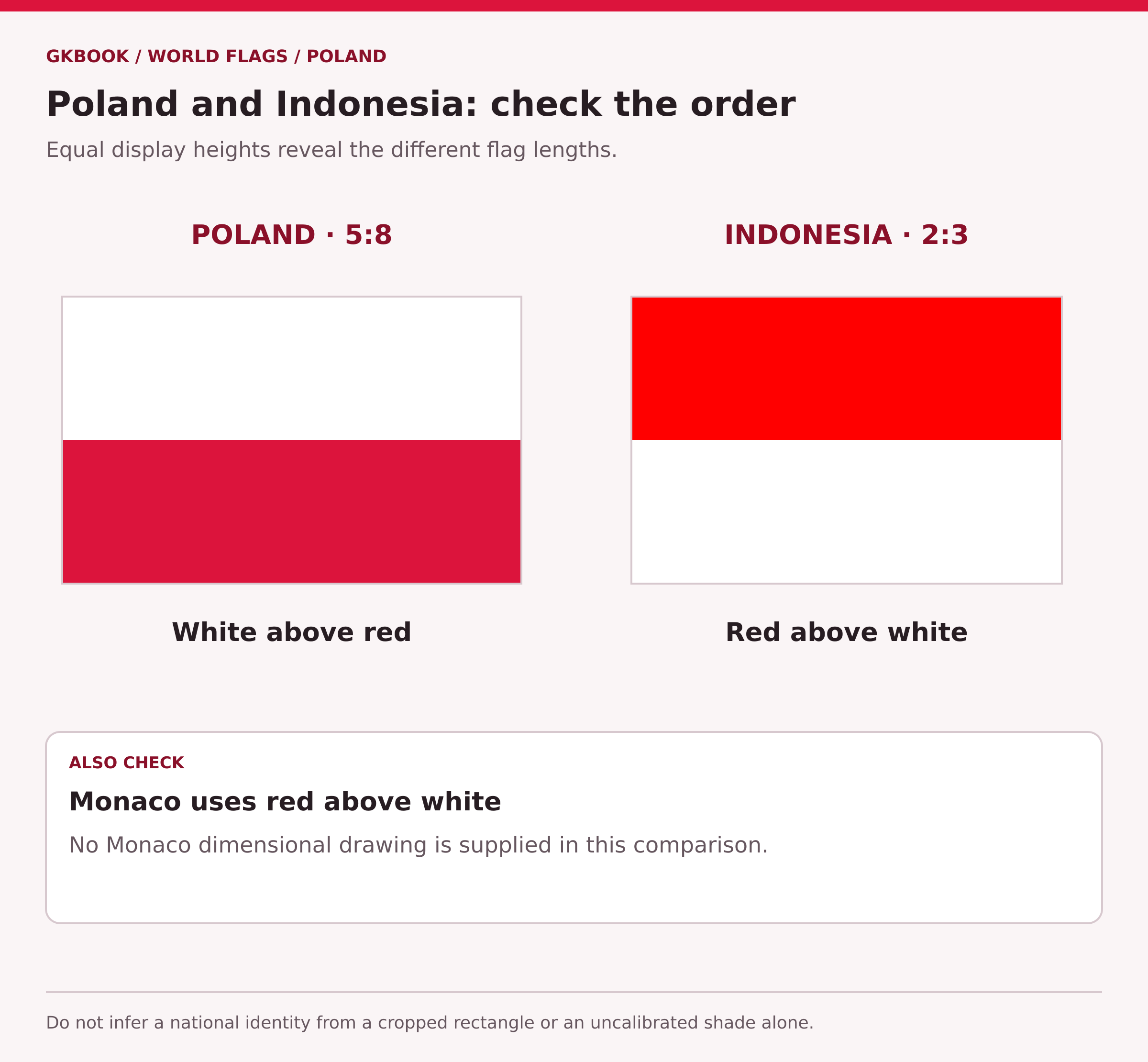
Poland places white above red. Indonesia and Monaco place red above white, so the order is the first distinction to check. Poland’s official height:length ratio is 5:8, while Indonesia’s is 2:3. Similar colors do not make these flags interchangeable, and an upside-down Polish flag should not be labeled as correctly displayed Poland.

The comparison shows Poland and Indonesia at the same height, allowing their slightly different lengths to remain visible. It uses a separate declared screen red for Indonesia. The aim is to compare band order and geometry, not to suggest that two countries legally share one calibrated color specification.
A cropped photograph can conceal the ratio, and lighting can change an apparent shade. White above red is therefore a useful first check, followed by the rectangle’s shape and the context. Monaco is mentioned for its opposite color order without supplying an additional unsourced dimensional drawing or treating a color match as proof of national identity.
How can you draw the Polish flag accurately?
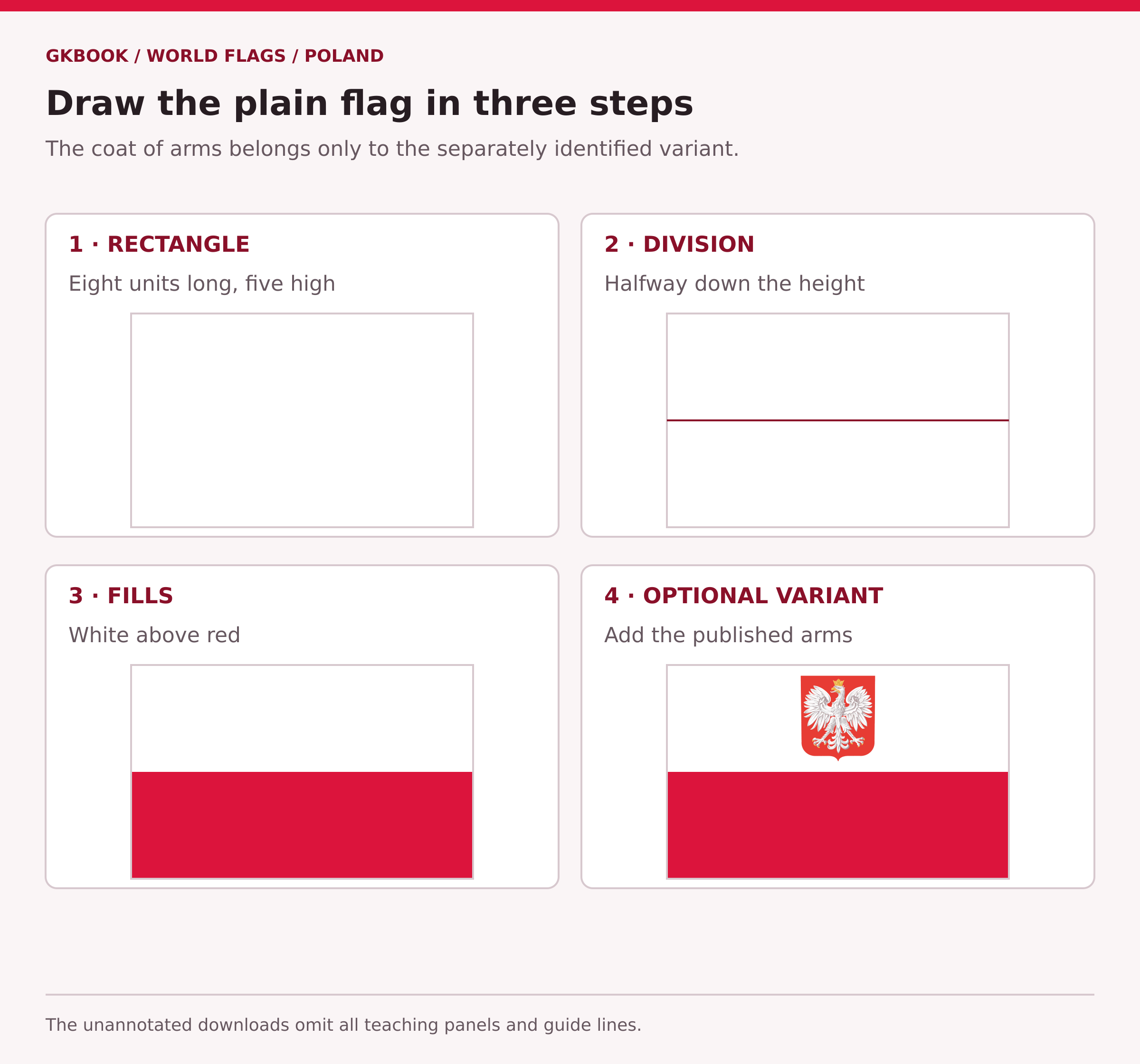
Draw a rectangle eight units long and five units high, divide it horizontally at half its height, and fill the upper band white and the lower band red. For the plain flag, stop there. For the emblem-bearing form, place the published coat of arms at the specified size in the white band.
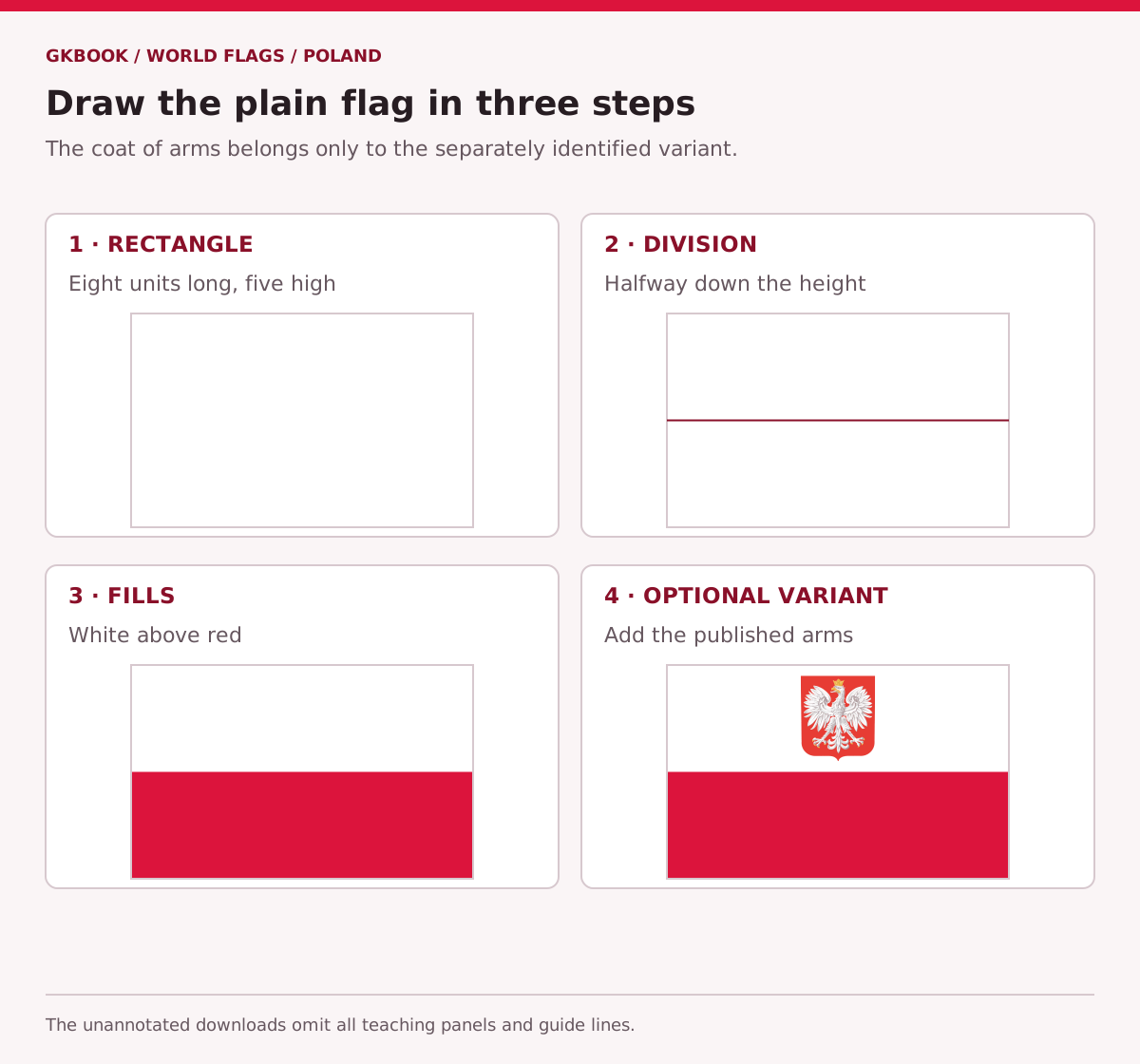
A grid makes the simple design repeatable. At 800 × 500 pixels, the boundary lies at y = 250. At 2,400 × 1,500, it lies at y = 750. Keep the fills opaque and the edge straight; no decorative wave, texture, or dark outline is required to identify the flag.
If the eagle-bearing version is needed, begin from reliable artwork rather than improvising a bird or removing its shield. Preserve its aspect ratio while setting the complete emblem’s height to two fifths of the flag height. The construction panels separate that optional step from the finished plain flag so the two variants remain unambiguous.
Which Poland flag image files are included?
The gallery contains 24 subjects, each supplied as SVG and PNG, plus a separate social-sharing image pair. The two unannotated flag PNGs measure 4,800 × 3,000 pixels. Their SVGs use 2,400 × 1,500 coordinate systems. The plain flag is fully vector; emblem-bearing files retain the published eagle as an embedded raster image.

Choose the plain SVG for sharp geometric scaling, or the PNG when the destination cannot display SVG. For the coat-of-arms version, the vector container preserves the field geometry while the eagle’s detail remains limited by the embedded 1,245 × 1,429-pixel crop. The larger export does not create new historical artwork or additional source detail.
Printed output also depends on paper, ink, fabric, and color management. The declared screen fills are useful for consistent educational images but are not certified production matches to the statutory measurements. The diagrams contain margins and labels, so their outer canvases have different shapes from the actual flags pictured inside them.
What mistakes should you check in a Poland flag image?
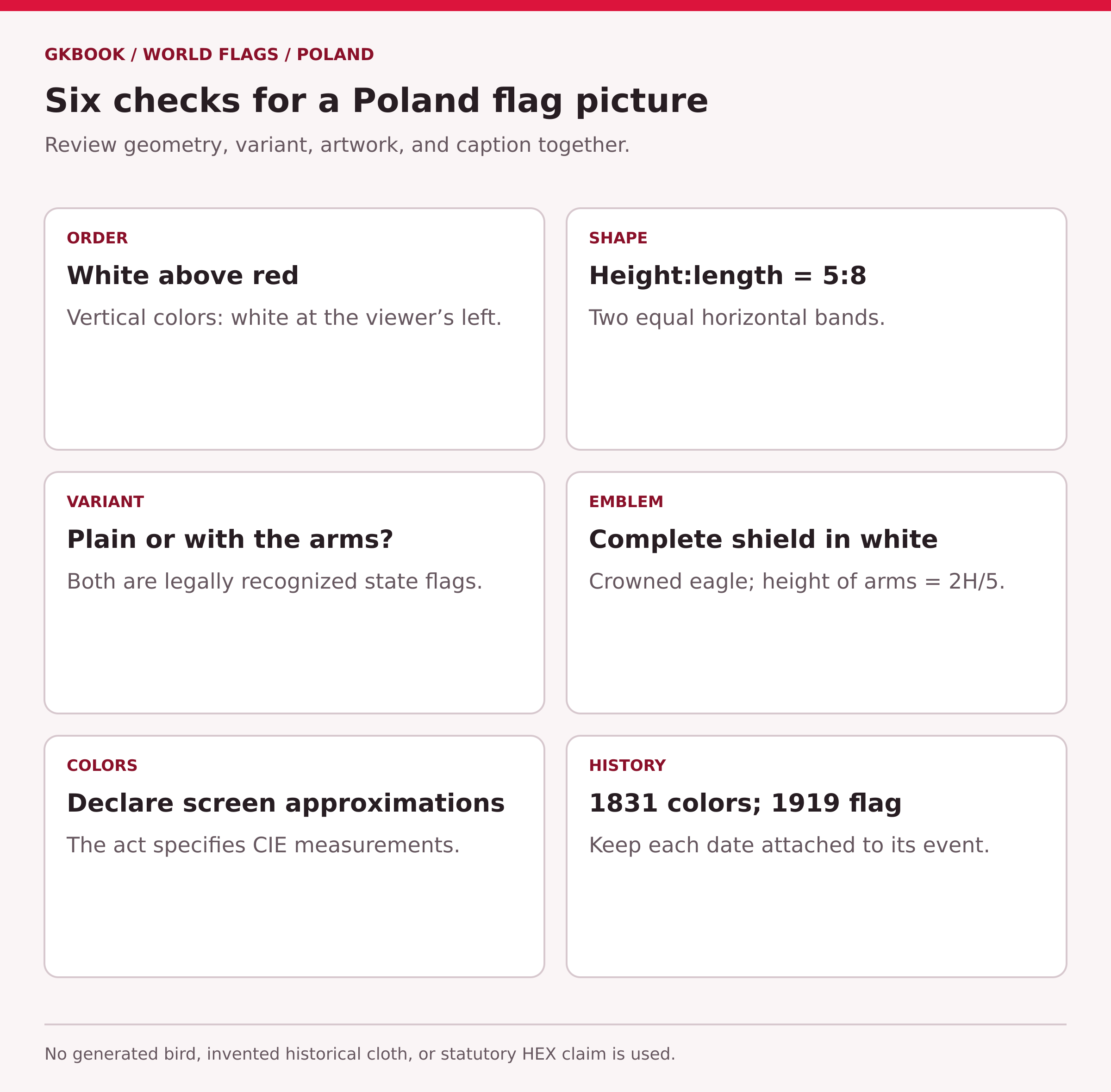
Check white above red, equal band heights, and the 5:8 height:length ratio. Confirm whether the intended variant is plain or bears the coat of arms. In the latter, the crowned eagle and red shield belong inside the white band. Avoid calling web HEX values official or confusing the 1831 and 1919 milestones.

Review the whole rectangle before its details. Stretching a correctly drawn flag can spoil its proportions, while cropping can conceal a misplaced band boundary. Next check the emblem’s presence, complete shield, size, and position. Finally, examine the caption: an accurate image can still be described with an incorrect variant name or historical date.
The gallery separates clean reference flags from educational diagrams so readers can tell which lines belong to the design. The accompanying notes also distinguish precise geometric relationships from reproduction limits in the official raster emblem. This combination makes the artwork useful while keeping its claims proportionate to the documentary evidence and the actual files.
Download Poland flag pictures
Download the plain national flag as SVG or 4,800 × 3,000 PNG. The SVG uses a 2,400 × 1,500 coordinate system. The separately labeled flag with coat of arms SVG and flag with coat of arms PNG retain the same 5:8 field.
The gallery contains 24 subjects, each with an SVG and PNG. The plain flag is fully vector. Eagle-bearing files embed an unretouched 1,245 × 1,429-pixel crop of the published official raster emblem; an SVG container does not make that detail infinitely scalable. Image credits and reproduction notes describe the source artwork and declared screen palette.
Explore more in World Flags, including the Indonesia flag and Monaco flag.
World Flags/Poland
Poland flag pictures
Two equal horizontal bands, white above red; height:length 5:8. Flat screen colors are declared approximations.
GKBook geometry and educational layouts; official emblem from the 2025 consolidated Act, Annex 1.Download SVGDownload PNG
The crowned White Eagle on a red shield is centered in the white band. Exact field geometry contains the published raster emblem, whose scan colors are unretouched.
GKBook geometry and educational layouts; official emblem from the 2025 consolidated Act, Annex 1.Download SVGDownload PNGEach band spans the full length and half the height. The boundary guide and external outline appear only in this teaching diagram.
GKBook geometry and educational layouts; official emblem from the 2025 consolidated Act, Annex 1.Download SVGDownload PNGAnnex 3 gives a 5:8 ratio for the shorter to longer dimension. Both rectangular variants share it.
GKBook geometry and educational layouts; official emblem from the 2025 consolidated Act, Annex 1.Download SVGDownload PNGWhite and red are specified by x, y, Y and permitted CIELUV differences. The separate HEX/RGB palette declares the fills used here.
GKBook geometry and educational layouts; official emblem from the 2025 consolidated Act, Annex 1.Download SVGDownload PNGThe white emblem and red field explain the bicolor’s ordering. The historical shared-color account includes the White Eagle and Lithuania’s mounted knight.
GKBook geometry and educational layouts; official emblem from the 2025 consolidated Act, Annex 1.Download SVGDownload PNGBoth forms are state flags under Article 6. Presence of the eagle is not a test of whether a flag is used by government.
GKBook geometry and educational layouts; official emblem from the 2025 consolidated Act, Annex 1.Download SVGDownload PNGAnnex 1 supplies the detailed official artwork. This enlarged view uses a crop of its published raster image, preserving source colors and feather detail.
GKBook geometry and educational layouts; official emblem from the 2025 consolidated Act, Annex 1.Download SVGDownload PNGOn the 2,400 × 1,500 master, the full emblem is 600 units high and centered at (1,200, 375). Its top and bottom clearances within white are 75 units.
GKBook geometry and educational layouts; official emblem from the 2025 consolidated Act, Annex 1.Download SVGDownload PNGThe act distinguishes inland and seagoing uses; the Ministry guide separately identifies the naval ensign.
GKBook geometry and educational layouts; official emblem from the 2025 consolidated Act, Annex 1.Download SVGDownload PNGThe historical dates describe distinct events. A resolution about national colors is not the same as adoption of the modern rectangular flag.
GKBook geometry and educational layouts; official emblem from the 2025 consolidated Act, Annex 1.Download SVGDownload PNGThe 1831 resolution regulated the national cockade and colors. It did not establish the complete modern flag construction.
GKBook geometry and educational layouts; official emblem from the 2025 consolidated Act, Annex 1.Download SVGDownload PNGThe act dated August 1, 1919 defined the national colors and supplied official patterns. The plain modern drawing illustrates the enduring band arrangement.
GKBook geometry and educational layouts; official emblem from the 2025 consolidated Act, Annex 1.Download SVGDownload PNGThe 1989 constitutional amendment and 1990 symbols-law amendment concern the crowned arms. They should not be merged into a new adoption date for the plain flag.
GKBook geometry and educational layouts; official emblem from the 2025 consolidated Act, Annex 1.Download SVGDownload PNGMay 2 is the annual Flag Day established by the 2004 amendment. It is distinct from the 1919 adoption milestone.
GKBook geometry and educational layouts; official emblem from the 2025 consolidated Act, Annex 1.Download SVGDownload PNGThe observer sees white on the left and red on the right. The illustration exchanges the flag’s horizontal and vertical dimensions without stretching it.
GKBook geometry and educational layouts; official emblem from the 2025 consolidated Act, Annex 1.Download SVGDownload PNGHorizontal reflection leaves the plain bicolor unchanged. External pole markers distinguish the two viewpoints.
GKBook geometry and educational layouts; official emblem from the 2025 consolidated Act, Annex 1.Download SVGDownload PNGThese checks summarize Ministry guidance on respectful display. National-color decorations are a separate category from the fixed-ratio flag.
GKBook geometry and educational layouts; official emblem from the 2025 consolidated Act, Annex 1.Download SVGDownload PNGThe act and Ministry guidance distinguish a declared mourning period, a lowered flag, and the flagstaff ribbon convention.
GKBook geometry and educational layouts; official emblem from the 2025 consolidated Act, Annex 1.Download SVGDownload PNGThe simplified circular diagram shows white at the center and red outside. It is a wearable national-color form, not the rectangular state flag.
GKBook geometry and educational layouts; official emblem from the 2025 consolidated Act, Annex 1.Download SVGDownload PNGPoland is white over red with height:length 5:8; Indonesia is red over white with height:length 2:3. Indonesia’s #FF0000 is an illustrative screen fill, not a certified standard.
GKBook geometry and educational layouts; official emblem from the 2025 consolidated Act, Annex 1.Download SVGDownload PNGThe first three panels complete the plain national flag. The fourth shows the optional coat-of-arms variant with its prescribed size and placement.
GKBook geometry and educational layouts; official emblem from the 2025 consolidated Act, Annex 1.Download SVGDownload PNGThe main plain and eagle-bearing PNGs are 4,800 × 3,000. Their SVG coordinate systems are 2,400 × 1,500. The official emblem remains a finite-resolution raster crop.
GKBook geometry and educational layouts; official emblem from the 2025 consolidated Act, Annex 1.Download SVGDownload PNGThe review covers color order, ratio, variant naming, complete arms, color specification, and historically accurate dates.
GKBook geometry and educational layouts; official emblem from the 2025 consolidated Act, Annex 1.Download SVGDownload PNGFrequently asked questions
What does the Poland flag look like?
Poland’s flag has two equal horizontal bands: white above red. Its official height:length ratio is 5:8. The plain flag has no emblem, while another legally recognized version places Poland’s crowned White Eagle on a red shield in the center of the white band. The modern flag was adopted in 1919.
What is the design of the Poland flag?
The plain Polish flag is a rectangle divided horizontally into two equal bands, white on top and red underneath. It contains no lettering, border, star, or eagle. The dividing line lies halfway down the flag. Both bands extend across its full length, producing a simple and balanced horizontal bicolor.
What are the official proportions of the Polish flag?
The official height:length ratio is 5:8. A flag 50 centimeters high is therefore 80 centimeters long, and each horizontal band is 25 centimeters high. Both the plain flag and the flag with the coat of arms use this same rectangular proportion, as shown in Annex 3 of the current law.
What are the official white and red color specifications?
Polish law defines the colors through CIE measurements, not hexadecimal web codes. Annex 2 gives white as x 0.315, y 0.320, Y 82.0, and red as x 0.570, y 0.305, Y 16.0. These downloads use white #FFFFFF and red #DC143C as explicitly declared, uncertified screen approximations for the two bands.
What does the white band represent?
The white band has a heraldic origin in the White Eagle of Poland. Official historical explanations also connect the shared colors to Lithuania’s white mounted knight. Cultural interpretations associate white with virtues such as purity or friendship, but these meanings should be distinguished from the documented heraldic source of the color.
What does the red band represent?
Red comes from the heraldic field behind the White Eagle and from the shared white-and-red heraldry invoked in the history of the national colors. Later cultural explanations connect red with courage, blood, and the struggle for independence. The historical origin and these patriotic interpretations describe different aspects of the same color.
Why is Poland’s flag called Biało-Czerwona?
Biało-Czerwona means the white-and-red and is a familiar Polish name for the flag. It follows the color order of the ordinary horizontal design: white above red. The formal name flaga państwowa Rzeczypospolitej Polskiej identifies the state flag of the Republic of Poland; the emblem-bearing form adds the words z godłem.
Does Poland have a flag with an eagle?
Yes. Polish law recognizes both the plain white-over-red flag and a version with the national coat of arms centered in the white band. The latter includes a crowned White Eagle on a red shield. It serves specified official and maritime uses; the plain flag is also used by state institutions.
How do the national colors differ from the state flag?
Poland’s national colors are white and red arranged in equal bands, but they can appear in forms without the flag’s fixed proportions. The rectangular state flag has the specified 5:8 ratio. A long ribbon, a vertical banner, and a cockade can display national colors without being interchangeable with that statutory flag.
What does the Polish White Eagle look like?
The national coat of arms depicts a white eagle with spread wings, a golden crown, and a golden beak and talons, on a red shield. Its head faces heraldic right, which is the viewer’s left. The official artwork contains detailed feathers and shading that a generic bird icon would not reproduce.
Where does the coat of arms go on the flag?
The coat of arms is centered horizontally and vertically within the white band. Annex 3 sets its height at two fifths of the flag’s overall height. For the 1,500-unit-high master, the emblem is 600 units high, centered at y = 375, with 75 units of white clearance above and below.
Who uses the Polish flag with the coat of arms?
The act assigns the emblem-bearing flag to Polish diplomatic and consular representations, specified overseas missions, civil airports and airfields, civil transport aircraft on foreign flights, and harbor authorities. It also provides for maritime and certain military contexts. These uses do not mean that every government building should replace the plain flag with this version.
Is the flag with the eagle also a maritime ensign?
Yes. Article 9 provides for Polish seagoing vessels to fly the flag with the coat of arms as an ensign, subject to the applicable maritime rules. The ordinary rectangular emblem-bearing flag should be distinguished from the swallow-tailed naval ensign. The plain state flag is also prescribed for Polish inland-waterway vessels.
What are the key dates in the history of Poland’s flag?
The colors have heraldic roots, gained national prominence in 1792, and received formal recognition in the national-cockade resolution of February 7, 1831. The modern state flag was adopted on August 1, 1919. Later legislation standardized national symbols, restored the crowned eagle, and established Flag Day in 2004.
How did heraldry influence the white-and-red flag?
The flag’s colors derive from heraldry: a white eagle against red in Poland’s arms, with official historical accounts also referring to Lithuania’s white mounted knight on red. White appears above red because the emblem’s color precedes the field’s color. The ordering preserves that relationship between the emblem and its background.
What happened to the national colors in 1831?
On February 7, 1831, the joined parliamentary chambers adopted a resolution establishing a white-and-red national cockade during the November Uprising. It referred to the colors of the arms of the Kingdom of Poland and the Grand Duchy of Lithuania. This was recognition of the national colors, not adoption of today’s complete flag specification.
When was the modern Polish flag adopted?
The Legislative Sejm adopted the modern white-over-red state flag on August 1, 1919, after Poland regained independence. The act defined white and red in parallel horizontal bands, with white above. Its accompanying patterns included official flag forms. The date should be distinguished from the earlier history of the national colors.
When was the eagle’s crown restored?
The constitutional amendment of December 29, 1989 restored the crowned White Eagle in the constitutional description. The act of February 9, 1990 then amended the symbols law and replaced the relevant emblem patterns. These changes concerned the arms and the eagle-bearing flag; the plain white-over-red bicolor did not acquire an eagle.
Which law defines the Polish flag today?
The Constitution identifies Poland’s national colors and crowned White Eagle, while the Act of January 31, 1980, as amended, provides detailed rules and annexed patterns. The consolidated text published in 2025 contains the color measurements and flag proportions used here. Its publication did not create a new flag or a new adoption date.
When is Poland’s Flag Day?
Poland celebrates Flag Day on May 2. The observance was established by the act of February 20, 2004 and is now stated in Article 6a of the symbols law. It encourages recognition of the national flag and colors. May 2 is also observed as the Day of the Polish Diaspora and Poles Abroad.
Can private citizens display Poland’s flag?
Yes. The plain white-and-red flag is used by citizens as well as public institutions, and everyone may use the national colors respectfully. Display is not confined to Flag Day. State holidays, anniversaries, community occasions, and personal expressions of national belonging can all provide contexts for respectful use of the plain flag.
How should the Polish flag be displayed vertically?
When Poland’s national colors are arranged vertically and viewed from the front, white belongs on the viewer’s left and red on the right. Article 4 states that ordering explicitly. The gallery shows a vertical arrangement of the plain bicolor; it does not rotate the eagle sideways or invent a separate emblem-bearing banner pattern.
Does the plain Polish flag look different from the back?
The plain flag has the same white-over-red appearance from either side when its top stays uppermost. A left-to-right reflection moves the hoist to the opposite edge but leaves the two horizontal bands unchanged. Turning the flag upside down is a different operation and reverses the required order of the colors.
How should Poland’s flag be treated respectfully?
Keep the flag clean, intact, correctly oriented, and clear of the ground. Ministry guidance advises suitable lighting for overnight display and distinguishes flags from decorative uses of national colors. It also says that the state flag should carry no added writing or drawings. Explanatory captions belong beside the flag image.
How is the flag used during national mourning?
During officially declared national mourning, the symbols act calls for the state flag to be lowered to half-mast. Ministry guidance explains the hoisting and lowering sequence and distinguishes this from a black ribbon on a flagstaff. The white and red bands remain unchanged; mourning does not turn the flag into a different national design.
What is the Polish national cockade?
The national cockade is a circular white-and-red badge associated with the same colors as the flag. The Interior Ministry’s guide places white at its center and red around the outside. It is a wearable form of national colors, with its own history, rather than a small circular version of the rectangular state flag.
How does Poland’s flag differ from Indonesia’s and Monaco’s?
Poland places white above red. Indonesia and Monaco place red above white, so the order is the first distinction to check. Poland’s official height:length ratio is 5:8, while Indonesia’s is 2:3. Similar colors do not make these flags interchangeable, and an upside-down Polish flag should not be labeled as correctly displayed Poland.
How can you draw the Polish flag accurately?
Draw a rectangle eight units long and five units high, divide it horizontally at half its height, and fill the upper band white and the lower band red. For the plain flag, stop there. For the emblem-bearing form, place the published coat of arms at the specified size in the white band.
Which Poland flag image files are included?
The gallery contains 24 subjects, each supplied as SVG and PNG, plus a separate social-sharing image pair. The two unannotated flag PNGs measure 4,800 × 3,000 pixels. Their SVGs use 2,400 × 1,500 coordinate systems. The plain flag is fully vector; emblem-bearing files retain the published eagle as an embedded raster image.
What mistakes should you check in a Poland flag image?
Check white above red, equal band heights, and the 5:8 height:length ratio. Confirm whether the intended variant is plain or bears the coat of arms. In the latter, the crowned eagle and red shield belong inside the white band. Avoid calling web HEX values official or confusing the 1831 and 1919 milestones.
Explore all general-knowledge topics and the A-to-Z lists.












We Value Your Opinion Comments