
Honduras flag picture
Explore the construction sheet, the September 1 Flag Day observance, and the historical sequence.
| Design | Blue–white–blueThree equal horizontal bands; five blue stars in the middle. |
|---|---|
| Proportions | 2:1 width:heightThe same ratio is written 1:2 when height comes first. |
| Stars | Five, each with five pointsFour form a rectangle; one sits at its center. |
| Five-star creation | February 16, 1866Decree No. 7, as cited by Honduran public institutions. |
| Major reform | January 18, 1949Decree No. 29 revised the flag description. |
| Blue shade | Dark-blue and turquoise renditionsLegal wording, later interpretation, and actual usage require distinction. |
| Representation | Five Central American statesCosta Rica, El Salvador, Guatemala, Honduras, and Nicaragua. |
| Flag Day | September 1Separate from Independence Day on September 15. |
The stars recall Costa Rica, El Salvador, Guatemala, Honduras, and Nicaragua. The 1866 creation, 1949 reform, and annual September 1 observance are separate milestones. The article distinguishes historical color wording from exact digital shades.
What is the national flag of Honduras?
The flag of Honduras has three equal horizontal bands: blue at the top and bottom, with white between them. Five blue, five-pointed stars occupy the middle band. Four form the corners of an imaginary rectangle, and the fifth sits in its center. The usual national design has no coat of arms.
The five stars are the quickest way to recognize Honduras among the blue-and-white flags of Central America. The simple pattern carries a regional story: a country with its own national identity continues to remember a former union through five separate stars.
Three dates answer different questions. The five-star design is associated with 1866, its major descriptive reform with 1949, and its annual Flag Day with September 1. The recent debate about blue shades concerns another part of the flag’s history.
Explore the five stars, drawing reference, blue-color history, Flag Day, and downloadable pictures.
How are Honduras’s bands and stars arranged?
Each horizontal band occupies one-third of the flag’s height. The five stars lie entirely within the central white band and match the outer bands in color. Their arrangement has two stars above, one at the center, and two below, with an upright point at the top of every star.
Top and bottom: blue bands of equal height. Middle: a white band of the same height, carrying the stars.
Hoist: the edge attached to the pole or rope. Fly: the free edge. A flat drawing normally places the hoist at the viewer’s left.
The arrangement is often called a quincunx: four surrounding positions and a fifth at the center, comparable to the five spots on a die. The outer positions form a rectangle rather than a circular ring.
What colors and digital values are used in the Honduras downloads?
The dark-blue download uses #0D3B99, while the turquoise version uses #00BCE4. Both use white #FFFFFF, and each version matches its stars to its blue bands. These are the actual digital values of the supplied reference artwork, not authenticated statutory HEX codes, Pantone numbers, textile dyes, or printing specifications.
| Reference element | HEX | RGB | Where used |
|---|---|---|---|
| Dark blue | #0D3B99 | 13, 59, 153 | Bands and stars in the main reference |
| Turquoise | #00BCE4 | 0, 188, 228 | Bands and stars in the alternate reference |
| White | #FFFFFF | 255, 255, 255 | Middle band in both versions |
The dark-blue master follows the inspected public-domain reference geometry and its current fill value. The separate turquoise master preserves the same shapes with the alternate source’s fill. Supplying both makes their difference visible without treating either hexadecimal number as legislation.
A color on a screen is an RGB instruction, while ink and dyed cloth interact with the material and lighting. Automatic conversion to CMYK or selection of a visually similar Pantone swatch is a production decision, not proof of a government specification. Obtain an appropriate physical sample for a commissioned flag.
What do the colors and stars of Honduras’s flag mean?
Official educational explanations associate the blue with the sky and the seas bordering Central America, and the white with peace and purity. The five stars recall the five states of the former Central American federation and an ideal of regional unity. These interpretations explain the design rather than prescribing numerical colors.
The Education Secretariat’s civic explanation connects the outer blue bands with the sky and the Atlantic and Pacific waters. Honduras faces the Caribbean Sea, part of the Atlantic system, and also reaches the Pacific through the Gulf of Fonseca.
The white band is commonly explained through peace and purity. The stars add a political and historical meaning: shared Central American origins and the aspiration to unity. These familiar interpretations are distinct from the practical rules used to draw equal bands or position stars.
Which countries do the five stars represent?
The five stars represent Costa Rica, El Salvador, Guatemala, Honduras, and Nicaragua, the five states associated with the former Central American federation. They express the memory and ideal of regional unity. They do not represent five Honduran departments, and neither Belize nor Panama belongs to this particular five-country group.
| Represented country | Why it belongs to the group |
|---|---|
| Costa Rica | One of the five former federal states |
| El Salvador | One of the five former federal states |
| Guatemala | One of the five former federal states |
| Honduras | The country flying this national flag and one of the federal states |
| Nicaragua | One of the five former federal states |
Some later explanatory sources assign particular countries to individual corners and Honduras to the center. The legal passages examined establish the arrangement but do not authenticate that complete position-by-position key. The supported national symbolism is the five-country group.
The stars are five-pointed, blue, and separate from one another. Neither a national coat of arms nor a written list of country names belongs inside the ordinary five-star design.
What are the proportions of the Honduras flag?
Honduras’s flag is twice as wide as it is high: a 2:1 width-to-height ratio. Sources that give height before width write the same proportion as 1:2. The three bands have equal heights, so each occupies one-third of the total height, regardless of the flag’s finished physical size.
| Measurement | Relationship | Example on a 72 × 36 grid |
|---|---|---|
| Width | Twice the height | 72 units |
| Height | Half the width | 36 units |
| Each horizontal band | One-third of the height | 12 units |
| White band | Full width between the blue bands | y = 12 to y = 24 |
The 1970 regulation explicitly describes an unchanging vertical-to-horizontal relationship of 1 to 2 while allowing overall size to vary with use. Saying “2:1” on this page places width first; it does not describe a different flag.
For a finished width of 150 centimeters, the height is 75 centimeters and each band is 25 centimeters high. The stars must be enlarged with the field. Keeping a fixed small set of stars while enlarging only the background would produce a different balance.
How can the Honduras flag be constructed from a reference grid?
Start with a rectangle twice as wide as it is high, divide it into three equal horizontal bands, and color the outer bands blue. Place five matching upright stars in the white band. Use four corner positions and one central position, scaling the complete reference uniformly rather than guessing each star separately.
| Feature | Coordinates or calculation |
|---|---|
| Reference field | 72 wide × 36 high |
| Band boundaries | y = 12; y = 24 |
| Upper star centers | (26, 15) and (46, 15) |
| Middle star center | (36, 18) |
| Lower star centers | (26, 21) and (46, 21) |
| Outer star radius | 2 reference units |
| SVG master scale | 3000 ÷ 72 = 41⅔ pixels per reference unit |
The legal description establishes four stars around a central fifth star. It does not supply these exact coordinates or this two-unit radius. The original reference uses a reusable five-pointed path, so all five stars have the same shape and orientation.
The downloadable SVG is 3000 by 1500 pixels at its declared size. Its viewBox retains vector scaling; the PNG is a 6000-by-3000 raster derivative. Neither format changes the underlying 2:1 geometry.
What finished sizes preserve the flag’s proportions?
Any calculated finished-field size that preserves the 2:1 ratio keeps the basic proportions: examples include 120 by 60, 150 by 75, and 200 by 100 centimeters. Each band is one-third of the height. These examples are mathematical sizes, not a verified government schedule of mandatory commercial flag dimensions.
| Finished width | Finished height | Height of each band |
|---|---|---|
| 120 cm | 60 cm | 20 cm |
| 150 cm | 75 cm | 25 cm |
| 200 cm | 100 cm | 33⅓ cm |
| 3000 pixels | 1500 pixels | 500 pixels |
These measurements describe the visible field, not extra cloth needed for seams or attachment. A sleeve may consume material outside the finished width, and a reinforced hoist may need a separate pattern piece. Specify the finished design before adding fabrication allowances.
How did the Honduras flag develop?
Honduras inherited the blue-white-blue tradition of the Central American federation. Its five-star national design is associated with an 1866 decree, followed by a major descriptive reform in 1949. Later regulations and institutional practice help explain differing blue shades. Flag Day, constitutional recognition, and recent color proposals are separate milestones.
September 15 is the independence anniversary; the five-star flag was created later.
Blue-white-blue belongs to the United Provinces and Federal Republic tradition shared by the region.
Independent national identities developed while federal colors remained influential.
Decree No. 7 is the creation milestone cited by Honduran public institutions.
Specialist histories describe a school flag with a circular arrangement; early drawings and later reports differ.
Decree No. 29 revised the description, including the five-star layout and turquoise wording.
Acuerdo No. 1628 is dated September 3, 1970; its publication appears in La Gaceta on April 28, 1971.
Decree No. 84-95 is associated with the September 1 observance.
Dark-blue and turquoise flags appear in references and documented institutional practice.
Congress reported a proposal to specify azul turquí; the report did not announce enacted reform.
A political transition does not automatically establish a new flag. The chronology distinguishes federal history, a national design decree, later specifications, and civic observances. Historical diagrams also need to distinguish national flags from military or school flags used in a particular setting.
Why does the flag recall the Central American federation?
Honduras belonged to the Central American federation whose blue-white-blue tradition influenced several later national flags. The five stars preserve a reference to the former federal states even after the union broke apart. Similar colors therefore connect regional histories, while the stars distinguish Honduras from neighboring flags that display coats of arms.
The United Provinces of Central America emerged in 1823, and the Federal Republic followed in 1824. Its core states were Costa Rica, El Salvador, Guatemala, Honduras, and Nicaragua. The federal union broke apart in the late 1830s, but its colors remained influential.
The stars on Honduras’s flag allow the former members to be remembered as a group. They express an idea of regional unity without making the present countries one state. Modern membership in a regional organization is a different question from the historical five-state symbolism.
Later union projects, including the Greater Republic of Central America in the 1890s, complicate historical flag charts. Specialist accounts also disagree about some yellow-star illustrations. An unverified yellow-star reconstruction is therefore not supplied as a definitive former Honduran national flag.
When was the five-star flag created?
Honduran public institutions identify Decree No. 7 of February 16, 1866 as the creation of the national five-star flag, during José María Medina’s presidency. That date concerns the national design, not independence from Spain. The flag’s later description and proportions were revised through Decree No. 29 in January 1949.
| Event | Date used here | Meaning |
|---|---|---|
| National five-star creation | February 16, 1866 | Date of Decree No. 7 cited by Honduran institutions |
| Descriptive reform | January 18, 1949 | Date of Decree No. 29 |
| Annual Flag Day | September 1 | Recurring civic observance, not the 1866 decree date |
The Tribunal Superior de Cuentas and Education Secretariat both identify the 1866 decree in their civic histories. Those accounts associate the creation with President José María Medina. This page follows their decree date instead of merging it with differently reported adoption or publication dates in general flag summaries.
Independence in 1821 preceded the five-star design by several decades. A caption that labels this exact flag “adopted in 1821” would collapse two different historical events.
Who is credited with the flag’s creation?
The documented creation is a legislative act associated with the government of José María Medina in 1866. That political attribution does not establish that Medina personally drew every element. The sources reviewed do not securely identify one individual designer of the complete present arrangement; modern vector artists created reproductions of an existing symbol.
There are several kinds of credit: a legislature can create a national design, an administration can promulgate it, a craftsperson can sew a particular flag, and an illustrator can trace a vector reference. These roles should not be treated as interchangeable.
The modern digital creators credited with the downloadable media did not originate the nineteenth-century national symbol. Their credit identifies the particular artwork used to reproduce it. No unsupported personal designer or legendary first seamstress is inserted to fill that gap.
What did the 1949 reform establish?
Decree No. 29 of January 18, 1949 revised the earlier flag description. The reform is associated with the equal horizontal bands, turquoise-blue wording, five-star arrangement, and the familiar 1:2 height-to-width proportion. It was a revision of an existing national symbol, rather than the first appearance of a five-star Honduran flag.
The 1949 date belongs to a reform of the 1866 instrument. Official institutional accounts reproduce the three-band description and the five-star grouping. The later 1970 regulation expressly identifies its delegated authority under the 1949 decree.
The distinction matters when reading a short infobox: “created in 1866” and “reformed in 1949” are compatible. Treating 1949 as the first appearance of any five-star Honduran national flag removes an earlier documented part of the history.
The expression azul turquesa is central to the later color discussion. It should be retained as the historical wording rather than silently replaced by a modern digital swatch name.
Why are turquoise and dark-blue versions both documented?
The color record includes different descriptions and practices. The 1949 text uses azul turquesa, while a regulation dated September 3, 1970 interprets the blue as dark blue, or turquí. Turquoise renditions also appear in recent official use. These differences cannot be resolved simply by treating one website’s HEX value as law.
| Evidence | What it establishes | What it does not establish |
|---|---|---|
| 1949 decree wording | Use of the term azul turquesa | A modern HEX, CMYK, or Pantone code |
| 1970 regulation, published 1971 | A stated interpretation as dark blue or turquí | A certified current consolidation of all later law |
| Photographs from particular ceremonies | The color appearance of flags used at those events | A compulsory nationwide shade for every institution |
| September 2026 congressional report | A proposed wording change to azul turquí | Proof that the proposal was enacted |
Acuerdo No. 1628’s opening provisions are especially relevant: the 1970 text treats dark blue, or turquí, as the intended interpretation of the earlier color term. Its date is September 3, 1970, while the gazette issue is dated April 28, 1971. Those are the act and publication dates, respectively.
The photographic record also prevents a simple all-or-nothing timeline. The August 2026 IADC photograph on this page still shows a turquoise flag at that event. A reference website’s date range cannot establish that every physical flag changed on the same day.
The main illustration here is a dark-blue reference, accompanied by a separate turquoise version. The caption identifies each file’s exact color without claiming that the continuing legal and practical history has been settled by an image file.
What was proposed about the flag’s color in 2026?
On September 24, 2026, Congress reported a proposal by José Jaar to replace the color wording with azul turquí while retaining the three equal bands and five stars. The report described what would happen if the reform were approved. It therefore documents a proposal, not proof of an enacted color amendment.
The congressional report identifies the proposal as an amendment to Article 1 of the 1866 instrument as reformed in 1949. The proposed wording would name azul turquí for the outer bands while retaining the white middle band and five stars.
The report’s conditional description is decisive: it explains the result if the reform is approved. No enactment or gazette publication of that proposed amendment was authenticated for this article. The dated report is presented as legislative activity, without converting it into a claim that a new national flag was legally adopted in 2026.
Which historical legal records describe the flag?
The main historical records examined are Decree No. 7 of 1866, its 1949 reform through Decree No. 29, and a flag regulation dated September 3, 1970, published in La Gaceta in 1971. These records establish a legislative history; this article does not certify a fully consolidated statement of all current flag law.
| Record | Relevant scope | Evidence used here |
|---|---|---|
| Decree No. 7, February 16, 1866 | Creation of the five-star flag | Cited by official Honduran institutions and the later regulation |
| Decree No. 29, January 18, 1949 | Reform of the flag description | Official institutional reproduction and the 1970 regulation’s reference |
| Acuerdo No. 1628, September 3, 1970 | Form, proportion, color interpretation, and regulation | Opening provisions in the digitized April 28, 1971 La Gaceta |
| Decree No. 84-95 | September 1 Flag Day | Official Education Secretariat account |
The digitized gazette’s opening page supplies the 1970 regulation’s ratio, star arrangement, and color interpretation. Its continuation was not fully retrieved. This article consequently does not claim to reproduce the complete rules governing manufacture, honors, or every authorized use.
The regulation also restricts inscriptions, allowing exceptions through military rules for identifying military insignia. Keep the ordinary national reference free of added words. A rule for a military unit’s flag should not be generalized into permission to place arbitrary text on every national flag.
Historical source analysis and a current compliance determination are different tasks. The downloads document their evidence and limitations; they are not a certificate from a government authority.
How should a Honduras flag be prepared for print or fabric?
Preserve the 2:1 finished-field ratio, equal bands, five upright stars, and a consistent blue across the bands and stars. Use a suitable approved reference and proof the entire design before production. Materials, seams, sleeves, and color matching require separate decisions; a downloadable image alone does not certify compliance with every applicable production rule.
Keep the complete geometry
Use the entire SVG, preserve the 2:1 field, and match all stars to the bands. Confirm five equal, upright stars and three bands of equal height.
Check the finished proof
Inspect the chosen blue on the actual material. A small emoji, a photograph under colored light, or a compressed screenshot is an unsuitable production master.
The 1970 regulation’s preamble expressly discusses a procedure for authorizing manufacture. Because its complete continuation and any later changes were not authenticated here, this page does not claim that manufacturing is either universally license-free or subject to one verified current application procedure.
For practical fabrication, distinguish the finished field from seams, sleeves, fringe, and pole fittings. Preserve the stars’ position when adding a reinforced hoist. Material strength, stitching, lightfastness, and wind loading depend on the intended use and are separate from the mathematical flag design.
The 2014 photograph includes gold fringe on a ceremonial flag. Fringe is an attachment around the cloth, not a third national color to introduce into the blue stars or white band.
How is the flag displayed in an institutional ceremony?
Position depends on the applicable ceremony and institution. UNAH’s published protocol gives the national flag the place of honor at the head table’s right, which is the audience’s left, and addresses groups of flags separately. This is a documented university convention; it should not be presented as a complete national ceremonial code.
| UNAH protocol situation | Position described |
|---|---|
| At the head table | National flag at the table’s right, the audience’s left |
| University insignia beside it | At the other end of the head table |
| An odd number of flags | National flag at the center |
| An even group | National flag on the audience’s left |
The university’s published protocol describes solemn academic openings, national celebrations, anniversaries, and events with the president as a guest. Its diagram was checked with the wording, because “right” depends on whose viewpoint is used.
For an actual ceremony, establish the organizer’s applicable protocol and the viewpoint before setting out poles. Distinguish a national flag’s position of honor from a decorative diagram or a private display. Do not infer a universal national hoisting timetable from one university example.
When does Honduras celebrate National Flag Day?
Honduras observes National Flag Day on September 1. Official education materials associate the observance with Decree No. 84-95, and government institutions mark it with flag ceremonies at the opening of the civic month. This annual observance is separate from the 1866 design milestone and from Independence Day on September 15.
The Spanish name is Día de la Bandera Nacional. Government institutions and schools mark September 1 with ceremonies honoring the flag. The Education Secretariat identifies Decree No. 84-95 in explaining the observance, and the tax administration’s 2025 account documents an institutional celebration.
An annual observance is not an event timetable. Exact hours, venues, participants, and arrangements depend on the particular year and organizer; no future ceremony schedule is assumed here.
How does Independence Day differ from Flag Day?
No. Flag Day is September 1, while Independence Day is September 15 and commemorates independence from Spain in 1821. The national five-star design came later, in 1866. Keeping those dates separate prevents an independence anniversary, an annual flag observance, and a flag-design decree from being mistaken for the same event.
September 15 recalls the 1821 independence declaration from Spanish rule in Central America. The federal period and subsequent national flags belong to the political developments that followed. Honduras’s five-star national emblem did not arrive fully formed at the instant of independence.
The 1970 regulation’s preamble also discusses a school oath to the flag on September 15. That reference connects the symbol to independence celebrations without moving the separate September 1 Flag Day observance to the fifteenth.
What is a documented Honduran half-mast observance?
A documented example followed the killings at the women’s prison PNFAS in June 2023. The official newspaper reported an instruction to state institutions to lower the national flag beginning June 22. That was a specific mourning measure, not a permanent annual rule or evidence that the same instruction remains active today.
The official newspaper Poder Popular, in its June 26, 2023 issue, reported that state institutions were instructed to lower the national flag beginning Thursday, June 22, following the killings at PNFAS. It also described the lowered flag at the government civic center.
The relevant indexed official passage was read; a complete local copy of that newspaper issue was not obtained. The reported starting date supports this historical example, but no unverified end date, casualty total, or standard number of mourning days is added.
Half-mast practice follows the applicable instruction for the occasion. This page is not a live mourning notice and does not tell institutions to apply the 2023 order today.
How can a flag be cared for and respectfully retired?
Keep a displayed flag clean, secure, and in sound condition, following its material’s care instructions. Honduras’s Education Secretariat documented lowering, ceremonial burning, and raising a replacement flag on September 1, 2023. That event is evidence of an institutional practice; it does not by itself establish a compulsory procedure for every private owner.
Basic care depends on the textile: keep it dry before storage, avoid damaging cleaning methods, inspect attachment points, and replace an unserviceable display flag. These are practical care principles rather than a newly invented national folding code.
The Education Secretariat’s dated account records a ceremony at El Picacho on September 1, 2023 that included lowering, burning, and raising the national flag. The original press PDF was retrieved and the first page visually inspected. It supplies a concrete institutional example.
A historical textile or museum object calls for conservation judgment rather than routine replacement. The ceremonial example does not authorize destruction of an archival flag, and this article does not prescribe a mandatory private retirement ceremony.
How does the flag appear from the reverse side?
The ordinary five-star design is horizontally symmetric, so a view from behind preserves the same visual arrangement while putting the hoist on the opposite side. Turning the flag upside down is different: the stars then point downward. Identical blue outer bands therefore do not make every possible orientation equally correct.
The two blue bands are interchangeable in color, but an individual five-pointed star is not unchanged by a 180-degree rotation. That difference makes the stars a useful check when hanging or stitching the cloth.
A vertical wall display is a separate presentation question. This page does not invent an authenticated national convention for rotating a rectangular flag or individually turning its stars in such a display.
How can Honduras be distinguished from similar flags?
Honduras uses five separate stars in a white horizontal band. El Salvador’s state flag and Nicaragua’s national flag instead feature coats of arms within horizontal blue-white-blue designs. Guatemala uses vertical blue-white-blue bands with its arms in the state flag. Similar colors reflect regional connections, but their emblems and proportions differ.
| Flag | Quick identifying feature |
|---|---|
| Honduras | Five separate blue stars on horizontal bands |
| El Salvador, state reference | Coat of arms centered on horizontal bands |
| Nicaragua | Coat of arms, including its triangular device, on horizontal bands |
| Guatemala, state reference | Vertical bands and a quetzal-bearing coat of arms |
Color alone is insufficient for identification. Look first for horizontal or vertical bands, then for five separate stars or an emblem. The different proportions also matter when preparing a comparative drawing.
Continue with the established El Salvador flag article, Guatemala flag article, or the World Flags collection.
What do real flag photographs add to the article?
The photographs show a Honduran flag beside the United States flag in Tegucigalpa on May 5, 2014, and a turquoise rendition at an IADC ceremony in Washington on August 5, 2026. They document particular events and physical flags. Lighting, folds, and institutional practice make them unsuitable as exact national color specifications.

The first photograph was taken in Tegucigalpa on May 5, 2014 and credited to Maj. Will Cox of the Georgia National Guard. The second was taken at Fort Lesley J. McNair in Washington, D.C., on August 5, 2026 by Tech. Sgt. Mozer O. Da Cunha of the U.S. Air Force.
The 2026 source was posted on September 30, which is an upload date rather than the capture date. Its visible turquoise flag is useful evidence of that particular event’s display. It does not establish a national color standard or a synchronized change at every institution.
Both images retain their complete publicly available 1000-pixel-wide frames, with proportionate smaller WebP copies. No cropping, recoloring, upscaling, or invented reconstruction was used. Their folded cloth and ceremonial surroundings complement the flat vector drawings.
What is the Honduras flag emoji and its Unicode sequence?
The Honduras flag emoji is 🇭🇳. It is formed from the regional indicator symbols H and N, encoded as U+1F1ED and U+1F1F3. Devices may show different blue shades or simplified stars. An emoji is useful in text, but its platform-specific rendering is not a construction drawing or a manufacturing color standard.
| Item | Value |
|---|---|
| Flag emoji | 🇭🇳 |
| Country indicator pair | HN |
| First regional indicator | H · U+1F1ED |
| Second regional indicator | N · U+1F1F3 |
The underlying characters identify a country sequence; the application supplies the actual picture. An unsupported environment may show the letters instead of a flag. A small glyph may simplify the stars or use a blue different from either file on this page.
What errors should be avoided in a Honduras flag illustration?
Common errors include omitting a star, adding a sixth star, using unequal bands, rotating the stars downward, or stretching the rectangle away from its 2:1 ratio. Confusing the ordinary national flag with the arms-bearing naval reference also changes the design. Exact digital blues should be labeled as reference values rather than certified law.
Check five essential details
Three equal bands; blue–white–blue order; five blue stars; four around one center; 2:1 width:height. Inspect each upright star and preserve the whole design when resizing.
Keep dates and variants distinct
Do not equate independence with five-star adoption, Flag Day with Independence Day, a naval emblem with the ordinary national design, or a proposed amendment with enacted law.
Also avoid using a national flag as a base for arbitrary wording. In diagrams, place dimensions and labels outside the cloth, as the construction sheet does. Captions should explain whether an image is a drawing, a photograph, a historical reference, or an alternate color rendition.
Which Honduras flag files are available locally?
The local gallery supplies dark-blue and turquoise SVG flags, an enlarged national PNG, construction and color diagrams, a naval reference, regional comparisons, and documented photographs. SVG files scale cleanly, while the PNG is convenient for ordinary image software. Captions identify reference measurements, historical examples, and the rights associated with each image.
| File type | Available use | Download |
|---|---|---|
| Dark-blue SVG | Scalable national reference | Download SVG |
| Turquoise SVG | Scalable alternate color reference | Download turquoise SVG |
| 6000 × 3000 PNG | Large raster national reference | Download PNG |
| Construction SVG | Measured reference grid | Download construction sheet |
| Local media credits | Creators, rights, and derivative filenames | Download credits |
The picture gallery below provides the remaining diagrams, the complete naval reference, and both photographs. Each tile identifies its subject and rights in plain text and links directly to an actual local image file.
The measurements and digital palettes are reference values. For a formally commissioned institutional flag, use the applicable current instructions and an approved production sample alongside the geometric drawing.
Honduras flag pictures
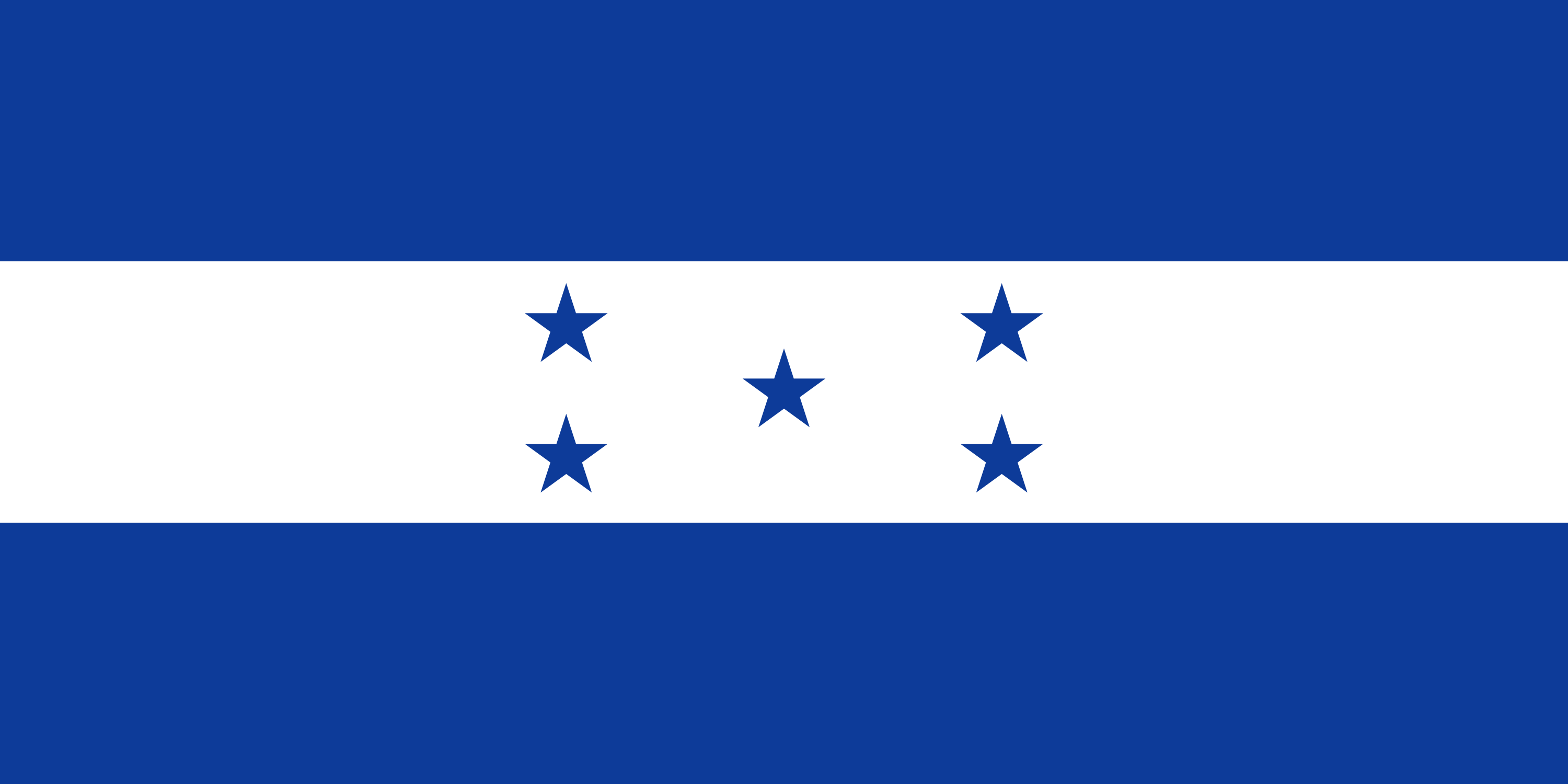
Three equal horizontal bands, blue-white-blue, with five blue stars. Four stars form a rectangle and the fifth is centered. This 2:1 width:height reference uses #0D3B99. The exact digital shade and star coordinates are artwork values, not certified national production specifications.
GKBook composition, CC0; underlying flag geometry, public domain; Commons contributors.Download image
The same five-star design in turquoise #00BCE4 and white. This rendition illustrates the turquoise color tradition and documented recent usage. Its precise HEX value is a digital reference, not an authenticated statutory code or proof that every institution used one shade in a given year.
GKBook composition, CC0; underlying flag geometry, public domain; Commons contributors.Download image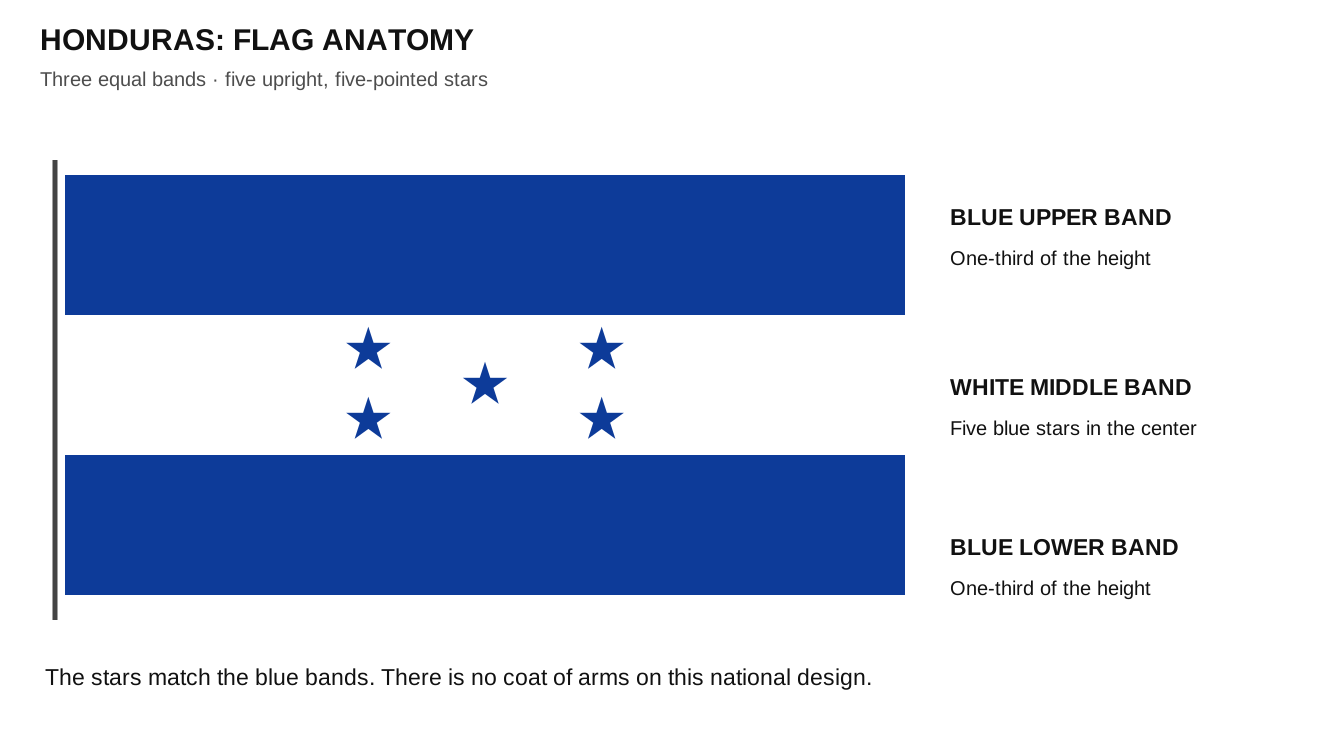
Three equal horizontal bands fill the field. The center is white and carries five stars matching the outer blue bands. The national five-star design has no coat of arms, words, yellow stars, or vertical stripes.
GKBook composition, CC0; underlying flag geometry, public domain; Commons contributors.Download image
Five upright blue stars represent Costa Rica, El Salvador, Guatemala, Honduras, and Nicaragua, the five states associated with the former Central American federation. This detail preserves the source geometry; its country list is collective rather than a legally prescribed assignment of one country to each position.
GKBook composition, CC0; underlying flag geometry, public domain; Commons contributors.Download image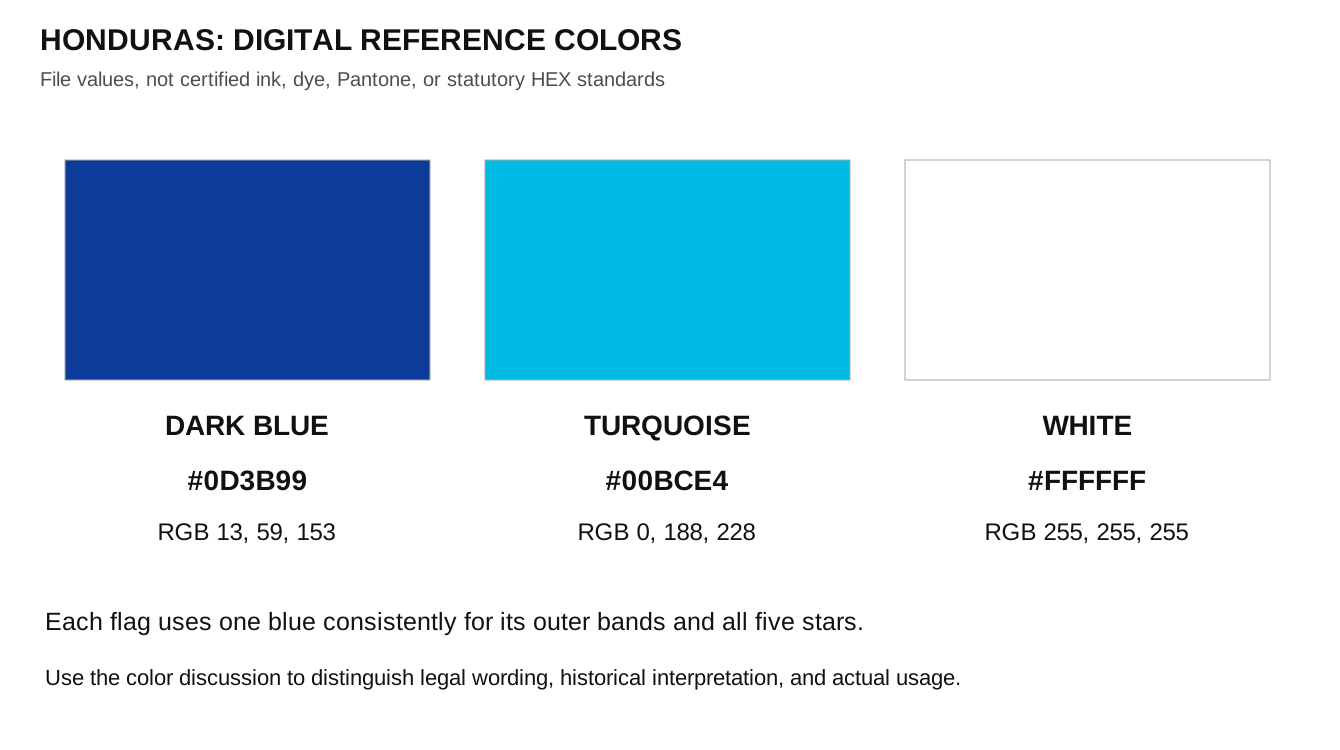
The dark-blue download uses #0D3B99, RGB 13,59,153. The turquoise download uses #00BCE4, RGB 0,188,228. Both use white #FFFFFF, RGB 255,255,255. These values describe the supplied files; they are not certified national print or textile standards.
GKBook composition, CC0; underlying flag geometry, public domain; Commons contributors.Download image
On this 72-by-36 grid, band boundaries are y=12 and y=24. Five star centers are (26,15), (46,15), (36,18), (26,21), and (46,21), each with an outer radius of 2 units. These coordinates document the digital reference and are not legislated numerical star measurements.
GKBook composition, CC0; underlying flag geometry, public domain; Commons contributors.Download image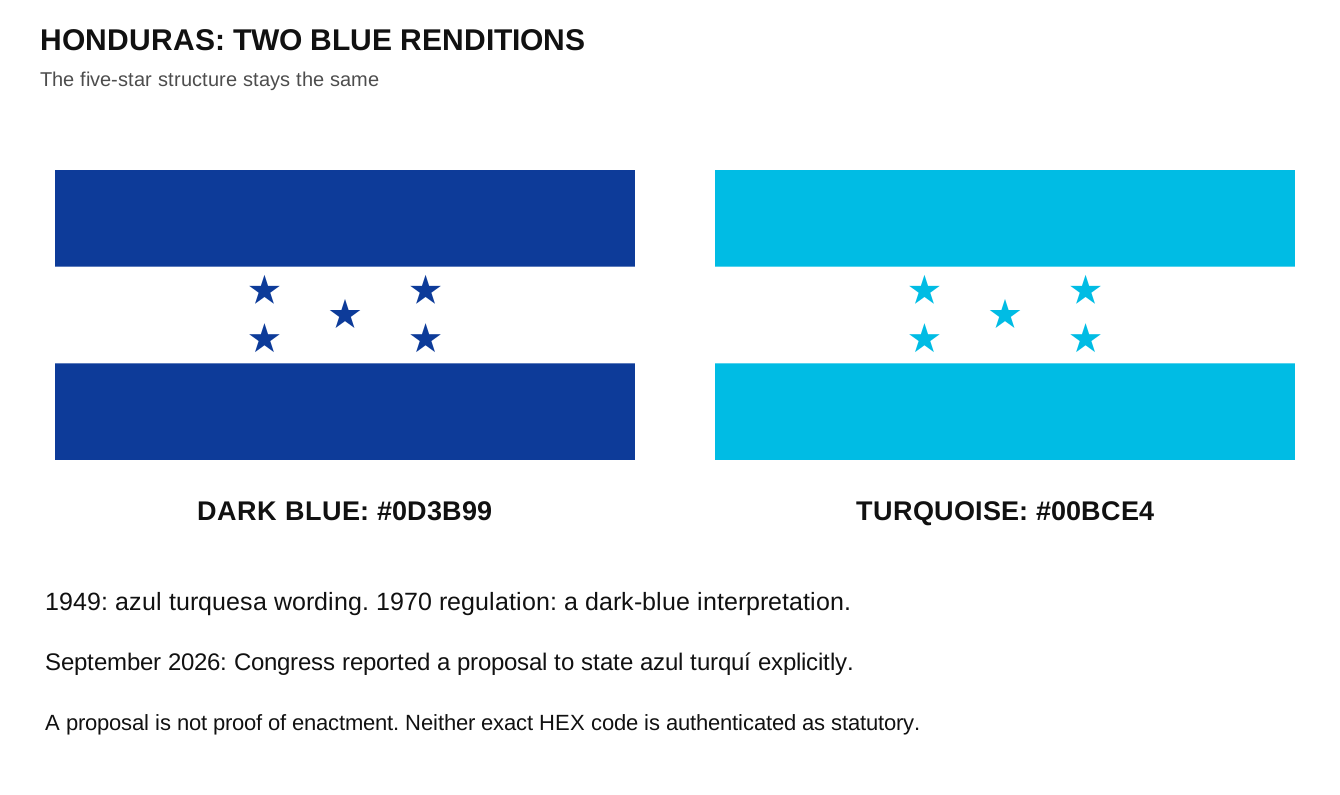
Both blue renditions use the same five-star layout. The 1949 wording, a dark-blue interpretation in the 1970 regulation, recent turquoise use, and a September 2026 proposal require separate explanation. A digital file name or a proposed bill alone does not establish a new enacted national color standard.
GKBook composition, CC0; underlying flag geometry, public domain; Commons contributors.Download image
A 120-by-60, 150-by-75, or 200-by-100-centimeter finished field has the 2:1 ratio. Each band is one-third of the height. These are calculated examples; seam allowances, sleeves, and reinforcement are separate fabrication choices.
GKBook composition, CC0; underlying flag geometry, public domain; Commons contributors.Download image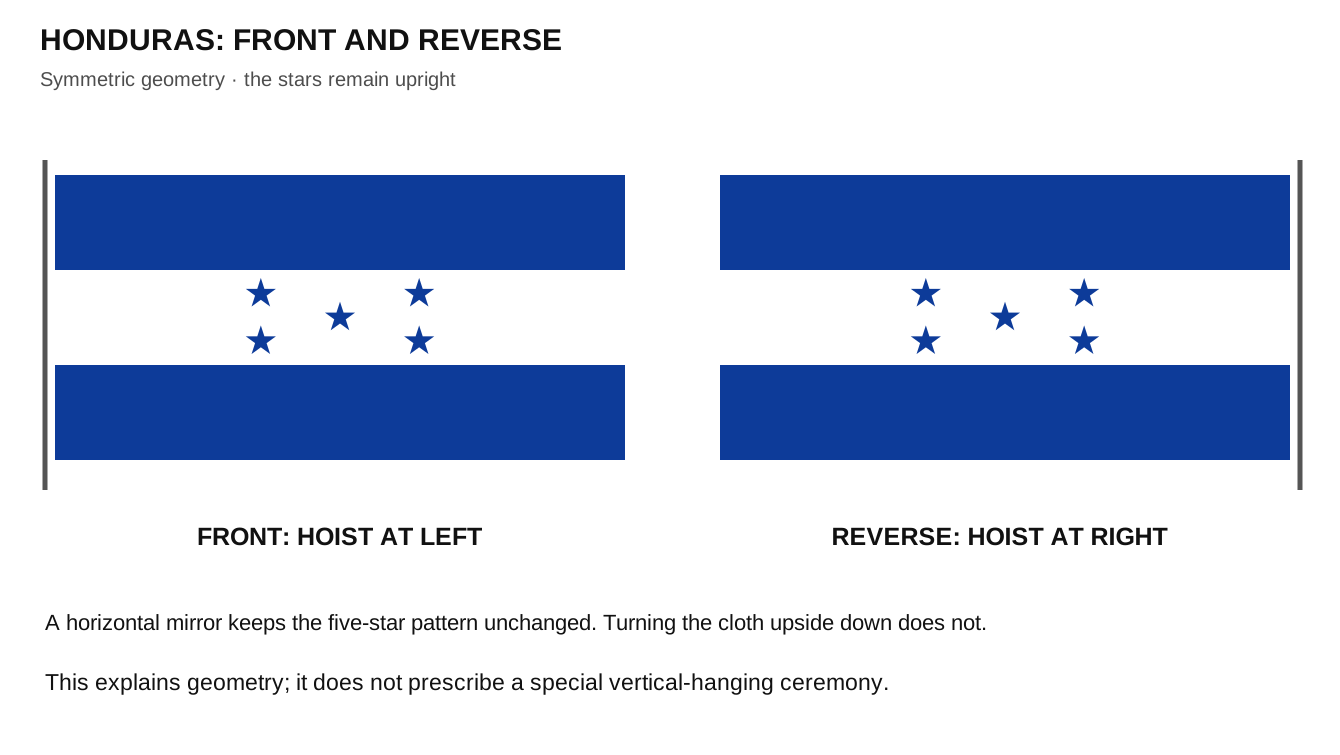
The blue-white-blue field and five-star arrangement are horizontally symmetric. Seen from behind, the flag has the same arrangement with the hoist on the other side. An upside-down flag reverses the stars’ point orientation even though the outer blue bands still look alike.
GKBook composition, CC0; underlying flag geometry, public domain; Commons contributors.Download image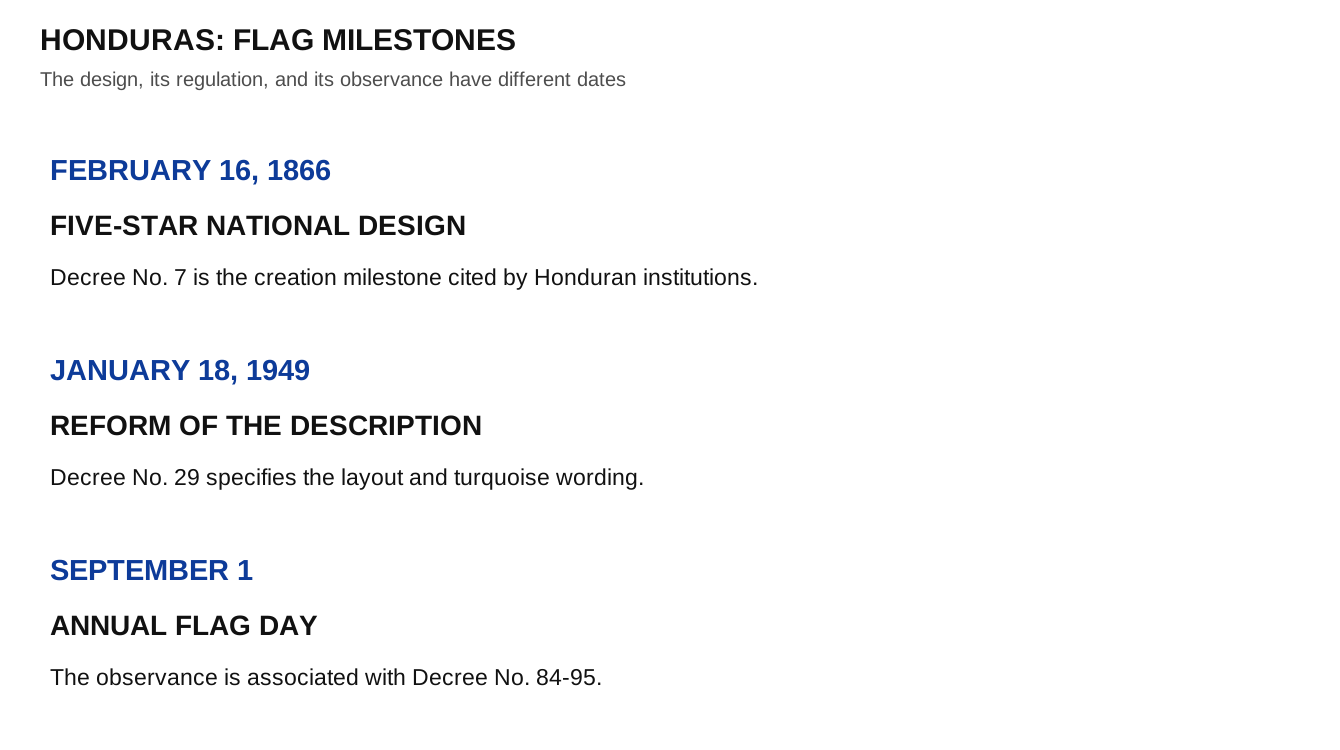
The national five-star design is associated with Decree No. 7 of February 16, 1866. Decree No. 29 of January 18, 1949 revised its description. September 1 is the annual Flag Day under Decree No. 84-95; it is separate from Independence Day on September 15.
GKBook composition, CC0; underlying flag geometry, public domain; Commons contributors.Download image
This specialist naval ensign reference places the complete coat of arms in the white band with five stars below it in an arc. It preserves the original public-domain Xrmap artwork and its colors. It is a distinct reference variant, not a replacement for the ordinary five-star national flag.
Public-domain Xrmap flag collection and Commons contributors; GKBook packaging, CC0.Download image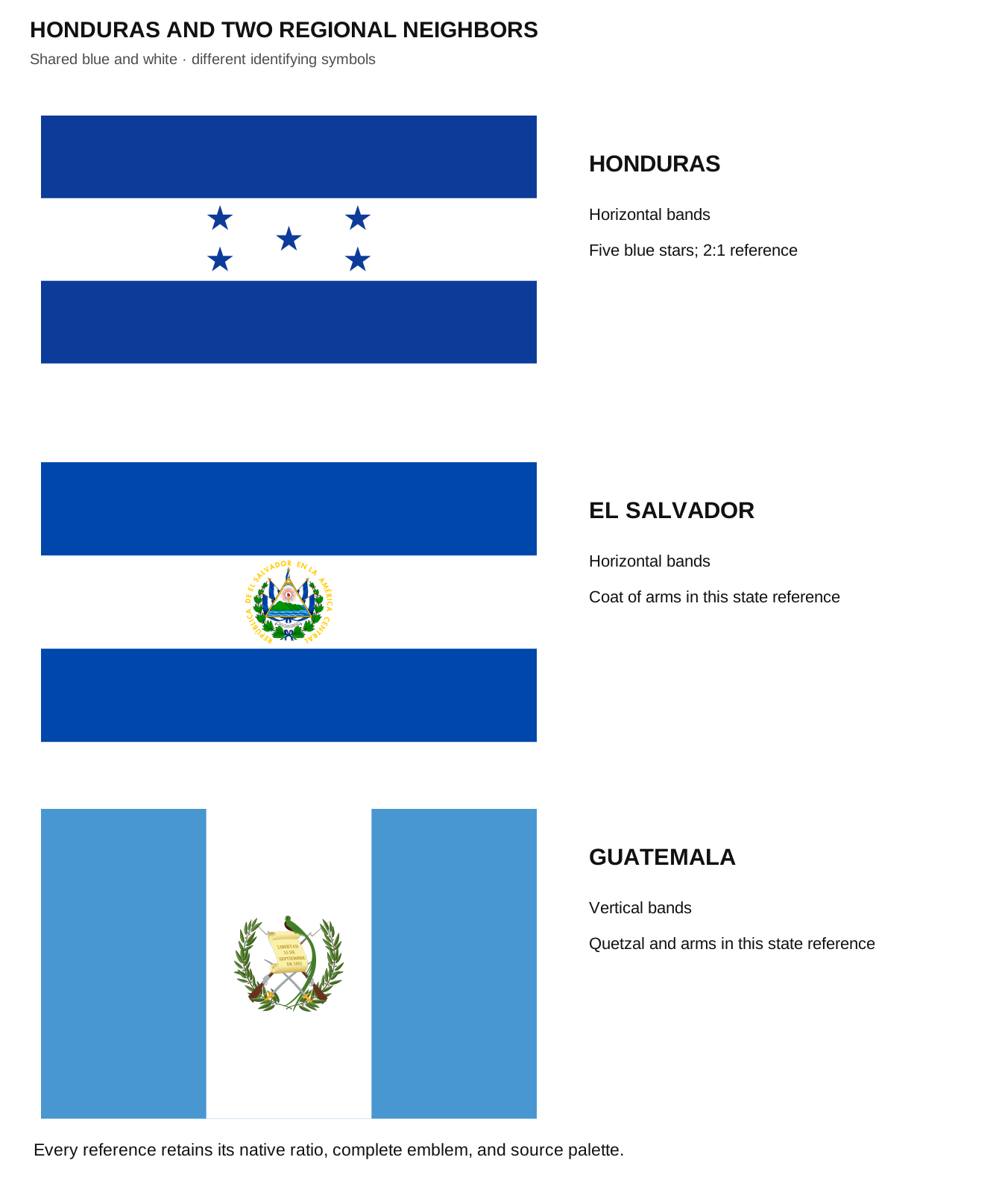
Honduras is identified by five stars on horizontal blue-white-blue bands. El Salvador’s state reference places arms in the center of horizontal bands. Guatemala’s state flag uses vertical bands and a quetzal-bearing coat of arms. Each image preserves its own proportions and complete source geometry.
GKBook comparison, CC0; Honduras, El Salvador, and Guatemala flag references, public domain; Commons contributors including K21edgo.Download image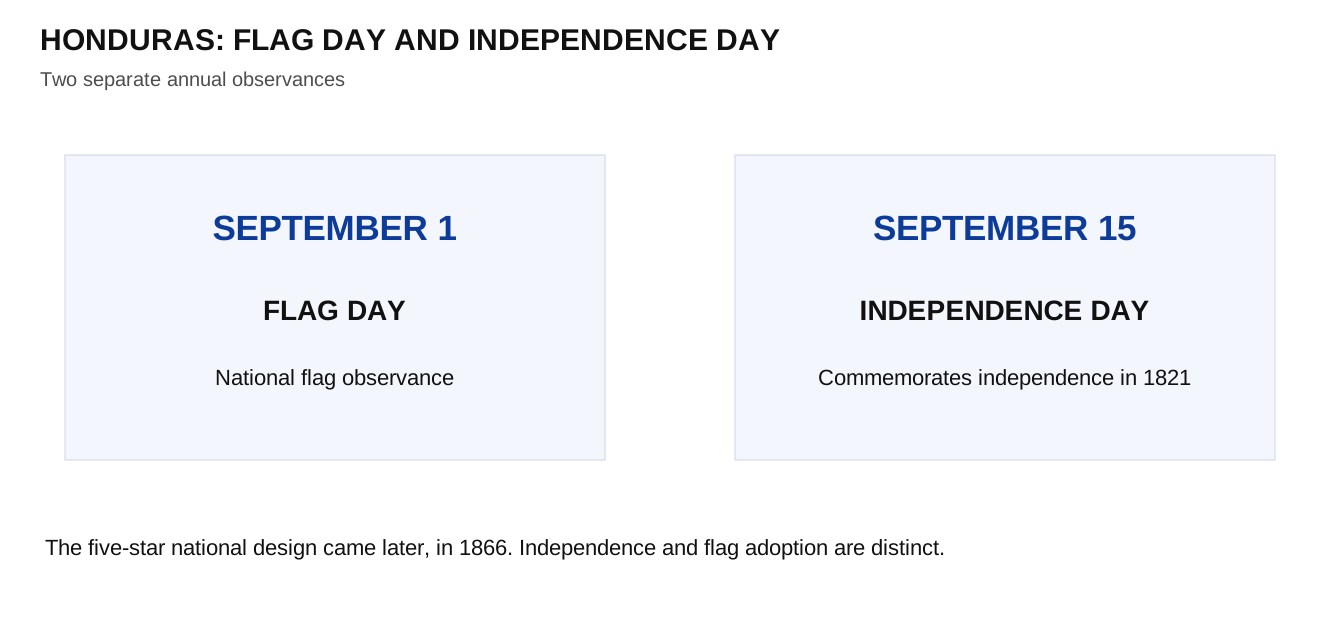
Honduras observes Flag Day on September 1 and Independence Day on September 15. Independence in 1821 predates the five-star national flag’s 1866 creation milestone. The dates should not be combined into one adoption anniversary.
GKBook composition, CC0; underlying flag geometry, public domain; Commons contributors.Download image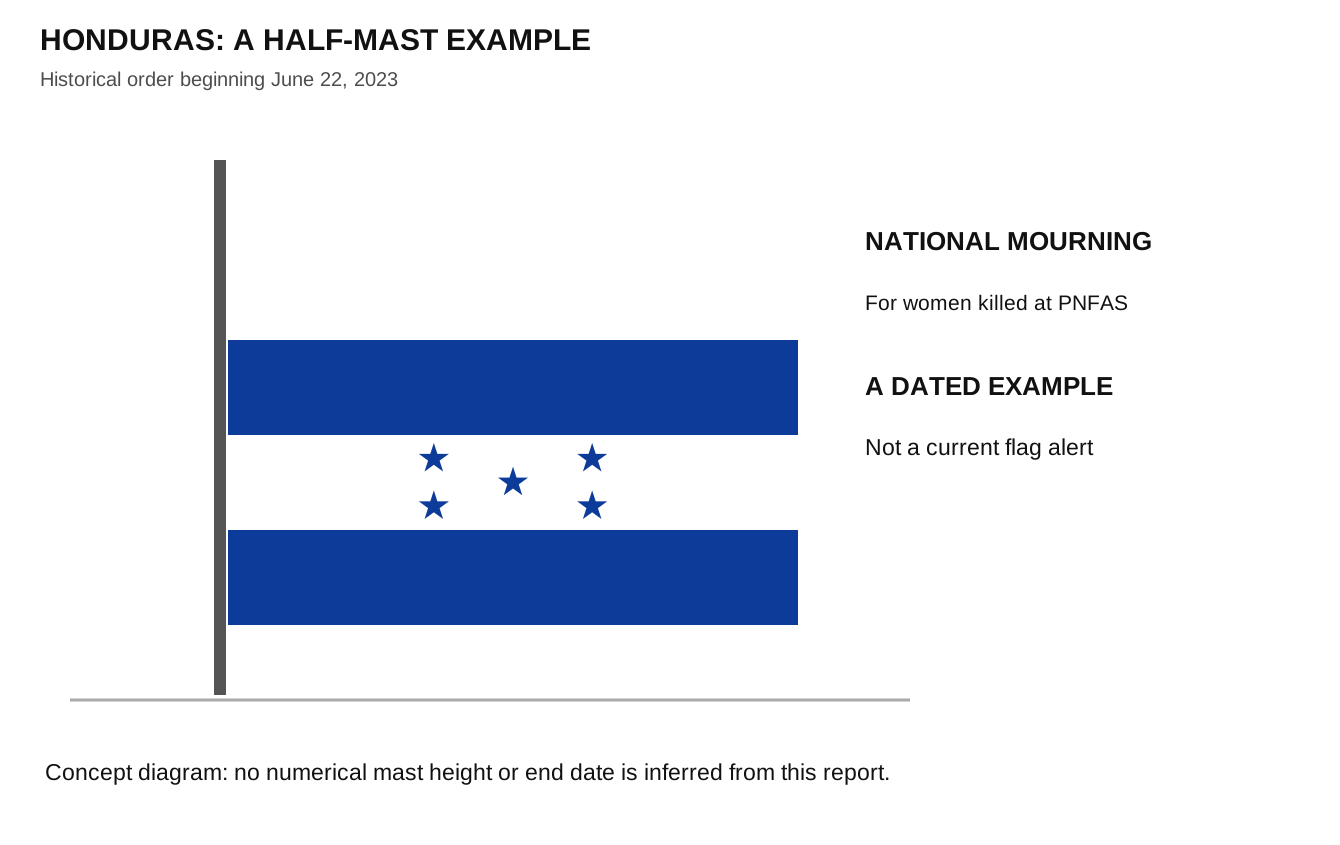
The official newspaper reported an instruction for state institutions to lower the national flag beginning June 22, 2023, following the killings at the women’s prison PNFAS. This is a historical example; the drawing does not invent a duration, permanent calendar rule, or exact lowering distance.
GKBook composition, CC0; underlying flag geometry, public domain; Commons contributors.Download image
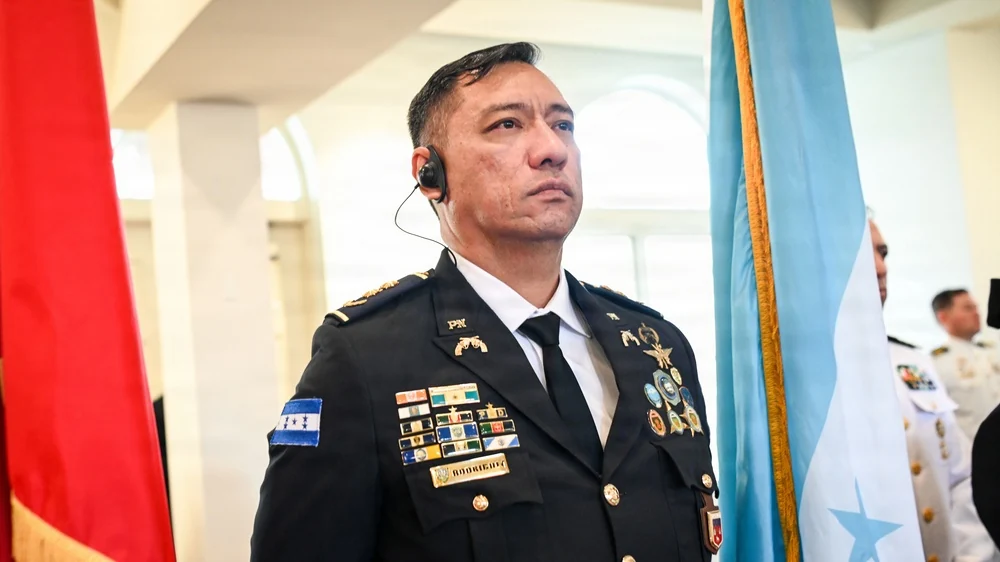
A Honduran soldier holds the national flag beside a Georgia Guardsman with the United States flag in Tegucigalpa on May 5, 2014. The photograph documents a military ceremony; the gold fringe is a ceremonial attachment outside the basic flag field.
Maj. Will Cox / Georgia National Guard; public domain. The appearance of U.S. Department of War (DoW) visual information does not imply or constitute DoW endorsement.Download image
A member of the Honduran delegation stands beside a turquoise rendition of the national flag at the Inter-American Defense College Class 66 Convocation Ceremony, Fort Lesley J. McNair, Washington, D.C., on August 5, 2026. This photograph records actual use at that event, not a nationwide color decree.
Tech. Sgt. Mozer O. Da Cunha / U.S. Air Force; public domain. The appearance of U.S. Department of War (DoW) visual information does not imply or constitute DoW endorsement.Download imageFrequently asked questions
What does the flag of Honduras look like?
The flag of Honduras has three equal horizontal bands: blue at the top and bottom, with white between them. Five blue, five-pointed stars occupy the middle band. Four form the corners of an imaginary rectangle, and the fifth sits in its center. The usual national design has no coat of arms.
How are the bands and stars arranged?
Each horizontal band occupies one-third of the flag’s height. The five stars lie entirely within the central white band and match the outer bands in color. Their arrangement has two stars above, one at the center, and two below, with an upright point at the top of every star.
What are the digital colors of Honduras’s flag?
The dark-blue download uses #0D3B99, while the turquoise version uses #00BCE4. Both use white #FFFFFF, and each version matches its stars to its blue bands. These are the actual digital values of the supplied reference artwork, not authenticated statutory HEX codes, Pantone numbers, textile dyes, or printing specifications.
What do the colors of Honduras’s flag symbolize?
Official educational explanations associate the blue with the sky and the seas bordering Central America, and the white with peace and purity. The five stars recall the five states of the former Central American federation and an ideal of regional unity. These interpretations explain the design rather than prescribing numerical colors.
What do the five stars on Honduras’s flag represent?
The five stars represent Costa Rica, El Salvador, Guatemala, Honduras, and Nicaragua, the five states associated with the former Central American federation. They express the memory and ideal of regional unity. They do not represent five Honduran departments, and neither Belize nor Panama belongs to this particular five-country group.
What is the ratio of the Honduras flag?
Honduras’s flag is twice as wide as it is high: a 2:1 width-to-height ratio. Sources that give height before width write the same proportion as 1:2. The three bands have equal heights, so each occupies one-third of the total height, regardless of the flag’s finished physical size.
How can the Honduras flag be drawn accurately?
Start with a rectangle twice as wide as it is high, divide it into three equal horizontal bands, and color the outer bands blue. Place five matching upright stars in the white band. Use four corner positions and one central position, scaling the complete reference uniformly rather than guessing each star separately.
What sizes can be used for a Honduras flag?
Any calculated finished-field size that preserves the 2:1 ratio keeps the basic proportions: examples include 120 by 60, 150 by 75, and 200 by 100 centimeters. Each band is one-third of the height. These examples are mathematical sizes, not a verified government schedule of mandatory commercial flag dimensions.
How has the Honduras flag developed over time?
Honduras inherited the blue-white-blue tradition of the Central American federation. Its five-star national design is associated with an 1866 decree, followed by a major descriptive reform in 1949. Later regulations and institutional practice help explain differing blue shades. Flag Day, constitutional recognition, and recent color proposals are separate milestones.
Why does Honduras use the Central American colors?
Honduras belonged to the Central American federation whose blue-white-blue tradition influenced several later national flags. The five stars preserve a reference to the former federal states even after the union broke apart. Similar colors therefore connect regional histories, while the stars distinguish Honduras from neighboring flags that display coats of arms.
When was the five-star Honduras flag created?
Honduran public institutions identify Decree No. 7 of February 16, 1866 as the creation of the national five-star flag, during José María Medina’s presidency. That date concerns the national design, not independence from Spain. The flag’s later description and proportions were revised through Decree No. 29 in January 1949.
Who designed the flag of Honduras?
The documented creation is a legislative act associated with the government of José María Medina in 1866. That political attribution does not establish that Medina personally drew every element. The sources reviewed do not securely identify one individual designer of the complete present arrangement; modern vector artists created reproductions of an existing symbol.
What changed in the Honduras flag in 1949?
Decree No. 29 of January 18, 1949 revised the earlier flag description. The reform is associated with the equal horizontal bands, turquoise-blue wording, five-star arrangement, and the familiar 1:2 height-to-width proportion. It was a revision of an existing national symbol, rather than the first appearance of a five-star Honduran flag.
Why are both dark-blue and turquoise Honduras flags seen?
The color record includes different descriptions and practices. The 1949 text uses azul turquesa, while a regulation dated September 3, 1970 interprets the blue as dark blue, or turquí. Turquoise renditions also appear in recent official use. These differences cannot be resolved simply by treating one website’s HEX value as law.
What did the Honduran Congress report about the flag in 2026?
On September 24, 2026, Congress reported a proposal by José Jaar to replace the color wording with azul turquí while retaining the three equal bands and five stars. The report described what would happen if the reform were approved. It therefore documents a proposal, not proof of an enacted color amendment.
Which legal records describe the Honduras flag?
The main historical records examined are Decree No. 7 of 1866, its 1949 reform through Decree No. 29, and a flag regulation dated September 3, 1970, published in La Gaceta in 1971. These records establish a legislative history; this article does not certify a fully consolidated statement of all current flag law.
What matters when manufacturing a Honduras flag?
Preserve the 2:1 finished-field ratio, equal bands, five upright stars, and a consistent blue across the bands and stars. Use a suitable approved reference and proof the entire design before production. Materials, seams, sleeves, and color matching require separate decisions; a downloadable image alone does not certify compliance with every applicable production rule.
How is the Honduras flag positioned at formal events?
Position depends on the applicable ceremony and institution. UNAH’s published protocol gives the national flag the place of honor at the head table’s right, which is the audience’s left, and addresses groups of flags separately. This is a documented university convention; it should not be presented as a complete national ceremonial code.
When is Flag Day in Honduras?
Honduras observes National Flag Day on September 1. Official education materials associate the observance with Decree No. 84-95, and government institutions mark it with flag ceremonies at the opening of the civic month. This annual observance is separate from the 1866 design milestone and from Independence Day on September 15.
Is Honduras’s Flag Day the same as Independence Day?
No. Flag Day is September 1, while Independence Day is September 15 and commemorates independence from Spain in 1821. The national five-star design came later, in 1866. Keeping those dates separate prevents an independence anniversary, an annual flag observance, and a flag-design decree from being mistaken for the same event.
When has Honduras flown its flag at half-mast?
A documented example followed the killings at the women’s prison PNFAS in June 2023. The official newspaper reported an instruction to state institutions to lower the national flag beginning June 22. That was a specific mourning measure, not a permanent annual rule or evidence that the same instruction remains active today.
How are worn Honduras flags cared for or retired?
Keep a displayed flag clean, secure, and in sound condition, following its material’s care instructions. Honduras’s Education Secretariat documented lowering, ceremonial burning, and raising a replacement flag on September 1, 2023. That event is evidence of an institutional practice; it does not by itself establish a compulsory procedure for every private owner.
Does the Honduras flag look the same from behind?
The ordinary five-star design is horizontally symmetric, so a view from behind preserves the same visual arrangement while putting the hoist on the opposite side. Turning the flag upside down is different: the stars then point downward. Identical blue outer bands therefore do not make every possible orientation equally correct.
Does Honduras have a naval flag with a coat of arms?
Specialist flag references document a Honduran naval ensign with the coat of arms in the white band and five stars arranged in an arc below it. That distinct design should be labeled as a naval reference. It must not silently replace the familiar national flag whose center contains five stars without arms.
How is Honduras’s flag different from nearby national flags?
Honduras uses five separate stars in a white horizontal band. El Salvador’s state flag and Nicaragua’s national flag instead feature coats of arms within horizontal blue-white-blue designs. Guatemala uses vertical blue-white-blue bands with its arms in the state flag. Similar colors reflect regional connections, but their emblems and proportions differ.
What do the documentary flag photographs show?
The photographs show a Honduran flag beside the United States flag in Tegucigalpa on May 5, 2014, and a turquoise rendition at an IADC ceremony in Washington on August 5, 2026. They document particular events and physical flags. Lighting, folds, and institutional practice make them unsuitable as exact national color specifications.
What is the Honduras flag emoji?
The Honduras flag emoji is 🇭🇳. It is formed from the regional indicator symbols H and N, encoded as U+1F1ED and U+1F1F3. Devices may show different blue shades or simplified stars. An emoji is useful in text, but its platform-specific rendering is not a construction drawing or a manufacturing color standard.
What mistakes should be avoided when drawing the Honduras flag?
Common errors include omitting a star, adding a sixth star, using unequal bands, rotating the stars downward, or stretching the rectangle away from its 2:1 ratio. Confusing the ordinary national flag with the arms-bearing naval reference also changes the design. Exact digital blues should be labeled as reference values rather than certified law.
Which Honduras flag pictures can be downloaded here?
The local gallery supplies dark-blue and turquoise SVG flags, an enlarged national PNG, construction and color diagrams, a naval reference, regional comparisons, and documented photographs. SVG files scale cleanly, while the PNG is convenient for ordinary image software. Captions identify reference measurements, historical examples, and the rights associated with each image.
Explore all general-knowledge topics and the A-to-Z lists.


We Value Your Opinion Comments