
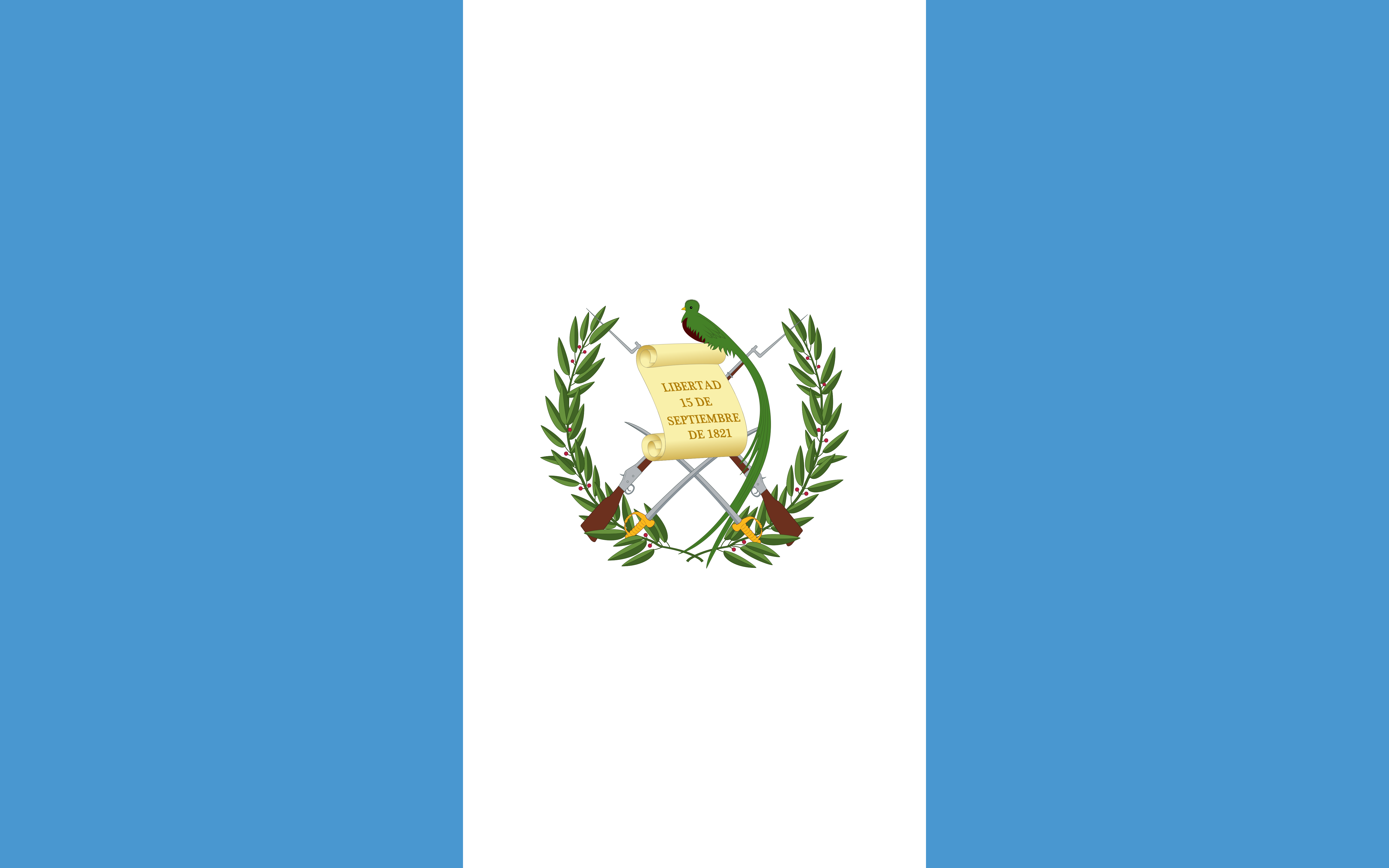
Guatemala flag picture
Explore the construction sheet, the August 17 Flag Day, and the historical sequence.
| Design | Blue · white · blueEqual vertical thirds, with the national arms centered on white. |
|---|---|
| Proportion | 8:5 width:heightThe law states the equivalent height:length ratio, 5:8. |
| Flag adoption | August 17, 1871Commemorated by the annual Flag Day. |
| Arms adoption | November 18, 1871Decree 33 under Miguel García Granados. |
| Arms designer | Juan Bautista FrenerCredited for the coat of arms by Guatemala’s Culture Ministry. |
| Flag Day | August 17Established in Article 17 of Decree 104-97. |
| Inscription | September 15, 1821The parchment records the independence date. |
| Flag law | Decree 104-97Issued October 28 and published November 26, 1997. |
Equal blue-white-blue vertical bands surround the national arms. The flag dates to August 17, 1871; its parchment commemorates September 15, 1821. The statutory width:height ratio is 8:5.
What is the flag of Guatemala?
Guatemala’s flag has three equal vertical bands of blue, white, and blue, with the national coat of arms centered on the white band. The arms combine a quetzal, parchment, crossed rifles and swords, and laurel branches. The statutory proportion is 8:5 when expressed as width to height.
The blue-white-blue flag identifies Guatemala through an unusually detailed central emblem. Its bird, weapons, foliage, and dated parchment connect a simple three-band arrangement with the country’s ideas of liberty, sovereignty, and national history.
The flag’s principal historical dates answer different questions. September 15, 1821 is the independence date written on the parchment. August 17, 1871 marks the flag’s creation. November 18, 1871 belongs to the adoption of the arms. The later law published in 1997 regulates the design and its use.
Explore the complete arms, construction sheet, historical sequence, Flag Day, and downloadable pictures.
How are the flag’s bands and emblem arranged?
Each vertical band occupies one-third of the flag’s width. The blue bands stand at the attachment and free edges, with white between them. The coat of arms belongs in the center of the white band. Preserve its complete arrangement rather than substituting a shield, bird silhouette, or text-only badge.
The hoist is the edge attached to the staff or halyard, and the fly is the free edge. Both outer bands are blue. The white center carries the arms rather than a plain shield or isolated bird.
Article 2 requires equal bands. Changing the central band’s width to make room for an oversized emblem changes the arrangement. Scale the complete flag instead of adjusting its parts independently.
What are the official color standards and digital values?
Article 2 identifies blue as ISCC-NBS 177 and white as ISCC-NBS 263. The supplied digital reference uses blue #4997D0, RGB 73, 151, 208, and white #FFFFFF, RGB 255, 255, 255. These HEX and RGB values describe the artwork; they are not numerical color codes written into the law.
| Color | Statutory designation | Supplied SVG fill | RGB |
|---|---|---|---|
| Blue | ISCC-NBS 177 | #4997D0 | 73, 151, 208 |
| White | ISCC-NBS 263 | #FFFFFF | 255, 255, 255 |
The distinction is practical. A named color standard governs the legal description, whereas a screen value tells software how to draw this file. Converting a digital color to ink or cloth requires a managed production process; a single unverified Pantone or CMYK conversion should not be advertised as statutory.
The arms retain the greens, reds, gold tones, browns, and metallic shading present in the complete reference. Those details are not reduced to the two field colors. Photographs may show blue differently because of light, camera settings, fabric, and age.
What do Guatemala’s flag colors symbolize?
Article 3 associates blue with strength, justice, truth, and loyalty, and white with purity, peace, integrity, firmness, and light. Official educational accounts also connect the blue bands with Guatemala’s Pacific and Atlantic-Caribbean setting. Keep that geographical interpretation distinct from the values expressly listed in the flag law.
The legal explanation in Article 3 supplies a particularly useful answer because it names the values represented by the colors and several emblem elements. The official parliamentary explanation about the two coasts adds a geographical reading; it does not replace those statutory meanings.
Blue and white also appear in other Central American national designs. Shared colors should not be used to transfer another country’s precise emblem interpretation or legal construction rules to Guatemala.
What are the parts and meanings of the coat of arms?
The quetzal represents liberty; the parchment preserves the national birth date; the swords symbolize justice and sovereignty; and the laurel signifies victory. Article 3 gives those meanings. The arms also contain crossed rifles with fixed bayonets, whose historical type and arrangement are described separately in Article 4.
| Element | Description | Meaning or legal role |
|---|---|---|
| Quetzal | Perched above the parchment; long tail | Liberty, Article 3 |
| Parchment | Four-line gold inscription | Preserves the national birth date, Articles 3 and 5 |
| Swords | Crossed behind the parchment | Justice and sovereignty, Article 3 |
| Rifles | Remington type of 1871, fixed triangular bayonets | Detailed physical description, Article 4 |
| Laurel | Natural branches with fruit, crossed below | Victory, Articles 3 and 4 |
Article 4 describes the rifles in profile, crossed at a right angle in the center, with their trigger guards facing down. The laurel branches intertwine with the weapons and cross below without a ribbon tying them together. These details help identify an incomplete or improvised emblem.
The reference preserves all the weapon, leaf, fruit, feather, parchment, and lettering paths. A simplified icon may be convenient in a tiny interface, but it is not a faithful replacement for the full national emblem in a flag master.
What does the parchment inscription mean?
The parchment reads LIBERTAD, 15 DE, SEPTIEMBRE, DE 1821 across four lines in the 1997 law and the supplied artwork. It records September 15, 1821, the independence date. The inscription is therefore older than the present flag’s adoption in 1871 and should not be mistaken for that adoption date.
The four lines prescribed by Article 5 are LIBERTAD / 15 DE / SEPTIEMBRE / DE 1821. In English, the inscription identifies liberty and September 15, 1821. Its wording commemorates independence; it is not a manufacturing date or an inscription naming the flag’s designer.
The law also describes the parchment’s rolled ends and its position over the crossing rifles. The preserved reference lettering is drawn as shapes, so the download does not depend on a visitor having a particular font installed.
Older descriptions and some physical objects use the spelling setiembre. This article follows the spelling septiembre visible in the 1997 statute and in the supplied flag artwork rather than silently treating every historical rendering as identical.
Which direction does the quetzal face, and what does it signify?
A quetzal appears above the parchment in Guatemala’s coat of arms. Article 6 places it facing heraldic dexter, which is the viewer’s left in a front-facing illustration, and describes its long tail extending below the laurel. Article 3 identifies the bird as the supreme symbol of liberty.
Heraldic directions are described from the emblem’s own perspective. Consequently, dexter appears on the viewer’s left in the ordinary front-facing reference. The long tail curves down across the composition and extends below the lower laurel leaves, as Article 6 describes.
The law makes the quetzal a symbol of liberty. That symbolic association does not require a biological claim that the bird cannot survive captivity. The wildlife photograph provides a separate view of a real resplendent quetzal without substituting it for the heraldic drawing.
What is the correct proportion of Guatemala’s flag?
Guatemala’s national flag has an 8:5 width:height proportion. Article 1 expresses the same relationship as 5:8 height:length. A flag 100 centimeters high is therefore 160 centimeters wide. The ratio is exactly 1.6; it should not be confused with the mathematical golden ratio, which is approximately 1.618.
Ratio notation can create a false disagreement between sources. A height:length ratio of 5:8 and a width:height ratio of 8:5 describe the same rectangle. This page consistently states width first.
Article 1 refers to an aesthetic golden rule when explaining the proportions. The specified integer ratio remains 5:8 height:length. Mathematically, 8 divided by 5 equals 1.6; it is a close approximation to, not exactly, the irrational golden ratio.
How are the downloadable flag’s dimensions organized?
The reference uses a 960-by-600 coordinate rectangle divided into three 320-unit bands. Its complete arms are centered on white and retained without independent resizing of their parts. The delivered SVG enlarges this reference uniformly to 2880 by 1800. It is an educational drawing, not a ministry-certified manufacturing model.
| Feature | Reference measurement | Interpretation |
|---|---|---|
| National rectangle | 960 × 600 units | 8:5 width:height |
| Each vertical band | 320 units wide | One-third of total width |
| Band boundaries | x = 320 and x = 640 | Measured from the upper-left origin |
| Geometric center | (480, 300) | Center of the rectangle |
| National SVG | 2880 × 1800 | Uniform threefold enlargement |
| Large PNG | 5760 × 3600 | Uniform sixfold enlargement |
Article 2 places the arms in the center of the white band and specifies that they occupy two-thirds of it to achieve proportional dimensions. The wording does not give a complete coordinate system for every feather, leaf, or weapon, nor does it explicitly define a circular emblem diameter.
The educational reference keeps its original arms as a single complete composition. For regulated manufacture, Article 16’s ministry-issued model is the relevant additional requirement. A dimensioned teaching sheet should not be represented as that authorization or model.
Which finished sizes keep the correct proportion?
Finished sizes such as 80 by 50, 160 by 100, or 240 by 150 centimeters all preserve Guatemala’s 8:5 width:height ratio. These are calculated examples, not an official stock-size schedule. Use uniform scaling for the entire design, and plan sleeves, hems, reinforcement, and shrinkage separately from the visible rectangle.
For a finished height H, calculate width as 8H/5. For a chosen width W, calculate height as 5W/8. Apply the relationship to the visible national rectangle, then account for any attachment sleeve or sewing allowance.
The large PNG has 1920 pixels per band across its 5760-pixel width. The SVG is the more flexible master for resizing because it retains the paths defining the arms, including the lettering. A raster image cannot gain new detail merely by being enlarged.
How did Guatemala’s flag develop?
Guatemala’s historical flags included horizontal arrangements and designs containing red and yellow before the present vertical blue-white-blue flag originated in 1871. This page illustrates a state reconstruction from 1851–1858 and a plain pattern from 1858–1871. Their periods and different emblem status are labeled so they are not mistaken for current alternatives.
September 15, 1821 is the national birth date recorded on the parchment.
Guatemala shared the blue-white-blue federal tradition of the United Provinces of Central America before later national revisions.
The illustrated modern reconstruction retains the full historical emblem and multicolor horizontal arrangement.
The plain reconstruction has seven horizontal bands; state versions also carried arms.
The blue-white-blue vertical design dates to the government of Miguel García Granados.
Decree 33 established the coat of arms associated with Juan Bautista Frener.
The September 12 regulation, effective September 15, specified the design and described a plain merchant variant.
Decree 104-97 was issued October 28 and published November 26; it took effect thirty days after publication.
The modern colors have a regional antecedent. Guatemala’s Congress connects the liberal design with the earlier flag of the United Provinces of Central America, itself associated with the blue-white-blue tradition of the Río de la Plata, present-day Argentina. That historical relationship helps explain the comparison with other regional flags, while today’s vertical layout remains distinctive.
The historical sheets are modern reconstructions from reusable reference files. They are not photographs of surviving nineteenth-century textiles. Their native proportions and complete available designs are preserved.
The plain 1858 pattern must be labeled carefully: it omits the arms that appeared on state versions. The 1851 sheet, by contrast, reproduces a complete state-flag reference. Treating both images simply as identical kinds of “national flag” would erase that useful distinction.
Which dates belong to the flag and the arms?
The present blue-white-blue flag dates to August 17, 1871, under Miguel García Granados. The coat of arms followed through Decree 33 on November 18, 1871. Those dates should be distinguished from the detailed 1968 regulation and the later flag-and-arms law, Decree 104-97, published in 1997.
Article 17 explicitly connects August 17 with the flag’s creation in 1871. The Culture Ministry dates the arms to Decree 33 of November 18 in the same year. The two milestones belong to the same reform period but are not one identical legal event.
The adoption date should also remain separate from the date a modern SVG was drawn or uploaded. A newer digital file can reproduce an older national design without becoming a new national flag.
When did the 1997 flag law take effect?
Decree 104-97 is Guatemala’s law regulating the national flag and coat of arms. Congress issued it on October 28, 1997, and the official gazette published it on November 26. Article 19 provides for entry into force thirty days after publication. It regulates design, symbolism, display, manufacture, and Flag Day.
| Stage | Date | Evidence |
|---|---|---|
| Congressional issuance | October 28, 1997 | Closing enactment text |
| Executive sanction | November 19, 1997 | Sanction on the second gazette page |
| Official publication | November 26, 1997 | Diario de Centro América, pages 2733–2734 |
| Commencement rule | Thirty days after publication | Article 19; calculated date December 26, 1997 |
The statute’s title is Ley Normativa de la Bandera Nacional y del Escudo de Armas. Its nineteen articles address the flag’s form and meaning, the arms, everyday and ceremonial display, production authorization, and the annual observance.
Article 18 repeals provisions that conflict with the new law. That matters when an older explanation gives a light-blue background for the separate arms or discusses the plain merchant variant without mentioning the later law. The statutory text, rather than an undated summary, supplies the basis for the legal statements here.
Who created Guatemala’s coat of arms?
Guatemala’s Culture Ministry credits the Swiss designer Juan Bautista Frener with the coat of arms adopted in November 1871. That attribution concerns the emblem. It should not be expanded into an unsupported claim that he personally designed every element of the national flag or authored the later legal standards.
The Culture Ministry identifies Frener as Swiss and attributes the national arms to him under Miguel García Granados’s government. The verified attribution is specific to the emblem, so the fact table labels him as the arms designer.
The national design, its historical author, a legal standard, and a modern digital illustrator are distinct. The public-domain vector contributors reproduced the arms for electronic use; they did not originate the national symbol in 1871.
What authorization applies to flag manufacture and sale?
Yes. Article 16 assigns the Ministry of Culture and Sports responsibility for authorizing people and entities that manufacture, distribute, or sell national flags. It also requires a single official model supplied with the authorization. Downloading educational artwork does not provide that authorization or establish that a commercial product meets the ministry’s model.
Article 16 requires the ministry to prepare a single model and provide it with the corresponding authorization. It prohibits manufacture without permission and production that fails to conform to the legal provisions. The educational SVG in this package does not replace that official process.
Before an actual production order, establish the required authorization and official model with the responsible authority. This article does not invent an application fee, turnaround time, textile weight, or stitch count. Those details are not supplied by the statute reviewed here.
Where must the national flag be displayed?
Article 8 requires daily display at buildings occupied by state offices, autonomous and decentralized institutions, and the national education system. Other individuals and legal entities may display it voluntarily in the same manner. Article 11 separately addresses consulates, embassies, and official events abroad, requiring the coat of arms in those settings.
Daily institutional display
Article 8 covers state offices, autonomous and decentralized institutions, and the national education system. Article 10 assigns oversight to the relevant ministries and governing bodies.
Preserve the required emblem
Article 11 requires the arms at the overseas diplomatic and official settings it names. A historical plain pattern should not be substituted in those settings.
Article 9 requires replacement of nonconforming flags in the settings it covers, while recognizing exceptions for historically valuable flags and those forming an integral part of a monument or building. An antique textile and a new everyday institutional flag therefore raise different questions.
How should the flag be raised and lowered?
Article 12 requires the national flag to be raised and lowered slowly and ceremoniously, with those present saluting during the action. It also prohibits hoisting flags whose original colors have faded or whose condition is evidently poor. The reviewed law does not prescribe a universal clock time for every raising or lowering.
The paired requirement is worth keeping intact: both raising and lowering are slow and ceremonious. Importing a foreign rule that says to raise briskly would misstate the Guatemalan provision. Those present are to salute while the action takes place.
Article 1 says the flag itself does not render honors or salute, and prohibits adding legends or inscriptions. This is distinct from the people’s salute during the ceremony. Do not add a slogan, sponsor’s logo, or explanatory caption to the national flag rectangle.
The statute reviewed here does not set a universal 8 a.m. or sunset schedule. Local institutional directions can provide operational details, but they should not be invented from another country’s etiquette.
How does the flag look from the reverse?
In the usual front-facing image, the quetzal faces the viewer’s left, the heraldic dexter direction named in Article 6. Seen through a single layer of cloth from behind, the whole design reverses, including the lettering. That physical reverse view does not establish a separate official standard for double-sided manufacture.
A left-facing bird in the front reference and a right-facing bird seen through the reverse can describe the same physical flag. The attachment edge changes apparent sides at the same time. Mirroring only the bird while leaving the parchment readable would create a different composite image.
No separate vertical-banner construction or double-sided printing specification is inferred here. The front reference remains the main download for consistent recognition and study.
How is the flag placed with other flags?
Article 14 places the Guatemalan flag first in the raising order on separate staffs and at the top when flags share a pole. It also specifies greater dimensions, a right-hand position with one other flag, and the center with several. The text does not define the observer’s viewpoint for right.
| Arrangement | Rule in Article 14 |
|---|---|
| Separate staffs | Raise Guatemala’s flag first |
| Shared staff | Guatemala’s flag at the top |
| Dimensions | National flag larger than the other flags |
| One other flag | National flag on the right |
| Several other flags | National flag in the center |
| Relative height | No flag or pennant higher than the national flag |
The viewing direction matters in any right-or-left instruction. Because this article does not have a verified official diagram defining that perspective, it does not convert the statute into an audience-left or speaker-right illustration.
A diplomatic event abroad also involves its host’s ceremonial arrangements. The documentary photograph supplies an example of actual display, not proof that a specific lineup exhaustively demonstrates every provision of Guatemalan domestic law.
Where does the national flag lead a procession?
Article 13 provides that, in a parade with two flags, the national flag goes at the head on the right. With several flags, it leads and the others follow in a line. Apply that procession rule to an actual parade; it is not a substitute for the separate display rules in Article 14.
Article 13 distinguishes a two-flag parade from one with several flags. Its procession rule uses the national flag as the leading standard, with the other flags following in line in the latter case.
Keep this moving arrangement separate from a fixed group of staffs. The center position described for several flags in Article 14 concerns display, while Article 13 describes a procession. Combining fragments of both into one unlabeled diagram would be confusing.
When is Guatemala’s Flag Day observed?
Guatemala celebrates Flag Day on August 17, commemorating the flag’s creation in 1871. Article 17 establishes the annual observance and directs public and private educational institutions to celebrate it, or the nearest appropriate day. Flag Day is distinct from September 15, the independence date recorded on the coat of arms.
Article 17 calls for public and private educational establishments at all levels to mark the occasion, allowing the nearest appropriate day. That qualification recognizes that a school’s ceremony need not always occur on the exact calendar date.
The existence of Flag Day does not by itself establish a universal paid holiday or workplace closure. The page identifies the national-symbol observance without inventing a yearly ceremony timetable or transferring September’s independence celebrations into August.
When is Guatemala’s flag lowered for mourning?
Guatemala uses half-mast display during government-declared mourning periods. A documented example is Agreement 75-2025, following Pope Francis’s death, which ordered flags lowered at the National Palace and government buildings for three days from April 21, 2025. This is a historical example, not a continuing instruction or an annual observance.
| Historical instruction | Verified detail |
|---|---|
| Instrument | Government Agreement 75-2025 |
| Occasion | Death of Pope Francis |
| Period | Three days from April 21, 2025 |
| Premises named | National Palace and government buildings |
| Government news report | AGN, April 22, 2025 |
The announcement’s publication date and the beginning of the mourning period are different: the AGN report appeared on April 22 but described three days beginning April 21. Preserve that distinction rather than silently moving the start to the article’s date.
A later mourning order may specify different premises or dates. The archived example establishes that lowered display is used for official mourning; it does not create a permanent three-day rule for every death.
Does half-mast require an exact numerical height here?
The reviewed 2025 government news report gives the mourning period and affected buildings but does not specify a measured fraction of the mast. The accompanying illustration therefore shows a conceptual lowered position. A particular institution’s instructions should govern the actual installation; the diagram does not invent a national numerical standard.
The diagram deliberately omits a measurement line. It distinguishes ordinary raised display from a lower mourning position without assigning the top or center of the cloth to an unsupported fraction of the pole.
The reviewed report also does not establish a universal black-ribbon size or complete funeral-flag procedure. Those would require separate evidence and should not be filled in from a foreign protocol guide.
What does the law say about damaged and retired flags?
Article 12 forbids hoisting national flags with faded original colors or evidently poor condition. It directs that flags withdrawn from circulation be incinerated with the corresponding honors, leaving disposal of the ashes to the relevant institution. For historically valuable flags, also consider the separate preservation exceptions expressly recognized in Article 9.
The statute expressly connects condition with respectful display. A faded or evidently damaged flag should not continue to be hoisted merely because its basic pattern remains recognizable. Institutions should follow their applicable procedures for retirement with honors.
Article 9’s historical exceptions should be considered before treating an old, significant textile as ordinary worn stock. Museum conservation and the replacement of a deteriorated everyday flag are different tasks. The article does not prescribe a foreign folding ritual or provide instructions for conducting a fire.
For serviceable cloth, follow the manufacturer’s care directions and store it dry. Those are practical maintenance suggestions, distinct from the legal provisions on condition and retirement.
What does the download’s reuse status permit?
No. Copyright status concerns permission to reuse the particular artwork. Guatemala’s national-symbol rules remain a separate issue, including Article 16’s authorization system for making, distributing, and selling national flags. The supplied files identify their reuse status, but they are not a commercial license, a ministry approval, or a government endorsement.
The public credits distinguish public-domain reference artwork, original CC0 explanatory compositions, and the two photographs. They describe the files’ copyright status. They do not confer approval to manufacture or sell national flags under Article 16.
Similarly, using a national emblem in a product, advertisement, or logo is a separate decision from downloading an educational image. Do not describe the package as an official procurement template or a government endorsement.
What background belongs behind the separate coat of arms?
Article 7 of the 1997 law states that the coat of arms, when separate from the flag, always has a white background. An older 1968 regulation described a light-blue field. The dated difference matters: the older wording should not be copied into an explanation of the later statutory requirement.
The change is easy to miss when reusing an older explanation. The specialist transcription of the 1968 regulation describes a light-blue field; Article 7 of the 1997 law expressly says the background is always white. Article 18 also repeals inconsistent provisions.
The enlarged arms diagram therefore uses white, matching the later statutory wording. Its complete emblem is a separate reusable reference, while the national flag download keeps the same subject within the white central band.
Why is a plain historical merchant flag included?
The 1968 regulation described a plain merchant flag without arms. This article includes that pattern as historical context. The later law describes the arms on the national flag and expressly requires them in consular, embassy, and official overseas settings. Do not present the historical plain download as a certified current official replacement.
Article 1 of the later law uses the name Bandera with or without the arms, so a statement that every plain image is universally forbidden would go beyond the wording. Nevertheless, Article 2 describes the arms in the national design, and Article 11 expressly requires them in its official overseas settings.
The sensible editorial distinction is to identify this unadorned image by its documented historical merchant context and to use the full arms-bearing design as the national master. The file is not labeled as a certified present-day civil alternative.
How is Guatemala’s flag different from other blue-white-blue flags?
Guatemala’s blue-white-blue bands run vertically, and its central emblem prominently includes a quetzal and parchment. Honduras, El Salvador, and Argentina use horizontal bands. Honduras has five stars, El Salvador has a different coat of arms, and Argentina has a sun. Check orientation and emblem before relying on blue color alone.
| Flag | Band direction | Distinctive center |
|---|---|---|
| Guatemala | Vertical | Quetzal, dated parchment, weapons, and laurel |
| Honduras | Horizontal | Five stars |
| El Salvador | Horizontal | Its own complete national arms |
| Argentina | Horizontal | Sun of May |
Small thumbnails can hide the details separating the two coats of arms. Guatemala’s tall-tailed bird above the parchment is a particularly useful cue. Neither Honduras’s stars nor Argentina’s sun can be substituted for it.
The comparison uses complete source files, not abbreviated approximations. El Salvador’s reference retains its 1005-by-567 native rectangle; it is not stretched to match Guatemala’s 8:5 format.
What is Guatemala’s flag emoji?
Guatemala’s flag emoji is 🇬🇹, corresponding to the country code GT. The sequence combines regional indicator G, U+1F1EC, with regional indicator T, U+1F1F9. Its appearance varies by device and application. Use the supplied SVG or PNG when you need consistent proportions, a complete emblem, and reproducible digital artwork.
The regional indicators G and T form the sequence U+1F1EC U+1F1F9. A platform without the relevant flag rendering may display letters or another fallback. That difference is a software presentation issue, not a new national design.
Emoji often add shading or a waving effect and are too small to inspect the parchment and weapons. For print or detailed study, use the complete vector master or the large PNG.
What does the Washington photograph show?
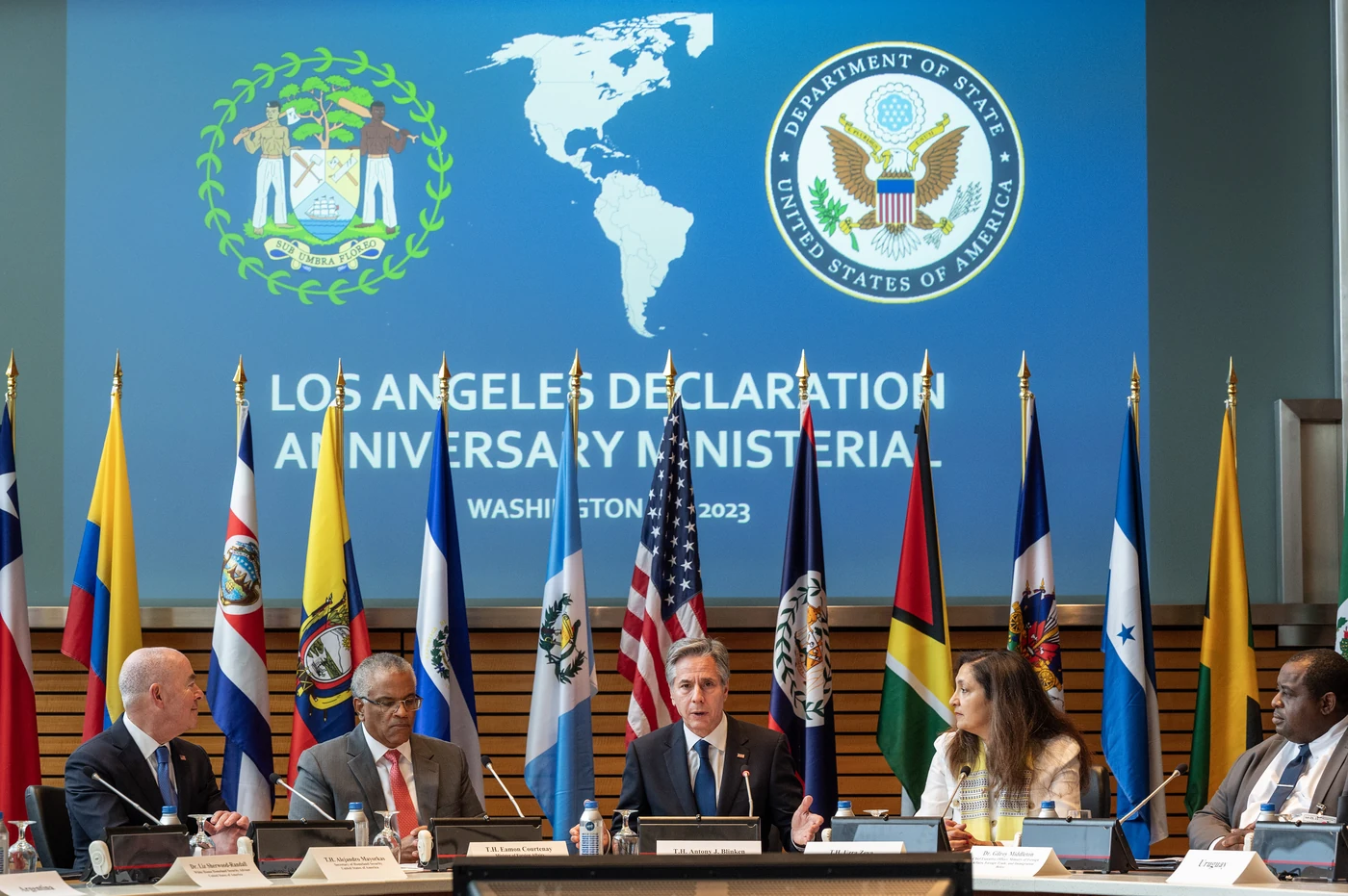
The photograph shows national flags at the Los Angeles Declaration Anniversary Ministerial in Washington, D.C., on June 23, 2023. Guatemala’s blue-white-blue flag with its arms appears in the lineup. The State Department credits James Pan. The photograph documents a diplomatic setting; draped cloth and lighting make it unsuitable as a construction standard.
The original caption identifies the ministerial event, Washington location, and June 23, 2023 date. James Pan photographed it for the U.S. Department of State. The Guatemalan flag appears beside other national flags behind the participants.
The local versions retain the full frame. The event’s name refers to the Los Angeles Declaration, but the source explicitly locates this anniversary ministerial in Washington, D.C.; the caption does not move the photograph to Los Angeles.
Flag folds partly hide the field and arms. That makes the image useful for diplomatic context while the flat vector remains the reliable guide to the full arrangement.
Where was the real quetzal photographed?
Bernard Gagnon photographed the resplendent quetzal in Los Quetzales National Park, Costa Rica, on February 5, 2023. The image provides wildlife context for the bird in Guatemala’s national arms. Its location is stated accurately: the fact that a bird symbolizes Guatemala does not make every photograph of that species a Guatemalan scene.
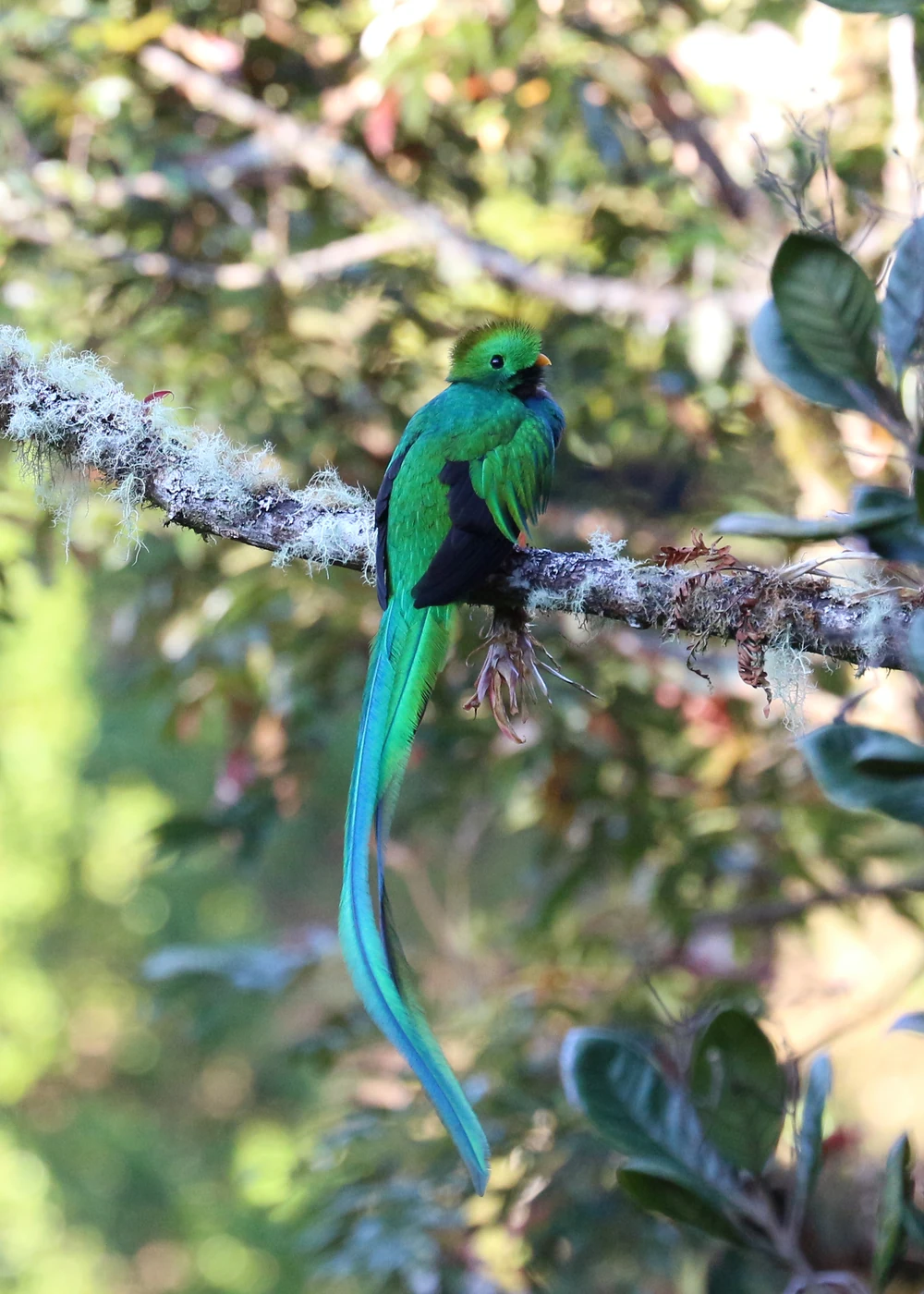
The source identifies the bird as a resplendent quetzal, Pharomachrus mocinno. The photograph shows the green plumage and long tail that help readers connect a living bird with the stylized national emblem.
Its Costa Rican location is preserved in both the caption and alternative text. The symbolism belongs to Guatemala’s arms, while the photographed scene has its own independently documented place and date.
Bernard Gagnon released the photograph under a CC0 public-domain dedication. The image is served locally, with a smaller responsive version, and its credit remains visible beside the caption.
What errors should be avoided in a Guatemala flag drawing?
Keep the bands vertical and equal, use the 8:5 rectangle, and retain the full coat of arms on white. Do not remove the weapons, shorten the quetzal’s tail, reverse only the bird, replace the parchment lettering, or stretch the emblem. Distinguish the 1821 inscription from the flag’s 1871 origin.
Check geometry, emblem, and dates together
Three vertical equal bands and an 8:5 rectangle are the first checks. Then inspect the complete quetzal, parchment, weapons, and laurel. A correct blue fill does not repair a missing emblem or distorted lettering.
Keep diagrams separate from the plain flag. Measurement arrows, explanatory text, and calendar labels belong outside the national rectangle. Do not turn a teaching sheet into an apparently authorized ceremonial flag.
Historical reconstructions should retain their labels. The 1858 plain design and the 1968 merchant pattern answer historical questions; neither should silently replace the full national SVG.
Which Guatemala flag downloads are included?
The package includes the national SVG and large PNG, complete arms detail, construction and size guides, a front-and-reverse illustration, historical reconstructions, a date comparison, a mourning diagram, and a comparison with related flags. Two photographs provide diplomatic and wildlife context. Every gallery download is served from the local Guatemala article directory.
Download the national SVG or the 5760 × 3600 PNG. The picture gallery supplies individual local downloads for every explanatory sheet, historical reconstruction, and photograph.
The separate 1851 state reconstruction and 1858 plain pattern preserve the distinction explained in the history section. The arms detail is presented on white.
Download the plain-text image credits. They identify creators and reuse status without adding external navigation to the article.
Guatemala flag pictures
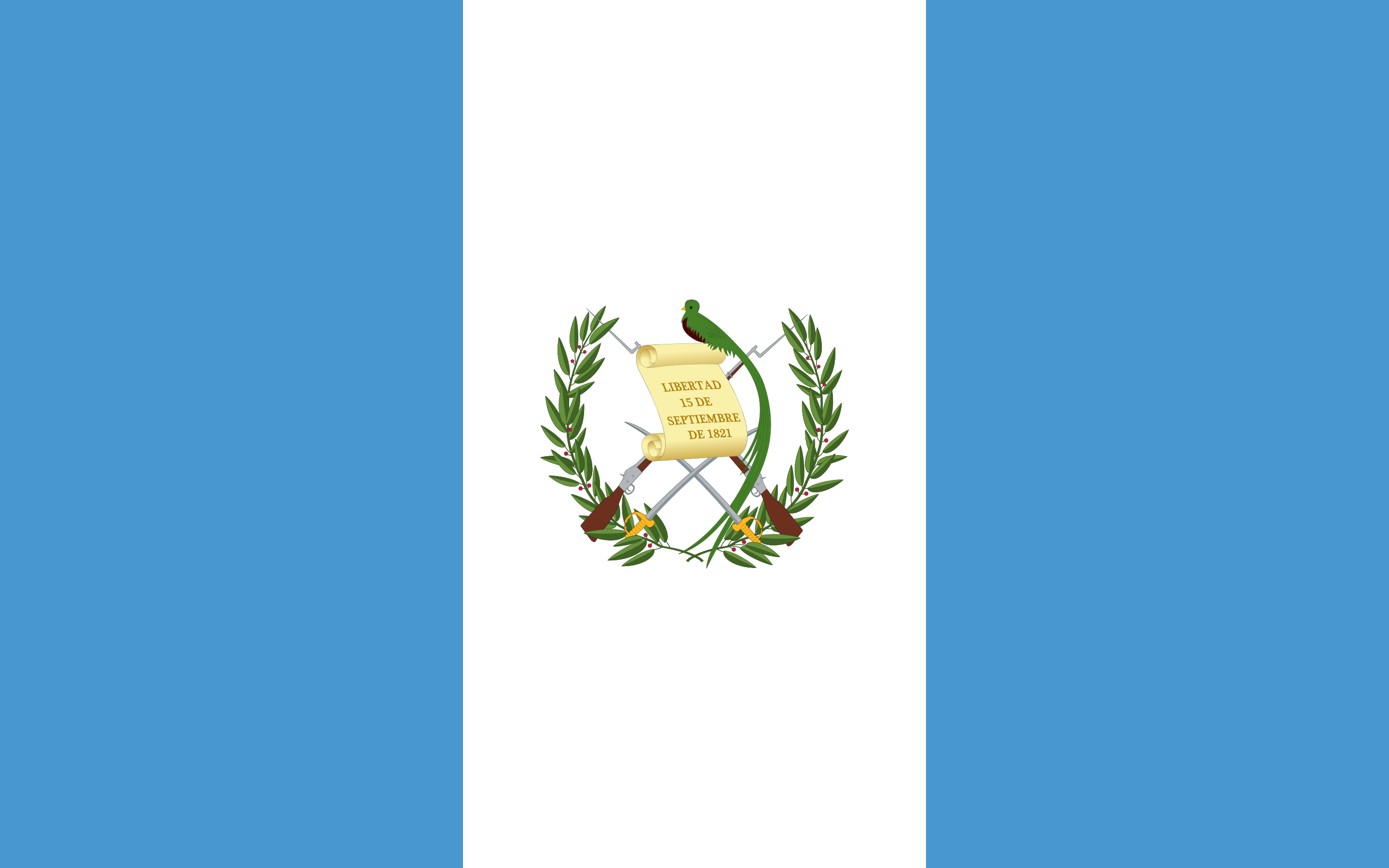
Guatemala’s national flag has equal vertical blue, white, and blue bands with the complete coat of arms centered on white. Its width:height ratio is 8:5.
K21edgo reference artwork; GKBook composition. Original explanatory layout, CC0; source artwork, public domain or CC0.Download image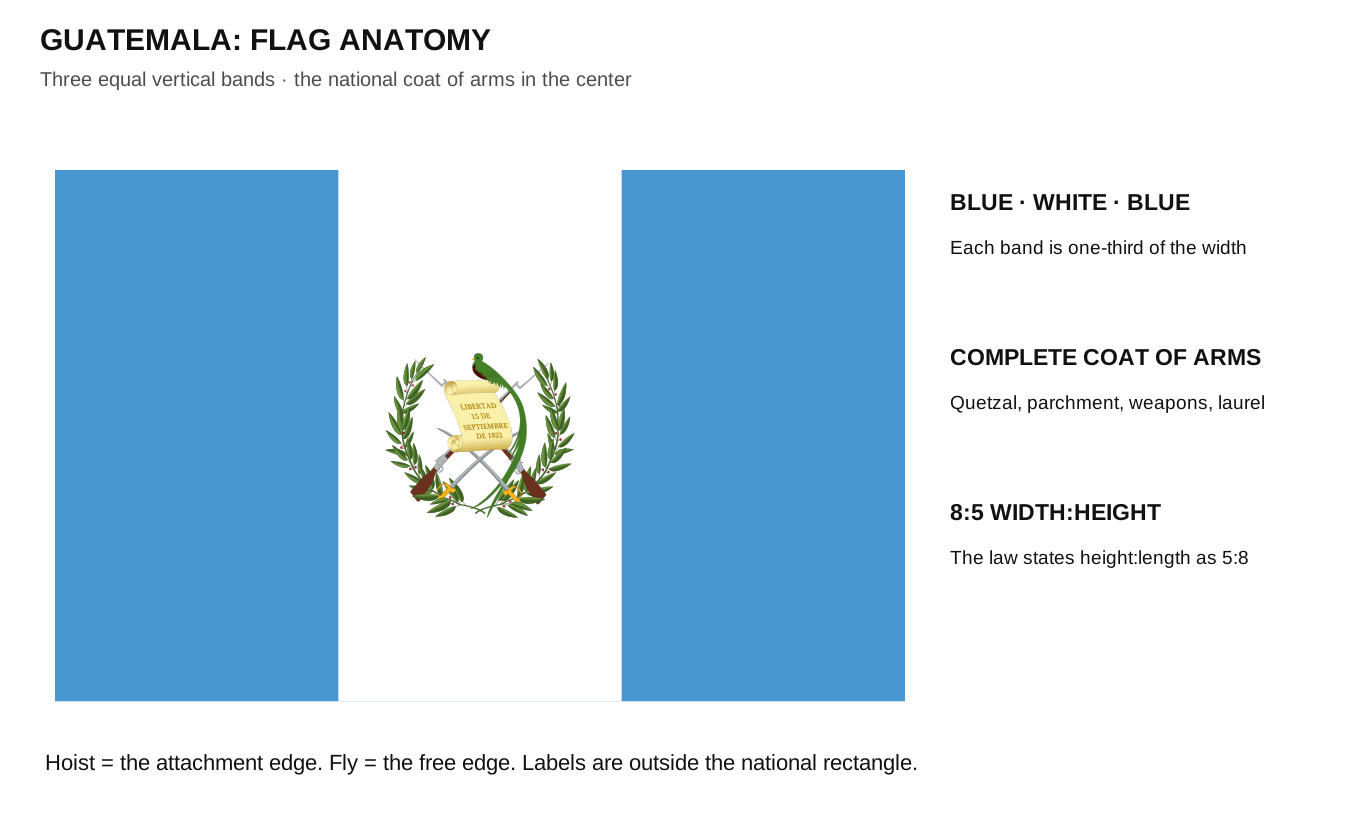
Equal blue side bands flank a white center band containing the national coat of arms. The complete design uses an 8:5 width:height rectangle; explanatory labels are outside the flag.
K21edgo reference artwork; GKBook composition. Original explanatory layout, CC0; source artwork, public domain or CC0.Download image
The full arms contain a quetzal, a parchment dated September 15, 1821, crossed rifles and swords, and laurel branches. The 1997 law specifies white behind the arms when displayed separately.
K21edgo reference artwork; GKBook composition. Original explanatory layout, CC0; source artwork, public domain or CC0.Download image
The 960-by-600 reference divides into three 320-unit bands. Blue occupies the outer thirds and white the middle third. The centered arms retain their complete reference geometry; the drawing is not a ministry-certified manufacturing model.
K21edgo reference artwork; GKBook composition. Original explanatory layout, CC0; source artwork, public domain or CC0.Download image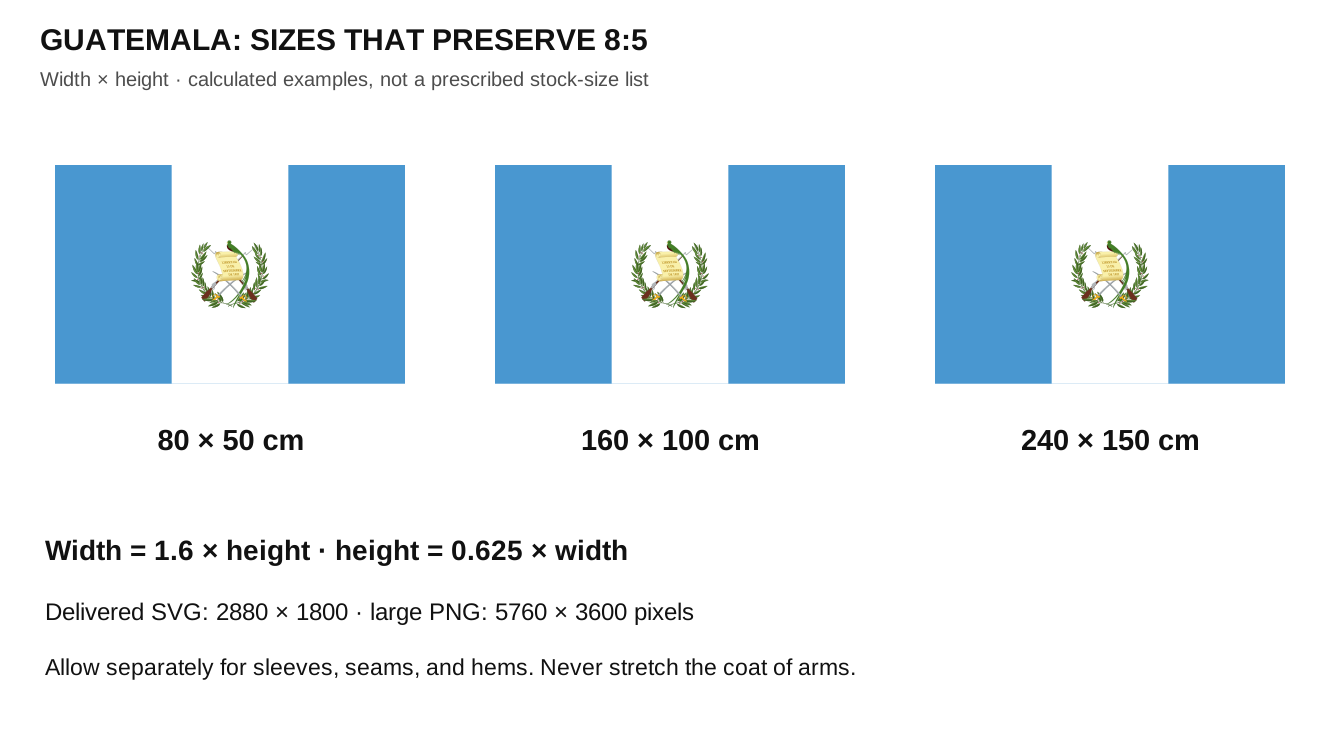
Examples of the 8:5 proportion include 80 by 50, 160 by 100, and 240 by 150 centimeters. The national SVG is 2880 by 1800 and the PNG is 5760 by 3600 pixels.
K21edgo reference artwork; GKBook composition. Original explanatory layout, CC0; source artwork, public domain or CC0.Download image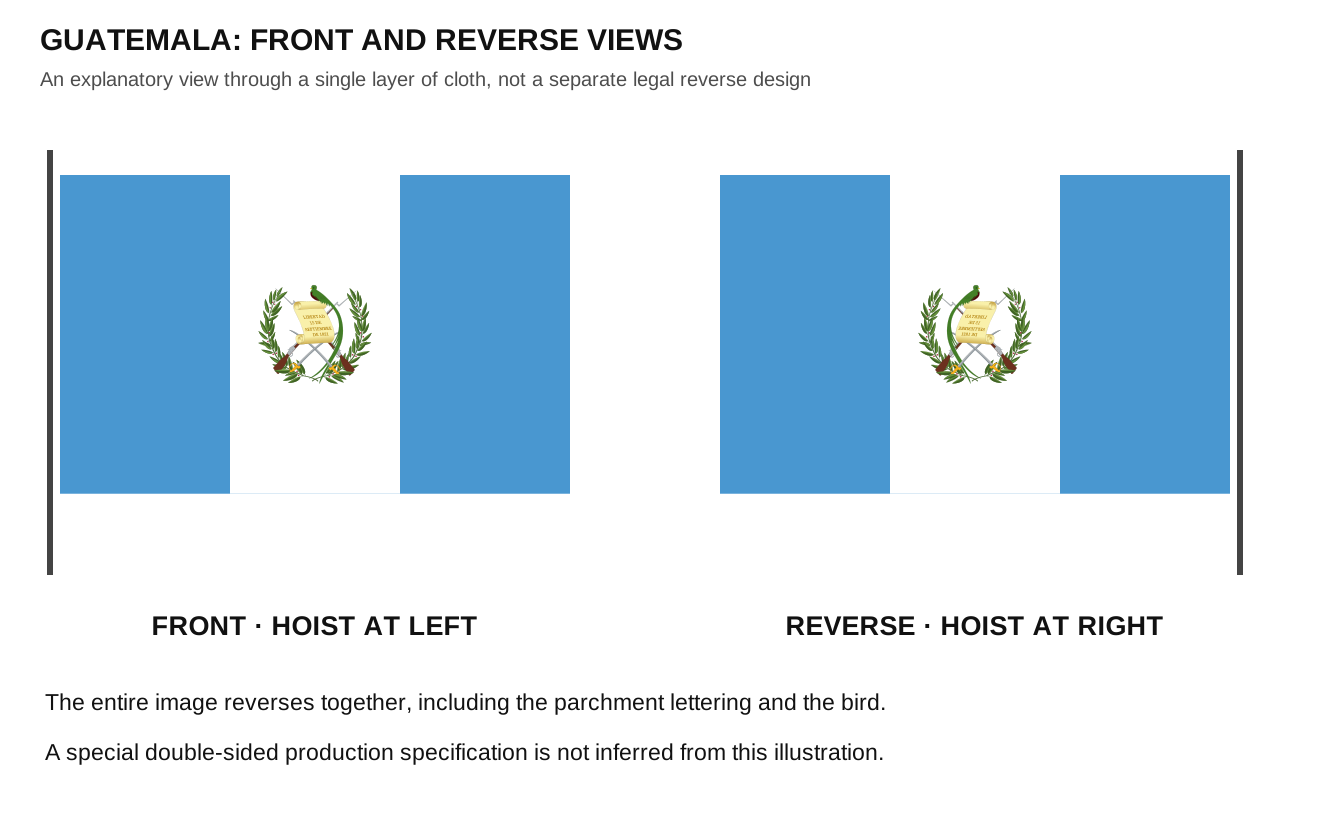
A front view has the quetzal facing the viewer’s left. In a view through a single cloth layer from behind, the complete design, including the lettering, is mirrored. This is a physical illustration, not an authenticated double-sided construction standard.
K21edgo reference artwork; GKBook composition. Original explanatory layout, CC0; source artwork, public domain or CC0.Download image
An illustrative reconstruction of the plain blue-white-blue merchant flag described in the 1968 regulation. It is presented as historical context, not as a certified current replacement for the national flag with arms.
GKBook original geometric reconstruction. Original explanatory layout, CC0; source artwork, public domain or CC0.Download image
Modern reconstruction of Guatemala’s 1851–1858 state flag, preserving the complete reference emblem and its native proportions. This historical design is not today’s national flag.
Germenfer; GKBook presentation. Original explanatory layout, CC0; source artwork, public domain or CC0.Download image
Modern reconstruction of the plain 1858–1871 pattern, with blue, white, red, yellow, red, white, and blue horizontal bands. State versions also carried arms; this plain reference is not a complete state ensign.
Fvasconcellos; GKBook presentation. Original explanatory layout, CC0; source artwork, public domain or CC0.Download image
The comparison distinguishes the 1851 state reconstruction, the plain 1858 pattern, the present design with 1871 origins, and the plain merchant form described in 1968. They are not interchangeable current national flags.
K21edgo, Germenfer, Fvasconcellos; GKBook composition. Original explanatory layout, CC0; source artwork, public domain or CC0.Download image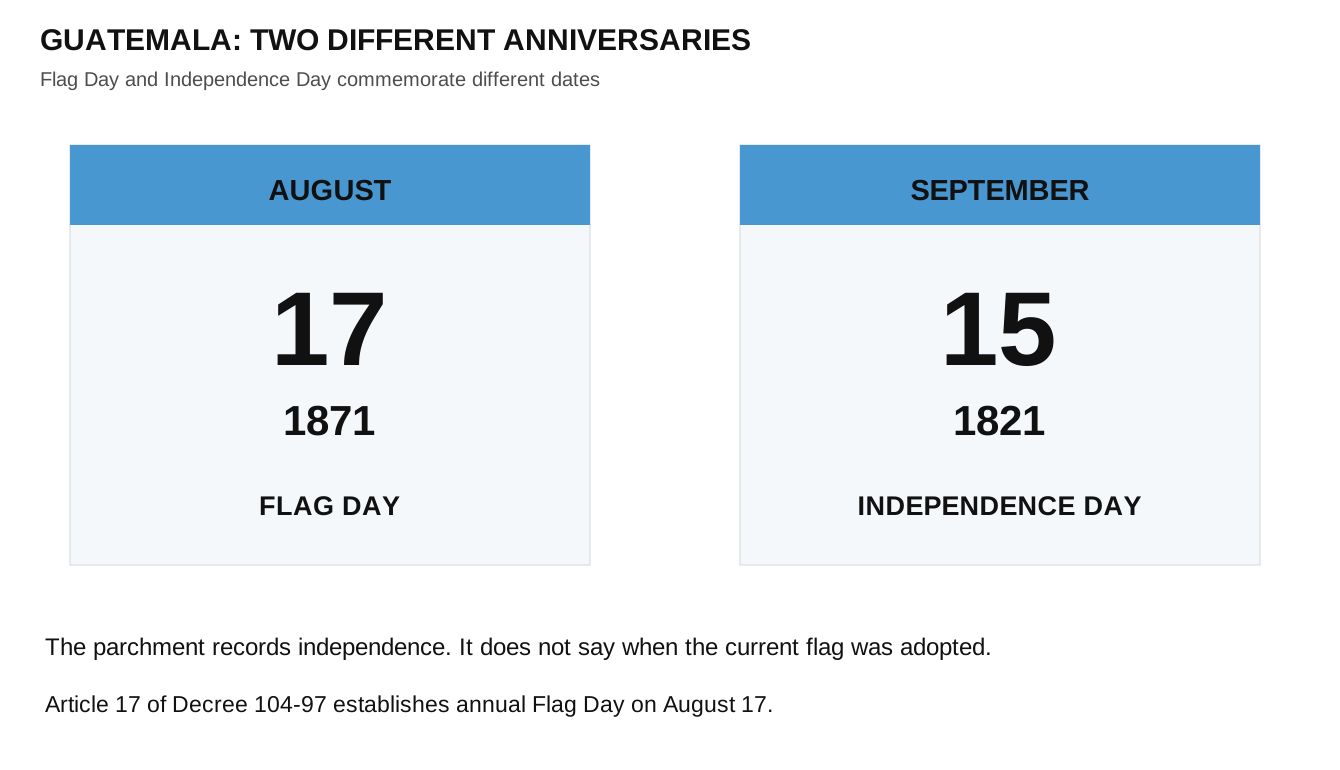
August 17 is Guatemala’s Flag Day, commemorating the flag’s creation in 1871. September 15 is the independence date in 1821 recorded on the parchment. These are distinct anniversaries.
K21edgo reference artwork; GKBook composition. Original explanatory layout, CC0; source artwork, public domain or CC0.Download image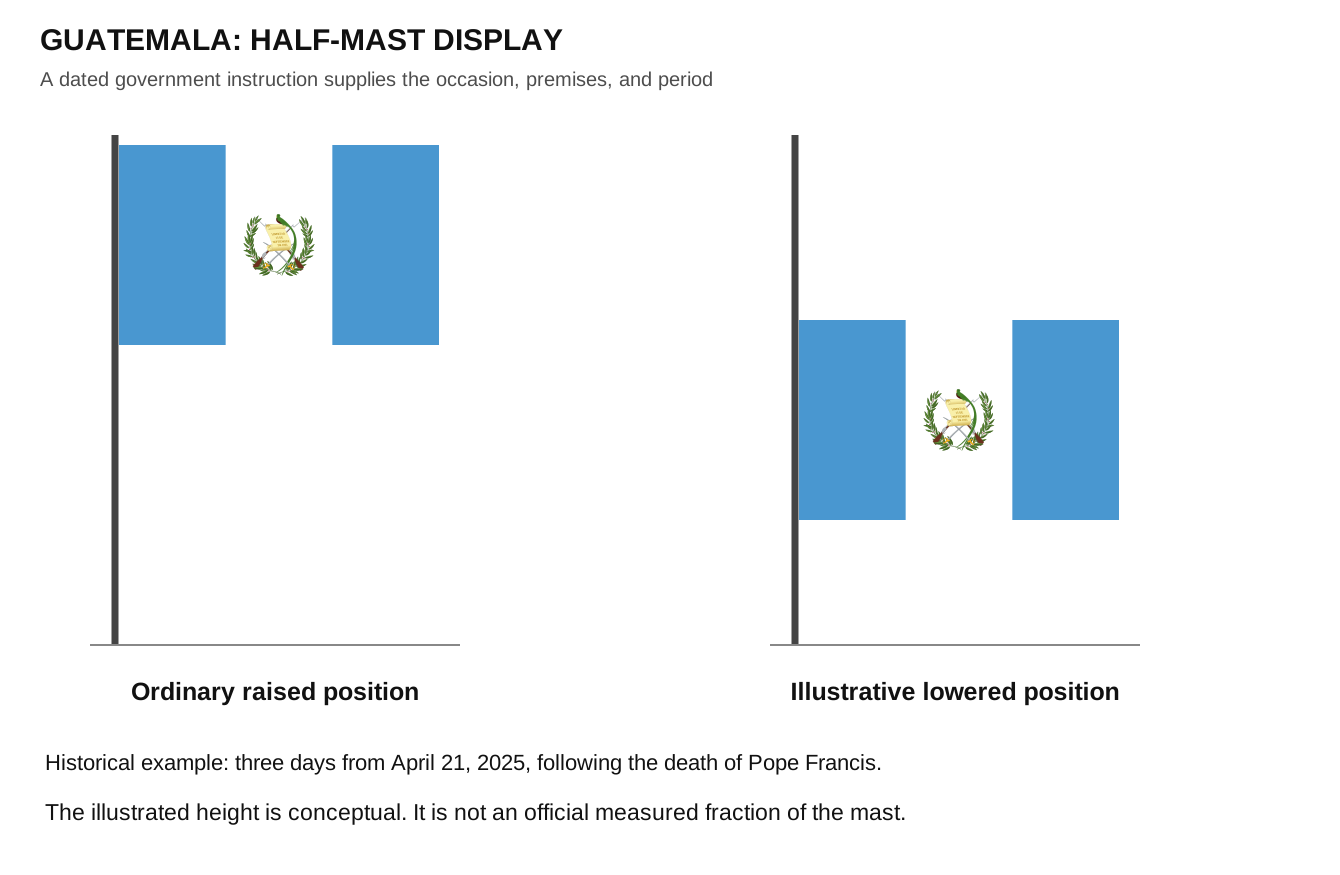
A lowered national flag illustrates mourning. Agreement 75-2025 ordered half-mast at the National Palace and government buildings for three days from April 21, 2025. The drawing does not prescribe an exact mast-height measurement.
K21edgo reference artwork; GKBook composition. Original explanatory layout, CC0; source artwork, public domain or CC0.Download image
Guatemala uses vertical blue-white-blue bands and a quetzal coat of arms. Honduras has horizontal bands and five stars; El Salvador has horizontal bands and its own arms; Argentina has horizontal bands and a central sun.
K21edgo (Guatemala), Kes47 (Honduras), Commons file-history contributors (El Salvador and Argentina); GKBook composition. Original explanatory layout, CC0; source artwork, public domain or CC0.Download image
A Guatemala flag appears among national flags at the Los Angeles Declaration Anniversary Ministerial in Washington, D.C., on June 23, 2023. The State Department identifies the event as co-hosted by Antony Blinken and Alejandro Mayorkas.
James Pan / U.S. Department of State. Public domain in the United States; official U.S. federal photograph.Download image
A resplendent quetzal photographed by Bernard Gagnon in Los Quetzales National Park, Costa Rica, on February 5, 2023. This wildlife photograph explains the bird depicted in Guatemala’s arms; it was not taken in Guatemala.
Bernard Gagnon. CC0 public-domain dedication.Download imageFrequently asked questions
What does Guatemala’s national flag look like?
Guatemala’s flag has three equal vertical bands of blue, white, and blue, with the national coat of arms centered on the white band. The arms combine a quetzal, parchment, crossed rifles and swords, and laurel branches. The statutory proportion is 8:5 when expressed as width to height.
How are the bands and emblem arranged?
Each vertical band occupies one-third of the flag’s width. The blue bands stand at the attachment and free edges, with white between them. The coat of arms belongs in the center of the white band. Preserve its complete arrangement rather than substituting a shield, bird silhouette, or text-only badge.
What are Guatemala’s official flag colors and digital color values?
Article 2 identifies blue as ISCC-NBS 177 and white as ISCC-NBS 263. The supplied digital reference uses blue #4997D0, RGB 73, 151, 208, and white #FFFFFF, RGB 255, 255, 255. These HEX and RGB values describe the artwork; they are not numerical color codes written into the law.
What do the blue and white colors symbolize?
Article 3 associates blue with strength, justice, truth, and loyalty, and white with purity, peace, integrity, firmness, and light. Official educational accounts also connect the blue bands with Guatemala’s Pacific and Atlantic-Caribbean setting. Keep that geographical interpretation distinct from the values expressly listed in the flag law.
What does Guatemala’s coat of arms represent?
The quetzal represents liberty; the parchment preserves the national birth date; the swords symbolize justice and sovereignty; and the laurel signifies victory. Article 3 gives those meanings. The arms also contain crossed rifles with fixed bayonets, whose historical type and arrangement are described separately in Article 4.
What is written on the parchment on Guatemala’s flag?
The parchment reads LIBERTAD, 15 DE, SEPTIEMBRE, DE 1821 across four lines in the 1997 law and the supplied artwork. It records September 15, 1821, the independence date. The inscription is therefore older than the present flag’s adoption in 1871 and should not be mistaken for that adoption date.
Which bird appears on Guatemala’s flag?
A quetzal appears above the parchment in Guatemala’s coat of arms. Article 6 places it facing heraldic dexter, which is the viewer’s left in a front-facing illustration, and describes its long tail extending below the laurel. Article 3 identifies the bird as the supreme symbol of liberty.
What are the proportions of Guatemala’s flag?
Guatemala’s national flag has an 8:5 width:height proportion. Article 1 expresses the same relationship as 5:8 height:length. A flag 100 centimeters high is therefore 160 centimeters wide. The ratio is exactly 1.6; it should not be confused with the mathematical golden ratio, which is approximately 1.618.
How is the downloadable Guatemala flag constructed?
The reference uses a 960-by-600 coordinate rectangle divided into three 320-unit bands. Its complete arms are centered on white and retained without independent resizing of their parts. The delivered SVG enlarges this reference uniformly to 2880 by 1800. It is an educational drawing, not a ministry-certified manufacturing model.
What sizes preserve the correct Guatemala flag ratio?
Finished sizes such as 80 by 50, 160 by 100, or 240 by 150 centimeters all preserve Guatemala’s 8:5 width:height ratio. These are calculated examples, not an official stock-size schedule. Use uniform scaling for the entire design, and plan sleeves, hems, reinforcement, and shrinkage separately from the visible rectangle.
How has Guatemala’s flag changed over time?
Guatemala’s historical flags included horizontal arrangements and designs containing red and yellow before the present vertical blue-white-blue flag originated in 1871. This page illustrates a state reconstruction from 1851–1858 and a plain pattern from 1858–1871. Their periods and different emblem status are labeled so they are not mistaken for current alternatives.
When was Guatemala’s present flag adopted?
The present blue-white-blue flag dates to August 17, 1871, under Miguel García Granados. The coat of arms followed through Decree 33 on November 18, 1871. Those dates should be distinguished from the detailed 1968 regulation and the later flag-and-arms law, Decree 104-97, published in 1997.
What is Decree 104-97?
Decree 104-97 is Guatemala’s law regulating the national flag and coat of arms. Congress issued it on October 28, 1997, and the official gazette published it on November 26. Article 19 provides for entry into force thirty days after publication. It regulates design, symbolism, display, manufacture, and Flag Day.
Who designed Guatemala’s coat of arms?
Guatemala’s Culture Ministry credits the Swiss designer Juan Bautista Frener with the coat of arms adopted in November 1871. That attribution concerns the emblem. It should not be expanded into an unsupported claim that he personally designed every element of the national flag or authored the later legal standards.
Does Guatemala regulate the manufacture and sale of national flags?
Yes. Article 16 assigns the Ministry of Culture and Sports responsibility for authorizing people and entities that manufacture, distribute, or sell national flags. It also requires a single official model supplied with the authorization. Downloading educational artwork does not provide that authorization or establish that a commercial product meets the ministry’s model.
Where does Guatemala’s law require the flag to be flown?
Article 8 requires daily display at buildings occupied by state offices, autonomous and decentralized institutions, and the national education system. Other individuals and legal entities may display it voluntarily in the same manner. Article 11 separately addresses consulates, embassies, and official events abroad, requiring the coat of arms in those settings.
How must Guatemala’s flag be raised and lowered?
Article 12 requires the national flag to be raised and lowered slowly and ceremoniously, with those present saluting during the action. It also prohibits hoisting flags whose original colors have faded or whose condition is evidently poor. The reviewed law does not prescribe a universal clock time for every raising or lowering.
Which direction should the quetzal face on the flag?
In the usual front-facing image, the quetzal faces the viewer’s left, the heraldic dexter direction named in Article 6. Seen through a single layer of cloth from behind, the whole design reverses, including the lettering. That physical reverse view does not establish a separate official standard for double-sided manufacture.
What does the law say about displaying other flags?
Article 14 places the Guatemalan flag first in the raising order on separate staffs and at the top when flags share a pole. It also specifies greater dimensions, a right-hand position with one other flag, and the center with several. The text does not define the observer’s viewpoint for right.
Where does Guatemala’s flag go in a parade?
Article 13 provides that, in a parade with two flags, the national flag goes at the head on the right. With several flags, it leads and the others follow in a line. Apply that procession rule to an actual parade; it is not a substitute for the separate display rules in Article 14.
When is Guatemala’s Flag Day?
Guatemala celebrates Flag Day on August 17, commemorating the flag’s creation in 1871. Article 17 establishes the annual observance and directs public and private educational institutions to celebrate it, or the nearest appropriate day. Flag Day is distinct from September 15, the independence date recorded on the coat of arms.
When does Guatemala fly its flag at half-mast?
Guatemala uses half-mast display during government-declared mourning periods. A documented example is Agreement 75-2025, following Pope Francis’s death, which ordered flags lowered at the National Palace and government buildings for three days from April 21, 2025. This is a historical example, not a continuing instruction or an annual observance.
Does the mourning example establish an exact half-mast height?
The reviewed 2025 government news report gives the mourning period and affected buildings but does not specify a measured fraction of the mast. The accompanying illustration therefore shows a conceptual lowered position. A particular institution’s instructions should govern the actual installation; the diagram does not invent a national numerical standard.
How should worn Guatemala flags be retired?
Article 12 forbids hoisting national flags with faded original colors or evidently poor condition. It directs that flags withdrawn from circulation be incinerated with the corresponding honors, leaving disposal of the ashes to the relevant institution. For historically valuable flags, also consider the separate preservation exceptions expressly recognized in Article 9.
Does public-domain artwork remove Guatemala’s national-symbol restrictions?
No. Copyright status concerns permission to reuse the particular artwork. Guatemala’s national-symbol rules remain a separate issue, including Article 16’s authorization system for making, distributing, and selling national flags. The supplied files identify their reuse status, but they are not a commercial license, a ministry approval, or a government endorsement.
What background does the separate Guatemalan coat of arms use?
Article 7 of the 1997 law states that the coat of arms, when separate from the flag, always has a white background. An older 1968 regulation described a light-blue field. The dated difference matters: the older wording should not be copied into an explanation of the later statutory requirement.
Is the plain blue-white-blue flag a current official alternative?
The 1968 regulation described a plain merchant flag without arms. This article includes that pattern as historical context. The later law describes the arms on the national flag and expressly requires them in consular, embassy, and official overseas settings. Do not present the historical plain download as a certified current official replacement.
How can Guatemala’s flag be distinguished from similar flags?
Guatemala’s blue-white-blue bands run vertically, and its central emblem prominently includes a quetzal and parchment. Honduras, El Salvador, and Argentina use horizontal bands. Honduras has five stars, El Salvador has a different coat of arms, and Argentina has a sun. Check orientation and emblem before relying on blue color alone.
What is Guatemala’s flag emoji and country code?
Guatemala’s flag emoji is 🇬🇹, corresponding to the country code GT. The sequence combines regional indicator G, U+1F1EC, with regional indicator T, U+1F1F9. Its appearance varies by device and application. Use the supplied SVG or PNG when you need consistent proportions, a complete emblem, and reproducible digital artwork.
What does the Washington photograph document?
The photograph shows national flags at the Los Angeles Declaration Anniversary Ministerial in Washington, D.C., on June 23, 2023. Guatemala’s blue-white-blue flag with its arms appears in the lineup. The State Department credits James Pan. The photograph documents a diplomatic setting; draped cloth and lighting make it unsuitable as a construction standard.
Where was the quetzal photograph taken?
Bernard Gagnon photographed the resplendent quetzal in Los Quetzales National Park, Costa Rica, on February 5, 2023. The image provides wildlife context for the bird in Guatemala’s national arms. Its location is stated accurately: the fact that a bird symbolizes Guatemala does not make every photograph of that species a Guatemalan scene.
What mistakes should be avoided when drawing Guatemala’s flag?
Keep the bands vertical and equal, use the 8:5 rectangle, and retain the full coat of arms on white. Do not remove the weapons, shorten the quetzal’s tail, reverse only the bird, replace the parchment lettering, or stretch the emblem. Distinguish the 1821 inscription from the flag’s 1871 origin.
Which Guatemala flag pictures are available to download?
The package includes the national SVG and large PNG, complete arms detail, construction and size guides, a front-and-reverse illustration, historical reconstructions, a date comparison, a mourning diagram, and a comparison with related flags. Two photographs provide diplomatic and wildlife context. Every gallery download is served from the local Guatemala article directory.
Explore all general-knowledge topics and the A-to-Z lists.

We Value Your Opinion Comments