
Croatia flag picture
Explore the construction sheet, the coat of arms, and the historical sequence.
| Country | CroatiaRepublic of Croatia; Croatian name: Republika Hrvatska. |
|---|---|
| Color order | Red · white · blueThree equal horizontal stripes, with the national arms at the center. |
| Current design adopted | December 21, 1990The detailed symbols law established the present flag and five-shield crown. |
| Proportions | 2 : 1 — width:heightEquivalent to 1:2 height:width. Maritime legislation specifies a different ship format. |
| Main shield | 25 red-and-white fieldsFive rows and five columns; the upper-left field is red. |
| Crown | Five historical shieldsCroatian star-and-crescent arms, Dubrovnik, Dalmatia, Istria, and Slavonia. |
| Modern artwork | Miroslav ŠutejParliament credits Šutej’s design and Božo Kokan’s digital rendering. |
| Croatian Flag Day | June 5Established by Parliament in 2025; first observed in 2026. |
Croatia’s flag has three equal horizontal stripes and the national arms at the center. Its main shield has 25 red-and-white fields, with five historical shields above it. The symbols express national identity; the 1990 law does not assign a separate meaning to each stripe.
An overview of the Croatia flag
The flag of Croatia is a horizontal tricolor of red, white, and blue, with the national coat of arms at its center. Its three stripes have equal height. The emblem combines a red-and-white checkered shield with a crown formed from five smaller historical shields. The national flag is twice as wide as it is high.
The present design was established on December 21, 1990. Croatia’s use of the three national colors is much older: the tricolor became a national emblem during the political and cultural changes of 1848. The distinction between those dates explains why an old Croatian tricolor and today’s flag can belong to the same tradition without having identical emblems.
Croatia’s Constitution recognizes the red-white-blue flag and historic arms. The detailed Law on the Coat of Arms, Flag and Anthem of the Republic of Croatia and the Flag and Sash of the President of the Republic of Croatia specifies their appearance and use. Parliament also publishes graphic models for accurate reproduction.
For quick identification, look for the 25-field checkerboard and the five-part crown. A plain red-white-blue tricolor loses the feature that distinguishes Croatia’s current national flag from several other flags. In Croatian, trobojnica means “tricolor,” while the checkered motif is commonly called the šahovnica.
The checkered shield and its heraldic crown
The main shield contains five rows and five columns of alternating red and white fields. Article 7 of the 1990 law requires the first field at the upper left, as the viewer sees it, to be red. White is also described in heraldic terms as silver. A red outline defines the principal shield and crown.
There are 13 red and 12 white fields: an odd-numbered alternating grid that starts with red necessarily has one more red field. This is a calculation from the legal pattern, not an additional symbolism rule. The lower edge curves into the shield’s point, so the bottom fields are not all complete rectangles.
Above the checkered shield, five smaller shields join to make a crown-like outline. They do not depict a monarch’s jeweled crown. Their named historical identities, rather than five modern administrative units, explain the arrangement. The modern national emblem brings those traditions together in one composition.
The five shields, read from left to right
The 1990 law describes each small shield separately. Read the sequence from the viewer’s left: the Croatian star-and-crescent arms, the Republic of Dubrovnik, Dalmatia, Istria, and Slavonia. Light and dark blue backgrounds alternate, and the small animal, star, and crescent details are part of the design.
| Position | Historical arms | Features prescribed by the law |
|---|---|---|
| 1 — left | The “oldest known” Croatian arms | A yellow or gold six-pointed star above a white or silver crescent on a blue field. “Oldest known” is the wording used by the statute. |
| 2 | Republic of Dubrovnik | Two red horizontal bars on a dark blue field. Use this statutory version when reproducing the national crown. |
| 3 — center | Dalmatia | Three yellow or gold crowned leopard heads, arranged two above one, on a blue field. |
| 4 | Istria | A yellow or gold goat with red horns and hooves, facing the viewer’s left, on a dark blue field. |
| 5 — right | Slavonia | Two white or silver horizontal bars; a marten on the red field between them; and a yellow or gold six-pointed star above. |
Two details deserve a closer look. First, the star over the crescent has six points, as does the star in the Slavonian shield. Second, the law calls the Dalmatian animals leopard heads. Descriptions of them as lions in other historical or heraldic discussions should not lead an illustrator to replace the crowned heads with a different animal design.
The name attached to the first shield is a legal designation. It is safer to identify it as the shield the law calls the oldest known Croatian arms than to turn that label into a claim that every earlier Croatian emblem is conclusively known. Likewise, the national crown’s Dubrovnik shield should be copied from the national model, rather than improvised from another historical depiction of Dubrovnik’s arms.
Colors and the official graphic model
The flag’s three broad stripes are red, white, and blue. Its detailed arms add light blue, yellow or gold, and black. Parliament’s published construction sheet supplies separate screen and print references. The table transcribes that sheet; hexadecimal values are calculated directly from its RGB entries.
| Color | RGB / hex | CMYK (%) | Pantone / ink label | Location |
|---|---|---|---|---|
| Red | 255, 0, 0#FF0000 | 0, 100, 100, 0 | 186 C | Upper stripe; checkered fields and heraldic details |
| White / silver | 255, 255, 255#FFFFFF | 0, 0, 0, 0 | Transparent white | Middle stripe, alternate fields, crescent and bars |
| Light blue | 0, 147, 221#0093DD | 100, 0, 0, 0 | Cyan | Alternating fields in the crown |
| Dark blue | 23, 23, 150#171796 | 100, 82, 0, 2 | Reflex blue | Lower stripe and dark fields in the crown |
| Yellow / gold | 247, 219, 23#F7DB17 | 0, 6, 95, 0 | 108 | Stars and animal details |
| Black | 0, 0, 0#000000 | 0, 0, 0, 100 | Process black | Fine details in the arms |
These references should be read at two levels. The 1990 statute establishes the colors and heraldic composition in words. The published graphic sheet gives more detailed production guidance, including RGB, CMYK, and named ink references. Those columns are separate specifications: one should not assume that an automatic conversion between them reproduces the same printed result.
Some online charts give different red or blue values. Here, the controlling reference for the drawings is the sheet currently supplied on Parliament’s state-symbols page. In particular, its dark blue is RGB 23, 23, 150, and its light blue is RGB 0, 147, 221. A photograph taken in shade, faded cloth, or a screen profile can make the same flag look different without changing its intended design.
For physical production, check a proof against the approved model and the intended material. Gold and silver in the legal description name heraldic colors; they do not, by themselves, require metallic foil or metallic thread in every national flag. The law’s general description also does not assign separate official shades for indoor and outdoor flags.
Symbolism and meaning
Croatia’s flag combines the national tricolor with historic arms. Article 2 of the symbols law says that the arms, flag, and anthem represent the Republic and express belonging to it. The tricolor’s historical explanation lies in the national revival and the heraldic colors associated with Croatia, Slavonia, and Dalmatia.
The 1990 law does not give an individual virtue or sacrifice meaning to each stripe. It would therefore be misleading to present “red means blood,” “white means peace,” and “blue means freedom” as its official explanation. Such lists may be modern interpretations, but they are not part of the statutory account used here.
The central emblem has a more specific documented identity. The red-and-white shield is the historic Croatian arms. The crown names five heraldic traditions, each recognizable through its own motif. The crescent, stars, leopard heads, goat, and marten belong to those historical arms; they should not be recast as a newly invented list of five national values.
The colors work collectively. Their order, the proportions of the cloth, and the emblem together form the national symbol. This is why accurate color matching matters, but a list of color names alone cannot describe the flag completely.
Construction and proportions
For the national flag, width:height is 2:1. In the law’s height-to-length wording, the ratio is 1:2. Each horizontal stripe occupies exactly one-third of the height. With a height of 100 units, the width is 200 units and each stripe is 33⅓ units high.
The arms are positioned by a defined central reference point. Article 10 places that point at the intersection of the flag’s diagonals. Parliament’s drawing marks it as T. This is a practical distinction: centering the entire emblem’s rectangular bounding box can put the arms at the wrong height, because the crown and the pointed shield have different shapes.
The crown extends into the red stripe, while the lower part of the main shield enters the blue stripe. In the published construction, the top of the main checkered shield lies at the red–white boundary. The emblem should remain a single proportionate drawing; stretching its width to fill more of the middle stripe distorts the shields and animals.
| Flag height | Flag width | Height of each stripe | Status |
|---|---|---|---|
| 60 cm | 120 cm | 20 cm | Calculated example |
| 90 cm | 180 cm | 30 cm | Calculated example |
| 100 cm | 200 cm | 33⅓ cm | Calculated example |
| 150 cm | 300 cm | 50 cm | Calculated example |
The hoist is the side attached to a pole, and the fly is the free side. Diagrams conventionally show the hoist on the viewer’s left. The official face of the arms should be reproduced consistently; a separate vertical display instruction is discussed under vertical orientation.
History: from heraldic colors to the modern flag
The history of Croatia’s flag is a sequence of related designs, legal decisions, and changes of state. A political turning point does not always introduce a new flag, and a change to the arms can occur while the same three stripe colors remain.
Early evidence of checkered arms
Dalibor Čepulo identifies surviving checkered Croatian arms from the late fifteenth century, centuries before the modern tricolor. Early examples differ from today’s emblem.
The national tricolor and Jelačić’s installation
During the national revival, red, white, and blue emerged together as Croatian national colors. Parliament’s historical explanation connects them with the heraldic traditions of Croatia, Slavonia, and Dalmatia. Ban Josip Jelačić’s installation on June 5, 1848, gave the tricolor a prominent ceremonial role.
Restriction and later recognition
Imperial restrictions displaced the national tricolor in 1852. The Croatian–Hungarian Settlement of 1868 later recognized national colors and symbols in Croatian autonomous affairs.
A transition out of Austria-Hungary
On October 29, 1918, Parliament severed constitutional ties with Austria-Hungary and Croatia joined the State of Slovenes, Croats and Serbs. That state united with Serbia and Montenegro on December 1. Croatia’s constitutional historical account records these transitions; they should not be substituted for the adoption dates of specific flag designs.
The Banovina of Croatia
Within the Yugoslav monarchy, the Banovina used Croatian heraldic identity. Čepulo notes that its flag was not formally regulated, although a plain Croatian tricolor was commonly used.
A different wartime state symbol
The Ustaša regime’s Nazi-aligned wartime state adopted a flag with a white-first checkerboard and its U emblem. That complete design belongs to the regime’s history; a single field color does not establish the identity of every older checkered emblem.
The red-star flag in socialist Croatia
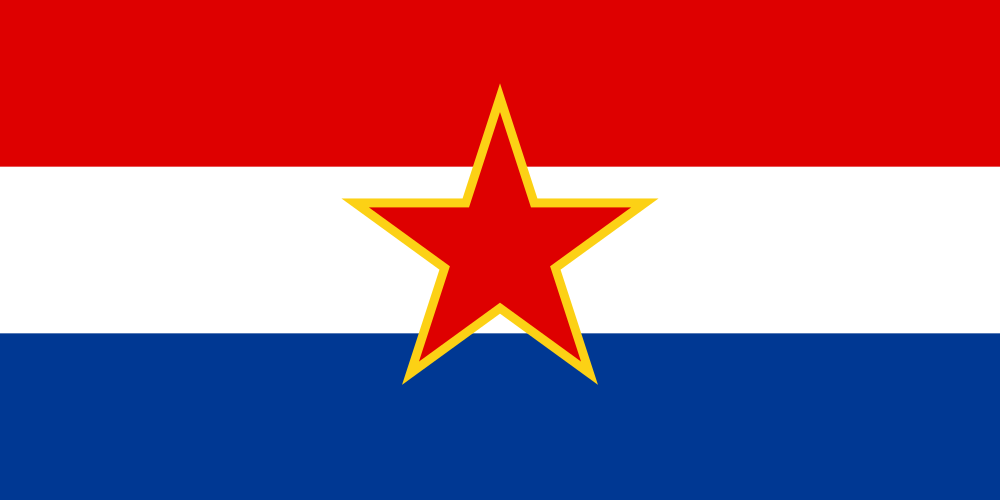
The 1947 constitution specified a red-white-blue flag with a gold-edged red star. Later socialist constitutions retained the emblem. This was a republican flag within Yugoslavia, not the present arms-bearing national flag.
The historic arms return to the constitutional description
Constitutional Amendment LXVI described a 25-field red-and-white historic Croatian shield and the tricolor with that shield at its center. It left the precise form and use to legislation. This intermediate constitutional change should be distinguished from the detailed design adopted in December.
The present national design is enacted
Parliament enacted the detailed symbols law, including the five-shield crown and the flag’s proportions. The law was published that day and took effect on publication. Croatia’s new Constitution followed on December 22. The modern flag’s adoption date is therefore December 21, not the later date of independence.
Independence with the existing flag
Parliament declared sovereignty and independence on June 25, 1991. After the three-month moratorium, the October 8 decision severed remaining state and legal ties with the other republics and provinces of Yugoslavia. These were major political steps, not fresh adoptions of a new national flag design.
A national Flag Day is established and observed
Parliament’s June 6, 2025 decision designated June 5 as Croatian Flag Day. The first annual observance took place on June 5, 2026. Its date recalls the 1848 ceremonial tricolor rather than the December 1990 enactment of the current flag.
The Jelačić installation flag survives as a museum object. Curator Jelena Borošak-Marijanović documents a 93 × 123 cm swallowtail silk flag, with combined kingdom arms and an Illyrian emblem on one side and Jelačić family arms on the other. It is a ceremonial cavalry-style object, not a rectangular copy of today’s national flag.
Parliament’s 2025 explanatory history identifies the museum inventory as HPM/PMH 11862 and records that the original was displayed at the first multiparty parliamentary session on May 30, 1990. That connection gives the older flag a role in modern parliamentary memory without making it the legal national flag of 1990.
Design authorship and later digital standards
The Croatian Parliament credits Miroslav Šutej with the artistic design of the state symbols and Božo Kokan with their digital rendering. Šutej’s modern composition uses historic heraldic material; crediting that composition does not mean that he invented the checkered Croatian arms or the nineteenth-century tricolor.
The digital models are valuable because hand-redrawn versions can change the animals, star points, outlines, or relative sizes. A common master helps publishers and manufacturers reproduce the same design. Publication of a digital model is a standardization step, not evidence that the national flag was newly adopted at that later moment.
For a reproduction of the current flag, use the complete model associated with the national flag. Do not mix a crown from one drawing, a shield from another, and a blue sampled from a photograph. Such combinations can look plausible at a distance while drifting from the published design.
Adoption and the legal framework
The constitutional and statutory descriptions have different jobs. Article 11 of the Constitution recognizes the historic checkered arms and the red-white-blue flag. The detailed 1990 symbols law sets out the arms, the flag’s proportions, its placement rules, and aspects of respectful use. Parliament’s graphic sheet supplies an authoritative visual model.
| Instrument or record | What it establishes | What it should not be confused with |
|---|---|---|
| July 1990 constitutional amendment | Return of historic arms in the flag’s constitutional description | The completed December five-shield design |
| December 21, 1990 symbols law | Detailed current flag, arms, use and protection | A new adoption at independence in 1991 |
| Constitution, Article 11 | Constitutional identity of the state symbols | A complete manufacturing drawing |
| Parliament’s digital models | Published drawings and production references | A new national-flag adoption |
| 2025 Flag Day decision | June 5 annual observance | A redesign or an automatic nonworking holiday |
The law also protects the dignity and integrity of the symbols. It permits artistic, musical, and educational use subject to respect for the Republic’s reputation and dignity. Its provisions on alterations and incorporated elements should be read alongside that permission; an educational diagram labeling a flag and a proposed replacement emblem are different kinds of use.
The rules discussed here concern the national flag unless a paragraph specifically identifies maritime or military regulations. Specialized flags, rank flags, and shipboard ceremonies have additional provisions. Their dimensions and procedures should not be generalized to every flag flown outside a home or public building.
National, maritime, naval, and presidential flags
Croatia’s ordinary national flag is the arms-bearing 2:1 tricolor. The symbols law does not define a separate plain, emblem-free civil version. Shipboard and presidential flags need separate identification because their proportions or designs differ from that national format.
| Flag or use | Proportions, width:height | Identification |
|---|---|---|
| National flag | 2:1 | Equal red-white-blue stripes, complete national arms at the center. |
| Flag on a ship under the Maritime Code | 3:2 | National design in the ship format described by Article 182. |
| Naval stern flag and jack | 3:2 under the 2009 naval regulation | Specialized naval symbols and their prescribed use; do not assume every Croatian ship flies the same naval flag. |
| Presidential standard | 1:1 | A square blue standard with a red-and-white checked border and a distinct central heraldic composition, including the letters RH. |
The presidential flag is described in Articles 23 and 24 of the 1990 law. Its arrangement includes a central medallion, historical arms, and colored lines extending from it. The law provides for display at the President’s official premises or residence when the President is there, on the President’s vehicle, and on other ceremonial occasions.
Naval regulations distinguish a stern flag from a jack at the bow and from rank or command flags. The 2009 regulation specifies separate handling and size provisions. This is why a photograph of a warship is not sufficient evidence for a general civilian flag-display rule.
Flags that can be confused with Croatia’s
The most dependable recognition clues are the stripe order, emblem, emblem position, and proportions. Several European flags use red, white, and blue. A folded flag may hide its arms, and poor lighting can obscure its shade of blue, so use more than one clue when identifying a photograph.
| Flag | Stripe order, top to bottom | Key distinction |
|---|---|---|
| Croatia | Red · white · blue | Checkered arms at the center, with a five-shield crown. |
| Netherlands | Red · white · blue | Plain tricolor without national arms; usual width:height 3:2. |
| Slovenia | White · blue · red | A mountain-bearing shield toward the hoist; different stripe order and emblem. |
| Historical socialist Croatian flag | Red · white · blue | A gold-edged red star instead of the present arms. |
For Croatia and Slovenia, first compare the top stripe: it is red on Croatia’s flag and white on Slovenia’s. Then inspect the emblem. Croatia has its checkerboard at the center; Slovenia’s shield is toward the hoist and depicts Mount Triglav. The neighboring countries’ flags are not interchangeable.
Common mistakes to avoid
Read the complete design
- Count 25 fields in the main shield, not 24. The curved lower edge does not remove the fifth row.
- Keep the upper-left field red in the current national arms.
- Retain all five historical shields and both six-pointed stars.
- Treat the entire coat of arms as part of the national flag, rather than an optional decoration.
Keep dates and interpretations distinct
- 1848 explains the tricolor’s national history; December 21, 1990 identifies the current detailed design.
- June 5 is Flag Day. May 30 is Statehood Day. Neither changes the adoption date.
- The five shields are historical heraldic identities, not a list of five present-day provinces.
- The statute does not assign blood, peace, or freedom separately to the three stripes.
Another practical mistake is placing the whole emblem too high or too low after centering its bounding box. The construction uses the arms’ defined reference point. Copy the complete approved arrangement rather than estimating the emblem’s position from a low-resolution thumbnail.
Manufacture and faithful reproduction
A well-made Croatian flag preserves the 2:1 national rectangle, equal stripe heights, and undistorted arms. Those features matter whether the design is printed, stitched, or displayed on a screen. The general symbols law does not prescribe one exclusive fiber or a universal series of commercial national-flag sizes.
For the emblem, fine detail is especially important: the Dalmatian heads have crowns, the Istrian goat has red horns and hooves, and the Slavonian marten sits between two silver bars. Printing the crown too small can merge those details. A larger, faithful vector is a better production starting point than enlarging a compressed photograph.
Practical production checks
- Maintain the flag’s legal ratio and equal thirds; use the published arms without horizontal or vertical stretching.
- Check a screen or print proof against Parliament’s color references and complete graphic model.
- Keep seams, fittings, and pole sleeves from obscuring the national design.
- Inspect a physical flag regularly for wear, tears, fading, and loss of detail.
Limits of the specification
- Calculated size examples in this article are scaling aids, not an official catalog of national sizes.
- The general flag law does not make every gold-colored detail metallic.
- Naval size and cloth provisions apply to their specified naval flags; they do not establish a universal fabric rule.
- A decorative drawing, teaching grid, or labeled construction sheet is not a replacement production master.
The inspection and proofing steps above are practical guidance. The separate legal rule is clear: Article 5 prohibits public display of arms or flags that are worn, untidy, torn, or otherwise damaged. A respectful display therefore includes maintaining the condition of the object, as well as drawing it correctly.
Croatian Flag Day: June 5
Croatian Flag Day is June 5. Parliament established it by a decision adopted on June 6, 2025, published in Narodne novine on June 11. The first annual observance followed on June 5, 2026. The date commemorates the 1848 tricolor associated with Ban Josip Jelačić’s installation.
These dates can easily be confused because the decision was adopted one day after the annual date it designated. The decision’s own effective date was June 6, 2025; that does not turn June 6 into Flag Day. Nor does the June 11 gazette publication date change the annual observance.
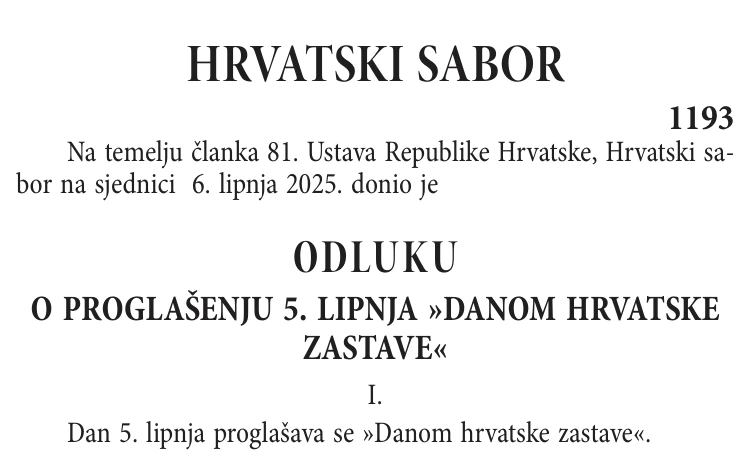
The decision establishes a commemorative day. It does not itself declare a nonworking public holiday or replace Statehood Day. The distinction is useful when reading a calendar or planning an educational event: the subject commemorated, the annual date, the date of adoption, and any holiday status are separate questions.
The 1848 connection gives the day a historical focus beyond the current design’s age. It recalls the national tricolor’s development and its place in public life, while December 21 remains the adoption date of the detailed flag used today.
Statehood Day and the independence milestones
Statehood Day is May 30. Parliament’s account connects it with the first democratically elected multiparty Parliament, which convened on May 30, 1990. It is a different commemoration from Croatian Flag Day on June 5, although both occasions draw on the flag’s role as a state symbol.
The independence sequence has its own dates. Parliament adopted its sovereignty and independence decision on June 25, 1991. Following the moratorium, October 8, 1991 marked the decision to sever state and legal ties with the other Yugoslav republics and provinces. Neither date should replace December 21, 1990 in an answer about adoption of the current flag.
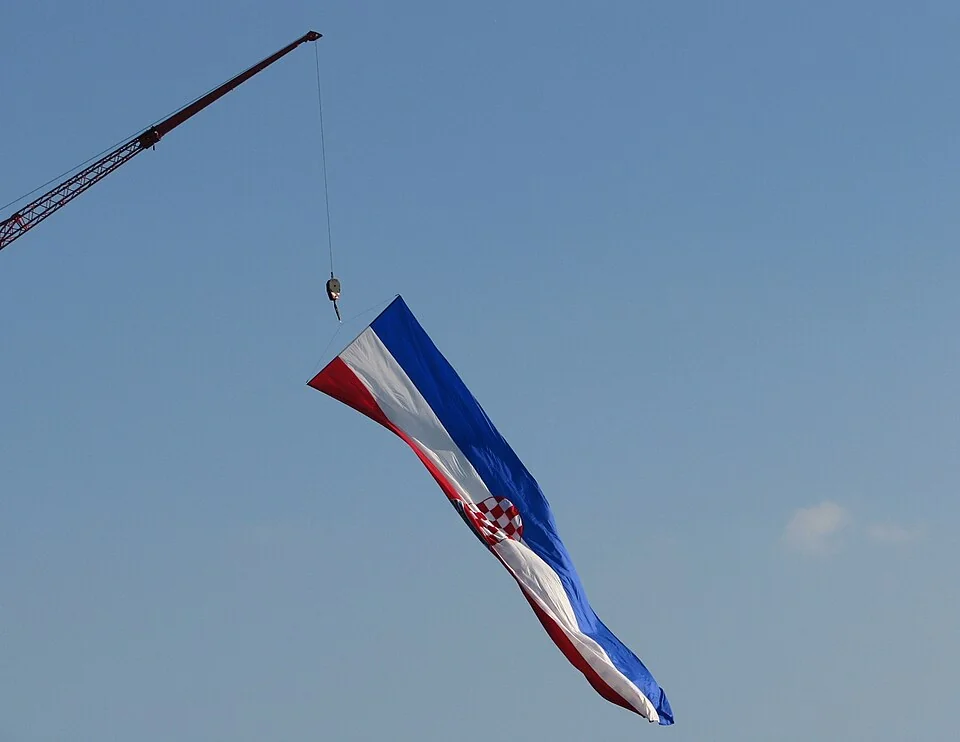
The photograph records a particular military parade in Zagreb on August 4, 2015. Its caption identifies that event and date; it should not be relabeled as a Flag Day ceremony or as the flag’s first raising.
Display, handling, and public use
The symbols law provides for the flag to be displayed permanently on buildings of state bodies, on the Republic’s holidays, and during national mourning. It also permits display at public political, scientific, cultural, sporting, and other gatherings, subject to the law and the customs of the occasion.
Requirements and permitted uses
- Use the flag in a manner consistent with respect for the Republic’s reputation and dignity.
- Display the prescribed national design, keeping the arms and flag intact.
- Follow the applicable orientation rule for the particular display.
- During ceremonial raising, lowering, or carrying, Article 14 calls for customary honors, including standing or saluting as appropriate.
Avoid these errors
- Do not publicly display a worn, untidy, torn, or otherwise damaged flag.
- Do not treat every artistic adaptation as a new official national design.
- Do not transfer shipboard timetables or military rank-flag procedures to ordinary building displays.
- Do not assume the law’s reference to a flag on a bier grants a funeral entitlement to every named category of person.
The law expressly permits artistic, musical, and educational use when it respects the state’s reputation and dignity. An explanatory diagram can therefore label the stripes and arms without claiming to be the actual national flag flown at a ceremony. The context and presentation should make that distinction clear.
For a specific official ceremony, use the relevant institution’s current arrangements as well as the national law. The general symbols law does not provide a complete timetable or sequence for every school event, international meeting, funeral, or military occasion.
Vertical orientation and street displays
When the flag is displayed vertically at a table, rostrum, or another place of honor, red is first on the viewer’s left. Article 13 also gives compass-direction rules for vertical flags suspended across streets or in a circular square. Those situations should be checked separately rather than reduced to one universal left–right instruction.
| Situation named in Article 13 | Position of the red stripe |
|---|---|
| Vertical flag across an east–west street | On the north side |
| Vertical flag across a north–south street | On the east side |
| Vertical flag in a circular square | On the east side |
| Vertical display at a table, rostrum, or other place of honor | First on the viewer’s left, seen from the front |
| Flag laid on a bier, pedestal, or another object, or carried horizontally | On the viewer’s left, seen from the front |
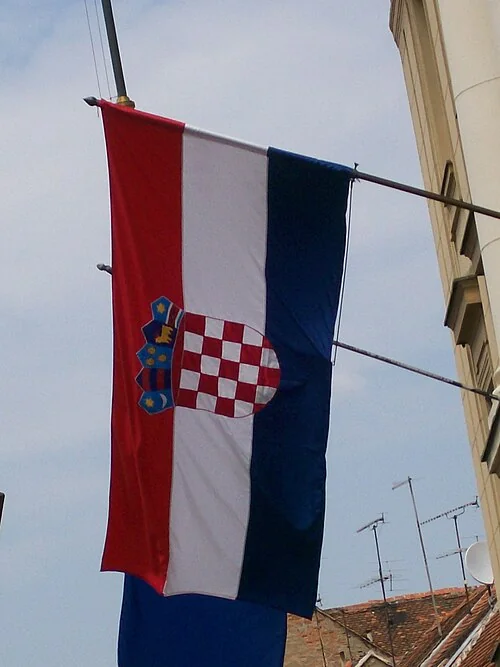
The photograph at Parliament shows why it is useful to think about the whole cloth rather than the reading direction of the arms alone. In a vertical hanging, the stripes become upright bands and the emblem rotates with the flag. The statute’s orientation instruction should not be replaced by an improvised emblem layout.
Half-mast and national mourning
Article 11 of the symbols law provides that the national flag is flown at half-mast for the duration of national mourning. The article establishes the relationship between a declared period of mourning and the lowered flag. It does not itself supply a permanent list of all officeholders, funeral entitlements, or fixed mourning periods.
| Context | What the verified provision establishes | Practical implication |
|---|---|---|
| National mourning | Flag at half-mast for the duration of mourning | Follow the actual declaration’s dates and scope. |
| A particular death or funeral | The general flag law does not set every entitlement or duration | Check the applicable official decision instead of assuming an automatic number of days. |
| Naval stern flag or jack | The naval regulation refers half-mast use to armed-forces ceremonial provisions | Use the specialized military instructions for that setting. |
A sound display plan starts with the official notice for the occasion: when the mourning period begins and ends, which institutions are covered, and whether separate ceremonial instructions apply. Do not infer a new nationwide half-mast requirement from an undated photograph or a rule belonging to another country.
Respect also includes the flag’s condition. Lowering a torn or badly worn flag does not remedy the law’s separate prohibition on publicly displaying damaged symbols. Use a complete, serviceable flag throughout the observance.
Croatia flag pictures
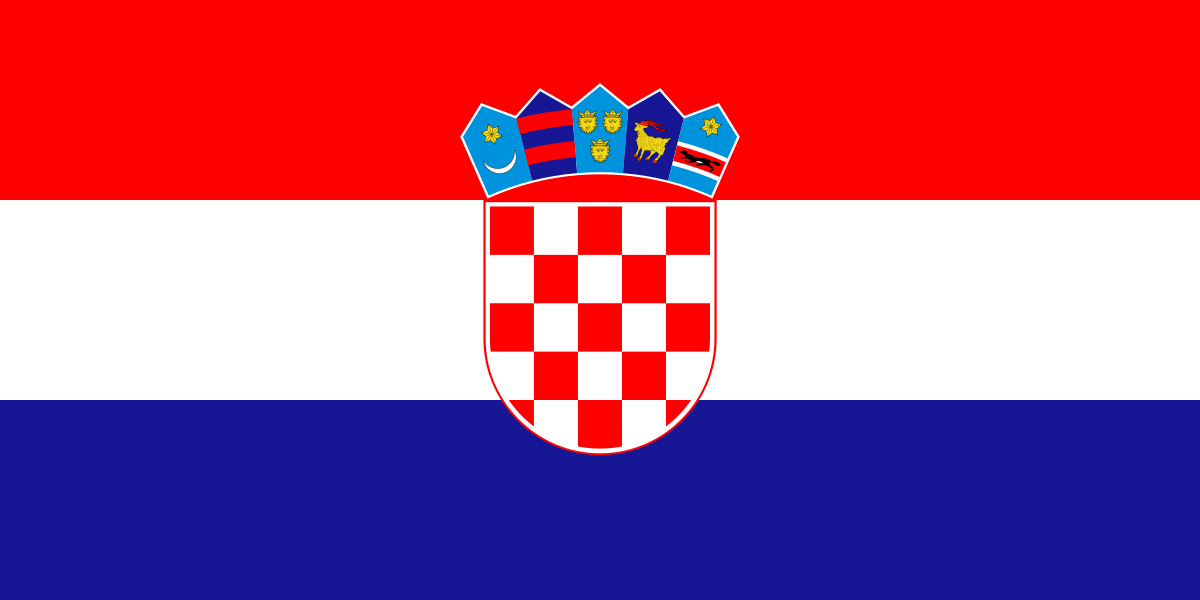
Croatia’s national flag: equal red, white, and blue stripes with the checkered arms and five-shield crown at the center.
GKBook explanatory drawing; public-domain national-symbol artwork based on the Parliament model. Image credit and license.Download image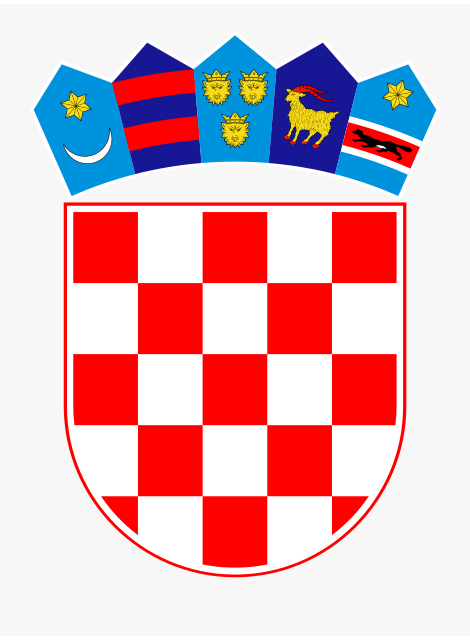
The arms as drawn on the national flag: 25 red-and-white fields beneath five historical shields.
GKBook explanatory drawing; public-domain national-symbol artwork based on the Parliament model. Image credit and license.Download image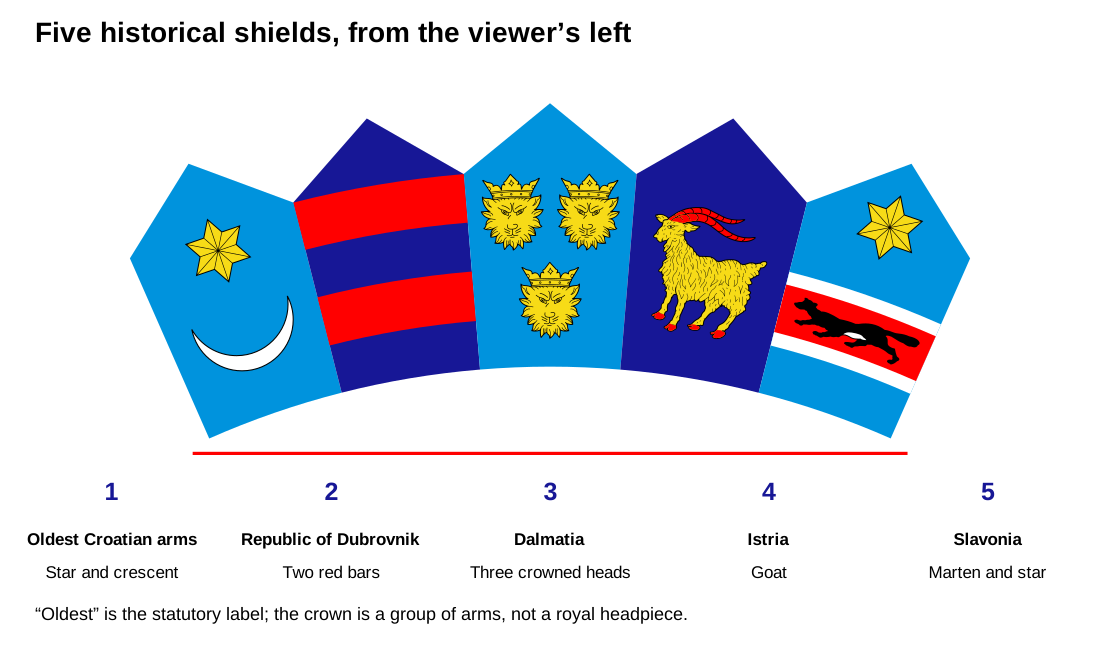
Left to right: the star-and-crescent arms, Dubrovnik, Dalmatia, Istria, and Slavonia. Enlarged from the verified national-flag artwork.
GKBook explanatory drawing; public-domain national-symbol artwork based on the Parliament model. Image credit and license.Download image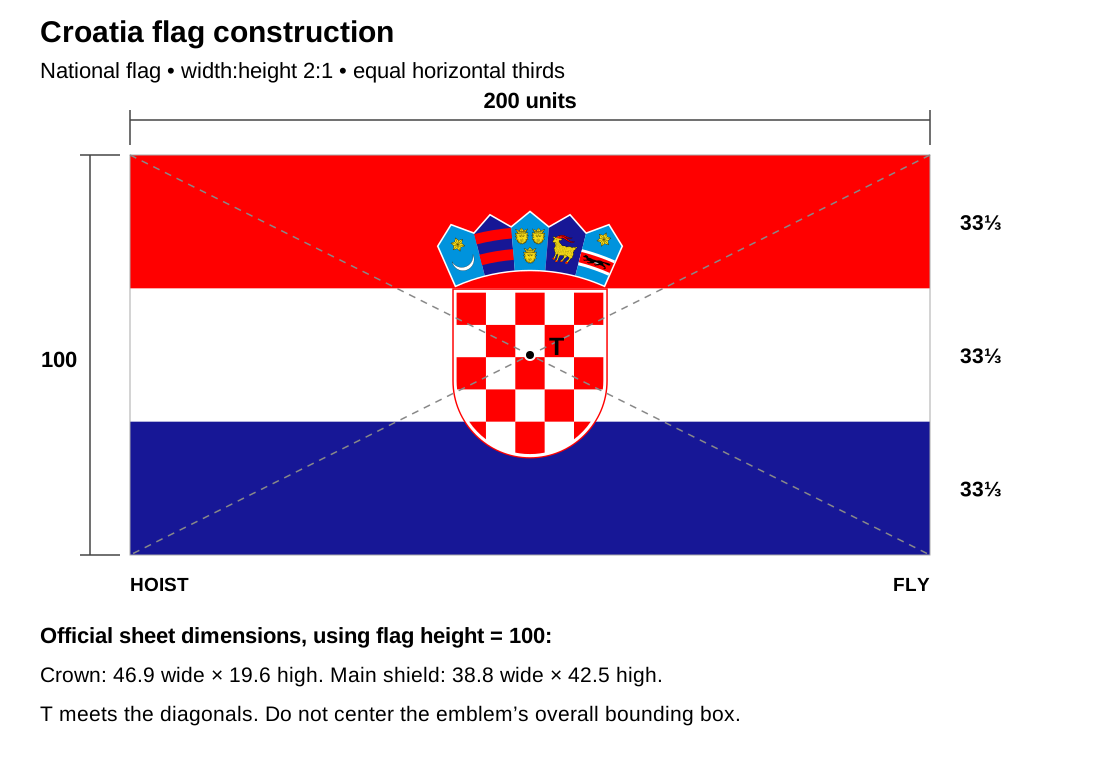
A 200-by-100 construction with equal thirds. Measurements for the arms follow Parliament’s graphic sheet; its reference point T meets the flag’s diagonals.
GKBook explanatory drawing; public-domain national-symbol artwork based on the Parliament model. Image credit and license.Download image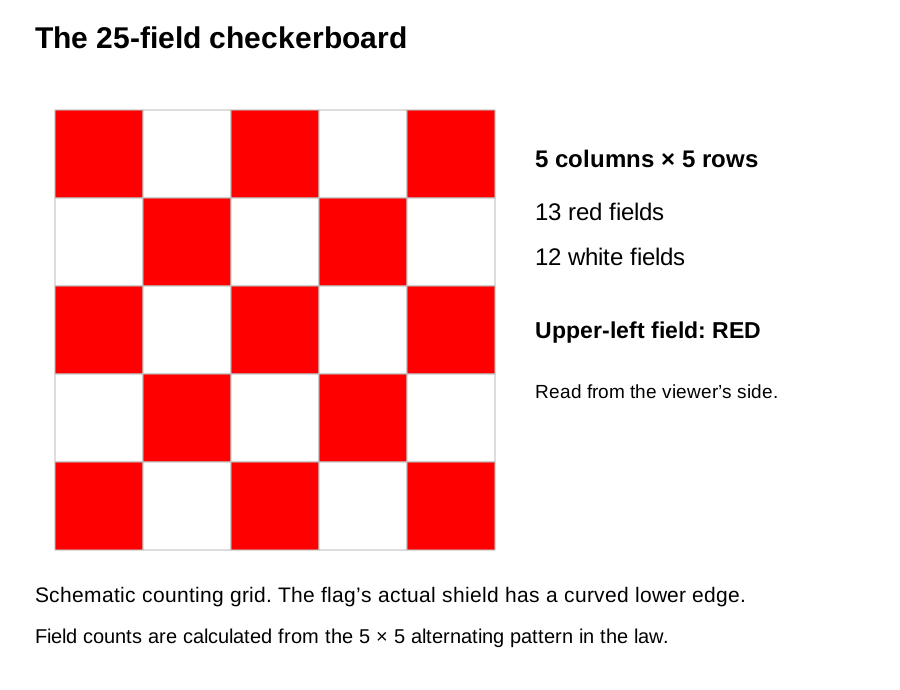
A labeled counting diagram with 13 red and 12 white fields, beginning with red at the upper left. This square teaching grid does not replace the curved official shield.
GKBook explanatory drawing; public-domain national-symbol artwork based on the Parliament model. Image credit and license.Download image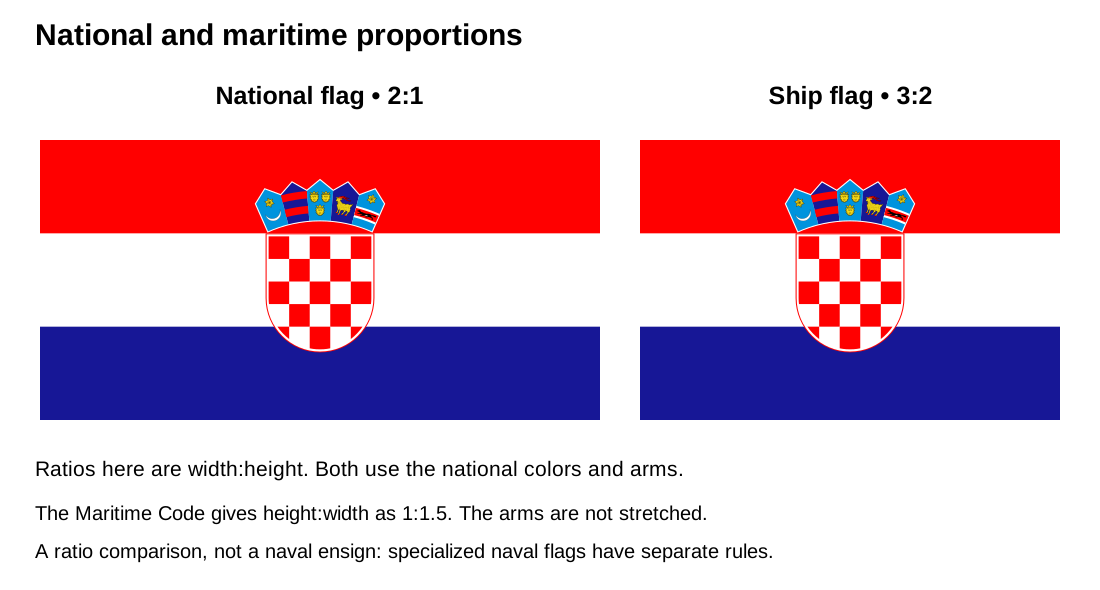
At equal height, the national flag is twice as wide as it is high; the Maritime Code’s ship flag has width:height 3:2. These are different legal formats.
GKBook explanatory drawing; public-domain national-symbol artwork based on the Parliament model. Image credit and license.Download image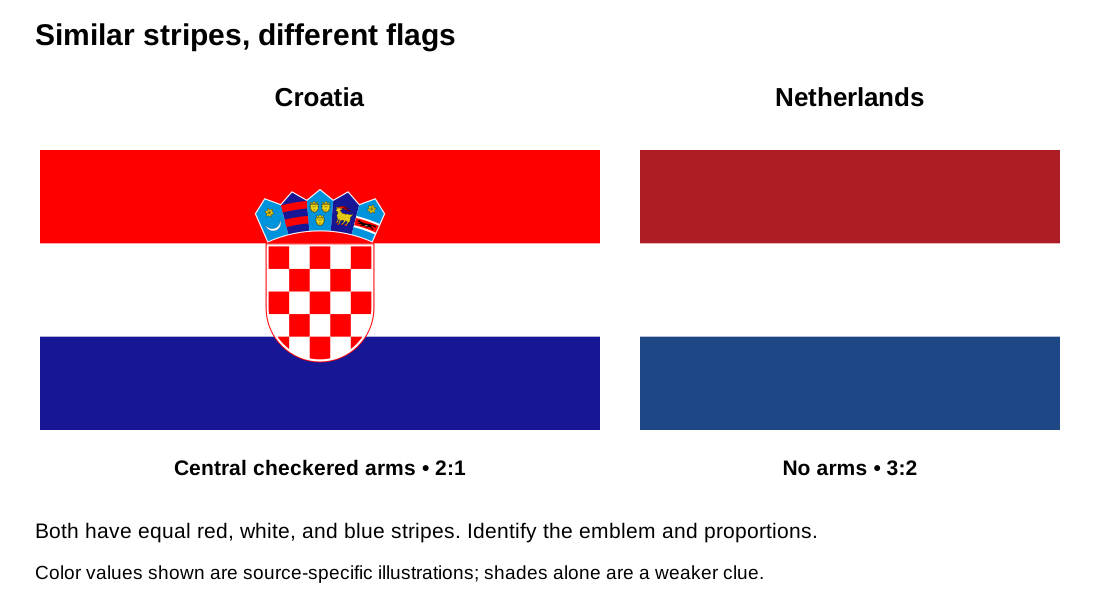
Croatia has central checkered arms and width:height 2:1. The Netherlands has a plain red-white-blue tricolor and width:height 3:2.
GKBook explanatory drawing; public-domain national-symbol artwork based on the Parliament model. Image credit and license.Download image
Reproduction of the flag specified in the 1947 constitutional period and retained under later socialist constitutions until the 1990 change. The red star has a gold border.
Zscout370 / Metrónomo, Wikimedia Commons. Public-domain official-work reproduction; not an archival photograph. Image credit and license.Download image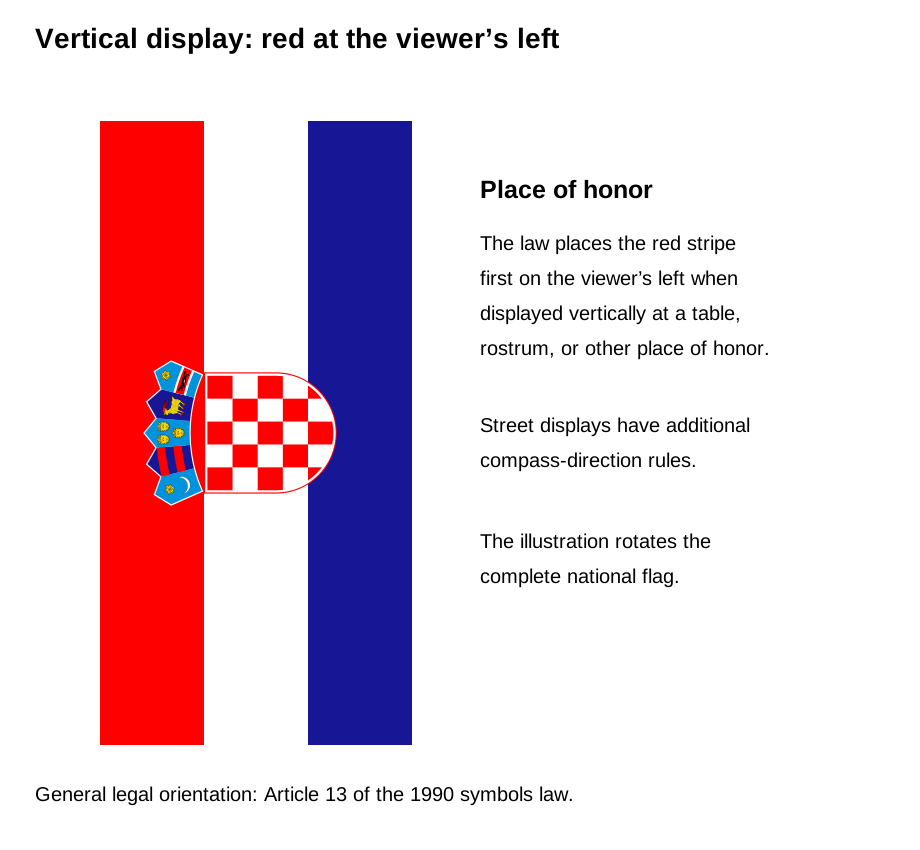
A national flag rotated so red is on the viewer’s left, illustrating the place-of-honor rule. Article 13 gives separate compass rules for streets and squares.
GKBook explanatory drawing; public-domain national-symbol artwork based on the Parliament model. Image credit and license.Download image
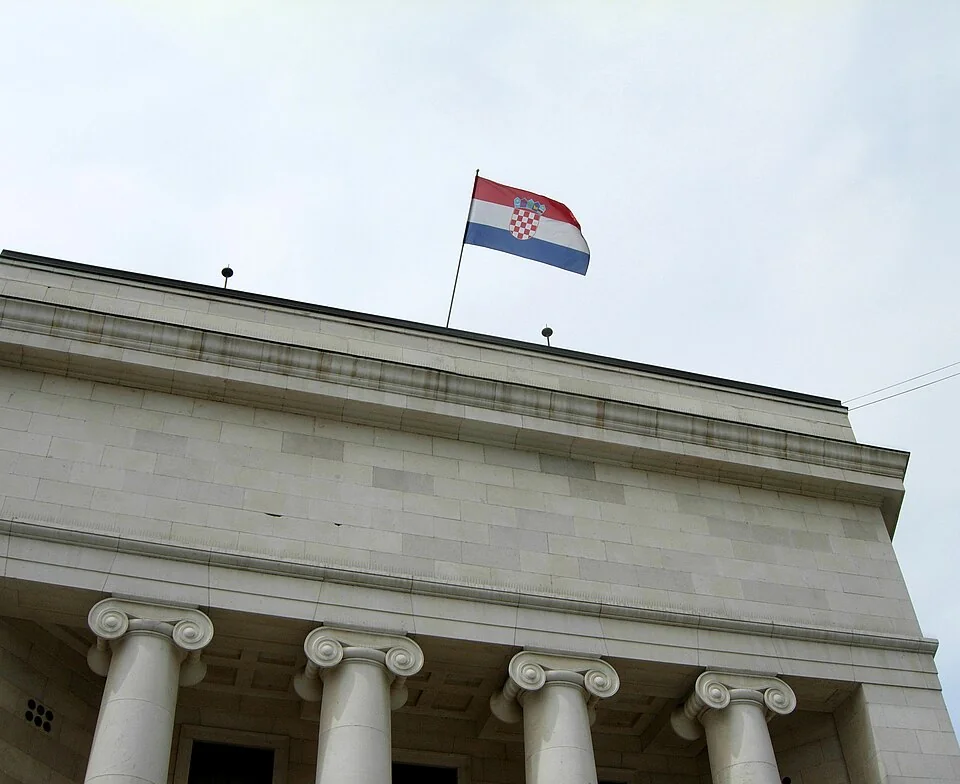
Croatia’s flag above the Croatian National Bank building in Zagreb on May 19, 2008.
Acediscovery. CC BY 4.0. Resized and converted to WebP; no crop. Image credit and license.Download image
A vertically displayed Croatian flag at the Parliament building on August 8, 2007.
Suradnik13. CC BY-SA 3.0. Converted to WebP; no crop or enlargement. Image credit and license.Download image
A Croatian flag suspended above the military parade in Zagreb on August 4, 2015.
Ex13. CC BY-SA 4.0. Resized and converted to WebP; no crop. Image credit and license.Download image
Excerpt from Narodne novine, June 11, 2025: the heading and first clause of Parliament’s decision designate June 5 as Croatian Flag Day. The continuation and signature are outside this crop.
Croatian Parliament / Narodne novine. Public-domain official text; cropped and converted from the gazette PDF. Image credit and license.Download imageFrequently asked questions
What does the Croatian flag look like?
Croatia’s flag has three equal horizontal stripes: red at the top, white in the middle, and blue at the bottom. The national coat of arms is centered on the flag. Its checkered main shield has 25 fields and a crown composed of five smaller historical shields.
What is the ratio of the Croatia flag?
The national flag’s width-to-height ratio is 2:1, also written as 1:2 when height comes first. Each stripe occupies one-third of the height. Croatia’s Maritime Code specifies a different shipboard format, with width:height 3:2, so the context matters when comparing flag measurements.
When was the current Croatian flag adopted?
The current detailed flag design was adopted on December 21, 1990, through the law governing Croatia’s state symbols. Its five-shield crown belongs to that design. The Croatian national tricolor has nineteenth-century roots, while independence in 1991 was a later political milestone rather than another flag adoption.
Why is 1848 important in Croatian flag history?
The red-white-blue tricolor emerged as a Croatian national symbol during the national revival in 1848. A prominent ceremonial example was Ban Josip Jelačić’s installation flag on June 5 that year. That historical tradition explains the date of Croatian Flag Day, although today’s detailed design dates from 1990.
How many fields are in the Croatian checkerboard?
The main shield has 25 alternating red and white fields in five rows and five columns. Because the upper-left field is red, the pattern contains 13 red and 12 white fields. These counts follow from the arrangement; the law does not assign a separate symbolic meaning to each field.
Should the first field be red or white?
In the current national coat of arms, the first field at the upper left, viewed from the front, must be red. Article 7 of the 1990 symbols law states this expressly. A white-first checkerboard should therefore not replace the red-first shield when reproducing today’s prescribed national flag.
What do the five shields above the checkerboard represent?
From the viewer’s left, the crown shows the star-and-crescent arms described by law as the oldest known Croatian arms, followed by Dubrovnik, Dalmatia, Istria, and Slavonia. These are historical heraldic identities. They are not five present-day provinces or a list of five newly assigned national values.
Is the crown a royal crown?
The shape above the main shield is formed by five small historical shields joined into a crown-like outline. It is not a separate jeweled royal crown. The individual shields carry prescribed stars, a crescent, bars, and animals, and their order is part of the national coat of arms.
What does the star and crescent on Croatia’s flag mean?
The star and crescent belong to the first small shield, which the 1990 law calls the oldest known Croatian arms. The statute specifies a gold six-pointed star above a silver crescent on blue. It does not define the entire national flag as a religious flag because of that motif.
Are the Dalmatian animals lions or leopards?
The Croatian symbols law describes the Dalmatian shield as three crowned leopard heads in yellow or gold on blue. They are arranged two above one. For a faithful national-flag drawing, retain the heads in the published model instead of substituting a different animal based on another heraldic description.
Why is there a goat on the Croatian flag?
The goat appears in the fourth small shield, representing Istria. The law describes a yellow or gold goat with red horns and hooves on a dark blue field, facing the viewer’s left. It is part of Istria’s historical arms within the national crown, not an independent modern mascot.
What is the small animal in the Slavonian shield?
The rightmost small shield represents Slavonia and contains a marten. It walks across a red field between two white or silver horizontal bars, with a gold six-pointed star above. Those details are prescribed by the symbols law and should remain visible in an accurate reproduction of the arms.
Who designed the modern Croatian flag artwork?
The Croatian Parliament credits Miroslav Šutej with the artistic design of the state symbols and Božo Kokan with their digital rendering. This credit concerns the modern composition and its published artwork. The checkered arms and the red-white-blue national tradition existed long before the current flag was adopted.
What do red, white, and blue officially symbolize?
The 1990 law describes the colors but does not assign a separate meaning such as blood, peace, or freedom to each stripe. Collectively, the symbols represent the Republic and belonging to it. The tricolor’s historical explanation is associated with the national revival and the heraldic traditions of Croatian lands.
What are the Croatian flag’s RGB and hex colors?
Parliament’s published flag construction sheet gives red as RGB 255, 0, 0, white as 255, 255, 255, and the dark blue stripe as 23, 23, 150. Their hexadecimal equivalents are #FF0000, #FFFFFF, and #171796. The arms also use light blue, yellow or gold, and black.
When is Croatian Flag Day?
Croatian Flag Day is June 5. Parliament established the observance by a decision adopted on June 6, 2025, and the first annual observance took place on June 5, 2026. The selected date recalls the tricolor used at Ban Josip Jelačić’s installation in 1848, rather than the current design’s adoption.
Is Flag Day the same as Statehood Day?
No. Croatian Flag Day falls on June 5, while Statehood Day is May 30. Statehood Day recalls the first democratically elected multiparty Parliament in 1990. The Flag Day decision does not itself declare a nonworking holiday, and neither observance replaces December 21, 1990 as the current flag’s adoption date.
Can Croatia’s national flag be shown without its arms?
The national flag described in the 1990 law includes the coat of arms at its center. That law does not define a separate emblem-free civil version. A plain red-white-blue tricolor may recall the broader historical tradition, but it does not reproduce the complete current statutory national design.
Why do some Croatian ship flags have different proportions?
Article 182 of Croatia’s Maritime Code gives the national flag on a ship a height-to-length ratio of 1:1.5, equivalent to width:height 3:2. The general national flag is 2:1 width:height. A shorter rectangular ship format can therefore be legally appropriate without changing the national stripe order or arms.
Is the presidential standard the national flag?
No. The presidential standard is a separate square blue flag with a checked border and its own heraldic composition, including the letters RH. The 1990 law describes its design and occasions of use. It should not be substituted for the rectangular red-white-blue national flag in a general flag chart.
How should the Croatian flag hang vertically?
At a table, rostrum, or another place of honor, a vertically displayed flag has red first on the viewer’s left. Article 13 provides different compass-based instructions for flags across streets and in a circular square. Identify the display setting before applying one simplified left-to-right rule to every situation.
When is the Croatian flag flown at half-mast?
The national symbols law provides for the flag to fly at half-mast for the duration of national mourning. The applicable declaration determines the actual occasion and period. The general law does not supply a complete list of automatic funeral entitlements or one fixed number of mourning days for every death.
Can a damaged Croatian flag be publicly displayed?
Article 5 of the symbols law prohibits public display of a flag or coat of arms that is worn, untidy, torn, or otherwise damaged. The condition of the object therefore matters as well as its design. Inspecting a physical flag and replacing damaged examples supports compliance with that rule.
Does Croatian law permit educational use of the flag?
Yes. Article 6 allows artistic, musical, and educational use, provided it respects the Republic’s reputation and dignity. An explanatory drawing can identify parts of the flag without claiming to replace its official design. Keep labels and schematic illustrations clearly distinguished from the complete national flag used for official display.
How is the coat of arms centered on the flag?
The law places the arms’ defined central point at the intersection of the flag’s diagonals. Parliament’s construction sheet labels that point T. Centering the entire emblem’s rectangular bounding box is not equivalent, because the crown and pointed shield extend differently above and below the intended reference point.
How can Croatia’s flag be distinguished from the Netherlands flag?
Both flags have equal red, white, and blue horizontal stripes in that order. Croatia adds its checkered national arms and uses a 2:1 national rectangle. The Netherlands flag has no central emblem and is normally 3:2. When the arms are visible, they provide the quickest reliable distinction.
How can Croatia’s flag be distinguished from Slovenia’s?
Croatia has red at the top, white in the middle, and blue below, with checkered arms at the center. Slovenia has white, blue, and red stripes and a mountain-bearing shield toward the hoist. Check both stripe order and emblem position, especially when a flag is folded or partly obscured.
Does every Croatian flag require one particular fabric?
The general national symbols law does not prescribe a single exclusive fabric for all Croatian flags. It does require respectful use and prohibits public display of damaged examples. Specialized naval regulations contain their own production provisions, which should not be turned into a universal material requirement for every national flag.

We Value Your Opinion Comments