
Costa Rica flag picture
Explore the construction sheet, the flag and pavilion, and the historical sequence.
| Country | Costa RicaThe plain flag and the state pavilion have distinct uses. |
|---|---|
| Color order | Blue · white · red · white · blueFive horizontal stripes; the center red stripe is twice the height of each other stripe. |
| Adoption | September 29, 1848Adoption of the five-stripe design; later changes concern the arms and legal standards. |
| First ceremonial raising | November 12, 1848Plaza Mayor in San José, now Parque Central. |
| Proportions | 5 : 3 — width:heightEquivalent to 3:5 height:width; the legal model measures 200 × 120 cm. |
| Design attribution | Pacífica Fernández OreamunoOfficial educational accounts credit her participation and French inspiration. |
| Current flag law | Law 10178 of 2022Defines flag and pavilion use, geometry, colors, and official meanings. |
| Flag Day observance | November 12Officially Día del Pabellón Nacional — National Pavilion Day. |
The national flag has five horizontal stripes, with the red center twice the height of each blue or white stripe. The plain flag has no emblem; the state pavilion adds the arms on a white ellipse toward the hoist. The color meanings below come from the current law.
An overview of the Costa Rica flag
The flag of Costa Rica has five horizontal stripes in the order blue, white, red, white, and blue. The red center stripe is twice as high as any of the others. The plain national flag has no emblem. The pabellón nacional, or national pavilion, adds the coat of arms on a white ellipse toward the hoist.
The five-stripe arrangement was adopted on September 29, 1848, during the presidency of José María Castro Madriz. The first ceremonial raising took place on November 12, 1848, in San José’s Plaza Mayor, now Parque Central. These dates record different events: adoption and first ceremonial display. November 12 later became National Pavilion Day.
The present legal framework is Law 10178 of 2022. It separates the plain flag, the national arms, and the pavilion into distinct chapters. That distinction matters in practice: the flag is used widely, while the arms-bearing pavilion has restricted ceremonial and institutional uses, with a special exception on November 12.
The key recognition clues are the blue outer stripes, the broad red center, and the absence or presence of the arms. A flag without the arms is a complete national symbol in its own right. It is not an unfinished pavilion or an incorrect version of the design.
The plain flag and the state pavilion
Costa Rican law uses bandera nacional for the plain flag and pabellón nacional for the ceremonial version bearing the national arms. English-language flag charts often describe these as the civil flag and state flag. The Spanish legal terms are more useful when explaining who may display each version.
The hoist is the edge attached to a pole; the fly is the free edge. On the pavilion, the arms are closer to the hoist than to the middle of the cloth. A centered emblem in a decorative illustration should not replace the placement required by Article 15.
| Feature | Plain national flag | National pavilion |
|---|---|---|
| Spanish name | Bandera nacional | Pabellón nacional |
| Stripes | Blue–white–red–white–blue | The same five stripes |
| Coat of arms | Absent | Present on a white ellipse in the red stripe |
| Typical legal role | General national display | Principal ceremonial representation of the state |
| Use on November 12 | National flag remains available for respectful use | Article 17 expressly permits schools, public offices, and private individuals to raise it that day |
Article 12 calls the pavilion the highest ceremonial representation of the Costa Rican state. This explains why the law reserves its routine display to particular institutions and offices. It does not make the plain flag less authentic. For a classroom identification exercise, a sports crowd, or a general picture of the national design, the plain five-stripe flag is the clearest starting point.
The coat of arms on the pavilion
The arms contain a landscape rather than a single geometric emblem. Article 9 of Law 10178 describes three volcanoes and a broad valley between two oceans, with a merchant ship in each. A rising sun appears at the left of the upper horizon. Above the landscape, seven equal stars form an arc.
The seven stars represent the provinces: San José, Alajuela, Cartago, Heredia, Guanacaste, Puntarenas, and Limón. The law names those provinces explicitly. The stars do not represent seven countries, seven volcanoes, or seven colors in the flag.
| Element | Documented description | How to read it |
|---|---|---|
| Seven stars | Equal-sized stars arranged in an arc | The seven provinces named in Article 9 |
| Three volcanoes | Three volcanoes above a broad valley | A landscape feature; the law does not assign three individual volcano names |
| Two bodies of water | Two oceans, each with a merchant ship | The two-sided maritime landscape is part of the legal composition |
| Rising sun | At the left of the upper horizon | A required element of the scene |
| Myrtle branches | Two branches joined by a broad white ribbon | A framing element around the upper portion |
| White ribbon | Gold lettering: “República de Costa Rica” | The country’s name, retained in Spanish |
| Blue upper ribbon | Silver lettering: “América Central” | The regional inscription, retained in Spanish |
The official-model decree, 26853-SP of May 5, 1998, adds color detail: a light-green valley, blue-green volcanoes, a blue sea, an old-gold sun, dark-green myrtle, silver stars, and a light-blue upper ribbon. Its text explains that the volcanoes were drawn with smoke to distinguish them as volcanoes. The smoke is not evidence of a particular eruption.
The arms were revised over time while the five-stripe pattern continued. The 1998 decree’s historical account explains the removal of surrounding flags and war trophies in 1906 and the addition of two stars in 1964. A pavilion with five stars can therefore belong to an earlier period; it should not be used as a current seven-star model.
The flag’s three-color palette and the arms’ more detailed palette should also be kept separate. Green, gold, and other colors occur in the arms, but the flag’s stripe colors remain blue, white, and red. The ordinary plain flag does not acquire additional stripes because its ceremonial counterpart contains a multicolored emblem.
Color specifications and screen reproduction
Law 10178, Article 2, specifies Pantone Reflex Blue for blue and Pantone 485 C for red. It names white without assigning a Pantone number. These are present legal color references, not numbers inferred from a photograph or inherited from an older online flag chart.
| Color | Legal reference | Screen value used here | Position |
|---|---|---|---|
| Blue | Pantone Reflex Blue | #001489 · RGB 0, 20, 137 | Top and bottom stripes |
| White | White; no Pantone number specified | #FFFFFF · RGB 255, 255, 255 | Second and fourth stripes |
| Red | Pantone 485 C | #DA291C · RGB 218, 41, 28 | Broad center stripe |
A color described for physical production cannot be reproduced identically on every phone, printer, and fabric. The table therefore separates the legal reference from the screen approximation. It does not assert an official RGB, CMYK, or hexadecimal standard that the law does not provide.
For a formal production order, identify the relevant material, printing process, and approved physical color reference. A photograph taken in shadow, bright sunlight, or artificial light is useful evidence of display, but it is not a reliable replacement for a color specification. Folds and camera processing can make the same stripe appear lighter or darker within one image.
The white stripe should remain visible against a white page or background. A thin outline around an educational illustration can help show the flag’s edge; that outline is a presentation aid and is not a fourth national stripe color.
Symbolism and meaning
The current law gives a concise official meaning for each color: blue represents the country’s sky, white represents peace, and red represents the blood of those who fell for freedom. These meanings appear in Articles 1 and 2 of Law 10178 and are repeated consistently in the factbox and the matching strips below.
The stripes’ meanings and the arms’ meanings operate at different levels. Blue, white, and red explain the flag’s national colors. The seven stars on the pavilion’s arms identify the seven provinces. A statement about the stars should not be transferred to the plain flag, which contains none.
Older explanations and commemorative material may associate the colors with additional ideals. Those can be discussed as interpretations when their sources are identified, but they should not replace the wording of the current law. In particular, a modern legal account should not say that no official symbolism exists: the 2022 statute supplies it directly.
How is the Costa Rica flag constructed?
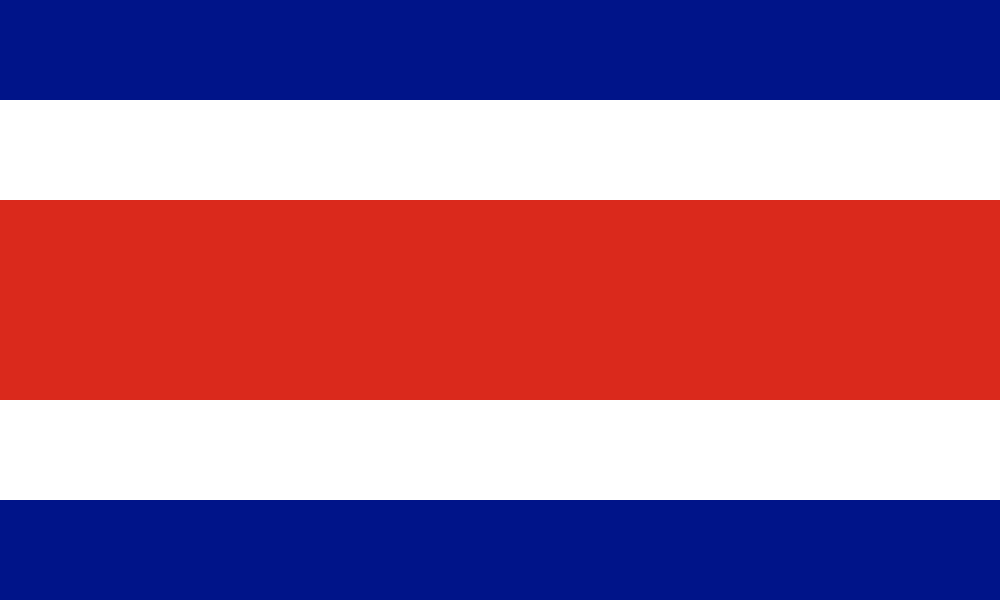
Draw a rectangle five units wide and three units high. Divide its height into six equal parts, then color the stripes blue, white, red, white, and blue. The red stripe takes two parts; each other stripe takes one. The legal model is 200 centimeters wide by 120 centimeters high.
| Stripe from top | Share of total height | 200 × 120 cm model | 1,000 × 600 SVG coordinates |
|---|---|---|---|
| 1 · Blue | 1/6 | 20 cm | y = 0 to 100 |
| 2 · White | 1/6 | 20 cm | y = 100 to 200 |
| 3 · Red | 2/6 = 1/3 | 40 cm | y = 200 to 400 |
| 4 · White | 1/6 | 20 cm | y = 400 to 500 |
| 5 · Blue | 1/6 | 20 cm | y = 500 to 600 |
The ratio 5:3 width:height is equivalent to 3:5 height:width. Both describe the same landscape rectangle. Labeling the order is essential: a bare “3:5” does not tell a reader which measurement is being given first.
Although there are five stripes, the three colors cover equal total areas on the plain flag. The two blue stripes together occupy one-third of the height, as do the two white stripes; the single red stripe occupies the remaining third. This is a calculation from the stripe geometry, not an extra symbolic meaning. The pavilion’s white ellipse and arms alter the visible color areas.
| Finished width × height | Each blue or white stripe | Red stripe | Status |
|---|---|---|---|
| 200 × 120 cm | 20 cm | 40 cm | Dimensions stated in the law |
| 100 × 60 cm | 10 cm | 20 cm | Calculated half-scale example |
| 50 × 30 cm | 5 cm | 10 cm | Calculated quarter-scale example |
| 25 × 15 cm | 2.5 cm | 5 cm | Calculated small-format example |
Horizontal stripes remain horizontal when a flag is hung from a normal pole. If it is displayed as a tall hanging object, do not stretch its drawing into a new rectangle. The visible color pattern and the physical method of suspension are separate matters; a diagram should first preserve the national design.
Exact placement of the pavilion’s white ellipse
The pavilion follows the same 200 × 120 cm outer dimensions. Article 15 places the national arms on a white ellipse whose major axis is 30 cm and minor axis 20 cm. In the standard upright rendering, that is 30 cm high and 20 cm wide. Its center lies 60 cm from the hoist, on the red stripe’s vertical midpoint.
| Measurement | Statutory 200 × 120 cm model | 1,000 × 600 drawing |
|---|---|---|
| Distance from hoist to ellipse center | 60 cm | 300 units |
| Height of ellipse | 30 cm | 150 units |
| Width of ellipse | 20 cm | 100 units |
| Ellipse center vertically | Middle of red stripe | y = 300 |
| Ellipse horizontal range | 50 to 70 cm from hoist | x = 250 to 350 |
| Ellipse vertical range | 45 to 75 cm from top | y = 225 to 375 |
At any proportional size, the center is 30 percent of the flag’s width from the hoist. The ellipse’s height is one-quarter of the total flag height, and its width is one-tenth of the flag width. These relations help detect a badge that has drifted toward the fly or an ellipse that has been enlarged beyond the stated model.
The provision determines the ellipse’s geometry but does not give a digital path for every leaf, star, or ship in the arms. The coat of arms should follow the official description and model. Its ornamental detail should not be simplified into an unrelated seal merely to make a small image easier to draw.
History: predecessors, adoption, and later standards
Costa Rica’s flag history contains several kinds of change: early replacements of the entire design, the 1848 adoption of the present stripe arrangement, later revisions to the arms, and modern laws governing use. Keeping those categories separate prevents a new legal standard or an extra star from being mistaken for the first adoption of the flag.
Independence precedes the current design
The independence anniversary marks September 15, 1821. The present five-stripe pattern came later. It is therefore inaccurate to date this particular design to the moment of independence.
Early and federal-era symbols
Early historical accounts record a white flag with a red star and the later blue–white–blue flag family associated with Central American union. The detailed day-by-day chronology differs across later accounts; these predecessors should not be confused with the five-stripe design adopted in 1848.
A replacement and a documented restoration
A decree dated April 21, 1840 established new symbols. The white–blue–white predecessor belongs to this period. On April 20, 1842, Francisco Morazán’s government repealed that decree and restored the earlier pavilion, arms, and coinage symbols. Its preamble explicitly defended Central American unity.
A republic and a new five-stripe flag
Costa Rica was proclaimed a republic on August 31. The national-symbols decree followed on September 29. Its five horizontal stripes placed red in the center, twice the height of each blue or white stripe, with the arms on white for the pavilion. The first ceremonial raising was November 12 in San José.
Changes around the arms
Law 18 of November 27, 1906 became the long-standing national-symbols law. The later official-model decree explains that surrounding flags and war trophies were removed from the arms and replaced by a gold frame. The five-stripe color order continued.
The pavilion’s dimensions in legislation
Law 60 of June 13, 1934 amended the older symbols law. The later consolidated text records the 200 × 120 cm pavilion and an offset white ellipse. The current 2022 law now provides the operative measurements and use rules; the 1934 instrument is historical.
National Pavilion Day is established
Law 768 of October 25, 1949 established November 12 as Día del Pabellón Nacional. Its preamble preserved the 1848 design decree’s wording and the account of the first ceremonial raising. The current law continues the November 12 observance.
Seven stars represent seven provinces
Law 3429 of October 21, 1964 added two stars to the five-star arms and used the name Escudo Nacional. The seven provincial stars remain in the current legal description. A change in the arms should be distinguished from a change in the stripe pattern.
An official model standardizes the arms
Decree 26853-SP of May 5, 1998 adopted an official arms model and described its colors. It included smoking volcanoes and sought consistency across official representations. The plain flag’s five-stripe arrangement did not acquire a new emblem.
A modern law separates flag and pavilion
Law 10178, signed April 25 and effective with publication on May 11, replaced the old national-symbols statutes. It specifies Pantone references, sets out flag and pavilion uses separately, and permits private display of the pavilion on November 12.
New ceremonial and mourning rules
Decree 44635-RREE of August 21, 2024 replaced the older state ceremonial decree. It provides current mourning periods and the decree-based procedure for outside flags and pavilions to fly at half-mast. This is a protocol update, not a redesign of the flag.
The early predecessors are summarized here without presenting speculative construction drawings. The 1842 restoration survives as a primary decree, while the 1848 design is quoted in the 1949 Pavilion Day law. Those legal records provide firmer anchors than an uncaptioned online row of historical flags.
Pacífica Fernández Oreamuno and design authorship
Pacífica Fernández Oreamuno is associated with the creation of the 1848 flag. The Ministry of Public Education’s official account of the republic’s anniversary credits her participation and identifies the French flag as an inspiration. She was the wife of President José María Castro Madriz, whose government adopted the new national symbols.
Her contribution and the government’s legal action should be described separately. A person can help conceive a flag while a decree gives it official status. Likewise, the first ceremonial raising is a third event. The design attribution, September 29 adoption, and November 12 raising are related parts of the story, not interchangeable dates or roles.
The familiar five-stripe Costa Rican arrangement is its own design. Referring to French inspiration does not mean that the finished flags have the same stripe layout. The strongest concise account is that Fernández participated in the creation of the design, and the Castro Madriz government established the national symbols in 1848.
In 2021, the Legislative Assembly declared Fernández Benemérita de la Patria, an official national honor. That resolution records the honor; it should not be turned into evidence for a particular sewing anecdote, private conversation, or exact sketch that the resolution does not reproduce.
The current law and the older rules it replaced
Law 10178 was signed on April 25, 2022 and published in La Gaceta No. 86 on May 11, 2022, when it took effect. Its adoption did not create the five-stripe design for the first time. Instead, it supplied a modern, consolidated framework for the flag, arms, pavilion, and their uses.
| Legal instrument | Role in this article | Present or historical |
|---|---|---|
| 1848 national-symbols decree | Adoption of the five-stripe arrangement | Historical foundation |
| Law 768 of 1949 | National Pavilion Day and historical account of first raising | Observance continued by Article 17 of the current law |
| Law 18 of 1906 and amendments | Earlier rules, including historical dimensions and uses | Expressly repealed by Law 10178 |
| Decree 26853-SP of 1998 | Official model and detailed colors of the arms | Model text read alongside the current statutory arms description |
| Law 10178 of 2022 | Flag, pavilion, arms, proportions, colors, display, and restrictions | Current national-symbols statute |
| Decree 44635-RREE of 2024 | State ceremonial, funerals, and official mourning | Current ceremonial framework reviewed here |
Article 23 repealed the 1906 law and the amending laws of 1934, 1964, and 1976. Old tables of square military flags, absolute restrictions on private pavilion use, or historical fines should therefore not be copied into a current guide without checking the later law. The special private-use permission on November 12 is a clear example of a rule that an older summary can miss.
The distinction was applied within the judiciary in Supreme Court Circular 213-2023. It directed judicial offices outside the Supreme Court headquarters to use the plain national flag, including in entrances and courtrooms, while reserving the pavilion for the specified settings. “Government flag” is consequently too broad a shortcut if it implies that every government office routinely flies the pavilion.
Other restrictions concern the arms in private seals or trademarks, the symbols as organizational or political badges, and special official vehicle plates. These are different subjects from respectful display of a plain flag on a vehicle during an authorized patriotic occasion. A rule about official license plates should not be expanded into a claim that every flag on transport is forbidden.
Manufacture and checking a finished flag
Article 2 says the flag’s fabric should preferably be silk. “Preferably” is significant: the provision is not a statement that every lawful flag must be made exclusively from silk. The same article requires enlargements and reductions to preserve the 200 × 120 cm proportions.
Checks supported by the legal design
- Keep blue at the top and bottom, white next to the blue, and red in the center.
- Make the red stripe twice the height of each other stripe.
- Preserve 5:3 width:height when enlarging or reducing the rectangle.
- Use the law’s blue and red color references; distinguish them from on-screen approximations.
- For the pavilion, verify the white ellipse’s size, hoist offset, and current seven-star arms.
Practical production advice
- Measure the finished visible cloth separately from sleeves, hems, and reinforcement.
- Check that the stripe boundaries meet cleanly across seams.
- Inspect both sides for alignment and a recognizable, complete design.
- Keep diagram labels and guide lines off a finished flag.
- Use the commissioning authority’s approved physical sample and any additional procurement requirements.
The first set of checks follows the statute and the calculated geometry. The second is general workmanship advice. The law’s basic description should not be supplemented with invented requirements for stitch count, fabric weight, dye tolerance, an exclusive supplier, or a certification mark.
For the pavilion, the law describes the arms in color on a white ground. A small printed flag can lose fine details in the ships, myrtle, and lettering, so quality checking should look beyond the number of stripes. A recognizable current arms design and the correct placement are more useful checks than decorative fringe or the style of the pole finial.
Article 20 prohibits flying flags or pavilions that are torn, faded, incomplete, or otherwise in a condition showing disrespect. Material durability therefore matters to ongoing display, even though the basic flag law does not provide a full textile-testing specification.
Flag Day: November 12, National Pavilion Day
Costa Rica observes National Pavilion Day on November 12. Its Spanish name is Día del Pabellón Nacional. Law 768 established the observance in 1949 to recall the first ceremonial raising in 1848, and Article 17 of Law 10178 continues it today.
The day has a practical legal consequence as well as a historical meaning. Public and private schools and public offices honor the pavilion and may raise it. Private individuals may also raise the pavilion on November 12, with due respect. This express exception is why a simple statement that private people can “never” fly the arms-bearing version is incomplete.
| Date | What it marks | Keep it distinct from |
|---|---|---|
| September 15 | Independence anniversary, dating to 1821 | Adoption of the current stripe arrangement |
| September 29 | The 1848 national-symbols decree | The first ceremonial raising |
| November 12 | First ceremonial raising in 1848; National Pavilion Day | The September adoption date |
A photograph of a flag at a roundabout or public square is not automatically a photograph of this observance. The documentary images on this page retain their actual dates and locations. A dated ordinary display can explain how the flag looks in use without being relabeled as an anniversary ceremony.
National Day and school ceremonies
September 15 commemorates Costa Rica’s independence and the Central American declaration of 1821. The Ministry of Public Education organizes annual educational activities around that anniversary. It is a national-history observance, while November 12 specifically honors the pavilion.
The Ministry’s 2026 teaching guide advises schools, where possible, to raise the flag at the start of the school day and lower it before the day ends. Its ceremony guidance places the flag on the presiding person’s right, which is the audience’s left, and describes standing respectfully during its entrance. These are attributed school-ceremony instructions, not a replacement for the general law.
A school program can therefore explain three points together: how to recognize the stripe pattern, why the flag differs from the pavilion, and what the date commemorates. Article 19 of the current law specifically calls for civic education about the symbols and their differences. The educational purpose is understanding as well as correct display.
Display, handling, and the position of honor
The plain national flag must fly outside public buildings and institutions and occupy a prominent place inside them. The law also requires it at ports of entry and exit, including those operated under concession. For private display, Article 4 permits respectful use during patriotic festivities and nationally significant commemorations and expressly allows citizens to keep the flag raised permanently in an appropriate setting.
What the flag law requires
- Treat the flag with respect and place it in a prominent, visible position of honor.
- Keep it from dragging on or touching the ground.
- Preserve the design without added slogans or inscriptions.
- Use a sound, complete flag rather than a torn or badly faded one.
- Give it the prescribed priority when displaying it with domestic institutional flags.
Distinctions that prevent mistakes
- Use the plain flag for general display; check the pavilion’s narrower permissions separately.
- Do not apply the pavilion’s 6 a.m.–6 p.m. schedule automatically to every plain flag.
- Do not interpret domestic precedence as permission to subordinate another country’s national flag.
- Distinguish ordinary flag display on transport from rules about official vehicle plates.
- A historical ceremony or photograph does not establish a universal display rule.
The law’s “right” is defined from the position of a person standing with their back to the display. In a typical front-facing arrangement, this places the national flag on the audience’s left. That viewpoint is easy to reverse accidentally. Describe the observer’s position whenever giving instructions such as “put it on the right.”
| Arrangement | Rule in Article 7 | Viewpoint or limitation |
|---|---|---|
| Two flags | Costa Rica occupies the position of honor on the right | Right is defined from behind the display, facing the audience |
| An odd number of flags | Costa Rica occupies the center | Domestic arrangement under the statute |
| An even number of flags | Costa Rica occupies the right of the two central positions | Use the law’s defined viewpoint |
| Same halyard with provincial, city, or society flags | The national flag is highest | This clause names subordinate domestic flags |
| Flags of other states | Follow international practices and applicable international-organization rules | Article 8 treats this separately |
The plain flag’s stripe pattern has the same top-to-bottom order from either side. The pavilion’s arms remain physically toward the hoist, so a reverse-side view places them toward the viewer’s right when the pole is on that side. A photograph must be read together with the pole, folds, and viewing direction.
Where and when the pavilion is used
Article 14 reserves routine pavilion display to the principal seats of the Supreme Powers—Casa Presidencial, the Legislative Assembly, and the Supreme Court—and to the Supreme Electoral Tribunal and Costa Rican diplomatic and consular missions abroad. It also provides for a pavilion on a pedestal in the principal offices of members of the Supreme Powers.
| Requirement | Current rule | Relevant distinction |
|---|---|---|
| Time of raising and lowering | Raise at 6 a.m.; lower at 6 p.m. | Article 16 concerns the pavilion |
| Occasion | Official acts | Do not treat it as an unrestricted decorative flag |
| Location | The places authorized by Article 14 | General public-building flag duties usually concern the plain flag |
| Inside a room | One national pavilion, in the position of honor | The law defines the right from behind the display |
| November 12 | Schools, public offices, and private individuals may raise it respectfully | Express exception in Article 17 |
The pavilion and plain flag can look almost identical at a distance. Look for the white ellipse and the national arms within the broad red stripe. When a photograph shows an official event, its context can help identify the object, but the presence of an official does not by itself establish which flag is visible.
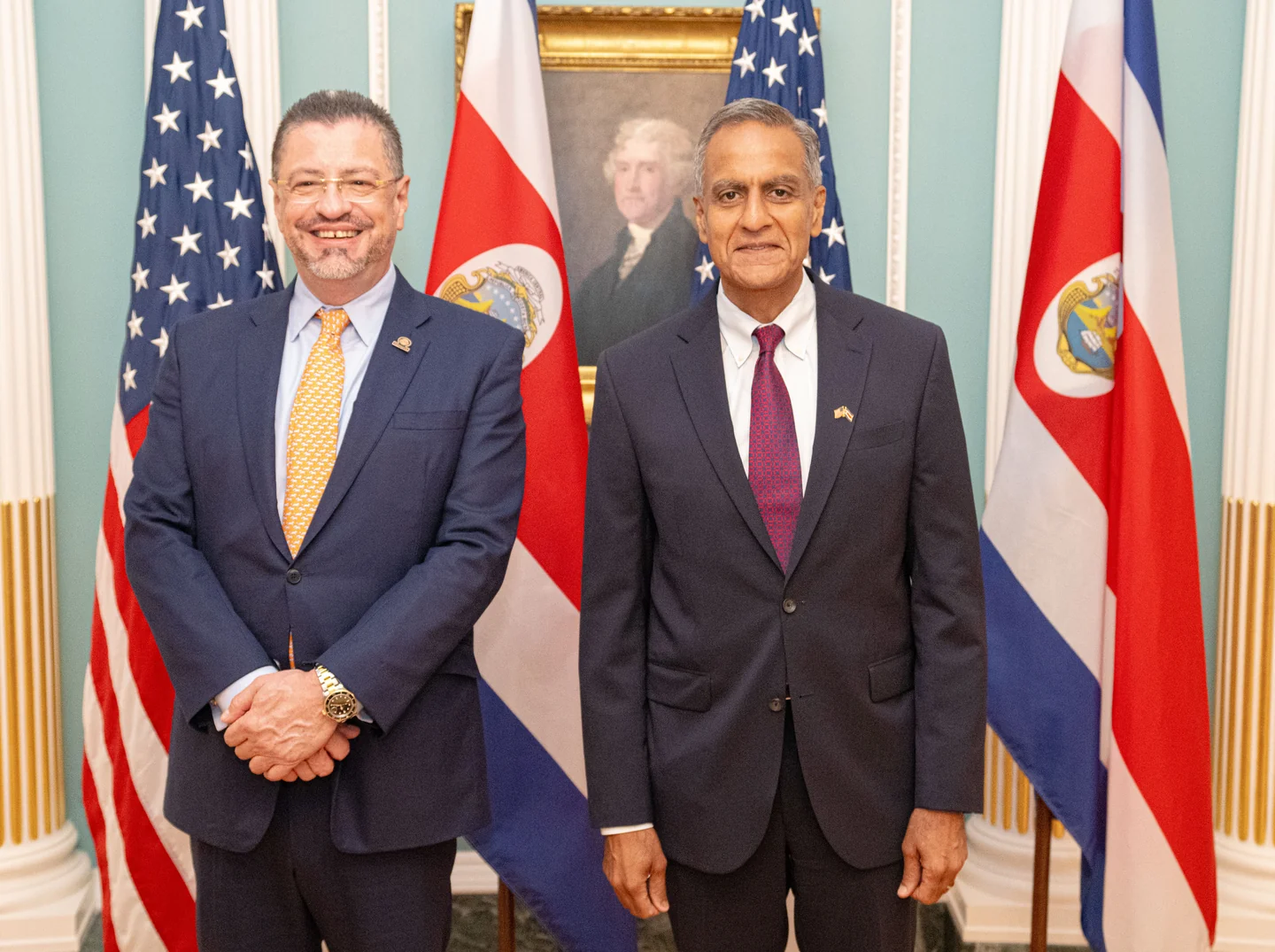
This dated diplomatic photograph shows arms-bearing Costa Rican pavilions behind the participants. It illustrates the ceremonial form in a real setting. It is not a photograph of the flag’s adoption or a guide to every possible international arrangement.
Costa Rica and Thailand: a useful comparison
Costa Rica and Thailand both have five horizontal stripes, with a center stripe twice the height of each neighboring stripe. The color order is different: Costa Rica has blue outer stripes and a red center; Thailand has red outer stripes and a blue center. The center color is the quickest recognition clue.
| Clue | Costa Rica | Thailand |
|---|---|---|
| Top and bottom | Blue | Red |
| Center stripe | Red | Blue |
| Intermediate stripes | White | White |
| Width:height | 5:3 | 3:2 |
| Arms on the form discussed here | Absent on plain flag; present on pavilion | Absent on the national tricolor |
Do not identify a flag from a list of color names alone. Their order, relative stripe heights, proportions, and any emblem determine the design. In a tightly cropped photograph, checking which color borders the top edge is often more reliable than judging a small difference in shade.
Common misconceptions about the Costa Rica flag
| Misconception | Accurate distinction |
|---|---|
| “Every Costa Rica flag must include the arms.” | The plain national flag is complete without them; the pavilion is a separate ceremonial form. |
| “All five stripes are equal.” | The red stripe is twice the height of each other stripe. |
| “The current flag was adopted in 1821.” | Independence dates to 1821; the five-stripe design dates to 1848. |
| “September 29 and November 12 are competing adoption dates.” | September 29 is adoption; November 12 records the first ceremonial raising and the later annual observance. |
| “The seven stars represent seven Central American countries.” | Article 9 says they represent Costa Rica’s seven provinces. |
| “The arms belong in the exact horizontal center of the pavilion.” | The legal ellipse center is 60 cm from the hoist on a 200 cm-wide model. |
| “Private people can never fly the pavilion.” | Article 17 expressly allows respectful private display on November 12. |
| “The law requires silk in every case.” | It says silk is preferred. |
| “Online hexadecimal codes are the legal specification.” | The law names Pantone references for blue and red; the page’s hex values are screen approximations. |
| “Every flag must be lowered at 6 p.m.” | The 6 a.m.–6 p.m. provision is in the pavilion chapter; plain-flag use is separately regulated. |
| “The flag and Thailand’s flag are the same.” | Their outer and center colors are reversed, and the stated proportions differ. |
When identifying an old image, check the date before treating an unfamiliar arms design as an error. When evaluating a current flag, use current specifications. A historical five-star pavilion and a modern plain flag answer different questions; neither should be mistaken for a defective copy of the other.
Half-mast and official mourning
Costa Rica’s current state ceremonial decree provides specific periods of official mourning. Under Articles 53 and 54 of Decree 44635-RREE of 2024, mourning is declared by an executive decree, and the outside pavilion, where flown, remains at half-mast. The outside national flag is treated likewise where applicable.
| Circumstance in Article 53 | Mourning period | Application |
|---|---|---|
| Death of the serving president of Costa Rica | Eight days | Declared through the required executive decree |
| Death of a former president, or the head of another state power or the Supreme Electoral Tribunal | Three days | The rule identifies particular offices |
| Death of a foreign head of state or government | Three days | The decree includes a separate papal exception |
| Death of the pope | Four days | Express exception in Article 53(c) |
| Other cases at the presidency’s discretion | Up to three days | Check the actual declaration and its dates |
A documented application is Decree 44970-RE of April 21, 2025, issued after the death of Pope Francis. It declared four days of mourning, April 21–24, 2025, and required half-mast pavilion display at the relevant public institutions. The date range belongs to that specific decree and should not be reused for a future observance.
For a particular mourning period, the executive announcement supplies the dates and instructions. The decree’s treatment of flags outside does not call for drawing a black stripe across the cloth or replacing the national colors. Half-mast changes the flag’s position on its staff; it does not change the national design.
State funeral treatment
The same ceremonial framework distinguishes a state funeral from the length of official mourning. Articles 42–43 provide for an offer of state funeral honors to the family and identify the eligible offices and honors. The categories include the president, former presidents, national honorees, vice presidents, ministers, legislators, specified magistrates, and specified diplomatic office holders.
Under Article 44, the coffin is covered with the national pavilion during the state funeral ceremony. For a cremation urn, the pavilion is displayed on a pedestal. The pavilion is handed to the family before burial or transport. These are provisions for the state funeral framework, not a general entitlement for every private funeral.
The picture gallery below keeps flat flag drawings, explanatory construction diagrams, a primary legal document, and documentary photographs clearly labeled. The FAQ then collects concise answers to the main questions about recognition, history, dimensions, and use.
Costa Rica flag pictures
The plain national flag: blue, white, red, white, and blue in a 1:1:2:1:1 stripe ratio.
GKBook original diagram. CC0 1.0. Screen colors are editorial approximations. Image credit and license.Download image
The state pavilion adds the national arms in a white ellipse toward the hoist. The ellipse follows the legal dimensions; the arms are a public-domain vector rendering.
GKBook flag geometry, CC0 1.0; coat of arms adapted from xrmap/HansenBCN and Commons contributors, public domain; inscription colors adjusted to the law. Image credit and license.Download image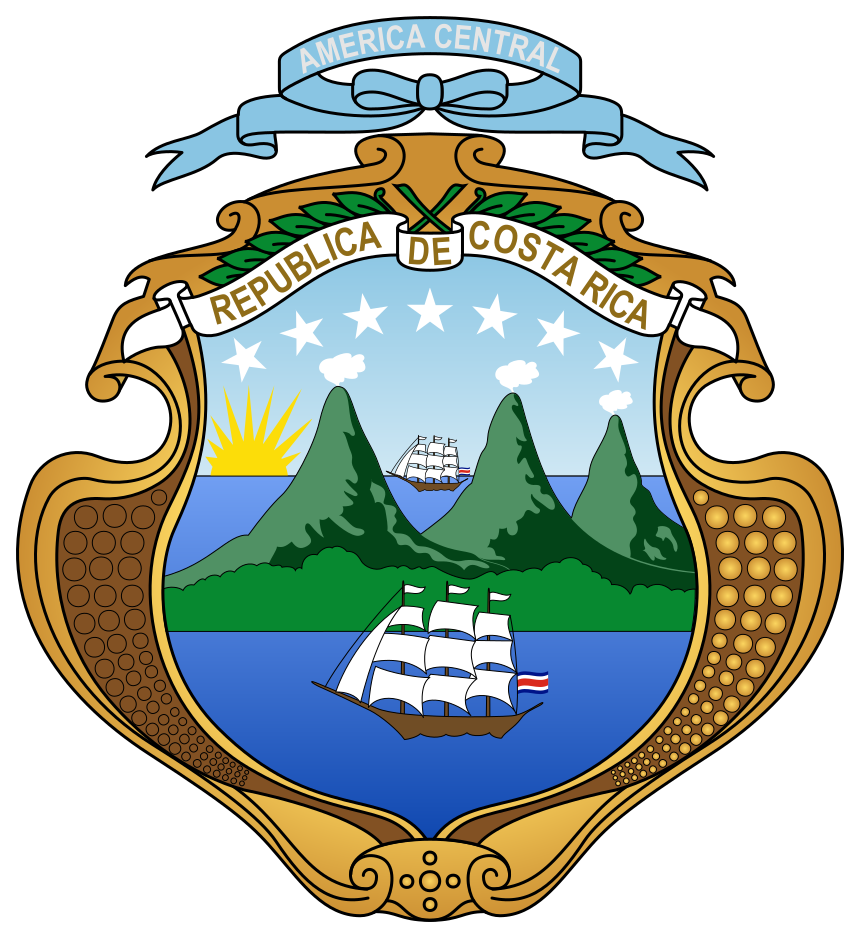
The national arms show seven stars, three volcanoes, a valley, two oceans, two merchant ships, a rising sun, myrtle, and two inscriptions.
xrmap flag collection / HansenBCN and Wikimedia Commons contributors, including HapHaxion. Public domain. SVG optimized and framed; inscription colors adjusted to the statutory gold and silver descriptions. Image credit and license.Download image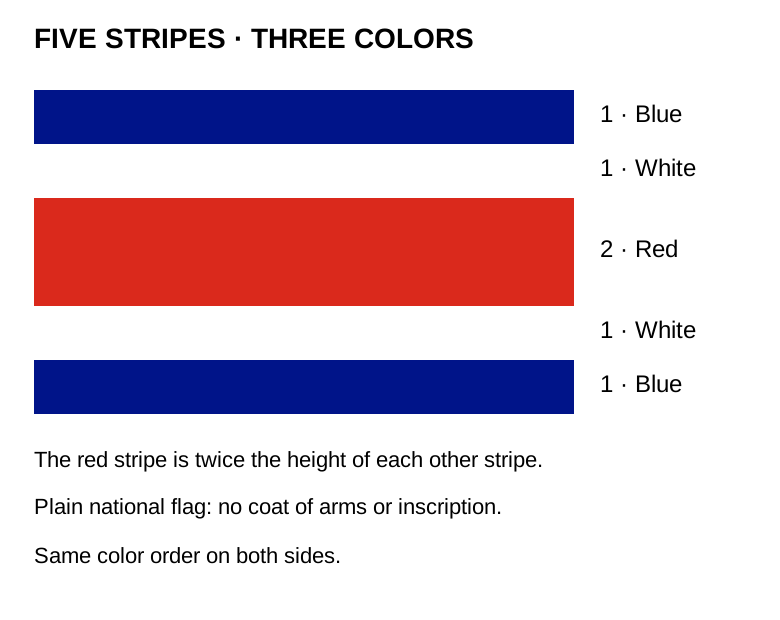
The center red stripe occupies one-third of the height. Each blue or white stripe occupies one-sixth. Labels are explanatory and are not printed on the flag.
GKBook original diagram. CC0 1.0. Screen colors are editorial approximations. Image credit and license.Download image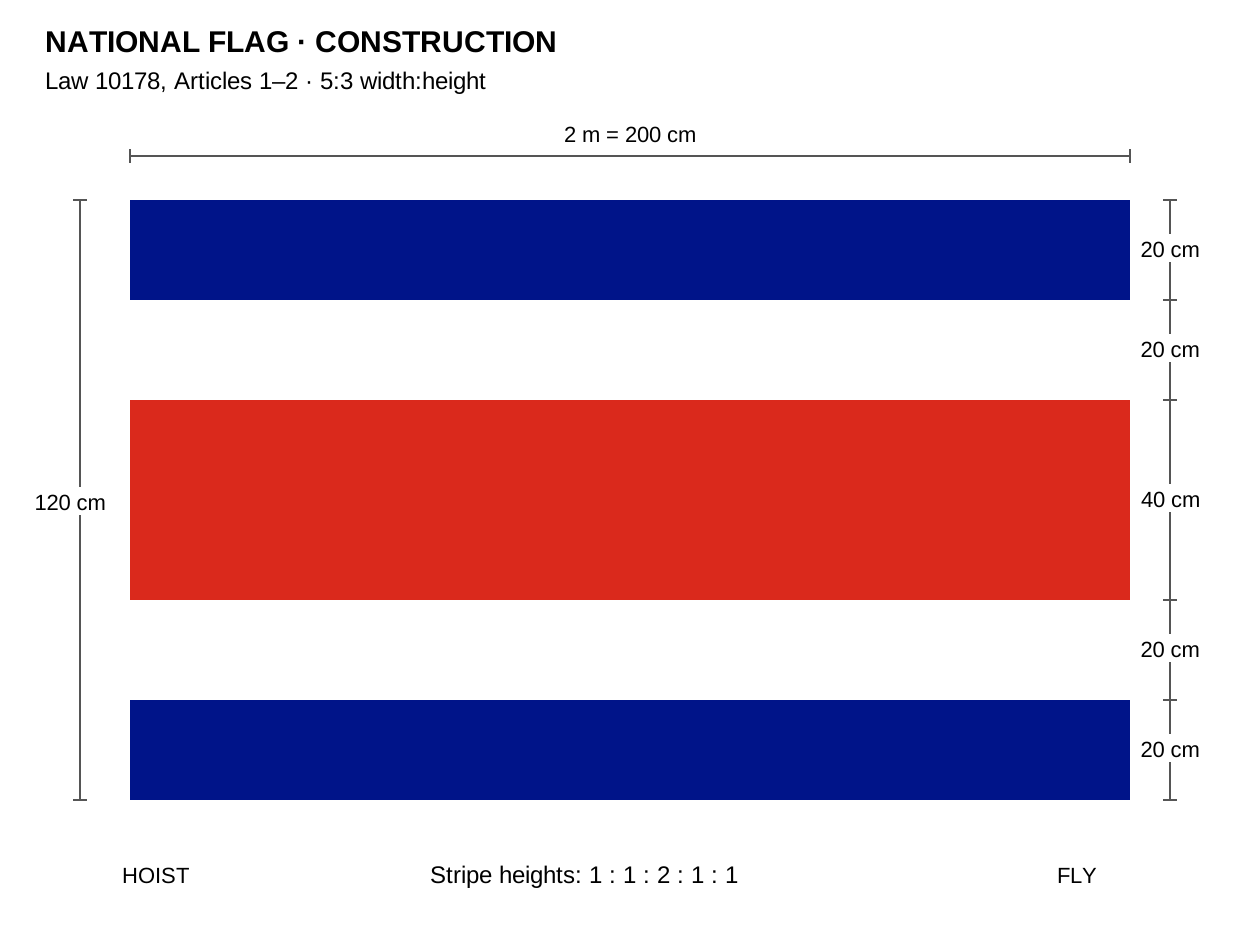
The law’s 200 × 120 cm model has stripe heights of 20, 20, 40, 20, and 20 cm. Smaller and larger reproductions preserve these proportions.
GKBook original diagram. CC0 1.0. Screen colors are editorial approximations. Image credit and license.Download image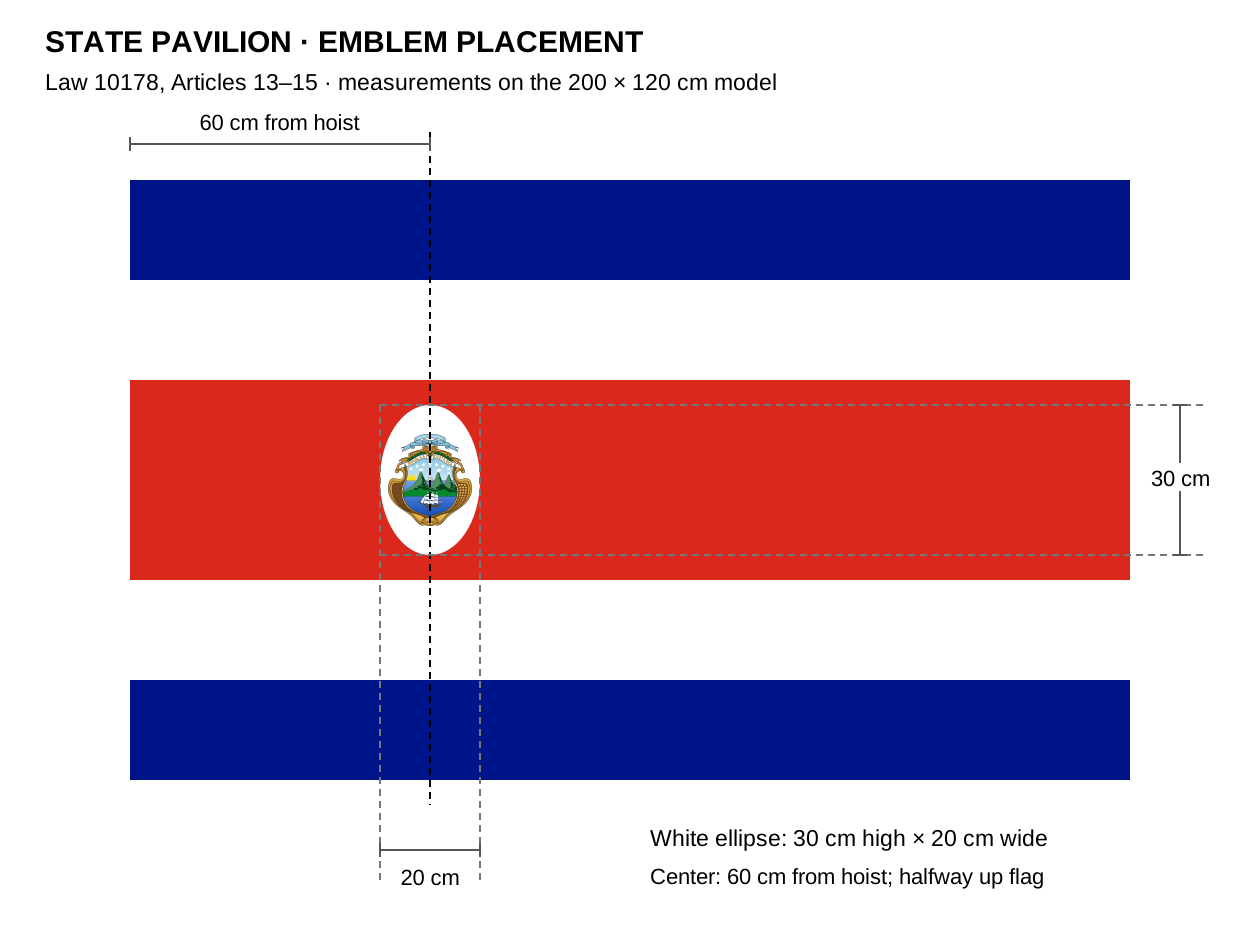
At the statutory 200 × 120 cm size, the white ellipse is 30 cm high and 20 cm wide, centered 60 cm from the hoist on the centerline of the red stripe. Arms artwork inside it is a rendering choice.
GKBook original diagram. CC0 1.0. Screen colors are editorial approximations. Image credit and license.Download image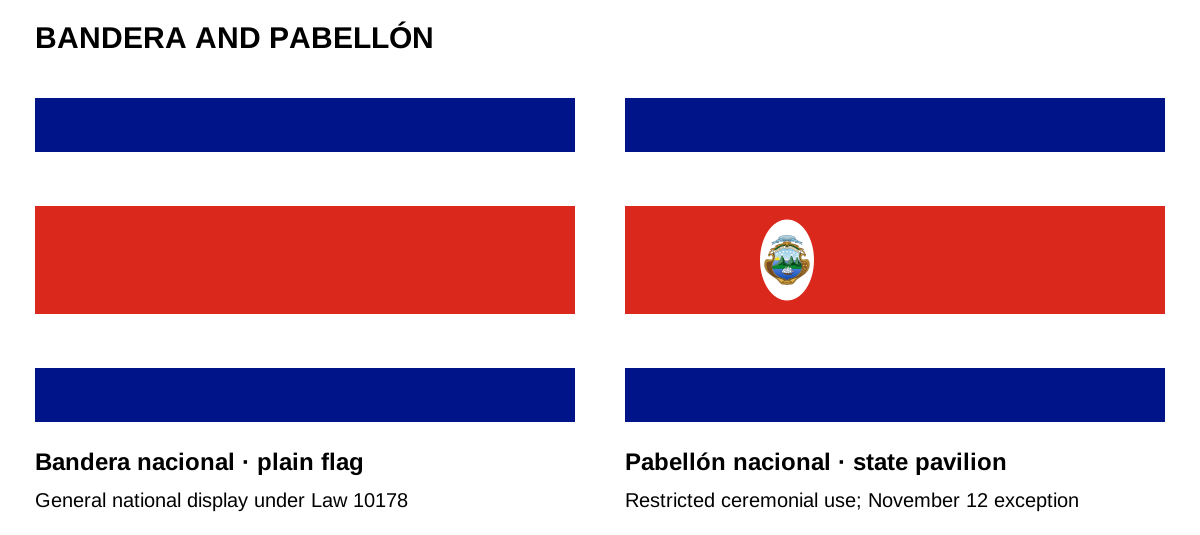
The colored stripes are the same. The presence of the coat of arms identifies the pavilion, whose display is more restricted than that of the plain flag.
GKBook original diagram. CC0 1.0. Screen colors are editorial approximations. Image credit and license.Download image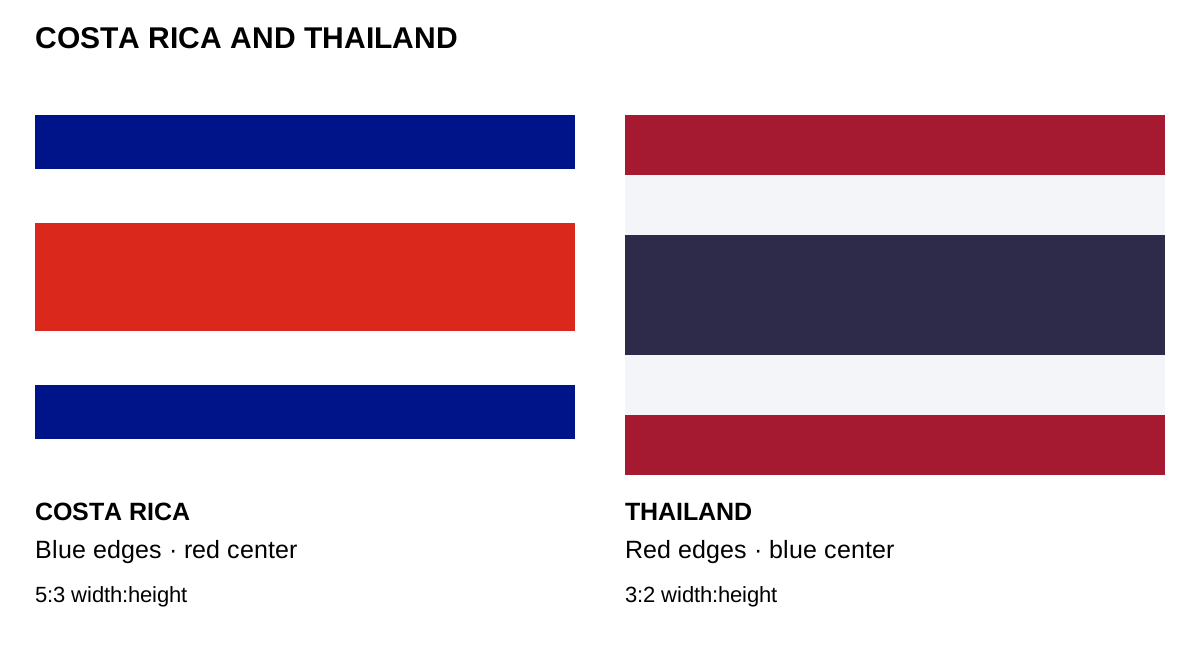
Costa Rica has blue outer stripes and a red center; Thailand has red outer stripes and a blue center. Both use 1:1:2:1:1 stripe heights, but their usual proportions differ.
GKBook original diagram. CC0 1.0. Screen colors are editorial approximations. Image credit and license.Download image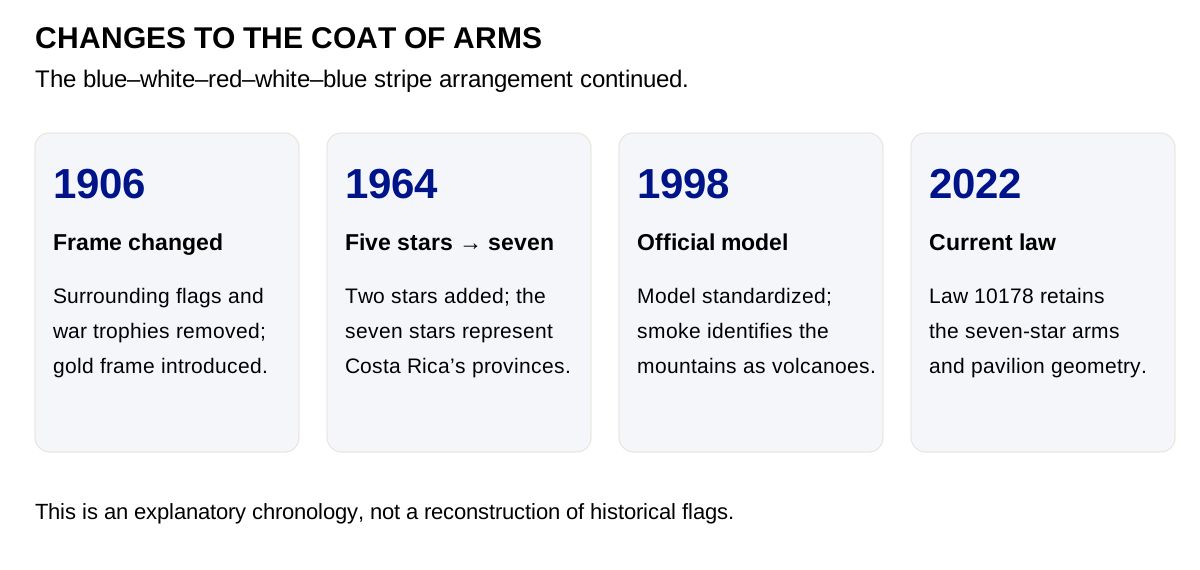
Changes in 1906, 1964, and 1998 concern the arms or their official model. They should not be mistaken for changes to the five-stripe color order adopted in 1848.
GKBook original diagram. CC0 1.0. Screen colors are editorial approximations. Image credit and license.Download image
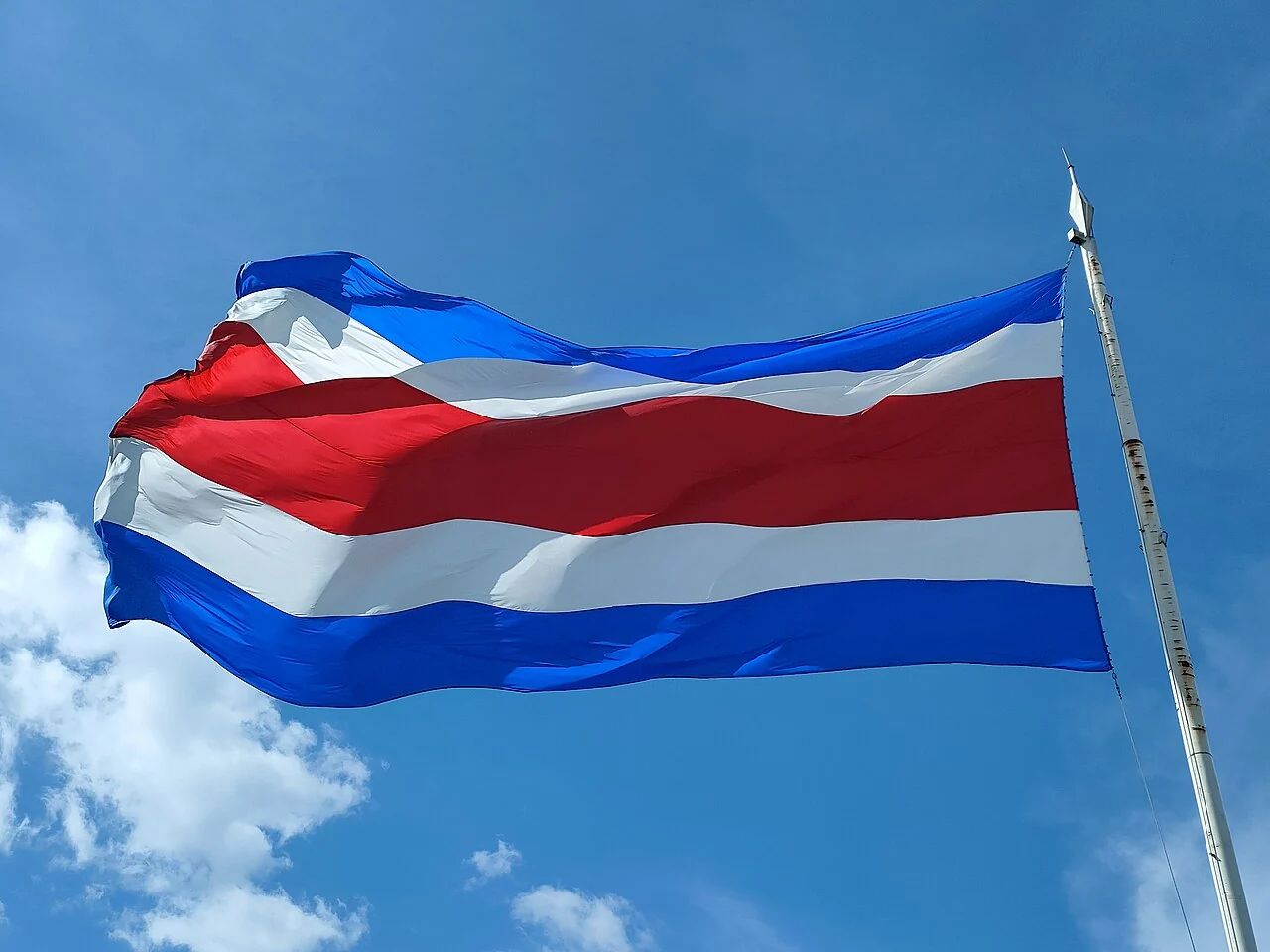
Costa Rica’s plain national flag at Plaza Mayor in Cartago on April 18, 2025.
Rubýñ. CC0 1.0. Resized and converted to WebP; no crop. Image credit and license.Download image
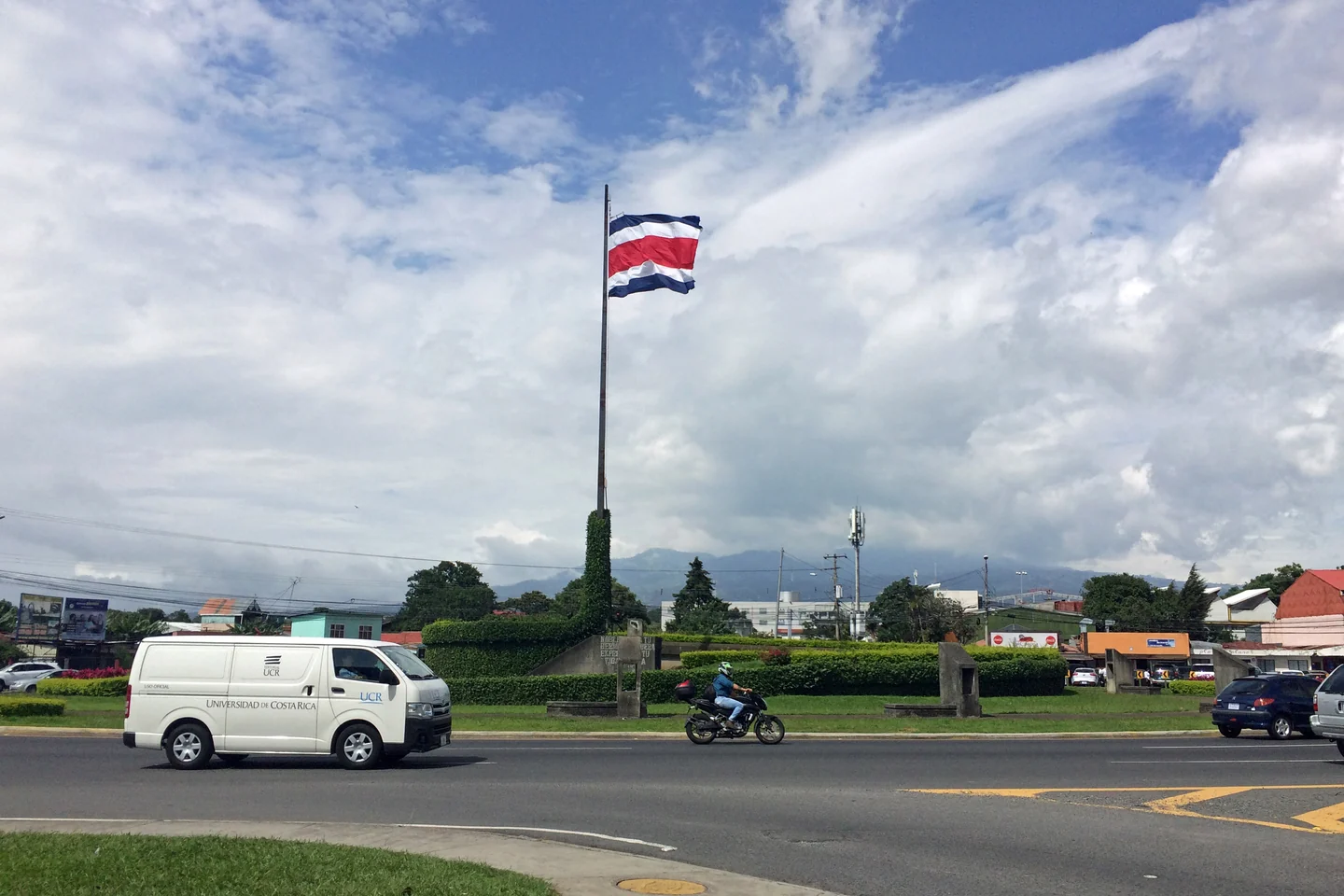
The flag at La Bandera roundabout in San Pedro, San José, photographed on July 14, 2016.
Mariordo (Mario Roberto Durán Ortiz). CC BY-SA 4.0. Resized and converted to WebP; no crop. Image credit and license.Download image
Costa Rican President Rodrigo Chaves, left, and U.S. Deputy Secretary Richard R. Verma at the State Department in Washington, DC, on August 30, 2023; Costa Rican pavilions and U.S. flags stand behind them.
Freddie Everett / U.S. Department of State. Public domain. Resized and converted to WebP; no crop. Image credit and license.Download image
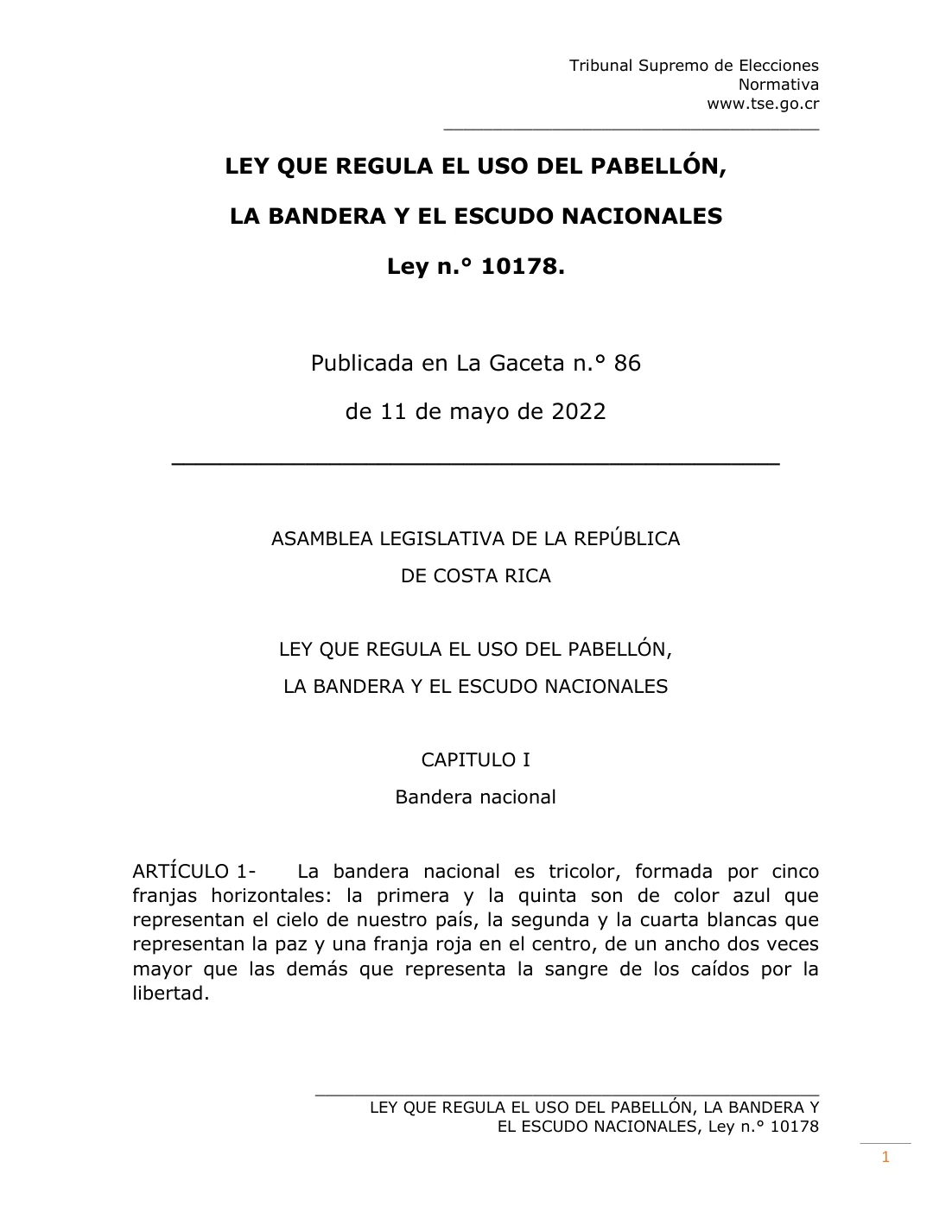
First page of Law 10178, as published in the Supreme Electoral Tribunal’s statutory compilation. The opening provision defines the stripes and their official symbolism.
Costa Rican statutory text; public domain. PDF page rendered as WebP. Image credit and license.Download imageFrequently asked questions
What does the Costa Rica flag look like?
Costa Rica’s plain flag has five horizontal stripes: blue, white, red, white, and blue. The red center stripe is twice the height of each other stripe. Its width:height ratio is 5:3. The plain flag has no emblem; the state pavilion adds the national coat of arms.
What do the colors mean?
Law 10178 gives official meanings for all three colors. Blue represents the sky of Costa Rica, white represents peace, and red represents the blood of those who fell for freedom. These meanings appear in the current statute and should be distinguished from additional interpretations found in older explanatory accounts.
When was the five-stripe flag adopted?
The five-stripe design was adopted on September 29, 1848, during José María Castro Madriz’s presidency. The first ceremonial raising followed on November 12, 1848, in San José’s Plaza Mayor, now Parque Central. Adoption and first raising are different events, so the two dates do not conflict.
Who designed the Costa Rica flag?
Pacífica Fernández Oreamuno is credited with participating in the creation of the 1848 flag. The Ministry of Public Education’s historical account identifies French inspiration. Her design contribution should be distinguished from the government decree that adopted the symbols and from the ceremony at which the pavilion was first raised.
What is the difference between the bandera and the pabellón?
The bandera nacional is the plain five-stripe national flag. The pabellón nacional adds the national arms on a white ellipse toward the hoist. Law 10178 treats them separately: the flag has broad national uses, while the pavilion is the state’s principal ceremonial symbol and has more restricted uses.
Is a Costa Rica flag without the coat of arms correct?
Yes. The plain national flag is an official form in its own right, defined in the opening chapter of Law 10178. It is not an incomplete pavilion. The coat of arms distinguishes the ceremonial pavilion, whose routine display is reserved to particular institutions, offices, and authorized occasions.
What is the correct aspect ratio?
The ratio is 5:3 width:height, equivalent to 3:5 height:width. Article 2 of Law 10178 gives a model two meters long and 1.20 meters high and requires proportional enlargements or reductions. Always label the dimension order so that a ratio is not mistaken for an upright rectangle.
How wide are the five stripes?
Measured vertically, their heights are in the ratio 1:1:2:1:1. Each blue or white stripe occupies one-sixth of the total flag height, while the red stripe occupies one-third. On the law’s 200 × 120 cm model, the stripe heights are 20, 20, 40, 20, and 20 cm.
Do the three colors cover equal areas?
On the plain flag, yes. The two blue stripes together occupy one-third of the rectangle, the two white stripes another third, and the red center the final third. This is a calculation from the stripe proportions. The pavilion’s white ellipse and multicolored arms change the visible color areas.
Are the flag’s Pantone colors official?
Yes. Article 2 of Law 10178 names Pantone Reflex Blue for blue and Pantone 485 C for red. It names white without a Pantone number. The hexadecimal and RGB values shown in this article are selected screen approximations; those digital codes are not written into the law.
Where is the coat of arms placed on the pavilion?
The arms sit on a white ellipse in the red stripe, toward the hoist. On the 200 × 120 cm model, the ellipse is 30 cm high and 20 cm wide, with its center 60 cm from the hoist. It is not centered across the full flag width.
What do the seven stars represent?
The seven stars on the national arms represent San José, Alajuela, Cartago, Heredia, Guanacaste, Puntarenas, and Limón, Costa Rica’s seven provinces. Article 9 names them explicitly. The stars belong to the arms on the pavilion; the ordinary plain national flag has no stars or other emblem.
What do the three volcanoes show?
The arms’ legal description calls for three volcanoes and a broad valley between two oceans, with a merchant ship in each ocean. The 1998 official-model decree explains that smoke identifies the mountains as volcanoes. The current statute does not assign three specific named volcanoes to those depicted forms.
Why do some old pavilions have only five stars?
The national arms formerly had five stars. Two were added in 1964, producing the seven-star representation of the provinces used today. A dated historical image can therefore correctly show five stars. It should not be used as a current model, and the change did not alter the stripe order.
Did the national flag change in 1998?
The 1998 decree adopted an official model of the national arms and described its colors and smoking volcanoes. It addressed consistency in the emblem’s representation. The blue–white–red–white–blue stripe arrangement was not newly adopted that year; its history goes back to the national-symbols decree of September 1848.
When is Flag Day in Costa Rica?
The formally named observance is National Pavilion Day, Día del Pabellón Nacional, on November 12. It commemorates the first ceremonial raising in 1848. Law 768 established the day in 1949, and Article 17 of the current law continues it with special honors and permissions for displaying the pavilion.
Can private individuals fly the pavilion?
Article 14 restricts routine use of the national pavilion to specified institutions and offices. Article 17 provides an express exception on November 12, when private individuals may raise it respectfully. A claim that private people may never display the pavilion overlooks this specific National Pavilion Day permission.
Can people keep the plain flag flying permanently?
Article 4 expressly allows a citizen to keep the national flag raised permanently as a patriotic gesture, provided it is in an appropriate place and receives the required legal and respectful treatment. This permission concerns the plain flag and should not be confused with the pavilion’s narrower display rules.
Must every Costa Rica flag be lowered at 6 p.m.?
Article 16 sets a 6 a.m. raising time and a 6 p.m. lowering time for the national pavilion. That provision belongs to the pavilion chapter. The plain national flag has separate rules, including the Article 4 permission for citizens to maintain a respectful permanent display in an appropriate setting.
What does the position of honor on the right mean?
The law defines the right from the position of someone standing with their back to the display. In a typical arrangement facing an audience, this is the audience’s left. Odd and even groups have additional placement rules, while displays with foreign national flags follow the separate international-practice provision.
Is silk mandatory for every flag?
No. Article 2 says the flag’s fabric should preferably be silk. It does not make silk the only permissible material in that provision. The law still requires the correct proportions and respectful condition, and Article 20 prohibits flying torn, faded, incomplete, or otherwise disrespectfully maintained flags and pavilions.
Why is September 15 different from November 12?
September 15 marks the independence anniversary dating to 1821. November 12 is National Pavilion Day and recalls the first ceremonial raising of the 1848 design. September 29 is the design’s adoption date. Keeping these events separate avoids giving the current flag an incorrect independence-era adoption date.
How can I tell Costa Rica’s flag from Thailand’s?
Check the broad center stripe and the outer edges. Costa Rica has a red center and blue outer stripes; Thailand has a blue center and red outer stripes. Both use the 1:1:2:1:1 stripe-height pattern. Costa Rica’s width:height ratio is 5:3, while Thailand’s is 3:2.
When is the flag flown at half-mast?
The 2024 state ceremonial decree provides for half-mast display during officially declared mourning. An executive decree establishes the observance, and the outside pavilion and, where applicable, the outside national flag are lowered. The duration depends on the category in Article 53 and the specific dates in the declaration.
What are the official mourning periods?
The 2024 decree specifies eight days for a serving Costa Rican president, three for the listed former presidents or institutional heads, and three for a foreign head of state or government. A pope’s death has a four-day exception. Other discretionary cases may last up to three days, under an executive declaration.
May the pavilion cover a coffin?
Article 44 of the state ceremonial decree provides for covering the coffin with the national pavilion during a state funeral. For a cremation urn, the pavilion is displayed on a pedestal. It is then handed to the family. These provisions belong to the state funeral framework, not every private funeral.
Can I download the flag and construction diagrams?
Yes. The gallery links to actual flag drawings, construction diagrams, an arms detail, a comparison, a legal-document image, and three documentary photographs. Captions distinguish diagrams from historical evidence. The photographs retain their stated licenses, and the credit file records their creators, sources, permitted use, and any required attribution.

We Value Your Opinion Comments