
Republic of the Congo flag picture
Explore the construction sheet, the diagonal design, and the historical sequence.
| Country | Republic of the CongoCongo-Brazzaville; capital: Brazzaville. |
|---|---|
| Design | Green · yellow · redGreen and red right triangles separated by a yellow diagonal; no emblem. |
| Original law | August 18, 1959Constitutional Law No. 8; published in the September 15, 1959 Journal Officiel. |
| Restoration | 1991The restoration act is dated May 17; June 10 is commonly cited for the flag’s return. |
| Proportions | 3 : 2 — width:heightThe original published model measures 180 × 120 cm. |
| Current legal description | Constitution, Article 3The 2015 Constitution retains the green-yellow-red diagonal design. |
| National Day | August 15Independence was achieved on August 15, 1960. |
| Individual designer | Not identified in the lawThe legislative assembly adopted it; Fulbert Youlou promulgated the law. |
The national flag has a green hoist-side triangle and a red fly-side triangle separated by a yellow diagonal. It has no emblem. These concise meanings follow the Presidency’s explanation; the article also distinguishes the Embassy in Canada’s alternative associations.
An overview of the Republic of the Congo flag
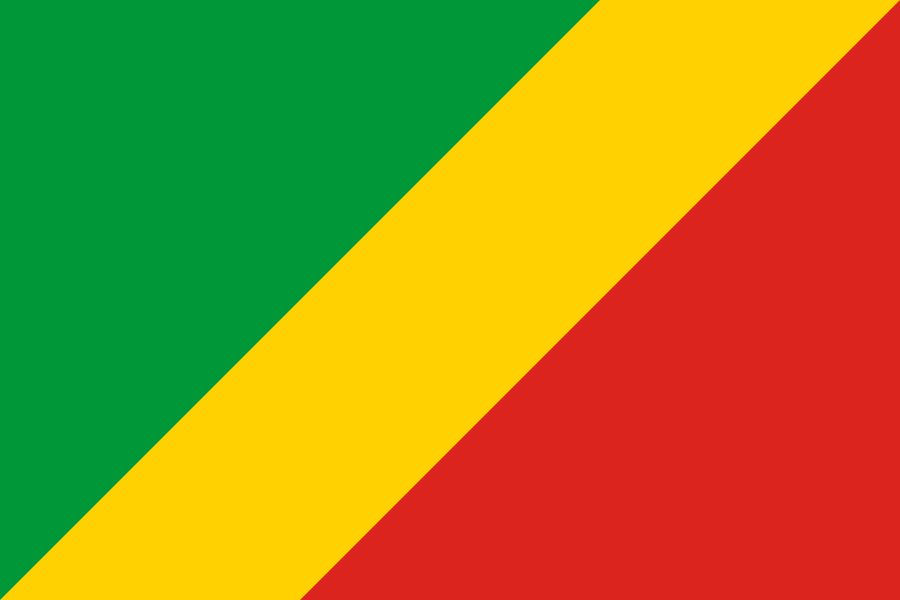
The flag of the Republic of the Congo is a rectangle divided into a green triangle beside the pole, a red triangle toward the free end, and a yellow diagonal between them. In the familiar front view, with the pole at the left, the yellow band rises from the lower left toward the upper right. The flag has no star, lettering, or coat of arms.
This is the flag of Congo-Brazzaville, the country whose capital is Brazzaville. The neighboring Democratic Republic of the Congo, associated with Kinshasa, has a different flag: blue, with a yellow star and a red diagonal edged in yellow. The two countries share part of their names, but their national flags and legal histories are distinct.
The diagonal tricolor was established by a law dated August 18, 1959, before independence in 1960. A red flag with a socialist insignia replaced it during the People’s Republic period. The original diagonal arrangement was restored in 1991 and is described today in Article 3 of the 2015 Constitution.
Three details make the design especially useful to study: the green belongs at the hoist; the yellow is a diagonal band rather than a horizontal stripe; and the original gazette contains a dimensioned drawing. That drawing lets readers check the proportions and calculate the areas instead of relying on an approximate sketch.
The diagonal design and the absence of an emblem
The hoist is the edge attached to the pole or staff; the fly is the free end. These terms are more reliable than “left” and “right,” because a flag can be seen from either side. The constitutional description fixes green on the hoist side, so its relationship to the pole stays the same when the cloth turns.
The two outer fields are right triangles. Their right angles occupy the upper-hoist and lower-fly corners in the conventional front view. The yellow band separates them along parallel diagonal boundaries. Nothing is placed in the band: an added star, shield, seal, or slogan would change the ordinary national design.
The national coat of arms, seal, anthem, and motto are separate state symbols. Article 4 identifies La Congolaise as the anthem and Unité–Travail–Progrès as the motto, meaning Unity–Work–Progress. These words are not printed on the ordinary flag. A photograph of a decorated ceremonial object should therefore not automatically be treated as a new national-flag pattern.
Color specification and digital reproduction
The legal description names green, yellow, and red. The 1959 gazette identifies those colors in its drawing, but its monochrome printing cannot establish precise digital shades. Article 3 of the present Constitution says that a law specifies dimensions, color tones, and other details; the constitutional paragraph itself supplies no Pantone, RGB, or hexadecimal values.
| Color | Position | Digital value used here | Status |
|---|---|---|---|
| Green | Hoist-side triangle | #009739 · RGB 0, 151, 57 | Selected screen reference |
| Yellow | Diagonal band | #FFD100 · RGB 255, 209, 0 | Selected screen reference |
| Red | Fly-side triangle | #DC241F · RGB 220, 36, 31 | Selected screen reference |
The table gives a consistent palette for these illustrations. A browser color, a textile dye, and a printed ink are different reproduction systems. Lighting, folds, fading, and camera processing also affect the appearance of a photographed flag. None of those differences alone establishes that a flag design was legally changed.
For formal production, use the current specification required by the commissioning authority and an approved physical color sample. Do not convert a convenient online hex value into an “official Pantone” label. The diagrams below have documentary support for their geometry; that does not give their screen colors the same legal status.
Symbolism and meaning
The Presidency’s explanation connects green with hope for economic and social development, yellow with unity and hospitality, and red with courage and energy. Those meanings appear in the matching color strips below. They are an official explanatory interpretation, rather than meanings written into Article 3’s geometric definition.
Official explanations are not completely uniform. The Congolese Embassy in Canada also associates green with farming and forests, yellow with friendship and nobility, and red with blood shed in the independence struggle. These accounts should be attributed to their respective institutions; they should not be combined into a supposedly exhaustive symbolism clause in the Constitution.
The green-yellow-red palette is often discussed in the wider context of African national flags. For identification, however, the arrangement matters as much as the colors. This flag’s yellow diagonal and plain green hoist triangle distinguish it from flags that use three vertical or horizontal stripes.
How is the Republic of the Congo flag constructed?
Draw a rectangle three units wide for every two units high. Place green at the upper hoist and red at the lower fly, separated by a yellow band rising diagonally. The dimensioned model published with the 1959 law measures 180 centimeters wide by 120 centimeters high.
| Feature | Original published model | 900 × 600 drawing |
|---|---|---|
| Overall rectangle | 180 cm wide × 120 cm high | 900 units wide × 600 units high |
| Green triangle | 120 cm along the top and full 120 cm at the hoist | Vertices (0,0), (600,0), (0,600) |
| Yellow band | 60 cm along the top; 60 cm along the bottom | Vertices (0,600), (600,0), (900,0), (300,600) |
| Red triangle | 120 cm along the bottom and full 120 cm at the fly | Vertices (900,0), (900,600), (300,600) |
The two yellow boundaries are parallel. On the 900 × 600 canvas, their equations are x + y = 600 and x + y = 900. The first separates green from yellow; the second separates yellow from red. The lines are clipped by the flag’s rectangular outer edge.
To scale the drawing, multiply every coordinate by the same factor. Keep the finished visible dimensions separate from sewing allowances, a hoist sleeve, or reinforced hems. Those manufacturing additions do not belong inside the colored rectangle shown in the law’s diagram.
Proportions, diagonal width, and equal color areas
The published 180 × 120 cm model reduces to 3:2 width:height, or 2:3 height:width. Always state which dimension comes first. A flag labeled simply “2:3” can otherwise be mistaken for an upright rectangle when the author intended height followed by width.
| Width × height | Yellow span along top or bottom | Purpose |
|---|---|---|
| 180 × 120 cm | 60 cm | Original published model |
| 90 × 60 cm | 30 cm | Calculated half-scale example |
| 45 × 30 cm | 15 cm | Calculated quarter-scale example |
In the 180 × 120 cm model, the yellow band measures 60 cm along a horizontal line through the middle of the flag. Its perpendicular width is 60 ÷ √2, approximately 42.43 cm. Its boundaries rise at 45 degrees. The rectangle’s corner-to-corner diagonal has a different angle, so drawing a thick stripe along that diagonal would produce a different pattern.
Each outer triangle has an area of ½ × 120 × 120 = 7,200 cm². The full rectangle has an area of 180 × 120 = 21,600 cm². The remaining yellow area is also 7,200 cm². Thus each color covers exactly one-third of the model’s area, even though the flag is not divided into three equal-width stripes. This is a geometric calculation from the published drawing, not an additional symbolism claim.
History of the flag
The flag’s history includes both continuity and a substantial replacement. The present design originated before independence, disappeared during the People’s Republic period, and returned in 1991. Political and constitutional dates therefore need to be separated from the dates of changes to the flag itself.
A republic before independence
The constitutional record begins with the proclamation of the Republic on November 28, 1958. This political milestone precedes the flag law. It should not be confused with August 15, 1960, when independence was achieved.
The diagonal tricolor is established
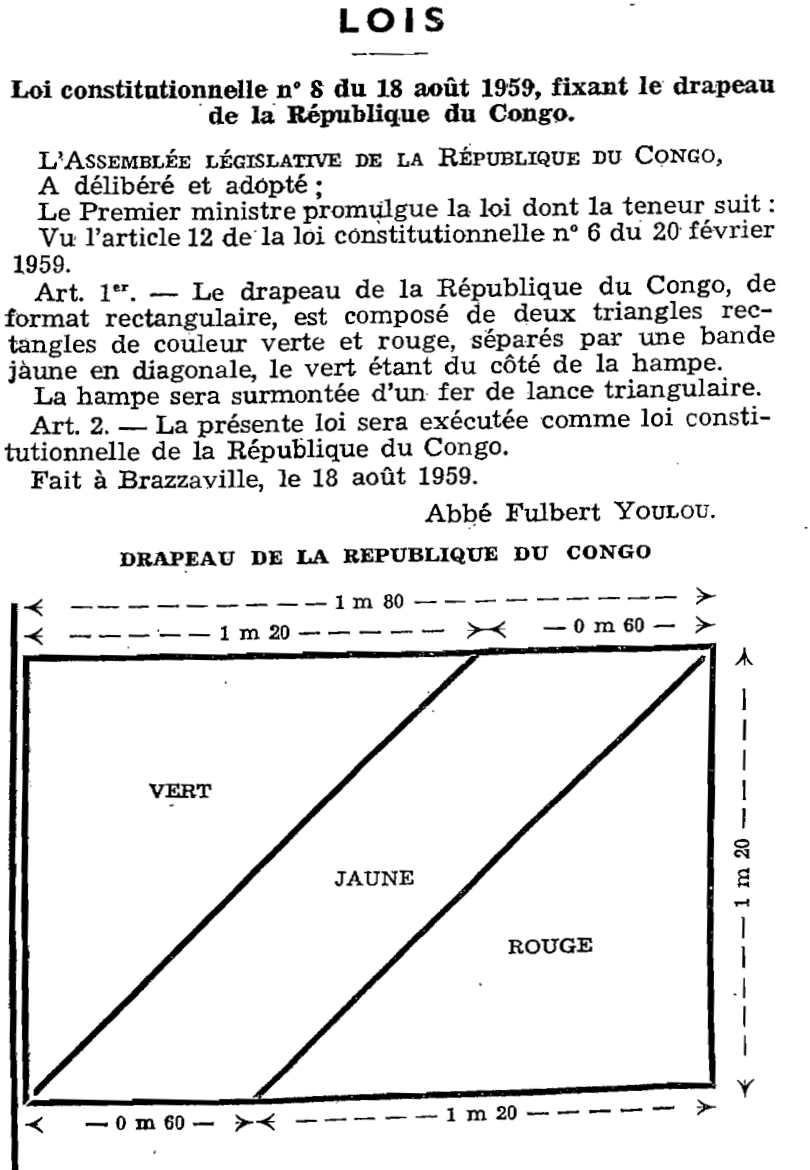
Constitutional Law No. 8 is dated August 18, 1959. The legislative assembly adopted it and Prime Minister Abbé Fulbert Youlou promulgated it. The September 15 Journal Officiel printed the law with a 180 × 120 cm flag model.
Independence with the same flag
The Republic of the Congo became independent on August 15, 1960. The green-yellow-red flag was already in existence. The Embassy in Canada’s account states that it was not changed on independence.
A red flag for the People’s Republic
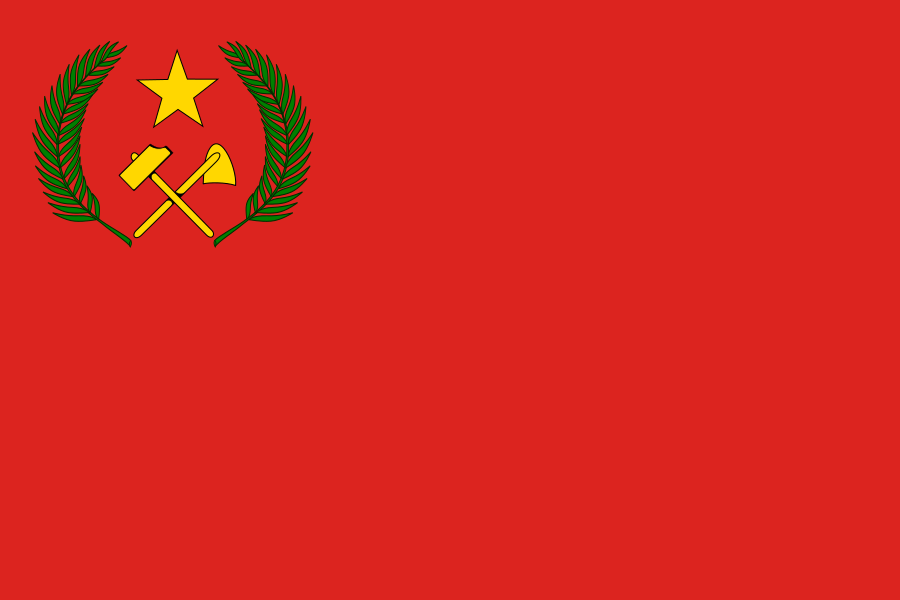
The Constitution adopted on December 30, 1969 and promulgated the following day prescribed a bright red flag. Its upper-hoist insignia combined green palm branches, a yellow hoe and hammer, and a yellow five-pointed star. This is the design associated with the People’s Republic period from 1970 to 1991.
The original symbols are restored
Act No. 002-91-PCN-RG, dated May 17, 1991, restored the diagonal tricolor and other national symbols. It declared itself immediately enforceable. The June 4 Fundamental Act repeated the flag description. June 10 is also commonly cited for the flag’s return in later summaries; it is not the date printed on the restoration act.
The design in the present Constitution
Article 3 of the 2015 Constitution describes the rectangular flag with green and red right triangles separated by a yellow diagonal, with green at the hoist. It preserves the restored design. The later constitutional amendment of January 7, 2022 concerns Article 157, not a new national flag.
Adoption, publication, and restoration dates
Two pairs of dates frequently cause confusion. In 1959, the dated law and its gazette publication occurred on different days. In 1991, a restoration act preceded the June date often repeated in flag summaries. The primary documents identify what each legal instrument actually says.
| Date | Document or event | What the evidence establishes |
|---|---|---|
| August 18, 1959 | Constitutional Law No. 8 | The date of the flag law and its promulgation at Brazzaville. |
| September 15, 1959 | Journal Officiel, page 568 | Publication of the law and dimensioned model. The Embassy in Canada also calls this the official-adoption date. |
| May 17, 1991 | Act No. 002-91-PCN-RG | Restoration of the original flag; Article 2 provides immediate and urgent enforceability. |
| June 4, 1991 | Fundamental Act, Article 2 | The restored flag description appears again in the transitional constitutional text. |
| June 10, 1991 | Date reported in later summaries | The Embassy in Canada and specialist references use this date for the flag’s return; it is distinct from the earlier legal act. |
A careful short answer is therefore: the design was established in 1959 and restored in 1991. When a precise date is needed, identify the event: August 18 for the original law, September 15 for its gazette publication, and May 17 for the restoration act. The reviewed act does not explain why June 10 became the common summary date, so that distinction should remain visible.
Design authorship and the adopting authorities
The 1959 law records an institutional decision. The Legislative Assembly of the Congo deliberated and adopted the text, and Prime Minister Abbé Fulbert Youlou promulgated it. The law does not identify an individual artist or designer. Promulgating a law is not evidence that its signatory personally drew the flag.
The 1991 restoration act belongs to the Sovereign National Conference. It bears the signature of Monseigneur Ernest Kombo, president of the conference presidium. Again, this identifies the authority behind the act, not the creator of a new drawing. The restored arrangement was the earlier national design.
These distinctions prevent a common attribution error: taking the name printed under a legal instrument and turning it into a design credit. The documented authorship here is the adopting and restoring process; a separately verified personal design attribution would require additional evidence.
The People’s Republic flag and other apparent variants
The historical red flag was a substantially different national design. Article 5 of the 1969 Constitution specified a bright red rectangle with a compound insignia in the upper corner beside the hoist. Two green palm branches crossed at their bases surrounded a crossed hoe and hammer in golden yellow, with a golden-yellow five-pointed star above.
The agricultural tool is a hoe, not a sickle. The star belongs to this historical red flag; it is absent from the current diagonal tricolor. Images that render the entire insignia in yellow also differ from the constitutional wording, which explicitly calls the palm branches green.
A flag seen in a ceremony may have fringe, a finial, or identifying inscriptions associated with its particular use. Such additions should be documented individually. They are not grounds for placing a coat of arms or a star on every national flag. The law’s ordinary design and a specialized ceremonial object answer different questions.
The green flag bearing a hand and torch belongs to Zaire’s history in the Democratic Republic of the Congo. It is not a predecessor of Congo-Brazzaville’s current flag. Likewise, the present DRC star flag is a neighboring country’s national symbol, not a Republic of the Congo variant.
How do the flags of the two Congos differ?
The Republic of the Congo uses green and red triangles separated by a yellow diagonal, without a star. The Democratic Republic of the Congo uses a blue field, a yellow star, and a red diagonal edged in yellow. Brazzaville identifies the first country; Kinshasa identifies the second.
| Clue | Republic of the Congo | Democratic Republic of the Congo |
|---|---|---|
| Capital | Brazzaville | Kinshasa |
| Main colors | Green, yellow, red | Blue, red, yellow |
| Star on the current flag | None | One yellow five-pointed star |
| Diagonal | Yellow band separating green and red | Red band with narrow yellow edges |
| Current constitutional description | Article 3 of the 2015 Constitution | Article 1 of the 2006 Constitution |
A plain-text label such as “Congo flag” is incomplete when the context does not identify the country. In an image caption, quiz, atlas, or event program, use the full state name or add the capital-based distinction. The presence or absence of the yellow star is a quick check, but the whole color arrangement is the stronger identification.
Manufacture and practical quality checks
A faithful reproduction starts with the finished rectangle and the two parallel diagonal boundaries. The original published model gives a useful dimensional check: green takes two-thirds of the top edge, yellow takes the remaining third, and the bottom edge reverses that division between yellow and red. All three colors occupy equal areas.
Check the finished design
- Keep the width and height in the 3:2 relationship shown in the original model.
- Put green next to the hoist and preserve the two right-triangle shapes.
- Check the yellow band at both horizontal edges; its top and bottom spans should match.
- Keep construction lines, labels, and extra emblems off the finished flag.
Keep specifications distinct
- Treat the listed hex values as digital references, not a verified textile-dye standard.
- Distinguish the finished visible dimensions from seams, hems, reinforcement, and sleeves.
- Use the commissioning authority’s approved material and color requirements for formal orders.
- Do not infer an exclusive manufacturer, mandated fabric, or testing regime from the constitutional description.
The first set of checks follows the documented design and its geometry. The production advice is general practice. The reviewed legal texts do not supply a complete modern procurement standard for fabric weight, stitching, fastness, or tolerances, so no such specification is asserted here.
For educational printing, export the vector at the desired size with proportional scaling. Do not stretch it to fill an unrelated frame. A border added around a diagram can help separate it from the page, but that border is part of the presentation, not an extra national color.
National Day and the independence anniversary
August 15 marks the Republic of the Congo’s independence anniversary. Independence was achieved on August 15, 1960. The flag was already established by the 1959 law, so the national anniversary and the original flag-law anniversary are different dates.
For a concise timeline, keep August 18, 1959 for the original flag law, August 15, 1960 for independence, and 1991 for the restoration. Calling all three dates “Flag Day” would erase the events they actually commemorate. The August 15 observance is identified here as National Day; no separate statutory Flag Day is inferred from the flag’s adoption date.
The flag also appears outside national-anniversary celebrations. The gallery includes a school setting, a flag photographed abroad, and a diplomatic event. Their captions identify the actual places and occasions so that an ordinary display is not mistaken for a photograph of adoption or an Independence Day ceremony.
Display, handling, and the side facing the viewer
The rule that can be read directly from the design law is the placement of green beside the staff. In the conventional front view this puts green in the upper-left area. From the reverse, the pole is on the right and the geometry is mirrored. A reversed photograph is not necessarily a wrongly made flag.
The original 1959 law also describes a staff surmounted by a triangular spearhead. The 1991 restoration act repeats this provision. A finial is a fitting on the staff, not a shape printed on the cloth. The present constitutional paragraph gives the flag design more briefly and refers further details to legislation.
Documented design and display evidence
- Use green on the hoist side, as specified in the legal descriptions.
- Distinguish the historical legal staff-finial provision from the printed flag design.
- Identify a photograph’s viewing side, date, and occasion before comparing its appearance with a flat drawing.
General care recommendations
- Keep the flag clean and replace a badly damaged or faded example.
- Arrange the display so that the cloth can be seen and is not unnecessarily obstructed.
- For an official ceremony, follow the competent authority’s current instructions on placement and timing.
These care recommendations are not presented as a complete Congolese flag code. The reviewed instruments do not establish an exhaustive schedule for nighttime flying, vehicle use, disposal, funeral coverings, or precedence among multiple flags. A specific official instruction should be checked for the particular ceremony.
Half-mast and national mourning
Half-mast display is documented in the Republic of the Congo during officially declared national mourning. On November 22, 2023, flags were lowered following the fatal crowd crush at a military recruitment event in Brazzaville. Africanews, reporting with AFP, described flags at half-mast outside public administrations and schools.
| Situation | Supported conclusion | Limit |
|---|---|---|
| November 22, 2023 mourning observance | Authorities declared national mourning and half-mast flag display was reported in Brazzaville. | A documented event, not an annual observance. |
| A future official mourning order | The actual order should identify the period and institutions concerned. | Do not infer automatic durations or entitled office holders from the 2023 example. |
| Routine flag illustration | Use the national design without mourning additions. | Half-mast changes the position on a pole, not the flag’s colors or geometry. |
A single mourning event cannot establish a permanent rule for every death or disaster. For an official display, check the applicable announcement and its dates. The flag’s design remains the green-yellow-red tricolor; mourning should not be illustrated by inventing a black stripe or another altered national flag.
Common misconceptions to avoid
| Misconception | Accurate distinction |
|---|---|
| “The flag has three equal horizontal stripes.” | It has two right triangles and a diagonal band. The areas, rather than horizontal stripe widths, are equal in the published model. |
| “It was first adopted when independence was declared in 1960.” | The flag law dates from August 18, 1959. |
| “Every official source gives exactly the same color meanings.” | The Presidency and Embassy in Canada provide different explanatory associations. |
| “The restored flag was legally created on June 10, 1991.” | The original restoration act is dated May 17, 1991 and declares immediate enforceability. June 10 is a commonly reported return date. |
| “The modern flag includes a yellow star.” | The ordinary current flag has no star. A star appeared on the historical People’s Republic flag; the neighboring DRC also uses a star today. |
| “The red historical flag used a hammer and sickle.” | The 1969 constitutional text specifies a hoe and a hammer. |
| “A reverse-side photo shows a separate flag variant.” | The same cloth appears mirrored when viewed from the opposite side. |
The pictures below include exact flat drawings, explanatory diagrams, a legal-document excerpt, and documentary photographs. Their labels keep those evidence types separate. The historical drawings illustrate earlier designs; they are not presented as photographs taken at the time.
Republic of the Congo flag pictures
Green at the hoist, red at the fly, and a yellow diagonal band, in a 3:2 width:height rectangle.
GKBook drawing from the dimensioned model published with the 1959 flag law.Download image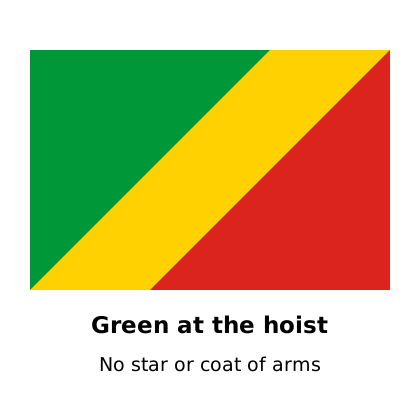
The ordinary national flag has two colored right triangles and a yellow diagonal. It carries no separate emblem.
GKBook drawing from the dimensioned model published with the 1959 flag law.Download image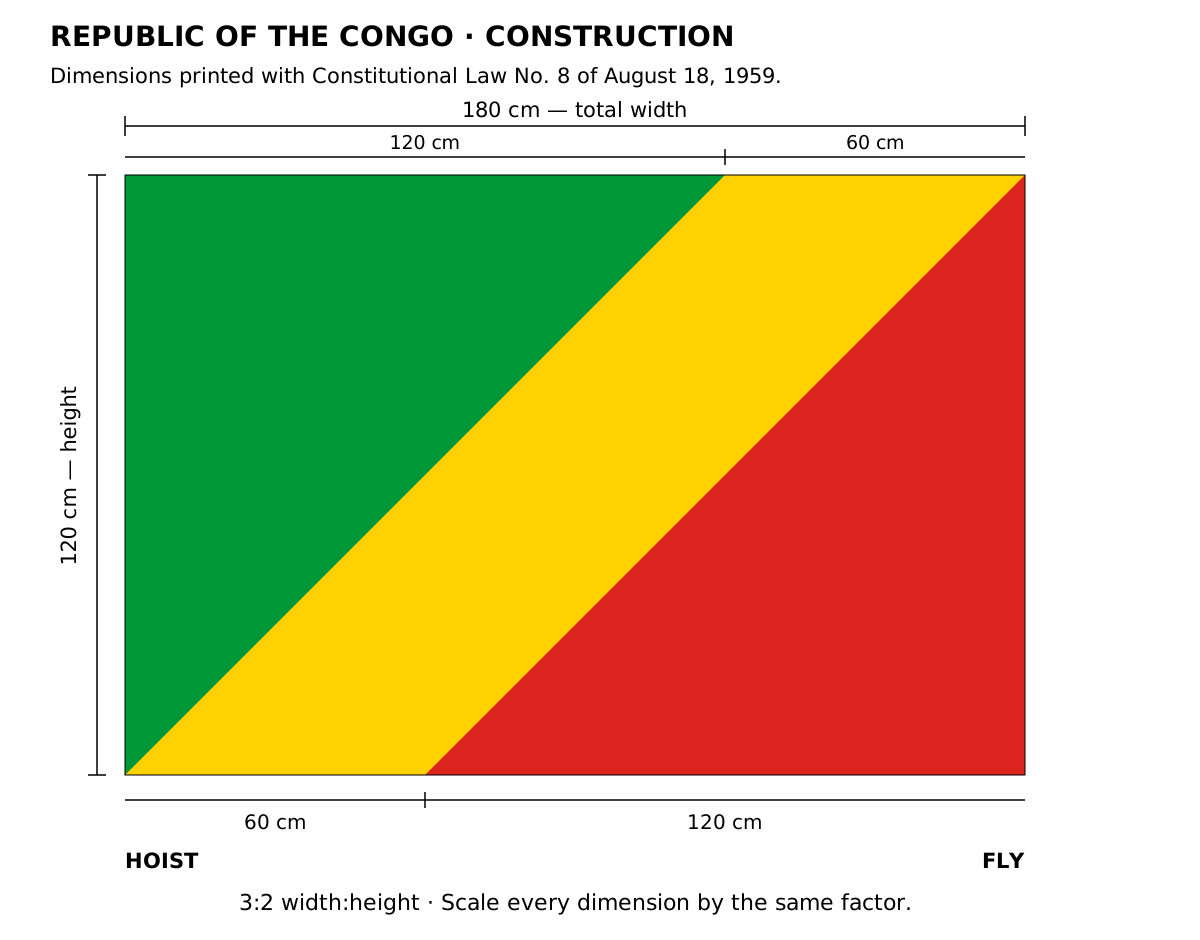
A 180 × 120 cm model: green occupies 120 cm of the top edge; yellow occupies 60 cm at the top and bottom. Scaled directly from the original published diagram.
GKBook drawing from the dimensioned model published with the 1959 flag law.Download image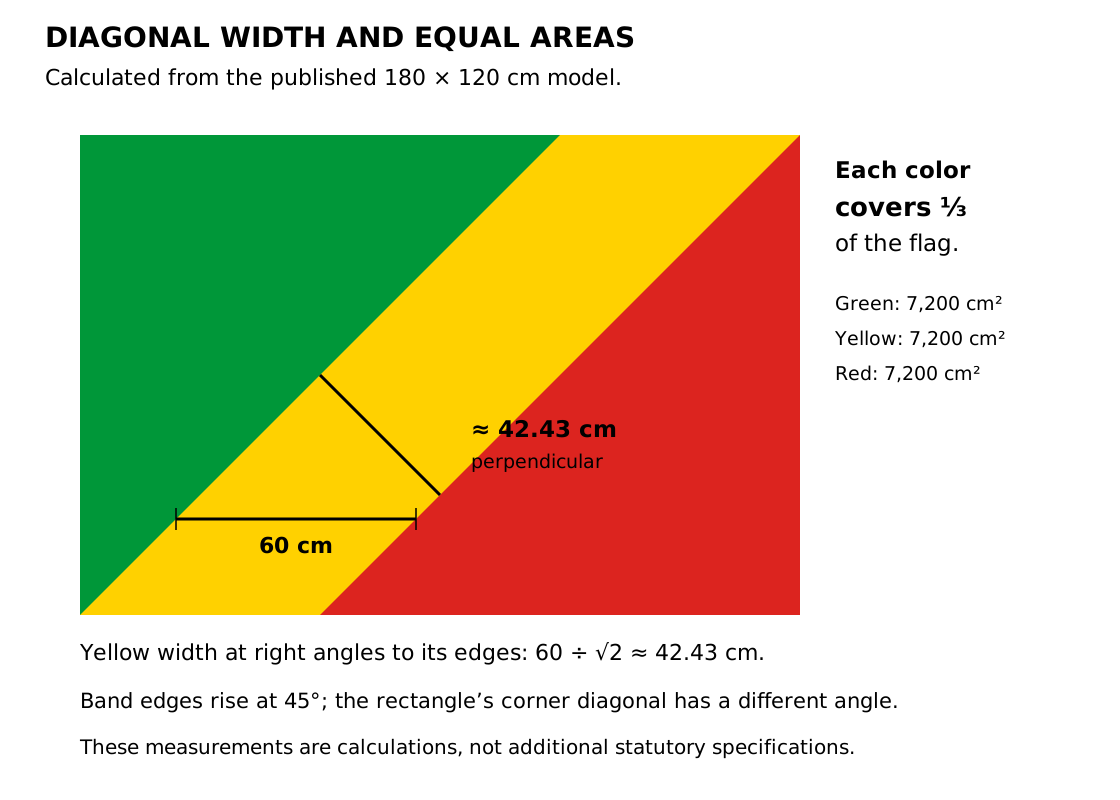
The yellow band spans 60 cm horizontally, or about 42.43 cm perpendicularly, in the original model. Each of the three colors covers one-third of the total area.
GKBook drawing from the dimensioned model published with the 1959 flag law.Download image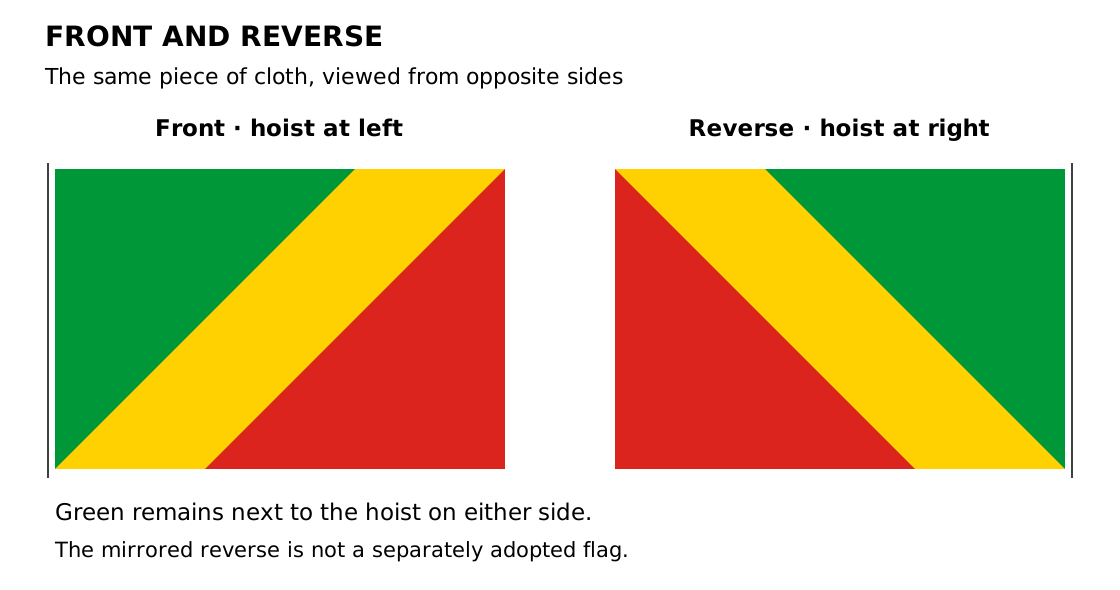
Seen from the reverse, the hoist is at the right and the diagonal appears mirrored. Green remains beside the pole.
GKBook drawing from the dimensioned model published with the 1959 flag law.Download image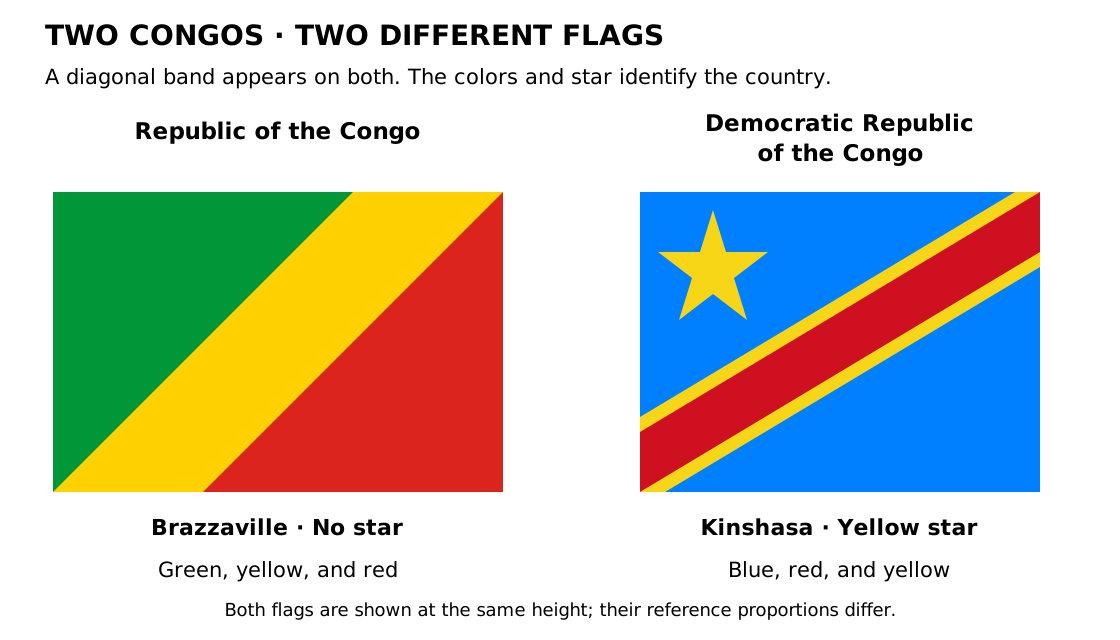
Congo-Brazzaville has the green, yellow, and red flag. Congo-Kinshasa has a blue flag with a yellow star and a red diagonal edged in yellow.
GKBook comparison drawing. The DRC appears only as a clearly labeled comparison.Download image
Historical reference drawing: a red field with green palm branches, a yellow hoe and hammer, and a yellow star near the upper hoist.
Thommy and later Wikimedia Commons contributors; public domain (PD-Congo). Normalized by GKBook; reference drawing, not an archival photograph.Download image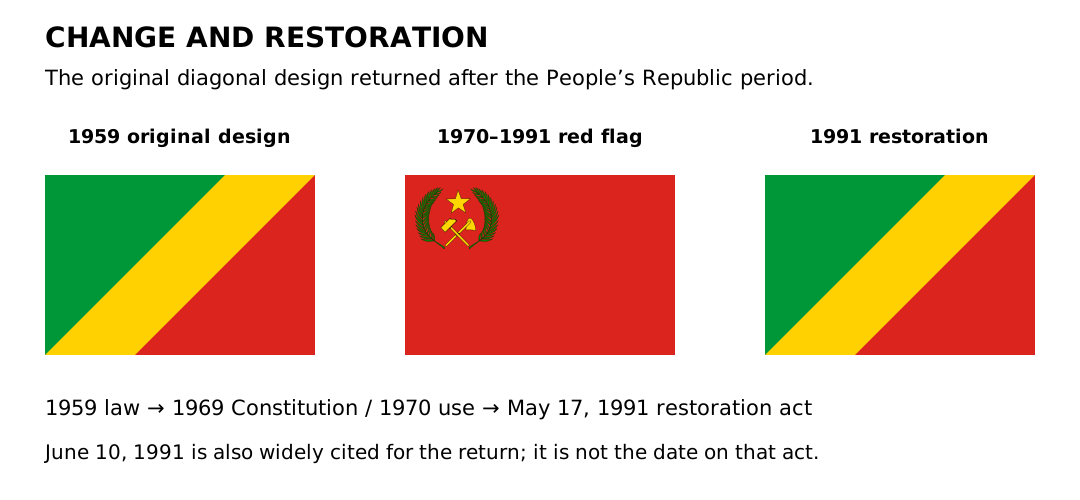
The green-yellow-red design originated in 1959, was replaced during the People’s Republic period, and was restored in 1991. These are reference drawings, not photographs.
GKBook sequence; historical red flag by Thommy and Commons contributors (public domain).Download image
Constitutional Law No. 8 of August 18, 1959, with its flag model, published on page 568 of the September 15, 1959 Journal Officiel. This is a crop of the original scan.
Journal Officiel de la République du Congo; scan supplied by the Secrétariat général du Gouvernement. Public-domain legal text; cropped and converted to WebP. Image credit and license.Download image
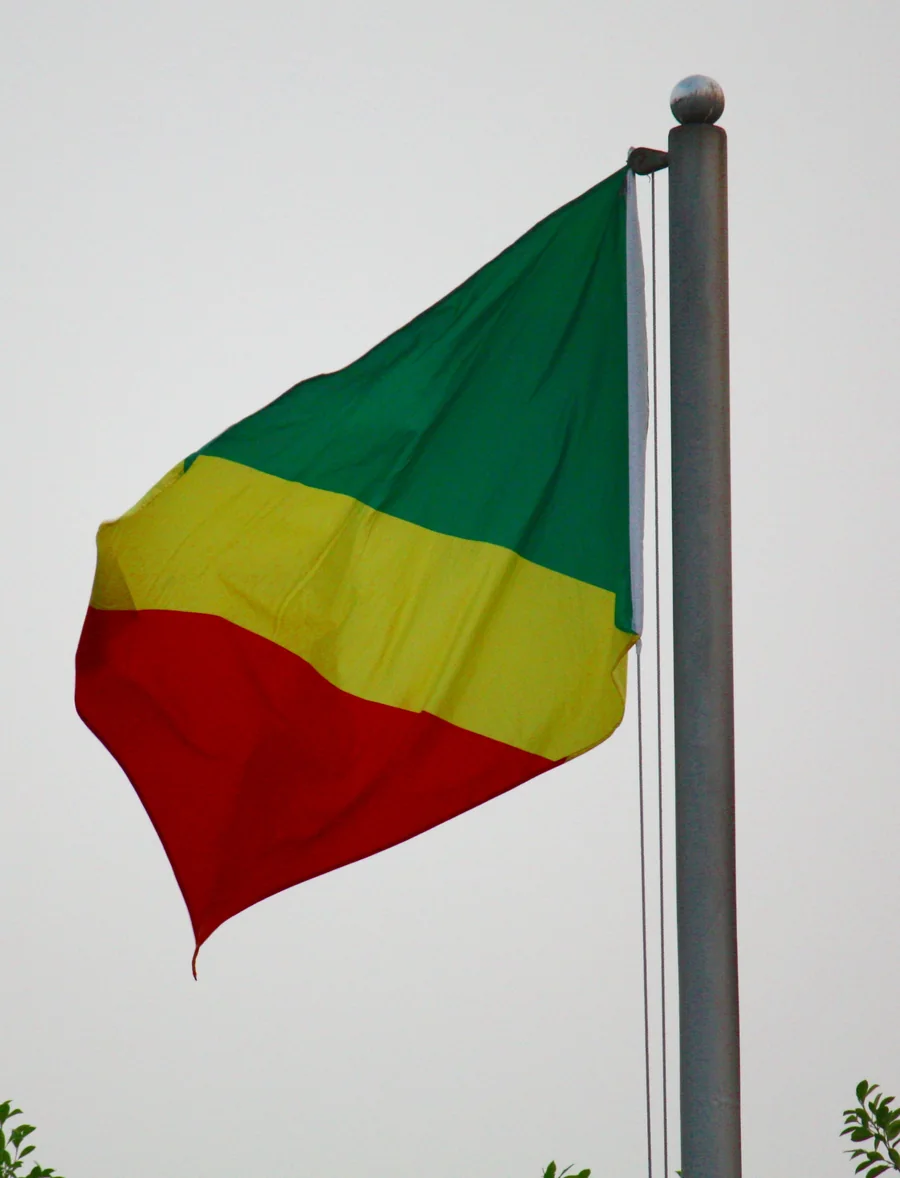
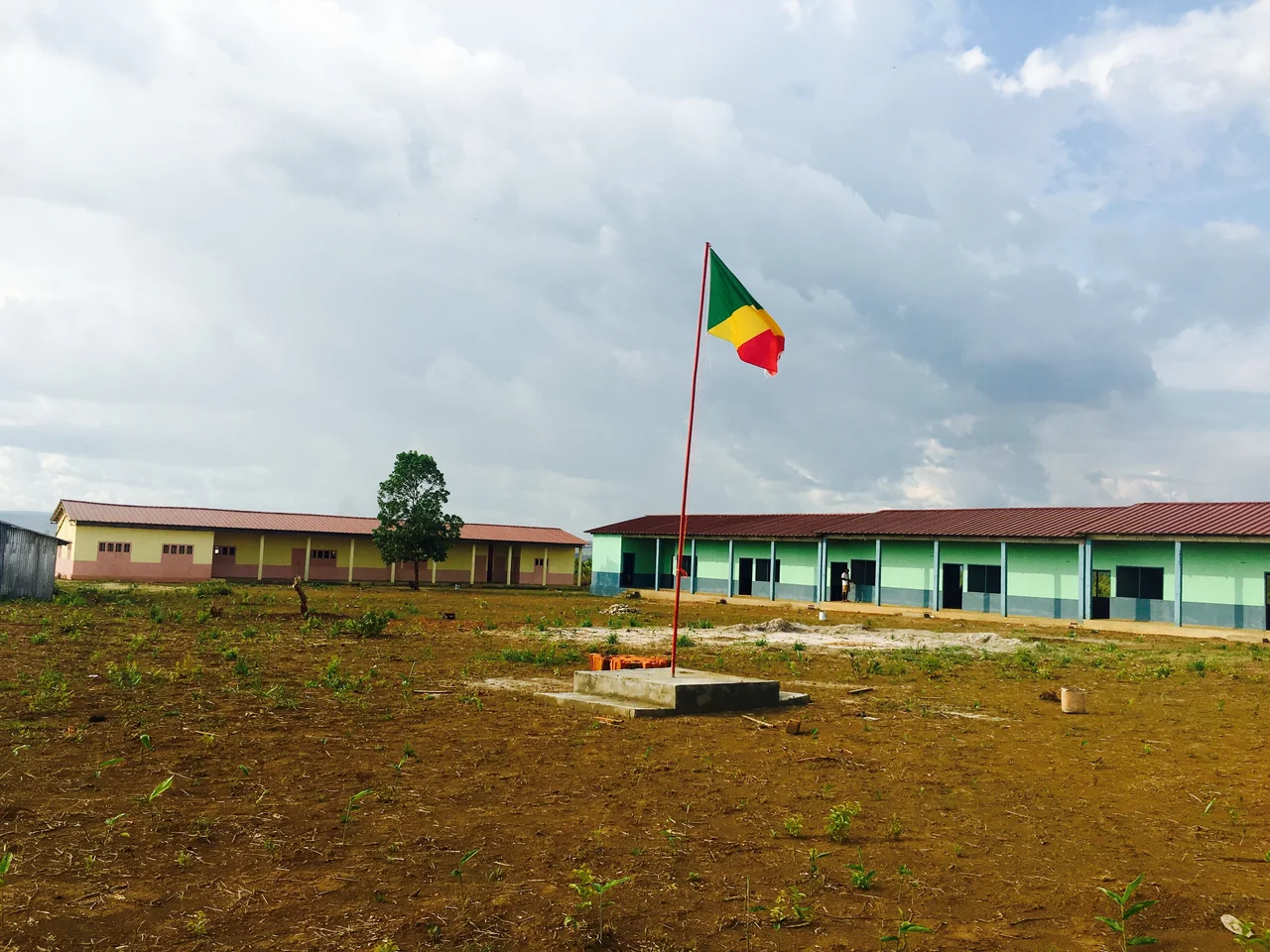
The national flag on the grounds of Notre Dame du Bon Cœur School in Kingoué, photographed on October 10, 2019.
Ocelot02. CC BY-SA 4.0. Resized and converted to WebP; no crop. Image credit and license.Download image
A Republic of the Congo flag in Shenzhen, photographed by J. Patrick Fischer on August 31, 2010. The pole is at the right, showing the reverse side.
J. Patrick Fischer. CC BY-SA 3.0. Resized and converted to WebP; no crop. Image credit and license.Download image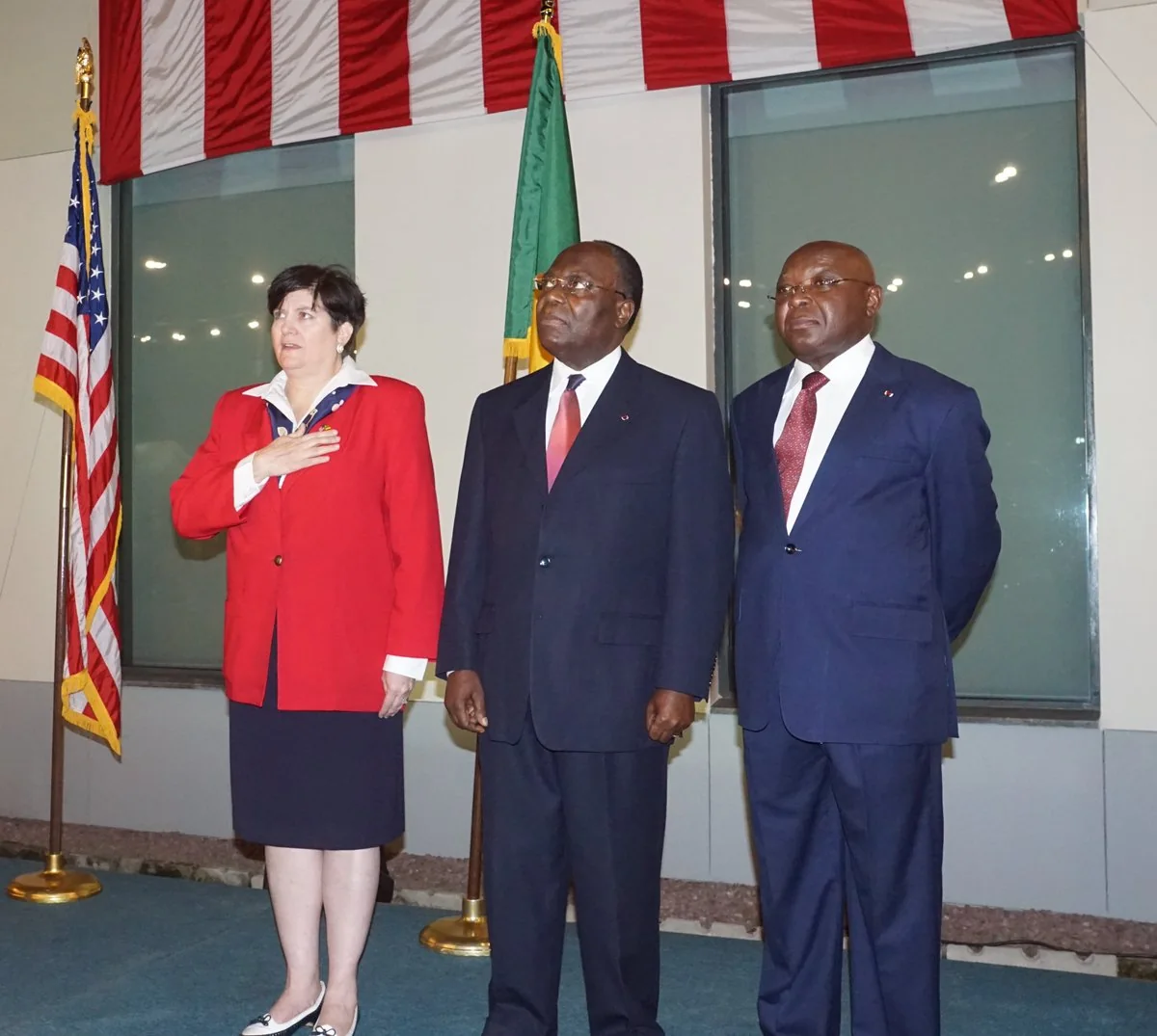
The Congolese flag behind Prime Minister Clément Mouamba at the U.S. independence anniversary celebration in Brazzaville on July 7, 2016, with Ambassador Stephanie Sullivan and Minister Raymond Mboulou.
U.S. Embassy in Brazzaville. Public domain: U.S. federal government work. Converted to WebP; no crop. Image credit and license.Download imageFrequently asked questions
What does the Republic of the Congo flag look like?
It has a green triangle at the hoist, a red triangle at the fly, and a yellow diagonal band between them. In the usual front view, the yellow band rises toward the upper right. The ordinary national flag contains no star, shield, coat of arms, or lettering.
Which Congo uses the green, yellow, and red flag?
The Republic of the Congo uses this flag. Its capital is Brazzaville, which explains the distinguishing name Congo-Brazzaville. The neighboring Democratic Republic of the Congo has its capital at Kinshasa and uses a different flag with a blue field, a yellow star, and a red diagonal edged in yellow.
What do the three colors mean?
The Presidency associates green with hope for economic and social progress, yellow with unity and hospitality, and red with courage and energy. These are attributed explanatory meanings. The constitutional flag description specifies the colors and their arrangement without assigning this set of symbolic meanings to them.
Why do some accounts give different meanings for the colors?
The official explanatory accounts are not identical. The Embassy in Canada connects green with farming and forests, yellow with friendship and nobility, and red with blood shed in the independence struggle. These associations differ from the Presidency’s wording, so an explanation should identify which institutional account it follows.
When was the flag originally adopted?
The original flag law is Constitutional Law No. 8, dated August 18, 1959. It was published with a dimensioned drawing in the September 15, 1959 Journal Officiel. The Embassy in Canada also describes September 15 as official adoption, so the event attached to each date matters.
Did independence in 1960 bring a new flag?
No. The green-yellow-red design was already established in 1959, before independence on August 15, 1960. The Embassy in Canada states that the flag did not change at independence. The later red flag belongs to the People’s Republic period, beginning around the turn of 1969 and 1970.
When was the original flag restored?
The restoration act is dated May 17, 1991 and declares itself immediately enforceable. The June 4 Fundamental Act repeats the restored design. June 10, 1991 is commonly cited for the flag’s return in later accounts, but it is not the date printed on that restoration act.
What is the flag’s aspect ratio?
The model published with the 1959 law measures 180 centimeters wide and 120 centimeters high. This is a ratio of 3:2 width:height, equivalent to 2:3 height:width. Stating the order avoids confusion when a flag specification lists a ratio without labeling its two dimensions.
How wide is the yellow band?
In the original 180-by-120-centimeter model, yellow occupies 60 centimeters of the top edge and 60 centimeters of the bottom edge. Its perpendicular width is about 42.43 centimeters. That second figure is calculated from the drawing; it is not another measurement explicitly printed in the law.
Do the three colors cover equal areas?
Yes, in the published model each color covers one-third of the rectangle. Each outer triangle has an area of 7,200 square centimeters, and the yellow area is the same. Equal areas do not mean equal horizontal stripes: the flag is divided by two parallel diagonal lines.
Does the current national flag have a star?
No. The ordinary current flag has green and red triangles separated by yellow, without a star or another emblem. A yellow star appeared in the historical People’s Republic insignia. The neighboring Democratic Republic of the Congo also has a yellow star on its different current national flag.
Who designed the flag?
The 1959 law identifies the legislative assembly as the adopting body and Prime Minister Abbé Fulbert Youlou as the official who promulgated it. It does not name an individual designer. A signature on the law should therefore not be treated as proof of personal artistic authorship.
What flag was used during the People’s Republic period?
The historical flag had a bright red field with an insignia near the upper hoist. The 1969 Constitution described two green palm branches, a crossed golden-yellow hoe and hammer, and a golden-yellow five-pointed star above. This red design is associated with the period from 1970 to 1991.
Was the historical tool a sickle or a hoe?
The constitutional description specifies a hoe crossed with a hammer. It does not call the agricultural tool a sickle. It also specifies green palm branches and a golden-yellow star, distinctions that help evaluate later drawings of the historical red flag and avoid importing another state’s insignia.
Are the hexadecimal colors official national standards?
The hexadecimal values listed on this page are digital reference values used consistently in its drawings. They are not claimed as statutory national color codes. The Constitution names green, yellow, and red and refers further details to legislation; that paragraph itself does not provide RGB or Pantone numbers.
Why does the diagonal look reversed in some photographs?
A flag seen from its other side appears mirrored. The hoist moves from the viewer’s left to the right, while green remains physically attached beside the pole. Folds and wind also change the visible outline. A reverse-side photograph does not by itself show an incorrectly made flag.
Is the coat of arms printed on the ordinary flag?
No. The ordinary national flag described in Article 3 consists of the colored triangles and diagonal band. The Constitution treats the coat of arms and other state symbols separately. A decorated ceremonial object should not be used to add an emblem to every reproduction of the national flag.
What is commemorated on August 15?
August 15 is the Republic of the Congo’s independence anniversary, marking independence on August 15, 1960. It is distinct from the August 18, 1959 flag law and the 1991 restoration. This page identifies the national anniversary separately and does not invent a statutory Flag Day from an adoption date.
Can the flag be flown at half-mast?
Half-mast display is documented during official national mourning. On November 22, 2023, it was reported outside public administrations and schools in Brazzaville after the fatal recruitment-event crowd crush. That example does not establish an automatic mourning schedule; the applicable official announcement should determine a particular observance.
What does the law say about the flagstaff?
The original 1959 law describes a staff topped by a triangular spearhead, and the 1991 restoration act repeats the provision. This concerns a fitting on the staff, not a shape printed on the flag. The colored rectangle itself remains the plain green-yellow-red diagonal design shown here.
Was the green torch flag of Zaire used by Congo-Brazzaville?
No. The flag with a green field, yellow disk, and a hand holding a torch belongs to Zaire’s history in the Democratic Republic of the Congo. Congo-Brazzaville’s historical replacement was the red People’s Republic flag. The two neighboring countries’ flag sequences should be kept separate.
Can I download the flag pictures and diagrams?
Yes. Each gallery item links to an actual image file supplied with this page. The collection includes flag drawings, construction diagrams, a legal-document excerpt, and three documentary photographs. Photo credits and license information accompany the images; the diagrams are labeled so they are not mistaken for archival photographs.

We Value Your Opinion Comments