
Comoros flag picture
Explore the construction sheet, the crescent-and-stars detail, and the historical sequence.
| Country | Union of the ComorosFrench: Union des Comores. Capital: Moroni. |
|---|---|
| Band order | Yellow · white · red · blueRead from top to bottom; all four bands have equal height. |
| Hoist design | Green triangleWhite crescent and four white five-pointed stars. |
| Usual proportion | 5 : 3 — width:heightEquivalent to 3:5 height:width; a common reference format, not a ratio stated in Article 9. |
| Constitutional adoption | December 23, 2001The new design appears in Article 1 of the Constitution adopted by referendum. |
| Later recognition | 2018 Constitution, Article 9The current constitutional wording specifies equal horizontal bands and the green hoist triangle. |
| Island symbolism | Four islandsMohéli, Mayotte, Anjouan, and Grande Comore; Mayotte is administered by France and claimed by the Comoros. |
| National Day | July 6Independence was proclaimed on July 6, 1975; this is separate from the current flag’s adoption. |
The Comorian flag has four equal horizontal bands, yellow, white, red, and blue from top to bottom. A green triangle at the hoist contains a white crescent and four white stars. The island associations below are established interpretations; the Constitution describes the design.
An overview
The flag of the Comoros combines four horizontal bands—yellow, white, red, and blue—with a green triangle at the hoist. Inside the triangle are a white crescent and four white stars. The design is recorded in the Constitution adopted on December 23, 2001, and is retained in the later constitutional description.
Its two most recognizable features tell related stories. The bands are associated with the four main islands of the Comorian archipelago, while the four stars repeat that island symbolism. Green and the crescent connect the design to Islam. The flag therefore joins a geographic idea of the islands with a religious symbol that appeared in earlier Comorian flags.
An essential distinction runs through the design: the four islands represented are not all administered by the same state. Grande Comore, Anjouan, and Mohéli form the territory administered by the Union of the Comoros. Mayotte is administered by France and claimed by the Comoros. Its presence in the flag expresses Comorian national symbolism and the territorial claim; it does not describe French administrative practice.
The current flag also belongs to a longer visual history. A crescent and four stars appeared on the 1963 local flag before independence. Later governments changed their position and the surrounding field. The colorful horizontal bands of the present design are a subsequent development, rather than the flag flown unchanged since independence in 1975.
The crescent and four stars
The white crescent opens toward the fly in the familiar front view, with four five-pointed stars arranged in a vertical line between its tips. The 2001 constitutional text explicitly describes a crescent facing right. Article 9 of the 2018 text specifies the crescent and aligned stars without setting out a complete measured construction.
The four stars represent the four islands collectively. They are not a count of the islands currently administered by the Union, nor a set of four political parties. The crescent and the green field have an established Islamic association. These meanings should be distinguished from the legal text, which describes the flag’s components rather than giving a color-by-color explanation.
This drawing gives every star one point facing upward. Other depictions differ in small details, including the orientation of the stars and the thickness of the crescent. Such differences are not, by themselves, evidence that a new national flag was adopted. A photograph records a particular flag specimen; the constitutional description remains the starting point for identifying the national design.
Colors and digital specifications
The Constitution names yellow, white, red, blue, and green. It does not give hexadecimal values, RGB triplets, Pantone numbers, or textile tolerances in the flag article. The palette below documents the digital shades used in this page’s current-flag illustrations. These are reproduction references, not a newly asserted national color law.
| Color | Hex | RGB | Placement |
|---|---|---|---|
| Yellow | #FFD100 | 255, 209, 0 | Top band |
| White | #FFFFFF | 255, 255, 255 | Second band; crescent and stars |
| Red | #EF3340 | 239, 51, 64 | Third band |
| Blue | #003DA5 | 0, 61, 165 | Bottom band |
| Green | #009639 | 0, 150, 57 | Hoist triangle |
This palette follows the commonly reproduced Olympic-era digital reference recorded by vexillological sources and the Commons model. A screen image cannot establish the exact appearance of a dyed fabric under daylight. Printing, stitching, lighting, weathering, and camera white balance can all affect the apparent shade. For recognition, begin with the color order and the crescent-and-stars arrangement.
Symbolism and meaning
The established interpretation associates one horizontal band with each of the four main islands. This is the useful reading to remember: yellow for Mohéli, white for Mayotte, red for Anjouan, and blue for Grande Comore. The four stars reinforce the same four-island idea, while green and the crescent have a religious association.
These associations are reported in specialist flag references. The Constitution itself provides the visual description and names the islands in its territorial provisions; it does not attach a separate moral slogan to every stripe. Claims that each band legally means wealth, peace, sacrifice, or the sea should therefore not replace the island interpretation without a specific supporting source.
The repetition of four is especially helpful for understanding the design. The bands distinguish the islands through color, and the stars give the crescent a four-part national identity. The green triangle provides a shared setting for the white symbols rather than a fifth island band.
The four islands and the Mayotte distinction
| Band | Island name | Name in Comorian usage | Administrative distinction |
|---|---|---|---|
| Yellow | Mohéli | Mwali | Administered by the Union of the Comoros |
| White | Mayotte | Maoré | Administered by France; claimed by the Comoros |
| Red | Anjouan | Ndzuwani | Administered by the Union of the Comoros |
| Blue | Grande Comore | Ngazidja | Administered by the Union of the Comoros |
Article 6 of the 2018 Constitution includes Mwali, Maoré, Ndzuwani, and Ngazidja in its description of the national territory. France describes Mayotte as part of the French Republic. Reading those positions together explains why the flag has four stars even though the Union administers three principal islands.
The difference developed during decolonization. In the December 1974 independence referendum, the three other islands voted for independence while Mayotte voted to remain with France. Comorian authorities proclaimed independence on July 6, 1975. Later votes and changes to Mayotte’s French status did not remove it from Comorian constitutional claims.
The order of the stripes is not a north-to-south map of the archipelago, and the sizes of the bands do not measure island area or population. They are equal-height parts of a flag. No star-to-individual-island ordering is assigned here because the sources establish the collective four-island meaning rather than a documented top-star-to-bottom-star key.
Construction, proportions, and example sizes
The commonly reproduced flag has a 5:3 width-to-height ratio, equivalent to 3:5 when height is stated first. Its horizontal bands divide the height equally. The green isosceles triangle has its base along the hoist and extends toward the fly. In the reference construction used here, its apex reaches the center of the rectangle.
| Element | Construction used here | Status |
|---|---|---|
| Overall rectangle | 60 units wide × 36 units high | Common 5:3 reference proportion |
| Band boundaries | y = 0, 9, 18, 27, 36 | Four equal heights required by Article 9 |
| Triangle vertices | (0, 0), (30, 18), (0, 36) | Isosceles hoist triangle required; coordinates illustrate it |
| Star centers | x = 12.519; y = 12.5, 16.25, 20, 23.75 | Coordinates of this drawing |
| Star spacing | 3.75 units between consecutive centers | Calculated from the reference coordinates |
An isosceles triangle has two equal sides. It does not have to be equilateral. With the apex halfway across this 60-by-36 rectangle, the point angle is approximately 61.9 degrees. Making it exactly 60 degrees would alter the triangle’s reach. The Constitution’s use of “isosceles” does not require that change.
The equal bands also do not have equal visible colored areas once the triangle covers their hoist ends. Their equality concerns height. To lay out a drawing, first divide the full rectangle into four equal horizontal zones and then place the green triangle over them. The white crescent and stars are added within the triangle.
| Example width × height | Height of each band | Triangle reach in this model |
|---|---|---|
| 100 × 60 cm | 15 cm | 50 cm |
| 150 × 90 cm | 22.5 cm | 75 cm |
| 200 × 120 cm | 30 cm | 100 cm |
A maker can scale the reference artwork uniformly to another size without changing its geometry. Hem allowance, the pole sleeve, and fastening hardware are separate from the visible design rectangle. A photograph of a billowing flag cannot reliably supply flat construction measurements.
A closer look at star placement
The stars are separate from the crescent, even though their placement relates to its two tips. Keeping a straight line of centers and a repeated star size helps the small emblem remain legible. At very small image sizes, the gaps between the stars matter more than decorative effects such as shadows or outlines.
The current drawing uses a smooth crescent formed by circular arcs and a repeated five-point-star shape. The published reference supplies arc radii of 8.5 and 8.25 units and approximately 1.75-unit star radii in the 60-by-36 grid. These values allow the artwork to be reproduced consistently. Their inclusion does not turn an illustrator’s construction into a legal specification.
How the Comorian flag evolved
Comorian flag history has a recurring visual thread: a crescent and four stars. The field, the angle of the crescent, the alignment of the stars, and the presence of inscriptions changed over time. The timeline identifies the principal designs without treating every political transition or every differently drawn specimen as a separate national flag.
1963
A local flag before independence
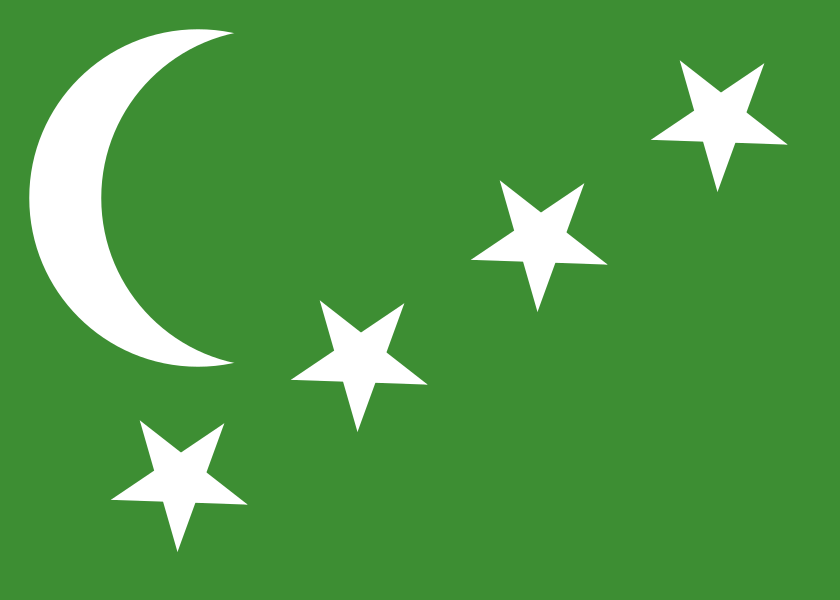
A green flag combined a crescent near the upper hoist with four stars running diagonally upward. Specialist literature credits Suzanne Gauthier and reports a 7:5 width-to-height format. This stage predates the country’s independence.
1975
Independence, then a red-and-green redesign
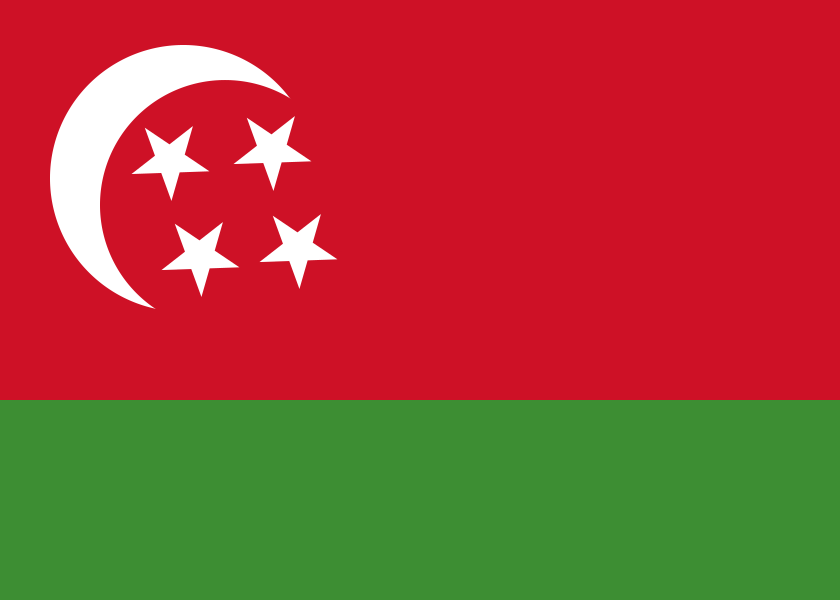
Independence was proclaimed on July 6. A later design under Ali Soilih used a red upper field and a green lower band, with the stars grouped in a diamond near the crescent. The red portion occupied the upper two thirds. The illustrated flag belongs to the 1975–1978 period, not to every moment of 1975.
1978
The return to a green field
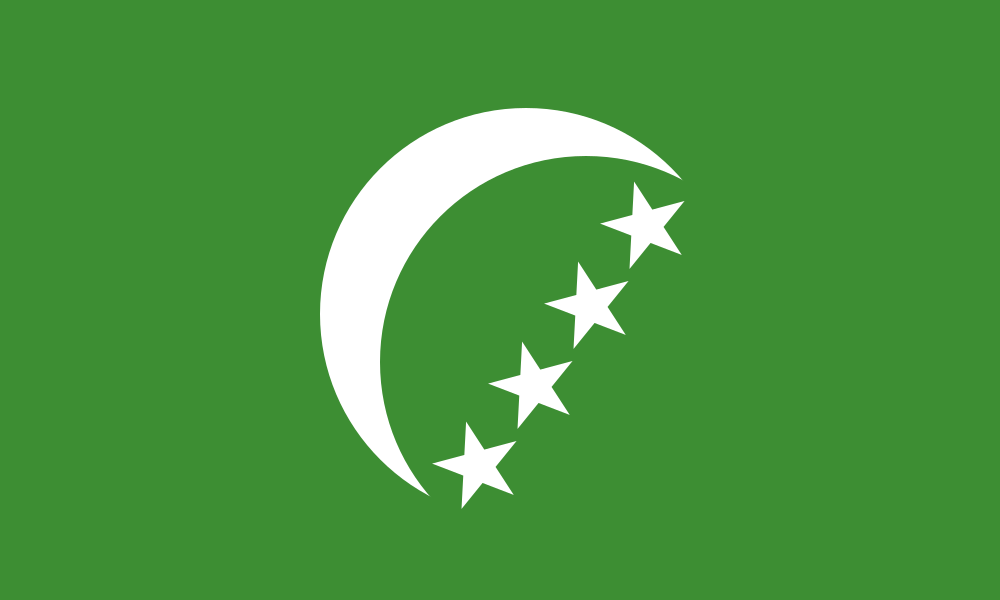
The red field disappeared after Ahmed Abdallah returned to power. A larger crescent and four stars in a line occupied the green field. The common depiction tilts the crescent toward the lower fly. The new political order and its constitutional recognition should be distinguished from the precise dates on which particular flag specimens were replaced.
1992
An upward-facing crescent
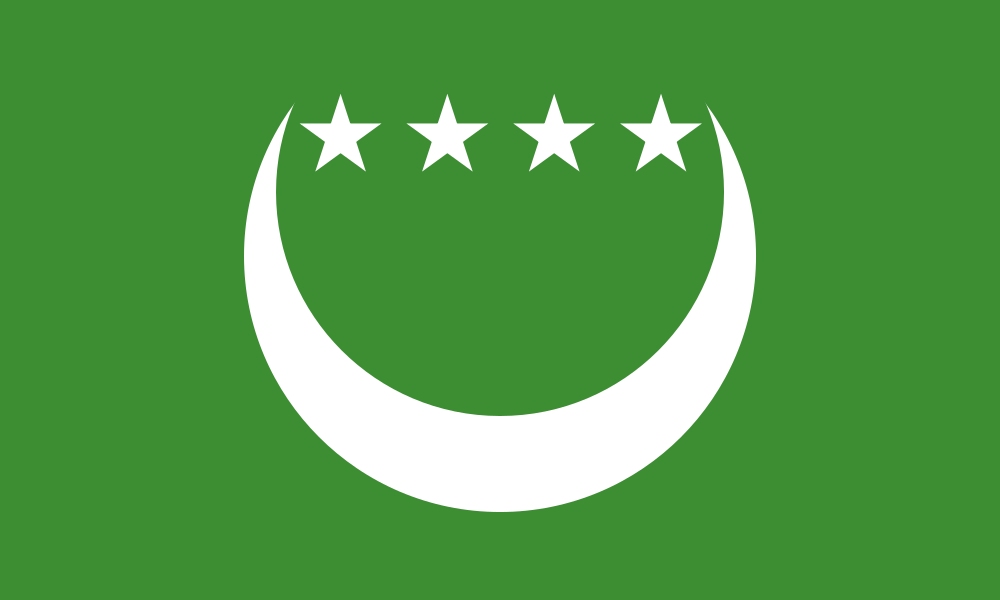
The design associated with the 1992 Constitution placed the four stars in a horizontal row between the upward-facing tips of the crescent. Green and white remained the flag’s colors. The change concerned the arrangement of the existing symbols, rather than a change in the number of islands represented.
1996
Arabic inscriptions added
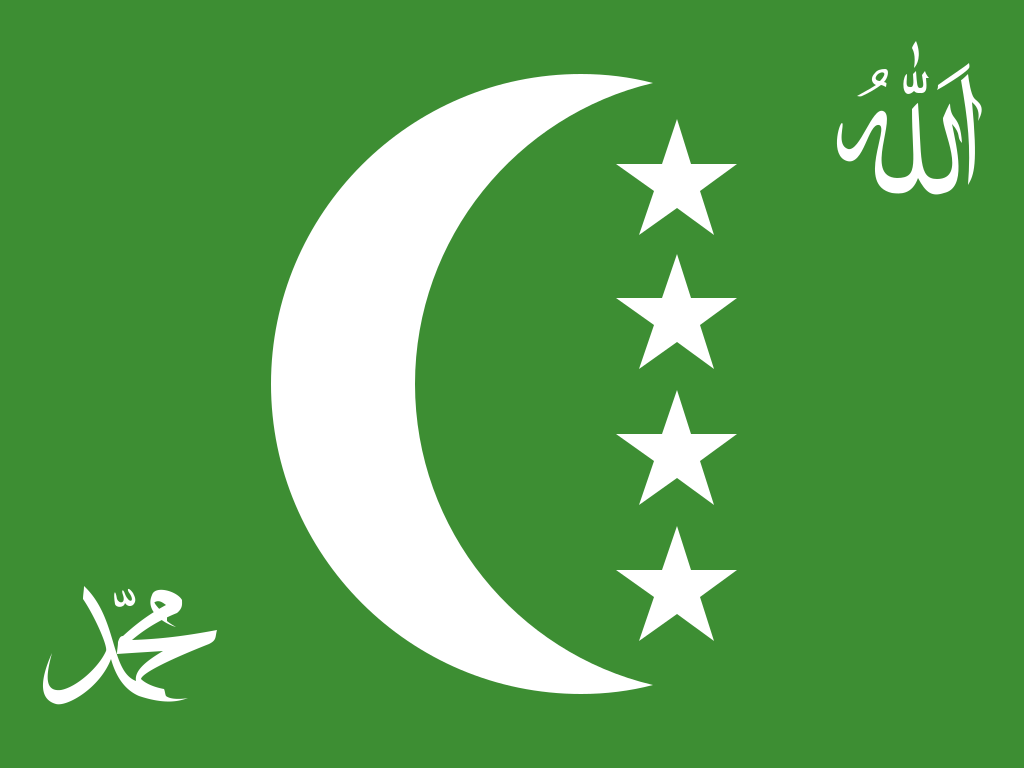
The 1996 constitutional description retained the green field, crescent, and four stars, and added the names Allah and Muhammad. The period produced differing depictions of the lettering and the flag’s proportions. The illustration preserves sourced historical artwork; it is not an archival photograph or a modern construction standard.
2001
The Union’s four-band flag
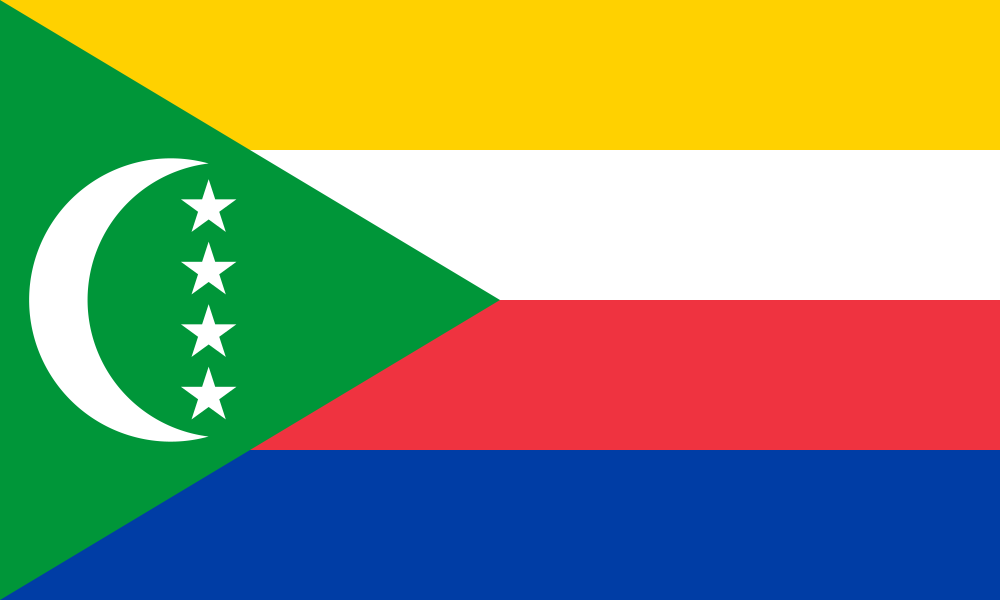
The Constitution adopted by referendum on December 23 described the new yellow, white, red, and blue flag, a green triangle, a white crescent facing right, and four white stars. The crescent-and-stars motif continued, now set beside the four island-associated bands.
2018
The arrangement retained in Article 9
The revised constitutional text expressly describes the four bands as equal and horizontal, in yellow-white-red-blue order, with a green isosceles triangle at the pole. This is later constitutional recognition of the current arrangement, not evidence of an entirely new flag design.
Historical illustrations are labeled as reconstructions. The literature records differing proportions, shades, and crescent details, especially for the flags of the late twentieth century. Those differences are retained as evidence of variation instead of being converted into an unsupported sequence of exact legal specifications.
Adoption and the constitutional framework
The most secure starting point for the current design is the Constitution of December 23, 2001. Its first article lists the new flag’s colors, crescent, four stars, and green isosceles triangle. The text is a direct documentary basis for the design, unlike an undated flag image or a later summary that provides only a year.
The constitutional settlement followed the Fomboni reconciliation framework signed on February 17, 2001. United Nations reporting describes that agreement as a basis for the peace process. This context helps explain why a flag emphasizing the islands belongs to the formation of the Union. It does not establish an individual designer or a quotation explaining every color.
Some flag references date the current flag to early 2002, reflecting its introduction around the new constitutional settlement. Constitutional adoption, promulgation, and a first ceremonial raising are different events. Here, December 23, 2001 is labeled specifically as the constitutional adoption date; a separate exact first-hoisting date is not asserted.
Article 9 of the 2018 text preserves the same principal design and gives a clearer description of the equal horizontal bands. It also identifies the flag, seals, and anthem as symbols of the Union and national sovereignty. The flag itself remains distinct from the national seal: the full seal is not placed in its center.
Design authorship: the 1963 flag and the current flag
Suzanne Gauthier is credited in specialist literature with the 1963 local flag. That design used a green field, a white crescent near the upper hoist, and four diagonally arranged stars. The attribution belongs to that historical design and should not automatically be transferred to the four-band flag adopted decades later.
The constitutional texts describing the current flag do not name its individual designer. The earlier crescent-and-stars tradition is clear, but continuity of a motif does not establish authorship of every later arrangement. A careful account can credit Gauthier’s documented historical role while leaving the personal authorship of the 2001 design unresolved.
This distinction also prevents a common timeline error: 1963 was a pre-independence flag milestone, while independence was proclaimed in 1975. The current design’s constitutional milestone came in 2001. Those three dates refer to three different developments.
National, island, and historical flags
The national flag represents the Union. The presidency’s state-symbols page separately presents flags for Grande Comore, Anjouan, and Mohéli, as well as material labeled for Mayotte. Their separate presentation does not make them interchangeable with the national flag or settle the territorial dispute over Mayotte.
| What is shown | How to identify it | How to interpret it |
|---|---|---|
| Current national flag | Four horizontal bands plus a green triangle, crescent, and four stars | The national design described in Article 9 |
| Earlier national flag | Predominantly green field, sometimes with inscriptions or a differently angled crescent | A dated historical design, not the ordinary current flag |
| Island flag | A separately identified island emblem or design | A subnational or locally attributed symbol; verify the island and date |
| National seal | A separate official emblem presented by the presidency | Not an emblem to add to the national flag |
| Reverse-side specimen | Triangle and crescent mirrored left to right | The same physical flag viewed from the other side |
Photographs sometimes show ceremonial cloth, differently proportioned flags, or inconsistent emblem details. A single photographed variation cannot establish a separate legal state flag, naval ensign, or presidential standard. No additional current national service variant is asserted here without an authoritative specification.
Reproducing the flag accurately
For a drawing or educational print, preserve the equal band heights, their top-to-bottom order, the green hoist triangle, and the white emblem. Begin with a flat vector rather than tracing a waving photograph. Keep the four stars distinct, and scale the entire design uniformly so that the crescent and stars do not become stretched.
Drawing and reproduction checks
- Divide the height into four equal bands before adding the triangle.
- Keep yellow at the top and blue at the bottom in the standard front view.
- Use a white crescent and four white five-pointed stars, with no added seal.
- Check the final artwork at its intended display size so the small stars remain recognizable.
Avoid introducing new specifications
- Do not label a web hex code as a national textile law.
- Do not turn these example dimensions into an official approved-size list.
- Do not infer a required fabric or licensed factory from a foreign flag code.
- Do not add words or historic inscriptions to the current national design.
These are reproduction practices derived from the design. They are not presented as a Comorian manufacturing code. The constitutional flag description does not prescribe a particular fiber, weave, printing process, hem, or supplier. Any government procurement specification would need to be checked separately for the intended ceremonial or institutional use.
Hoist, fly, and the reverse view
The hoist is the edge attached to the pole or staff; the fly is the free edge. In the standard illustration, the hoist is on the left, so the green triangle is at the left and the crescent opens toward the right. Those terms are more reliable than “left” and “right” when describing a physical flag.
Looking at the opposite side of an ordinary flag moves the triangle to the viewer’s right and reverses the crescent’s opening. That is different from hanging the flag upside down. A reverse view preserves the horizontal band order; a 180-degree rotation places blue at the top. A photograph should be interpreted with the pole position and camera viewpoint in mind.
A special rule for vertical wall display cannot be inferred simply by rotating a computer image. For an official ceremony, follow the applicable institutional instructions. The diagram here explains front and reverse views of a horizontally oriented flag; it does not invent a national rule for vertical hanging.
Display and official ceremonies
The Comorian government’s Decree No. 25-022/PR of March 29, 2025 addresses official and public ceremonies, precedence, and civil and military honors. It is a relevant source for ceremonial context. Its rules about the rank and seating of officials should not be mistaken for a measured flag-construction code or a universal flagpole arrangement.
For example, Article 5 provides that an official or public ceremony begins after the highest-ranking authority has taken the designated place. Article 18 addresses performance of the national anthem around the head of state’s speech at official ceremonies. These are rules for the event, rather than instructions to add an anthem title or a seal to the flag.
Practical care for an accurate display
- Use a clean, legible specimen with the correct band order and all four stars.
- Give enough clearance for the cloth to move without snagging.
- Check the actual ceremony instructions when preparing official flags and honors.
Keep the scope of a rule clear
- Do not import another country’s folding sequence or list of prohibited uses.
- Do not treat a seating-precedence table as a rule for ranking flags.
- Do not convert a particular ceremony photograph into a nationwide legal requirement.
The care suggestions above are general good practice. The specific legal points are attributed to the 2025 decree. This distinction allows the page to give useful handling advice without inventing a comprehensive Comorian civilian flag code.
National Day: July 6
July 6 marks the Comoros’ proclamation of independence in 1975. It is the national observance to associate with the country’s independence and flag displays. It should not be confused with December 23, 2001, the constitutional adoption date used here for the present flag design.
A photograph captioned “Independence Day” can therefore show different national flags depending on the year it was taken. A celebration in the early independence period would not automatically have used the current four-band design. The event date and the flag version both matter when identifying archival material.
No separate annual national Flag Day is established by the sources used for this article. The navigation consequently points to National Day. That is a distinction about the evidence available for a separate observance, not a claim that the flag has no place in school, civic, or national celebrations.
Half-mast and mourning honors
Article 15 of the 2025 ceremonies decree specifically addresses the death of the President of the Union. It provides for military flags and standards to take mourning honors and for military ensigns to be lowered. The government determines the mourning period and the other arrangements for the president’s funeral.
| Provision | What the decree establishes | Limit of the statement |
|---|---|---|
| Article 15: presidential death | Military flags and standards take mourning honors; military ensigns are lowered | This is the decree’s specific presidential and military provision |
| Mourning period | The government sets the duration and funeral arrangements | No fixed number of days is supplied in Article 15 |
| Articles 12–14: funeral honors | Military funeral honors cover specified people; the head of state can extend honors | Eligibility for funeral honors is not itself a general civilian half-mast schedule |
For another death or a particular national mourning event, the applicable government announcement is the relevant instruction. The cited provision should not be expanded into an invented schedule for every officeholder, an automatic national holiday exception, or a prescribed height on every civilian flagpole.
Common misconceptions to avoid
| Misconception | More accurate explanation |
|---|---|
| “Four stars mean four islands administered by the Union.” | The symbolism includes Mayotte, which France administers and the Comoros claims. |
| “The flag has four colors.” | It has four band colors plus the green triangle: five colors altogether. |
| “The current flag was adopted at independence in 1975.” | Its constitutional adoption is dated December 23, 2001. Earlier flags were used after independence. |
| “Suzanne Gauthier designed every version.” | The documented attribution concerns the 1963 local flag. |
| “The green triangle must be equilateral.” | The constitutional description says isosceles; the common central-apex model is not exactly equilateral. |
| “A different crescent direction always means an incorrect flag.” | The opposite side of the cloth produces a mirrored view; historical designs also differ. |
| “Any drawing dimensions found online are official.” | The source and status of a construction drawing matter; this page labels its reference coordinates. |
For quick recall, follow the bands from top to bottom—yellow, white, red, blue—then add the green hoist triangle, white crescent, and four stars. Connect the four bands and four stars to the island symbolism, while keeping the Mayotte administration distinction in view.
The flag in a regional setting
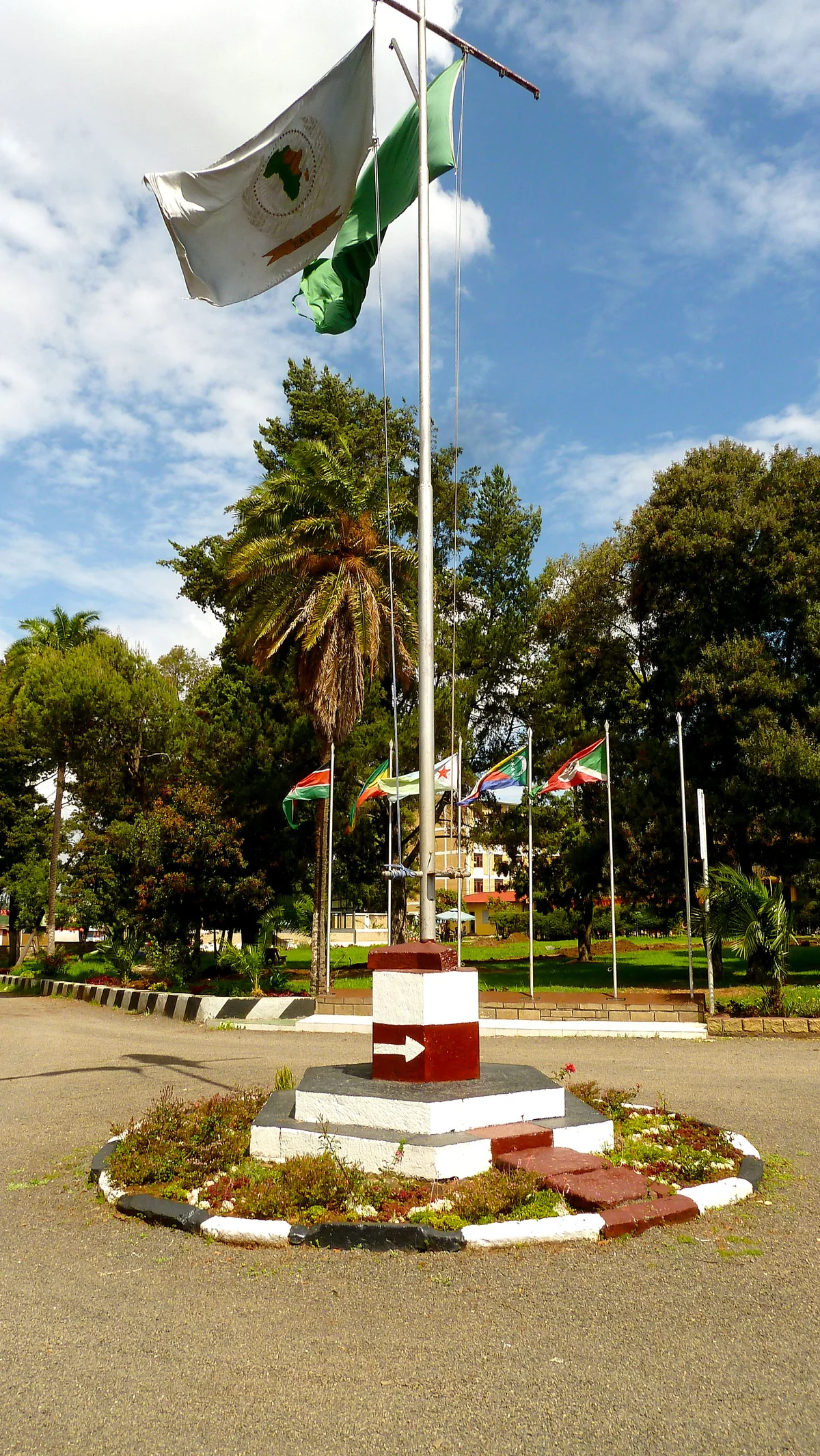
The Comorian flag appears in the background among national flags in this photograph of the East Africa Standby Brigade headquarters. The foreground institutional flags are separate emblems. The image provides a documented setting for public display; it does not establish the flag’s legal dimensions, a national hoisting schedule, or a required order for every ceremony.
Comoros flag pictures
Yellow, white, red, and blue bands with a green hoist triangle, a white crescent, and four white stars.
GKBook drawing using the public-domain Commons geometric model; digital colors are reference shades.Download image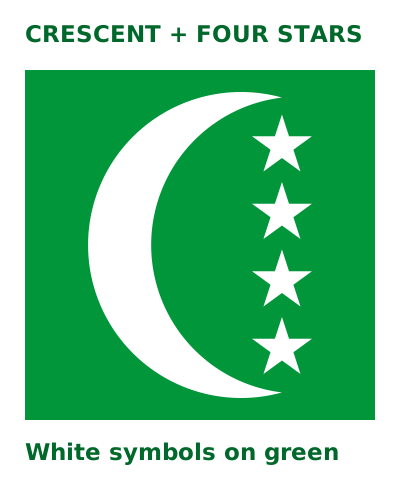
A close-up of the white crescent and the four five-pointed stars. One point of each star faces up in this reference drawing.
Original GKBook diagram. Reference construction, not a complete statutory specification.Download image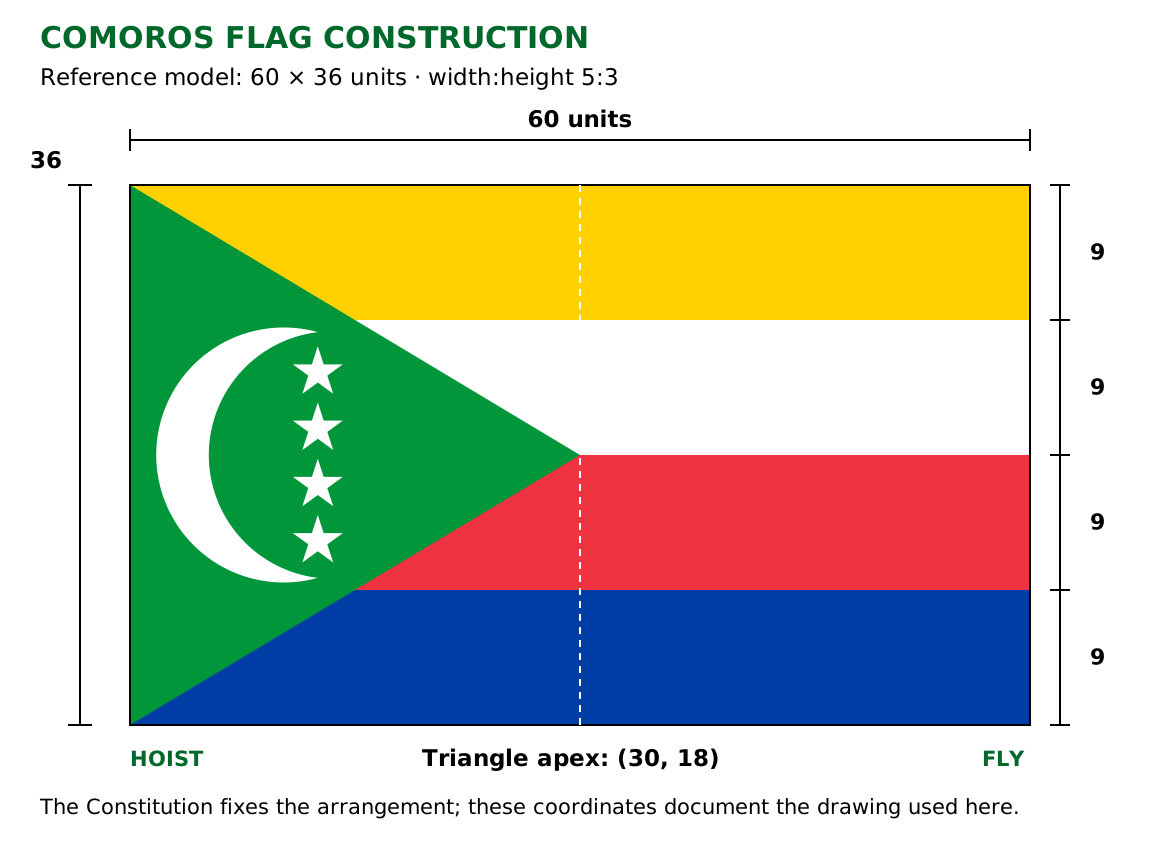
A 60-by-36-unit reference drawing, with four nine-unit-high bands and the green triangle’s apex at the center of the flag. These drawing coordinates are not statutory measurements.
Original GKBook diagram. Reference construction, not a complete statutory specification.Download image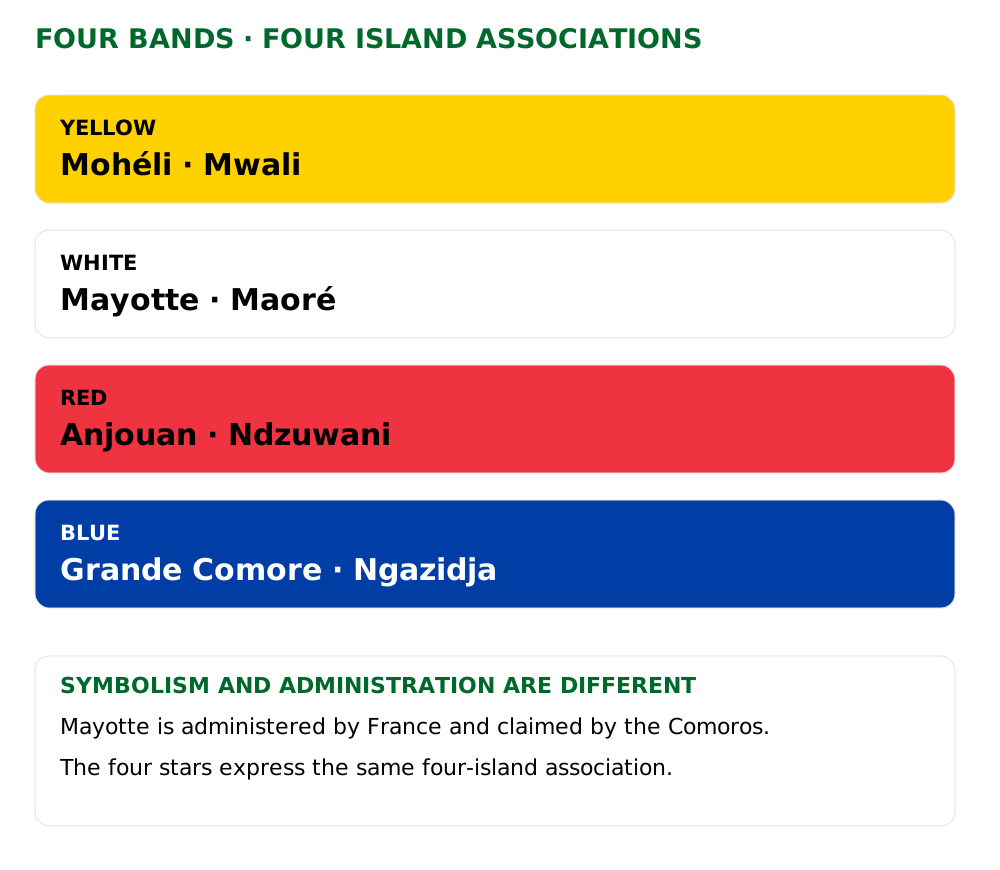
Yellow is associated with Mohéli, white with Mayotte, red with Anjouan, and blue with Grande Comore. The flag’s four-island symbolism includes Mayotte, which is administered by France and claimed by the Comoros.
Original GKBook diagram. Reference construction, not a complete statutory specification.Download image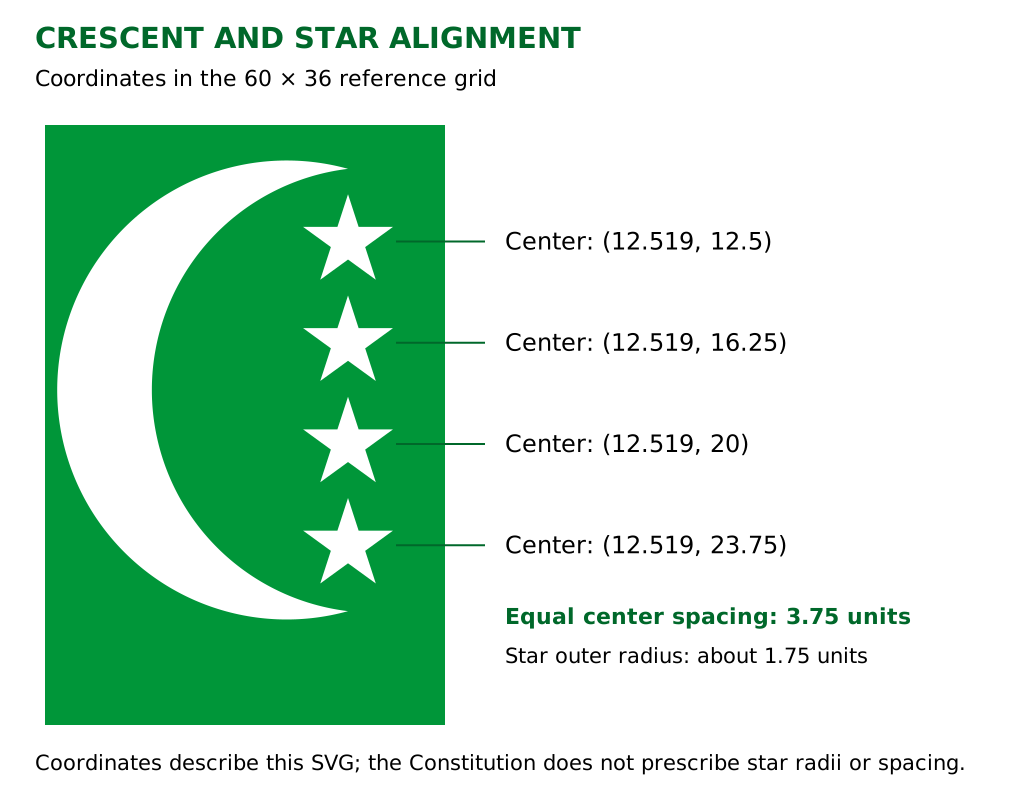
The four star centers form a vertical line in the current reference drawing, with equal spacing. The coordinate values explain the SVG rather than claim a government construction standard.
Original GKBook diagram. Reference construction, not a complete statutory specification.Download image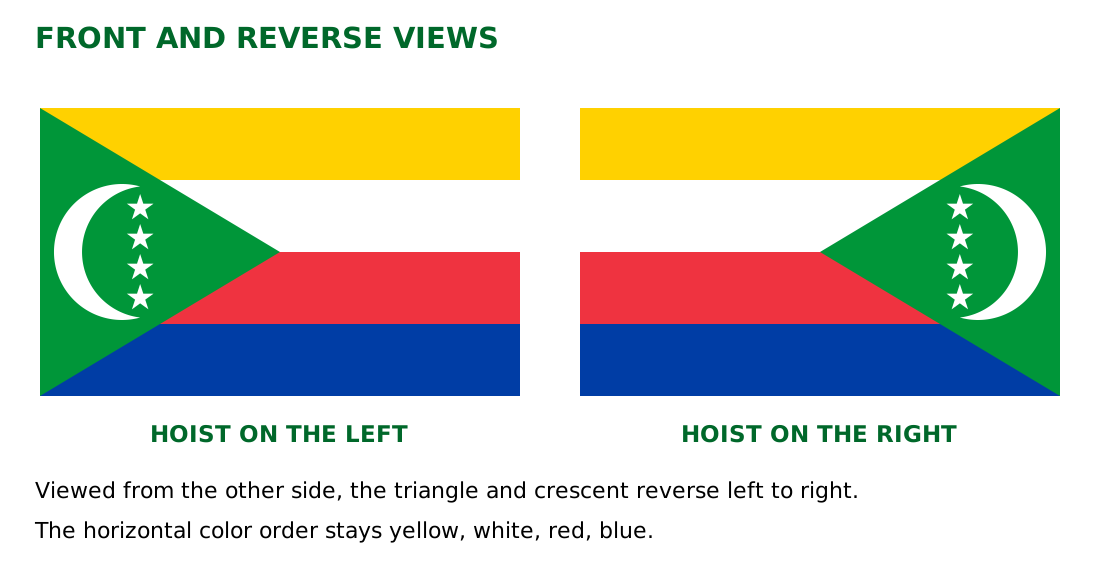
A reverse view mirrors the triangle and crescent horizontally while keeping the four bands in the same top-to-bottom order. It is not a separate national flag.
Original GKBook diagram. Reference construction, not a complete statutory specification.Download image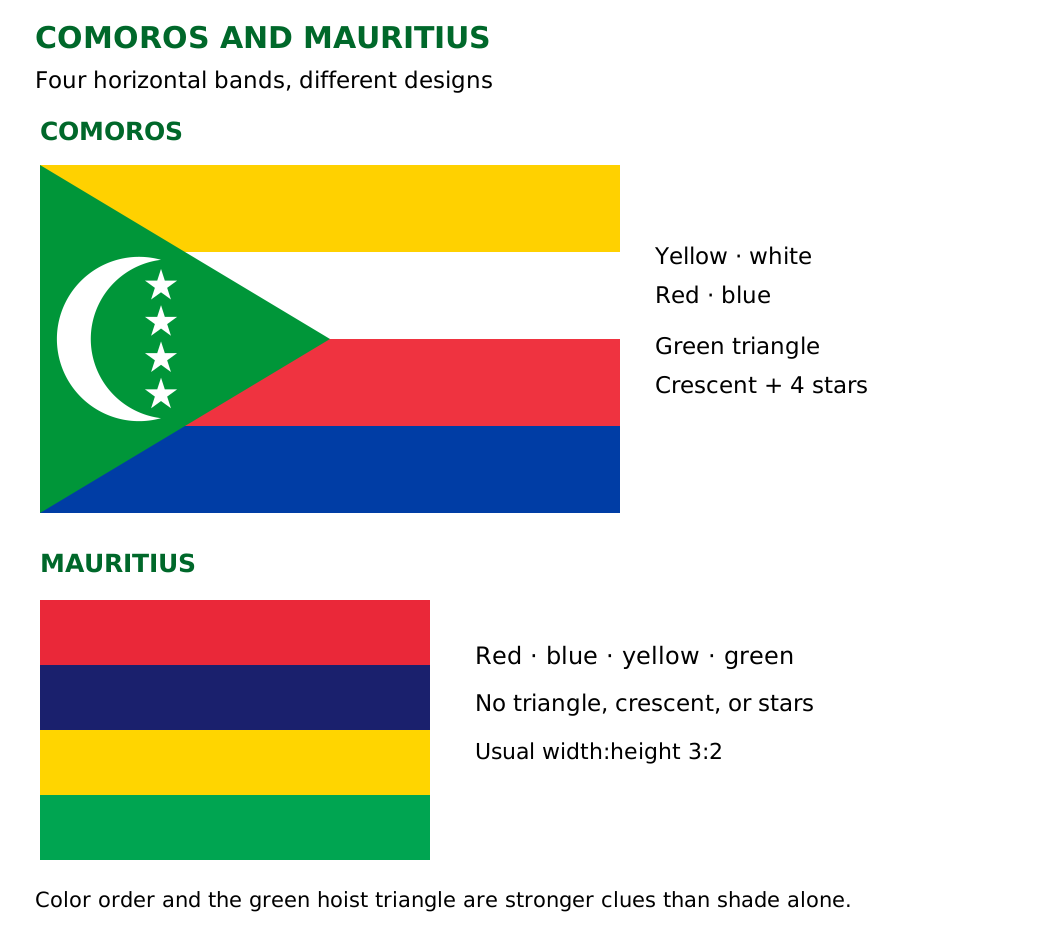
Comoros has yellow-white-red-blue bands and a green triangle with white symbols. Mauritius has four equal red-blue-yellow-green bands and no emblem. Both flags are drawn at their usual proportions.
Original GKBook vectors. Mauritius arrangement and 3:2 proportions checked against its government’s National Flag page; web shades are illustrative.Download image
Green field, crescent near the upper hoist, and four stars in an ascending diagonal. This reconstruction uses the 7:5 format reported in specialist literature.
Orange Tuesday / Wikimedia Commons. Public domain. Metadata cleaned; field adjusted to the documented 7:5 ratio.Download image
Red over green, with four stars grouped beside the crescent. A historical reconstruction in the source artwork’s 7:5 format.
Zscout370, based on Hammon27 / Wikimedia Commons. CC BY-SA 3.0. Metadata cleaned; source geometry retained. Image credit and license.Download image
A green field with a tilted crescent and four stars in a line. Historical reconstruction; published proportions for this period vary.
Mysid / Wikimedia Commons. Public domain. Metadata cleaned; source geometry retained.Download image
A green field with an upward-facing crescent and a horizontal row of stars. Historical reconstruction; the source drawing’s proportions are illustrative.
Mysid / Wikimedia Commons. Public-domain geometric design. Metadata cleaned; source geometry retained.Download image
The pre-2001 green flag with a crescent, four stars, and Arabic inscriptions. Reconstructed artwork; the source image’s shape is not a definitive historical proportion.
Mysid / Wikimedia Commons. Public-domain geometric design. Metadata cleaned; source geometry retained.Download image
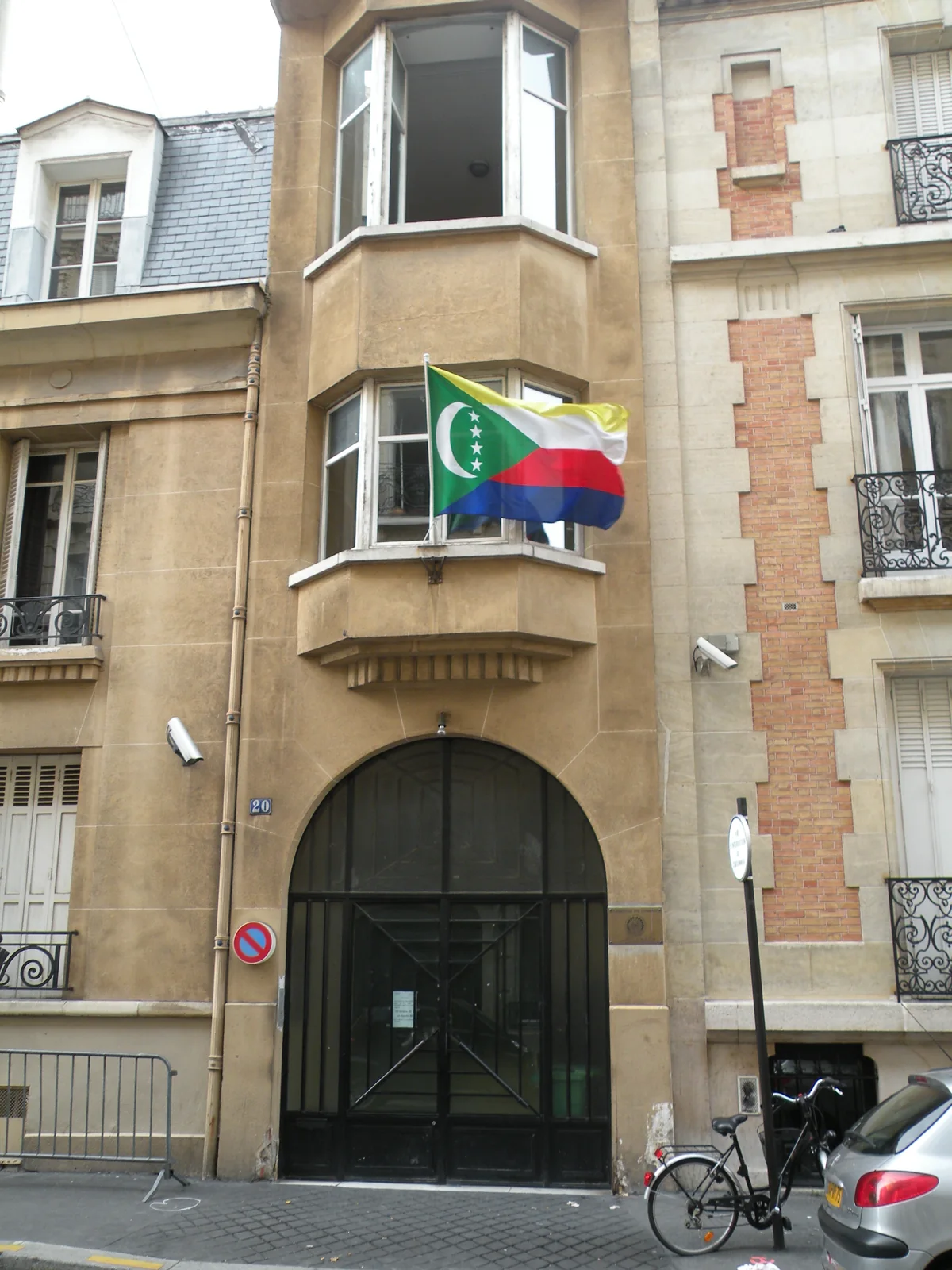
The Comorian flag outside the embassy at 20 rue Marbeau, Paris, photographed on June 26, 2009.
Pymouss / Wikimedia Commons. CC BY-SA 3.0. Resized and converted to WebP. Image credit and license.Download image
Flags at the East Africa Standby Brigade headquarters in Addis Ababa, Ethiopia, on April 27, 2012; the Comorian flag appears among the national flags in the background.
Rich Bartell / U.S. Army Africa, via Wikimedia Commons. CC BY 2.0. Resized and converted to WebP. Image credit and license.Download imageFrequently asked questions
What does the flag of the Comoros look like?
The flag has four equal horizontal bands: yellow at the top, then white, red, and blue. A green isosceles triangle extends from the hoist. Inside it are a white crescent and four white five-pointed stars, arranged in a line between the crescent’s tips.
What do the four stars represent?
The four stars represent the four main islands associated with Comorian national identity: Grande Comore, Anjouan, Mohéli, and Mayotte. Their meaning includes Mayotte even though France administers it and the Comoros claims it. The stars are therefore not simply a count of islands administered by the Union.
Which island does each band represent?
The established island associations are yellow for Mohéli, white for Mayotte, red for Anjouan, and blue for Grande Comore. These interpretations are reported by specialist flag references. The Constitution names the flag’s colors and describes its arrangement, but does not itself provide a separate explanatory meaning for each band.
Why is Mayotte represented on the flag?
Mayotte is part of the four-island Comorian national claim expressed in the flag’s symbolism. France administers Mayotte, while the Comorian Constitution includes it in the national territory. The white band and the four-star motif should be understood in that context, without confusing symbolism with current administration.
When was the current Comoros flag adopted?
The current design is described in Article 1 of the Constitution adopted by referendum on December 23, 2001. That is the constitutional adoption date used here. Some references describe its introduction in early 2002, so adoption and the date of a first ceremonial raising should not be treated as interchangeable.
Was this the flag used at independence in 1975?
No. The four-band design belongs to the constitutional settlement of 2001, long after independence was proclaimed on July 6, 1975. Earlier Comorian flags used the crescent and four stars on different backgrounds and in different arrangements. A historical photograph needs both an event date and a flag identification.
What is the flag’s width-to-height ratio?
The commonly reproduced format is 5:3 in width-to-height order, equivalent to 3:5 when height is given first. That is the format of this page’s current-flag SVG. Article 9 of the Constitution describes the components and equal horizontal bands without specifying a numerical overall ratio.
Are the four horizontal bands equal?
Yes. Article 9 of the 2018 Constitution describes four equal horizontal bands, ordered yellow, white, red, and blue from top to bottom. Each occupies one quarter of the flag’s height. The green triangle covers parts of their hoist ends, so equal height does not mean equal visible colored area.
Why does the flag have a crescent and a green triangle?
Green and the crescent have an established association with Islam in interpretations of the Comorian flag. The triangle gives the white crescent and four stars a common setting beside the island-associated bands. The Constitution describes these elements, while their religious interpretation comes from the flag’s documented symbolism.
Does the Comoros flag have four or five colors?
It has five colors: yellow, white, red, blue, and green. Four colors form the horizontal bands, while green fills the hoist triangle. White is also used for the crescent and stars. Counting only the bands leaves out a substantial part of the national design.
Are the hexadecimal colors legally prescribed?
The constitutional flag article gives color names rather than hexadecimal values or RGB triplets. This page records a consistent digital reference palette for its illustrations. Those screen values should not be presented as a statutory textile standard, and they do not by themselves establish printing tolerances or fabric colors.
Did Suzanne Gauthier design the current flag?
The documented attribution to Suzanne Gauthier concerns the local flag introduced in 1963, with a green field, crescent, and diagonally arranged stars. It should not automatically be transferred to the four-band design of 2001. The constitutional descriptions of the current flag do not identify an individual designer.
Does the current flag contain Arabic writing?
No. The current national design has colored bands, a green triangle, a white crescent, and four white stars, without inscriptions. Arabic names appeared on the preceding 1996–2001 design. Adding those historical inscriptions to the present flag would combine elements from different periods rather than reproduce the current design.
Does the current flag include the national seal?
No. The national seal is a separate state symbol. The national flag’s green triangle contains the white crescent and four stars rather than the full seal. The presidency presents the flag and seal separately, and Article 9 of the Constitution distinguishes the country’s flag, seals, and anthem.
Is the green triangle equilateral?
The Constitution calls the hoist triangle isosceles, meaning that two sides are equal. It does not require all three sides to be equal. In the common 5:3 reference drawing with a central apex, the point angle is approximately 61.9 degrees, rather than exactly 60 degrees.
Which way should the crescent face?
In the standard front view with the hoist on the left, the crescent opens toward the right, toward the fly. The 2001 constitutional wording explicitly describes that direction. Looking at the opposite side of the same flag mirrors the design, so the crescent appears to open left.
Is July 6 a separate Flag Day?
July 6 is the national independence observance, marking the proclamation of independence in 1975. The sources used here do not establish a distinct annual national Flag Day. It is also different from December 23, 2001, the constitutional adoption date associated with the current four-band flag.
What does the mourning decree say about half-mast?
Article 15 of the March 29, 2025 ceremonies decree addresses the death of the President of the Union, providing mourning honors for military flags and standards and lowering military ensigns. The government sets the mourning period. That specific provision is not a complete civilian half-mast schedule.
How is the Comoros flag different from Mauritius’s flag?
Comoros has yellow, white, red, and blue bands, plus a green hoist triangle containing a crescent and four stars. Mauritius has four equal red, blue, yellow, and green bands, with no such triangle or symbols. The color order and the white emblem provide clear identification clues.
Can the construction diagram be used to make an accurate drawing?
Yes. The diagram gives a reproducible 60-by-36-unit model, equal nine-unit band heights, a central triangle apex, and documented star coordinates. It is accurate to the reference SVG supplied here. The measurements are labeled as drawing specifications rather than a complete construction standard issued by the Comorian government.
Are older green Comoros flags necessarily incorrect?
They may be accurate historical flags. Several earlier national designs used a green field with a crescent and four stars, sometimes with Arabic inscriptions. They should be identified by their period and source. A historically correct design is different from the ordinary national flag used today.
Where can I download the flag pictures?
The picture gallery provides internal downloads of the actual SVG drawings and photographs used in this article. Historical reconstructions are labeled, and photographs carry credits. The adjacent media rights file includes the required licenses for credited material, so the download’s reuse conditions can be checked alongside the image.

We Value Your Opinion Comments