
Colombia flag picture
Explore the construction sheet, the unequal-band detail, and the 1861 arrangement.
| Country | Republic of ColombiaSpanish: República de Colombia. |
|---|---|
| Design | Horizontal yellow, blue, and redA plain tricolor; the ordinary national flag has no emblem. |
| Band heights | 2 : 1 : 1Yellow 50%; blue 25%; red 25%. |
| Usual proportion | 3 : 2 — width:heightEquivalent to 2:3 height:width; some service flags use different dimensions. |
| Current arrangement | November 26, 1861Established by decree under Tomás Cipriano de Mosquera. |
| Modern flag law | Law 12 of 1984Article 2 restates the unequal horizontal bands. |
| Historical origin | Miranda’s tricolor traditionFrancisco de Miranda is associated with the earlier yellow-blue-red colors. |
| Flag Day | August 7Established as an annual national flag celebration by Law 28 of 1925. |
| Independence Day | July 20A separate national observance. |
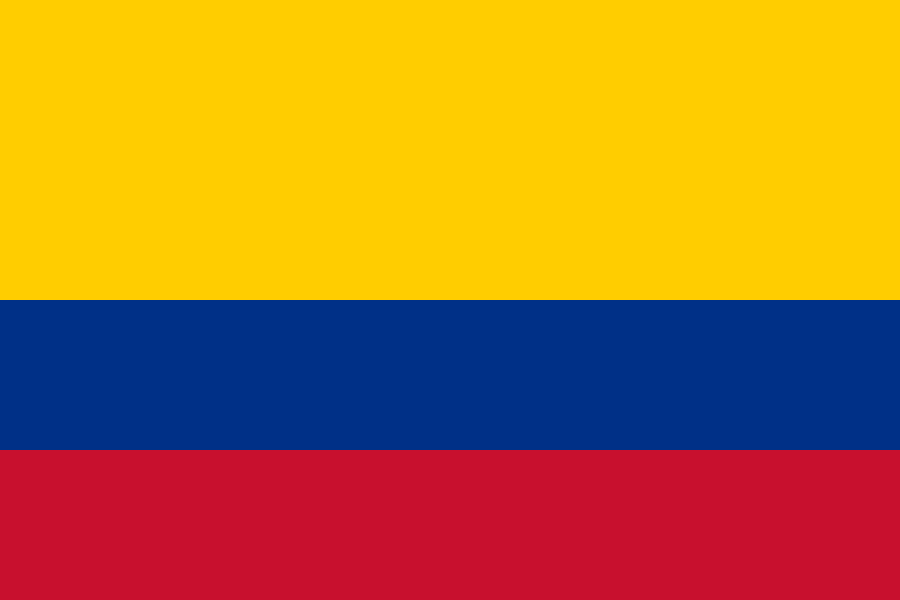
Colombia’s national flag is a plain horizontal tricolor. Yellow fills the upper half; blue and red each fill one quarter below it. The wider yellow band distinguishes its proportions from a tricolor divided into three equal bands.
What does the flag of Colombia look like?
The flag of Colombia is a horizontal tricolor of yellow, blue, and red. Yellow covers the upper half, while blue and red each occupy one quarter below it. The ordinary national flag has no emblem. Its current arrangement dates to November 26, 1861, and its usual width-to-height ratio is 3:2.
The wide yellow band is the quickest identifying feature. Read the flag from top to bottom: a broad yellow field, a narrower blue strip, and an equally narrow red strip. Three colors do not mean three equal divisions. A horizontal line through the exact middle of the flag marks the boundary between yellow and blue.
Colombia shares the yellow-blue-red tradition with neighboring Ecuador and Venezuela. That family resemblance reflects a connected independence-era history, but it does not make every modern version interchangeable. Compare the band widths and emblems before identifying a flag from a photograph.
The Spanish name bandera de Colombia means “flag of Colombia”; tricolor nacional describes the national tricolor. The country’s English name is spelled Colombia, with an “o” after the “l.” The article’s flag pictures show the ordinary national design unless a caption identifies a different version.
A plain flag with unequal bands
Colombia’s ordinary flag has no central shield, bird, star, lettering, or motto. Its defining design feature is the relationship between the three horizontal bands. The absence of an emblem leaves the color order and the extra height of yellow clearly visible from a distance.
The national coat of arms is a separate symbol. It appears in particular presidential and armed-service uses; it should not be added automatically to an ordinary flag illustration. A requirement to display both national symbols at an institution does not mean printing one on the other.
In flag terminology, the hoist is the edge nearest the pole or attachment. The fly is the outer edge. Those terms help describe historical vertical flags and service badges even though the ordinary Colombian design runs all three colors across the entire width.
Colombia flag colors and digital specifications
The legal color names are yellow, blue, and red. Article 2 of Law 12 of 1984 specifies their order and their shares of the flag. A color name in that statute is not the same thing as a hexadecimal value, an ink formula, or a textile color tolerance.
| Color | Position and share | Digital value used here | RGB |
|---|---|---|---|
| Yellow | Top half — 50% | #FFCD00 | 255, 205, 0 |
| Blue | Middle quarter — 25% | #003087 | 0, 48, 135 |
| Red | Bottom quarter — 25% | #C8102E | 200, 16, 46 |
The values above match the verified digital reference used for the drawings on this page. They provide a consistent web illustration, including the matching symbolism rows. They are not a claim that Colombia’s flag law mandates these exact screen values or a corresponding Pantone number.
Physical fabric, printing, transmitted light, camera exposure, and display settings can change the appearance of a photographed flag. A darker blue or warmer yellow in a photograph is therefore a poor identification test on its own. Check the proportions and any badge first; compare colors under comparable lighting.
For manufacturing, a documented sample and the applicable purchasing specification are more useful than choosing a color from a random online picture. The mathematical band divisions remain the same whatever production process is used.
Symbolism and meaning
Colombia’s Foreign Ministry gives a descriptive explanation of the national colors: yellow relates to abundance and civic ideals, blue to the seas and international connections, and red to life and strength. This interpretation explains the symbol; it is separate from the statute that defines the flag’s visible design.
A familiar popular explanation associates yellow with gold, blue with the seas, and red with blood shed for independence. Flag references record that interpretation, but it should not erase the Foreign Ministry’s broader description. Color symbolism can have several historical layers; the written design rule remains yellow above blue above red.
The larger yellow band is a specified feature of the design. Its size does not, by itself, establish a numerical claim about mineral wealth, the number of regions, or the relative importance of the colors. The flag carries no encoded count of departments, rivers, or historical leaders.
Construction, proportions, and calculated sizes
For a flag with total height H, the yellow band has height H ÷ 2. Blue and red each have height H ÷ 4. In the usual 3:2 width-to-height format, total width is 1.5 × H. These relationships produce a simple six-unit-by-four-unit construction grid.
| Example width × height | Yellow height | Blue height | Red height |
|---|---|---|---|
| 60 × 40 cm | 20 cm | 10 cm | 10 cm |
| 90 × 60 cm | 30 cm | 15 cm | 15 cm |
| 150 × 100 cm | 50 cm | 25 cm | 25 cm |
| 300 × 200 cm | 100 cm | 50 cm | 50 cm |
Each band spans the same full width, so its share of the total area equals its share of the total height. Yellow occupies exactly half the rectangle. The two narrower bands together occupy the other half. No border, emblem allowance, or spacing gap should be inserted between the colored fields of the ordinary flag.
A practical drawing method is to divide the height into four equal strips, combine the top two as yellow, fill the third blue, and fill the fourth red. This avoids the common mistake of drawing three equal horizontal bands. For a raster image, a height divisible by four also avoids fractional-pixel band boundaries.
Distinguish the proportions of the general national format from dimensions prescribed for particular historical military standards. A 135-by-110-centimeter service flag does not imply that an everyday national flag must have that outline. The variant table identifies the context of those measurements.
History of the Colombian flag
The history is easiest to follow by separating three questions: where the colors came from, when the current arrangement was fixed, and when later laws regulated its use. A new statute or a change in state organization does not necessarily mean a new flag design.
Miranda’s earlier tricolor
Archivo de Bogotá traces the yellow-blue-red tradition to Francisco de Miranda’s expedition and the raising of his tricolor aboard the brig Leander on March 12, 1806. This is an origin in the wider independence movement. It is not the date of the present Colombian rectangle with its specific unequal horizontal bands.
A shared independence-era palette
The tricolor was adopted in Venezuela in 1811. That earlier use helps explain why the same three colors later became familiar across more than one country. The modern national flags should still be identified by their own legal arrangements rather than treated as unchanged copies of a single early flag.
The historical Republic of Colombia
The December 17, 1819 union carried the tricolor into the historical Republic of Colombia, usually called Gran Colombia in modern accounts. Its symbolism belongs to a wider political history than that of today’s country alone. A political union, a constitutional settlement, and a specific flag drawing are related but distinct subjects.
Red, blue, and yellow became vertical bands
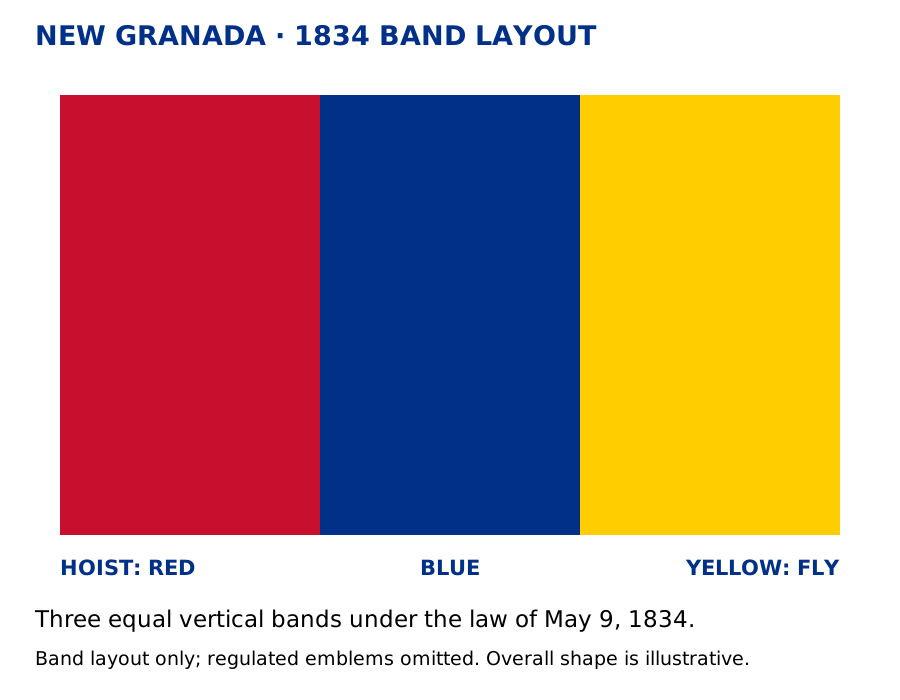
The New Granadan law of May 9, 1834 prescribed three equal vertical divisions: red nearest the pole, blue in the center, and yellow at the outer edge. It also distinguished emblem-bearing public and war flags from the merchant version. The reconstruction below isolates the band layout so it does not pass an incomplete service flag off as a full historical specimen.
The current horizontal arrangement
A decree issued under provisional president Tomás Cipriano de Mosquera on November 26, 1861 restored a horizontal arrangement and specified yellow across the upper half, with blue and red below in equal quarters. This is the key date for the current band pattern. It should be distinguished from earlier adoption of the three national colors.
Detailed service-flag specifications
Decree 861 of May 17, 1924 restated the national bands and described merchant and military forms. Its measurements are valuable evidence for particular service designs. They did not replace the plain yellow-blue-red field with a compulsory badge on every national flag. The merchant reconstruction later in this article is labeled to this decree.
An annual national Flag Day
Law 28, sanctioned on February 16, 1925, established an annual national flag celebration on August 7. That observance is separate from July 20, Independence Day. It also differs from November 26, the anniversary of the 1861 arrangement. One date does not serve all three purposes.
Military rules preserved the national bands
Decree 62 of January 11, 1934 retained the unequal horizontal bands while describing military flags, dimensions, and identifying arms. These provisions belong to the regulation of particular uses. They should not be read as the introduction of a different ordinary national flag.
The flag’s design was restated in statute
Law 12 of February 29, 1984 recognized the national symbols and set out the same half-quarter-quarter flag arrangement in Article 2. It also separately described the national coat of arms. The law is a modern legal foundation for the design, not evidence that Colombia first adopted the tricolor in 1984.
A detailed display framework
Decree 1967 of August 15, 1991 addressed the use of the national symbols: specified display dates, precedence, lighting, respectful handling, official mourning, and authorized emblem-bearing flags. Its practical subject is how the symbols are displayed and used. It does not reorder or resize the three bands.
Institutional display and weekly school ceremonies
Law 198 of July 17, 1995 required permanent display of the national flag and coat of arms at specified institutions. It also required weekly civic ceremonies during academic terms in public and private primary and secondary schools. That later weekly rule should be distinguished from the monthly school provision in the 1991 decree.
Who designed the flag of Colombia?
The answer depends on which part of the flag’s history is meant. Francisco de Miranda is associated with the earlier yellow-blue-red tricolor. Francisco de Paula Santander’s government prescribed New Granada’s vertical arrangement in 1834. Tomás Cipriano de Mosquera’s decree established the current unequal horizontal arrangement on November 26, 1861.
| Person | Documented role | What the attribution does not mean |
|---|---|---|
| Francisco de Miranda | Earlier tricolor tradition, associated with the 1806 expedition. | Not a claim that the exact modern Colombian drawing was adopted in 1806. |
| Francisco de Paula Santander | President when the 1834 New Granadan law prescribed the vertical bands. | Not the current horizontal arrangement. |
| Tomás Cipriano de Mosquera | Provisional president behind the November 26, 1861 decree. | Not the original inventor of the earlier three-color tradition. |
A short infobox that gives only one name can hide this distinction. The color tradition has an earlier history than the current arrangement. Legal authority for a particular layout is also different from the artistic act of inventing a palette. Colombia’s Foreign Ministry and Bogotá’s archive provide the context for those separate roles.
Stories about the personal inspiration behind Miranda’s choice of colors should be treated according to the evidence for each story. The documented flag laws establish arrangements and uses; they do not turn every later anecdote about the colors into an official account.
Making the flag: materials, seams, and finished proportions
For the ordinary flag, the principal construction requirement is visual: preserve the horizontal yellow half and the blue and red quarters. Whether the bands are sewn as separate pieces or reproduced on one piece of fabric, their finished dimensions should follow the same layout. This is a design check, not a claim that one manufacturing technique is legally required.
When sewing separate panels, distinguish the visible finished height from the cut height. Seam allowances are part of the sewing process; they should not consume enough of a narrow band to change its share of the finished rectangle. The attachment sleeve or reinforced edge likewise should not be mistaken for an extra colored band.
Historical service flags show that material and decoration depended on purpose. Colombia Nos Une, drawing on National Museum examples, describes sewn and embroidered silk flags associated with Batallón Chía No. 27 around 1861 and the Cazadores del Cauca around 1932. These objects document particular military textiles, not a universal requirement that every modern Colombian flag be silk.
Useful production checks
- Measure the finished display rectangle before assessing the band heights.
- Check that blue and red are equal and together match the height of yellow.
- Preserve the selected colors consistently across the full band, without artificial gradients in the flag itself.
- Use the applicable service specification when making a commissioned military or maritime flag.
Frequent drawing errors
- Three equal horizontal bands presented as the ordinary Colombian flag.
- An added coat of arms without identifying a special authorized version.
- A border or white gap between bands introduced by the illustration software.
- A historical service size labeled as a universal national-flag dimension.
National, presidential, military, and maritime versions
The familiar plain tricolor is the reference point. A flag with a shield, unit title, or special badge needs a more precise caption because those details identify a particular use. Article 8 of the 1991 display decree reserves flags bearing the national coat of arms to the President and the armed bodies of the Republic.
| Version or context | Distinguishing feature | How to interpret it |
|---|---|---|
| Ordinary national flag | Plain unequal yellow-blue-red bands. | No shield, star, or inscription is required in the ordinary design. |
| Presidential and armed-body uses | National arms may appear under the authorized-use rules. | Do not treat an emblem-bearing specimen as the general civilian pattern. |
| Military flag in the 1924 decree | 135 × 110 cm for the flag of foot units; separate identifying arms and unit details. | A service-specific format, not the usual 3:2 national format. |
| Mounted standard in the 1924 decree | 100 × 100 cm. | A historical service specification; the square outline does not redefine the ordinary national flag. |
| Merchant flag in the 1924 decree | 3 × 2 m with a central blue oval, red border, and white eight-point star. | A specifically dated legal design, illustrated separately below. |
The coat of arms contains its own national imagery, including a condor, a liberty cap, a pomegranate and cornucopias, and a maritime scene. That symbolic content belongs to the arms. It is not a hidden part of the plain flag and should not be described as appearing on every Colombian flag.
Institutional display of a flag beside a coat of arms is another distinct arrangement. Law 198 of 1995 names the two symbols separately when directing their display at public offices and other institutions. A plain flag remains a plain flag even when a coat-of-arms plaque is mounted nearby.
The merchant flag described in 1924
Decree 861 of May 17, 1924 supplies an unusually detailed maritime design. It describes a merchant flag three meters wide and two meters high, carrying a blue oval in the center, a red velvet border, and a white star with eight points. The drawing below reconstructs that dated specification; it does not claim that every vessel seen today carries this version.
The blue oval’s stated axes are 40 centimeters and 30 centimeters. The red border is five centimeters wide, and the white star is ten centimeters in diameter. These numbers describe the badge for the stated flag size; they should not be confused with percentages of the entire flag.
The distinction between prescribed dimensions and an illustrator’s choices matters most in a close-up. An accurate reconstruction can reproduce the stated sizes while acknowledging that a source does not settle every contour. The blue oval and red border also distinguish this star-bearing maritime design from Venezuela’s arc of eight separate stars.
Flag Day, Independence Day, and the adoption anniversary
Colombia’s annual Flag Day falls on August 7. Law 28 of 1925 established the national flag celebration on that date. DIMAR connects the observance with the Battle of Boyacá, fought on August 7, 1819. Independence Day is a separate occasion on July 20.
| Date | Occasion | What it marks |
|---|---|---|
| August 7 | Flag Day and the Battle of Boyacá commemoration | The annual flag celebration established in 1925; Boyacá’s battle took place in 1819. |
| July 20 | Independence Day / National Day | The national independence observance. |
| November 26, 1861 | Current flag arrangement | The decree establishing the present horizontal band pattern. |
| February 29, 1984 | Law 12 of 1984 | Modern statutory recognition of the national symbols; not the first adoption of the design. |
The flag in national celebrations and communities abroad
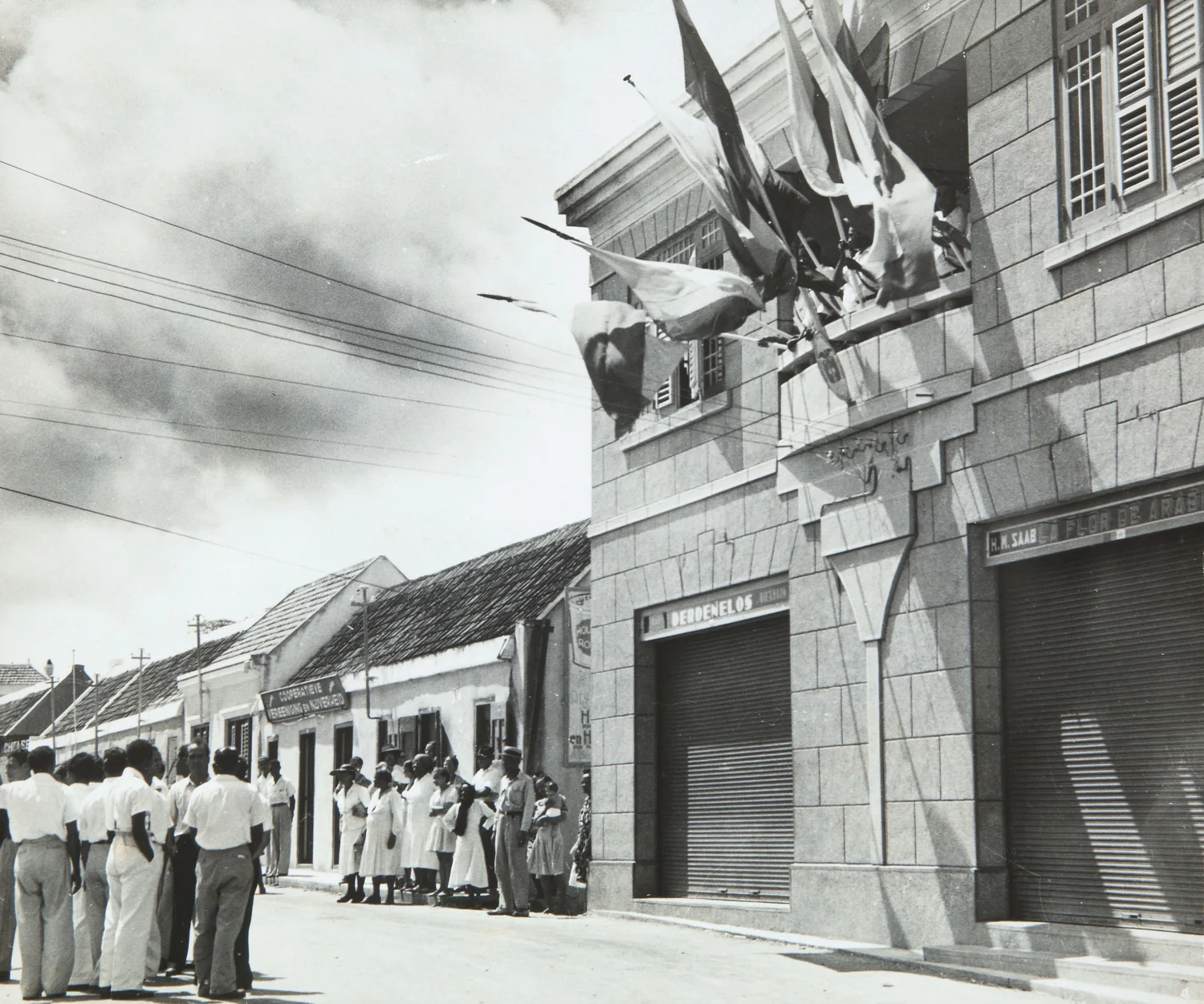
National observances also have a history outside Colombia. The photograph below records a July 20 celebration at the Colombian consulate in Willemstad, Curaçao, in 1944. It gives a documented example of a community gathering around the national occasion; the caption’s date comes from the museum record, not the later digitization of the photograph.
For navigation, this page links “Flag Day” to the August 7 observance. That label should not be used for the November adoption anniversary or substituted automatically for July 20. Keeping the three dates separate is useful in a factbox, a historical timeline, and a short answer about the flag.
Hoist, reverse, and correct orientation
An ordinary Colombian flag looks the same in its color arrangement when viewed from its reverse: the three bands still run horizontally, with yellow above blue above red. Turning the whole rectangle upside down is different. A 180-degree rotation puts red at the top and the large yellow field at the bottom.
A mirror image across a vertical axis leaves this plain design unchanged because every band extends from one side to the other. That observation applies to the unlettered, unemblemed national field. A special flag carrying arms, a unit inscription, or another badge may need its own front-and-reverse specification.
In photographs, distinguish a rotated image from a flag actually displayed upside down. Cropping, camera angle, folds, and an attachment edge hidden behind a pole can confuse the reading. The most reliable starting point is the position and size of yellow in the full visible rectangle.
Display and protocol in Colombia
Decree 1967 of 1991 provides Colombia’s detailed framework for displaying the national symbols. Its rules address dates, positioning, lighting, handling, and special uses. The table below summarizes the main flag-display occasions in that decree; institutional requirements under the later 1995 law are explained in the following section.
| Occasion or setting | Flag-display provision | Useful distinction |
|---|---|---|
| July 20 and August 7 | Named among the national display dates. | Independence Day and the Flag Day/Boyacá occasion remain distinct. |
| October 12 and November 11 | Also named in Article 1. | Do not reduce the decree’s list to only the two most familiar dates. |
| Feast of the Sacred Heart | Named in Article 1. | It is a movable observance; a permanent calendar date should not be invented. |
| Territorial and local anniversaries | Article 2 addresses specified creation and founding anniversaries. | The relevant local occasion is additional to the national dates. |
| Official national mourning | Special half-mast and black-crepe provisions apply. | Follow the authorized mourning occasion rather than a privately invented schedule. |
Position and ceremony
- With one other flag, Colombia takes the protocol position on the right, which is the viewer’s left.
- In a group, the decree places Colombia in the center and orders the others alphabetically in Spanish, alternating the sides.
- Where individual national anthems accompany the hoisting, the Colombian flag is raised first and lowered last.
- When only Colombia’s anthem accompanies the ceremony, the decree provides for simultaneous raising and lowering.
Handling and setting
- The flag must not touch the ground.
- Its original form should be preserved rather than altered with additions that distort the national symbol.
- Display is ordinarily during the day; nighttime use is allowed where adequate comparable illumination makes the flag appreciable.
- Diplomatic missions follow the applicable arrangements with the host country.
Read those instructions in their stated context. For example, the placement rule for a group is not permission to improvise the order of a multinational ceremony without its protocol arrangements. Armed forces have additional service regulations, and missions abroad operate in a host-country setting.
The decree also distinguishes respectful use from misuse. Its provisions do not support a blanket statement that the national colors or symbols can never appear on clothing or objects. Context, respect, and the particular regulated use matter. The flag’s color order and proportions should not be casually altered merely to fit a decorative space.
Public institutions and school flag ceremonies
Law 198 of 1995 requires permanent display of the national flag and coat of arms at the main entrance of specified public institutions, military and police premises, educational institutions, and diplomatic or consular missions. The two national symbols are named separately. A flag does not acquire a shield simply because a building displays both.
For public and private primary and secondary schools, the law requires a civic ceremony each week during academic terms, including raising the flag and singing the national anthem. This later requirement is important when reading the older display decree: the 1991 text referred to a monthly school ceremony, while the 1995 statute specifies a weekly one.
Heritage buildings and monuments receive particular attention in the 1995 law. The appropriate local planning authority determines the placement of the symbols in those settings. Preserving a national symbol and respecting the physical character of a historic building are therefore addressed together.
Permanent institutional display, a scheduled civic ceremony, and flag display at a home on a named observance are different situations. Keeping them separate avoids the misleading claim that every flag follows exactly the same daily routine. Lighting and respectful presentation remain relevant to the setting.
Half-mast, national mourning, and funeral use
Colombia’s display decree connects half-mast use and a black crepe bow with official national mourning or express orders of Congress or the executive authority. Mourning is therefore an authorized occasion, not a fixed extra flag holiday. The duration and setting should follow the relevant declaration rather than an invented recurring schedule.
| Situation | What the national framework establishes | What should not be assumed |
|---|---|---|
| Official national mourning | Half-mast display and black crepe under the circumstances specified in Article 1. | A universal number of days for every death or tragedy. |
| Express congressional or executive order | The decree recognizes a specific instruction from those authorities. | That an unrelated foreign mourning calendar automatically applies in Colombia. |
| Black crepe bow | A visible mourning treatment is described along with half-mast use. | That changing the flag’s colored bands is part of the mourning design. |
| Coffin covering | Article 9 permits specified civil, ecclesiastical, and military authorities and recognized distinguished persons to be honored this way. | An imported fold sequence, burial instruction, or entitlement not stated in the Colombian provision. |
A flag at half-mast remains the same national design. Mourning changes its manner of display, not the proportions or meaning of the three bands. A photograph of a lowered flag therefore needs its own event context; the flag’s position alone does not establish who was being commemorated or how long the order lasted.
Funeral use is also distinct from the instructions for a flag on a pole. The cited decree identifies eligible honors but does not supply every handling detail sometimes found in international flag guides. A Colombian account should not silently import another country’s ceremony into this gap.
Common misconceptions about Colombia’s flag
| Misconception | Accurate explanation |
|---|---|
| “The three bands are equal.” | Only blue and red are equal; yellow fills half the height. |
| “The national flag must include the coat of arms.” | The ordinary flag is plain. Emblem-bearing flags belong to specifically identified uses. |
| “Independence Day and Flag Day are the same date.” | July 20 is Independence Day; August 7 is the annual national flag celebration established in 1925. |
| “The current flag was first adopted in 1984.” | The current band arrangement dates to November 26, 1861. The 1984 law restates the design. |
| “A modern web color code is automatically law.” | A chosen digital palette and a legally prescribed color standard are different things. |
| “A star on a yellow-blue-red flag always means Venezuela.” | Colombia’s 1924 merchant design used one eight-point star in an oval; Venezuela’s illustrated civil flag has eight separate five-point stars. |
| “One designer’s name explains every version.” | Miranda, Santander, and Mosquera have distinct roles in the color tradition and the 1834 and 1861 arrangements. |
| “The country is spelled Columbia.” | The country’s English name is Colombia. |
The most useful identification sequence is simple: inspect the size of yellow, verify the order of blue and red, and check whether any emblem is actually present. Then read the caption or setting for the version and date. This method is more dependable than treating a familiar color combination as a complete identification.
Read the Colombian flag at a glance
Remember yellow half, blue quarter, red quarter. The ordinary national flag is plain, and the usual overall rectangle is three units wide for every two units high. The current band arrangement dates to November 26, 1861; modern statutory recognition appears in Law 12 of 1984.
For the calendar, keep August 7: Flag Day separate from July 20: Independence Day. For imagery, distinguish the ordinary flag from a historical reconstruction, a service flag, and an authentic photograph. The gallery provides downloadable drawings and documentary pictures, each with its own caption.
Continue with the flag picture gallery, read the frequently asked questions, or browse World Flags.
Colombia flag pictures
The ordinary Colombian national flag: yellow occupies one half; blue and red occupy one quarter each.
Original GKBook vector; verified geometry. Digital colors are illustrative, not a legal color standard.Download image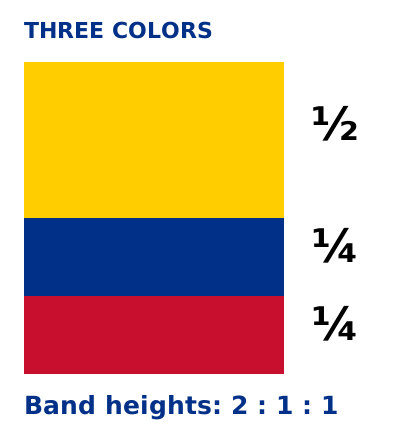
The yellow band is twice as tall as either the blue or red band. This detail isolates band heights; it is not a full flag-proportion drawing.
Original GKBook vector; verified geometry. Digital colors are illustrative, not a legal color standard.Download image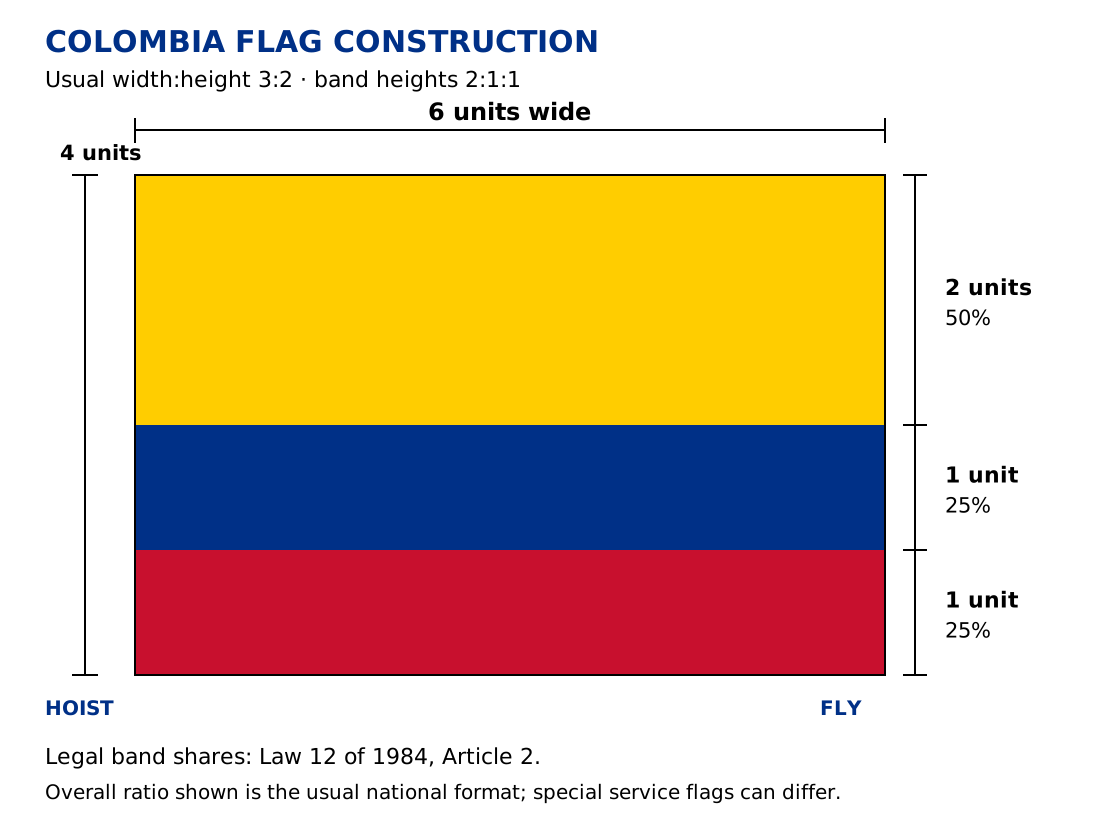
A six-unit-wide, four-unit-high example gives the yellow band two units of height and the other bands one unit each. Band shares are prescribed in law; the diagram uses the usual 3:2 overall format.
Original GKBook vector; verified geometry. Digital colors are illustrative, not a legal color standard.Download image
Reconstruction of the 1834 red-blue-yellow band layout, read from hoist to fly. Emblem-bearing versions were separately specified; this is not an archival image or a complete service flag.
Original GKBook vector; verified geometry. Digital colors are illustrative, not a legal color standard.Download image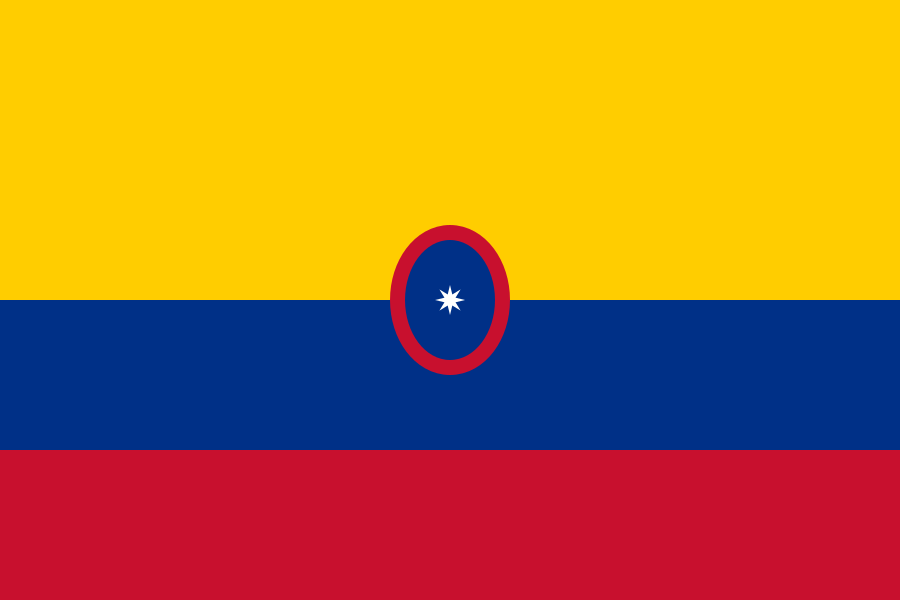
Illustrative reconstruction of the merchant flag in Decree 861 of 1924: a centered blue oval with a red border and a white eight-point star. The star’s inner indentations and web color shades are illustrative.
Original GKBook vector; verified geometry. Digital colors are illustrative, not a legal color standard.Download image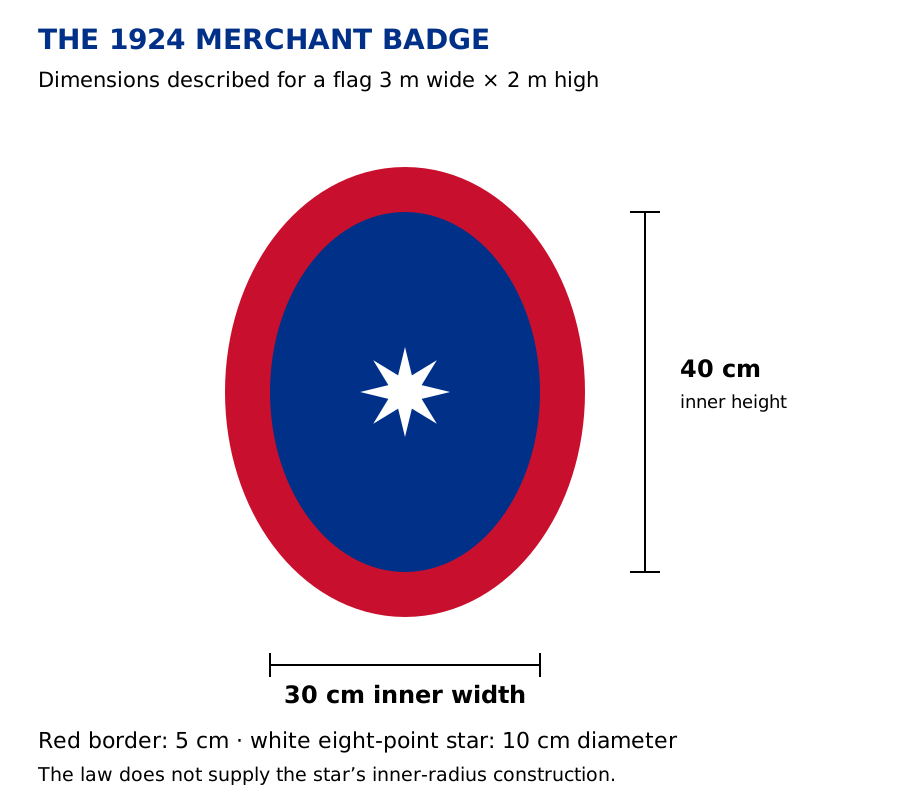
A close-up of the legally described 40-by-30-centimeter blue oval, five-centimeter red border, and ten-centimeter white star. The regular eight-point star shown is an illustrative rendering.
Original GKBook vector; verified geometry. Digital colors are illustrative, not a legal color standard.Download image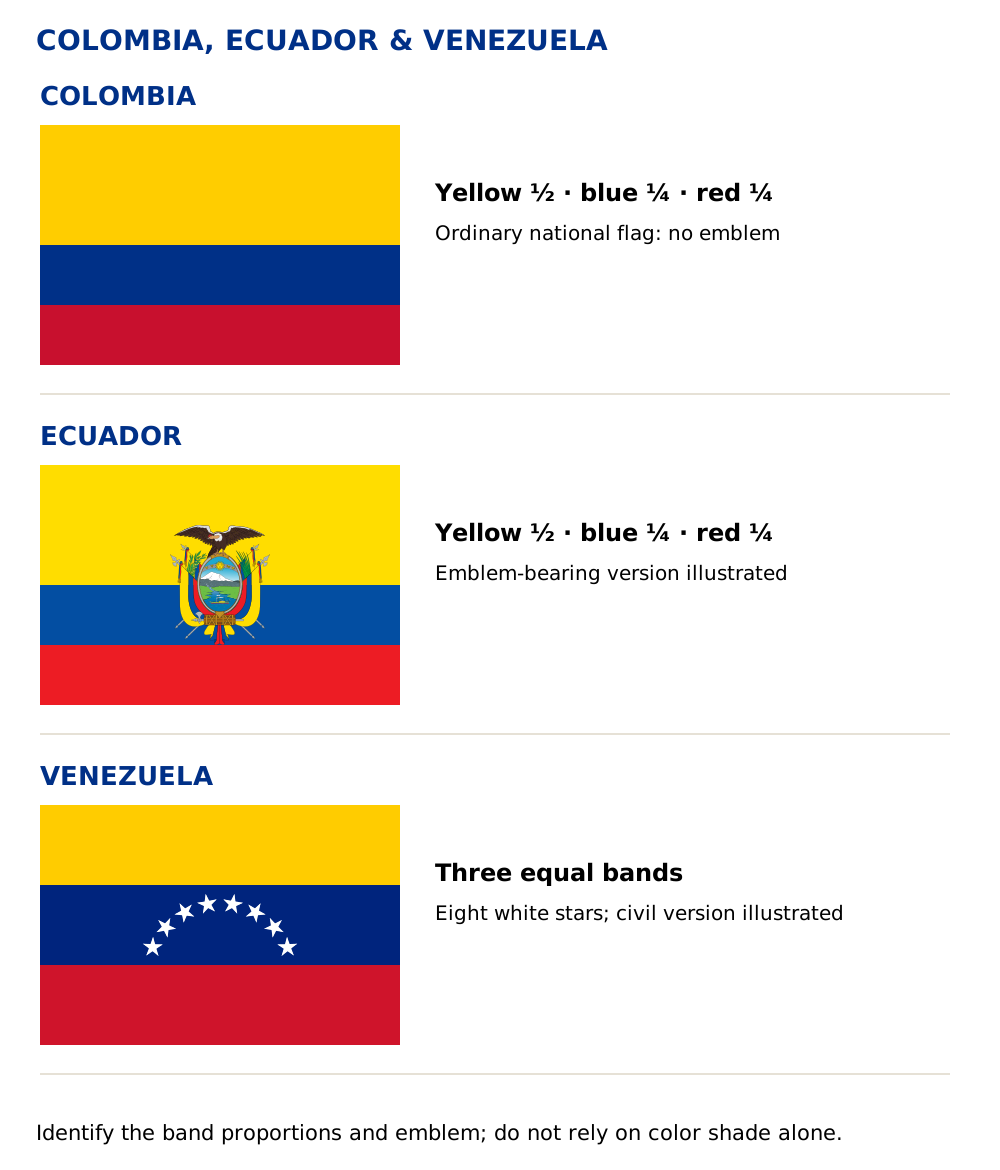
Colombia’s plain unequal-band flag, Ecuador’s emblem-bearing version, and Venezuela’s eight-star civil flag. Ecuador and Venezuela artwork retains the verified source geometry.
Layout and Colombia drawing: GKBook. Ecuador: Presidency of Ecuador / Commons contributors, public-domain official artwork and CC0. Venezuela: Commons contributors, public-domain geometric design.Download image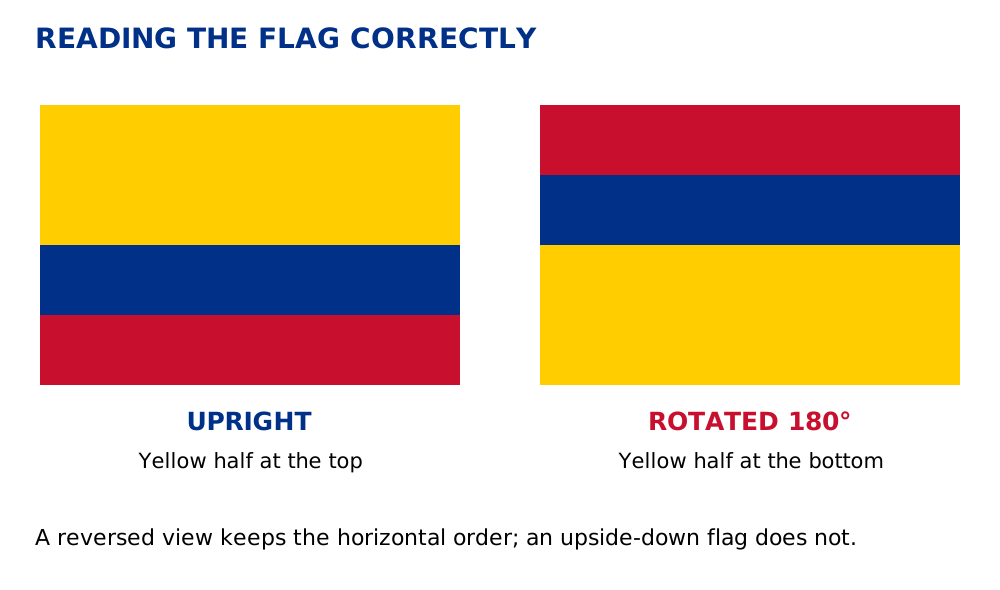
The upright flag has yellow across the upper half. Turning the flag through 180 degrees moves yellow to the bottom; looking at its reverse does not.
Original GKBook vector; verified geometry. Digital colors are illustrative, not a legal color standard.Download image
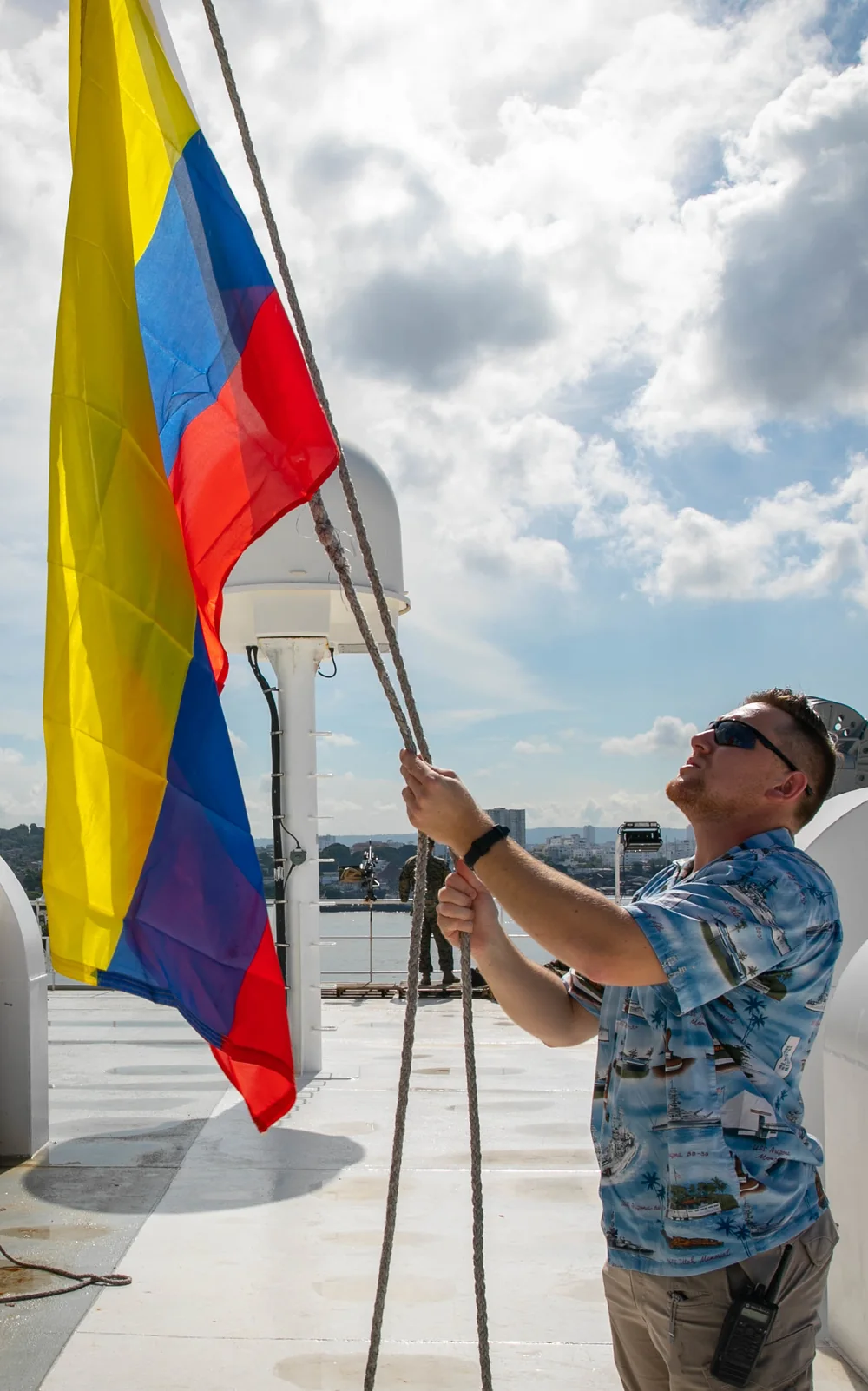
A Colombian flag is raised aboard USNS Comfort as the ship arrives in Cartagena on November 11, 2022.
Juel Foster / U.S. Navy, public domain. Resized and converted to WebP.Download image
Colombian Independence Day celebrations outside the consulate in Willemstad, Curaçao, on July 20, 1944.
Unknown photographer; National Museum of World Cultures, TM-60060879. Public domain. Resized and converted to WebP.Download imageFrequently asked questions
What are the colors of Colombia’s flag?
Colombia’s national flag has yellow, blue, and red horizontal bands, read from top to bottom. Yellow occupies the upper half of the rectangle. Blue and red each occupy one quarter. The ordinary flag has no central emblem, shield, star, or lettering.
Why is the yellow band wider?
The larger yellow band is part of the prescribed design. Law 12 of 1984 assigns yellow one half of the flag and blue and red one quarter each. The resulting height ratio is 2:1:1. Its size does not establish a numerical claim about Colombia’s wealth or geography.
What is the flag’s usual proportion?
The usual national flag has a width-to-height ratio of 3:2, equivalent to 2:3 when height is stated first. Its yellow band is half the height. Historical regulations give other dimensions for particular service flags, so those measurements should not be applied indiscriminately to the ordinary national design.
When was the current Colombian flag adopted?
The current unequal horizontal band arrangement was established on November 26, 1861, by a decree under Tomás Cipriano de Mosquera. The yellow-blue-red tradition is older. Later laws, including Law 12 of 1984, restated or regulated the national symbol rather than introducing that arrangement for the first time.
Who designed Colombia’s flag?
Several historical roles need to be distinguished. Francisco de Miranda is associated with the earlier tricolor tradition. Santander’s government prescribed New Granada’s vertical bands in 1834. Mosquera’s decree established the current unequal horizontal arrangement in 1861. Naming one person without explaining the version can therefore be misleading.
What does yellow symbolize?
Colombia’s Foreign Ministry relates yellow to the abundance of the land, sovereignty, harmony, and justice. A familiar popular interpretation also connects it with gold. These explanations concern symbolism; they should be distinguished from the statutory rule that yellow occupies the upper half of the flag.
What does blue symbolize?
The Foreign Ministry’s explanation connects blue with the seas and relationships with other peoples. The color occupies the middle quarter of the national flag. Its symbolic interpretation is separate from a manufacturing specification or a particular digital blue used in a web illustration.
What does red symbolize?
The Foreign Ministry describes red through life, love, strength, and progress. Popular accounts also associate red with the sacrifices of independence. The two explanations should be identified as different interpretive traditions, rather than presented as identical wording in the statute that defines the flag’s design.
Does the ordinary flag of Colombia have a coat of arms?
No. The ordinary national flag is the plain yellow-blue-red tricolor. Colombia’s display decree reserves emblem-bearing flags to particular presidential and armed-body uses. The national coat of arms is also displayed separately at institutions; that requirement does not mean it must be printed on every flag.
When is Colombia’s Flag Day?
Colombia’s annual national flag celebration is on August 7. Law 28 of 1925 established that date, and it coincides with the commemoration of the Battle of Boyacá of August 7, 1819. It is separate from Independence Day on July 20 and from the November 26 adoption anniversary.
Is July 20 the flag’s adoption date?
No. July 20 is Colombia’s Independence Day or National Day. The current flag arrangement dates to November 26, 1861, while August 7 is the annual national flag celebration established in 1925. Those dates describe different events and should not be substituted for one another.
What did the 1834 flag look like?
The law of May 9, 1834 prescribed three equal vertical bands for New Granada: red at the hoist, blue in the center, and yellow at the fly. It separately described emblem-bearing versions. The reconstruction on this page shows the band layout, not every regulated emblem or service detail.
Did the flag change in 1984?
Law 12 of 1984 restated the yellow half and the blue and red quarters already associated with the current flag arrangement. It is an important modern legal reference for the national symbols. It should not be treated as the first adoption of the 1861 band pattern.
Are the hexadecimal colors on this page official law?
The hexadecimal values identify the consistent digital palette used in these drawings. They are not presented as statutory color codes. Law 12 of 1984 names yellow, blue, and red and defines their proportions, but those provisions do not supply the hexadecimal or Pantone table shown in some flag guides.
How can I draw the flag accurately?
Draw a rectangle in the usual 3:2 width-to-height format. Divide its height into four equal parts. Color the top two parts yellow, the third blue, and the fourth red. Do not leave gaps between bands or add an emblem to the ordinary national version.
How does Colombia’s flag differ from Ecuador’s?
The Ecuadorian version pictured in this article has a national coat of arms, while Colombia’s ordinary flag is plain. Both pictured flags give yellow half the height and blue and red one quarter each. Read the version label carefully rather than treating a color shade as the decisive difference.
How does Colombia’s flag differ from Venezuela’s?
Colombia’s ordinary flag has a double-height yellow band and no emblem. Venezuela’s civil flag has three equal bands and eight white five-point stars arranged in an arc on blue. Band proportions and the star pattern are more reliable identification cues than small differences between digital color shades.
Why does a historical Colombian merchant flag show a star?
Decree 861 of 1924 described a merchant flag with a centered blue oval, a red border, and one white eight-point star. That specifically dated maritime design is different from the ordinary plain national flag. It also differs from Venezuela’s arc of eight separate five-point stars.
Does every Colombian flag use the same dimensions?
No single historical service dimension should be applied to every version. The usual national format is 3:2 width:height, but the 1924 decree described a 135-by-110-centimeter military flag and a 100-by-100-centimeter mounted standard. Those are specifically identified service formats, not a new ordinary national outline.
Can the flag be displayed at night?
Decree 1967 of 1991 ordinarily places display in daytime, with an exception when comparable illumination allows the flag to be properly appreciated. This is a lighting condition, not an unrestricted statement that all nighttime display follows the same rule. Particular institutions and services can have additional arrangements.
Where does Colombia’s flag stand beside another flag?
In the two-flag arrangement described by the national display decree, Colombia occupies the protocol right, which appears on the viewer’s left. The decree gives a separate center-and-alternating-order arrangement for groups. The setting and applicable ceremony should be identified before transferring either rule to a different situation.
When is the flag flown at half-mast?
The national display decree connects half-mast and black-crepe mourning treatment with official national mourning or express congressional or executive orders. A specific declaration supplies the occasion. There is no basis in that general provision for inventing a recurring lowering date or the same mourning duration for every event.
How often do Colombian schools hold flag ceremonies?
Law 198 of 1995 requires a weekly civic ceremony during academic terms in public and private primary and secondary schools, including raising the flag and singing the anthem. That later weekly requirement should be distinguished from the monthly school provision found in the older 1991 decree.
Are the pictures on this page authentic photographs?
The gallery identifies two documentary photographs separately from the vector drawings: a Colombian flag raised aboard USNS Comfort in Cartagena in 2022, and an Independence Day gathering in Willemstad in 1944. Construction sheets and historical reconstructions are explanatory graphics, not photographs of original historical objects.

We Value Your Opinion Comments