
China flag picture
Explore the construction sheet, the five-star detail, and the 1949 adoption story.
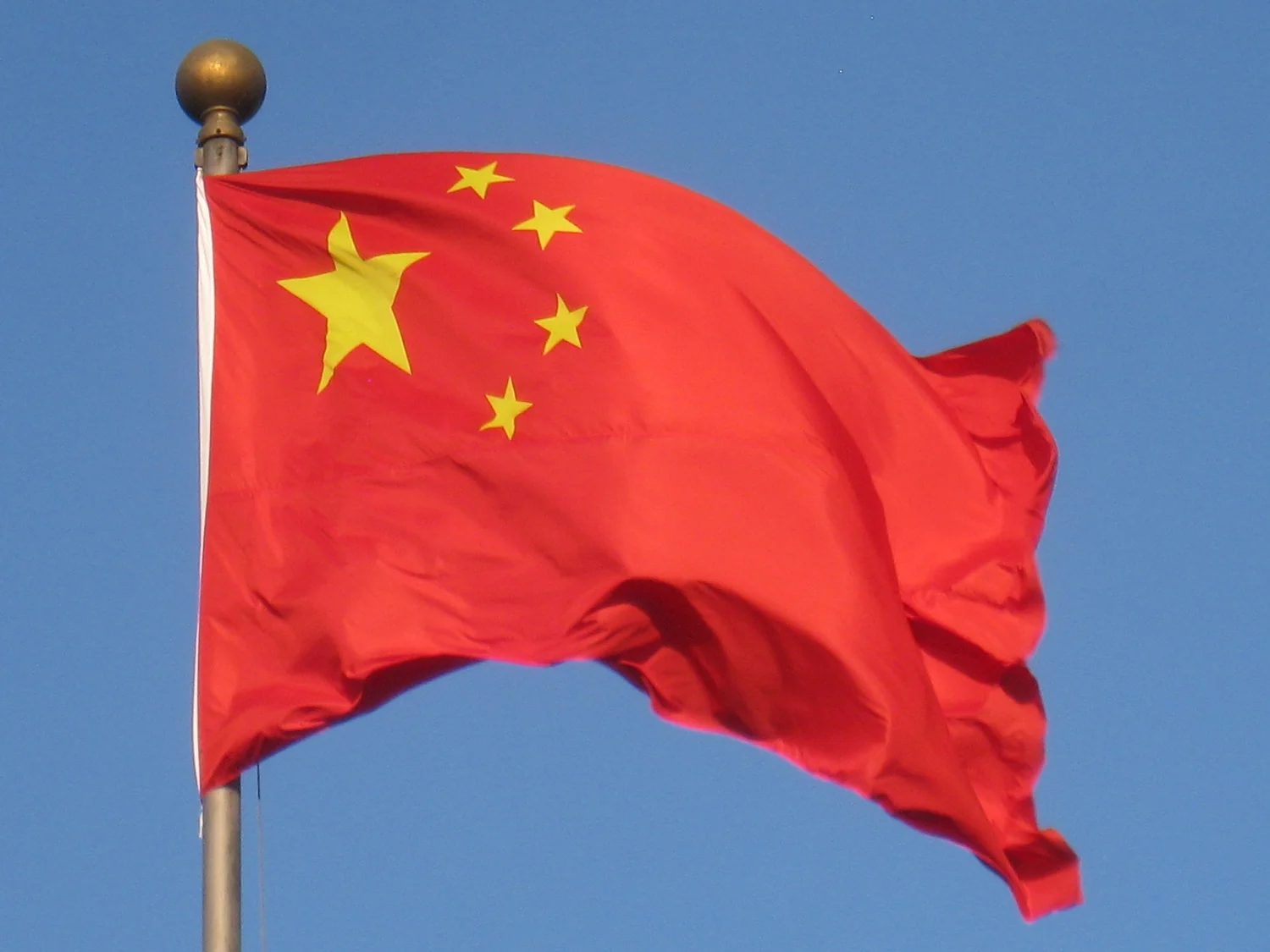
| Country | People’s Republic of ChinaPRC; distinct from the Republic of China flag used in Taiwan. |
|---|---|
| Common name | Five-star Red FlagWǔxīng Hóngqí · 五星红旗 |
| Adopted | September 27, 1949The CPPCC adoption resolution. |
| Founding ceremony | October 1, 1949The flag was raised at Tiananmen Square. |
| Designer | Zeng LiansongHis proposal was revised before adoption. |
| Proportion | 3:2 · width:heightEquivalently 2:3 · height:width. |
| Colors | Red and yellowRed field; five yellow stars. |
| Construction | 30 × 20 unitsOne large star and four individually rotated small stars. |
| National Day | October 1Different from the September 27 adoption anniversary. |
| Flag law | 1990; amended in 2020Latest amendment listed in the consulted law history took effect January 1, 2021. |
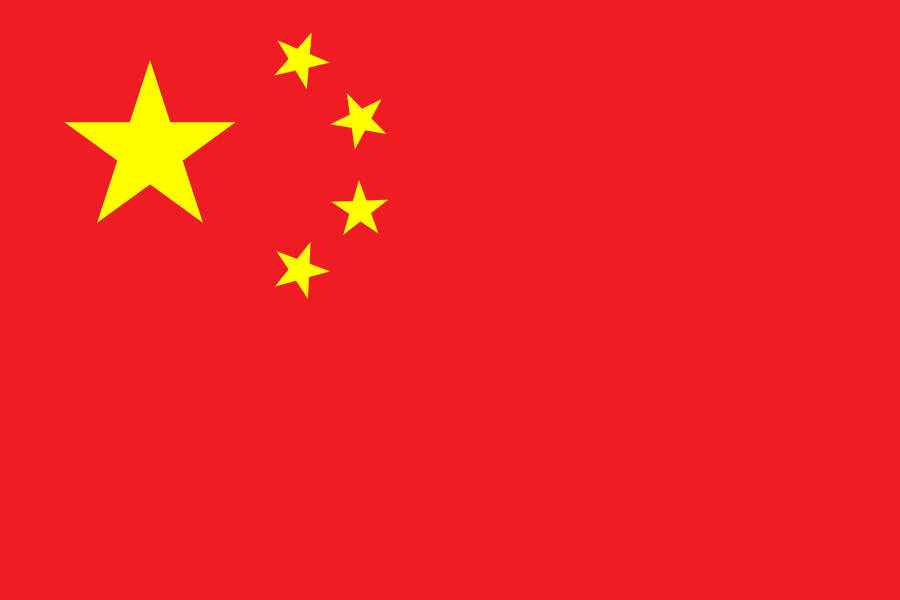
China’s national flag places one large yellow star and four smaller yellow stars in the upper corner beside the pole. Each small star points toward the large star’s center; the rest of the rectangle is plain red.
What does the flag of China look like?
China’s national flag is a red rectangle with five yellow five-pointed stars in the upper corner beside the pole. One large star sits to the left of four smaller stars arranged in an arc. Its width is one and a half times its height, giving a width-to-height ratio of 3:2.
This is the flag of the People’s Republic of China, commonly called the Five-star Red Flag, or Wǔxīng Hóngqí (五星红旗). The name identifies the visible design: five stars on red. There are no horizontal stripes, no text, and no national coat of arms on the ordinary national flag.
Its formal adoption was on September 27, 1949. The founding ceremony at Tiananmen Square followed on October 1, 1949. Keeping those dates separate prevents a common confusion between the decision choosing the flag and the ceremony that made it internationally recognizable.
The edge attached to the pole is the hoist; the free edge is the fly. In the usual front-view illustration, the hoist is on the left. Most of the flag remains plain red, so the star cluster has a distinctive position and clear visual emphasis.
The five stars: size, position, and direction
The five stars share the same regular five-pointed shape, but they do not share one orientation. The large star has a point facing straight upward. Each small star is individually turned so that one of its outer points aims toward the center of the large star.
The large star’s surrounding circle has a diameter equal to three-tenths of the flag’s height. Each small star’s surrounding circle has a diameter of one-tenth of that height. The large star is therefore three times the small star’s linear size. The circles are construction guides; they are not drawn on the finished flag.
All five centers lie within the upper hoist quarter. The four small centers do not form a perfect semicircle, an evenly spaced row, or the corners of a square. Their locations are fixed by the official grid. Copying a generic cluster of five star icons will often produce the wrong arrangement.
Colors and the official digital image
The construction instructions specify a red field and yellow stars. For the digital drawings here, the colors were checked directly against the standard flag PNG distributed through the Chinese government’s English-language website. Its dominant interior pixels are red RGB 238, 28, 37 and yellow RGB 255, 255, 0.
| Color | Hex used in these drawings | RGB | Where it appears |
|---|---|---|---|
| Red | #EE1C25 | 238, 28, 37 | The entire rectangular field |
| Yellow | #FFFF00 | 255, 255, 0 | All five stars |
A digital color value describes a screen reproduction. Fabric standards also involve material, dyes, illumination, and measurement conditions. A Pantone number or an automatically converted CMYK recipe should not be presented as a legal requirement merely because a flag website lists it.
The downloadable government images use whole-pixel dimensions, including a 4,096-by-2,731-pixel version. That tiny rounding effect does not change the legal 3:2 proportion. The original SVG on this page uses an exact 900-by-600 viewBox and scales without rounding the underlying geometry.
Real cloth also looks different in shade, transmitted sunlight, or a deep fold. The photographs below show actual flags in use, while the flat vector drawings supply the more dependable reference for shapes and relative positions.
Symbolism and meaning
Official explanations connect the red field with revolution and the five-star arrangement with unity under the leadership of the Communist Party of China. Hong Kong’s Education Bureau describes the smaller stars’ inward orientation as an expression of unity around a center. These are statements of the flag’s official symbolism, rather than independent claims about political consensus.
In the explanation associated with designer Zeng Liansong, the large star represents the Communist Party. The four smaller stars were linked to four social classes in the political language of 1949: the working class, the peasantry, the urban petty bourgeoisie, and the national bourgeoisie. The latter two terms refer to historical categories of small proprietors and national business owners within that political framework.
That specific four-class reading and the broader official idea of popular unity belong together, but they answer slightly different questions. One explains the designer’s conceptual scheme; the other explains the adopted arrangement as a whole. Neither requires assigning each individual small star a modern administrative region.
The five stars do not stand for five provinces, five continents, or a fixed list of five ethnic groups. The ethnic interpretation is often confused with the much earlier five-color flag of the Republic of China. That earlier flag had five horizontal bands and a different historical meaning.
Yellow is sometimes embellished with stories about mineral wealth, imperial power, or prosperity. The official educational explanation consulted here emphasizes the luminous contrast between yellow stars and red. Such additional associations should not replace the documented meaning or be invented as mandatory symbolism.
Construction and exact proportions
Use a rectangle 30 units wide and 20 units high. The official method divides the upper hoist quarter into a grid 15 units wide and 10 units high. Extending those same units over the entire rectangle produces the 30-by-20 drawing below. No sleeve or pole is included in the colored field’s dimensions.
Set the origin at the upper-left corner of the red field. Measure x to the right and y downward. A circumradius is the distance from a star’s center to one of its outer tips; it is not the distance to an inward notch.
| Star | Center (x, y) | Circumradius | Orientation |
|---|---|---|---|
| Large | (5, 5) | 3 units | One outer point straight up |
| Small 1, highest | (10, 2) | 1 unit | One outer point toward (5, 5) |
| Small 2 | (12, 4) | 1 unit | One outer point toward (5, 5) |
| Small 3 | (12, 7) | 1 unit | One outer point toward (5, 5) |
| Small 4, lowest | (10, 9) | 1 unit | One outer point toward (5, 5) |
For a regular five-pointed star, alternate outer and inner vertices at 36-degree intervals around the center. The inner radius is the outer radius multiplied by (3 − √5) ÷ 2, approximately 0.381966. This is a geometric consequence of the regular star, not a separate color or symbolism rule.
The four inward-pointing directions follow from the coordinates. From the highest small center, the vector toward the large center is (−5, 3); the remaining vectors are (−7, 1), (−7, −2), and (−5, −4). These different vectors explain why the small stars must be rotated separately. A complete drawing can therefore be reconstructed from the table without tracing a photograph.
| Measurement | Rule in terms of height H | Example: H = 100 cm |
|---|---|---|
| Flag width | 1.5H | 150 cm |
| Grid unit | H ÷ 20 | 5 cm |
| Large star center | H/4 from left and top | 25 cm from both edges |
| Large star circle diameter | 0.3H | 30 cm |
| Small star circle diameter | 0.1H | 10 cm |
Because area scales with the square of a linear dimension, the large star has nine times the area of one small star when both use the same regular shape. This is useful for understanding their visual hierarchy, but it is a calculated property—not an official symbolic meaning for the number nine.
The five standard flag sizes
The flag-making instructions list five common sizes. They are written here as length × height, so the larger number comes first. Each pair reduces to 3:2. The law also accommodates other sizes when special circumstances require them, provided the complete design is scaled proportionally.
| Size | Length × height | Large star circle diameter | Small star circle diameter |
|---|---|---|---|
| 1 | 288 × 192 cm | 57.6 cm | 19.2 cm |
| 2 | 240 × 160 cm | 48 cm | 16 cm |
| 3 | 192 × 128 cm | 38.4 cm | 12.8 cm |
| 4 | 144 × 96 cm | 28.8 cm | 9.6 cm |
| 5 | 96 × 64 cm | 19.2 cm | 6.4 cm |
The smallest listed standard size is not a command to make every hand-held flag 96 centimeters long. A scaled reproduction can be smaller while retaining the same arrangement. The important distinction is between enlarging or reducing the whole design and changing one star, the field width, or the spacing independently.
History: from the design competition to the flag law
The modern Chinese flag belongs to the political transformation of 1949. Its history includes the public competition, committee selection, final revision, adoption resolution, founding ceremony, and much later flag legislation. The timeline distinguishes changes in the law from changes in the appearance of the flag.
July–August 1949
A public design invitation
A newspaper appeal invited designs for the new state’s national symbols. The Education Bureau’s historical account records a submission period from July 14 to August 15. The selection process ultimately produced a booklet of 38 designs for delegates to consider.
August 11, 1949
Zeng Liansong’s submission
The Guangzhou CPPCC documentary exhibition dates Zeng’s submitted flag drawing to August 11. His design became candidate No. 32. The proposal belonged to a competitive public process; it was not simply a flag personally invented by the head of state.
September 1949
Discussion and revision
Delegates examined competing designs, including patterns with stars, tools, grain, and horizontal bands. The Guangzhou exhibition reproduces meeting records and notes discussion of the small stars’ placement. A consultation chaired by Mao Zedong and Zhou Enlai took place on September 25.
September 27, 1949
The Five-star Red Flag is adopted
The First Plenary Session of the Chinese People’s Political Consultative Conference adopted the red flag with five stars. This is the formal adoption milestone. The resolution associated the design with the unity of the Chinese revolutionary people.
October 1, 1949
The founding ceremony at Tiananmen
The flag was raised at Tiananmen Square during the founding ceremony of the People’s Republic of China. This event explains October 1’s central place in the flag’s public history. It occurred after the adoption decision, not on the day the design was selected.
1990
A national flag law
The National Flag Law was adopted on June 28, 1990, and came into force on October 1 that year. It organized rules on manufacture, use, display, and protection of the flag around the already established five-star design.
2009
A first amendment
The law was amended on August 27, 2009. A legal amendment is not automatically a redesign: the red field, five yellow stars, and their construction continued to identify the same national flag.
2020–2021
Updated rules for use and digital images
A further amendment was adopted on October 17, 2020, with effect from January 1, 2021. The revised framework addresses matters including scaled flag sizes, online use of the flag design, educational settings, and the collection and proper handling of flags after public events.
Earlier flags and the five-color misunderstanding
Before the People’s Republic, different Chinese governments and political movements used different flags. The Five-star Red Flag should therefore not be projected backward onto every event described simply as “Chinese history.” The early republican five-color flag and the later white-sun design belong to distinct political and visual traditions.
The Republic of China Presidential Office’s account explains that the early provisional government adopted the five-color flag. Its bands represented the five ethnic categories commonly named in that era: Han, Manchu, Mongol, Hui, and Tibetan. Those historical categories should not be mistaken for a complete modern description of China’s population.
The later Republic of China flag has a white sun in a blue canton on a red field and is used in Taiwan today. Its emblem is a sun with twelve rays, not the PRC’s cluster of five yellow stars. These are different flags associated with different governments; referring to both merely as “the old and new Chinese flag” can obscure that continuing distinction.
The yellow field and dragon associated with Qing imperial flags belong to an earlier period again. Neither the dragon nor the white-sun emblem is concealed inside the current PRC flag. A historical exhibition should identify a flag by its design, period, and institution rather than treating red or yellow alone as sufficient identification.
Who designed the flag of China?
Zeng Liansong designed the proposal that became the Five-star Red Flag. He was a Shanghai-based worker from Rui’an in Zhejiang, with an interest in drawing rather than a career as a professional flag designer. A committee considered and revised his submission before the national flag was formally adopted in September 1949.
Zeng’s original proposal placed a hammer-and-sickle motif inside the large star. The adopted design removed that internal device, leaving the large star plain. This is an important distinction when comparing an archival proposal with the finished national flag: a proposed element is not necessarily part of the flag that was adopted.
His role also differs from those of the delegates who selected the design, the officials who approved it, and the people who sewed the first ceremonial flags. Describing Mao Zedong as the flag’s designer conflates the founding ceremony with the design competition. Describing one early seamstress or workshop as the designer would make a similar mistake.
Accounts of the competition do not always count submissions in the same way. Some count designs, others packages or entries. The well-documented facts most useful for this flag’s story are the large public response, the booklet of 38 selected designs, and the identification of Zeng’s proposal as No. 32. Those details explain the process without turning a disputed total into false precision.
Manufacture: from a drawing to a physical flag
The drawing instructions control the design regardless of the size of the finished flag. A fabric producer must preserve the red field, the five yellow stars, their relative sizes, their locations, and their directions. The staff cover is white in the instructions; it is a functional attachment at the hoist rather than an extra stripe across the flag.
Both sides use the same colors and star shapes. Seen from the reverse, however, the arrangement is mirrored because the hoist is now on the viewer’s right. A maker should not independently place an upper-left cluster on both faces as if they were two unrelated posters. The two faces describe one flag attached to one pole.
The National Flag Law’s production requirements should not be replaced with a claim that a particular consumer fabric is compulsory in every setting. The original geometric construction is not a complete specification for fiber type, dye chemistry, seam allowance, weather resistance, or a supplier’s certification. Those production questions need the applicable product standard and the intended use.
For a practical visual inspection, lay the flag flat, locate the hoist, compare the width and height, and examine the star cluster. Check for an incorrectly upright small star, a large star shifted into the middle of the flag, mismatched yellow areas, or a distorted rectangle. These observations help identify drawing and assembly errors; they do not constitute laboratory certification.
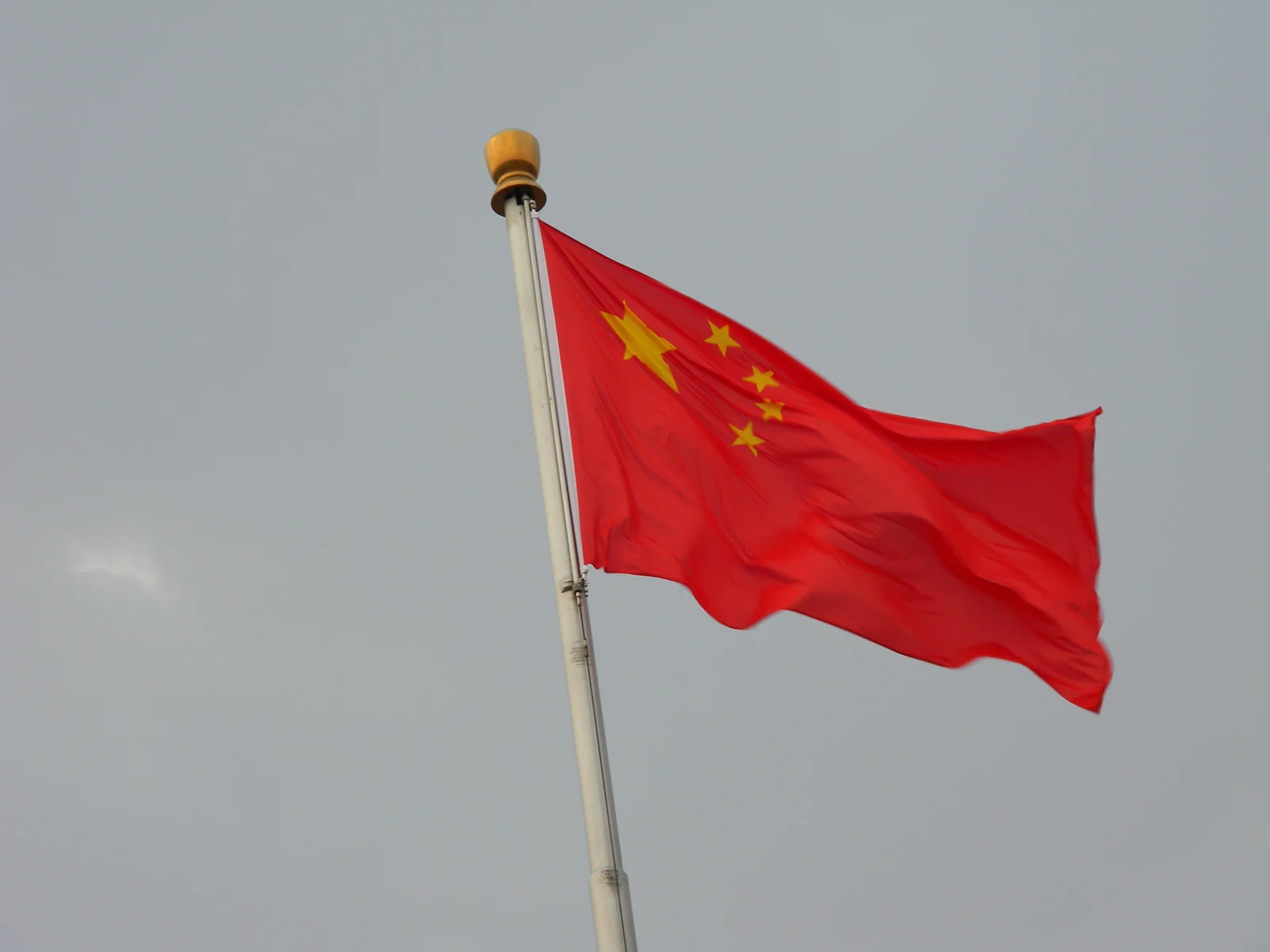
The photograph shows why an image of moving cloth cannot replace a dimensioned template. Folds compress distances, perspective changes apparent angles, and the free edge moves independently of the pole. Use a flat construction drawing to establish geometry, then use photographs to understand material and setting.
The front, reverse, and orientation of the flag
A reverse-side view places the star cluster at the upper right when the pole is on the right. That is expected for a flag seen from behind. It does not mean that the flag was redesigned, that the photograph is necessarily wrong, or that the smaller stars have acquired a different meaning.
An upside-down flag is a different situation: the star cluster falls near the lower edge rather than the upper edge. The flag law prohibits inverted and dignity-impairing display. Locate both the top edge and the pole before judging a photograph, especially when the cloth is folded or the photographer is on the opposite side.
Do not rotate the small stars independently when rotating or reflecting an entire flag drawing. Their directions are part of the arrangement and must transform with it. For a display format governed by local ceremonial instructions, follow those instructions rather than inventing a universal rule from a single photograph.
October 1: National Day and the flag
China’s National Day is October 1, commemorating the founding of the People’s Republic in 1949. The flag’s adoption anniversary is September 27. These two dates have related histories but different meanings. This article uses “National Day” for October 1 and does not relabel the adoption anniversary as a separately established national Flag Day.
The National Flag Law includes National Day among the important festivals and commemorative occasions for displaying the flag. It also refers to International Labor Day, New Year’s Day, the Spring Festival, and National Constitution Day. Rules for particular institutions and locations should be read with their applicable provisions, rather than reduced to a claim that every private person must fly a flag every day.
Tiananmen Square has a daily flag-raising ceremony under the national law. Schools have their own regular display and ceremony requirements. The existence of an October 1 celebration does not mean that the national flag is reserved for that single day of the year.
The Education Bureau’s history dates the first raising at Tiananmen Square to October 1, 1949. That precise statement is more useful than an unrestricted “first-ever flag” claim, because flags were also being prepared, displayed, and discussed around the preceding conference.
Display, handling, and ceremony
The National Flag Law gives the flag a position of prominence and sets rules for raising, lowering, condition, and use. The 2020 amendments took effect in 2021. Separate provisions govern diplomatic, military, maritime, and regional settings, so guidance for one setting should not automatically be applied to every other setting.
| Setting | General treatment in the national framework |
|---|---|
| Specified national institutions and entry points | Daily display at the places named in the law |
| Other specified public institutions | Display on working days |
| Schools | Daily display except vacations and rest days; regular ceremonies |
| Public cultural and sports facilities | Display on open days |
| Major festivals and commemorative occasions | Display at the institutions and public places covered by the relevant provision |
| Foreign affairs, armed forces, and vessels | Additional rules from the responsible authorities |
Respectful display
- Raise and lower the flag slowly on a vertical pole.
- Raise it to the peak for ordinary full-staff display.
- Keep it from touching the ground while lowering it.
- Face the flag and stand solemnly during the raising ceremony; use the appropriate salute where required.
- Keep flags clean and in good condition, and collect them after organized public events.
Uses the law restricts
- Displaying damaged, soiled, faded, or substandard flags.
- Displaying the flag upside down or in another dignity-impairing manner.
- Discarding used flags carelessly.
- Using the flag or its design as a trademark, in commercial advertisements, or in other specified inappropriate circumstances.
- Assuming that an ordinary private funeral automatically qualifies for national-flag ceremonial honors.
The framework describes morning raising and evening lowering for the institutional and occasion-based displays covered by the relevant provisions. It also allows for severe weather. A dramatic photograph taken at night is not, by itself, enough to determine which institutional rule or special arrangement applied.
Hong Kong’s Protocol Division gives practical handling guidance: inspect flags regularly, dry them before storage, fold them neatly, and explain the raising and lowering procedure to the staff responsible. That advice is useful for caring for a physical flag; its legal setting is the Hong Kong ordinances and administrative arrangements.
For international displays, the national law refers to the Foreign Ministry’s rules or international practice. This qualification matters: a domestic rule giving the national flag prominence is not a reason to place another country’s flag in a deliberately subordinate position at an international ceremony.
How is China’s flag different from Vietnam’s flag?
China’s flag has five yellow stars grouped near the upper corner beside the pole: one large star and four smaller ones. Vietnam’s flag has one large yellow star at the center of a red rectangle. Count the stars and locate the group before comparing shades of red, which vary in photographs.
| Feature | China | Vietnam |
|---|---|---|
| Star count | Five | One |
| Position | Upper hoist quarter | Center of the flag |
| Relative sizes | One large and four small | One star only |
| Orientation | Small stars point toward the large star | One point of the star faces upward |
| Field | Red | Red |
Vietnam’s published display guidance places its star at the intersection of the flag’s diagonals and makes the outer radius one-fifth of the flag’s length. This gives its single emblem a substantially different placement and visual scale from China’s cluster. A tightly cropped picture can conceal that distinction, so the complete rectangle is the best identification reference.
A small emoji may simplify details, but it should not substitute one flag for the other. The Chinese flag’s characteristic feature is the relationship between five stars, not merely a yellow shape on red.
The flag as a textile and a space-mission object
An everyday flag and a mission-specific flag share a design but can be very different physical objects. Wuhan Textile University documents its work on national-flag textiles for the Chang’e-5 and Chang’e-6 lunar missions. A 2026 university account highlights the engineering challenges of stability and radiation resistance in that work.
This is a useful extension of the manufacturing story: a recognizable national symbol must sometimes be reproduced in materials selected for a demanding environment. The need to unfold, retain a recognizable shape, and preserve color is different from the need to fly repeatedly from a street-side pole.
The lunar examples do not establish the required fiber for every Chinese flag, and a mission image should not be presented as a general manufacturing standard. Nor should an illustration of a flag on a spacecraft be confused with a separately deployed piece of cloth. The university’s account concerns the textile development itself.
Half-mast and national mourning
The national law provides for half-staff display after the deaths of specified state leaders and other designated persons, and in connection with certain national memorial occasions, serious disasters, public-health emergencies, or other events causing especially serious casualties. The actual dates and places depend on the applicable official decision; they are not a standing instruction to lower the flag on every anniversary.
On a vertical pole, first raise the flag to the peak. Then lower it until the distance from the peak to the top edge of the flag equals one-third of the pole’s length. Before taking it down at the end, raise it to the peak again and then lower it completely.
| Question | Practical answer |
|---|---|
| Is “half-staff” exactly halfway down? | No. The stated rule measures a gap of one-third of the pole’s length above the flag. |
| Where is the measurement taken? | From the peak of the staff to the flag’s top edge. |
| What happens before lowering for mourning? | The flag first reaches the peak. |
| What happens before taking it down? | It returns to the peak before its final descent. |
| Does every private funeral qualify? | No. Ceremonial flag honors have defined eligibility and rules. |
Flag-draping of remains, coffins, or urns is distinct from flying a flag at half-staff. The law provides for designated eligible persons and requires careful handling and recovery of the flag after the ceremony. It should not be described as a general entitlement for every funeral.
A monochrome graphic, a black border added to an online image, and a flag lowered on a pole are not the same ceremonial act. The mourning diagram here preserves the national flag and explains its position on the staff. It does not create a new black or modified version of the national design.
Common mistakes to avoid
| Misconception | Correction |
|---|---|
| All five stars should point straight up. | Only the large star does; each small star points toward its center. |
| The five stars represent five ethnic groups. | That confusion mixes the PRC flag with the early republican five-color flag. |
| October 1, 1949, is the selection date. | The flag was adopted on September 27; October 1 was the founding ceremony. |
| A yellow hammer and sickle belongs in the large star. | It appeared in Zeng’s proposal and was removed before adoption. |
| A flag photographed from behind is a different design. | The reverse is mirrored around the hoist; the stars remain beside the pole. |
| Yellow Hex codes also define a fabric dye. | Screen color and physical textile specifications are different. |
| A later amendment means the flag changed appearance. | The 1990 law and later amendments regulate the established design. |
| Every red flag with a yellow star is China’s. | Check the count and position; Vietnam’s flag has one centered star. |
For a quick review, remember three visible facts: a red field, five yellow stars, and an upper-hoist cluster. For an accurate drawing, add the 30-by-20 grid and the individual small-star rotations. For the historical account, keep the designer, the approving conference, the founding ceremony, and later legal standards in their separate roles.
China flag pictures
Flag of China: five yellow stars on a red field
Original GKBook vector illustration. Explanatory guides are not part of the national flag.Download image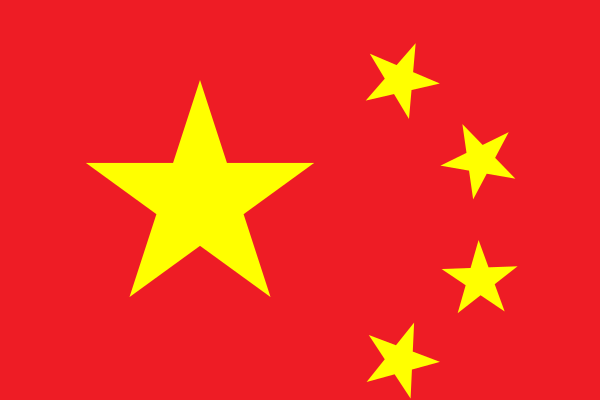
The large star and four individually rotated small stars
Original GKBook vector illustration. Explanatory guides are not part of the national flag.Download image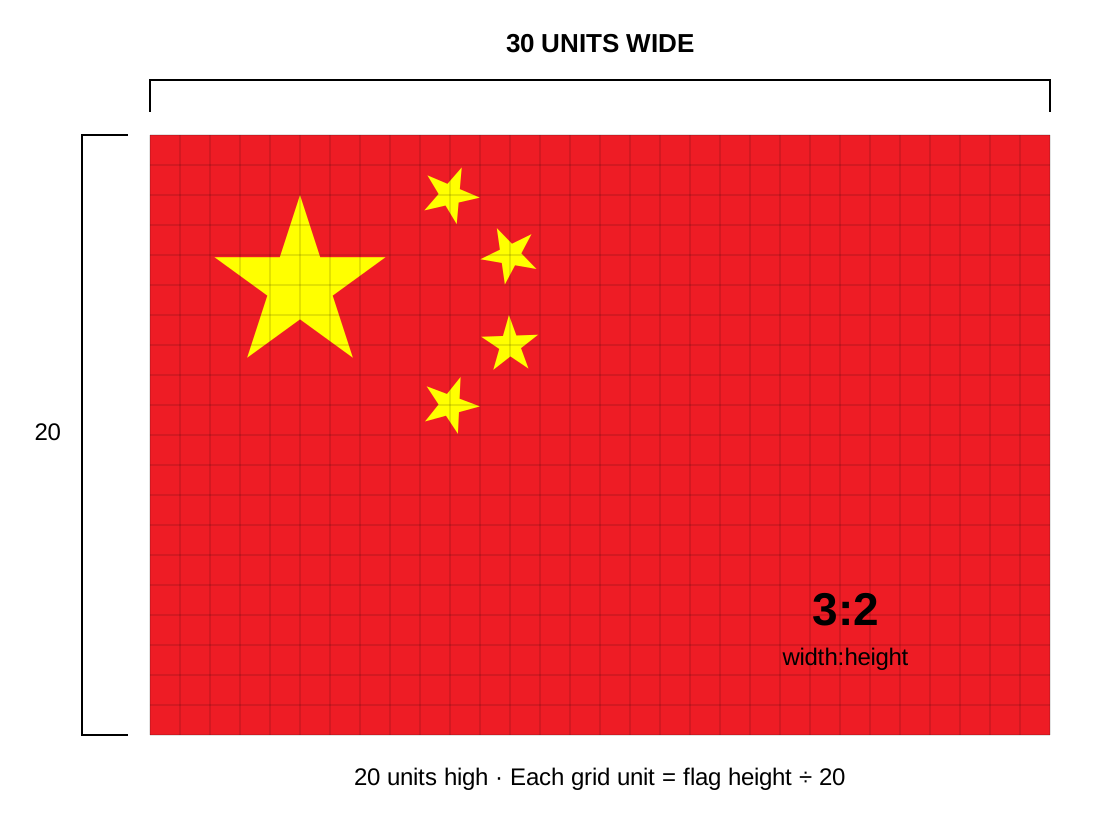
China flag construction on a 30-by-20-unit grid
Original GKBook vector illustration. Explanatory guides are not part of the national flag.Download image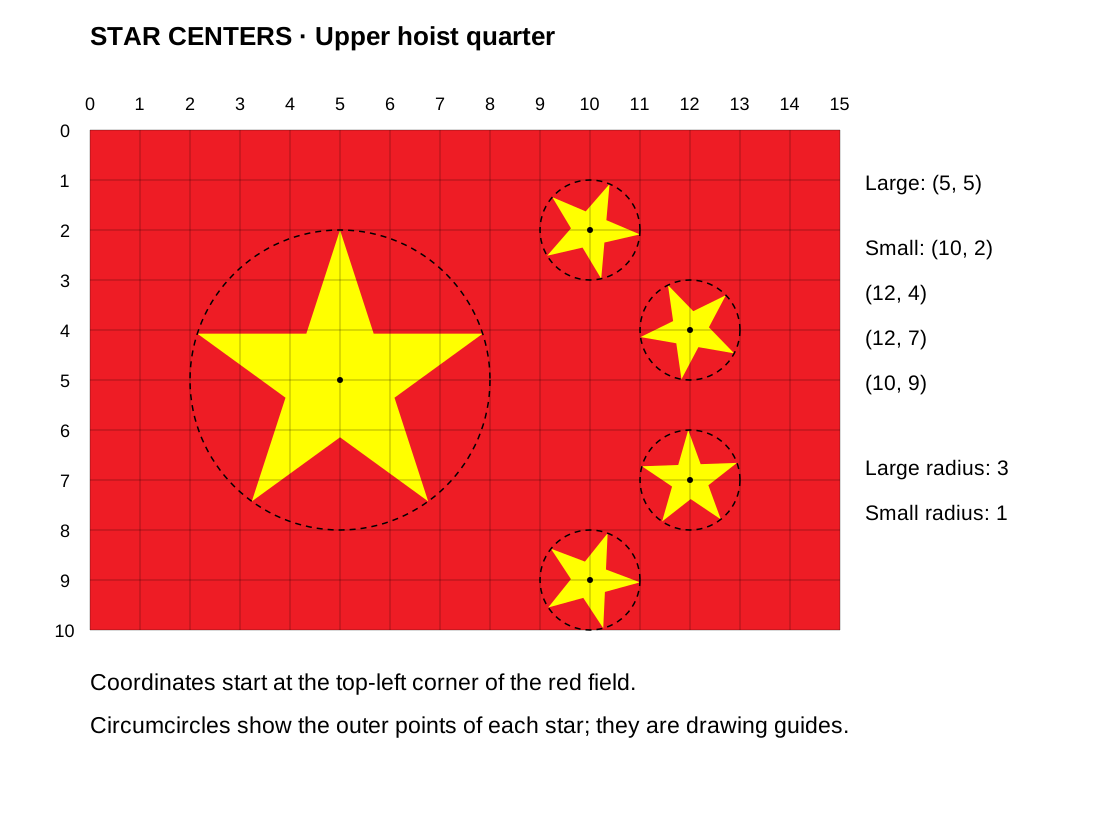
Star centers and circumcircles in the upper hoist quarter
Original GKBook vector illustration. Explanatory guides are not part of the national flag.Download image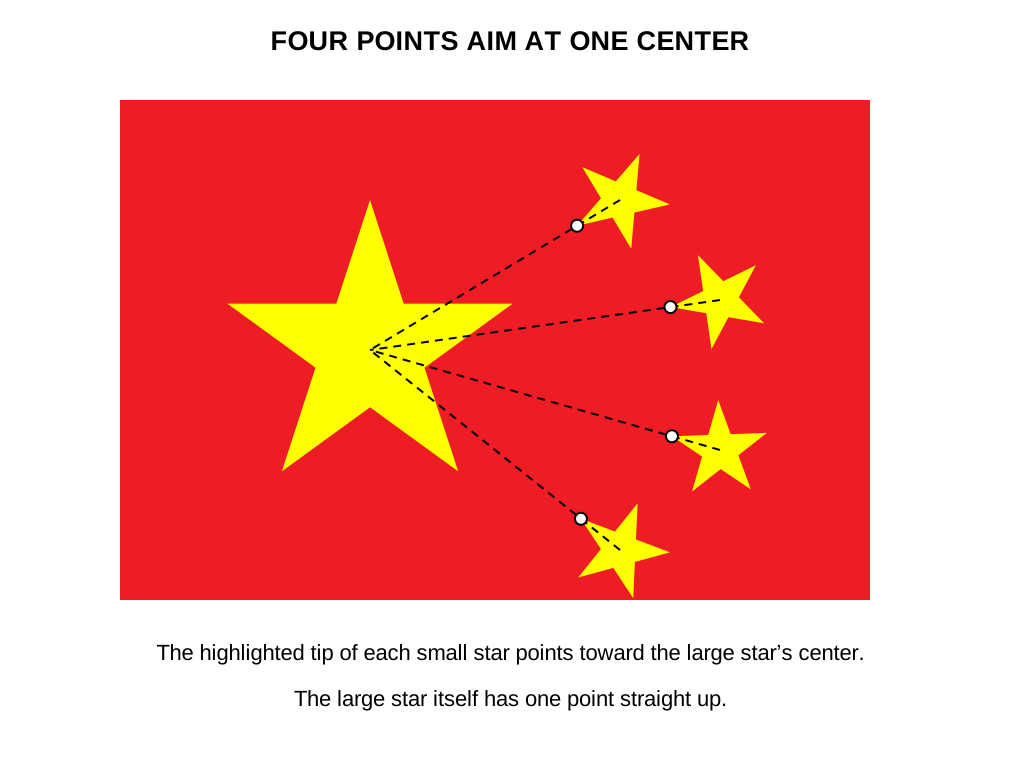
Each small star points toward the center of the large star
Original GKBook vector illustration. Explanatory guides are not part of the national flag.Download image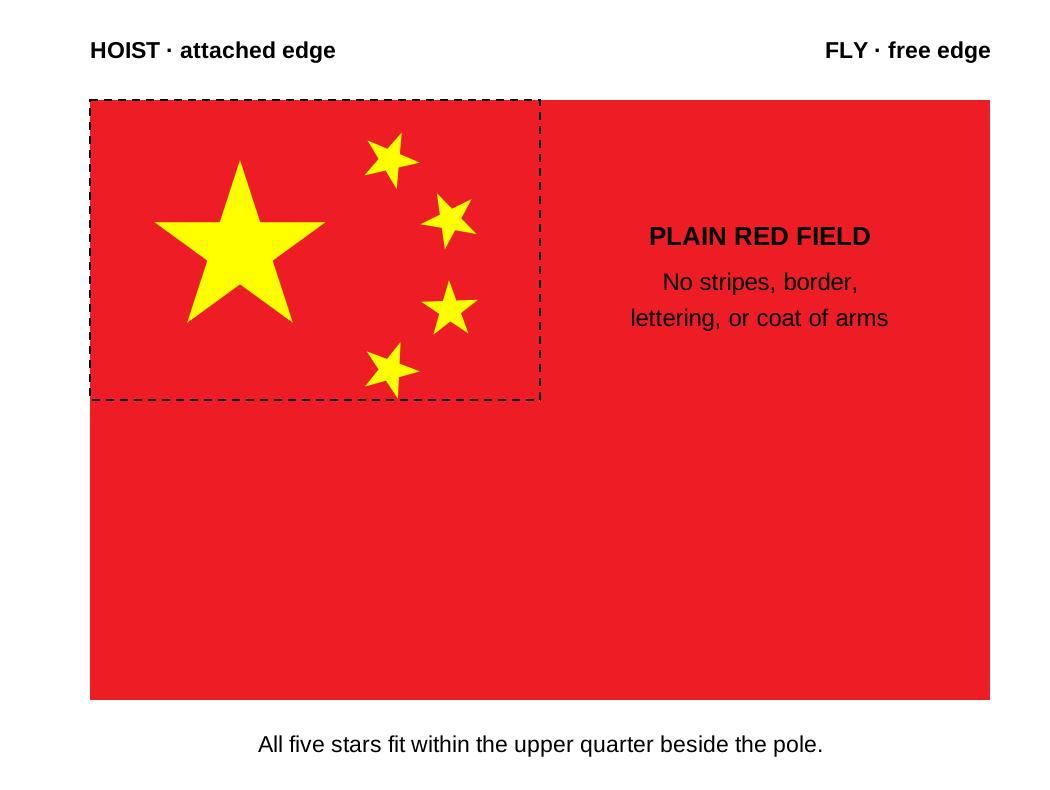
China flag anatomy: the star cluster occupies the upper hoist quarter
Original GKBook vector illustration. Explanatory guides are not part of the national flag.Download image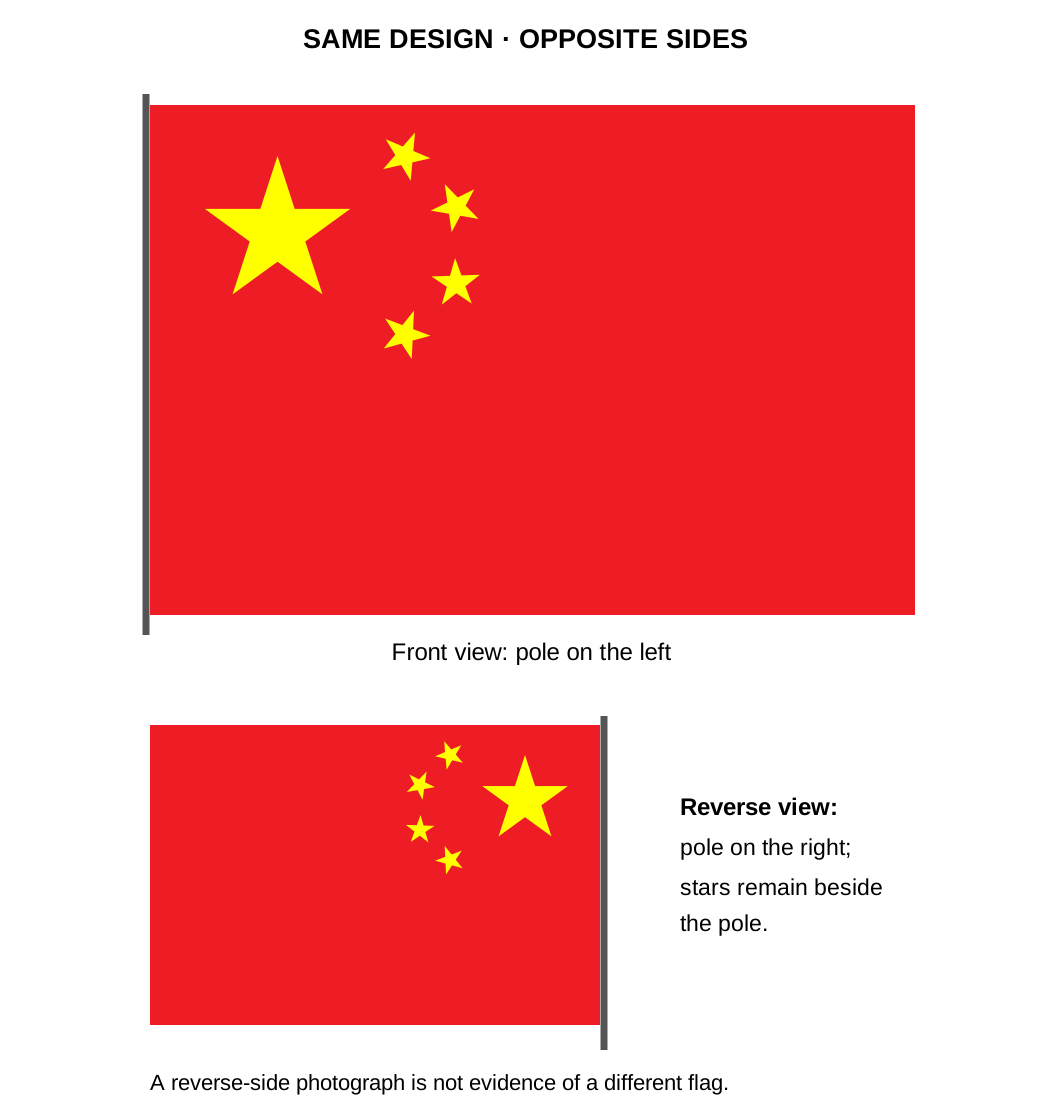
Front and reverse views keep the stars next to the pole
Original GKBook vector illustration. Explanatory guides are not part of the national flag.Download image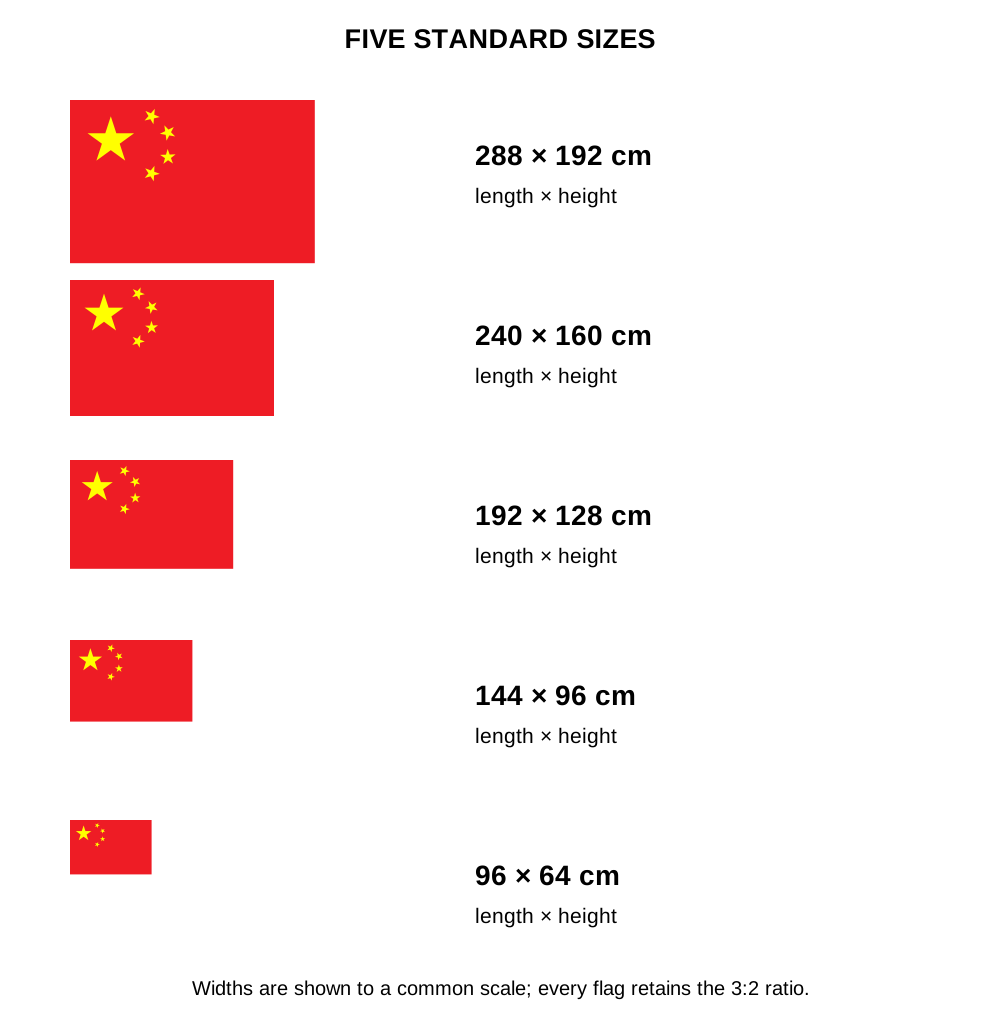
The five standard Chinese flag sizes, shown at a common scale
Original GKBook vector illustration. Explanatory guides are not part of the national flag.Download image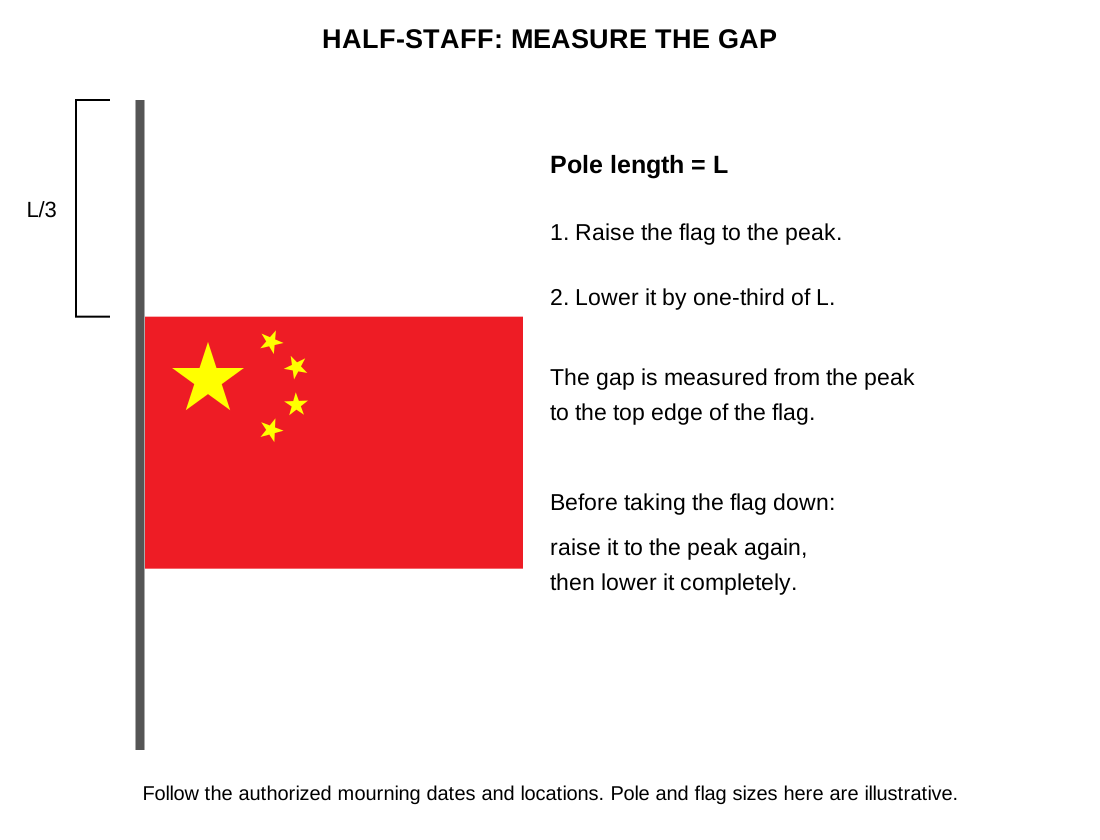
Chinese half-staff display: the top of the flag is one-third of a pole length below the peak
Original GKBook vector illustration. Explanatory guides are not part of the national flag.Download image
Early Republic of China five-color flag: red, yellow, blue, white, and black
Original GKBook reconstruction of the 1912–1928 design. Historical fabric shades are illustrative; this is not an archival photograph.Download image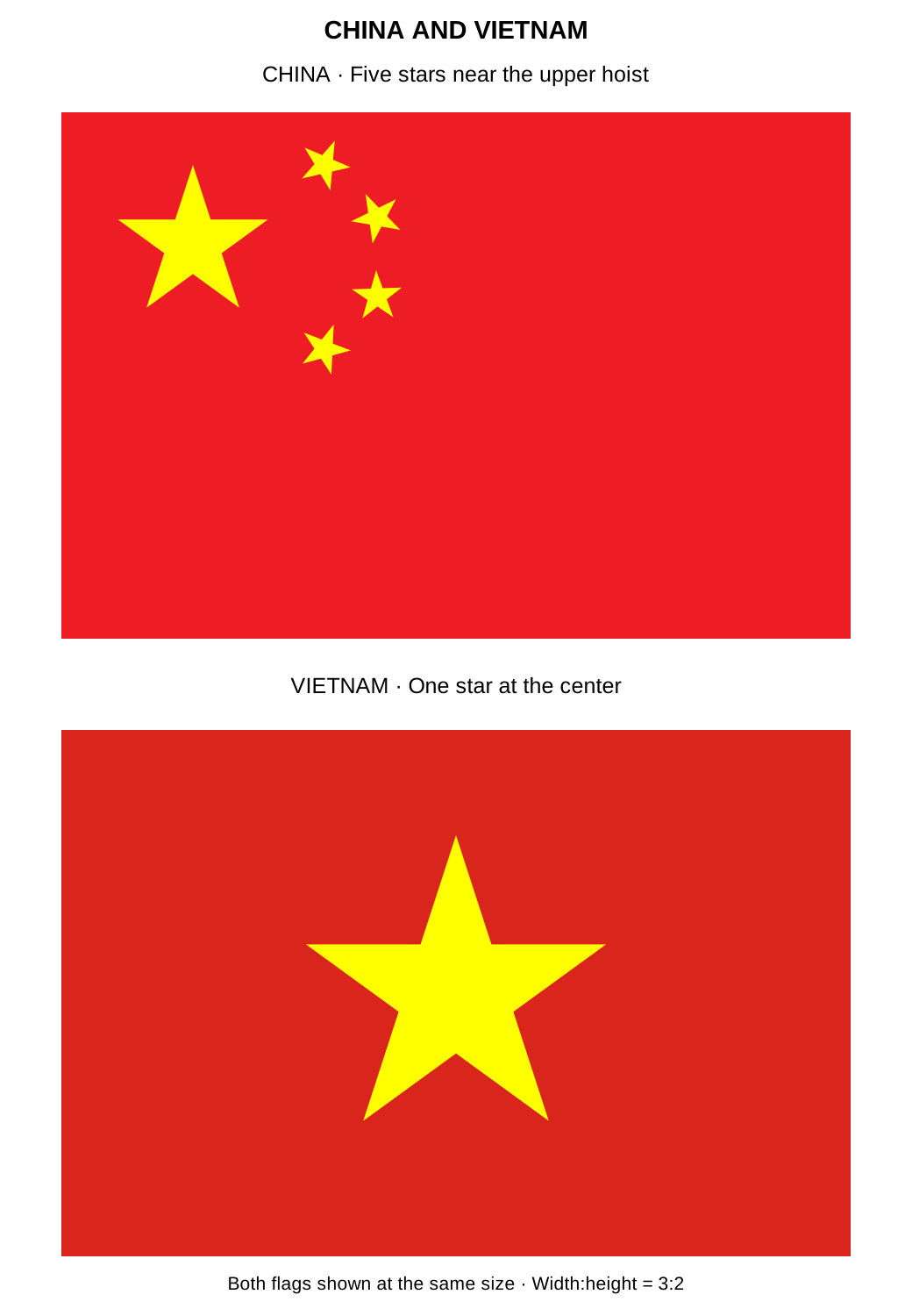
China has five stars near the hoist; Vietnam has one centered star
Original GKBook comparison. China geometry follows its construction instructions; Vietnam’s centered star radius is one-fifth of flag length. Screen colors are reproductions.Download image
A Chinese national flag flying from a pole, photographed on June 17, 2012.
Photo: Ecow, CC0. Resized and converted to WebP.Download image
A Chinese national flag in Beijing, photographed on October 16, 2009.
Photo: Daderot, public domain; Commons crop by Meidosensei. Converted to WebP.Download imageFrequently asked questions
What is the flag of China called?
The national flag of the People’s Republic of China is commonly called the Five-star Red Flag, or Wǔxīng Hóngqí in Mandarin. The name describes its five yellow stars on a red field. This article covers that PRC design, rather than every flag used by earlier Chinese governments.
When was China’s current flag adopted?
The First Plenary Session of the Chinese People’s Political Consultative Conference adopted the Five-star Red Flag on September 27, 1949. The founding ceremony at Tiananmen Square took place on October 1. Adoption and the founding ceremony are related but separate milestones.
Who designed the flag?
Zeng Liansong submitted the proposal that became the national flag. He was based in Shanghai and originally came from Rui’an, Zhejiang. His entry became candidate No. 32 in the selection process and was revised before adoption.
What does the red background mean?
The official explanation connects red with revolution. The symbolism refers to the political setting in which the People’s Republic was founded. Broader cultural associations of red do not replace this documented explanation of the national flag.
What does the large star represent?
In the explanation associated with the designer, the large star represents the Communist Party of China. The four smaller stars are grouped around it to express the people’s unity under Party leadership. That is the flag’s stated political symbolism.
What do the four small stars represent?
The broad official meaning is the unity of the people around the Party. Zeng’s historical explanation linked them to workers, peasants, the urban petty bourgeoisie, and the national bourgeoisie. Those are social categories in the political language of 1949, not four provinces.
Do the five stars represent five ethnic groups?
No. That interpretation confuses the PRC flag with the early Republic of China’s five-color flag, whose horizontal bands were associated with five ethnic categories. The Five-star Red Flag uses a different design and a different explanation of its symbols.
Why are the stars yellow?
The official educational explanation emphasizes the bright stars’ contrast with the red field. The construction instructions specify yellow stars. An additional claim that yellow must mean wealth, gold reserves, or a particular natural resource is not needed to explain the documented design.
How many points does each star have?
Every star has five outer points. There is one large star and four smaller stars of the same regular shape. No star has an extra point, circular border, or lettering in the ordinary national flag.
Why are the small stars tilted?
Each small star has one outer point directed toward the center of the large star. Because their centers occupy four different locations, they need four different rotations. Drawing all the small stars upright would not follow the official construction.
What are the flag’s proportions?
The ratio is 3:2 when written as width to height, or 2:3 as height to width. A 150-centimeter-wide example is therefore 100 centimeters high. The same scale factor must be applied to the entire design.
Where is the large star centered?
On a 30-unit-wide by 20-unit-high grid, its center is at x = 5, y = 5, measured from the upper-left corner. Its circumradius is three units. The four small-star centers are at (10, 2), (12, 4), (12, 7), and (10, 9).
How much larger is the large star?
Its circumcircle diameter is three-tenths of flag height, while a small star’s is one-tenth. The large star is therefore three times the linear size and nine times the area of one small star of the same regular shape. The area comparison is a calculation, not a symbolic rule.
What are the five standard sizes?
Written as length by height in centimeters, they are 288 × 192, 240 × 160, 192 × 128, 144 × 96, and 96 × 64. Other sizes can be obtained by proportional scaling for special circumstances, with the size suited to the pole and setting.
Which digital colors are used here?
The drawings use red #EE1C25 and yellow #FFFF00, matching the dominant interior pixels checked in the government’s downloadable flag PNG. These values describe a digital reproduction. They should not be presented as a complete textile dye or printing specification.
Does the current flag contain a hammer and sickle?
No. Zeng’s submitted proposal included a hammer-and-sickle device within the large star, but it was removed before adoption. The present national flag has five plain yellow stars. It is distinct from the Communist Party flag.
Is October 1 Flag Day?
October 1 is China’s National Day and commemorates the founding of the People’s Republic. The flag adoption anniversary is September 27. This article does not claim a separate national Flag Day without an established official basis.
What should the reverse side look like?
When the pole is on the viewer’s right, the star cluster is at the upper right. The design is mirrored because the observer is seeing the opposite face of the same flag. The stars remain close to the hoist.
Is China’s flag the same as Vietnam’s?
No. China has five stars clustered near the upper hoist, while Vietnam has one star centered on the red field. Both flags use red and yellow, but star count and placement make the designs distinct.
Is Hong Kong’s flag the national flag of China?
No. Hong Kong’s red flag with a white bauhinia is its regional flag. The PRC national flag has five yellow stars. Hong Kong has rules for using the two together, including the national flag’s prominence and raising and lowering order.
How far is the flag lowered for half-staff display?
The distance from the peak of the pole to the top edge of the flag is one-third of the pole’s length. Raise the flag to the peak first, then lower it to that position. Before final lowering, raise it to the peak again.
May the flag be used as a business logo?
The National Flag Law restricts use of the flag or its design as a trademark and in commercial advertisements, among other uses. An educational picture of the flag is not the same as permission to adopt it as a business brand.
Did the 2020 amendment create a new flag?
No. The amendment updated the legal framework for the existing Five-star Red Flag and took effect on January 1, 2021. It addresses use, display, online imagery, education, and handling without replacing the red field and five yellow stars.
Are the downloadable historical pictures photographs?
The five-color historical flag in this article is an original vector reconstruction and is labeled as such. The two Beijing-era flag images are genuine photographs with their own creator credits. A reconstruction is useful for design comparison but is not an archival object.

We Value Your Opinion Comments