
Cabo Verde flag picture

| Name | Bandeira de Cabo Verde (the national flag; Cape Verde in older English) |
|---|---|
| Adopted | September 22, 1992 (the law); in force September 25, 1992 (with the Constitution) |
| Designer | Pedro Gregório Lopes |
| Proportion | 17 : 10 (fly : hoist) |
| Law | Constitution of 1992, Article 8; the flag law of 1992 |
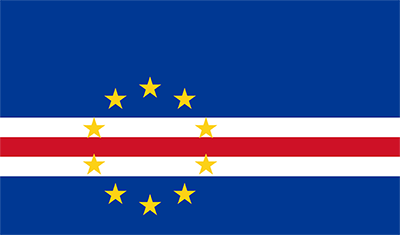
The flag of Cabo Verde — Cape Verde, in the older English name — is a blue field crossed below its center by a band of white, red and white, with a ring of ten yellow stars toward the hoist: the ocean and the sky, peace and the road of effort, and the ten islands of the archipelago in one circle.
An overview
The national flag of Cabo Verde — Cape Verde, in the older English name — is a blue field crossed just below its center by a band of white, red and white, with a ring of ten yellow stars set toward the hoist. The bands run 6:1:1:1:3, the flag is 10:17 by law, and it has flown since September 1992.
It is the flag of a second beginning. The islands became independent on July 5, 1975, under the red, yellow and green of the PAIGC, the party that had fought for Cabo Verde and Guinea-Bissau together and meant to unite them. The union died in a coup in Bissau in 1980; the one-party state died at the polls in January 1991; and in September 1992 the new republic took a new flag, designed by Pedro Gregório Lopes, that looked out to the Atlantic instead: a blue sea, a road of white and red, and ten stars for ten islands.
It has no green, in a country called Green Cape, and the designer said why: the islands are dry, and it is the sea that feeds them.
The ten stars
Ten yellow stars in a ring, set toward the hoist on the red stripe — one for each island of the archipelago, from Santo Antão in the northwest to Brava in the south, Santa Luzia included though no one lives there. The ring is the nation: islands strung across 400 km of ocean, held in one circle. The stripes beneath the ring are read as a road — white for peace, red for the effort of building a country — laid across the blue of the sea and the sky.
There is no green on the flag of a country whose name means Green Cape, and that was a choice. The designer, Pedro Gregório Lopes, explained that green was the wrong color for islands where drought is a constant and the sea, not the land, feeds the people. The flag of 1992 also turned away from the red, yellow and green of the PAIGC, the party that had won independence for Cabo Verde and Guinea-Bissau together: after the first free elections of 1991 the new government wanted a flag that looked to the Atlantic, to Portugal and to the United States, where more Cabo Verdeans live than at home, rather than to the union with Guinea-Bissau that a coup in Bissau had ended in 1980.
Official color specification
The law of 1992 describes the colors and fixes no shade; no Cabo Verdean instrument gives a Pantone. The values below are those the standard references carry — a deep blue, a clear red, and a warm yellow for the stars.
| Color | Hex | Pantone | RGB |
|---|---|---|---|
| Blue | #003893 | not fixed in law | 0, 56, 147 |
| White | #FFFFFF | White | 255, 255, 255 |
| Red | #CF2027 | not fixed in law | 207, 32, 39 |
| Yellow | #F7D116 | not fixed in law | 247, 209, 22 |
Symbolism and meaning
The meanings were published with the flag in 1992, and the designer added his own gloss on the blue and the missing green.
Red, white and blue together were also chosen as a link to Portugal and the United States, the countries most bound to the archipelago by history and by the diaspora.
Design and official specification
The law of 1992 sets an unusual proportion, 10:17, and a precise geometry: the upper blue takes half the height, the three stripes of the band a twelfth each, the lower blue a quarter; the ring of stars, a quarter of the height in radius, sits on the red stripe at three-eighths of the length from the hoist. Flags for hand and window are usually made at 2:3.
| Element | Specification | Reference |
|---|---|---|
| Hoist (height) | 10 | 100 cm (39.4 in) on the reference flag |
| Fly (length) | 17 | 170 cm (66.9 in) |
| Ratio | 10 : 17 | The law of 1992; 2:3 in common manufacture |
| Bands | Five horizontal — blue, white, red, white, blue — in the proportion 6 : 1 : 1 : 1 : 3 | The upper blue half the height; each stripe of the band one-twelfth; the lower blue a quarter |
| The ring | Ten yellow five-pointed stars in a circle, one point up, centered on the red band at three-eighths of the length from the hoist | The circle's radius a quarter of the height |
| The stars | Equally spaced, each pointing outward from the center of the ring | Ten, for the ten islands |
| The description in law | A blue field with a band of white, red and white below its center, and a circle of ten yellow stars toward the hoist | Constitution of 1992, Article 8; the flag law of September 1992 — in substance |
How the flag evolved
A party’s banner at independence, a competition after the first free elections, and a flag unchanged since — the story in three moves.
1975
The PAIGC colors

The flag hoisted at independence on July 5, 1975, and confirmed by law on April 19, 1976, came from the banner of the PAIGC, the party of Amílcar Cabral that had fought Portugal for both Cabo Verde and Guinea-Bissau: a vertical red band at the hoist bearing a black star, framed by ears of corn and a clam shell, beside horizontal yellow and green. Guinea-Bissau's flag was nearly the same, for the two countries were meant to unite; the coup in Bissau of 1980 ended the plan, and the party split.
1992
Ten stars on the sea

The Movement for Democracy won the first multiparty elections in January 1991 and ended sixteen years of one-party rule. A new flag followed, chosen by competition and designed by Pedro Gregório Lopes: a blue sea, a road of white, red and white, and ten stars for the islands. The law adopting it is dated September 22, 1992; it came into force with the new Constitution on September 25. The arms and the anthem changed with it.
today
Unchanged
The flag has not changed since 1992 — through the return of the PAICV to government in 2001 and again in 2026, the country's request to the world in 2013 to call it Cabo Verde in every language, and the summer of 2026 when the Blue Sharks carried it to the World Cup for the first time. On the mast it keeps the 10:17 of the law; in the hand it is usually made at 2:3.
Who designed the flag of Cabo Verde?
Pedro Gregório Lopes, whose design won the competition the new government held after the elections of 1991. He is one of the few flag designers to have explained a color he left out: green, he said, was wrong for islands where drought is the rule and where the sea, not the land, is the source of life — so the flag is a blue sea with a road across it and the islands set upon it as stars.
The flag it replaced had no single author; it was the banner of the PAIGC, adapted in 1975 with the corn and the shell that told Cabo Verde’s flag from Guinea-Bissau’s.
July 5
Cabo Verde keeps no flag day. The flag’s great day is Independence Day, July 5, when it is raised across the ten islands and, as loudly, among the diaspora — in Lisbon, in Boston and New Bedford, in Rotterdam and Dakar — for more Cabo Verdeans live abroad than at home. The flag’s own anniversary is September 22, the date of the law of 1992; Democracy Day, January 13, remembers the elections of 1991 that brought it about.
Legal status and display rules
The flag rests on Article 8 of the Constitution of 1992, which names it with the arms and the anthem as the symbols of the nation, and on the flag law of September 1992, which describes it and fixes its proportions. Cabo Verde has no separate flag code; the rules of display are the state’s protocol, tabled here.
| Provision | The rule |
|---|---|
| The instruments | Article 8 of the Constitution of 1992, which names the flag, the arms and the anthem as the national symbols; the flag law of September 1992, which describes the flag and fixes its proportions; the state's protocol |
| Where it flies | On the Presidential Palace and the government buildings in Praia, the National Assembly, the ministries, the town halls of the 22 municipalities, the schools, the courts, the ports and airports, and the embassies |
| Ceremony | Raised in the morning and lowered at nightfall at public institutions; hoisted to the anthem, "Cântico da Liberdade," at formal ceremonies and in schools |
| Precedence | The national flag in the place of honor; the flags of ECOWAS, the African Union and the Community of Portuguese Language Countries beside it at state events |
| Respect | Not used as a covering or in commerce; its desecration punishable under the Penal Code |
| The arms | The circle with the torch of liberty and the plumb line, the three chain links, the ten stars and the motto — adopted with the flag in 1992 |
| Standardization | No Pantone is fixed in law; the 10:17 proportion and the 6:1:1:1:3 bands are the law's |
Half-mast and mourning
Mourning is decreed by the government, and the islands have lowered the flag for a singer as well as for statesmen.
| Provision | The rule |
|---|---|
| When | In periods of national mourning decreed by the government — on the death of former presidents and prime ministers, after disasters at sea and on the volcano, and, in 2011, for Cesária Évora |
| How | The flag is flown at half-mast on public buildings for the days the decree names |
Things you may not know
Green Cape, no green. The country is named for the greenest point of the African coast, but the flag has no green at all — by the designer’s decision, for islands that are mostly dry.
Often mistaken for Europe’s. The flag of 1992 and the flag of the European Union both set a ring of yellow stars on blue; Cabo Verde’s has ten, for its islands, and sits off-center on a red road — and the Azores, Portugal’s other Atlantic islands, fly a ring of nine.
One of the ten stars stands for an island with no people. Santa Luzia, a nature reserve, has had no permanent inhabitants since the 1960s, and still counts.
Frequently asked questions
What does the flag of Cabo Verde look like?
A blue field crossed, just below its center, by a band of three stripes — white, red, white — with a ring of ten yellow five-pointed stars toward the hoist, centered on the red stripe. The bands are in the proportion 6:1:1:1:3 and the flag is 10:17 by law, though it is commonly made at 2:3. It has flown since September 1992.
Is it Cape Verde or Cabo Verde?
Both name the same country and the same flag. Cabo Verde is the official name: in October 2013 the government asked the United Nations to use the Portuguese form in every language and not to translate it, and the UN, ISO, the U.S. State Department and Britannica followed. Cape Verde is the older English rendering, still common in everyday speech and in search. This page uses the official name and keeps the old one where readers look for it.
What do the colors of the Cabo Verde flag mean?
Blue for the sea and the sky around the islands; white for peace; red for the effort and resolve of the people on the road to progress — the three stripes read together as a road across the ocean; and the yellow of the stars for the islands themselves. The red, white and blue were also chosen as a link to Portugal and the United States, the two countries most tied to the archipelago.
What do the ten stars on the Cabo Verde flag mean?
The ten islands of the archipelago — Santo Antão, São Vicente, Santa Luzia, São Nicolau, Sal, Boa Vista, Maio, Santiago, Fogo and Brava — arranged in a circle to show the unity of a nation spread across the sea. Santa Luzia, uninhabited, counts among the ten.
Why is there no green on the flag of Cabo Verde?
On purpose. The country's name means Green Cape, but the designer, Pedro Gregório Lopes, left green out because the islands are dry — drought is a constant of their history — and because it is the blue sea, not the land, that feeds the people. Dropping the green also dropped the PAIGC colors of the old flag.
When was the Cabo Verde flag adopted?
By a law dated September 22, 1992, in force with the new Constitution on September 25, 1992 — a year and a half after the first multiparty elections. It replaced the flag of independence of July 5, 1975.
Who designed the flag of Cabo Verde?
Pedro Gregório Lopes, a Cabo Verdean designer whose entry won the competition held after the democratic transition of 1991. He later explained the absence of green and the choice of blue for a maritime nation.
What was the old flag of Cape Verde?
The flag of 1975–1992: a vertical red band at the hoist with a black five-pointed star between two ears of corn and a clam shell, beside horizontal bands of yellow over green — the colors of the PAIGC, the party that had won independence for both Cabo Verde and Guinea-Bissau, whose flag was almost identical. The design was retired when the one-party state ended.
Does Cabo Verde have a flag day?
No. The flag's great day is Independence Day, July 5, when it is raised across the islands and among the diaspora from Lisbon to Boston; its own anniversary is September 22, the date of the flag law of 1992. Democracy Day, January 13, marks the first free elections of 1991 that led to the flag.
Every general-knowledge topic and the A-to-Z lists.
The world A to Z: flags, countries, the sciences, places, people, subjects.

We Value Your Opinion Comments