
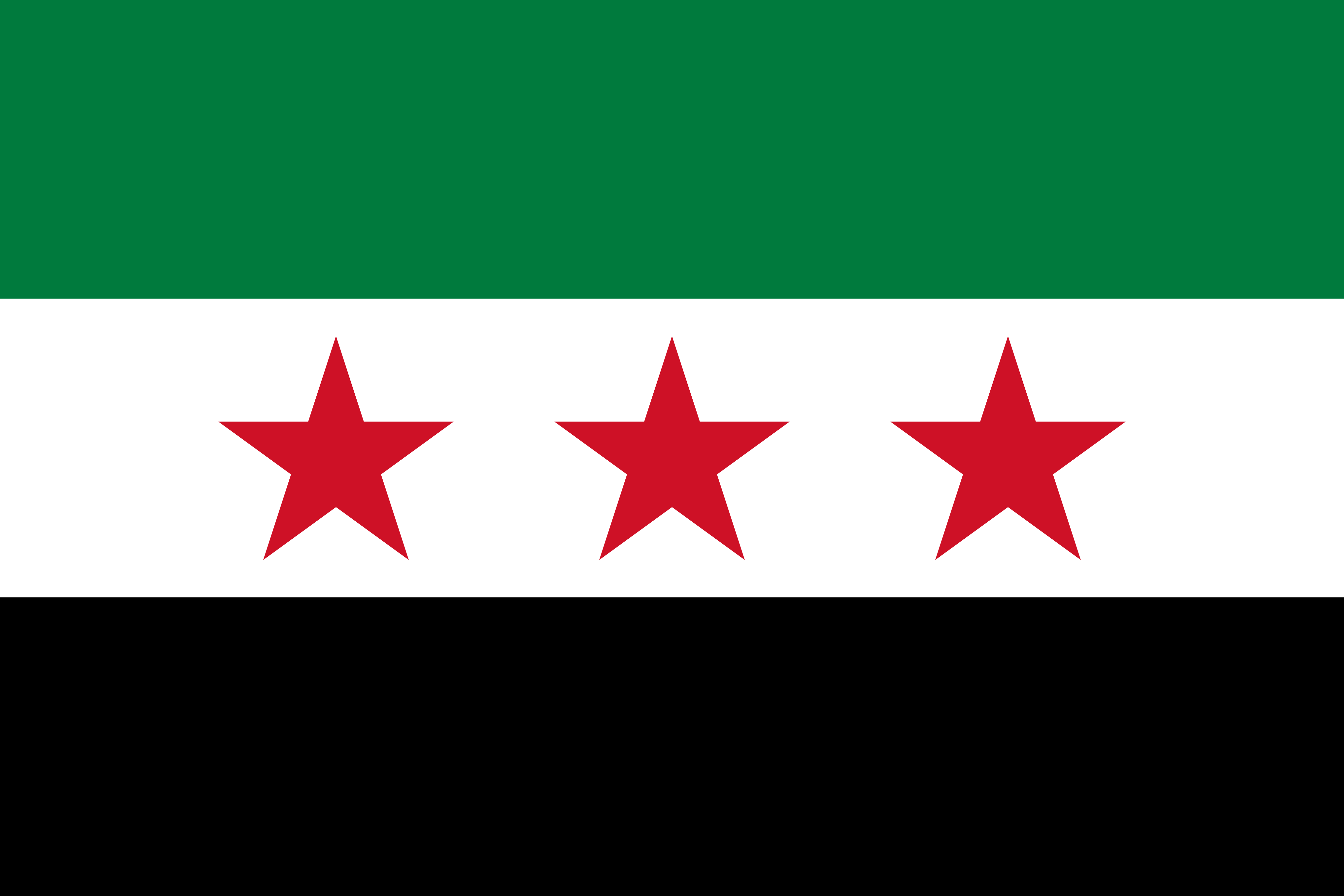
Syria flag picture
Explore the proportions, history, and picture gallery.
| Country | Syrian Arab RepublicWestern Asia. |
|---|---|
| Design | Three equal bands · three red starsGreen above white above black; no eagle or lettering. |
| Proportions | Height:length = 2:3Contemporary horizontal presentation; explicit axis labels. |
| Return to national use | December 2024Distinct from the later constitutional definition. |
| Constitutional definition | Declaration signed March 13, 2025Article 6; Article 53 ties commencement to gazette publication. |
| Main image sizes | SVG and PNG: 6,300 × 4,200Complete rectangle; opaque RGB PNG. |
Article 6 names the colors but supplies no numerical color codes. These files use a documented digital palette.
What does the Syria flag look like?
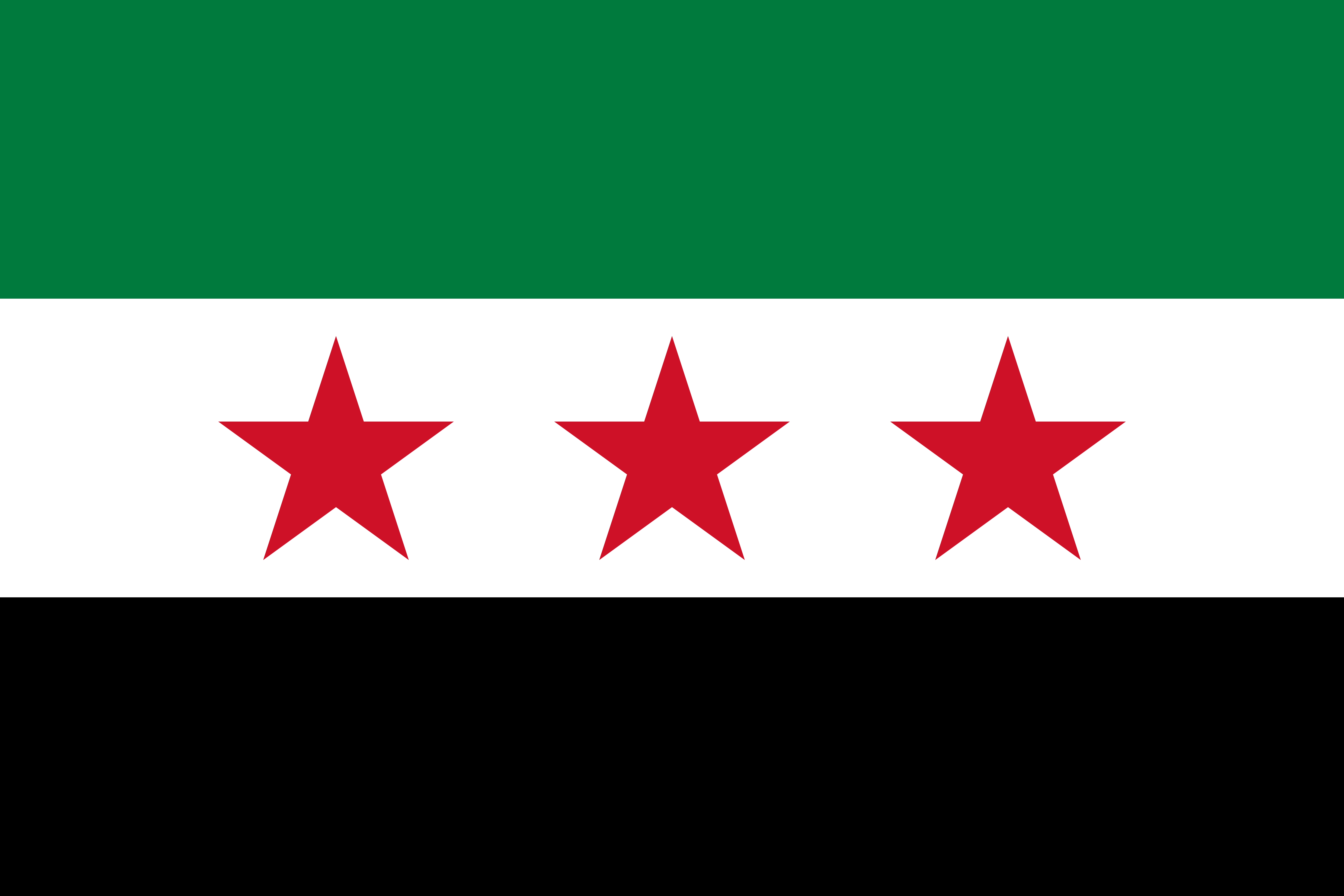
Syria’s current national flag has three equal horizontal bands: green above white above black. Three red, five-pointed stars form a row across the white band. The contemporary rectangular presentation has a height-to-length ratio of 2:3. This is the design described in the constitutional declaration signed on March 13, 2025.
Identify the whole composition before looking at a small detail. The upper stripe is green, the lower stripe is black, and the stars are red. A red upper stripe with two green stars identifies an earlier Syrian design. Its large vector and raster versions show the same arrangement. The construction illustrations add measurements outside the flag so that the national design remains easy to recognize and compare.
What is the Syrian flag called?
The straightforward name is the national flag of Syria, or the Syrian Arab Republic. The green, white, and black design with three red stars is also widely called the independence flag. Its later use by opponents of the Assad government explains the additional historical description “revolution flag.”
A name needs a time context. Independence flag connects the design with an earlier period of Syrian statehood, while revolution flag describes its later political use. Neither expression changes the visible arrangement of the three stripes and three stars. In a current country index, “Syria flag” is the clearest short label.
Captions for historical photographs should retain the date and setting. A picture from a demonstration and a picture of a current official building may show related designs while documenting different circumstances. Descriptive naming helps readers understand that continuity without presenting every use as the same legal event.
Which Syrian flag is current?
The current design is the green, white, and black tricolor with three red stars. It returned to national use following the fall of the Assad government in December 2024. Article 6 of the declaration signed in March 2025 describes these bands and stars; the earlier two-green-star flag is historical.
For an updated illustration, check three features together: the top stripe, the star color, and the number of stars. Replacing only the red upper stripe in an older image would leave the wrong star arrangement.
Search engines, old textbooks, emoji fonts, and stored thumbnails can preserve earlier artwork after a national change. Date the underlying source instead of assuming that a recently downloaded file is current. This collection uses the contemporary design consistently in its main image, explanatory figures, gallery thumbnails, and social sharing card.
What are the colors of the Syria flag?
The flag uses green, white, black, and red. Green, white, and black occupy equal horizontal stripes, while red fills the three stars. These downloads use #007A3D, #FFFFFF, #000000, and #CE1126 respectively. Those numerical values are declared digital reproduction choices; Article 6 names colors without supplying HEX or RGB codes.
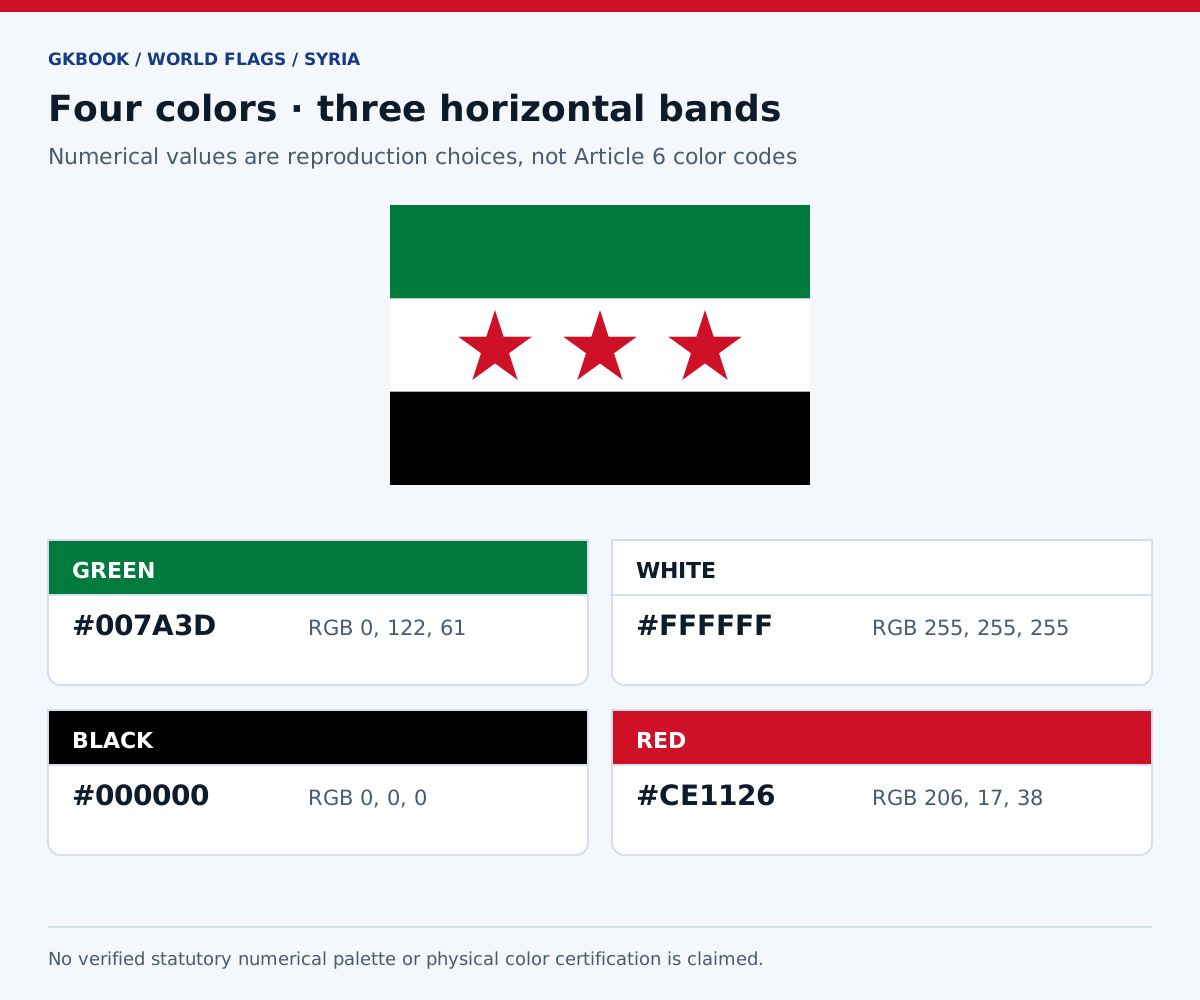
A four-color palette and three stripes are compatible descriptions: the fourth color belongs to the stars. Each stripe occupies one third of the rectangle before the stars are placed over the middle stripe. White is an opaque painted area in these files, rather than an opening through which a page background appears.
Screen values help keep related illustrations consistent. They do not establish a universal textile dye, ink recipe, or manufacturing tolerance. Different screens and printing systems can reproduce the same numbers differently. Keep the numerical palette attached to this edition, and use an appropriate proof when preparing a physical reproduction.
| Part | HEX | RGB |
|---|---|---|
| Upper stripe | #007A3D | 0, 122, 61 |
| Middle stripe | #FFFFFF | 255, 255, 255 |
| Lower stripe | #000000 | 0, 0, 0 |
| Three stars | #CE1126 | 206, 17, 38 |
What does the Syrian flag represent?
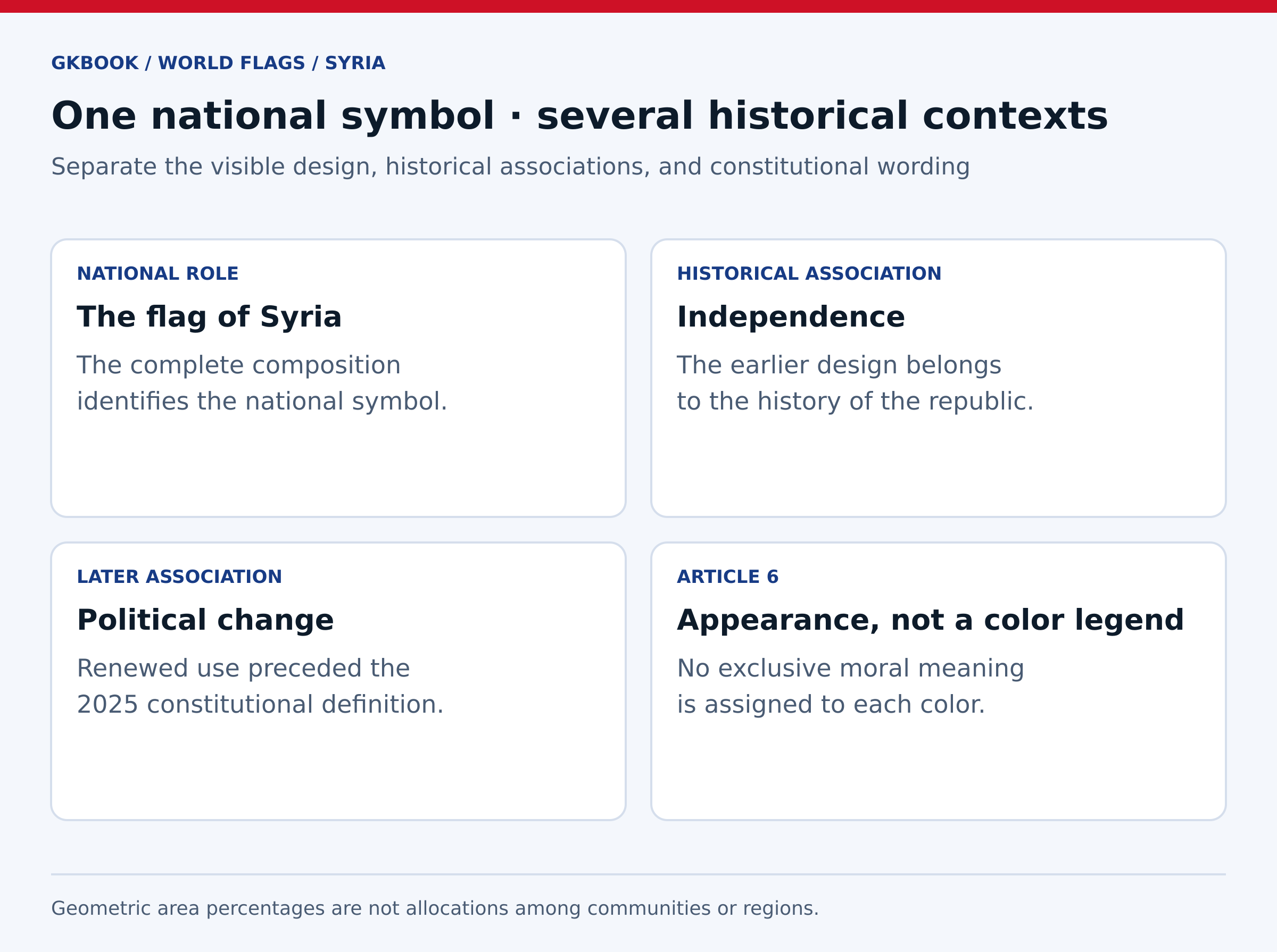
The complete flag represents Syria. Its green, white, black, and red belong to the wider Arab flag tradition, while this particular arrangement carries Syrian historical associations with independence and later political change. Symbolic interpretations should be distinguished from Article 6, which describes the flag’s appearance without assigning a meaning to each color.
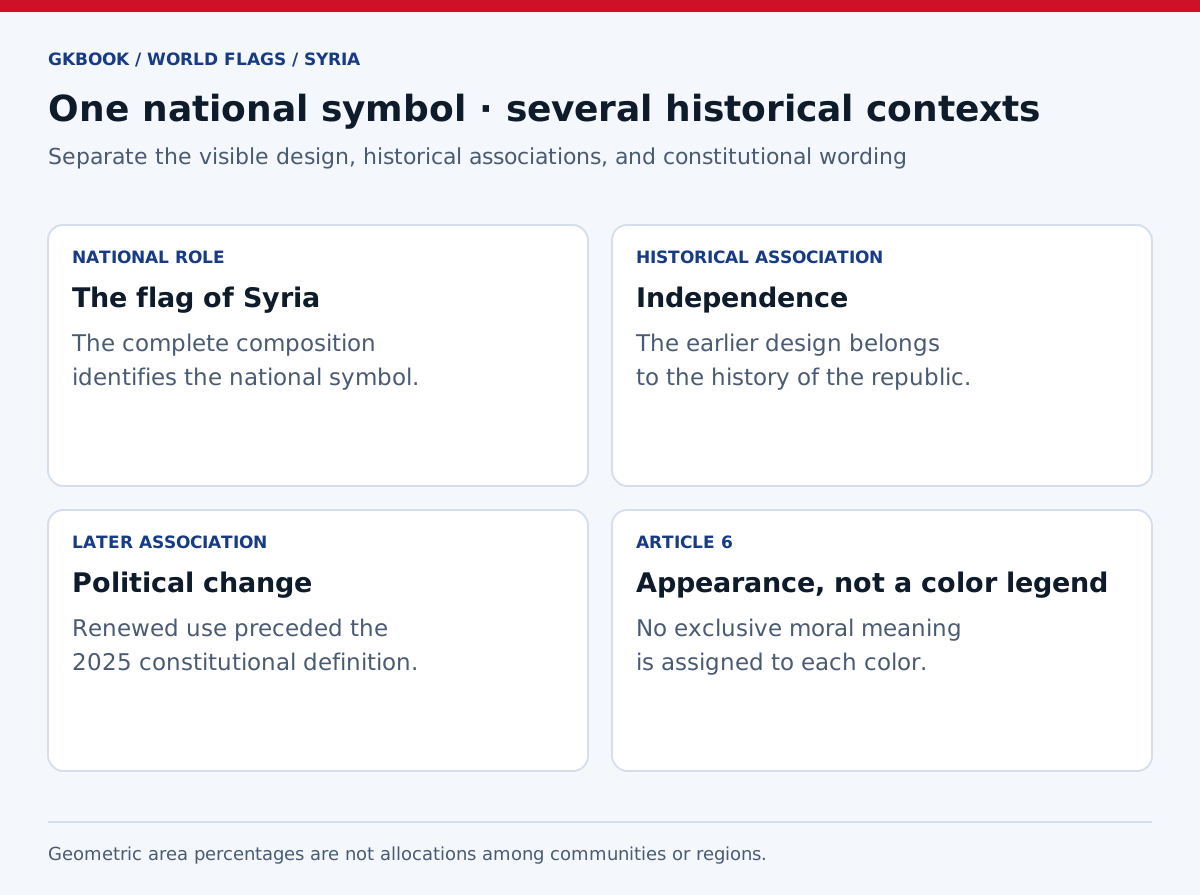
National symbolism can accumulate across generations. A person remembering independence, a family recalling displacement, and a reader studying constitutional history may encounter the same design through different experiences. An educational explanation should give the historical setting without claiming that every citizen interprets the symbol in one identical way.
Color meanings also require a named context. Accounts of Arab dynasties, poetry, sacrifice, and modern aspirations are not interchangeable statements of the current constitutional text. Here, the composition is presented confidently, while interpretation remains attributed and qualified. The mathematical area of a stripe is never treated as a percentage of the population.
What do the three red stars mean?
A historical explanation reported by SANA associates the three stars with Damascus, Aleppo, and Deir ez-Zor. This is an attributed interpretation of the design’s origins, rather than a geographical legend written into Article 6. The current declaration requires three red stars but does not assign each star a named territory.
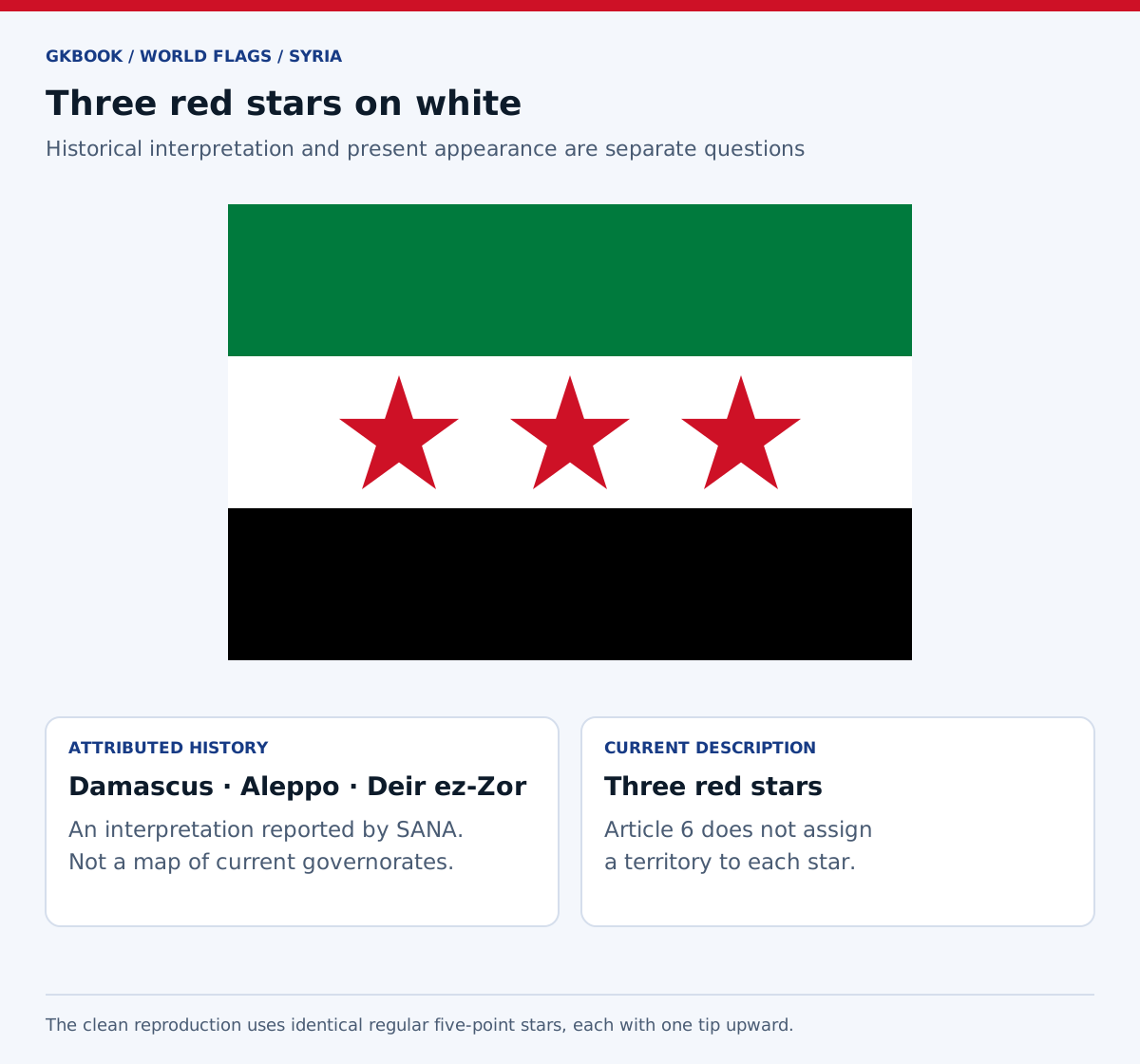
Read historical territorial names in their period. Administrative boundaries, political units, and present governorates do not automatically correspond. A diagram with three stars is therefore not a current map divided into three equal regions. The stars’ equal size in this reproduction expresses a consistent drawing, not a measured territorial comparison.
Their number and color are useful identifying features even when a historical interpretation is uncertain or disputed. The row contains three separate red shapes on white, each with one point upward. No additional star, colored outline, disk, or connecting line belongs in the clean national flag supplied here.
Why is the upper stripe green?
Green is the upper color in Syria’s current flag because the design returns to the earlier green, white, and black arrangement. Article 6 expressly places green above white and black. Although green has wider historical and cultural associations, the constitutional description does not declare one exclusive religious meaning for this stripe.
The stripe’s position is more reliable for identification than a guessed symbolic slogan. In a flat horizontal view, green touches the entire upper edge from hoist to fly. It does not form a triangle, a narrow border, or a background behind all three stars. Those changes would produce a different composition.
A grayscale photocopy can conceal the difference between green and red. Preserve a written caption or color key when the image must be reproduced without color. For accessible teaching, combine the words “green upper stripe” with the star count and star color, so recognition does not depend on color perception alone.
What is the ratio of the Syria flag?
The contemporary flag is shown at a height-to-length ratio of 2:3: a rectangle three units long and two units high. The master is 6,300 pixels long and 4,200 pixels high. Explicit axis labels matter because the declaration’s Arabic wording uses length and width in the reverse relationship to conventional flag terminology.
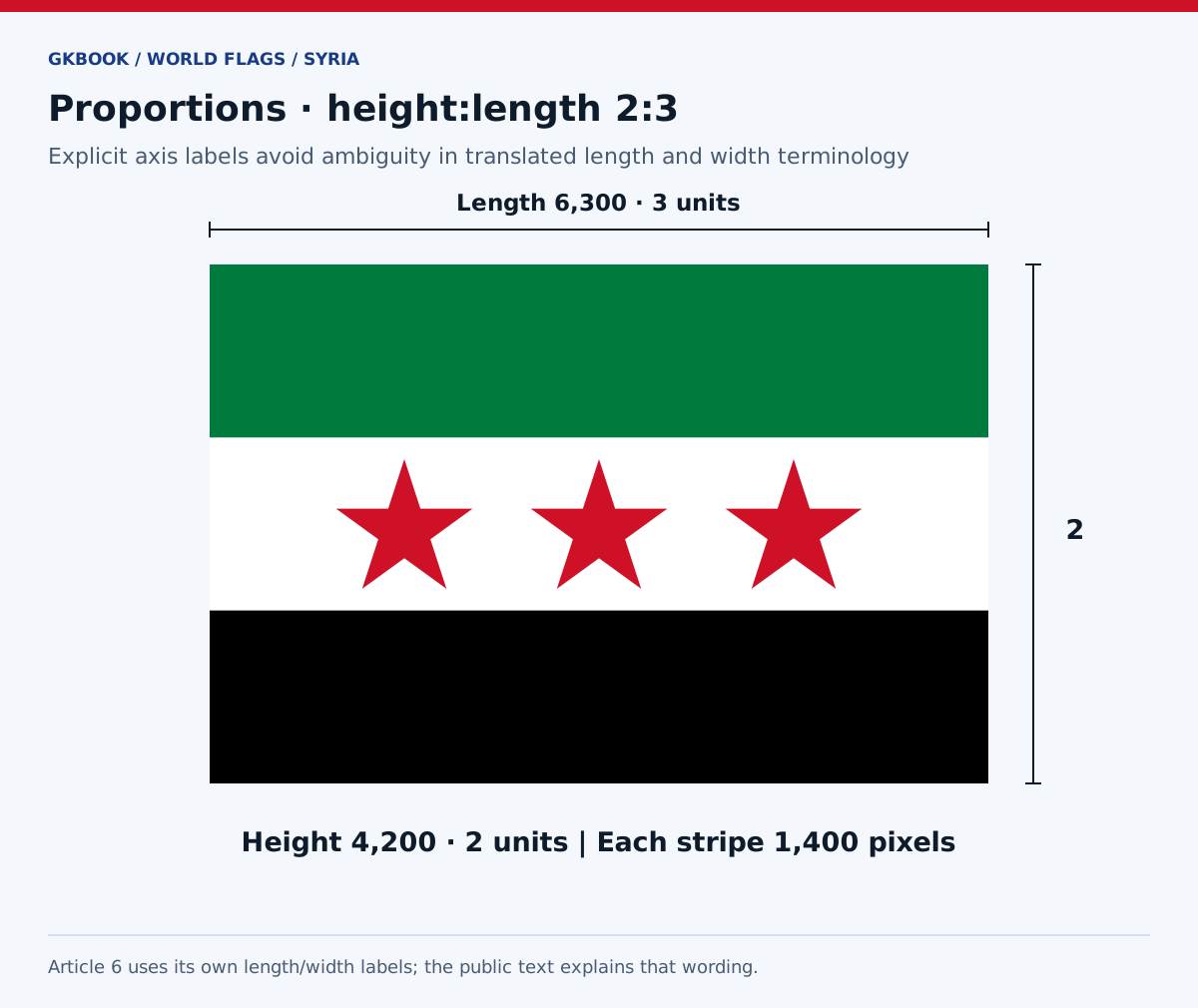
The declaration literally makes its named length two thirds of its named width. This collection does not silently turn that phrase into a quotation using different labels. Instead, the horizontal contemporary presentation is stated unambiguously as height:length 2:3, consistent with the inspected digital reference and the modern descriptive account.
Scale both axes by the same factor. A 900 by 600 image and a 630 by 420 image preserve the same outline. A 900 by 450 rectangle belongs to a different ratio, even if its stripe colors look familiar. Historical dimensions must be checked separately from the contemporary presentation.
Are the three stripes equal in height?
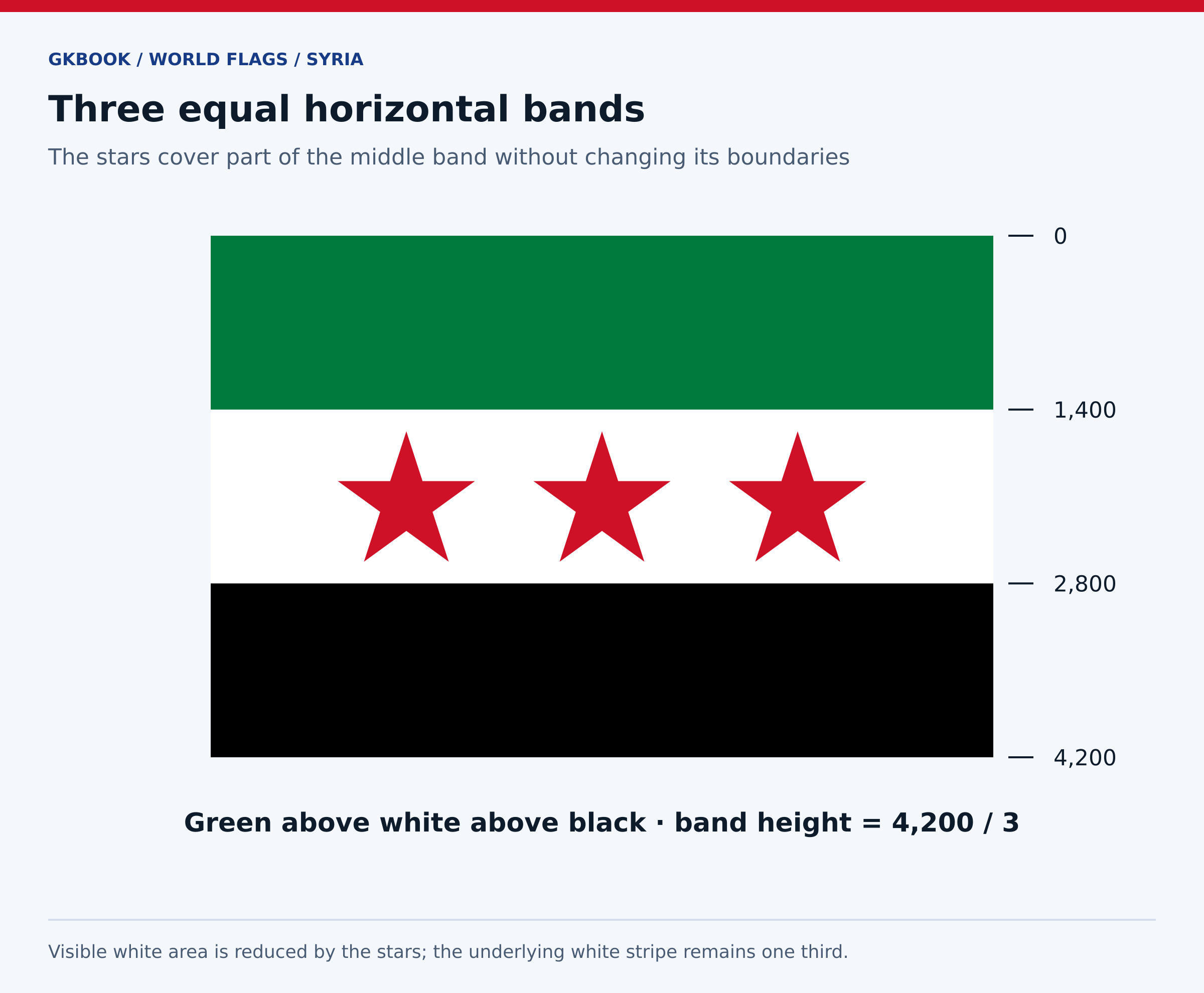
Yes. Article 6 describes three equal horizontal rectangles, and this reproduction gives each stripe one third of the flag’s height. In the 6,300 by 4,200 master, every stripe is 1,400 pixels high. The stars are placed within the white stripe without changing either of its straight boundaries.

Starting at the upper edge, green extends to the first third, white occupies the middle third, and black fills the remaining third. The stripe boundaries remain horizontal across the complete length. In a vector file, shared coordinates prevent an accidental hairline gap between neighboring colored regions.
White’s underlying stripe area equals green’s and black’s, but its visible area is smaller after the red stars cover part of it. That distinction explains why equal stripe heights do not produce three equal visible color areas.
How are the five-pointed stars drawn?
Each star in this reproduction is a regular, filled five-pointed star with one outer point upward. Ten alternating outer and inner vertices form its boundary. The five-point form agrees with the inspected reference and earlier constitutional description; the 2025 declaration itself does not specify the number of points or a construction formula.
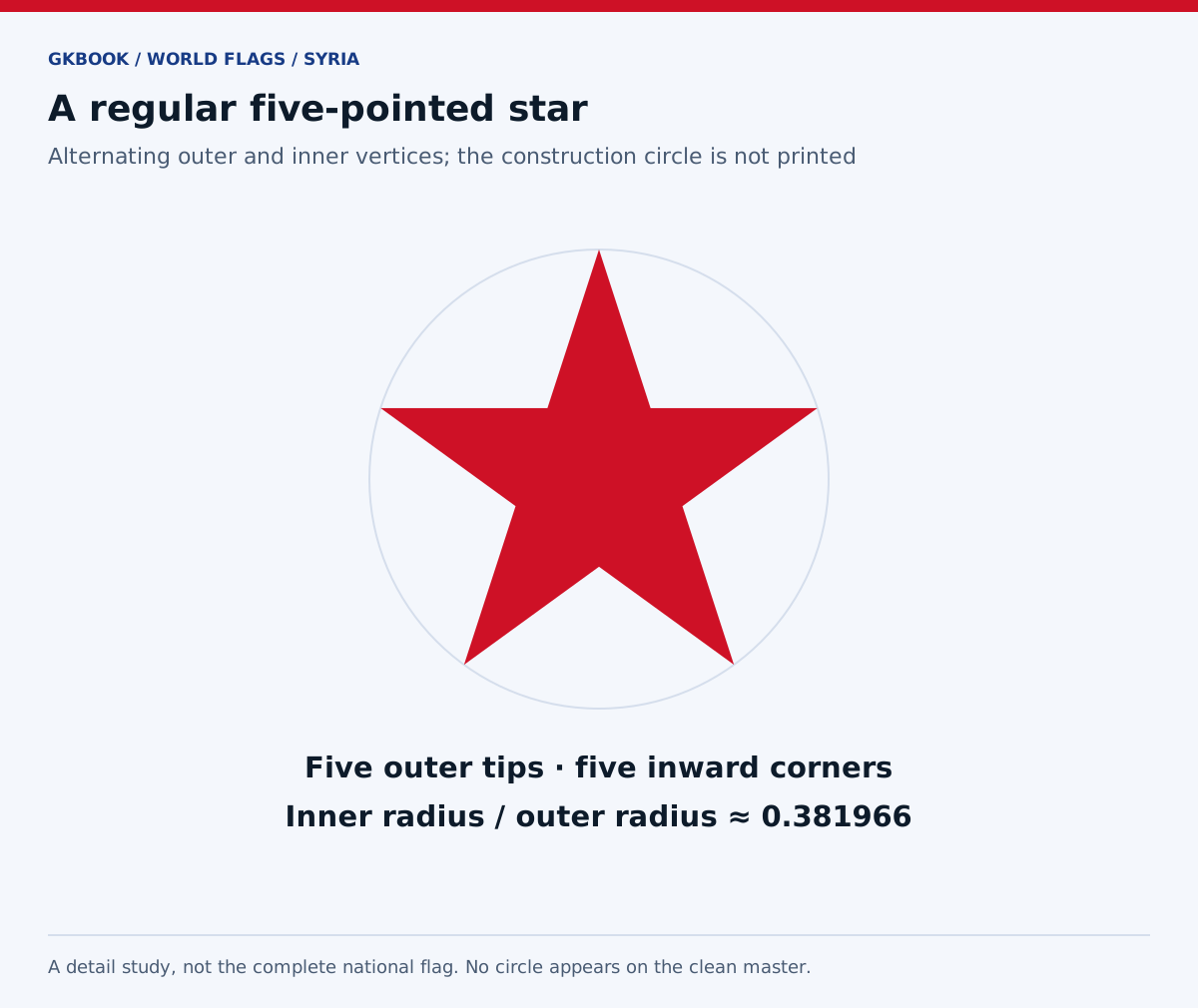
An outer circle supplies the five tips, separated by equal angles. A smaller concentric circle supplies the five inward corners. Joining those points in alternating order produces a clean silhouette without a hole. The circles are construction aids and are not visible features of the national flag.
The inner radius follows the geometry of a regular pentagram, approximately 0.381966 times the outer radius. A hand-drawn star can look plausible while having uneven arms or a different indentation. Using a stated regular construction keeps all three stars identical and makes later resizing reproducible rather than dependent on visual guessing.
How large are the stars in these files?
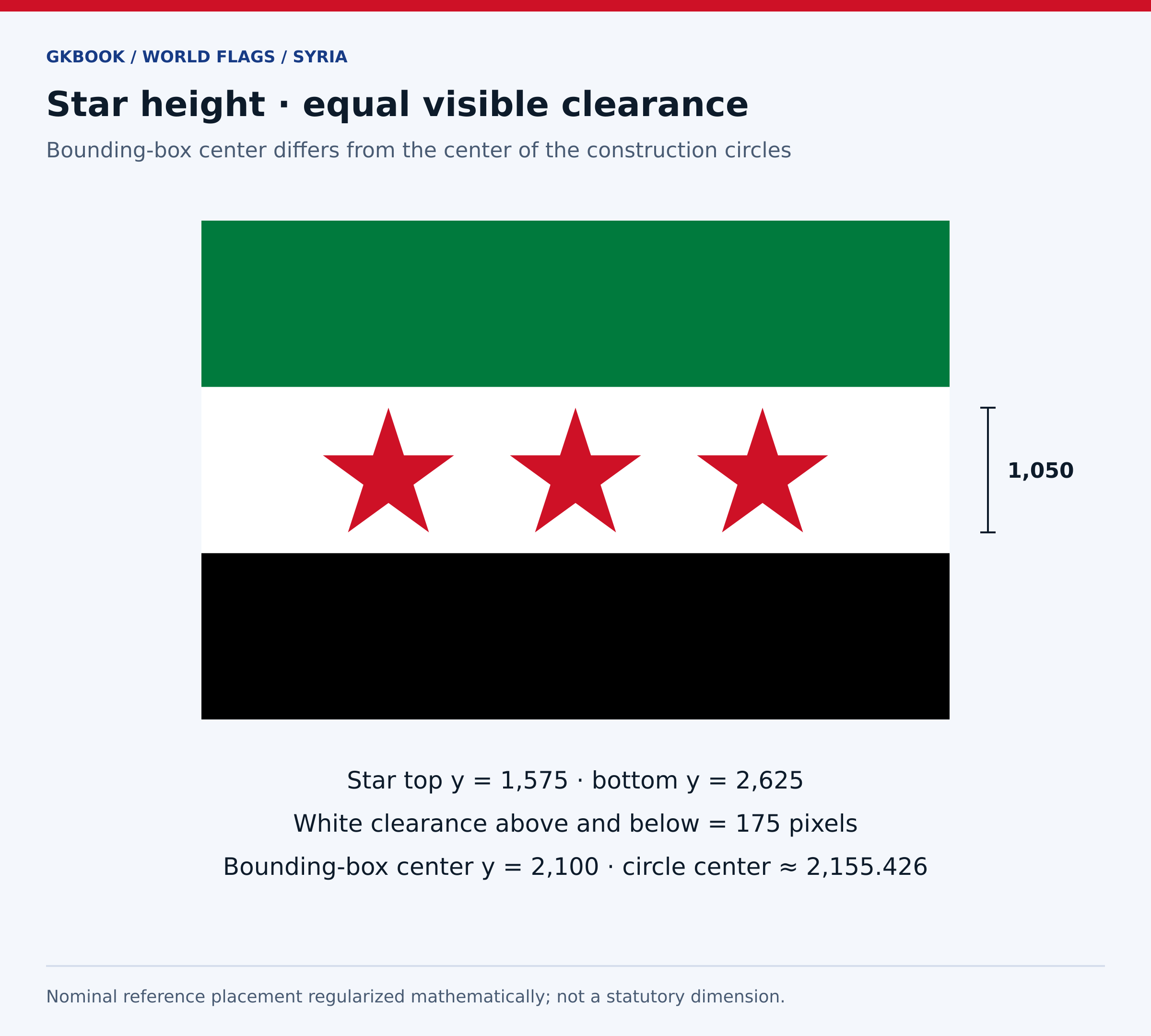
Each star’s bounding box is 1,050 pixels high in the 6,300 by 4,200 master. Its top is at y = 1,575 and its bottom at y = 2,625. This leaves 175 pixels of white above and below. These measurements reproduce the reference’s nominal placement; they are not dimensions supplied by Article 6.

The vertical bounding box and the construction circle have different centers. A regular upright star extends farther above its circle center than below it. Centering that circle on the middle of the white stripe would therefore leave unequal visible clearances. Here, the star’s visible top and bottom determine its vertical placement.
The resulting outer radius is approximately 580.426 pixels, with the circle center near y = 2,155.426. Rounded numbers in a caption explain the design; the vector uses greater precision. Keep the original formula when rebuilding instead of repeatedly rounding a previously rounded drawing, which can introduce small inconsistencies between exports.
How are the three stars spaced?
The stars’ horizontal centers are at one quarter, one half, and three quarters of the flag’s length in this reproduction. On the master, those positions are x = 1,575, 3,150, and 4,725. Their visible vertical centers share y = 2,100. The equal center spacing is a declared drawing convention based on the reference.
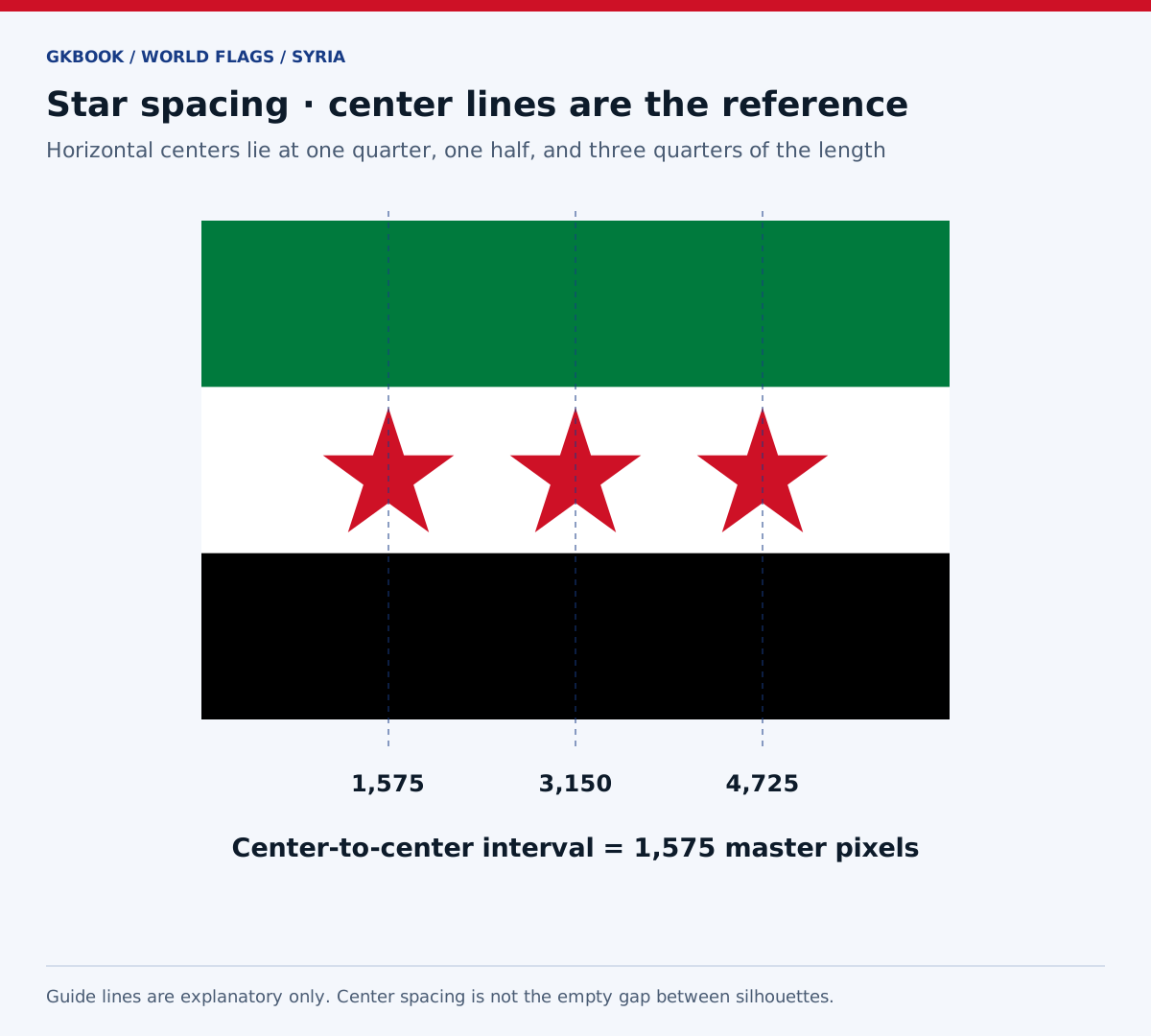
Center spacing is different from the empty gap between neighboring silhouettes. The three centers are 1,575 pixels apart, while each star has a substantial width. Subtract that width to obtain the clear gap. Measuring from whichever point happens to look nearest can give an inconsistent result across different illustrations.
The outside margins also differ from the gaps between stars. Quarter-length centers create a balanced row, but they do not divide the white stripe into alternating equal star widths and blank spaces. The placement diagram marks center lines explicitly so that those two kinds of measurement remain easy to distinguish.
How can the complete flag be constructed?
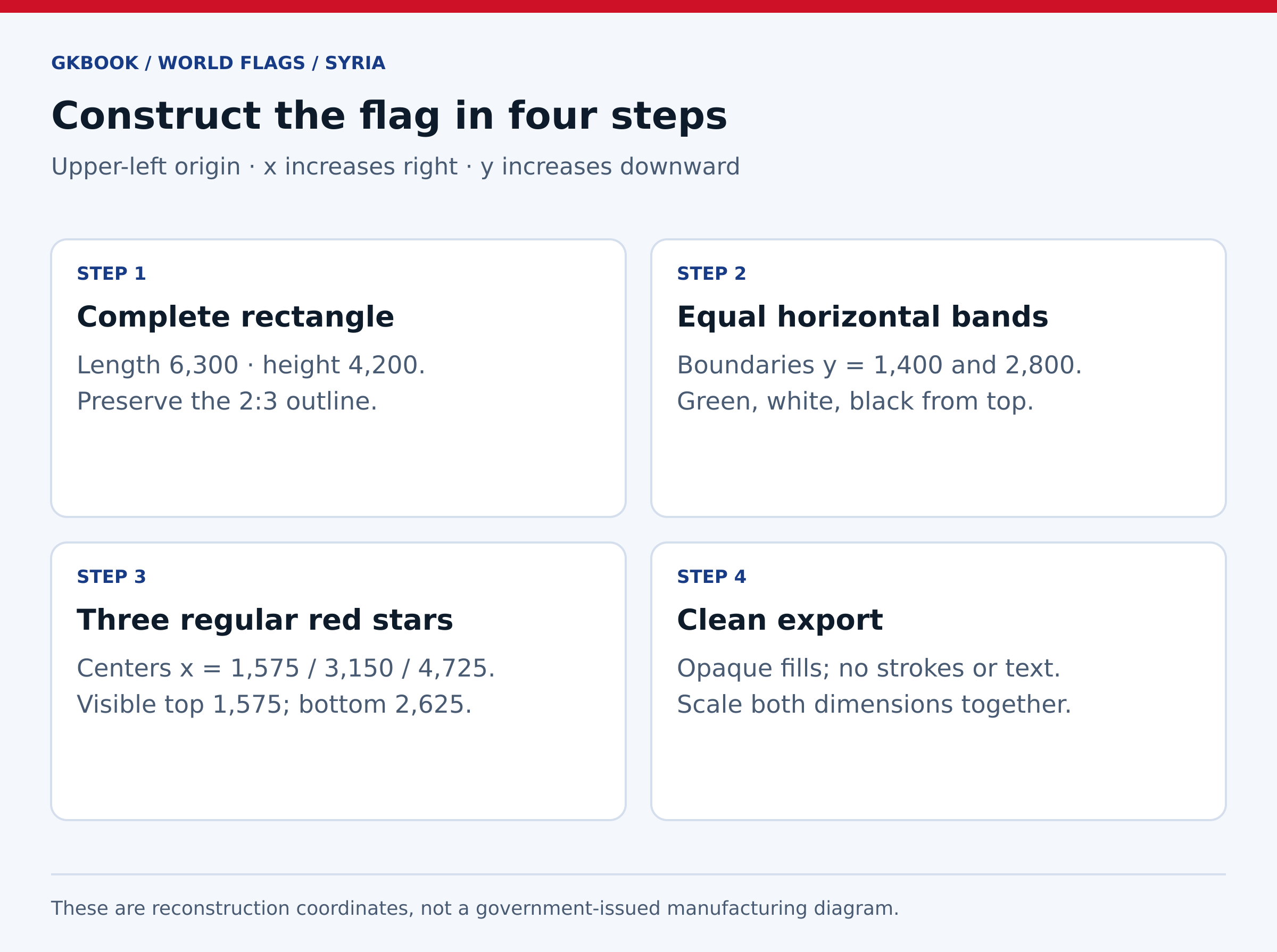
Begin with a 6,300 by 4,200 rectangle, divide its height into three equal bands, and place the three regular red stars at the stated coordinates. Keep green above white above black. The construction uses exact formulas for star vertices and preserves the full rectangle without outlines, shadows, lettering, or extra symbols.
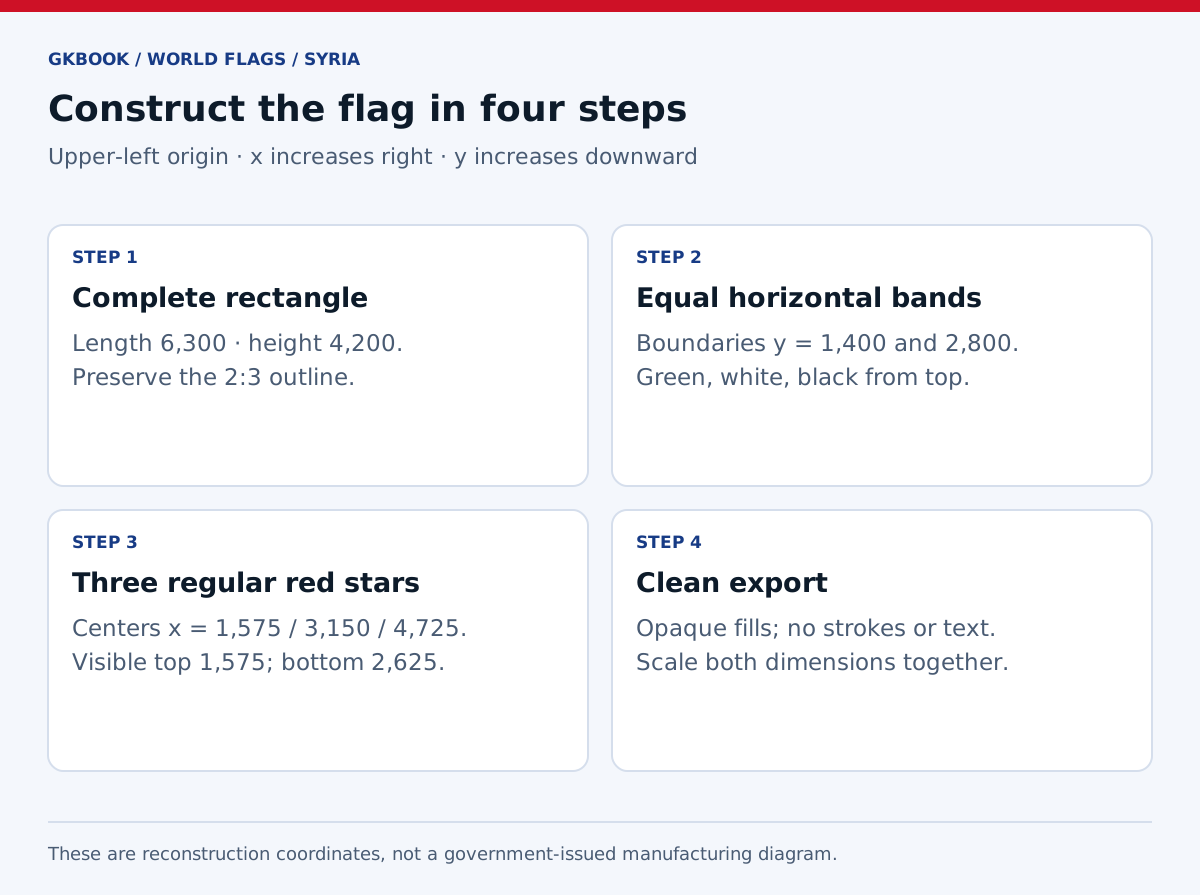
Use an upper-left origin: x increases to the right and y increases downward. This convention makes the band boundaries y = 1,400 and y = 2,800. The star tips and lower vertices stay strictly inside those boundaries. A shared palette prevents small color differences between otherwise matching pieces of artwork.
The order of drawing matters only where shapes overlap. An opaque black rectangle can form the base, with white and green rectangles above it, followed by the red stars. The final visible result has three equal bands. Construction layers should never be mistaken for an additional black border or an invisible fourth stripe.
What share of the flag is each color?
Green and black each occupy exactly one third of the rectangle. White occupies one third minus the combined area of the three red stars. Red occupies that combined star area. These are calculations for the declared regular-star reproduction, not constitutional percentages or symbolic allocations among Syrian communities, regions, or historical periods.
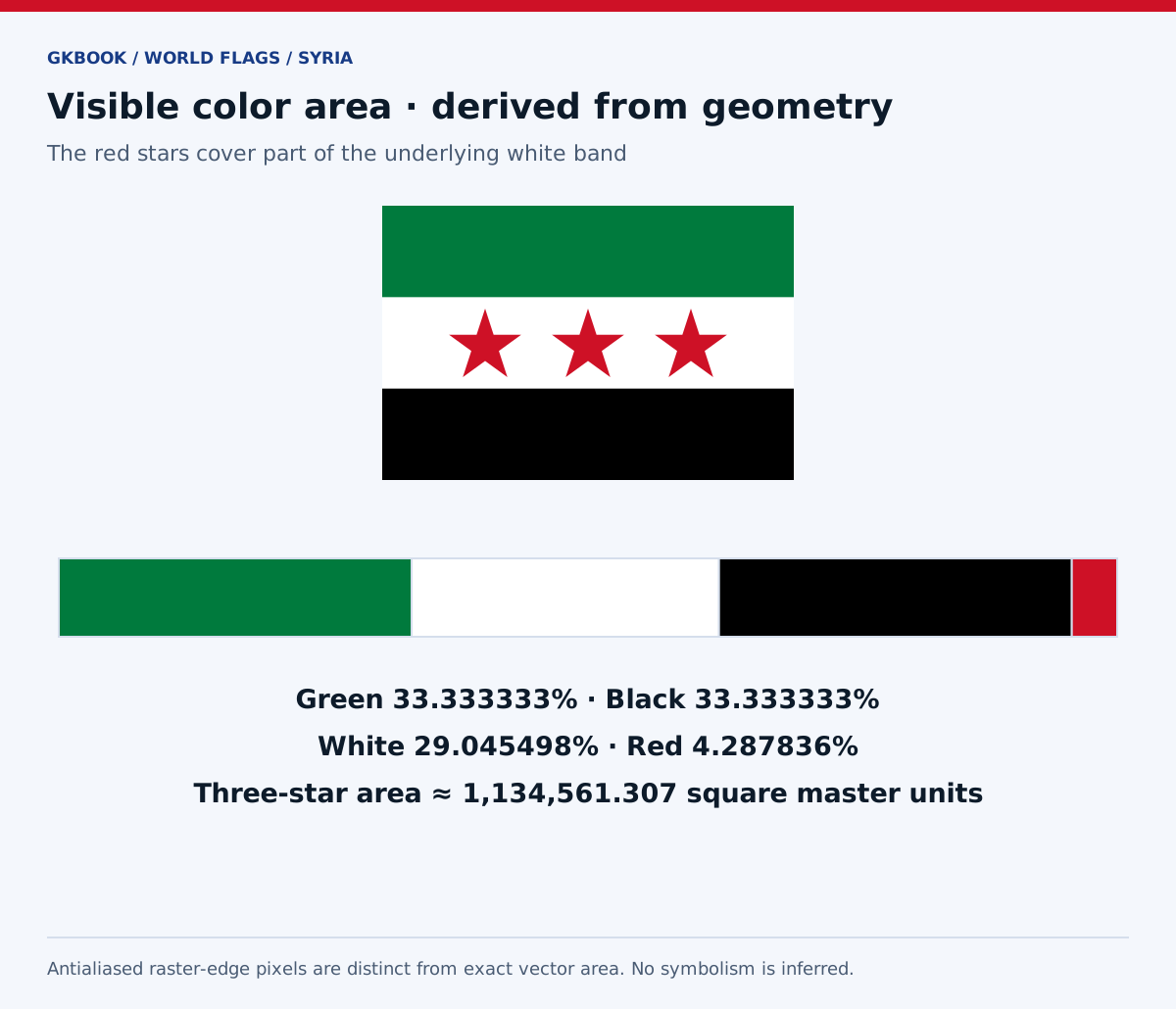
A polygon area formula gives each star’s area directly from its vertices. Multiplying by three and dividing by the whole rectangle gives the red share. Subtracting that share from one third gives visible white. This method avoids counting the hidden white beneath the stars as if it remained visible.
Raster edges introduce another distinction. Antialiasing blends neighboring colors along diagonal boundaries, so counting only perfectly red pixels does not recover the exact geometric red area. The area chart uses the vector calculation. The pixel checks separately examine flat interiors and the narrow boundary regions where blended samples are expected.
How has Syria’s flag changed over time?
Syria’s flag history includes the green, white, and black three-star design of the earlier republic, the red, white, and black union design introduced with Egypt in 1958, and several later changes. The earlier three-red-star pattern returned after separation in 1961 and again after the political change of December 2024.

The 1930 constitutional text describes green, white, and black bands with three red five-pointed stars, but it gives an elongated rectangle with length twice height. Consequently, historical continuity of colors and symbols does not establish that every period used the current proportions or the precise star measurements in these downloads.
The two-green-star design reappeared in 1980 and remained associated with the Assad-era state until 2024. Other intervening versions belong in a dated chronology, not an undifferentiated row of interchangeable flags. The historical panels here summarize major transitions without inventing period-specific shades, fabric details, or exact facsimiles of undocumented originals.
When was the current Syria flag adopted?
Distinguish practical use from constitutional definition. The three-red-star design returned to national use in December 2024. The constitutional declaration signed on March 13, 2025 describes it in Article 6. Article 53 makes the declaration effective upon Official Gazette publication; this review did not obtain that gazette issue to establish the commencement date.
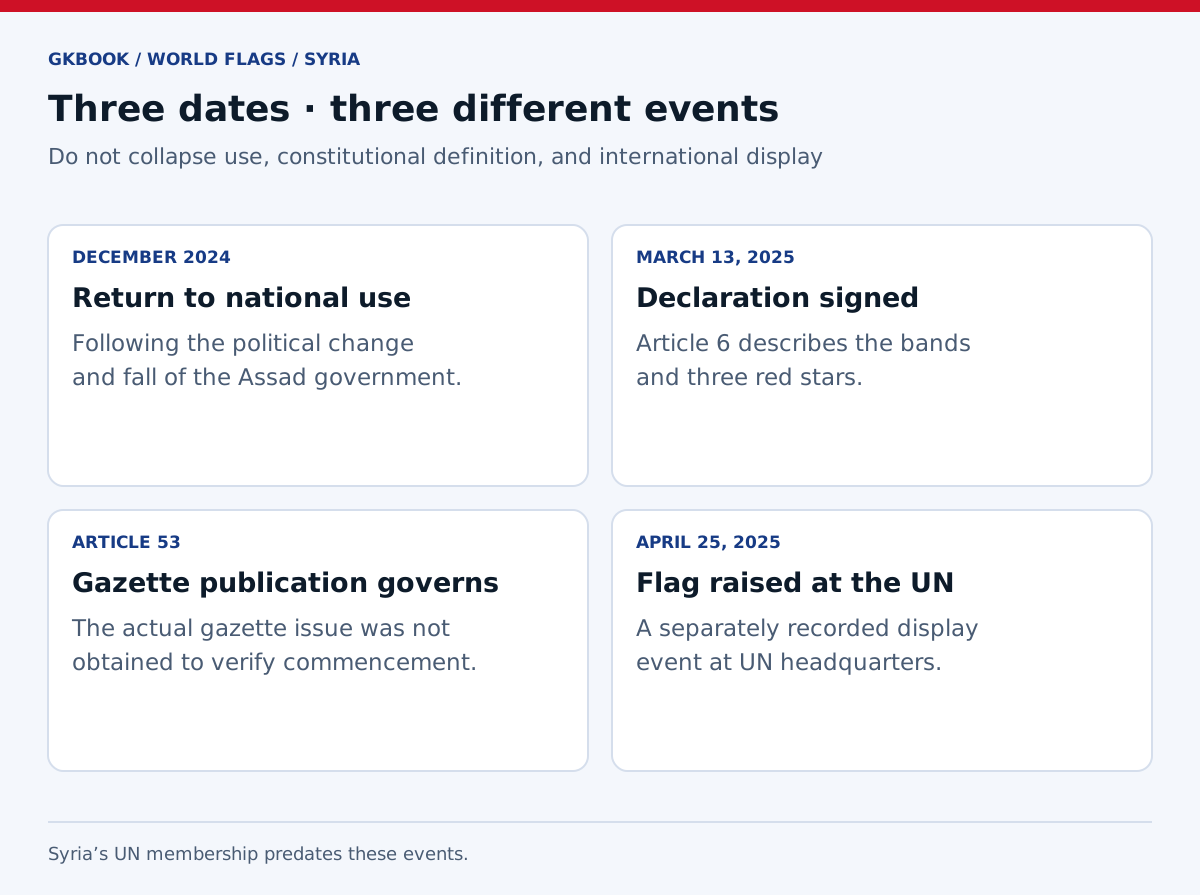
A date field should explain what happened on that date. Signing a declaration, publishing it, beginning to display a flag, and raising it at an international headquarters are separate actions. Labeling all of them “adoption” would hide information that matters when comparing sources or correcting an older reference page.
For this edition, March 13, 2025 is labeled the date of the signed constitutional definition. December 2024 identifies the return to national use, and April 25, 2025 identifies the UN ceremony. The package preserves those distinctions throughout its prose and illustrations instead of presenting an unverified legal commencement day.
Who designed the Syrian flag?
The earlier design developed through Syria’s constitutional process, rather than a securely documented single modern graphic commission. SANA’s historical account connects it with the constitutional committee chaired by Ibrahim Hananu. That attribution should not be expanded into proof that one person independently drew every detail of the current digital flag.
A constitutional committee can select a national symbol without leaving a surviving original drawing signed by one artist. Political authorship, historical advocacy, legal description, and geometric execution are different contributions. Where the evidence identifies a committee, a careful caption should retain that collective context instead of manufacturing a simple inventor story.
Modern vector contributors have a separate role. They translate a design into paths, coordinates, and color values, sometimes correcting earlier digital versions. GKBook’s contribution here is the regularized reconstruction, calculations, educational layouts, and exports. None of those production credits claims authorship of Syria’s national symbolism or a government commission.
What does the current declaration specify?
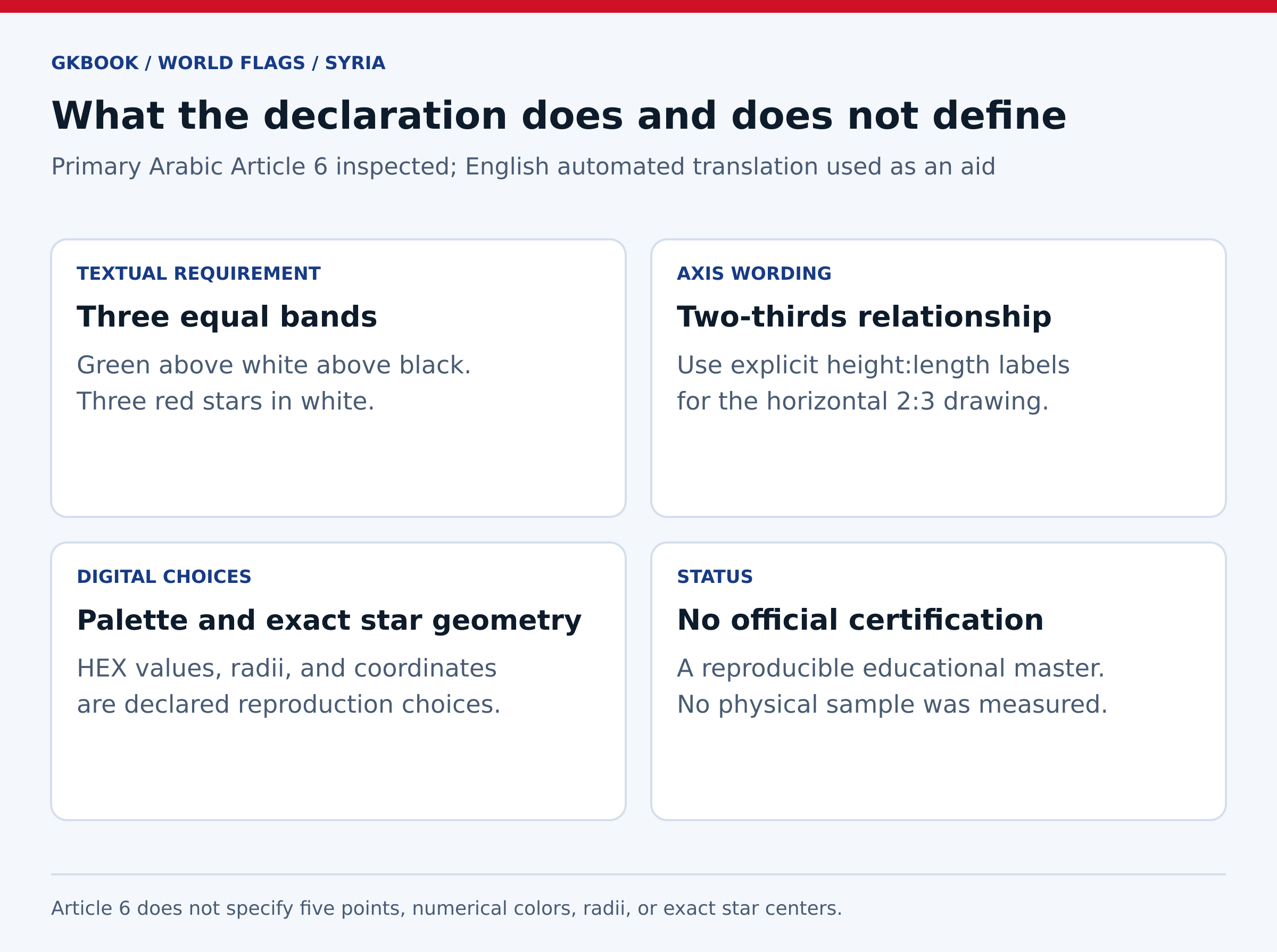
Article 6 specifies a rectangular flag, three equal horizontal bands in green, white, and black order, and three red stars in the white band. It also states a two-thirds relationship using its own axis labels. It does not provide numerical colors, star radii, exact center coordinates, or a detailed manufacturing diagram.
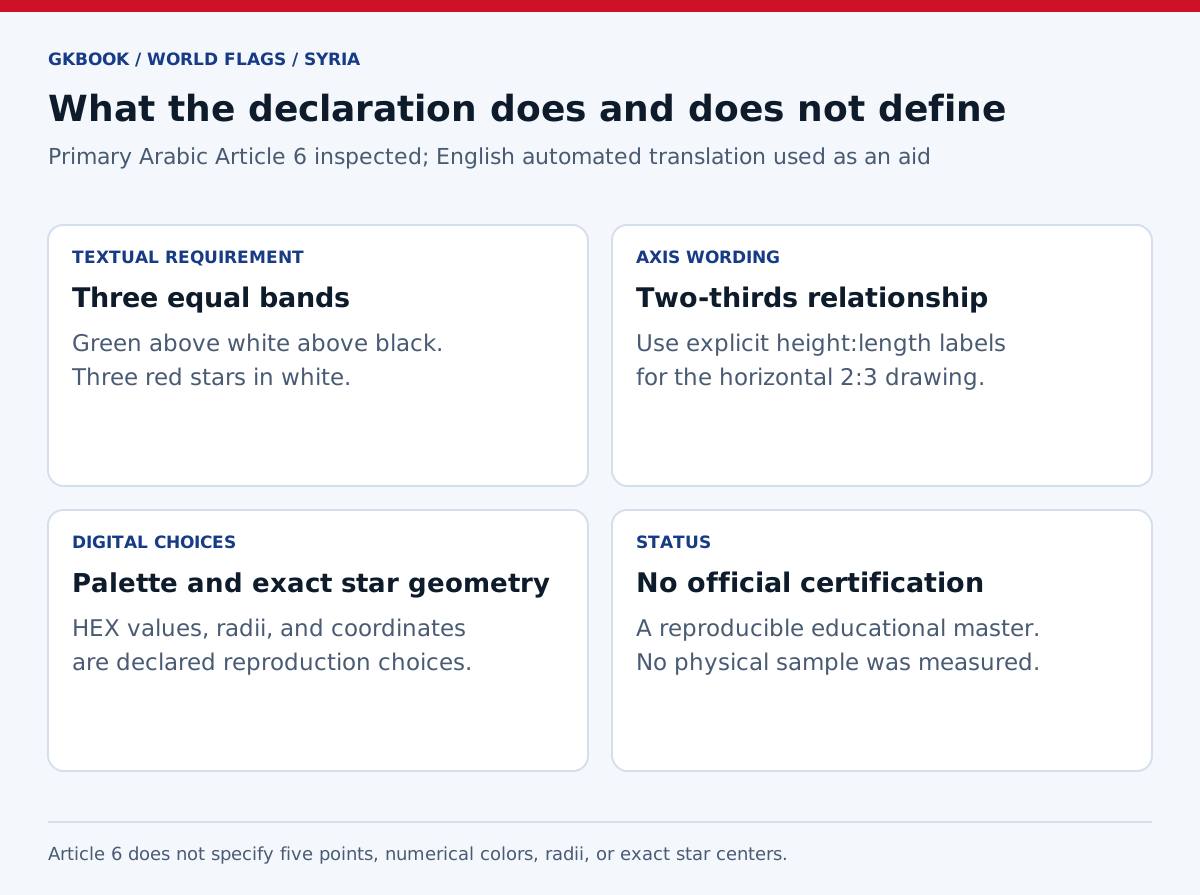
A useful specification separates direct textual requirements from decisions needed to produce a digital file. Equal bands and the three red stars come from the declaration. The regular five-point construction, exact quarter-length centers, and numerical palette are recorded reproduction choices informed by the inspected reference. That separation makes the artwork auditable.
The Arabic document is the primary text inspected for this article. The available English PDF identifies itself as an automated translation and is used only as an aid. A digital reconstruction is not an official approval, a complete legal opinion, or evidence that every manufacturer must use the same numerical settings.
How does the current flag differ from the old flag?
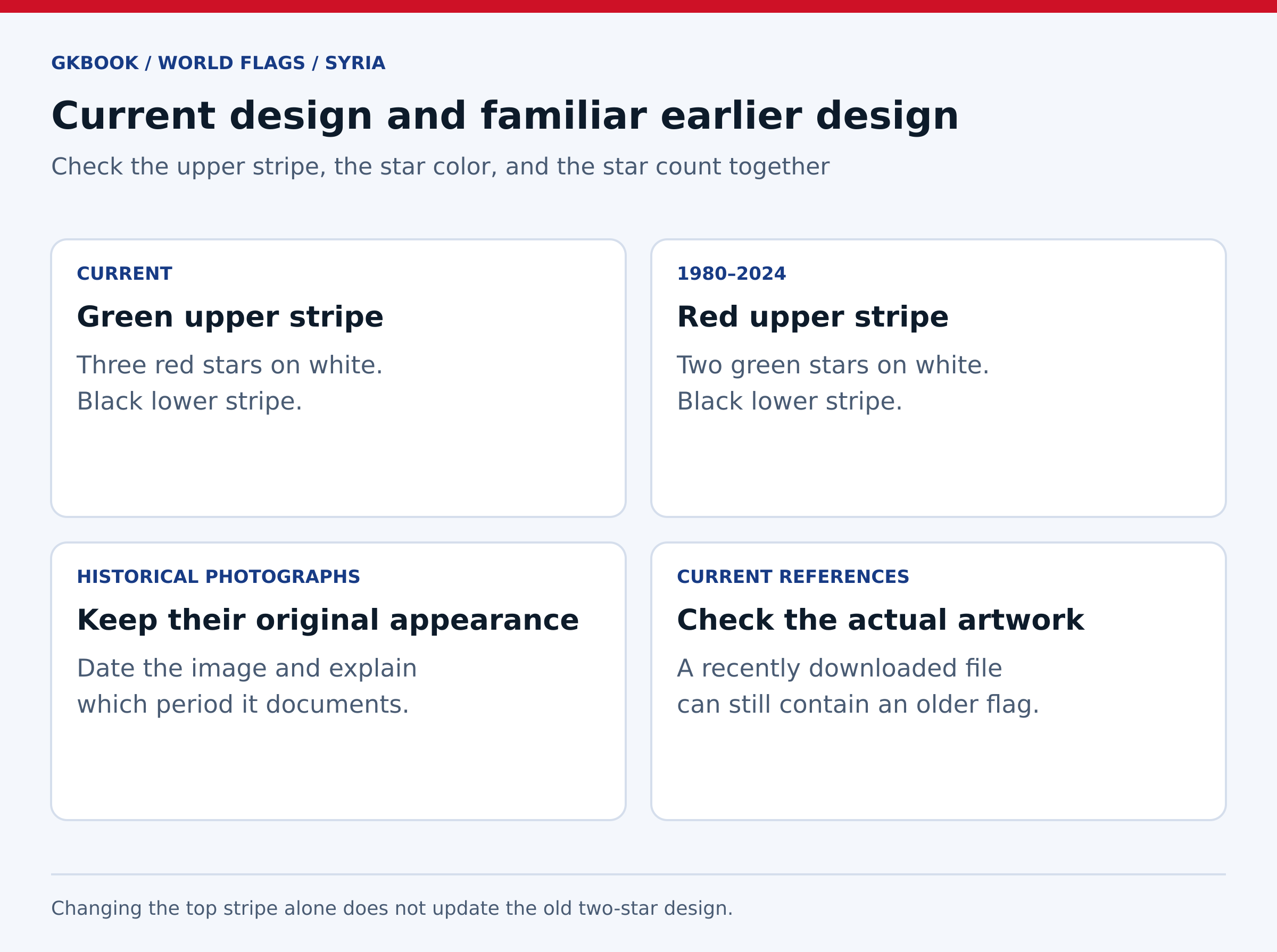
The familiar flag used from 1980 to 2024 had a red upper stripe and two green stars on its white middle stripe. The current flag has a green upper stripe and three red stars. Both retain white in the middle and black below, so the upper color and star arrangement are decisive.
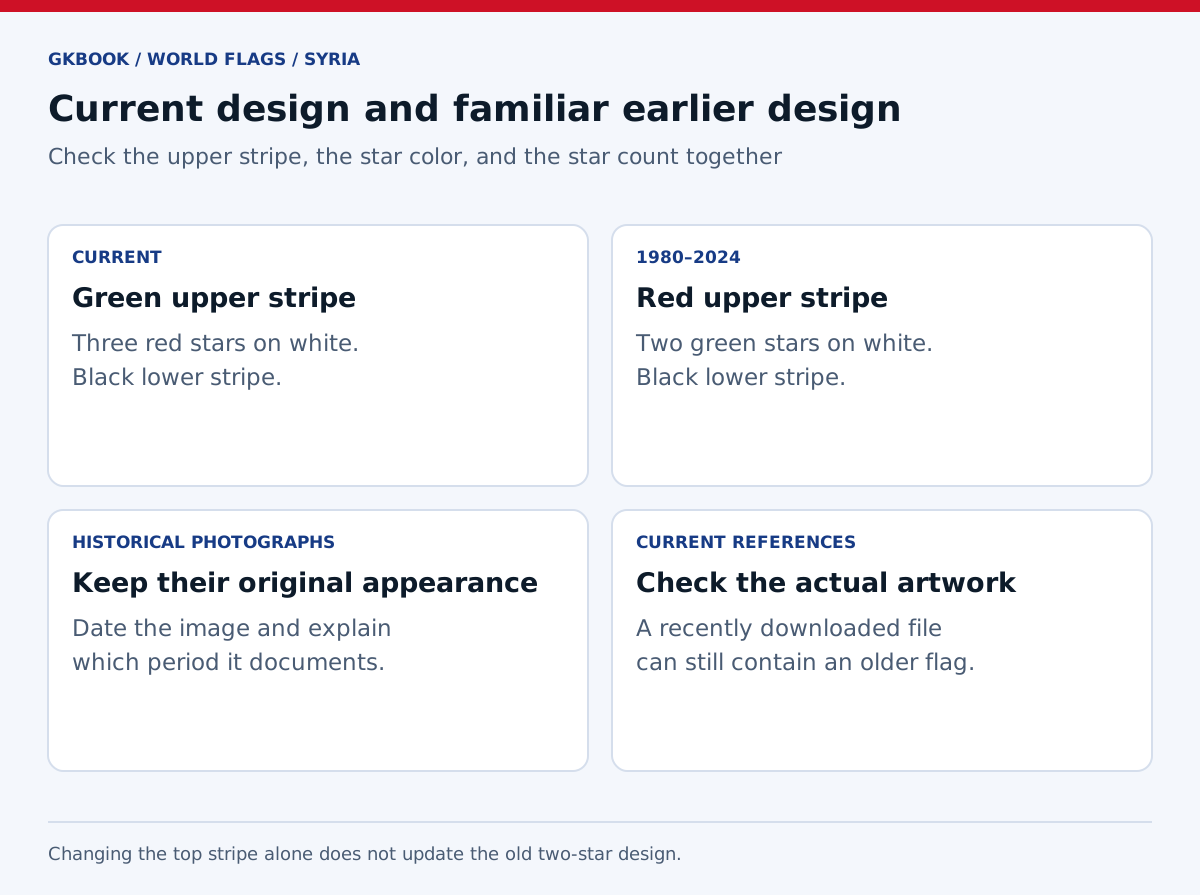
The similarity can make an outdated image easy to overlook, especially in a tiny thumbnail. Count the stars before approving an illustration. Then check that all three are red and that the upper band is green. These checks are more dependable than relying on a filename that merely says “Syria.”
Historical pictures should not be digitally recolored to make them appear current. Preserve the original visual evidence and add the period in the caption. For a present-day country article, use a separately prepared current flag. The comparison panel describes the two compositions without passing a newly drawn historical version off as an archival object.
What does Syria commemorate on April 17?
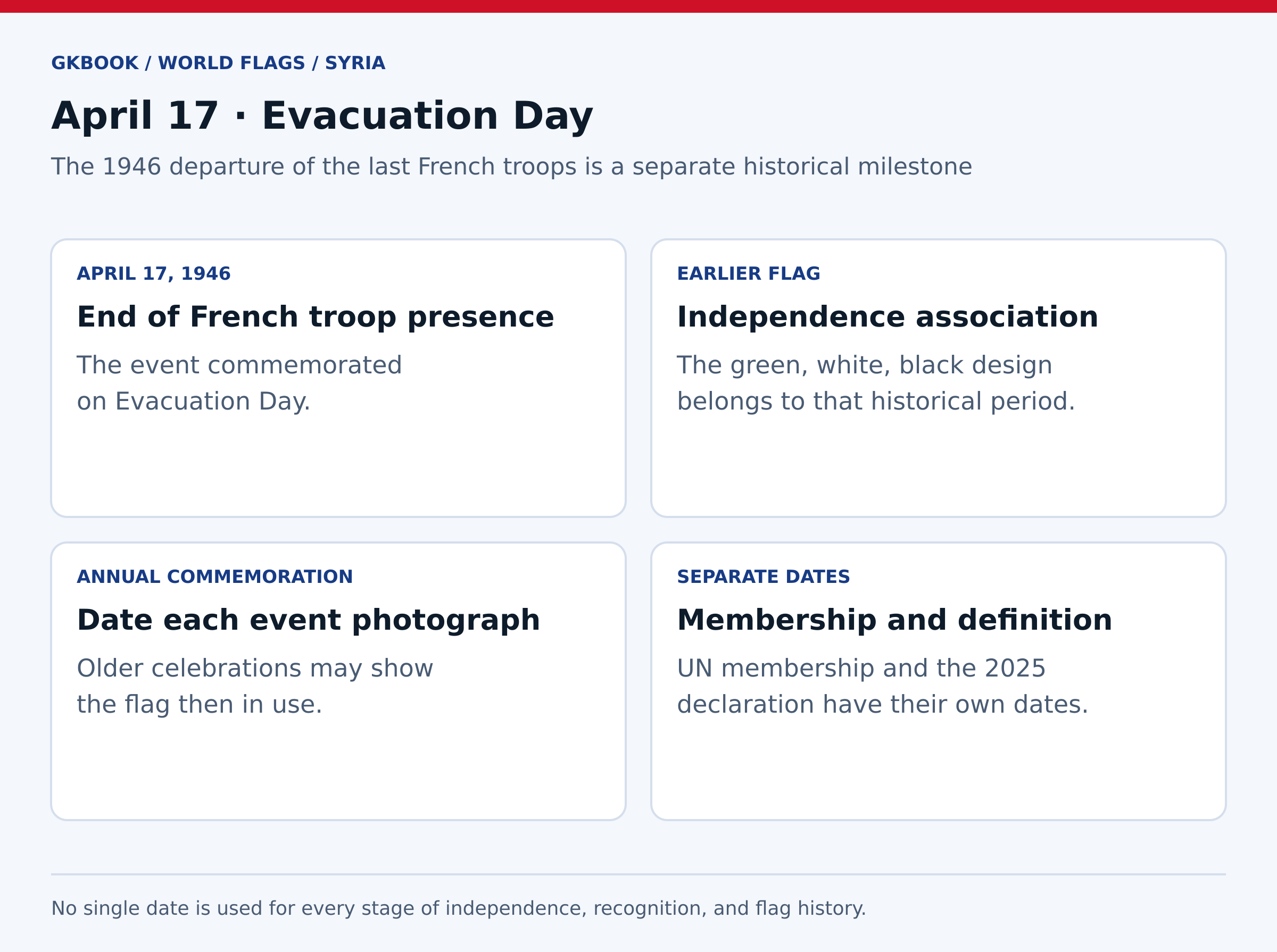
April 17 is Syria’s Evacuation Day, commemorating the departure of the last French troops in 1946. The earlier independence flag is associated with that period. This commemoration is distinct from the March 2025 declaration, the return to the three-star design in December 2024, and the April 2025 UN flag-raising ceremony.
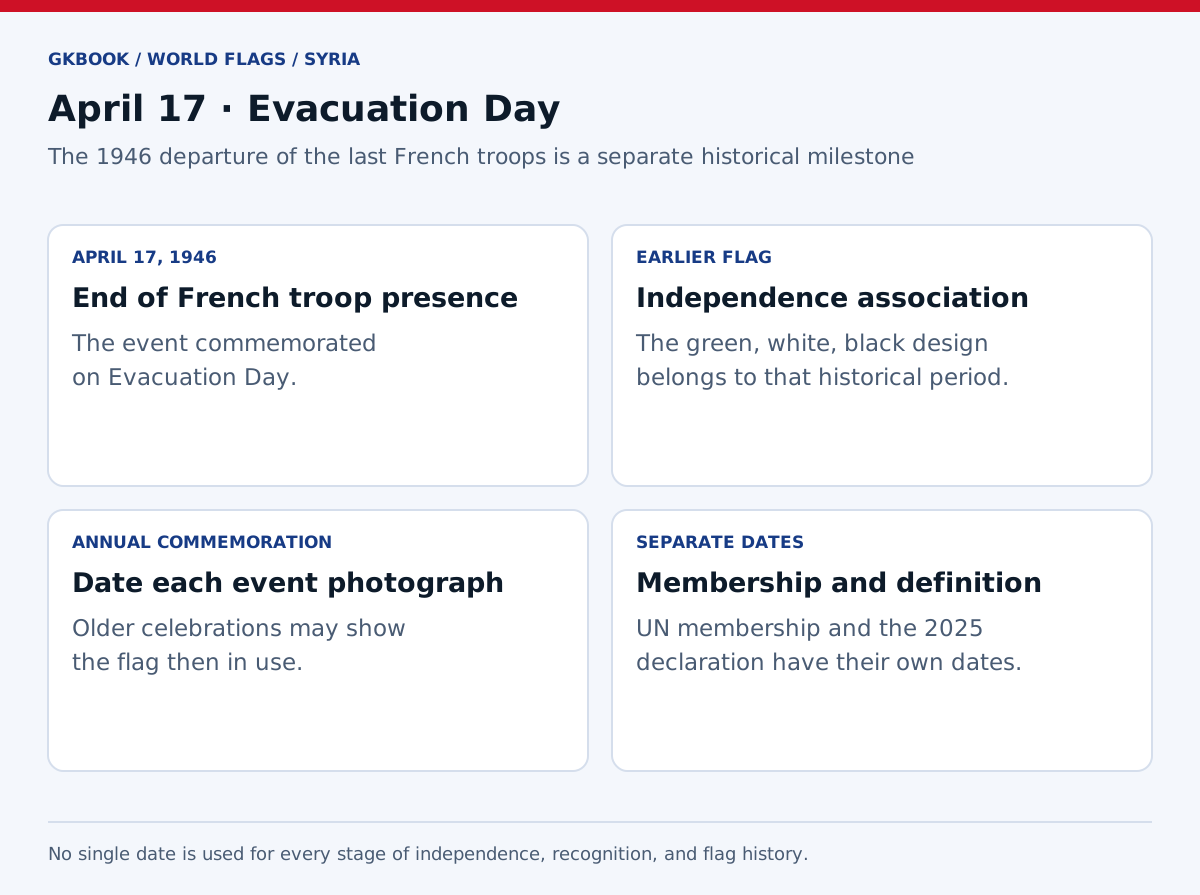
Independence can involve several milestones: recognition by another country, constitutional development, the end of foreign military presence, and participation in international institutions. A short timeline becomes clearer when each date is attached to a specific event. The annual April commemoration concerns the 1946 evacuation, rather than the creation of this digital artwork.
Flags displayed for the occasion keep their ordinary design. The event does not call for a special extra star or a modified stripe arrangement in an educational illustration. When selecting a photograph of a celebration, verify its year and caption, because an older event may show a flag used during that earlier period.
When did Syria become a United Nations member?
Syria was an original United Nations member from October 24, 1945. After union with Egypt, it resumed separate membership on October 13, 1961. These membership milestones concern the state’s participation in the UN. They are different from bilateral recognition, independence commemorations, flag changes, and the raising of the current flag in 2025.
An international organization records membership through its own institutional history. Another country’s diplomatic recognition follows a different process and may carry another date. For example, the United States’ historical account dates its recognition of Syrian independence to September 8, 1944. These statements answer different questions and should not be forced into one universal recognition date.
A change of flag does not itself create a new member state. Similarly, a photograph of a flag outside an international building is not a complete record of every country’s diplomatic position. Use membership records for membership, diplomatic histories for bilateral relations, and the relevant national text for the flag’s constitutional description.
When was the current Syrian flag raised at the UN?
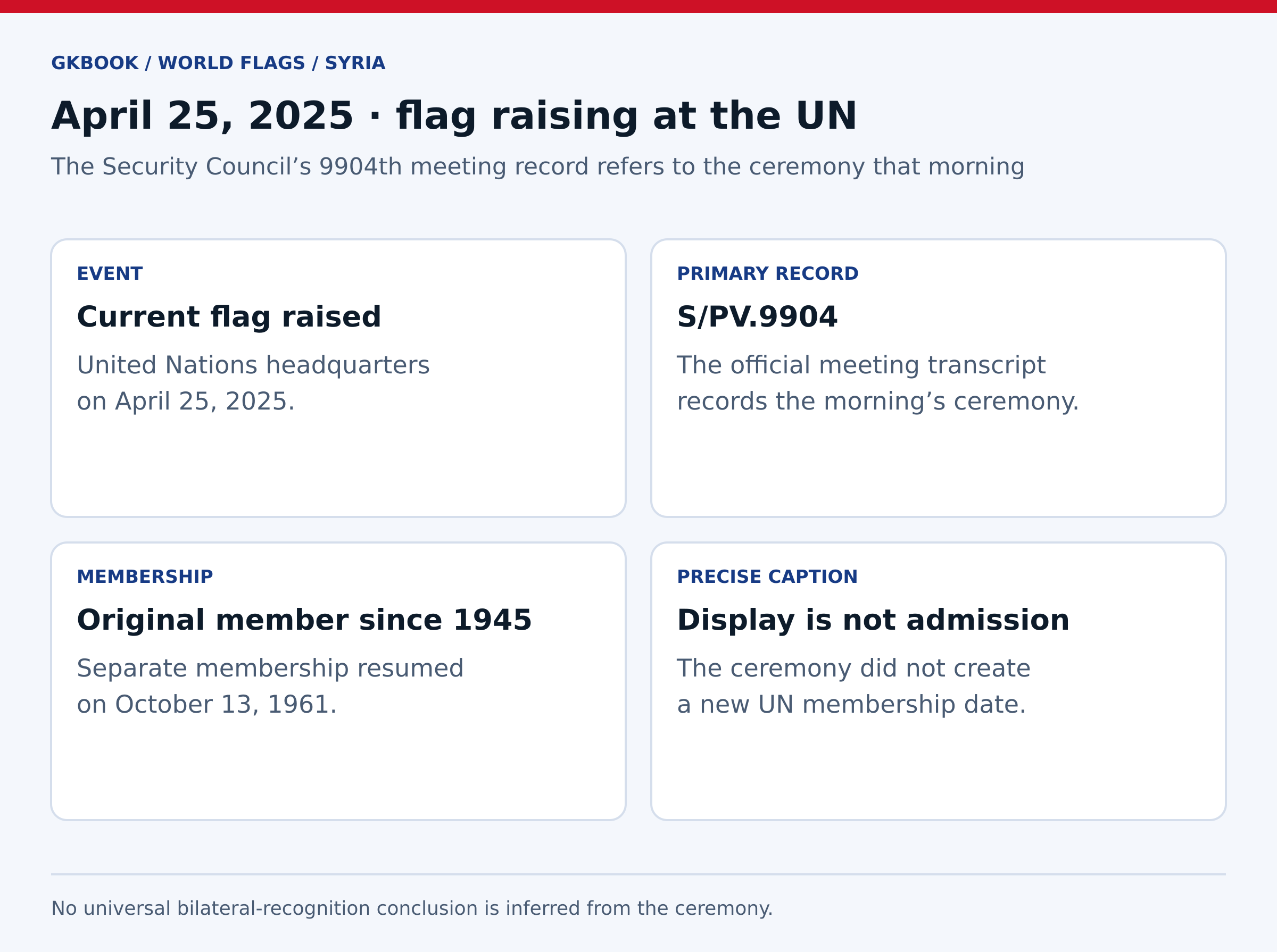
The current Syrian flag was raised at United Nations headquarters on April 25, 2025. The Security Council’s official record for its 9904th meeting refers to the ceremony that morning. This was an international display milestone, not Syria’s first admission to the UN or the signing date of its constitutional declaration.
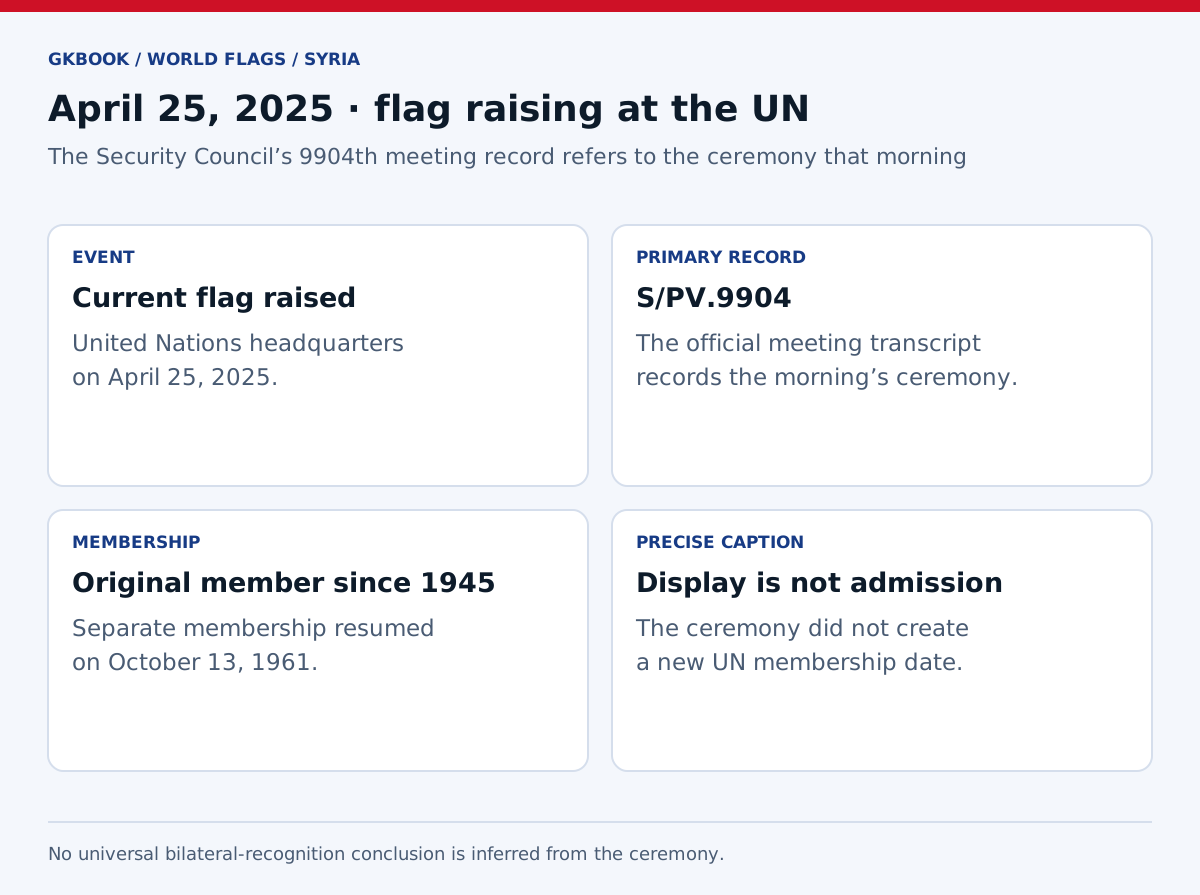
The meeting record places the ceremony within a dated institutional proceeding, making it stronger evidence for the event than an undated photograph. It also shows why the country’s long membership history and the new flag’s appearance at headquarters can both be true. The symbol changed while the membership history continued.
Keep captions precise: identify the place, date, and action shown. A flag raising does not by itself explain constitutional commencement or settle every question of diplomatic recognition. In this collection, the ceremony receives its own timeline panel, allowing readers to compare it with the domestic milestones without merging their meanings.
Does the Syria flag include an eagle or coat of arms?
No eagle, shield, or coat of arms appears on the national flag described in Article 6. The declaration treats the state emblem separately in Article 5. A new golden-eagle visual identity was announced in July 2025, but that separate emblem does not replace the three red stars within the national flag’s white band.

Official websites, stationery, seals, and uniforms may display an emblem beside a flag. Identify the complete object before copying it: a document header or ceremonial backdrop can combine several symbols in a layout that is not a flag specification.
The clean downloads contain only the bands and stars. The emblem panel explains the distinction in words and does not invent a detailed eagle drawing. Anyone preparing an emblem reproduction should consult the appropriate identity materials separately, with their own proportions, color treatment, and permitted applications kept distinct from this flag master.
Why does Syria’s flag resemble other Arab flags?
Many Arab national flags share combinations of green, white, black, and red through related historical traditions. Similar colors do not make their designs interchangeable. Syria is identified by its green, white, and black horizontal bands with three red stars on white, considered together with the complete outline and current period.

A comparison works best when it follows a consistent checklist: stripe orientation, color order, devices, number of stars, and proportions. Checking only the palette misses much of a flag’s identity. Two designs can use the same four colors while differing in nearly every other feature of their construction.
Use the World Flags collection to compare complete national designs with their own captions. Do not crop away a triangle, cover a coat of arms, or move a star to make a comparison fit. Those seemingly small edits remove the very distinctions that a good comparison should help readers notice.
How should the flag be displayed in an illustration?
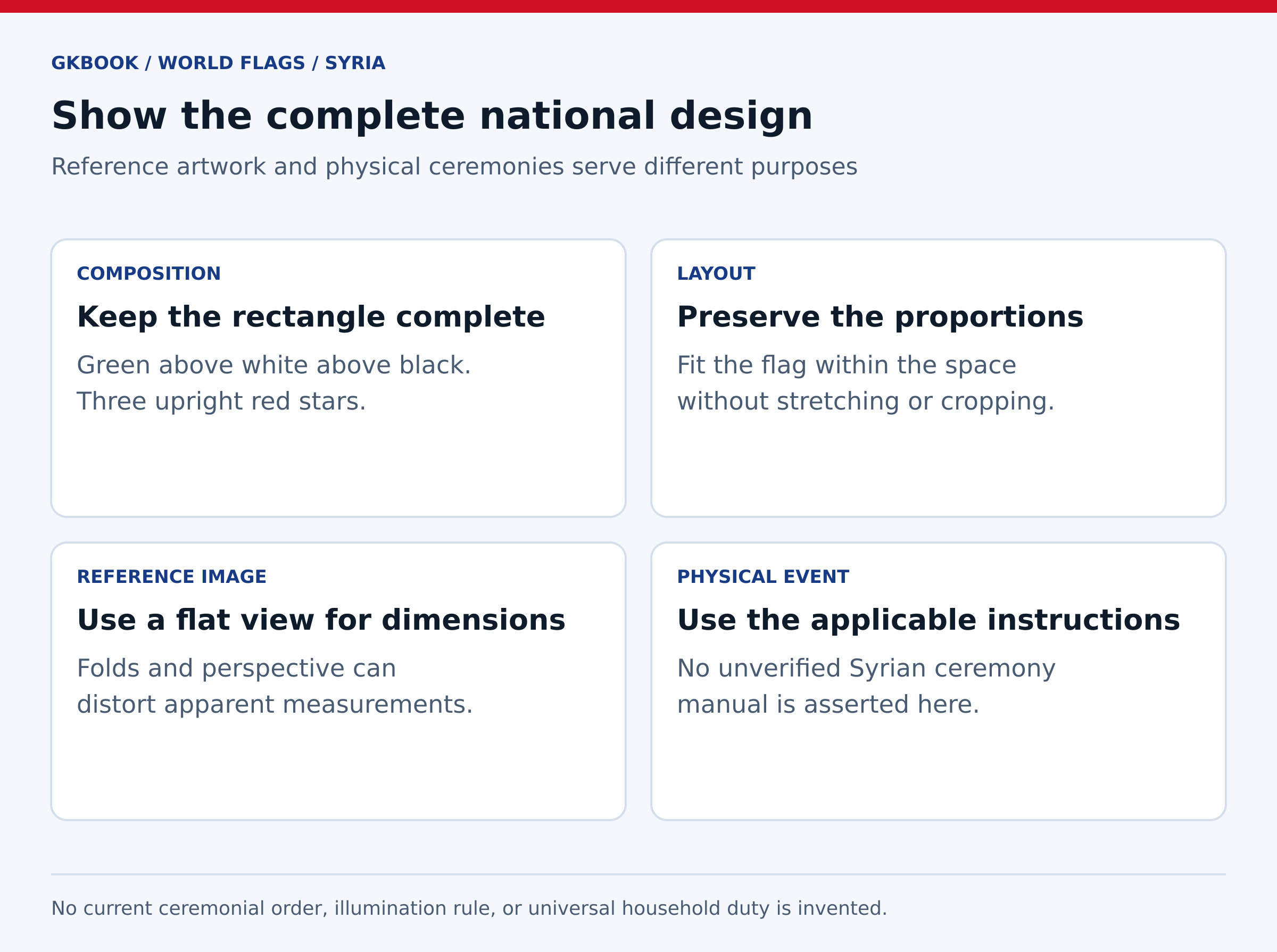
Show the entire flag with green above white above black, three red stars, and undistorted 2:3 proportions. Leave labels and decorations outside its rectangle. For physical ceremonies, follow the responsible institution’s current instructions; this collection does not present an unverified Syrian ceremonial manual or a universal civilian display rule.
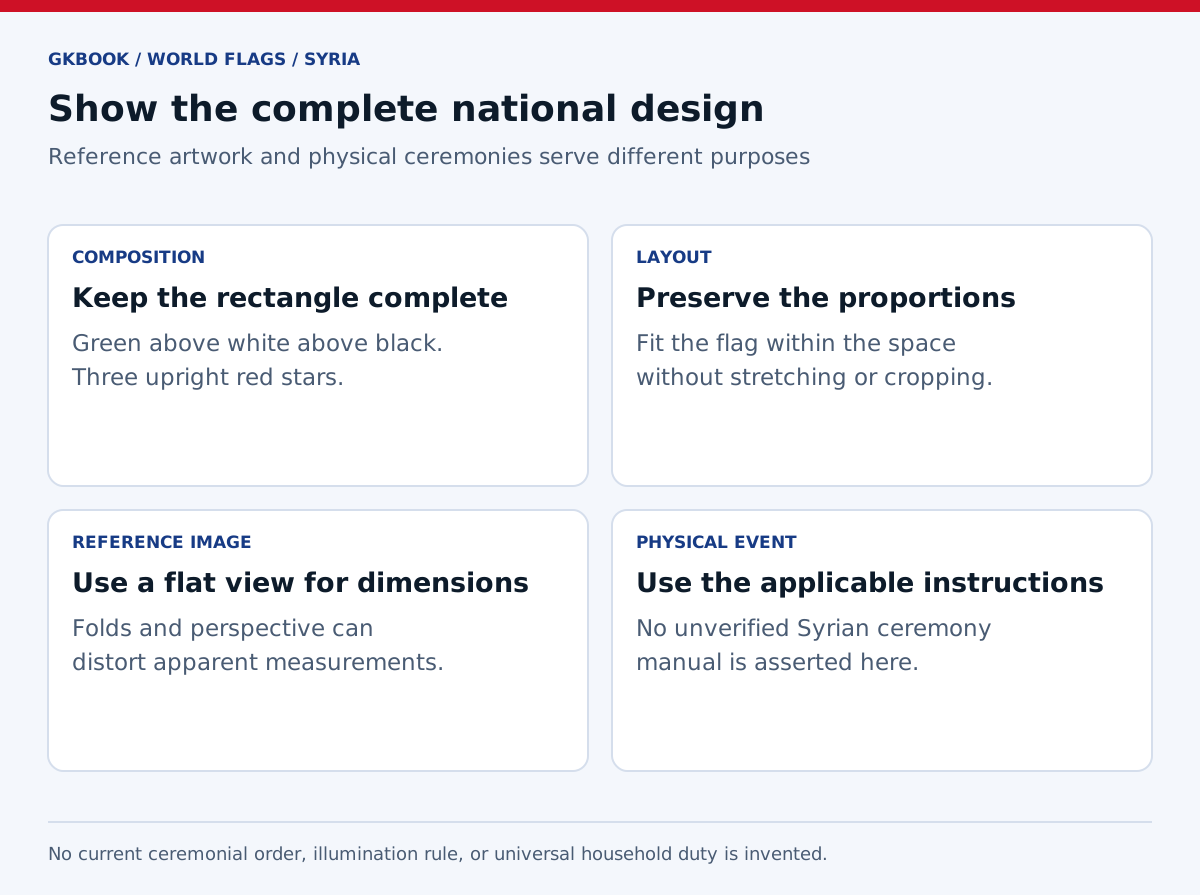
A photograph of a flying flag naturally includes folds, perspective, and changing light. A reference diagram serves a different purpose: it reveals the underlying flat design. Both can be useful when clearly labeled. Avoid measuring official proportions from a folded photograph, where the apparent length and star spacing may be distorted.
In a page layout, provide enough room for the full rectangle. A square image slot can contain the flag with surrounding space instead of stretching or cropping it. Keep a readable caption near the picture, and ensure that a decorative background does not become visually confused with an extra border on the flag.
Does half-mast change the flag design?
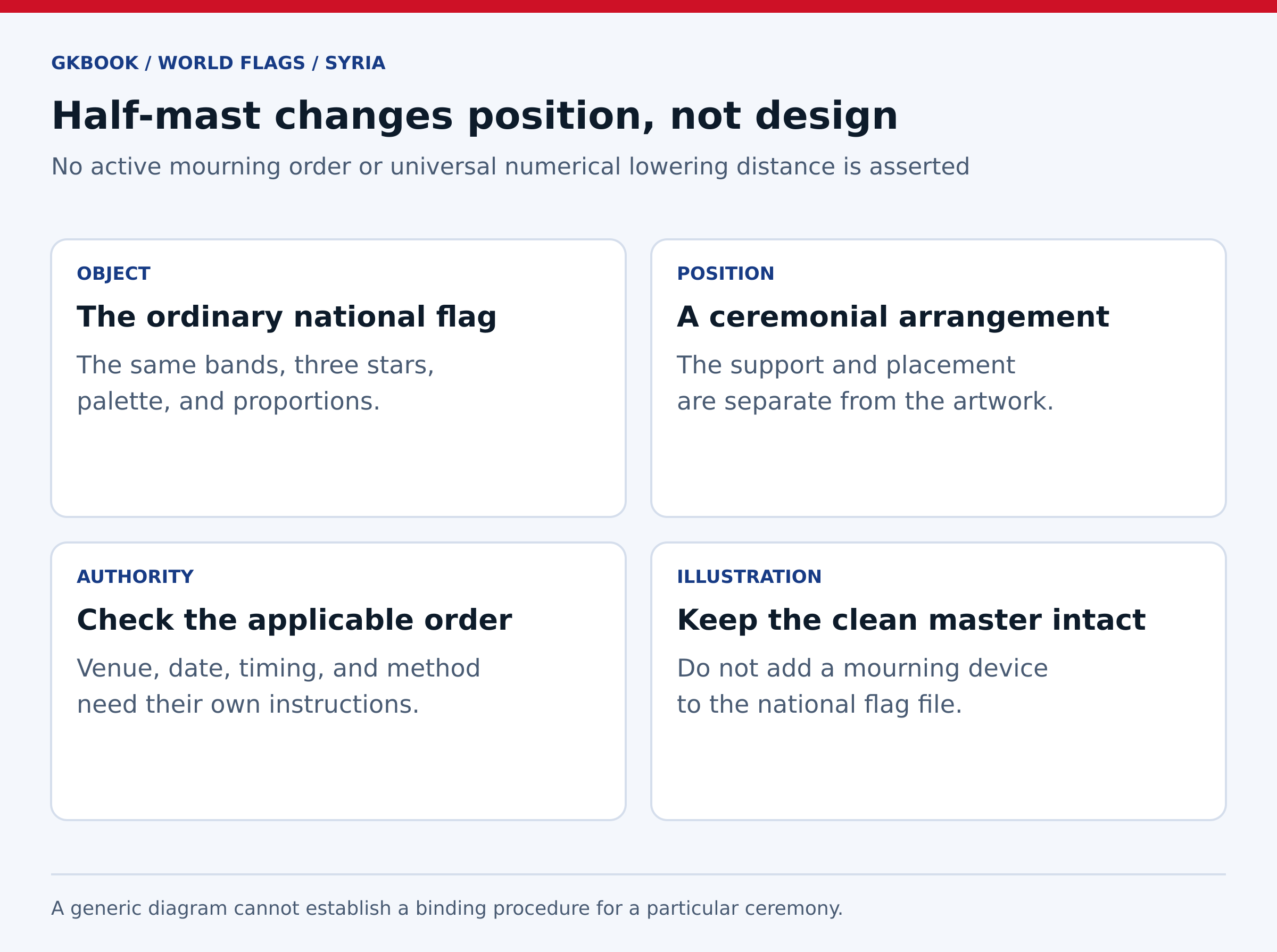
No. Half-mast concerns the position of a flag on its support, not a different set of stripes or stars. The normal design remains intact. A specific Syrian mourning order or institutional protocol must determine when and how it is flown; no active order or prescribed numerical lowering distance is asserted here.
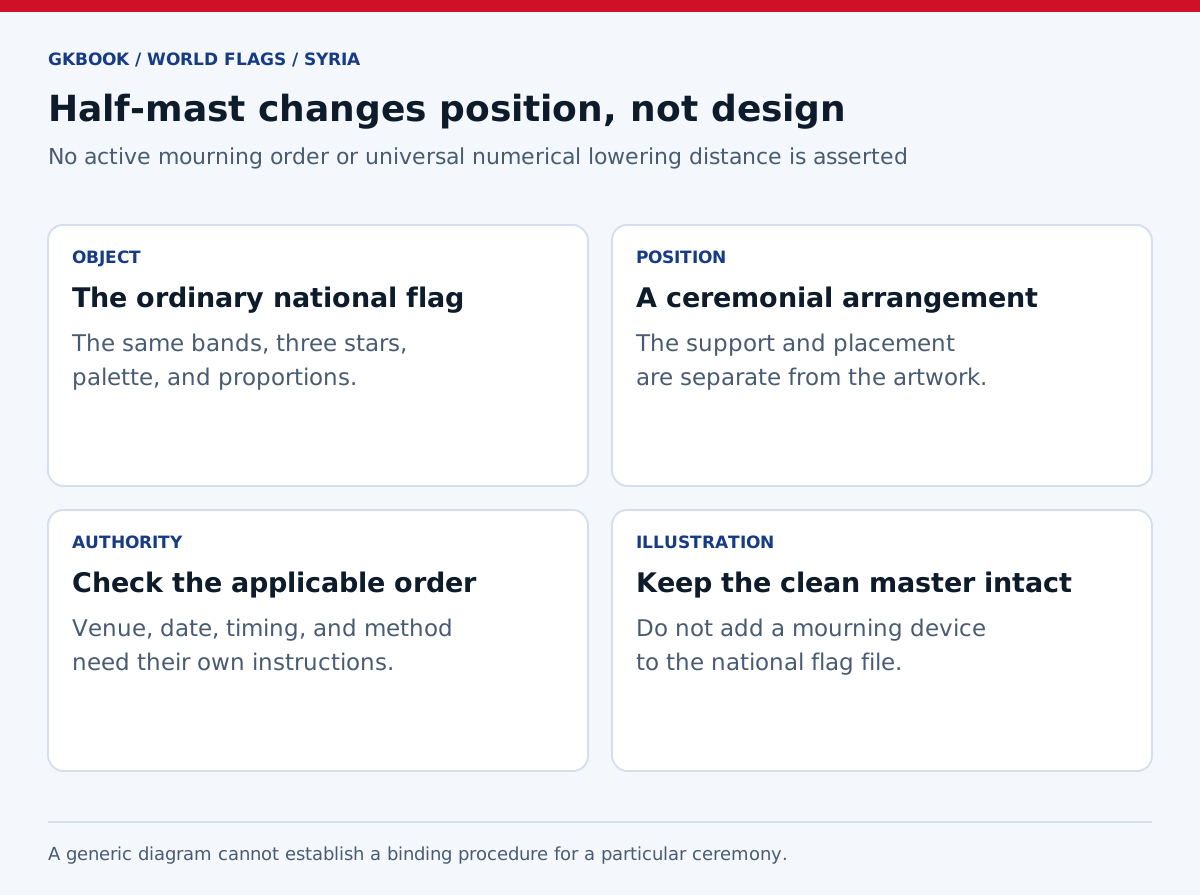
A diagram can explain the difference between an object and its position without inventing a binding ceremony. The rectangle remains complete, and its colors do not become darker simply because the occasion is solemn.
For an actual event, obtain the instruction that applies to the venue and date. A general educational page cannot establish those event-specific details from the flag’s appearance alone. This panel therefore addresses design continuity and clearly leaves operational protocol separate.
Can the Syria flag be shown vertically?
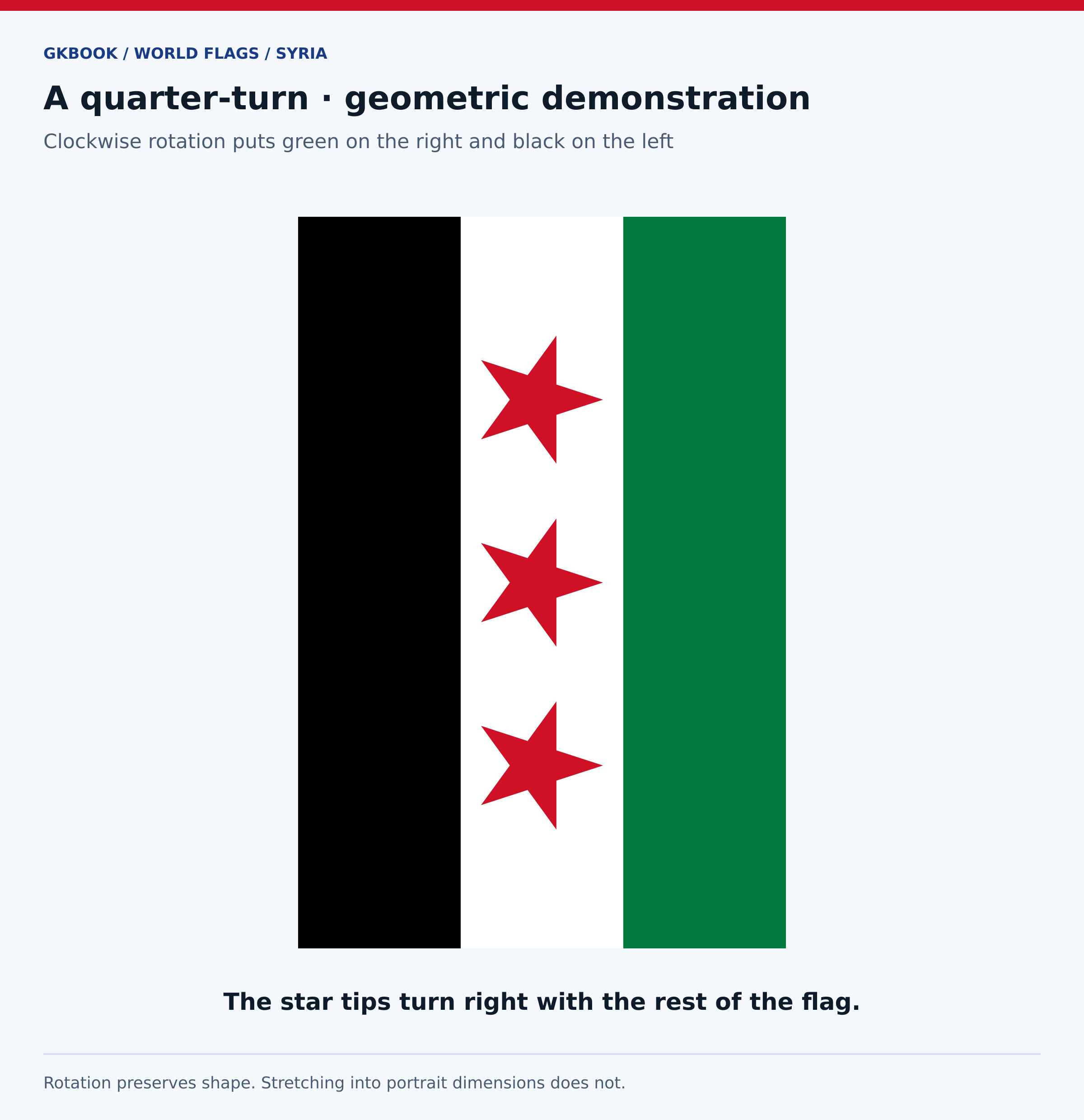
A complete flag can be illustrated after a quarter-turn, but rotation changes where its colors and star points appear to the viewer. A clockwise turn puts green on the right and black on the left, with star tips pointing right. This is a geometric demonstration, not a verified official Syrian vertical-display prescription.
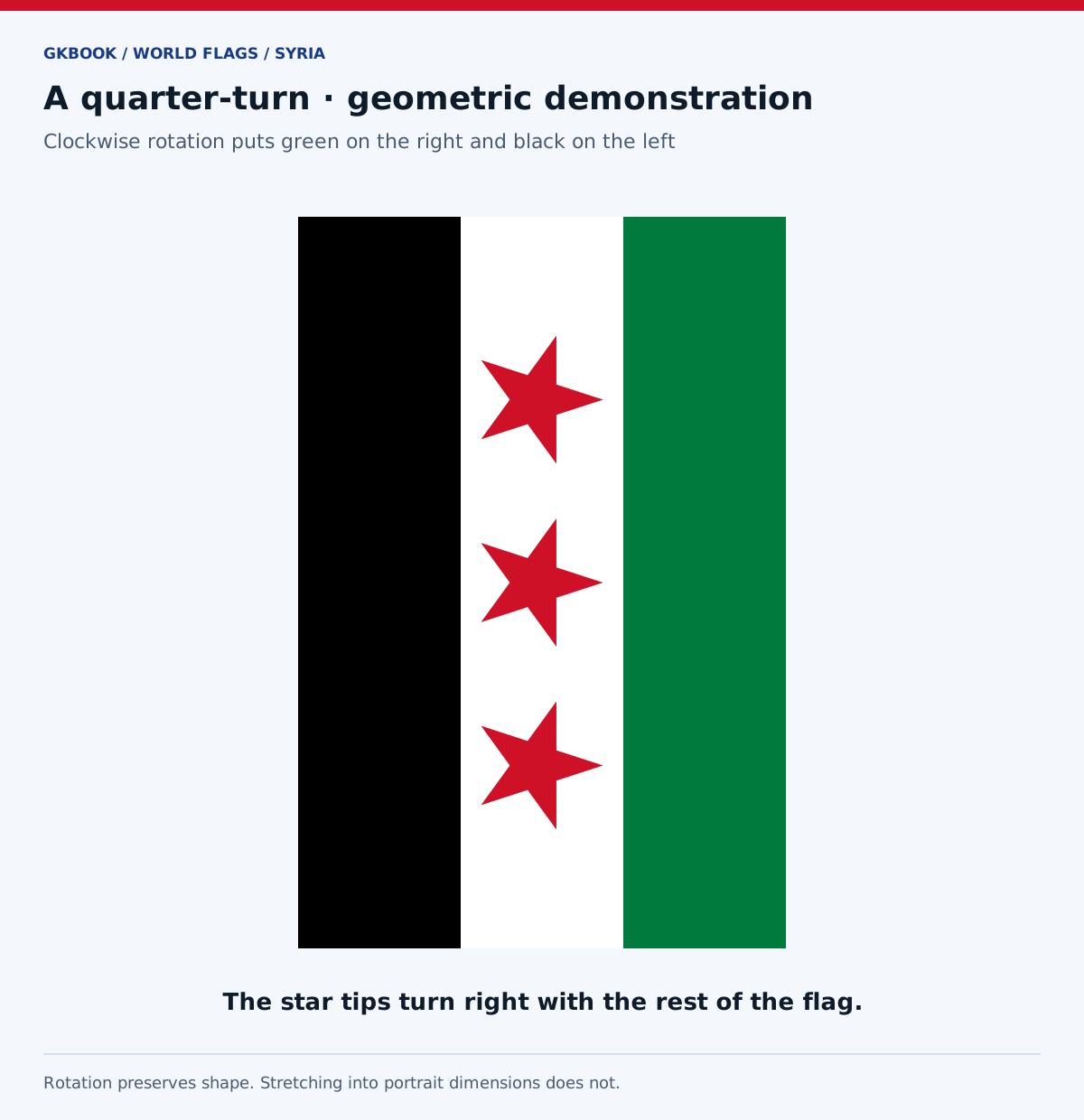
Rotation preserves every distance within the flag while exchanging the rectangle’s horizontal and vertical extents. Stretching does not: it changes the shape of each star and the proportions of the whole object. If a portrait layout needs a flag, choose a complete rotated illustration or retain the normal horizontal flag within surrounding space.
Do not rotate the bands and then independently turn the stars upright while calling the result a simple rotation. That creates a different arrangement. The guide shows the transformation explicitly so viewers can understand what moved. Venue-specific hanging conventions require their own authority and should not be inferred solely from this mathematical example.
What does the reverse of the Syrian flag look like?
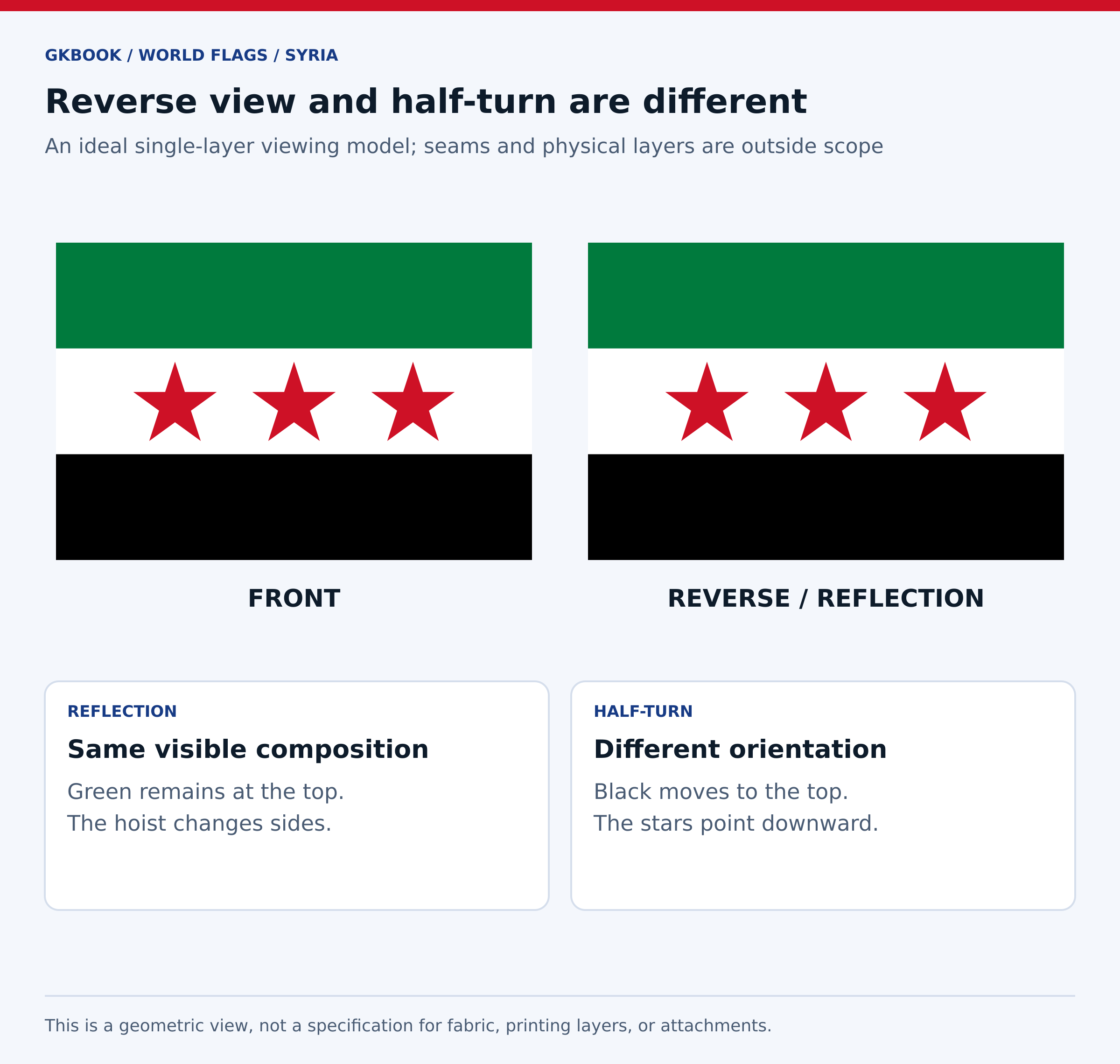
In an ideal single-layer viewing model, the reverse is a horizontal reflection of the front. Because the three identical upright stars are symmetrically placed, the flat design looks the same: green remains above white and black. Turning the image upside down is different and reverses the upper and lower stripes.
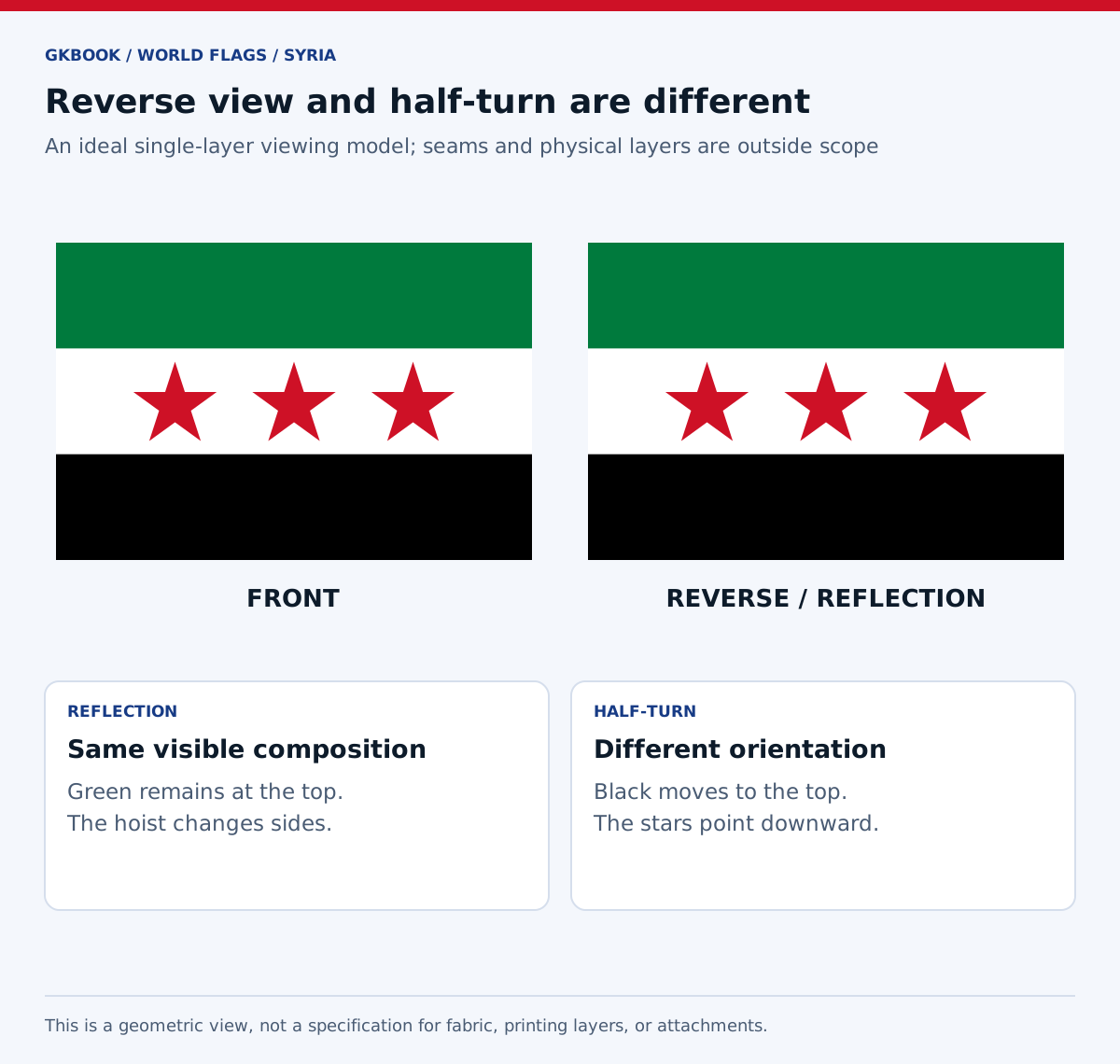
The hoist changes sides for the viewer looking from behind, even when the visible color composition is unchanged. Real cloth may show seams, attachments, translucency, or separate printed layers. Those manufacturing details are outside the ideal diagram, which explains only the geometry of viewing the same flat design from opposite sides.
A half-turn within the picture plane puts black at the top and directs the stars downward. That transformation is not a substitute for a reverse view. The comparison separates reflection from rotation, helping prevent a common mistake when preparing two-sided displays, animation frames, or an educational explanation of flag orientation.
How can the flag be resized or printed accurately?
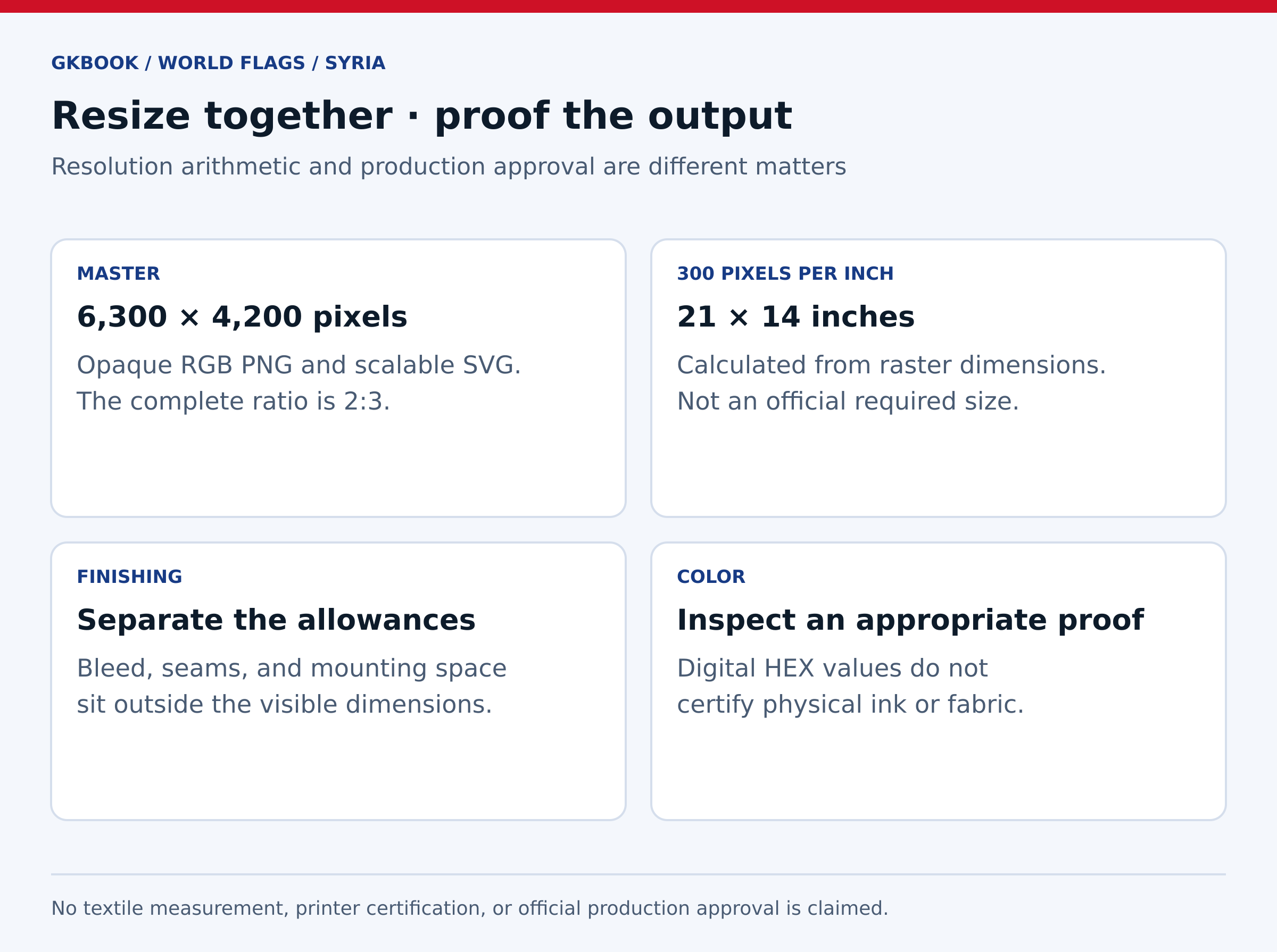
Resize both dimensions together and preserve the complete 2:3 rectangle. The SVG is suitable for scalable artwork, while the opaque PNG measures 6,300 by 4,200 pixels. At 300 pixels per inch, that corresponds to 21 by 14 inches. This is resolution arithmetic, not an official required physical flag size.
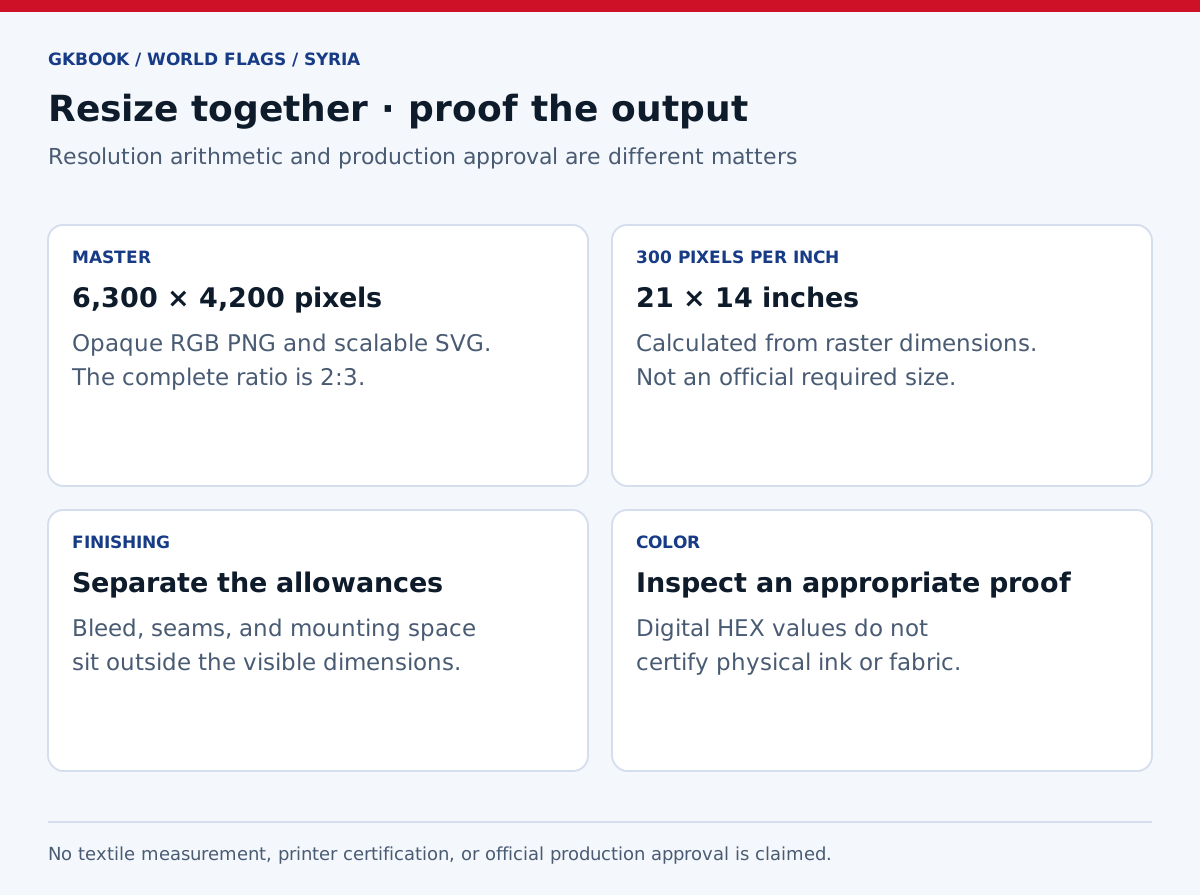
Use the vector for large layouts when the production system supports it, and inspect the exported result at the intended size. Thin accidental gaps, softened tips, and cropped outside edges are easier to spot before manufacture. Keep sewing allowances, bleed, and mounting space separate from the visible flag’s measured rectangle.
Screen HEX values do not directly specify a guaranteed fabric or press color. Work with the printer’s color process and inspect a suitable proof. The supplied numerical palette establishes consistency across this digital collection; it does not claim a measured match to an official physical standard or approval of a particular production method.
Which Syria flag pictures are included?
The collection contains 24 subjects, each supplied as SVG and PNG, plus a separate social sharing image in both formats. It includes the clean current flag, color and geometry guides, historical explanations, and orientation comparisons. Captions distinguish a production-style flag master from educational panels and from events described without invented archival imagery.
Choose the clean flag when a page needs the national symbol alone. Choose an explanatory panel when the reader needs measurements, chronology, or a comparison. A labeled diagram is not a substitute for a plain flag, and a new historical illustration is not evidence that a particular physical object once existed.
All subjects retain clear captions and text alternatives. The original vector and matching raster downloads allow reuse at different scales without removing the explanation of what each image represents. The separate social card uses a complete flag inside its wider canvas, preserving the national rectangle while providing space for a readable article title.
Download Syria flag pictures
Download the complete current flag as SVG or 6,300 × 4,200 PNG. The height:length ratio is 2:3, with equal green, white, and black bands and three red stars. The numerical palette and regularized star geometry are declared reproduction choices.
The gallery contains 24 subjects, each with an SVG and PNG. Captions distinguish the clean flag from geometry guides, historical explanations, and display comparisons. Image credits and reproduction notes identify the artwork basis and its limits. The separate 1,200 × 630 social card contains a complete 540 × 360 flag.
Continue exploring national designs in World Flags.
World Flags/Syria
Syria flag pictures
Current national design; regularized digital construction with a declared palette.
GKBook geometric reconstruction and original educational layouts. Community vector contributors credited in the notes. No official certification or endorsement.Download SVGDownload PNGGreen #007A3D, white #FFFFFF, black #000000, red #CE1126: declared digital values based on the inspected reference.
GKBook geometric reconstruction and original educational layouts. Community vector contributors credited in the notes. No official certification or endorsement.Download SVGDownload PNGHistorical associations do not turn every modern interpretation into a constitutional statement.
GKBook geometric reconstruction and original educational layouts. Community vector contributors credited in the notes. No official certification or endorsement.Download SVGDownload PNGThe historical territorial interpretation is attributed; the current text describes three red stars.
GKBook geometric reconstruction and original educational layouts. Community vector contributors credited in the notes. No official certification or endorsement.Download SVGDownload PNGContemporary horizontal presentation: height:length 2:3, master length 6,300 and height 4,200.
GKBook geometric reconstruction and original educational layouts. Community vector contributors credited in the notes. No official certification or endorsement.Download SVGDownload PNGEach band is 1,400 pixels high in the 6,300 × 4,200 master.
GKBook geometric reconstruction and original educational layouts. Community vector contributors credited in the notes. No official certification or endorsement.Download SVGDownload PNGA regularized star silhouette based on the contemporary reference; Article 6 does not provide this formula.
GKBook geometric reconstruction and original educational layouts. Community vector contributors credited in the notes. No official certification or endorsement.Download SVGDownload PNGThe visible star height is 1,050 master pixels, leaving 175 pixels of white clearance above and below.
GKBook geometric reconstruction and original educational layouts. Community vector contributors credited in the notes. No official certification or endorsement.Download SVGDownload PNGQuarter-length center positions are a declared reproduction convention based on the inspected reference.
GKBook geometric reconstruction and original educational layouts. Community vector contributors credited in the notes. No official certification or endorsement.Download SVGDownload PNGExact regular star formulas are recorded privately. The composition combines textual requirements with declared drawing choices.
GKBook geometric reconstruction and original educational layouts. Community vector contributors credited in the notes. No official certification or endorsement.Download SVGDownload PNGCalculated from the declared regular-star geometry; red is the combined star area and visible white is the remainder of the middle third.
GKBook geometric reconstruction and original educational layouts. Community vector contributors credited in the notes. No official certification or endorsement.Download SVGDownload PNGA selective historical timeline. These panels are explanations, not newly invented archival facsimiles.
GKBook geometric reconstruction and original educational layouts. Community vector contributors credited in the notes. No official certification or endorsement.Download SVGDownload PNGThe signing date is verified; it is not silently substituted for the unverified gazette commencement date.
GKBook geometric reconstruction and original educational layouts. Community vector contributors credited in the notes. No official certification or endorsement.Download SVGDownload PNGArticle 6 is the appearance authority; the community vector is a reference for a digital reconstruction.
GKBook geometric reconstruction and original educational layouts. Community vector contributors credited in the notes. No official certification or endorsement.Download SVGDownload PNGA descriptive comparison of compositions, without fabricating an archival image of a historical flag.
GKBook geometric reconstruction and original educational layouts. Community vector contributors credited in the notes. No official certification or endorsement.Download SVGDownload PNGApril 17 commemorates evacuation; it is not the signing date of the current declaration.
GKBook geometric reconstruction and original educational layouts. Community vector contributors credited in the notes. No official certification or endorsement.Download SVGDownload PNGThe current flag’s appearance at headquarters is distinct from the state’s long UN membership history.
GKBook geometric reconstruction and original educational layouts. Community vector contributors credited in the notes. No official certification or endorsement.Download SVGDownload PNGA state emblem can appear beside a flag without becoming part of the national flag design.
GKBook geometric reconstruction and original educational layouts. Community vector contributors credited in the notes. No official certification or endorsement.Download SVGDownload PNGShared Arab colors do not make different flags interchangeable.
GKBook geometric reconstruction and original educational layouts. Community vector contributors credited in the notes. No official certification or endorsement.Download SVGDownload PNGThese are illustration principles; venue-specific ceremonial duties require their own authority.
GKBook geometric reconstruction and original educational layouts. Community vector contributors credited in the notes. No official certification or endorsement.Download SVGDownload PNGDesign continuity is explained without supplying an unverified Syrian half-mast protocol.
GKBook geometric reconstruction and original educational layouts. Community vector contributors credited in the notes. No official certification or endorsement.Download SVGDownload PNGA complete clockwise quarter-turn, without independently rearranging the stars. Not an official vertical-display prescription.
GKBook geometric reconstruction and original educational layouts. Community vector contributors credited in the notes. No official certification or endorsement.Download SVGDownload PNGHorizontal reflection preserves the ideal symmetric design; a half-turn does not.
GKBook geometric reconstruction and original educational layouts. Community vector contributors credited in the notes. No official certification or endorsement.Download SVGDownload PNGPreserve the vector geometry, numerical palette, and complete outline when exporting for a particular use.
GKBook geometric reconstruction and original educational layouts. Community vector contributors credited in the notes. No official certification or endorsement.Download SVGDownload PNGFrequently asked questions
What does the Syria flag look like?
Syria’s current national flag has three equal horizontal bands: green above white above black. Three red, five-pointed stars form a row across the white band. The contemporary rectangular presentation has a height-to-length ratio of 2:3. This is the design described in the constitutional declaration signed on March 13, 2025.
What is the Syrian flag called?
The straightforward name is the national flag of Syria, or the Syrian Arab Republic. The green, white, and black design with three red stars is also widely called the independence flag. Its later use by opponents of the Assad government explains the additional historical description “revolution flag.”
Which Syrian flag is current?
The current design is the green, white, and black tricolor with three red stars. It returned to national use following the fall of the Assad government in December 2024. Article 6 of the declaration signed in March 2025 describes these bands and stars; the earlier two-green-star flag is historical.
What are the colors of the Syria flag?
The flag uses green, white, black, and red. Green, white, and black occupy equal horizontal stripes, while red fills the three stars. These downloads use #007A3D, #FFFFFF, #000000, and #CE1126 respectively. Those numerical values are declared digital reproduction choices; Article 6 names colors without supplying HEX or RGB codes.
What does the Syrian flag represent?
The complete flag represents Syria. Its green, white, black, and red belong to the wider Arab flag tradition, while this particular arrangement carries Syrian historical associations with independence and later political change. Symbolic interpretations should be distinguished from Article 6, which describes the flag’s appearance without assigning a meaning to each color.
What do the three red stars mean?
A historical explanation reported by SANA associates the three stars with Damascus, Aleppo, and Deir ez-Zor. This is an attributed interpretation of the design’s origins, rather than a geographical legend written into Article 6. The current declaration requires three red stars but does not assign each star a named territory.
Why is the upper stripe green?
Green is the upper color in Syria’s current flag because the design returns to the earlier green, white, and black arrangement. Article 6 expressly places green above white and black. Although green has wider historical and cultural associations, the constitutional description does not declare one exclusive religious meaning for this stripe.
What is the ratio of the Syria flag?
The contemporary flag is shown at a height-to-length ratio of 2:3: a rectangle three units long and two units high. The master is 6,300 pixels long and 4,200 pixels high. Explicit axis labels matter because the declaration’s Arabic wording uses length and width in the reverse relationship to conventional flag terminology.
Are the three stripes equal in height?
Yes. Article 6 describes three equal horizontal rectangles, and this reproduction gives each stripe one third of the flag’s height. In the 6,300 by 4,200 master, every stripe is 1,400 pixels high. The stars are placed within the white stripe without changing either of its straight boundaries.
How are the five-pointed stars drawn?
Each star in this reproduction is a regular, filled five-pointed star with one outer point upward. Ten alternating outer and inner vertices form its boundary. The five-point form agrees with the inspected reference and earlier constitutional description; the 2025 declaration itself does not specify the number of points or a construction formula.
How large are the stars in these files?
Each star’s bounding box is 1,050 pixels high in the 6,300 by 4,200 master. Its top is at y = 1,575 and its bottom at y = 2,625. This leaves 175 pixels of white above and below. These measurements reproduce the reference’s nominal placement; they are not dimensions supplied by Article 6.
How are the three stars spaced?
The stars’ horizontal centers are at one quarter, one half, and three quarters of the flag’s length in this reproduction. On the master, those positions are x = 1,575, 3,150, and 4,725. Their visible vertical centers share y = 2,100. The equal center spacing is a declared drawing convention based on the reference.
How can the complete flag be constructed?
Begin with a 6,300 by 4,200 rectangle, divide its height into three equal bands, and place the three regular red stars at the stated coordinates. Keep green above white above black. The construction uses exact formulas for star vertices and preserves the full rectangle without outlines, shadows, lettering, or extra symbols.
What share of the flag is each color?
Green and black each occupy exactly one third of the rectangle. White occupies one third minus the combined area of the three red stars. Red occupies that combined star area. These are calculations for the declared regular-star reproduction, not constitutional percentages or symbolic allocations among Syrian communities, regions, or historical periods.
How has Syria’s flag changed over time?
Syria’s flag history includes the green, white, and black three-star design of the earlier republic, the red, white, and black union design introduced with Egypt in 1958, and several later changes. The earlier three-red-star pattern returned after separation in 1961 and again after the political change of December 2024.
When was the current Syria flag adopted?
Distinguish practical use from constitutional definition. The three-red-star design returned to national use in December 2024. The constitutional declaration signed on March 13, 2025 describes it in Article 6. Article 53 makes the declaration effective upon Official Gazette publication; this review did not obtain that gazette issue to establish the commencement date.
Who designed the Syrian flag?
The earlier design developed through Syria’s constitutional process, rather than a securely documented single modern graphic commission. SANA’s historical account connects it with the constitutional committee chaired by Ibrahim Hananu. That attribution should not be expanded into proof that one person independently drew every detail of the current digital flag.
What does the current declaration specify?
Article 6 specifies a rectangular flag, three equal horizontal bands in green, white, and black order, and three red stars in the white band. It also states a two-thirds relationship using its own axis labels. It does not provide numerical colors, star radii, exact center coordinates, or a detailed manufacturing diagram.
How does the current flag differ from the old flag?
The familiar flag used from 1980 to 2024 had a red upper stripe and two green stars on its white middle stripe. The current flag has a green upper stripe and three red stars. Both retain white in the middle and black below, so the upper color and star arrangement are decisive.
What does Syria commemorate on April 17?
April 17 is Syria’s Evacuation Day, commemorating the departure of the last French troops in 1946. The earlier independence flag is associated with that period. This commemoration is distinct from the March 2025 declaration, the return to the three-star design in December 2024, and the April 2025 UN flag-raising ceremony.
When did Syria become a United Nations member?
Syria was an original United Nations member from October 24, 1945. After union with Egypt, it resumed separate membership on October 13, 1961. These membership milestones concern the state’s participation in the UN. They are different from bilateral recognition, independence commemorations, flag changes, and the raising of the current flag in 2025.
When was the current Syrian flag raised at the UN?
The current Syrian flag was raised at United Nations headquarters on April 25, 2025. The Security Council’s official record for its 9904th meeting refers to the ceremony that morning. This was an international display milestone, not Syria’s first admission to the UN or the signing date of its constitutional declaration.
Does the Syria flag include an eagle or coat of arms?
No eagle, shield, or coat of arms appears on the national flag described in Article 6. The declaration treats the state emblem separately in Article 5. A new golden-eagle visual identity was announced in July 2025, but that separate emblem does not replace the three red stars within the national flag’s white band.
Why does Syria’s flag resemble other Arab flags?
Many Arab national flags share combinations of green, white, black, and red through related historical traditions. Similar colors do not make their designs interchangeable. Syria is identified by its green, white, and black horizontal bands with three red stars on white, considered together with the complete outline and current period.
How should the flag be displayed in an illustration?
Show the entire flag with green above white above black, three red stars, and undistorted 2:3 proportions. Leave labels and decorations outside its rectangle. For physical ceremonies, follow the responsible institution’s current instructions; this collection does not present an unverified Syrian ceremonial manual or a universal civilian display rule.
Does half-mast change the flag design?
No. Half-mast concerns the position of a flag on its support, not a different set of stripes or stars. The normal design remains intact. A specific Syrian mourning order or institutional protocol must determine when and how it is flown; no active order or prescribed numerical lowering distance is asserted here.
Can the Syria flag be shown vertically?
A complete flag can be illustrated after a quarter-turn, but rotation changes where its colors and star points appear to the viewer. A clockwise turn puts green on the right and black on the left, with star tips pointing right. This is a geometric demonstration, not a verified official Syrian vertical-display prescription.
What does the reverse of the Syrian flag look like?
In an ideal single-layer viewing model, the reverse is a horizontal reflection of the front. Because the three identical upright stars are symmetrically placed, the flat design looks the same: green remains above white and black. Turning the image upside down is different and reverses the upper and lower stripes.
How can the flag be resized or printed accurately?
Resize both dimensions together and preserve the complete 2:3 rectangle. The SVG is suitable for scalable artwork, while the opaque PNG measures 6,300 by 4,200 pixels. At 300 pixels per inch, that corresponds to 21 by 14 inches. This is resolution arithmetic, not an official required physical flag size.
Which Syria flag pictures are included?
The collection contains 24 subjects, each supplied as SVG and PNG, plus a separate social sharing image in both formats. It includes the clean current flag, color and geometry guides, historical explanations, and orientation comparisons. Captions distinguish a production-style flag master from educational panels and from events described without invented archival imagery.
Explore all general-knowledge topics and the A-to-Z lists.










We Value Your Opinion Comments