

Switzerland flag picture
Explore the proportions, history, and picture gallery.
| Country | Swiss ConfederationCentral Europe. |
|---|---|
| Design | Red square · white Swiss crossCentered and freestanding; no shield or lettering. |
| Proportions | Height:length = 1:1Both axes: 6:7:6:7:6 on a 32-unit grid. |
| Historical milestones | 1848 federal state · 1889 cross dimensionsCommon troop flag introduced in 1841. |
| Current specification | Protection Act of June 21, 2013Articles 1–3 and Annex 2; commenced January 1, 2017. |
| Main image sizes | SVG and PNG: 6,400 × 6,400Complete square; opaque RGB PNG. |
The numerical red is statutory. The white value is declared for these reproductions. Historical meanings and evidence are explained below.
What does the Swiss flag look like?
Switzerland’s national flag is a red square with a white, upright cross at its center. The cross stops short of every edge. Its four projecting arms are equal, each one-sixth longer than wide. The ordinary flag has height:length proportions of 1:1; Switzerland also has a distinct rectangular maritime flag.
The square outline is part of the design, not empty space that a layout editor can trim away. Red surrounds the entire cross, including the four ends of its arms. The clean national flag contains no lettering, shield, border, or additional emblem. This collection separates the complete flag from educational illustrations. Measurements, historical dates, and explanatory labels appear around the artwork in those illustrations; they are not additions to the national symbol. The main SVG and PNG preserve the same construction and colors at their full dimensions.
What is Switzerland’s flag called?
The usual English names are the Swiss flag and Switzerland’s national flag. Schweizerfahne is the German term used in the federal law, while Schweizerkreuz names the Swiss cross itself. The cross, the square flag, and the shield-shaped coat of arms are related symbols, but their complete outlines are different.
A filename such as Switzerland flag identifies the country, while Swiss national flag is a natural descriptive caption. Add square form when distinguishing the ordinary flag from the maritime version. This small qualification makes an image collection easier to search without inventing a special nickname or an official English title.
The cross can also appear by itself in other settings. Seeing it on an object does not mean the object depicts a complete flag. Check whether the surrounding field is square, shield-shaped, or part of another design before deciding how to label the picture or describe its proportions.
What colors are on the Swiss flag?
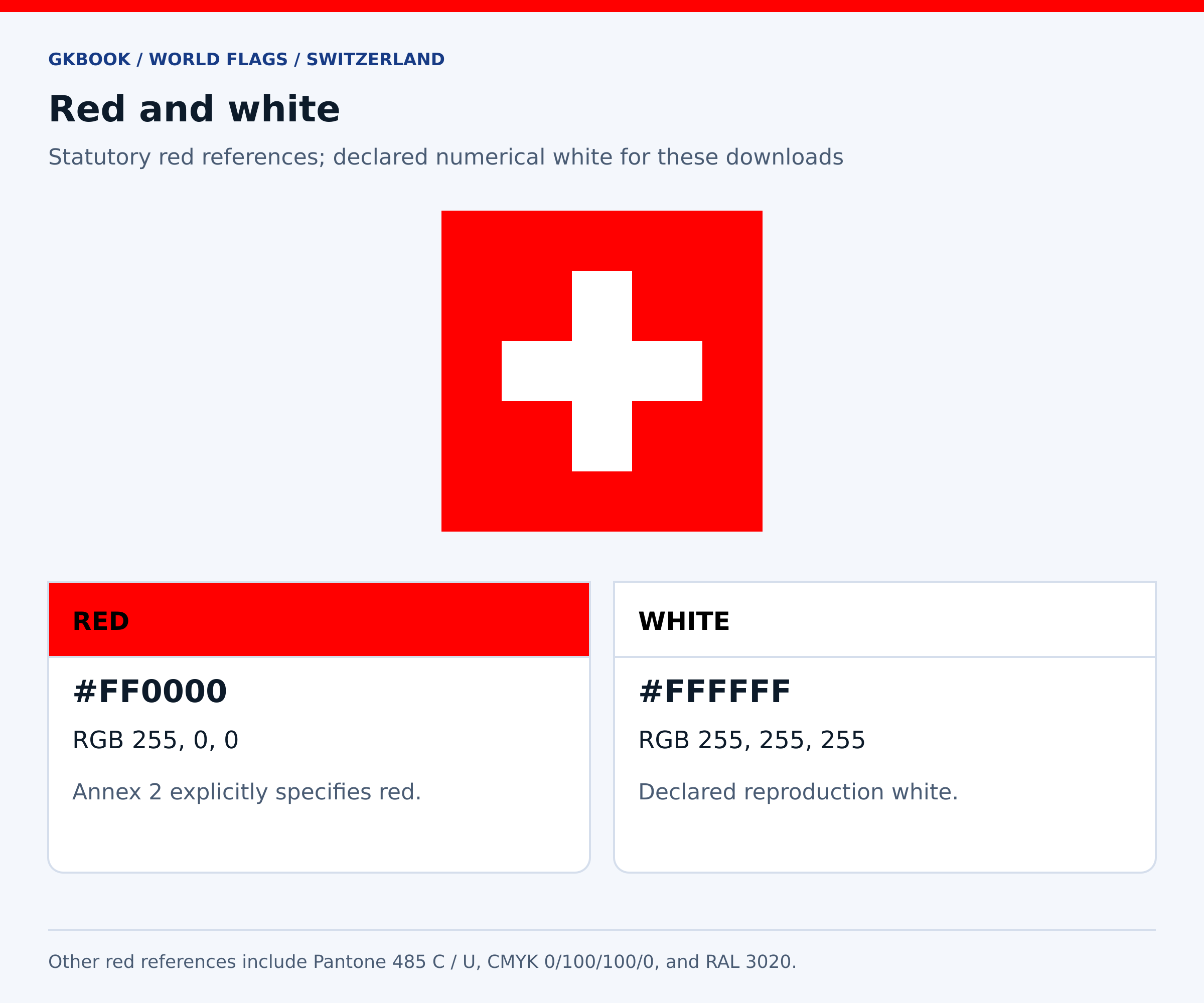
The Swiss flag has a red field and a white cross. Annex 2 of the current federal law specifies red as RGB 255, 0, 0 and hexadecimal #FF0000, alongside physical color references. These downloads use #FFFFFF for white; the annex does not prescribe a corresponding numerical shade of white.

The legal red references include Pantone 485 C and 485 U, CMYK 0/100/100/0, and RAL 3020 traffic red. These belong to different production systems. Keep the system name beside each value so that a printer does not mistake an RGB channel triplet for an ink recipe or a paint reference.
Both downloadable formats use identical red and white fills. The PNG is opaque RGB, so its white cross remains white over a colored webpage. A monitor profile, ambient lighting, paper, fabric, and printing process can affect perceived color. Stored numerical agreement is useful, but it does not certify a manufactured object.
| Color | HEX | RGB | Qualification |
|---|---|---|---|
| Red | #FF0000 | 255, 0, 0 | Explicitly listed in statutory Annex 2 |
| White | #FFFFFF | 255, 255, 255 | Declared reproduction white; no numerical white in Annex 2 |
What does the red on Switzerland’s flag mean?
There is no single settled historical explanation for the red field. The Swiss government’s overview discusses competing possibilities, including a religious association and a connection with Bern’s banner. Those possibilities should remain qualified. The current law specifies the color and construction; it does not assign red a mandatory moral meaning.
A familiar color association is not automatically evidence of a flag’s original intention. Red may suggest courage or sacrifice to a viewer, but that personal reading differs from a documented explanation. Historical uncertainty can be stated directly without filling the gap with a generic list of patriotic virtues.
In the drawing, red has a clear structural role: it forms the square background and separates every cross end from the edge. The large red area also makes the white cross easy to recognize. Those observable design functions can be explained confidently even when the field’s earliest symbolism remains debated.
What does the white cross represent?
The white cross developed into a common identifying sign of Swiss troops and later a national emblem. The Federal Archives traces a shared white-cross identifier to the Battle of Laupen in 1339. Describing this historical role is firmer than assigning white an officially prescribed meaning such as purity, peace, or innocence.
The early identifier and the modern flag are not the same physical object. Strips of white cloth on clothing could help troops recognize one another without requiring a standardized red square. Over time, a shared sign could acquire wider political meaning while its presentation and legal construction continued to develop.
Today the white shape is an upright, freestanding cross with equal projecting arms. Freestanding means that red remains between each arm end and the field’s boundary. It does not mean the cross floats away from its own center, has four detached pieces, or needs a separate outline to remain recognizable.
What is the meaning of the Swiss flag?
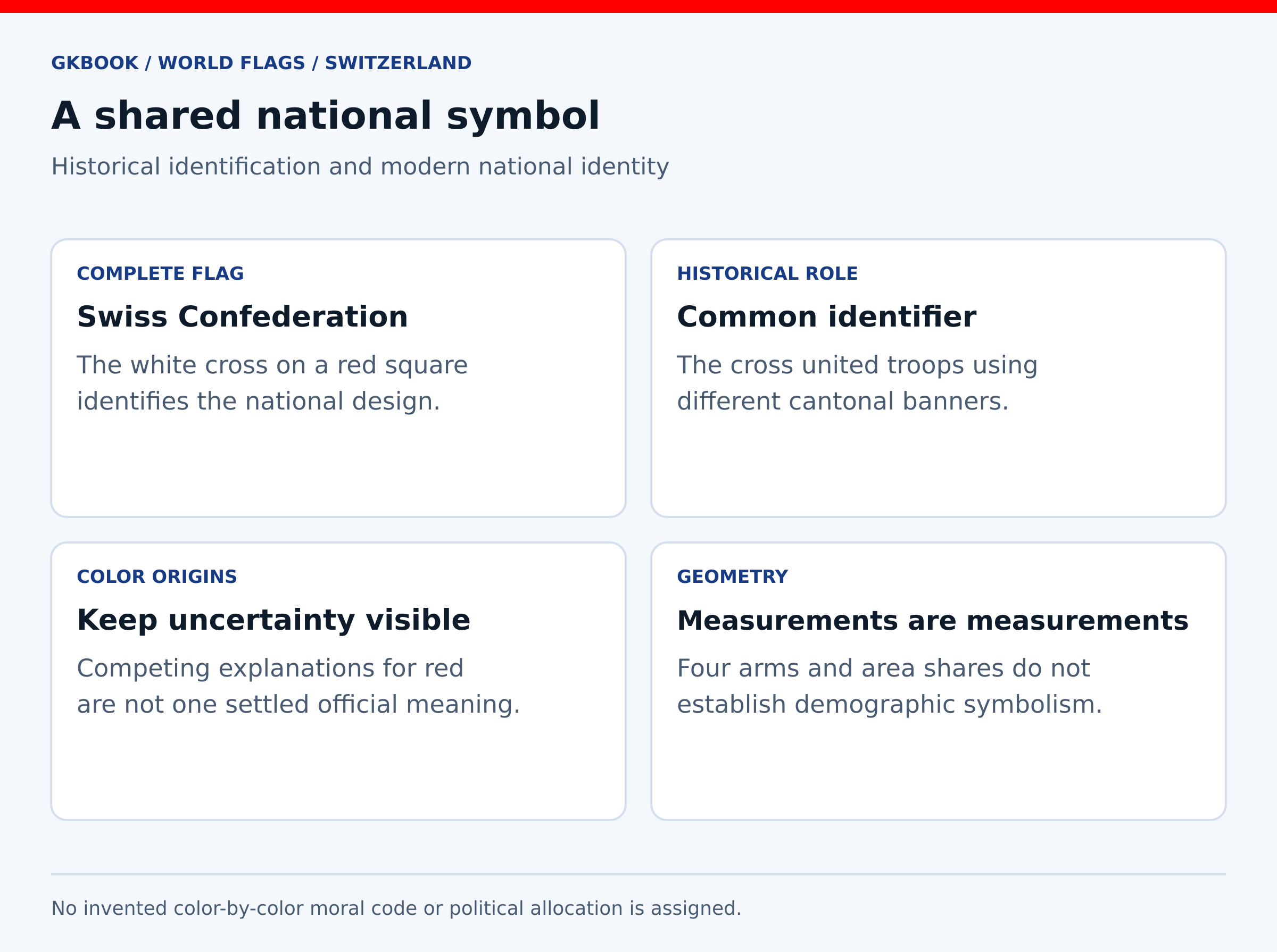
The Swiss flag identifies the Swiss Confederation and expresses a shared national identity through the white cross on red. Its historical background includes military identification and the development of federal institutions. The law defines its appearance, while historical explanations address its origins; neither provides a separate official meaning for every measured component.

The complete composition matters more than a color list. A white cross alone, a red shield, and a square red flag may share visual ingredients while serving different roles. Explain the flag as a national symbol first, then describe the particular history of its cross and its standardized outline.
Geometric numbers do not establish additional symbolism. Four equal arms are not evidence of four cantons, four languages, or four political divisions. Likewise, the proportion of red area is a drawing calculation, not a statement about population or territory. Keep useful measurements separate from claims about historical intent.
What kind of cross appears on Switzerland’s flag?
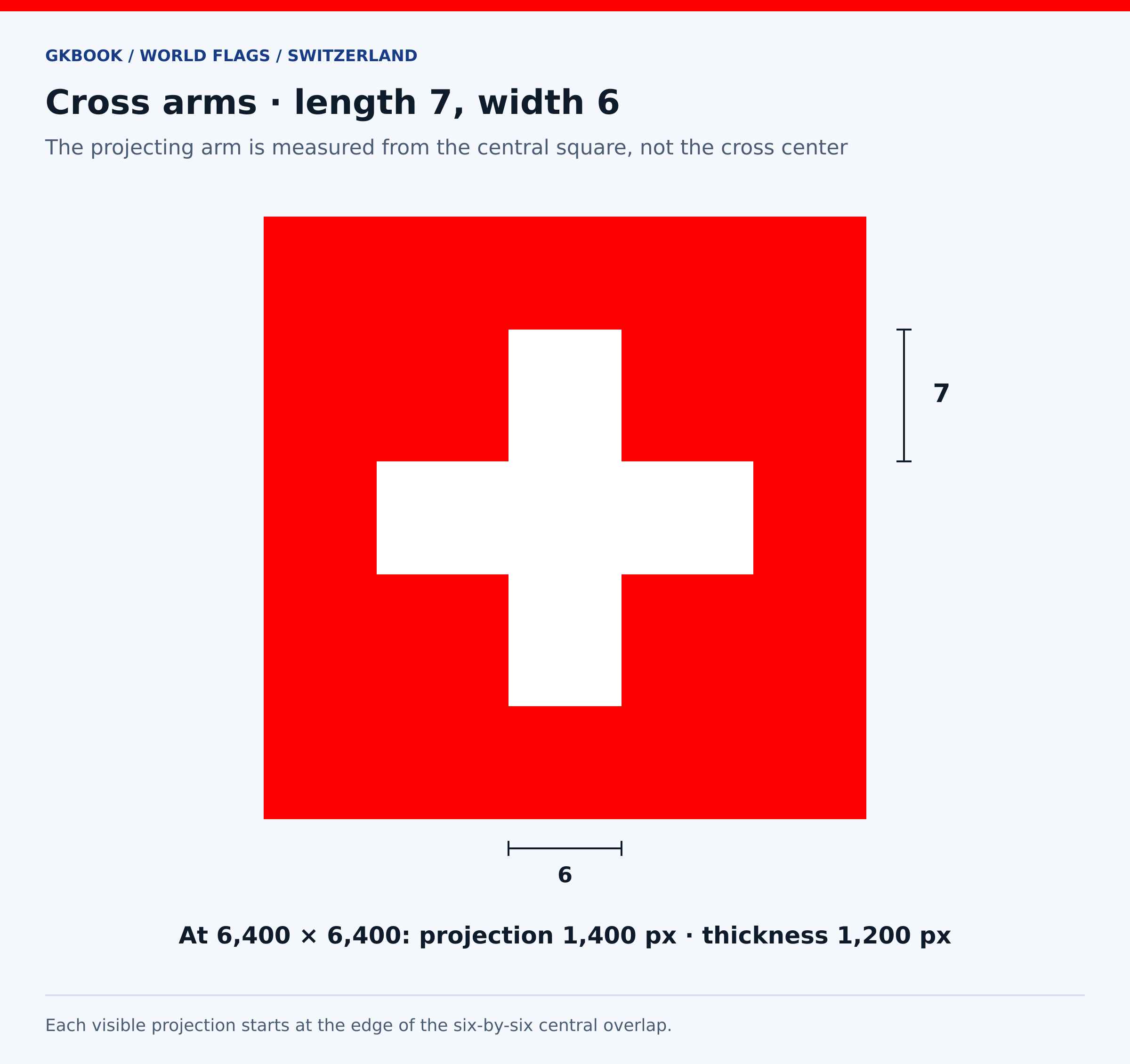
The Swiss flag carries an upright white cross with four equal projecting arms. It is centered and freestanding: none of its ends reaches an outer edge. Each arm projects seven units from the central square and is six units wide. This differs from a Nordic cross extending across the entire field.

A practical drawing method uses two overlapping white rectangles, one horizontal and one vertical. Their intersection creates a six-by-six central square. The visible projection beyond that square is seven units in every direction. The two rectangles are construction aids; the finished artwork shows one uninterrupted white shape.
Do not add a circular background, a dark keyline, rounded ends, or a longer lower arm. Those changes alter the specified silhouette. Labels and dimension lines can help explain the cross in a teaching diagram, but the clean national flag should retain straight edges and the same white fill throughout.
Why is the Swiss flag square?
The square form reflects the flag’s military background and is now expressly defined by federal law. Article 3 describes the national flag as a Swiss cross in a square field. A square has equal height and length, so the ordinary national design should not be stretched into a standard rectangular flag placeholder.
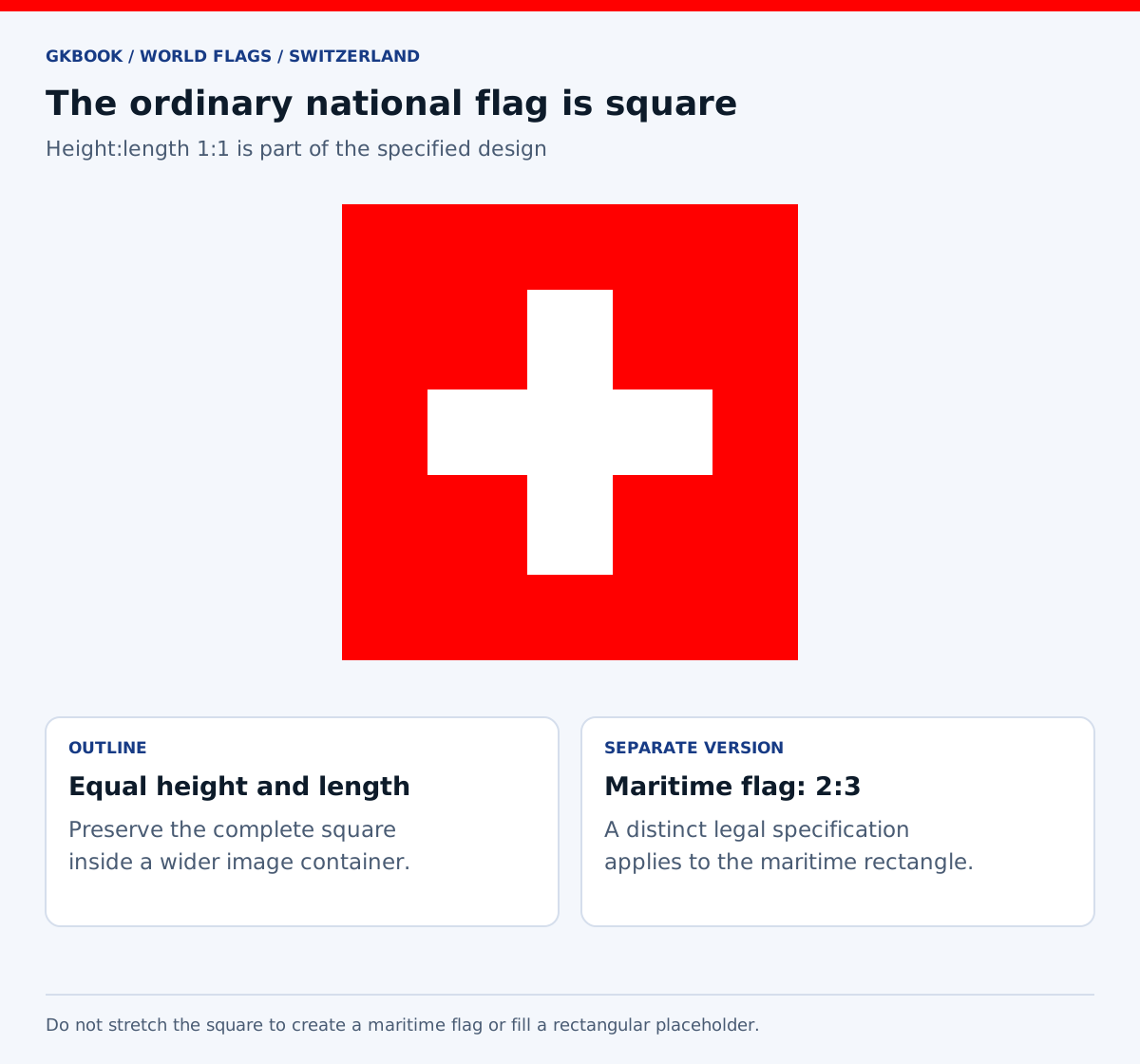
A website may use a rectangular image container while still displaying the complete square inside it. The surrounding space belongs to the interface, not the flag. Preserve that distinction in thumbnails, presentation slides, and social graphics so the shape remains immediately visible and the outer red margins stay intact.
Switzerland’s maritime flag is a separate rectangular version with its own legal basis. Its existence does not make the square optional in an illustration labeled as the ordinary national flag. A useful comparison identifies the intended version before discussing measurements, rather than assuming that every rectangle represents a drawing error.
What are the proportions of Switzerland’s flag?
The ordinary Swiss flag has height:length proportions of 1:1. Annex 2 uses a 32-by-32 construction grid. Across either central axis, the divisions are 6:7:6:7:6: red margin, projecting arm, central thickness, projecting arm, and red margin. The full cross spans 20 units, or five-eighths of the flag’s side.

The overall ratio and the internal grid answer different questions. A square outline establishes equal outer dimensions, but many incorrectly sized crosses could still fit inside it. The five-part sequence fixes the cross’s scale and placement as well. Both checks are needed when evaluating a small icon or a large banner.
Twenty divided by thirty-two is exactly 0.625. It is not the exact golden-ratio reciprocal, which is approximately 0.618. The construction should therefore be reproduced from its stated integer dimensions rather than altered to fit an aesthetic formula. Uniform scaling preserves the correct relationships at every suitable output size.
How wide are the arms of the Swiss cross?
Each projecting arm is seven units long and six units wide. The length is therefore one-sixth greater than the width, giving a 7:6 ratio. The full horizontal and vertical bars each measure 20 by 6 units. In the supplied 6,400-pixel square master, the arm thickness is 1,200 pixels.

Measure an arm’s projection from the edge of the central square to its outer end. Measuring from the cross center would include half of that central square and produce a different number. This distinction explains why the legal arm ratio is compatible with a complete bar measuring twenty units across.
In the master, each projection is 1,400 pixels long, while the central overlap is 1,200 by 1,200 pixels. The four projections are equal. Changing only the horizontal scale would make the horizontal and vertical arms disagree, even if the resulting shape still looked roughly like a plus sign.
How much red space surrounds the Swiss cross?
The shortest distance from each cross end to its corresponding flag edge is six units on the 32-unit grid. That equals three-sixteenths of the flag’s side and matches the cross’s thickness. In the 6,400-pixel master, all four end margins are 1,200 pixels, with the cross centered at 3,200, 3,200.

These measurements concern the top, bottom, left, and right ends of the cross. The larger red corner areas have a different shape and should not be mistaken for narrow rectangular borders. The cross’s overall bounding square measures twenty units on each side and sits centrally within the thirty-two-unit field.
A crop that removes equal amounts from every edge can preserve a square outline while making the cross too large relative to the field. Check the margins after cropping or placing artwork in a frame. Hems, sleeves, and attachment allowances should be planned separately from the intended visible square.
How can you draw the Swiss flag accurately?
Start with a red square, then overlay two equal-width white rectangles at its center. On the 6,400-by-6,400 master, the horizontal rectangle begins at 1,200, 2,600 and measures 4,000 by 1,200. The vertical rectangle begins at 2,600, 1,200 and measures 1,200 by 4,000. Their overlap forms the cross center.

Coordinates here are measured from the upper-left corner, with x increasing rightward and y increasing downward. One grid unit equals two hundred pixels. This scale places every boundary on a whole pixel, making the master easy to inspect without partially covered edge pixels or ambiguous fractional coordinates.
Draw the red background first and use exactly the same white for both bars. Their overlap is intentional, so there should be no seam, gap, or darker intersection. The vector file can scale to other sizes while preserving the construction. Keep width and height linked when resizing the complete flag.
What percentage of the Swiss flag is red or white?
The white cross occupies 51/256 of the ideal square, or 19.921875 percent. Red occupies the remaining 205/256, or 80.078125 percent. These figures follow from two 20-by-6 white rectangles with their 6-by-6 intersection subtracted once. They describe visible geometric area, not additional official symbolism or a required physical fabric weight.

The cross calculation is 120 plus 120 minus 36, giving 204 square grid units. The whole flag contains 32 times 32, or 1,024 units. Counting the overlap twice would exaggerate the white share because the same central square belongs to both drawing rectangles but appears only once.
At the master’s resolution, white covers 8,160,000 pixels and red covers 32,800,000, totaling 40,960,000. These exact counts apply to the clean master with integer boundaries. Smaller antialiased previews may contain intermediate edge colors, so their raw color counts should not be substituted for the underlying geometric calculation.
What is the history of Switzerland’s flag?
The Swiss cross developed over centuries before the present flag was standardized. The Federal Archives identifies white crosses worn at Laupen in 1339, an official common emblem in 1814, and a shared troop flag in 1841. The federal state followed in 1848, while the cross-arm dimensions were settled in 1889.
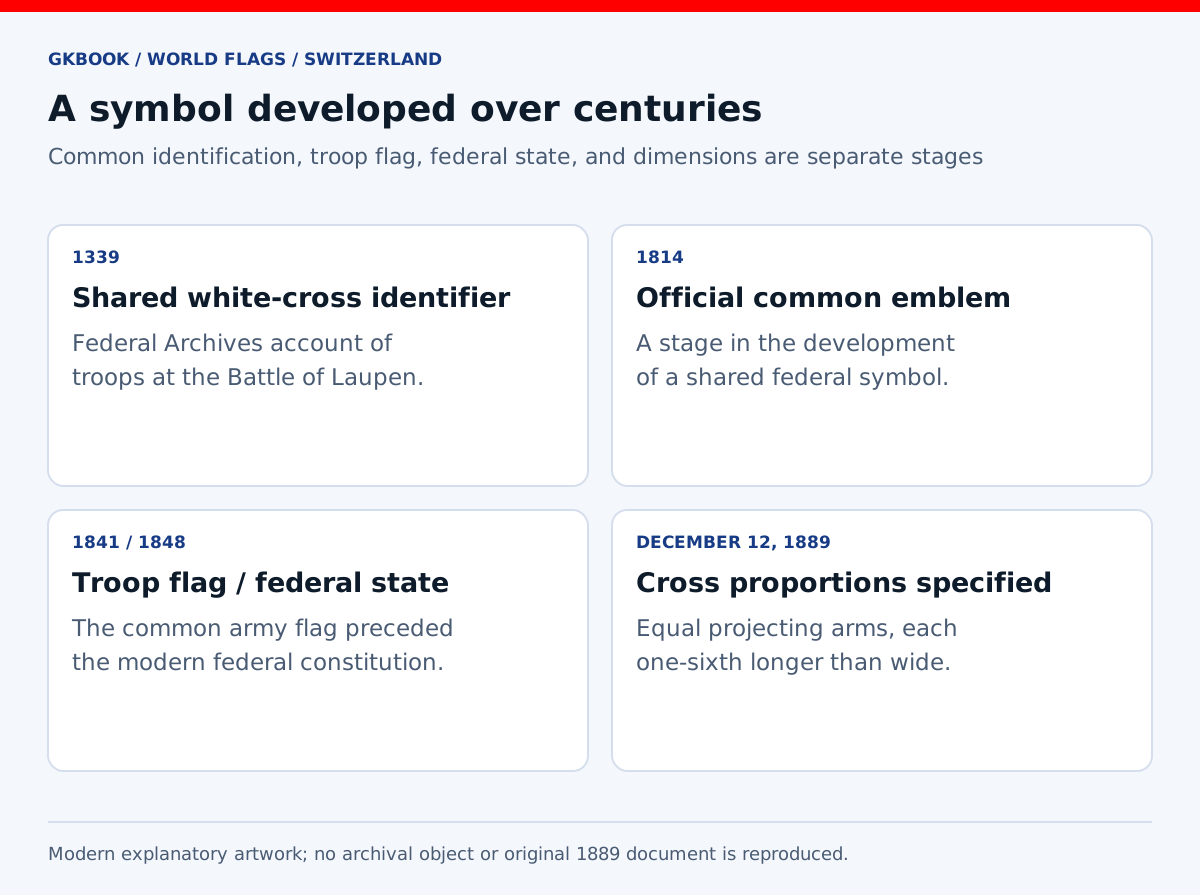
These milestones describe different stages: a practical identifier, a shared emblem, an army flag, and later national standardization. Treating them as interchangeable adoption dates hides the gradual development. A modern red square is useful for explaining the present design, but it should not be presented as a surviving medieval banner.
The historical record also includes cantonal banners and the Helvetic Republic’s different colors. A timeline can acknowledge those changes without claiming that every Swiss unit used an identical flag throughout the period. The current square combines a familiar symbol with precise rules that are much later than its earliest documented use.
When was the Swiss flag adopted?
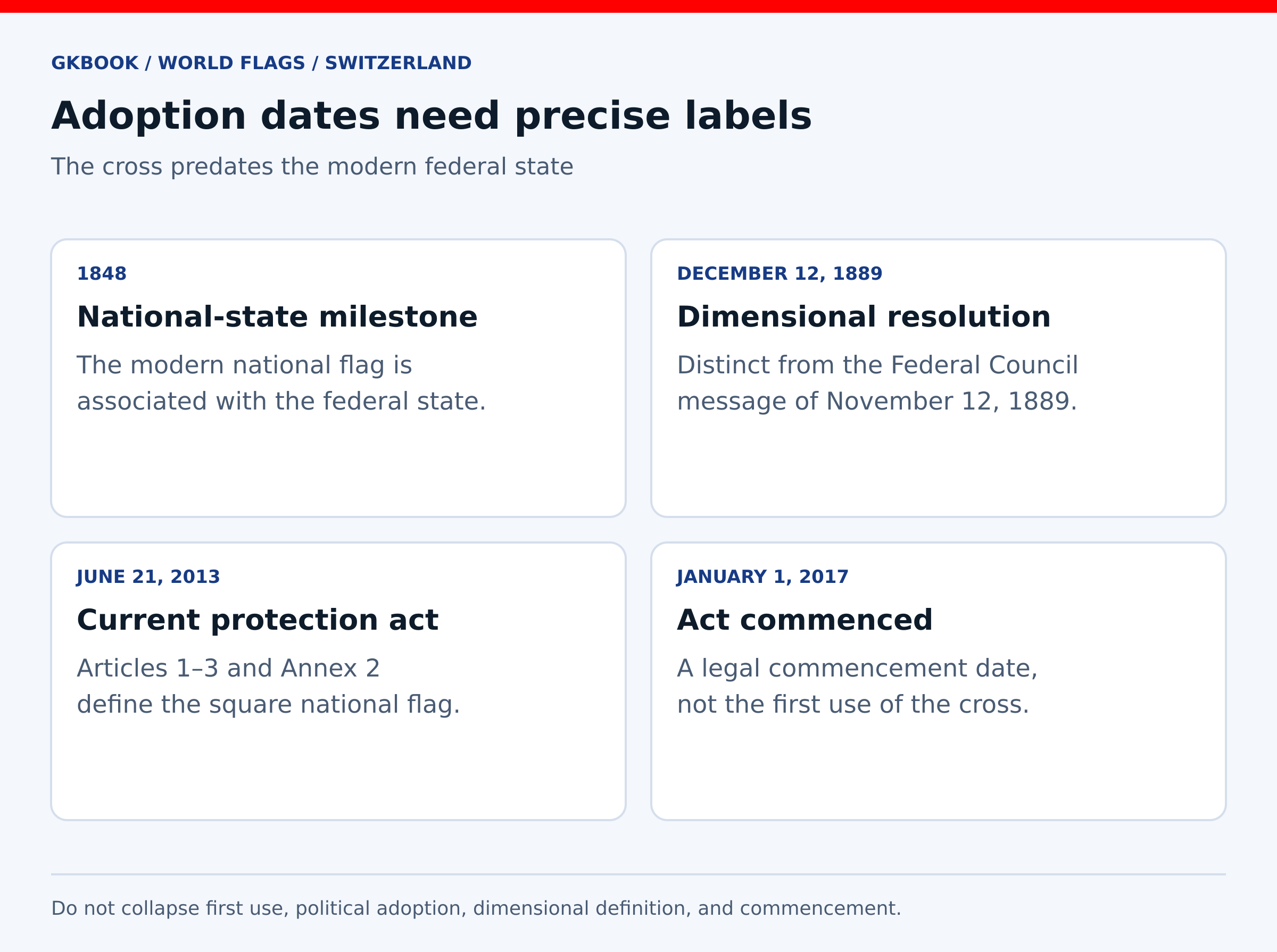
The modern national flag is associated with the federal state established in 1848. A common troop flag had already been introduced in 1841. The federal resolution of December 12, 1889 specified the cross-arm proportions. These are distinct milestones; the current protection act was adopted in 2013 and took effect on January 1, 2017.
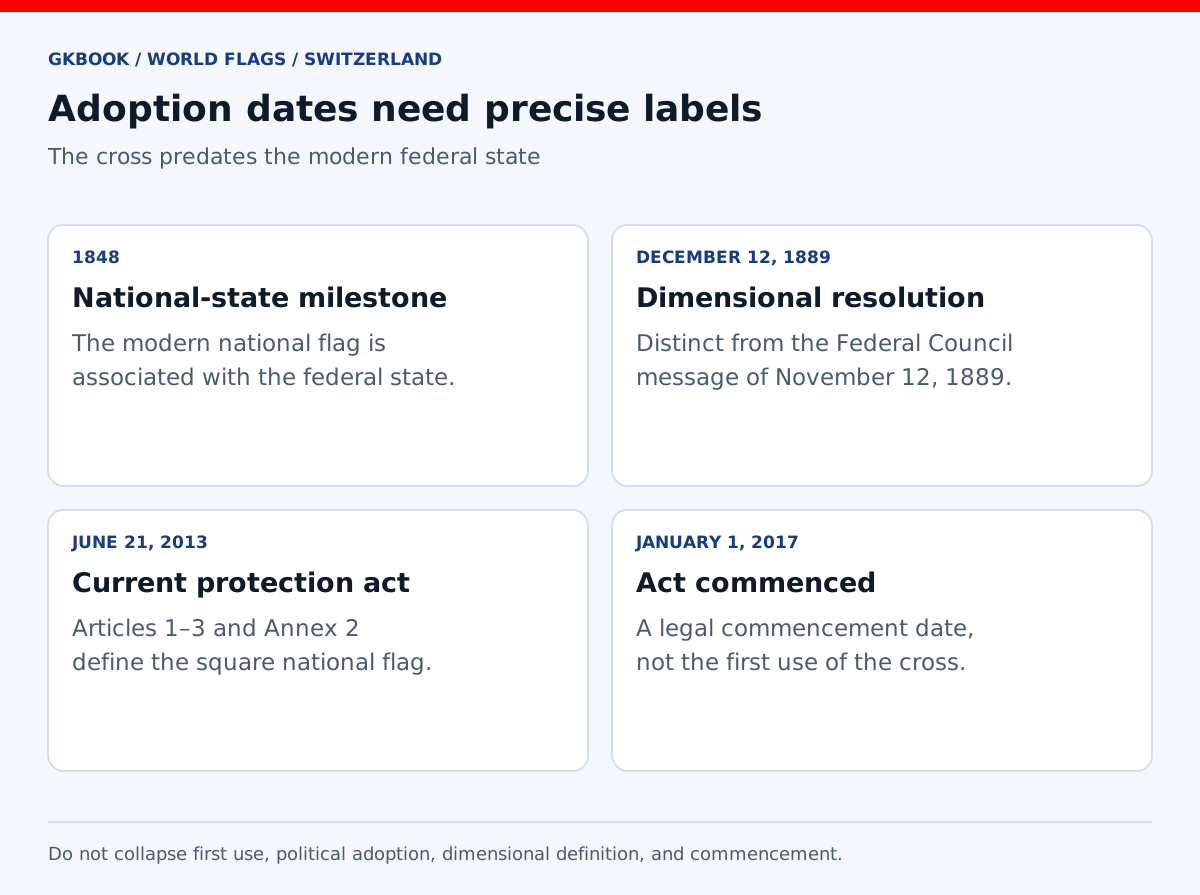
A short reference may list 1848 as adoption, but a fuller explanation should identify what that date represents. It does not mean the white cross was invented that year. Likewise, the 1889 decision concerns dimensions rather than the first appearance of a shared Swiss emblem or military flag.
The army’s historical account distinguishes the Federal Council’s message of November 12, 1889 from the resolution adopted on December 12. Keeping those dates separate prevents a common chronological confusion. The original 1889 resolution was not obtained for this review; the official army account and Federal Archives provide the historical basis.
Who designed Switzerland’s flag?
No single person invented every element of the Swiss flag across its long history. Guillaume Henri Dufour advocated a common army flag, and the army’s historical account credits painter Carl Stauffer with drawing the definitive 1841 model. The older cross tradition and the later 1889 dimensional decision require separate attribution.
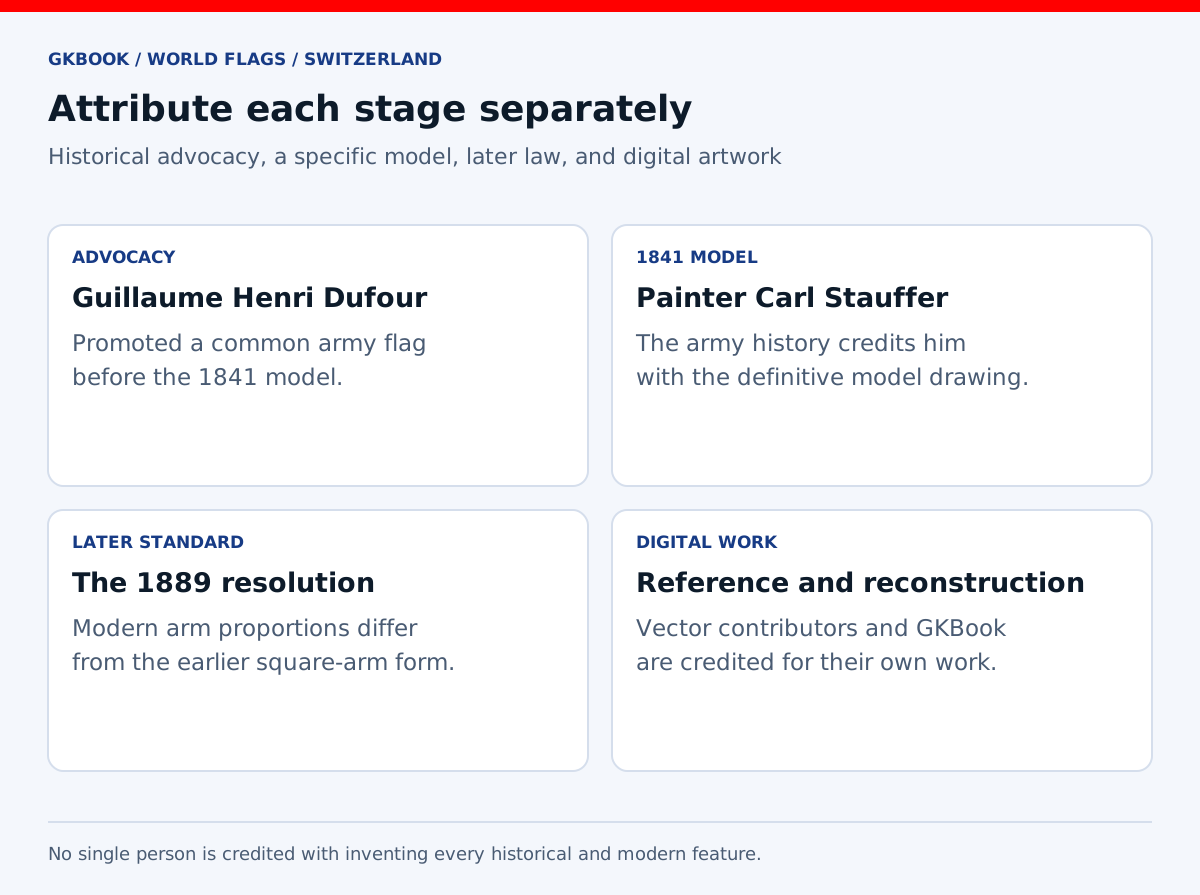
The nineteenth-century model should not be silently equated with every detail of today’s standardized cross. The army account describes the earlier cross in terms of five equal squares, whereas the modern projecting arms have a seven-to-six length-to-width ratio. Historical design work and subsequent legal refinement belong to different stages.
Digital contributors have another role. A person who draws a modern SVG, corrects its colors, or optimizes its code is not thereby the historical national designer. The credits distinguish the inspected community reference from GKBook’s reconstruction, calculations, explanatory layouts, and exported files, without implying an official design commission.
Which law defines the Swiss flag today?
The Federal Act of June 21, 2013 on the Protection of the Swiss Coat of Arms and Other Public Signs defines the cross and square flag. Article 1 specifies the arms, Article 3 identifies the square field, and Annex 2 supplies the construction and red color references. The act commenced in 2017.
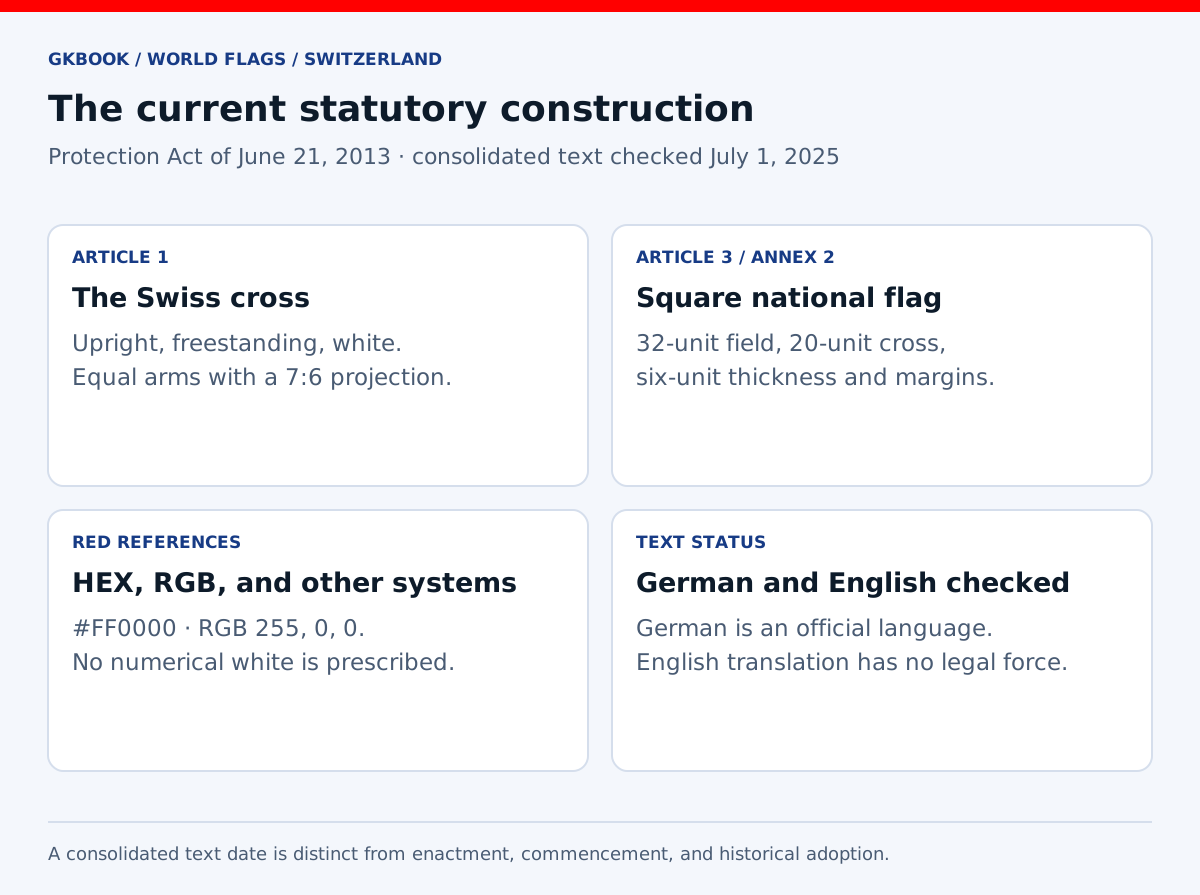
The consolidated German text checked here is dated July 1, 2025. The corresponding English translation helps explain the provisions, but its own notice states that it has no legal force. The authoritative German text and its annex were therefore checked directly rather than relying only on a summary page.
A current consolidated text can include later amendments without changing the flag’s historical adoption milestone. Read the relevant article and annex together: the prose describes the symbol, and the diagram fixes relationships that a verbal description alone may leave unclear. Published color references also remain distinct from physical production approval.
Did Switzerland ever use a different flag?
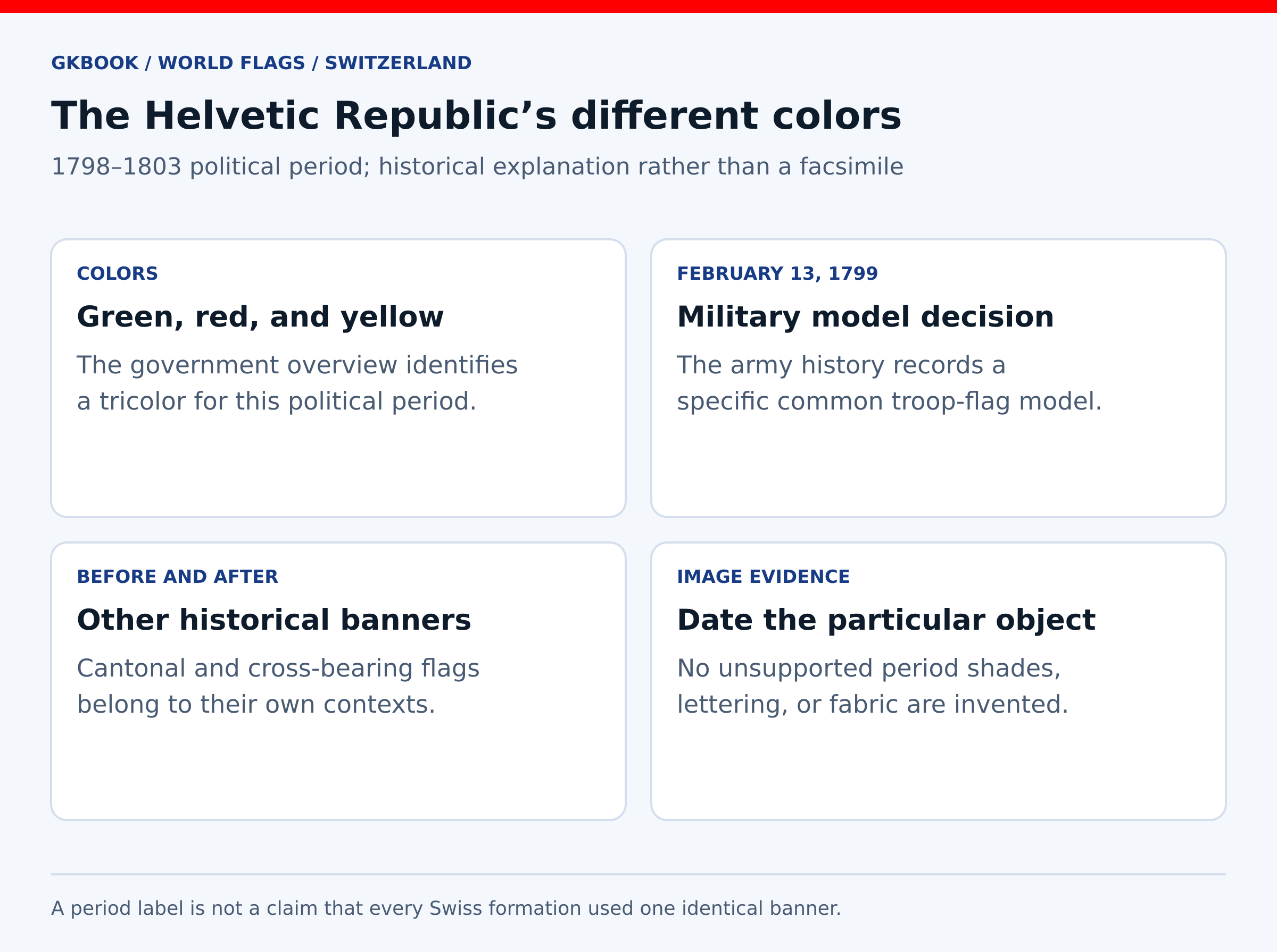
Yes. During the Helvetic Republic of 1798–1803, a green, red, and yellow tricolor replaced the white-cross design in that political context. Earlier and later military history also includes cantonal banners and different cross constructions. These historical forms should be dated and labeled, rather than presented as interchangeable versions of today’s square national flag.

The army history records a February 13, 1799 decision concerning a common military flag model for the Helvetic Republic. That specific decision should not be expanded into a claim that the three colors first appeared anywhere on that day. The political period and an individual flag regulation answer different questions.
This collection uses explanatory panels for the historical tricolor instead of inventing an archival facsimile with unsupported shades, lettering, or fabric details. When a historical object is available, preserve its particular features and provenance. A clean modern reconstruction cannot substitute for evidence about exactly what an older banner looked like.
When is Swiss National Day?
Swiss National Day is August 1, when the flag appears in public celebrations and private displays. The date is associated with the Federal Charter of early August 1291. The Federal Council distinguishes the 1891 jubilee celebrations from the establishment of August 1 as National Day in 1899; these dates are separate from flag standardization.

The charter’s dating to early August should not be turned into a verified claim that it was signed on August 1 at the Rütli meadow. The government’s account distinguishes the document from the later founding narrative. A national commemoration can acquire importance without every detail of a popular legend being literal history.
Modern celebrations may include flags, lanterns, and bonfires. Those customs explain why the symbol is especially visible at this time of year, but they do not alter its construction. The national holiday, the 1848 federal state, and the 1889 cross-dimension resolution should retain their own labels on a timeline.
Is Swiss National Day an independence day?
Swiss National Day commemorates a founding tradition associated with the 1291 charter, rather than a single modern colonial independence declaration. Switzerland developed through successive alliances and constitutional changes. The Federal Treaty and border settlement of 1815 and the federal constitution of 1848 are separate milestones, each requiring its own historical label.
A country’s formation can be a process rather than one event. Medieval alliances, later diplomatic settlements, and a modern federal constitution concern different institutions and circumstances. Calling all of them independence dates would make a short flag caption less accurate, especially when the caption also includes adoption or membership dates.
The modern flag can accompany a general account of Switzerland, but its presence does not prove that the same standardized object existed at every stage described. For a historical illustration, identify the period and the evidence. For a current national reference, use the present square and explain earlier milestones in surrounding text.
When did Switzerland join the United Nations?
Switzerland joined the United Nations on September 10, 2002. The United Nations admission record identifies that date, which is separate from the country’s earlier statehood, its flag’s history, and diplomatic recognition by individual countries. Membership in an international organization does not establish the first existence of a national symbol or a state.
Use the admission date for a question specifically about United Nations membership. Do not relabel it as Swiss independence or flag adoption. A national flag may have been in established use long before membership, and an international organization’s procedures do not replace the country’s own historical and constitutional chronology.
For a concise comparison table, give each date a descriptive heading: federal state, cross proportions, current flag law, or UN admission. That approach lets readers compare countries without forcing unlike events into one column. It also avoids suggesting that every state followed the same route to international participation.
Why is there a rectangular Swiss flag?
Switzerland has a rectangular maritime flag with height:length proportions of 2:3. It is governed separately under the Navigation Act of September 23, 1953, and the general flag law expressly preserves that legislation. The maritime version should be identified by purpose; it does not replace the ordinary square national flag supplied as the main download.

A rectangular field requires a separate construction, not a horizontal stretch of the square. Stretching would also widen the cross and change the relationship between its horizontal and vertical arms. Keeping the same recognizable motif does not make those distortions acceptable or establish the precise placement required by another specification.
The maritime illustration here explains the distinction through labeled information panels. It is not a separate production master for ships. Readers preparing maritime markings should use the applicable maritime specification and vessel requirements, while readers seeking the ordinary Swiss national flag can use the square files in this collection.
Is the Swiss coat of arms the same as the flag?
The Swiss coat of arms and flag share a white cross on red, but their outlines differ. Article 2 places the cross in a triangular shield, while Article 3 defines the flag’s square field. A shield-shaped badge should therefore be labeled as the coat of arms, not as a complete square national flag.

Shared colors and a shared cross make the two symbols closely related, which can lead to imprecise captions. The surrounding shape is still meaningful. Cropping a shield into a square or adding a shield to the flag creates a different image and does not reproduce the ordinary flag’s specified composition.
This package explains the distinction without supplying an improvised shield template. Use the relevant annex when an exact coat-of-arms drawing is required. The clean flag has a red square around the cross, with no shield border, lettering, or extra emblem inserted at its center or in a corner.
How is the Swiss flag related to the Red Cross emblem?
The Red Cross emblem reverses the Swiss flag’s colors: it is a red cross on white, while Switzerland’s flag is a white cross on red. The ICRC explains this visual relationship. The humanitarian emblem, recognized under the 1864 Geneva Convention, has a different protective and identifying purpose from the Swiss national flag.

Color order is therefore essential when identifying the two symbols. A white cross on red should not be captioned as the Red Cross merely because both designs contain a cross. Likewise, changing the colors of the national flag creates a different symbol rather than an alternative Swiss flag palette.
The ICRC distinguishes protective and indicative uses of its emblems. That context makes the Red Cross more specific than a generic decoration for medicine or first aid. This educational comparison explains the relationship without offering a new emblem template or implying that the national flag and humanitarian emblem have interchangeable uses.
How should the Swiss flag be displayed?
Display the complete square flag without distorting its cross or concealing its red margins. The Swiss army’s flag regulation calls for respectful handling, good condition, and lowering by darkness unless the flag is illuminated. Those instructions have a military context; public ceremonies and other institutions may provide their own applicable arrangements.
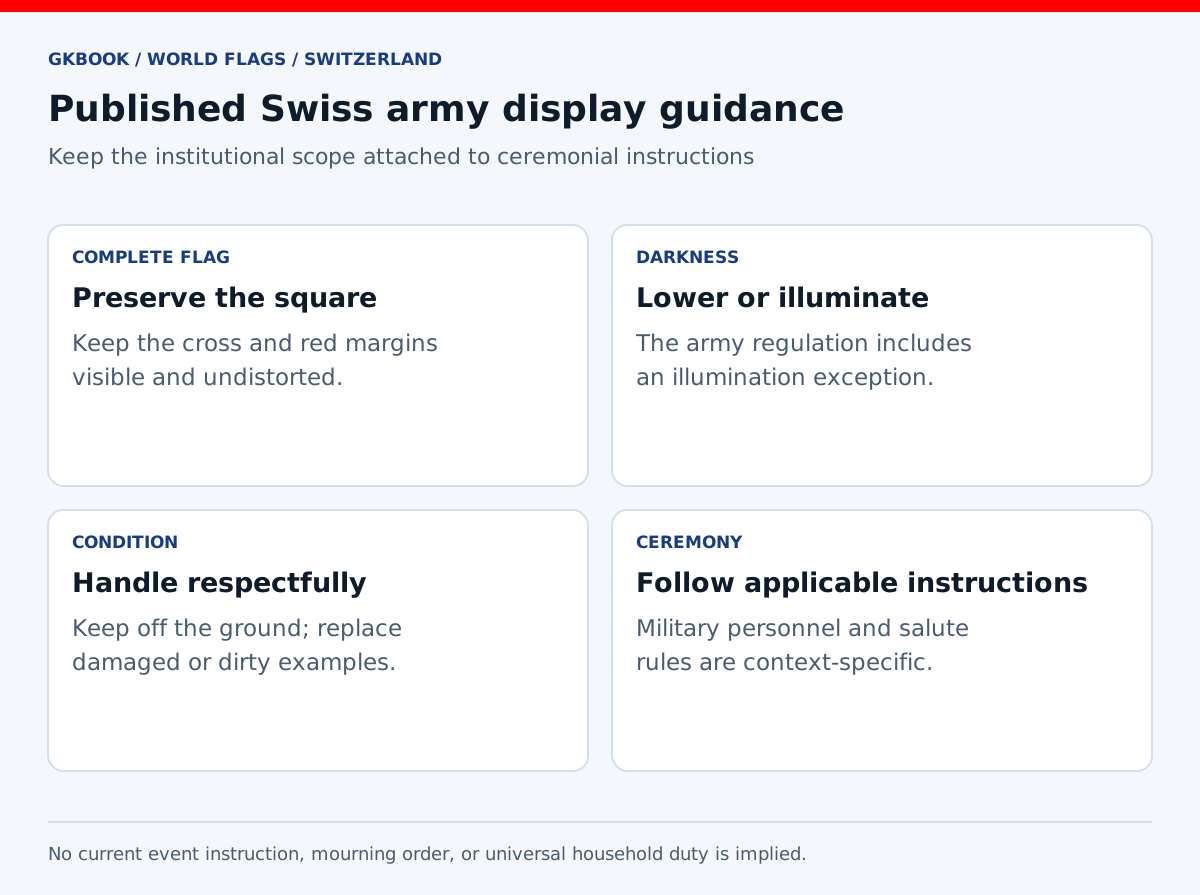
The army guidance also emphasizes keeping the flag off the ground and replacing damaged or dirty examples. These practical points help preserve a clear and respectful presentation. Requirements involving personnel, salutes, and ceremonial sequences should remain attached to their institutional setting rather than being presented as universal duties for every household.
When arranging multiple national flags, check the organizer’s protocol and the available space. The army manual discusses matching heights even when national proportions produce different lengths. For the Swiss square, maintaining the intended visible shape matters more than forcing its width to match every neighboring rectangular flag.
How is the Swiss flag flown at half-mast?
The Swiss army’s mourning guidance specifies raising the flag to the top before lowering it to the mourning position, and raising it to the top again before final lowering. The occasion and instructions determine when this applies. This explanation describes the sequence; it does not announce a current mourning order or prescribe a universal numerical height.

Half-mast is a form of display on a pole, not a modified flag design. The red square and white cross retain their normal dimensions. A teaching panel can show the order of operations without inventing a precise fraction of pole height that the reviewed passage does not state.
The military regulation addresses particular deaths, sites, and official decisions within its scope. A civilian institution should follow the instructions relevant to its own event and authority. Keep that distinction visible when adapting general flag information into a ceremony plan, especially where several flags or different pole arrangements are involved.
Does the Swiss flag change when hung vertically?
The square Swiss flag keeps the same flat appearance after a quarter-turn because its centered cross has four equal arms. No stretching or rearrangement is needed to make it taller. The army manual discusses appropriate hanging arrangements; the image here demonstrates geometric symmetry, while actual attachments and ceremonial placement depend on the display setting.
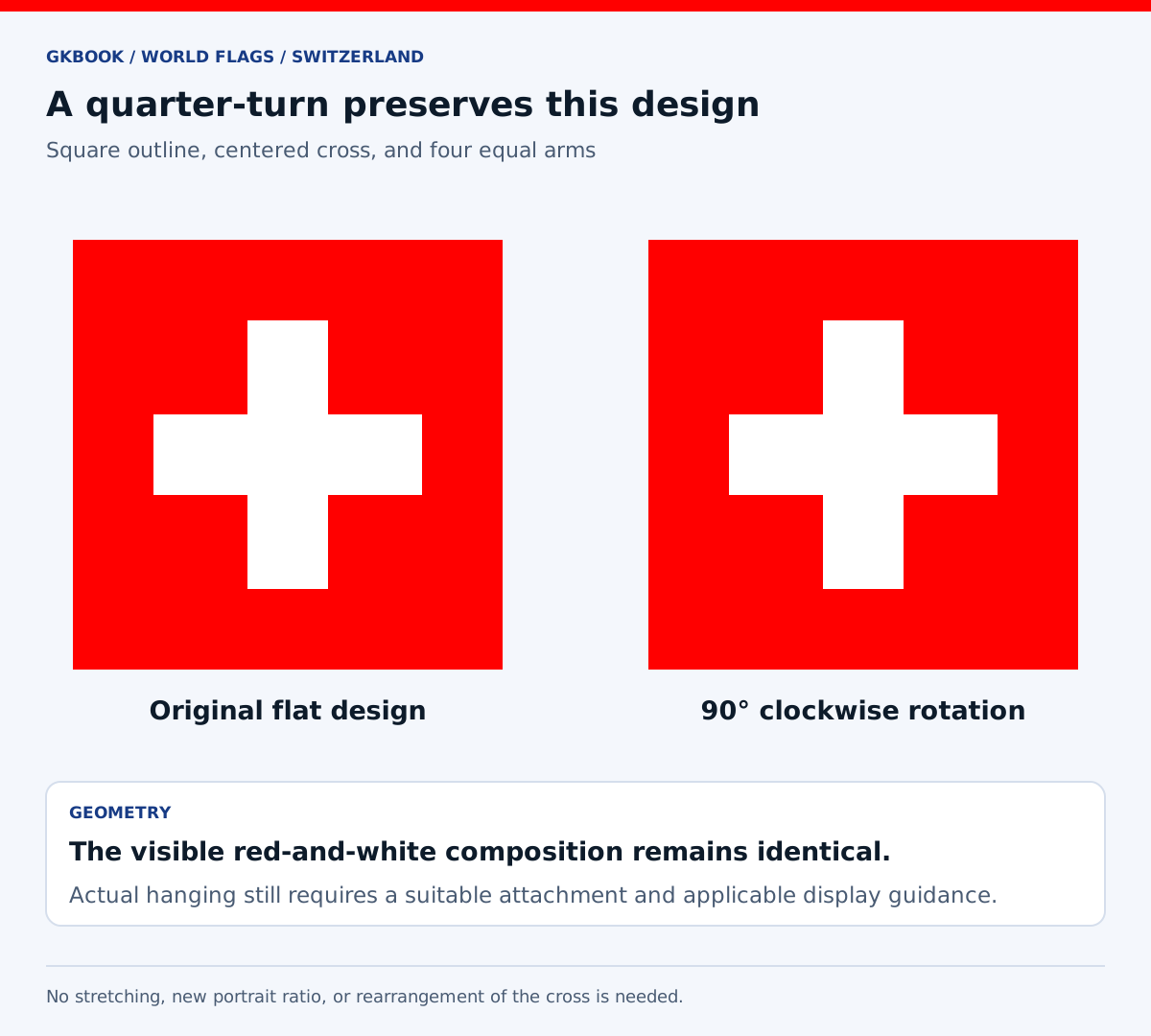
A square has no separate portrait aspect ratio. Rotating it ninety degrees leaves equal outer dimensions and the same cross silhouette. That makes the design different from an asymmetric rectangular flag whose components move to visibly different positions after rotation. The mathematical result can be checked directly from the construction.
Physical display still involves hardware, seams, and the direction of the original hoist. Those details are not encoded by the flat colored image. Keep the complete square visible and use a suitable hanging arrangement instead of lengthening the field, narrowing the cross, or treating a tall decorative banner as the ordinary flag.
Does the reverse of the Swiss flag look different?
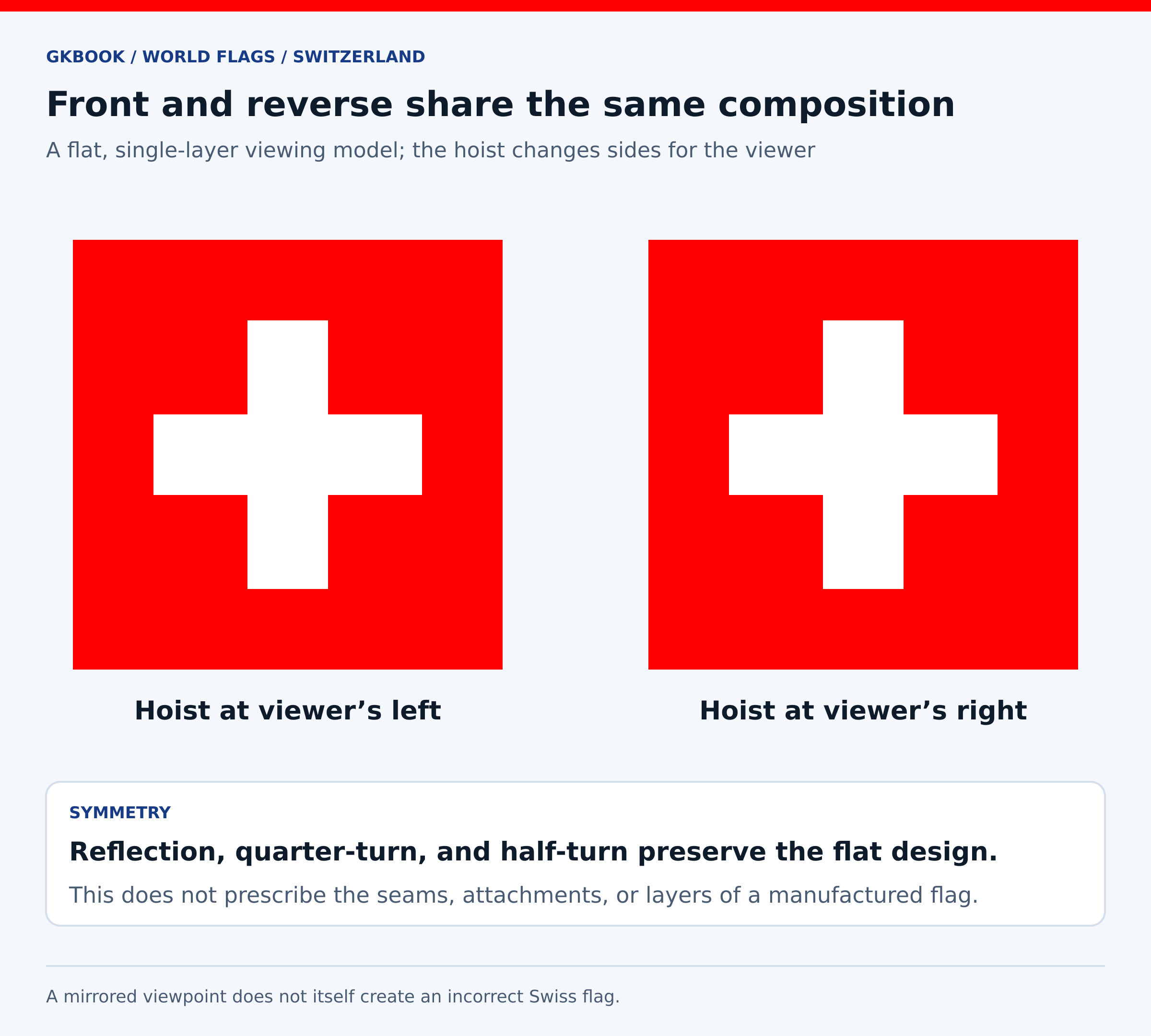
In a flat, single-layer viewing model, the reverse has the same visible red-and-white composition as the front. Horizontal reflection preserves the centered cross and square margins. Quarter-turns and a half-turn also preserve this design. These are geometric properties; they do not specify how every physical flag’s seams, attachments, or fabric layers are manufactured.

The hoist changes sides for a viewer looking from the opposite face, even though the colored pattern remains identical. That distinction is useful when labeling a photograph of a flag on a pole. A plain image without hardware cannot reveal which edge was originally attached to that pole.
Do not infer an incorrect display solely from a mirrored image of this symmetric flag. Conversely, symmetry does not justify stretching, cropping, or changing the cross’s size. Those operations alter measurements rather than merely changing the viewpoint. The comparison artwork uses complete flags so that the unchanged proportions remain easy to inspect.
How should Swiss flag artwork be prepared for printing?
Use the SVG for scalable geometry or the 6,400-by-6,400 PNG for a large raster image. At 300 pixels per inch, that PNG corresponds to 21⅓ by 21⅓ inches. This is resolution arithmetic, not a required physical flag size. Preserve the square and consult the published red references when proofing the chosen material.

Keep cutting, hemming, sleeves, and other finishing allowances separate from the intended visible field. Adding fabric for an attachment should not silently remove the red margin or enlarge the white cross in the finished visible square. A production drawing can show those allowances outside the national design.
The statutory color list contains several systems, including a CMYK value, but one file cannot guarantee identical appearance across all papers, fabrics, inks, and displays. Use an appropriate proof for the actual process. These downloads provide precise digital construction; they do not claim laboratory measurement, textile certification, or official production approval.
What Swiss flag pictures are included in this collection?
The collection contains 24 subjects, each supplied as SVG and PNG, plus a separate social preview pair. It includes the clean square flag, color and construction guides, historical explanations, and display comparisons. The main flag contains no labels; annotations belong to the educational layouts and should not be mistaken for features of the national design.
Choose the clean master when you need a standalone national symbol. Choose an explanatory picture when a reader needs to understand a specific measurement, date, or distinction. Each gallery item has a descriptive caption and alternative text, making the relationship between the subject and its teaching purpose clear.
The social graphic places a complete square flag beside the article title inside a wider canvas. That surrounding composition does not turn the flag itself into a rectangle. For further comparisons, the World Flags collection links to other national designs while each country’s own proportions and historical qualifications remain separately documented.
Download Switzerland flag pictures
Download the clean national flag as SVG or 6,400 × 6,400 PNG. Both preserve the complete square, the 32-unit construction, the 20-unit cross, and equal six-unit end margins and thickness. Red is #FF0000 as specified in Annex 2; white is the declared reproduction value #FFFFFF.
The gallery contains 24 subjects, each with an SVG and PNG. Captions distinguish clean flag artwork, construction guides, historical explanations, and display comparisons. Image credits and reproduction notes identify the artwork basis. The separate 1,200 × 630 social card contains a complete 384 × 384 flag. The maritime version is explained separately and is not supplied as a production master.
Continue exploring national designs in World Flags.
World Flags/Switzerland
Switzerland flag pictures
Complete square national flag with statutory construction and red, plus declared reproduction white.
GKBook geometric reconstruction and original educational layouts. Community SVG contributors credited in the notes. No official certification or endorsement.Download SVGDownload PNGRed #FF0000 is listed in the legal annex. The annex does not prescribe a numerical white; these files use #FFFFFF.
GKBook geometric reconstruction and original educational layouts. Community SVG contributors credited in the notes. No official certification or endorsement.Download SVGDownload PNGHistorical association, current identity, and geometric measurements answer different questions.
GKBook geometric reconstruction and original educational layouts. Community SVG contributors credited in the notes. No official certification or endorsement.Download SVGDownload PNGThe white cross is centered in the red square and does not extend to its edges.
GKBook geometric reconstruction and original educational layouts. Community SVG contributors credited in the notes. No official certification or endorsement.Download SVGDownload PNGThe ordinary national flag remains square even when placed inside a rectangular page or social graphic.
GKBook geometric reconstruction and original educational layouts. Community SVG contributors credited in the notes. No official certification or endorsement.Download SVGDownload PNGAnnex 2 defines a 32-unit square with a centered 20-unit cross, six-unit margins, and six-unit thickness.
GKBook geometric reconstruction and original educational layouts. Community SVG contributors credited in the notes. No official certification or endorsement.Download SVGDownload PNGEach projecting arm is one-sixth longer than wide: seven units by six. A full cross bar measures twenty by six.
GKBook geometric reconstruction and original educational layouts. Community SVG contributors credited in the notes. No official certification or endorsement.Download SVGDownload PNGAll four end margins are six units, or three-sixteenths of the flag side. The cross is centered.
GKBook geometric reconstruction and original educational layouts. Community SVG contributors credited in the notes. No official certification or endorsement.Download SVGDownload PNGTwo overlapping white rectangles form the cross over a red square. All master boundaries fall on integer pixels.
GKBook geometric reconstruction and original educational layouts. Community SVG contributors credited in the notes. No official certification or endorsement.Download SVGDownload PNGWhite occupies 51/256 and red 205/256 of the square. These are geometric shares, not symbolic allocations.
GKBook geometric reconstruction and original educational layouts. Community SVG contributors credited in the notes. No official certification or endorsement.Download SVGDownload PNGHistorical panels distinguish different milestones; they do not reproduce a surviving medieval or nineteenth-century flag.
GKBook geometric reconstruction and original educational layouts. Community SVG contributors credited in the notes. No official certification or endorsement.Download SVGDownload PNGThe official army history and Federal Archives support the 1889 chronology. The original resolution was not obtained.
GKBook geometric reconstruction and original educational layouts. Community SVG contributors credited in the notes. No official certification or endorsement.Download SVGDownload PNGDufour’s advocacy and Stauffer’s model do not make either person the inventor of the older Swiss cross tradition.
GKBook geometric reconstruction and original educational layouts. Community SVG contributors credited in the notes. No official certification or endorsement.Download SVGDownload PNGRelevant provisions and the actual legal annex were inspected. Screen agreement is not physical production certification.
GKBook geometric reconstruction and original educational layouts. Community SVG contributors credited in the notes. No official certification or endorsement.Download SVGDownload PNGThe panel describes the historical tricolor without fabricating an archival reconstruction.
GKBook geometric reconstruction and original educational layouts. Community SVG contributors credited in the notes. No official certification or endorsement.Download SVGDownload PNGThe Federal Council distinguishes the charter, later commemorations, and the establishment of National Day.
GKBook geometric reconstruction and original educational layouts. Community SVG contributors credited in the notes. No official certification or endorsement.Download SVGDownload PNGThis is an explanatory comparison, not a maritime production master. The actual Navigation Act annex was inspected.
GKBook geometric reconstruction and original educational layouts. Community SVG contributors credited in the notes. No official certification or endorsement.Download SVGDownload PNGThe current law distinguishes the square flag from the triangular shield. No improvised coat-of-arms facsimile is supplied.
GKBook geometric reconstruction and original educational layouts. Community SVG contributors credited in the notes. No official certification or endorsement.Download SVGDownload PNGThe ICRC explains the inverse colors and the humanitarian emblem’s separate role. This is not an emblem production template.
GKBook geometric reconstruction and original educational layouts. Community SVG contributors credited in the notes. No official certification or endorsement.Download SVGDownload PNGThe army regulation is the source for these practical points. It is not presented as a universal civilian ceremony code.
GKBook geometric reconstruction and original educational layouts. Community SVG contributors credited in the notes. No official certification or endorsement.Download SVGDownload PNGThe reviewed army passage specifies the top-first sequence without supplying a universal numerical fraction of pole height.
GKBook geometric reconstruction and original educational layouts. Community SVG contributors credited in the notes. No official certification or endorsement.Download SVGDownload PNGA quarter-turn leaves the square national design unchanged. This demonstrates geometry, not an attachment or ceremony plan.
GKBook geometric reconstruction and original educational layouts. Community SVG contributors credited in the notes. No official certification or endorsement.Download SVGDownload PNGThe square and centered cross are symmetric. The reverse has the same colored pattern in this flat viewing model.
GKBook geometric reconstruction and original educational layouts. Community SVG contributors credited in the notes. No official certification or endorsement.Download SVGDownload PNGThe vector preserves construction at different scales. Physical color and finishing require appropriate production checks.
GKBook geometric reconstruction and original educational layouts. Community SVG contributors credited in the notes. No official certification or endorsement.Download SVGDownload PNGFrequently asked questions
What does the Swiss flag look like?
Switzerland’s national flag is a red square with a white, upright cross at its center. The cross stops short of every edge. Its four projecting arms are equal, each one-sixth longer than wide. The ordinary flag has height:length proportions of 1:1; Switzerland also has a distinct rectangular maritime flag.
What is Switzerland’s flag called?
The usual English names are the Swiss flag and Switzerland’s national flag. Schweizerfahne is the German term used in the federal law, while Schweizerkreuz names the Swiss cross itself. The cross, the square flag, and the shield-shaped coat of arms are related symbols, but their complete outlines are different.
What colors are on the Swiss flag?
The Swiss flag has a red field and a white cross. Annex 2 of the current federal law specifies red as RGB 255, 0, 0 and hexadecimal #FF0000, alongside physical color references. These downloads use #FFFFFF for white; the annex does not prescribe a corresponding numerical shade of white.
What does the red on Switzerland’s flag mean?
There is no single settled historical explanation for the red field. The Swiss government’s overview discusses competing possibilities, including a religious association and a connection with Bern’s banner. Those possibilities should remain qualified. The current law specifies the color and construction; it does not assign red a mandatory moral meaning.
What does the white cross represent?
The white cross developed into a common identifying sign of Swiss troops and later a national emblem. The Federal Archives traces a shared white-cross identifier to the Battle of Laupen in 1339. Describing this historical role is firmer than assigning white an officially prescribed meaning such as purity, peace, or innocence.
What is the meaning of the Swiss flag?
The Swiss flag identifies the Swiss Confederation and expresses a shared national identity through the white cross on red. Its historical background includes military identification and the development of federal institutions. The law defines its appearance, while historical explanations address its origins; neither provides a separate official meaning for every measured component.
What kind of cross appears on Switzerland’s flag?
The Swiss flag carries an upright white cross with four equal projecting arms. It is centered and freestanding: none of its ends reaches an outer edge. Each arm projects seven units from the central square and is six units wide. This differs from a Nordic cross extending across the entire field.
Why is the Swiss flag square?
The square form reflects the flag’s military background and is now expressly defined by federal law. Article 3 describes the national flag as a Swiss cross in a square field. A square has equal height and length, so the ordinary national design should not be stretched into a standard rectangular flag placeholder.
What are the proportions of Switzerland’s flag?
The ordinary Swiss flag has height:length proportions of 1:1. Annex 2 uses a 32-by-32 construction grid. Across either central axis, the divisions are 6:7:6:7:6: red margin, projecting arm, central thickness, projecting arm, and red margin. The full cross spans 20 units, or five-eighths of the flag’s side.
How wide are the arms of the Swiss cross?
Each projecting arm is seven units long and six units wide. The length is therefore one-sixth greater than the width, giving a 7:6 ratio. The full horizontal and vertical bars each measure 20 by 6 units. In the supplied 6,400-pixel square master, the arm thickness is 1,200 pixels.
How much red space surrounds the Swiss cross?
The shortest distance from each cross end to its corresponding flag edge is six units on the 32-unit grid. That equals three-sixteenths of the flag’s side and matches the cross’s thickness. In the 6,400-pixel master, all four end margins are 1,200 pixels, with the cross centered at 3,200, 3,200.
How can you draw the Swiss flag accurately?
Start with a red square, then overlay two equal-width white rectangles at its center. On the 6,400-by-6,400 master, the horizontal rectangle begins at 1,200, 2,600 and measures 4,000 by 1,200. The vertical rectangle begins at 2,600, 1,200 and measures 1,200 by 4,000. Their overlap forms the cross center.
What percentage of the Swiss flag is red or white?
The white cross occupies 51/256 of the ideal square, or 19.921875 percent. Red occupies the remaining 205/256, or 80.078125 percent. These figures follow from two 20-by-6 white rectangles with their 6-by-6 intersection subtracted once. They describe visible geometric area, not additional official symbolism or a required physical fabric weight.
What is the history of Switzerland’s flag?
The Swiss cross developed over centuries before the present flag was standardized. The Federal Archives identifies white crosses worn at Laupen in 1339, an official common emblem in 1814, and a shared troop flag in 1841. The federal state followed in 1848, while the cross-arm dimensions were settled in 1889.
When was the Swiss flag adopted?
The modern national flag is associated with the federal state established in 1848. A common troop flag had already been introduced in 1841. The federal resolution of December 12, 1889 specified the cross-arm proportions. These are distinct milestones; the current protection act was adopted in 2013 and took effect on January 1, 2017.
Who designed Switzerland’s flag?
No single person invented every element of the Swiss flag across its long history. Guillaume Henri Dufour advocated a common army flag, and the army’s historical account credits painter Carl Stauffer with drawing the definitive 1841 model. The older cross tradition and the later 1889 dimensional decision require separate attribution.
Which law defines the Swiss flag today?
The Federal Act of June 21, 2013 on the Protection of the Swiss Coat of Arms and Other Public Signs defines the cross and square flag. Article 1 specifies the arms, Article 3 identifies the square field, and Annex 2 supplies the construction and red color references. The act commenced in 2017.
Did Switzerland ever use a different flag?
Yes. During the Helvetic Republic of 1798–1803, a green, red, and yellow tricolor replaced the white-cross design in that political context. Earlier and later military history also includes cantonal banners and different cross constructions. These historical forms should be dated and labeled, rather than presented as interchangeable versions of today’s square national flag.
When is Swiss National Day?
Swiss National Day is August 1, when the flag appears in public celebrations and private displays. The date is associated with the Federal Charter of early August 1291. The Federal Council distinguishes the 1891 jubilee celebrations from the establishment of August 1 as National Day in 1899; these dates are separate from flag standardization.
Is Swiss National Day an independence day?
Swiss National Day commemorates a founding tradition associated with the 1291 charter, rather than a single modern colonial independence declaration. Switzerland developed through successive alliances and constitutional changes. The Federal Treaty and border settlement of 1815 and the federal constitution of 1848 are separate milestones, each requiring its own historical label.
When did Switzerland join the United Nations?
Switzerland joined the United Nations on September 10, 2002. The United Nations admission record identifies that date, which is separate from the country’s earlier statehood, its flag’s history, and diplomatic recognition by individual countries. Membership in an international organization does not establish the first existence of a national symbol or a state.
Why is there a rectangular Swiss flag?
Switzerland has a rectangular maritime flag with height:length proportions of 2:3. It is governed separately under the Navigation Act of September 23, 1953, and the general flag law expressly preserves that legislation. The maritime version should be identified by purpose; it does not replace the ordinary square national flag supplied as the main download.
Is the Swiss coat of arms the same as the flag?
The Swiss coat of arms and flag share a white cross on red, but their outlines differ. Article 2 places the cross in a triangular shield, while Article 3 defines the flag’s square field. A shield-shaped badge should therefore be labeled as the coat of arms, not as a complete square national flag.
How is the Swiss flag related to the Red Cross emblem?
The Red Cross emblem reverses the Swiss flag’s colors: it is a red cross on white, while Switzerland’s flag is a white cross on red. The ICRC explains this visual relationship. The humanitarian emblem, recognized under the 1864 Geneva Convention, has a different protective and identifying purpose from the Swiss national flag.
How should the Swiss flag be displayed?
Display the complete square flag without distorting its cross or concealing its red margins. The Swiss army’s flag regulation calls for respectful handling, good condition, and lowering by darkness unless the flag is illuminated. Those instructions have a military context; public ceremonies and other institutions may provide their own applicable arrangements.
How is the Swiss flag flown at half-mast?
The Swiss army’s mourning guidance specifies raising the flag to the top before lowering it to the mourning position, and raising it to the top again before final lowering. The occasion and instructions determine when this applies. This explanation describes the sequence; it does not announce a current mourning order or prescribe a universal numerical height.
Does the Swiss flag change when hung vertically?
The square Swiss flag keeps the same flat appearance after a quarter-turn because its centered cross has four equal arms. No stretching or rearrangement is needed to make it taller. The army manual discusses appropriate hanging arrangements; the image here demonstrates geometric symmetry, while actual attachments and ceremonial placement depend on the display setting.
Does the reverse of the Swiss flag look different?
In a flat, single-layer viewing model, the reverse has the same visible red-and-white composition as the front. Horizontal reflection preserves the centered cross and square margins. Quarter-turns and a half-turn also preserve this design. These are geometric properties; they do not specify how every physical flag’s seams, attachments, or fabric layers are manufactured.
How should Swiss flag artwork be prepared for printing?
Use the SVG for scalable geometry or the 6,400-by-6,400 PNG for a large raster image. At 300 pixels per inch, that PNG corresponds to 21⅓ by 21⅓ inches. This is resolution arithmetic, not a required physical flag size. Preserve the square and consult the published red references when proofing the chosen material.
What Swiss flag pictures are included in this collection?
The collection contains 24 subjects, each supplied as SVG and PNG, plus a separate social preview pair. It includes the clean square flag, color and construction guides, historical explanations, and display comparisons. The main flag contains no labels; annotations belong to the educational layouts and should not be mistaken for features of the national design.
Explore all general-knowledge topics and the A-to-Z lists.











We Value Your Opinion Comments