
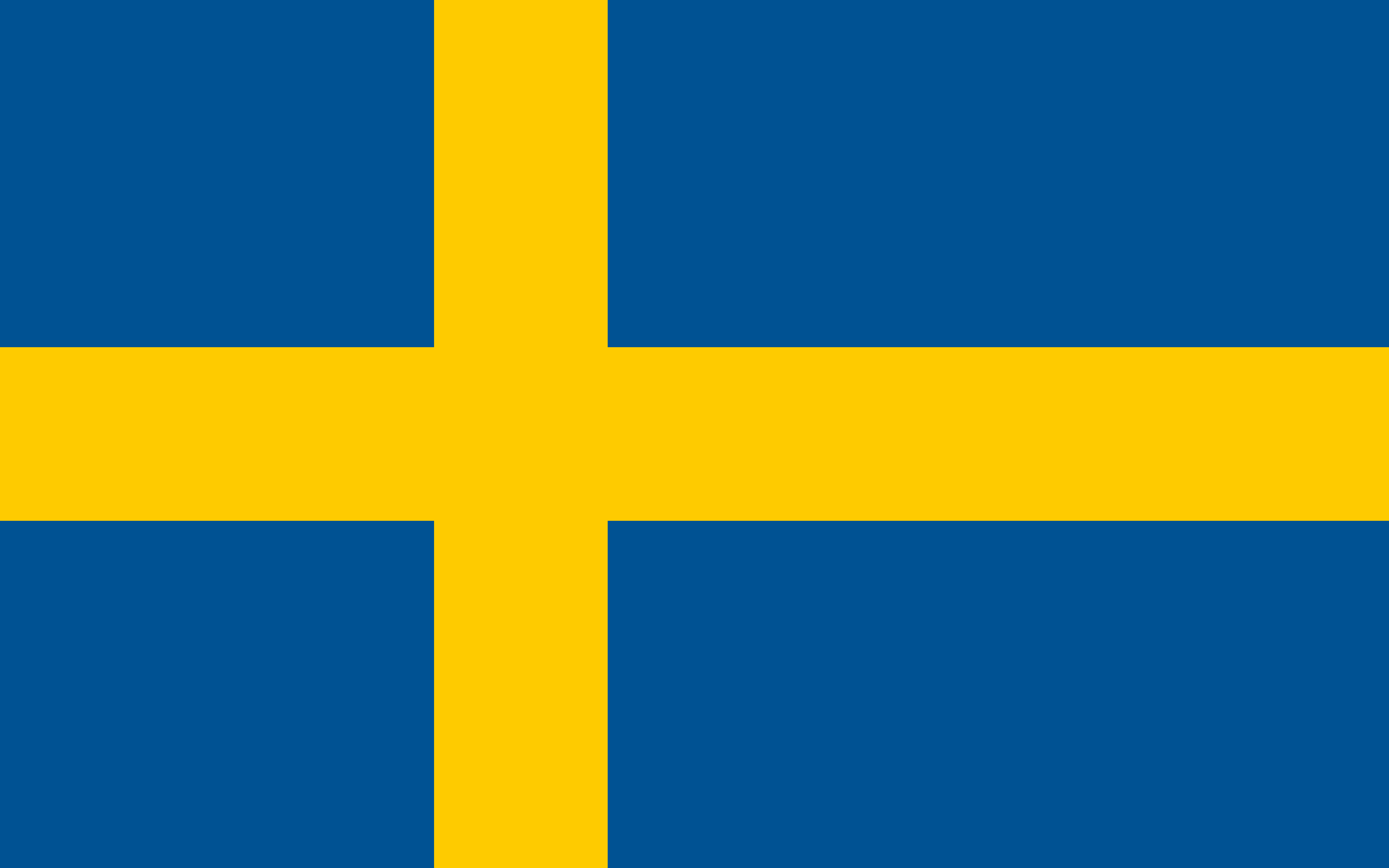
Sweden flag picture
Explore the proportions, history, and picture gallery.
| Country | Kingdom of SwedenNorthern Europe. |
|---|---|
| Design | Blue field · yellow Nordic crossNo coat of arms on the ordinary rectangle. |
| Proportions | Height:length = 5:8Horizontal 5:2:9; vertical 4:2:4. |
| Modern flag law | June 22, 1906Commencement specified for July 1; the cross is older. |
| Current specifications | SFS 1982:269 and 1983:826Flag construction and physical color references. |
| Main image sizes | SVG and PNG: 6,000 × 3,750Declared screen palette; opaque RGB PNG. |
Physical NCS/CIE specifications and declared screen colors have distinct roles. Heraldic meanings are explained in the article.
What does the Swedish flag look like?
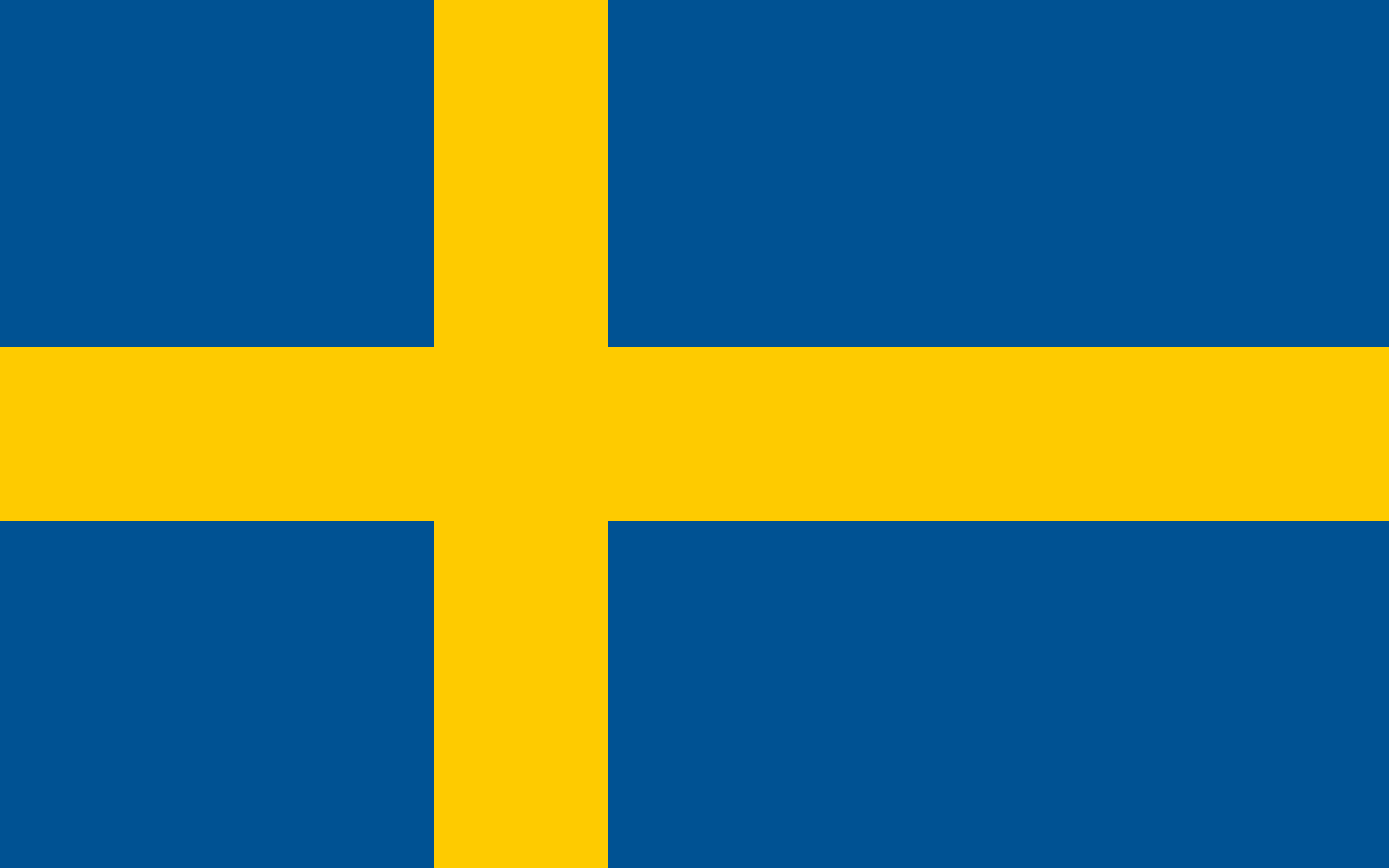
Sweden’s national flag is blue with a yellow Nordic cross extending to all four edges. The vertical arm sits nearer the hoist than the fly. The ordinary rectangular flag has height:length proportions of 5:8. Its modern legal history includes the 1906 flag law and the current 1982 statute.
The design contains two colors and one continuous cross. Four blue rectangles remain visible around the yellow arms, with the pair nearest the pole shorter than the pair at the free end. There is no surrounding border, lettering, or emblem on the ordinary flag. This collection supplies a clean master and explanatory pictures. Dimensions, labels, and historical panels belong to the teaching layouts around the flag. They do not add features to the national design, change its proportions, or turn a modern illustration into an archival object.
What is Sweden’s flag called?
The usual English names are Sweden’s national flag and the Swedish flag. In Swedish, Sveriges flagga means the flag of Sweden, while svenska flaggan means the Swedish flag. A country name and a version label are more precise than an invented nickname, especially when distinguishing the ordinary rectangle from royal or military forms.
Use Sweden in filenames and Swedish in descriptive captions. Both identify the same country and design. A caption such as Swedish national flag, rectangular form tells the reader which version is shown without suggesting that every flag used by Swedish institutions must have the identical outline.
Historical images benefit from a date as well as a national label. An additional canton mark or a three-tailed outline may be meaningful evidence of a particular period or function. Do not remove such details from an archival photograph merely to make it resemble the clean modern rectangular master.
What colors are on Sweden’s flag?
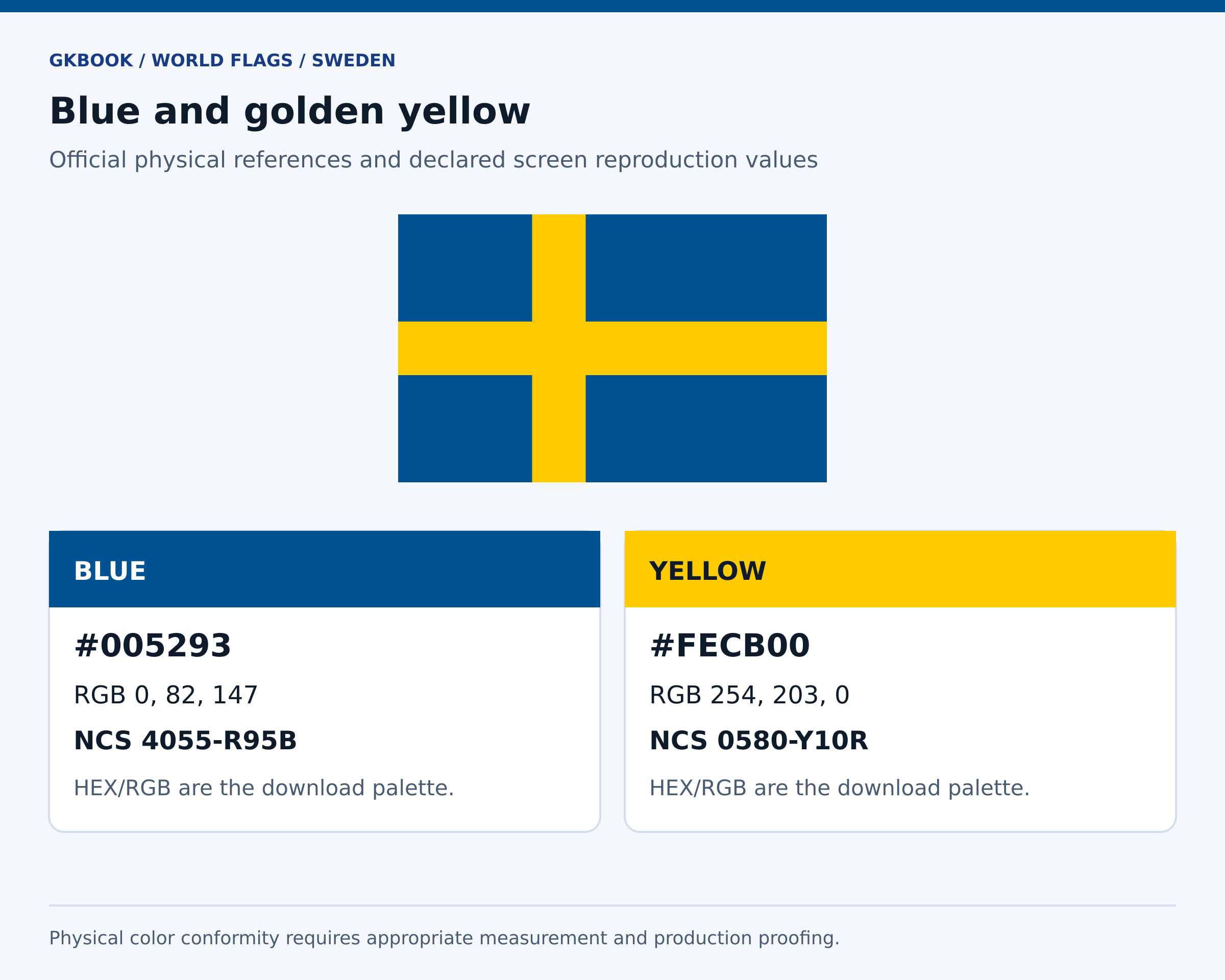
Sweden’s flag has a blue field and a golden-yellow cross. The official color ordinance specifies NCS 4055-R95B for blue and NCS 0580-Y10R for yellow. These downloads use #005293 and #FECB00 as declared screen values, matching the inspected reference SVG. Those hexadecimal numbers are not prescribed by the ordinance itself.

A color standard and a digital file answer different production questions. The standard provides a physical reference, while the file stores numerical channel values for a particular reproduction. Keep those roles visible when passing artwork between a website editor, a graphic designer, and a textile manufacturer.
The SVG and PNG use the same two declared fills. Neither contains a transparent blue field or a white separation around the cross. A display profile, viewing conditions, and the material used for printing can change perceived appearance even when the file’s stored numbers remain exactly the same.
| Color | Official NCS | Download HEX | Download RGB |
|---|---|---|---|
| Blue | 4055-R95B | #005293 | 0, 82, 147 |
| Yellow | 0580-Y10R | #FECB00 | 254, 203, 0 |
What does the blue on Sweden’s flag represent?
The strongest documented explanation connects the blue field with Sweden’s heraldic colors, particularly the blue background bearing golden crowns in the national arms. It should not automatically be described as an official symbol of lakes, sky, loyalty, or justice. Those associations require their own evidence rather than a generic color-meaning list.
A visual resemblance can suggest a memorable classroom comparison, but resemblance alone does not establish historical intention. Blue water and blue skies appear in many places. The connection to Swedish heraldry is more specific because it concerns an existing national visual tradition discussed by the National Archives.
In the drawing, blue occupies the four rectangular spaces outside the cross. That placement can be measured independently of symbolic interpretation. The calculated share of blue area describes this flat composition; it does not measure water coverage, population, or the importance of any group within the country.
What does the yellow on Sweden’s flag represent?
The yellow belongs to the same blue-and-gold heraldic tradition as Sweden’s national arms. The law describes the cross as golden yellow. Gold in heraldry can be represented by yellow in a flat flag image; this does not require metallic ink, glitter, or an added explanation that the cross officially represents sunshine.
A plain yellow fill keeps the shape readable at small sizes and reproduces the supplied vector consistently. Metallic effects would introduce reflections and shading that are absent from this master. They may be decorative treatments in other contexts, but they are not necessary to draw the national design.
The official physical color reference should guide a production discussion when close material matching is required. The RGB yellow in these downloads is a declared screen choice. Neither the word gold nor a bright monitor preview establishes that a printed surface will match an approved textile sample.
Why does Sweden’s flag have a Nordic cross?
Sweden’s flag belongs to the Nordic cross tradition, with a cross extending to the edges and its vertical arm toward the hoist. The Royal Court connects this family of banners with medieval Christian cross symbolism and identifies Denmark’s flag as a model. The historical explanation is distinct from a rule assigning religious identity to citizens.
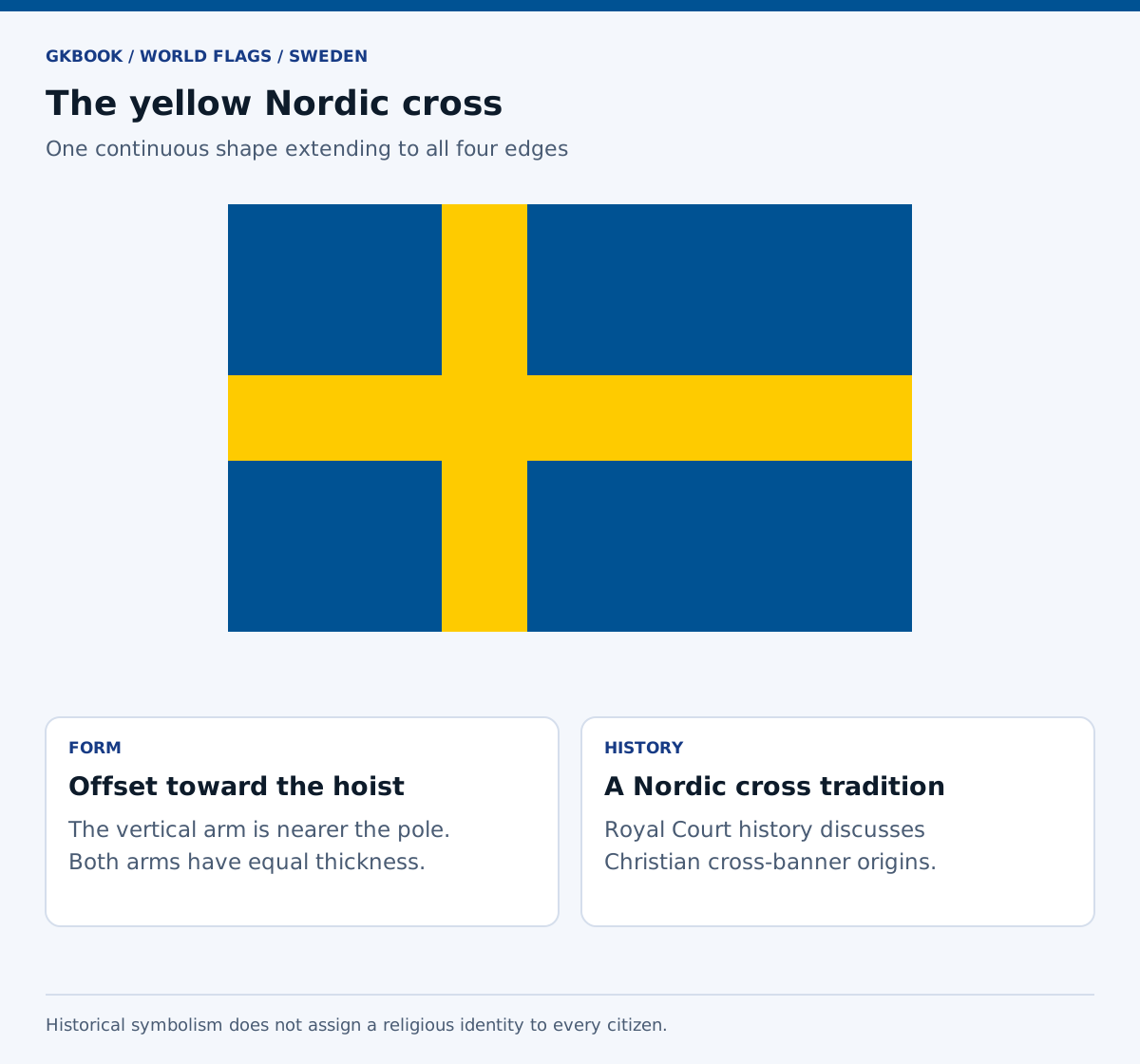
The cross remains one continuous shape where its arms meet. There is no central disk, inner outline, or gap between the vertical and horizontal parts. Those details matter when the flag is reduced to an icon, because even a thin contrasting border would introduce a feature absent from the design.
A Nordic cross is not enough by itself to identify a country. Colors, proportions, arm widths, and placement distinguish particular flags within the family. Sweden’s construction combines a blue field, a yellow cross, and specific unequal horizontal divisions. Copying another country’s outline and changing its colors can produce an inaccurate result.
What does Sweden’s flag symbolize?
The flag identifies Sweden through its blue-and-gold heraldic colors and Nordic cross. The official historical accounts explain those connections rather than supplying a universal one-word meaning for every color. Its use as a national symbol does not turn the measured areas, four blue fields, or cross arms into a demographic or political diagram.

Meaning and construction should be explained together without treating them as interchangeable evidence. A legal measurement establishes how wide an arm is. A historical account can explain the visual tradition behind the cross. Neither type of information automatically proves a separate story about each corner or each unit of area.
For a short description, identify the country, the two colors, and the cross first. Add the heraldic background when the reader needs historical context. This approach preserves the strongest documented connections and avoids presenting a memorable but unsupported interpretation as if it were an official national statement.
How old is Sweden’s blue-and-yellow flag?
The blue-and-yellow cross design is documented in the sixteenth century, well before the 1906 law. The Royal Court points to cross banners in Johan III’s ducal arms in 1557 and instructions mentioning the cross in 1569. Earlier heraldic origins are plausible, but they should not be presented as a proven single invention date.
The Royal Court discusses a possible connection with the fifteenth-century arms of Karl Knutsson Bonde. Its wording is cautious. An earlier heraldic composition can help explain a later banner without proving that a fully standardized national flag was already being used in precisely the form supplied here.
Dates attached to surviving images, instructions, laws, and modern file revisions describe different kinds of evidence. A documented sixteenth-century banner establishes an earlier history than the modern statute. It does not certify that every present dimension or current physical color tolerance was already fixed in that period.
What are Sweden’s flag proportions?
The ordinary rectangular flag has a height:length ratio of 10:16, usually simplified to 5:8. Across its length, the divisions are 5:2:9; down its height, they are 4:2:4. The supplied master is 6,000 × 3,750 pixels, preserving all these relationships without stretching or cropping the national rectangle.

Height:length describes the rectangle from top to bottom and from hoist to fly. In software that asks for width and height instead, enter those dimensions in the opposite order: a width of sixteen units and a height of ten units. The two descriptions refer to the same shape.
Choose one scale factor for both axes. For example, a sixteen-centimeter width requires a ten-centimeter height, while an eighty-centimeter width requires a fifty-centimeter height. Setting width and height independently can preserve a plausible-looking cross while quietly changing the legally defined proportions of the complete flag.
How wide is the yellow cross?
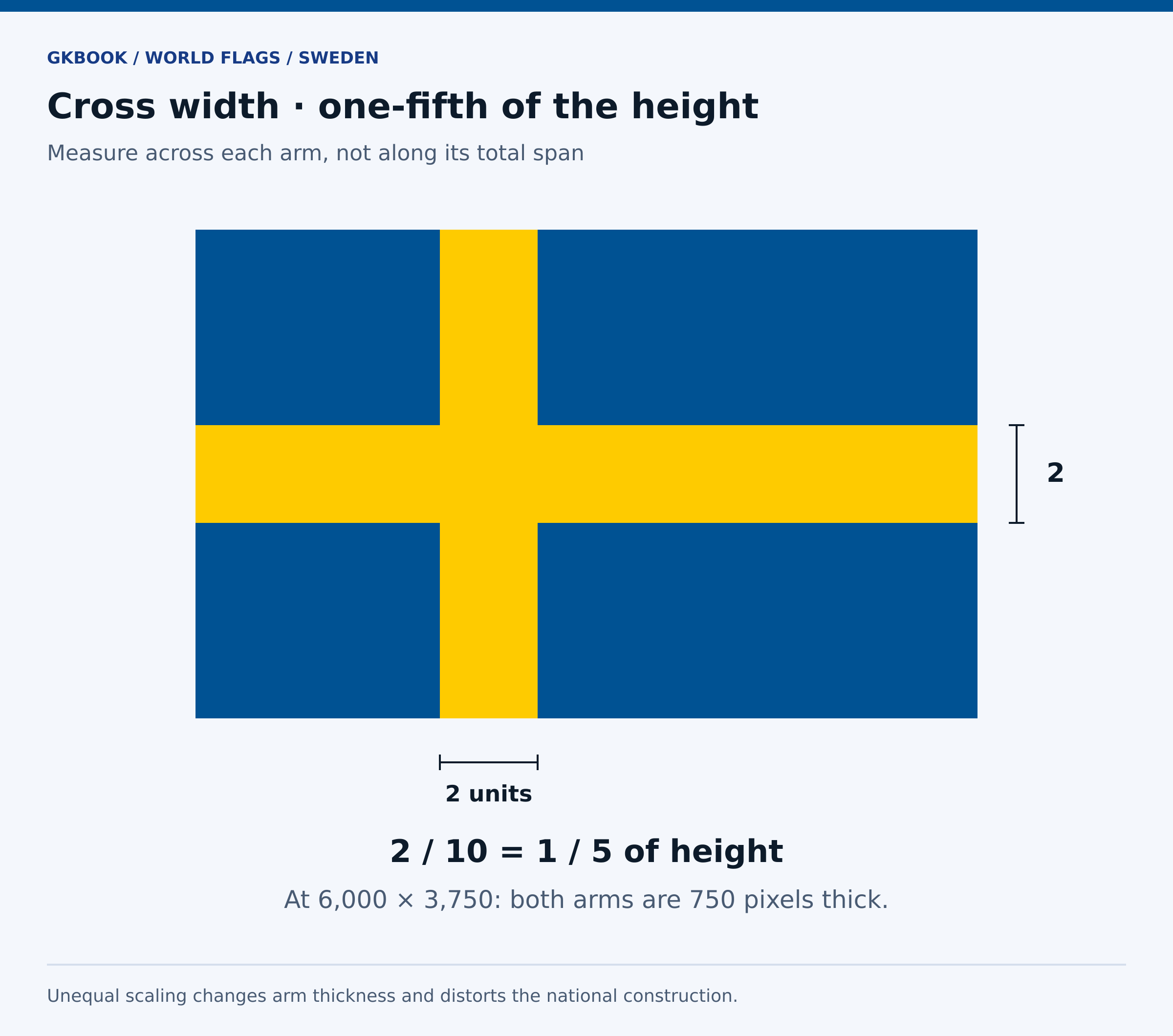
Both cross arms are two units wide on the ten-unit-high construction grid. Their thickness therefore equals one-fifth of the flag’s height, or one-eighth of its length. In the 6,000 × 3,750 master, each arm is 750 pixels thick. Measure perpendicular to each arm rather than along its overall length.
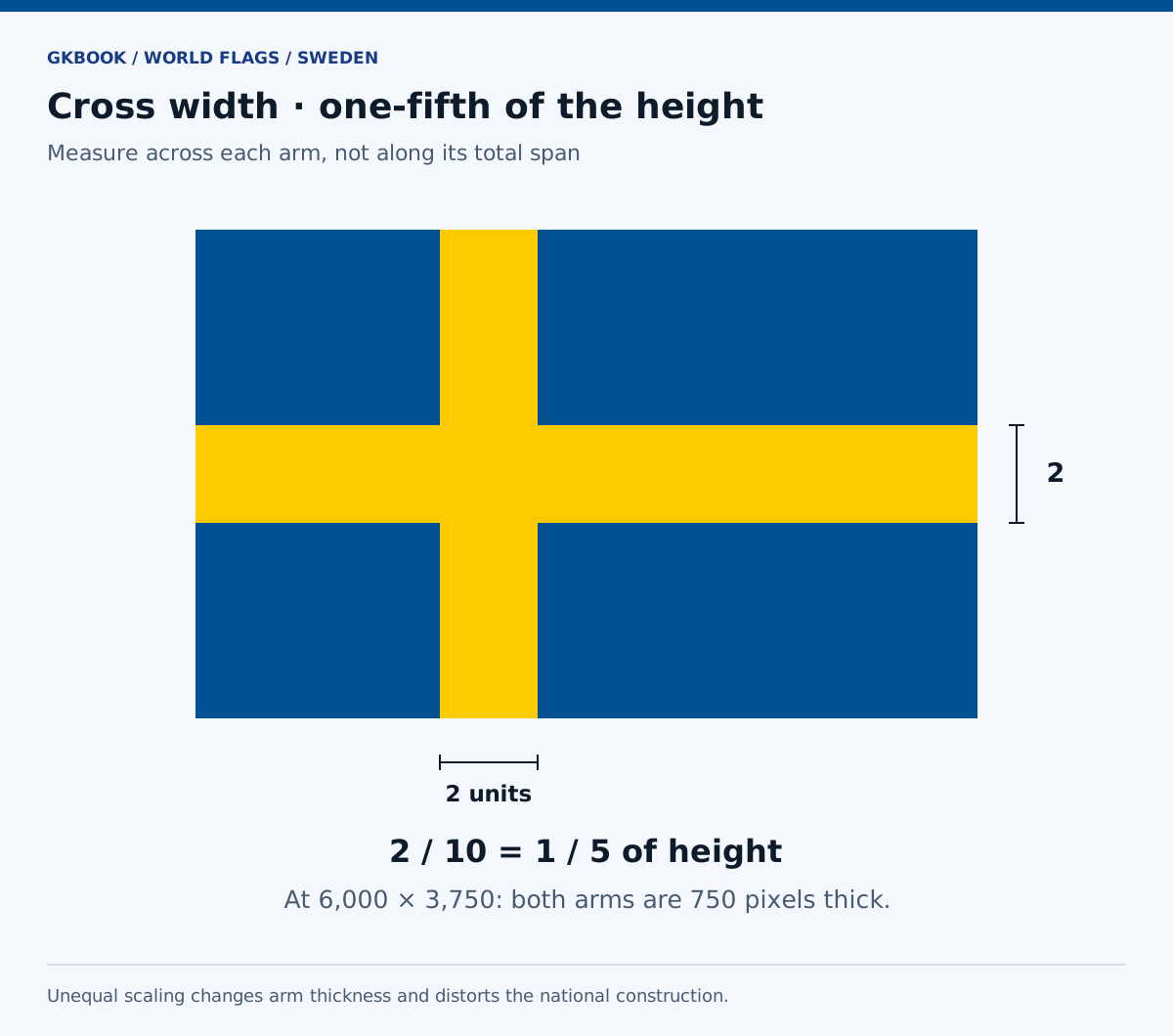
The horizontal arm spans the full six-thousand-pixel width, but that span is not its thickness. Its upper and lower edges are seven hundred fifty pixels apart. Likewise, the vertical arm runs from top to bottom, while the distance between its left and right edges gives its width.
Equal arm thickness keeps the intersection square. If a drawing program stretches only the horizontal axis, the vertical arm becomes wider while the horizontal arm keeps its old thickness. Comparing those two measurements provides a useful additional check when an image has been placed inside a resized layout frame.
How large are the four blue fields?
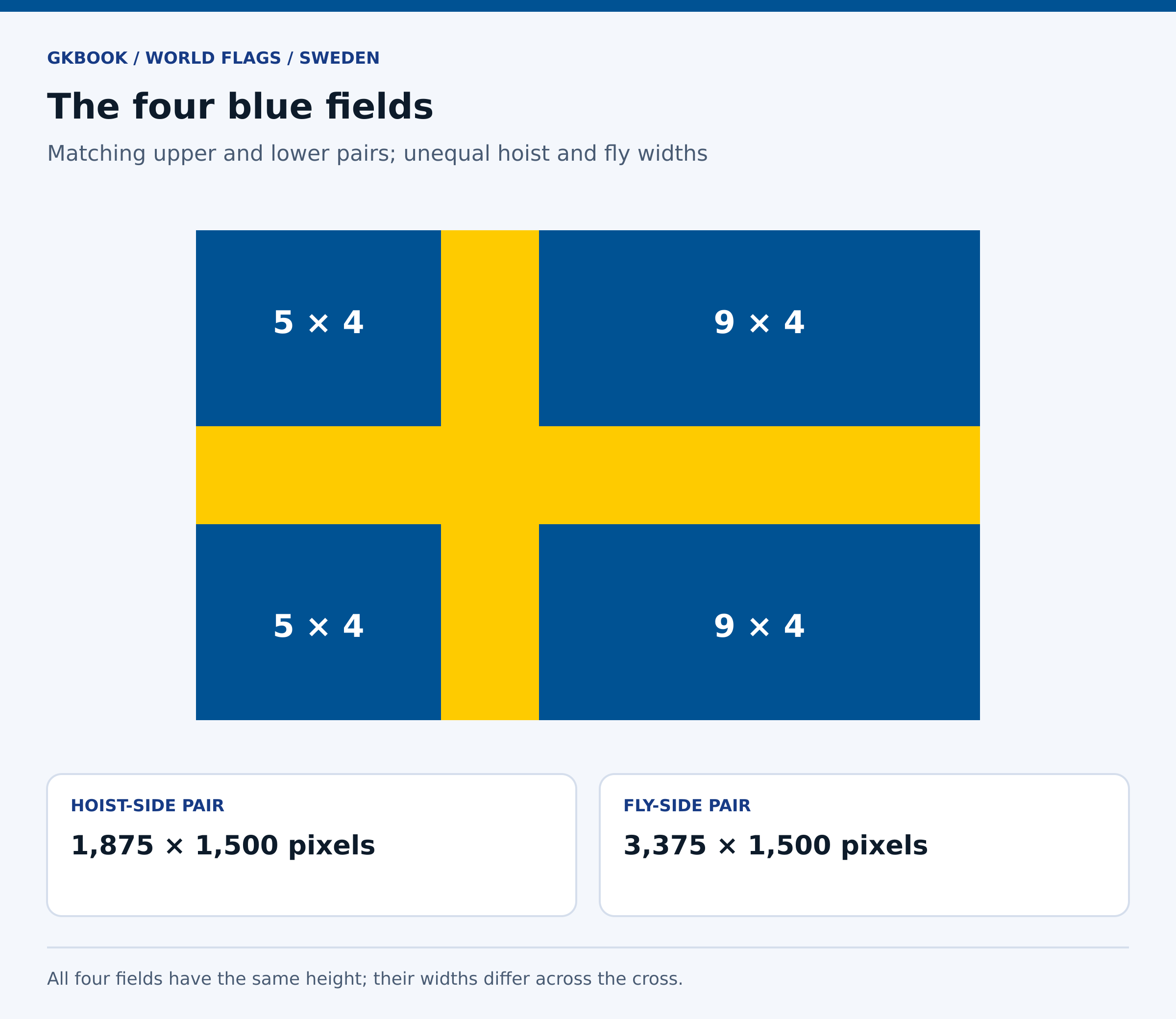
Each blue field beside the hoist measures five units across and four units high. Each field toward the fly measures nine units across and four units high. The top and bottom pairs match, but the left and right pairs do not. Their unequal widths create the characteristic offset of the Nordic cross.
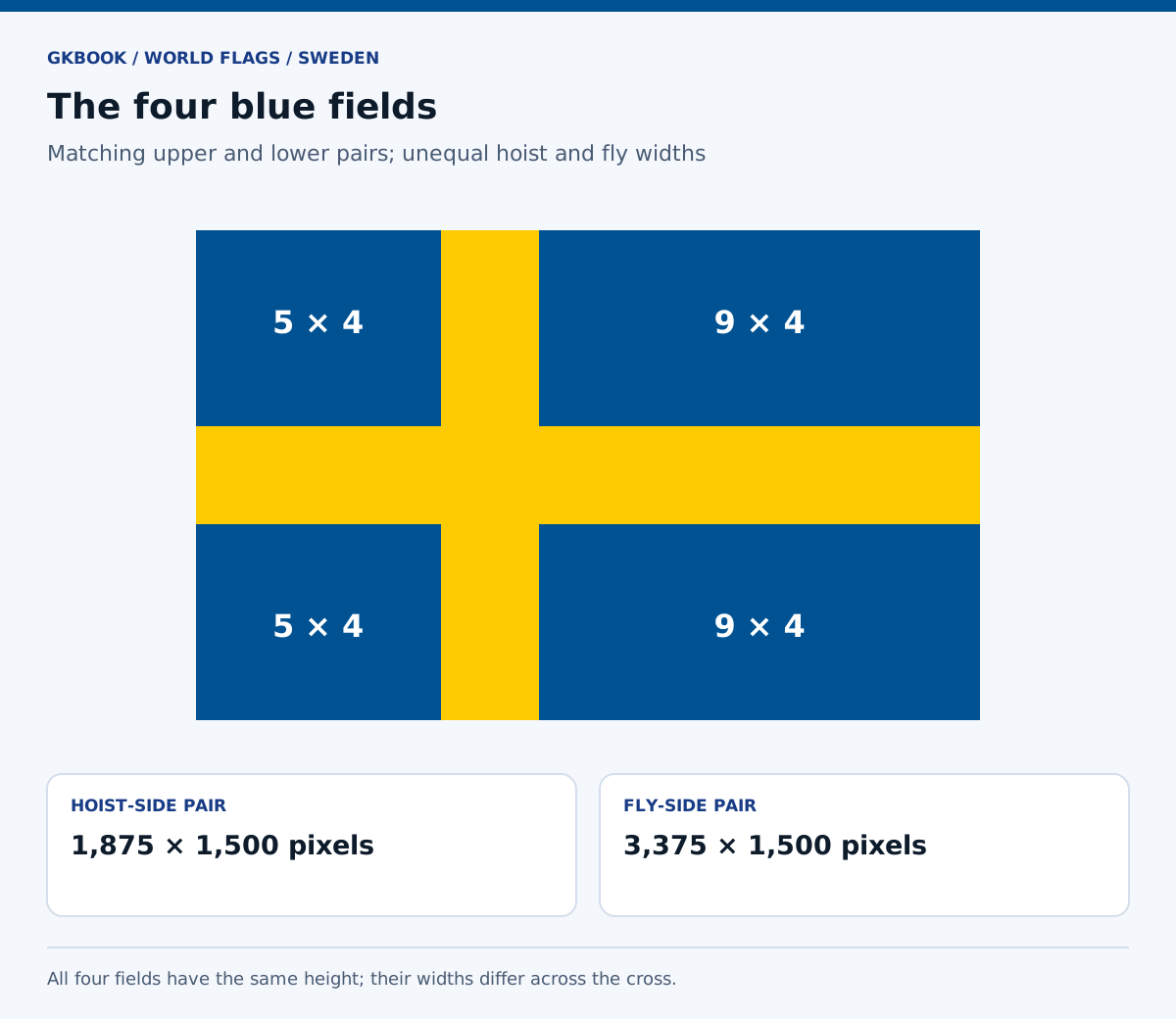
In the master, the two hoist-side fields each measure 1,875 by 1,500 pixels. The two fly-side fields each measure 3,375 by 1,500 pixels. These are visible blue areas after the yellow cross has been drawn, so their measurements exclude the cross rather than counting its overlap twice.
The four corners are rectangular, with straight shared boundaries against the yellow. Rounded corners, padding, or a drop shadow can be useful around an illustration on a webpage, but they should not be cut into the actual flag artwork. Preserve the complete blue corner fields in downloadable masters.
| Field pair | Width | Height |
|---|---|---|
| Hoist-side blue fields | 1,875 | 1,500 |
| Fly-side blue fields | 3,375 | 1,500 |
| Cross intersection | 750 | 750 |
Where is the cross intersection located?
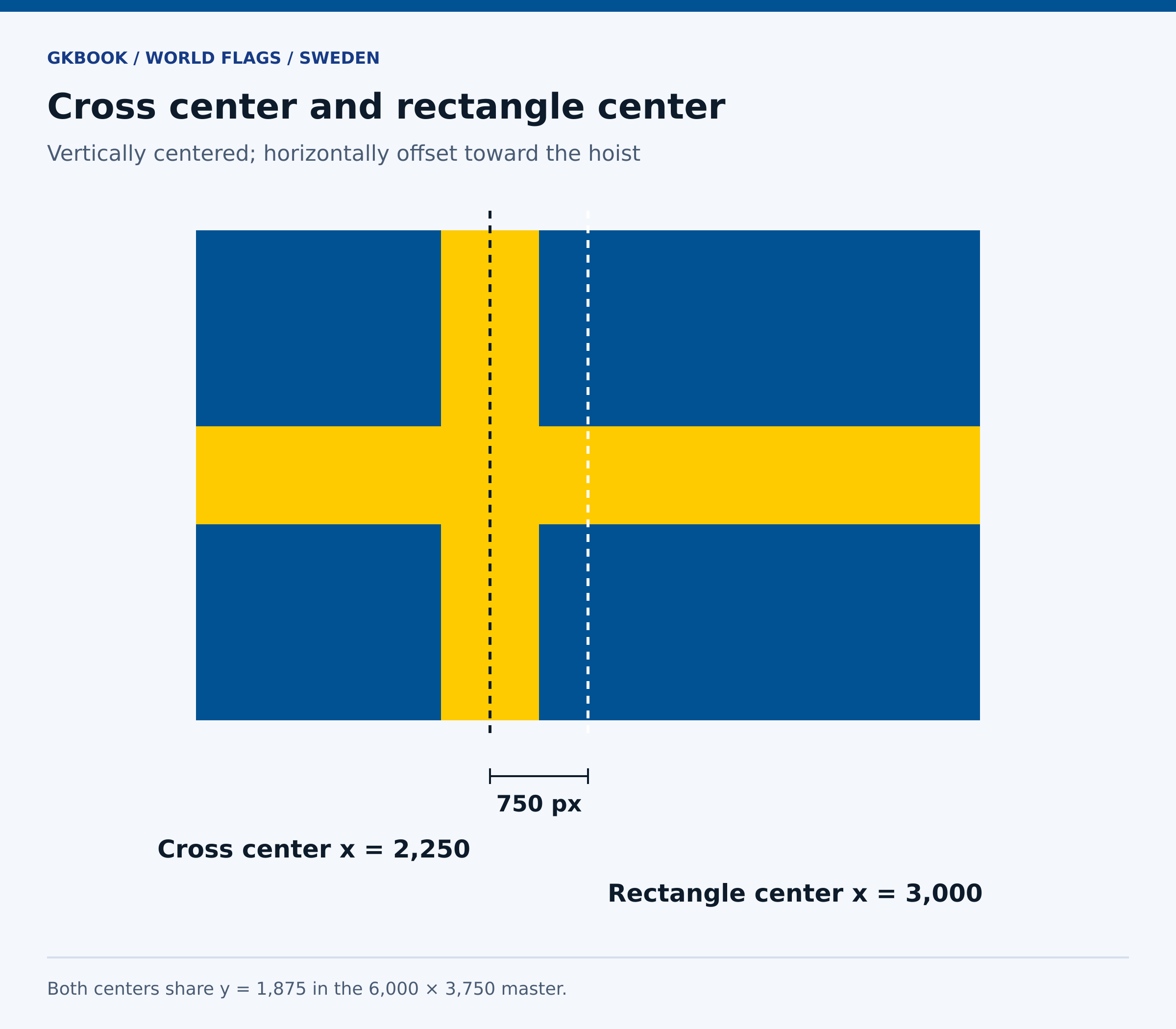
The center of the cross intersection lies six units from the hoist and five units from the top on a sixteen-by-ten grid. That is three-eighths of the flag’s length and half its height. In the master, the point is (2,250, 1,875), which lies 750 pixels left of the rectangle’s center.
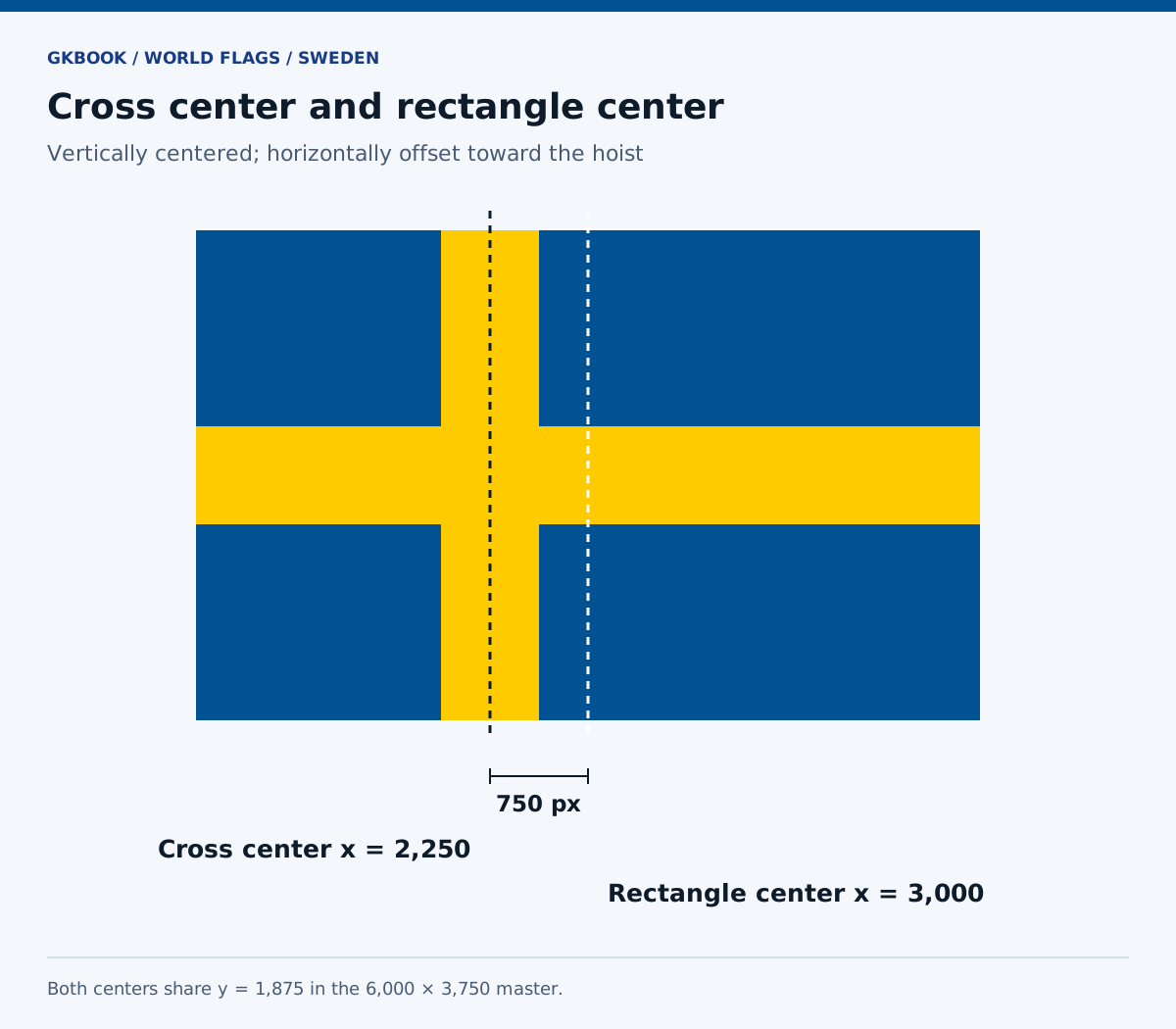
The cross is vertically centered but horizontally offset. These are separate measurements, so the word centered needs a stated direction. Moving the intersection to the middle of the rectangle would produce equal left and right fields and remove a defining feature of the Swedish national construction.
Measure from the hoist edge to the centerline of the vertical arm, not to its nearest yellow boundary. The boundary lies at five units, while the centerline lies at six. Confusing those two locations can shift a carefully measured cross by half its own thickness.
How can Sweden’s flag be drawn accurately?
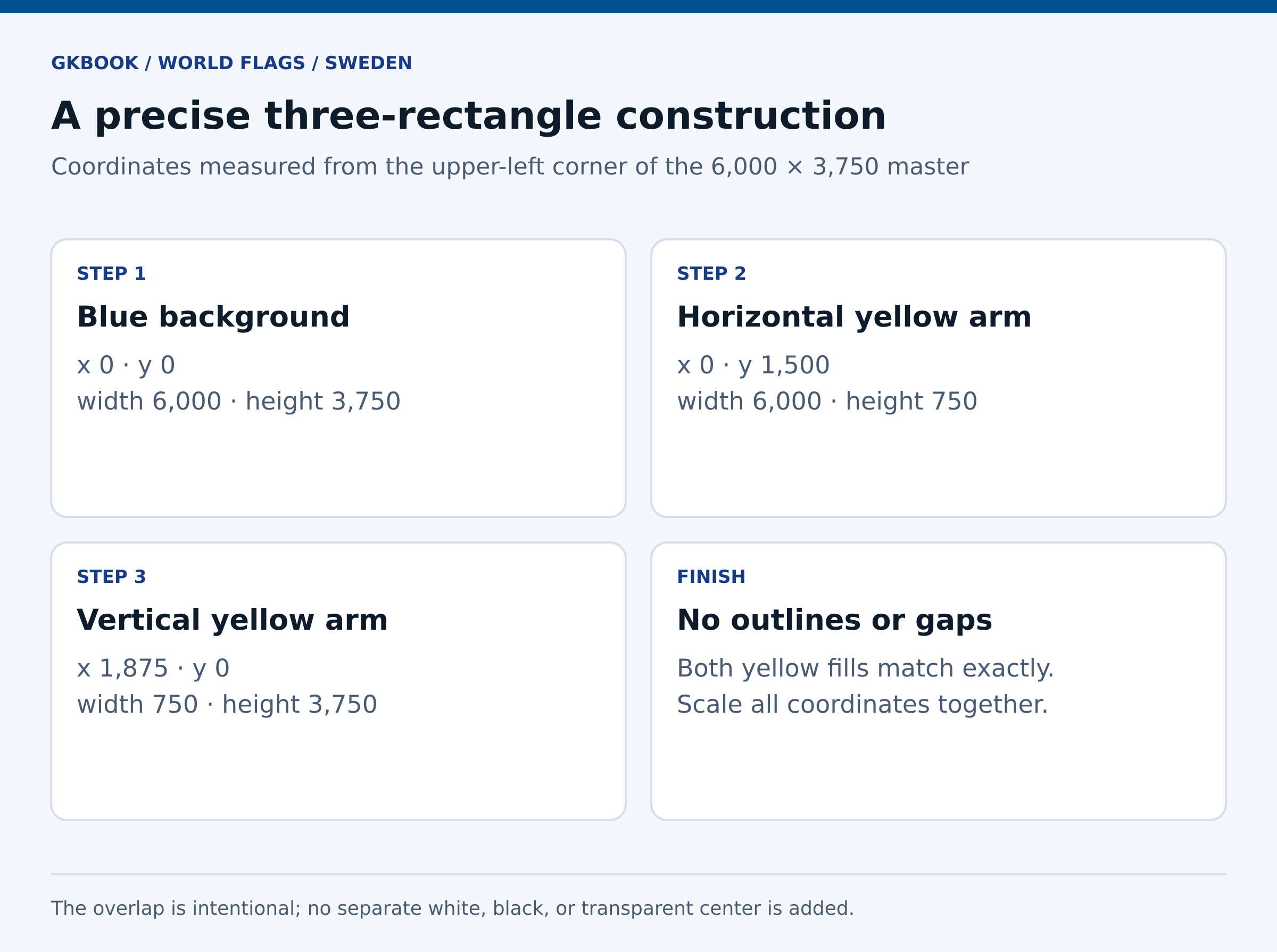
Start with a 6,000 × 3,750 blue rectangle. Add a yellow horizontal rectangle from y=1,500 to y=2,250 across the full width. Add a yellow vertical rectangle from x=1,875 to x=2,625 across the full height. These three shapes reproduce the required grid without strokes, outlines, or separate corner patches.
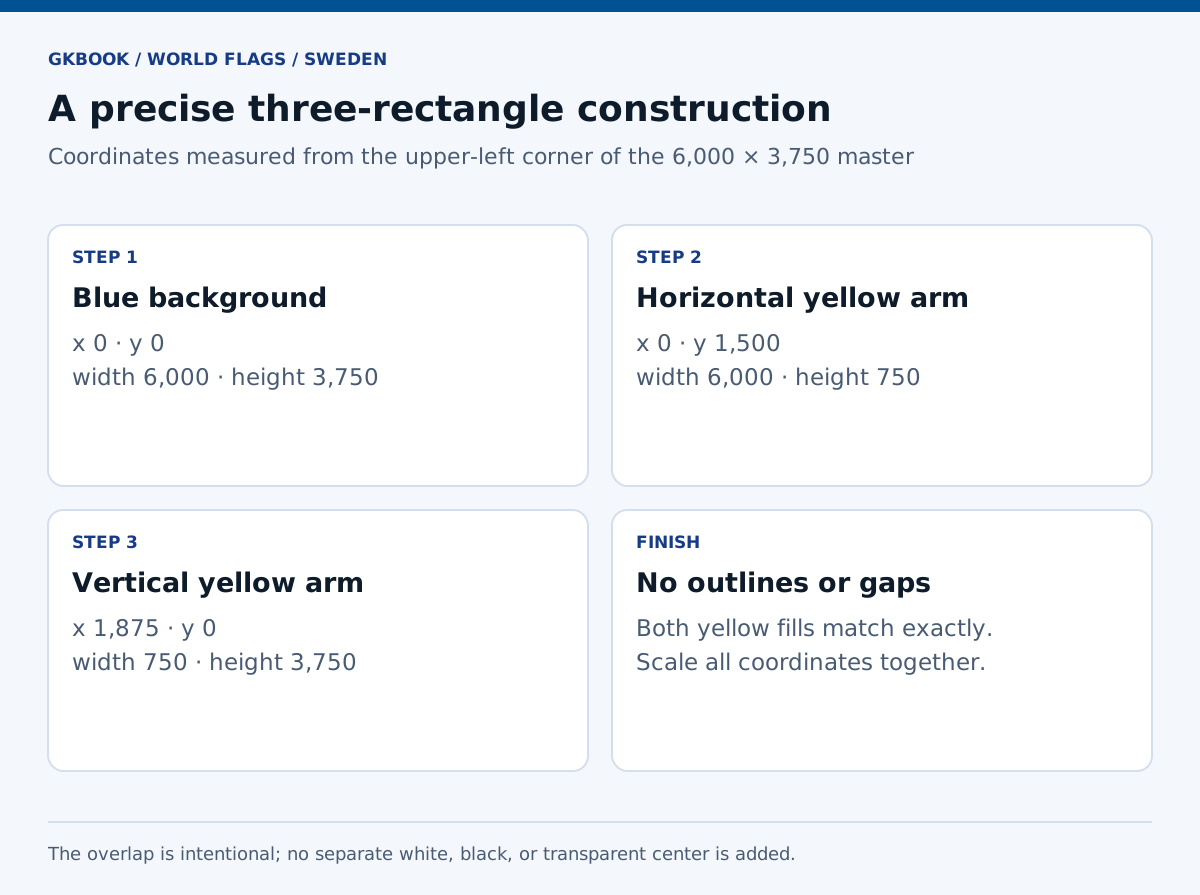
Coordinates begin at the upper-left corner, increasing rightward and downward. Use filled shapes with no border. The two yellow rectangles overlap at their intersection, so the finished cross has a seamless center. Their order does not affect the visible result because both use exactly the same fill.
A vector editor can express the same construction on a sixteen-by-ten canvas, then scale it uniformly. The larger master uses an integer unit of 375 pixels, making every boundary fall on an exact pixel edge. This provides a convenient raster export without changing the underlying mathematical design.
| Shape | x | y | Width | Height |
|---|---|---|---|---|
| Blue background | 0 | 0 | 6,000 | 3,750 |
| Yellow horizontal arm | 0 | 1,500 | 6,000 | 750 |
| Yellow vertical arm | 1,875 | 0 | 750 | 3,750 |
How much of Sweden’s flag is blue or yellow?
In the exact rectangular construction, yellow covers 30 percent of the area and blue covers 70 percent. The horizontal and vertical arms overlap, so their intersection must be subtracted once when calculating the cross. These percentages are geometric deductions from the proportions, not additional symbolic or demographic meanings assigned to the colors.

On the sixteen-by-ten grid, the whole flag has 160 square units. The horizontal arm covers thirty-two and the vertical arm twenty. Their shared two-by-two square covers four, giving forty-eight yellow square units after subtraction. The remaining one hundred twelve square units are blue.
At master resolution, that becomes 6,750,000 yellow pixels and 15,750,000 blue pixels because all boundaries fall on integer coordinates. The same fractions apply at every uniform scale. A small antialiased thumbnail can contain blended edge pixels, but that rendering behavior does not change the ideal area calculation.
How has Sweden’s national flag changed?
The blue-and-yellow cross predates modern legislation. During the nineteenth-century union with Norway, a union mark appeared in the upper hoist corner. Its removal in 1905 preceded the flag law of 1906. Later legislation retained the familiar cross while formalizing the current rules and more precise color references for reproduction.

The government’s 1906 bill recounts the union mark introduced in 1844 and its removal under the ordinance of October 27, 1905. Those changes concerned an added canton device. They should be distinguished from the much earlier development of the blue-and-yellow cross itself.
The historical pictures in this collection are explanatory panels, not reproductions of authenticated nineteenth-century cloth. A current clean flag can introduce the subject, but a genuine period illustration must retain its own details and date. Removing a union mark from such an image would alter the historical evidence.
When was Sweden’s present flag adopted?
June 22, 1906 is the date of the modern flag law commonly associated with adoption of the present flag. The parliamentary adopted text specified July 1, 1906 as its commencement. The cross design itself is older, and the union mark had already been removed in 1905; these dates describe different events.
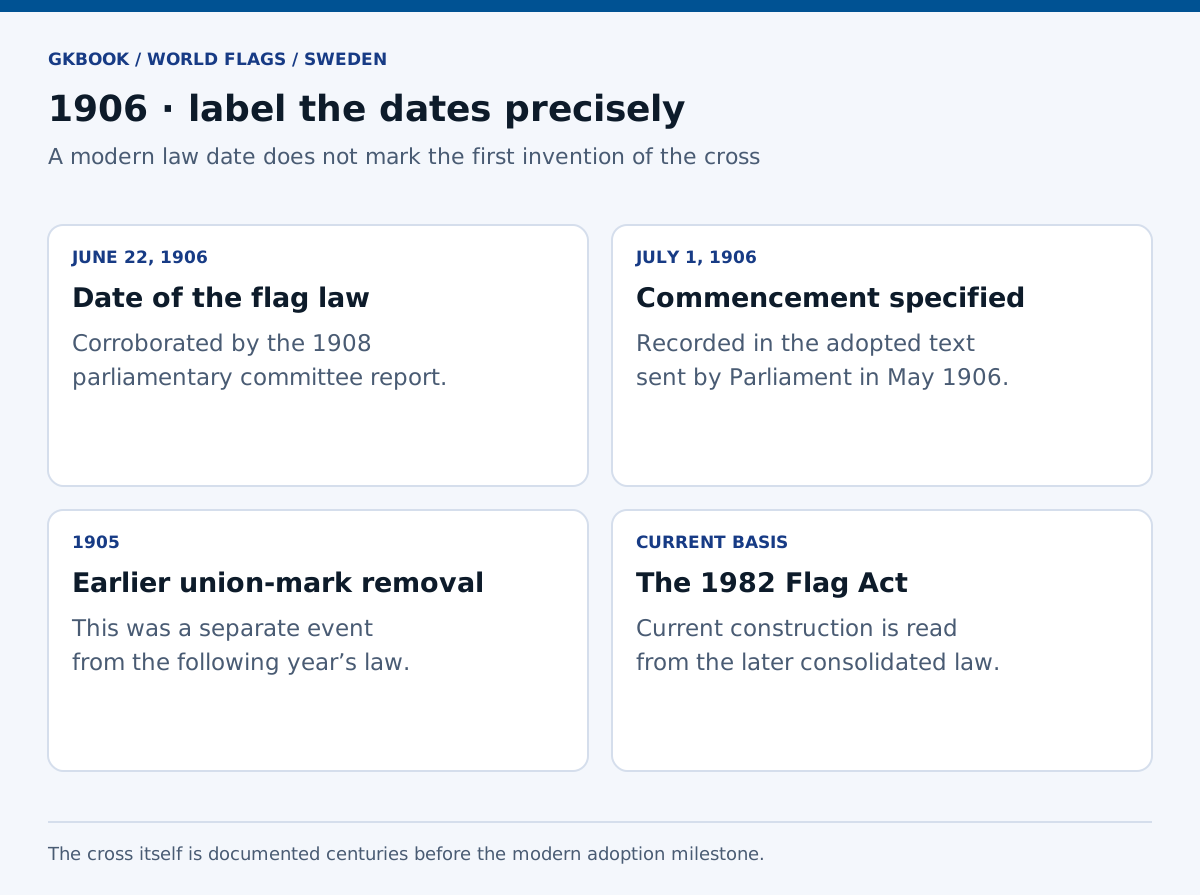
The June date is corroborated by a 1908 parliamentary committee report referring to the law of June 22, 1906. The May 1906 parliamentary communication records the adopted text and its commencement clause. This review did not obtain the original promulgated gazette copy, so that access distinction is retained.
A concise timeline should label legislation, commencement, and earlier design changes separately. Otherwise a reader may assume that Sweden invented the blue-and-yellow cross on the day the law was issued. The current legal specification is the later 1982 statute, which should also be distinguished from the historical adoption milestone.
Who designed Sweden’s national flag?
No single verified designer can be assigned to the centuries-old Swedish cross flag from the sources reviewed here. Its development belongs to a longer heraldic and Nordic tradition. The 1906 standardization involved official proposals and legislative decisions; a person associated with one proposal should not automatically be credited with inventing the national design.

The 1906 government bill discusses a Naval Staff proposal and a proposal from consul O. Trapp, favoring the former for the dimensions. That documented comparison is narrower than a claim that either party originated the blue-and-yellow cross. Design development and later standardization are separate historical questions.
The names attached to modern vector files identify contributors to particular digital drawings. They are not evidence of authorship of the national symbol. GKBook’s credit similarly concerns the reconstruction, measurements, educational layouts, and exports prepared for this collection, without claiming an original historical design or official commission.
What was the union mark on Sweden’s earlier flag?
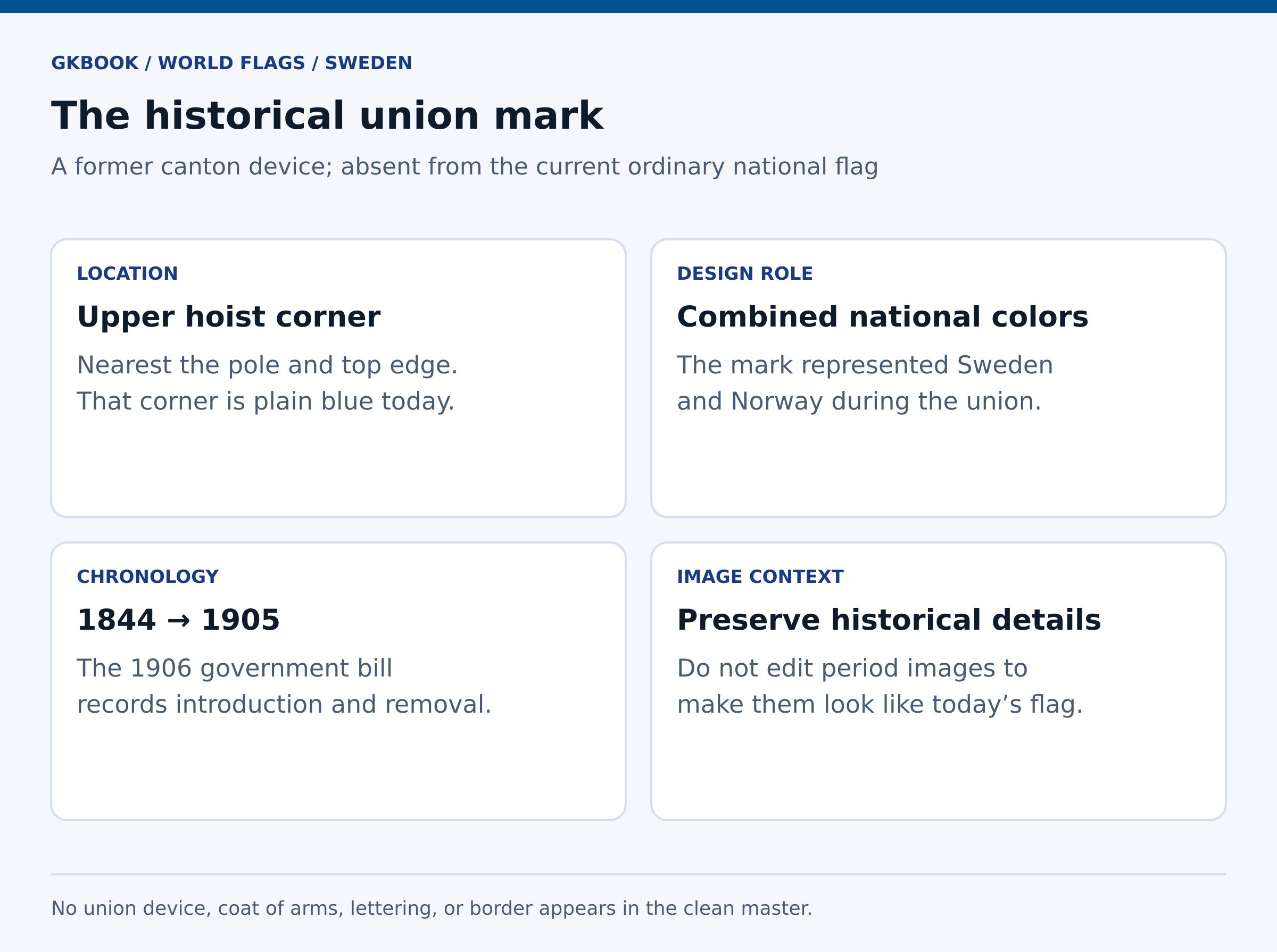
The union mark was a device combining Swedish and Norwegian colors in the upper hoist corner during the union period. The 1906 government bill records its introduction in 1844 and removal in 1905. It was an addition to the flag, not a different name for the yellow cross or the national coat of arms.
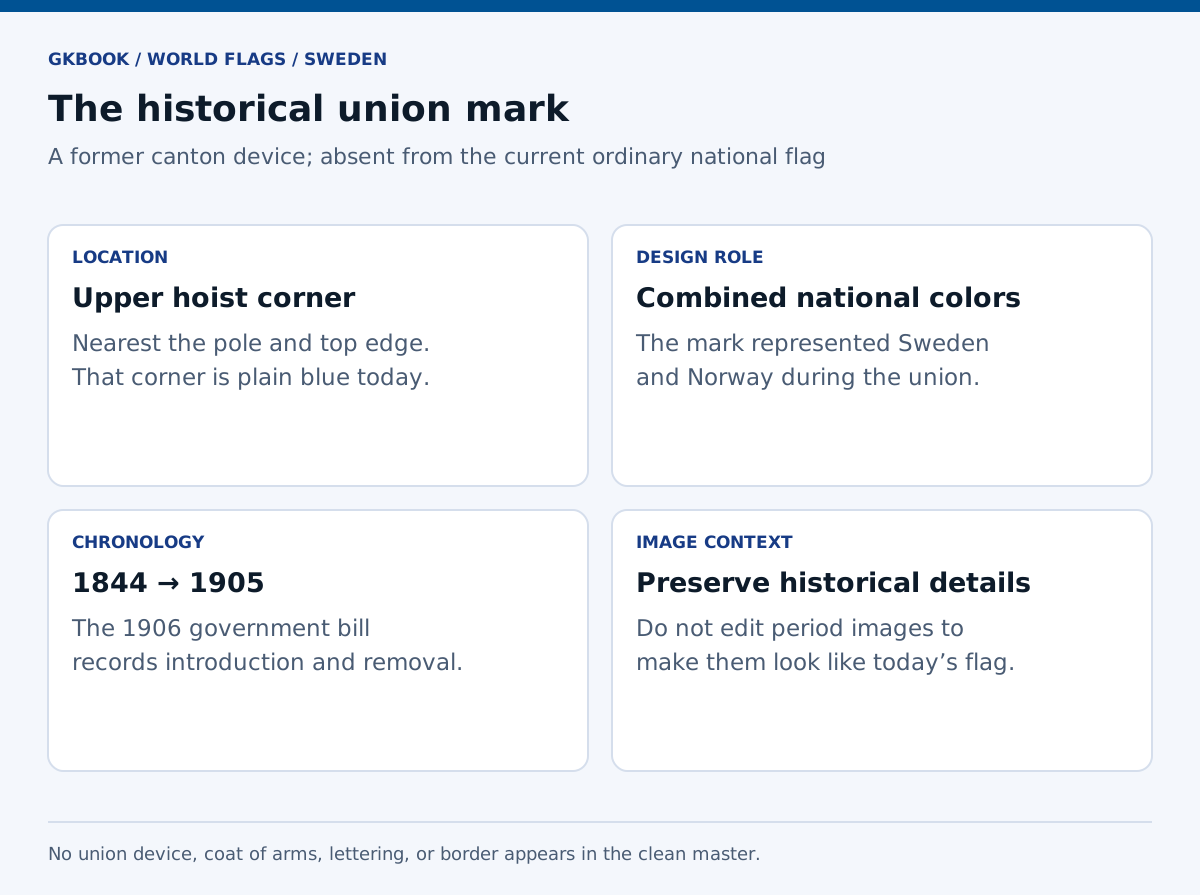
The upper hoist corner is the area nearest both the pole and the top edge. On an ordinary modern Swedish flag, that area is blue. Identifying the location helps explain a historical description even without supplying a speculative drawing of the old mark’s exact geometry and colors.
A modern teaching panel should clearly say that it describes an earlier feature. The clean master in this package represents the current rectangular design and therefore contains no union mark. Historical photographs, surviving flags, and contemporary drawings require their own source checks before being treated as faithful examples of a particular year.
Which standards govern Sweden’s flag today?
The current construction is set out in the Flag Act, SFS 1982:269. The color ordinance, SFS 1983:826, specifies NCS and CIE references and tolerances. These files follow the statutory geometry and declare their screen palette separately. They do not claim laboratory verification against the physical standard or official certification of manufactured material.
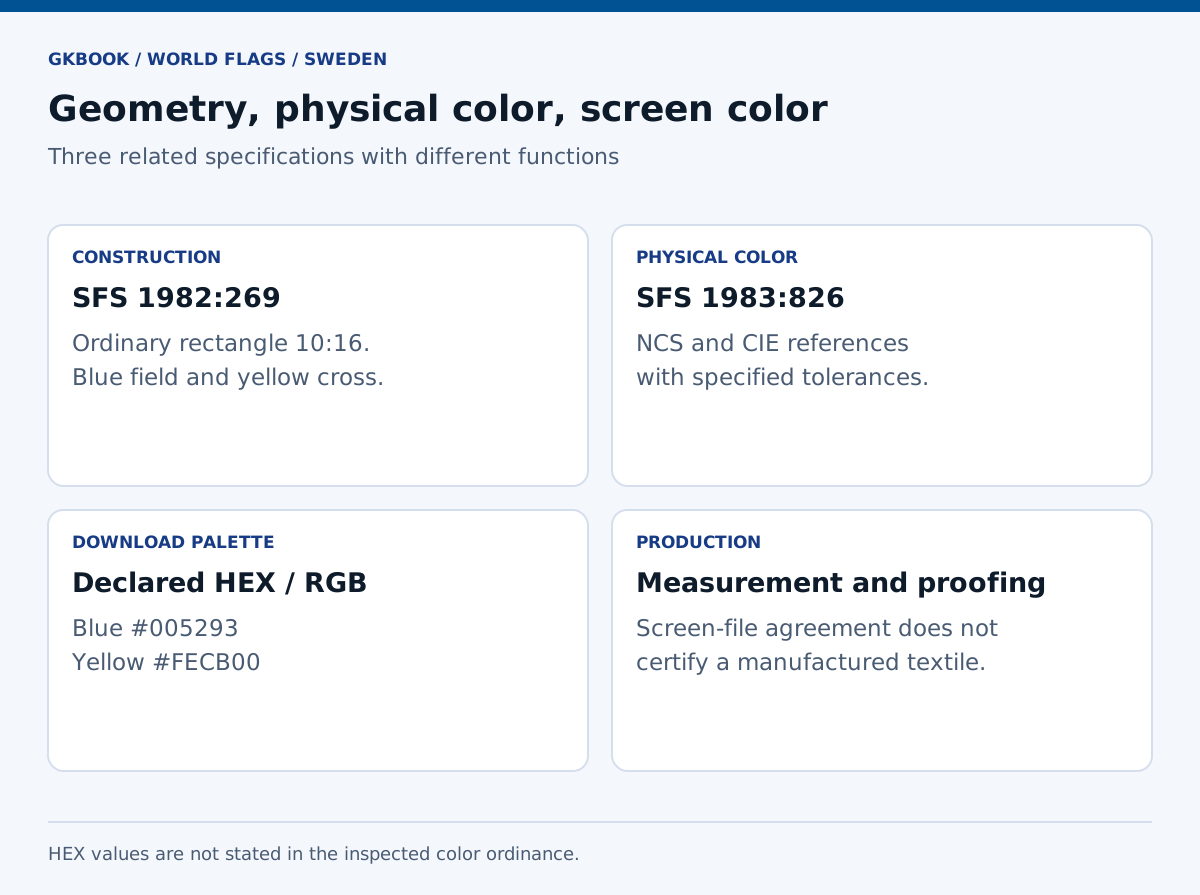
The ordinance gives blue chromaticity x=0.189, y=0.192 and reflectance factor Y=8.3; yellow uses x=0.472, y=0.465 and Y=64.4. These measurements are not RGB channel values. Converting between systems requires appropriate color-management assumptions, so they should not be copied directly into a graphics program as screen components.
The National Archives also gives reproduction guidance using Pantone references, including different coated and uncoated yellow choices. That distinction illustrates why a single screen code cannot settle every production method. The referenced measurement standard and physical sample testing were not obtained or performed for this digital collection.
| Color | NCS | CIE x | CIE y | Reflectance Y |
|---|---|---|---|---|
| Blue | 4055-R95B | 0.189 | 0.192 | 8.3 |
| Yellow | 0580-Y10R | 0.472 | 0.465 | 64.4 |
When is Sweden’s National Day and Flag Day?
Sweden’s National Day and Swedish Flag Day fall on June 6. Nationwide Flag Day observance dates from 1916; the day became the official National Day in 1983 and a public holiday in 2005. The commemorated milestones include Gustav Vasa’s election in 1523 and the constitution of 1809, rather than the June 1906 flag-law date.
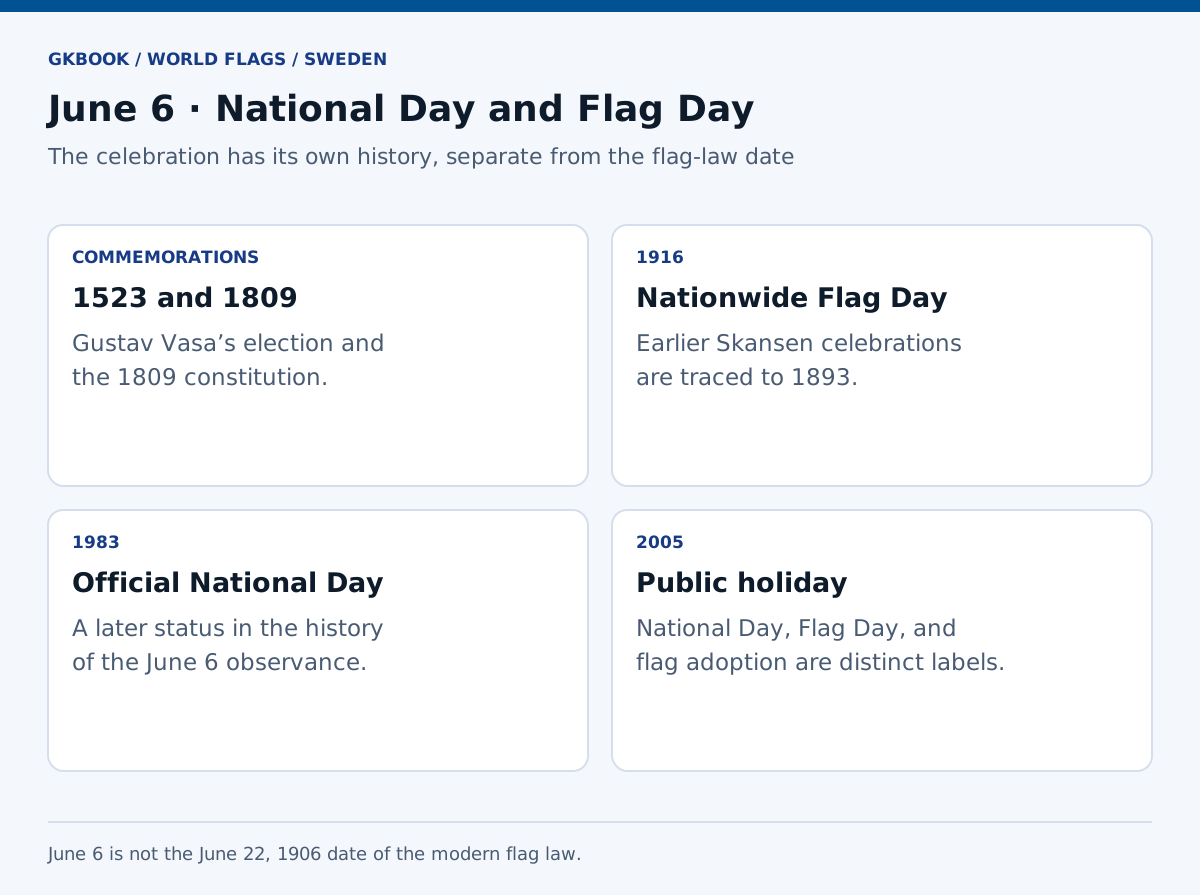
The Royal Court’s account traces earlier celebrations at Skansen to Artur Hazelius in 1893. That local initiative and the later nationwide observance belong to different stages. Naming both without their scope can make the history appear inconsistent even though the dates describe separate developments in the celebration.
The official flag-day ordinance also lists occasions such as Veterans Day on May 29, United Nations Day on October 24, and Nobel Day on December 10. A flag-day calendar tells people when an occasion is observed; it does not redefine the flag’s dimensions or establish a new adoption date.
Does June 6 mark a modern independence declaration?
June 6 is Sweden’s National Day, with commemorations tied to Gustav Vasa’s election as king in 1523 and the 1809 constitution. It should not be presented as a modern colonial independence declaration or confused with the 1905 end of the union with Norway. Those descriptions refer to different historical developments and political relationships.

National holidays often gather several historical associations into one annual observance. The existence of a holiday therefore does not establish that a country began, adopted its current flag, or received universal international recognition on that exact date. Each of those claims needs a specifically identified event and appropriate evidence.
For this collection, the safest timeline labels are the documented commemorations and the dated changes to the flag. A current Swedish flag can illustrate a National Day article without being described as the exact banner used in 1523. That distinction preserves the difference between modern illustration and historical documentation.
When did Sweden become a United Nations member?
Sweden’s United Nations membership became effective on November 19, 1946, when its instrument of adherence was presented under the rules then in force. The General Assembly decision was dated November 9, and registration followed on December 14. These are separate steps; none is Sweden’s flag-adoption date or a universal date of recognition.
The United Nations Treaty Collection explicitly explains the early membership procedure in its footnote for the first six new members. Reading only the decision-date column would miss the later effective date. The actual instrument of adherence provides another dated record, while its registration belongs to the administrative recordkeeping process.
Membership in an international organization is different from a country’s historical formation and from recognition by an individual foreign government. The distinction matters when building a concise country factbox. The flag’s construction is established through Swedish law, not through the date on which a United Nations document was registered.
Are there different official forms of Sweden’s flag?
Yes. The law distinguishes the ordinary rectangular flag from a three-tailed form used in specified royal and military contexts. The rectangular flag has height:length proportions of 5:8; the three-tailed form has an overall ratio of 1:2 including its tails. The latter should not be substituted casually for the ordinary national rectangle.
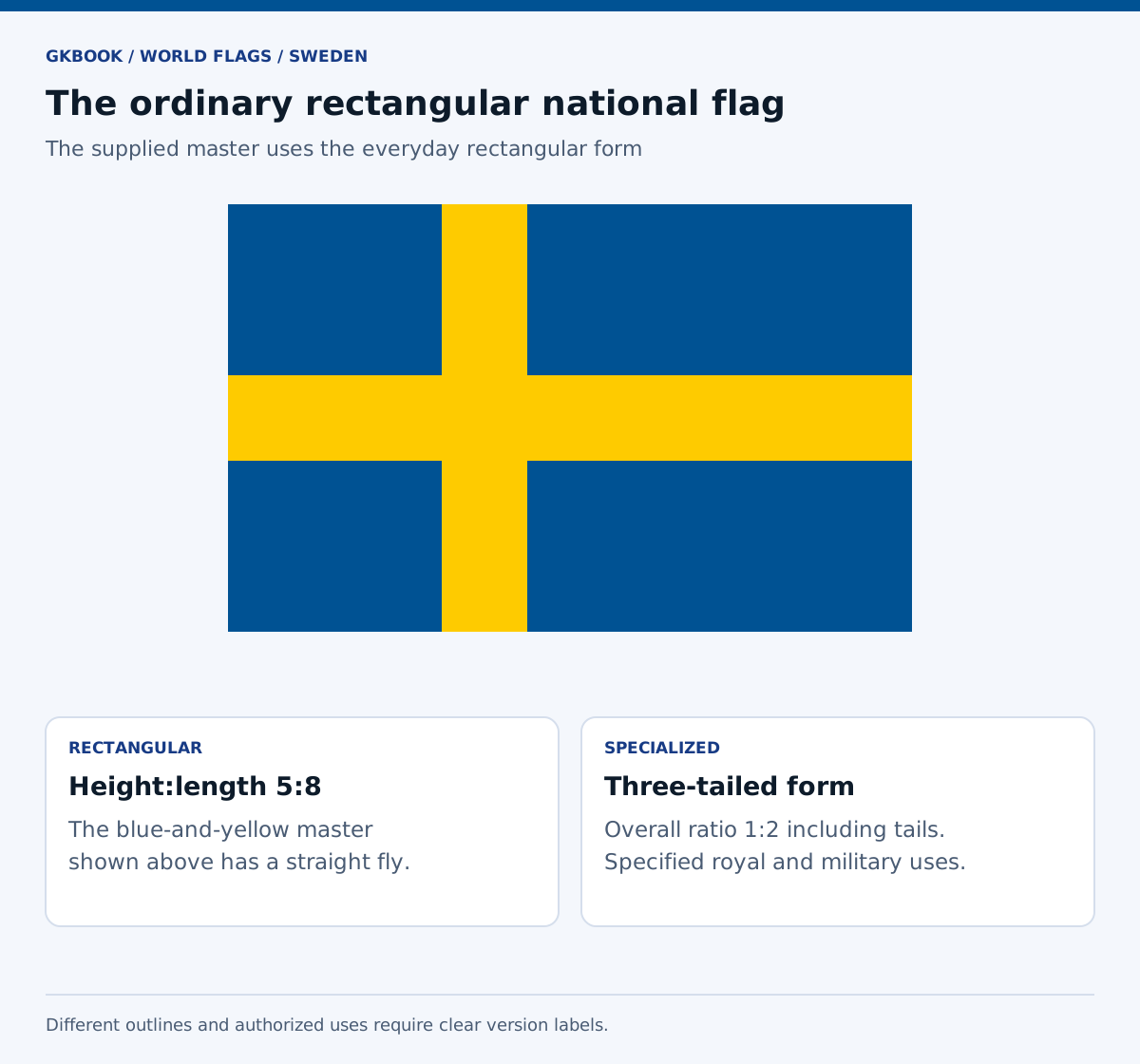
A change in outline can signal a change in authorized use. The royal and military provisions are therefore more than optional decorative cuts at the fly. This package supplies the ordinary rectangular master and explains the other form without pretending that a simplified sketch establishes every specialized detail or entitlement.
When selecting an image for a general country article, confirm that its outline matches the intended subject. A royal flag photographed above a palace can accurately document that setting while being unsuitable as an unlabeled example of the ordinary rectangle. Context and version labels prevent that avoidable confusion.
Does the ordinary Swedish flag contain a coat of arms?
No. The ordinary rectangular national flag consists of the blue field and yellow cross without a coat of arms or lettering. The law provides particular royal exceptions for arms on a white field at the cross center. Those specified uses do not make the arms part of every Swedish flag or authorize arbitrary added emblems.
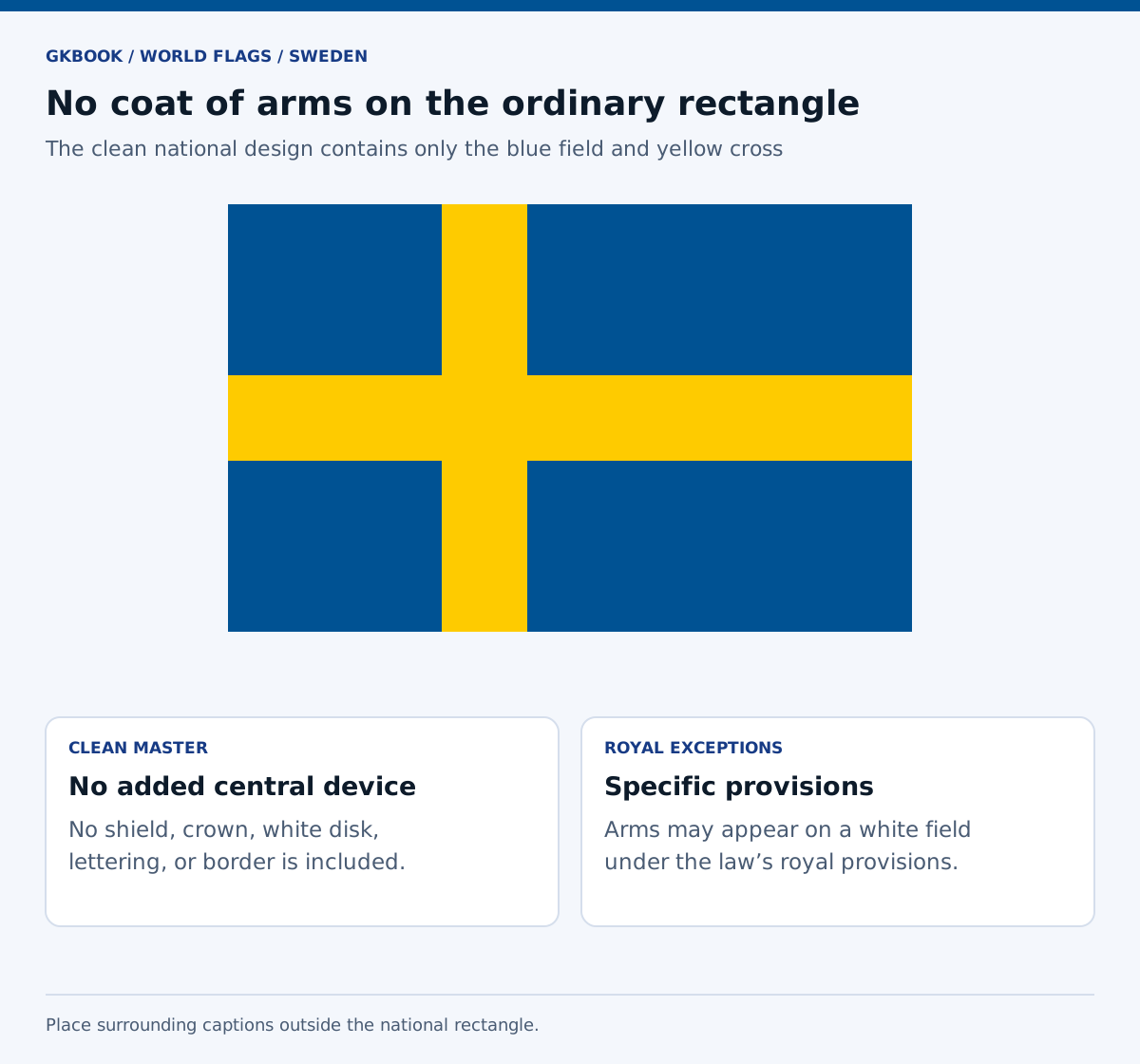
A page may place a national flag beside a coat of arms while keeping them separate symbols. The surrounding layout does not change the flag’s own contents. Likewise, a caption, institution name, or event date can appear outside the rectangle without being printed over the cross.
The clean SVG therefore contains only the background and two crossing yellow rectangles. It has no white central panel, crown, shield, or text. A specialized royal or institutional reproduction would need its own verified reference and appropriate use context, rather than an unannounced modification of this ordinary master.
When should Sweden’s flag be raised and lowered?
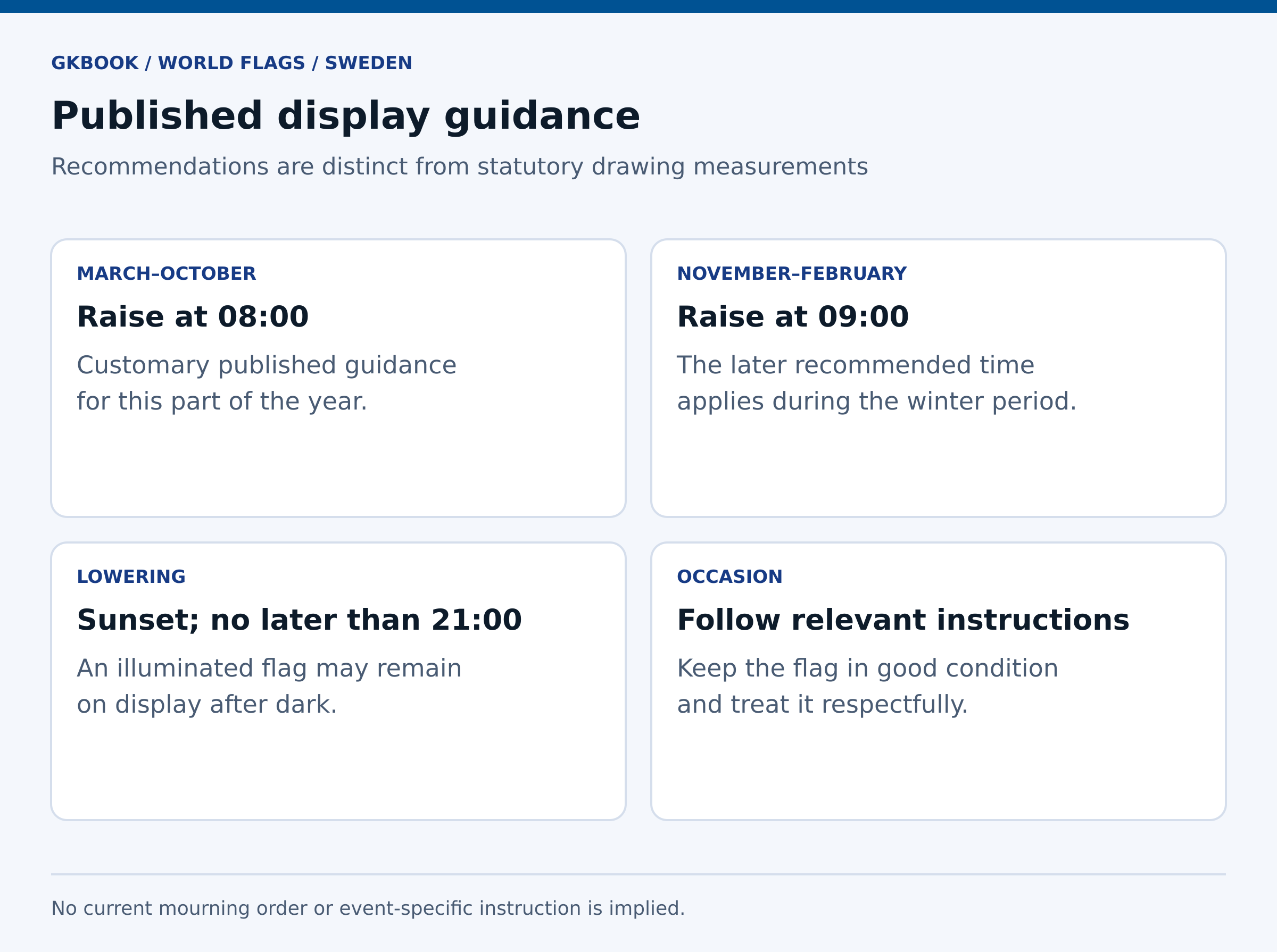
Published guidance recommends raising the flag at 08:00 from March through October and 09:00 from November through February. It is normally lowered at sunset, no later than 21:00; illumination allows display after dark. These are display recommendations, distinct from the statutory construction rules, and specific ceremonial instructions may address the occasion.
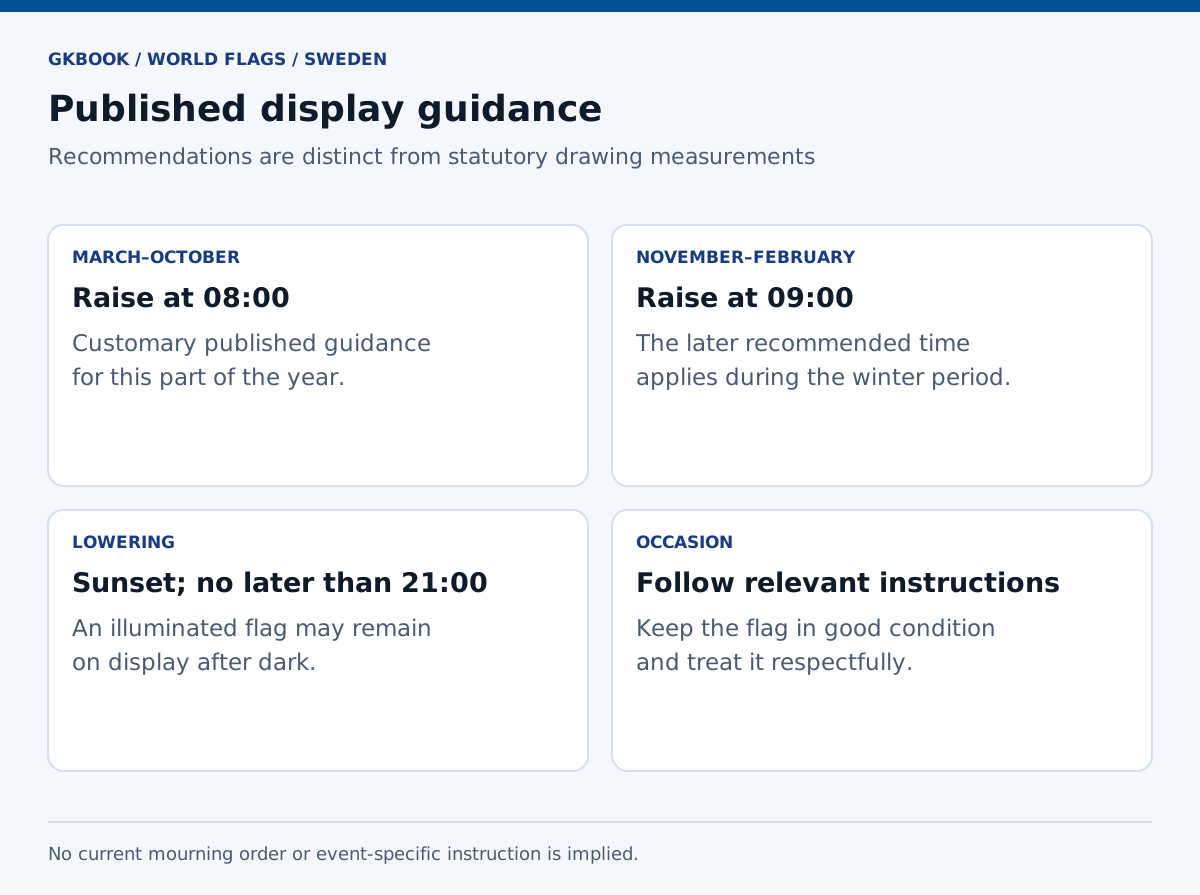
The National Archives explains that customary guidance draws on military practice, tradition, and international usage. That context matters: a recommendation about the time of day should not be misrepresented as a dimension written into the Flag Act. The flag remains the same design throughout its daily display.
Use a sound attachment and keep the cloth in good condition. The National Day Foundation advises respectful treatment and one nation’s flag on each pole. An illustration cannot establish the correct mounting or precedence for every ceremony, so organizers should obtain the instructions that apply to their particular setting.
How is Sweden’s flag flown at half-mast?
The published procedure is to raise the flag to the top, then lower it for mourning. National Archives guidance places the midpoint of its short edge at two-thirds of the pole’s height. Before final lowering, the National Day Foundation says to raise it to the top again. Specific official mourning instructions should govern the occasion.
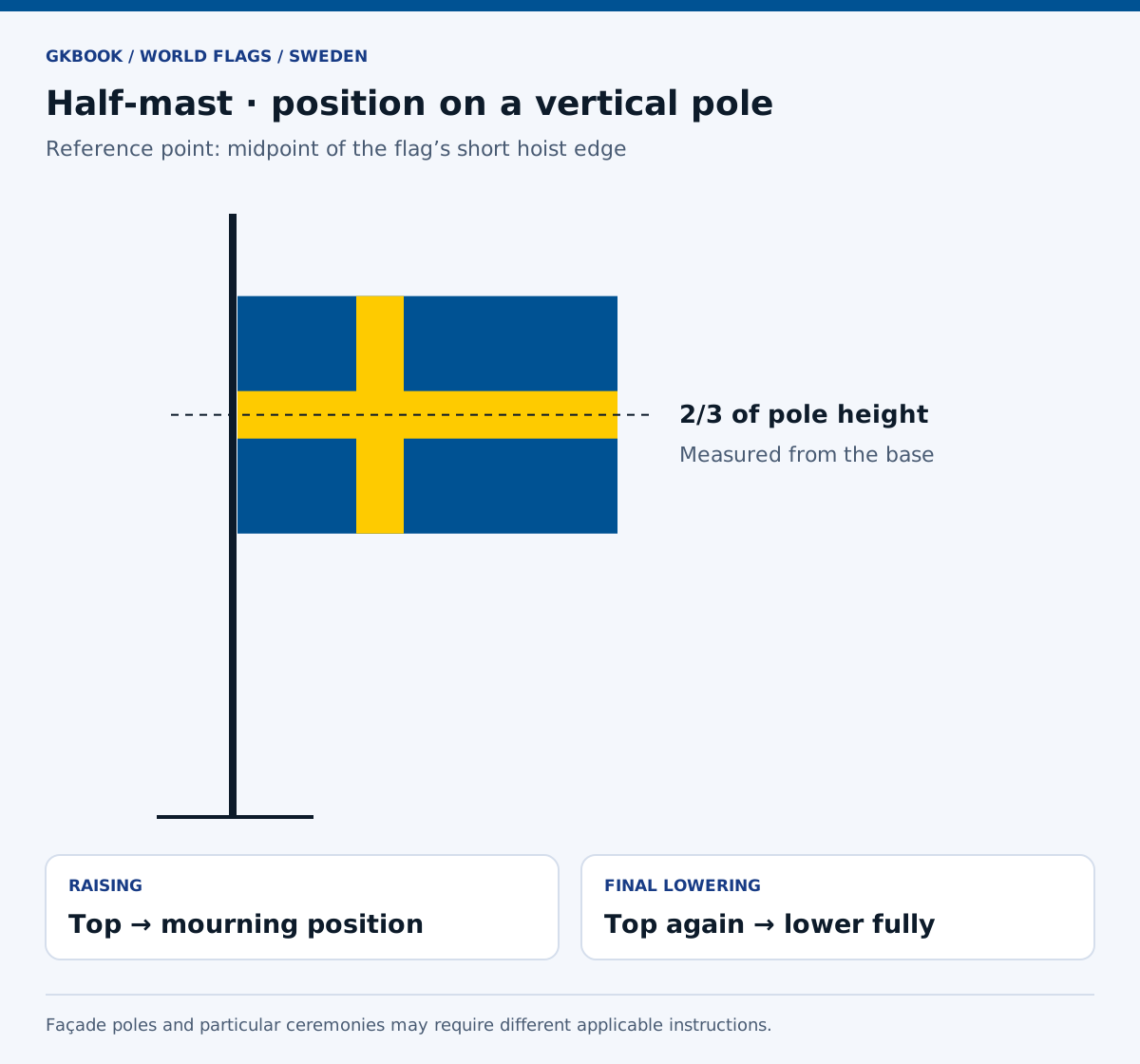
The expression half-mast does not mean that the entire flag must be centered at half the pole’s height. The cited guidance identifies a particular reference point and position. Its separate advice for an inclined façade pole should not be confused with the vertical-pole diagram shown here.
Mourning changes the flag’s position, not its artwork. The yellow cross remains yellow and the blue field remains blue; no black stripe or replacement emblem is added. The illustration explains a general procedure and is not an announcement that a national mourning period is currently in force.
Is a special vertical Swedish flag verified here?
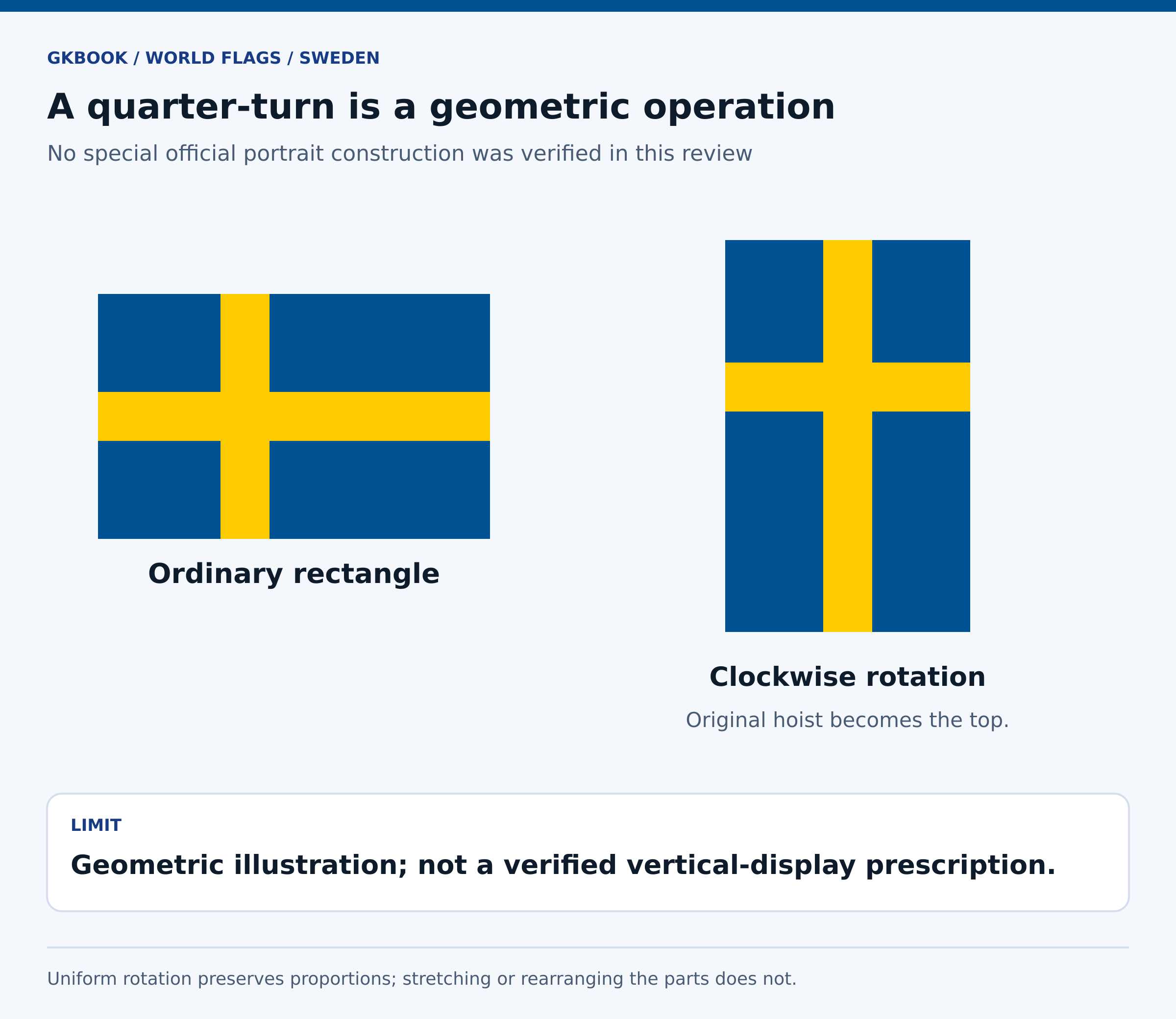
No special portrait construction was established in the primary sources reviewed for this collection. A clockwise quarter-turn of the ordinary rectangle places the original hoist at the top and the shorter blue fields above the cross. The diagram labels that geometric rotation explicitly; it does not claim to prescribe an official vertical-display rule.
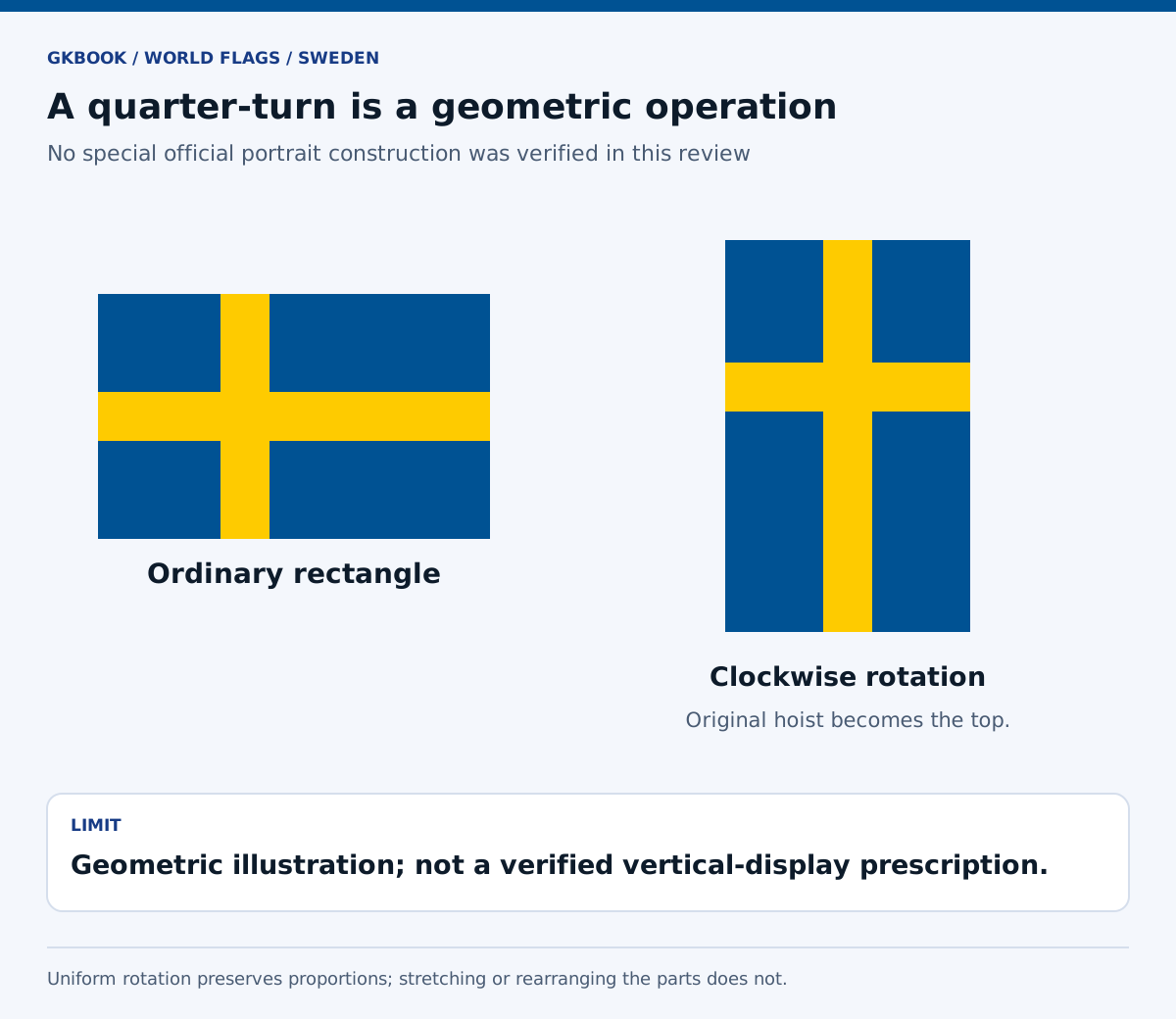
Rotation changes the orientation of the complete flag without changing the relative dimensions of its parts. Stretching the rectangle into a portrait frame is a different operation and can alter both arm thickness and field proportions. A portrait poster can also contain a smaller, unrotated national flag within its layout.
The absence of a verified instruction in this review is an evidence limit, not proof that no relevant protocol exists elsewhere. For a formal vertical hanging, obtain the applicable event or national guidance. Keep the original hoist edge identifiable instead of silently rearranging the cross and blue fields.
What does the reverse of Sweden’s flag look like?
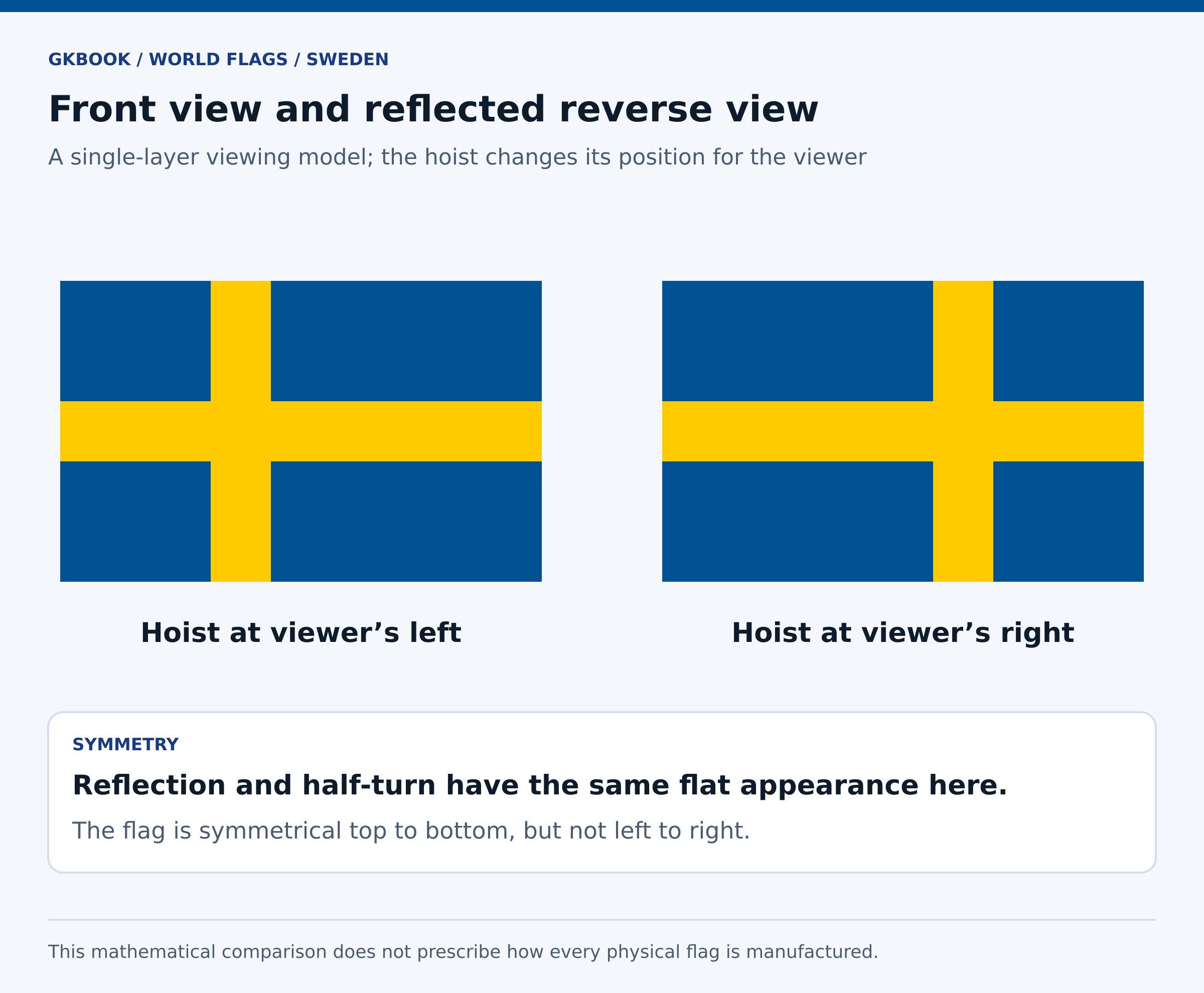
A horizontal reflection puts the vertical cross arm nearer the viewer’s right edge, with the longer blue fields on the left. The horizontal arm remains centered. This models viewing a single-layer flag from the opposite side. Because the design is vertically symmetrical, a half-turn has the same flat appearance as that reflected view.
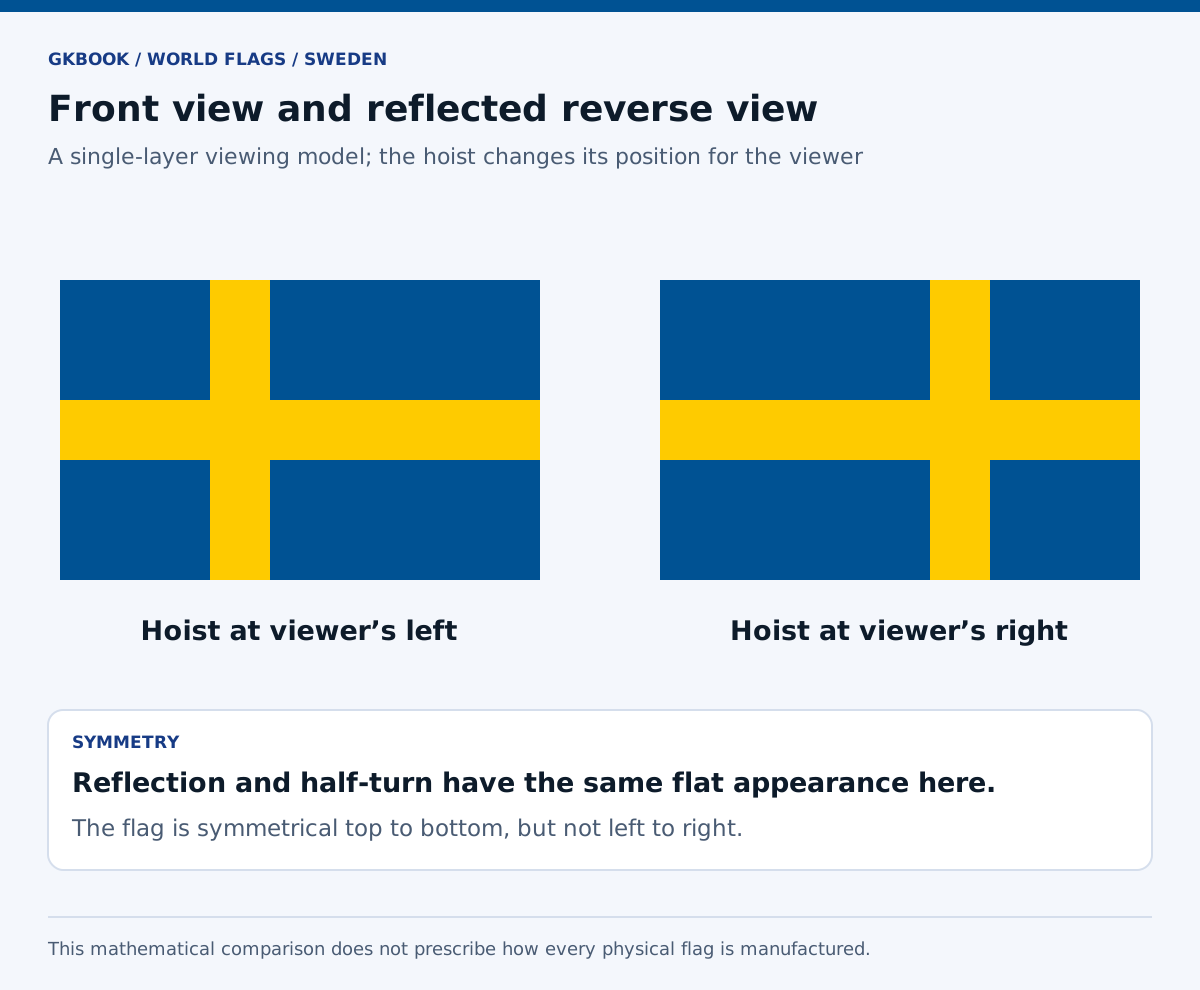
The hoist remains the edge attached to the pole even when it appears on the right in a photograph. Identify that attachment before judging the orientation. A right-offset cross can be a legitimate reverse view rather than evidence that someone has drawn the proportions incorrectly.
Reflection, rotation, and manufacturing are separate questions. A producer may print or assemble faces in a particular way, which is not determined by this mathematical comparison alone. The diagram retains the complete flag and labels the viewing operation so that it can be understood without inventing a separate reverse-side national design.
How should these Swedish flag files be prepared for printing?
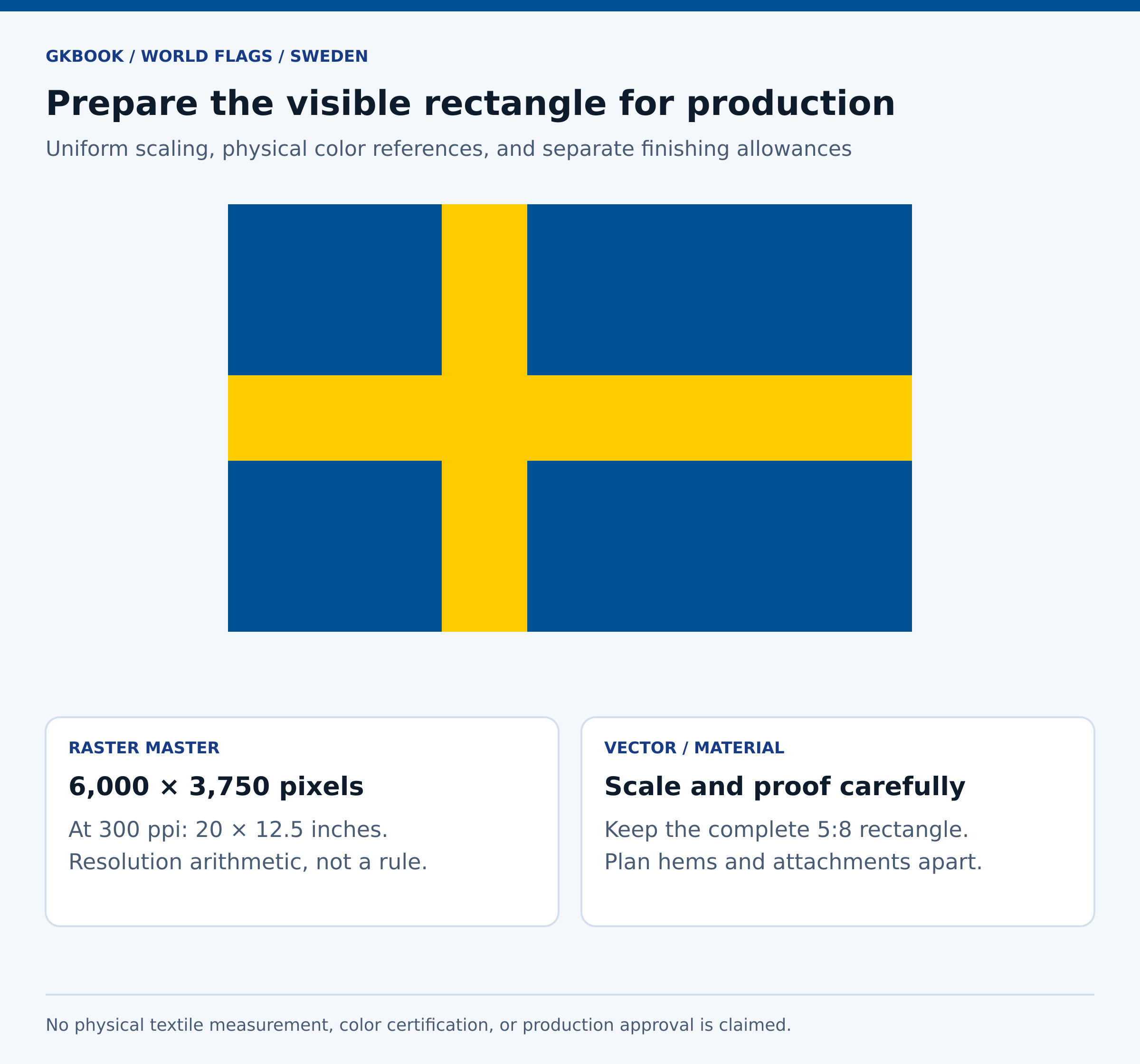
Preserve the complete 5:8 rectangle and the 5:2:9 and 4:2:4 divisions. The 6,000 × 3,750 PNG corresponds to 20 × 12.5 inches at 300 pixels per inch; that is resolution arithmetic, not a required physical size. Use the official color references for production proofing, and scale the SVG uniformly for larger work.
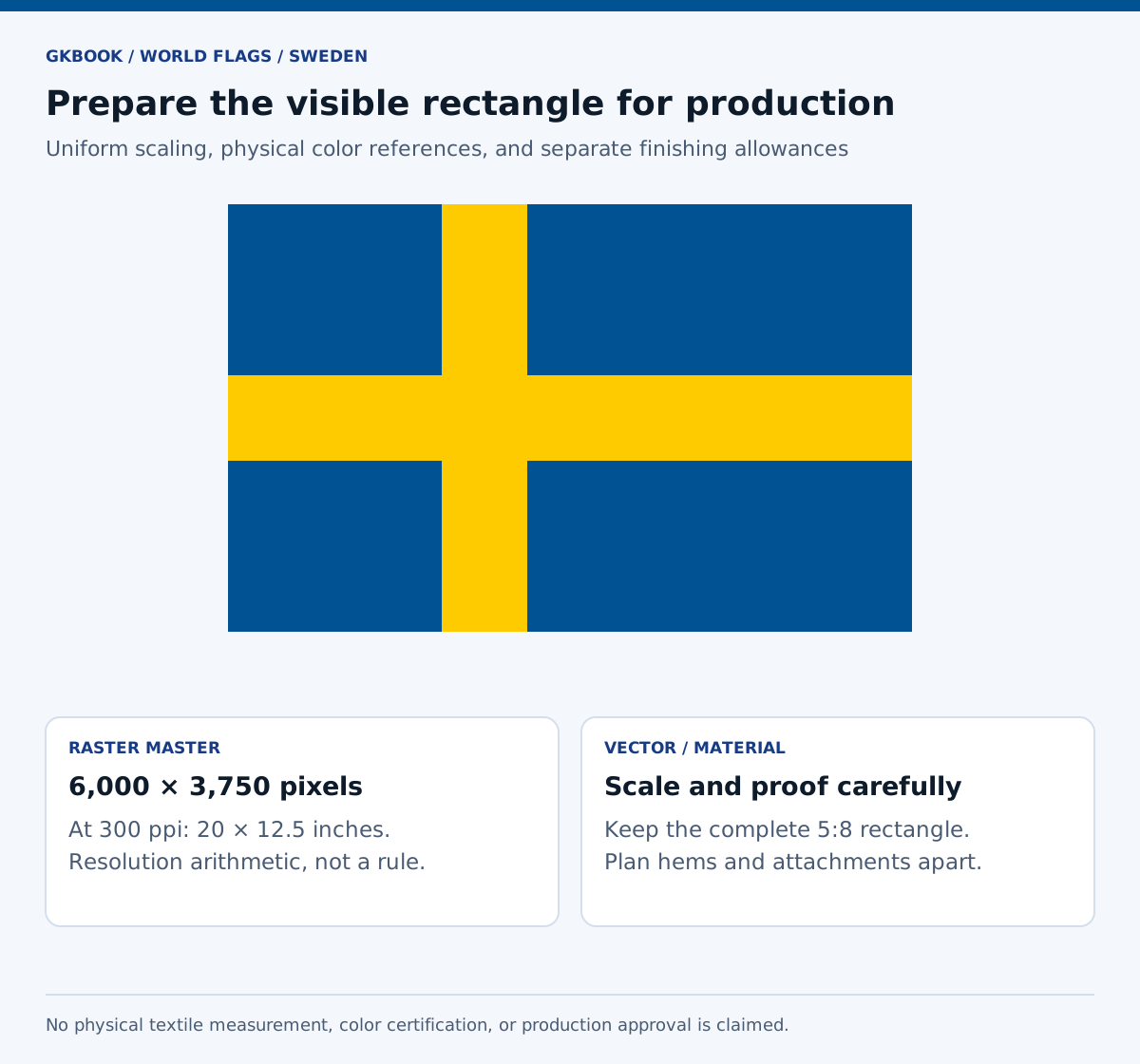
Set the finished visible dimensions before adding hems, seams, or attachment allowances. Extra material used for fabrication should not silently shift the cross or enlarge one blue field. The digital master describes the visible composition, while the production drawing must account separately for how the object will be made.
A universal CMYK conversion cannot be inferred from the screen palette alone. Ink, substrate, profile, and finishing affect the result. Check a suitable proof against the intended physical reference rather than approving color solely from an uncalibrated monitor or assuming that a numerically identical file guarantees matching fabric.
Which Sweden flag pictures are included?
The collection contains 24 subjects in SVG and PNG, plus a separate social card. It includes the clean flag, color and meaning guides, construction diagrams, historical explanations, adoption and standardization panels, display guidance, geometric orientation comparisons, and printing notes. Captions distinguish the ordinary national master from explanatory layouts and descriptions of specialized or historical forms.
Use the clean master when a document simply needs Sweden’s national flag. The other images add labels and comparisons for teaching. Historical panels do not claim to reproduce surviving period fabric, and the portrait study identifies a rotation rather than presenting an unverified alternative national specification.
Matching vector and raster filenames make the pairs easy to select. Each subject has descriptive alternative text and a caption. The separate 1,200 × 630 social image contains a complete 544 × 340 flag; its surrounding canvas has different proportions, while the national rectangle inside retains the correct shape.
Download Sweden flag pictures
Download the clean national flag as SVG or 6,000 × 3,750 PNG. Both preserve the complete 5:8 rectangle, horizontal divisions of 5:2:9, vertical divisions of 4:2:4, and equal cross-arm thickness. The screen palette is declared separately from the official NCS and CIE physical references. Physical production requires appropriate color proofing and finishing allowances.
The gallery contains 24 subjects, each with an SVG and PNG. Captions distinguish clean flag artwork, component studies, historical explanations, and technical guides. Image credits and reproduction notes identify the artwork basis. The separate 1,200 × 630 social card contains a complete 544 × 340 flag and does not change the national rectangle.
Continue exploring national designs in World Flags.
World Flags/Sweden
Sweden flag pictures
Complete 5:8 rectangular national flag with statutory geometry and declared screen colors.
GKBook geometric reconstruction and educational layouts; screen palette checked against Wikimedia Commons contributors. No official certification or endorsement.Download SVGDownload PNGNCS references come from the color ordinance. HEX/RGB values are declared for these downloads, not quoted as statutory screen codes.
GKBook geometric reconstruction and educational layouts; screen palette checked against Wikimedia Commons contributors. No official certification or endorsement.Download SVGDownload PNGOfficial accounts connect the flag with heraldic colors and the Nordic cross; measurements do not establish extra symbolism.
GKBook geometric reconstruction and educational layouts; screen palette checked against Wikimedia Commons contributors. No official certification or endorsement.Download SVGDownload PNGThe cross has no outline, disk, or central emblem on the ordinary rectangular flag.
GKBook geometric reconstruction and educational layouts; screen palette checked against Wikimedia Commons contributors. No official certification or endorsement.Download SVGDownload PNGLegal height:length 10:16 simplifies to 5:8. Cross and field divisions scale together.
GKBook geometric reconstruction and educational layouts; screen palette checked against Wikimedia Commons contributors. No official certification or endorsement.Download SVGDownload PNGBoth arms are equally wide: two grid units or 750 pixels in the master.
GKBook geometric reconstruction and educational layouts; screen palette checked against Wikimedia Commons contributors. No official certification or endorsement.Download SVGDownload PNGLabels are educational overlays. The clean national flag contains no text.
GKBook geometric reconstruction and educational layouts; screen palette checked against Wikimedia Commons contributors. No official certification or endorsement.Download SVGDownload PNGThe cross center lies at three-eighths of the length, not halfway across the rectangle. Guide lines are annotations.
GKBook geometric reconstruction and educational layouts; screen palette checked against Wikimedia Commons contributors. No official certification or endorsement.Download SVGDownload PNGThe two yellow rectangles overlap to form a seamless cross over the blue background.
GKBook geometric reconstruction and educational layouts; screen palette checked against Wikimedia Commons contributors. No official certification or endorsement.Download SVGDownload PNGThe ideal construction has 70% blue and 30% yellow. These are geometric shares, not symbolic allocations.
GKBook geometric reconstruction and educational layouts; screen palette checked against Wikimedia Commons contributors. No official certification or endorsement.Download SVGDownload PNGHistorical explanation based on official accounts and the 1906 government bill; no archival flag facsimile is claimed.
GKBook geometric reconstruction and educational layouts; screen palette checked against Wikimedia Commons contributors. No official certification or endorsement.Download SVGDownload PNGThe original promulgated 1906 gazette was not obtained; the parliamentary records and their scope are identified.
GKBook geometric reconstruction and educational layouts; screen palette checked against Wikimedia Commons contributors. No official certification or endorsement.Download SVGDownload PNGThe 1906 bill favored Naval Staff dimensions; no proposal author is credited here as inventor of the centuries-old cross flag.
GKBook geometric reconstruction and educational layouts; screen palette checked against Wikimedia Commons contributors. No official certification or endorsement.Download SVGDownload PNGA description of the former union mark, without an unverified historical reconstruction.
GKBook geometric reconstruction and educational layouts; screen palette checked against Wikimedia Commons contributors. No official certification or endorsement.Download SVGDownload PNGThe current law and color ordinance were read. No laboratory color-conformity claim is made for these downloads.
GKBook geometric reconstruction and educational layouts; screen palette checked against Wikimedia Commons contributors. No official certification or endorsement.Download SVGDownload PNGDates follow the Royal Court’s historical account and the official flag-day ordinance.
GKBook geometric reconstruction and educational layouts; screen palette checked against Wikimedia Commons contributors. No official certification or endorsement.Download SVGDownload PNGThe panel separates National Day associations, the union period, flag legislation, and UN membership.
GKBook geometric reconstruction and educational layouts; screen palette checked against Wikimedia Commons contributors. No official certification or endorsement.Download SVGDownload PNGThe three-tailed form is described, not fabricated as a simplified cutout of this rectangular master.
GKBook geometric reconstruction and educational layouts; screen palette checked against Wikimedia Commons contributors. No official certification or endorsement.Download SVGDownload PNGA specific royal exception does not make a coat of arms part of every Swedish flag.
GKBook geometric reconstruction and educational layouts; screen palette checked against Wikimedia Commons contributors. No official certification or endorsement.Download SVGDownload PNGNational Archives guidance explains customary times, including the illumination exception.
GKBook geometric reconstruction and educational layouts; screen palette checked against Wikimedia Commons contributors. No official certification or endorsement.Download SVGDownload PNGThe flag’s hoist midpoint is at two-thirds of a vertical pole’s height. The drawing explains general guidance, not an active mourning order.
GKBook geometric reconstruction and educational layouts; screen palette checked against Wikimedia Commons contributors. No official certification or endorsement.Download SVGDownload PNGA clockwise quarter-turn places the original hoist at the top. Formal vertical use requires applicable guidance.
GKBook geometric reconstruction and educational layouts; screen palette checked against Wikimedia Commons contributors. No official certification or endorsement.Download SVGDownload PNGThe reverse has its vertical cross arm toward the viewer’s right. A half-turn produces the same flat appearance because the design is vertically symmetrical.
GKBook geometric reconstruction and educational layouts; screen palette checked against Wikimedia Commons contributors. No official certification or endorsement.Download SVGDownload PNGUse the official physical references for proofing; screen values are not a universal CMYK formula.
GKBook geometric reconstruction and educational layouts; screen palette checked against Wikimedia Commons contributors. No official certification or endorsement.Download SVGDownload PNGFrequently asked questions
What does the Swedish flag look like?
Sweden’s national flag is blue with a yellow Nordic cross extending to all four edges. The vertical arm sits nearer the hoist than the fly. The ordinary rectangular flag has height:length proportions of 5:8. Its modern legal history includes the 1906 flag law and the current 1982 statute.
What is Sweden’s flag called?
The usual English names are Sweden’s national flag and the Swedish flag. In Swedish, Sveriges flagga means the flag of Sweden, while svenska flaggan means the Swedish flag. A country name and a version label are more precise than an invented nickname, especially when distinguishing the ordinary rectangle from royal or military forms.
What colors are on Sweden’s flag?
Sweden’s flag has a blue field and a golden-yellow cross. The official color ordinance specifies NCS 4055-R95B for blue and NCS 0580-Y10R for yellow. These downloads use #005293 and #FECB00 as declared screen values, matching the inspected reference SVG. Those hexadecimal numbers are not prescribed by the ordinance itself.
What does the blue on Sweden’s flag represent?
The strongest documented explanation connects the blue field with Sweden’s heraldic colors, particularly the blue background bearing golden crowns in the national arms. It should not automatically be described as an official symbol of lakes, sky, loyalty, or justice. Those associations require their own evidence rather than a generic color-meaning list.
What does the yellow on Sweden’s flag represent?
The yellow belongs to the same blue-and-gold heraldic tradition as Sweden’s national arms. The law describes the cross as golden yellow. Gold in heraldry can be represented by yellow in a flat flag image; this does not require metallic ink, glitter, or an added explanation that the cross officially represents sunshine.
Why does Sweden’s flag have a Nordic cross?
Sweden’s flag belongs to the Nordic cross tradition, with a cross extending to the edges and its vertical arm toward the hoist. The Royal Court connects this family of banners with medieval Christian cross symbolism and identifies Denmark’s flag as a model. The historical explanation is distinct from a rule assigning religious identity to citizens.
What does Sweden’s flag symbolize?
The flag identifies Sweden through its blue-and-gold heraldic colors and Nordic cross. The official historical accounts explain those connections rather than supplying a universal one-word meaning for every color. Its use as a national symbol does not turn the measured areas, four blue fields, or cross arms into a demographic or political diagram.
How old is Sweden’s blue-and-yellow flag?
The blue-and-yellow cross design is documented in the sixteenth century, well before the 1906 law. The Royal Court points to cross banners in Johan III’s ducal arms in 1557 and instructions mentioning the cross in 1569. Earlier heraldic origins are plausible, but they should not be presented as a proven single invention date.
What are Sweden’s flag proportions?
The ordinary rectangular flag has a height:length ratio of 10:16, usually simplified to 5:8. Across its length, the divisions are 5:2:9; down its height, they are 4:2:4. The supplied master is 6,000 × 3,750 pixels, preserving all these relationships without stretching or cropping the national rectangle.
How wide is the yellow cross?
Both cross arms are two units wide on the ten-unit-high construction grid. Their thickness therefore equals one-fifth of the flag’s height, or one-eighth of its length. In the 6,000 × 3,750 master, each arm is 750 pixels thick. Measure perpendicular to each arm rather than along its overall length.
How large are the four blue fields?
Each blue field beside the hoist measures five units across and four units high. Each field toward the fly measures nine units across and four units high. The top and bottom pairs match, but the left and right pairs do not. Their unequal widths create the characteristic offset of the Nordic cross.
Where is the cross intersection located?
The center of the cross intersection lies six units from the hoist and five units from the top on a sixteen-by-ten grid. That is three-eighths of the flag’s length and half its height. In the master, the point is (2,250, 1,875), which lies 750 pixels left of the rectangle’s center.
How can Sweden’s flag be drawn accurately?
Start with a 6,000 × 3,750 blue rectangle. Add a yellow horizontal rectangle from y=1,500 to y=2,250 across the full width. Add a yellow vertical rectangle from x=1,875 to x=2,625 across the full height. These three shapes reproduce the required grid without strokes, outlines, or separate corner patches.
How much of Sweden’s flag is blue or yellow?
In the exact rectangular construction, yellow covers 30 percent of the area and blue covers 70 percent. The horizontal and vertical arms overlap, so their intersection must be subtracted once when calculating the cross. These percentages are geometric deductions from the proportions, not additional symbolic or demographic meanings assigned to the colors.
How has Sweden’s national flag changed?
The blue-and-yellow cross predates modern legislation. During the nineteenth-century union with Norway, a union mark appeared in the upper hoist corner. Its removal in 1905 preceded the flag law of 1906. Later legislation retained the familiar cross while formalizing the current rules and more precise color references for reproduction.
When was Sweden’s present flag adopted?
June 22, 1906 is the date of the modern flag law commonly associated with adoption of the present flag. The parliamentary adopted text specified July 1, 1906 as its commencement. The cross design itself is older, and the union mark had already been removed in 1905; these dates describe different events.
Who designed Sweden’s national flag?
No single verified designer can be assigned to the centuries-old Swedish cross flag from the sources reviewed here. Its development belongs to a longer heraldic and Nordic tradition. The 1906 standardization involved official proposals and legislative decisions; a person associated with one proposal should not automatically be credited with inventing the national design.
What was the union mark on Sweden’s earlier flag?
The union mark was a device combining Swedish and Norwegian colors in the upper hoist corner during the union period. The 1906 government bill records its introduction in 1844 and removal in 1905. It was an addition to the flag, not a different name for the yellow cross or the national coat of arms.
Which standards govern Sweden’s flag today?
The current construction is set out in the Flag Act, SFS 1982:269. The color ordinance, SFS 1983:826, specifies NCS and CIE references and tolerances. These files follow the statutory geometry and declare their screen palette separately. They do not claim laboratory verification against the physical standard or official certification of manufactured material.
When is Sweden’s National Day and Flag Day?
Sweden’s National Day and Swedish Flag Day fall on June 6. Nationwide Flag Day observance dates from 1916; the day became the official National Day in 1983 and a public holiday in 2005. The commemorated milestones include Gustav Vasa’s election in 1523 and the constitution of 1809, rather than the June 1906 flag-law date.
Does June 6 mark a modern independence declaration?
June 6 is Sweden’s National Day, with commemorations tied to Gustav Vasa’s election as king in 1523 and the 1809 constitution. It should not be presented as a modern colonial independence declaration or confused with the 1905 end of the union with Norway. Those descriptions refer to different historical developments and political relationships.
When did Sweden become a United Nations member?
Sweden’s United Nations membership became effective on November 19, 1946, when its instrument of adherence was presented under the rules then in force. The General Assembly decision was dated November 9, and registration followed on December 14. These are separate steps; none is Sweden’s flag-adoption date or a universal date of recognition.
Are there different official forms of Sweden’s flag?
Yes. The law distinguishes the ordinary rectangular flag from a three-tailed form used in specified royal and military contexts. The rectangular flag has height:length proportions of 5:8; the three-tailed form has an overall ratio of 1:2 including its tails. The latter should not be substituted casually for the ordinary national rectangle.
Does the ordinary Swedish flag contain a coat of arms?
No. The ordinary rectangular national flag consists of the blue field and yellow cross without a coat of arms or lettering. The law provides particular royal exceptions for arms on a white field at the cross center. Those specified uses do not make the arms part of every Swedish flag or authorize arbitrary added emblems.
When should Sweden’s flag be raised and lowered?
Published guidance recommends raising the flag at 08:00 from March through October and 09:00 from November through February. It is normally lowered at sunset, no later than 21:00; illumination allows display after dark. These are display recommendations, distinct from the statutory construction rules, and specific ceremonial instructions may address the occasion.
How is Sweden’s flag flown at half-mast?
The published procedure is to raise the flag to the top, then lower it for mourning. National Archives guidance places the midpoint of its short edge at two-thirds of the pole’s height. Before final lowering, the National Day Foundation says to raise it to the top again. Specific official mourning instructions should govern the occasion.
Is a special vertical Swedish flag verified here?
No special portrait construction was established in the primary sources reviewed for this collection. A clockwise quarter-turn of the ordinary rectangle places the original hoist at the top and the shorter blue fields above the cross. The diagram labels that geometric rotation explicitly; it does not claim to prescribe an official vertical-display rule.
What does the reverse of Sweden’s flag look like?
A horizontal reflection puts the vertical cross arm nearer the viewer’s right edge, with the longer blue fields on the left. The horizontal arm remains centered. This models viewing a single-layer flag from the opposite side. Because the design is vertically symmetrical, a half-turn has the same flat appearance as that reflected view.
How should these Swedish flag files be prepared for printing?
Preserve the complete 5:8 rectangle and the 5:2:9 and 4:2:4 divisions. The 6,000 × 3,750 PNG corresponds to 20 × 12.5 inches at 300 pixels per inch; that is resolution arithmetic, not a required physical size. Use the official color references for production proofing, and scale the SVG uniformly for larger work.
Which Sweden flag pictures are included?
The collection contains 24 subjects in SVG and PNG, plus a separate social card. It includes the clean flag, color and meaning guides, construction diagrams, historical explanations, adoption and standardization panels, display guidance, geometric orientation comparisons, and printing notes. Captions distinguish the ordinary national master from explanatory layouts and descriptions of specialized or historical forms.
Explore all general-knowledge topics and the A-to-Z lists.








We Value Your Opinion Comments