
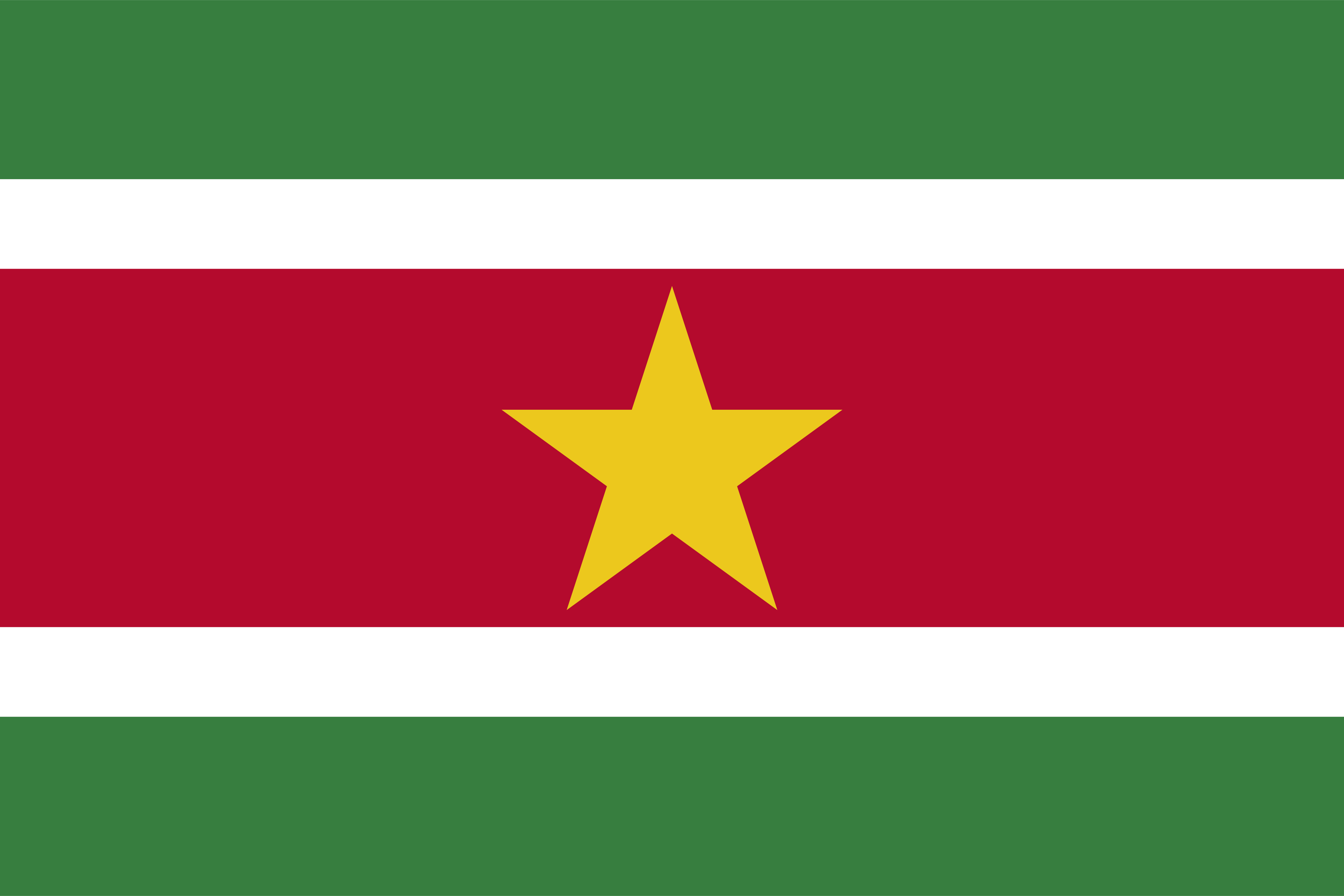
Suriname flag picture
Explore the star placement, history, and picture gallery.
| Country | Republic of SurinameSouth America. |
|---|---|
| Design | Green · White · Red · White · GreenOne upright yellow star on the red band. |
| Proportions | Height:length = 2:3Band heights: 2:1:4:1:2. |
| Present flag introduced | November 25, 1975Introduced at independence. |
| Star placement | Equal visible gaps above and belowConstruction-circle center lies slightly below flag midpoint. |
| Main image sizes | SVG and PNG: 6,000 × 4,000Declared screen palette; opaque RGB PNG. |
The national design contains no coat of arms, lettering, or circle around the star. Symbolic meanings are attributed in the article.
What does the Surinamese flag look like?
Suriname’s national flag has five horizontal bands of green, white, red, white, and green, with one upright yellow star in the red center. Its height:length ratio is 2:3, and the band heights follow 2:1:4:1:2. The present design entered use at independence on November 25, 1975.
The wide red band makes the single yellow star easy to recognize. Two narrow white stripes separate it from the green bands at the top and bottom. Read the design as one complete rectangle: the colored stripes continue to both edges, and the star has no surrounding circle. This collection includes a clean national flag and explanatory illustrations. Measurement lines, captions, and information cards appear only in the teaching layouts. They help explain the design without becoming additional features of the national symbol or changing its proportions.
What is Suriname’s flag called?
The design is usually called the national flag of Suriname or the Surinamese flag. The government describes it as the national flag of the Republic of Suriname. A descriptive country name is clearer than an invented nickname, especially when distinguishing the present star-and-stripes arrangement from the earlier flag used before independence.
Use Suriname in filenames, captions, and article titles so readers can connect the image to the country. Older English documents may use Surinam, including the United Nations record of admission. That historical spelling does not identify a different state or a separate modern national flag design.
Version labels matter when an image is historical. The white flag with five colored stars connected by an ellipse belongs to the period before independence. Describing both images only as the Surinamese flag can obscure the change, so attach a date or design period whenever the context requires it.
What colors are on Suriname’s flag?
Suriname’s flag uses green, white, red, and yellow. These downloads use #377E3F, #FFFFFF, #B40A2D, and #ECC81D respectively, matching the inspected reference SVG. They are declared screen values. The current government description gives color names and historical mixtures; the original linked digital-color PDF was unavailable for direct verification during this review.
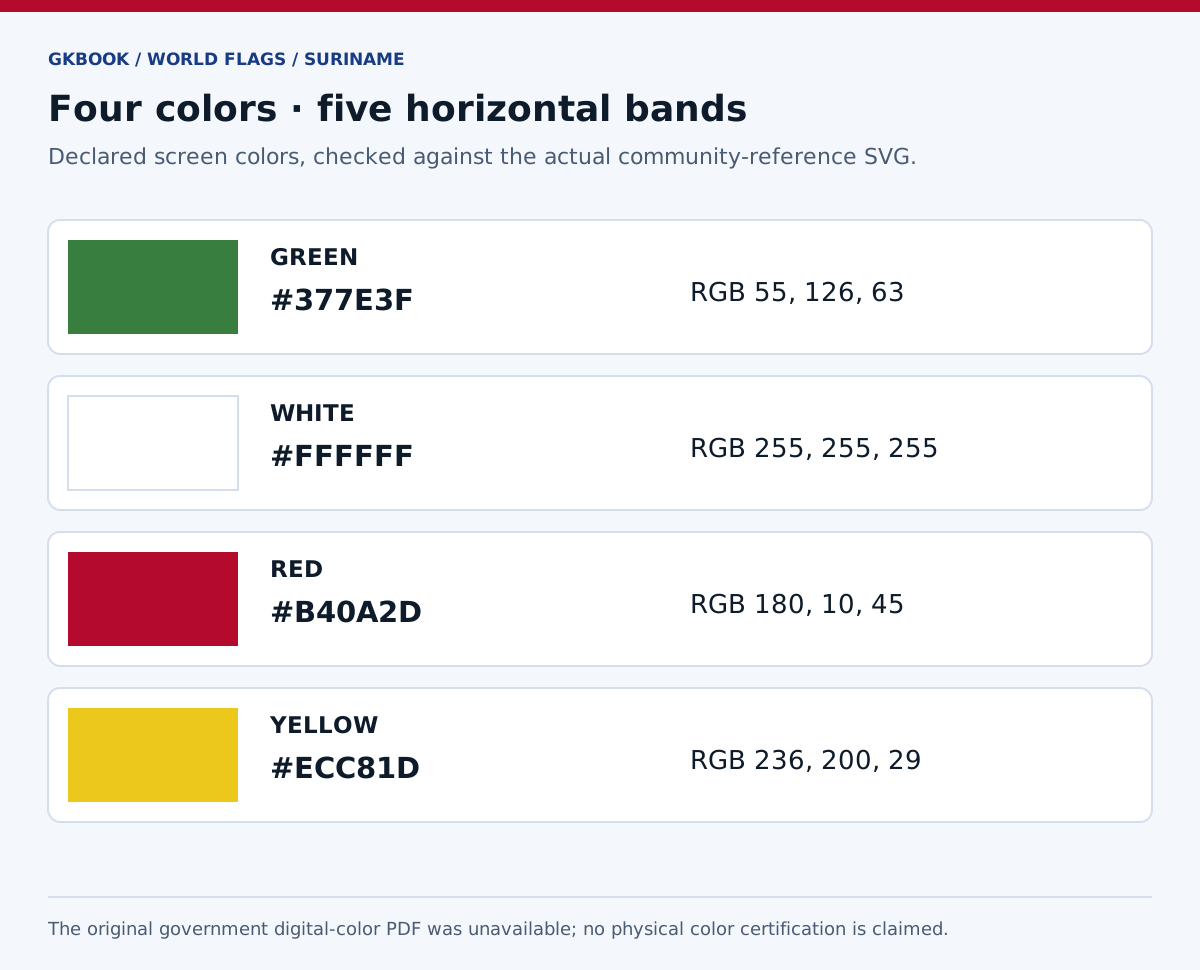
Color names describe the national composition, while numerical values make a particular digital reproduction repeatable. A hexadecimal code specifies a screen color, not the appearance of every ink, dye, fabric, or display. Retaining the declared values helps keep the SVG, PNG, gallery diagrams, and social card consistent with one another.
The white stripes are solid artwork, not transparent gaps. Yellow fills the star without a darker outline. Raster exports may contain intermediate colors along diagonal edges because those pixels smooth the star’s contour. Such edge shades are rendering effects, rather than additional colors introduced into the national design.
| Color | Hexadecimal | RGB | Placement |
|---|---|---|---|
| Green | #377E3F | 55, 126, 63 | Top and bottom bands |
| White | #FFFFFF | 255, 255, 255 | Two narrow separators |
| Red | #B40A2D | 180, 10, 45 | Wide central band |
| Yellow | #ECC81D | 236, 200, 29 | Single five-pointed star |
What does Suriname’s flag symbolize?
The government’s explanation connects green with fertility and hope, white with justice and freedom, and red with renewal and love expressed through action. The yellow star represents national unity and a shared future, with yellow also associated with sacrifice. These are attributed national meanings, not numerical measures of population or territory.
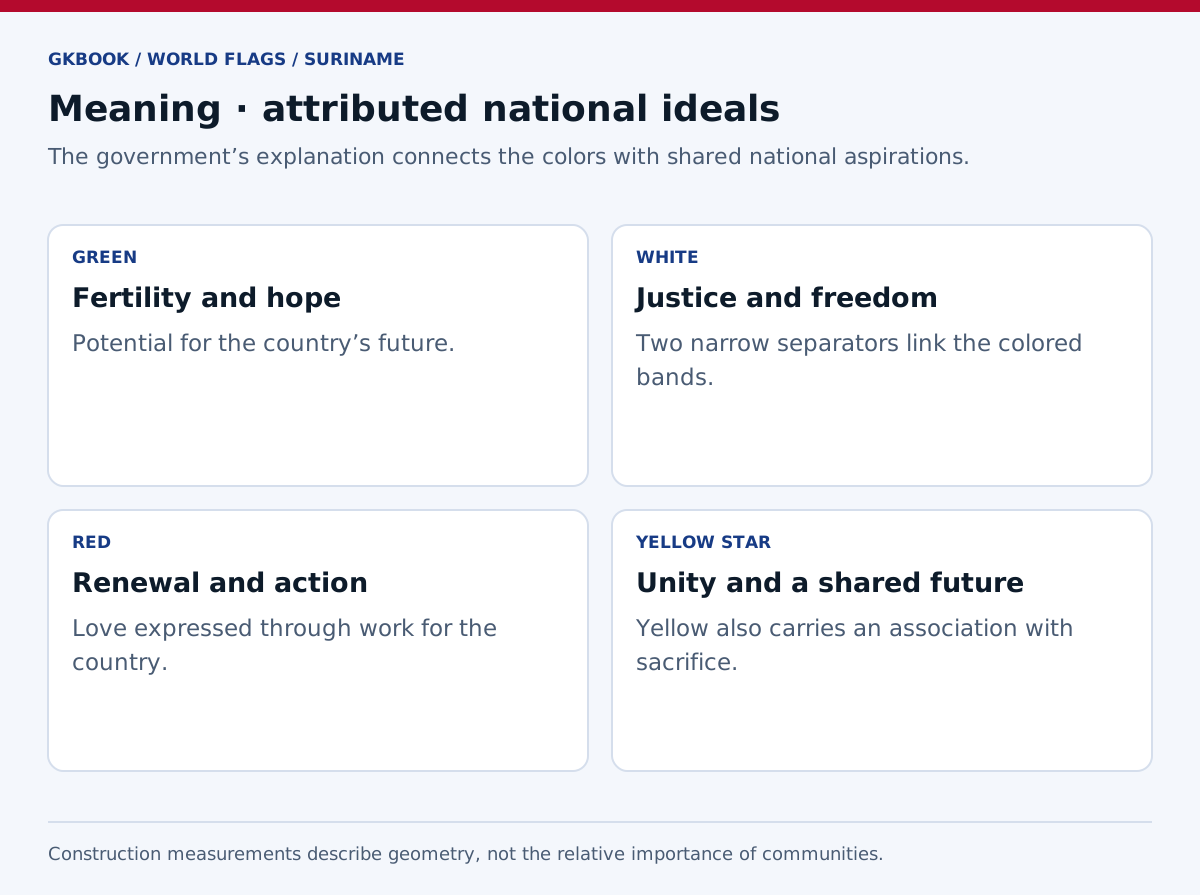
Read the symbolism as a statement of collective ideals. The composition brings several colors around one star, but the design does not divide citizens into measured areas. Neither the band widths nor the star’s size should be converted into a demographic chart or a ranking of communities.
The government’s fuller wording gives several connected ideas rather than a single universal keyword for each color. A short classroom summary can introduce those associations, while a longer explanation should retain the distinction between symbolic interpretation and geometric construction. The dimensions determine appearance; they do not themselves establish an additional political meaning.
What do the green bands represent?
The government associates green with Suriname’s fertility, its possibilities, and hope for a new national future. Green occupies the upper and lower bands. Each is one fifth of the complete flag height, making the two green bands equal in thickness and together twice as tall as the two white stripes combined.
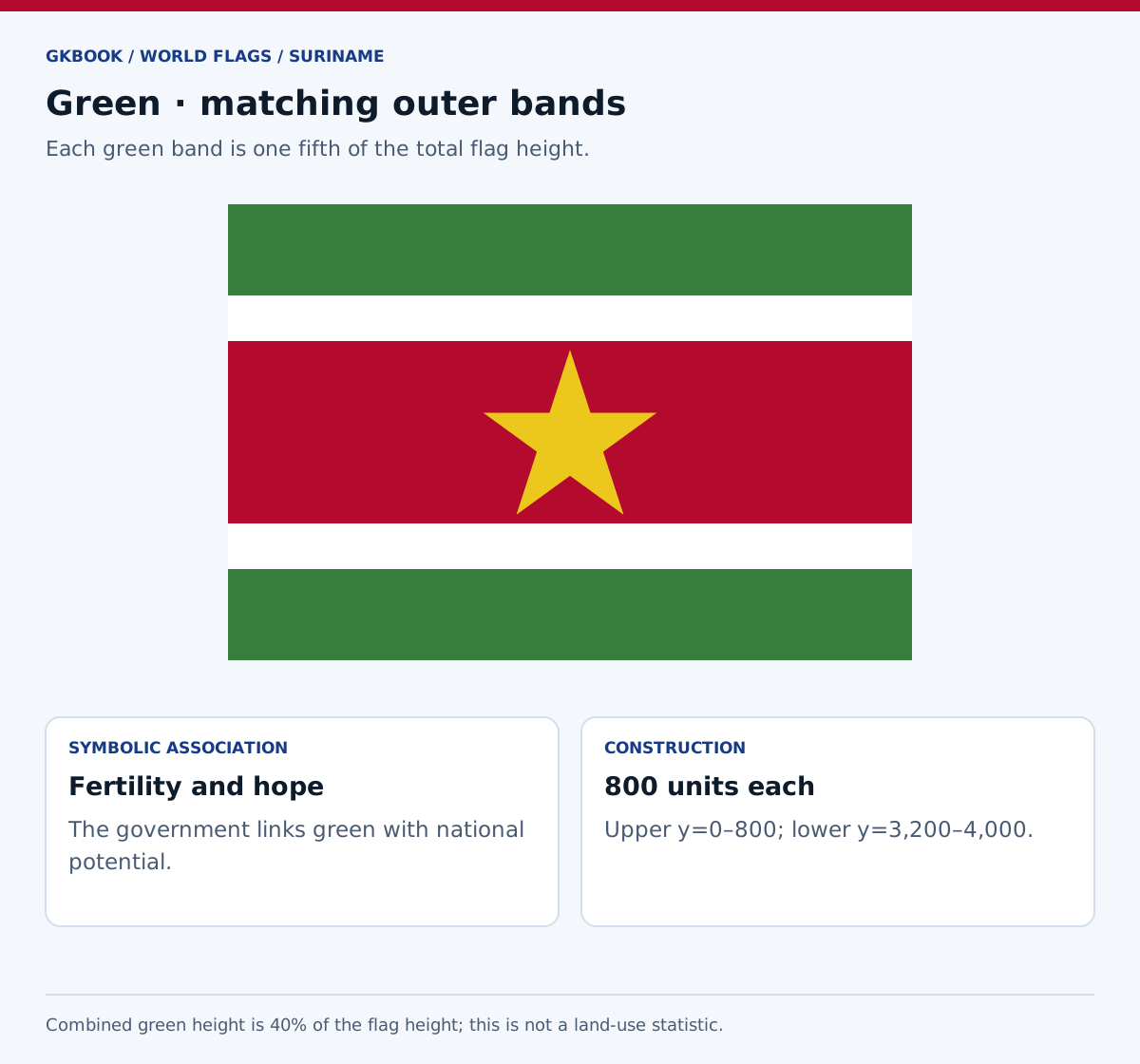
The matching outer bands give the design a balanced frame without adding a separate border. Green reaches the top and bottom edges and extends across the entire length. When resizing the flag, preserve both bands together; trimming one edge can leave an apparently familiar image with the wrong internal proportions.
Fertility is a symbolic association, not a claim that precisely forty percent of the country has a particular land use. The combined green band area follows from the drawing specification. A geography illustration would need its own measurements and evidence rather than borrowing a percentage from the flag.
What do the white stripes represent?
The government’s account links white with justice and freedom. Two narrow white stripes separate the red center from the green outer bands. Each white stripe is one tenth of the total flag height, so each is half the height of a green band and one quarter the height of the red band.
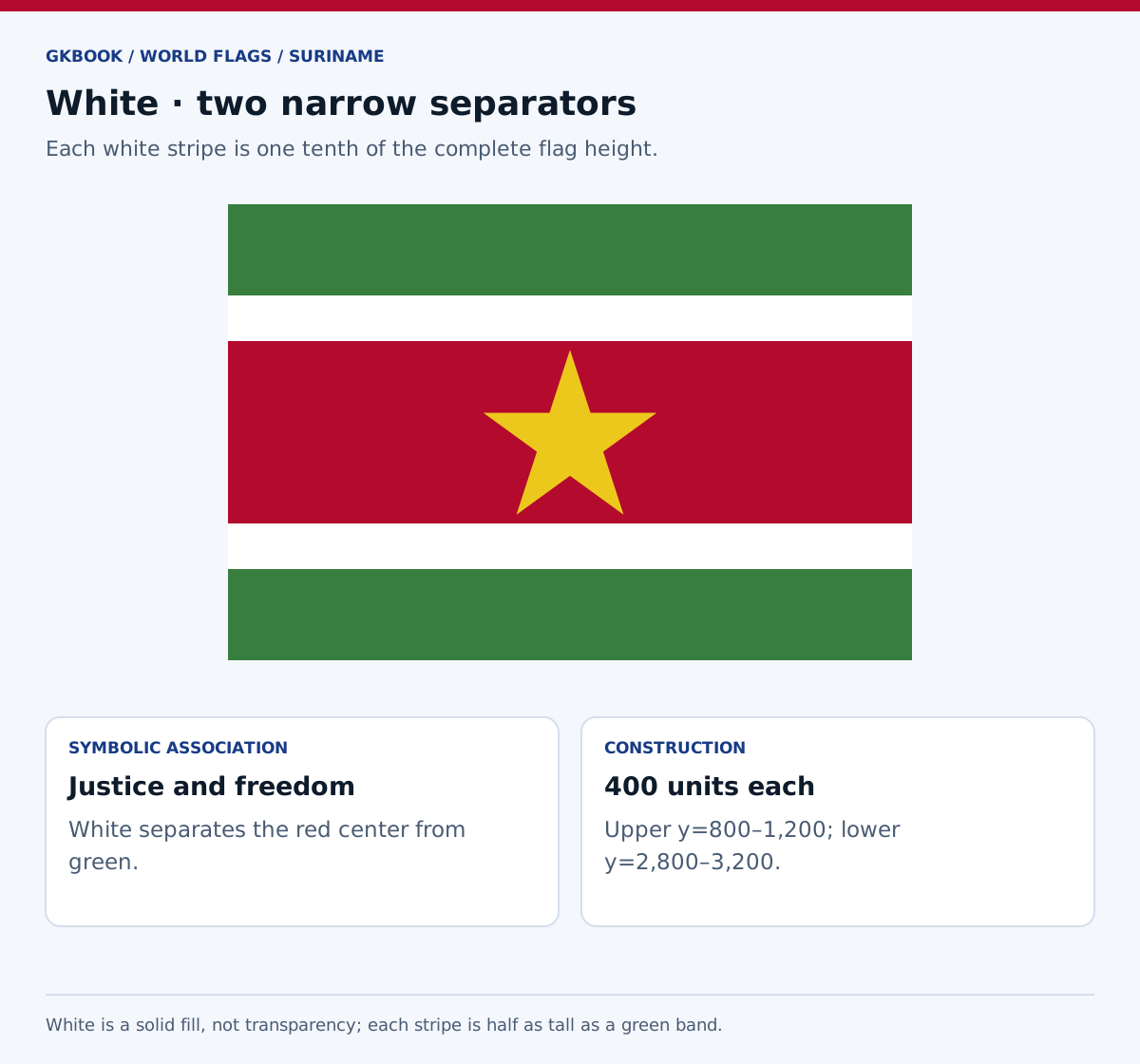
These separators are easy to lose when a small icon is cropped or simplified. Keep a white stripe above the red field and another below it. They run continuously from one side of the flag to the other, without breaks where the central star approaches the red field’s edges.
White remains opaque in the supplied PNG, even when the flag is placed on a colored page. A page border can help readers see the national rectangle against a white background, but that border is a presentation device. It should not become an extra stripe inside the clean master artwork.
What does the red band represent?
The government explains red through renewal, progress, and love that leads to action for the country. It describes the shade through a historical mixture of orange and carmine. Red forms the broad middle band, occupying four tenths of the flag height before the yellow star is placed over it.

The central band is the widest individual stripe. It is twice the height of either green band and four times the height of either white stripe. Those comparisons describe thickness, not the relative importance of the ideals associated with the colors or the number of people represented by them.
The orange mentioned in the historical mixture is not an additional visible stripe. A reproduction should retain one continuous red field around the star. Introducing a separate orange panel, gradient, or shaded edge would turn a description of the color’s historical formulation into an invented element of the national design.
What does the yellow color represent?
Yellow colors the single star and is associated in the government’s explanation with sacrifice and a shared golden future. The star itself expresses unity. Yellow is therefore a flat design color in these files; the symbolic reference to gold does not require metallic ink, a gradient, or a three-dimensional effect.

A bright flat fill keeps the five-pointed silhouette readable against red. Photographs may show folds, reflected light, or embroidery, but those material effects belong to the photographed object. They should not be traced into the geometric master as extra highlights or dark outlines around the star’s points.
For printing, a digital yellow and a metallic gold are different production choices. This collection supplies a declared RGB yellow rather than a specialist ink specification. Preserve the shape and placement while arranging a suitable physical color proof for the intended material, especially when the final object is much larger than a screen preview.
What does the star on Suriname’s flag mean?
The single yellow star represents the unity of the nation. It has five points, with one pointing straight upward, and sits within the wide red band. The reviewed government explanation does not assign a separate present-day population group, district, or continent to each of the star’s five individual points.
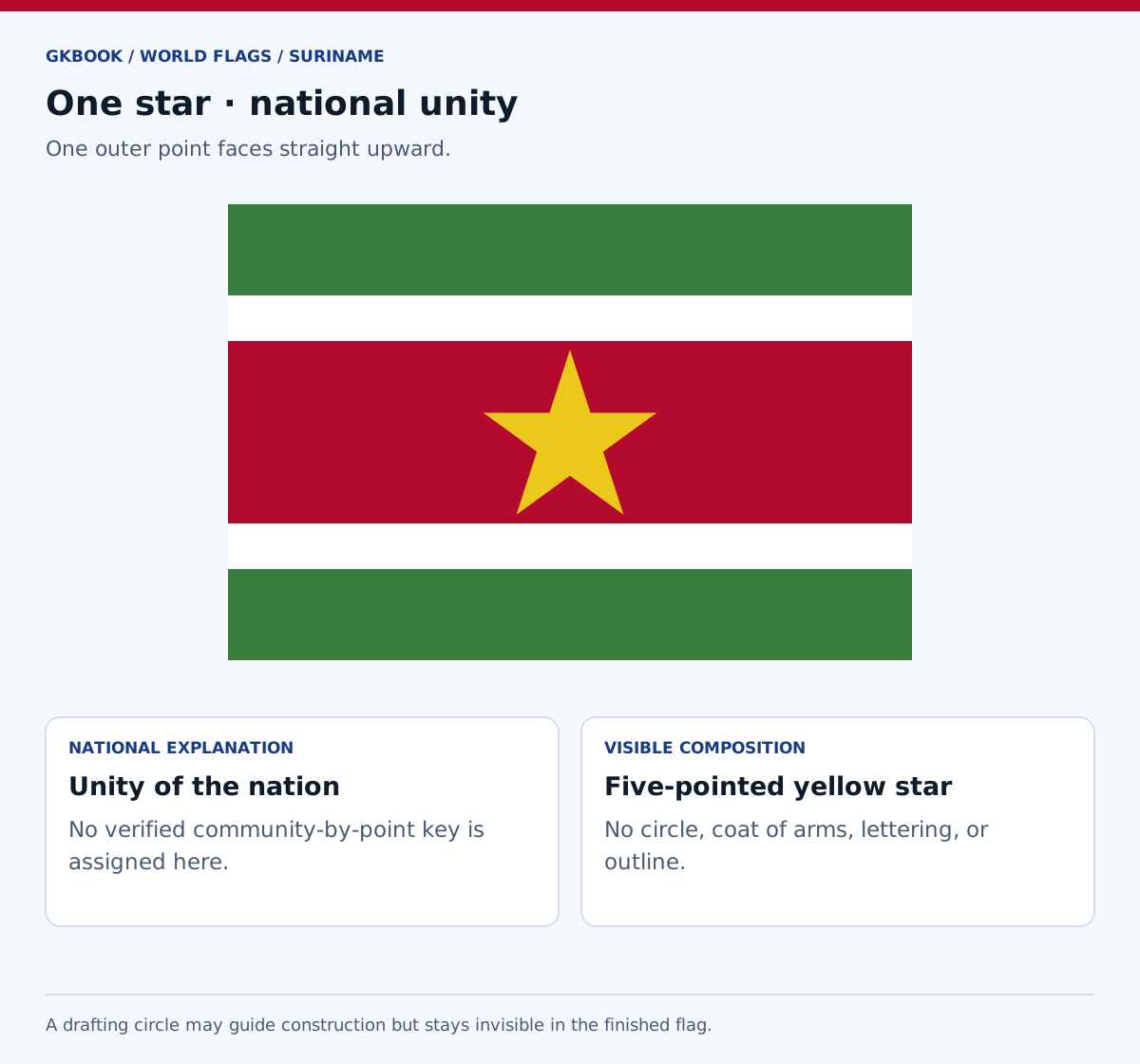
One star and five stars are different design statements. The earlier flag displayed five separate colored stars, while the present flag brings attention to a single central device. Counting the points of that device should not be used to recreate the earlier flag’s separate stars or its historical population classifications.
The central star is solid and has no surrounding white disk, black ring, lettering, or coat of arms. A construction circle can help a drafter position its outer points, but that circle remains invisible in the finished flag. The explanatory diagrams keep construction guides distinct from the national artwork.
What is the official proportion of Suriname’s flag?
The government specifies a height:length ratio of 2:3. The supplied master is 6,000 pixels wide and 4,000 pixels high, which follows that relationship exactly. Uniform scaling preserves the national rectangle. A social-media card may have another overall shape while containing a complete flag with the correct internal ratio.

Ratios are clearest when the order of dimensions is stated. Height:length 2:3 describes the same rectangle as width:height 3:2. Image dimensions usually list width first, so the download size reads 6,000 × 4,000. These different notations agree once the labels identify which measurement comes first.
Measure the outer rectangle rather than only the red band or the star’s bounding box. Stretching the flag to fill a square or an unusually wide banner changes every component. Fit the complete image within the available space and leave surrounding margins when the container has a different aspect ratio.
What are the five band heights?
From top to bottom, the band-height ratio is 2:1:4:1:2 for green, white, red, white, and green. On the 4,000-unit-high master, those heights are 800, 400, 1,600, 400, and 800. The five bands are not equal, although matching colors above and below the center have equal heights.

The ratio adds to ten parts, making it convenient to construct a scaled drawing. Divide the height by ten, then allocate two parts to each green band, one to each white stripe, and four to red. All boundaries remain horizontal, parallel, and uninterrupted across the full width.
The star changes the visible red area without changing the underlying band height. Keep these two measurements separate when explaining the design. Red occupies forty percent of the rectangle before the star is overlaid, but the exposed red surface is smaller because the yellow polygon covers part of it.
| Band | Top coordinate | Height | Share of total height |
|---|---|---|---|
| Upper green | 0 | 800 | 20% |
| Upper white | 800 | 400 | 10% |
| Red | 1,200 | 1,600 | 40% |
| Lower white | 2,800 | 400 | 10% |
| Lower green | 3,200 | 800 | 20% |
How large is the star on Suriname’s flag?
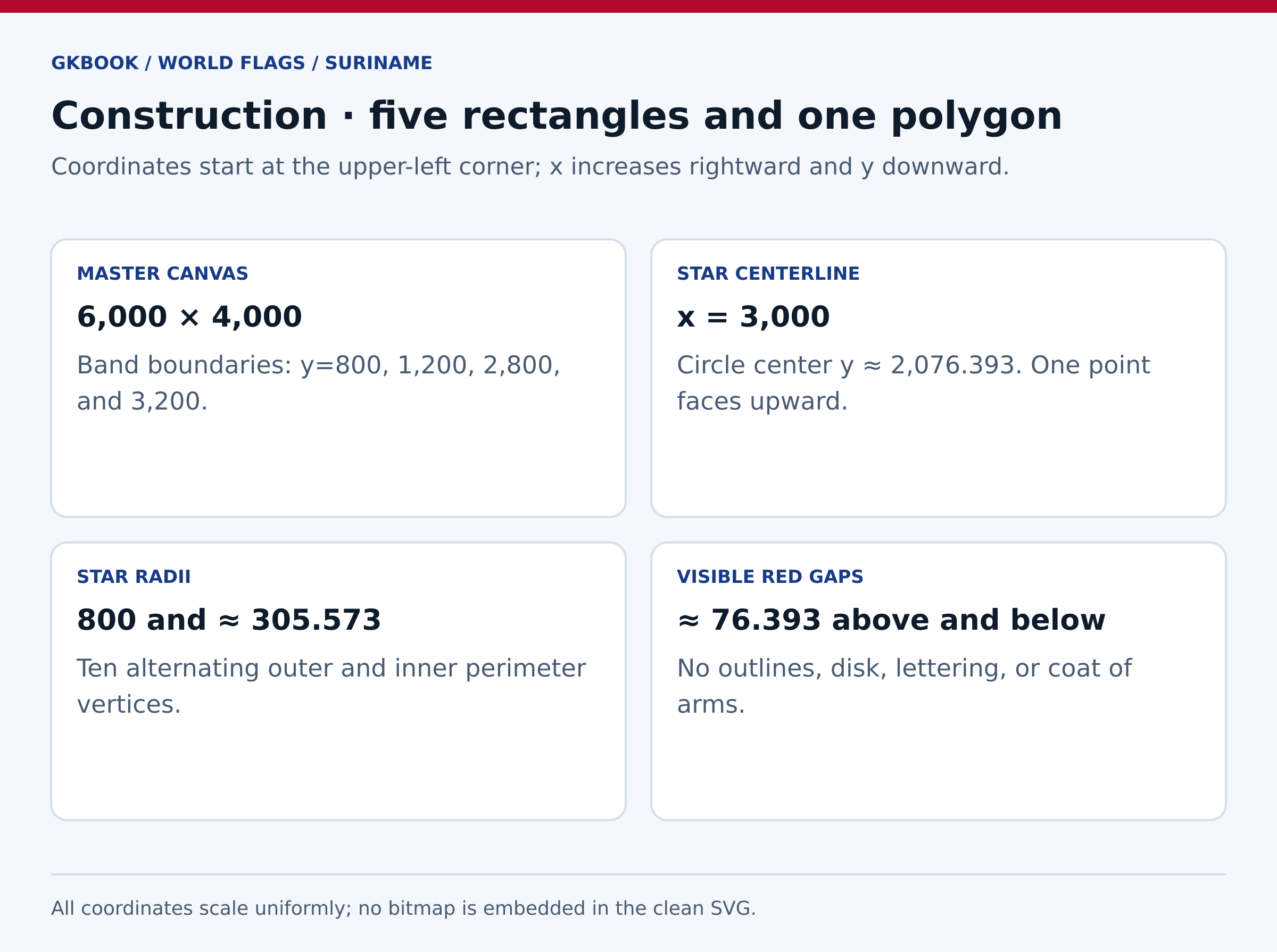
The government makes the star’s circumscribed-circle radius equal to the height of a green band. In this master that radius is 800 units, or one fifth of the flag height. The circle’s diameter equals the red band’s height, but the star’s visible top-to-bottom height is smaller than that diameter.

A circle enclosing the five outer tips is a drafting aid, not a visible part of the flag. The uppermost point reaches the top of that circle, while the two lowest outer points fall short of its bottom. Consequently, centering the circle vertically would not center the visible star between the red edges.
For a regular pentagram, the inner radius is approximately 305.573 units when the outer radius is 800. The supplied geometry computes that relationship rather than estimating the notches by eye. Keeping all ten perimeter vertices connected in order produces a solid star with consistent points and clean inward corners.
Is the star’s construction circle centered vertically?
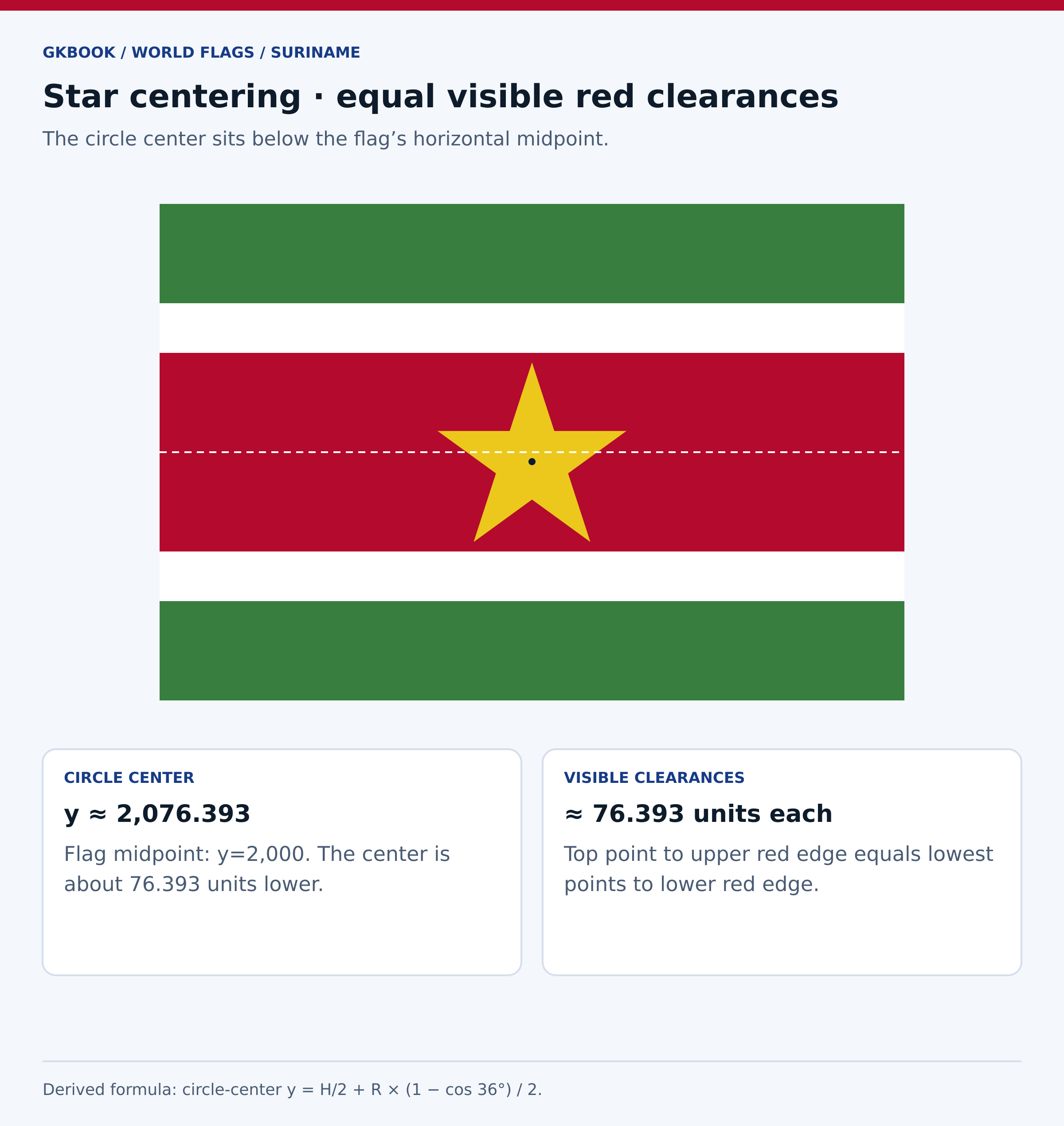
No. The government requires equal visible clearance above the highest star point and below the two lowest points within the red band. That places the star’s construction-circle center slightly below the flag’s midpoint. In this master it is at y≈2,076.393, while the flag’s midpoint is y=2,000; both clearances are approximately 76.393 units.
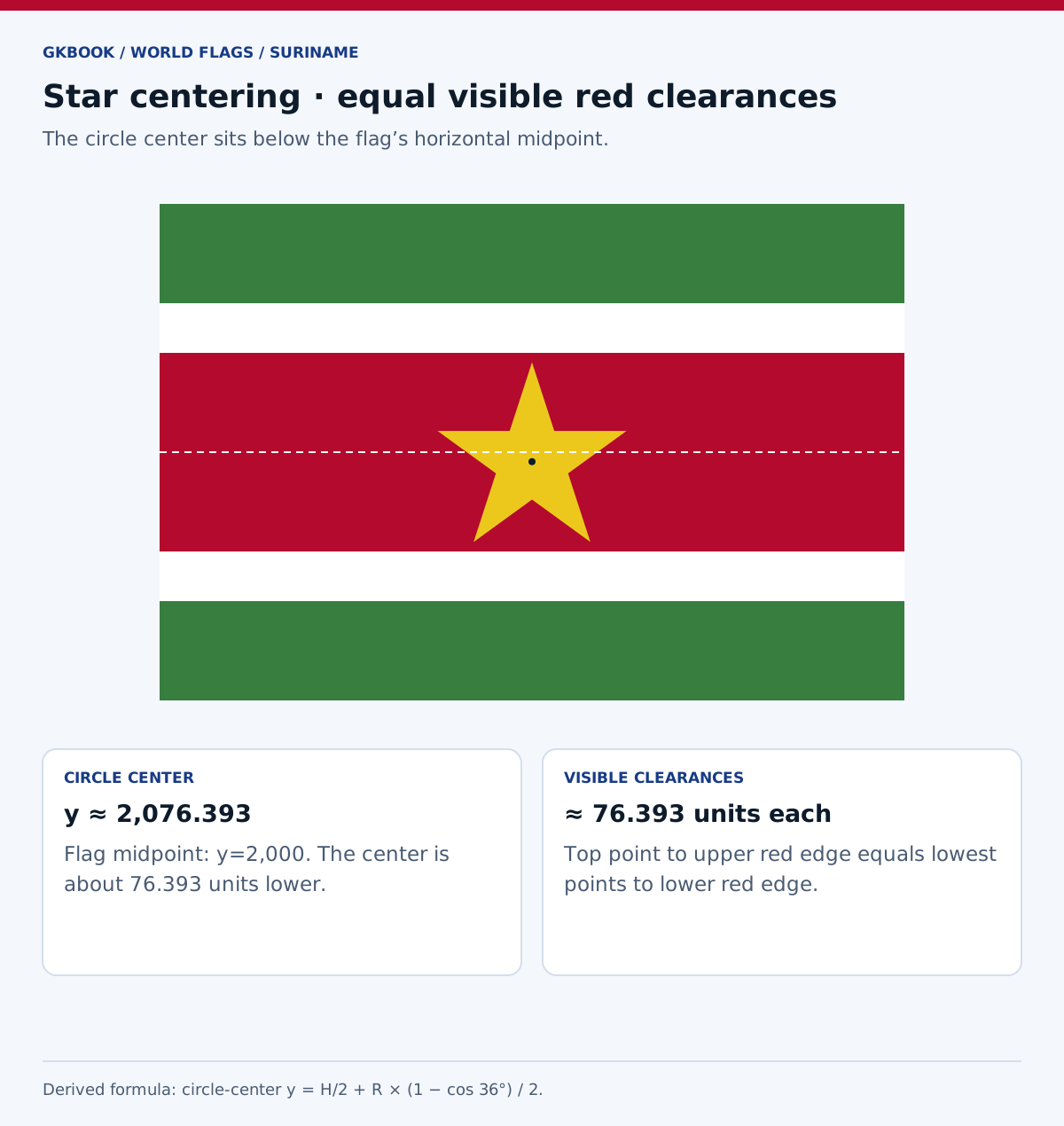
This is the detail most easily lost in an otherwise tidy reconstruction. The visible star is balanced between the red boundaries, but its enclosing circle is not centered on the horizontal midpoint. Equal clearance is checked against the actual polygon tips rather than against the circle’s top and bottom.
The offset follows from the regular five-pointed geometry. With outer radius R, move the circle center downward by R multiplied by one minus the cosine of 36 degrees, divided by two. The diagrams show the resulting measurements explicitly, while the clean master contains only the flag’s colored shapes.
How is Suriname’s flag constructed accurately?
Use a 6,000 × 4,000 rectangle with band boundaries at y=800, 1,200, 2,800, and 3,200. Place an upright regular yellow star on the vertical centerline x=3,000. Its outer radius is 800, its inner radius is about 305.573, and its circle center is y≈2,076.393 to preserve equal visible red margins.
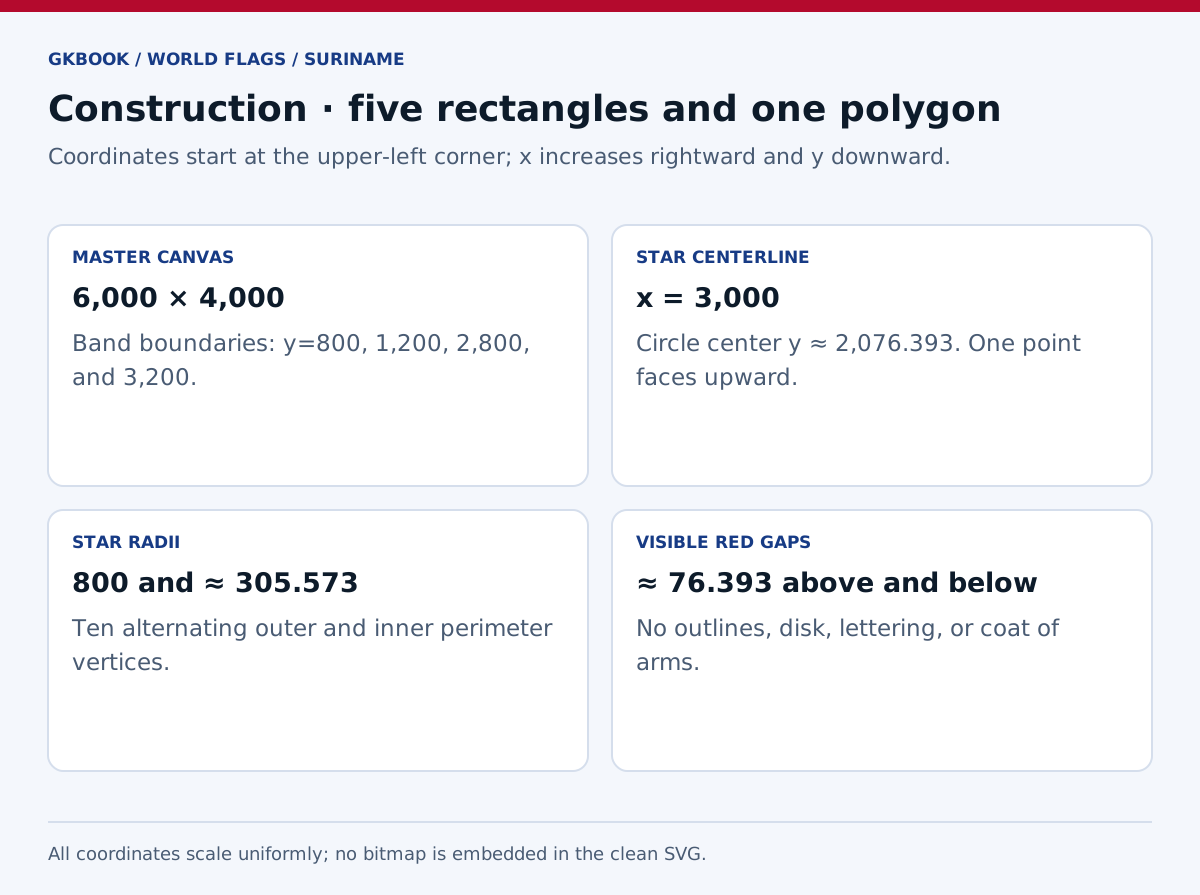
Coordinates begin at the upper-left corner, increasing rightward and downward. Draw five full-width rectangles in the required order, then place the star over the red rectangle. The star’s highest point lies near y=1,276.393 and its two lowest outer points near y=2,723.607, leaving matching clearance from the red boundaries.
Do not add outlines to separate adjacent colors. Their shared edges already define the composition. The SVG uses five rectangles and a ten-vertex polygon, with no embedded bitmap or hidden photograph. All coordinates scale together, so the same construction can produce a small icon or a much larger vector drawing.
| Measurement | Value |
|---|---|
| Vertical centerline | x = 3,000 |
| Outer radius | 800 |
| Inner radius | 800 × (3 − √5) / 2 ≈ 305.573 |
| Circle center | (3,000, 2,076.393…) |
| Highest point | y ≈ 1,276.393 |
| Lowest outer points | y ≈ 2,723.607 |
| Top and bottom visible red gaps | ≈ 76.393 each |
How has Suriname’s national flag changed?
The earlier flag established in 1959 had a white field with five differently colored stars linked by a black ellipse. The present green, white, red, white, and green design with one yellow star replaced it at independence in 1975. These are distinct national designs, so historical images need dates and version labels.

The inspected 1959 ordinance is dated December 8 and states that it takes effect on December 15 of that year. Its appendix describes the earlier stars and ellipse in detail. It should not be cited as the construction authority for the current flag simply because its title mentions Suriname’s national flag.
The change to one central star accompanied a new stage in the country’s political history. This gallery presents that sequence through explanatory panels rather than pretending to reproduce an authenticated period artifact. For an actual ceremony photograph, the pictured design and the event date should be checked together before writing a caption.
When was Suriname’s present flag adopted?
Suriname’s present national flag entered use on November 25, 1975, when the country became independent. The government’s account of the flag ceremony identifies that changeover. Preparatory design discussions and parliamentary decisions occurred earlier, but they should not replace the independence-day date used for the introduction of the current national flag.

Attach each date to the event it describes. A proposal, a committee decision, a parliamentary debate, and a first ceremonial raising can belong to different moments in the same adoption process. Listing them without labels can make an accurate historical sequence look like a contradiction about one single date.
Here, November 25 identifies the current flag’s introduction at independence. The older ordinance’s December 1959 dates concern the previous design. Later digital files have their own revision dates, which document artwork maintenance rather than a new national adoption. A changed SVG timestamp is therefore not evidence of a changed flag.
Who designed Suriname’s present flag?
The adopted flag was based on a proposal by Jack Pinas, but the final design incorporated changes made during the selection process. Historical research and reporting record his objections to those alterations. Crediting Pinas as the originating designer should therefore retain that qualification rather than describing the final flag as his unchanged winning entry.
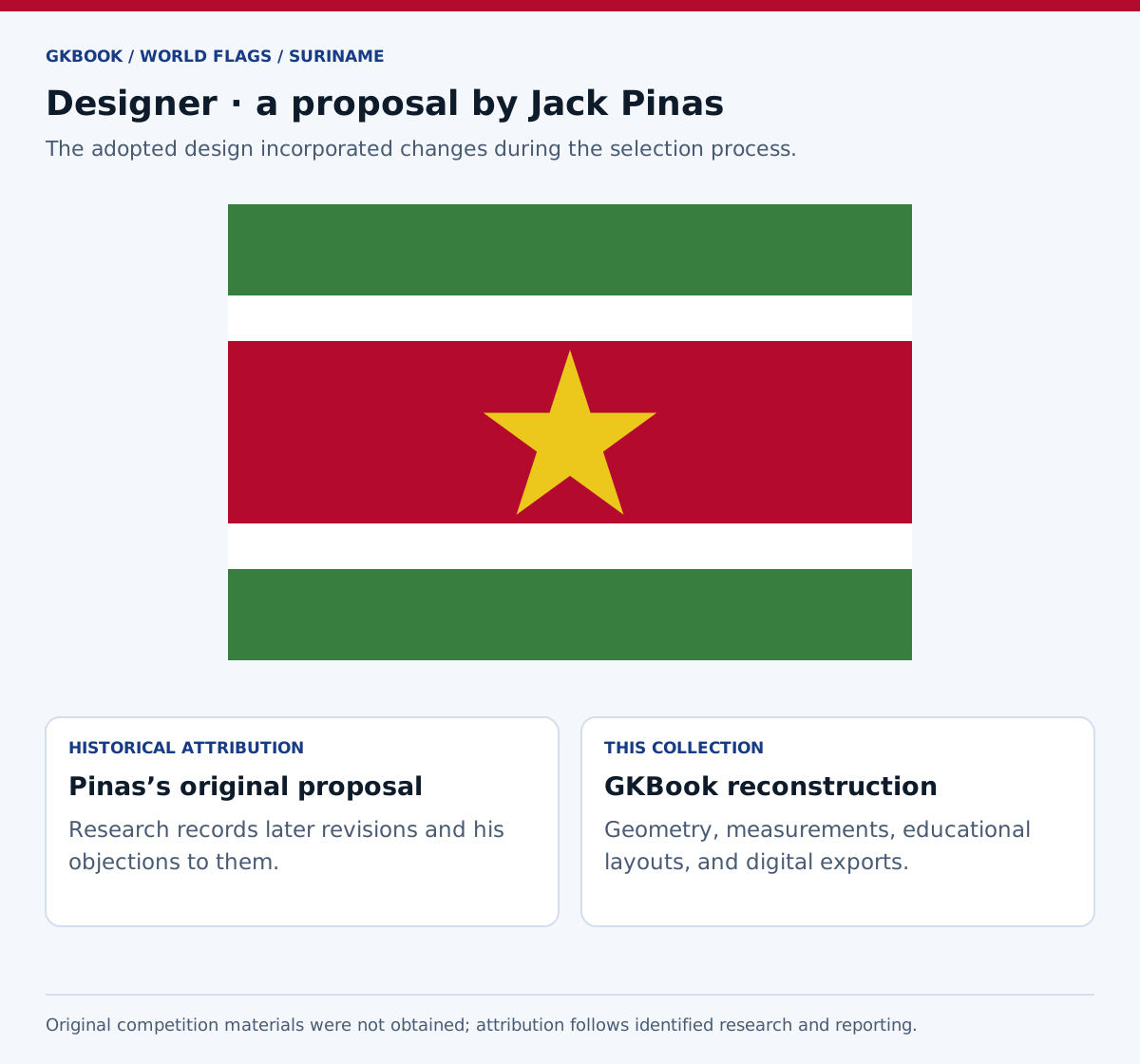
Rob Bertijn’s archival study describes a proposal with a black star inside a white disk, followed by discussion and revisions that produced the yellow star. The account also identifies committee involvement. This makes authorship more specific than a simple competition story in which one submitted drawing passed directly into official use.
GKBook’s credit concerns the reconstruction, measurements, teaching layouts, and exports supplied here. It does not replace the historical design attribution or imply that the original competition materials were obtained. The present artwork follows the government’s published final geometry, while the designer section preserves the distinction between an initial proposal and the adopted result.
When did Suriname become independent?
Suriname became independent from the Netherlands on November 25, 1975. The present national flag was introduced for that milestone. The United States recognized Suriname and established diplomatic relations on the same date. United Nations membership followed on December 4, 1975, so admission should remain distinct from independence and bilateral recognition.

These milestones describe different relationships. Independence concerns the country’s political status, bilateral recognition records another state’s response, and United Nations admission concerns membership in an international organization. Their proximity in the calendar does not make them interchangeable labels for the same administrative or constitutional event in the historical record.
A current flag can appropriately illustrate an independence anniversary, but an archival caption should still identify the photograph’s actual date. The explanatory panel uses the national design alongside dated statements. It is a modern teaching image, not a claim to show the original flag-raising ceremony or a particular surviving piece of fabric.
What did Suriname’s earlier flag look like?
The 1959 flag had a white rectangular field and five equal, black-outlined stars in black, brown, yellow, red, and white, connected by a black elliptical band. The ordinance took effect on December 15, 1959. This earlier design was replaced in 1975 and should not be confused with today’s single yellow star.

The law’s appendix specifies the ellipse and the placement of the individual stars, so the historical design was more than an arbitrary cluster of symbols. Its white star had a black outline to remain visible on the white field. Those features belong to that earlier composition and are absent from the present master.
Eva Essed-Fruin’s participant account, supported by her archival research, credits Noni Verwey-Lichtveld with developing the earlier design. This is separate from the attribution to Jack Pinas for the later proposal. The gallery describes the older flag without inventing a color-calibrated facsimile of an archival object or transferring its features into the modern design.
Why does the present flag have one star instead of five?
The single star expresses national unity, whereas the earlier five-star flag used separate colors in a historical representation of population groups. The current government explanation emphasizes one nation and a shared future. It does not provide a rule assigning one modern community to each point of the present yellow star.
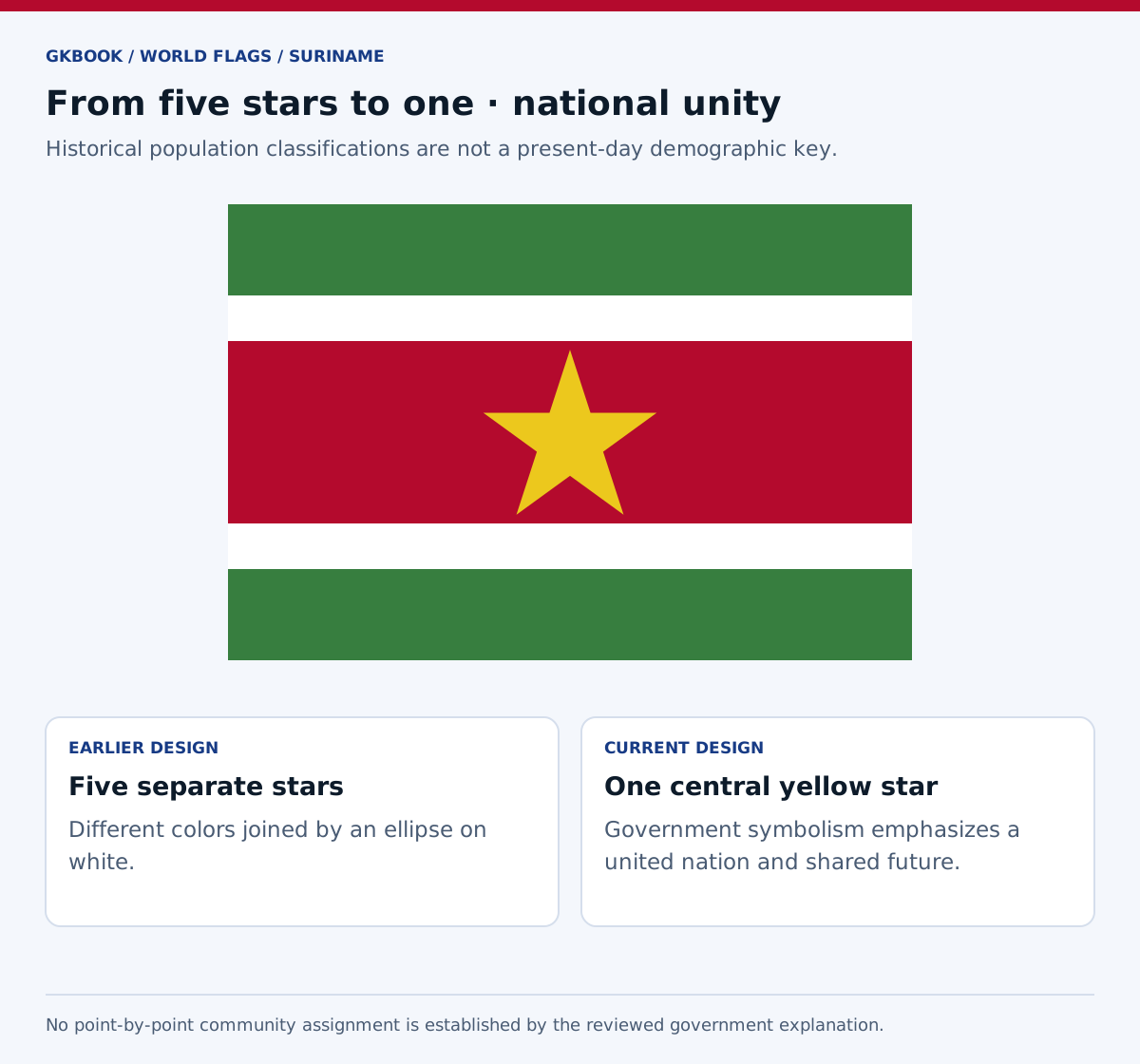
Historical population categories should be described as part of their period, not presented as a complete or timeless classification of Suriname’s people. The shift in the design is visible without turning those categories into a modern demographic statement. One central star replaces a set of separate stars joined by an ellipse.
A common visual misunderstanding is to count the new star’s five tips as if they were the five old stars compressed into one. That interpretation needs evidence beyond the number five. The reviewed national explanation supports unity; the construction specification determines the star’s shape and placement without adding a point-by-point identity key.
Which specifications govern this reconstruction?
This reconstruction follows the current government-published description for the 2:3 rectangle, band ratios, star radius, upright point, and equal visible clearances. Its regular star geometry is calculated explicitly. The screen colors match the inspected Commons SVG, while the unavailable original digital-color PDF and the unobtained 1975 legal instrument remain clearly recorded evidence limits.

Different kinds of evidence have different roles. A national government description establishes the construction used here. The actual community SVG provides a reproducible digital comparison, including its numerical fills. The earlier law documents a previous flag. Treating all three as interchangeable would conceal both the chronology and the basis for each production choice.
The published star rules deserve more attention than a generic instruction to place a star in the middle. They specify its radius and equal visible margins. These conditions produce a precise circle-center offset, which is retained in the supplied vector. Physical color certification and official approval of a manufactured flag are separate matters.
When did Suriname join the United Nations?
Suriname was admitted to the United Nations on December 4, 1975, under General Assembly resolution 3413 (XXX). The United Nations Treaty Series records that date separately from the declaration signed on November 25 and its later registration on June 1, 1976. UN admission is not the national flag’s adoption date.
The declaration accepted the obligations of the United Nations Charter on behalf of the new country. Its record includes several dates because signing, presentation, admission, and treaty registration are separate steps. Reading only the registration date would move the membership milestone into the wrong year and distort the independence chronology.
The United States recognition record offers a different, bilateral timeline: recognition and diplomatic relations began on November 25, 1975. Neither that record nor the UN document sets the national flag’s dimensions or colors. They help establish state-history milestones, while the government’s flag description supplies the construction evidence used for these images.
Does Suriname’s flag include the national coat of arms?
No. The ordinary national flag contains the five horizontal bands and one yellow star, without the coat of arms, a motto, lettering, or a shield. The government presents the national arms as a separate symbol. A page or ceremonial display may show both symbols together without making the arms part of the flag.
When identifying a flag in a document, separate the rectangular banner from surrounding seals, headings, and official logos. A national emblem beside a flag can provide context, but its proximity does not establish a new flag variant. The clean download therefore leaves the red field plain except for the yellow star.
The distinction also helps with thumbnails and school worksheets. Adding an elaborate emblem can obscure the single-star silhouette that identifies the ordinary design. If a specialized institutional banner is required, it needs its own documented reference and label rather than an unannounced alteration of this national master.
What guidance is available for displaying the flag?
A government-published protocol interview describes ordinary display from sunrise to sunset and emphasizes respectful handling. That educational account is useful guidance, but it is not a complete current legal code for every ceremony. An official event should follow its applicable instructions, including any directions about timing, precedence, mounting, or mourning.

The artwork itself should remain complete and legible during display. Preserve the five bands and the upright star rather than stretching the design to fill a decorative space. Labels, dates, and institutional messages can sit beside the flag in a layout without being printed over the national symbol.
Physical display also involves the condition of the object, the attachment method, and the setting. Those choices cannot all be settled by a flat SVG. The collection explains the verified design and the selected published guidance, while an organizer remains responsible for obtaining the instructions that actually apply to the occasion.
Is a specific vertical-display version verified here?
No authoritative instruction for a special portrait arrangement was established in the sources reviewed for this collection. The verified national design is the 2:3 horizontal rectangle with one star point upward. Do not assume that rotating the entire image sideways, stretching it tall, or independently rearranging its parts creates an officially prescribed vertical version.
A portrait-shaped poster can contain a smaller, correctly proportioned horizontal flag without changing the national design. This is a layout choice around the image. By contrast, turning the complete flag through a quarter-turn also turns the star sideways and changes the direction in which the colored bands appear.
The absence of a verified portrait rule in this review is a limit of the material examined, not proof that no relevant instruction exists elsewhere. For a formal vertical hanging, obtain the applicable national or event guidance. This package avoids presenting an inferred arrangement as an official alternative flag.
What does the reverse of Suriname’s flag look like?
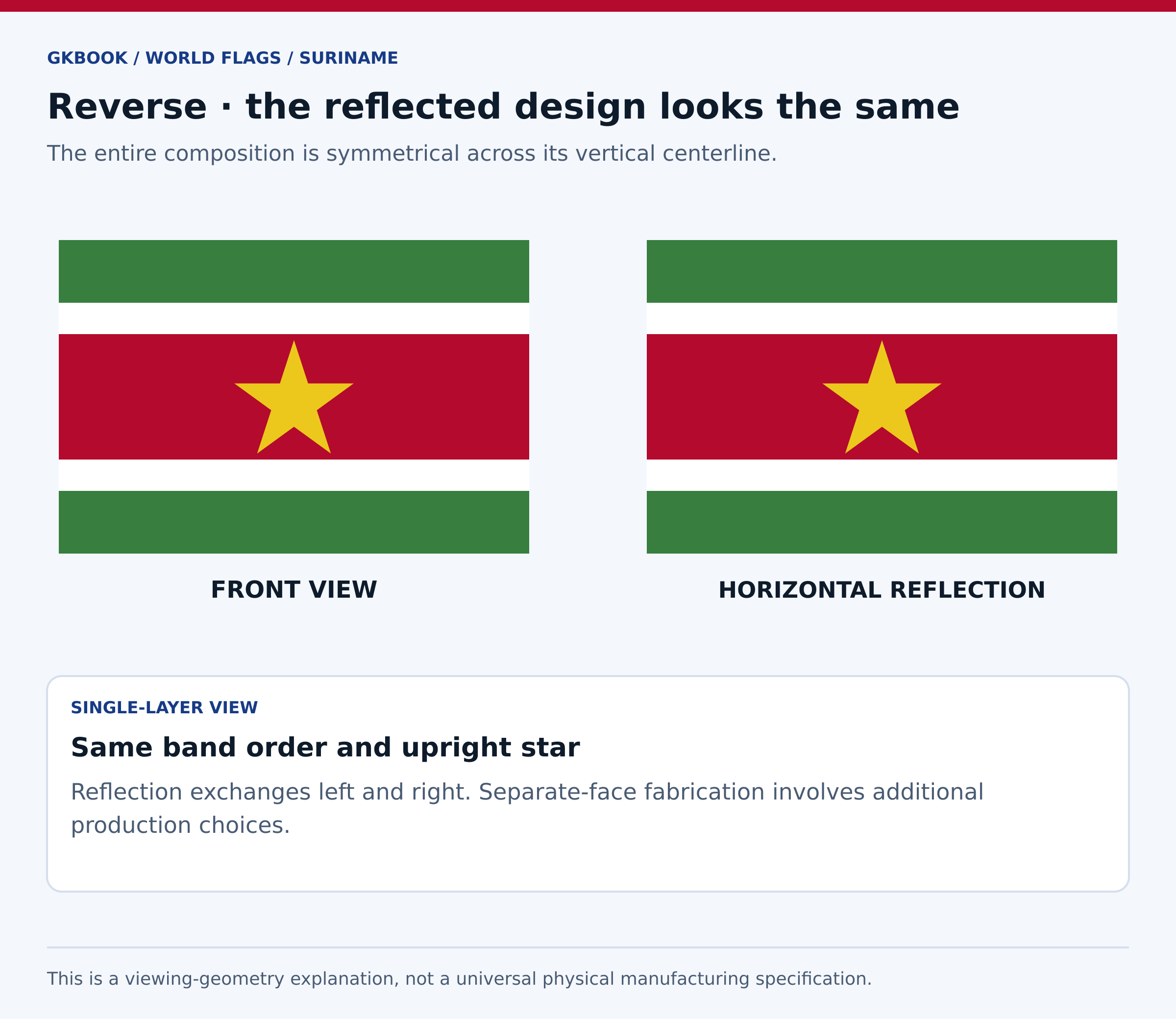
A horizontal reflection of the complete design has the same appearance: the bands extend across the full width, and the centered upright star is bilaterally symmetrical. This explains the reverse view of a single layer. It does not specify every manufacturing choice for separately printed or assembled faces of a physical flag.

Reflection exchanges left and right without exchanging top and bottom. Because both sides of the national composition match across its vertical centerline, no lettering or asymmetrical emblem reverses. The gallery shows the complete front and reflected view together so the unchanged star orientation and stripe order can be checked directly.
Turning the flag upside down is a different operation. Although the outer band sequence reads the same from either end, the star would have two upper points instead of one. That distinction makes the central device a necessary orientation check even when the green and white stripes appear to be arranged correctly.
Can Suriname’s flag be flown at half-mast?
Yes. A government announcement directed half-mast display on public buildings and docked ships for the national day of mourning on June 4, 2025. That is a dated example, not an active instruction for today. For another occasion, follow the applicable official announcement rather than importing an unverified procedure from another country.
A mourning announcement identifies the occasion and the institutions covered by it. Its date matters as much as the requested display. Reusing an old order without its historical context can incorrectly suggest that a mourning period remains in effect or that the same directions automatically apply to every event.
The reviewed announcement establishes that half-mast display is used, but it does not supply a comprehensive raising-and-lowering sequence for all circumstances. The national artwork stays unchanged. Half-mast concerns where the physical flag sits on its pole, rather than adding a black stripe, changing the star, or darkening the image.
How can an upside-down flag be recognized?
Check the star. In the correct horizontal design, one outer point faces straight upward and two outer points form the lowest pair. The green-white-red-white-green band sequence is vertically symmetrical, so checking the stripes alone will not reveal an upside-down image. A half-turn makes the star point downward instead.
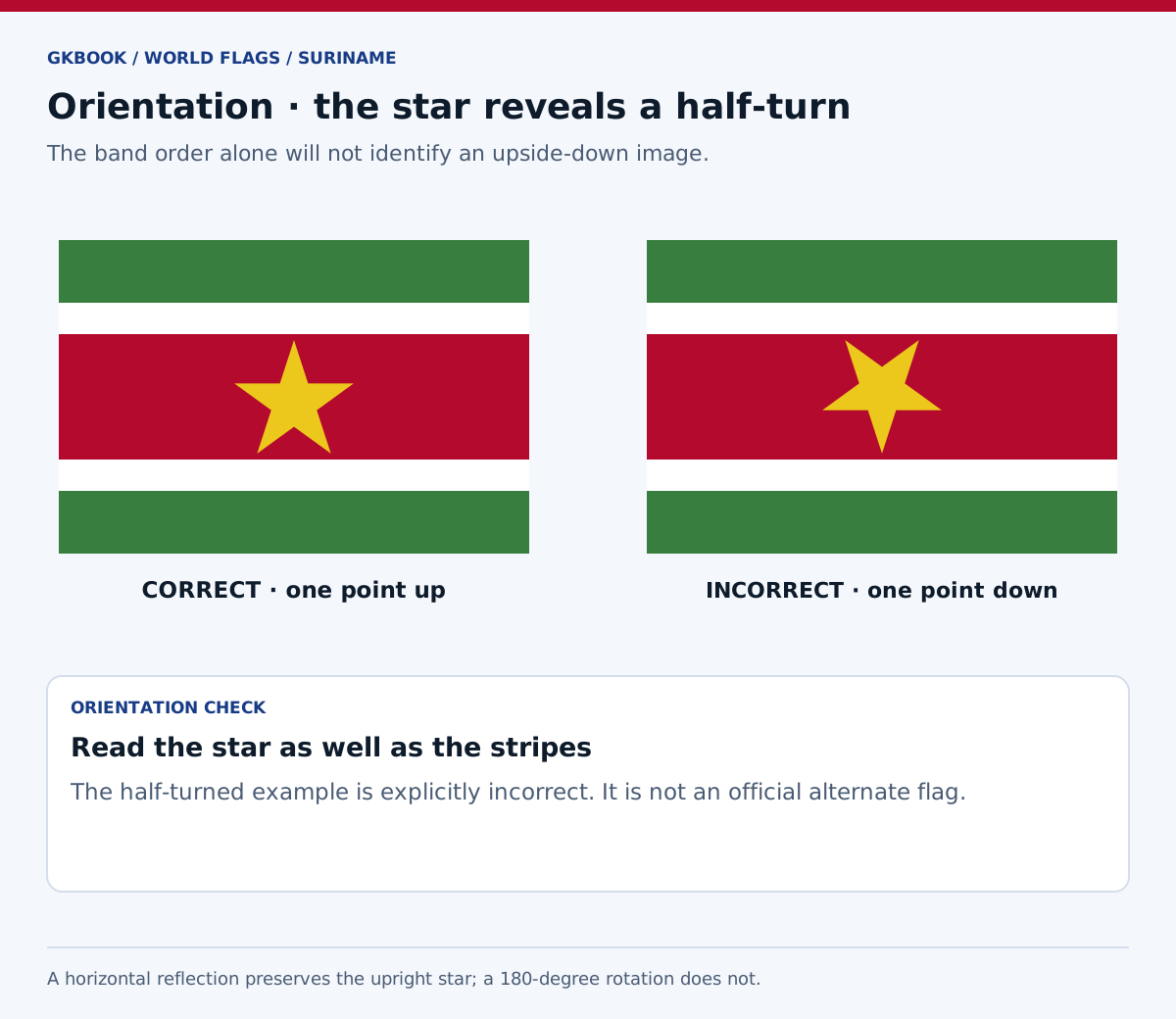
This differs from looking at the reverse, which exchanges left and right but preserves the upright star. A rotated photograph and a reflected photograph can therefore behave differently even when both show the same physical object. Identify the operation before deciding whether an image has the correct national orientation.
The orientation illustration marks a half-turned example explicitly as incorrect. It is a teaching comparison, not a second official version. Keep that label with the diagram if it is reused, and use the clean upright master whenever an ordinary article, icon, or classroom display simply requires the national flag.
How should these flag files be prepared for printing?
Preserve the complete 2:3 rectangle, the 2:1:4:1:2 bands, and the star’s equal visible margins. The 6,000 × 4,000 PNG corresponds to 20 × 13⅓ inches at 300 pixels per inch. That is a resolution calculation, not an official physical size. The SVG supports enlargement; physical color matching needs a suitable production proof.

Check the narrow white stripes and the star’s inward corners before approving an enlarged print. A layout program can distort a correct file by stretching it to fill a frame. Scale uniformly and keep the complete rectangle visible, with no added stroke around the star or the outer flag edge.
The declared RGB values are not a universal CMYK recipe. Conversion depends on the printing process, color profile, and material. Plan seams, hems, and attachment allowances separately so the intended visible proportions survive fabrication. Extra cloth for finishing should not silently shift the band boundaries or alter the star’s position within red.
Which Suriname flag pictures are included?
The collection contains 24 subjects in both SVG and PNG, plus a separate social card. Subjects cover the clean flag, colors, meanings, star, proportions, bands, geometry, history, adoption, designer, independence, earlier design, standardization, display, orientation, reverse viewing, and printing. Captions distinguish the national artwork from measurements, explanatory panels, and historical descriptions.
Choose the clean master for an ordinary national-flag illustration. The other files support teaching by adding labels, diagrams, or historical context around the design. Historical panels do not claim to reproduce archival fabric, and the incorrect orientation example remains clearly marked so it cannot be mistaken for a valid alternate flag.
Each subject has matching vector and raster filenames, descriptive alternative text, and a caption. The separate 1,200 × 630 social image contains a complete 540 × 360 flag. Its surrounding canvas has a different aspect ratio, but the national rectangle inside it retains the verified proportions and upright star.
Download Suriname flag pictures
Download the clean national flag as SVG or 6,000 × 4,000 PNG. Both preserve the complete 2:3 rectangle, five bands in 2:1:4:1:2 heights, and upright yellow star with equal visible red clearances. The screen palette is declared separately from the government’s color names and historical mixtures. Physical production requires appropriate color proofing and finishing allowances.
The gallery contains 24 subjects, each with an SVG and PNG. Captions distinguish clean flag artwork, component studies, historical explanations, and technical guides. Image credits and reproduction notes identify the artwork basis. The separate 1,200 × 630 social card contains a complete 540 × 360 flag and does not change the national rectangle.
Continue exploring national designs in World Flags.
World Flags/Suriname
Suriname flag pictures
Complete 2:3 national flag with government-published proportions and declared screen colors.
GKBook geometric reconstruction and educational layouts; screen palette checked against Wikimedia Commons contributors. No official certification or endorsement.Download SVGDownload PNGGreen #377E3F, white #FFFFFF, red #B40A2D, and yellow #ECC81D. These are declared screen values.
GKBook geometric reconstruction and educational layouts; screen palette checked against Wikimedia Commons contributors. No official certification or endorsement.Download SVGDownload PNGSymbolic associations follow the government explanation; they are not demographic percentages.
GKBook geometric reconstruction and educational layouts; screen palette checked against Wikimedia Commons contributors. No official certification or endorsement.Download SVGDownload PNGTwo equal green bands frame the design without adding a separate border.
GKBook geometric reconstruction and educational layouts; screen palette checked against Wikimedia Commons contributors. No official certification or endorsement.Download SVGDownload PNGThe two white stripes are opaque parts of the national artwork.
GKBook geometric reconstruction and educational layouts; screen palette checked against Wikimedia Commons contributors. No official certification or endorsement.Download SVGDownload PNGThe star overlays the red band without changing its underlying height.
GKBook geometric reconstruction and educational layouts; screen palette checked against Wikimedia Commons contributors. No official certification or endorsement.Download SVGDownload PNGThe reference to a golden future does not require metallic rendering.
GKBook geometric reconstruction and educational layouts; screen palette checked against Wikimedia Commons contributors. No official certification or endorsement.Download SVGDownload PNGThe single star is a national unity symbol; five points are not five separate stars.
GKBook geometric reconstruction and educational layouts; screen palette checked against Wikimedia Commons contributors. No official certification or endorsement.Download SVGDownload PNGHeight:length 2:3 is the same as width:height 3:2.
GKBook geometric reconstruction and educational layouts; screen palette checked against Wikimedia Commons contributors. No official certification or endorsement.Download SVGDownload PNGThe five bands have heights 800, 400, 1,600, 400, and 800 in the supplied master.
GKBook geometric reconstruction and educational layouts; screen palette checked against Wikimedia Commons contributors. No official certification or endorsement.Download SVGDownload PNGThe enclosing circle diameter is 1,600 units; the visible star height is smaller.
GKBook geometric reconstruction and educational layouts; screen palette checked against Wikimedia Commons contributors. No official certification or endorsement.Download SVGDownload PNGCenter the visible star between the red edges, not its enclosing circle on the flag midpoint.
GKBook geometric reconstruction and educational layouts; screen palette checked against Wikimedia Commons contributors. No official certification or endorsement.Download SVGDownload PNGThe regular-star calculations preserve the government’s equal-visible-clearance rule.
GKBook geometric reconstruction and educational layouts; screen palette checked against Wikimedia Commons contributors. No official certification or endorsement.Download SVGDownload PNGThe 1959 ordinance governs the earlier design, not today’s five bands.
GKBook geometric reconstruction and educational layouts; screen palette checked against Wikimedia Commons contributors. No official certification or endorsement.Download SVGDownload PNGPreparatory decisions and independence-day introduction belong to distinct stages.
GKBook geometric reconstruction and educational layouts; screen palette checked against Wikimedia Commons contributors. No official certification or endorsement.Download SVGDownload PNGThe final flag should not be described as an unchanged winning competition entry.
GKBook geometric reconstruction and educational layouts; screen palette checked against Wikimedia Commons contributors. No official certification or endorsement.Download SVGDownload PNGIndependence, bilateral recognition, and UN membership should retain their own labels.
GKBook geometric reconstruction and educational layouts; screen palette checked against Wikimedia Commons contributors. No official certification or endorsement.Download SVGDownload PNGThe current master excludes the earlier ellipse and separate stars.
GKBook geometric reconstruction and educational layouts; screen palette checked against Wikimedia Commons contributors. No official certification or endorsement.Download SVGDownload PNGFive points on one star should not automatically be assigned the earlier stars’ categories.
GKBook geometric reconstruction and educational layouts; screen palette checked against Wikimedia Commons contributors. No official certification or endorsement.Download SVGDownload PNGThe original 1975 instrument was not obtained; the current government description provides the technical basis.
GKBook geometric reconstruction and educational layouts; screen palette checked against Wikimedia Commons contributors. No official certification or endorsement.Download SVGDownload PNGThe article separates the verified artwork from event-specific display instructions.
GKBook geometric reconstruction and educational layouts; screen palette checked against Wikimedia Commons contributors. No official certification or endorsement.Download SVGDownload PNGOne upper point identifies the correct horizontal orientation; a half-turn points the star down.
GKBook geometric reconstruction and educational layouts; screen palette checked against Wikimedia Commons contributors. No official certification or endorsement.Download SVGDownload PNGThe centered star and full-width bands make the reflected appearance identical.
GKBook geometric reconstruction and educational layouts; screen palette checked against Wikimedia Commons contributors. No official certification or endorsement.Download SVGDownload PNGThe inch dimensions are resolution arithmetic, not an official required flag size.
GKBook geometric reconstruction and educational layouts; screen palette checked against Wikimedia Commons contributors. No official certification or endorsement.Download SVGDownload PNGFrequently asked questions
What does the Surinamese flag look like?
Suriname’s national flag has five horizontal bands of green, white, red, white, and green, with one upright yellow star in the red center. Its height:length ratio is 2:3, and the band heights follow 2:1:4:1:2. The present design entered use at independence on November 25, 1975.
What is Suriname’s flag called?
The design is usually called the national flag of Suriname or the Surinamese flag. The government describes it as the national flag of the Republic of Suriname. A descriptive country name is clearer than an invented nickname, especially when distinguishing the present star-and-stripes arrangement from the earlier flag used before independence.
What colors are on Suriname’s flag?
Suriname’s flag uses green, white, red, and yellow. These downloads use #377E3F, #FFFFFF, #B40A2D, and #ECC81D respectively, matching the inspected reference SVG. They are declared screen values. The current government description gives color names and historical mixtures; the original linked digital-color PDF was unavailable for direct verification during this review.
What does Suriname’s flag symbolize?
The government’s explanation connects green with fertility and hope, white with justice and freedom, and red with renewal and love expressed through action. The yellow star represents national unity and a shared future, with yellow also associated with sacrifice. These are attributed national meanings, not numerical measures of population or territory.
What do the green bands represent?
The government associates green with Suriname’s fertility, its possibilities, and hope for a new national future. Green occupies the upper and lower bands. Each is one fifth of the complete flag height, making the two green bands equal in thickness and together twice as tall as the two white stripes combined.
What do the white stripes represent?
The government’s account links white with justice and freedom. Two narrow white stripes separate the red center from the green outer bands. Each white stripe is one tenth of the total flag height, so each is half the height of a green band and one quarter the height of the red band.
What does the red band represent?
The government explains red through renewal, progress, and love that leads to action for the country. It describes the shade through a historical mixture of orange and carmine. Red forms the broad middle band, occupying four tenths of the flag height before the yellow star is placed over it.
What does the yellow color represent?
Yellow colors the single star and is associated in the government’s explanation with sacrifice and a shared golden future. The star itself expresses unity. Yellow is therefore a flat design color in these files; the symbolic reference to gold does not require metallic ink, a gradient, or a three-dimensional effect.
What does the star on Suriname’s flag mean?
The single yellow star represents the unity of the nation. It has five points, with one pointing straight upward, and sits within the wide red band. The reviewed government explanation does not assign a separate present-day population group, district, or continent to each of the star’s five individual points.
What is the official proportion of Suriname’s flag?
The government specifies a height:length ratio of 2:3. The supplied master is 6,000 pixels wide and 4,000 pixels high, which follows that relationship exactly. Uniform scaling preserves the national rectangle. A social-media card may have another overall shape while containing a complete flag with the correct internal ratio.
What are the five band heights?
From top to bottom, the band-height ratio is 2:1:4:1:2 for green, white, red, white, and green. On the 4,000-unit-high master, those heights are 800, 400, 1,600, 400, and 800. The five bands are not equal, although matching colors above and below the center have equal heights.
How large is the star on Suriname’s flag?
The government makes the star’s circumscribed-circle radius equal to the height of a green band. In this master that radius is 800 units, or one fifth of the flag height. The circle’s diameter equals the red band’s height, but the star’s visible top-to-bottom height is smaller than that diameter.
Is the star’s construction circle centered vertically?
No. The government requires equal visible clearance above the highest star point and below the two lowest points within the red band. That places the star’s construction-circle center slightly below the flag’s midpoint. In this master it is at y≈2,076.393, while the flag’s midpoint is y=2,000; both clearances are approximately 76.393 units.
How is Suriname’s flag constructed accurately?
Use a 6,000 × 4,000 rectangle with band boundaries at y=800, 1,200, 2,800, and 3,200. Place an upright regular yellow star on the vertical centerline x=3,000. Its outer radius is 800, its inner radius is about 305.573, and its circle center is y≈2,076.393 to preserve equal visible red margins.
How has Suriname’s national flag changed?
The earlier flag established in 1959 had a white field with five differently colored stars linked by a black ellipse. The present green, white, red, white, and green design with one yellow star replaced it at independence in 1975. These are distinct national designs, so historical images need dates and version labels.
When was Suriname’s present flag adopted?
Suriname’s present national flag entered use on November 25, 1975, when the country became independent. The government’s account of the flag ceremony identifies that changeover. Preparatory design discussions and parliamentary decisions occurred earlier, but they should not replace the independence-day date used for the introduction of the current national flag.
Who designed Suriname’s present flag?
The adopted flag was based on a proposal by Jack Pinas, but the final design incorporated changes made during the selection process. Historical research and reporting record his objections to those alterations. Crediting Pinas as the originating designer should therefore retain that qualification rather than describing the final flag as his unchanged winning entry.
When did Suriname become independent?
Suriname became independent from the Netherlands on November 25, 1975. The present national flag was introduced for that milestone. The United States recognized Suriname and established diplomatic relations on the same date. United Nations membership followed on December 4, 1975, so admission should remain distinct from independence and bilateral recognition.
What did Suriname’s earlier flag look like?
The 1959 flag had a white rectangular field and five equal, black-outlined stars in black, brown, yellow, red, and white, connected by a black elliptical band. The ordinance took effect on December 15, 1959. This earlier design was replaced in 1975 and should not be confused with today’s single yellow star.
Why does the present flag have one star instead of five?
The single star expresses national unity, whereas the earlier five-star flag used separate colors in a historical representation of population groups. The current government explanation emphasizes one nation and a shared future. It does not provide a rule assigning one modern community to each point of the present yellow star.
Which specifications govern this reconstruction?
This reconstruction follows the current government-published description for the 2:3 rectangle, band ratios, star radius, upright point, and equal visible clearances. Its regular star geometry is calculated explicitly. The screen colors match the inspected Commons SVG, while the unavailable original digital-color PDF and the unobtained 1975 legal instrument remain clearly recorded evidence limits.
When did Suriname join the United Nations?
Suriname was admitted to the United Nations on December 4, 1975, under General Assembly resolution 3413 (XXX). The United Nations Treaty Series records that date separately from the declaration signed on November 25 and its later registration on June 1, 1976. UN admission is not the national flag’s adoption date.
Does Suriname’s flag include the national coat of arms?
No. The ordinary national flag contains the five horizontal bands and one yellow star, without the coat of arms, a motto, lettering, or a shield. The government presents the national arms as a separate symbol. A page or ceremonial display may show both symbols together without making the arms part of the flag.
What guidance is available for displaying the flag?
A government-published protocol interview describes ordinary display from sunrise to sunset and emphasizes respectful handling. That educational account is useful guidance, but it is not a complete current legal code for every ceremony. An official event should follow its applicable instructions, including any directions about timing, precedence, mounting, or mourning.
Is a specific vertical-display version verified here?
No authoritative instruction for a special portrait arrangement was established in the sources reviewed for this collection. The verified national design is the 2:3 horizontal rectangle with one star point upward. Do not assume that rotating the entire image sideways, stretching it tall, or independently rearranging its parts creates an officially prescribed vertical version.
What does the reverse of Suriname’s flag look like?
A horizontal reflection of the complete design has the same appearance: the bands extend across the full width, and the centered upright star is bilaterally symmetrical. This explains the reverse view of a single layer. It does not specify every manufacturing choice for separately printed or assembled faces of a physical flag.
Can Suriname’s flag be flown at half-mast?
Yes. A government announcement directed half-mast display on public buildings and docked ships for the national day of mourning on June 4, 2025. That is a dated example, not an active instruction for today. For another occasion, follow the applicable official announcement rather than importing an unverified procedure from another country.
How can an upside-down flag be recognized?
Check the star. In the correct horizontal design, one outer point faces straight upward and two outer points form the lowest pair. The green-white-red-white-green band sequence is vertically symmetrical, so checking the stripes alone will not reveal an upside-down image. A half-turn makes the star point downward instead.
How should these flag files be prepared for printing?
Preserve the complete 2:3 rectangle, the 2:1:4:1:2 bands, and the star’s equal visible margins. The 6,000 × 4,000 PNG corresponds to 20 × 13⅓ inches at 300 pixels per inch. That is a resolution calculation, not an official physical size. The SVG supports enlargement; physical color matching needs a suitable production proof.
Which Suriname flag pictures are included?
The collection contains 24 subjects in both SVG and PNG, plus a separate social card. Subjects cover the clean flag, colors, meanings, star, proportions, bands, geometry, history, adoption, designer, independence, earlier design, standardization, display, orientation, reverse viewing, and printing. Captions distinguish the national artwork from measurements, explanatory panels, and historical descriptions.
Explore all general-knowledge topics and the A-to-Z lists.






We Value Your Opinion Comments