
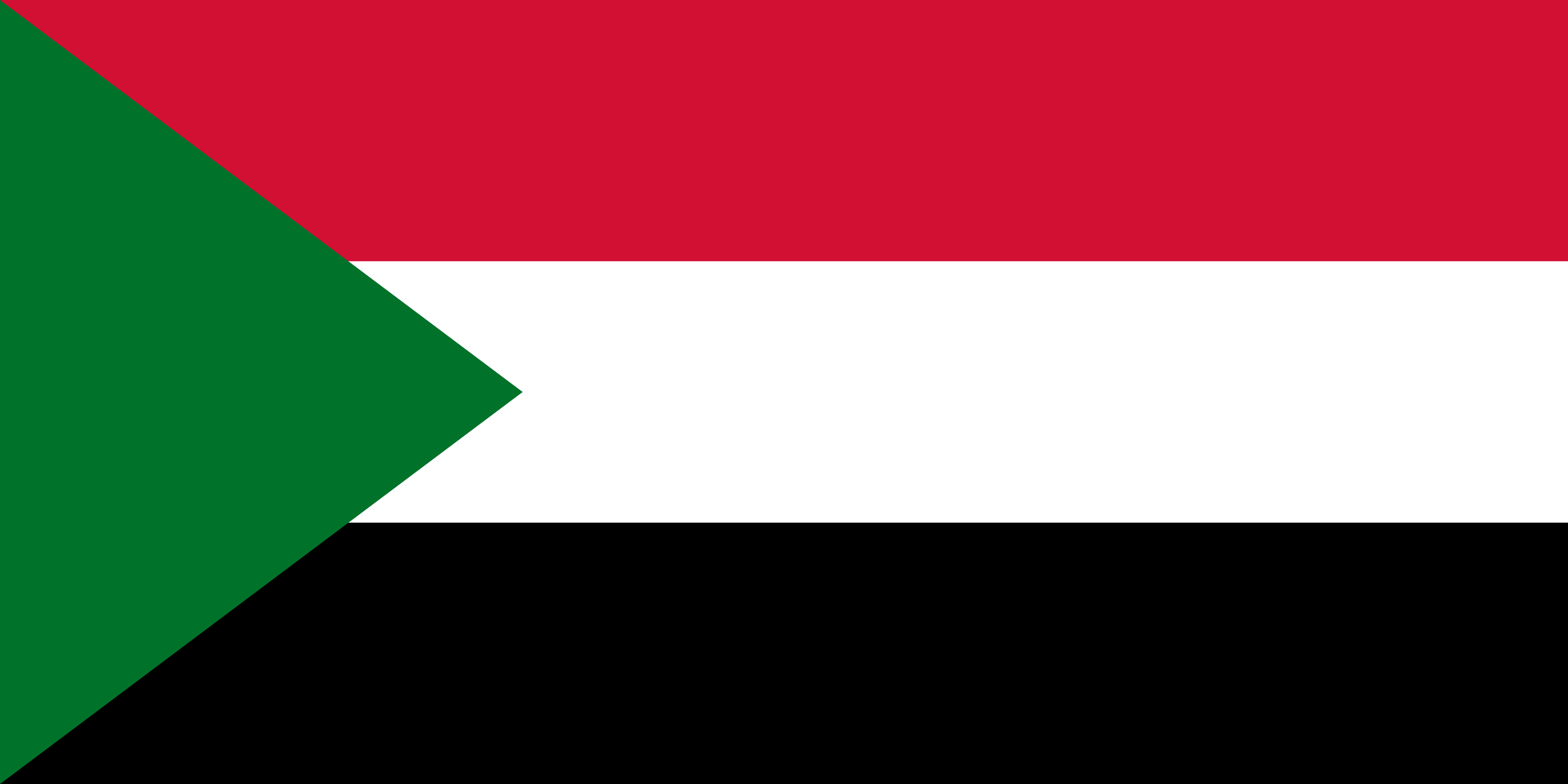
Sudan flag picture
Explore the construction notes, history, and picture gallery.
| Country | Republic of SudanDistinct from South Sudan. |
|---|---|
| Design | Red · White · Black · GreenEqual horizontal bands; plain green hoist triangle. |
| Proportions | Height:length = 1:2Triangle depth is one third of full length. |
| Present design adopted | May 20, 1970Separate from independence on January 1, 1956. |
| Inspected legal specification | National Flag Act 1993Article 4 describes geometry and orientation. |
| Main image sizes | SVG and PNG: 6,000 × 3,000Declared screen palette; opaque RGB PNG. |
The ordinary national flag has no star, lettering, or coat of arms. Color meanings are attributed in the article.
What does the Sudanese flag look like?
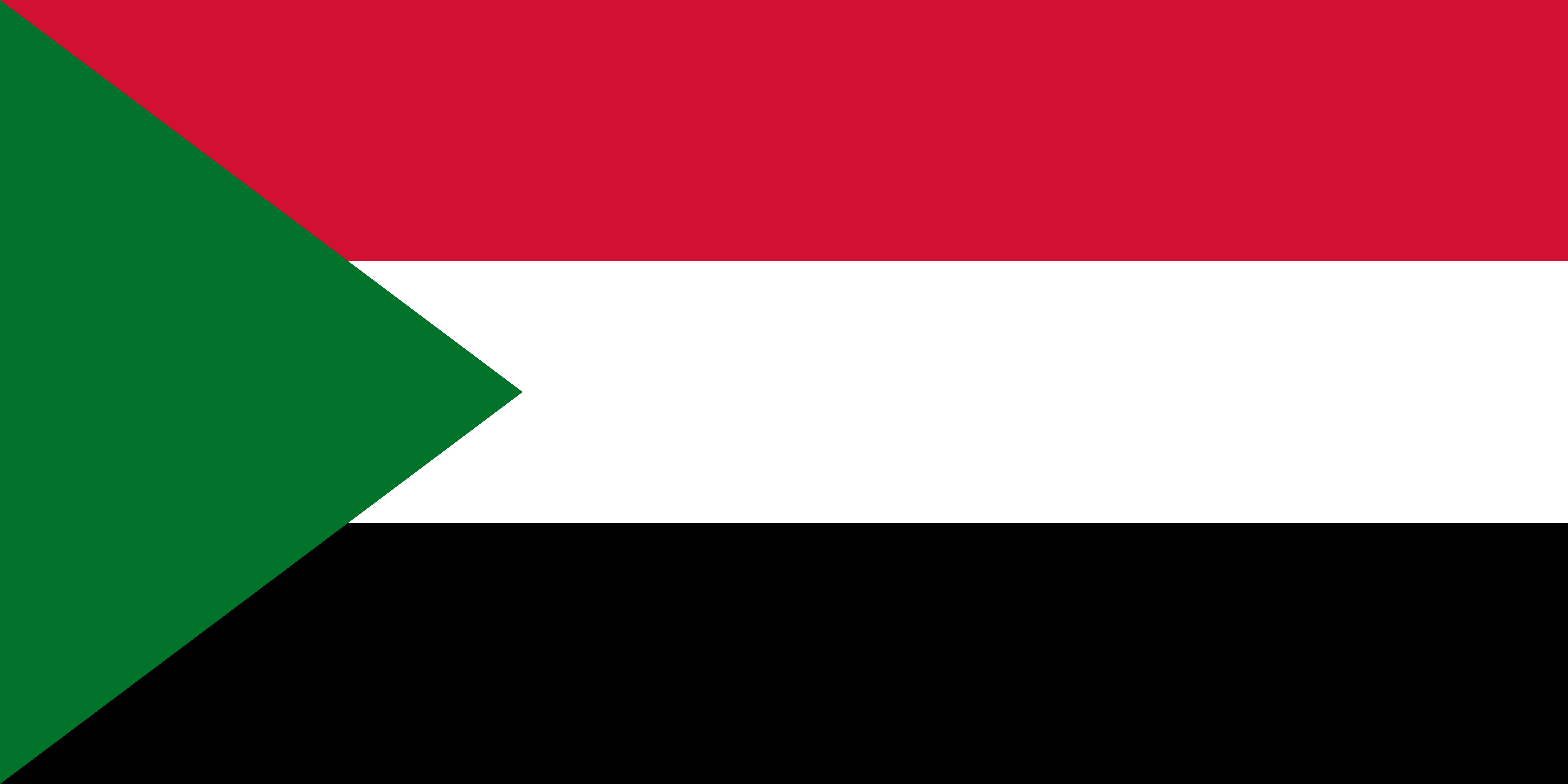
Sudan’s national flag has three equal horizontal bands of red, white, and black, with a green triangle extending from the hoist. Its height:length ratio is 1:2. The triangle reaches one third of the flag’s length, and the ordinary national design contains no star, lettering, or coat of arms.
Read the flag from top to bottom at its free edge: red, white, then black. The green shape occupies the attachment side, which appears on the left in the usual front view. Its point lies halfway down the rectangle, inside the white band. This combination identifies Sudan without relying on a caption or a country name printed over the image. The collection includes a clean flag and separate explanatory diagrams. Labels, measurement brackets, and information cards belong to those teaching layouts; they are not additional elements of the national flag itself.
What is Sudan’s flag called?
The design is normally called the national flag of Sudan or the Sudanese flag. The inspected National Flag Act uses the national-flag designation rather than establishing a special popular nickname. Sudan and South Sudan are separate countries, so their names and flag images should remain clearly distinguished in labels and filenames.
A country label is especially useful when several flags share the same four colors. Calling this image simply an Arab flag or an African flag loses the specific arrangement that identifies Sudan. Use the national name together with the red, white, and black bands and the green hoist triangle.
Historical pictures need an additional date or version label. The blue, yellow, and green independence flag belongs to an earlier design period, even though it also represents Sudanese national history. A descriptive title should help readers identify that distinction rather than treating every Sudanese national banner as visually interchangeable.
What are the colors of Sudan’s flag?
Sudan’s flag uses red, white, black, and green. This collection assigns them #D21034, #FFFFFF, #000000, and #007229 respectively, matching the inspected reference SVG. These are declared screen values. The 1993 National Flag Act names the colors but does not supply mandatory hexadecimal codes or a complete physical color-matching specification.
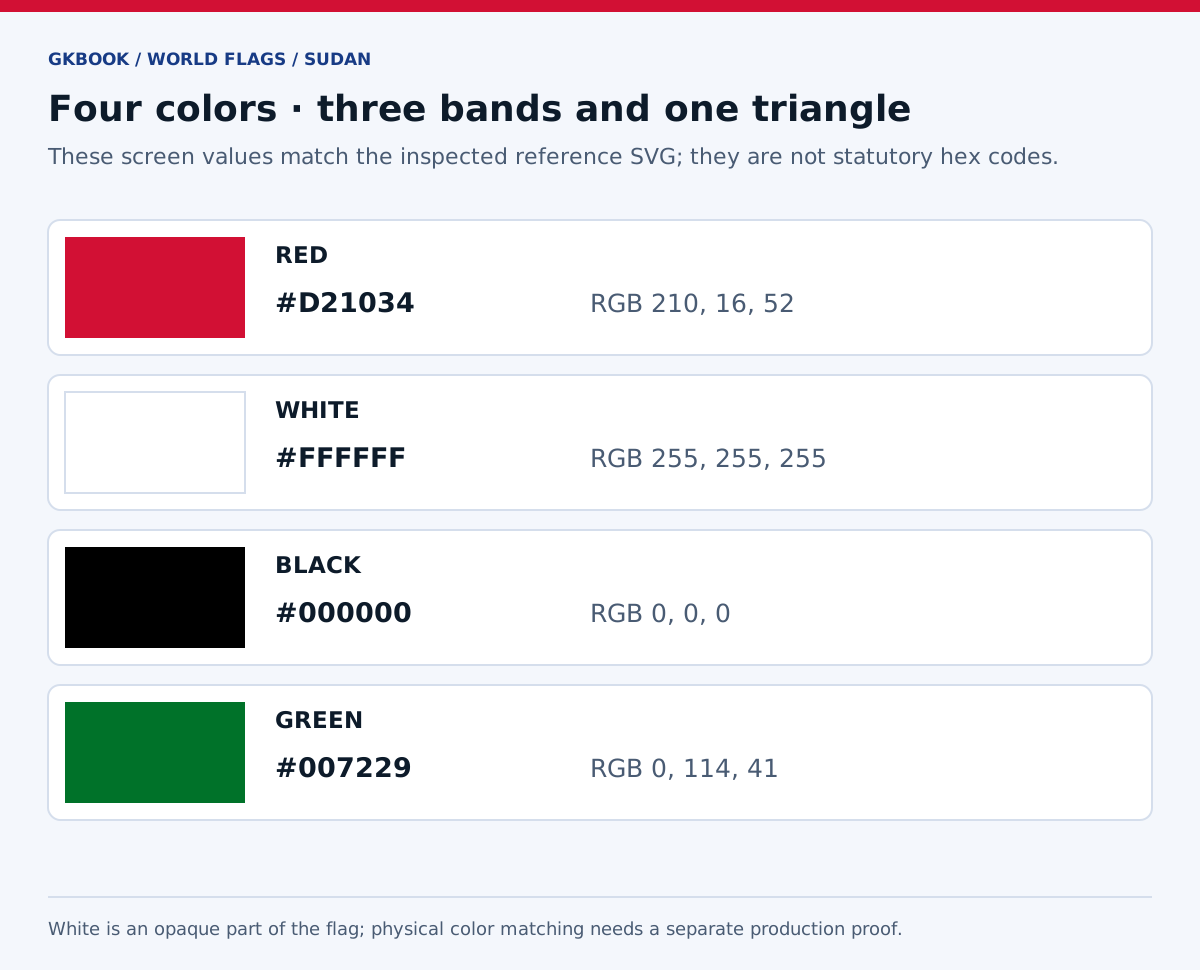
Color names and numerical reproduction values answer different questions. The names identify the national design; the digital values make these particular files reproducible. Copying an online swatch into another application preserves a chosen screen value, but does not establish that every material or printing process will reproduce the same appearance.
White is an opaque part of the artwork, not a transparent opening. Black fills the bottom band without a separate outline around the flag. Anti-aliased pixels along the diagonal edges may contain intermediate shades after rasterization. Those edge pixels smooth the boundary and do not introduce additional named flag colors.
| Color | Hexadecimal | RGB | Position |
|---|---|---|---|
| Red | #D21034 | 210, 16, 52 | Top band |
| White | #FFFFFF | 255, 255, 255 | Middle band |
| Black | #000000 | 0, 0, 0 | Bottom band |
| Green | #007229 | 0, 114, 41 | Hoist triangle |
What does Sudan’s flag symbolize?
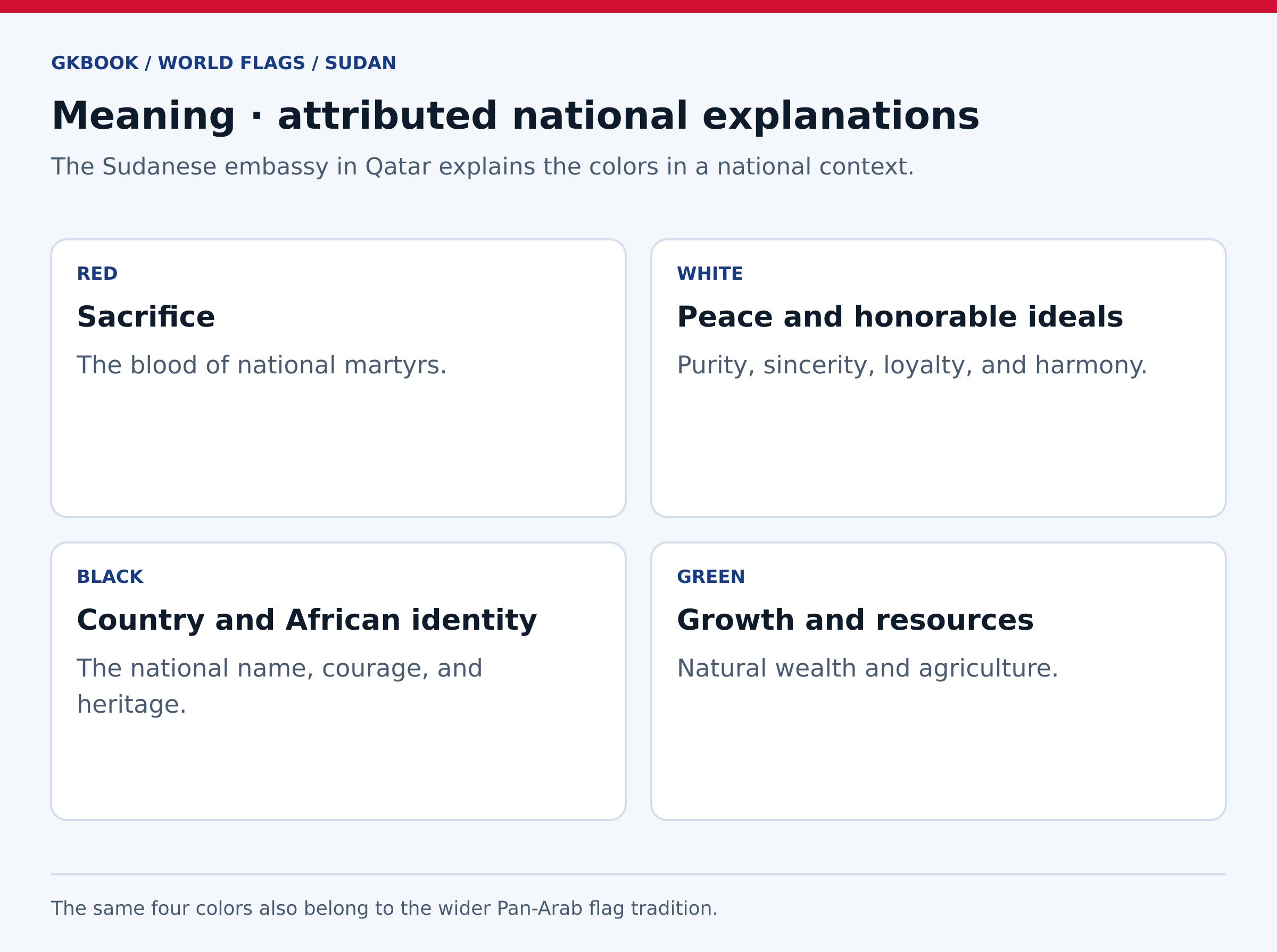
The Sudanese embassy in Qatar connects red with sacrifice, white with peaceful and honorable ideals, black with the country’s name and African identity, and green with growth and natural resources. These explanations concern the colors. They do not turn the flag’s areas into population shares or assign a documented meaning to every geometric measurement.
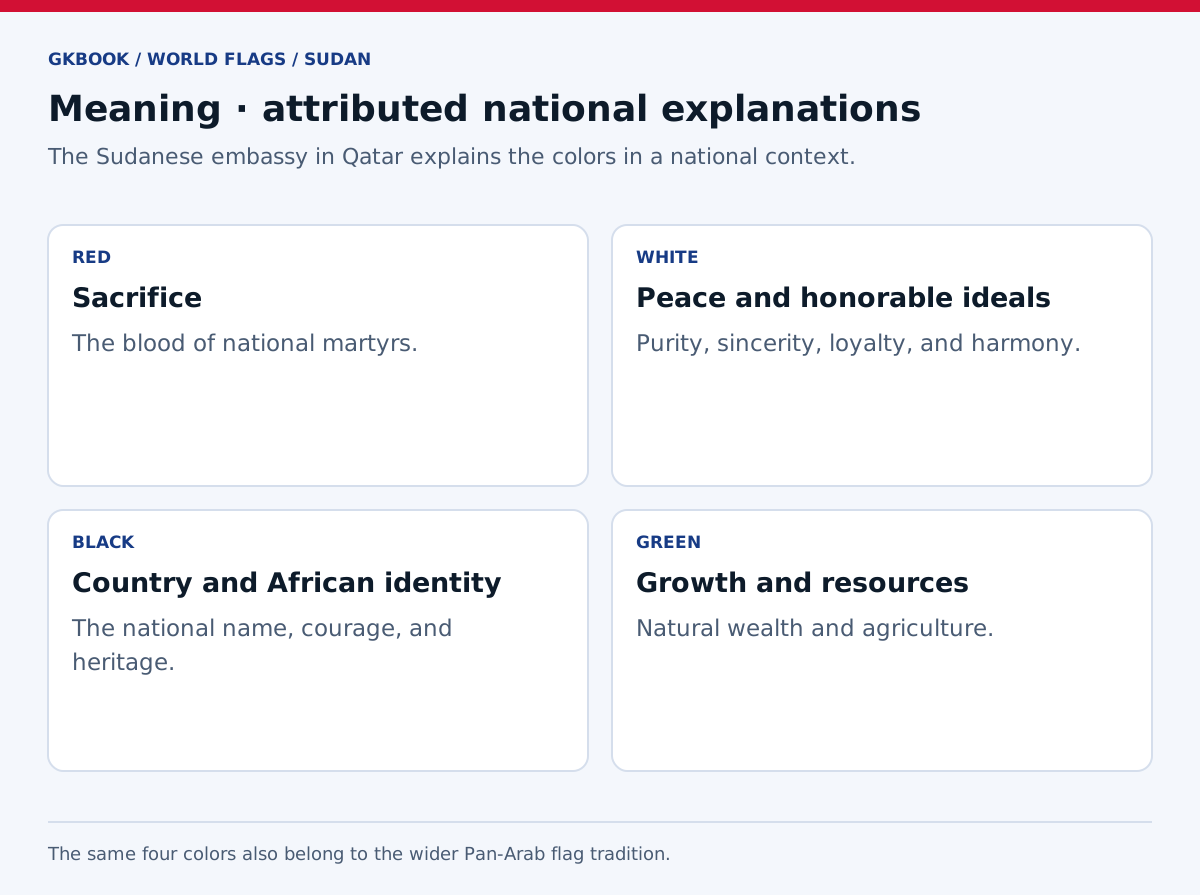
The four colors also belong to the wider Pan-Arab flag tradition. A shared palette can express a regional connection while a particular arrangement identifies one country. Sudan’s version combines that color family with its own national explanations, so the regional association should not erase the meanings described by Sudanese institutions.
Symbolic accounts are interpretations rather than a mathematical key to individual citizens. The green triangle does not mark a measured portion of the population, and the three horizontal bands should not be converted into a list of three communities without evidence. The construction diagrams explain shapes; the symbolism diagrams explain attributed associations.
What does the red band represent?
In the Sudanese embassy’s explanation, red recalls the blood of national martyrs. The University of Illinois educational account also connects it with sacrifice during resistance to colonial rule. Red forms the upper horizontal band in the ordinary front view; its visible area is partly covered by the green triangle at the hoist.
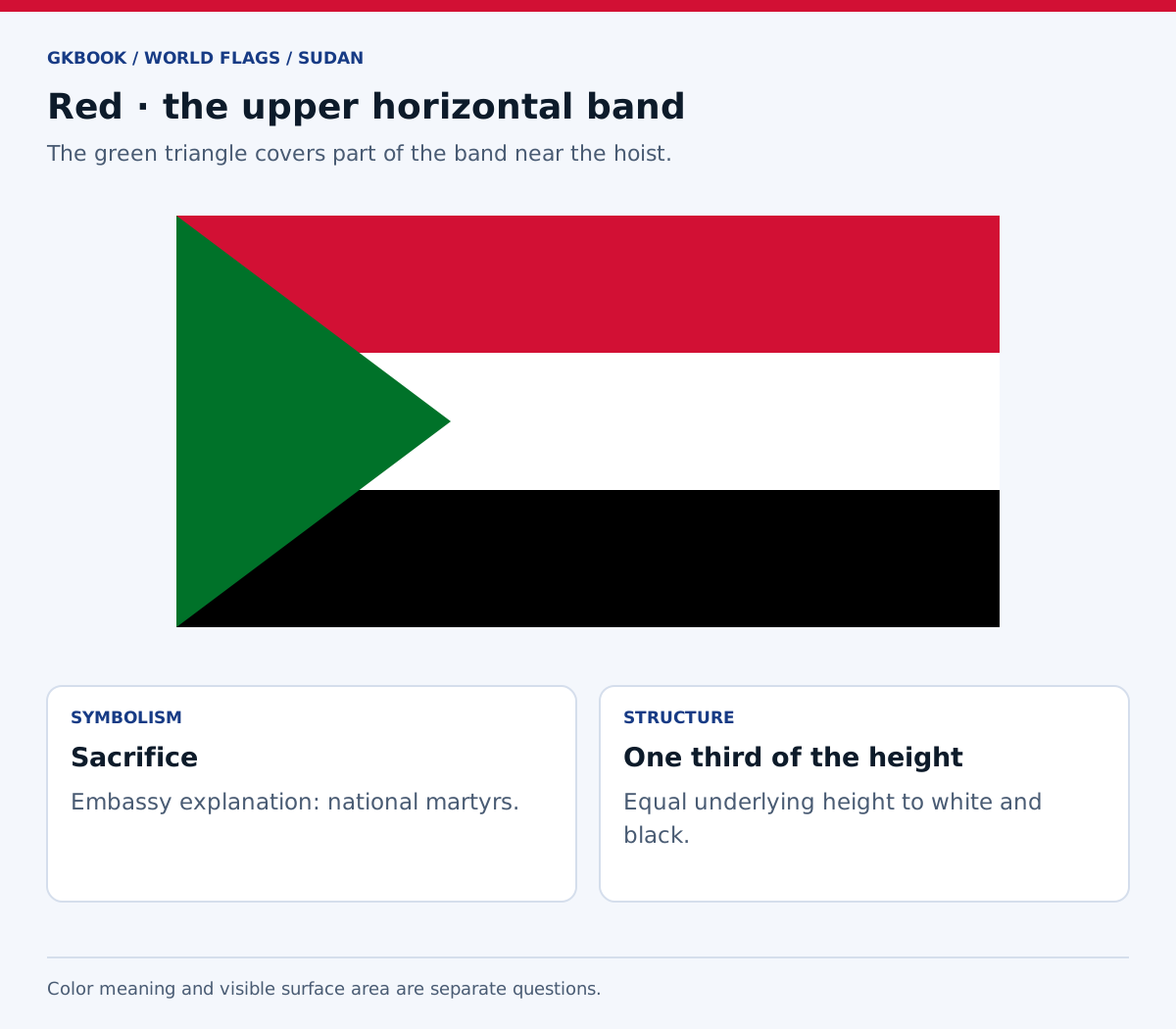
A symbolic description does not make the upper band a separate commemorative flag. It remains one part of a single national composition. When identifying a small icon, check that red is above white and black. Reversing the order or moving red into the triangle produces a different arrangement.
The red band has the same underlying height as the other two bands. Its apparent area is affected by the triangle laid over it, which is why band height and exposed color area need separate explanations. A clean reproduction preserves the straight upper edge and the uninterrupted red field beyond the triangle.
What does the white band represent?
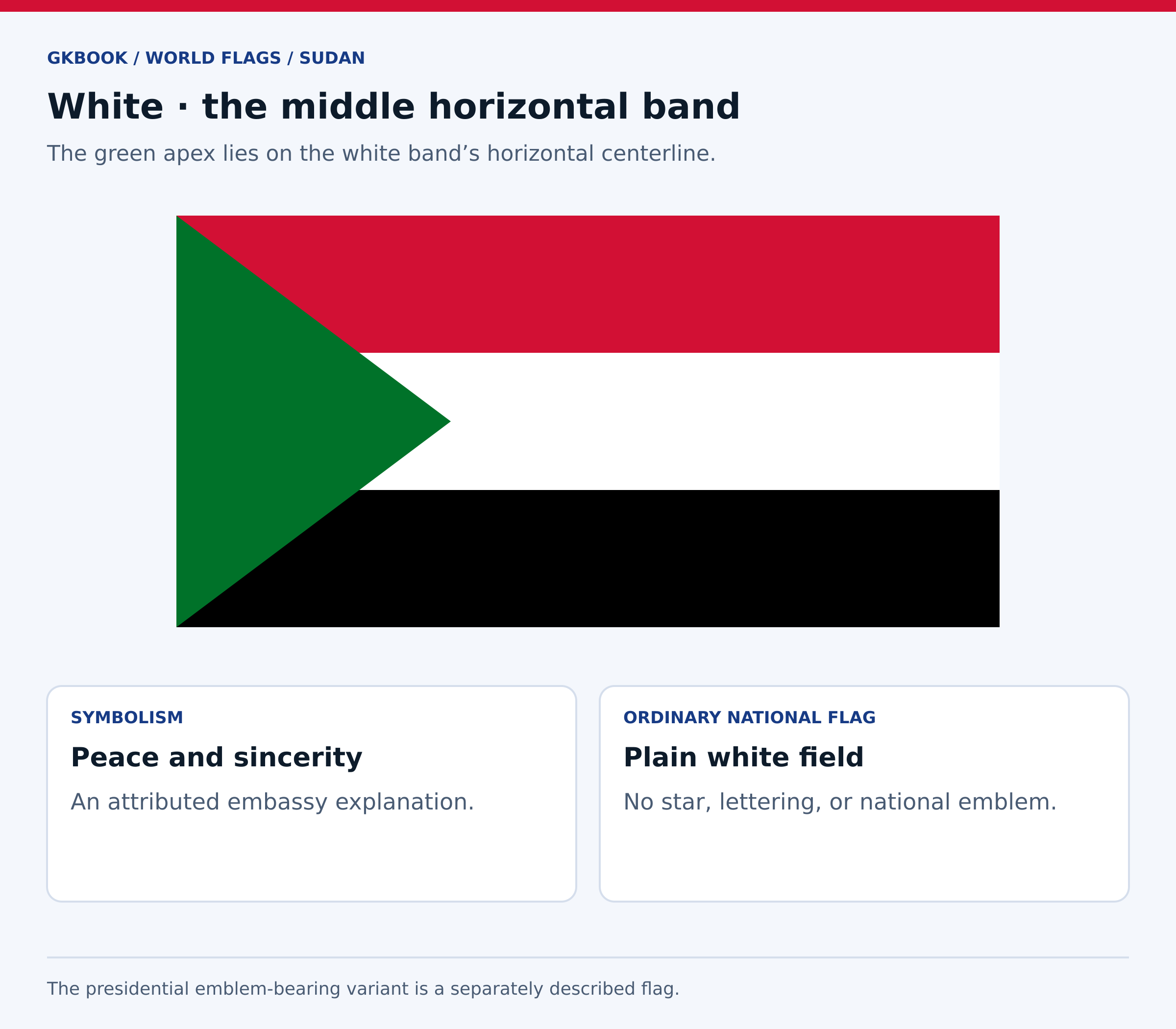
The embassy’s account associates white with purity, sincerity, loyalty, peace, and harmony. White occupies the middle horizontal band of Sudan’s flag. The green triangle’s point falls on that band’s centerline. The ordinary national version leaves the remaining white field plain, without a star, national emblem, inscription, or additional colored device.
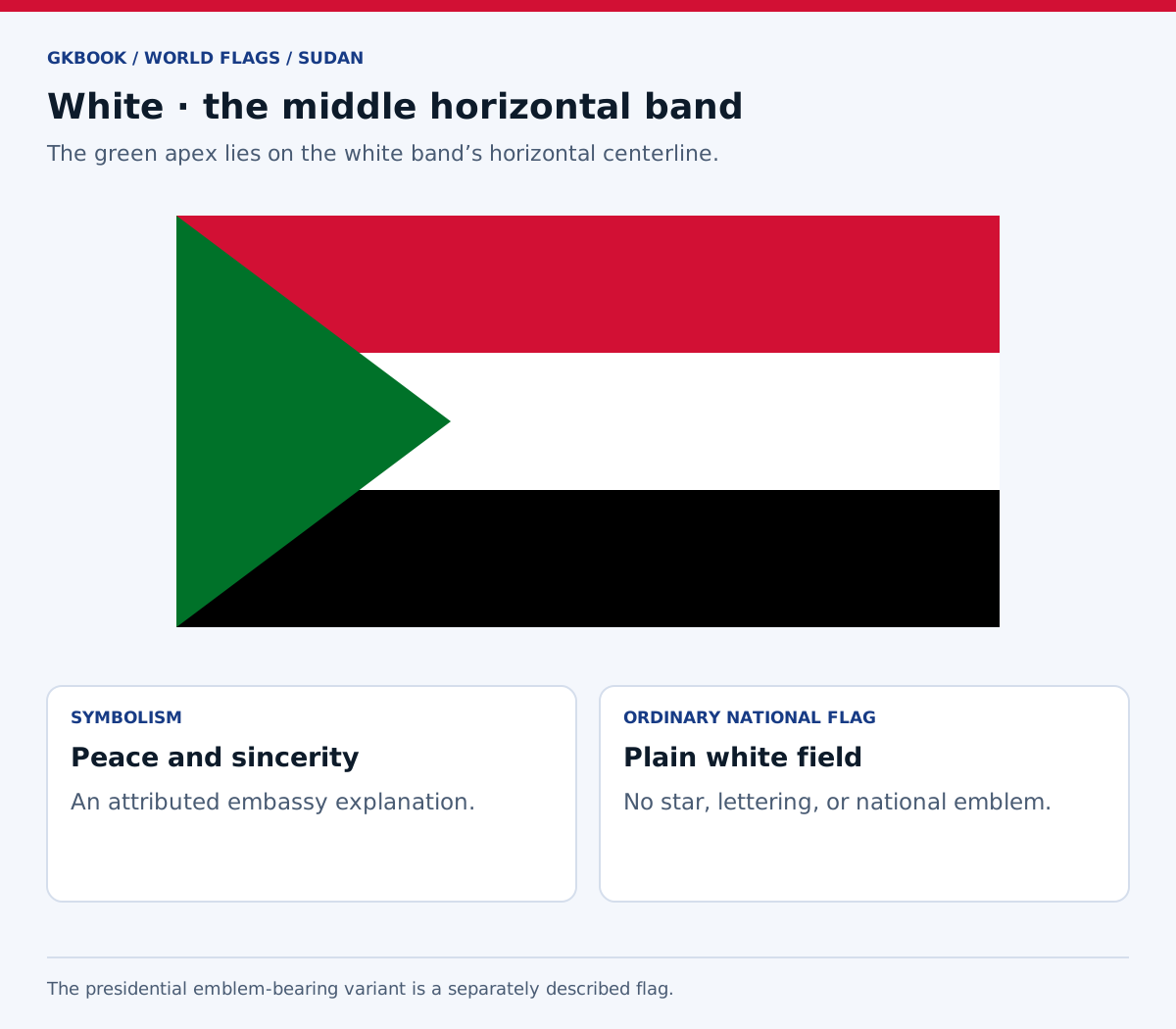
White can disappear visually when a flag is displayed on a white webpage. A surrounding page border may help distinguish the rectangle, but that border belongs to the presentation rather than to the flag. The downloadable master keeps the white band filled, so it remains visible against a darker background.
Do not remove the middle stripe when making a transparent-background cutout of a photograph or illustration. Transparency outside a flag and white inside its design are different things. The flat PNG supplied here has an opaque background throughout the complete national rectangle, including the white area beside the green triangle.
What does the black band represent?
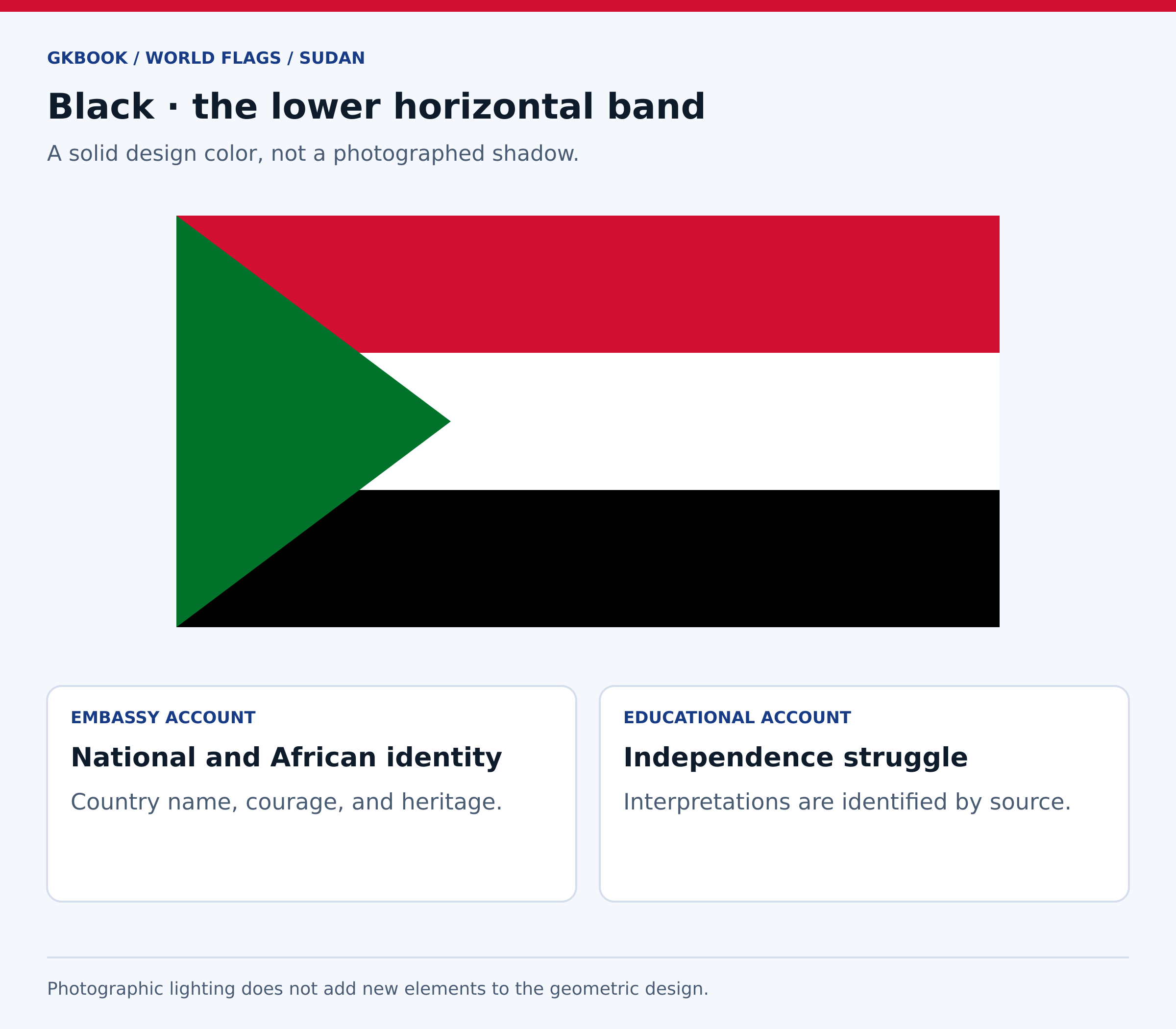
The Sudanese embassy links black with the country’s name, courage, attachment to homeland and heritage, and African belonging. Other educational explanations emphasize the independence struggle. Black is the lower band of the national flag. These related accounts should be attributed rather than compressed into a claim that one phrase exhausts its meaning.

The national interpretation should not be treated as a test of any individual person’s identity. A flag can carry historical and geographic associations without describing every citizen in the same terms. Reading the embassy explanation in that way preserves its stated national context and avoids inventing a demographic classification.
In the digital artwork, black is a solid fill. It is not a shadow cast by the red or white stripe. Photographs of fabric may introduce highlights, folds, and reflections, but those lighting effects should not be copied into a clean geometric master as if they were additional official features.
What does the green triangle represent?
The Sudanese embassy explains green through growth, natural wealth, and agricultural resources. Some broader flag descriptions also associate green with Islam, but that is not the wording of the embassy passage used here. The color fills the complete hoist triangle; the reviewed legal specification does not assign its depth a separate symbolic meaning.
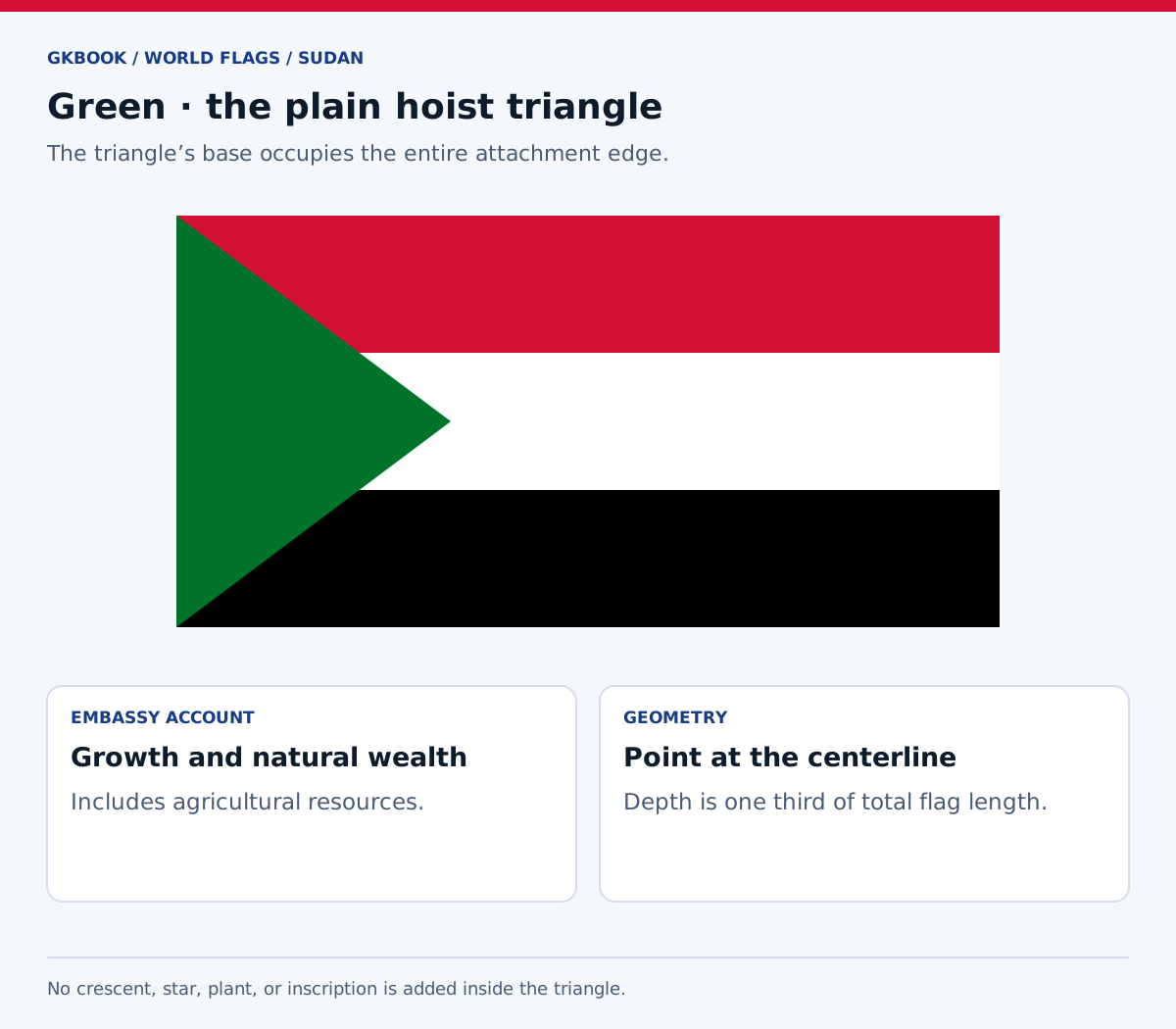
Keep the distinction between a color’s interpretation and a shape’s construction. Agricultural symbolism does not require the triangle to resemble a field, leaf, or map. Its straight edges and central point are geometric features, and the national design does not add a plant, crescent, or star inside it.
A reliable comparison also considers where green appears. On Sudan’s flag it is concentrated at the hoist rather than forming the bottom horizontal band. A quick color count cannot capture that difference. Checking both placement and outline is more useful than identifying the flag from the presence of green alone.
Is the green triangle equilateral or isosceles?
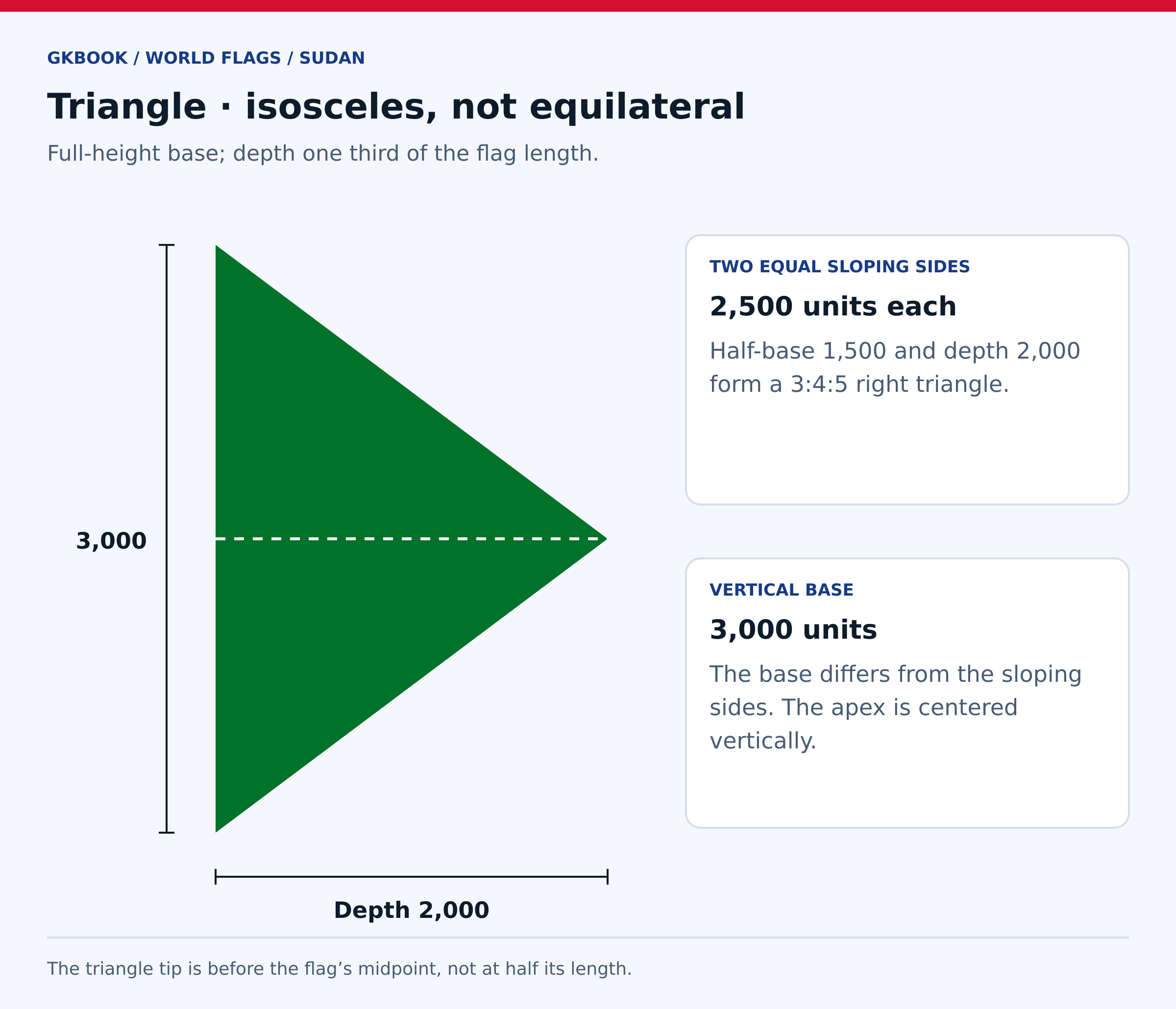
Sudan’s green triangle is isosceles, not equilateral. Its vertical base equals the full flag height, and its perpendicular depth equals one third of the flag length. In the 6,000 × 3,000 master, the base is 3,000 units, the depth is 2,000, and each sloping side is 2,500 units long.
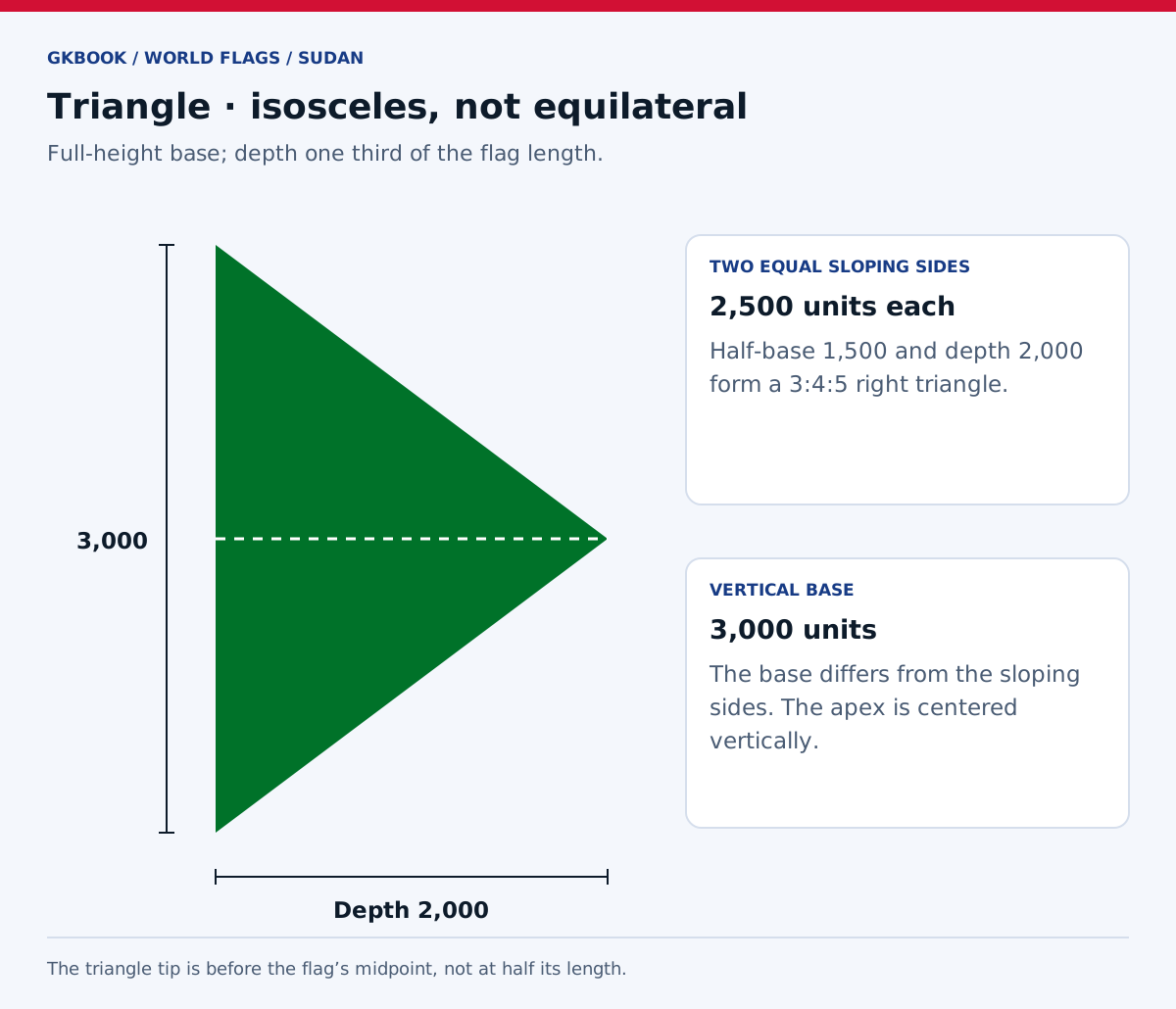
The point sits halfway down the flag, which makes the upper and lower slopes symmetrical. Joining that point to the midpoint of the hoist divides the triangle into two right triangles. Each has legs of 1,500 and 2,000 units, giving a 2,500-unit hypotenuse by the Pythagorean relationship.
This calculation provides a useful drawing check. An equilateral triangle with the same 3,000-unit base would extend farther into the flag and would not satisfy the documented depth. The triangle’s point also stops before the rectangle’s center, rather than reaching the halfway mark along the flag’s length.
What is the official proportion of Sudan’s flag?
The National Flag Act specifies a rectangle whose height is half its length. Sudan’s flag therefore has a height:length proportion of 1:2, also written as width:height 2:1. The supplied master is 6,000 × 3,000. Uniform enlargement or reduction preserves the same relationship and the positions of all internal boundaries.
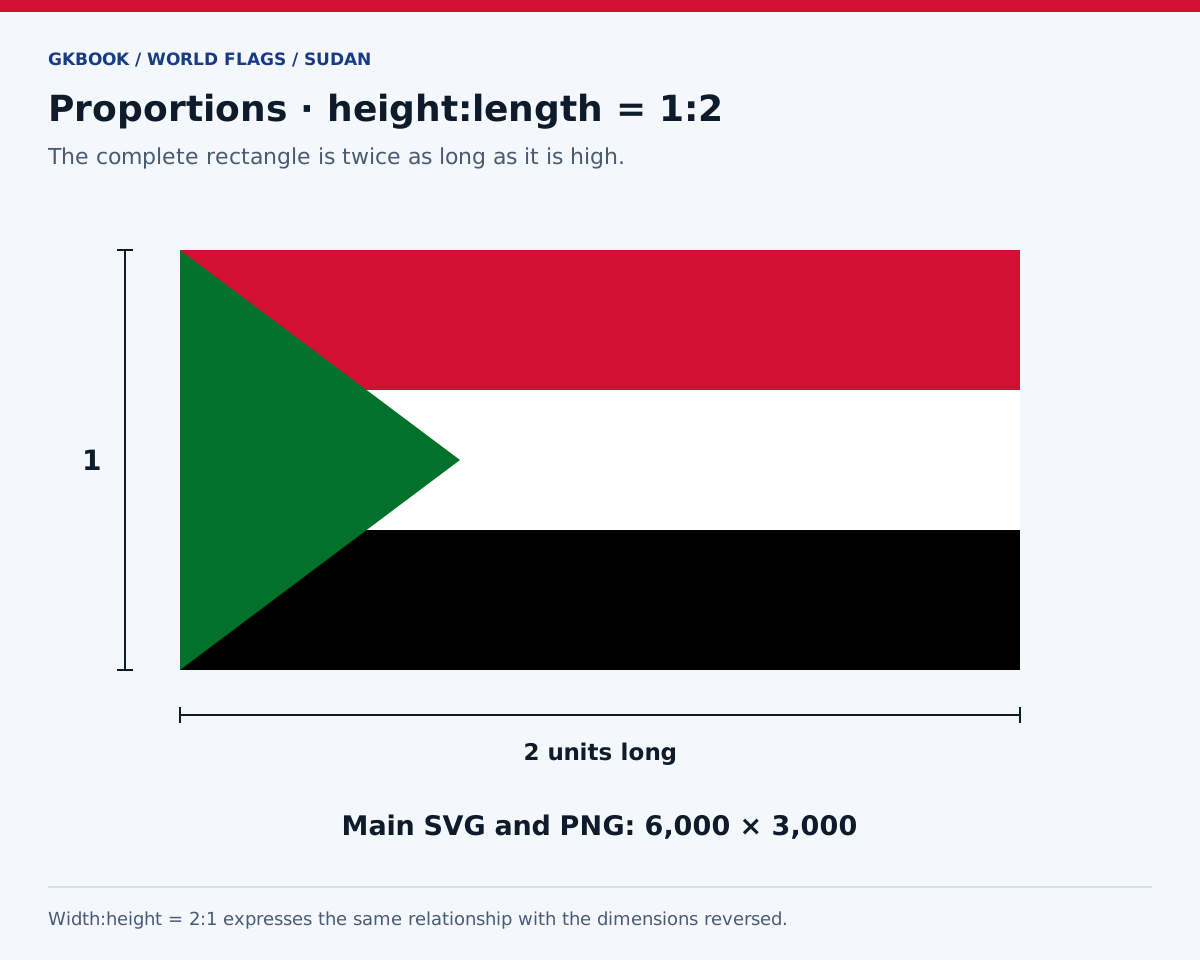
Always state which dimension comes first when writing a ratio. A bare 2:1 can be misunderstood if a reader expects height before length. The diagrams use height:length consistently, while ordinary image dimensions list horizontal pixels before vertical pixels. Both conventions describe the same wide rectangle when their labels are clear.
Measure the complete flag, including the green triangle and all three bands. The ratio does not describe only the rectangular area to the right of the triangle’s point. A decorative card, social-media canvas, or page margin may have different dimensions while still containing a correctly proportioned national flag.
Are the three horizontal bands equal?
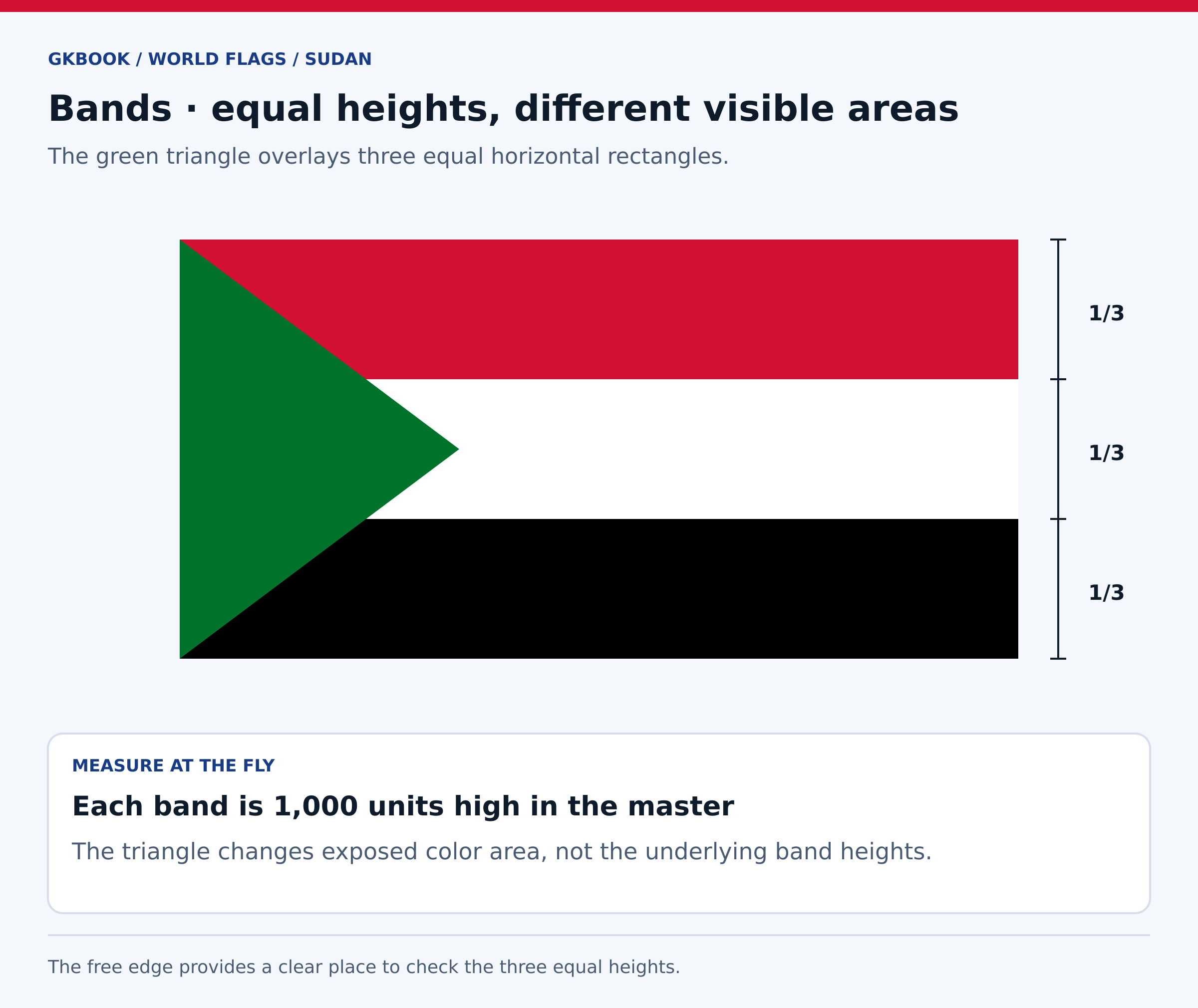
Yes. The underlying red, white, and black horizontal bands have equal heights, each one third of the flag’s height. On the 3,000-unit-high master, each band is 1,000 units tall. Their visible areas are not equal because the green triangle covers different amounts of the central and outer bands.

At the free edge, all three stripes are fully visible, so that edge is a convenient place to check their heights. The dividing lines occur at one third and two thirds of the total height. They remain horizontal and parallel even where the green triangle hides their beginnings.
Do not narrow the white band to compensate for the triangle’s overlap or enlarge it to equalize the exposed areas. Either adjustment changes the specified construction. Equal band height refers to the underlying rectangles. The area calculation is a separate consequence of laying the triangular shape over those rectangles.
How is Sudan’s flag constructed accurately?
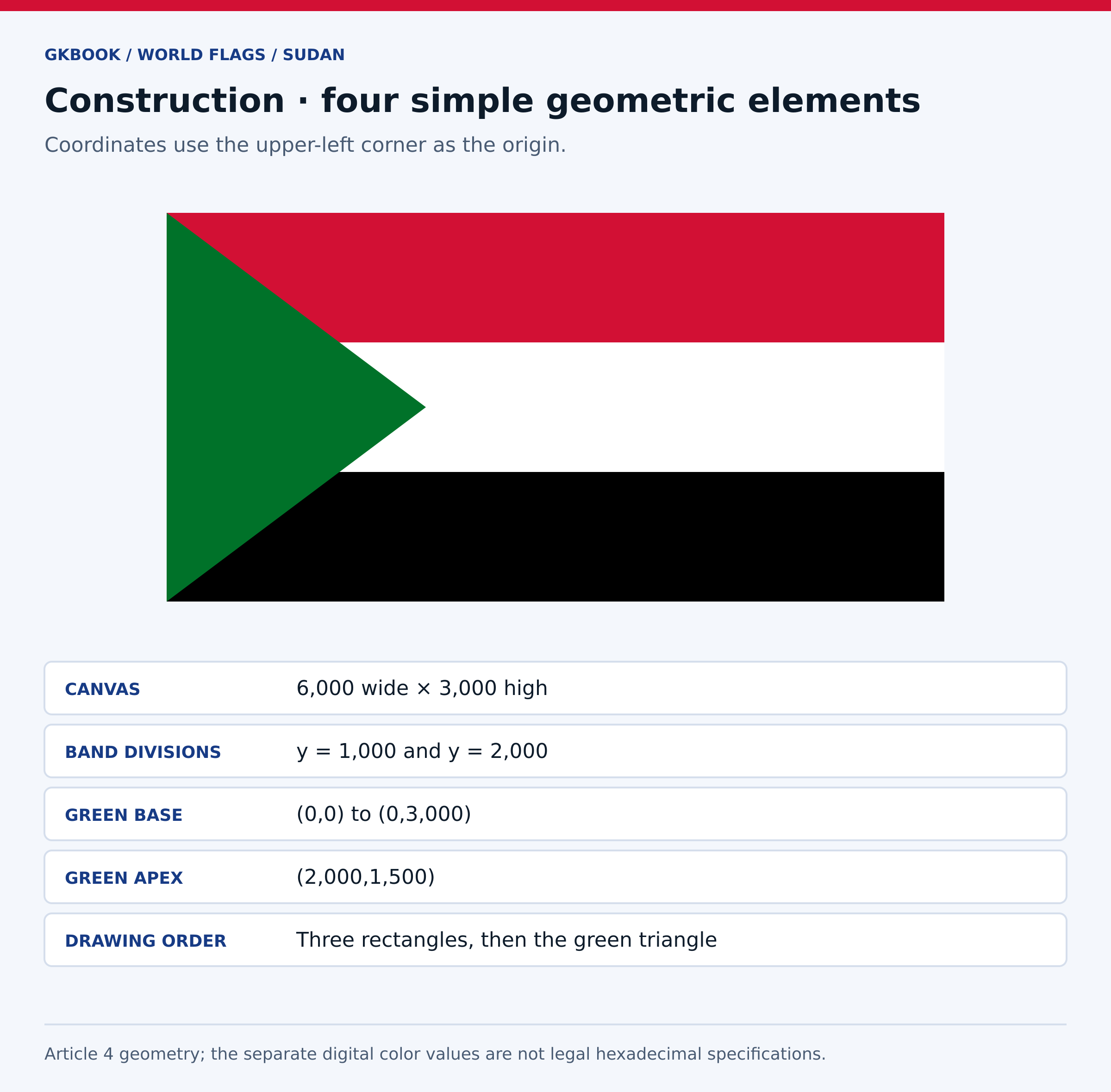
Start with a 6,000 × 3,000 rectangle. Draw red from y=0 to 1,000, white from y=1,000 to 2,000, and black from y=2,000 to 3,000. Overlay a green triangle joining (0,0), (2,000,1,500), and (0,3,000). This scales the inspected legal geometry without introducing decorative borders or extra symbols.
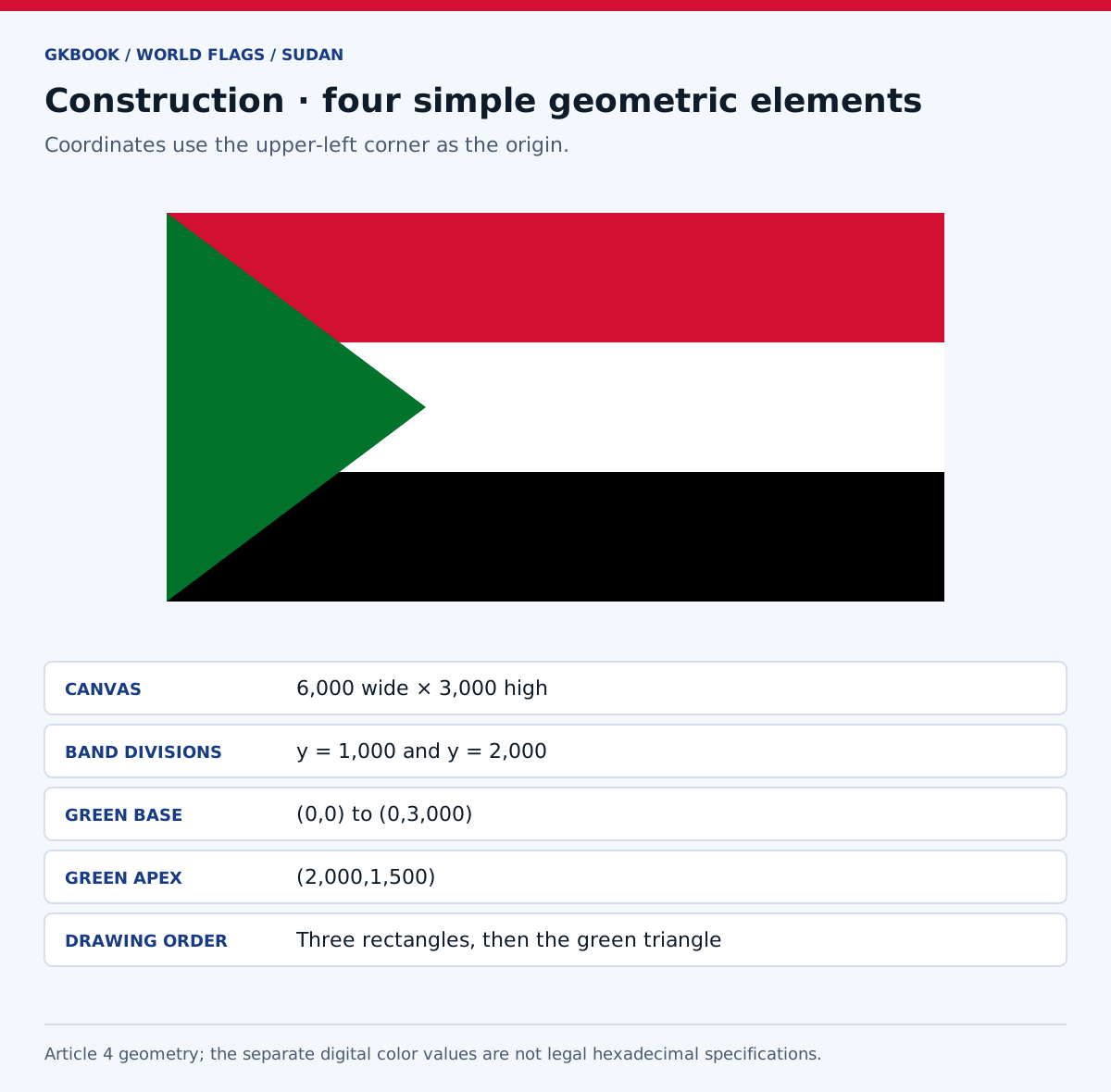
The coordinate origin is the upper-left corner, with horizontal values increasing toward the fly and vertical values increasing downward. The triangle’s apex is therefore one third of the length from the hoist and halfway between the top and bottom edges. All coordinates scale together when a different size is required.
Construct the bands first and the triangle last so the shared boundaries remain clean. The resulting master needs only three rectangles and one polygon. It does not need a photograph, an embedded bitmap, a clipping mask, or a complex heraldic tracing. Measurement brackets belong outside the clean national design.
| Element | Position or dimensions |
|---|---|
| Canvas | Width 6,000; height 3,000 |
| Band height | 1,000 each |
| Green triangle base | (0,0) to (0,3,000) |
| Green triangle apex | (2,000,1,500) |
| Triangle depth | 2,000 = one third of length |
How much of the flag is occupied by each color?
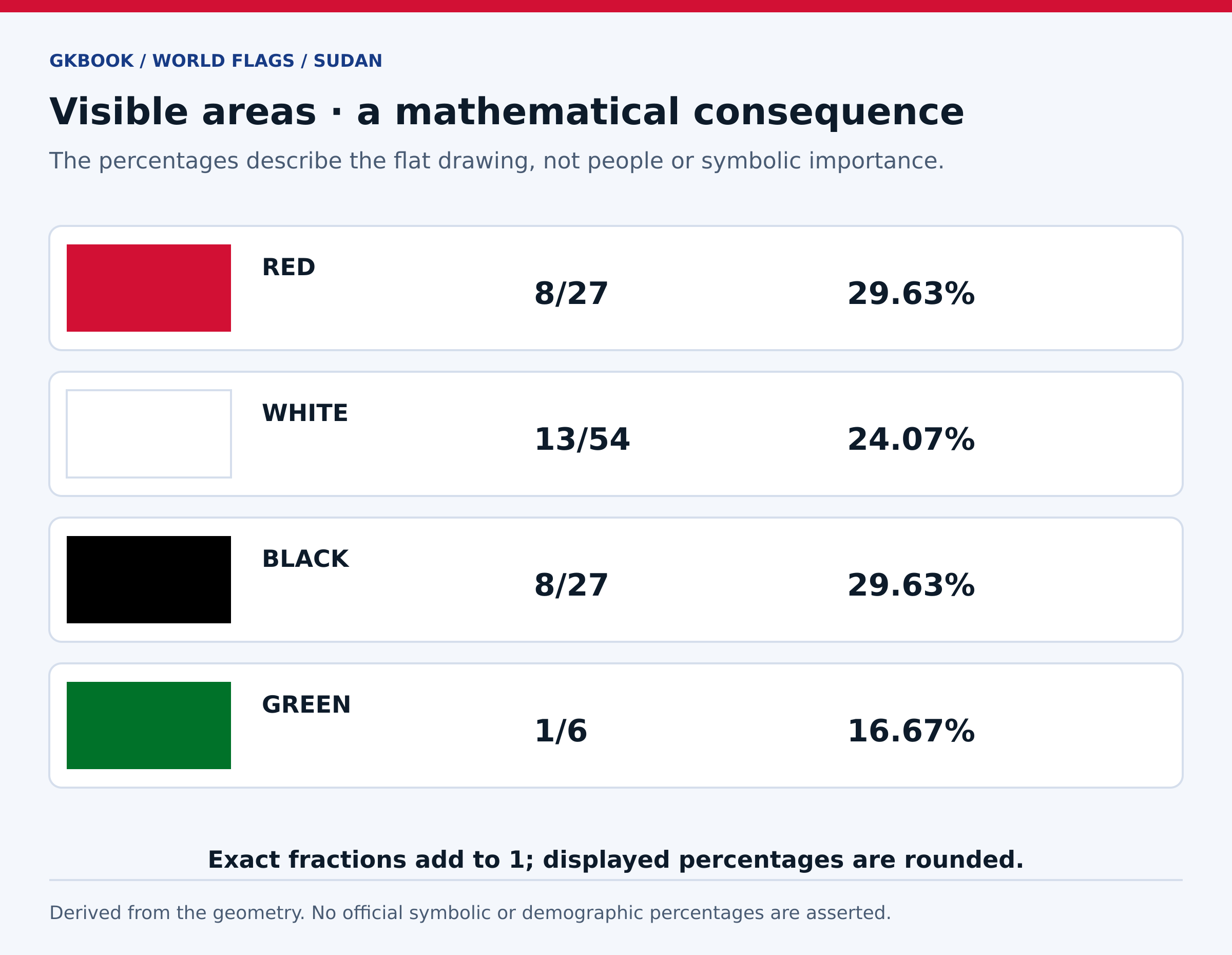
From the specified geometry, green occupies one sixth of the complete rectangle. Red and black each occupy 8/27, while white occupies 13/54. These are calculated visible areas, not official symbolic percentages. The central white band loses more area to the triangle than either of the two outer bands.

The full rectangle contains 18,000,000 square units in this master. The triangle has half the product of its 3,000-unit base and 2,000-unit depth, giving 3,000,000 square units. Dividing by the complete area gives one sixth. This result follows from the geometry without measuring a photograph or estimating fabric folds.
For the remaining colors, subtract the triangular overlap from each equal underlying stripe. The upper and lower results match because the triangle is symmetrical about the flag’s horizontal centerline. Rounded percentages are useful for illustration, but the exact fractions add to one and avoid small rounding discrepancies in a teaching exercise.
| Color | Exact fraction | Approximate percentage |
|---|---|---|
| Red | 8/27 | 29.63% |
| White | 13/54 | 24.07% |
| Black | 8/27 | 29.63% |
| Green | 1/6 | 16.67% |
Does Sudan’s national flag contain a star or coat of arms?
The ordinary national flag contains neither a star nor a coat of arms. Article 4(3) of the inspected 1993 Act separately describes a presidential flag with a gold national emblem centered on the white band. That additional device should not be inserted into a picture intended to show the ordinary Sudanese national flag.
A bird emblem appearing beside a flag on an official website is not automatically part of the flag itself. Page layouts often place several national symbols together. To identify the flag design, examine the rectangular banner rather than treating nearby seals, titles, or institutional logos as elements printed on it.
Stars can also enter mistaken illustrations through confusion with other countries. The green triangle in this collection stays plain. The distinction matters in small icons, where an added yellow device can change recognition immediately. Presidential or institutional variants require their own clearly labeled reference rather than an unannounced modification of the national master.
How has Sudan’s national flag changed over time?
Sudan used a blue, yellow, and green horizontal tricolor after independence in 1956. The red, white, and black design with a green triangle followed in 1970, after the 1969 political change. Later legislation specified its construction and use. The older flag remains a historical design and has also appeared in proposals for restoration.
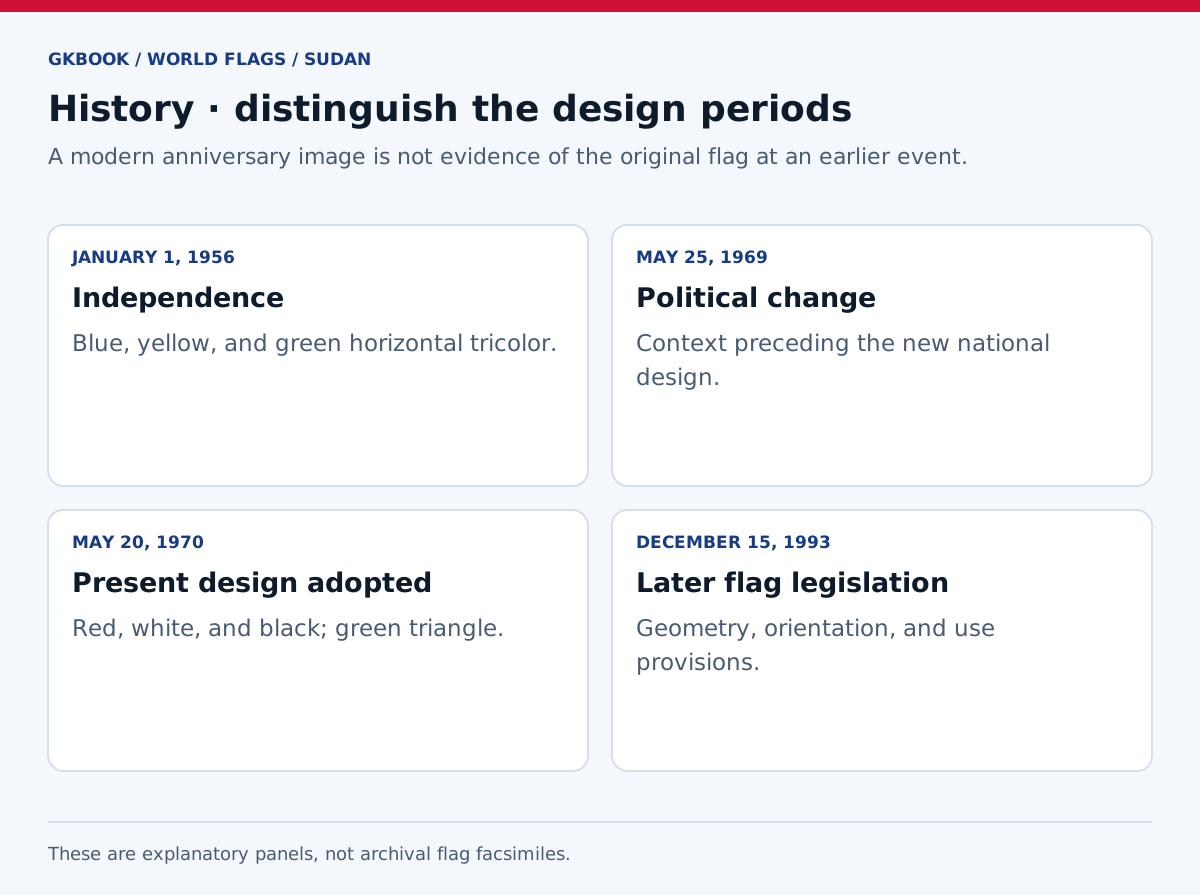
A flag history should separate the date of state independence from the introduction of a later national design. The present arrangement cannot be projected backward into every independence-era photograph. Likewise, a recent appearance of the earlier tricolor does not by itself prove that the legal national design has changed.
The timeline in this collection uses dated explanatory panels rather than claiming to reproduce archival fabric. That makes the sequence visible while keeping historical evidence and modern illustration distinct. For a specific ceremony or museum object, the date, provenance, and actual pictured arrangement remain more informative than a generic modern flag caption.
When was the present Sudanese flag adopted?
Sudanese diplomatic descriptions date adoption of the present flag to May 20, 1970. That event is separate from independence on January 1, 1956, and from the National Flag Act adopted on December 15, 1993. The latter is a later legal specification, not evidence that the current arrangement first appeared in 1993.
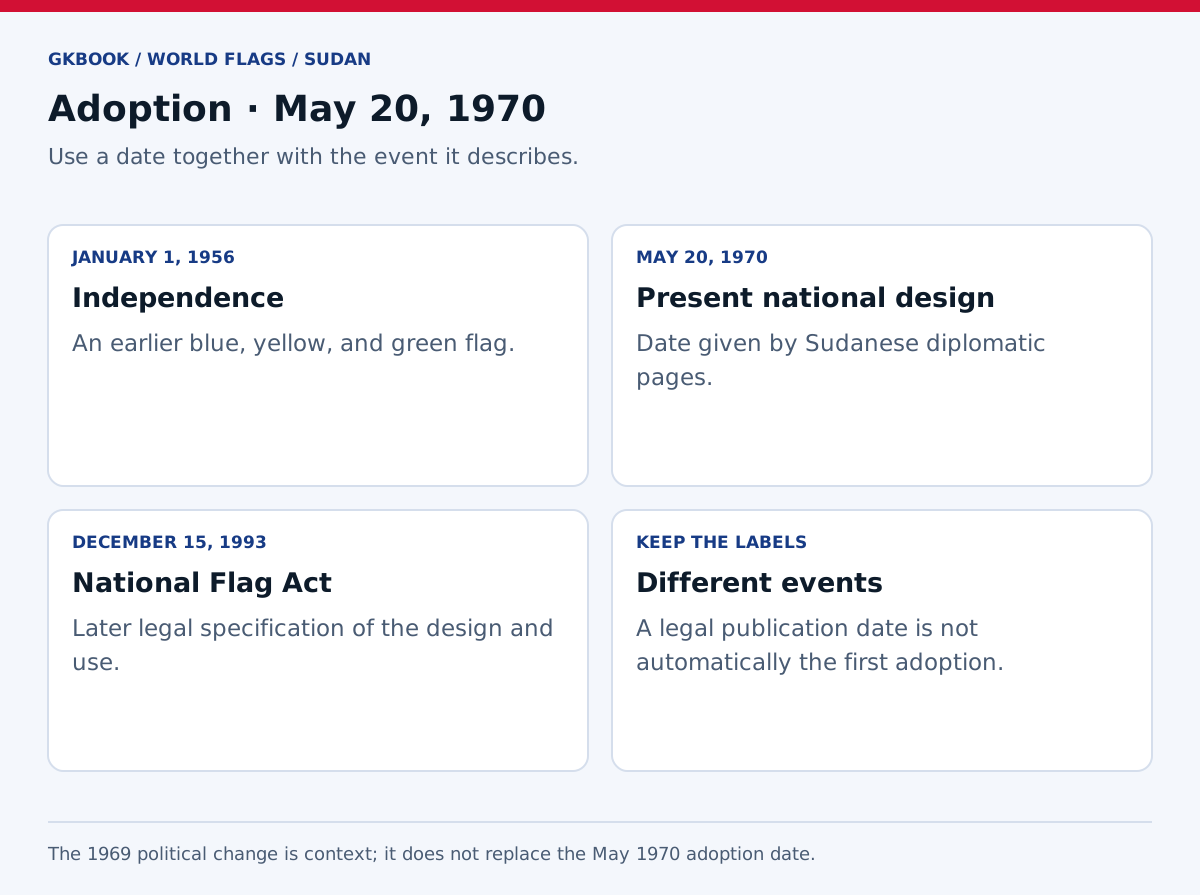
Dates become easier to compare when each is attached to an event. Independence describes a change in political status; adoption identifies the chosen flag design; legislation can restate dimensions and regulate use years afterward. A date printed beside a flag should make clear which of those events it represents.
The 1969 political change provides context for the replacement of the earlier tricolor, but it is not the same as the documented May 1970 adoption date. This article follows the diplomatic accounts for that milestone and keeps later legal material in its own place in the chronology.
Who designed Sudan’s present flag?
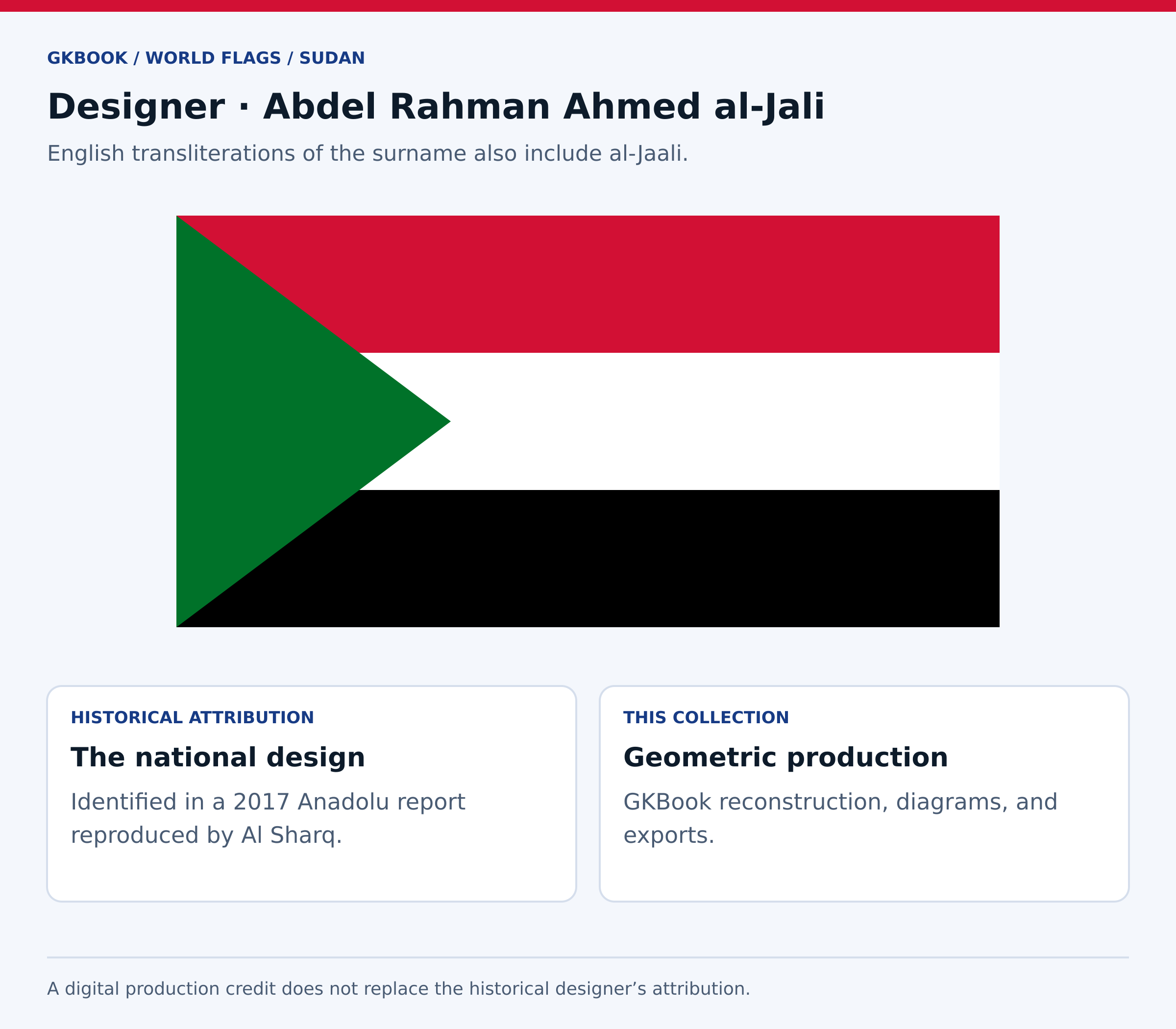
The present design is credited to Abdel Rahman Ahmed al-Jali, whose surname also appears as al-Jaali in English transliteration. A November 2017 Anadolu report reproduced by Al Sharq identifies him as its designer and reports the presidency’s announcement of his death. The original competition drawings were not obtained for this collection.

Transliteration differences do not necessarily identify different people. The Arabic name in the report helps connect the English spellings, while the description of the adopted 1970 design identifies the relevant work. Attribution should remain separate from the political authority that selected a design or the legislation that later described it.
GKBook prepared these geometric files and teaching layouts; it did not invent Sudan’s national design. The screen palette was checked against the credited Commons reference. Reconstructing simple shapes from documented measurements is a production task, and its credit should not replace the historical designer’s name or suggest official endorsement.
When did Sudan become independent?
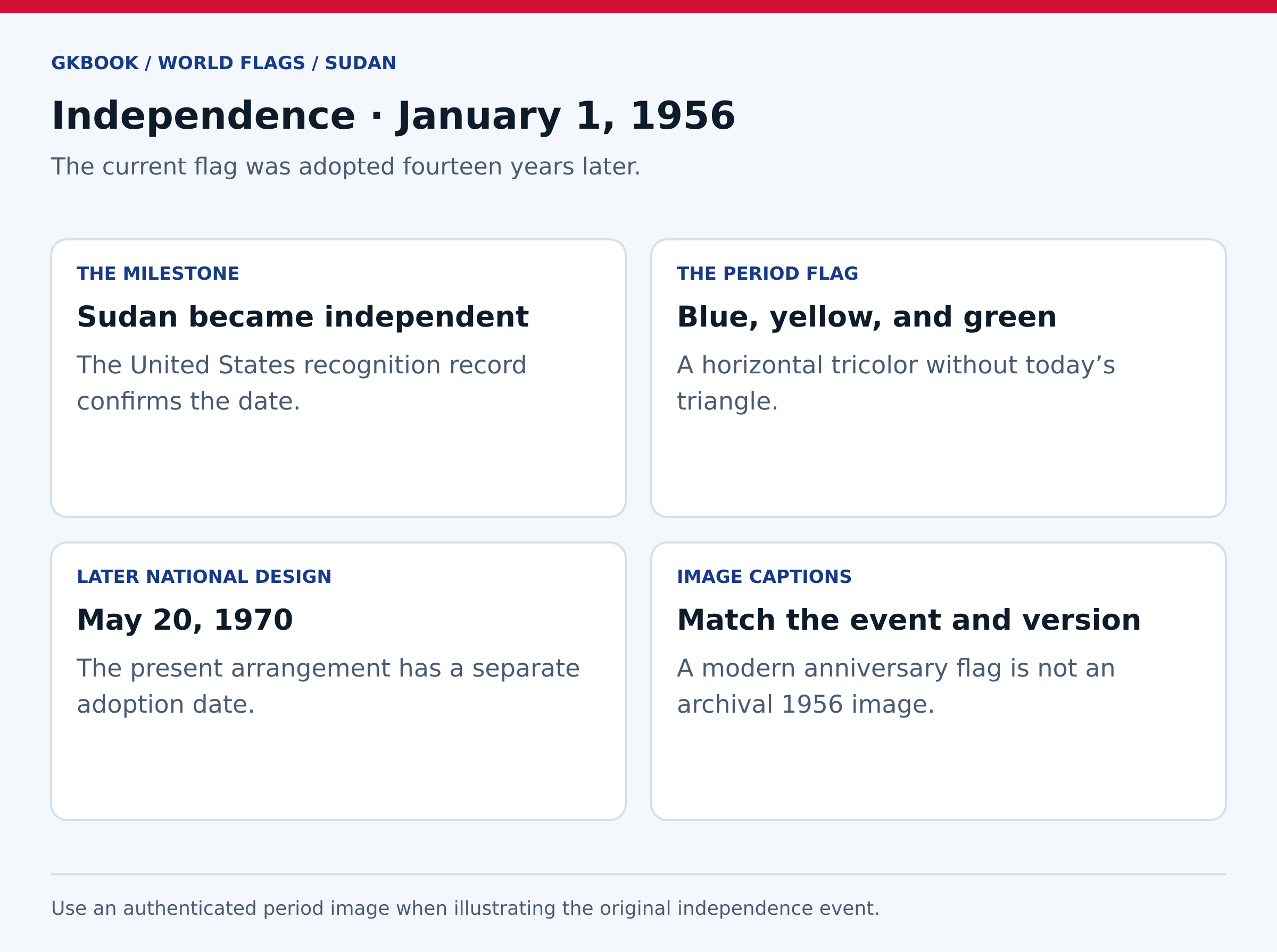
Sudan became independent on January 1, 1956. Its independence-era national flag was the earlier blue, yellow, and green tricolor, not the present red, white, and black design with a green triangle. The United States recognition record confirms the independence date; the current flag’s adoption belongs to May 20, 1970.
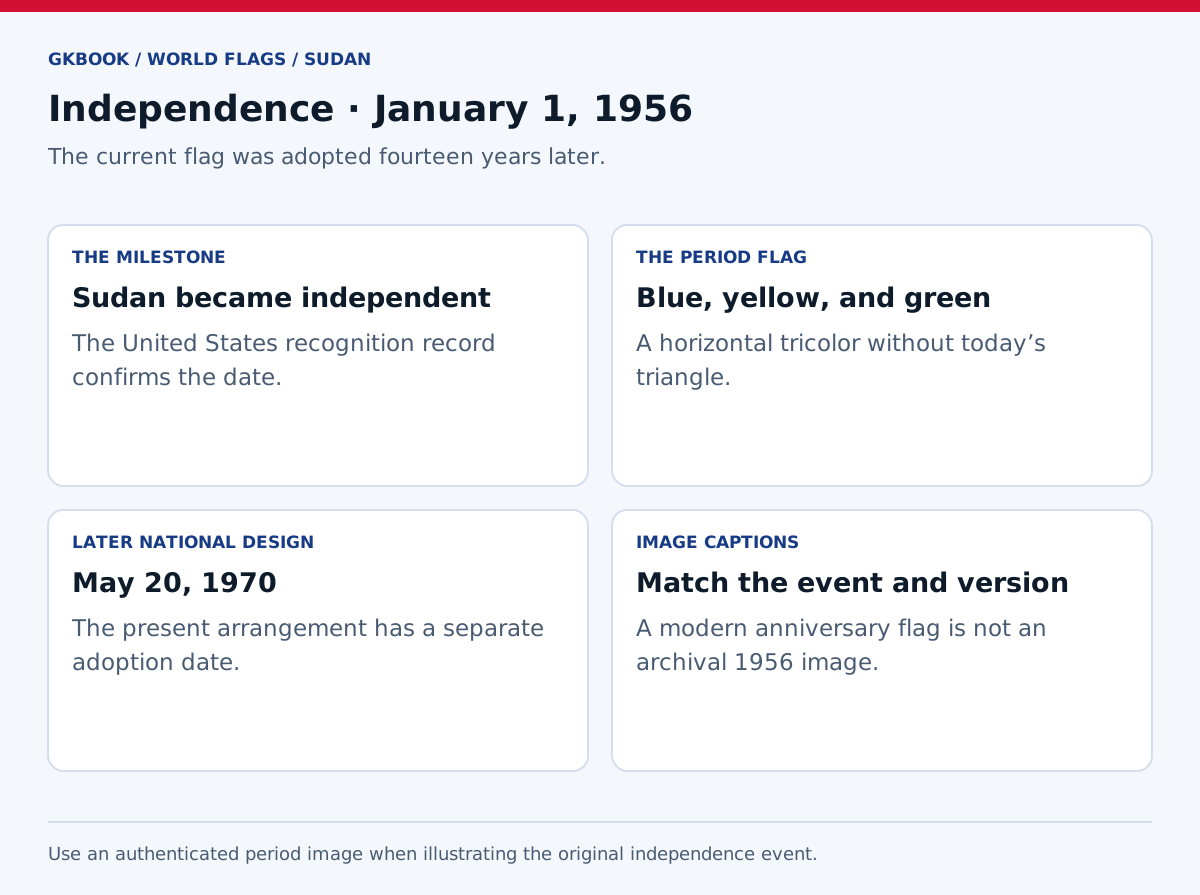
A modern flag displayed at an anniversary represents the country during that later commemoration. It does not establish that the same arrangement was present at the original ceremony. This distinction is particularly useful when choosing an illustration for a historical article, school timeline, or exhibit about the end of colonial rule.
Keep the historical milestone and its accompanying artwork together. A caption can explain independence in 1956 while explicitly identifying a modern national flag shown for context. If the purpose is to depict the original event, use an authenticated period image or a separately documented reconstruction of the earlier tricolor.
What did Sudan’s independence flag look like?
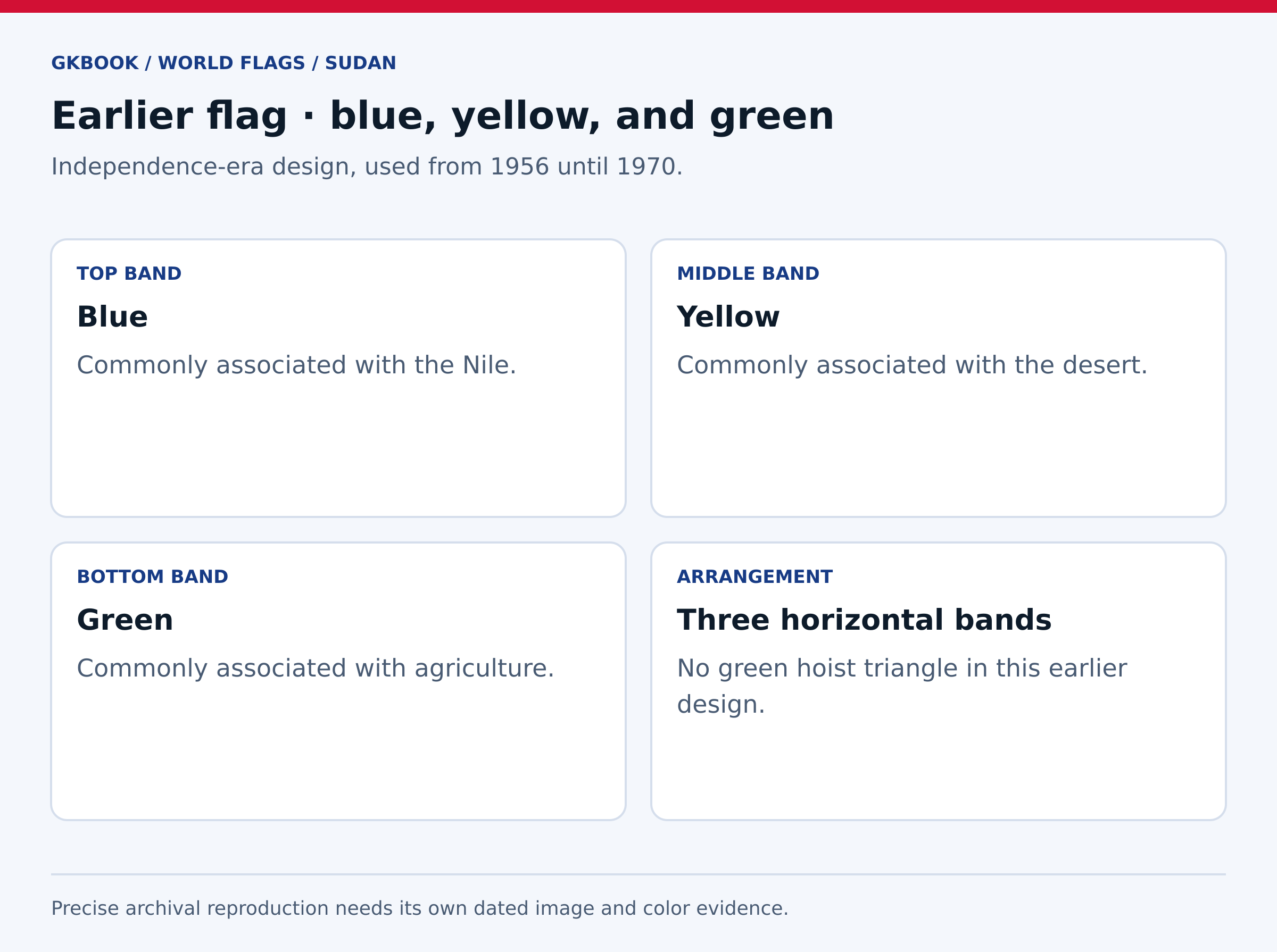
The independence-era flag used three horizontal bands: blue at the top, yellow in the middle, and green at the bottom. It served from 1956 until the 1970 replacement. Accounts commonly connect those colors with the Nile, desert, and agriculture. It did not contain the present flag’s green hoist triangle.
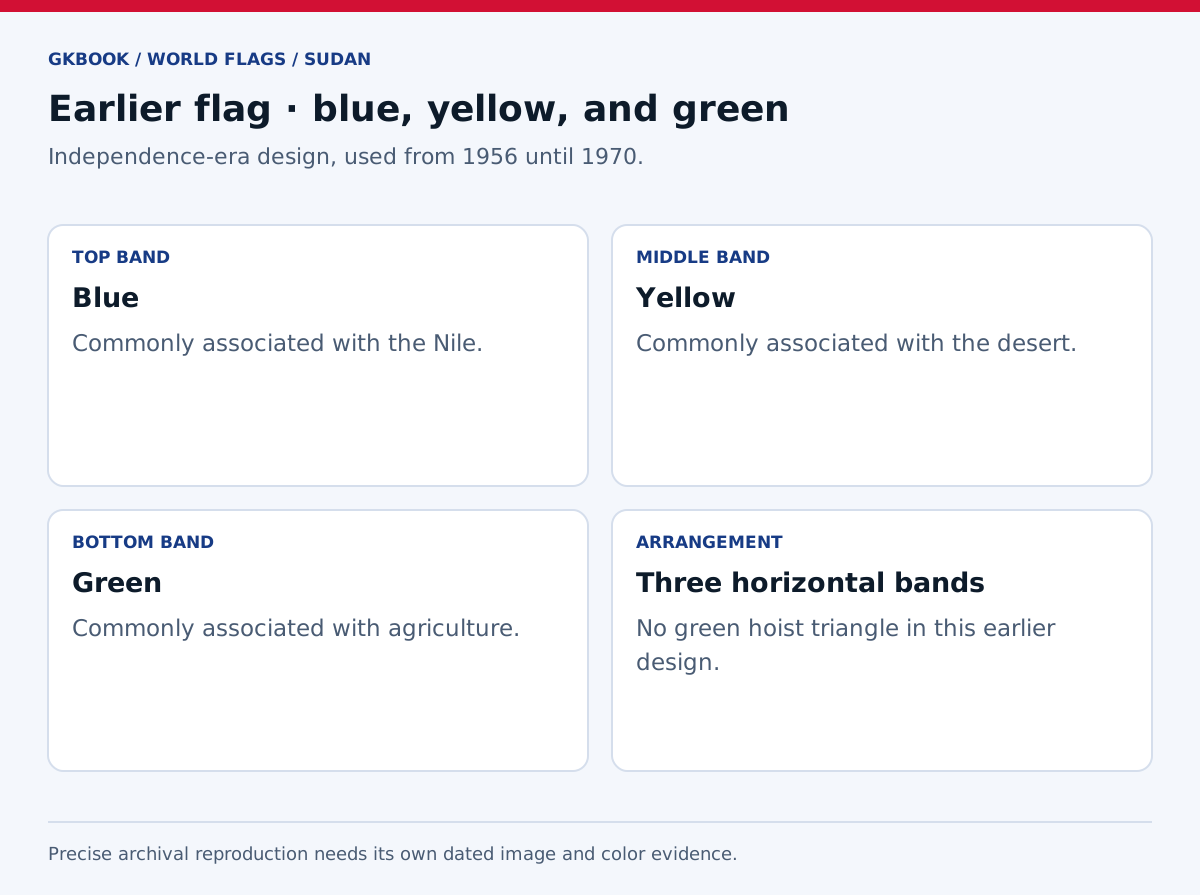
The change affected both palette and arrangement. The earlier design was a straightforward horizontal tricolor, whereas the later flag combined three horizontal bands with a fourth-colored triangle. Simply recoloring the present master would therefore be an inaccurate way to produce the independence flag, because the triangular component would remain.
The historical gallery panel describes the earlier design in words and dates. It does not claim to be a color-calibrated facsimile of a particular surviving flag. For archival reproduction, the original image, its date, its physical condition, and the intended historical version need their own examination before precise shades are assigned.
Has Sudan restored its old blue, yellow, and green flag?
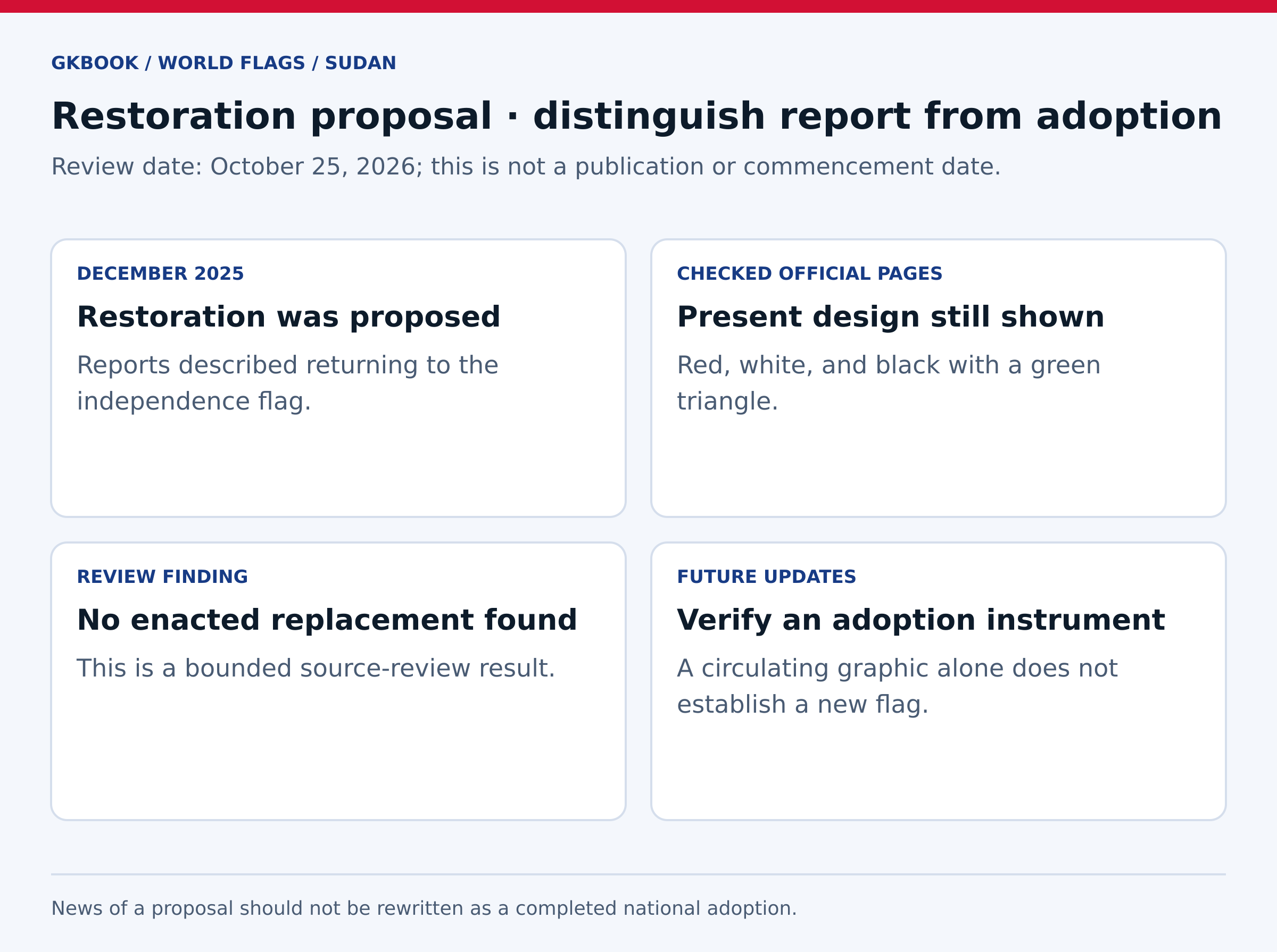
Official consulate and embassy pages inspected on October 25, 2026 still presented the red, white, and black flag with a green triangle. December 2025 reporting described a proposal to restore the independence flag. This review found no enacted replacement; a reported proposal should not be described as a completed national adoption.
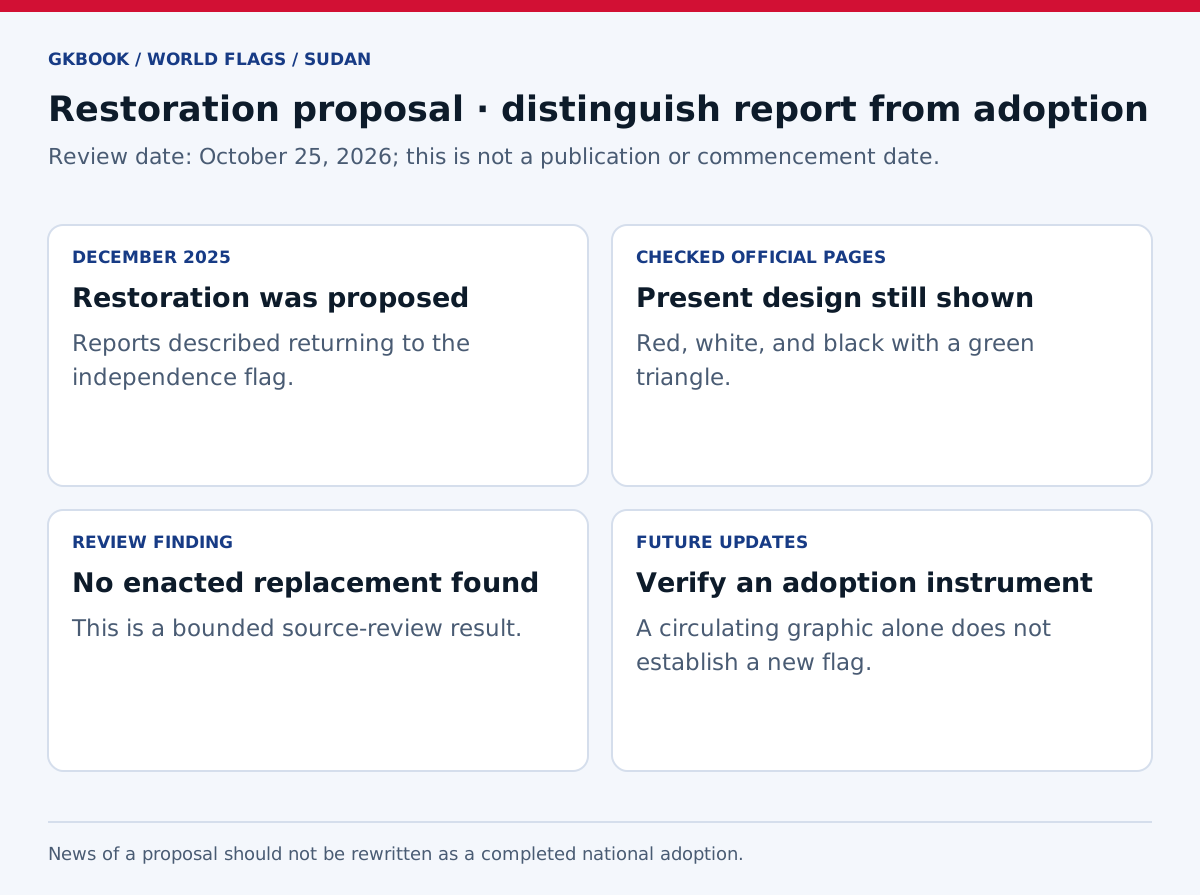
Sudans Post and Al Jazeera reported the restoration suggestion in early December 2025. Their accounts identify it as a proposal, which is the relevant distinction for a reference article. A political speech, a circulating graphic, and a formally adopted national design are different kinds of evidence and require different captions.
The review date describes when these sources were checked; it is not an invented publication or legal commencement date. Anyone updating a later edition should check for an authoritative adoption instrument and official implementation. Until such evidence is established, the historical tricolor should be labeled as historical or proposed in this context.
What law specifies Sudan’s flag design?
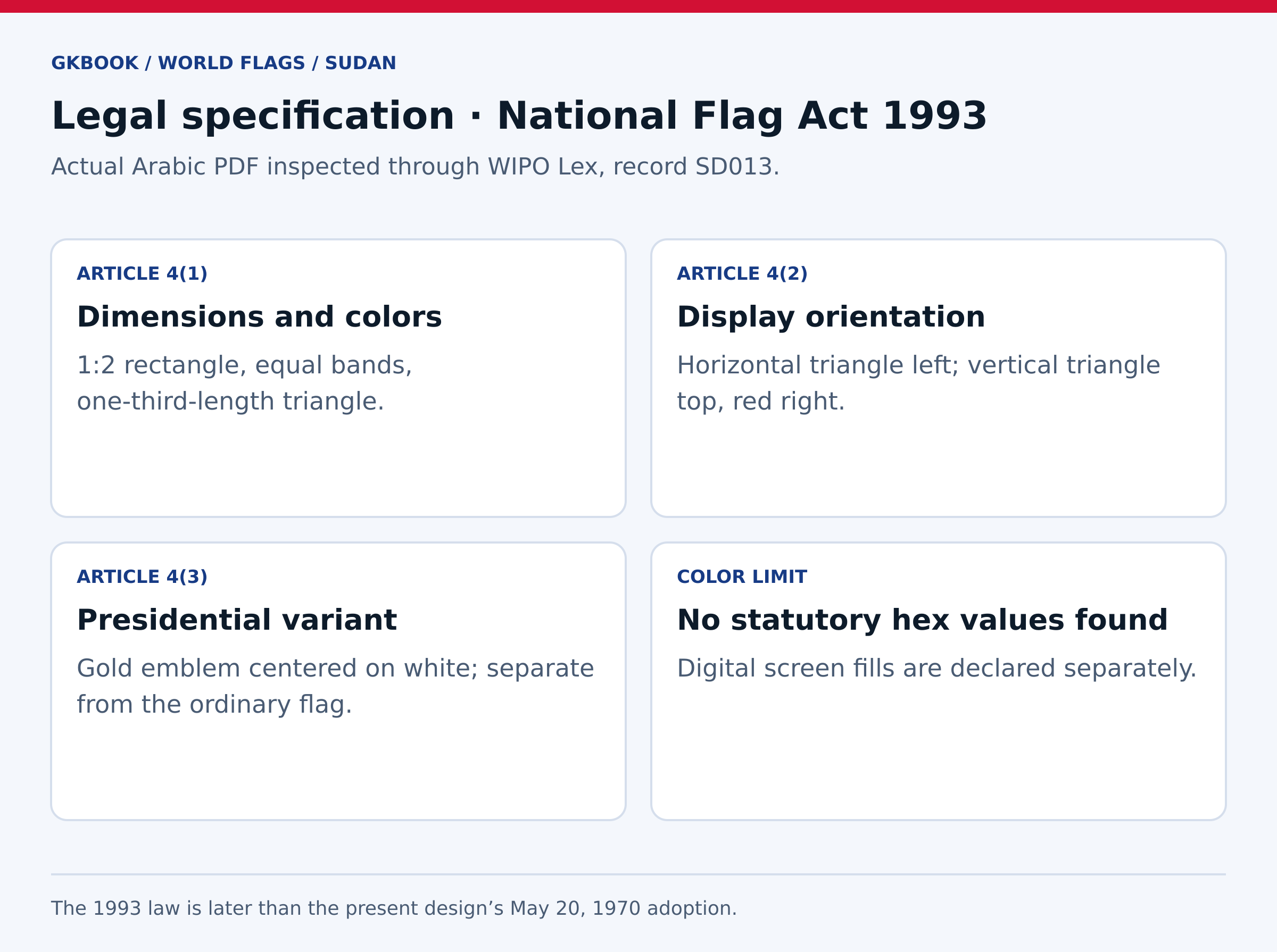
The inspected National Flag Act 1993 specifies the flag in Article 4, including its proportions, equal bands, triangle dimensions, and display orientation. WIPO Lex records adoption of that Act on December 15, 1993. The review examined the actual Arabic PDF; this does not establish that every later domestic order or amendment was obtained.
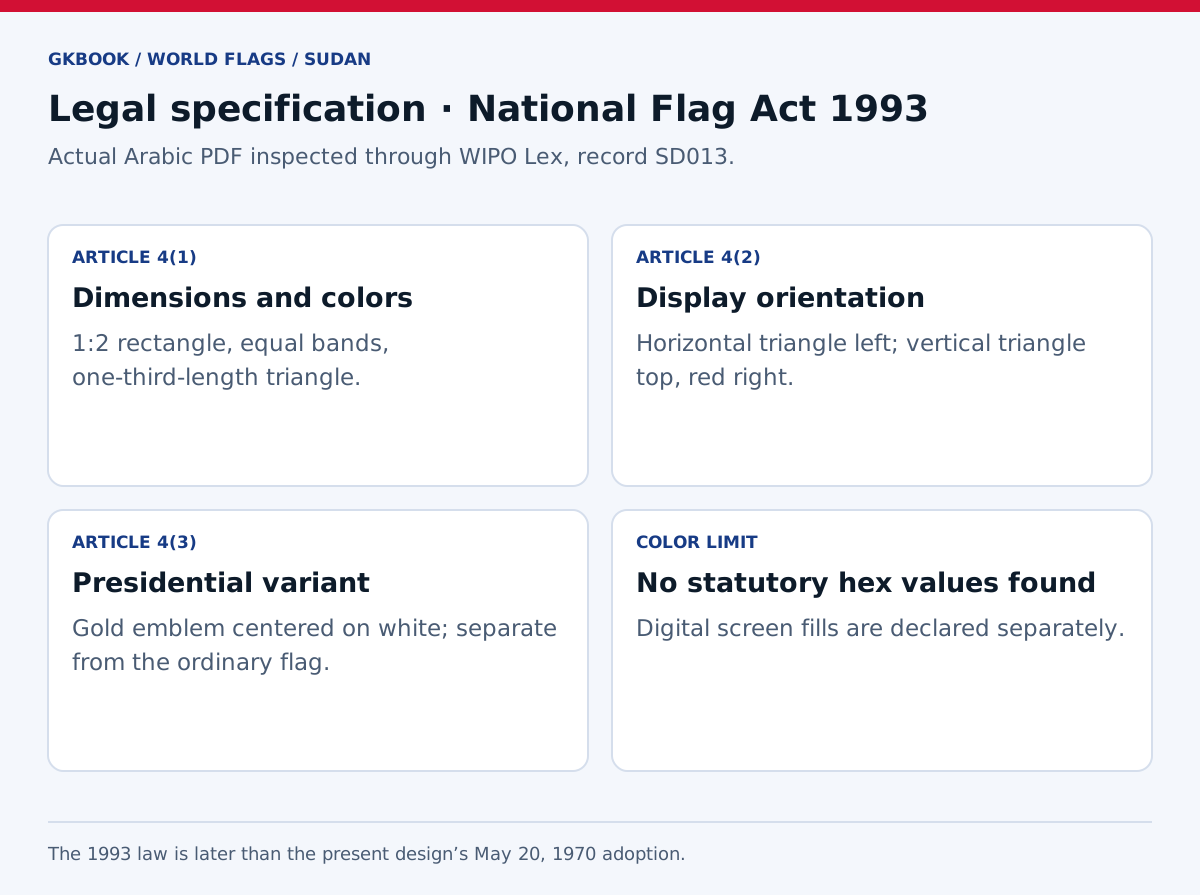
The geometric provisions are sufficient to construct the basic arrangement at any scale. They do not supply the screen codes used in these downloads. Treating a community SVG’s hexadecimal values as if they were printed in the Act would combine two different sources and overstate what the legal text actually specifies.
The Act also addresses sizes, locations, handling, and other uses. Those provisions concern more than the shape of a digital image. This article identifies selected passages relevant to understanding the flag, while a particular ceremony, institution, or production contract may require its applicable instructions and current administrative requirements.
Are international recognition dates the same as flag adoption?
No. Sudan’s independence, bilateral recognition, United Nations admission, and flag adoption are separate events. The United States recognized Sudan on January 1, 1956. A United Nations Treaty Series note records admission on November 12, 1956. Neither date replaces May 20, 1970 as the adoption date reported for the present flag.
Recognition by one country is not a universal date for every diplomatic relationship. The United States historical record also distinguishes recognition from the establishment of diplomatic relations. A reference timeline becomes clearer when each entry names the institution involved and the event, rather than presenting several dates as competing answers.
The United Nations document contains a declaration signed in January 1956 and a later admission date in its footnote. Reading only the document heading could confuse those events. The admission concerned the state’s membership; it did not prescribe the later flag’s triangle, colors, or national adoption procedure.
How does Sudan’s flag differ from South Sudan’s flag?
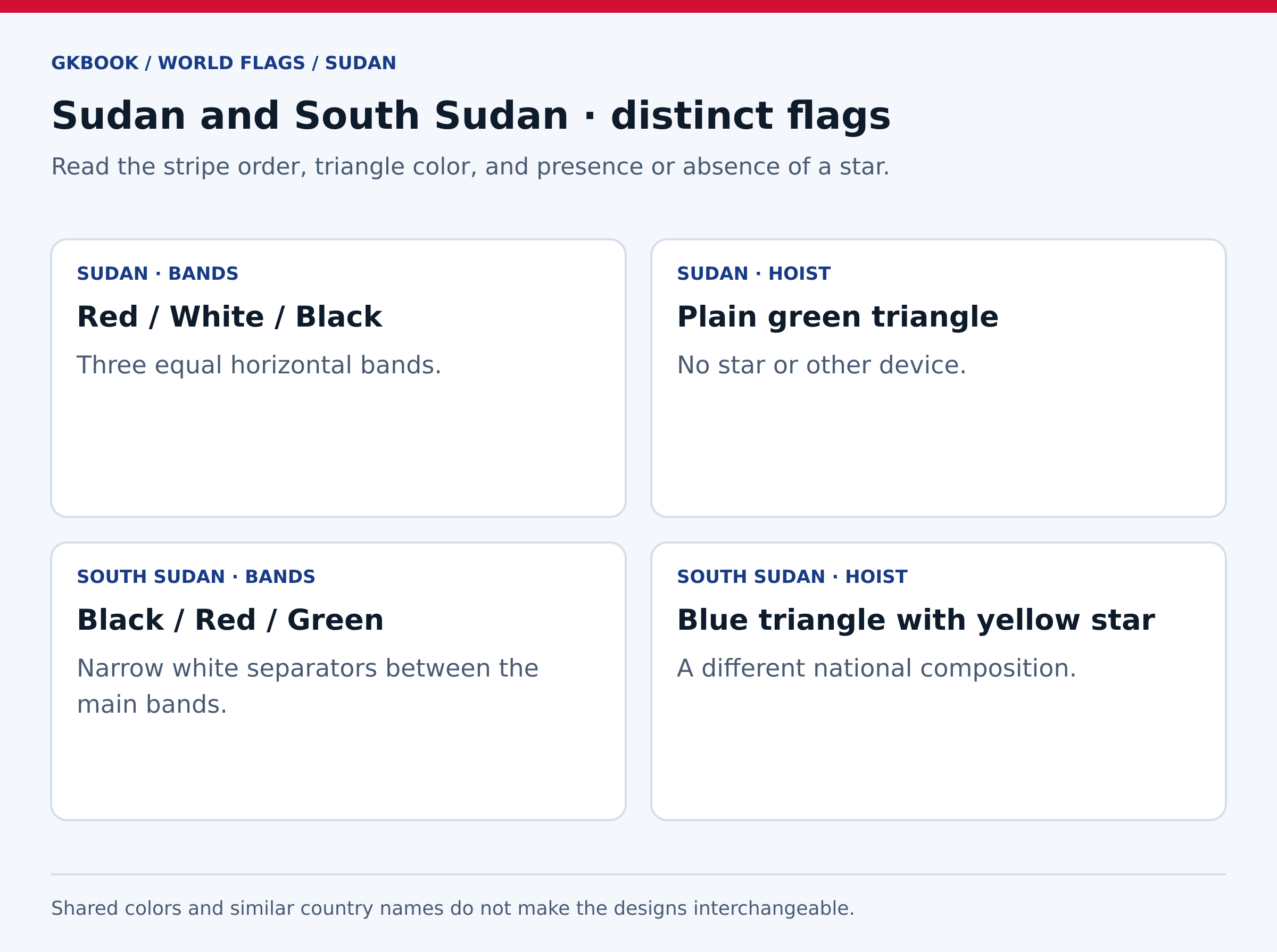
Sudan’s flag has red, white, and black equal bands with a plain green triangle. South Sudan’s flag has black, red, and green main bands separated by white stripes, plus a blue triangle containing a yellow star. The similar country names should not obscure these clear differences in band order, separators, and hoist device.

Compare several features together rather than looking for one shared color. The top stripe is red for Sudan and black for South Sudan. The hoist triangle changes color, and the star belongs to South Sudan’s design. Sudan’s white middle band is also structurally different from the narrow white separators in its neighbor’s flag.
The comparison panel uses written descriptions so that each national design remains identified without suggesting a hybrid. Visit the South Sudan flag guide for that country’s separate construction and history. Country names should remain explicit in alternative text, file names, captions, and educational comparison tables.
Which side of Sudan’s flag is the hoist?
The hoist is the attachment edge at the base of Sudan’s green triangle. It appears on the left in the ordinary horizontal front view. The fly is the opposite, free edge, where the red, white, and black bands are fully visible. These terms identify physical edges rather than permanent directions on every photograph.
The distinction helps explain reverse views and flags hanging from different supports. Moving to the other side of a single piece of fabric changes the viewer’s left and right, but the attachment edge remains the hoist. It should not be renamed simply because it appears on the right of an image.
For a flat reference illustration, the ordinary front view provides a consistent starting point. The green triangle begins at that left edge and points inward, while the free edge remains a straight vertical boundary through all three bands. Captions can identify a reverse view when a teaching comparison deliberately changes that orientation.
How does the flag law describe ordinary display?
The inspected 1993 Act provides selected rules for display and handling. It describes daytime flying, permits certain evening displays, calls for careful raising and lowering, and prohibits another flag on the same pole. It also addresses condition and foreign flags. These are passages from the reviewed Act, not a complete statement of every current administrative instruction.
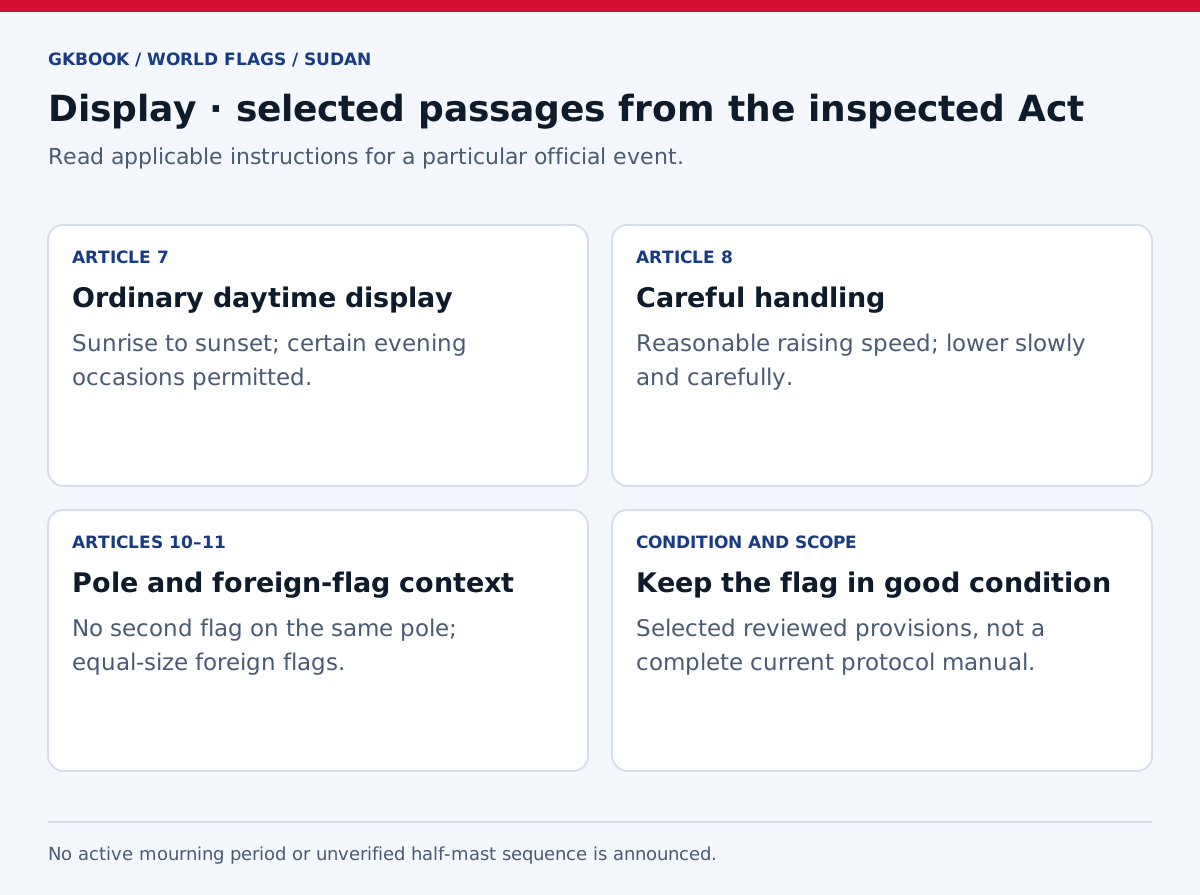
Article 7 describes the ordinary daytime interval from sunrise to sunset, with provision for evening display on specified occasions. Article 8 distinguishes raising at a reasonable speed from lowering slowly and carefully. The handling language should be read as written rather than replaced by an assumed rule borrowed from another country.
For foreign national flags, the Act addresses equal size and the national flag’s place of honor, subject to the stated diplomatic context. It also rejects faded or poor-condition flags. Selected guidance is useful for orientation, but a particular official event still needs its applicable instructions rather than an improvised ceremony assembled from unrelated traditions.
How should Sudan’s flag be displayed vertically?
Article 4(2) of the inspected Act places the green triangle at the top and the red band on the viewer’s right when the flag is displayed vertically. A clockwise quarter-turn of the ordinary horizontal front view produces that arrangement. The portrait display has a width:height relationship of 1:2 and keeps the complete design.
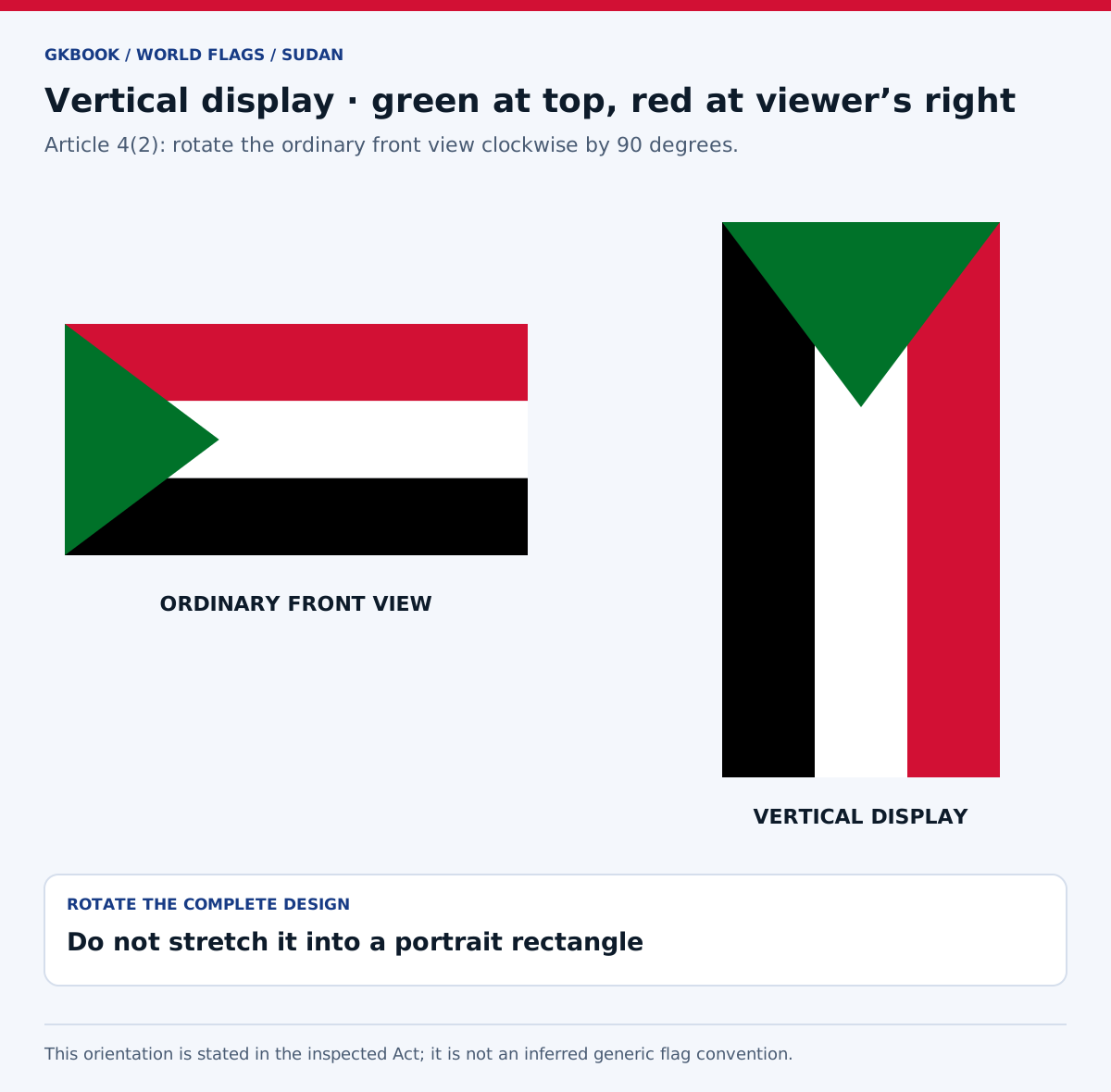
The vertical orientation is a rotation, not a stretch into a tall rectangle. The triangle’s base moves to the top edge, its point faces downward, and the three bands become vertical. From the viewer’s left to right, the lower uninterrupted band portions appear black, white, and red.
Rotating the horizontal artwork counterclockwise would place the triangle at the bottom and would not produce the described arrangement. Keep the whole flag together during rotation, including every colored area. The illustration provides an ordinary horizontal reference beside the vertical result so that the relationship can be checked without relying only on a verbal instruction.
What does the reverse of Sudan’s flag look like?
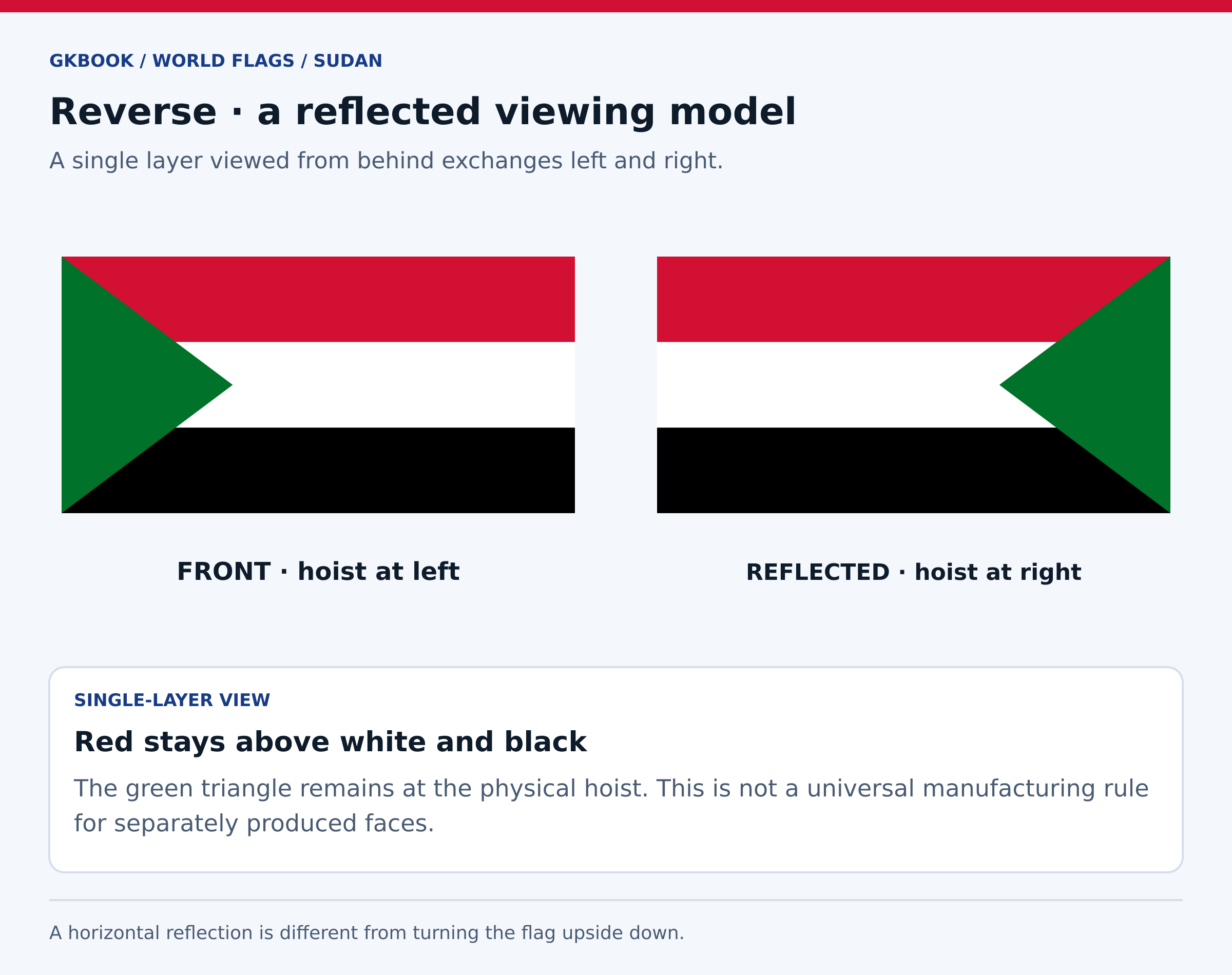
In a single-layer viewing model, looking from behind horizontally reflects the complete flag. The green triangle then appears at the viewer’s right, while red remains above white and black. The physical hoist has not moved. This illustration explains viewing geometry and is not a universal manufacturing rule for every separately printed or assembled flag.
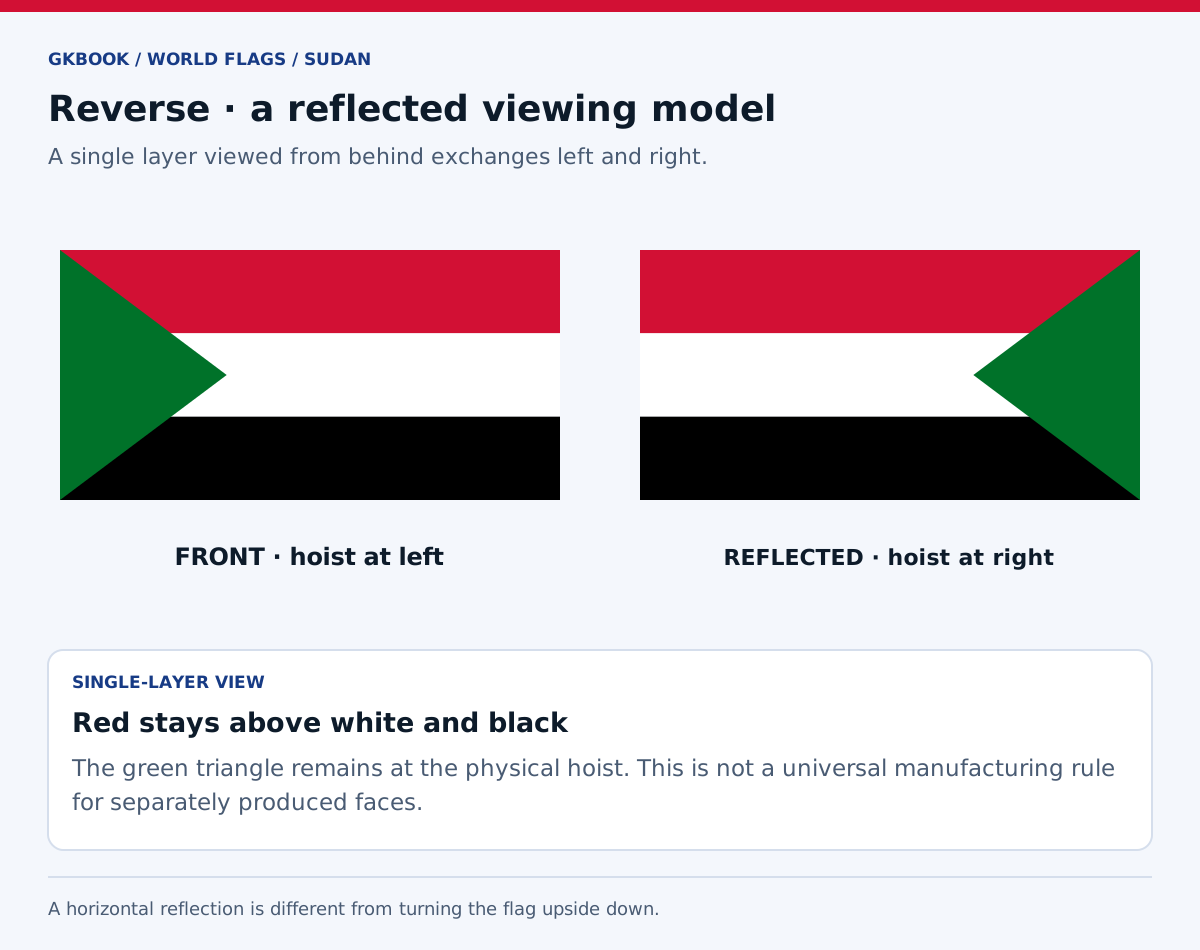
A horizontal reflection changes left and right without exchanging top and bottom. That is why the stripe sequence remains recognizable from the other side. The triangle still begins at the attachment edge and points inward. A vertical flip would do something different and should not be substituted for this reverse-view explanation.
The plain geometric design contains no lettering that needs a separate readability decision. Nevertheless, fabric construction and two-face printing can introduce production choices beyond a diagram of one layer. Label the comparison as a reflected view and consult the intended fabrication requirements before treating it as instructions for every physical product.
Does this guide establish a Sudanese half-mast procedure?
No specific half-mast sequence was established by the passages examined in the 1993 Act. For an actual mourning display, follow the applicable official order and instructions. This collection does not announce an active mourning period or import another country’s raising-and-lowering sequence as if it were a verified Sudanese national rule.
A general flag reference and a current mourning announcement serve different purposes. The first explains the design and selected standing provisions; the second identifies an occasion, dates, institutions, and any required procedure. A historical announcement should not be reused as proof that a particular instruction is active today.
The absence of an established sequence in this review is a limit of the evidence presented here, not a claim that no additional instruction exists anywhere. Keep the national artwork unchanged while checking the actual display order. Lowering a physical flag concerns its position on a pole rather than redesigning the image itself.
How should Sudan’s flag files be prepared for printing?
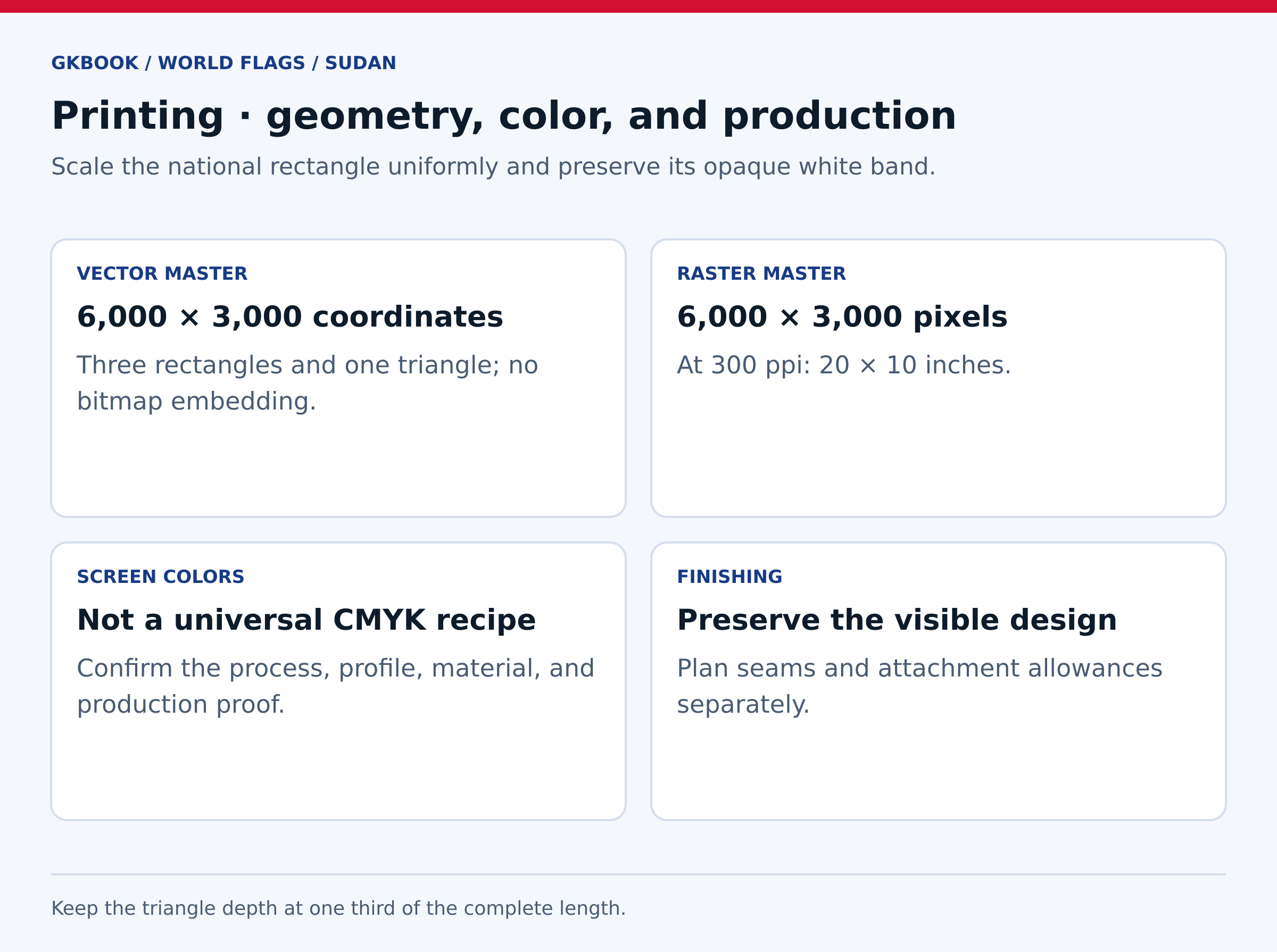
Preserve the complete 1:2 rectangle and scale every component uniformly. The PNG contains 6,000 × 3,000 pixels, equivalent to 20 × 10 inches at 300 pixels per inch. That is a resolution calculation, not an official required physical size. The SVG supports enlargement, while physical color matching requires an appropriate production proof.
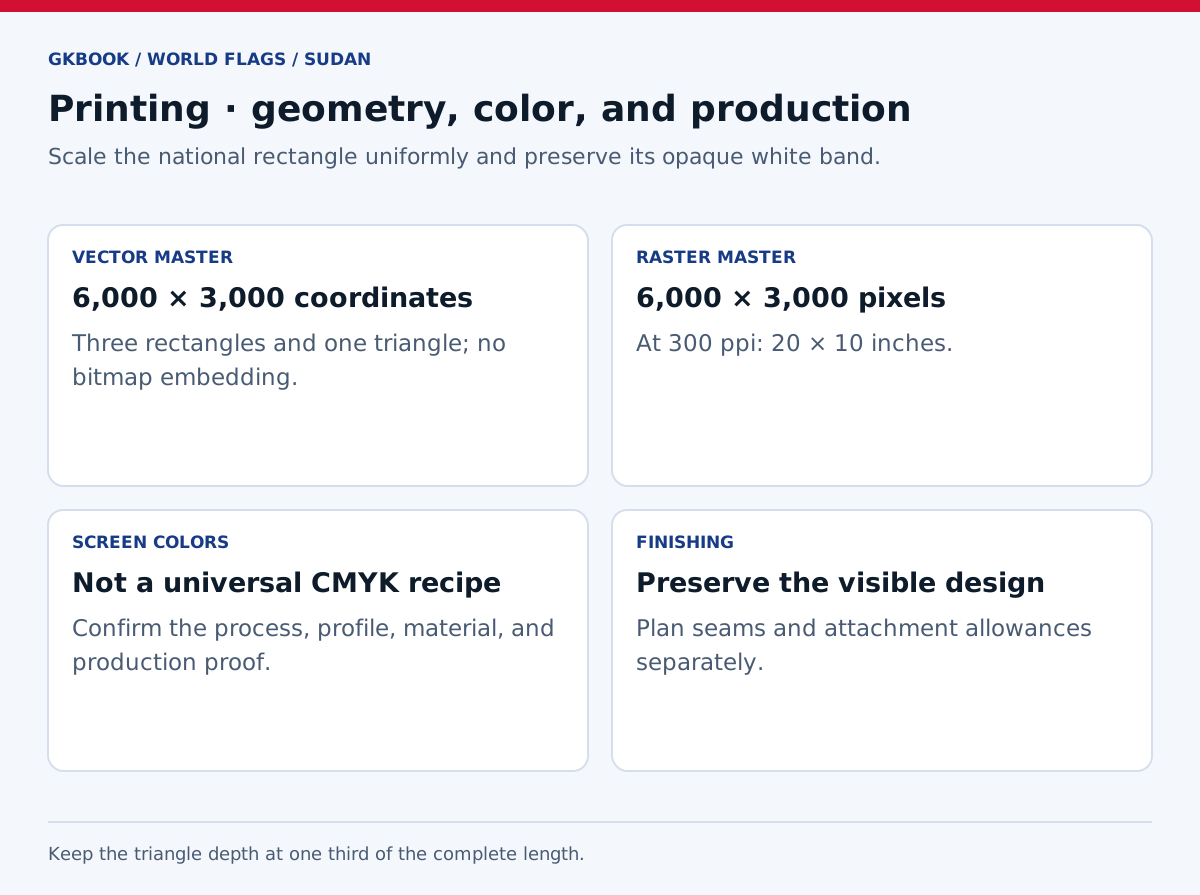
Check the triangle’s point, the equal band heights, and the outer rectangle before approving a print. Keep the white band opaque and avoid adding black strokes around the colored shapes. A correctly sized file can still be distorted if a layout program stretches it to fill a differently proportioned frame.
The declared screen palette is not a universal CMYK recipe. Conversion depends on the process, profile, and material used. Hemming, seams, and attachment allowances also need planning so that the intended visible geometry remains intact. Keep those production allowances separate from the clean artwork instead of silently moving the triangle’s apex.
Which Sudan flag pictures are included?
The collection contains 24 subjects in SVG and PNG, plus a separate social card. They cover the clean national flag, colors, symbolism, triangle, proportions, geometry, areas, history, adoption, designer, independence, earlier design, restoration proposal, law, comparison, display, vertical orientation, reverse viewing, and printing. Captions distinguish flag artwork from educational information panels.
Choose the clean master when an article simply needs the national flag. The other images add measurements, explanations, or comparisons for teaching purposes. Their surrounding labels are part of the diagram, not part of the flag. Historical panels identify events and versions without claiming to reproduce an authenticated archival object.
Each gallery subject has matching vector and raster filenames and descriptive alternative text. The social image uses a separate 1,200 × 630 canvas containing a complete, correctly proportioned flag. That wider layout does not change the national rectangle. The credits file records the artwork basis, screen palette, construction choices, and reproduction limits.
Download Sudan flag pictures
Download the clean national flag as SVG or 6,000 × 3,000 PNG. Both preserve the complete 1:2 rectangle, equal red, white, and black bands, and green triangle extending one third of the length. The screen palette is declared separately from the color names in the inspected Act. Physical production requires appropriate color proofing and finishing allowances.
The gallery contains 24 subjects, each with an SVG and PNG. Captions distinguish clean flag artwork, component studies, historical explanations, and technical guides. Image credits and reproduction notes identify the artwork basis. The separate 1,200 × 630 social card contains a complete flag and does not change the national rectangle.
Continue exploring national designs in World Flags.
World Flags/Sudan
Sudan flag pictures
Complete national flag with Article 4 geometry and a declared screen palette.
GKBook geometric reconstruction and educational layouts; screen palette checked against Wikimedia Commons contributors. No official certification or endorsement.Download SVGDownload PNGThe Act specifies color names. The four numerical screen fills are declared for these digital files.
GKBook geometric reconstruction and educational layouts; screen palette checked against Wikimedia Commons contributors. No official certification or endorsement.Download SVGDownload PNGThese are attributed symbolic explanations, not population percentages or a code for every measurement.
GKBook geometric reconstruction and educational layouts; screen palette checked against Wikimedia Commons contributors. No official certification or endorsement.Download SVGDownload PNGRed is at the top in the ordinary front view; it is not the color of Sudan’s hoist triangle.
GKBook geometric reconstruction and educational layouts; screen palette checked against Wikimedia Commons contributors. No official certification or endorsement.Download SVGDownload PNGWhite is a solid color in the master, not a transparent opening.
GKBook geometric reconstruction and educational layouts; screen palette checked against Wikimedia Commons contributors. No official certification or endorsement.Download SVGDownload PNGThe black band has the same underlying height as red and white.
GKBook geometric reconstruction and educational layouts; screen palette checked against Wikimedia Commons contributors. No official certification or endorsement.Download SVGDownload PNGThe triangle’s dimensions are specified geometrically; no demographic interpretation is assigned.
GKBook geometric reconstruction and educational layouts; screen palette checked against Wikimedia Commons contributors. No official certification or endorsement.Download SVGDownload PNGThe measurements are scaled to the 6,000 × 3,000 master; the green shape is a component study.
GKBook geometric reconstruction and educational layouts; screen palette checked against Wikimedia Commons contributors. No official certification or endorsement.Download SVGDownload PNGThe brackets measure the complete flag, including the triangle and all bands.
GKBook geometric reconstruction and educational layouts; screen palette checked against Wikimedia Commons contributors. No official certification or endorsement.Download SVGDownload PNGRed is above white and black; do not narrow the middle band to compensate for the green overlay.
GKBook geometric reconstruction and educational layouts; screen palette checked against Wikimedia Commons contributors. No official certification or endorsement.Download SVGDownload PNGThe triangle depth is one third of length, equal to two thirds of height.
GKBook geometric reconstruction and educational layouts; screen palette checked against Wikimedia Commons contributors. No official certification or endorsement.Download SVGDownload PNGGreen covers one sixth of the complete rectangle; the white band loses the largest overlap.
GKBook geometric reconstruction and educational layouts; screen palette checked against Wikimedia Commons contributors. No official certification or endorsement.Download SVGDownload PNGThe timeline separates political history, flag adoption, and later legislation.
GKBook geometric reconstruction and educational layouts; screen palette checked against Wikimedia Commons contributors. No official certification or endorsement.Download SVGDownload PNGThe current arrangement’s 1970 adoption is distinct from the later Act’s date.
GKBook geometric reconstruction and educational layouts; screen palette checked against Wikimedia Commons contributors. No official certification or endorsement.Download SVGDownload PNGThe original competition drawings were not obtained; the attribution follows identified reporting.
GKBook geometric reconstruction and educational layouts; screen palette checked against Wikimedia Commons contributors. No official certification or endorsement.Download SVGDownload PNGIndependence is a state-history milestone, not the adoption date of the current arrangement.
GKBook geometric reconstruction and educational layouts; screen palette checked against Wikimedia Commons contributors. No official certification or endorsement.Download SVGDownload PNGThis historical description is not a color-calibrated reproduction of a surviving fabric flag.
GKBook geometric reconstruction and educational layouts; screen palette checked against Wikimedia Commons contributors. No official certification or endorsement.Download SVGDownload PNGThe old tricolor is treated as historical or proposed; the inspected official pages still show the current design.
GKBook geometric reconstruction and educational layouts; screen palette checked against Wikimedia Commons contributors. No official certification or endorsement.Download SVGDownload PNGThe review of this Act is not an exhaustive audit of every later domestic instruction.
GKBook geometric reconstruction and educational layouts; screen palette checked against Wikimedia Commons contributors. No official certification or endorsement.Download SVGDownload PNGThe comparison uses descriptions, with a separate GKBook guide for South Sudan.
GKBook geometric reconstruction and educational layouts; screen palette checked against Wikimedia Commons contributors. No official certification or endorsement.Download SVGDownload PNGThe selected legal passages are attributed to the inspected 1993 Act.
GKBook geometric reconstruction and educational layouts; screen palette checked against Wikimedia Commons contributors. No official certification or endorsement.Download SVGDownload PNGThe triangle moves to the top; the lower band portions read black, white, red from viewer left to right.
GKBook geometric reconstruction and educational layouts; screen palette checked against Wikimedia Commons contributors. No official certification or endorsement.Download SVGDownload PNGThe horizontal reflection changes triangle location in the viewer’s image without reversing the stripe order.
GKBook geometric reconstruction and educational layouts; screen palette checked against Wikimedia Commons contributors. No official certification or endorsement.Download SVGDownload PNGThe print dimensions are a resolution calculation, not a required official flag size.
GKBook geometric reconstruction and educational layouts; screen palette checked against Wikimedia Commons contributors. No official certification or endorsement.Download SVGDownload PNGFrequently asked questions
What does the Sudanese flag look like?
Sudan’s national flag has three equal horizontal bands of red, white, and black, with a green triangle extending from the hoist. Its height:length ratio is 1:2. The triangle reaches one third of the flag’s length, and the ordinary national design contains no star, lettering, or coat of arms.
What is Sudan’s flag called?
The design is normally called the national flag of Sudan or the Sudanese flag. The inspected National Flag Act uses the national-flag designation rather than establishing a special popular nickname. Sudan and South Sudan are separate countries, so their names and flag images should remain clearly distinguished in labels and filenames.
What are the colors of Sudan’s flag?
Sudan’s flag uses red, white, black, and green. This collection assigns them #D21034, #FFFFFF, #000000, and #007229 respectively, matching the inspected reference SVG. These are declared screen values. The 1993 National Flag Act names the colors but does not supply mandatory hexadecimal codes or a complete physical color-matching specification.
What does Sudan’s flag symbolize?
The Sudanese embassy in Qatar connects red with sacrifice, white with peaceful and honorable ideals, black with the country’s name and African identity, and green with growth and natural resources. These explanations concern the colors. They do not turn the flag’s areas into population shares or assign a documented meaning to every geometric measurement.
What does the red band represent?
In the Sudanese embassy’s explanation, red recalls the blood of national martyrs. The University of Illinois educational account also connects it with sacrifice during resistance to colonial rule. Red forms the upper horizontal band in the ordinary front view; its visible area is partly covered by the green triangle at the hoist.
What does the white band represent?
The embassy’s account associates white with purity, sincerity, loyalty, peace, and harmony. White occupies the middle horizontal band of Sudan’s flag. The green triangle’s point falls on that band’s centerline. The ordinary national version leaves the remaining white field plain, without a star, national emblem, inscription, or additional colored device.
What does the black band represent?
The Sudanese embassy links black with the country’s name, courage, attachment to homeland and heritage, and African belonging. Other educational explanations emphasize the independence struggle. Black is the lower band of the national flag. These related accounts should be attributed rather than compressed into a claim that one phrase exhausts its meaning.
What does the green triangle represent?
The Sudanese embassy explains green through growth, natural wealth, and agricultural resources. Some broader flag descriptions also associate green with Islam, but that is not the wording of the embassy passage used here. The color fills the complete hoist triangle; the reviewed legal specification does not assign its depth a separate symbolic meaning.
Is the green triangle equilateral or isosceles?
Sudan’s green triangle is isosceles, not equilateral. Its vertical base equals the full flag height, and its perpendicular depth equals one third of the flag length. In the 6,000 × 3,000 master, the base is 3,000 units, the depth is 2,000, and each sloping side is 2,500 units long.
What is the official proportion of Sudan’s flag?
The National Flag Act specifies a rectangle whose height is half its length. Sudan’s flag therefore has a height:length proportion of 1:2, also written as width:height 2:1. The supplied master is 6,000 × 3,000. Uniform enlargement or reduction preserves the same relationship and the positions of all internal boundaries.
Are the three horizontal bands equal?
Yes. The underlying red, white, and black horizontal bands have equal heights, each one third of the flag’s height. On the 3,000-unit-high master, each band is 1,000 units tall. Their visible areas are not equal because the green triangle covers different amounts of the central and outer bands.
How is Sudan’s flag constructed accurately?
Start with a 6,000 × 3,000 rectangle. Draw red from y=0 to 1,000, white from y=1,000 to 2,000, and black from y=2,000 to 3,000. Overlay a green triangle joining (0,0), (2,000,1,500), and (0,3,000). This scales the inspected legal geometry without introducing decorative borders or extra symbols.
How much of the flag is occupied by each color?
From the specified geometry, green occupies one sixth of the complete rectangle. Red and black each occupy 8/27, while white occupies 13/54. These are calculated visible areas, not official symbolic percentages. The central white band loses more area to the triangle than either of the two outer bands.
Does Sudan’s national flag contain a star or coat of arms?
The ordinary national flag contains neither a star nor a coat of arms. Article 4(3) of the inspected 1993 Act separately describes a presidential flag with a gold national emblem centered on the white band. That additional device should not be inserted into a picture intended to show the ordinary Sudanese national flag.
How has Sudan’s national flag changed over time?
Sudan used a blue, yellow, and green horizontal tricolor after independence in 1956. The red, white, and black design with a green triangle followed in 1970, after the 1969 political change. Later legislation specified its construction and use. The older flag remains a historical design and has also appeared in proposals for restoration.
When was the present Sudanese flag adopted?
Sudanese diplomatic descriptions date adoption of the present flag to May 20, 1970. That event is separate from independence on January 1, 1956, and from the National Flag Act adopted on December 15, 1993. The latter is a later legal specification, not evidence that the current arrangement first appeared in 1993.
Who designed Sudan’s present flag?
The present design is credited to Abdel Rahman Ahmed al-Jali, whose surname also appears as al-Jaali in English transliteration. A November 2017 Anadolu report reproduced by Al Sharq identifies him as its designer and reports the presidency’s announcement of his death. The original competition drawings were not obtained for this collection.
When did Sudan become independent?
Sudan became independent on January 1, 1956. Its independence-era national flag was the earlier blue, yellow, and green tricolor, not the present red, white, and black design with a green triangle. The United States recognition record confirms the independence date; the current flag’s adoption belongs to May 20, 1970.
What did Sudan’s independence flag look like?
The independence-era flag used three horizontal bands: blue at the top, yellow in the middle, and green at the bottom. It served from 1956 until the 1970 replacement. Accounts commonly connect those colors with the Nile, desert, and agriculture. It did not contain the present flag’s green hoist triangle.
Has Sudan restored its old blue, yellow, and green flag?
Official consulate and embassy pages inspected on October 25, 2026 still presented the red, white, and black flag with a green triangle. December 2025 reporting described a proposal to restore the independence flag. This review found no enacted replacement; a reported proposal should not be described as a completed national adoption.
What law specifies Sudan’s flag design?
The inspected National Flag Act 1993 specifies the flag in Article 4, including its proportions, equal bands, triangle dimensions, and display orientation. WIPO Lex records adoption of that Act on December 15, 1993. The review examined the actual Arabic PDF; this does not establish that every later domestic order or amendment was obtained.
Are international recognition dates the same as flag adoption?
No. Sudan’s independence, bilateral recognition, United Nations admission, and flag adoption are separate events. The United States recognized Sudan on January 1, 1956. A United Nations Treaty Series note records admission on November 12, 1956. Neither date replaces May 20, 1970 as the adoption date reported for the present flag.
How does Sudan’s flag differ from South Sudan’s flag?
Sudan’s flag has red, white, and black equal bands with a plain green triangle. South Sudan’s flag has black, red, and green main bands separated by white stripes, plus a blue triangle containing a yellow star. The similar country names should not obscure these clear differences in band order, separators, and hoist device.
Which side of Sudan’s flag is the hoist?
The hoist is the attachment edge at the base of Sudan’s green triangle. It appears on the left in the ordinary horizontal front view. The fly is the opposite, free edge, where the red, white, and black bands are fully visible. These terms identify physical edges rather than permanent directions on every photograph.
How does the flag law describe ordinary display?
The inspected 1993 Act provides selected rules for display and handling. It describes daytime flying, permits certain evening displays, calls for careful raising and lowering, and prohibits another flag on the same pole. It also addresses condition and foreign flags. These are passages from the reviewed Act, not a complete statement of every current administrative instruction.
How should Sudan’s flag be displayed vertically?
Article 4(2) of the inspected Act places the green triangle at the top and the red band on the viewer’s right when the flag is displayed vertically. A clockwise quarter-turn of the ordinary horizontal front view produces that arrangement. The portrait display has a width:height relationship of 1:2 and keeps the complete design.
What does the reverse of Sudan’s flag look like?
In a single-layer viewing model, looking from behind horizontally reflects the complete flag. The green triangle then appears at the viewer’s right, while red remains above white and black. The physical hoist has not moved. This illustration explains viewing geometry and is not a universal manufacturing rule for every separately printed or assembled flag.
Does this guide establish a Sudanese half-mast procedure?
No specific half-mast sequence was established by the passages examined in the 1993 Act. For an actual mourning display, follow the applicable official order and instructions. This collection does not announce an active mourning period or import another country’s raising-and-lowering sequence as if it were a verified Sudanese national rule.
How should Sudan’s flag files be prepared for printing?
Preserve the complete 1:2 rectangle and scale every component uniformly. The PNG contains 6,000 × 3,000 pixels, equivalent to 20 × 10 inches at 300 pixels per inch. That is a resolution calculation, not an official required physical size. The SVG supports enlargement, while physical color matching requires an appropriate production proof.
Which Sudan flag pictures are included?
The collection contains 24 subjects in SVG and PNG, plus a separate social card. They cover the clean national flag, colors, symbolism, triangle, proportions, geometry, areas, history, adoption, designer, independence, earlier design, restoration proposal, law, comparison, display, vertical orientation, reverse viewing, and printing. Captions distinguish flag artwork from educational information panels.
Explore all general-knowledge topics and the A-to-Z lists.









We Value Your Opinion Comments