

Sri Lanka flag picture
Explore the construction notes, history, and picture gallery.
| Country | Democratic Socialist Republic of Sri LankaConstitutional flag name: Lion Flag. |
|---|---|
| Design | Lion · Sword · Four Bo leavesGreen and saffron stripes; maroon field; yellow framing; black outlines. |
| Proportions | Height:length = 1:2Length is twice the full height. |
| Striped design approved | March 2, 1951Separate from independence on February 4, 1948. |
| Present leaf revision | May 22, 1972SLS 1:2020 supersedes the 1985 technical standard. |
| Main image sizes | SVG and PNG: 6,000 × 3,000Complete rectangle with credited lion and leaf curves. |
Black outlines define the lion and leaves. Symbolic interpretations are attributed where official accounts differ.
What does the Sri Lankan flag look like?
Sri Lanka’s flag is a yellow-bordered rectangle with green and saffron stripes beside a maroon panel. A yellow lion holds an upright sword within that panel, with a yellow Bo leaf in each corner. Black outlines define the lion and leaves. The flag’s height:length proportion is 1:2.
Start at the attachment edge, called the hoist. Green comes first, followed by saffron and a yellow separator before the larger maroon field. The lion faces toward the stripes. Reading the design in this order avoids confusing the narrow colored panels with a conventional tricolor. The four leaves belong inside the maroon field rather than in the outer border. This collection shows the complete national composition and supplies separate teaching diagrams for its details. The artwork follows a declared digital construction, with credited reference curves and openly stated limits on physical color matching.
What is the Sri Lankan flag called?
Sri Lanka’s national flag is formally identified as the Lion Flag in Article 6 of the Constitution. The name refers to its prominent sword-bearing lion. It describes the complete national flag, including its colored stripes, border, and leaves, rather than a separate plain banner containing only the animal.
The constitutional name gives a useful starting point when a photograph or illustration is labeled simply as a lion flag. Many unrelated banners use lions. Sri Lanka’s particular combination of stripes, maroon field, yellow framing, sword, and corner leaves provides the necessary visual identification.
An older lion banner may belong to the history of the Kandyan kingdom rather than to the present republic. A shared animal motif does not make every historical object identical. Look for a date and a reliable description before assigning an old image the modern national name or design.
What are the colors of the Sri Lankan flag?
The Sri Lankan flag uses maroon, saffron, green, yellow, and black. Black outlines the lion and Bo leaves. This digital collection uses #941E32, #DF7500, #005F56, #F7B718, and #000000 respectively. These are declared screen values; the official standard provides textile color references and CIELAB coordinates rather than mandatory hexadecimal codes.

Maroon is also described as red in technical and explanatory material, while saffron is often called orange. Those naming differences should not make the two warm colors interchangeable. The narrow stripe and the much larger lion field occupy different positions and have distinct appearances in a complete reproduction.
Use the table to identify the actual fills in these downloads. A displayed swatch is affected by the screen and viewing conditions, so visual similarity alone cannot certify a fabric sample. The black linework also needs to survive reduction; counting only the four large colored areas overlooks that specified detail.
| Color | Hexadecimal | RGB | Official TCX reference |
|---|---|---|---|
| Maroon / red | #941E32 | 148, 30, 50 | 19-1863 |
| Saffron / orange | #DF7500 | 223, 117, 0 | 16-1164 |
| Green | #005F56 | 0, 95, 86 | 18-5322 |
| Yellow / gold | #F7B718 | 247, 183, 24 | 14-0957 |
| Black | #000000 | 0, 0, 0 | Not applicable in the table |
What does the Sri Lankan flag symbolize?
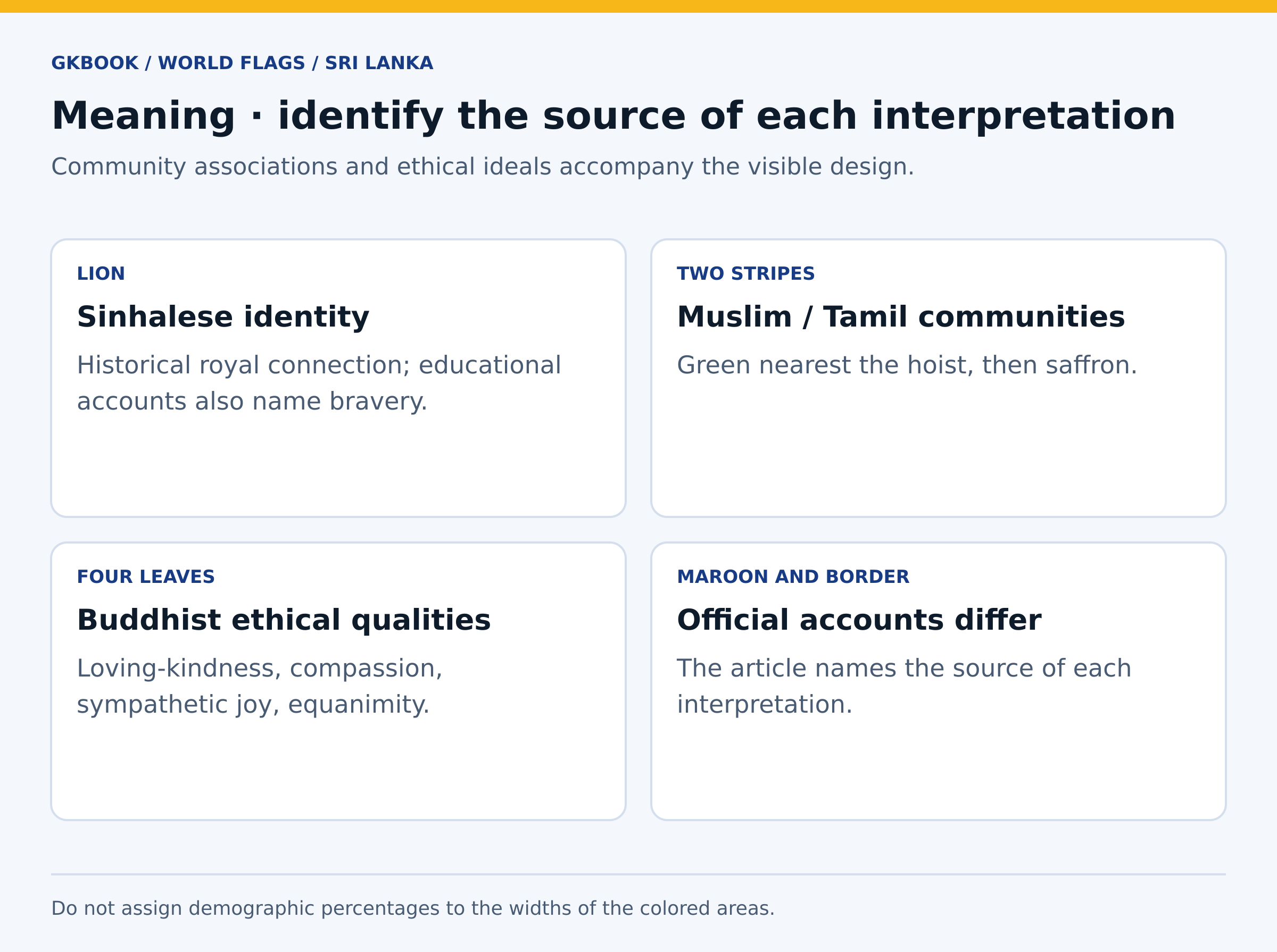
Official explanations associate the lion with the Sinhalese, the green stripe with Muslims, and the saffron stripe with Tamils. The sword represents sovereignty in the embassy account, while the four Bo leaves connect with Buddhist virtues. Interpretations of maroon and the yellow border differ across official educational and diplomatic sources.

These explanations combine community identities, historical memory, and ethical ideals. They are not a census chart. The sizes of the colored areas do not provide population percentages, and linguistic, ethnic, and religious categories should not be treated as interchangeable labels for every individual in Sri Lanka.
A careful description separates the visible design from an attributed interpretation. The lion, stripes, and leaves can be located directly in the artwork. Claims about what each element means require an explanatory source. Where official accounts differ, naming the source preserves useful information without inventing a single uniform symbolism code.
Why is there a lion on Sri Lanka’s flag?
The lion connects the flag with Sinhalese identity and the historical royal standard of Kandy. Official educational explanations also associate it with qualities such as bravery and leadership. In the normal front view, the yellow lion faces the hoist stripes and holds a sword in its raised right forepaw.

This is a stylized emblem, with a shaped mane, curled tail, and detailed paws. It should not be replaced with a generic wildlife silhouette. The pose, sword, and direction together make the figure recognizable, while the black interior lines preserve distinctions that a flat yellow cutout would lose.
The lion on the flag is not the whole national state emblem. Sri Lanka’s separate emblem places a lion within a larger circular composition containing additional elements. Adding those surrounding devices to the flag would change the national design. The enlargement here studies only the flag’s own lion and sword.
What does the sword on the Sri Lankan flag represent?
Sri Lanka’s embassy explanation associates the sword with the nation’s sovereignty. The education textbook describes related ideas of lawful, fair government and protection. The yellow lion holds the upright weapon in its right forepaw. This anatomical right is different from simply labeling an object by the viewer’s right-hand side.
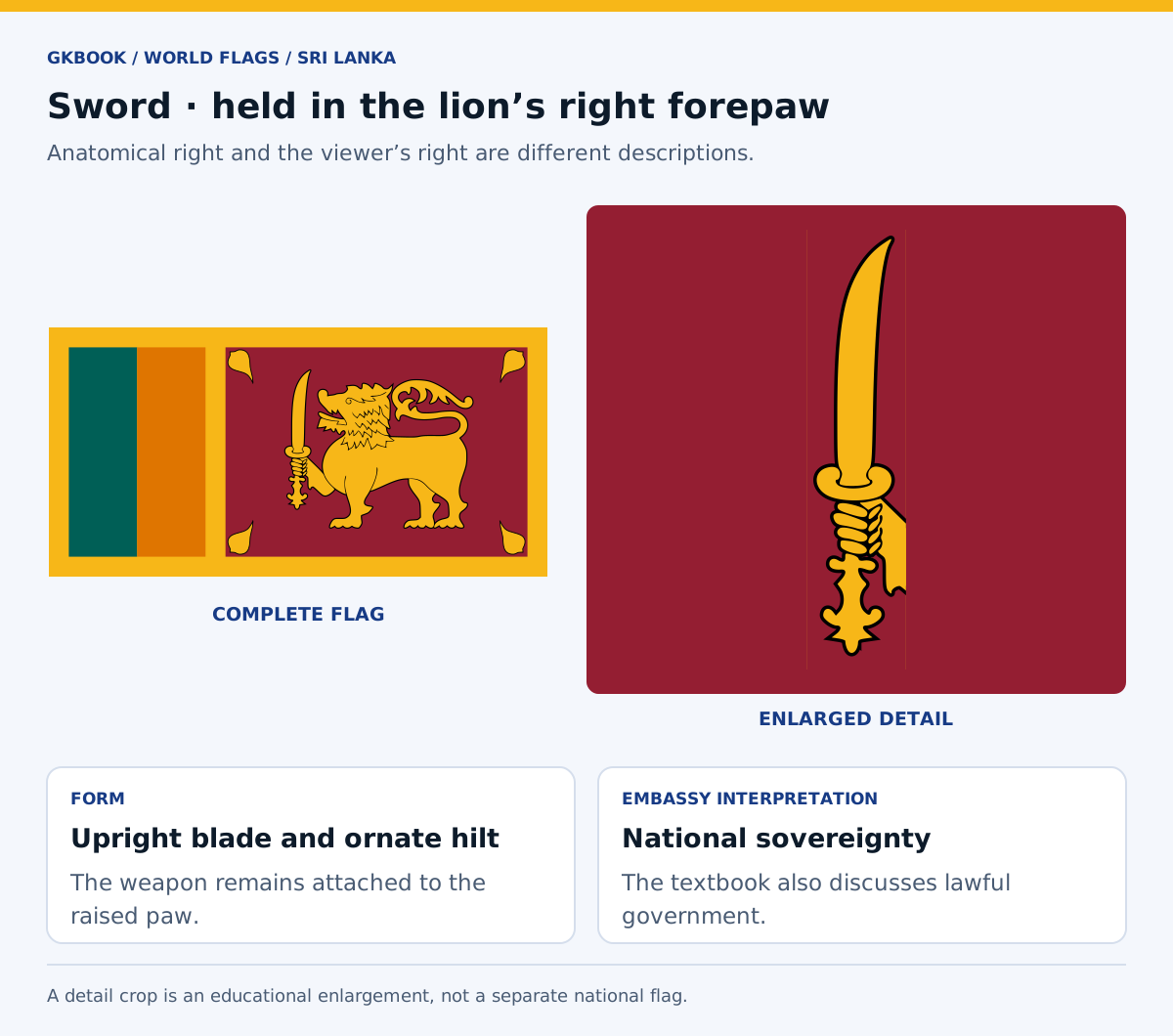
The blade, guard, grip, and lower ornament form one continuous visual feature. Its narrow profile is particularly vulnerable to simplification. At small sizes, the paw may merge with the grip; inspect an enlarged view before deciding whether a reproduction has omitted a detail or merely reduced it beyond legibility.
The sword’s interpretation does not require adding an inscription or changing its shape. An educational crop may isolate the weapon for study, but the national master keeps it attached to the lion. The surrounding maroon remains part of the flag field, not a separate background invented for the weapon.
What are the four leaves on Sri Lanka’s flag?
The four yellow corner devices are Bo leaves, associated with Buddhism and its ethical teachings. Each sits within a corner of the maroon panel and has a black outline. The present leaf treatment dates to the republican revision of 1972; earlier corner devices should not automatically be drawn as today’s leaves.
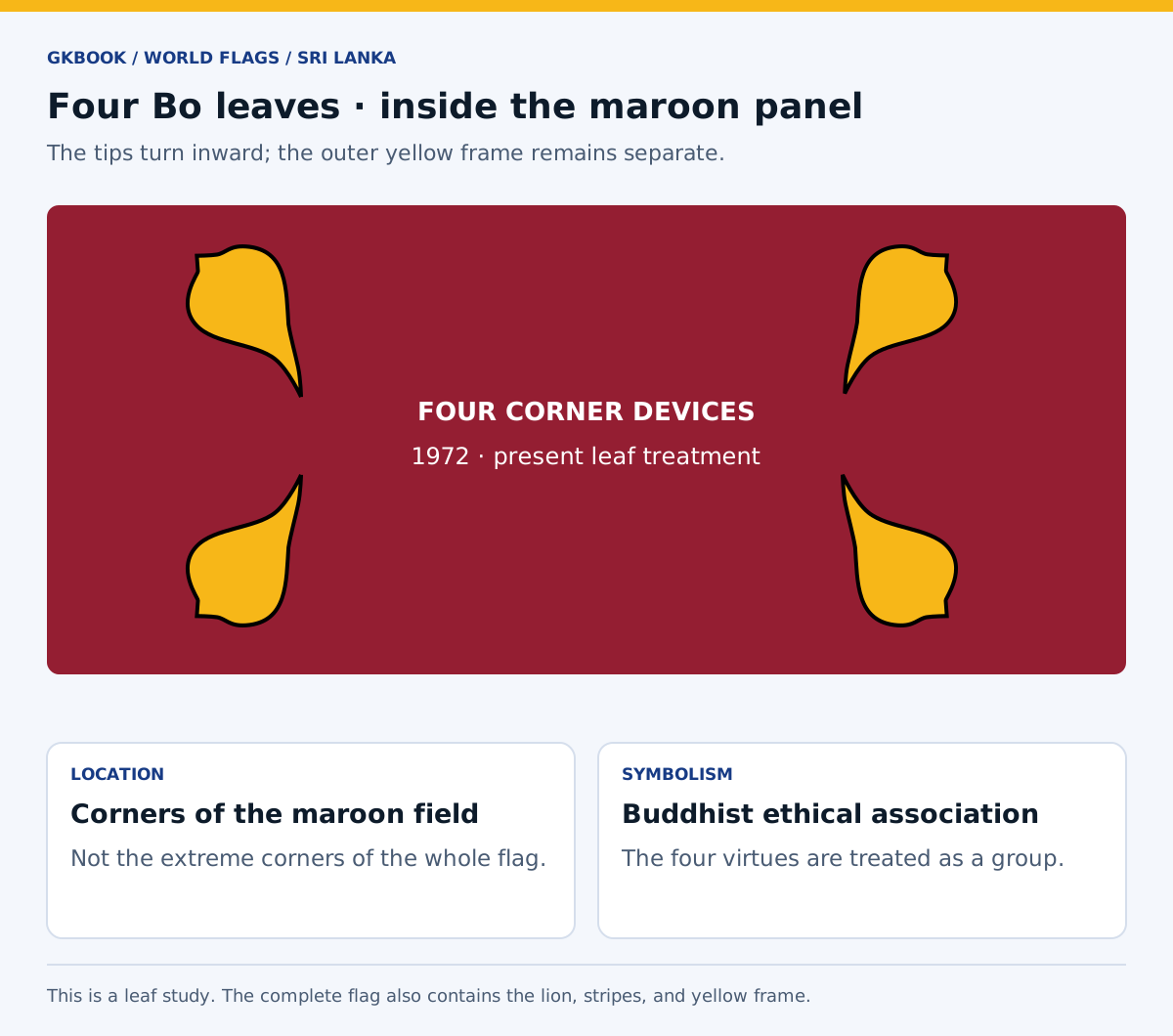
Their pointed ends turn inward toward the central space, while the fuller leaf shapes occupy the corners. They are not maple leaves, stars, or spear tips in the present design. A leaf study should preserve its asymmetrical contour instead of substituting a generic heart shape or botanical icon.
The four leaves do not sit at the extreme corners of the entire rectangular flag. The yellow border separates them from the edge, and the green and saffron panels lie beyond the maroon field on the hoist side. This distinction helps catch a frequent error in simplified classroom drawings.
Which four virtues are associated with the Bo leaves?
The National Archives identifies the four virtues as Metta, loving-kindness; Karuna, compassion; Mudita, sympathetic joy; and Upekkha, equanimity. Together they explain the ethical association of the four Bo leaves. The sources examined do not establish a fixed assignment of one named virtue to each particular corner of the flag.

Present the four terms as a group when using an educational legend. Numbering the leaves clockwise and attaching a virtue to each position would suggest an official spatial mapping that has not been demonstrated. The count of four supports the association without requiring that extra claim about individual corners.
English translations can differ slightly while describing the same set of qualities. Sympathetic joy concerns joy in another’s well-being, and equanimity expresses balanced composure. These short explanations help distinguish the terms for learners; they do not turn the flag into a complete account of Buddhist doctrine or religious practice.
What does the maroon background mean?
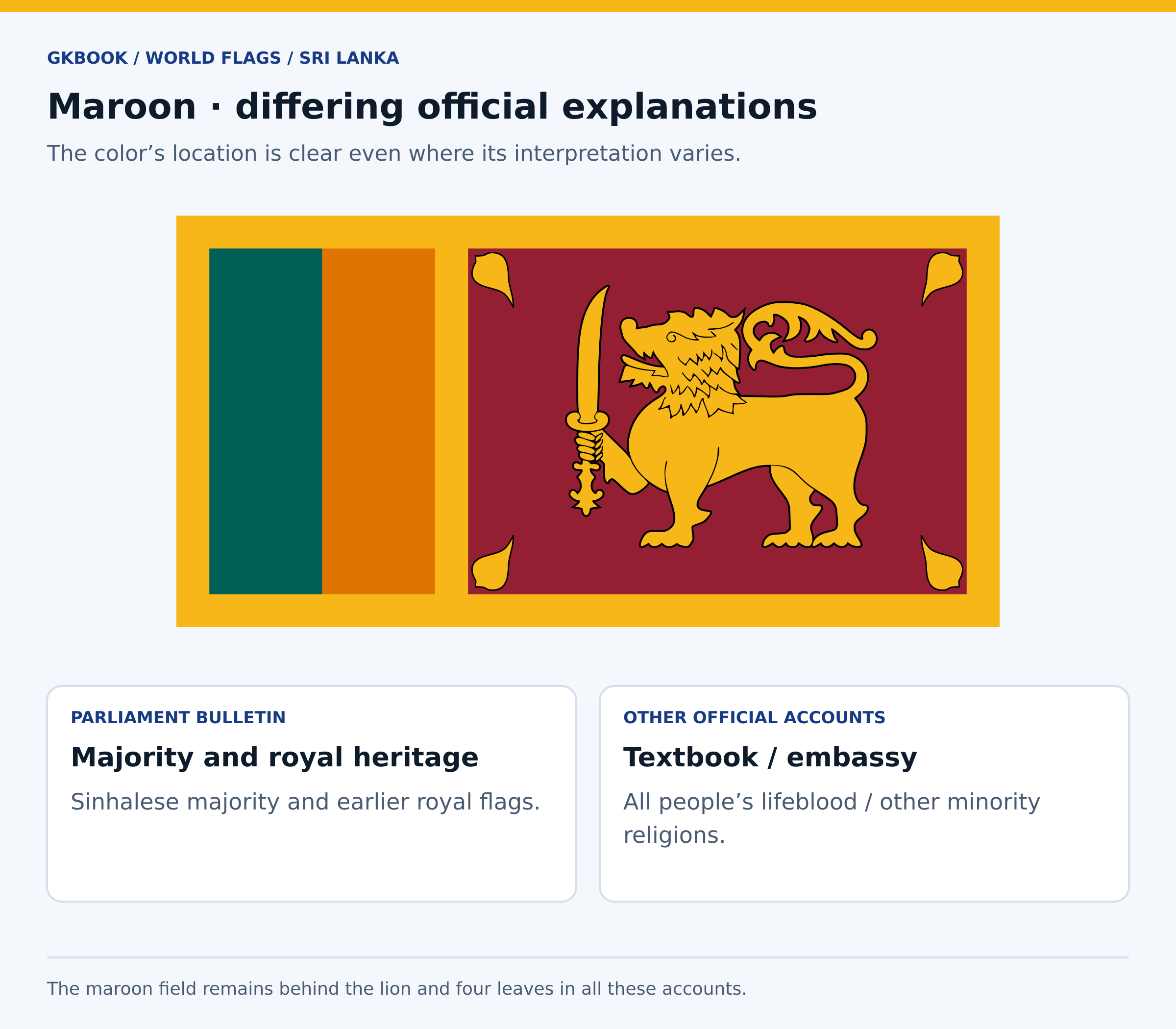
Official accounts give different meanings for the maroon field. A Parliament bulletin connects it with the Sinhalese majority and older royal flags. The education textbook links it with all people’s lifeblood and royal heritage. The embassy explanation assigns it to other minority religions. These interpretations should remain explicitly attributed.

The disagreement concerns symbolism rather than the location of the color. All these discussions describe the dark field behind the lion and leaves. Reporting one account as the only official meaning would conceal a real difference among government publications and could mislead readers comparing textbooks with diplomatic material.
For image identification, describe the field as maroon or dark red before discussing its meanings. A caption can then name the particular interpretive source it follows. Avoid turning a color choice into an unsupported claim that a whole community is absent, excluded, or represented by a precise percentage of the cloth.
What does the green stripe represent?
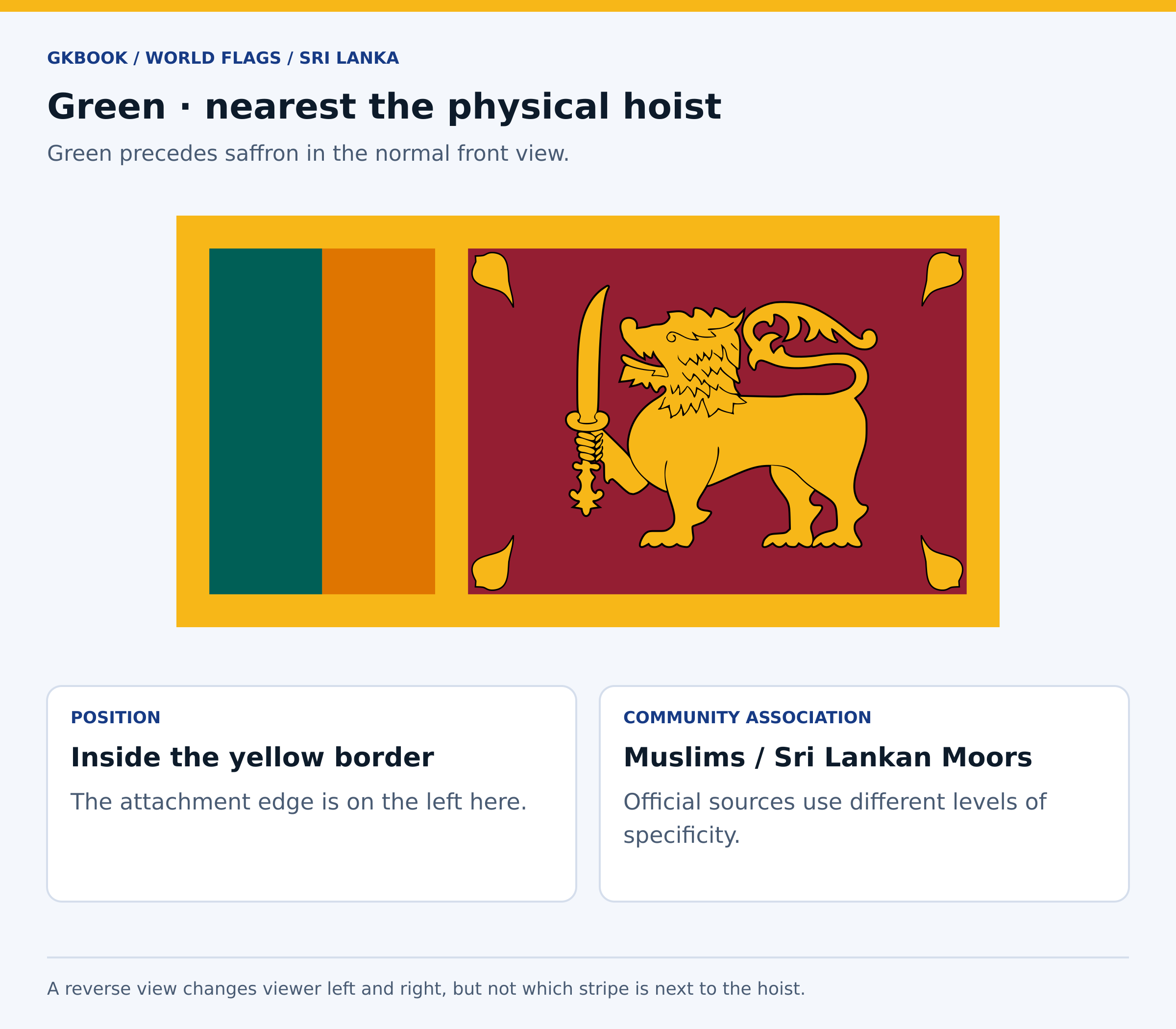
The green stripe is associated with Sri Lanka’s Muslim community in official educational and diplomatic explanations. A Parliament bulletin uses the more specific term Sri Lankan Moors. Green is the stripe nearest the hoist, inside the yellow border, followed by saffron toward the larger maroon panel containing the lion.

The position matters as much as the hue. Swapping green and saffron produces a different arrangement even if every other component remains recognizable. Check the attachment side rather than assuming that whichever stripe appears on the left of a cropped photograph must always be nearest the pole.
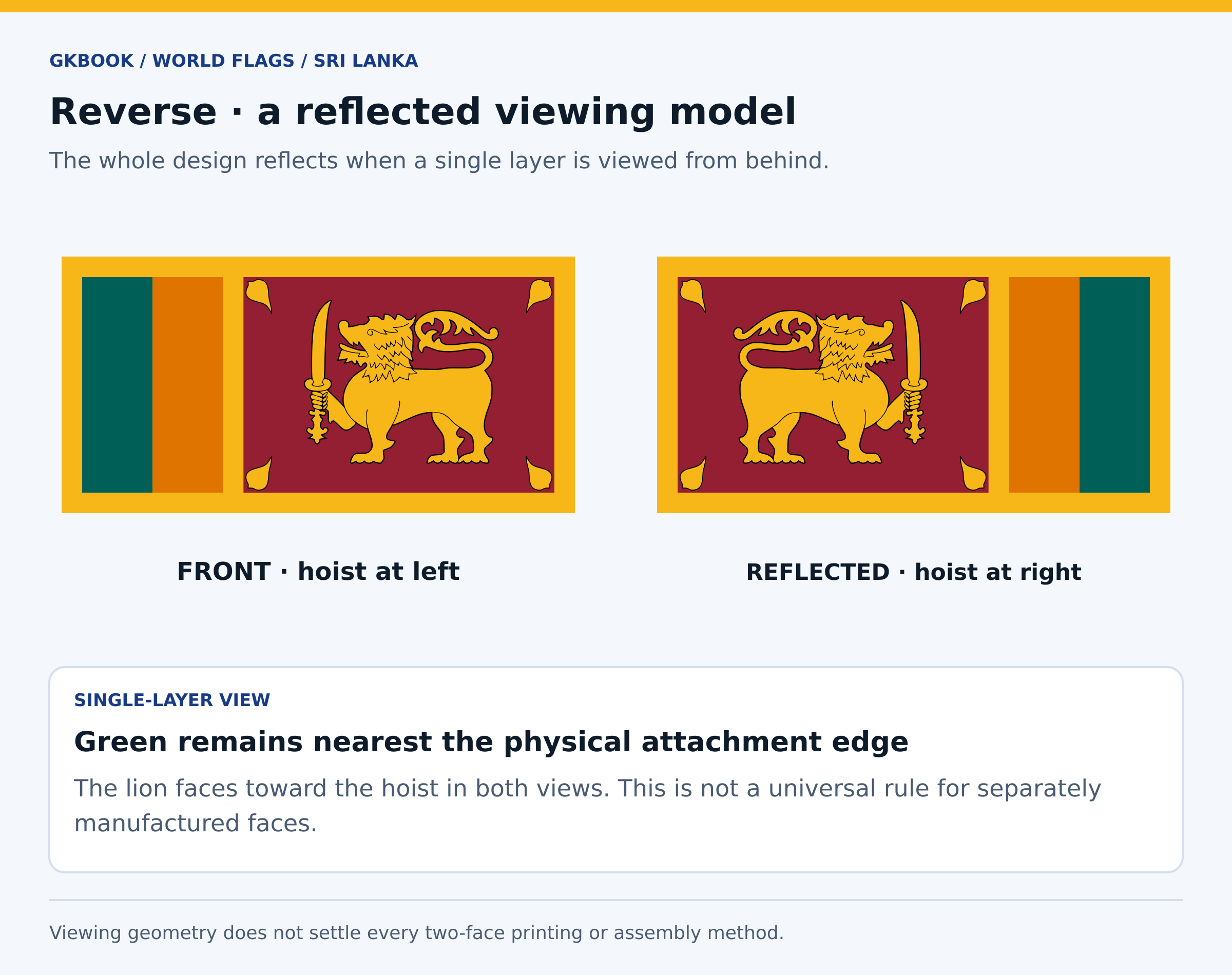
A reflected view from behind a single layer reverses the picture’s left and right while preserving the stripe next to the actual hoist. The community association also should not be read as a complete definition of religious or ethnic identity. The article reports the wording used by the relevant explanatory sources.
What does the saffron stripe represent?
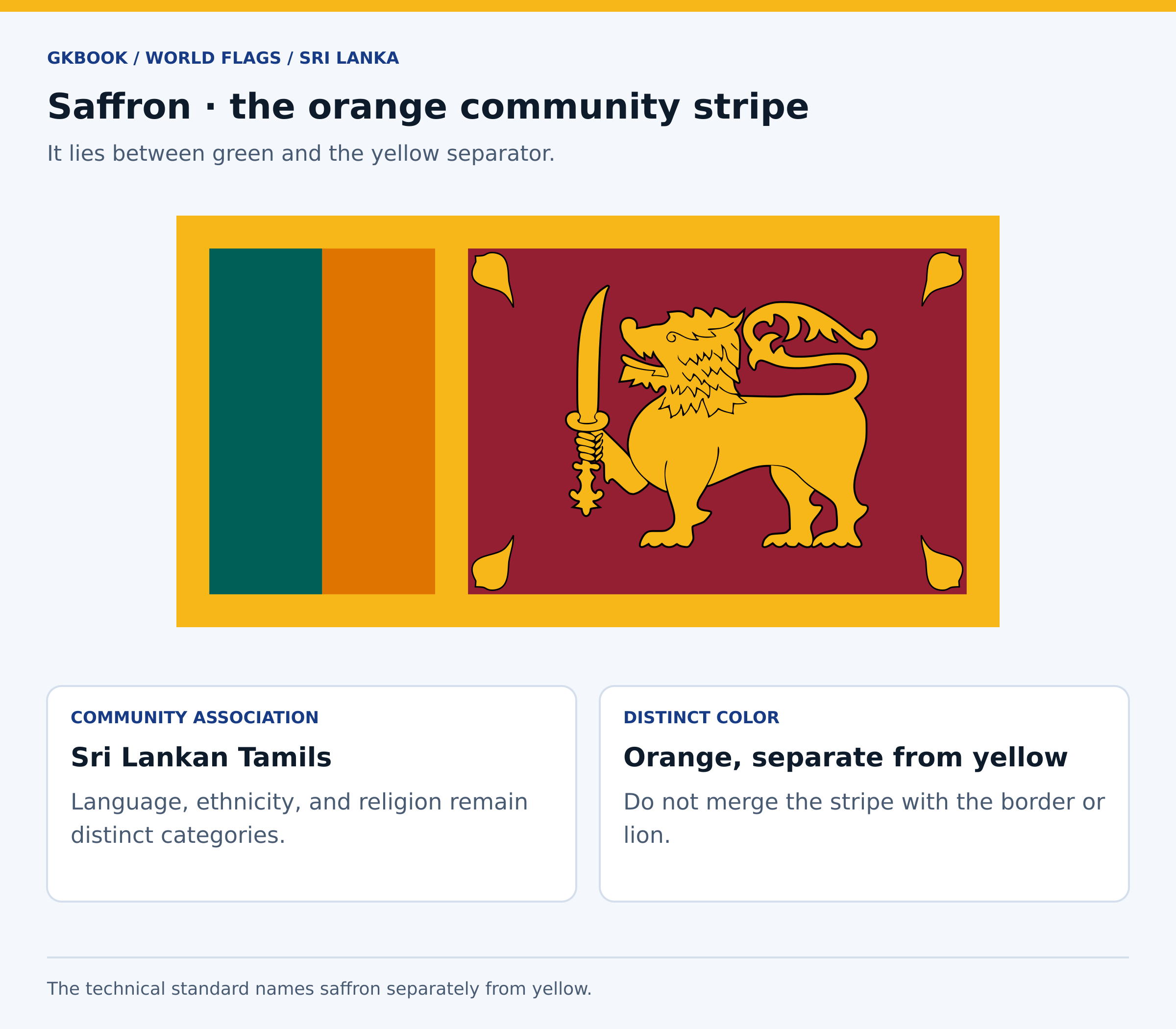
The saffron stripe is associated with Sri Lanka’s Tamil community in official explanations. It is also commonly described as orange. In the normal front view it lies immediately to the right of green, with a yellow divider separating it from the maroon lion panel. The two community stripes have equal widths.

Use saffron or orange for this stripe to distinguish it clearly from the yellow border and symbols. Some educational wording uses yellow loosely, but the technical standard identifies saffron as a separate color. In the downloadable artwork, the orange stripe and gold-yellow framing have visibly different fills.
Community symbolism does not imply that all Tamil people share one religion. Language, ethnicity, and religious affiliation describe different aspects of identity. Nor does equal stripe width establish equal population shares. The design creates a national composition; its geometry is not a statistical graph of the country’s communities.
What does the yellow border mean?
The yellow border frames the entire flag and separates the stripes from the maroon panel. The embassy explanation connects it with other minority communities, while the education textbook emphasizes unity, peace, wisdom, and mutual understanding. Yellow also colors the lion and leaves, but their meanings should be discussed separately.

The border is a continuous part of the visible design. It should not be removed as if it were an accidental margin around an online image. Cropping to the colored inner panels would change both the proportions and the relationship between the hoist stripes and the lion field.
The internal yellow divider matches the framing system in this construction. Keep the complete rectangle when placing a flag in a slide or publication, and add any decorative page border outside it. A website’s white spacing, drop shadow, or caption box does not become part of the national flag.
What is the correct ratio of the Sri Lankan flag?
Sri Lanka’s flag has a height:length ratio of 1:2, so its length is twice its height. The main files use a 6,000 × 3,000 canvas. This preserves the complete flag rectangle, including its yellow border. A square thumbnail or a 2:3 replacement would change the intended national proportions.

The order of the numbers matters. Written as width:height, the same relationship is 2:1; written as height:length, it is 1:2. Always label the convention when comparing diagrams. A flag sixty centimeters long and thirty centimeters high has the same overall shape as the supplied master.
Scale the entire composition uniformly rather than stretching only the maroon panel or widening the stripes. Responsive image settings should preserve the original aspect ratio. A surrounding social card can have its own rectangular dimensions, but the flag placed inside that card should retain the national relationship between height and length.
How is the downloadable Sri Lankan flag constructed?
The digital master preserves the exact 1:2 canvas and the standard’s stripe-width rule. It uses a 240-unit yellow border on a 6,000 × 3,000 canvas. Rounded dimensions in the standard do not close into one exact grid, so the remaining maroon width is derived and the construction is documented.

Each stripe measures one seventh of the total length after excluding the outer hoist border. Here that gives approximately 822.857 units. Applying the uniform border and divider leaves approximately 3,634.286 units for the maroon panel. These calculated coordinates describe this reconstruction rather than a newly issued official drawing.
The lion and four leaves retain credited source curves, adjusted to declared nominal component boxes. This makes the choices reproducible, including the small disagreement between rounded tabular dimensions and exact relationships. The package does not claim certified conformity with every manufacturing requirement. Use approved production specifications when commissioning physical national flags.
| Element | Position or dimension |
|---|---|
| Outer yellow border / divider | 240 units |
| Each colored stripe | 822.857142857 units |
| Maroon panel | x = 2,125.714285714; y = 240 |
| Maroon panel size | 3,634.285714286 × 2,520 |
| Lion and sword box | x = 2,832; y = 504; 2,280 × 1,920 |
| Each leaf box | 312 × 408; 24-unit inset from panel edges |
Why are the lion and leaves outlined in black?
Black outlines are part of the Sri Lankan flag specification, not merely an optional effect added by illustrators. They define the yellow lion and four Bo leaves against maroon. The lion also has black internal detail. The large color panels and yellow border should not receive arbitrary extra black dividing lines.

At small display sizes, black and yellow edges are softened by antialiasing, which helps curved shapes appear smooth on a pixel grid. Those intermediate edge colors are rendering artifacts rather than additional named flag colors. A high-resolution master should retain the original paths so smaller exports begin with complete detail.
Heavy outlines can close small gaps in the mane, mouth, paw, and sword grip. Removing them loses detail in the opposite direction. When preparing a print proof, examine both the outer silhouette and interior linework. Avoid automatic tracing that silently changes their thickness or joins neighboring shapes together.
How did Sri Lanka’s national flag develop?
The modern flag draws on the royal lion standard associated with Kandy before British rule. A lion flag returned at independence in 1948. A committee considered the national design, and Parliament approved the version with community stripes in 1951. The republican revision of 1972 established the present treatment of the corner leaves.

The history joins continuity with deliberate change. Retaining the lion connected the emerging national flag with an earlier royal emblem, while the additional stripes broadened the composition. A historical timeline should therefore track which features changed, rather than presenting one undifferentiated adoption event covering the entire design.
Sources describe the older corner devices in different ways. The National Archives calls them beralu devices, while the standard discusses making the Bo leaves more prominent in 1972. The useful common point is that the corners were revised. A modern digital leaf should not be inserted into every earlier historical illustration.
When was Sri Lanka’s present flag adopted?
May 22, 1972 is the date associated with the present republican flag revision, including the modern Bo leaves. The striped predecessor had already received parliamentary approval on March 2, 1951. Independence on February 4, 1948 is an earlier milestone, so these three dates answer different questions about the flag’s development.
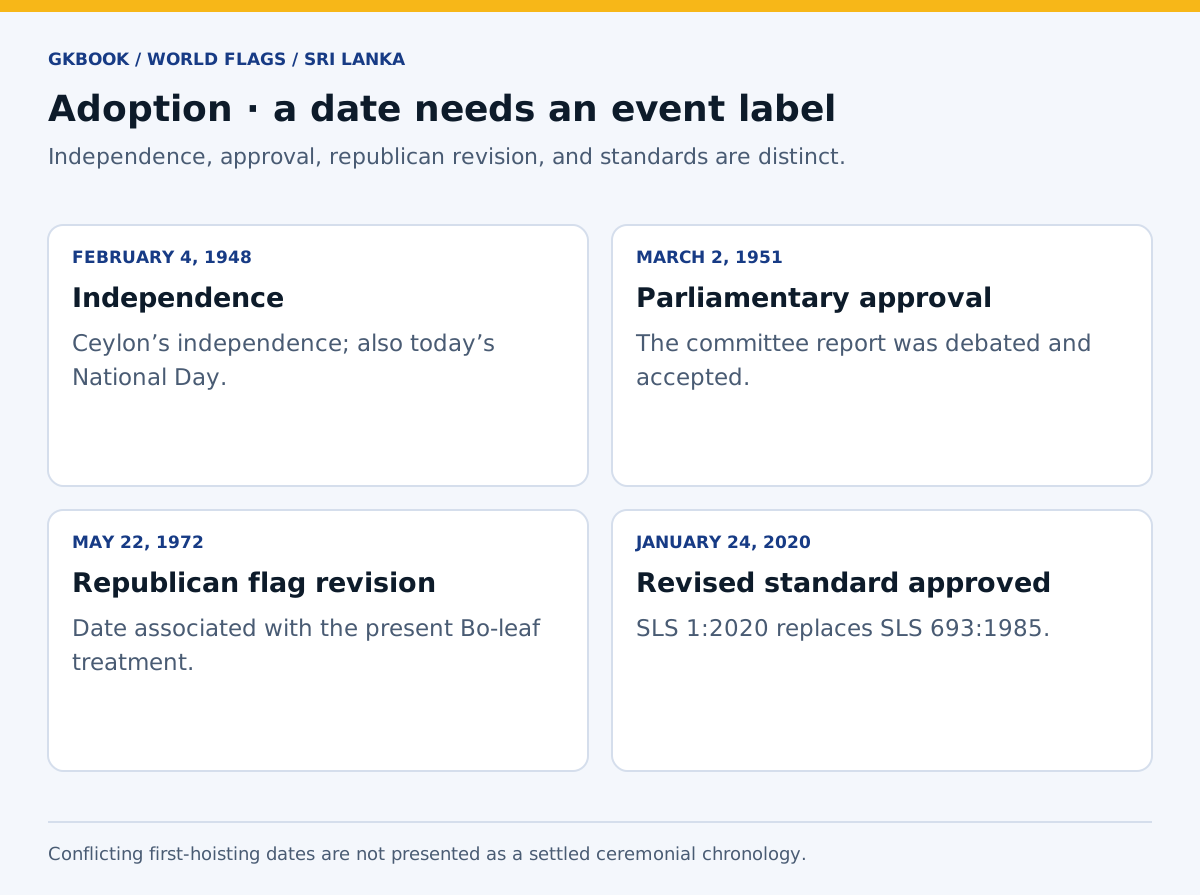
The standard’s historical account distinguishes the tabling of the committee report on February 27, 1951 from the debate and approval that followed. Diplomatic and government summaries also mention committee decisions in 1950. A committee-stage date should not silently replace the separately documented parliamentary approval in the following year.
Accounts disagree about an exact first-hoisting date for the striped design. This article therefore does not select one unsupported ceremonial date as definitive. When a concise label is needed, pair the year with the feature: independence lion flag, approved striped design, or republican leaf revision. That wording keeps the chronology understandable.
How is the flag connected with independence in 1948?
Ceylon became independent on February 4, 1948, and the historical lion standard was used in the independence period. The later striped composition and present corner leaves should not be projected backward onto every 1948 scene. February 4 remains the National Day identified in Article 8 of Sri Lanka’s Constitution.

The constitutional holiday and the flag’s later changes belong to related but separate histories. Independence established a new political setting for national symbols. It did not freeze every subsequent design detail. A commemorative illustration should identify whether it shows a historical independence flag or the national flag used today.
Photographs are especially useful when accompanied by reliable dates and captions. Without those, a modern flag at an independence anniversary can be mistaken for evidence of the exact design flown in 1948. The current master in this collection is labeled as the modern flag and is not a replica of an archival object.
What changed in the flag when Sri Lanka became a republic?
Sri Lanka became a republic on May 22, 1972. The flag’s corner devices were revised into the present Bo-leaf treatment associated with four Buddhist virtues. The lion, sword, green and saffron stripes, maroon field, and yellow framing continued. The change did not introduce an entirely new color arrangement for the first time.

The republican milestone is often used as the adoption date of the current flag. That shorthand is useful when the accompanying explanation identifies the leaf revision. It becomes misleading if readers are left to assume that the community stripes, or the historical association of the lion, originated only in 1972.
A comparison should focus on the corners and the dated design context. This collection uses explanatory panels rather than invented facsimiles of earlier flags. Producing a faithful historical reproduction would require its own authenticated model, including the old corner devices and the particular drawing conventions used at that time.
Who designed the Sri Lankan national flag?
The modern flag developed through a committee and later revisions, rather than one person designing every element at once. Prime Minister D. S. Senanayake appointed the National Flag Committee in 1948. S. W. R. D. Bandaranaike chaired it, and Senarat Paranavitana served as secretary. The lion motif itself had an older royal history.

Separate political responsibility from artistic authorship. Appointing a committee, chairing its discussions, approving a report, and drawing a vector file are different contributions. Giving one person sole credit for the ancient motif, twentieth-century composition, republican revision, and present downloadable artwork would erase those distinctions.
The lion and leaf curves in these downloads derive from the credited Wikimedia Commons artwork by Zscout370 and Mike Rohsopht. GKBook supplies the documented construction, palette adjustments, article, and educational layouts. Those digital production credits describe this package; they do not make its contributors the historical designers of Sri Lanka’s national flag.
What is the current Sri Lankan flag standard?
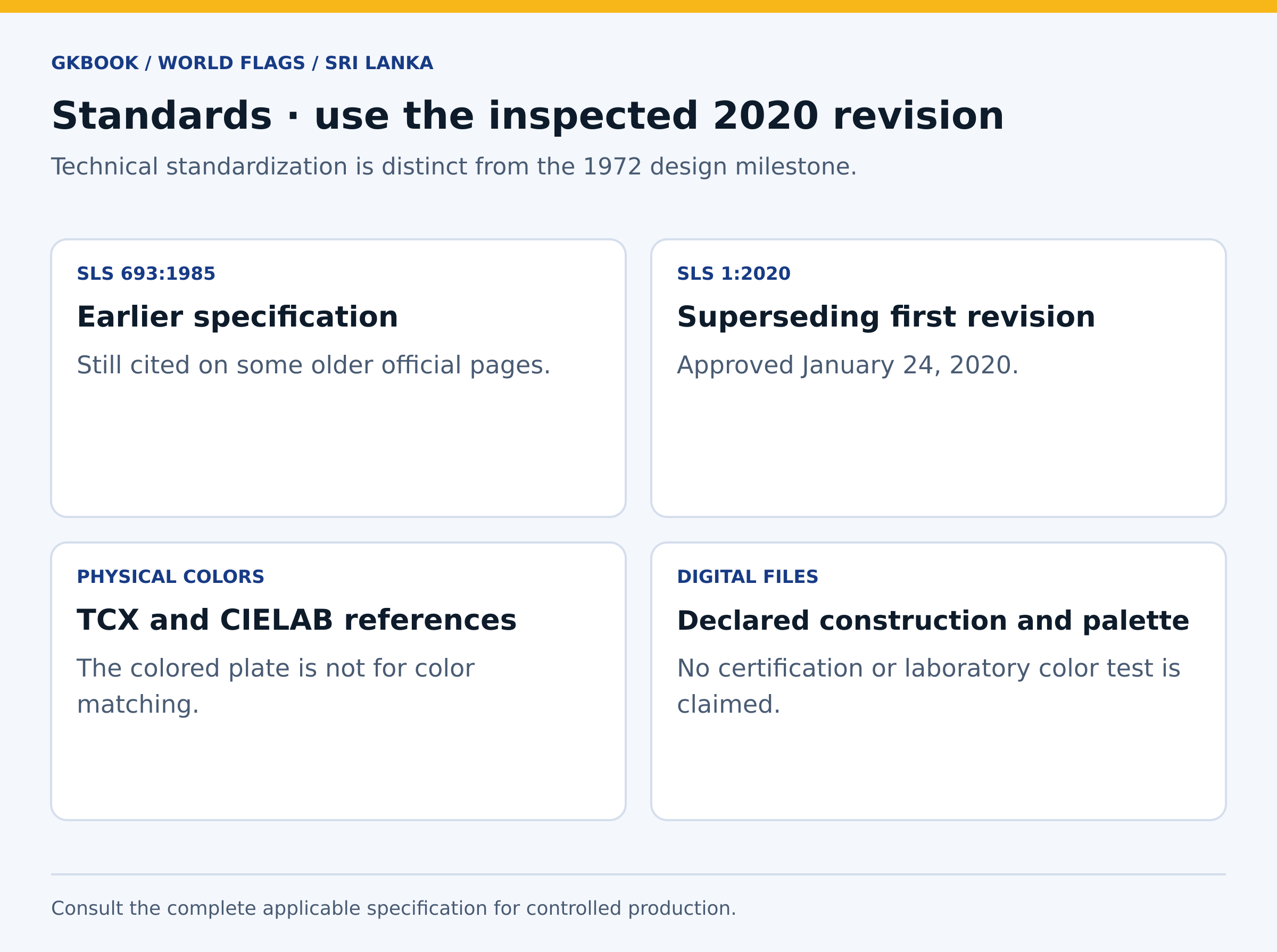
The official standard inspected for this collection is SLS 1:2020, approved on January 24, 2020. It supersedes SLS 693:1985. The newer document covers the national flag’s design and technical requirements. Older government pages and textbooks still citing the 1985 standard should not be mistaken for evidence that no revision occurred.

A standard number and a design adoption date serve different purposes. Updating a technical specification does not necessarily mark the creation of a new national symbol. Keep the 1972 design milestone separate from the 1985 specification and its 2020 replacement when preparing a chronology or answering a short factual question.
The standard’s colored plate explicitly is not a color-matching reference. Its measured color information and textile references therefore matter more than a screenshot of the illustration. The digital files offered here explain their screen palette and geometric choices, but they are not accompanied by an official conformity certificate or laboratory color report.
What does Sri Lanka’s Constitution say about the flag?
Article 6 identifies Sri Lanka’s national flag as the Lion Flag depicted in the Second Schedule. The schedule supplies its visual representation. This constitutional provision establishes the flag’s identity; detailed dimensions, textile color references, and manufacturing requirements are addressed separately by the national standard rather than spelled out in Article 6.
The parliamentary edition examined is the revised 2023 text incorporating amendments through the Twenty First Amendment. Its flag illustration provides an official constitutional reference for the overall composition. The edition identifies itself as an unofficial edited text, so it should be described accurately rather than relabeled as an original signed constitutional instrument.
A constitutional illustration, a manufacturing drawing, and a website image solve different problems. The first identifies a national symbol, the second guides controlled production, and the third communicates visually on a screen. Using them together is helpful, provided their roles are kept distinct and a digital reproduction does not acquire an unsupported official certification.
When did Sri Lanka join the United Nations?
Ceylon, now Sri Lanka, joined the United Nations on December 14, 1955. The UN’s Sri Lanka office confirms that date. Membership is a separate institutional milestone from independence in 1948, parliamentary approval of the striped flag in 1951, and the republican flag revision in 1972. It is not a universal flag-recognition date.
International membership, diplomatic recognition, and adoption of a national emblem are different processes. They may appear beside one another in a national history, but one should not be used as an automatic substitute for another. A flag timeline is clearer when it names the action associated with each year.
The UN account also distinguishes the beginning of its work in the country from admission as a member. That distinction illustrates why a date requires an accompanying event label. This article uses the membership date only for institutional context, without claiming that every government recognized the state or flag on that same day.
How should the Sri Lankan flag be displayed?
Official educational guidance places the colored stripes nearest the pole and calls for respectful, clearly visible display. Foreign national flags should be at equal height and size in the arrangement described. A government circular warns against faded, damaged, distorted, or upside-down flags. Ceremony-specific instructions should be checked against the applicable official code.

Inspect the complete design before installation: border intact, lion facing the stripes, and no accidental crop or added lettering. The education textbook also calls for adequate illumination at night. A clean digital file is only one part of a respectful display; condition, attachment, location, and visibility matter as well.
The complete flag-use code could not be retrieved during this review. The guidance here is therefore limited to the circular and textbook passages actually examined, rather than presented as a comprehensive protocol manual. In particular, arrangements involving local organizational flags should not be confused with the textbook’s equal-height treatment of foreign national flags.
When and how is the Sri Lankan flag flown at half-mast?
The official education textbook associates half-mast display with mourning occasions declared by the government. It describes raising the flag to the top before lowering it to the mourning position, then raising it again before the final lowering. This explains the sequence; it does not announce any currently active mourning instruction.
Half-mast is a ceremonial state, not a different national design. Keep the same colors, proportions, lion, and leaves. Do not alter the downloadable image by adding a black stripe or removing a symbol to suggest mourning. The physical position on the pole communicates the observance.
An event organizer should follow the instruction applicable to the occasion and installation. The full code was not obtained in this review, so this article does not attempt to resolve every pole arrangement or special case. A static educational diagram or historical note should never be mistaken for a current government announcement.
What does the reverse of the Sri Lankan flag look like?
Viewing a single-layer flag from behind produces a horizontal reflection: the hoist appears on the viewer’s right, and the lion faces toward it. Green remains the stripe nearest the physical attachment edge. The comparison supplied here demonstrates viewing geometry, not a universal manufacturing specification for separately printed or sewn flag faces.
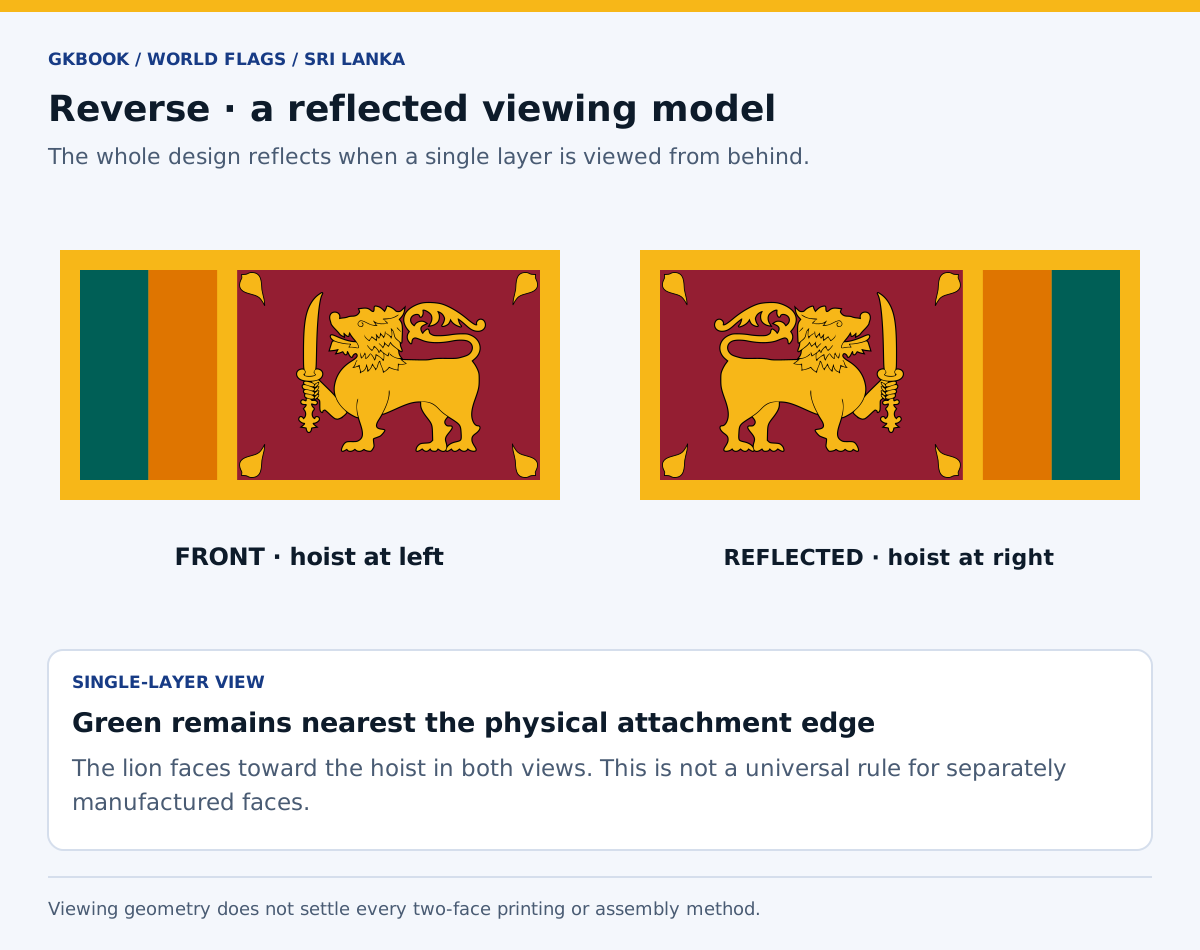
The reflected lion, sword, and leaves move together with the field. Flipping only the animal while leaving the stripes in their original positions creates an inconsistent diagram. Conversely, a photograph from the reverse side should not be called upside down simply because the familiar left-to-right arrangement has been reversed.
The terms front and back in this illustration refer to the observer’s viewpoint. They do not decide how a particular maker must assemble opaque layers, print a second face, or place seams. Those production decisions require the relevant approved specification. The clean master is the normal front-view composition used throughout this article.
Can the Sri Lankan flag be displayed vertically?
Do not stretch Sri Lanka’s 1:2 flag into a portrait-shaped replacement or rotate individual components. The education textbook’s street-display guidance keeps the lion parallel to the ground. The complete flag-use code was not obtained, so this article does not prescribe a universal clockwise or counterclockwise rule for every vertical installation.
A tall available wall space does not change the national flag’s proportions. One practical layout is to retain the full horizontal rectangle within the available area, with surrounding space left outside the design. That is a page-layout suggestion, not a claim that every physical hanging method has been officially approved.
When an installation requires a different orientation, consult the responsible authority’s instructions for that setting. The attachment edge, direction of the lion, and readability of the whole composition all need attention. The package deliberately includes a labeled reverse-view study but no speculative portrait flag that could be mistaken for an official vertical standard.
How can older Sri Lankan flags be distinguished?
Older flags should be identified by their date, context, community stripes, and corner devices. The historical Kandyan lion standard, the independence-era lion flag, the approved striped design, and the present republican version are related but not identical. The current Bo leaves should not be used as a shortcut for every earlier corner treatment.

A reliable comparison begins with an authenticated image or object record. Decorative redrawings can smooth away precisely the features needed for dating, including the lion’s form and corner ornaments. A modern file labeled historical is not sufficient evidence unless its basis and the particular version reproduced are explained.
The gallery’s history panels are textual guides, not claimed facsimiles of museum specimens. They help readers ask the right identification questions without supplying invented historical artwork. If an old photograph is ambiguous, describe the visible elements and uncertainty rather than assigning a year solely from a familiar maroon-and-yellow appearance.
How should the Sri Lankan flag files be prepared for printing?
Use the vector master for scalable artwork and preserve the complete 1:2 rectangle. The PNG is 6,000 × 3,000 pixels, equivalent to 20 × 10 inches at 300 pixels per inch. That is a resolution calculation, not an official physical flag size. Physical color and manufacturing conformity require separate checks.

Inspect the sword grip, mane, paws, tail, and leaf outlines in a production proof. Fine black gaps can disappear through ink spread or aggressive reduction, while cutting can remove part of the yellow border. A larger file helps preserve detail but does not by itself solve substrate or finishing problems.
The package’s screen hex values are not a universal CMYK recipe. Color conversion depends on the print process and profile, and textile matching requires the appropriate physical references. Keep seam, hem, and attachment allowances outside the intended visible artwork rather than silently stretching its panels to fill a production template.
Which Sri Lankan flag pictures are included?
This collection contains 24 subjects in both SVG and PNG, plus a separate social card. Subjects include the clean national flag, colors, symbolism, lion, sword, leaves, virtues, geometry, history, adoption, display, reverse viewing, and printing. Captions distinguish complete flags from enlarged details, comparison images, and educational information panels.
Choose the clean master when a publication simply needs the national flag. Teaching diagrams add labels, brackets, and explanatory cards around the design; those additions should remain attached to their captions when reused. A cropped sword study is useful for learning about a detail but is not a complete national flag.
The gallery supplies descriptive alternatives and matching filenames for each format. SVG retains vector curves for enlargement, while PNG provides a convenient raster image with an opaque background. The separate social artwork contains a correctly proportioned flag inside its wider layout. Neither the social canvas nor an information panel changes the national flag’s proportions.
Download Sri Lanka flag pictures
Download the clean national flag as SVG or 6,000 × 3,000 PNG. Both preserve the complete 1:2 rectangle, green and saffron stripes, yellow framing, maroon field, sword-bearing lion, and four Bo leaves. The documented construction resolves rounded measurements explicitly. Credited reference curves are retained with adjusted placement and screen colors; physical production requires the appropriate approved specifications and proof.
The gallery contains 24 subjects, each with an SVG and PNG. Captions distinguish clean flags, detail enlargements, historical explanations, and technical guides. Image credits and reproduction notes identify the artwork basis. The separate 1,200 × 630 social card contains a complete flag and does not alter the national rectangle.
Continue exploring national designs in World Flags.
World Flags/Sri Lanka
Sri Lanka flag pictures
The complete 1:2 Lion Flag in a documented digital construction.
GKBook construction and educational layouts; lion and leaf paths adapted from Zscout370 and Mike Rohsopht / Wikimedia Commons. Geometry and screen palette adjusted; no official certification or endorsement.Download SVGDownload PNGFive specified colors include black outlines; the screen codes are not statutory hex values.
GKBook construction and educational layouts; lion and leaf paths adapted from Zscout370 and Mike Rohsopht / Wikimedia Commons. Geometry and screen palette adjusted; no official certification or endorsement.Download SVGDownload PNGThe community symbolism is not a census chart or a complete classification of personal identity.
GKBook construction and educational layouts; lion and leaf paths adapted from Zscout370 and Mike Rohsopht / Wikimedia Commons. Geometry and screen palette adjusted; no official certification or endorsement.Download SVGDownload PNGThe detailed reference curves are retained and mapped to the declared component box.
GKBook construction and educational layouts; lion and leaf paths adapted from Zscout370 and Mike Rohsopht / Wikimedia Commons. Geometry and screen palette adjusted; no official certification or endorsement.Download SVGDownload PNGThe weapon is cropped from the same master drawing; the full flag remains visible for context.
GKBook construction and educational layouts; lion and leaf paths adapted from Zscout370 and Mike Rohsopht / Wikimedia Commons. Geometry and screen palette adjusted; no official certification or endorsement.Download SVGDownload PNGAn enlarged arrangement of all four source leaf shapes, kept in their corresponding orientations.
GKBook construction and educational layouts; lion and leaf paths adapted from Zscout370 and Mike Rohsopht / Wikimedia Commons. Geometry and screen palette adjusted; no official certification or endorsement.Download SVGDownload PNGThe four terms explain the group of leaves without assigning one term to an undocumented corner.
GKBook construction and educational layouts; lion and leaf paths adapted from Zscout370 and Mike Rohsopht / Wikimedia Commons. Geometry and screen palette adjusted; no official certification or endorsement.Download SVGDownload PNGThe article attributes the different interpretations instead of declaring one universal meaning.
GKBook construction and educational layouts; lion and leaf paths adapted from Zscout370 and Mike Rohsopht / Wikimedia Commons. Geometry and screen palette adjusted; no official certification or endorsement.Download SVGDownload PNGThe green stripe’s community association does not make its width a population statistic.
GKBook construction and educational layouts; lion and leaf paths adapted from Zscout370 and Mike Rohsopht / Wikimedia Commons. Geometry and screen palette adjusted; no official certification or endorsement.Download SVGDownload PNGThe two community stripes are equal in width; the yellow divider separates them from maroon.
GKBook construction and educational layouts; lion and leaf paths adapted from Zscout370 and Mike Rohsopht / Wikimedia Commons. Geometry and screen palette adjusted; no official certification or endorsement.Download SVGDownload PNGYellow framing, the lion, and the leaves share a color but have separate structural roles.
GKBook construction and educational layouts; lion and leaf paths adapted from Zscout370 and Mike Rohsopht / Wikimedia Commons. Geometry and screen palette adjusted; no official certification or endorsement.Download SVGDownload PNGThe brackets measure the whole rectangle, not only the maroon panel.
GKBook construction and educational layouts; lion and leaf paths adapted from Zscout370 and Mike Rohsopht / Wikimedia Commons. Geometry and screen palette adjusted; no official certification or endorsement.Download SVGDownload PNGThe maroon width is the remainder after applying the exact stripe rule and a uniform yellow frame.
GKBook construction and educational layouts; lion and leaf paths adapted from Zscout370 and Mike Rohsopht / Wikimedia Commons. Geometry and screen palette adjusted; no official certification or endorsement.Download SVGDownload PNGThe crop shows the black outer and internal linework inherited from the credited vector.
GKBook construction and educational layouts; lion and leaf paths adapted from Zscout370 and Mike Rohsopht / Wikimedia Commons. Geometry and screen palette adjusted; no official certification or endorsement.Download SVGDownload PNGThe history separates the royal motif, independence period, striped design, and leaf revision.
GKBook construction and educational layouts; lion and leaf paths adapted from Zscout370 and Mike Rohsopht / Wikimedia Commons. Geometry and screen palette adjusted; no official certification or endorsement.Download SVGDownload PNGCommittee-stage dates in 1950 should not replace the separately documented parliamentary approval.
GKBook construction and educational layouts; lion and leaf paths adapted from Zscout370 and Mike Rohsopht / Wikimedia Commons. Geometry and screen palette adjusted; no official certification or endorsement.Download SVGDownload PNGA modern flag at an anniversary does not prove that its exact design was used in 1948.
GKBook construction and educational layouts; lion and leaf paths adapted from Zscout370 and Mike Rohsopht / Wikimedia Commons. Geometry and screen palette adjusted; no official certification or endorsement.Download SVGDownload PNGThe present flag is shown with its four inward-pointing corner leaves.
GKBook construction and educational layouts; lion and leaf paths adapted from Zscout370 and Mike Rohsopht / Wikimedia Commons. Geometry and screen palette adjusted; no official certification or endorsement.Download SVGDownload PNGNo one person is credited with inventing every element and every later revision.
GKBook construction and educational layouts; lion and leaf paths adapted from Zscout370 and Mike Rohsopht / Wikimedia Commons. Geometry and screen palette adjusted; no official certification or endorsement.Download SVGDownload PNGThe current SLSI download listing and actual 2020 PDF were inspected.
GKBook construction and educational layouts; lion and leaf paths adapted from Zscout370 and Mike Rohsopht / Wikimedia Commons. Geometry and screen palette adjusted; no official certification or endorsement.Download SVGDownload PNGThe guidance is limited to passages actually examined and is not a complete ceremonial manual.
GKBook construction and educational layouts; lion and leaf paths adapted from Zscout370 and Mike Rohsopht / Wikimedia Commons. Geometry and screen palette adjusted; no official certification or endorsement.Download SVGDownload PNGThe reflection includes the lion, sword, leaves, and colored panels together.
GKBook construction and educational layouts; lion and leaf paths adapted from Zscout370 and Mike Rohsopht / Wikimedia Commons. Geometry and screen palette adjusted; no official certification or endorsement.Download SVGDownload PNGThese panels are identification guidance, not reproductions of museum objects.
GKBook construction and educational layouts; lion and leaf paths adapted from Zscout370 and Mike Rohsopht / Wikimedia Commons. Geometry and screen palette adjusted; no official certification or endorsement.Download SVGDownload PNGThe print dimensions are a resolution calculation, not an official required flag size.
GKBook construction and educational layouts; lion and leaf paths adapted from Zscout370 and Mike Rohsopht / Wikimedia Commons. Geometry and screen palette adjusted; no official certification or endorsement.Download SVGDownload PNGFrequently asked questions
What does the Sri Lankan flag look like?
Sri Lanka’s flag is a yellow-bordered rectangle with green and saffron stripes beside a maroon panel. A yellow lion holds an upright sword within that panel, with a yellow Bo leaf in each corner. Black outlines define the lion and leaves. The flag’s height:length proportion is 1:2.
What is the Sri Lankan flag called?
Sri Lanka’s national flag is formally identified as the Lion Flag in Article 6 of the Constitution. The name refers to its prominent sword-bearing lion. It describes the complete national flag, including its colored stripes, border, and leaves, rather than a separate plain banner containing only the animal.
What are the colors of the Sri Lankan flag?
The Sri Lankan flag uses maroon, saffron, green, yellow, and black. Black outlines the lion and Bo leaves. This digital collection uses #941E32, #DF7500, #005F56, #F7B718, and #000000 respectively. These are declared screen values; the official standard provides textile color references and CIELAB coordinates rather than mandatory hexadecimal codes.
What does the Sri Lankan flag symbolize?
Official explanations associate the lion with the Sinhalese, the green stripe with Muslims, and the saffron stripe with Tamils. The sword represents sovereignty in the embassy account, while the four Bo leaves connect with Buddhist virtues. Interpretations of maroon and the yellow border differ across official educational and diplomatic sources.
Why is there a lion on Sri Lanka’s flag?
The lion connects the flag with Sinhalese identity and the historical royal standard of Kandy. Official educational explanations also associate it with qualities such as bravery and leadership. In the normal front view, the yellow lion faces the hoist stripes and holds a sword in its raised right forepaw.
What does the sword on the Sri Lankan flag represent?
Sri Lanka’s embassy explanation associates the sword with the nation’s sovereignty. The education textbook describes related ideas of lawful, fair government and protection. The yellow lion holds the upright weapon in its right forepaw. This anatomical right is different from simply labeling an object by the viewer’s right-hand side.
What are the four leaves on Sri Lanka’s flag?
The four yellow corner devices are Bo leaves, associated with Buddhism and its ethical teachings. Each sits within a corner of the maroon panel and has a black outline. The present leaf treatment dates to the republican revision of 1972; earlier corner devices should not automatically be drawn as today’s leaves.
Which four virtues are associated with the Bo leaves?
The National Archives identifies the four virtues as Metta, loving-kindness; Karuna, compassion; Mudita, sympathetic joy; and Upekkha, equanimity. Together they explain the ethical association of the four Bo leaves. The sources examined do not establish a fixed assignment of one named virtue to each particular corner of the flag.
What does the maroon background mean?
Official accounts give different meanings for the maroon field. A Parliament bulletin connects it with the Sinhalese majority and older royal flags. The education textbook links it with all people’s lifeblood and royal heritage. The embassy explanation assigns it to other minority religions. These interpretations should remain explicitly attributed.
What does the green stripe represent?
The green stripe is associated with Sri Lanka’s Muslim community in official educational and diplomatic explanations. A Parliament bulletin uses the more specific term Sri Lankan Moors. Green is the stripe nearest the hoist, inside the yellow border, followed by saffron toward the larger maroon panel containing the lion.
What does the saffron stripe represent?
The saffron stripe is associated with Sri Lanka’s Tamil community in official explanations. It is also commonly described as orange. In the normal front view it lies immediately to the right of green, with a yellow divider separating it from the maroon lion panel. The two community stripes have equal widths.
What does the yellow border mean?
The yellow border frames the entire flag and separates the stripes from the maroon panel. The embassy explanation connects it with other minority communities, while the education textbook emphasizes unity, peace, wisdom, and mutual understanding. Yellow also colors the lion and leaves, but their meanings should be discussed separately.
What is the correct ratio of the Sri Lankan flag?
Sri Lanka’s flag has a height:length ratio of 1:2, so its length is twice its height. The main files use a 6,000 × 3,000 canvas. This preserves the complete flag rectangle, including its yellow border. A square thumbnail or a 2:3 replacement would change the intended national proportions.
How is the downloadable Sri Lankan flag constructed?
The digital master preserves the exact 1:2 canvas and the standard’s stripe-width rule. It uses a 240-unit yellow border on a 6,000 × 3,000 canvas. Rounded dimensions in the standard do not close into one exact grid, so the remaining maroon width is derived and the construction is documented.
Why are the lion and leaves outlined in black?
Black outlines are part of the Sri Lankan flag specification, not merely an optional effect added by illustrators. They define the yellow lion and four Bo leaves against maroon. The lion also has black internal detail. The large color panels and yellow border should not receive arbitrary extra black dividing lines.
How did Sri Lanka’s national flag develop?
The modern flag draws on the royal lion standard associated with Kandy before British rule. A lion flag returned at independence in 1948. A committee considered the national design, and Parliament approved the version with community stripes in 1951. The republican revision of 1972 established the present treatment of the corner leaves.
When was Sri Lanka’s present flag adopted?
May 22, 1972 is the date associated with the present republican flag revision, including the modern Bo leaves. The striped predecessor had already received parliamentary approval on March 2, 1951. Independence on February 4, 1948 is an earlier milestone, so these three dates answer different questions about the flag’s development.
How is the flag connected with independence in 1948?
Ceylon became independent on February 4, 1948, and the historical lion standard was used in the independence period. The later striped composition and present corner leaves should not be projected backward onto every 1948 scene. February 4 remains the National Day identified in Article 8 of Sri Lanka’s Constitution.
What changed in the flag when Sri Lanka became a republic?
Sri Lanka became a republic on May 22, 1972. The flag’s corner devices were revised into the present Bo-leaf treatment associated with four Buddhist virtues. The lion, sword, green and saffron stripes, maroon field, and yellow framing continued. The change did not introduce an entirely new color arrangement for the first time.
Who designed the Sri Lankan national flag?
The modern flag developed through a committee and later revisions, rather than one person designing every element at once. Prime Minister D. S. Senanayake appointed the National Flag Committee in 1948. S. W. R. D. Bandaranaike chaired it, and Senarat Paranavitana served as secretary. The lion motif itself had an older royal history.
What is the current Sri Lankan flag standard?
The official standard inspected for this collection is SLS 1:2020, approved on January 24, 2020. It supersedes SLS 693:1985. The newer document covers the national flag’s design and technical requirements. Older government pages and textbooks still citing the 1985 standard should not be mistaken for evidence that no revision occurred.
What does Sri Lanka’s Constitution say about the flag?
Article 6 identifies Sri Lanka’s national flag as the Lion Flag depicted in the Second Schedule. The schedule supplies its visual representation. This constitutional provision establishes the flag’s identity; detailed dimensions, textile color references, and manufacturing requirements are addressed separately by the national standard rather than spelled out in Article 6.
When did Sri Lanka join the United Nations?
Ceylon, now Sri Lanka, joined the United Nations on December 14, 1955. The UN’s Sri Lanka office confirms that date. Membership is a separate institutional milestone from independence in 1948, parliamentary approval of the striped flag in 1951, and the republican flag revision in 1972. It is not a universal flag-recognition date.
How should the Sri Lankan flag be displayed?
Official educational guidance places the colored stripes nearest the pole and calls for respectful, clearly visible display. Foreign national flags should be at equal height and size in the arrangement described. A government circular warns against faded, damaged, distorted, or upside-down flags. Ceremony-specific instructions should be checked against the applicable official code.
When and how is the Sri Lankan flag flown at half-mast?
The official education textbook associates half-mast display with mourning occasions declared by the government. It describes raising the flag to the top before lowering it to the mourning position, then raising it again before the final lowering. This explains the sequence; it does not announce any currently active mourning instruction.
What does the reverse of the Sri Lankan flag look like?
Viewing a single-layer flag from behind produces a horizontal reflection: the hoist appears on the viewer’s right, and the lion faces toward it. Green remains the stripe nearest the physical attachment edge. The comparison supplied here demonstrates viewing geometry, not a universal manufacturing specification for separately printed or sewn flag faces.
Can the Sri Lankan flag be displayed vertically?
Do not stretch Sri Lanka’s 1:2 flag into a portrait-shaped replacement or rotate individual components. The education textbook’s street-display guidance keeps the lion parallel to the ground. The complete flag-use code was not obtained, so this article does not prescribe a universal clockwise or counterclockwise rule for every vertical installation.
How can older Sri Lankan flags be distinguished?
Older flags should be identified by their date, context, community stripes, and corner devices. The historical Kandyan lion standard, the independence-era lion flag, the approved striped design, and the present republican version are related but not identical. The current Bo leaves should not be used as a shortcut for every earlier corner treatment.
How should the Sri Lankan flag files be prepared for printing?
Use the vector master for scalable artwork and preserve the complete 1:2 rectangle. The PNG is 6,000 × 3,000 pixels, equivalent to 20 × 10 inches at 300 pixels per inch. That is a resolution calculation, not an official physical flag size. Physical color and manufacturing conformity require separate checks.
Which Sri Lankan flag pictures are included?
This collection contains 24 subjects in both SVG and PNG, plus a separate social card. Subjects include the clean national flag, colors, symbolism, lion, sword, leaves, virtues, geometry, history, adoption, display, reverse viewing, and printing. Captions distinguish complete flags from enlarged details, comparison images, and educational information panels.
Explore all general-knowledge topics and the A-to-Z lists.










We Value Your Opinion Comments