

South Korea flag picture
Explore the construction notes, history, and picture gallery.
| Name | TaegeukgiNational flag of the Republic of Korea. |
|---|---|
| Design | Taegeuk and four trigramsWhite field; red and blue circle; black line patterns. |
| Proportions | Height:length = 2:3Circle diameter equals half the flag height. |
| Royal adoption | March 6, 1883Precedes the republic’s government establishment in 1948. |
| Construction guidelines | October 15, 1949Technical standardization, distinct from first historical use. |
| Main image sizes | SVG and PNG: 6,000 × 4,000Both preserve the standard 2:3 rectangle. |
What does the South Korea flag look like?
South Korea’s flag, the Taegeukgi, has a white rectangular field, a red and blue taegeuk circle in the center, and four black trigrams around it. The trigrams represent sky, earth, water, and fire. Its height:length proportion is 2:3, and the exact arrangement follows official Korean construction instructions.
The flag combines a distinctive visual structure with a history extending beyond the establishment of the Republic of Korea. Understanding it requires separating the nineteenth-century national symbol from later standardization. The reference drawings explain the circle, line patterns, proportions, and documented meanings while distinguishing official specifications from the screen colors used in these downloadable illustrations.
What is the South Korea flag called?
The national flag is called Taegeukgi. Taegeuk refers to the central symbol of complementary forces, while gi means flag. South Korea is the common country name used here; Republic of Korea is the state’s official English name. The flag’s historical origins precede the establishment of that republic in 1948.
The name directs attention to the central red and blue form, but the complete national flag also includes its white background and four black trigrams. A taegeuk symbol appearing by itself is therefore not the entire Taegeukgi. This distinction matters when labeling an icon, a decorative motif, or a cropped photograph.
English spellings of Korean words have varied across historical publications. This article consistently uses Taegeukgi, taegeuk, geon, gon, gam, and ri. A variation in transliteration should not automatically be treated as evidence of a different flag. Identify the underlying symbol, arrangement, and historical context before making that judgment.
What are the colors of the South Korea flag?
The flag uses white, red, blue, and black. White forms the background, red and blue divide the central taegeuk, and black forms the four trigrams. Official guidance specifies CIE and Munsell color references. The supplied artwork uses a documented screen palette, whose hexadecimal values are reproduction choices rather than legislated RGB values.
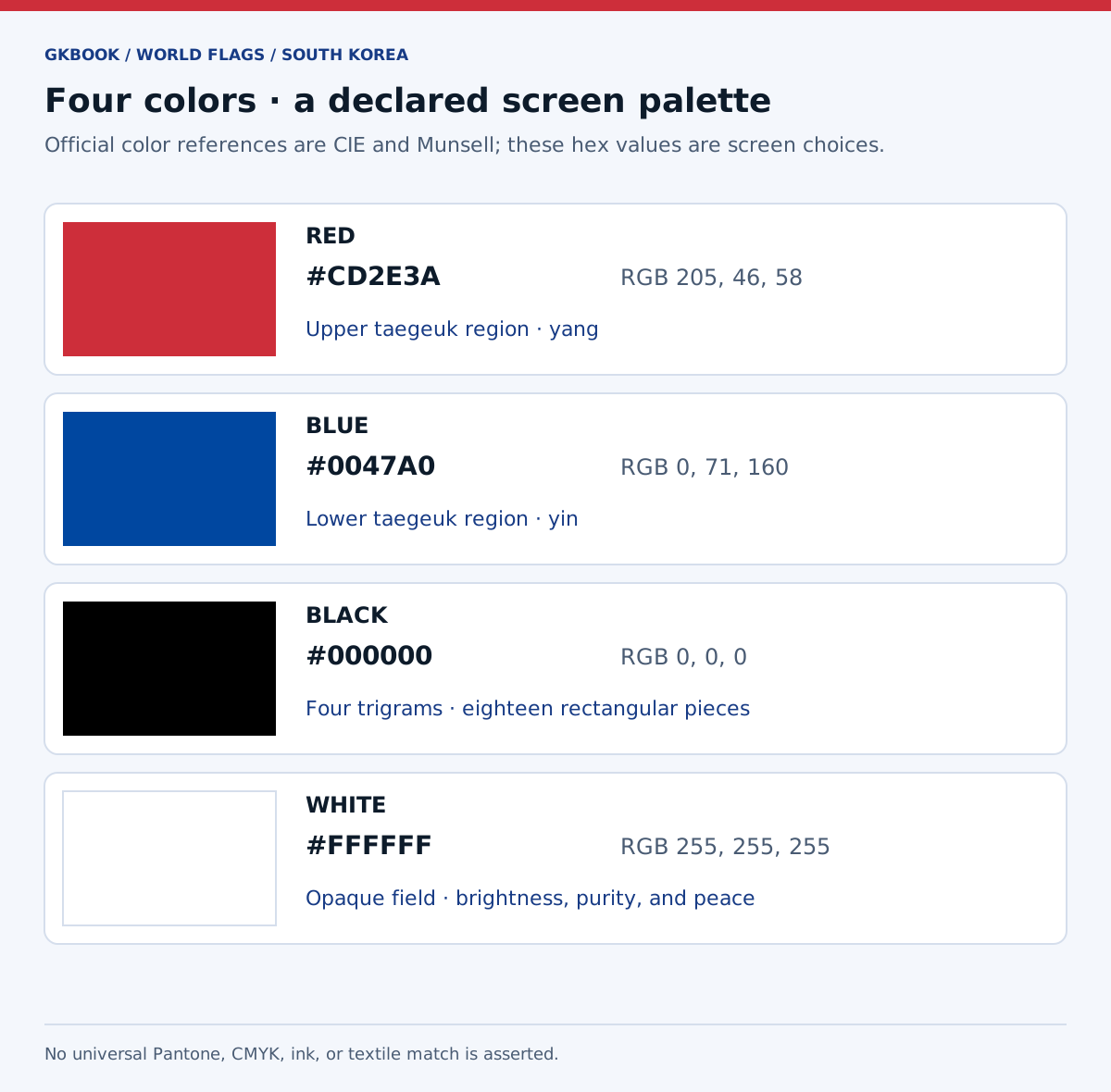
The ministry’s table gives red as CIE x 0.5640, y 0.3194, Y 15.3 and Munsell 6.0R 4.5/14. Blue is x 0.1556, y 0.1354, Y 6.5 and Munsell 5.0PB 3.0/12. Black and white are listed as N 0.5 and N 9.5 respectively.
These references should not be silently replaced by the colors of a government logo. The consistent screen values below match the inspected reference SVG. A physical fabric, ink, and viewing light can change appearance; a production proof is still necessary. No universal Pantone or CMYK conversion is asserted.
| Color | Hexadecimal | RGB | Location |
|---|---|---|---|
| Red | #CD2E3A | 205, 46, 58 | Upper taegeuk region |
| Blue | #0047A0 | 0, 71, 160 | Lower taegeuk region |
| Black | #000000 | 0, 0, 0 | Four trigrams |
| White | #FFFFFF | 255, 255, 255 | Field |
What does the South Korea flag mean?
Official explanations connect the white field with brightness, purity, and peace. The red and blue taegeuk expresses the harmony of complementary forces: red is yang and blue is yin. The four trigrams signify sky, earth, water, and fire. Together, these elements present an ordered, interconnected universe rather than a collection of unrelated decorations.
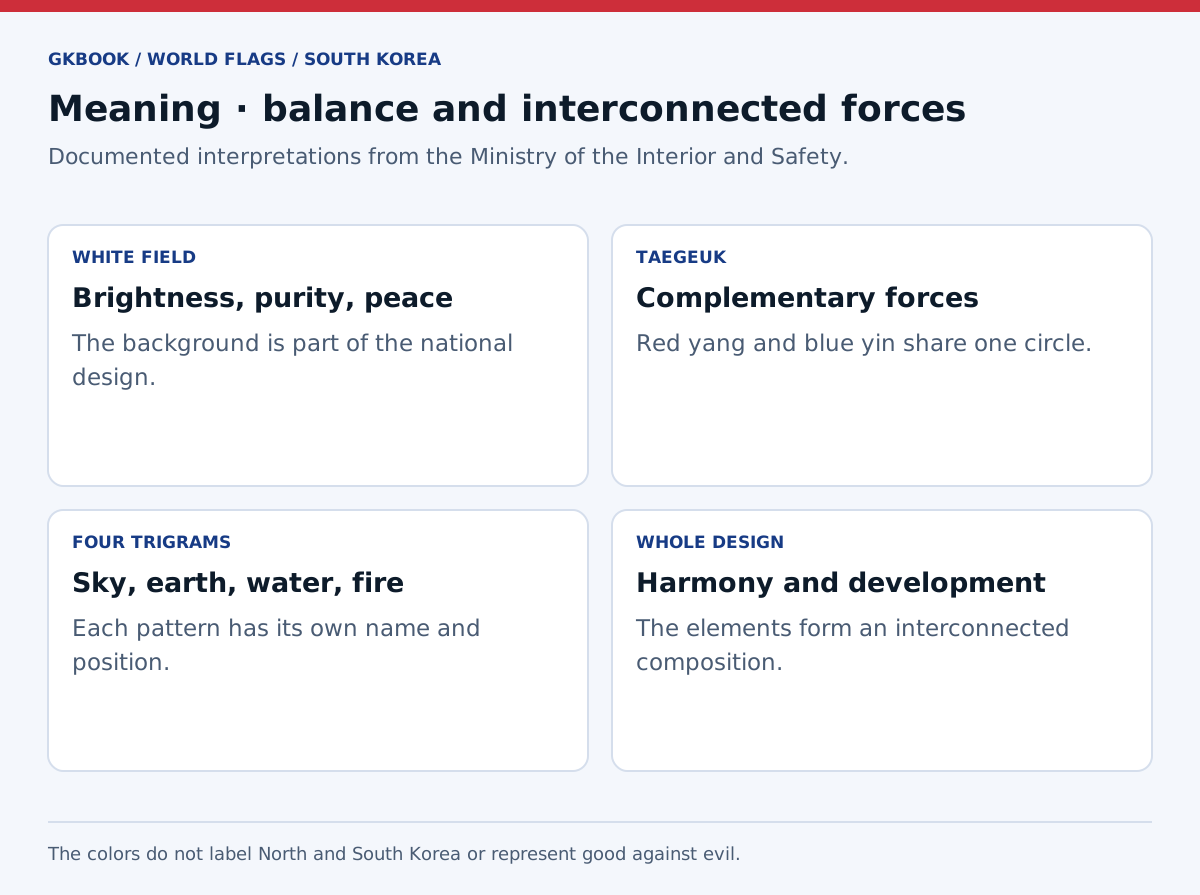
The ministry describes the design through a traditional understanding of balance and the creation and development of the universe. The relationship between the two colored regions is central: they meet within one circle instead of forming separate symbols. The black trigrams extend that explanation through four natural associations.
An accurate account should distinguish these documented interpretations from a viewer’s personal associations. Red does not officially label one Korean state and blue the other, and the design is not a diagram of racial groups. Its historical and philosophical context is more useful than inventing a modern political meaning for each patch.
What is the red and blue symbol on the South Korea flag?
The central symbol is a taegeuk: one circle divided into interlocking red and blue regions by a curved boundary. Red occupies the upper region and blue the lower region in the standard horizontal view. The official construction uses circular arcs aligned with the flag’s descending diagonal, not a generic upright yin-yang icon.

The circle is centered in the rectangle, and its diameter equals half the flag’s height. Its dividing curve is built from two smaller semicircles. Their centers lie on the diagonal running from the upper-left corner toward the lower-right corner. That diagonal gives the symbol its characteristic inclination.
A familiar commercial yin-yang drawing may have a vertical dividing axis, black and white colors, or contrasting dots. Substituting it would change the national design. The downloadable master instead uses exact circular arcs and the specified red and blue arrangement, with no dots, outline, lettering, or ornamental shading.
What do yin and yang mean on the South Korea flag?
In the official explanation, blue represents yin and red represents yang. They are complementary forces whose interaction produces harmony and development. The flag does not identify one as good and the other as evil. Both belong within the same circular form, emphasizing their relationship rather than the victory of one over the other.

This interpretation provides a careful starting point for describing the symbol without claiming to summarize every philosophical tradition that has used related ideas. The national flag uses one particular arrangement: two colored regions in a circle, accompanied by four trigrams. Other historical or decorative taegeuk forms need their own descriptions.
The visual balance does not mean that the two regions can be swapped freely. A symbol can express complementary forces while still having a prescribed orientation and colors. For a faithful reproduction, preserve the red upper region, blue lower region, diagonal construction, and surrounding trigram positions together.
What are the four trigrams on the South Korea flag?
The four trigrams are geon at the upper left, gam at the upper right, ri at the lower left, and gon at the lower right in the standard horizontal view. Their meanings are sky, water, fire, and earth respectively. Each contains three lines, which may be continuous or broken at the center.

A broken line is still one line within a trigram, although it consists of two separate black pieces. Across the whole flag there are twelve conceptual lines and eighteen black rectangular pieces. Counting visible pieces without recognizing the broken-line structure can make the arrangement seem more complicated than it is.
The patterns are not interchangeable corner decorations. Geon has three continuous lines; gon has three broken lines. Gam has a continuous middle line between broken outer lines, while ri has a broken middle line between continuous outer lines. The table and diagrams pair each pattern with its actual position.
| Position | Name | Lines | Meaning |
|---|---|---|---|
| Upper left | Geon | Solid / solid / solid | Sky |
| Upper right | Gam | Broken / solid / broken | Water |
| Lower left | Ri | Solid / broken / solid | Fire |
| Lower right | Gon | Broken / broken / broken | Earth |
What does geon represent on the South Korea flag?
Geon represents sky, also commonly translated as heaven. It is the upper-left trigram in the normal horizontal view and consists of three continuous black lines. Its three solid bars contrast with gon’s three broken lines at the opposite corner. Geon helps identify the correct orientation when the flag is raised normally.
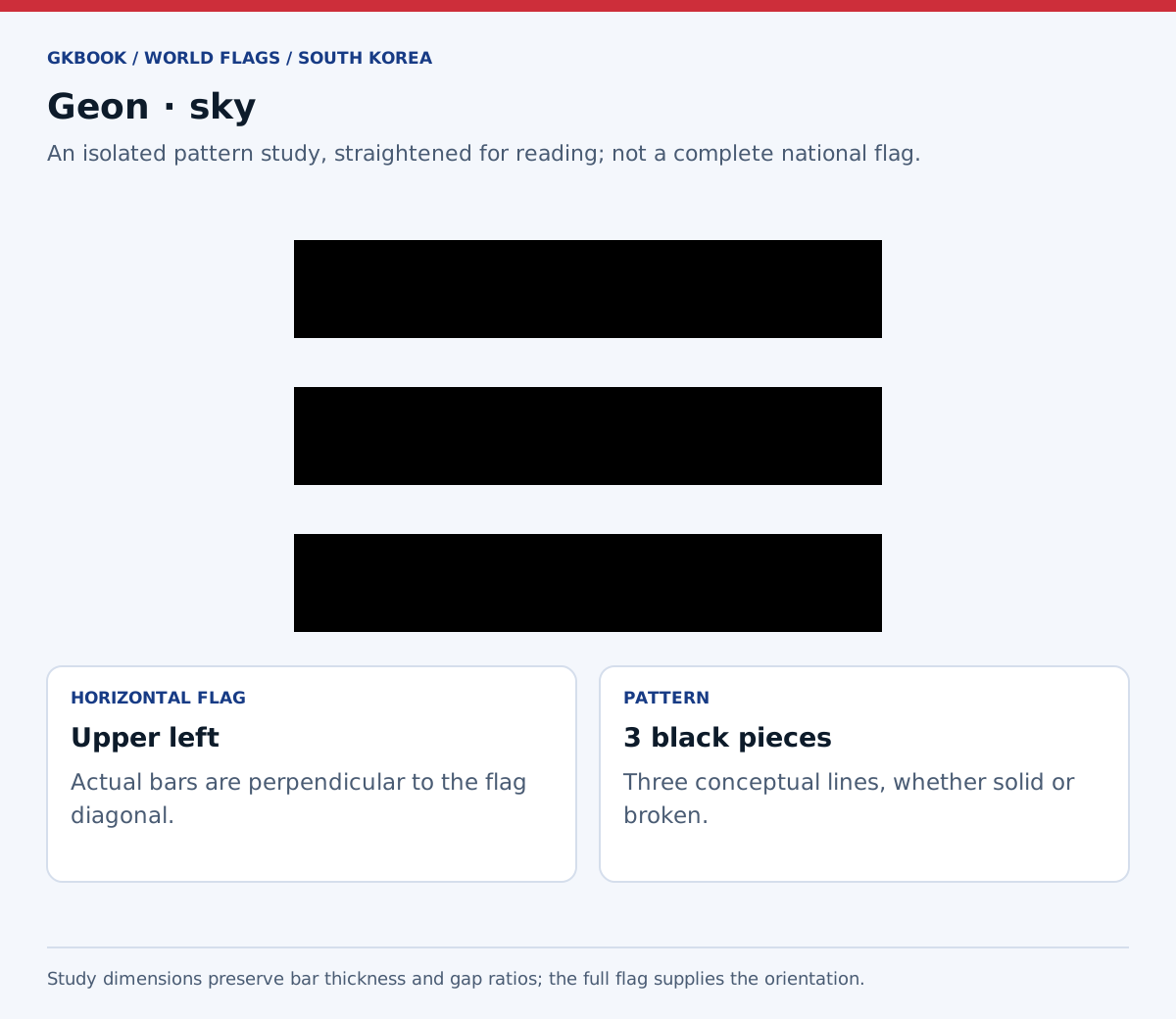
The official hoisting instruction places geon at the upper left and attaches the side containing geon and ri to the flagpole. This is a practical reference for the ordinary horizontal flag. It should not be applied without adjustment to a specifically prescribed vertical hanging or a photograph taken from behind.
Within the construction, geon’s bars run perpendicular to the diagonal through their center. They are not horizontal stripes parallel to the top edge of the flag. The isolated teaching diagram straightens the three-line pattern for reading; the complete flag drawings retain its specified angle and distance from the taegeuk.
What does gon represent on the South Korea flag?
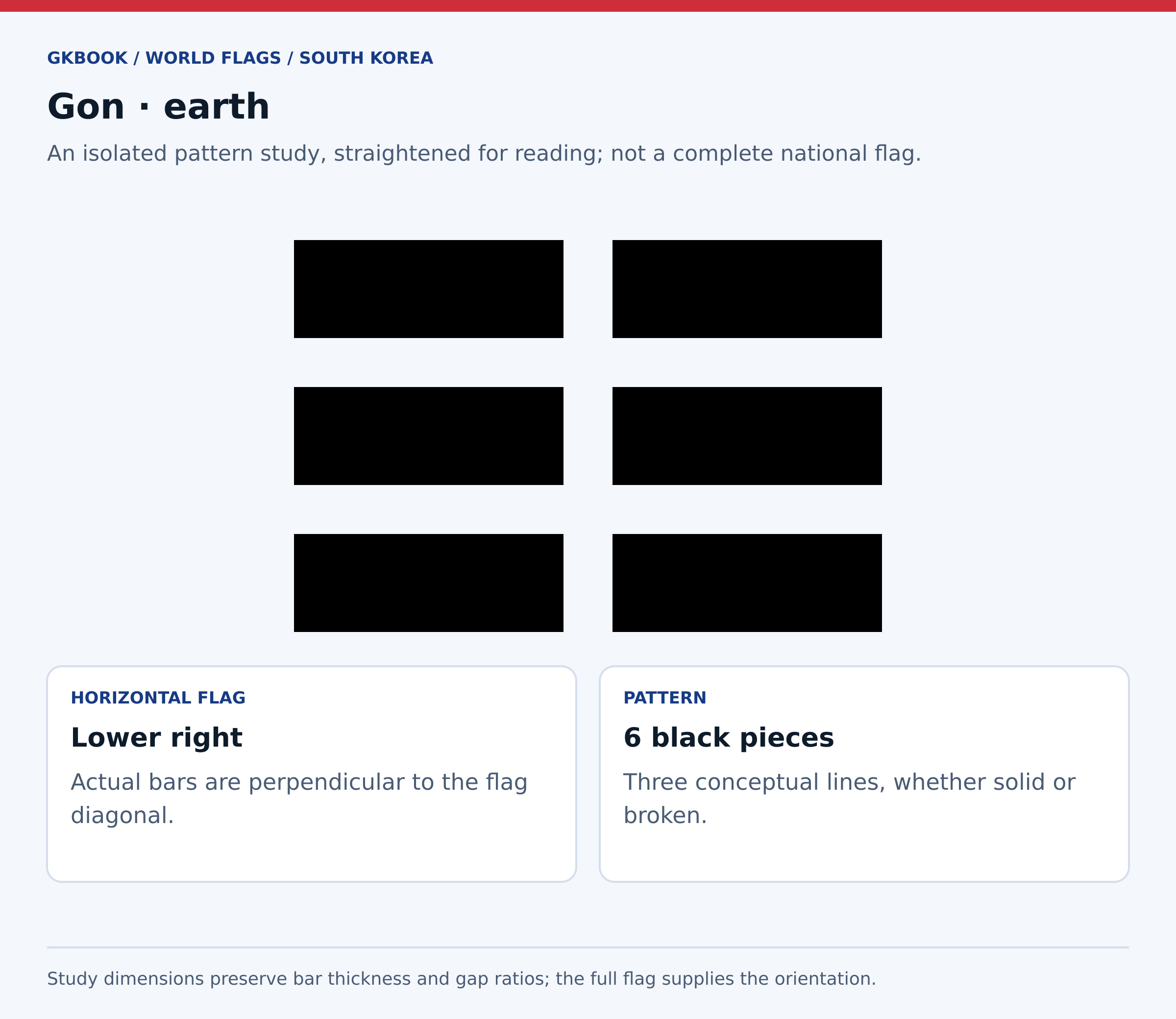
Gon represents earth. It appears at the lower right in the standard horizontal view and contains three broken black lines, making six separate black pieces. The middle gaps are deliberate parts of the design. Gon is diagonally opposite geon, the three-solid-line trigram associated with sky.

All three gaps in gon are centered and equal. Each row therefore has two matching segments, not a short piece on one side and a long piece on the other. The group occupies the same overall length and depth as the other trigrams even though it contains more separate rectangles.
When the flag is reduced to a small icon, the gaps can disappear through poor rendering or heavy printing. That would make gon resemble geon and erase an essential distinction. Check the broken lines at the actual display size, while keeping the specified geometry intact in the original vector.
What does gam represent on the South Korea flag?
Gam represents water. It occupies the upper-right corner in the usual horizontal view, with one continuous middle line between two broken outer lines. That creates five separate black pieces. Its arrangement differs from ri, the fire trigram at the lower left, whose middle line is broken instead.
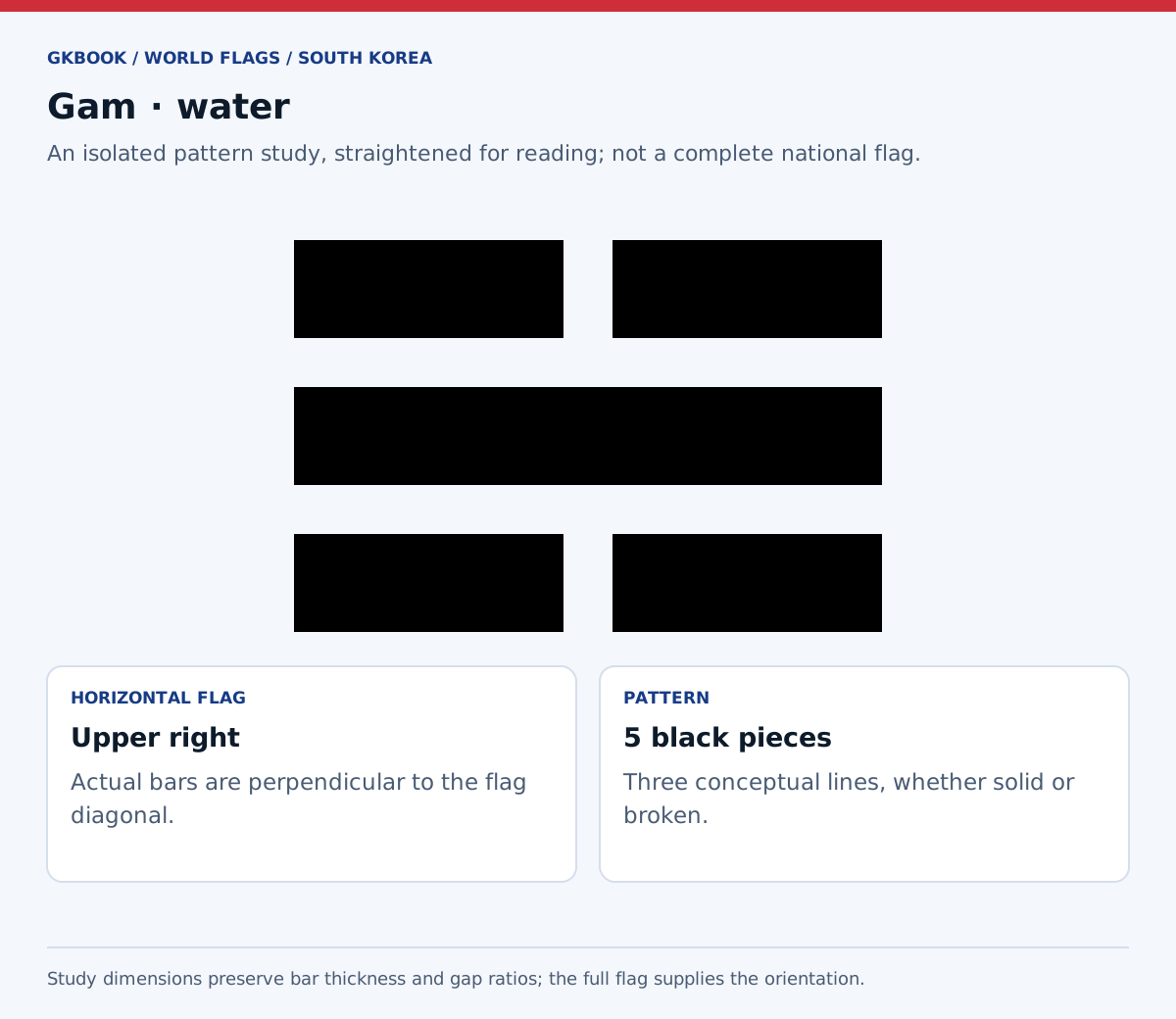
The easiest way to distinguish gam is to inspect the central row first. In gam it is solid; the two rows on either side are divided. Counting five pieces provides a useful secondary check, but the line pattern and corner position are the primary features of the symbol.
Gam’s group is centered on the rising diagonal of the rectangular flag, and its long bars are perpendicular to that diagonal. Changing the group to an arbitrary forty-five-degree tilt would alter the official construction. Its black fill, row spacing, and central gaps follow the same dimensional system as the other trigrams.
What does ri represent on the South Korea flag?
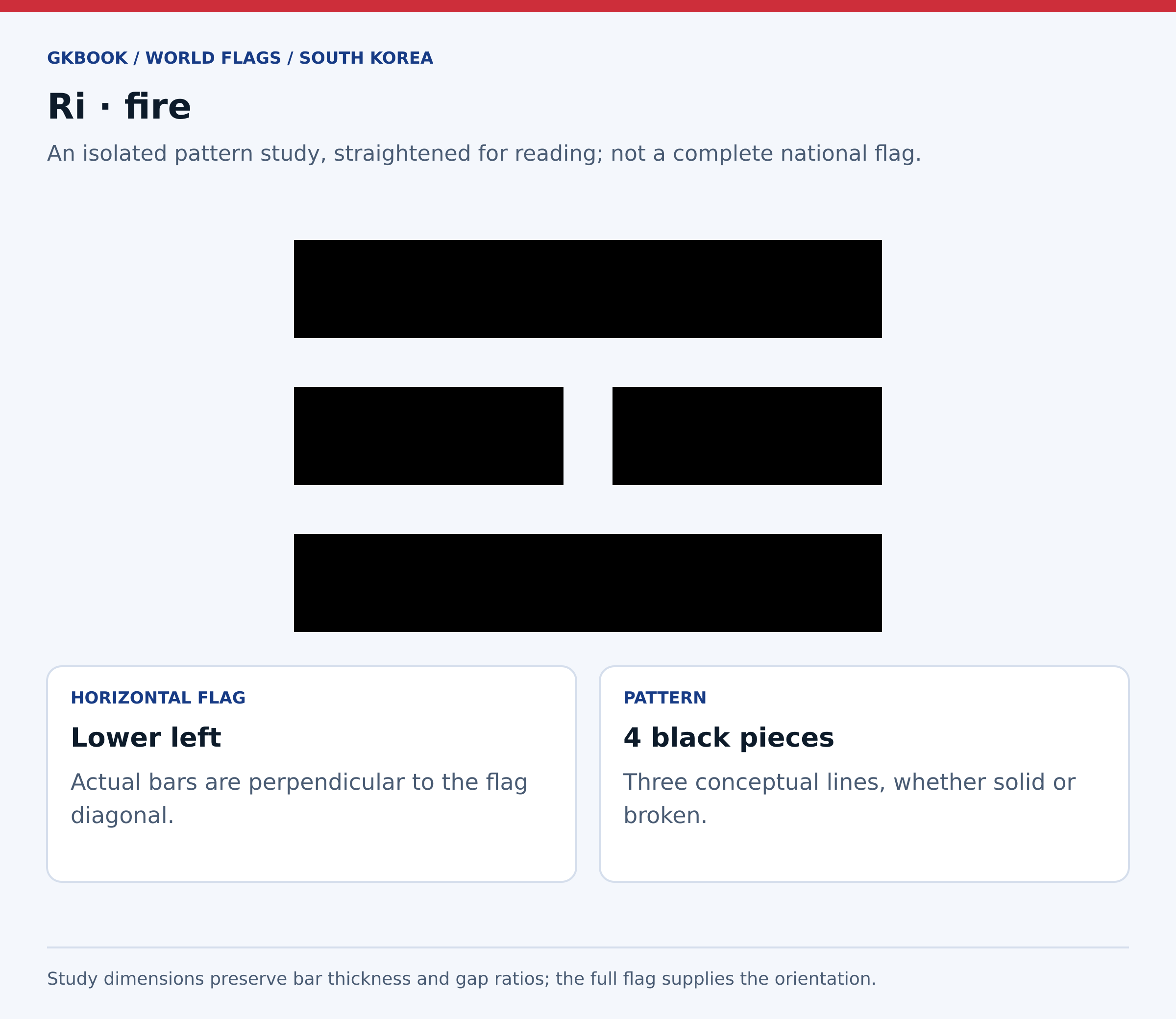
Ri represents fire. In the standard horizontal flag it is at the lower left, with two continuous outer lines surrounding a broken middle line. It has four separate black pieces. Its pattern is the complement of gam’s, and its position becomes especially useful when identifying the prescribed vertical hanging orientation.

The pronunciation and spelling of a trigram name may be unfamiliar, but its visual pattern offers a clear reference. Read ri as solid, broken, solid across its three rows. The two halves of its central row have equal lengths and the same central gap used in every other broken line.
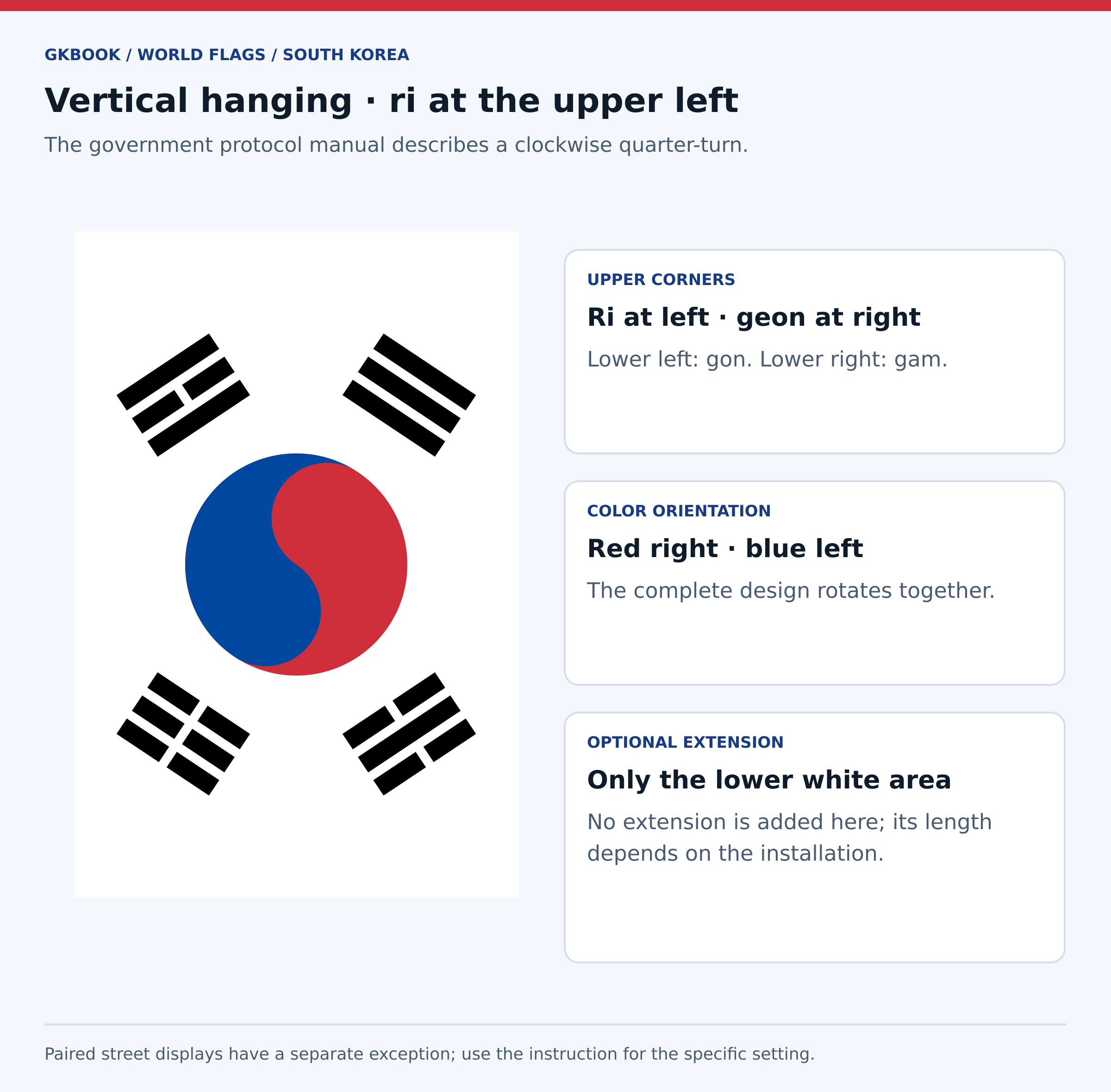
For an elongated vertical hanging, the enforcement decree places ri at the upper left. That instruction belongs to a particular display context; it does not change ri’s position on the standard horizontal master. The gallery separates an isolated pattern study from the full horizontal flag and the vertical display explanation.
What is the official ratio of the South Korea flag?
The standard flag’s height:length ratio is 2:3, meaning its length is one and a half times its height. The main SVG and PNG use a 6,000 by 4,000 canvas. The taegeuk diameter is half the flag height, and all trigram measurements scale with that diameter rather than being independently estimated.

Writing the ratio with its direction avoids confusion. Height:length is 2:3, while length:height is 3:2; these describe the same rectangle. A six-unit length therefore requires a four-unit height. The size can change for a different installation, but scaling one dimension alone would distort both the circle and the trigrams.
The official guidance includes special provisions for certain hanging arrangements. Those do not make a stretched horizontal flag an accurate general-purpose master. Use the normal rectangle for reference downloads, and identify any specialized presentation separately. The clean files contain no extra border, mounting sleeve, surrounding card, or transparent margin.
How is the South Korea flag constructed?
Start with a 3:2 rectangle and a centered circle whose diameter is half the height. Construct the taegeuk along the upper-left to lower-right diagonal using two smaller semicircles. Center the four trigrams on the rectangle’s diagonals, with their bars perpendicular to those diagonals and their nearest edges one quarter-circle-diameter from the circle.

On a 6,000 by 4,000 drawing, the circle center is at 3,000, 2,000 and its radius is 1,000. Each small semicircle has radius 500. The relevant diagonal makes approximately 33.690 degrees with the horizontal, derived from the rectangle’s two-to-three proportions rather than chosen by eye.
Each trigram group is 1,000 units long and about 666.6667 units deep. Its nearest edge is 500 units beyond the circle along the diagonal. Consequently the group center lies about 1,833.3333 units from the flag center. These distances describe geometric edges and centers, not the outer limits of antialiased pixels.
How wide are the trigram bars and gaps?
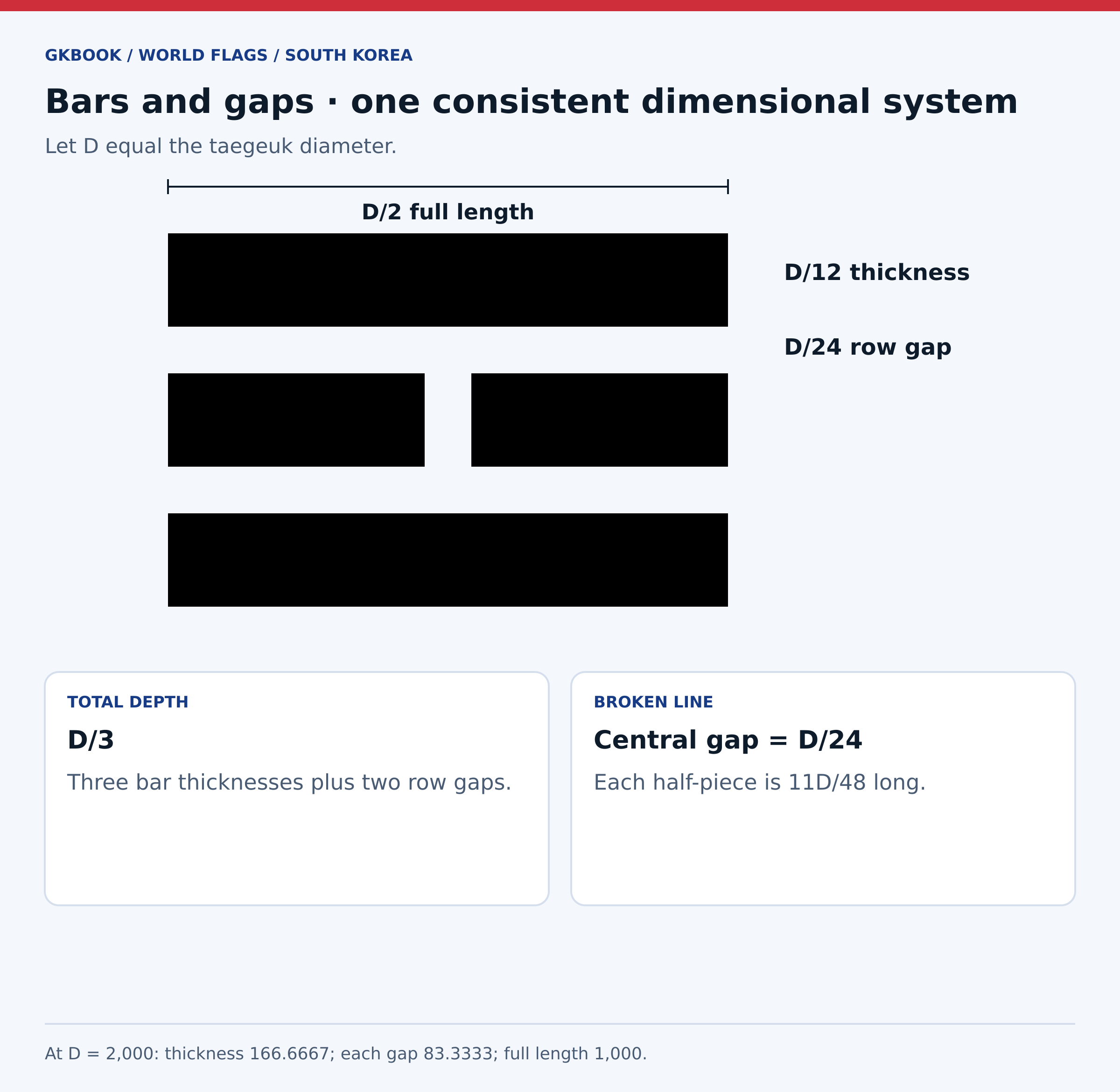
Using D for the taegeuk diameter, each full bar is D/2 long and D/12 thick. The spacing between rows and the gap in a broken line are both D/24. A three-row group is D/3 deep. Each half of a broken line is therefore 11D/48 long.
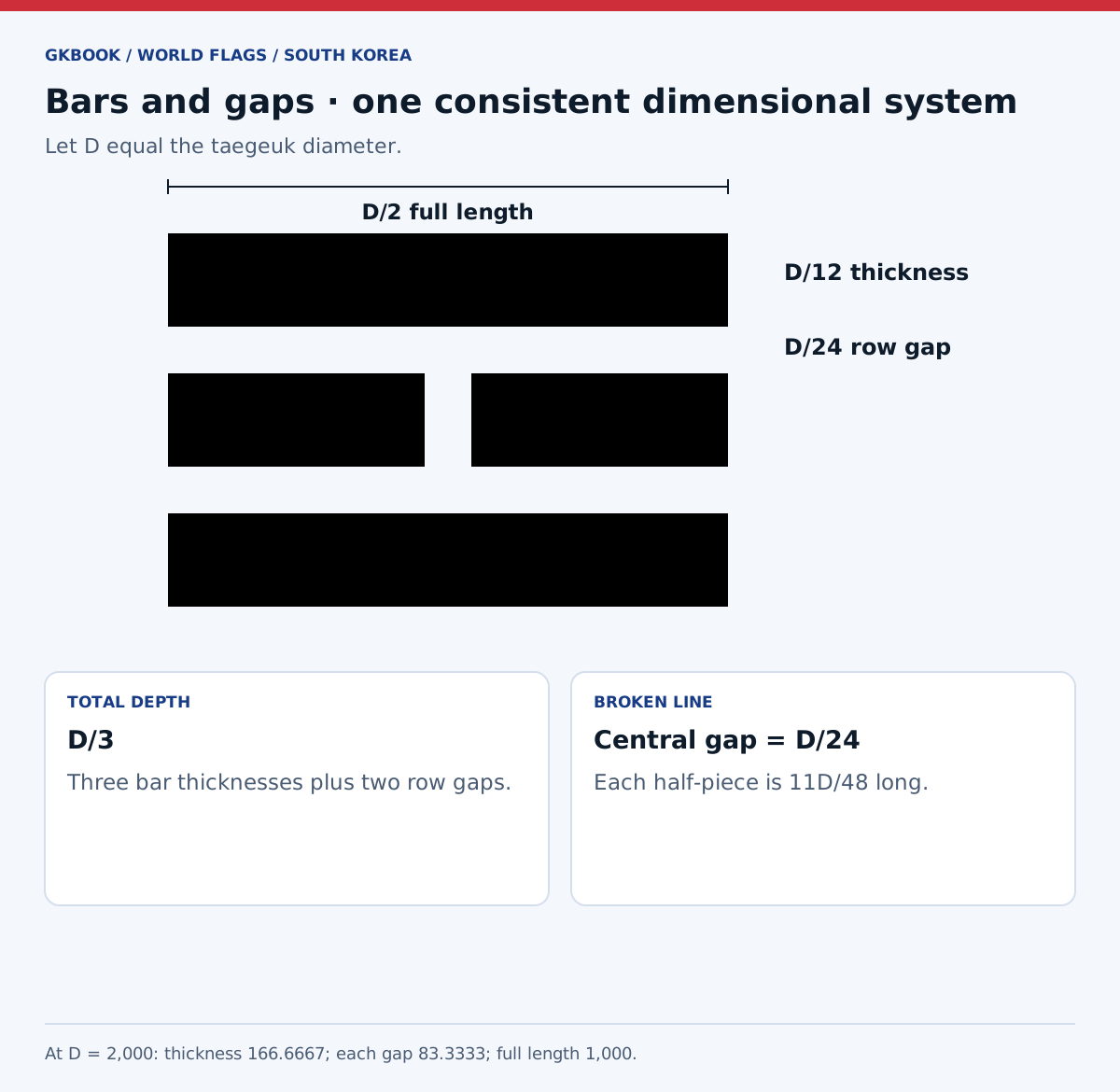
The group depth comes from adding three bar thicknesses and two row gaps: three twelfths plus two twenty-fourths equals one third of the diameter. This arithmetic is useful because it checks several dimensions together. A drawing with plausible individual bars may still be wrong if their spacing produces an incorrect total depth.
At the supplied master size, full bars are 1,000 units long, their thickness is about 166.6667, and each specified gap is about 83.3333. The decimal figures are explanatory approximations; the construction uses the underlying ratios. The broken-line gap is measured along the bar, while row spacing is measured across the group.
What is the history of the South Korea flag?
The Taegeukgi emerged during Korea’s nineteenth-century diplomatic opening. Government accounts connect its development with the 1882 Korea–United States treaty and Park Yeong-hyo’s diplomatic mission later that year. King Gojong proclaimed it a national flag on March 6, 1883. Later governments and regulations refined its appearance rather than creating an entirely unrelated symbol.

The ministry notes uncertainty about the precise flag used at the treaty signing. Its account then describes Park’s September 1882 voyage and the use of a four-trigram design. These episodes belong to a developing national symbol, so a modern standardized drawing should not be labeled an exact facsimile of every early flag.
The Korean Provisional Government issued a flag style guide on June 29, 1942. After the Republic of Korea’s government was established in 1948, a committee worked on standardization and construction guidelines were announced in 1949. The sequence explains continuity alongside variation without suggesting that all historical examples were geometrically identical.
When was the South Korea flag adopted?
The date depends on the event being described. King Gojong proclaimed the Taegeukgi a national flag on March 6, 1883. The Republic of Korea’s government was established on August 15, 1948, using this inherited national symbol. Construction guidelines announced on October 15, 1949 standardized its design; they were not its nineteenth-century origin.
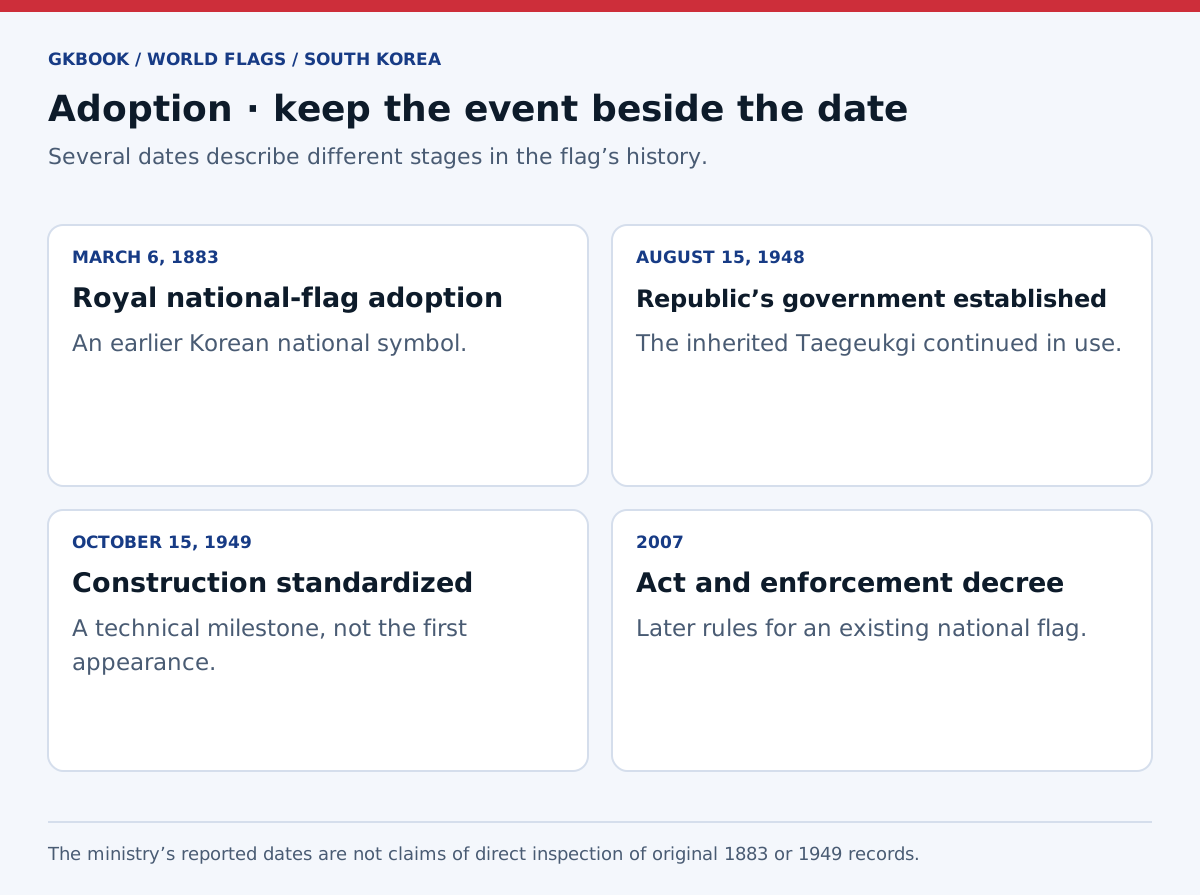
A single date without an event label can be misleading. Royal adoption, establishment of the republic, and technical standardization answer different historical questions. The flag’s association with present-day South Korea is often discussed through 1948, but the taegeuk-and-trigram tradition had already existed for decades by then.
The dates here follow the ministry’s historical account and are written with their corresponding events. The article does not claim direct inspection of the original 1883 proclamation or the original 1949 announcement. Their reported dates are distinguished from the later construction provisions actually examined for the current reconstruction.
Who designed the South Korea flag?
The flag’s origins involve several people and successive decisions. Scholarship credits Lee Eung-jun with an early 1882 design, while official history emphasizes Park Yeong-hyo’s diplomatic use and King Gojong’s proclamation. Assigning the entire modern standardized flag to one unqualified sole designer would obscure the difference between early creation, adoption, and later specification.

Han Cheol-Ho’s 2008 research distinguishes Lee’s role in the flag’s origins from Park’s role in its formalization. The accessible record examined here was the scholarly abstract, not the full paper or its cited diplomatic archives. That access limit matters when assessing detailed claims about particular drawings or conversations.
The ministry’s account independently explains Park’s voyage and the royal proclamation, but it does not justify treating every later geometric requirement as his personal invention. GKBook’s contribution is a new vector reconstruction and educational presentation based on published specifications. That modern illustration credit is separate from authorship of the historical national symbol.
How was the South Korea flag standardized?
Standardization developed in stages. The Provisional Government issued a style guide in 1942; a flag committee was formed in January 1949; and construction guidelines were announced on October 15, 1949. The National Flag Act and its enforcement decree followed in 2007. These later rules organize an existing symbol rather than establish its first historical appearance.
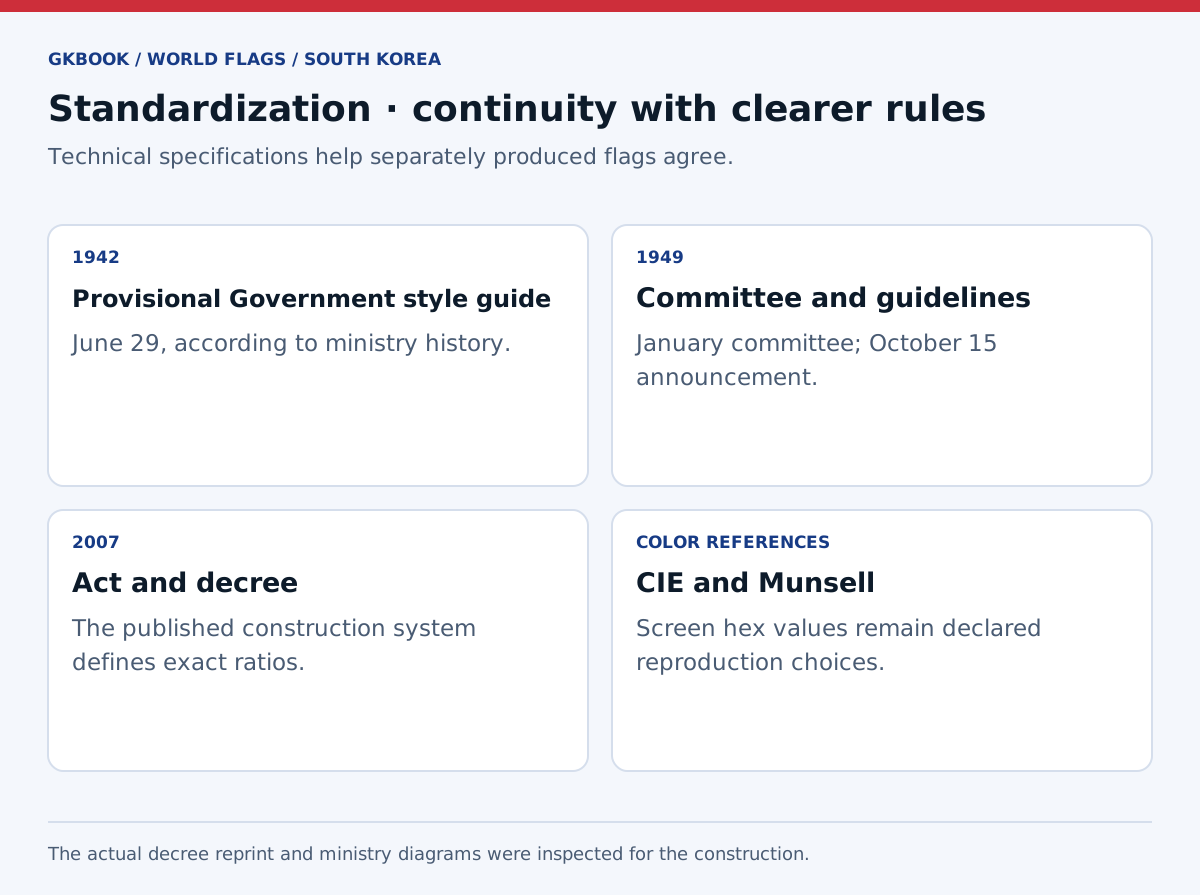
A standard makes independently produced flags agree on the rectangle, circle, trigrams, spacing, and colors. This is especially important for a design whose early examples varied. The inspected enforcement decree supplies mathematical instructions, while ministry diagrams make the relationships easier to see and its color table supplies a separate technical reference.
The law portal’s downloaded page was a navigation shell, so the construction review also used an actual government-hosted decree reprint and the ministry booklet. These sources support the specific rules discussed here; they are not presented as a complete audit of every legal provision or a certification of a manufactured flag.
How is the flag connected with Korean Liberation Day?
National Liberation Day, Gwangbokjeol, is observed on August 15 and commemorates liberation from Japanese colonial rule in 1945. The Republic of Korea’s government was established on the same calendar date in 1948. The Taegeukgi connects with both national remembrance and public celebration, but those two historical events should remain clearly distinguished.

The National Folk Museum explains the holiday through the end of colonial rule and its subsequent commemoration. Flags displayed for the occasion express a connection to that history. The date does not mean that the taegeuk-and-trigram flag was first invented in 1945 or that its detailed construction was finalized that day.
An educational timeline can therefore show 1945 liberation, 1948 government establishment, and 1949 technical guidelines as separate entries. For a particular year’s official ceremony, consult that year’s announcement for its arrangements. This article explains the recurring holiday and historical relationship, without inventing a current venue, program, theme, or guest list.
Does the flag’s adoption date mark international recognition?
No single flag date establishes universal diplomatic recognition. The Republic of Korea and the Democratic People’s Republic of Korea were admitted to the United Nations on September 17, 1991, through General Assembly resolution 46/1. That membership event is distinct from the Taegeukgi’s nineteenth-century origins and the Republic of Korea’s establishment in 1948.
The United Nations record supplies an identifiable institutional event: admission to membership. It should not be converted into a claim that every government first recognized South Korea on that day. Bilateral diplomatic recognition and relations depend on the states involved and require their own dated records.
Likewise, displaying a national flag at an international meeting is evidence of that event’s presentation, not a substitute for researching a country’s legal history. The article keeps UN admission, government establishment, royal flag adoption, and construction standardization on separate lines so that their different meanings remain visible to readers.
Did earlier Korean flags look exactly like today’s flag?
Earlier Taegeukgi examples varied in the taegeuk’s form, trigram arrangement, and proportions before later standardization. The National Museum of Korea preserves the Denny Taegeukgi, an important surviving nineteenth-century example. Historical objects should be identified by their own dates and collection records, rather than redrawn as if they followed every modern construction rule.
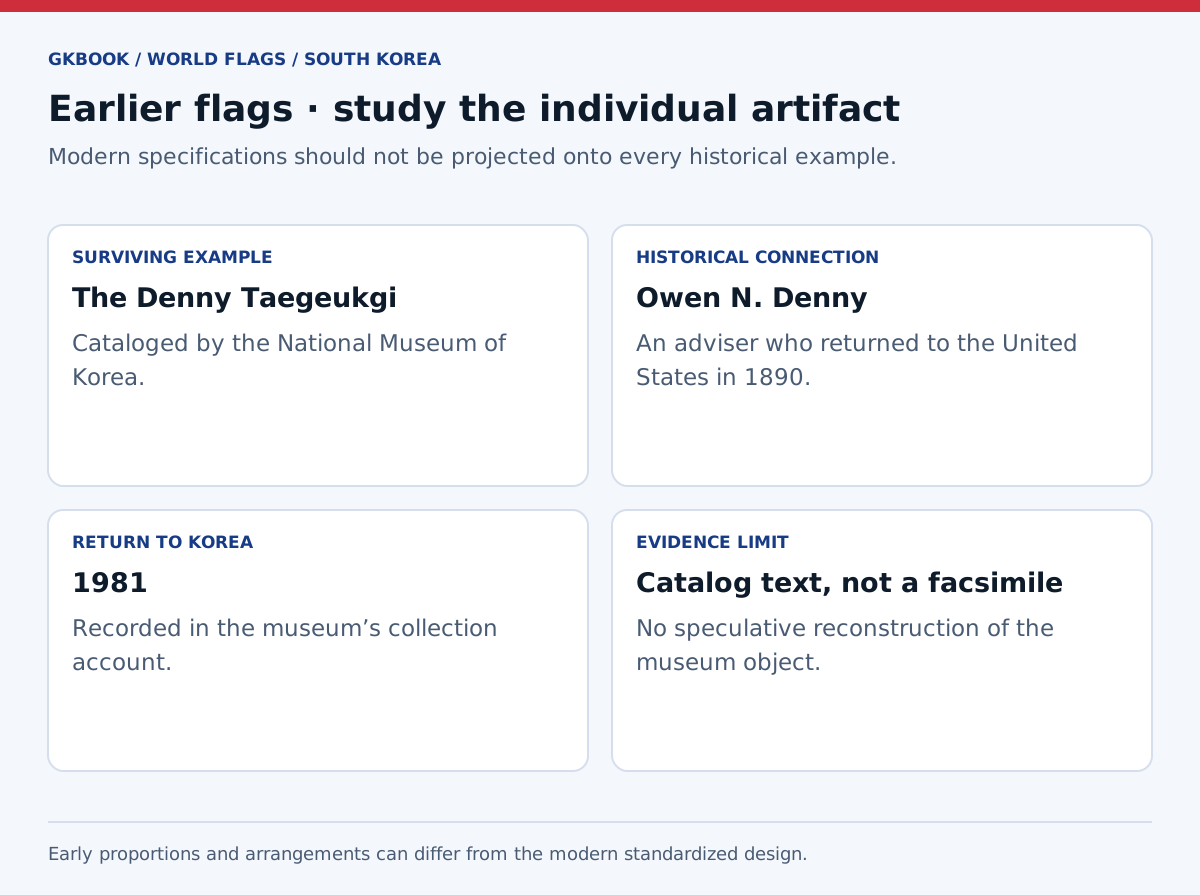
The museum’s record connects its flag with Owen N. Denny, an adviser to King Gojong who returned to the United States in 1890. It also records the object’s return to Korea in 1981. Those details identify a particular surviving artifact, not an interchangeable illustration of all flags from the period.
The gallery uses a clearly labeled historical explanation instead of inventing a reconstruction from the catalog text. A historical flag’s cord position, dimensions, or worn colors should not automatically override current specifications. Conversely, a pristine modern vector should not be passed off as an image of the actual museum object.
Does the South Korea flag include the national emblem?
The flag does not contain the Republic of Korea’s separate national emblem. Its complete design consists of the white field, red and blue taegeuk, and four black trigrams. The national emblem combines a taegeuk with five mugunghwa petals and a ribbon bearing the country’s name; those additional elements do not belong on the flag.
Related national symbols can share a motif without being the same design. Recognizing the taegeuk in an emblem does not mean that the emblem may replace the flag’s central circle. The surrounding petals, ribbon, and lettering serve a different official composition and would visibly alter a clean national flag.
The ministry dates the national-emblem regulation to 1963. That date concerns the emblem and should not be reused as the flag’s adoption date. For teaching materials, place explanatory labels outside the national rectangle and identify a separate emblem illustration explicitly if one is included in another project.
What does the reverse of the South Korea flag look like?
Viewed through a single-layer flag from the opposite side, the whole design appears horizontally mirrored. The taegeuk curve and all four trigrams move together, and the observer sees the attachment edge on the opposite side. This viewing model is different from turning the flag upside down or rearranging individual symbols.

In that mirrored view, gam appears at the upper left and geon at the upper right, while gon appears at the lower left and ri at the lower right. Red still occupies the upper region of the circle, although the diagonal inclination and interlocking curve are reflected.
The diagram explains a geometric viewing relationship rather than prescribing a manufacturer’s seams, printing process, or separately applied faces. A photograph can also be digitally mirrored, so check the pole and surrounding context before treating it as evidence of a display error. Always transform the complete composition when illustrating the reverse.
How should the South Korea flag be hung vertically?
For the elongated hanging described in the enforcement decree, ri is at the upper left. Government protocol guidance explains a clockwise quarter-turn of the flag, with any necessary extension confined to the lower white area. This specialized presentation should be identified separately from the ordinary horizontal 2:3 national flag.
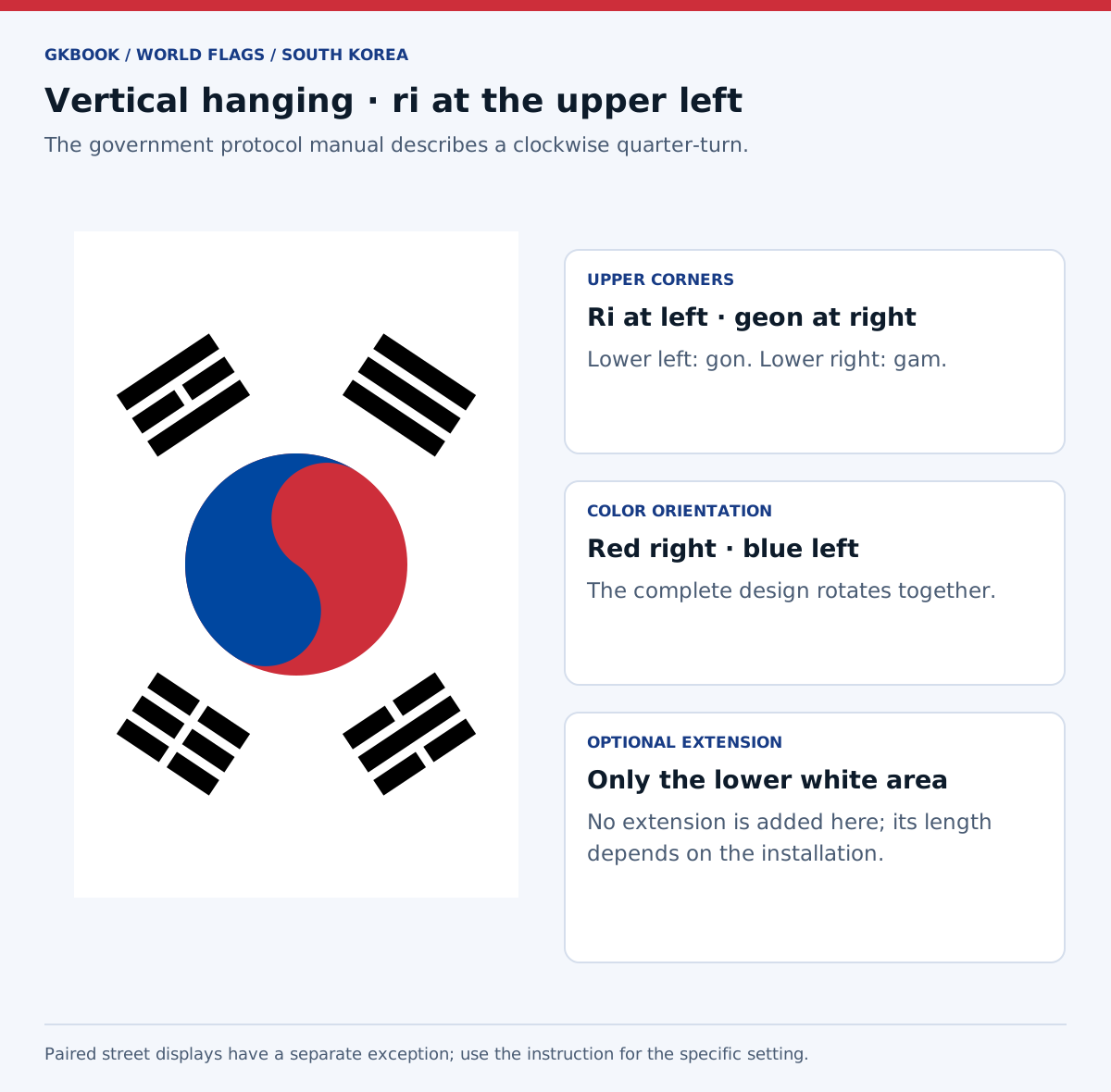
After that quarter-turn, geon is at the upper right, gon at the lower left, and gam at the lower right. Red is predominantly on the viewer’s right and blue on the left. The central symbol and trigrams rotate together; individual symbols should not be moved independently to approximate the result.
The decree also describes a special exception for paired street displays, so one general diagram cannot replace every installation instruction. The gallery illustrates the basic rotated arrangement without claiming a universal extension length. Preserve the clean horizontal master for ordinary reference use, and follow the specific official layout for the intended setting.
What are the main rules for displaying the South Korea flag?
For ordinary hoisting, geon belongs at the upper left, and the side containing geon and ri attaches to the pole. Official guidance calls for suitable illumination when the flag is flown at night. When displayed with foreign national flags, the enforcement decree specifies equal size and height; domestic organizational flags have separate placement rules.
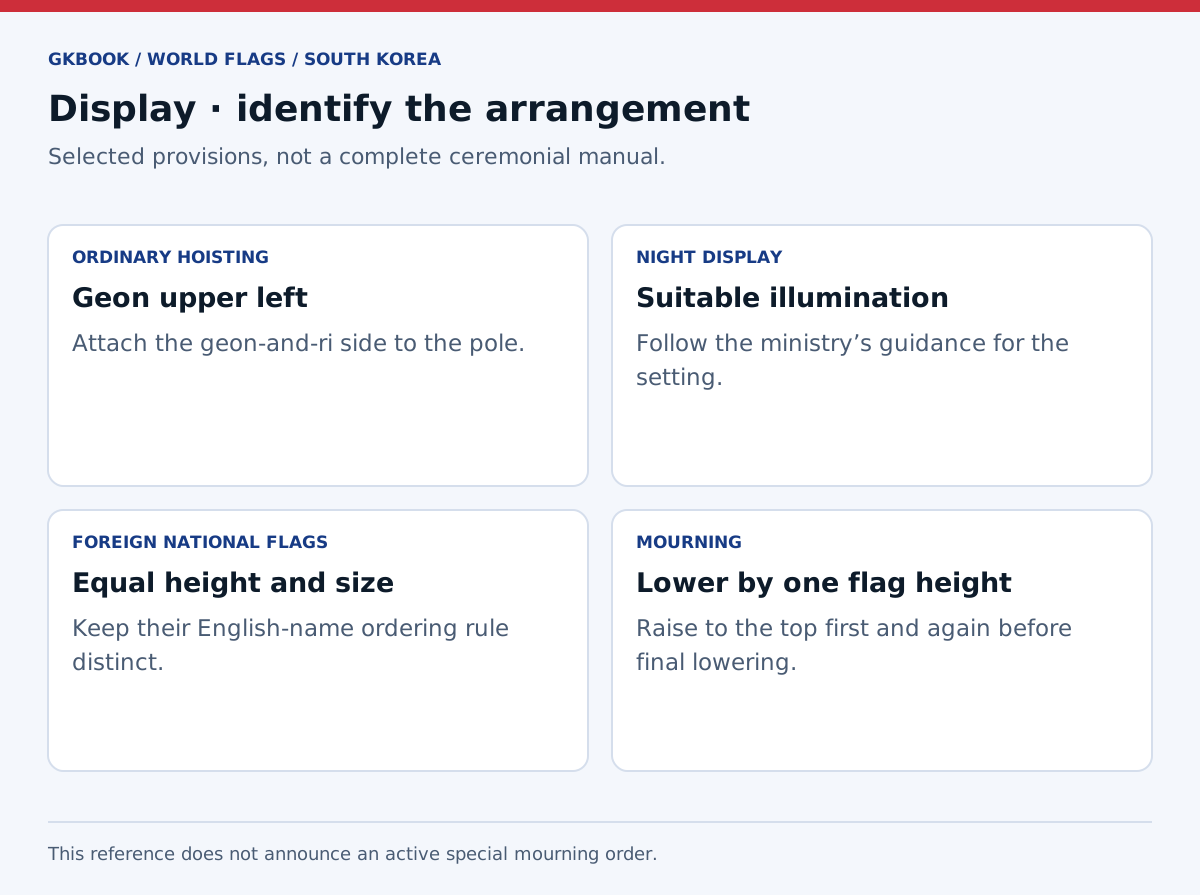
The decree’s international display provision also orders foreign national flags by their English country names. That rule concerns the specified multi-flag arrangement and should not be confused with placing a school or organizational flag beside the national flag. Different installations require attention to their own instructions and viewpoints.
The ministry describes additional arrangements for homes, buildings, interiors, vehicles, and ceremonies. This article selects the points needed to understand the illustrations without pretending to reproduce every placement rule. Before organizing a formal event, use the applicable official layout and check that fixtures, lighting, and the flag’s condition suit the occasion.
How is the South Korea flag flown at half-mast?
For prescribed mourning display, the flag is first raised to the top and then lowered by one flag height. Before final lowering, it is raised to the top again. Ministry guidance identifies Memorial Day and national funeral mourning among the relevant occasions. This explanation does not announce that a special mourning order is currently active.
The instruction uses the flag’s height as the lowering distance; it does not simply place the flag’s center halfway down any pole. That distinction matters because poles have different lengths. The complete design remains visible and unchanged, with the normal attachment side and orientation retained throughout the procedure.
The decree provides for circumstances where a full flag-height lowering is impracticable. For an actual ceremony, check the relevant instructions and any dated mourning notice for its duration and scope. A standing educational description cannot establish an additional current mourning period or substitute for the organizer’s official event requirements.
How should the South Korea flag be cared for and used respectfully?
Keep the flag clean, intact, and correctly displayed. Ministry guidance allows washing or ironing when the flag will not be damaged, so a blanket claim that it must never be washed is inaccurate. Products using the design must respect the flag’s dignity. These principles do not automatically grant commercial clearance or official endorsement.
Inspect fabric for dirt, tears, fading, and damage that changes the design. Follow suitable care instructions for the material while preserving the colors and trigram gaps. The ministry also describes collection and disposal arrangements for damaged flags; a worn flag should not simply remain in use indefinitely.
A national symbol, a photograph, and a particular digital drawing involve different questions about reproduction and attribution. Keep unrelated logos and slogans outside a clean reference flag. The provided credits identify the source basis and modern reconstruction without suggesting that downloading the artwork authorizes every advertising claim or product presentation.
How can I print the South Korea flag accurately?
Use the SVG for scalable artwork or the opaque 6,000 by 4,000 PNG for raster workflows, preserving the 2:3 proportion. Check the circle, trigram patterns, gaps, and orientation after printing. Screen colors provide a consistent digital reference; physical production should use the applicable color specifications and an approved proof rather than an assumed universal conversion.
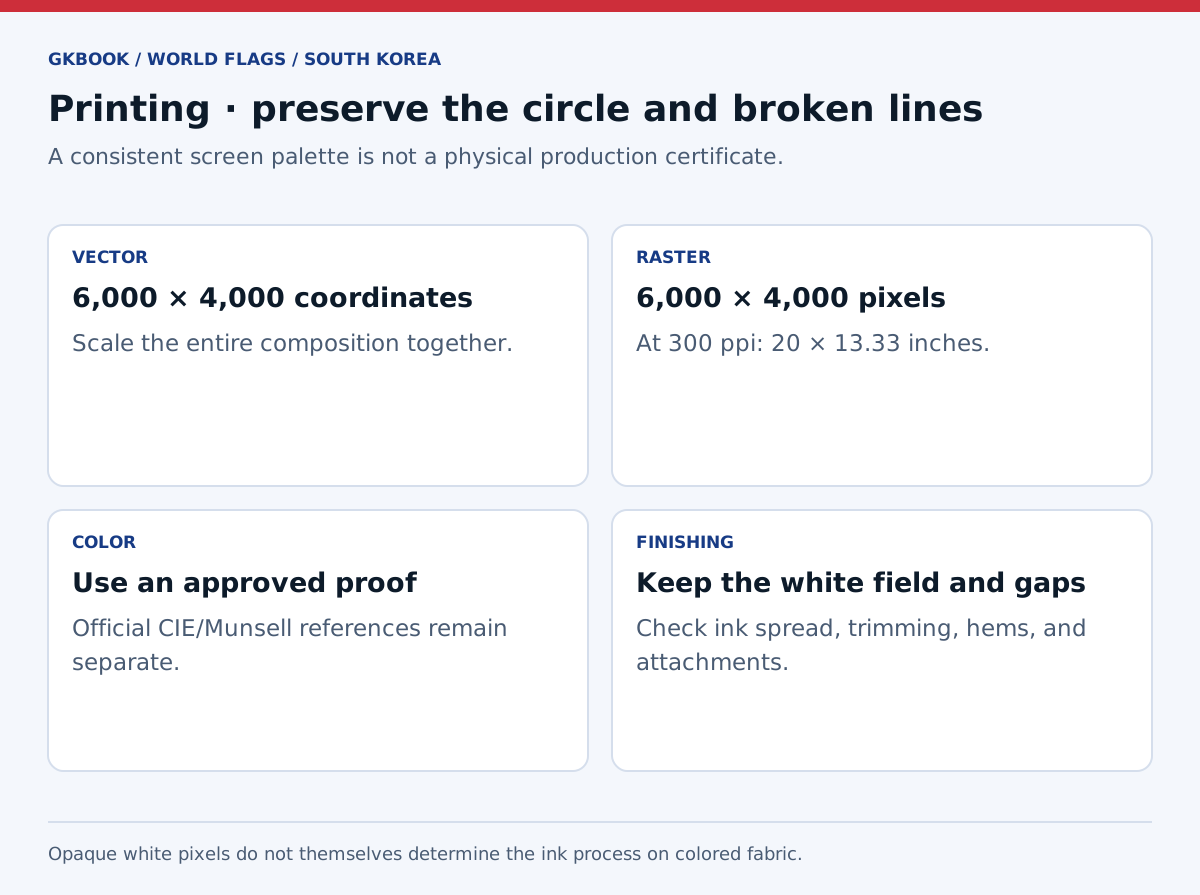
At 300 pixels per inch, the supplied PNG corresponds to a print 20 inches long and about 13.33 inches high. This is a resolution calculation, not a mandatory physical flag size. Enlarging the vector preserves mathematical edges, while a printer still needs sufficient resolution and suitable materials to reproduce them.
Small broken-line gaps deserve particular attention because ink spread or low resolution can close them. On colored fabric, confirm how the white field will be produced instead of assuming that transparent or unprinted areas will look white. Allow for hems, trimming, and attachments without cropping the intended visible design.
What mistakes should be avoided when drawing the South Korea flag?
Common errors include swapping gam and ri, replacing the taegeuk with a dotted yin-yang icon, using arbitrary forty-five-degree trigram angles, and stretching the rectangle. Also avoid closing broken-line gaps, making the white field transparent, or labeling chosen hex colors as statutory values. A correct drawing preserves the complete geometry and clearly identifies its reproduction choices.

Check the standard horizontal corners in sequence: geon, gam, ri, gon. Then inspect the middle line of gam and ri, because their opposite patterns make accidental exchanges easy. Count twelve conceptual lines and eighteen black pieces. Confirm that the centered taegeuk has the correct diagonal curve and no contrasting dots.
Historical captions need their own checks. Do not call 1949 the first appearance of the Taegeukgi, turn UN admission into universal diplomatic recognition, or apply an old artifact’s proportions to a modern master. Accurate educational artwork depends on both the visible construction and the words used to explain it.
Where can I download accurate South Korea flag pictures?
The downloads include a clean SVG and an opaque 6,000 by 4,000 PNG, plus 24 illustrated subjects in both formats. The master follows official geometric ratios and a declared screen palette. Separate diagrams explain the taegeuk, trigrams, history, construction, and display, while the social card surrounds a complete flag with an external title.
Choose the clean master when a project needs only the national flag. Select a labeled diagram when the purpose is to explain a ratio, pattern, or historical distinction. The teaching cards deliberately add context outside the national rectangle; their headings and panels are not elements of the flag itself.
Useful alternative text identifies South Korea, the white field, the red and blue central taegeuk, and the four black trigrams. Accessible download labels should name the file format rather than rely on a colored icon. The gallery and credits keep the image subjects, source basis, and reproduction choices clear for reuse.
Download South Korea flag pictures
Download the clean national flag as SVG or 6,000 × 4,000 PNG. Both use a 6,000 × 4,000 canvas with the centered red and blue taegeuk, four black trigrams, and opaque white field. Geometry follows official construction instructions; screen values match the documented reference vector. These are carefully constructed educational files, not certified textile manufacturing samples.
The gallery contains 24 subjects, each with an SVG and PNG. The captions distinguish published specifications, attributed meanings, historical events, and digital reproduction choices. Image credits and reproduction notes explain the source basis. The separate 1,200 × 630 social card contains a complete flag and does not alter the national rectangle.
Continue exploring national designs in World Flags.
World Flags/South Korea
South Korea flag pictures
A 2:3 Taegeukgi constructed from official geometric ratios and a declared screen palette.
GKBook geometric reconstruction and educational layouts, following Korean government construction instructions and a declared screen palette.Download SVGDownload PNGThe four screen fills match the inspected reference SVG; official physical-color references remain separate.
GKBook geometric reconstruction and educational layouts, following Korean government construction instructions and a declared screen palette.Download SVGDownload PNGOfficial meanings are distinguished from personal associations or invented political color codes.
GKBook geometric reconstruction and educational layouts, following Korean government construction instructions and a declared screen palette.Download SVGDownload PNGA dashed guide identifies the diagonal; it is absent from the clean master.
GKBook geometric reconstruction and educational layouts, following Korean government construction instructions and a declared screen palette.Download SVGDownload PNGOfficial interpretation emphasizes harmony and development, not good defeating evil.
GKBook geometric reconstruction and educational layouts, following Korean government construction instructions and a declared screen palette.Download SVGDownload PNGTwelve conceptual lines form eighteen separate black pieces.
GKBook geometric reconstruction and educational layouts, following Korean government construction instructions and a declared screen palette.Download SVGDownload PNGThe isolated study shows the line pattern; the complete flag retains its official angle and location.
GKBook geometric reconstruction and educational layouts, following Korean government construction instructions and a declared screen palette.Download SVGDownload PNGThe isolated study shows the line pattern; the complete flag retains its official angle and location.
GKBook geometric reconstruction and educational layouts, following Korean government construction instructions and a declared screen palette.Download SVGDownload PNGThe isolated study shows the line pattern; the complete flag retains its official angle and location.
GKBook geometric reconstruction and educational layouts, following Korean government construction instructions and a declared screen palette.Download SVGDownload PNGThe isolated study shows the line pattern; the complete flag retains its official angle and location.
GKBook geometric reconstruction and educational layouts, following Korean government construction instructions and a declared screen palette.Download SVGDownload PNGPhysical sizes can vary while every component retains its specified relative dimensions.
GKBook geometric reconstruction and educational layouts, following Korean government construction instructions and a declared screen palette.Download SVGDownload PNGDimensions follow the decree and ministry diagram; displayed decimals abbreviate exact ratios.
GKBook geometric reconstruction and educational layouts, following Korean government construction instructions and a declared screen palette.Download SVGDownload PNGA straightened ri pattern illustrates the common lengths, thicknesses, and gaps.
GKBook geometric reconstruction and educational layouts, following Korean government construction instructions and a declared screen palette.Download SVGDownload PNGGovernment history distinguishes early development from subsequent specifications.
GKBook geometric reconstruction and educational layouts, following Korean government construction instructions and a declared screen palette.Download SVGDownload PNGThe republic’s establishment does not erase the flag’s nineteenth-century history.
GKBook geometric reconstruction and educational layouts, following Korean government construction instructions and a declared screen palette.Download SVGDownload PNGThe modern standardized flag should not be attributed to one sole designer without qualification.
GKBook geometric reconstruction and educational layouts, following Korean government construction instructions and a declared screen palette.Download SVGDownload PNGStandardization clarifies an existing design rather than marking its earliest historical use.
GKBook geometric reconstruction and educational layouts, following Korean government construction instructions and a declared screen palette.Download SVGDownload PNGThe flag predates both twentieth-century milestones.
GKBook geometric reconstruction and educational layouts, following Korean government construction instructions and a declared screen palette.Download SVGDownload PNGThe historical flag is discussed through its collection record; this card is not an image of the artifact.
GKBook geometric reconstruction and educational layouts, following Korean government construction instructions and a declared screen palette.Download SVGDownload PNGA horizontal reflection models viewing the opposite side of a single-layer flag.
GKBook geometric reconstruction and educational layouts, following Korean government construction instructions and a declared screen palette.Download SVGDownload PNGThis example shows the clockwise-rotated design without an optional lower white extension.
GKBook geometric reconstruction and educational layouts, following Korean government construction instructions and a declared screen palette.Download SVGDownload PNGNational flags, domestic organizational flags, and special hangings have different instructions.
GKBook geometric reconstruction and educational layouts, following Korean government construction instructions and a declared screen palette.Download SVGDownload PNGThe print-size example is a resolution calculation, not a required national flag size.
GKBook geometric reconstruction and educational layouts, following Korean government construction instructions and a declared screen palette.Download SVGDownload PNGCommon errors affect both the visible national design and the dates used to explain it.
GKBook geometric reconstruction and educational layouts, following Korean government construction instructions and a declared screen palette.Download SVGDownload PNGFrequently asked questions
What does the South Korea flag look like?
South Korea’s flag, the Taegeukgi, has a white rectangular field, a red and blue taegeuk circle in the center, and four black trigrams around it. The trigrams represent sky, earth, water, and fire. Its height:length proportion is 2:3, and the exact arrangement follows official Korean construction instructions.
What is the South Korea flag called?
The national flag is called Taegeukgi. Taegeuk refers to the central symbol of complementary forces, while gi means flag. South Korea is the common country name used here; Republic of Korea is the state’s official English name. The flag’s historical origins precede the establishment of that republic in 1948.
What are the colors of the South Korea flag?
The flag uses white, red, blue, and black. White forms the background, red and blue divide the central taegeuk, and black forms the four trigrams. Official guidance specifies CIE and Munsell color references. The supplied artwork uses a documented screen palette, whose hexadecimal values are reproduction choices rather than legislated RGB values.
What does the South Korea flag mean?
Official explanations connect the white field with brightness, purity, and peace. The red and blue taegeuk expresses the harmony of complementary forces: red is yang and blue is yin. The four trigrams signify sky, earth, water, and fire. Together, these elements present an ordered, interconnected universe rather than a collection of unrelated decorations.
What is the red and blue symbol on the South Korea flag?
The central symbol is a taegeuk: one circle divided into interlocking red and blue regions by a curved boundary. Red occupies the upper region and blue the lower region in the standard horizontal view. The official construction uses circular arcs aligned with the flag’s descending diagonal, not a generic upright yin-yang icon.
What do yin and yang mean on the South Korea flag?
In the official explanation, blue represents yin and red represents yang. They are complementary forces whose interaction produces harmony and development. The flag does not identify one as good and the other as evil. Both belong within the same circular form, emphasizing their relationship rather than the victory of one over the other.
What are the four trigrams on the South Korea flag?
The four trigrams are geon at the upper left, gam at the upper right, ri at the lower left, and gon at the lower right in the standard horizontal view. Their meanings are sky, water, fire, and earth respectively. Each contains three lines, which may be continuous or broken at the center.
What does geon represent on the South Korea flag?
Geon represents sky, also commonly translated as heaven. It is the upper-left trigram in the normal horizontal view and consists of three continuous black lines. Its three solid bars contrast with gon’s three broken lines at the opposite corner. Geon helps identify the correct orientation when the flag is raised normally.
What does gon represent on the South Korea flag?
Gon represents earth. It appears at the lower right in the standard horizontal view and contains three broken black lines, making six separate black pieces. The middle gaps are deliberate parts of the design. Gon is diagonally opposite geon, the three-solid-line trigram associated with sky.
What does gam represent on the South Korea flag?
Gam represents water. It occupies the upper-right corner in the usual horizontal view, with one continuous middle line between two broken outer lines. That creates five separate black pieces. Its arrangement differs from ri, the fire trigram at the lower left, whose middle line is broken instead.
What does ri represent on the South Korea flag?
Ri represents fire. In the standard horizontal flag it is at the lower left, with two continuous outer lines surrounding a broken middle line. It has four separate black pieces. Its pattern is the complement of gam’s, and its position becomes especially useful when identifying the prescribed vertical hanging orientation.
What is the official ratio of the South Korea flag?
The standard flag’s height:length ratio is 2:3, meaning its length is one and a half times its height. The main SVG and PNG use a 6,000 by 4,000 canvas. The taegeuk diameter is half the flag height, and all trigram measurements scale with that diameter rather than being independently estimated.
How is the South Korea flag constructed?
Start with a 3:2 rectangle and a centered circle whose diameter is half the height. Construct the taegeuk along the upper-left to lower-right diagonal using two smaller semicircles. Center the four trigrams on the rectangle’s diagonals, with their bars perpendicular to those diagonals and their nearest edges one quarter-circle-diameter from the circle.
How wide are the trigram bars and gaps?
Using D for the taegeuk diameter, each full bar is D/2 long and D/12 thick. The spacing between rows and the gap in a broken line are both D/24. A three-row group is D/3 deep. Each half of a broken line is therefore 11D/48 long.
What is the history of the South Korea flag?
The Taegeukgi emerged during Korea’s nineteenth-century diplomatic opening. Government accounts connect its development with the 1882 Korea–United States treaty and Park Yeong-hyo’s diplomatic mission later that year. King Gojong proclaimed it a national flag on March 6, 1883. Later governments and regulations refined its appearance rather than creating an entirely unrelated symbol.
When was the South Korea flag adopted?
The date depends on the event being described. King Gojong proclaimed the Taegeukgi a national flag on March 6, 1883. The Republic of Korea’s government was established on August 15, 1948, using this inherited national symbol. Construction guidelines announced on October 15, 1949 standardized its design; they were not its nineteenth-century origin.
Who designed the South Korea flag?
The flag’s origins involve several people and successive decisions. Scholarship credits Lee Eung-jun with an early 1882 design, while official history emphasizes Park Yeong-hyo’s diplomatic use and King Gojong’s proclamation. Assigning the entire modern standardized flag to one unqualified sole designer would obscure the difference between early creation, adoption, and later specification.
How was the South Korea flag standardized?
Standardization developed in stages. The Provisional Government issued a style guide in 1942; a flag committee was formed in January 1949; and construction guidelines were announced on October 15, 1949. The National Flag Act and its enforcement decree followed in 2007. These later rules organize an existing symbol rather than establish its first historical appearance.
How is the flag connected with Korean Liberation Day?
National Liberation Day, Gwangbokjeol, is observed on August 15 and commemorates liberation from Japanese colonial rule in 1945. The Republic of Korea’s government was established on the same calendar date in 1948. The Taegeukgi connects with both national remembrance and public celebration, but those two historical events should remain clearly distinguished.
Does the flag’s adoption date mark international recognition?
No single flag date establishes universal diplomatic recognition. The Republic of Korea and the Democratic People’s Republic of Korea were admitted to the United Nations on September 17, 1991, through General Assembly resolution 46/1. That membership event is distinct from the Taegeukgi’s nineteenth-century origins and the Republic of Korea’s establishment in 1948.
Did earlier Korean flags look exactly like today’s flag?
Earlier Taegeukgi examples varied in the taegeuk’s form, trigram arrangement, and proportions before later standardization. The National Museum of Korea preserves the Denny Taegeukgi, an important surviving nineteenth-century example. Historical objects should be identified by their own dates and collection records, rather than redrawn as if they followed every modern construction rule.
Does the South Korea flag include the national emblem?
The flag does not contain the Republic of Korea’s separate national emblem. Its complete design consists of the white field, red and blue taegeuk, and four black trigrams. The national emblem combines a taegeuk with five mugunghwa petals and a ribbon bearing the country’s name; those additional elements do not belong on the flag.
What does the reverse of the South Korea flag look like?
Viewed through a single-layer flag from the opposite side, the whole design appears horizontally mirrored. The taegeuk curve and all four trigrams move together, and the observer sees the attachment edge on the opposite side. This viewing model is different from turning the flag upside down or rearranging individual symbols.
How should the South Korea flag be hung vertically?
For the elongated hanging described in the enforcement decree, ri is at the upper left. Government protocol guidance explains a clockwise quarter-turn of the flag, with any necessary extension confined to the lower white area. This specialized presentation should be identified separately from the ordinary horizontal 2:3 national flag.
What are the main rules for displaying the South Korea flag?
For ordinary hoisting, geon belongs at the upper left, and the side containing geon and ri attaches to the pole. Official guidance calls for suitable illumination when the flag is flown at night. When displayed with foreign national flags, the enforcement decree specifies equal size and height; domestic organizational flags have separate placement rules.
How is the South Korea flag flown at half-mast?
For prescribed mourning display, the flag is first raised to the top and then lowered by one flag height. Before final lowering, it is raised to the top again. Ministry guidance identifies Memorial Day and national funeral mourning among the relevant occasions. This explanation does not announce that a special mourning order is currently active.
How should the South Korea flag be cared for and used respectfully?
Keep the flag clean, intact, and correctly displayed. Ministry guidance allows washing or ironing when the flag will not be damaged, so a blanket claim that it must never be washed is inaccurate. Products using the design must respect the flag’s dignity. These principles do not automatically grant commercial clearance or official endorsement.
How can I print the South Korea flag accurately?
Use the SVG for scalable artwork or the opaque 6,000 by 4,000 PNG for raster workflows, preserving the 2:3 proportion. Check the circle, trigram patterns, gaps, and orientation after printing. Screen colors provide a consistent digital reference; physical production should use the applicable color specifications and an approved proof rather than an assumed universal conversion.
What mistakes should be avoided when drawing the South Korea flag?
Common errors include swapping gam and ri, replacing the taegeuk with a dotted yin-yang icon, using arbitrary forty-five-degree trigram angles, and stretching the rectangle. Also avoid closing broken-line gaps, making the white field transparent, or labeling chosen hex colors as statutory values. A correct drawing preserves the complete geometry and clearly identifies its reproduction choices.
Where can I download accurate South Korea flag pictures?
The downloads include a clean SVG and an opaque 6,000 by 4,000 PNG, plus 24 illustrated subjects in both formats. The master follows official geometric ratios and a declared screen palette. Separate diagrams explain the taegeuk, trigrams, history, construction, and display, while the social card surrounds a complete flag with an external title.
Explore all general-knowledge topics and the A-to-Z lists.










We Value Your Opinion Comments