

South Africa flag picture
Explore the construction notes, history, and picture gallery.
| Design | Six colors and a green YBlack hoist triangle; gold and white edgings; red above blue. |
|---|---|
| Proportions | Height:length = 2:3Schedule 1 specifies the dimensions and band widths. |
| Taken into use | April 27, 1994The conventional adoption date, during the democratic transition. |
| Proclamation published | April 20, 1994Distinct from the earlier March selection and April 27 use. |
| Designer | Frederick Gordon BrownellKnown as Fred Brownell; then South African State Herald. |
| Main image sizes | SVG and PNG: 6,000 × 4,000Both preserve the constitutional 2:3 shape. |
What does the South Africa flag look like?
South Africa’s national flag has six colors: black, gold, green, white, chilli red, and blue. A green band forms a sideways Y, opening toward the flagpole. A gold border separates it from the black triangle, while white separates it from the red upper and blue lower areas. The height:length ratio is 2:3.
The flag combines a striking geometric arrangement with the history of South Africa’s transition to democracy. Accurate study requires distinguishing the design itself from personal color interpretations, the introduction of the flag from earlier statehood, and statutory proportions from digital color choices. The drawings below preserve those distinctions while explaining how the separate elements fit together.
What are the colors of the South Africa flag?
The six colors are black, gold, green, white, chilli red, and blue. The constitution names them, while government guidance provides textile references and approximate Pantone equivalents. This package uses a declared screen palette drawn from the inspected Commons vector. Its hexadecimal values are reproduction choices, not RGB numbers written into the constitution.

Color names, textile references, and screen values answer different questions. The government lists CKS textile colors and calls its Pantone equivalents approximate. Treating a Pantone reference as an exact universal conversion to RGB or CMYK would conceal differences between printing systems, fabrics, illumination, and screens.
The supplied files use the same six values throughout every complete flag. This consistency makes comparison and reuse easier, but it does not certify a physical product. A manufacturer should work from the applicable textile specification and approve a material proof. The white and black areas remain fully opaque.
| Color | Hexadecimal | RGB | Government’s approximate Pantone reference |
|---|---|---|---|
| Chilli red | #E03C31 | 224, 60, 49 | 179 C |
| Blue | #001489 | 0, 20, 137 | Reflex Blue C |
| Green | #007749 | 0, 119, 73 | 3415 C |
| Gold | #FFB81C | 255, 184, 28 | 1235 C |
| Black | #000000 | 0, 0, 0 | No equivalent listed on the inspected page |
| White | #FFFFFF | 255, 255, 255 | No equivalent listed on the inspected page |
What does the South Africa flag mean?
The flag’s central idea is the coming together of different elements of South African society and their movement forward in unity. Official guidance associates that interpretation with the converging design. It explicitly avoids assigning universal meanings to individual colors, so familiar claims about blood, minerals, land, or particular population groups require careful qualification.

The flag became a shared national symbol during the transition from apartheid to democratic government. That historical setting explains its importance without requiring every patch of color to represent one fixed object or community. The design’s overall relationship is more securely documented than many lists of individual color meanings.
People may develop personal associations with a national flag, and those experiences can be meaningful. An encyclopedia should identify them as interpretations rather than converting them into official definitions. Students can distinguish what they observe, what the government explains, and what a particular writer or speaker associates with the symbol.
What does the Y shape on the South Africa flag represent?
The green Y-shaped band represents convergence: two arms begin at the flagpole side, meet near the center, and continue toward the free edge as one band. Government guidance interprets this as diverse elements of society moving ahead together. The shape is also called a pall in heraldic descriptions of the flag.

The letter Y is a convenient visual comparison, not lettering printed on the flag. Its two diagonal arms and horizontal stem form one continuous green region. The constitution defines the paths of the arms through their centerlines, which begin at the two corners beside the flagpole and meet at the rectangle’s center.
This distinction helps when drawing the design. The visible edges of a thick band do not all meet at the centerline junction. They form offset corners around it. A careful construction follows the stated paths and widths, rather than placing three independent rectangular strips where their corners merely seem to touch.
What does green mean on the South Africa flag?
Green forms the continuous Y-shaped band, the feature associated with convergence and unity. The government does not assign green alone one universal meaning such as agriculture or fertility. Its role should therefore be explained through the documented design, while personal or historical associations with the color remain distinct from an official color definition.

The green region connects the flag’s two diagonal arms to its horizontal center. It is neither a separate border nor a background behind an emblem. Its width is one fifth of the flag’s height, measured across the band rather than along a diagonal edge.
The chosen screen green is #007749. Government guidance lists CKS 42 c Spectrum green and approximately Pantone 3415 C. These references describe color reproduction, not symbolism. Keeping those two topics separate prevents a technical color chart from being misread as evidence for a social, religious, or agricultural meaning.
Is the top of the South Africa flag red or orange?
The constitution calls the upper area chilli red. It should not be replaced by the orange stripe of the former national flag. Designer Fred Brownell explained the choice in relation to earlier red and orange traditions, but that historical explanation does not establish blood or sacrifice as a universal official meaning for the color.

In the standard horizontal view, the red region is above the green stem. At the free edge it occupies one third of the total height. Near the flagpole it narrows because the upper diagonal arm and its white edging cut across that part of the rectangle.
This package uses #E03C31 as its screen reproduction. The official guidance names CKS 750 c Chilli red and approximately Pantone 179 C. A photograph may make this hue look more orange under warm lighting; reproducing a photograph’s lighting shift is different from following a declared digital palette.
Where is blue on the South Africa flag?
Blue occupies the lower area in the normal horizontal view, below the white edging and green stem. At the free edge it spans one third of the flag’s height. The constitution specifies its position, but official guidance does not prescribe the sky or sea as blue’s single universal symbolic meaning.

Blue balances the red region geometrically: reflecting the upper field across the horizontal centerline gives the lower field’s outline. Their shapes correspond, but their colors differ. This means the entire colored flag is not unchanged by turning it upside down, even though some construction lines are symmetric.
The screen blue used here is #001489, matching the inspected reference SVG. Government guidance names CKS 762 c National flag blue and approximately Pantone Reflex Blue C. A web illustration using another saturated blue should be compared against its stated reproduction basis rather than assumed to document a new national design.
What is the black triangle on the South Africa flag?
The black triangle is the area next to the flagpole, enclosed by the gold edging of the green Y. It is a required part of the constitutional design. Although black has historical political associations, the government’s explanation does not assign it one universal meaning or make the flag a color-coded classification of people.

The triangle is centered vertically at the hoist, the edge attached to the pole. Its point faces toward the fly, the free edge. The point ends before the center of the whole rectangle because the gold edging and thick green arms occupy space around the centerline junction.
Gold separates black from green along the two sloping sides; there is no additional gold stripe closing the triangle at the flagpole edge. This detail is easy to miss when drawing from memory. A clean reconstruction uses a filled black triangle rather than transparency that would reveal the page or fabric underneath.
Why does the South Africa flag use gold or yellow?
Gold is the constitutional color name for the narrow edging between the black triangle and the green arms. It appears yellow in ordinary digital artwork. The government does not give it one universal meaning such as mineral wealth, and the word gold does not require metallic ink, a reflective gradient, or glitter in a flat flag image.

Its immediate visual role is separation: a light band lies between two darker colors. The edging follows both sloping sides of the triangle. At every straight segment its specified thickness is one fifteenth of the flag’s height, measured perpendicular to the diagonal rather than vertically.
The declared screen value is #FFB81C. Official guidance names CKS 724 c Gold yellow and approximately Pantone 1235 C. For a classroom color key, gold and yellow can be connected explicitly while preserving the constitutional terminology. Changing the shade to a metallic texture would create an artistic treatment of the design.
What are the white stripes on the South Africa flag?
The white stripes are narrow edgings that separate the green Y from the upper red and lower blue areas. Each edging is one fifteenth of the flag’s height. They are part of the design, not empty gaps. Official guidance does not assign white a single universal meaning such as peace or a particular population group.

A narrow separating border is called a fimbriation in heraldry. Here the white borders continue from the diagonal arms into horizontal strips beside the green stem. They should remain visible when the flag is reduced, although small raster images necessarily approximate their edges with pixels.
The master uses solid #FFFFFF and exports an opaque RGB PNG. A transparent white area would let another background replace a national color. On dark fabric, reproducing white may require a separate ink or material layer; the fact that a digital file looks white does not settle the production method.
What is the ratio of the South Africa flag?
South Africa’s flag has a height:length ratio of 2:3. Schedule 1 of the constitution explicitly specifies a rectangle one and a half times as long as it is wide. The supplied master is 6,000 pixels long and 4,000 pixels high, preserving that proportion without cropping or stretching the national design.

The word width can be confusing because graphics software usually calls the horizontal dimension width, while flag descriptions may use it for the shorter dimension. Writing height:length makes the intended relationship clear. A flag 100 centimeters high should be 150 centimeters long under the stated ratio.
Proportion is separate from physical size. The 2001 official instructions list several sizes for different settings, but they retain the same shape. An illustration can be enlarged or reduced by multiplying both dimensions by the same factor. Changing only one dimension distorts the diagonal angles as well as the rectangle.
How do you draw the South Africa flag accurately?
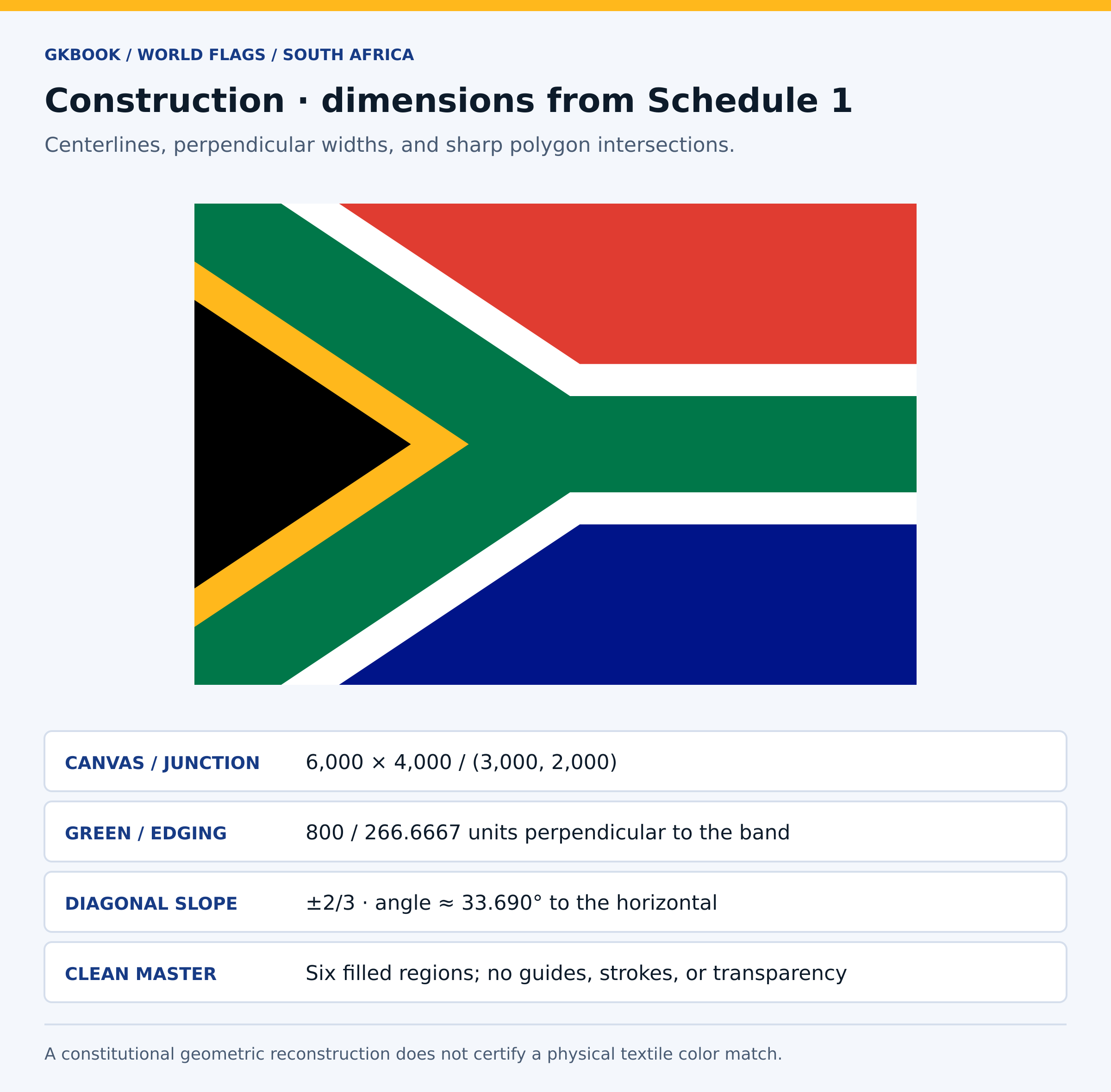
Start with a 2:3 rectangle. Draw centerlines from both hoist corners to the rectangle’s center, then from that center to the middle of the fly. Build a green band one fifth of the flag’s height around those paths, with one-fifteenth-height white or gold edgings. Fill the remaining regions red, blue, and black.

For the supplied 6,000 by 4,000 master, the centerline junction is at coordinates 3,000 and 2,000. The green band is 800 units thick, while each edging is 266.6667 units. Its diagonal centerlines have slopes of plus and minus two thirds, corresponding to an angle of about 33.690 degrees to the horizontal.
Widths are measured perpendicular to the diagonal arms. Offset lines are then intersected to form sharp joins, and all shapes are clipped to the outer rectangle. This produces precise polygon coordinates without leaving rounded stroke caps, stray outlines, gaps, or construction guides inside the clean flag master.
How wide are the stripes and borders on the South Africa flag?
The green band is one fifth of the flag’s height, and each narrow white or gold edging is one fifteenth. At the fly, the vertical sequence is red, white, green, white, blue in the ratio 5:1:3:1:5. These proportions follow from Schedule 1 rather than an estimate made from a photograph.

Dividing the total height into fifteen equal units makes the arithmetic clear. Red and blue each occupy five units at the fly; the green stem takes three; each white strip takes one. The sum is fifteen. Together, the green stem and its two borders occupy one third of the total height.
The same perpendicular border thickness continues around the diagonal arms. A vertical measurement through a sloping stripe is longer than its true width, so using the horizontal stem’s numbers as vertical offsets would produce the wrong diagonal geometry. The construction diagram labels the measurement direction as well as the quantity.
What is the history of the South Africa flag?
The present flag emerged during negotiations leading to South Africa’s democratic transition. Public proposals in 1993 did not produce an accepted design. Brownell’s developing concept was selected in March 1994, proclaimed in April, and taken into use on April 27. The later constitution retained the design and specified its geometry in Schedule 1.

The change replaced a national flag used from 1928 through the apartheid era. A new shared symbol had to work across a deeply divided society while remaining recognizable and practical to manufacture. Brownell’s account describes both the public design process and the technical work that followed when it failed to secure agreement.
This history is a sequence of decisions, not a single moment of invention. An early sketch, committee selection, formal proclamation, first official use, and constitutional retention can have different dates. Keeping those events separate explains why reliable accounts mention both March and April 1994 without necessarily contradicting one another.
When was the South Africa flag adopted?
The present flag was taken into use on April 27, 1994, the date conventionally given for its adoption. Its proclamation was published on April 20, 1994. Brownell records an earlier Transitional Executive Council selection on March 15. These dates describe selection, legal announcement, and official use, rather than three different national flags.

Government Notice 510 of 2001 identifies the original instrument as Proclamation 70 of 1994, published in Gazette 15663 on April 20. That official cross-reference supports the proclamation date. The original 1994 gazette was not obtained for this package, so its complete text and signing formalities are not claimed as directly inspected.
April 27 is also associated with the first democratic national elections. Nelson Mandela’s presidential inauguration took place later, on May 10, 1994. A flag displayed during that inauguration was already the national flag. The anniversary of democratic transition should therefore not be replaced by the later presidential ceremony date.
Who designed the South Africa flag?
Frederick Gordon Brownell, usually known as Fred Brownell, designed South Africa’s present national flag while serving as State Herald. Government and university accounts identify him. His own historical account explains how the concept developed through sketches and consultation before political selection, distinguishing the designer’s work from the institutions that approved and introduced the flag.

Brownell recalled an important sketch made in Zurich on August 25, 1993, followed by refinements to the arrangement and colors. That recollection is a participant’s published account. It should be attributed as such rather than presented as though every sketch and conversation had been independently re-created by later researchers.
The University of Pretoria also records his 2015 doctorate on the flag’s history. Historical authorship remains separate from modern file production: GKBook prepared the vector reconstruction and teaching diagrams supplied here. Creating a new digital drawing does not make its illustrator the designer of the national flag.
Was the South Africa flag the winner of a public competition?
The final flag should not simply be described as the winner of the 1993 public competition. Brownell records thousands of submissions, shortlisted proposals, and later professional designs that failed to gain acceptance. The adopted design emerged through subsequent technical work and political consultation, with Transitional Executive Council approval recorded on March 15, 1994.

Public participation and final authorship are related but different parts of the story. A consultation can influence what a country expects from a symbol without producing the exact design eventually selected. The unsuccessful proposals explain why the search continued close to the introduction of the new democratic arrangements.
The selection diagram therefore labels stages rather than ranking imaginary finalists or reproducing unverified rejected designs. It distinguishes the public submission phase, further design work, technical committee consideration, and political approval. This helps students understand why a simple statement about winning a contest can omit important parts of the evidence.
Was South Africa created as a country in 1994?
No. The flag introduced in 1994 marked the democratic transition, not South Africa’s first existence as a state. The Union dated from 1910, and the republic was established on May 31, 1961. The 1994 elections and new national flag belong to the ending of apartheid and the establishment of democratic government.
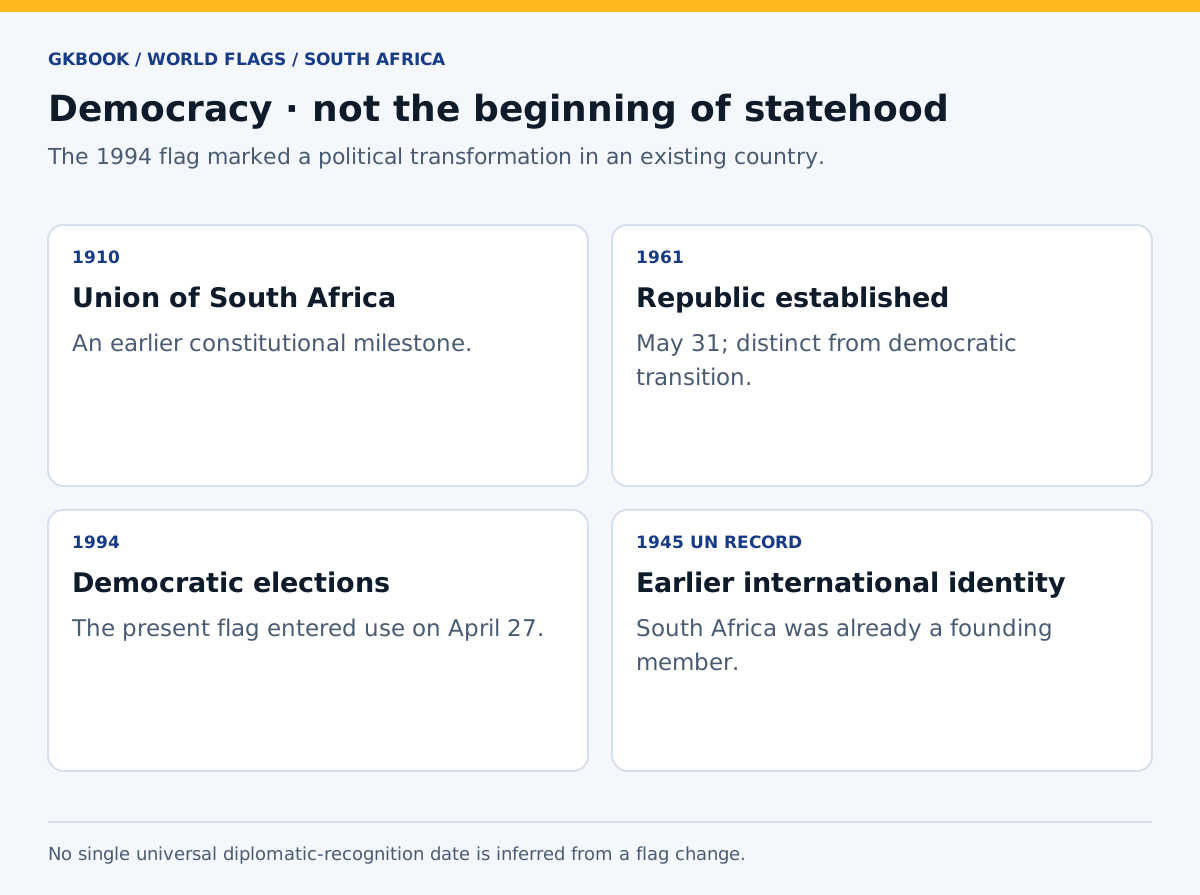
Political change can transform a state’s constitution and symbols without creating its first international identity. South Africa’s earlier constitutional history and its long-standing United Nations membership make that distinction especially important. A timeline should name each event instead of treating independence, republic, democracy, and flag adoption as interchangeable labels.
The new flag expressed a different national project from the exclusionary order it replaced. Recognizing the earlier state does not minimize the significance of democratic citizenship in 1994. It provides the chronology needed to understand why a country with decades of previous history chose a new shared emblem at that moment.
Did South Africa join the United Nations when its new flag appeared?
No. South Africa was a founding member of the United Nations in 1945, long before the present flag. The UN’s historical table records the Union of South Africa signing the Charter on June 26, 1945 and depositing ratification on November 7. The 1994 flag change must not be treated as a new UN admission.
The founding-member table separates the signing date from the later deposit of ratification. Both belong to the establishment of the United Nations, not the introduction of the current flag. The country’s name and political order changed over time, but those changes do not erase the earlier membership record.
Diplomatic recognition, participation in an organization, and recognition of an image are also different questions. A familiar flag does not establish one universal date on which every other government recognized a country. For this article, the relevant conclusion is simply that international membership predates the democratic flag by many decades.
Where is the South Africa flag defined in law?
Section 5 of South Africa’s constitution identifies the national flag and refers to Schedule 1 for its description and sketch. The schedule specifies the 2:3 rectangle, six colors, green Y, edging widths, and placement of the black, red, and blue regions. It does not prescribe the hexadecimal values used in this digital package.

The 1996 constitution was signed on December 10, 1996 and generally commenced on February 4, 1997. Those dates concern the constitutional settlement that retained the flag; they are not its first-use date. The inspected Schedule 1 is unusually useful for drawing because it supplies numeric proportions rather than merely naming the colors.
A legal description, technical textile references, and a screen rendering still serve different purposes. The constitutional ratios can be implemented exactly in vector coordinates, while color reproduction requires a declared medium. This package documents both the legal geometric basis and the narrower status of its chosen RGB palette.
What flag did South Africa use before 1994?
The preceding national flag, introduced in 1928, had orange, white, and blue horizontal bands with three smaller flags in the white band. It remained in use through the apartheid era until the democratic transition. The present six-color Y design replaced it in 1994 and should not be confused with a recolored version of that older composition.

The former design combined British and Boer historical symbols. Its later association with apartheid makes context important in historical discussion. The article explains the predecessor to clarify what changed, without treating it as an alternative current flag or reconstructing detailed miniature flags from an uncertain reference image.
Dates in captions matter whenever historical symbols appear in a lesson. A picture labeled simply South Africa can obscure whether it represents the Union, the apartheid-era republic, or the democratic period. The supplied history card uses an explicit 1928–1994 label and reserves the clean flag download for the current national design.
Does the South Africa flag include the coat of arms?
No. The national flag contains colored geometric areas and borders, with no coat of arms, motto, lettering, or other central emblem. South Africa’s coat of arms is a separate national symbol. Its present form was introduced in 2000, after the flag, so adding it to the flag would change the constitutional composition.
The government’s identity booklet presents the flag and the coat of arms separately. Their themes of unity can be related without combining the two drawings. A document or ceremonial backdrop may display both symbols, but proximity on a page does not make one a required component of the other.
This distinction also prevents confusion with organizational flags, military insignia, or decorative products that incorporate additional imagery. The clean master remains a rectangle of six colors. The gallery explains the national design; it does not present speculative armorial artwork or claim that every flag containing a South African canton is the national flag itself.
Why is the South Africa flag associated with Freedom Day?
Freedom Day is observed on April 27 to commemorate South Africa’s first democratic national elections in 1994. The present flag was taken into use on that date, linking the symbol and commemoration. The 2001 flag instructions also identify Freedom Day as a ceremonial occasion for flying the national flag.
The anniversary recalls a political and civic milestone, not an annual redesign. A flag raised during a later Freedom Day ceremony remains the same national symbol defined in Schedule 1. A particular year’s program, venue, or official theme should be taken from that year’s announcement rather than copied from an older celebration.
For revision notes, place April 27 beside democratic elections and the new flag, and May 10 beside Mandela’s inauguration. Both dates belong to 1994, but they answer different questions. This simple event labeling is more reliable than memorizing a year without remembering what occurred.
What does the reverse of the South Africa flag look like?
Viewed from behind as a single layer, the whole design is horizontally mirrored. The black triangle appears at the observer’s right, where the flag is attached, while red remains above blue. The green arms still open toward the hoist. This is a reverse view of the same flag, not a different national design.
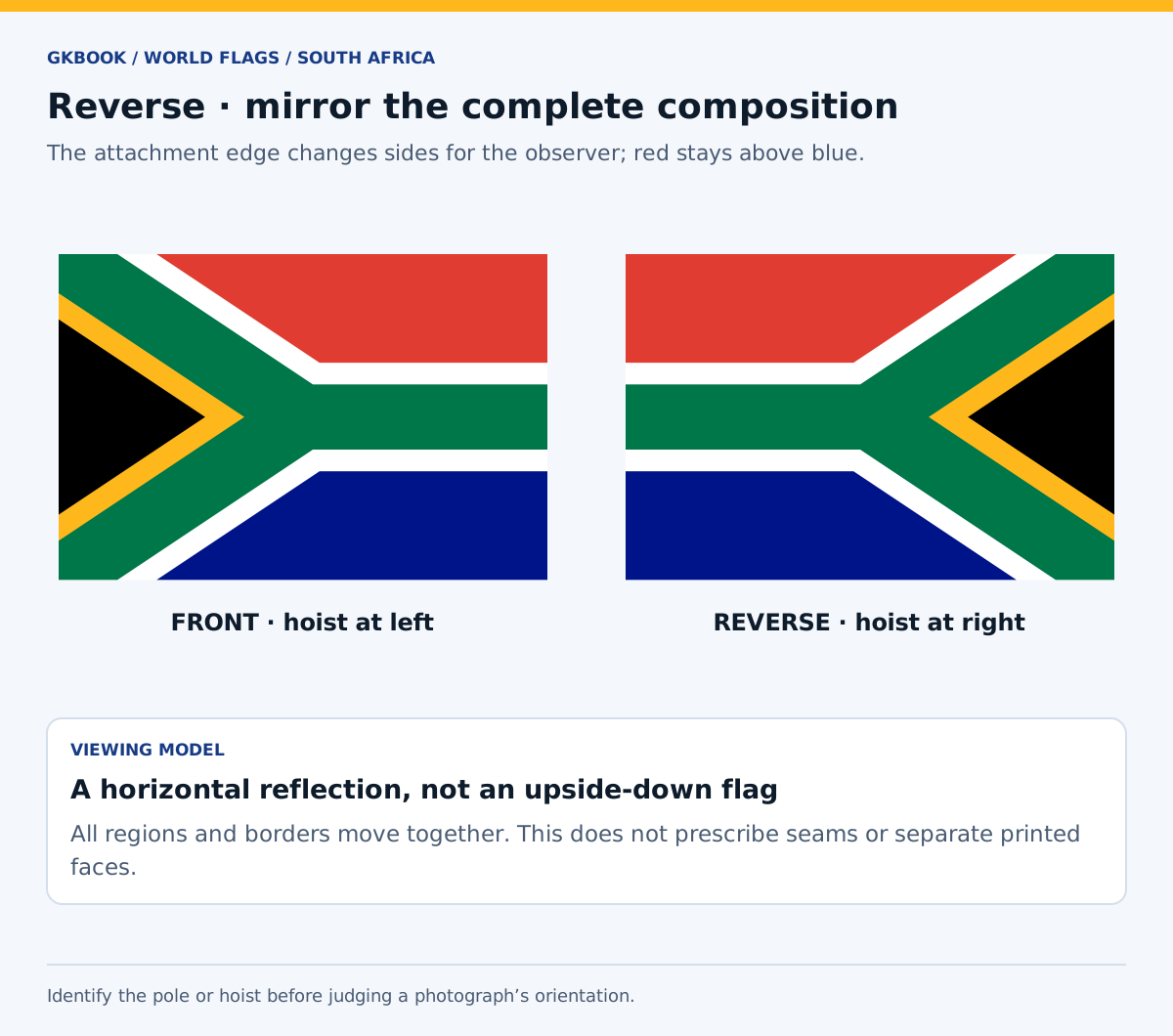
A mirror changes left and right without exchanging top and bottom. Turning a front-view image upside down does something different: it puts blue above red. The reverse diagram therefore reflects the complete composition, including all colored regions and edgings, instead of moving only the black triangle or changing individual pieces.
This geometric explanation does not prescribe a particular seam, backing, or double-sided printing method. Manufacturing depends on the material and intended installation. When checking a photograph, identify the pole or attachment edge first; a black triangle on the right can be perfectly consistent with viewing the reverse.
How should the South Africa flag hang vertically on a wall?
Official instructions say that, when displayed vertically against a wall, the hoist or cord seam is uppermost and the red band is on the viewer’s left. The black triangle is therefore at the top. Simply rotating the normal front-view image clockwise puts red on the wrong side for this specified wall display.

The supplied diagram follows the government’s identity booklet and the 2001 notice. It maps the horizontal flag’s hoist to the top while placing the upper red region at the left. In geometric terms this exchanges the drawing’s horizontal and vertical coordinates, producing a reflected-and-rotated view rather than a stretched rectangle.
The instruction is specifically about a vertical wall display. It should not be generalized into an invented rule for every banner, pole arrangement, or garment. On a narrow screen, the ordinary horizontal flag can simply scale down proportionally; responsive layout does not require converting it into a portrait design.
How should the South Africa flag be displayed with other flags?
The 2001 official instructions place South Africa’s flag at equal height and approximately equal size when displayed with other countries’ national flags. They also distinguish the viewer’s side from the speaker’s side in indoor placement. Follow the applicable arrangement and identify the observer’s viewpoint before translating words such as right into a physical position.

For a flag beside or behind a speaker, the notice specifies the speaker’s right; elsewhere in the room it specifies the audience’s right as they face the speaker. These are different viewpoints. A stage plan should label who is looking from where, rather than place an unexplained right-hand arrow on a diagram.
The notice addresses official flag stations, sizes, maintenance, ceremonial occasions, and other arrangements. This article summarizes relevant points without pretending to reproduce every instruction. A specific event can require additional coordination with the responsible protocol office, especially when national flags, organizational flags, and several types of flagstaff are combined.
When should South Africa’s flag be flown at half-mast?
The published 2001 instructions state that the national flag is half-masted for mourning on instructions from the Presidency. It is first raised to the top, then lowered to the prescribed position, and raised again before final lowering. This article explains that standing procedure; it does not declare that a mourning order is currently active.
The notice defines the position through the center of the flag, halfway between the top fitting and bottom of the flagstaff. The word half therefore concerns placement on the staff, not cutting the flag in half or hiding part of its design. All six colors and their arrangement remain unchanged.
For an actual occasion, consult the dated instruction for its duration and scope. A general educational article cannot establish whether a particular building should lower its flag today. Keep the distinction between a continuing procedural reference and an event-specific order visible when preparing notices, captions, or ceremonial plans.
What should be avoided when using the South Africa flag?
Preserve the complete design and follow the applicable display guidance. The government’s identity booklet advises against letting the flag touch the ground or using it as a tablecloth. Keep unrelated text and logos outside a clean flag image. These presentation principles do not by themselves grant commercial permission or establish official endorsement.
A national design, a photograph of a flag, and a particular digital illustration raise different questions about use and attribution. The Commons file’s stated public-domain status is recorded for that reference artwork; it is not treated as a blanket clearance for every product, promotion, or use of a national symbol.
For historical education, label former flags and artistic adaptations clearly. For current reference material, maintain the six colors, the Y, and the borders. The credits distinguish Brownell’s original national design from GKBook’s reconstruction so that the modern production process does not obscure the historical source of the symbol.
How can I print the South Africa flag accurately?
Use the scalable SVG or the supplied 6,000 by 4,000 PNG, keep the 2:3 proportion, and preserve every border. The declared screen palette is suitable for consistent digital artwork, but physical production needs appropriate textile or print specifications and a proof. Do not treat an approximate Pantone reference as a guaranteed RGB-to-ink conversion.

At 300 pixels per inch, the PNG corresponds to a print 20 inches long and about 13.33 inches high. This is a resolution example, not a compulsory national size. The vector can scale further without turning its straight polygon edges into enlarged blocks, provided the production software handles the file correctly.
Check the gold and white edgings carefully after trimming, hemming, or reduction. A lost border can merge adjacent dark areas and change the design. Confirm that white is reproduced on colored material, and compare a finished sample under suitable lighting. Sleeves and seams should not obscure the intended visible rectangle.
Where can I download accurate South Africa flag pictures?
The downloads below include a clean SVG, an opaque 6,000 by 4,000 PNG, and 24 illustrated subjects supplied in both formats. The main drawing follows the constitutional geometry and a documented screen palette. Separate diagrams explain construction, history, reverse viewing, and official vertical wall display, with labels kept outside the clean national rectangle.
Use SVG when a layout needs scalable lines and precise proportions; use PNG when software requires a raster image. A social card is also supplied, but its title and background surround a complete flag rather than becoming part of it. Select the clean master when the requirement is the national flag alone.
Helpful alternative text identifies South Africa and the defining arrangement: a green Y, a black hoist triangle edged in gold, and red above blue separated by white. Do not rely on color alone to identify download controls. Clear labels, intact proportions, and adequate interface contrast make the pictures easier to use.
Download South Africa flag pictures
Download the clean national flag as SVG or 6,000 × 4,000 PNG. Both use a 6,000 × 4,000 canvas with the constitutional green Y, black triangle, gold and white edgings, red upper region, and blue lower region. Geometry follows Schedule 1; screen values match the documented reference vector. These are carefully constructed educational files, not certified textile manufacturing samples.
The gallery contains 24 subjects, each with an SVG and PNG. The captions distinguish published specifications, attributed meanings, historical events, and digital reproduction choices. Image credits and reproduction notes explain the source basis. The separate 1,200 × 630 social card contains a complete flag and does not alter the national rectangle.
Continue exploring national designs in World Flags.
World Flags/South Africa
South Africa flag pictures
The constitutional 2:3 design with six colors and a declared screen palette.
Historical flag design: Frederick Gordon Brownell. GKBook vector reconstruction and educational layouts, following constitutional geometry and a documented screen palette.Download SVGDownload PNGOfficial guidance gives textile references and approximate Pantone equivalents; these RGB values match the inspected reference vector.
Historical flag design: Frederick Gordon Brownell. GKBook vector reconstruction and educational layouts, following constitutional geometry and a documented screen palette.Download SVGDownload PNGGovernment guidance explains the converging design while avoiding universal individual color meanings.
Historical flag design: Frederick Gordon Brownell. GKBook vector reconstruction and educational layouts, following constitutional geometry and a documented screen palette.Download SVGDownload PNGDashed teaching guides trace the converging paths; guides are absent from the clean flag.
Historical flag design: Frederick Gordon Brownell. GKBook vector reconstruction and educational layouts, following constitutional geometry and a documented screen palette.Download SVGDownload PNGThe continuous band joins the hoist corners to the middle of the fly.
Historical flag design: Frederick Gordon Brownell. GKBook vector reconstruction and educational layouts, following constitutional geometry and a documented screen palette.Download SVGDownload PNGThe red region narrows toward the hoist because of the diagonal arm and white edging.
Historical flag design: Frederick Gordon Brownell. GKBook vector reconstruction and educational layouts, following constitutional geometry and a documented screen palette.Download SVGDownload PNGThe field’s geometric balance does not make its colored design unchanged when inverted.
Historical flag design: Frederick Gordon Brownell. GKBook vector reconstruction and educational layouts, following constitutional geometry and a documented screen palette.Download SVGDownload PNGThe triangle remains opaque and belongs on the attachment side of the flag.
Historical flag design: Frederick Gordon Brownell. GKBook vector reconstruction and educational layouts, following constitutional geometry and a documented screen palette.Download SVGDownload PNGGold separates the black triangle from both green diagonal arms.
Historical flag design: Frederick Gordon Brownell. GKBook vector reconstruction and educational layouts, following constitutional geometry and a documented screen palette.Download SVGDownload PNGWhite is part of the design, not empty space between colored pieces.
Historical flag design: Frederick Gordon Brownell. GKBook vector reconstruction and educational layouts, following constitutional geometry and a documented screen palette.Download SVGDownload PNGThe aspect ratio is specified, while physical sizes vary with the installation.
Historical flag design: Frederick Gordon Brownell. GKBook vector reconstruction and educational layouts, following constitutional geometry and a documented screen palette.Download SVGDownload PNGThe outline is reconstructed from stated ratios, with exact offset-line intersections.
Historical flag design: Frederick Gordon Brownell. GKBook vector reconstruction and educational layouts, following constitutional geometry and a documented screen palette.Download SVGDownload PNGThe vertical fly-edge sequence sums to fifteen units; gold appears only beside the hoist triangle.
Historical flag design: Frederick Gordon Brownell. GKBook vector reconstruction and educational layouts, following constitutional geometry and a documented screen palette.Download SVGDownload PNGThe constitution later retained the flag and described its geometry.
Historical flag design: Frederick Gordon Brownell. GKBook vector reconstruction and educational layouts, following constitutional geometry and a documented screen palette.Download SVGDownload PNGThe different dates describe successive milestones, not competing flag designs.
Historical flag design: Frederick Gordon Brownell. GKBook vector reconstruction and educational layouts, following constitutional geometry and a documented screen palette.Download SVGDownload PNGGovernment and university accounts identify Brownell as the designer.
Historical flag design: Frederick Gordon Brownell. GKBook vector reconstruction and educational layouts, following constitutional geometry and a documented screen palette.Download SVGDownload PNGThe current flag should not simply be labeled the winning public competition entry.
Historical flag design: Frederick Gordon Brownell. GKBook vector reconstruction and educational layouts, following constitutional geometry and a documented screen palette.Download SVGDownload PNGStatehood, republic, international membership, and the new democratic flag are different events.
Historical flag design: Frederick Gordon Brownell. GKBook vector reconstruction and educational layouts, following constitutional geometry and a documented screen palette.Download SVGDownload PNGLater constitutional dates do not replace the flag’s 1994 first-use date.
Historical flag design: Frederick Gordon Brownell. GKBook vector reconstruction and educational layouts, following constitutional geometry and a documented screen palette.Download SVGDownload PNGThe present flag is not merely the former flag with its orange stripe recolored.
Historical flag design: Frederick Gordon Brownell. GKBook vector reconstruction and educational layouts, following constitutional geometry and a documented screen palette.Download SVGDownload PNGThe whole flag is mirrored as a single-layer viewing model; red remains above blue.
Historical flag design: Frederick Gordon Brownell. GKBook vector reconstruction and educational layouts, following constitutional geometry and a documented screen palette.Download SVGDownload PNGThis view exchanges horizontal and vertical coordinates, giving the prescribed red-left, hoist-top arrangement.
Historical flag design: Frederick Gordon Brownell. GKBook vector reconstruction and educational layouts, following constitutional geometry and a documented screen palette.Download SVGDownload PNGSpeaker and audience viewpoints must not be interchanged.
Historical flag design: Frederick Gordon Brownell. GKBook vector reconstruction and educational layouts, following constitutional geometry and a documented screen palette.Download SVGDownload PNGThe print-size example is a resolution calculation, not a required physical flag size.
Historical flag design: Frederick Gordon Brownell. GKBook vector reconstruction and educational layouts, following constitutional geometry and a documented screen palette.Download SVGDownload PNGFrequently asked questions
What does the South Africa flag look like?
South Africa’s national flag has six colors: black, gold, green, white, chilli red, and blue. A green band forms a sideways Y, opening toward the flagpole. A gold border separates it from the black triangle, while white separates it from the red upper and blue lower areas. The height:length ratio is 2:3.
What are the colors of the South Africa flag?
The six colors are black, gold, green, white, chilli red, and blue. The constitution names them, while government guidance provides textile references and approximate Pantone equivalents. This package uses a declared screen palette drawn from the inspected Commons vector. Its hexadecimal values are reproduction choices, not RGB numbers written into the constitution.
What does the South Africa flag mean?
The flag’s central idea is the coming together of different elements of South African society and their movement forward in unity. Official guidance associates that interpretation with the converging design. It explicitly avoids assigning universal meanings to individual colors, so familiar claims about blood, minerals, land, or particular population groups require careful qualification.
What does the Y shape on the South Africa flag represent?
The green Y-shaped band represents convergence: two arms begin at the flagpole side, meet near the center, and continue toward the free edge as one band. Government guidance interprets this as diverse elements of society moving ahead together. The shape is also called a pall in heraldic descriptions of the flag.
What does green mean on the South Africa flag?
Green forms the continuous Y-shaped band, the feature associated with convergence and unity. The government does not assign green alone one universal meaning such as agriculture or fertility. Its role should therefore be explained through the documented design, while personal or historical associations with the color remain distinct from an official color definition.
Is the top of the South Africa flag red or orange?
The constitution calls the upper area chilli red. It should not be replaced by the orange stripe of the former national flag. Designer Fred Brownell explained the choice in relation to earlier red and orange traditions, but that historical explanation does not establish blood or sacrifice as a universal official meaning for the color.
Where is blue on the South Africa flag?
Blue occupies the lower area in the normal horizontal view, below the white edging and green stem. At the free edge it spans one third of the flag’s height. The constitution specifies its position, but official guidance does not prescribe the sky or sea as blue’s single universal symbolic meaning.
What is the black triangle on the South Africa flag?
The black triangle is the area next to the flagpole, enclosed by the gold edging of the green Y. It is a required part of the constitutional design. Although black has historical political associations, the government’s explanation does not assign it one universal meaning or make the flag a color-coded classification of people.
Why does the South Africa flag use gold or yellow?
Gold is the constitutional color name for the narrow edging between the black triangle and the green arms. It appears yellow in ordinary digital artwork. The government does not give it one universal meaning such as mineral wealth, and the word gold does not require metallic ink, a reflective gradient, or glitter in a flat flag image.
What are the white stripes on the South Africa flag?
The white stripes are narrow edgings that separate the green Y from the upper red and lower blue areas. Each edging is one fifteenth of the flag’s height. They are part of the design, not empty gaps. Official guidance does not assign white a single universal meaning such as peace or a particular population group.
What is the ratio of the South Africa flag?
South Africa’s flag has a height:length ratio of 2:3. Schedule 1 of the constitution explicitly specifies a rectangle one and a half times as long as it is wide. The supplied master is 6,000 pixels long and 4,000 pixels high, preserving that proportion without cropping or stretching the national design.
How do you draw the South Africa flag accurately?
Start with a 2:3 rectangle. Draw centerlines from both hoist corners to the rectangle’s center, then from that center to the middle of the fly. Build a green band one fifth of the flag’s height around those paths, with one-fifteenth-height white or gold edgings. Fill the remaining regions red, blue, and black.
How wide are the stripes and borders on the South Africa flag?
The green band is one fifth of the flag’s height, and each narrow white or gold edging is one fifteenth. At the fly, the vertical sequence is red, white, green, white, blue in the ratio 5:1:3:1:5. These proportions follow from Schedule 1 rather than an estimate made from a photograph.
What is the history of the South Africa flag?
The present flag emerged during negotiations leading to South Africa’s democratic transition. Public proposals in 1993 did not produce an accepted design. Brownell’s developing concept was selected in March 1994, proclaimed in April, and taken into use on April 27. The later constitution retained the design and specified its geometry in Schedule 1.
When was the South Africa flag adopted?
The present flag was taken into use on April 27, 1994, the date conventionally given for its adoption. Its proclamation was published on April 20, 1994. Brownell records an earlier Transitional Executive Council selection on March 15. These dates describe selection, legal announcement, and official use, rather than three different national flags.
Who designed the South Africa flag?
Frederick Gordon Brownell, usually known as Fred Brownell, designed South Africa’s present national flag while serving as State Herald. Government and university accounts identify him. His own historical account explains how the concept developed through sketches and consultation before political selection, distinguishing the designer’s work from the institutions that approved and introduced the flag.
Was the South Africa flag the winner of a public competition?
The final flag should not simply be described as the winner of the 1993 public competition. Brownell records thousands of submissions, shortlisted proposals, and later professional designs that failed to gain acceptance. The adopted design emerged through subsequent technical work and political consultation, with Transitional Executive Council approval recorded on March 15, 1994.
Was South Africa created as a country in 1994?
No. The flag introduced in 1994 marked the democratic transition, not South Africa’s first existence as a state. The Union dated from 1910, and the republic was established on May 31, 1961. The 1994 elections and new national flag belong to the ending of apartheid and the establishment of democratic government.
Did South Africa join the United Nations when its new flag appeared?
No. South Africa was a founding member of the United Nations in 1945, long before the present flag. The UN’s historical table records the Union of South Africa signing the Charter on June 26, 1945 and depositing ratification on November 7. The 1994 flag change must not be treated as a new UN admission.
Where is the South Africa flag defined in law?
Section 5 of South Africa’s constitution identifies the national flag and refers to Schedule 1 for its description and sketch. The schedule specifies the 2:3 rectangle, six colors, green Y, edging widths, and placement of the black, red, and blue regions. It does not prescribe the hexadecimal values used in this digital package.
What flag did South Africa use before 1994?
The preceding national flag, introduced in 1928, had orange, white, and blue horizontal bands with three smaller flags in the white band. It remained in use through the apartheid era until the democratic transition. The present six-color Y design replaced it in 1994 and should not be confused with a recolored version of that older composition.
Does the South Africa flag include the coat of arms?
No. The national flag contains colored geometric areas and borders, with no coat of arms, motto, lettering, or other central emblem. South Africa’s coat of arms is a separate national symbol. Its present form was introduced in 2000, after the flag, so adding it to the flag would change the constitutional composition.
Why is the South Africa flag associated with Freedom Day?
Freedom Day is observed on April 27 to commemorate South Africa’s first democratic national elections in 1994. The present flag was taken into use on that date, linking the symbol and commemoration. The 2001 flag instructions also identify Freedom Day as a ceremonial occasion for flying the national flag.
What does the reverse of the South Africa flag look like?
Viewed from behind as a single layer, the whole design is horizontally mirrored. The black triangle appears at the observer’s right, where the flag is attached, while red remains above blue. The green arms still open toward the hoist. This is a reverse view of the same flag, not a different national design.
How should the South Africa flag hang vertically on a wall?
Official instructions say that, when displayed vertically against a wall, the hoist or cord seam is uppermost and the red band is on the viewer’s left. The black triangle is therefore at the top. Simply rotating the normal front-view image clockwise puts red on the wrong side for this specified wall display.
How should the South Africa flag be displayed with other flags?
The 2001 official instructions place South Africa’s flag at equal height and approximately equal size when displayed with other countries’ national flags. They also distinguish the viewer’s side from the speaker’s side in indoor placement. Follow the applicable arrangement and identify the observer’s viewpoint before translating words such as right into a physical position.
When should South Africa’s flag be flown at half-mast?
The published 2001 instructions state that the national flag is half-masted for mourning on instructions from the Presidency. It is first raised to the top, then lowered to the prescribed position, and raised again before final lowering. This article explains that standing procedure; it does not declare that a mourning order is currently active.
What should be avoided when using the South Africa flag?
Preserve the complete design and follow the applicable display guidance. The government’s identity booklet advises against letting the flag touch the ground or using it as a tablecloth. Keep unrelated text and logos outside a clean flag image. These presentation principles do not by themselves grant commercial permission or establish official endorsement.
How can I print the South Africa flag accurately?
Use the scalable SVG or the supplied 6,000 by 4,000 PNG, keep the 2:3 proportion, and preserve every border. The declared screen palette is suitable for consistent digital artwork, but physical production needs appropriate textile or print specifications and a proof. Do not treat an approximate Pantone reference as a guaranteed RGB-to-ink conversion.
Where can I download accurate South Africa flag pictures?
The downloads below include a clean SVG, an opaque 6,000 by 4,000 PNG, and 24 illustrated subjects supplied in both formats. The main drawing follows the constitutional geometry and a documented screen palette. Separate diagrams explain construction, history, reverse viewing, and official vertical wall display, with labels kept outside the clean national rectangle.
Explore all general-knowledge topics and the A-to-Z lists.





We Value Your Opinion Comments