

Solomon Islands flag picture
Explore the construction notes, history, and picture gallery.
| Design | Blue and green with a yellow diagonalFive equal white five-pointed stars in the blue field. |
|---|---|
| Proportions | Height:length = 1:2The stripe rises from lower hoist to upper fly. |
| Conventional adoption date | November 18, 1977A separate December approval account is discussed below. |
| Independence | July 7, 1978The flag predates independent statehood. |
| United Nations admission | September 19, 1978Membership differs from flag adoption and universal recognition. |
| Main image sizes | SVG and PNG: 6,000 × 3,000Both preserve the national 1:2 shape. |
What does the Solomon Islands flag look like?
The Solomon Islands flag has a blue upper hoist area and a green lower fly area separated by a yellow diagonal stripe rising from bottom left to top right. Five white five-pointed stars occupy the blue area in a two-one-two arrangement. The national rectangle has a height:length ratio of 1:2.
Read the design from the attachment edge, called the hoist, toward the free edge, called the fly. In a conventional front view, the hoist is at the left. The stars form a compact group within the blue field rather than spreading across the entire rectangle. Distinguishing the overall flag from its individual symbols makes its geometry, history, and meaning easier to understand.
What are the colors of the Solomon Islands flag?
The flag uses blue, green, yellow, and white. This package uses the documented screen values #0051BA, #215B33, #FCD116, and #FFFFFF, respectively, matching the inspected Wikimedia Commons vector. These values are reproduction conventions. The research did not establish a government-issued hexadecimal standard or an exact universal conversion to printing inks.

Color identification and color measurement are different tasks. The recognizable design requires blue and green fields, a yellow dividing stripe, and white stars. Exact screen numbers make an illustration reproducible, but they do not by themselves establish a legal color specification or guarantee identical appearance on every display.
Specialist references record differing print palettes. Avoid combining a blue from one reference with a green from another while calling the result a single official standard. For material production, agree on a reference and proof it under suitable lighting. The supplied digital files consistently use one declared palette.
| Color | Hexadecimal | RGB | Location |
|---|---|---|---|
| Blue | #0051BA | 0, 81, 186 | Upper hoist field |
| Green | #215B33 | 33, 91, 51 | Lower fly field |
| Yellow | #FCD116 | 252, 209, 22 | Diagonal stripe |
| White | #FFFFFF | 255, 255, 255 | Five stars |
What does the Solomon Islands flag symbolize?
The widely documented interpretation associates blue with the ocean, green with the land, and yellow with sunshine. The white stars express the country’s island groupings, although historical accounts differ over their relationship to administrative divisions. The design brings sea, land, sunlight, and a group of islands into one national composition.

The landscape interpretation connects the large colored fields with the environment of an island country. It need not be expanded into an unsupported code in which every shade, angle, or star point carries a separate political message. The basic relationships already provide a clear explanation of the composition.
Symbolic interpretations should also retain their historical context. A participant’s recollection, a later educational summary, and a formal specification are different kinds of evidence. Where they disagree, describe the difference instead of combining incompatible statements into a confident but misleading explanation. The star discussion below makes that distinction explicit.
What does blue represent on the Solomon Islands flag?
Blue represents the surrounding sea in the standard explanation, with sky also appearing in some historical accounts. It occupies the upper hoist side of the diagonal division and provides the background for all five white stars. Blue is a field color here, not a separate rectangular canton added over another background.

The blue area touches the top and hoist edges. Its diagonal boundary is partly covered by the yellow stripe, so the visible blue shape is slightly smaller than the underlying half of the rectangle. The stars are placed well inside this field and do not cross the yellow band.
A location description is often more useful than a color name alone. In a monochrome exercise, label the upper hoist region and the star cluster before adding color. This preserves the design’s organization even when different printers, screens, or color-vision conditions make the blue harder to distinguish.
What does green represent on the Solomon Islands flag?
Green represents the land and its vegetation. It fills the lower fly side of the flag, opposite the blue upper hoist region. The yellow diagonal separates the two fields. This package uses a dark green screen convention; a brighter green found in another reference should not automatically be treated as a changed national design.

The green field reaches the lower and free edges. Unlike the blue field, it contains no stars or other emblem. That visual balance is part of the recognizable flag: the star cluster belongs near the hoist, while a broad uninterrupted green region extends toward the fly.
When comparing two reproductions, first check their structure, then their color specification. A difference in shade may result from a declared palette, a photograph’s lighting, faded fabric, or an uncalibrated screen. Those causes differ from a deliberate national redesign, which would require separate historical or official evidence.
What does the yellow stripe on the Solomon Islands flag mean?
The yellow stripe represents sunshine or the sun’s rays in the standard interpretation. It runs from the lower hoist corner toward the upper fly corner, separating blue from green. Its direction matters: a stripe descending from the upper hoist would describe a different front-facing composition, even if all four colors remained correct.

The stripe is a band of constant perpendicular width. Measuring its thickness vertically gives a larger number because the band is slanted. This is an ordinary geometric effect, not a widening of the stripe. The construction section explains the measurement used in the supplied drawing.
The corners require care when making a vector file. A broad line drawn directly between the corners must be clipped to the rectangular flag, or its edges can project beyond the canvas. Here the visible band is constructed as a six-vertex polygon whose intersections stay exactly on the boundary.
Why are the stars on the Solomon Islands flag white?
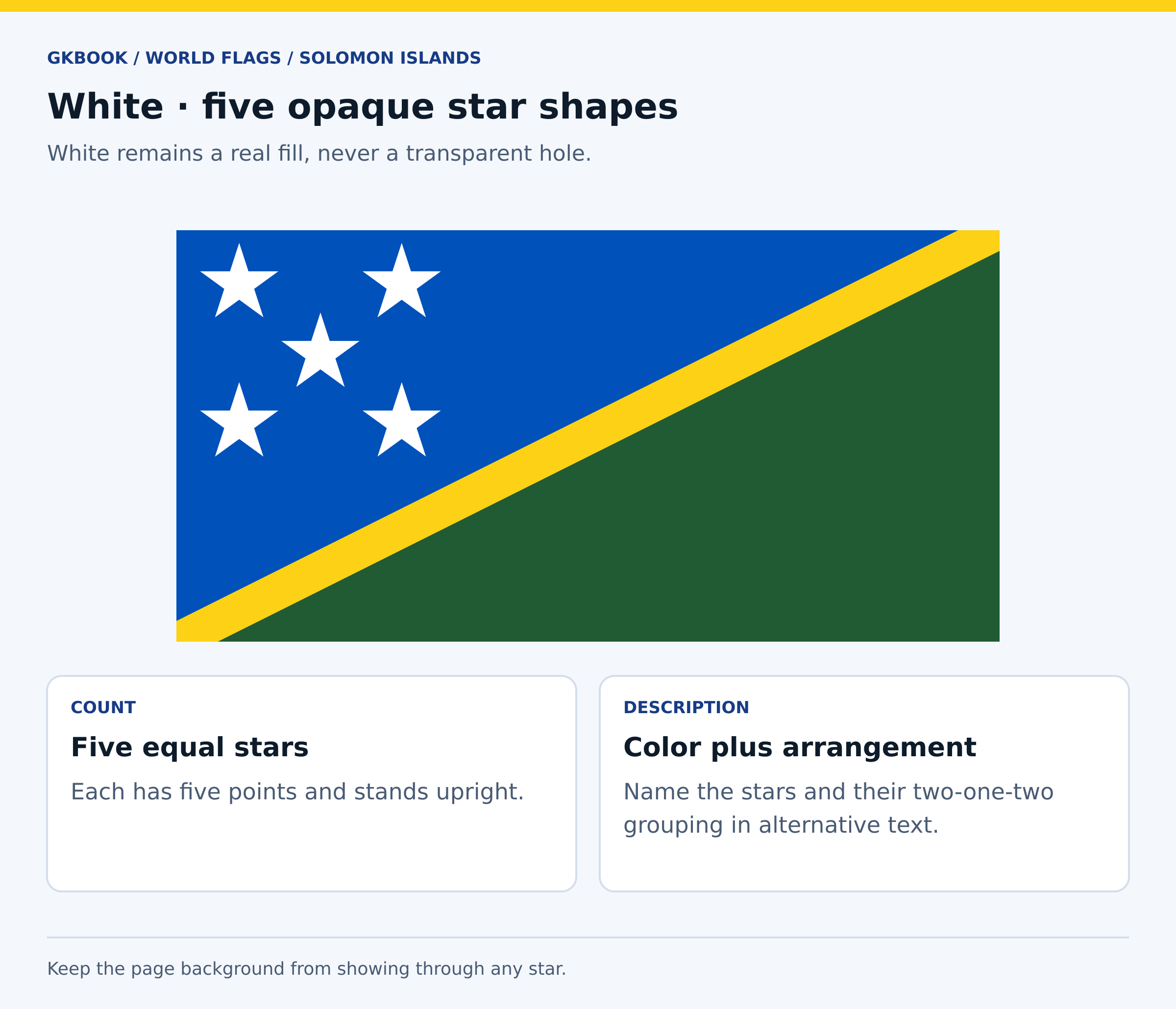
White distinguishes the five stars clearly against the blue field. The inspected references identify their color and regional symbolism but do not establish one compulsory separate meaning for white itself. Explanations such as peace or purity should therefore be presented as interpretations when specifically sourced, not automatically added as official meanings.

All five stars use the same opaque white. They are filled shapes, not white outlines or transparent holes. If white were replaced with transparency, the surrounding webpage or printing substrate could show through and change a visible part of the national design.
For an accessible description, mention the number and arrangement as well as the color. A reader should be able to distinguish five equal stars grouped near the hoist from a constellation, a row, or a ring. Their positions and shapes carry information that a color-only label would leave out.
How many stars are on the Solomon Islands flag?
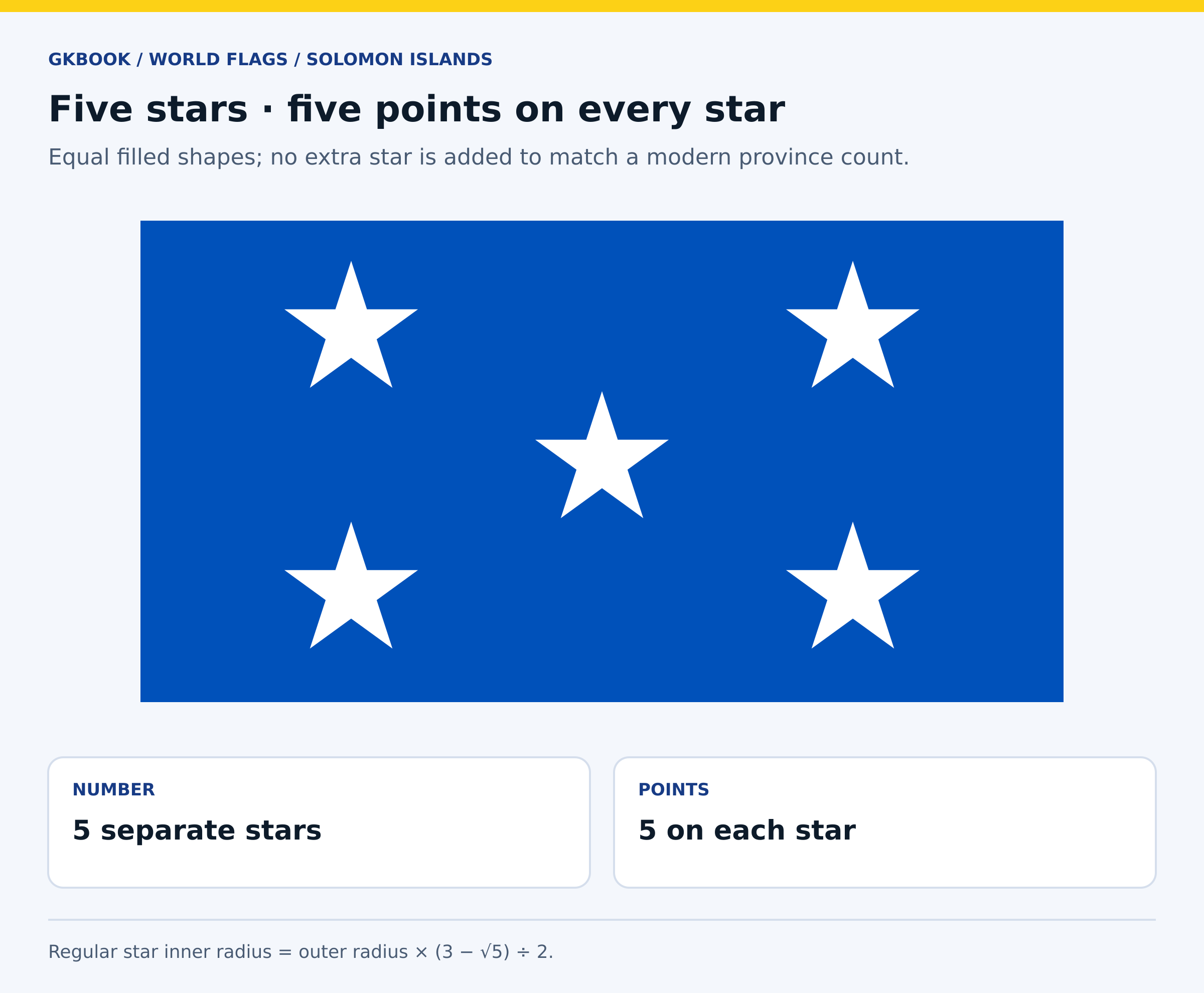
There are five white stars, and each has five points. All are the same size and point upward in the standard horizontal view. Four surround a central star, producing an X-like group. Counting the stars is different from counting their points: the flag has five separate star symbols, not twenty-five stars.

The outer stars occupy the corners of a compact rectangular arrangement, with the fifth at its center. Their spacing keeps the cluster distinct from the yellow band. No extra star should be added merely to match a later count of provinces or another administrative statistic.
A regular five-pointed star can be constructed from ten alternating vertices on two concentric circles. The inner radius used here is the outer radius multiplied by approximately 0.381966. This produces the familiar regular pentagram outline as one filled polygon, without crossing strokes or overlapping pieces that might render inconsistently.
How are the stars arranged on the Solomon Islands flag?
The five stars follow a two-one-two arrangement: two in the upper row, one centered below them, and two in the lower row. The cluster resembles an X or quincunx. It is not a straight row or an H-shaped constellation. Each individual star remains upright rather than turning along the cluster’s diagonals.
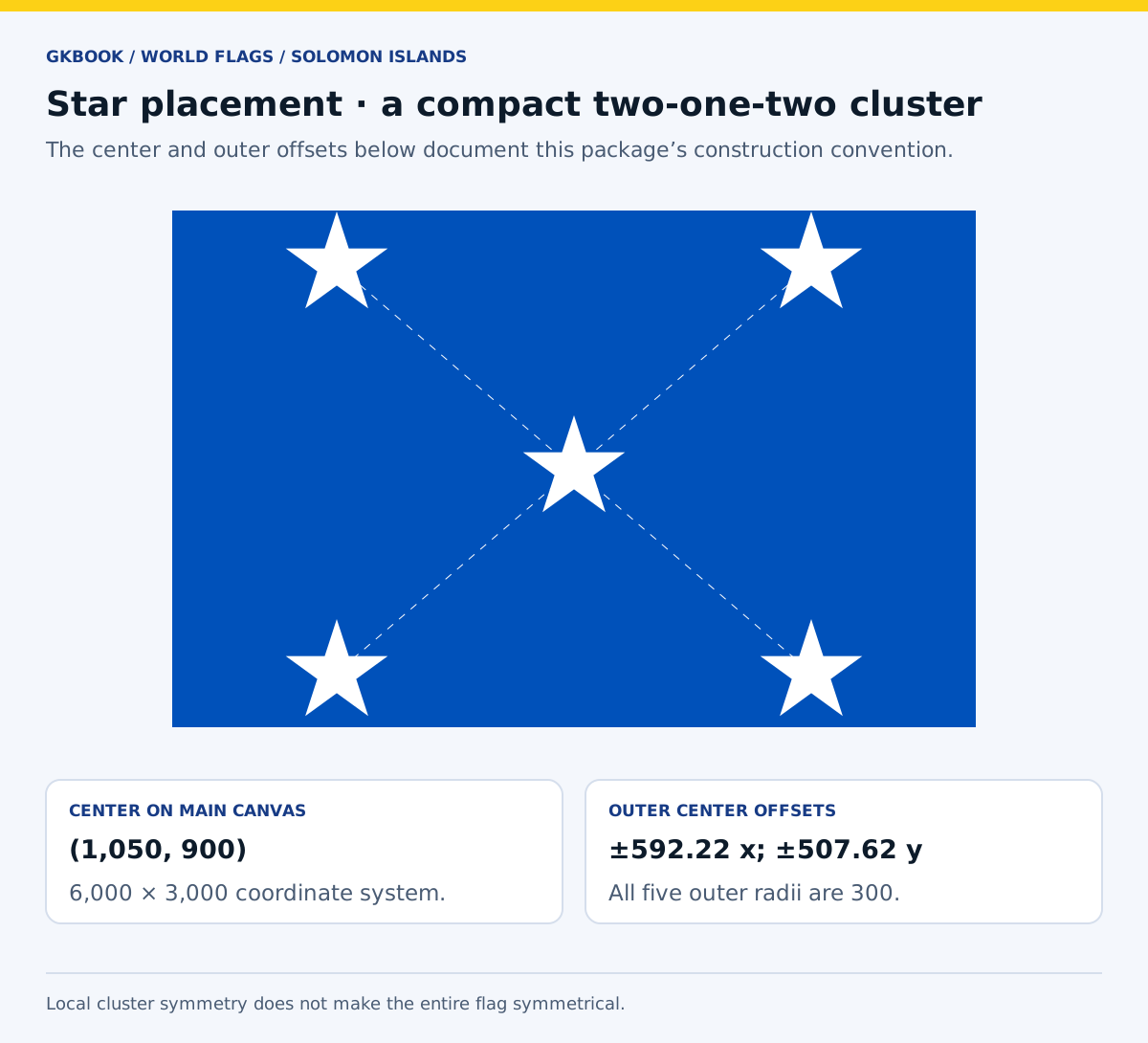
In the supplied 6,000 by 3,000 coordinate system, the central star is at 1,050 and 900. The four outer centers lie about 592.22 units to either side and 507.62 units above or below it. These numbers document this reconstruction’s chosen convention rather than a newly discovered statute.
The arrangement has horizontal and vertical symmetry about the central star’s position. The whole flag does not share those symmetries because the colored fields and stripe have a particular orientation. Keeping the distinction between local symmetry and overall orientation prevents accidental rotation of the complete national design.
What do the five stars on the Solomon Islands flag represent?
A documented explanation identifies five major groupings: Malaita, Central, Eastern, Western, and the Polynesian Outliers. Sir Peter Kenilorea’s retrospective account favors these enduring groupings over a changing province count. Other accounts describe districts or provinces, so the historical disagreement should be acknowledged rather than assigning each star an unquestioned modern administrative label.

The historical encyclopedia follows the island-group explanation and cites Kenilorea’s autobiography. His clarification is also reproduced in specialist flag correspondence. Those are related evidence streams, not two wholly independent eyewitness accounts. They provide a reason to avoid the oversimplified statement that the stars simply count today’s provinces.
Do not turn the list into a positional map. The inspected material does not establish which specific star represents which grouping. A diagram may explain the collective interpretation without labeling the upper left star as one region and the lower right as another. Such invented assignments would add unsupported information.
Do the five stars equal the number of present-day provinces?
No. The government’s administrative summary lists nine provinces and the city of Honiara as a separate administrative area. The national flag still has five stars. Whatever historical terminology a reference uses for the star symbolism, the design should not be read as a current province-count chart or automatically updated when administrative arrangements change.
A national emblem can retain a historical number while administrative boundaries develop independently. Counting the symbols is therefore not a reliable way to answer a modern civics question about local government. Use a current administrative source for that question and a flag source for the national design.
The disagreement in older descriptions is more complicated than a simple arithmetic correction. Island groups, districts, provinces, and a capital administration are not necessarily equivalent categories. Preserving their names and time periods helps explain why accounts differ without implying that a star is missing or that the flag has become invalid.
Do the stars on the Solomon Islands flag show the Southern Cross?
The stars are generally explained through the country’s regions or island groupings, rather than as the Southern Cross constellation. John A. Hazeldine’s published recollection explicitly rejects a constellation interpretation. Their five-pointed shapes and compact X-like arrangement should not be confused with a star map simply because several Pacific flags use astronomical symbols.

A constellation depiction normally relates its stars to a recognizable celestial pattern. Here the educational description should begin with the documented regional meaning. Similarity in the number of stars does not establish identical symbolism across different national flags, especially when the relevant historical accounts say otherwise.
When teaching visual recognition, use three checks together: the equal star sizes, the two-one-two grouping, and the blue-green field divided by yellow. That combination identifies this flag more reliably than the phrase five stars alone. The supplied comparison card explains the distinction without inventing a substitute astronomical arrangement.
What is the ratio of the Solomon Islands flag?
The flag’s height:length ratio is 1:2, so its length is twice its height. A flag 100 centimeters high is 200 centimeters long. Both supplied clean masters measure 6,000 by 3,000, preserving that proportion. The separate social card has its own canvas, with a complete correctly proportioned flag placed inside it.

Always name the dimensions when stating a ratio. Software usually calls the horizontal dimension width, while flag descriptions may use width for the short side. Height and length avoid that ambiguity. The ratio determines the rectangle’s shape; it does not require every physical flag to have one fixed size.
Scale the complete composition together. Doubling the rectangle should also double the stripe thickness, star sizes, and distances between star centers. Stretching the image horizontally without changing its height would widen the stars and alter the diagonal angle. A responsive webpage should therefore preserve the image’s intrinsic aspect ratio.
Is the yellow diagonal on the Solomon Islands flag at 45 degrees?
No. On a 1:2 rectangle, the corner-to-corner diagonal rises one unit for every two units of horizontal distance. Its angle to the horizontal is about 26.565 degrees. The stripe follows that diagonal from lower hoist to upper fly. A 45-degree band would correspond to a different geometric relationship and would miss those opposite corners.
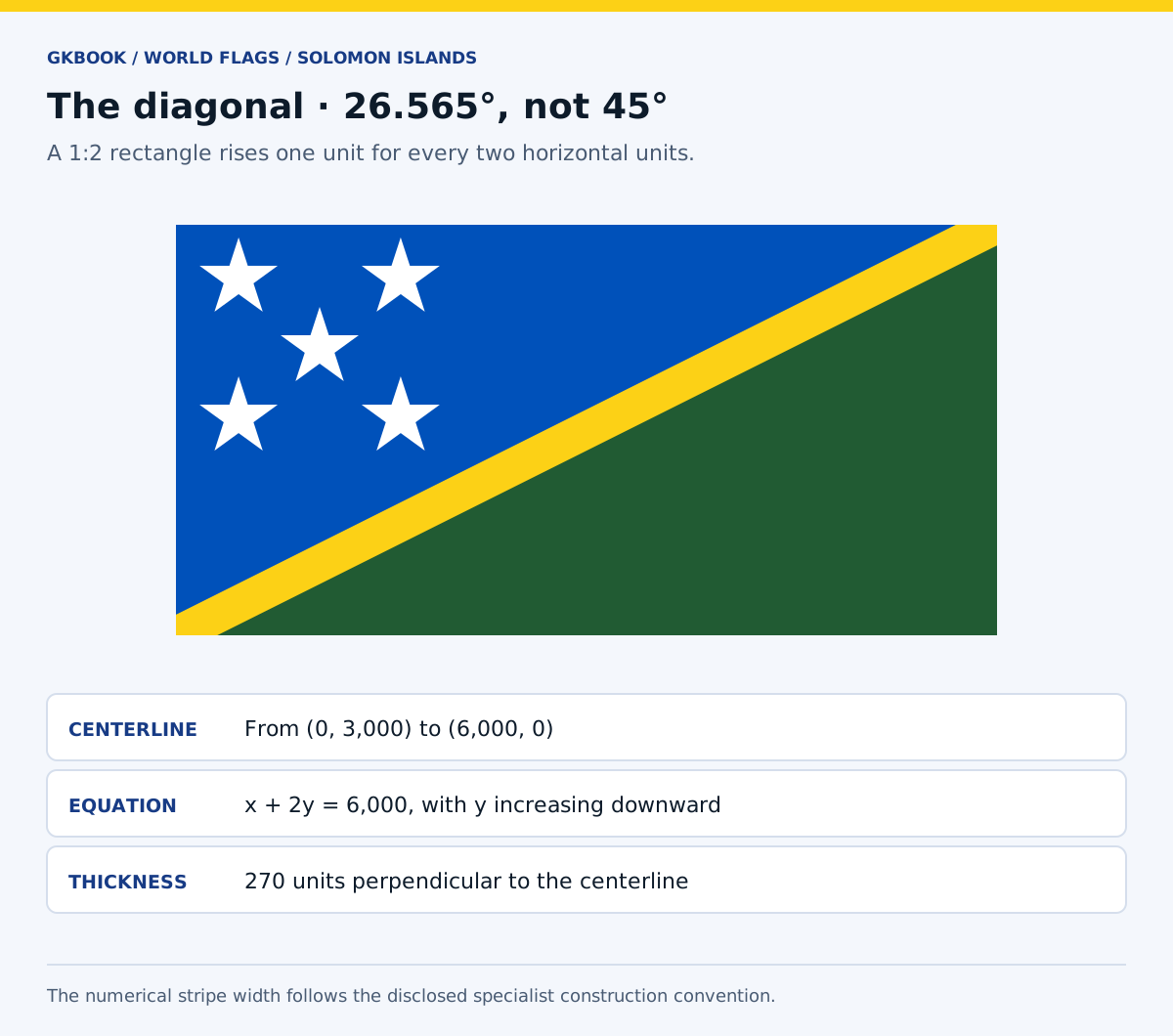
The centerline on the supplied canvas runs from coordinates zero and 3,000 to 6,000 and zero. In image coordinates, where y increases downward, its equation is x plus twice y equals 6,000. That equation is a convenient way to check the stripe direction independently of the drawing software.
The chosen perpendicular band width is 270 units. Its intersections with a vertical edge extend about 150.93 units on either side of the centerline’s corner position before clipping. This illustrates why stripe width, edge intersection distance, and diagonal length are three different measurements that should not be substituted for one another.
How is the Solomon Islands flag drawn accurately?
Use a 1:2 rectangle, a rising yellow diagonal, blue above the diagonal, green below it, and five equal white upright stars near the upper hoist. This package follows a documented specialist construction convention and checks it against a separate vector reference. Its detailed dimensions are disclosed without claiming government-certified manufacturing authority.

The reference construction uses a 200 by 100 field, a 70 by 60 guide for the star cluster, a center-to-outer-star distance of 26, a star outer radius of 10, and a stripe width of 9. Multiplication by 30 produces the supplied coordinate system.
The outer star centers follow the guide’s diagonals. Exact trigonometry and regular star polygons remove small rounding differences in the comparison SVG. The underlying layout remains the same. A construction diagram displays guides outside or over an explanatory copy, while the clean national master contains only the flag’s colored shapes.
What is the history of the Solomon Islands flag?
The current flag emerged during preparations for independence, following a design competition announced in 1975 and subsequent discussion of proposals. It replaced the protectorate’s British-derived flag in 1977, before independence in July 1978. The new composition used colored fields, a diagonal stripe, and stars rather than a Union Jack with a colonial badge.

The selection process should not be reduced to a single winning sketch being adopted immediately. Historical accounts describe rejected designs and further government consideration. The change involved choosing a symbol intended to represent the whole country, and later recollections do not agree on every participant’s contribution.
For a timeline, separate the competition, adoption of the flag, independence, and admission to the United Nations. They are connected developments but answer different questions. A dated photograph or an account of a particular ceremony should likewise be identified as evidence of that event, rather than automatically treated as the flag’s legal beginning.
When was the Solomon Islands flag adopted?
The customary adoption date is November 18, 1977, several months before independence on July 7, 1978. That date is supported by specialist flag records and the historical encyclopedia’s image catalog. The encyclopedia’s narrative separately reports royal approval in early December 1977. The original warrant was not inspected, so this discrepancy remains explicitly documented.

Adoption, approval, announcement, and first public raising can occur on different dates. The surviving references reviewed here do not provide enough primary documentation to reconstruct every step with certainty. It would therefore be misleading to convert the December statement into a confidently dated ceremony or dismiss it without explanation.
For a short factual answer, give November 18, 1977 as the conventional adoption date and identify July 7, 1978 as independence. For deeper study, retain the approval-date qualification. This balances the widely used answer with the limits of the evidence instead of pretending that all sources agree on an identical chronology.
Who designed the Solomon Islands flag?
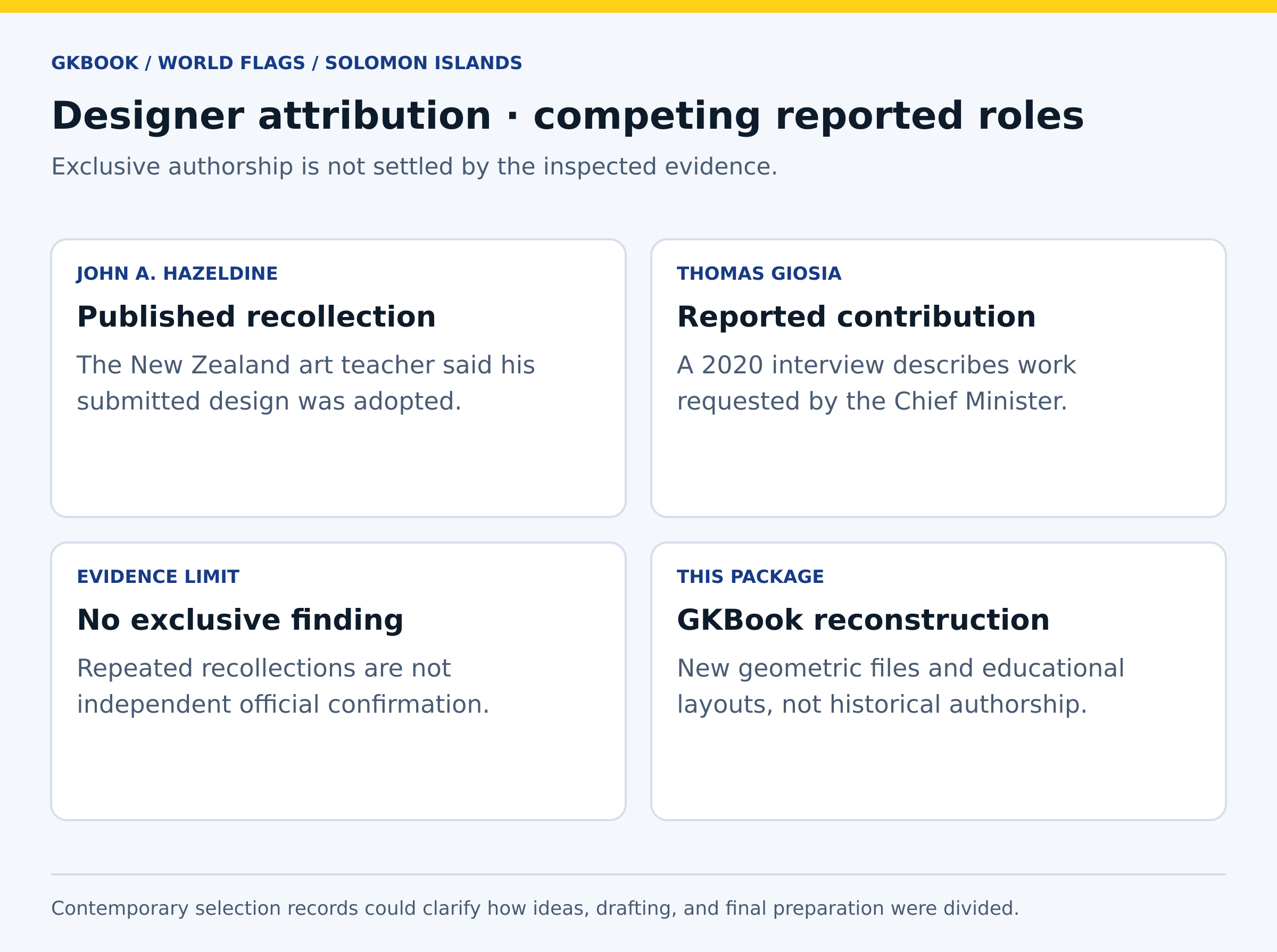
Designer attribution is disputed. New Zealand art teacher John A. Hazeldine described submitting the adopted design, while Solomon Islands artist Thomas Giosia later reported his own contribution to the design process. The inspected evidence does not settle exclusive authorship. A careful account credits these reported roles and distinguishes personal recollections from a verified contemporary appointment or award.

Hazeldine’s account appears in specialist correspondence, and a later Solomon Times article repeats it. That repetition does not create independent confirmation. The newspaper’s 2020 interview with Giosia presents another recollection, including work requested by the Chief Minister. Neither account alone resolves how ideas, drafting, selection, and final preparation were divided.
This article therefore avoids labeling one person the undisputed sole designer. A contemporary signed drawing, official correspondence, or complete selection record could clarify the issue. Until such evidence is established, the modern illustrator’s role is easier to state: GKBook prepared the educational reconstruction and diagrams, not the historical national design.
Was the Solomon Islands flag introduced on Independence Day?
The current flag predates Independence Day. Its conventional adoption date is November 18, 1977, while Solomon Islands became independent on July 7, 1978. The Independence Order identifies July 7 as the appointed day. Using the already selected flag at independence does not mean that the design was first adopted on that same date.
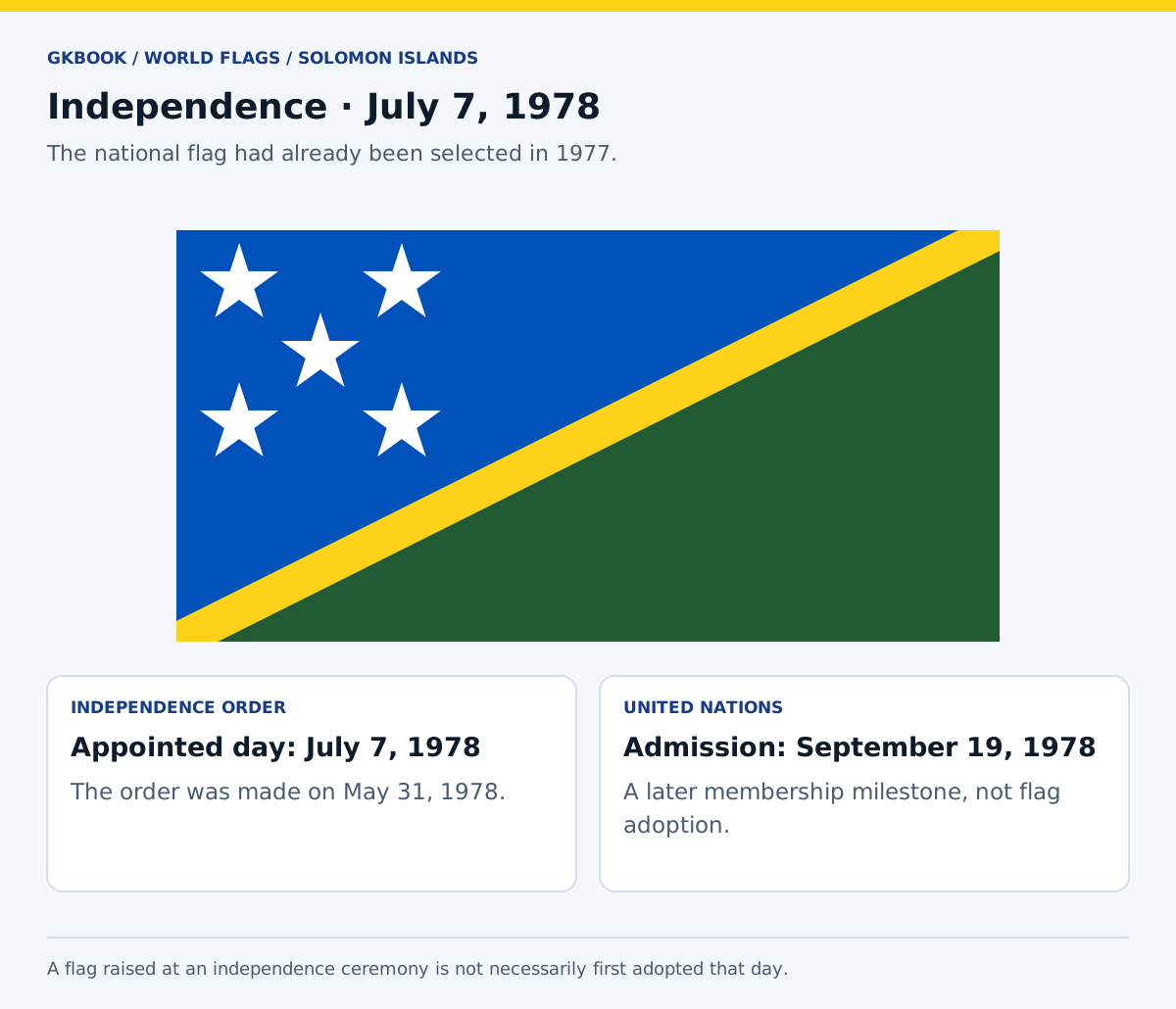
The parliamentary copy of the Independence Order distinguishes its making on May 31, 1978 from its main commencement on July 7. These are legal milestones in the establishment of the independent constitutional system. They should not be repurposed as dates for designing or standardizing the flag.
Annual independence celebrations can renew a symbol’s importance without changing its origin. A caption saying that the flag was raised during an independence ceremony describes its use on that occasion. It does not, by itself, establish that no earlier official flag existed or that the ceremony was the first raising anywhere.
When did Solomon Islands join the United Nations?
Solomon Islands joined the United Nations on September 19, 1978, under General Assembly resolution 33/1. This came after independence in July and after the flag’s adoption in 1977. UN admission is an institutional membership date, not the flag’s adoption date or a single date on which every other country necessarily recognized the state.
The United Nations Treaty Series records the government’s declaration accepting Charter obligations and notes the later admission in a footnote. The declaration was dated July 24, 1978; that document date is separate from the September membership decision. Reading both prevents another easy timeline error.
International recognition, membership, and diplomatic relations are related but distinct concepts. A flag may represent a state before it joins a particular organization. Keep the event label attached to the date in study notes: flag adoption, independence, Charter declaration, or UN admission. That approach is more precise than a single undifferentiated recognition timeline.
What flag was used before the present Solomon Islands flag?
Before the current design, the protectorate used British-derived flags, including a Blue Ensign with a Union Jack and a local badge. The badge and its presentation changed over time. The immediately preceding flag belonged to the 1966–1977 period. These historical designs should not be confused with the modern blue-green flag or reconstructed from a generic colonial template.

A flag’s field, canton, and badge can each change independently. That is why an old illustration needs a date and a source, even when it resembles another ensign. A modern coat of arms should not be inserted into an earlier design merely because both refer to the same territory.
The historical card in this package uses a labeled timeline instead of newly drawn colonial flags. This keeps the period distinctions clear without supplying speculative artwork. A teacher can explain the transition from an imperial ensign format to the current diagonal composition while reserving detailed badge comparisons for verified historical images.
Does the Solomon Islands national flag contain the coat of arms?
No. The standard national flag contains colored fields, a yellow diagonal, and five white stars, without the coat of arms or a motto. The country’s armorial bearings are a separate national symbol. Adding a shield, supporters, lettering, or a government seal to the clean flag would produce a different graphic and should not be presented as the standard design.

National symbols can appear together on a webpage, official document, or ceremonial backdrop while remaining separate designs. Their presence in the same setting does not authorize merging them into one flag. The supplied clean file therefore keeps its four-color composition free from additional emblems and text.
This distinction also helps when reading historical sources. Some earlier flags carried badges, and some rejected proposals included more elaborate symbols. Those facts do not describe the present national rectangle. The educational card explains the difference through words, avoiding an unverified reconstruction of the country’s detailed coat of arms.
What does the reverse of the Solomon Islands flag look like?
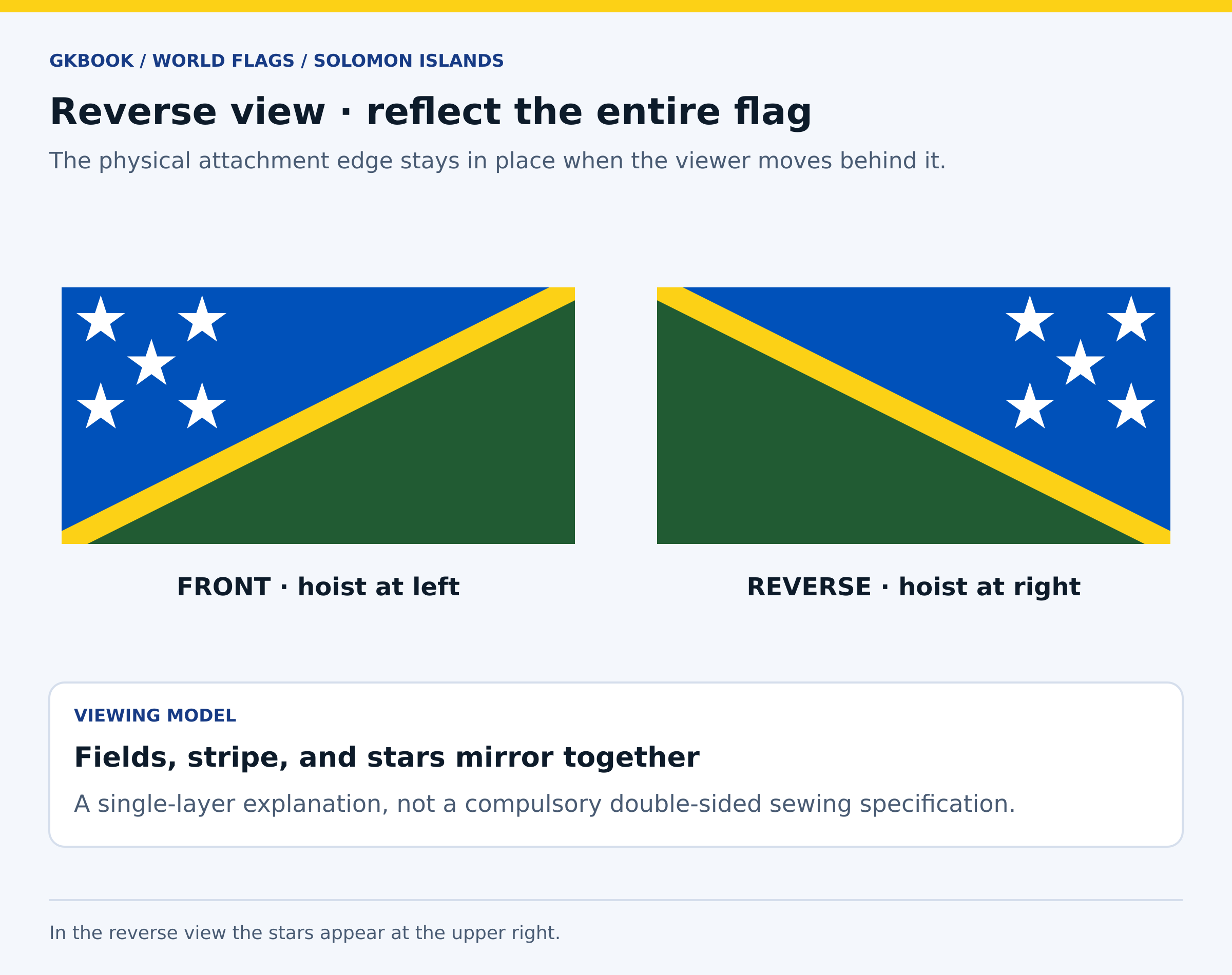
Viewed through a single layer from behind, the entire design is horizontally mirrored. The stars appear near the upper right, and the yellow stripe slopes from upper left to lower right in that view. This describes the reverse of one object, not a second national design or a compulsory specification for manufacturing a double-sided fabric flag.
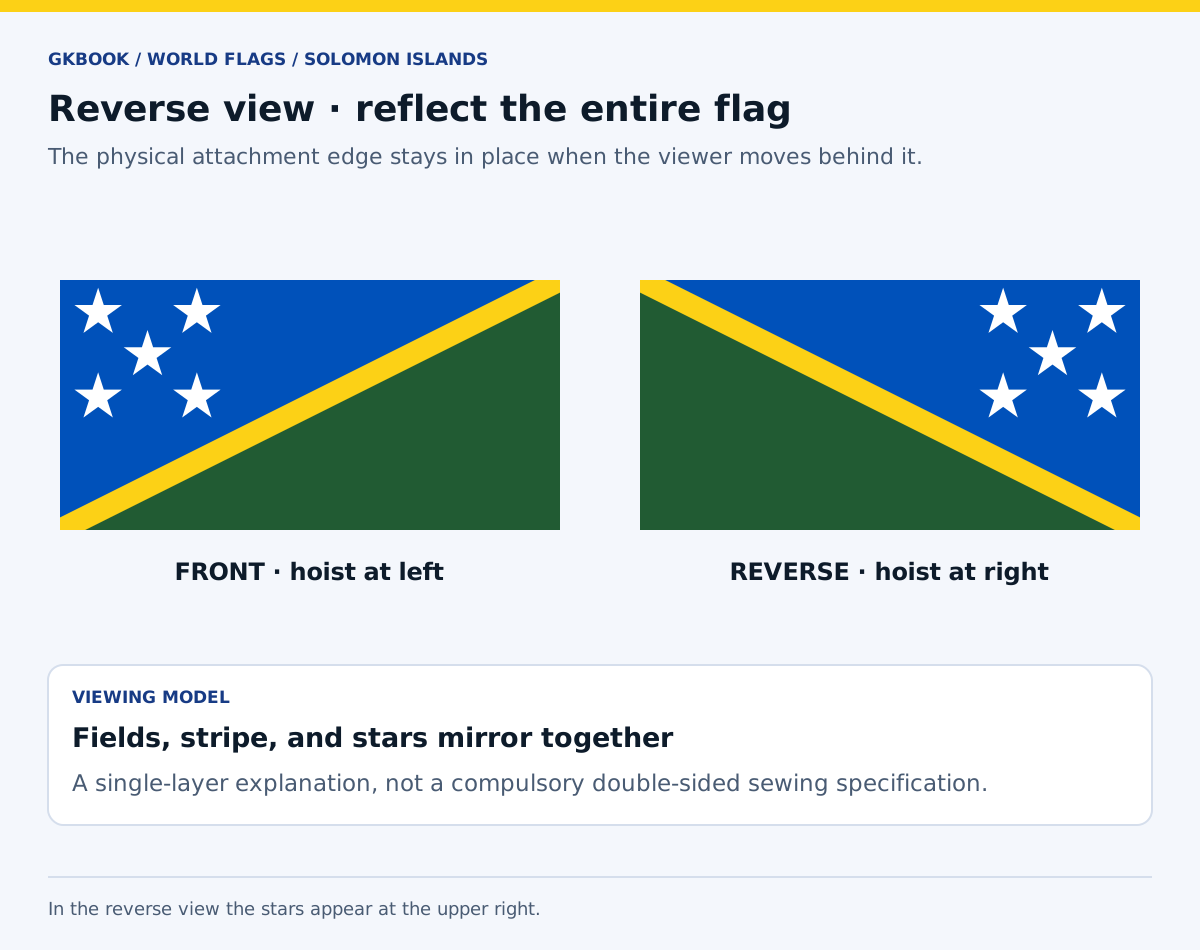
The physical hoist edge stays attached to the same pole or rope. It appears on the viewer’s right only because the observer has moved behind the flag. Reflecting the complete composition keeps the colored fields, band, and star group consistent with that change of viewpoint.
An upside-down front view is different from a reverse view. Rotation changes which edge is at the top; reflection changes the left-right relationship. The supplied comparison demonstrates a horizontal mirror only. It does not prescribe printing layers, backing material, seams, or the orientation of an independently sewn second face.
How should the Solomon Islands flag be displayed vertically?
A vertical display should follow the instructions of the responsible organizer or protocol authority. Event manuals may specify a rotation for their own setting, but that does not establish a universal national rule. This package supplies the standard horizontal master and does not invent a separate official portrait design or rearrange the stars to fit one.
Turning a complete image and redesigning its contents are different operations. A rotation keeps all relationships intact but changes their orientation to the viewer. Moving the stars independently, changing the stripe direction, or stretching the rectangle creates a modified composition that needs its own justification.
For websites and printed reference pages, preserve the horizontal 1:2 flag and scale it to the available width. A narrow screen does not require a portrait national flag. For an actual ceremony, confirm the applicable arrangement before production, especially when several national flags are being prepared for a shared display system.
When is the Solomon Islands flag flown at half-mast?
Half-mast display follows official mourning instructions for a particular occasion. Government advisories have specified both the lowering period and the return to full mast. An evergreen flag article should explain that practice without claiming a mourning order is currently active. Check the relevant announcement, including its dates and local time, for an actual observance.
A Government House advisory in April 2021 gave a specific time for returning flags to full mast after Prince Philip’s funeral. It illustrates why a general statement about mourning is not enough to determine today’s instructions. The operative dates belong to the named event.
Half-mast concerns a flag’s position on a pole, not an alteration to its design. The blue, green, yellow, and white composition remains intact. Do not remove stars, blacken a field, or crop half the rectangle as a substitute for the physical display practice when preparing a general educational illustration.
How should the Solomon Islands flag be displayed clearly?
Use the complete design, preserve the 1:2 shape, keep the stars upright in the standard horizontal view, and maintain the correct rising diagonal. For official ceremonies, follow the responsible authority’s placement instructions. The sources inspected here do not establish a complete national display code, so general presentation advice should not be mislabeled as a statutory rule.

A clear display begins with a correctly identified front view. Place captions and logos outside the national rectangle, and allow enough space that the stars remain legible. A photograph of a flag in motion may hide some shapes in folds, but a reference drawing should show the complete composition.
Multi-flag arrangements depend on the setting, available fixtures, and applicable protocol. Avoid inventing a universal precedence rule from one photograph. The guidance in this article concerns faithful visual presentation; it does not claim to determine every ceremonial order, maritime requirement, or government authorization that might apply to a particular event.
How can the Solomon Islands flag be reproduced respectfully?
Preserve the complete design, use a clean and legible image, and keep unrelated advertising or explanatory text outside the flag. Identify historical variants and artistic adaptations honestly. These are practical editorial principles. They do not establish blanket commercial permission, official endorsement, or a comprehensive statement of Solomon Islands law governing national-symbol use.
The distinction between a flag illustration and a themed graphic should remain clear. A background using blue, green, and yellow can support a page without being labeled a national flag. Once an image is presented as the flag itself, readers reasonably expect the correct proportions, stripe, and five stars.
Maintain attribution where a reference drawing or photograph is reused. Copyright status, ownership of a particular artwork, and national-symbol usage rules are separate questions. The credits identify this package’s reconstruction choices and reference sources, allowing editors to understand what they are receiving without an unsupported promise of unrestricted use.
How should the Solomon Islands flag be printed?
Use the scalable SVG or the 6,000 by 3,000 PNG, and scale every element together. Preserve opaque white stars and the 1:2 ratio. The files use a declared screen palette, so physical production should be checked with a material proof. Do not assume that a generic RGB-to-CMYK conversion reproduces an officially specified textile color.
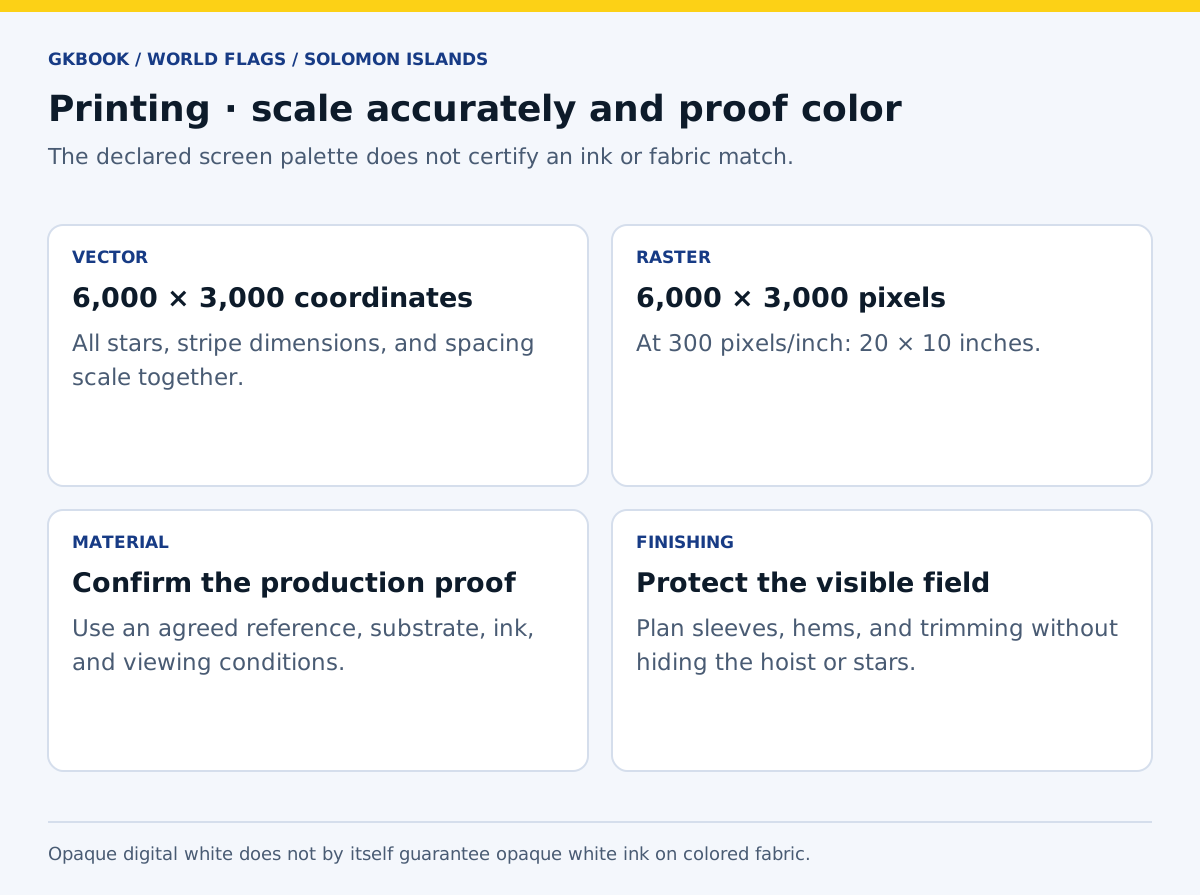
At 300 pixels per inch, the PNG corresponds to a print 20 inches long and 10 inches high. This is a resolution calculation, not a mandatory national size. The SVG allows larger output while retaining vector edges, provided the production software interprets the file correctly.
Plan hems, sleeves, and trimming outside the intended visible design. A seam that hides part of the hoist can shift the apparent star placement or shorten the rectangle. Printing on colored material also requires an appropriate white process: opaque white in a digital file does not itself guarantee opaque white ink on fabric.
How should the Solomon Islands flag be used on websites?
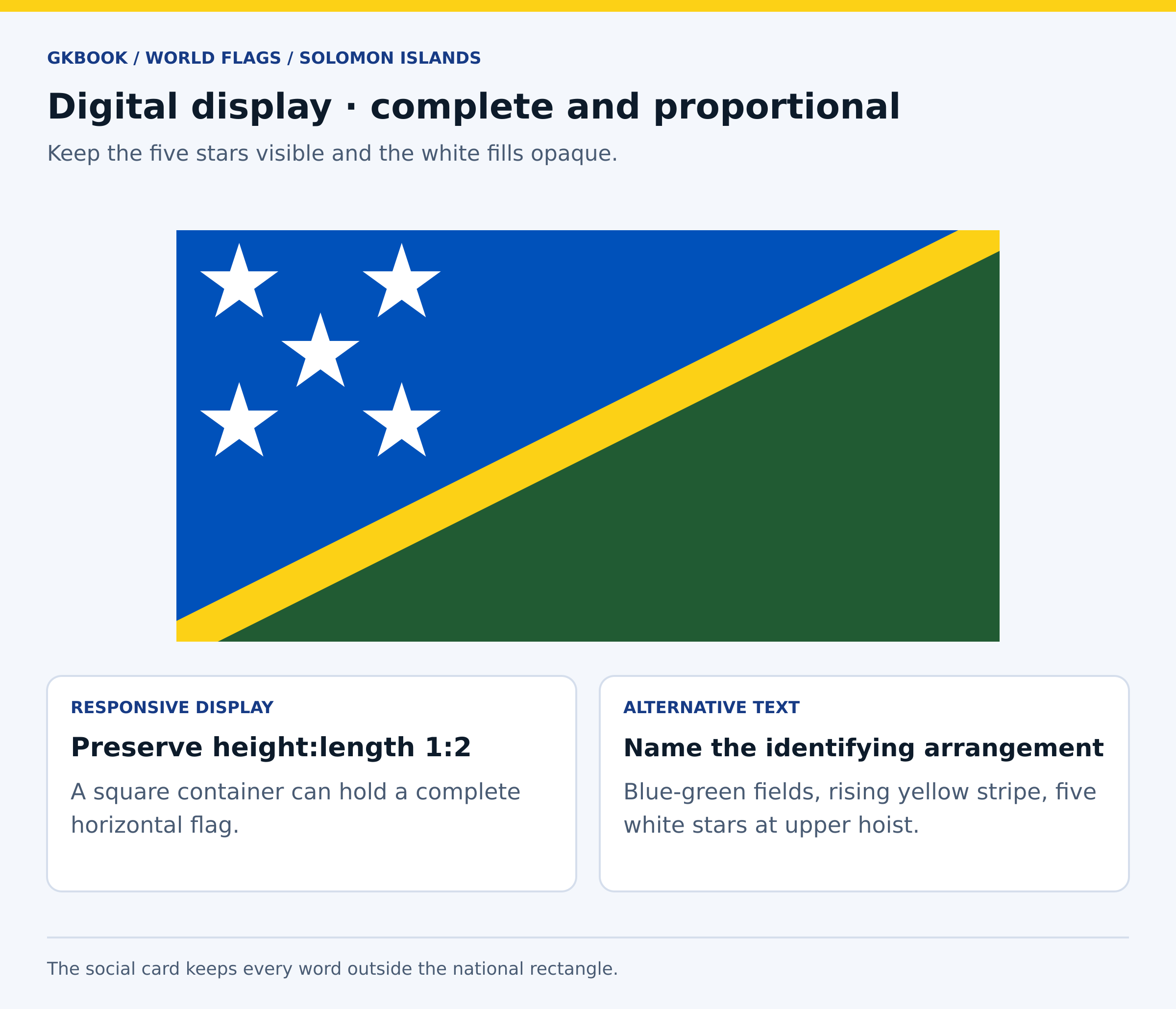
Show the entire 1:2 rectangle with proportional scaling, opaque white stars, and sufficient size to distinguish all five symbols. SVG suits scalable display, while PNG provides a fixed raster alternative. Useful alternative text names Solomon Islands and describes the blue-green fields, rising yellow diagonal, and five white stars near the upper hoist.

Avoid cropping the flag into a square badge when the purpose is to teach its design. A square container can hold the complete rectangle with space above and below it. Stretching the image to fill the square changes both the national proportions and the star geometry.
Surrounding interface text needs its own contrast treatment. This page uses readable text colors and a dark overlay on the blue-green banner while leaving the national artwork unchanged. The social card likewise has a separate presentation canvas: its title and descriptive wording sit outside a complete correctly proportioned flag.
Which Solomon Islands flag pictures are included?
The package includes 24 subjects in SVG and PNG, covering the clean flag, colors, symbolism, star arrangement, construction, history, and practical reproduction. Both main flag files are 6,000 by 3,000. A separate 1,200 by 630 social-image pair places a complete flag within a presentation layout, without adding lettering inside the national rectangle.
Choose the clean flag for a national illustration and the labeled diagrams for a lesson about a specific feature. Historical and authorship cards explain evidence and uncertainty through text. They do not fabricate rejected proposals, undocumented colonial badges, or a resolved exclusive designer credit.
The credits state the geometric convention, screen palette, source comparison, and limitations. Editors can therefore distinguish a careful educational reconstruction from a government manufacturing specification. All repeated complete flags use the same geometry, and the reverse card explicitly identifies its mirrored view so it cannot be mistaken for the standard front.
Download Solomon Islands flag pictures
Download the clean national flag as SVG or 6,000 × 3,000 PNG. Both use a 6,000 × 3,000 canvas with blue and green fields, a rising yellow diagonal, and five equal upright white stars. Detailed geometry follows a disclosed specialist convention, with a separate vector comparison and one declared screen palette. The files are educational reconstructions, not certified government manufacturing masters.
The gallery contains 24 subjects, each with an SVG and PNG. The captions distinguish published specifications, attributed meanings, historical events, and digital reproduction choices. Image credits and reproduction notes explain the source basis. The separate 1,200 × 630 social card contains a complete flag and does not alter the national rectangle.
Continue exploring national designs in World Flags.
World Flags/Solomon Islands
Solomon Islands flag pictures
The 1:2 national design with a documented geometric convention and screen palette.
Solomon Islands national symbol; GKBook geometric reconstruction. Construction convention: Vexilla Mundi; screen palette: Wikimedia Commons reference.Download SVGDownload PNGPublished reference palettes differ; this package consistently uses one documented screen choice.
Solomon Islands national symbol; GKBook geometric reconstruction. Construction convention: Vexilla Mundi; screen palette: Wikimedia Commons reference.Download SVGDownload PNGLandscape symbolism is well documented; the history of the star explanation needs qualification.
Solomon Islands national symbol; GKBook geometric reconstruction. Construction convention: Vexilla Mundi; screen palette: Wikimedia Commons reference.Download SVGDownload PNGThe blue field is part of the diagonal composition, not a separate rectangular canton.
Solomon Islands national symbol; GKBook geometric reconstruction. Construction convention: Vexilla Mundi; screen palette: Wikimedia Commons reference.Download SVGDownload PNGA shade difference between references does not by itself establish a redesign.
Solomon Islands national symbol; GKBook geometric reconstruction. Construction convention: Vexilla Mundi; screen palette: Wikimedia Commons reference.Download SVGDownload PNGThe diagonal is not 45 degrees; its slope follows the national rectangle.
Solomon Islands national symbol; GKBook geometric reconstruction. Construction convention: Vexilla Mundi; screen palette: Wikimedia Commons reference.Download SVGDownload PNGThe inspected evidence does not establish a compulsory separate meaning for white.
Solomon Islands national symbol; GKBook geometric reconstruction. Construction convention: Vexilla Mundi; screen palette: Wikimedia Commons reference.Download SVGDownload PNGEnlarged teaching diagram of the star group; it is not a complete flag or a construction master.
Solomon Islands national symbol; GKBook geometric reconstruction. Construction convention: Vexilla Mundi; screen palette: Wikimedia Commons reference.Download SVGDownload PNGThe enlarged blue detail panel explains local symmetry; guides are absent from the clean flag.
Solomon Islands national symbol; GKBook geometric reconstruction. Construction convention: Vexilla Mundi; screen palette: Wikimedia Commons reference.Download SVGDownload PNGThe island-group interpretation is documented without erasing competing accounts.
Solomon Islands national symbol; GKBook geometric reconstruction. Construction convention: Vexilla Mundi; screen palette: Wikimedia Commons reference.Download SVGDownload PNGThe Solomon Islands stars should not automatically be interpreted as the Southern Cross.
Solomon Islands national symbol; GKBook geometric reconstruction. Construction convention: Vexilla Mundi; screen palette: Wikimedia Commons reference.Download SVGDownload PNGHeight:length 1:2 is equivalent to length:height 2:1.
Solomon Islands national symbol; GKBook geometric reconstruction. Construction convention: Vexilla Mundi; screen palette: Wikimedia Commons reference.Download SVGDownload PNGThe stripe follows the rectangle’s corner-to-corner diagonal; edge intersections are clipped to the field.
Solomon Islands national symbol; GKBook geometric reconstruction. Construction convention: Vexilla Mundi; screen palette: Wikimedia Commons reference.Download SVGDownload PNGVexilla Mundi geometry is checked against a separate Commons vector; exact star geometry removes small rounding differences.
Solomon Islands national symbol; GKBook geometric reconstruction. Construction convention: Vexilla Mundi; screen palette: Wikimedia Commons reference.Download SVGDownload PNGFlag adoption and independence are distinct; the approval-date discrepancy is retained.
Solomon Islands national symbol; GKBook geometric reconstruction. Construction convention: Vexilla Mundi; screen palette: Wikimedia Commons reference.Download SVGDownload PNGThe article uses the conventional adoption date while explaining the unresolved approval chronology.
Solomon Islands national symbol; GKBook geometric reconstruction. Construction convention: Vexilla Mundi; screen palette: Wikimedia Commons reference.Download SVGDownload PNGThe article identifies the accounts without naming an undisputed sole designer.
Solomon Islands national symbol; GKBook geometric reconstruction. Construction convention: Vexilla Mundi; screen palette: Wikimedia Commons reference.Download SVGDownload PNGThe dates identify separate legal and international events.
Solomon Islands national symbol; GKBook geometric reconstruction. Construction convention: Vexilla Mundi; screen palette: Wikimedia Commons reference.Download SVGDownload PNGThis historical summary does not supply speculative colonial artwork.
Solomon Islands national symbol; GKBook geometric reconstruction. Construction convention: Vexilla Mundi; screen palette: Wikimedia Commons reference.Download SVGDownload PNGThe clean flag preserves the standard composition without additional emblems.
Solomon Islands national symbol; GKBook geometric reconstruction. Construction convention: Vexilla Mundi; screen palette: Wikimedia Commons reference.Download SVGDownload PNGThe reverse is a horizontal reflection, not an upside-down flag.
Solomon Islands national symbol; GKBook geometric reconstruction. Construction convention: Vexilla Mundi; screen palette: Wikimedia Commons reference.Download SVGDownload PNGThe article does not invent a universal precedence rule or current mourning declaration.
Solomon Islands national symbol; GKBook geometric reconstruction. Construction convention: Vexilla Mundi; screen palette: Wikimedia Commons reference.Download SVGDownload PNGPrint dimensions are a resolution example, not a compulsory physical flag size.
Solomon Islands national symbol; GKBook geometric reconstruction. Construction convention: Vexilla Mundi; screen palette: Wikimedia Commons reference.Download SVGDownload PNGUseful descriptions combine color, count, and position.
Solomon Islands national symbol; GKBook geometric reconstruction. Construction convention: Vexilla Mundi; screen palette: Wikimedia Commons reference.Download SVGDownload PNGFrequently asked questions
What does the Solomon Islands flag look like?
The Solomon Islands flag has a blue upper hoist area and a green lower fly area separated by a yellow diagonal stripe rising from bottom left to top right. Five white five-pointed stars occupy the blue area in a two-one-two arrangement. The national rectangle has a height:length ratio of 1:2.
What are the colors of the Solomon Islands flag?
The flag uses blue, green, yellow, and white. This package uses the documented screen values #0051BA, #215B33, #FCD116, and #FFFFFF, respectively, matching the inspected Wikimedia Commons vector. These values are reproduction conventions. The research did not establish a government-issued hexadecimal standard or an exact universal conversion to printing inks.
What does the Solomon Islands flag symbolize?
The widely documented interpretation associates blue with the ocean, green with the land, and yellow with sunshine. The white stars express the country’s island groupings, although historical accounts differ over their relationship to administrative divisions. The design brings sea, land, sunlight, and a group of islands into one national composition.
What does blue represent on the Solomon Islands flag?
Blue represents the surrounding sea in the standard explanation, with sky also appearing in some historical accounts. It occupies the upper hoist side of the diagonal division and provides the background for all five white stars. Blue is a field color here, not a separate rectangular canton added over another background.
What does green represent on the Solomon Islands flag?
Green represents the land and its vegetation. It fills the lower fly side of the flag, opposite the blue upper hoist region. The yellow diagonal separates the two fields. This package uses a dark green screen convention; a brighter green found in another reference should not automatically be treated as a changed national design.
What does the yellow stripe on the Solomon Islands flag mean?
The yellow stripe represents sunshine or the sun’s rays in the standard interpretation. It runs from the lower hoist corner toward the upper fly corner, separating blue from green. Its direction matters: a stripe descending from the upper hoist would describe a different front-facing composition, even if all four colors remained correct.
Why are the stars on the Solomon Islands flag white?
White distinguishes the five stars clearly against the blue field. The inspected references identify their color and regional symbolism but do not establish one compulsory separate meaning for white itself. Explanations such as peace or purity should therefore be presented as interpretations when specifically sourced, not automatically added as official meanings.
How many stars are on the Solomon Islands flag?
There are five white stars, and each has five points. All are the same size and point upward in the standard horizontal view. Four surround a central star, producing an X-like group. Counting the stars is different from counting their points: the flag has five separate star symbols, not twenty-five stars.
How are the stars arranged on the Solomon Islands flag?
The five stars follow a two-one-two arrangement: two in the upper row, one centered below them, and two in the lower row. The cluster resembles an X or quincunx. It is not a straight row or an H-shaped constellation. Each individual star remains upright rather than turning along the cluster’s diagonals.
What do the five stars on the Solomon Islands flag represent?
A documented explanation identifies five major groupings: Malaita, Central, Eastern, Western, and the Polynesian Outliers. Sir Peter Kenilorea’s retrospective account favors these enduring groupings over a changing province count. Other accounts describe districts or provinces, so the historical disagreement should be acknowledged rather than assigning each star an unquestioned modern administrative label.
Do the five stars equal the number of present-day provinces?
No. The government’s administrative summary lists nine provinces and the city of Honiara as a separate administrative area. The national flag still has five stars. Whatever historical terminology a reference uses for the star symbolism, the design should not be read as a current province-count chart or automatically updated when administrative arrangements change.
Do the stars on the Solomon Islands flag show the Southern Cross?
The stars are generally explained through the country’s regions or island groupings, rather than as the Southern Cross constellation. John A. Hazeldine’s published recollection explicitly rejects a constellation interpretation. Their five-pointed shapes and compact X-like arrangement should not be confused with a star map simply because several Pacific flags use astronomical symbols.
What is the ratio of the Solomon Islands flag?
The flag’s height:length ratio is 1:2, so its length is twice its height. A flag 100 centimeters high is 200 centimeters long. Both supplied clean masters measure 6,000 by 3,000, preserving that proportion. The separate social card has its own canvas, with a complete correctly proportioned flag placed inside it.
Is the yellow diagonal on the Solomon Islands flag at 45 degrees?
No. On a 1:2 rectangle, the corner-to-corner diagonal rises one unit for every two units of horizontal distance. Its angle to the horizontal is about 26.565 degrees. The stripe follows that diagonal from lower hoist to upper fly. A 45-degree band would correspond to a different geometric relationship and would miss those opposite corners.
How is the Solomon Islands flag drawn accurately?
Use a 1:2 rectangle, a rising yellow diagonal, blue above the diagonal, green below it, and five equal white upright stars near the upper hoist. This package follows a documented specialist construction convention and checks it against a separate vector reference. Its detailed dimensions are disclosed without claiming government-certified manufacturing authority.
What is the history of the Solomon Islands flag?
The current flag emerged during preparations for independence, following a design competition announced in 1975 and subsequent discussion of proposals. It replaced the protectorate’s British-derived flag in 1977, before independence in July 1978. The new composition used colored fields, a diagonal stripe, and stars rather than a Union Jack with a colonial badge.
When was the Solomon Islands flag adopted?
The customary adoption date is November 18, 1977, several months before independence on July 7, 1978. That date is supported by specialist flag records and the historical encyclopedia’s image catalog. The encyclopedia’s narrative separately reports royal approval in early December 1977. The original warrant was not inspected, so this discrepancy remains explicitly documented.
Who designed the Solomon Islands flag?
Designer attribution is disputed. New Zealand art teacher John A. Hazeldine described submitting the adopted design, while Solomon Islands artist Thomas Giosia later reported his own contribution to the design process. The inspected evidence does not settle exclusive authorship. A careful account credits these reported roles and distinguishes personal recollections from a verified contemporary appointment or award.
Was the Solomon Islands flag introduced on Independence Day?
The current flag predates Independence Day. Its conventional adoption date is November 18, 1977, while Solomon Islands became independent on July 7, 1978. The Independence Order identifies July 7 as the appointed day. Using the already selected flag at independence does not mean that the design was first adopted on that same date.
When did Solomon Islands join the United Nations?
Solomon Islands joined the United Nations on September 19, 1978, under General Assembly resolution 33/1. This came after independence in July and after the flag’s adoption in 1977. UN admission is an institutional membership date, not the flag’s adoption date or a single date on which every other country necessarily recognized the state.
What flag was used before the present Solomon Islands flag?
Before the current design, the protectorate used British-derived flags, including a Blue Ensign with a Union Jack and a local badge. The badge and its presentation changed over time. The immediately preceding flag belonged to the 1966–1977 period. These historical designs should not be confused with the modern blue-green flag or reconstructed from a generic colonial template.
Does the Solomon Islands national flag contain the coat of arms?
No. The standard national flag contains colored fields, a yellow diagonal, and five white stars, without the coat of arms or a motto. The country’s armorial bearings are a separate national symbol. Adding a shield, supporters, lettering, or a government seal to the clean flag would produce a different graphic and should not be presented as the standard design.
What does the reverse of the Solomon Islands flag look like?
Viewed through a single layer from behind, the entire design is horizontally mirrored. The stars appear near the upper right, and the yellow stripe slopes from upper left to lower right in that view. This describes the reverse of one object, not a second national design or a compulsory specification for manufacturing a double-sided fabric flag.
How should the Solomon Islands flag be displayed vertically?
A vertical display should follow the instructions of the responsible organizer or protocol authority. Event manuals may specify a rotation for their own setting, but that does not establish a universal national rule. This package supplies the standard horizontal master and does not invent a separate official portrait design or rearrange the stars to fit one.
When is the Solomon Islands flag flown at half-mast?
Half-mast display follows official mourning instructions for a particular occasion. Government advisories have specified both the lowering period and the return to full mast. An evergreen flag article should explain that practice without claiming a mourning order is currently active. Check the relevant announcement, including its dates and local time, for an actual observance.
How should the Solomon Islands flag be displayed clearly?
Use the complete design, preserve the 1:2 shape, keep the stars upright in the standard horizontal view, and maintain the correct rising diagonal. For official ceremonies, follow the responsible authority’s placement instructions. The sources inspected here do not establish a complete national display code, so general presentation advice should not be mislabeled as a statutory rule.
How can the Solomon Islands flag be reproduced respectfully?
Preserve the complete design, use a clean and legible image, and keep unrelated advertising or explanatory text outside the flag. Identify historical variants and artistic adaptations honestly. These are practical editorial principles. They do not establish blanket commercial permission, official endorsement, or a comprehensive statement of Solomon Islands law governing national-symbol use.
How should the Solomon Islands flag be printed?
Use the scalable SVG or the 6,000 by 3,000 PNG, and scale every element together. Preserve opaque white stars and the 1:2 ratio. The files use a declared screen palette, so physical production should be checked with a material proof. Do not assume that a generic RGB-to-CMYK conversion reproduces an officially specified textile color.
How should the Solomon Islands flag be used on websites?
Show the entire 1:2 rectangle with proportional scaling, opaque white stars, and sufficient size to distinguish all five symbols. SVG suits scalable display, while PNG provides a fixed raster alternative. Useful alternative text names Solomon Islands and describes the blue-green fields, rising yellow diagonal, and five white stars near the upper hoist.
Which Solomon Islands flag pictures are included?
The package includes 24 subjects in SVG and PNG, covering the clean flag, colors, symbolism, star arrangement, construction, history, and practical reproduction. Both main flag files are 6,000 by 3,000. A separate 1,200 by 630 social-image pair places a complete flag within a presentation layout, without adding lettering inside the national rectangle.
Explore all general-knowledge topics and the A-to-Z lists.









We Value Your Opinion Comments