
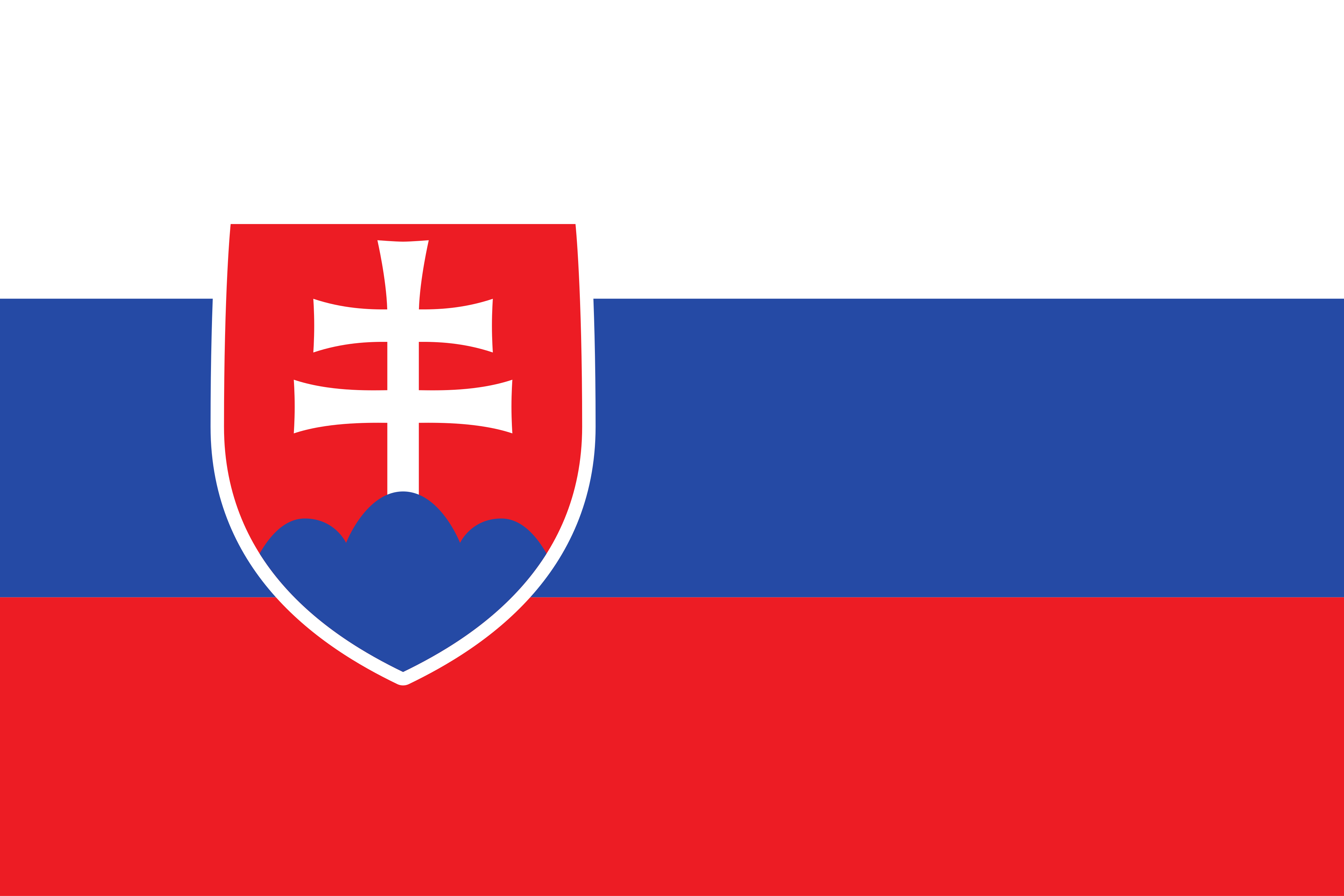
Slovakia flag picture
Explore the construction notes, history, and picture gallery.
| Design | White, blue, and red; national arms near the hoistThree equal bands and a double cross on three blue hills. |
|---|---|
| Proportions | Height:length = 2:3Shield height is one half of flag height. |
| Constitutional definition | September 1, 1992First hoisting at Bratislava Castle: September 3, 1992. |
| Independent republic | January 1, 1993UN admission followed on January 19, 1993. |
| Detailed symbols law | February 18, 1993; effective March 22Enactment and commencement are distinct dates. |
| Main image sizes | SVG 4,500 × 3,000; PNG 6,000 × 4,000Both preserve the national 2:3 proportion. |
What does the Slovakia flag look like?
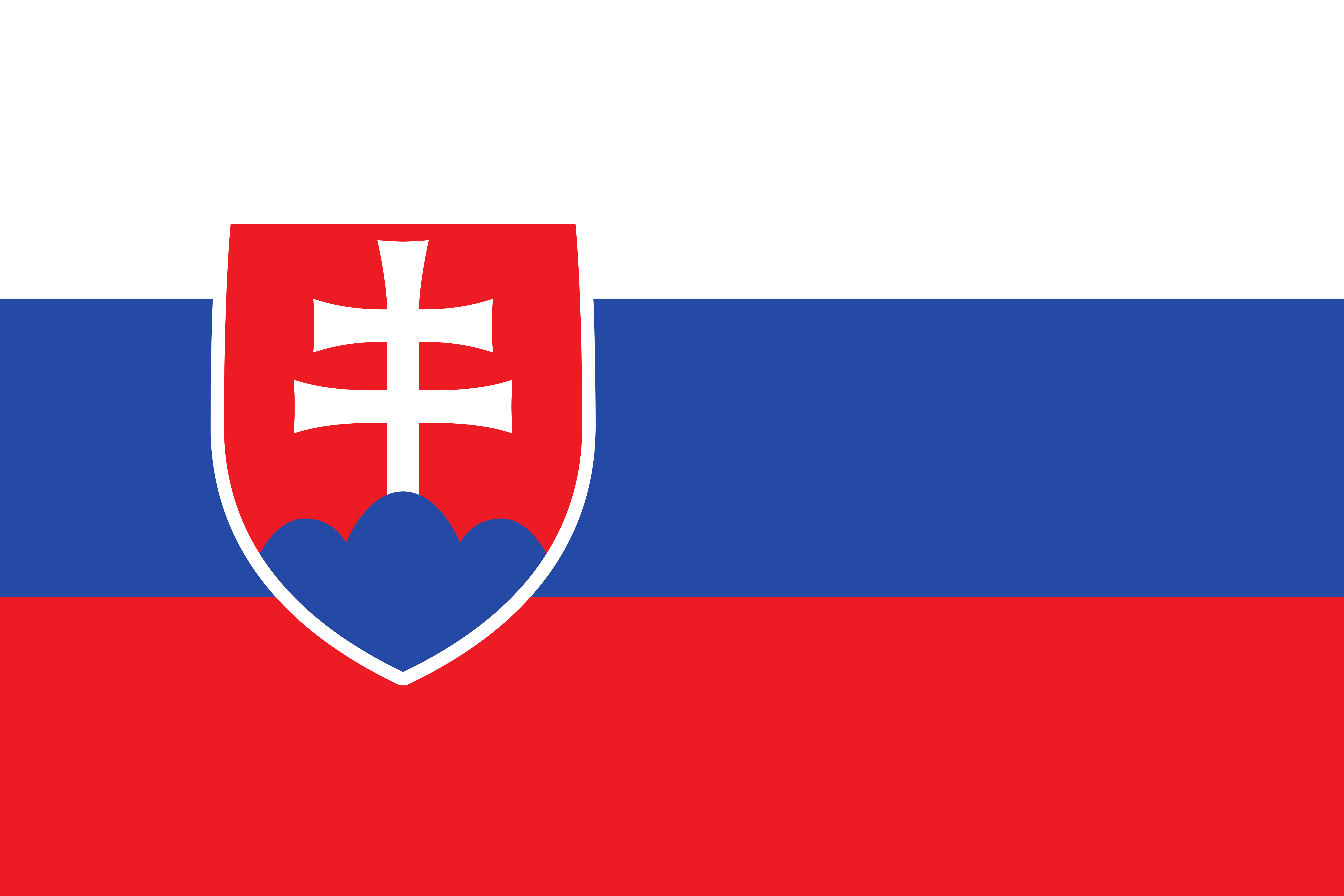
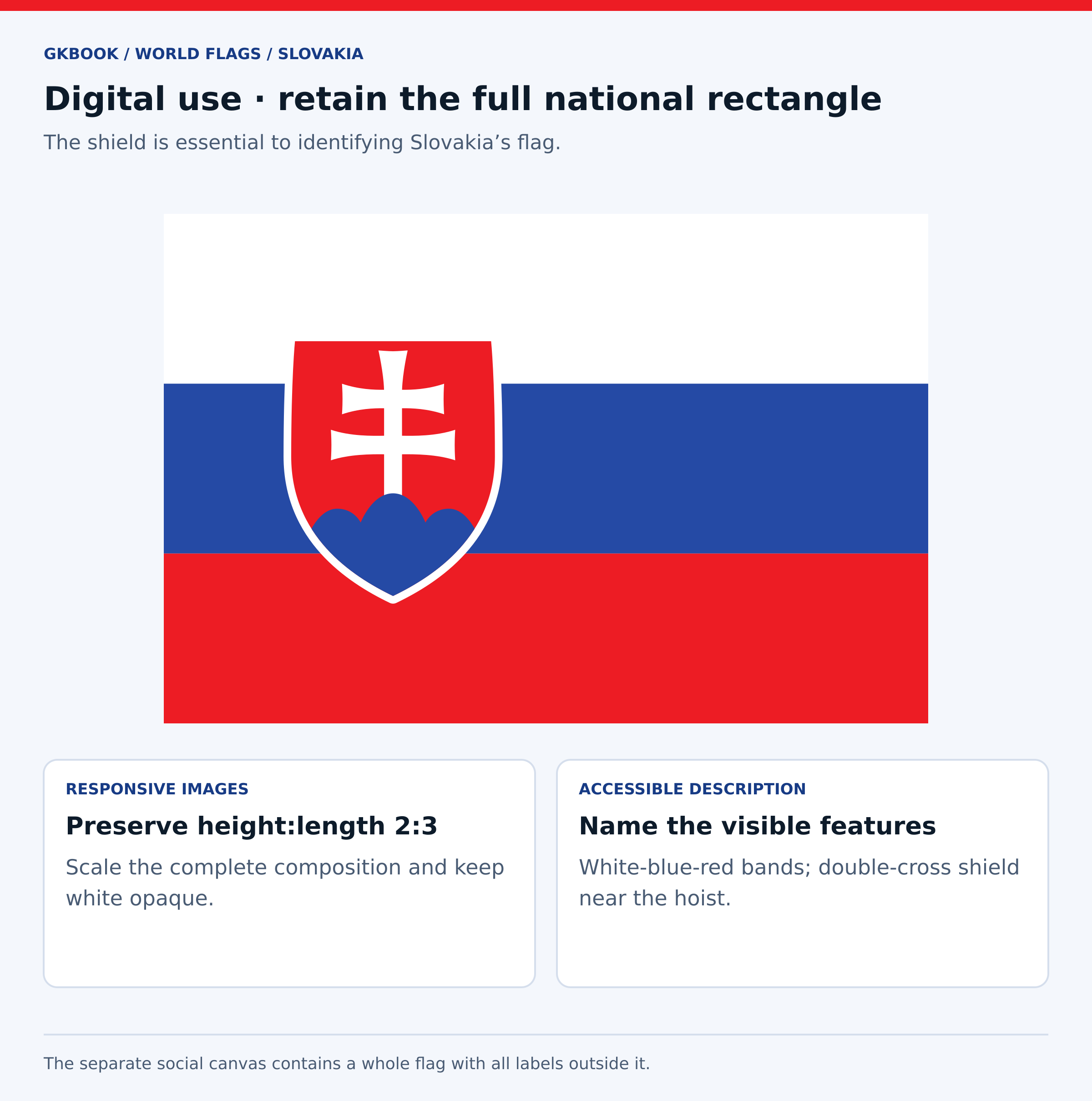
Slovakia’s flag has three equal horizontal bands of white, blue, and red, with the national coat of arms toward the hoist. The emblem contains a white double cross on three blue hills inside a red shield. The flag’s height:length ratio is 2:3, and the shield is half the flag’s height.
Read the design from top to bottom, then examine the shield near the attachment edge. The white band is uppermost, blue occupies the middle, and red forms the bottom. The shield crosses both horizontal boundaries, making the complete design distinguishable from an uncharged tricolor. A narrow white edging separates the shield from colored backgrounds. The cross has two horizontal arms, and the central hill rises above its neighbors. These details connect a modern national flag with older heraldic traditions while giving it a precise, recognizable arrangement.
What are the colors of the Slovakia flag?
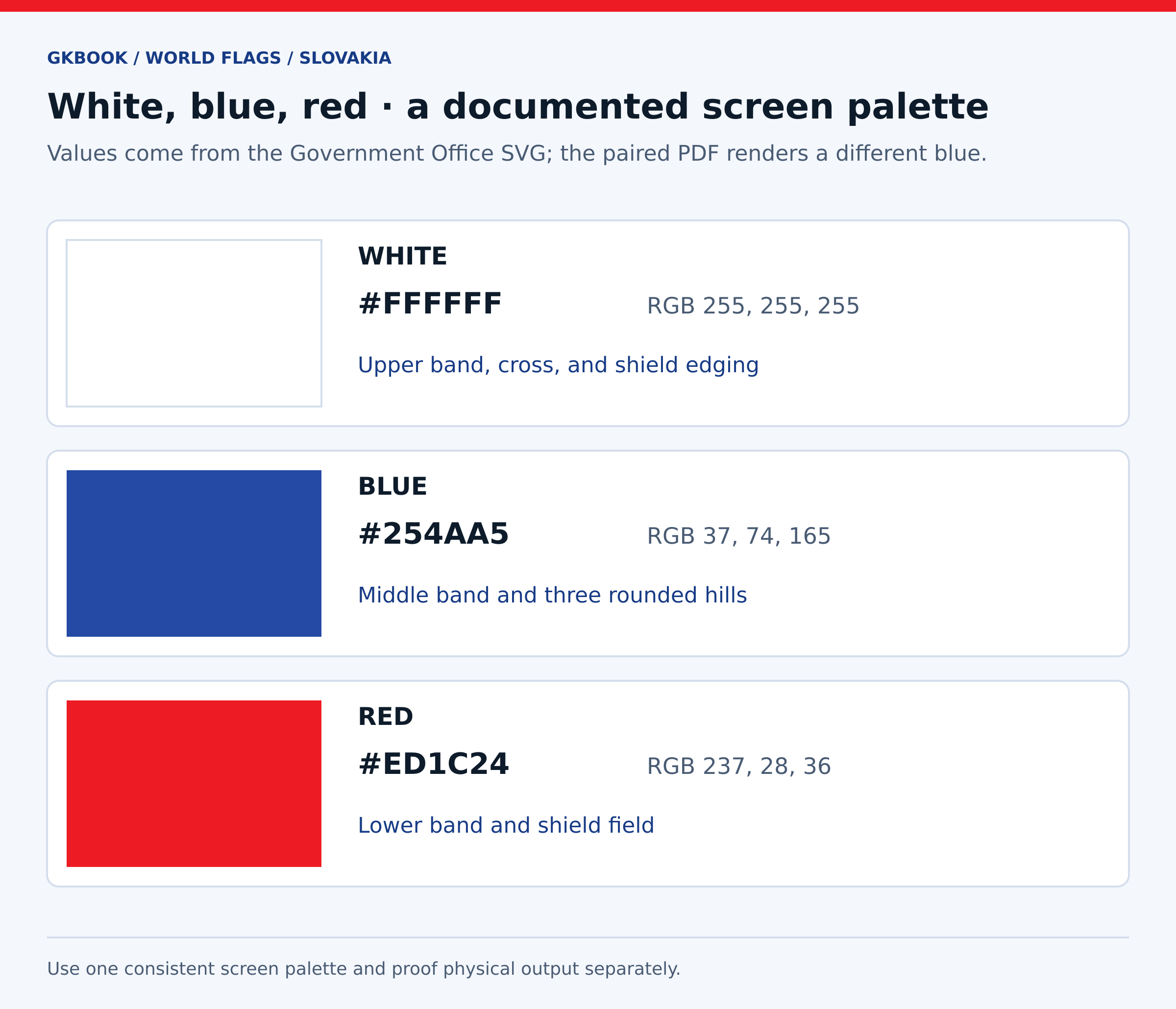
Slovakia’s flag uses white, blue, and red. This package follows the Government Office’s downloadable SVG palette: #FFFFFF, #254AA5, and #ED1C24. Those are identifiable values in an official digital illustration, rather than universal statutory hexadecimal or print specifications. The paired government PDF renders a different blue, so the source choice is disclosed.

Color names and color recipes serve different purposes. The legislation identifies the national colors; a digital file must also assign numerical values. Here the SVG provides a traceable screen recipe, including the same blue for the middle band and the three hills. White is a solid color throughout the image.
The PDF and SVG offered on the government website do not produce identical screen blues. Converting a print-oriented PDF can depend on its color space and rendering software. Keep the selected palette consistent across a project, and use a physical proof when matching fabric or ink.
| Color | Hexadecimal | RGB | Location |
|---|---|---|---|
| White | #FFFFFF | 255, 255, 255 | Top band, cross, edging |
| Blue | #254AA5 | 37, 74, 165 | Middle band and hills |
| Red | #ED1C24 | 237, 28, 36 | Bottom band and shield |
What does the Slovakia flag symbolize?
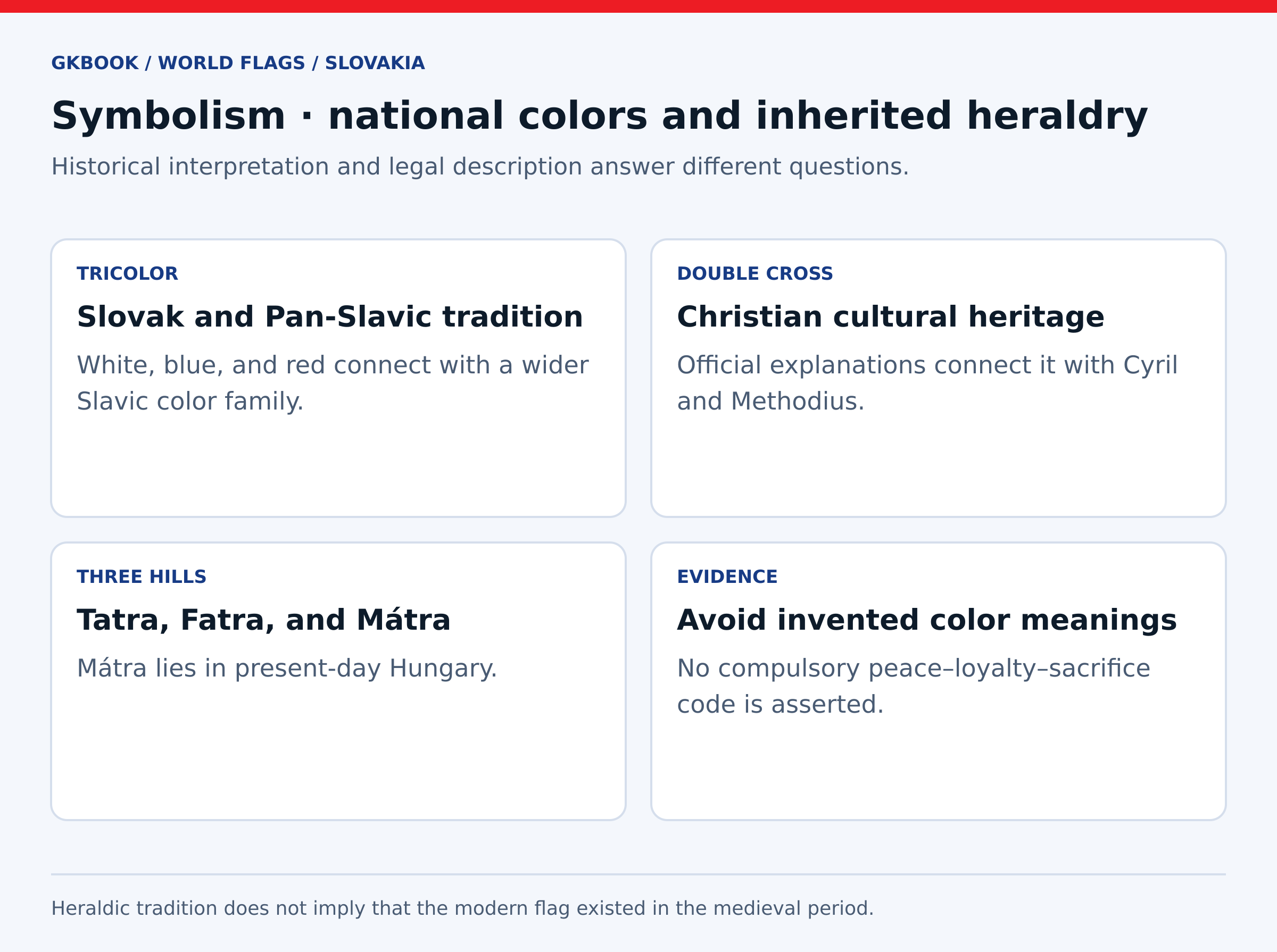
The white, blue, and red tricolor belongs to Slovakia’s national tradition and the wider Pan-Slavic color family. The double cross recalls Christian and Cyril-and-Methodius traditions. The three hills conventionally represent Tatra, Fatra, and Mátra. These historical interpretations should be distinguished from the legal description of the flag’s shapes and arrangement.
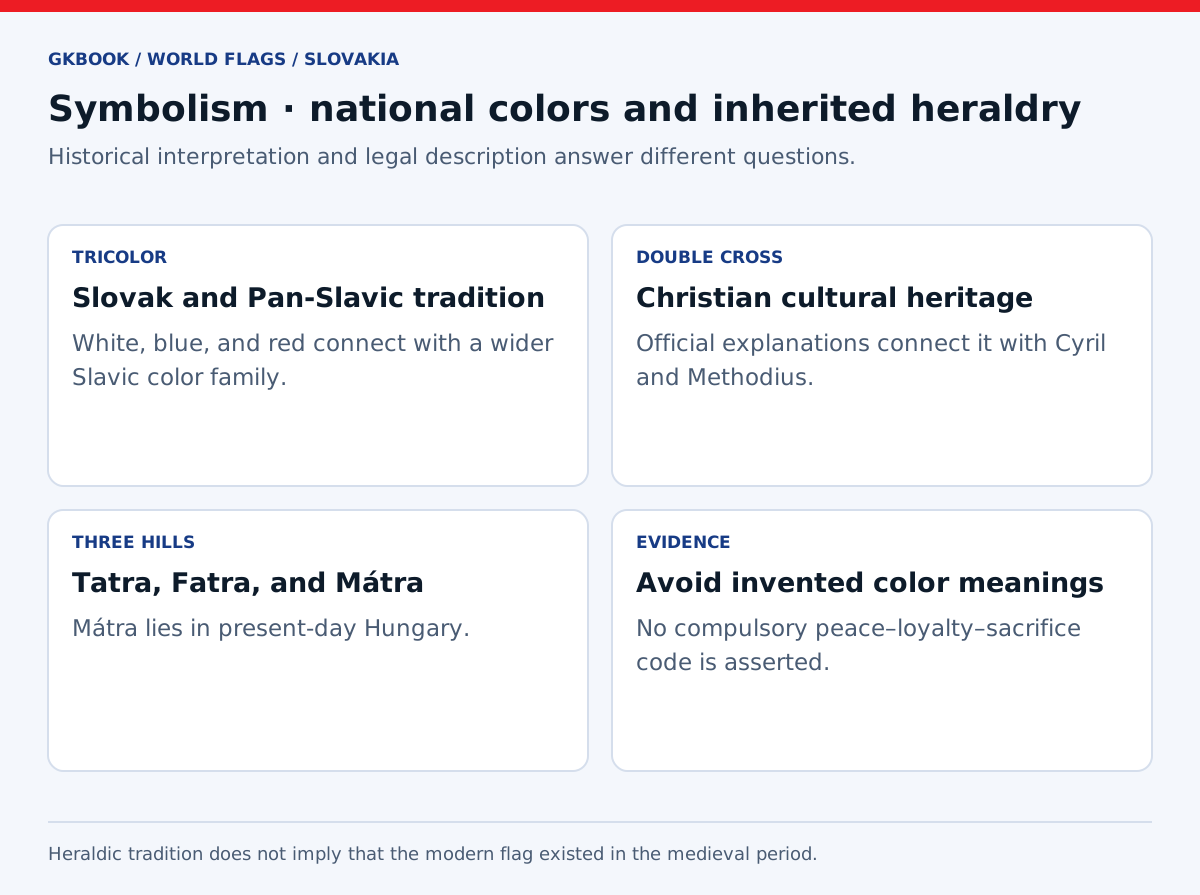
A flag can communicate several layers of identity at once. The bands connect Slovakia with a broader Slavic visual tradition, while the coat of arms supplies a specifically Slovak heraldic identity. The Government Office explains both the mountain interpretation and the cross’s association with Christian heritage.
Symbolism is strongest when attributed to a documented tradition. The sources used here do not establish an official three-part code assigning peace to white, loyalty to blue, and sacrifice to red. Such attractive formulas should not displace the historical account simply because they are easy to memorize.
What does the white color mean on Slovakia’s flag?
White is the upper band of Slovakia’s national tricolor and also appears in the double cross and the shield’s edging. The law permits white to represent heraldic silver in the coat of arms. The inspected official descriptions do not assign white a separate compulsory meaning such as peace or purity.
Heraldry uses silver as a named tincture, commonly represented by white in flat artwork. That explains why the cross can be described as silver in a legal or heraldic text yet appear white in the national flag. It does not require metallic shading or a gray substitute in an ordinary illustration.
White also has a practical visual function. Its narrow border prevents the red shield from disappearing into the red band and separates the blue hills from the blue background. On the white upper band, the same edging naturally merges with the field.
What does the blue band represent?
Blue is the middle band and one of the Pan-Slavic colors used in Slovakia’s national tradition. The coat of arms also uses blue for its three rounded hills. Official historical accounts connect the tricolor with Slavic solidarity; they do not establish a separate mandatory emotional meaning for the blue band alone.
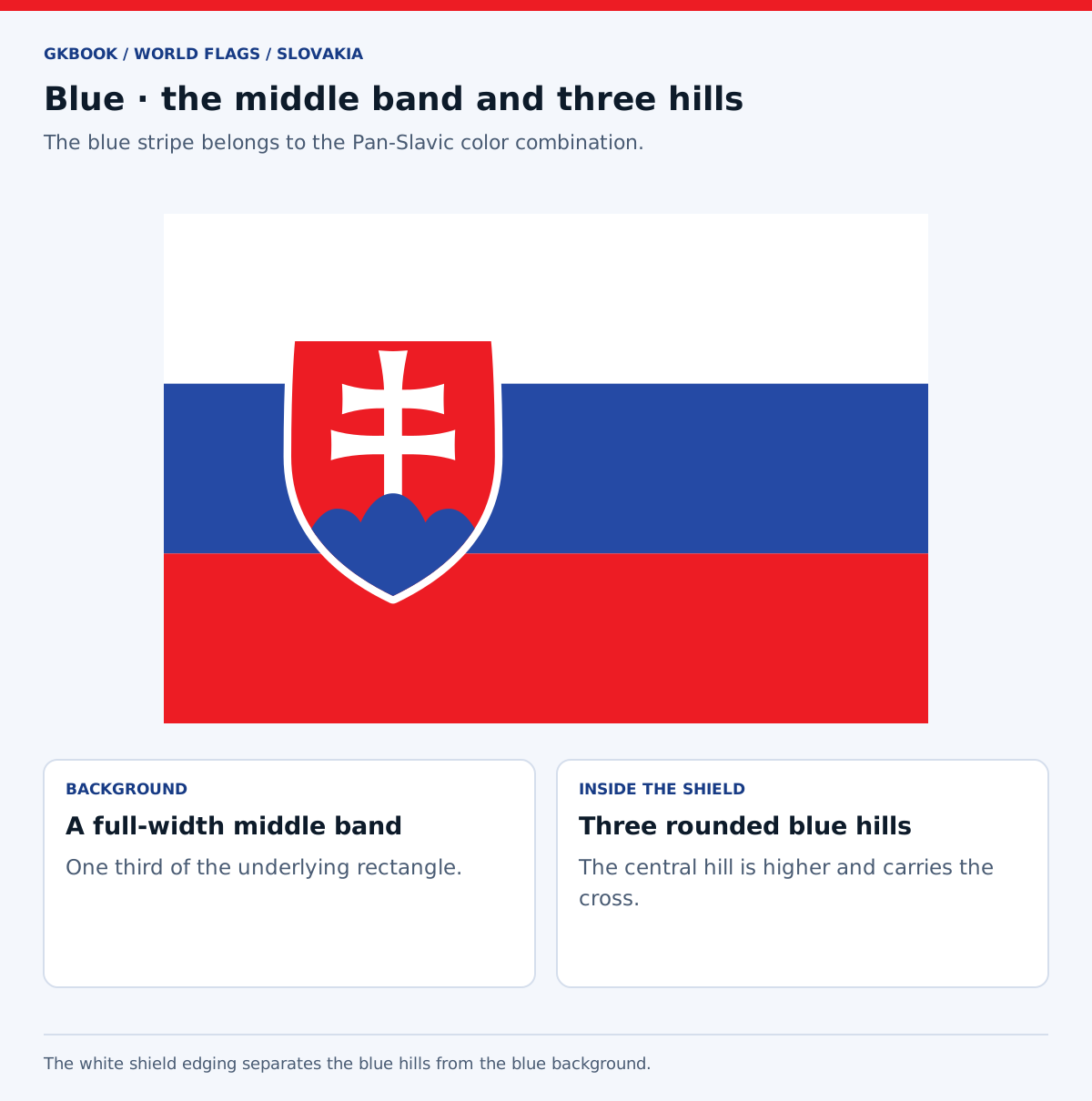
The parliamentary historical account explains that blue joined an earlier white-and-red combination during the revolutionary period of 1848–1849. It connected the Slovak colors with other Slavic peoples and helped distinguish the combination from Poland’s white and red. This historical explanation is more specific than a generic claim that blue always means freedom.
In the finished flag, blue appears in two different structural roles: a full-width background stripe and a shaped element within the arms. Both use the selected blue, but the white edging keeps the shield visually separate from the surrounding band.
Where does red appear on Slovakia’s flag?
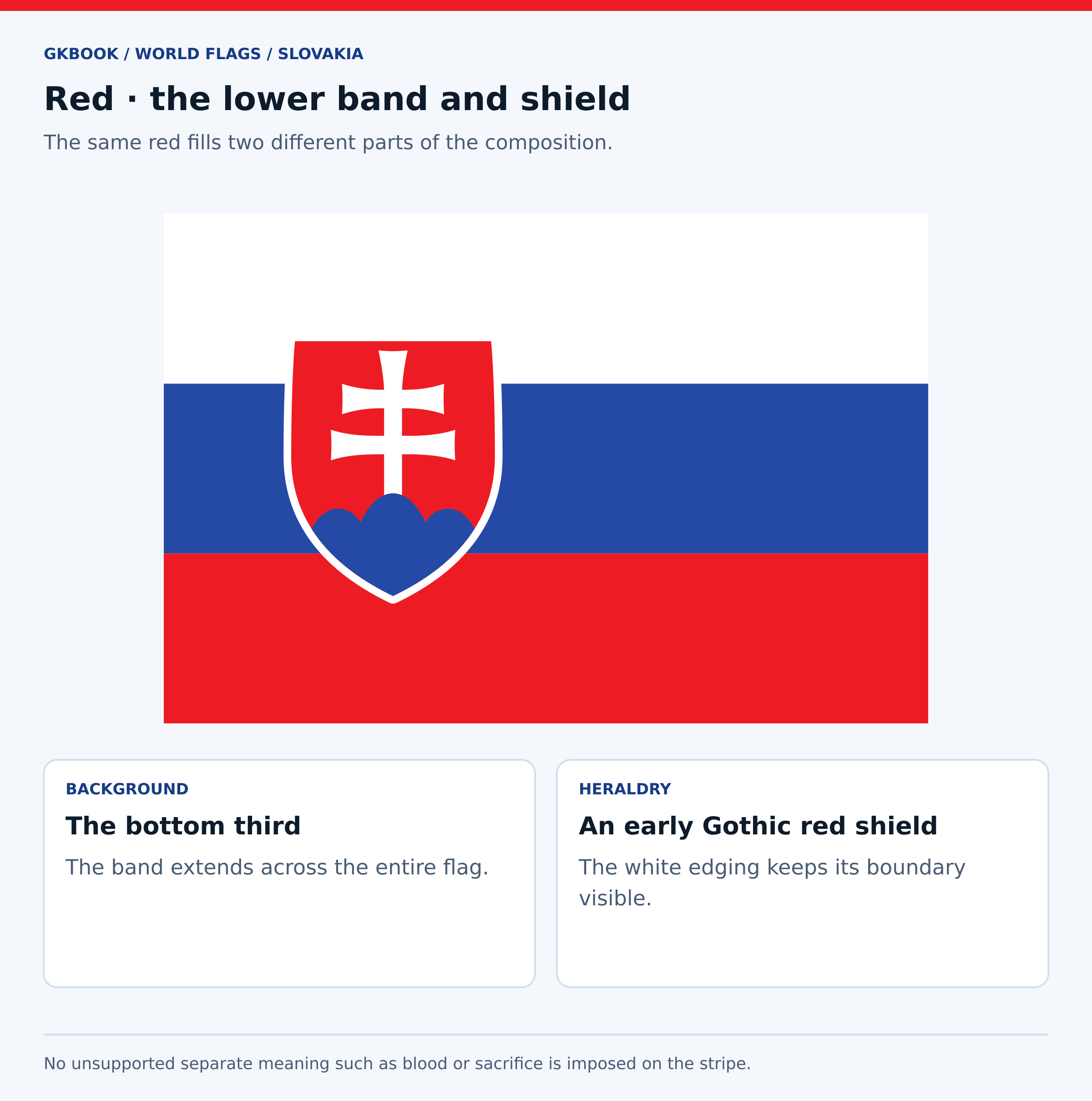
Red fills the bottom band and the shield behind the double cross. It is part of the historic Slovak and Pan-Slavic color combination. The inspected legal and government descriptions identify its use without assigning a unique compulsory meaning to the red stripe, such as courage, blood, or sacrifice.
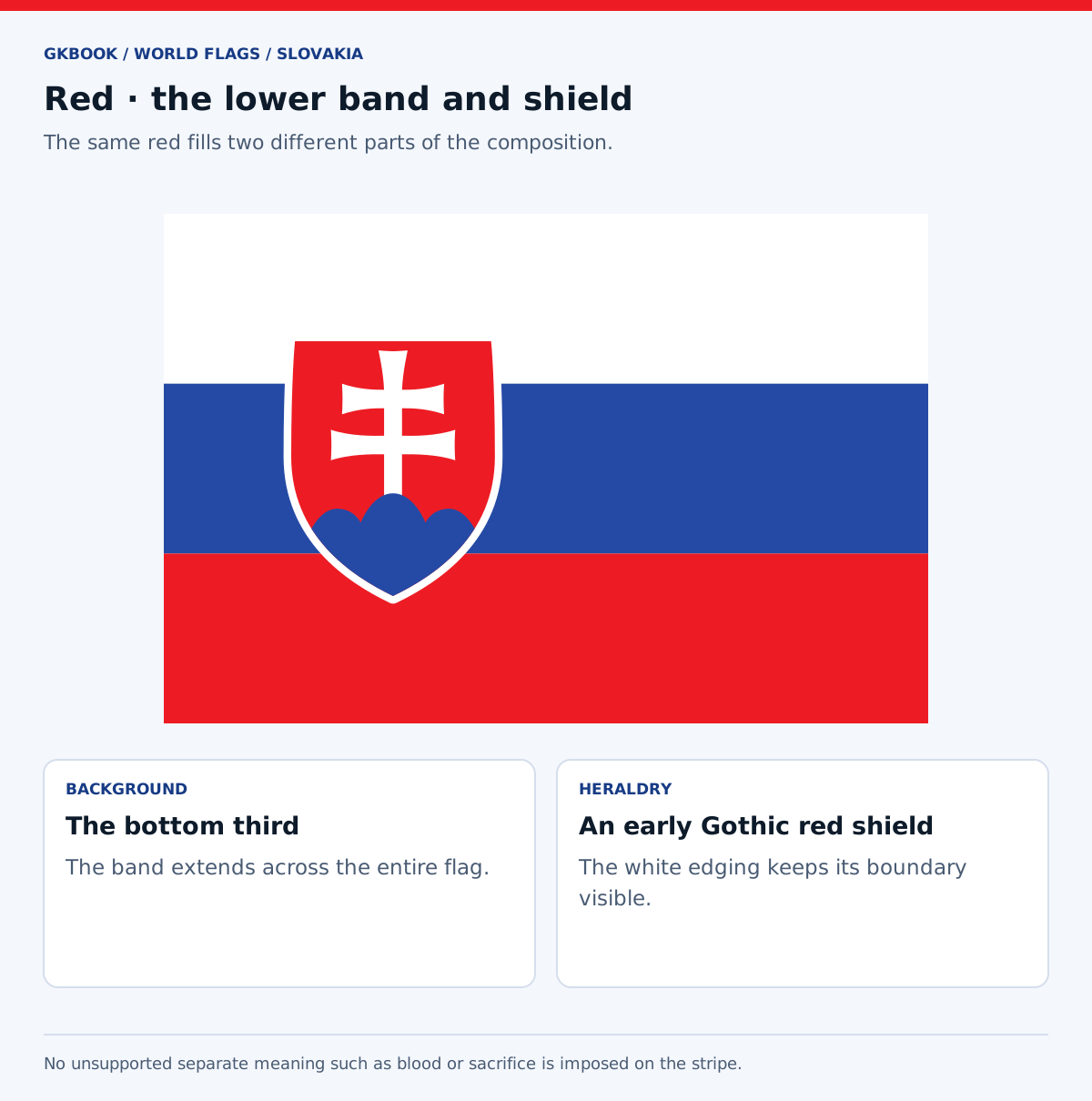
The lower stripe and shield share a color, but they are distinct pieces of the composition. The stripe spans the full rectangular field. The shield is a bounded heraldic surface that overlaps the white, blue, and red bands. Its point extends into the lower band, where the white edging preserves its outline.
A useful identification exercise is to follow that edge around the bottom of the shield. Omitting the edging would merge neighboring red areas and weaken the emblem’s silhouette. Adding a dark outline instead would introduce a contour the flag specification does not call for.
What is the emblem on the Slovakia flag?
The emblem is Slovakia’s national coat of arms: a silver or white double cross standing on the raised central peak of three blue hills, all within a red early Gothic shield. The hills are rounded, and the cross ends widen and curve inward. No crown, stars, motto, or lettering belongs on this flag.

A coat of arms is a structured heraldic design, not simply any national logo. The legal description identifies the shield, its colors, and the relationship between cross and hills. The cross rises from the middle hill; the two outer hills sit lower. These relationships remain recognizable when the whole emblem is scaled.
The government’s standalone arms download includes dark contour strokes. Its flag download omits those strokes inside the emblem. For the national flag, the latter treatment is the relevant model. Copying an arbitrary coat-of-arms icon can therefore introduce details that do not belong in the flag artwork.
What does the double cross on Slovakia’s flag mean?
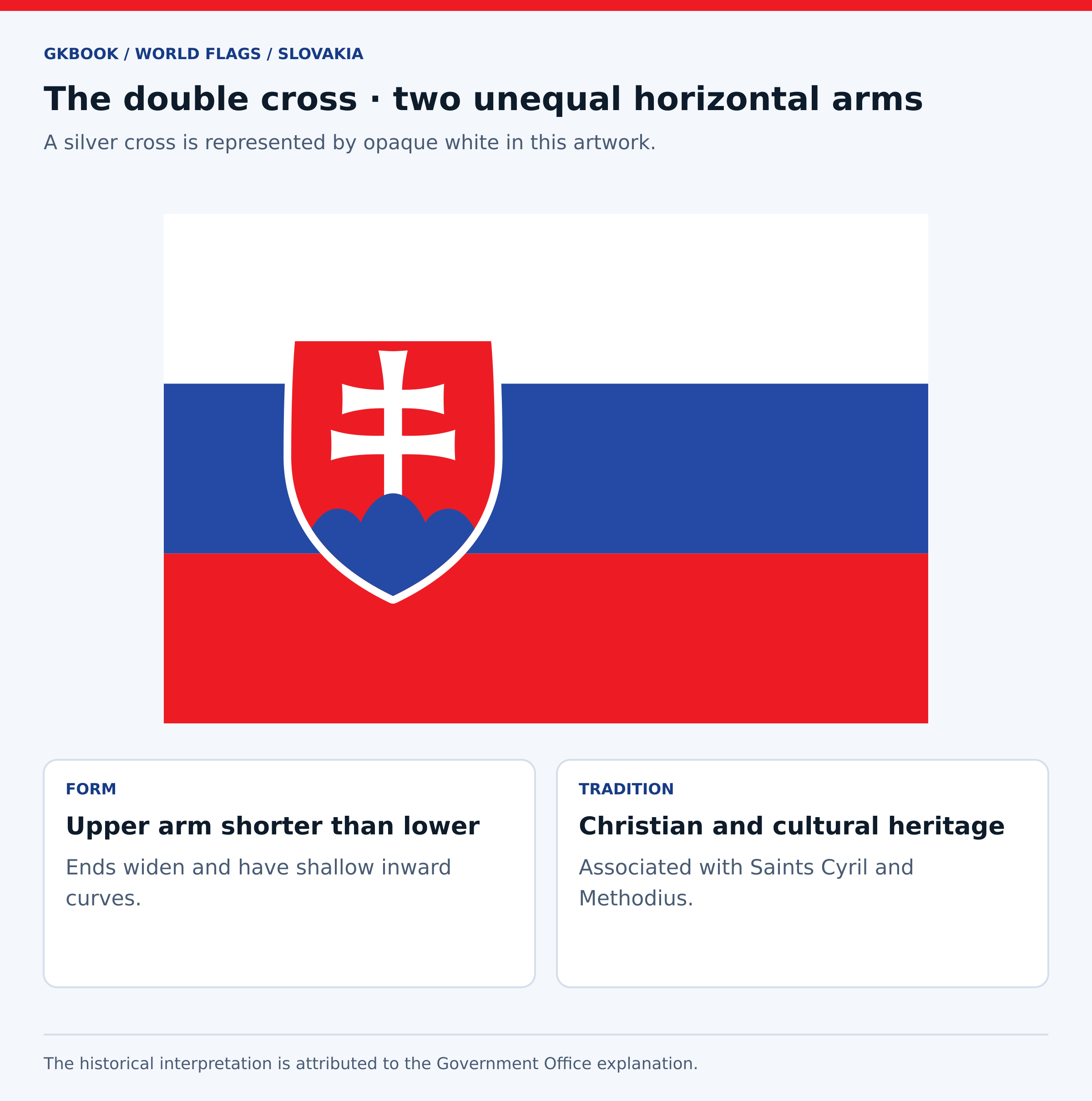
The double cross expresses a Christian heraldic tradition and is associated in official explanations with Saints Cyril and Methodius. It has one vertical stem and two horizontal arms, with the upper arm shorter than the lower one. Its broadened, indented ends are part of the specified appearance, rather than ordinary rectangular crossbars.
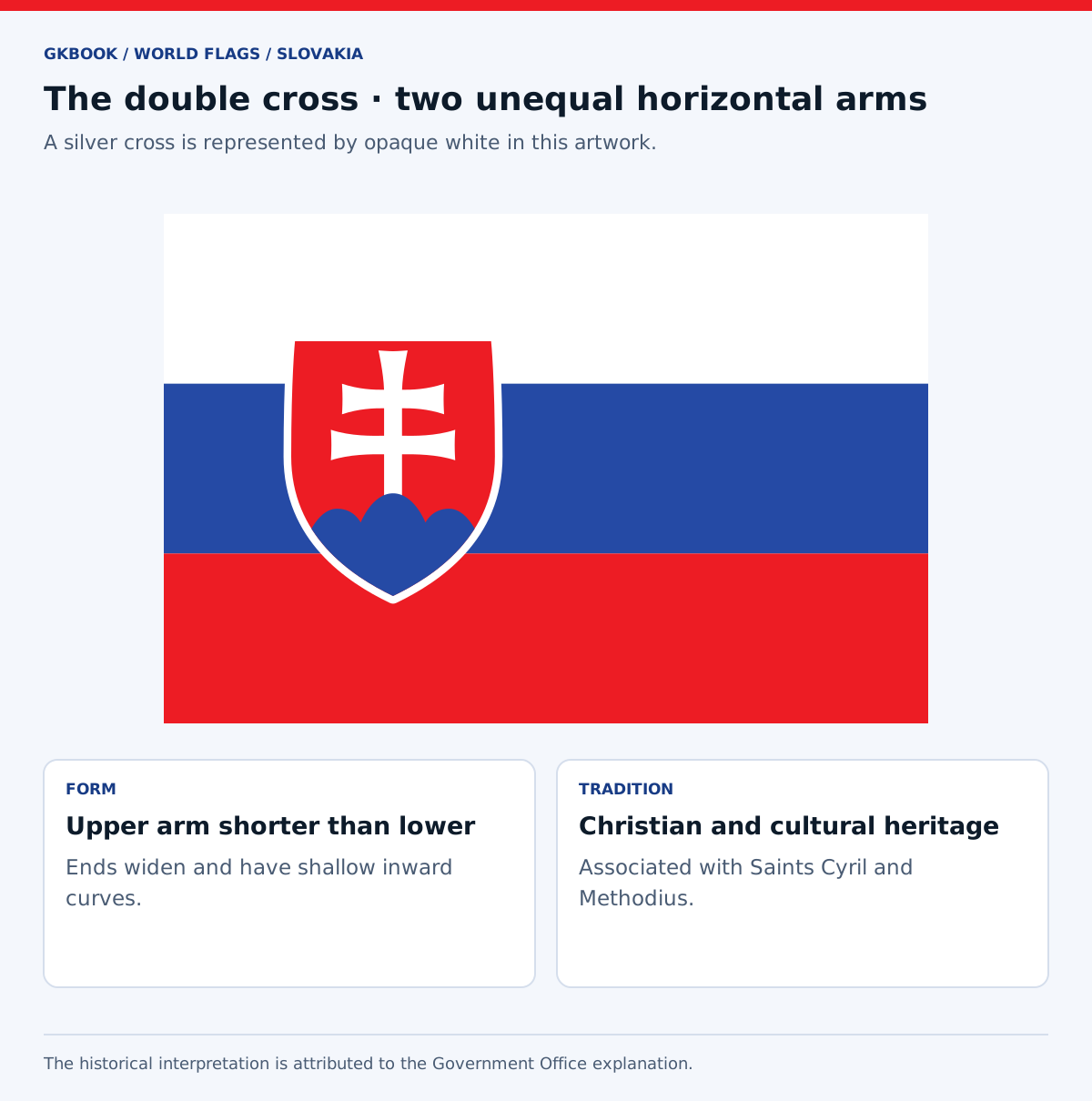
The Government Office connects the symbol with the Christian and cultural legacy associated with Great Moravia and the ninth-century mission of Cyril and Methodius. This describes the national interpretation of an inherited emblem. It should not be expanded into a claim that the modern flag itself existed in the ninth century.
The cross also provides a useful drawing check. Its two arms differ in length, and the ends flare outward with shallow concavities. A simple plus sign, three-bar cross, or pair of separate crosses would change the design. The supplied curves preserve the government illustration’s form.
Which mountains are represented by the three hills?
The three hills traditionally represent the Tatra, Fatra, and Mátra mountain ranges. Tatra and Fatra are associated with present-day Slovakia, while Mátra lies in Hungary. The blue rounded shapes are heraldic symbols, not a geographic map, and the inspected official explanation does not assign a named range to each left-to-right position.

The mountain interpretation reflects a historical landscape broader than the borders of the present republic. Mátra’s location in Hungary is therefore not an error to be corrected by renaming the third hill. It is part of the inherited explanation of the arms.
The drawing simplifies mountains into three rounded elevations. The middle one is higher and carries the cross, but its height does not make it a measured depiction of a particular summit. Students should distinguish a symbolic mountain group from a topographic profile showing real elevations, distances, or the direction of a mountain chain.
What is the official ratio of the Slovakia flag?
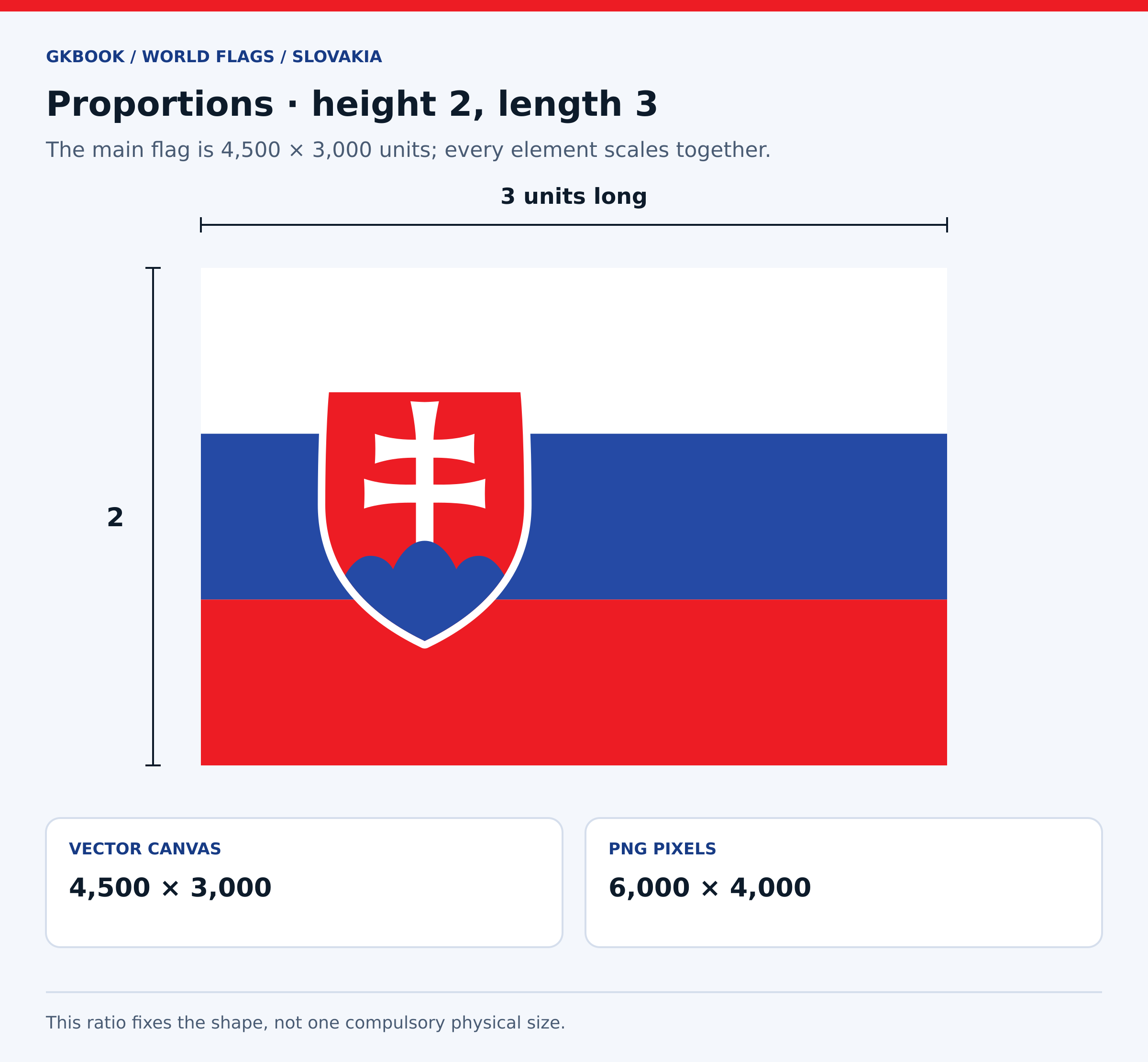
The national flag has a height:length ratio of 2:3. A flag 150 centimeters long is therefore 100 centimeters high, with three bands each one third of that height. The supplied main SVG uses a 4,500 by 3,000 canvas, and its 6,000 by 4,000 PNG preserves the same proportions.

Always specify the order of dimensions. Image software usually calls the horizontal measurement width, while flag legislation may use width for the shorter dimension. Height and length avoid that ambiguity. The ratio fixes shape rather than a compulsory physical size.
Scaling must apply to the entire composition. Doubling the flag’s length doubles its height, band heights, shield dimensions, and edging. Altering only the outer rectangle would stretch the emblem. The separate social image has its own presentation canvas, but the flag placed inside it remains a complete rectangle with the national proportions.
Are the three bands equal in size?
Yes. The underlying white, blue, and red horizontal bands have equal height and extend across the full length of the flag. Each background band occupies one third of the rectangle before the coat of arms is added. The final visible color areas differ because the shield, cross, hills, and edging cover parts of those bands.
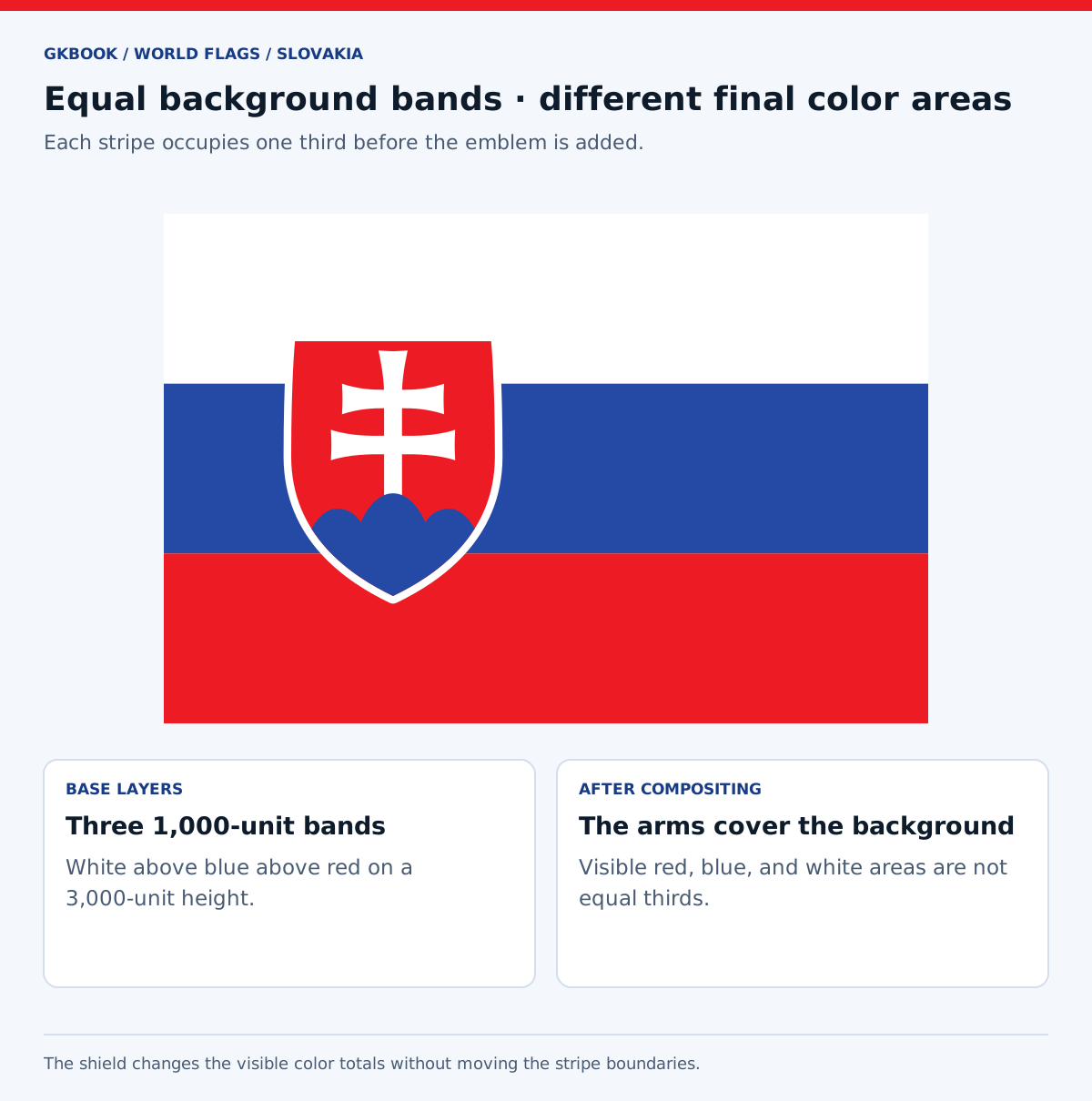
Equal stripes are a construction rule, not a statement that exactly one third of the completed picture is visibly red, white, or blue. The shield adds red to the upper and middle regions, while the cross and edging add white. The hills contribute blue within the emblem.
On the main SVG, the boundaries fall at vertical coordinates 1,000 and 2,000. The three background rectangles each cover 4,500,000 square coordinate units. These calculations describe the base layers; counting visible pixels after compositing the arms answers a different question and will give different totals.
How is the Slovakia flag constructed?
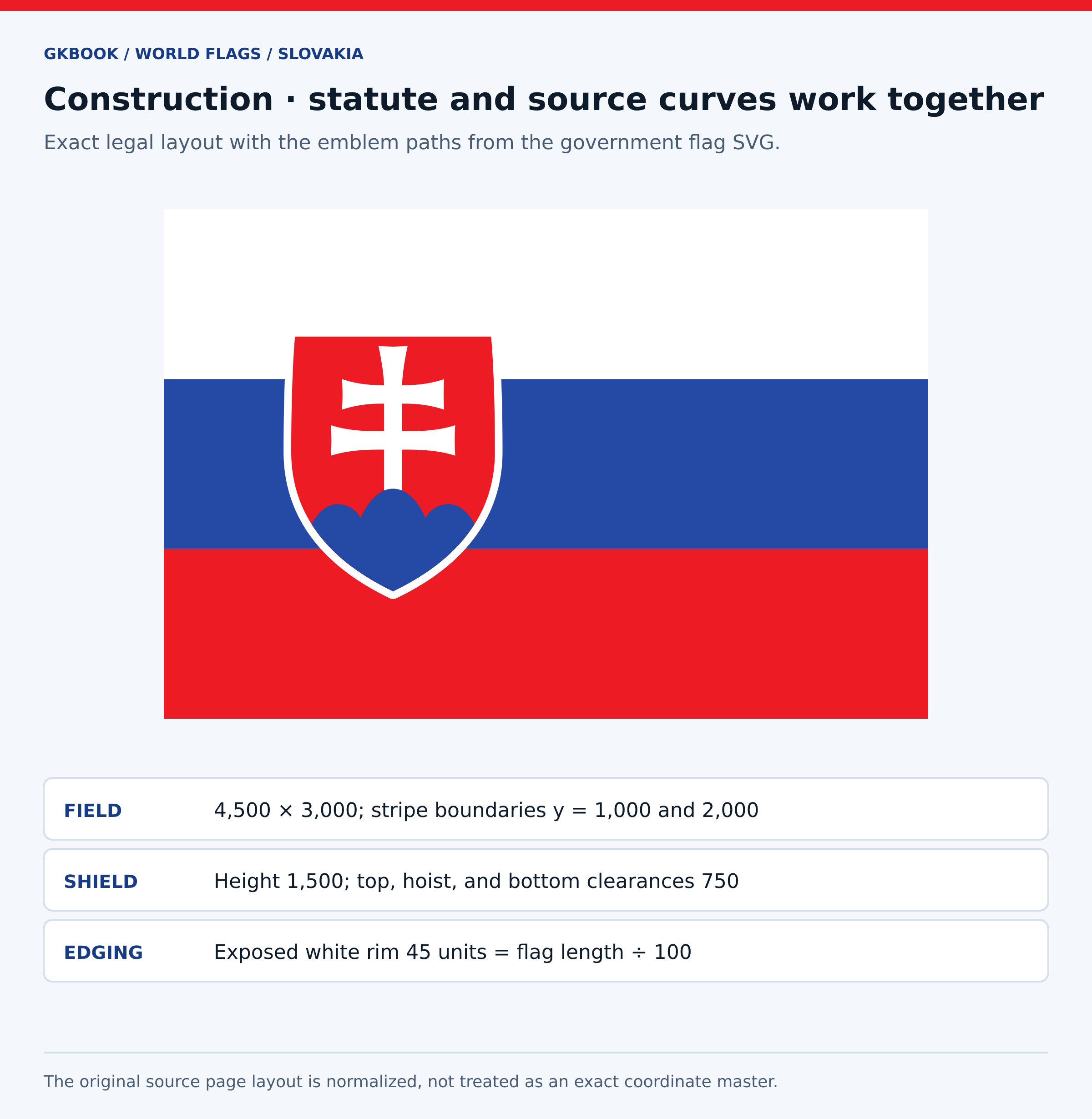
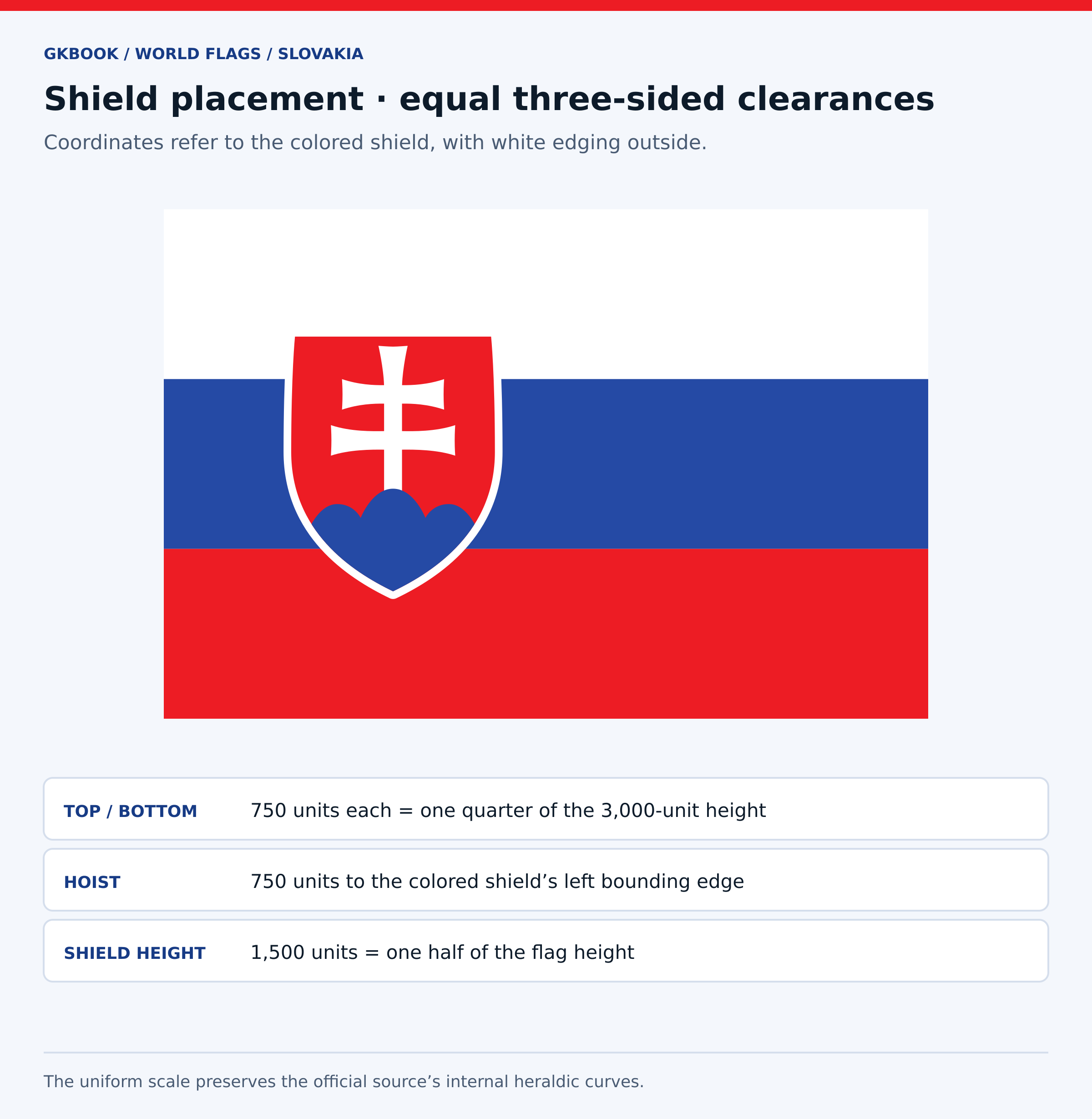
Construct a 3:2 landscape rectangle with three equal horizontal bands, white above blue above red. Place the colored shield toward the hoist, with height equal to half the flag’s height and equal top, hoist, and bottom clearances. Add the specified white edging and preserve the official double-cross and three-hill shapes.
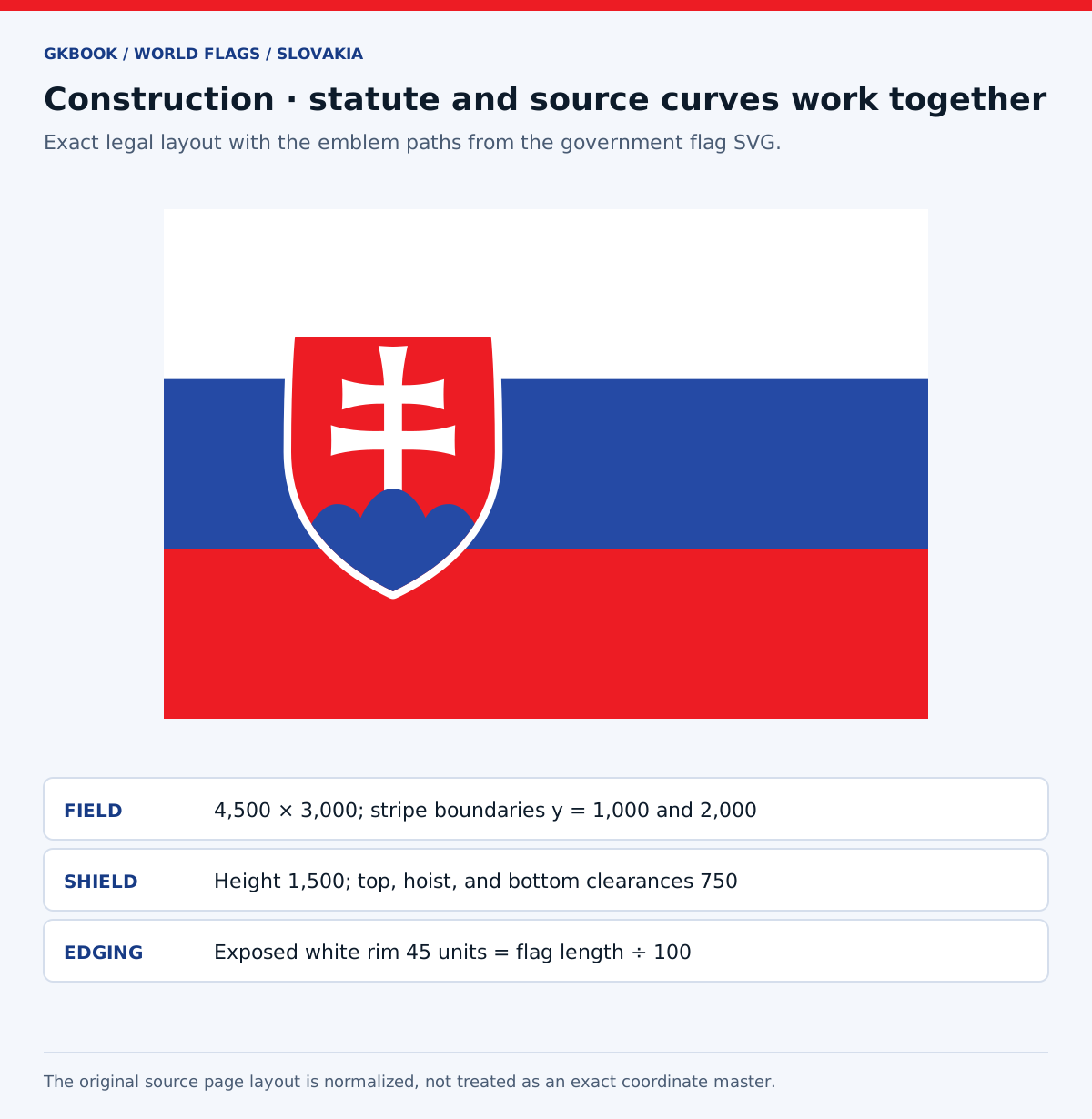
The statutory construction diagram supplies the essential measurements. Using a 4,500 by 3,000 coordinate field gives a shield height of 1,500 and clearances of 750. The exposed white edging is 45 units, one hundredth of the flag’s length. These measurements scale together.
The downloadable government SVG provides detailed emblem curves, but its page-sized flag illustration does not exactly match every numerical relationship. This reconstruction retains those curves under uniform scaling and uses the statutory measurements for placement. The outer page margins and black frame are excluded from the clean national image.
What is the history of Slovakia’s flag?
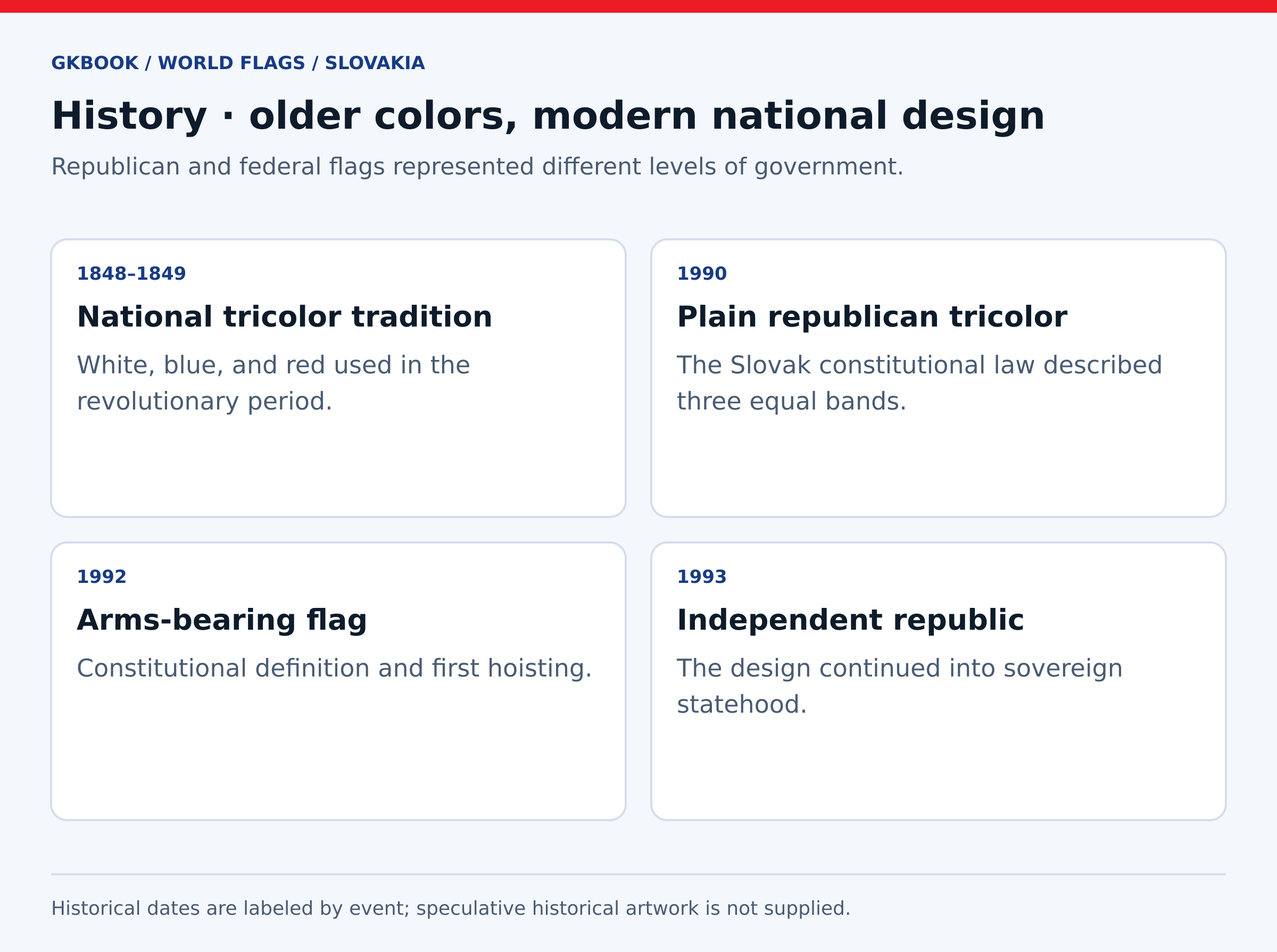
Slovakia’s white-blue-red national tradition developed during the nineteenth century, especially the revolutionary years 1848–1849. A plain tricolor appeared in later Slovak state legislation, including the 1990 constitutional law. The present design adds the national arms and belongs to the constitutional transition of 1992 and the independent republic established in 1993.

The parliamentary historical account traces the color order through a 1919 regulation and a 1939 law before discussing its restoration in 1990. Those references describe different political periods. They should not be presented as continuous use of the present arms-bearing national flag.
The former Czechoslovak federation had its own flag. Slovak republican symbols and federal symbols could coexist because they represented different levels of government. As the federation approached dissolution, the shield gave the Slovak tricolor a distinctive identity. The modern flag’s chronology therefore combines an older color tradition with a later constitutional design.
When was the current Slovakia flag adopted?
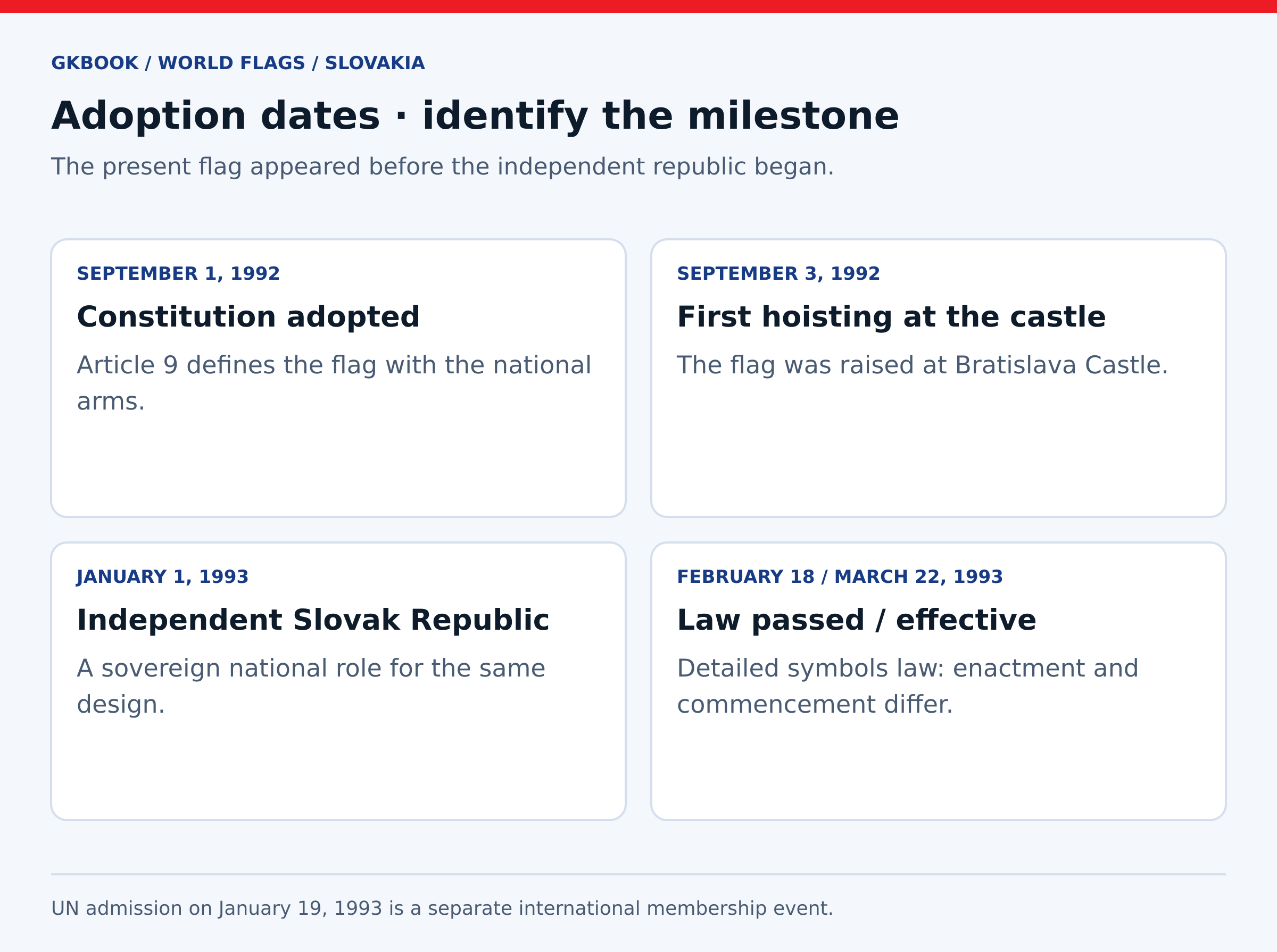
The current arms-bearing flag is defined in the Constitution adopted on September 1, 1992, and was first hoisted at Bratislava Castle on September 3. Slovakia became independent on January 1, 1993. The detailed state-symbols law was enacted on February 18, 1993, and took effect on March 22, so these milestones should be distinguished.
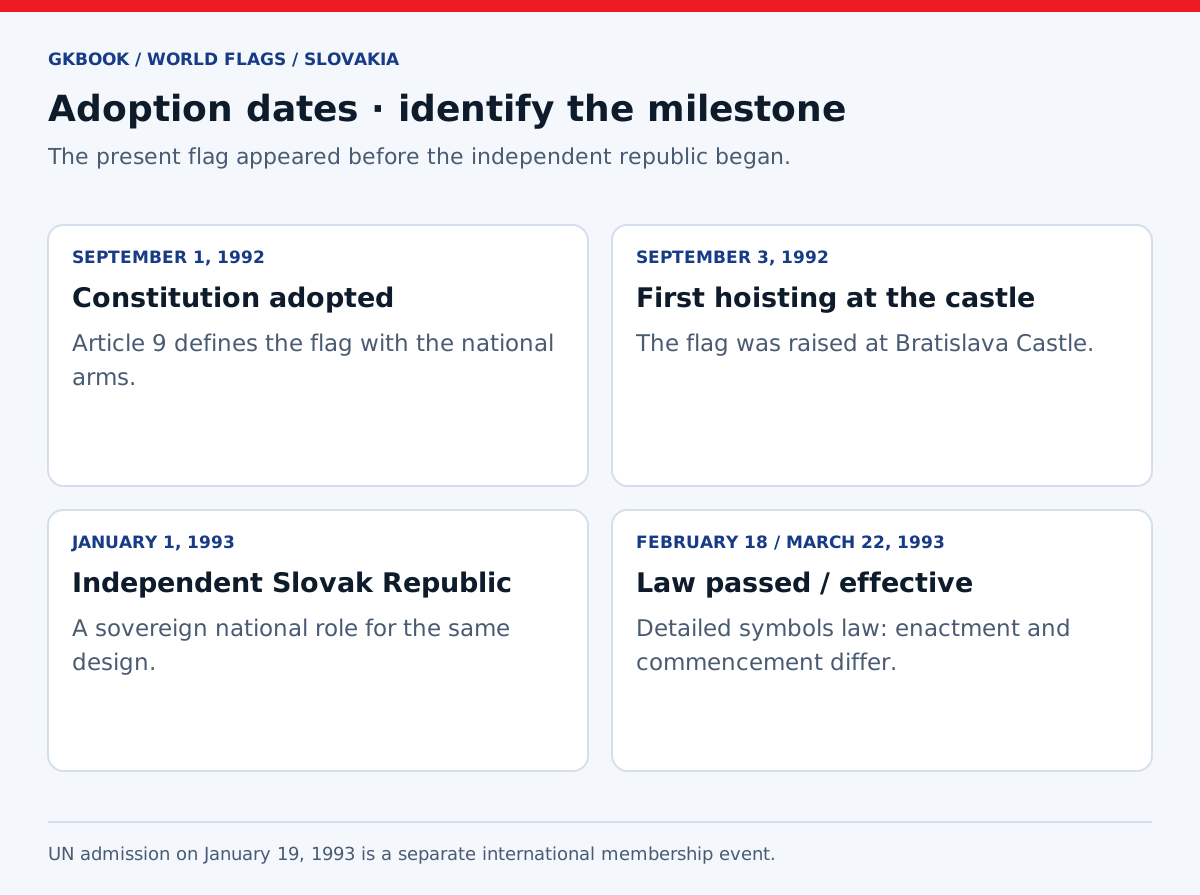
A date labeled adoption can refer to several different events. Constitutional definition, a ceremonial first raising, sovereign statehood, and detailed statutory regulation do not necessarily happen together. The Government Office’s January 1993 introduction date is best read in the context of the independent republic, alongside the documented September 1992 events.
The 1993 law’s date printed beneath its title is February 18. Its publication date is March 22, and its commencement clause makes publication the effective date. Naming both prevents a common error: treating the date a law was passed as automatically the day it entered into force.
| Date | Event |
|---|---|
| September 1, 1992 | Constitution adopted; flag defined in Article 9 |
| September 3, 1992 | First hoisting at Bratislava Castle |
| January 1, 1993 | Independent Slovak Republic |
| February 18, 1993 | State-symbols law enacted |
| March 22, 1993 | Law published and effective |
Who designed Slovakia’s modern national symbols?
The modern design work is associated with heraldist Ladislav Vrtel and artist Ladislav Čisárik. Slovakia’s official heraldic register names both authors, while a TASR account distinguishes Vrtel’s heraldic concepts from Čisárik’s drawings. They developed modern forms of inherited symbols; they did not originate the centuries-old double-cross tradition itself.
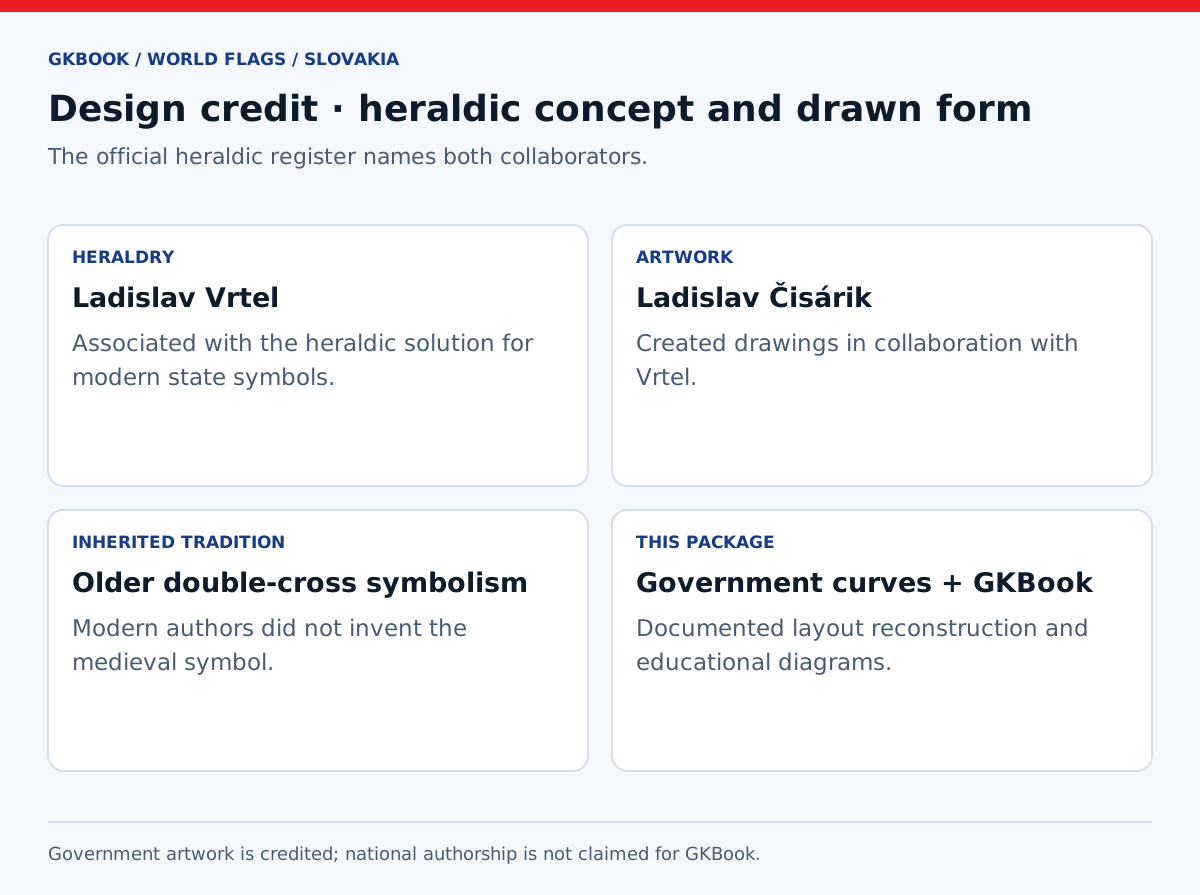
Authorship needs to be stated at the right level. A heraldist can determine the symbolic and heraldic solution while an artist creates its final drawn form. The official register’s joint credit and the later account of their collaboration support acknowledging both contributors.
That historical credit is separate from the authorship of a modern educational file. The government SVG supplies the emblem paths used here; GKBook supplies the normalized layout, diagrams, and article. Reproducing or explaining a national symbol does not make its modern file creator the designer of the national flag.
Was the Slovakia flag introduced before independence?
Yes. The Constitution defined the arms-bearing flag in September 1992, and it was raised at Bratislava Castle that month. The independent Slovak Republic began on January 1, 1993, after Czechoslovakia’s dissolution. The flag therefore appeared before independence, even though 1993 marks its role as the symbol of a sovereign state.

A national design may be selected while constitutional and political changes are still taking place. Slovakia’s case illustrates that sequence: the present flag was established during the final months of the federation, then continued into independent statehood.
For a timeline, label the September event as constitutional definition or first hoisting and the January event as independence. A change in the state represented does not always require another visual redesign. Conversely, the older plain tricolor should not be substituted for the present flag when illustrating the republic’s independent era. The coat of arms is an essential identifying feature.
When did Slovakia join the United Nations?
Slovakia was admitted to the United Nations on January 19, 1993. The Security Council had recommended admission on January 8, after the republic became independent on January 1. UN admission is an international membership milestone; it is not the adoption date of the flag or a single universal date of diplomatic recognition.
Membership in an international organization and recognition by individual states are different processes. The United Nations record identifies admission to the organization, while diplomatic recognition can involve separate decisions by other governments. A flag timeline should not collapse those processes into one event.
The three January dates also answer different questions. January 1 concerns the new state, January 8 the Security Council recommendation, and January 19 General Assembly admission. None changes the September 1992 history of the arms-bearing design. Keeping those labels explicit makes the chronology easier to use in exam preparation and reference writing.
How does Slovakia’s flag differ from the former Czechoslovak flag?
Slovakia’s national flag has three horizontal white-blue-red bands and a coat of arms near the hoist. The former Czechoslovak federal flag had white above red with a blue triangle extending from the hoist. The two designs represented different constitutional entities; the federal flag should not be mistaken for the present Slovak flag.

The federal design’s blue element is a triangle, not a horizontal middle stripe. Its white and red fields divide the remaining rectangle into upper and lower areas. Slovakia’s design instead uses three full-width stripes and the shield as its distinctive device.
The 1990 Slovak constitutional law described a plain white-blue-red republican flag, while contemporary federal legislation described the triangle-bearing federal flag. That coexistence helps explain photographs and documents from the final federation years. Identify the institution and date before deciding that one image is incorrect merely because another flag appears in the same period.
What is the difference between Slovakia’s and Slovenia’s flags?
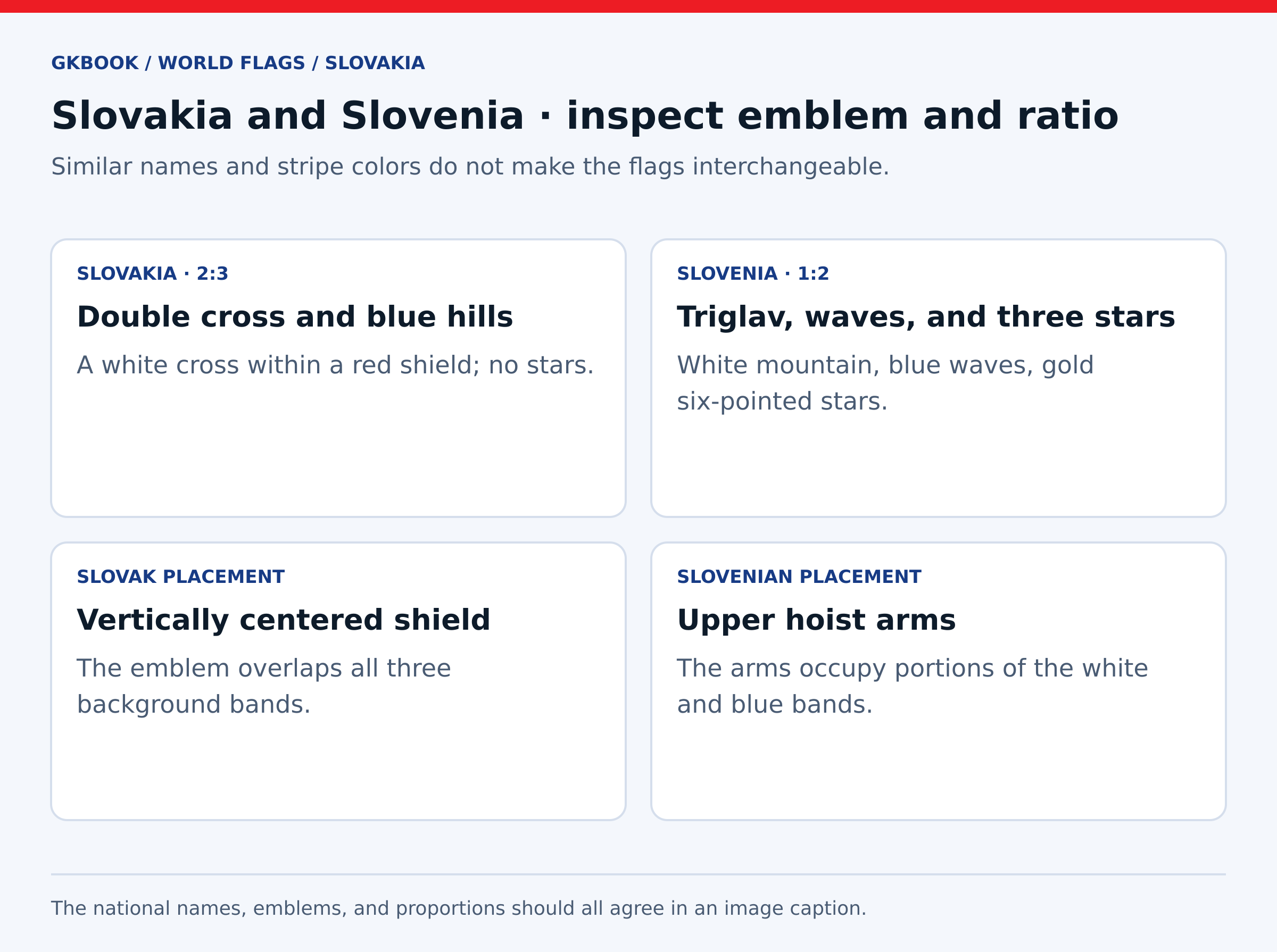
Both flags use horizontal white-blue-red bands, but their emblems and proportions differ. Slovakia has a white double cross on three blue hills within a red shield and a 2:3 ratio. Slovenia has Mount Triglav, wavy lines, and three gold stars within its arms, and its national flag has a 1:2 ratio.

Start with the emblem rather than the similar country names. Slovakia’s shield contains a cross and rounded blue hills. Slovenia’s official description identifies a white mountain on blue, two wavy lines, and three golden six-pointed stars. Those features are decisive even in a small picture.
The outlines differ as well: Slovenia’s flag is longer relative to its height. Its arms sit across the white and blue bands near the upper hoist. Slovakia’s taller shield is vertically centered and extends into all three bands. These comparisons are more reliable than judging colors on screens with different settings.
Why does Slovakia’s flag resemble Russia’s flag?
The resemblance comes from the shared white-blue-red tricolor associated with Pan-Slavic traditions. Slovakia’s present flag is distinguished by its national coat of arms near the hoist. Parliamentary history connects the addition of the arms with the need to differentiate Slovakia’s tricolor after Russia restored its historical white-blue-red flag.
Similar color combinations do not make two national flags interchangeable. An emblem can carry the identifying information that separates otherwise similar striped fields. In Slovakia’s case, omitting the shield removes that essential distinction.
The parliamentary retrospective discusses Russia’s restoration in the early 1990s as part of the background to the change. Its narrative reference to 1991 is not used here as a substitute for the documented September 1992 constitutional and ceremonial milestones. Historical motivation and formal introduction answer different questions, and both can be explained without inventing an additional adoption date.
Where should the coat of arms be placed on the flag?
The coat of arms belongs in the hoist half of the flag and is vertically centered. Its height equals half the flag’s height, with equal clearances from the top, hoist, and bottom edges. On the supplied 4,500 by 3,000 layout, the colored shield is 1,500 units high and begins 750 units from those reference edges.
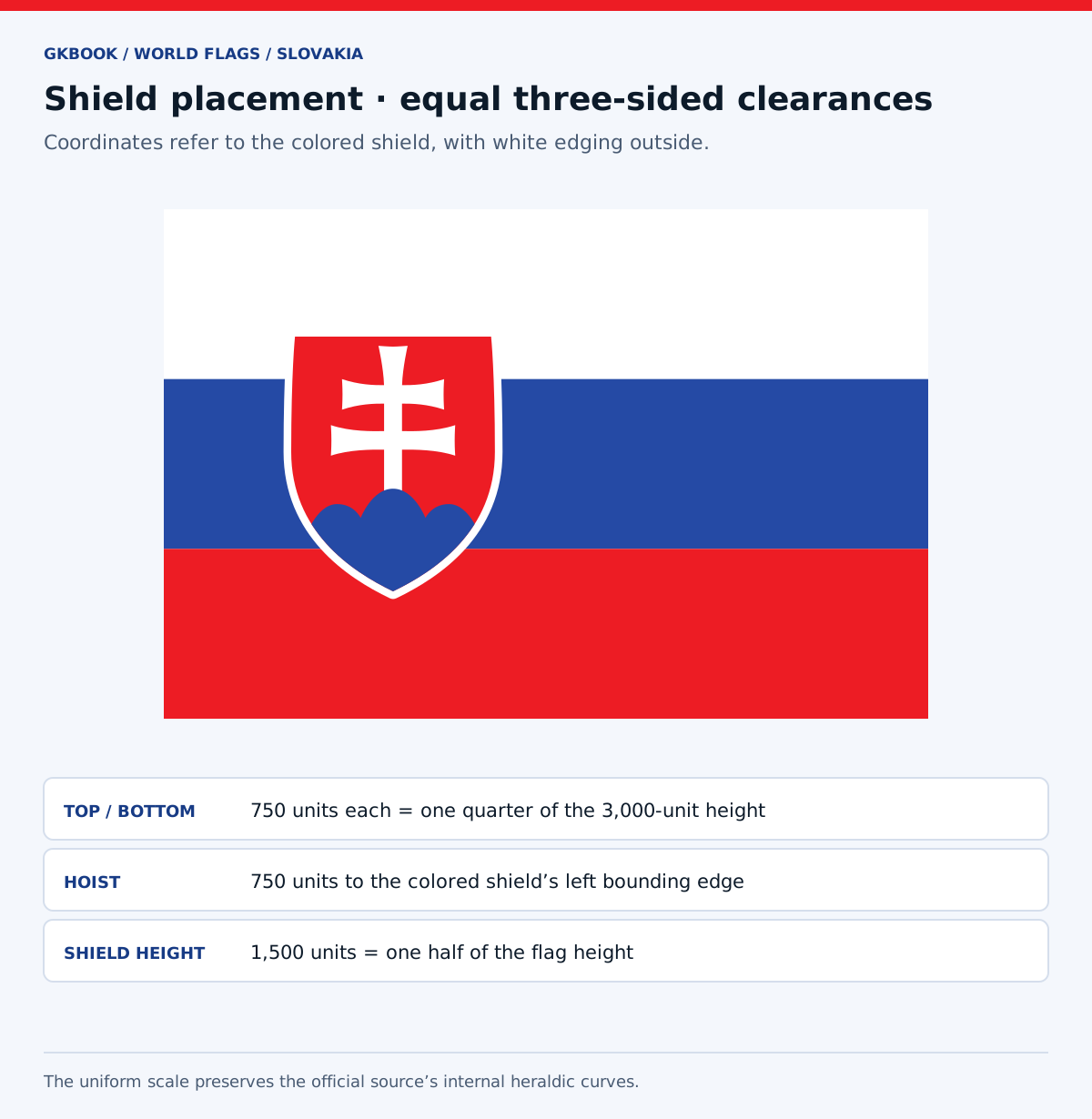
The hoist is the edge attached to the staff or rope. With the usual front-facing view, it appears at the left. Equal upper and lower clearances center the shield vertically, while the equal hoist clearance shifts it away from the rectangle’s horizontal center.
The measurement refers to the colored shield’s bounding shape; the narrow white edging extends beyond it where visible. Construction diagrams should make that distinction clear. Moving the arms to the middle of the full flag or scaling them to fit entirely within the blue band would violate the specified arrangement.
How wide is the white edging around the shield?
Where the shield meets a color other than white, the flag specification requires white edging one hundredth of the flag’s length. For a flag 150 centimeters long, that is 1.5 centimeters. This edging is separate from the white cross, and the flag’s coat of arms should not receive a dark contour line.

Use the long dimension when calculating the border. One hundredth of the height would produce a thinner result on a 2:3 flag. On the supplied SVG, the correct exposed edging is 45 units because the length is 4,500.
The reconstruction draws white beneath the colored shield and places the emblem over it. This gives a consistent visible separation without shrinking the shield itself. The edging disappears against the upper white field, which is expected. A rectangle around the whole flag is only a presentation aid and is absent from the clean downloadable national artwork.
What does the reverse side of Slovakia’s flag look like?
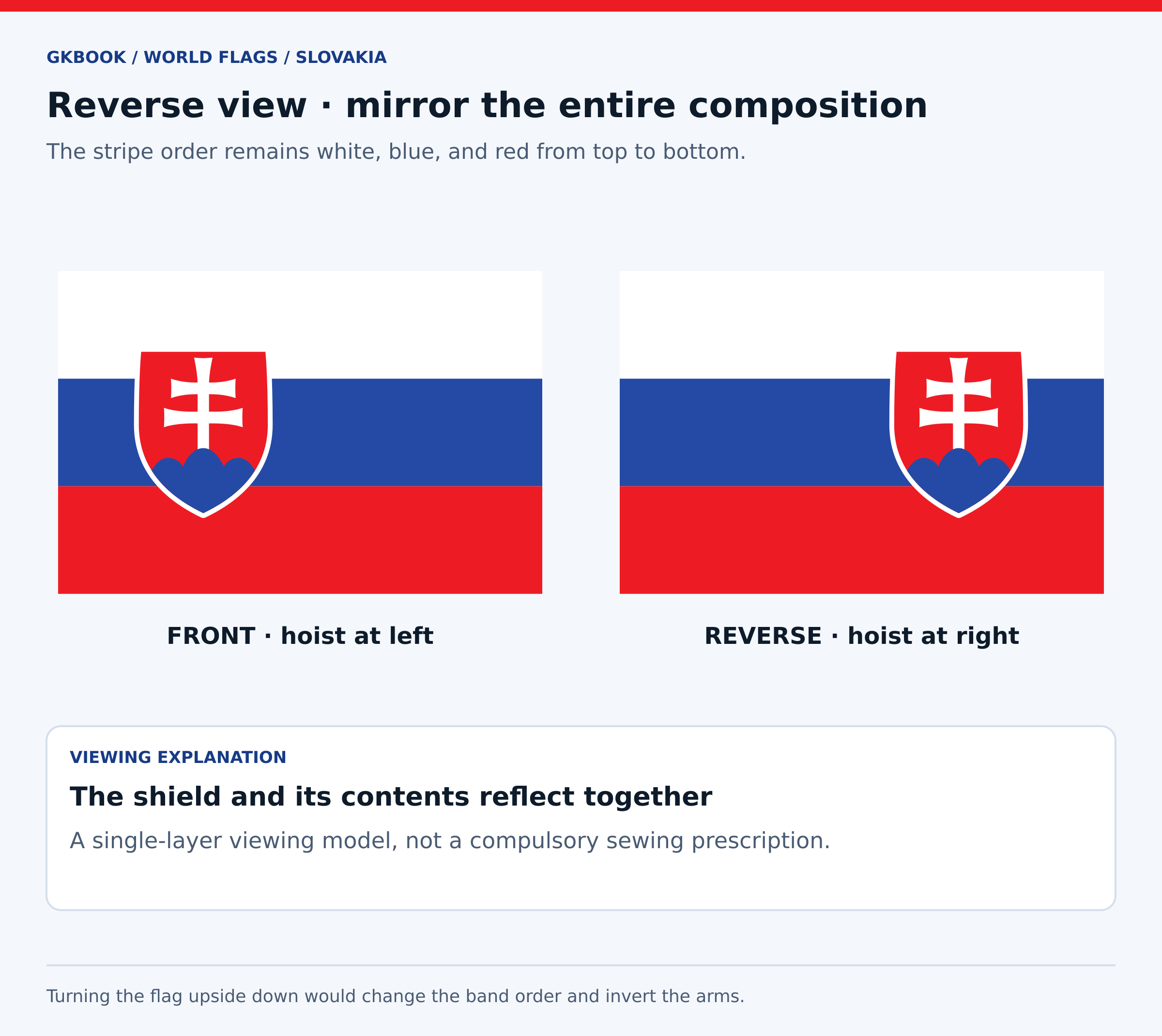
Looking through a single-layer Slovakia flag from behind produces a horizontal mirror of the whole design. The shield appears toward the right, while the bands remain white, blue, and red from top to bottom. This explains a reverse view; it does not prescribe how every double-sided manufactured flag must be sewn.
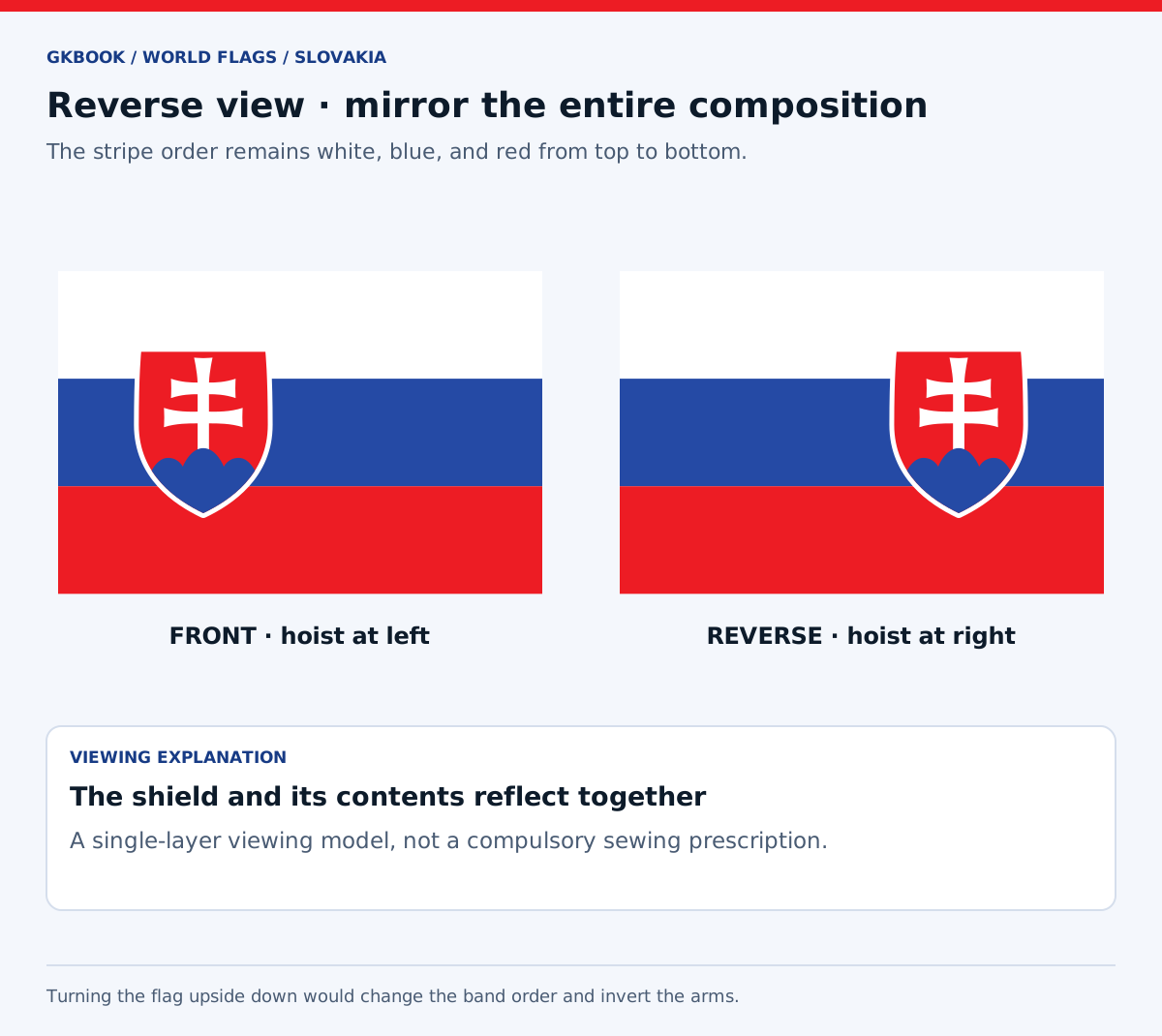
The reverse changes the relationship to the viewer, not the identity of the attachment edge. The hoist is still physically the same edge, even though it appears on the opposite side when viewed from behind. The cross and hills are reflected with the shield.
A comparison diagram should therefore mirror the complete composition. Moving only the shield while leaving some internal details unchanged would be an inconsistent transformation. Turning the entire flag upside down is another operation: it reverses the vertical band order and inverts the arms, so it is not an explanation of the reverse side.
How should a vertical Slovak banner display the coat of arms?
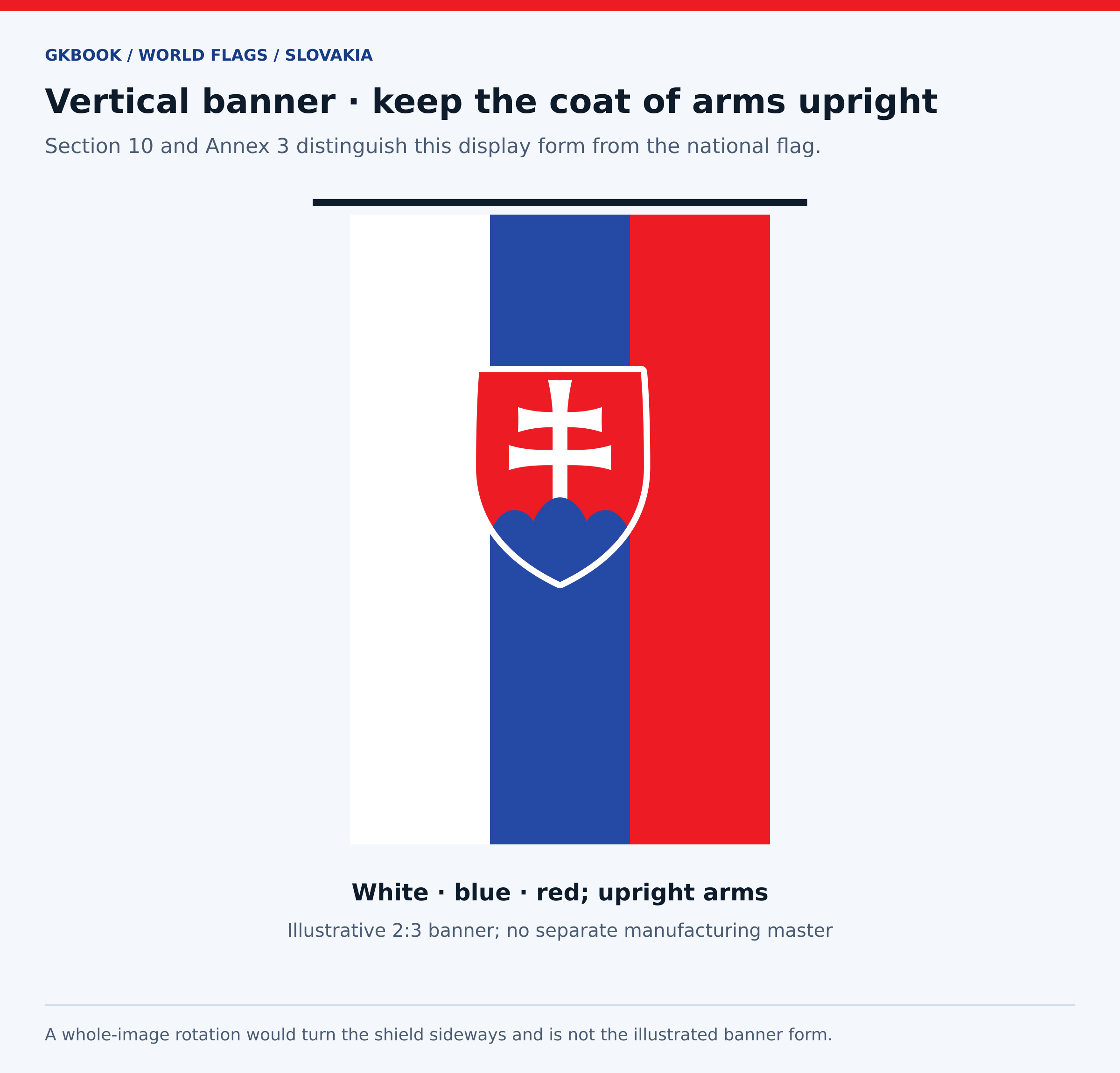
The state-symbols law distinguishes the flag from a banner fixed to a staff or crossbar. For the hanging banner form called a koruhva, the coat of arms must remain upright. The statutory illustrations show white, blue, and red vertical fields. Simply rotating the entire horizontal flag would turn the cross and shield sideways.
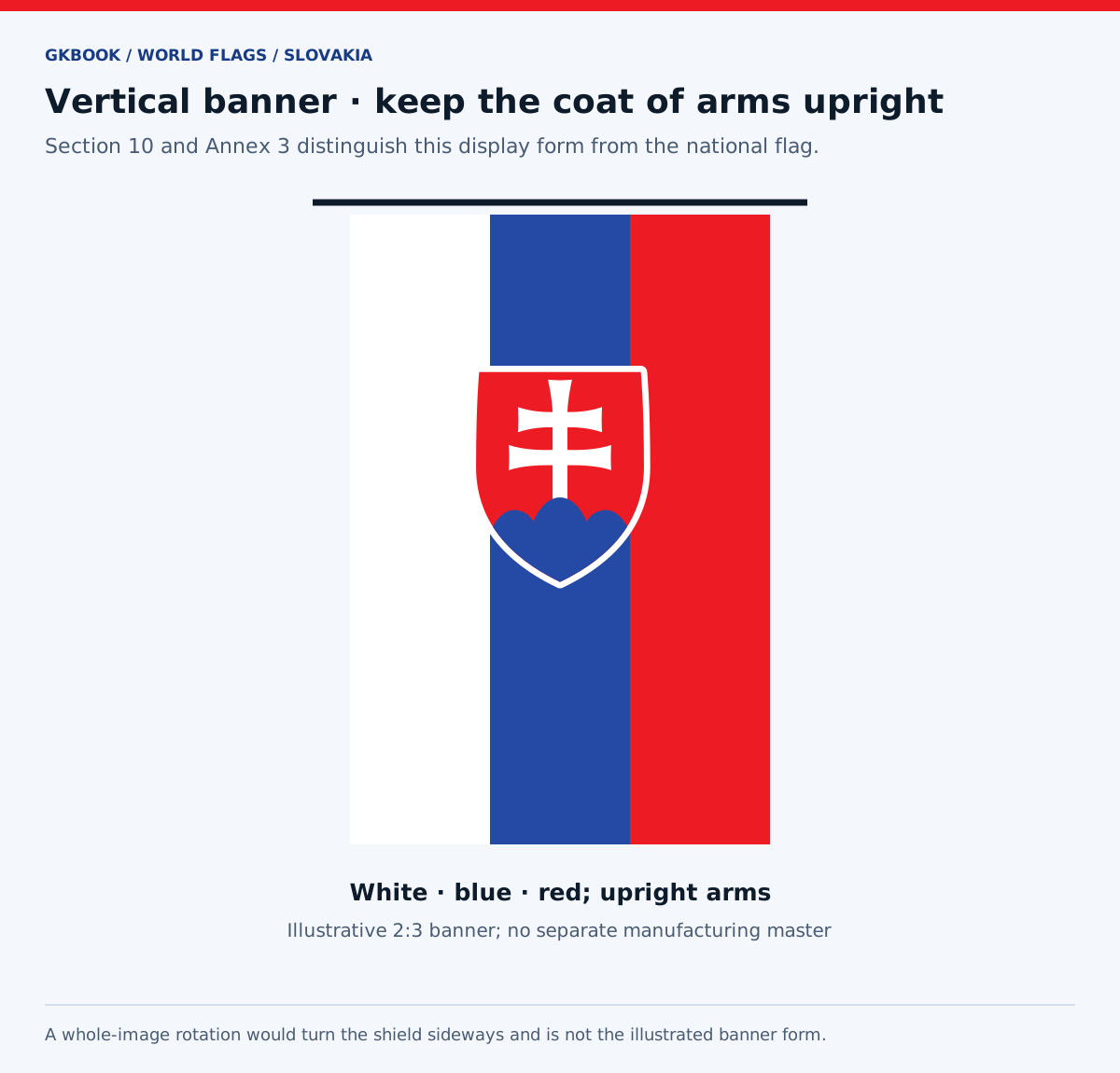
Section 10 provides separate rules for the banner form, including a maximum length of three times its width. That does not replace the national flag’s 2:3 proportion. It describes a related display format with its own mounting arrangement.
The educational illustration keeps the arms upright while arranging the three colors vertically. Its dimensions are an example, not an additional legally mandated banner size. For a formal display, follow the relevant statutory illustration and the intended mounting form. A correct horizontal flag file should not be stretched or blindly rotated to manufacture a different format.
What are the main rules for displaying Slovakia’s flag?
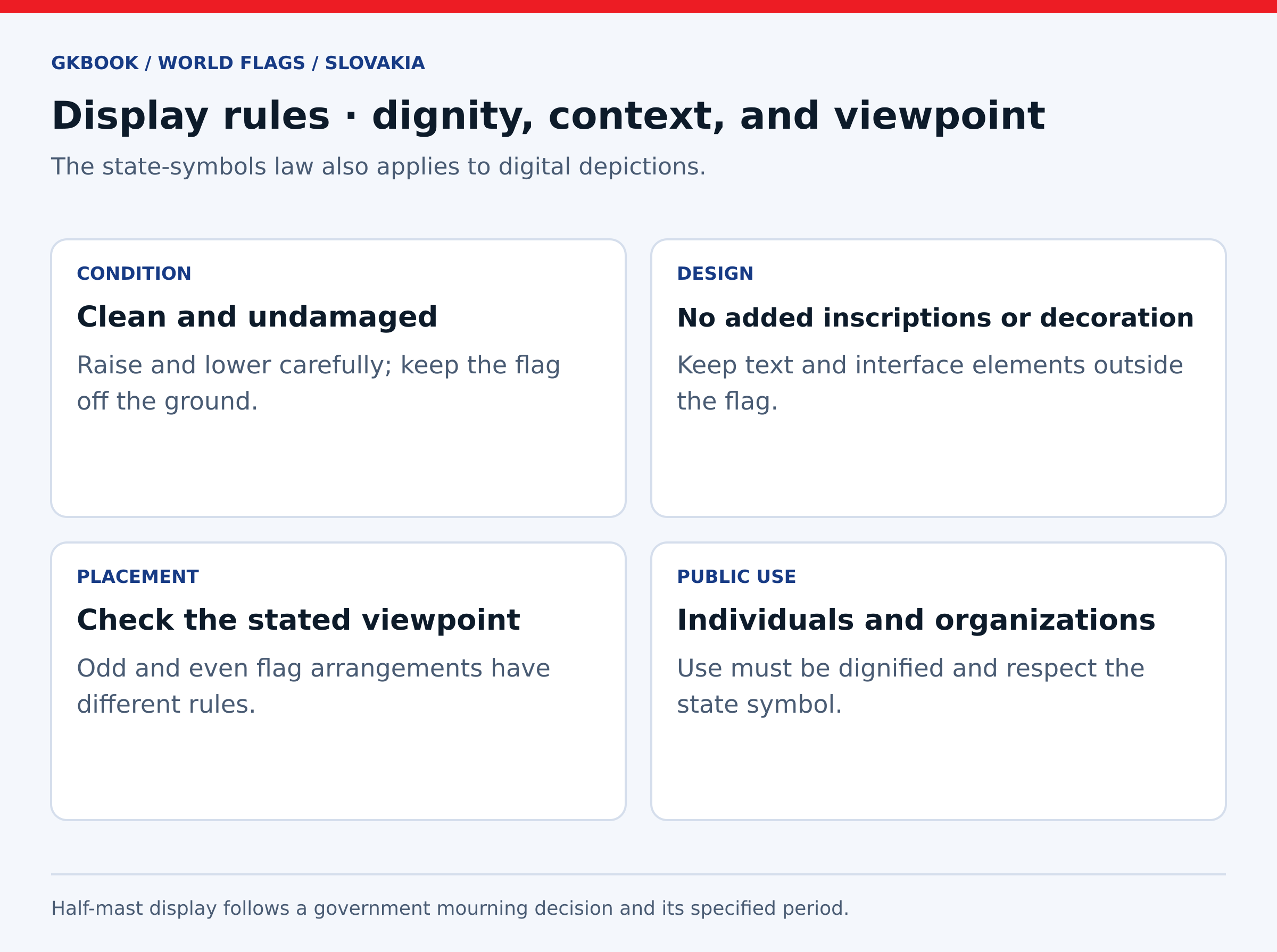
Slovak law requires dignified use and sets rules for official buildings, ceremonies, and arrangements with other flags. It specifies the place of honor, prohibits additions such as inscriptions or decorations, and requires careful raising and lowering. Individuals and organizations may use the flag, provided their use respects its status as a state symbol.
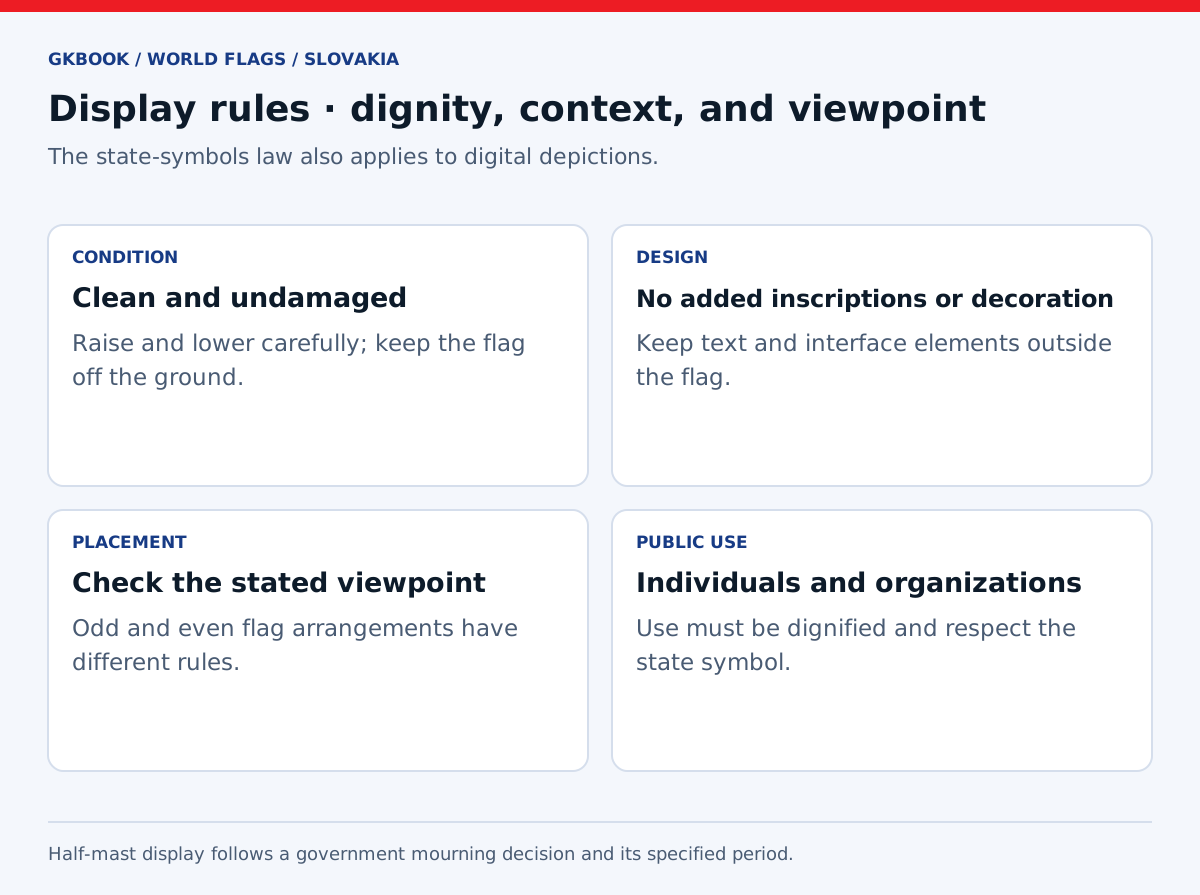
For international events, the law distinguishes odd and even numbers of flags. In an odd-numbered arrangement, the Slovak flag occupies the center; with an even number, it occupies the viewer’s left position in the central pair. A national and municipal flag are placed at equal height, with the national flag on the viewer’s left.
These are contextual rules, not instructions to raise every Slovak flag above every foreign flag. The statute also preserves diplomatic and intergovernmental customs. Check the type of event and the observer’s viewpoint before translating a placement rule into a physical arrangement.
When is Slovakia’s flag flown at half-mast?
The state-symbols law provides for lowering the flag to half-mast during state mourning. The government declares the mourning period, and its decision determines the duration of the lowered display. This explains the general rule; it does not imply that Slovakia is currently observing mourning or that every private memorial triggers the same requirement.
A permanent rule and a current declaration are different kinds of information. The statute explains who decides and what follows; an actual mourning notice supplies the dates and times for a particular event. Those details should be checked when organizing a real display.
The law separately addresses flags used at funerals, including removal from a coffin before burial or cremation. It also treats mounted banners differently from flags raised on a pole. These distinctions help avoid applying a general half-mast instruction to a display that has no mechanism for lowering it.
How should Slovakia’s flag be handled and reproduced respectfully?
Use a clean, undamaged flag and preserve its full design. Slovak law prohibits displaying it dirty or damaged, tying it into a rosette, or adding decorations and inscriptions. It calls for slow, dignified raising and lowering without touching the ground. The law also applies to electronic communication and digital depictions.
Respectful reproduction includes the details that make the symbol identifiable. Keep the three stripes, the complete arms, and the white edging. Do not substitute a sports logo, decorative cross, or abbreviated national emblem and label the result the official flag.
Digital use also requires care with layout. A circular avatar crop may remove the shield or cut away one of the bands. A text overlay can cover the very feature the image is intended to teach. Keep captions, buttons, labels, and decorative frames outside the national rectangle so readers can see the whole design.
How should the Slovakia flag be printed?
Use the scalable SVG or the 6,000 by 4,000 PNG, preserving the 2:3 ratio and the complete shield geometry. Scale the bands, arms, and white edging together. The declared RGB palette is a screen recipe from the government SVG; reliable physical color matching requires a proof on the intended paper or fabric.

At 300 pixels per inch, the supplied PNG corresponds to a print measuring 20 by 13⅓ inches. That is a calculation from its pixel dimensions, not a mandatory national flag size. The vector file can scale to other dimensions without converting its curves into a low-resolution grid.
Allowances for hems, sleeves, and cutting belong in production planning. They should not silently change the visible flag’s proportions or cover the shield. A printer should also confirm how white is produced on a colored substrate, since the digital file’s opaque white cannot guarantee an opaque physical ink layer.
How should the Slovakia flag be used on websites?
Display the complete flag with its proportions intact, and keep the white areas opaque. Use SVG for scalable presentation or an appropriately sized PNG. Alternative text should identify the white-blue-red bands and the double-cross shield near the hoist. Keep labels and controls outside the flag, and avoid cropping away the emblem.
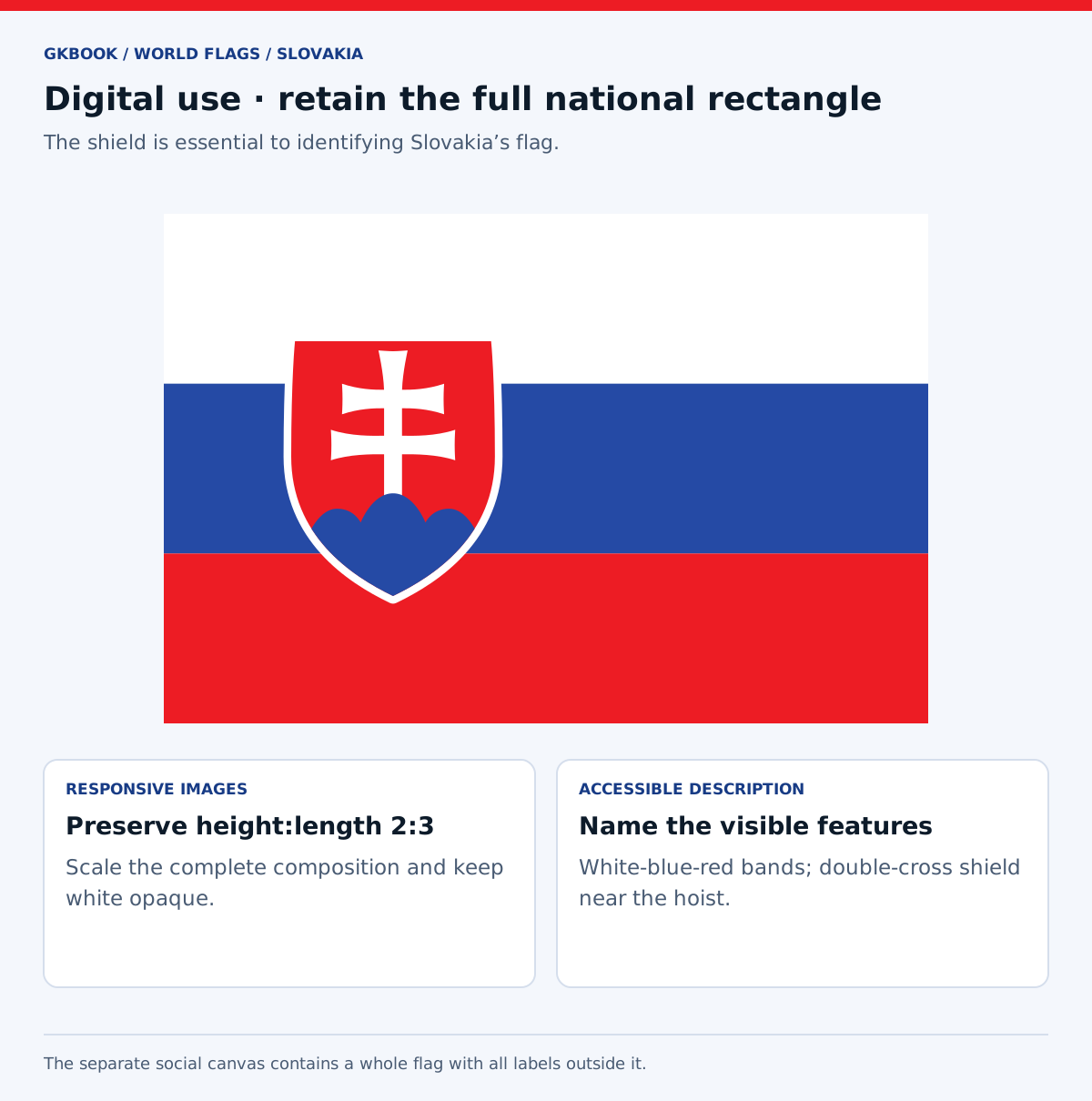
Responsive layout should scale the image as a unit. A fixed-width and fixed-height box can distort it unless the image is contained proportionally. The arms deserve particular attention at small sizes: the two crossbars and three hills should remain distinguishable.
The flag’s own red-and-blue boundary is a national design feature, while surrounding interface text needs readable contrast. Use suitable text colors on banners and factboxes without altering the flag to meet an interface theme. The supplied social card handles this by placing a complete national rectangle inside a separate presentation canvas with its own typography.
Which Slovakia flag pictures are included in the gallery?
The gallery provides 24 subjects in SVG and PNG, including the clean flag, colors, symbolism, history, dimensions, shield placement, white edging, and display explanations. The main SVG is 4,500 by 3,000 units, and the PNG is 6,000 by 4,000 pixels. A separate 1,200 by 630 social-image pair is included.
Choose the clean flag for a national illustration and the explanatory diagrams when teaching a particular feature. Construction labels are outside the national rectangle, and comparison cards describe other designs without inventing historical artwork. The vertical banner is identified as an illustrative display example.
The credits distinguish the government emblem source from GKBook’s educational work. They also explain the palette choice and normalization of the government illustration to statutory measurements. That documentation lets an editor understand how the files were made and why their layout should not be treated as a simple crop of the source page.
Download Slovakia flag pictures
Download the clean national flag as SVG or 6,000 × 4,000 PNG. The SVG uses 4,500 × 3,000 coordinates, exact statutory layout, and the government flag SVG’s emblem curves. Both formats preserve the equal bands, shield placement, and white edging. The screen palette follows the government SVG; physical color reproduction needs a separate proof.
The gallery contains 24 subjects, each with an SVG and PNG. The captions distinguish published specifications, attributed meanings, historical events, and digital reproduction choices. Image credits and reproduction notes explain the source basis. The separate 1,200 × 630 social card contains a complete flag and does not alter the national rectangle.
Continue exploring national designs in World Flags.
World Flags/Slovakia
Slovakia flag pictures
Statutory 2:3 layout with government SVG emblem curves and declared screen colors.
Slovak national symbol; emblem paths from the Government Office SVG. Historical design: Ladislav Vrtel and Ladislav Čisárik. GKBook educational reconstruction and layouts.Download SVGDownload PNGThe digital palette is #FFFFFF, #254AA5 and #ED1C24; it is not claimed as a universal statutory print specification.
Slovak national symbol; emblem paths from the Government Office SVG. Historical design: Ladislav Vrtel and Ladislav Čisárik. GKBook educational reconstruction and layouts.Download SVGDownload PNGThe cross and hills carry documented traditional meanings; no unsupported individual stripe symbolism is added.
Slovak national symbol; emblem paths from the Government Office SVG. Historical design: Ladislav Vrtel and Ladislav Čisárik. GKBook educational reconstruction and layouts.Download SVGDownload PNGBlue performs two visual roles: a background stripe and part of the national arms.
Slovak national symbol; emblem paths from the Government Office SVG. Historical design: Ladislav Vrtel and Ladislav Čisárik. GKBook educational reconstruction and layouts.Download SVGDownload PNGThe red shield overlaps all three bands and remains distinct from the lower red stripe.
Slovak national symbol; emblem paths from the Government Office SVG. Historical design: Ladislav Vrtel and Ladislav Čisárik. GKBook educational reconstruction and layouts.Download SVGDownload PNGGovernment flag artwork omits dark contours that appear in the separate arms download.
Slovak national symbol; emblem paths from the Government Office SVG. Historical design: Ladislav Vrtel and Ladislav Čisárik. GKBook educational reconstruction and layouts.Download SVGDownload PNGThe precise curves distinguish this heraldic cross from a generic plus sign.
Slovak national symbol; emblem paths from the Government Office SVG. Historical design: Ladislav Vrtel and Ladislav Čisárik. GKBook educational reconstruction and layouts.Download SVGDownload PNGThe official explanation names three ranges collectively rather than labeling individual positions.
Slovak national symbol; emblem paths from the Government Office SVG. Historical design: Ladislav Vrtel and Ladislav Čisárik. GKBook educational reconstruction and layouts.Download SVGDownload PNGHeight:length 2:3 is the same shape as length:height 3:2.
Slovak national symbol; emblem paths from the Government Office SVG. Historical design: Ladislav Vrtel and Ladislav Čisárik. GKBook educational reconstruction and layouts.Download SVGDownload PNGEqual stripe height must be distinguished from final visible color area.
Slovak national symbol; emblem paths from the Government Office SVG. Historical design: Ladislav Vrtel and Ladislav Čisárik. GKBook educational reconstruction and layouts.Download SVGDownload PNGSection 7 and Annex 2 provide the controlling measurements; the source page frame is omitted.
Slovak national symbol; emblem paths from the Government Office SVG. Historical design: Ladislav Vrtel and Ladislav Čisárik. GKBook educational reconstruction and layouts.Download SVGDownload PNGOlder plain tricolors are not identical to the present arms-bearing national flag.
Slovak national symbol; emblem paths from the Government Office SVG. Historical design: Ladislav Vrtel and Ladislav Čisárik. GKBook educational reconstruction and layouts.Download SVGDownload PNGConstitution, ceremony, independence, and statutory detail have different dates.
Slovak national symbol; emblem paths from the Government Office SVG. Historical design: Ladislav Vrtel and Ladislav Čisárik. GKBook educational reconstruction and layouts.Download SVGDownload PNGHistorical authorship, official source artwork, and educational-file authorship are distinct.
Slovak national symbol; emblem paths from the Government Office SVG. Historical design: Ladislav Vrtel and Ladislav Čisárik. GKBook educational reconstruction and layouts.Download SVGDownload PNGIndependence is not the first appearance of the present visual design.
Slovak national symbol; emblem paths from the Government Office SVG. Historical design: Ladislav Vrtel and Ladislav Čisárik. GKBook educational reconstruction and layouts.Download SVGDownload PNGThe former federal flag is not the present Slovak national flag.
Slovak national symbol; emblem paths from the Government Office SVG. Historical design: Ladislav Vrtel and Ladislav Čisárik. GKBook educational reconstruction and layouts.Download SVGDownload PNGSlovenia’s official description supplies the comparison; no borrowed color recipe is used for Slovakia.
Slovak national symbol; emblem paths from the Government Office SVG. Historical design: Ladislav Vrtel and Ladislav Čisárik. GKBook educational reconstruction and layouts.Download SVGDownload PNGThe shield is vertically centered, not centered across the entire flag length.
Slovak national symbol; emblem paths from the Government Office SVG. Historical design: Ladislav Vrtel and Ladislav Čisárik. GKBook educational reconstruction and layouts.Download SVGDownload PNGNo dark contour is added around the shield or the internal cross and hills.
Slovak national symbol; emblem paths from the Government Office SVG. Historical design: Ladislav Vrtel and Ladislav Čisárik. GKBook educational reconstruction and layouts.Download SVGDownload PNGA horizontal reflection explains viewing the same flag from behind.
Slovak national symbol; emblem paths from the Government Office SVG. Historical design: Ladislav Vrtel and Ladislav Čisárik. GKBook educational reconstruction and layouts.Download SVGDownload PNGThe statute allows related banner forms, limits their length, and requires upright arms in a koruhva. This is an illustrative layout.
Slovak national symbol; emblem paths from the Government Office SVG. Historical design: Ladislav Vrtel and Ladislav Čisárik. GKBook educational reconstruction and layouts.Download SVGDownload PNGThis is an educational summary of the inspected consolidated law, not a new permission or current event notice.
Slovak national symbol; emblem paths from the Government Office SVG. Historical design: Ladislav Vrtel and Ladislav Čisárik. GKBook educational reconstruction and layouts.Download SVGDownload PNGThe source SVG palette is declared without claiming a universal Pantone or CMYK conversion.
Slovak national symbol; emblem paths from the Government Office SVG. Historical design: Ladislav Vrtel and Ladislav Čisárik. GKBook educational reconstruction and layouts.Download SVGDownload PNGUse a complete proportional image rather than a crop that loses the emblem.
Slovak national symbol; emblem paths from the Government Office SVG. Historical design: Ladislav Vrtel and Ladislav Čisárik. GKBook educational reconstruction and layouts.Download SVGDownload PNGFrequently asked questions
What does the Slovakia flag look like?
Slovakia’s flag has three equal horizontal bands of white, blue, and red, with the national coat of arms toward the hoist. The emblem contains a white double cross on three blue hills inside a red shield. The flag’s height:length ratio is 2:3, and the shield is half the flag’s height.
What are the colors of the Slovakia flag?
Slovakia’s flag uses white, blue, and red. This package follows the Government Office’s downloadable SVG palette: #FFFFFF, #254AA5, and #ED1C24. Those are identifiable values in an official digital illustration, rather than universal statutory hexadecimal or print specifications. The paired government PDF renders a different blue, so the source choice is disclosed.
What does the Slovakia flag symbolize?
The white, blue, and red tricolor belongs to Slovakia’s national tradition and the wider Pan-Slavic color family. The double cross recalls Christian and Cyril-and-Methodius traditions. The three hills conventionally represent Tatra, Fatra, and Mátra. These historical interpretations should be distinguished from the legal description of the flag’s shapes and arrangement.
What does the white color mean on Slovakia’s flag?
White is the upper band of Slovakia’s national tricolor and also appears in the double cross and the shield’s edging. The law permits white to represent heraldic silver in the coat of arms. The inspected official descriptions do not assign white a separate compulsory meaning such as peace or purity.
What does the blue band represent?
Blue is the middle band and one of the Pan-Slavic colors used in Slovakia’s national tradition. The coat of arms also uses blue for its three rounded hills. Official historical accounts connect the tricolor with Slavic solidarity; they do not establish a separate mandatory emotional meaning for the blue band alone.
Where does red appear on Slovakia’s flag?
Red fills the bottom band and the shield behind the double cross. It is part of the historic Slovak and Pan-Slavic color combination. The inspected legal and government descriptions identify its use without assigning a unique compulsory meaning to the red stripe, such as courage, blood, or sacrifice.
What is the emblem on the Slovakia flag?
The emblem is Slovakia’s national coat of arms: a silver or white double cross standing on the raised central peak of three blue hills, all within a red early Gothic shield. The hills are rounded, and the cross ends widen and curve inward. No crown, stars, motto, or lettering belongs on this flag.
What does the double cross on Slovakia’s flag mean?
The double cross expresses a Christian heraldic tradition and is associated in official explanations with Saints Cyril and Methodius. It has one vertical stem and two horizontal arms, with the upper arm shorter than the lower one. Its broadened, indented ends are part of the specified appearance, rather than ordinary rectangular crossbars.
Which mountains are represented by the three hills?
The three hills traditionally represent the Tatra, Fatra, and Mátra mountain ranges. Tatra and Fatra are associated with present-day Slovakia, while Mátra lies in Hungary. The blue rounded shapes are heraldic symbols, not a geographic map, and the inspected official explanation does not assign a named range to each left-to-right position.
What is the official ratio of the Slovakia flag?
The national flag has a height:length ratio of 2:3. A flag 150 centimeters long is therefore 100 centimeters high, with three bands each one third of that height. The supplied main SVG uses a 4,500 by 3,000 canvas, and its 6,000 by 4,000 PNG preserves the same proportions.
Are the three bands equal in size?
Yes. The underlying white, blue, and red horizontal bands have equal height and extend across the full length of the flag. Each background band occupies one third of the rectangle before the coat of arms is added. The final visible color areas differ because the shield, cross, hills, and edging cover parts of those bands.
How is the Slovakia flag constructed?
Construct a 3:2 landscape rectangle with three equal horizontal bands, white above blue above red. Place the colored shield toward the hoist, with height equal to half the flag’s height and equal top, hoist, and bottom clearances. Add the specified white edging and preserve the official double-cross and three-hill shapes.
What is the history of Slovakia’s flag?
Slovakia’s white-blue-red national tradition developed during the nineteenth century, especially the revolutionary years 1848–1849. A plain tricolor appeared in later Slovak state legislation, including the 1990 constitutional law. The present design adds the national arms and belongs to the constitutional transition of 1992 and the independent republic established in 1993.
When was the current Slovakia flag adopted?
The current arms-bearing flag is defined in the Constitution adopted on September 1, 1992, and was first hoisted at Bratislava Castle on September 3. Slovakia became independent on January 1, 1993. The detailed state-symbols law was enacted on February 18, 1993, and took effect on March 22, so these milestones should be distinguished.
Who designed Slovakia’s modern national symbols?
The modern design work is associated with heraldist Ladislav Vrtel and artist Ladislav Čisárik. Slovakia’s official heraldic register names both authors, while a TASR account distinguishes Vrtel’s heraldic concepts from Čisárik’s drawings. They developed modern forms of inherited symbols; they did not originate the centuries-old double-cross tradition itself.
Was the Slovakia flag introduced before independence?
Yes. The Constitution defined the arms-bearing flag in September 1992, and it was raised at Bratislava Castle that month. The independent Slovak Republic began on January 1, 1993, after Czechoslovakia’s dissolution. The flag therefore appeared before independence, even though 1993 marks its role as the symbol of a sovereign state.
When did Slovakia join the United Nations?
Slovakia was admitted to the United Nations on January 19, 1993. The Security Council had recommended admission on January 8, after the republic became independent on January 1. UN admission is an international membership milestone; it is not the adoption date of the flag or a single universal date of diplomatic recognition.
How does Slovakia’s flag differ from the former Czechoslovak flag?
Slovakia’s national flag has three horizontal white-blue-red bands and a coat of arms near the hoist. The former Czechoslovak federal flag had white above red with a blue triangle extending from the hoist. The two designs represented different constitutional entities; the federal flag should not be mistaken for the present Slovak flag.
What is the difference between Slovakia’s and Slovenia’s flags?
Both flags use horizontal white-blue-red bands, but their emblems and proportions differ. Slovakia has a white double cross on three blue hills within a red shield and a 2:3 ratio. Slovenia has Mount Triglav, wavy lines, and three gold stars within its arms, and its national flag has a 1:2 ratio.
Why does Slovakia’s flag resemble Russia’s flag?
The resemblance comes from the shared white-blue-red tricolor associated with Pan-Slavic traditions. Slovakia’s present flag is distinguished by its national coat of arms near the hoist. Parliamentary history connects the addition of the arms with the need to differentiate Slovakia’s tricolor after Russia restored its historical white-blue-red flag.
Where should the coat of arms be placed on the flag?
The coat of arms belongs in the hoist half of the flag and is vertically centered. Its height equals half the flag’s height, with equal clearances from the top, hoist, and bottom edges. On the supplied 4,500 by 3,000 layout, the colored shield is 1,500 units high and begins 750 units from those reference edges.
How wide is the white edging around the shield?
Where the shield meets a color other than white, the flag specification requires white edging one hundredth of the flag’s length. For a flag 150 centimeters long, that is 1.5 centimeters. This edging is separate from the white cross, and the flag’s coat of arms should not receive a dark contour line.
What does the reverse side of Slovakia’s flag look like?
Looking through a single-layer Slovakia flag from behind produces a horizontal mirror of the whole design. The shield appears toward the right, while the bands remain white, blue, and red from top to bottom. This explains a reverse view; it does not prescribe how every double-sided manufactured flag must be sewn.
How should a vertical Slovak banner display the coat of arms?
The state-symbols law distinguishes the flag from a banner fixed to a staff or crossbar. For the hanging banner form called a koruhva, the coat of arms must remain upright. The statutory illustrations show white, blue, and red vertical fields. Simply rotating the entire horizontal flag would turn the cross and shield sideways.
What are the main rules for displaying Slovakia’s flag?
Slovak law requires dignified use and sets rules for official buildings, ceremonies, and arrangements with other flags. It specifies the place of honor, prohibits additions such as inscriptions or decorations, and requires careful raising and lowering. Individuals and organizations may use the flag, provided their use respects its status as a state symbol.
When is Slovakia’s flag flown at half-mast?
The state-symbols law provides for lowering the flag to half-mast during state mourning. The government declares the mourning period, and its decision determines the duration of the lowered display. This explains the general rule; it does not imply that Slovakia is currently observing mourning or that every private memorial triggers the same requirement.
How should Slovakia’s flag be handled and reproduced respectfully?
Use a clean, undamaged flag and preserve its full design. Slovak law prohibits displaying it dirty or damaged, tying it into a rosette, or adding decorations and inscriptions. It calls for slow, dignified raising and lowering without touching the ground. The law also applies to electronic communication and digital depictions.
How should the Slovakia flag be printed?
Use the scalable SVG or the 6,000 by 4,000 PNG, preserving the 2:3 ratio and the complete shield geometry. Scale the bands, arms, and white edging together. The declared RGB palette is a screen recipe from the government SVG; reliable physical color matching requires a proof on the intended paper or fabric.
How should the Slovakia flag be used on websites?
Display the complete flag with its proportions intact, and keep the white areas opaque. Use SVG for scalable presentation or an appropriately sized PNG. Alternative text should identify the white-blue-red bands and the double-cross shield near the hoist. Keep labels and controls outside the flag, and avoid cropping away the emblem.
Which Slovakia flag pictures are included in the gallery?
The gallery provides 24 subjects in SVG and PNG, including the clean flag, colors, symbolism, history, dimensions, shield placement, white edging, and display explanations. The main SVG is 4,500 by 3,000 units, and the PNG is 6,000 by 4,000 pixels. A separate 1,200 by 630 social-image pair is included.
Explore all general-knowledge topics and the A-to-Z lists.









We Value Your Opinion Comments