
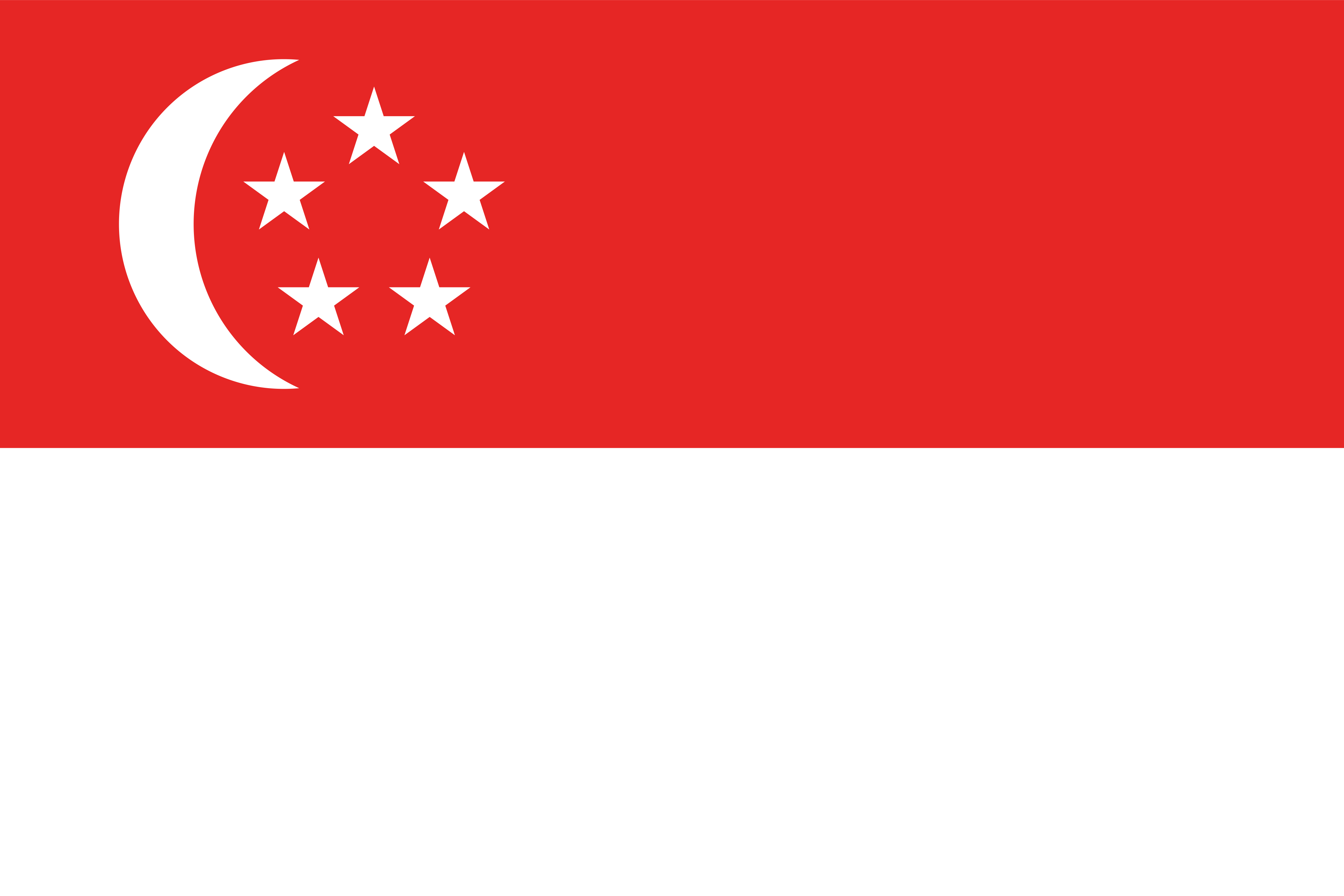
Singapore flag picture
Explore the construction notes, history, and picture gallery.
| Design | Red above white; crescent and five starsTwo equal background bands, with an emblem at the upper hoist. |
|---|---|
| Proportions | Height:length = 2:3The original plate shows 54 inches long by 36 high. |
| Unveiled | December 3, 1959State flag presented publicly at the City Hall steps. |
| Independent national flag | August 9, 1965The familiar design continued at independence. |
| Design leadership | Committee led by Dr Toh Chin ChyeThen Deputy Prime Minister of Singapore. |
| Main image sizes | SVG 5,400 × 3,600; PNG 6,000 × 4,000Both preserve the same national proportions. |
What does the Singapore flag look like?
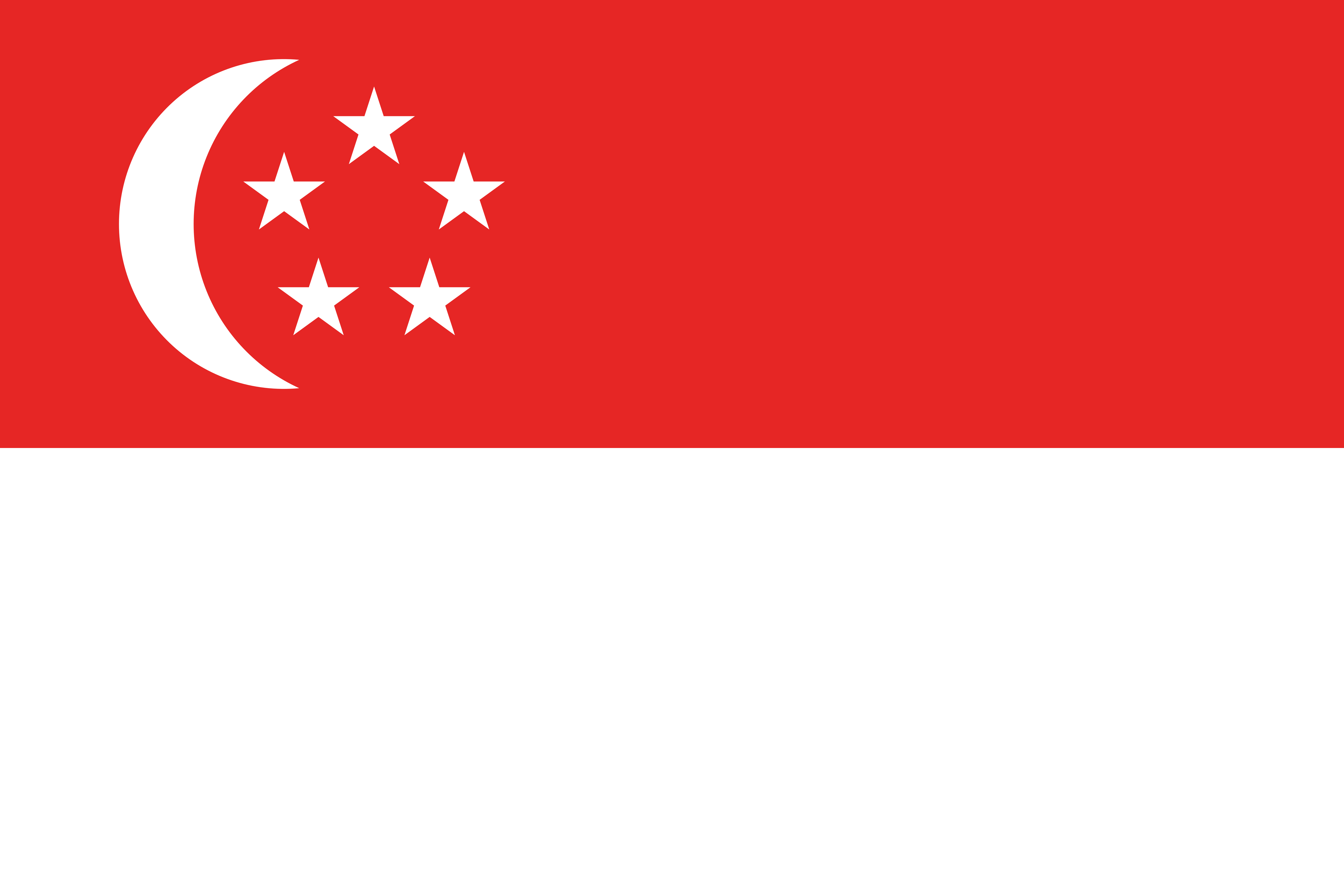
Singapore’s flag has two equal horizontal bands, red above white, with a white crescent and five white five-pointed stars in the upper hoist. Its height:length ratio is 2:3. The design was publicly unveiled on December 3, 1959, and became the independent republic’s national flag on August 9, 1965.
Begin with the large rectangle, then examine the emblem in its upper left area. The crescent opens toward the stars, and all five stars have an upward point. There is no coat of arms, lion, inscription, or outline around these white shapes. The red and white fields communicate national ideals, while the crescent and stars add meanings of growth and civic aspiration. Understanding the flag requires both its visual design and its chronology: self-government, participation in Malaysia, and independence were different political stages, even though the familiar design continued across them.
What are the colors of the Singapore flag?
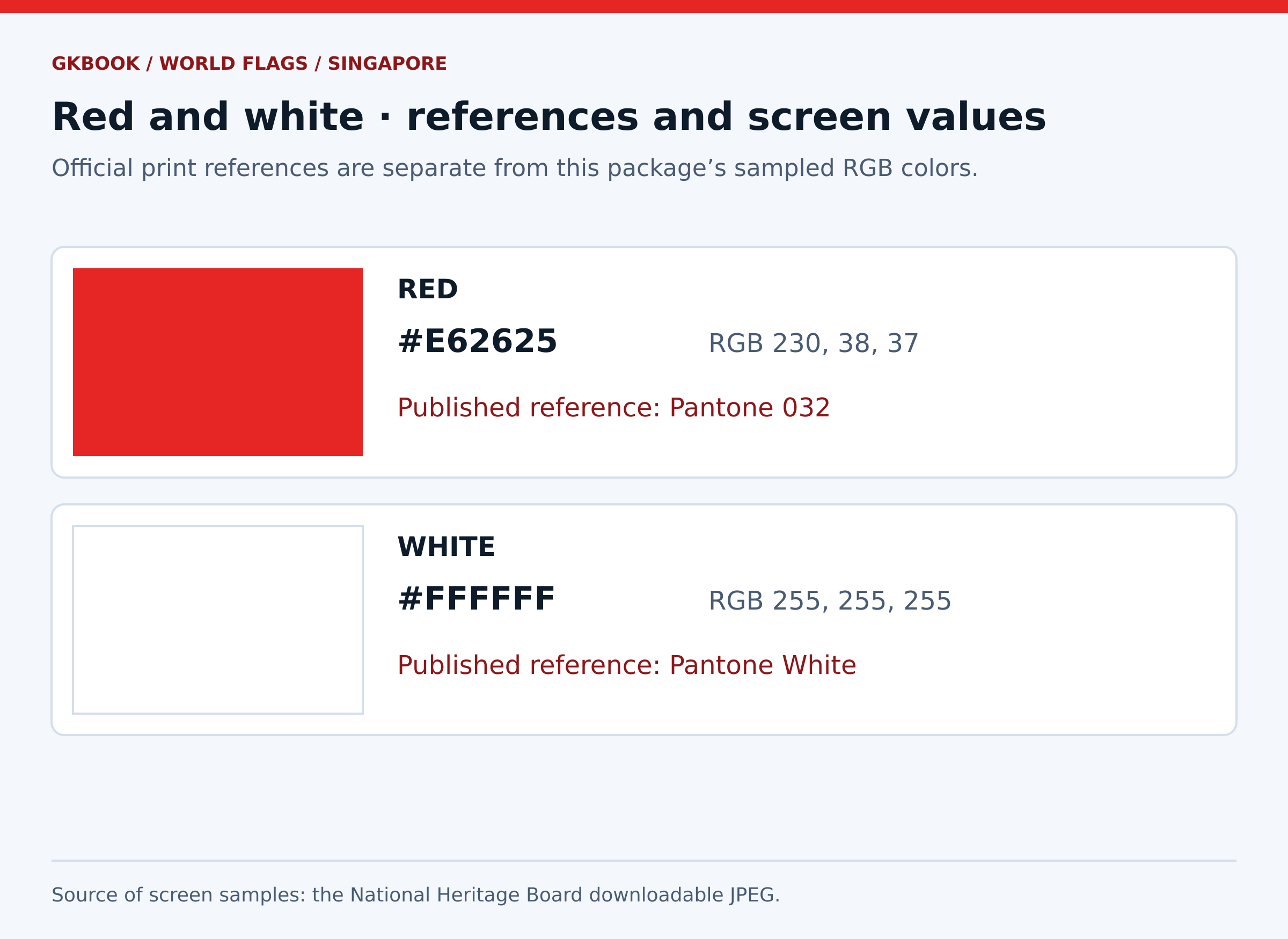
The flag is red and white. National Heritage Board guidance specifies Pantone 032 and Pantone White for reproduction. This digital package uses #E62625 and #FFFFFF, sampled from the board’s downloadable JPEG. These RGB values are declared screen choices, not statutory hexadecimal specifications or guaranteed conversions for ink and fabric.
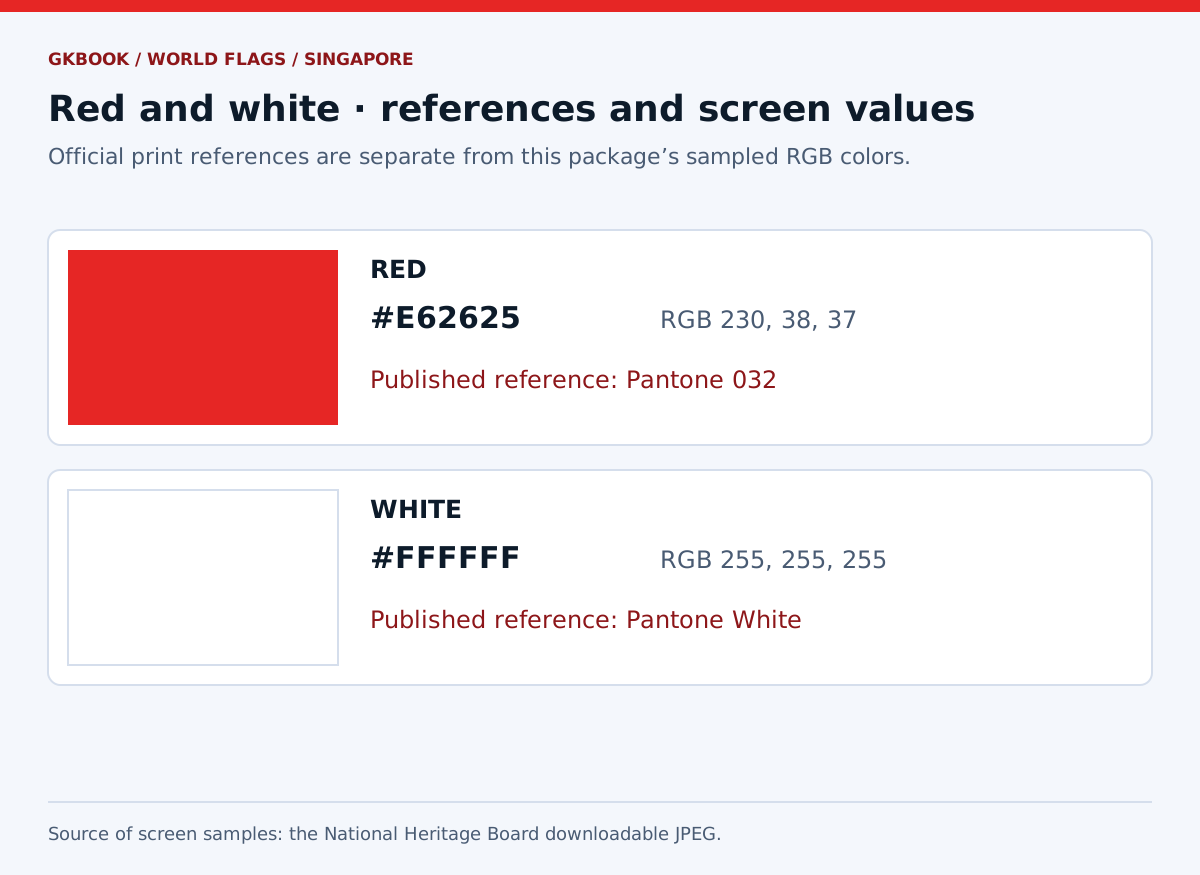
A named print reference and a screen color answer different production questions. A print system identifies a physical color standard, while an RGB triplet describes a color within a digital workflow. Paper, fabric, illumination, profiles, and display settings can affect the result. Therefore, a precise file should disclose both the official reference and its chosen screen values.
The downloadable JPEG supplies a useful color comparison but is not used as the coordinate master. Its compressed edges and rounded dimensions are unsuitable for recovering every mathematical boundary. The package instead combines the printed archival dimensions with a clearly documented digital palette.
| Color | Published reference | Screen value | RGB |
|---|---|---|---|
| Red | Pantone 032 | #E62625 | 230, 38, 37 |
| White | Pantone White | #FFFFFF | 255, 255, 255 |
What does the Singapore flag mean?
Red signifies universal fellowship and equality, while white signifies purity and virtue. The crescent represents a young nation advancing toward its future. The five stars express democracy, peace, progress, justice, and equality. These meanings describe shared national aspirations; they do not divide the population into five ethnic or religious groups.

The original 1959 parliamentary paper explains the colors and emblem alongside the new state arms and anthem. Its account presents the flag as a statement of collective ideals. Later official explanations preserve the same central themes, although wording such as brotherhood or fellowship may differ between documents.
Treat the symbolism as a connected explanation rather than a collection of unrelated labels. Equality appears in both the interpretation of red and the list represented by the stars. This overlap is meaningful: different visual elements can reinforce the same civic value without each receiving a completely exclusive definition.
What does red represent on the Singapore flag?
Red represents universal brotherhood and equality in the official explanation. It occupies the upper half of the flag’s underlying rectangle and provides the background for the white crescent and stars. Red’s national meaning should be distinguished from broader cultural associations or recollections about the process of choosing the design.

Official interpretations describe the chosen symbol, while accounts of the design process explain how alternatives were considered. Those are related but different questions. Historical discussions of happiness, prosperity, or the political associations of an all-red flag should not displace the published national meaning.
Visually, the red field reaches every part of the upper edge and extends to the fly. The white emblem interrupts its visible area, so red does not occupy exactly half of the final colored surface. Half describes the height of the underlying band; the crescent and stars occupy part of that band.
What does white represent on the Singapore flag?
White represents purity and virtue. It forms the lower half of the rectangle and also fills the crescent and all five stars in the red upper half. In the downloadable artwork, every white region is opaque, so the design remains intact when displayed against a colored page or background.

The large lower field and the small emblem shapes use the same white. A transparent gap would behave differently: its appearance would depend on whatever lay behind the image. The SVG therefore includes a solid white background, and the PNG is exported without transparency.
For a picture placed on a white webpage, the lower edge may become difficult to see. A surrounding card or frame can identify the picture’s boundary, provided it stays outside the national rectangle. The clean download itself contains no decorative border, shadow, or artificial texture that could be mistaken for part of the flag.
What does the crescent moon on Singapore’s flag symbolize?
The white crescent represents a young nation on the ascendant: a country looking forward and developing its future. It sits near the hoist within the red band and opens toward the five stars. The published national explanation emphasizes this civic meaning rather than identifying the flag as a religious banner.

Crescent shapes occur in many cultures and flags, so their meaning cannot be inferred from shape alone. For Singapore, the national explanation is the relevant starting point. The 1959 parliamentary material connects the crescent with a young country advancing toward its ideals, and later guidance repeats that theme.
The drawing also matters. The crescent is neither a semicircle nor a white disk with a centrally placed hole. Its two circular boundaries have different radii and displaced centers. This geometry produces the tapering horns while leaving a clear red space between the crescent’s inner edge and the stars.
How many stars are on the Singapore flag?
There are five white five-pointed stars on Singapore’s flag. Their centers lie around an imaginary circle beside the crescent, with one star at the top and two stars on each side below it. Every star points upward; the stars are not rotated outward like spokes around the circle.

Count both the number of stars and the points on each one. Five stars with five points each is different from a single star with many points. The stars are equal in size, and the circular arrangement is a relationship between their centers, not an instruction to draw a white ring.
The original construction plate shows their pentagram geometry and equally spaced center positions. It also gives a diameter for each star’s enclosing circle. That enclosing circle is a measuring aid only. No circle outline, connection line, or central star appears in the finished national flag.
What do the five stars of Singapore represent?
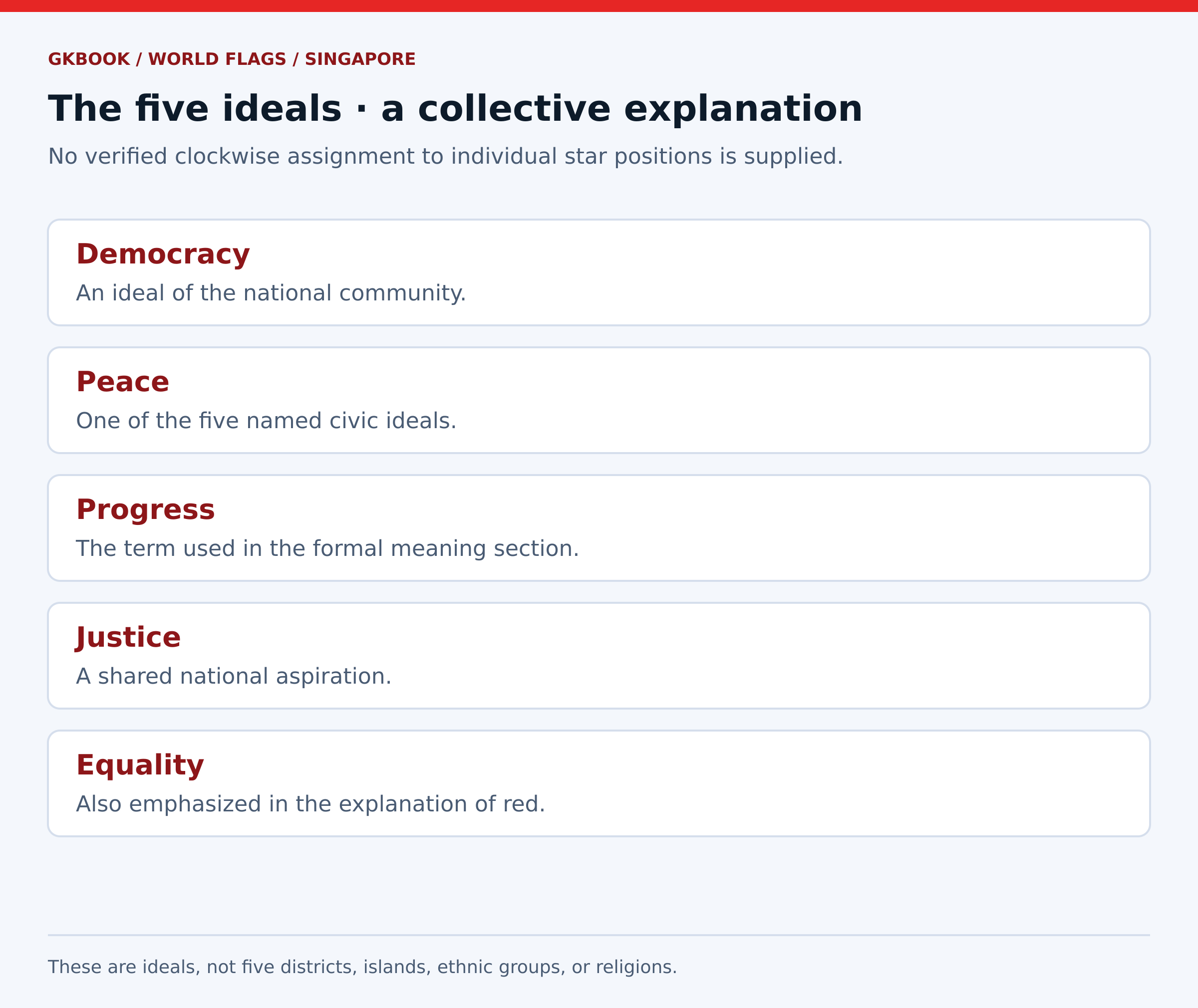
The five stars represent democracy, peace, progress, justice, and equality. Official descriptions present these as the nation’s five ideals. The inspected sources do not assign a particular ideal to a specific star position, so this article does not invent a clockwise mapping or label individual stars inside the flag.

A student can remember the five ideals as a list and explain how they contribute to a shared national vision. The symbols stand for principles, not five named islands, administrative districts, ethnic communities, or religious traditions. Those alternative interpretations require evidence and are not supported by the inspected official descriptions.
The historical account and current symbolism should also be read carefully. One passage on the heritage board’s origins page uses prosperity while describing early ideas, but its formal meaning section uses progress. The original parliamentary explanation likewise includes progress. That is the term retained in the article’s standard list.
What is the official ratio of the Singapore flag?
Singapore’s flag has a height:length ratio of 2:3, equivalent to length:height 3:2. The original construction plate shows a rectangle 54 inches long and 36 inches high. Other sizes preserve the same relationship: a flag 90 centimeters long is 60 centimeters high, with each horizontal band 30 centimeters high.
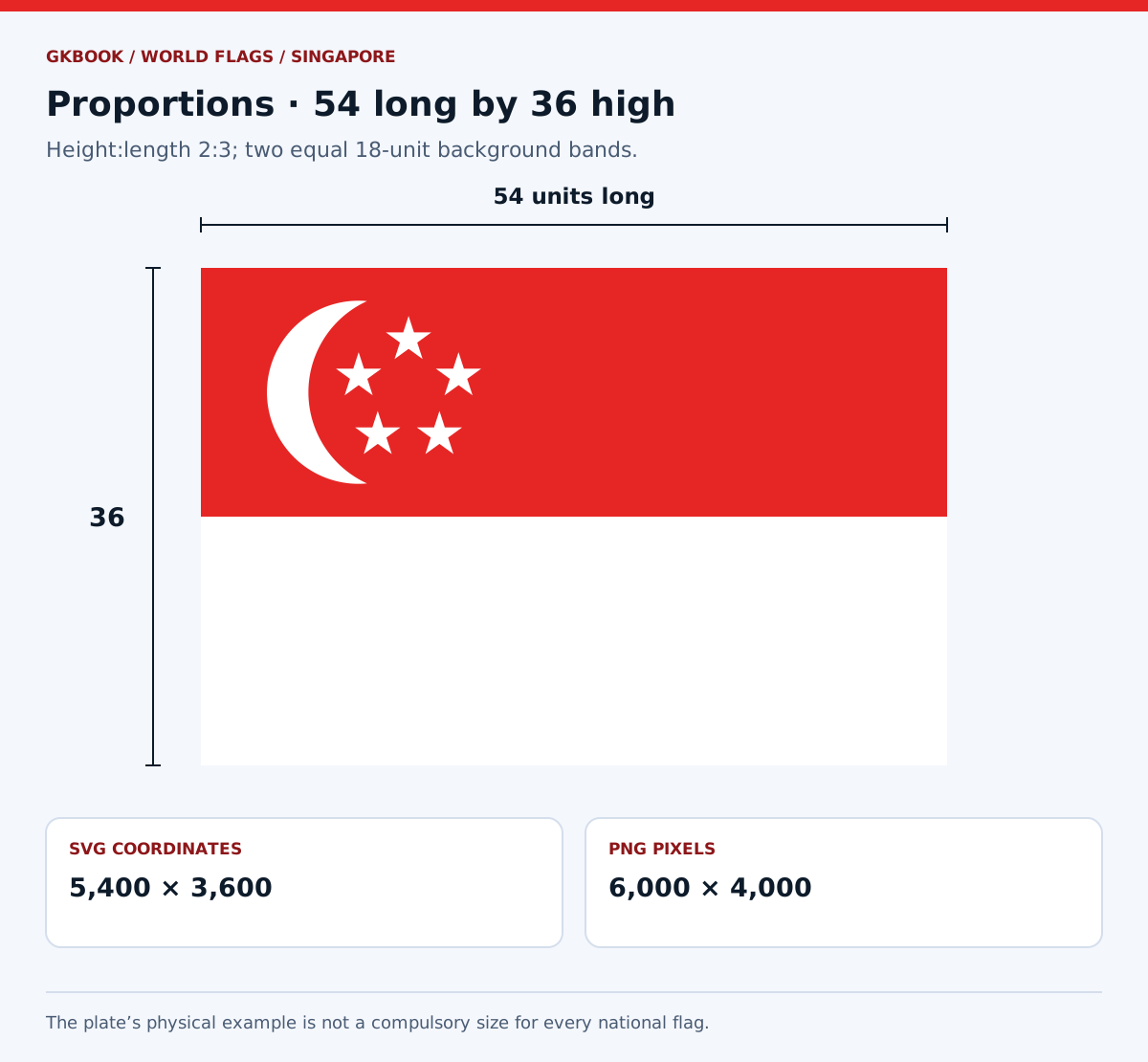
State the order of dimensions whenever giving a ratio. Writing only three to two can confuse readers who expect height first. The original paper calls the shorter dimension width, whereas image software commonly uses width for the horizontal dimension. Here, height and length remove that ambiguity.
The main SVG uses 5,400 by 3,600 coordinate units, exactly one hundred times the numbers on the archival plate. The PNG uses 6,000 by 4,000 pixels. Both have identical proportions, despite their different numerical sizes. Scaling must apply equally to the rectangle, crescent, stars, and the distances between them.
Are the red and white bands equal in size?
Yes. The two underlying horizontal bands have equal height, with red above white. Each occupies half of the rectangular field before the emblem is added. Because the white crescent and stars lie inside the red half, the final visible white area is greater than half of the complete flag.

This distinction helps separate construction from area measurement. Dividing the rectangle into two equal sections establishes the background. Adding white shapes afterward reduces the visible red area and increases the total white area. It does not make the lower band taller or change the horizontal dividing line.
On the SVG canvas, the boundary falls at y equals 1,800, halfway down the 3,600-unit height. The red background extends from the top to that line, and the lower field continues to the bottom. No narrow separator, gap, or third stripe lies between them.
How is the Singapore flag constructed accurately?
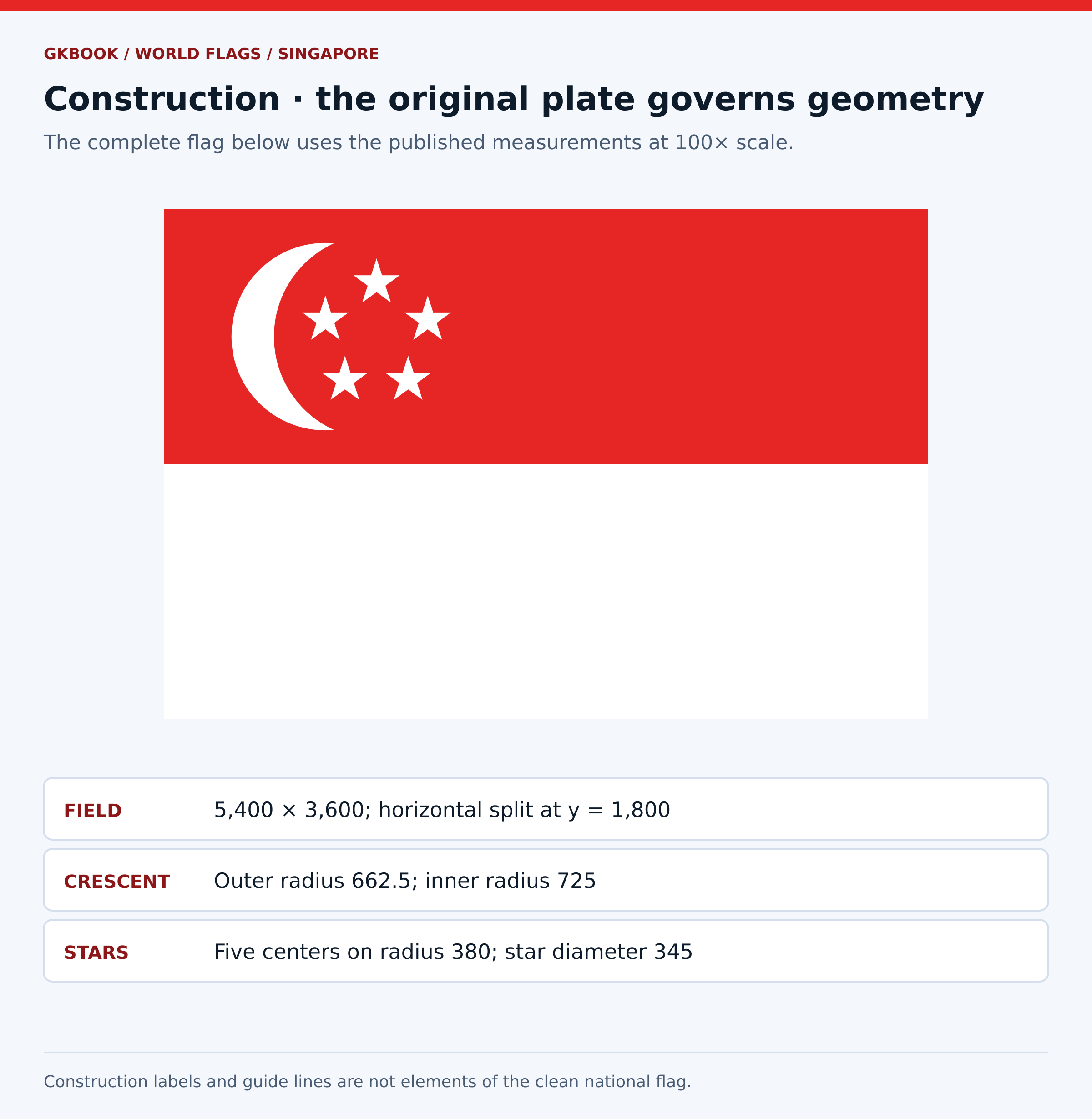
Start with a 54 by 36 rectangle and divide it horizontally into two 18-unit bands. Place the crescent and five stars in the upper hoist using the original 1959 plate’s dimensions. Scale every coordinate together, keep all stars upright, and omit construction lines from the finished national artwork.
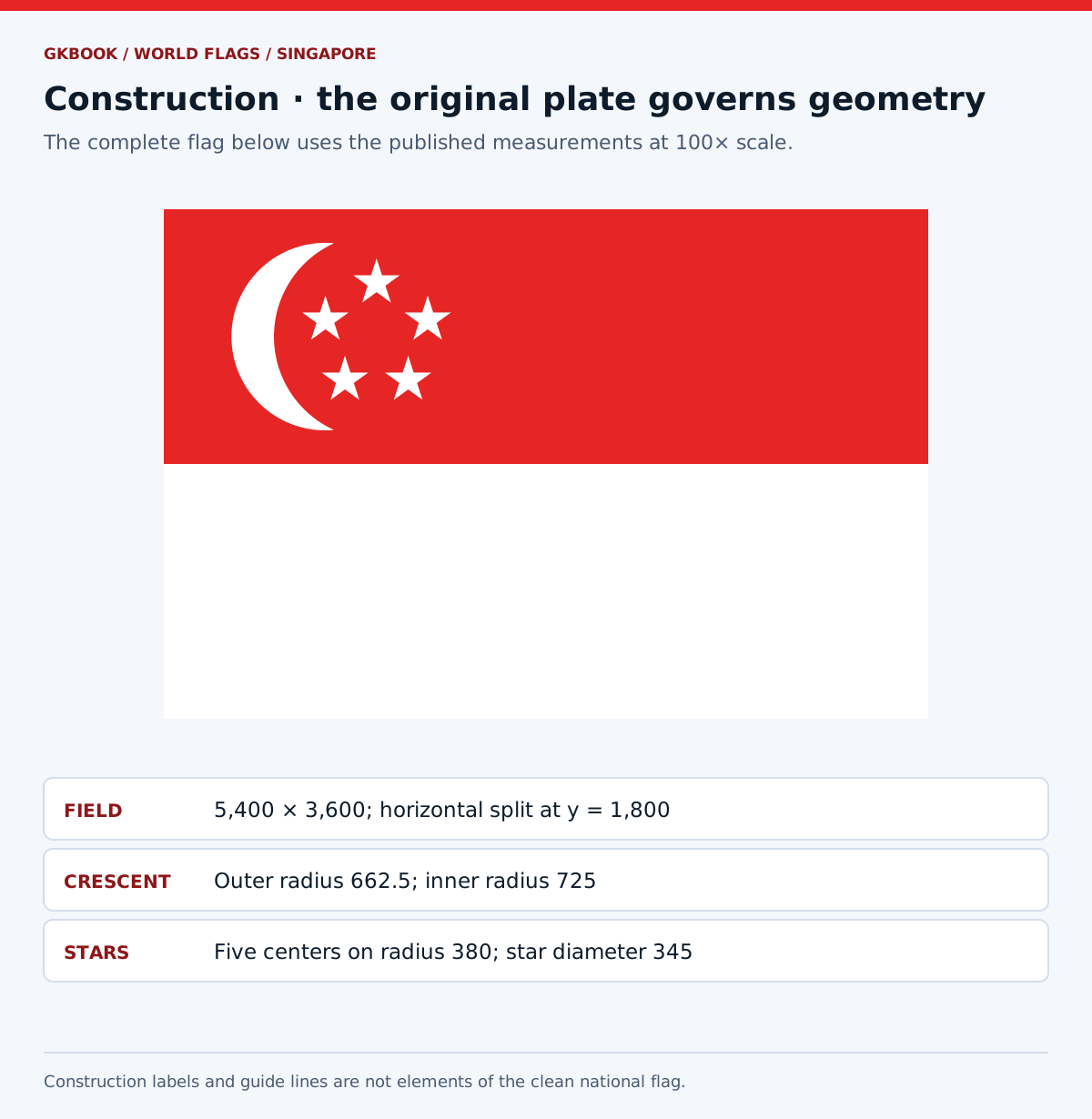
The archival plate supplies a reproducible recipe rather than merely a small illustration to trace. It identifies the crescent’s outer diameter, its distance from the hoist, its horizontal depth, and the inner circular radius. The star arrangement has its own center-circle radius, equal angular intervals, and enclosing diameters.
These specifications are kept in the package’s geometry record. The clean SVG contains only the two background fields, one crescent path, and five star polygons. Explanatory dimensions and labels belong to separate diagrams. This separation allows readers to study the construction without confusing an annotated teaching image with the actual flag.
What is the history of Singapore’s flag?
Singapore developed the red-and-white design after attaining internal self-government in 1959. It was unveiled publicly that December, remained the state flag during Singapore’s membership in Malaysia from 1963 to 1965, and became the independent republic’s national flag in 1965. These stages explain why both 1959 and 1965 appear in its history.
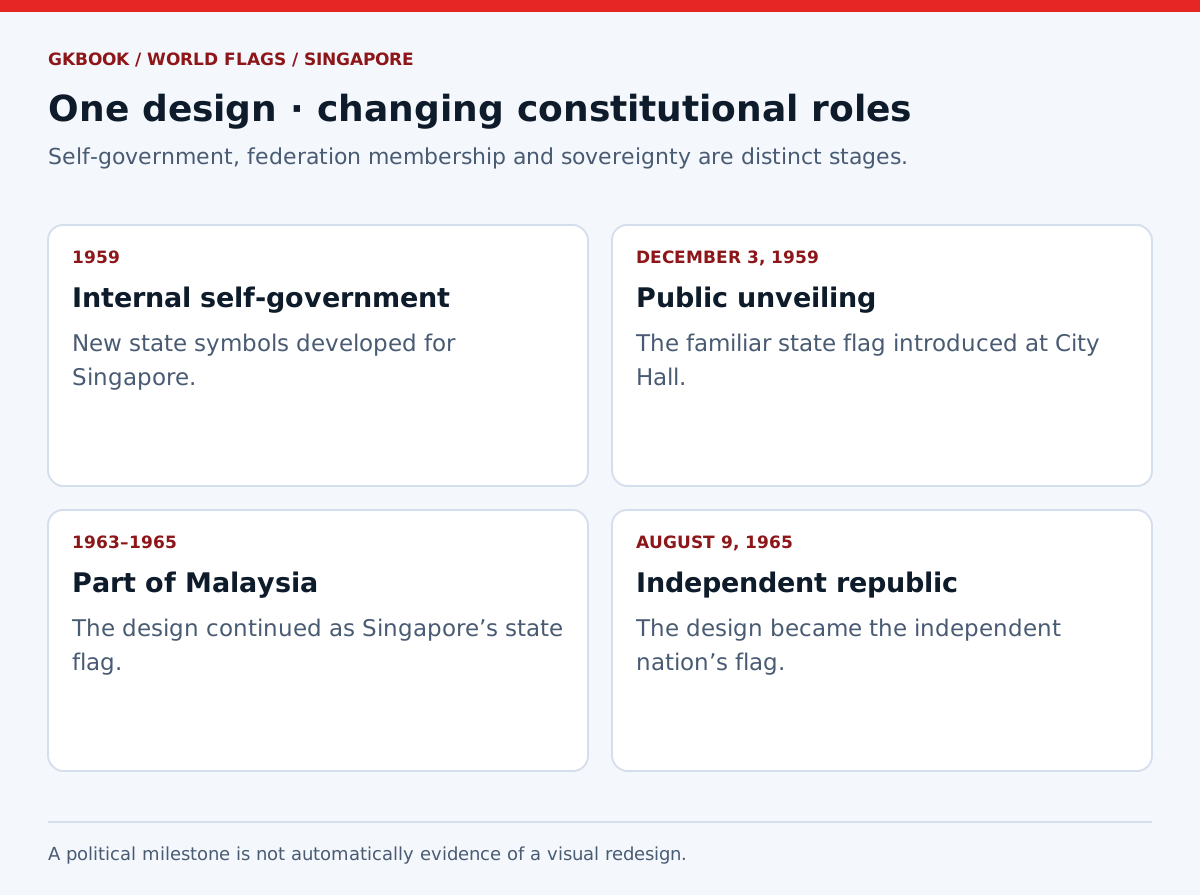
The flag formed part of a wider effort to create shared state symbols, alongside the arms and anthem. It expressed a political community’s aspirations at a time when Singapore was self-governing but had not yet become an independent republic. A committee led by Toh Chin Chye considered designs for this purpose.
Historical context should not be flattened into a single independence story. The British colonial period, self-government, membership in Malaysia, and independent statehood describe different arrangements. Nor should a variation between modern digital illustrations be treated as proof of a historical redesign. Dates and design changes require separate supporting evidence.
When was the Singapore flag adopted?
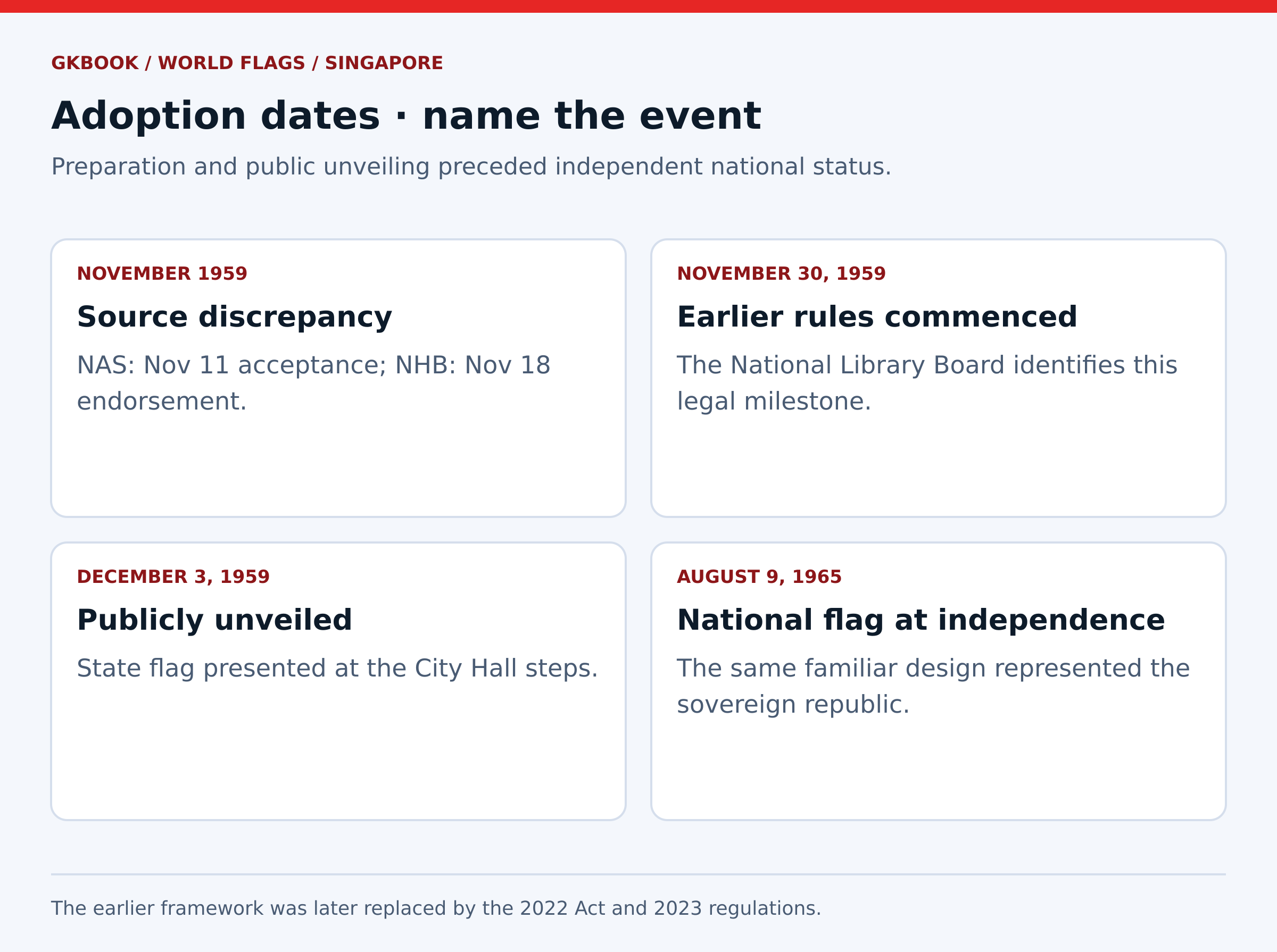
The design was publicly unveiled on December 3, 1959, as Singapore’s state flag. It became the independent republic’s national flag on August 9, 1965. Preparatory legislative steps in November 1959 preceded the unveiling, so approval, commencement of the earlier rules, public presentation, and independent national status should be labeled separately.

The parliamentary symbols paper was tabled on November 7, 1959. The November 11 order paper lists an adoption motion, and the archives describe acceptance at that sitting. The heritage board instead gives November 18 for endorsement. These accounts remain a source discrepancy, not an invented sequence. The National Library Board dates the earlier regulatory framework’s commencement to November 30.
December 3 marks the public unveiling at the City Hall steps during the installation of Yusof bin Ishak as Yang di-Pertuan Negara. The familiar design therefore predates sovereignty. An adoption summary should explain this sequence instead of substituting independence day for the flag’s first public appearance.
Who designed the Singapore flag?
The flag was developed by a committee led by Dr Toh Chin Chye, then Singapore’s Deputy Prime Minister. Official historical accounts credit his leadership and describe alternative designs considered before the final choice. This committee attribution is more precise than presenting a modern illustrator or an unsupported sole drafter as the original designer.

The design process combined a political purpose with practical visual decisions. A new state symbol needed to express common aspirations and remain distinguishable from the flags of other countries. The heritage board records Toh’s study of other national flags and his presentation of prototypes for consideration.
Accounts of individual suggestions do not change the basic distinction between national design and later reproduction. The present package credits the committee’s historical role while identifying GKBook as the creator of these coordinates, explanatory layouts, and article. A digital file’s author credit is not evidence that its illustrator invented Singapore’s national flag.
Did Singapore introduce a new flag at independence in 1965?
Singapore retained the familiar red-and-white design when it became independent on August 9, 1965. The flag had already represented the self-governing state since 1959. Independence changed its role to the national flag of a sovereign republic; it should not be described as the first appearance of the crescent-and-five-stars design.

A national symbol can remain visually stable while its constitutional role changes. In this case, the continuity of the design links the aspirations expressed during self-government with the independent republic. That relationship is clearer when a timeline gives both dates and names the event attached to each.
The independence milestone also explains National Day’s place in Singapore’s civic calendar. August 9 commemorates independent statehood, whereas December 3 belongs to the history of the flag’s public introduction. Neither anniversary needs to replace the other. Together they answer two common questions: when the design appeared and when the independent nation adopted it.
Was this flag used while Singapore was part of Malaysia?
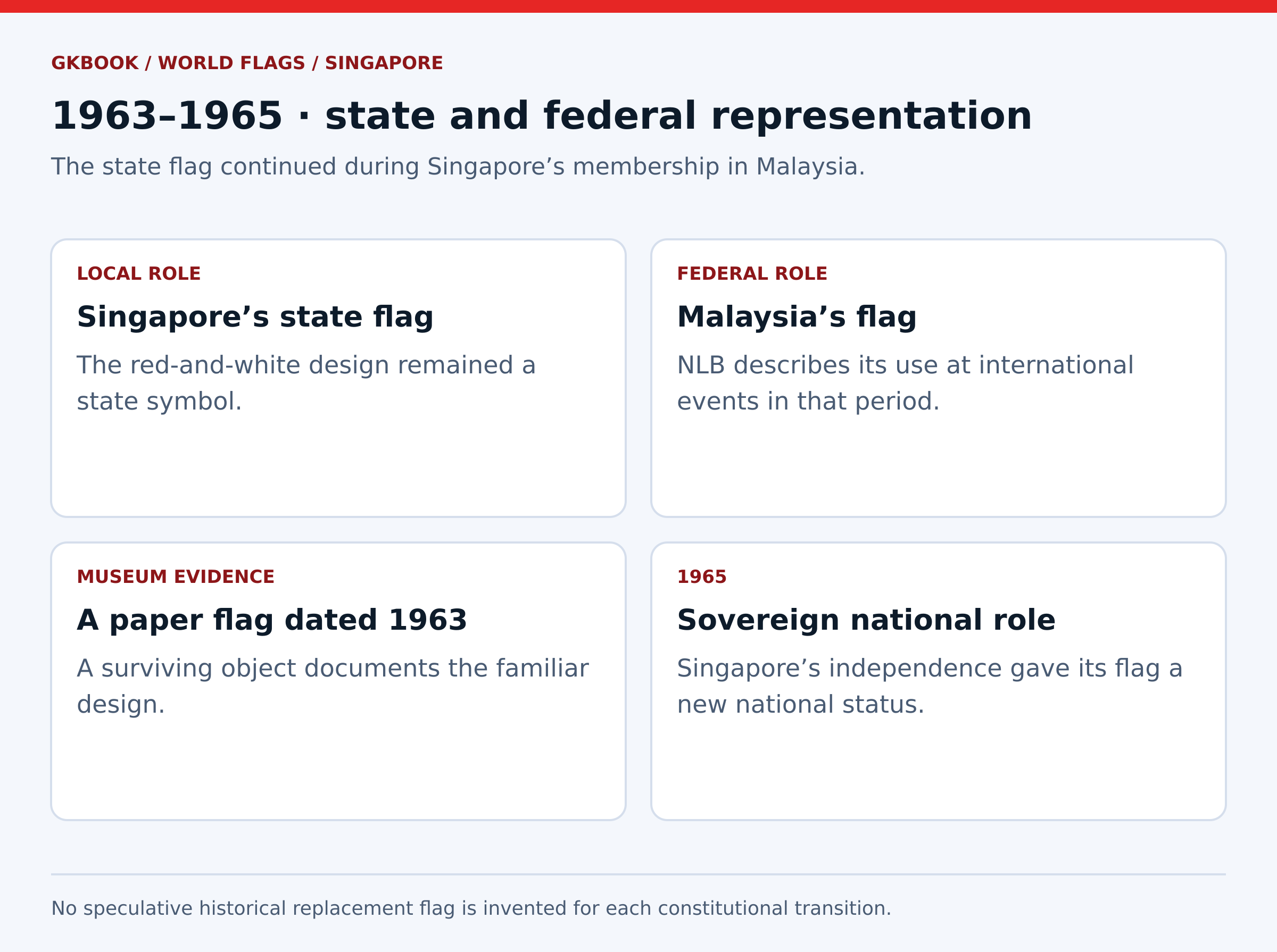
Yes. Singapore’s red-and-white design remained its state flag during membership in Malaysia from 1963 to 1965. The National Library Board explains that the federation’s flag represented Singapore at international events during that period. State representation and federal representation therefore coexisted, rather than requiring the local design to disappear.

A flag’s use depends on the political level and occasion it represents. The local state flag and the federation’s national flag served different purposes, so describing one does not automatically negate the other. A museum’s surviving 1963 paper flag also documents the red-and-white design within that period.
For a school chronology, show the same basic Singapore design across self-government, federation membership, and independence while changing the accompanying labels. This approach avoids inventing a replacement design for every political transition. The article does not provide a speculative collection of historical badge variants or imply that modern redraw differences establish official changes.
Why is National Day on August 9 rather than the flag’s unveiling date?
Singapore’s National Day commemorates independence on August 9, 1965. The flag’s public unveiling on December 3, 1959, belongs to the earlier self-government period. The same familiar design connects both events, but a national independence anniversary and an anniversary of a flag’s introduction are different kinds of historical observance.
The distinction becomes especially useful when reading captions, quiz questions, or timelines. A photograph of a National Day celebration does not establish that the design was first created on that date. Likewise, a record of the 1959 unveiling does not make Singapore an independent republic six years earlier.
National Day and the National Day celebrations period are also different. The day is August 9; the period identified in the flag-use framework runs from July 1 through September 30. That longer interval affects specified display and use conditions. It does not change the anniversary’s date or introduce a seasonal version of the flag.
Does the Singapore flag contain its coat of arms?
No. The national flag contains a crescent and five stars, but not the complete national coat of arms. The arms also include a shield, lion, tiger, and motto. Shared symbols connect the two designs historically; they do not authorize adding the arms, a lion head, or lettering to the flag.

The 1959 parliamentary paper presents the arms and flag separately and explains their related symbolism. Reading them side by side helps identify which elements are common and which belong only to the heraldic design. The ordinary flag remains visually simpler than the arms.
This difference matters when downloading illustrations or preparing educational material. A crest placed beside a flag in an official document is not necessarily printed on the flag itself. A special service flag or office-related standard may have its own composition. The clean national download therefore preserves the crescent and five stars without importing additional emblems from neighboring illustrations.
What measurements define the Singapore flag’s crescent?
On the 54 by 36 archival plate, the crescent begins 4.78 inches from the hoist. Its outer circle has a 13.25-inch diameter, its horizontal depth is 3 inches, and its inner circular radius is 7.25 inches. Both centers lie halfway down the 18-inch red band; scale these measurements together.

The outer radius is half of 13.25, or 6.625. Adding that radius to the left inset places the outer center at x equals 11.405. The inner circle begins three units farther right than the crescent’s left edge, so its center is at 4.78 plus 3 plus 7.25, giving x equals 15.03.
Both centers have y equals 9. Subtracting the inner disk from the outer disk creates the crescent. These arithmetic steps explain the published dimensions without tracing a compressed image. The two circles have unequal radii; replacing them with equal circles would change the horns and inner curve.
How are the five stars positioned and sized?
The archival plate places the star centers on a circle of radius 3.8 inches, separated by 72 degrees. Each star fits inside a circle 3.45 inches in diameter. The star-center circle shares the crescent’s inner-circle center. All five stars have the same size and remain upright in the normal horizontal view.

On the 54-unit drawing, that common center is at x equals 15.03 and y equals 9. The top star’s center is therefore at y equals 5.2. The other centers follow around the circle at equal angular intervals. Their enclosing circles are useful for measuring size but are absent from the finished artwork.
An older secondary construction account gives a different star diameter when converted to this scale. The original scanned plate clearly labels 3.45, so that printed value controls this reconstruction. The package also preserves the printed 4.78 hoist inset instead of silently rounding it to a neighboring convenient value.
What does the reverse of the Singapore flag look like?
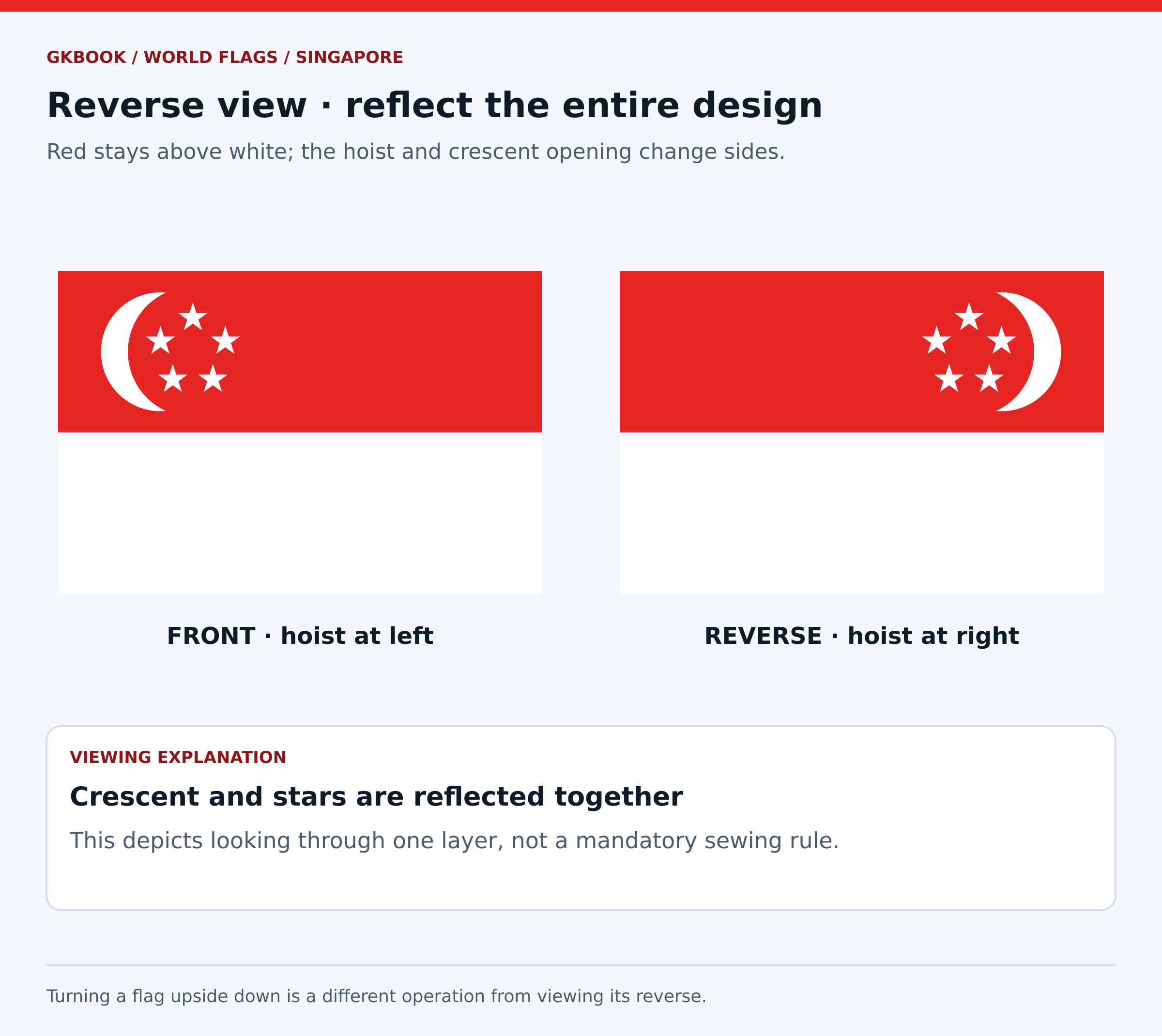
When the same single-layer flag is viewed from behind, the entire design is mirrored horizontally: the crescent-and-stars group appears near the upper right, and the crescent opens leftward. Red remains above white. This explains a reverse view; it is not a separate national design or a compulsory specification for sewing.
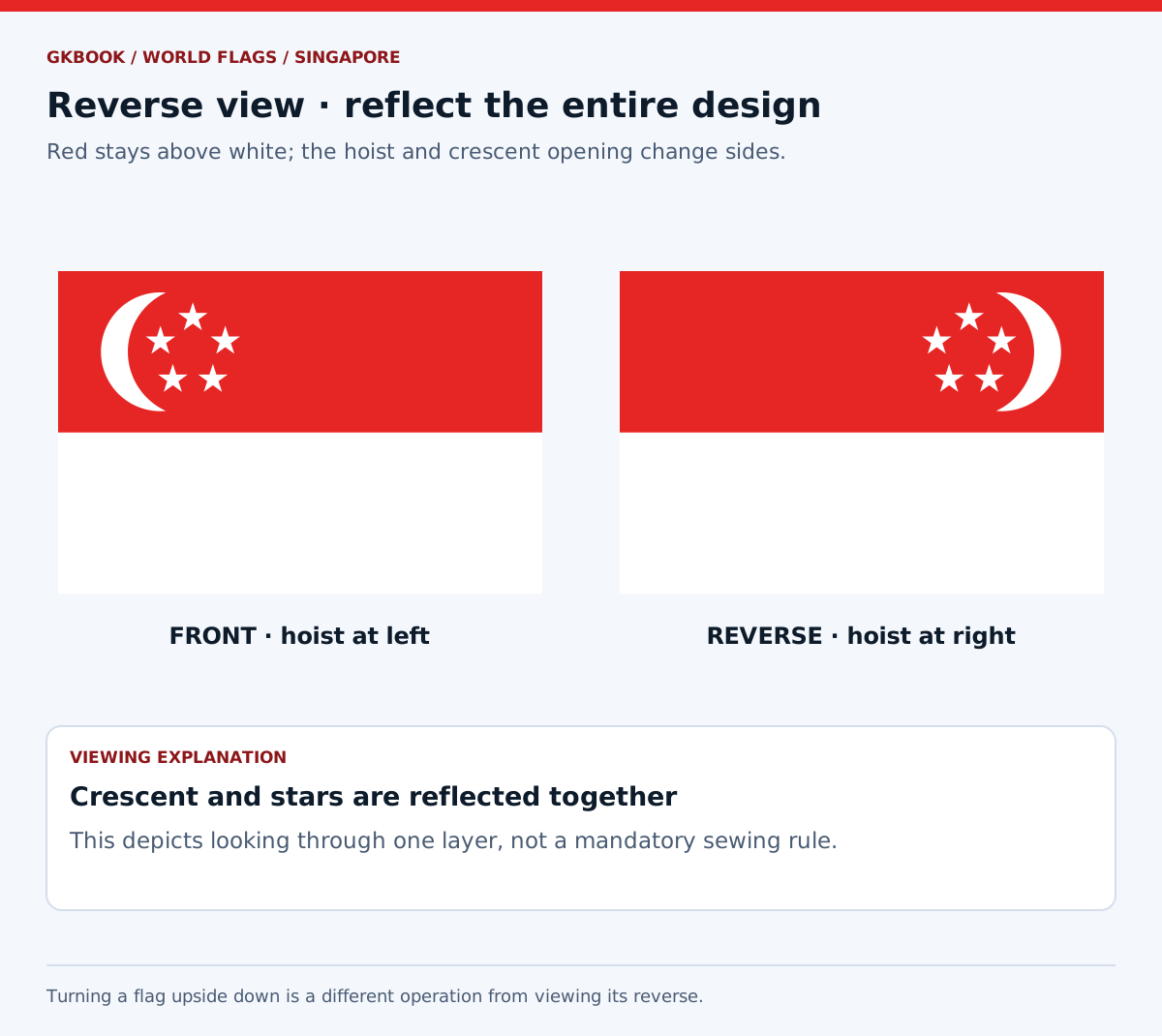
A reflection affects every emblem element together. Moving only the crescent, leaving the stars behind, or keeping its opening unchanged would not represent the back of the same drawing. Turning the flag upside down is also different, because that rotation would exchange the top and bottom fields.
The diagram labels the viewing side and hoist explicitly. That labeling prevents a reverse illustration from being mistaken for the normal front-facing reference. For ordinary presentation on a webpage or against a wall, use the appropriate front view with the emblem in its expected position rather than treating the reverse diagram as a second display option.
How should Singapore’s flag be displayed against a wall?
Regulation 8(6) specifies that a hung flag should be against a vertical wall or other vertical flat surface, with the crescent and stars at the top left as seen by a viewer facing it. The supplied wall diagram preserves the normal landscape flag and follows that viewer-based placement rule.
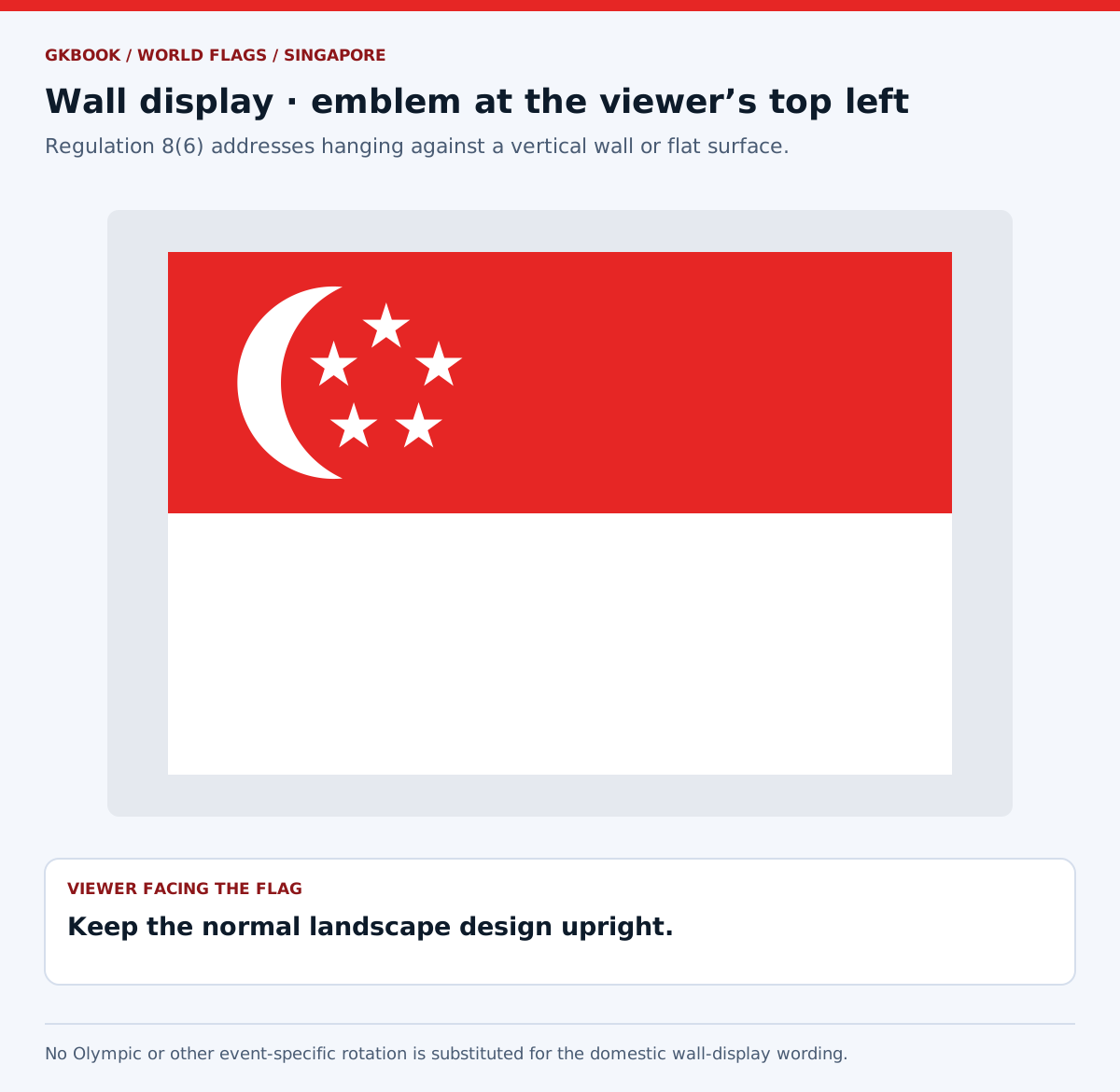
A vertical wall is a surface orientation, not automatically an instruction to turn the flag into a tall portrait shape. This distinction is easy to miss when the word vertical appears in a caption. The regulations and heritage board guidance describe where the emblem should appear to the spectator.
The accompanying diagram places an unchanged flag against a wall, with explanatory text outside its boundary. It does not substitute a sports-event rotation convention for Singapore’s domestic wall-display wording. Protocol for a particular international ceremony may have its own requirements, but such instructions should be identified and verified for that setting.
Can the Singapore flag be displayed throughout the year?
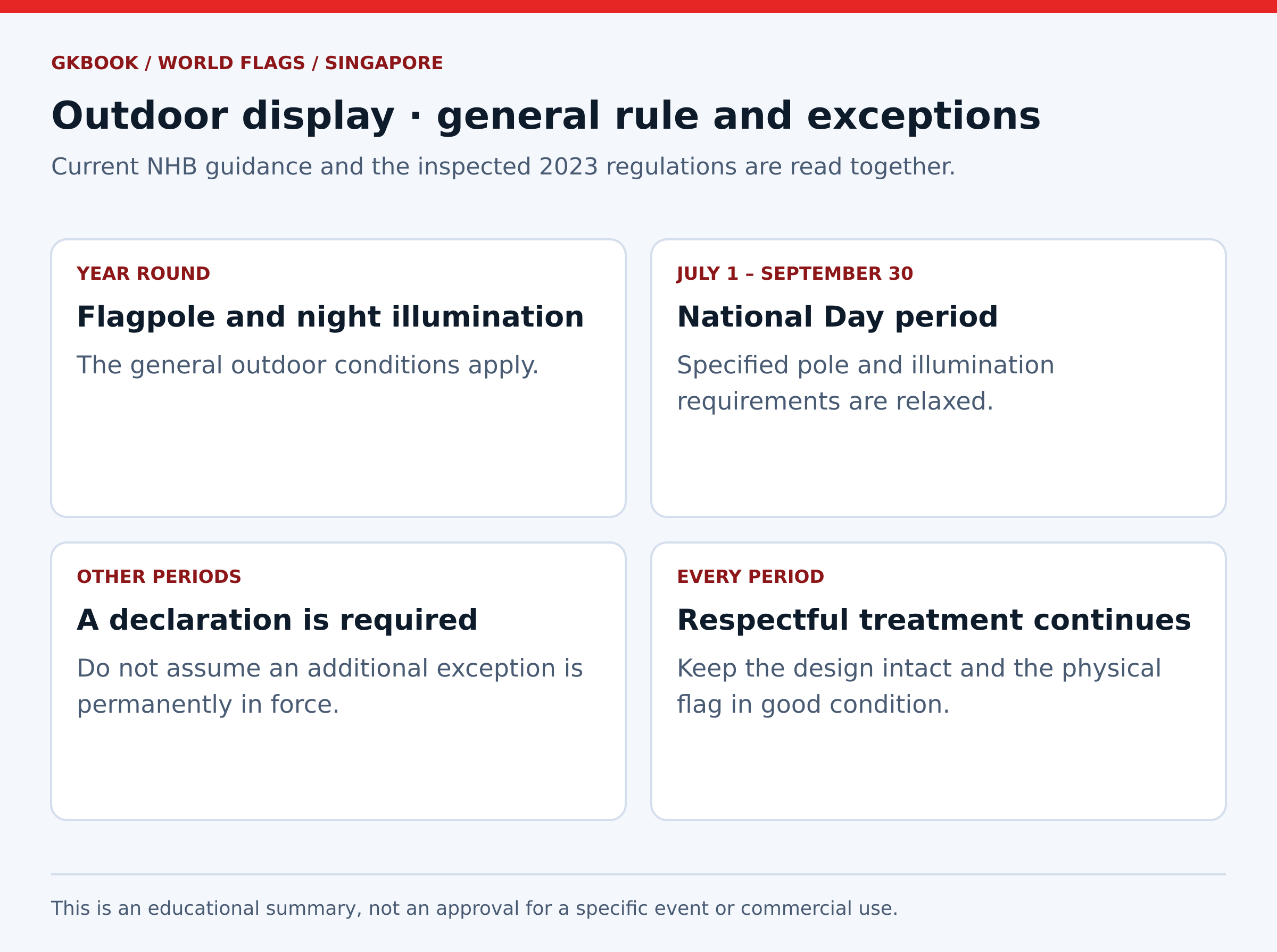
The heritage board’s guidance allows year-round display from a flagpole, with proper illumination when flown at night. During the National Day period, July 1 to September 30, specified flagpole and night-illumination requirements are relaxed. The regulations also provide for other declared periods; those exceptions should not be assumed to apply permanently.
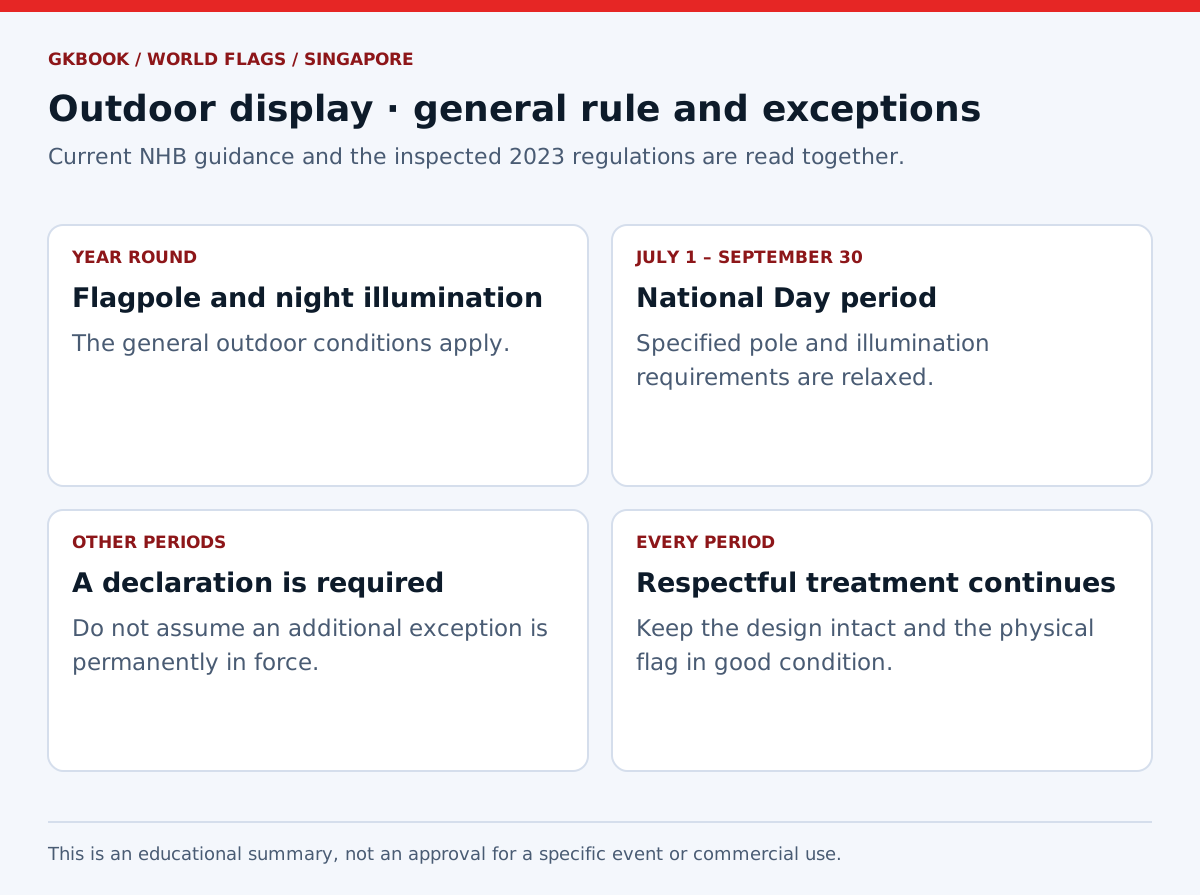
The general outdoor rule and its exceptions belong together. Quoting only the year-round permission omits conditions, while quoting only the National Day relaxation incorrectly suggests that flags are otherwise forbidden. The article summarizes the framework as checked against the 2023 regulations and the heritage board’s current guidance.
Display alongside other flags also involves a position of honor and international practice. Domestic organizational flags should not be treated as equivalent to foreign national flags in every protocol situation. For a specific event, consult the applicable official instructions rather than inferring a complete ceremony arrangement from a single illustration or a short educational summary.
When is Singapore’s flag flown at half-mast?
The regulations provide for half-mast display during a period of national mourning declared by the government. Heritage board guidance explains raising the flag fully before lowering it to half-mast, and raising it fully again before final lowering. This article explains the procedure without claiming that a mourning period is currently in effect.
Half-mast is a commemorative use of the existing flag, not a modified design. The white symbols, band order, and proportions remain unchanged. The relevant declaration identifies the occasion and period, so an old photograph or past notice cannot establish what should happen today.
The practical sequence helps distinguish half-mast display from leaving a flag partway up a pole without explanation. Handling should remain dignified, and the flag should be kept clear of the ground. The article does not invent a universal measured gap between the pole’s top and the flag or prescribe a current schedule without a verified announcement.
How should the Singapore flag be handled and cared for?
Official guidance calls for keeping the flag clean, replacing faded or torn flags, and treating it respectfully. It should not touch the ground or be displayed in damaged condition. The heritage board advises packing worn-out flags into a sealed black trash bag so that they are not left exposed in a dustbin.
Care concerns the physical object as well as its symbolic appearance. Store it neatly, prevent accidental damage, and avoid hanging it out with ordinary laundry. A flag that is too worn for display should be replaced rather than retained simply because its colors are still recognizable.
For images, respectful treatment includes preserving the design and keeping added words or graphics away from the emblem. The official examples place accompanying material beside or below the flag image. The package’s labels and teaching notes therefore sit outside each complete flag rectangle, while the clean files contain no captions or added marks.
Can the Singapore flag be used on products or clothing?
Singapore’s framework distinguishes commercial uses, attire, decoration, and the National Day period. Respectful noncommercial use on attire is permitted year-round under the stated conditions; specified commercial and decorative uses have National Day exceptions. A downloadable flag file is not blanket permission for every product, advertisement, trademark, or other proposed use.
The 2023 changes expanded some uses while retaining safeguards. Earlier summaries that describe all clothing uses as forbidden are therefore incomplete for the newer framework. Conversely, permission in one category does not remove separate restrictions on another category, such as using the flag as a trademark.
A proposed application should be evaluated by its purpose, timing, placement, and treatment of the design. The official illustrated guidance addresses examples such as attire placement and items likely to become dirty. This article provides context rather than an approval for a particular commercial project; its artwork credits explain reproduction choices, not regulatory authorization.
Is Singapore’s national flag the same as its Red Ensign?
No. Singapore’s Red Ensign is a separate maritime design: a red field with a white ring enclosing a crescent and five stars, in a 1:2 height:length ratio. The Maritime and Port Authority’s circular distinguishes it from the 2:3 national flag and states that the national flag does not substitute for that ensign.
Flags can identify the same country while serving different roles. The national flag’s red-over-white layout is readily recognizable on land, whereas the Red Ensign has a different field, emblem arrangement, and proportion for its maritime purpose. Shared colors and symbols do not make the two drawings interchangeable.
The inspected authority is the maritime agency’s dated circular, which describes the proper colors for Singapore-registered vessels. It is used here to explain the design distinction, not to provide a complete current operating checklist for every ship. This package supplies the national flag and does not label a speculative naval or merchant construction as an authenticated master.
How should the Singapore flag files be prepared for printing?
Preserve the 2:3 height:length ratio, equal background bands, and complete crescent-and-stars geometry. Use the scalable SVG or the 6,000 by 4,000 PNG. Keep the published Pantone reference separate from the sampled RGB recipe, and proof physical output on its intended material before treating the colors as a reliable match.
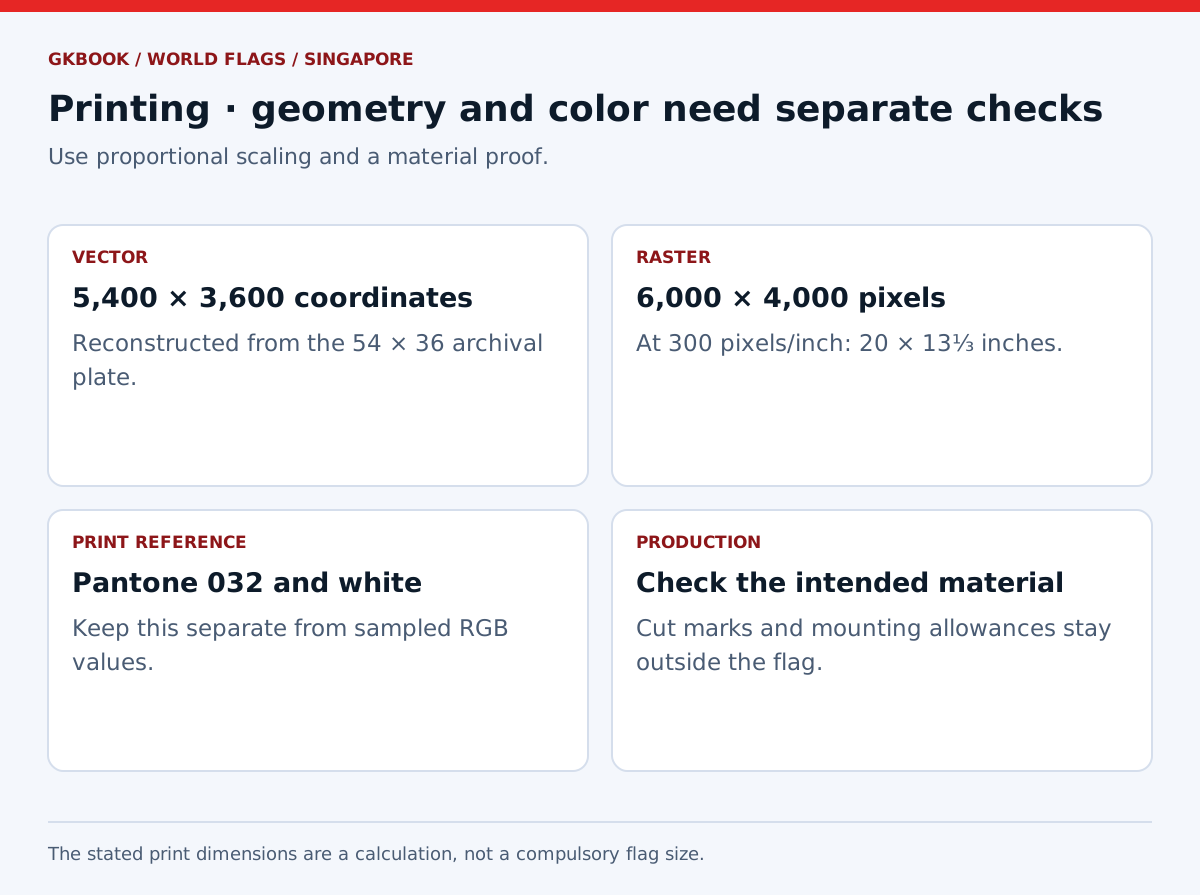
At 300 pixels per inch, the supplied PNG corresponds to 20 by 13⅓ inches. That is a calculation from its pixel dimensions, not a compulsory national flag size. The vector file can scale further without losing the mathematical shapes, provided the software preserves its proportions and paths.
Place cutting marks, captions, and mounting allowances outside the finished flag area. Fabric stretch, seams, printer profiles, and lighting can affect the final result even when the digital coordinates are correct. A production proof is therefore useful for checking both color and the small star details before a larger run is made.
How can the Singapore flag be displayed clearly online?
Show the complete rectangle without stretching or cropping, preserve its opaque white areas, and provide alternative text identifying the red-over-white design with a crescent and five stars. Use SVG for scalable rendering or an appropriate PNG size. Keep nearby labels and interface controls outside the national flag itself.

A small preview must retain the emblem, because the two background colors alone do not identify Singapore uniquely. Check the stars at the intended display size instead of assuming that a large, detailed master will remain equally legible when reduced. Avoid changing star count or enlarging isolated parts to compensate for a poorly chosen layout.
For responsive pages, preserve the natural image ratio while allowing the surrounding card to adapt. The separate social image uses a wider canvas with a complete flag inside it. Its overall dimensions belong to the social layout and should never be mistaken for a new national flag proportion.
What Singapore flag pictures are included in this package?
The gallery includes 24 subjects in SVG and PNG, covering the clean flag, symbolism, chronology, proportions, crescent construction, star placement, and display examples. The main SVG is 5,400 by 3,600 units, and the PNG is 6,000 by 4,000 pixels. A separate 1,200 by 630 social-image pair is also supplied.
The illustrations are original geometric reconstructions and educational layouts. The original archival scan, complete source publications, and heritage board reference image are retained only as research inputs and are not redistributed. Credits identify the national design’s committee attribution and GKBook’s work on these new files.
The private editorial records document the dimensions, sampled colors, differing secondary measurements, source access, and validation limits. They also preserve an offline rebuild recipe and file hashes. These records help an editor reproduce the package and review its evidence without placing a public Sources or Tests section inside the established GKBook article layout.
Download Singapore flag pictures
Download the clean national flag as SVG or 6,000 × 4,000 PNG. The SVG uses 5,400 × 3,600 coordinates based on the original 54 × 36 construction plate. Both formats preserve equal background bands, the measured crescent, and five upright stars. White is opaque. The screen red is sampled from the heritage board’s JPEG; Pantone 032 is listed separately as the published print reference.
The gallery contains 24 subjects, each with an SVG and PNG. The captions distinguish published specifications, attributed meanings, historical events, and digital reproduction choices. Image credits and reproduction notes explain the source basis. The separate 1,200 × 630 social card contains a complete flag and does not alter the national rectangle.
Continue exploring national designs in World Flags.
World Flags/Singapore
Singapore flag pictures
Clean national flag reconstructed from the original 1959 plate; 2:3 height:length. Screen colors are sampled reproduction choices.
National design: committee led by Dr Toh Chin Chye / Singapore. Original coordinate reconstruction and educational layouts: GKBook.Download SVGDownload PNGPantone 032 and Pantone White are published guidance; #E62625 and #FFFFFF are sampled screen choices, not an exact ink conversion.
National design: committee led by Dr Toh Chin Chye / Singapore. Original coordinate reconstruction and educational layouts: GKBook.Download SVGDownload PNGThe symbolism is civic; no star-to-ethnic-group mapping is asserted.
National design: committee led by Dr Toh Chin Chye / Singapore. Original coordinate reconstruction and educational layouts: GKBook.Download SVGDownload PNGThe background band is half the flag’s height; its visible red area is less than half.
National design: committee led by Dr Toh Chin Chye / Singapore. Original coordinate reconstruction and educational layouts: GKBook.Download SVGDownload PNGWhite appears both in the lower band and within the red upper field.
National design: committee led by Dr Toh Chin Chye / Singapore. Original coordinate reconstruction and educational layouts: GKBook.Download SVGDownload PNGThe crescent’s form and its attributed civic meaning answer different questions.
National design: committee led by Dr Toh Chin Chye / Singapore. Original coordinate reconstruction and educational layouts: GKBook.Download SVGDownload PNGThe imaginary center circle and enclosing circles are omitted from the finished flag.
National design: committee led by Dr Toh Chin Chye / Singapore. Original coordinate reconstruction and educational layouts: GKBook.Download SVGDownload PNGDemocracy, peace, progress, justice, and equality are a collective list, not verified labels for five particular positions.
National design: committee led by Dr Toh Chin Chye / Singapore. Original coordinate reconstruction and educational layouts: GKBook.Download SVGDownload PNGThe archival plate uses 54 by 36 inches. Every dimension can be scaled proportionally.
National design: committee led by Dr Toh Chin Chye / Singapore. Original coordinate reconstruction and educational layouts: GKBook.Download SVGDownload PNGEqual band heights do not mean the final visible red and white areas are equal.
National design: committee led by Dr Toh Chin Chye / Singapore. Original coordinate reconstruction and educational layouts: GKBook.Download SVGDownload PNGThree measured relationships establish the full rectangle, crescent and five-star arrangement.
National design: committee led by Dr Toh Chin Chye / Singapore. Original coordinate reconstruction and educational layouts: GKBook.Download SVGDownload PNGThe visual design predates independence by six years.
National design: committee led by Dr Toh Chin Chye / Singapore. Original coordinate reconstruction and educational layouts: GKBook.Download SVGDownload PNGOfficial accounts differ on November endorsement; later milestones are labeled separately.
National design: committee led by Dr Toh Chin Chye / Singapore. Original coordinate reconstruction and educational layouts: GKBook.Download SVGDownload PNGNational design attribution is distinct from authorship of a later digital file.
National design: committee led by Dr Toh Chin Chye / Singapore. Original coordinate reconstruction and educational layouts: GKBook.Download SVGDownload PNGIndependence is distinguished from the first public unveiling.
National design: committee led by Dr Toh Chin Chye / Singapore. Original coordinate reconstruction and educational layouts: GKBook.Download SVGDownload PNGState and federal symbols could serve different representational roles at the same time.
National design: committee led by Dr Toh Chin Chye / Singapore. Original coordinate reconstruction and educational layouts: GKBook.Download SVGDownload PNGThe original parliamentary paper describes the flag and arms in separate sections.
National design: committee led by Dr Toh Chin Chye / Singapore. Original coordinate reconstruction and educational layouts: GKBook.Download SVGDownload PNGThe inner disk is removed from the outer disk. The printed 4.78 inset and unequal radii govern this reconstruction.
National design: committee led by Dr Toh Chin Chye / Singapore. Original coordinate reconstruction and educational layouts: GKBook.Download SVGDownload PNGThe star-center ring shares the inner crescent circle’s center. All stars have an upward point.
National design: committee led by Dr Toh Chin Chye / Singapore. Original coordinate reconstruction and educational layouts: GKBook.Download SVGDownload PNGThe complete design is reflected horizontally; the reverse is not an alternative normal front-facing layout.
National design: committee led by Dr Toh Chin Chye / Singapore. Original coordinate reconstruction and educational layouts: GKBook.Download SVGDownload PNGA vertical wall is a surface orientation, not by itself an instruction to rotate the flag into a portrait shape.
National design: committee led by Dr Toh Chin Chye / Singapore. Original coordinate reconstruction and educational layouts: GKBook.Download SVGDownload PNGYear-round display conditions and National Day exceptions must not be confused.
National design: committee led by Dr Toh Chin Chye / Singapore. Original coordinate reconstruction and educational layouts: GKBook.Download SVGDownload PNGExact geometry does not guarantee a physical color match across inks, fabrics and lighting.
National design: committee led by Dr Toh Chin Chye / Singapore. Original coordinate reconstruction and educational layouts: GKBook.Download SVGDownload PNGUse an opaque SVG or PNG and keep interface controls outside the national rectangle.
National design: committee led by Dr Toh Chin Chye / Singapore. Original coordinate reconstruction and educational layouts: GKBook.Download SVGDownload PNGFrequently asked questions
What does the Singapore flag look like?
Singapore’s flag has two equal horizontal bands, red above white, with a white crescent and five white five-pointed stars in the upper hoist. Its height:length ratio is 2:3. The design was publicly unveiled on December 3, 1959, and became the independent republic’s national flag on August 9, 1965.
What are the colors of the Singapore flag?
The flag is red and white. National Heritage Board guidance specifies Pantone 032 and Pantone White for reproduction. This digital package uses #E62625 and #FFFFFF, sampled from the board’s downloadable JPEG. These RGB values are declared screen choices, not statutory hexadecimal specifications or guaranteed conversions for ink and fabric.
What does the Singapore flag mean?
Red signifies universal fellowship and equality, while white signifies purity and virtue. The crescent represents a young nation advancing toward its future. The five stars express democracy, peace, progress, justice, and equality. These meanings describe shared national aspirations; they do not divide the population into five ethnic or religious groups.
What does red represent on the Singapore flag?
Red represents universal brotherhood and equality in the official explanation. It occupies the upper half of the flag’s underlying rectangle and provides the background for the white crescent and stars. Red’s national meaning should be distinguished from broader cultural associations or recollections about the process of choosing the design.
What does white represent on the Singapore flag?
White represents purity and virtue. It forms the lower half of the rectangle and also fills the crescent and all five stars in the red upper half. In the downloadable artwork, every white region is opaque, so the design remains intact when displayed against a colored page or background.
What does the crescent moon on Singapore’s flag symbolize?
The white crescent represents a young nation on the ascendant: a country looking forward and developing its future. It sits near the hoist within the red band and opens toward the five stars. The published national explanation emphasizes this civic meaning rather than identifying the flag as a religious banner.
How many stars are on the Singapore flag?
There are five white five-pointed stars on Singapore’s flag. Their centers lie around an imaginary circle beside the crescent, with one star at the top and two stars on each side below it. Every star points upward; the stars are not rotated outward like spokes around the circle.
What do the five stars of Singapore represent?
The five stars represent democracy, peace, progress, justice, and equality. Official descriptions present these as the nation’s five ideals. The inspected sources do not assign a particular ideal to a specific star position, so this article does not invent a clockwise mapping or label individual stars inside the flag.
What is the official ratio of the Singapore flag?
Singapore’s flag has a height:length ratio of 2:3, equivalent to length:height 3:2. The original construction plate shows a rectangle 54 inches long and 36 inches high. Other sizes preserve the same relationship: a flag 90 centimeters long is 60 centimeters high, with each horizontal band 30 centimeters high.
Are the red and white bands equal in size?
Yes. The two underlying horizontal bands have equal height, with red above white. Each occupies half of the rectangular field before the emblem is added. Because the white crescent and stars lie inside the red half, the final visible white area is greater than half of the complete flag.
How is the Singapore flag constructed accurately?
Start with a 54 by 36 rectangle and divide it horizontally into two 18-unit bands. Place the crescent and five stars in the upper hoist using the original 1959 plate’s dimensions. Scale every coordinate together, keep all stars upright, and omit construction lines from the finished national artwork.
What is the history of Singapore’s flag?
Singapore developed the red-and-white design after attaining internal self-government in 1959. It was unveiled publicly that December, remained the state flag during Singapore’s membership in Malaysia from 1963 to 1965, and became the independent republic’s national flag in 1965. These stages explain why both 1959 and 1965 appear in its history.
When was the Singapore flag adopted?
The design was publicly unveiled on December 3, 1959, as Singapore’s state flag. It became the independent republic’s national flag on August 9, 1965. Preparatory legislative steps in November 1959 preceded the unveiling, so approval, commencement of the earlier rules, public presentation, and independent national status should be labeled separately.
Who designed the Singapore flag?
The flag was developed by a committee led by Dr Toh Chin Chye, then Singapore’s Deputy Prime Minister. Official historical accounts credit his leadership and describe alternative designs considered before the final choice. This committee attribution is more precise than presenting a modern illustrator or an unsupported sole drafter as the original designer.
Did Singapore introduce a new flag at independence in 1965?
Singapore retained the familiar red-and-white design when it became independent on August 9, 1965. The flag had already represented the self-governing state since 1959. Independence changed its role to the national flag of a sovereign republic; it should not be described as the first appearance of the crescent-and-five-stars design.
Was this flag used while Singapore was part of Malaysia?
Yes. Singapore’s red-and-white design remained its state flag during membership in Malaysia from 1963 to 1965. The National Library Board explains that the federation’s flag represented Singapore at international events during that period. State representation and federal representation therefore coexisted, rather than requiring the local design to disappear.
Why is National Day on August 9 rather than the flag’s unveiling date?
Singapore’s National Day commemorates independence on August 9, 1965. The flag’s public unveiling on December 3, 1959, belongs to the earlier self-government period. The same familiar design connects both events, but a national independence anniversary and an anniversary of a flag’s introduction are different kinds of historical observance.
Does the Singapore flag contain its coat of arms?
No. The national flag contains a crescent and five stars, but not the complete national coat of arms. The arms also include a shield, lion, tiger, and motto. Shared symbols connect the two designs historically; they do not authorize adding the arms, a lion head, or lettering to the flag.
What measurements define the Singapore flag’s crescent?
On the 54 by 36 archival plate, the crescent begins 4.78 inches from the hoist. Its outer circle has a 13.25-inch diameter, its horizontal depth is 3 inches, and its inner circular radius is 7.25 inches. Both centers lie halfway down the 18-inch red band; scale these measurements together.
How are the five stars positioned and sized?
The archival plate places the star centers on a circle of radius 3.8 inches, separated by 72 degrees. Each star fits inside a circle 3.45 inches in diameter. The star-center circle shares the crescent’s inner-circle center. All five stars have the same size and remain upright in the normal horizontal view.
What does the reverse of the Singapore flag look like?
When the same single-layer flag is viewed from behind, the entire design is mirrored horizontally: the crescent-and-stars group appears near the upper right, and the crescent opens leftward. Red remains above white. This explains a reverse view; it is not a separate national design or a compulsory specification for sewing.
How should Singapore’s flag be displayed against a wall?
Regulation 8(6) specifies that a hung flag should be against a vertical wall or other vertical flat surface, with the crescent and stars at the top left as seen by a viewer facing it. The supplied wall diagram preserves the normal landscape flag and follows that viewer-based placement rule.
Can the Singapore flag be displayed throughout the year?
The heritage board’s guidance allows year-round display from a flagpole, with proper illumination when flown at night. During the National Day period, July 1 to September 30, specified flagpole and night-illumination requirements are relaxed. The regulations also provide for other declared periods; those exceptions should not be assumed to apply permanently.
When is Singapore’s flag flown at half-mast?
The regulations provide for half-mast display during a period of national mourning declared by the government. Heritage board guidance explains raising the flag fully before lowering it to half-mast, and raising it fully again before final lowering. This article explains the procedure without claiming that a mourning period is currently in effect.
How should the Singapore flag be handled and cared for?
Official guidance calls for keeping the flag clean, replacing faded or torn flags, and treating it respectfully. It should not touch the ground or be displayed in damaged condition. The heritage board advises packing worn-out flags into a sealed black trash bag so that they are not left exposed in a dustbin.
Can the Singapore flag be used on products or clothing?
Singapore’s framework distinguishes commercial uses, attire, decoration, and the National Day period. Respectful noncommercial use on attire is permitted year-round under the stated conditions; specified commercial and decorative uses have National Day exceptions. A downloadable flag file is not blanket permission for every product, advertisement, trademark, or other proposed use.
Is Singapore’s national flag the same as its Red Ensign?
No. Singapore’s Red Ensign is a separate maritime design: a red field with a white ring enclosing a crescent and five stars, in a 1:2 height:length ratio. The Maritime and Port Authority’s circular distinguishes it from the 2:3 national flag and states that the national flag does not substitute for that ensign.
How should the Singapore flag files be prepared for printing?
Preserve the 2:3 height:length ratio, equal background bands, and complete crescent-and-stars geometry. Use the scalable SVG or the 6,000 by 4,000 PNG. Keep the published Pantone reference separate from the sampled RGB recipe, and proof physical output on its intended material before treating the colors as a reliable match.
How can the Singapore flag be displayed clearly online?
Show the complete rectangle without stretching or cropping, preserve its opaque white areas, and provide alternative text identifying the red-over-white design with a crescent and five stars. Use SVG for scalable rendering or an appropriate PNG size. Keep nearby labels and interface controls outside the national flag itself.
What Singapore flag pictures are included in this package?
The gallery includes 24 subjects in SVG and PNG, covering the clean flag, symbolism, chronology, proportions, crescent construction, star placement, and display examples. The main SVG is 5,400 by 3,600 units, and the PNG is 6,000 by 4,000 pixels. A separate 1,200 by 630 social-image pair is also supplied.
Explore all general-knowledge topics and the A-to-Z lists.













We Value Your Opinion Comments