
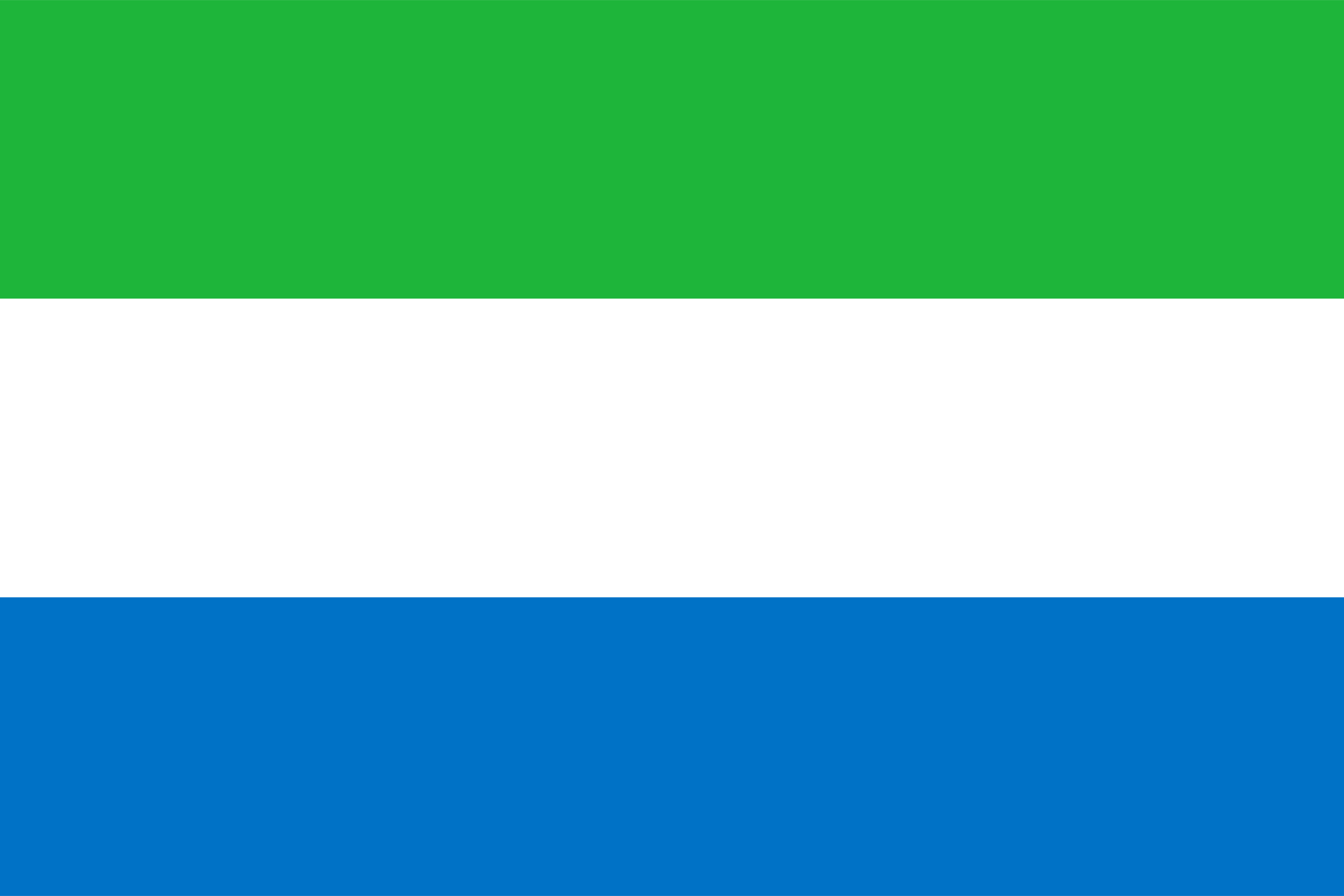
Sierra Leone flag picture
Explore the construction notes, history, and picture gallery.
| Design | Three equal horizontal bandsGreen above white above blue; no emblem. |
|---|---|
| Proportions | Height:length = 2:3Constitutional normal official size: nine across, six down. |
| Adopted | April 27, 1961Introduced at independence from the United Kingdom. |
| Designer | No verified sole individual creditOriginal national design and modern redraw are distinct. |
| Screen palette | Sampled reproduction colorsUS reference image; no statutory RGB claim. |
| Main image sizes | SVG 4,500 × 3,000; PNG 6,000 × 4,000Both preserve the exact same flag proportions. |
What does the Sierra Leone flag look like?
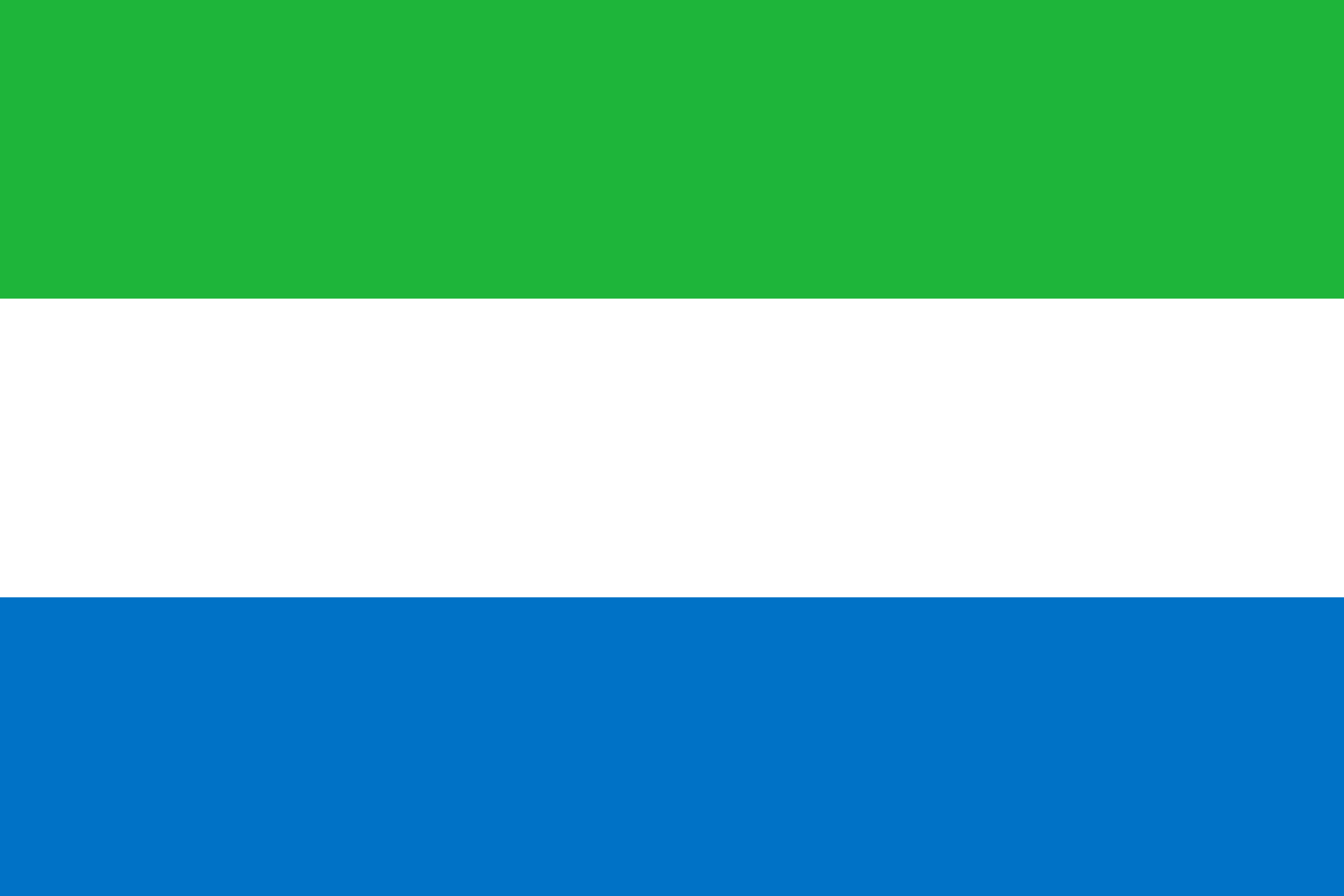
The Sierra Leone flag has three equal horizontal bands: green at the top, white in the middle, and blue at the bottom. Its normal official proportions are nine units across to six down, equivalent to height:length 2:3. Adopted at independence on April 27, 1961, it has no central emblem.
Read the flag vertically, starting at the upper edge. Each color extends across the entire length, and the three bands together fill a rectangular field. There is no separate corner panel, diagonal division, star, or coat of arms on the ordinary national flag. This simplicity makes the arrangement easy to remember, but it also makes errors in order or proportions especially noticeable. The flag’s constitutional description establishes its basic identity; diplomatic descriptions and reference images corroborate equal band heights. The downloadable reconstruction preserves those relationships while identifying its precise screen colors as reproduction choices.
What are the Sierra Leone flag colors and color codes?
The national colors are green, white, and blue. This digital reconstruction uses green #1EB53A, white #FFFFFF, and blue #0072C6, sampled from the US Office of the Historian’s flag image. The constitutional clause names colors but supplies no numeric RGB codes; these screen values are not presented as statutory specifications.
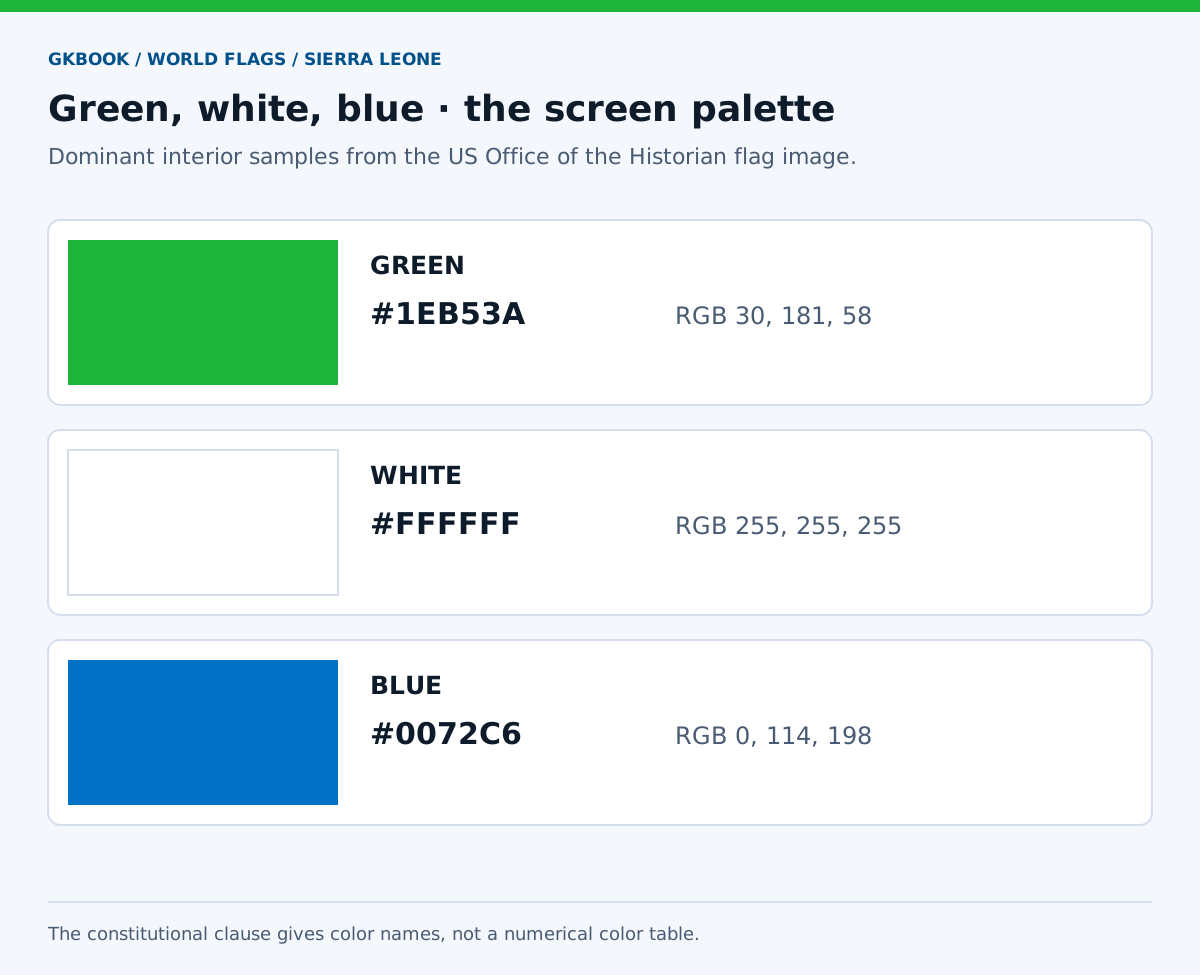
The corresponding RGB triplets are 30,181,58 for green, 255,255,255 for white, and 0,114,198 for blue. Listing both formats makes it possible to reproduce the same files in different graphics applications. The hexadecimal and decimal values express the same chosen digital palette.
These values should remain distinguished from physical ink or textile specifications. A printed cloth, a compressed embassy image, and a small government website icon may look different without representing a new national flag. The source record documents the sampled image and the limits of using it as a color reference.
| Band | HEX | RGB | Status |
|---|---|---|---|
| Green | #1EB53A | 30, 181, 58 | Sampled digital fill |
| White | #FFFFFF | 255, 255, 255 | Opaque digital white |
| Blue | #0072C6 | 0, 114, 198 | Sampled digital fill |
What does the Sierra Leone flag mean?
Sierra Leone’s embassy description associates green with agriculture, mountains, and natural resources; white with unity and justice; and blue with the sea and Freetown’s natural harbor. Government teaching material similarly links the colors to agriculture, unity, and the sea. These interpretations explain the colors without adding pictures to the flag.

The explanation brings together the country’s landscape, livelihood, and civic ideals. Green and blue connect the design to land and water, while white expresses a relationship among people. A flag can communicate those ideas through simple colored fields rather than through detailed illustrations of farms, mountains, or ships.
Symbolism should be read in its national context. A blue stripe elsewhere may have a different meaning, and white does not automatically carry one universal interpretation. Here, the educational and diplomatic accounts provide the basis for the explanation. They do not assign individual stripes to named ethnic groups or administrative provinces.
What does green represent on the Sierra Leone flag?
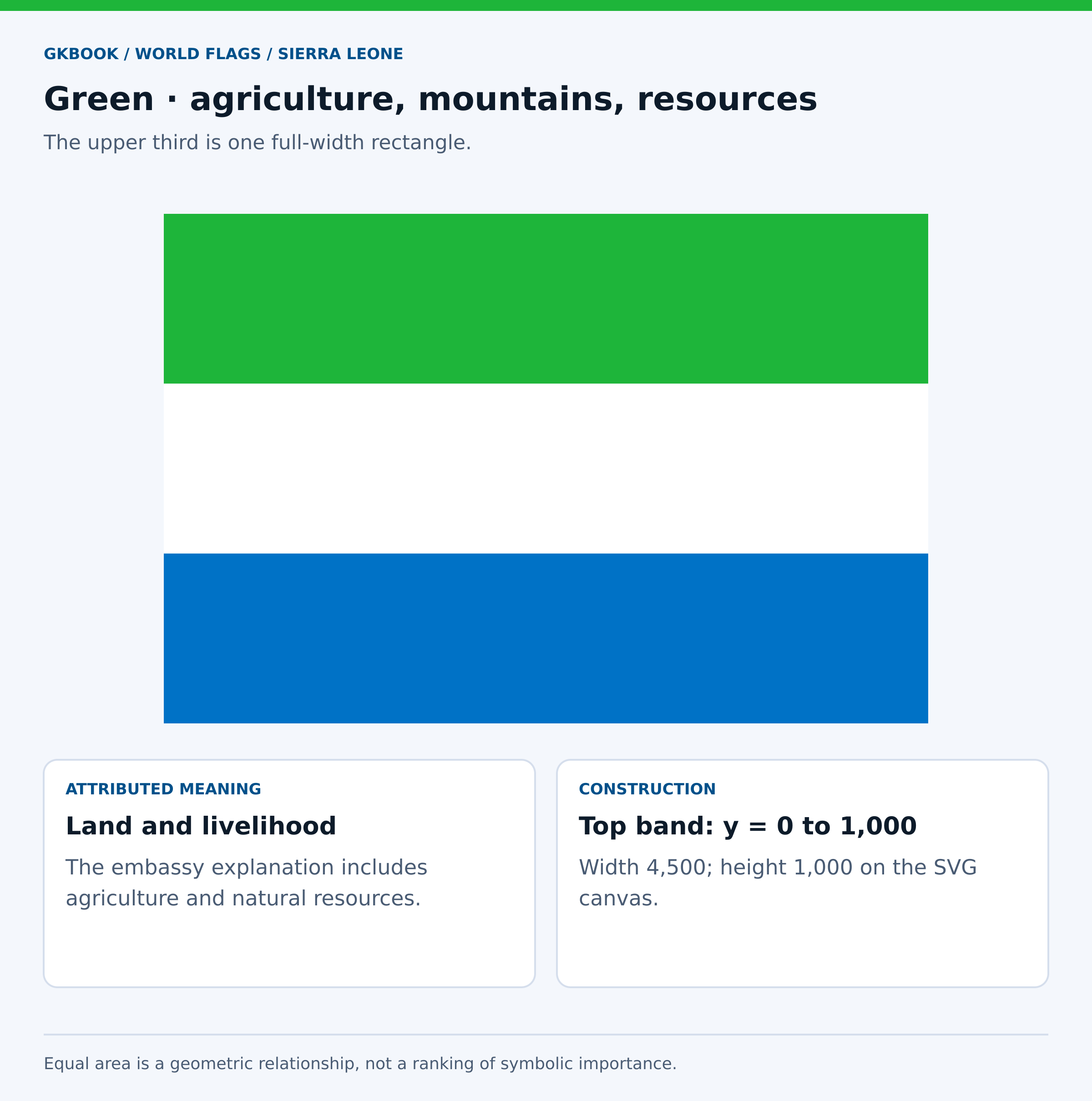
Green represents agriculture, mountains, and natural resources in the embassy’s explanation. It forms the top third of the national flag and runs from the hoist to the fly. Government classroom material gives agriculture as its basic meaning, providing a clear starting point for understanding this upper band.
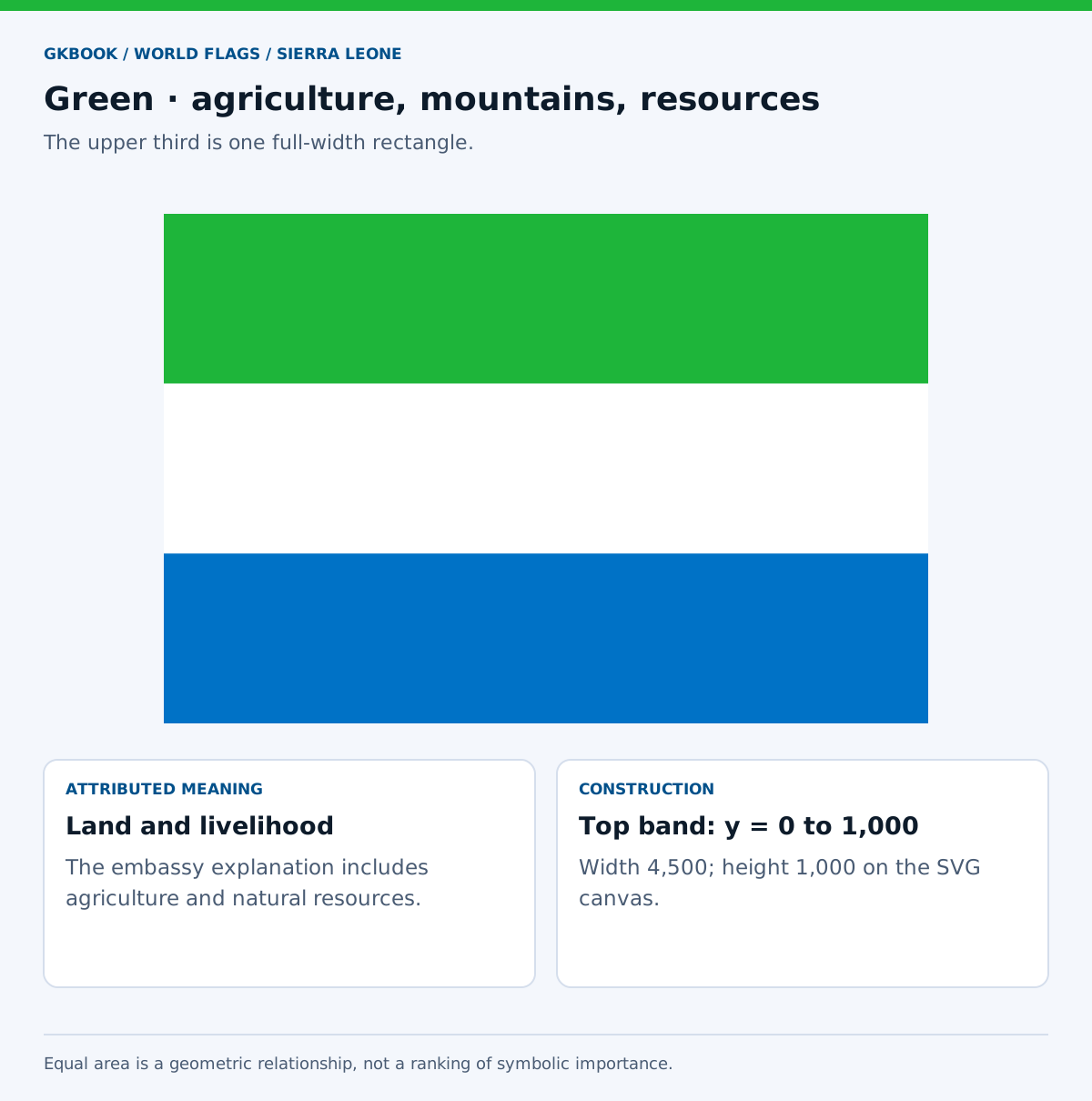
The green field is a complete rectangle, not a triangular landscape or a drawing of vegetation. Its symbolic relationship with the land does not authorize adding a mountain silhouette, tree, or agricultural emblem. Those additions would change the plain national design rather than clarify its existing geometry.
In the coordinate master, green fills the first 1,000 units of the 3,000-unit height. Its full width is 4,500 units, giving it precisely the same area as white and blue. The symbolism and the measurement answer different questions: one explains the color’s interpretation, while the other explains how to draw it.
What does white represent on the Sierra Leone flag?
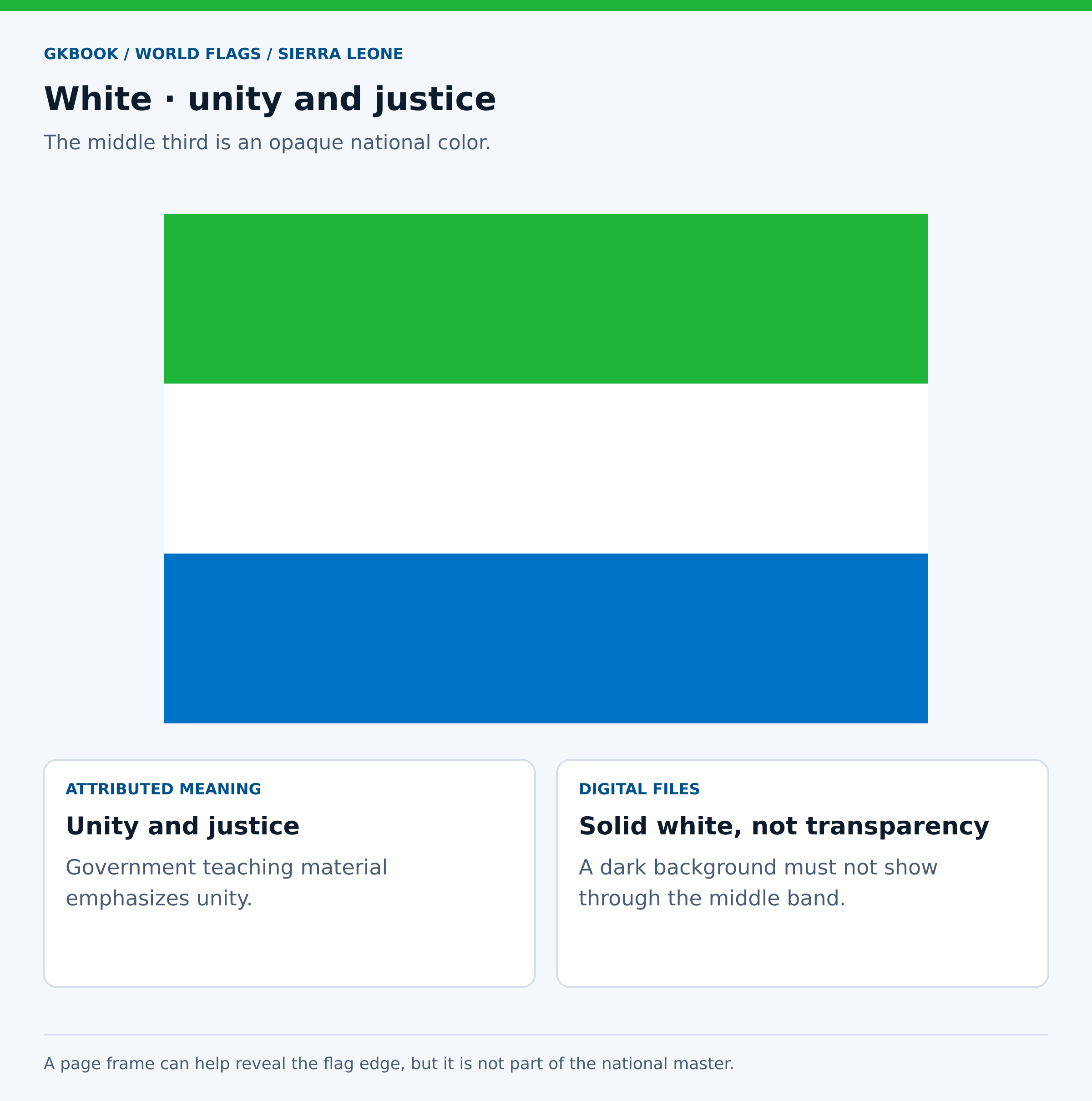
White represents unity and justice in the embassy’s account, with government teaching material emphasizing unity. It occupies the middle third between green and blue. The white band is a solid part of the flag, not a transparent opening, an uncolored gap, or a decorative line separating two larger fields.
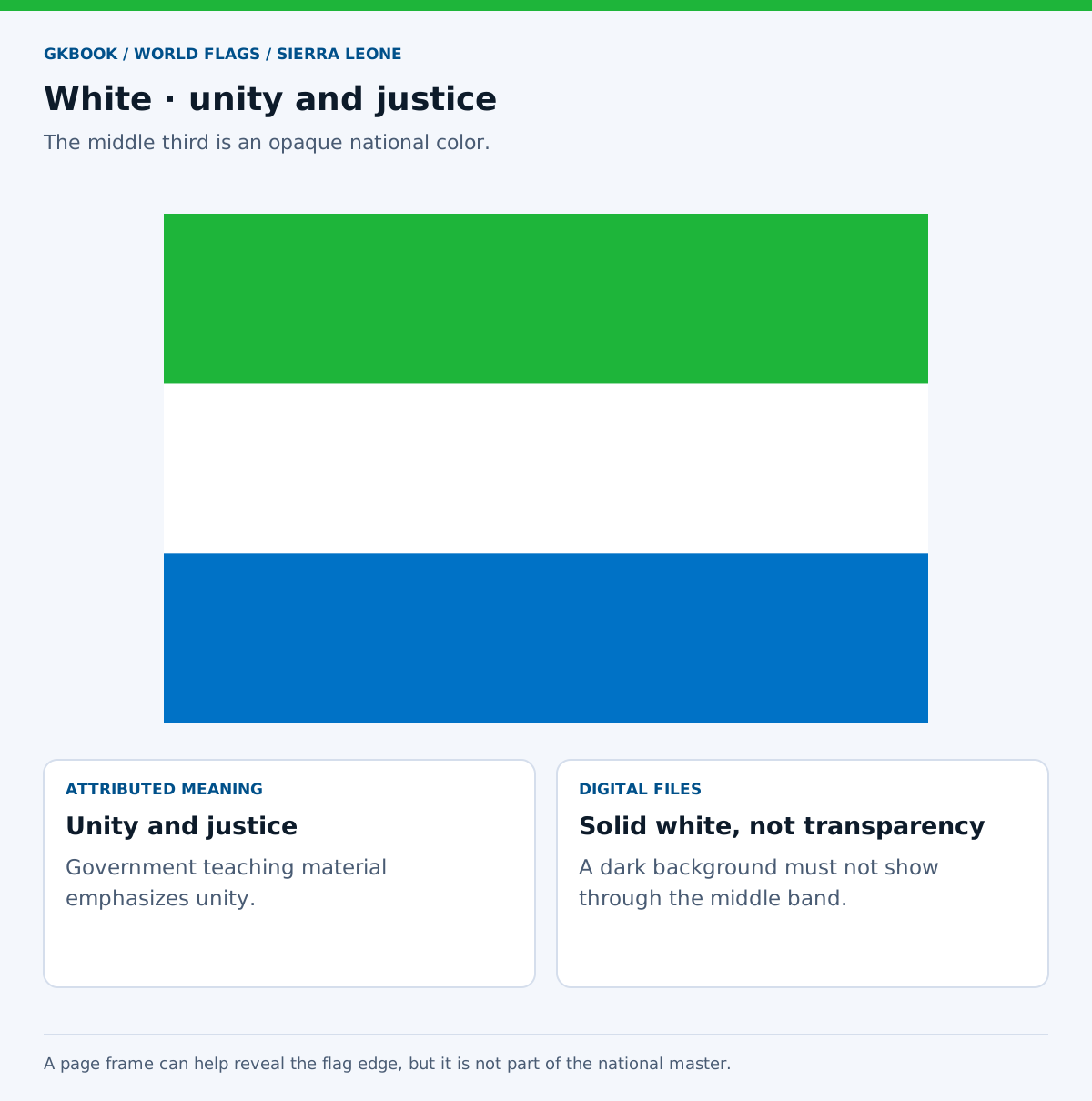
A white stripe can disappear visually against a white page even when its geometry is correct. This is a display issue, not a reason to narrow the band or replace it with gray. A surrounding page background or an external presentation frame can help show the full rectangle without altering the flag.
Both supplied master formats explicitly fill the central band with white. This matters when an image appears on a dark website or colored slide. Transparent pixels would let that background show through and would therefore replace a national color with a color chosen by the surrounding layout.
What does blue represent on the Sierra Leone flag?
Blue represents the sea and the natural harbor at Freetown in the embassy’s description. It fills the bottom third of the flag. Britannica also relates it to an aspiration toward international peace through the harbor’s use; this broader interpretation is kept distinct from the basic geographical explanation.

The lower band is horizontal and uniform. Although its meaning involves water, the national flag does not depict waves. Wavy bars appear in the country’s heraldic imagery, but importing them into the plain blue stripe would merge two distinct national symbols into an invented hybrid.
Blue extends to both side edges and the entire bottom edge. On the master canvas its upper boundary is at y=2,000, measured downward from the top. Keeping this boundary straight and parallel to the green-white boundary preserves the equal-band structure even when the flag is displayed at a very small size.
What is the correct order of the Sierra Leone flag stripes?
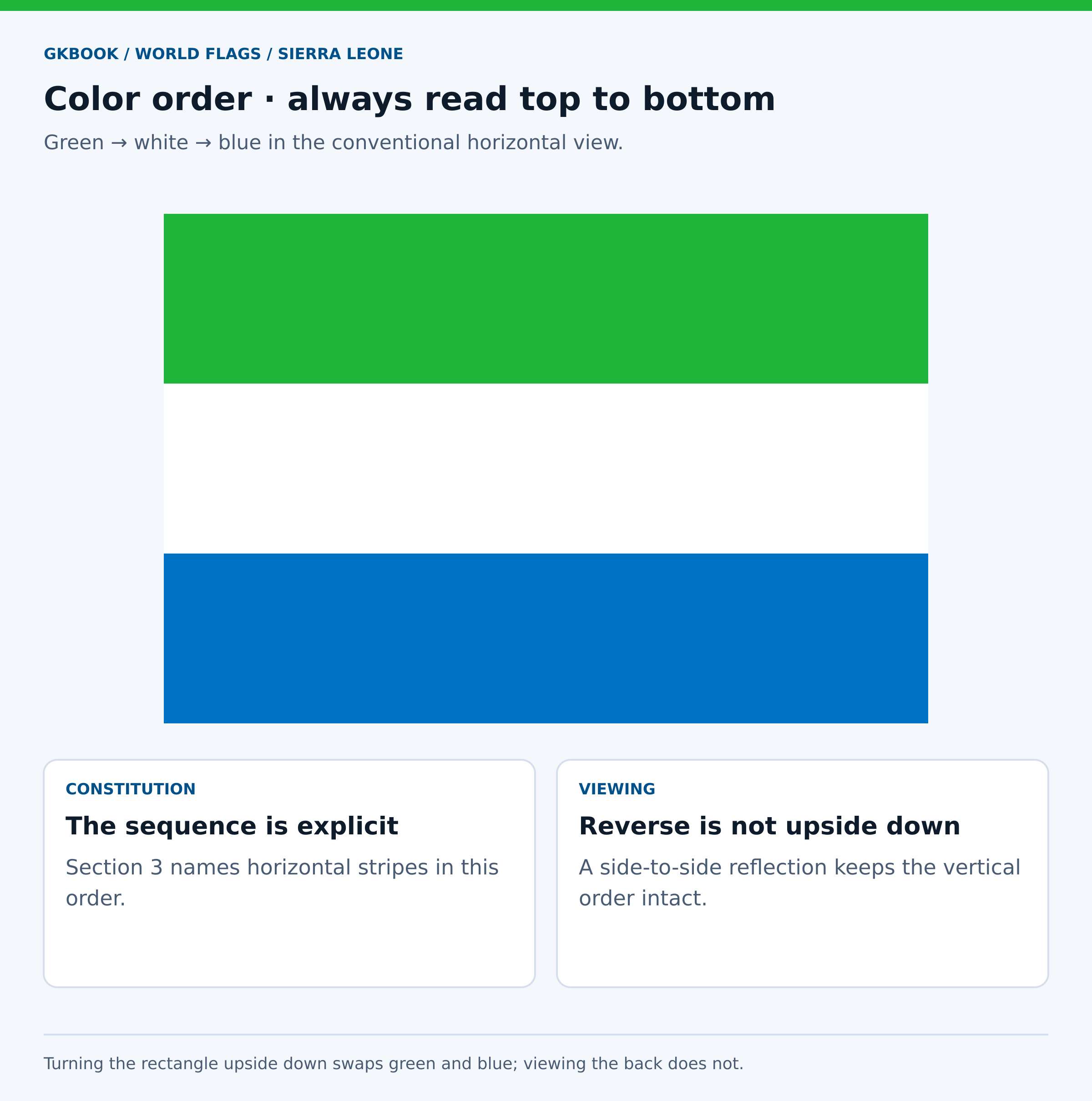
The correct order is green, white, and blue from top to bottom. Section 3 of the 1991 Constitution explicitly gives that sequence. Turning the flag upside down reverses the upper and lower colors, while viewing the plain horizontal design from the other side leaves their vertical order unchanged.

Top and bottom remain the most useful reference points because every stripe spans the complete width. There is no emblem near the pole that a viewer must locate before identifying the national design. The hoist is the attached edge, and the fly is the free edge opposite it.
When checking an illustration, first identify the upper stripe, then the central white field, and finally the lower blue stripe. Do not infer orientation from a caption alone. A correct country name beneath an upside-down or vertically striped image does not make that image an accurate conventional front view.
What is the Sierra Leone flag ratio?
The constitutional normal official proportion is nine units across to six units down. Dividing both numbers by three gives length:height 3:2, commonly written height:length 2:3. A flag 90 centimeters long is therefore 60 centimeters high. The numbers describe a relationship, not one compulsory physical size.

Naming the dimensions avoids confusion between two equivalent ways of writing the ratio. A reference using 2:3 normally puts the height first; a horizontal drawing described as 3:2 puts the length first. Neither expression calls for a tall rectangle when the flag is shown conventionally.
The supplied SVG uses a 4,500 by 3,000 coordinate canvas, and the large PNG uses 6,000 by 4,000 pixels. Both preserve the same proportion. A square website tile can contain the whole flag with surrounding space, but stretching the national rectangle to occupy the entire square would change its proportions.
Are the three stripes equal in size?
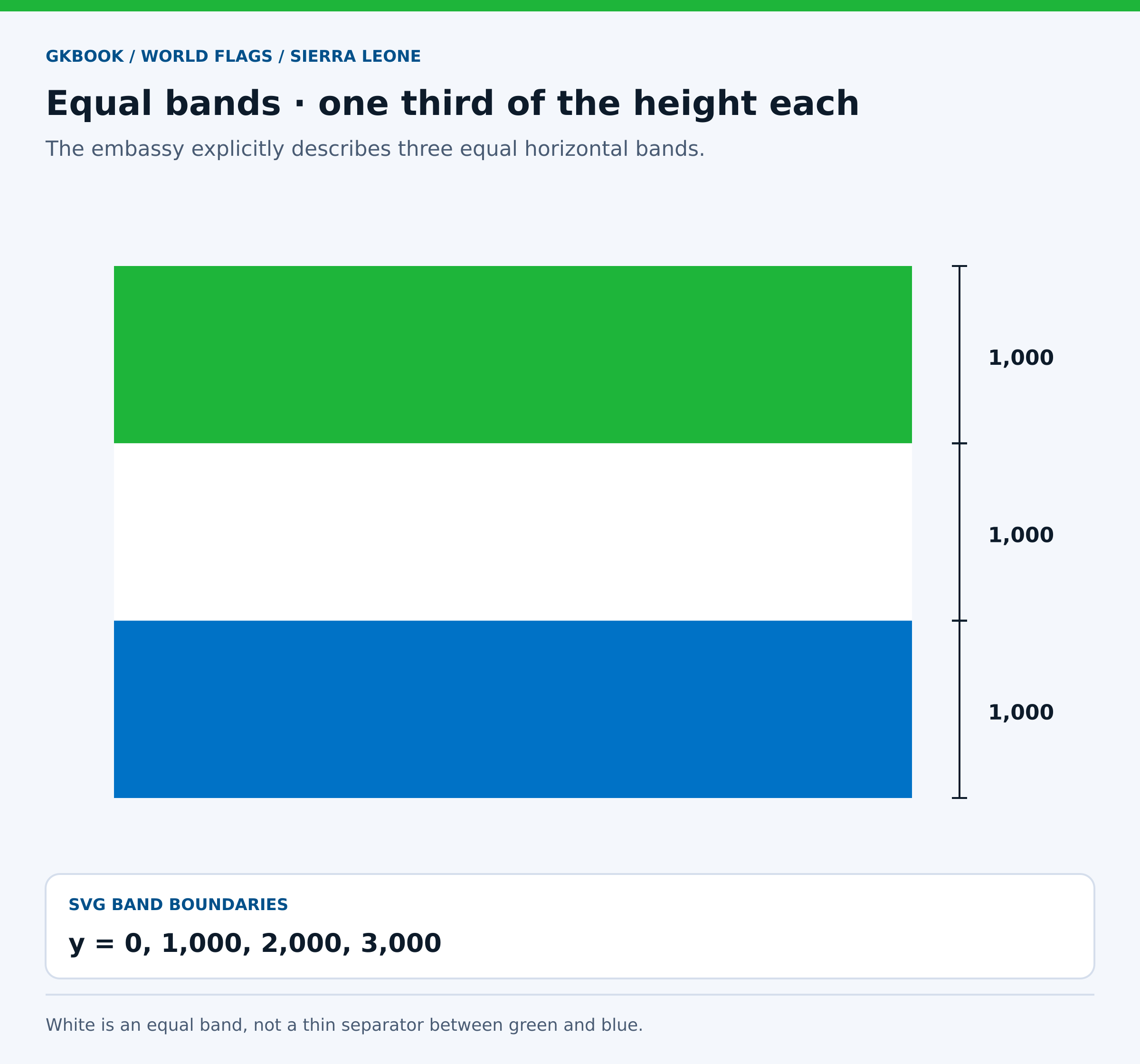
Yes. The Sierra Leone Embassy describes three equal horizontal bands, and the reference illustrations corroborate that arrangement. Each band is one third of the flag’s height and covers one third of its area. The constitutional clause gives the color order and overall proportion without separately specifying numerical band heights.

For a flag 60 centimeters high, each stripe is 20 centimeters high. All three have the same full length, so equal heights also produce equal areas. There is no narrow white separator between two larger colored fields; white is an equal member of the tricolor.
This distinction matters when reading a concise legal description alongside a more explicit visual reference. The coordinate recipe draws on both kinds of evidence and records their roles separately. It does not insert the phrase equal widths into a constitutional quotation that does not contain it, even though the equal-band reconstruction is well supported.
How do you draw the Sierra Leone flag accurately?
Draw a rectangle three units long and two units high, divide its height into three equal parts, and fill the bands green, white, and blue from the top downward. Use straight shared boundaries, a solid white middle band, and no border or emblem within the national rectangle.
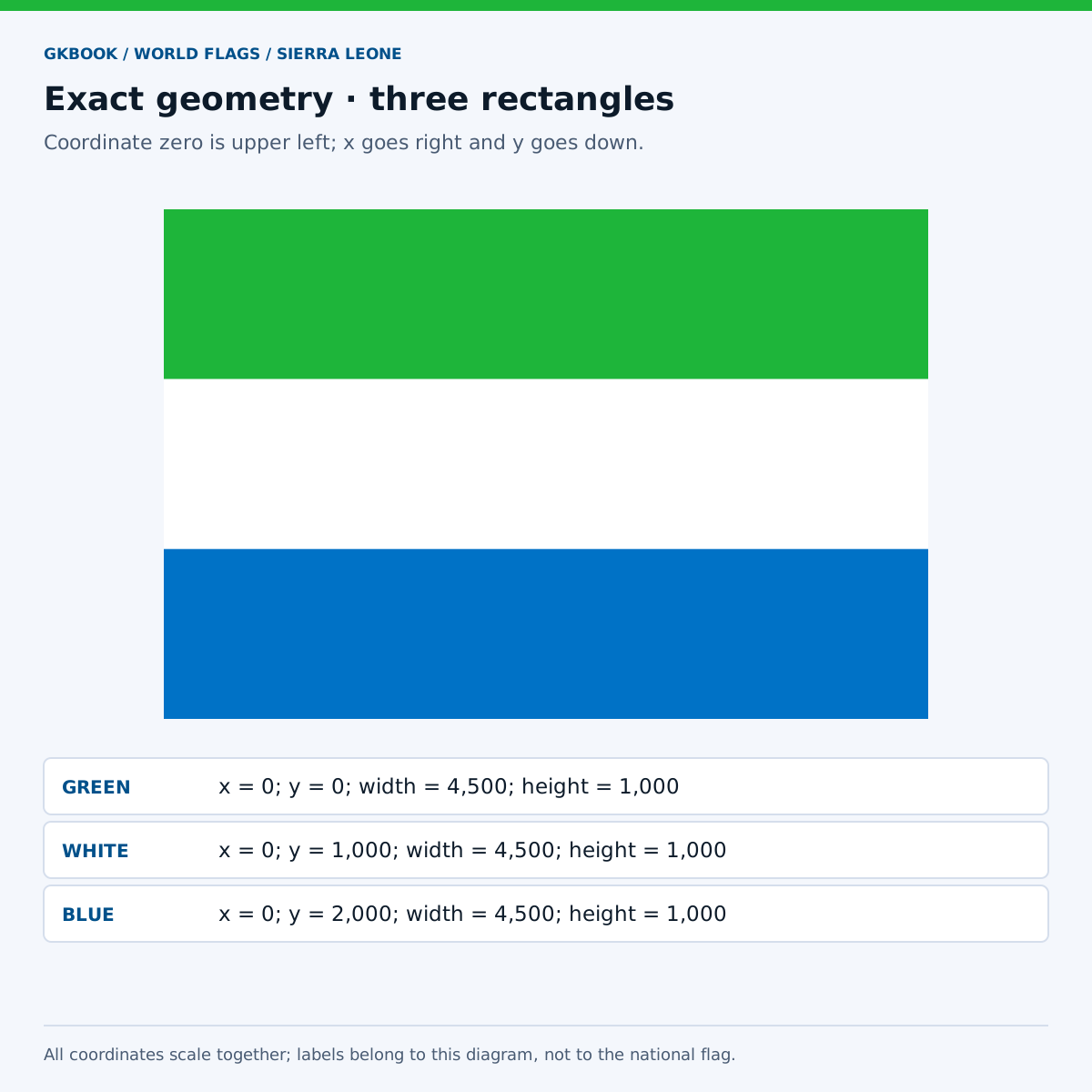
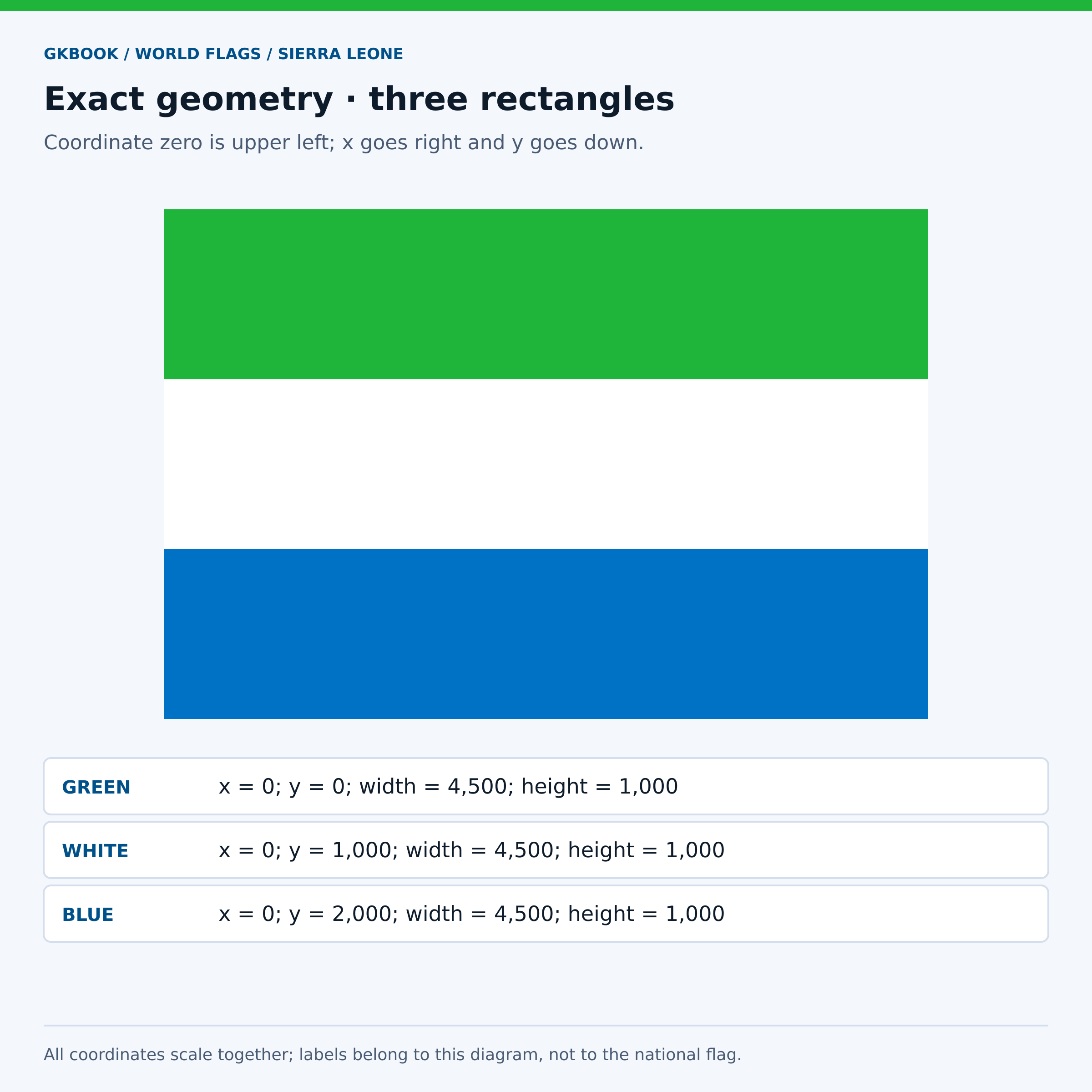
For digital construction, use the upper-left corner as the coordinate origin, with x increasing rightward and y increasing downward. The 4,500 by 3,000 master then has band boundaries at y=0, 1,000, 2,000, and 3,000. Each rectangle starts at x=0 and ends at x=4,500.
These coordinates define a compact vector without tracing a photograph or estimating cloth folds. Shared boundaries occupy exactly the same positions, so the fields meet without gutters. Scale every coordinate by the same factor when changing the drawing size. The separate explanatory labels remain outside the clean master and are not national design elements.
| Band | Top y | Bottom y | Width |
|---|---|---|---|
| Green | 0 | 1,000 | 4,500 |
| White | 1,000 | 2,000 | 4,500 |
| Blue | 2,000 | 3,000 | 4,500 |
How much of the flag does each color occupy?
Each color occupies exactly one third of the ideal flat flag. All three bands have the same full length and one third of the height, so their areas are equal. In the 4,500 by 3,000 vector master, each band covers 4,500,000 square coordinate units out of 13,500,000.
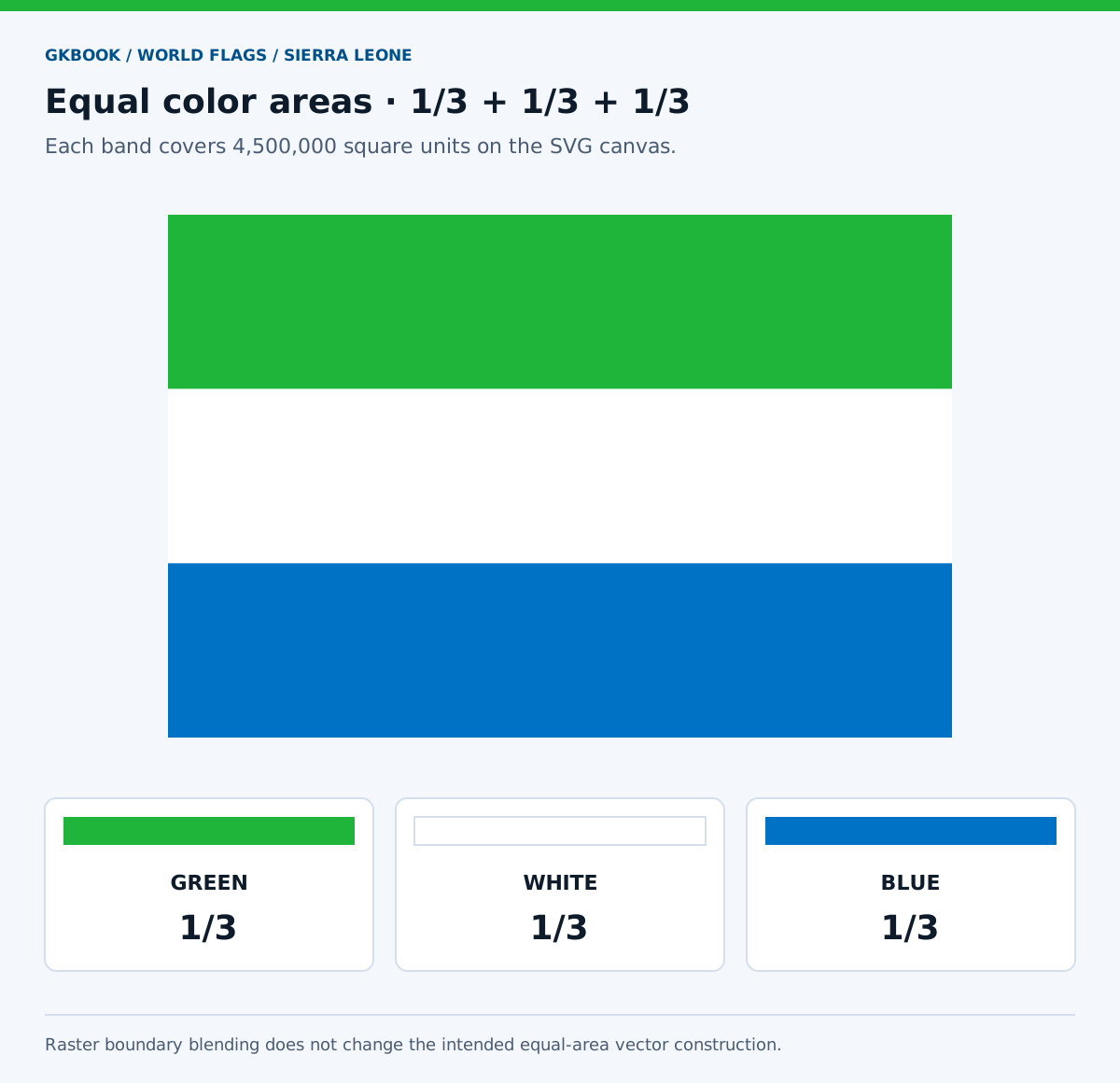
The calculation is length multiplied by band height: 4,500 times 1,000. Adding the three results gives the area of the complete rectangle. This is a mathematical consequence of the equal-band construction, not a separate official claim about the relative importance of the meanings associated with the colors.
Raster images require one further distinction. A height of 4,000 pixels is not divisible by three, so a renderer must represent fractional boundaries through its pixel sampling. Small blended edge rows do not imply unequal intended stripes. The vector geometry remains exact even when the raster cannot assign an integer row count to every band.
What is the history of the Sierra Leone flag?
Sierra Leone’s green-white-blue national flag dates from independence in 1961. Before that, British colonial flags used a Blue Ensign with a territorial badge. The independent design replaced that colonial framework with a plain horizontal tricolor. The 1991 Constitution later described the national colors and normal official proportions.

The main visual change was structural. Colonial ensigns combined a blue field, the Union Flag in the upper corner, and a badge associated with the territory. The independent national flag instead gives its three colors the whole rectangular field, with no colonial corner device and no added badge.
Historical accounts also describe changes to the colonial badge before independence. Those changes belong to the earlier ensign’s history and should not be counted as revisions of the present tricolor. A timeline is clearer when it separates the colonial framework, the independence flag, the later republic, and the constitutional text that now documents the design.
When was the Sierra Leone flag adopted?
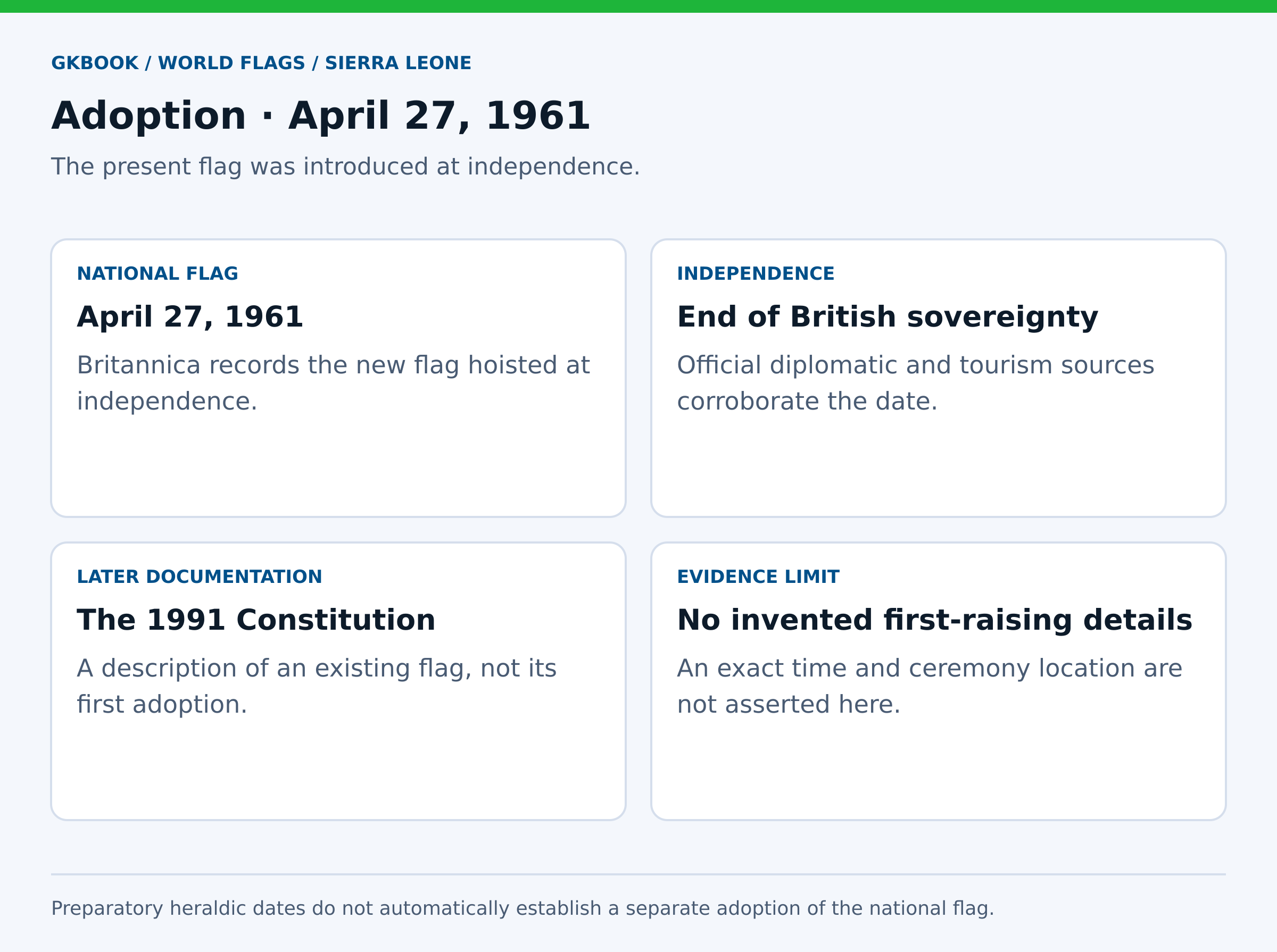
Sierra Leone adopted its present national flag on April 27, 1961, when the country became independent from the United Kingdom. Britannica records the new flag being hoisted at independence. The 1991 constitutional description is a later legal confirmation of the design, not the date when the tricolor first appeared.

Several dates can appear in a national flag’s history without describing the same event. A preparatory design process precedes public adoption, while later legislation can restate an existing design. Here, the independence date is the relevant starting point for the familiar green-white-blue national flag.
The article does not assign an exact first-raising time or location beyond what the inspected evidence establishes. It also does not turn a date associated with developing the coat of arms into a different flag-adoption date. The adoption panel therefore keeps April 27, 1961 prominent while labeling later constitutional documentation separately.
Was the current flag introduced at independence?
Yes. The green-white-blue flag was introduced when Sierra Leone became independent on April 27, 1961. That distinguishes it from national flags adopted long after independence. The later transition to a republic in 1971 changed the constitutional form of the state; it is not the adoption date of this tricolor.

Independence concerned the end of British sovereignty. Becoming a republic concerned the subsequent form of the head of state. These developments occurred ten years apart, so collapsing them into one event obscures the chronology even though the same national colors represent the country in later commemorations.
An illustration of independence should use the plain horizontal tricolor rather than a modernized colonial ensign. Conversely, a colonial-era scene should not automatically receive the independent flag merely because it depicts the same geographical territory. Matching a historical image to its date is as important as matching its colors to the country name.
How do recognition and UN membership differ from flag adoption?
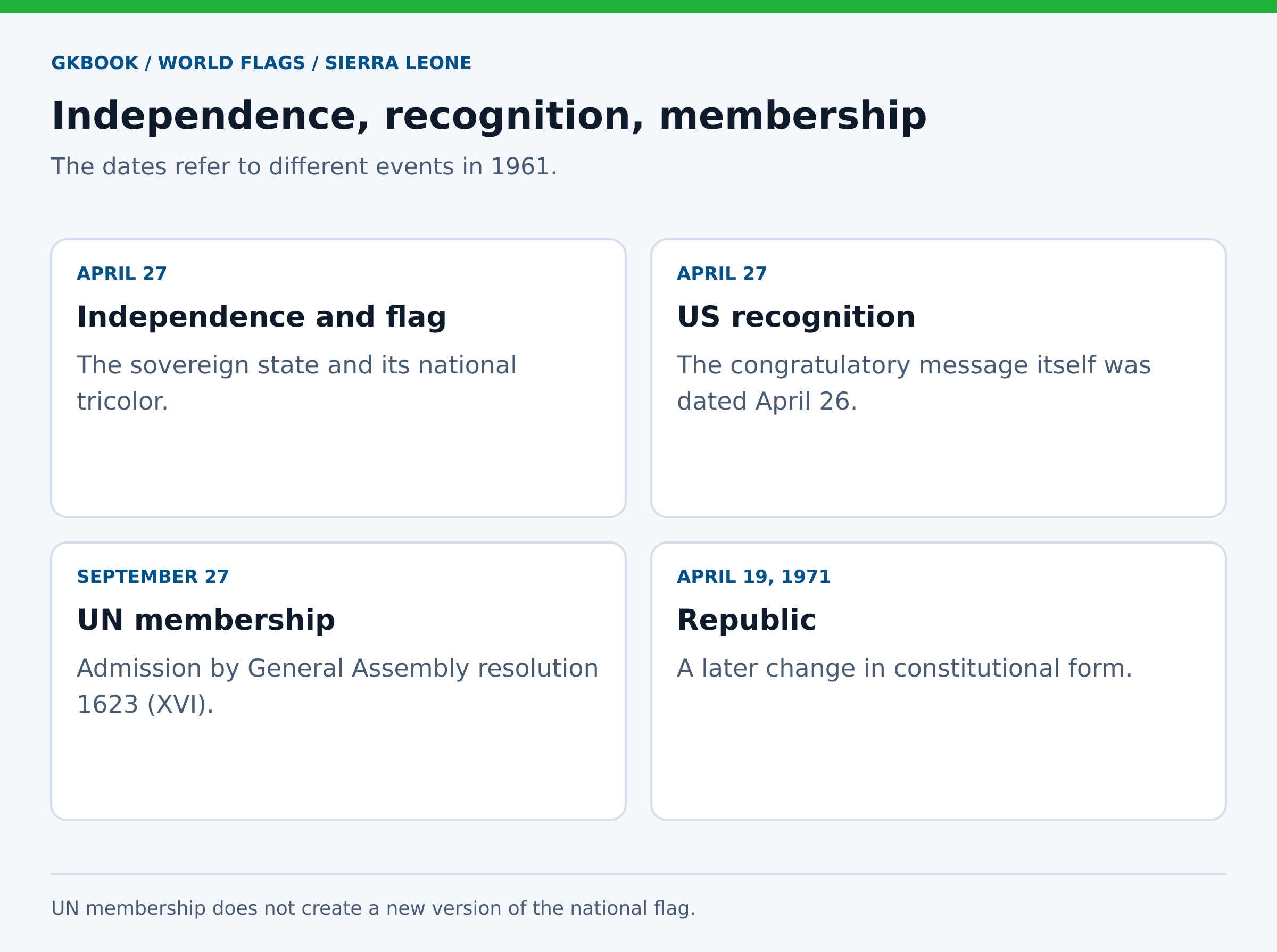
The United States recognized Sierra Leone’s independence on April 27, 1961, while UN membership followed on September 27, 1961. The US congratulatory message was dated April 26. These diplomatic records describe recognition and membership, not separate adoptions of the national flag or evidence that its colors changed between those dates.
The Office of the Historian distinguishes the date written on the message from the independence it recognized. This is a useful example of why a document’s preparation date should not automatically be treated as the effective date of the event it records. Diplomatic relations also began on April 27.
The UN Treaty Series records an acceptance declaration dated at Freetown on independence day and notes admission by General Assembly resolution 1623 (XVI) in September. The country’s Permanent Mission corroborates the admission date. These records place Sierra Leone internationally without replacing the flag’s separate design and adoption history.
Did the Sierra Leone flag change when the country became a republic?
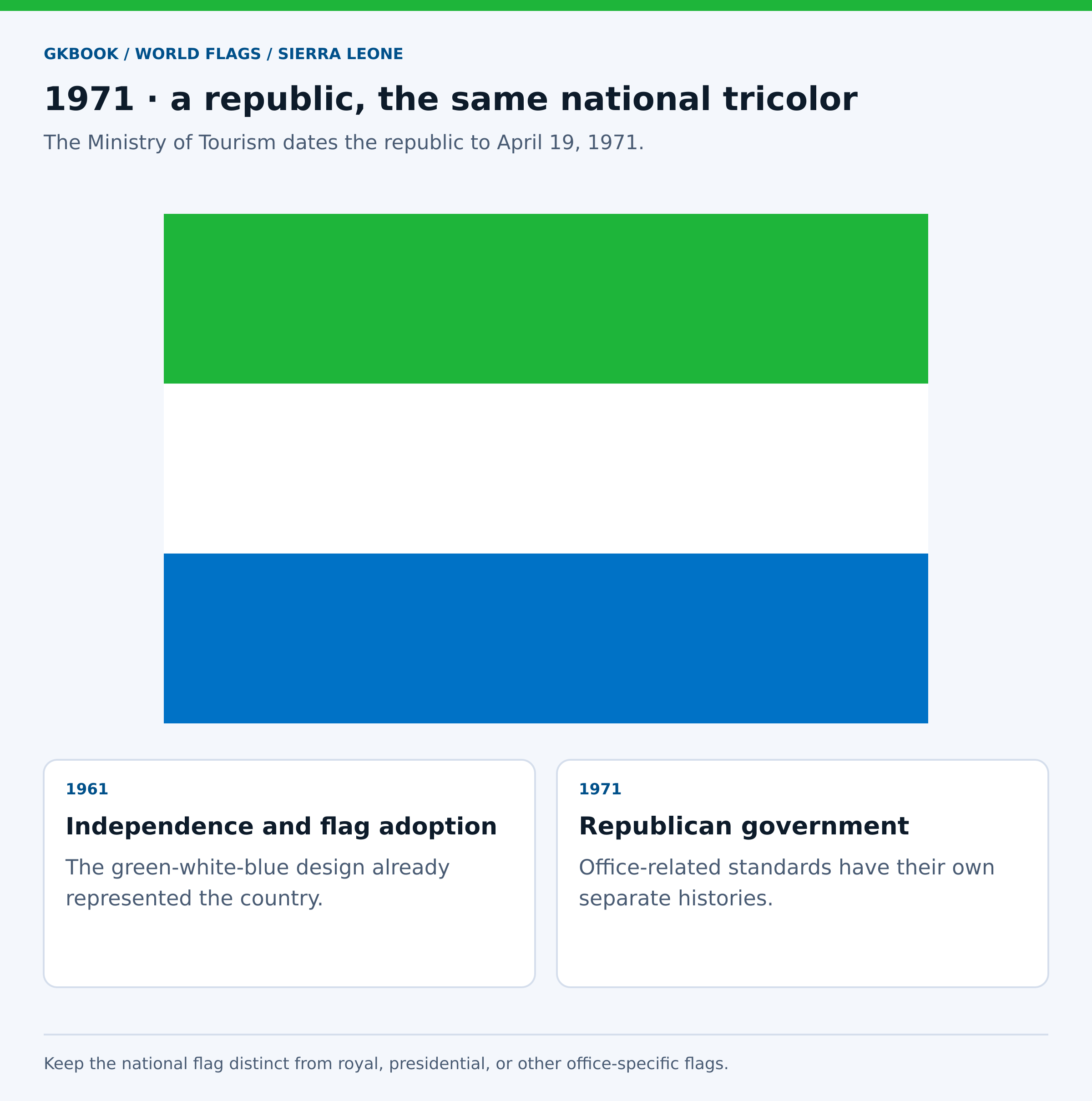
The familiar green-white-blue national tricolor continued when Sierra Leone became a republic on April 19, 1971. The Ministry of Tourism records that republican transition separately from independence in 1961. Royal and office-related standards have their own histories; a change in those flags does not establish a new national tricolor.

The ordinary national flag and the flag associated with a particular office perform different roles. A monarchy can have a sovereign’s personal standard in addition to a national flag, and a republic can likewise use office-specific symbols. Their existence should not lead an editor to add royal or presidential devices to the national design.
For the main chronology, keep three labels visible: independence and flag adoption in 1961, republic in 1971, and the constitutional text in 1991. This ordering explains the political changes while avoiding an unsupported claim that every constitutional transition required a replacement of the green, white, and blue bands.
What does the Constitution say about the national flag?
Section 3 of the 1991 Constitution identifies the national flag as horizontal stripes of green, white, and blue from top to bottom. It gives the normal official proportion as nine units across to six down. The clause does not provide hexadecimal colors, a Pantone table, or a named individual designer.
The inspected constitutional text was obtained from Sierra Leone Web and corroborated against the parliamentary search record and the version hosted by UNHCR’s Refworld. The parliamentary website itself was intermittently unavailable, so the research record distinguishes direct document access from indexed evidence.
That source distinction matters because a precise reconstruction should not pretend to have read unavailable material. The flag clause supports the sequence and ratio; the embassy description supplies explicit equality of bands. The package does not claim a comprehensive audit of every constitutional amendment or a newly issued manufacturing standard for physical flags.
Who designed the Sierra Leone flag?
The sources directly verified for this article do not establish a named individual as the sole designer of Sierra Leone’s national flag. The constitutional clause specifies its appearance without naming an author. Claims about preparatory heraldic work should be distinguished from documented personal authorship and from adoption at independence.
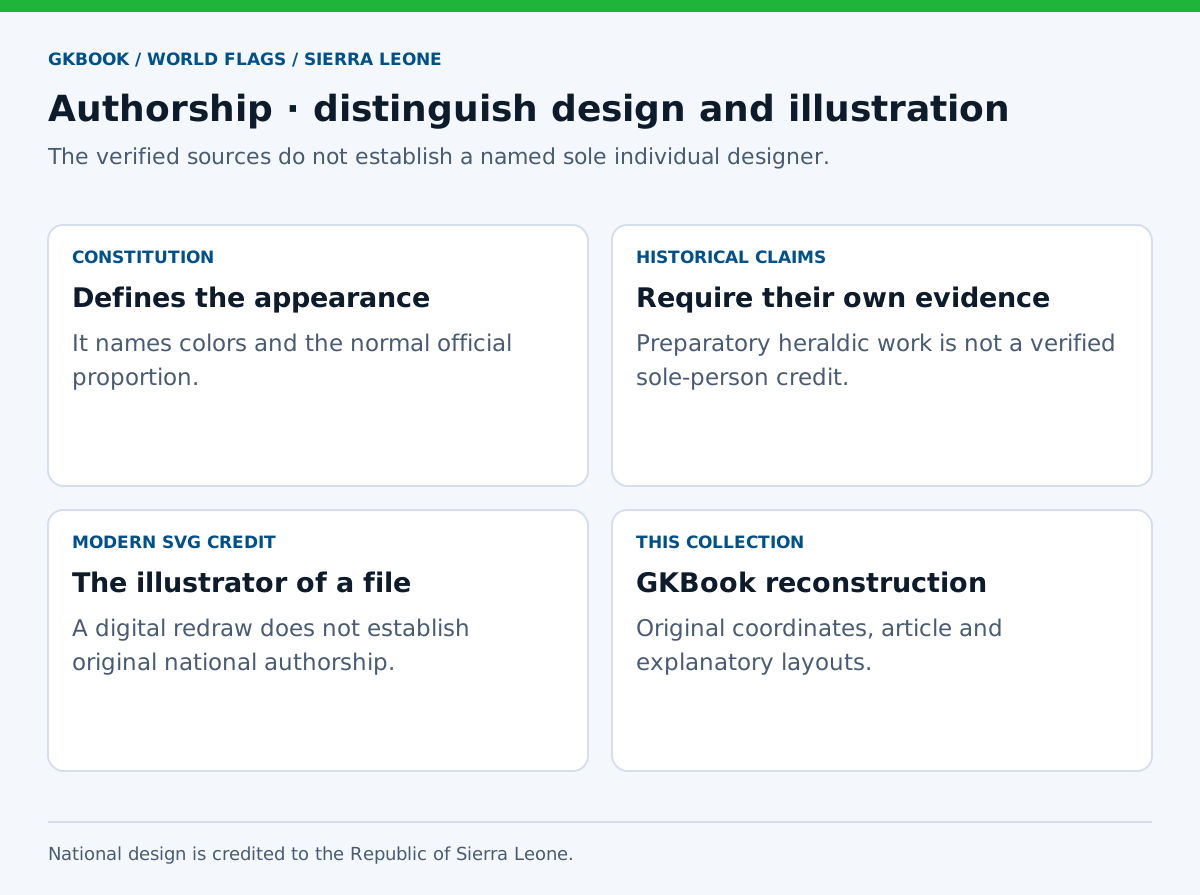
A modern SVG file often carries the name of its illustrator. That credit identifies the person who recreated the artwork, not necessarily the person or institution responsible for the national design decades earlier. Reusing an image credit as the historical designer’s name would therefore be misleading.
Some secondary accounts connect the flag’s development with work on the national arms. The inspected constitutional and diplomatic materials do not independently resolve a sole individual attribution. This package consequently credits the national design to Sierra Leone and identifies GKBook only for the new geometric reconstruction, original article, and educational diagrams.
Does the Sierra Leone national flag contain a coat of arms?
No. The ordinary national flag is the plain green-white-blue horizontal tricolor, without a coat of arms, lion, shield, or motto. Sierra Leone’s coat of arms is a separate national symbol. Its shared colors and heraldic imagery help explain historical associations, but they are not additional elements of the flag.

The constitutional document’s heading includes an illustration of the arms above the legal text. That page layout does not place the arms on the flag described beneath it. Reading a document illustration and reading the flag clause are different tasks, and conflating them can produce an incorrect emblem-bearing download.
The heraldic design includes lions and other detailed elements, while the flag reduces its visual vocabulary to three full-width colors. The comparison panels describe this distinction without supplying a guessed coat-of-arms reconstruction. A plain national flag file should remain plain even when it appears next to an official crest on a webpage.
Is the national motto written on the Sierra Leone flag?
No. The national motto, Unity, Freedom and Justice, is established separately in Section 6 of the Constitution. It is not lettering on the ordinary flag. White’s attributed meaning of unity and justice overlaps with part of the motto, but that relationship does not add text to the central band.
A useful national-symbol comparison separates the visual flag, the heraldic arms, the spoken or sung anthem, and the motto. They can appear together in civic materials while remaining distinct forms of representation. The constitutional organization reinforces that distinction by treating the flag and political objectives in separate provisions.
When designing a poster, place any explanatory wording outside the flag image. A caption may identify the country or discuss the motto, but words printed across the white stripe would create a modified illustration. The clean downloads therefore contain no lettering, leaving the national rectangle suitable for accurate educational reuse.
What flag was used before Sierra Leone became independent?
Before independence, British colonial ensigns used a blue field with the Union Flag in the canton and a territorial badge. The badge changed during the colonial period. These earlier ensigns differ fundamentally from the independent green-white-blue tricolor, which has neither a Union canton nor a colonial badge.
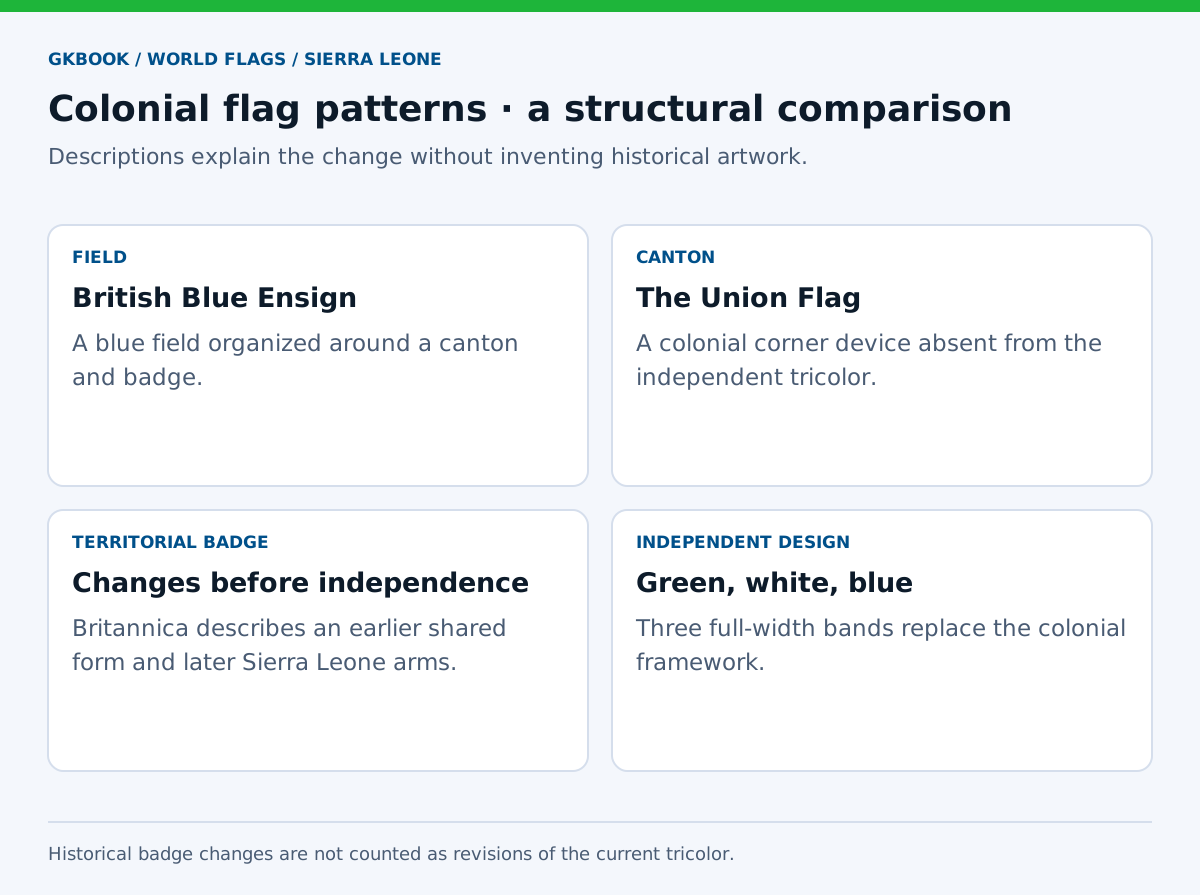
Britannica describes an earlier badge shared in basic form with several British West African territories, differentiated by initials. A later Sierra Leone-specific coat of arms was approved in 1914 and used as a flag badge. That broad sequence is sufficient to explain why older photographs can show different colonial emblems.
The historical panels do not claim exact badge artwork, dimensions, or a complete chronology of every ensign variant. They provide a structural comparison: a colonial blue field with corner device and badge, followed by an independent field of three equal bands. Precise period replicas would require their own archival manufacturing references.
What does the reverse side of the Sierra Leone flag look like?
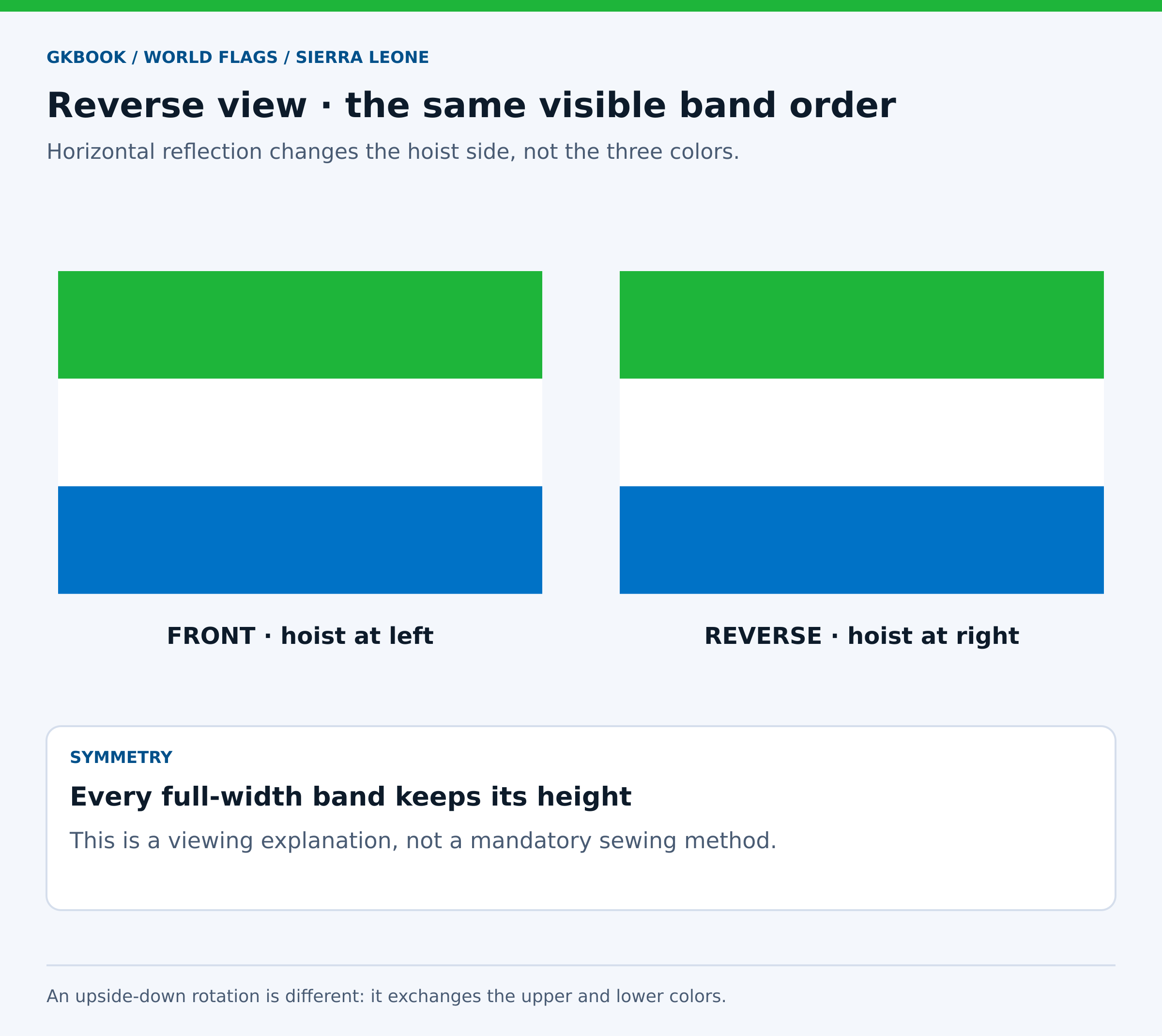
The plain horizontal design looks the same from the reverse side: green remains above white, with blue below. A horizontal reflection moves the hoist to the opposite side but does not change full-width bands. The diagram demonstrates this viewing symmetry; it is not a prescription for a particular sewing method.
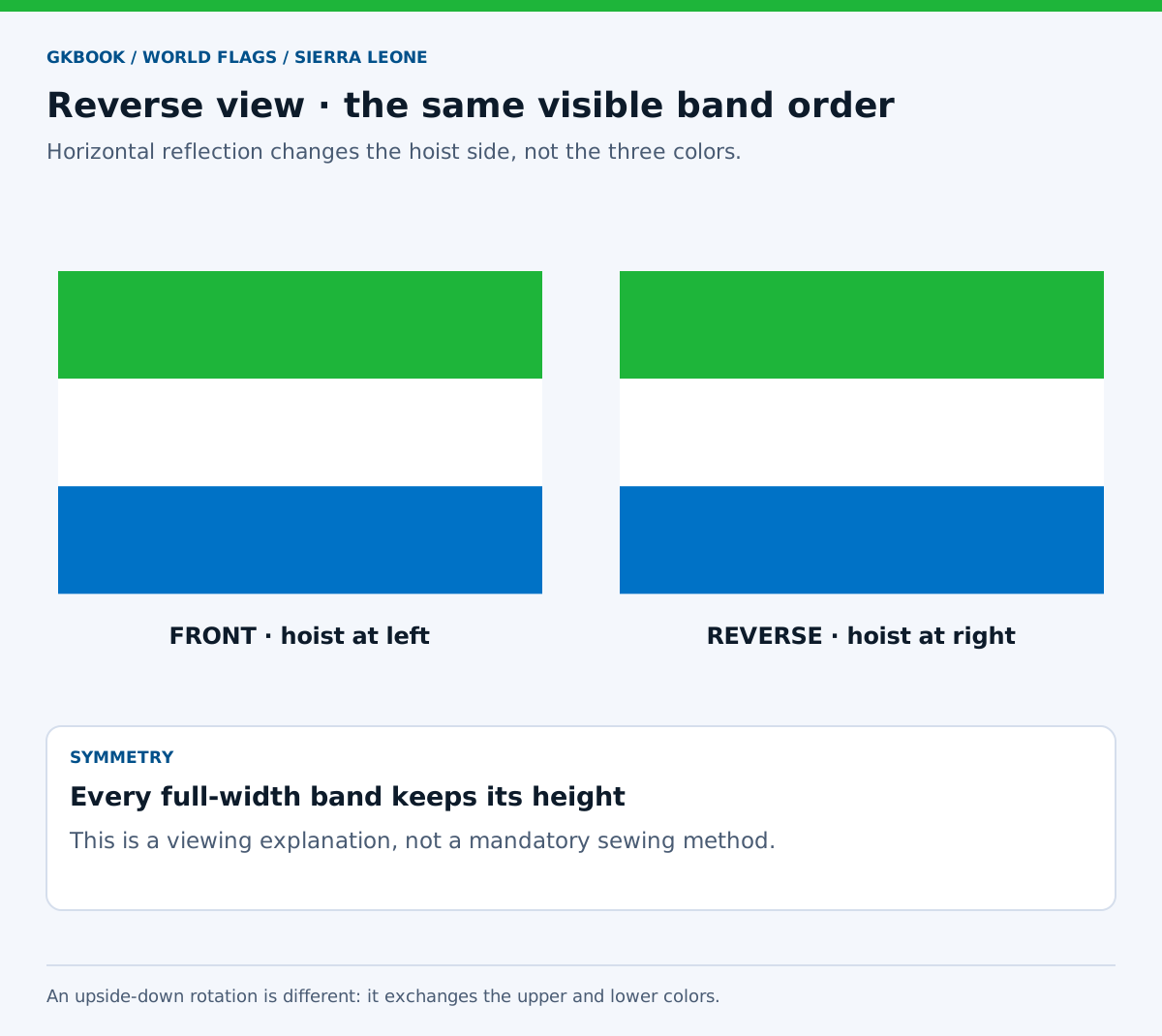
This follows from the geometry of the three rectangles. Reflecting any point across a vertical centerline changes its horizontal coordinate while leaving its height unchanged. Since each color fills the entire width at its assigned heights, the reflected color pattern is identical to the original.
An upside-down view is different because it changes vertical coordinates and exchanges the upper and lower colors. The reverse comparison labels the hoist on each side to make that distinction clear. No lettering or asymmetric emblem needs to be reversed, since neither is part of the ordinary Sierra Leone national flag.
How should a vertical version of the Sierra Leone flag be interpreted?
The supplied vertical diagram is a 90-degree counterclockwise rotation example, placing green at the left, white in the middle, and blue at the right. It explains orientation while preserving the whole rectangle. It is not presented as a verified Sierra Leone national protocol rule for every vertical display setting.
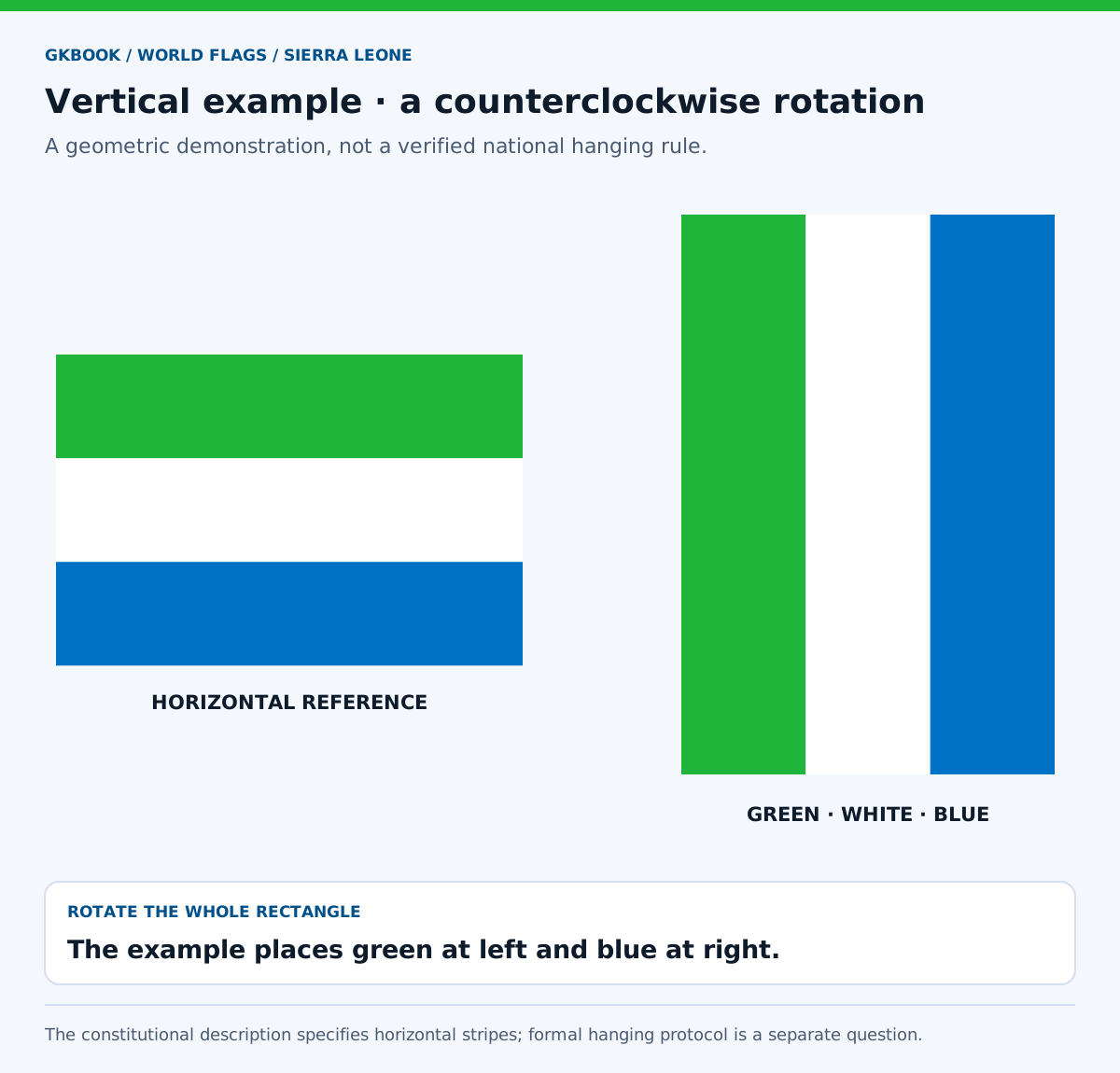
Rotating the complete design changes the rectangle from wide to tall without altering the relative areas of the colors. It should not be confused with creating a new vertical-striped national flag of the original landscape proportions. The figure includes an ordinary horizontal reference so that the transformation is explicit.
A formal hanging arrangement may depend on a venue’s applicable protocol. The inspected constitutional flag clause does not provide a vertical-display instruction, and a secondary report about an Olympic manual is not treated as direct access to that manual. The article consequently labels the diagram as a geometric example rather than a national legal requirement.
Why do Sierra Leone flag pictures show different shades?
Published flag images can use different digital palettes, compression, or color-processing choices. The inspected Sierra Leone Embassy illustration differs from the US historical reference image. The Constitution names green, white, and blue without specifying numerical shades. A difference between these reproductions alone does not establish a change to the national design.

The embassy JPEG’s dominant green and blue samples are 111,180,64 and 1,92,171. The US reference uses 30,181,58 and 0,114,198. Reporting both observations makes the difference measurable, but neither image should be promoted into a comprehensive Sierra Leone color law merely because it appears on a government website.
The package chooses the latter palette consistently and preserves the former comparison in the research record. Readers should therefore understand the HEX table as a recipe for these supplied files. For textile or specialist print production, establish the required physical color reference and check the result on the actual material.
How can the Sierra Leone flag be displayed accurately online?
Use the complete flag in its natural 3:2 horizontal shape, preserve all three equal bands, and supply alternative text describing their order. SVG supports scalable display; the opaque PNG preserves white on colored backgrounds. Avoid stretching the rectangle or using a crop that removes part of the upper or lower stripe.

A responsive webpage can change the image width while allowing its height to follow automatically. When a card has fixed dimensions, contain the flag within it rather than applying a cover crop. The white middle band should remain filled even if the surrounding page is also white.
The social card is a separate 1,200 by 630 composition containing a complete flag. Its headings and margins belong to the card, not the national design. Keeping the clean master separate from the presentation layout lets editors reuse the flag in different contexts without accidentally carrying a caption or decorative border into it.
How should the Sierra Leone flag be prepared for printing?
Preserve the 2:3 height:length ratio and three equal horizontal bands. Use the vector master when scalable outlines are needed, or choose a sufficiently large PNG for raster output. Treat the supplied RGB palette as a digital reproduction recipe, and check a physical proof before relying on an ink or fabric match.

At 300 pixels per inch, a 6,000 by 4,000 image corresponds to twenty by thirteen and one third inches. This is a sampling calculation, not an official flag size. The vector can be scaled to other dimensions while retaining exact band geometry regardless of how many pixels a preview uses.
Keep printer marks, cutting guides, and explanatory text outside the finished national rectangle. If the intended use requires a textile color standard, resolve that separately from the website’s hexadecimal table. A precise rectangle and a consistent screen color do not, by themselves, guarantee the appearance of dye on a particular cloth.
How can the flag stay accurate at small icon sizes?
Choose a 3:2 icon size whose height is divisible by three, such as 90 by 60 pixels, when equal integer stripe rows are useful. Keep all three bands visible and avoid rounding them independently. The original vector remains the reference when a display size requires fractional pixel boundaries.

For a 90 by 60 image, the three bands each occupy twenty rows. A 45 by 30 image likewise assigns ten rows to each. These examples preserve both the national aspect ratio and simple raster divisions, making them useful for a country list or compact educational table.
Other sizes are not automatically wrong. A browser may resample the vector and blend pixels at a boundary. What matters is that the intended geometry stays proportional rather than being manually distorted to compensate for every screen. Meaningful alternative text also identifies the flag when its small visual size limits what a reader can distinguish.
How can students learn the flag’s colors and meanings?
Students can learn the top-to-bottom sequence first, then connect green with agriculture, white with unity, and blue with the sea. Sierra Leone’s government lesson material uses these basic associations. More detailed explanations can add mountains and resources, justice, and Freetown’s harbor while keeping the original three-color design unchanged.
A useful classroom activity starts with a measured rectangle and three equal bands. Students can identify the upper, middle, and lower fields before discussing their meanings. Asking them to explain both the order and one associated idea checks understanding more effectively than asking for color names without context.
For older students, add the distinction between a constitutional description, an attributed meaning, and a reproduction choice. The legal ratio can be simplified mathematically, the meanings can be traced to educational or diplomatic sources, and the screen palette can be identified as a declared digital recipe. Each kind of statement answers a different question.
Which Sierra Leone flag pictures are available to download?
The gallery provides 24 subjects, each in SVG and PNG, covering the clean flag, colors, meanings, proportions, history, construction, and viewing examples. The main SVG measures 4,500 by 3,000 coordinate units, and the main PNG is 6,000 by 4,000 pixels. A separate 1,200 by 630 social pair is included.
Use the clean master for a country illustration and a labeled diagram when explaining a specific feature. Every complete flag in the collection is built from the same three rectangles and palette. Captions distinguish national design facts, attributed meanings, historical events, and practical reproduction advice.
The set contains original vector layouts rather than photographs or AI-generated flags. It does not include speculative colonial badges, a guessed heraldic master, or a naval production specification. Credits and private research notes document the sources, uncertainties, and calculation methods, helping an editor reuse the artwork without losing the distinction between verified geometry and selected digital colors.
Download Sierra Leone flag pictures
Download the clean national flag as SVG or 6,000 × 4,000 PNG. Both preserve the constitutional 2:3 height:length ratio and three equal horizontal bands. The 4,500 × 3,000 SVG uses three rectangles, and white is explicitly filled. Screen colors are sampled from the US historical reference image and are disclosed reproduction choices.
The gallery contains 24 subjects, each with an SVG and PNG. The captions distinguish published specifications, attributed meanings, historical events, and digital reproduction choices. Image credits and reproduction notes explain the source basis. The separate 1,200 × 630 social card contains a complete flag and does not alter the national rectangle.
Continue exploring national designs in World Flags.
World Flags/Sierra Leone
Sierra Leone flag pictures
Clean national flag: three equal horizontal green, white, and blue bands. Height:length 2:3; digital fills are sampled reproduction choices.
National design: Republic of Sierra Leone. Original geometric reconstruction and explanatory layout: GKBook.Download SVGDownload PNGGreen #1EB53A, white #FFFFFF, blue #0072C6. These sampled screen values are not statutory RGB or physical dye specifications.
National design: Republic of Sierra Leone. Original geometric reconstruction and explanatory layout: GKBook.Download SVGDownload PNGThe embassy gives the fuller account; government teaching material emphasizes agriculture, unity, and the sea.
National design: Republic of Sierra Leone. Original geometric reconstruction and explanatory layout: GKBook.Download SVGDownload PNGGreen fills one third of the flag and is not shaped into a landscape illustration.
National design: Republic of Sierra Leone. Original geometric reconstruction and explanatory layout: GKBook.Download SVGDownload PNGWhite has the same height and area as green and blue.
National design: Republic of Sierra Leone. Original geometric reconstruction and explanatory layout: GKBook.Download SVGDownload PNGThe blue band is flat and rectangular even though its meaning concerns water.
National design: Republic of Sierra Leone. Original geometric reconstruction and explanatory layout: GKBook.Download SVGDownload PNGIdentifying the upper and lower edges is enough to check the plain national design.
National design: Republic of Sierra Leone. Original geometric reconstruction and explanatory layout: GKBook.Download SVGDownload PNGNine across to six down simplifies to three across to two down; the two file sizes preserve this same proportion.
National design: Republic of Sierra Leone. Original geometric reconstruction and explanatory layout: GKBook.Download SVGDownload PNGEach stripe is 1,000 units high on a 3,000-unit SVG canvas. Equality is corroborated separately from the constitutional color-order wording.
National design: Republic of Sierra Leone. Original geometric reconstruction and explanatory layout: GKBook.Download SVGDownload PNGThree rectangles fill the exact 4,500 by 3,000 canvas without gutters, border strokes, or an emblem.
National design: Republic of Sierra Leone. Original geometric reconstruction and explanatory layout: GKBook.Download SVGDownload PNGEach rectangle has area 4,500 × 1,000; together they cover 13,500,000 square coordinate units.
National design: Republic of Sierra Leone. Original geometric reconstruction and explanatory layout: GKBook.Download SVGDownload PNGThe timeline separates the flag’s introduction from later changes in constitutional government.
National design: Republic of Sierra Leone. Original geometric reconstruction and explanatory layout: GKBook.Download SVGDownload PNGAdoption at independence and later constitutional confirmation are different historical labels.
National design: Republic of Sierra Leone. Original geometric reconstruction and explanatory layout: GKBook.Download SVGDownload PNGThe document date, diplomatic recognition date, UN admission date and flag adoption are kept distinct.
National design: Republic of Sierra Leone. Original geometric reconstruction and explanatory layout: GKBook.Download SVGDownload PNGThe political transition is not relabeled as adoption of the present national flag.
National design: Republic of Sierra Leone. Original geometric reconstruction and explanatory layout: GKBook.Download SVGDownload PNGNo unsupported individual designer is named; national design and modern reconstruction credits are separated.
National design: Republic of Sierra Leone. Original geometric reconstruction and explanatory layout: GKBook.Download SVGDownload PNGThe arms may appear beside the flag in a document or ceremony without becoming part of its national rectangle.
National design: Republic of Sierra Leone. Original geometric reconstruction and explanatory layout: GKBook.Download SVGDownload PNGThe comparison concerns the structure of earlier flags; it does not claim precise period badge geometry.
National design: Republic of Sierra Leone. Original geometric reconstruction and explanatory layout: GKBook.Download SVGDownload PNGA horizontal reflection preserves the green-white-blue order because every band spans the full width.
National design: Republic of Sierra Leone. Original geometric reconstruction and explanatory layout: GKBook.Download SVGDownload PNGThe complete flag is rotated 90 degrees counterclockwise. This diagram is not asserted to be Sierra Leone’s official vertical-display protocol.
National design: Republic of Sierra Leone. Original geometric reconstruction and explanatory layout: GKBook.Download SVGDownload PNGThe embassy and US images have different dominant RGB values; neither is presented as a Sierra Leone statutory color table.
National design: Republic of Sierra Leone. Original geometric reconstruction and explanatory layout: GKBook.Download SVGDownload PNGThe social card and labeled educational layouts remain separate from the clean national master.
National design: Republic of Sierra Leone. Original geometric reconstruction and explanatory layout: GKBook.Download SVGDownload PNGThe dimensions allow reproducible scale calculations, while physical color needs a separate production proof.
National design: Republic of Sierra Leone. Original geometric reconstruction and explanatory layout: GKBook.Download SVGDownload PNGThe pixel examples preserve the national proportions while simplifying raster stripe boundaries.
National design: Republic of Sierra Leone. Original geometric reconstruction and explanatory layout: GKBook.Download SVGDownload PNGFrequently asked questions
What does the Sierra Leone flag look like?
The Sierra Leone flag has three equal horizontal bands: green at the top, white in the middle, and blue at the bottom. Its normal official proportions are nine units across to six down, equivalent to height:length 2:3. Adopted at independence on April 27, 1961, it has no central emblem.
What are the Sierra Leone flag colors and color codes?
The national colors are green, white, and blue. This digital reconstruction uses green #1EB53A, white #FFFFFF, and blue #0072C6, sampled from the US Office of the Historian’s flag image. The constitutional clause names colors but supplies no numeric RGB codes; these screen values are not presented as statutory specifications.
What does the Sierra Leone flag mean?
Sierra Leone’s embassy description associates green with agriculture, mountains, and natural resources; white with unity and justice; and blue with the sea and Freetown’s natural harbor. Government teaching material similarly links the colors to agriculture, unity, and the sea. These interpretations explain the colors without adding pictures to the flag.
What does green represent on the Sierra Leone flag?
Green represents agriculture, mountains, and natural resources in the embassy’s explanation. It forms the top third of the national flag and runs from the hoist to the fly. Government classroom material gives agriculture as its basic meaning, providing a clear starting point for understanding this upper band.
What does white represent on the Sierra Leone flag?
White represents unity and justice in the embassy’s account, with government teaching material emphasizing unity. It occupies the middle third between green and blue. The white band is a solid part of the flag, not a transparent opening, an uncolored gap, or a decorative line separating two larger fields.
What does blue represent on the Sierra Leone flag?
Blue represents the sea and the natural harbor at Freetown in the embassy’s description. It fills the bottom third of the flag. Britannica also relates it to an aspiration toward international peace through the harbor’s use; this broader interpretation is kept distinct from the basic geographical explanation.
What is the correct order of the Sierra Leone flag stripes?
The correct order is green, white, and blue from top to bottom. Section 3 of the 1991 Constitution explicitly gives that sequence. Turning the flag upside down reverses the upper and lower colors, while viewing the plain horizontal design from the other side leaves their vertical order unchanged.
What is the Sierra Leone flag ratio?
The constitutional normal official proportion is nine units across to six units down. Dividing both numbers by three gives length:height 3:2, commonly written height:length 2:3. A flag 90 centimeters long is therefore 60 centimeters high. The numbers describe a relationship, not one compulsory physical size.
Are the three stripes equal in size?
Yes. The Sierra Leone Embassy describes three equal horizontal bands, and the reference illustrations corroborate that arrangement. Each band is one third of the flag’s height and covers one third of its area. The constitutional clause gives the color order and overall proportion without separately specifying numerical band heights.
How do you draw the Sierra Leone flag accurately?
Draw a rectangle three units long and two units high, divide its height into three equal parts, and fill the bands green, white, and blue from the top downward. Use straight shared boundaries, a solid white middle band, and no border or emblem within the national rectangle.
How much of the flag does each color occupy?
Each color occupies exactly one third of the ideal flat flag. All three bands have the same full length and one third of the height, so their areas are equal. In the 4,500 by 3,000 vector master, each band covers 4,500,000 square coordinate units out of 13,500,000.
What is the history of the Sierra Leone flag?
Sierra Leone’s green-white-blue national flag dates from independence in 1961. Before that, British colonial flags used a Blue Ensign with a territorial badge. The independent design replaced that colonial framework with a plain horizontal tricolor. The 1991 Constitution later described the national colors and normal official proportions.
When was the Sierra Leone flag adopted?
Sierra Leone adopted its present national flag on April 27, 1961, when the country became independent from the United Kingdom. Britannica records the new flag being hoisted at independence. The 1991 constitutional description is a later legal confirmation of the design, not the date when the tricolor first appeared.
Was the current flag introduced at independence?
Yes. The green-white-blue flag was introduced when Sierra Leone became independent on April 27, 1961. That distinguishes it from national flags adopted long after independence. The later transition to a republic in 1971 changed the constitutional form of the state; it is not the adoption date of this tricolor.
How do recognition and UN membership differ from flag adoption?
The United States recognized Sierra Leone’s independence on April 27, 1961, while UN membership followed on September 27, 1961. The US congratulatory message was dated April 26. These diplomatic records describe recognition and membership, not separate adoptions of the national flag or evidence that its colors changed between those dates.
Did the Sierra Leone flag change when the country became a republic?
The familiar green-white-blue national tricolor continued when Sierra Leone became a republic on April 19, 1971. The Ministry of Tourism records that republican transition separately from independence in 1961. Royal and office-related standards have their own histories; a change in those flags does not establish a new national tricolor.
What does the Constitution say about the national flag?
Section 3 of the 1991 Constitution identifies the national flag as horizontal stripes of green, white, and blue from top to bottom. It gives the normal official proportion as nine units across to six down. The clause does not provide hexadecimal colors, a Pantone table, or a named individual designer.
Who designed the Sierra Leone flag?
The sources directly verified for this article do not establish a named individual as the sole designer of Sierra Leone’s national flag. The constitutional clause specifies its appearance without naming an author. Claims about preparatory heraldic work should be distinguished from documented personal authorship and from adoption at independence.
Does the Sierra Leone national flag contain a coat of arms?
No. The ordinary national flag is the plain green-white-blue horizontal tricolor, without a coat of arms, lion, shield, or motto. Sierra Leone’s coat of arms is a separate national symbol. Its shared colors and heraldic imagery help explain historical associations, but they are not additional elements of the flag.
Is the national motto written on the Sierra Leone flag?
No. The national motto, Unity, Freedom and Justice, is established separately in Section 6 of the Constitution. It is not lettering on the ordinary flag. White’s attributed meaning of unity and justice overlaps with part of the motto, but that relationship does not add text to the central band.
What flag was used before Sierra Leone became independent?
Before independence, British colonial ensigns used a blue field with the Union Flag in the canton and a territorial badge. The badge changed during the colonial period. These earlier ensigns differ fundamentally from the independent green-white-blue tricolor, which has neither a Union canton nor a colonial badge.
Is the national flag the same as the naval ensign?
Specialist flag references describe a Sierra Leone naval ensign with the national tricolor in the canton of a white field. That is a different composition from the full-field national flag. The inspected references disagree or qualify some naval details, so this package does not supply a purported official naval manufacturing master.
What does the reverse side of the Sierra Leone flag look like?
The plain horizontal design looks the same from the reverse side: green remains above white, with blue below. A horizontal reflection moves the hoist to the opposite side but does not change full-width bands. The diagram demonstrates this viewing symmetry; it is not a prescription for a particular sewing method.
How should a vertical version of the Sierra Leone flag be interpreted?
The supplied vertical diagram is a 90-degree counterclockwise rotation example, placing green at the left, white in the middle, and blue at the right. It explains orientation while preserving the whole rectangle. It is not presented as a verified Sierra Leone national protocol rule for every vertical display setting.
Why do Sierra Leone flag pictures show different shades?
Published flag images can use different digital palettes, compression, or color-processing choices. The inspected Sierra Leone Embassy illustration differs from the US historical reference image. The Constitution names green, white, and blue without specifying numerical shades. A difference between these reproductions alone does not establish a change to the national design.
How can the Sierra Leone flag be displayed accurately online?
Use the complete flag in its natural 3:2 horizontal shape, preserve all three equal bands, and supply alternative text describing their order. SVG supports scalable display; the opaque PNG preserves white on colored backgrounds. Avoid stretching the rectangle or using a crop that removes part of the upper or lower stripe.
How should the Sierra Leone flag be prepared for printing?
Preserve the 2:3 height:length ratio and three equal horizontal bands. Use the vector master when scalable outlines are needed, or choose a sufficiently large PNG for raster output. Treat the supplied RGB palette as a digital reproduction recipe, and check a physical proof before relying on an ink or fabric match.
How can the flag stay accurate at small icon sizes?
Choose a 3:2 icon size whose height is divisible by three, such as 90 by 60 pixels, when equal integer stripe rows are useful. Keep all three bands visible and avoid rounding them independently. The original vector remains the reference when a display size requires fractional pixel boundaries.
How can students learn the flag’s colors and meanings?
Students can learn the top-to-bottom sequence first, then connect green with agriculture, white with unity, and blue with the sea. Sierra Leone’s government lesson material uses these basic associations. More detailed explanations can add mountains and resources, justice, and Freetown’s harbor while keeping the original three-color design unchanged.
Which Sierra Leone flag pictures are available to download?
The gallery provides 24 subjects, each in SVG and PNG, covering the clean flag, colors, meanings, proportions, history, construction, and viewing examples. The main SVG measures 4,500 by 3,000 coordinate units, and the main PNG is 6,000 by 4,000 pixels. A separate 1,200 by 630 social pair is included.
Explore all general-knowledge topics and the A-to-Z lists.











We Value Your Opinion Comments