
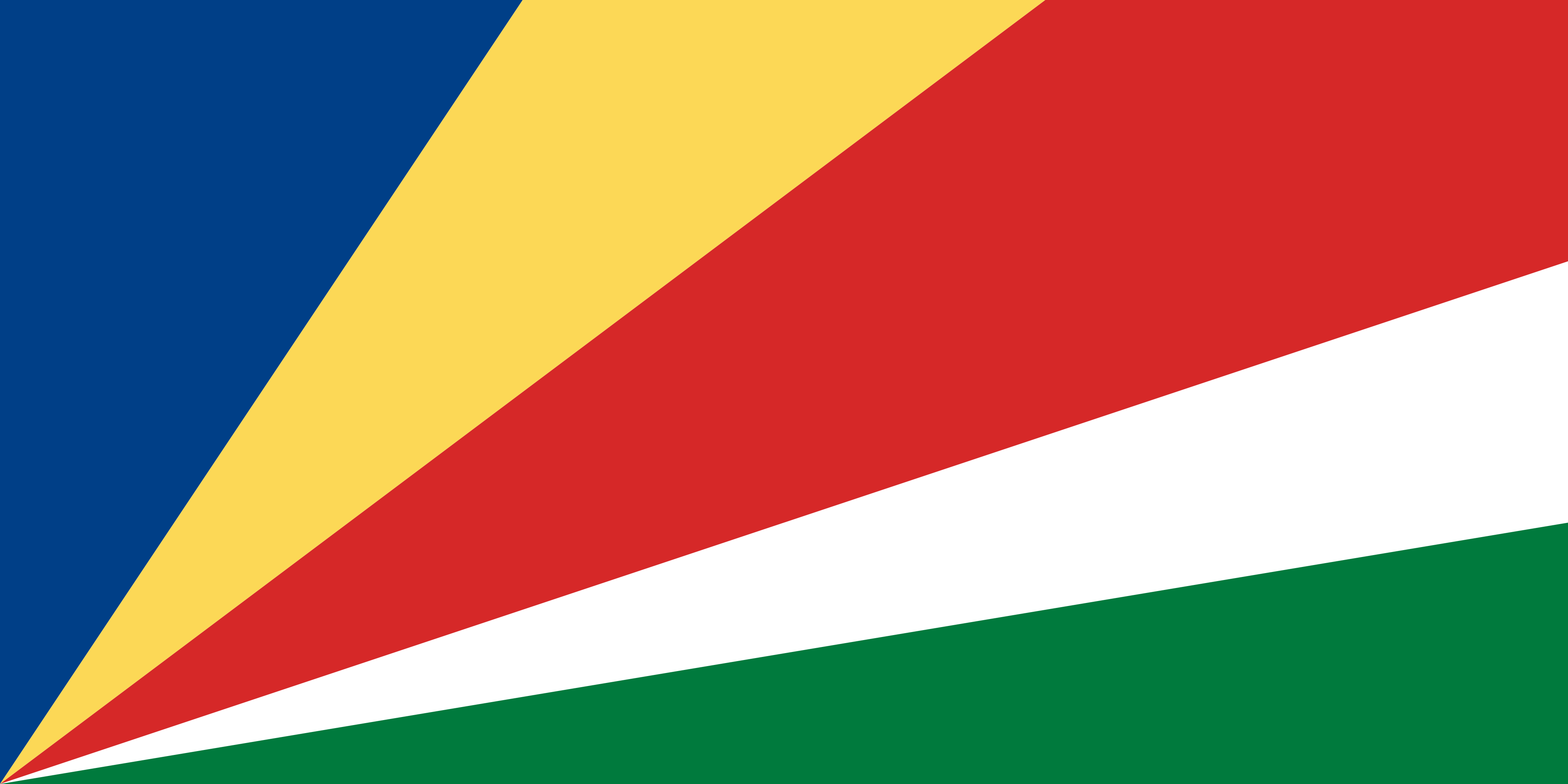
Seychelles flag picture
Explore the construction notes, history, and picture gallery.
| Design | Five colored fieldsA shared origin at the lower hoist; no emblem. |
|---|---|
| Proportions | Height:length = 1:2The top and fly edges each have three equal divisions. |
| Adopted | June 18, 1996Date printed on the original ministry symbols booklet. |
| Designer | Philippe UziceCredited by the Foreign Affairs Department. |
| Screen palette | Sampled from a ministry imageRGB values are disclosed reproduction choices. |
| Main image sizes | 6,000 × 3,000Exact SVG coordinates and opaque PNG pixels. |
What does the Seychelles flag look like?
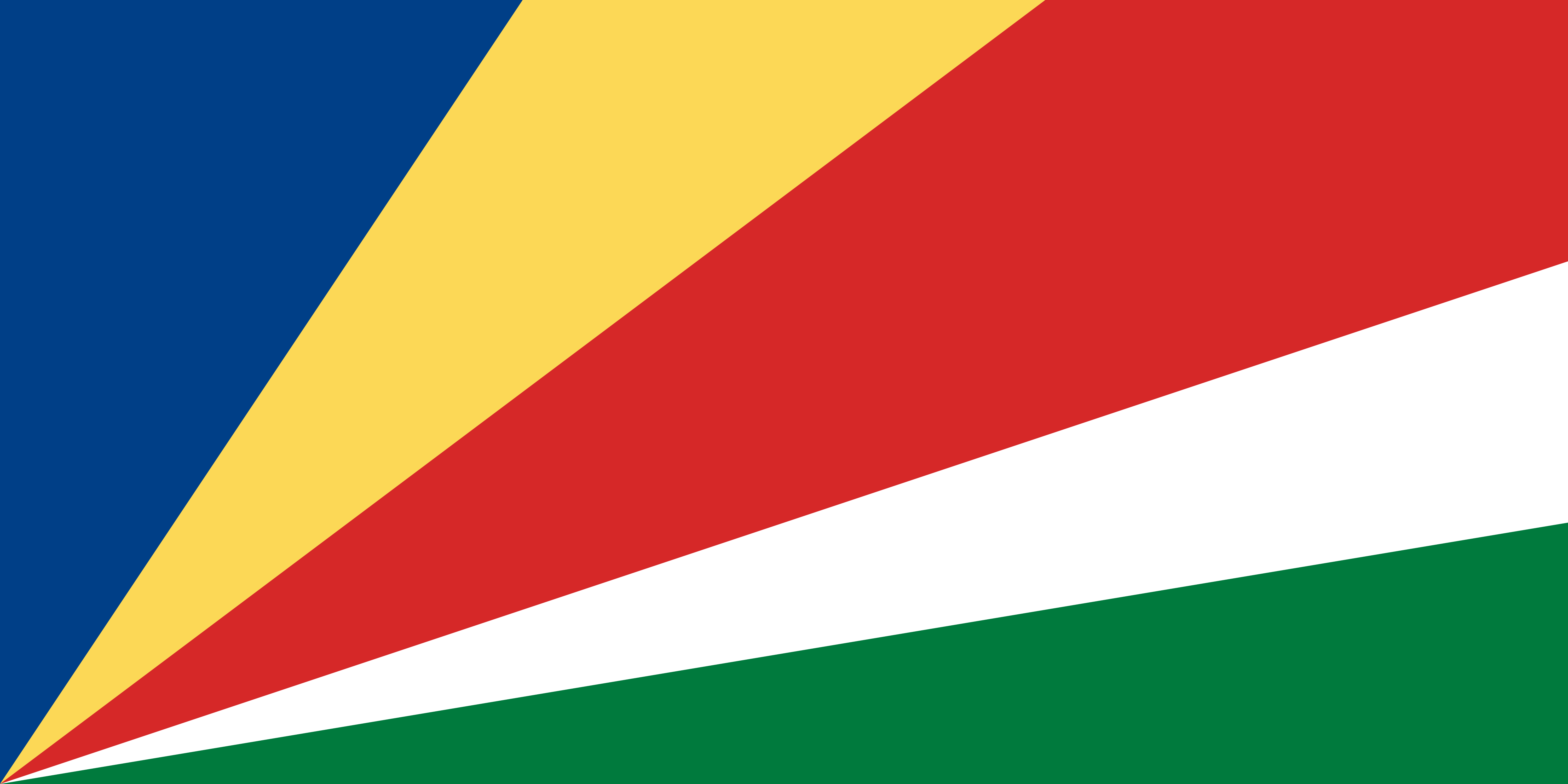
The Seychelles flag is a rectangle with five colored rays spreading from its lower hoist corner: blue, yellow, red, white, and green. Its height:length ratio is 1:2. Adopted on June 18, 1996, the national flag carries no coat of arms, lettering, stars, or separate central emblem.
Start by identifying the hoist, the edge attached to the pole. In the conventional front view it is on the left, and the five fields meet at its bottom corner. The upper edge is divided among blue, yellow, and red; the free edge is divided among red, white, and green. This arrangement gives the flag its recognizable expanding fan. It also explains why a row of five equal vertical stripes would be incorrect. The construction is straightforward once the outer rectangle and the edge divisions are fixed before the connecting lines are drawn.
What are the Seychelles flag colors and color codes?
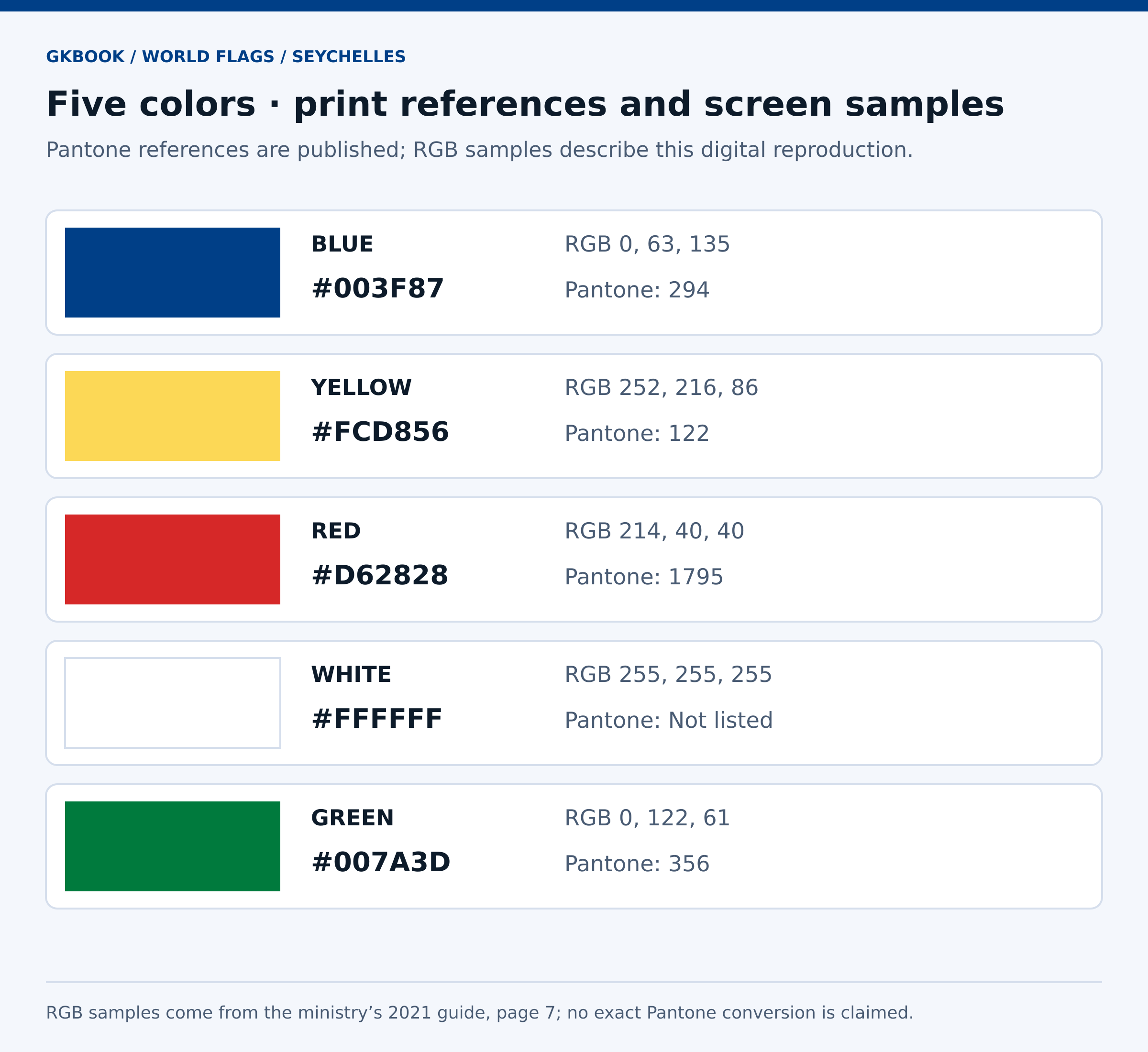
The five colors are blue, yellow, red, white, and green. Official guidance lists Pantone references 294, 122, 1795, and 356 for the four chromatic colors. This artwork uses RGB values sampled from the ministry’s illustration; its hexadecimal codes are documented screen choices, not statutory RGB specifications.
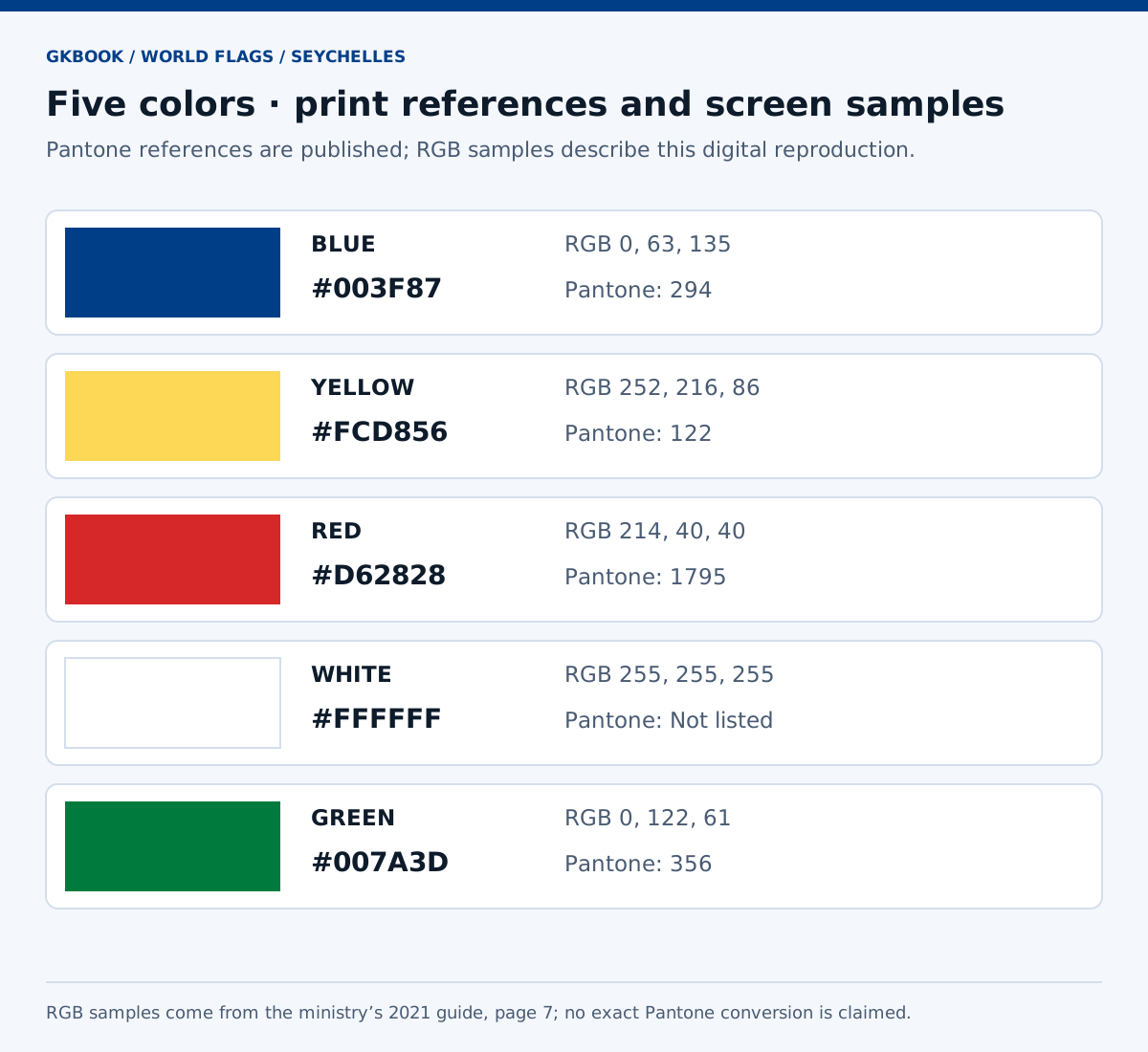
The drawing uses blue #003F87, yellow #FCD856, red #D62828, white #FFFFFF, and green #007A3D. These values come from dominant interior colors in the flag image embedded on page 7 of the ministry’s 2021 guide. They make the delivered files reproducible without pretending that a sampled illustration establishes a legal digital standard.
A Pantone reference, a process-ink percentage, and an RGB triplet describe different reproduction systems. Their numbers should therefore remain separately labeled. For physical production, use the published print references with a suitable material proof instead of assuming that the screen appearance specifies fabric dye.
| Color | Pantone reference in guidance | Sampled HEX / RGB |
|---|---|---|
| Blue | 294 | #003F87 / 0, 63, 135 |
| Yellow | 122 | #FCD856 / 252, 216, 86 |
| Red | 1795 | #D62828 / 214, 40, 40 |
| White | No separate reference listed | #FFFFFF / 255, 255, 255 |
| Green | 356 | #007A3D / 0, 122, 61 |
What does the Seychelles flag mean?
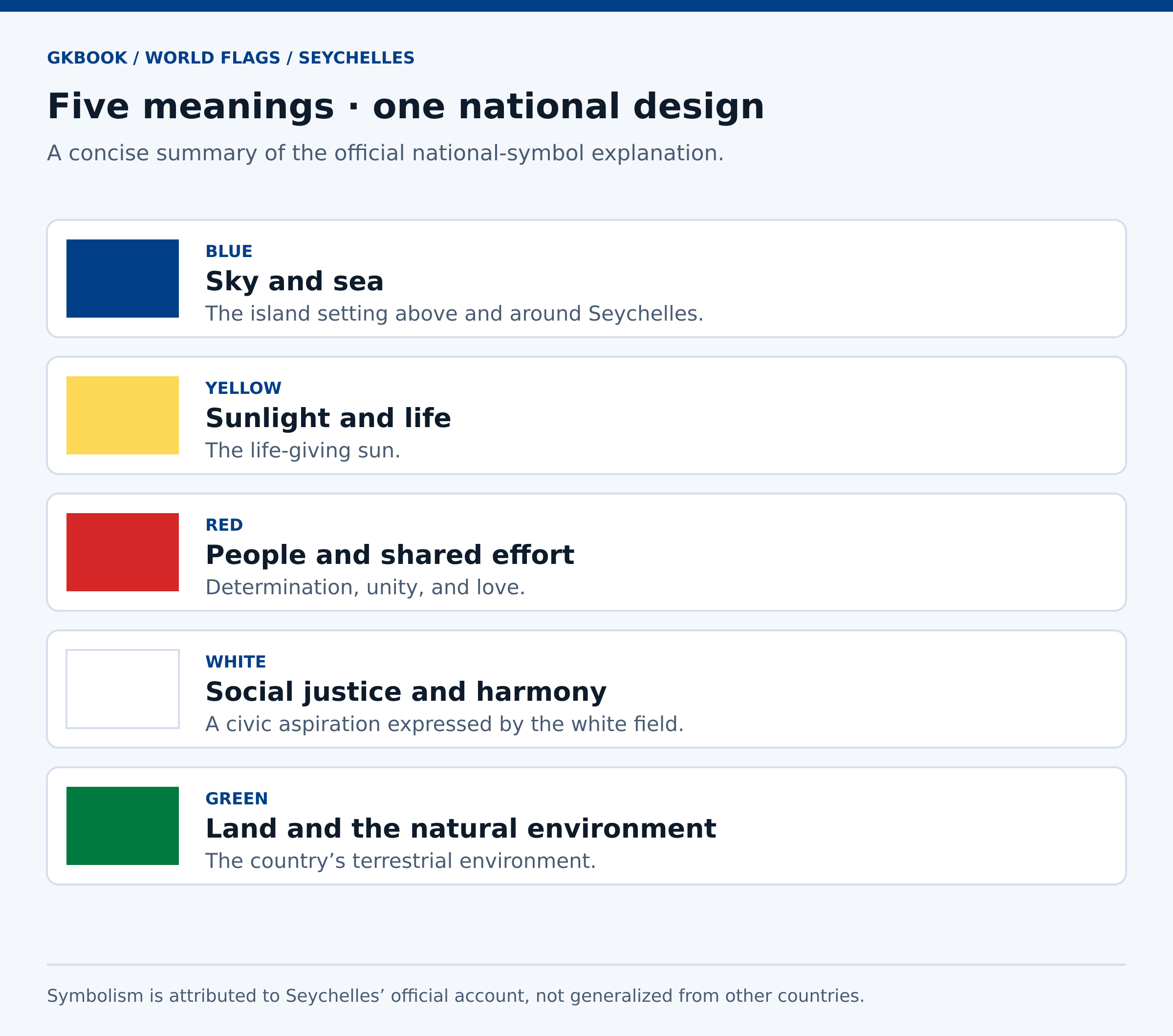
The official explanation connects blue with sky and sea, yellow with the sun, red with the people’s shared effort, white with social justice and harmony, and green with land and nature. The spreading bands represent forward movement. These meanings belong to Seychelles’ own account of its national design.
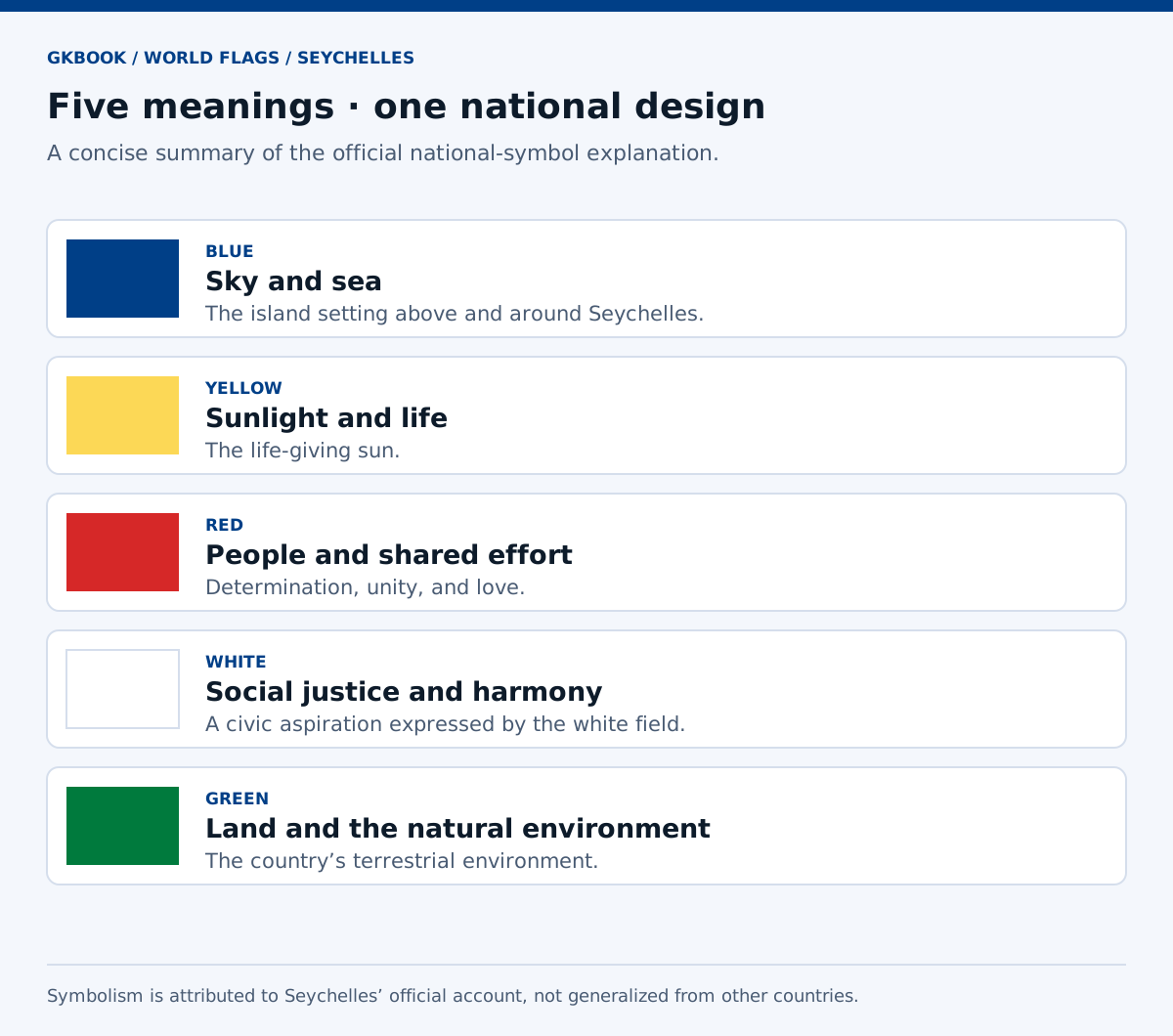
A useful way to read the flag is to connect its natural imagery with its civic themes. Sea, sunlight, and land establish an island setting; collective effort and harmony describe aspirations for national life. The expanding arrangement brings those ideas together rather than assigning a different island to each field.
Color symbolism is contextual. Red can mean different things on different flags, and another country’s interpretation should not be substituted here. Likewise, the five fields do not establish a count of administrative districts, inhabited islands, languages, or religious communities. The official explanation does not make those numerical mappings.
What does blue represent on the Seychelles flag?
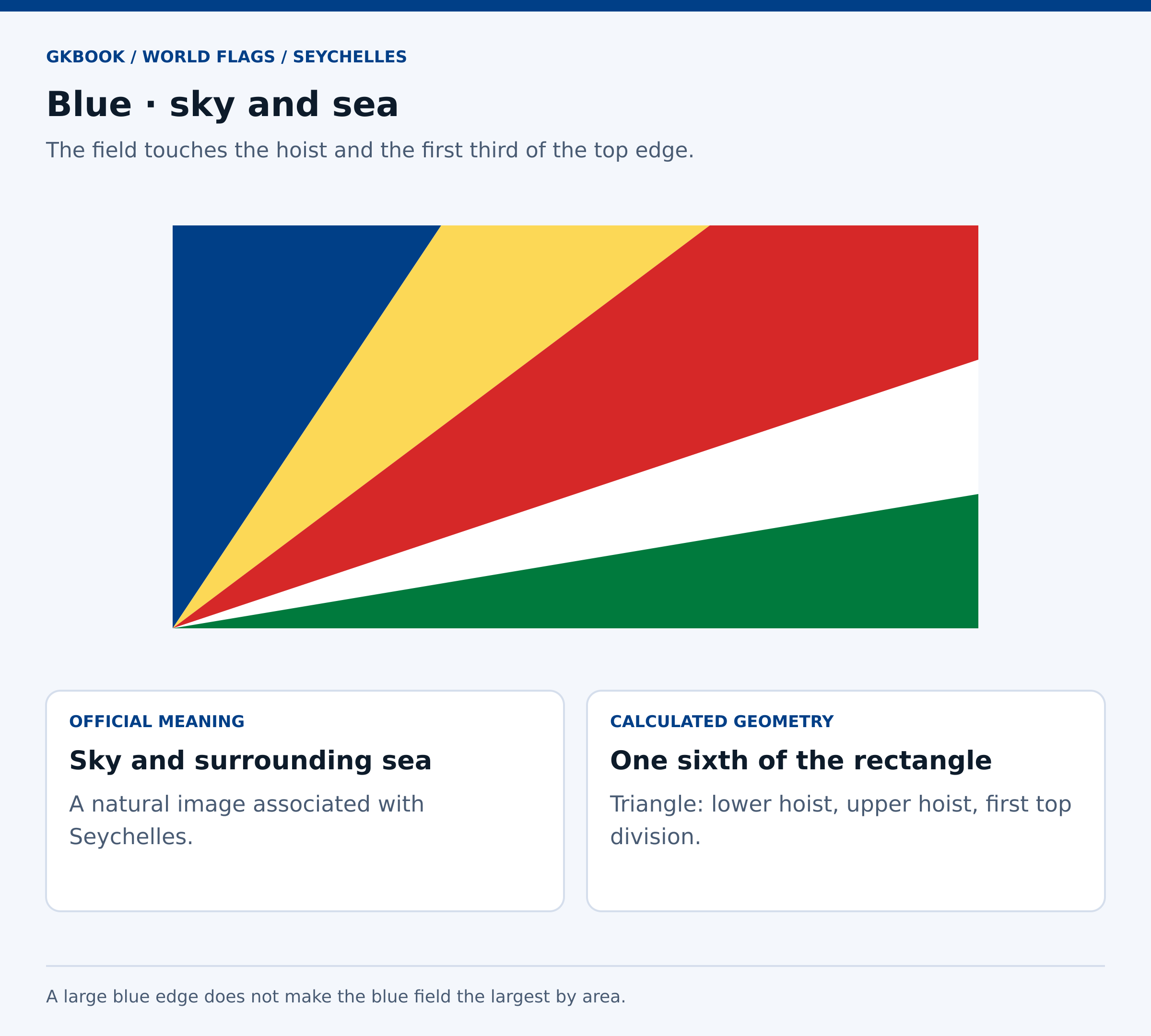
Blue represents the sky and the sea surrounding Seychelles in the official account. It occupies the triangular field against the hoist and the first third of the top edge. In the usual front view, blue is uppermost at the left; it is not a separate border around the flag.
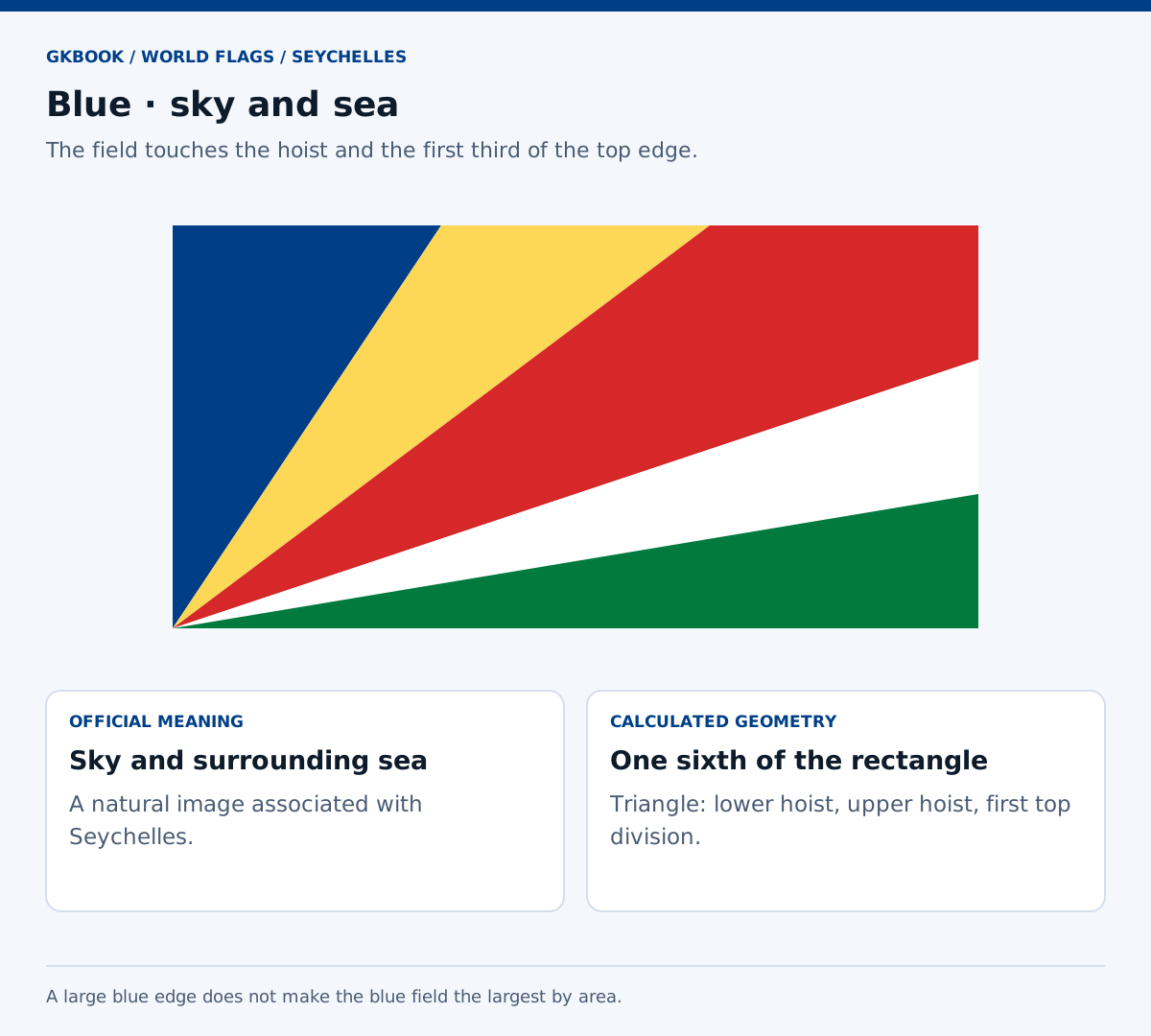
The blue triangle has vertices at the lower hoist, upper hoist, and first division of the top edge. On a 6,000 by 3,000 coordinate drawing, those points are (0,3000), (0,0), and (2000,0). This is enough information to construct its outline exactly without estimating a diagonal angle.
Although the triangle reaches the flag’s full height along the hoist, it narrows continuously toward the common origin. Its area is one sixth of the rectangle. That area follows from its base and height; it does not imply that blue has less symbolic importance than the larger red field.
What does yellow represent on the Seychelles flag?
Yellow represents the sun and its life-giving light. It forms the second ray, between blue and red, and occupies the middle third of the top edge. The official meaning is solar; descriptions that replace it with beach sand change the ministry’s stated explanation of the color.
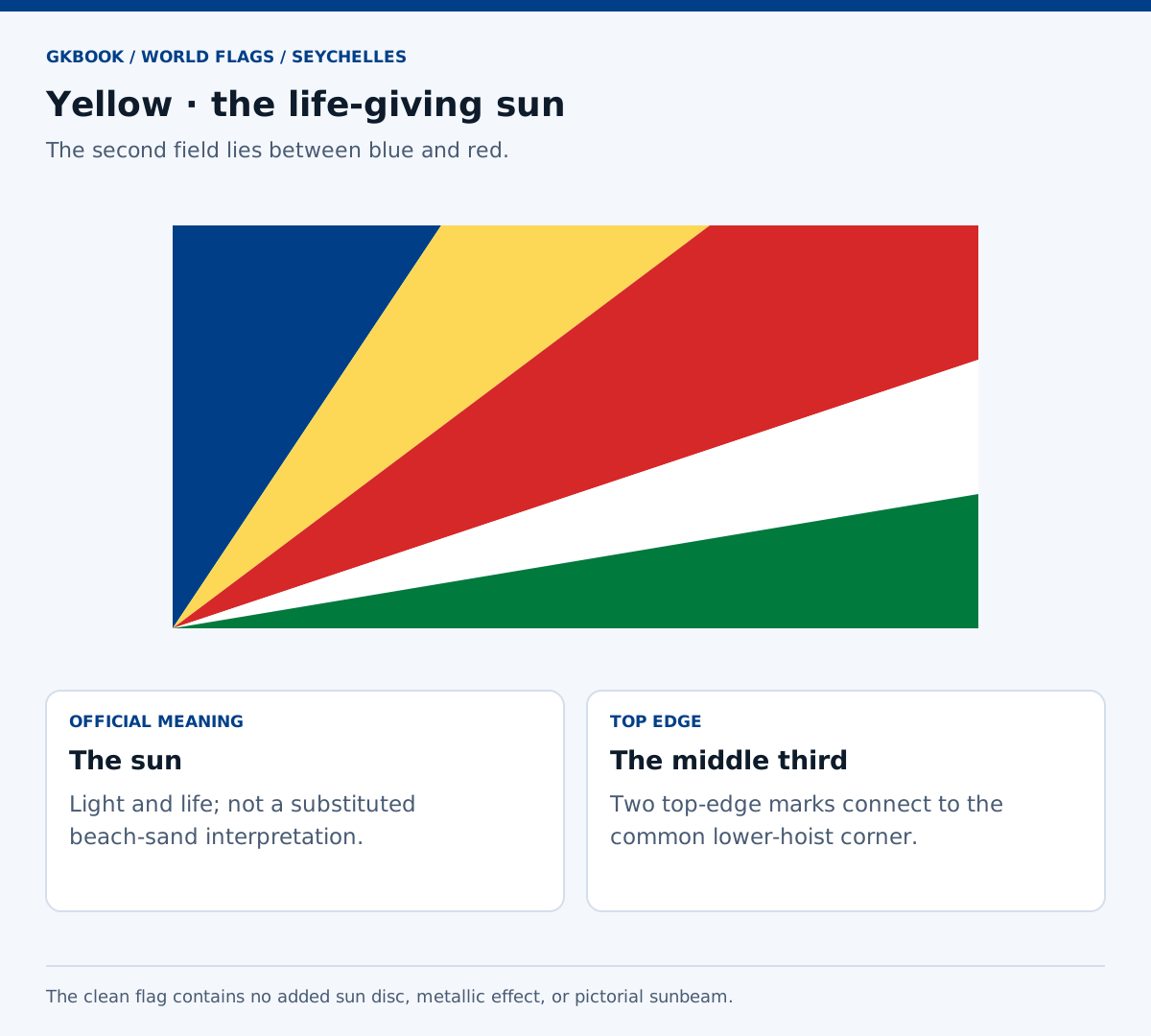
The yellow field is a triangle whose top edge runs from one third to two thirds of the flag’s length. Its third vertex is the common lower-hoist corner. A drawing can therefore preserve its shape by fixing those endpoints, even when the flag is reduced to a small illustration.
Yellow remains a flat color in the clean artwork. A metallic gradient, sun disc, or drawn sunbeam would add detail absent from the national design. The ray itself carries the color; the meaning does not require an additional picture of the object that the color represents.
What does red represent on the Seychelles flag?
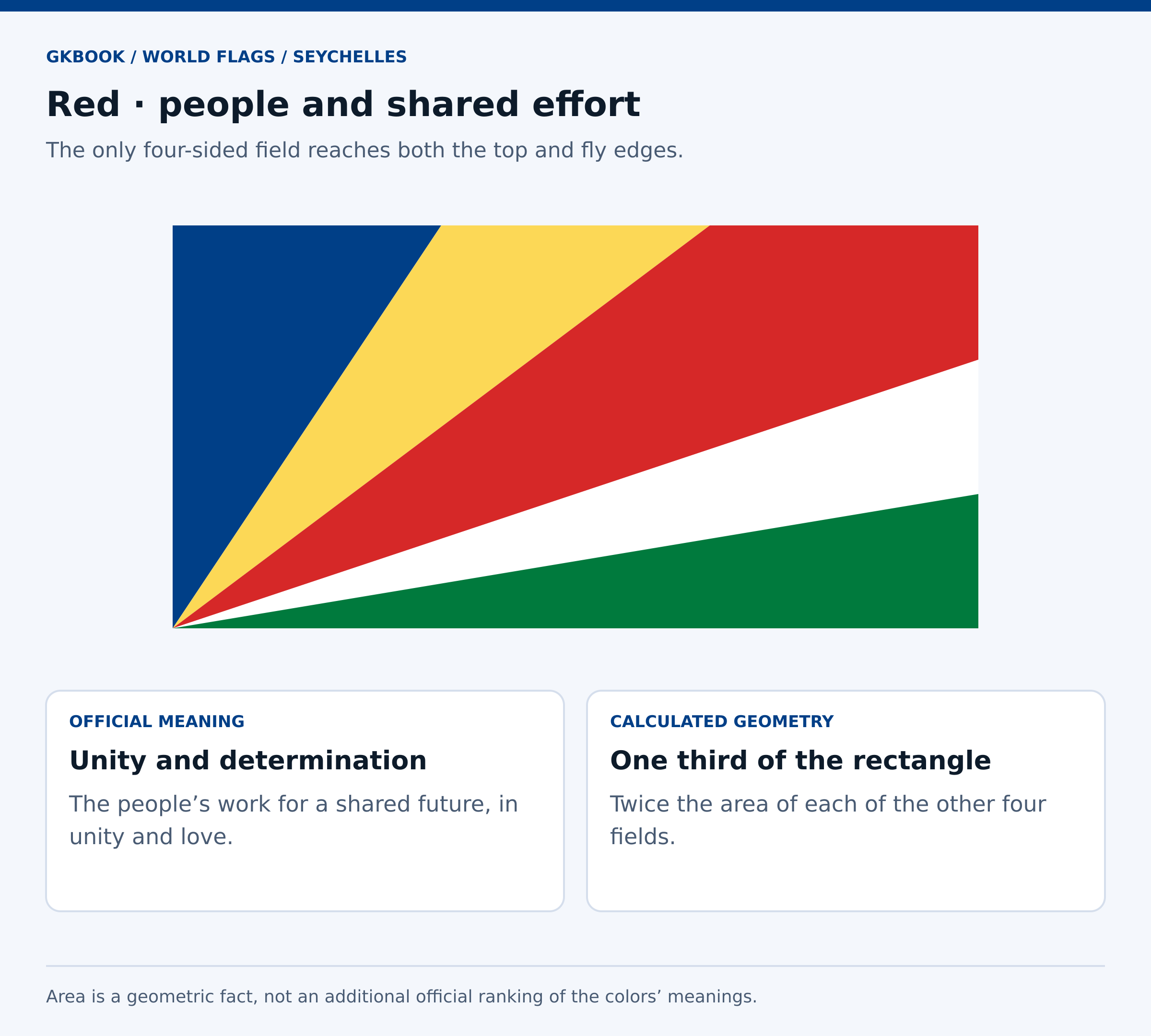
Red represents the people and their determination to build a shared future in unity and love. It is the broad central field, touching both the last third of the top edge and the upper third of the fly. Its four-sided shape distinguishes it from the other four fields.
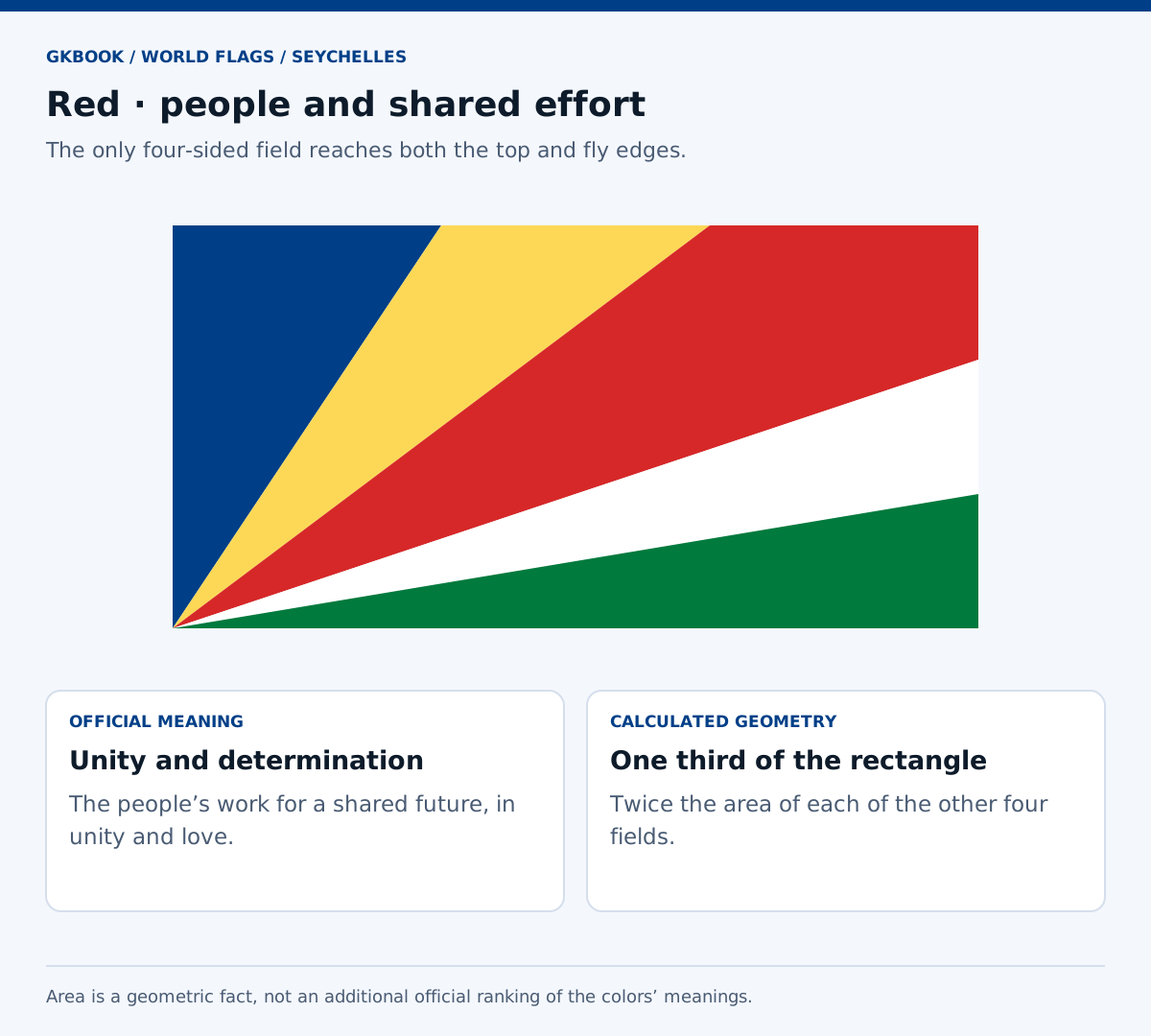
Follow the red outline from the common origin to the second top-edge division, across to the upper fly corner, and down to the first fly-edge division. Closing that path produces a quadrilateral. Treating it as a single triangle would remove part of the prescribed field or move a boundary.
Red covers one third of the rectangle, while each other color covers one sixth. This relationship is a consequence of the specified edge divisions. It is a geometric observation, not an additional official symbolic claim about the relative importance of the people, nature, sunlight, or justice.
What does white represent on the Seychelles flag?
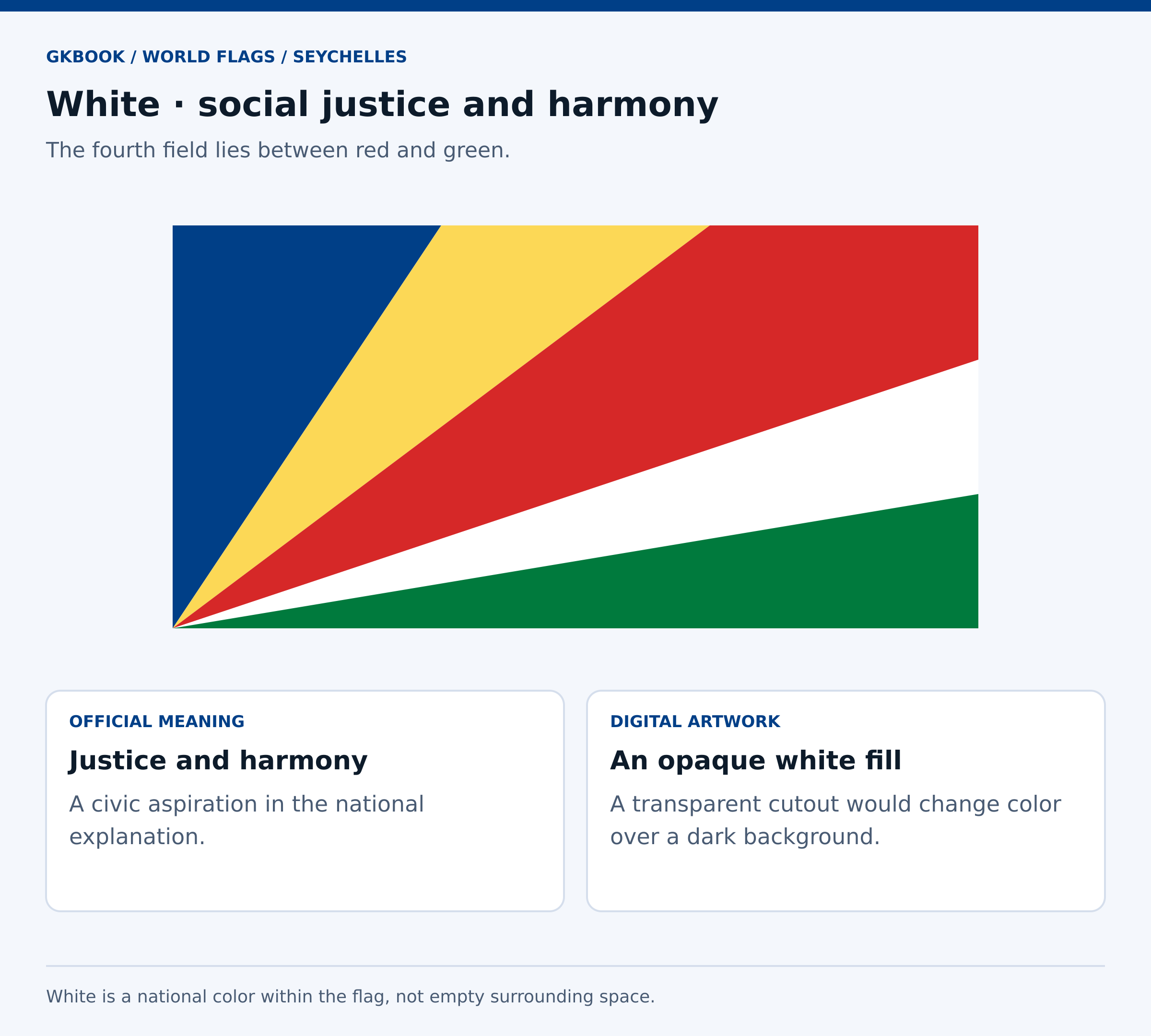
White represents social justice and harmony. It lies between red and green, widening from the lower hoist toward the middle third of the fly edge. White is a filled part of the flag, not an empty gap, transparent cutout, decorative outline, or separator added outside the design.
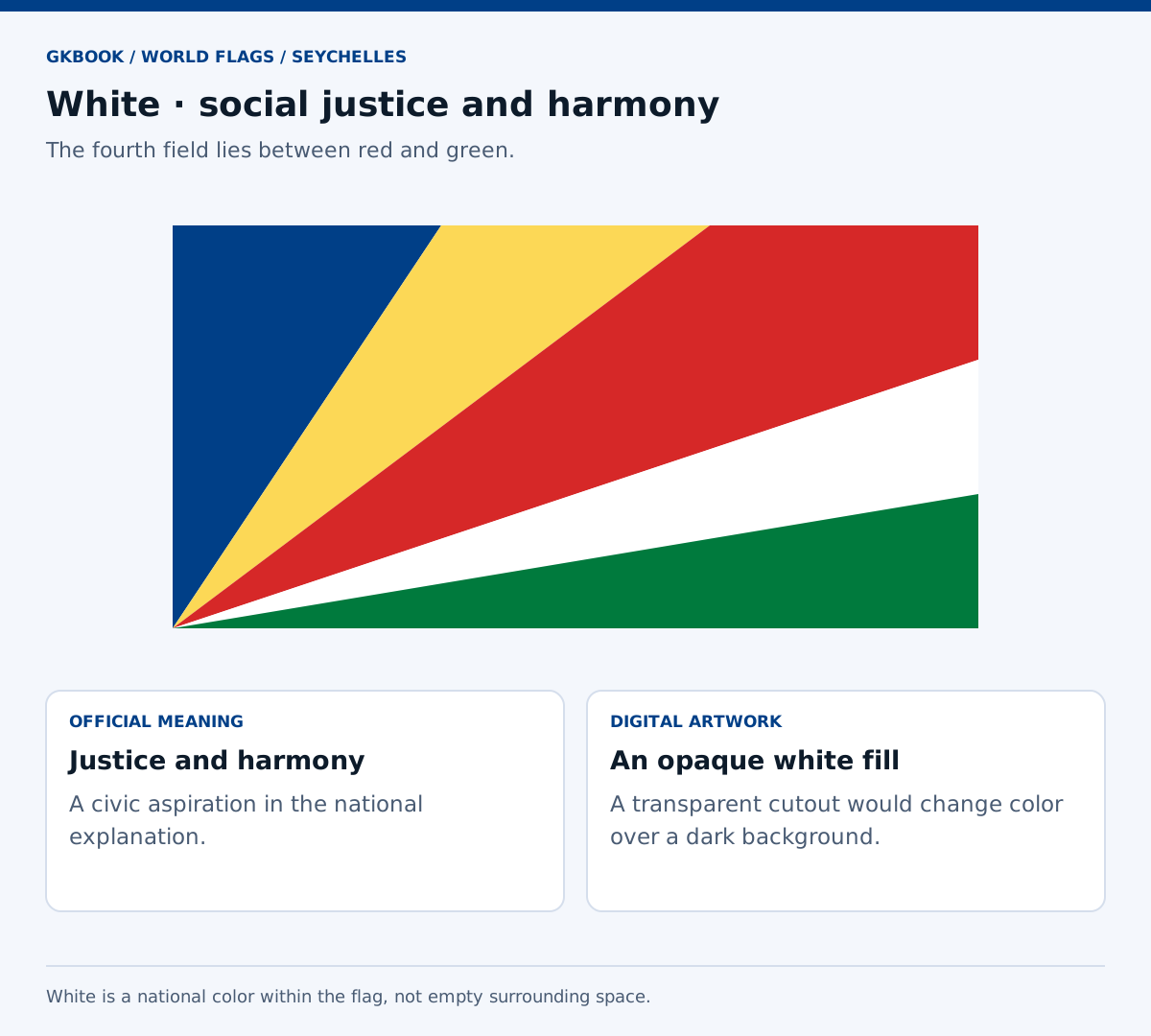
Transparency is particularly misleading in this field. If a transparent triangle is placed over a dark webpage, it would appear dark rather than white, changing a national color. Both the SVG and the opaque PNG therefore contain explicit white throughout the field’s interior.
The triangle’s fly-side endpoints are at one third and two thirds of the flag’s height, measured down from the top. At the lower-hoist origin its width becomes zero, just like the other rays. Keep those edges straight; the wavy white band belongs to the previous flag, not the current one.
What does green represent on the Seychelles flag?
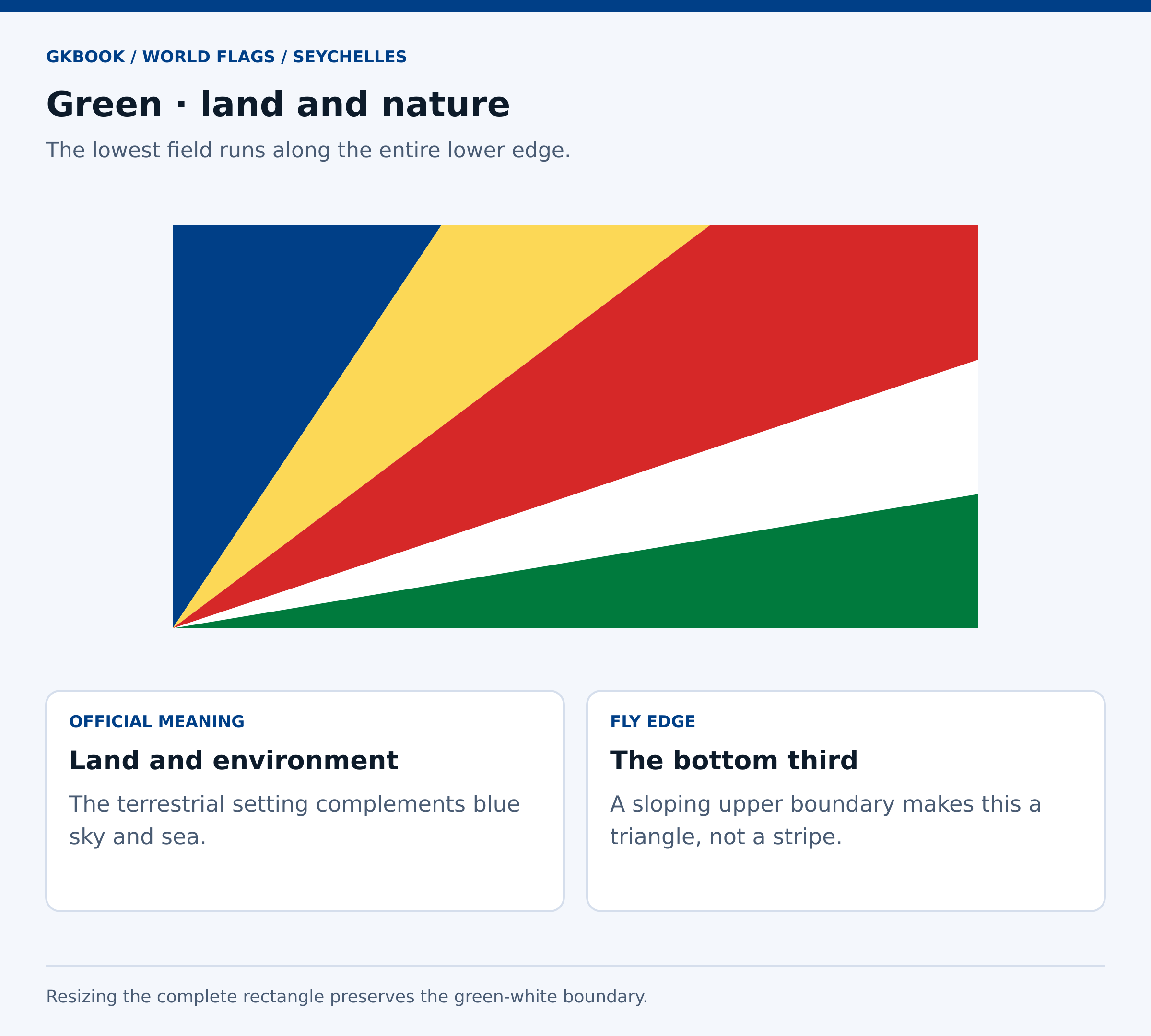
Green represents the land and the natural environment. It forms the lowest triangular field, running along the bottom edge from the hoist to the fly. At the fly it occupies the bottom third of the height. The green region is part of the fan, not a full-width horizontal stripe.
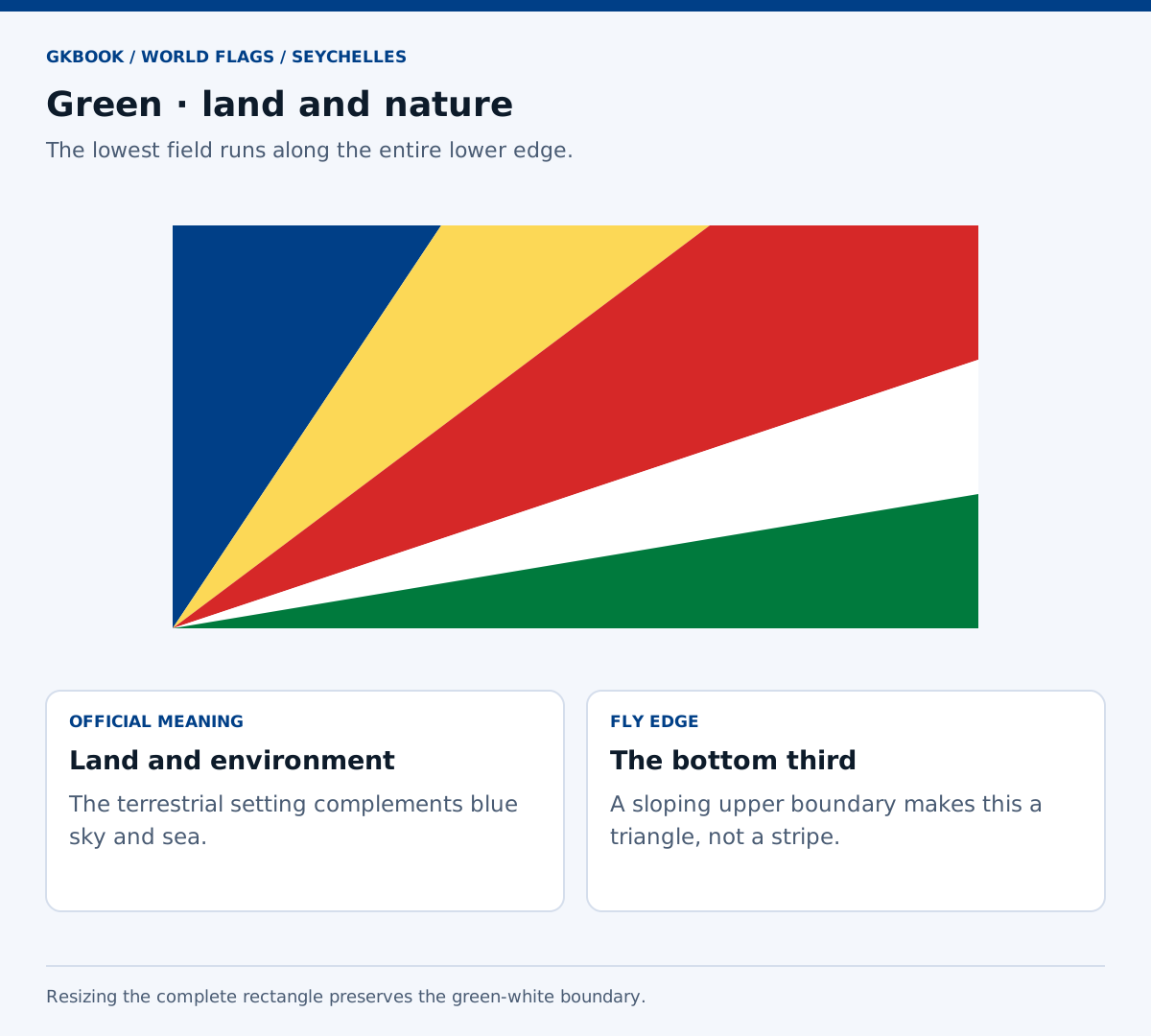
Its outline uses three corners: the shared origin, the lower fly corner, and the second fly-edge division. Because the lower edge is horizontal, this field can look like a low stripe at a glance. Its sloping upper boundary is the feature that reveals the triangular construction.
For an accurate small icon, preserve that slope instead of thickening the green region to make it more visible. Enlarging one color independently moves a shared edge and necessarily changes white as well. Scaling the whole flag retains the correct relationships between the adjoining fields at every size.
Why does the Seychelles flag have diagonal rays?
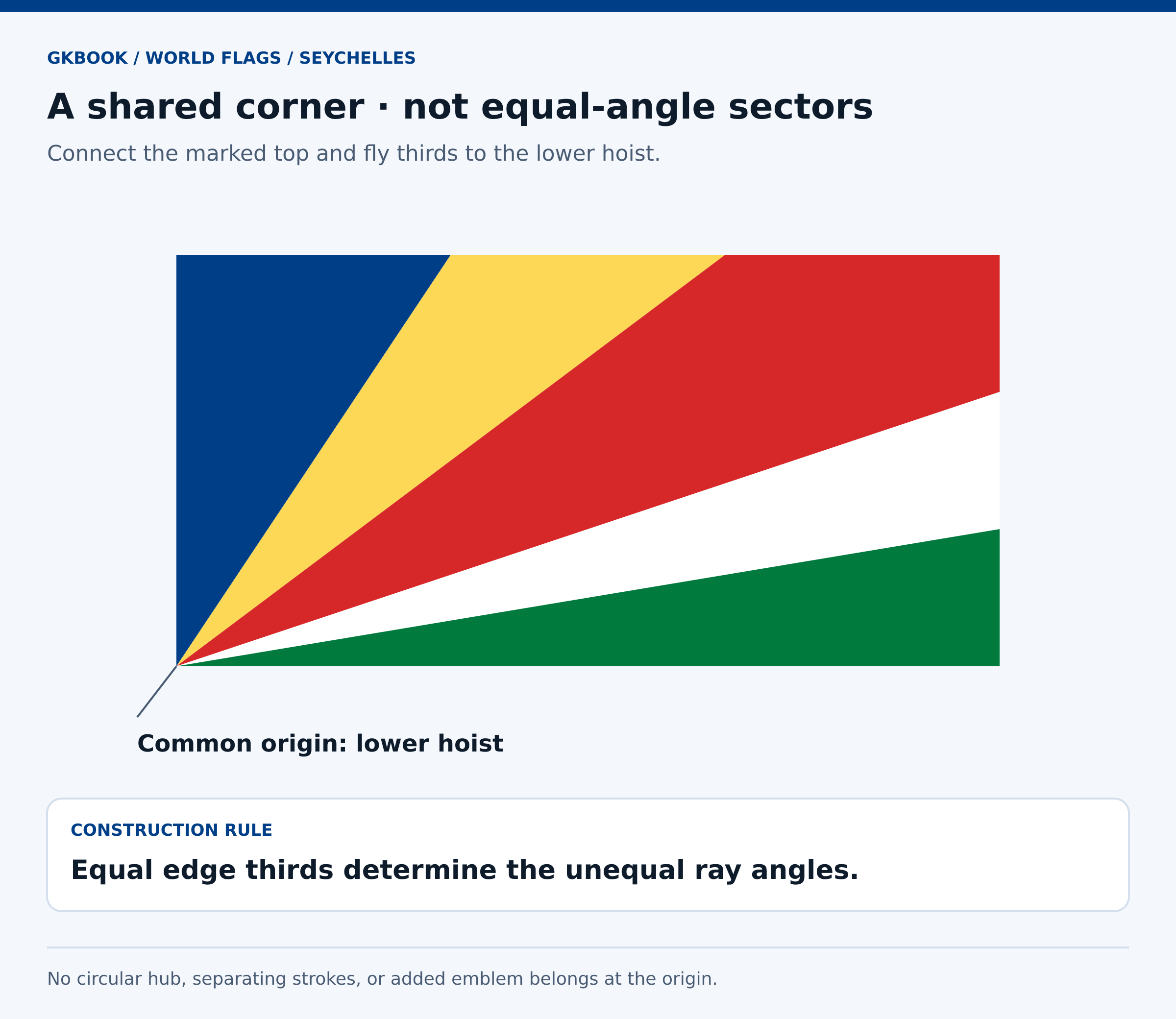
The ministry associates the expanding bands with a country moving toward its future. Geometrically, all five fields meet at the bottom of the hoist and spread toward the top and fly. They are not five equal-angle sectors: their boundaries are determined by equal thirds along those two outer edges.
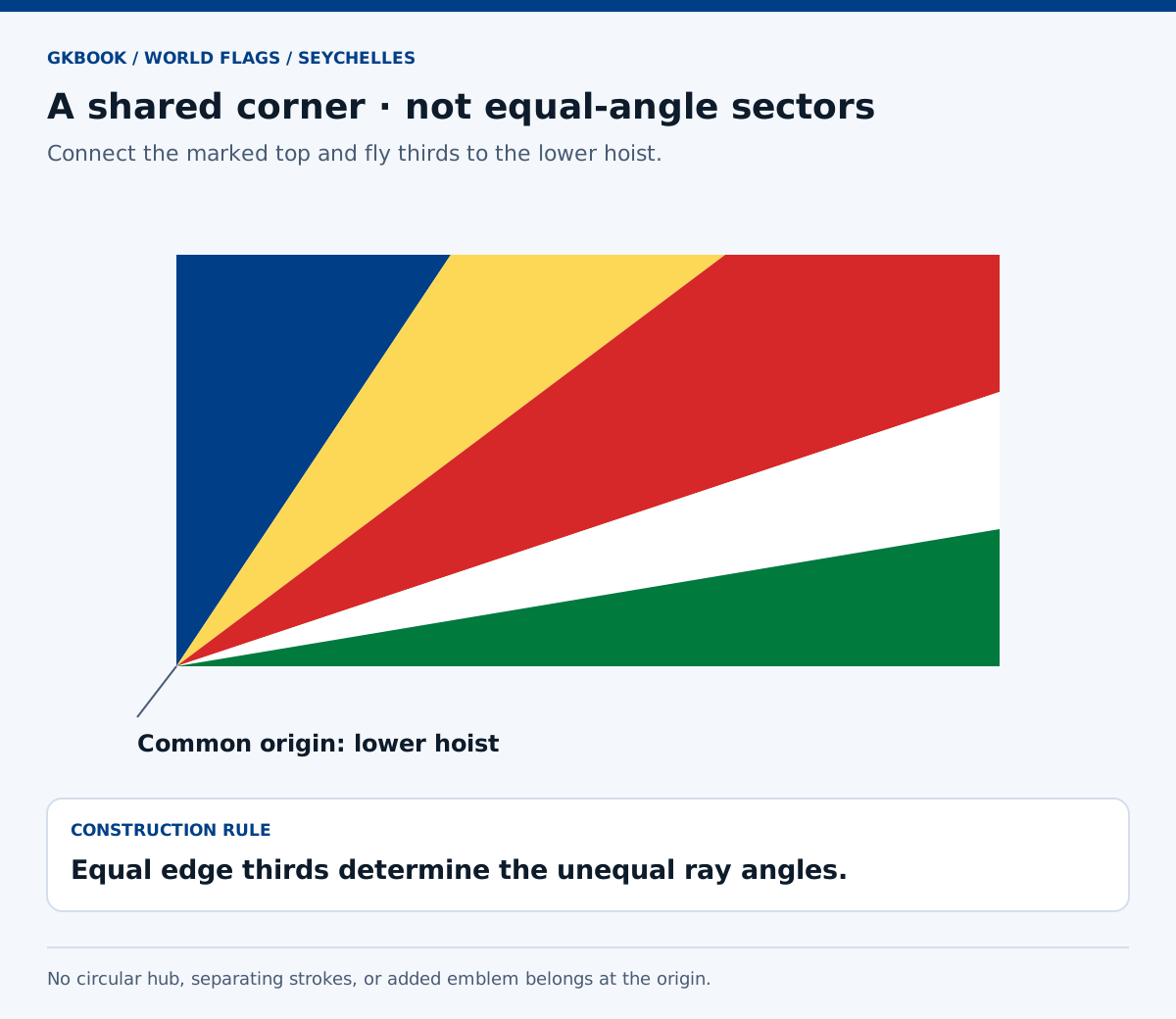
The common corner is a point, not a circular hub or small emblem. The clean drawing consequently has no disc at the origin and no dividing strokes between colors. At large scale, each shared boundary should remain a single straight line joining that corner to its specified endpoint.
An equal-angle fan would produce different intersections with the rectangle. This is an easy mistake when using a rotation tool to duplicate a wedge. Construct the edge divisions first, then connect them to the origin. The resulting angular differences are correct consequences of the rectangle and its prescribed thirds.
What is the Seychelles flag ratio?
The Seychelles flag has a height:length ratio of 1:2, so its horizontal length is twice its vertical height. A flag 90 centimeters high would be 180 centimeters long. The same rectangle is sometimes described as width:height 2:1; naming the dimensions avoids an apparent contradiction between these expressions.

The ministry’s original symbols booklet explicitly gives the one-by-two proportion. Its later guide lists practical sizes that preserve the same relationship, such as two feet by one foot and six feet by three feet. Those examples describe sizes, not competing national proportions.
The master supplied here uses a 6,000 by 3,000 canvas for both SVG coordinates and PNG pixels. Other dimensions work equally well when both axes are scaled together. A square thumbnail container can include the complete flag with surrounding space, but stretching the flag itself to fill that square changes its design.
How is the top edge divided?
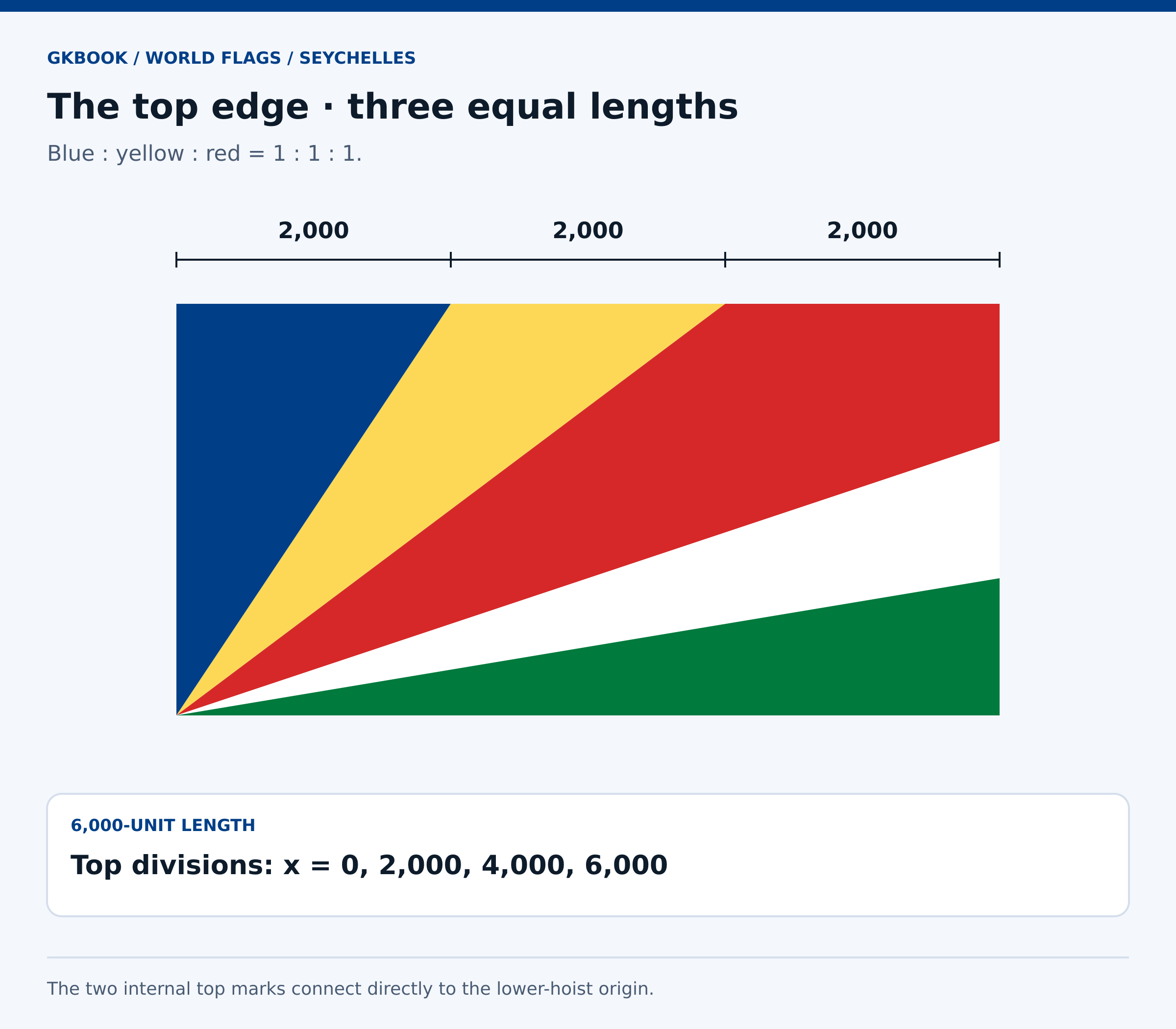
The top edge is divided into three equal lengths: blue, then yellow, then red from the hoist toward the fly. On the 6,000-unit master, the two internal division points are x=2,000 and x=4,000. Straight lines connect these points to the lower-hoist origin to define the first two internal boundaries.
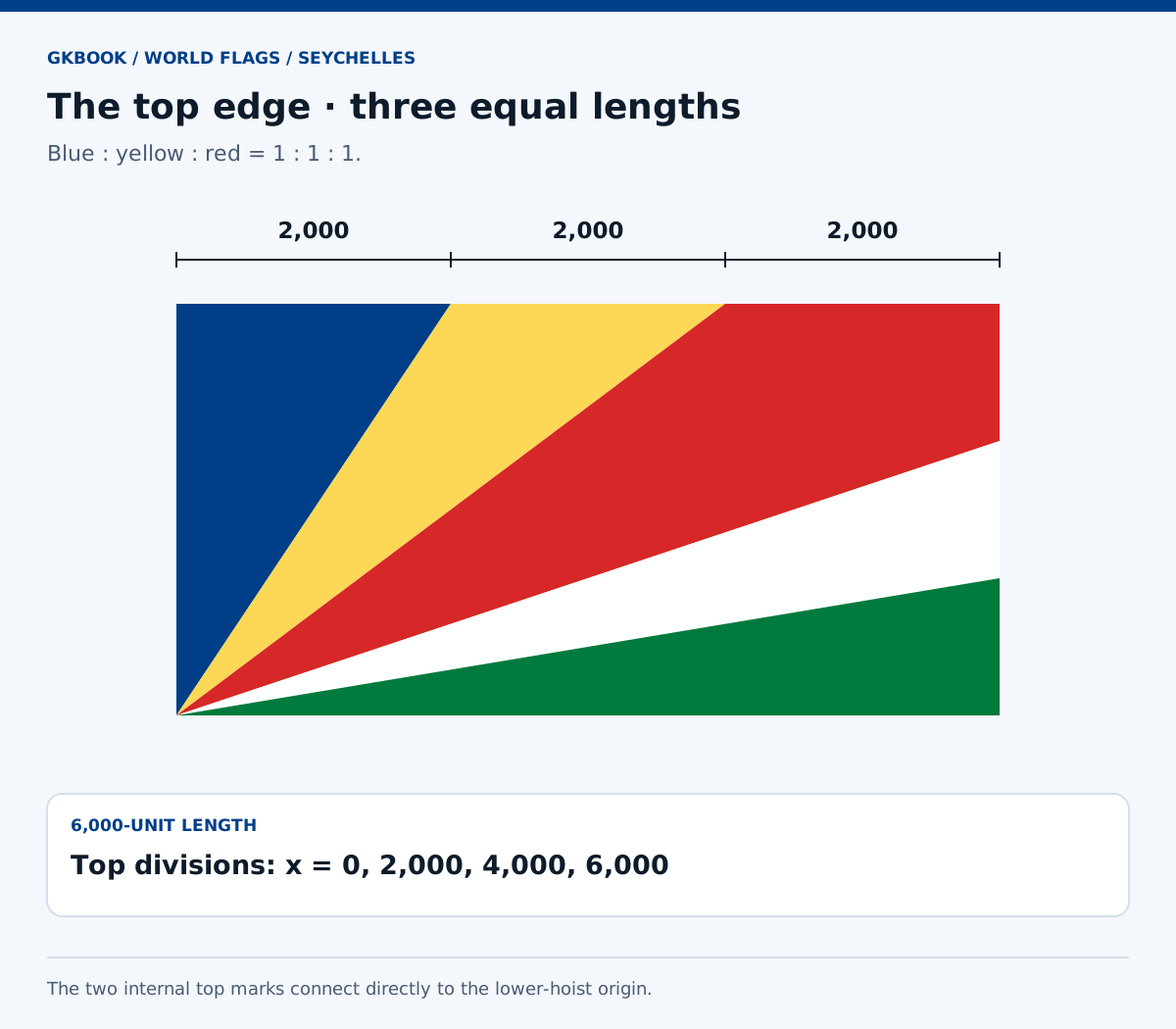
Only three colors meet the upper edge over a nonzero distance. White and green touch the shared origin below, so they do not require extra divisions across the top. Marking five equal top segments would therefore produce an entirely different pattern despite using the correct five colors.
The simplest manual construction begins with a ruler: divide the full length into three, mark both internal positions, and draw to the opposite lower corner at the hoist. For the first two triangles, these marks determine the whole shape. Red continues around the upper fly corner to its separate fly-side endpoint.
How is the fly edge divided?
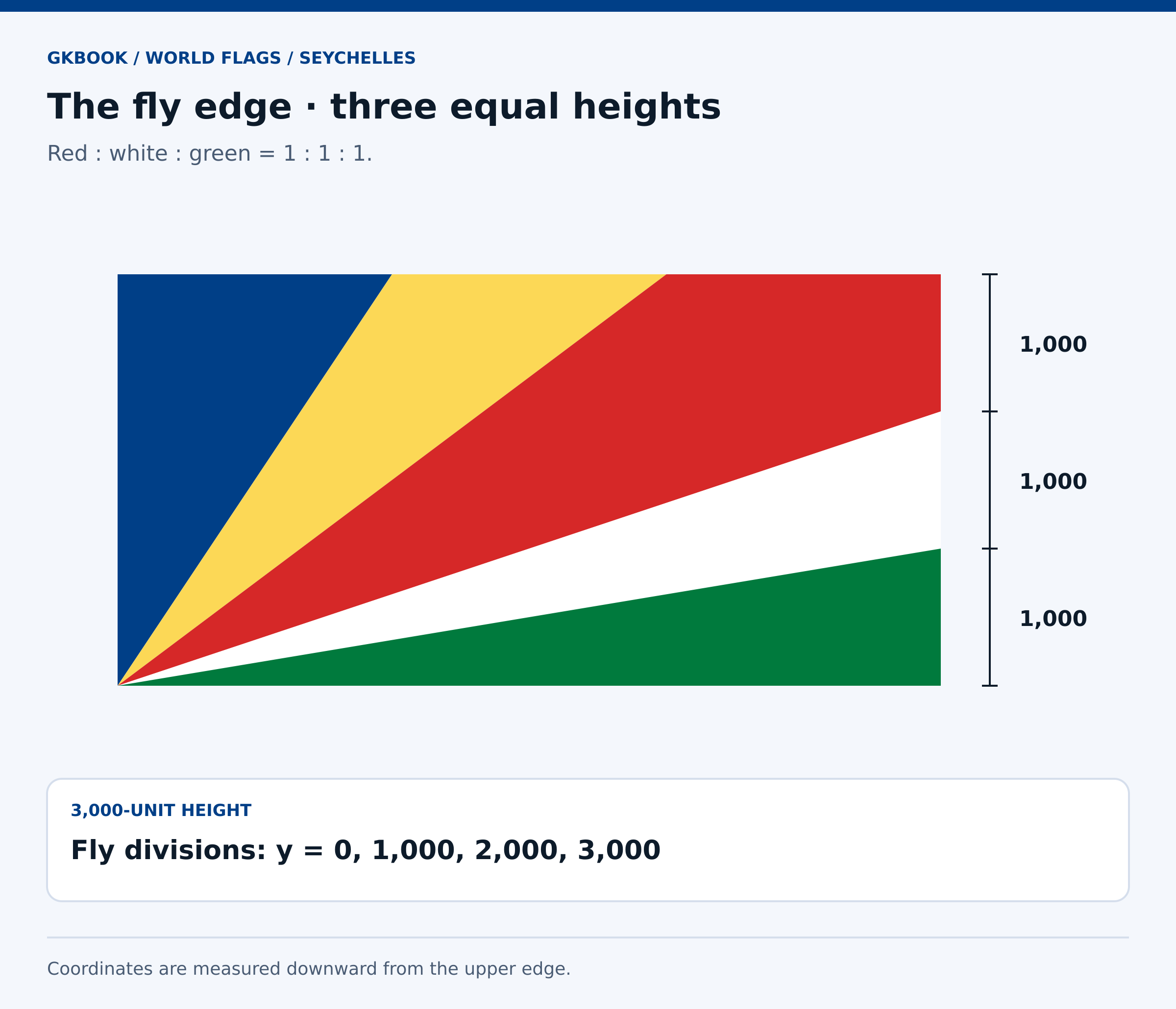
The fly edge is divided into three equal heights: red above, white in the middle, and green below. On a 3,000-unit-high master, the dividing points are y=1,000 and y=2,000 measured from the top. Connecting them to the lower hoist completes the remaining internal boundaries of the five-color design.
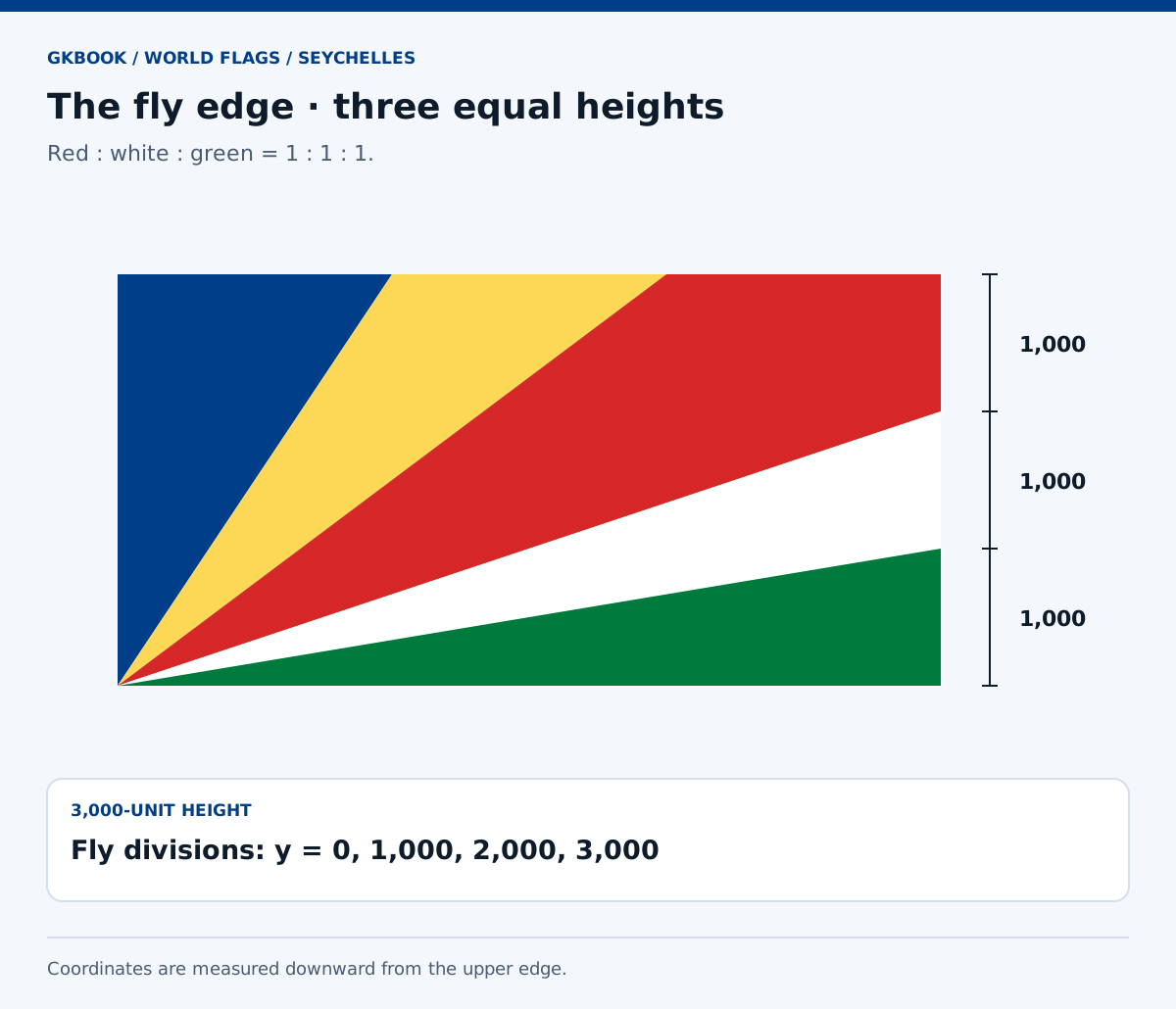
The fly is the free edge opposite the pole. Naming that edge matters because the hoist has a different appearance: nearly its full length borders blue, while all five fields converge at its bottom endpoint. The edge-thirds instruction does not apply to the hoist.
At the fly, white’s visible height is exactly the same as red’s and green’s. That equality does not imply equal areas inside the whole flag. The broad red quadrilateral has additional territory along the top. Reading the two sets of thirds together resolves this difference without changing either of the official edge relationships.
How do you draw the Seychelles flag accurately?
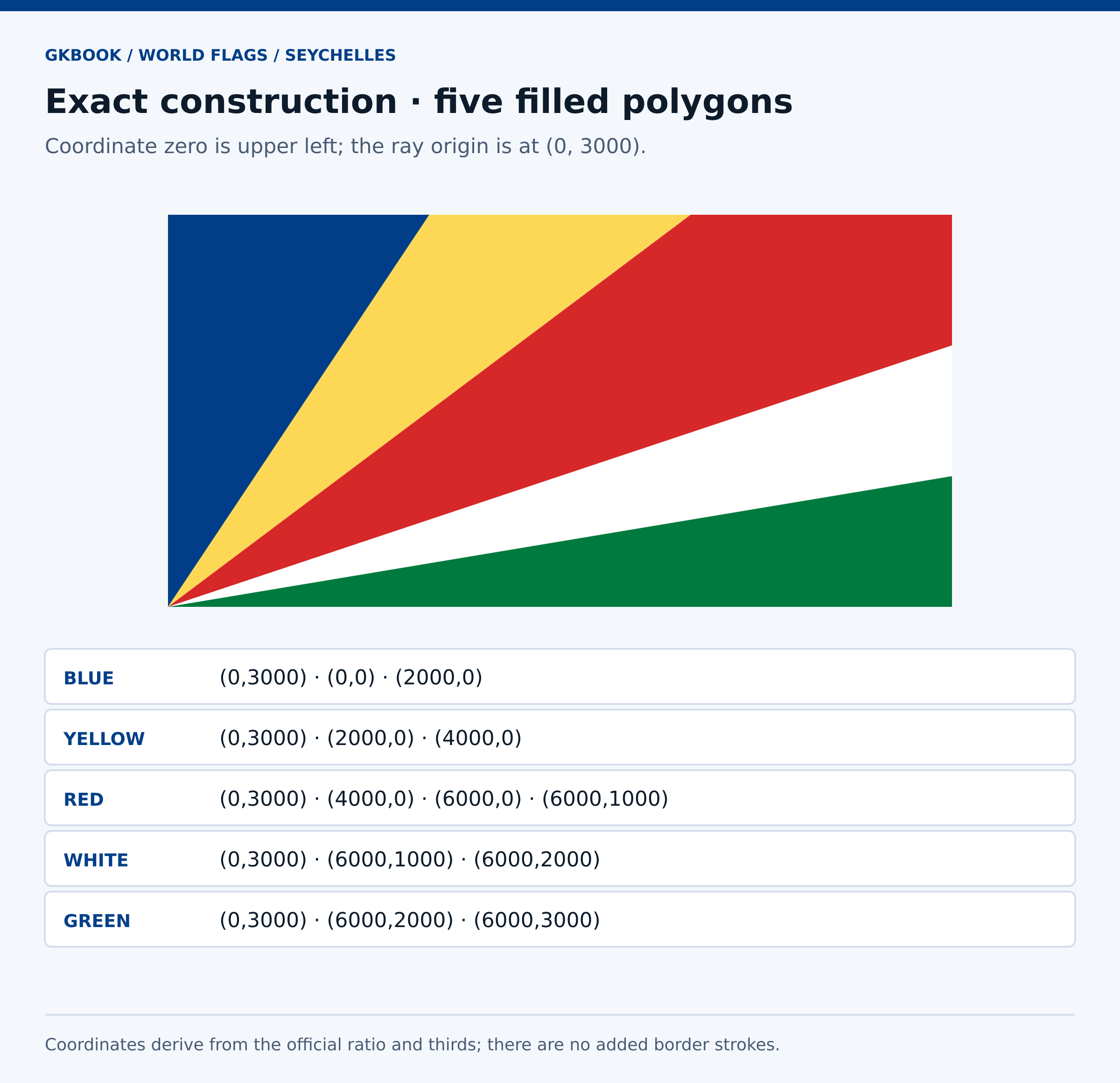
Draw a 2:1 horizontal rectangle, mark thirds along its top and right edges, and join the four internal marks to the lower-left corner. Fill the resulting regions blue, yellow, red, white, and green in order. Keep the boundaries straight, the common origin exact, and the whole flag free of outlines.
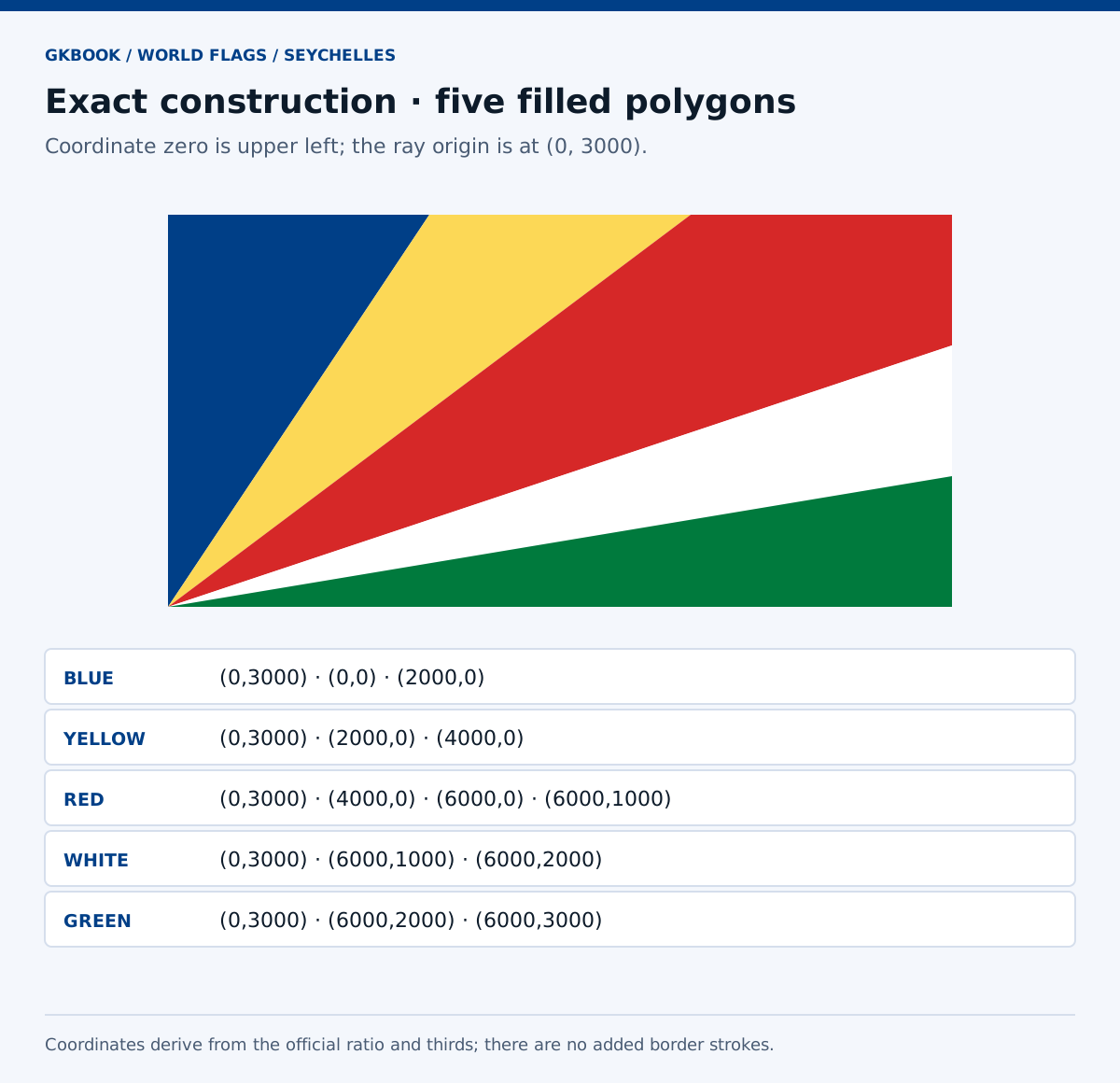
Use the upper-left corner as coordinate zero, with x increasing rightward and y increasing downward. The origin of the rays is then (0,3000), which differs from the coordinate origin. Explicitly naming these two points prevents a common reversal when transferring the design into vector software.
Each colored polygon shares its neighboring edge exactly. The model needs no decorative stroke and no invented measurement at the common corner. The accompanying coordinate table makes the construction reproducible in another drawing program. All coordinates can be multiplied by the same scale factor to produce a larger or smaller version.
| Field | Polygon vertices, in order |
|---|---|
| Blue | (0,3000), (0,0), (2000,0) |
| Yellow | (0,3000), (2000,0), (4000,0) |
| Red | (0,3000), (4000,0), (6000,0), (6000,1000) |
| White | (0,3000), (6000,1000), (6000,2000) |
| Green | (0,3000), (6000,2000), (6000,3000) |
Are the five colored fields equal in area?
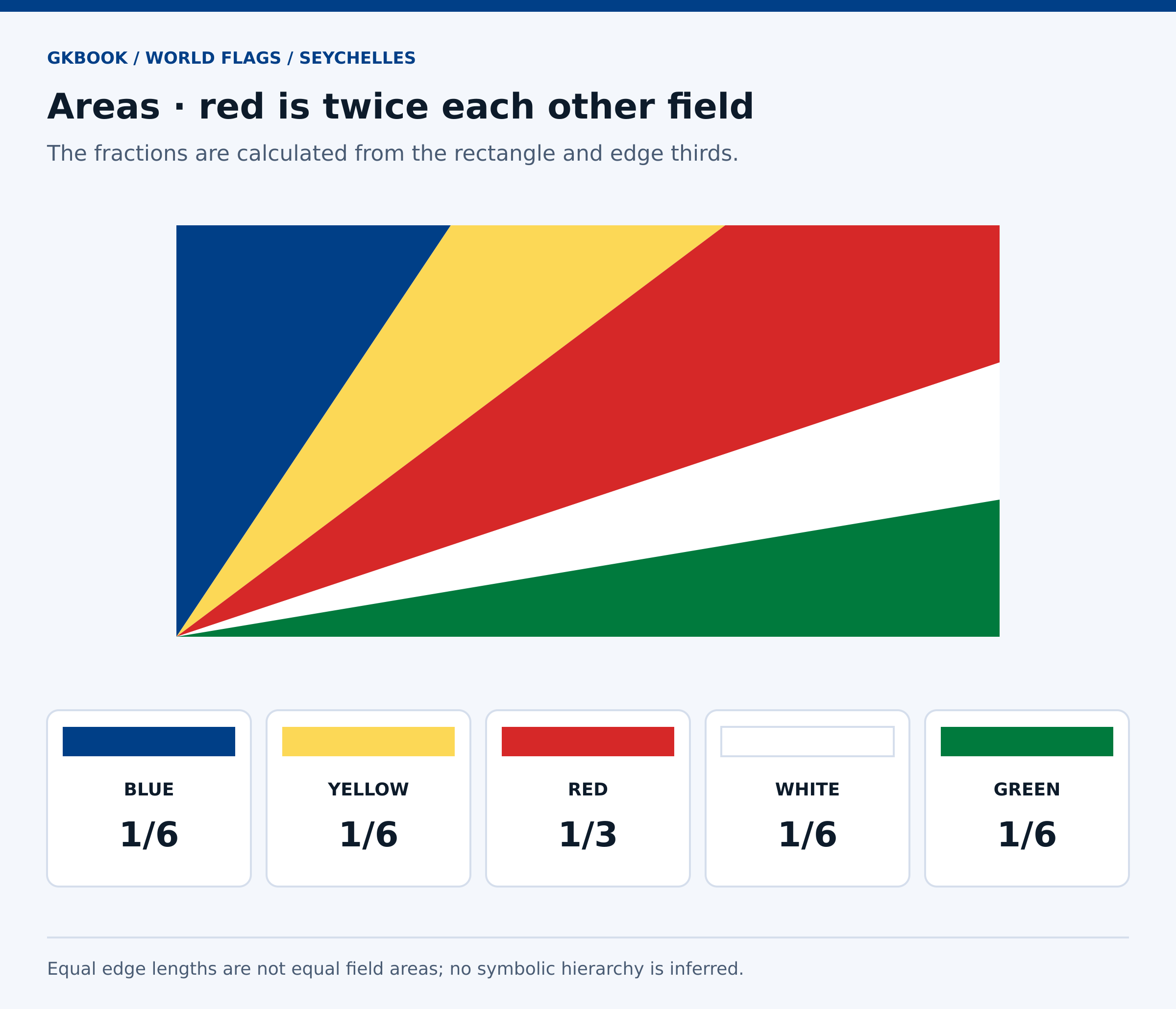
No. Red occupies one third of the complete flag, while blue, yellow, white, and green each occupy one sixth. These fractions follow mathematically from the official 1:2 rectangle and edge-thirds construction. Equal lengths along selected outer edges do not make all five interior regions equal in area.
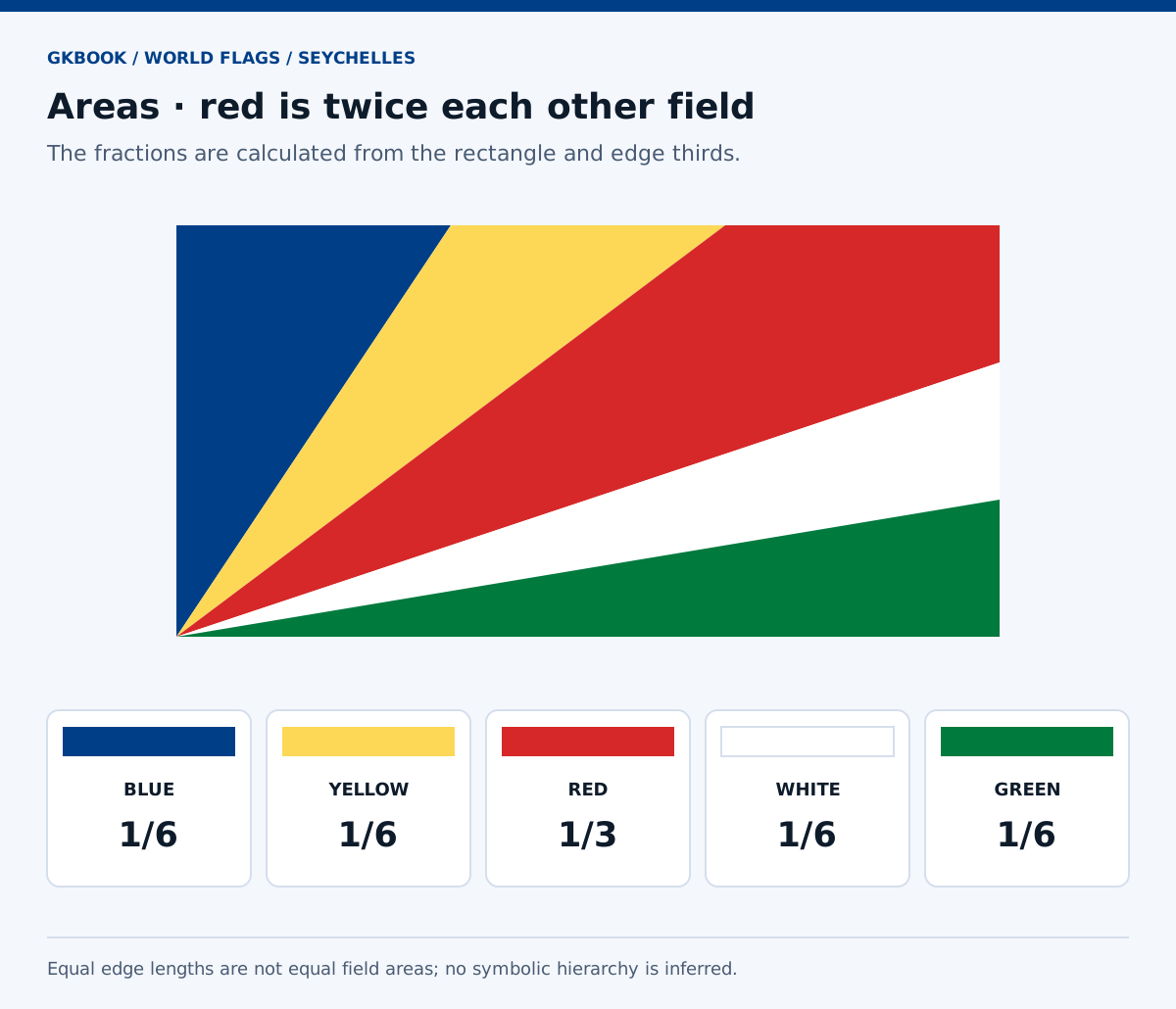
For blue and yellow, each triangle has a top-edge base of length L/3 and a perpendicular height H. Its area is therefore LH/6. White and green have a fly-edge base of H/3 and a perpendicular distance L to the common corner, producing the same result.
Together those four triangles cover two thirds of the rectangle. Red fills the remaining third. On the supplied master, the whole area is 18,000,000 square coordinate units: 6,000,000 are red, and each other field covers 3,000,000. These are calculated areas, not additional proportions quoted from a government color table.
What is the history of the Seychelles flag?
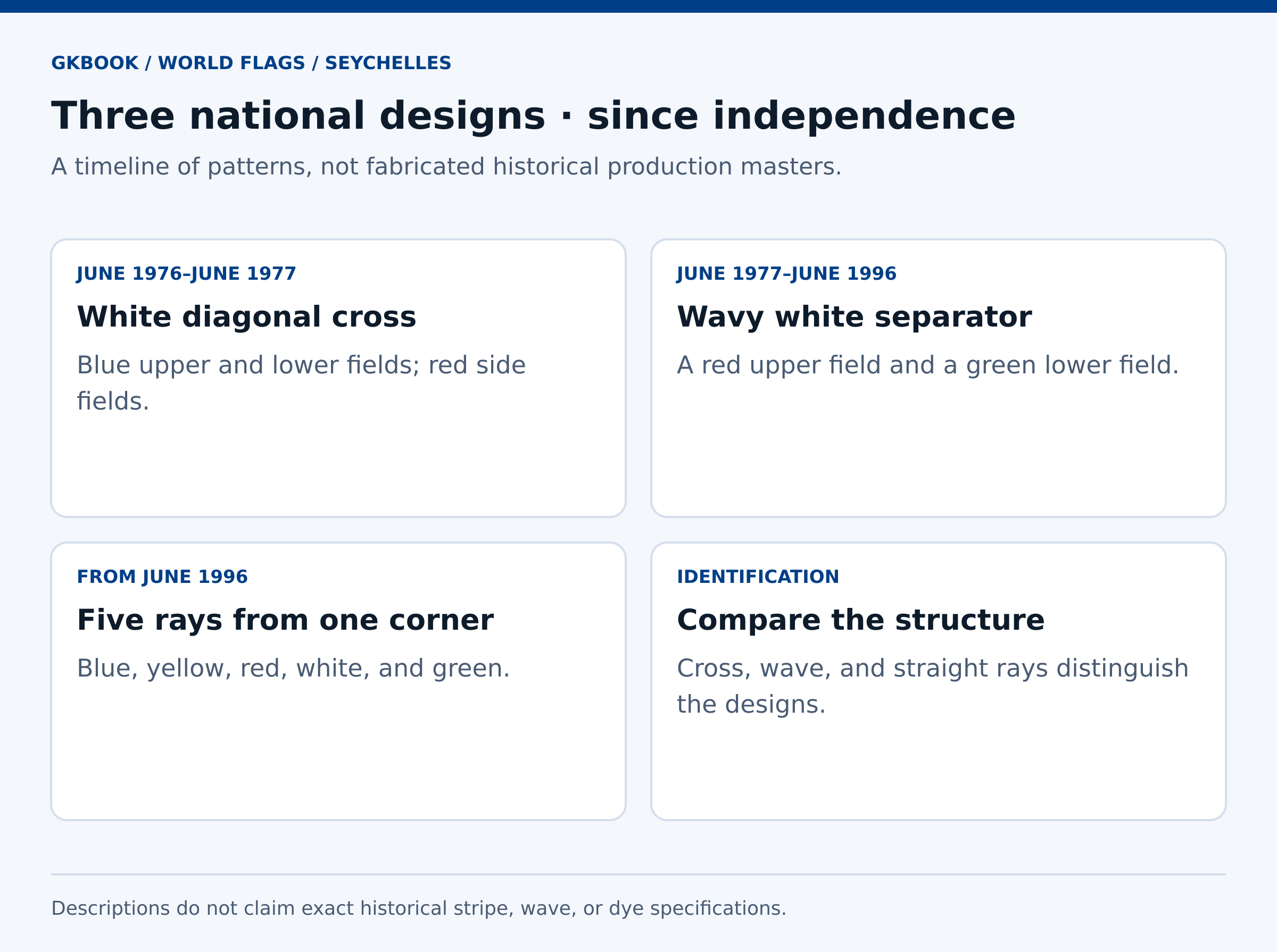
Seychelles has used three national flag designs since independence in 1976. The first combined red and blue fields with a white diagonal cross. A red-and-green design with a wavy white band followed in 1977. The present five-ray flag arrived in 1996 during the country’s Third Republic.

The sequence reflects major changes in the country’s public identity. The independence flag marked the end of British colonial rule. The next design followed the 1977 change of government and closely resembled the governing party’s flag, with its central sun omitted. The later multiparty setting prompted a broader national design.
Historical identification should begin with the pattern rather than color names alone. A white diagonal cross, a wavy horizontal band, and straight rays from a corner are three different structures. The timeline here describes those changes without presenting loosely reconstructed older flags as exact historical production masters.
When was the current Seychelles flag adopted?
The current Seychelles flag was adopted on June 18, 1996. The Ministry of Foreign Affairs’ original symbols booklet prints that date on its cover and identifies the National Symbols Act, Act No. 3 of 1996. This primary record is the basis for the adoption date used throughout this article.
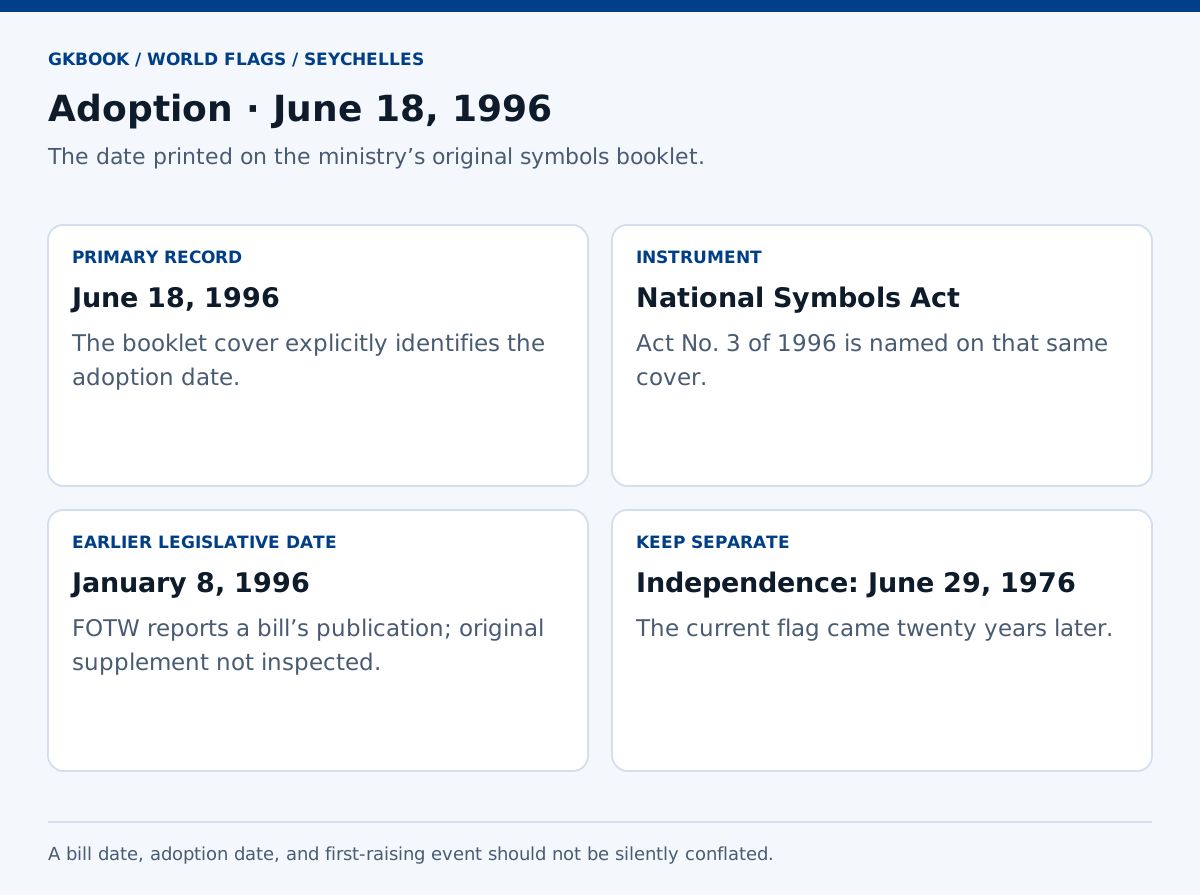
The booklet is particularly useful because it belongs to the introduction of the new symbols rather than a later unsourced flag list. Its English description gives the rectangular proportion and edge divisions, while its cover provides the adoption date. Both parts identify the same five-ray national design.
The year 1996 should not be conflated with either independence in 1976 or the Third Republic’s constitutional milestone in 1993. A later flag can represent an already established republic. The chronology panel keeps those events separately named so that the date printed beside the current flag remains specific to that design.
Why do some references give January 8, 1996?
Some flag references give January 8, 1996, but the ministry’s original booklet states adoption on June 18. Flags of the World associates January 8 with publication of a National Symbols Bill in a gazette supplement. That secondary report is distinguished here from the directly inspected ministry adoption record.
A bill, an enacted law, a commencement date, and a first ceremonial raising are different kinds of event. Repeating one date without its label can turn an earlier legislative step into an apparent contradiction. The current article therefore uses the primary booklet’s explicit adoption statement for its headline date.
The original January gazette supplement was not inspected for this package. Its reported date is retained as an attributed explanation rather than promoted into a verified legal finding. The private research record preserves that limitation and the conflicting references, allowing an editor to revisit the distinction without silently replacing the better-supported June date.
Was today’s Seychelles flag used at independence?
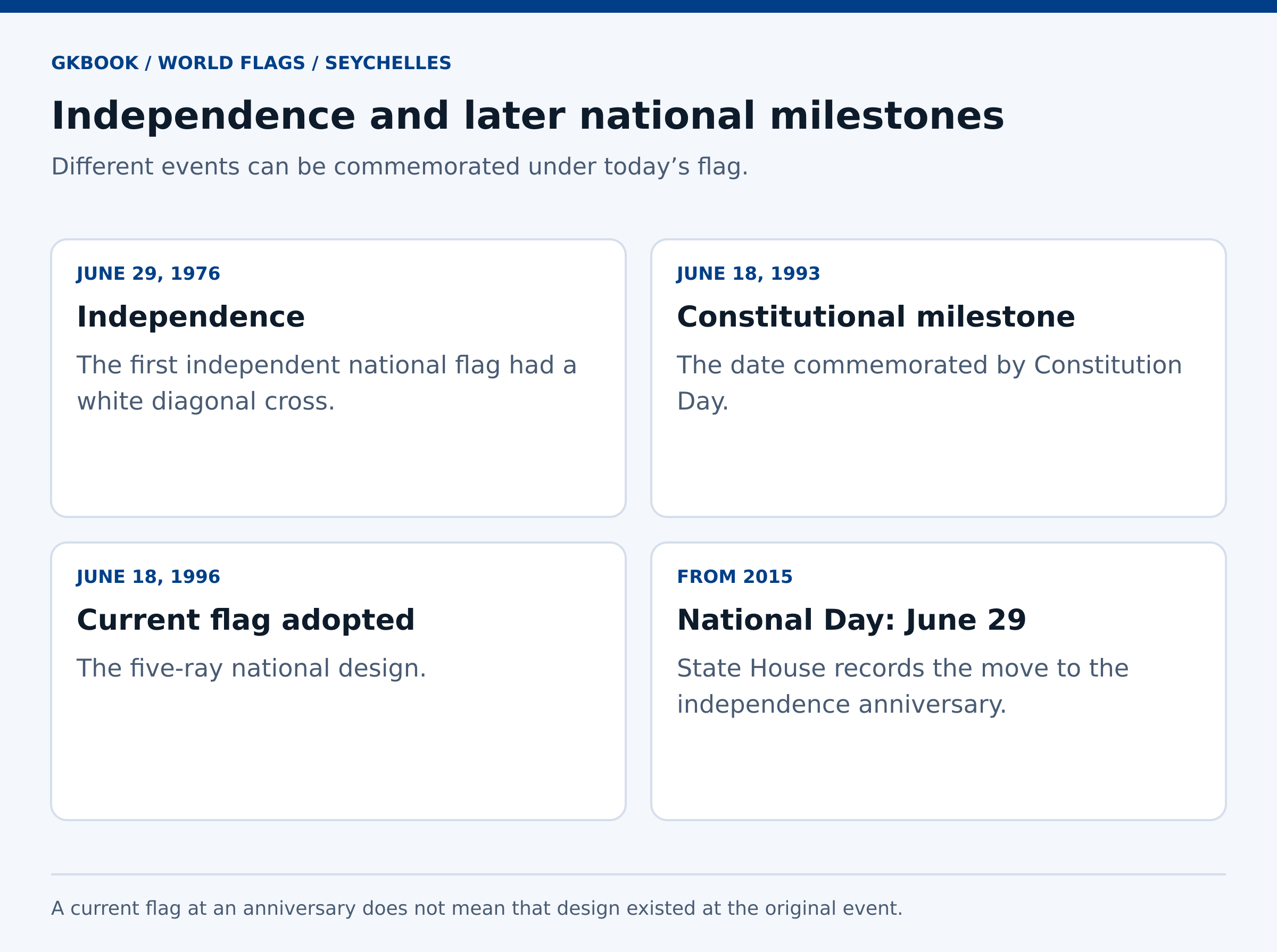
No. Seychelles became independent on June 29, 1976, under an earlier national flag with blue and red fields divided by a white diagonal cross. The present five-ray design was adopted twenty years later, on June 18, 1996. Independence and adoption of the current flag are separate historical milestones.
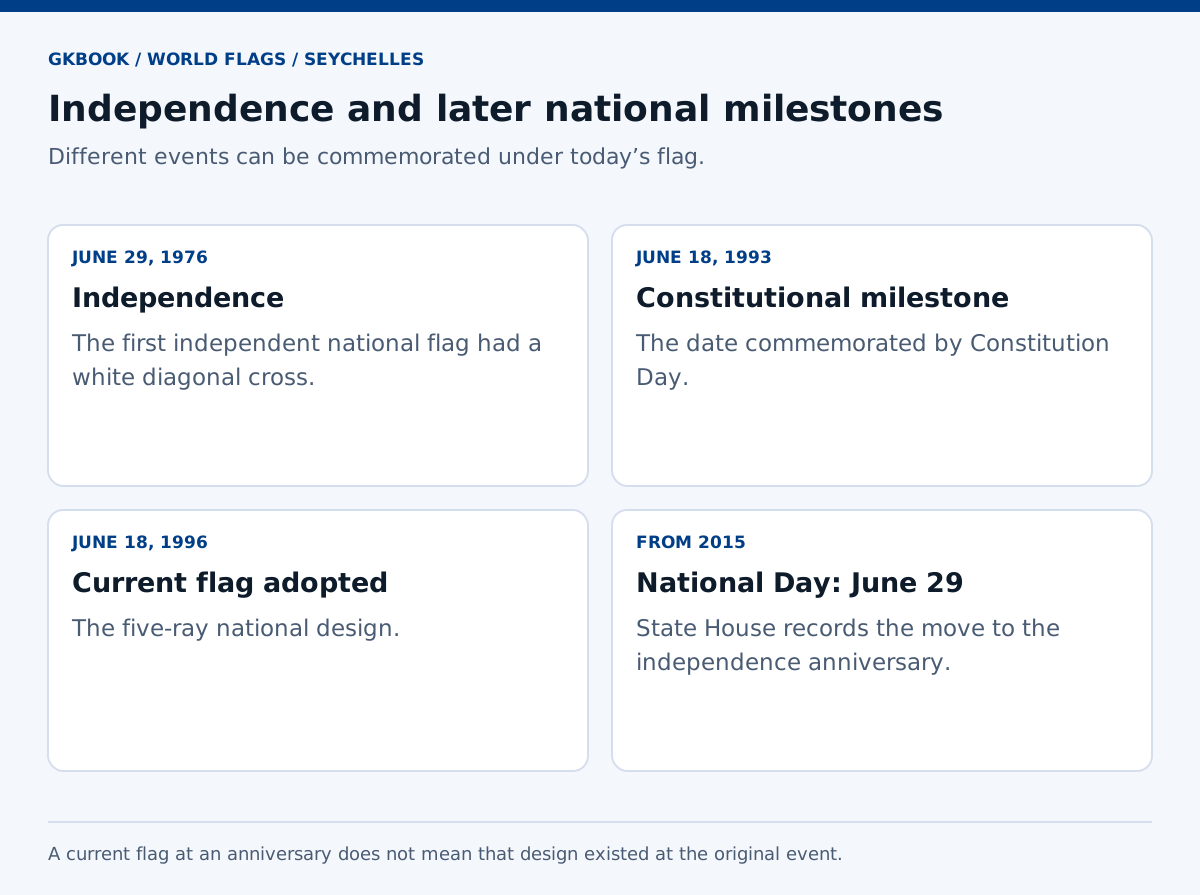
A photograph or illustration labeled as the 1976 independence ceremony should therefore be checked for the earlier pattern. Replacing it with today’s rays may be convenient for a general country profile, but it would misrepresent which national flag was raised at that historical event.
Anniversary celebrations today can correctly display the current flag while commemorating independence. The distinction is between the date being remembered and the design currently in use. A timeline benefits from showing both: 1976 for the sovereign state’s independence, and 1996 for the particular flag reproduced in the main image and downloads.
How do National Day and Constitution Day differ?
Seychelles’ National Day is celebrated on June 29, the anniversary of independence. June 18 is Constitution Day and also the calendar date on which the current flag was adopted in 1996. State House records the National Day celebration moving to the independence anniversary in 2015, keeping these occasions distinct.
Older accounts may call June 18 the national day because that was the terminology when the new symbols were introduced. Reading that wording in its historical setting avoids treating a period description as an error or as the present holiday calendar. The date of a document matters alongside its subject.
Constitution Day commemorates the constitutional foundation of the Third Republic, whereas the current flag’s introduction belongs to a later year. State House’s 2025 account of flag-raising ceremonies on Mahé, Praslin, and La Digue illustrates the continuing constitutional commemoration without shifting the 1996 adoption date back to 1993.
Who designed the Seychelles flag?
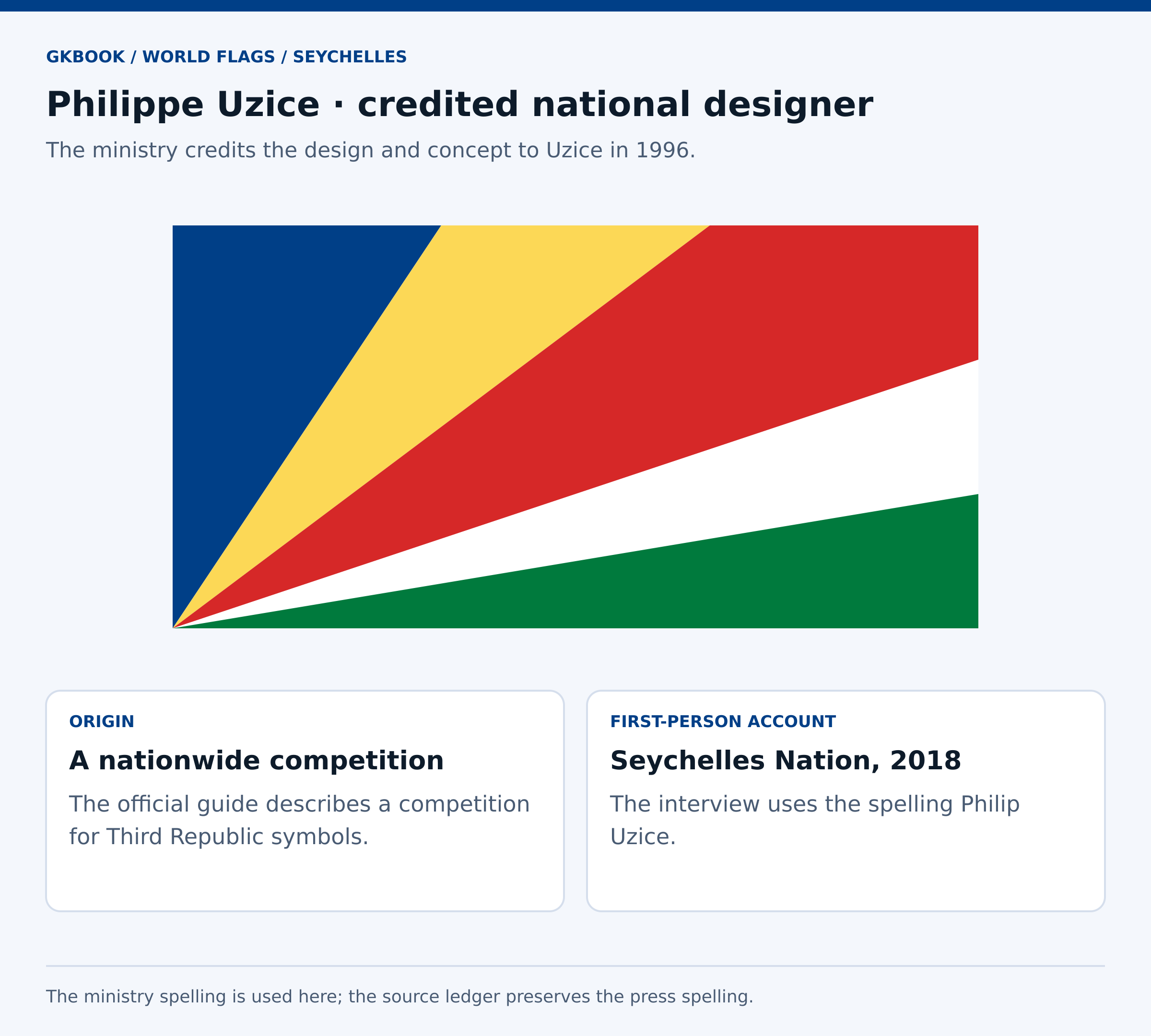
The Foreign Affairs Department credits Philippe Uzice with designing and conceptualizing the current flag in 1996, following a nationwide competition. A Seychelles Nation interview identifies the same designer as Philip Uzice. This article follows the ministry’s spelling while preserving the press spelling in the private source record.
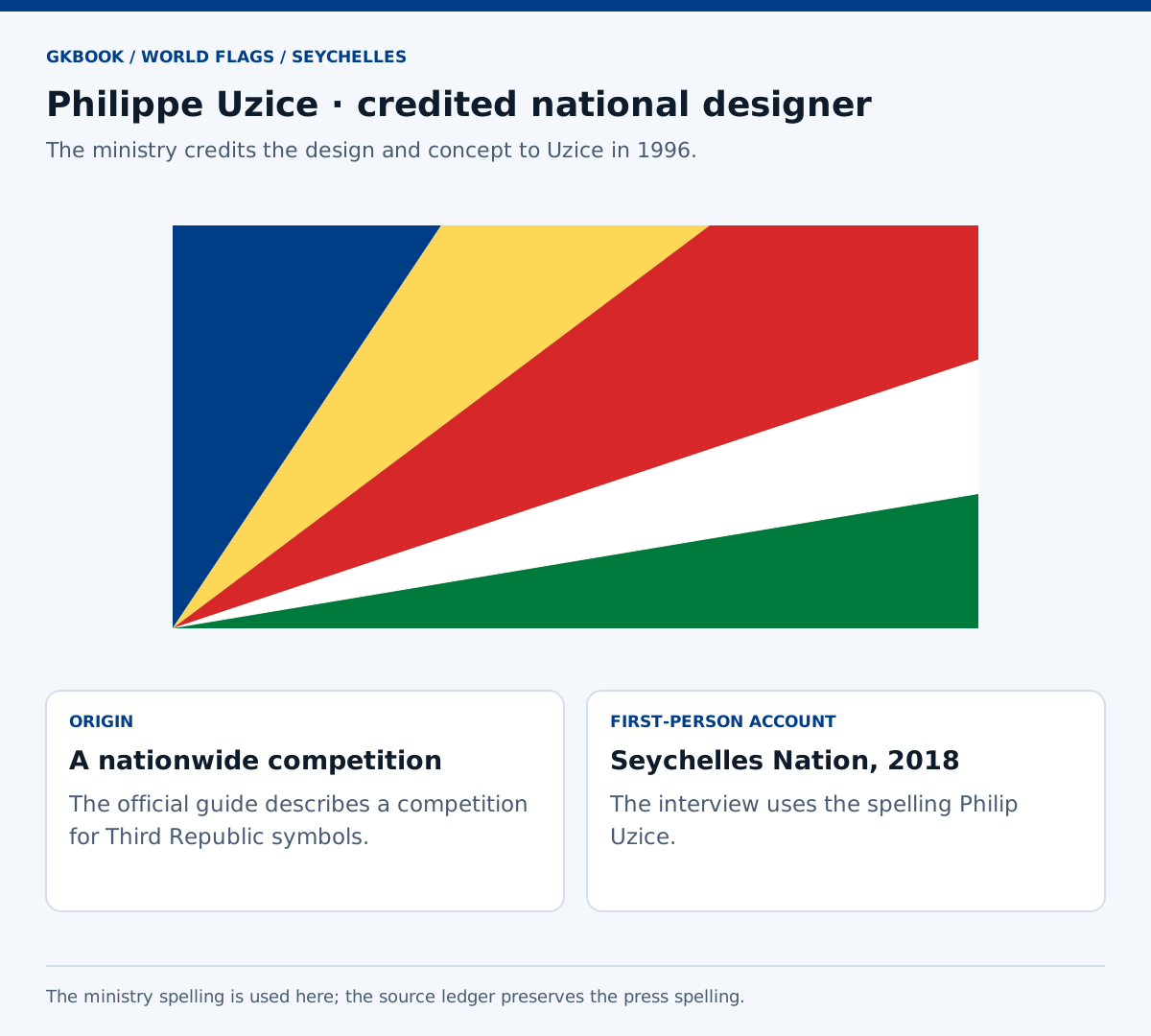
The designer’s 2018 interview describes submitting several proposals and studying other national flags in search of a distinctive result. That first-person account supports an attribution more securely than an anonymous image caption. It also gives the design a human context beyond a list of official measurements.
The final artwork combines a simple construction with an unusual distribution of colors. Its identity depends on the shared lower corner and the paired edge divisions, rather than a detailed central emblem. Crediting Uzice recognizes authorship of the national design; GKBook’s contribution is the explanatory text, precise reconstruction, and accompanying educational layouts.
How did the earlier Seychelles flags differ?
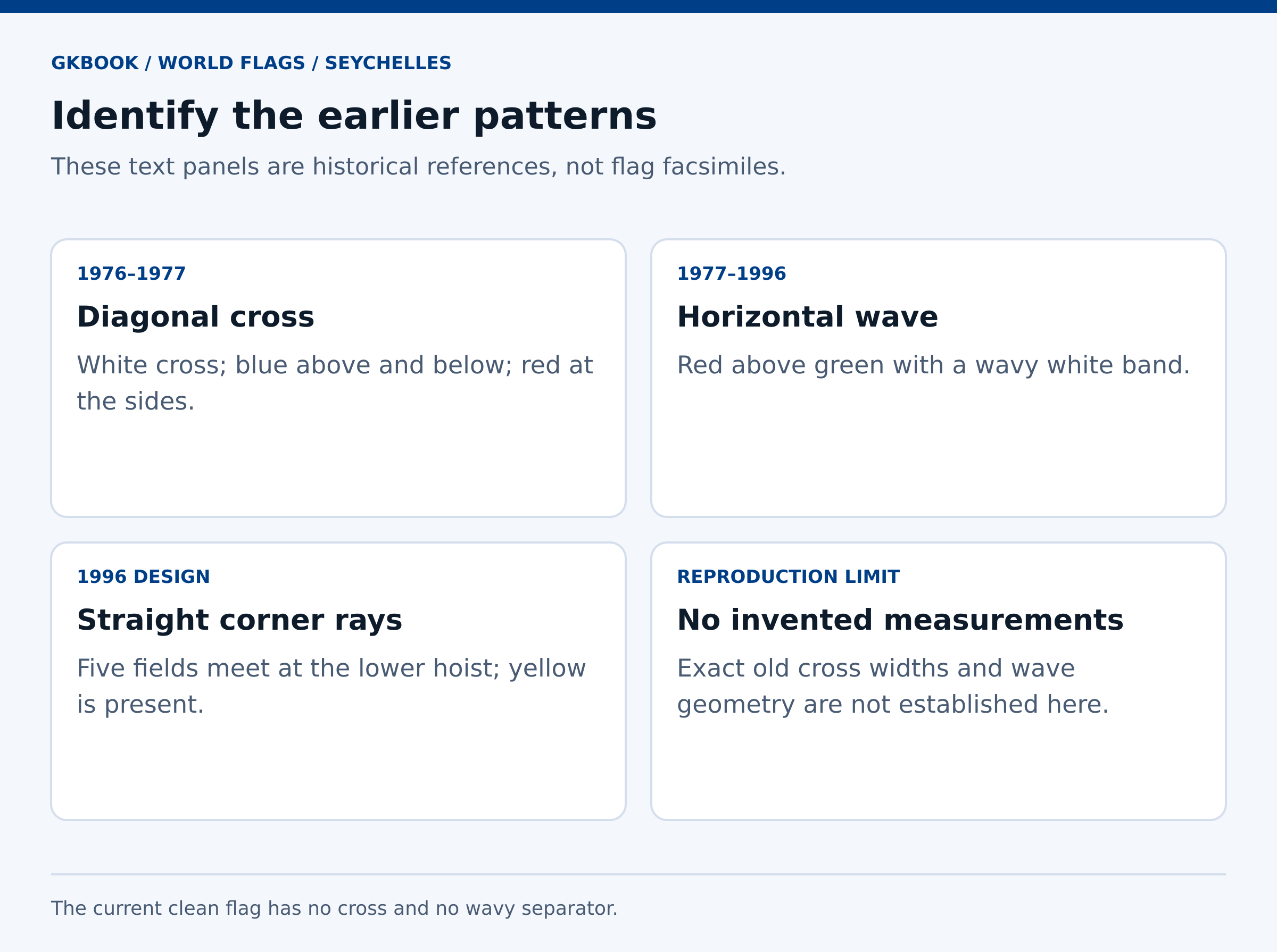
The 1976–1977 flag used a white diagonal cross between blue upper and lower fields and red side fields. The 1977–1996 flag used red above green with a wavy white separator. Today’s flag replaces those structures with five straight-sided fields meeting at the lower hoist, and adds yellow.
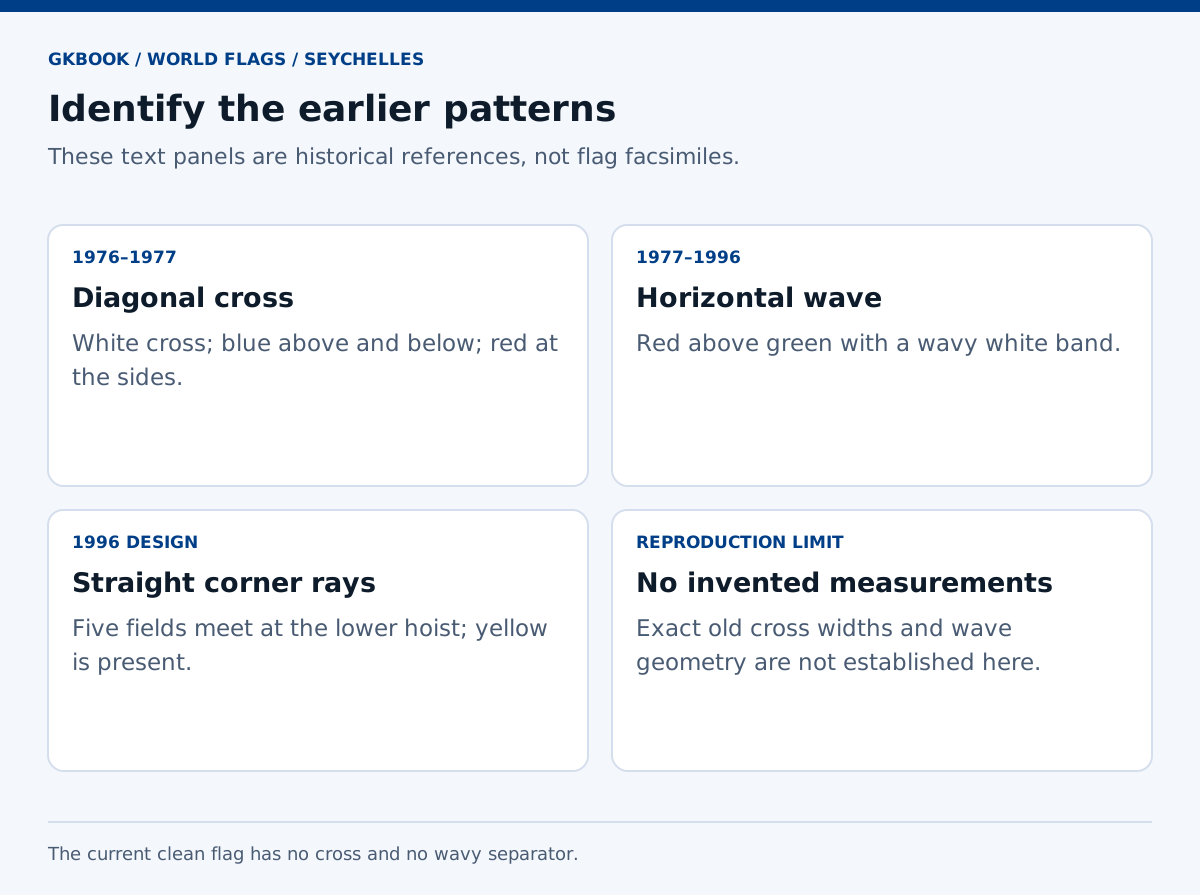
The ministry’s historical chart makes the succession easy to compare. The first independence design is organized around a crossing of diagonals, while the second is organized horizontally. Neither uses the current flag’s single corner as a common origin. This structural change is more informative than simply counting retained colors.
The comparison cards deliberately describe the earlier patterns in words. They do not invent exact saltire widths, wave amplitudes, or historical dye standards that the inspected chart does not numerically establish. For a museum reproduction of an older flag, those production details would require their own period-specific source investigation.
What is the legal basis of the Seychelles flag?
Article 3 of Seychelles’ Constitution provides for national symbols to be prescribed by an Act. The ministry’s 1996 booklet identifies the National Symbols Act, Act No. 3 of 1996, for the new symbols. Its later guidance explains the flag’s design and use; these sources serve different documentary purposes.
A constitutional provision establishes the category of national symbol without necessarily drawing every colored boundary. The implementing symbols material supplies the recognizable design. The construction in this article therefore rests on the ministry’s explicit rectangle and edge divisions, rather than inferring dimensions from the general constitutional provision.
The constitutional PDF inspected for this project is an older consolidation. The legal database also flags unapplied amendments to its symbols-law record. These limits are retained privately, and this article does not claim a complete current-law audit, quote penalty amounts, or present its downloadable artwork as a government-issued certificate of compliance.
Does the Seychelles national flag include the coat of arms?
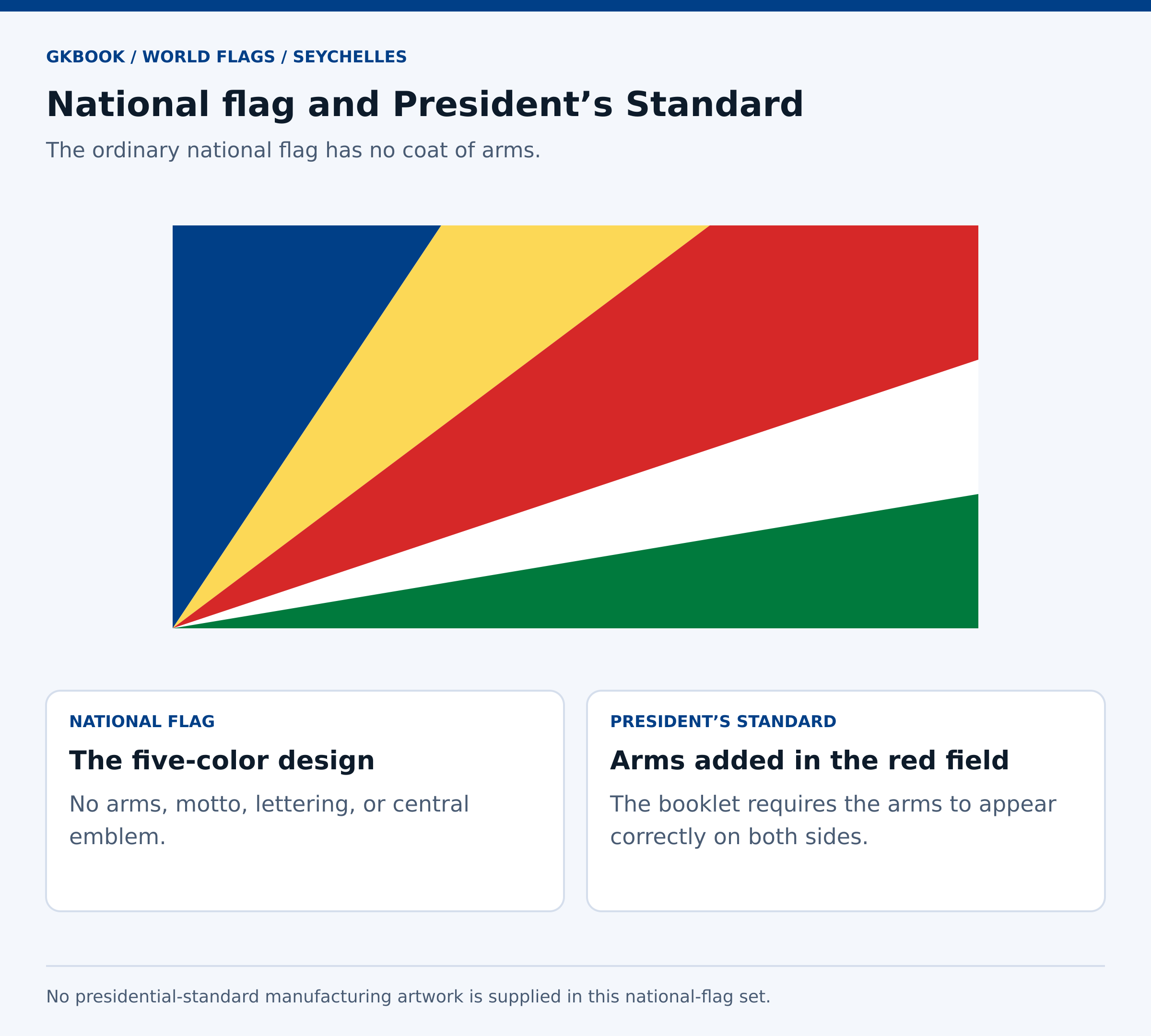
The ordinary national flag has no coat of arms. The President’s Standard uses the national pattern with the arms added in the red field. The ministry’s original booklet describes that separate standard and requires its arms to appear correctly on both sides. The plain national flag and presidential standard should not be confused.
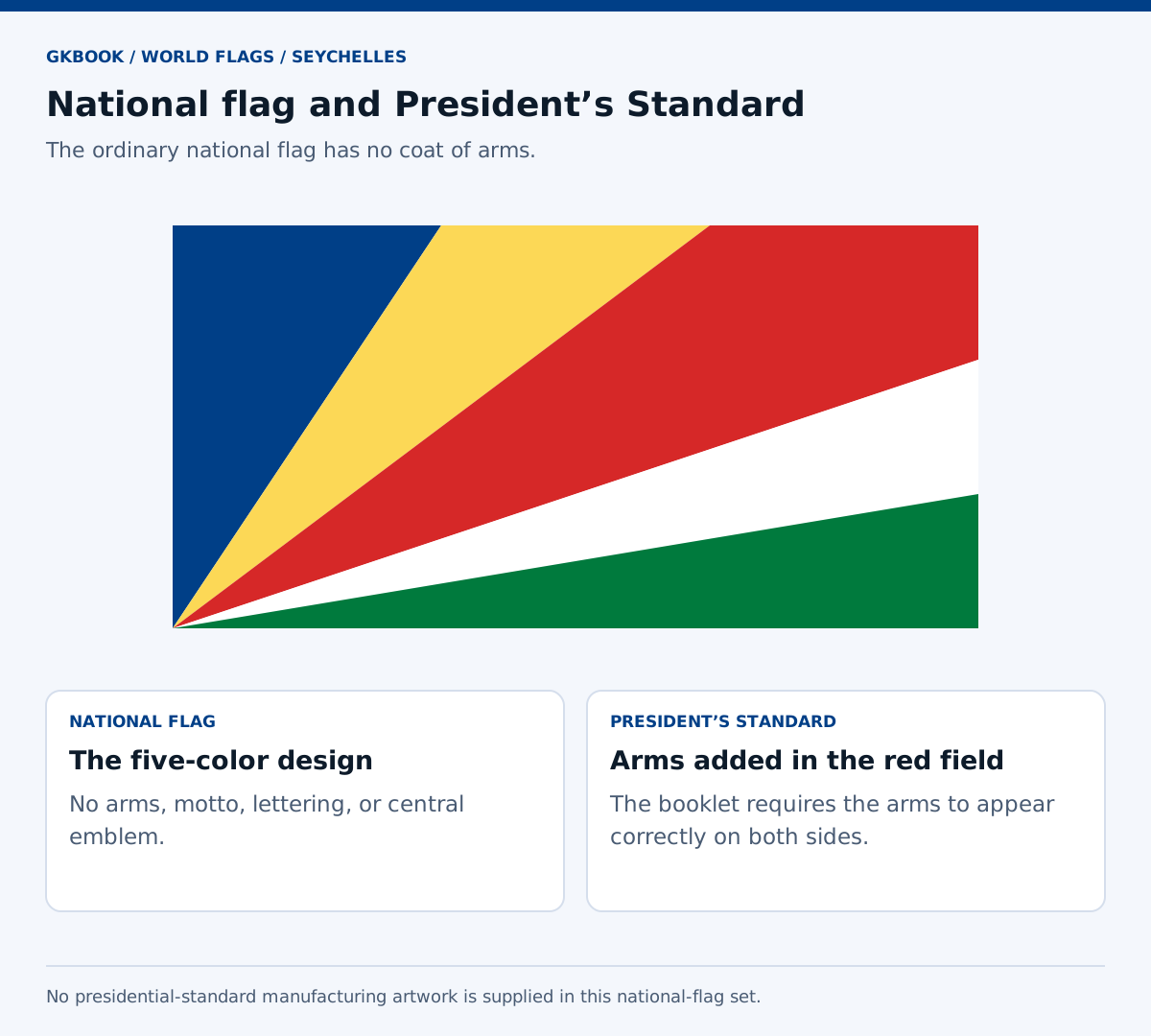
Adding an emblem to a familiar national background is not merely an artistic variation when the result corresponds to a separately defined official standard. The emblem identifies a different purpose. A generic Seychelles flag download should therefore supply the plain five-color design unless the presidential standard has specifically been requested.
The comparison in this package uses descriptive panels instead of an approximate drawing of the detailed arms. It shows the complete ordinary flag and explains what differentiates the standard. No simplified substitute crest is placed on the national master, and no presidential-standard manufacturing file is included among these downloads.
What does the reverse of the Seychelles flag look like?
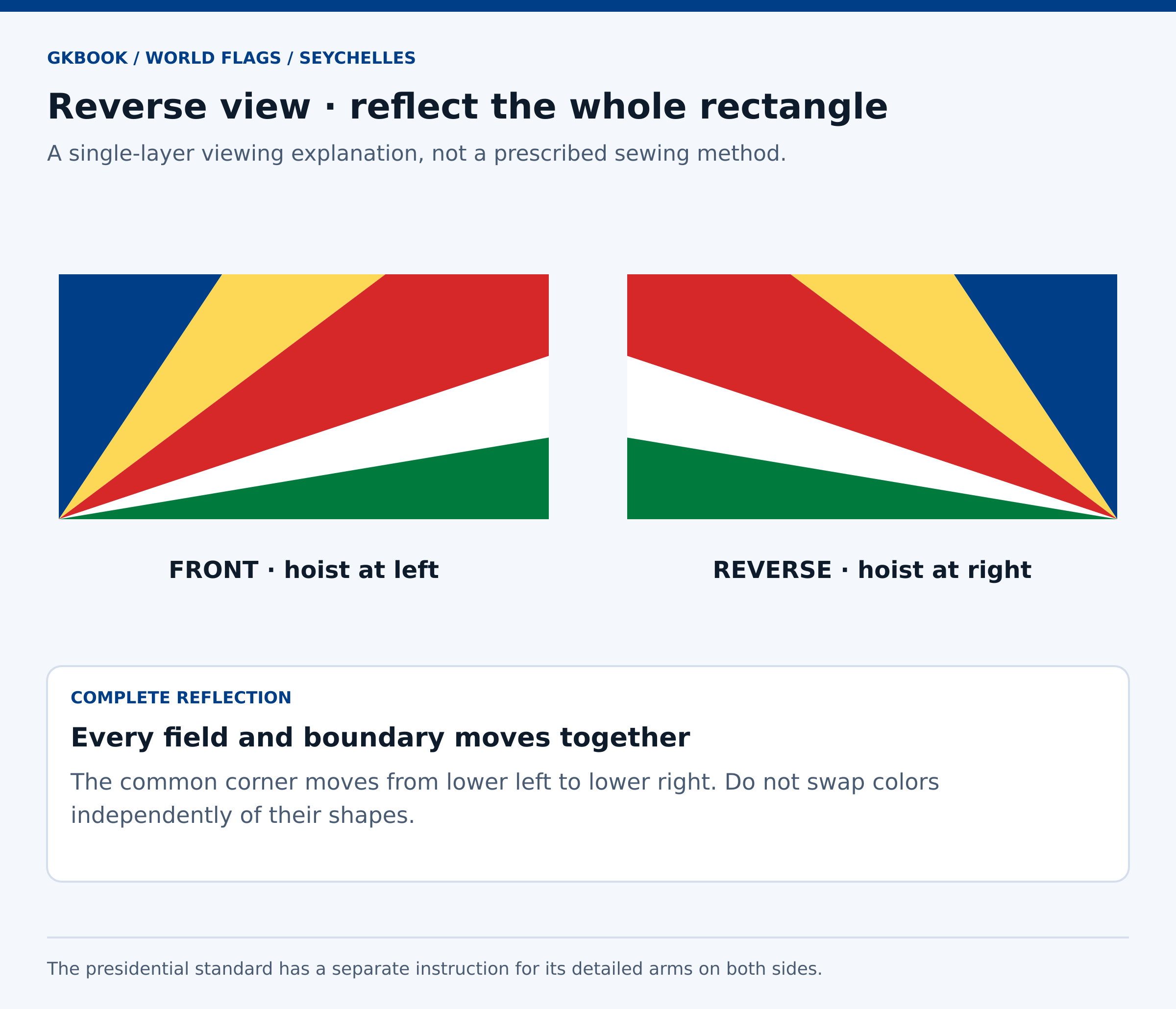
Viewed through a single flat layer from the other side, the complete design is horizontally mirrored: the hoist is at the right and the rays meet at its lower corner. The reverse diagram illustrates that viewing relationship. It does not establish a mandatory sewing method or a separate officially prescribed reverse pattern.
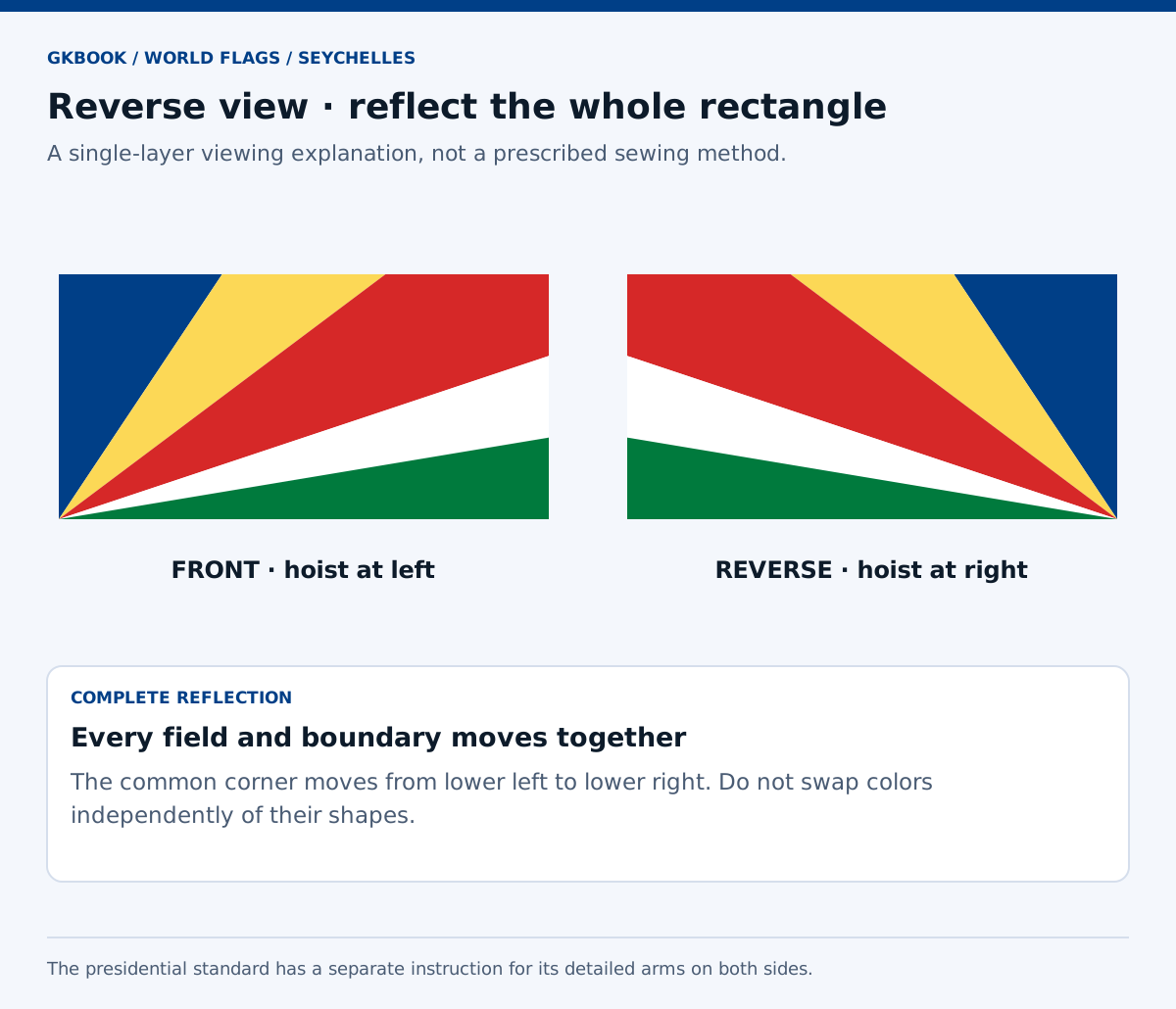
Keep the physical pole side in mind when comparing photographs. A flag seen from behind can look reversed on the screen while still being attached correctly. Mirroring the whole rectangle preserves every boundary and color relationship; swapping selected colors without reflecting their shapes does not.
The ordinary national flag contains no lettering or detailed arms that would need to be made readable on both sides. That makes this optical explanation relatively simple. The President’s Standard has its own two-sided emblem instruction, so the basic single-layer diagram should not be extended into a manufacturing claim about that separate standard.
How should the Seychelles flag hang vertically?
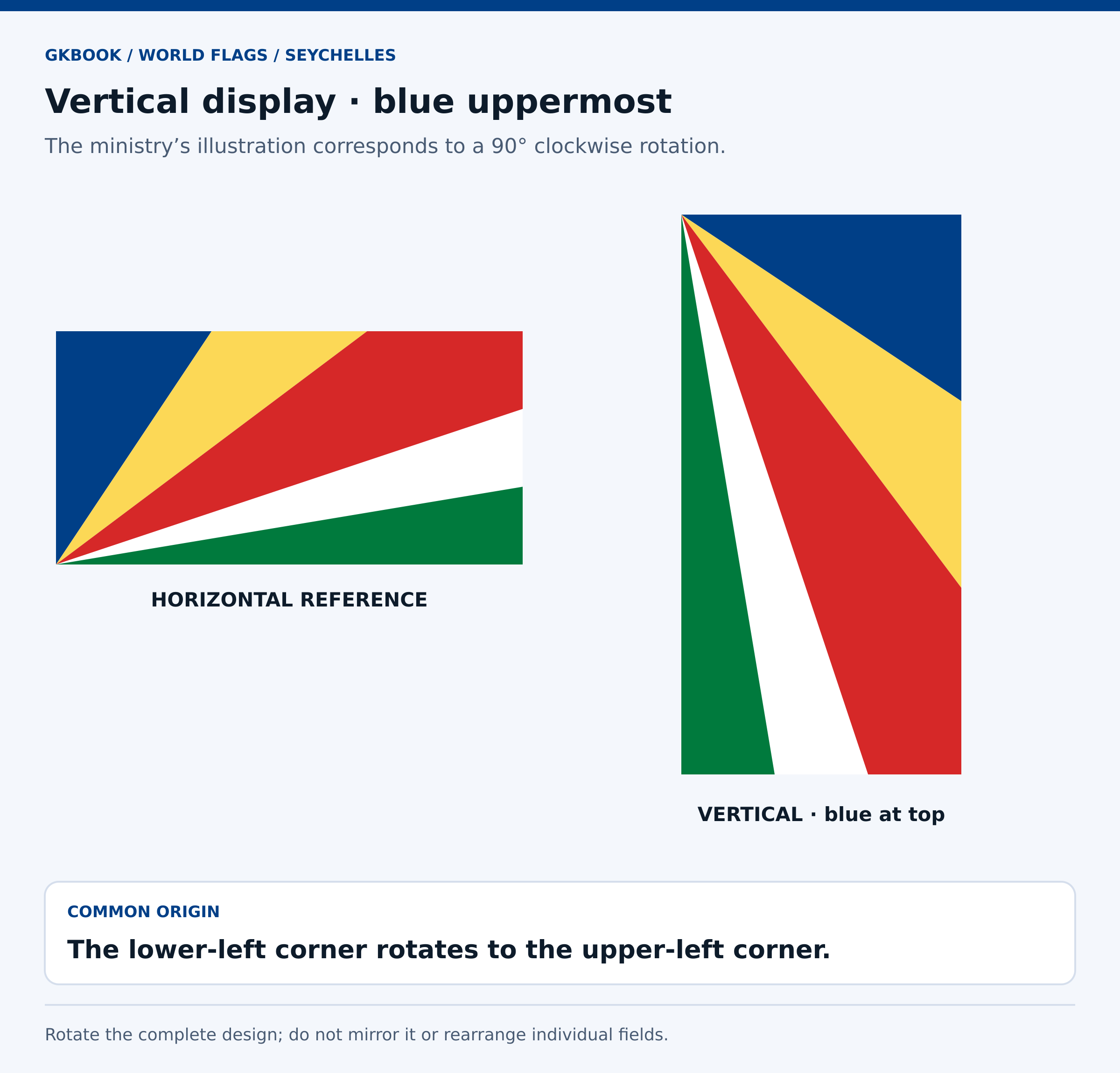
The ministry’s display guidance says blue should be uppermost when the flag hangs vertically. Its illustration corresponds to rotating the conventional horizontal front view 90 degrees clockwise. The supplied vertical diagram follows that example, placing the common ray origin at the upper-left corner while preserving the complete rectangular design.
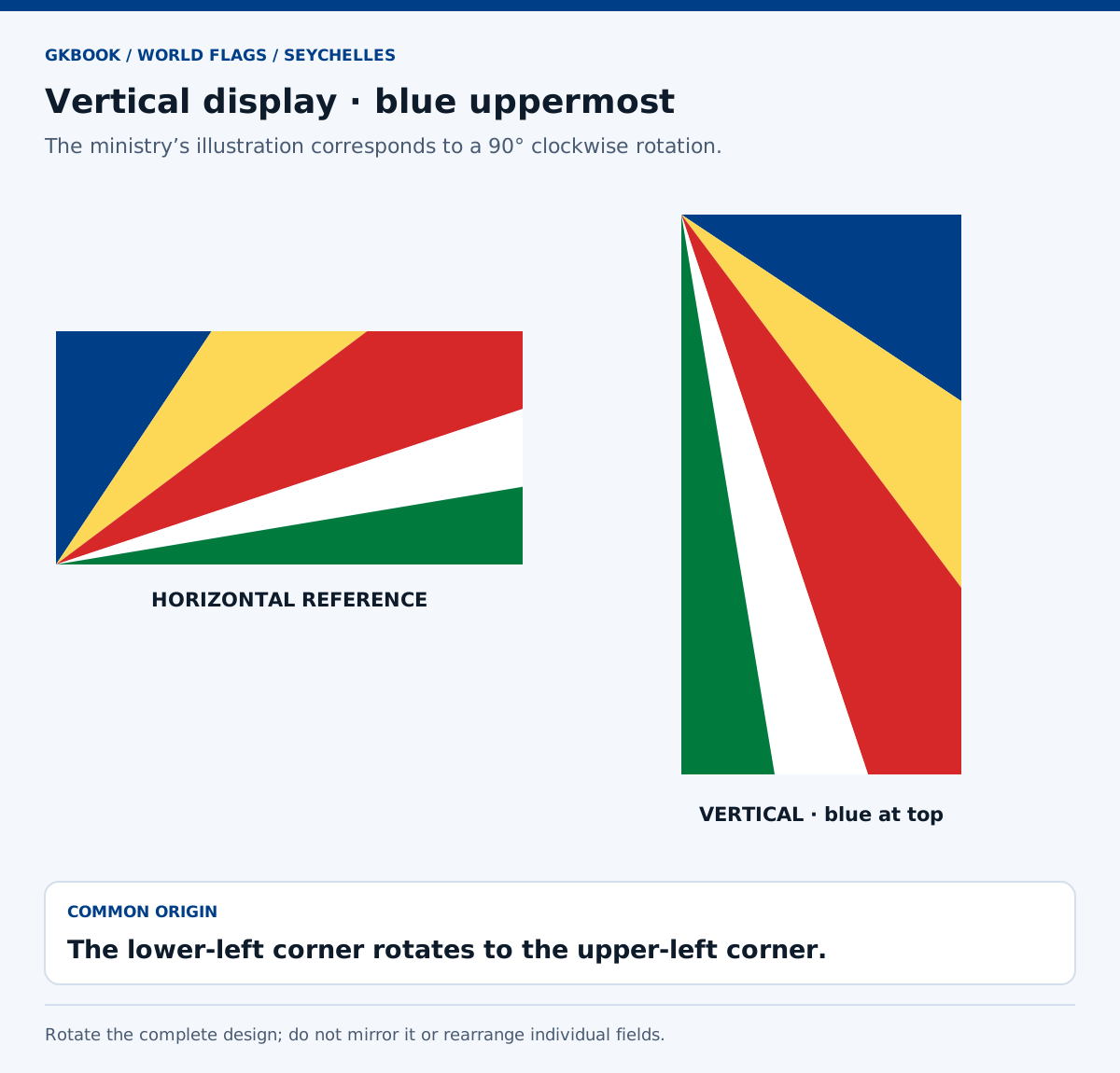
Rotation changes the page dimensions from a wide rectangle to a tall one, but it does not redraw the five fields. Every vertex moves together, and the flag retains the same area proportions. The vertical figure includes a horizontal reference so that the relationship between the two views remains visible.
Do not use a simple horizontal mirror as a substitute for rotation: that leaves the rectangle wide and moves the hoist to the other side. Likewise, independently rearranging the colors would lose the official illustration’s geometry. For a vertical layout, rotate the complete artwork and leave its internal proportions intact.
What basic flag-handling guidance does Seychelles publish?
The ministry’s guide emphasizes respectful display, careful handling, and keeping the national flag clean and undamaged. It advises outdoor display during daylight where possible and proper illumination at night. These are summarized points from the published guidance; specialized ceremonies and placements should be checked against their own detailed instructions.
For everyday educational display, the practical priority is to show the complete design clearly. Use a secure support, allow enough space for the cloth to move, and avoid arrangements that drag it across a surface. A damaged physical flag and a distorted digital illustration create different problems, but both can obscure the intended national symbol.
The reference images here are diagrams rather than ceremony plans. They do not determine precedence among visiting delegations, vehicle placements, or funeral arrangements. Those situations involve context beyond the flag’s five polygons and should be addressed using the relevant protocol guidance.
How does the guidance describe half-mast display?
The ministry describes half-mast display as a sign of mourning and respect, undertaken following presidential instructions. Its sequence raises the flag to the pole’s peak before lowering it to the mourning position, and raises it again before final lowering. A notice for the particular occasion determines when the observance applies.
A picture of a flag partway down a pole cannot establish the authorized dates of mourning. The occasion, instructions, and intended duration matter as much as the position shown. This article therefore describes the published sequence without inventing a current mourning announcement or presenting a generic photograph as evidence of one.
The geometric downloads have no flagpole, so they do not encode a half-mast height. That separation is useful: the national rectangle stays the same while its position on a pole can change. A ceremony organizer needs the applicable instructions in addition to an accurate drawing of the flag itself.
How should the Seychelles flag be prepared for printing?
Preserve the 1:2 rectangle, the edge-thirds construction, and all five filled colors. Use the official print references as a production starting point, then check a proof on the intended material. The sampled RGB palette supplied here supports consistent digital artwork; it is not a guaranteed textile or process-print color match.
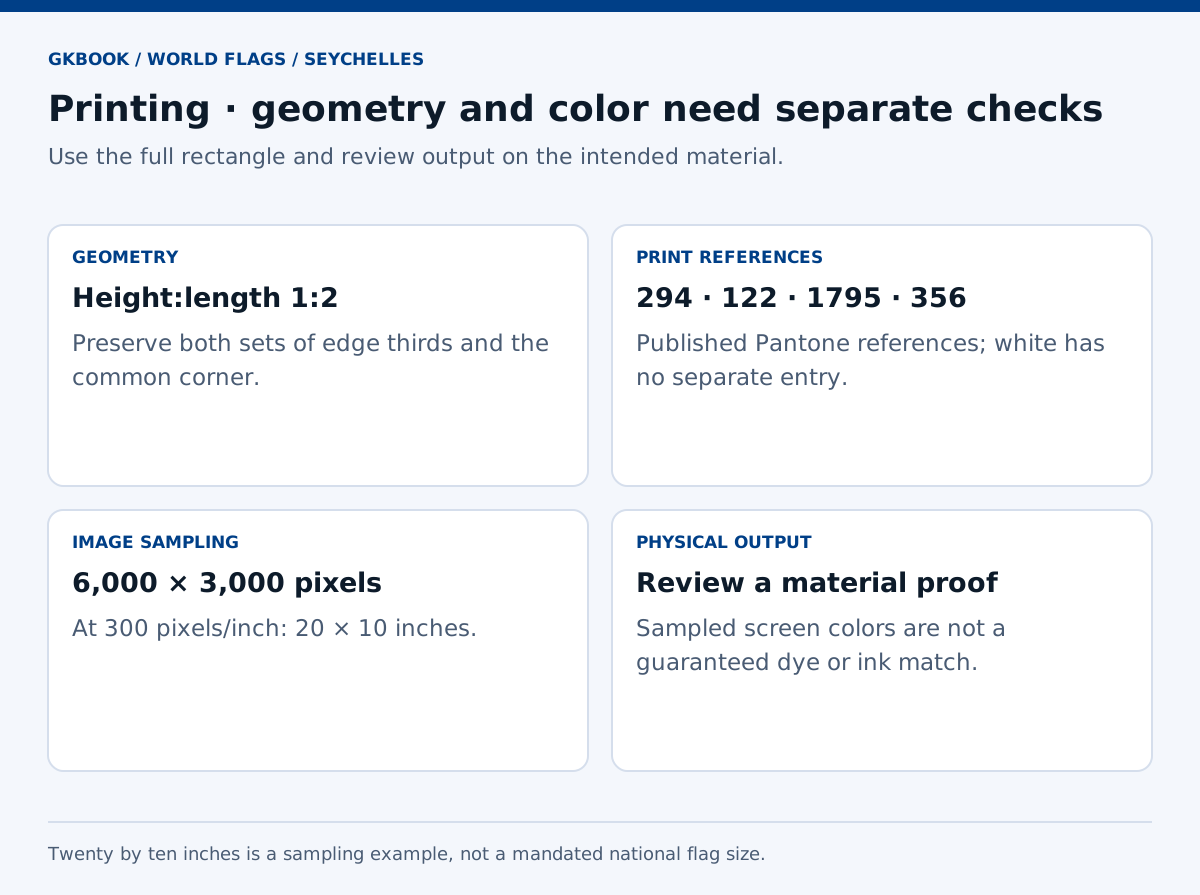
SVG is useful when a printer needs scalable outlines. The paths remain sharp at different output sizes, while the chosen color workflow controls how those fills are translated to ink. If a raster file is required, select a pixel size appropriate to the intended physical dimensions instead of enlarging a small preview.
At 300 pixels per inch, the 6,000 by 3,000 PNG corresponds to twenty by ten inches. That calculation describes image sampling, not a mandated flag size. Keep cutting marks and production annotations outside the finished rectangle, and review the white field as carefully as the darker colors.
How can the Seychelles flag be used accurately on a webpage?
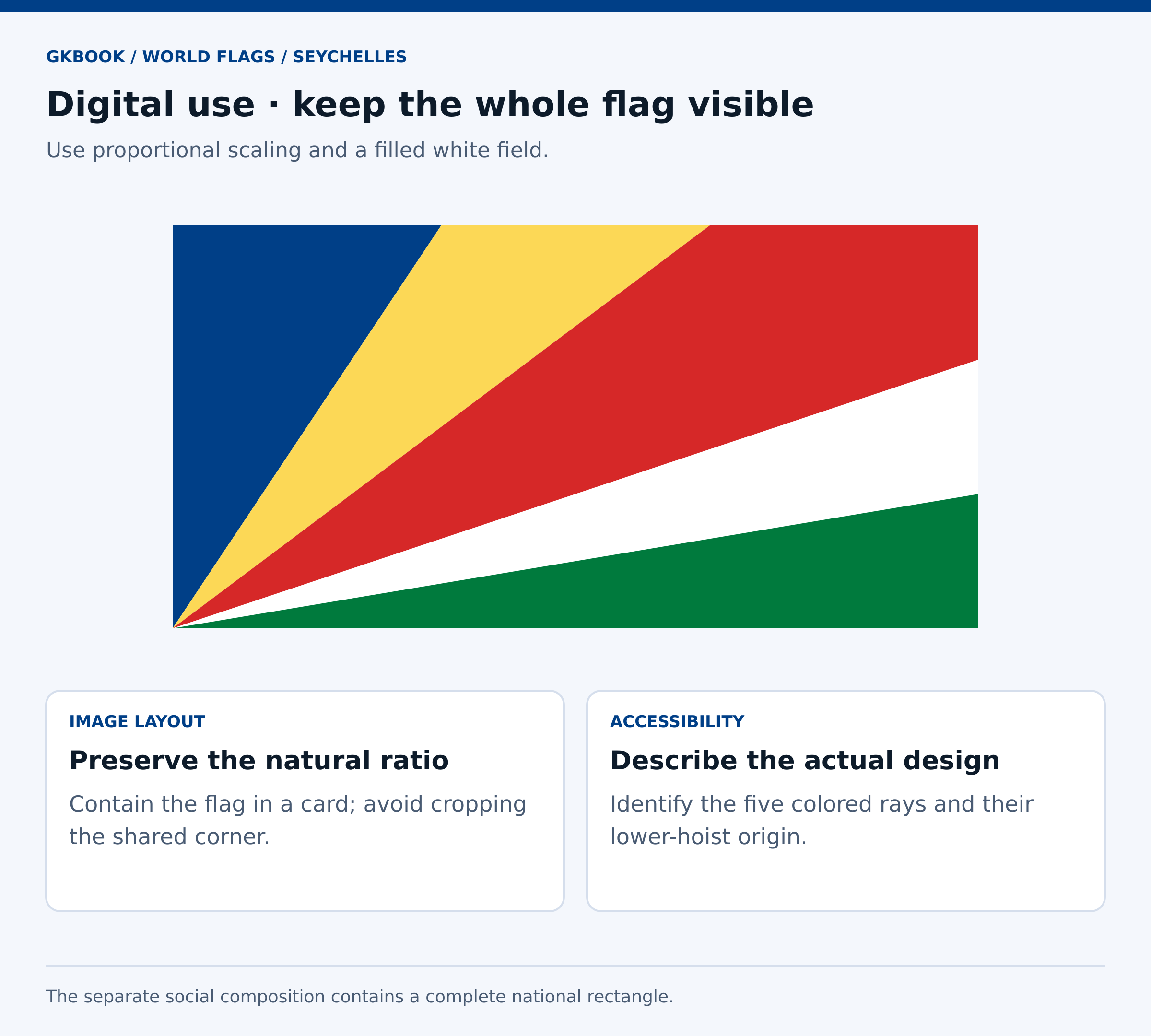
Display the complete flag with its natural 2:1 horizontal shape, meaningful alternative text, and enough space to preserve all five fields. Use SVG for scalable graphics or the opaque PNG when a raster image is needed. Avoid cropping the ray origin or stretching the rectangle to fill an unrelated container.
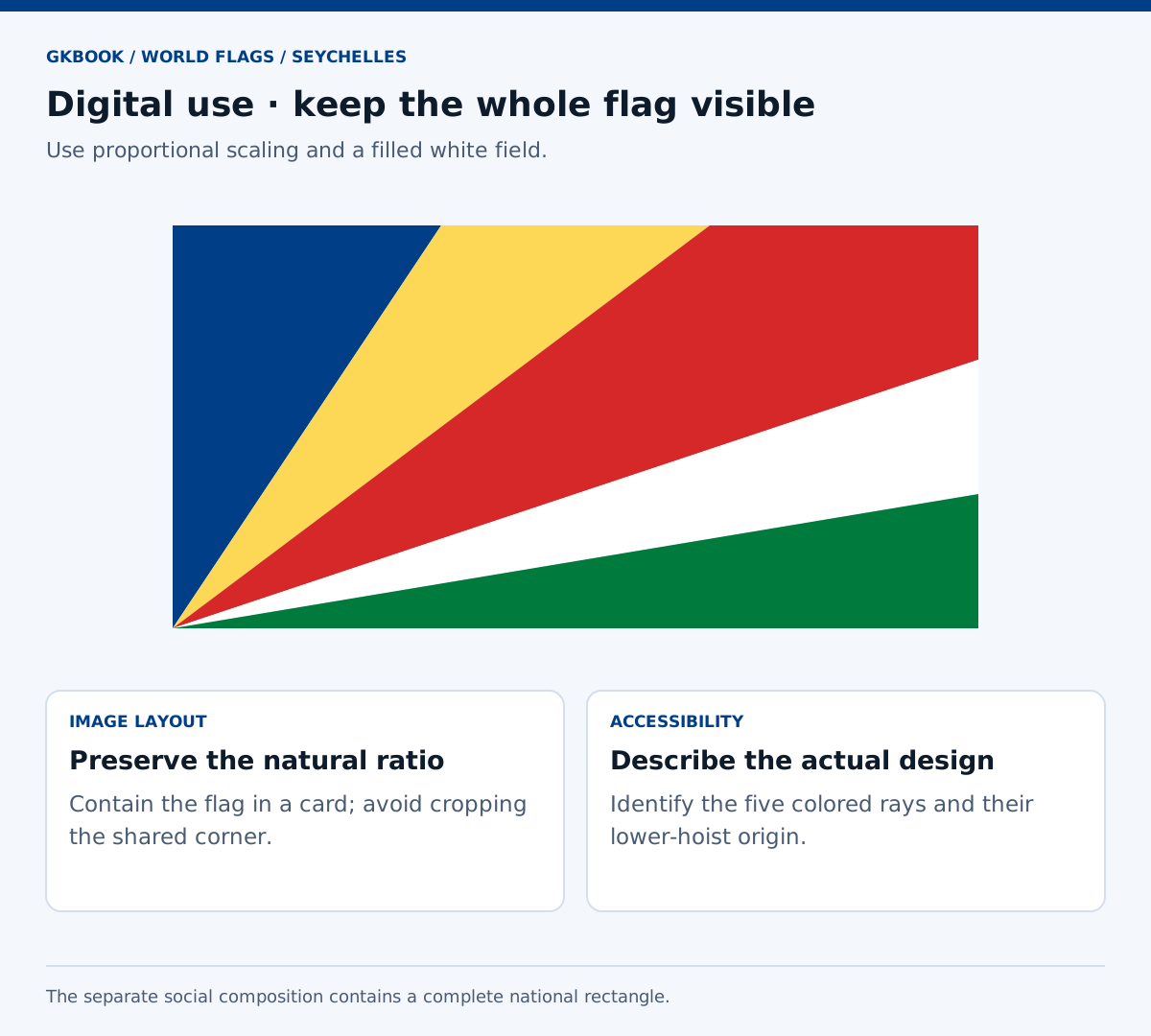
A responsive image can change width while its height follows automatically. This keeps the diagonals and edge divisions stable on both wide and narrow screens. If a card has fixed dimensions, contain the flag inside it rather than letting a cover-style crop remove part of the design.
The social image is a separate 1,200 by 630 composition containing a complete national flag. Its surrounding text and margins belong to the card, not to the flag. Likewise, the educational diagrams include labels outside their reference rectangles, while the clean master remains free of headings, rulers, shadows, and decorative effects.
Which Seychelles flag pictures are available to download?
The gallery provides 24 subjects, each in SVG and PNG, including a clean national flag, color and meaning references, construction diagrams, history panels, and orientation examples. The main SVG and PNG both measure 6,000 by 3,000. A separate 1,200 by 630 social pair is also included in the package.
Choose the clean flag for a country illustration and a labeled diagram when explaining a particular feature. The downloads share one geometric model, so a flag shown in the proportions diagram matches the flag shown in the history or orientation references. Captions identify explanatory content and the evidence status of production choices.
The gallery does not supply photographs, historical manufacturing masters, or an approximate presidential crest. Each item has descriptive alternative text and a credit. The accompanying reproduction notes explain the sampled palette, original geometry, and source basis so that an editor can retain those distinctions when reusing the files.
Download Seychelles flag pictures
Download the clean national flag as SVG or 6,000 × 3,000 PNG. Both preserve the official 1:2 height:length ratio and the equal top-edge and fly-edge thirds. The five polygons meet at the lower hoist, and white is explicitly filled. Screen colors are sampled from the ministry’s 2021 illustration; the published print references are listed separately.
The gallery contains 24 subjects, each with an SVG and PNG. The captions distinguish published specifications, attributed meanings, historical events, and digital reproduction choices. Image credits and reproduction notes explain the source basis. The separate 1,200 × 630 social card contains a complete flag and does not alter the national rectangle.
Continue exploring national designs in World Flags.
World Flags/Seychelles
Seychelles flag pictures
Clean national flag: height:length 1:2, with five fields radiating from the lower hoist. The screen palette is sampled from a ministry illustration, not a statutory RGB prescription.
National design: Philippe Uzice / Republic of Seychelles. Original geometric reconstruction and explanatory layout: GKBook.Download SVGDownload PNGRGB samples: #003F87, #FCD856, #D62828, #FFFFFF, #007A3D. Pantone references 294, 122, 1795 and 356 remain separately labeled.
National design: Philippe Uzice / Republic of Seychelles. Original geometric reconstruction and explanatory layout: GKBook.Download SVGDownload PNGThe official interpretation combines natural imagery with collective civic aspirations; it does not assign the fields to five islands or districts.
National design: Philippe Uzice / Republic of Seychelles. Original geometric reconstruction and explanatory layout: GKBook.Download SVGDownload PNGBlue is the upper-hoist triangle; its area is calculated from the published edge thirds.
National design: Philippe Uzice / Republic of Seychelles. Original geometric reconstruction and explanatory layout: GKBook.Download SVGDownload PNGYellow forms a triangle reaching the middle third of the top edge.
National design: Philippe Uzice / Republic of Seychelles. Original geometric reconstruction and explanatory layout: GKBook.Download SVGDownload PNGRed is a quadrilateral, not a triangle; its larger area follows from the edge construction.
National design: Philippe Uzice / Republic of Seychelles. Original geometric reconstruction and explanatory layout: GKBook.Download SVGDownload PNGThe white triangle reaches the middle third of the fly edge and is explicitly filled.
National design: Philippe Uzice / Republic of Seychelles. Original geometric reconstruction and explanatory layout: GKBook.Download SVGDownload PNGGreen reaches the bottom third of the fly and the full bottom edge.
National design: Philippe Uzice / Republic of Seychelles. Original geometric reconstruction and explanatory layout: GKBook.Download SVGDownload PNGThe expanding form symbolizes forward movement. Its geometry is determined by equal thirds on the top and fly, not equal angles around the origin.
National design: Philippe Uzice / Republic of Seychelles. Original geometric reconstruction and explanatory layout: GKBook.Download SVGDownload PNGThe 1996 ministry booklet gives the one-by-two proportion. Both main files preserve it exactly.
National design: Philippe Uzice / Republic of Seychelles. Original geometric reconstruction and explanatory layout: GKBook.Download SVGDownload PNGOnly blue, yellow, and red occupy lengths of the top edge; five equal top segments would be incorrect.
National design: Philippe Uzice / Republic of Seychelles. Original geometric reconstruction and explanatory layout: GKBook.Download SVGDownload PNGThe free edge has equal red, white, and green lengths. This rule does not apply to the hoist edge.
National design: Philippe Uzice / Republic of Seychelles. Original geometric reconstruction and explanatory layout: GKBook.Download SVGDownload PNGShared endpoints keep every color boundary straight and coincident. All coordinates scale by the same factor.
National design: Philippe Uzice / Republic of Seychelles. Original geometric reconstruction and explanatory layout: GKBook.Download SVGDownload PNGRed covers one third; blue, yellow, white, and green each cover one sixth. The five regions sum to the full rectangle.
National design: Philippe Uzice / Republic of Seychelles. Original geometric reconstruction and explanatory layout: GKBook.Download SVGDownload PNGThe ministry’s historical chart identifies three post-independence flags.
National design: Philippe Uzice / Republic of Seychelles. Original geometric reconstruction and explanatory layout: GKBook.Download SVGDownload PNGThe primary ministry booklet supports the June adoption date; a secondary January bill-publication report is separately labeled.
National design: Philippe Uzice / Republic of Seychelles. Original geometric reconstruction and explanatory layout: GKBook.Download SVGDownload PNGIndependence, the constitutional commemoration, adoption, and the annual national celebration remain distinct.
National design: Philippe Uzice / Republic of Seychelles. Original geometric reconstruction and explanatory layout: GKBook.Download SVGDownload PNGNational-design authorship belongs to Uzice; GKBook supplies the geometric reconstruction and educational layouts.
National design: Philippe Uzice / Republic of Seychelles. Original geometric reconstruction and explanatory layout: GKBook.Download SVGDownload PNGThe comparison separates three patterns without inventing period manufacturing specifications.
National design: Philippe Uzice / Republic of Seychelles. Original geometric reconstruction and explanatory layout: GKBook.Download SVGDownload PNGThe complete national flag is shown; the separate presidential standard is described, not drawn with an approximate crest.
National design: Philippe Uzice / Republic of Seychelles. Original geometric reconstruction and explanatory layout: GKBook.Download SVGDownload PNGA horizontal reflection explains viewing a single flat layer from the back; it does not assert a national manufacturing rule.
National design: Philippe Uzice / Republic of Seychelles. Original geometric reconstruction and explanatory layout: GKBook.Download SVGDownload PNGThe 2021 ministry guide says blue should be uppermost and illustrates the clockwise orientation reproduced here.
National design: Philippe Uzice / Republic of Seychelles. Original geometric reconstruction and explanatory layout: GKBook.Download SVGDownload PNGThe PNG size supports a precise print-size calculation, while physical color matching requires its own workflow.
National design: Philippe Uzice / Republic of Seychelles. Original geometric reconstruction and explanatory layout: GKBook.Download SVGDownload PNGSVG supports scalable display, and the opaque PNG preserves white on any page background.
National design: Philippe Uzice / Republic of Seychelles. Original geometric reconstruction and explanatory layout: GKBook.Download SVGDownload PNGFrequently asked questions
What does the Seychelles flag look like?
The Seychelles flag is a rectangle with five colored rays spreading from its lower hoist corner: blue, yellow, red, white, and green. Its height:length ratio is 1:2. Adopted on June 18, 1996, the national flag carries no coat of arms, lettering, stars, or separate central emblem.
What are the Seychelles flag colors and color codes?
The five colors are blue, yellow, red, white, and green. Official guidance lists Pantone references 294, 122, 1795, and 356 for the four chromatic colors. This artwork uses RGB values sampled from the ministry’s illustration; its hexadecimal codes are documented screen choices, not statutory RGB specifications.
What does the Seychelles flag mean?
The official explanation connects blue with sky and sea, yellow with the sun, red with the people’s shared effort, white with social justice and harmony, and green with land and nature. The spreading bands represent forward movement. These meanings belong to Seychelles’ own account of its national design.
What does blue represent on the Seychelles flag?
Blue represents the sky and the sea surrounding Seychelles in the official account. It occupies the triangular field against the hoist and the first third of the top edge. In the usual front view, blue is uppermost at the left; it is not a separate border around the flag.
What does yellow represent on the Seychelles flag?
Yellow represents the sun and its life-giving light. It forms the second ray, between blue and red, and occupies the middle third of the top edge. The official meaning is solar; descriptions that replace it with beach sand change the ministry’s stated explanation of the color.
What does red represent on the Seychelles flag?
Red represents the people and their determination to build a shared future in unity and love. It is the broad central field, touching both the last third of the top edge and the upper third of the fly. Its four-sided shape distinguishes it from the other four fields.
What does white represent on the Seychelles flag?
White represents social justice and harmony. It lies between red and green, widening from the lower hoist toward the middle third of the fly edge. White is a filled part of the flag, not an empty gap, transparent cutout, decorative outline, or separator added outside the design.
What does green represent on the Seychelles flag?
Green represents the land and the natural environment. It forms the lowest triangular field, running along the bottom edge from the hoist to the fly. At the fly it occupies the bottom third of the height. The green region is part of the fan, not a full-width horizontal stripe.
Why does the Seychelles flag have diagonal rays?
The ministry associates the expanding bands with a country moving toward its future. Geometrically, all five fields meet at the bottom of the hoist and spread toward the top and fly. They are not five equal-angle sectors: their boundaries are determined by equal thirds along those two outer edges.
What is the Seychelles flag ratio?
The Seychelles flag has a height:length ratio of 1:2, so its horizontal length is twice its vertical height. A flag 90 centimeters high would be 180 centimeters long. The same rectangle is sometimes described as width:height 2:1; naming the dimensions avoids an apparent contradiction between these expressions.
How is the top edge divided?
The top edge is divided into three equal lengths: blue, then yellow, then red from the hoist toward the fly. On the 6,000-unit master, the two internal division points are x=2,000 and x=4,000. Straight lines connect these points to the lower-hoist origin to define the first two internal boundaries.
How is the fly edge divided?
The fly edge is divided into three equal heights: red above, white in the middle, and green below. On a 3,000-unit-high master, the dividing points are y=1,000 and y=2,000 measured from the top. Connecting them to the lower hoist completes the remaining internal boundaries of the five-color design.
How do you draw the Seychelles flag accurately?
Draw a 2:1 horizontal rectangle, mark thirds along its top and right edges, and join the four internal marks to the lower-left corner. Fill the resulting regions blue, yellow, red, white, and green in order. Keep the boundaries straight, the common origin exact, and the whole flag free of outlines.
Are the five colored fields equal in area?
No. Red occupies one third of the complete flag, while blue, yellow, white, and green each occupy one sixth. These fractions follow mathematically from the official 1:2 rectangle and edge-thirds construction. Equal lengths along selected outer edges do not make all five interior regions equal in area.
What is the history of the Seychelles flag?
Seychelles has used three national flag designs since independence in 1976. The first combined red and blue fields with a white diagonal cross. A red-and-green design with a wavy white band followed in 1977. The present five-ray flag arrived in 1996 during the country’s Third Republic.
When was the current Seychelles flag adopted?
The current Seychelles flag was adopted on June 18, 1996. The Ministry of Foreign Affairs’ original symbols booklet prints that date on its cover and identifies the National Symbols Act, Act No. 3 of 1996. This primary record is the basis for the adoption date used throughout this article.
Why do some references give January 8, 1996?
Some flag references give January 8, 1996, but the ministry’s original booklet states adoption on June 18. Flags of the World associates January 8 with publication of a National Symbols Bill in a gazette supplement. That secondary report is distinguished here from the directly inspected ministry adoption record.
Was today’s Seychelles flag used at independence?
No. Seychelles became independent on June 29, 1976, under an earlier national flag with blue and red fields divided by a white diagonal cross. The present five-ray design was adopted twenty years later, on June 18, 1996. Independence and adoption of the current flag are separate historical milestones.
How do National Day and Constitution Day differ?
Seychelles’ National Day is celebrated on June 29, the anniversary of independence. June 18 is Constitution Day and also the calendar date on which the current flag was adopted in 1996. State House records the National Day celebration moving to the independence anniversary in 2015, keeping these occasions distinct.
Who designed the Seychelles flag?
The Foreign Affairs Department credits Philippe Uzice with designing and conceptualizing the current flag in 1996, following a nationwide competition. A Seychelles Nation interview identifies the same designer as Philip Uzice. This article follows the ministry’s spelling while preserving the press spelling in the private source record.
How did the earlier Seychelles flags differ?
The 1976–1977 flag used a white diagonal cross between blue upper and lower fields and red side fields. The 1977–1996 flag used red above green with a wavy white separator. Today’s flag replaces those structures with five straight-sided fields meeting at the lower hoist, and adds yellow.
What is the legal basis of the Seychelles flag?
Article 3 of Seychelles’ Constitution provides for national symbols to be prescribed by an Act. The ministry’s 1996 booklet identifies the National Symbols Act, Act No. 3 of 1996, for the new symbols. Its later guidance explains the flag’s design and use; these sources serve different documentary purposes.
Does the Seychelles national flag include the coat of arms?
The ordinary national flag has no coat of arms. The President’s Standard uses the national pattern with the arms added in the red field. The ministry’s original booklet describes that separate standard and requires its arms to appear correctly on both sides. The plain national flag and presidential standard should not be confused.
What does the reverse of the Seychelles flag look like?
Viewed through a single flat layer from the other side, the complete design is horizontally mirrored: the hoist is at the right and the rays meet at its lower corner. The reverse diagram illustrates that viewing relationship. It does not establish a mandatory sewing method or a separate officially prescribed reverse pattern.
How should the Seychelles flag hang vertically?
The ministry’s display guidance says blue should be uppermost when the flag hangs vertically. Its illustration corresponds to rotating the conventional horizontal front view 90 degrees clockwise. The supplied vertical diagram follows that example, placing the common ray origin at the upper-left corner while preserving the complete rectangular design.
What basic flag-handling guidance does Seychelles publish?
The ministry’s guide emphasizes respectful display, careful handling, and keeping the national flag clean and undamaged. It advises outdoor display during daylight where possible and proper illumination at night. These are summarized points from the published guidance; specialized ceremonies and placements should be checked against their own detailed instructions.
How does the guidance describe half-mast display?
The ministry describes half-mast display as a sign of mourning and respect, undertaken following presidential instructions. Its sequence raises the flag to the pole’s peak before lowering it to the mourning position, and raises it again before final lowering. A notice for the particular occasion determines when the observance applies.
How should the Seychelles flag be prepared for printing?
Preserve the 1:2 rectangle, the edge-thirds construction, and all five filled colors. Use the official print references as a production starting point, then check a proof on the intended material. The sampled RGB palette supplied here supports consistent digital artwork; it is not a guaranteed textile or process-print color match.
How can the Seychelles flag be used accurately on a webpage?
Display the complete flag with its natural 2:1 horizontal shape, meaningful alternative text, and enough space to preserve all five fields. Use SVG for scalable graphics or the opaque PNG when a raster image is needed. Avoid cropping the ray origin or stretching the rectangle to fill an unrelated container.
Which Seychelles flag pictures are available to download?
The gallery provides 24 subjects, each in SVG and PNG, including a clean national flag, color and meaning references, construction diagrams, history panels, and orientation examples. The main SVG and PNG both measure 6,000 by 3,000. A separate 1,200 by 630 social pair is also included in the package.
Explore all general-knowledge topics and the A-to-Z lists.





We Value Your Opinion Comments