
Serbia flag picture
Explore the construction notes, history, and picture gallery.
| Official variants | National and state flagsPlain tricolor; tricolor with lesser arms. |
|---|---|
| Proportions | Height:length = 2:3The statutory ratio, also written length:height 3:2. |
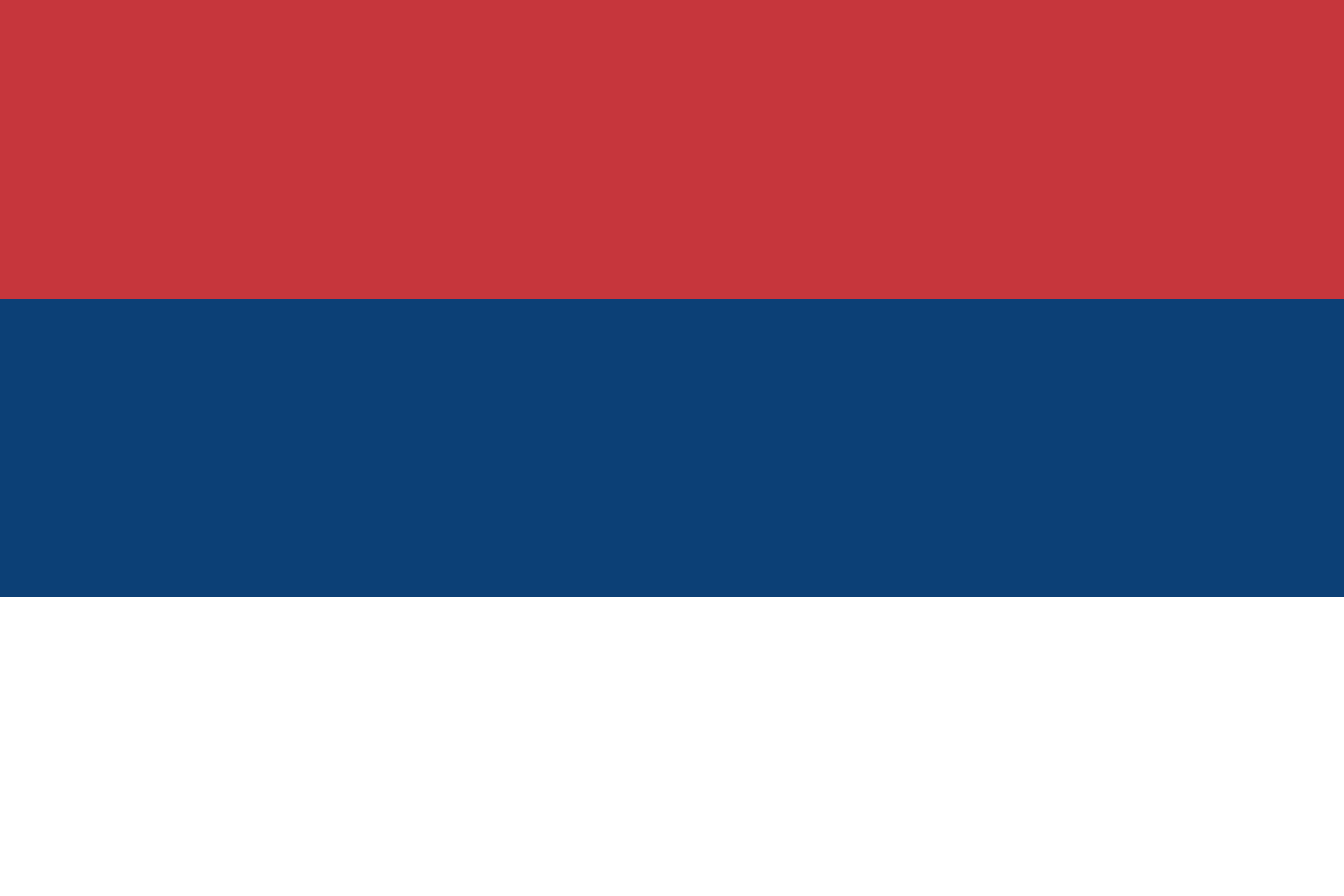
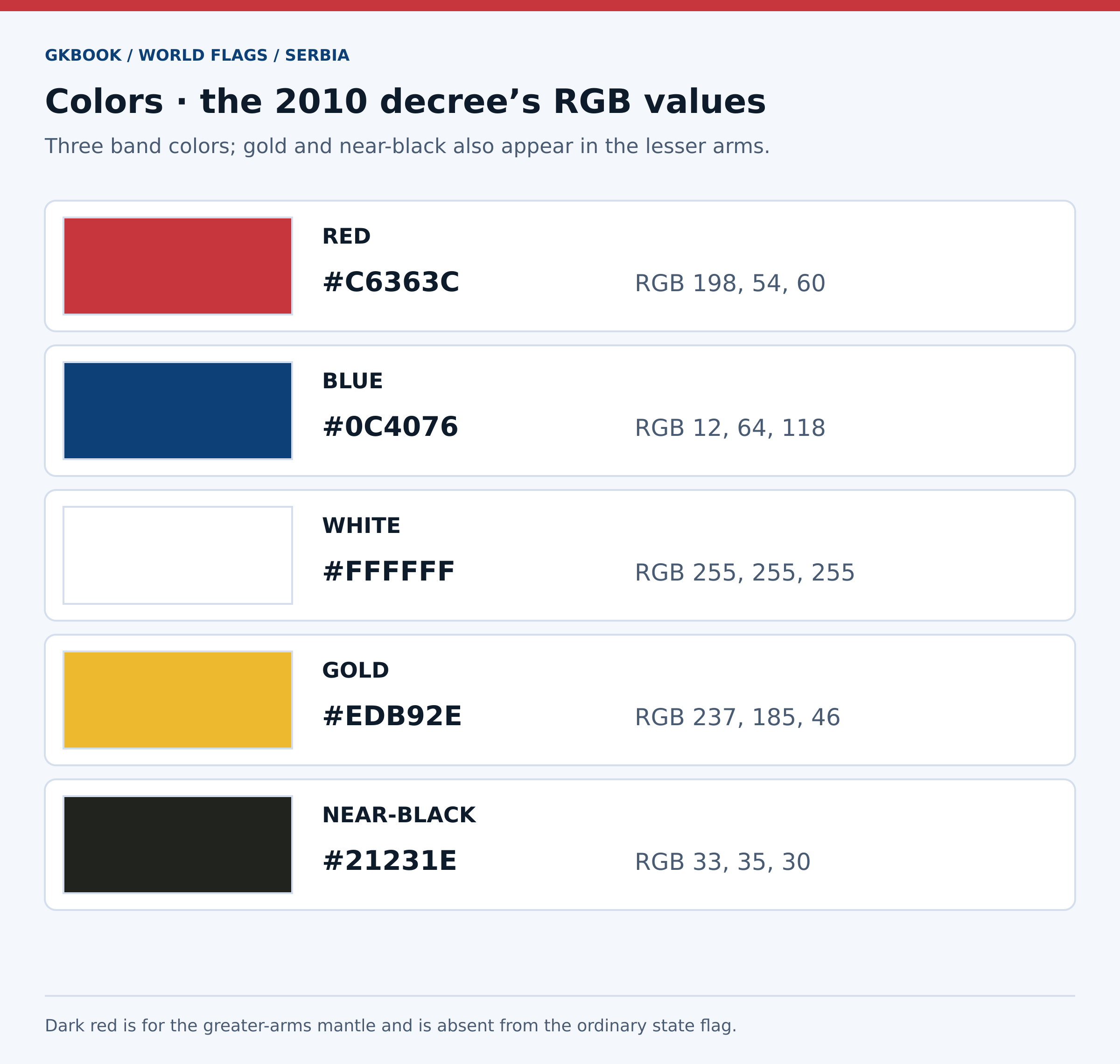
| Band colors | #C6363C · #0C4076 · #FFFFFFRed and blue follow the decree’s RGB entries; white is digital white. |
| Arms axis | 5L/14 from the hoistOne seventh of the flag length toward the hoist from the midpoint. |
| Modern milestones | 2004 · 2009 · 2010Restoration; symbols law; graphic standards. |
| Main image sizes | SVG and PNGBoth variants: 4,500 × 3,000 SVG; 6,000 × 4,000 PNG. |
What does the Serbia flag look like?
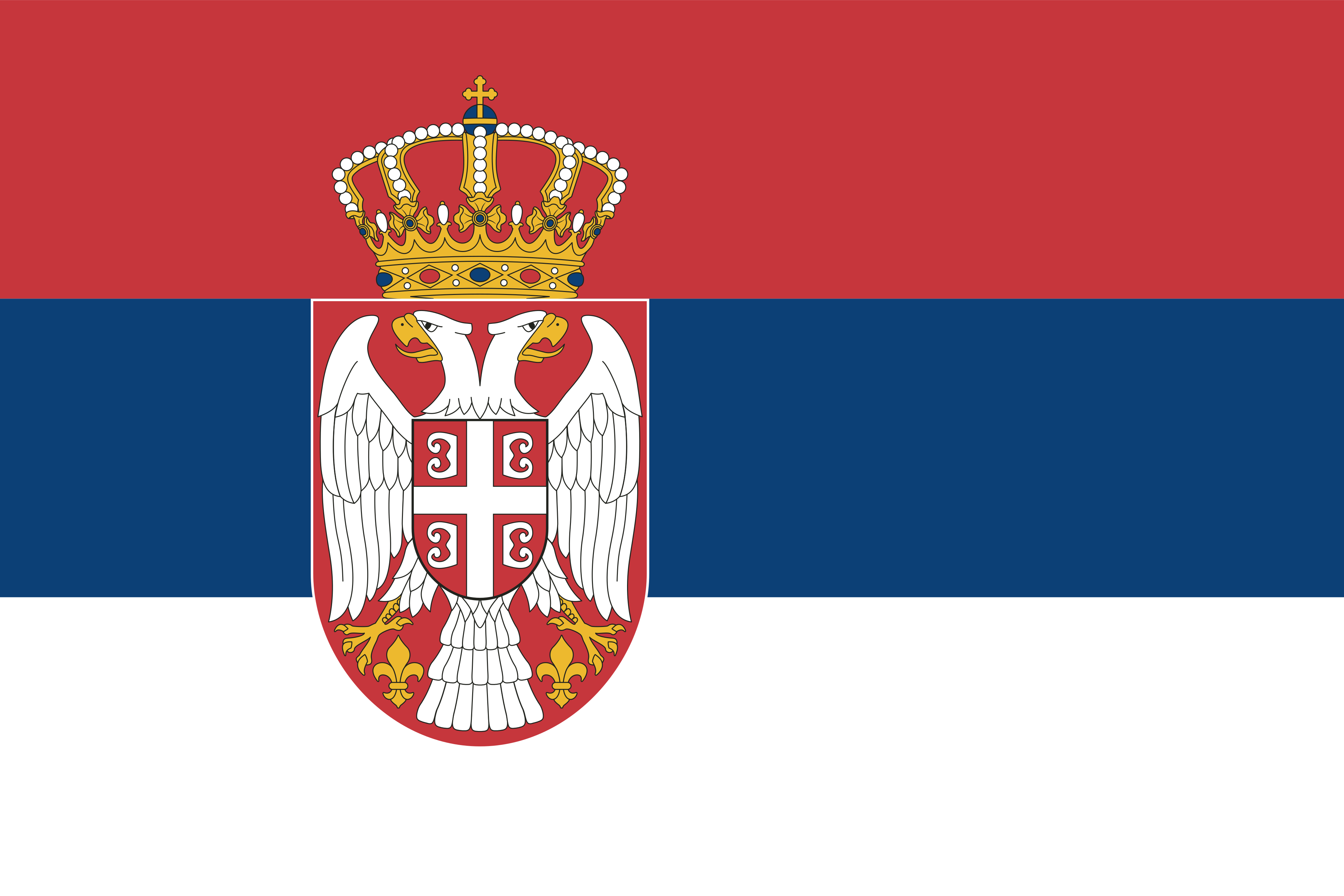
Serbia uses a red-blue-white horizontal tricolor in two official forms. The national flag has no emblem; the state flag adds the lesser coat of arms toward the hoist. Both have height:length proportions of 2:3. The state version, with its crowned double-headed eagle, is the main picture shown here.
Begin identification with the stripe order and then check the emblem. Red is uppermost, blue occupies the middle, and white forms the bottom band. The hoist is the edge attached to the pole, conventionally shown at the left in a front view. On the state flag, the arms sit noticeably left of the rectangle’s midpoint. This offset is intentional. The gallery also supplies the plain national flag as a separately named download, so an image without the eagle is not automatically an erroneous or unfinished Serbian flag.
What is the difference between Serbia’s national and state flags?
The national flag, called Narodna zastava in Serbian, is the plain red-blue-white tricolor. The state flag, Državna zastava, carries the lesser coat of arms on the same bands. Both are official forms recognized by the constitution and law; the presence of the arms identifies the version, not its authenticity.
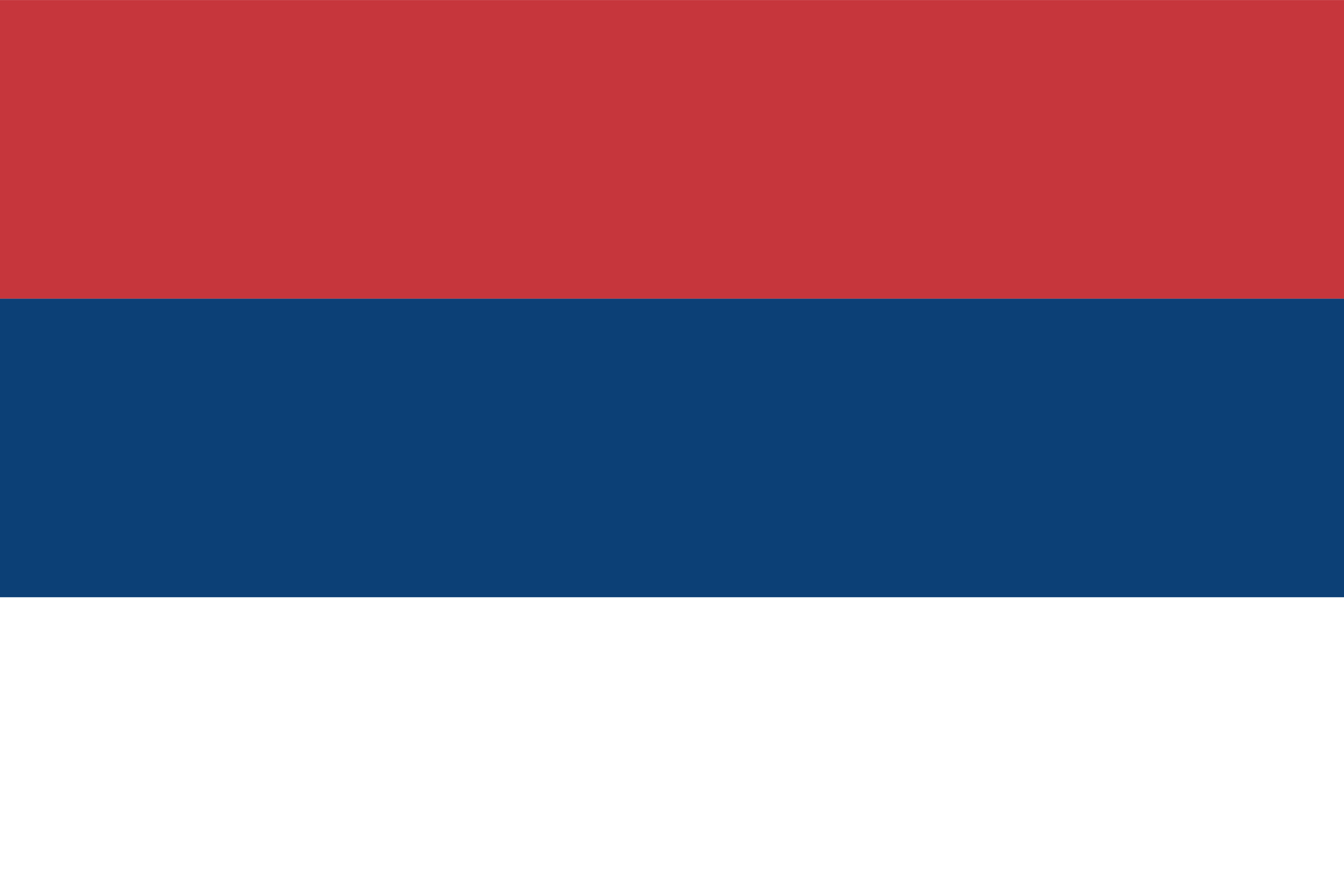
English references often call the plain version the civil flag, although “national flag” follows the Serbian legal terminology more closely. Descriptions should state which version they mean, especially when supplying files to an event organizer or a publication. The two designs share the same rectangle, stripe order, and equal band heights. Their distinction is the additional emblem. A caption such as “Serbia state flag with lesser arms” removes ambiguity. The legal names do not justify a blanket statement that ordinary citizens may never display the state version; the government addressed that question in 2023.
What are the official colors of the Serbia flag?
The bands are red, blue, and white. Article 6 of the 2010 graphic-standard decree specifies RGB 198,54,60 for red and 12,64,118 for blue. The arms also use gold 237,185,46 and near-black 33,35,30. This package represents white as #FFFFFF; that article does not give a numerical white entry.

The table records the decree’s separate color-system entries rather than inventing conversions between them. Its Pantone blue is 280C. The stated RGB red becomes hexadecimal #C6363C, while blue becomes #0C4076. Gold and near-black serve details of the coat of arms, so a three-band flag can contain more than three colors. The decree also lists a dark red for the mantle of the greater arms. That mantle does not appear on the ordinary state flag, and its dark red is therefore absent from these clean flag masters.
| Color | Hex / RGB | Pantone | CMYK |
|---|---|---|---|
| Red | #C6363C / 198,54,60 | 192C | 0,90,70,10 |
| Blue | #0C4076 / 12,64,118 | 280C | 100,72,0,19 |
| White | #FFFFFF / 255,255,255 | Not listed in Article 6 | Not listed in Article 6 |
| Gold | #EDB92E / 237,185,46 | 123C | 4,24,95,0 |
| Near-black | #21231E / 33,35,30 | Not listed in Article 6 | 0,0,0,100 |
What do the colors of Serbia’s flag mean?
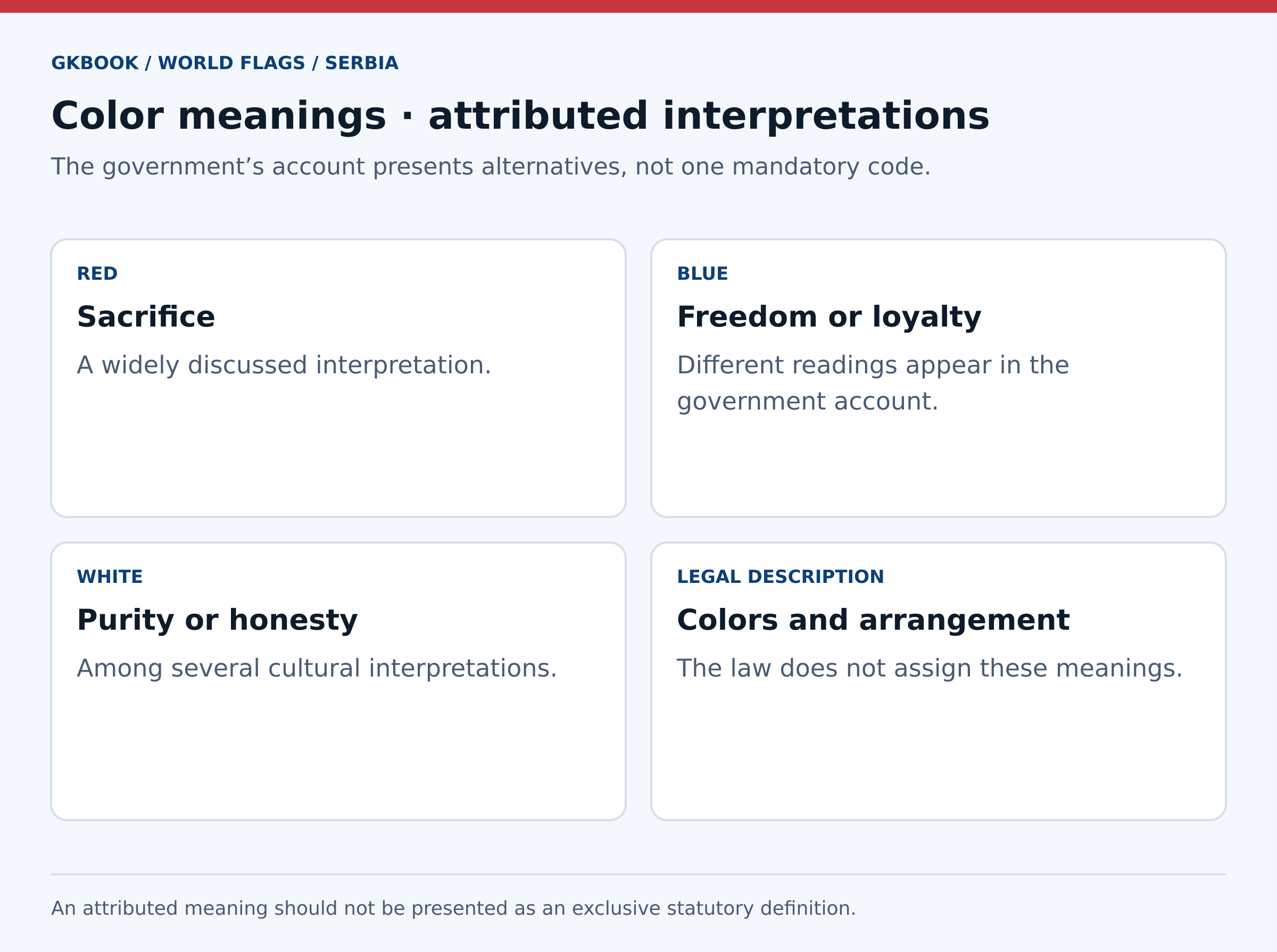
Serbia’s government presents several popular interpretations rather than one compulsory meaning for each stripe. Its explanation connects red with sacrifice and blue with freedom, while white receives different readings, including purity. These cultural associations should be attributed; the flag law prescribes the colors and arrangement without assigning those meanings.

A symbolic explanation and a legal description answer different questions. The first discusses ideas associated with a design; the second establishes what must be drawn. The government’s national-symbols page itself offers alternatives, including loyalty for blue and honesty for white. That variation is a reason to avoid presenting a single mnemonic as the exclusive official interpretation. A concise educational caption can say that the colors have commonly discussed associations with sacrifice, freedom, and purity, while making clear that these are interpretations. Color order and geometry remain the stronger evidence for identifying an image.
Which coat of arms appears on Serbia’s state flag?
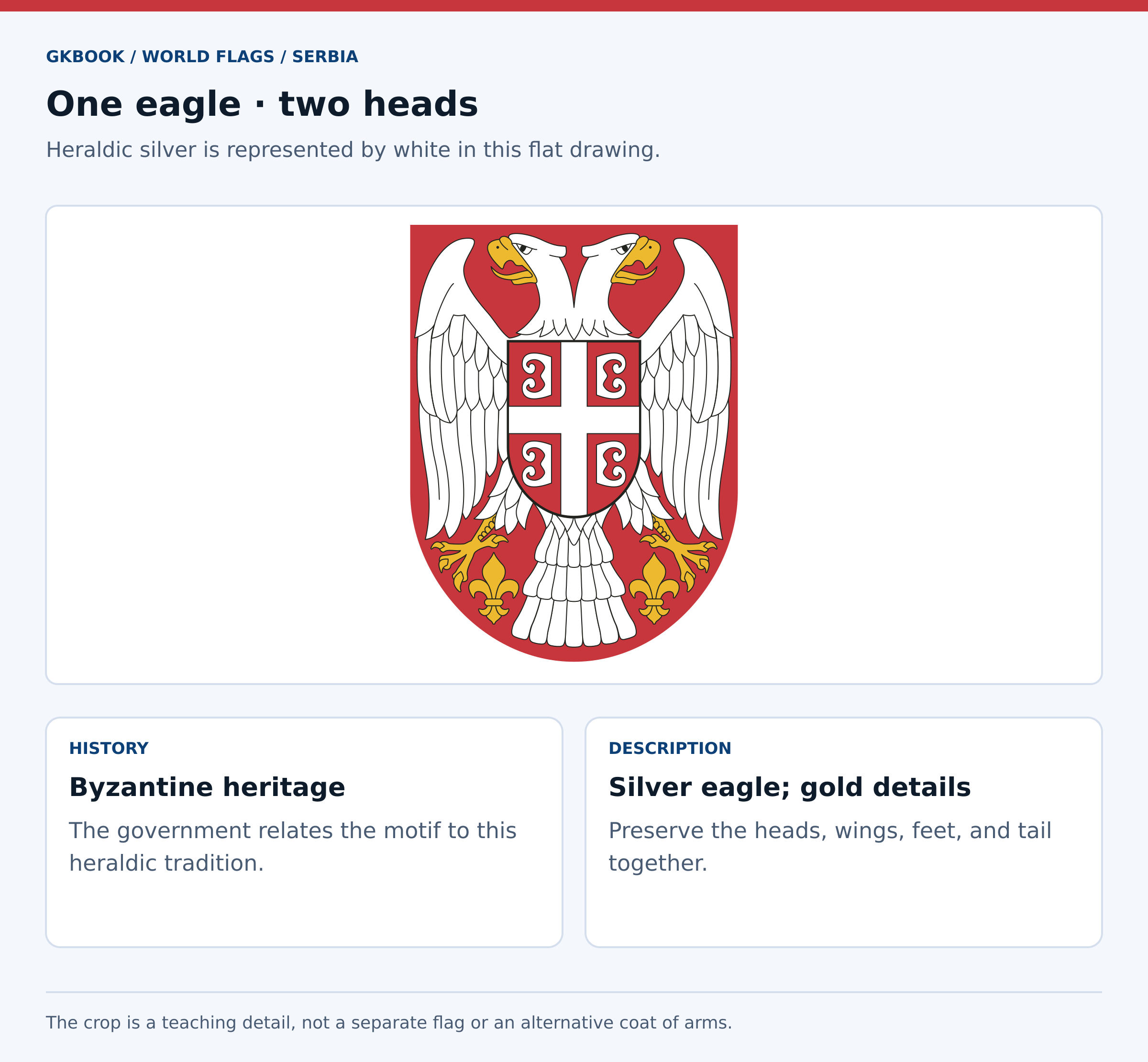
The state flag uses Serbia’s lesser coat of arms: a crowned red shield bearing a silver double-headed eagle, two gold fleurs-de-lis, and a smaller breast shield with a silver cross and four firesteels. The greater arms add a mantle and another crown; that larger composition is not the ordinary flag emblem.

“Lesser” describes a heraldic version, not a reduced-resolution image or an optional selection of details. The crown, eagle, breast shield, and two lilies form one composition. A correct small display therefore scales that whole composition rather than removing whichever elements become difficult to see. The supplied enlargement makes these details easier to inspect. It uses the same vector reconstruction as the flag master, checked against the government’s published illustrations. Its credit distinguishes the national design from the modern digital drawing and from GKBook’s surrounding explanatory layout.
Why is there a double-headed eagle on the Serbia flag?
The double-headed eagle belongs to Serbia’s historic coat of arms. The government’s explanation relates it to Byzantine heraldic heritage. In the legal description, the eagle is silver on a red shield, with gold beaks, tongues, and legs. Its two heads are parts of one bird, not two separate eagle emblems.

The white areas in a flat drawing represent heraldic silver. They do not imply that a printed or sewn flag must use metallic material. The wings, feathers, heads, beaks, and claws give the eagle its recognizable form, and the smaller shield lies over its breast. Interpretations assigning a modern country or a specific geographical direction to each head need separate evidence; they are not supplied by the flag’s legal description. For accurate reproduction, preserve the published outlines and the relationship between the bird and the enclosing shield instead of substituting a generic eagle icon.
What is the cross on Serbia’s flag?
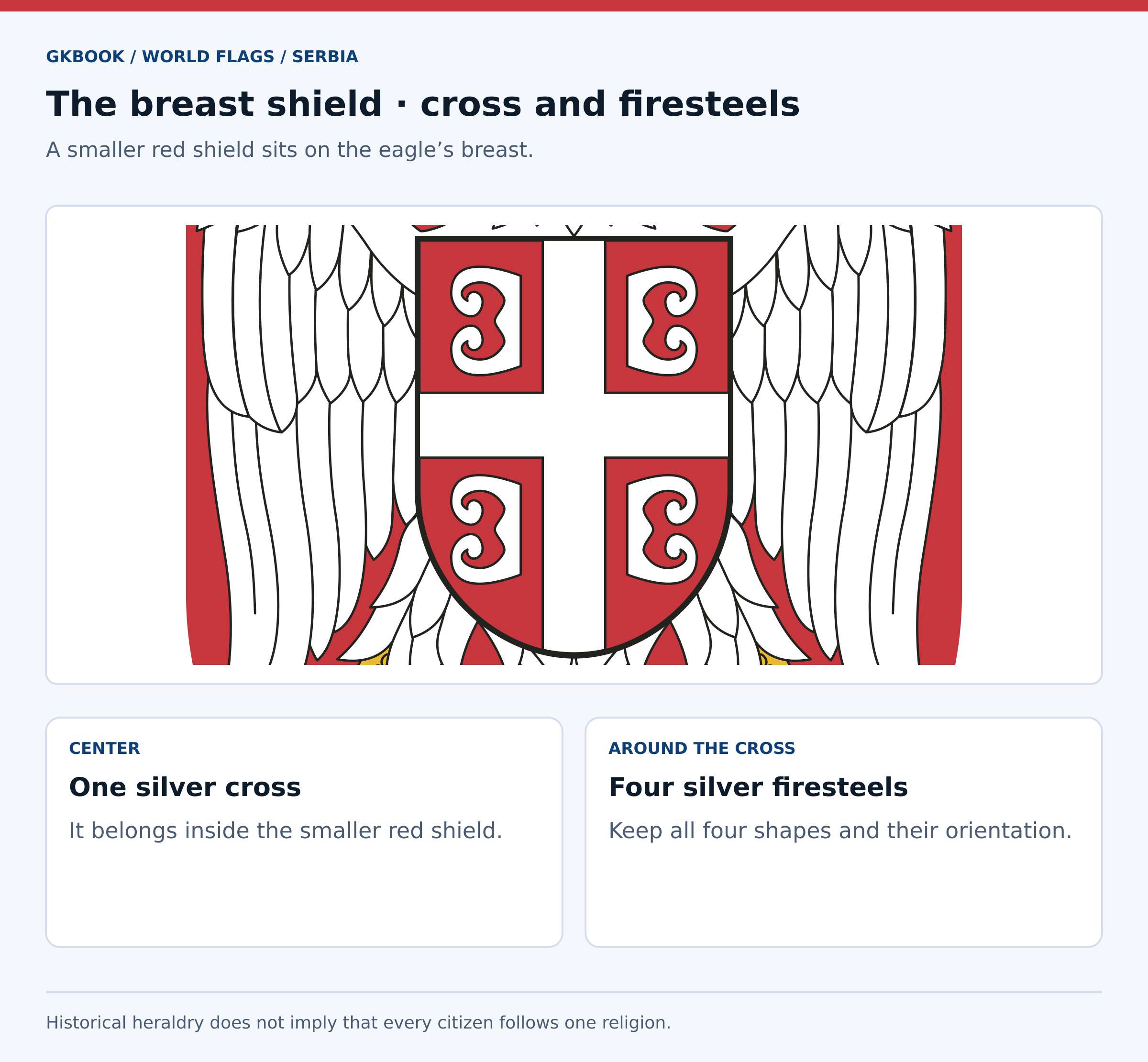
A silver cross appears on the red shield carried on the eagle’s breast. Four silver firesteels occupy the spaces around it. The cross is part of Serbia’s historical heraldry, not an instruction to add a separate cross to the tricolor or a statement that every Serbian citizen shares one religion.
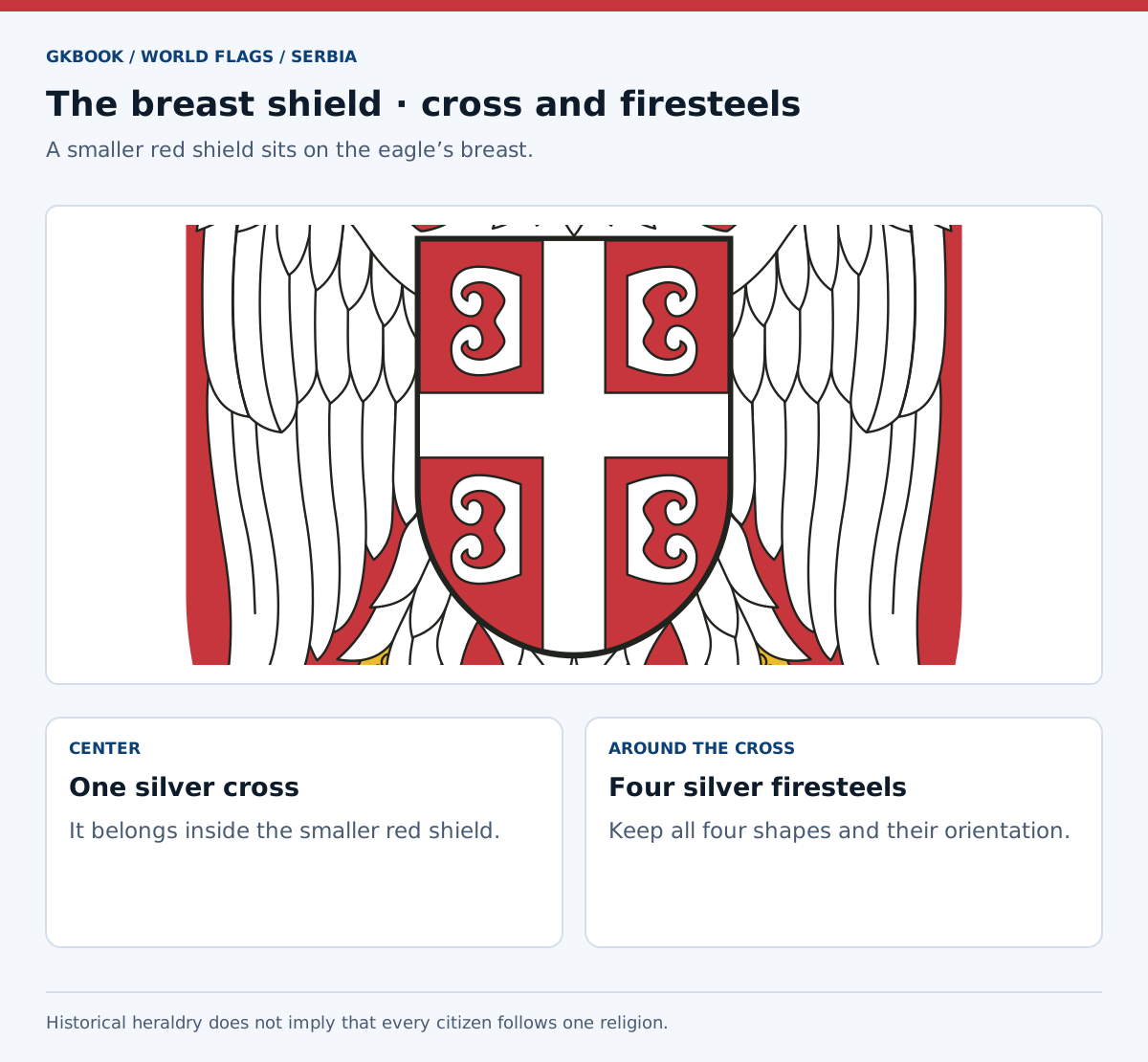
The smaller breast shield must remain distinct from the larger red shield behind the eagle. Its cross reaches across the smaller shield, while the surrounding firesteels retain their own curved shapes. This arrangement is easily lost when a thumbnail is enlarged from a poor raster source. The close-up therefore uses vector geometry from the same reconstruction as the complete flag. Serbia’s constitution also describes the state as secular and separates religious communities from the state. Historical religious imagery in a national emblem should not be confused with a constitutional requirement that citizens follow a particular faith.
Are the four symbols around the Serbian cross letters?
The law describes the four silver shapes as firesteels, commonly called ocila. They are often associated with the Serbian motto “Samo sloga Srbina spasava,” usually translated as “Only unity saves the Serbs.” That popular reading should remain separate from the statutory heraldic description; the artwork uses shaped symbols, not typed letters.
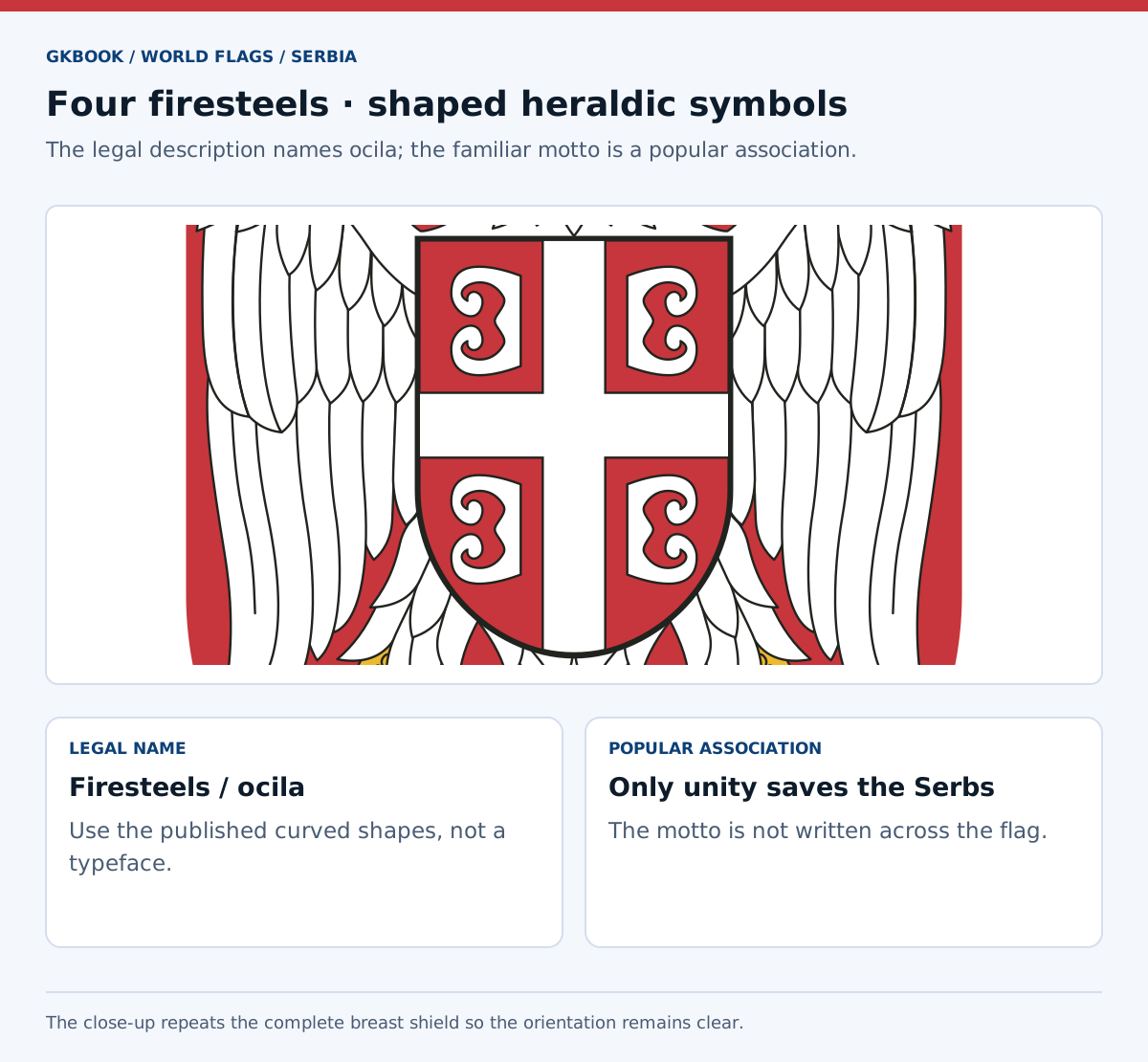
A firesteel is a tool associated with striking sparks, and the heraldic forms have a long visual history. Their resemblance to Cyrillic letters helps explain the familiar motto association, but it does not make an ordinary text font a suitable replacement. The four elements face in paired orientations around the cross, following the published artwork. Keep their curves, spacing, and relationship to the red background intact. The motto itself is not written across the flag. In an explanatory poster, place a translation in the surrounding caption so that the national rectangle stays unchanged.
Why does Serbia’s flag have a crown if Serbia is a republic?
The crown is retained as part of Serbia’s historical coat of arms. Its presence does not mean that the present state is a monarchy. The 2009 law refers back to the arms established for the Kingdom of Serbia in 1882, while today’s constitution establishes the Republic of Serbia.

Heraldic designs can preserve symbols from earlier political periods after institutions change. The crown above the lesser arms is a clear example of that continuity. In the flag drawing, it sits directly above the larger shield, with its cross, arches, pearls, and colored details retained. It should not be replaced with an unrelated royal crown merely because both look similar at a distance. The legal reference to June 16, 1882 concerns the historical arms law. It is not a claim that the complete modern flag, in its present digital rendering, was adopted on that date.
What are the two gold flowers on Serbia’s coat of arms?
The two gold flowers are fleurs-de-lis, or heraldic lilies, positioned near the eagle’s feet within the larger red shield. They are explicitly included in the legal description of the lesser arms. Both belong in the state flag’s emblem; they should not be omitted or replaced with ordinary flower drawings.

A fleur-de-lis is a conventional heraldic shape, so its stylized outline matters more than botanical realism. The two examples balance the lower part of the shield on either side of the eagle’s tail. They use the gold specified for the heraldic details. This article identifies their form and position without assigning them an unsupported modern territorial meaning. When checking a reduced image, inspect the lower shield for both lilies as well as the tail feathers. A damaged or simplified source can retain the conspicuous crown and heads while losing these smaller identifying elements.
What is the correct aspect ratio of the Serbia flag?
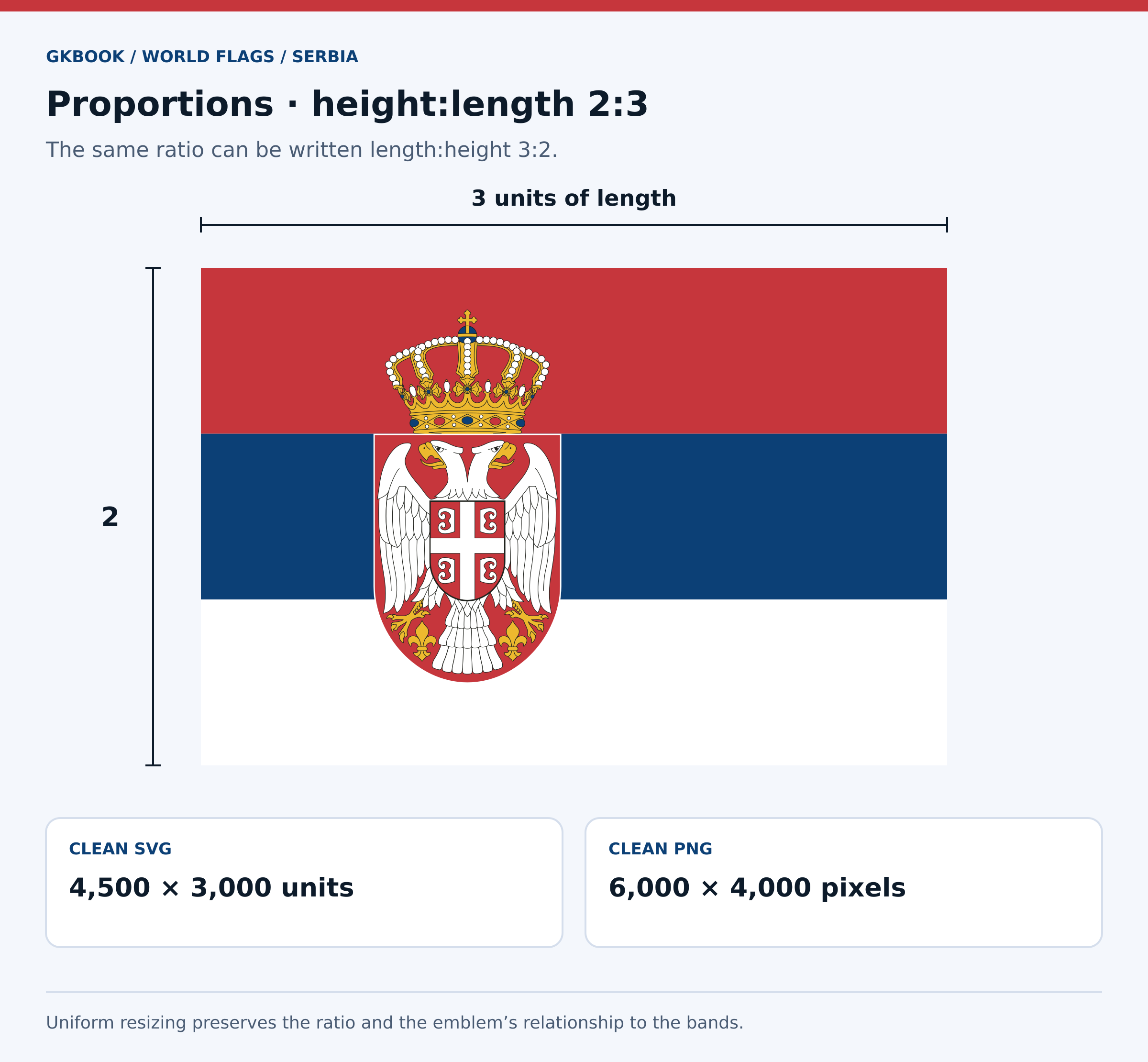
Both official Serbian flag forms have length:height proportions of 3:2, equivalently height:length 2:3. A flag 150 centimeters long is therefore 100 centimeters high. The clean SVG masters in this package measure 4,500 by 3,000 units, and their opaque PNG versions measure 6,000 by 4,000 pixels.

Naming the dimensions avoids the common confusion between “2:3” and “3:2.” Both expressions describe the same rectangle when their order is stated. In a web layout, set the displayed width and allow the height to follow the image’s intrinsic proportions. A square thumbnail or a wide social card can contain the complete flag with surrounding space, but its outer canvas does not redefine the national ratio. The diagrams place dimension lines outside the flag boundary. Those guides explain the measurement and are absent from the downloadable clean state and national masters.
Are the three stripes on Serbia’s flag equal?
Yes. The red, blue, and white bands have equal heights and span the full length of the flag. On the 4,500 by 3,000 vector canvas, each band is 1,000 units high. The arms overlay the state flag’s bands without changing their underlying dimensions or the red-blue-white order.

The top band extends from y = 0 to 1,000, the middle band from 1,000 to 2,000, and the bottom band from 2,000 to 3,000. Coordinates begin at the upper-left corner. Drawing the complete rectangles first gives clean boundaries before the emblem is added. On a 4,000-pixel-high PNG, exact thirds do not all fall on whole-pixel rows; edge rasterization handles that fractional boundary. This does not justify changing one band’s geometric height. Avoid adding outlines or gaps at the joins, which would introduce extra elements into the national design.
Where is the coat of arms placed on Serbia’s flag?
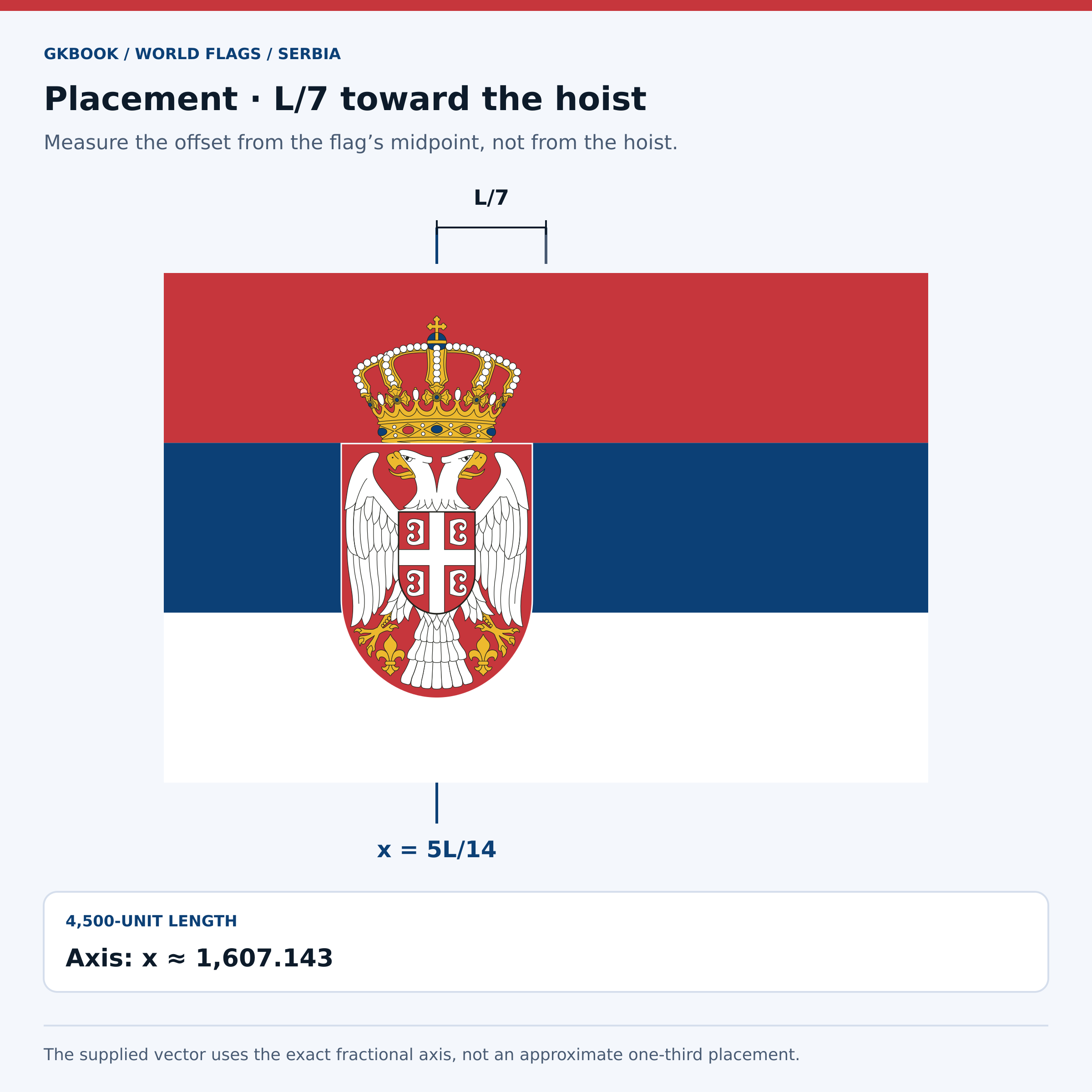
The law places the arms toward the hoist by one seventh of the flag’s length from the flag’s midpoint. If length is L, the emblem’s vertical axis is at 5L/14 from the hoist. On the 4,500-unit canvas, that is approximately x = 1,607.143, rather than the center at 2,250.
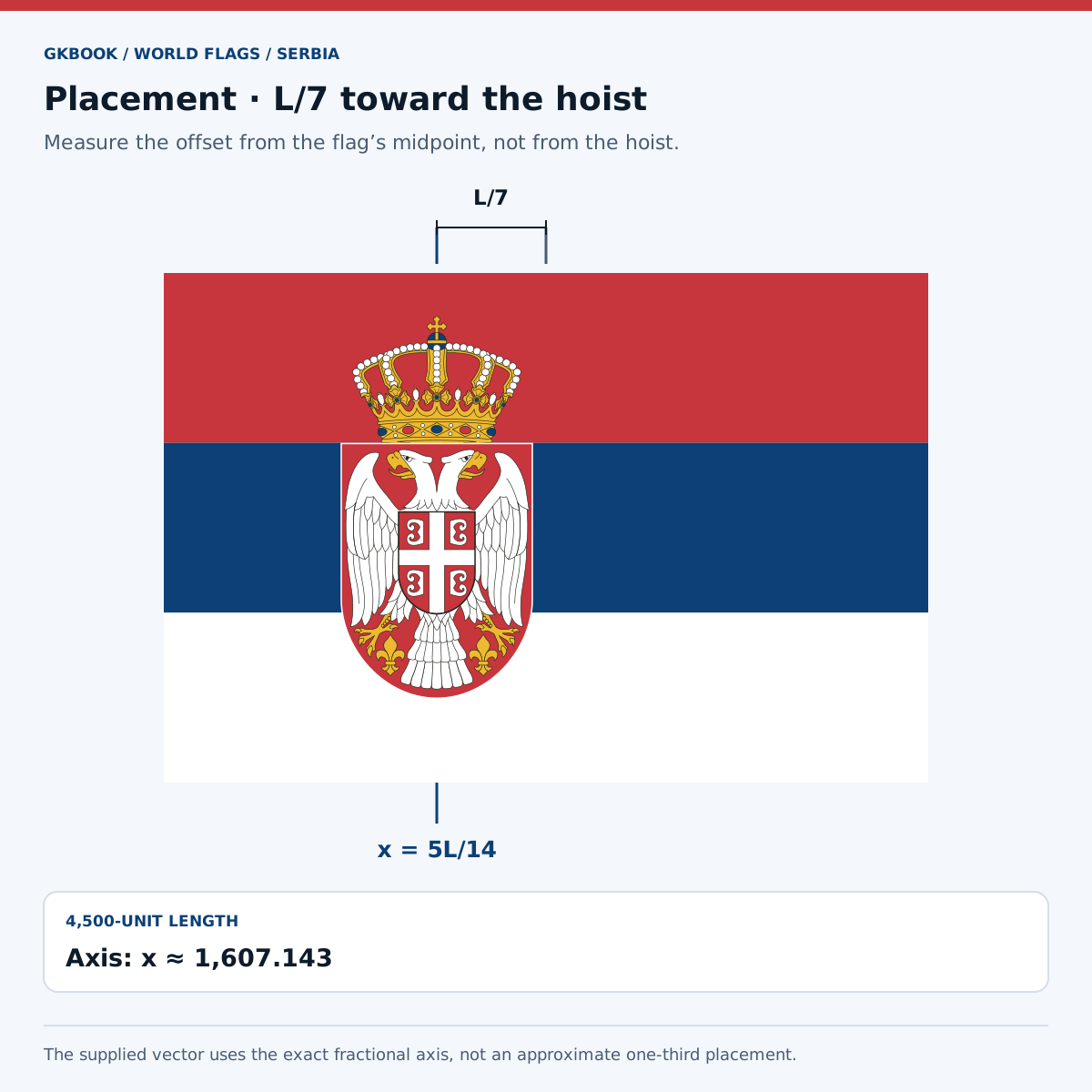
The wording describes an offset from the midpoint, not a distance measured directly from the hoist. Subtract L/7 from L/2 to obtain 5L/14. This distinction prevents a large positioning error. It also explains why placing the emblem at exactly one third of the length is only an approximation. The construction illustration labels the central axis and the offset separately. The file uses the precise fractional position and scales the entire emblem uniformly. Its placement remains fixed relative to the flag even when the image is resized or surrounded by a different page layout.
How large should the coat of arms be on Serbia’s flag?
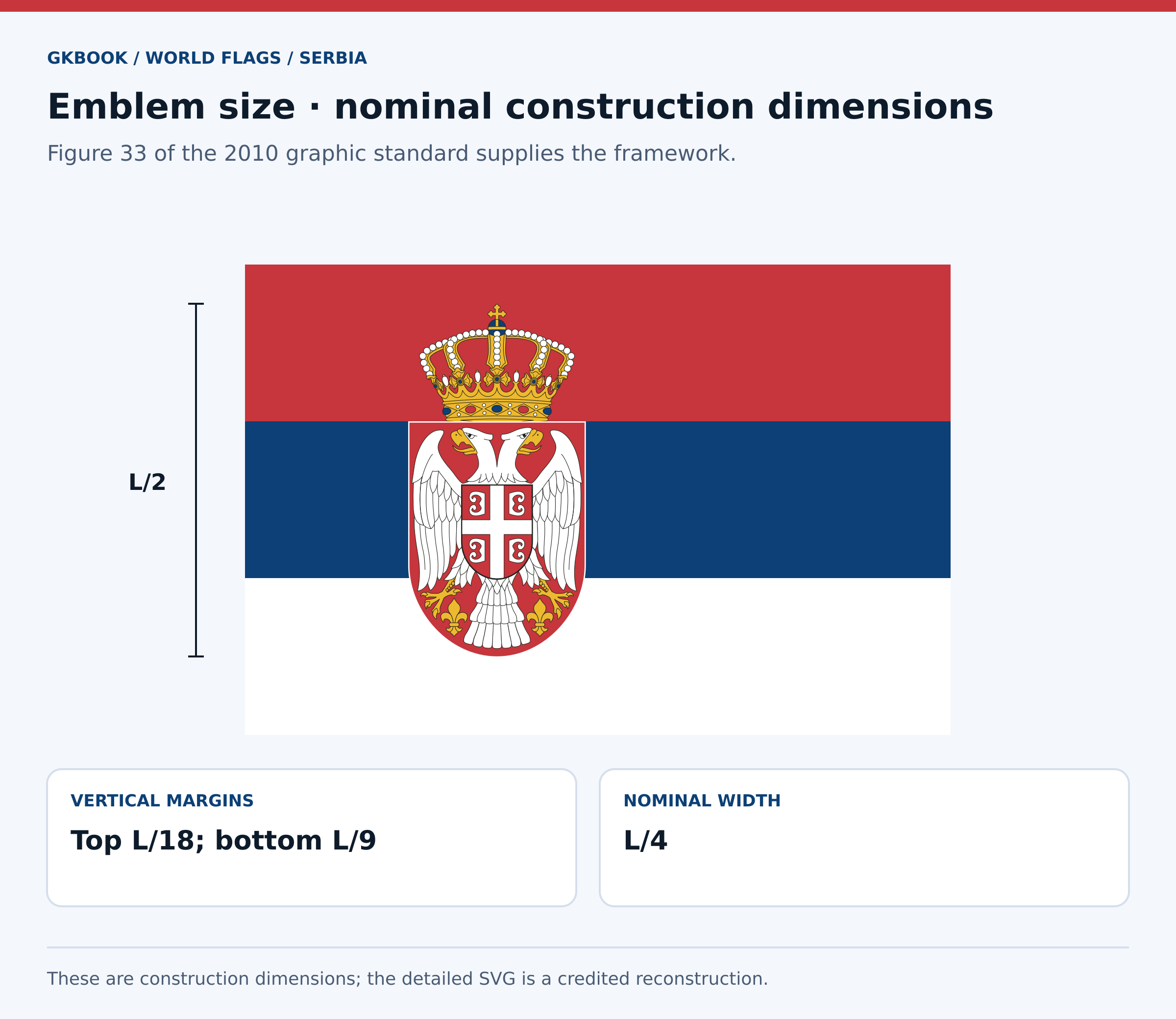
Figure 33 of the 2010 graphic standards supplies nominal construction dimensions. The complete arms are L/2 high and L/4 wide, with their top L/18 below the upper edge and bottom L/9 above the lower edge. The shield’s top aligns with the boundary between the red and blue bands.

Here L means the full flag length. Since the height is 2L/3, these measurements give an emblem height of three quarters of the flag height. On a 4,500-unit length, the nominal top is 250, height 2,250, width 1,125, and bottom margin 500. Printed outlines and reconstructed curves can extend slightly beyond nominal construction boundaries. The package therefore records these dimensions as the official framework and identifies the supplied detailed drawing as a credited reconstruction. It does not claim that every painted edge is an exact numerical transcription of the original government artwork.
How can you draw the Serbia flag accurately?
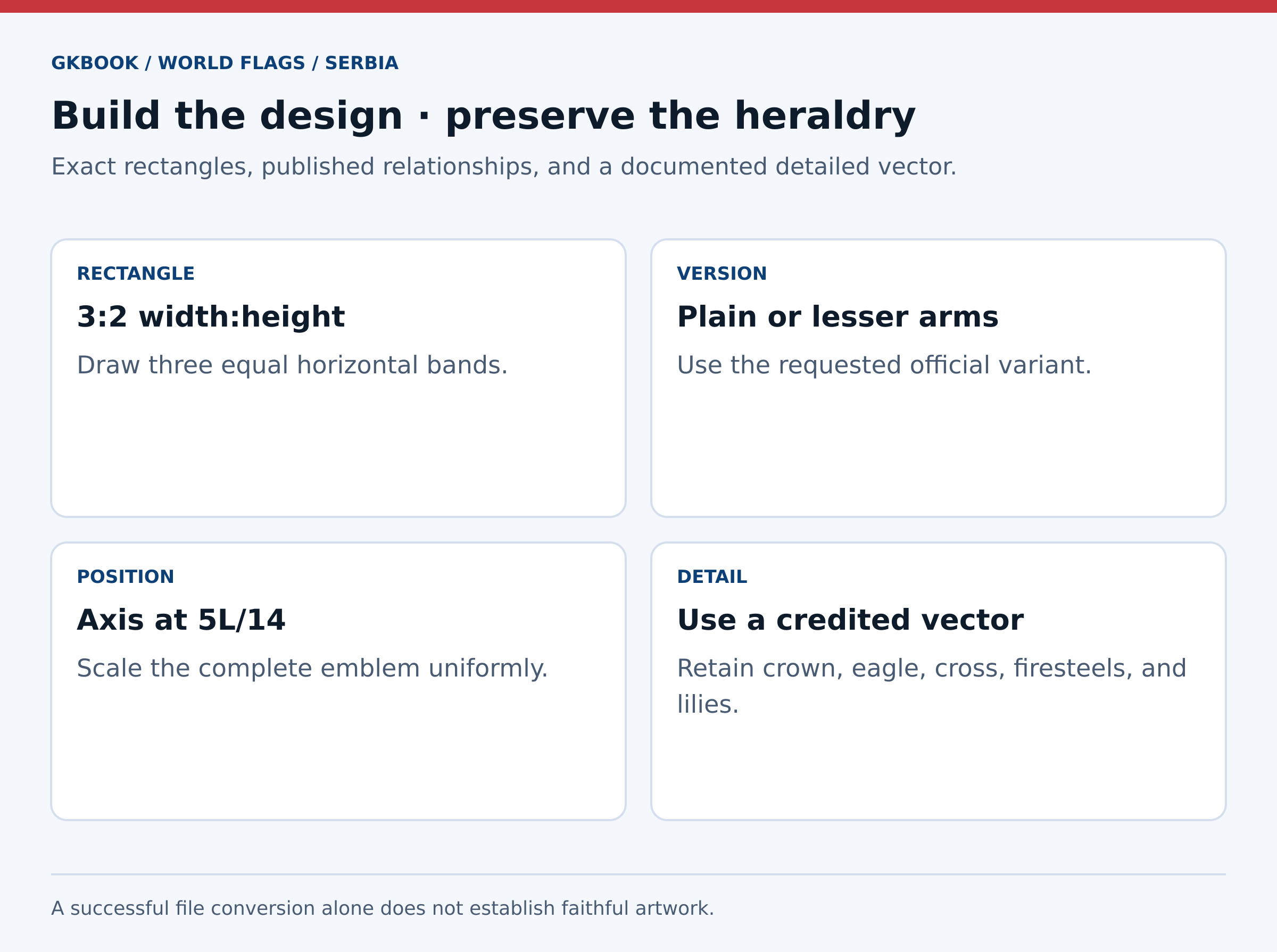
Build a 3:2 width:height rectangle, add equal red-blue-white horizontal bands, and use the correct official variant. For the state flag, place a complete lesser-arms vector on the prescribed axis and at the published scale. Preserve the detailed heraldry; a generic eagle, crown, or set of typed letters is insufficient.
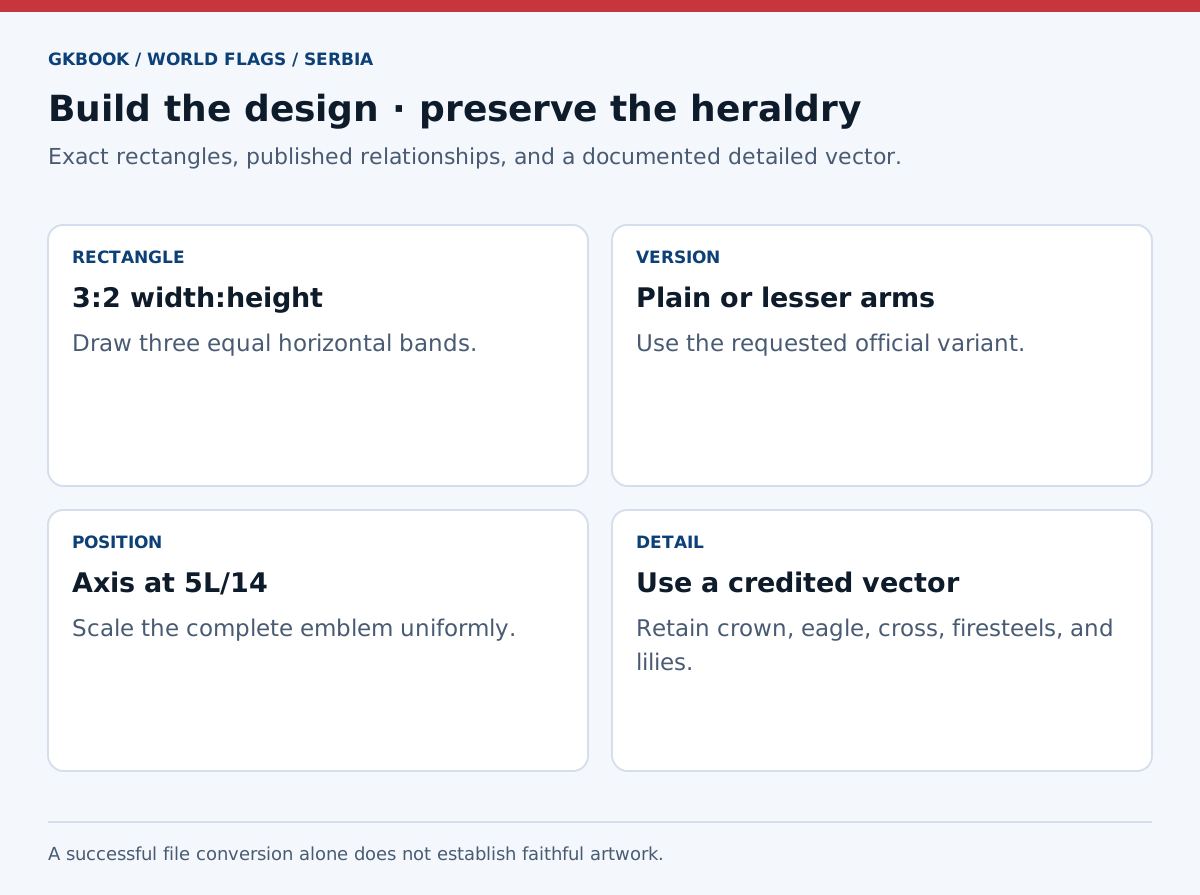
The reconstruction uses exact band rectangles and a reusable emblem group. Its published SVG source supplies the intricate contours, while the Serbian law and construction sheet control the overall relationships. Repeated vector elements are expanded and their styles retained, allowing the same drawing to appear reliably in every illustration. The source’s rounded horizontal translation is normalized to the exact fraction 5L/14. No hand-drawn replacement eagle is introduced. The private production record explains this processing, the source attribution, and the difference between a carefully checked reconstruction and a government-certified original master.
What is the history of Serbia’s present flag?
The present design combines Serbia’s red-blue-white tricolor with historical arms associated with the kingdom. The modern legal sequence includes the 2004 recommendation restoring national symbols, the 2006 constitution, the 2009 symbols law, and the 2010 graphic standards. These milestones concern different aspects of recognition, regulation, and detailed reproduction.
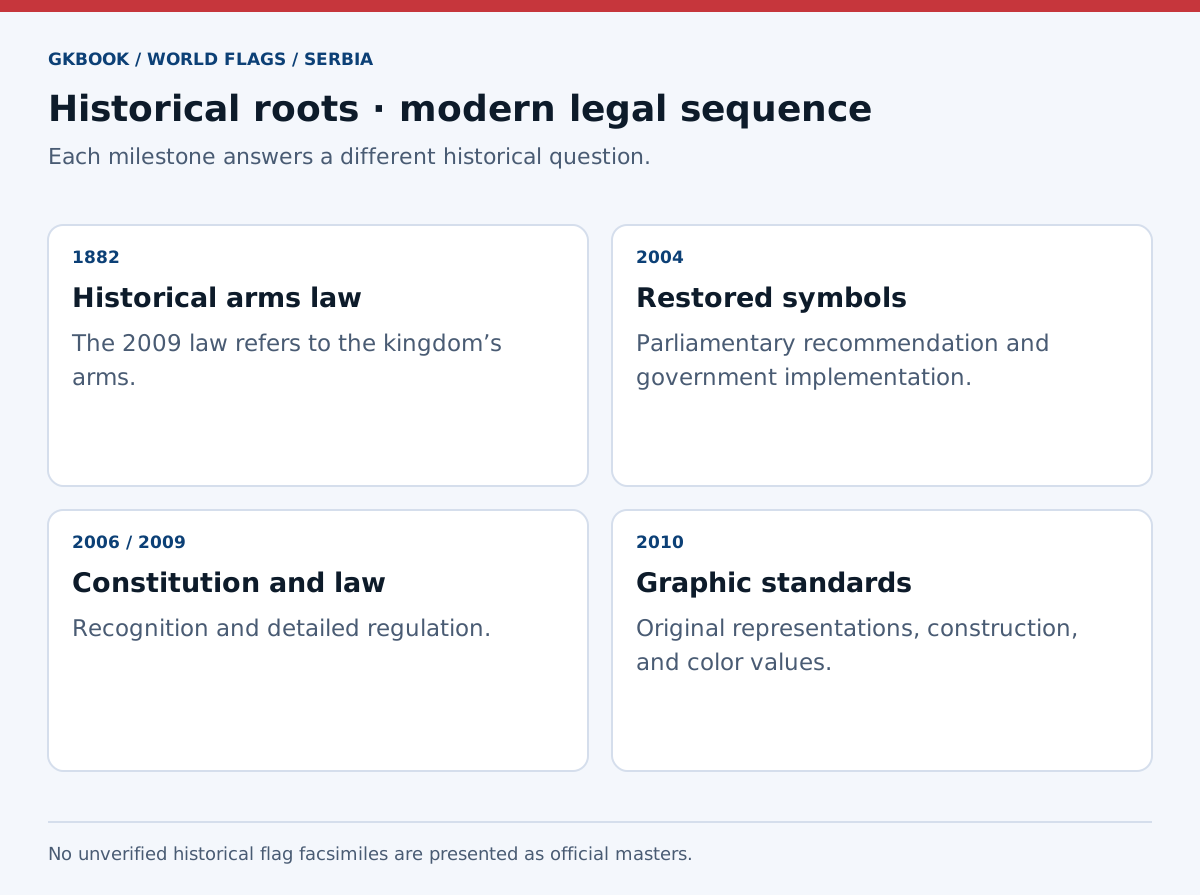
The older heraldic reference and the modern flag record should be read together without treating them as one uninterrupted legal instrument. The symbols law expressly invokes the kingdom’s 1882 arms, while the contemporary state is a republic. In August 2004, parliament recommended the renewed use of historical national symbols, and the government issued implementation guidance two days later. Subsequent constitutional and legislative provisions gave the two flag forms their current framework. The gallery presents that documentary sequence rather than offering uncertain facsimiles of every historical flag associated with Serbian or Yugoslav political institutions.
When was the present Serbia flag adopted?
August 17, 2004 marks the parliamentary recommendation restoring the contemporary symbols. The symbols law was adopted on May 11, 2009, and the detailed graphic-standard decree is dated November 11, 2010. A precise caption should identify which milestone it means instead of treating restoration, legislation, and artwork standardization as the same event.

For a short general description, “restored in 2004; current graphic standard from 2010” gives readers useful context. A more detailed timeline should retain the legal instrument names. The government’s August 19, 2004 action implemented the earlier parliamentary recommendation. The 2009 law then specified appearance and use, including the ratio and emblem offset. The 2010 decree established the original representations and color standards. Its date is not automatically its effective date: the text says it enters into force on the eighth day after publication. This package does not invent an unverified publication-based effective date.
| Date | Instrument or event | Role |
|---|---|---|
| August 17, 2004 | Parliamentary recommendation | Restoration of contemporary national symbols |
| August 19, 2004 | Government implementation recommendation | Practical implementation |
| May 11, 2009 | Symbols law adopted | Appearance and use regulated by law |
| November 11, 2010 | Graphic-standard decree dated | Detailed representations and color standards |
What changed in the 2010 Serbia flag standard?
The 2010 decree established detailed original representations and graphic standards for the arms, flags, and official standards. It supplied construction illustrations and numerical color specifications. It did not introduce a new stripe order: the recognizable red-blue-white flag and the distinction between plain national and armorial state versions already existed.

A change to an emblem’s detailed drawing can be visually significant without constituting an entirely new national flag. Feather contours, crown ornament, and line treatment require a stable reference when reproductions are compared. The government distributes both graphic illustrations and older vector files alongside the decree. File conversion can introduce errors, so a successful import is not sufficient verification by itself. The supplied reconstruction was checked against the published reference artwork and dimensions. Its provenance is disclosed in the credits, and the colors are checked against the decree’s explicit RGB entries rather than inferred from a compressed preview.
Was Serbia’s flag first adopted at independence in 2006?
No. The 2004 restoration preceded the end of the State Union of Serbia and Montenegro. On June 5, 2006, Serbia’s parliament adopted a resolution concerning succession to the union’s legal subjectivity. That state-continuity milestone should be distinguished from the earlier restoration and the later 2009 law and 2010 graphic standard.

A country’s constitutional history and the history of its symbols do not always share one starting date. Serbia used the restored design while it was still part of the state union. The Civil Aviation Directorate’s institutional history records the June 5 resolution in explaining Serbia’s succession to international obligations. That primary account supports the date and context, but it is not itself a flag-adoption instrument. Labeling each event prevents a misleading caption such as “flag created in 2006” when the available government record already documents the contemporary symbols in 2004.
Where is Serbia’s flag recognized in the constitution?
Article 7 of Serbia’s constitution recognizes the country’s coat of arms, flag, and anthem. It explicitly identifies both the national and state flags, while leaving their appearance and use to legislation. The detailed stripe order, proportions, and emblem placement come from the symbols law and associated graphic standards.
The constitutional provision establishes the categories of national symbols rather than presenting a complete drawing manual. Its distinction between greater and lesser arms also helps explain why different state emblems appear in different contexts. For a production file, read the constitutional recognition alongside the law and the decree instead of expecting one paragraph to supply every dimension and color value. The government-hosted constitutional PDF inspected for this article identifies the 2006 constitution and subsequent amendments. The flag provision remains the relevant starting point for understanding the two versions shown in this gallery.
Who designed the Serbia flag?
The inspected legal and government sources establish institutional approval and historical heraldic continuity, but they do not establish one sole designer of the entire present flag. Distinguish the national design, the 2010 graphic standard, and a modern SVG reconstruction. A digital file contributor’s name is not automatically the historical flag designer.
Several roles may be involved in producing a national symbol: developing heraldic artwork, preparing official standards, approving legislation, and making later digital copies. Those roles require their own evidence. This package attributes the detailed SVG reconstruction to its documented Wikimedia Commons contributor history and credits GKBook for construction and educational layouts. It does not convert those production credits into a claim of national authorship. Likewise, a political officeholder who approved or signed a document should not be called the flag’s artist solely because their name appears on that instrument. Keeping these distinctions visible makes the credits more useful.
When is Serbia’s Flag Day?
September 15 is observed as the Day of Serbian Unity, Freedom and the National Flag. A Serbian government announcement records its first observance on September 15, 2020. That commemorative date is separate from the flag’s 2004 restoration and the dates of its governing law and graphic standards.

An anniversary or national celebration can make a flag especially visible without being the day on which the design was adopted. For an event graphic, label the occasion with its full name and date, then place that wording outside the flag rectangle. The clean images supplied here contain no event lettering and can therefore be reused in other settings. The cited government announcement establishes the first observance; it is not used here to claim that the occasion is a statutory nonworking holiday. That is a different question requiring the applicable holiday legislation.
Is Serbia’s presidential standard the same as the state flag?
No. The presidential standard is a distinct square design using the greater coat of arms and its own border treatment. The National Assembly president’s standard is another separate design. Neither should be made by stretching the ordinary rectangular state flag into a square or adding a border to its lesser arms.
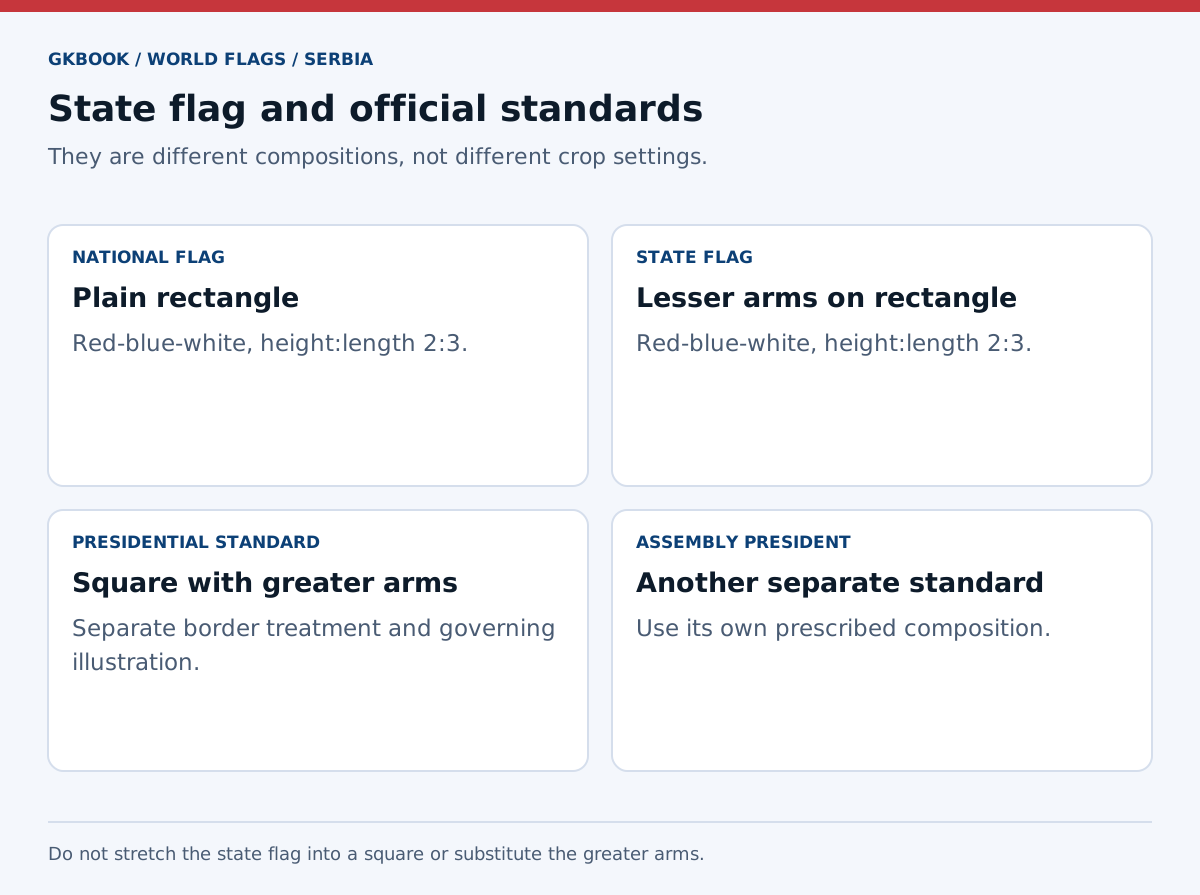
The law describes these standards separately, and the 2010 decree provides their respective illustrations. Their use of the greater arms explains the mantle and additional crown absent from the ordinary state flag. These are changes of composition, not merely changes of size. The comparison in this gallery identifies the categories in labeled panels without presenting an independently reconstructed standard as an official production master. If a brief requests a presidential standard, first confirm that specific emblem and its governing illustration. The two clean flag downloads here remain the rectangular state and national versions.
May citizens display Serbia’s state flag?
A Serbian government conclusion announced on April 27, 2023 states that both the state and national flags may be freely displayed on ceremonial occasions, subject to the legal requirements protecting their dignity. It is therefore inaccurate to describe the armorial state flag as categorically forbidden to ordinary citizens.
The distinction between official use and public display needs careful wording. The symbols law identifies institutions and occasions where particular forms are displayed, while the later government statement addresses broader ceremonial use. Neither should be reduced to a slogan that overlooks the other. For an ordinary educational page, identify the two versions and explain the government’s clarification. Commercial branding, modified designs, and particular ceremonial arrangements raise separate provisions and cannot be cleared merely by downloading an image. This article summarizes the published rule and clarification; it does not certify a specific proposed use or replace the applicable text.
How should Serbia’s flag be oriented when displayed vertically?
For the vertical displays described in Article 31, the law says the upper color, red, comes first on the viewer’s left. The gallery demonstrates this with the plain national flag. It does not invent a special upright rearrangement of the state flag’s coat of arms or present one as a universal requirement.

A vertical display needs its own orientation check because “top stripe” no longer describes a vertical band. Looking at the displayed national flag from the front, the sequence in the illustrated case is red, blue, white from left to right. The national rectangle is rotated, preserving the relative widths of the three colors. Article 31 also addresses other display settings, so the diagram’s caption names its scope. For a state flag installation, consult the relevant arrangement and artwork rather than independently rotating or moving individual heraldic components to make them look more convenient.
When is Serbia’s flag flown at half-mast?
Article 23 of the symbols law provides for the state flag to be flown at half-mast on the buildings of state bodies and other covered public bodies on days of mourning. This is a display position, not an alternate flag design. The colors, proportions, and coat of arms remain unchanged.
A dated mourning decision and the general flag rule serve different purposes. The decision identifies the occasion, while the rule describes the corresponding treatment of the flag. A reusable reference article should not announce that mourning is currently in force without checking the relevant contemporary decision. Likewise, a half-mast illustration should show the position on a pole rather than darken the flag, add a black stripe, or remove the crown. This gallery supplies the unchanged flag masters; it does not include an undated claim that a particular mourning order presently applies.
What basic handling rules apply to Serbia’s flag?
The symbols law requires respect for the flag and provides rules against inappropriate alteration and treatment. It addresses damaged flags, contact with the ground, use as coverings, and suitable illumination at night. These handling provisions concern the flag’s dignity; they do not authorize adding a slogan, logo, or decorative border to the design.
Keep an educational layout distinct from the flag it explains. Labels, dimensions, and event titles can appear in the surrounding composition without becoming part of the national rectangle. For physical display, the law’s specific provisions should guide treatment of worn examples and placement. Article 32 generally provides for daylight display and allows night display when properly illuminated. Article 33 addresses contact with the ground and uses such as curtains, coverings, or table coverings, with a distinction for table flags. A concise summary cannot establish every exception or approve every proposed product bearing national symbols.
How should a Serbia flag file be prepared for printing?
Use the SVG when the production workflow accepts vectors, and preserve the complete design at its 3:2 width:height ratio. The clean PNGs are opaque RGB images measuring 6,000 by 4,000 pixels. Consult the decree’s separate print-color entries and obtain a proof; an automatic RGB conversion is not an independent color specification.

At 300 pixels per inch, the PNG corresponds to a nominal print of 20 by about 13.33 inches before production allowances. That calculation does not prescribe a suitable size for every process or viewing distance. Inspect a proof for the complete eagle, four firesteels, two lilies, crown detail, and the correct emblem offset. Fine outlines may require adequate output resolution. Bleed, hems, mounting sleeves, and cutting marks belong to the production layout outside the measured national rectangle. The supplied vector reconstruction is documented and scalable, but it is not presented as a certified manufacturing master.
How should Serbia’s flag be used in digital layouts?
Scale the flag uniformly and let its height follow its width. Identify whether an image shows the state or national version, and provide alternative text describing its bands and emblem. The separate 1,200 by 630 social card contains a complete flag; its surrounding canvas does not change the flag’s proportions.
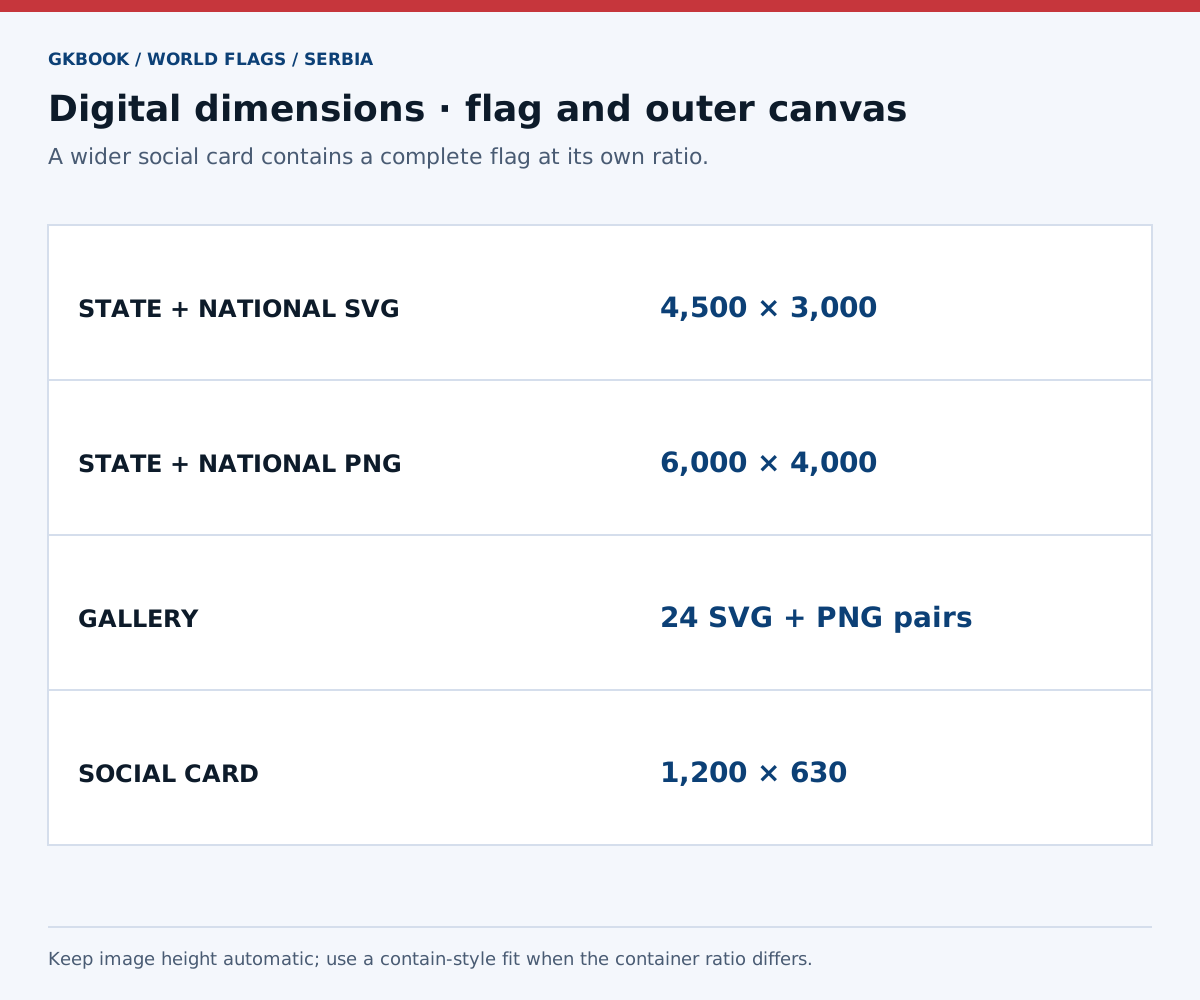
Use a contain-style image treatment when the available container has a different shape. Cropping to fill a square can remove the hoist margin, crown, or part of an outer band, making the result a poor reference image. At very small sizes, use the intended official variant and an adjacent country label instead of silently deleting heraldic details from the state version. The SVG preserves geometry, while the PNG is useful in systems that reject vector uploads. The page’s gallery captions and downloadable filenames identify each subject so that explanatory artwork is not confused with a clean flag.
Which Serbia flag pictures are included in the download?
The package includes 24 subjects, each as SVG and PNG, plus a separate social-preview pair. Both clean official flag variants appear alongside colors, heraldic details, construction diagrams, dated milestones, and reproduction guidance. Captions identify the source basis and distinguish the detailed vector reconstruction from the official rules used to check it.
Choose the clean state flag when a complete armorial version is required, or the separately named national flag for the plain tricolor. Choose an explanatory diagram when the purpose is to teach a dimension, identify a heraldic detail, or clarify a date. The article and FAQ use matching direct answers, while the private editorial material retains source access notes, production choices, and validation results. Individual image credits travel with the package. All subjects use descriptive filenames, and the accompanying rebuild inputs preserve the relationships and artwork used to generate this particular set of downloadable files.
Download Serbia flag pictures
Download the clean flag as SVG or 6,000 × 4,000 PNG. Both preserve the statutory 2:3 height:length ratio, equal horizontal bands, and the prescribed emblem axis. The plain national version is separately available as SVG and PNG. The detailed state emblem remains a credited reconstruction checked against official illustrations.
The gallery contains 24 subjects, each with an SVG and PNG. The captions distinguish published specifications, attributed meanings, historical events, and digital reproduction choices. Image credits and reproduction notes explain the source basis. The separate 1,200 × 630 social card contains a complete flag and does not alter the national rectangle.
Continue exploring national designs in World Flags.
World Flags/Serbia
Serbia flag pictures
State flag with lesser arms. Equal red-blue-white bands; height:length 2:3. Detailed emblem is a credited vector reconstruction checked against official illustrations.
Serbian national design; detailed emblem adapted from Wikimedia Commons contributors; GKBook construction and educational layouts.Download SVGDownload PNGThe official Narodna zastava has no coat of arms. Equal red-blue-white horizontal bands; height:length 2:3.
Serbian national design; detailed emblem adapted from Wikimedia Commons contributors; GKBook construction and educational layouts.Download SVGDownload PNGRed, blue, gold and near-black follow decree Article 6. White #FFFFFF is a digital convention; the article gives no numeric white entry.
Serbian national design; detailed emblem adapted from Wikimedia Commons contributors; GKBook construction and educational layouts.Download SVGDownload PNGThe government presents several popular interpretations; preserve their attribution.
Serbian national design; detailed emblem adapted from Wikimedia Commons contributors; GKBook construction and educational layouts.Download SVGDownload PNGEnlargement of the same reconstructed lesser arms used on the state flag.
Serbian national design; detailed emblem adapted from Wikimedia Commons contributors; GKBook construction and educational layouts.Download SVGDownload PNGDetail of the eagle and shields; no geographical assignment to each head is asserted.
Serbian national design; detailed emblem adapted from Wikimedia Commons contributors; GKBook construction and educational layouts.Download SVGDownload PNGThe breast-shield detail preserves the cross, red fields, and four firesteels.
Serbian national design; detailed emblem adapted from Wikimedia Commons contributors; GKBook construction and educational layouts.Download SVGDownload PNGThe four curved emblems around the cross are firesteels in the statutory description.
Serbian national design; detailed emblem adapted from Wikimedia Commons contributors; GKBook construction and educational layouts.Download SVGDownload PNGCrown detail from the same reconstructed emblem, with arches, pearls, cross, and colored ornament.
Serbian national design; detailed emblem adapted from Wikimedia Commons contributors; GKBook construction and educational layouts.Download SVGDownload PNGLower-shield crop showing both gold lilies, the feet, and the eagle’s tail.
Serbian national design; detailed emblem adapted from Wikimedia Commons contributors; GKBook construction and educational layouts.Download SVGDownload PNGBoth national and state forms have the statutory 2:3 height:length ratio.
Serbian national design; detailed emblem adapted from Wikimedia Commons contributors; GKBook construction and educational layouts.Download SVGDownload PNGThe arms overlay complete bands; they do not change the underlying stripe heights.
Serbian national design; detailed emblem adapted from Wikimedia Commons contributors; GKBook construction and educational layouts.Download SVGDownload PNGSubtract L/7 from L/2 to get 5L/14 from the hoist.
Serbian national design; detailed emblem adapted from Wikimedia Commons contributors; GKBook construction and educational layouts.Download SVGDownload PNGNominal arms height L/2 and width L/4; top L/18, bottom margin L/9. Stroke and reconstructed-contour extents can differ slightly.
Serbian national design; detailed emblem adapted from Wikimedia Commons contributors; GKBook construction and educational layouts.Download SVGDownload PNGThe rules come from the law and decree; the detailed emblem is a disclosed reconstruction.
Serbian national design; detailed emblem adapted from Wikimedia Commons contributors; GKBook construction and educational layouts.Download SVGDownload PNGThe chronology separates historical heraldry from modern recognition and production standards.
Serbian national design; detailed emblem adapted from Wikimedia Commons contributors; GKBook construction and educational layouts.Download SVGDownload PNGThe decree date is not automatically its effective date; Article 9 specifies the eighth day after publication.
Serbian national design; detailed emblem adapted from Wikimedia Commons contributors; GKBook construction and educational layouts.Download SVGDownload PNGThe 2010 standard concerns detailed representation and color, not a new stripe order.
Serbian national design; detailed emblem adapted from Wikimedia Commons contributors; GKBook construction and educational layouts.Download SVGDownload PNGSerbia’s 2006 succession milestone is separate from the earlier flag restoration.
Serbian national design; detailed emblem adapted from Wikimedia Commons contributors; GKBook construction and educational layouts.Download SVGDownload PNGThe first observance is documented on September 15, 2020; no nonworking-holiday classification is inferred.
Serbian national design; detailed emblem adapted from Wikimedia Commons contributors; GKBook construction and educational layouts.Download SVGDownload PNGThis comparison identifies categories; it does not supply a reconstructed presidential or assembly standard.
Serbian national design; detailed emblem adapted from Wikimedia Commons contributors; GKBook construction and educational layouts.Download SVGDownload PNGFor the specified vertical display, red comes first on the viewer’s left; blue and white follow.
Serbian national design; detailed emblem adapted from Wikimedia Commons contributors; GKBook construction and educational layouts.Download SVGDownload PNGPrinting size is an arithmetic example; proof the actual production workflow and color system.
Serbian national design; detailed emblem adapted from Wikimedia Commons contributors; GKBook construction and educational layouts.Download SVGDownload PNGBoth clean masters preserve height:length 2:3. The gallery and social layouts add explanatory space around the design.
Serbian national design; detailed emblem adapted from Wikimedia Commons contributors; GKBook construction and educational layouts.Download SVGDownload PNGFrequently asked questions
What does the Serbia flag look like?
Serbia uses a red-blue-white horizontal tricolor in two official forms. The national flag has no emblem; the state flag adds the lesser coat of arms toward the hoist. Both have height:length proportions of 2:3. The state version, with its crowned double-headed eagle, is the main picture shown here.
What is the difference between Serbia’s national and state flags?
The national flag, called Narodna zastava in Serbian, is the plain red-blue-white tricolor. The state flag, Državna zastava, carries the lesser coat of arms on the same bands. Both are official forms recognized by the constitution and law; the presence of the arms identifies the version, not its authenticity.
What are the official colors of the Serbia flag?
The bands are red, blue, and white. Article 6 of the 2010 graphic-standard decree specifies RGB 198,54,60 for red and 12,64,118 for blue. The arms also use gold 237,185,46 and near-black 33,35,30. This package represents white as #FFFFFF; that article does not give a numerical white entry.
What do the colors of Serbia’s flag mean?
Serbia’s government presents several popular interpretations rather than one compulsory meaning for each stripe. Its explanation connects red with sacrifice and blue with freedom, while white receives different readings, including purity. These cultural associations should be attributed; the flag law prescribes the colors and arrangement without assigning those meanings.
Which coat of arms appears on Serbia’s state flag?
The state flag uses Serbia’s lesser coat of arms: a crowned red shield bearing a silver double-headed eagle, two gold fleurs-de-lis, and a smaller breast shield with a silver cross and four firesteels. The greater arms add a mantle and another crown; that larger composition is not the ordinary flag emblem.
Why is there a double-headed eagle on the Serbia flag?
The double-headed eagle belongs to Serbia’s historic coat of arms. The government’s explanation relates it to Byzantine heraldic heritage. In the legal description, the eagle is silver on a red shield, with gold beaks, tongues, and legs. Its two heads are parts of one bird, not two separate eagle emblems.
What is the cross on Serbia’s flag?
A silver cross appears on the red shield carried on the eagle’s breast. Four silver firesteels occupy the spaces around it. The cross is part of Serbia’s historical heraldry, not an instruction to add a separate cross to the tricolor or a statement that every Serbian citizen shares one religion.
Are the four symbols around the Serbian cross letters?
The law describes the four silver shapes as firesteels, commonly called ocila. They are often associated with the Serbian motto “Samo sloga Srbina spasava,” usually translated as “Only unity saves the Serbs.” That popular reading should remain separate from the statutory heraldic description; the artwork uses shaped symbols, not typed letters.
Why does Serbia’s flag have a crown if Serbia is a republic?
The crown is retained as part of Serbia’s historical coat of arms. Its presence does not mean that the present state is a monarchy. The 2009 law refers back to the arms established for the Kingdom of Serbia in 1882, while today’s constitution establishes the Republic of Serbia.
What are the two gold flowers on Serbia’s coat of arms?
The two gold flowers are fleurs-de-lis, or heraldic lilies, positioned near the eagle’s feet within the larger red shield. They are explicitly included in the legal description of the lesser arms. Both belong in the state flag’s emblem; they should not be omitted or replaced with ordinary flower drawings.
What is the correct aspect ratio of the Serbia flag?
Both official Serbian flag forms have length:height proportions of 3:2, equivalently height:length 2:3. A flag 150 centimeters long is therefore 100 centimeters high. The clean SVG masters in this package measure 4,500 by 3,000 units, and their opaque PNG versions measure 6,000 by 4,000 pixels.
Are the three stripes on Serbia’s flag equal?
Yes. The red, blue, and white bands have equal heights and span the full length of the flag. On the 4,500 by 3,000 vector canvas, each band is 1,000 units high. The arms overlay the state flag’s bands without changing their underlying dimensions or the red-blue-white order.
Where is the coat of arms placed on Serbia’s flag?
The law places the arms toward the hoist by one seventh of the flag’s length from the flag’s midpoint. If length is L, the emblem’s vertical axis is at 5L/14 from the hoist. On the 4,500-unit canvas, that is approximately x = 1,607.143, rather than the center at 2,250.
How large should the coat of arms be on Serbia’s flag?
Figure 33 of the 2010 graphic standards supplies nominal construction dimensions. The complete arms are L/2 high and L/4 wide, with their top L/18 below the upper edge and bottom L/9 above the lower edge. The shield’s top aligns with the boundary between the red and blue bands.
How can you draw the Serbia flag accurately?
Build a 3:2 width:height rectangle, add equal red-blue-white horizontal bands, and use the correct official variant. For the state flag, place a complete lesser-arms vector on the prescribed axis and at the published scale. Preserve the detailed heraldry; a generic eagle, crown, or set of typed letters is insufficient.
What is the history of Serbia’s present flag?
The present design combines Serbia’s red-blue-white tricolor with historical arms associated with the kingdom. The modern legal sequence includes the 2004 recommendation restoring national symbols, the 2006 constitution, the 2009 symbols law, and the 2010 graphic standards. These milestones concern different aspects of recognition, regulation, and detailed reproduction.
When was the present Serbia flag adopted?
August 17, 2004 marks the parliamentary recommendation restoring the contemporary symbols. The symbols law was adopted on May 11, 2009, and the detailed graphic-standard decree is dated November 11, 2010. A precise caption should identify which milestone it means instead of treating restoration, legislation, and artwork standardization as the same event.
What changed in the 2010 Serbia flag standard?
The 2010 decree established detailed original representations and graphic standards for the arms, flags, and official standards. It supplied construction illustrations and numerical color specifications. It did not introduce a new stripe order: the recognizable red-blue-white flag and the distinction between plain national and armorial state versions already existed.
Was Serbia’s flag first adopted at independence in 2006?
No. The 2004 restoration preceded the end of the State Union of Serbia and Montenegro. On June 5, 2006, Serbia’s parliament adopted a resolution concerning succession to the union’s legal subjectivity. That state-continuity milestone should be distinguished from the earlier restoration and the later 2009 law and 2010 graphic standard.
Where is Serbia’s flag recognized in the constitution?
Article 7 of Serbia’s constitution recognizes the country’s coat of arms, flag, and anthem. It explicitly identifies both the national and state flags, while leaving their appearance and use to legislation. The detailed stripe order, proportions, and emblem placement come from the symbols law and associated graphic standards.
Who designed the Serbia flag?
The inspected legal and government sources establish institutional approval and historical heraldic continuity, but they do not establish one sole designer of the entire present flag. Distinguish the national design, the 2010 graphic standard, and a modern SVG reconstruction. A digital file contributor’s name is not automatically the historical flag designer.
When is Serbia’s Flag Day?
September 15 is observed as the Day of Serbian Unity, Freedom and the National Flag. A Serbian government announcement records its first observance on September 15, 2020. That commemorative date is separate from the flag’s 2004 restoration and the dates of its governing law and graphic standards.
Is Serbia’s presidential standard the same as the state flag?
No. The presidential standard is a distinct square design using the greater coat of arms and its own border treatment. The National Assembly president’s standard is another separate design. Neither should be made by stretching the ordinary rectangular state flag into a square or adding a border to its lesser arms.
May citizens display Serbia’s state flag?
A Serbian government conclusion announced on April 27, 2023 states that both the state and national flags may be freely displayed on ceremonial occasions, subject to the legal requirements protecting their dignity. It is therefore inaccurate to describe the armorial state flag as categorically forbidden to ordinary citizens.
How should Serbia’s flag be oriented when displayed vertically?
For the vertical displays described in Article 31, the law says the upper color, red, comes first on the viewer’s left. The gallery demonstrates this with the plain national flag. It does not invent a special upright rearrangement of the state flag’s coat of arms or present one as a universal requirement.
When is Serbia’s flag flown at half-mast?
Article 23 of the symbols law provides for the state flag to be flown at half-mast on the buildings of state bodies and other covered public bodies on days of mourning. This is a display position, not an alternate flag design. The colors, proportions, and coat of arms remain unchanged.
What basic handling rules apply to Serbia’s flag?
The symbols law requires respect for the flag and provides rules against inappropriate alteration and treatment. It addresses damaged flags, contact with the ground, use as coverings, and suitable illumination at night. These handling provisions concern the flag’s dignity; they do not authorize adding a slogan, logo, or decorative border to the design.
How should a Serbia flag file be prepared for printing?
Use the SVG when the production workflow accepts vectors, and preserve the complete design at its 3:2 width:height ratio. The clean PNGs are opaque RGB images measuring 6,000 by 4,000 pixels. Consult the decree’s separate print-color entries and obtain a proof; an automatic RGB conversion is not an independent color specification.
How should Serbia’s flag be used in digital layouts?
Scale the flag uniformly and let its height follow its width. Identify whether an image shows the state or national version, and provide alternative text describing its bands and emblem. The separate 1,200 by 630 social card contains a complete flag; its surrounding canvas does not change the flag’s proportions.
Which Serbia flag pictures are included in the download?
The package includes 24 subjects, each as SVG and PNG, plus a separate social-preview pair. Both clean official flag variants appear alongside colors, heraldic details, construction diagrams, dated milestones, and reproduction guidance. Captions identify the source basis and distinguish the detailed vector reconstruction from the official rules used to check it.
Explore all general-knowledge topics and the A-to-Z lists.








We Value Your Opinion Comments