
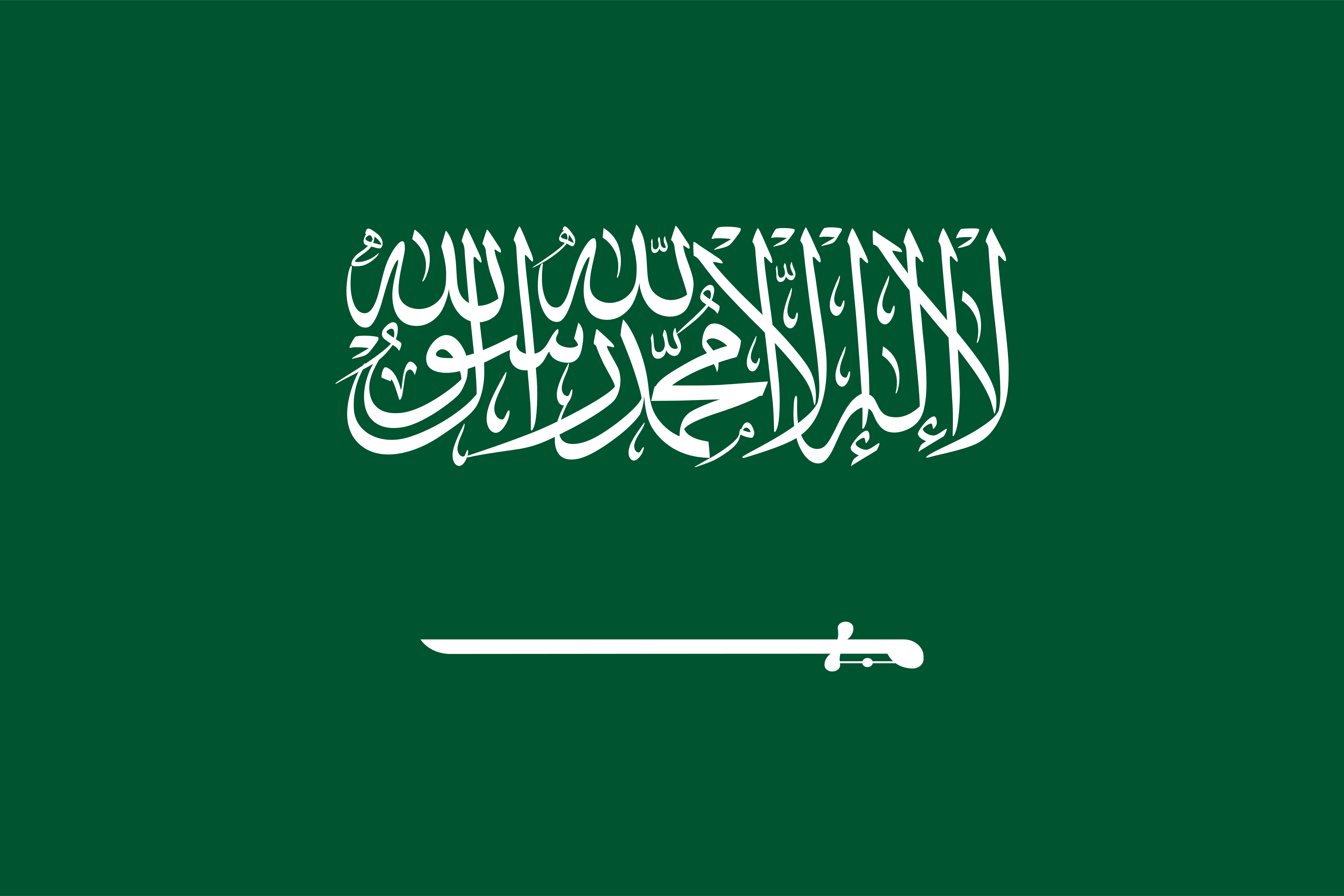
Saudi Arabia flag picture
Explore the construction notes, history, and picture gallery.
| Design | Green field; white Shahada and one swordThe Arabic declaration uses Thuluth calligraphy. |
|---|---|
| Proportions | Height:length = 2:3The national rectangle has no extra border or hoist strip. |
| Green reference | #005430 · RGB 0, 84, 48Ministry of Culture: Pantone 3425 C; textile 19-6026 TCX. |
| Historical milestones | March 11, 1937 / March 15, 1973Royal approval / Royal Decree M/3 approving the Flag Law. |
| Flag Day | March 11 each yearEstablished by Royal Order A/303 in 2023. |
| Main image sizes | SVG and PNGSVG: 4,500 × 3,000; PNG: 6,000 × 4,000. |
What does the Saudi Arabia flag look like?
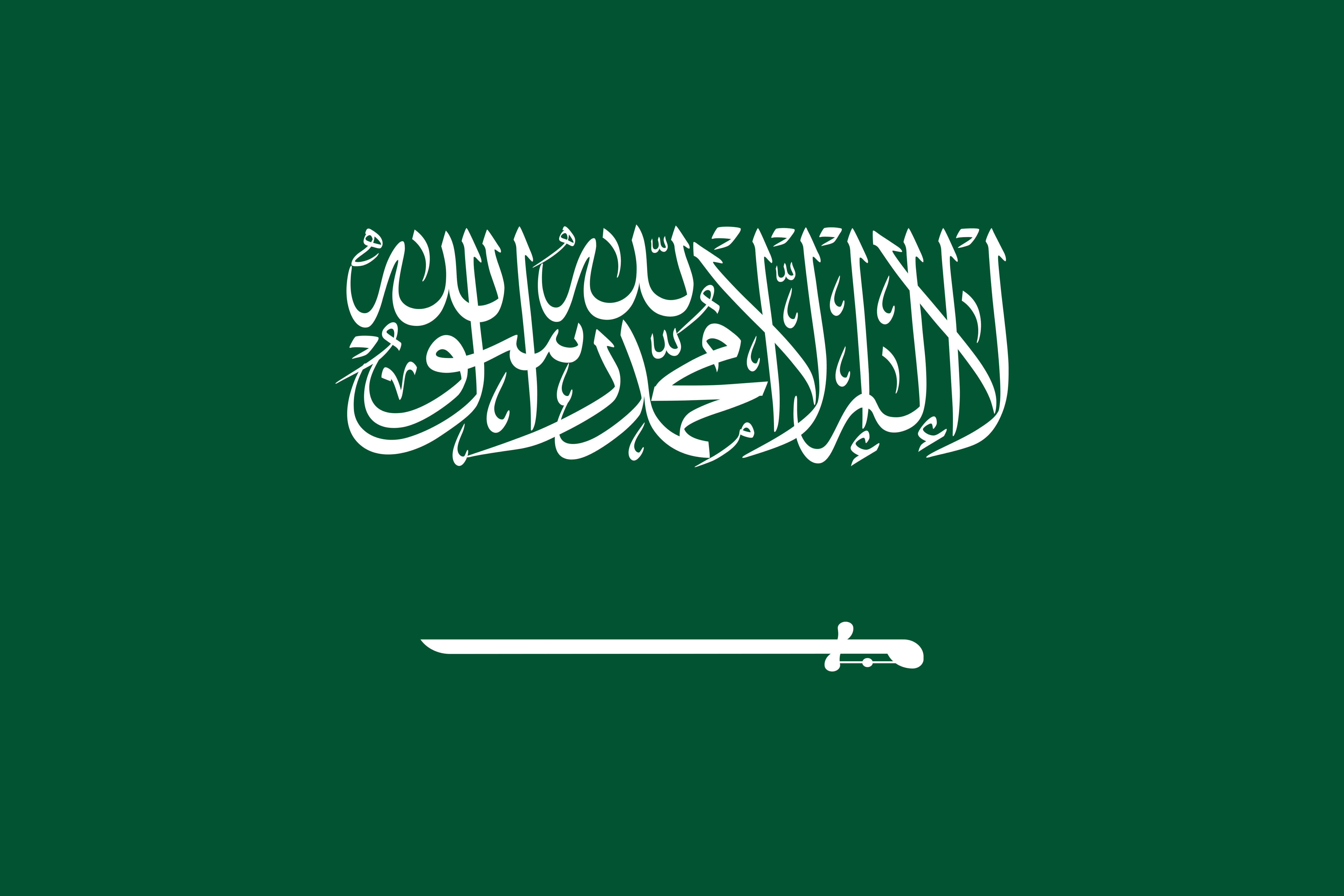
The flag of Saudi Arabia is green with the white Shahada, the Islamic declaration of faith, above one white horizontal sword. The inscription is in Thuluth calligraphy. Its height:length ratio is 2:3, and the published official view shows the sword’s point at left and its hilt at right.
The design joins a statement of faith with a symbol of authority and justice. The letters’ reading direction matters as much as the rectangle’s proportions. This guide explains the design, its history, and the distinctions between the ordinary flag, royal flag, and national emblem.
What are the colors of the Saudi Arabia flag?
Saudi Arabia’s flag has two colors: green for the field and white for the inscription and sword. The Ministry of Culture’s usage guide specifies green as RGB 0, 84, 48 and hexadecimal #005430. It also lists Pantone 3425 C, textile reference 19-6026 TCX, and a separate CMYK formula.

The guide calls the colors emerald green and snow white. Its explicit green values provide a stronger reference for these downloads than a shade sampled from a photograph. The white artwork uses pure digital white, #FFFFFF; the guide’s green specification table should not be misrepresented as a numerical table for both colors.
Color systems describe different processes. RGB serves screens, CMYK describes process printing, and Pantone identifies physical color references. A color-managed proof remains useful: an RGB triplet cannot guarantee that every printer, fabric, or viewing condition produces an identical appearance.
| Reference | Green | White |
|---|---|---|
| Hex / RGB | #005430 / 0, 84, 48 | #FFFFFF / 255, 255, 255 in these files |
| Pantone | 3425 C | Snow white; no numeric entry claimed |
| Textile | 19-6026 TCX | No textile code asserted here |
| CMYK in guide | 89, 15, 97, 56 | No numerical guide entry asserted |
What does green represent on the Saudi flag?
Saudipedia explains green as a symbol of growth and fertility. The green field also belongs to the long history of Saudi banners associated with the Islamic declaration of faith. These are related historical and symbolic contexts, rather than evidence that every detail of the present drawing existed unchanged in the earliest banners.
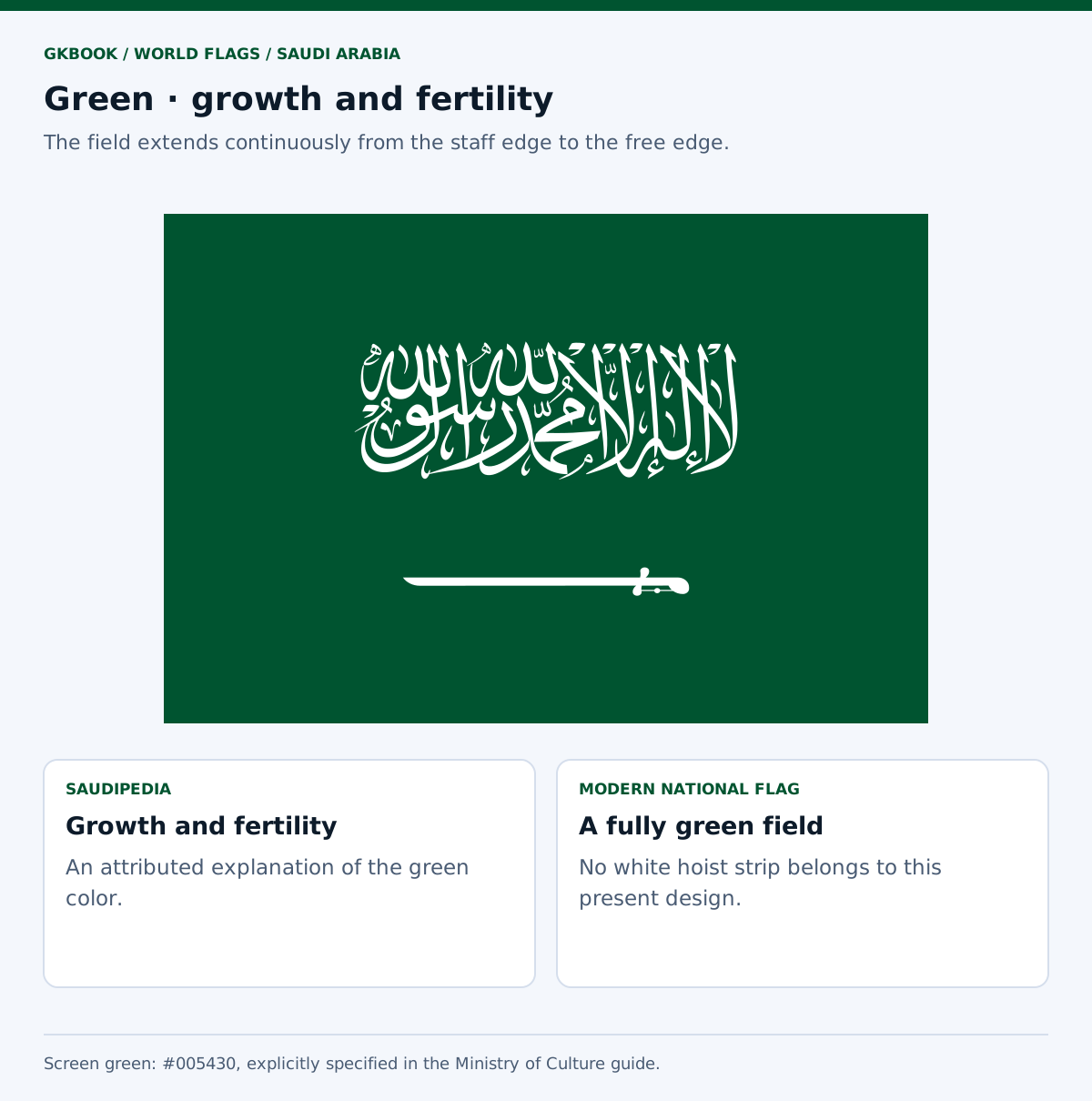
Green extends across the whole national flag, including the edge beside the staff. A white vertical strip appears in accounts of earlier Saudi banners, but it does not belong to the modern national master. Adding such a strip would combine elements from different periods and alter the flag described by the current guide.
The field remains a single flat color around the white symbols. Trees, landscapes, gradients, and textured fabric effects can belong in a photograph or illustration of a flag, but they are not additional elements of its design. The clean downloadable master therefore uses one consistent green throughout the rectangle.
What does white mean on the flag?
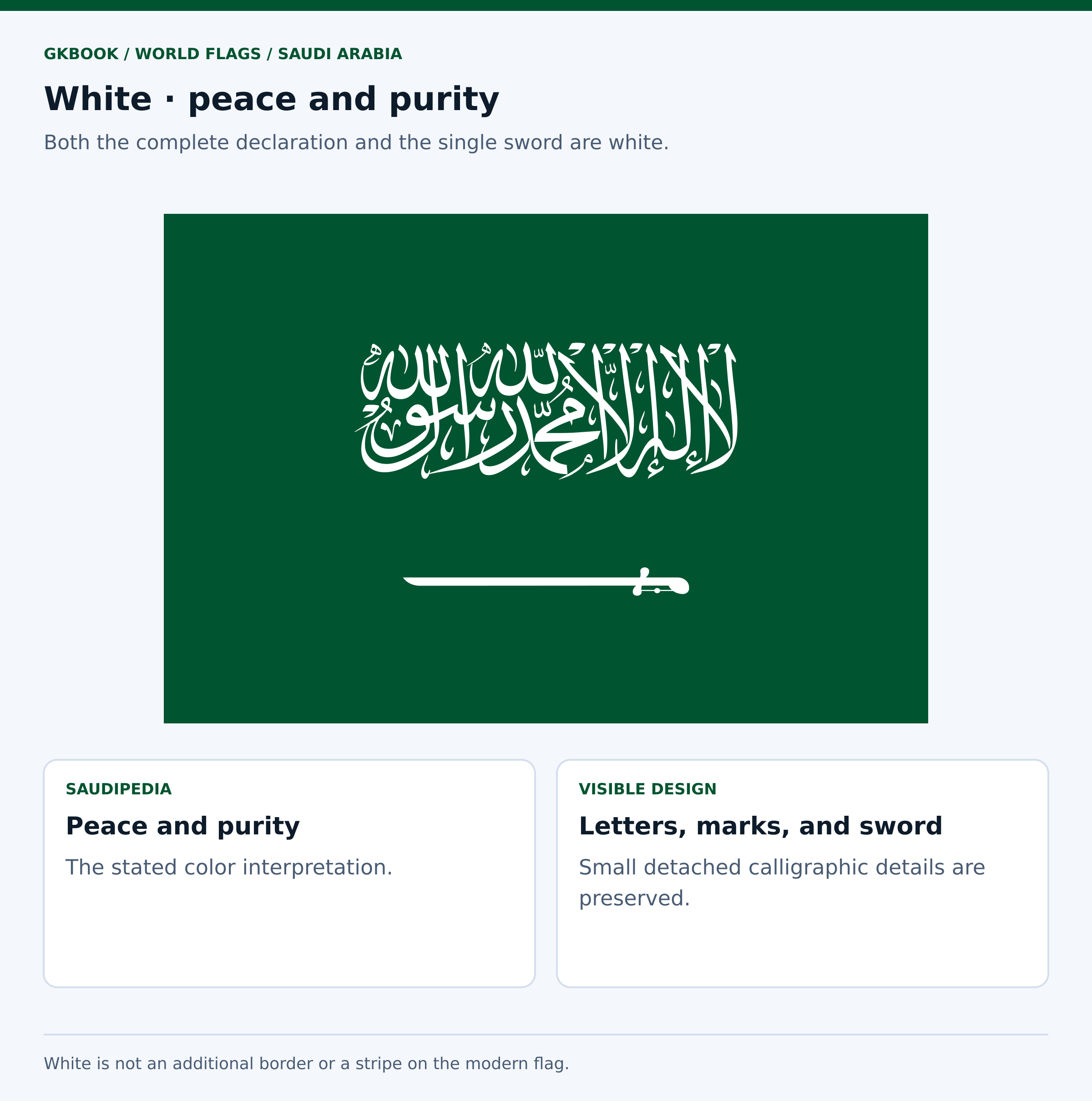
Saudipedia associates white with peace and purity. White forms both the Shahada and the sword, giving the two elements a clear visual relationship against the green field. It is not a separate stripe or border on the modern national flag, and the sword does not introduce a third color.
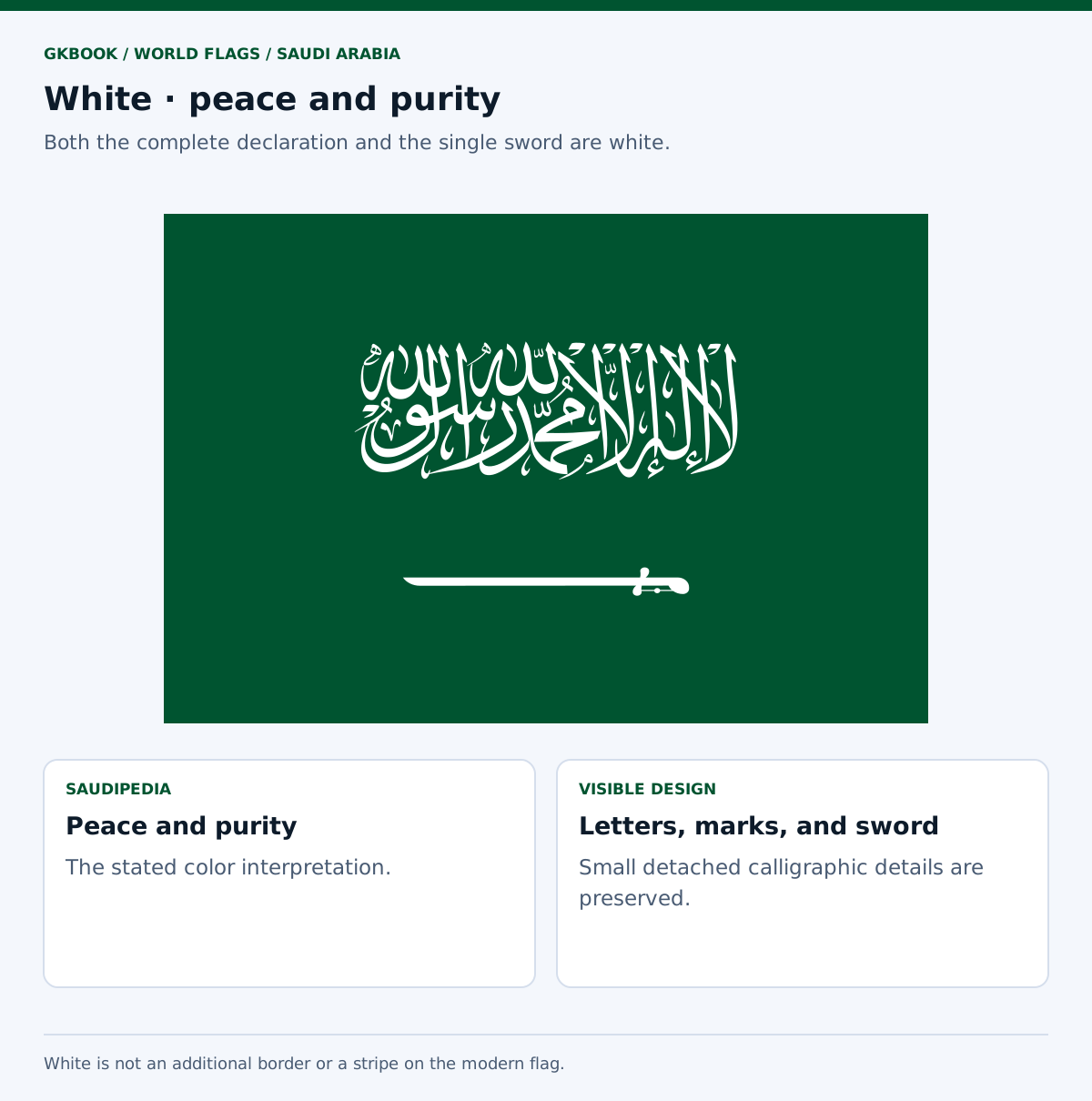
The same white applies to small marks within the calligraphic composition and to the larger letterforms. Fine details can disappear in a tiny thumbnail even when the original file is correct. A larger rendering improves legibility without changing the writing, widening individual strokes, or simplifying the religious declaration into a decorative pattern.
A white background in a page layout should remain visibly separate from the national rectangle. The social card places the complete flag within surrounding space. That layout treatment does not give the national flag a white frame, canton, or new heraldic component.
What does the Saudi Arabia flag symbolize?
The Shahada expresses Islamic faith, while the sword is associated with strength, justice, and security. The 2023 royal order establishing Flag Day emphasizes the flag’s religious meaning, dignity, and national unity. Saudipedia additionally associates green with growth and fertility and white with peace and purity; these explanations should retain their attribution.

The central writing communicates a specific declaration rather than a general decorative theme. The sword beneath it contributes another part of the national symbolism. Explaining the two together helps readers recognize the relationship between belief and state identity without turning every curve of the blade into an independently documented symbolic message.
Official and reference accounts emphasize different words. Strength, dignity, security, and justice are compatible descriptions, but they are not one verbatim sentence from a single legal article. Design rules establish the visible arrangement; explanatory texts supply its wider cultural and historical interpretation.
What is written on the Saudi Arabia flag?
The Arabic inscription is the Shahada: “لا إله إلا الله محمد رسول الله”. It declares belief in the oneness of Allah and in Muhammad as Allah’s messenger. On the flag, the words appear in white Thuluth calligraphy, with the complete inscription above the sword and intended to be clear on both sides.

In ordinary text, the phrase can be displayed as لا إله إلا الله محمد رسول الله. This plain text helps identify the words, but it is not a substitute for the flag’s particular calligraphic drawing. Letter shapes, spacing, stacked forms, and small marks contribute to the published composition.
Arabic reads from right to left in the normal horizontal presentation. When checking a photograph, a reversed image can be detected through the writing even if the green field looks familiar. The master artwork preserves the complete published inscription as vector paths, so it does not depend on an installed Arabic font.
What does the Arabic writing mean in English?
A standard English translation is: “There is no god but Allah; Muhammad is the Messenger of Allah.” The two clauses express the Islamic declaration of faith. English wording explains the Arabic inscription for readers, but translated words are not placed on the Saudi national flag and do not replace its calligraphy.

Allah is the Arabic word conventionally retained in this translation for God. English versions may vary slightly in capitalization or connective wording while conveying the same two declarations. The Ministry of Culture’s English guide provides the corresponding meaning, allowing the text to be explained without asking readers to interpret the calligraphy unaided.
For an educational layout, keep a translation in a caption or a separate text panel. This makes its status clear and leaves the flag itself complete. The illustrations follow that approach: explanatory English sits outside the rectangle, while the national design retains its green field, white Arabic declaration, and single sword.
Which calligraphic script is used on the flag?
The flag uses Thuluth, a style of Arabic calligraphy named in the official usage guide. The published inscription is a specific arrangement of letterforms and marks, not simply a line typed in any Arabic font. Accurate reproduction should preserve that complete arrangement, including the small detached shapes around the main strokes.
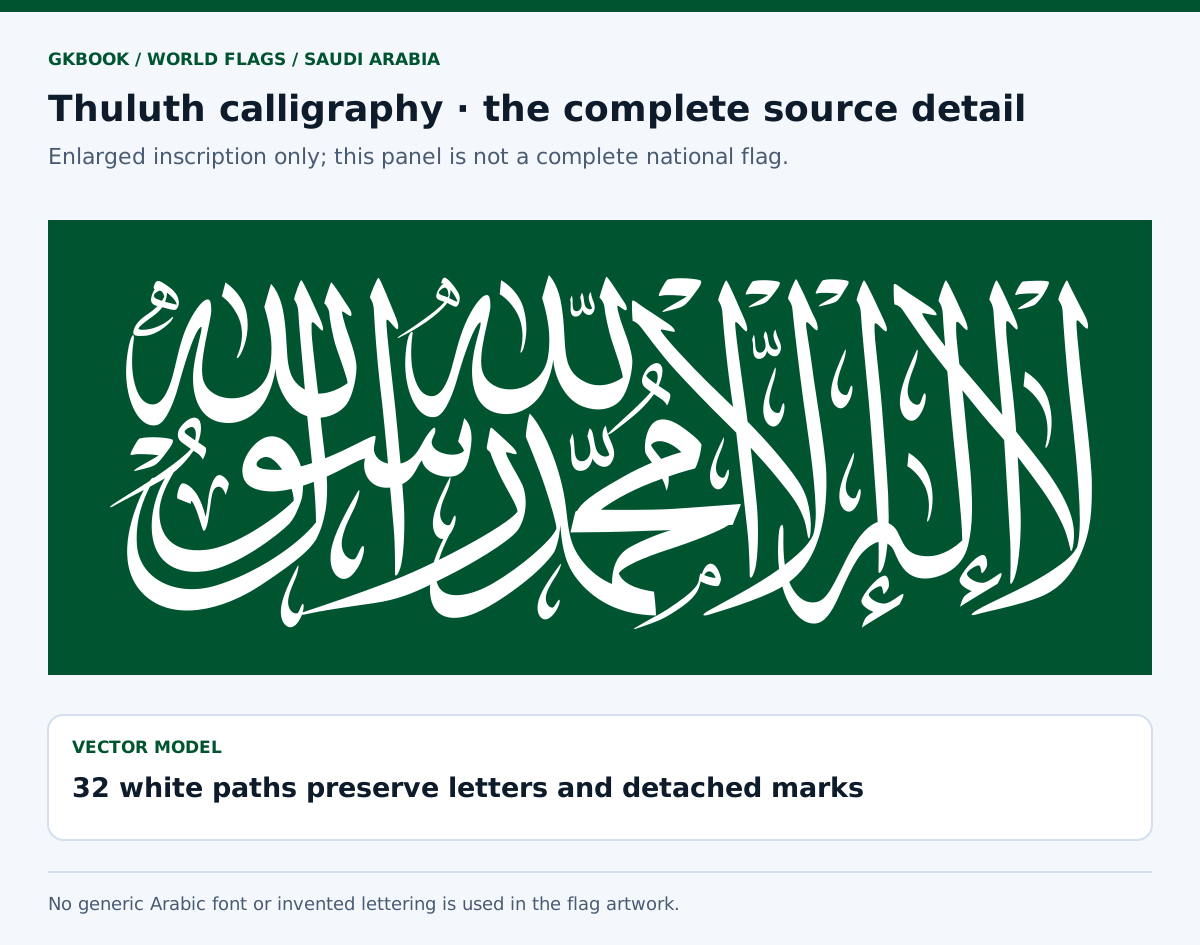
Calligraphy combines language with a designed visual composition. Replacing the official model with a generic font may preserve some words while changing their proportions, stacking, and relationship to the sword. A decorative imitation can also omit meaningful marks. Using the published vector artwork avoids both problems in the clean digital reference.
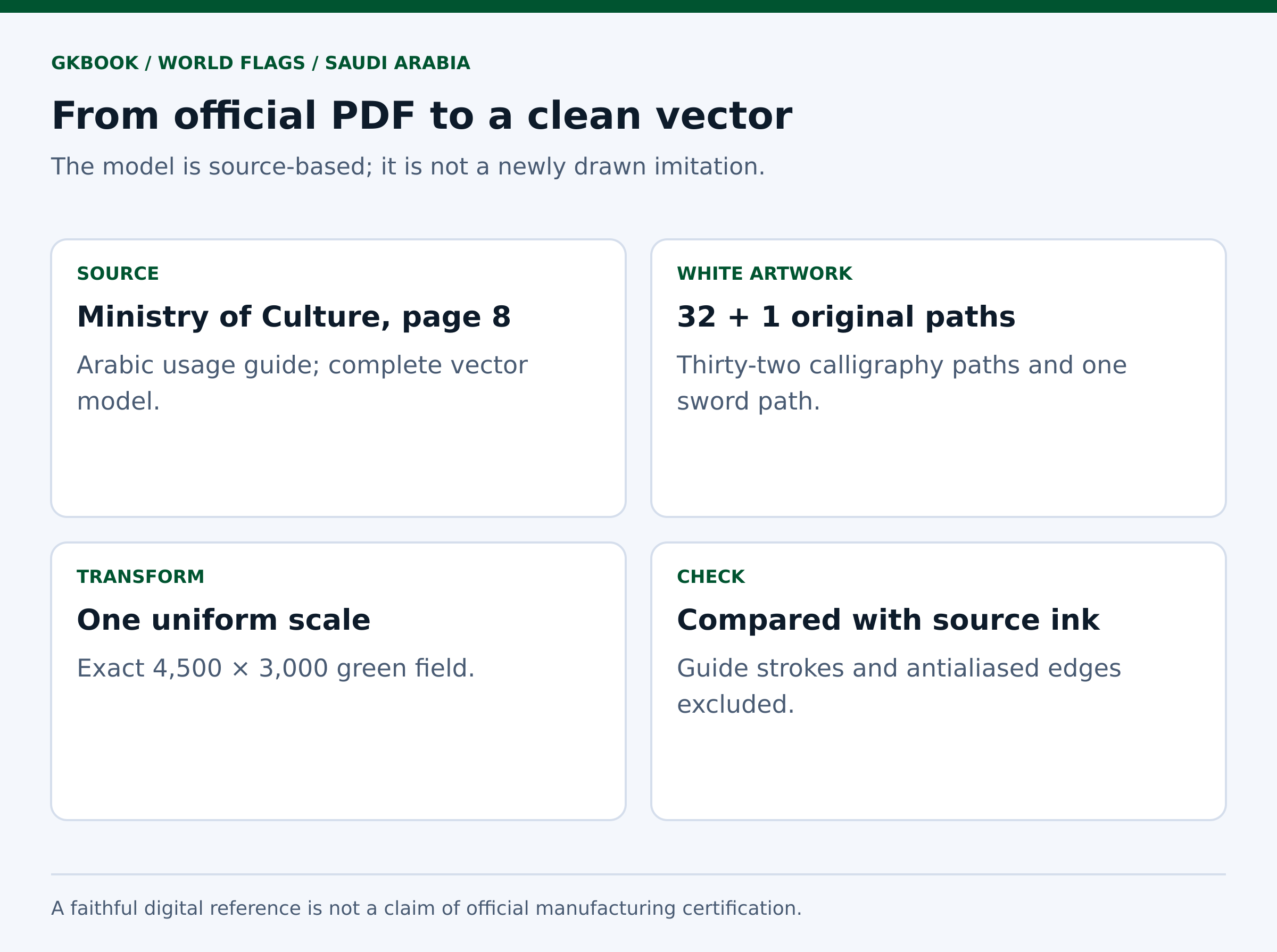
This edition retains thirty-two white paths for the calligraphy from the ministry’s Arabic guide, with the sword held as a separate thirty-third path. Those counts describe the source file’s construction, not a religious interpretation or a count of letters. They provide a practical way to check that no piece disappeared during extraction.
What does the sword on the Saudi flag represent?
The sword is associated with justice and security in Saudipedia’s explanation, while the Flag Day royal order also connects it with strength and dignity. Visually, it is a single white unsheathed sword beneath the Shahada. It should not be replaced with the crossed swords and palm tree of the separate national emblem.
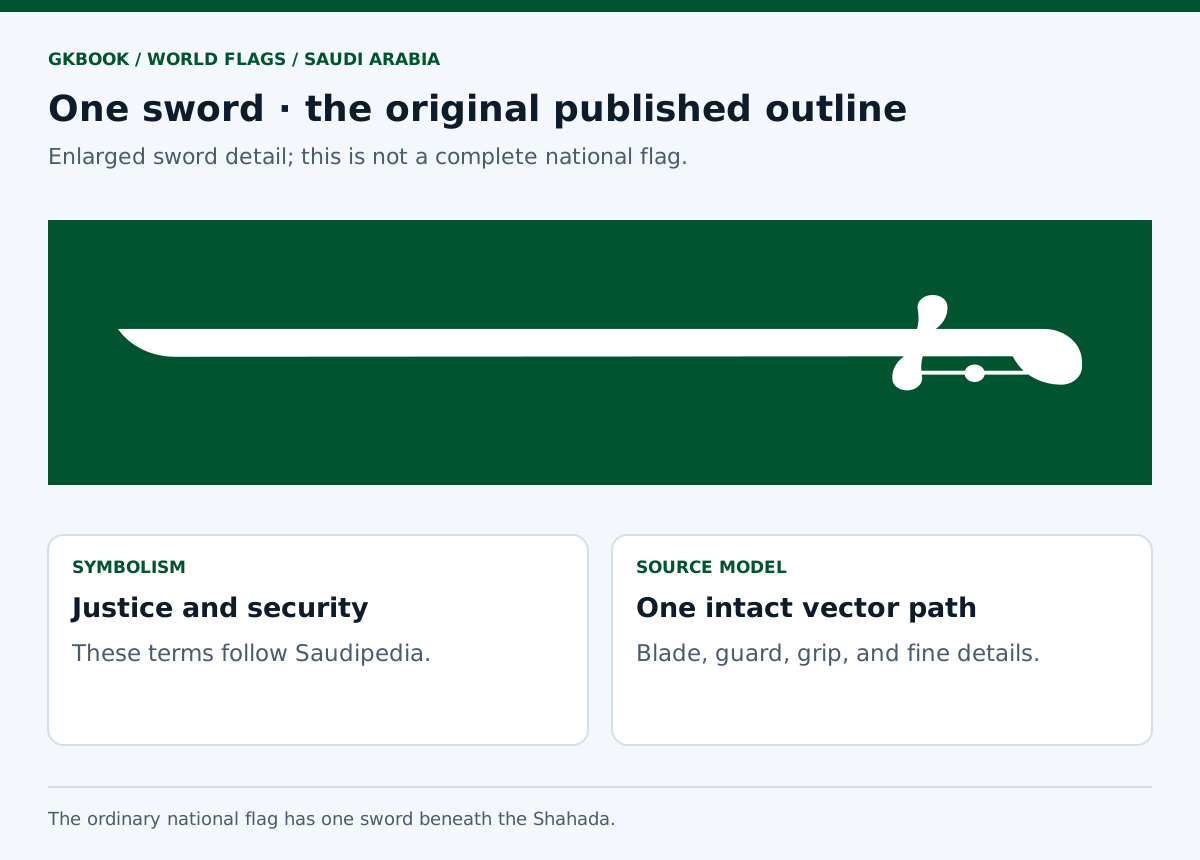
The published blade runs horizontally beneath the inscription and is broadly straight, with a shaped point and a detailed hilt. Its silhouette should be taken from the official model rather than replaced with a generic weapon icon. This preserves the relationship between the blade, guard, grip, and small details near the handle.
A symbolic explanation does not determine all manufacturing dimensions. The usage guide separately supplies a length relationship between sword and inscription, while its model supplies the outline. Reading those two kinds of information together gives a more accurate picture than relying on either a short meaning statement or a simplified silhouette alone.
Which way does the sword point?
In the Ministry of Culture’s published horizontal model, the sword points to the viewer’s left and its hilt is on the right. The inscription above it reads correctly from right to left. Preserve this complete published arrangement when using the standard image; do not flip the entire flag as a shortcut to another view.
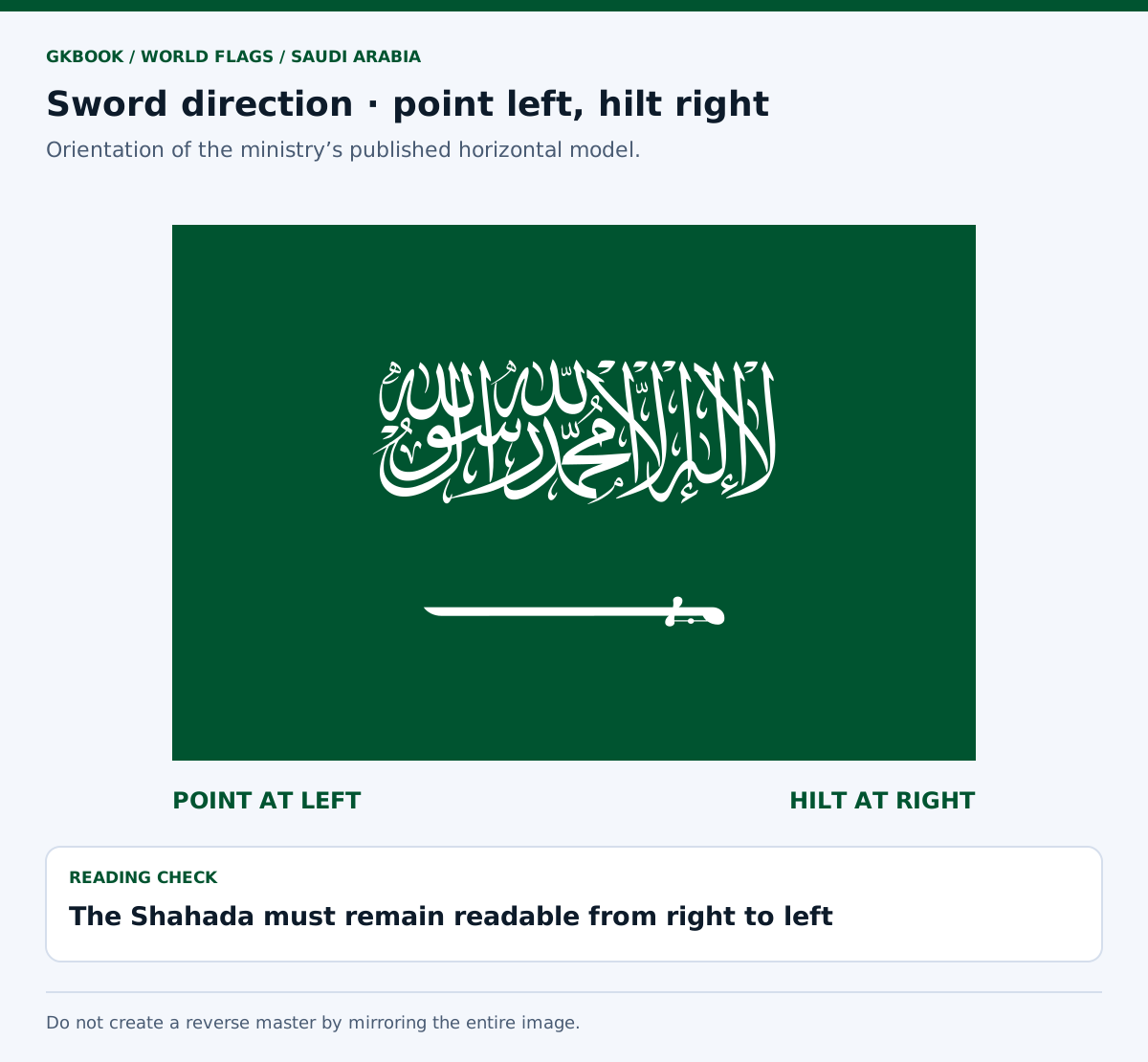
Viewer’s left and right describe the image in front of the reader. Hoist and fly instead refer to the edge attached to the staff and the free edge. Those terms can become confusing when a flag is seen from another side, so the diagrams use explicit point-left and hilt-right labels for the source view.
The Arabic inscription provides a decisive orientation check because a simple horizontal mirror reverses its letters. A physical flag must satisfy the requirement for clarity on both sides. An illustration of that requirement is different from a sewing specification, and this package does not invent a separate reverse manufacturing pattern from a mirror operation.
What is the Saudi flag’s official ratio?
The Saudi national flag has a height:length ratio of 2:3. Its horizontal length is one and a half times its height. A flag measuring 150 centimeters long and 100 centimeters high follows this relationship, as do the 4,500 × 3,000 SVG and 6,000 × 4,000 PNG masters provided here.

The legal and guide wording describes the shorter dimension as two-thirds of the longer dimension. Stating height:length removes the ambiguity that can arise when different sources use width for different sides of a rectangle. A 2:3 ratio and a length:height ratio of 3:2 describe the same shape from opposite directions.
The guide lists several practical sizes, including 150 × 100, 120 × 80, 30 × 20, and 24 × 16 centimeters when written length first. Each preserves the same proportion. The national design should scale uniformly between sizes; changing the rectangle alone would distort the spacing around the inscription and sword.
| Length | Height | Height:length |
|---|---|---|
| 150 cm | 100 cm | 2:3 |
| 120 cm | 80 cm | 2:3 |
| 30 cm | 20 cm | 2:3 |
| 24 cm | 16 cm | 2:3 |
How large are the inscription and sword?
The ministry’s construction diagram places the inscription and sword within a central block occupying nominally half the flag’s length and half its height. It specifies the sword’s length as three-quarters of the inscription’s length. Fine outline bounds in the published PDF differ slightly from these nominal guide relationships, so those measurements should be distinguished.

A construction block is not identical to every visible edge of a letter. Calligraphic strokes and marks can extend a little beyond a nominal guide, and the sword’s outline contains details at its ends. Measuring the outermost vector coordinates therefore produces slightly different numbers from reading the labeled relationships on the drawing.
The downloadable master preserves the ministry’s complete outlines under one uniform scale. It does not stretch the sword or move individual marks to force rounded relationships onto fine path bounds. This approach keeps the published artwork intact while making the distinction between nominal construction and actual digital contours explicit for careful readers.
Where are the white symbols placed?
The white inscription sits above the sword in the central portion of the green field. The ministry’s diagram shows balanced side margins and a central symbol block, with green space above and below. The sword runs parallel to the flag’s long edges, and neither element touches the outer boundary of the national rectangle.
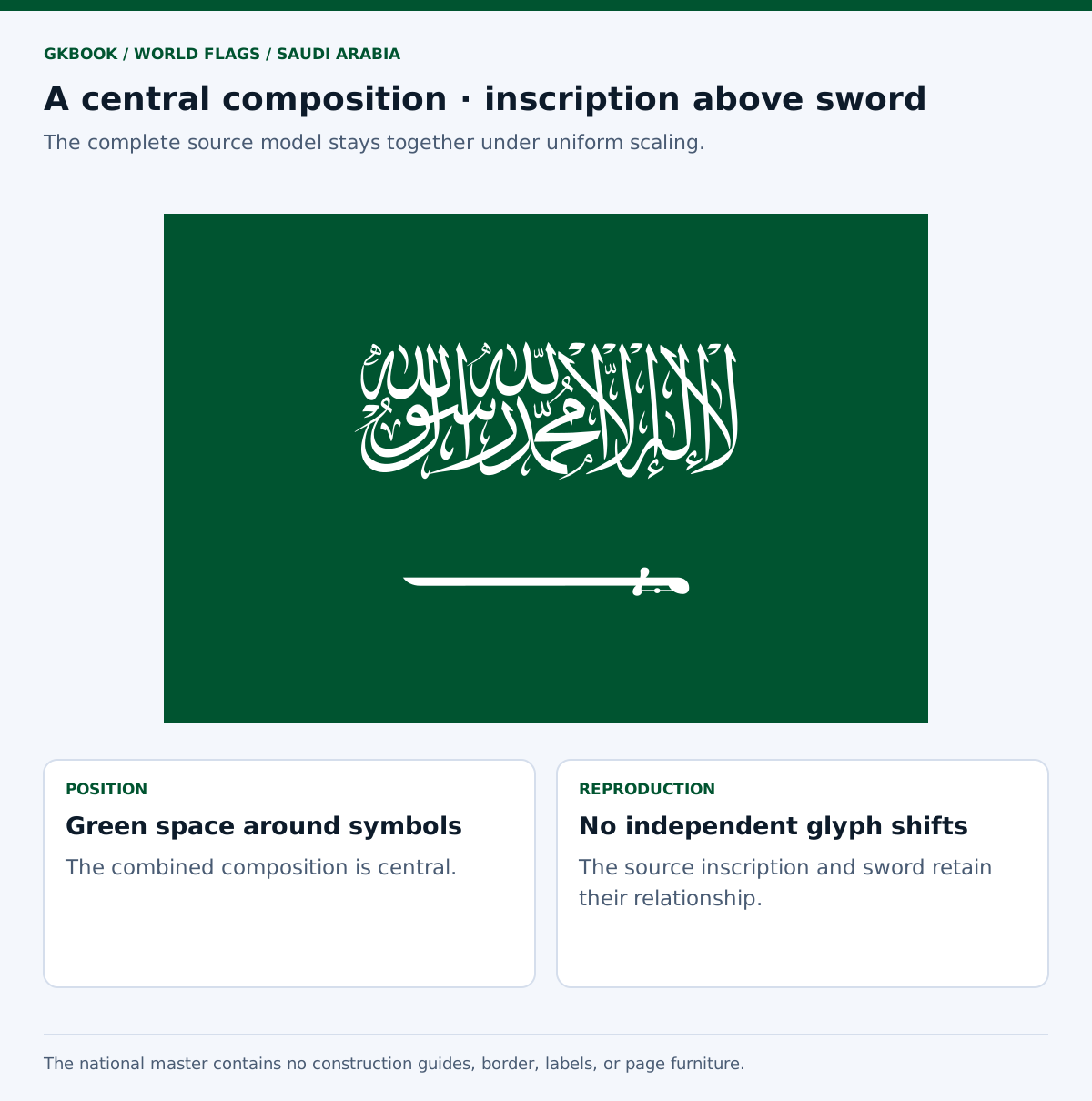
The calligraphy and sword work as a combined composition, even though their separate visible outlines have different widths and heights. Centering each object by an arbitrary software bounding box can change their relationship. Keeping the source model together preserves the intentional arrangement more reliably than rebuilding its placement from isolated approximate measurements.
For this digital edition, the source flag’s height determines one uniform scale, and its field is centered horizontally within an exact 3:2 rectangle. The tiny difference between the PDF diagram’s measured rectangle and the stated ratio is absorbed by the surrounding green field. The white paths themselves remain unchanged in shape.
How was the downloadable flag constructed?
The clean flag uses a 4,500 × 3,000 green rectangle and the thirty-three white vector paths extracted from the Ministry of Culture’s Arabic usage guide. The paths receive one uniform scale and translation. The exact 2:3 canvas and published green are fixed; small differences between nominal dimensions and source outlines are documented.
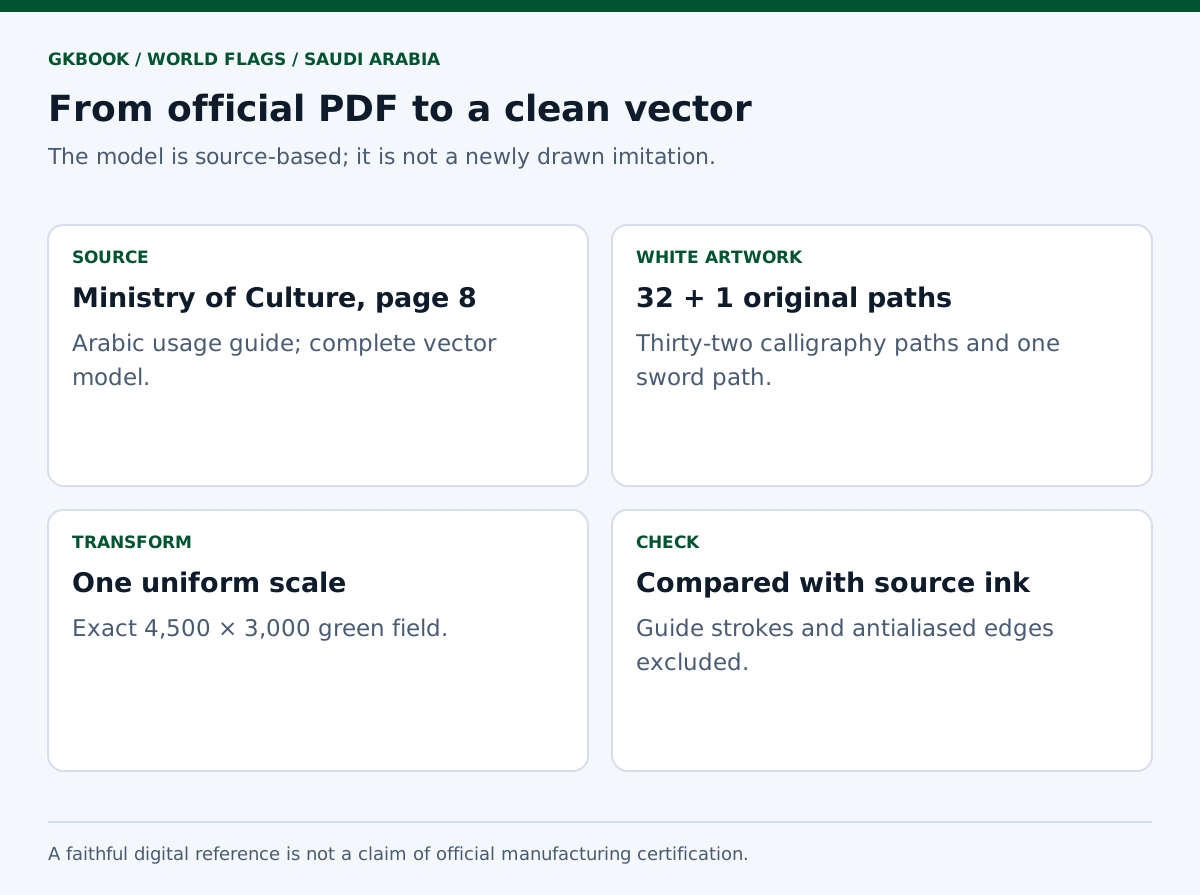
This is a source-based digital reproduction rather than a newly invented calligraphic interpretation. The original paths include both the large lettering and the detached marks. Guide lines, page furniture, and surrounding explanatory text are excluded from the national master, leaving only the solid field, the complete Shahada, and the sword.
The package records the source PDF’s identity, the extracted path attributes, the scale, and the resulting bounds. An independent raster comparison checks the extracted white shapes against the source page, excluding guide strokes and antialiased boundaries. These checks support faithful reproduction, while stopping short of claiming official certification for a manufactured flag.
What is the history of the Saudi flag?
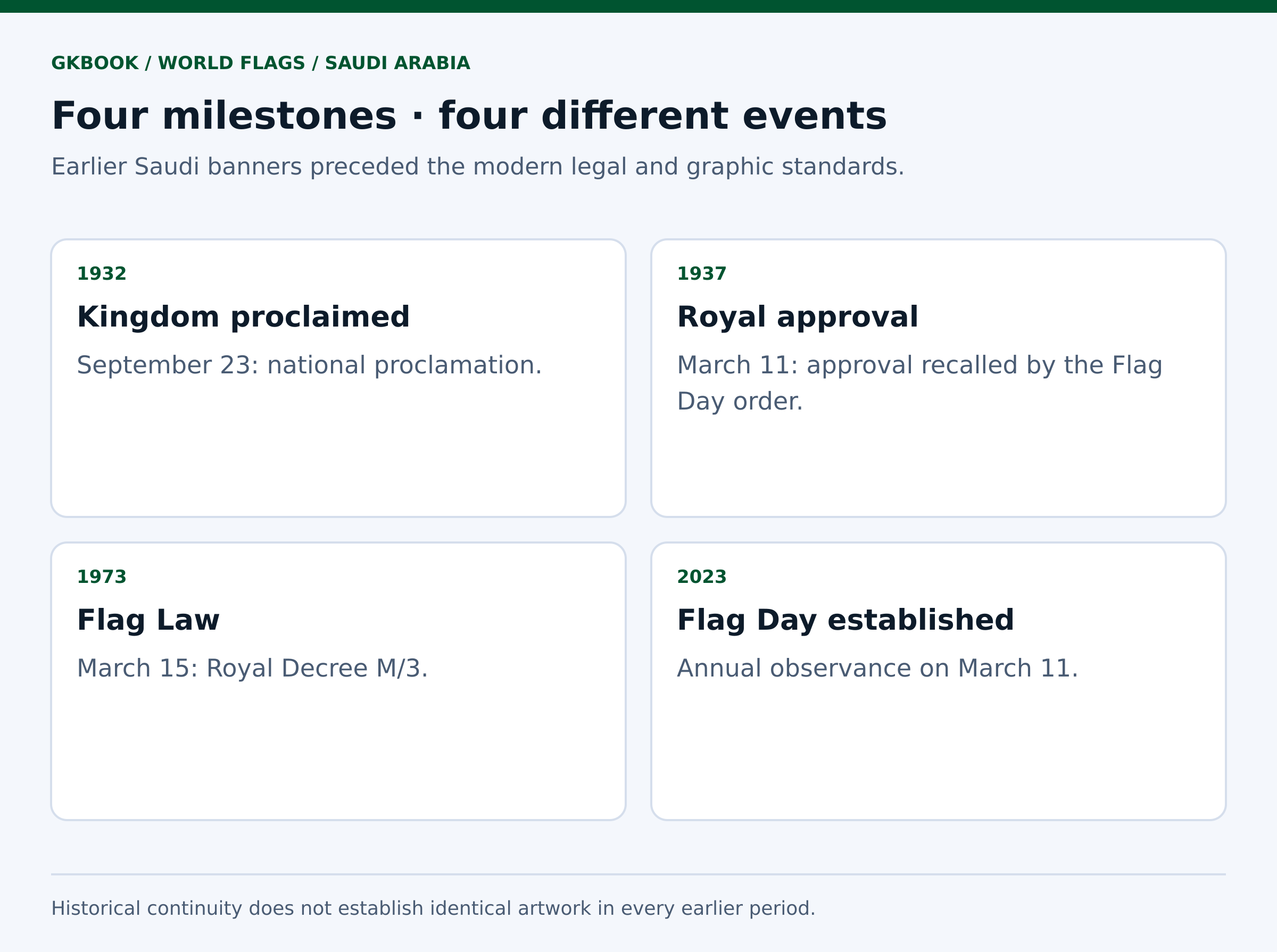
The modern flag developed from earlier Saudi green banners bearing the declaration of faith. The Ministry of Culture describes changes in shape, white hoist strips, and sword arrangements before the present design. Important later milestones include the kingdom’s proclamation in 1932, royal approval in 1937, and the Flag Law issued in 1973.

The guide connects the national banner with the First and Second Saudi States as well as the later unification led by King Abdulaziz. That continuity concerns identity and tradition; it does not establish that every historical banner used the exact modern calligraphy, sword contour, field proportion, or numerical green specification.
A useful timeline separates state formation from the approval and regulation of a national symbol. It also distinguishes an event from its later commemoration. These distinctions explain why several dates appear in responsible accounts without requiring one date to stand for every historical development.
When was the Saudi Arabia flag adopted?
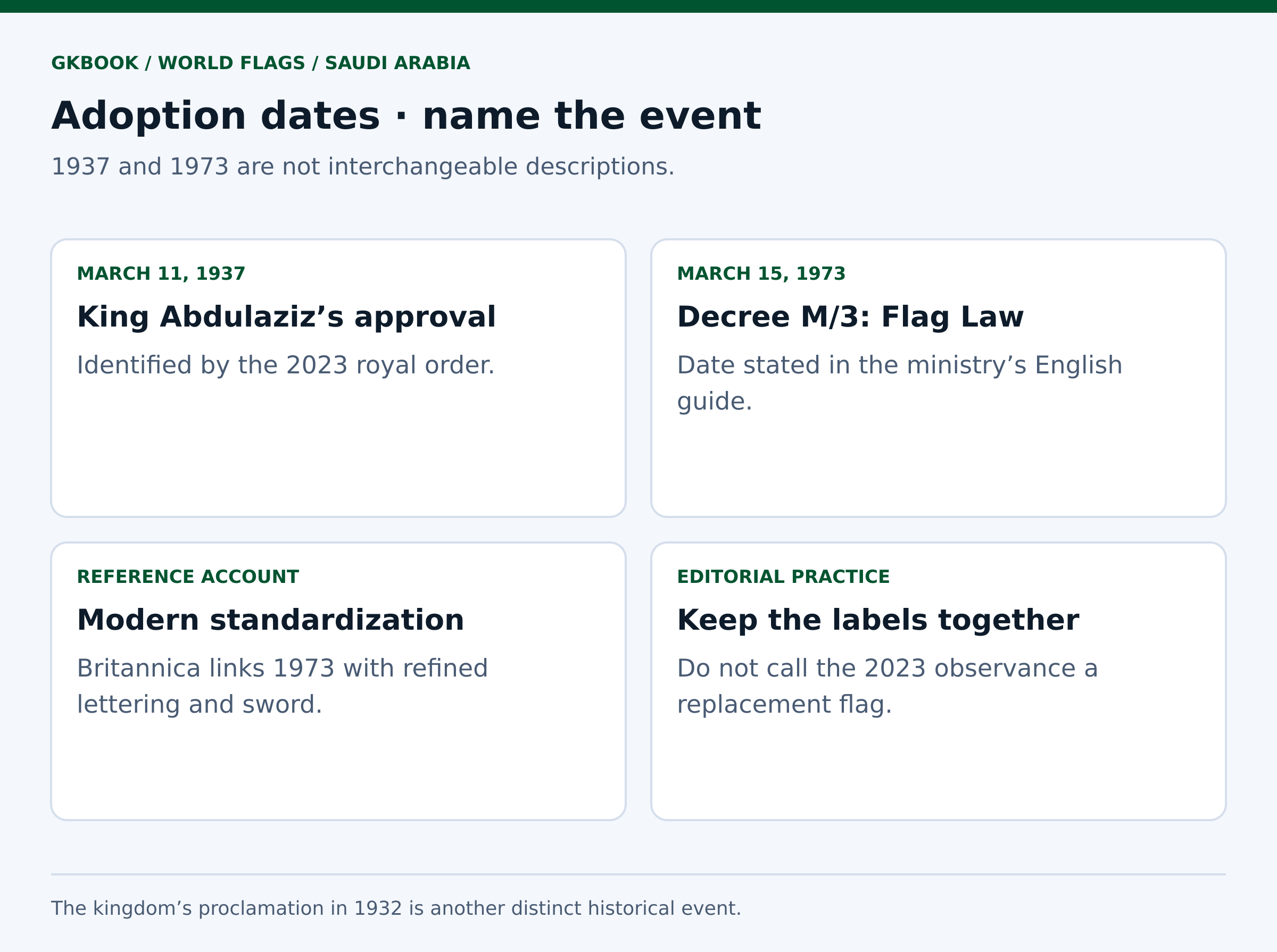
The royal order establishing Flag Day identifies March 11, 1937 as King Abdulaziz’s approval of the flag’s present form. March 15, 1973 is the date of Royal Decree M/3 approving the Flag Law, as stated in the ministry’s guide. These are distinct milestones, so an adoption answer should explain which event it means.

The 1937 event appears in the ministry’s historical account alongside a Shura Council decision and a 150 by 100 centimeter size. The 1973 decree provides the later legal framework. Britannica associates that later date with a standardized design using a smaller inscription and a straight-bladed sword, providing context for familiar modern adoption tables.
The safest concise chronology labels both events explicitly: design approval in 1937 and the Flag Law in 1973. A third date, 2023, concerns the establishment of the annual Flag Day observance. None of these labels should be silently substituted for the proclamation of the kingdom in 1932 or described as the first appearance of any Saudi green banner.
| Date | Event |
|---|---|
| September 23, 1932 | Proclamation of the Kingdom of Saudi Arabia |
| March 11, 1937 | Royal approval recalled by the Flag Day order |
| March 15, 1973 | Royal Decree M/3 approving the Flag Law |
| March 1, 2023 | Royal order establishing annual Flag Day on March 11 |
When is Saudi Flag Day?
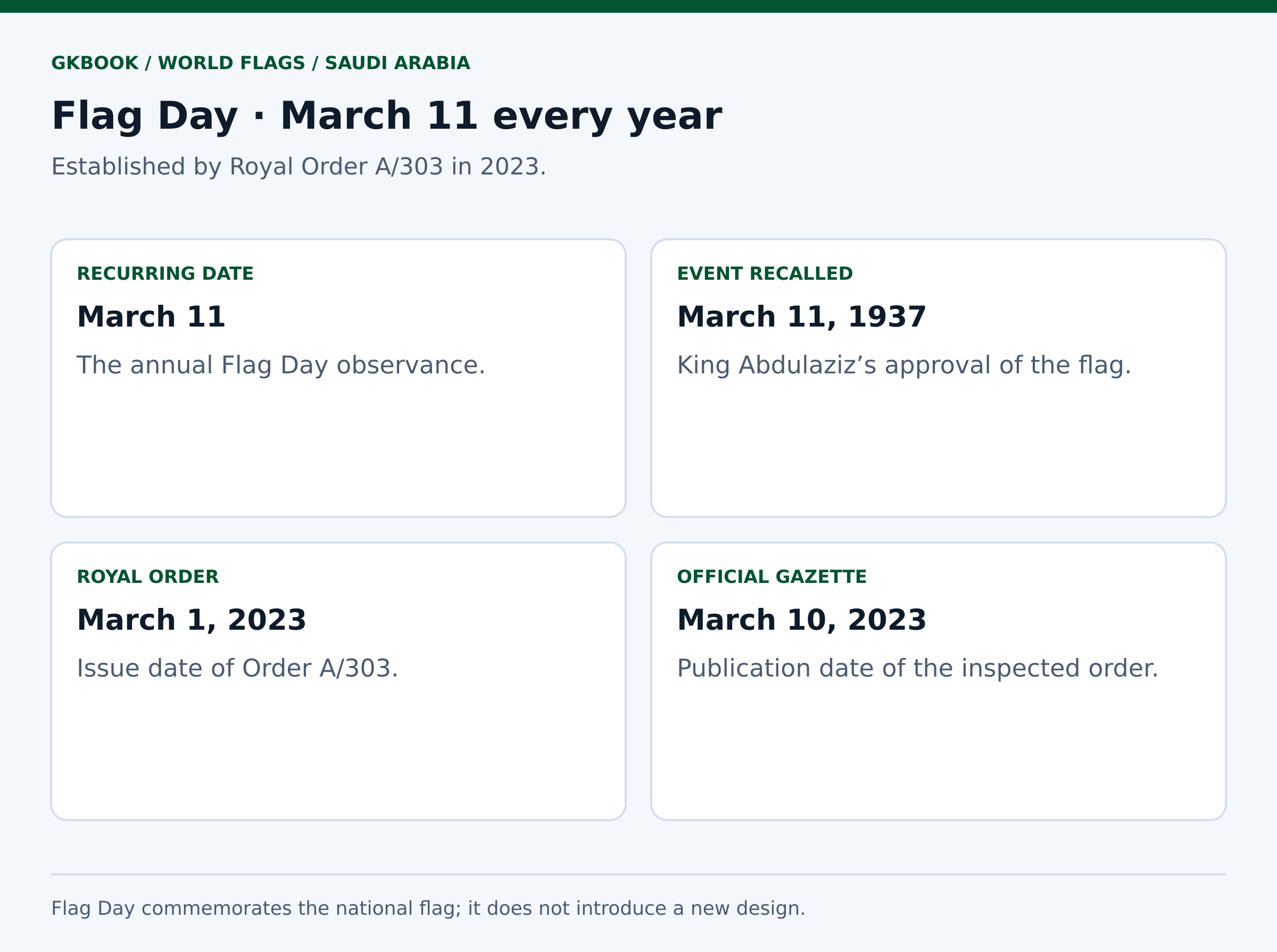
Saudi Flag Day is observed annually on March 11. Royal Order A/303, dated March 1, 2023, established the observance and connected its date with King Abdulaziz’s approval of the flag on March 11, 1937. The order created a commemoration; it did not introduce a replacement flag design in 2023.
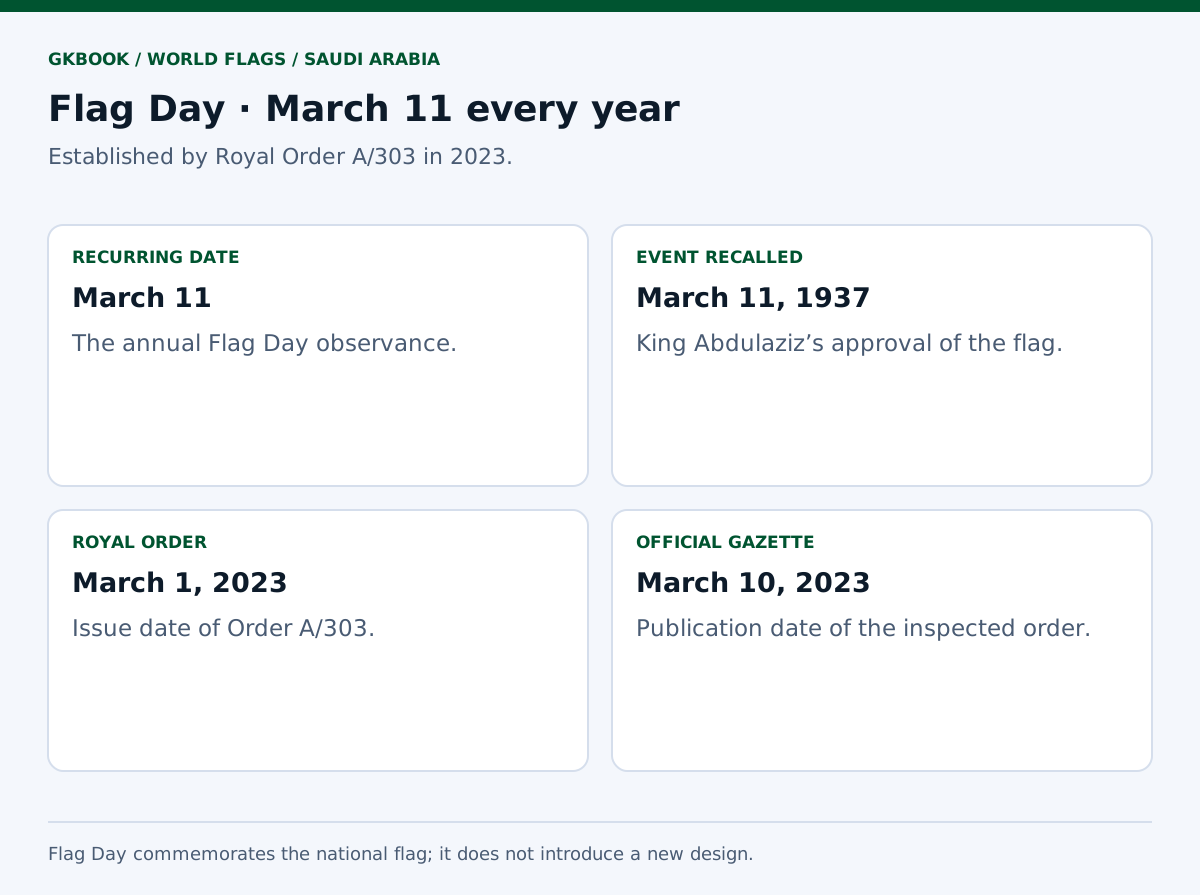
The order was published in the official gazette on March 10, 2023. Its issue date, publication date, and recurring observance date are three separate pieces of information. Keeping them separate prevents a common timeline error in which the newspaper’s publication date becomes the date on which the flag itself was approved.
Flag Day draws attention to the banner’s historical and national significance. The royal order discusses its religious declaration, the sword, and its role as a symbol of unity and pride. Those themes explain the purpose of the observance without changing the design rules that govern the field, inscription, sword, and proportions.
Is Flag Day the same as Saudi National Day?
No. Flag Day falls on March 11 and recalls the flag approval associated with 1937. Saudi National Day falls on September 23 and commemorates the proclamation of the kingdom in 1932. The flag can appear at both occasions, but the dates refer to different historical events and should not be combined in an adoption label.
An event photograph often shows the same national flag alongside signs, lighting, or a temporary celebration identity. Those surrounding graphics identify the occasion rather than modify the flag. A caption should therefore give the event’s name and date separately from the permanent national design visible within the photograph or illustration.
For a classroom timeline, placing the two annual observances on separate rows makes the distinction easy to remember. September concerns the kingdom’s national proclamation; March concerns the flag approval recalled in the later royal order. This also keeps a modern commemorative campaign from being mistaken for a historical flag variant or a new national emblem.
Who designed the Saudi Arabia flag?
A sole-designer attribution is not established by the evidence used here. The ministry describes an evolving national banner and institutional decisions, while a historian’s account published by King Saud University rejects reducing its origin to Hafiz Wahba alone. King Abdulaziz’s approval is a documented milestone, but approval and individual artistic authorship are different claims.
The university account cites the National Center for Documents and Archives in describing the flag’s development through Saudi institutions. That is evidence against treating a frequently repeated personal credit as settled history. It does not supply a signed original drawing for every element or identify one person as the author of all successive versions.
The artwork in this package therefore credits the national design to Saudi Arabia and identifies the Ministry of Culture as the publisher of the vector model used for reproduction. GKBook receives credit for the explanatory layouts. This separates national authorship, source publication, and the practical preparation of a modern educational download.
Did earlier Saudi flags look different?
Yes. The ministry’s historical account describes earlier green banners with a white hoist strip and different sword arrangements, including swords above the declaration. The present national flag has a fully green field and one sword below the Shahada. Historical continuity does not mean that every previous banner had today’s exact layout or dimensions.
A short historical description cannot by itself determine an authentic vector drawing of a particular old flag. It may omit the precise calligraphy, color shade, fabric shape, or date range. Reconstructing those details without further evidence would create a polished image whose apparent precision exceeded the documentation available for it.
The history illustrations consequently use chronology cards and the current national model. They explain documented changes without presenting speculative banners as archival facsimiles. A written historical description remains distinct from a surviving flag, photograph, or measured drawing that could support a more exact reconstruction.
What does the Saudi Flag Law regulate?
The Flag Law approved by Royal Decree M/3 in 1973 describes the national flag and regulates its display and treatment. The Ministry of Culture’s guide brings together design specifications and practical protocols. Among the principal requirements are clear white symbols on green, the stated proportions, respectful handling, and a prohibition on half-masting.
The guide identifies additional regulations issued after the law, showing that the basic decree is only one part of the practical framework. A general reference article can explain the main rules without pretending to reproduce every administrative provision or resolve every possible application involving buildings, diplomatic use, vehicles, ceremonies, or commercial products.
This page follows the ministry’s guide for visual examples and the main display principles. It does not reproduce historical penalty amounts as current enforcement advice. The emphasis is on accurate identification and respectful educational reproduction, with the evidence and its limits recorded separately.
Why is the Saudi flag never flown at half-mast?
The Saudi Flag Law prohibits flying the national flag at half-mast, and the Ministry of Culture’s guide repeats the rule. The flag bears the Islamic declaration of faith, which explains its distinctive treatment in official accounts. This prohibition concerns the mourning position on a staff; it does not mean a flag can never be lowered for care.

Half-masting is a specific display practice in which a flag is kept below its normal position. Routine removal, folding, replacement, and storage are different actions. Confusing these categories can turn a clear rule into the inaccurate statement that the Saudi flag must remain physically raised at all times and in every setting.
An illustration should communicate the rule without presenting a half-masted Saudi flag as an acceptable ceremonial example. The gallery therefore uses a complete upright national image and a separate explanatory panel. It also avoids the unnecessary claim that no other flag anywhere has a comparable rule, which is not needed to explain Saudi practice.
How should the Saudi flag look from the reverse?
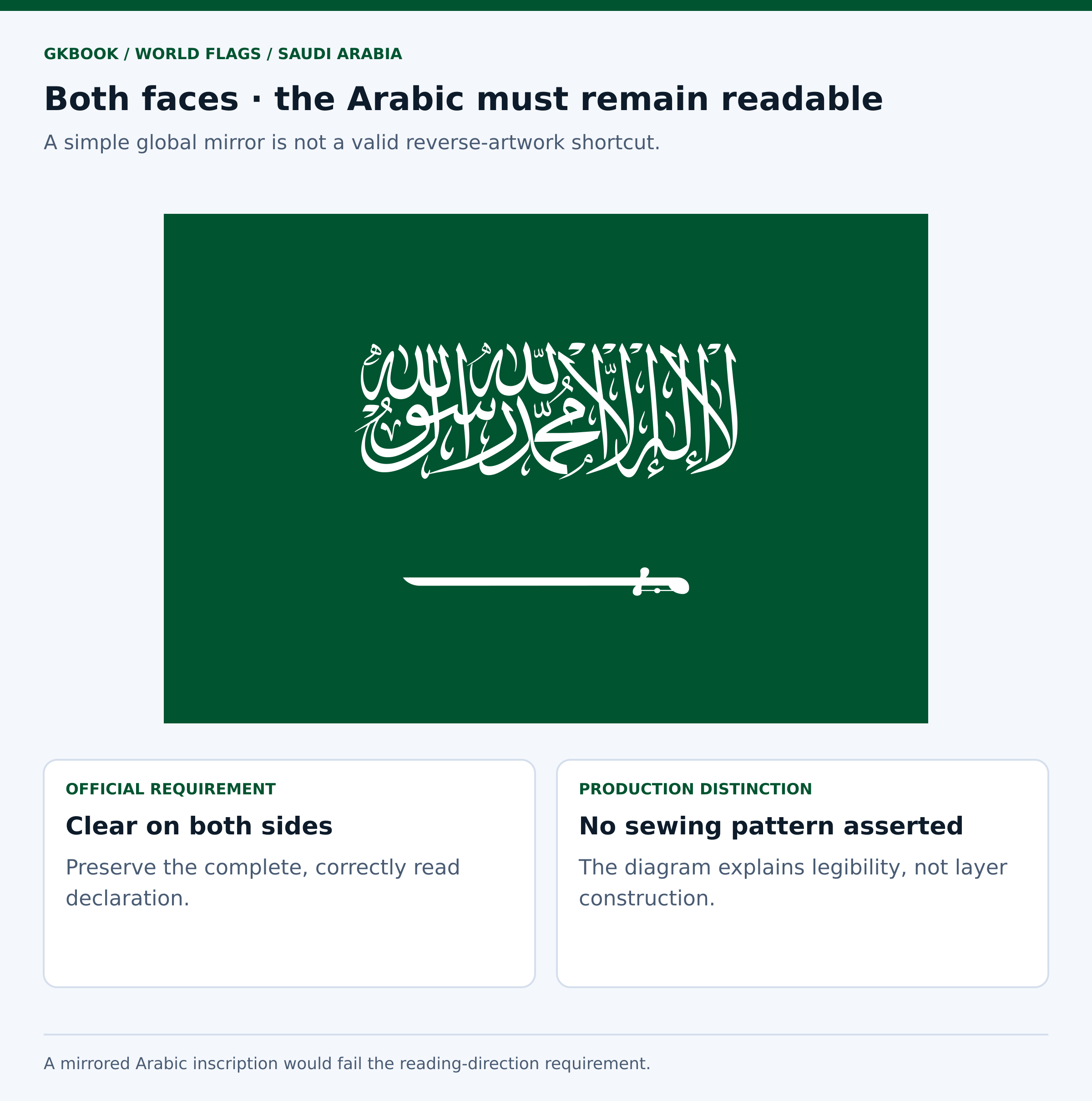
The Shahada and sword must be clear on both sides, as the official description requires. In particular, the Arabic declaration must remain readable rather than becoming mirrored lettering. A simple horizontal flip of the standard artwork is therefore unsuitable as a reverse master; physical construction must preserve the required reading of the inscription.

Many flags with only bands or symmetric shapes can be illustrated from behind by reflecting the entire image. The Saudi flag requires additional care because its written declaration carries meaning. A mirrored screen preview may still look superficially familiar while failing the most important linguistic part of the design.
The reverse diagram in this set explains the requirement using readable source artwork and a separate text panel. It does not pretend to supply a detailed sewing pattern for layers, seams, or separate faces. Those production choices should be resolved against the official specification and the manufacturer’s process while retaining the complete, correctly read declaration.
Can the Saudi flag be displayed vertically?
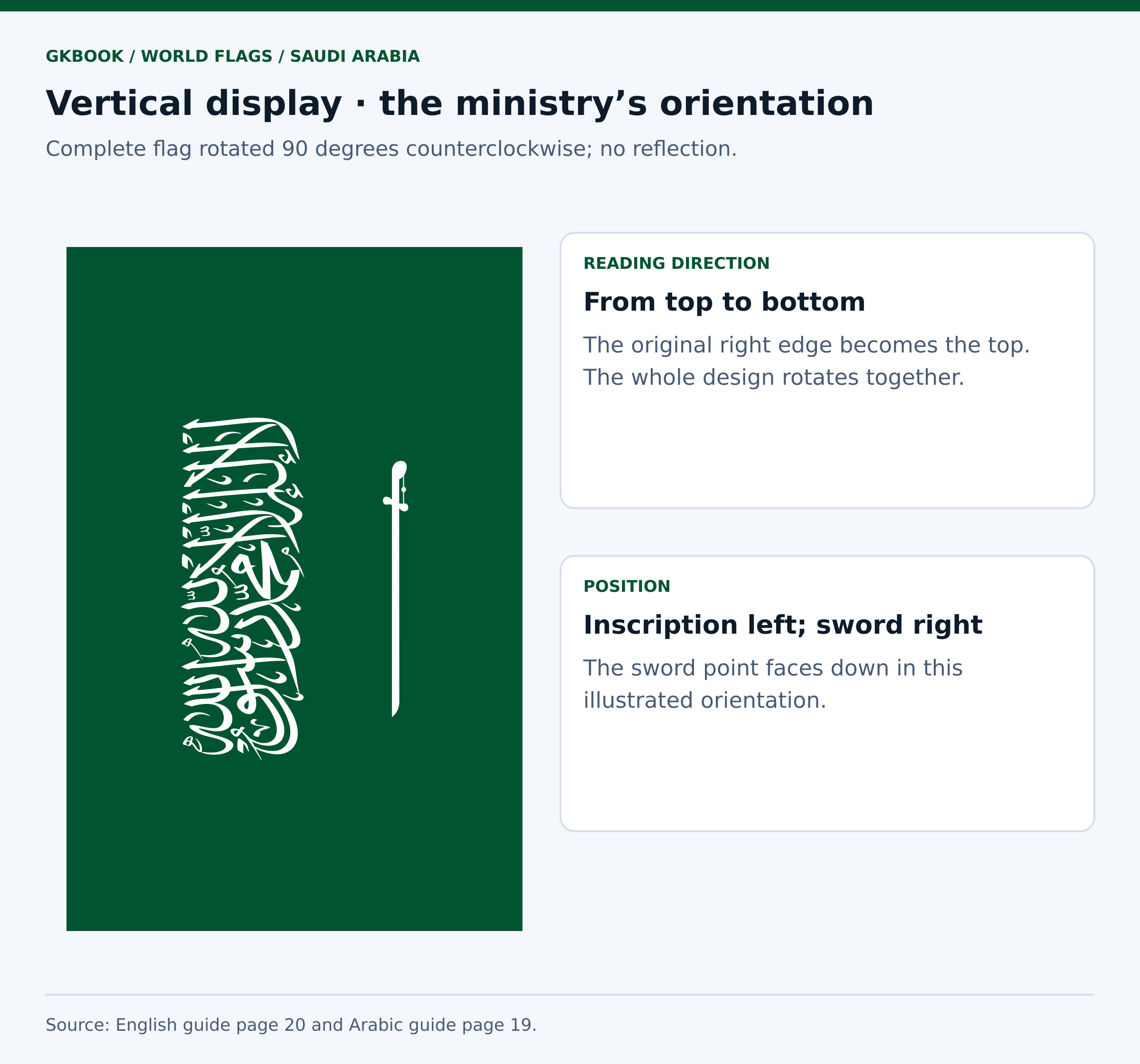
Yes. The Ministry of Culture’s usage guide includes a vertical display and specifies that the Shahada and sword read from top to bottom. In its illustrated orientation, the inscription is to the viewer’s left of the sword. Follow that published arrangement; older blanket claims that the flag must never be displayed vertically conflict with this guide.

Starting from the published horizontal view, a ninety-degree counterclockwise rotation produces the illustrated vertical arrangement. The original right side becomes the top, the sword lies along the viewer’s right, and its point faces downward. The diagram rotates the complete flag uniformly, preserving every part of the declaration and the relationship of the two symbols.
Rotation is different from reflection: a rotation changes the orientation of the whole rectangle without reversing the letters within it. The vertical teaching image demonstrates the ministry’s example rather than a new national design. Display decisions should also account for the particular setting and the guide’s broader provisions for placement and respectful treatment.
How should the Saudi flag be handled and cared for?
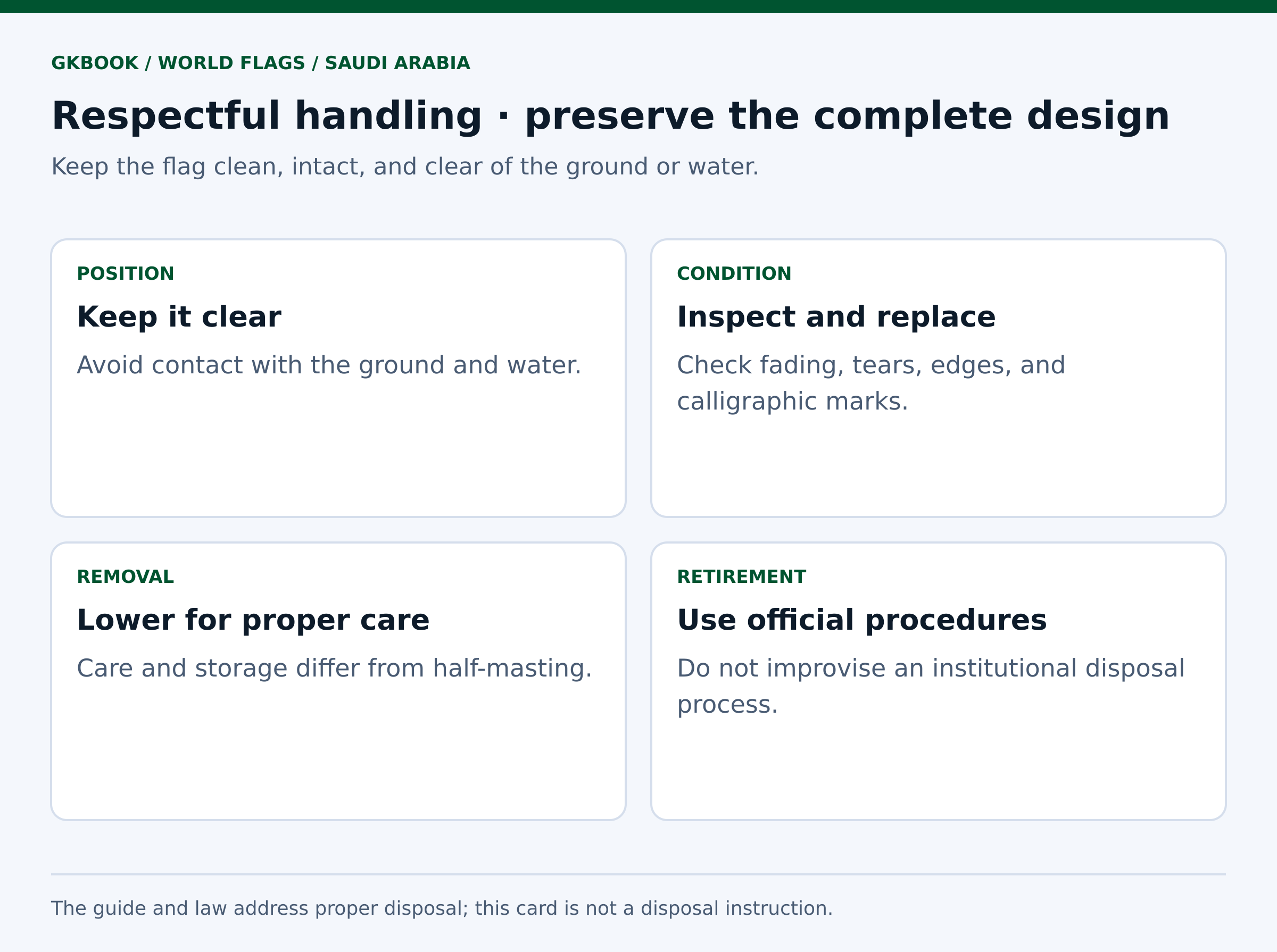
The guide calls for respectful handling: keep the flag from touching the ground or water, maintain it in good condition, and replace a damaged or faded flag. Lowering it for proper care is different from half-masting. Folding, storage, and retirement should follow the responsible institution’s procedures rather than improvised or disrespectful handling.

Inspect a physical flag for wear, discoloration, and damage to the inscription as well as to its edges. A tear through a small calligraphic mark can affect the declaration even when most of the cloth remains intact. The condition of the whole design matters, not just whether a green rectangle is still recognizable.
A retired flag also deserves a controlled process. The inspected law and guide discuss official disposal, so the common absolute claim that a Saudi flag can never be destroyed is misleading. This article does not turn that administrative process into a household instruction; institutions should apply the procedure that governs their own flags.
What uses of the Saudi flag should be avoided?
The guide prohibits disrespectful treatment, inversion as a distress signal, and additions that alter the national flag. It also restricts commercial advertising and trademark use. Keep slogans, logos, and decorative additions outside the flag itself, and do not assume that downloading an educational image grants unrestricted rights to place it on every product.
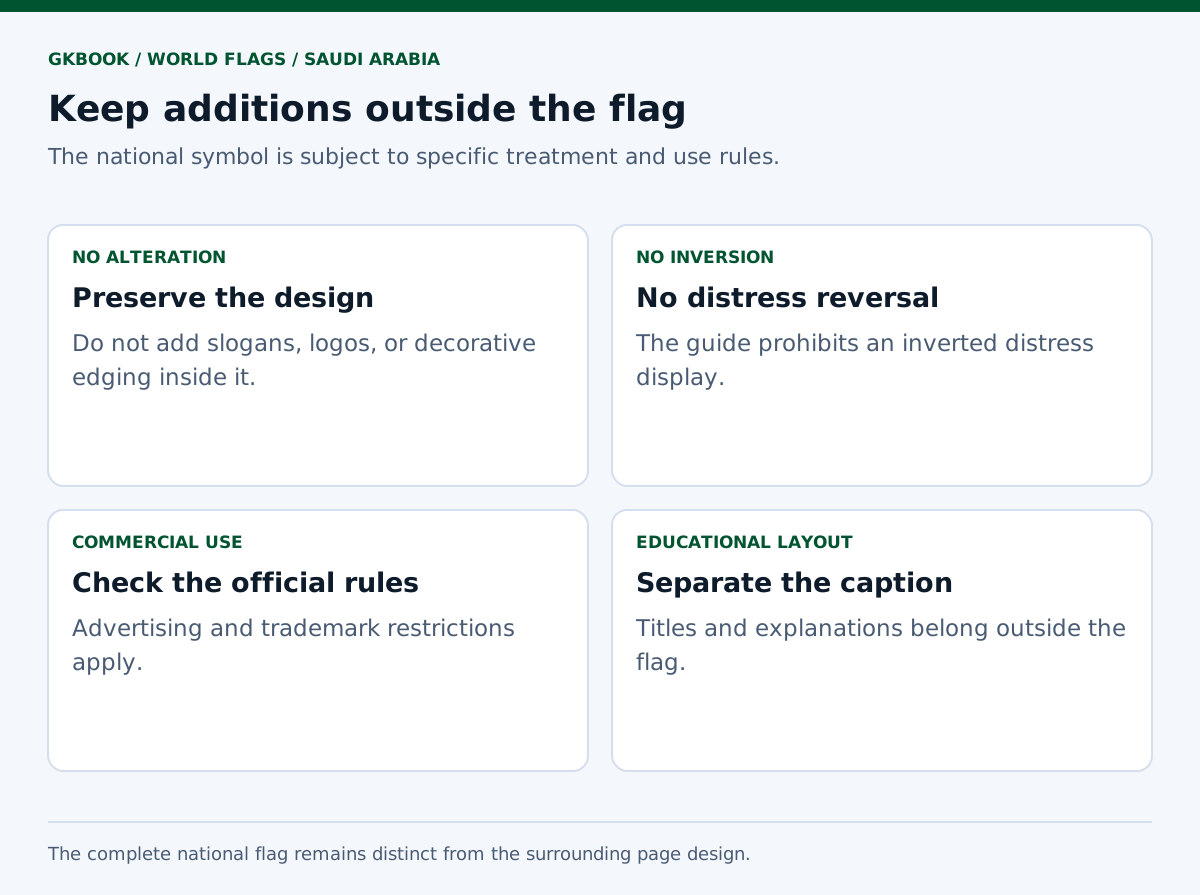
A national symbol has a role beyond ordinary graphic decoration. Placing writing over the Shahada, replacing the sword with a brand mark, or adding an ornamental border changes the design rather than simply resizing it. An educational layout can communicate a topic through surrounding text while leaving the actual national rectangle complete.
Online, captions and surrounding space identify where the national flag ends and the page design begins. The social image follows this principle with its GKBook label outside the flag. Specific commercial or ceremonial applications may require a detailed check of the relevant official provisions.
How does the royal flag differ from the national flag?
The king’s flag follows the national flag’s general design but adds the Saudi emblem in gold in the lower corner beside the staff. The ordinary national flag has no gold palm tree or crossed swords. A photograph showing that added emblem should therefore be identified carefully instead of being used as a generic national-flag master.
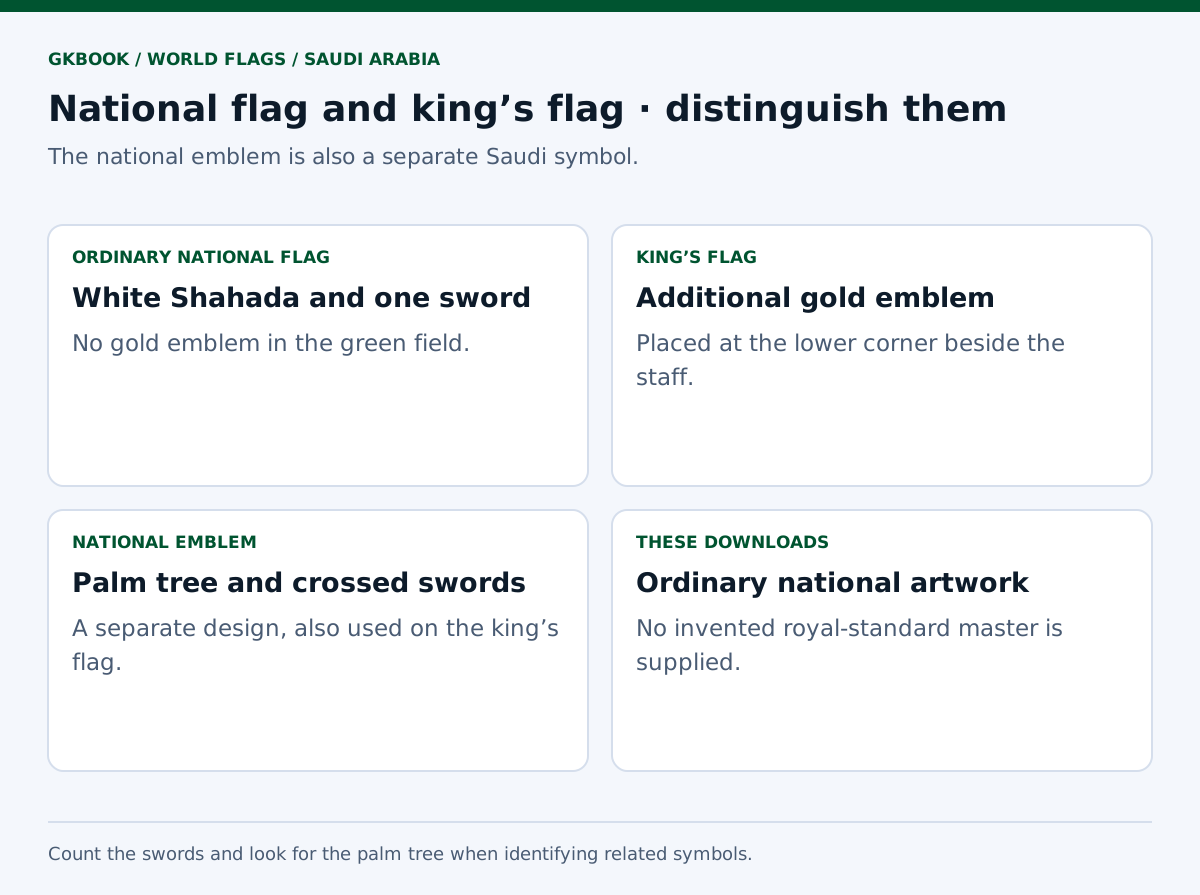
The guide treats the king’s flag as a distinct official flag, with its own illustration. The additional emblem identifies a particular royal use and is not an optional embellishment for ordinary flags. Removing or adding it changes which official design is being represented, even though the green field and central declaration remain recognizable.
The gallery explains this distinction with text cards rather than inventing a new drawing of the royal standard. All complete national flags in this package retain only the white Shahada and single white sword. This keeps the downloadable national artwork unambiguous while helping readers interpret the related design when they encounter it elsewhere.
Is the palm tree and crossed-swords emblem on the flag?
No. Saudi Arabia’s national emblem consists of a palm tree above two crossed swords, but that emblem is separate from the ordinary national flag. The flag carries the white Shahada above one horizontal sword. Confusing the two symbols can lead to an incorrect flag image, especially when adapting a government crest or a royal-flag photograph.
The distinction is also reflected in the Basic Law’s separate provisions for the flag and the state emblem. Both represent Saudi Arabia, but they are not interchangeable pictures. A government document may display the emblem without being a flag, just as a national flag may appear without the emblem anywhere in its field.
For visual identification, count the swords and look for the palm tree. A single horizontal white sword beneath Arabic calligraphy belongs to the ordinary national design. Crossed swords with a palm tree indicate the emblem, whether it appears alone, within an institutional identity, or as the additional gold feature on the king’s flag.
How should the flag be used in digital artwork?
Use the complete SVG for scalable artwork or the 6,000 × 4,000 PNG for a large raster image. Preserve the 2:3 height:length ratio, the published green, and readable Arabic. The ministry also provides specific digital crop treatments, but this package’s clean master and social card retain the complete rectangular national flag.
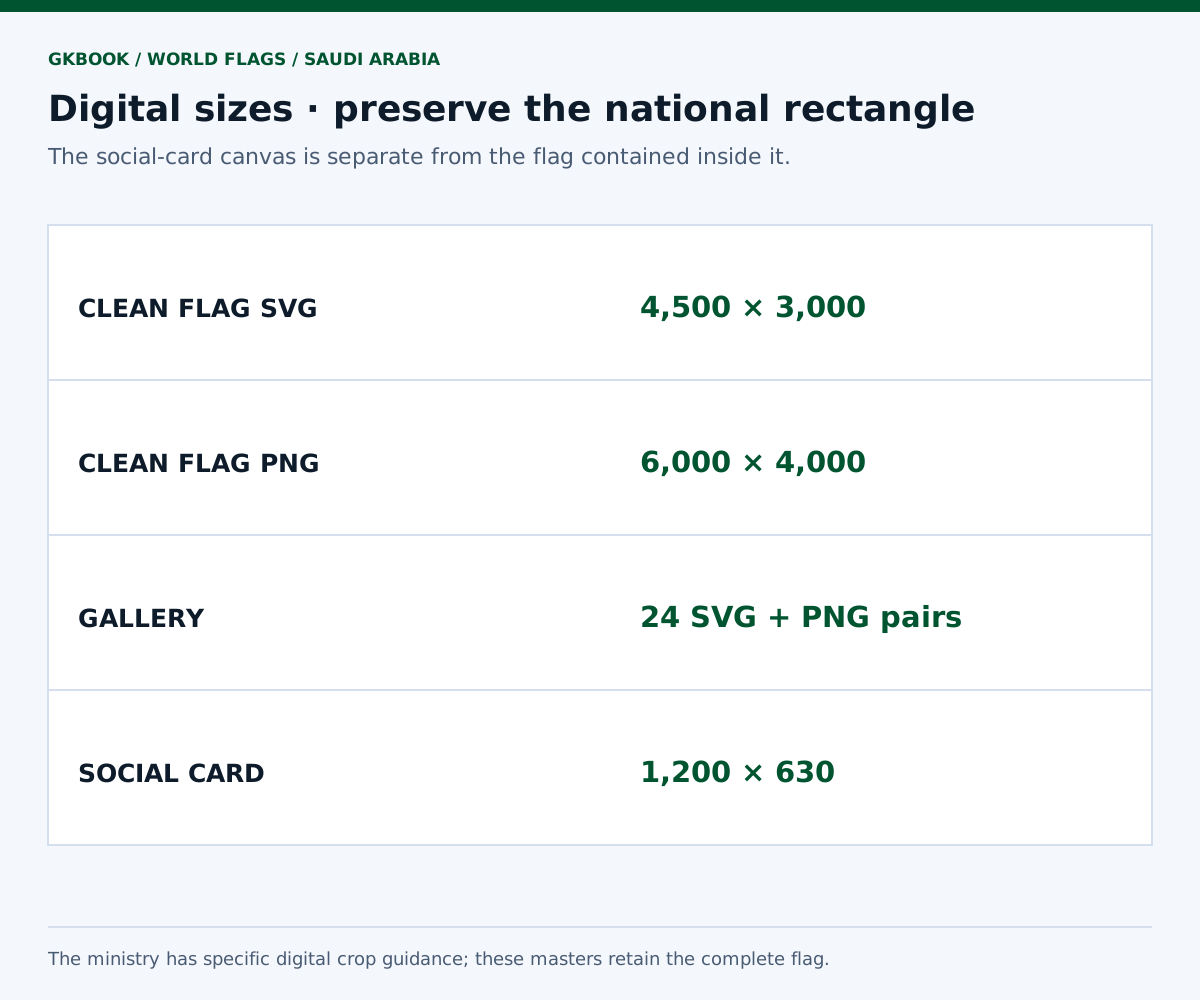
An SVG stores the white shapes as paths, so the calligraphy does not depend on a reader having a particular font. A PNG stores pixels and should be used at a suitable size for its intended display. In both cases, uniform scaling preserves the relationship between the field, the inscription, and the sword.
The separate 1,200 by 630 social canvas is a page preview, not a new flag proportion. It contains an undistorted national rectangle with the title outside it. If a platform applies its own crop, check the result before publishing so that the complete declaration and sword remain visible in the chosen presentation.
What Saudi Arabia flag pictures are included?
The gallery contains twenty-four subjects, each supplied as an SVG and a PNG, plus a separate social-card pair. Subjects cover the clean flag, colors, meanings, Arabic inscription, sword, proportions, history, and display guidance. The diagrams are educational illustrations; the clean national master contains only the green field and the official white symbols.
Captions identify what each image demonstrates, whether a color reference, a construction relationship, a historical distinction, or a protocol point. This makes it possible to choose an illustration that answers a specific question. A timeline, for example, explains dates without suggesting that its boxes or headings belong on the national flag.
Every complete flag uses the same source model. Begin with the master, compare the explanatory subjects, and explore other national designs in World Flags. Credits accompany the downloads and distinguish the ministry’s published artwork from GKBook’s educational layouts and digital reproduction work.
Download Saudi Arabia flag pictures
Download the clean flag as SVG or 6,000 × 4,000 PNG. Both preserve the 2:3 height:length ratio, the ministry’s green, and the same complete white calligraphy and sword.
The gallery contains 24 subjects, each with an SVG and PNG. The captions distinguish published specifications, attributed meanings, historical events, and digital reproduction choices. Image credits and reproduction notes explain the source basis. The separate 1,200 × 630 social card contains a complete flag and does not alter the national rectangle.
Continue exploring national designs in World Flags.
World Flags/Saudi Arabia
Saudi Arabia flag pictures
Complete national flag based on the Ministry of Culture’s published vector model. Exact 2:3 height:length field; original white calligraphy and sword paths preserved under uniform scaling.
National design: Kingdom of Saudi Arabia; calligraphy and sword: Ministry of Culture published vector model. Educational layout: GKBook.Download SVGDownload PNGThe green codes are explicitly published by the ministry. #FFFFFF is this edition’s pure-white digital implementation.
National design: Kingdom of Saudi Arabia; calligraphy and sword: Ministry of Culture published vector model. Educational layout: GKBook.Download SVGDownload PNGSaudipedia associates green with growth and fertility. The modern national field is green across the entire rectangle.
National design: Kingdom of Saudi Arabia; calligraphy and sword: Ministry of Culture published vector model. Educational layout: GKBook.Download SVGDownload PNGWhite’s peace and purity interpretation is attributed to Saudipedia. The two white components belong to the same national design.
National design: Kingdom of Saudi Arabia; calligraphy and sword: Ministry of Culture published vector model. Educational layout: GKBook.Download SVGDownload PNGThe royal order and Saudipedia provide complementary explanations. These cards do not claim every word appears in the Flag Law.
National design: Kingdom of Saudi Arabia; calligraphy and sword: Ministry of Culture published vector model. Educational layout: GKBook.Download SVGDownload PNGThe complete Shahada is preserved in the ministry’s Thuluth calligraphy. These explanatory panels sit outside the national rectangle.
National design: Kingdom of Saudi Arabia; calligraphy and sword: Ministry of Culture published vector model. Educational layout: GKBook.Download SVGDownload PNGEnglish translation: There is no god but Allah; Muhammad is the Messenger of Allah. The translation is explanatory and is not inserted into the flag.
National design: Kingdom of Saudi Arabia; calligraphy and sword: Ministry of Culture published vector model. Educational layout: GKBook.Download SVGDownload PNGAll thirty-two inscription paths from the official model are preserved. The path count describes file construction, not the number of Arabic letters.
National design: Kingdom of Saudi Arabia; calligraphy and sword: Ministry of Culture published vector model. Educational layout: GKBook.Download SVGDownload PNGThe sword’s exact source silhouette is retained as one path. It is separate from the national emblem’s two crossed swords.
National design: Kingdom of Saudi Arabia; calligraphy and sword: Ministry of Culture published vector model. Educational layout: GKBook.Download SVGDownload PNGLabels refer to the viewer’s left and right in the published model. A global mirror would reverse the Arabic lettering.
National design: Kingdom of Saudi Arabia; calligraphy and sword: Ministry of Culture published vector model. Educational layout: GKBook.Download SVGDownload PNGBoth downloadable masters preserve the stated national-flag ratio. Width-first length:height notation would be 3:2.
National design: Kingdom of Saudi Arabia; calligraphy and sword: Ministry of Culture published vector model. Educational layout: GKBook.Download SVGDownload PNGNominal dimensions are distinguished from the fine outline bounds of the official PDF. No part of the calligraphy is stretched to force a bounding-box equality.
National design: Kingdom of Saudi Arabia; calligraphy and sword: Ministry of Culture published vector model. Educational layout: GKBook.Download SVGDownload PNGThe original model is centered on an exact 2:3 field using the source flag height for uniform scaling. Tiny source-field drafting differences remain documented.
National design: Kingdom of Saudi Arabia; calligraphy and sword: Ministry of Culture published vector model. Educational layout: GKBook.Download SVGDownload PNGThe extraction retains original path data and excludes surrounding PDF labels. Reproduction details and measured bounds accompany the package.
National design: Kingdom of Saudi Arabia; calligraphy and sword: Ministry of Culture published vector model. Educational layout: GKBook.Download SVGDownload PNGThe timeline separates the state’s proclamation, flag approval, later Flag Law, and modern commemoration.
National design: Kingdom of Saudi Arabia; calligraphy and sword: Ministry of Culture published vector model. Educational layout: GKBook.Download SVGDownload PNGThe 1937 approval and 1973 law explain the two major dates found in flag accounts. The article identifies their different evidential roles.
National design: Kingdom of Saudi Arabia; calligraphy and sword: Ministry of Culture published vector model. Educational layout: GKBook.Download SVGDownload PNGThe observance, the event it recalls, the order’s issue date, and its publication date are distinct.
National design: Kingdom of Saudi Arabia; calligraphy and sword: Ministry of Culture published vector model. Educational layout: GKBook.Download SVGDownload PNGThe prohibition concerns the mourning position on a staff. It should not be expanded into the inaccurate claim that a flag can never be lowered for care.
National design: Kingdom of Saudi Arabia; calligraphy and sword: Ministry of Culture published vector model. Educational layout: GKBook.Download SVGDownload PNGThe standard readable model illustrates the requirement. This is not a separately specified reverse manufacturing master.
National design: Kingdom of Saudi Arabia; calligraphy and sword: Ministry of Culture published vector model. Educational layout: GKBook.Download SVGDownload PNGThe Ministry of Culture guide permits this vertical arrangement. It is a rotation of the complete published horizontal model, with no mirrored lettering.
National design: Kingdom of Saudi Arabia; calligraphy and sword: Ministry of Culture published vector model. Educational layout: GKBook.Download SVGDownload PNGThese care principles follow the official guide. Retirement is governed by procedure, so an absolute claim that no flag can ever be destroyed is misleading.
National design: Kingdom of Saudi Arabia; calligraphy and sword: Ministry of Culture published vector model. Educational layout: GKBook.Download SVGDownload PNGThe guide identifies prohibited alterations and uses. Educational downloads are not an unrestricted commercial license.
National design: Kingdom of Saudi Arabia; calligraphy and sword: Ministry of Culture published vector model. Educational layout: GKBook.Download SVGDownload PNGThe guide distinguishes the king’s flag, which adds the gold national emblem, from the ordinary national flag reproduced here.
National design: Kingdom of Saudi Arabia; calligraphy and sword: Ministry of Culture published vector model. Educational layout: GKBook.Download SVGDownload PNGThe clean masters are 2:3 height:length; the social card contains a complete flag within a wider editorial canvas.
National design: Kingdom of Saudi Arabia; calligraphy and sword: Ministry of Culture published vector model. Educational layout: GKBook.Download SVGDownload PNGFrequently asked questions
What does the Saudi Arabia flag look like?
The flag of Saudi Arabia is green with the white Shahada, the Islamic declaration of faith, above one white horizontal sword. The inscription is in Thuluth calligraphy. Its height:length ratio is 2:3, and the published official view shows the sword’s point at left and its hilt at right.
What are the colors of the Saudi Arabia flag?
Saudi Arabia’s flag has two colors: green for the field and white for the inscription and sword. The Ministry of Culture’s usage guide specifies green as RGB 0, 84, 48 and hexadecimal #005430. It also lists Pantone 3425 C, textile reference 19-6026 TCX, and a separate CMYK formula.
What does green represent on the Saudi flag?
Saudipedia explains green as a symbol of growth and fertility. The green field also belongs to the long history of Saudi banners associated with the Islamic declaration of faith. These are related historical and symbolic contexts, rather than evidence that every detail of the present drawing existed unchanged in the earliest banners.
What does white mean on the flag?
Saudipedia associates white with peace and purity. White forms both the Shahada and the sword, giving the two elements a clear visual relationship against the green field. It is not a separate stripe or border on the modern national flag, and the sword does not introduce a third color.
What does the Saudi Arabia flag symbolize?
The Shahada expresses Islamic faith, while the sword is associated with strength, justice, and security. The 2023 royal order establishing Flag Day emphasizes the flag’s religious meaning, dignity, and national unity. Saudipedia additionally associates green with growth and fertility and white with peace and purity; these explanations should retain their attribution.
What is written on the Saudi Arabia flag?
The Arabic inscription is the Shahada: “لا إله إلا الله محمد رسول الله”. It declares belief in the oneness of Allah and in Muhammad as Allah’s messenger. On the flag, the words appear in white Thuluth calligraphy, with the complete inscription above the sword and intended to be clear on both sides.
What does the Arabic writing mean in English?
A standard English translation is: “There is no god but Allah; Muhammad is the Messenger of Allah.” The two clauses express the Islamic declaration of faith. English wording explains the Arabic inscription for readers, but translated words are not placed on the Saudi national flag and do not replace its calligraphy.
Which calligraphic script is used on the flag?
The flag uses Thuluth, a style of Arabic calligraphy named in the official usage guide. The published inscription is a specific arrangement of letterforms and marks, not simply a line typed in any Arabic font. Accurate reproduction should preserve that complete arrangement, including the small detached shapes around the main strokes.
What does the sword on the Saudi flag represent?
The sword is associated with justice and security in Saudipedia’s explanation, while the Flag Day royal order also connects it with strength and dignity. Visually, it is a single white unsheathed sword beneath the Shahada. It should not be replaced with the crossed swords and palm tree of the separate national emblem.
Which way does the sword point?
In the Ministry of Culture’s published horizontal model, the sword points to the viewer’s left and its hilt is on the right. The inscription above it reads correctly from right to left. Preserve this complete published arrangement when using the standard image; do not flip the entire flag as a shortcut to another view.
What is the Saudi flag’s official ratio?
The Saudi national flag has a height:length ratio of 2:3. Its horizontal length is one and a half times its height. A flag measuring 150 centimeters long and 100 centimeters high follows this relationship, as do the 4,500 × 3,000 SVG and 6,000 × 4,000 PNG masters provided here.
How large are the inscription and sword?
The ministry’s construction diagram places the inscription and sword within a central block occupying nominally half the flag’s length and half its height. It specifies the sword’s length as three-quarters of the inscription’s length. Fine outline bounds in the published PDF differ slightly from these nominal guide relationships, so those measurements should be distinguished.
Where are the white symbols placed?
The white inscription sits above the sword in the central portion of the green field. The ministry’s diagram shows balanced side margins and a central symbol block, with green space above and below. The sword runs parallel to the flag’s long edges, and neither element touches the outer boundary of the national rectangle.
How was the downloadable flag constructed?
The clean flag uses a 4,500 × 3,000 green rectangle and the thirty-three white vector paths extracted from the Ministry of Culture’s Arabic usage guide. The paths receive one uniform scale and translation. The exact 2:3 canvas and published green are fixed; small differences between nominal dimensions and source outlines are documented.
What is the history of the Saudi flag?
The modern flag developed from earlier Saudi green banners bearing the declaration of faith. The Ministry of Culture describes changes in shape, white hoist strips, and sword arrangements before the present design. Important later milestones include the kingdom’s proclamation in 1932, royal approval in 1937, and the Flag Law issued in 1973.
When was the Saudi Arabia flag adopted?
The royal order establishing Flag Day identifies March 11, 1937 as King Abdulaziz’s approval of the flag’s present form. March 15, 1973 is the date of Royal Decree M/3 approving the Flag Law, as stated in the ministry’s guide. These are distinct milestones, so an adoption answer should explain which event it means.
When is Saudi Flag Day?
Saudi Flag Day is observed annually on March 11. Royal Order A/303, dated March 1, 2023, established the observance and connected its date with King Abdulaziz’s approval of the flag on March 11, 1937. The order created a commemoration; it did not introduce a replacement flag design in 2023.
Is Flag Day the same as Saudi National Day?
No. Flag Day falls on March 11 and recalls the flag approval associated with 1937. Saudi National Day falls on September 23 and commemorates the proclamation of the kingdom in 1932. The flag can appear at both occasions, but the dates refer to different historical events and should not be combined in an adoption label.
Who designed the Saudi Arabia flag?
A sole-designer attribution is not established by the evidence used here. The ministry describes an evolving national banner and institutional decisions, while a historian’s account published by King Saud University rejects reducing its origin to Hafiz Wahba alone. King Abdulaziz’s approval is a documented milestone, but approval and individual artistic authorship are different claims.
Did earlier Saudi flags look different?
Yes. The ministry’s historical account describes earlier green banners with a white hoist strip and different sword arrangements, including swords above the declaration. The present national flag has a fully green field and one sword below the Shahada. Historical continuity does not mean that every previous banner had today’s exact layout or dimensions.
What does the Saudi Flag Law regulate?
The Flag Law approved by Royal Decree M/3 in 1973 describes the national flag and regulates its display and treatment. The Ministry of Culture’s guide brings together design specifications and practical protocols. Among the principal requirements are clear white symbols on green, the stated proportions, respectful handling, and a prohibition on half-masting.
Why is the Saudi flag never flown at half-mast?
The Saudi Flag Law prohibits flying the national flag at half-mast, and the Ministry of Culture’s guide repeats the rule. The flag bears the Islamic declaration of faith, which explains its distinctive treatment in official accounts. This prohibition concerns the mourning position on a staff; it does not mean a flag can never be lowered for care.
How should the Saudi flag look from the reverse?
The Shahada and sword must be clear on both sides, as the official description requires. In particular, the Arabic declaration must remain readable rather than becoming mirrored lettering. A simple horizontal flip of the standard artwork is therefore unsuitable as a reverse master; physical construction must preserve the required reading of the inscription.
Can the Saudi flag be displayed vertically?
Yes. The Ministry of Culture’s usage guide includes a vertical display and specifies that the Shahada and sword read from top to bottom. In its illustrated orientation, the inscription is to the viewer’s left of the sword. Follow that published arrangement; older blanket claims that the flag must never be displayed vertically conflict with this guide.
How should the Saudi flag be handled and cared for?
The guide calls for respectful handling: keep the flag from touching the ground or water, maintain it in good condition, and replace a damaged or faded flag. Lowering it for proper care is different from half-masting. Folding, storage, and retirement should follow the responsible institution’s procedures rather than improvised or disrespectful handling.
What uses of the Saudi flag should be avoided?
The guide prohibits disrespectful treatment, inversion as a distress signal, and additions that alter the national flag. It also restricts commercial advertising and trademark use. Keep slogans, logos, and decorative additions outside the flag itself, and do not assume that downloading an educational image grants unrestricted rights to place it on every product.
How does the royal flag differ from the national flag?
The king’s flag follows the national flag’s general design but adds the Saudi emblem in gold in the lower corner beside the staff. The ordinary national flag has no gold palm tree or crossed swords. A photograph showing that added emblem should therefore be identified carefully instead of being used as a generic national-flag master.
Is the palm tree and crossed-swords emblem on the flag?
No. Saudi Arabia’s national emblem consists of a palm tree above two crossed swords, but that emblem is separate from the ordinary national flag. The flag carries the white Shahada above one horizontal sword. Confusing the two symbols can lead to an incorrect flag image, especially when adapting a government crest or a royal-flag photograph.
How should the flag be used in digital artwork?
Use the complete SVG for scalable artwork or the 6,000 × 4,000 PNG for a large raster image. Preserve the 2:3 height:length ratio, the published green, and readable Arabic. The ministry also provides specific digital crop treatments, but this package’s clean master and social card retain the complete rectangular national flag.
What Saudi Arabia flag pictures are included?
The gallery contains twenty-four subjects, each supplied as an SVG and a PNG, plus a separate social-card pair. Subjects cover the clean flag, colors, meanings, Arabic inscription, sword, proportions, history, and display guidance. The diagrams are educational illustrations; the clean national master contains only the green field and the official white symbols.
Explore all general-knowledge topics and the A-to-Z lists.








We Value Your Opinion Comments