

São Tomé and Príncipe flag picture
Explore the construction notes, history, and picture gallery.
| Design | Green, yellow, green; red triangle; two black starsThe stars represent the two principal islands. |
|---|---|
| Proportions | Height:length = 1:2Band heights are 2:3:2; yellow is 1.5 times each green band. |
| First use | July 12, 1975The flag was used at the proclamation of independence. |
| Formal adoption | November 5, 1975 commonly listedMatches constitutional approval; the inspected gazette was published December 15. |
| Symbolism | Islands, equality, and independence struggleThe Presidency explains these meanings; color interpretations are attributed. |
| Main image sizes | SVG and PNGSVG: 2,800 × 1,400; PNG: 6,000 × 3,000. |
What does the São Tomé and Príncipe flag look like?
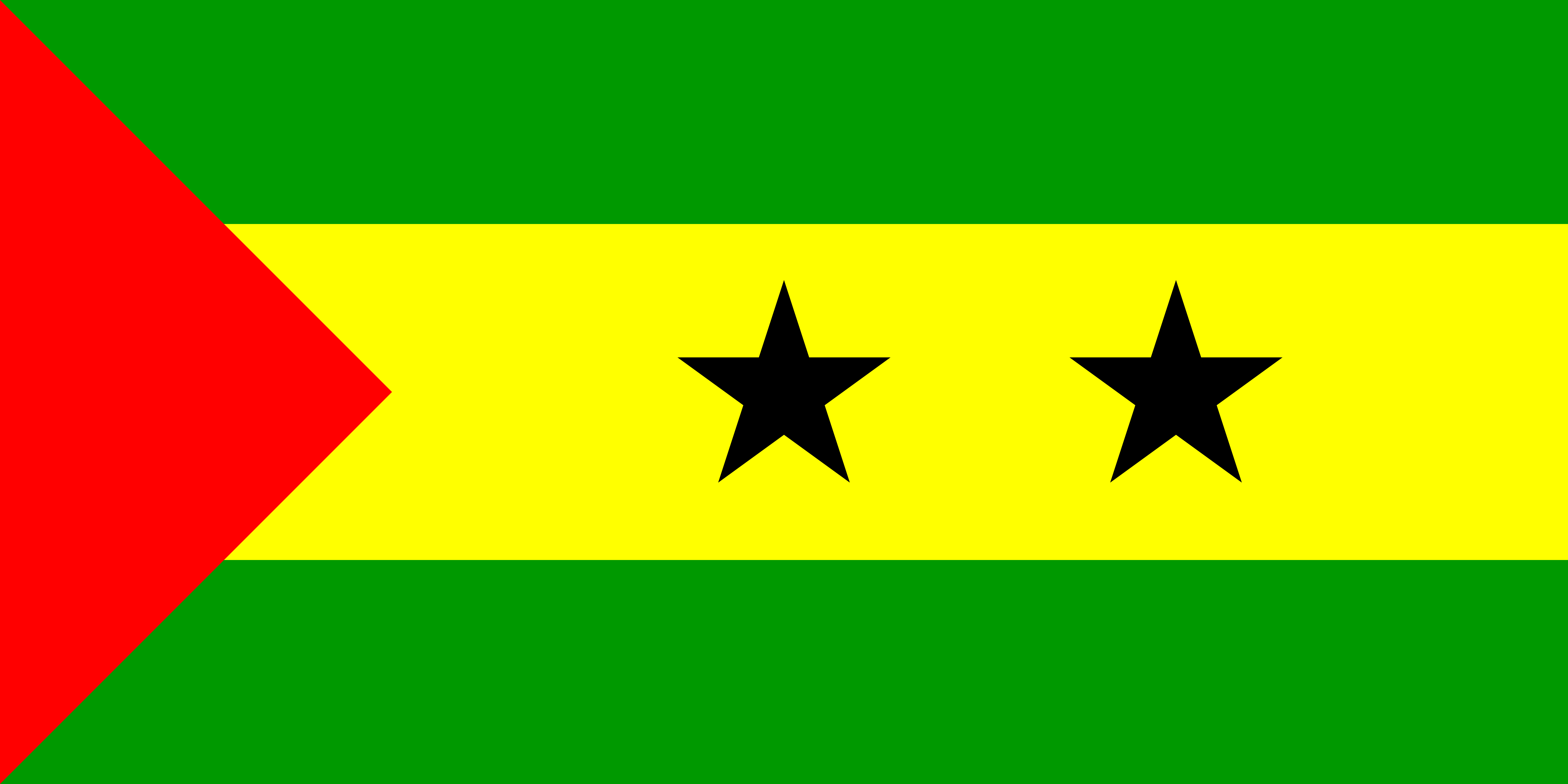
The flag of São Tomé and Príncipe has green, yellow, and green horizontal bands, a red triangle at the hoist, and two black five-pointed stars in the yellow band. The band heights follow 2:3:2. Its familiar height:length proportion is 1:2, and the stars represent the two principal islands.
The design brings two island identities into one national symbol. This guide separates the constitutional description from later explanations and from the practical choices used to draw a digital flag. The illustrations preserve that distinction, including where precise numerical color and star specifications are not supplied by the constitutional text.
What are the colors of the São Tomé and Príncipe flag?
The flag uses green, yellow, red, and black. Green forms the upper and lower bands, yellow forms the wider middle band, red fills the hoist triangle, and black fills both stars. The constitution names these colors but does not supply numeric RGB, hexadecimal, CMYK, or Pantone specifications.
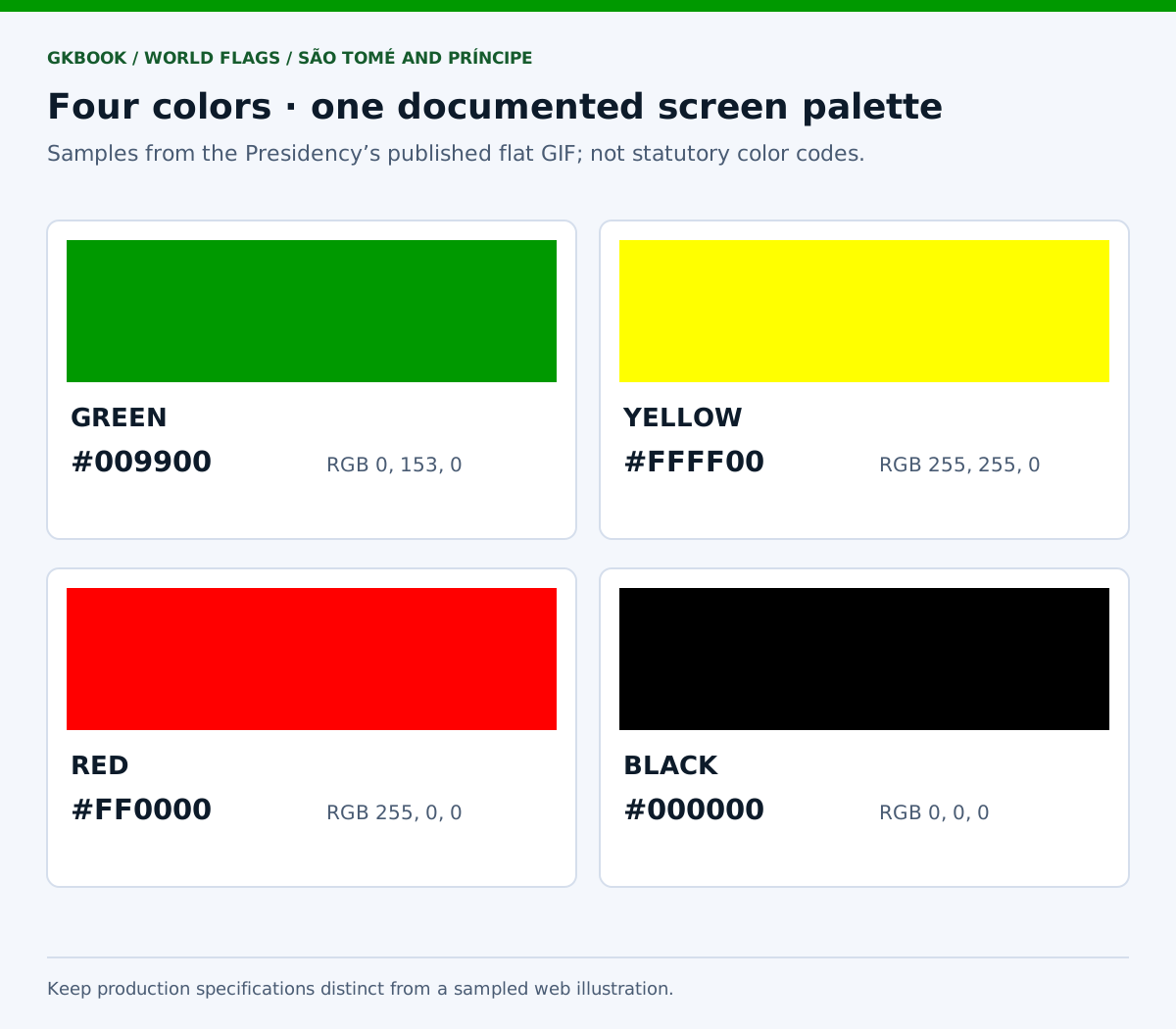
The screen files in this package use the four flat colors found in the Presidency’s published flag image: green #009900, yellow #FFFF00, red #FF0000, and black #000000. Sampling that government illustration gives this edition a documented visual reference without turning its palette into a legally prescribed color standard.
Keep the four colors consistent across the full flag, thumbnails, teaching diagrams, and social preview. A photographed flag can appear darker or warmer because of lighting and fabric. Such variation does not establish a different design, and a digital swatch alone cannot determine a printer’s inks or textile dyes.
| Color | Position | RGB | Hex |
|---|---|---|---|
| Green | Upper and lower bands | 0, 153, 0 | #009900 |
| Yellow | Middle band | 255, 255, 0 | #FFFF00 |
| Red | Hoist triangle | 255, 0, 0 | #FF0000 |
| Black | Two stars | 0, 0, 0 | #000000 |
What does the São Tomé and Príncipe flag mean?
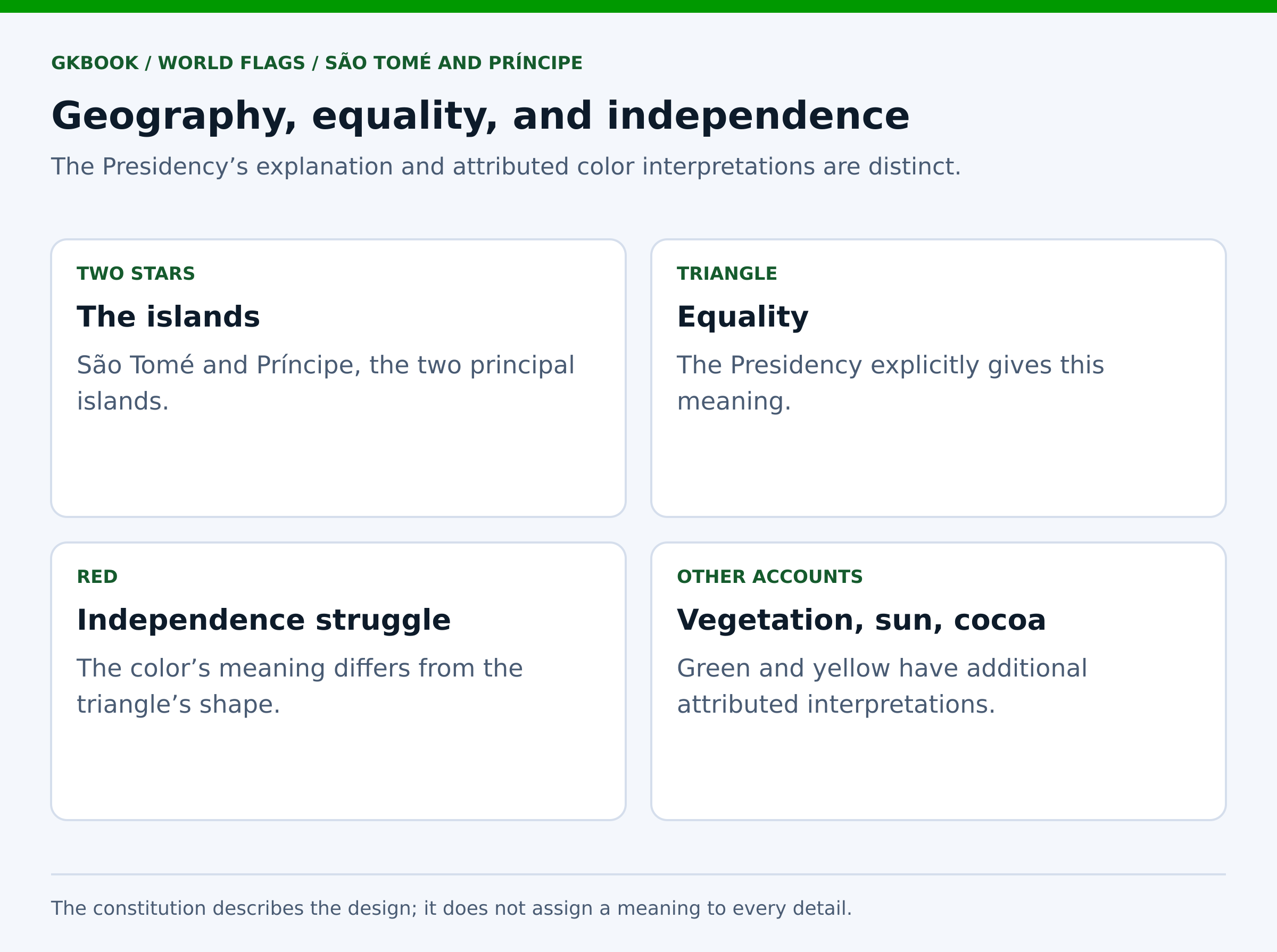
The Presidency explains the two stars as the islands, the triangle as equality, and red as the struggle for independence. It connects the colors with the liberation movement and Pan-African colors. Other accounts associate green with vegetation and yellow with sunshine or cocoa, so those additional interpretations should be identified by source.

A flag’s legal description and its explanation of meaning answer different questions. The constitution establishes the arrangement of bands, stars, and triangle. The Presidency’s account adds symbolic interpretation. Neither document requires assigning a separate hidden message to every angle, point, distance, or small patch of colored fabric.
Read the symbolism as a combination of geography and political history. The stars connect the design to the islands, while the triangle and its color express equality and the independence struggle. Attributed explanations of vegetation, sunlight, and cocoa add context without replacing those distinctions or pretending all sources use identical wording.
What does green represent on the flag?
Green is commonly explained as the islands’ lush vegetation. Whitney Smith’s Britannica account gives this interpretation, while the Presidency places the flag’s colors within a Pan-African and liberation-movement context. Green appears twice, in equally high upper and lower bands, and does not stand for two separately specified regions.

The repeated green bands create a frame around the yellow center. Their identical height is part of the constitutional description, so making one taller than the other changes the design. The symbolic association with vegetation does not require adding leaves, trees, textures, or landscape pictures inside these flat green areas.
Príncipe’s forest environment provides real geographical context for that interpretation. UNESCO’s biosphere-reserve account discusses the island’s biodiversity and ecosystems, although it is not a flag specification. A landscape source can explain the setting while the constitution and a flag reference remain the appropriate evidence for the actual national design.
Does yellow represent sunshine or cocoa?
Both explanations appear in published accounts. Britannica associates yellow with the tropical sun; the Museu Virtual da Lusofonia account emphasizes wealth, especially cocoa. The constitution specifies a yellow middle band without assigning either meaning. Present these as attributed interpretations rather than claiming one combined explanation is a quotation from flag law.

The difference is manageable when each statement retains its source. Sunshine describes the islands’ tropical setting, while cocoa refers to an agricultural resource. Neither explanation changes the band’s position or proportions. The wider yellow center also supplies the contrasting background that makes the two black stars easy to recognize.
UNESCO describes cocoa agriculture in its account of Príncipe, which helps readers understand the economic reference. That contextual evidence does not independently prove what a flag designer intended. The downloadable artwork therefore uses a plain yellow field; it does not insert cocoa pods, a sun disk, or other interpretive additions.
What does the red color mean?
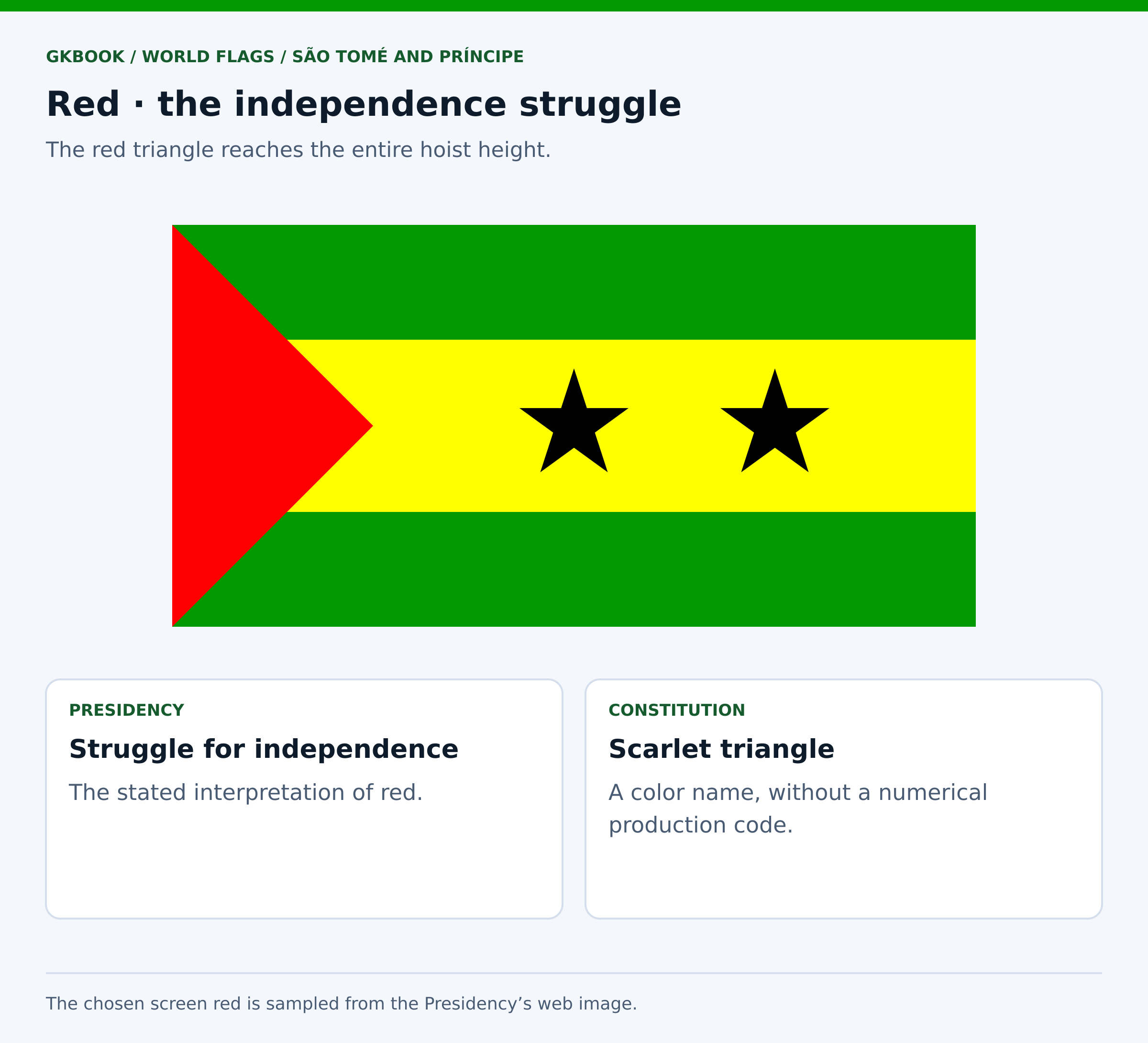
According to the Presidency, red represents the struggle for independence. It occupies the triangle at the flag’s hoist, the edge beside the staff. The constitutional description calls for a scarlet triangle. The screen files use the red in the Presidency’s published image, without claiming that sample is a statutory numerical standard.

Keep the meaning of the color distinct from the meaning of the shape. The official explanatory page connects red with the independence struggle and the triangle with equality. A short caption can communicate both ideas, but collapsing them into one vague phrase would lose information that the source makes explicit.
The red area reaches the full height of the flag along the hoist and narrows to a point inside the field. It covers parts of all three bands. No border separates the triangle from the surrounding colors, and no additional emblem belongs inside it in the national flag described here.
Why does the flag have a triangle?
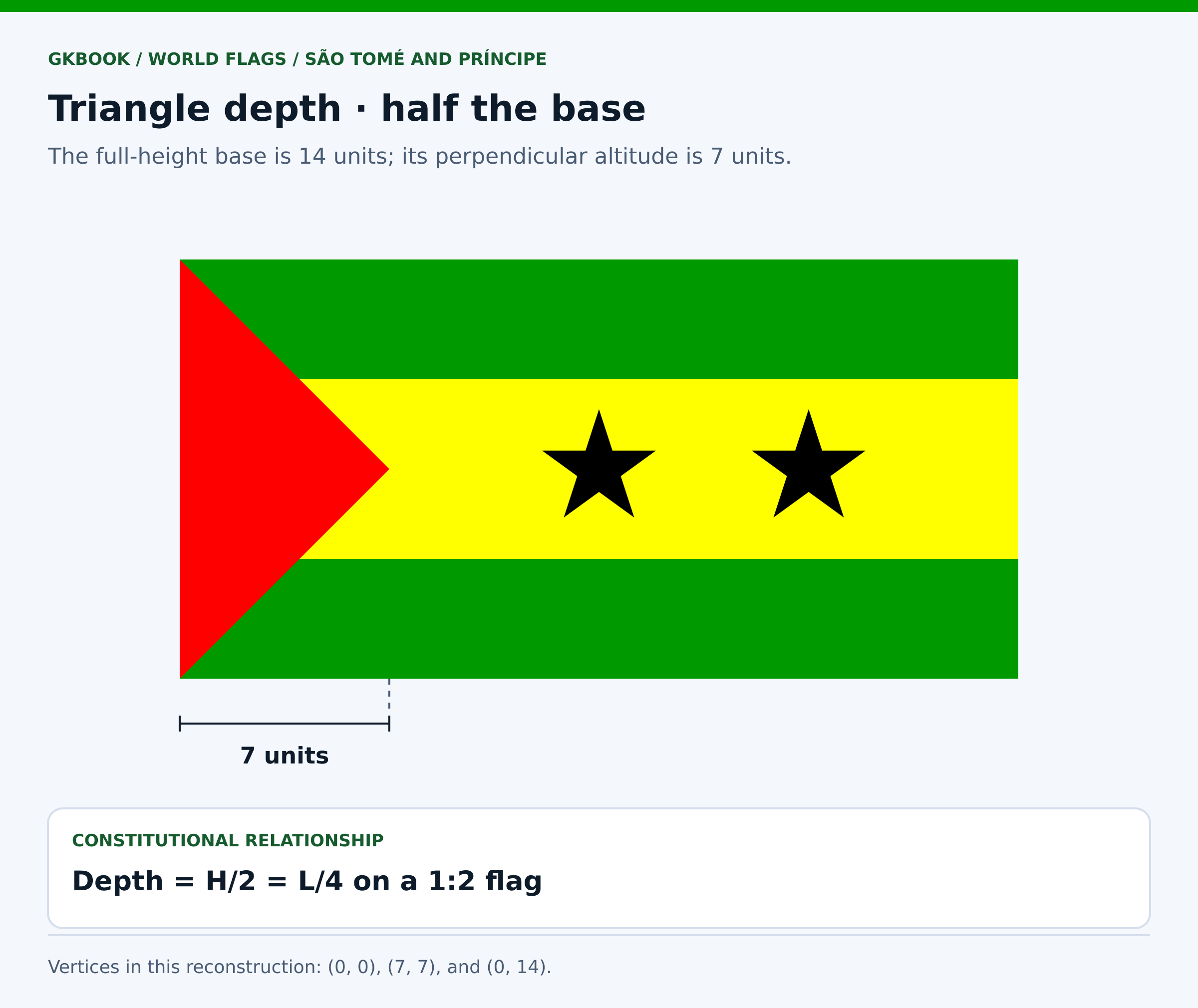
The Presidency identifies the triangle with equality. Geometrically, its base lies along the left hoist edge and its point faces toward the fly. The constitution states that its altitude is half its base. This gives a shallow triangle, not an equilateral one, and separates its specified shape from its symbolic interpretation.
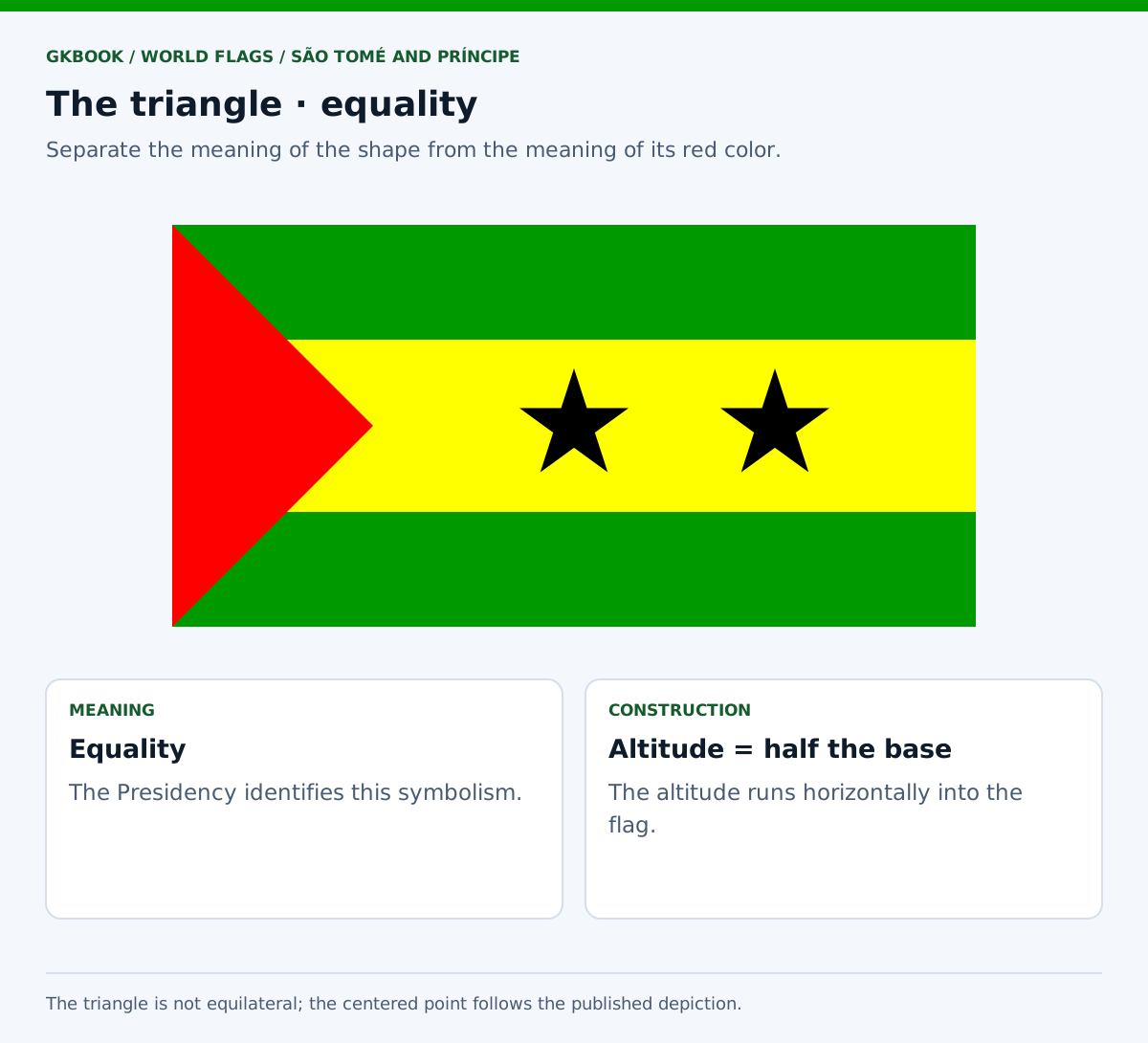
In a triangle, altitude means the perpendicular distance from the base to the opposite vertex. Here the base is vertical, so the altitude runs horizontally into the flag. Misreading altitude as the flag’s vertical height would produce the wrong construction even though the same everyday word is used for height.
The illustration centers the point halfway down the hoist, matching the Presidency’s image. This makes the top and bottom sloping sides equal. The exact centered coordinate is recorded as part of the reconstruction, while the half-base altitude is directly stated in the constitution and applies independently of the chosen drawing scale.
What do the two stars represent?
The two black stars represent São Tomé and Príncipe, the country’s two principal islands. The Presidency describes them as symbols of the islands of the archipelago. Each star has five points, and both lie within the yellow band. Their number is not a count of all surrounding islets or administrative divisions.
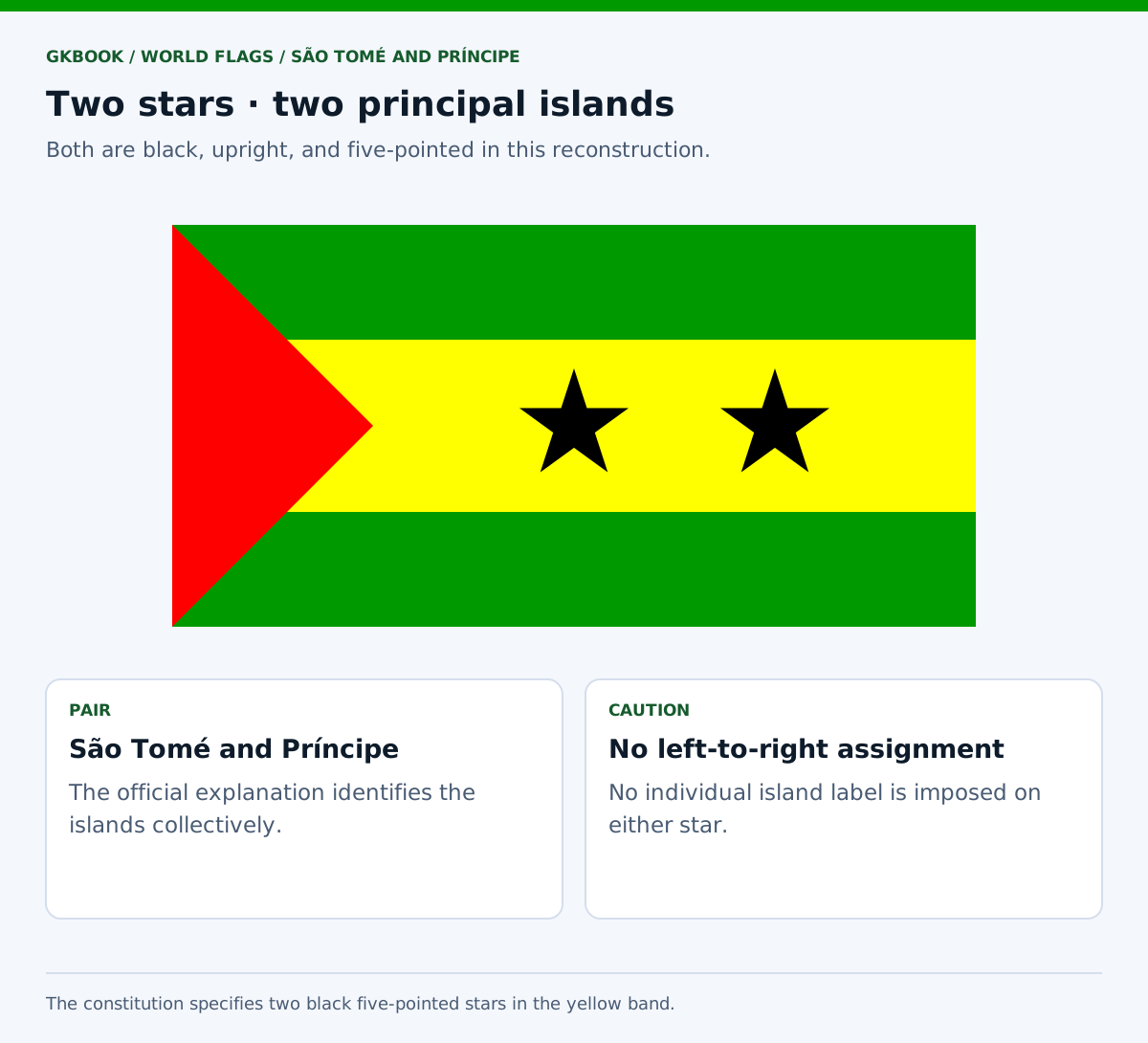
The paired stars make the national name visible as a simple repeated motif. Their equal size gives both island identities the same graphic treatment in this reconstruction. The constitutional description requires two black five-pointed stars but does not provide separate sizes or a ranked hierarchy for the two islands.
Do not silently label the left star as one specific island and the right star as the other without a source establishing that assignment. The inspected official explanation identifies the pair collectively. The gallery therefore names the two islands together and avoids presenting an unsupported left-to-right geographical code.
Why are the stars black?
Black is the constitutionally specified color of both stars. Britannica connects them with the African population of the two principal islands, while the Presidency emphasizes the islands themselves. These explanations can be reported with attribution. Black should remain a solid fill, without replacing the stars with outlines, shadows, or differently colored symbols.

The dark stars contrast strongly with the yellow center, making their number and shape legible at a distance. This is an observable property of the drawing, separate from historical symbolism. At small sizes, preserving the five-point outline is more useful than adding decorative shading or an artificial three-dimensional effect.
Related African flags also use black stars, but shared graphic vocabulary does not establish identical meanings in every country. Read São Tomé and Príncipe’s design through its own sources first. Comparisons can help recognition, provided another country’s explanation is not copied into this flag’s account as if it were local evidence.
Which islands are represented by the flag?
The stars refer to São Tomé and Príncipe, the two main islands named in the country’s title. The national territory also includes surrounding islets, so two stars do not mean the republic contains only two pieces of land. The flag is a symbolic composition rather than a geographical map or a scale diagram.

Article 3 of the 2003 constitutional text identifies the two principal islands and the islets forming the territory. That wording helps prevent a common overstatement about the stars. A national symbol can highlight the principal islands without attempting to reproduce the full inventory or outline of the country’s land.
Neither the star spacing nor their equal drawn size should be used to estimate real distances, relative island areas, or population. The gallery uses named cards to explain the pair and keeps geographical claims separate from the construction grid. This also avoids presenting invented island silhouettes as an authoritative map.
Are these Pan-African colors?
Yes. The Presidency explicitly connects green, yellow, and red with Pan-African colors and the country’s liberation movement. The flag also includes black stars. That shared palette places the design within a wider African visual tradition, while its repeated green bands, two stars, and red hoist triangle give it a distinct national arrangement.
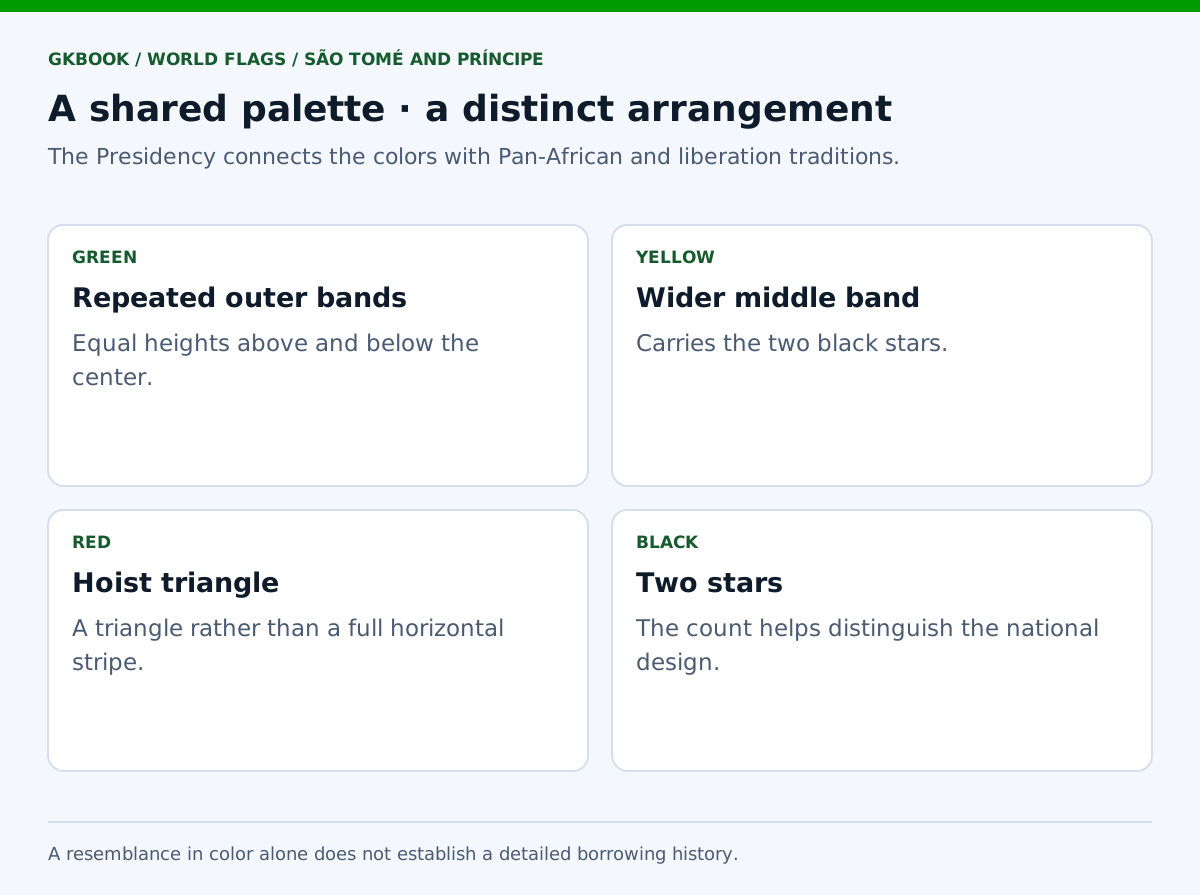
A palette alone is not enough to identify a flag. Several countries combine green, yellow, red, and black, but distribute them differently. São Tomé and Príncipe repeats green above and below a broader yellow band, then uses the triangle and paired stars to make the composition recognizable as its own.
The political context matters without turning every resemblance into proof of direct copying. The Presidency provides a clear link to the liberation movement. A more specific claim that a particular foreign flag supplied every shape or measurement would require additional evidence, so this guide does not infer that history from color similarity alone.
What is the flag’s aspect ratio?
The familiar flag has height:length proportions of 1:2, making it twice as long as it is high. Britannica states this ratio, and the Presidency’s published image uses it. The constitutional flag paragraph does not itself give an overall aspect ratio, so the source of that numerical convention should remain explicit.

Height:length and width:height describe the same rectangle in opposite orders. A flag 1 meter high and 2 meters long has height:length 1:2 and width:height 2:1. Confusing the order can produce a tall portrait rectangle instead of the horizontal national flag shown in the reference image.
The clean master uses a 2,800 by 1,400 coordinate canvas, with a 6,000 by 3,000 PNG export. Both retain the same proportion. A social-preview canvas has a different shape, so it contains a complete flag inside a larger layout instead of stretching the national flag to fill the card.
How wide are the three horizontal bands?
Their heights are in the ratio 2:3:2: green, yellow, green. The constitution says the green bands are equal and the yellow band is one and a half times each green band. Yellow therefore occupies three sevenths of the height, and each green band occupies two sevenths, not one quarter.

For a 14-unit-high construction, each green band is 4 units high and yellow is 6 units high. The boundaries fall at y = 4 and y = 10 when measured downward from the top. These are consequences of the constitutional relationship, not a separate invented stripe system.
Descriptions calling yellow twice as high as green produce a different 1:2:1 arrangement. That would place yellow across half the flag rather than three sevenths. The gallery demonstrates the correct proportions using the complete underlying bands, because the red triangle obscures their left ends without changing their intended heights.
How far does the red triangle extend?
The triangle’s depth equals half the flag’s height because its base spans the hoist and its altitude is half that base. On a 1:2 flag, this is one quarter of the length. In the 28-by-14 construction used here, the triangle reaches x = 7, with its point at y = 7.

Choose a convenient scale before drawing. With a flag 140 centimeters high and 280 centimeters long, the triangle’s horizontal depth is 70 centimeters. With the digital master’s height of 1,400 units, it becomes 700 units. The same relationship survives every uniform enlargement or reduction of the artwork.
The sloping edges are straight lines from the top and bottom hoist corners to the centered point. Do not measure the depth along a sloping edge; that is a different distance. The diagram marks the horizontal altitude and keeps its dimension guides outside the clean downloadable flag.
What size should the stars be?
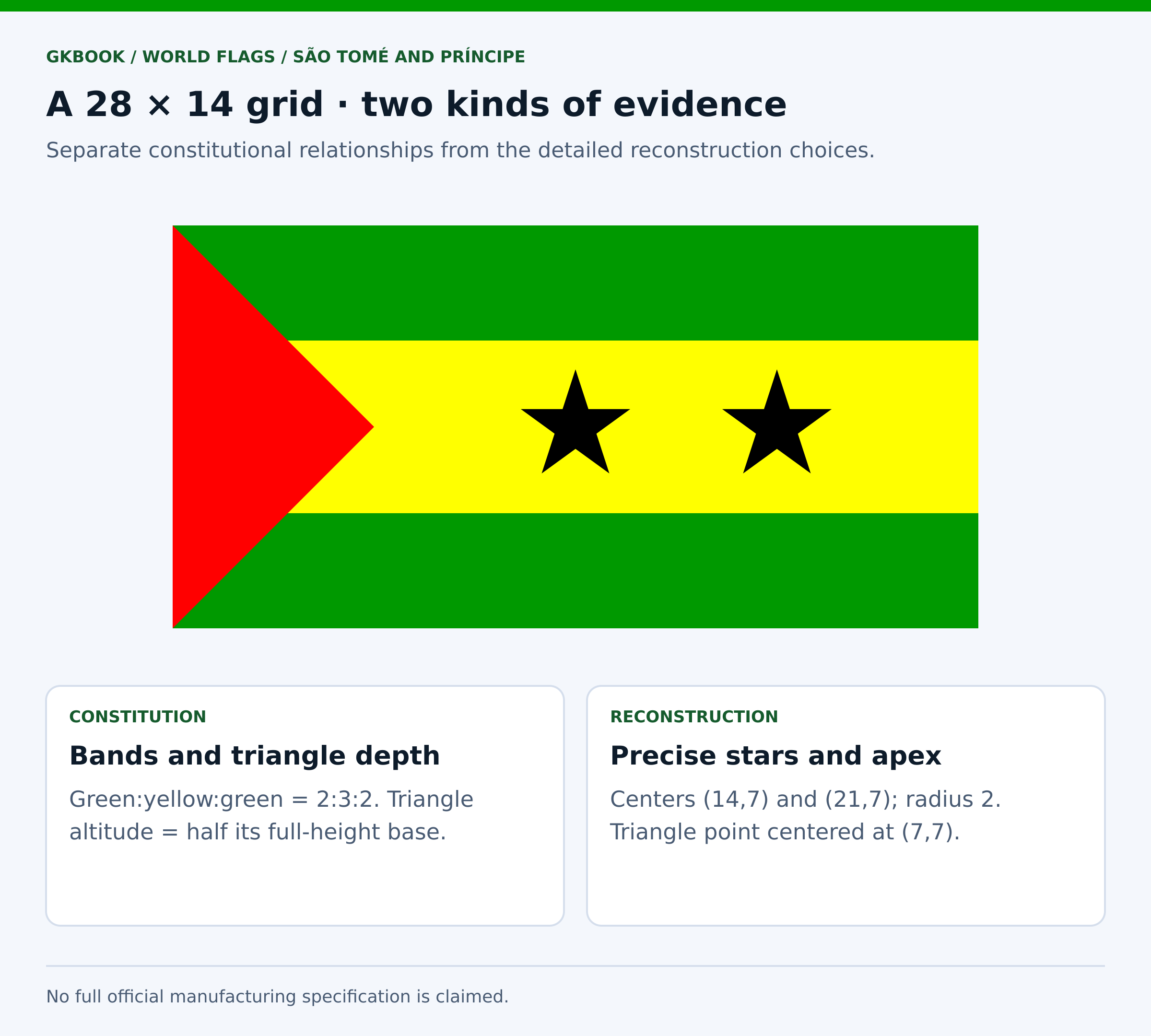
The constitution requires two black five-pointed stars but gives no numerical radius. This reconstruction uses equal regular stars with an outer radius of 2 units on a 28-by-14 grid, consistent with the published government image. That radius is a declared drawing convention, not a measurement quoted from the constitutional text.
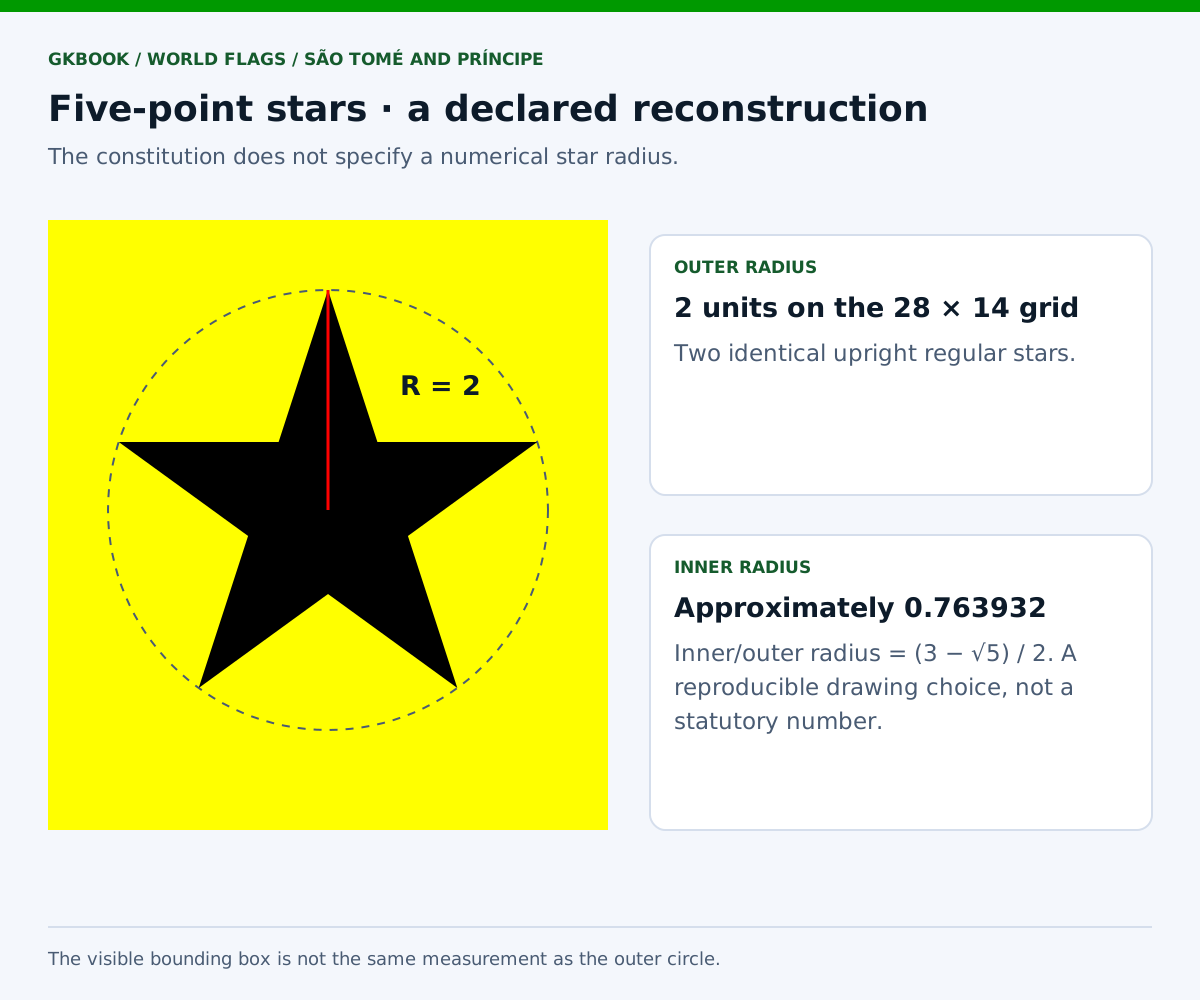
A star’s outer radius is measured from its construction center to a tip, not across its full width. The corresponding outer circle here has a diameter of 4 units. A five-point star’s visible bounding box is not the same as that circle, so different measurements should not be silently interchanged.
The inner radius is approximately 0.763932 units, obtained from the regular pentagram proportion. The five outer tips alternate with five inner corners. Recording that rule makes the supplied vector reproducible while leaving the evidence limit clear: the constitutional description specifies five points, not this complete mathematical construction.
Where are the two stars placed?
Both stars sit on the horizontal centerline of the yellow band. This edition places their construction centers at (14, 7) and (21, 7) on a 28-by-14 grid, matching the conventional layout and the Presidency’s illustration. Those coordinates are reconstruction choices; the constitution states that the stars lie in the yellow band.

The point of the red triangle lies at x = 7 in this grid. Moving toward the fly, the first star center, second star center, and outer edge then occur at x = 14, 21, and 28. These equal seven-unit intervals explain the regular visual rhythm of the chosen composition.
Measure all coordinates from the upper-left corner of the front view, with x increasing rightward and y downward. Both stars have one tip pointing upward. A regular five-point star’s visible top and bottom extents are unequal around its construction center, so aligning bounding-box centers would slightly shift the intended layout.
How can you draw the flag accurately?
Start with a 28-by-14 rectangle, divide its height into 4, 6, and 4 units, and add a red triangle through (0, 0), (7, 7), and (0, 14). Add equal upright black stars centered at (14, 7) and (21, 7), using the explicitly declared reconstruction radius of 2 units.

Draw the green field first, place the yellow band between y = 4 and y = 10, and overlay the red triangle. Then add the two stars. This order gives clean adjoining color regions without outlining the shapes. The guides in teaching illustrations are explanatory marks and do not belong on the national flag.
The supplied specification identifies which relationships come from the constitution and which come from visual reconstruction. It also records the chosen digital palette and export dimensions. Keeping that record with the vectors makes corrections reviewable and prevents a convenient numerical grid from being mistaken for a complete official manufacturing specification.
| Element | This drawing | Status |
|---|---|---|
| Overall rectangle | 28 × 14; height:length 1:2 | Britannica and Presidency image |
| Band heights | 4 : 6 : 4, equivalent to 2 : 3 : 2 | Constitutional relationship |
| Triangle depth | 7 units; half the 14-unit base | Constitutional relationship |
| Triangle point | (7, 7) | Centered reconstruction from published image |
| Star centers | (14, 7) and (21, 7) | Declared reconstruction convention |
| Outer star radius | 2 units | Declared reconstruction convention |
What is the history of the flag?
The national design emerged from the independence movement and was used when independence was proclaimed on July 12, 1975. The original constitution, approved on November 5, described the green-yellow-green bands, black stars, and red triangle. Its inspected gazette issue was published December 15, so first use, constitutional approval, and publication are distinct events.

The constitutional preamble traces the organized struggle through the CLSTP, formed in 1960, and its transformation into the MLSTP in 1972. This distinction matters when summarizing the movement’s earlier name. A simplified account that calls every stage MLSTP can obscure the chronology even if it correctly connects the movement with independence.
The original 1975 document and the 2003 constitutional text retain the recognizable flag description. Their article numbers differ: the earlier description appears in Article 2, while the later one appears in Article 14. Continuity of the pattern should not be confused with a claim that every modern digital rendering has identical measurements.
When was the flag officially adopted?
November 5, 1975 is widely listed as the formal adoption date and matches approval of the original constitution containing the flag description. The flag was already used at independence on July 12. The inspected official gazette is dated December 15, 1975; its publication date should not be substituted for first use or approval.

Article 49 of the original constitution states that it takes effect immediately upon approval. The closing approval statement supplies November 5. This provides a concrete constitutional event behind the commonly cited date, while the separate independence evidence explains why July 12 also appears in reference accounts of the flag.
A useful timeline labels each event instead of forcing all dates into a single adoption claim. September 16, 1975, the United Nations admission date, is another milestone in state history, but it is not the flag’s first-use date. Institutional recognition and the adoption of a national symbol answer different historical questions.
| Date | Event | Evidence |
|---|---|---|
| July 12, 1975 | Independence and flag use | Constitutional preamble; archival shotlist; Britannica |
| September 16, 1975 | United Nations admission | UN country profile |
| November 5, 1975 | Constitutional approval and immediate effect | Original constitution, closing statement and Article 49 |
| December 15, 1975 | Publication of inspected gazette issue No. 39 | Original gazette masthead |
Was the flag used on independence day?
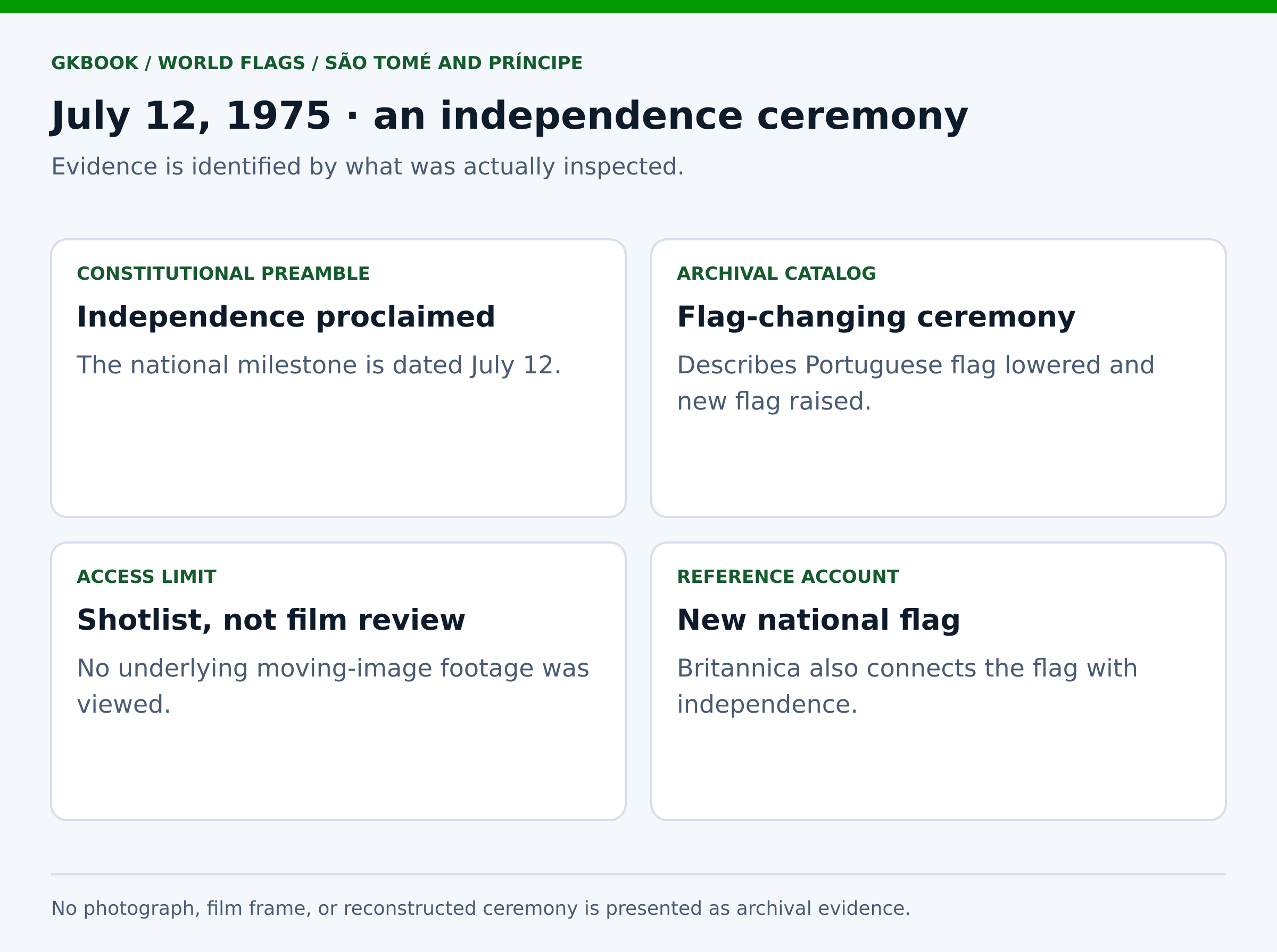
Yes. Britannica associates the new national flag with independence on July 12, 1975, and a Reuters archival catalog describes footage of the Portuguese flag being lowered and the new red, yellow, and green flag raised that day. This guide inspected the catalog description, not the underlying moving-image footage itself.

The archival description is valuable because it identifies an event, a date, and a flag-changing ceremony. Its scope should still be stated accurately: a catalog shotlist is evidence about recorded footage, but reading it is not the same as examining each frame or measuring the dimensions of the flag in the film.
The country’s constitutional preamble independently identifies July 12 as the proclamation of independence. The agreement between that national milestone and the flag-use account supports a clear chronology. It does not make the later November approval statement or December publication masthead errors; those records document different stages of the new state’s constitutional history.
Who designed the São Tomé and Príncipe flag?
Britannica credits Manuel Pinto da Costa with designing the national flag. That attribution should be presented as a reference account, because the constitutional flag paragraph does not name a designer. The design is closely associated with the independence movement, but a political association alone would not establish personal authorship without an explicit source.
Naming a designer and identifying the body that adopted a national symbol are separate tasks. An individual may be credited with a design while a constitution or other public act establishes the national description. The article keeps those roles distinct and does not turn the attribution into an unsupported account of a design competition.
No signed original drawing, commission record, or detailed account of the drafting process was inspected for this package. The gallery therefore illustrates the finished flag and its documented relationships. It does not invent a portrait, handwritten signature, preliminary sketch, or personal explanation of every numerical proportion attributed to the credited designer.
What flag was used before independence?
Before independence, the islands were under Portuguese rule, and the Portuguese national flag preceded the new national flag at the independence ceremony described in the Reuters archival catalog. That evidence does not establish a separately adopted colonial territorial flag. Proposed or unofficial historical illustrations should not be presented as verified flags that actually flew.
Historical flag collections sometimes mix national flags, administrative proposals, party emblems, and modern reconstructions. These are different categories of evidence. To identify an earlier flag responsibly, establish whether it was authorized, used, merely proposed, or drawn much later to illustrate a period rather than documenting a surviving original object.
This package focuses on the current national design and a text-based historical sequence. It does not supply a speculative colonial flag or claim an exact facsimile of the independence-day cloth. The archival description supports the change from Portuguese to national symbolism, while detailed construction comes from the separately identified flag sources.
How does the national flag differ from the MLSTP flag?
Britannica explains that the national flag uses the movement’s familiar colors and symbols but changes the horizontal bands from equal heights to the national 2:3:2 relationship. The national yellow band is therefore wider than either green band. This is a comparison of a documented design feature, not a substitute for an authenticated party-flag master.
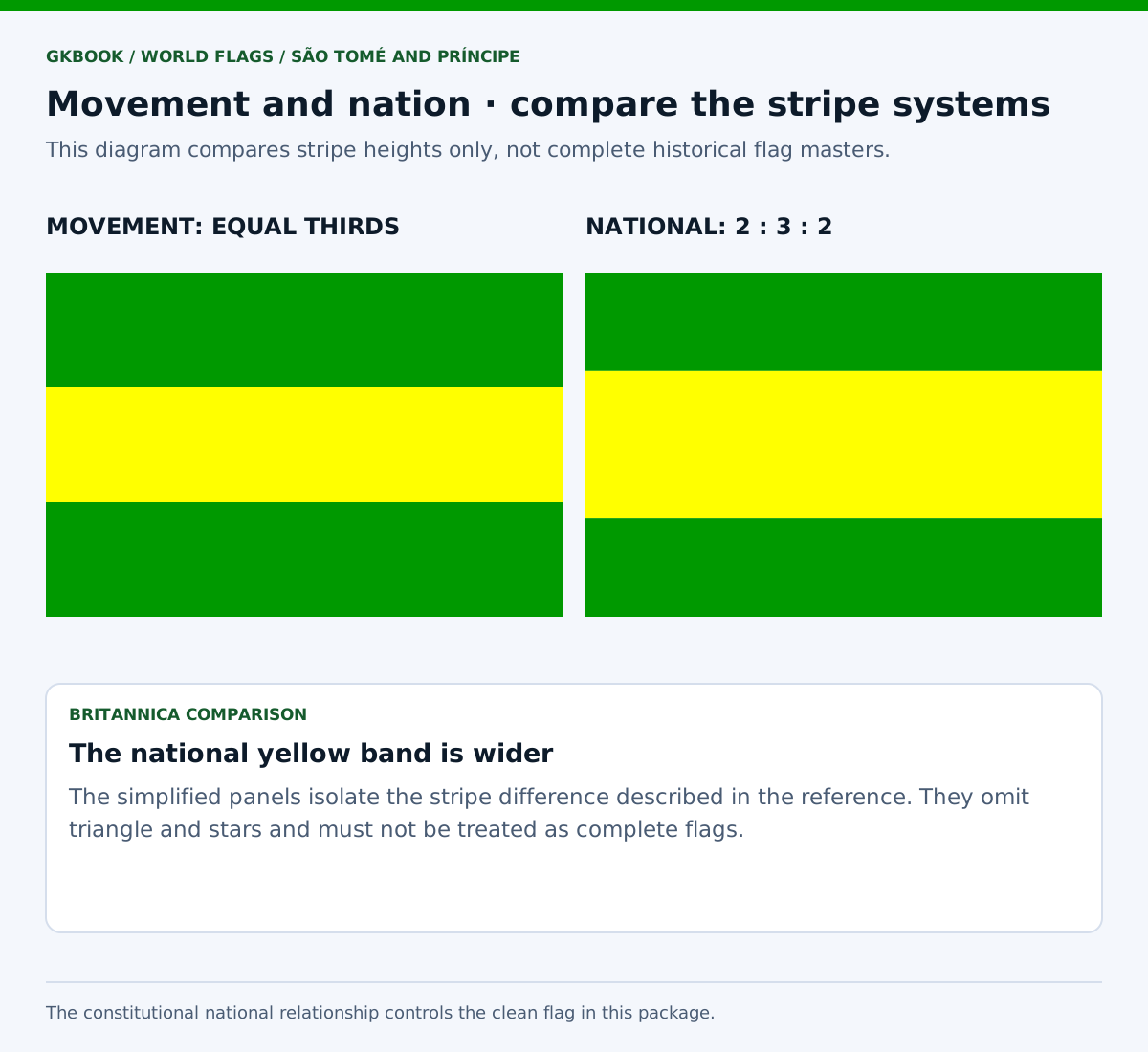
Equal thirds place band boundaries at one third and two thirds of a rectangle’s height. The national arrangement places them at two sevenths and five sevenths. That numerical difference is easy to miss in a small photograph, but it is substantial enough that an equal-striped drawing should not serve as the national master.
The comparison diagram shows only the two stripe systems and labels them accordingly. It does not invent precise historical star measurements or imply that every movement-era flag was manufactured identically. The constitution remains the controlling source for the national stripe relationship, regardless of variations visible in later reproductions or historical photographs.
What does the constitution actually specify?
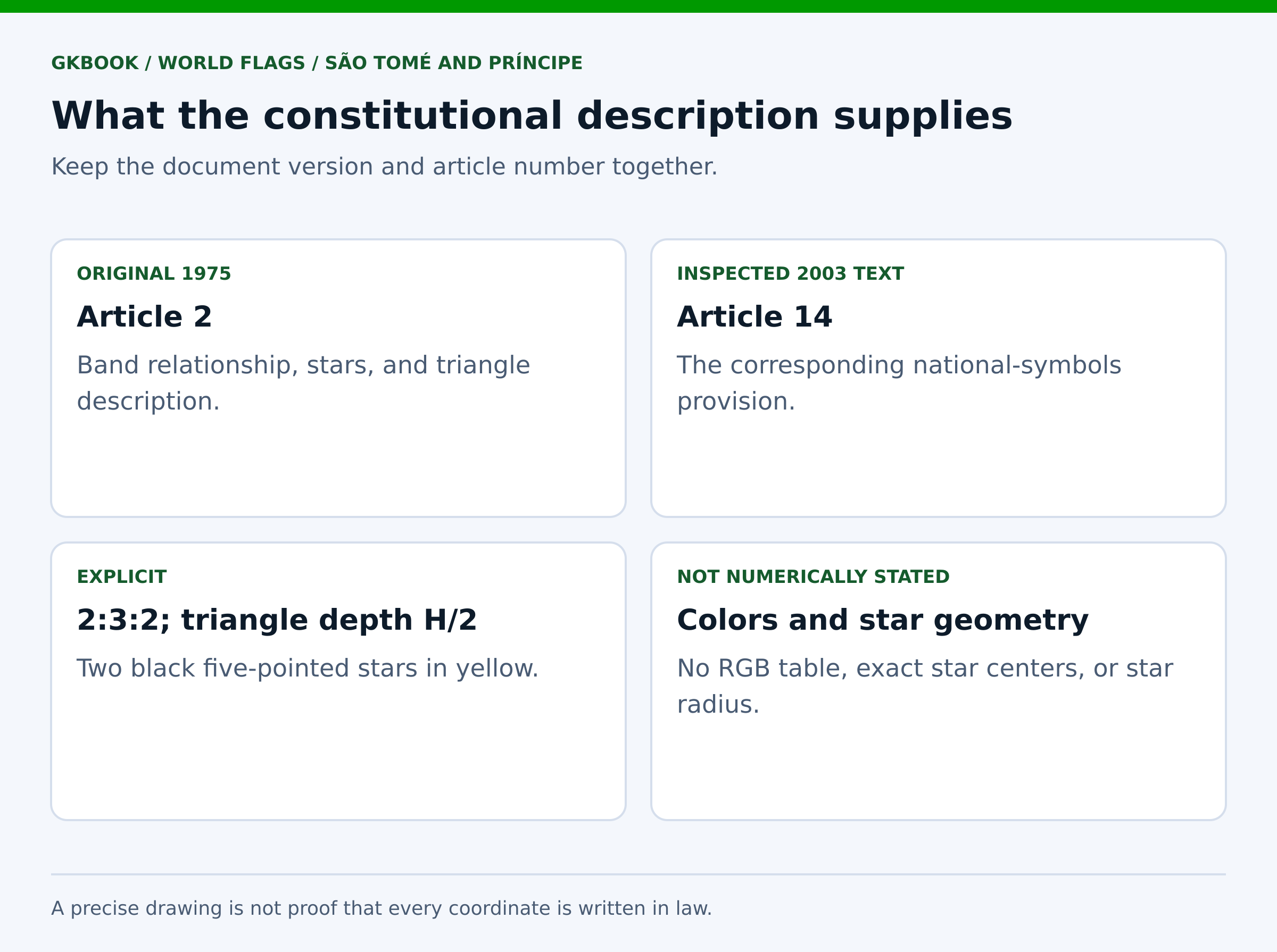
Article 14 of the inspected 2003 constitutional text specifies green-yellow-green bands, equal green heights, yellow one and a half times each green, two black five-pointed stars in yellow, and a scarlet hoist triangle whose altitude is half its base. It does not provide numerical color codes, star radii, or exact star-center coordinates.

The original 1975 constitution gives the corresponding description in Article 2. When citing these documents, keep the version and article number together. Referring to Article 14 as though it were the original 1975 numbering would blur the record even though the central visual description remains recognizable in both texts.
The omitted measurements explain why a useful drawing specification needs an evidence column. A clean vector can adopt a consistent aspect ratio, star geometry, and palette while acknowledging that those details are not all written into the constitutional paragraph. Precision in the file is valuable, but it should not imply greater legal specificity than the source supplies.
Does the coat of arms belong on the flag?
No coat of arms appears in the constitutional flag description. The flag uses its bands, triangle, and two stars. The constitution describes the national emblem separately and names the anthem Independência Total. Adding the coat of arms, the anthem’s title, or a written motto to the clean flag would create a different composition.
National symbols can share a constitutional article without occupying the same surface. The emblem has its own heraldic imagery, while the flag has a simpler geometric design. Treating every symbol named in the article as an instruction to add it to the flag would confuse the structure of the legal text.
An educational page may discuss the emblem and anthem beside the flag, provided captions make the relationship clear. In these downloads, all explanatory text stays outside the clean master. The two stars remain the only black figures within the yellow band, and no lettering is inserted into any of the colored regions.
How can you distinguish it from Ghana’s flag?
São Tomé and Príncipe has green at both top and bottom, a red hoist triangle, and two black stars. Ghana has red, gold, and green horizontal stripes with one black star in the middle stripe. The shared colors can suggest a resemblance, but the triangle and star count make the designs readily distinguishable.
The Ghana Permanent Mission’s description confirms the single-star red-gold-green arrangement. Comparing observable features is more reliable than identifying a flag from one color or a blurred thumbnail. Begin with the number of stars, check whether red forms a band or triangle, and then examine the top stripe.
Symbolic explanations should remain attached to the relevant country. Ghana’s account of its black star does not automatically define the pair on São Tomé and Príncipe’s flag. A side-by-side comparison is useful for recognition, but it should not erase differences in national history, the official description, or the meaning given by local sources.
What does the reverse side look like?
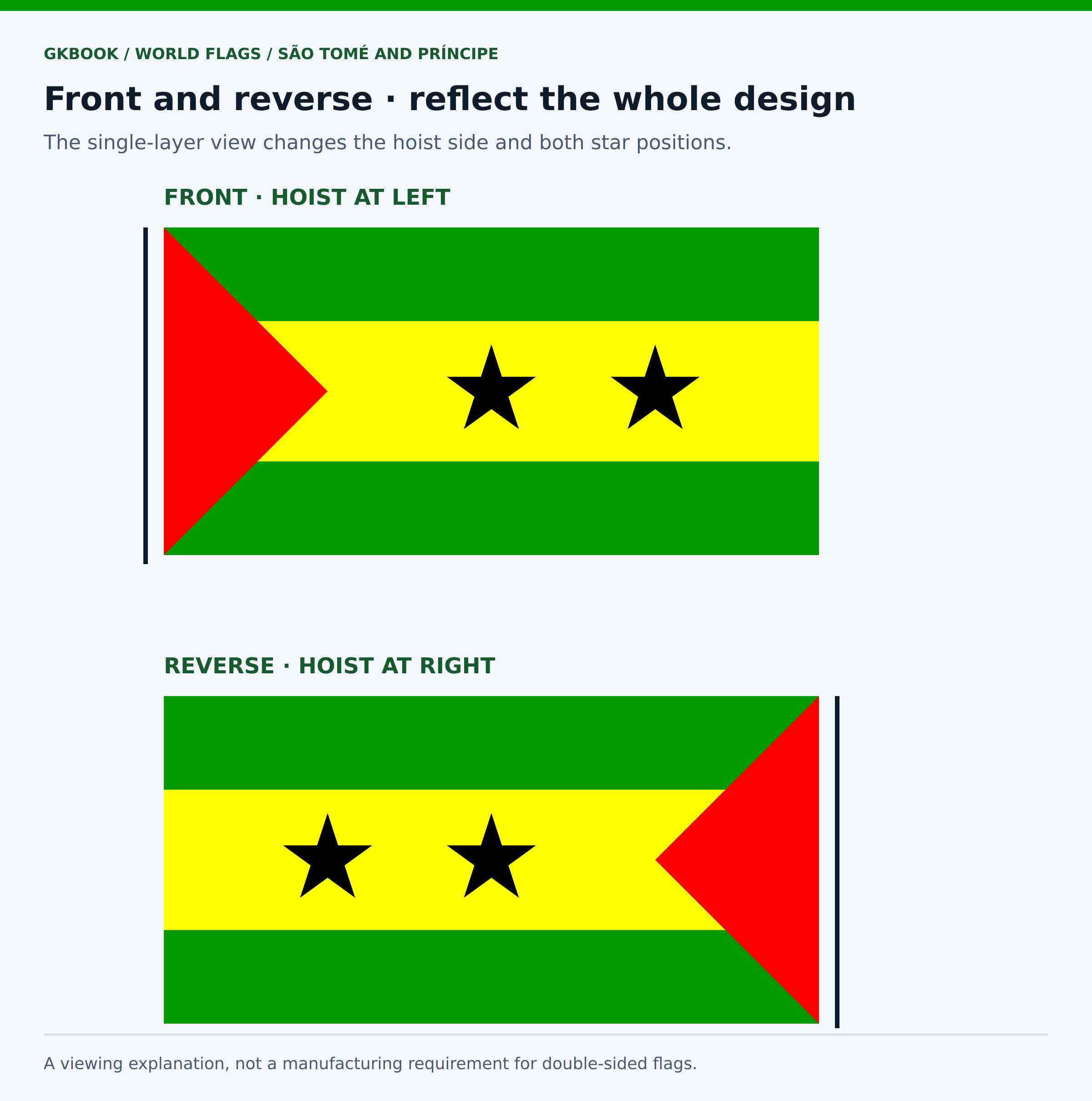
Viewed through a single layer of cloth, the reverse is the horizontal reflection of the front: the red hoist triangle appears at the viewer’s right, and the two stars move with the reflected composition. The green-yellow-green order remains unchanged. This explanation describes a viewing relationship, not a prescribed method of manufacturing double-sided flags.

A regular upright five-point star is individually symmetric across its vertical axis, so each star retains its familiar shape when reflected. The complete flag is not horizontally symmetric, because the red triangle occupies one end. Mirroring only the triangle while leaving the stars fixed would not correctly reflect the entire design.
The reverse diagram reflects the full master as one group and shows the staff at the corresponding edge. Labels stay outside the fabric so readers can distinguish the viewing direction. The clean downloadable file remains the conventional front view, with the hoist at the left and the fly at the right.
Which digital file should you use?
Use the SVG when you need scalable vector artwork and the PNG when you need a ready-made raster image. The clean flag SVG uses a 2,800-by-1,400 canvas, and the PNG is 6,000 by 3,000 pixels. Both preserve the 1:2 height:length proportion, opaque colors, and the same declared reconstruction geometry.

SVG retains straight edges and mathematical star outlines when enlarged. PNG fixes the image to a pixel grid and is convenient for applications that do not accept vectors. Neither format makes the chosen screen colors a physical production standard, and both should be resized proportionally to avoid widening or flattening the stars.
The educational diagrams use larger surrounding canvases for captions, guides, and comparisons. Their canvas proportions are not alternative national flag ratios. The separate 1,200-by-630 social card also contains a complete correctly proportioned flag, allowing a preview layout to fit its intended space without cropping or stretching the national design.
How should the flag be prepared for print?
Start with the vector master, preserve the proportions, and agree on a material-specific color proof with the producer. The constitution does not supply the numeric production colors needed for a universal print recipe. The provided hexadecimal values document this screen illustration, so they should not be advertised as officially certified Pantone or textile specifications.
Paper, ink, fabric, lighting, and color management affect the finished appearance. A manufacturer may use its own documented reference, but that reference should be identified honestly rather than retroactively attributed to the constitution. Review the green, yellow, red, and black together, since their contrast is part of the flag’s recognizability.
Check the physical layout as well as the color proof: equal green heights, the wider yellow band, a half-height triangle depth, and two upright five-pointed stars. Inspect small reproductions for lost tips or accidental outlines. A production approval should refer to the agreed artwork and process, rather than relying solely on a web thumbnail.
Where can you download the flag pictures?
The gallery below provides 24 subjects, each in SVG and PNG, including the clean national flag and diagrams explaining its colors, symbolism, proportions, stars, and historical dates. A separate social-preview pair measures 1,200 by 630. The clean flag keeps the hoist at the left and contains no captions, pole, texture, or border.
Use the clean master when the flag itself is the intended image. Use the labeled diagrams when teaching a particular feature, such as the 2:3:2 stripe relationship or the distinction between first use and constitutional approval. Each caption identifies the diagram’s purpose so explanatory material is not mistaken for part of the national design.
Image credits and the private editorial record describe the source basis, reconstruction choices, and verification limits. The package contains original geometric artwork rather than copied stock illustrations. File checks cover the supplied assets and article structure; they do not claim government endorsement, physical color certification, or successful execution inside a live GKBook installation.
Download São Tomé and Príncipe flag pictures
Download the clean flag as SVG or 6,000 × 3,000 PNG. Both preserve the 1:2 height:length ratio, the 2:3:2 band relationship, and the same declared reconstruction.
The gallery contains 24 subjects, each with an SVG and PNG. Constitutional measurements, attributed symbolism, and drawing choices are distinguished in the captions. Image credits and reproduction notes explain the source basis. The separate 1,200 × 630 social card contains a complete flag, and sampled screen colors are not a statutory production standard.
Continue exploring national designs in World Flags.
World Flags/São Tomé and Príncipe
São Tomé and Príncipe flag pictures
Clean national flag in a documented 1:2 reconstruction. Constitutional band heights are 2:3:2; detailed star measurements and the screen palette are explicitly identified as drawing choices.
GKBook: original geometric drawing and explanatory layout; constitutional design and Presidency image used as references.Download SVGDownload PNGThese exact RGB samples come from the Presidency’s 432 × 216 GIF. They are a digital reference, not a statutory Pantone, CMYK, or textile specification.
GKBook: original geometric drawing and explanatory layout; constitutional design and Presidency image used as references.Download SVGDownload PNGThe Presidency identifies the islands, equality, and independence struggle. Other accounts provide vegetation, sunshine, and cocoa interpretations.
GKBook: original geometric drawing and explanatory layout; constitutional design and Presidency image used as references.Download SVGDownload PNGGreen’s vegetation meaning is attributed to Britannica; the Presidency places the colors in a wider political tradition.
GKBook: original geometric drawing and explanatory layout; constitutional design and Presidency image used as references.Download SVGDownload PNGSunshine and cocoa occur in different accounts. Neither is presented as wording from the constitutional flag paragraph.
GKBook: original geometric drawing and explanatory layout; constitutional design and Presidency image used as references.Download SVGDownload PNGThe Presidency identifies red with the independence struggle; the constitution specifies the scarlet triangle.
GKBook: original geometric drawing and explanatory layout; constitutional design and Presidency image used as references.Download SVGDownload PNGThe red hoist triangle combines a stated symbolic meaning with a constitutional depth relationship.
GKBook: original geometric drawing and explanatory layout; constitutional design and Presidency image used as references.Download SVGDownload PNGThe stars symbolize the principal islands; their number is not a count of every surrounding islet.
GKBook: original geometric drawing and explanatory layout; constitutional design and Presidency image used as references.Download SVGDownload PNGBlack is constitutionally specified; Britannica supplies a population-related interpretation and the Presidency emphasizes the islands.
GKBook: original geometric drawing and explanatory layout; constitutional design and Presidency image used as references.Download SVGDownload PNGThe territorial description includes the main islands and surrounding islets. These cards are explanatory, not cartographic.
GKBook: original geometric drawing and explanatory layout; constitutional design and Presidency image used as references.Download SVGDownload PNGColor placement and star count distinguish the flag within a shared African palette.
GKBook: original geometric drawing and explanatory layout; constitutional design and Presidency image used as references.Download SVGDownload PNGThe overall ratio is separately sourced; it is not quoted from the constitutional flag paragraph.
GKBook: original geometric drawing and explanatory layout; constitutional design and Presidency image used as references.Download SVGDownload PNGA 14-unit height divides into 4, 6, and 4 units, equivalent to 2:3:2. The triangle overlays their hoist ends.
GKBook: original geometric drawing and explanatory layout; constitutional design and Presidency image used as references.Download SVGDownload PNGThe half-base altitude is constitutional; the centered apex follows the published depiction. The depth is a horizontal measurement.
GKBook: original geometric drawing and explanatory layout; constitutional design and Presidency image used as references.Download SVGDownload PNGThe circumscribed circle and radius guide explain this reconstruction. They do not belong on the flag or appear as numbers in the constitution.
GKBook: original geometric drawing and explanatory layout; constitutional design and Presidency image used as references.Download SVGDownload PNGThe centers are (14,7) and (21,7); those exact coordinates are a documented reconstruction convention, not constitutional text.
GKBook: original geometric drawing and explanatory layout; constitutional design and Presidency image used as references.Download SVGDownload PNGThe grid combines directly stated relationships with documented choices needed to make a reproducible vector.
GKBook: original geometric drawing and explanatory layout; constitutional design and Presidency image used as references.Download SVGDownload PNGThe chronology distinguishes independence and use, constitutional approval, publication, and the later constitutional article.
GKBook: original geometric drawing and explanatory layout; constitutional design and Presidency image used as references.Download SVGDownload PNGNovember 5 corresponds to constitutional approval and immediate effect; it does not erase earlier independence-day use.
GKBook: original geometric drawing and explanatory layout; constitutional design and Presidency image used as references.Download SVGDownload PNGThe constitutional preamble and reference account support the date; the archival shotlist describes the ceremony without serving as a measured flag drawing.
GKBook: original geometric drawing and explanatory layout; constitutional design and Presidency image used as references.Download SVGDownload PNGBritannica identifies the stripe-height distinction. These isolated stripe diagrams are not authenticated historical party-flag reconstructions.
GKBook: original geometric drawing and explanatory layout; constitutional design and Presidency image used as references.Download SVGDownload PNGThe constitutional provisions specify important relationships but do not provide every measurement needed for a digital master.
GKBook: original geometric drawing and explanatory layout; constitutional design and Presidency image used as references.Download SVGDownload PNGThe complete flag is mirrored horizontally. Individual regular stars remain upright; their positions move with the entire composition.
GKBook: original geometric drawing and explanatory layout; constitutional design and Presidency image used as references.Download SVGDownload PNGThe SVG and PNG flag masters have the same 1:2 height:length ratio. The separate social card holds a complete flag within its wider layout.
GKBook: original geometric drawing and explanatory layout; constitutional design and Presidency image used as references.Download SVGDownload PNGFrequently asked questions
What does the São Tomé and Príncipe flag look like?
The flag of São Tomé and Príncipe has green, yellow, and green horizontal bands, a red triangle at the hoist, and two black five-pointed stars in the yellow band. The band heights follow 2:3:2. Its familiar height:length proportion is 1:2, and the stars represent the two principal islands.
What are the colors of the São Tomé and Príncipe flag?
The flag uses green, yellow, red, and black. Green forms the upper and lower bands, yellow forms the wider middle band, red fills the hoist triangle, and black fills both stars. The constitution names these colors but does not supply numeric RGB, hexadecimal, CMYK, or Pantone specifications.
What does the São Tomé and Príncipe flag mean?
The Presidency explains the two stars as the islands, the triangle as equality, and red as the struggle for independence. It connects the colors with the liberation movement and Pan-African colors. Other accounts associate green with vegetation and yellow with sunshine or cocoa, so those additional interpretations should be identified by source.
What does green represent on the flag?
Green is commonly explained as the islands’ lush vegetation. Whitney Smith’s Britannica account gives this interpretation, while the Presidency places the flag’s colors within a Pan-African and liberation-movement context. Green appears twice, in equally high upper and lower bands, and does not stand for two separately specified regions.
Does yellow represent sunshine or cocoa?
Both explanations appear in published accounts. Britannica associates yellow with the tropical sun; the Museu Virtual da Lusofonia account emphasizes wealth, especially cocoa. The constitution specifies a yellow middle band without assigning either meaning. Present these as attributed interpretations rather than claiming one combined explanation is a quotation from flag law.
What does the red color mean?
According to the Presidency, red represents the struggle for independence. It occupies the triangle at the flag’s hoist, the edge beside the staff. The constitutional description calls for a scarlet triangle. The screen files use the red in the Presidency’s published image, without claiming that sample is a statutory numerical standard.
Why does the flag have a triangle?
The Presidency identifies the triangle with equality. Geometrically, its base lies along the left hoist edge and its point faces toward the fly. The constitution states that its altitude is half its base. This gives a shallow triangle, not an equilateral one, and separates its specified shape from its symbolic interpretation.
What do the two stars represent?
The two black stars represent São Tomé and Príncipe, the country’s two principal islands. The Presidency describes them as symbols of the islands of the archipelago. Each star has five points, and both lie within the yellow band. Their number is not a count of all surrounding islets or administrative divisions.
Why are the stars black?
Black is the constitutionally specified color of both stars. Britannica connects them with the African population of the two principal islands, while the Presidency emphasizes the islands themselves. These explanations can be reported with attribution. Black should remain a solid fill, without replacing the stars with outlines, shadows, or differently colored symbols.
Which islands are represented by the flag?
The stars refer to São Tomé and Príncipe, the two main islands named in the country’s title. The national territory also includes surrounding islets, so two stars do not mean the republic contains only two pieces of land. The flag is a symbolic composition rather than a geographical map or a scale diagram.
Are these Pan-African colors?
Yes. The Presidency explicitly connects green, yellow, and red with Pan-African colors and the country’s liberation movement. The flag also includes black stars. That shared palette places the design within a wider African visual tradition, while its repeated green bands, two stars, and red hoist triangle give it a distinct national arrangement.
What is the flag’s aspect ratio?
The familiar flag has height:length proportions of 1:2, making it twice as long as it is high. Britannica states this ratio, and the Presidency’s published image uses it. The constitutional flag paragraph does not itself give an overall aspect ratio, so the source of that numerical convention should remain explicit.
How wide are the three horizontal bands?
Their heights are in the ratio 2:3:2: green, yellow, green. The constitution says the green bands are equal and the yellow band is one and a half times each green band. Yellow therefore occupies three sevenths of the height, and each green band occupies two sevenths, not one quarter.
How far does the red triangle extend?
The triangle’s depth equals half the flag’s height because its base spans the hoist and its altitude is half that base. On a 1:2 flag, this is one quarter of the length. In the 28-by-14 construction used here, the triangle reaches x = 7, with its point at y = 7.
What size should the stars be?
The constitution requires two black five-pointed stars but gives no numerical radius. This reconstruction uses equal regular stars with an outer radius of 2 units on a 28-by-14 grid, consistent with the published government image. That radius is a declared drawing convention, not a measurement quoted from the constitutional text.
Where are the two stars placed?
Both stars sit on the horizontal centerline of the yellow band. This edition places their construction centers at (14, 7) and (21, 7) on a 28-by-14 grid, matching the conventional layout and the Presidency’s illustration. Those coordinates are reconstruction choices; the constitution states that the stars lie in the yellow band.
How can you draw the flag accurately?
Start with a 28-by-14 rectangle, divide its height into 4, 6, and 4 units, and add a red triangle through (0, 0), (7, 7), and (0, 14). Add equal upright black stars centered at (14, 7) and (21, 7), using the explicitly declared reconstruction radius of 2 units.
What is the history of the flag?
The national design emerged from the independence movement and was used when independence was proclaimed on July 12, 1975. The original constitution, approved on November 5, described the green-yellow-green bands, black stars, and red triangle. Its inspected gazette issue was published December 15, so first use, constitutional approval, and publication are distinct events.
When was the flag officially adopted?
November 5, 1975 is widely listed as the formal adoption date and matches approval of the original constitution containing the flag description. The flag was already used at independence on July 12. The inspected official gazette is dated December 15, 1975; its publication date should not be substituted for first use or approval.
Was the flag used on independence day?
Yes. Britannica associates the new national flag with independence on July 12, 1975, and a Reuters archival catalog describes footage of the Portuguese flag being lowered and the new red, yellow, and green flag raised that day. This guide inspected the catalog description, not the underlying moving-image footage itself.
Who designed the São Tomé and Príncipe flag?
Britannica credits Manuel Pinto da Costa with designing the national flag. That attribution should be presented as a reference account, because the constitutional flag paragraph does not name a designer. The design is closely associated with the independence movement, but a political association alone would not establish personal authorship without an explicit source.
What flag was used before independence?
Before independence, the islands were under Portuguese rule, and the Portuguese national flag preceded the new national flag at the independence ceremony described in the Reuters archival catalog. That evidence does not establish a separately adopted colonial territorial flag. Proposed or unofficial historical illustrations should not be presented as verified flags that actually flew.
How does the national flag differ from the MLSTP flag?
Britannica explains that the national flag uses the movement’s familiar colors and symbols but changes the horizontal bands from equal heights to the national 2:3:2 relationship. The national yellow band is therefore wider than either green band. This is a comparison of a documented design feature, not a substitute for an authenticated party-flag master.
What does the constitution actually specify?
Article 14 of the inspected 2003 constitutional text specifies green-yellow-green bands, equal green heights, yellow one and a half times each green, two black five-pointed stars in yellow, and a scarlet hoist triangle whose altitude is half its base. It does not provide numerical color codes, star radii, or exact star-center coordinates.
Does the coat of arms belong on the flag?
No coat of arms appears in the constitutional flag description. The flag uses its bands, triangle, and two stars. The constitution describes the national emblem separately and names the anthem Independência Total. Adding the coat of arms, the anthem’s title, or a written motto to the clean flag would create a different composition.
How can you distinguish it from Ghana’s flag?
São Tomé and Príncipe has green at both top and bottom, a red hoist triangle, and two black stars. Ghana has red, gold, and green horizontal stripes with one black star in the middle stripe. The shared colors can suggest a resemblance, but the triangle and star count make the designs readily distinguishable.
What does the reverse side look like?
Viewed through a single layer of cloth, the reverse is the horizontal reflection of the front: the red hoist triangle appears at the viewer’s right, and the two stars move with the reflected composition. The green-yellow-green order remains unchanged. This explanation describes a viewing relationship, not a prescribed method of manufacturing double-sided flags.
Which digital file should you use?
Use the SVG when you need scalable vector artwork and the PNG when you need a ready-made raster image. The clean flag SVG uses a 2,800-by-1,400 canvas, and the PNG is 6,000 by 3,000 pixels. Both preserve the 1:2 height:length proportion, opaque colors, and the same declared reconstruction geometry.
How should the flag be prepared for print?
Start with the vector master, preserve the proportions, and agree on a material-specific color proof with the producer. The constitution does not supply the numeric production colors needed for a universal print recipe. The provided hexadecimal values document this screen illustration, so they should not be advertised as officially certified Pantone or textile specifications.
Where can you download the flag pictures?
The gallery below provides 24 subjects, each in SVG and PNG, including the clean national flag and diagrams explaining its colors, symbolism, proportions, stars, and historical dates. A separate social-preview pair measures 1,200 by 630. The clean flag keeps the hoist at the left and contains no captions, pole, texture, or border.
Explore all general-knowledge topics and the A-to-Z lists.












We Value Your Opinion Comments