
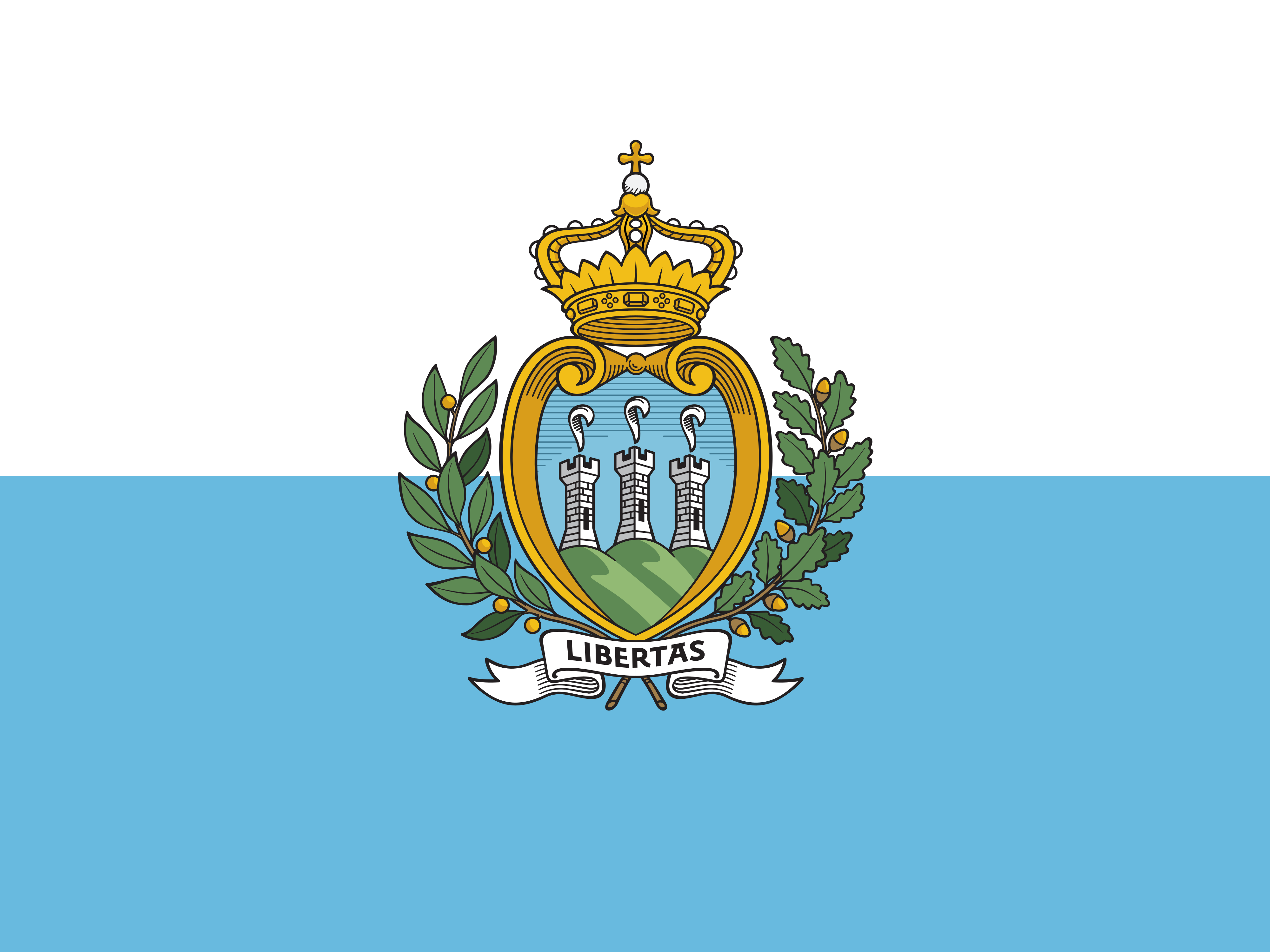
San Marino flag picture
Explore the construction notes, history, and picture gallery.
| Design | White, light blue, and the national armsThree feathered towers, a closed crown, laurel, oak, and LIBERTAS. |
|---|---|
| Proportions | Standard height:length = 3:4A 2:3 form is permitted for international use or when specifically provided. |
| Graphic standard | Constitutional Law No. 1 of July 22, 2011Published July 25; effective August 9, 2011. |
| Earlier adoption | April 6, 1862 is commonly citedThe legislative report treats the exact original flag adoption date as uncertain. |
| Meaning | LIBERTAS: liberty or freedomThe law expressly identifies the closed crown with sovereignty. |
| Main image sizes | SVG and PNGSVG: 4,000 × 3,000; PNG: 6,000 × 4,500. |
What does the San Marino flag look like?
San Marino’s official flag has two equal horizontal bands, white above light blue, with the national coat of arms placed over their boundary. The arms contain three feathered towers, a closed crown, leafy branches, and the motto LIBERTAS. The standard flag has height:length proportions of 3:4.
This guide explains the official flag and arms, the permitted proportions, and the evidence behind the dates. The gallery connects the legal measurements to educational illustrations and preserves the distinction between the official emblem and the surrounding explanatory artwork.
What are the colors of the San Marino flag?
The two background colors are white and light blue. Annex A of the 2011 constitutional law specifies light blue as Pantone 2915 C or 2915 U, with CMYK 55/10/5/0. The coat of arms adds its own prescribed colors. The law does not provide an official RGB or hexadecimal table.

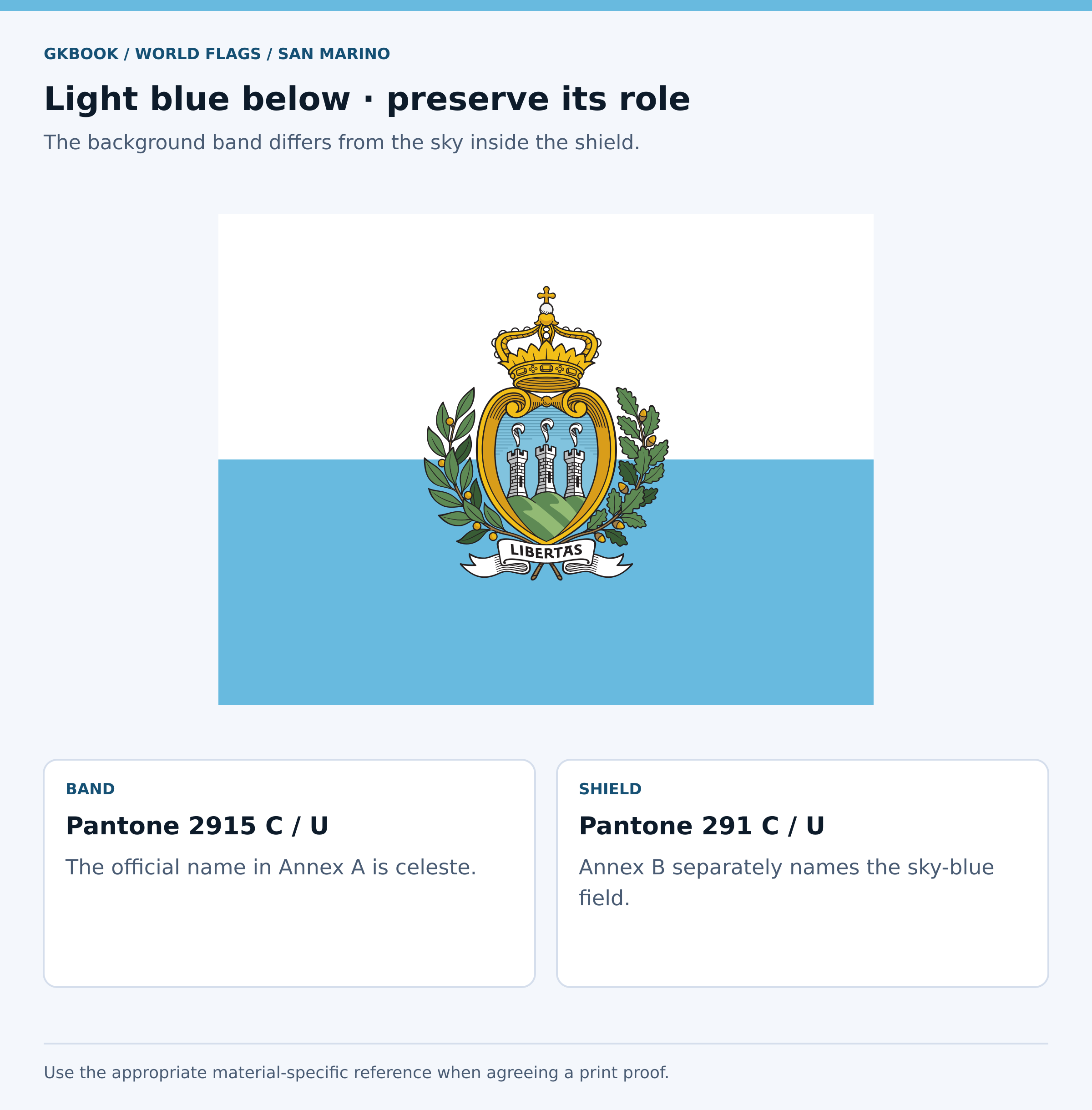
The flag’s lower band and the blue field inside its shield have different references. Annex B gives the shield’s sky blue as Pantone 291 C, while Annex A uses 2915 C for the flag. Replacing both with a single blue loses a distinction present in the published specifications.
The downloadable screen artwork uses colors converted from the official PDF, including #68BADF for the lower band and #FFFFFF for white. These values describe this digital rendering. They are not newly declared national standards, and a screen sample cannot certify the appearance of an ink, fabric, or finished flag.
| Part | Official reference | CMYK | Screen file |
|---|---|---|---|
| Light blue band | Pantone 2915 C / 2915 U | 55/10/5/0 | #68BADF |
| White band | White paper / white fabric | 0/0/0/0 | #FFFFFF |
What does the San Marino flag mean?
The flag combines the republic’s white and blue colors with an emblem centered on liberty and sovereignty. LIBERTAS means liberty or freedom, and the law expressly identifies the closed crown as a symbol of sovereignty. The towers connect the emblem with Mount Titano. The law does not assign a separate official meaning to every color.

Symbolic explanations should distinguish a legal statement from a later interpretation. The crown’s meaning is explicit in the constitutional description, and the Latin motto states liberty directly. The three towers also connect the emblem to a recognizable place, giving the flag both a political message and a geographical identity.
Whitney Smith’s Britannica account relates the white and blue to the clouds and sky around the mountainous country. That is a useful attributed interpretation. It should not be rewritten as a sentence from the flag law, or expanded into unsupported meanings for every shade, leaf, jewel, or architectural detail.
Why is the upper half of the flag white?
White is the upper of the flag’s two equal background bands. The official specification calls for white paper in print and white fabric for textiles. Whitney Smith associates the white and blue with clouds and sky around San Marino. The constitutional description fixes white’s position without prescribing a separate symbolic meaning for it.

White is a positive part of the composition, not an instruction to remove the background. A transparent upper half would allow the page, photograph, or material behind it to change the flag’s appearance. The clean PNG supplied here therefore has an opaque white upper band and an opaque blue lower band.
White also appears within the arms, where heraldic silver describes the towers, ostrich feathers, and scroll. These are distinct design elements even when they share a white screen fill. The silver description does not mean the upper band should be replaced with metallic gray or that every white area needs a border.
Which blue belongs on the lower half?
The lower band is light blue, called celeste in Annex A. Its specified printing references are Pantone 2915 C and 2915 U, and the annex also lists 15-4323 TPX for textiles. This background blue differs from the shield’s azzurro cielo. Keep the two roles separate when reproducing the complete flag.

A dark navy band changes the flag’s overall character and departs from the light blue specified in the annex. The official PDF supplies a visual reference, while its named color systems provide production information. The shade seen in a photograph can vary with daylight, shadows, fabric, camera settings, and screen calibration.
For a web image, use one declared rendering consistently across the flag, thumbnails, diagrams, and social preview. For production, identify the relevant material and color system before approving a proof. A hexadecimal code alone cannot capture all the conditions represented by coated paper, uncoated paper, and a textile reference.
What appears in the coat of arms?
The official arms show a blue shield containing three green mountains and three silver towers topped with silver ostrich feathers. A closed crown sits above the shield. Laurel and oak branches surround it, and a silver scroll carries LIBERTAS in black capitals. The 2011 law defines the complete graphic model in Annex B.

The coat of arms is an organized heraldic composition. The shield contains the landscape and towers; the crown sits outside it; the branches frame its sides; and the motto belongs on the scroll below. Treating these as interchangeable decorations can produce an image that looks elaborate while misidentifying the national emblem.
The artwork in this package reproduces the vector paths of the official annex. It preserves the crown, feathers, masonry, foliage, and lettering as a single model instead of assembling unrelated clip art. Explanatory labels remain outside that model, and credits distinguish the government’s underlying emblem from GKBook’s educational page and diagrams.
| Role | Pantone coated | Pantone uncoated | CMYK |
|---|---|---|---|
| Sun yellow | 7406 C | 7404 U | 5/25/100/0 |
| Golden yellow | 124 C | 7405 U | 5/35/100/10 |
| Branch brown | 7559 C | 7558 U | 15/35/70/30 |
| Light green | 576 C | 577 U | 47/10/70/0 |
| Leaf green | 7742 C | 363 U | 65/25/80/13 |
| Shadow green | Cool Gray 4 C + 7742 C; or 350 C | Cool Gray 3 U + 363 U; or 350 U | 65/25/80/50 |
| Sky blue | 291 C | 291 U | 47/8/7/0 |
| Shadow blue | Cool Gray 4 C + 291 C; or 7698 C | Cool Gray 3 U + 291 U; or 7698 U | 70/30/20/20 |
| Shadow gray | Cool Gray 4 C | Cool Gray 3 U | 0/0/0/30 |
| Black | Black C | Black U | 0/0/0/100 |
Which three towers does the flag represent?
The three towers refer to Guaita, Cesta, and Montale, the fortifications associated with Mount Titano. Official tourism sources identify these landmarks, and the government connects them with the national arms. The emblem represents them through stylized heraldic towers; it is not a measured architectural elevation or a literal photograph of the three buildings.
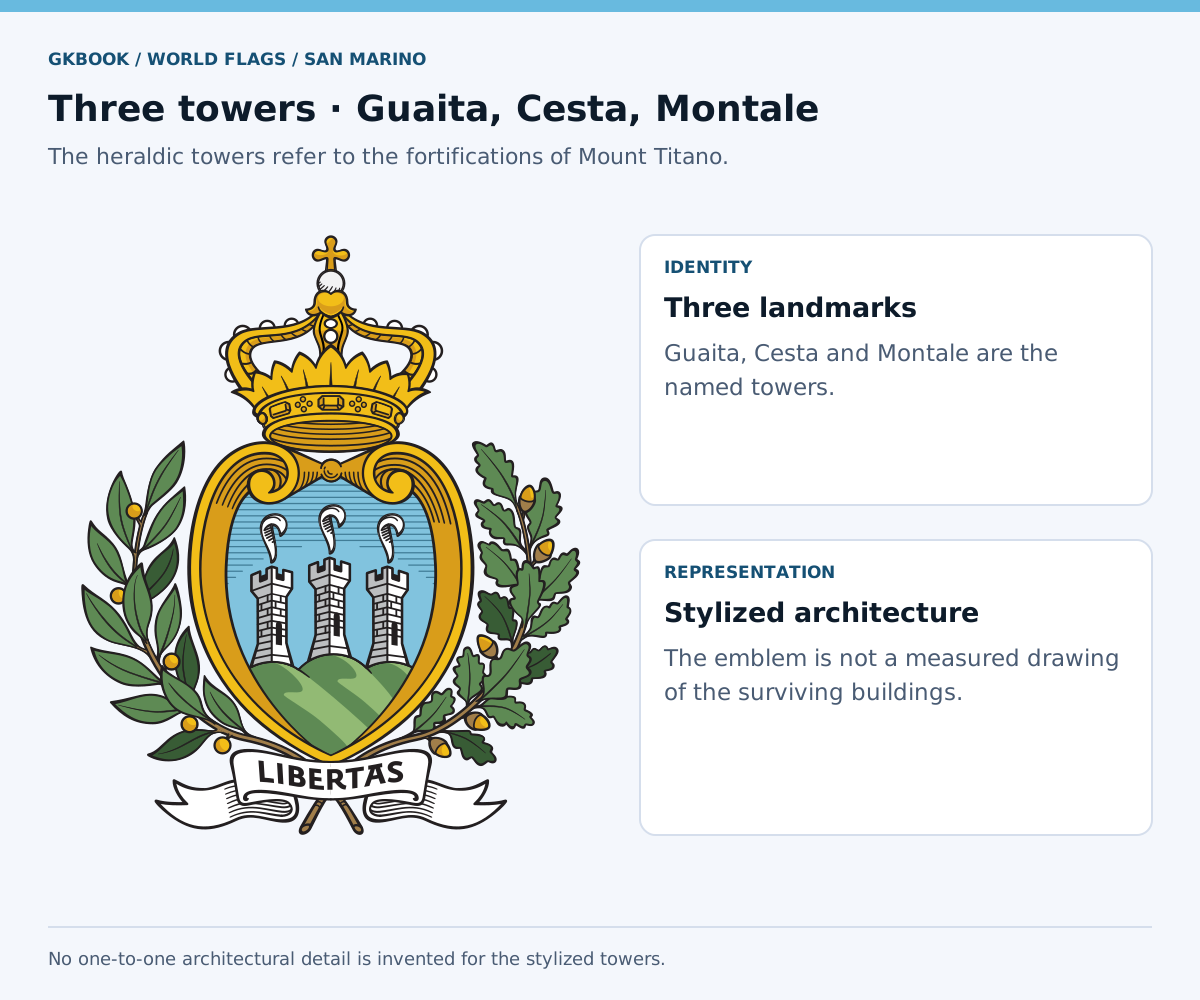
The real fortifications help explain why the towers are such a recognizable national symbol. Guaita, Cesta, and Montale belong to the mountain landscape overlooking the historic city. Their defensive associations also fit the wider theme of a community protecting its freedom and maintaining its institutions over a long period.
The three drawn towers should remain three. Their windows, battlements, outlines, and feathered tops are part of the prescribed model. A drawing does not become more accurate by replacing them with modern photographs or by assigning every small masonry feature to a particular surviving wall without documentary evidence.
What do the three green mountains represent?
The green mountains beneath the towers connect the arms with the three towered summits of Mount Titano. They form part of the blue shield’s landscape. Their number does not describe San Marino’s municipalities, which are nine. The heraldic mountains are stylized shapes, so their outlines should not be treated as a topographic survey.

Mount Titano and the historic center are recognized together by UNESCO as evidence of a continuing republican tradition. This geographical setting gives the emblem a concrete reference beyond an abstract arrangement of towers. The flag brings that setting into a compact image that can be recognized at a distance.
The green shapes support the towers inside the shield and use the tonal distinctions shown in the official model. Moving them outside the shield or turning the entire lower band green changes the composition. A separate landscape photograph can explain the location, but it cannot replace the heraldic model in the flag.
Are the shapes above the towers feathers or flames?
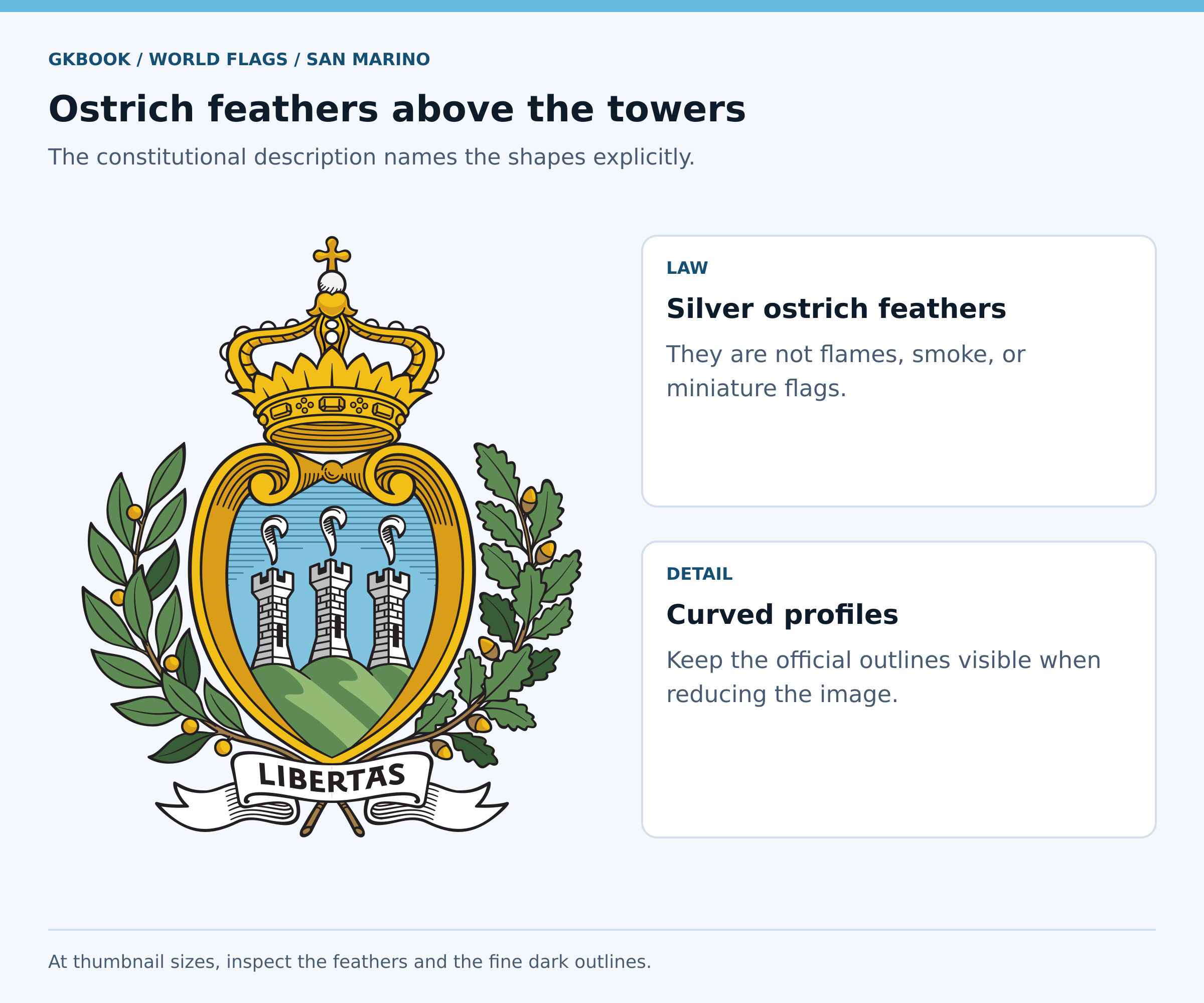
They are ostrich feathers, not flames, flags, or extra towers. The constitutional description explicitly calls for silver ostrich feathers above the three silver towers. In the official graphic they curve rather than forming straight spikes. Keeping these small features intact is important because they help distinguish San Marino’s arms from other fortified-city emblems.
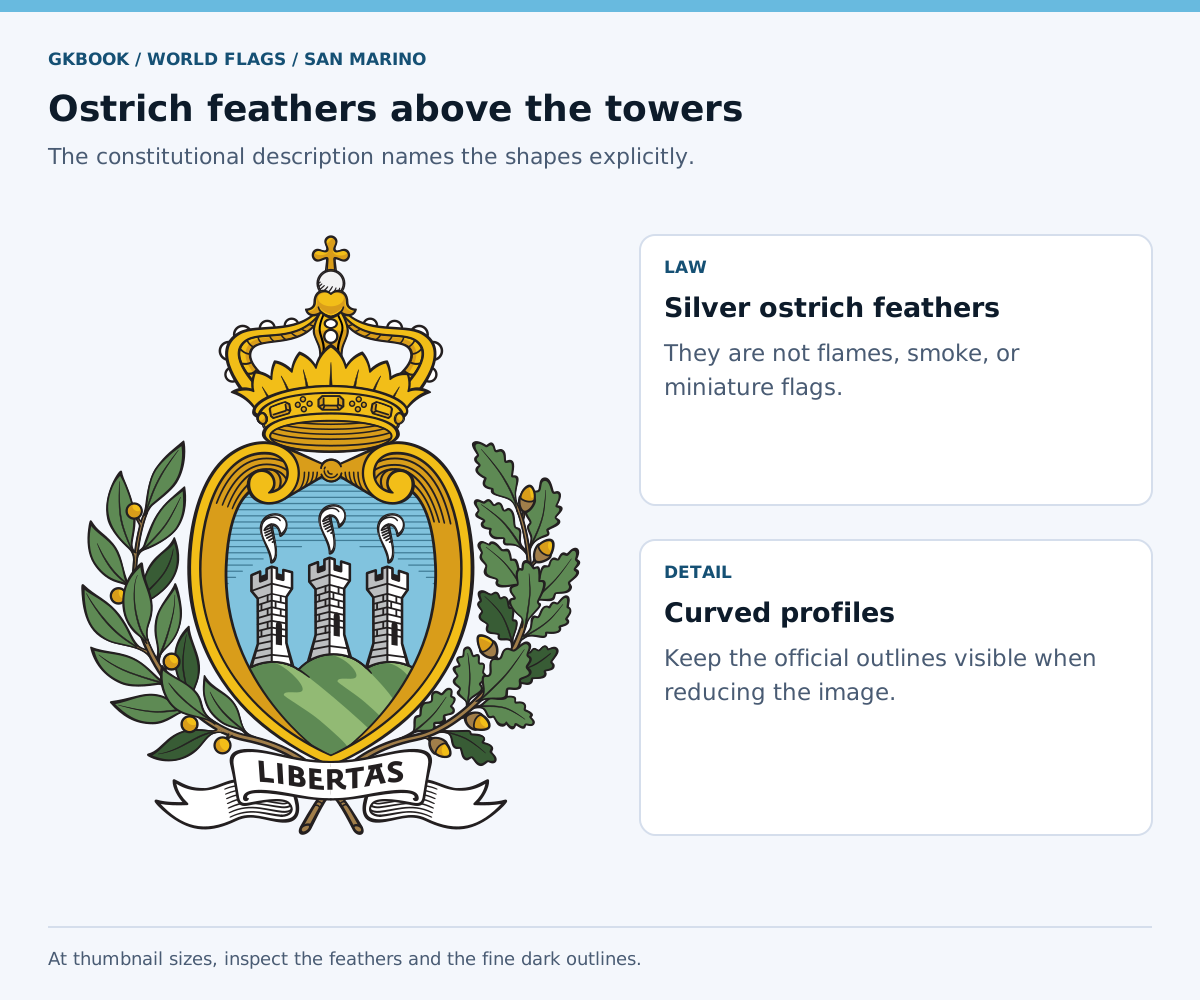
The feathers are easy to misread when the emblem is reduced to a tiny icon. Their curved profiles can resemble smoke or decorative flourishes, especially if dark outlines disappear. The enlarged arms in the gallery let readers inspect them within the complete design, where their attachment to the towers remains visible.
No speculative origin story is needed to identify the shapes: the law supplies their name. Some historical explanations discuss the towers’ real metal vanes or possible word associations, but such interpretations should remain attributed. The reproduction follows the published outlines and does not replace them with generic flame or feather symbols.
Why does a republic have a crown on its flag?
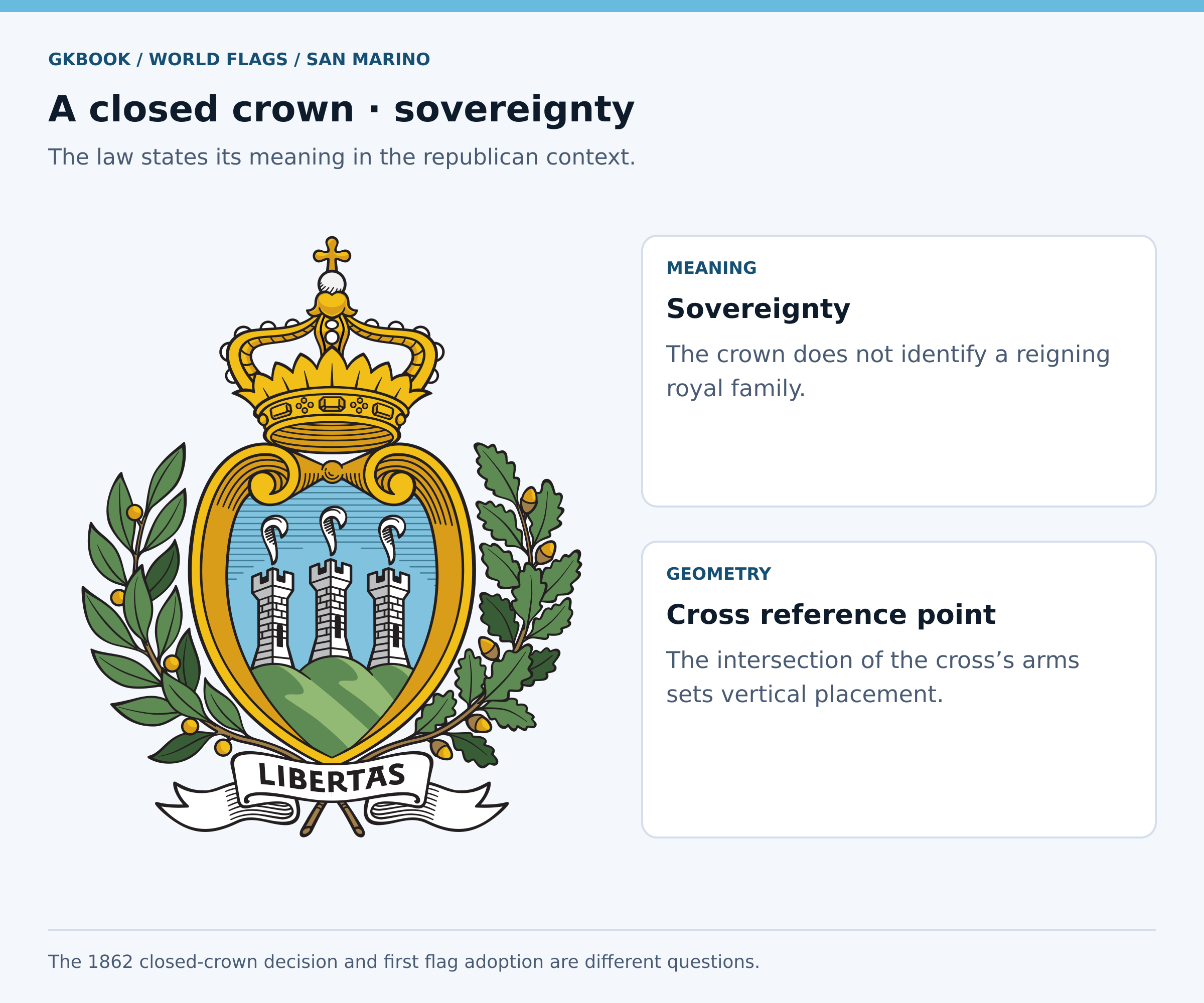
The closed crown represents sovereignty, as the constitutional description expressly states. It does not make San Marino a monarchy or identify a reigning royal family. The 2011 explanatory report connects the closed crown with an April 6, 1862 decree concerning the arms. The crown’s political meaning is therefore distinct from hereditary kingship.

The word closed describes a crown whose arches rise above its circlet. In the official drawing, the crown also carries an upper orb and cross. These features belong to the adopted heraldic model. They should be retained when explaining the emblem rather than replaced with a generic open coronet.
The republic’s institutional character and its use of a crown are compatible because heraldic symbols acquire meaning in their own context. Here the law provides that context directly. The crown also supplies an important construction reference: the intersection of its cross determines the emblem’s vertical placement on the flag.
Which branches surround the shield?
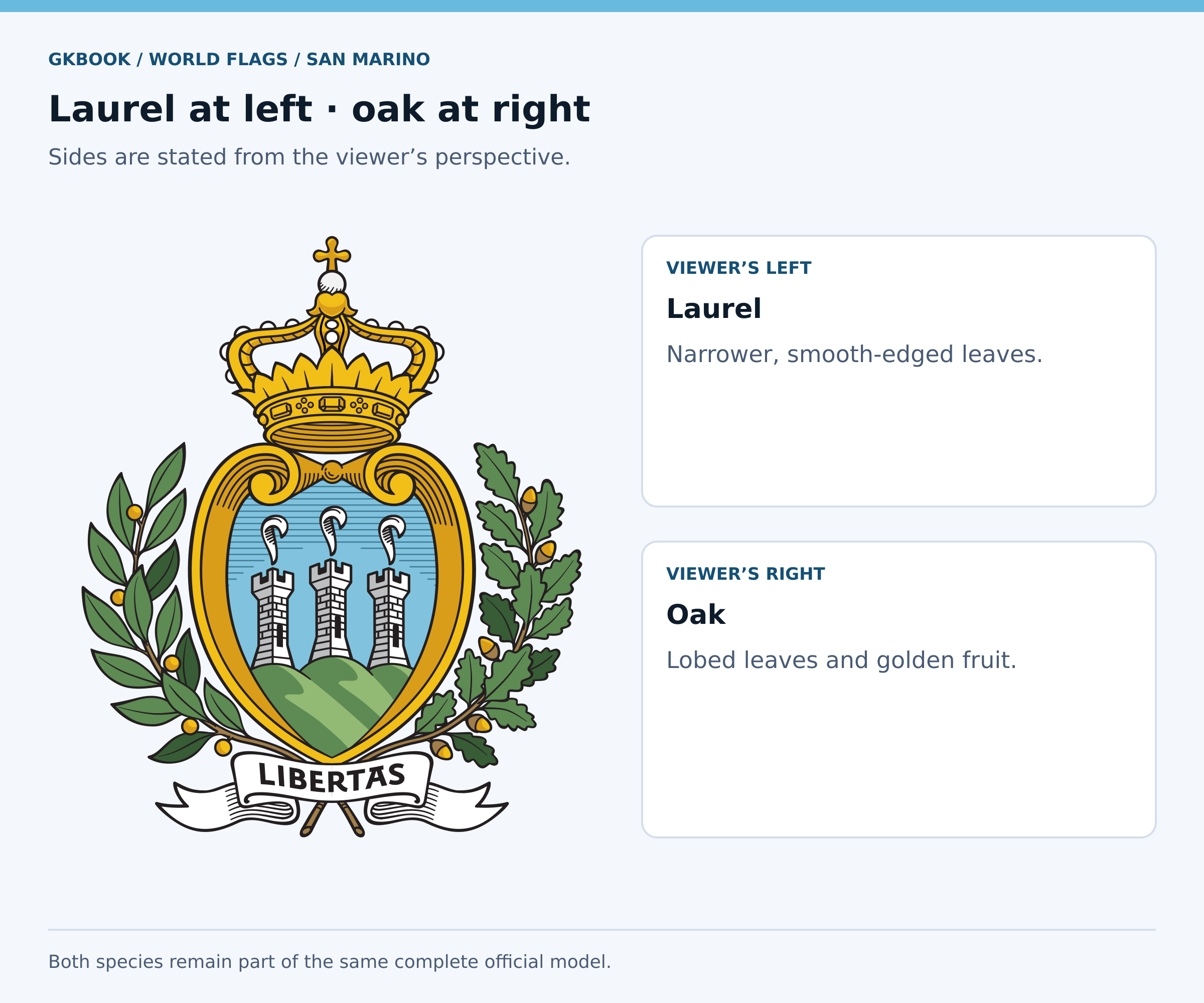
A laurel branch appears on the viewer’s left and an oak branch on the viewer’s right. They are green, bear golden fruit, and cross below the shield. The official tourism description confirms their identities and sides. Preserve their different leaf shapes; making the branches identical would remove a deliberate feature of the emblem.

The laurel leaves have narrower, smoother outlines, while the oak leaves are lobed. These botanical differences make the two sides visually distinguishable even though both use green. The official model also contains brown stems and shaded details, so a single mirrored branch is an inadequate substitute for the complete wreath.
Heraldic descriptions sometimes use right and left from the bearer’s perspective. This article avoids that ambiguity by stating the viewer’s sides explicitly. The constitutional text identifies the species and their crossing arrangement, but it does not assign a separate official symbolic definition to every leaf or piece of fruit.
What does LIBERTAS mean on the flag?
LIBERTAS is Latin for liberty or freedom. It appears in black capital letters on the silver scroll beneath the shield. The motto states a central theme of San Marino’s national identity. It is part of the official arms, so omitting it, changing its spelling, or replacing it with translated lettering changes the prescribed design.

The word belongs to the emblem rather than to the white or blue background band. In the supplied vector artwork, its letterforms come from the official graphic model, so the rendering does not depend on an installed display font. The surrounding scroll and its folds remain part of the same composition.
Translations help explain the motto, but they should appear in an external caption or accompanying text. Adding English words inside the ribbon would create a different emblem. At small sizes, inspect whether the original letters remain discernible; increasing the whole flag’s display size is preferable to inventing heavier replacement lettering.
What is the standard ratio of the San Marino flag?
The standard flag has height:length proportions of 3:4. Annex A expresses it as three units high and four units long, with equal horizontal bands. The principal SVG in this package is 4,000 by 3,000 units, and its PNG is 6,000 by 4,500 pixels. Both preserve the same rectangular proportions.

Ratio notation needs an identified order. Height:length 3:4 is the same shape as width:height 4:3; it is not a contradiction. For example, a flag 120 centimeters long is 90 centimeters high. Each background band occupies 45 centimeters of that height before the central arms are placed over the boundary.
Resize both dimensions together. Cropping a 3:4 flag into a wider rectangle can remove part of its field, while stretching it changes the emblem. The permitted 2:3 version has its own composition rules and is supplied separately, allowing the appropriate form to be selected without distorting the standard file.
Is a 2:3 San Marino flag also official?
Yes. Annex A permits height:length proportions of 2:3 for international use and when specifically provided for. In that version, the coat of arms occupies the middle third of the flag’s length, and the crown cross intersection lies one sixth of the flag’s height below the top. It is a separately specified composition.

At a shared height, the two authorized proportions use the same nominal arms width: half the flag’s height. The 2:3 flag simply provides more horizontal field on either side. This follows from one third of its length, whereas the standard 3:4 design assigns three eighths of its length to the arms.
The alternate download is 4,500 by 3,000 SVG units and 6,000 by 4,000 PNG pixels. Its label identifies the permitted 2:3 version. It should not be described as the sole correct national ratio, and a graphic editor should not obtain it by widening every element of the 3:4 design.
How large should the coat of arms be?
On the standard 3:4 flag, the arms occupy three eighths of the flag’s length, expressed as a base of one and a half L within a four-L flag. Annex B gives the arms a nominal width:height frame of 10:12. These proportions concern the complete emblem, including crown, branches, and scroll.
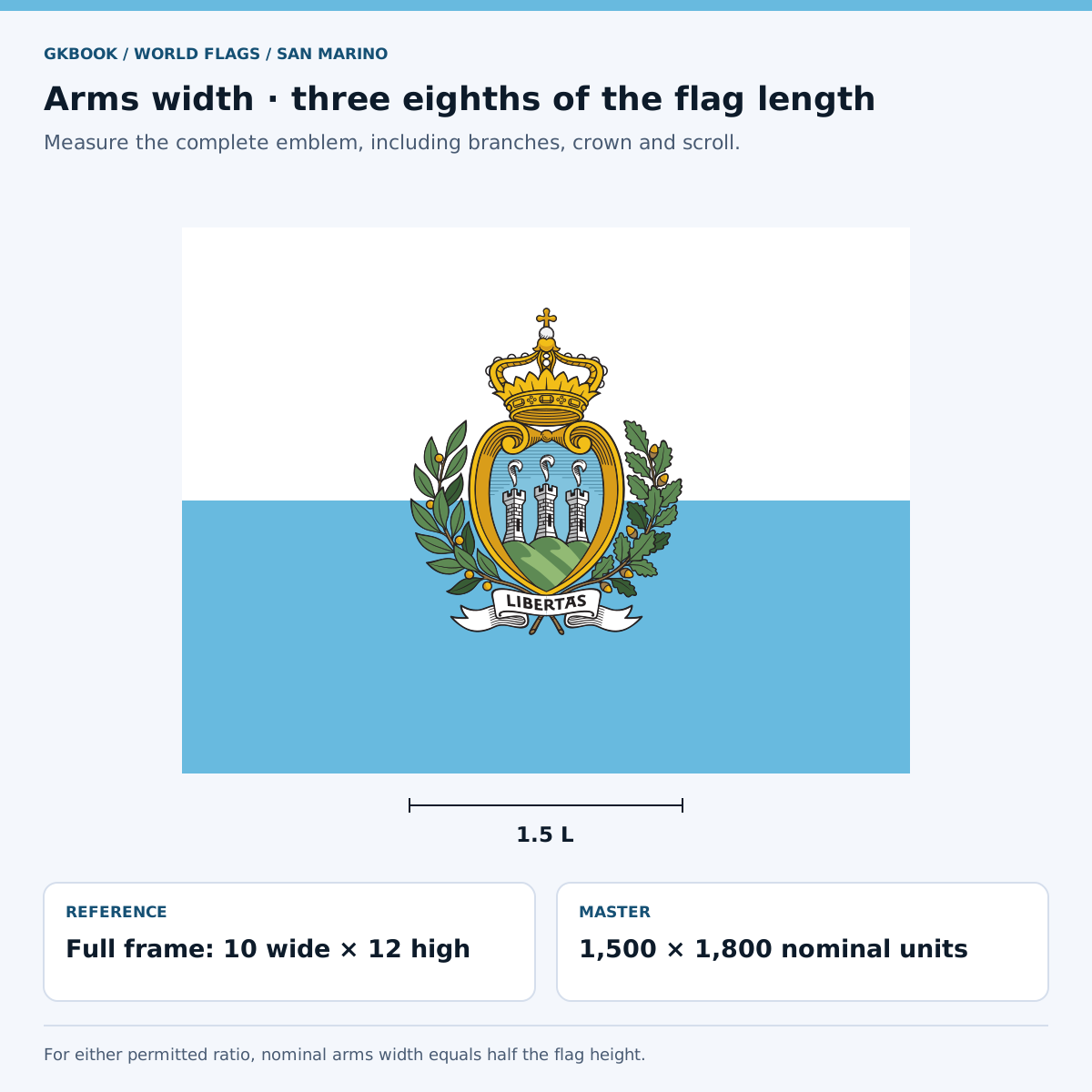
A common error is to measure only the blue shield and then enlarge the whole emblem until that shield reaches the specified width. The law’s graphic reference applies to the full coat of arms. Using the complete frame preserves the intended relationship between the emblem and the surrounding white and blue field.
On the 4,000 by 3,000 master, the nominal emblem frame is 1,500 units wide and 1,800 high. The official source paths are scaled uniformly within that reference system. Tiny drafting deviations in the published graphic are documented in the private specification, without presenting the file as a certified manufacturing master.
Where exactly should the coat of arms sit?
The arms are centered horizontally, but their vertical position is set by the cross above the crown. On the standard flag, the intersection of the cross’s arms is half an L below the top edge, or one sixth of the flag’s height. Centering the emblem’s bounding box vertically would give a different placement.

With L equal to 1,000 in the main master, the flag is 4,000 by 3,000 and the cross reference is at y = 500. The nominal emblem frame begins at x = 1,250 and ends at x = 2,750. These horizontal margins each equal five quarters of L.
The cross intersection is not the uppermost tip of the cross, the top of the crown’s arches, or the center of the shield. Those alternative anchors shift the entire emblem. The construction illustration marks the correct reference with external guides, while the clean flag contains only its prescribed field and arms.
How did San Marino’s flag develop?
The flag combines a long heraldic tradition with modern standardization. A 2011 government report discusses a recorded banner in 1465, a white-and-blue cockade in 1797, and an 1862 decision about the closed crown. The constitutional law of 2011 fixed precise text and graphic models. These events should not be collapsed into one adoption date.

The older evidence concerns different objects and decisions: a banner, a cockade, the arms, and eventually a detailed flag standard. A cockade establishes use of colors in an identifying badge, but does not by itself establish every feature of a rectangular flag. Likewise, changing a crown does not date the first bicolor.
The modern law was intended to resolve inconsistent graphic treatments while preserving traditional heraldic elements. Its explanatory report describes work to improve clarity and reproducibility. This makes 2011 a well-documented standardization milestone, without implying that San Marino first acquired a national symbol or became an independent republic in that year.
When was the San Marino flag adopted?
April 6, 1862 is commonly given, including in a government overview. However, the 2011 legislative report says the exact original adoption date is uncertain and associates the 1862 decree with the closed crown on the arms. The present graphic standard is securely dated to the 2011 law. The distinction should remain explicit.

The government overview and the legislative report serve different purposes. The overview offers a brief historical summary, while the report explains the evidence behind a new constitutional definition. Britannica likewise distinguishes the 1862 arms decision from the unresolved question of when the arms were placed on the flag.
For precise captions, use an event label: an 1862 heraldic decision, the law dated July 22, 2011, publication on July 25, or entry into force on August 9. The parliamentary register supplies the latter dates. None should be silently relabeled as the proven first day on which the white-and-blue flag existed.
| Date | Event | How to describe it |
|---|---|---|
| April 6, 1862 | Closed-crown decision; commonly cited adoption | Original flag adoption remains uncertain |
| July 20, 2011 | Parliamentary approval | Approval of the constitutional law |
| July 22, 2011 | Date of the law | Promulgation / statutory standardization |
| July 25, 2011 | Legal publication | Publication date |
| August 9, 2011 | Entry into force | Effective date recorded by Parliament |
What did earlier San Marino flags look like?
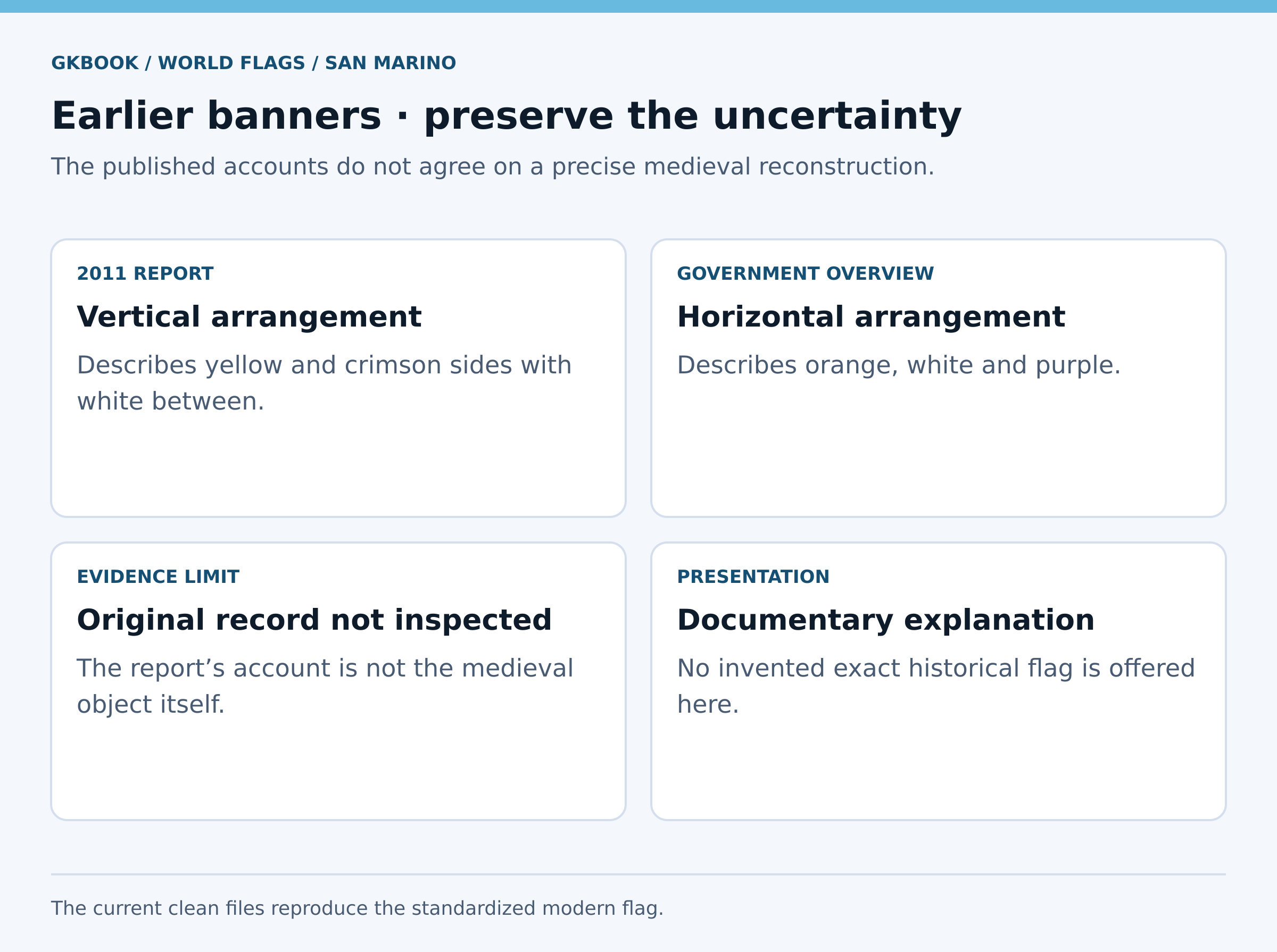
Older accounts describe a fifteenth-century multicolored banner and later white-and-blue designs with differing renderings of the arms. Published descriptions of the early banner disagree about arrangement and color terminology. This gallery therefore uses historical evidence cards instead of presenting an invented exact reconstruction. The modern standardized artwork should not be backdated to medieval events.

The 2011 report describes a September 4, 1465 archival reference to a vertical arrangement with yellow and crimson at the sides and white between. A government overview instead describes a horizontal orange, white, and purple banner. That disagreement makes a confident modern facsimile inappropriate without further examination of the original record.
The original medieval banner and its fabric colors were not inspected for this article. Nor does a modern ceremonial recreation establish their precise historical appearance. For nineteenth- and twentieth-century flags, variations in the arms should be identified by the actual object or image, rather than treated as one universally fixed predecessor design.
What changed in 2011?
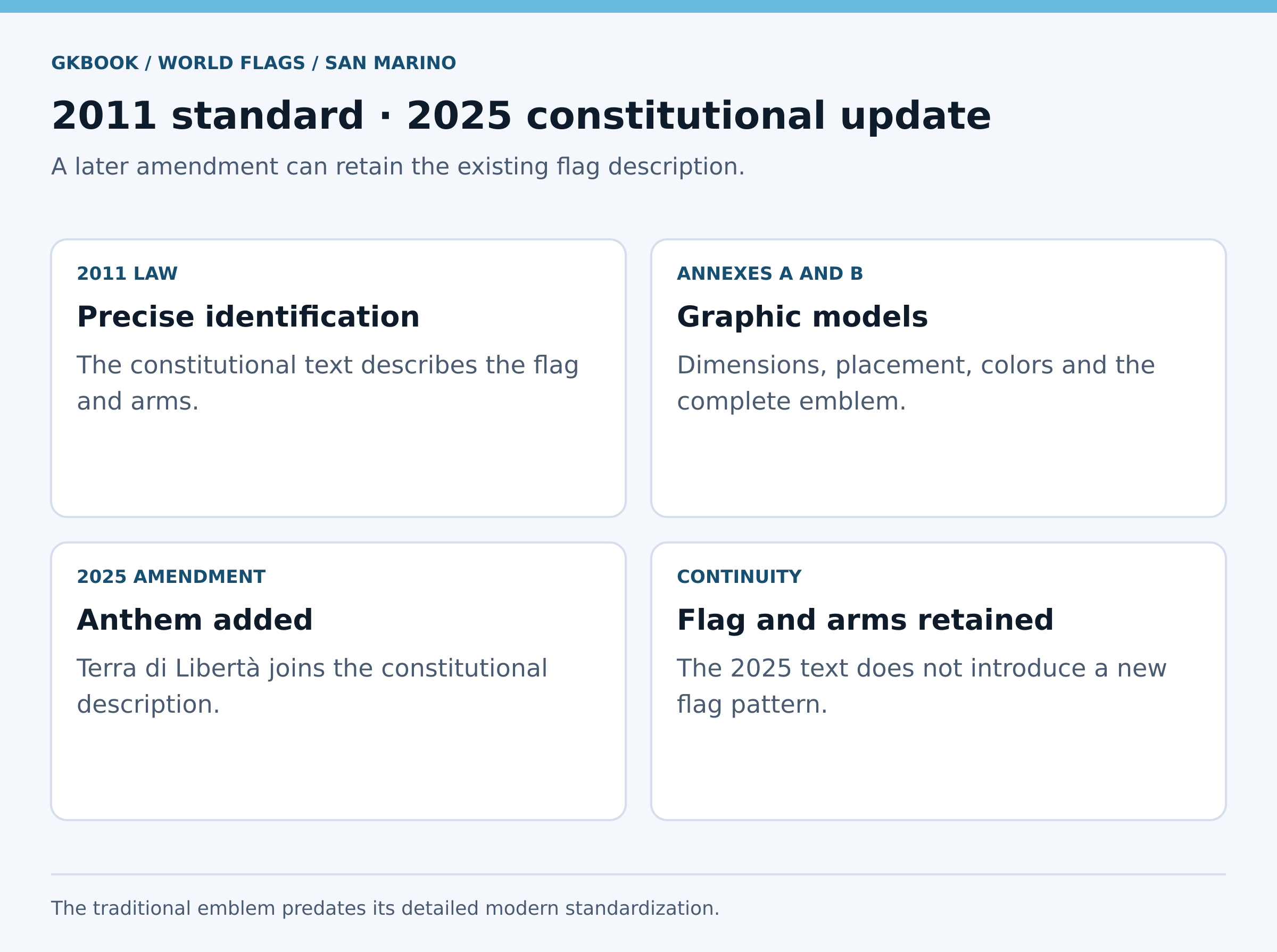
The 2011 constitutional law supplied a precise description and graphic annexes for the flag and official arms. It specified proportions, emblem placement, and color references while preserving the traditional heraldic elements. The explanatory report describes improved graphical clarity. This standardization should be distinguished from the much older history of the colors, towers, and motto.

The law added Article 2-bis to the 1974 Declaration of Rights and Fundamental Principles. Annex A defines the flag, and Annex B defines the arms. Together they allow a reproduction to be assessed against a shared model instead of relying only on a general phrase such as white and blue with towers.
A later constitutional law dated September 26, 2025 replaced Article 2-bis with a version that retains the flag and arms descriptions and adds the anthem, Terra di Libertà. That amendment does not introduce a new flag pattern. Its existence also shows why a historical standardization date and the latest relevant constitutional text are different questions.
Who designed the San Marino flag?
The sources checked do not establish one individual as the creator of the entire national flag. Its elements developed historically, and the 2011 standardization was an institutional project informed by documentary and heraldic research. The explanatory report credits collaborative work but does not identify a single named designer whose authorship can safely be assigned to this flag.
A named official who signs or presents a law is not automatically the artist who drew its annex. Similarly, a later illustrator, manufacturer, or editor of an online SVG does not thereby become the designer of the national flag. Those are different forms of responsibility and should be credited separately.
For the supplied images, the underlying arms are credited to the official published model. GKBook is responsible for the explanatory compositions, file preparation, and article. This attribution avoids claiming authorship of a national emblem while still making the production history of the downloadable assets clear and reviewable.
Is the plain white-and-blue bicolor the official civil flag?
The statutory official flag includes the coat of arms. The government’s overview explains that plain bicolors spread because of an interpretation of restrictions on private use of the arms, and says a later clarification excluded the flag from that prohibition. It describes one national and state flag with the arms. A plain bicolor should therefore be labeled carefully.

Some flag references classify an uncharged white-and-blue form as a civil flag or record it as a usage variant. That observation is different from the design expressly defined in the 2011 constitutional law. The present guide follows the law and government explanation when identifying the official national flag.
The gallery does not offer a plain bicolor as an interchangeable official download. Historical or observed use can be discussed without erasing the distinction between a documented practice and a prescribed national design. The same care applies to commercial versions of the arms, which are governed by a separate legal framework.
How do the flags of the nine Castelli differ?
San Marino’s nine Castelli, or local administrations, have their own flags based on the white-and-blue bicolor. The government describes them as carrying the local coat of arms and the Castello’s name vertically beside the staff. They identify particular municipalities and should not be confused with the national flag, whose center bears the republic’s official arms.

A shared background can make these flags look similar at a distance. The central emblem provides the decisive distinction, while the vertical name gives another identification aid. The official tourism material explains several local arms through place names and geographical associations, demonstrating that they are separate municipal symbols.
The number of municipalities must not be confused with the three towers in the national arms. Nine is an administrative count; three belongs to the emblem’s mountain-and-fortification imagery. This gallery explains the relationship with text cards and avoids inventing unverified municipal coats of arms or reproducing them as national alternatives.
Which laws define the flag and coat of arms?
Constitutional Law No. 1 of July 22, 2011 supplies the flag and arms models. Law No. 190 of December 5, 2011 addresses protection and use, and Regulation No. 3 of August 6, 2012 provides institutional graphic guidance. The 2025 constitutional amendment retains the flag and arms description while adding the official anthem.
These documents have different functions. The constitutional annexes identify what the symbols look like; the ordinary law addresses permitted uses and protection; the regulation coordinates institutional reproduction. Reading one of them does not replace the others, particularly when the question concerns commercial applications rather than identifying the flag.
This article records the versions and provisions actually inspected. It does not claim that every later administrative decision, commercial agreement, or ceremonial instruction has been examined. The national symbols can be explained accurately without turning a general educational article into a complete permission system for every proposed use.
Can the coat of arms be reproduced for education?
Article 3(4) of the inspected Law No. 190 of 2011 permits private depictions in dictionaries, encyclopedias, scientific works, and educational or explanatory publications without specific authorization. The same law contains restrictions on alterations and commercial applications. Educational reproduction should not be treated as blanket permission to turn the arms into a business logo or product mark.
The purpose and context of a reproduction matter. Showing the flag in an encyclopedia explains a national symbol; using the arms to identify a private company can suggest an official connection. The law and the Interior Ministry’s guidance distinguish these situations, and commercial-use procedures should be checked for the intended application.
The package credits the official artwork and presents it as reference material within an educational article. It makes no claim of government endorsement or unrestricted commercial licensing. Downloads preserve the model, while diagrams add explanations around it. The source notes document the inspected educational provision and the limits of the legal review.
When is the flag associated with national celebrations?
September 3 is the feast of Saint Marinus and the anniversary of the republic’s traditional foundation. Official tourism information expressly describes the year 301 as a tradition. The date is not the adoption date of the modern flag. Other state ceremonies also use national symbols, including the investiture of the Captains Regent.
The traditional foundation story, medieval republican continuity, and modern flag specification operate on different historical timescales. UNESCO discusses the continuing republican institutions of the historic center, while the contemporary flag law addresses a precise graphic model. Putting the current flag into a claimed scene from 301 would therefore require a clear modern-illustration label.
Official tourism information lists the investitures on April 1 and October 1. This explains recurring ceremonial settings without inventing a flag-specific holiday or a permanent program for every year. For an actual event, follow its published arrangements rather than inferring exact raising times or mourning instructions from an anniversary alone.
What does the reverse of the San Marino flag look like?
When viewed through a single-layer flag from the opposite side, the complete design is horizontally reflected. White remains above blue, but the branches exchange apparent sides and LIBERTAS appears reversed. A specially manufactured double-sided flag can keep lettering readable on both faces. This physical distinction should not be confused with changing the national design.
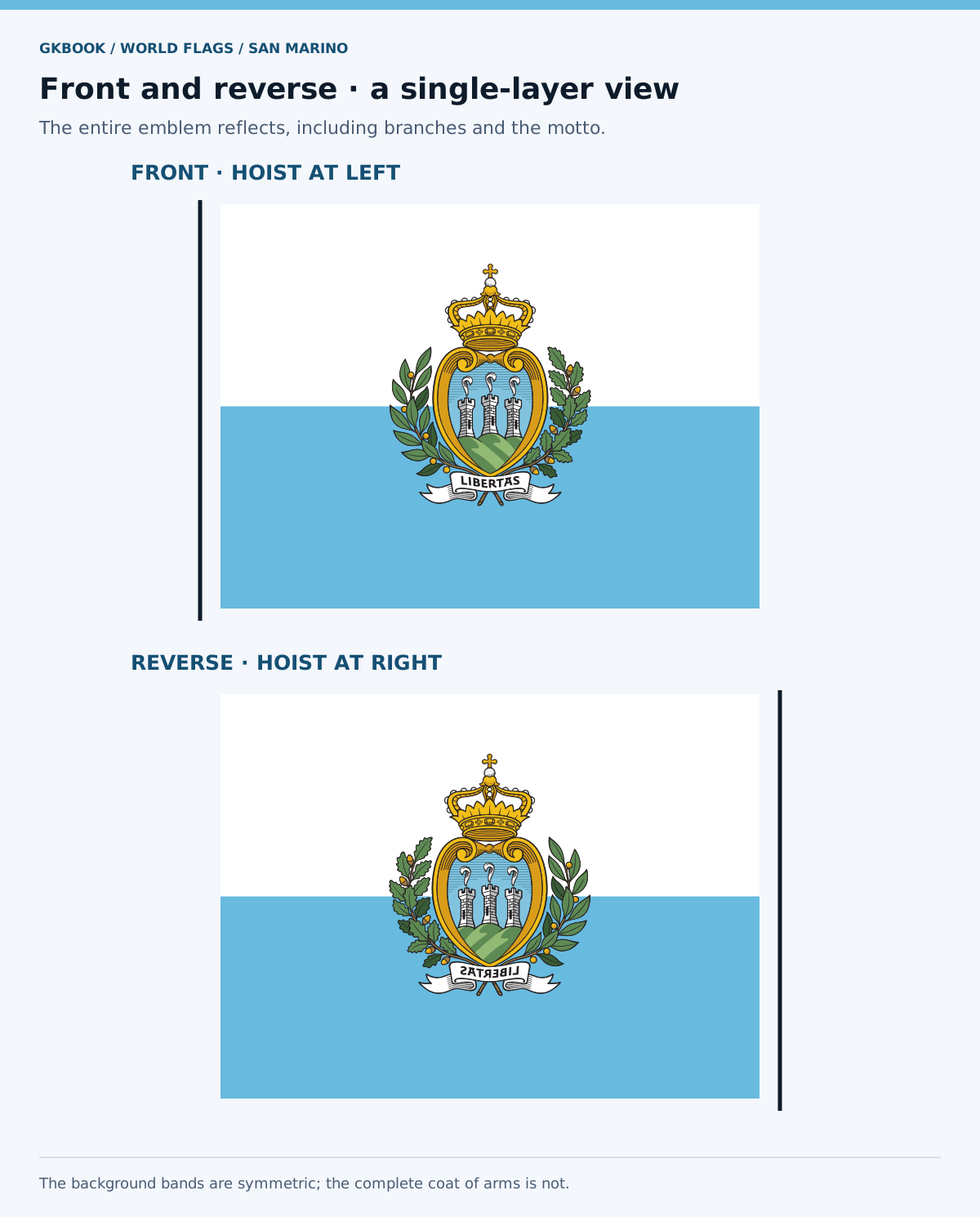
The background alone is horizontally symmetric, but the complete emblem is not. Its laurel and oak branches differ, and the motto has a reading direction. A reverse-view illustration must reflect the whole artwork consistently instead of swapping only the branches or leaving the letters facing forward by accident.
The gallery’s reverse diagram explains the view through single-layer material and labels it accordingly. It does not claim that the law requires one particular method of sewing or printing two faces. When ordering a physical flag, specify the intended construction with the maker while retaining the prescribed design on each intended front-facing surface.
Which SVG and PNG sizes are supplied?
The principal flag is supplied as a 4,000-by-3,000 SVG and a 6,000-by-4,500 PNG. The permitted 2:3 version has a 4,500-by-3,000 SVG and a 6,000-by-4,000 PNG. There are 24 gallery subjects with both formats, plus a separate 1,200-by-630 social card containing a complete correctly proportioned flag.

SVG preserves the field geometry and the detailed vector paths of the arms across display sizes. PNG supplies a predictable raster image for software that does not accept SVG. The clean national files have no pole, cloth texture, external caption, or decorative shadow, and their backgrounds are fully opaque.
The diagram and social canvases are larger explanatory layouts, so their outer dimensions are not national flag ratios. Each complete flag inside them retains its proper proportions. Inspect small previews carefully: the feather outlines, masonry, foliage, and motto can become hard to distinguish even when the underlying vector file remains accurate.
How should the flag be prepared for printing?
Preserve the correct flag ratio, emblem frame, cross-based placement, and complete official artwork. Use the annex’s appropriate Pantone, CMYK, or textile references when arranging production, and approve a proof on the intended material. The RGB colors in these web files are converted screen values, so they should not be described as certified physical color matches.
A 6,000-pixel-wide image printed at 300 pixels per inch produces a 20-inch-wide flag. The standard file would then be 15 inches high, while the permitted 2:3 file would be about 13.33 inches high. These are arithmetic examples, not legally prescribed flag dimensions or promises about a particular printing process.
The arms contain fine dark strokes and small lettering, so the practical minimum size depends on reproduction quality. A clean vector source helps preserve those details, but ink spread, weave, stitching, and viewing distance still matter. Confirm the production method and proof rather than assuming that a larger pixel count solves every manufacturing constraint.
What does the San Marino flag picture gallery include?
The gallery contains 24 subjects, each available as SVG and PNG, including both permitted flag proportions, the complete arms, color references, construction guides, historical dates, and reverse-view explanation. The coat of arms reproduces the official annex’s vector artwork. GKBook’s surrounding diagrams are educational compositions, and the historical cards are not claimed as archival photographs.
Start with the clean 3:4 national flag when a standard reference image is needed. Use the clearly labeled 2:3 version for a context requiring that permitted proportion. The other subjects answer specific questions about the emblem or its history, so their labels and explanatory space should remain with them.
The downloadable credits explain the official model, PDF color conversion, source access, and reproduction limits. The private editorial package records the research ledger and verification results. Readers can also continue through GKBook’s World Flags collection to compare how other national flags express geography, institutions, and historical identity.
Download San Marino flag pictures
Download the standard 3:4 flag as SVG or 6,000 × 4,500 PNG. The permitted 2:3 form is available as SVG or 6,000 × 4,000 PNG.
The gallery contains 24 subjects, each with an SVG and PNG. The flag layouts follow Annex A, and the arms preserve the vector model from Annex B. Screen colors are converted from the published PDF and are not an official RGB table. Image credits and reproduction notes explain the source basis and educational-use context. The separate 1,200 × 630 social card contains a complete standard flag.
Continue exploring national designs in World Flags.
World Flags/San Marino
San Marino flag pictures
The standard official flag, with equal white and light-blue bands and the complete national arms. Geometry follows Annex A; the arms reproduce Annex B.
Arms reproduced from the official 2011 Annex B vector model; GKBook layout and educational annotations. Screen colors are converted from the published PDF.Download SVGDownload PNGAnnex A permits this proportion for international use or when specifically provided. The arms occupy the middle third of the length; the crown cross is one sixth of the height below the top.
Arms reproduced from the official 2011 Annex B vector model; GKBook layout and educational annotations. Screen colors are converted from the published PDF.Download SVGDownload PNGAnnex A gives the band’s Pantone, CMYK and textile references. The shown hexadecimal values describe these screen assets only.
Arms reproduced from the official 2011 Annex B vector model; GKBook layout and educational annotations. Screen colors are converted from the published PDF.Download SVGDownload PNGThe crown’s sovereignty symbolism and the motto are explicit; the color explanation is attributed to the reference account.
Arms reproduced from the official 2011 Annex B vector model; GKBook layout and educational annotations. Screen colors are converted from the published PDF.Download SVGDownload PNGWhite forms the upper equal band; the emblem’s silver elements have their own heraldic roles.
Arms reproduced from the official 2011 Annex B vector model; GKBook layout and educational annotations. Screen colors are converted from the published PDF.Download SVGDownload PNGThe complete flag keeps the band and shield blues distinct. Screen color is a declared conversion of the published PDF.
Arms reproduced from the official 2011 Annex B vector model; GKBook layout and educational annotations. Screen colors are converted from the published PDF.Download SVGDownload PNGThis is an educational reproduction of the full official model. Its 585 vector fill/stroke paths are preserved under uniform scaling.
Arms reproduced from the official 2011 Annex B vector model; GKBook layout and educational annotations. Screen colors are converted from the published PDF.Download SVGDownload PNGThe full arms preserve the relationship among towers, mountains, feathers and shield.
Arms reproduced from the official 2011 Annex B vector model; GKBook layout and educational annotations. Screen colors are converted from the published PDF.Download SVGDownload PNGGreen mountains belong inside the shield and retain the official model’s tonal details.
Arms reproduced from the official 2011 Annex B vector model; GKBook layout and educational annotations. Screen colors are converted from the published PDF.Download SVGDownload PNGEach tower is topped by a feather. The full model is shown to preserve context.
Arms reproduced from the official 2011 Annex B vector model; GKBook layout and educational annotations. Screen colors are converted from the published PDF.Download SVGDownload PNGThe closed crown retains its arches, upper orb and cross as part of the official arms.
Arms reproduced from the official 2011 Annex B vector model; GKBook layout and educational annotations. Screen colors are converted from the published PDF.Download SVGDownload PNGThe branches have distinct forms and cross below the shield; they are not mirrored copies.
Arms reproduced from the official 2011 Annex B vector model; GKBook layout and educational annotations. Screen colors are converted from the published PDF.Download SVGDownload PNGThe official lettering is preserved as vector artwork, with no dependency on a local font.
Arms reproduced from the official 2011 Annex B vector model; GKBook layout and educational annotations. Screen colors are converted from the published PDF.Download SVGDownload PNGDimension guides sit outside the clean national design. The white and light-blue bands have equal heights.
Arms reproduced from the official 2011 Annex B vector model; GKBook layout and educational annotations. Screen colors are converted from the published PDF.Download SVGDownload PNGThe horizontal bracket corresponds to the nominal full emblem frame, not only the shield. Source graphic precision is documented privately.
Arms reproduced from the official 2011 Annex B vector model; GKBook layout and educational annotations. Screen colors are converted from the published PDF.Download SVGDownload PNGThe dashed guide stops before the arms and marks the height of the crown cross’s intersection. It is absent from the clean flag.
Arms reproduced from the official 2011 Annex B vector model; GKBook layout and educational annotations. Screen colors are converted from the published PDF.Download SVGDownload PNGThe chronology distinguishes the objects and decisions documented by the sources.
Arms reproduced from the official 2011 Annex B vector model; GKBook layout and educational annotations. Screen colors are converted from the published PDF.Download SVGDownload PNGThe 1862 claim is attributed and its limitation explained; the 2011 procedural dates are independently labeled.
Arms reproduced from the official 2011 Annex B vector model; GKBook layout and educational annotations. Screen colors are converted from the published PDF.Download SVGDownload PNGThese text cards explain the disagreement about the 1465 banner without treating one modern facsimile as proven.
Arms reproduced from the official 2011 Annex B vector model; GKBook layout and educational annotations. Screen colors are converted from the published PDF.Download SVGDownload PNGThe inspected 2025 constitutional law repeats the flag and arms description while adding the anthem.
Arms reproduced from the official 2011 Annex B vector model; GKBook layout and educational annotations. Screen colors are converted from the published PDF.Download SVGDownload PNGThe government overview distinguishes the official flag from the historical spread of an uncharged bicolor.
Arms reproduced from the official 2011 Annex B vector model; GKBook layout and educational annotations. Screen colors are converted from the published PDF.Download SVGDownload PNGThis is a comparison of identifying features, not a gallery of reconstructed municipal emblems.
Arms reproduced from the official 2011 Annex B vector model; GKBook layout and educational annotations. Screen colors are converted from the published PDF.Download SVGDownload PNGThe reverse reflects the complete flag horizontally. LIBERTAS reads backward in this view; specially made double-sided flags are a separate construction choice.
Arms reproduced from the official 2011 Annex B vector model; GKBook layout and educational annotations. Screen colors are converted from the published PDF.Download SVGDownload PNGThe clean national flags preserve their respective authorized ratios. The social canvas is not itself a national flag ratio.
Arms reproduced from the official 2011 Annex B vector model; GKBook layout and educational annotations. Screen colors are converted from the published PDF.Download SVGDownload PNGFrequently asked questions
What does the San Marino flag look like?
San Marino’s official flag has two equal horizontal bands, white above light blue, with the national coat of arms placed over their boundary. The arms contain three feathered towers, a closed crown, leafy branches, and the motto LIBERTAS. The standard flag has height:length proportions of 3:4.
What are the colors of the San Marino flag?
The two background colors are white and light blue. Annex A of the 2011 constitutional law specifies light blue as Pantone 2915 C or 2915 U, with CMYK 55/10/5/0. The coat of arms adds its own prescribed colors. The law does not provide an official RGB or hexadecimal table.
What does the San Marino flag mean?
The flag combines the republic’s white and blue colors with an emblem centered on liberty and sovereignty. LIBERTAS means liberty or freedom, and the law expressly identifies the closed crown as a symbol of sovereignty. The towers connect the emblem with Mount Titano. The law does not assign a separate official meaning to every color.
Why is the upper half of the flag white?
White is the upper of the flag’s two equal background bands. The official specification calls for white paper in print and white fabric for textiles. Whitney Smith associates the white and blue with clouds and sky around San Marino. The constitutional description fixes white’s position without prescribing a separate symbolic meaning for it.
Which blue belongs on the lower half?
The lower band is light blue, called celeste in Annex A. Its specified printing references are Pantone 2915 C and 2915 U, and the annex also lists 15-4323 TPX for textiles. This background blue differs from the shield’s azzurro cielo. Keep the two roles separate when reproducing the complete flag.
What appears in the coat of arms?
The official arms show a blue shield containing three green mountains and three silver towers topped with silver ostrich feathers. A closed crown sits above the shield. Laurel and oak branches surround it, and a silver scroll carries LIBERTAS in black capitals. The 2011 law defines the complete graphic model in Annex B.
Which three towers does the flag represent?
The three towers refer to Guaita, Cesta, and Montale, the fortifications associated with Mount Titano. Official tourism sources identify these landmarks, and the government connects them with the national arms. The emblem represents them through stylized heraldic towers; it is not a measured architectural elevation or a literal photograph of the three buildings.
What do the three green mountains represent?
The green mountains beneath the towers connect the arms with the three towered summits of Mount Titano. They form part of the blue shield’s landscape. Their number does not describe San Marino’s municipalities, which are nine. The heraldic mountains are stylized shapes, so their outlines should not be treated as a topographic survey.
Are the shapes above the towers feathers or flames?
They are ostrich feathers, not flames, flags, or extra towers. The constitutional description explicitly calls for silver ostrich feathers above the three silver towers. In the official graphic they curve rather than forming straight spikes. Keeping these small features intact is important because they help distinguish San Marino’s arms from other fortified-city emblems.
Why does a republic have a crown on its flag?
The closed crown represents sovereignty, as the constitutional description expressly states. It does not make San Marino a monarchy or identify a reigning royal family. The 2011 explanatory report connects the closed crown with an April 6, 1862 decree concerning the arms. The crown’s political meaning is therefore distinct from hereditary kingship.
Which branches surround the shield?
A laurel branch appears on the viewer’s left and an oak branch on the viewer’s right. They are green, bear golden fruit, and cross below the shield. The official tourism description confirms their identities and sides. Preserve their different leaf shapes; making the branches identical would remove a deliberate feature of the emblem.
What does LIBERTAS mean on the flag?
LIBERTAS is Latin for liberty or freedom. It appears in black capital letters on the silver scroll beneath the shield. The motto states a central theme of San Marino’s national identity. It is part of the official arms, so omitting it, changing its spelling, or replacing it with translated lettering changes the prescribed design.
What is the standard ratio of the San Marino flag?
The standard flag has height:length proportions of 3:4. Annex A expresses it as three units high and four units long, with equal horizontal bands. The principal SVG in this package is 4,000 by 3,000 units, and its PNG is 6,000 by 4,500 pixels. Both preserve the same rectangular proportions.
Is a 2:3 San Marino flag also official?
Yes. Annex A permits height:length proportions of 2:3 for international use and when specifically provided for. In that version, the coat of arms occupies the middle third of the flag’s length, and the crown cross intersection lies one sixth of the flag’s height below the top. It is a separately specified composition.
How large should the coat of arms be?
On the standard 3:4 flag, the arms occupy three eighths of the flag’s length, expressed as a base of one and a half L within a four-L flag. Annex B gives the arms a nominal width:height frame of 10:12. These proportions concern the complete emblem, including crown, branches, and scroll.
Where exactly should the coat of arms sit?
The arms are centered horizontally, but their vertical position is set by the cross above the crown. On the standard flag, the intersection of the cross’s arms is half an L below the top edge, or one sixth of the flag’s height. Centering the emblem’s bounding box vertically would give a different placement.
How did San Marino’s flag develop?
The flag combines a long heraldic tradition with modern standardization. A 2011 government report discusses a recorded banner in 1465, a white-and-blue cockade in 1797, and an 1862 decision about the closed crown. The constitutional law of 2011 fixed precise text and graphic models. These events should not be collapsed into one adoption date.
When was the San Marino flag adopted?
April 6, 1862 is commonly given, including in a government overview. However, the 2011 legislative report says the exact original adoption date is uncertain and associates the 1862 decree with the closed crown on the arms. The present graphic standard is securely dated to the 2011 law. The distinction should remain explicit.
What did earlier San Marino flags look like?
Older accounts describe a fifteenth-century multicolored banner and later white-and-blue designs with differing renderings of the arms. Published descriptions of the early banner disagree about arrangement and color terminology. This gallery therefore uses historical evidence cards instead of presenting an invented exact reconstruction. The modern standardized artwork should not be backdated to medieval events.
What changed in 2011?
The 2011 constitutional law supplied a precise description and graphic annexes for the flag and official arms. It specified proportions, emblem placement, and color references while preserving the traditional heraldic elements. The explanatory report describes improved graphical clarity. This standardization should be distinguished from the much older history of the colors, towers, and motto.
Who designed the San Marino flag?
The sources checked do not establish one individual as the creator of the entire national flag. Its elements developed historically, and the 2011 standardization was an institutional project informed by documentary and heraldic research. The explanatory report credits collaborative work but does not identify a single named designer whose authorship can safely be assigned to this flag.
Is the plain white-and-blue bicolor the official civil flag?
The statutory official flag includes the coat of arms. The government’s overview explains that plain bicolors spread because of an interpretation of restrictions on private use of the arms, and says a later clarification excluded the flag from that prohibition. It describes one national and state flag with the arms. A plain bicolor should therefore be labeled carefully.
How do the flags of the nine Castelli differ?
San Marino’s nine Castelli, or local administrations, have their own flags based on the white-and-blue bicolor. The government describes them as carrying the local coat of arms and the Castello’s name vertically beside the staff. They identify particular municipalities and should not be confused with the national flag, whose center bears the republic’s official arms.
Which laws define the flag and coat of arms?
Constitutional Law No. 1 of July 22, 2011 supplies the flag and arms models. Law No. 190 of December 5, 2011 addresses protection and use, and Regulation No. 3 of August 6, 2012 provides institutional graphic guidance. The 2025 constitutional amendment retains the flag and arms description while adding the official anthem.
Can the coat of arms be reproduced for education?
Article 3(4) of the inspected Law No. 190 of 2011 permits private depictions in dictionaries, encyclopedias, scientific works, and educational or explanatory publications without specific authorization. The same law contains restrictions on alterations and commercial applications. Educational reproduction should not be treated as blanket permission to turn the arms into a business logo or product mark.
When is the flag associated with national celebrations?
September 3 is the feast of Saint Marinus and the anniversary of the republic’s traditional foundation. Official tourism information expressly describes the year 301 as a tradition. The date is not the adoption date of the modern flag. Other state ceremonies also use national symbols, including the investiture of the Captains Regent.
What does the reverse of the San Marino flag look like?
When viewed through a single-layer flag from the opposite side, the complete design is horizontally reflected. White remains above blue, but the branches exchange apparent sides and LIBERTAS appears reversed. A specially manufactured double-sided flag can keep lettering readable on both faces. This physical distinction should not be confused with changing the national design.
Which SVG and PNG sizes are supplied?
The principal flag is supplied as a 4,000-by-3,000 SVG and a 6,000-by-4,500 PNG. The permitted 2:3 version has a 4,500-by-3,000 SVG and a 6,000-by-4,000 PNG. There are 24 gallery subjects with both formats, plus a separate 1,200-by-630 social card containing a complete correctly proportioned flag.
How should the flag be prepared for printing?
Preserve the correct flag ratio, emblem frame, cross-based placement, and complete official artwork. Use the annex’s appropriate Pantone, CMYK, or textile references when arranging production, and approve a proof on the intended material. The RGB colors in these web files are converted screen values, so they should not be described as certified physical color matches.
What does the San Marino flag picture gallery include?
The gallery contains 24 subjects, each available as SVG and PNG, including both permitted flag proportions, the complete arms, color references, construction guides, historical dates, and reverse-view explanation. The coat of arms reproduces the official annex’s vector artwork. GKBook’s surrounding diagrams are educational compositions, and the historical cards are not claimed as archival photographs.
Explore all general-knowledge topics and the A-to-Z lists.









We Value Your Opinion Comments