
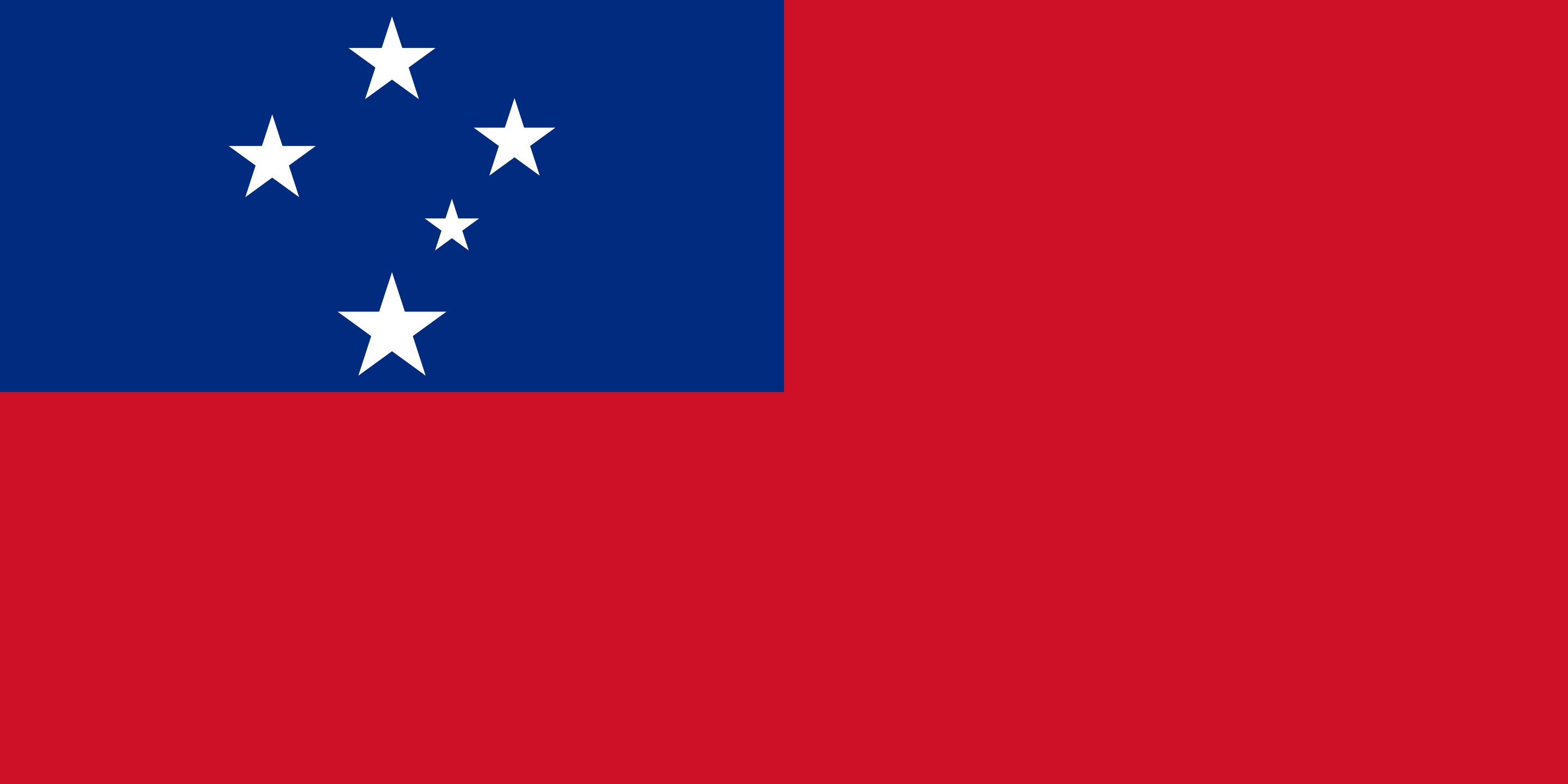
Samoa flag picture
Explore the construction notes, history, and picture gallery.
| Design | Red, blue, and five white starsThe stars represent the Southern Cross. |
|---|---|
| Proportions | Height:length = 1:2Statutory grid: 288 × 144; canton: 144 × 72. |
| Five-star adoption | February 24, 1949Ministry date and Gazette publication; notice dated February 11. |
| Independence | January 1, 1962The existing design continued; annual celebration is June 1. |
| 1948 design credit | Malietoa Tanumafili II and Tupua Tamasese Mea‘oleA reported family account also describes contributions by their wives. |
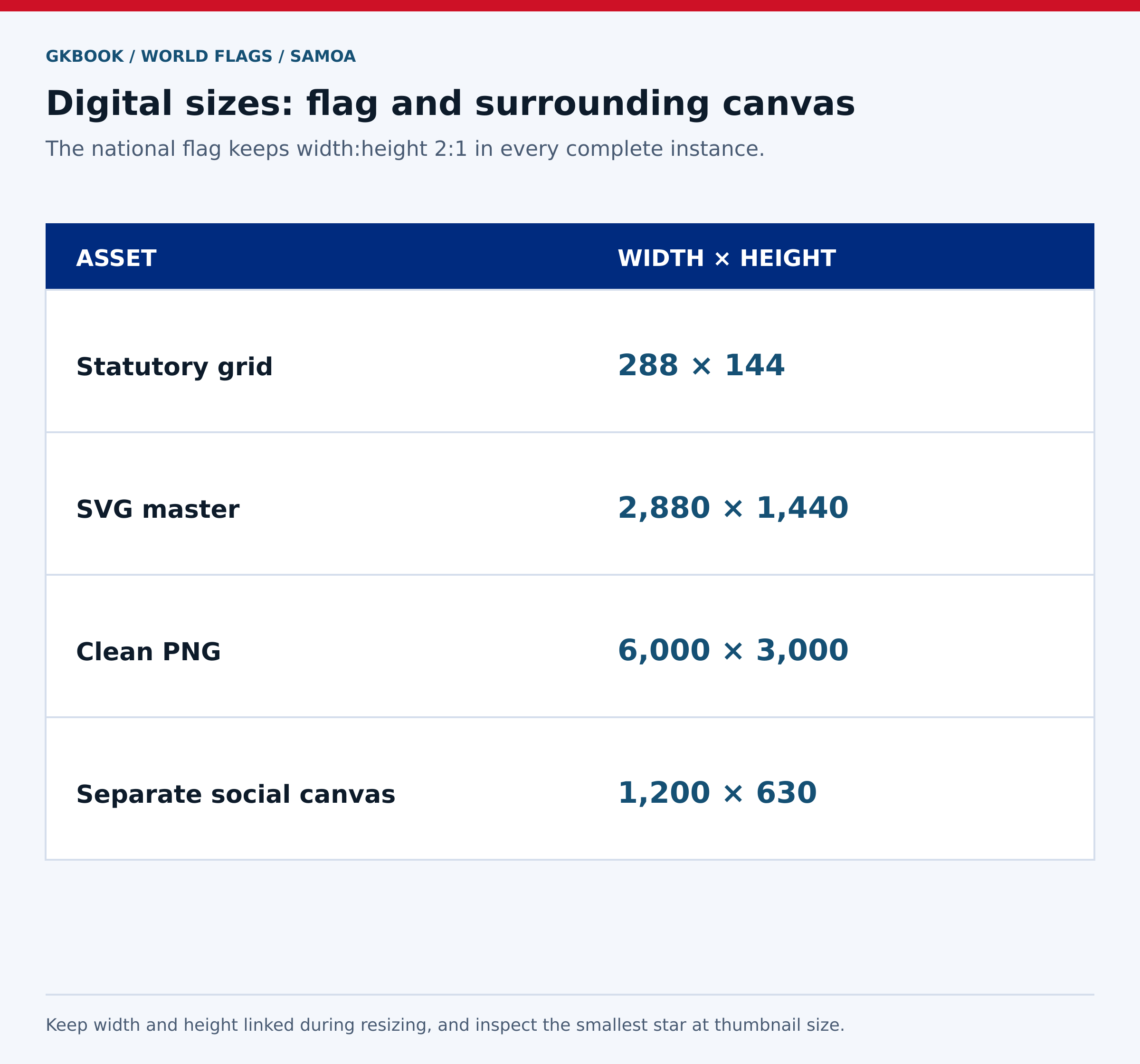
| Image sizes | SVG and PNGSVG: 2,880 × 1,440; PNG: 6,000 × 3,000. |
What does the Samoa flag look like?
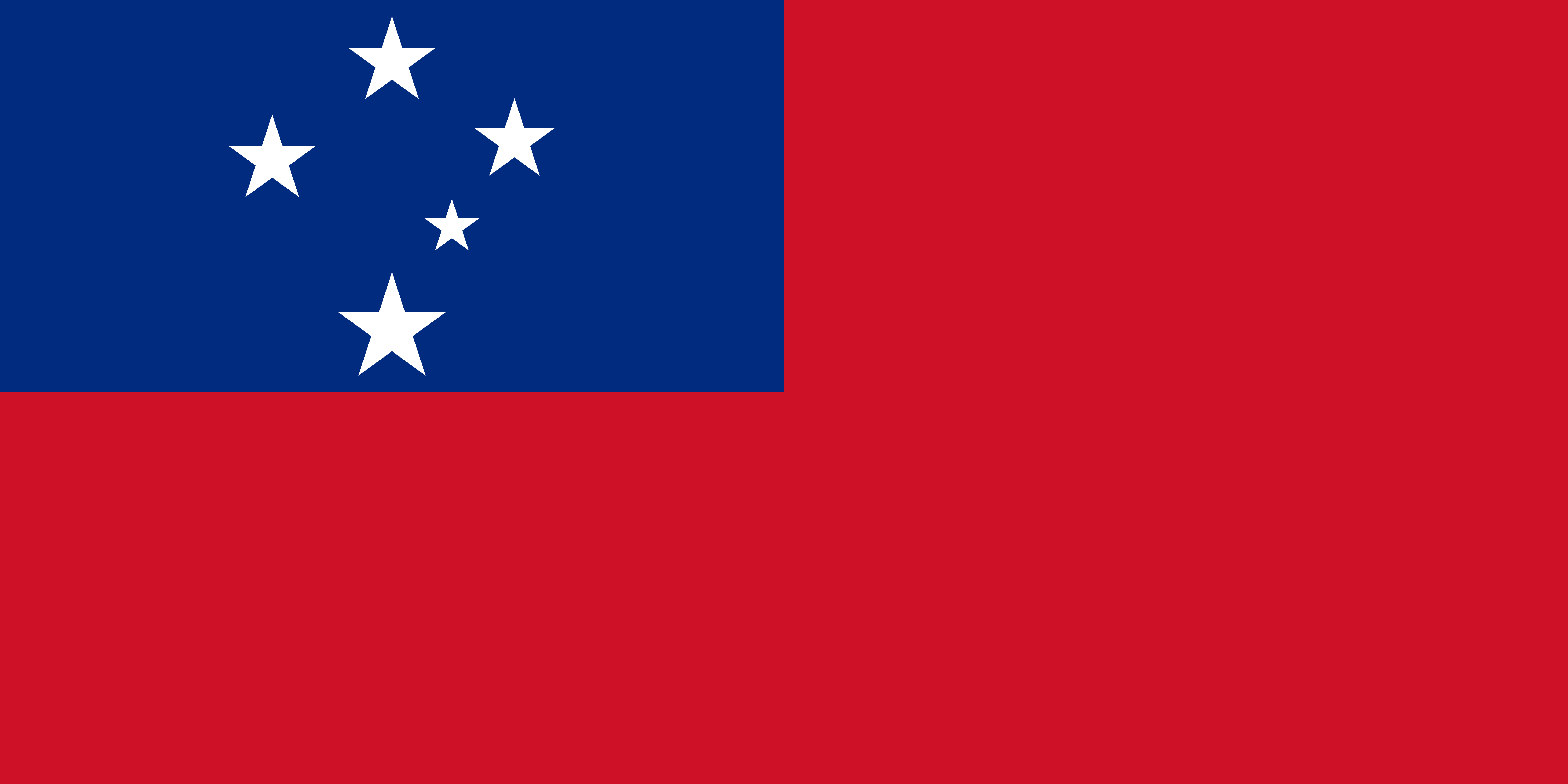
Samoa’s flag has a red field with a blue rectangle in the upper corner beside the hoist. Five white, five-pointed stars inside that canton represent the Southern Cross. The flag is twice as long as it is high. Its five-star design dates from 1949, before independence in 1962.
This guide explains the flag’s symbolism and legal geometry, compares the original 1948 and 1949 records, and distinguishes design adoption from independence. The gallery connects the measurements to original illustrations and keeps historical attribution and source limits explicit.
What are the colors of the Samoa flag?
Samoa’s flag uses red, blue, and white. A Ministry of Foreign Affairs and Trade factsheet publishes red as RGB 206, 17, 38, blue as RGB 0, 43, 127, and white as RGB 255, 255, 255. These published digital values guide the downloads; the flag law itself specifies color names without numerical screen codes.
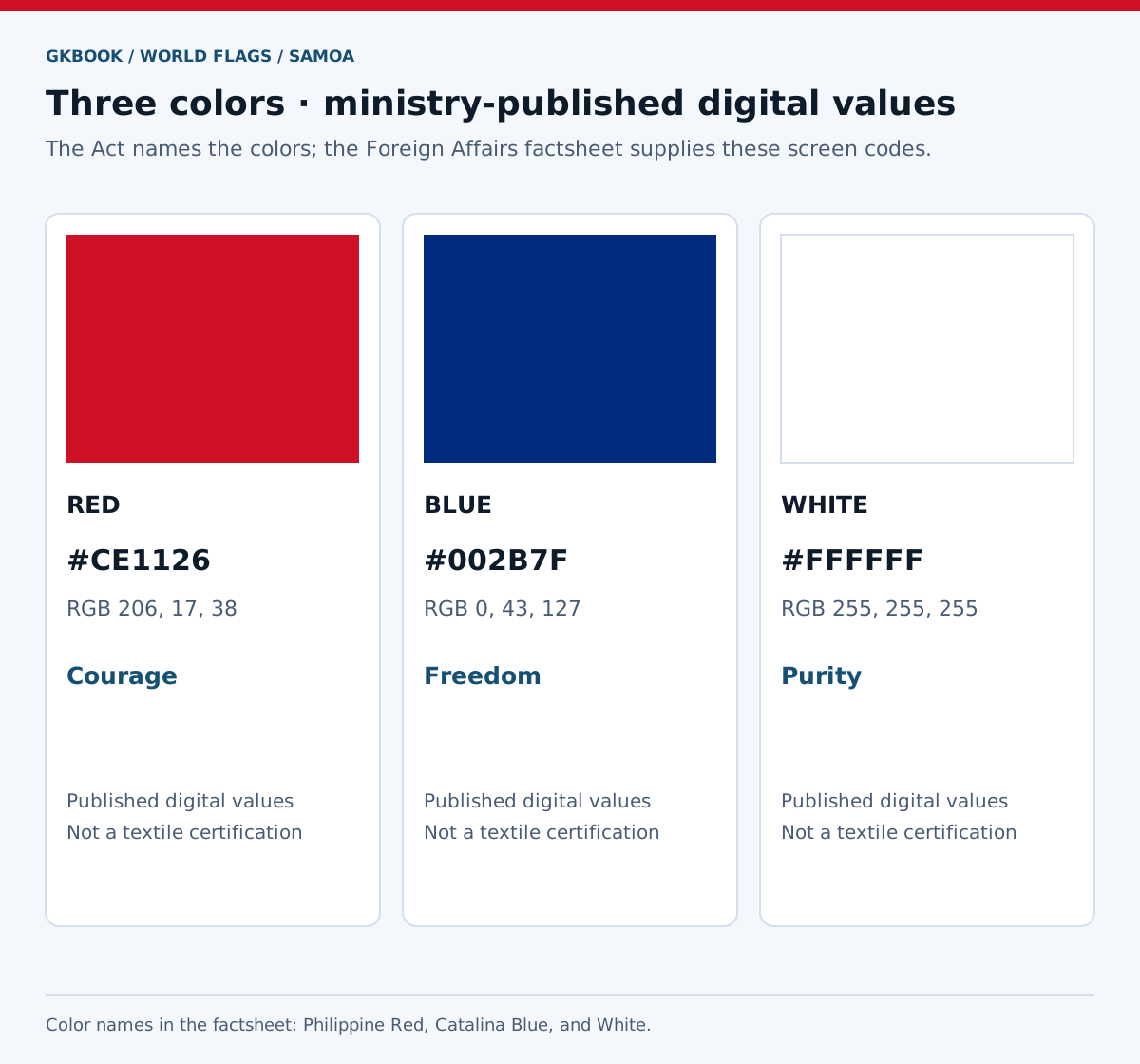
The ministry calls its blue Catalina Blue and its red Philippine Red. Those names label the values in that particular factsheet; they do not establish a universal naming system for every paint, fabric, or screen. The table preserves the published hexadecimal and RGB pairs exactly so the files can be reproduced consistently.
The law and the factsheet serve different purposes. The schedule describes the national pattern and its measurements, while the factsheet adds digital color information and a short explanation. An image sampled from a photograph may vary because of lighting or compression. Use the stated values instead of treating photographed pixels as a standard.
| Element | RGB | Hexadecimal |
|---|---|---|
| Red field | 206, 17, 38 | #CE1126 |
| Blue canton | 0, 43, 127 | #002B7F |
| White stars | 255, 255, 255 | #FFFFFF |
What does the Samoa flag mean?
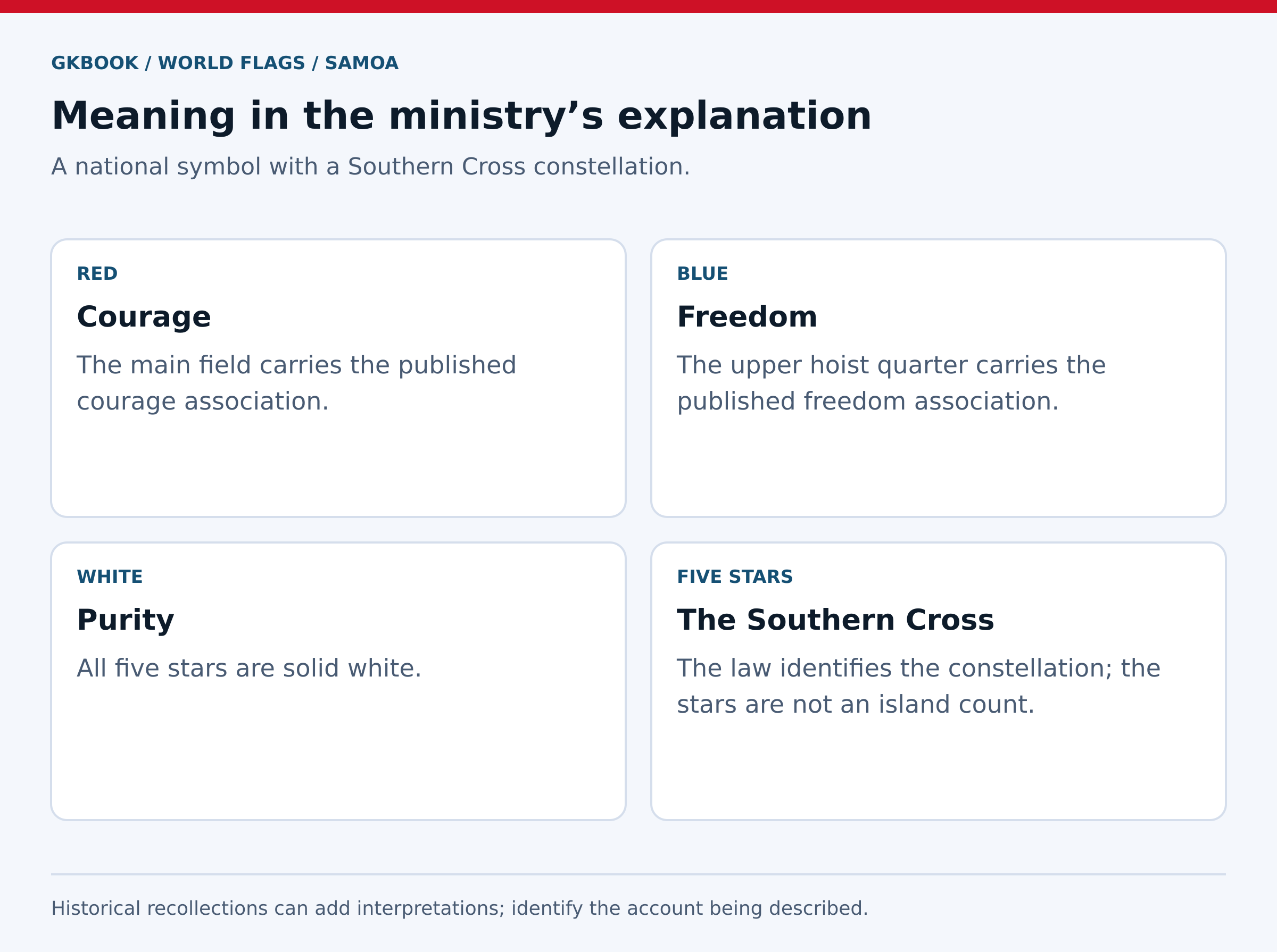
The Ministry of Foreign Affairs and Trade explains red as courage, blue as freedom, and white as purity. The five stars represent the Southern Cross, connecting the design with the southern sky. These published meanings should be distinguished from the 1994 law’s schedule, which specifies the flag’s appearance and construction rather than assigning meanings to its colors.
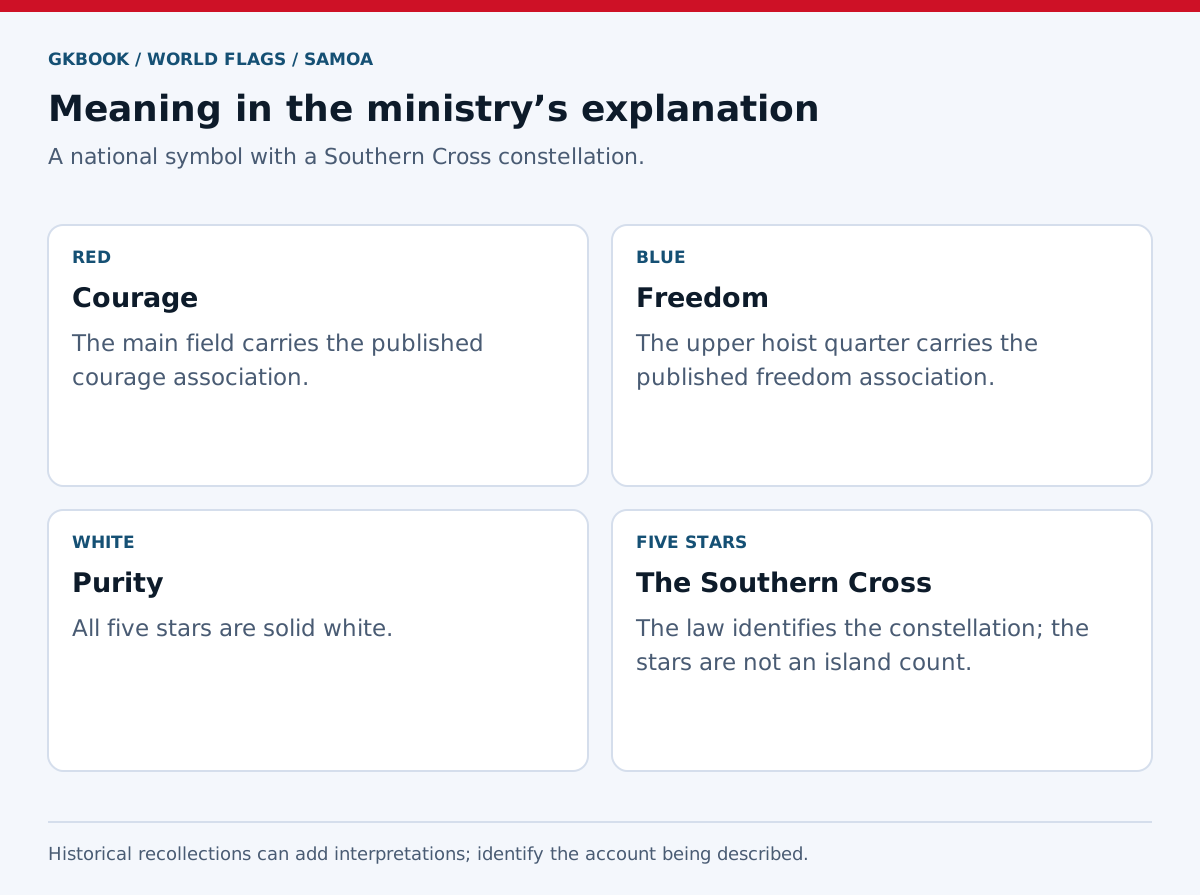
The same three color associations appear in Whitney Smith’s specialist account. The government’s general country page also connects red with courage and blue with freedom. Agreement between these descriptions supports the familiar interpretation, but the symbolic language is not a numerical specification for the relative areas of the colors.
Historical recollections can preserve additional interpretations. A family account reported through the National University of Samoa describes sacrifice, unity, and Pacific location. That account belongs to the design’s remembered origins. It should be attributed as such instead of silently replacing the ministry’s concise explanation or presenting every interpretation as statutory wording.
What does the red field represent?
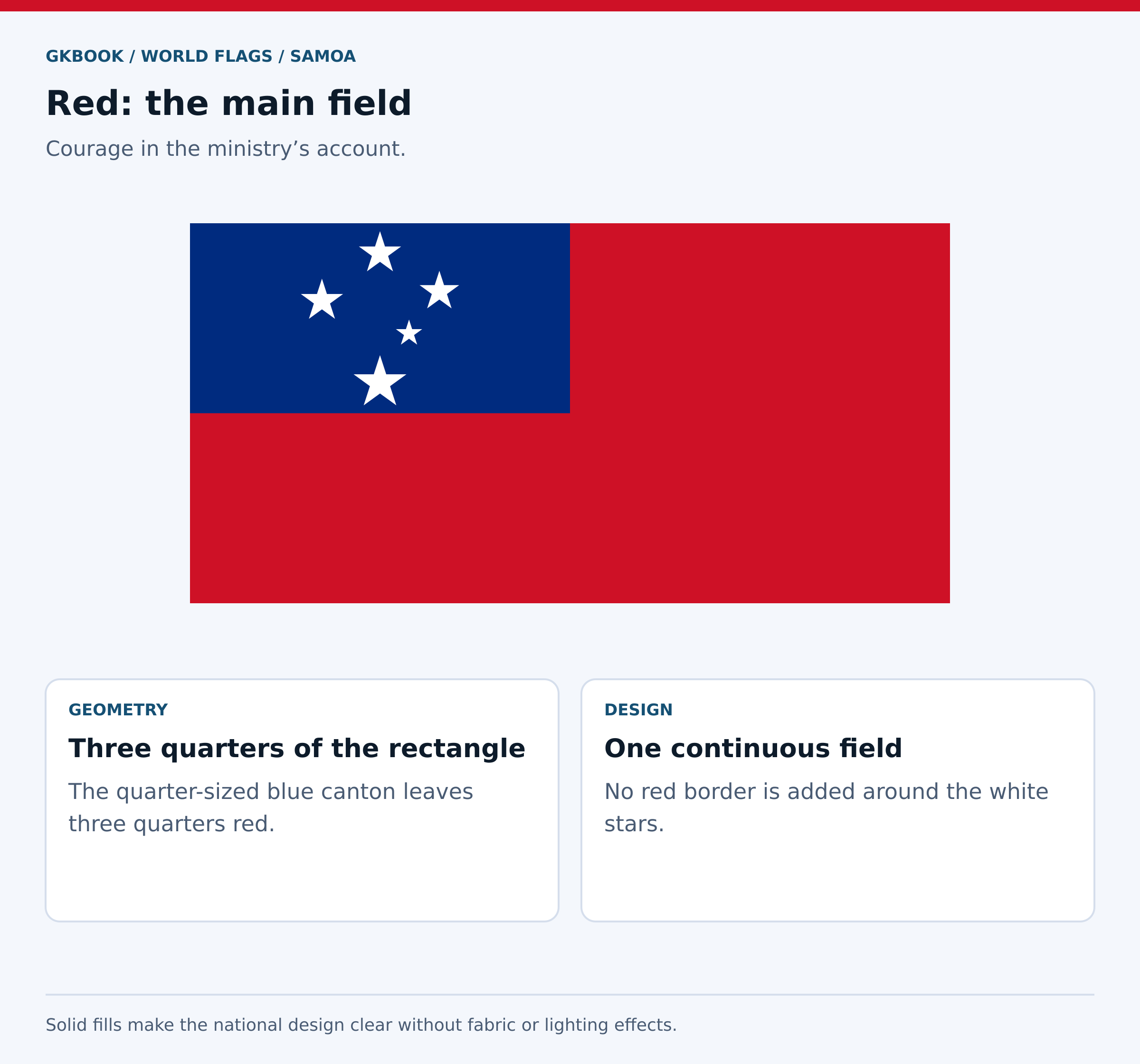
Red represents courage in the ministry’s explanation. It forms the main field of the flag, surrounding the blue canton along its right and lower sides. Before accounting for the white stars, the red field occupies three quarters of the rectangle. The downloaded artwork uses the ministry’s published red value, hexadecimal #CE1126.
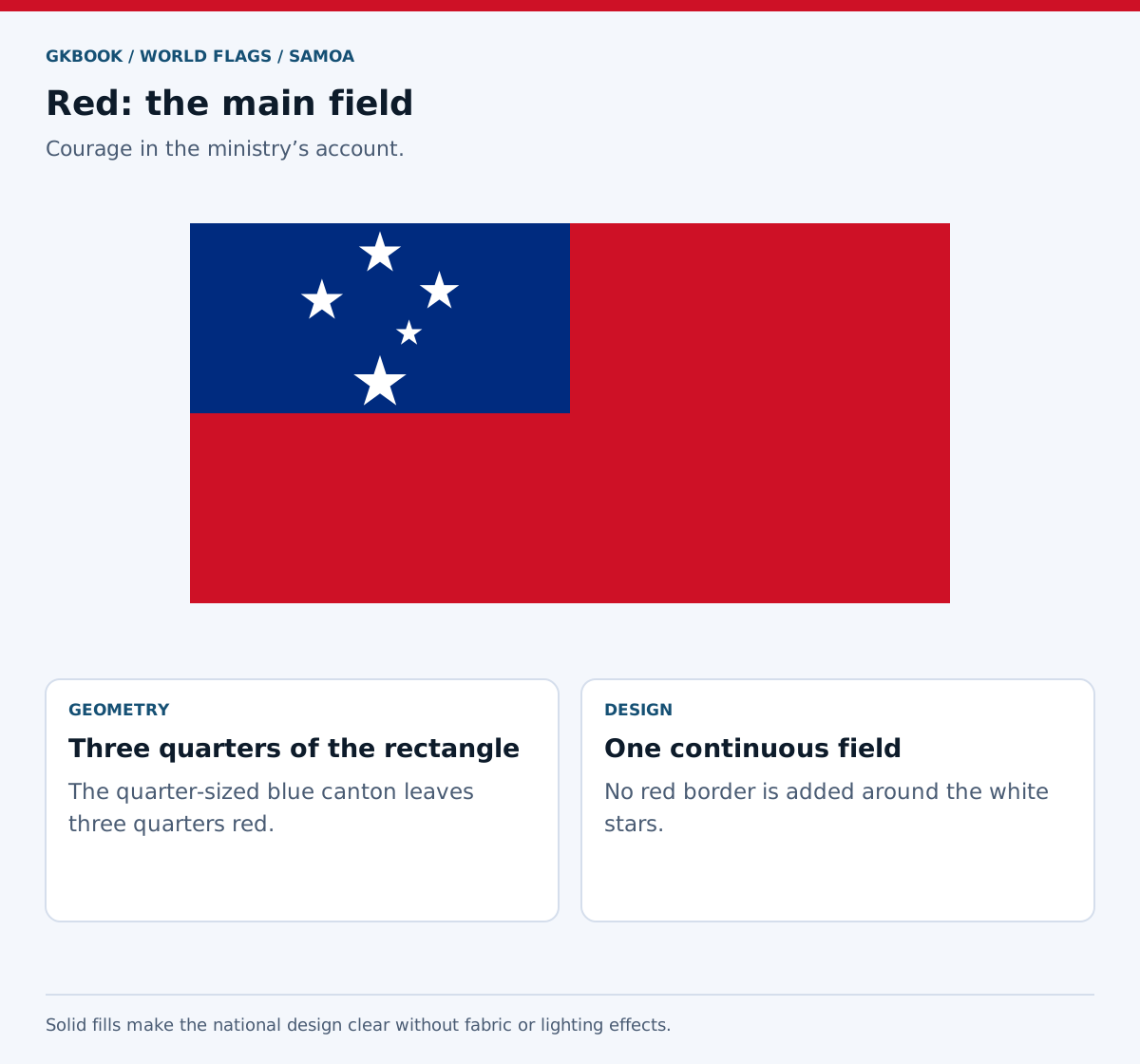
A field is the background on which other flag elements are placed. Here the red is continuous across the entire lower half and the upper half beyond the canton. It is not a separate border drawn around the blue rectangle, and no red outline surrounds the white stars.
The area follows directly from the design: a quarter-sized canton leaves three quarters of the total rectangle red. That fraction is a geometric result, not a claim that courage has a measurable share of national identity. In a clean reference image, a solid fill preserves this relationship without folds, shadows, or decorative texture.
What does the blue canton represent?
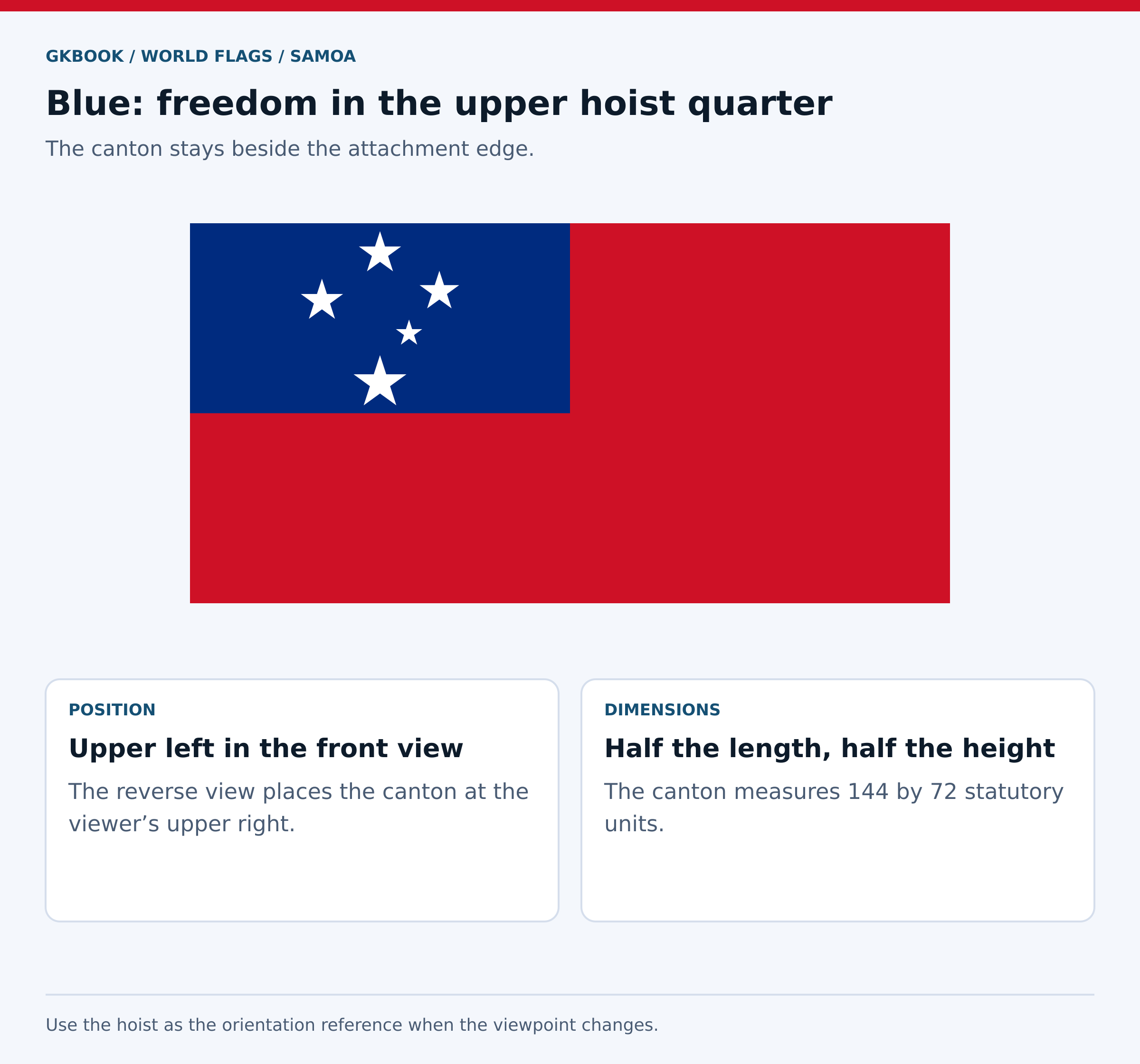
Blue represents freedom in the ministry’s account. It fills the upper quarter beside the hoist, the edge attached to a staff or halyard. In the usual front view, this canton appears at the upper left. Its published digital color is #002B7F, and it provides the background for all five white stars.
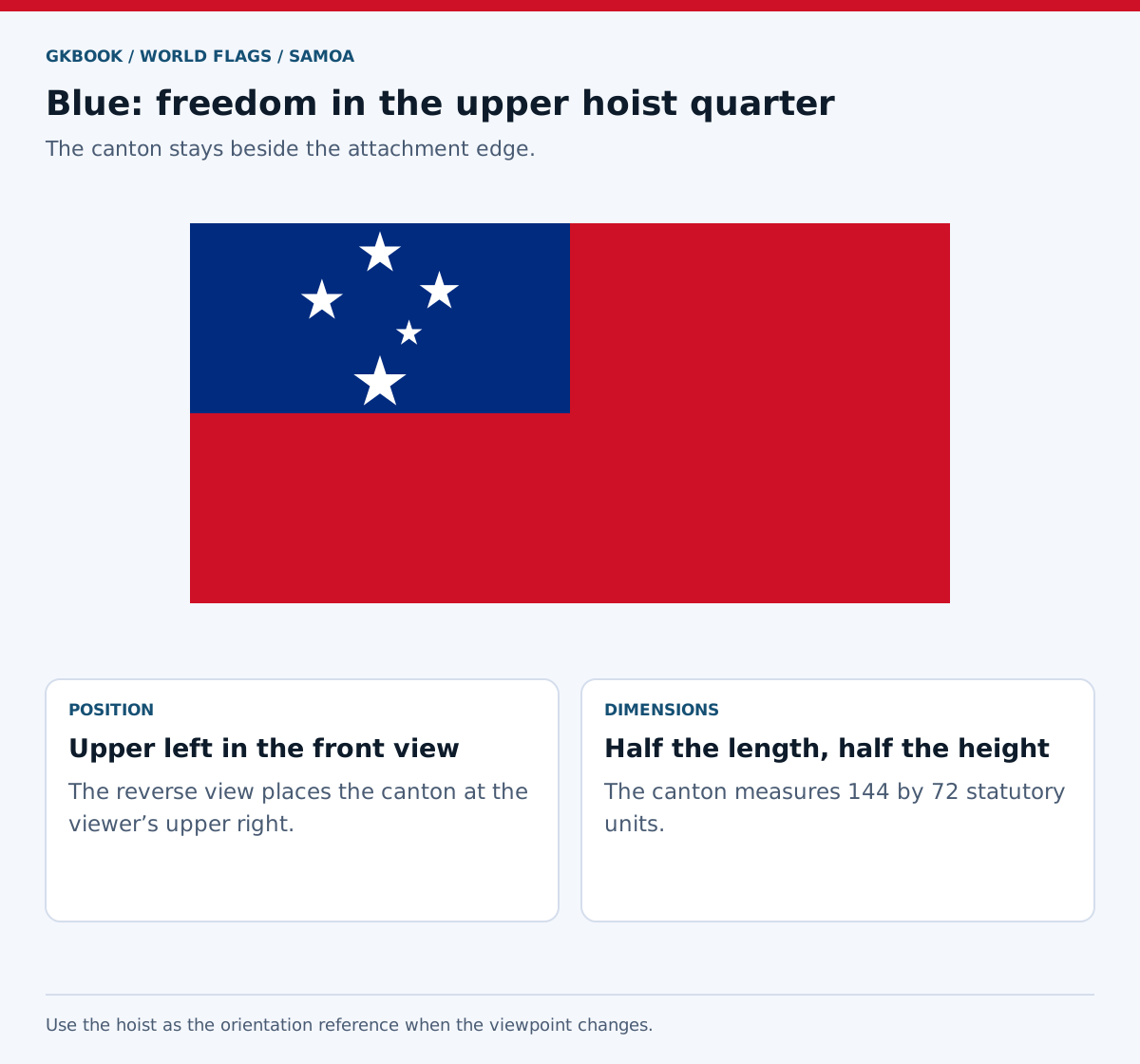
The canton is a rectangle with half the full flag’s length and half its height. Its position is defined relative to the attachment edge, not merely the viewer’s left. Looking at a flag from behind changes its apparent orientation while the canton remains beside the hoist.
The five stars lie entirely within the blue area. Their clear separation from its edges is controlled by the statutory measurements. Adding a white border around the canton, extending blue across the whole top half, or moving it to the free end would alter the design described in the schedule.
What does white represent on the flag?
White represents purity in the ministry’s published explanation. It appears in the five stars, each drawn as a solid, regular five-pointed figure. The white is not an outline around a red center. All five stars use the same white fill, although their prescribed sizes and positions are not identical.
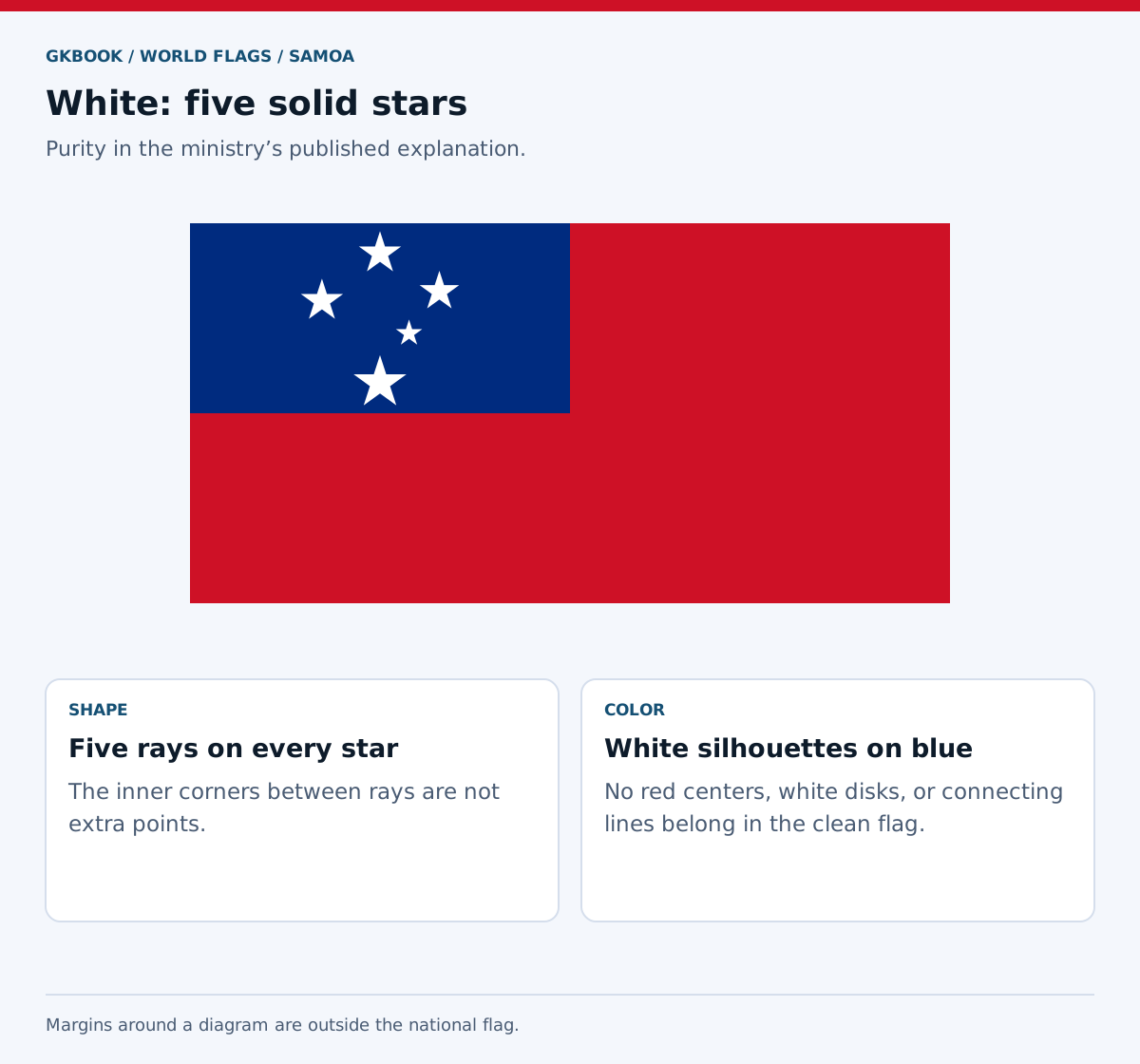
The stars remain legible because white contrasts strongly with the dark blue canton. Their shapes are filled silhouettes rather than astronomical photographs. There are no drawn rays of light beyond the five points, no circular backing disks, and no connecting lines between them in the national design.
A white margin around a flag on a webpage belongs to the surrounding layout. It should not be mistaken for part of the flag itself. The clean download ends exactly at the red rectangle’s boundaries; a separate diagram may include margins so captions and measurement guides can be placed outside the design.
How many stars are on Samoa’s flag?
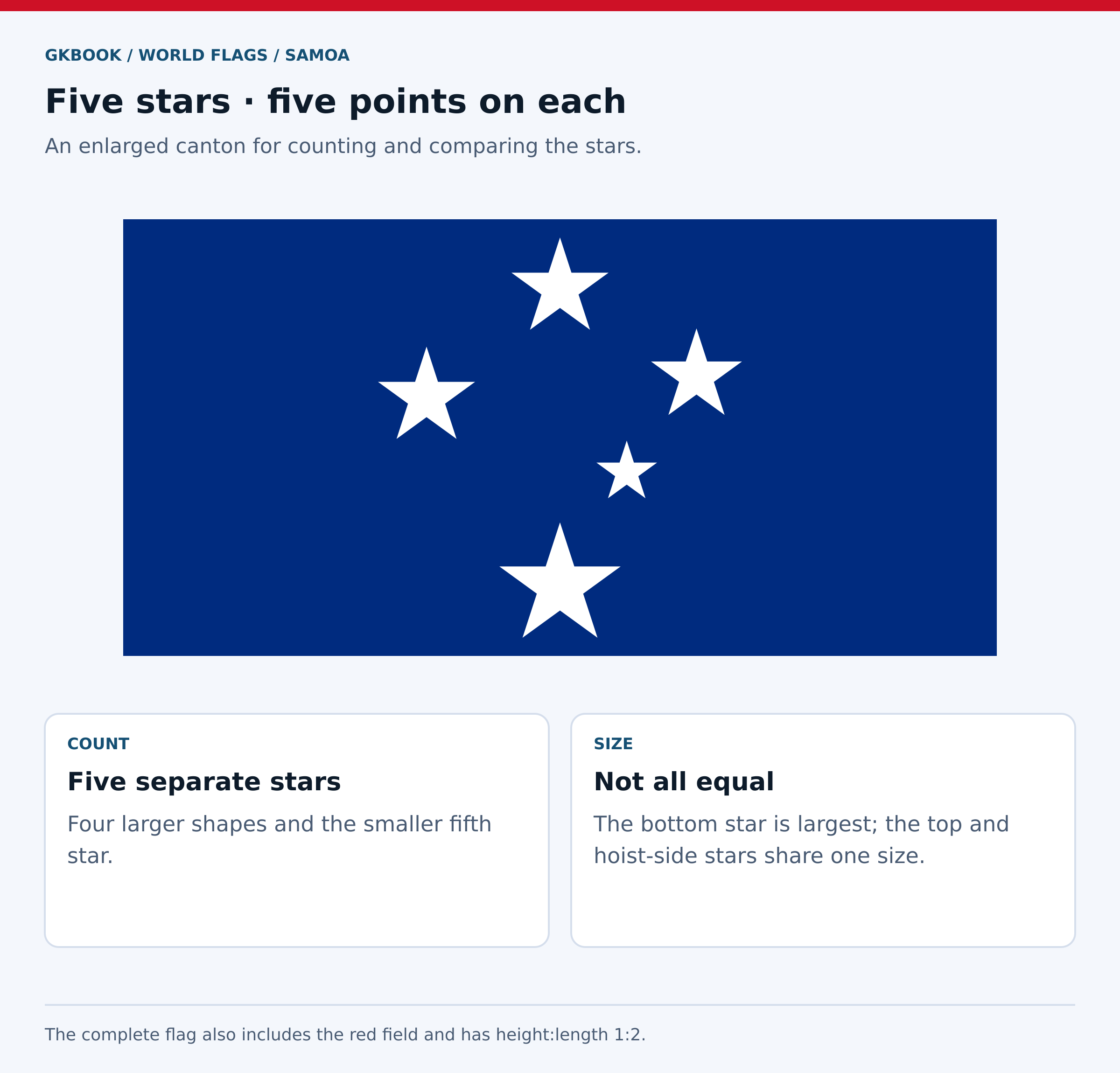
The current flag has five white stars, and every star has five points. Four larger stars outline the main cross, with a smaller fifth star inside the lower right part of the arrangement in the standard front view. The law identifies them with the Southern Cross; they are not a count of Samoa’s islands.
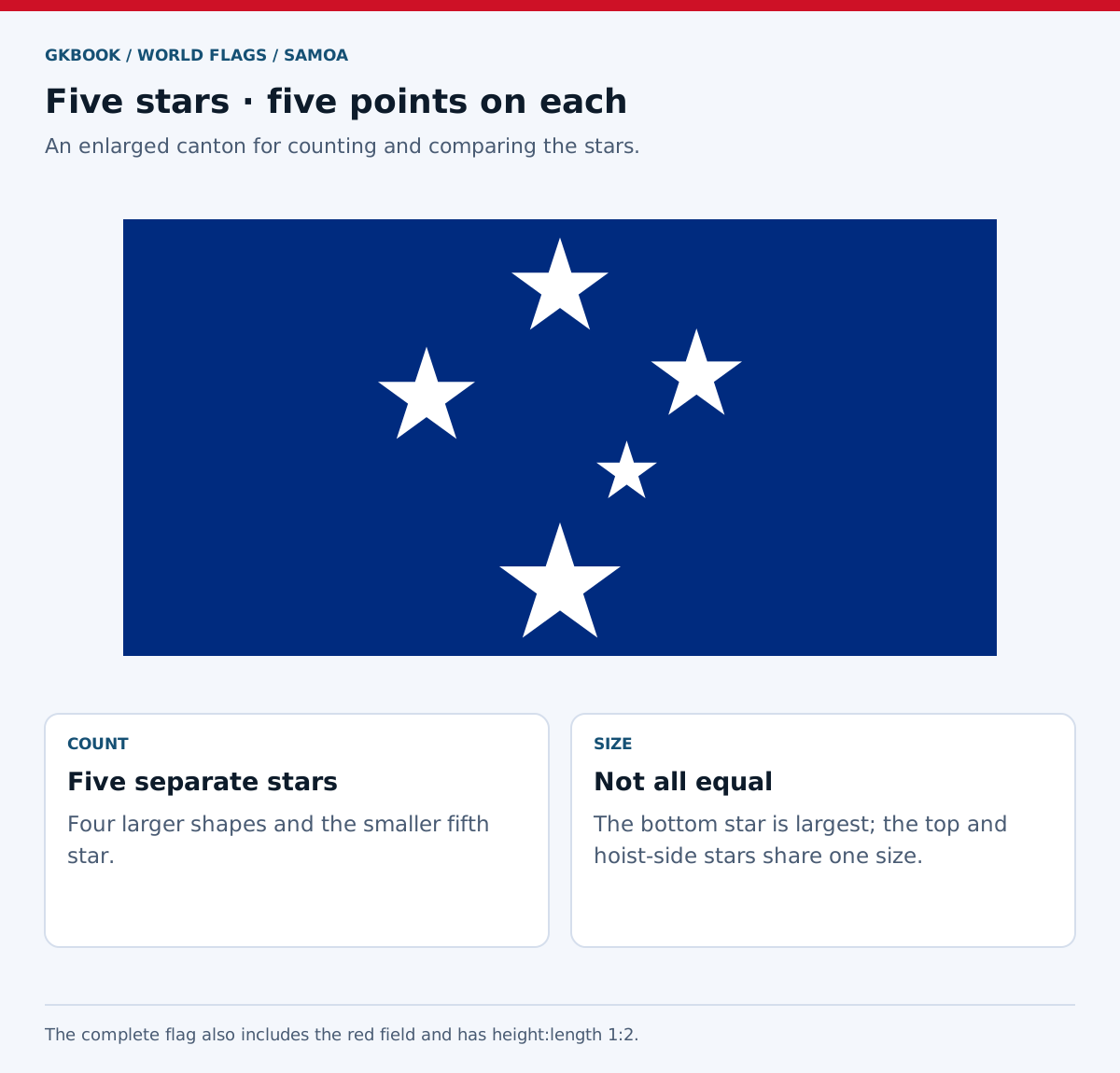
Count complete white shapes, then count the outer tips of one shape. These are different quantities: five stars appear on the flag, and each individual star has five rays. The inner corners between the rays are part of the outline, but they are not additional star points.
The schedule assigns four size values across the five stars. The top and hoist-side stars share one size, the fly-side star is slightly smaller, the bottom star is largest, and the fifth star is smallest. Replacing all five with identical symbols loses a measured feature of the national design.
What is the Southern Cross shown on the flag?
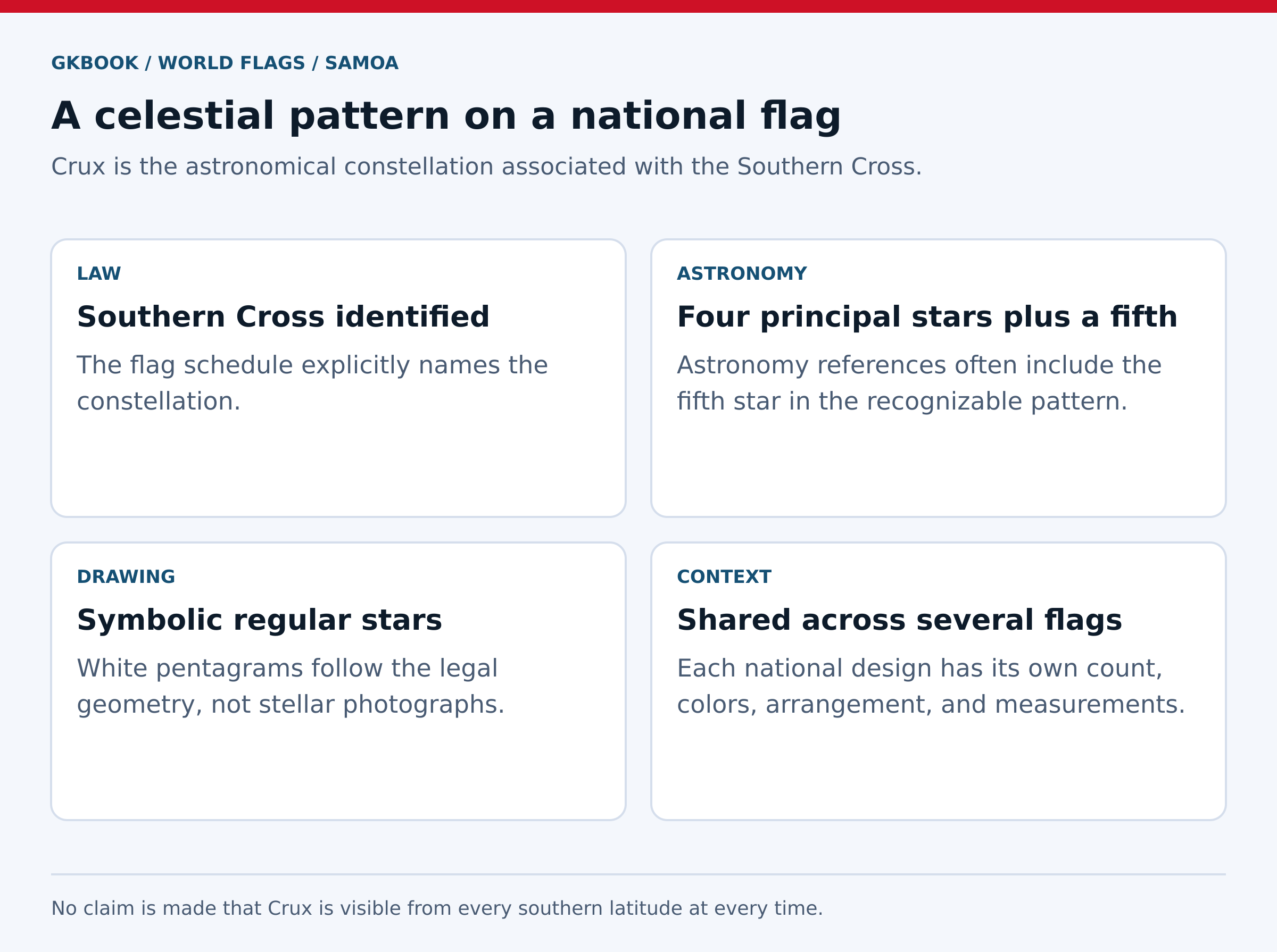
The Southern Cross is a recognizable star pattern associated with the constellation Crux in the southern sky. Samoa’s law explicitly identifies the five stars with it. Astronomical organizations describe four principal stars and a fifth often included in the pattern. The flag is a symbolic arrangement, not a calibrated map of the night sky.

The International Astronomical Union’s education glossary and the European Southern Observatory explain the Southern Cross’s importance as a southern celestial landmark. Other national flags also use it. This shared astronomical reference does not make their star counts, colors, locations, or construction rules interchangeable.
The flag’s prescribed figures are flat, white pentagrams. Actual stars differ in brightness, color, distance, and physical properties, none of which is represented by a photographically realistic surface here. The drawing follows the legal layout rather than a particular date, time, viewing latitude, or camera projection of the sky.
Why is one of the five stars smaller?
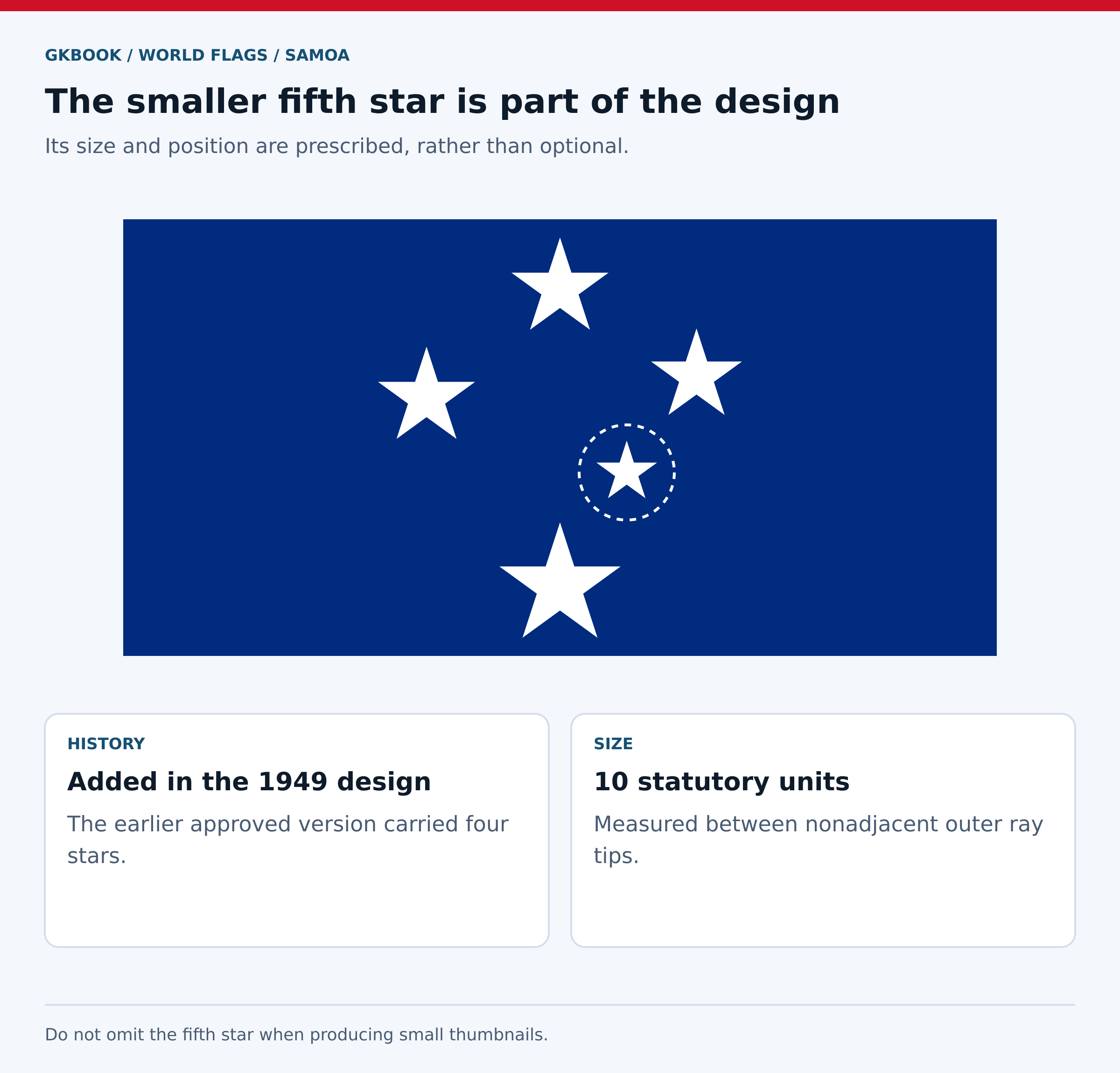
The smaller fifth star is part of the five-star design introduced in 1949, following a four-star version approved in 1948. The construction schedule gives it a ten-unit ray-to-ray measurement, smaller than the other stars. It sits below and to the right of the upper central star, remaining entirely within the blue canton.
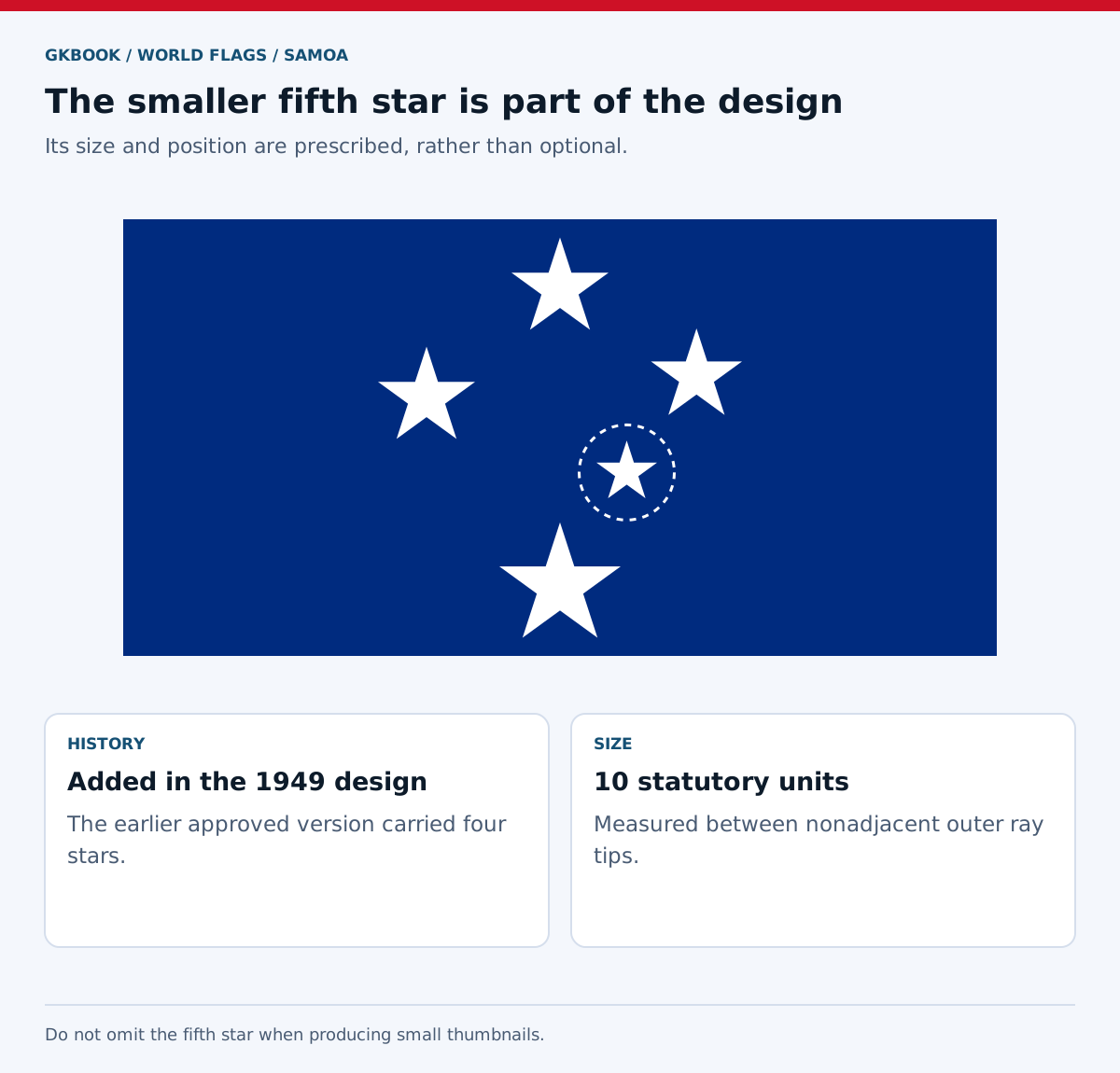
The smaller shape should remain visible when preparing a thumbnail. Omitting it creates a different star count, while enlarging it to match its neighbors removes the intended hierarchy. The clean vector keeps its proportional size, and the supplied large PNG preserves enough resolution for ordinary resizing.
The 1949 notice specifies both its size and its offsets from the canton edges. Its placement is therefore reproducible rather than guessed from a photograph. The present flag should not be described as four stars plus an optional decoration: all five are included in the national design identified by the law.
What is the aspect ratio of the Samoa flag?
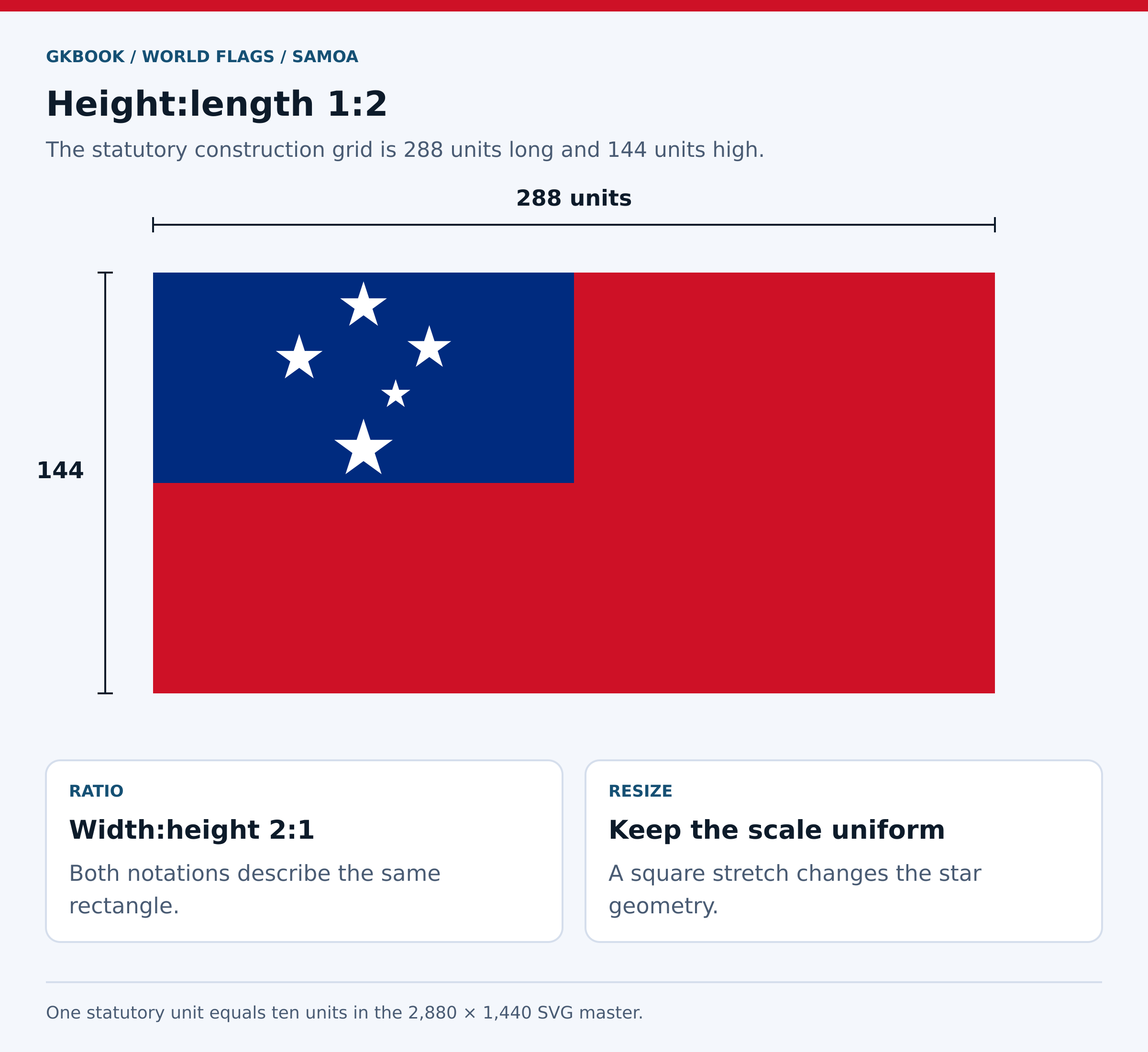
The flag’s height to length ratio is 1:2. The law describes a grid 144 units high and 288 units long, so the length is exactly twice the height. A 600-by-300 image and a 6,000-by-3,000 image therefore have the same correct proportions when width is written first.

Naming the order prevents confusion. Height:length 1:2 and width:height 2:1 describe the same landscape rectangle. The staff, sleeve outside the artwork, surrounding frame, and explanatory caption are excluded from that rectangle. The ratio belongs to the flag itself rather than the entire page or photograph.
The SVG master uses 2,880 by 1,440 drawing units, ten times the statutory grid. Every position scales by the same factor. When resizing, keep width and height linked; squeezing the flag into a square changes the canton, distorts the regular stars, and invalidates the measured relationships even if the colors remain correct.
How large is the blue canton?
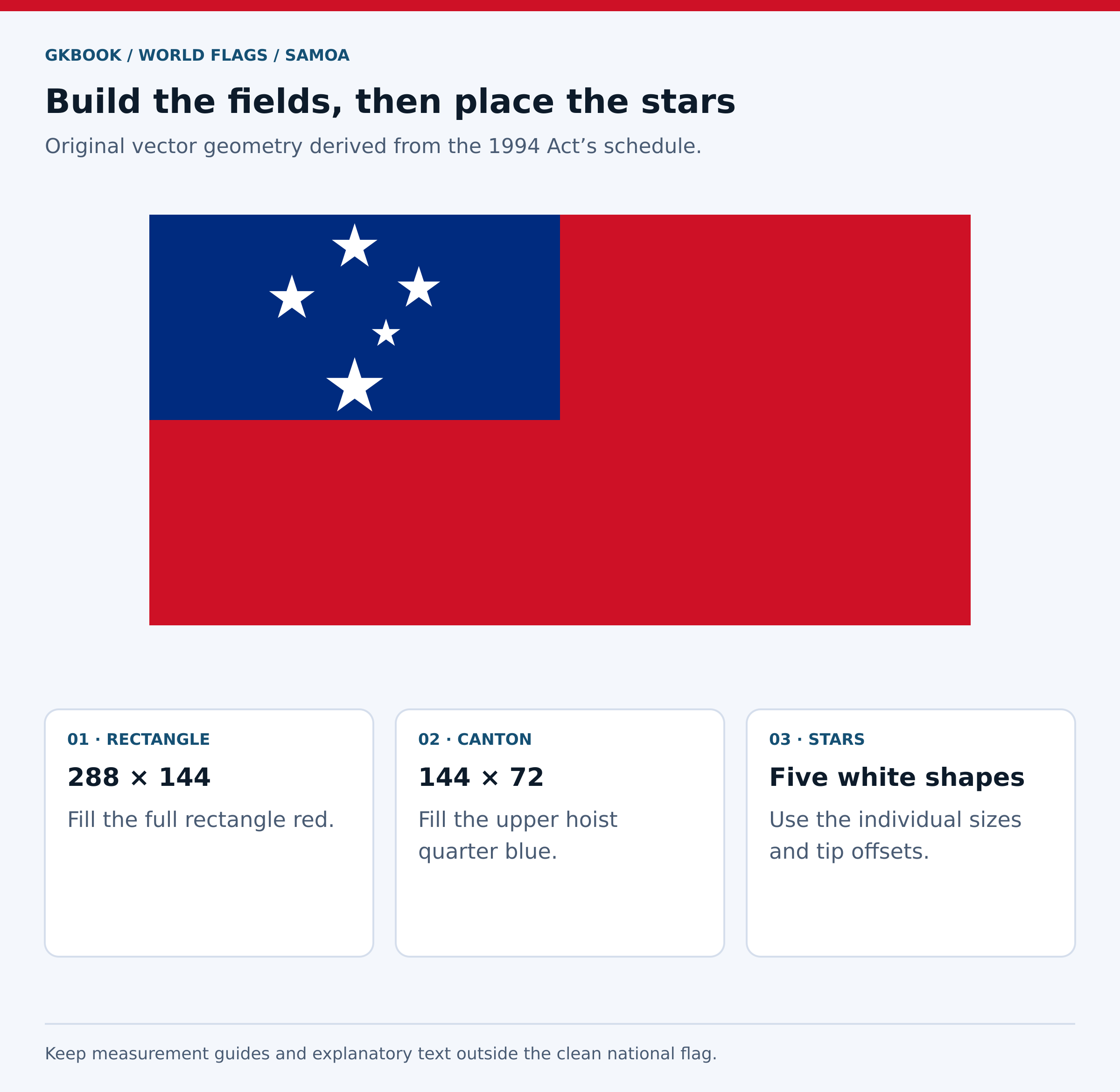
The blue canton occupies the first quarter of the flag: half its full length and half its full height. On the statutory 288-by-144 grid, it measures 144 by 72 units. Its outer edges coincide with the top and hoist edges, while the remaining three quarters form the red field.
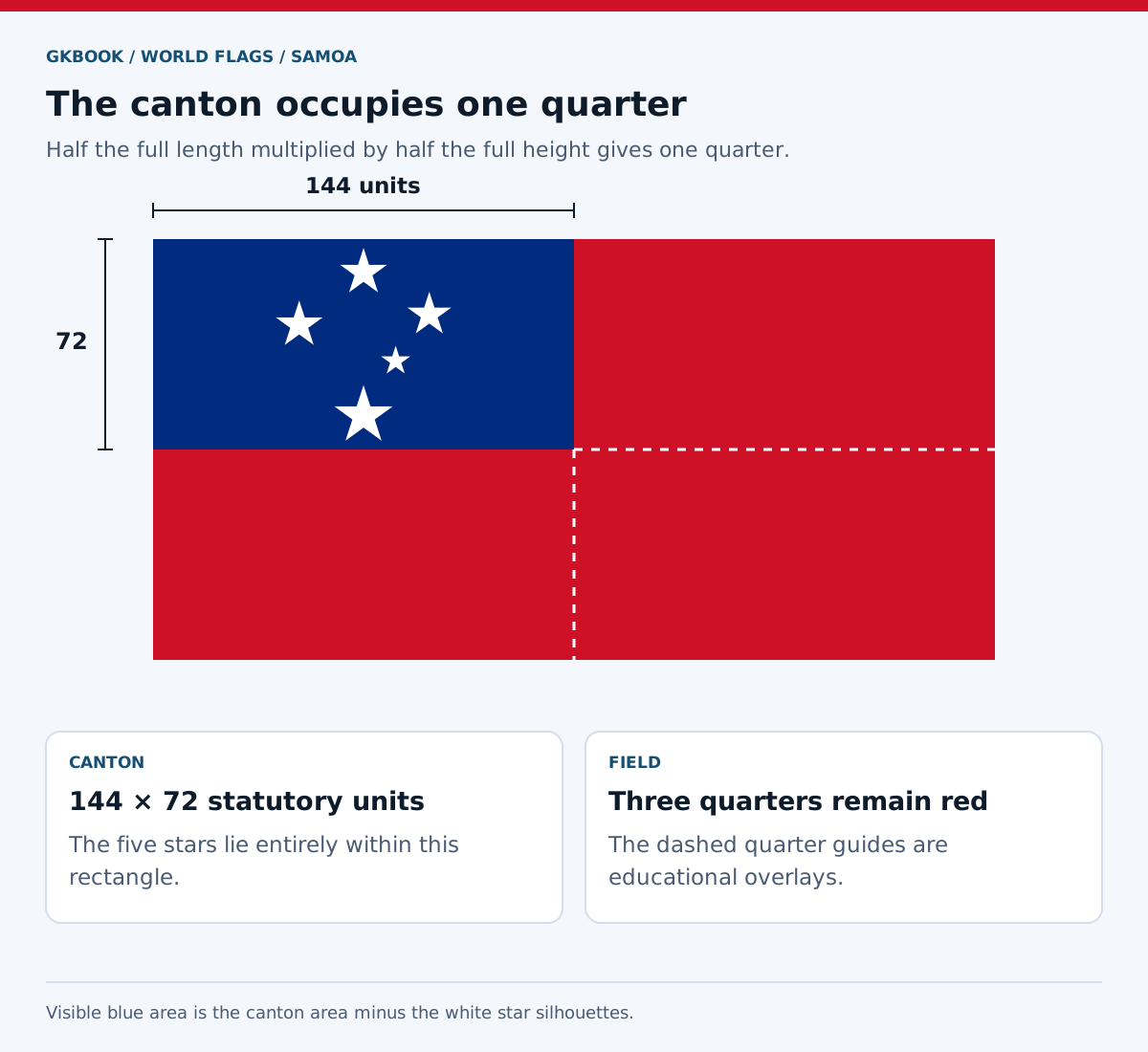
Quarter refers to area in this arrangement. Dividing the rectangle once vertically and once horizontally creates four equal rectangles, and the upper hoist rectangle is blue. It would be incorrect to make the canton only one quarter of the length while keeping half the height.
The white stars are placed over the blue area, so the visible blue area is slightly smaller than one quarter after their silhouettes are included. The canton’s geometric boundary remains a full quarter regardless of that overprinting. This distinction is useful when calculating area or comparing a construction grid with a finished image.
How are the five star sizes measured?
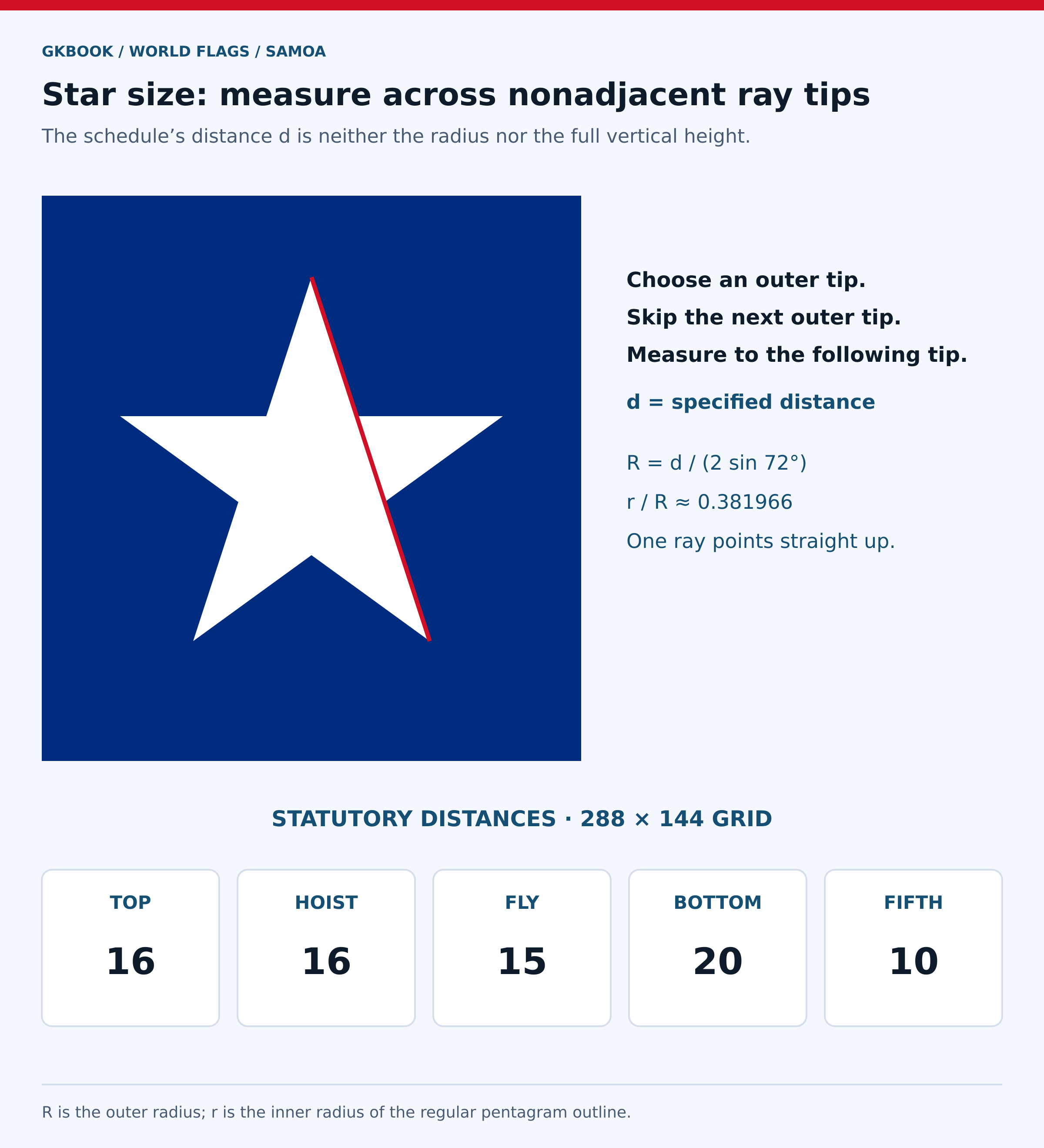
The schedule measures a star from one outer ray tip to the next-but-one ray tip, skipping one intervening tip. The top and hoist-side stars measure 16 units, the fly-side star 15, the bottom star 20, and the fifth star 10. These lengths are not the stars’ circumdiameters or their vertical bounding-box heights.
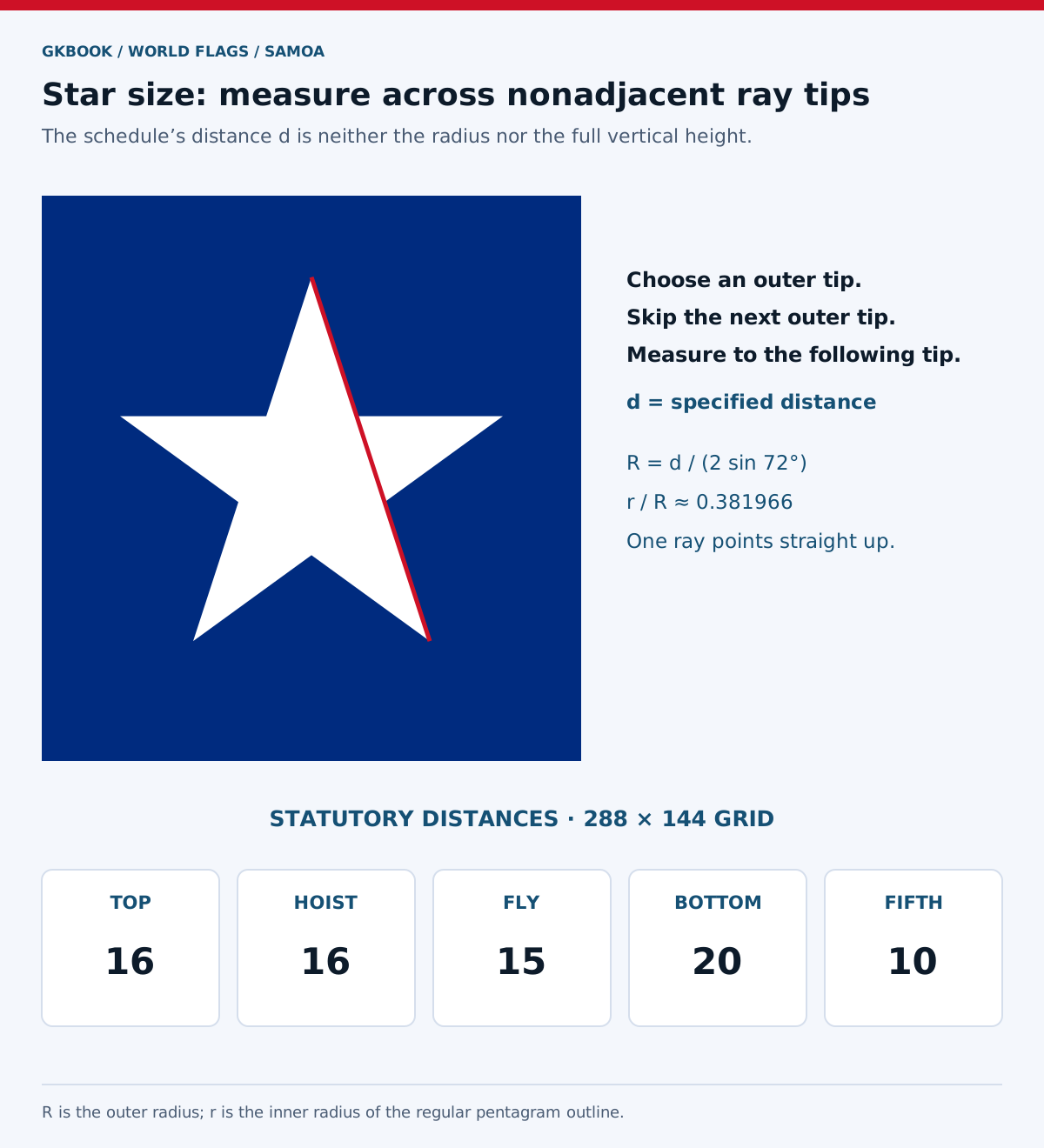
For a regular five-pointed star, the specified distance is a diagonal between two nonadjacent outer vertices. Its circumradius is that distance divided by twice the sine of seventy-two degrees. Using half the specified distance as the radius would make every star slightly too small for the intended measurement.
The drawing uses regular pentagram outlines, with inner radius divided by outer radius equal to approximately 0.381966. This follows from the intersections of a regular pentagram. The law supplies the regular-star requirement and tip-to-tip distances; the equations translate those instructions into reproducible vector coordinates.
| Star position | Specified distance | Relative size |
|---|---|---|
| Top | 16 | Same as hoist-side star |
| Hoist side | 16 | Same as top star |
| Fly side | 15 | Slightly smaller |
| Bottom | 20 | Largest |
| Fifth | 10 | Smallest |
Where are the five stars positioned?
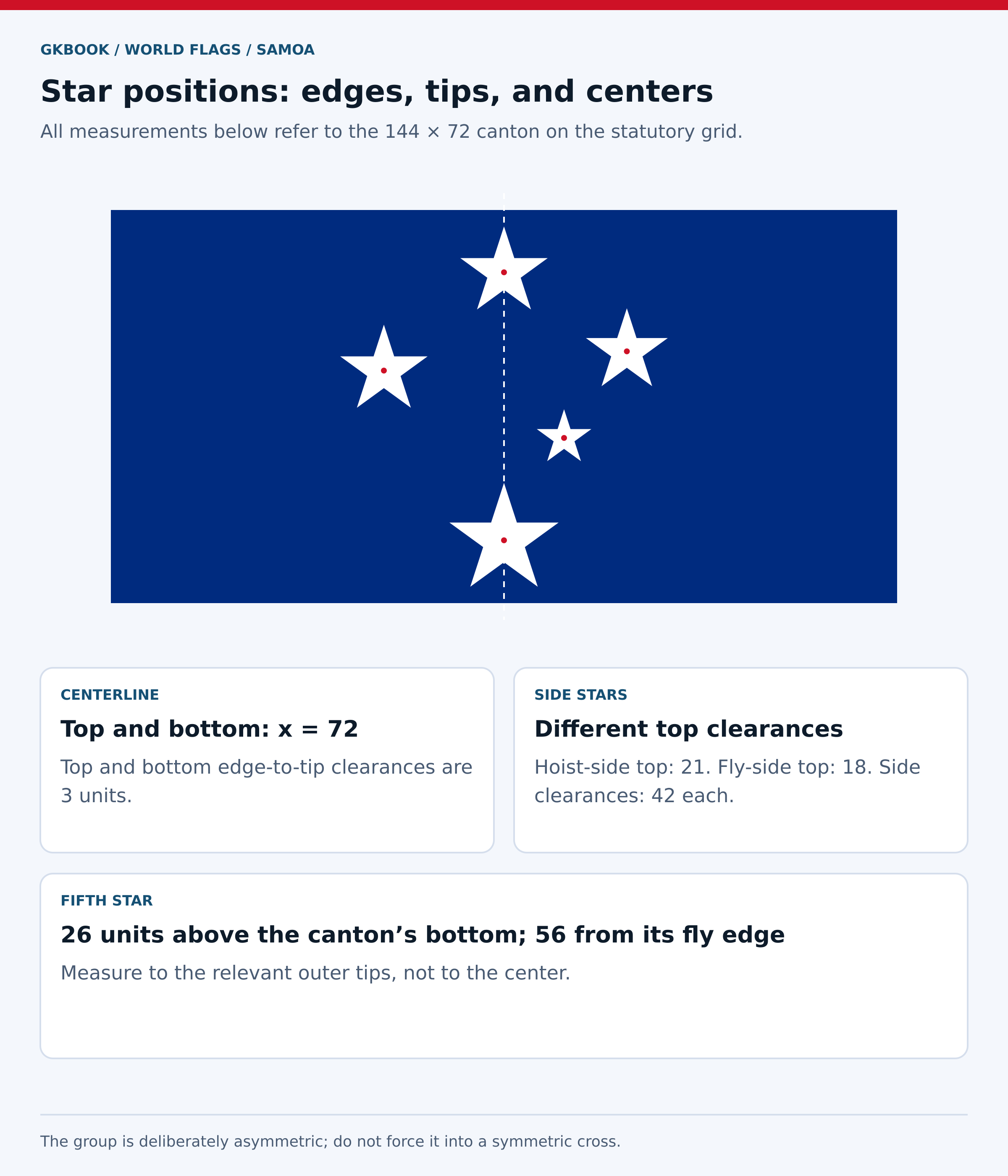
The top and bottom stars are centered on the vertical line through the canton’s midpoint. Their outer tips leave three-unit margins at the canton’s top and bottom. The other stars use specified offsets from its edges. The hoist-side and fly-side stars have different heights, so the arrangement must not be made perfectly symmetrical.
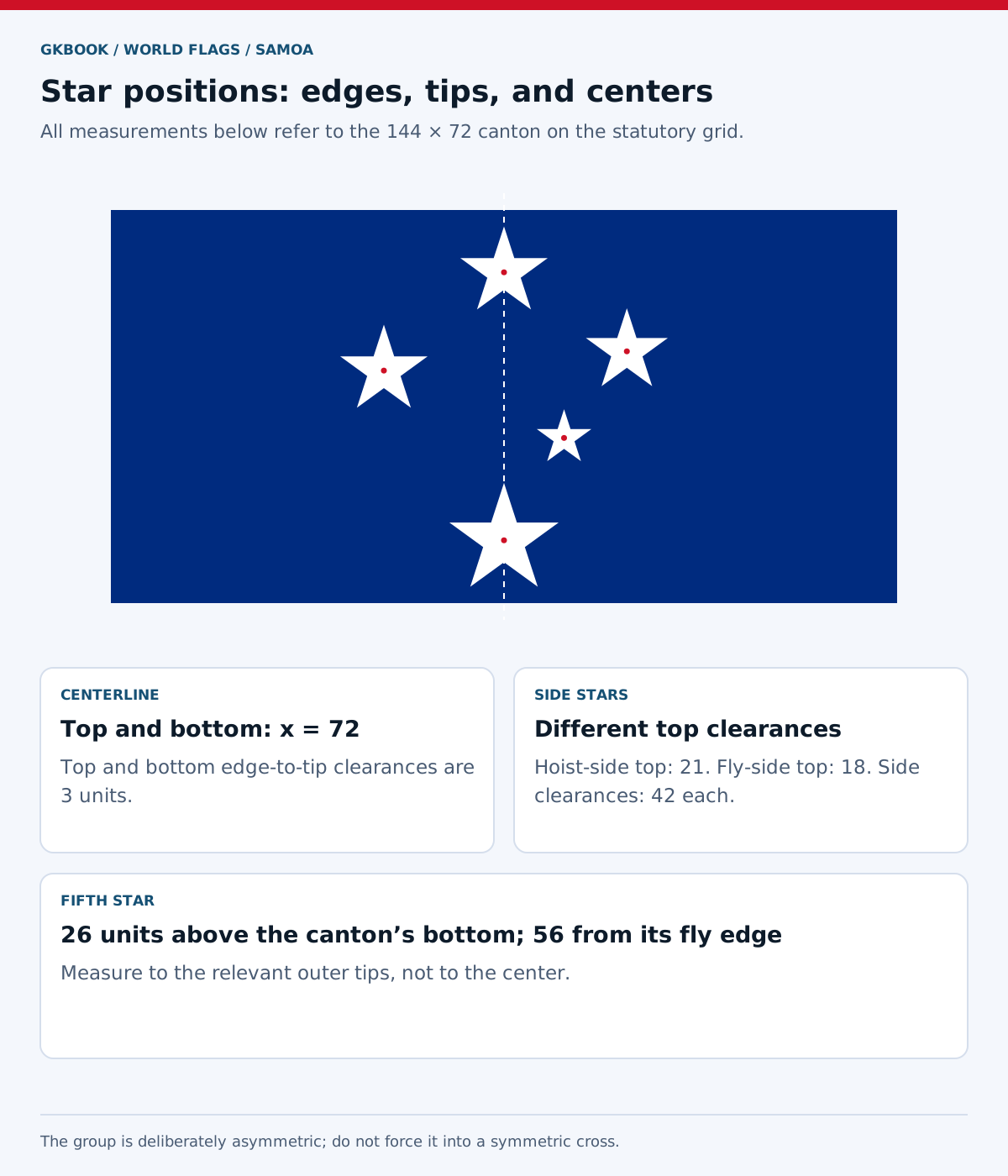
On the statutory grid, the canton’s centerline is x = 72. The hoist-side star’s top is at y = 21 and its nearest left tip at x = 42. The fly-side star’s top is at y = 18 and its nearest right tip is forty-two units from the canton’s right edge.
The fifth star’s bottom tips are twenty-six units above the canton’s lower edge, and its nearest right tip is fifty-six units from the canton’s right edge. These are edge-to-tip distances, not center coordinates. Calculating centers from the actual regular-star outlines avoids shifting the stars by half their width or height.
How can I draw the flag accurately?
Begin with the statutory 288-by-144 rectangle, fill it red, and place a 144-by-72 blue canton at the upper hoist. Add five upright regular white stars using the schedule’s individual sizes and edge offsets. Calculate each center from those measurements, then scale the entire design uniformly to the required output dimensions.
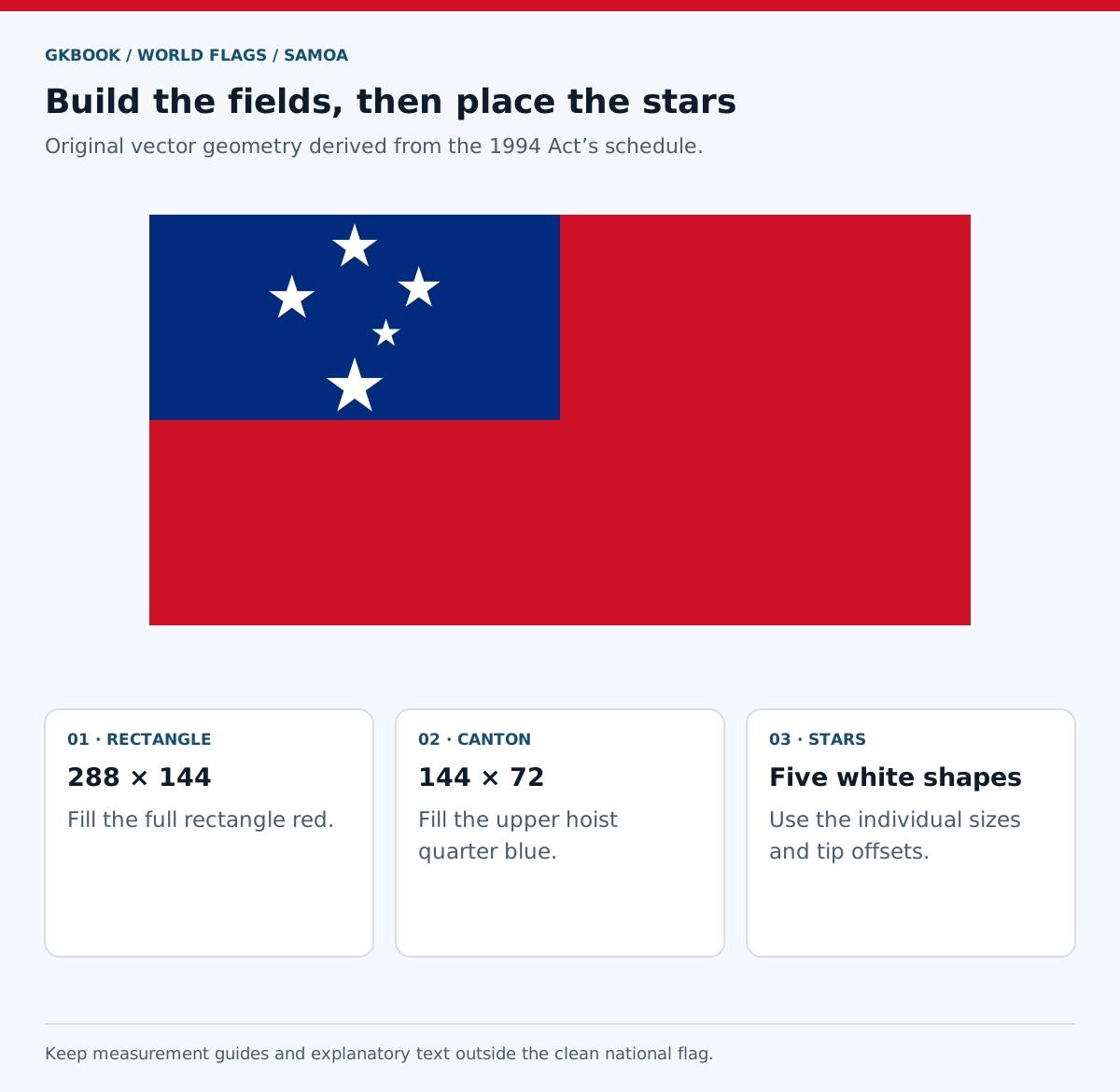
The clean SVG consists of two rectangles and five star polygons. It contains no photograph, texture, border, staff, or label. The regular pentagram construction gives each star five equal outer rays and a consistent relationship between its inner and outer corners, while preserving the required differences in overall size.
Use the legal grid for reasoning and the master coordinate system for output. One statutory unit equals ten SVG units in this package. Keep guide lines and measurements in separate teaching diagrams. The final flag should retain only the colored fields and white stars, with every star wholly inside the canton.
What is the history of Samoa’s current flag?
A four-star flag was approved in May 1948 while Western Samoa was administered by New Zealand. A revised five-star design followed in February 1949 and continued when the country became independent on January 1, 1962. The 1994 flag and anthem law later recorded the design and related rules; it did not introduce the familiar five-star flag.
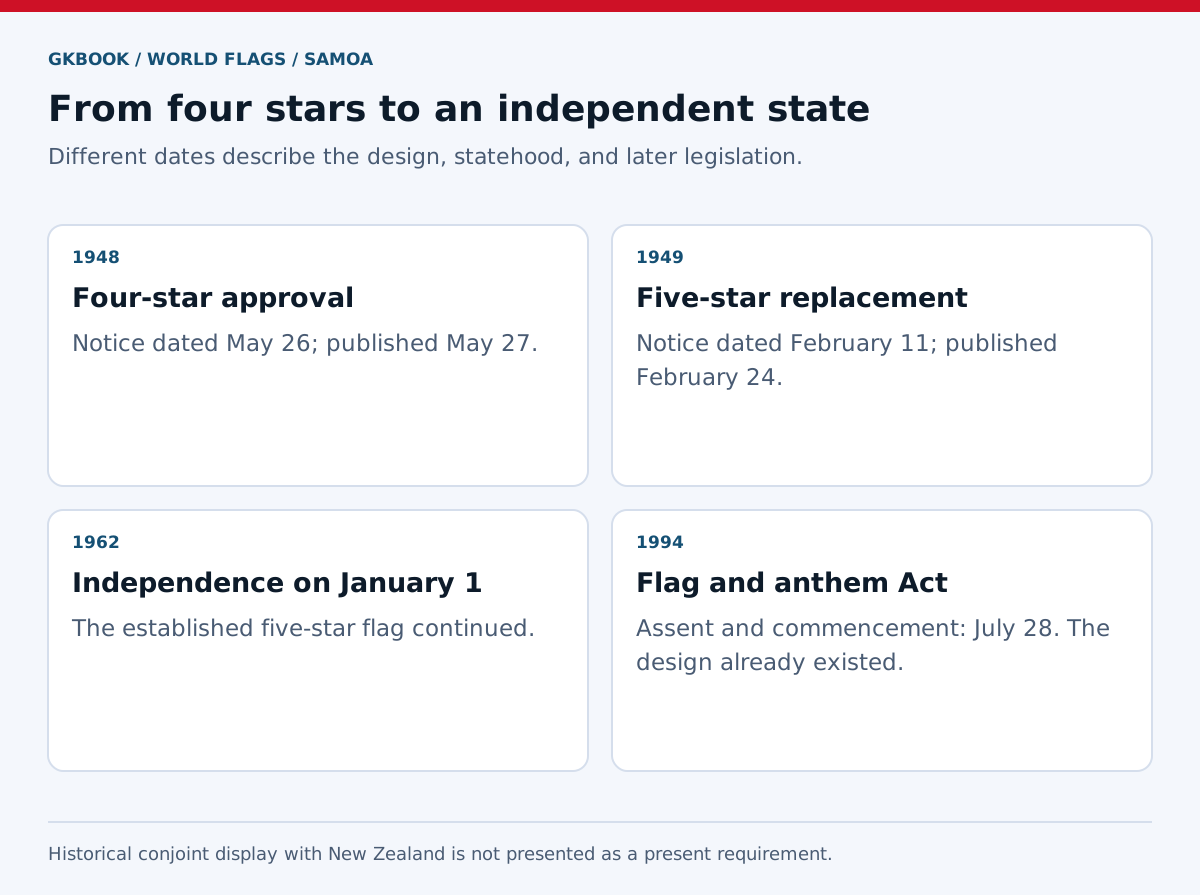
The original Gazette notices provide contemporary evidence for the two versions. The 1948 notice is dated May 26 and was published May 27. The 1949 replacement notice is dated February 11 and appeared in the February 24 issue. Both belong to the period before independent statehood.
Their historical instruction to fly the Samoan and New Zealand flags together describes that administrative period. It should not be presented as a current requirement for independent Samoa. The article separates the development of the design, the publication of its approval, the achievement of independence, and the later domestic legislation.
When was Samoa’s five-star flag adopted?
February 24, 1949 is the adoption date given in the Ministry of Foreign Affairs and Trade factsheet and Whitney Smith’s account. The original approval notice was dated February 11 and published in the February 24 Gazette. Those dates should be labeled separately; January 1, 1962 marks independence and continued use of the existing design.
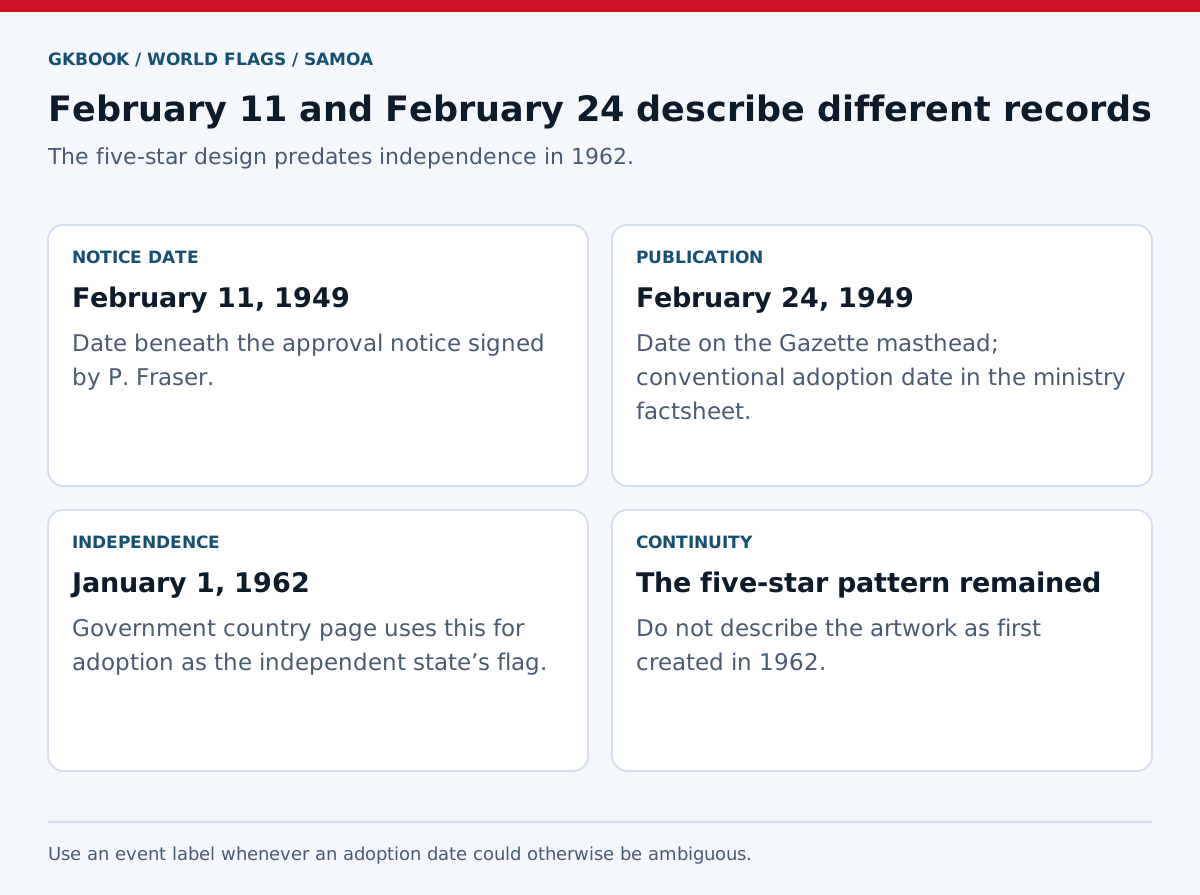
The Gazette’s masthead establishes the publication date, while the signature beneath the flag notice establishes its own date. The distinction matters because a decision document can predate the issue that publishes it. No separate ceremony or first-hoisting time is inferred solely from either date.
The government’s general country page calls January 1, 1962 the official adoption date. Read alongside the earlier notices and the ministry factsheet, that wording concerns the flag of the independent state. It does not show that the five-star artwork first appeared in 1962. The evidence supports continuity across independence.
| Event | Date | Evidence |
|---|---|---|
| Four-star notice dated | May 26, 1948 | Gazette notice; published May 27 |
| Five-star notice dated | February 11, 1949 | Signature under replacement notice |
| Five-star publication / conventional adoption | February 24, 1949 | Gazette masthead; ministry factsheet |
| Independence; design retained | January 1, 1962 | Ministry factsheet; NZ History |
| 1994 Act assent and commencement | July 28, 1994 | Act, opening provisions |
Did the flag change when Samoa became independent?
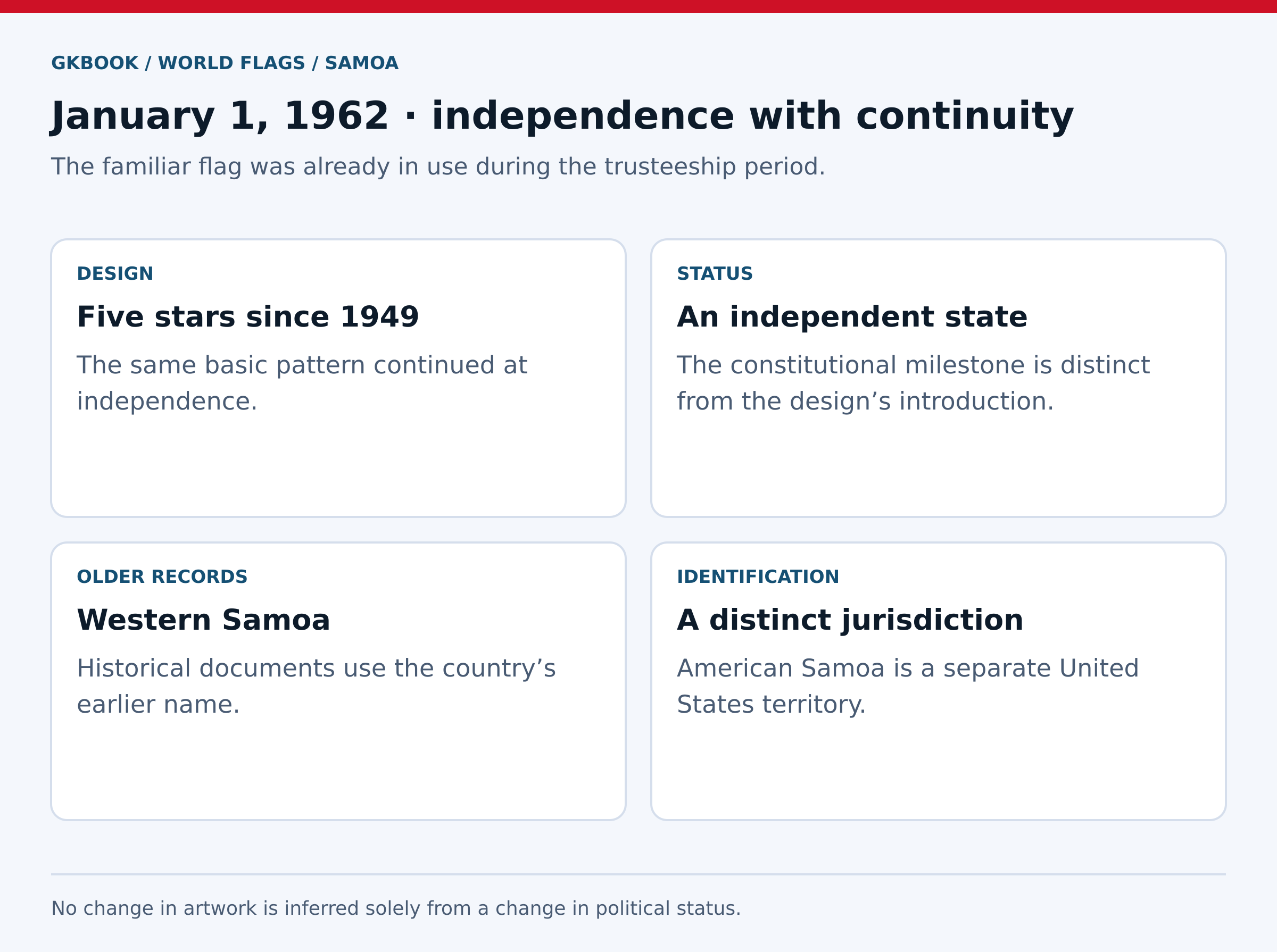
The five-star flag was retained when Samoa became independent on January 1, 1962. It had already been used during the preceding trusteeship period. Independence changed the country’s political status, while the familiar red field, blue canton, and five white stars continued. The design’s 1949 adoption and the country’s 1962 independence are separate milestones.
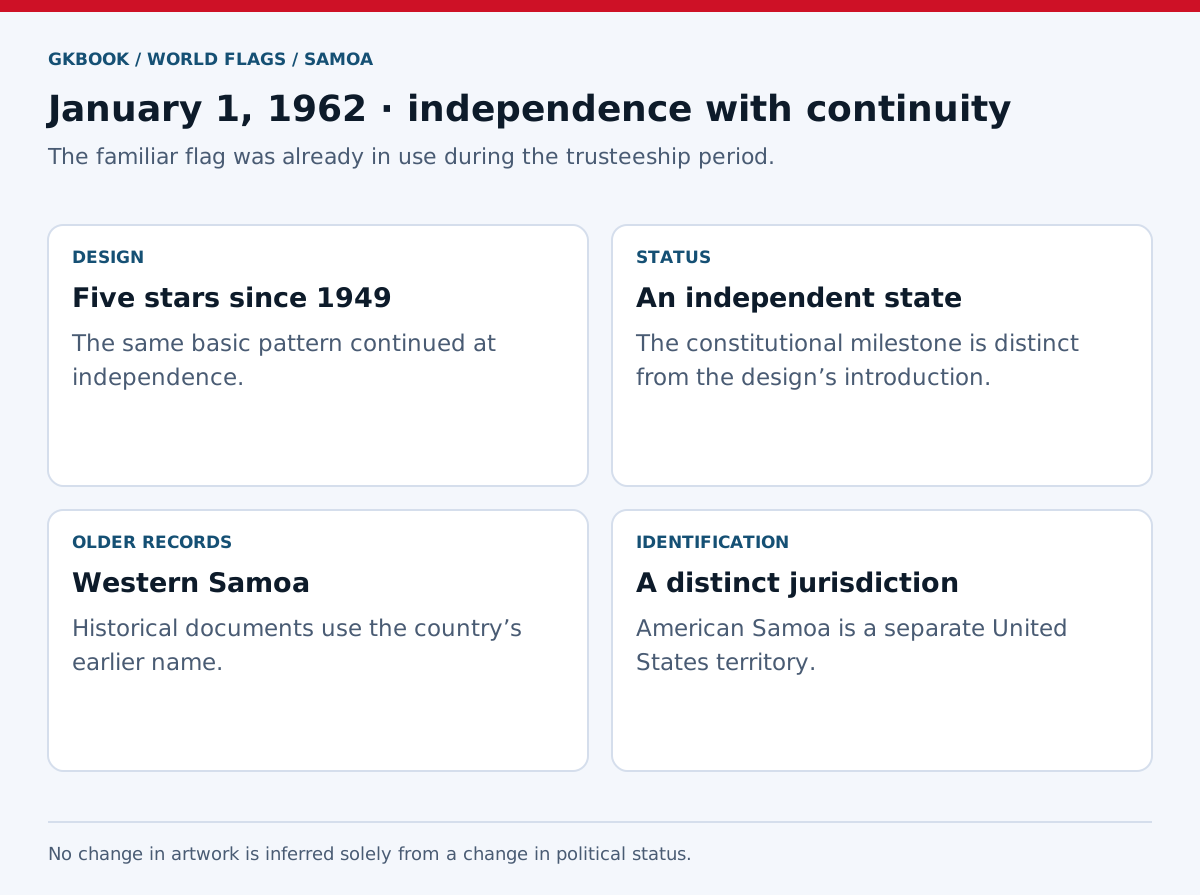
New Zealand’s Ministry for Culture and Heritage confirms the independence date, and the Samoan ministry factsheet explicitly connects the earlier flag with continued use after independence. Whitney Smith likewise states that the national design did not change on that occasion. These accounts agree on the distinction between design and statehood.
Older records use the name Western Samoa. That wording identifies the historical country and period discussed by those documents; it should not be confused with American Samoa, a separate United States territory. Captions should preserve enough context to explain which jurisdiction and which event a historical flag image represents.
Why is Independence Day celebrated on June 1?
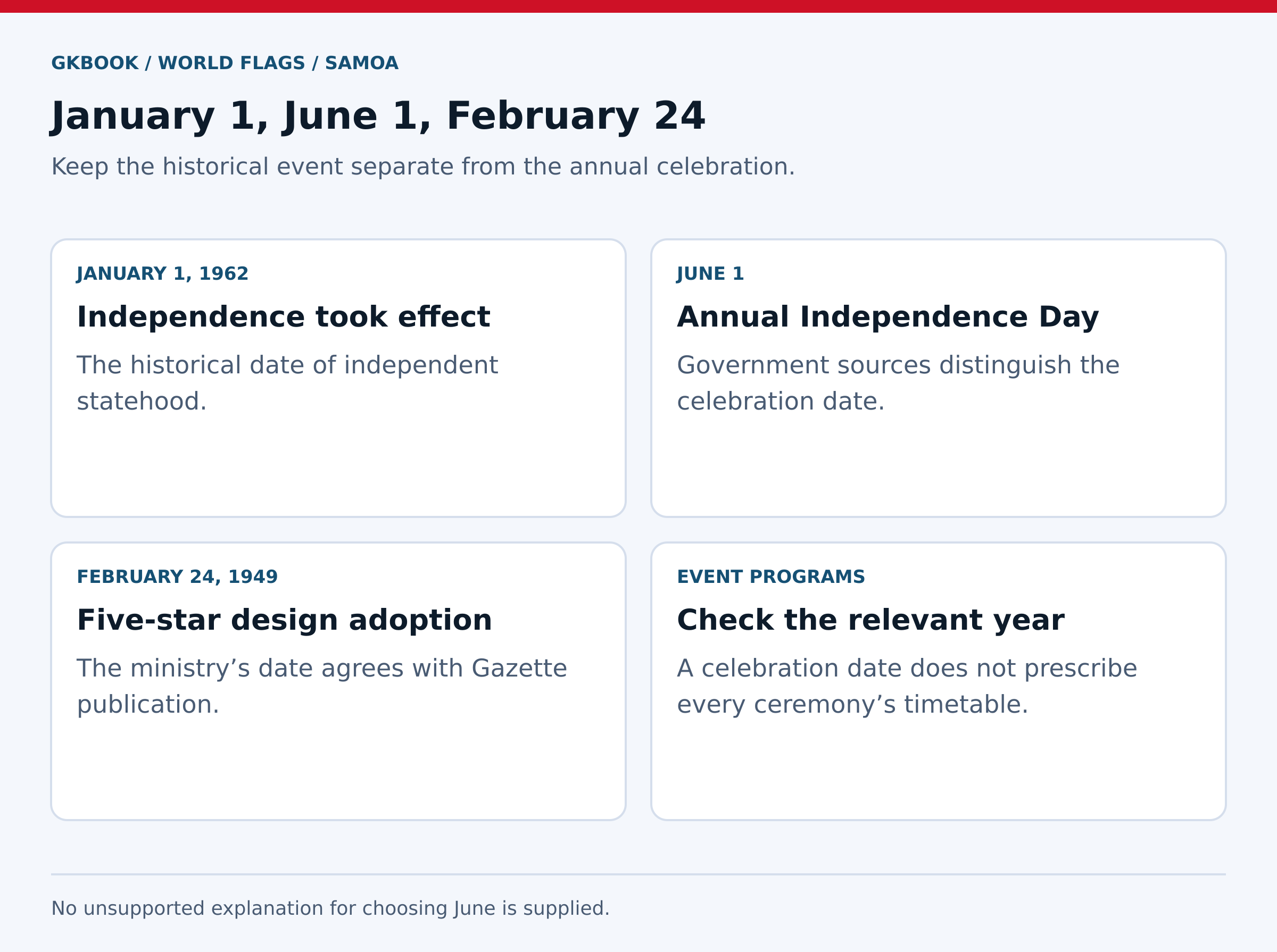
Samoa celebrates Independence Day on June 1, although independence took effect on January 1, 1962. Government sources distinguish the historical event from its annual celebration, and Samoa’s 2026 events page lists June 1 for Independence Day. Neither the June observance nor the January independence date replaces the five-star design’s 1949 history.
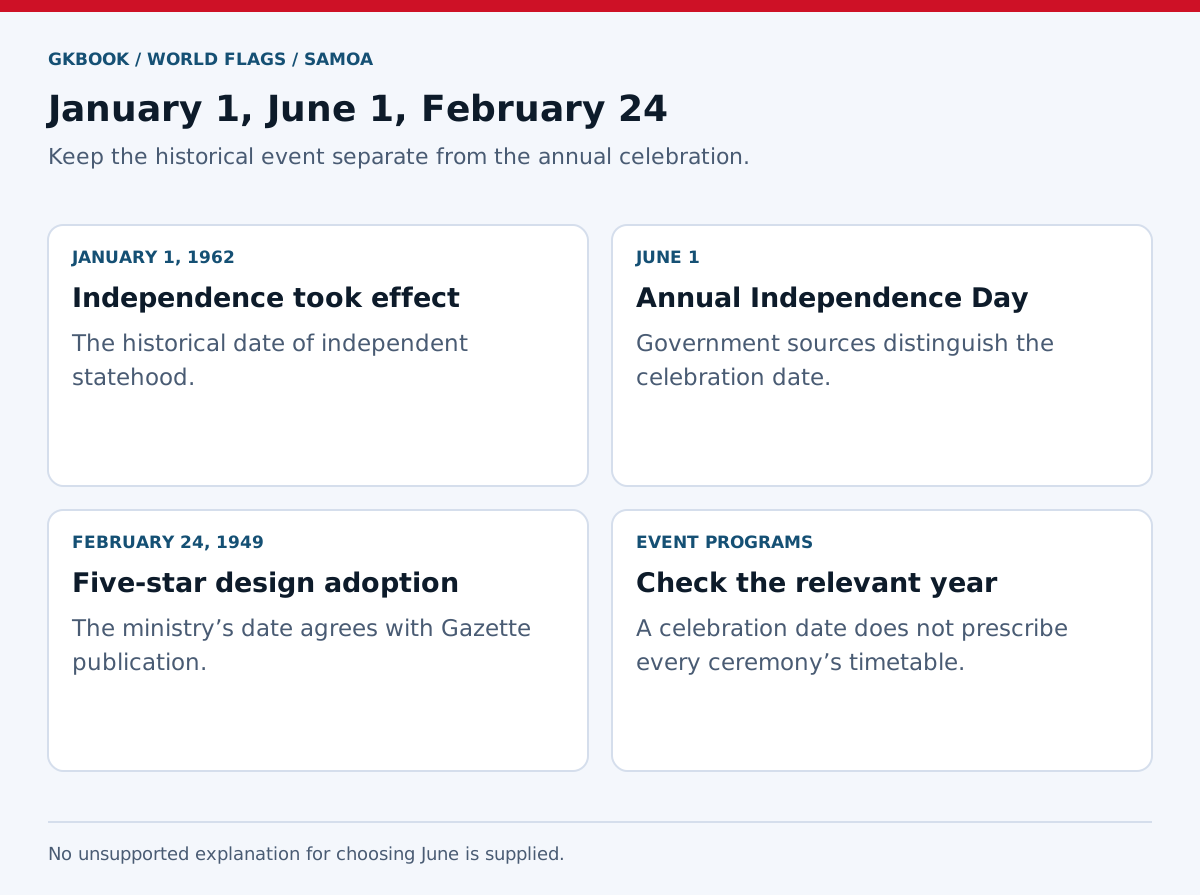
A national celebration can take place on a different calendar date from the event it commemorates. A caption reading Independence Day should therefore explain whether it refers to the original constitutional milestone or an annual ceremony. The flag can appear at both without acquiring a new adoption date.
The illustrated date card separates January 1, June 1, and February 24 by meaning. It does not invent a reason for choosing June, a fixed ceremony timetable, or a rule that every celebration has the same program. Event organizers’ published arrangements remain the relevant source for a particular year’s activities.
Who designed the Samoan flag?
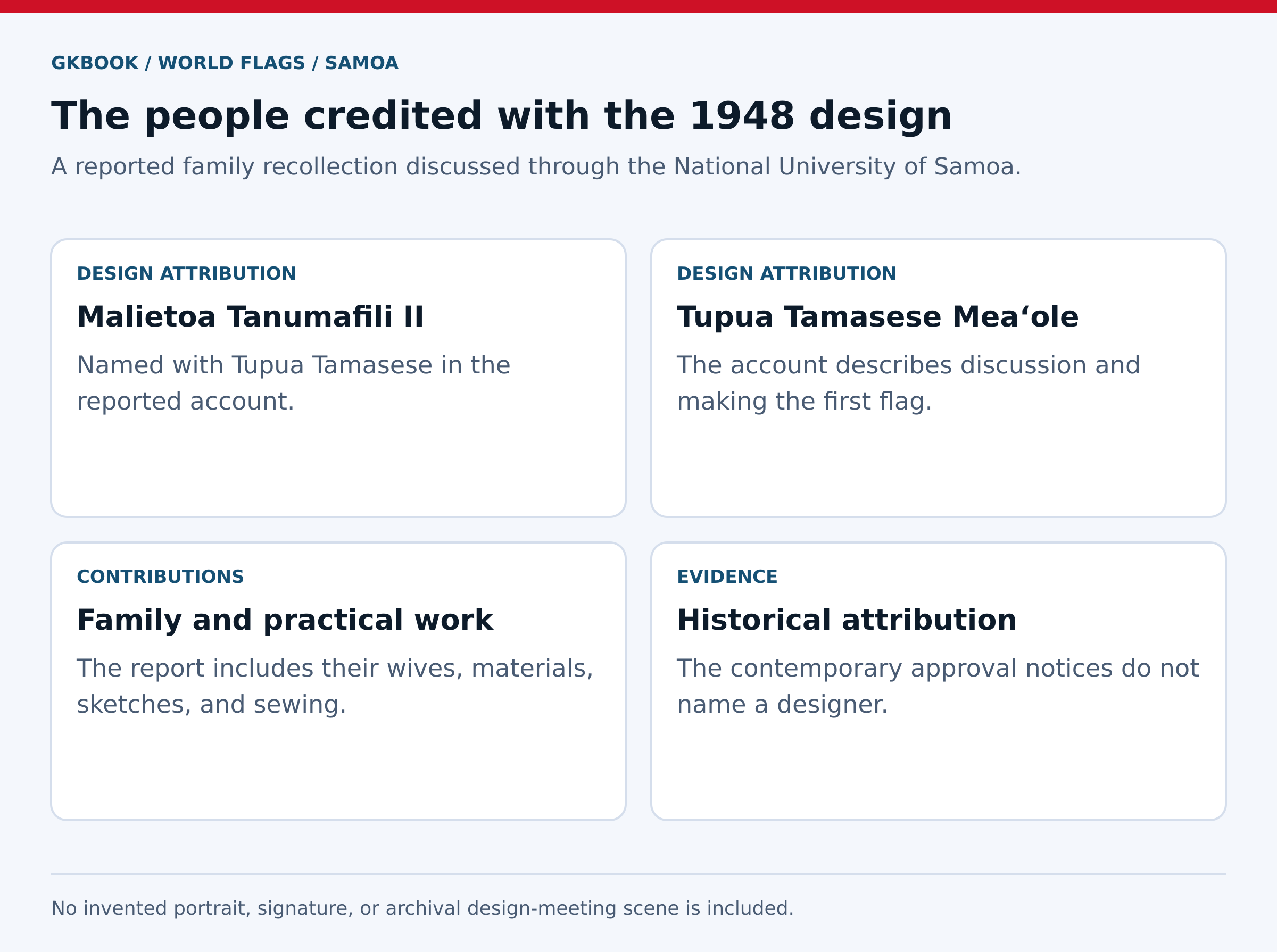
Malietoa Tanumafili II and Tupua Tamasese Mea‘ole are credited with developing the 1948 design. A Samoa Observer report describes a family recollection discussed by a National University of Samoa lecturer, including the participation of their wives. This is a historical attribution to the original design, not proof that either man personally drafted every later statutory measurement.
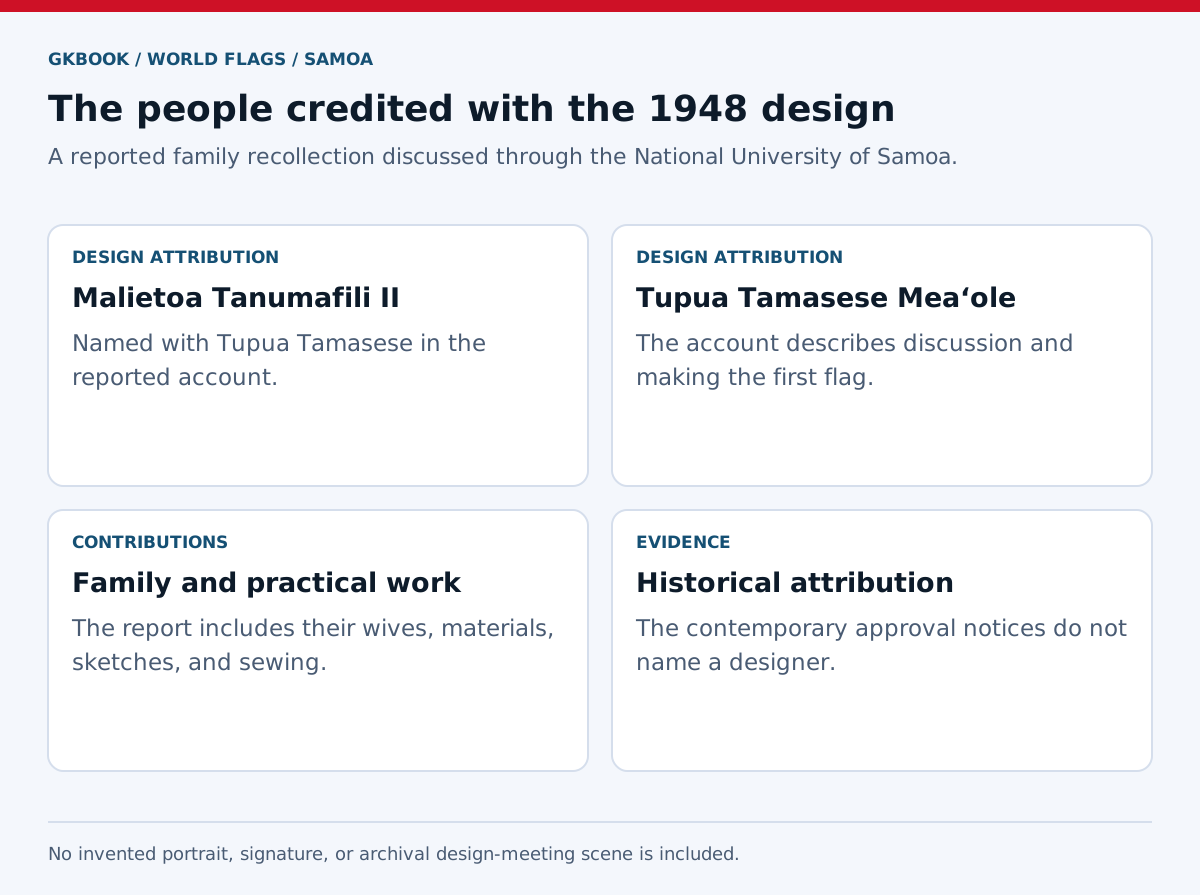
The 2022 report draws on an account by Pili‘opo Tamasese Maia‘i presented through the university’s Centre for Samoan Studies. It describes discussion, sketches, obtaining materials, and sewing. This gives useful context for the collective work behind the emblem, rather than reducing its creation to an isolated modern graphic-design commission.
The contemporary approval notices do not name a designer, and no original signed sketch was inspected for this package. The attribution is therefore tied to the reported account. The gallery uses a text-based credit card; it does not generate portraits, signatures, or a supposedly archival picture of the design meeting.
Was the 1948 flag just today’s flag with one star removed?
The 1948 version had four stars, but its notice also differs in a placement instruction: the fly-side star’s nearest tip was twenty-two units from the canton’s fly edge, compared with forty-two in the 1949 schedule. Simply deleting today’s smallest star therefore does not reproduce every detail of the earlier written specification.

The original 1948 text describes the four stars and their measurements, while the replacement notice adds the fifth star and revises the wording. Comparing documents directly exposes details that a short timeline can conceal. A historical reconstruction must identify which schedule it follows rather than rely only on the visible star count.
This gallery explains the difference with a comparison card instead of presenting a casually modified modern image as an exact historical facsimile. The earlier notice also uses less explicit wording for star measurement. That wording and the period artwork deserve their own reconstruction study before a manufacturing-level claim is made for the predecessor.
What mistakes should be avoided when drawing the flag?
Avoid equal-sized stars, a missing fifth star, a misplaced canton, or a square outer rectangle. Preserve the stars’ five-pointed shape, their upright orientation, and their unequal positions. Measure star size between the specified ray tips rather than treating the number as a radius. Keep the 1948, 1949, 1962, and 1994 events distinct in captions.
Work from the largest relationships down to the smallest. Check the two-to-one rectangle, the quarter-sized canton, the five separate stars, and then the individual star measurements. A drawing may look familiar while still being wrong in the position of the fly-side star or the size of the small fifth one.
Review the accompanying wording with the same care. The 1994 Act is not the first appearance of the design, and an annual June celebration is not the original date of independence. Source labels should also distinguish statutory dimensions, ministry-published screen colors, and historical recollections rather than treating them as identical kinds of evidence.
Which law describes Samoa’s national flag?
The Official Flag and National Anthem of Samoa Act 1994 identifies the flag through its schedule. Its assent and commencement date is July 28, 1994. The Attorney General’s published consolidation is labeled as at December 31, 2023. It includes the design, raising and lowering rules, anthem provisions, and offenses; it also repeals the 1973 flag Act.

The schedule provides a practical construction basis: rectangle, canton, star count, regular-star shape, sizes, and offsets. The body of the Act concerns the national symbols and behavior around them. Reading both avoids confusing a technical drawing rule with a rule governing an actual ceremony or public conduct.
The version date is part of the evidence. This article identifies the official consolidated text inspected rather than claiming to have reviewed every subsequent instruction or legal instrument. It does not treat a downloadable image as permission for every possible use, and it does not infer a detailed display code from provisions that do not address one.
What does the law say about raising and lowering the flag?
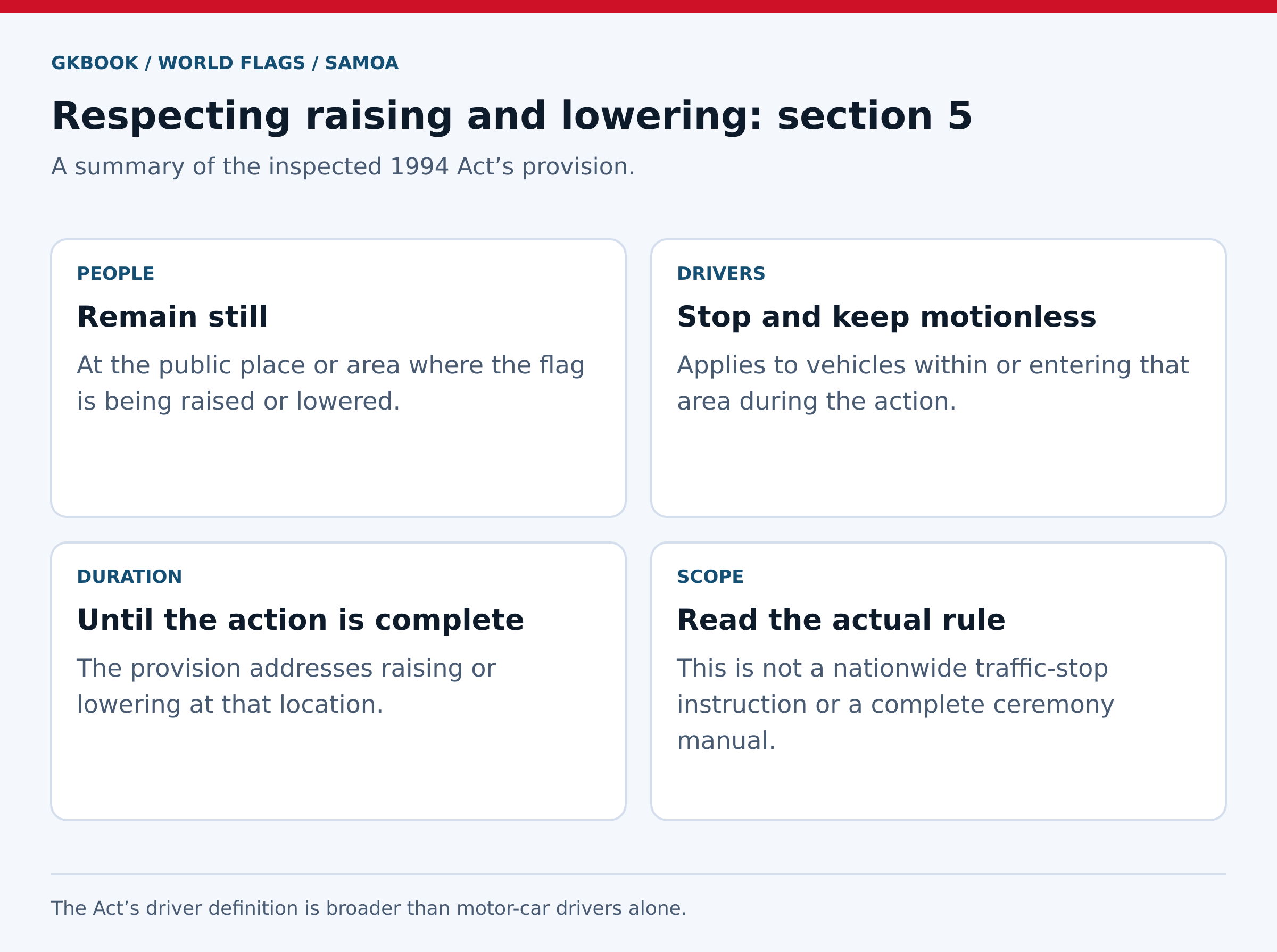
Section 5 of the inspected 1994 Act requires people at a public place or area where Samoa’s flag is being raised or lowered to remain still until the action is complete. It also directs drivers within or entering that area to stop their vehicles and keep them motionless for the duration of the raising or lowering.
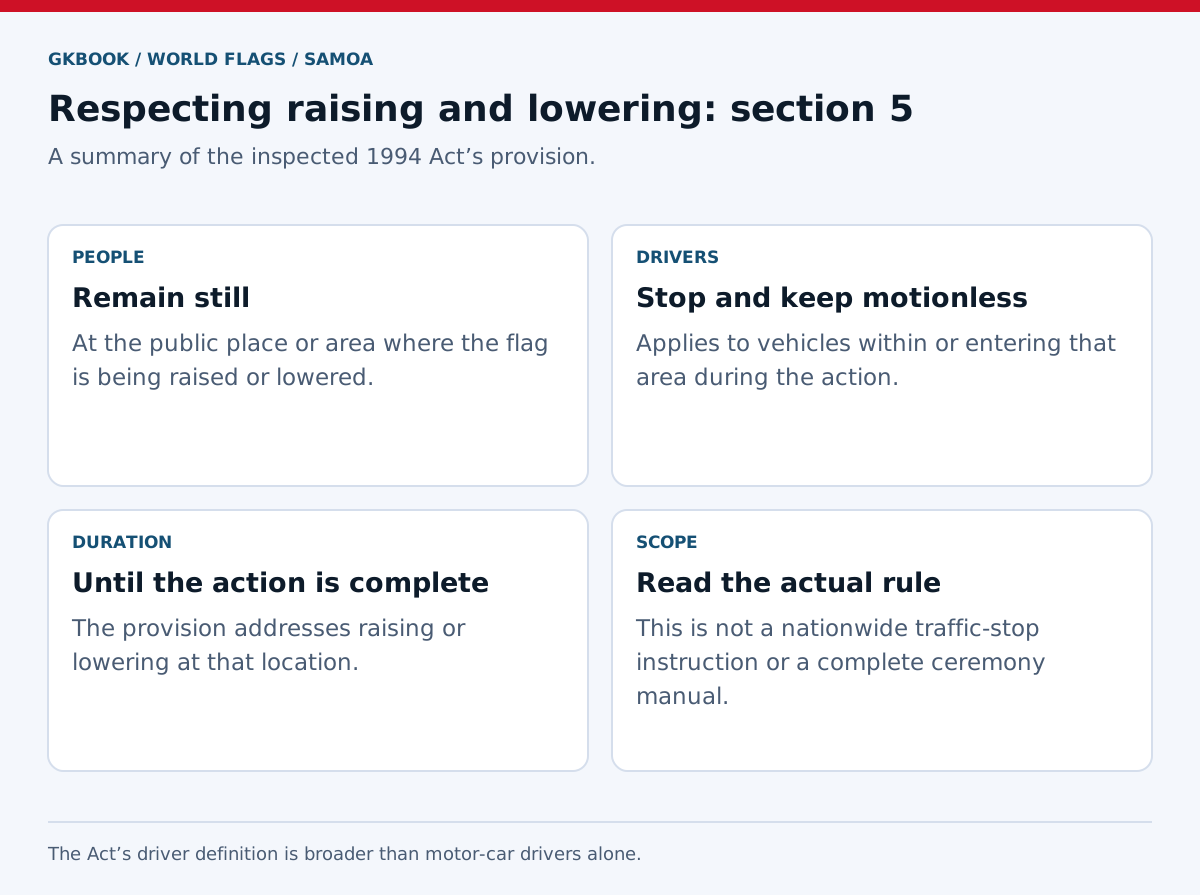
The requirement concerns the place where the ceremony is occurring. It should not be paraphrased as an instruction for all traffic everywhere in Samoa to stop whenever a flag moves. The Act defines driver broadly, including several riders and people controlling vehicles, so its wording should be consulted for a specific application.
The accompanying card summarizes the inspected provision without inventing extra salutes, clothing requirements, staff heights, or a universal ceremony script. For an organized event, the statutory provision and the responsible organizer’s instructions address different aspects of conduct. A correct flag drawing alone cannot establish every arrangement needed for that occasion.
How are the flag and national anthem connected?
The same 1994 Act covers both national symbols and identifies Samoa Tula‘i as the national anthem. It contains separate provisions about respecting the flag’s raising or lowering and remaining still during the anthem. The government also describes the anthem as The Banner of Freedom, whose words honor the country’s flag.
The legal connection is straightforward: one Act identifies the flag in a schedule and names the anthem in section 4. Separate sections then address conduct associated with each. This does not make the anthem’s title an inscription to add to the flag; the clean design contains only its fields and stars.
The article does not reproduce the anthem’s lyrics or musical score. Its purpose here is to explain why flag ceremonies and the anthem often appear together in national-symbol discussions. The creator of the anthem and the people credited with the flag’s original design should not be merged into one unqualified authorship claim.
What should be checked before flying Samoa’s flag at half-mast?
Check the official instruction for the particular mourning occasion and the responsible authority’s display guidance. The inspected 1994 Act describes the flag and rules around raising and lowering, but does not supply a complete half-mast positioning diagram or calendar. This guide therefore does not invent a lowering distance or assert that a mourning order is currently in force.
National mourning can involve decisions about dates, buildings, events, and responsible officials. Those details require an applicable instruction rather than an assumption based on a neighboring country’s custom. A diagram that marks an exact position on a staff would imply precision that the inspected flag schedule does not provide.
The internal national design remains the same when its position on a staff changes. Mourning does not add a black border or remove a star. The gallery consequently concentrates on verified internal construction and a source-based explanation of the raising rule, leaving occasion-specific positioning to the relevant official directions.
What does Samoa’s flag look like from behind?
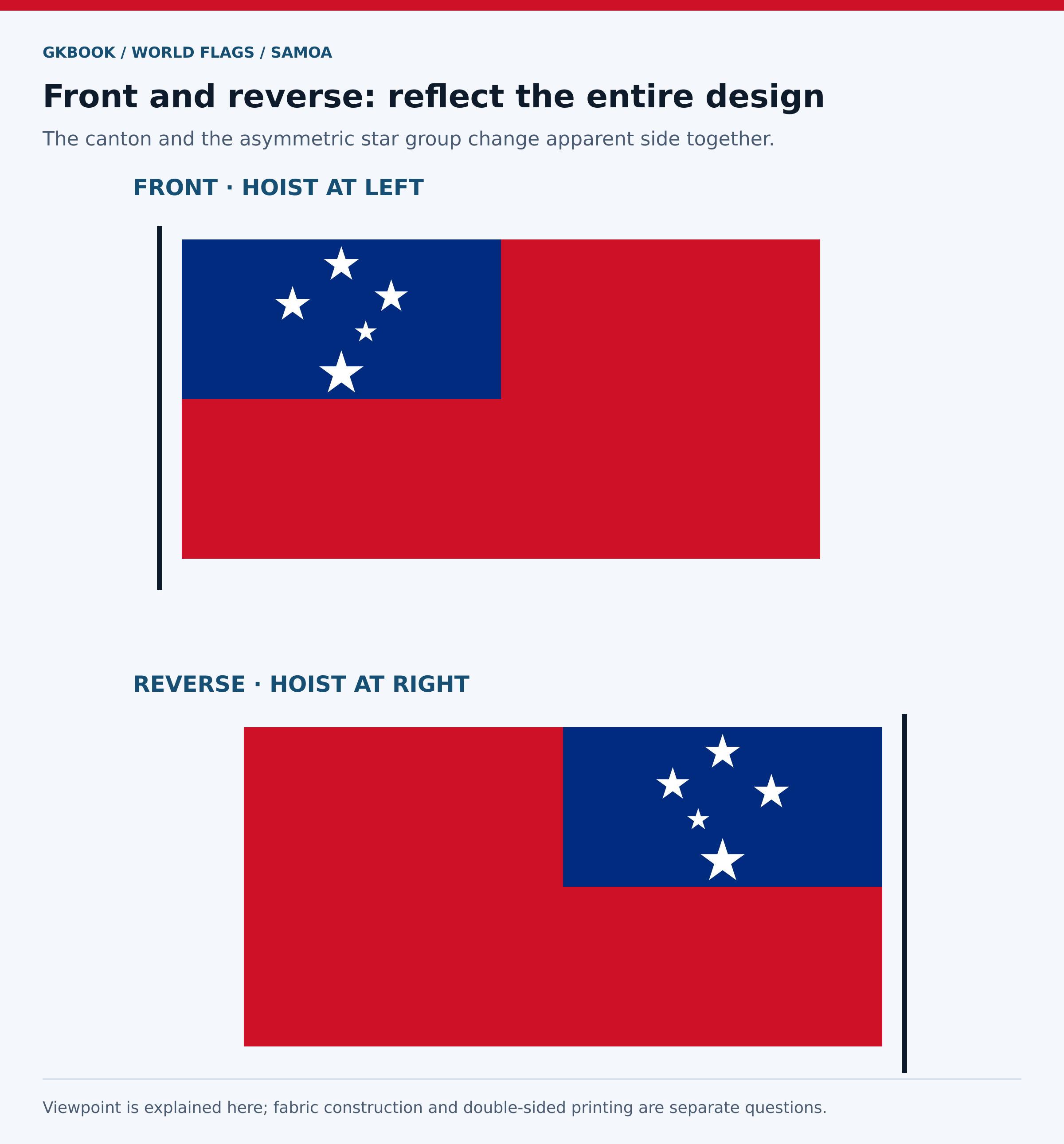
Viewed from behind a single-layer flag, the blue canton appears at the upper right when the hoist is on the viewer’s right. The entire star arrangement is horizontally reflected as well. Each upright regular star retains its own shape, but the group is not mirror-symmetric, so the small fifth star changes apparent side.
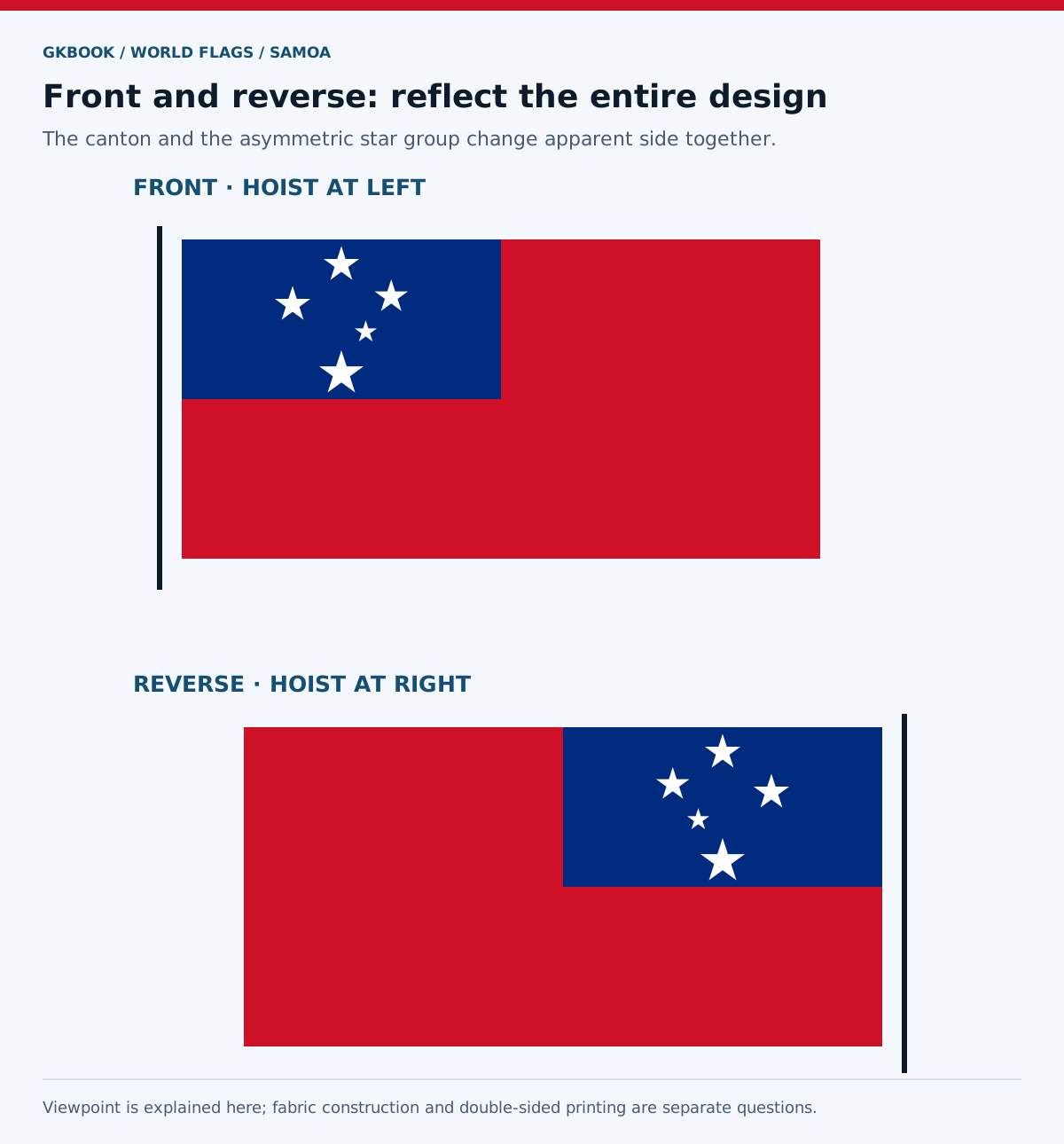
This is a change of viewpoint, not a separate national design. The canton stays beside the attachment edge even though its screen position reverses. A photograph taken from the back can therefore be correct without matching the usual front-view illustration with its hoist on the left.
Reflect the complete composition together. Moving only the blue rectangle while leaving the stars in their former order would not show the true reverse. The teaching image demonstrates a horizontal reflection; it does not prescribe the construction of double-sided fabric panels, seams, or separate printing layers.
How is Samoa’s flag different from New Zealand’s flag?
Samoa uses a red field and five solid white stars inside a blue canton. New Zealand uses a blue field, the Union Jack in its canton, and four red stars with white borders on the fly. Both reference the Southern Cross, but their star counts, colors, locations, and detailed constructions differ.
The resemblance has a historical context. Samoa’s modern flag developed during New Zealand administration, and the contemporary notices instructed that the two flags be flown together in that period. This connection does not allow today’s New Zealand star layout, digital palette, or display rules to be substituted for Samoa’s specification.
American Samoa is another distinct jurisdiction: it is a United States territory rather than the independent state discussed here. Use the full country or territory name when selecting an image. A shared regional identity or similar name does not make national and territorial flags interchangeable in captions, classrooms, or official material.
Which digital flag sizes are included?
The clean SVG uses a 2,880-by-1,440 coordinate system, and the clean PNG is 6,000 by 3,000 pixels. Both preserve the flag’s two-to-one width to height ratio. Twenty-four gallery subjects each have SVG and PNG versions, while a separate 1,200-by-630 social card places the complete flag inside a larger explanatory layout.
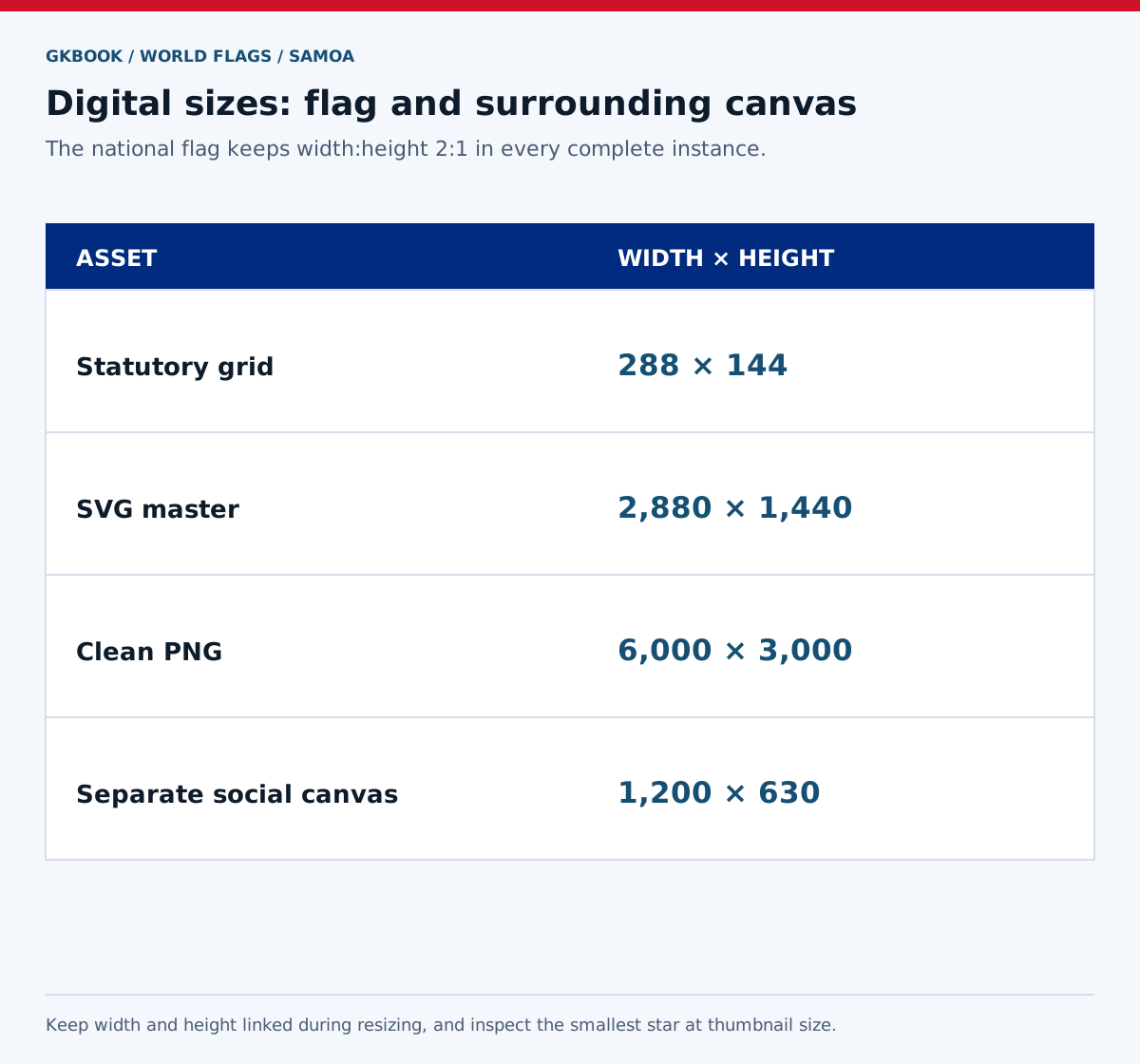
The SVG can be scaled by software because it stores the shapes as vector coordinates. The PNG provides a fixed raster image for applications that need one. Choose the clean reference when only the national emblem is required, and choose a labeled diagram when the purpose is to explain a measurement or historical distinction.
The social canvas is not a new flag ratio. Its internal flag remains a complete two-to-one rectangle, with an external frame separating it from the surrounding design. When creating small thumbnails, inspect the fifth star and the gaps between stars at the actual display size rather than relying only on a large preview.
How should the flag artwork be prepared for print?
Keep the flag’s proportions, complete canton, and measured stars intact, then agree the output size and a color proof with the printer. The ministry factsheet supplies digital values and CMYK figures, but those figures do not identify an ICC profile or certified textile standard. Printing on different materials can produce visibly different results from the same file.
The factsheet’s heading resembles a Pantone label, but it does not give numbered Pantone references. Its listed color names and numerical values should not be converted into invented certified ink codes. A screen RGB value is useful for consistency, while a production proof shows how the chosen printer, ink, and substrate reproduce it.
A 6,000-pixel-wide raster printed at 300 pixels per inch is twenty inches wide; at 150 pixels per inch it is forty inches wide. These are arithmetic examples, not compulsory national flag sizes. Vector output removes a fixed pixel-resolution limit, but color management, material, finishing, and the required viewing distance still matter.
Which Samoa flag pictures can I download?
The gallery provides 24 subjects as SVG and PNG pairs, covering the clean flag, colors, symbolism, canton, star measurements, dates, designers, law, and reverse view. A separate social card is also supplied. All illustrations are original vector compositions; the historical cards explain documentary evidence without claiming to be archival photographs or original government artwork.
Use the proportions and canton diagrams to introduce the large shapes, then the size and position diagrams to study the stars. The history and adoption cards attach dates to particular events. The designer card identifies the reported attribution and its evidential basis without inventing a portrait or signature.
Every subject has alternative text, a caption, and reproduction notes. The picture gallery groups the downloads, and World Flags leads to related country articles. The direct answers also supply the visible FAQ and its structured data, keeping the explanations consistent across the page.
Download Samoa flag pictures
Download the clean national flag as SVG or 6,000 × 3,000 PNG. Its SVG coordinate system is 2,880 × 1,440, preserving a 2:1 width to height ratio.
The gallery contains 24 subjects, each with an SVG and PNG. The geometry is calculated from the 1994 Act’s schedule, and the RGB/hex palette follows the ministry factsheet. Image credits and reproduction notes explain the source basis, regular-star calculations, and distinction between digital values and physical color production. The separate social card is 1,200 × 630 and contains a complete correctly proportioned flag.
Continue exploring national designs in World Flags.
World Flags/Samoa
Samoa flag pictures
A red field with a blue upper hoist quarter containing five white regular stars. Geometry follows the 1994 Act’s schedule; digital fills follow the ministry factsheet.
Original GKBook vector drawing calculated from the 1994 Act’s schedule; digital fills follow Samoa’s Ministry of Foreign Affairs and Trade factsheet.Download SVGDownload PNGValues are published in Samoa’s Ministry of Foreign Affairs and Trade factsheet. No numbered Pantone reference or certified textile conversion is inferred.
Original GKBook vector drawing calculated from the 1994 Act’s schedule; digital fills follow Samoa’s Ministry of Foreign Affairs and Trade factsheet.Download SVGDownload PNGThe ministry’s color symbolism and the Act’s measured design are different kinds of information.
Original GKBook vector drawing calculated from the 1994 Act’s schedule; digital fills follow Samoa’s Ministry of Foreign Affairs and Trade factsheet.Download SVGDownload PNGThe red field surrounds the canton to its right and below; its area follows from the quarter-sized canton.
Original GKBook vector drawing calculated from the 1994 Act’s schedule; digital fills follow Samoa’s Ministry of Foreign Affairs and Trade factsheet.Download SVGDownload PNGBlue forms a complete quarter rectangle behind all five white stars.
Original GKBook vector drawing calculated from the 1994 Act’s schedule; digital fills follow Samoa’s Ministry of Foreign Affairs and Trade factsheet.Download SVGDownload PNGAll five stars use the same white fill; they differ in prescribed size and position.
Original GKBook vector drawing calculated from the 1994 Act’s schedule; digital fills follow Samoa’s Ministry of Foreign Affairs and Trade factsheet.Download SVGDownload PNGThis enlarged canton is an explanatory detail, not the full national flag. The five symbols represent the Southern Cross.
Original GKBook vector drawing calculated from the 1994 Act’s schedule; digital fills follow Samoa’s Ministry of Foreign Affairs and Trade factsheet.Download SVGDownload PNGAstronomical context follows IAU education and ESO material. This is not a sky chart or an observing guide.
Original GKBook vector drawing calculated from the 1994 Act’s schedule; digital fills follow Samoa’s Ministry of Foreign Affairs and Trade factsheet.Download SVGDownload PNGThe dashed circle is a teaching overlay identifying the fifth star. It is absent from the clean flag.
Original GKBook vector drawing calculated from the 1994 Act’s schedule; digital fills follow Samoa’s Ministry of Foreign Affairs and Trade factsheet.Download SVGDownload PNGThe measurement brackets are outside the national design. The complete flag is twice as long as it is high.
Original GKBook vector drawing calculated from the 1994 Act’s schedule; digital fills follow Samoa’s Ministry of Foreign Affairs and Trade factsheet.Download SVGDownload PNGDashed lines divide the red field into the other three quarter areas for explanation; they are absent from the clean flag.
Original GKBook vector drawing calculated from the 1994 Act’s schedule; digital fills follow Samoa’s Ministry of Foreign Affairs and Trade factsheet.Download SVGDownload PNGThe enlarged star is illustrative. The red diagonal connects outer ray tips with one outer tip skipped; only the clean white silhouette belongs in the flag.
Original GKBook vector drawing calculated from the 1994 Act’s schedule; digital fills follow Samoa’s Ministry of Foreign Affairs and Trade factsheet.Download SVGDownload PNGCenter dots and a centerline are teaching overlays. The side stars have different heights, and the fifth star is off-axis.
Original GKBook vector drawing calculated from the 1994 Act’s schedule; digital fills follow Samoa’s Ministry of Foreign Affairs and Trade factsheet.Download SVGDownload PNGEvery complete national flag in the package uses two rectangles and the same five calculated star polygons.
Original GKBook vector drawing calculated from the 1994 Act’s schedule; digital fills follow Samoa’s Ministry of Foreign Affairs and Trade factsheet.Download SVGDownload PNGThe chronology is based on the original Gazette notices, ministry information, and the inspected Act.
Original GKBook vector drawing calculated from the 1994 Act’s schedule; digital fills follow Samoa’s Ministry of Foreign Affairs and Trade factsheet.Download SVGDownload PNGThe Gazette text and masthead were inspected. No separate first-hoisting ceremony is inferred from publication alone.
Original GKBook vector drawing calculated from the 1994 Act’s schedule; digital fills follow Samoa’s Ministry of Foreign Affairs and Trade factsheet.Download SVGDownload PNGIndependence is confirmed by New Zealand’s Ministry for Culture and Heritage; flag continuity is recorded by the Samoan ministry and Whitney Smith.
Original GKBook vector drawing calculated from the 1994 Act’s schedule; digital fills follow Samoa’s Ministry of Foreign Affairs and Trade factsheet.Download SVGDownload PNGSamoa’s government events page lists June 1 for Independence Day in 2026; the older New Zealand government explanation confirms the distinction.
Original GKBook vector drawing calculated from the 1994 Act’s schedule; digital fills follow Samoa’s Ministry of Foreign Affairs and Trade factsheet.Download SVGDownload PNGSamoa Observer’s 2022 report cites a family account discussed by a university lecturer. Original sketches were not inspected.
Original GKBook vector drawing calculated from the 1994 Act’s schedule; digital fills follow Samoa’s Ministry of Foreign Affairs and Trade factsheet.Download SVGDownload PNGThis is a documentary comparison, not a claimed exact facsimile of the 1948 flag. The original notice’s measurement wording also differs.
Original GKBook vector drawing calculated from the 1994 Act’s schedule; digital fills follow Samoa’s Ministry of Foreign Affairs and Trade factsheet.Download SVGDownload PNGThe complete five-page published Act was read. Its version date is explicit; it is not treated as proof that every later instruction has been inspected.
Original GKBook vector drawing calculated from the 1994 Act’s schedule; digital fills follow Samoa’s Ministry of Foreign Affairs and Trade factsheet.Download SVGDownload PNGThe diagram summarizes section 5 of the Act as published in the 2023 consolidation. It adds no unsupported salute, clothing, or staff-height rule.
Original GKBook vector drawing calculated from the 1994 Act’s schedule; digital fills follow Samoa’s Ministry of Foreign Affairs and Trade factsheet.Download SVGDownload PNGThe reverse is a horizontal reflection. Its canton appears upper right, and the small fifth star switches apparent side within the group.
Original GKBook vector drawing calculated from the 1994 Act’s schedule; digital fills follow Samoa’s Ministry of Foreign Affairs and Trade factsheet.Download SVGDownload PNGDiagram and social-card canvases add explanatory space around correctly proportioned complete flag instances.
Original GKBook vector drawing calculated from the 1994 Act’s schedule; digital fills follow Samoa’s Ministry of Foreign Affairs and Trade factsheet.Download SVGDownload PNGFrequently asked questions
What does the Samoa flag look like?
Samoa’s flag has a red field with a blue rectangle in the upper corner beside the hoist. Five white, five-pointed stars inside that canton represent the Southern Cross. The flag is twice as long as it is high. Its five-star design dates from 1949, before independence in 1962.
What are the colors of the Samoa flag?
Samoa’s flag uses red, blue, and white. A Ministry of Foreign Affairs and Trade factsheet publishes red as RGB 206, 17, 38, blue as RGB 0, 43, 127, and white as RGB 255, 255, 255. These published digital values guide the downloads; the flag law itself specifies color names without numerical screen codes.
What does the Samoa flag mean?
The Ministry of Foreign Affairs and Trade explains red as courage, blue as freedom, and white as purity. The five stars represent the Southern Cross, connecting the design with the southern sky. These published meanings should be distinguished from the 1994 law’s schedule, which specifies the flag’s appearance and construction rather than assigning meanings to its colors.
What does the red field represent?
Red represents courage in the ministry’s explanation. It forms the main field of the flag, surrounding the blue canton along its right and lower sides. Before accounting for the white stars, the red field occupies three quarters of the rectangle. The downloaded artwork uses the ministry’s published red value, hexadecimal #CE1126.
What does the blue canton represent?
Blue represents freedom in the ministry’s account. It fills the upper quarter beside the hoist, the edge attached to a staff or halyard. In the usual front view, this canton appears at the upper left. Its published digital color is #002B7F, and it provides the background for all five white stars.
What does white represent on the flag?
White represents purity in the ministry’s published explanation. It appears in the five stars, each drawn as a solid, regular five-pointed figure. The white is not an outline around a red center. All five stars use the same white fill, although their prescribed sizes and positions are not identical.
How many stars are on Samoa’s flag?
The current flag has five white stars, and every star has five points. Four larger stars outline the main cross, with a smaller fifth star inside the lower right part of the arrangement in the standard front view. The law identifies them with the Southern Cross; they are not a count of Samoa’s islands.
What is the Southern Cross shown on the flag?
The Southern Cross is a recognizable star pattern associated with the constellation Crux in the southern sky. Samoa’s law explicitly identifies the five stars with it. Astronomical organizations describe four principal stars and a fifth often included in the pattern. The flag is a symbolic arrangement, not a calibrated map of the night sky.
Why is one of the five stars smaller?
The smaller fifth star is part of the five-star design introduced in 1949, following a four-star version approved in 1948. The construction schedule gives it a ten-unit ray-to-ray measurement, smaller than the other stars. It sits below and to the right of the upper central star, remaining entirely within the blue canton.
What is the aspect ratio of the Samoa flag?
The flag’s height to length ratio is 1:2. The law describes a grid 144 units high and 288 units long, so the length is exactly twice the height. A 600-by-300 image and a 6,000-by-3,000 image therefore have the same correct proportions when width is written first.
How large is the blue canton?
The blue canton occupies the first quarter of the flag: half its full length and half its full height. On the statutory 288-by-144 grid, it measures 144 by 72 units. Its outer edges coincide with the top and hoist edges, while the remaining three quarters form the red field.
How are the five star sizes measured?
The schedule measures a star from one outer ray tip to the next-but-one ray tip, skipping one intervening tip. The top and hoist-side stars measure 16 units, the fly-side star 15, the bottom star 20, and the fifth star 10. These lengths are not the stars’ circumdiameters or their vertical bounding-box heights.
Where are the five stars positioned?
The top and bottom stars are centered on the vertical line through the canton’s midpoint. Their outer tips leave three-unit margins at the canton’s top and bottom. The other stars use specified offsets from its edges. The hoist-side and fly-side stars have different heights, so the arrangement must not be made perfectly symmetrical.
How can I draw the flag accurately?
Begin with the statutory 288-by-144 rectangle, fill it red, and place a 144-by-72 blue canton at the upper hoist. Add five upright regular white stars using the schedule’s individual sizes and edge offsets. Calculate each center from those measurements, then scale the entire design uniformly to the required output dimensions.
What is the history of Samoa’s current flag?
A four-star flag was approved in May 1948 while Western Samoa was administered by New Zealand. A revised five-star design followed in February 1949 and continued when the country became independent on January 1, 1962. The 1994 flag and anthem law later recorded the design and related rules; it did not introduce the familiar five-star flag.
When was Samoa’s five-star flag adopted?
February 24, 1949 is the adoption date given in the Ministry of Foreign Affairs and Trade factsheet and Whitney Smith’s account. The original approval notice was dated February 11 and published in the February 24 Gazette. Those dates should be labeled separately; January 1, 1962 marks independence and continued use of the existing design.
Did the flag change when Samoa became independent?
The five-star flag was retained when Samoa became independent on January 1, 1962. It had already been used during the preceding trusteeship period. Independence changed the country’s political status, while the familiar red field, blue canton, and five white stars continued. The design’s 1949 adoption and the country’s 1962 independence are separate milestones.
Why is Independence Day celebrated on June 1?
Samoa celebrates Independence Day on June 1, although independence took effect on January 1, 1962. Government sources distinguish the historical event from its annual celebration, and Samoa’s 2026 events page lists June 1 for Independence Day. Neither the June observance nor the January independence date replaces the five-star design’s 1949 history.
Who designed the Samoan flag?
Malietoa Tanumafili II and Tupua Tamasese Mea‘ole are credited with developing the 1948 design. A Samoa Observer report describes a family recollection discussed by a National University of Samoa lecturer, including the participation of their wives. This is a historical attribution to the original design, not proof that either man personally drafted every later statutory measurement.
Was the 1948 flag just today’s flag with one star removed?
The 1948 version had four stars, but its notice also differs in a placement instruction: the fly-side star’s nearest tip was twenty-two units from the canton’s fly edge, compared with forty-two in the 1949 schedule. Simply deleting today’s smallest star therefore does not reproduce every detail of the earlier written specification.
What mistakes should be avoided when drawing the flag?
Avoid equal-sized stars, a missing fifth star, a misplaced canton, or a square outer rectangle. Preserve the stars’ five-pointed shape, their upright orientation, and their unequal positions. Measure star size between the specified ray tips rather than treating the number as a radius. Keep the 1948, 1949, 1962, and 1994 events distinct in captions.
Which law describes Samoa’s national flag?
The Official Flag and National Anthem of Samoa Act 1994 identifies the flag through its schedule. Its assent and commencement date is July 28, 1994. The Attorney General’s published consolidation is labeled as at December 31, 2023. It includes the design, raising and lowering rules, anthem provisions, and offenses; it also repeals the 1973 flag Act.
What does the law say about raising and lowering the flag?
Section 5 of the inspected 1994 Act requires people at a public place or area where Samoa’s flag is being raised or lowered to remain still until the action is complete. It also directs drivers within or entering that area to stop their vehicles and keep them motionless for the duration of the raising or lowering.
How are the flag and national anthem connected?
The same 1994 Act covers both national symbols and identifies Samoa Tula‘i as the national anthem. It contains separate provisions about respecting the flag’s raising or lowering and remaining still during the anthem. The government also describes the anthem as The Banner of Freedom, whose words honor the country’s flag.
What should be checked before flying Samoa’s flag at half-mast?
Check the official instruction for the particular mourning occasion and the responsible authority’s display guidance. The inspected 1994 Act describes the flag and rules around raising and lowering, but does not supply a complete half-mast positioning diagram or calendar. This guide therefore does not invent a lowering distance or assert that a mourning order is currently in force.
What does Samoa’s flag look like from behind?
Viewed from behind a single-layer flag, the blue canton appears at the upper right when the hoist is on the viewer’s right. The entire star arrangement is horizontally reflected as well. Each upright regular star retains its own shape, but the group is not mirror-symmetric, so the small fifth star changes apparent side.
How is Samoa’s flag different from New Zealand’s flag?
Samoa uses a red field and five solid white stars inside a blue canton. New Zealand uses a blue field, the Union Jack in its canton, and four red stars with white borders on the fly. Both reference the Southern Cross, but their star counts, colors, locations, and detailed constructions differ.
Which digital flag sizes are included?
The clean SVG uses a 2,880-by-1,440 coordinate system, and the clean PNG is 6,000 by 3,000 pixels. Both preserve the flag’s two-to-one width to height ratio. Twenty-four gallery subjects each have SVG and PNG versions, while a separate 1,200-by-630 social card places the complete flag inside a larger explanatory layout.
How should the flag artwork be prepared for print?
Keep the flag’s proportions, complete canton, and measured stars intact, then agree the output size and a color proof with the printer. The ministry factsheet supplies digital values and CMYK figures, but those figures do not identify an ICC profile or certified textile standard. Printing on different materials can produce visibly different results from the same file.
Which Samoa flag pictures can I download?
The gallery provides 24 subjects as SVG and PNG pairs, covering the clean flag, colors, symbolism, canton, star measurements, dates, designers, law, and reverse view. A separate social card is also supplied. All illustrations are original vector compositions; the historical cards explain documentary evidence without claiming to be archival photographs or original government artwork.
Explore all general-knowledge topics and the A-to-Z lists.








We Value Your Opinion Comments