

Saint Vincent and the Grenadines flag picture
Explore the construction notes, history, and picture gallery.
| Design | Blue, gold, green; three diamondsGold is double the width of either outer band. |
|---|---|
| Proportions | Height:length = 2:3Band widths from hoist to fly are 1:2:1. |
| Adoption attribution | October 12, 1985Foreign Affairs gives this date for adoption. |
| Hoisting account | October 21, 1985Parliament’s date; Britannica instead gives October 22. |
| Designer | Julien van der WalElaine Liverpool is credited with the earlier independence flag. |
| Image sizes | SVG and PNGSVG: 3,000 × 2,000; PNG: 6,000 × 4,000. |
What does the Saint Vincent and the Grenadines flag look like?
The flag of Saint Vincent and the Grenadines has vertical blue, gold, and green bands, with the gold band twice as wide as either outer band. Three green diamonds form a V on the gold field. The familiar design dates from 1985, while the country became independent in 1979.
This guide connects the design with official meanings, independence in 1979, and the documented adoption and hoisting accounts from 1985. The gallery explains band proportions, diamond geometry, historical evidence, and the choices involved in a transparent digital reconstruction.
What colors are on the Saint Vincent and the Grenadines flag?
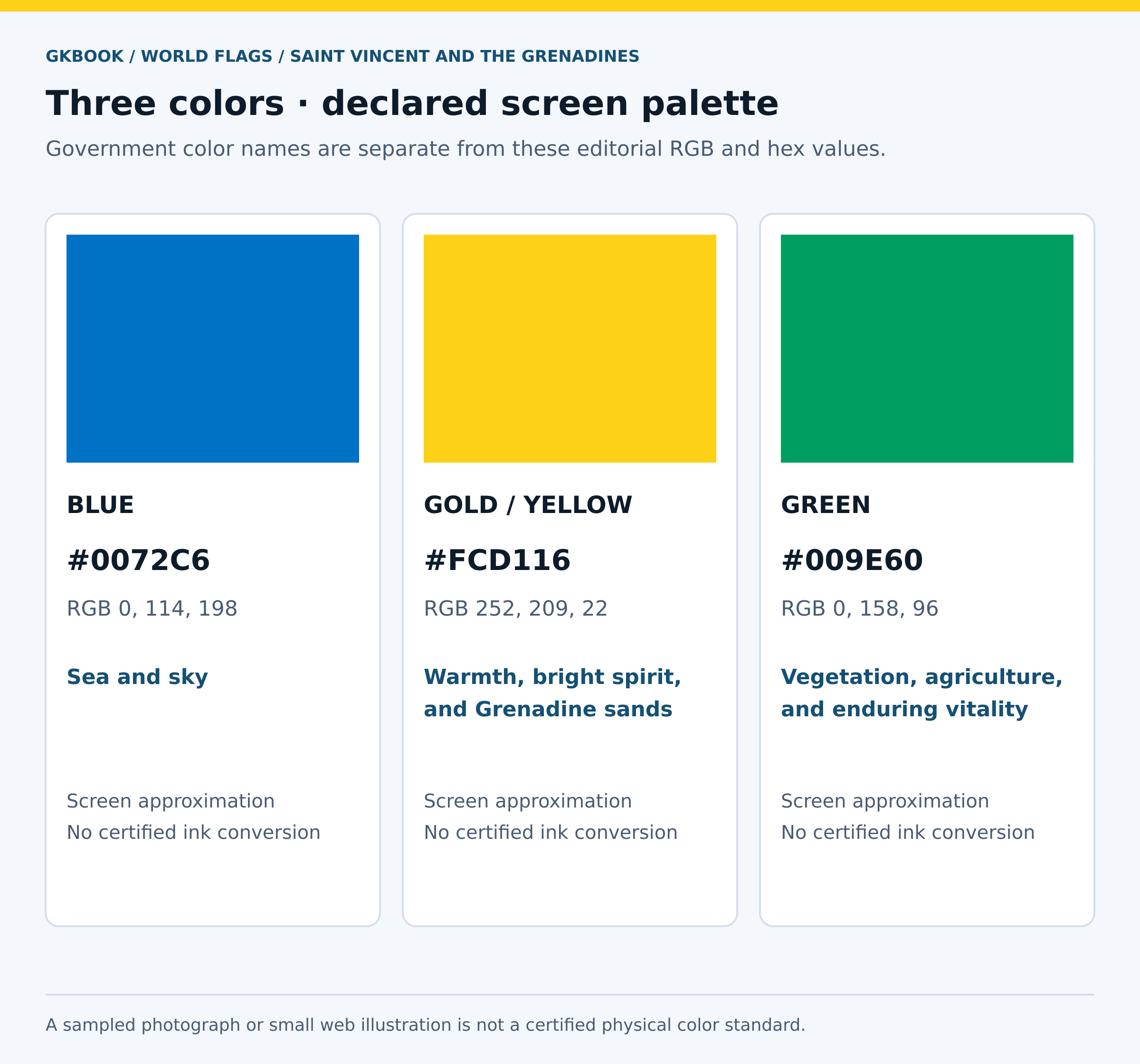
The flag uses blue, gold or yellow, and green. Blue is nearest the hoist, gold occupies the broad middle band, and green is at the fly and in the three diamonds. The numerical RGB and hexadecimal values in these downloads are declared screen approximations, not color codes prescribed by the government pages checked.

Color names identify the design, but they do not by themselves define a unique digital shade. A photograph, printed souvenir, and web illustration can differ because of lighting, ink, fabric, compression, and display settings. Sampling one of those images cannot establish an authoritative color standard for every medium.
This package uses the same three fills in every complete flag. The table records those choices so a designer can reproduce the files consistently. It does not equate a hexadecimal value with a certified textile dye, commercial ink formula, or official Pantone reference. The palette and its evidential limits travel together.
| Element | RGB | Hexadecimal |
|---|---|---|
| Blue | 0, 114, 198 | #0072C6 |
| Gold / yellow | 252, 209, 22 | #FCD116 |
| Green | 0, 158, 96 | #009E60 |
What does the flag mean?
Government explanations connect blue with the sea and sky, gold with warmth, the people’s bright spirit and Grenadine sands, and green with vegetation, agriculture, and vitality. The three green diamonds form a V for Vincent and express the country’s many islands as gems of the Antilles, rather than a literal count of islands.

The meanings bring together landscape and national identity. Sea, sky, sand, and vegetation supply recognizable physical associations, while warmth and vitality describe qualities attributed to the people. The flag does not need a detailed island map or a written motto to communicate these ideas through its colors and arrangement.
Keep symbolic interpretation separate from measurement. The gold band’s area is not a percentage of sandy land, and the green areas are not an agricultural statistic. Likewise, a national aspiration is not evidence that every person has the same character. The official account explains the intended symbolism of the design.
What does the blue band represent?
Blue represents the sky and sea in the government’s explanation. It forms the vertical band beside the hoist, which is the edge attached to the staff or halyard. In the usual front view, with the hoist on the left, blue therefore appears on the left side of the flag.

The band is a solid area of color. It does not contain painted waves, clouds, a coastline, or a separate sea emblem. Those features might appear in a decorative scene around a flag, but inserting them into this band would alter the national pattern shown in the clean download.
Hoist and fly remain useful terms when the viewpoint changes. A flag photographed from behind can show blue at the viewer’s right while blue is still beside the staff. Identify the attachment edge before deciding whether a photograph is reversed or incorrectly drawn. Left alone is an incomplete orientation instruction.
What does the gold band represent?
Gold is associated with warmth, the bright spirit of the people, and the golden sands of the Grenadines. It is the central band and is twice the width of either outer band. The three green diamonds are placed entirely within this gold field, leaving visible gold between and around them.

Gold and yellow describe the same flat-colored field in ordinary flag descriptions. The national reference image does not require a metallic surface, shine, foil effect, or gradient. A uniform fill makes the boundaries between the bands and the edges of the diamonds easy to recognize at different sizes.
The broad center also provides room for the emblem. Reducing it to the same width as the blue or green stripe changes the composition, even when all three colors remain present. Measure the rectangle in four equal vertical units: the middle two units belong to gold, with one outer unit on each side.
What does the green color represent?
Green represents lush vegetation, agriculture, and the enduring vitality of the people in the official explanation. It appears both in the outer band at the fly and in the three diamonds on gold. These separate green regions belong to one design and use the same digital fill in this reconstruction.

The fly is the free end opposite the attachment edge. Its green stripe extends from the top to the bottom of the rectangle, matching the blue stripe’s width. The green diamonds are separate shapes within the central field; they do not connect physically with the green stripe.
Using one fill for all green areas keeps the artwork coherent. A lighter green diamond might look different in a photograph because of folds or illumination, but that does not establish a separate prescribed diamond color. The flat reference removes lighting effects so the design can be studied without confusing material appearance with geometry.
What do the three diamonds symbolize?
The three green diamonds express the islands as gems of the Antilles and the plural nature of Saint Vincent and the Grenadines. Two diamonds sit above a third, forming a V. The government explanation does not identify three particular islands as a one-to-one key for the individual diamonds.

A diamond is a compact visual sign for a gem. Here it refers to the country’s islands through metaphor, not to a claim about diamond mines or a national mineral resource. The shapes are flat green lozenges, without drawn facets, outlines, sparkles, or a surrounding decorative border.
Treat the set as an emblem. Assigning the upper left, upper right, and lower shapes to particular islands would add information absent from the checked official account. The three shapes also should not be read as a complete census of the islands. Their shared color, repeated form, and arrangement work together.
Why are the diamonds arranged like a V?
The V refers to Vincent. Its shape comes from two upper diamonds and one lower central diamond, rather than a printed letter added to the flag. The official account connects this arrangement with the country’s name and island identity. No separate V, initials, or lettering appears in the clean national design.
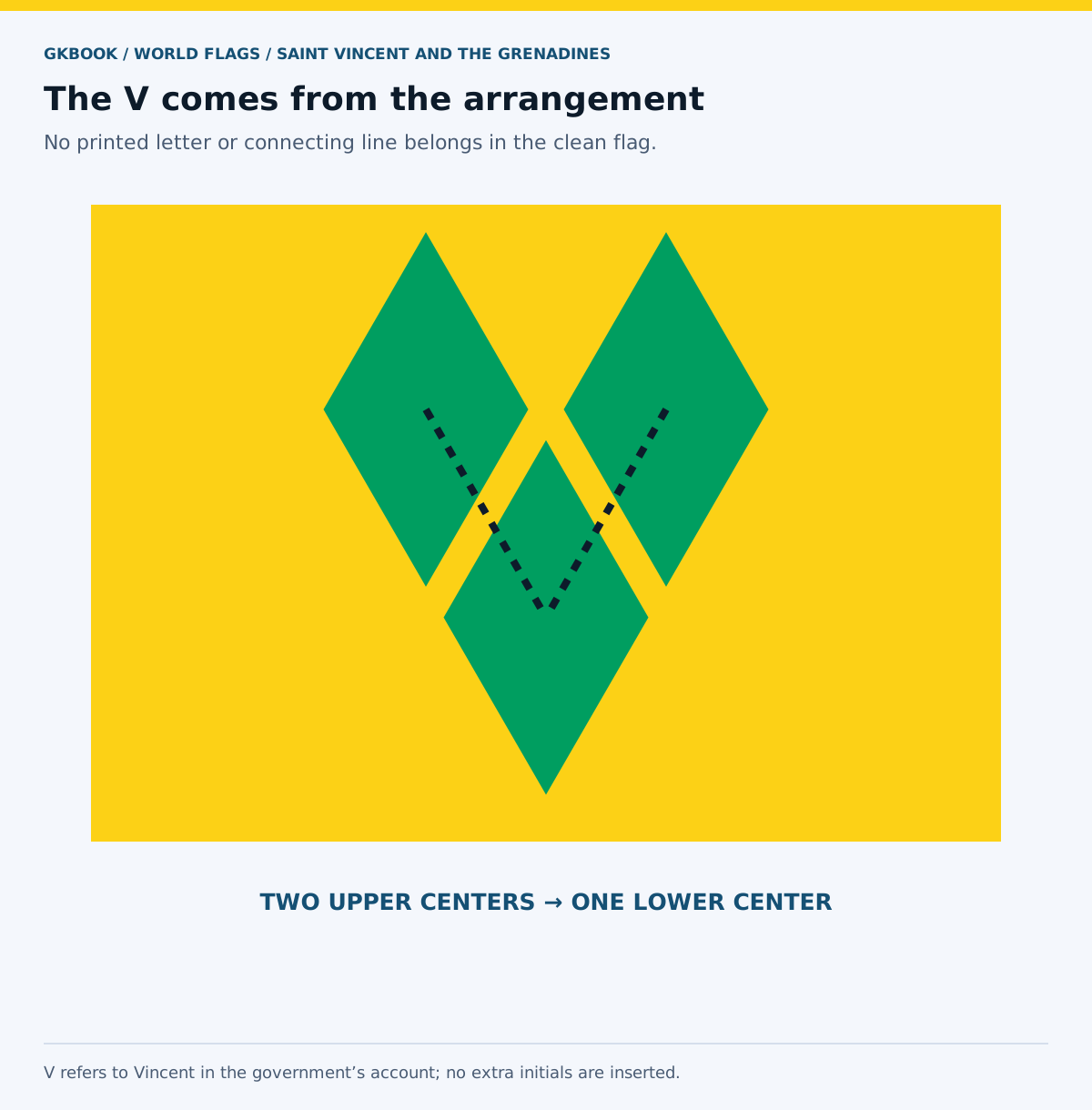
Imagine joining the centers of the two upper shapes to the center of the lower shape. Those two descending arms explain the V arrangement. The teaching diagram marks that relationship, but its guide lines are deliberately excluded from the downloadable clean flag, where the three diamonds remain separated by gold.
The arrangement is not an inverted triangle of lettering and not a horizontal row of gems. Moving the lower diamond up between the others removes the characteristic V. Keeping the two upper centers level and the lower one on the central axis makes the intended arrangement easy to recognize.
Does each diamond stand for a particular island?
The checked government descriptions give the diamonds a collective meaning: the many islands of Saint Vincent and the Grenadines as gems of the Antilles. They do not name a particular island for each diamond. The emblem should therefore be explained as a national symbol, without inventing an individual island assignment or a three-island count.

A flag can represent a country consisting of multiple islands without drawing each one. The name includes Saint Vincent and the Grenadines, and the official explanation explicitly emphasizes plurality. A small set of repeated shapes can communicate that idea without functioning as a geographically accurate map or an inventory of territory.
The island-meaning card uses words and the existing emblem rather than an invented map. Its purpose is to prevent a common misreading: three visible diamonds do not establish that the country contains exactly three islands. A geographical map would require its own location data, scale, labels, and territorial context.
What is the flag’s aspect ratio?
The national flag is conventionally reproduced with a height to length ratio of 2:3. A rectangle 200 units high is therefore 300 units long. This ratio is stated in the specialist reference account and is consistent with the Parliament illustration, allowing for its small raster rounding difference; it should be preserved when resizing.

Always name the order of a ratio. Height:length 2:3 describes a landscape rectangle, whereas width:height 3:2 describes the same shape with the terms reversed. The flag’s rectangle excludes a staff, mounting sleeve outside the artwork, frame, caption, or the larger canvas of an explanatory diagram.
The SVG master measures 3,000 by 2,000 units, and the main PNG measures 6,000 by 4,000 pixels. Both preserve the same ratio. A square thumbnail can contain the complete flag with space above and below; stretching the rectangle to fill the square would change every diamond angle and band proportion.
How wide are the three vertical bands?
The band widths follow 1:2:1 from hoist to fly: blue occupies one quarter of the full length, gold occupies one half, and green occupies one quarter. On the 3,000-unit master, their widths are 750, 1,500, and 750 units. The central field is double-width, so this is not an equal-width tricolor.

Draw boundaries at one quarter and three quarters of the full length. These positions create the broad center without needing to estimate each stripe separately. Every band runs through the full height, so the outer stripes have equal area before considering the diamonds placed over the gold.
The band proportions and the overall rectangle answer different questions. The first describes how the length is divided; the second compares total height with total length. A picture can have correct stripe widths but the wrong outer ratio, or the right rectangle with an incorrectly narrow center. Check both relationships independently.
| Band | Horizontal span | Share of full length |
|---|---|---|
| Blue | 0–750 | 1/4 |
| Gold | 750–2,250 | 1/2 |
| Green | 2,250–3,000 | 1/4 |
What shape are the green diamonds?
The emblem uses three upright lozenges, or diamond-shaped rhombi. In this reconstruction they are congruent rhombi with sixty-degree and one-hundred-twenty-degree angles. Their horizontal diagonal is 375 master units and their vertical diagonal is 375 times the square root of three. Those exact dimensions are declared reconstruction choices, not measurements prescribed by the checked government text.

A rhombus has four equal sides. Its diagonals connect opposite corners and meet at right angles in this construction. Because the vertical diagonal is longer than the horizontal one, these shapes are taller than they are wide; they are not squares merely turned through forty-five degrees.
The exact angles and diagonal lengths make the drawing reproducible. They are guided by the appearance of the Parliament-hosted image, whose credited illustrator is identified in the research notes. A carefully constructed digital shape can match that appearance without becoming an official manufacturing standard merely because its coordinates are precise.
Where are the diamonds placed?
The diamonds lie entirely within the gold band, with two level upper centers and one lower center on the flag’s vertical midpoint line. This reconstruction places the upper centers at (1,280, 975) and (1,720, 975), and the lower center at (1,500, 975 + 220√3). The coordinates are editorial choices guided by the Parliament illustration.

Coordinates begin at the upper left of the master, with x increasing rightward and y increasing downward. The two upper centers are equally far from x = 1,500. The lower center lies on that axis, giving the diamond group left-right symmetry even though the outer bands have different colors.
The group sits somewhat below the rectangle’s horizontal center in this construction. That placement is recorded numerically rather than assigned an unsupported new symbolic meaning. Gold remains visible between every diamond and the band boundaries. The shapes neither overlap each other nor touch the outer blue and green fields.
How can I draw the flag consistently?
Begin with a 3:2 landscape rectangle, divide its length into blue, gold, and green bands in a 1:2:1 ratio, and add three equal green diamonds in a V on gold. Use one documented set of diamond dimensions and centers throughout. This package distinguishes that exact reconstruction from the broader design supported by government descriptions.

A useful order is background first, emblem second. Fill the full rectangle gold, cover the left quarter blue and the right quarter green, then place the three rhombi. The resulting vector contains simple filled shapes rather than a photograph, so it can scale without introducing new drawing details.
Each rhombus is defined by four points around its center: top, right, bottom, and left. Half the horizontal diagonal is 187.5 units; half the vertical diagonal is 187.5√3. Apply those same offsets to all three centers. Keep construction lines, coordinate labels, and measurement brackets outside the clean national flag file.
What is the history of the flag?
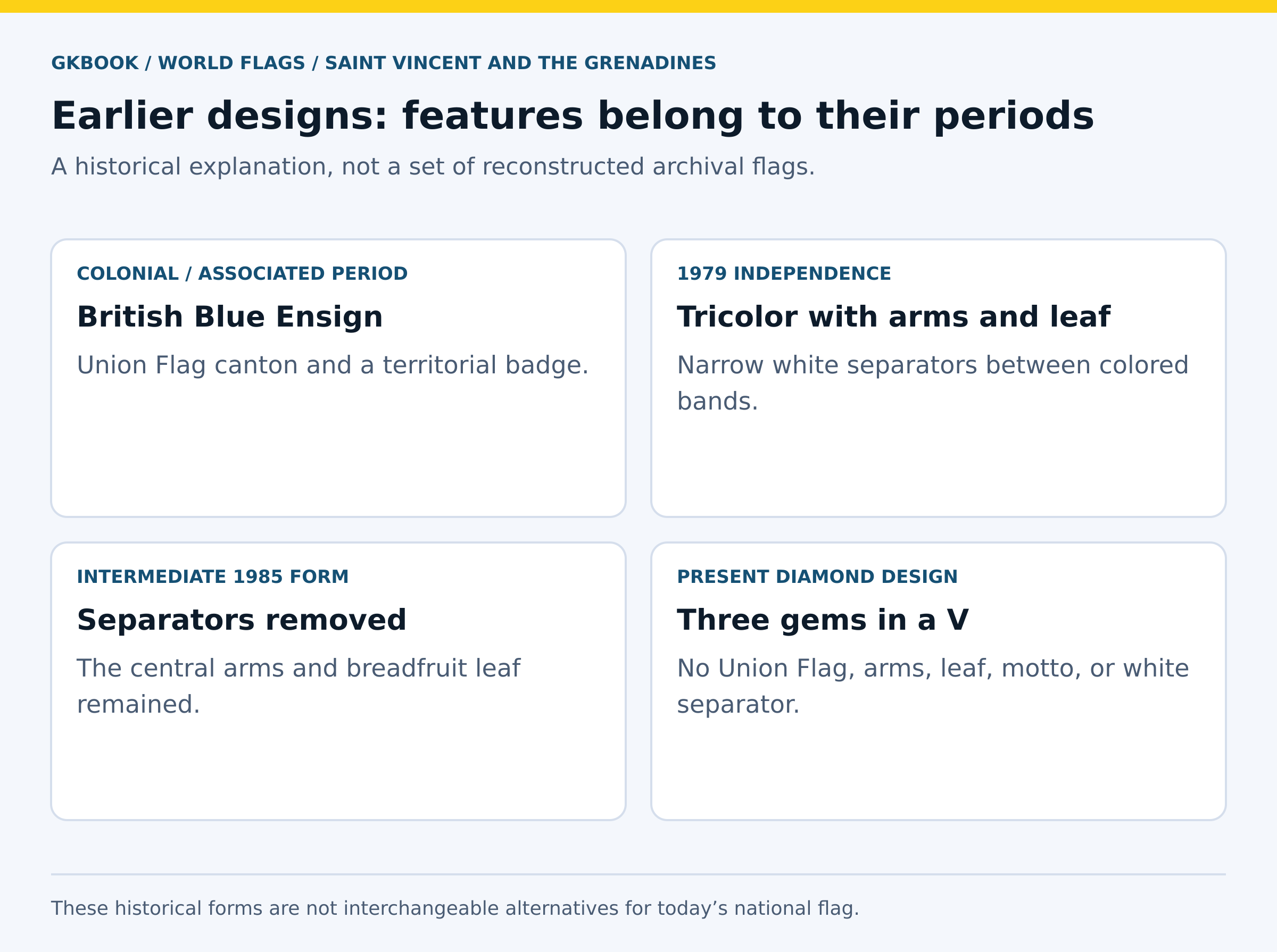
The independence flag introduced in 1979 used blue, yellow, and green with narrow white separators and the coat of arms on a breadfruit leaf. During 1985 the separators disappeared, and the present diamond design followed. Government sources distinguish October 12 adoption from October 21 hoisting; a specialist reference instead dates the hoisting October 22.
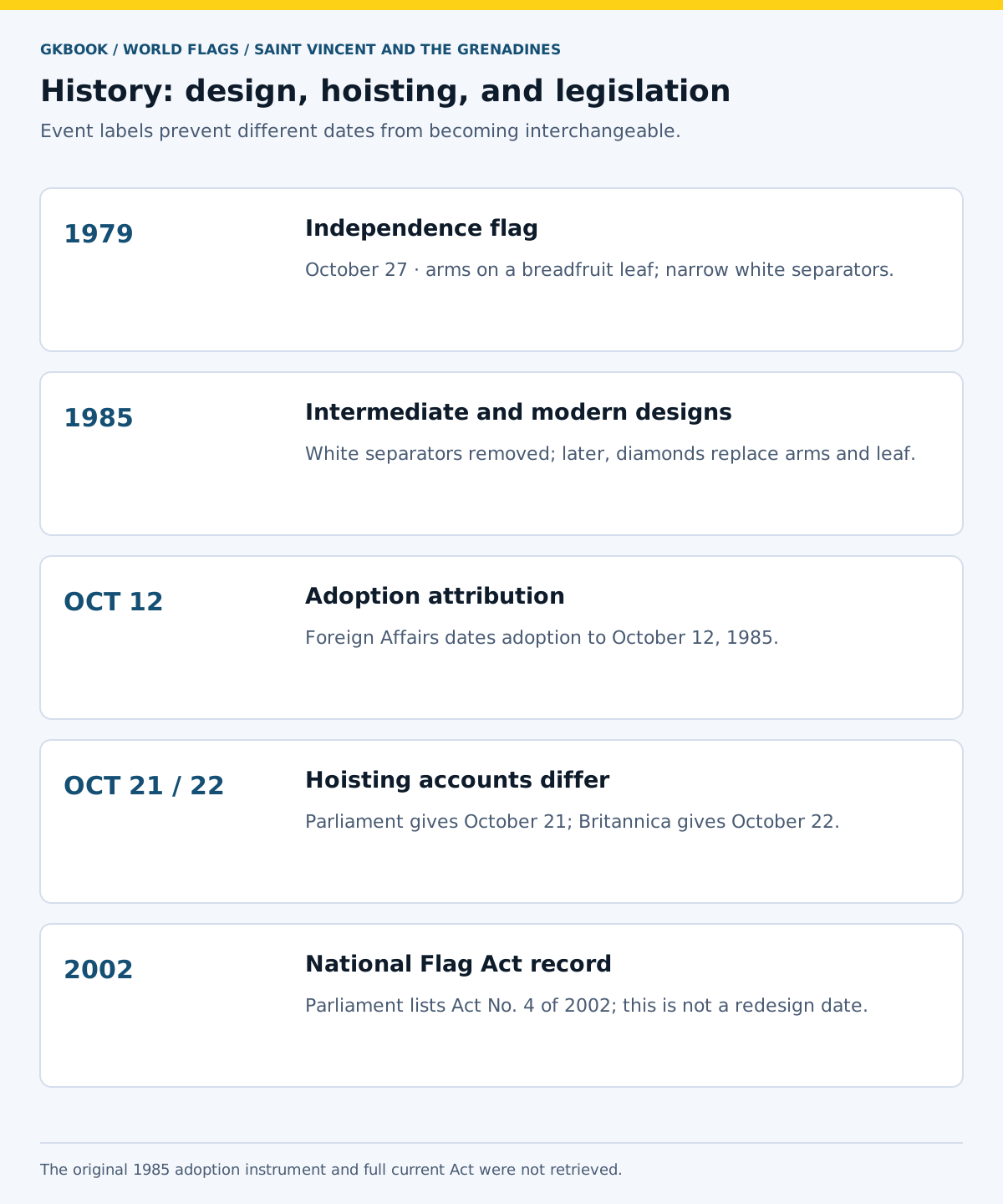
The central emblem changed more substantially than the palette. The earlier arms and leaf were replaced by three simple diamonds, while the broad central band provided space for the new arrangement. Historical illustrations should be labeled by period so that the independence design is not mistaken for the present national flag.
The Parliament history page credits later illustrations and is a retrospective, rather than a contemporary record of the changes. The article therefore compares accounts instead of assuming that official hosting resolves every historical question. Dates are attached to the events that each source actually describes, and remaining disagreements are identified openly.
Was the current flag adopted on October 12 or October 21, 1985?
Foreign Affairs explicitly gives October 12, 1985 as the adoption date. Parliament’s historical account says the new flag was hoisted on October 21. Those statements concern different events. Britannica gives October 22 for hoisting, so a one-day disagreement remains; this guide uses the government hoisting account while making that discrepancy visible.

A decision to adopt a design and a public ceremony raising it need not occur on the same day. Keeping the event labels prevents a simple date list from appearing contradictory. The original 1985 adoption instrument was not retrieved, so the ministry’s later attribution is identified as the evidence for October 12.
The date comparison does not silently convert one source’s claim into another. October 21 is presented as Parliament’s hoisting date; October 22 is the competing reference date. Neither date is the country’s independence anniversary. A precise caption should identify both what happened and which account supplies the day.
| Event or account | Date | Evidence |
|---|---|---|
| Independence | October 27, 1979 | Parliament; U.S. Office of the Historian |
| Adoption attribution | October 12, 1985 | Foreign Affairs national flag page |
| Hoisting account used here | October 21, 1985 | Parliament history page |
| Competing hoisting date | October 22, 1985 | Whitney Smith, Britannica |
Was the diamond flag used at independence in 1979?
No. Saint Vincent and the Grenadines became independent on October 27, 1979, when the national flag carried the coat of arms on a breadfruit leaf and included narrow white separators. The familiar three-diamond design followed in 1985. The independence date and the present flag’s adoption date therefore describe separate milestones in national history.

The United States Office of the Historian independently confirms the independence date. That political milestone concerns the country’s status, while the later flag change concerns the form of its national symbol. A country can retain its independence while revising the design used to represent it.
The distinction also matters when illustrating older events. Placing the present diamonds into a supposed 1979 documentary image would create an anachronism. The gallery uses a dated explanatory card instead of inventing an archival photograph. When using a real historical image elsewhere, identify the date and the flag version actually visible.
Who designed the present flag?
Swiss graphic artist Julien van der Wal is credited with the present three-diamond design in Whitney Smith’s Britannica account. The same account identifies Elaine Liverpool with the earlier independence flag. These credits refer to different stages, so they should not be combined into a claim that one person designed every version of the national flag.
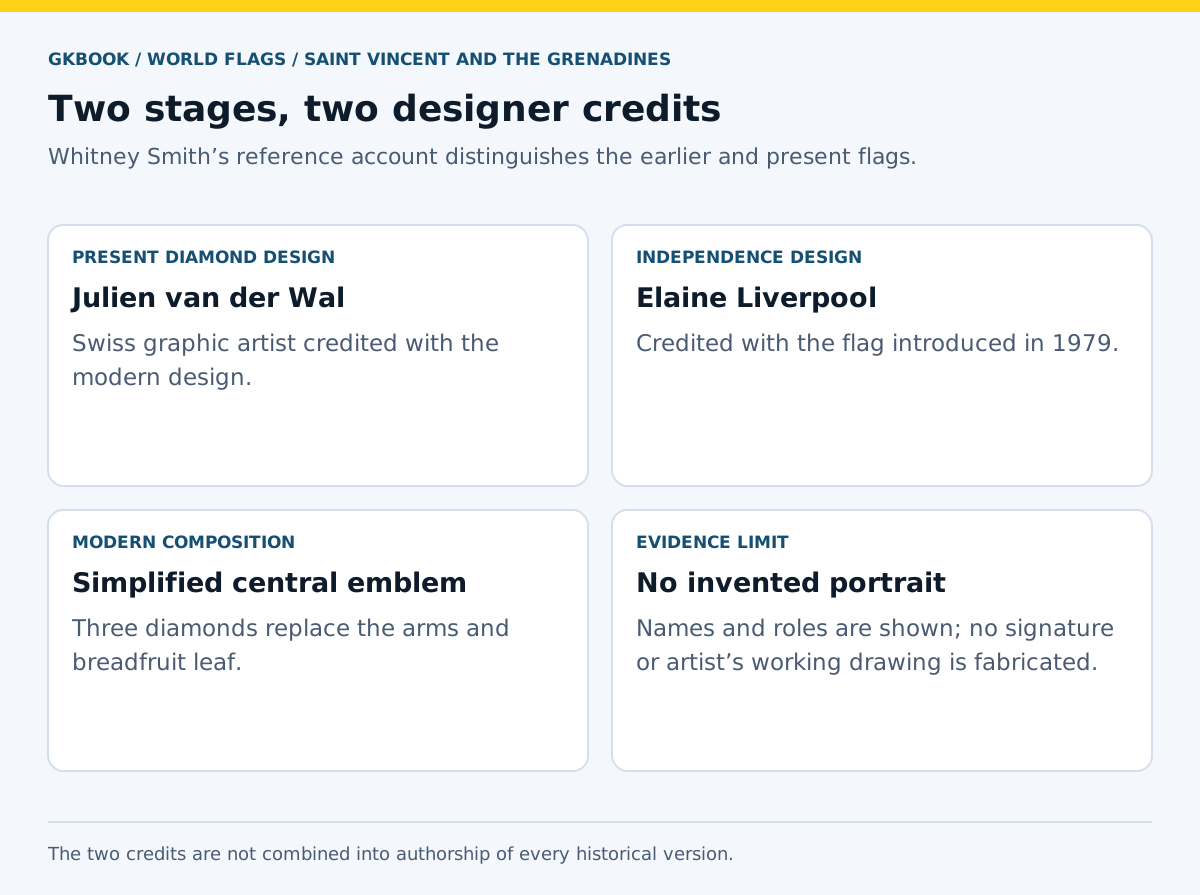
The reference describes the later commission as a move toward a simpler, more recognizable design. Its creator retained the main color combination while replacing the elaborate central device. The designer’s role explains the modern composition; it does not supply a complete authenticated coordinate sheet or a current national color standard.
The designer card uses names and roles rather than a fabricated portrait, signature, or personal quotation. It avoids unrelated biographical claims repeated on other flag sites. A historical credit can be reported accurately while acknowledging that the original commission documents and the artist’s working drawings were not part of the material inspected.
What designs preceded the three diamonds?
The historical sequence includes a British Blue Ensign with a territorial badge, the 1979 independence tricolor with white separators and arms on a breadfruit leaf, and an intermediate 1985 version without those separators. The present design replaced the central arms and leaf with diamonds. These former designs belong to their own historical periods.

A British Blue Ensign has a Union Flag canton and a blue field carrying a badge. That overall arrangement differs from the later vertical tricolor. The modern flag contains no Union Flag, breadfruit leaf, coat of arms, or motto; those details should not be added from an older illustration.
The gallery summarizes the sequence in text rather than claiming exact historical pigment values or tracing a small archive image into an authoritative facsimile. This keeps the historical explanation useful without inventing details. A complete reproduction of an earlier flag would require separate evidence for that version’s arms, leaf, proportions, and colors.
Why do older flag pictures include white stripes?
The independence flag included narrow white separators between the colored bands. Parliament’s historical account shows an intermediate 1985 design with those separators removed before the later diamond version. White is therefore relevant to the earlier flag’s history, but it is not a stripe or outline in the current blue, gold, and green national design.
A white line in a historical drawing may be intentional, while a pale edge in a photograph can also come from glare, stitching, compression, or the surrounding background. Identify the version before interpreting the line. The modern clean artwork has direct blue-to-gold and gold-to-green boundaries without white fimbriation.
The word fimbriation means a narrow edging that separates areas of color. Understanding the term helps readers follow older descriptions without assuming a fourth broad band. The white space between the flag and a website card is likewise external page layout, not a white stripe belonging to the flag itself.
What does the official record show about the National Flag Act?
Parliament’s 2002 legislation register lists the National Flag Act as Act No. 4 of 2002, with assent on February 4 and publication on February 12. The inspected document is an index, not the full Act. It establishes that legislative record but does not, by itself, reveal every rule governing the flag’s display or use.

The same row records parliamentary readings in October 2001. Those legislative dates are separate from the design’s introduction in 1985. An Act concerning a flag can appear long after the emblem itself, so the year in an Act title should not automatically be used as a redesign or first-adoption date.
A legal index supplies metadata about legislation. It cannot substitute for reading the enacted provisions, schedules, amendments, and applicable regulations. The full Act and a current consolidated set of rules were not located for this package. Accordingly, the article does not invent penalties, commercial permissions, compulsory physical sizes, or precise ceremonial requirements from the index alone.
How should a clear reference image show the flag?
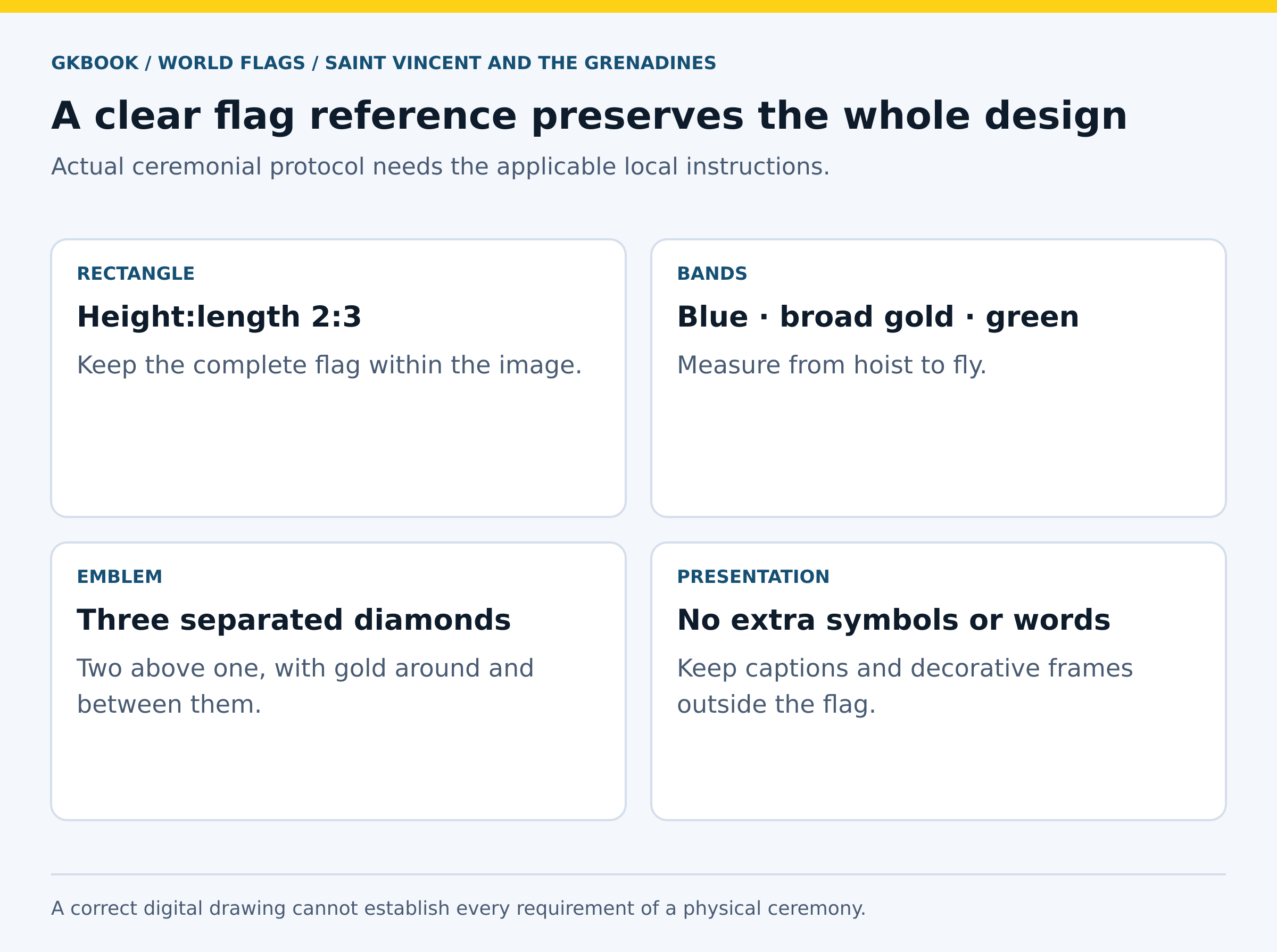
Show the full 2:3 rectangle with blue at the hoist, a double-width gold center, green at the fly, and three separated green diamonds forming a V. Preserve the colors and proportions without inserting text or symbols. For an actual official ceremony, obtain the applicable local instructions rather than treating a drawing guide as a complete protocol code.

A reference image should make the design easy to inspect. Keep the rectangle flat, avoid cropping a band, and use a background that leaves the flag’s edges visible. Decorative folds and lighting can be appropriate in a photograph, but they make exact comparisons of geometry and color more difficult.
Physical display introduces separate questions about location, staff arrangement, timing, handling, and the occasion. These cannot be answered simply by checking the pixels in an image. The gallery’s display card addresses visual identification and preservation of the design; it does not borrow another country’s flag code and label it Vincentian law.
How has the flag represented the country at the United Nations?
A government diplomatic bulletin records a flag installation ceremony on January 2, 2020, marking Saint Vincent and the Grenadines taking its elected Security Council seat. It also recalls a national flag-raising ceremony on September 17, 1980. The earlier event predates the diamond design, so the two occasions must not be illustrated as the same flag version.

The bulletin’s relevant page places the two ceremonies in historical context. Its 1980 photograph belongs to the earlier period; its 2020 account concerns the country’s role on the Security Council. The gallery presents a dated comparison, without copying the photographs or pretending that a newly drawn image documents either event.
International use demonstrates how a national emblem identifies a country beyond its territory. It does not turn a ceremony date into an adoption date or supply a manufacturing specification. The article records these particular historical occasions without claiming that a past council term remains current or prescribing the full protocol of a United Nations event.
What should be checked before flying the flag at half-mast?
Check the applicable official instruction and legal provisions for the particular occasion. A 2013 report of a parliamentary explanation describes a formal process under the Flag Act for mourning observances. The full current rules were not retrieved here, so this guide does not prescribe a lowering distance, automatic occasions, or a mourning order in force today.
The historical report shows why general custom should not be substituted for the country’s own procedure. It concerns the circumstances surrounding one past observance and the government’s explanation at that time. It is not a current consolidated legal text or an authorization for a new ceremony.
Mourning position and flag design are different subjects. Lowering a flag does not add black borders, change the diamond count, or replace the colors. Because the inspected material does not establish a complete present positioning rule, the gallery avoids a falsely precise half-mast diagram and keeps its technical drawings focused on the flag’s internal design.
What does the flag look like from the reverse side?
From the reverse side of a single-layer flag, the horizontal order appears green, gold, blue when the hoist is on the viewer’s right. The diamond group still looks like a V because it is symmetric left to right. The whole flag is not mirror-symmetric, however, since its outer bands have different colors.

A horizontal reflection moves the blue band to the opposite side of the image, but blue remains next to the attachment edge. The two upper diamonds exchange positions and the lower diamond stays central. With equal shapes, that exchange leaves the emblem’s visible arrangement unchanged.
This explains why a photograph taken from behind need not show a manufacturing mistake. Use the staff or attachment edge to establish viewpoint. The reverse diagram is a geometric explanation, not a specification for double-sided printing, separate fabric panels, or stitching methods; those production choices require their own practical instructions.
Can the flag be rotated into a vertical illustration?
A complete flag can be rotated as an image, but that operation also rotates its bands and diamond arrangement. It does not create a separately authorized vertical design. The government pages checked do not supply a detailed vertical-display construction, so this package retains the standard horizontal reference and does not invent a special ceremonial layout.
Rotating the whole image through ninety degrees preserves its internal angles and relative distances. Rearranging the diamonds to remain upright while changing the bands would instead redraw the design. These operations are different, even if both results fit inside a portrait-shaped space.
For a poster or narrow webpage, proportional containment is usually the clearest way to show the unaltered reference rectangle. Surrounding space belongs to the layout. When an actual vertical hanging is required for an official event, confirm the responsible organizer’s instructions rather than assuming a general graphic operation establishes the country’s protocol.
Which digital image sizes are provided?
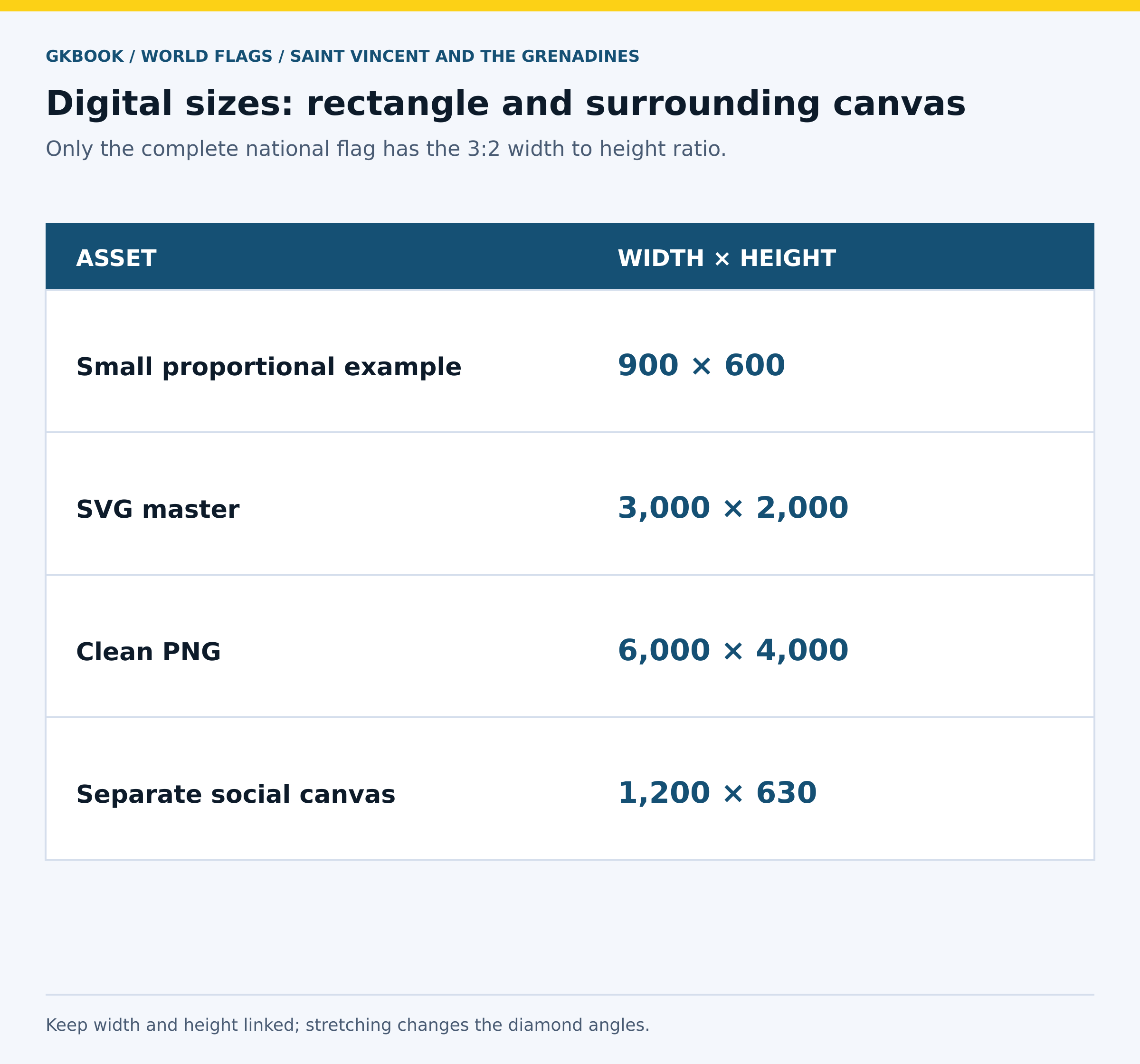
The clean SVG uses a 3,000 by 2,000 coordinate system, and the clean PNG measures 6,000 by 4,000 pixels. Both preserve the flag’s 3:2 width to height ratio. A separate 1,200 by 630 social card contains the complete flag within its own wider canvas, while the teaching diagrams include external labels and explanatory space.

SVG describes the geometry as shapes, so software can render it at different sizes without enlarging a fixed pixel grid. PNG provides a ready-made raster image for applications that do not support SVG. Choose the clean flag for a plain national symbol and a labeled diagram for explanation.
The social card’s dimensions are a layout specification, not a new national flag ratio. Its internal flag remains complete and correctly proportioned. When making thumbnails, keep width and height linked and inspect the result at its actual display size; tiny renderings can make the gold gaps between diamonds harder to see.
| Asset | Dimensions | Purpose |
|---|---|---|
| Clean SVG | 3,000 × 2,000 units | Scalable reference |
| Clean PNG | 6,000 × 4,000 pixels | Fixed raster reference |
| Social card | 1,200 × 630 pixels | Separate sharing layout |
How should the flag artwork be prepared for print?
Preserve the full rectangle, band widths, diamond shapes, and spacing when preparing print artwork. The supplied RGB colors are screen approximations, so they are not a certified physical ink or fabric specification. Agree the output size, material, color proof, and any required authoritative specification with the printer before treating a production sample as approved.
Pixel dimensions alone do not determine physical size. A 6,000-pixel-wide image printed at 300 pixels per inch is twenty inches wide; at 150 pixels per inch it is forty inches wide. These are arithmetic examples, not officially mandated flag sizes or guaranteed quality thresholds for every printing process.
Vector artwork avoids dependence on a fixed raster resolution, but it does not remove color-management and material considerations. Paper, fabric, ink, and illumination can change appearance. Keep a record of the approved production proof and distinguish it from the editable educational file. Do not add trim guides, labels, or a white frame inside the national design.
What mistakes should be avoided when drawing the flag?
Avoid equal-width bands, reversed hoist and fly colors, touching diamonds, a horizontal row of gems, or extra white separators in the current design. Historical captions should separate 1979 independence from the 1985 changes. Exact diamond coordinates and RGB values should also be identified as reconstruction choices unless an authoritative numerical specification supports them.
Start with the largest relationships: landscape rectangle, broad gold center, and correct outer colors relative to the attachment edge. Next count the diamonds and check their two-above-one arrangement. Finally inspect whether all three share the same shape, whether gold separates them, and whether the emblem remains inside the center band.
Then review the caption. A 2002 legislative entry does not establish a 2002 redesign, and a 1980 flag photograph cannot document diamonds introduced later. Avoid creating a three-island key from the emblem. These checks connect visual accuracy with historical accuracy instead of treating the picture and its explanation as unrelated pieces.
Which flag pictures can I download?
The gallery includes 24 subjects, each supplied as SVG and PNG, plus a separate social card. Subjects cover the clean flag, color meanings, band proportions, diamond geometry, historical dates, designer credits, and evidence limits. All are original vector compositions; historical cards do not invent archival photographs, portraits, signatures, or authoritative predecessor specifications.
Use the clean national flag when the design alone is required. Select a construction diagram to explain measurement, a color card to connect appearance and meaning, or a timeline to distinguish adoption, hoisting, independence, and later legislative records. Each subject includes alternative text, a caption, and reproduction notes.
The SVG versions retain editable shapes and labels, while the PNG versions provide fixed renderings. All downloads are grouped in the picture gallery. The World Flags collection offers related country articles. Direct answers are shared with the FAQ so readers encounter the same explanation in both places.
Download Saint Vincent and the Grenadines flag pictures
Download the clean national flag as SVG or 6,000 × 4,000 PNG. Its SVG coordinate system is 3,000 × 2,000, preserving a 3:2 width to height ratio.
The gallery contains 24 subjects, each with an SVG and PNG. The conventional ratio and broad government-described design are followed. Exact diamond dimensions, centers, and angles are disclosed editorial reconstruction choices, and screen colors are separate approximations. Image credits and reproduction notes explain the construction basis and the limits of the screen palette. The separate social card is 1,200 × 630 and contains a complete correctly proportioned flag.
Continue exploring national designs in World Flags.
World Flags/Saint Vincent and the Grenadines
Saint Vincent and the Grenadines flag pictures
Blue, gold, and green bands in widths 1:2:1, with three green diamonds in a V. Detailed diamond coordinates and screen colors are disclosed editorial reconstruction choices.
Original GKBook vector reconstruction. Broad design follows government descriptions; exact diamond geometry and screen colors are disclosed editorial choices.Download SVGDownload PNGThe checked government descriptions name blue, gold, and green but supply no numerical color table. These consistent screen fills do not claim official RGB or certified physical color conversions.
Original GKBook vector reconstruction. Broad design follows government descriptions; exact diamond geometry and screen colors are disclosed editorial choices.Download SVGDownload PNGGovernment symbolism is paraphrased. Color areas are not statistical percentages, and three diamonds do not mean exactly three islands.
Original GKBook vector reconstruction. Broad design follows government descriptions; exact diamond geometry and screen colors are disclosed editorial choices.Download SVGDownload PNGThe blue band occupies one quarter of the length at the hoist. Its meaning does not require adding waves or clouds.
Original GKBook vector reconstruction. Broad design follows government descriptions; exact diamond geometry and screen colors are disclosed editorial choices.Download SVGDownload PNGGold and yellow refer to the same flat-colored field in flag descriptions; metallic effects are not part of this clean reference.
Original GKBook vector reconstruction. Broad design follows government descriptions; exact diamond geometry and screen colors are disclosed editorial choices.Download SVGDownload PNGThe green stripe and green diamonds are separate regions of the same design, reproduced with one screen value.
Original GKBook vector reconstruction. Broad design follows government descriptions; exact diamond geometry and screen colors are disclosed editorial choices.Download SVGDownload PNGThe emblem represents gems and the country’s plural island character. This isolated device is explanatory, not a complete national flag.
Original GKBook vector reconstruction. Broad design follows government descriptions; exact diamond geometry and screen colors are disclosed editorial choices.Download SVGDownload PNGDashed guides connect the centers to explain the V. Guides are educational overlays and are absent from the clean national flag.
Original GKBook vector reconstruction. Broad design follows government descriptions; exact diamond geometry and screen colors are disclosed editorial choices.Download SVGDownload PNGThe teaching card distinguishes official collective meaning from an invented island-by-island interpretation.
Original GKBook vector reconstruction. Broad design follows government descriptions; exact diamond geometry and screen colors are disclosed editorial choices.Download SVGDownload PNGThe conventional 2:3 height:length ratio is confirmed in the specialist reference account and followed in these files.
Original GKBook vector reconstruction. Broad design follows government descriptions; exact diamond geometry and screen colors are disclosed editorial choices.Download SVGDownload PNGBlue and green each occupy one quarter of the length; gold occupies one half. The figures describe the master, not prescribed physical inches.
Original GKBook vector reconstruction. Broad design follows government descriptions; exact diamond geometry and screen colors are disclosed editorial choices.Download SVGDownload PNGEach rhombus has horizontal diagonal 375 and vertical diagonal 375√3 master units, giving sixty-degree and one-hundred-twenty-degree angles. These details are editorial, not certified official dimensions.
Original GKBook vector reconstruction. Broad design follows government descriptions; exact diamond geometry and screen colors are disclosed editorial choices.Download SVGDownload PNGThe group is horizontally centered and sits somewhat below the flag’s horizontal center. Exact coordinates are openly declared choices guided by the Parliament image.
Original GKBook vector reconstruction. Broad design follows government descriptions; exact diamond geometry and screen colors are disclosed editorial choices.Download SVGDownload PNGFill the rectangle, establish the outer bands, place the equal diamonds, and remove any teaching guides. All stages retain the same master coordinates.
Original GKBook vector reconstruction. Broad design follows government descriptions; exact diamond geometry and screen colors are disclosed editorial choices.Download SVGDownload PNGThe timeline separates independence, changes in 1985, adoption attribution, competing hoisting dates, and the later Act index.
Original GKBook vector reconstruction. Broad design follows government descriptions; exact diamond geometry and screen colors are disclosed editorial choices.Download SVGDownload PNGAdoption and hoisting can occur on different days. The guide preserves the official attributions and reports the remaining one-day reference disagreement.
Original GKBook vector reconstruction. Broad design follows government descriptions; exact diamond geometry and screen colors are disclosed editorial choices.Download SVGDownload PNGThe independence date is independently confirmed by the U.S. Office of the Historian. The modern diamond flag is not the 1979 version.
Original GKBook vector reconstruction. Broad design follows government descriptions; exact diamond geometry and screen colors are disclosed editorial choices.Download SVGDownload PNGDesigner credits are attributed to the read reference account. They do not imply that original commission records or measured artist drawings were inspected.
Original GKBook vector reconstruction. Broad design follows government descriptions; exact diamond geometry and screen colors are disclosed editorial choices.Download SVGDownload PNGThe sequence follows the government historical illustrations and reference account. No exact former color values or detailed coat-of-arms facsimiles are invented.
Original GKBook vector reconstruction. Broad design follows government descriptions; exact diamond geometry and screen colors are disclosed editorial choices.Download SVGDownload PNGParliament’s actual PDF was downloaded and the relevant index page visually checked. The complete Act was not located; the distinction is explicit.
Original GKBook vector reconstruction. Broad design follows government descriptions; exact diamond geometry and screen colors are disclosed editorial choices.Download SVGDownload PNGThis is visual-reference guidance. It is not a complete ceremonial code or a claim that another country’s staff and mourning rules apply here.
Original GKBook vector reconstruction. Broad design follows government descriptions; exact diamond geometry and screen colors are disclosed editorial choices.Download SVGDownload PNGThe 2020 government bulletin’s relevant page was read and visually checked. The historical events are not adoption dates or a claim of a current council term.
Original GKBook vector reconstruction. Broad design follows government descriptions; exact diamond geometry and screen colors are disclosed editorial choices.Download SVGDownload PNGReflection swaps blue and green on the viewer’s page while blue remains at the hoist. The equal diamonds retain their V appearance.
Original GKBook vector reconstruction. Broad design follows government descriptions; exact diamond geometry and screen colors are disclosed editorial choices.Download SVGDownload PNGThe social card and diagrams have explanatory canvases. Their internal complete flag instances preserve the same master geometry and ratio.
Original GKBook vector reconstruction. Broad design follows government descriptions; exact diamond geometry and screen colors are disclosed editorial choices.Download SVGDownload PNGFrequently asked questions
What does the Saint Vincent and the Grenadines flag look like?
The flag of Saint Vincent and the Grenadines has vertical blue, gold, and green bands, with the gold band twice as wide as either outer band. Three green diamonds form a V on the gold field. The familiar design dates from 1985, while the country became independent in 1979.
What colors are on the Saint Vincent and the Grenadines flag?
The flag uses blue, gold or yellow, and green. Blue is nearest the hoist, gold occupies the broad middle band, and green is at the fly and in the three diamonds. The numerical RGB and hexadecimal values in these downloads are declared screen approximations, not color codes prescribed by the government pages checked.
What does the flag mean?
Government explanations connect blue with the sea and sky, gold with warmth, the people’s bright spirit and Grenadine sands, and green with vegetation, agriculture, and vitality. The three green diamonds form a V for Vincent and express the country’s many islands as gems of the Antilles, rather than a literal count of islands.
What does the blue band represent?
Blue represents the sky and sea in the government’s explanation. It forms the vertical band beside the hoist, which is the edge attached to the staff or halyard. In the usual front view, with the hoist on the left, blue therefore appears on the left side of the flag.
What does the gold band represent?
Gold is associated with warmth, the bright spirit of the people, and the golden sands of the Grenadines. It is the central band and is twice the width of either outer band. The three green diamonds are placed entirely within this gold field, leaving visible gold between and around them.
What does the green color represent?
Green represents lush vegetation, agriculture, and the enduring vitality of the people in the official explanation. It appears both in the outer band at the fly and in the three diamonds on gold. These separate green regions belong to one design and use the same digital fill in this reconstruction.
What do the three diamonds symbolize?
The three green diamonds express the islands as gems of the Antilles and the plural nature of Saint Vincent and the Grenadines. Two diamonds sit above a third, forming a V. The government explanation does not identify three particular islands as a one-to-one key for the individual diamonds.
Why are the diamonds arranged like a V?
The V refers to Vincent. Its shape comes from two upper diamonds and one lower central diamond, rather than a printed letter added to the flag. The official account connects this arrangement with the country’s name and island identity. No separate V, initials, or lettering appears in the clean national design.
Does each diamond stand for a particular island?
The checked government descriptions give the diamonds a collective meaning: the many islands of Saint Vincent and the Grenadines as gems of the Antilles. They do not name a particular island for each diamond. The emblem should therefore be explained as a national symbol, without inventing an individual island assignment or a three-island count.
What is the flag’s aspect ratio?
The national flag is conventionally reproduced with a height to length ratio of 2:3. A rectangle 200 units high is therefore 300 units long. This ratio is stated in the specialist reference account and is consistent with the Parliament illustration, allowing for its small raster rounding difference; it should be preserved when resizing.
How wide are the three vertical bands?
The band widths follow 1:2:1 from hoist to fly: blue occupies one quarter of the full length, gold occupies one half, and green occupies one quarter. On the 3,000-unit master, their widths are 750, 1,500, and 750 units. The central field is double-width, so this is not an equal-width tricolor.
What shape are the green diamonds?
The emblem uses three upright lozenges, or diamond-shaped rhombi. In this reconstruction they are congruent rhombi with sixty-degree and one-hundred-twenty-degree angles. Their horizontal diagonal is 375 master units and their vertical diagonal is 375 times the square root of three. Those exact dimensions are declared reconstruction choices, not measurements prescribed by the checked government text.
Where are the diamonds placed?
The diamonds lie entirely within the gold band, with two level upper centers and one lower center on the flag’s vertical midpoint line. This reconstruction places the upper centers at (1,280, 975) and (1,720, 975), and the lower center at (1,500, 975 + 220√3). The coordinates are editorial choices guided by the Parliament illustration.
How can I draw the flag consistently?
Begin with a 3:2 landscape rectangle, divide its length into blue, gold, and green bands in a 1:2:1 ratio, and add three equal green diamonds in a V on gold. Use one documented set of diamond dimensions and centers throughout. This package distinguishes that exact reconstruction from the broader design supported by government descriptions.
What is the history of the flag?
The independence flag introduced in 1979 used blue, yellow, and green with narrow white separators and the coat of arms on a breadfruit leaf. During 1985 the separators disappeared, and the present diamond design followed. Government sources distinguish October 12 adoption from October 21 hoisting; a specialist reference instead dates the hoisting October 22.
Was the current flag adopted on October 12 or October 21, 1985?
Foreign Affairs explicitly gives October 12, 1985 as the adoption date. Parliament’s historical account says the new flag was hoisted on October 21. Those statements concern different events. Britannica gives October 22 for hoisting, so a one-day disagreement remains; this guide uses the government hoisting account while making that discrepancy visible.
Was the diamond flag used at independence in 1979?
No. Saint Vincent and the Grenadines became independent on October 27, 1979, when the national flag carried the coat of arms on a breadfruit leaf and included narrow white separators. The familiar three-diamond design followed in 1985. The independence date and the present flag’s adoption date therefore describe separate milestones in national history.
Who designed the present flag?
Swiss graphic artist Julien van der Wal is credited with the present three-diamond design in Whitney Smith’s Britannica account. The same account identifies Elaine Liverpool with the earlier independence flag. These credits refer to different stages, so they should not be combined into a claim that one person designed every version of the national flag.
What designs preceded the three diamonds?
The historical sequence includes a British Blue Ensign with a territorial badge, the 1979 independence tricolor with white separators and arms on a breadfruit leaf, and an intermediate 1985 version without those separators. The present design replaced the central arms and leaf with diamonds. These former designs belong to their own historical periods.
Why do older flag pictures include white stripes?
The independence flag included narrow white separators between the colored bands. Parliament’s historical account shows an intermediate 1985 design with those separators removed before the later diamond version. White is therefore relevant to the earlier flag’s history, but it is not a stripe or outline in the current blue, gold, and green national design.
What does the official record show about the National Flag Act?
Parliament’s 2002 legislation register lists the National Flag Act as Act No. 4 of 2002, with assent on February 4 and publication on February 12. The inspected document is an index, not the full Act. It establishes that legislative record but does not, by itself, reveal every rule governing the flag’s display or use.
How should a clear reference image show the flag?
Show the full 2:3 rectangle with blue at the hoist, a double-width gold center, green at the fly, and three separated green diamonds forming a V. Preserve the colors and proportions without inserting text or symbols. For an actual official ceremony, obtain the applicable local instructions rather than treating a drawing guide as a complete protocol code.
How has the flag represented the country at the United Nations?
A government diplomatic bulletin records a flag installation ceremony on January 2, 2020, marking Saint Vincent and the Grenadines taking its elected Security Council seat. It also recalls a national flag-raising ceremony on September 17, 1980. The earlier event predates the diamond design, so the two occasions must not be illustrated as the same flag version.
What should be checked before flying the flag at half-mast?
Check the applicable official instruction and legal provisions for the particular occasion. A 2013 report of a parliamentary explanation describes a formal process under the Flag Act for mourning observances. The full current rules were not retrieved here, so this guide does not prescribe a lowering distance, automatic occasions, or a mourning order in force today.
What does the flag look like from the reverse side?
From the reverse side of a single-layer flag, the horizontal order appears green, gold, blue when the hoist is on the viewer’s right. The diamond group still looks like a V because it is symmetric left to right. The whole flag is not mirror-symmetric, however, since its outer bands have different colors.
Can the flag be rotated into a vertical illustration?
A complete flag can be rotated as an image, but that operation also rotates its bands and diamond arrangement. It does not create a separately authorized vertical design. The government pages checked do not supply a detailed vertical-display construction, so this package retains the standard horizontal reference and does not invent a special ceremonial layout.
Which digital image sizes are provided?
The clean SVG uses a 3,000 by 2,000 coordinate system, and the clean PNG measures 6,000 by 4,000 pixels. Both preserve the flag’s 3:2 width to height ratio. A separate 1,200 by 630 social card contains the complete flag within its own wider canvas, while the teaching diagrams include external labels and explanatory space.
How should the flag artwork be prepared for print?
Preserve the full rectangle, band widths, diamond shapes, and spacing when preparing print artwork. The supplied RGB colors are screen approximations, so they are not a certified physical ink or fabric specification. Agree the output size, material, color proof, and any required authoritative specification with the printer before treating a production sample as approved.
What mistakes should be avoided when drawing the flag?
Avoid equal-width bands, reversed hoist and fly colors, touching diamonds, a horizontal row of gems, or extra white separators in the current design. Historical captions should separate 1979 independence from the 1985 changes. Exact diamond coordinates and RGB values should also be identified as reconstruction choices unless an authoritative numerical specification supports them.
Which flag pictures can I download?
The gallery includes 24 subjects, each supplied as SVG and PNG, plus a separate social card. Subjects cover the clean flag, color meanings, band proportions, diamond geometry, historical dates, designer credits, and evidence limits. All are original vector compositions; historical cards do not invent archival photographs, portraits, signatures, or authoritative predecessor specifications.
Explore all general-knowledge topics and the A-to-Z lists.







We Value Your Opinion Comments