

Saint Lucia flag picture
Explore the construction notes, history, and picture gallery.
| Design | Blue, gold, black, and whiteThree overlapping triangle layers evoke the twin Pitons. |
|---|---|
| Proportions | Height:length = 1:2The flag is twice as long as it is high. |
| Original adoption | March 1, 1967The triangular design predates independence on February 22, 1979. |
| Later version | February 22, 2002Date attributed by the March 1, 2010 Government Gazette. |
| Designer | Dunstan St. OmerLater known as Sir Dunstan St. Omer. |
| Image sizes | SVG and PNGSVG: 3,600 × 1,800; PNG: 6,000 × 3,000. |
What does the Saint Lucia flag look like?
Saint Lucia’s flag has a cerulean blue field with a central white-edged black triangle and a gold triangle in front. The pointed design recalls the island’s twin Pitons. The rectangular flag is twice as long as it is high, giving a height to length ratio of 1:2.
This guide connects the design with its official meanings, original adoption in 1967, independence in 1979, and the later version dated 2002. The gallery explains the triangular layers, proportions, historical evidence, and choices involved in a transparent digital reconstruction.
What are the colors of the Saint Lucia flag?
Saint Lucia’s flag uses cerulean blue, gold or light chrome yellow, black, and white. A 2003 government notice identifies the blue with Process Cyan 100 percent, while a 2010 Gazette repeats the color names. The RGB and hexadecimal values supplied here are editorial screen approximations, not numerical digital values specified by those publications.

The government’s descriptive word gold and the notice’s Light Chrome Yellow refer to the same yellow element in this guide. They do not require a fifth color or a metallic gradient. Black and white form the taller triangular device, while blue fills the surrounding rectangle.
The table separates source terminology from the exact fills in these downloads. Process Cyan is a printing reference, and its appearance depends on the printing process and color management. It should not be silently treated as a certified RGB value. Neither checked publication supplies a Pantone or RAL mapping for this artwork.
| Element | Government terminology | Editorial RGB | Editorial hex |
|---|---|---|---|
| Blue field | Cerulean Blue; Process Cyan 100% in 2003 | 102, 204, 255 | #66CCFF |
| Gold triangle | Light Chrome Yellow | 252, 209, 22 | #FCD116 |
| Black triangle | Black | 0, 0, 0 | #000000 |
| White edging | White | 255, 255, 255 | #FFFFFF |
What does the Saint Lucia flag mean?
Blue represents fidelity and recalls the surrounding sea and tropical sky. Gold represents sunshine and prosperity. Black and white express cultural influences living and working together, with the design emphasizing African heritage. The triangles evoke the twin Pitons and the people’s hope and aspirations, according to the government’s explanation.

These associations combine physical surroundings with an account of cultural identity. They explain why a simple arrangement of colors and straight edges can communicate more than a literal picture of a landscape. The flag refers to the sea and mountains without drawing waves, trees, or a detailed coastline.
Read the stated meanings as symbolic intentions. They do not establish a population percentage, a guarantee of prosperity, or a measurement of social harmony. The article paraphrases the older government wording in contemporary language while preserving its emphasis on African heritage and the shared life of different cultural communities.
What does the blue field represent?
The government identifies cerulean blue with fidelity and connects it with the tropical sky and surrounding waters of the Caribbean Sea and Atlantic Ocean. Blue covers the entire background around the central triangles. It is a single field, rather than separate upper and lower stripes representing the sky and sea individually.
The blue remains visible on every side of the triangular device. That surrounding space is part of the design, so placing the emblem directly against an edge or cropping the rectangle too closely changes the visual relationship. A complete reference image should retain the full blue field.
Different screens, photographs, printed objects, and older illustrations can show different shades. The 2003 notice provides the Process Cyan reference, but a sampled JPEG is not a color standard. This package declares one consistent digital approximation and does not label every other observed shade as an officially adopted historical version.
What does the gold triangle represent?
Gold represents sunshine and prosperity in the official explanation. It forms the broad lower triangle in front of the taller black-and-white device. The government notice calls its color Light Chrome Yellow. In these illustrations, the gold apex is placed at the rectangle’s center as a disclosed construction choice, not an independently stated official measurement.

The gold triangle overlaps the lower part of the black triangle, producing the familiar dark pointed shape above it. Its lower edge lies along the device’s baseline. This layer order matters: reversing it would hide the gold under black and produce a different national symbol.
The published description places the golden triangle centrally at the base but does not supply a complete coordinate list for its apex. The reconstruction therefore records its chosen position explicitly. A flat yellow fill is used throughout; shadows, metallic textures, and lighting effects belong to decorative illustrations rather than this clean flag reference.
What do black and white symbolize?
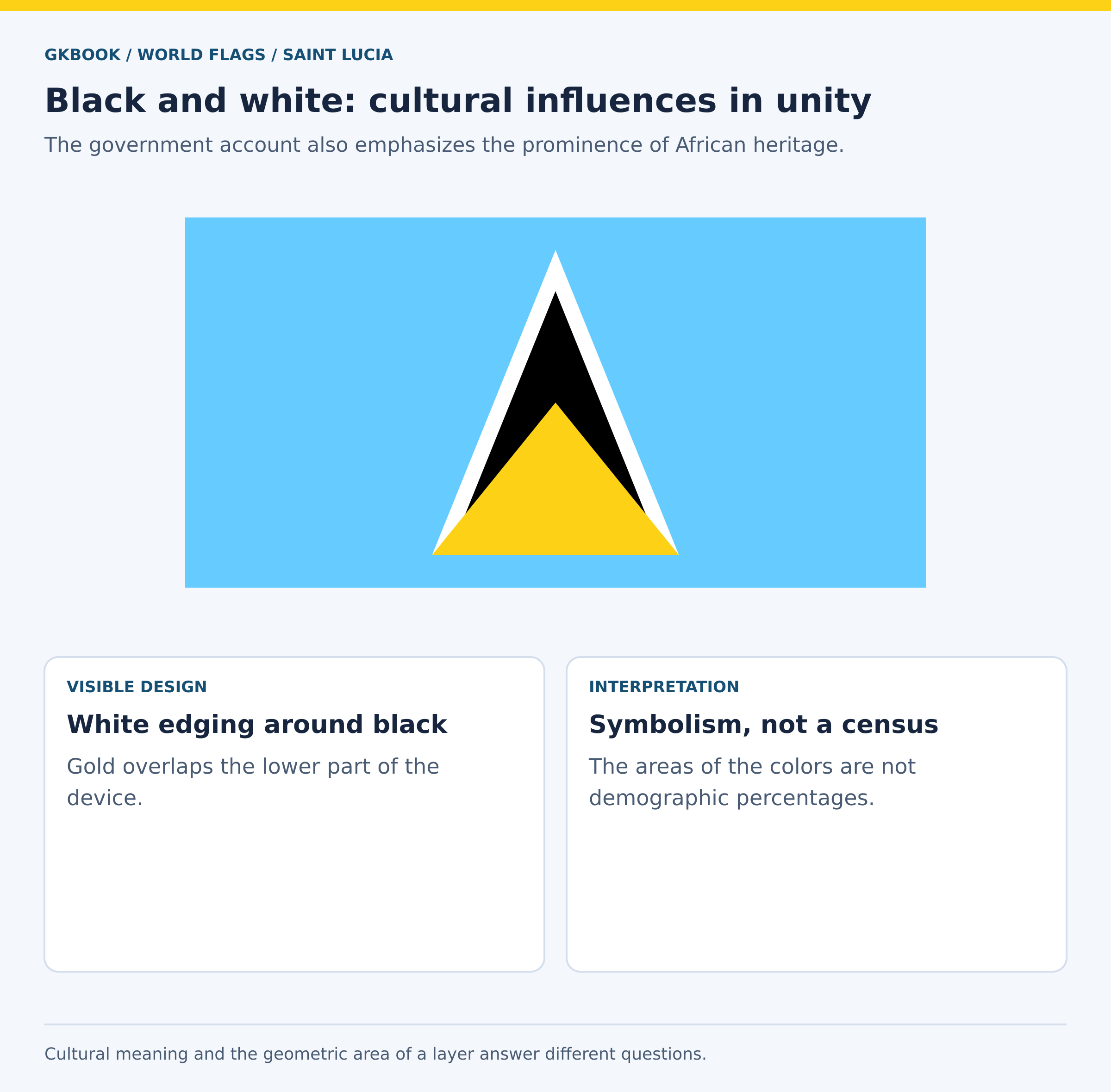
Black and white represent cultural influences living and working in unity in the government’s account. The description also emphasizes the prominence of African heritage relative to European influence. These are historical and cultural meanings assigned to the design; the areas of black and white should not be read as numerical demographic proportions.
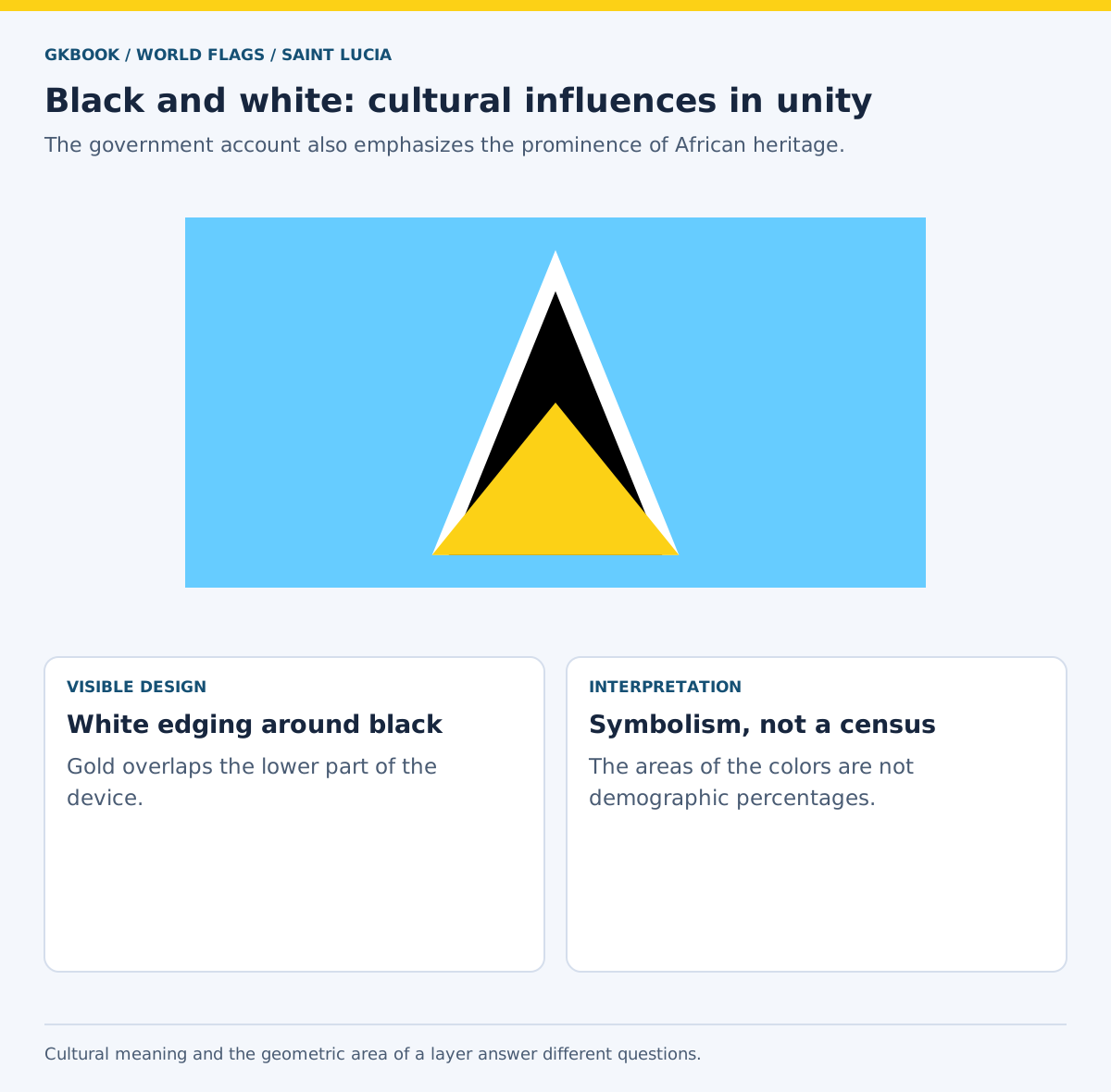
The older official explanation uses racial terminology characteristic of its wording. A modern educational account can convey its meaning accurately without repeating that terminology unnecessarily. The emphasis is on cultural inheritance and shared national life, not a claim that color establishes the worth of a person or community.
Visually, white appears as edging around the taller black shape, while gold covers its lower portion. The resulting areas depend on the construction and overlap of triangles. Measuring their pixels would describe the drawing, but it would not produce a valid census of Saint Lucia’s people or cultural influences.
Which mountains are represented by the triangles?
The triangles recall Saint Lucia’s twin Pitons, Gros Piton and Petit Piton, near Soufrière. UNESCO describes them as two prominent volcanic spires rising beside the sea. The flag is a stylized national symbol, not a scale drawing of their heights, and the official explanation does not supply a separate color-to-mountain assignment.

UNESCO lists the Pitons Management Area as a World Heritage property inscribed in 2004. Its description places the peaks in the island’s southwest and identifies their volcanic setting. This provides independent geographical grounding for the government’s explanation of the flag’s mountain imagery.
The government text refers both to three triangular layers and, elsewhere, to the famous twin Pitons. These should not become a claim that the landmark consists of three equally represented mountains. Count the white, black, and gold as construction layers; identify Gros Piton and Petit Piton as the two principal landmarks evoked by the design.
How many triangles are used in the flag design?
The device is constructed from three overlapping triangular layers: white at the back, black above it, and gold in front. Only parts of the underlying white and black remain visible. This layering explains why descriptions often emphasize two prominent pointed forms even though three colored triangles are involved in constructing the artwork.

Begin with the complete white triangle, add the slightly inset black triangle, and then cover the lower part with gold. The white layer becomes the visible edging, while the exposed black region resembles an arrowhead. Counting the remaining color regions without considering overlap can obscure this simple construction.
The layer diagram separates the stages so each contribution can be understood. It does not add extra triangles to the final flag. All three layers share a vertical axis of symmetry, and the whole device remains centered horizontally within the blue rectangle in this reconstruction.
Does Saint Lucia’s flag contain a star?
There is no separate five-pointed star on Saint Lucia’s flag. The government’s description calls the exposed black form a three-pointed star, but it arises from overlapping triangles rather than an additional emblem. For clear identification, describe the white-edged black triangle with a gold triangle in front on a blue field.

The word star can be misleading if it prompts someone to insert a familiar five-pointed symbol. In the actual design, the gold triangle covers the lower middle of the black layer, leaving a tall upper point and two lower extensions. The resulting dark outline is often described as an arrowhead.
The gallery therefore explains the visible black shape through the original layering rather than replacing it with a generic star icon. No extra circle, sun, crescent, or freestanding star belongs in the clean national flag. The underlying triangular construction is the more reliable guide for drawing it.
What is the Saint Lucia flag’s aspect ratio?
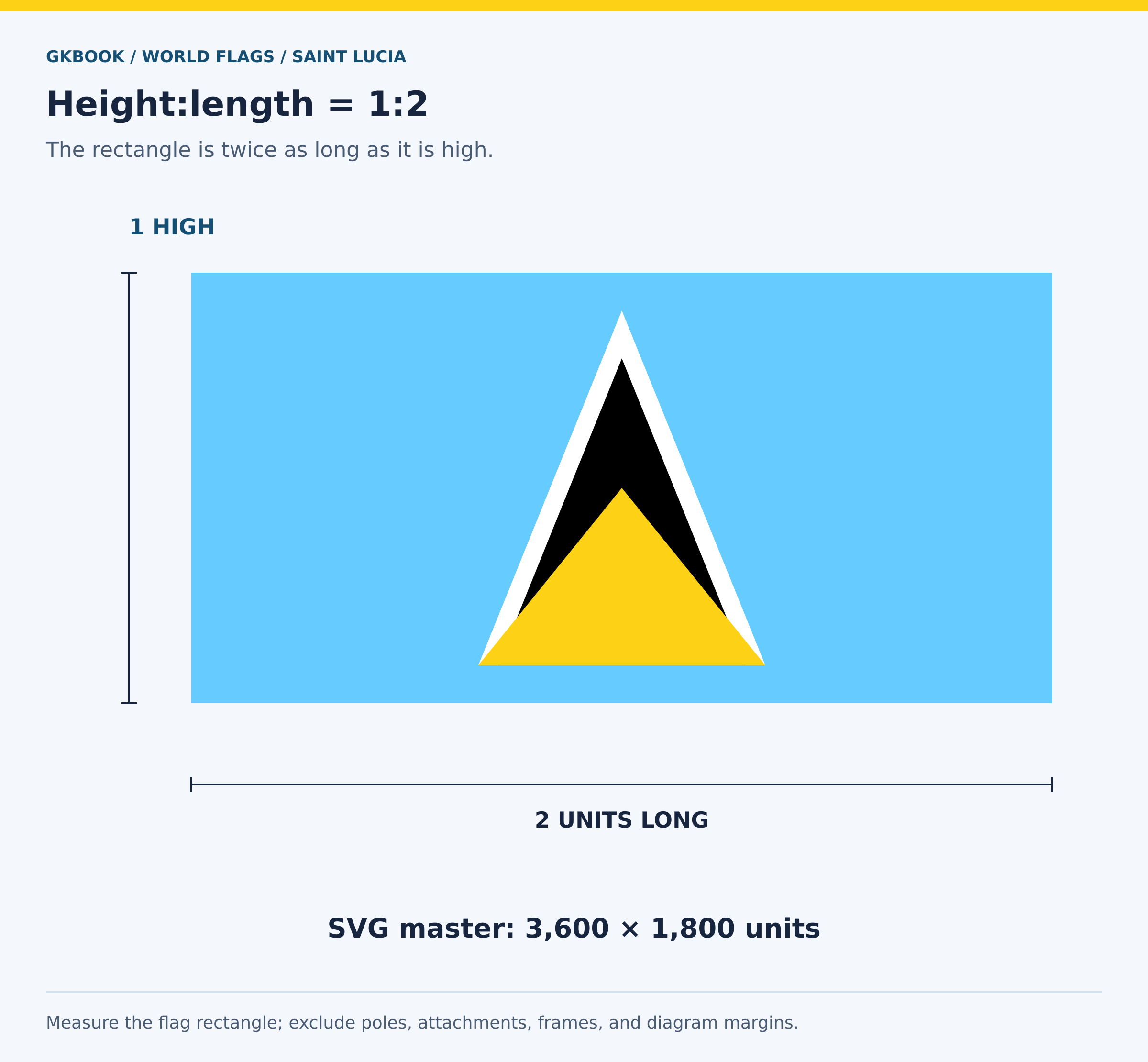
Saint Lucia’s national flag has a height to length ratio of 1:2, meaning its length is twice its height. The government lists several physical sizes with that relationship, including a pole flag measuring six feet by three feet. Digital images should preserve the same rectangle instead of stretching the flag to fill another shape.

Dimensions written as six by three feet usually give length first. A ratio written as height:length reverses that order, so the same rectangle becomes 1:2. Naming the order prevents the common mistake of reading 1:2 as a portrait-shaped flag.
A 1,200 by 600 pixel image and a 60 by 30 centimeter rectangle have the same proportions. These are scaling examples, not additional official size categories. Exclude the pole, attachments, picture frame, and surrounding explanatory canvas when measuring the flag itself. The downloadable SVG uses a 3,600 by 1,800 coordinate system.
How wide is the triangular device’s base?
The government description gives the common base as one third of the flag’s full length. On the six-foot pole flag, that span is two feet, or twenty-four inches. This reconstruction uses that span for the white and gold triangles, while the inset black layer shares their baseline with a narrower hidden base.
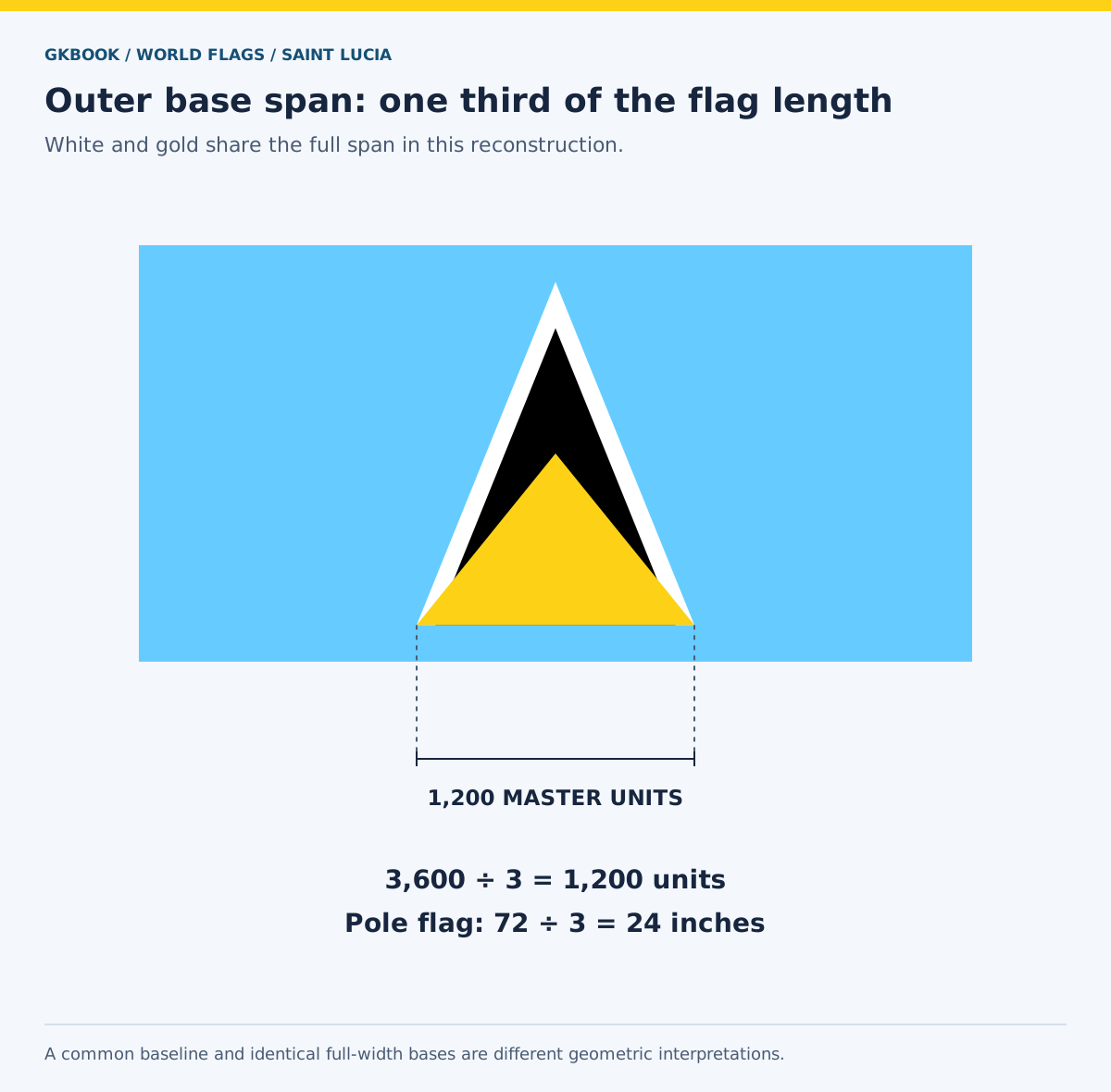
The distinction between a baseline and an identical full-width base matters when interpreting the description. Making the black triangle narrower allows its sloping edges to remain parallel to the white edges. Giving every layer identical base endpoints would instead make the visible white edging taper toward those endpoints.
The chosen interpretation is recorded openly. On the 3,600-unit master, the outer base runs from x = 1,200 to x = 2,400, centered at x = 1,800. Its 1,200-unit span equals one third of the rectangle’s length, leaving equal horizontal margins on either side.
How wide is the white edging?
Published government descriptions give the white portion beside the black triangle as one and a half inches on each side. This package interprets that figure on the six-foot pole flag, measured perpendicular to parallel sloping edges. The reference size and measurement direction are disclosed assumptions because the text does not provide a fully dimensioned construction sheet.
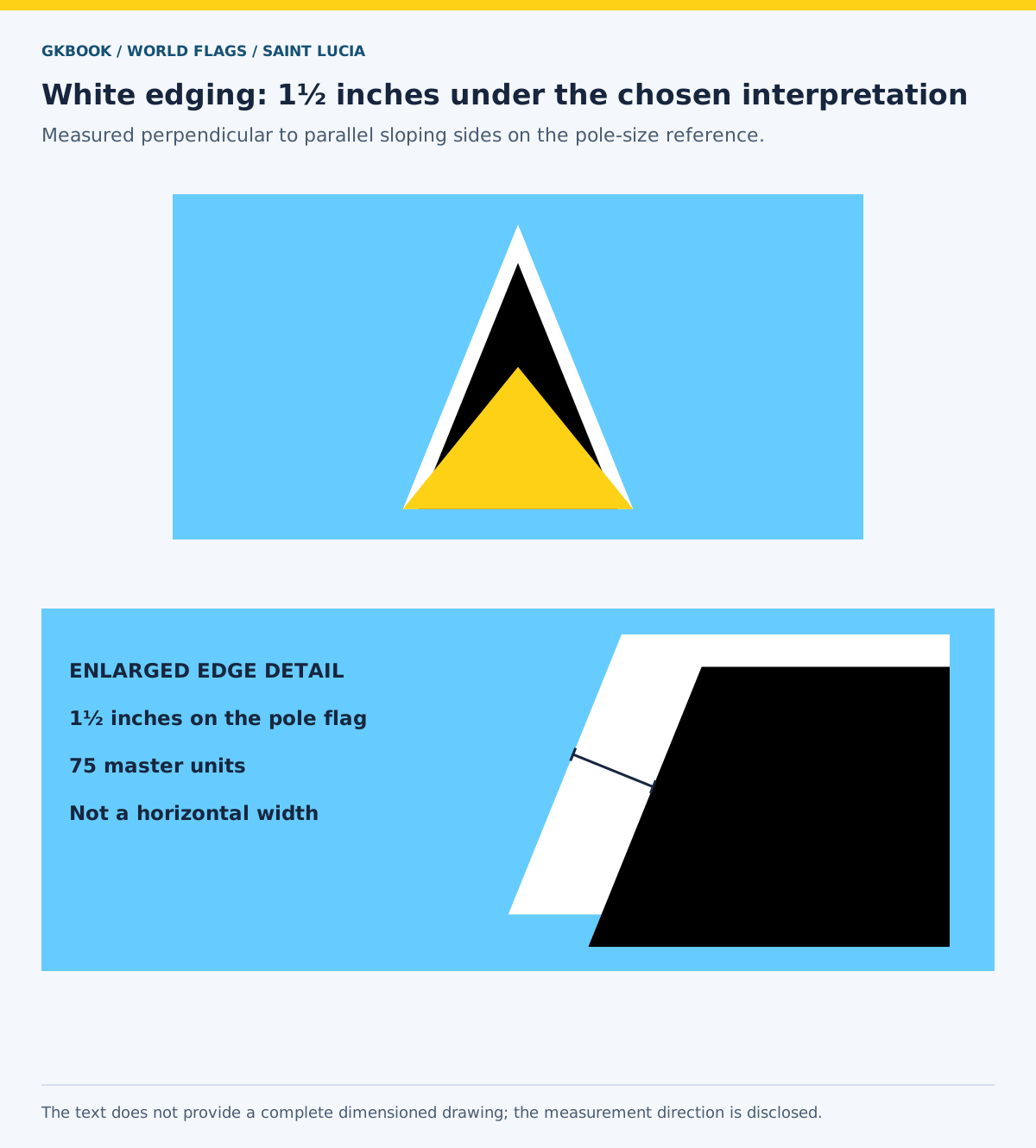
A perpendicular measurement is the shortest distance between parallel lines. A horizontal measurement across the same inclined border would be longer, so the two cannot be substituted without changing the shape. The edging diagram marks the measurement at right angles to a sloping side.
At fifty master units per inch, the selected white width is seventy-five units. It scales with the entire flag in these digital files. The package does not repeat a fixed one-and-a-half-inch border on a tiny desk flag: doing so would overwhelm the device and ignore the need for proportional reproduction.
What is the gap between the black and white peaks?
The published description gives a four-inch separation between the white and black peaks. In this reconstruction, the figure is applied to the six-foot pole flag and becomes 200 master units. Together with the chosen perpendicular white width and outer base span, it determines the taller triangle’s height under the parallel-edge interpretation.

The calculation uses a half-base of twelve inches, a peak gap of four inches, and a white width of one and a half inches. Similar right triangles give an outer sloping side of thirty-two inches. The vertical height is therefore the square root of thirty-two squared minus twelve squared.
That height is approximately 29.664794 inches, rather than exactly thirty inches. The white envelope is centered vertically as an editorial placement choice, leaving equal upper and lower margins. These calculations explain the drawing’s internal consistency; they do not claim that the government published every resulting coordinate.
How can I draw Saint Lucia’s flag accurately?
Start with a blue rectangle twice as long as it is high. Center a tall white triangle, place an inset black triangle over it, and add the lower gold triangle in front. Follow one documented construction consistently, distinguishing the published measurements from assumptions about scale, border direction, centering, and the gold apex.

This master uses the pole size as its reference, with fifty units representing one inch. The white and gold base spans one third of the full length. The black peak sits 200 units below the white peak, and parallel sloping edges provide a seventy-five-unit perpendicular white border.
The white envelope has equal top and bottom margins, and the gold apex lies at the flag’s center. These last placement choices complete the reconstruction where the description leaves details open. Dimension labels and guides appear only in teaching diagrams; the clean flag contains just the background and three triangular layers.
What is the history of the Saint Lucia flag?
Dunstan St. Omer’s triangular national design originated with associated statehood on March 1, 1967. Saint Lucia became independent on February 22, 1979. A later government Gazette labels the subsequent version as adopted on February 22, 2002. These dates describe different stages and should not be collapsed into a single undifferentiated adoption claim.

The 2010 Gazette’s historical feature illustrates the earlier British Blue Ensign, the flag used from 1967 to 1979, and the version captioned with the 2002 adoption date. That official retrospective is stronger evidence for the later date than an undated online color chart or speculation based on a photograph.
The 2003 government notice addresses standardization and records colors and measurements. Its publication is another distinct event: it is not the first creation of the design. The timeline keeps original adoption, independence, later-version dating, and publication of reproduction guidance separate so readers can compare sources without confusing their purposes.
When was Saint Lucia’s national flag first adopted?
Saint Lucia first adopted the national design on March 1, 1967, when it achieved internal self-government as an associated state. The consulate’s national-symbols account gives this date, and the Government Gazette identifies the 1967–1979 flag period. The design therefore predates full independence by almost twelve years, despite its strong association with independence celebrations.
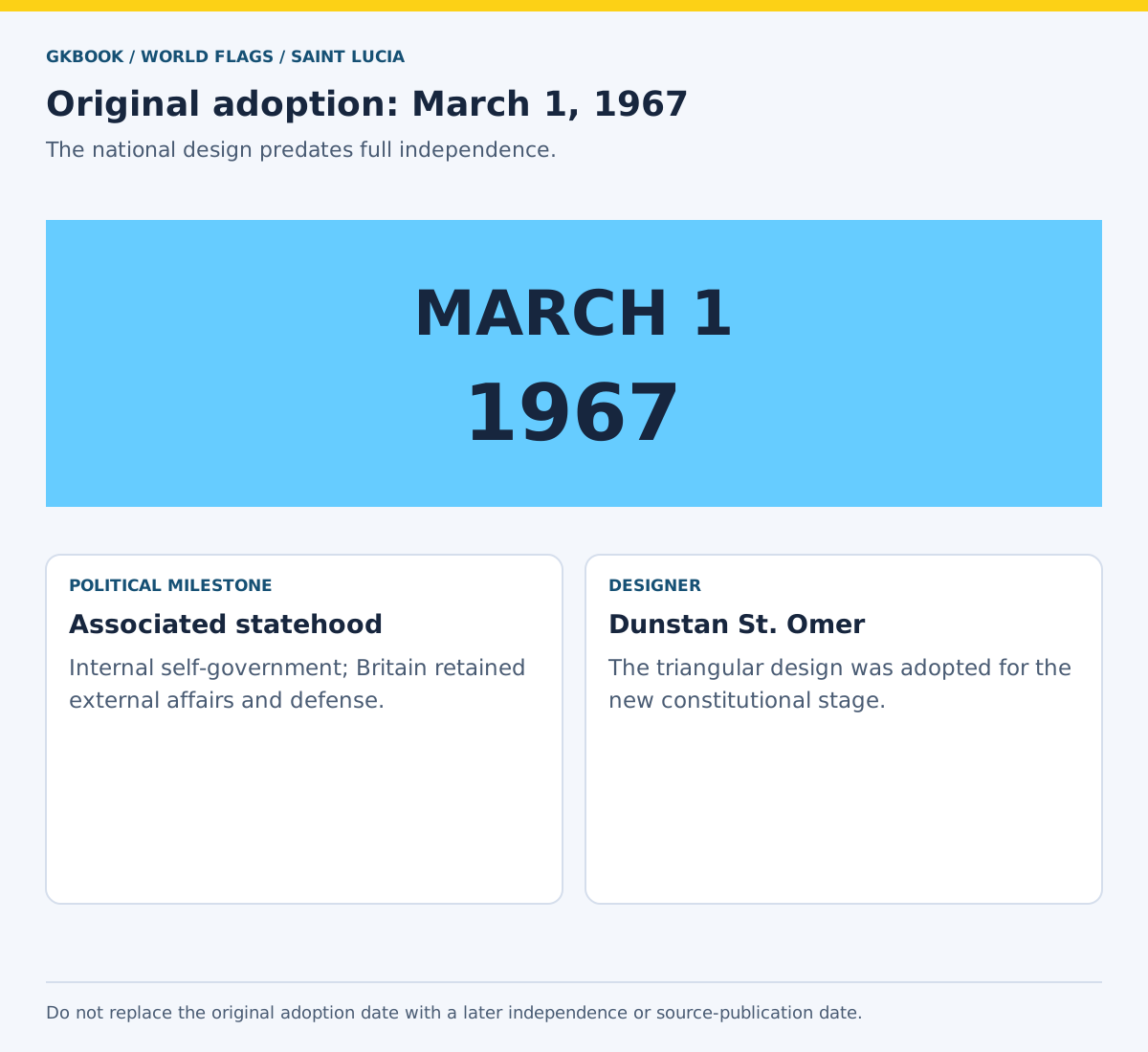
Associated statehood gave Saint Lucia responsibility for internal affairs while the United Kingdom retained responsibility for external affairs and defense. The new flag belonged to that political transition. Its appearance in 1967 should not be described as evidence that full sovereign independence had already occurred.
For a concise reference, label March 1, 1967 as original adoption. When describing the present rendering, add the later-version date separately. A timeline or factbox can accommodate both facts without forcing readers to choose between apparently contradictory answers to a question that has several historical layers.
Why is February 22, 1979 also associated with the flag?
February 22, 1979 is Saint Lucia’s independence date. The flag’s basic triangular design already existed, but independence gave it the role of representing a sovereign country. Historical accounts distinguish that milestone from the original 1967 adoption and the later version dated 2002, so 1979 should not be presented as the design’s first appearance.
The United States Office of the Historian confirms the independence date, providing an institutional source separate from Saint Lucia’s own flag descriptions. The date concerns the country’s constitutional status. It is not interchangeable with a foreign government’s later recognition or the establishment of diplomatic relations.
Images used around independence can document contemporary practice, but a photograph alone cannot establish exact pigment specifications or every geometric revision. This guide therefore preserves the major historical distinction without deriving a complete 1979 construction sheet from a small reproduction or assigning unverified numerical dimensions to that version.
What evidence supports the February 22, 2002 version date?
The Government Gazette of March 1, 2010 includes a historical feature whose later flag illustration is captioned as adopted on February 22, 2002. That is an official retrospective attribution of the date. This guide distinguishes it from the 1967 origin and does not claim to have located the original 2002 adoption instrument.

The Gazette illustration was checked directly, alongside its surrounding historical text. Its caption supports a precise date more firmly than older secondary discussions that only estimated a change between late 2001 and early 2002. The distinction between a later official account and an original adoption instrument remains important.
The page is not a certified color swatch or a complete coordinate drawing. Its grayscale reproduction cannot establish the numerical blue used in these downloads. Likewise, the Gazette’s 2010 publication date does not mean that the flag was redesigned in 2010; it is the date of the source reporting the earlier event.
Who designed Saint Lucia’s flag?
Saint Lucian artist Dunstan St. Omer designed the national flag. The government attributes the design and its description to him, while a published 2015 interview records his reflections on the competition and his artistic intentions. He is widely identified as Sir Dunstan St. Omer, following his later knighthood, rather than as a different designer.

In the interview, St. Omer described wanting the design to communicate his hopes for Saint Lucia. He also recalled submitting two entries, including an alternative green flag with a black eagle. That recollection is presented as the designer’s account, not as a recovered official competition file or a surviving measured drawing.
The designer card uses text rather than an invented portrait or signature. It keeps the 1967 design separate from later honors and retrospective interviews. A personal recollection helps explain creative intention, but it does not supply the missing numerical details needed for a certified manufacturing specification.
What flags preceded the current version?
The government’s 2010 historical feature shows a British Blue Ensign with colonial arms for the period before March 1967, followed by an earlier triangular national design for 1967–1979. The earlier triangular illustration has a lower gold apex than the later version. These are historical forms, not interchangeable alternatives for reproducing today’s national flag.

The Gazette dates the illustrated colonial ensign period from August 16, 1939 to March 1, 1967. Its Union Flag canton and colonial arms belong to that earlier design. Neither the canton nor those arms should be added to the present blue field and triangular device.
The historical comparison card describes the visual differences without inventing precise former pigments or a detailed arms facsimile. The printed retrospective is useful evidence for broad design changes, but its small grayscale illustrations cannot settle every original proportion. The current download is therefore kept separate from the historical explanation.
What official physical flag sizes are listed?
The 2003 notice lists a six-by-three-foot pole flag, a nine-by-four-and-a-half-inch hand flag, a six-by-three-inch desk flag, and an eleven-by-five-and-a-half-foot casket flag. All have a 1:2 height to length ratio. The 2010 Gazette repeats these inch and foot sizes but contains an incorrect metric conversion for the hand flag’s height.

Four and a half inches equals 11.43 centimeters, not the 10.16 centimeters printed beside the hand-flag size in the 2010 Gazette. The table retains the stated imperial dimensions and supplies mathematically correct metric equivalents. This is an explicit conversion correction, not an invented new official size.
The larger foot measurements convert exactly using 30.48 centimeters per foot. The Gazette rounds some of its meter equivalents, which should be distinguished from the clear hand-height error. Physical size categories also differ from the pixel dimensions of an image: a PNG’s resolution does not determine its printed size without a chosen output scale.
| Category | Published size | Calculated metric equivalent |
|---|---|---|
| Pole | 6 × 3 feet | 182.88 × 91.44 cm |
| Hand | 9 × 4½ inches | 22.86 × 11.43 cm |
| Desk | 6 × 3 inches | 15.24 × 7.62 cm |
| Casket | 11 × 5½ feet | 335.28 × 167.64 cm |
What guidance applies to respectful flag display?
The government’s etiquette code calls for a flag of proper appearance, without fading or bleaching, and says tears should be repaired before hoisting. It specifies a white mast and gives placement and handling instructions. These published guidelines should be read in their ceremonial context, rather than treated as a complete legal opinion about every possible use.

The code also says that the flag should not touch objects beneath it and should not carry added marks or lettering. A correctly drawn image and a respectfully handled physical flag are separate considerations. The clean download provides the design; it cannot establish the condition of a cloth flag or its actual display.
The 2003 standardization notice also discusses permission for imported souvenirs bearing national symbols. This article records that historical context without asserting unrestricted commercial clearance or providing a current import-law determination. For a particular official ceremony or product, consult the responsible authority about the applicable requirements.
How should Saint Lucia’s flag appear beside other national flags?
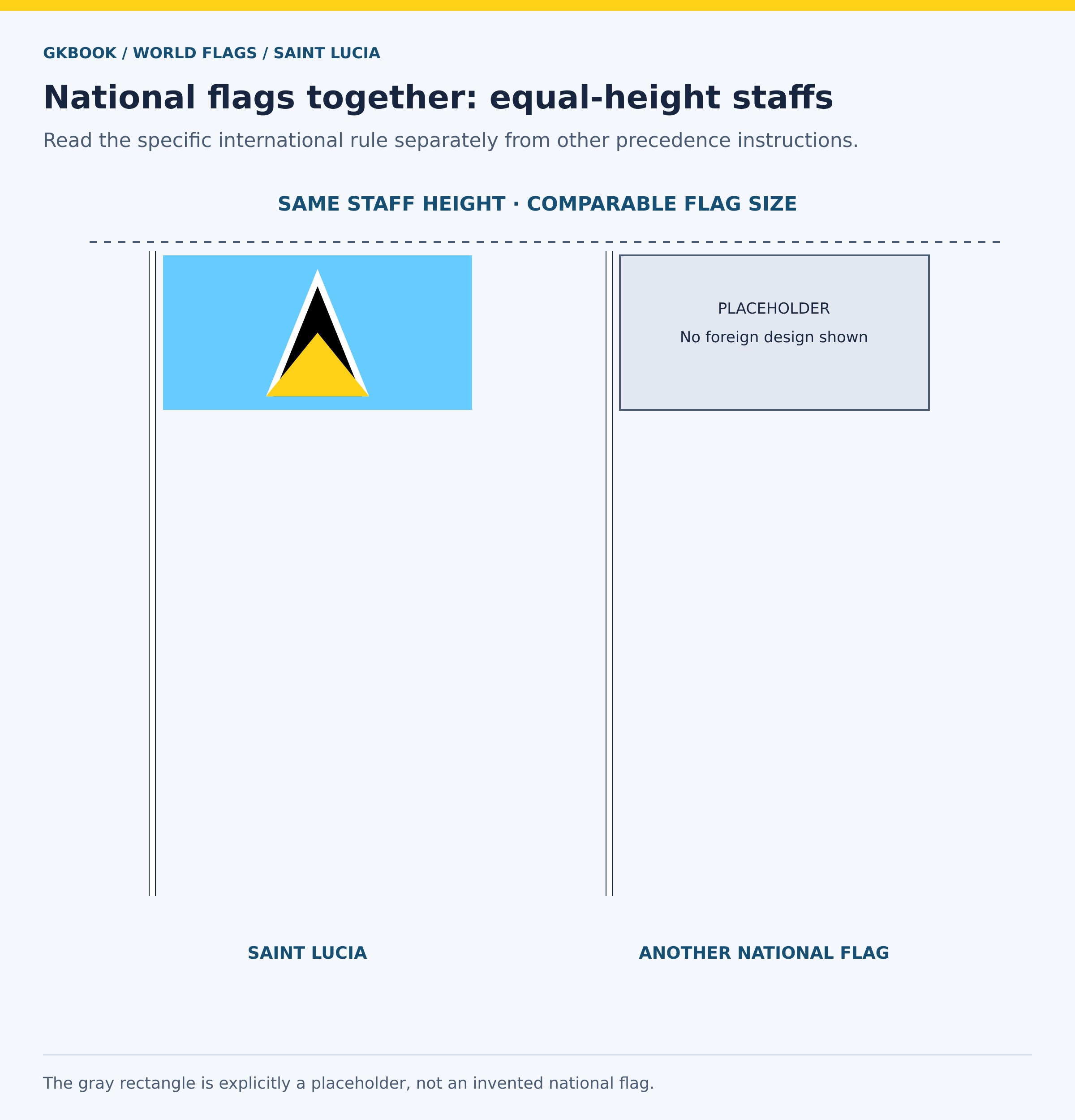
The government’s etiquette code says that national flags displayed together should use separate staffs of the same height and, as far as possible, flags of the same size. No country’s flag should be displayed above another. This international rule must be distinguished from general precedence instructions involving organizational or other non-national flags.

The diagram shows two equal-height staffs and equally sized rectangles. Saint Lucia’s flag appears beside an explicitly labeled placeholder rather than a fabricated foreign flag. The illustration explains equal treatment without suggesting that one sovereign country’s national symbol should occupy a superior vertical position.
A surrounding passage gives the Saint Lucia flag prominence within other groupings. Read that alongside the specific rule for national flags rather than applying it indiscriminately. Diplomatic events can also require an agreed order or additional ceremonial arrangements, which are beyond the basic height and size relationship shown here.
Which side is correct on a platform or crossed-staff display?
On a speaker’s platform, the government code places the flag to the speaker’s right, which is the audience’s left. For crossed staffs against a wall, Saint Lucia’s flag is on the observer’s left and its staff is in front. The viewpoint must be named because an unexplained instruction to use the right side is ambiguous.
The speaker faces the audience, so their right-hand directions are opposite. A stage diagram should make that relationship explicit before placing a staff. The code separately describes a flag elsewhere in the auditorium, so the platform instruction should not be transferred automatically to every location in the room.
A crossed display adds another distinction: which staff passes in front. This relationship does not change the national design itself. The blue field and upward-pointing triangles remain intact, and the flag should not become a covering for the speaker’s desk or a decorative drape across the platform.
Where should the flag be carried in a parade?
The government code places Saint Lucia’s flag on the marching right when carried with another flag, or in front of the center of a line of flags. Marching right means the participants’ right as they move forward. An observer facing the approaching procession sees that position on the observer’s left.
Direction of travel is essential when interpreting a photograph. A cropped image of a turning procession may conceal which way the formation is moving, making a simple left-or-right judgment unreliable. Establish the participants’ viewpoint before comparing the arrangement with the written code.
The pole and bearer belong to the ceremonial scene rather than the flag’s internal construction. A parade does not justify rotating the triangles downward or adding lettering to the blue field. This overview explains the published placement relationship without claiming to provide a complete marching drill or instructions for a particular event.
How is Saint Lucia’s flag flown at half-staff?
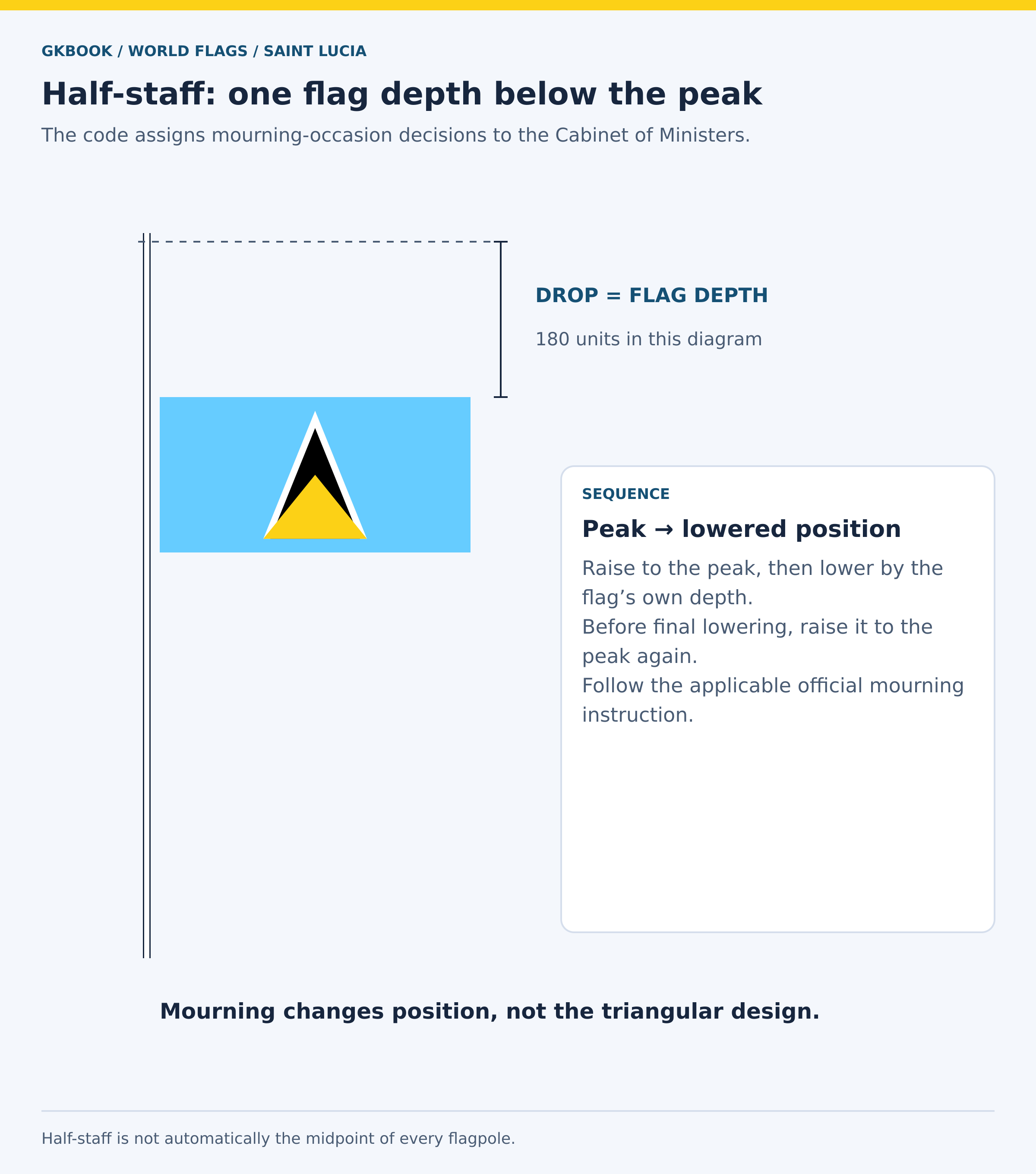
The government code defines half-staff as lowering the flag by its own depth from the peak, rather than automatically placing it halfway down the pole. First raise it to the peak, then lower it; raise it to the peak again before taking it down. The code assigns decisions about mourning occasions to the Cabinet of Ministers.

The flag’s depth is its vertical height. If an illustration shows a flag 180 units high, the top is lowered 180 units from the peak. That distance remains tied to the flag, not to a percentage of the entire staff’s height. The diagram marks the relationship directly.
Mourning changes the flag’s position, not its colors or triangle arrangement. This article does not infer that a particular mourning order is currently in force. A real observance must follow the official instruction for the occasion and duration, rather than an undated photograph or a general educational illustration.
Does Saint Lucia’s flag look different from the reverse side?
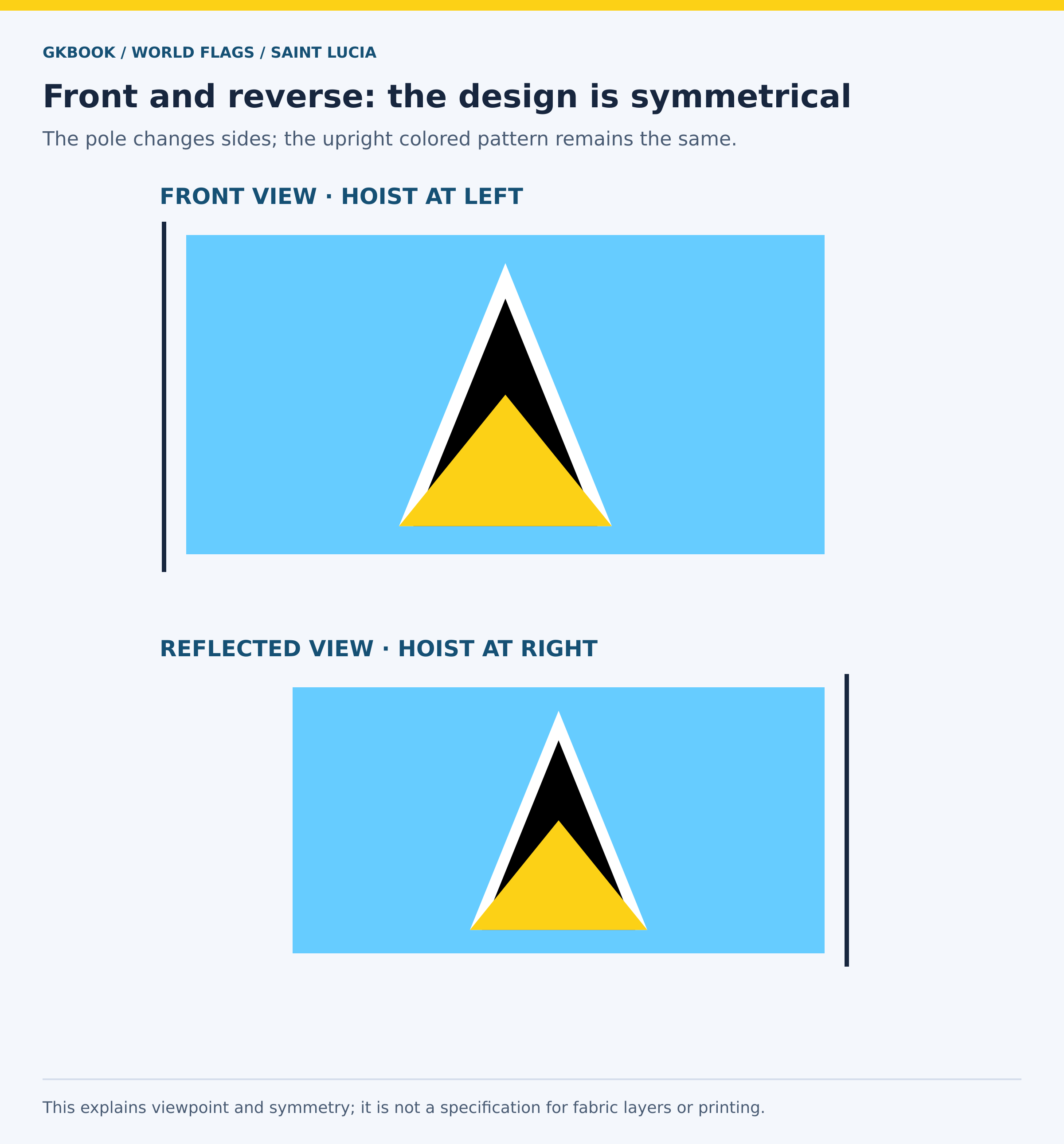
A horizontal reflection of this symmetrical design looks the same, although the pole appears on the opposite side. The central triangles remain upright, and the blue field surrounds them equally. Turning the flag upside down is different: that reverses the peaks vertically and is not the same operation as viewing the reverse side.
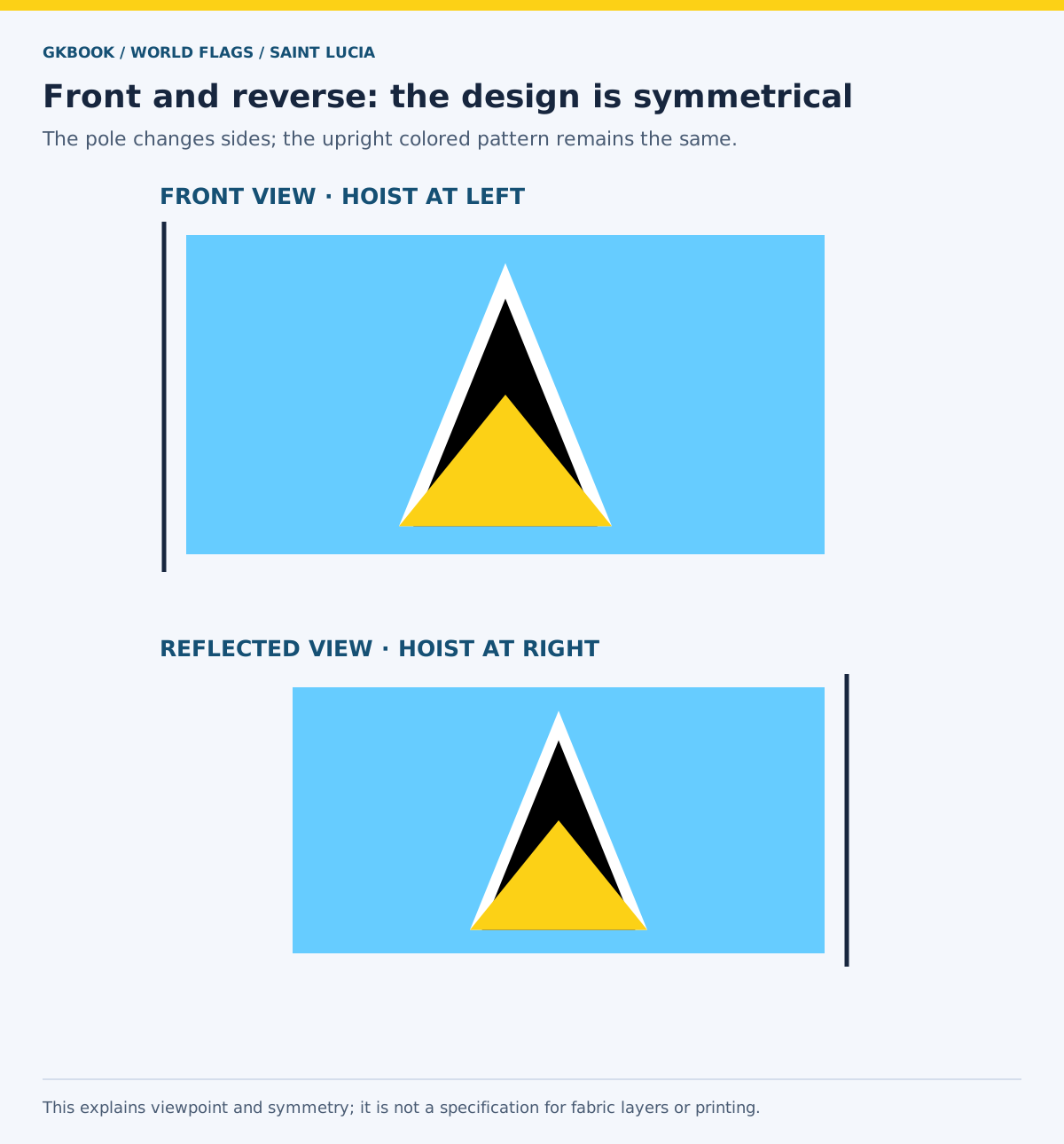
The device is symmetric about a vertical line through the center of the rectangle. Reflecting left and right therefore maps each triangular outline onto itself. The reverse diagram makes the viewpoint visible by moving the pole, even though the colored pattern appears unchanged.
This geometric observation does not prescribe fabric layers or a printing method. The government code treats inverted peaks as a distress signal, rather than ordinary display. For a normal reference image, keep all peaks upward and preserve the horizontal rectangle. A mirrored photograph alone is not evidence that the national pattern was altered.
How should Saint Lucia’s flag be reproduced digitally?
Preserve the 2:1 width to height ratio, centered triangular device, visible white edging, and gold foreground. Use the SVG for scalable artwork and the PNG for a fixed image. This package records the published measurements separately from its construction assumptions and screen palette, so precise digital coordinates are not mistaken for a certified government drawing.

The master SVG uses 3,600 by 1,800 units, while the clean PNG measures 6,000 by 3,000 pixels. Both contain the complete flag without a border, pole, title, or shadow. The labeled diagrams have larger explanatory canvases, whose dimensions should not be confused with the proportions of the flag inside them.
Use proportional containment when fitting the image into a card or thumbnail. Stretching changes triangle angles; cropping can remove blue margins or a peak. The separate 1,200 by 630 social card has its own canvas ratio and holds a complete 2:1 flag within that space.
What are common mistakes in Saint Lucia flag illustrations?
Frequent mistakes include omitting the white edging, reversing the triangle layers, inserting a separate star, or changing the rectangle’s 1:2 proportions. Captions can confuse the 1967 origin, 1979 independence, and 2002 version date. A careful reference also discloses construction assumptions and avoids presenting editorial RGB values as officially certified color specifications.
Check the whole composition before inspecting fine details. The blue field surrounds an upright device; white lies behind black, and gold lies in front. The outer base spans one third of the length in the published description. A gold triangle extending beyond that span or a device shifted to the hoist changes the design.
Then check what the accompanying text claims. Three construction layers do not establish three principal Pitons, and a later source’s publication date is not automatically an adoption date. Correct the documented hand-flag conversion openly, and distinguish a reproducible reconstruction from proof that every coordinate was government-prescribed.
Which Saint Lucia flag pictures are available to download?
The gallery provides 24 subjects, each in SVG and PNG, including the clean flag, color references, triangle construction, historical timelines, size tables, and protocol explanations. A separate social card is included. Every image is an original vector composition; historical and designer cards explain evidence without inventing archival photographs, portraits, or exact former color specifications.
Choose the clean flag when only the national design is needed. Use the construction diagrams to study overlap and measurements, the timelines to distinguish historical stages, and the size table to compare physical categories. Each subject includes a caption and alternative text, with reproduction notes explaining the evidence and assumptions.
The SVG labels remain editable, while PNG files provide fixed renderings for software without SVG support. Download links are grouped in the picture gallery. Continue exploring country designs through World Flags. The article and FAQ share the same direct answers to keep their explanations consistent.
Download Saint Lucia flag pictures
Download the clean national flag as SVG or 6,000 × 3,000 PNG. Its SVG coordinate system is 3,600 × 1,800, preserving a 2:1 width to height ratio.
The gallery contains 24 subjects, each with an SVG and PNG. Published dimensions are implemented with disclosed interpretations of the pole reference size, parallel edging, base, centering, and gold apex. Screen colors are separate editorial approximations. Image credits and reproduction notes explain the construction basis and physical color references. The separate social card is 1,200 × 630 and contains a complete correctly proportioned flag.
Continue exploring national designs in World Flags.
World Flags/Saint Lucia
Saint Lucia flag pictures
Cerulean blue field with a white-edged black triangle and gold triangle in front. Published measurements are implemented with disclosed construction interpretations and an editorial screen palette.
Original GKBook vector reconstruction. Published ratio, base span, white-width and peak-gap figures are used with disclosed interpretation of the pole size, parallel edging, centering, gold apex, and screen palette.Download SVGDownload PNGThe 2003 notice identifies Cerulean Blue with Process Cyan 100%, plus Light Chrome Yellow, Black, and White. The displayed digital fills are separate editorial choices.
Original GKBook vector reconstruction. Published ratio, base span, white-width and peak-gap figures are used with disclosed interpretation of the pole size, parallel edging, centering, gold apex, and screen palette.Download SVGDownload PNGOfficial meanings are paraphrased in contemporary language; the colors are not population statistics or evidence that aspirations have been fulfilled.
Original GKBook vector reconstruction. Published ratio, base span, white-width and peak-gap figures are used with disclosed interpretation of the pole size, parallel edging, centering, gold apex, and screen palette.Download SVGDownload PNGGold is the foreground layer. The exact apex position in this reconstruction is declared as a drawing choice.
Original GKBook vector reconstruction. Published ratio, base span, white-width and peak-gap figures are used with disclosed interpretation of the pole size, parallel edging, centering, gold apex, and screen palette.Download SVGDownload PNGBlack and white express cultural influences living and working together. Older official wording is paraphrased rather than reproduced as a demographic or racial ranking.
Original GKBook vector reconstruction. Published ratio, base span, white-width and peak-gap figures are used with disclosed interpretation of the pole size, parallel edging, centering, gold apex, and screen palette.Download SVGDownload PNGUNESCO identifies the twin volcanic landmarks and the 2004 World Heritage inscription. These schematic mountain forms are not a photograph, map, or flag construction.
Original GKBook vector reconstruction. Published ratio, base span, white-width and peak-gap figures are used with disclosed interpretation of the pole size, parallel edging, centering, gold apex, and screen palette.Download SVGDownload PNGThree colored triangles overlap on a blue field. Their visible regions are the result of layering, not three separate mountain portraits.
Original GKBook vector reconstruction. Published ratio, base span, white-width and peak-gap figures are used with disclosed interpretation of the pole size, parallel edging, centering, gold apex, and screen palette.Download SVGDownload PNGThe isolated visible black region is calculated from the intersection of the black and gold layers. It is a detail of the device, not a separate emblem to add to the flag.
Original GKBook vector reconstruction. Published ratio, base span, white-width and peak-gap figures are used with disclosed interpretation of the pole size, parallel edging, centering, gold apex, and screen palette.Download SVGDownload PNGThe pole, hand, desk, and casket dimensions all preserve the 1:2 height to length ratio.
Original GKBook vector reconstruction. Published ratio, base span, white-width and peak-gap figures are used with disclosed interpretation of the pole size, parallel edging, centering, gold apex, and screen palette.Download SVGDownload PNGThe outer white and gold base extends from x=1,200 to x=2,400. The inset black layer shares the baseline with a narrower hidden base; this interpretation is disclosed.
Original GKBook vector reconstruction. Published ratio, base span, white-width and peak-gap figures are used with disclosed interpretation of the pole size, parallel edging, centering, gold apex, and screen palette.Download SVGDownload PNGThe drawing interprets the published white width as the shortest distance between parallel black and white sides. The inset black layer and pole-size reference are declared assumptions.
Original GKBook vector reconstruction. Published ratio, base span, white-width and peak-gap figures are used with disclosed interpretation of the pole size, parallel edging, centering, gold apex, and screen palette.Download SVGDownload PNGFour inches becomes 200 master units. The derived outer height follows the chosen pole-size and perpendicular-border interpretation, not a separately published coordinate table.
Original GKBook vector reconstruction. Published ratio, base span, white-width and peak-gap figures are used with disclosed interpretation of the pole size, parallel edging, centering, gold apex, and screen palette.Download SVGDownload PNGThe drawing uses the government’s published dimensions with explicitly identified choices needed to complete the geometry.
Original GKBook vector reconstruction. Published ratio, base span, white-width and peak-gap figures are used with disclosed interpretation of the pole size, parallel edging, centering, gold apex, and screen palette.Download SVGDownload PNGThe timeline distinguishes original adoption, independence, the later version date, and a subsequent publication of reproduction guidance.
Original GKBook vector reconstruction. Published ratio, base span, white-width and peak-gap figures are used with disclosed interpretation of the pole size, parallel edging, centering, gold apex, and screen palette.Download SVGDownload PNGMarch 1, 1967 belongs to associated statehood. February 22, 1979 independence and the later 2002 version are separately identified.
Original GKBook vector reconstruction. Published ratio, base span, white-width and peak-gap figures are used with disclosed interpretation of the pole size, parallel edging, centering, gold apex, and screen palette.Download SVGDownload PNGThe precise later-version date is supported by the Gazette caption. The package does not pretend to have inspected the original 2002 adoption instrument.
Original GKBook vector reconstruction. Published ratio, base span, white-width and peak-gap figures are used with disclosed interpretation of the pole size, parallel edging, centering, gold apex, and screen palette.Download SVGDownload PNGThe designer’s later title and retrospective interview are distinguished from the original 1967 design.
Original GKBook vector reconstruction. Published ratio, base span, white-width and peak-gap figures are used with disclosed interpretation of the pole size, parallel edging, centering, gold apex, and screen palette.Download SVGDownload PNGThe historical card describes the Gazette illustrations without copying them or inventing a complete earlier flag specification.
Original GKBook vector reconstruction. Published ratio, base span, white-width and peak-gap figures are used with disclosed interpretation of the pole size, parallel edging, centering, gold apex, and screen palette.Download SVGDownload PNGThe table retains the published imperial dimensions. It corrects the Gazette’s hand-height conversion and distinguishes exact conversion from rounded meter equivalents.
Original GKBook vector reconstruction. Published ratio, base span, white-width and peak-gap figures are used with disclosed interpretation of the pole size, parallel edging, centering, gold apex, and screen palette.Download SVGDownload PNGThe code supplies protocol guidance. The 2003 notice also discusses imported souvenirs, but this card is not an exhaustive current legal opinion.
Original GKBook vector reconstruction. Published ratio, base span, white-width and peak-gap figures are used with disclosed interpretation of the pole size, parallel edging, centering, gold apex, and screen palette.Download SVGDownload PNGThe code calls for separate same-height staffs and flags of the same size as far as possible. No country’s flag is displayed above another.
Original GKBook vector reconstruction. Published ratio, base span, white-width and peak-gap figures are used with disclosed interpretation of the pole size, parallel edging, centering, gold apex, and screen palette.Download SVGDownload PNGThe illustrated flag is 180 units high and its top is lowered 180 units from the peak. This explains the published depth-based rule, without asserting a current mourning order.
Original GKBook vector reconstruction. Published ratio, base span, white-width and peak-gap figures are used with disclosed interpretation of the pole size, parallel edging, centering, gold apex, and screen palette.Download SVGDownload PNGA horizontal reflection preserves the symmetric triangular design. Turning it upside down is a different operation and reverses the peaks.
Original GKBook vector reconstruction. Published ratio, base span, white-width and peak-gap figures are used with disclosed interpretation of the pole size, parallel edging, centering, gold apex, and screen palette.Download SVGDownload PNGClean flag images retain a 2:1 width to height ratio. The separate social card contains the full flag within its separate explanatory canvas.
Original GKBook vector reconstruction. Published ratio, base span, white-width and peak-gap figures are used with disclosed interpretation of the pole size, parallel edging, centering, gold apex, and screen palette.Download SVGDownload PNGFrequently asked questions
What does the Saint Lucia flag look like?
Saint Lucia’s flag has a cerulean blue field with a central white-edged black triangle and a gold triangle in front. The pointed design recalls the island’s twin Pitons. The rectangular flag is twice as long as it is high, giving a height to length ratio of 1:2.
What are the colors of the Saint Lucia flag?
Saint Lucia’s flag uses cerulean blue, gold or light chrome yellow, black, and white. A 2003 government notice identifies the blue with Process Cyan 100 percent, while a 2010 Gazette repeats the color names. The RGB and hexadecimal values supplied here are editorial screen approximations, not numerical digital values specified by those publications.
What does the Saint Lucia flag mean?
Blue represents fidelity and recalls the surrounding sea and tropical sky. Gold represents sunshine and prosperity. Black and white express cultural influences living and working together, with the design emphasizing African heritage. The triangles evoke the twin Pitons and the people’s hope and aspirations, according to the government’s explanation.
What does the blue field represent?
The government identifies cerulean blue with fidelity and connects it with the tropical sky and surrounding waters of the Caribbean Sea and Atlantic Ocean. Blue covers the entire background around the central triangles. It is a single field, rather than separate upper and lower stripes representing the sky and sea individually.
What does the gold triangle represent?
Gold represents sunshine and prosperity in the official explanation. It forms the broad lower triangle in front of the taller black-and-white device. The government notice calls its color Light Chrome Yellow. In these illustrations, the gold apex is placed at the rectangle’s center as a disclosed construction choice, not an independently stated official measurement.
What do black and white symbolize?
Black and white represent cultural influences living and working in unity in the government’s account. The description also emphasizes the prominence of African heritage relative to European influence. These are historical and cultural meanings assigned to the design; the areas of black and white should not be read as numerical demographic proportions.
Which mountains are represented by the triangles?
The triangles recall Saint Lucia’s twin Pitons, Gros Piton and Petit Piton, near Soufrière. UNESCO describes them as two prominent volcanic spires rising beside the sea. The flag is a stylized national symbol, not a scale drawing of their heights, and the official explanation does not supply a separate color-to-mountain assignment.
How many triangles are used in the flag design?
The device is constructed from three overlapping triangular layers: white at the back, black above it, and gold in front. Only parts of the underlying white and black remain visible. This layering explains why descriptions often emphasize two prominent pointed forms even though three colored triangles are involved in constructing the artwork.
Does Saint Lucia’s flag contain a star?
There is no separate five-pointed star on Saint Lucia’s flag. The government’s description calls the exposed black form a three-pointed star, but it arises from overlapping triangles rather than an additional emblem. For clear identification, describe the white-edged black triangle with a gold triangle in front on a blue field.
What is the Saint Lucia flag’s aspect ratio?
Saint Lucia’s national flag has a height to length ratio of 1:2, meaning its length is twice its height. The government lists several physical sizes with that relationship, including a pole flag measuring six feet by three feet. Digital images should preserve the same rectangle instead of stretching the flag to fill another shape.
How wide is the triangular device’s base?
The government description gives the common base as one third of the flag’s full length. On the six-foot pole flag, that span is two feet, or twenty-four inches. This reconstruction uses that span for the white and gold triangles, while the inset black layer shares their baseline with a narrower hidden base.
How wide is the white edging?
Published government descriptions give the white portion beside the black triangle as one and a half inches on each side. This package interprets that figure on the six-foot pole flag, measured perpendicular to parallel sloping edges. The reference size and measurement direction are disclosed assumptions because the text does not provide a fully dimensioned construction sheet.
What is the gap between the black and white peaks?
The published description gives a four-inch separation between the white and black peaks. In this reconstruction, the figure is applied to the six-foot pole flag and becomes 200 master units. Together with the chosen perpendicular white width and outer base span, it determines the taller triangle’s height under the parallel-edge interpretation.
How can I draw Saint Lucia’s flag accurately?
Start with a blue rectangle twice as long as it is high. Center a tall white triangle, place an inset black triangle over it, and add the lower gold triangle in front. Follow one documented construction consistently, distinguishing the published measurements from assumptions about scale, border direction, centering, and the gold apex.
What is the history of the Saint Lucia flag?
Dunstan St. Omer’s triangular national design originated with associated statehood on March 1, 1967. Saint Lucia became independent on February 22, 1979. A later government Gazette labels the subsequent version as adopted on February 22, 2002. These dates describe different stages and should not be collapsed into a single undifferentiated adoption claim.
When was Saint Lucia’s national flag first adopted?
Saint Lucia first adopted the national design on March 1, 1967, when it achieved internal self-government as an associated state. The consulate’s national-symbols account gives this date, and the Government Gazette identifies the 1967–1979 flag period. The design therefore predates full independence by almost twelve years, despite its strong association with independence celebrations.
Why is February 22, 1979 also associated with the flag?
February 22, 1979 is Saint Lucia’s independence date. The flag’s basic triangular design already existed, but independence gave it the role of representing a sovereign country. Historical accounts distinguish that milestone from the original 1967 adoption and the later version dated 2002, so 1979 should not be presented as the design’s first appearance.
What evidence supports the February 22, 2002 version date?
The Government Gazette of March 1, 2010 includes a historical feature whose later flag illustration is captioned as adopted on February 22, 2002. That is an official retrospective attribution of the date. This guide distinguishes it from the 1967 origin and does not claim to have located the original 2002 adoption instrument.
Who designed Saint Lucia’s flag?
Saint Lucian artist Dunstan St. Omer designed the national flag. The government attributes the design and its description to him, while a published 2015 interview records his reflections on the competition and his artistic intentions. He is widely identified as Sir Dunstan St. Omer, following his later knighthood, rather than as a different designer.
What flags preceded the current version?
The government’s 2010 historical feature shows a British Blue Ensign with colonial arms for the period before March 1967, followed by an earlier triangular national design for 1967–1979. The earlier triangular illustration has a lower gold apex than the later version. These are historical forms, not interchangeable alternatives for reproducing today’s national flag.
What official physical flag sizes are listed?
The 2003 notice lists a six-by-three-foot pole flag, a nine-by-four-and-a-half-inch hand flag, a six-by-three-inch desk flag, and an eleven-by-five-and-a-half-foot casket flag. All have a 1:2 height to length ratio. The 2010 Gazette repeats these inch and foot sizes but contains an incorrect metric conversion for the hand flag’s height.
What guidance applies to respectful flag display?
The government’s etiquette code calls for a flag of proper appearance, without fading or bleaching, and says tears should be repaired before hoisting. It specifies a white mast and gives placement and handling instructions. These published guidelines should be read in their ceremonial context, rather than treated as a complete legal opinion about every possible use.
How should Saint Lucia’s flag appear beside other national flags?
The government’s etiquette code says that national flags displayed together should use separate staffs of the same height and, as far as possible, flags of the same size. No country’s flag should be displayed above another. This international rule must be distinguished from general precedence instructions involving organizational or other non-national flags.
Which side is correct on a platform or crossed-staff display?
On a speaker’s platform, the government code places the flag to the speaker’s right, which is the audience’s left. For crossed staffs against a wall, Saint Lucia’s flag is on the observer’s left and its staff is in front. The viewpoint must be named because an unexplained instruction to use the right side is ambiguous.
Where should the flag be carried in a parade?
The government code places Saint Lucia’s flag on the marching right when carried with another flag, or in front of the center of a line of flags. Marching right means the participants’ right as they move forward. An observer facing the approaching procession sees that position on the observer’s left.
How is Saint Lucia’s flag flown at half-staff?
The government code defines half-staff as lowering the flag by its own depth from the peak, rather than automatically placing it halfway down the pole. First raise it to the peak, then lower it; raise it to the peak again before taking it down. The code assigns decisions about mourning occasions to the Cabinet of Ministers.
Does Saint Lucia’s flag look different from the reverse side?
A horizontal reflection of this symmetrical design looks the same, although the pole appears on the opposite side. The central triangles remain upright, and the blue field surrounds them equally. Turning the flag upside down is different: that reverses the peaks vertically and is not the same operation as viewing the reverse side.
How should Saint Lucia’s flag be reproduced digitally?
Preserve the 2:1 width to height ratio, centered triangular device, visible white edging, and gold foreground. Use the SVG for scalable artwork and the PNG for a fixed image. This package records the published measurements separately from its construction assumptions and screen palette, so precise digital coordinates are not mistaken for a certified government drawing.
What are common mistakes in Saint Lucia flag illustrations?
Frequent mistakes include omitting the white edging, reversing the triangle layers, inserting a separate star, or changing the rectangle’s 1:2 proportions. Captions can confuse the 1967 origin, 1979 independence, and 2002 version date. A careful reference also discloses construction assumptions and avoids presenting editorial RGB values as officially certified color specifications.
Which Saint Lucia flag pictures are available to download?
The gallery provides 24 subjects, each in SVG and PNG, including the clean flag, color references, triangle construction, historical timelines, size tables, and protocol explanations. A separate social card is included. Every image is an original vector composition; historical and designer cards explain evidence without inventing archival photographs, portraits, or exact former color specifications.
Explore all general-knowledge topics and the A-to-Z lists.








We Value Your Opinion Comments