

Saint Kitts and Nevis flag picture
Explore the construction notes, history, and picture gallery.
| Design | Green, red, yellow, black, and whiteA rising yellow-edged black diagonal with two white stars. |
|---|---|
| Proportions | Height:length = 2:3Explicit ministry ratio; its separate 3 × 5 foot size entry conflicts. |
| Stars | Hope and libertyTwo white five-pointed stars; exact geometry is reconstructed. |
| Adoption | September 19, 1983The federation’s independence date. |
| Designer | Edrice LewisLater government recognition names Edrice Lewis-Viechweg. |
| Image sizes | SVG and PNGSVG: 3,000 × 2,000; PNG: 6,000 × 4,000. |
What does the Saint Kitts and Nevis flag look like?
The flag of Saint Kitts and Nevis has a green upper hoist and a red lower fly, divided by a yellow-edged black diagonal rising toward the upper fly. Two white five-pointed stars lie on the black band. The national flag uses a height to length ratio of 2:3.
This guide connects the design with its official meanings, independence in 1983, and ministry protocol. The gallery explains the diagonal, stars, proportions, historical context, and the choices involved in a transparent digital reconstruction.
What are the colors of the Saint Kitts and Nevis flag?
The flag uses green, red, yellow, black, and white. The Ministry of Foreign Affairs lists Pantone references for the colors, including Green 349C, Red 186C, Yellow 108C, Black C, and White. The RGB and hexadecimal fills in this guide are declared screen approximations, not certified conversions of those physical references.

Color names, physical references, and digital values answer different questions. The ministry identifies a reference system for reproduction, but its page does not provide the numerical RGB values used here. In particular, its entry for white does not include a separate numbered code. This guide preserves that distinction instead of completing a specification by guesswork.
Use the table to identify the actual fills in the downloadable artwork. A screen sample cannot establish how fabric, ink, or a printed swatch will look under different lighting. For physical production, confirm the appropriate reference and process with the responsible supplier.
| Element | Ministry reference | Editorial RGB | Editorial hex |
|---|---|---|---|
| Green | Pantone Green 349C | 4, 106, 56 | #046A38 |
| Red | Pantone Red 186C | 200, 16, 46 | #C8102E |
| Yellow | Pantone Yellow 108C | 254, 219, 0 | #FEDB00 |
| Black | Pantone Black C | 0, 0, 0 | #000000 |
| White | Pantone White | 255, 255, 255 | #FFFFFF |
What does the Saint Kitts and Nevis flag mean?
Official explanations connect green with fertile lands, red with the struggle from slavery through colonialism to independence, yellow with year-round sunshine, and black with African heritage. The two white stars represent hope and liberty. These associations describe the intended symbolism of the national design, rather than meanings inferred from its colors alone.

The federal government, the foreign ministry, and the Nevis Island Administration give the same core explanation. Their descriptions connect the land and climate with the people’s heritage and the historical pursuit of freedom. Repetition across official pages corroborates the government’s account, although it need not represent several independently researched histories.
When teaching the design, keep each association attached to the correct element. The black band is not described as mourning, and the stars should not automatically become labels for the two islands. The meaning chart follows the published explanation without claiming that a symbol measures present social conditions.
What does the green area represent?
Green represents the country’s fertile lands. In the conventional front view, it occupies the area toward the upper hoist, above the diagonal band. The hoist is the edge attached to the pole. Green is therefore identified by its relationship to the attachment and diagonal, rather than simply by the word left.
The green field reaches the upper left corner of the front-view rectangle. The yellow border separates it from the black diagonal, so green does not directly meet the black band. Its visible shape follows the rectangle and the oblique edge of the yellow strip, rather than a horizontal or vertical division.
Use the complete flag when explaining this color. An isolated green triangle loses the neighboring colors and diagonal direction that make the design recognizable. In a photograph taken from the opposite side, the green area appears toward the upper right while remaining on the hoist side.
What does the red area represent?
Red represents the struggle from slavery through colonialism to independence in the official account. It occupies the lower fly area, below the yellow-edged black diagonal in a front view. The fly is the edge away from the pole. This historical meaning is more specific than a generic association between red and courage.

The red area reaches the lower right corner when the hoist is shown at the left. Like the green field, it is separated from black by yellow. It contains no additional star, coat of arms, or inscription. Both white stars belong inside the diagonal band, not within the red field.
A short description should preserve the historical sequence rather than reduce it to an unsupported numerical claim about battles or casualties. The official symbolism refers broadly to a long struggle for freedom. It does not assign a separate event to each corner or edge of the red area.
What does the black diagonal band represent?
The black band represents African heritage. It runs diagonally from the lower hoist toward the upper fly and contains both white stars. Yellow borders separate it from the green and red fields. Its direction and contrasting edges are essential features of the design, not decorative additions around an ordinary two-color flag.

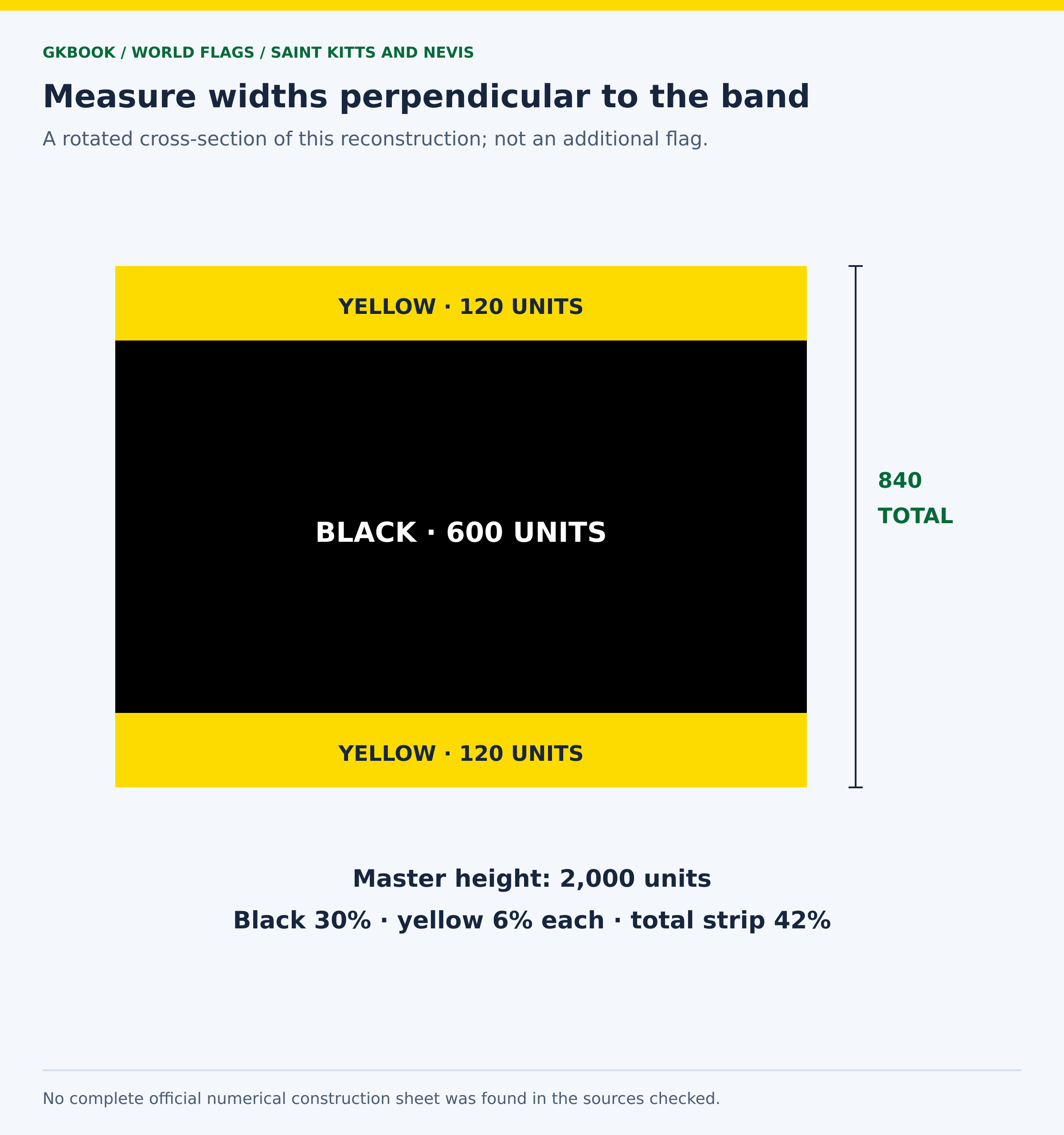
A diagonal width should be measured perpendicular to the band’s long edges. Measuring only the vertical distance between those edges produces a different number because the strip is inclined. The construction diagrams make this distinction explicit, helping readers reproduce a consistent border instead of widening it accidentally near one end.
The ministry description establishes the band’s color, direction, and yellow edging, but the sources checked did not yield a complete numerical construction sheet. This package therefore documents its exact widths as editorial reconstruction choices. Their precision makes the files reproducible; it does not turn them into government-certified measurements.
What do the yellow borders represent?
Yellow represents sunshine throughout the year. Two narrow yellow strips border the black diagonal, one toward the green field and one toward the red field. The ministry identifies the yellow reference as Pantone Yellow 108C. The border is also called fimbriation, a term for a narrow contrasting edging in flag descriptions.

The two visible strips follow parallel lines along the sides of the black band. They are not yellow outlines around individual stars and do not form a frame around the entire rectangle. At the edges of the flag, the diagonal strips are simply cut off by the rectangular boundary.
This reconstruction gives each strip the same perpendicular width. The color swatch records the screen fill separately from the ministry’s physical reference. Although descriptions may use the everyday word gold for a yellow edging, this drawing introduces no extra metallic effect, gradient, or sixth flag color.
What do the two white stars mean?
The two white five-pointed stars represent hope and liberty in the official explanation. Both sit inside the black diagonal and share the same inclined orientation in the official illustrations examined. Their number and shape are part of the national design; the sources do not assign a separate official meaning to each individual point.

Count the outward tips of each star, not the alternating inward corners. A five-pointed outline has ten alternating outer and inner vertices when drawn as a simple filled polygon. The white shape remains wholly inside the black area, with dark space separating its tips from the surrounding yellow edges.
The gallery enlarges one star to explain the construction while keeping teaching labels outside the emblem. Those labels are not additions to the national flag. The regular pentagram geometry and precise angle used in these files are disclosed drawing conventions guided by the observed official appearance.
Does each star stand for one of the two islands?
The official explanation identifies the two stars with hope and liberty, rather than explicitly assigning one star to Saint Kitts and the other to Nevis. Their number naturally invites a two-island association, but that inference should not replace the published symbolism. The complete national flag represents the federation of both islands.

It is useful to separate a design’s official interpretation from associations a viewer may reasonably notice. Two stars and two principal islands can suggest a connection, yet a suggested connection does not establish an official one-to-one key. The sources checked do not label a particular star as Saint Kitts or Nevis.
For an exam answer or a museum-style caption, use hope and liberty as the stated meaning. If discussing other interpretations, identify them as interpretations. Avoid pointing to the lower or upper star and presenting an island assignment as a documented feature of the original design.
What is the flag’s height to length ratio?
This guide uses a height to length ratio of 2:3, equivalent to a length to height ratio of 3:2. The ministry’s protocol page explicitly gives 3:2 for flags on land and at sea. Its separate reference to a standard size of 3 by 5 feet is inconsistent with that ratio.

The inconsistency matters: a rectangle three feet high and five feet long has a 3:5 ratio, not 2:3. This reconstruction follows the explicit ratio statement and the approximately matching government illustration, while recording the conflicting size entry. It does not silently convert one specification into the other.
A 90 by 60 centimeter rectangle and a 1,500 by 1,000 pixel image both have the chosen 3:2 width to height relationship. These are proportional examples, not additional official textile sizes. Measure the flag rectangle alone, excluding the pole, ties, surrounding page margins, or a display frame.
Which way does the diagonal band run?
In the usual front view with the hoist at the left, the black band rises from the lower left toward the upper right. More precisely, it runs from lower hoist to upper fly. Those attachment-based terms remain useful when the opposite side is visible and apparent left and right have exchanged places.
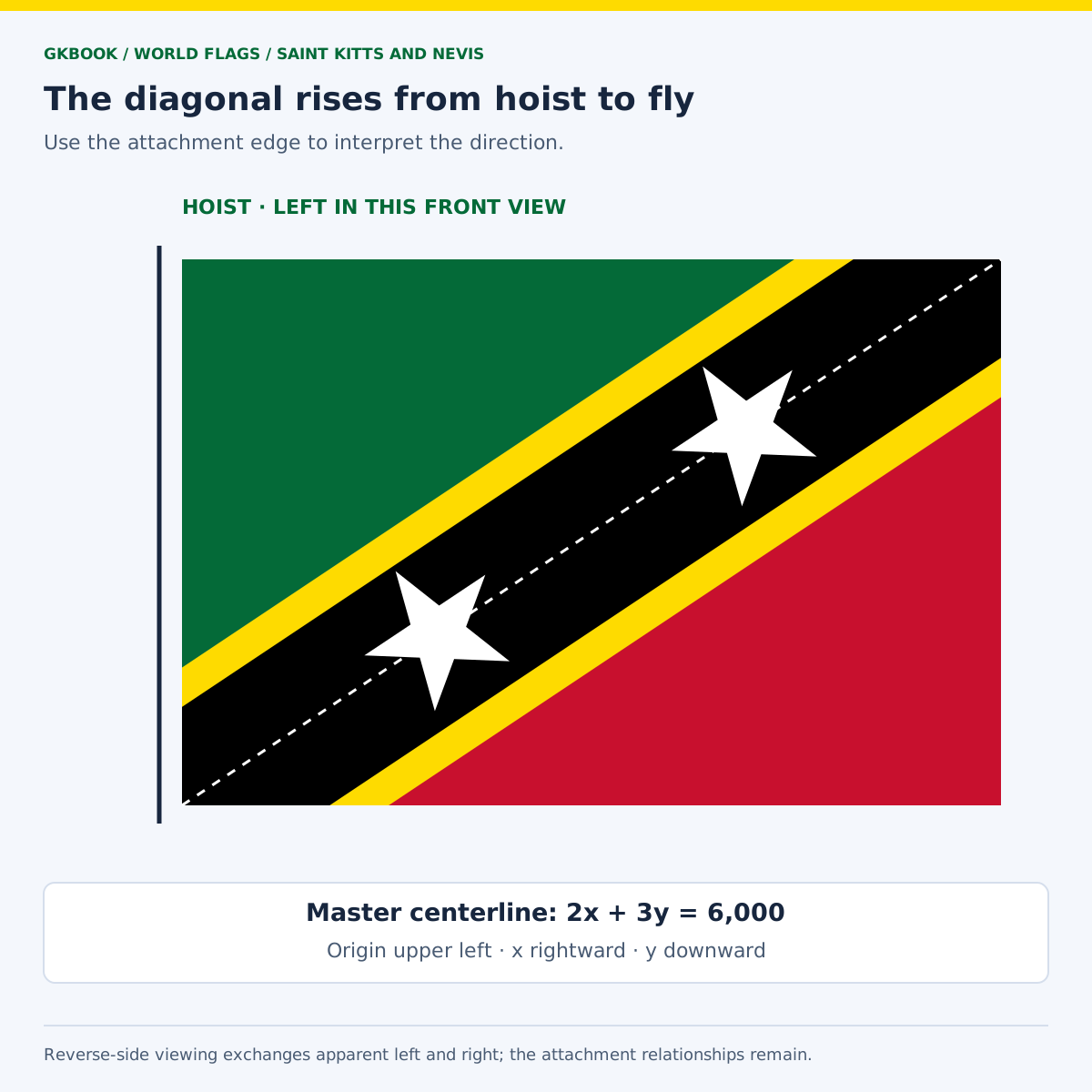
The centerline connects opposite corners of the underlying rectangle. With coordinates measured rightward and downward from the upper left, the master’s centerline is 2x + 3y = 6,000. That equation describes the editorial drawing on a 3,000 by 2,000 canvas; the complete black strip has a finite width around it.
The yellow borders run parallel to this centerline. A descending diagonal in a front-view drawing with the hoist still at the left would change the design. Before judging a photograph, however, check whether the pole is on the opposite side and whether the image has been mirrored.
How wide are the black band and yellow borders?
The sources checked describe the yellow-edged black band without supplying a complete numerical construction specification. This reconstruction uses a black width of 600 units and yellow edges of 120 units each on a 2,000-unit-high canvas. All three measurements are perpendicular to the diagonal and are explicitly editorial choices, not certified official dimensions.

The total yellow-and-black strip is 840 units wide, calculated as 120 + 600 + 120. Relative to the master height, the black band is 30 percent, each yellow border is 6 percent, and the complete strip is 42 percent. These percentages describe this package’s chosen geometry only.
The official illustrations provide a visual reference for a broad black band and narrower yellow edges. They are not treated as pixel-perfect technical drawings. Keeping the measurements in a separate specification makes a later correction possible without pretending that a reconstructed value was originally printed in a government standard.
How are the stars positioned and drawn in these images?
The master places equal stars at coordinates (937.5, 1,375) and (2,062.5, 625), measured from the upper left of a 3,000 by 2,000 rectangle. Each has an outer radius of 280 units. These positions, dimensions, regular pentagram outlines, and exact angular alignment are disclosed editorial conventions guided by the official illustrations.

Both centers lie on the diagonal centerline and are equally spaced from the midpoint. One outer tip of each star points toward the green side, perpendicular to the band. The remaining tips occur at equal 72 degree intervals. The inner radius follows the regular pentagram relationship, rather than an arbitrary rounded star shape.
A radius of 280 is smaller than the black strip’s half-width of 300, so each entire star fits within the black band. This containment is checked mathematically and in the rendered image. It establishes internal consistency with the declared drawing choices, not official certification of those choices.
How can I draw the Saint Kitts and Nevis flag accurately?
Begin with a 3:2 rectangle, place green toward the upper hoist and red toward the lower fly, then add the rising yellow-edged black diagonal and two white stars. Use a single consistent geometric specification. Here, the overall design and ratio statement are official references; detailed widths, star coordinates, and screen colors are disclosed reconstructions.

Build the layers in a controlled order: red background, green area, broad yellow strip, narrower black strip, and finally the two stars. Clip the diagonal shapes to the outer rectangle. This prevents stray corners outside the flag and keeps the yellow edges parallel instead of tapering them by eye.
The clean download contains no title, dimensions, pole, border, or shadow. Construction guides surround separate teaching illustrations. Check the proportions and star containment before exporting, and preserve the same geometry when changing resolution. A precise digital file should also explain which dimensions are supported by official text and which are editorial.
What is the history of the national flag?
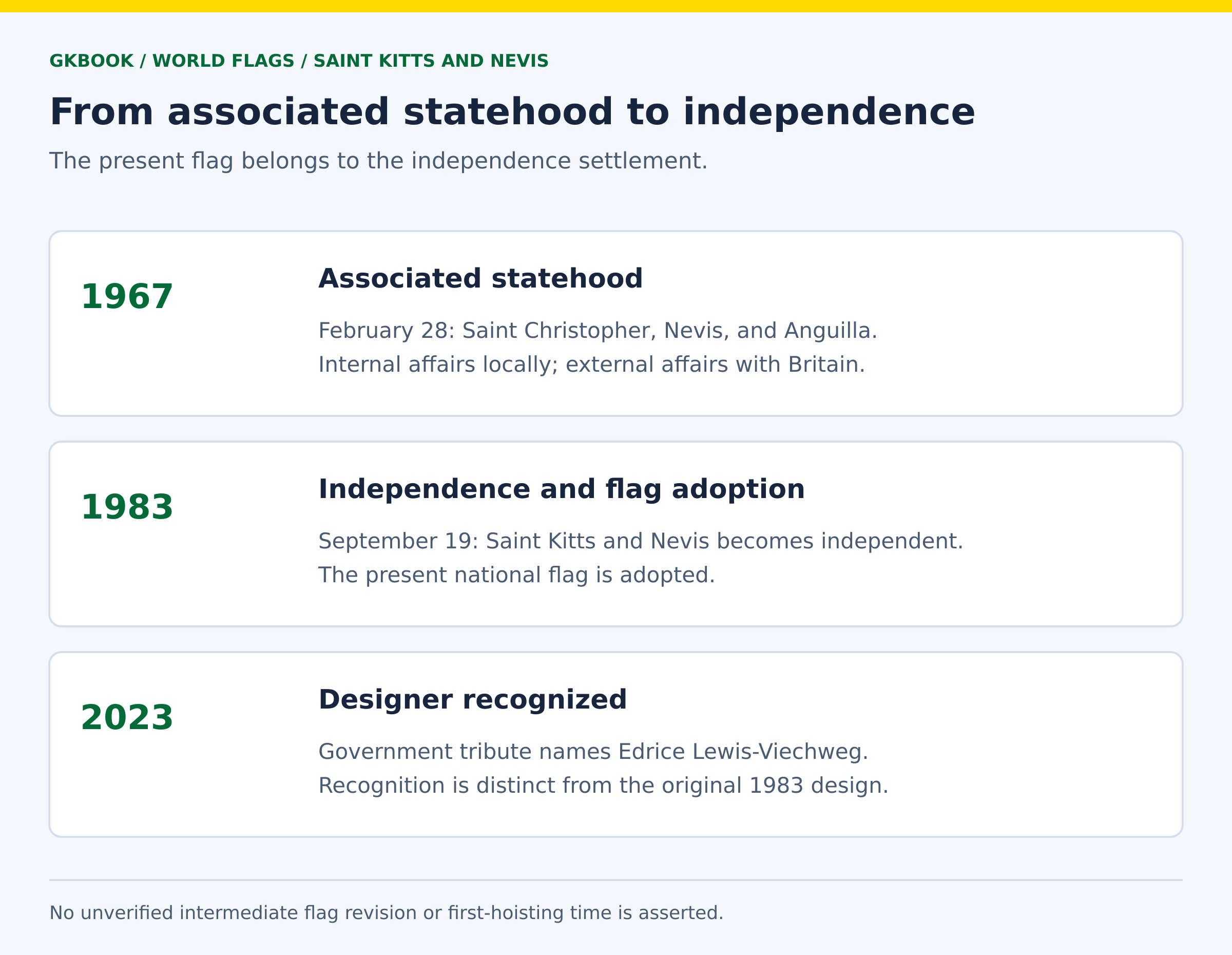
The present national flag belongs to the independence settlement of 1983. It followed the earlier period of associated statehood involving Saint Christopher, Nevis, and Anguilla. Edrice Lewis designed the winning national flag, and Saint Kitts and Nevis adopted it on September 19, 1983, when the federation became independent.

The National Archives distinguishes the 1967 associated-state arrangement from full independence. Under associated statehood, local government had responsibility for internal affairs while Britain retained responsibility for external affairs. Independence in 1983 therefore marks a constitutional change, not merely a new illustration on an unchanged political arrangement.
The historical timeline separates these milestones from later recognition of the designer. It does not invent an intermediate flag revision or reproduce an archival ceremony as if it were a new photograph. The present design should be identified with its 1983 adoption, even when an official web page or brochure was published much later.
When was the Saint Kitts and Nevis flag adopted?
The national flag was adopted on September 19, 1983, the date Saint Kitts and Nevis became independent. The federal government’s national-symbols account gives that adoption date, and the National Archives independently describes the independence milestone. A later brochure, web publication, or tribute to the designer does not change the original adoption date.

Write the full date when historical precision matters. The year alone is sufficient for a compact label, but it should not be replaced by the publication year of the source consulted. The government’s flag illustration, a 2018 national-symbols brochure, and a 2023 tribute are later presentations of an already established national symbol.
This guide does not attach an unverified minute, location, or eyewitness narrative to the first raising. Its adoption statement stays within the documented date and political milestone. The timeline likewise distinguishes adoption from subsequent commemorations rather than treating every official mention as a redesign.
Who designed the Saint Kitts and Nevis flag?
Edrice Lewis designed the national flag through a national competition, according to the federal government’s national-symbols account. A 2023 government information release identifies her as Edrice Lewis-Viechweg and recognizes her contribution to national identity. Some official materials use the spelling Edris; this guide follows the federal page’s Edrice spelling.

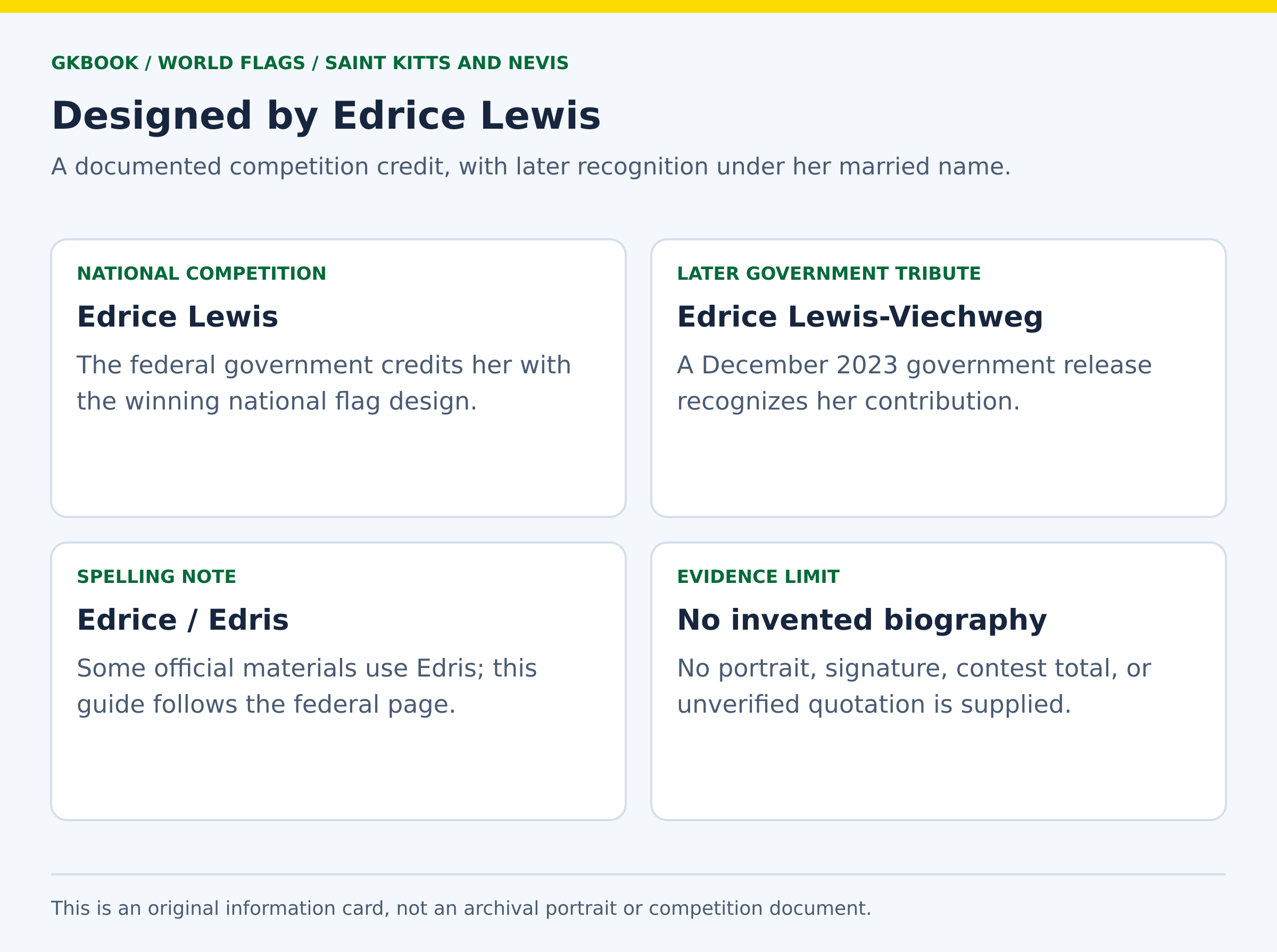
The later surname identifies the same credited designer in the government’s recognition story; it does not establish a second designer or a later adoption. Keeping the original competition credit beside the later form of her name helps readers connect records written at different times without constructing an unsupported biography.
The designer card is typographic, with no invented portrait or signature. The sources used here support the name, competition connection, and later recognition. They do not justify adding an exact number of contest submissions, a detailed judging narrative, or a personal quotation that has not been checked in an original record.
How does 1967 statehood differ from 1983 independence?
Associated statehood began on February 28, 1967, for Saint Christopher, Nevis, and Anguilla, while the independent federation of Saint Kitts and Nevis dates from September 19, 1983. These are different political milestones. The current national flag belongs to the 1983 independence period, not to the initial establishment of associated statehood.

The National Archives describes the 1967 arrangement as providing responsibility for internal affairs while external affairs remained with Britain. The later independence settlement concerned the two-island federation. Using the historical name with Anguilla in its proper period prevents an old administrative grouping from being mistaken for the present country.
This history card compares constitutional stages rather than attempting a precise facsimile of a predecessor flag from an unmeasured photograph. An old parade image can document that a flag was used, but it does not by itself establish exact pigment values, dimensions, or the geometry of every feature shown.
Why are both Saint Kitts and Saint Christopher used?
Saint Kitts is another name for Saint Christopher. Section 1 of the Constitution explicitly recognizes that naming relationship and allows the federation to be styled Saint Christopher and Nevis or Saint Kitts and Nevis. These names refer to the same country in this context, not to two different national flags.

The constitutional wording helps explain why archival records often use Saint Christopher while current public-facing descriptions commonly use Saint Kitts. A shortened form such as St. Kitts is a writing convention, not a change in national identity. The article’s main title uses the fully written Saint Kitts and Nevis.
Always read a constitutional provision in its proper setting. Text proposing how provisions would read after a hypothetical constitutional change should not be mistaken for the currently stated national name. Here the naming explanation follows the main Section 1, which identifies the federation and both islands together.
Does the flag represent Saint Kitts, Nevis, or both?
The national flag represents the federation of Saint Kitts and Nevis as a whole. The Constitution identifies a sovereign democratic federal state comprising the two islands. Its use at a federal ceremony therefore does not designate only Saint Kitts, and the presence of two stars does not create separate national flags for each island.
Nevis has its own island administration within the federation, and its official national-symbols page presents the same national flag and principal meanings. That institutional setting is different from describing Nevis as a separate sovereign country. The flag’s national role should be clear before discussing local offices or island-specific ceremonies.
A caption can name the particular island where a photograph was taken without narrowing what the national flag represents. Similarly, a government office on either island may display a federal symbol. Keep geographical location, administrative responsibility, and the identity represented by the flag distinct when interpreting such scenes.
Is the coat of arms or national motto on the flag?
No. The national flag contains the green and red fields, the yellow-edged black diagonal, and two white stars. The full coat of arms and the motto Country Above Self are separate national-symbol elements. Adding them, a country name, or an inscription to the clean flag would change the design described by official sources.

Government national-symbols pages present the flag alongside the coat of arms and anthem. Their appearance on one page does not combine them into one emblem. A coat of arms can contain more detailed imagery and lettering while the flag remains a simpler arrangement intended to be recognized at a distance.
Place an explanatory title outside the rectangle when preparing a classroom poster or reference card. This gallery follows that approach: labels and measurements belong to the surrounding educational composition. The downloadable clean flag retains only the specified visual elements, with no motto, decorative crest, or additional sun.
What guidance applies to respectful flag display?
The foreign ministry’s protocol guidance calls for a flag in good condition, free from fading or bleaching, with tears repaired before hoisting. It also describes a white flagstaff and rules for placement, raising, and lowering. These are ministry protocol instructions; this guide does not present them as a complete statement of every applicable law.

Condition and placement are separate from the printed design. A correct pattern can still be displayed carelessly if the cloth is damaged or allowed to drag. The ministry also discourages added lettering and advertising uses. Such guidance should not be converted into an unsupported claim that every possible commercial use has been cleared.
For a real ceremony, consult the responsible organizer about the applicable instructions and occasion. The diagrams here explain general relationships, not current official schedules. They do not claim that an educational download certifies a physical flag, authorizes a particular product, or supplies a complete legal opinion.
How should it be displayed beside other countries’ flags?
The ministry’s guidance says that national flags displayed together should use separate staffs of the same height and, as far as possible, flags of the same size. No national flag should be placed above another. This international equality rule should be distinguished from precedence rules involving domestic organizations or other non-national flags.

The international display diagram therefore shows equal-height staffs and equal-size rectangular placeholders. It explains the relationship without inventing another country’s flag or elevating Saint Kitts and Nevis above a foreign national flag. Equal treatment concerns the complete arrangement, including the height and comparable visual scale of the flags.
Do not apply a general instruction about giving the national flag prominence over organizational flags indiscriminately to a group of sovereign national flags. The ministry addresses the international case separately. For a specific diplomatic event, the host’s protocol arrangements can also determine ordering and ceremonial details beyond this basic diagram.
Which side is correct on a platform or crossed display?
For a speaker’s platform, the ministry places the flag on the speaker’s right, which is the audience’s left. In a crossed-staff display against a wall, it places the national flag on the observer’s left with its staff in front. Naming whose viewpoint is used prevents a simple left-right instruction from becoming misleading.
The speaker and the audience face opposite directions, so their right-hand sides are not the same. A stage plan should label both viewpoints before positioning the flag. The platform instruction should also not be transferred automatically to a flag located elsewhere in an auditorium, which the ministry discusses separately.
Crossed staffs add another relationship: one staff lies in front of the other. That is independent of which flag appears on the observer’s left. These examples concern a particular display arrangement and do not alter the flag’s internal diagonal, color order, star positions, or front-view convention.
Where does the flag belong in a procession?
The ministry’s parade guidance places the national flag on the marching right when carried with another flag, or in front of the center of a line of flags. Marching right means the participants’ right as they move forward. It should not be confused with the right side of a photograph taken from the front.
A viewer facing an approaching procession sees the marchers’ right on the viewer’s left. Photograph captions can therefore misidentify the position if they omit the direction of movement. Establish that direction before comparing an image with the written protocol instruction, particularly when the formation is turning or the photograph is cropped.
The flag remains the same national design during a parade. Its pole, bearer, and direction of travel belong to the ceremonial arrangement, not to the clean downloadable artwork. This guide explains the ministry’s general placement wording without claiming to provide a complete marching drill or an event-specific order.
How is the flag lowered for mourning?
The ministry describes half-mast as lowering the flag by its own depth from the peak of the staff, not automatically to the staff’s midpoint. It should first be raised to the peak, then lowered; before final lowering, it is raised to the peak again. The applicable official mourning instruction determines when this procedure is used.

The flag’s depth means its vertical height. On a drawing of a 200-unit-high flag, the illustrated drop is therefore 200 units below the peak. The exact height of the pole does not turn that instruction into a fixed percentage of the staff. The mourning diagram marks the drop directly.
Mourning affects the position of the flag, not its colors or the number of stars. No current mourning order is inferred from this general rule, and an undated image cannot establish one. An actual ceremony must follow the authorized instruction for its occasion and duration.
What does the reverse side of the flag look like?
Viewing the same flag from the opposite side produces a horizontal reflection. With the hoist now on the viewer’s right, green appears at the upper right, red at the lower left, and the diagonal descends from upper left to lower right. The stars reflect with the rest of the design; this is not an upside-down flag.
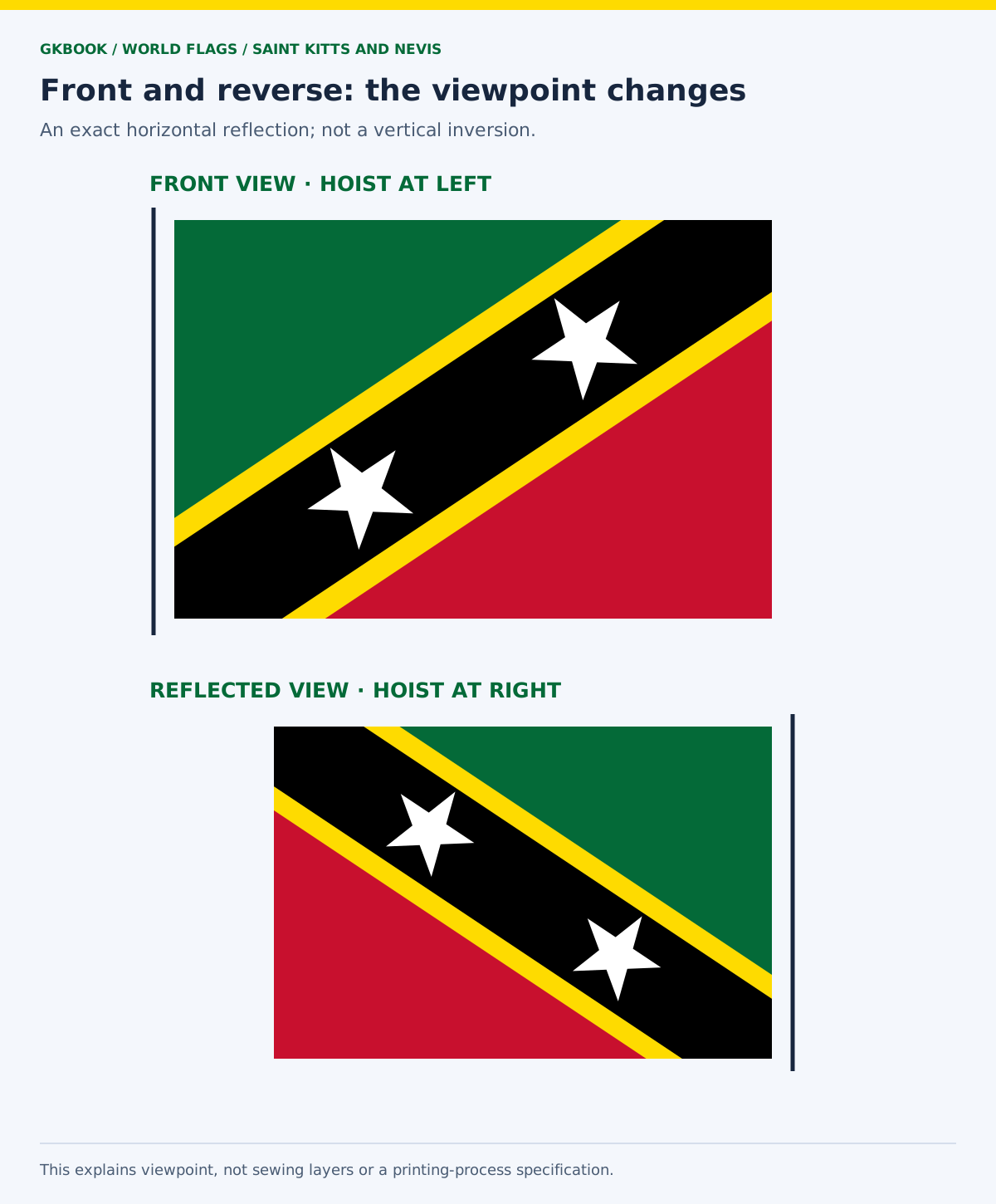
Hoist and fly remain attached to the same physical edges even though their apparent positions change. A diagram with the pole shown on each side makes that relationship clearer than a bare instruction to reverse the colors. A vertical inversion would exchange top and bottom instead and is a different operation.
The reverse illustration uses an exact horizontal reflection of the master artwork. It is a lesson in viewpoint, not a specification for sewing two panels or setting up a printing press. Check which side is visible before calling a photographed diagonal or inclined star orientation incorrect.
How should the flag be reproduced digitally?
Keep the flag rectangle at a 3:2 width to height ratio and preserve the diagonal, yellow edges, and two white stars. Use SVG for scalable artwork or PNG for a fixed raster image. The supplied numerical screen colors and detailed construction dimensions are documented editorial choices, not certified physical manufacturing specifications.

The clean SVG uses a 3,000 by 2,000 coordinate system, and the main PNG is 6,000 by 4,000 pixels. Both are complete opaque flags without labels, poles, or shadows. Diagram canvases include surrounding explanation and therefore should not be mistaken for the dimensions of the flag itself.
Contain the whole rectangle within a layout instead of stretching or cropping it. Cropping can remove a star or alter the apparent diagonal, while stretching distorts the star geometry. The separate 1,200 by 630 social card has a wider canvas but contains a complete flag at the correct internal proportions.
What are common mistakes in pictures of this flag?
Common errors include reversing the front-view diagonal, swapping the green and red fields, omitting yellow edges, or drawing the wrong number of star points. Captions can also misstate the official star symbolism, confuse 1967 with 1983, or present reconstructed dimensions and RGB values as official specifications. Accurate presentation requires checking both image and explanation.
Start with the attachment edge: green belongs toward the upper hoist and red toward the lower fly. Confirm two white five-pointed stars inside the black band, with parallel yellow borders on both sides. If the hoist appears at the right, consider the reverse view before deciding that the image is wrong.
Then review the accompanying claims. The ministry page contains a size inconsistency, so an honest construction reference should disclose its chosen basis. Likewise, a polished drawing does not validate an invented contest statistic, a separate meaning for each star point, or an unsupported story about a later redesign.
Which Saint Kitts and Nevis flag pictures can I download?
The gallery provides 24 subjects, each in SVG and PNG, including the clean flag, color swatches, star and band diagrams, historical timelines, and protocol explanations. A separate social card is also included. All are original vector compositions; the historical and designer cards explain documented facts without inventing archival photographs or a portrait.
Choose the clean flag when you need only the national design. Use the construction illustrations for geometry, the color card for the reference distinction, and the timelines for adoption and statehood. Each subject has a caption and alternative text, while the credits identify the limits of the reconstruction.
Downloads are grouped in the picture gallery. The SVG labels remain editable, and PNG files offer a fixed rendering for applications without SVG support. Continue with other country guides through World Flags. The article’s FAQ uses the same direct answers as its question sections.
Download Saint Kitts and Nevis flag pictures
Download the clean national flag as SVG or 6,000 × 4,000 PNG. Its SVG coordinate system is 3,000 × 2,000, preserving a 3:2 width to height ratio.
The gallery contains 24 subjects, each with an SVG and PNG. The ministry’s explicit ratio is followed, while its conflicting 3 × 5 foot size entry is documented. Band widths, exact star geometry, and screen colors are declared editorial choices. Image credits and reproduction notes explain the construction basis and physical color references. The separate social card is 1,200 × 630 and contains a complete correctly proportioned flag.
Continue exploring national designs in World Flags.
World Flags/Saint Kitts and Nevis
Saint Kitts and Nevis flag pictures
Green upper hoist, red lower fly, and a rising yellow-edged black diagonal with two white five-pointed stars. Detailed dimensions and digital fills are disclosed editorial reconstruction choices.
Original GKBook vector reconstruction. Official design, symbolism, ratio statement and physical color references are distinguished from editorial band widths, star geometry and RGB approximations.Download SVGDownload PNGFive ministry references are paired with the package’s separately declared RGB and hex fills. No certified physical-to-digital conversion is claimed.
Original GKBook vector reconstruction. Official design, symbolism, ratio statement and physical color references are distinguished from editorial band widths, star geometry and RGB approximations.Download SVGDownload PNGOfficial descriptions associate the fields, edging, band, and stars with land, history, climate, heritage, hope, and liberty.
Original GKBook vector reconstruction. Official design, symbolism, ratio statement and physical color references are distinguished from editorial band widths, star geometry and RGB approximations.Download SVGDownload PNGThe red element is shown in its proper position with its official meaning and physical color reference.
Original GKBook vector reconstruction. Official design, symbolism, ratio statement and physical color references are distinguished from editorial band widths, star geometry and RGB approximations.Download SVGDownload PNGThe black element is shown in its proper position with its official meaning and physical color reference.
Original GKBook vector reconstruction. Official design, symbolism, ratio statement and physical color references are distinguished from editorial band widths, star geometry and RGB approximations.Download SVGDownload PNGThe yellow element is shown in its proper position with its official meaning and physical color reference.
Original GKBook vector reconstruction. Official design, symbolism, ratio statement and physical color references are distinguished from editorial band widths, star geometry and RGB approximations.Download SVGDownload PNGEnlarged stars on black explain the official meanings. The teaching labels do not establish which physical star means hope or liberty.
Original GKBook vector reconstruction. Official design, symbolism, ratio statement and physical color references are distinguished from editorial band widths, star geometry and RGB approximations.Download SVGDownload PNGThe country comprises two islands, but the published star symbolism is hope and liberty.
Original GKBook vector reconstruction. Official design, symbolism, ratio statement and physical color references are distinguished from editorial band widths, star geometry and RGB approximations.Download SVGDownload PNGThis reconstruction follows the ministry’s explicit 3:2 length-to-height statement. The same page also lists a conflicting 3 by 5 foot size; that inconsistency is disclosed.
Original GKBook vector reconstruction. Official design, symbolism, ratio statement and physical color references are distinguished from editorial band widths, star geometry and RGB approximations.Download SVGDownload PNGThe black band runs from lower hoist to upper fly. The coordinate equation belongs to the editorial master; the dashed line is a teaching guide.
Original GKBook vector reconstruction. Official design, symbolism, ratio statement and physical color references are distinguished from editorial band widths, star geometry and RGB approximations.Download SVGDownload PNGWidths are measured at right angles to the diagonal. Black 600 plus yellow 120 on each side gives an 840-unit strip on the 2,000-unit-high master. These are reconstruction choices.
Original GKBook vector reconstruction. Official design, symbolism, ratio statement and physical color references are distinguished from editorial band widths, star geometry and RGB approximations.Download SVGDownload PNGEqual regular pentagrams are placed symmetrically on the band centerline. Radius 280 is smaller than the black half-width 300, keeping the stars inside black.
Original GKBook vector reconstruction. Official design, symbolism, ratio statement and physical color references are distinguished from editorial band widths, star geometry and RGB approximations.Download SVGDownload PNGLayer the fields, parallel diagonal strips, and stars, clipping the shapes at the rectangle. Exact widths and star geometry are declared editorial conventions.
Original GKBook vector reconstruction. Official design, symbolism, ratio statement and physical color references are distinguished from editorial band widths, star geometry and RGB approximations.Download SVGDownload PNGThe timeline separates the 1967 constitutional stage, the 1983 independence and adoption, and a later tribute to the designer.
Original GKBook vector reconstruction. Official design, symbolism, ratio statement and physical color references are distinguished from editorial band widths, star geometry and RGB approximations.Download SVGDownload PNGThe date is supported by the federal national-symbols account and the independence history. Later publication dates do not replace the adoption date.
Original GKBook vector reconstruction. Official design, symbolism, ratio statement and physical color references are distinguished from editorial band widths, star geometry and RGB approximations.Download SVGDownload PNGThe designer’s original competition credit is distinguished from later recognition and a spelling variant in official material.
Original GKBook vector reconstruction. Official design, symbolism, ratio statement and physical color references are distinguished from editorial band widths, star geometry and RGB approximations.Download SVGDownload PNGThe National Archives distinguishes associated statehood from full independence. The card compares stages without reconstructing an unmeasured predecessor flag.
Original GKBook vector reconstruction. Official design, symbolism, ratio statement and physical color references are distinguished from editorial band widths, star geometry and RGB approximations.Download SVGDownload PNGThe Constitution’s main Section 1 identifies the federation and explicitly recognizes Saint Kitts as another name for Saint Christopher.
Original GKBook vector reconstruction. Official design, symbolism, ratio statement and physical color references are distinguished from editorial band widths, star geometry and RGB approximations.Download SVGDownload PNGThe current national flag does not contain the full coat of arms or motto. Labels in teaching cards remain outside the flag rectangle.
Original GKBook vector reconstruction. Official design, symbolism, ratio statement and physical color references are distinguished from editorial band widths, star geometry and RGB approximations.Download SVGDownload PNGThe foreign ministry gives condition, staff, and use guidance. This overview is not a complete statement of every applicable law.
Original GKBook vector reconstruction. Official design, symbolism, ratio statement and physical color references are distinguished from editorial band widths, star geometry and RGB approximations.Download SVGDownload PNGSeparate staffs have the same height; flags should be the same size as far as possible. No national flag is placed above another. The gray rectangle is explicitly a placeholder.
Original GKBook vector reconstruction. Official design, symbolism, ratio statement and physical color references are distinguished from editorial band widths, star geometry and RGB approximations.Download SVGDownload PNGThe illustrated flag is 200 units high and its top is lowered 200 units from the peak. This diagram demonstrates the ministry’s depth-based wording without asserting a current mourning order.
Original GKBook vector reconstruction. Official design, symbolism, ratio statement and physical color references are distinguished from editorial band widths, star geometry and RGB approximations.Download SVGDownload PNGHorizontal reflection moves green to upper right and red to lower left; the hoist also appears at the right. The stars and diagonal reflect with the complete design.
Original GKBook vector reconstruction. Official design, symbolism, ratio statement and physical color references are distinguished from editorial band widths, star geometry and RGB approximations.Download SVGDownload PNGAll clean flag sizes retain a 3:2 width to height ratio. The separate social card contains a complete flag rather than stretching it across the wider canvas.
Original GKBook vector reconstruction. Official design, symbolism, ratio statement and physical color references are distinguished from editorial band widths, star geometry and RGB approximations.Download SVGDownload PNGFrequently asked questions
What does the Saint Kitts and Nevis flag look like?
The flag of Saint Kitts and Nevis has a green upper hoist and a red lower fly, divided by a yellow-edged black diagonal rising toward the upper fly. Two white five-pointed stars lie on the black band. The national flag uses a height to length ratio of 2:3.
What are the colors of the Saint Kitts and Nevis flag?
The flag uses green, red, yellow, black, and white. The Ministry of Foreign Affairs lists Pantone references for the colors, including Green 349C, Red 186C, Yellow 108C, Black C, and White. The RGB and hexadecimal fills in this guide are declared screen approximations, not certified conversions of those physical references.
What does the Saint Kitts and Nevis flag mean?
Official explanations connect green with fertile lands, red with the struggle from slavery through colonialism to independence, yellow with year-round sunshine, and black with African heritage. The two white stars represent hope and liberty. These associations describe the intended symbolism of the national design, rather than meanings inferred from its colors alone.
What does the green area represent?
Green represents the country’s fertile lands. In the conventional front view, it occupies the area toward the upper hoist, above the diagonal band. The hoist is the edge attached to the pole. Green is therefore identified by its relationship to the attachment and diagonal, rather than simply by the word left.
What does the red area represent?
Red represents the struggle from slavery through colonialism to independence in the official account. It occupies the lower fly area, below the yellow-edged black diagonal in a front view. The fly is the edge away from the pole. This historical meaning is more specific than a generic association between red and courage.
What does the black diagonal band represent?
The black band represents African heritage. It runs diagonally from the lower hoist toward the upper fly and contains both white stars. Yellow borders separate it from the green and red fields. Its direction and contrasting edges are essential features of the design, not decorative additions around an ordinary two-color flag.
What do the yellow borders represent?
Yellow represents sunshine throughout the year. Two narrow yellow strips border the black diagonal, one toward the green field and one toward the red field. The ministry identifies the yellow reference as Pantone Yellow 108C. The border is also called fimbriation, a term for a narrow contrasting edging in flag descriptions.
What do the two white stars mean?
The two white five-pointed stars represent hope and liberty in the official explanation. Both sit inside the black diagonal and share the same inclined orientation in the official illustrations examined. Their number and shape are part of the national design; the sources do not assign a separate official meaning to each individual point.
Does each star stand for one of the two islands?
The official explanation identifies the two stars with hope and liberty, rather than explicitly assigning one star to Saint Kitts and the other to Nevis. Their number naturally invites a two-island association, but that inference should not replace the published symbolism. The complete national flag represents the federation of both islands.
What is the flag’s height to length ratio?
This guide uses a height to length ratio of 2:3, equivalent to a length to height ratio of 3:2. The ministry’s protocol page explicitly gives 3:2 for flags on land and at sea. Its separate reference to a standard size of 3 by 5 feet is inconsistent with that ratio.
Which way does the diagonal band run?
In the usual front view with the hoist at the left, the black band rises from the lower left toward the upper right. More precisely, it runs from lower hoist to upper fly. Those attachment-based terms remain useful when the opposite side is visible and apparent left and right have exchanged places.
How wide are the black band and yellow borders?
The sources checked describe the yellow-edged black band without supplying a complete numerical construction specification. This reconstruction uses a black width of 600 units and yellow edges of 120 units each on a 2,000-unit-high canvas. All three measurements are perpendicular to the diagonal and are explicitly editorial choices, not certified official dimensions.
How are the stars positioned and drawn in these images?
The master places equal stars at coordinates (937.5, 1,375) and (2,062.5, 625), measured from the upper left of a 3,000 by 2,000 rectangle. Each has an outer radius of 280 units. These positions, dimensions, regular pentagram outlines, and exact angular alignment are disclosed editorial conventions guided by the official illustrations.
How can I draw the Saint Kitts and Nevis flag accurately?
Begin with a 3:2 rectangle, place green toward the upper hoist and red toward the lower fly, then add the rising yellow-edged black diagonal and two white stars. Use a single consistent geometric specification. Here, the overall design and ratio statement are official references; detailed widths, star coordinates, and screen colors are disclosed reconstructions.
What is the history of the national flag?
The present national flag belongs to the independence settlement of 1983. It followed the earlier period of associated statehood involving Saint Christopher, Nevis, and Anguilla. Edrice Lewis designed the winning national flag, and Saint Kitts and Nevis adopted it on September 19, 1983, when the federation became independent.
When was the Saint Kitts and Nevis flag adopted?
The national flag was adopted on September 19, 1983, the date Saint Kitts and Nevis became independent. The federal government’s national-symbols account gives that adoption date, and the National Archives independently describes the independence milestone. A later brochure, web publication, or tribute to the designer does not change the original adoption date.
Who designed the Saint Kitts and Nevis flag?
Edrice Lewis designed the national flag through a national competition, according to the federal government’s national-symbols account. A 2023 government information release identifies her as Edrice Lewis-Viechweg and recognizes her contribution to national identity. Some official materials use the spelling Edris; this guide follows the federal page’s Edrice spelling.
How does 1967 statehood differ from 1983 independence?
Associated statehood began on February 28, 1967, for Saint Christopher, Nevis, and Anguilla, while the independent federation of Saint Kitts and Nevis dates from September 19, 1983. These are different political milestones. The current national flag belongs to the 1983 independence period, not to the initial establishment of associated statehood.
Why are both Saint Kitts and Saint Christopher used?
Saint Kitts is another name for Saint Christopher. Section 1 of the Constitution explicitly recognizes that naming relationship and allows the federation to be styled Saint Christopher and Nevis or Saint Kitts and Nevis. These names refer to the same country in this context, not to two different national flags.
Does the flag represent Saint Kitts, Nevis, or both?
The national flag represents the federation of Saint Kitts and Nevis as a whole. The Constitution identifies a sovereign democratic federal state comprising the two islands. Its use at a federal ceremony therefore does not designate only Saint Kitts, and the presence of two stars does not create separate national flags for each island.
Is the coat of arms or national motto on the flag?
No. The national flag contains the green and red fields, the yellow-edged black diagonal, and two white stars. The full coat of arms and the motto Country Above Self are separate national-symbol elements. Adding them, a country name, or an inscription to the clean flag would change the design described by official sources.
What guidance applies to respectful flag display?
The foreign ministry’s protocol guidance calls for a flag in good condition, free from fading or bleaching, with tears repaired before hoisting. It also describes a white flagstaff and rules for placement, raising, and lowering. These are ministry protocol instructions; this guide does not present them as a complete statement of every applicable law.
How should it be displayed beside other countries’ flags?
The ministry’s guidance says that national flags displayed together should use separate staffs of the same height and, as far as possible, flags of the same size. No national flag should be placed above another. This international equality rule should be distinguished from precedence rules involving domestic organizations or other non-national flags.
Which side is correct on a platform or crossed display?
For a speaker’s platform, the ministry places the flag on the speaker’s right, which is the audience’s left. In a crossed-staff display against a wall, it places the national flag on the observer’s left with its staff in front. Naming whose viewpoint is used prevents a simple left-right instruction from becoming misleading.
Where does the flag belong in a procession?
The ministry’s parade guidance places the national flag on the marching right when carried with another flag, or in front of the center of a line of flags. Marching right means the participants’ right as they move forward. It should not be confused with the right side of a photograph taken from the front.
How is the flag lowered for mourning?
The ministry describes half-mast as lowering the flag by its own depth from the peak of the staff, not automatically to the staff’s midpoint. It should first be raised to the peak, then lowered; before final lowering, it is raised to the peak again. The applicable official mourning instruction determines when this procedure is used.
What does the reverse side of the flag look like?
Viewing the same flag from the opposite side produces a horizontal reflection. With the hoist now on the viewer’s right, green appears at the upper right, red at the lower left, and the diagonal descends from upper left to lower right. The stars reflect with the rest of the design; this is not an upside-down flag.
How should the flag be reproduced digitally?
Keep the flag rectangle at a 3:2 width to height ratio and preserve the diagonal, yellow edges, and two white stars. Use SVG for scalable artwork or PNG for a fixed raster image. The supplied numerical screen colors and detailed construction dimensions are documented editorial choices, not certified physical manufacturing specifications.
What are common mistakes in pictures of this flag?
Common errors include reversing the front-view diagonal, swapping the green and red fields, omitting yellow edges, or drawing the wrong number of star points. Captions can also misstate the official star symbolism, confuse 1967 with 1983, or present reconstructed dimensions and RGB values as official specifications. Accurate presentation requires checking both image and explanation.
Which Saint Kitts and Nevis flag pictures can I download?
The gallery provides 24 subjects, each in SVG and PNG, including the clean flag, color swatches, star and band diagrams, historical timelines, and protocol explanations. A separate social card is also included. All are original vector compositions; the historical and designer cards explain documented facts without inventing archival photographs or a portrait.
Explore all general-knowledge topics and the A-to-Z lists.








We Value Your Opinion Comments