
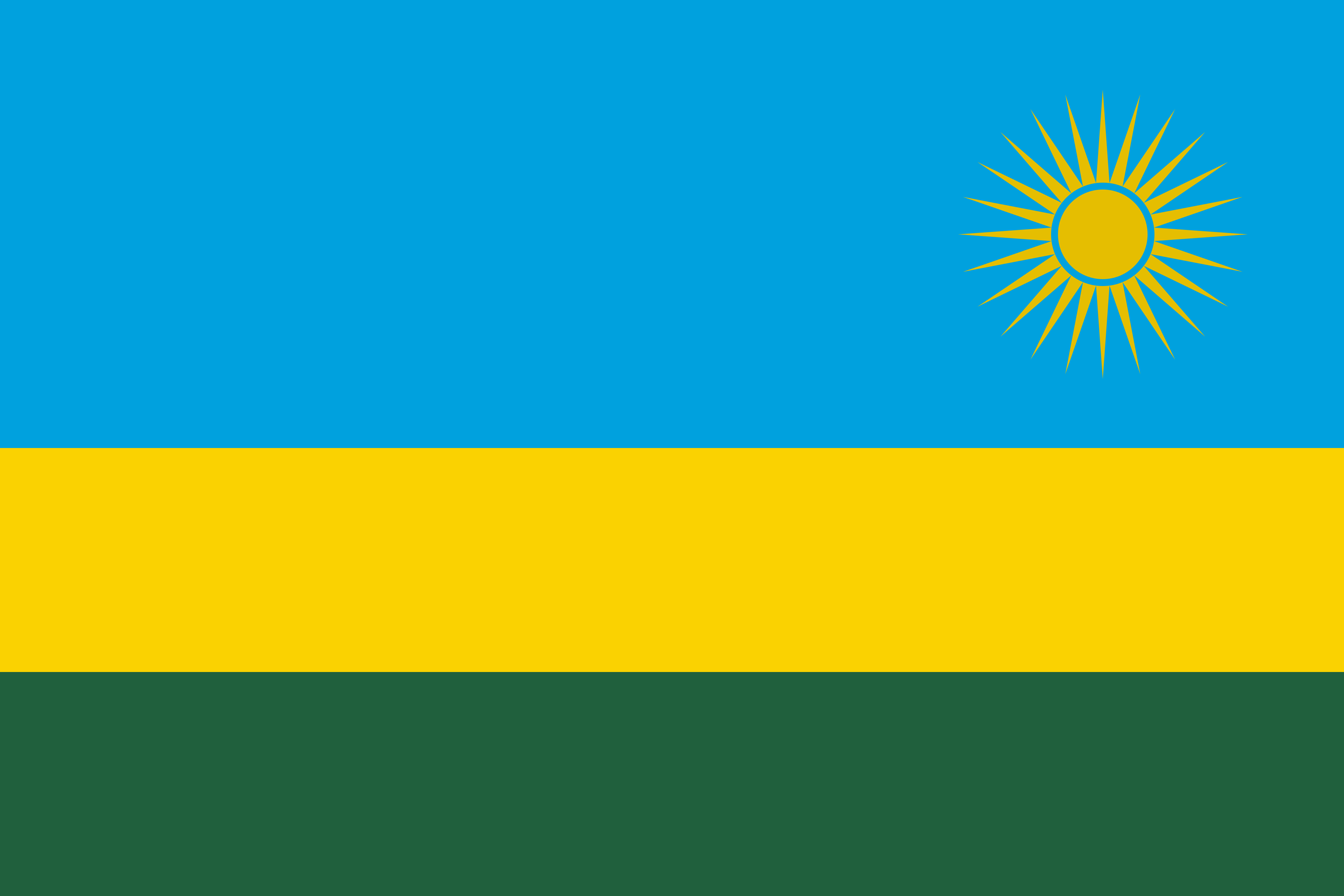
Rwanda flag picture
Explore the construction notes, history, and picture gallery.
| Design | Blue, yellow, green, and a golden sunThree horizontal bands; blue is twice as tall as either lower band. |
|---|---|
| Proportions | Height:length = 2:3Band heights = 2:1:1. |
| Sun | 24 rays and a blue ringAt the upper fly, away from the hoist. |
| Introduction | 2001October 25 parliamentary approval; December 31 public unveiling. |
| Drawing basis | Ordinary large: 195 × 130 cmLater order’s explicit measurements; ring/ray details and RGB are editorial. |
| Image sizes | SVG and PNGSVG: 3,900 × 2,600; PNG: 5,850 × 3,900. |
What does the Rwanda flag look like?
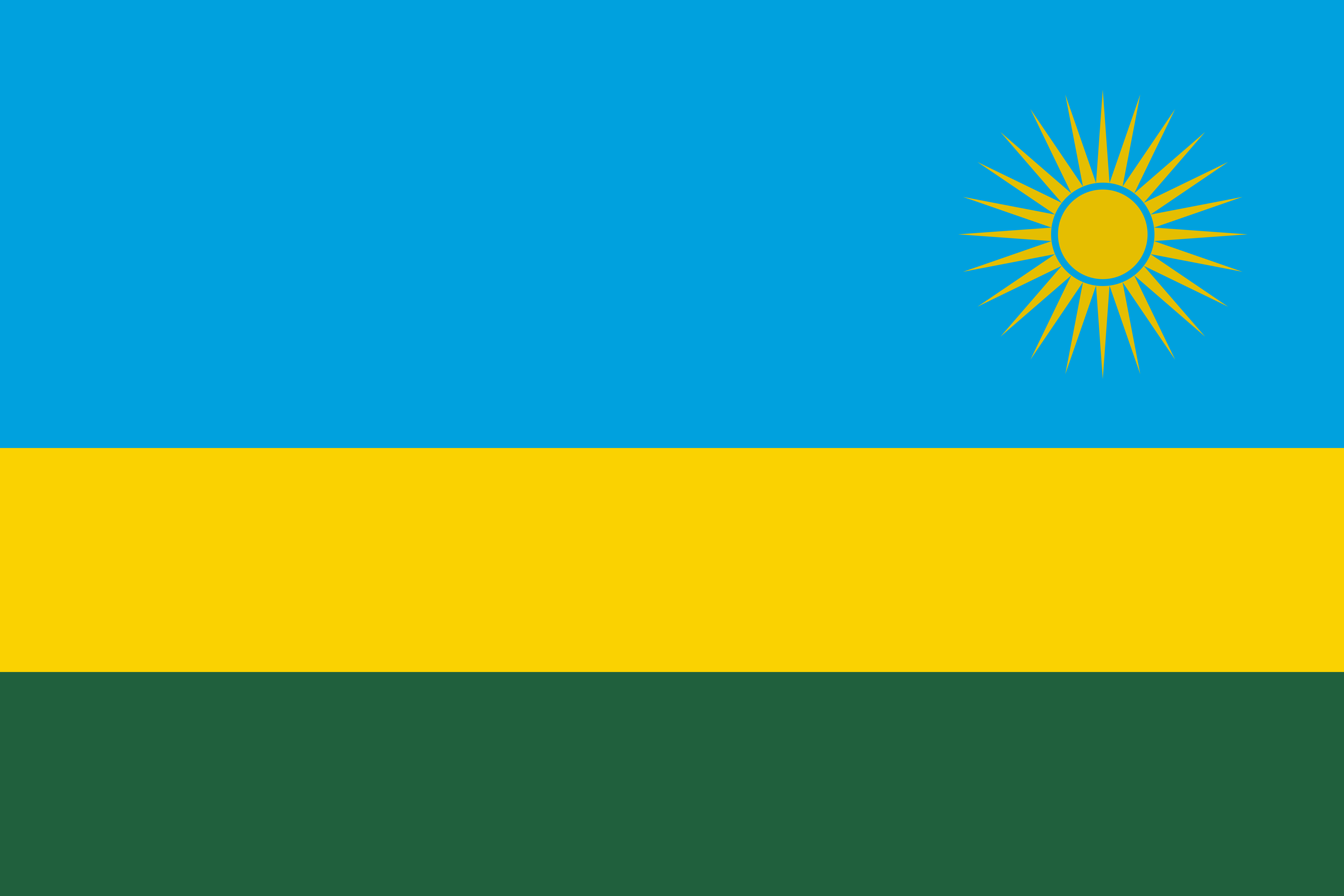
Rwanda’s national flag has a blue upper half, a yellow middle quarter, and a green lower quarter. A golden sun with 24 rays appears near the upper fly, separated from its rays by a blue ring. The rectangular flag has a height to length ratio of 2:3.
This guide connects the design with its official meanings, introduction in 2001, and later legal specifications. The gallery explains the unequal bands, sun construction, physical size variants, and the choices involved in a transparent digital reconstruction.
What are the colors of Rwanda’s flag?
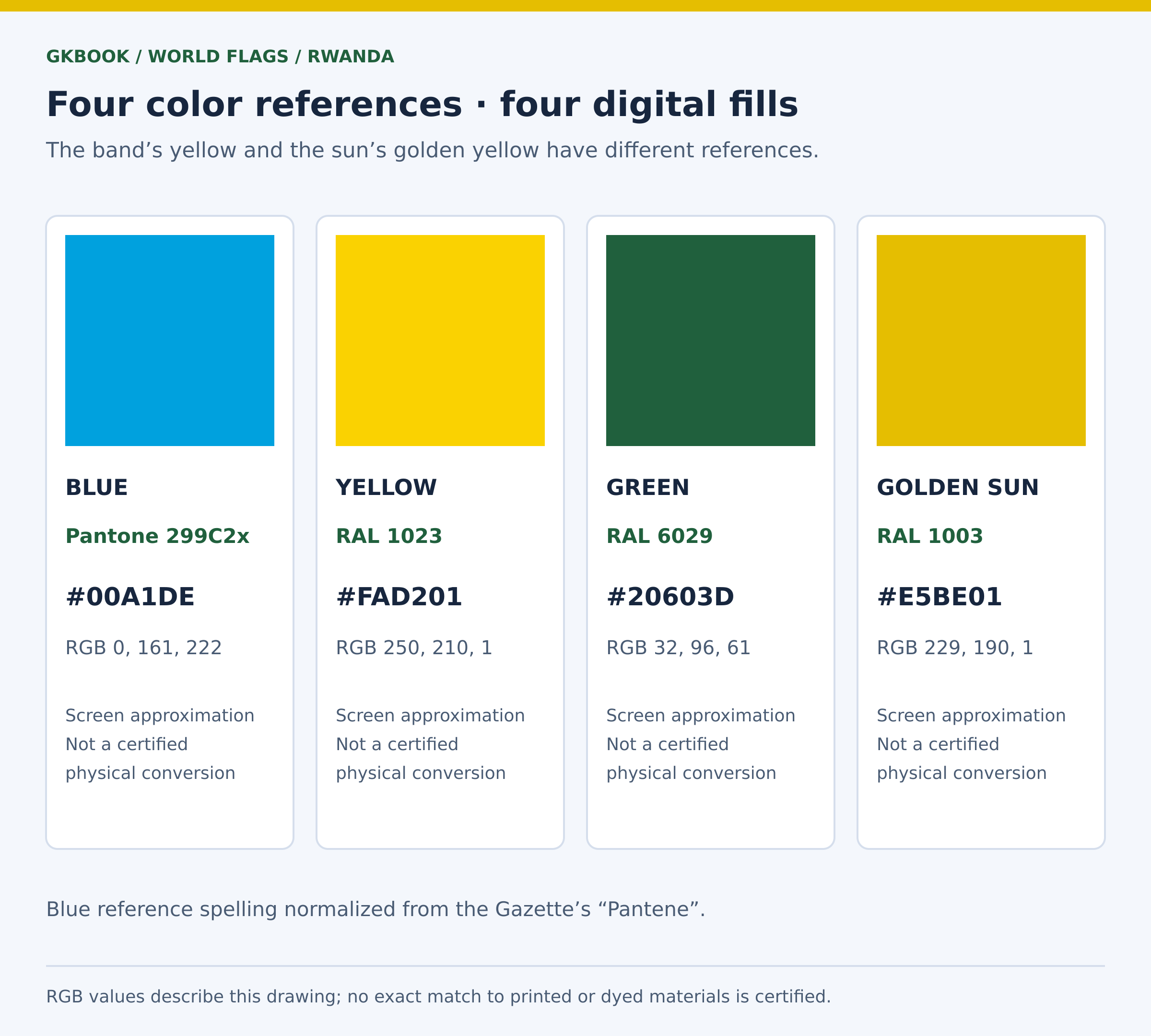
Rwanda’s flag combines blue, yellow, and green horizontal bands with a golden-yellow sun. The law distinguishes the band’s yellow from the sun’s gold and gives physical color references. This package uses four declared digital approximations; its RGB and hex values are editorial choices, not numerical values printed in the law.
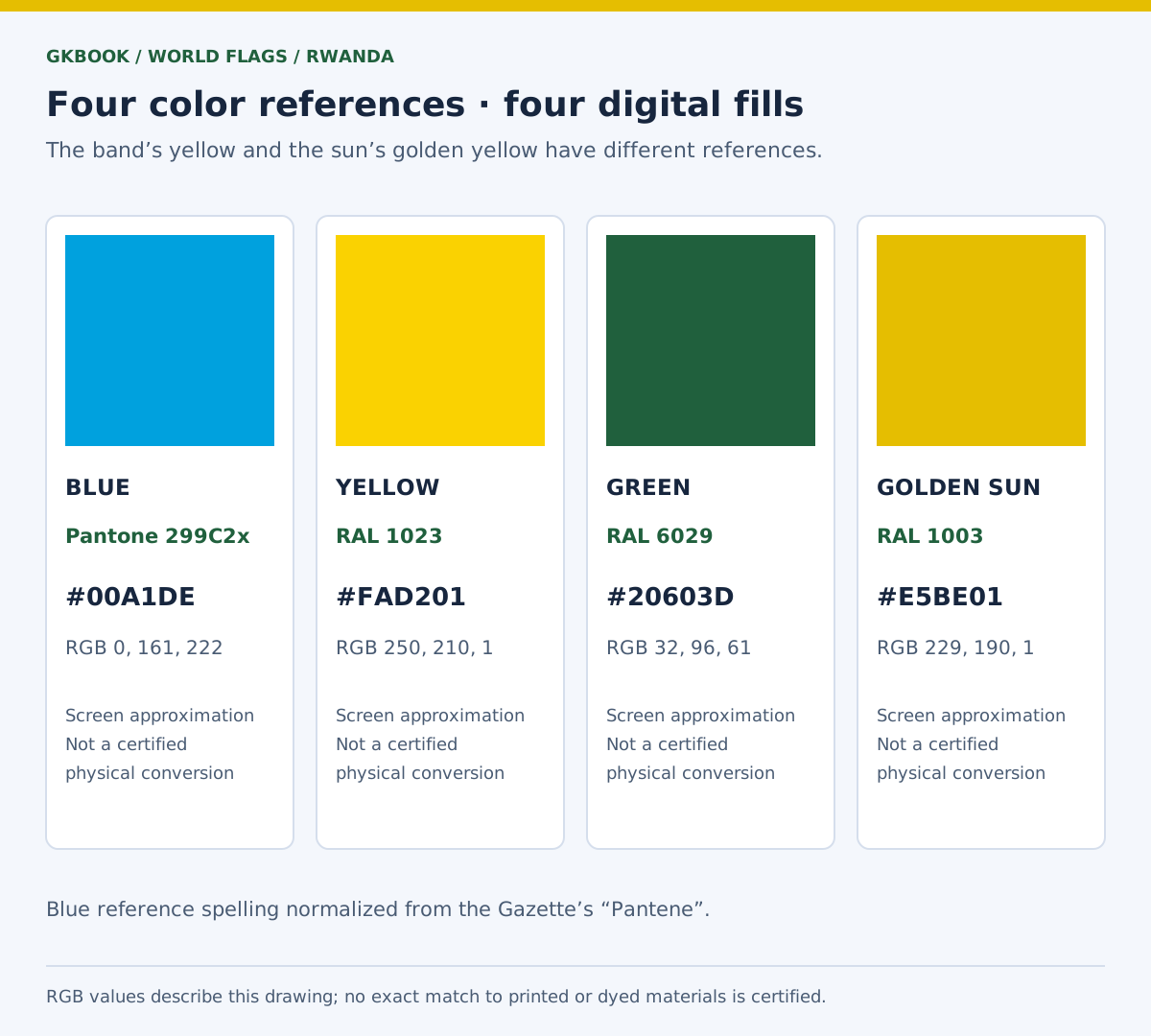
Article 6 identifies blue by the reference commonly normalized as Pantone 299C2x, green as RAL 6029, yellow as RAL 1023, and golden yellow as RAL 1003. The English Gazette prints the blue system name as “Pantene.” Retaining the full reference matters because silently dropping the suffix changes the recorded specification.
The swatches below document the fills used consistently in these images. They are not certified conversions between different physical color systems and a screen. A photograph or a sampled government JPEG also cannot establish such a conversion: lighting, compression, reproduction, and the original file’s preparation can all influence the observed values.
| Element | Article 6 reference | Editorial RGB | Editorial hex |
|---|---|---|---|
| Blue | Pantone 299C2x | 0, 161, 222 | #00A1DE |
| Yellow band | RAL 1023 | 250, 210, 1 | #FAD201 |
| Green | RAL 6029 | 32, 96, 61 | #20603D |
| Golden sun | RAL 1003 | 229, 190, 1 | #E5BE01 |
What does Rwanda’s flag mean?
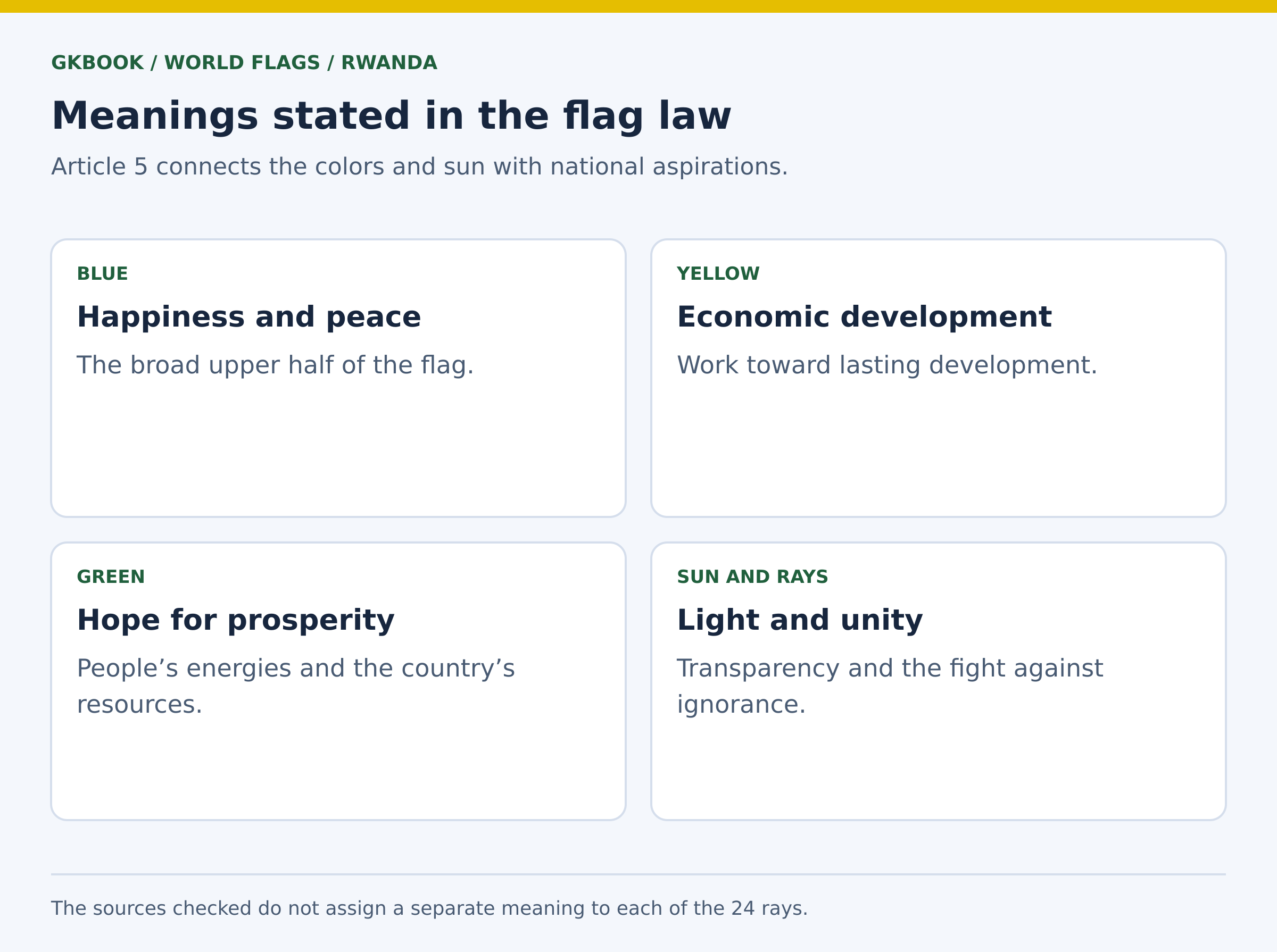
Rwanda’s flag law assigns meanings to its colors and sun. Blue expresses happiness and peace, yellow economic development, and green hope for prosperity. The sun and its golden rays represent light, unity, transparency, and the struggle against ignorance. These meanings come from the legal description, rather than an invented color mnemonic.
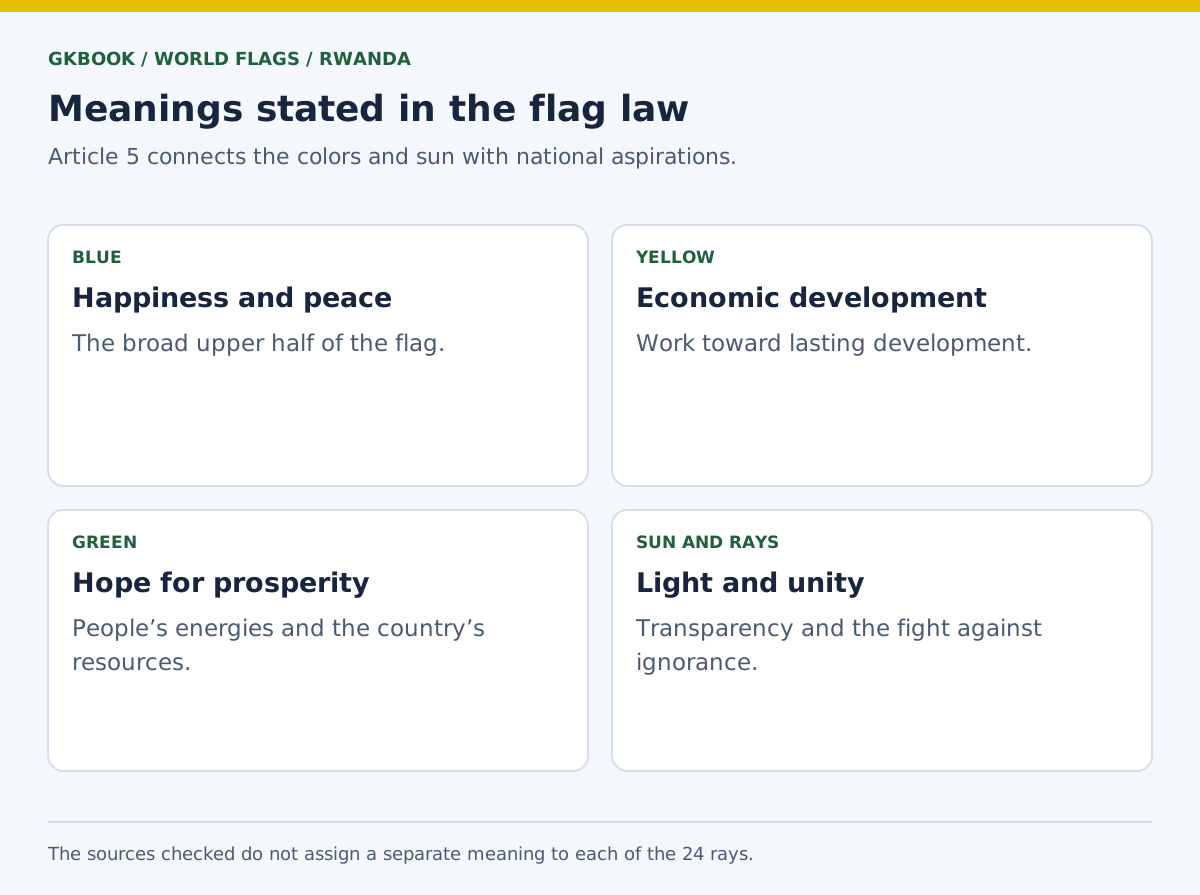
Article 5 connects the design with aspirations for people and national development. Its explanation of green emphasizes the use of people’s energies and the country’s resources, while yellow emphasizes work toward lasting development. The imagery therefore reaches beyond identifying a landscape or naming valuable materials.
For a short classroom answer, keep the principal association beside the correct element. For a fuller discussion, distinguish an official symbolic intention from a measurable social outcome. A flag can express hope, peace, or unity without proving that those aims have already been achieved. The meaning card presents the official associations without adding unsupported meanings for individual rays.
What does the blue part of Rwanda’s flag represent?
Blue represents happiness and peace in Rwanda’s flag law. It occupies the entire upper half of the flag, making it twice as tall as either lower band. The golden sun sits within this blue area near the fly, the edge opposite the side attached to the flagpole.
Blue is both a broad field and a small structural detail. It fills the space surrounding the sun and forms the circular separation between the central gold disc and the rays. The ring uses the same blue as the field in this reconstruction; it is not a white outline or a transparent hole.
Descriptions sometimes associate blue flags generally with water or sky. Those associations should not replace Rwanda’s stated meaning. When identifying this flag from a small picture, first look for the unusually deep upper band and the sun toward its outer edge. They remain useful despite photographic color shifts.
What does the yellow band represent?
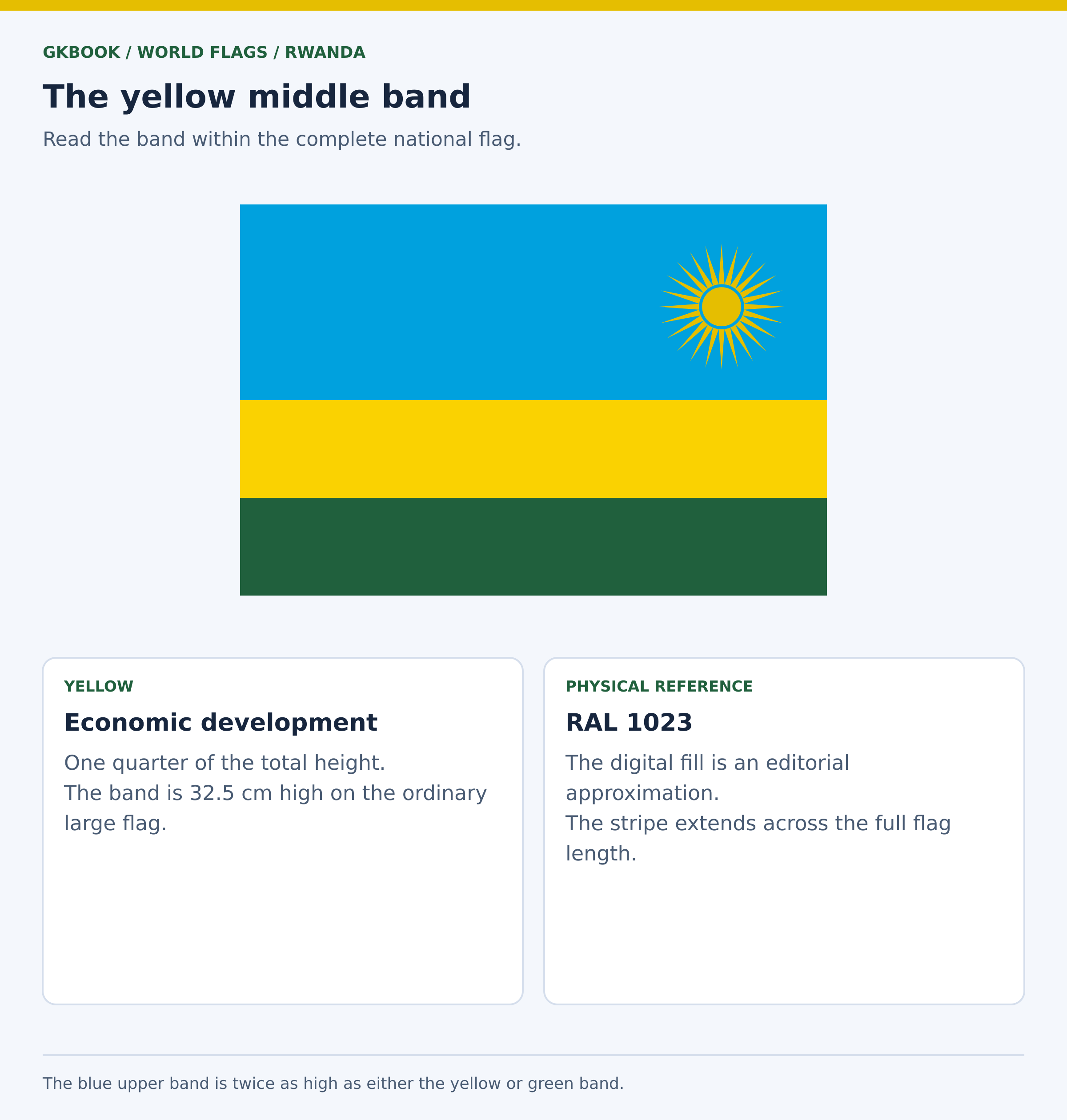
The yellow band represents economic development and the work required for lasting development. It lies between the blue and green areas and occupies one quarter of the flag’s height. Its specified physical reference is RAL 1023, which is distinct from the golden-yellow reference used for the sun.
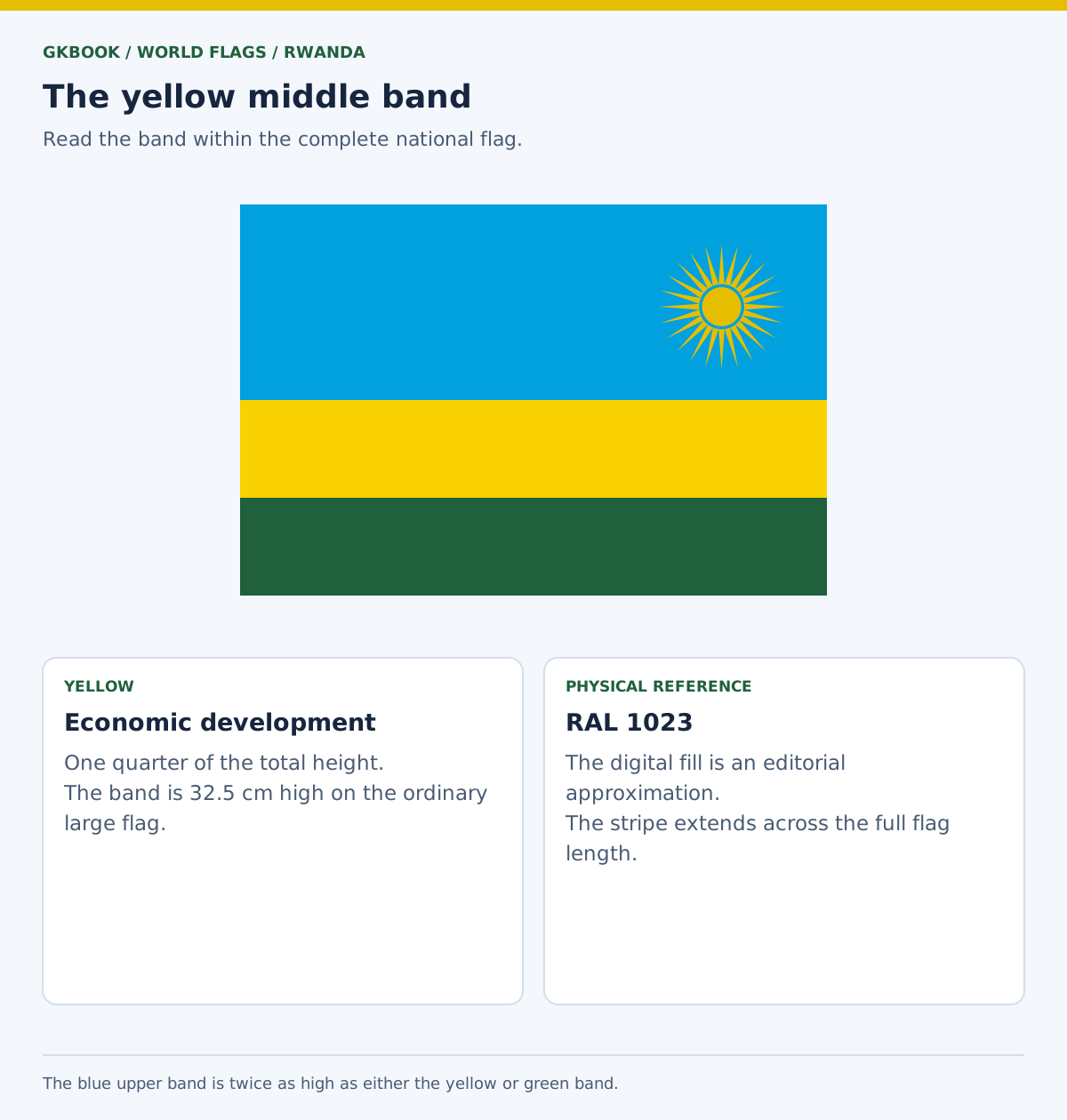
Because all three bands extend across the same length, the yellow band also occupies one quarter of the flag rectangle’s area before considering the sun, which lies elsewhere. In the master drawing it begins at vertical coordinate 1,300 and ends at 1,950, giving it a height of 650 units.
Do not merge the yellow band and the golden sun into one undifferentiated color specification. They may look similar in a small thumbnail, but Article 6 records separate references. The yellow illustration retains the complete flag to keep the isolated band in context.
What does the green band represent?
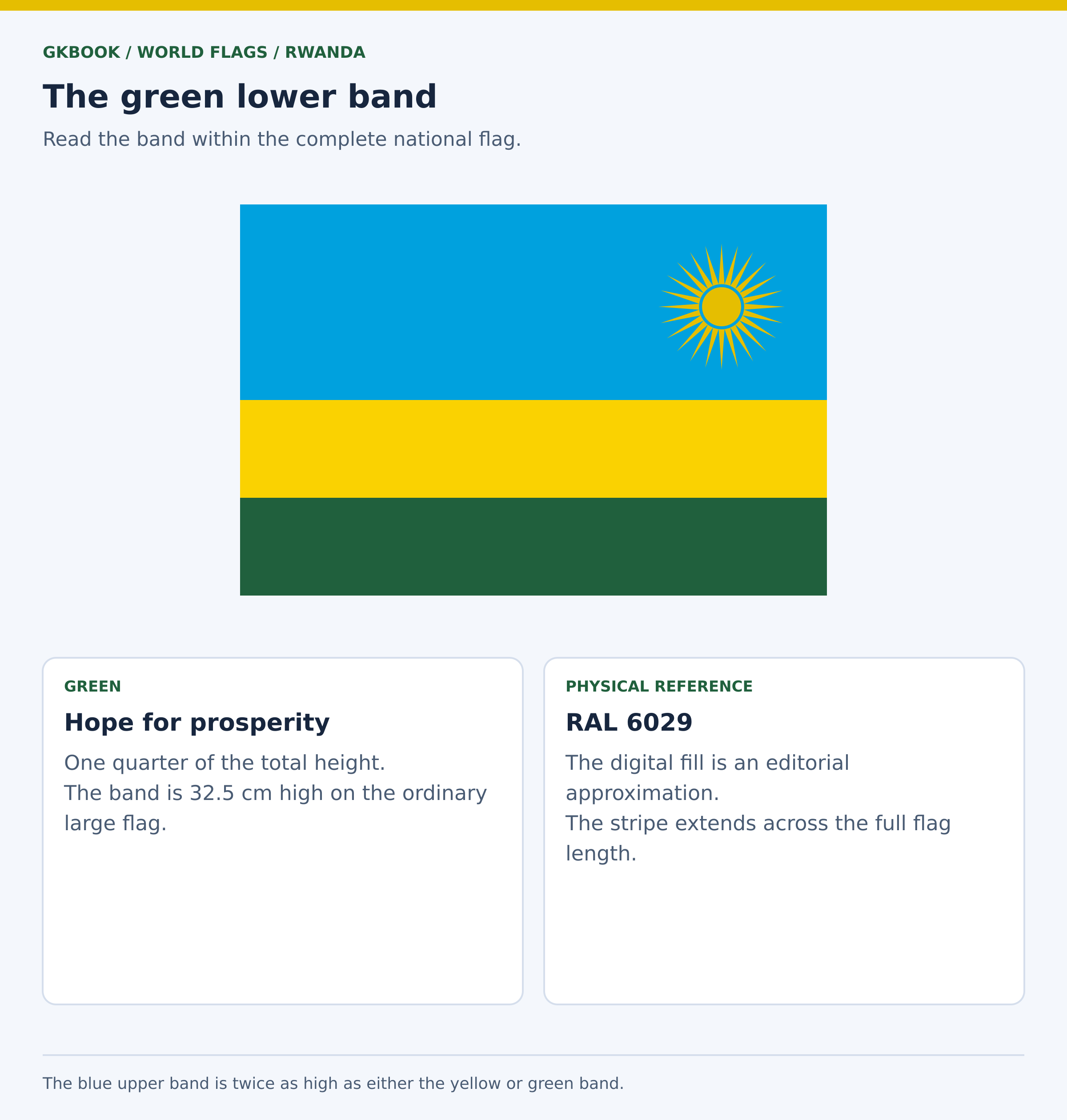
Green represents hope for prosperity, linked in the flag law to the productive use of people’s energies and the country’s resources. It forms the bottom quarter of the flag. Its height equals the yellow band’s height, and its physical color reference is RAL 6029.

The green stripe is a continuous rectangle along the lower edge. It does not contain the sun, a letter, a crest, or a separate agricultural illustration. At the ordinary large flag size of 195 by 130 centimeters, the green portion is 32.5 centimeters high and extends across the full 195 centimeter length.
Green can invite associations with vegetation, but the official explanation is broader than a literal picture of fields or forests. It concerns prosperity and the use of human and material resources. A concise caption can pair the band’s position with its official meaning.
What does the sun on Rwanda’s flag symbolize?
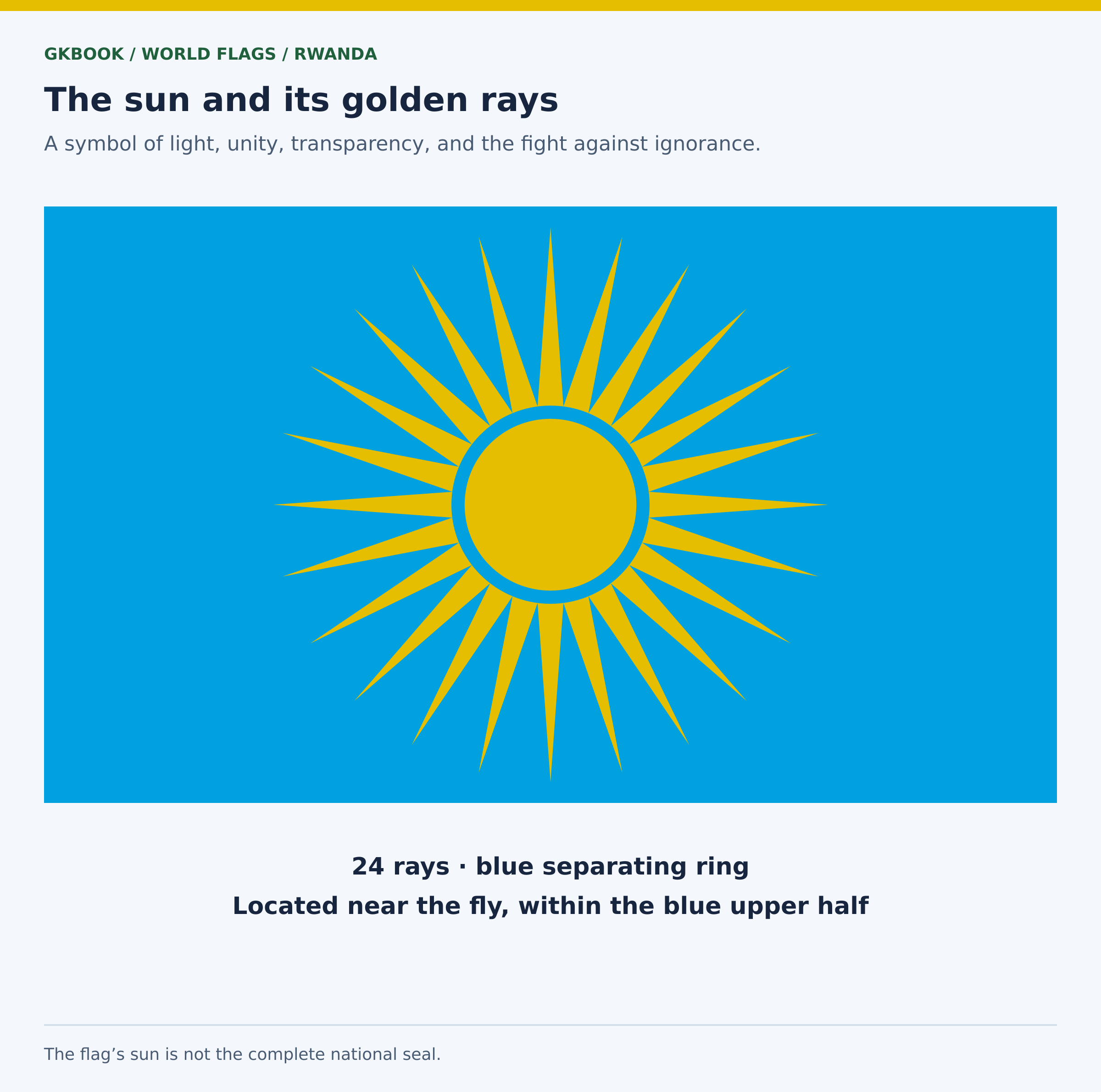
The golden sun and its rays symbolize light that progressively enlightens the people, together with unity, transparency, and the fight against ignorance. The sun appears in the blue upper portion near the fly. It is a distinct flag emblem, not a miniature version of Rwanda’s complete national seal.
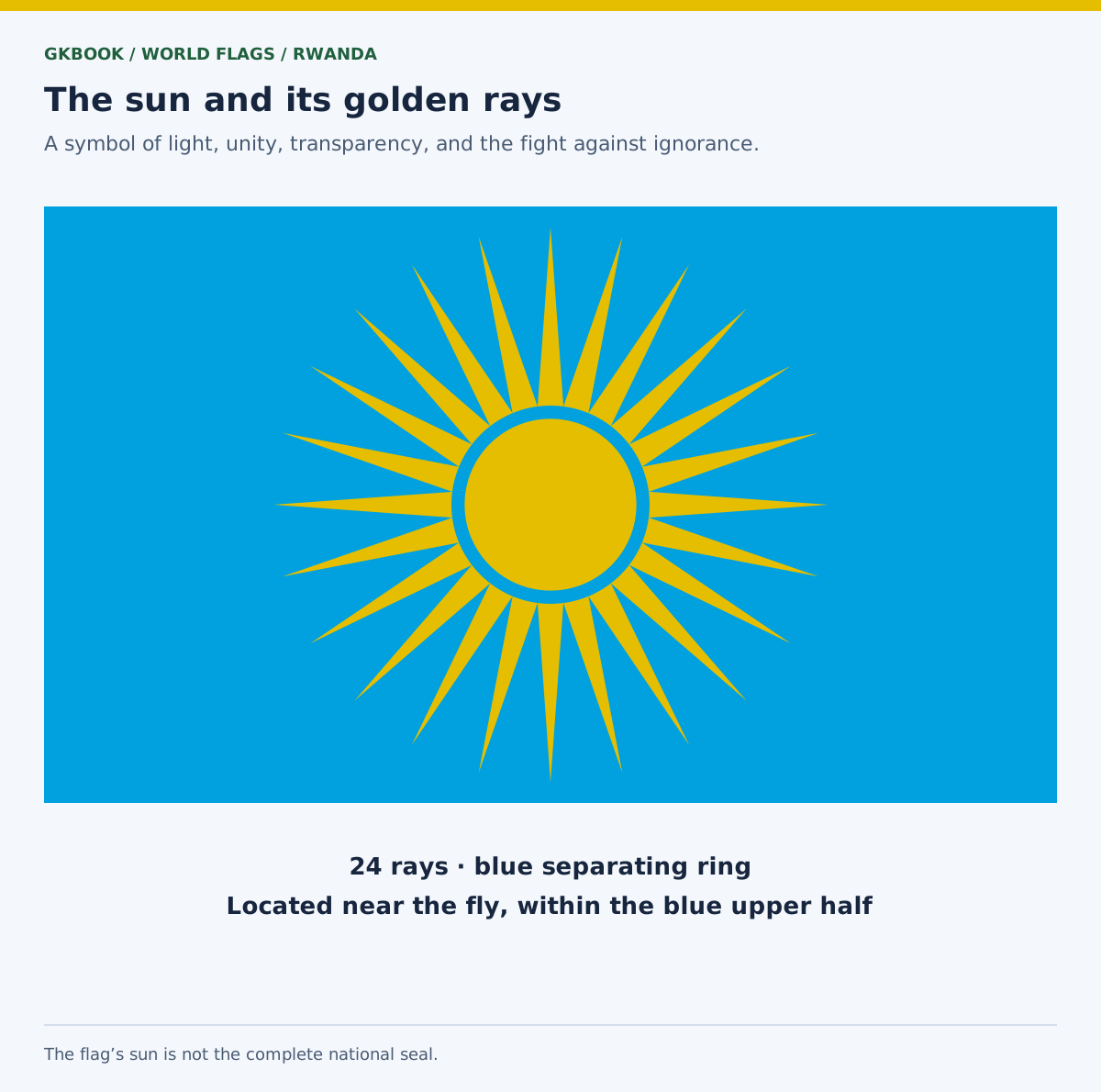
The legal explanation treats the sun and its rays as a connected symbol. Its position is visually prominent without replacing the blue field or interrupting either lower band. A blue circular gap separates the central gold disc from the surrounding gold rays, making the internal structure visible at a suitable display size.
For reproduction, distinguish the emblem’s overall ray diameter from the central sun measurement. The ordinary large flag specification gives 42 centimeters for the ray envelope and 13 centimeters for the sun. This reconstruction interprets the latter as the gold disc’s diameter; unspecified ring and ray details are disclosed in the construction notes.
How many rays does Rwanda’s flag sun have?
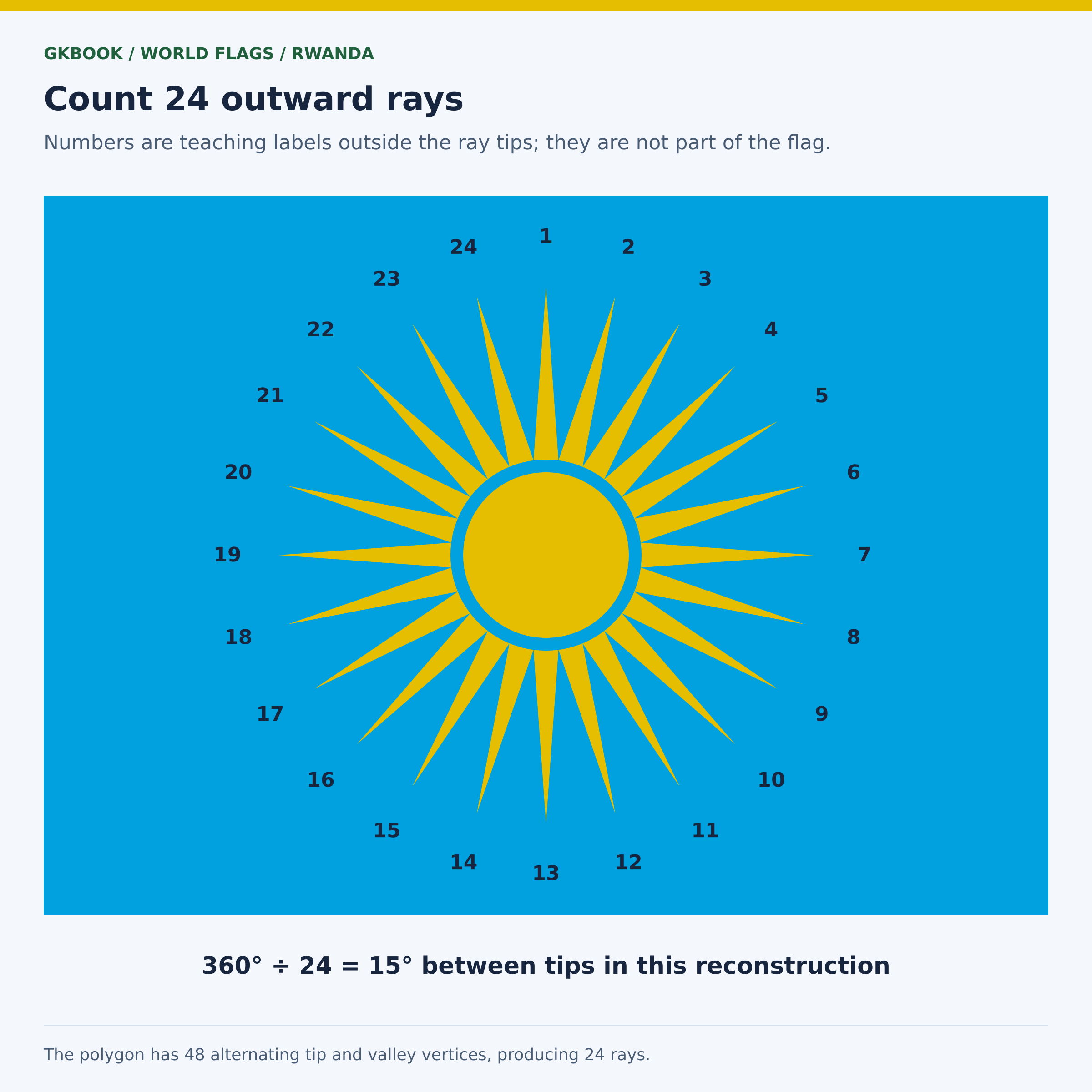
The sun has 24 rays, visible in the national design and government artwork. This reconstruction spaces their tips evenly around a circle. The official symbolism concerns the sun and its rays together; the sources checked do not assign each ray to an hour, province, district, or other individual unit.
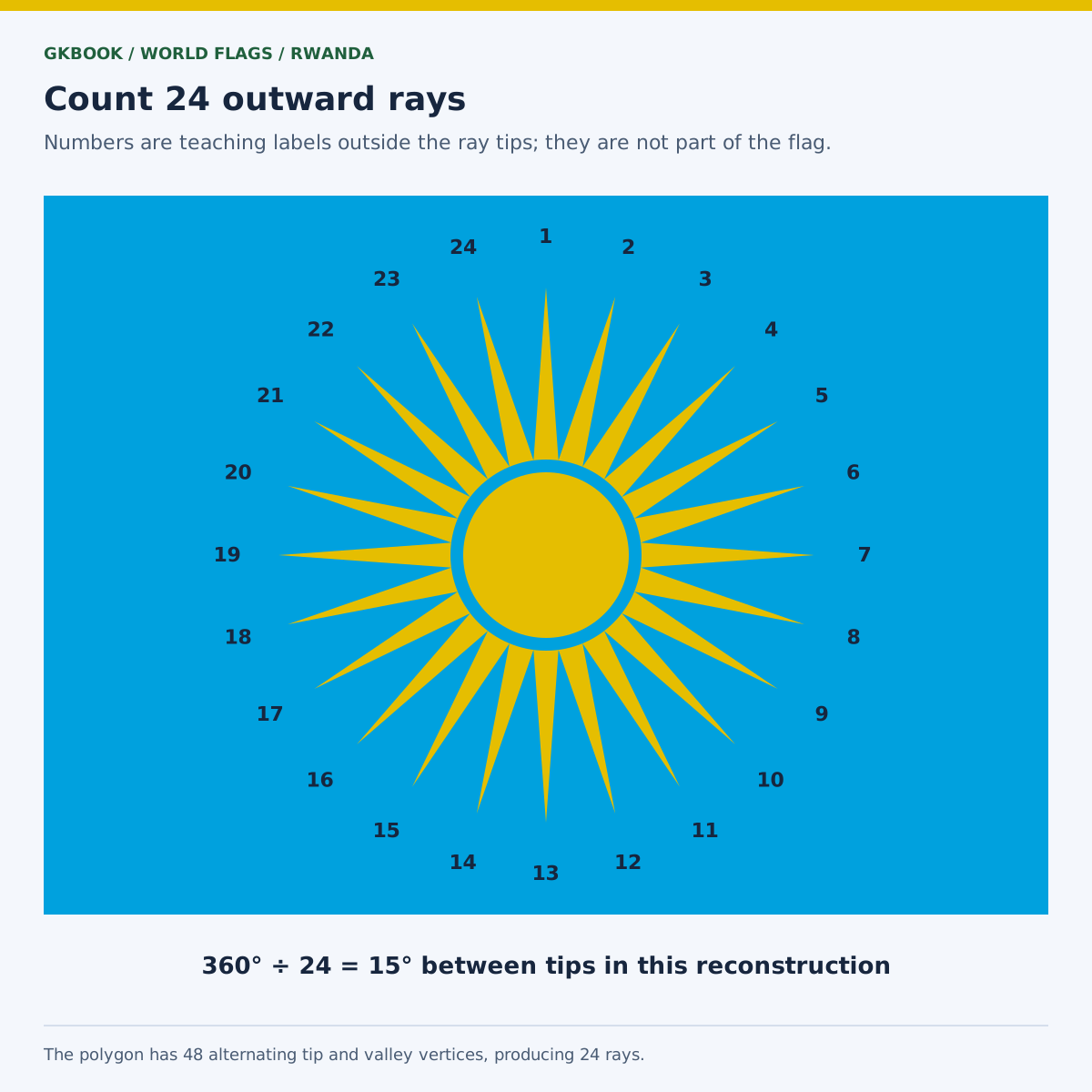
A regular arrangement of 24 tips produces an angular interval of 15 degrees, calculated by dividing a complete 360 degree turn by 24. That calculation explains this drawing’s construction. It does not establish that the flag represents a clock, nor does it turn an incidental numerical similarity into an official meaning.
Count the outward tips rather than the intervening valleys or the sides of the triangles. The clean vector contains 48 alternating outer and inner vertices, producing 24 outward rays. A magnified teaching diagram makes that count visible. The precise ray-root radius and starting angle are documented drawing conventions because the written measurements do not settle every outline detail.
Why is there a blue ring around the sun?
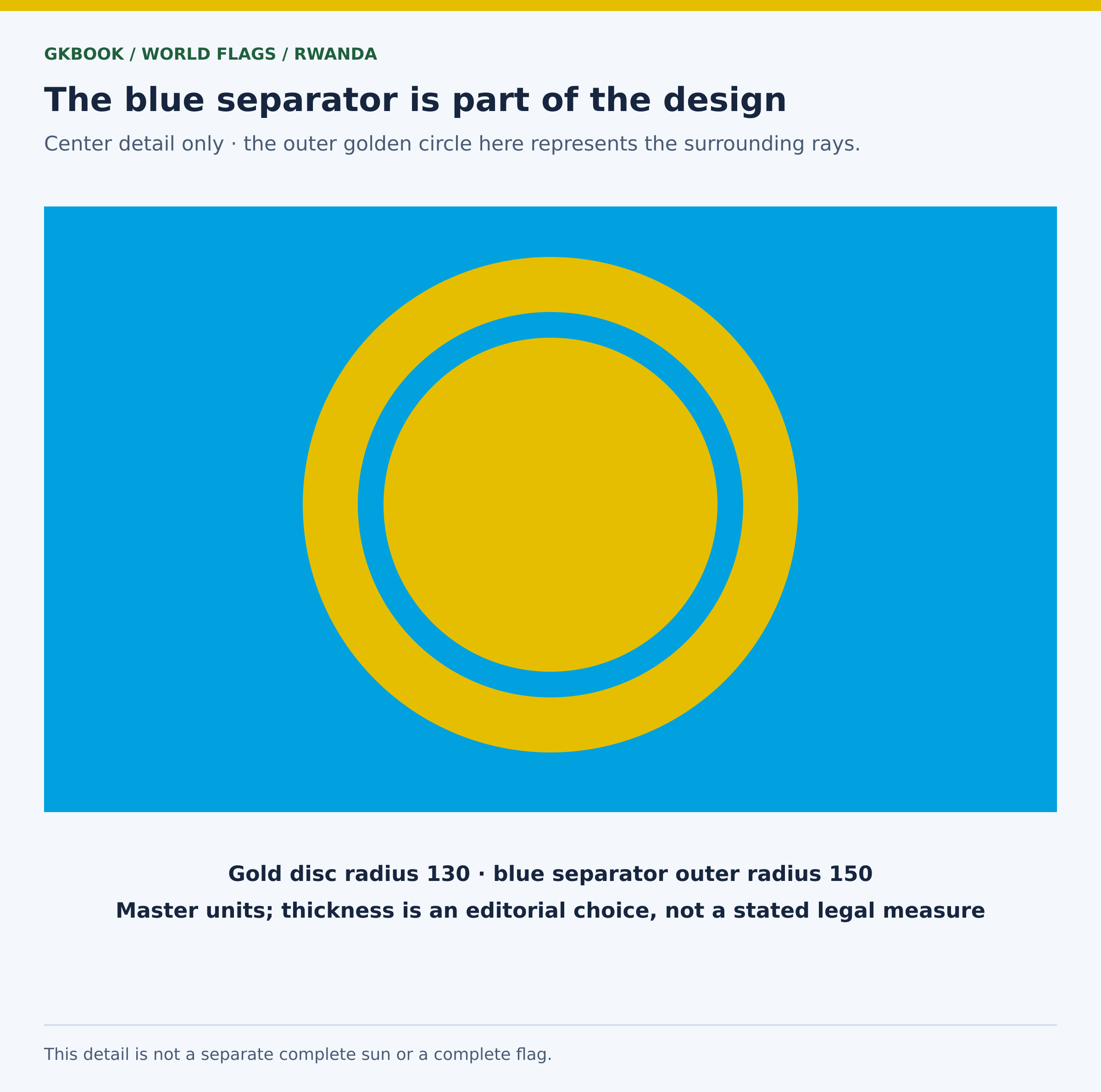
A blue ring separates the central sun from its golden rays, as the Constitution and flag law describe. The ring is part of the design, not an accidental gap in printing. Its thickness is not numerically specified in the provisions checked, so this package explicitly declares that detail as an editorial reconstruction choice.
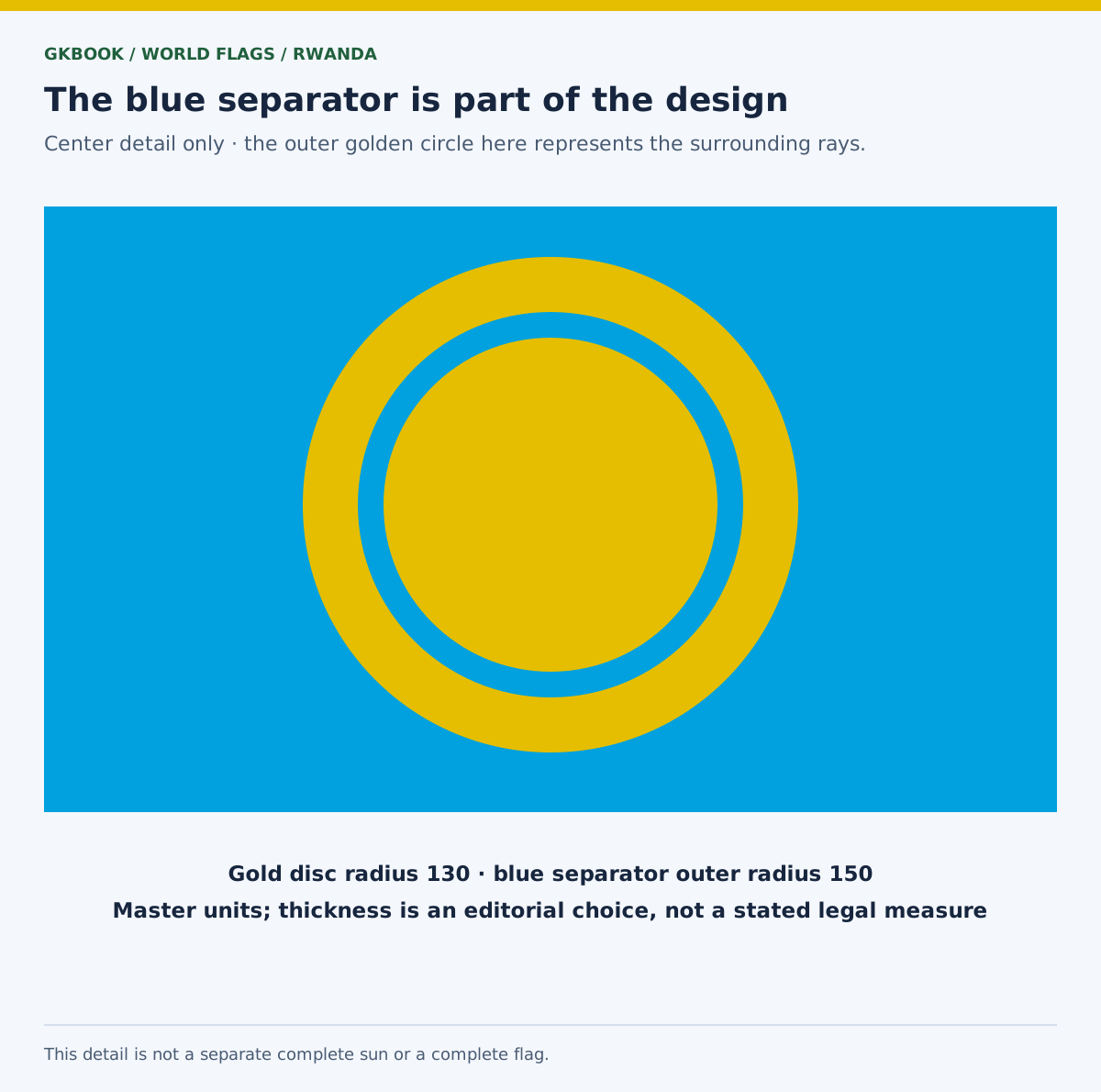
The master uses a gold disc of radius 130 units and a blue separator extending to radius 150 units. Both circles share the sun’s center. These values create a 20 unit radial gap, equivalent to one centimeter at the ordinary large flag’s drawing scale. That equivalent is explanatory, not an additional statutory measurement.
The rays begin outside the separator, preventing them from joining directly to the disc. Replacing the blue with white, leaving it transparent, or filling the whole center with gold would lose a feature named in the legal description. At very small sizes the gap may become difficult to see, which is a reason to preserve the vector original.
What is the aspect ratio of Rwanda’s flag?
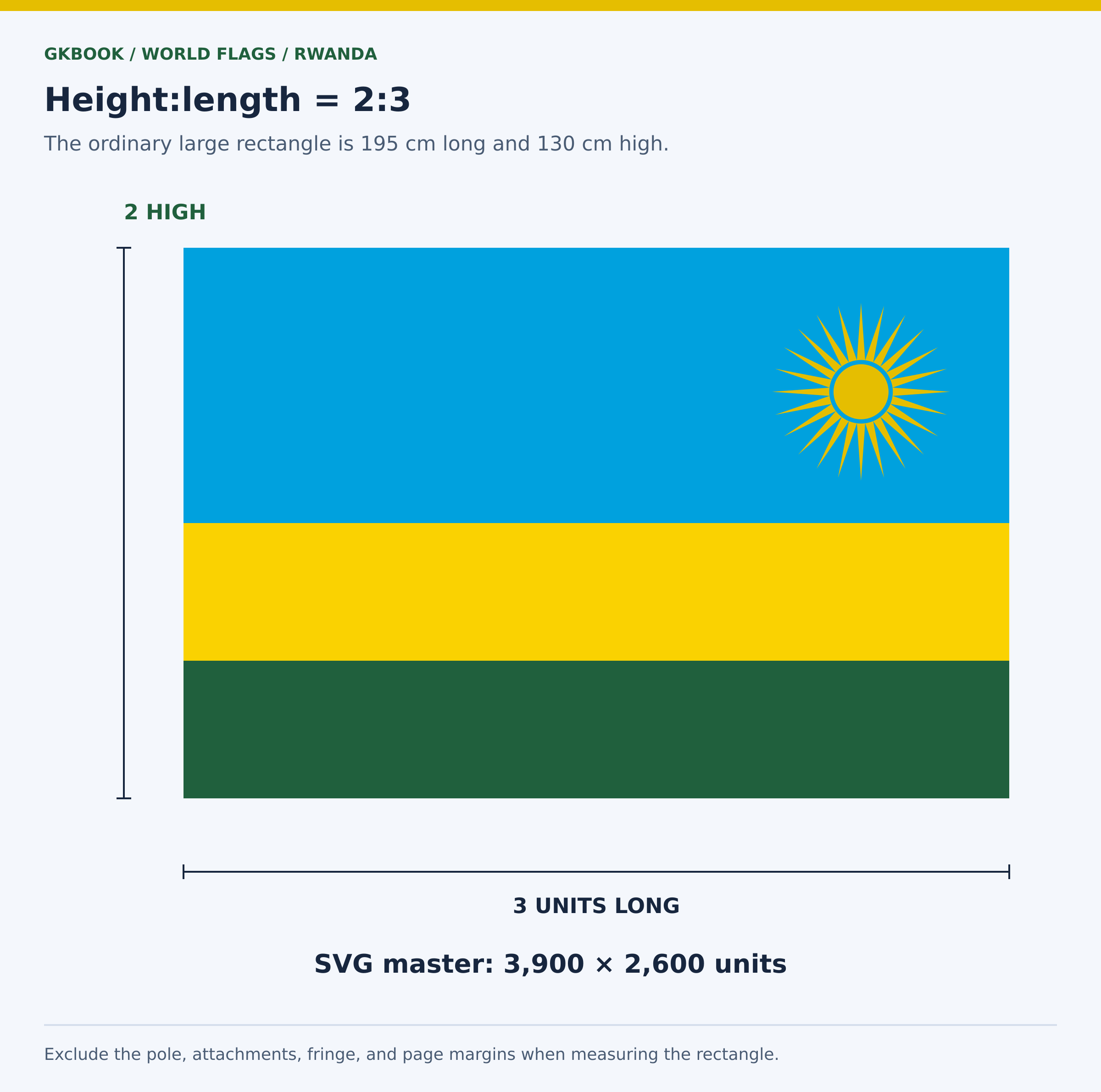
Rwanda’s national flag has a height to length ratio of 2:3, equivalent to an image width to height ratio of 3:2. The ordinary large version measures 195 centimeters long and 130 centimeters high. Measure the colored rectangle itself, excluding the pole, hoisting attachments, fringe, and surrounding page margins.

A landscape rectangle with this ratio is one and a half times as long as it is high. The supplied SVG uses 3,900 horizontal units and 2,600 vertical units. Both are twenty times the corresponding centimeter measurements for the ordinary large flag, so the main geometry can be traced directly to that specification.
Resizing a digital image should preserve the relationship between both dimensions. A 900 pixel width, for example, requires a 600 pixel height. Such a screen size is a mathematical scaling example, not a new officially prescribed textile size. The ministerial order separately describes physical variants, whose rounded emblem measurements deserve attention when preparing a manufactured flag.
Are the three horizontal bands equal?
No. Rwanda’s blue band occupies half the flag’s height, while yellow and green each occupy one quarter. Their height ratio is 2:1:1. Dividing the rectangle into three equal horizontal stripes would produce an incorrect construction, even if the colors and the sun were otherwise recognizable.

Think of the total height as four equal units. Blue takes the first two, yellow the third, and green the fourth. At the ordinary large size, those heights are 65, 32.5, and 32.5 centimeters. The two lower stripes together have exactly the same height as the upper blue field.
The master SVG places the horizontal boundaries at 1,300 and 1,950 units on a 2,600 unit canvas. The main PNG translates those boundaries to pixel rows 1,950 and 2,925 on its 3,900 pixel height. Both boundaries fall on exact integer rows.
Where exactly is the sun positioned?
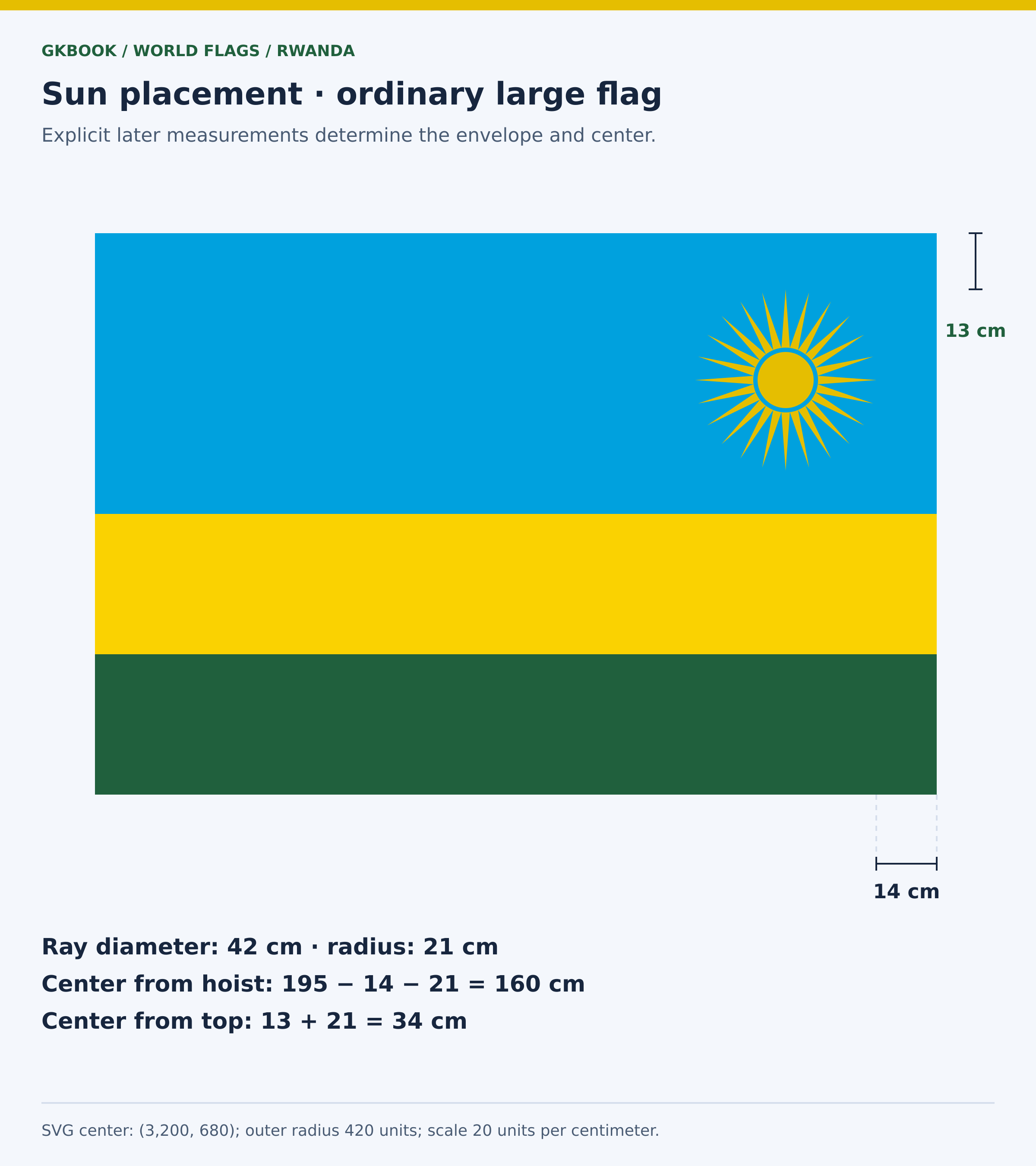
On the ordinary 195 by 130 centimeter flag, the outer rays are 13 centimeters below the top edge and 14 centimeters from the fly edge. Their overall diameter is 42 centimeters. These measurements place the center 160 centimeters from the hoist and 34 centimeters below the top.

The horizontal calculation subtracts the fly margin and the ray radius from the flag length: 195 minus 14 minus 21 equals 160. The vertical calculation adds the top margin and radius: 13 plus 21 equals 34. These are coordinates derived from the explicit measurements, not coordinates sampled from a resized photograph.
At twenty drawing units per centimeter, the center is therefore at x = 3,200 and y = 680. The ray envelope remains fully within the blue band. Its lowest point is 55 centimeters below the top, leaving 10 centimeters above the yellow stripe. Centering the sun vertically within the blue band would slightly alter the specified placement.
How is the Rwanda flag constructed in these files?
The drawing uses the later ministerial order’s explicit ordinary-large measurements: a 195 by 130 centimeter rectangle, unequal bands, and the stated sun size and offsets. A conflicting formula in the older annex is not used. Ring thickness, ray-root geometry, angular alignment, and numerical screen colors are openly identified as editorial choices.
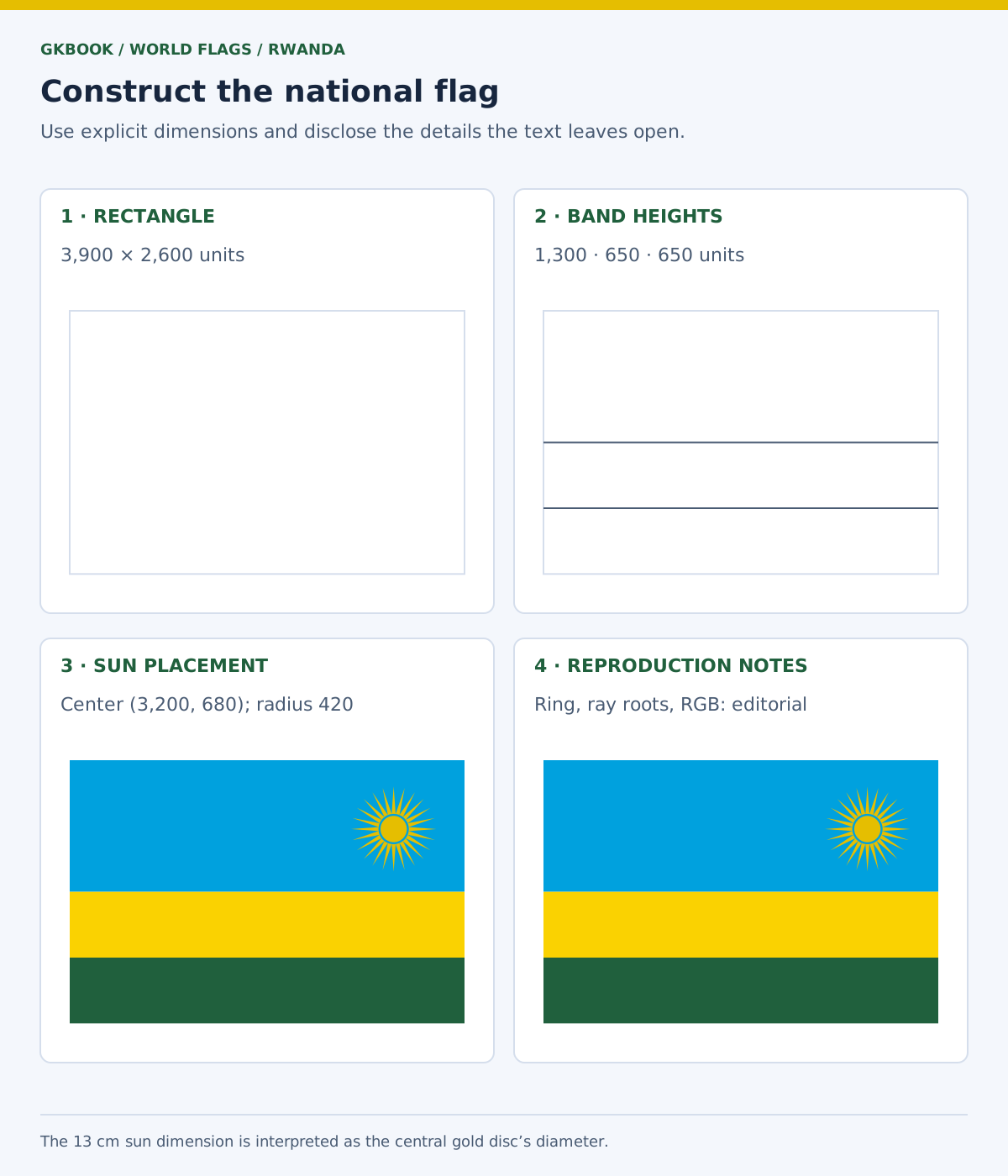
The older annex gives D = 0.125Y for the ray diameter. At a length of 195 centimeters, that yields 24.375 centimeters, which conflicts with the explicit 42 centimeter diameter repeated in the later size order. The reconstruction follows the later explicit dimension rather than silently combining incompatible instructions.
The code creates three rectangles, a regular 24-ray outline, a blue separator circle, and a gold disc. Its documentation records the interpretation of the 13 centimeter sun dimension and every additional drawing convention. The documentation makes the reconstruction reproducible without overstating the annex’s precision.
What is the history of Rwanda’s current flag?
Rwanda introduced its current blue, yellow, and green flag with a golden sun in 2001, replacing the earlier vertical tricolor bearing a black R. The change formed part of a renewal of national symbols. Later legislation described and regulated the flag; those later legal dates should not be mistaken for its first introduction.

A useful timeline separates the design’s arrival from subsequent legal documentation. Parliamentary action occurred in October 2001, followed by the public unveiling of the new symbols at the end of December. The flag law dated August 8, 2008 later set out characteristics, meanings, ceremonial rules, and protection provisions.
The 2013 amendment changed parts of that framework, including how sizes and materials were determined and who could possess the flag. A ministerial order dated December 19, 2013 then supplied detailed sizes and was published in January 2014. The 2023 Constitution continues to describe the design. None of those later instruments implies a newly invented flag in its publication year.
Was Rwanda’s flag adopted in October or December 2001?
The two dates describe different milestones. Parliamentary approval of the constitutional and flag changes is reported on October 25, 2001. The new flag, anthem, and national emblem were publicly unveiled on December 31, 2001. A careful timeline names the event beside each date instead of presenting the dates as interchangeable.

The October date appears in the parliamentary announcement preserved in a quoted historical record and in Rwandan university teaching material. The December unveiling is documented by contemporaneous reporting, while the later flag law also refers to the earlier Law 57/2001 dated December 31, 2001. Together these records explain why simplified references sometimes give different dates.
For a compact caption, “introduced in 2001” avoids collapsing the sequence. Where a full date is useful, write “parliamentary approval” or “public unveiling” beside it. Do not turn either date into a claim about a recurring national holiday without separate evidence, and do not substitute the 2008 law’s date for the design’s introduction.
Who designed Rwanda’s current flag?
The current flag is credited to Rwandan artist Alphonse Kirimobenecyo. Rwanda Education Board art materials associate him with the national flag and national emblem. His design credit should be distinguished from the institutions that approved the symbols and the later laws that describe their construction, meaning, and use.
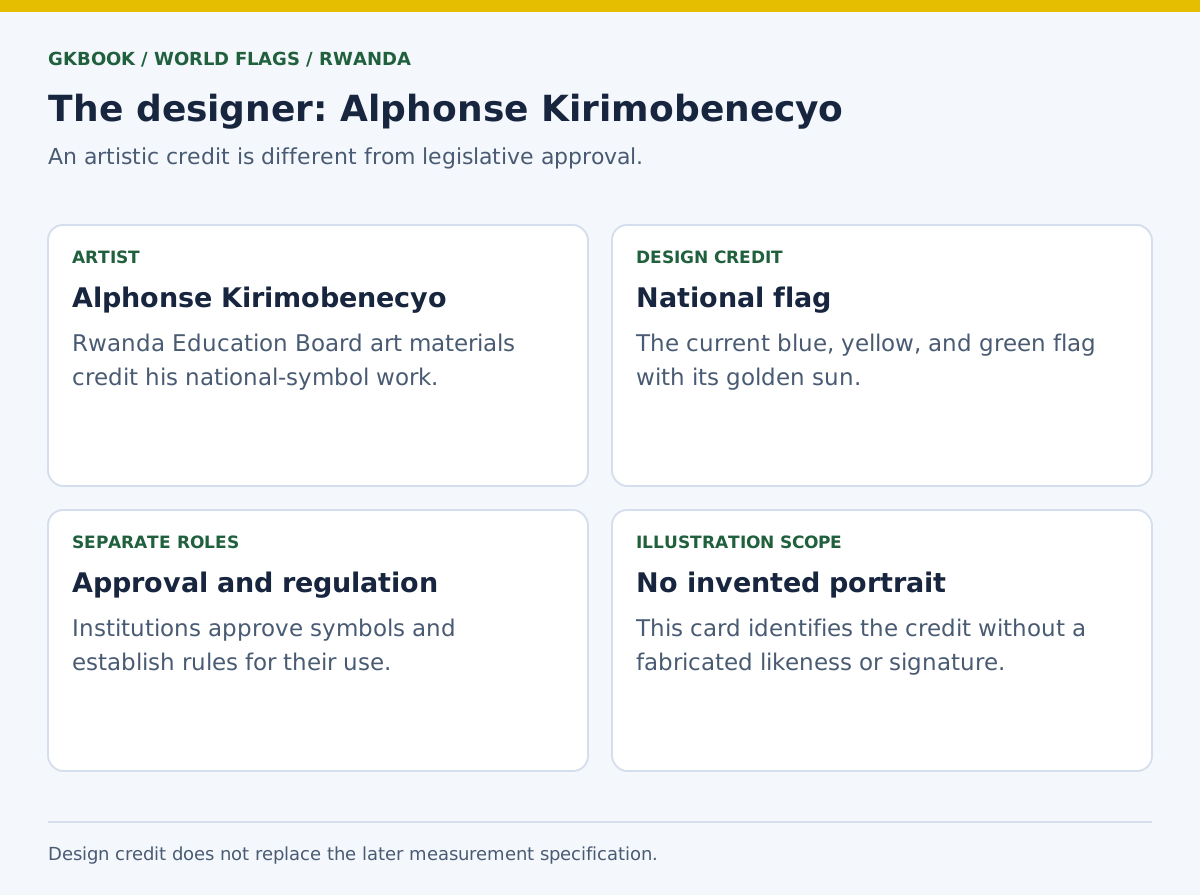
Authorship, approval, and legal specification answer different questions. An artist can devise a national symbol, parliament can approve a change, and legislation can later establish rules for making and displaying it. Keeping those roles distinct prevents a biography from being confused with a legal adoption timeline.
The designer card therefore identifies the documented credit without inventing a portrait, signature, workshop scene, or detailed personal account of the commission. It also does not attribute the national anthem to the flag designer merely because the symbols were unveiled together. Use the construction notes for dimensions; the credit identifies authorship.
What did Rwanda’s previous flag look like?
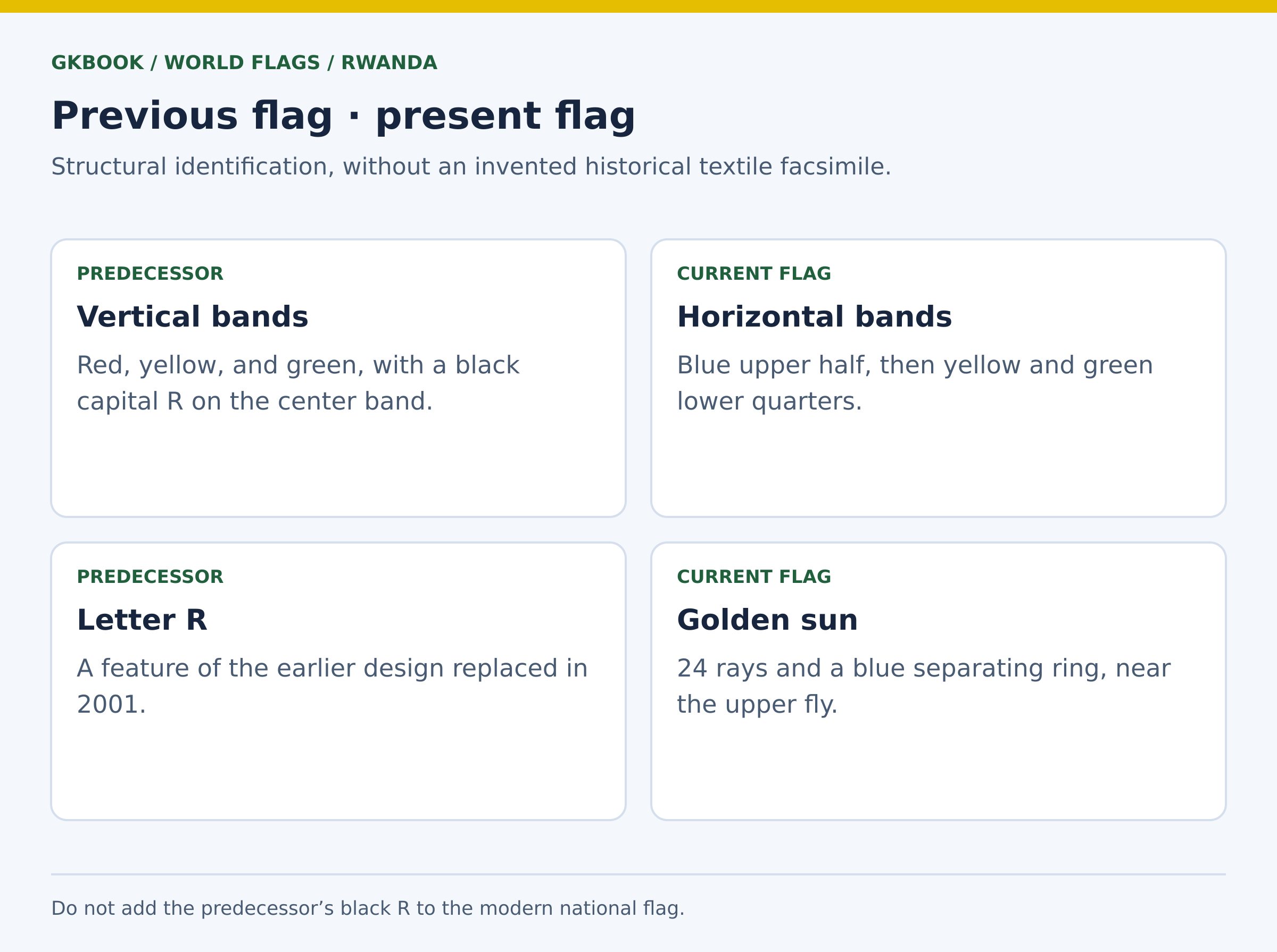
The flag replaced in 2001 had vertical red, yellow, and green bands with a black capital R on the yellow center band. It differs clearly from the present horizontal design, which has a broad blue upper field and a golden sun. The current flag does not retain the letter R.
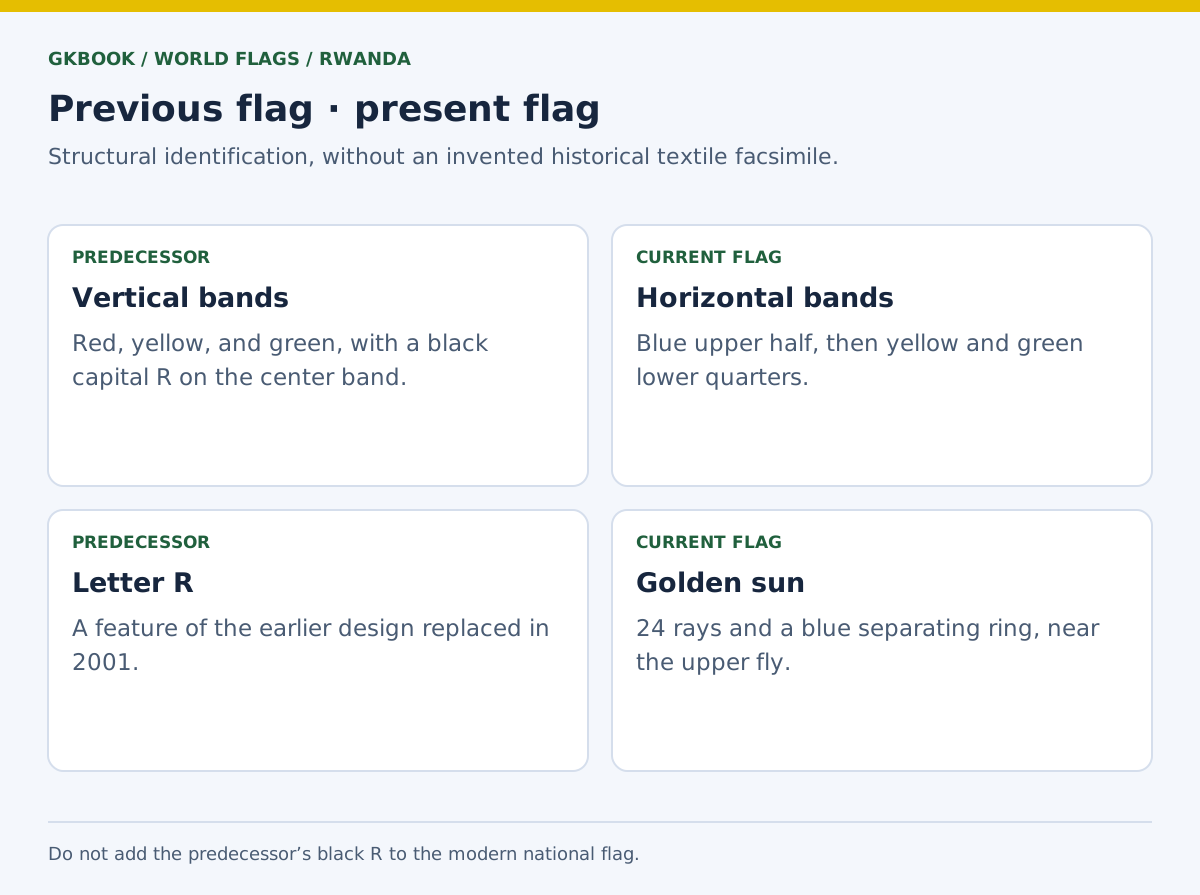
When reading a historical photograph, check the direction of the bands before comparing color shades. Vertical stripes and a central letter identify a different design from the current flag’s horizontal arrangement and sun near the fly. An old image should therefore carry a historical caption instead of being used as an unlabeled contemporary reference.
The comparison card describes those visible differences without supplying an allegedly exact reconstruction of the earlier textile. It does not guess a historical font, pigment, or letter measurement. The comparison identifies the predecessor without importing its letter into the modern flag.
Why did Rwanda change its flag?
The 2001 change was presented as part of a renewal of national identity and reconciliation after the 1994 genocide against the Tutsi. New national symbols were intended to express unity and a shared future. That stated purpose explains the official symbolism; it does not establish that every person interpreted the change identically.
The flag was unveiled alongside a new anthem and national emblem, making the event a broader symbolic transition. The present design’s official meanings emphasize peace, development, prosperity, enlightenment, and unity. Those intentions are relevant to its history, but they should be described as aims expressed through a national symbol.
Avoid reducing a complex historical experience to a claim that changing a flag itself produced reconciliation. Equally, do not assign a detailed political meaning to every geometric feature without evidence. A careful account can identify the public purpose of the change, acknowledge the historical setting, and describe the new design without inventing universal agreement about its effects.
How does Rwanda’s Constitution describe the flag?
Article 9 of Rwanda’s 2023 Constitution identifies the national flag among the state’s symbols. It describes green and yellow below a blue upper half, with a golden sun and rays on the right and a blue separating ring. The detailed physical measurements come from the separate flag legislation and implementing order.
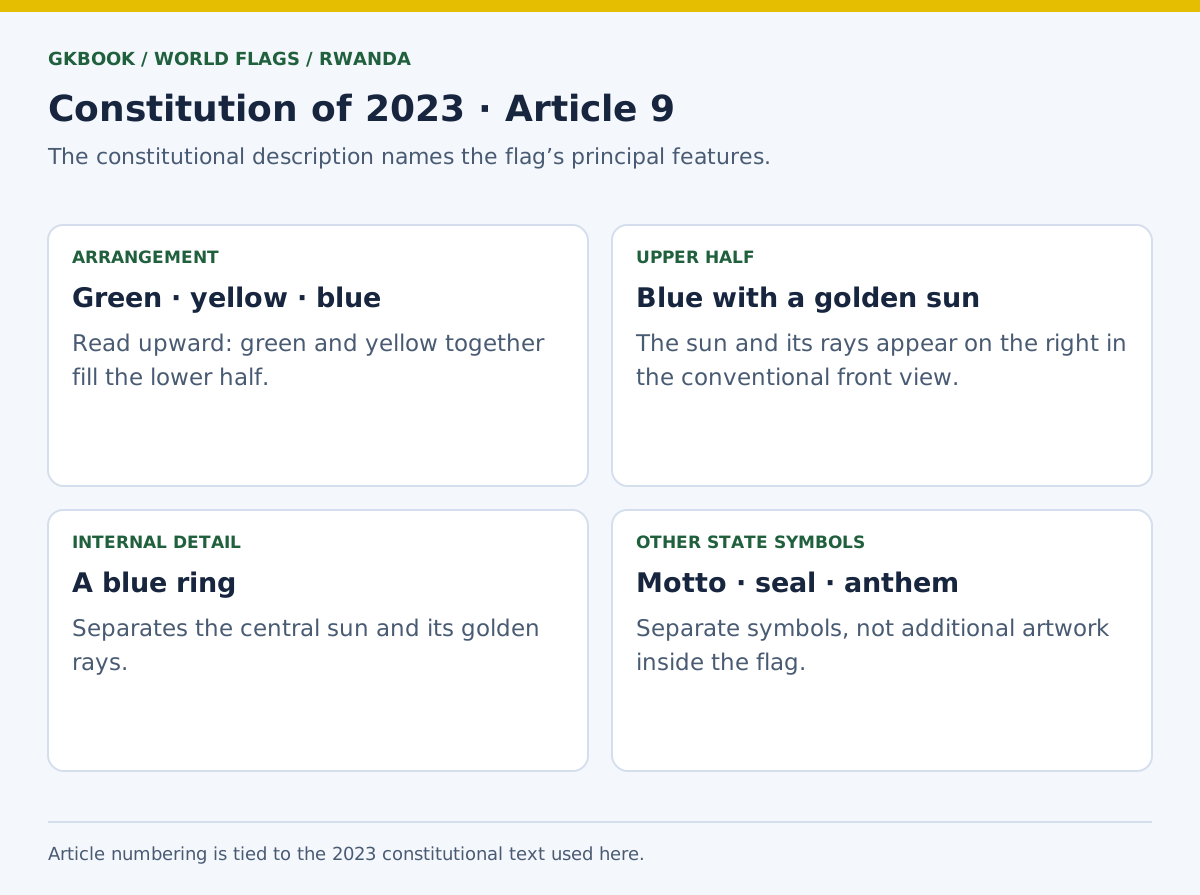
The constitutional description establishes the principal visual arrangement. It also places the flag alongside other national symbols, including the motto, seal, and anthem. This is why a discussion of the flag should not treat the complete seal as an optional decoration that can simply be placed on the national rectangle.
Article numbering must follow the edition being cited. This guide uses Article 9 of the Constitution published in August 2023, rather than silently carrying forward a number from an older text. For an actual drawing, consult the size order as well: the Constitution’s verbal description is not a complete coordinate table for the sun or its rays.
Which laws govern Rwanda’s national flag?
The framework includes Law 34/2008 of August 8, 2008, as amended, together with implementing orders. Law 06/2013 changed provisions on materials, sizes, possession, and use; Law 42/2018 modified offence provisions. Reading the original 2008 text alone can therefore produce outdated conclusions, even where its basic design description remains relevant.
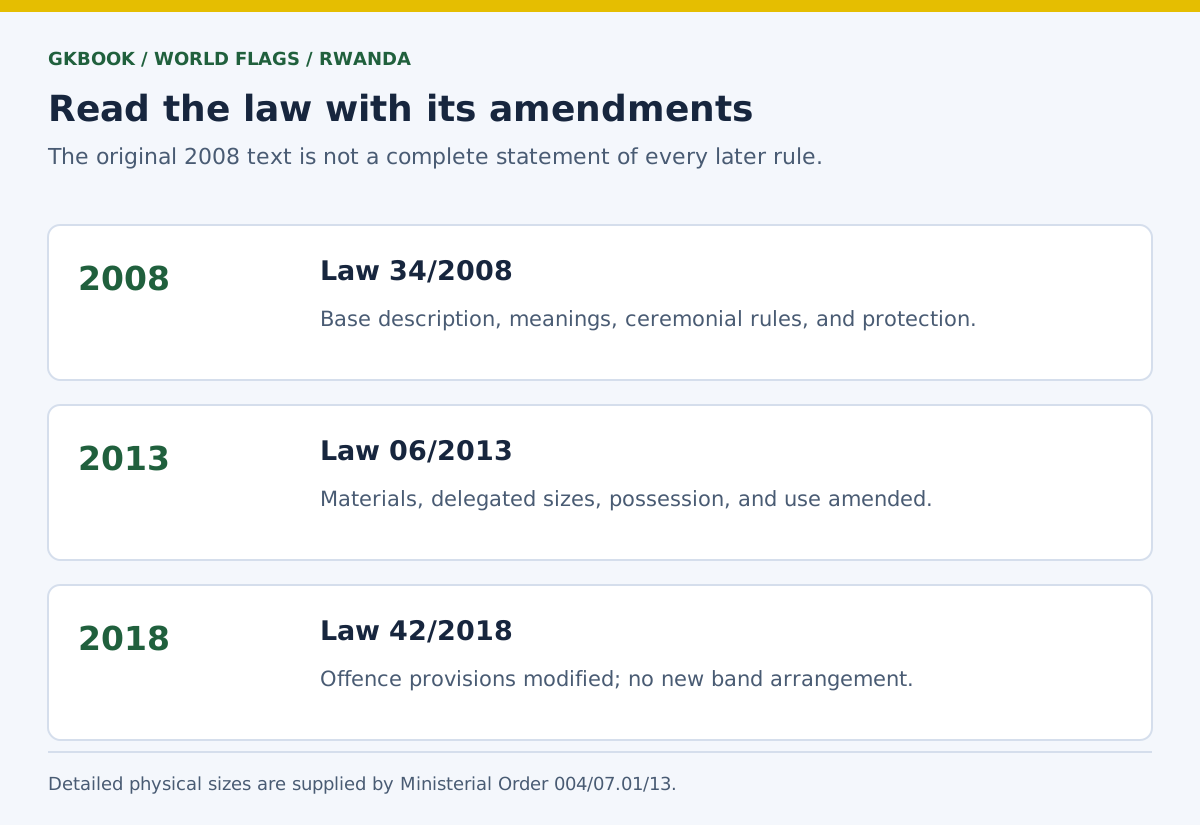
The 2013 amendment is particularly important for this guide. It replaced the original size provision with a framework under which a ministerial order determines dimensions. It also revised possession and use, so an older restriction on individual ownership should not be repeated as though the amendment had never happened.
The later size order repeats concrete measurements for several physical variants. The 2018 amendment concerns offences rather than a new arrangement of bands or a redesigned sun. This article explains selected design and historical provisions; it does not reproduce a complete consolidated code or assign penalties to a particular user’s proposed activity. The private editorial record identifies each instrument checked.
Which order supplies the detailed flag measurements?
Ministerial Order 004/07.01/13, dated December 19, 2013, determines the flag’s fabric and sizes. It was published in Official Gazette number 02 on January 13, 2014, and took effect on publication. Article 4 gives the ordinary large flag measurements used as the basis for this package’s main reconstruction.
The order’s date and publication date belong to different stages of the same instrument. Calling it the December 2013 order and recording its January 2014 publication avoids an apparent contradiction. Its authority also fits the 2013 amendment’s decision to place detailed sizes in a ministerial order.
The ordinary large version measures 195 by 130 centimeters and has no fringe. Other articles specify a ceremonial version, a small version, and indoor uses of large fringed flags. Those categories explain why not every official flag photograph has identical attachments or dimensions. The clean downloadable rectangle represents the ordinary large geometry, without a pole, hoisting ribbon, rings, or ceremonial fringe.
What physical sizes are specified for Rwanda’s flag?
The size order describes an ordinary large flag of 195 by 130 centimeters, a ceremonial version of 225 by 150 centimeters, and a small flag of 30 by 20 centimeters. Each rectangle has a 2:3 height to length ratio. Their stated sun measurements and edge offsets include small rounding differences.
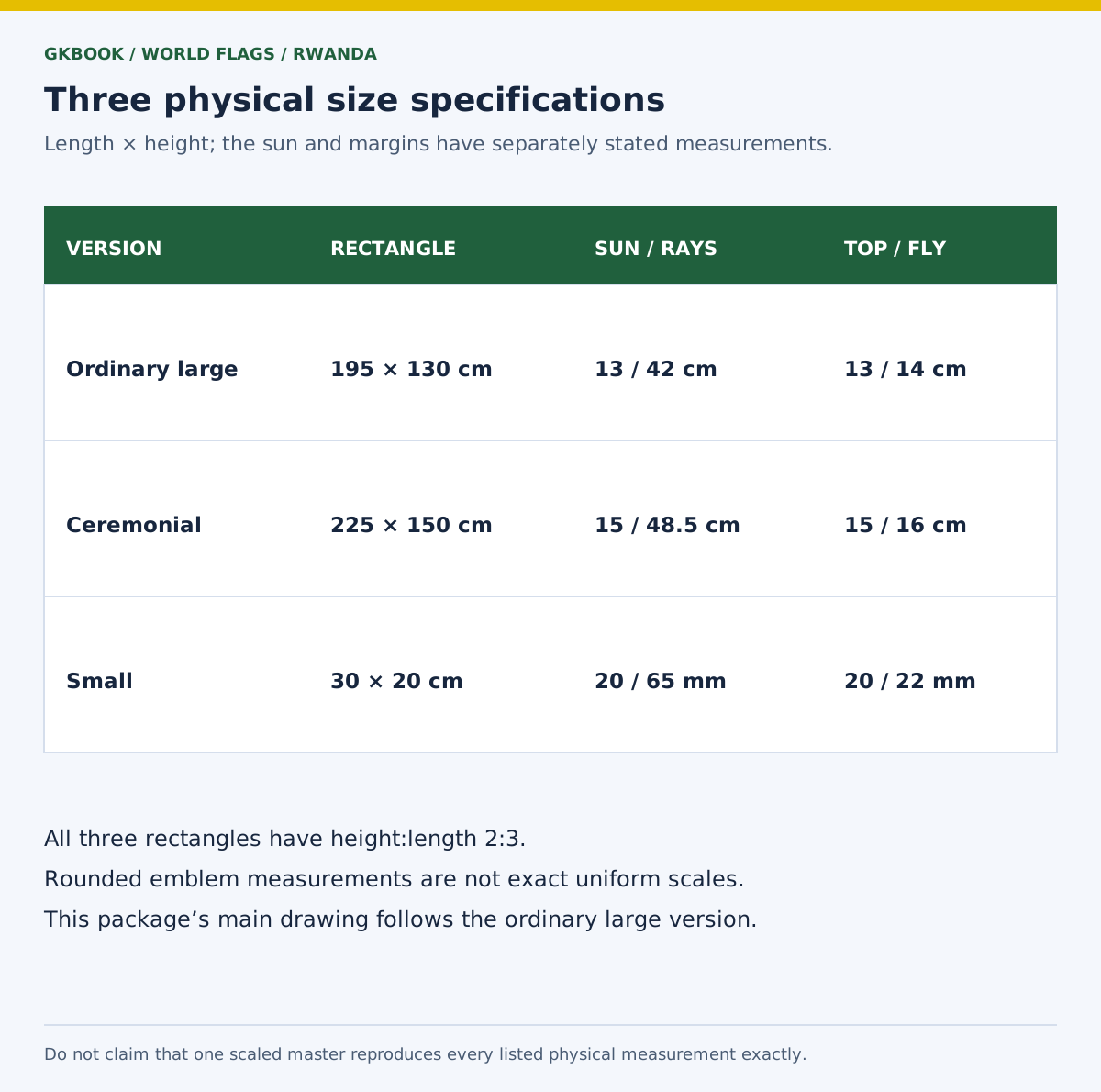
Uniform scaling of the ordinary large drawing preserves its appearance, but it does not reproduce every number listed for the other physical versions. For example, scaling the 42 centimeter ray diameter to the ceremonial length gives about 48.462 centimeters; the ceremonial specification states 48.5 centimeters. The small version separately states 65 millimeters.
These differences matter when the purpose is manufacturing to a named size provision. They do not prevent a proportional digital thumbnail, but they should not be concealed behind a claim that one master exactly implements every legal variant. The comparison table records the actual stated values and keeps centimeters and millimeters clearly distinguished.
| Version | Rectangle | Sun / rays diameter | Top / fly margin |
|---|---|---|---|
| Ordinary large | 195 × 130 cm | 13 / 42 cm | 13 / 14 cm |
| Ceremonial | 225 × 150 cm | 15 / 48.5 cm | 15 / 16 cm |
| Small | 30 × 20 cm | 20 / 65 mm | 20 / 22 mm |
What materials are specified for the flag?
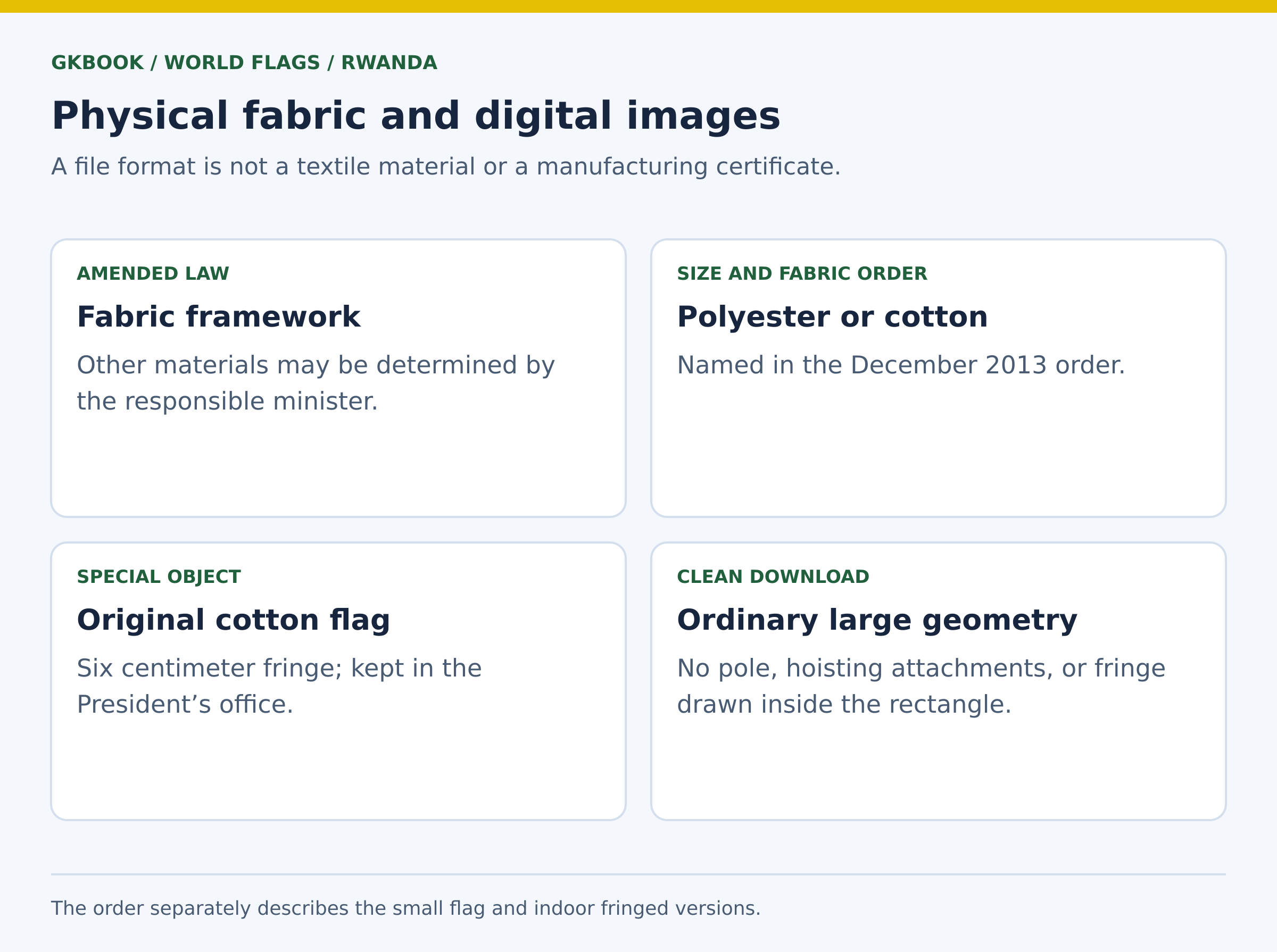
The amended law provides for a fabric flag and allows the responsible minister to determine other materials. The December 2013 size and fabric order names polyester or cotton. Material requirements for physical objects are separate from the SVG and PNG formats used to represent the flag in this digital package.
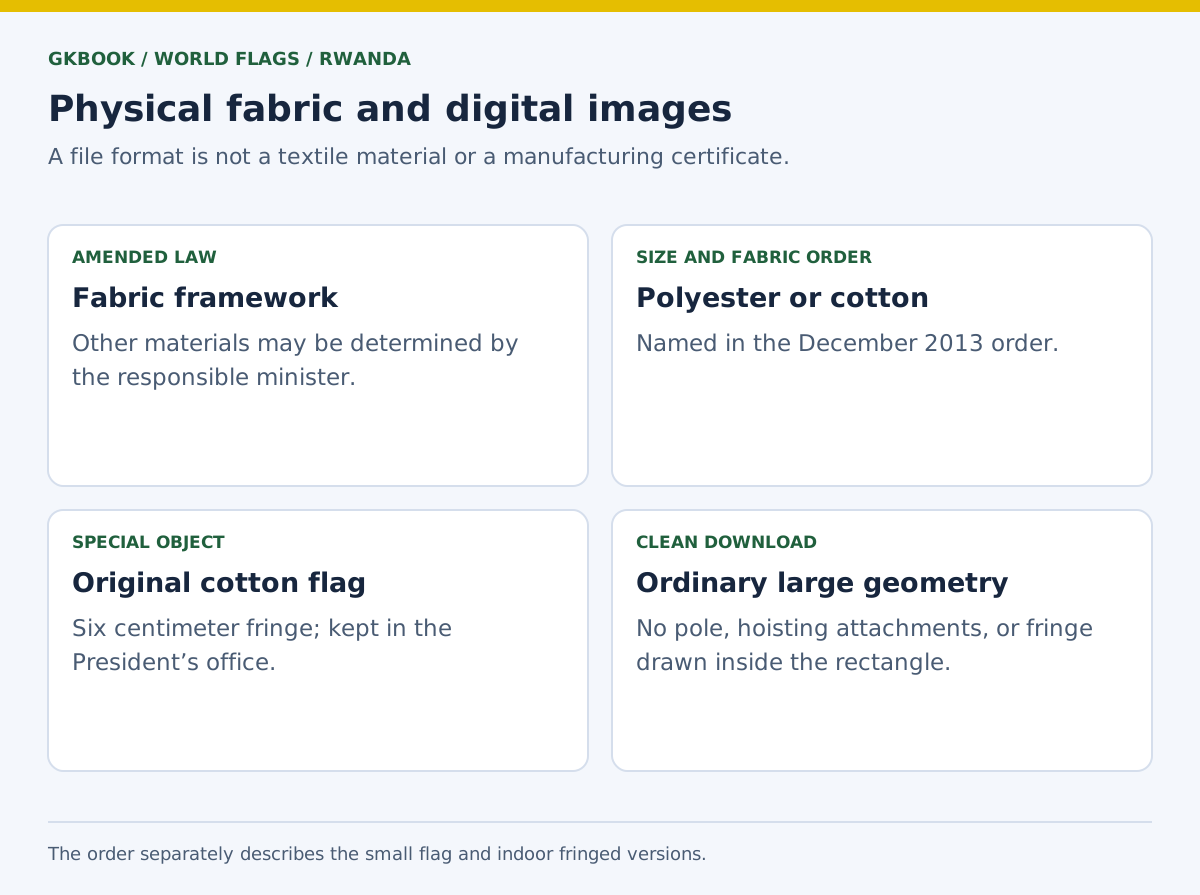
The order also describes an original cotton flag with a six centimeter fringe kept in the President’s office. That special object should not be confused with the ordinary large version, which has no fringe, or with every flag appearing in a general illustration. The small version has its own fringe provision.
A digital file carries geometry and color instructions, not a guarantee about fabric, stitching, durability, or a manufacturer’s physical color match. Converting the vector into embroidery or printing therefore requires attention to the intended physical version and the appropriate references. The material card explains these categories without presenting a raster download as a certified textile production specification.
Can individuals possess and use Rwanda’s flag?
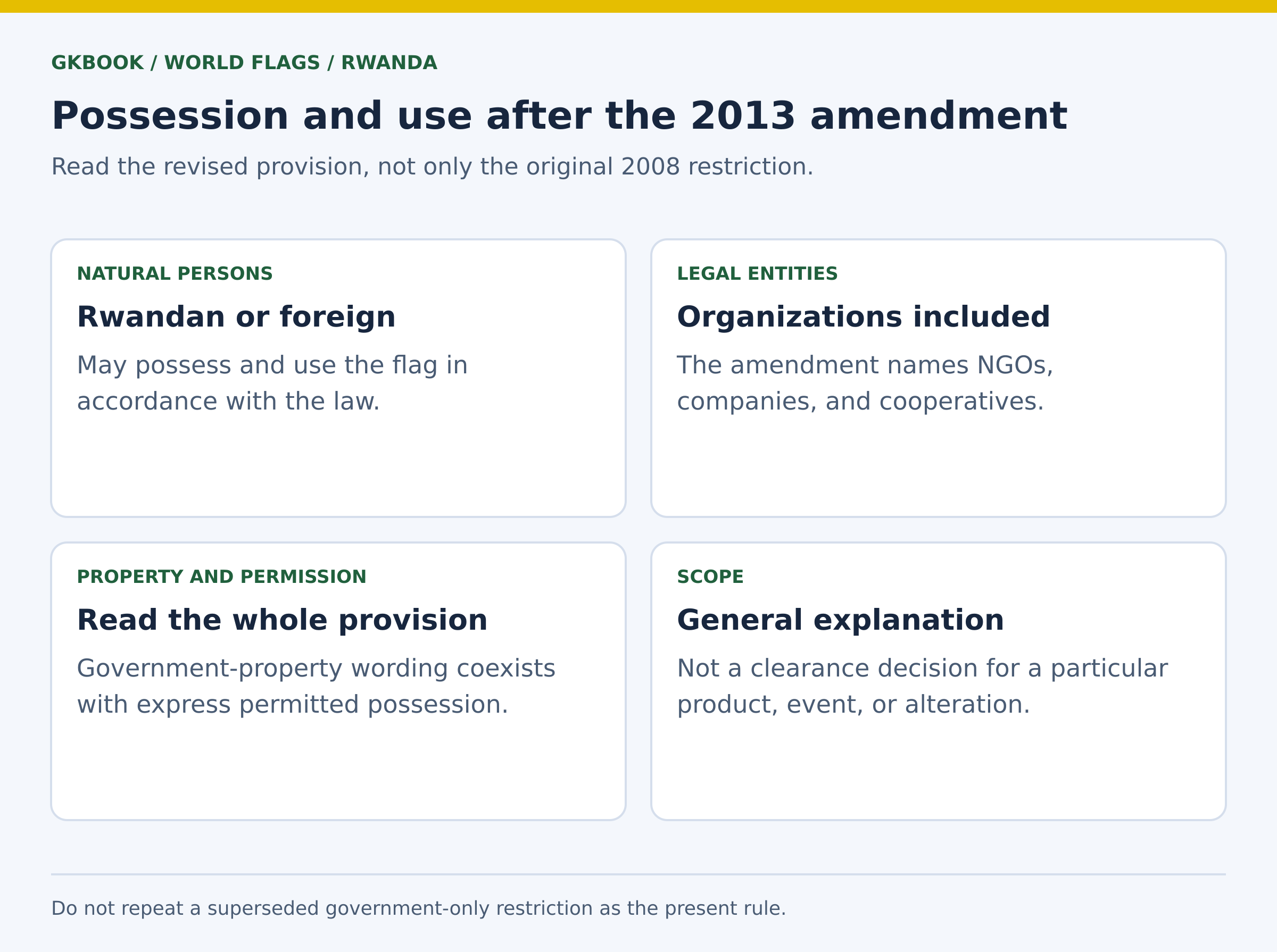
Yes. The 2013 amendment permits Rwandan or foreign natural persons and specified legal entities to possess and use the national flag in accordance with the law. It also addresses flag-like items and respect for the symbol. An unamended statement that the flag is reserved exclusively to government would therefore be misleading.
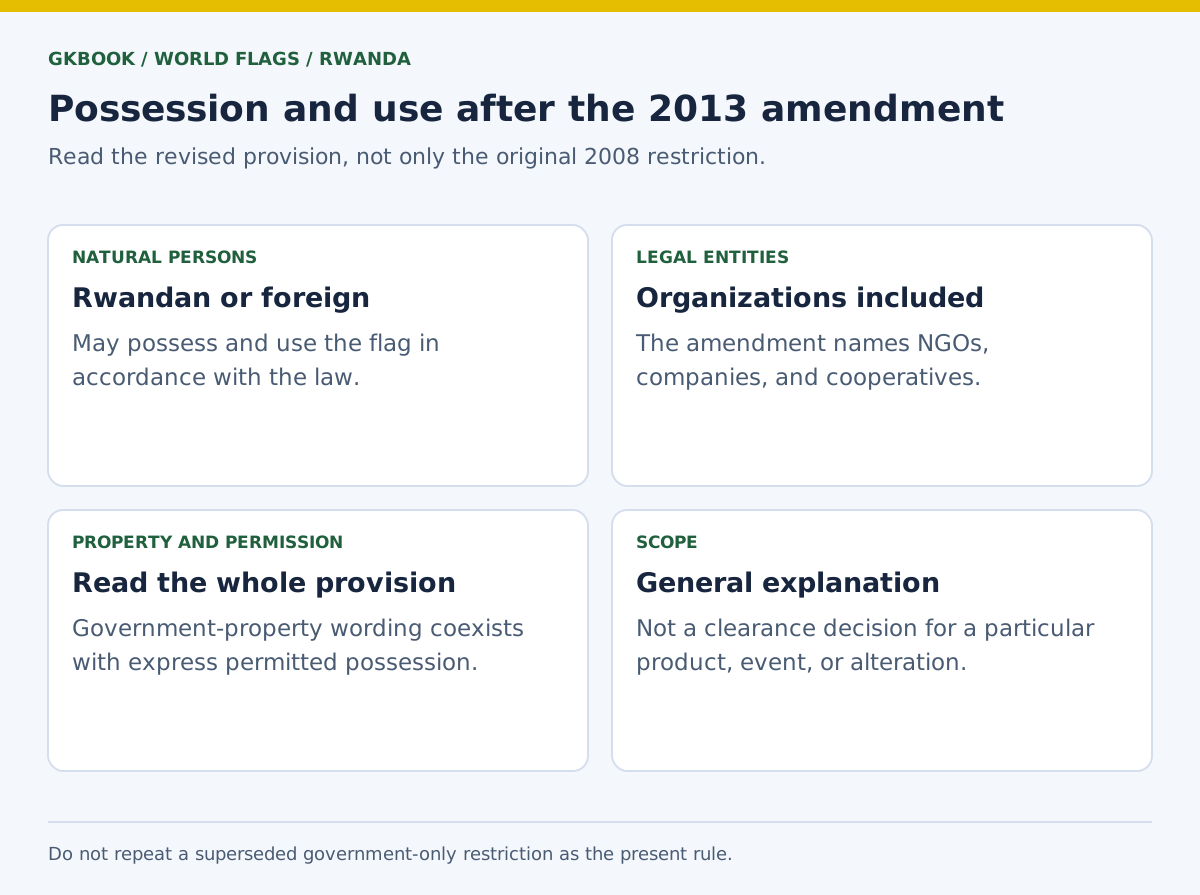
The amended provision retains the flag’s status as government property while expressly allowing possession and use by other people and organizations. Those parts should be read together, rather than selecting the first sentence and ignoring the following permission. The text names organizations including nongovernmental organizations, companies, and cooperatives.
That general explanation is not a clearance decision for a particular commercial product, event, or alteration. The gallery’s display card concentrates on the verified amendment and the need to distinguish a faithful flag from other objects using its colors. It does not import a foreign country’s flag etiquette or invent a universal rule governing every possible setting.
When is Rwanda’s flag flown at half-mast?
Article 12 provides for the national flag to be lowered to half-mast during national mourning established by law or ordered by the President. Flags being raised for that purpose first reach their normal position before being lowered. This explains the general procedure, without asserting that a particular mourning order is currently in effect.
Half-mast concerns the flag’s position on the staff, not a change to its printed design. The blue, yellow, and green arrangement and the sun remain the same. A diagram of the flag alone therefore cannot tell a viewer whether the surrounding ceremony is a mourning observance.
For a real event, the applicable instruction determines the occasion and timing. An undated photograph cannot establish a current mourning order. This package records the procedure at the level supported by Article 12 and leaves event schedules outside the construction reference.
Is Rwanda’s national seal part of the flag?
No. Rwanda’s complete national seal is a separate state symbol. The national flag contains the golden sun and rays within its blue field, above yellow and green bands. Adding the full seal, a national motto, or the old black R would alter the ordinary flag shown and described in this guide.
The Constitution lists the flag, motto, seal, and anthem together, but listing them does not combine their artwork into a single design. A shared motif or a common ceremonial setting also does not make two national symbols interchangeable. Identify the specific object before copying an emblem from one onto another.
For the clean flag download, use the supplied rectangle as a whole. Place an explanatory title or country name outside it when designing a teaching card. The gallery follows that distinction: labels, dimensions, and explanatory panels belong to the surrounding composition, while the flag itself retains only the specified bands and sun construction.
How does Rwanda’s flag look from the reverse side?
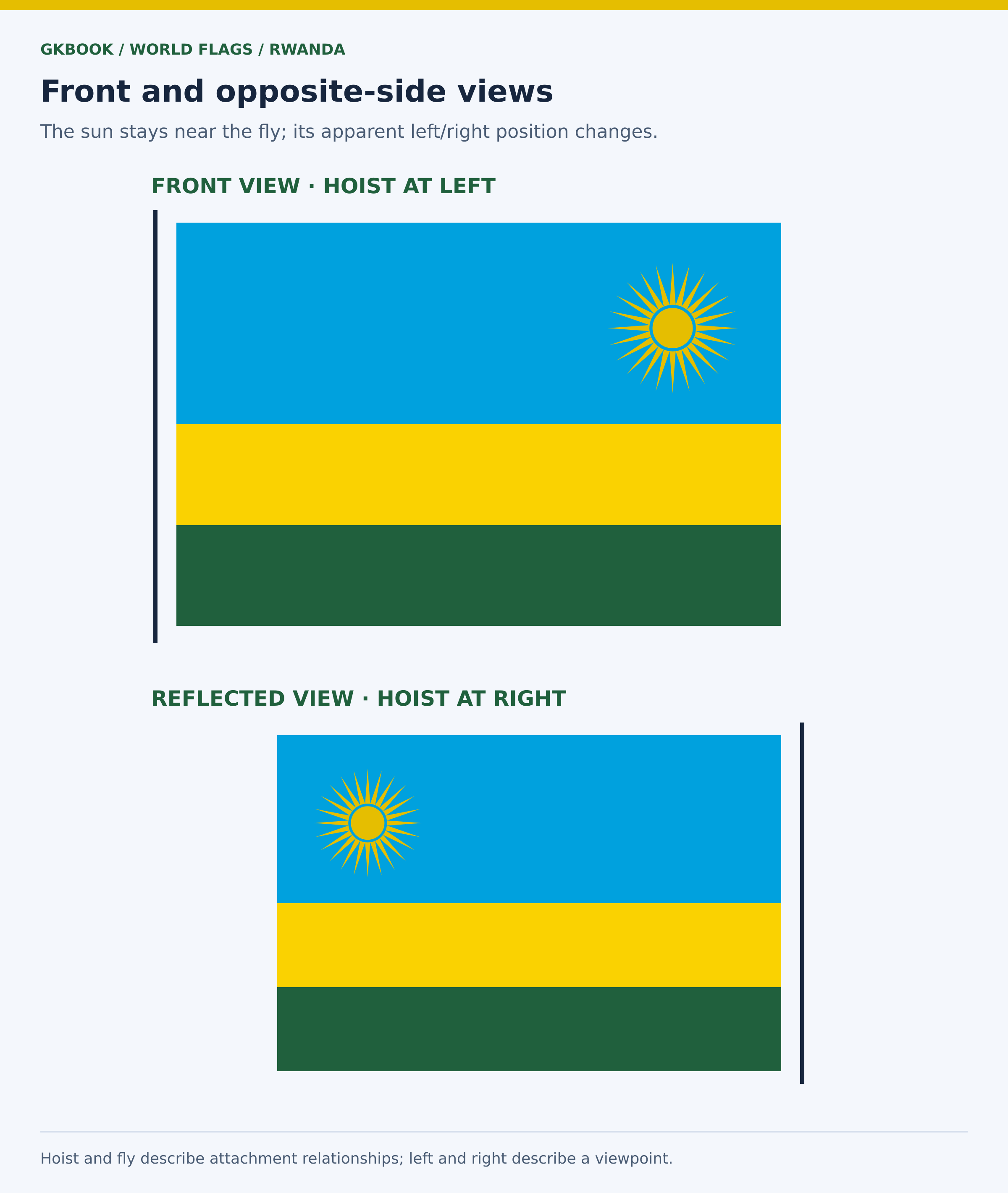
Viewing the same flag from the opposite side produces a horizontal reflection: the sun appears toward the viewer’s upper left when the hoist is on the right. It remains near the fly, away from the pole. Blue stays above yellow and green; the reflection does not reverse their vertical order.
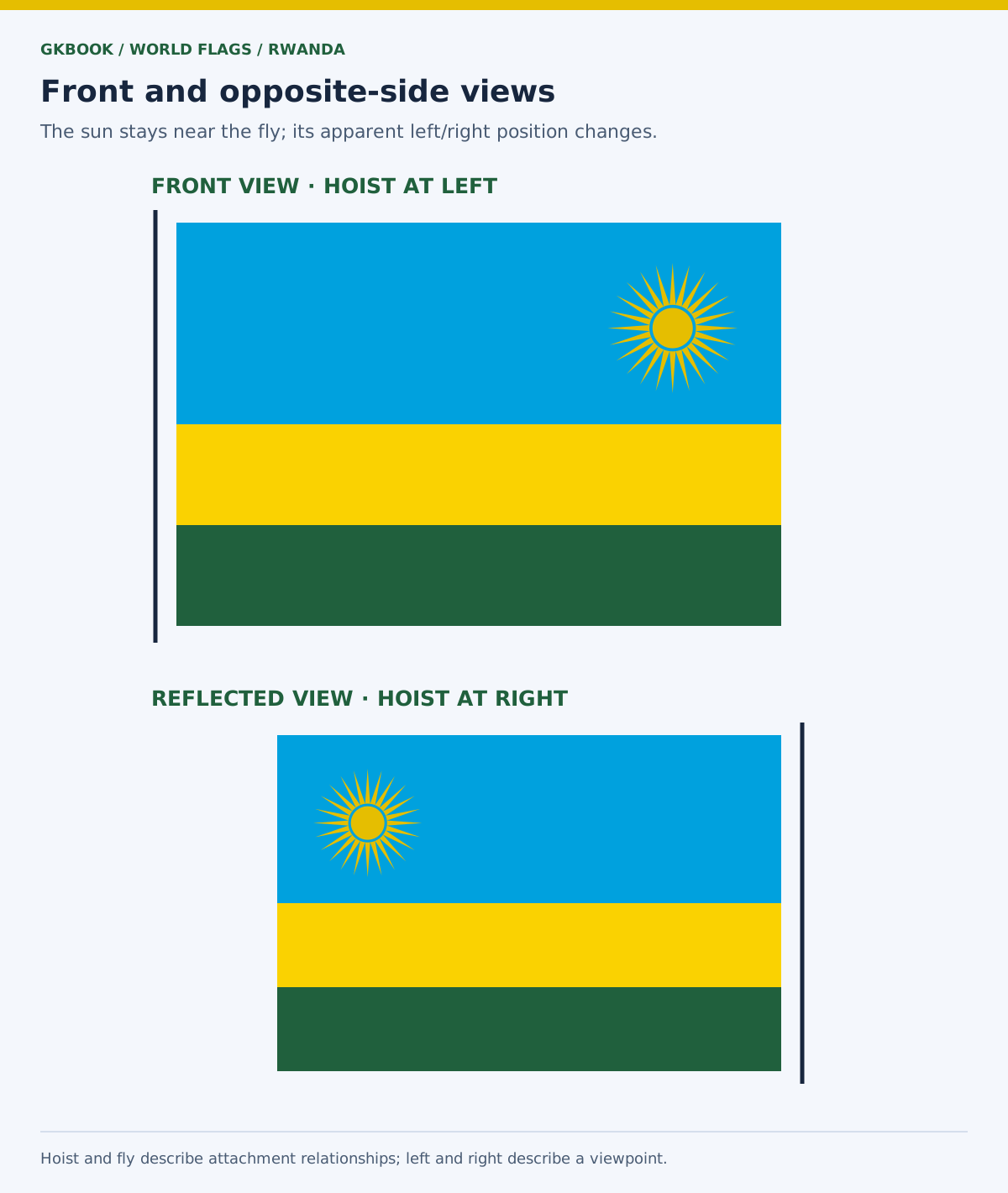
The words “left” and “right” depend on viewpoint, whereas hoist and fly identify edges by their relationship to the attachment. A front-view illustration conventionally places the hoist at the left and the sun toward the right. Looking through to the opposite side exchanges the apparent left and right positions.
The reverse diagram demonstrates that geometry with a labeled pole on each side. It is not a prescription for how many cloth layers to sew or how a printer should arrange separate panels. When reviewing a photograph, establish which side and attachment edge are visible before treating a sun on the viewer’s left as an error.
How should Rwanda’s flag be reproduced digitally?
Preserve the 3:2 image shape, the 2:1:1 band heights, the upper-fly sun, and its blue separator. Use the SVG when scalable artwork is needed and the PNG for a fixed raster image. Keep the palette’s editorial status visible: these screen values are not certified equivalents of the law’s physical color references.
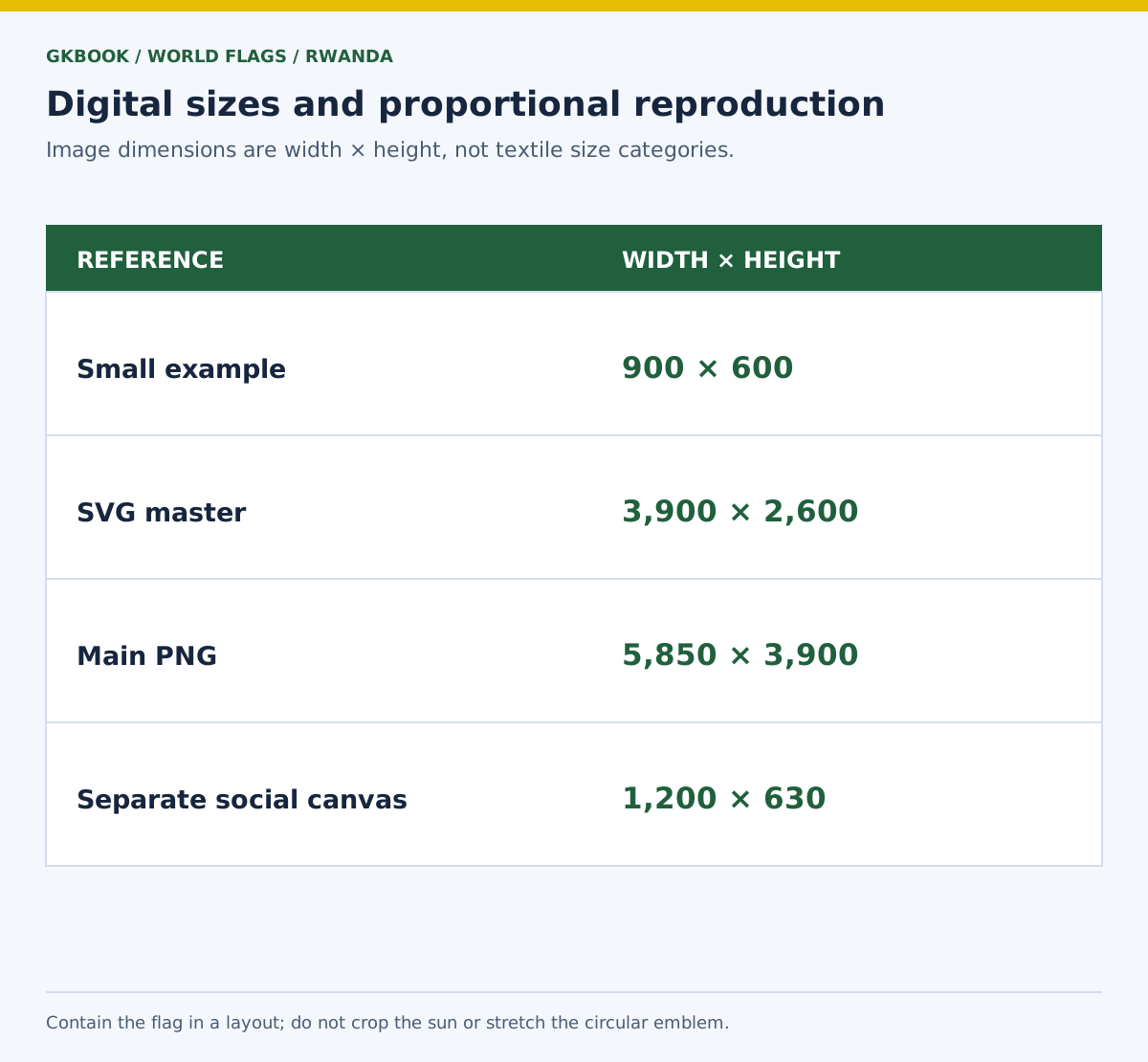
The clean PNG is 5,850 by 3,900 pixels, while the SVG uses a 3,900 by 2,600 coordinate system. Neither file includes a border, shadow, pole, title, or transparent background. The larger diagram canvases intentionally include text and measurements, so choose the clean reference when only the national flag is required.
Use proportional containment inside a thumbnail or social layout. Cropping can remove the sun or change the apparent height of a band, and stretching can turn the circular emblem into an ellipse. A very small raster may also blur the blue ring. Keeping the original vector allows a fresh rendering at an appropriate resolution when those details matter.
What are common mistakes in Rwanda flag illustrations?
Common errors include three equal bands, a centered sun, a missing blue ring, the wrong ray count, and treating both yellows as one specified shade. Historical mistakes include adding the old black R or calling the 2008 law the flag’s first adoption. Accurate artwork needs an equally careful caption.
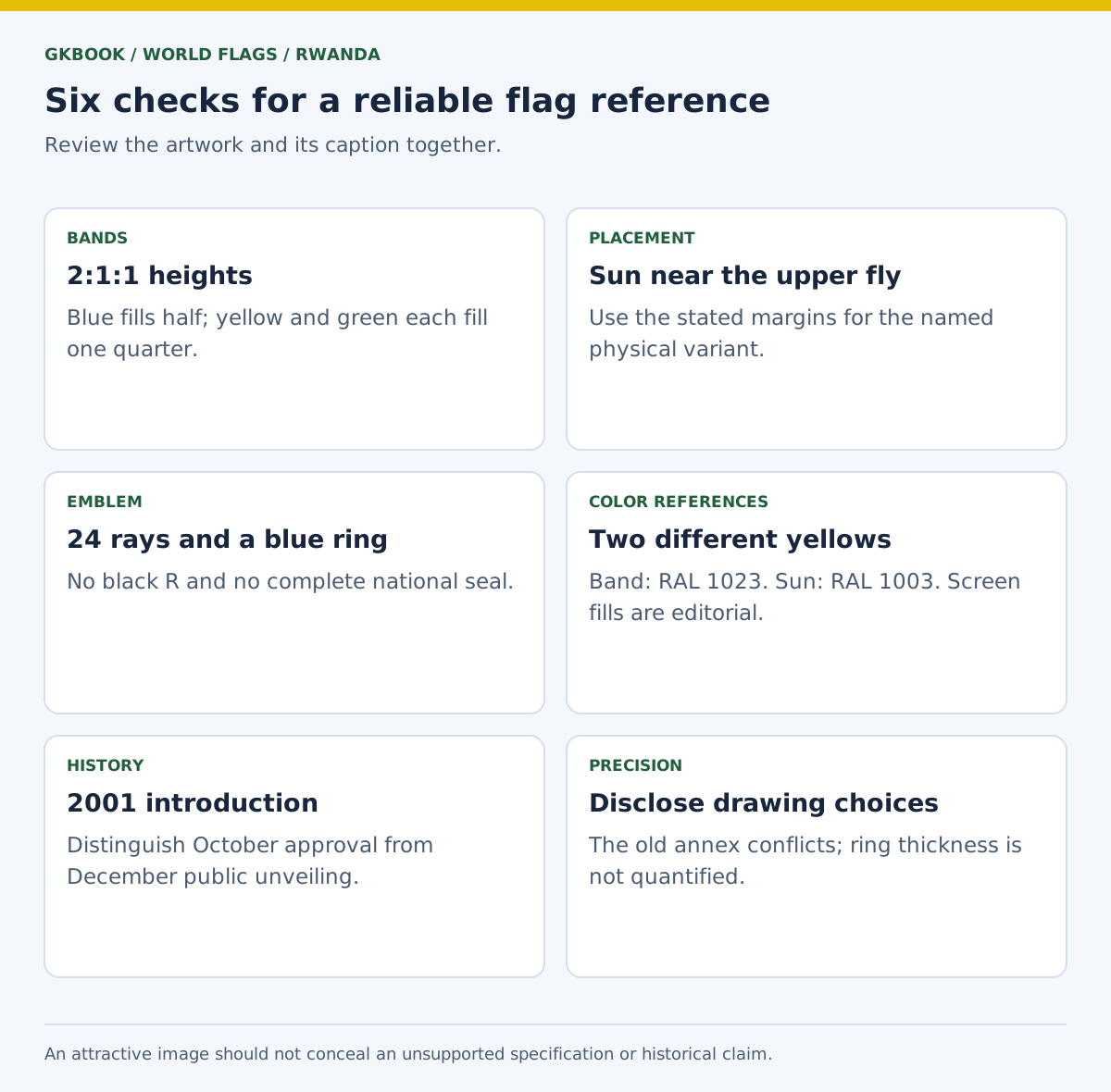
Check the rectangle and stripe boundaries before judging small details. The height is two thirds of the length; blue takes half the height; yellow and green each take a quarter. Then inspect the sun’s position, count its 24 outward rays, and confirm that a blue separator remains visible around the gold center.
Finally, read the accompanying claims. A drawing may be visually convincing while overstating its precision, using superseded possession rules, or presenting editorial RGB values as statutory codes. This package records the annex discrepancy and the unspecified ring details so that readers can distinguish a transparent reconstruction from an unsupported assertion of complete manufacturing compliance.
Which Rwanda flag pictures can I download here?
The gallery offers 24 subjects, each in SVG and PNG, including the clean flag, color references, sun diagrams, proportions, timelines, and use explanations. A separate social card is also supplied. All artwork is an original vector composition; historical and biographical cards explain documented facts without inventing archival photographs or portraits.
Choose the clean flag for a national reference, the construction diagrams for measurement lessons, and the timeline cards for distinguishing historical and legal dates. Each image includes a descriptive caption and alternative text. The SVG versions preserve vector shapes and editable labels, while the PNG versions provide fixed images for applications that do not support SVG.
The credits explain which dimensions follow the later order and which details are editorial conventions. Download links are grouped in the picture gallery. For further country guides, return to World Flags. The separate social card contains the complete flag within its own wider canvas rather than stretching the flag to fit.
Download Rwanda flag pictures
Download the clean national flag as SVG or 5,850 × 3,900 PNG. Its SVG coordinate system is 3,900 × 2,600, with band heights of 1,300, 650, and 650 units.
The gallery contains 24 subjects, each with an SVG and PNG. The main reconstruction follows the later ordinary-large measurements. Its ring thickness, ray-root geometry, angular alignment, and numerical screen colors are declared editorial choices. Image credits and reproduction notes explain the old annex discrepancy, physical color references, and size variants. The separate social card is 1,200 × 630 and contains a complete correctly proportioned flag.
Continue exploring national designs in World Flags.
World Flags/Rwanda
Rwanda flag pictures
Blue upper half, yellow middle quarter, green lower quarter, with a golden 24-ray sun at the upper fly. Reconstruction follows the ordinary-large measurements, with declared ring/ray conventions and editorial RGB.
Original GKBook vector reconstruction. Explicit dimensions follow Article 4 of Ministerial Order 004/07.01/13; ring thickness, ray-root geometry, orientation, and RGB fills are disclosed editorial choices.Download SVGDownload PNGArticle 6 supplies physical color references. The four RGB and hexadecimal fills shown are separately declared editorial approximations, not statutory numerical screen values.
Original GKBook vector reconstruction. Explicit dimensions follow Article 4 of Ministerial Order 004/07.01/13; ring thickness, ray-root geometry, orientation, and RGB fills are disclosed editorial choices.Download SVGDownload PNGThe meanings are drawn from Article 5. They express official symbolic intentions, not measured social outcomes.
Original GKBook vector reconstruction. Explicit dimensions follow Article 4 of Ministerial Order 004/07.01/13; ring thickness, ray-root geometry, orientation, and RGB fills are disclosed editorial choices.Download SVGDownload PNGThe yellow band is one quarter of the height. Its official meaning and physical color reference are distinct from the digital reproduction choice.
Original GKBook vector reconstruction. Explicit dimensions follow Article 4 of Ministerial Order 004/07.01/13; ring thickness, ray-root geometry, orientation, and RGB fills are disclosed editorial choices.Download SVGDownload PNGThe green band is one quarter of the height. Its official meaning and physical color reference are distinct from the digital reproduction choice.
Original GKBook vector reconstruction. Explicit dimensions follow Article 4 of Ministerial Order 004/07.01/13; ring thickness, ray-root geometry, orientation, and RGB fills are disclosed editorial choices.Download SVGDownload PNGEnlarged emblem from the package’s reconstruction. The blue ring separates the central gold disc and rays; its precise thickness and the ray-root geometry are editorial conventions.
Original GKBook vector reconstruction. Explicit dimensions follow Article 4 of Ministerial Order 004/07.01/13; ring thickness, ray-root geometry, orientation, and RGB fills are disclosed editorial choices.Download SVGDownload PNGEach outward tip is counted once. The regular spacing is a drawing convention; no unsupported meaning such as hours or provinces is assigned to the rays.
Original GKBook vector reconstruction. Explicit dimensions follow Article 4 of Ministerial Order 004/07.01/13; ring thickness, ray-root geometry, orientation, and RGB fills are disclosed editorial choices.Download SVGDownload PNGA magnified center detail separates the disc and surrounding rays. The actual master uses radii 130 and 150 units; the legal texts checked require a blue ring but do not quantify its thickness.
Original GKBook vector reconstruction. Explicit dimensions follow Article 4 of Ministerial Order 004/07.01/13; ring thickness, ray-root geometry, orientation, and RGB fills are disclosed editorial choices.Download SVGDownload PNGThe rectangle is one and a half times as long as it is high. Dimension guides sit outside the flag.
Original GKBook vector reconstruction. Explicit dimensions follow Article 4 of Ministerial Order 004/07.01/13; ring thickness, ray-root geometry, orientation, and RGB fills are disclosed editorial choices.Download SVGDownload PNGThe master has band heights 1,300, 650, and 650 units. Three equal horizontal bands would be incorrect.
Original GKBook vector reconstruction. Explicit dimensions follow Article 4 of Ministerial Order 004/07.01/13; ring thickness, ray-root geometry, orientation, and RGB fills are disclosed editorial choices.Download SVGDownload PNGThe ordinary large flag has a 42 cm ray diameter, a 13 cm top gap, and a 14 cm fly gap. Center coordinates follow by calculation.
Original GKBook vector reconstruction. Explicit dimensions follow Article 4 of Ministerial Order 004/07.01/13; ring thickness, ray-root geometry, orientation, and RGB fills are disclosed editorial choices.Download SVGDownload PNGThe old annex’s D = 0.125Y conflicts with the explicit 42 cm ray diameter at the ordinary large size. The reconstruction uses the later order’s explicit values and records all additional choices.
Original GKBook vector reconstruction. Explicit dimensions follow Article 4 of Ministerial Order 004/07.01/13; ring thickness, ray-root geometry, orientation, and RGB fills are disclosed editorial choices.Download SVGDownload PNGThe timeline distinguishes the 2001 introduction from later legislation and constitutional wording. The 2018 offence amendment is addressed separately.
Original GKBook vector reconstruction. Explicit dimensions follow Article 4 of Ministerial Order 004/07.01/13; ring thickness, ray-root geometry, orientation, and RGB fills are disclosed editorial choices.Download SVGDownload PNGOctober 25 and December 31 refer to different steps. The historical record should not collapse approval and public unveiling into one unlabeled event.
Original GKBook vector reconstruction. Explicit dimensions follow Article 4 of Ministerial Order 004/07.01/13; ring thickness, ray-root geometry, orientation, and RGB fills are disclosed editorial choices.Download SVGDownload PNGThe designer credit is supported by Rwanda Education Board materials. No unsupported personal biography, commission narrative, or anthem authorship is inferred.
Original GKBook vector reconstruction. Explicit dimensions follow Article 4 of Ministerial Order 004/07.01/13; ring thickness, ray-root geometry, orientation, and RGB fills are disclosed editorial choices.Download SVGDownload PNGThe comparison identifies the previous design and its main differences. It does not claim exact historical lettering, dyes, or dimensions.
Original GKBook vector reconstruction. Explicit dimensions follow Article 4 of Ministerial Order 004/07.01/13; ring thickness, ray-root geometry, orientation, and RGB fills are disclosed editorial choices.Download SVGDownload PNGArticle 9 of the 2023 Constitution supplies the description. Detailed sizes come from separate flag legislation and the implementing order.
Original GKBook vector reconstruction. Explicit dimensions follow Article 4 of Ministerial Order 004/07.01/13; ring thickness, ray-root geometry, orientation, and RGB fills are disclosed editorial choices.Download SVGDownload PNGThe legal chronology explains why an unamended 2008 possession restriction should not be repeated as current.
Original GKBook vector reconstruction. Explicit dimensions follow Article 4 of Ministerial Order 004/07.01/13; ring thickness, ray-root geometry, orientation, and RGB fills are disclosed editorial choices.Download SVGDownload PNGThe table transcribes the stated sizes in the 2013 order. Sun/rays entries are diameters; top/fly entries are gaps from the outer rays.
Original GKBook vector reconstruction. Explicit dimensions follow Article 4 of Ministerial Order 004/07.01/13; ring thickness, ray-root geometry, orientation, and RGB fills are disclosed editorial choices.Download SVGDownload PNGMaterials and fringes depend on the physical category. The main digital reference follows the ordinary large rectangle and does not certify a manufactured object.
Original GKBook vector reconstruction. Explicit dimensions follow Article 4 of Ministerial Order 004/07.01/13; ring thickness, ray-root geometry, orientation, and RGB fills are disclosed editorial choices.Download SVGDownload PNGLaw 06/2013 revises possession and use. The card does not claim an unconditional exemption from all national-symbol rules.
Original GKBook vector reconstruction. Explicit dimensions follow Article 4 of Ministerial Order 004/07.01/13; ring thickness, ray-root geometry, orientation, and RGB fills are disclosed editorial choices.Download SVGDownload PNGHorizontal reflection moves the sun to the viewer’s upper left while leaving blue above yellow above green. This explains viewpoint, not sewing or printing methods.
Original GKBook vector reconstruction. Explicit dimensions follow Article 4 of Ministerial Order 004/07.01/13; ring thickness, ray-root geometry, orientation, and RGB fills are disclosed editorial choices.Download SVGDownload PNGFlag images retain a 3:2 width to height ratio. The separate social canvas has its own wider ratio and contains a complete correctly proportioned flag.
Original GKBook vector reconstruction. Explicit dimensions follow Article 4 of Ministerial Order 004/07.01/13; ring thickness, ray-root geometry, orientation, and RGB fills are disclosed editorial choices.Download SVGDownload PNGThe checklist covers proportions, sun placement, internal details, color status, dates, and reconstruction limits.
Original GKBook vector reconstruction. Explicit dimensions follow Article 4 of Ministerial Order 004/07.01/13; ring thickness, ray-root geometry, orientation, and RGB fills are disclosed editorial choices.Download SVGDownload PNGFrequently asked questions
What does the Rwanda flag look like?
Rwanda’s national flag has a blue upper half, a yellow middle quarter, and a green lower quarter. A golden sun with 24 rays appears near the upper fly, separated from its rays by a blue ring. The rectangular flag has a height to length ratio of 2:3.
What are the colors of Rwanda’s flag?
Rwanda’s flag combines blue, yellow, and green horizontal bands with a golden-yellow sun. The law distinguishes the band’s yellow from the sun’s gold and gives physical color references. This package uses four declared digital approximations; its RGB and hex values are editorial choices, not numerical values printed in the law.
What does Rwanda’s flag mean?
Rwanda’s flag law assigns meanings to its colors and sun. Blue expresses happiness and peace, yellow economic development, and green hope for prosperity. The sun and its golden rays represent light, unity, transparency, and the struggle against ignorance. These meanings come from the legal description, rather than an invented color mnemonic.
What does the blue part of Rwanda’s flag represent?
Blue represents happiness and peace in Rwanda’s flag law. It occupies the entire upper half of the flag, making it twice as tall as either lower band. The golden sun sits within this blue area near the fly, the edge opposite the side attached to the flagpole.
What does the yellow band represent?
The yellow band represents economic development and the work required for lasting development. It lies between the blue and green areas and occupies one quarter of the flag’s height. Its specified physical reference is RAL 1023, which is distinct from the golden-yellow reference used for the sun.
What does the green band represent?
Green represents hope for prosperity, linked in the flag law to the productive use of people’s energies and the country’s resources. It forms the bottom quarter of the flag. Its height equals the yellow band’s height, and its physical color reference is RAL 6029.
What does the sun on Rwanda’s flag symbolize?
The golden sun and its rays symbolize light that progressively enlightens the people, together with unity, transparency, and the fight against ignorance. The sun appears in the blue upper portion near the fly. It is a distinct flag emblem, not a miniature version of Rwanda’s complete national seal.
How many rays does Rwanda’s flag sun have?
The sun has 24 rays, visible in the national design and government artwork. This reconstruction spaces their tips evenly around a circle. The official symbolism concerns the sun and its rays together; the sources checked do not assign each ray to an hour, province, district, or other individual unit.
Why is there a blue ring around the sun?
A blue ring separates the central sun from its golden rays, as the Constitution and flag law describe. The ring is part of the design, not an accidental gap in printing. Its thickness is not numerically specified in the provisions checked, so this package explicitly declares that detail as an editorial reconstruction choice.
What is the aspect ratio of Rwanda’s flag?
Rwanda’s national flag has a height to length ratio of 2:3, equivalent to an image width to height ratio of 3:2. The ordinary large version measures 195 centimeters long and 130 centimeters high. Measure the colored rectangle itself, excluding the pole, hoisting attachments, fringe, and surrounding page margins.
Are the three horizontal bands equal?
No. Rwanda’s blue band occupies half the flag’s height, while yellow and green each occupy one quarter. Their height ratio is 2:1:1. Dividing the rectangle into three equal horizontal stripes would produce an incorrect construction, even if the colors and the sun were otherwise recognizable.
Where exactly is the sun positioned?
On the ordinary 195 by 130 centimeter flag, the outer rays are 13 centimeters below the top edge and 14 centimeters from the fly edge. Their overall diameter is 42 centimeters. These measurements place the center 160 centimeters from the hoist and 34 centimeters below the top.
How is the Rwanda flag constructed in these files?
The drawing uses the later ministerial order’s explicit ordinary-large measurements: a 195 by 130 centimeter rectangle, unequal bands, and the stated sun size and offsets. A conflicting formula in the older annex is not used. Ring thickness, ray-root geometry, angular alignment, and numerical screen colors are openly identified as editorial choices.
What is the history of Rwanda’s current flag?
Rwanda introduced its current blue, yellow, and green flag with a golden sun in 2001, replacing the earlier vertical tricolor bearing a black R. The change formed part of a renewal of national symbols. Later legislation described and regulated the flag; those later legal dates should not be mistaken for its first introduction.
Was Rwanda’s flag adopted in October or December 2001?
The two dates describe different milestones. Parliamentary approval of the constitutional and flag changes is reported on October 25, 2001. The new flag, anthem, and national emblem were publicly unveiled on December 31, 2001. A careful timeline names the event beside each date instead of presenting the dates as interchangeable.
Who designed Rwanda’s current flag?
The current flag is credited to Rwandan artist Alphonse Kirimobenecyo. Rwanda Education Board art materials associate him with the national flag and national emblem. His design credit should be distinguished from the institutions that approved the symbols and the later laws that describe their construction, meaning, and use.
What did Rwanda’s previous flag look like?
The flag replaced in 2001 had vertical red, yellow, and green bands with a black capital R on the yellow center band. It differs clearly from the present horizontal design, which has a broad blue upper field and a golden sun. The current flag does not retain the letter R.
Why did Rwanda change its flag?
The 2001 change was presented as part of a renewal of national identity and reconciliation after the 1994 genocide against the Tutsi. New national symbols were intended to express unity and a shared future. That stated purpose explains the official symbolism; it does not establish that every person interpreted the change identically.
How does Rwanda’s Constitution describe the flag?
Article 9 of Rwanda’s 2023 Constitution identifies the national flag among the state’s symbols. It describes green and yellow below a blue upper half, with a golden sun and rays on the right and a blue separating ring. The detailed physical measurements come from the separate flag legislation and implementing order.
Which laws govern Rwanda’s national flag?
The framework includes Law 34/2008 of August 8, 2008, as amended, together with implementing orders. Law 06/2013 changed provisions on materials, sizes, possession, and use; Law 42/2018 modified offence provisions. Reading the original 2008 text alone can therefore produce outdated conclusions, even where its basic design description remains relevant.
Which order supplies the detailed flag measurements?
Ministerial Order 004/07.01/13, dated December 19, 2013, determines the flag’s fabric and sizes. It was published in Official Gazette number 02 on January 13, 2014, and took effect on publication. Article 4 gives the ordinary large flag measurements used as the basis for this package’s main reconstruction.
What physical sizes are specified for Rwanda’s flag?
The size order describes an ordinary large flag of 195 by 130 centimeters, a ceremonial version of 225 by 150 centimeters, and a small flag of 30 by 20 centimeters. Each rectangle has a 2:3 height to length ratio. Their stated sun measurements and edge offsets include small rounding differences.
What materials are specified for the flag?
The amended law provides for a fabric flag and allows the responsible minister to determine other materials. The December 2013 size and fabric order names polyester or cotton. Material requirements for physical objects are separate from the SVG and PNG formats used to represent the flag in this digital package.
Can individuals possess and use Rwanda’s flag?
Yes. The 2013 amendment permits Rwandan or foreign natural persons and specified legal entities to possess and use the national flag in accordance with the law. It also addresses flag-like items and respect for the symbol. An unamended statement that the flag is reserved exclusively to government would therefore be misleading.
When is Rwanda’s flag flown at half-mast?
Article 12 provides for the national flag to be lowered to half-mast during national mourning established by law or ordered by the President. Flags being raised for that purpose first reach their normal position before being lowered. This explains the general procedure, without asserting that a particular mourning order is currently in effect.
Is Rwanda’s national seal part of the flag?
No. Rwanda’s complete national seal is a separate state symbol. The national flag contains the golden sun and rays within its blue field, above yellow and green bands. Adding the full seal, a national motto, or the old black R would alter the ordinary flag shown and described in this guide.
How does Rwanda’s flag look from the reverse side?
Viewing the same flag from the opposite side produces a horizontal reflection: the sun appears toward the viewer’s upper left when the hoist is on the right. It remains near the fly, away from the pole. Blue stays above yellow and green; the reflection does not reverse their vertical order.
How should Rwanda’s flag be reproduced digitally?
Preserve the 3:2 image shape, the 2:1:1 band heights, the upper-fly sun, and its blue separator. Use the SVG when scalable artwork is needed and the PNG for a fixed raster image. Keep the palette’s editorial status visible: these screen values are not certified equivalents of the law’s physical color references.
What are common mistakes in Rwanda flag illustrations?
Common errors include three equal bands, a centered sun, a missing blue ring, the wrong ray count, and treating both yellows as one specified shade. Historical mistakes include adding the old black R or calling the 2008 law the flag’s first adoption. Accurate artwork needs an equally careful caption.
Which Rwanda flag pictures can I download here?
The gallery offers 24 subjects, each in SVG and PNG, including the clean flag, color references, sun diagrams, proportions, timelines, and use explanations. A separate social card is also supplied. All artwork is an original vector composition; historical and biographical cards explain documented facts without inventing archival photographs or portraits.
Explore all general-knowledge topics and the A-to-Z lists.








We Value Your Opinion Comments