

Romania flag picture
Explore the proportions, history, and picture gallery.
| Design | Blue, yellow, and redThree equal vertical bands; blue at the hoist. |
|---|---|
| Proportions | Height:length = 2:3Each band is one third of the total length. |
| Digital colors | #002B7F · #FCD116 · #CE1126Exact hex conversions of the statutory RGB values. |
| Modern restoration | December 27, 1989Decree-Law 2; the tricolor tradition is much older. |
| National Flag Day | June 26Established by Law 96/1998; distinct from National Day. |
| Image basis | 2023 legal annexSVG: 2,400 × 1,600; PNG: 4,800 × 3,200. |
What does the Romania flag look like?
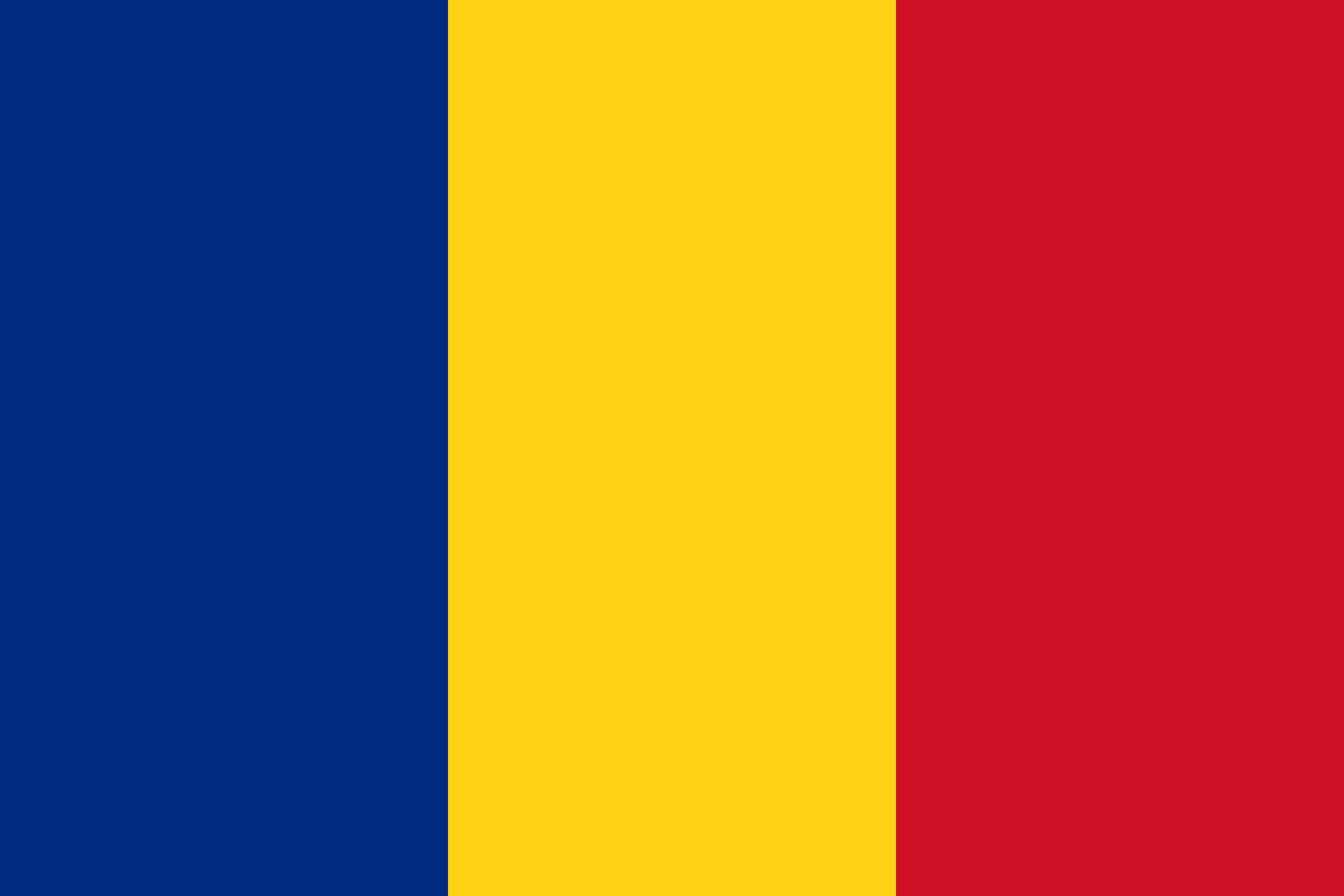
Romania’s national flag is a rectangle of three equal vertical bands: blue beside the flagpole, yellow in the center, and red at the free edge. Its height is two thirds of its length. The ordinary national flag has no coat of arms, inscription, star, or other central emblem.
This guide connects the tricolor’s appearance with its historical development and legal specifications. The gallery pairs a clean reference with labeled diagrams; the answers distinguish tradition, restoration, constitutional recognition, and later technical standards.
What are the official colors of Romania’s flag?
The flag is blue, yellow, and red. The annex introduced by Law 176/2023 specifies RGB values of 0, 43, 127 for blue; 252, 209, 22 for yellow; and 206, 17, 38 for red. Their exact hexadecimal equivalents are #002B7F, #FCD116, and #CE1126, respectively.

Romania’s legal color table provides three systems: Pantone references, CMYK percentages, and RGB channel values. They are listed specifications, rather than values estimated from a photograph. This guide uses the RGB triplets directly for its digital artwork. Hexadecimal notation expresses the same integers in another form; it is not an additional color standard stated in the law.
Keep each system attached to its intended workflow. A print operator should receive the listed print references, while a website can use the RGB equivalents. Converting a modern online Pantone swatch may produce different numbers and should not silently replace the annex’s explicit RGB entries.
| Band | Pantone | CMYK (%) | RGB | Derived hex |
|---|---|---|---|---|
| Blue | 280 C | 100, 70, 0, 10 | 0, 43, 127 | #002B7F |
| Yellow | 116 C | 0, 10, 95, 0 | 252, 209, 22 | #FCD116 |
| Red | 186 C | 0, 90, 80, 5 | 206, 17, 38 | #CE1126 |
What do the colors of Romania’s flag mean?
Romania’s tricolor represents the country and its national identity, with an important place in the revolutionary tradition of 1848. The Constitution and the current flag specifications define the colors and their arrangement; they do not assign a separate symbolic meaning to each band. Historical interpretation should remain distinct from legal description.
A flag can accumulate associations through public life without every association becoming a construction rule. Commemorations connect the Romanian tricolor with national solidarity, sacrifice, and the aspirations of earlier generations. Those broad themes help explain its emotional importance, but they do not change the size or position of its bands.
Popular explanations sometimes allocate virtues or historical regions to individual colors. Such accounts need their own historical evidence and attribution. This article does not present a regional color map as the flag’s proven origin, or turn an appealing classroom mnemonic into a statement from Article 12 of the Constitution.
Where is the blue band on Romania’s flag?
Blue is the band next to the hoist, the edge attached to the pole or support. In the conventional front view with the pole on the left, blue appears on the left. Its specified RGB value is 0, 43, 127, and its width equals one third of the flag’s length.
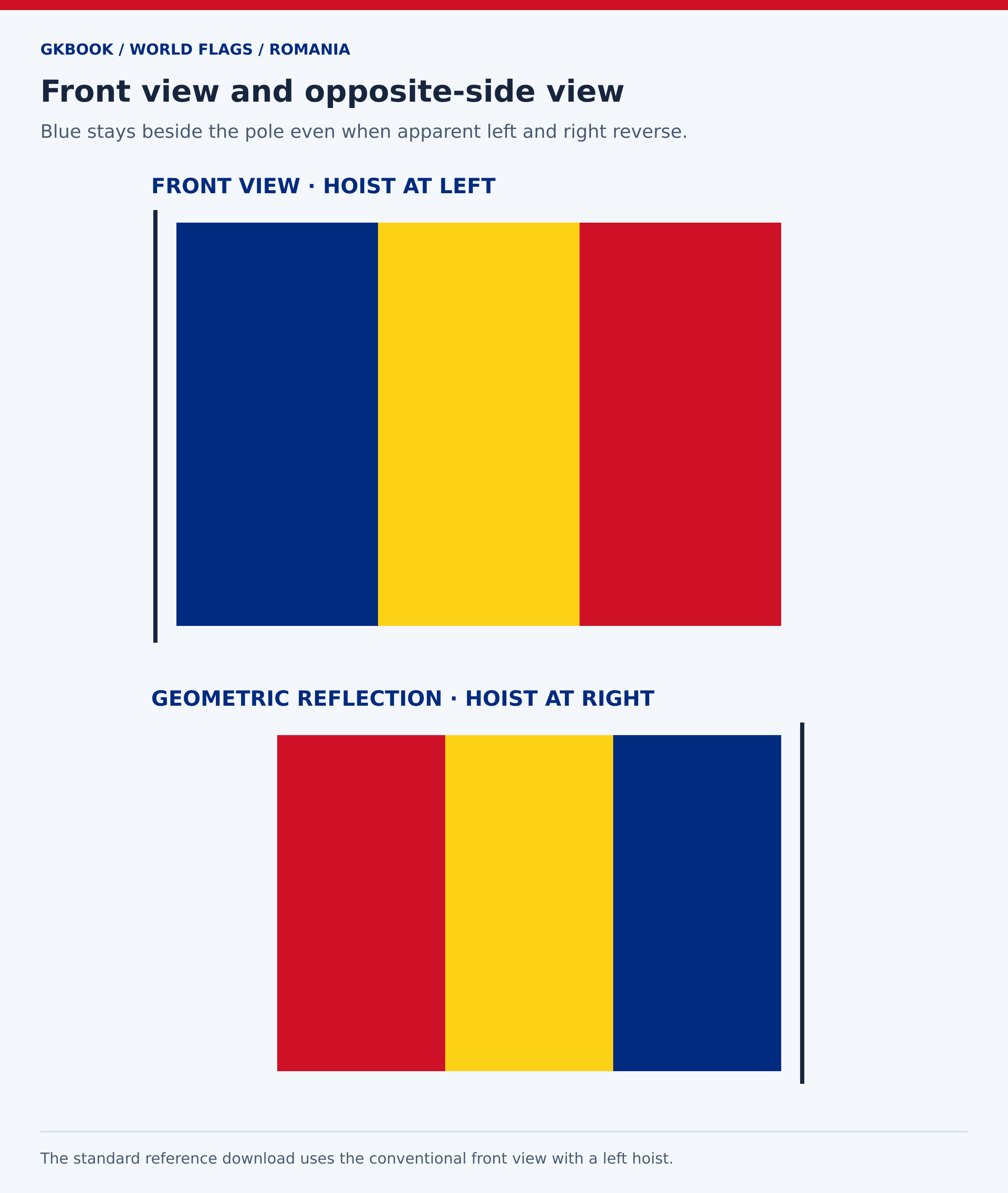
The word hoist is more precise than left because a person can stand on either side of a flying flag. Moving to the opposite side reverses the apparent sequence on the page, while the blue cloth remains attached beside the same pole. The gallery includes a reflected view to make this relationship visible.
The supplied clean image uses a left hoist, as expected in a reference illustration. It contains no drawn pole, fringe, sleeve, or surrounding border. Those objects can belong to a physical display, but they should not be included when calculating the rectangle’s three equal divisions.
How wide is the yellow band on Romania’s flag?
The yellow band occupies exactly the middle third of Romania’s flag. It is the same width as the blue and red bands, with straight vertical boundaries on both sides. The annex specifies RGB 252, 209, 22 for yellow, equivalent to #FCD116 in hexadecimal notation for digital images.
On a flag that is 150 centimeters long, yellow extends from the 50 centimeter mark to the 100 centimeter mark. On the supplied 2,400 unit SVG, it runs from x = 800 to x = 1,600. These are proportional examples, not separate sizes mandated for every flag.
Yellow often appears visually brighter than its neighbors, but brightness does not justify widening or narrowing it. Equal width is a geometric requirement, not a judgment made by eye. For an educational diagram, place explanatory words outside the colored rectangle so the national flag itself remains plain.
Which red should a Romania flag image use?
For a digital illustration based on the current legal annex, use RGB 206, 17, 38, written #CE1126 in hexadecimal. Red fills the outer third, away from the pole. The same annex lists Pantone 186 C and CMYK 0, 90, 80, 5 as its corresponding specified print references.
The red band reaches all the way to the free vertical edge, called the fly. There is no separate red outline around the blue or yellow areas. All three bands also reach the top and bottom edges, with no white gutters separating them.
A photograph may show darker red in a fold or lighter red under strong illumination. Such variations describe the photographed material and lighting, not additional colors in the design. Use flat, uniform fills for a reference drawing; preserve natural light and shade only when the subject is an actual photograph of a flag.
What is the aspect ratio of Romania’s flag?
Romania’s flag has a height to length ratio of 2:3. Article 1 of Law 75/1994 makes the height two thirds of the length, and the annex repeats that relationship. Written as image width by height, suitable examples include 900 × 600, 2,400 × 1,600, and 4,800 × 3,200.
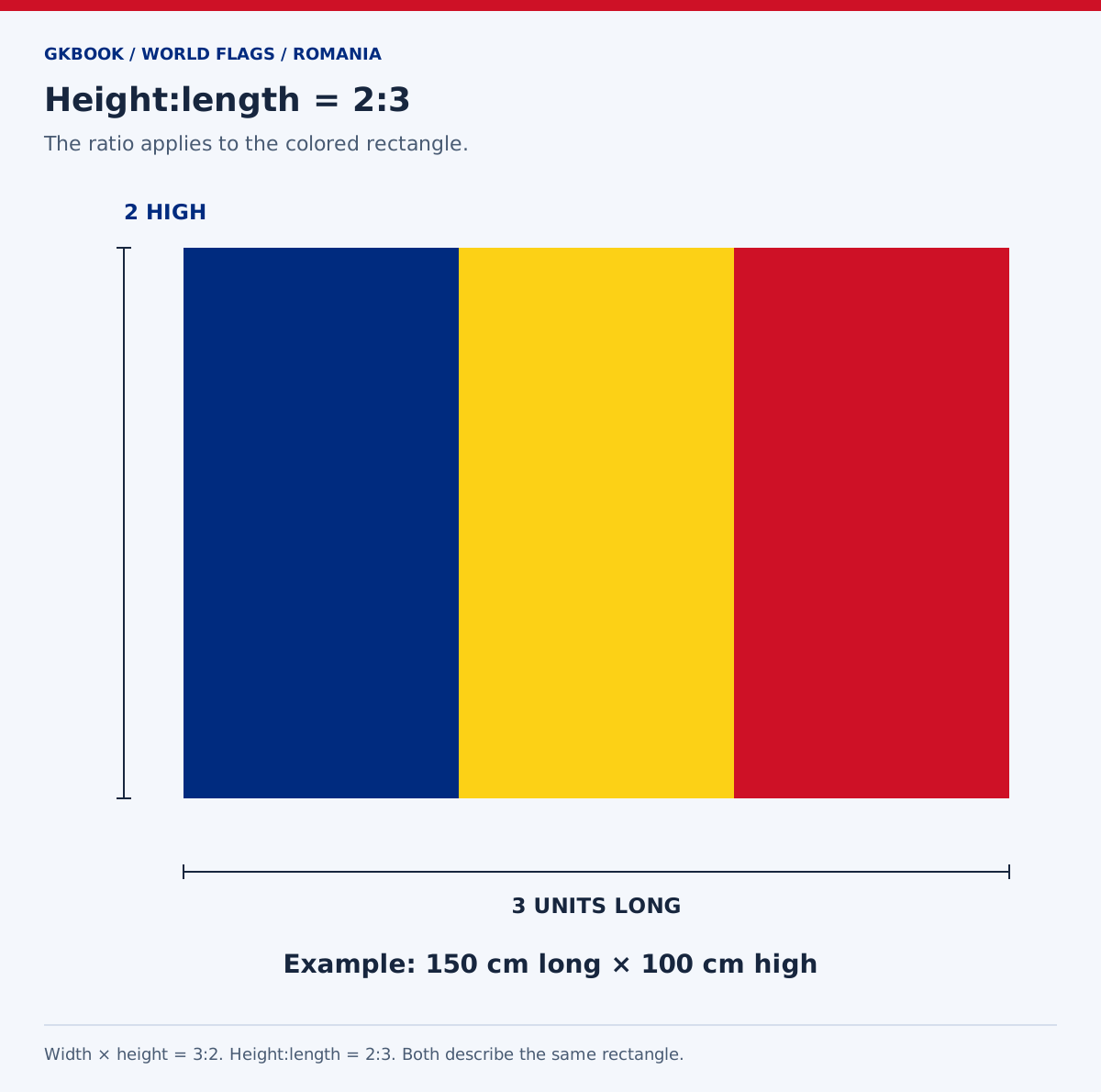
State the order of measurements whenever giving a ratio. Height:length = 2:3 and width:height = 3:2 describe the same landscape rectangle. Confusing those orders can accidentally produce a tall banner. The rectangle alone is measured; a pole, mounting sleeve outside the field, or page margin does not enlarge the design.
To calculate a matching height, multiply the intended length by two and divide by three. A 180 centimeter length therefore gives a 120 centimeter height. To calculate length from height, multiply by three halves. Scaling both dimensions by the same factor preserves the flag’s shape.
Are all three stripes the same size?
Yes. The blue, yellow, and red bands have equal widths and each extends through the full height of the rectangle. Each band therefore covers one third of the flag’s area. On the 2,400 × 1,600 SVG master, every band measures 800 units wide by 1,600 units high.
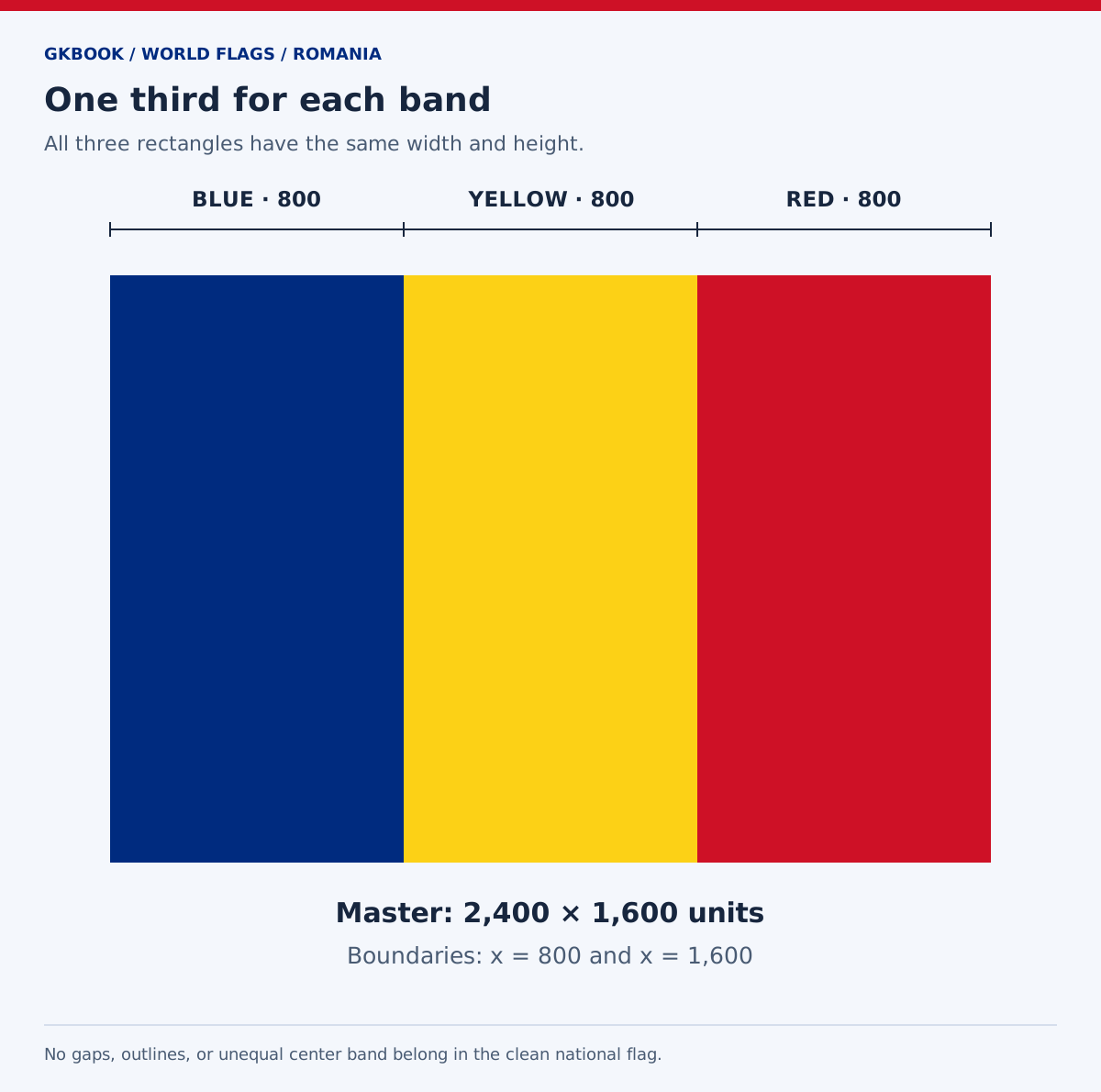
The boundaries fall at one third and two thirds of the total length. There is no narrow center band, enlarged yellow panel, or alternating stripe pattern. Each band is a simple rectangle, which makes the design straightforward to check independently with a ruler or vector editor.
For an integer pixel image with perfectly aligned divisions, choose a width divisible by three. The supplied main PNG is 4,800 pixels wide, so each band occupies exactly 1,600 columns. This practical export choice follows the mathematical pattern; it does not imply that the law specifies a particular pixel resolution.
In which direction should the colors run?
Read the colors outward from the pole: blue, yellow, then red. The bands run vertically across a landscape rectangle. A conventional reference image puts the pole side at the left, but a view from behind can show red on the viewer’s left while blue still remains beside the physical pole.
Orientation has two separate questions: which edge is attached, and where the viewer stands. A photograph should be judged using both. A mirrored photograph may look wrong if its pole is ignored, while a genuinely reversed installation can be missed if only the familiar colors are noticed.
The downloadable reference uses the ordinary front view throughout the article. Its upper and lower edges are visually equivalent because every color spans the complete height. Instructions for a special hanging arrangement should be checked for that setting; simply rotating a page image is not a substitute for display protocol.
How can you draw Romania’s flag accurately?
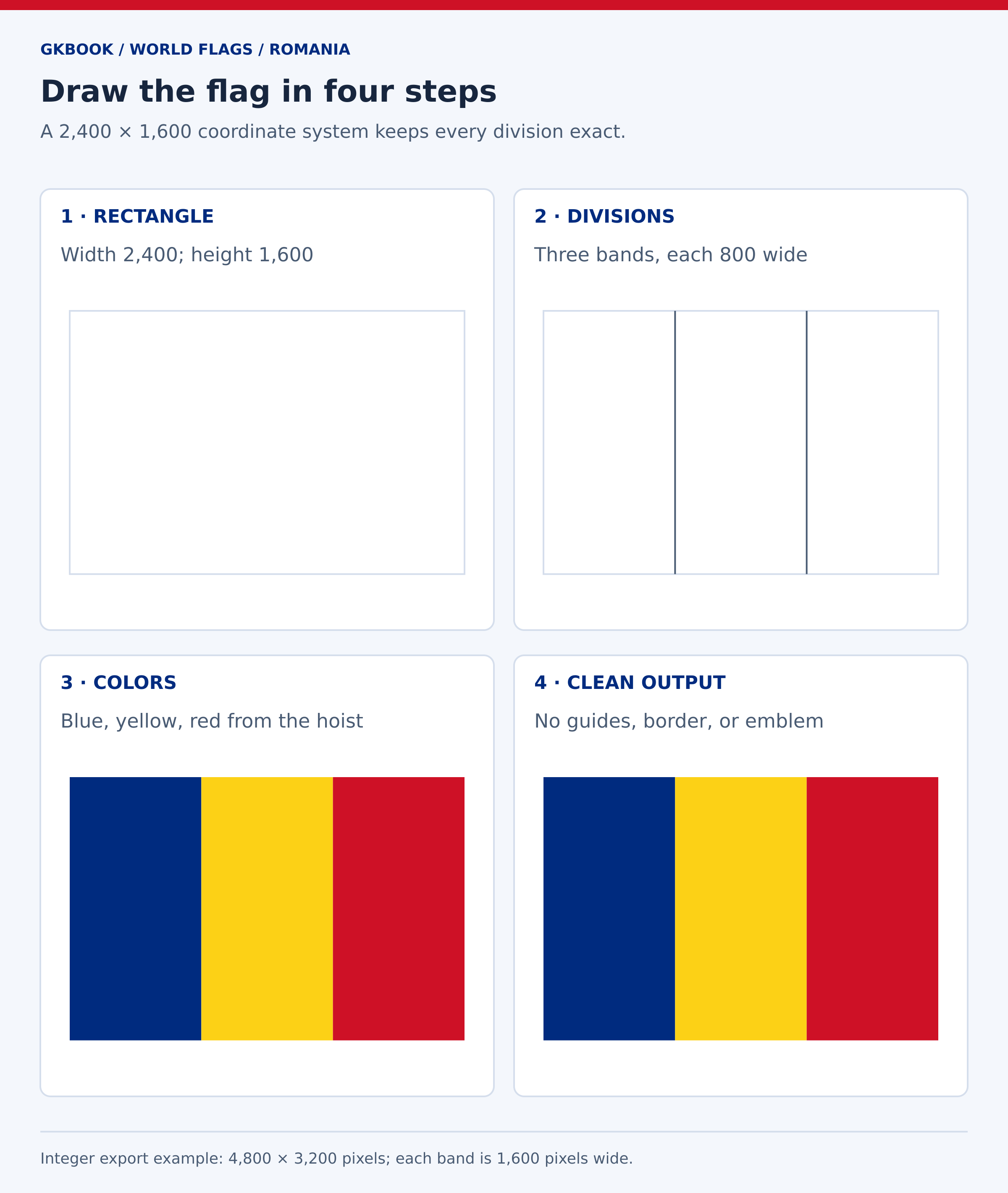
Draw a rectangle three units long and two units high. Divide its length into three equal vertical bands, then fill them blue, yellow, and red from the hoist outward. Use the legal RGB values for digital artwork and leave the colored rectangle free of outlines, text, shadows, and added emblems.
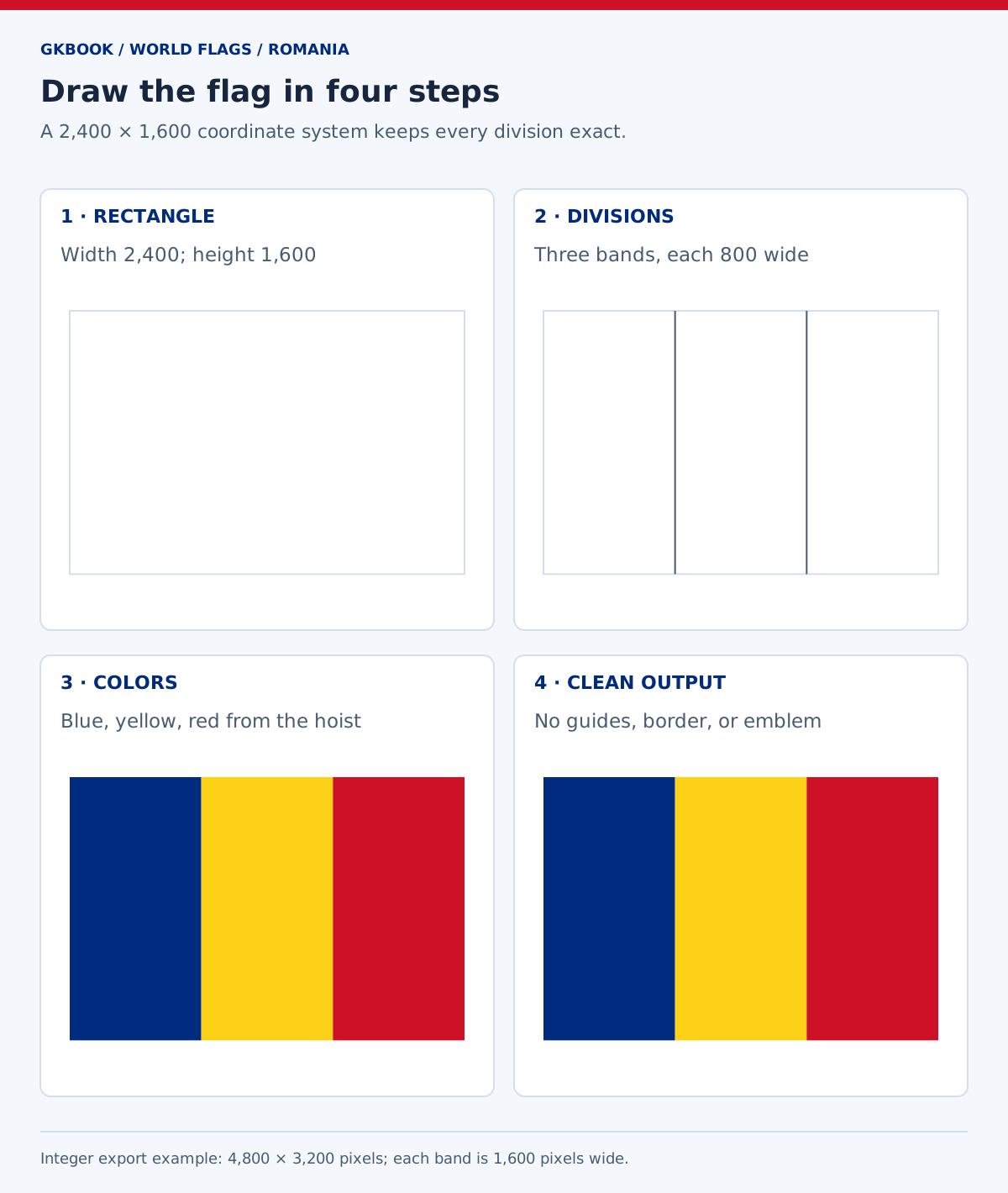
A convenient vector canvas is 2,400 by 1,600 units. Draw rectangles at x coordinates 0, 800, and 1,600, each 800 units wide and 1,600 high. Align their edges exactly, without stroke widths that would alter the divisions. The three shapes should cover the canvas completely.
Export the drawing at its original aspect ratio. For the main PNG, doubling every coordinate creates a 4,800 by 3,200 image with integer boundaries. A larger social card may contain the flag, but the flag inside that card must still retain its own 2:3 height to length relationship.
How did Romania’s flag develop over time?
Romania’s tricolor has a nineteenth century history, including its role in the 1848 revolutions and the vertical arrangement established in 1867. State emblems appeared on flags in later political periods. The plain tricolor returned during the 1989 revolution, followed by constitutional recognition in 1991 and subsequent legislation specifying its use and colors.
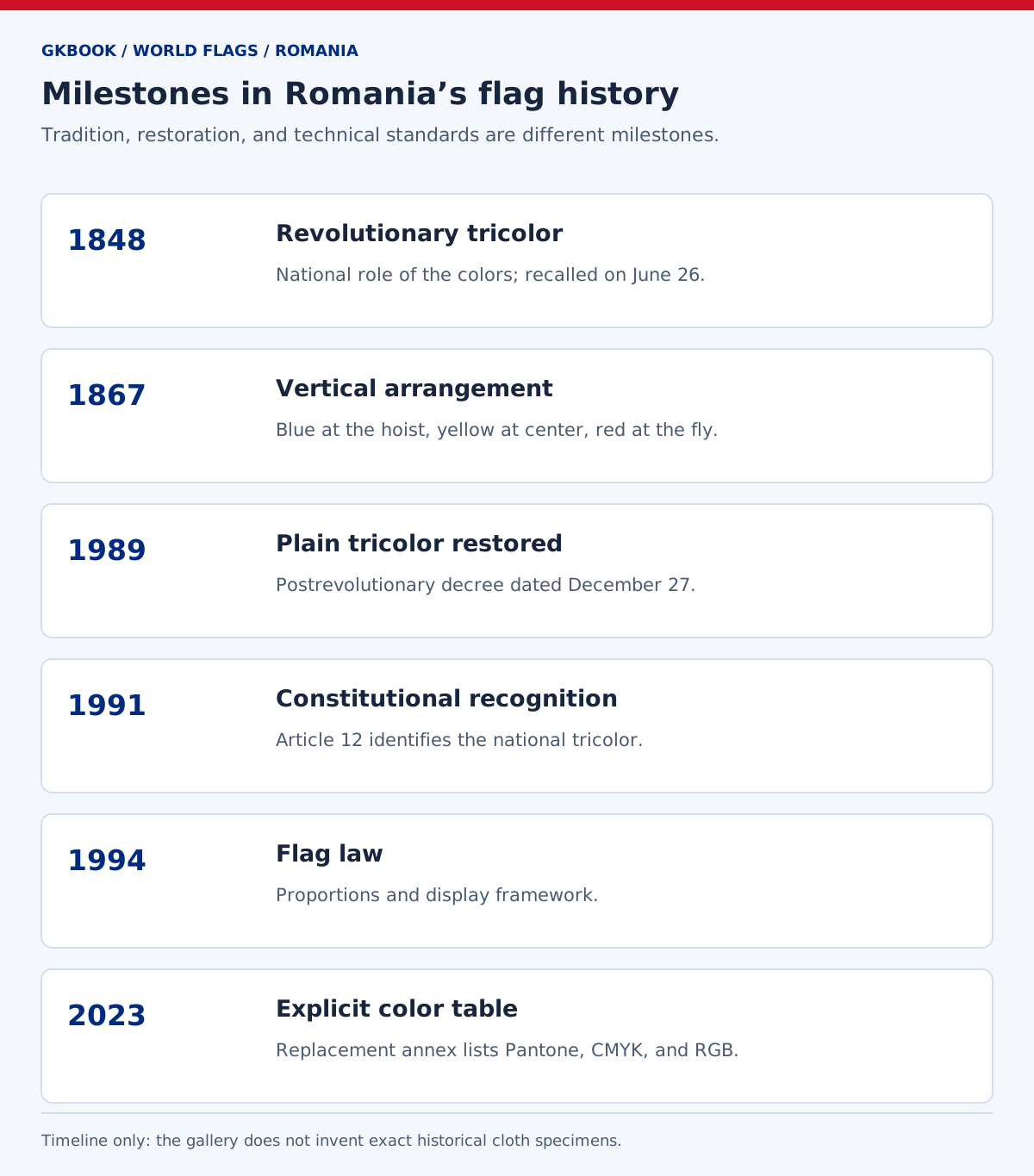
The story is easier to follow as several related developments: the political importance of the three colors, the arrangement of the bands, the presence or absence of an emblem, and the later rules for production and display. A single adoption year cannot adequately describe all four.
The timeline presents milestones without pretending that every historical flag was identical to the present download. Surviving museum objects may differ in inscriptions, emblems, material, proportions, or condition. Their details belong to their particular date and purpose. The modern reference artwork in this guide illustrates the current national pattern only.
Why is 1848 important in the flag’s history?
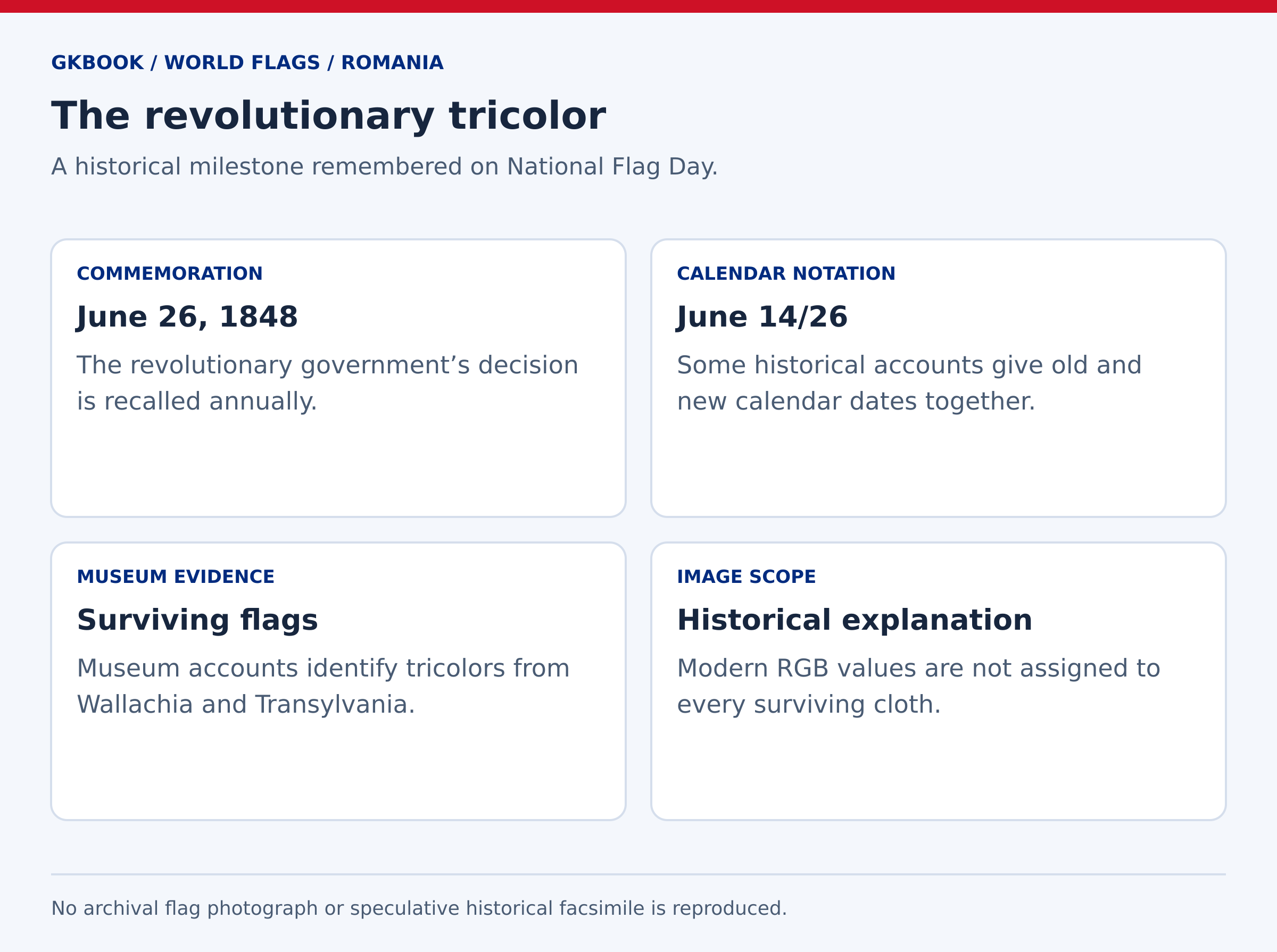
The revolutionary movements of 1848 gave the tricolor a prominent national role. Romania’s National Flag Day recalls the June 26, 1848 decision of the revolutionary government in Bucharest. Museum collections also preserve tricolors associated with revolutionaries in Wallachia and Transylvania, demonstrating the colors’ place in that wider historical movement.

Some historical references express the relevant date as June 14/26 because they show the older and newer calendar dates together. The annual commemoration uses June 26. Keeping the calendar notation explicit avoids treating two forms of the same historical date as separate flag adoptions.
Material evidence matters alongside decrees and commemorative speeches. The National History Museum’s exhibition account identifies revolutionary tricolors among the objects displayed. This gallery uses a text diagram for the period instead of inventing an exact 1848 specimen. It therefore does not assign modern RGB values or standardized dimensions to every surviving historic cloth.
What changed in the flag rules in 1867?
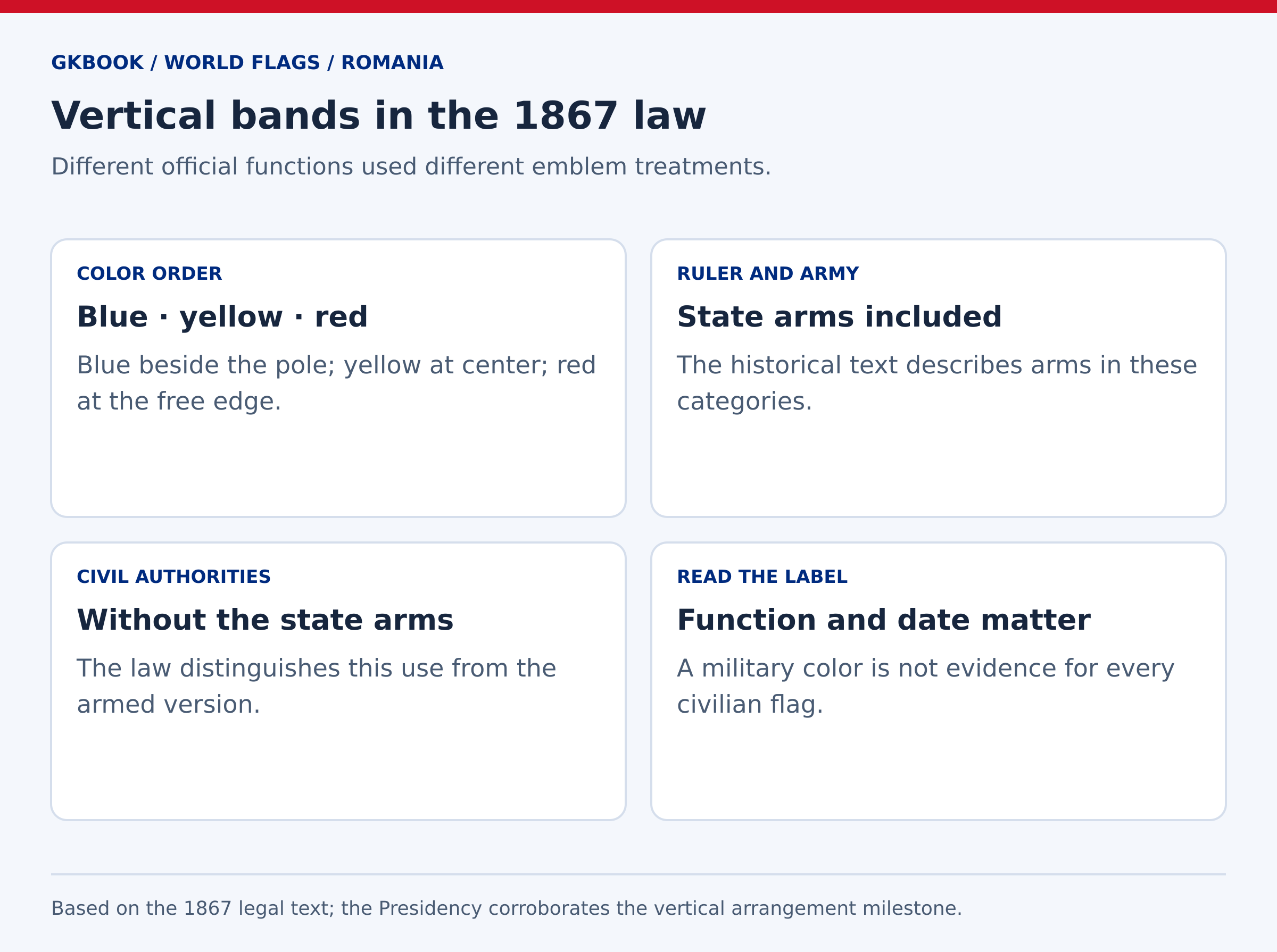
The 1867 law arranged the national colors vertically, with blue beside the pole, yellow in the middle, and red at the free edge. It distinguished flags carrying the state arms from those without them. The Presidency’s historical account identifies 1867, under Carol I, as an important milestone in the vertical arrangement.
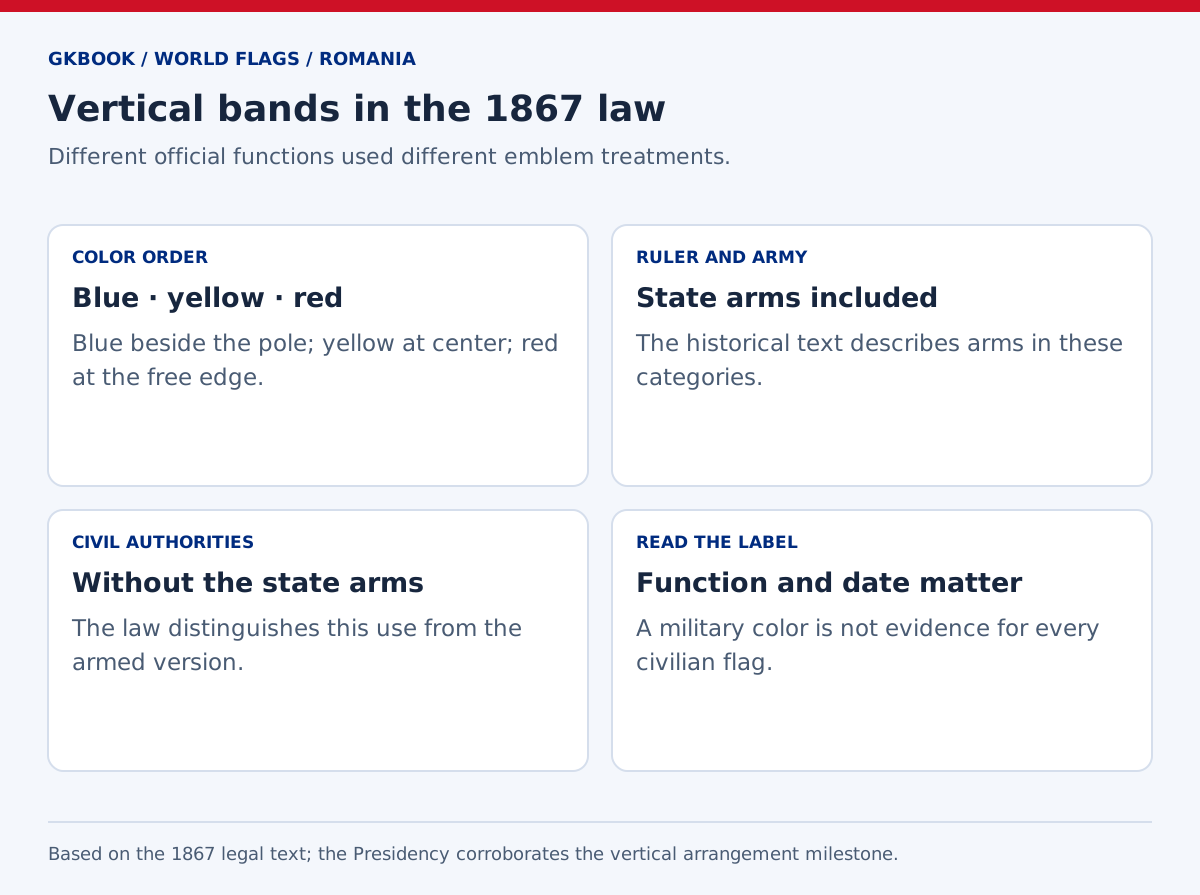
The historical law is useful because it describes different functions rather than one undifferentiated flag. Its provisions distinguish the ruler and army, civil authorities, and naval uses. In the transcribed text, civil authorities use a version without the arms, while certain other flags carry them.
This distinction prevents a misleading comparison between an old military color and today’s ordinary national flag. An emblem on a military object does not prove that every civilian flag of the same period bore it. The gallery summarizes these categories in words and does not fabricate a heraldic reconstruction of an 1867 standard.
Why did some Romanian flags have a hole in 1989?
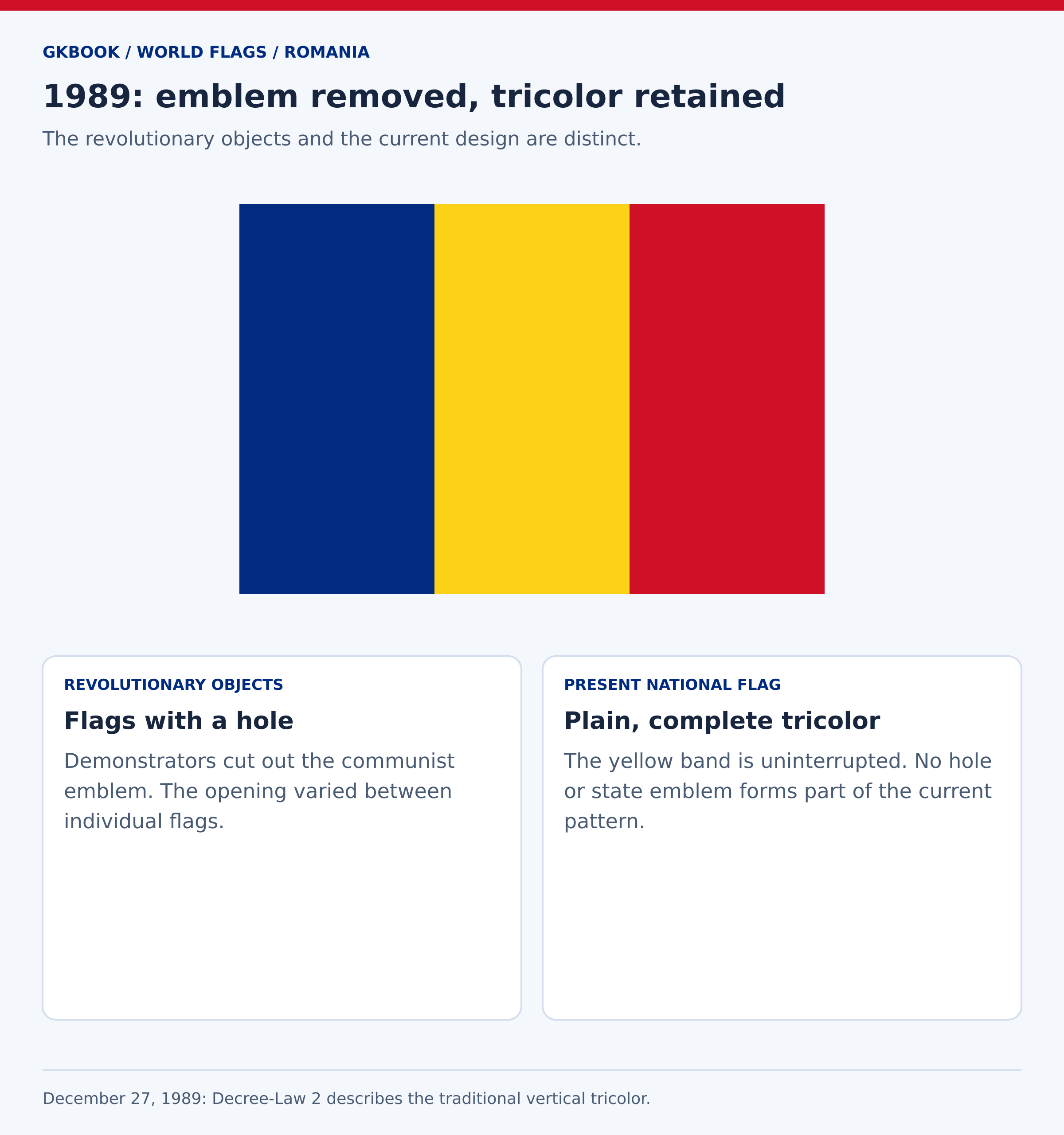
During the December 1989 revolution, demonstrators removed the communist state emblem from flags, leaving a hole where it had been. The altered flags became recognizable symbols of the uprising. They were revolutionary objects, not the finished specification for today’s flag, which has an uninterrupted yellow band and no hole.

Removing an emblem made a political statement while retaining the tricolor. The resulting opening should be understood through the event and the individual object. Its outline and size depended on how a particular flag was altered; there is no standard hole shape to reproduce as a current national design.
Decree-Law 2 of December 27, 1989 described the traditional vertical tricolor after the upheaval. That legal restoration is distinct from photographs of flags used in the streets. The diagram pairs a dated historical explanation with the present plain pattern rather than offering a fictional damaged flag as an authenticated artifact.
When was the present plain tricolor restored?
Decree-Law 2 of December 27, 1989 described Romania’s flag as the traditional vertical tricolor, ordered blue, yellow, and red from the pole. This is the modern restoration milestone for the plain flag. It should not be confused with the colors’ earlier history, the 1991 Constitution, or the later 1994 and 2023 legislation.

An adoption date needs a clear object: the tricolor tradition, a particular arrangement, a restored national design, or a technical specification. For this page, December 27, 1989 identifies the postrevolutionary legal description. It does not claim that Romanians first used these colors on that day.
The later dates answer different questions. The Constitution places the symbol in the state’s fundamental law. Law 75/1994 sets the basic rectangular proportions and display framework. Law 176/2023 replaces its annex with an explicit color table. These milestones form a sequence of recognition and specification, rather than repeated inventions of a new flag.
What does Romania’s Constitution say about the flag?
Article 12 of Romania’s Constitution identifies the flag as a tricolor with vertical bands ordered blue, yellow, and red from the pole. It also treats National Day, the anthem, and the state arms as national symbols. The flag’s detailed dimensions and color values are supplied by legislation, rather than by that constitutional sentence.

The constitutional wording provides the fundamental identification: three colors, vertical arrangement, and order from the hoist. It is not a technical drawing with pixel coordinates or a print production manual. Reading it together with the flag law gives a more complete description.
The tricolor appears in the original 1991 Constitution and remains in Article 12 of the revised text. The Chamber of Deputies distinguishes the original version from the revision that entered into force in 2003. A reference to the Constitution should therefore identify the version when discussing legal history, while recognizing the continuing color order.
Which law specifies the flag’s dimensions and colors?
Law 75 of July 16, 1994 establishes Romania’s flag proportions and display framework. Law 176 of June 19, 2023 replaces Annex 1 with the dimensional and color table used here. The 2023 law was published on June 20; the consolidated record marks the annex change effective from June 23, 2023.

The amended annex states the length as a reference unit, the height as two thirds of that length, and each color’s width as one third. It lists Pantone, CMYK, and RGB entries separately. These explicit values make the present digital drawing reproducible without measuring an illustration by eye.
The law also addresses matters beyond artwork, including public display and the addition of inscriptions or symbols. Technical compliance with the rectangle alone does not settle every question about a particular ceremony or specialized flag. The article explains the ordinary national pattern and selected general provisions. A particular official event may also have its own instructions.
When is Romania’s National Flag Day?
Romania celebrates National Flag Day on June 26. Law 96 of May 20, 1998 established the observance, which recalls the tricolor’s revolutionary history in 1848. The occasion is distinct from December 1, Romania’s National Day, and from December 27, the date of the 1989 decree describing the restored tricolor.

The Flag Day law provides for commemorative, cultural, educational, and military activities, together with public flag ceremonies. The annual date supplies historical context for the symbol; it does not mean the flag may only be displayed on that occasion. Other provisions govern permanent and temporary display.
A yearly ceremony announcement is useful evidence of how the day is observed, but its venue and starting time belong to that specific year. This guide gives the recurring June 26 date rather than presenting an older announcement as a current schedule. The gallery’s calendar card likewise contains no invented event times.
Is Flag Day the same as Romania’s National Day?
No. National Flag Day is June 26, while Romania’s National Day is December 1. Article 12 of the Constitution specifies December 1 as National Day, and the 1998 Flag Day law establishes the separate June observance. A flag may feature in both celebrations without making their dates or historical purposes interchangeable.

Separating the two dates helps keep captions accurate. A photograph of a tricolor taken in December should not automatically be labeled a Flag Day photograph. The event needs its own date and context, even when the same national symbol appears prominently in the image.
For a classroom calendar, label the observances explicitly and place their dates alongside their names. The gallery offers this simple comparison. It also keeps the modern restoration date out of either holiday label: December 27, 1989 is a legal milestone in the flag’s history, not an alternative date for the annual National Day.
Does Romania’s national flag include a coat of arms?
The ordinary national flag is the plain blue, yellow, and red tricolor, without a coat of arms. Historical and specialized flags can carry additional devices. The amended law prohibits adding inscriptions or symbols except those authorized by law or military regulations, so the plain pattern should not be confused with every authorized special flag.

Romania’s Constitution treats the state arms separately from the national flag. Combining two recognized national symbols does not automatically produce the ordinary flag. A publisher selecting a general country icon should therefore use the plain tricolor rather than place an eagle, shield, crown, or word in its center.
Historical illustrations require a different approach. A coat of arms may be essential to identifying a particular period or official function. In that case, label the object precisely and use a verified source for the emblem. This package includes no approximate heraldic drawings presented as authentic historical or military flags.
Why does Romania’s flag look similar to Chad’s flag?
Both flags use three equal vertical bands with blue beside the pole, a yellow or gold middle, and red at the free edge. This shared arrangement makes small images easy to confuse. Identify the country from a reliable caption and documented specifications; apparent shade differences in screenshots are not a dependable identification test.

Chad’s constitutional description calls its colors blue, gold, and red and puts blue beside the staff. That description establishes the similar arrangement. It does not by itself prove that every digital image of the two flags must use the same RGB numbers, or that a viewer can always distinguish them by eye.
This comparison therefore uses a feature table rather than an unsourced recoloring of a second flag. The Romanian download follows Romania’s own 2023 annex. When comparing actual files, examine their source and metadata as well as their appearance. Compression, display settings, and reproduction choices can obscure small color differences.
How is Romania’s flag different from Moldova’s flag?
Moldova’s flag also has equal vertical blue, yellow, and red bands, but it carries the state coat of arms in the yellow center. Its official height to length ratio is 1:2, compared with Romania’s 2:3. Romania’s ordinary national flag is therefore shorter relative to its height and has an empty yellow band.
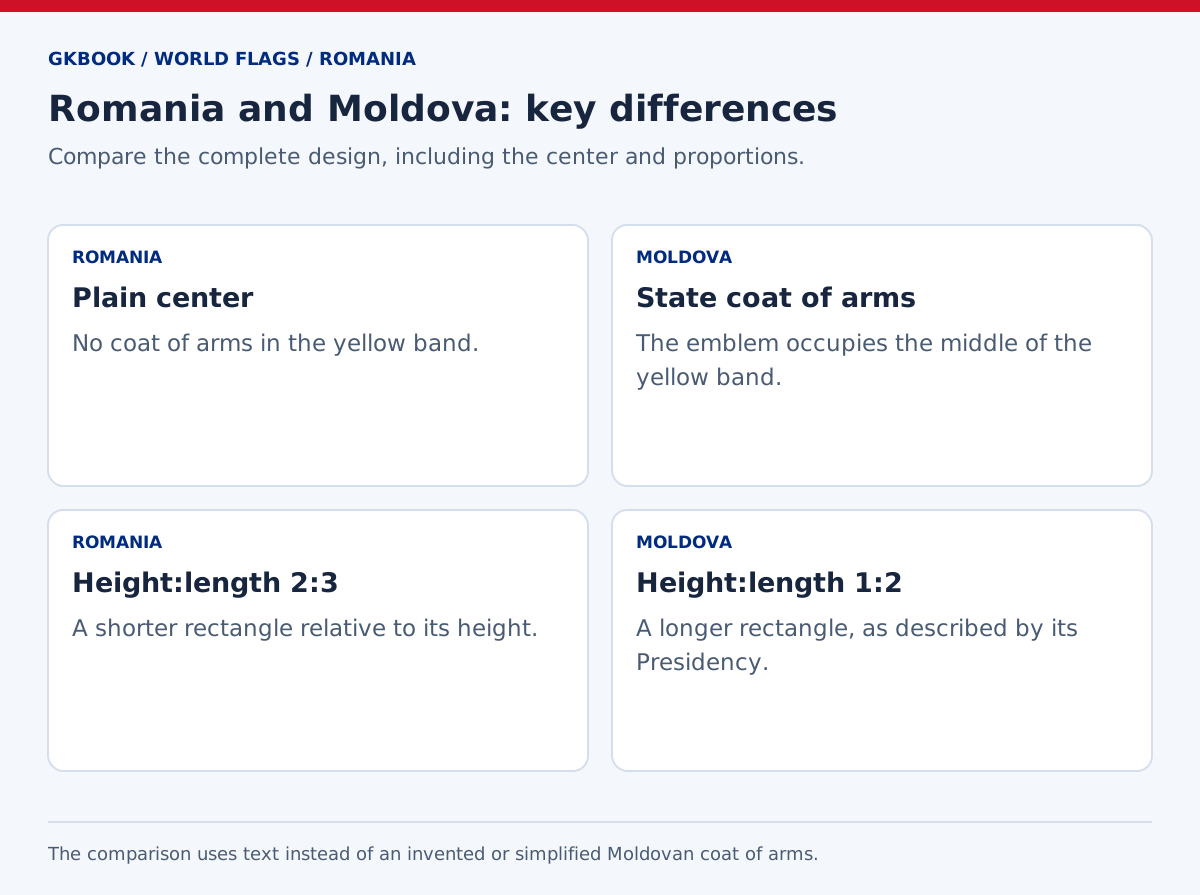
Moldova’s Presidency specifies both the emblem and the longer rectangle. Those structural differences are more useful for identification than guessing a color from a photograph. A cropped image can hide the outer proportions, so look for the central coat of arms as well.
The comparison diagram presents the two sets of features in text, avoiding a crude substitute for Moldova’s detailed emblem. Readers can continue to the Moldova flag guide for its own artwork and context. Shared colors are a reason to compare the complete designs carefully, rather than treat the two national flags as interchangeable.
Where may Romania’s national flag be displayed?
Law 75/1994 provides for permanent display at specified public institutions and other locations, and temporary display for national celebrations and official events. It also allows private individuals to fly the flag at their homes or residences. These categories concern use of the national flag; they do not alter its three equal bands.
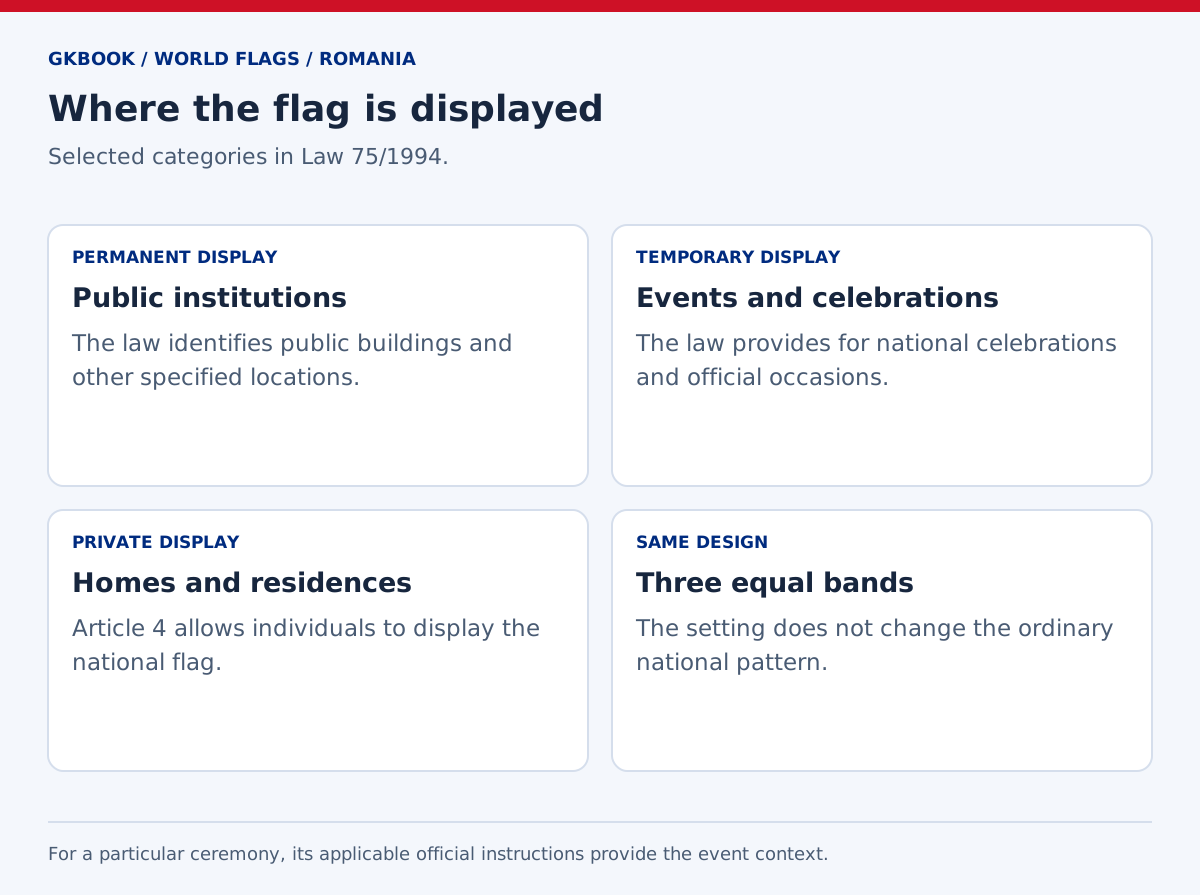
The permanent display provisions include public authority buildings, educational and cultural institutions, border crossing points, international airports, and Romanian vessels. Temporary display includes official visits, certain ceremonies, and other listed occasions. The categories explain why the same symbol appears in many different settings.
Private display is addressed separately in Article 4. It permits individuals to display the flag at their residence and other legal entities at their premises. A particular institution or event can involve additional procedural rules. The diagram summarizes the broad categories rather than designing an unverified ceremonial installation or implying that one photograph establishes every applicable requirement.
Where does Romania’s flag stand beside other national flags?
Under Article 8 of Law 75/1994, Romania’s flag is on the viewer’s left when displayed with one other national flag. With an odd total number it occupies the middle; with an even total it occupies the left of the central pair. The national flags are displayed at equal dimensions and the same level.
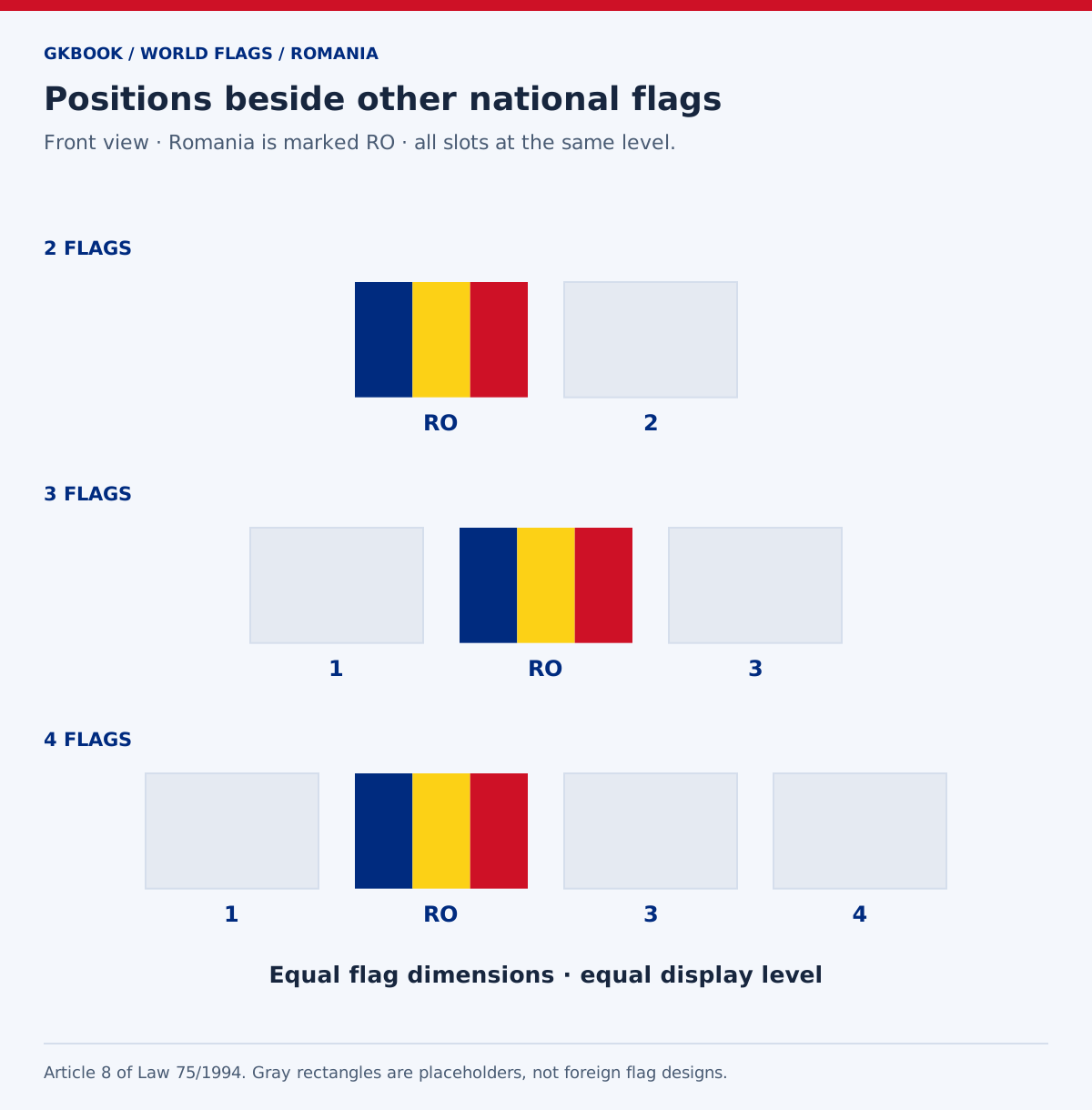
The viewpoint matters: the positions are described as seen from the front. A diagram read from behind would reverse the apparent left and right. The gallery uses numbered positions and a clearly labeled front view, with Romania marked in the prescribed location.
The remaining slots are neutral placeholders, not invented foreign flags. Their numbering shows placement without implying a ranking among the other countries. The chart covers the national flag arrangements stated in this article. International events and other settings can involve additional rules, while the amended law separately permits the European Union and NATO flags alongside Romania’s flag.
When is Romania’s flag flown at half-mast?
Article 6 of Law 75/1994 provides for Romania’s flag to be flown at half-mast on national days of mourning established by the Government. A lowered flag keeps the same colors and proportions. The law’s general rule does not establish that a particular day is currently a mourning day or prescribe a universal pixel position.
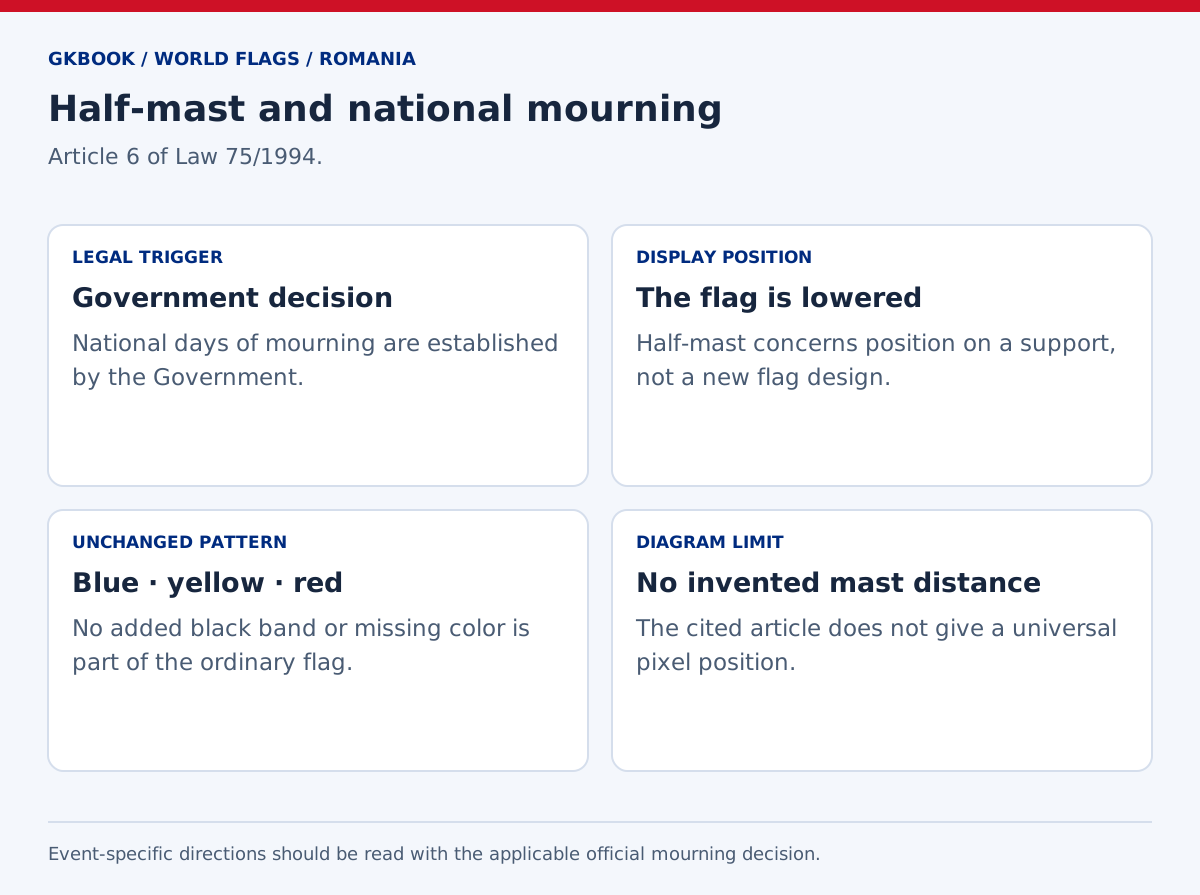
Half-mast describes the flag’s position on its support, not a modified design. There is no black band, extra emblem, or missing colored section in the ordinary flag itself. An illustration explaining mourning display should preserve the tricolor and distinguish it from the pole or other equipment.
The gallery explains the legal trigger in a text card. It avoids drawing a supposedly mandatory distance from the top of a mast when the cited article supplies no such dimension. Before organizing a particular ceremony, its official instructions and the applicable mourning decision provide the relevant event context.
Does the back of the flag have a different design?
The ordinary Romanian flag has no separate emblem or inscription requiring an alternate reverse design. Looking through the opposite side reverses the apparent order across the viewer’s field, while blue still adjoins the hoist. The gallery’s reflected image demonstrates this viewpoint and does not prescribe how a physical flag must be sewn or printed.

Start with a front view in which the pole is on the left. A geometric reflection places the pole on the right and makes the visible order red, yellow, blue from the viewer’s left. The attachment relationship remains unchanged: blue is still next to the pole.
This illustration is a teaching aid, not a construction specification for cloth layers. Transparency, seams, and printing methods vary between physical products. The clean reference file is deliberately supplied in the usual left hoist orientation, while the reflected view is separately labeled to prevent accidental reuse as an ordinary front view icon.
What image sizes preserve the correct flag proportions?
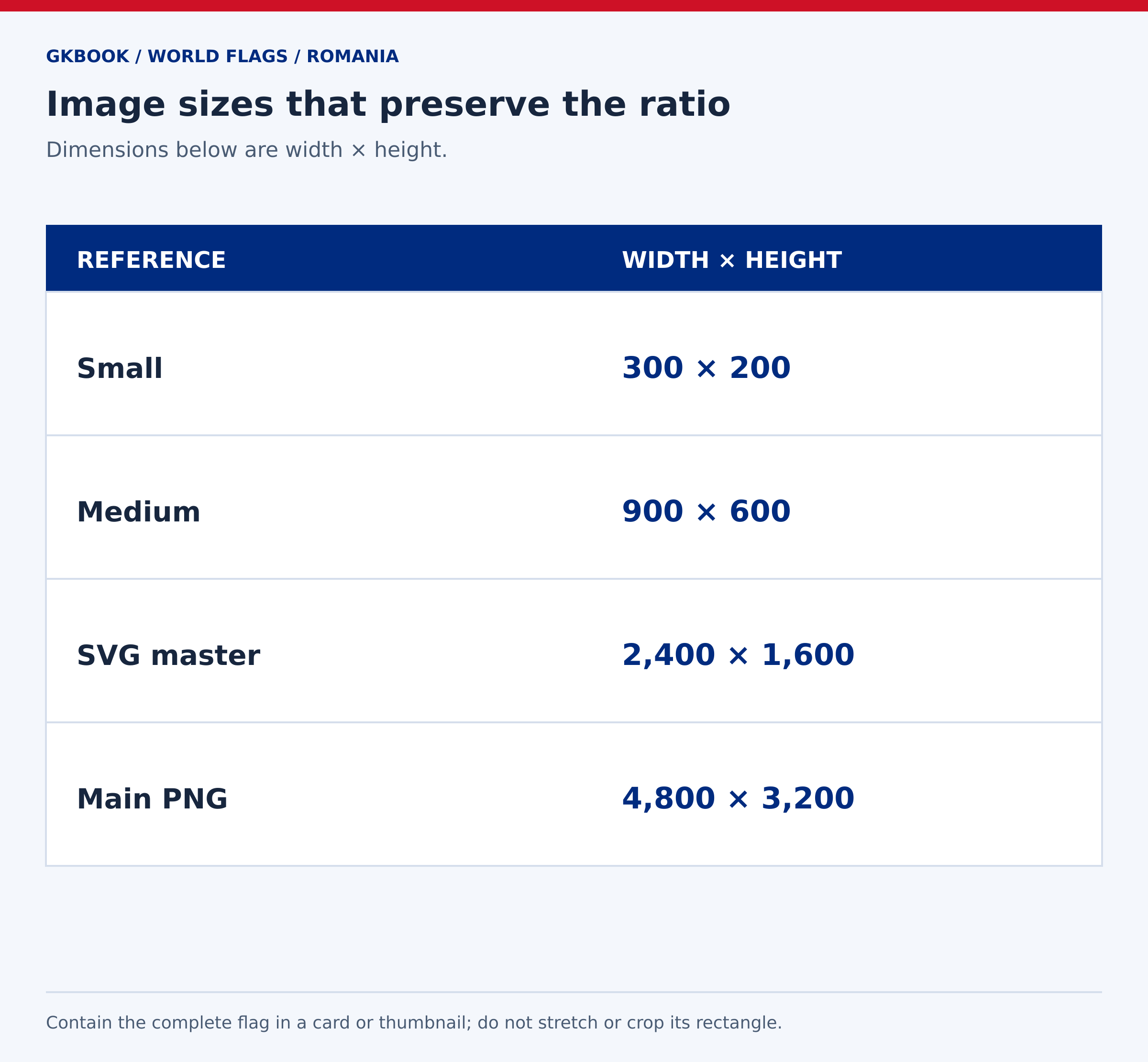
Any width and height in a 3:2 relationship preserve Romania’s landscape flag rectangle. This package supplies a 2,400 × 1,600 SVG master and a 4,800 × 3,200 PNG. Widths divisible by three also allow the equal vertical bands to align precisely with integer pixel boundaries in raster exports.
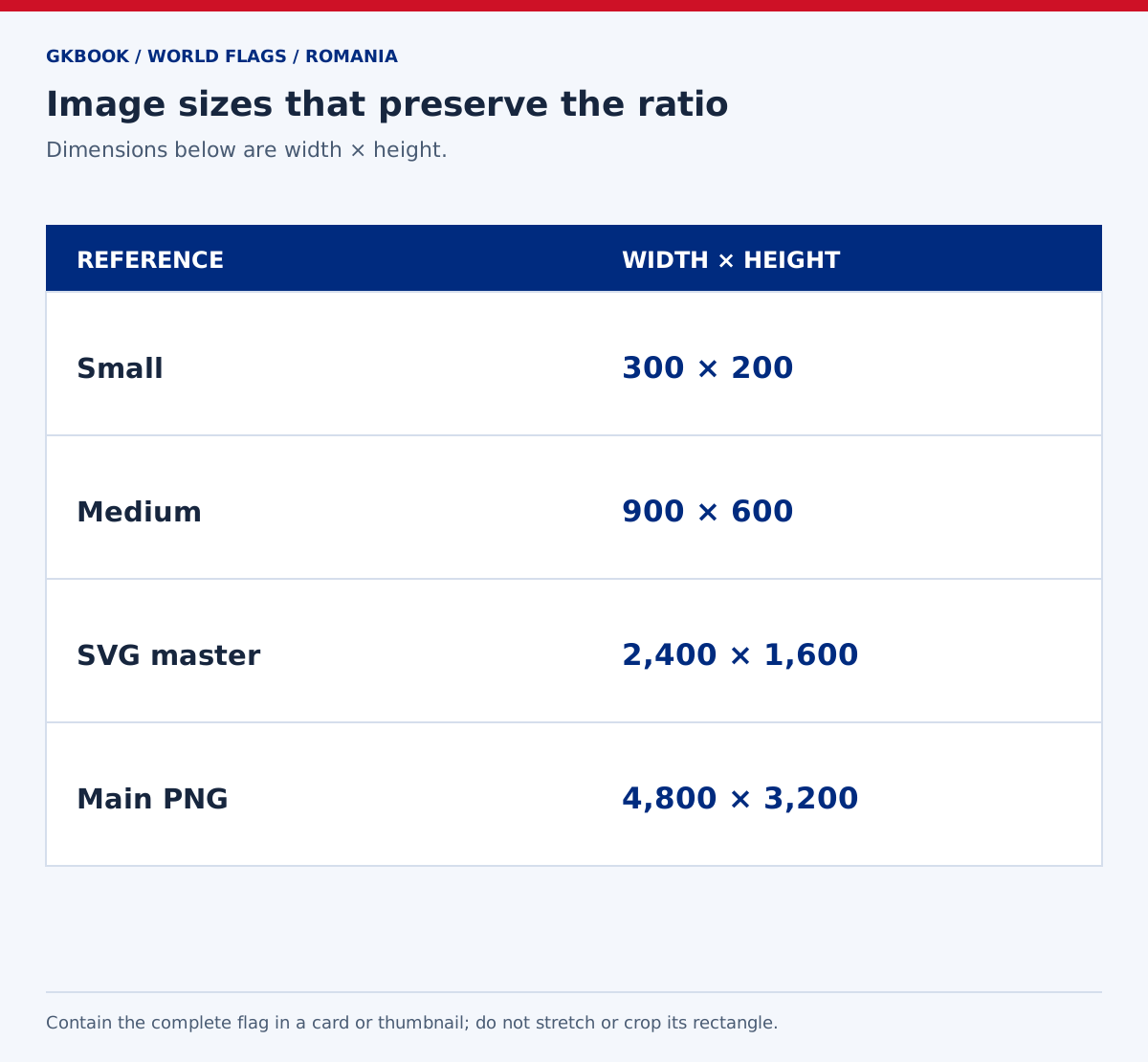
Common examples are 300 by 200, 900 by 600, and 1,500 by 1,000. Each is the same design at a different scale. A square avatar or a wide social card should contain the complete flag with surrounding space instead of stretching or cropping its colored rectangle.
The diagram files use larger explanatory canvases, so their overall image proportions are not flag proportions. The same applies to the separate 1,200 by 630 sharing card. Measure the flag object inside an educational layout, rather than assuming that its title, labels, margins, and footer form part of the national design.
How should the flag be prepared for print or screen?
For screens, use the annex’s RGB values and preserve the exact band geometry. For print, provide the annex’s listed Pantone and CMYK references to the production provider. The legal table gives these systems separately. A digital image alone cannot guarantee that a particular paper, ink, fabric, or display reproduces their appearance faithfully.
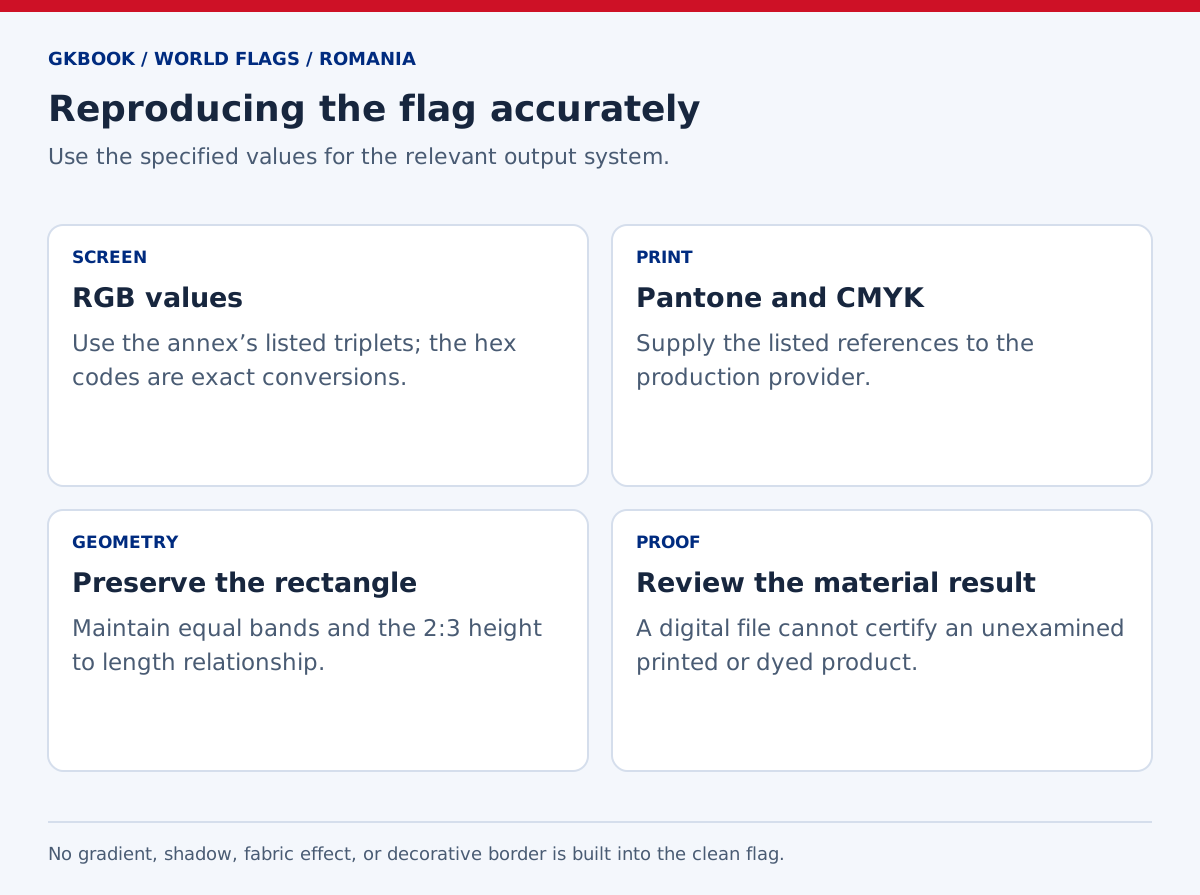
The supplied SVG contains vector rectangles, so enlarging it does not introduce pixelated edges. The PNG offers a fixed resolution for software that cannot use SVG. Neither file includes decorative texture or lighting effects inside the clean flag. Keep those effects in a separate illustration if they serve a specific visual purpose.
A production proof can reveal differences caused by material, viewing light, and color handling. Use the stated values as the reference rather than sampling an image from a search thumbnail. This is a practical reproduction workflow, not a claim that an unexamined physical item has passed official manufacturing approval.
What are the most common mistakes in Romania flag pictures?
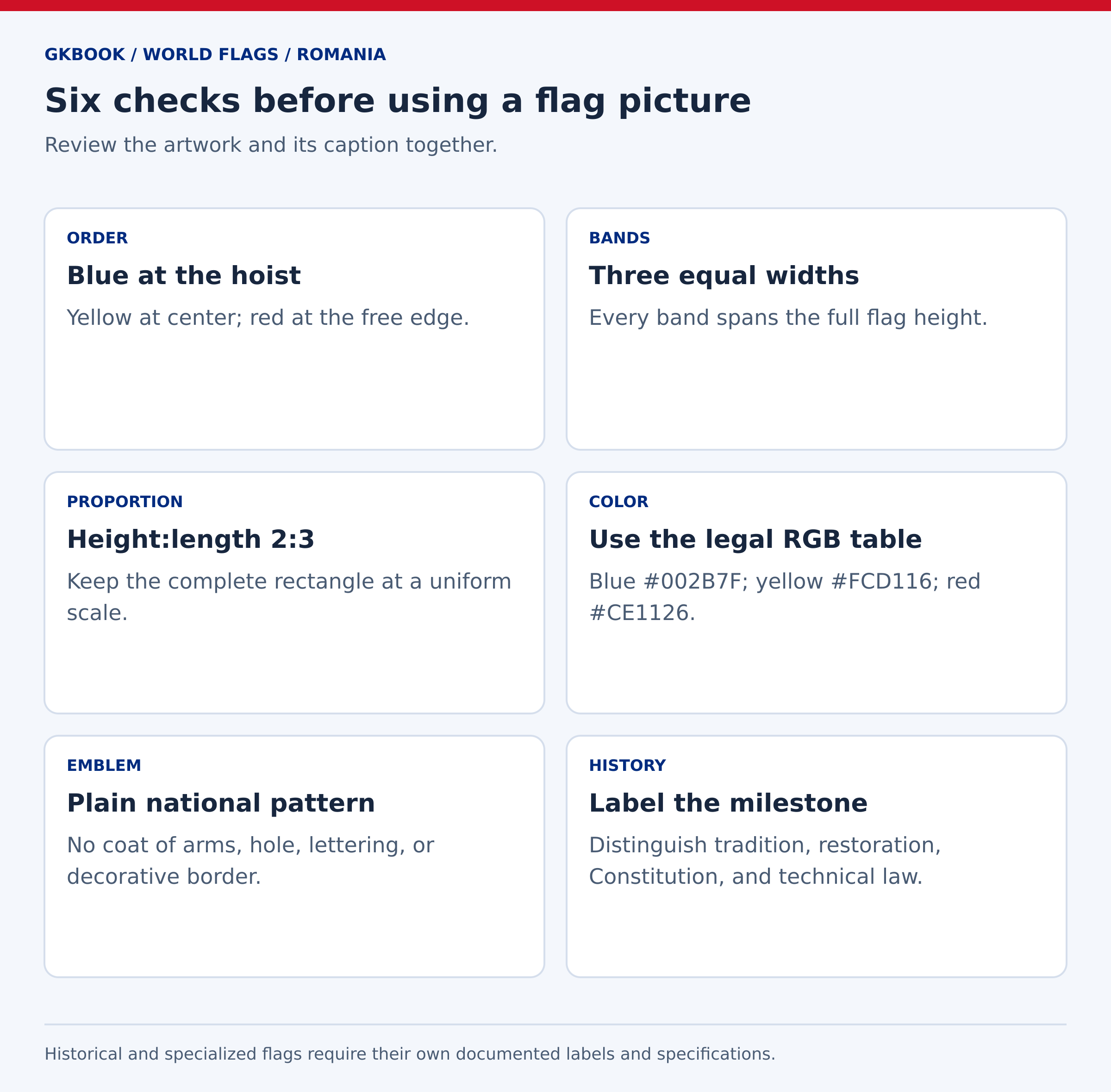
Common errors include reversing blue and red in a left hoist reference, making the bands unequal, stretching the rectangle, adding an emblem, and using arbitrary colors. Historical captions can also confuse 1848, 1867, 1989, 1991, and 2023. Check the picture’s geometry, its intended flag type, and the event described by its caption.
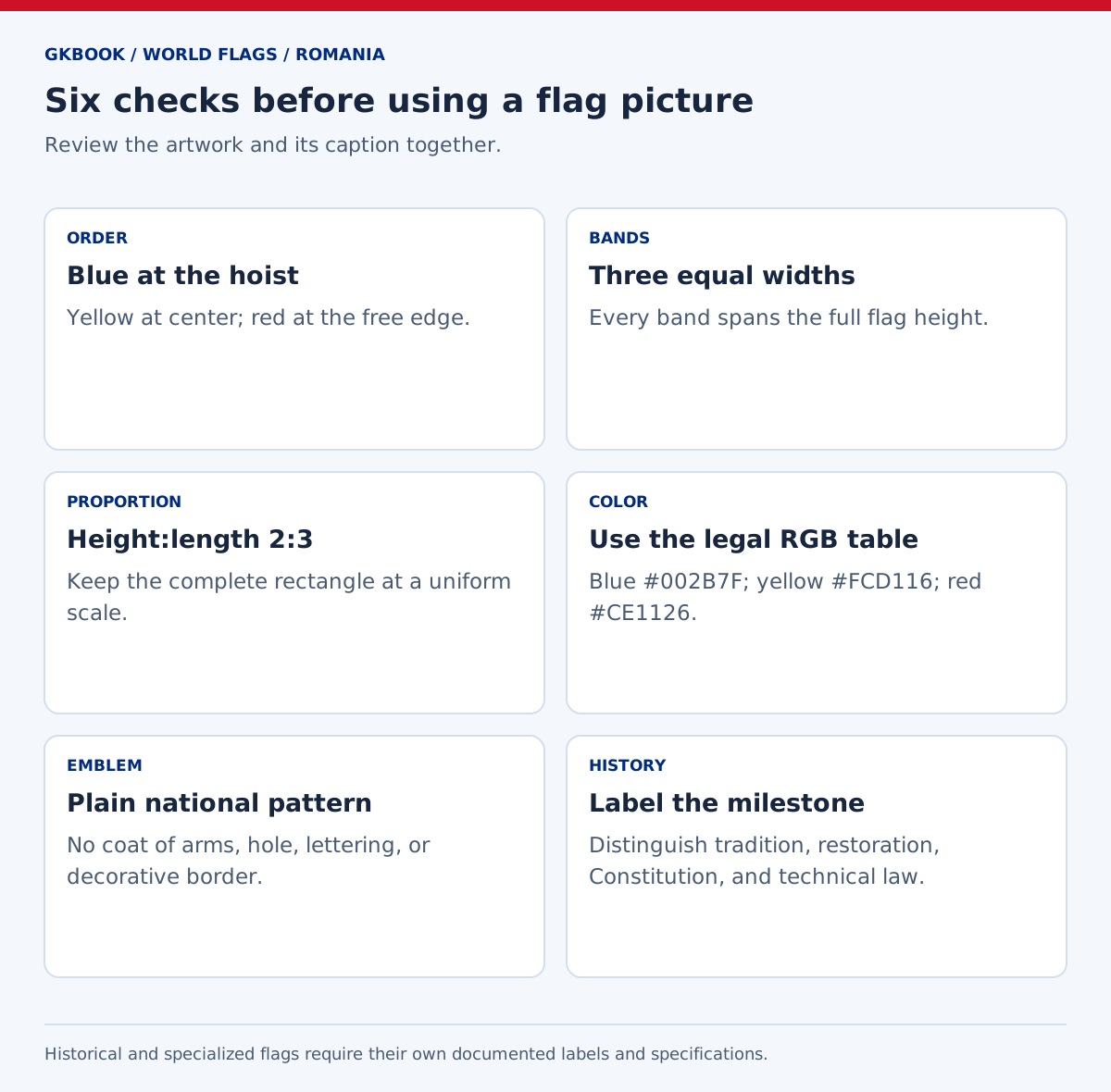
Begin with the simplest checks: three vertical bands, blue at the hoist, yellow in the middle, red at the fly, and a 2:3 height to length ratio. Then compare the RGB values when evaluating a digital reference. An attractive icon can still be geometrically inaccurate.
Finally, read the label. A revolutionary flag with its emblem removed belongs to a historical context, while a coat of arms may identify a special or older flag. Neither should silently replace the plain modern reference. The six point review card gathers these checks for readers preparing classroom materials, captions, or website graphics.
Which Romania flag pictures can I download here?
The gallery provides 24 subjects, each as an SVG and PNG, including the clean national flag, color and proportion diagrams, historical timelines, and display explanations. A separate social sharing card is also supplied. The clean flag is suitable as a reference image; the labeled diagrams are educational compositions with their own explanatory canvases.
Choose the clean tricolor when you need the country flag alone. Choose a diagram when the goal is to explain its measurements, chronology, or use. Titles and measurement lines sit outside the reference flag or belong to explicitly instructional stages, so they should not be mistaken for national design elements.
The downloads preserve readable captions, accessible image descriptions, and clear distinctions between current artwork and historical discussion. No museum photograph, archival cloth facsimile, or speculative old emblem is included. Explore the full picture gallery and continue through World Flags for related national flag guides.
Download Romania flag pictures
Download the clean national flag as SVG or 4,800 × 3,200 PNG. Its SVG coordinate system is 2,400 × 1,600, with three bands exactly 800 units wide.
The gallery contains 24 subjects, each with an SVG and PNG. All artwork is vector in the SVG files. The ordinary national flag follows the legal dimensions and RGB values in the 2023 annex. Image credits and reproduction notes explain the specifications, historical diagrams, and physical reproduction limits. The separate social card is 1,200 × 630 and contains the full flag at its correct proportions.
Explore more in World Flags, including the Chad flag and Moldova flag.
World Flags/Romania
Romania flag pictures
Three equal vertical bands, blue at the hoist, yellow at center, and red at the fly; height:length 2:3.
Original GKBook vector composition; flag geometry and color values from Romanian Law 75/1994, Annex 1 as replaced by Law 176/2023.Download SVGDownload PNGRGB, CMYK, and Pantone values are separately listed in the 2023 annex. Hexadecimal values are exact conversions from the RGB integers.
Original GKBook vector composition; flag geometry and color values from Romanian Law 75/1994, Annex 1 as replaced by Law 176/2023.Download SVGDownload PNGA landscape rectangle with height equal to two thirds of its length; the pole and surrounding margins are excluded.
Original GKBook vector composition; flag geometry and color values from Romanian Law 75/1994, Annex 1 as replaced by Law 176/2023.Download SVGDownload PNGEach band is 800 by 1,600 units on the SVG master, so each covers one third of the entire area.
Original GKBook vector composition; flag geometry and color values from Romanian Law 75/1994, Annex 1 as replaced by Law 176/2023.Download SVGDownload PNGThe preliminary stages are construction aids. The finished flag consists only of the three full-height colored rectangles.
Original GKBook vector composition; flag geometry and color values from Romanian Law 75/1994, Annex 1 as replaced by Law 176/2023.Download SVGDownload PNGThe chart distinguishes the revolutionary tradition, the vertical arrangement, the modern restoration, and later legal specifications.
Original GKBook vector composition; flag geometry and color values from Romanian Law 75/1994, Annex 1 as replaced by Law 176/2023.Download SVGDownload PNGThe 1848 revolutionary role is explained without presenting a modern drawing as an authenticated historical artifact.
Original GKBook vector composition; flag geometry and color values from Romanian Law 75/1994, Annex 1 as replaced by Law 176/2023.Download SVGDownload PNGThe historical law establishes vertical order and distinguishes flags with and without arms. No exact 1867 emblem is reconstructed.
Original GKBook vector composition; flag geometry and color values from Romanian Law 75/1994, Annex 1 as replaced by Law 176/2023.Download SVGDownload PNGThe image shows the present complete flag above a historical explanation. It does not depict an authenticated revolutionary artifact.
Original GKBook vector composition; flag geometry and color values from Romanian Law 75/1994, Annex 1 as replaced by Law 176/2023.Download SVGDownload PNGThe restoration date is not the origin of the three colors; later legislation supplies recognition and technical detail.
Original GKBook vector composition; flag geometry and color values from Romanian Law 75/1994, Annex 1 as replaced by Law 176/2023.Download SVGDownload PNGArticle 12 identifies the vertical tricolor and its order from the pole. Technical specifications are found in separate legislation.
Original GKBook vector composition; flag geometry and color values from Romanian Law 75/1994, Annex 1 as replaced by Law 176/2023.Download SVGDownload PNGThe dimension relationships and color table provide the basis for the exact vector drawing. Law date, publication, and effective date are distinguished.
Original GKBook vector composition; flag geometry and color values from Romanian Law 75/1994, Annex 1 as replaced by Law 176/2023.Download SVGDownload PNGThe annual June observance is distinct from December 1, National Day. The card gives no year-specific event schedule.
Original GKBook vector composition; flag geometry and color values from Romanian Law 75/1994, Annex 1 as replaced by Law 176/2023.Download SVGDownload PNGNational Flag Day and National Day have different dates and legal bases. Neither is the December 27, 1989 restoration milestone.
Original GKBook vector composition; flag geometry and color values from Romanian Law 75/1994, Annex 1 as replaced by Law 176/2023.Download SVGDownload PNGThe ordinary national flag has no coat of arms. The legal exception for authorized additions is not ignored.
Original GKBook vector composition; flag geometry and color values from Romanian Law 75/1994, Annex 1 as replaced by Law 176/2023.Download SVGDownload PNGThe comparison establishes a shared arrangement without inventing a color standard for Chad. Only Romania’s artwork is reproduced in this package.
Original GKBook vector composition; flag geometry and color values from Romanian Law 75/1994, Annex 1 as replaced by Law 176/2023.Download SVGDownload PNGMoldova’s official description specifies a central coat of arms and a 1:2 rectangle. Romania’s ordinary flag is plain and 2:3.
Original GKBook vector composition; flag geometry and color values from Romanian Law 75/1994, Annex 1 as replaced by Law 176/2023.Download SVGDownload PNGThe diagram summarizes general display categories rather than every institution-specific or event-specific requirement.
Original GKBook vector composition; flag geometry and color values from Romanian Law 75/1994, Annex 1 as replaced by Law 176/2023.Download SVGDownload PNGWith one other flag Romania is at the viewer’s left; with an odd total in the middle; with an even total at the left of the central pair.
Original GKBook vector composition; flag geometry and color values from Romanian Law 75/1994, Annex 1 as replaced by Law 176/2023.Download SVGDownload PNGThe general mourning rule is explained without claiming that any particular day is currently a mourning day.
Original GKBook vector composition; flag geometry and color values from Romanian Law 75/1994, Annex 1 as replaced by Law 176/2023.Download SVGDownload PNGThe second view reflects the flat drawing to explain viewpoint. It is not a prescription for fabric layers or a vertical hanging arrangement.
Original GKBook vector composition; flag geometry and color values from Romanian Law 75/1994, Annex 1 as replaced by Law 176/2023.Download SVGDownload PNGAll listed sizes preserve height:length 2:3 and allow exact thirds across the width. Diagram and social-card canvases are separate.
Original GKBook vector composition; flag geometry and color values from Romanian Law 75/1994, Annex 1 as replaced by Law 176/2023.Download SVGDownload PNGThe workflow separates digital values, print references, geometric scaling, and review of a physical proof.
Original GKBook vector composition; flag geometry and color values from Romanian Law 75/1994, Annex 1 as replaced by Law 176/2023.Download SVGDownload PNGA six point review covers orientation, band equality, proportions, color values, plain design, and historical captions.
Original GKBook vector composition; flag geometry and color values from Romanian Law 75/1994, Annex 1 as replaced by Law 176/2023.Download SVGDownload PNGFrequently asked questions
What does the Romania flag look like?
Romania’s national flag is a rectangle of three equal vertical bands: blue beside the flagpole, yellow in the center, and red at the free edge. Its height is two thirds of its length. The ordinary national flag has no coat of arms, inscription, star, or other central emblem.
What are the official colors of Romania’s flag?
The flag is blue, yellow, and red. The annex introduced by Law 176/2023 specifies RGB values of 0, 43, 127 for blue; 252, 209, 22 for yellow; and 206, 17, 38 for red. Their exact hexadecimal equivalents are #002B7F, #FCD116, and #CE1126, respectively.
What do the colors of Romania’s flag mean?
Romania’s tricolor represents the country and its national identity, with an important place in the revolutionary tradition of 1848. The Constitution and the current flag specifications define the colors and their arrangement; they do not assign a separate symbolic meaning to each band. Historical interpretation should remain distinct from legal description.
Where is the blue band on Romania’s flag?
Blue is the band next to the hoist, the edge attached to the pole or support. In the conventional front view with the pole on the left, blue appears on the left. Its specified RGB value is 0, 43, 127, and its width equals one third of the flag’s length.
How wide is the yellow band on Romania’s flag?
The yellow band occupies exactly the middle third of Romania’s flag. It is the same width as the blue and red bands, with straight vertical boundaries on both sides. The annex specifies RGB 252, 209, 22 for yellow, equivalent to #FCD116 in hexadecimal notation for digital images.
Which red should a Romania flag image use?
For a digital illustration based on the current legal annex, use RGB 206, 17, 38, written #CE1126 in hexadecimal. Red fills the outer third, away from the pole. The same annex lists Pantone 186 C and CMYK 0, 90, 80, 5 as its corresponding specified print references.
What is the aspect ratio of Romania’s flag?
Romania’s flag has a height to length ratio of 2:3. Article 1 of Law 75/1994 makes the height two thirds of the length, and the annex repeats that relationship. Written as image width by height, suitable examples include 900 × 600, 2,400 × 1,600, and 4,800 × 3,200.
Are all three stripes the same size?
Yes. The blue, yellow, and red bands have equal widths and each extends through the full height of the rectangle. Each band therefore covers one third of the flag’s area. On the 2,400 × 1,600 SVG master, every band measures 800 units wide by 1,600 units high.
In which direction should the colors run?
Read the colors outward from the pole: blue, yellow, then red. The bands run vertically across a landscape rectangle. A conventional reference image puts the pole side at the left, but a view from behind can show red on the viewer’s left while blue still remains beside the physical pole.
How can you draw Romania’s flag accurately?
Draw a rectangle three units long and two units high. Divide its length into three equal vertical bands, then fill them blue, yellow, and red from the hoist outward. Use the legal RGB values for digital artwork and leave the colored rectangle free of outlines, text, shadows, and added emblems.
How did Romania’s flag develop over time?
Romania’s tricolor has a nineteenth century history, including its role in the 1848 revolutions and the vertical arrangement established in 1867. State emblems appeared on flags in later political periods. The plain tricolor returned during the 1989 revolution, followed by constitutional recognition in 1991 and subsequent legislation specifying its use and colors.
Why is 1848 important in the flag’s history?
The revolutionary movements of 1848 gave the tricolor a prominent national role. Romania’s National Flag Day recalls the June 26, 1848 decision of the revolutionary government in Bucharest. Museum collections also preserve tricolors associated with revolutionaries in Wallachia and Transylvania, demonstrating the colors’ place in that wider historical movement.
What changed in the flag rules in 1867?
The 1867 law arranged the national colors vertically, with blue beside the pole, yellow in the middle, and red at the free edge. It distinguished flags carrying the state arms from those without them. The Presidency’s historical account identifies 1867, under Carol I, as an important milestone in the vertical arrangement.
Why did some Romanian flags have a hole in 1989?
During the December 1989 revolution, demonstrators removed the communist state emblem from flags, leaving a hole where it had been. The altered flags became recognizable symbols of the uprising. They were revolutionary objects, not the finished specification for today’s flag, which has an uninterrupted yellow band and no hole.
When was the present plain tricolor restored?
Decree-Law 2 of December 27, 1989 described Romania’s flag as the traditional vertical tricolor, ordered blue, yellow, and red from the pole. This is the modern restoration milestone for the plain flag. It should not be confused with the colors’ earlier history, the 1991 Constitution, or the later 1994 and 2023 legislation.
What does Romania’s Constitution say about the flag?
Article 12 of Romania’s Constitution identifies the flag as a tricolor with vertical bands ordered blue, yellow, and red from the pole. It also treats National Day, the anthem, and the state arms as national symbols. The flag’s detailed dimensions and color values are supplied by legislation, rather than by that constitutional sentence.
Which law specifies the flag’s dimensions and colors?
Law 75 of July 16, 1994 establishes Romania’s flag proportions and display framework. Law 176 of June 19, 2023 replaces Annex 1 with the dimensional and color table used here. The 2023 law was published on June 20; the consolidated record marks the annex change effective from June 23, 2023.
When is Romania’s National Flag Day?
Romania celebrates National Flag Day on June 26. Law 96 of May 20, 1998 established the observance, which recalls the tricolor’s revolutionary history in 1848. The occasion is distinct from December 1, Romania’s National Day, and from December 27, the date of the 1989 decree describing the restored tricolor.
Is Flag Day the same as Romania’s National Day?
No. National Flag Day is June 26, while Romania’s National Day is December 1. Article 12 of the Constitution specifies December 1 as National Day, and the 1998 Flag Day law establishes the separate June observance. A flag may feature in both celebrations without making their dates or historical purposes interchangeable.
Does Romania’s national flag include a coat of arms?
The ordinary national flag is the plain blue, yellow, and red tricolor, without a coat of arms. Historical and specialized flags can carry additional devices. The amended law prohibits adding inscriptions or symbols except those authorized by law or military regulations, so the plain pattern should not be confused with every authorized special flag.
Why does Romania’s flag look similar to Chad’s flag?
Both flags use three equal vertical bands with blue beside the pole, a yellow or gold middle, and red at the free edge. This shared arrangement makes small images easy to confuse. Identify the country from a reliable caption and documented specifications; apparent shade differences in screenshots are not a dependable identification test.
How is Romania’s flag different from Moldova’s flag?
Moldova’s flag also has equal vertical blue, yellow, and red bands, but it carries the state coat of arms in the yellow center. Its official height to length ratio is 1:2, compared with Romania’s 2:3. Romania’s ordinary national flag is therefore shorter relative to its height and has an empty yellow band.
Where may Romania’s national flag be displayed?
Law 75/1994 provides for permanent display at specified public institutions and other locations, and temporary display for national celebrations and official events. It also allows private individuals to fly the flag at their homes or residences. These categories concern use of the national flag; they do not alter its three equal bands.
Where does Romania’s flag stand beside other national flags?
Under Article 8 of Law 75/1994, Romania’s flag is on the viewer’s left when displayed with one other national flag. With an odd total number it occupies the middle; with an even total it occupies the left of the central pair. The national flags are displayed at equal dimensions and the same level.
When is Romania’s flag flown at half-mast?
Article 6 of Law 75/1994 provides for Romania’s flag to be flown at half-mast on national days of mourning established by the Government. A lowered flag keeps the same colors and proportions. The law’s general rule does not establish that a particular day is currently a mourning day or prescribe a universal pixel position.
Does the back of the flag have a different design?
The ordinary Romanian flag has no separate emblem or inscription requiring an alternate reverse design. Looking through the opposite side reverses the apparent order across the viewer’s field, while blue still adjoins the hoist. The gallery’s reflected image demonstrates this viewpoint and does not prescribe how a physical flag must be sewn or printed.
What image sizes preserve the correct flag proportions?
Any width and height in a 3:2 relationship preserve Romania’s landscape flag rectangle. This package supplies a 2,400 × 1,600 SVG master and a 4,800 × 3,200 PNG. Widths divisible by three also allow the equal vertical bands to align precisely with integer pixel boundaries in raster exports.
How should the flag be prepared for print or screen?
For screens, use the annex’s RGB values and preserve the exact band geometry. For print, provide the annex’s listed Pantone and CMYK references to the production provider. The legal table gives these systems separately. A digital image alone cannot guarantee that a particular paper, ink, fabric, or display reproduces their appearance faithfully.
What are the most common mistakes in Romania flag pictures?
Common errors include reversing blue and red in a left hoist reference, making the bands unequal, stretching the rectangle, adding an emblem, and using arbitrary colors. Historical captions can also confuse 1848, 1867, 1989, 1991, and 2023. Check the picture’s geometry, its intended flag type, and the event described by its caption.
Which Romania flag pictures can I download here?
The gallery provides 24 subjects, each as an SVG and PNG, including the clean national flag, color and proportion diagrams, historical timelines, and display explanations. A separate social sharing card is also supplied. The clean flag is suitable as a reference image; the labeled diagrams are educational compositions with their own explanatory canvases.
Explore all general-knowledge topics and the A-to-Z lists.







We Value Your Opinion Comments