

Portugal flag picture
Explore the proportions, history, and picture gallery.
| Design | Green at the hoist; red at the flyUnequal vertical fields: 40% green and 60% red. |
|---|---|
| Proportions | Height:length = 2:3SVG: 2,400 × 1,600; PNG: 4,800 × 3,200. |
| Central emblem | Shield over armillary sphereFive blue shields; seven castles; 25 white roundels. |
| Emblem placement | Centered on the color divisionComplete emblem height: half the flag height. |
| Design approval | November 29, 1910Approved by the Provisional Government. |
| Legislative adoption | June 19, 1911Published June 20; construction details published June 30. |
What does the Portugal flag look like?
Portugal’s national flag has unequal vertical fields of green and red, with green beside the flagpole. A white-edged national shield rests on a yellow armillary sphere at the color division. The flag’s height:length ratio is 2:3; green occupies two-fifths of its length and red the remaining three-fifths.
This guide connects the flag’s proportions with its heraldic details and republican history. The gallery combines a clean national flag with labeled diagrams, while the answers distinguish documented milestones from traditional interpretations.
What are the colors of the Portugal flag?
The main fields are dark green and scarlet red. The central emblem adds yellow, blue, white, and dark outlines. This page retains the palette of the Presidency’s downloadable SVG, including green #006035 and field red #ED1C24. These digital file values should not be mistaken for HEX specifications enacted in 1911.

The decree describes the colors in words. A modern digital drawing supplies a separate, practical reference for reproducing them on a screen. Keeping these two kinds of evidence distinct avoids turning a convenient RGB value into an invented century-old legal requirement. The palette diagram records every paint color found in the supplied official SVG.
The artwork contains a second red, #ED1B2E, in a small emblem detail, alongside the principal #ED1C24. Both are retained. A flat swatch is useful for checking a file; it cannot establish how dyed cloth will appear under daylight, artificial lighting, or a particular camera setting.
| Element | HEX | RGB |
|---|---|---|
| Green field | #006035 | 0, 96, 53 |
| Main red | #ED1C24 | 237, 28, 36 |
| Yellow | #FFF200 | 255, 242, 0 |
| Blue | #2E2C70 | 46, 44, 112 |
| White | #FFFFFF | 255, 255, 255 |
| Dark outlines | #231F20 | 35, 31, 32 |
| Additional emblem red | #ED1B2E | 237, 27, 46 |
What is the Portugal flag’s official ratio?
Portugal’s national flag has a height:length ratio of 2:3. Its length is therefore one and a half times its height. A rectangle measuring 1,200 pixels wide by 800 pixels high has the correct shape. The ratio describes the flag itself, excluding a pole, sleeve, frame, or surrounding page margin.

A useful drawing method starts with a six-unit length and a four-unit height, or any other pair with the same relationship. Multiply both dimensions by the same factor when resizing. Changing only the width produces a stretched shield and distorted sphere even when the green-red boundary still appears near its expected position.
The main download uses an exact 2,400 × 1,600 coordinate system. Its PNG doubles those dimensions without changing any proportions. Educational diagrams have taller canvases to accommodate explanations, but the small flags inside them retain the national ratio. Measure the colored rectangle rather than the entire diagram page.
How much of the flag is green and how much is red?
The green field occupies two-fifths of the flag’s total length, while the red field occupies three-fifths. That is a 40% to 60% division, not equal halves. On the 2,400-unit drawing, the boundary is 960 units from the hoist, leaving 1,440 units for the red field.

The proportion concerns the underlying fields before the emblem is drawn over them. Counting visible green and red pixels after adding the arms will give different totals because the yellow sphere and shield cover parts of both colors. The construction rule is about the location of a straight vertical boundary.
This asymmetry also explains why an accurately placed emblem looks left of the rectangle’s geometric center. Centering it halfway across the entire flag would move it into the red field. The field-layout picture separates the width measurements from the decorative details, making the underlying two-to-three division easy to inspect.
What does the green on Portugal’s flag mean?
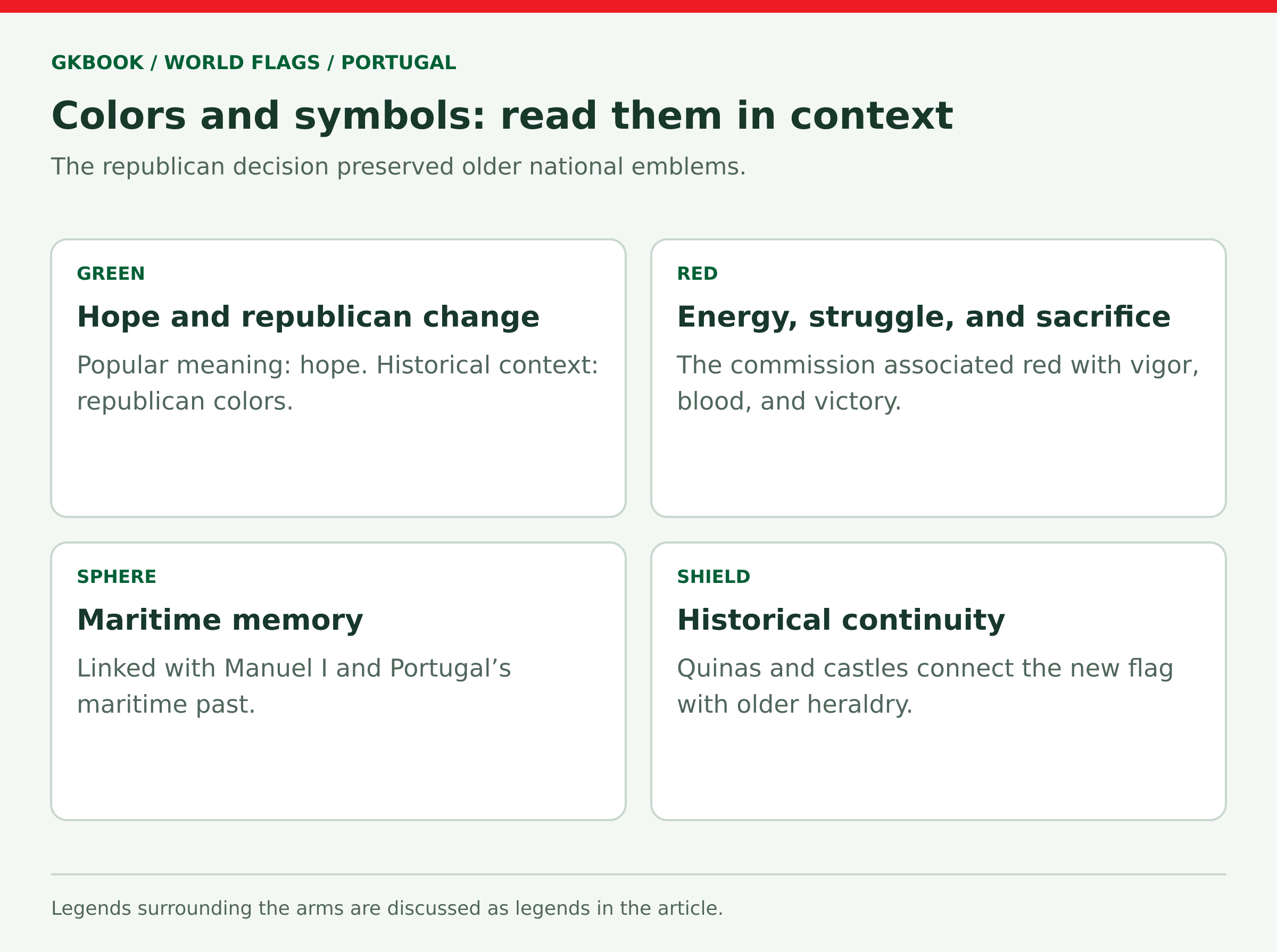
Green is commonly associated with hope, but its selection also belonged to the republican political history of the flag. The commission connected green and red with revolutionary events. Reading green only as an abstract color of hope leaves out the circumstances in which the new national design was chosen.

The archived Presidency explanation places green in the context of republican symbolism and the unsuccessful January 31, 1891 movement. Its account of the commission’s reasoning is more specific than a modern list of pleasant associations. The color participated in a political argument about how the country should represent itself after the monarchy.
For an educational caption, hope remains a recognizable interpretation when clearly identified as an association. A fuller explanation adds the republican setting. Neither statement determines the field’s numerical RGB value or its width.
What does the red on Portugal’s flag symbolize?
Red is associated with vigor, struggle, blood, and sacrifice in explanations of Portugal’s flag. The commission’s language emphasized a forceful, enthusiastic color linked with victory. The familiar account of blood shed for the country is therefore part of a broader symbolic explanation, rather than a complete account of the design decision.
The archived official explanation gives red an active emotional role: it evokes courage, collective energy, and commitment. The Museum of the Presidency observes that the blood association became especially prominent over time. These accounts support a layered interpretation without requiring every modern viewer to attach one identical personal meaning to the flag.
Red occupies the larger field, extending from the dividing line to the free edge. That measurable feature should accompany symbolic discussion because it helps readers identify an accurate image. A caption can explain sacrifice while still giving the essential visual instruction: the red area is three-fifths of the flag’s length.
What is the emblem in the middle of Portugal’s flag?
The emblem consists of Portugal’s white-edged national shield placed over a yellow armillary sphere with dark outlines. The shield contains five blue escutcheons and a red border bearing seven yellow castles. It sits at the boundary between green and red, which is left of the complete flag’s geometric midpoint.

The shield and sphere form one composition. Removing either component changes the national flag, just as adding a crown, wreath, or ribbon introduces ornament that does not belong to this ordinary rectangular design. An enlarged emblem view makes the small features legible without replacing them with simplified decorative guesses.
The supplied drawing preserves the detailed paths from the Presidency’s SVG. A single uniform transformation positions and sizes that artwork within an exact flag rectangle. This approach keeps the castle shapes, ring crossings, and roundel arrangement together instead of reconstructing each feature from memory. The accompanying isolated excerpts are clearly teaching views.
What does the armillary sphere represent?
The yellow armillary sphere recalls Portugal’s maritime history and its association with King Manuel I. The commission retained this older emblem within the republican flag. Its interlocking rings surround the national shield, connecting the new green-and-red field with an established historical symbol rather than introducing an entirely new set of arms.

An armillary sphere is represented by a system of rings, which gives the emblem its distinctive circular structure. In the flag, those rings are heraldic artwork. They should not be presented as a complete engineering diagram or as instructions for using a navigation instrument. The historical association matters more than an invented technical reading of each line.
The large shield obscures part of the sphere, so the visible rings must retain their proper crossings around it. Replacing the sphere with a plain yellow disk loses that structure. The gallery keeps the complete official composition visible while explaining the maritime and Manueline connections beside it.
What are the five blue shapes on Portugal’s flag?
The five blue shapes are small heraldic shields, or escutcheons, commonly called quinas in Portuguese discussions of the arms. They form a cross: one above, three across the middle, and one below. Each contains five white roundels. Their arrangement and contents are part of the flag’s recognizable national shield.

At small sizes, the quinas can look like simple blue spots. Enlarging the official drawing reveals their flat upper edges, curved lower portions, and carefully arranged white marks. The educational excerpt preserves those shapes while removing the surrounding sphere and larger shield from view. It is a detail study, not a separate national flag.
Count the blue shields before counting their contents. There are five shields overall; the middle row contributes three of them, including the central shield. Treating the pattern as a ring or adding a sixth shape would change the arms. The cross arrangement also helps distinguish the emblem from a generic decorated shield.
How many white dots are on the Portugal flag?
There are 25 white roundels inside the five blue shields: five roundels in each shield. Their arrangement places four around a central mark. Portuguese accounts call them besants. Traditional religious explanations sometimes introduce other numbers, but those interpretations do not alter the actual count visible in the present flag artwork.

The count is a direct observation of the official SVG. Each blue escutcheon is followed by five white shapes in the source artwork, giving five groups of five. These marks are part of the drawing, so they should remain distinguishable when the emblem is reproduced at a size intended for close study.
A thumbnail may merge several white marks into a pale blur. That is a limitation of the display size, not a different flag pattern. Use the larger PNG or vector file for counting exercises. Legends about religious symbolism belong in the historical explanation and should never be used to add extra roundels to a reconstruction.
Why does Portugal’s flag have seven castles?
Seven gold-colored castles appear on the red border of the national shield. Traditional explanations connect them with territorial development and the Algarve, while the commission associated the inherited arms with independence and national integrity. The present design contains seven castles; a precise list of seven conquered fortresses is not established here.

The published vector places three castles along the top, one on each side, and two toward the lower curve. The lower pair therefore should not be replaced by upright copies merely to make the image look more regular. Preserve the complete official arrangement.
The distinction between a visible count and a historical interpretation is useful here. Seven can be verified directly from the artwork; assigning each castle to a named fortress requires separate historical evidence. A careful teaching image labels the count and border location without converting a popular territorial story into an undocumented site-by-site key.
Where does white appear in Portugal’s flag?
White appears around the national shield, within its central field, and in the roundels inside the five blue escutcheons. The white edging of the shield is expressly included in the 1911 design description. Although green and red dominate the rectangle, white is therefore an essential part of the complete national flag.
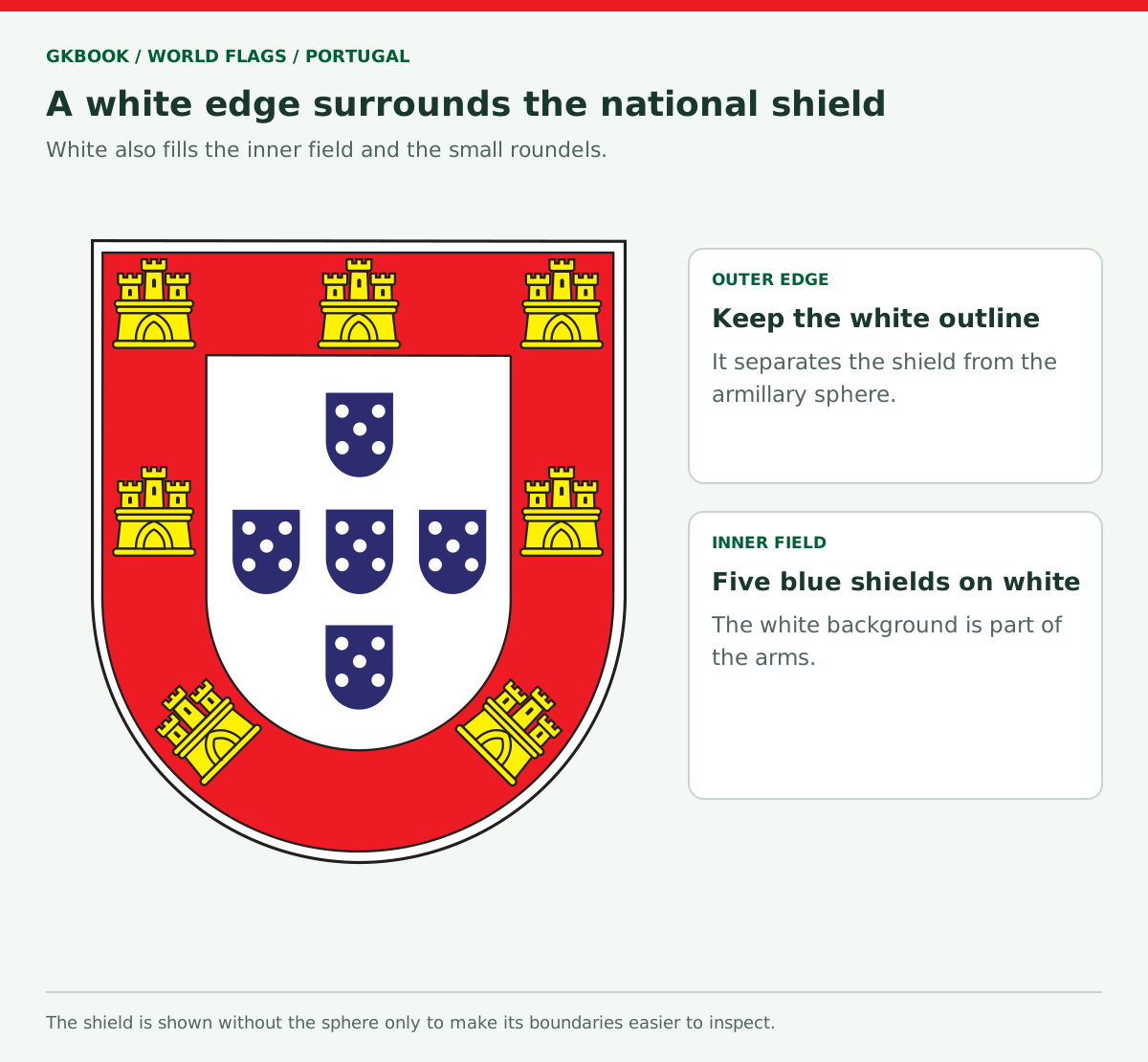
The outline separates the shield from the armillary sphere behind it. If it is omitted, the red border can appear to merge into surrounding parts of the composition. The inner white area serves a different purpose: it provides the field on which the five blue shields are arranged.
The enlarged shield diagram makes both white areas visible. It also shows why a plain red-and-green rectangle is incomplete. A restrained page background can help the emblem remain legible, but that background must remain outside the flag boundary and must not be mistaken for another national color band.
Where should the coat of arms be placed?
The complete central emblem is centered on the green-red dividing line and midway between the flag’s upper and lower edges. The 1911 construction text makes its height half the flag’s height. On this 2,400 × 1,600 master, its center is (960, 800), and its complete height is 800 units.

That leaves 400 units above and below the emblem in the master drawing. The equal clearances establish vertical balance even though the horizontal placement is asymmetric within the whole flag. Moving the emblem to x = 1,200 would center it in the rectangle but violate its relationship with the field division.
The Presidency file uses rounded coordinates. Here its emblem paths remain unchanged inside a uniform scaling and translation, while the enclosing fields follow the exact stated ratios. The measured painted extent includes the fine outer strokes. This declared normalization preserves the artwork’s proportions without claiming that every control point is separately specified by the 1911 text.
How did Portugal’s present flag develop?
The present flag developed after the republican revolution of October 5, 1910. A commission prepared a new design, approved by the Provisional Government on November 29. The Constituent Assembly ratified the flag on June 19, 1911, and its construction details were published on June 30. These dates describe different stages.

The change was debated rather than accepted immediately. Supporters of the earlier blue-and-white colors and advocates of green and red argued over historical continuity and the identity of the new Republic. The modern flag combined a conspicuous change of field colors with heraldic elements inherited from an older national tradition.
A timeline helps separate political events from documentary ones. October 5 identifies the revolution; November 29 identifies government approval of the final proposal. June 19 identifies legislative ratification, followed by publication and technical detail. Writing only one year beside an unlabeled historic image can hide those distinctions and imply a certainty the caption has not explained.
When was the Portugal flag officially adopted?
June 19, 1911 is the date of the Constituent Assembly decree adopting the national flag. The decree appeared in the Government Gazette on June 20. The Provisional Government had already approved the design on November 29, 1910. June 30, 1911 is the publication date for its detailed construction provisions.

The parliamentary archive identifies the adoption document and its publication in Diário do Governo number 141, page 2601. It separately catalogs the construction report published in number 150, pages 2756–2757. The issue numbers identify publications and should not automatically be turned into decree numbers in English captions.
This is why both 1910 and 1911 can appear in reliable accounts without describing contradictory events. The first belongs to the design decision under the Provisional Government; the second to the Assembly’s formal action. For a concise adoption fact, use June 19, 1911, then explain the earlier approval when space permits.
Who designed the Portugal flag?
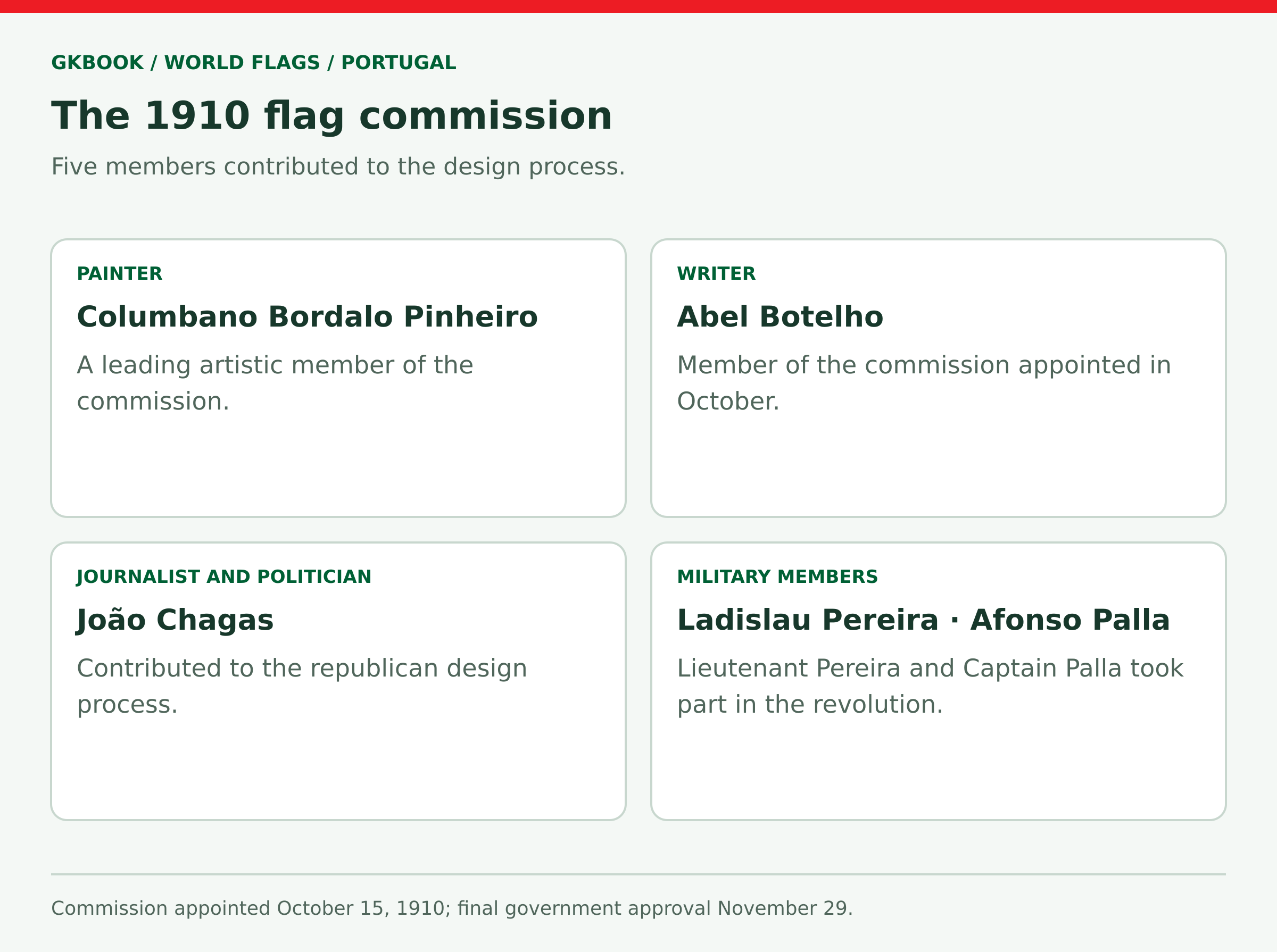
The design emerged from a five-member commission rather than a single credited designer. Its members were Columbano Bordalo Pinheiro, Abel Botelho, João Chagas, Ladislau Pereira, and Afonso Palla. The commission was appointed in October 1910, and the Provisional Government approved the final green-and-red design on November 29 of that year.

The Museum of the Presidency identifies the members as a painter, a writer, a journalist and politician, and two military participants in the revolution. Naming only the painter would leave out the documented collective responsibility.
The current Presidency chronology gives October 15 for the appointment and October 29 for presentation of the first design. Changes preceded the final approval in November. A design credit should therefore distinguish a commission’s work from government authorization, just as the adoption chronology distinguishes that authorization from the Assembly decree of the following year.
What flag did Portugal use before green and red?
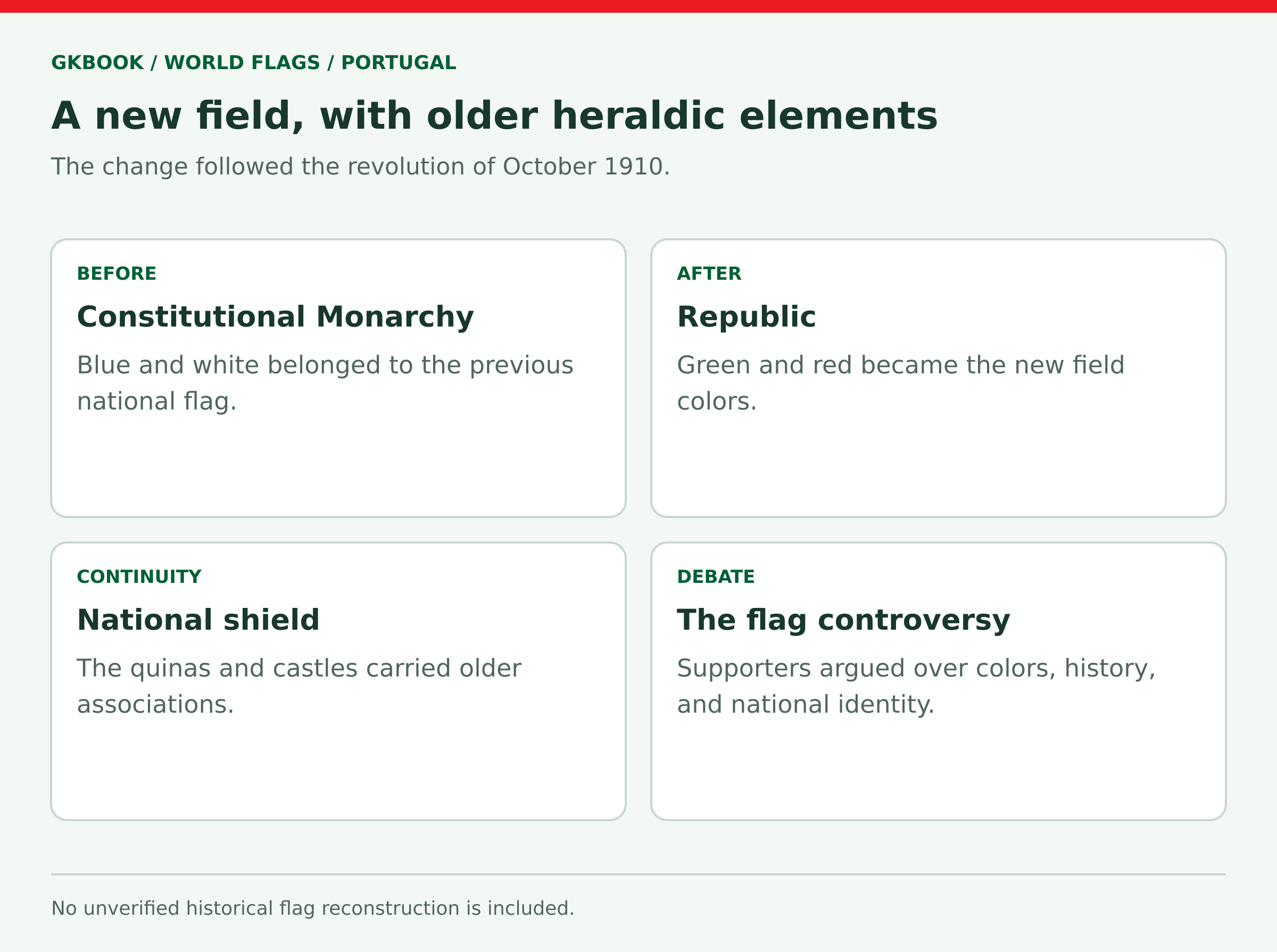
The Constitutional Monarchy used a blue-and-white national flag before the republican change. Green and red replaced those field colors after the 1910 revolution, while older elements of the national arms continued in the new composition. This guide describes that transition without presenting a modern speculative drawing as an authenticated historical flag.

Historical flags require more than swapping two colors in the current artwork. The crown, arms, proportions, and period-specific rendering must be checked against the relevant object or official pattern. Using today’s shield on an invented blue-and-white rectangle could produce an attractive image that misrepresents the earlier design.
The gallery therefore explains the monarchy-to-republic transition in a labeled text diagram. Its purpose is to show the relationship between political change and visual continuity. Readers can compare the inherited shield with the new field colors while keeping the provenance of a historical cloth separate from an educational account of its broad appearance.
Are the stories about five kings and thirty coins historical facts?
The five kings and religious stories belong to traditional interpretations of the Portuguese arms. The Museum of the Presidency explicitly connects them with the legend of Ourique, formulated centuries after the supposed event. They should be identified as legends or later interpretations, while the present artwork’s five shields and 25 roundels remain directly countable.
A flag can carry a powerful inherited story without that story serving as contemporary evidence for the origin of every shape. The museum’s account separates the legend from the later spread of explanations involving Christ’s wounds and Judas’s payment. That distinction supports respectful discussion without presenting a legendary episode as a documented design meeting.
For a classroom question, ask separately what the emblem contains and what traditions say it means. This separation also prevents a symbolic number from overriding the actual quantity of white marks in an accurate reproduction.
What does Portugal’s Constitution say about the flag?
Article 11 identifies the national flag as a symbol of the Republic’s sovereignty and Portugal’s independence, unity, and integrity. It refers to the flag adopted by the Republic instituted through the October 5, 1910 revolution. That constitutional reference establishes its national role; it is not a substitute for the detailed construction rules.
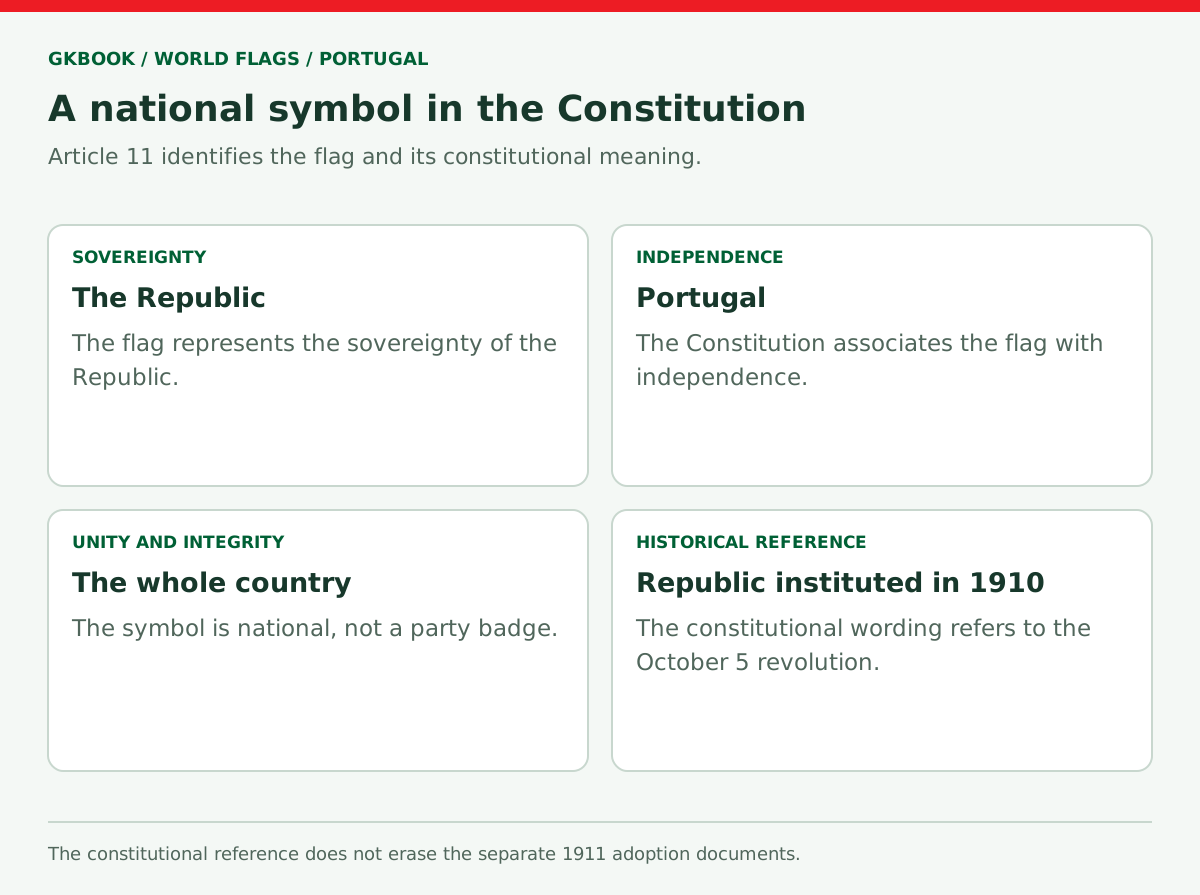
The constitutional wording describes what the flag represents in public life. It does not provide an RGB table or redraw the seven castles. Those questions require different evidence: the technical provisions for geometry and the official artwork for the detailed depiction.
The flag’s republican origin also should not reduce it to the badge of a contemporary political group. Article 11 frames it as a national symbol. In an encyclopedia entry, that role belongs alongside its recognizable appearance, so readers understand both the visual object and the constitutional meaning attached to it.
Is Portugal Day the flag’s adoption anniversary?
Portugal Day is celebrated on June 10 and is formally associated with Portugal, Camões, and Portuguese communities. It is distinct from the flag’s June 19, 1911 adoption date. The first republican flag festival took place on December 1, 1910. These observances and milestones should not be collapsed into one anniversary.
The Presidency’s legislation for Portugal Day confirms the annual June 10 date and its celebration both in Portugal and among communities abroad. The flag naturally appears in those ceremonies, but its presence does not turn the occasion into the anniversary of the Assembly decree.
The Museum of the Presidency separately documents the December 1, 1910 festivities, including production of early flags and the Lisbon procession. That historical celebration followed the November design approval and preceded parliamentary ratification. A useful timeline can include all these events while clearly labeling a national day, a festival, and a legal adoption.
Do military flags and the naval jack use the same design?
The ordinary national flag should be distinguished from specialized military and maritime patterns. The 1911 technical text separately describes unit flags with additional ornament and a jack with different construction. The general 1987 use law also preserves specialized rules. This package supplies the ordinary national flag, with those distinctions explained rather than reconstructed speculatively.
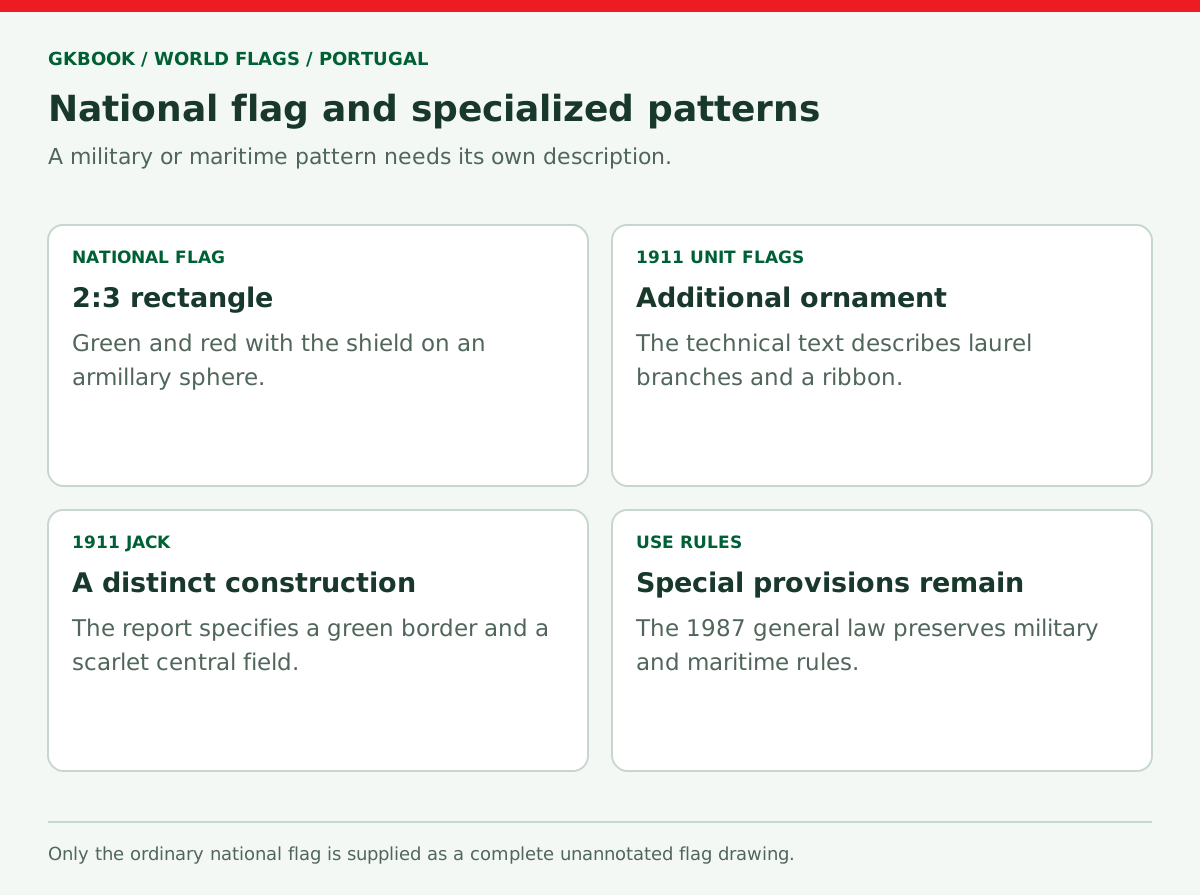
For the ordinary flag, the shield rests directly on the armillary sphere without surrounding laurel branches or a ribbon. The 1911 unit-flag provisions add such features and give their own dimensions. Applying those details to every Portuguese flag would merge distinct patterns that the same historical document treats separately.
A similarly cautious approach applies to the jack. Its historical description is useful evidence that not every Portuguese maritime symbol has the national flag’s layout. It does not, by itself, verify every present service practice. Identify the institution, date, and flag category before using a specialized pattern as a current operational reference.
Which side is green when Portugal’s flag is displayed?
Green belongs at the hoist, the edge attached to the pole. In the usual front-facing reference image with the pole on the left, green therefore appears on the left. From behind the same cloth, the pole and green field appear on the right. The gallery labels that reverse view as a geometric reflection.
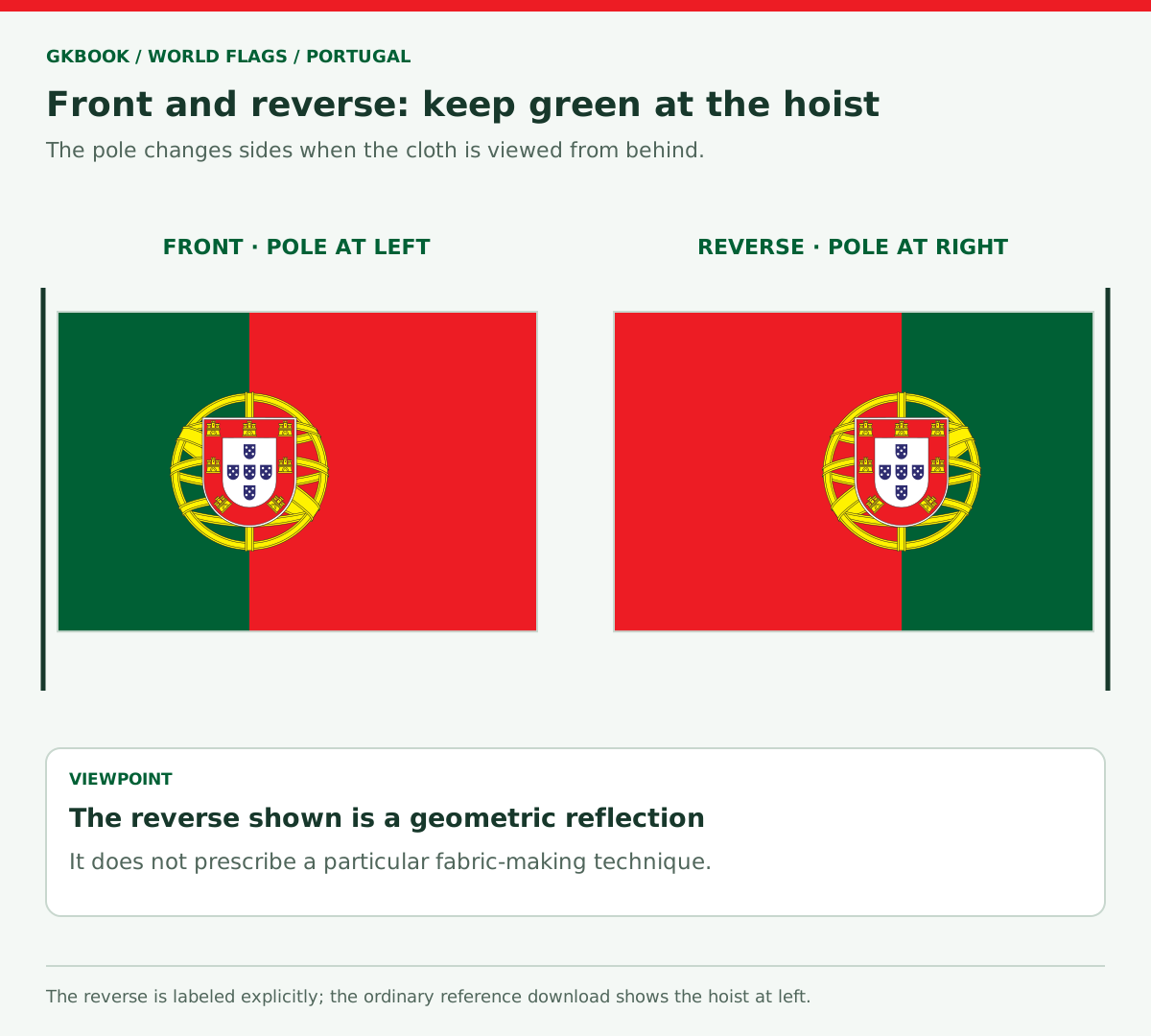
The hoist is a physical edge, whereas left and right depend on where the observer stands. Describing the flag only as green on the left can therefore confuse a photograph taken from the opposite side. A visible pole, attachment, or clearly labeled viewpoint resolves the ambiguity without changing the underlying design.
The reverse diagram reflects the entire composition, including the detailed sphere, instead of swapping only the large colored fields. It illustrates a view through one cloth and does not prescribe a specific manufacturing technique. A portrait-shaped hanging banner raises separate display questions; simply stretching the landscape file would damage both proportions and emblem geometry.
What are the general rules for displaying Portugal’s flag?
Decree-Law 150/87 requires the official pattern and good condition, and sets general rules for hoisting and respectful display. It specifies 9 a.m. to sunset, with illumination whenever possible if the flag remains up at night. Military, maritime, and certain international settings have particular provisions that must be considered in their own context.

The law addresses public buildings and also allows display by private institutions and individuals subject to the applicable procedures. Its rules about Sundays, holidays, and public ceremonies describe an official framework; they should not be paraphrased into an unsupported claim that private people may display the flag only on designated national holidays.
For an everyday visual check, confirm that the flag is recognizable, properly oriented, and in sound condition. Keep explanatory lettering outside its boundary. The qualification about overnight illumination matters: replacing whenever possible with an absolute statement would make the summary stronger than the text. A concise guide should preserve that distinction.
How is Portugal’s flag displayed during national mourning?
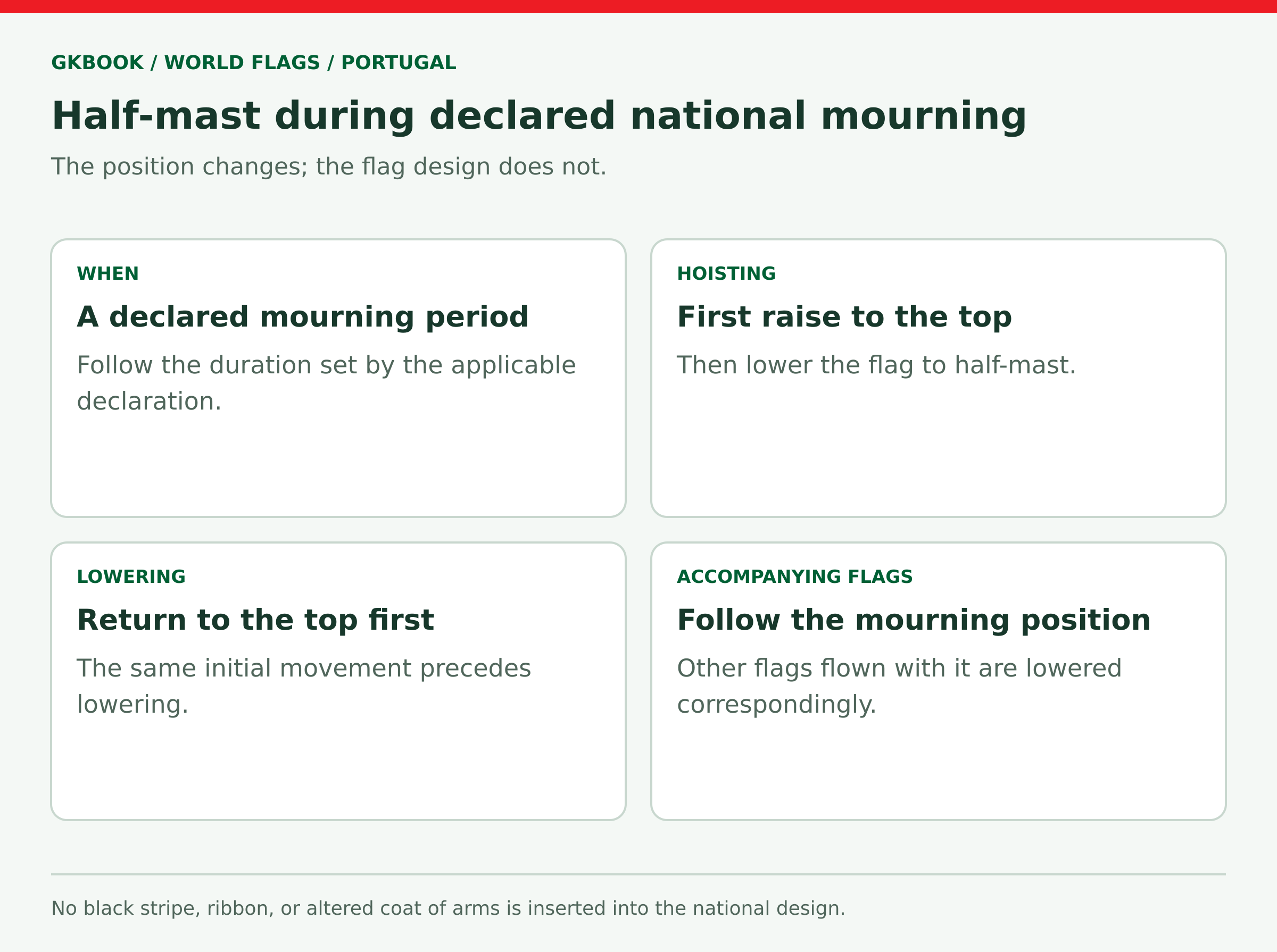
During a declared period of national mourning, Portugal’s flag is placed at half-mast for the specified duration. Article 7 of the 1987 law requires raising it to the top before lowering it to the mourning position, and again before taking it down. Other flags displayed with it follow the lowered position.

The declared period determines when this rule applies. A general explanation of half-mast does not establish that a particular mourning order is currently in force. The gallery therefore presents the sequence as a standing rule, without inventing an announcement, a current date range, or an authority’s instructions for a specific event.
Lowering the flag changes its display position rather than its design. The green and red fields, shield, and sphere remain intact. Adding a black stripe to the downloadable flag would create a different image and would not illustrate the rule accurately. The step cards concentrate on the prescribed movement and the relationship with accompanying flags.
Where is Portugal’s flag placed beside other flags?
The 1987 law gives Portugal’s flag the place of honor and provides arrangement-specific rules. With three masts it occupies the center; other layouts require attention to the law’s stated viewpoint and mast arrangement. International settings have specific protocol provisions. A universal instruction to put it on the viewer’s left would be incomplete.
Viewpoint is especially important because the text describes some positions from a person facing outward. Translating that directly into left or right in a photograph can reverse the intended placement. A site plan should establish the building, outward direction, and number of masts before applying the relevant clause.
The law also addresses differing mast heights and the flag’s dimensions relative to accompanying flags. This article explains the principle and one clear three-mast case, while leaving complex ceremonial arrangements to the exact rules applicable to the location and occasion.
How can I draw the Portugal flag accurately?
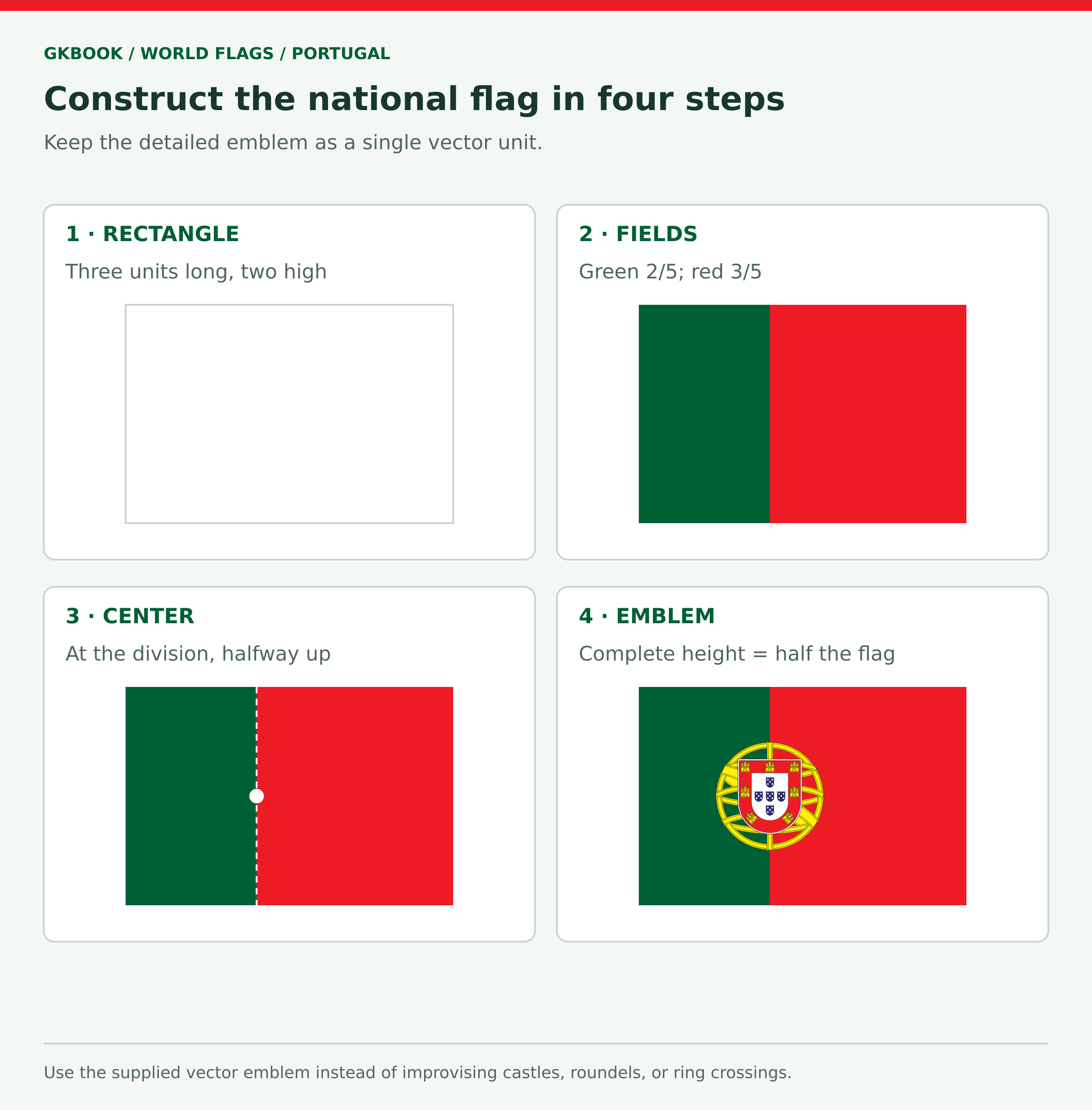
Start with a 2:3 rectangle, divide its length into five equal parts, and color the first two green and the remaining three red. Place the complete shield-and-sphere emblem on that division, vertically centered, at half the flag’s height. Use verified vector artwork for the emblem rather than improvising its many small details.

The construction sequence first establishes the field, then the center, then the emblem. Preliminary stages without the arms are labeled as drawing steps so that a learner does not mistake a plain green-red rectangle for a complete alternative national flag. The finished reference image contains every required component.
For reliable resizing, keep the emblem grouped and scale both axes by the same factor. Check the seven castles and five groups of roundels after exporting, especially at small sizes. Dimension guides, labels, and a pole marker can help explain the drawing, but they belong outside the clean downloadable flag and are not part of its design.
What image sizes are suitable for Portugal flag pictures?
Any dimensions with width:height 3:2 preserve the national flag’s shape. Examples include 600 × 400, 1,200 × 800, and 2,400 × 1,600 pixels. This package provides a 4,800 × 3,200 PNG and a vector SVG. Its labeled diagrams use separate canvas sizes so their explanations remain readable.

A larger pixel count helps when a raster image is printed or displayed at a large size, but it is not permission to stretch it into an arbitrary frame. Set one image dimension and allow the other to follow the aspect ratio. Cropping the green field can be particularly misleading because its intended share is already smaller.
The SVG retains vector paths for the complete emblem, allowing sharp scaling in compatible software. A very small display still cannot show every castle window clearly, regardless of file format. Use a separate close-up when those details matter, and keep the full flag nearby so readers understand where the enlarged feature belongs.
Are the web colors a complete printing specification?
No. The SVG’s RGB values describe a particular official digital file, while print production involves different color systems, materials, and viewing conditions. The Presidency also supplies CMYK and Pantone artwork. A screen HEX table alone cannot certify dyed fabric or guarantee that a desktop print matches a physical national flag standard.
The supplied Pantone EPS names 349 C, 485 C, 803 C, 288 C, and Black 6 C. Those names belong to that downloadable artwork and should be kept with its production context. They are not inferred by converting the screen palette through an arbitrary online calculator or by sampling a photograph.
For these educational downloads, the SVG’s fills are retained without pretending that their RGB numbers resolve every print decision. A print proof should be reviewed for both color and small-detail legibility. The white edge, black delineation, and castle details are easy to lose if the emblem is printed too small or placed on an unsuitable substrate.
What are the most common mistakes in Portugal flag images?
Frequent mistakes include equal green and red halves, a centered-in-the-rectangle emblem, an incorrect 2:3 shape, missing white edging, and simplified or miscounted heraldic details. Historical captions can also confuse the 1910 design approval with 1911 adoption. Check geometry, artwork, orientation, and date labels together rather than judging accuracy by color alone.

The checklist starts with features visible at thumbnail size: the smaller green field, larger red field, and emblem positioned toward the hoist. Next inspect the enlarged arms for five blue shields, five roundels in each, seven castles, and the surrounding sphere. The ordinary national flag has no crown or laurel wreath.
Finally review the caption and the file’s intended use. A historical diagram should identify its period, while a reverse view should identify its viewpoint. A screen palette should identify its source. These checks make an image more dependable without implying that every educational illustration is an official manufacturing master or a record of an actual historical cloth.
Which Portugal flag file should I download?
Choose the clean national-flag SVG for scalable vector artwork, or the 4,800 × 3,200 PNG for broad compatibility. The gallery also offers 23 explanatory subjects as SVG and PNG pairs. Those diagrams include labels and teaching layouts; they should not replace the unannotated flag when a complete national flag image is needed.
The clean flag is designed for readers who need the symbol itself. The field, proportion, and placement diagrams are useful when explaining how it is constructed. Detail studies enlarge the sphere, shields, roundels, or castles without pretending that the isolated feature is a separate national flag. Each download has a descriptive caption.
The image credits identify the Presidency as the source of the emblem artwork and digital palette. They also distinguish the original educational layouts from the reproduced national symbol. Preserve that attribution when reusing the supplied material. The separate share image is formatted for a social preview, so its entire canvas intentionally differs from the flag’s own ratio.
Download Portugal flag pictures
Download the clean national flag as SVG or 4,800 × 3,200 PNG. Its SVG coordinate system is 2,400 × 1,600, preserving the 2:3 shape and the exact 40% / 60% field division.
The gallery contains 24 subjects, each with an SVG and PNG. All artwork is vector in the SVG files. The emblem paths and colors come from the Presidency’s official download, uniformly scaled and positioned within the stated proportions. Image credits and reproduction notes identify the source, normalization, digital palette, and source-use conditions.
Explore more in World Flags, including the Spain flag and Brazil flag.
World Flags/Portugal
Portugal flag pictures
Green at the hoist occupies two-fifths of the length; red occupies three-fifths. The shield and armillary sphere sit on their dividing line.
GKBook diagrams; emblem artwork and digital palette: Presidência da República Portuguesa.Download SVGDownload PNGOn a 2,400-unit master, the green field is 960 units wide and red is 1,440. The external pole marker identifies the hoist.
GKBook diagrams; emblem artwork and digital palette: Presidência da República Portuguesa.Download SVGDownload PNGThe national flag has height:length 2:3. A 2,400 × 1,600 master preserves the ratio exactly.
GKBook diagrams; emblem artwork and digital palette: Presidência da República Portuguesa.Download SVGDownload PNGSeven distinct paint colors occur in the Presidency SVG, including a small additional red within the emblem. Original source colors are retained.
GKBook diagrams; emblem artwork and digital palette: Presidência da República Portuguesa.Download SVGDownload PNGThe national shield, with its white edge, is placed over a yellow armillary sphere with dark delineation. No crown, wreath, or ribbon is added.
GKBook diagrams; emblem artwork and digital palette: Presidência da República Portuguesa.Download SVGDownload PNGThe emblem’s center follows the green-red boundary, not the geometric midpoint of the whole flag. Equal top and bottom clearances are each one-quarter of the height.
GKBook diagrams; emblem artwork and digital palette: Presidência da República Portuguesa.Download SVGDownload PNGThe armillary sphere connects the flag to Manueline symbolism and Portugal’s maritime history. Its rings are shown within the complete emblem.
GKBook diagrams; emblem artwork and digital palette: Presidência da República Portuguesa.Download SVGDownload PNGThis excerpt retains the five blue escutcheons and their white roundels from the official vector. Their cross arrangement is essential.
GKBook diagrams; emblem artwork and digital palette: Presidência da República Portuguesa.Download SVGDownload PNGEach of the five blue shields contains five white roundels, often called besants in Portuguese accounts. The actual drawing contains 25.
GKBook diagrams; emblem artwork and digital palette: Presidência da República Portuguesa.Download SVGDownload PNGThe seven castles are counted on the shield’s red border. Their architectural details are retained from the official vector.
GKBook diagrams; emblem artwork and digital palette: Presidência da República Portuguesa.Download SVGDownload PNGThe white outline is explicitly named in the 1911 design description. White also appears inside the shield and as the roundels.
GKBook diagrams; emblem artwork and digital palette: Presidência da República Portuguesa.Download SVGDownload PNGThe meanings combine documented commission reasoning with later popular associations. They are not a list of color measurements.
GKBook diagrams; emblem artwork and digital palette: Presidência da República Portuguesa.Download SVGDownload PNGThe revolution, design approval, legislative ratification, and publication of technical details are separate milestones.
GKBook diagrams; emblem artwork and digital palette: Presidência da República Portuguesa.Download SVGDownload PNGJune 19, 1911 is the Assembly decree date. June 20 is its publication date; June 30 carries the construction details.
GKBook diagrams; emblem artwork and digital palette: Presidência da República Portuguesa.Download SVGDownload PNGThe Museum of the Presidency identifies five commission members. Attribution to a single person would omit the collective process.
GKBook diagrams; emblem artwork and digital palette: Presidência da República Portuguesa.Download SVGDownload PNGThe republican change replaced the blue-and-white monarchy flag with green and red while retaining historical heraldic elements.
GKBook diagrams; emblem artwork and digital palette: Presidência da República Portuguesa.Download SVGDownload PNGArticle 11 describes the national flag through sovereignty, independence, unity, and integrity and identifies the republican historical reference.
GKBook diagrams; emblem artwork and digital palette: Presidência da República Portuguesa.Download SVGDownload PNGThe 1911 technical report distinguishes the national flag from unit flags and the jack. Specialized historical specifications are not mislabeled as today’s universal service rules.
GKBook diagrams; emblem artwork and digital palette: Presidência da República Portuguesa.Download SVGDownload PNGA view through a single cloth reverses the left-right arrangement. Green remains beside the pole, which appears on the right in the reverse view.
GKBook diagrams; emblem artwork and digital palette: Presidência da República Portuguesa.Download SVGDownload PNGThe 1987 law addresses condition, timing, precedence, and respectful presentation. Its qualification on overnight lighting is retained.
GKBook diagrams; emblem artwork and digital palette: Presidência da República Portuguesa.Download SVGDownload PNGArticle 7 sets the mourning position and sequence. This diagram describes the rule without claiming that mourning is currently in force.
GKBook diagrams; emblem artwork and digital palette: Presidência da República Portuguesa.Download SVGDownload PNGUse the fixed rectangle and unequal fields, then place the complete emblem at the division with half-height size. Preliminary panels are construction stages, not alternative flags.
GKBook diagrams; emblem artwork and digital palette: Presidência da República Portuguesa.Download SVGDownload PNGThe main PNG is 4,800 × 3,200. Its SVG uses a 2,400 × 1,600 coordinate system, with exact 40% and 60% field widths.
GKBook diagrams; emblem artwork and digital palette: Presidência da República Portuguesa.Download SVGDownload PNGThe review covers field widths, hoist side, emblem placement, heraldic counts, correct ornament, and distinct historical milestones.
GKBook diagrams; emblem artwork and digital palette: Presidência da República Portuguesa.Download SVGDownload PNGFrequently asked questions
What does the Portugal flag look like?
Portugal’s national flag has unequal vertical fields of green and red, with green beside the flagpole. A white-edged national shield rests on a yellow armillary sphere at the color division. The flag’s height:length ratio is 2:3; green occupies two-fifths of its length and red the remaining three-fifths.
What are the colors of the Portugal flag?
The main fields are dark green and scarlet red. The central emblem adds yellow, blue, white, and dark outlines. This page retains the palette of the Presidency’s downloadable SVG, including green #006035 and field red #ED1C24. These digital file values should not be mistaken for HEX specifications enacted in 1911.
What is the Portugal flag’s official ratio?
Portugal’s national flag has a height:length ratio of 2:3. Its length is therefore one and a half times its height. A rectangle measuring 1,200 pixels wide by 800 pixels high has the correct shape. The ratio describes the flag itself, excluding a pole, sleeve, frame, or surrounding page margin.
How much of the flag is green and how much is red?
The green field occupies two-fifths of the flag’s total length, while the red field occupies three-fifths. That is a 40% to 60% division, not equal halves. On the 2,400-unit drawing, the boundary is 960 units from the hoist, leaving 1,440 units for the red field.
What does the green on Portugal’s flag mean?
Green is commonly associated with hope, but its selection also belonged to the republican political history of the flag. The commission connected green and red with revolutionary events. Reading green only as an abstract color of hope leaves out the circumstances in which the new national design was chosen.
What does the red on Portugal’s flag symbolize?
Red is associated with vigor, struggle, blood, and sacrifice in explanations of Portugal’s flag. The commission’s language emphasized a forceful, enthusiastic color linked with victory. The familiar account of blood shed for the country is therefore part of a broader symbolic explanation, rather than a complete account of the design decision.
What is the emblem in the middle of Portugal’s flag?
The emblem consists of Portugal’s white-edged national shield placed over a yellow armillary sphere with dark outlines. The shield contains five blue escutcheons and a red border bearing seven yellow castles. It sits at the boundary between green and red, which is left of the complete flag’s geometric midpoint.
What does the armillary sphere represent?
The yellow armillary sphere recalls Portugal’s maritime history and its association with King Manuel I. The commission retained this older emblem within the republican flag. Its interlocking rings surround the national shield, connecting the new green-and-red field with an established historical symbol rather than introducing an entirely new set of arms.
What are the five blue shapes on Portugal’s flag?
The five blue shapes are small heraldic shields, or escutcheons, commonly called quinas in Portuguese discussions of the arms. They form a cross: one above, three across the middle, and one below. Each contains five white roundels. Their arrangement and contents are part of the flag’s recognizable national shield.
How many white dots are on the Portugal flag?
There are 25 white roundels inside the five blue shields: five roundels in each shield. Their arrangement places four around a central mark. Portuguese accounts call them besants. Traditional religious explanations sometimes introduce other numbers, but those interpretations do not alter the actual count visible in the present flag artwork.
Why does Portugal’s flag have seven castles?
Seven gold-colored castles appear on the red border of the national shield. Traditional explanations connect them with territorial development and the Algarve, while the commission associated the inherited arms with independence and national integrity. The present design contains seven castles; a precise list of seven conquered fortresses is not established here.
Where does white appear in Portugal’s flag?
White appears around the national shield, within its central field, and in the roundels inside the five blue escutcheons. The white edging of the shield is expressly included in the 1911 design description. Although green and red dominate the rectangle, white is therefore an essential part of the complete national flag.
Where should the coat of arms be placed?
The complete central emblem is centered on the green-red dividing line and midway between the flag’s upper and lower edges. The 1911 construction text makes its height half the flag’s height. On this 2,400 × 1,600 master, its center is (960, 800), and its complete height is 800 units.
How did Portugal’s present flag develop?
The present flag developed after the republican revolution of October 5, 1910. A commission prepared a new design, approved by the Provisional Government on November 29. The Constituent Assembly ratified the flag on June 19, 1911, and its construction details were published on June 30. These dates describe different stages.
When was the Portugal flag officially adopted?
June 19, 1911 is the date of the Constituent Assembly decree adopting the national flag. The decree appeared in the Government Gazette on June 20. The Provisional Government had already approved the design on November 29, 1910. June 30, 1911 is the publication date for its detailed construction provisions.
Who designed the Portugal flag?
The design emerged from a five-member commission rather than a single credited designer. Its members were Columbano Bordalo Pinheiro, Abel Botelho, João Chagas, Ladislau Pereira, and Afonso Palla. The commission was appointed in October 1910, and the Provisional Government approved the final green-and-red design on November 29 of that year.
What flag did Portugal use before green and red?
The Constitutional Monarchy used a blue-and-white national flag before the republican change. Green and red replaced those field colors after the 1910 revolution, while older elements of the national arms continued in the new composition. This guide describes that transition without presenting a modern speculative drawing as an authenticated historical flag.
Are the stories about five kings and thirty coins historical facts?
The five kings and religious stories belong to traditional interpretations of the Portuguese arms. The Museum of the Presidency explicitly connects them with the legend of Ourique, formulated centuries after the supposed event. They should be identified as legends or later interpretations, while the present artwork’s five shields and 25 roundels remain directly countable.
What does Portugal’s Constitution say about the flag?
Article 11 identifies the national flag as a symbol of the Republic’s sovereignty and Portugal’s independence, unity, and integrity. It refers to the flag adopted by the Republic instituted through the October 5, 1910 revolution. That constitutional reference establishes its national role; it is not a substitute for the detailed construction rules.
Is Portugal Day the flag’s adoption anniversary?
Portugal Day is celebrated on June 10 and is formally associated with Portugal, Camões, and Portuguese communities. It is distinct from the flag’s June 19, 1911 adoption date. The first republican flag festival took place on December 1, 1910. These observances and milestones should not be collapsed into one anniversary.
Do military flags and the naval jack use the same design?
The ordinary national flag should be distinguished from specialized military and maritime patterns. The 1911 technical text separately describes unit flags with additional ornament and a jack with different construction. The general 1987 use law also preserves specialized rules. This package supplies the ordinary national flag, with those distinctions explained rather than reconstructed speculatively.
Which side is green when Portugal’s flag is displayed?
Green belongs at the hoist, the edge attached to the pole. In the usual front-facing reference image with the pole on the left, green therefore appears on the left. From behind the same cloth, the pole and green field appear on the right. The gallery labels that reverse view as a geometric reflection.
What are the general rules for displaying Portugal’s flag?
Decree-Law 150/87 requires the official pattern and good condition, and sets general rules for hoisting and respectful display. It specifies 9 a.m. to sunset, with illumination whenever possible if the flag remains up at night. Military, maritime, and certain international settings have particular provisions that must be considered in their own context.
How is Portugal’s flag displayed during national mourning?
During a declared period of national mourning, Portugal’s flag is placed at half-mast for the specified duration. Article 7 of the 1987 law requires raising it to the top before lowering it to the mourning position, and again before taking it down. Other flags displayed with it follow the lowered position.
Where is Portugal’s flag placed beside other flags?
The 1987 law gives Portugal’s flag the place of honor and provides arrangement-specific rules. With three masts it occupies the center; other layouts require attention to the law’s stated viewpoint and mast arrangement. International settings have specific protocol provisions. A universal instruction to put it on the viewer’s left would be incomplete.
How can I draw the Portugal flag accurately?
Start with a 2:3 rectangle, divide its length into five equal parts, and color the first two green and the remaining three red. Place the complete shield-and-sphere emblem on that division, vertically centered, at half the flag’s height. Use verified vector artwork for the emblem rather than improvising its many small details.
What image sizes are suitable for Portugal flag pictures?
Any dimensions with width:height 3:2 preserve the national flag’s shape. Examples include 600 × 400, 1,200 × 800, and 2,400 × 1,600 pixels. This package provides a 4,800 × 3,200 PNG and a vector SVG. Its labeled diagrams use separate canvas sizes so their explanations remain readable.
Are the web colors a complete printing specification?
No. The SVG’s RGB values describe a particular official digital file, while print production involves different color systems, materials, and viewing conditions. The Presidency also supplies CMYK and Pantone artwork. A screen HEX table alone cannot certify dyed fabric or guarantee that a desktop print matches a physical national flag standard.
What are the most common mistakes in Portugal flag images?
Frequent mistakes include equal green and red halves, a centered-in-the-rectangle emblem, an incorrect 2:3 shape, missing white edging, and simplified or miscounted heraldic details. Historical captions can also confuse the 1910 design approval with 1911 adoption. Check geometry, artwork, orientation, and date labels together rather than judging accuracy by color alone.
Which Portugal flag file should I download?
Choose the clean national-flag SVG for scalable vector artwork, or the 4,800 × 3,200 PNG for broad compatibility. The gallery also offers 23 explanatory subjects as SVG and PNG pairs. Those diagrams include labels and teaching layouts; they should not replace the unannotated flag when a complete national flag image is needed.
Explore all general-knowledge topics and the A-to-Z lists.









We Value Your Opinion Comments