
Lesotho flag picture
Use the construction sheet to check measurements, or follow the drawing guide.
Lesotho flag: key facts
| Country | LesothoKingdom of Lesotho; Southern Africa. |
|---|---|
| Design | Blue–white–green with a black hatThe central emblem is a mokorotlo. |
| Proportions | 2:3 height:lengthEquivalent to 3:2 length:height. |
| Band heights | 3:4:3Blue 30%; white 40%; green 30%. |
| Adopted | October 4, 2006The 40th anniversary of independence. |
| Hat height | 92% of the white bandEquivalent to 36.8% of the full flag height. |
| Governing law | National Flag Act, 2006Act No. 7; the Schedule contains the design. |
| Colors | Blue, white, green, and blackThe complete design has four colors. |
A quick memory aid: blue–white–green, 3–4–3, black Basotho hat in the center.
What does the flag of Lesotho look like?
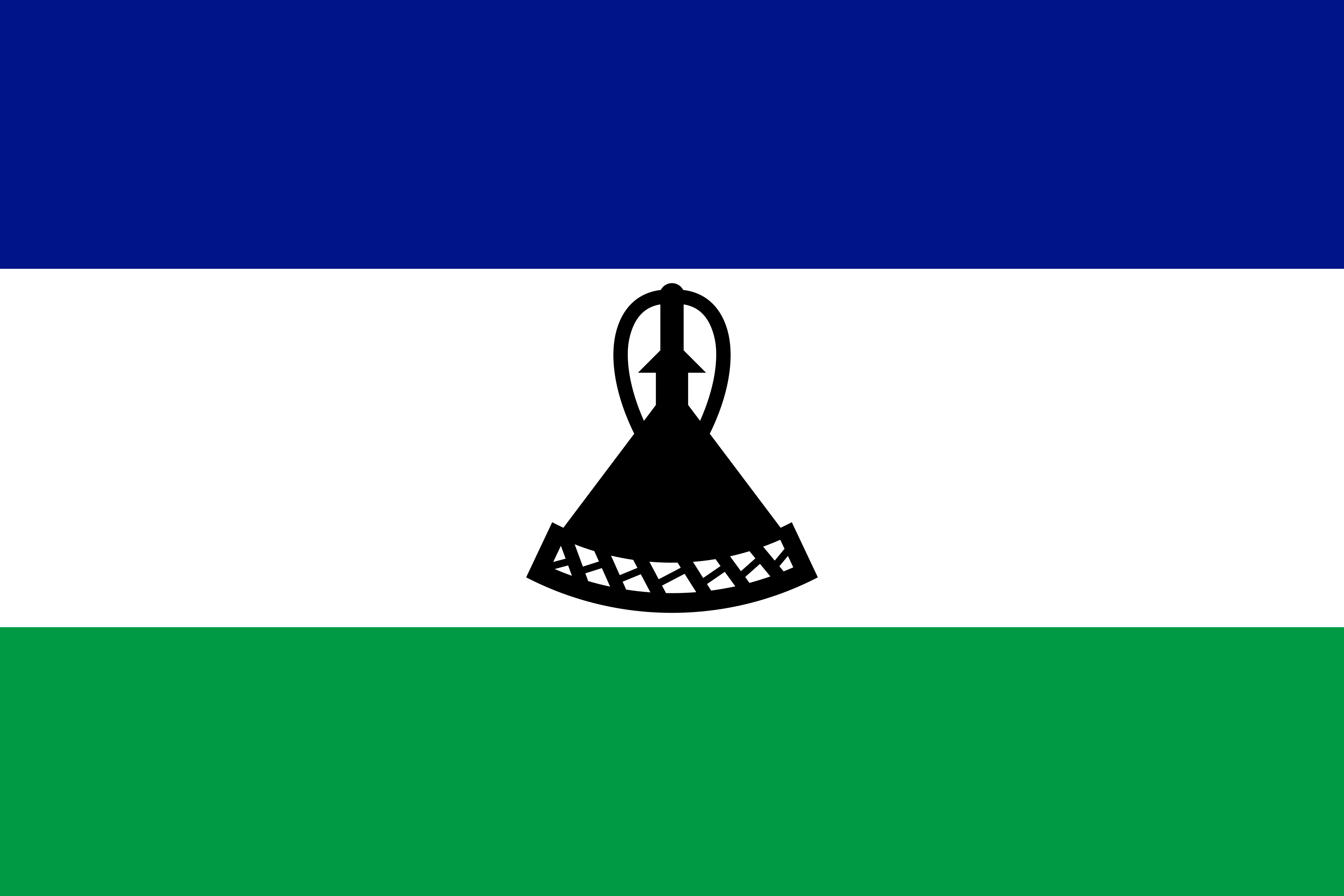
The flag of Lesotho has blue, white, and green horizontal bands in a 3:4:3 ratio. A black mokorotlo, or traditional Basotho hat, stands in the middle of the white band. The flag’s height-to-length ratio is 2:3.
The present design was introduced on October 4, 2006, the 40th anniversary of Lesotho’s independence. It represents the Kingdom of Lesotho, a mountainous Southern African country surrounded by South Africa.
What are the main parts of the flag?
Read the background from top to bottom as blue, white, green. The middle band is four-tenths of the flag’s height; each outer band is three-tenths.
| Element | Position | Share of full flag height |
|---|---|---|
| Blue band | Top | 30% |
| White band | Center | 40% |
| Green band | Bottom | 30% |
| Black Basotho hat | Centered on white | 36.8% |
The white band’s 40% describes its full rectangle before the emblem is added. The black hat covers some of that rectangle, so visible white occupies less than 40% of the flag’s area.
What are Lesotho’s flag colors and HEX codes?
The complete design uses blue, white, green, and black. The first three form the background bands; black forms the mokorotlo. These digital files use the palette below.
| Color | HEX in these files | RGB | Position |
|---|---|---|---|
| Blue | #001489 | 0, 20, 137 | Top band |
| White | #FFFFFF | 255, 255, 255 | Middle band |
| Green | #009A44 | 0, 154, 68 | Bottom band |
| Black | #000000 | 0, 0, 0 | Hat |
The Schedule to the National Flag Act, 2006 separately lists Pantone Reflex Blue C, White, Black, and Pantone Green 347C. The HEX and RGB entries here identify the supplied screen artwork; they do not replace those material color references.
What do the colors of Lesotho’s flag mean?
The established symbolism links blue with rain or water, white with peace, and green with vegetation and prosperity. The black hat represents the Basotho people and their African identity.
These associations connect the flag with both the country’s environment and its cultural life. The hat makes this particular blue-white-green flag immediately recognizable as Lesotho’s.
Blue for rain, white for peace, green for prosperity, and a black Basotho hat.
How does the flag relate to “Khotso, Pula, Nala”?
Lesotho’s national motto is Khotso, Pula, Nala, usually translated as Peace, Rain, Prosperity. The background colors reflect the same three ideas.
The motto’s word order is not the flag’s top-to-bottom color order. White corresponds to peace, blue to rain, and green to prosperity; the flag itself begins with blue.
What is the black symbol on the flag?
It is a mokorotlo, a traditional conical Basotho hat woven from grass. Its distinctive shape includes a broad brim and a raised top ornament. On the flag it appears as a black emblem with white openings.
The hat is a cultural and national symbol, not a bell, a crown, or a mountain drawn directly on the flag. The familiar silhouette appears in Lesotho’s crafts, architecture, and national imagery.
Why is the Basotho hat a national symbol?
The mokorotlo became closely associated with Basotho identity during the twentieth century. Museum research traces the familiar form’s growth in popularity through craft production, public life, and its use by political and royal figures.
Lesotho’s High Commission connects the conical shape with the profile of Mount Qiloane, near Thaba Bosiu. This is a cultural explanation of the hat’s form; the flag still depicts the hat itself.
The emblem already appeared on the first independence flag in 1966. Its return in 2006 renewed a recognizable national motif in a different arrangement.
How is the Lesotho flag constructed?
Use a rectangle 30 units long and 20 units high. Divide the height into 6 blue units, 8 white units, and 6 green units. Center the hat within the white panel.
| Measurement | Formula using total height H | When H = 100 cm |
|---|---|---|
| Length | 1.5 × H | 150 cm |
| Blue band | 0.3 × H | 30 cm |
| White band | 0.4 × H | 40 cm |
| Green band | 0.3 × H | 30 cm |
| Hat height | 0.92 × 0.4 × H | 36.8 cm |
| White gap above or below hat | 0.016 × H | 1.6 cm |
For the emblem’s detailed outline, scale the supplied vector as a whole. Do not stretch the top ornament separately from the hat’s body or brim.
How large is the hat, and should it touch the bands?
The Act specifies a hat height equal to 92% of the white band’s height. Since white occupies 40% of the flag’s height, the hat is 36.8% of the total height.
The centered emblem therefore leaves a small white gap above and below. Each gap is 4% of the white band’s height, or 1.6% of the full flag height. The hat should not touch the blue or green bands.
On a 100-centimeter-high flag, the white band is 40 centimeters high, the hat is 36.8 centimeters high, and each vertical gap is 1.6 centimeters.
Is the flag’s ratio 2:3 or 3:4:3?
These ratios describe different measurements. 2:3 is the overall height:length of the flag. 3:4:3 gives the heights of the blue, white, and green bands.
If dimensions are written length:height, the same outer rectangle is 3:2. A 150 × 100 centimeter flag follows that shape; its three bands are 30, 40, and 30 centimeters high.
What sizes can a Lesotho flag have?
Every part can be enlarged or reduced together. The examples below preserve the official proportions and emblem height.
| Length × height | Blue / green band | White band | Hat height |
|---|---|---|---|
| 90 × 60 cm | 18 cm each | 24 cm | 22.08 cm |
| 150 × 100 cm | 30 cm each | 40 cm | 36.8 cm |
| 180 × 120 cm | 36 cm each | 48 cm | 44.16 cm |
| 300 × 200 cm | 60 cm each | 80 cm | 73.6 cm |
The supplied PNG is 3600 × 2400 pixels. At 300 pixels per inch, it prints at 12 × 8 inches. The SVG can be scaled without pixelation.
How do you draw Lesotho’s flag?
- Draw a rectangle three units long for every two units high.
- Divide its height into ten equal parts.
- Color the top three parts blue and the bottom three green, leaving four white parts in the center.
- Place the black mokorotlo centrally in the white panel.
- Make the complete hat 92% as high as the white band, leaving equal white gaps above and below.
Use a recognizable mokorotlo in a classroom sketch. For a finished print or web graphic, use the downloadable vector to retain the detailed brim and top ornament.
How many national flag designs has Lesotho used since independence?
There have been three principal post-independence designs: the independence flag introduced in 1966, its replacement in 1987, and the current design introduced in 2006.
The first and current designs both use a Basotho hat, but their backgrounds and emblem colors differ. The intervening flag used a shield and weapons instead.
When was the present flag adopted?
The current national flag dates from October 4, 2006. The National Flag Act, 2006 appeared in the Gazette that day and states that it comes into operation on publication.
The date was also the 40th anniversary of independence from Britain on October 4, 1966. Independence Day and the present flag’s adoption anniversary therefore fall on the same month and day, but refer to events forty years apart.
Why did Lesotho change its flag in 2006?
The new design emphasized peace and a familiar cultural symbol. It replaced the previous shield-and-weapons emblem with the mokorotlo, while retaining blue, white, and green in a new horizontal arrangement.
At the time of the change, the government presented the flag as expressing peaceful relations within the country and with its neighbors. The design is often described as a peace flag in reporting about the 2006 celebrations.
What did the 1966 independence flag look like?
The first independence flag had a mainly blue field, green and red vertical strips at the hoist, and a white Basotho hat. It was introduced when Lesotho became independent in 1966 and remained in use until 1987.
The current hat is black, and the present flag has horizontal blue-white-green bands. A white-hat flag with a red stripe belongs to the earlier design.
What flag did Lesotho use from 1987 to 2006?
The intervening flag arranged white, blue, and green diagonally and carried a light-brown Basotho shield with an assegai and a knobkerrie. It followed the military takeover of 1986.
That design was replaced by the 2006 Act. Historical illustrations should be clearly labeled by period, so readers do not mistake the shield-and-weapons flag for today’s national flag.
What law defines the Lesotho flag?
The main specification is the National Flag Act, 2006, Act No. 7 of 2006. Section 3 establishes the flag described in its Schedule. The Schedule sets out the stripe order, proportions, black hat, emblem height, and color references.
Lesotho’s Constitution allows the national flag to be prescribed by an Act of Parliament. The 2006 Act repealed the earlier national flag legislation of 1987.
Where is Lesotho’s national flag flown?
Section 4 of the Act provides for display at the principal Government building in Lesotho, at Government offices abroad, and at other places prescribed by the King. Section 6 allows further directions about occasions, purposes, and manner of display.
For an official event, follow the applicable directions and the organizer’s arrangement. Keep the flag clean, clearly visible, and correctly oriented.
Keep the national design accurate
- Put blue above white and green.
- Keep the bands in a 3:4:3 ratio.
- Use a black mokorotlo centered on white.
- Leave equal small white gaps above and below the hat.
Avoid these alterations
- Three equally high stripes.
- A 1:2:1 stripe layout.
- A white or brown hat on the current flag.
- A hat touching the blue or green band.
Can the Lesotho flag be shown vertically?
For a simple vertical presentation, rotate the complete horizontal artwork 90 degrees. A clockwise rotation places green at the viewer’s left, white in the middle, and blue at the right; the hat rotates with the flag.
The illustration demonstrates that whole-flag rotation. Formal ceremonies may use a specified hanging arrangement, so follow the organizer’s reference rather than turning the hat independently.
Which way up should the hat appear?
In a normal horizontal flag, the ornament rises above the conical hat and its broad brim rests below. Blue belongs at the top and green at the bottom.
A flag seen from the reverse of a single layer of fabric appears mirrored. That does not make it upside down. Turning the whole rectangle through 180 degrees would put green on top and invert the hat, which changes the intended orientation.
Is the black hat the coat of arms?
No. The present national flag uses the mokorotlo emblem, not Lesotho’s complete coat of arms. The coat of arms is a different national device with a shield, supporters, and a motto.
The older shield-and-weapons flag, the national flag, and royal or official standards should be identified separately. A shared national color palette does not make them interchangeable.
What is the Lesotho flag emoji?
The Lesotho flag emoji is 🇱🇸. It combines the regional indicator letters L and S, encoded as U+1F1F1 U+1F1F8.
Devices may draw the hat differently, and some show the letters instead of a flag. Use the supplied SVG or PNG for a consistent flag picture in a page, presentation, or handout.
Which file should I use for printing or web display?
The SVG is best when the design must scale cleanly or remain editable. The 3600 × 2400 PNG is suitable for software that expects a raster image. Preserve the entire flag’s 3:2 length-to-height ratio when resizing.
Keep the white band opaque on colored backgrounds and preserve the white openings in the hat. For a physical flag, use the Act’s named Pantone references with a supplier’s color proof; screen colors can shift with the device, material, and printing process.
Which Lesotho flag mistakes should be avoided?
- Three colors in total: the three bands plus the black hat make four colors.
- Equal bands: the stripe ratio is 3:4:3.
- A double-height center: that would be 1:2:1, not Lesotho’s layout.
- Hat height equal to 92% of the whole flag: the 92% applies to the white band only.
- Hat touching the colored bands: small white gaps remain above and below.
- Calling the symbol a bell or crown: it is a mokorotlo, a Basotho hat.
- Confusing 1966 and 2006: one is independence; the other is the present flag’s adoption.
- Using the diagonal shield flag as current: that design belongs to 1987–2006.
- Treating a HEX value as the full legal color specification: the Act names Pantone references for blue and green.
Download Lesotho flag pictures
The plain flag SVG and PNG have no visible title or watermark. The separate educational illustrations cover construction, color, the hat, proportions, history, orientation, and drawing.
| File | Purpose | Download |
|---|---|---|
| Plain flag SVG | Scalable national flag artwork | Download SVG |
| Plain flag PNG | 3600 × 2400 pixels | Download PNG |
| Construction sheet | 30 × 20 grid and measurements | Download SVG |
| Color reference | Digital and statutory references | Download SVG |
| Mokorotlo detail | The black Basotho hat emblem | Download SVG |
| Hat-size guide | 92% rule and white clearances | Download SVG |
| Drawing guide | Three illustrated steps | Download SVG |
The gallery contains ten pictures. The explanatory layouts are by GKBook, using a public-domain mokorotlo vector adapted from Wikimedia Commons. Find more countries in the World Flags collection.
Lesotho flag pictures
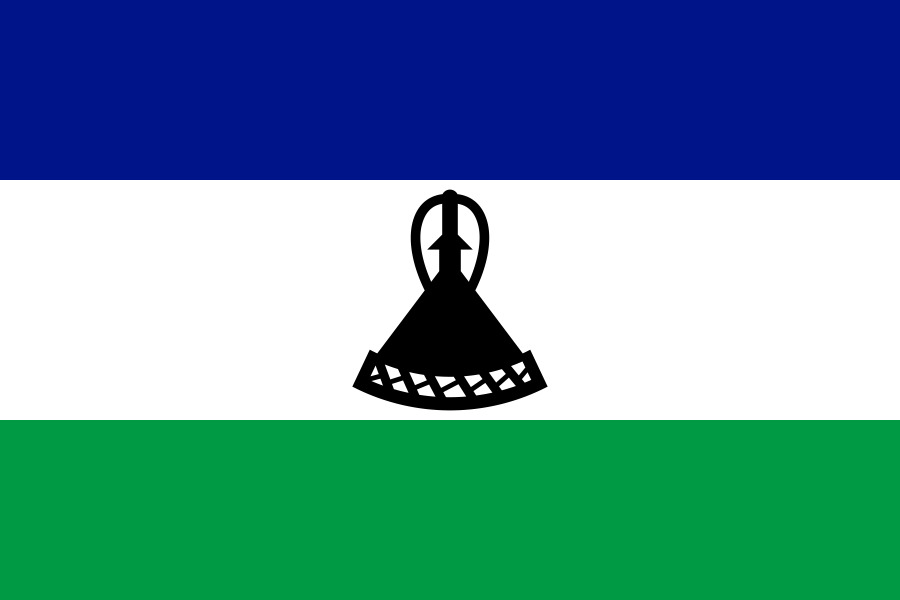
Blue, white, and green horizontal bands in a 3:4:3 ratio, with a black Basotho hat centered on white. Height:length is 2:3.
GKBook layout; hat vector adapted from Wikimedia Commons (public domain).Download image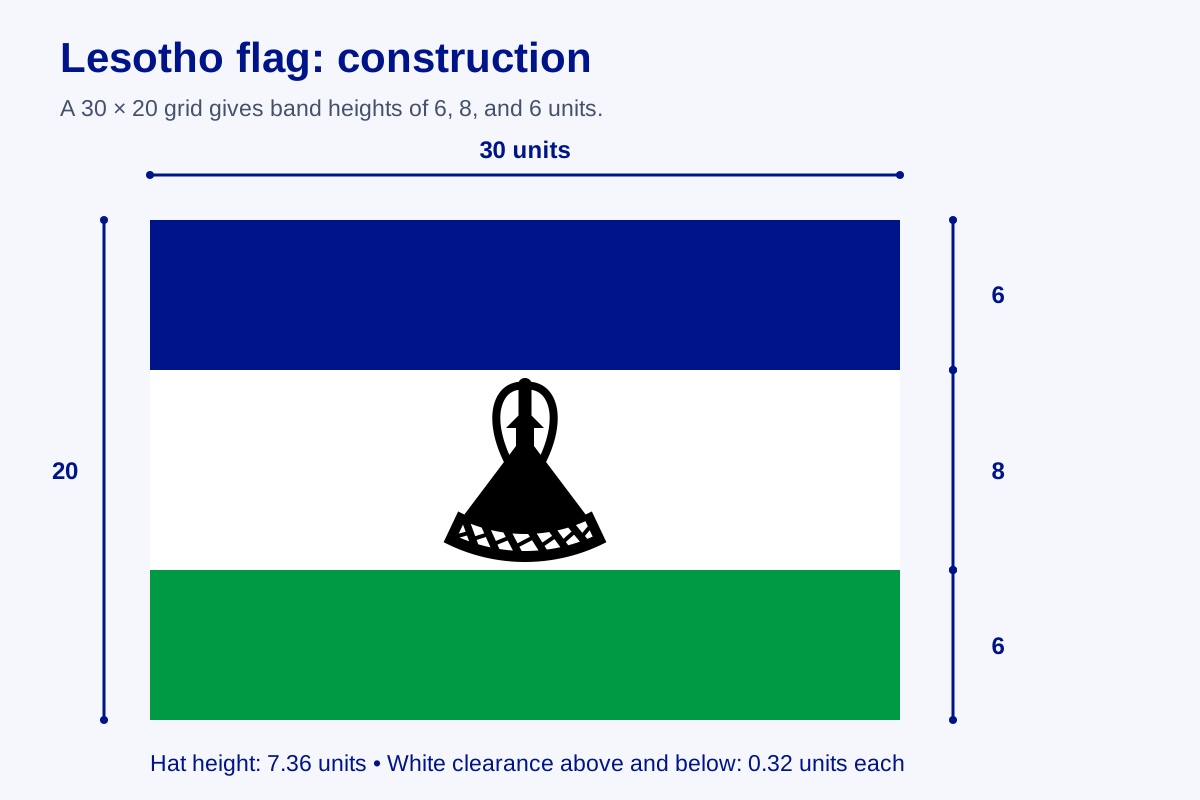
A 30 by 20 grid has bands 6, 8, and 6 units high. The hat is 7.36 units high, leaving 0.32 units of white above and below.
GKBook layout; hat vector adapted from Wikimedia Commons (public domain).Download image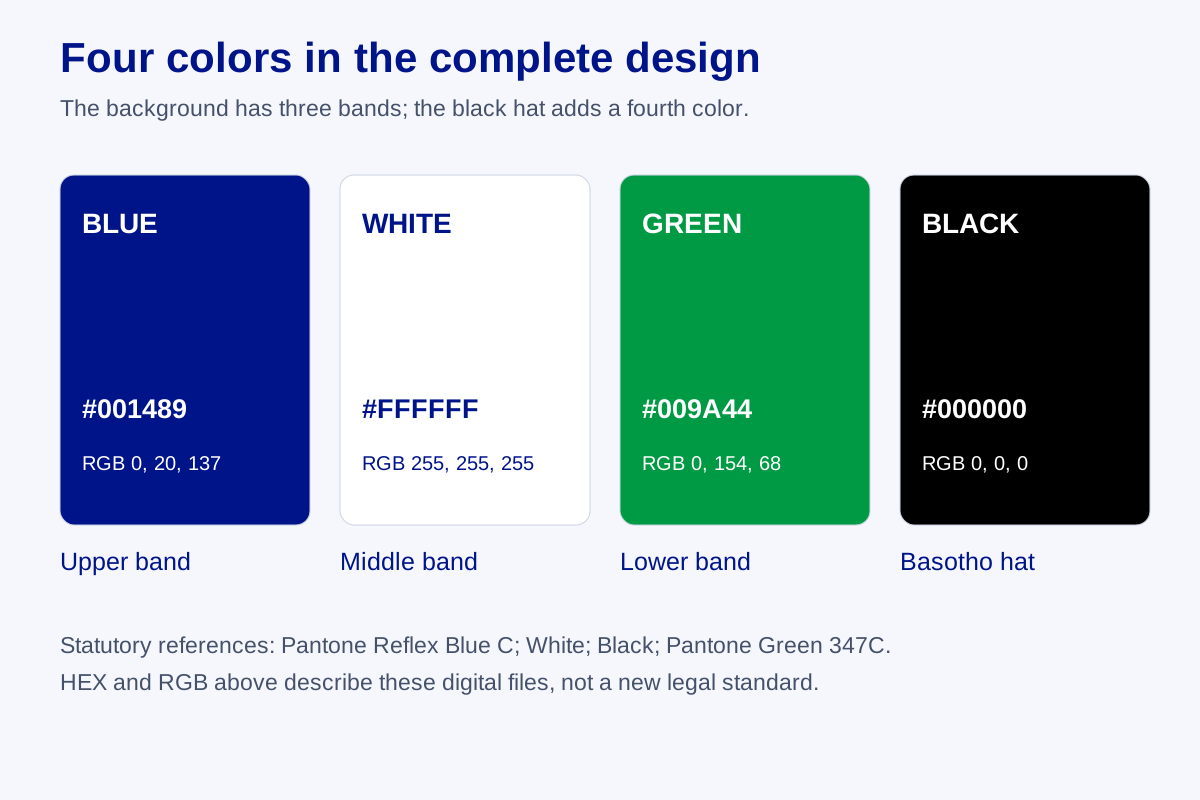
These files use blue #001489, white #FFFFFF, green #009A44, and black #000000. The Act separately names Pantone Reflex Blue C and Pantone Green 347C.
Original GKBook explanatory illustration.Download image
The central emblem is a black mokorotlo, a traditional Basotho hat. The vector preserves its top ornament and patterned curved brim.
GKBook layout; hat vector adapted from Wikimedia Commons (public domain).Download image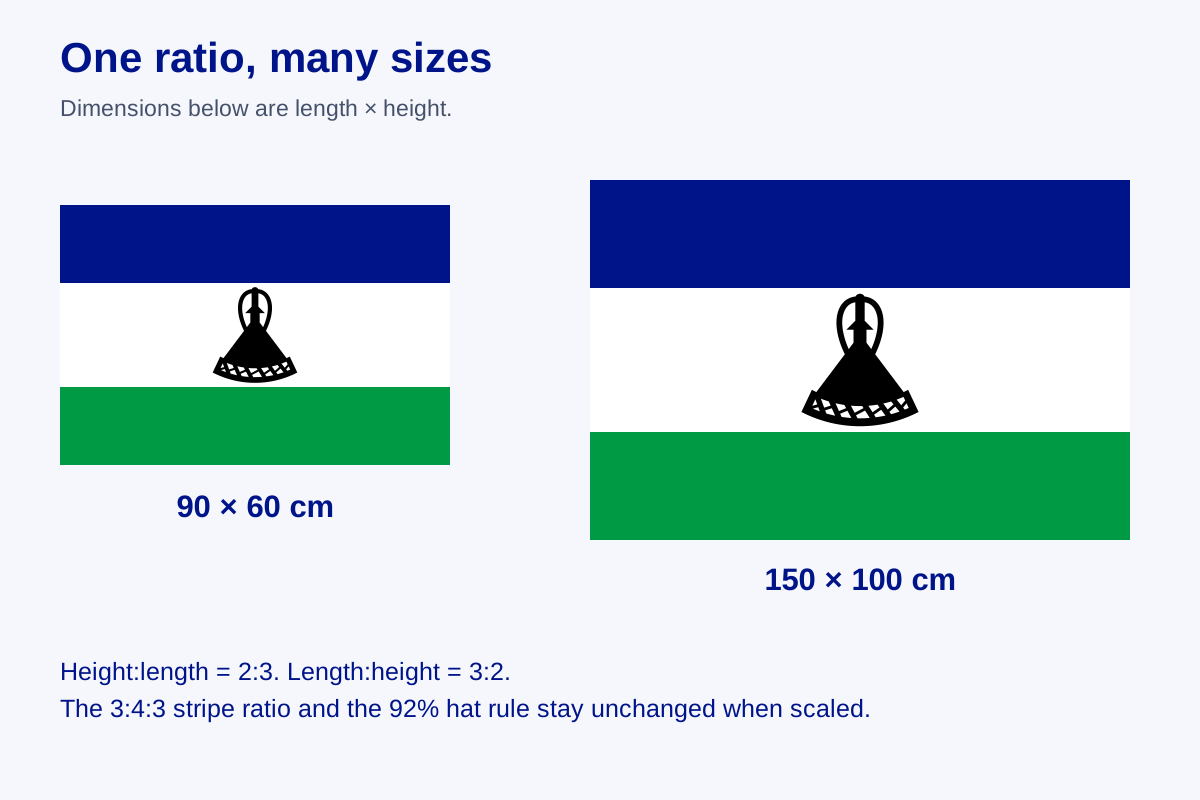
Examples of 90 by 60 centimeters and 150 by 100 centimeters both preserve the 2:3 height-to-length ratio.
GKBook layout; hat vector adapted from Wikimedia Commons (public domain).Download image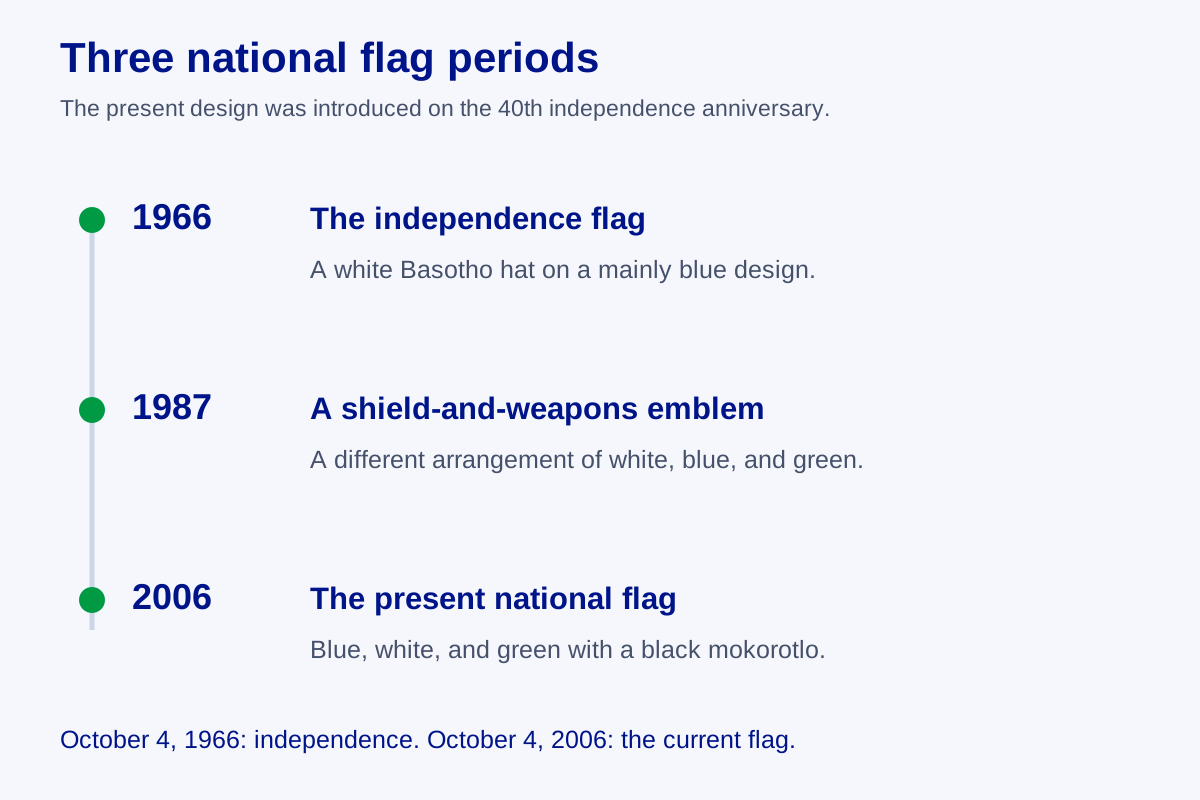
The three post-independence flag periods began in 1966, 1987, and 2006. The current hat flag was adopted on October 4, 2006.
Original GKBook explanatory illustration.Download image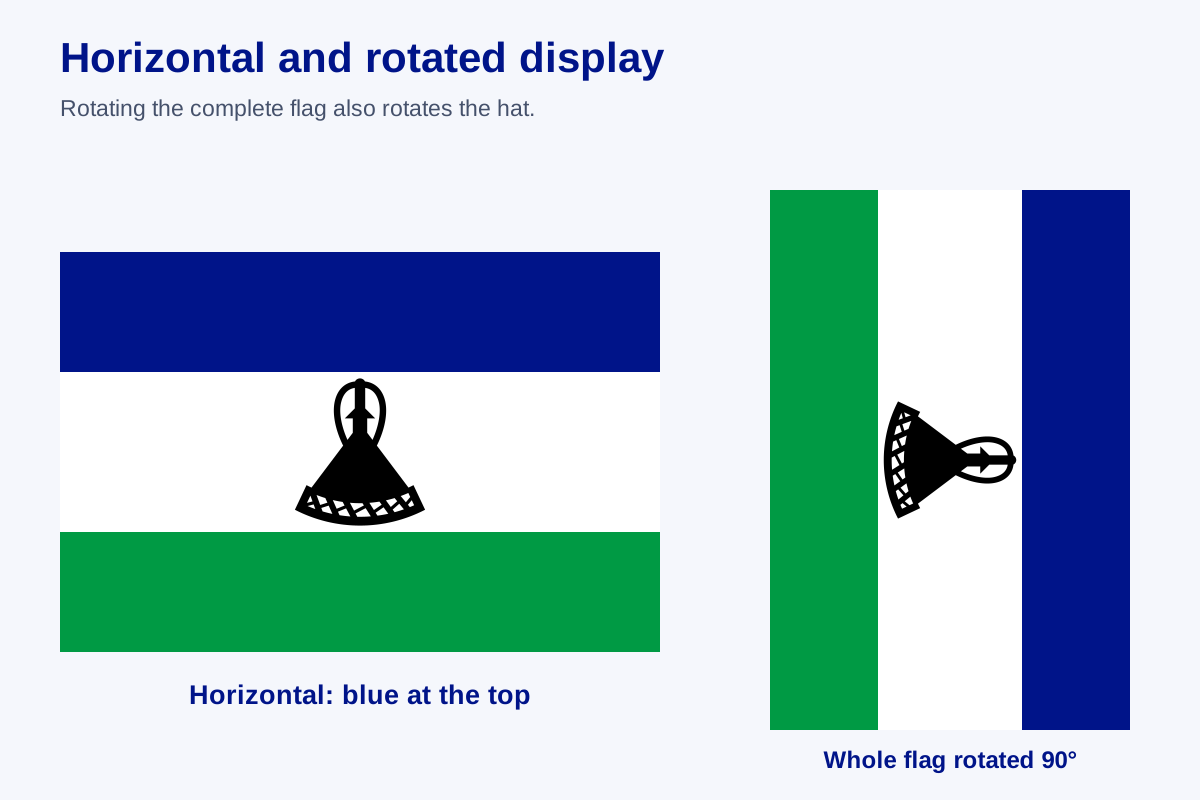
The horizontal flag has blue above white and green. A 90-degree clockwise rotation puts green at the viewer’s left and turns the hat with the whole flag.
GKBook layout; hat vector adapted from Wikimedia Commons (public domain).Download image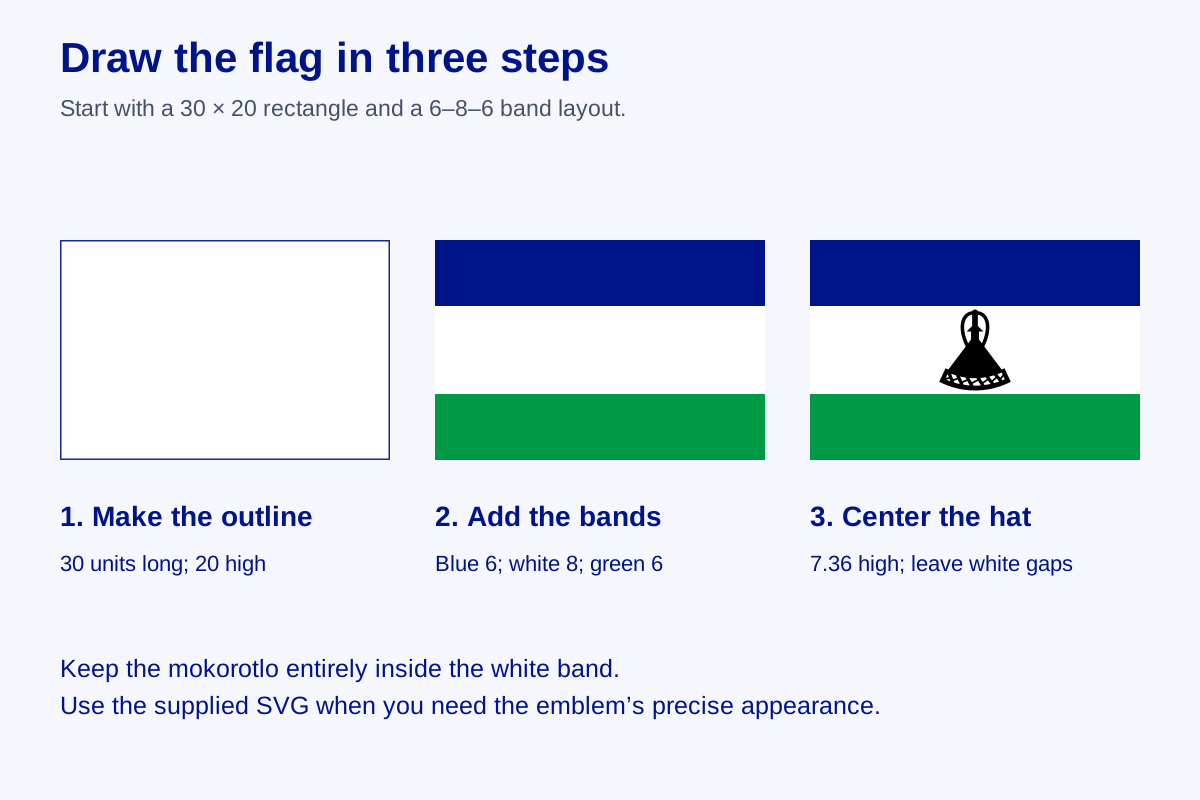
Three steps: draw a 3:2 rectangle, add blue-white-green bands in a 3:4:3 ratio, and center the black hat with small white gaps above and below.
GKBook layout; hat vector adapted from Wikimedia Commons (public domain).Download image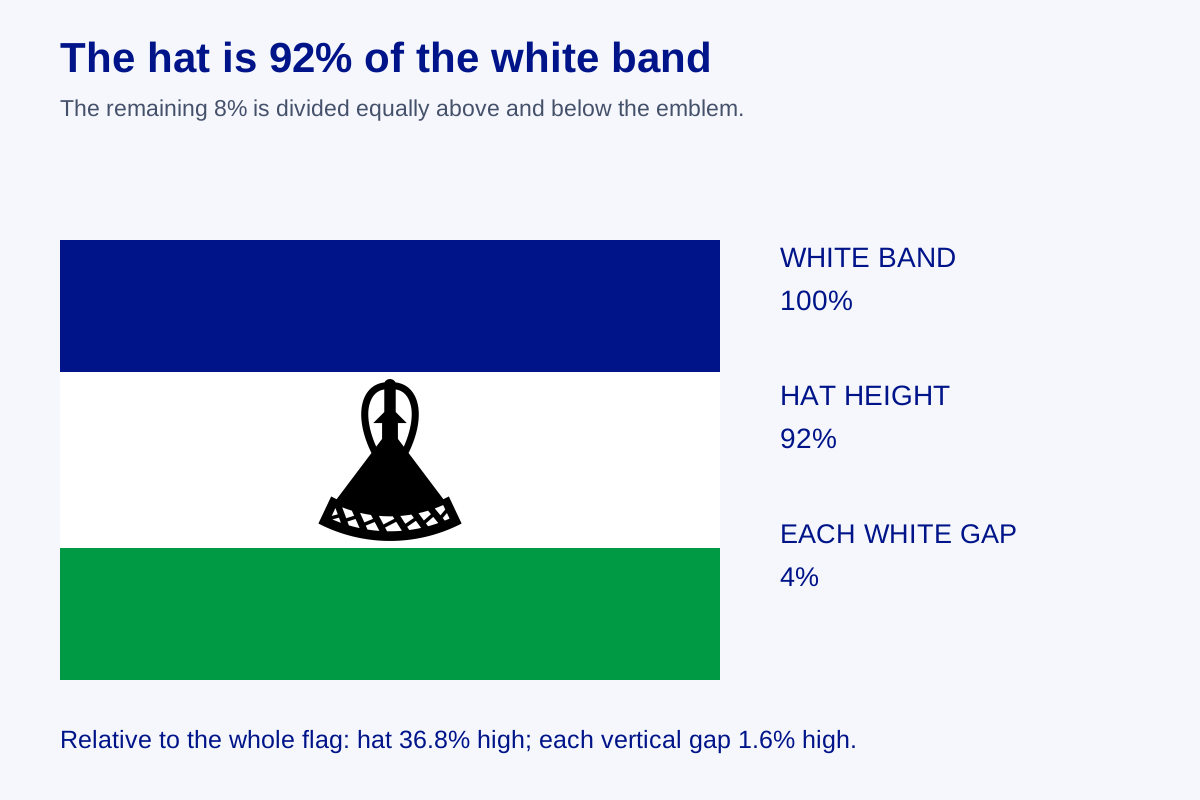
The hat is 92 percent of the white band’s height, or 36.8 percent of the full flag height. Each vertical white gap is 1.6 percent of the full flag height.
GKBook layout; hat vector adapted from Wikimedia Commons (public domain).Download image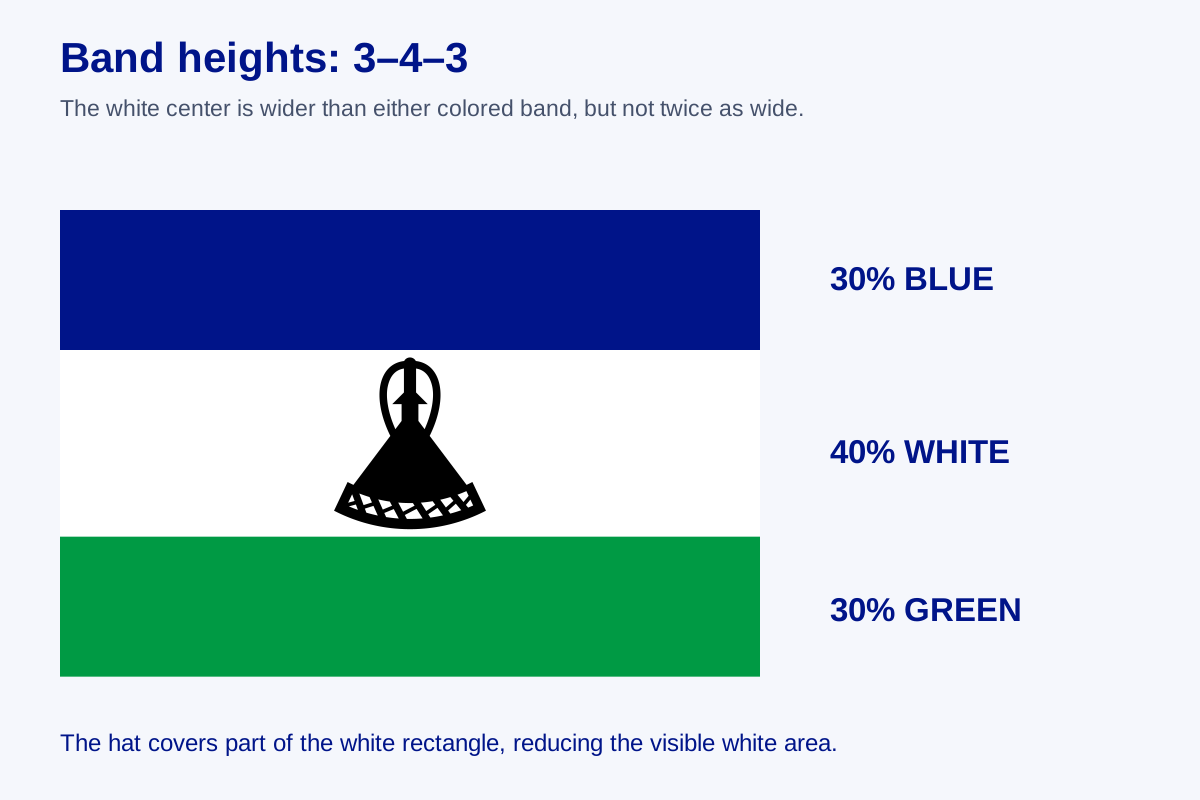
Blue and green each occupy 30 percent of the height, and the central white band occupies 40 percent before the hat is added.
GKBook layout; hat vector adapted from Wikimedia Commons (public domain).Download imageFrequently asked questions
What does Lesotho’s flag look like?
It has blue, white, and green horizontal bands in a 3:4:3 ratio, with a black Basotho hat centered in the white band.
What is the flag’s overall ratio?
Its height-to-length ratio is 2:3, equivalent to 3:2 length:height. The 3:4:3 ratio describes the three band heights instead.
What is the black symbol on the flag?
It is a mokorotlo, a traditional Basotho hat and a national cultural symbol.
What do the colors mean?
Blue is associated with rain or water, white with peace, and green with vegetation and prosperity. The black hat represents the Basotho people and African identity.
How many colors are on the flag?
Four: blue, white, green, and black. The background is a three-band design, and the hat adds black.
What are the flag’s HEX codes?
These files use blue #001489, white #FFFFFF, green #009A44, and black #000000. The Act separately specifies Pantone references for blue and green.
Which Pantone colors does the Act specify?
The Schedule lists Pantone Reflex Blue C, White, Black, and Pantone Green 347C.
How high is the hat?
It is 92% of the white band’s height. Since white is 40% of the whole flag height, the hat is 36.8% of the whole height.
Should the hat touch the blue or green stripe?
No. The centered hat leaves a white gap above and below. Each gap is 4% of the white band’s height, or 1.6% of the whole flag height.
When was the current flag adopted?
October 4, 2006, the 40th anniversary of Lesotho’s independence. The National Flag Act, 2006 was published in the Gazette that day.
When did Lesotho become independent?
October 4, 1966. The present flag was introduced on the same month and day forty years later.
Why was the flag changed in 2006?
The new design emphasized peace and cultural identity, replacing the previous shield-and-weapons emblem with a black Basotho hat.
What did the previous flag look like?
The 1987–2006 flag used diagonal white, blue, and green areas with a light-brown shield, assegai, and knobkerrie.
Was there a hat on the first independence flag?
Yes. The 1966 flag used a white Basotho hat on a mainly blue background with green and red hoist strips.
Is the hat a picture of a mountain?
It is a hat. Its conical shape is culturally associated with Mount Qiloane near Thaba Bosiu.
What does Khotso, Pula, Nala mean?
It means Peace, Rain, Prosperity. Those ideas correspond to white, blue, and green, although the flag’s top-to-bottom order starts with blue.
How do I draw the flag?
Use a 30-by-20 rectangle and bands 6, 8, and 6 units high. Center a black hat 7.36 units high in the white band, leaving 0.32 units of white above and below.
Is the hat the coat of arms?
No. The national flag’s mokorotlo is distinct from Lesotho’s complete coat of arms and from royal or other official standards.
What is the Lesotho flag emoji?
It is 🇱🇸, formed from regional indicator letters L and S: U+1F1F1 and U+1F1F8. Its appearance varies by platform.
Which download should I use?
Use the SVG for scalable artwork or the 3600-by-2400 PNG for a fixed-size image. Keep the 3:2 length-to-height ratio and preserve the white clearances around the hat.
Explore all general-knowledge topics and the A-to-Z lists.

We Value Your Opinion Comments