
Lebanon flag picture
Use the construction sheet to check measurements, or follow the drawing guide.
Lebanon flag: key facts
| Country | LebanonLebanese Republic; Eastern Mediterranean and Western Asia. |
|---|---|
| Design | Red–white–red with a cedarThree horizontal bands and a green central tree. |
| Customary ratio | 2:3 height:lengthEquivalent to 3:2 length:height; not stated in Article 5. |
| Band heights | 1:2:1The white band is twice as high as each red band. |
| Constitutional adoption | December 7, 1943The design emerged during the November independence events. |
| Flag Day | November 21Independence Day follows on November 22. |
| Central emblem | Cedar of LebanonGreen throughout; tip and base meet the white band’s edges. |
| Colors | Red, white, and greenArtwork: #D31624, #FFFFFF, and #008C3E. |
A quick memory aid: red–white–red, 1–2–1, green cedar in the center.
What does the flag of Lebanon look like?
The flag of Lebanon has red, white, and red horizontal bands, with a green cedar tree in the center. The white band is twice as high as either red band. The familiar rectangular flag uses a 2:3 height-to-length ratio.
The cedar reaches the upper and lower edges of the white band. Together, these features distinguish Lebanon’s flag from other red-and-white national flags.
What are the main parts of the Lebanese flag?
Read the design from top to bottom as red, white, and red. The white section takes up the middle half of the rectangle, and the green cedar is placed centrally within it.
| Element | Position | Share of total height |
|---|---|---|
| Upper red band | Top quarter | 25% |
| White band | Middle half | 50% |
| Lower red band | Bottom quarter | 25% |
| Green cedar | Centered in the white band | Spans the white band vertically |
The 50% figure describes the white band’s underlying rectangle. The cedar covers part of it, so the amount of visible white is less than half of the entire flag.
What are the Lebanon flag’s colors and HEX codes?
The national colors in the flag are red, white, and green. The downloadable illustrations use this consistent digital palette.
| Color | HEX in these files | RGB | Location |
|---|---|---|---|
| Red | #D31624 | 211, 22, 36 | Upper and lower bands |
| White | #FFFFFF | 255, 255, 255 | Central band |
| Green | #008C3E | 0, 140, 62 | Cedar, including trunk and base |
Article 5 of the Constitution names the colors without assigning HEX, RGB, CMYK, or Pantone numbers. These values identify the supplied artwork; they are not a claim that the Constitution prescribes a particular screen palette.
What do the colors and cedar symbolize?
Lebanese Army explanations associate red with the blood of those who sacrificed their lives for the country, and white with mountain snow, purity, and peace. The evergreen cedar represents endurance and immortality.
These interpretations connect the flag with both Lebanon’s landscape and its independence history. They explain the symbolism; the constitutional article itself describes the design.
Red bands, a broad white center, and the green cedar of Lebanon.
What tree is on Lebanon’s flag?
The emblem is the cedar of Lebanon, associated with the species Cedrus libani. It is a tree, not a maple leaf, a palm, or a generic triangular evergreen.
The cedar connects the modern national symbol with a much older landscape and cultural tradition. Lebanon’s surviving cedar forests include the Forest of the Cedars of God, part of the UNESCO World Heritage property shared with the Qadisha Valley.
The flag uses a stylized silhouette. Its branches and open spaces form an emblem rather than a botanical drawing of a particular individual tree.
How large should the cedar be?
Article 5 places the cedar in the center of the white band, with its top touching the upper red section and its base touching the lower one. The English constitutional text also relates its size to one-third of the white stripe.
The article does not supply a measured branch outline, a branch count, or a coordinate drawing explaining that one-third relationship. Use a consistent established emblem drawing rather than treating every twig, hole, or irregular edge as a separate legal dimension.
The files here retain a public-domain cedar outline derived from Wikimedia Commons/CIA artwork. The tree remains centered and reaches both boundaries of the white band; it is not presented as a government-issued manufacturing master.
How is the Lebanon flag constructed?
A convenient grid is 30 units long by 20 units high. Mark horizontal boundaries at 5 and 15 units down from the top. This creates bands 5, 10, and 5 units high. Place the green cedar in the middle section, with its tip and base meeting those boundaries.
| Measurement | Formula, using total height H | When H = 100 cm |
|---|---|---|
| Length | 1.5 × H | 150 cm |
| Each red band | H ÷ 4 | 25 cm |
| White band | H ÷ 2 | 50 cm |
| Upper white edge | H ÷ 4 from the top | 25 cm from the top |
| Lower white edge | 3 × H ÷ 4 from the top | 75 cm from the top |
| Cedar vertical extent | H ÷ 2 | 50 cm |
Scale the supplied cedar together with the complete flag. Keep its natural asymmetric outline instead of forcing the branches into a mirror image.
Is the Lebanon flag 2:3 or 3:2?
2:3 height:length and 3:2 length:height describe the same rectangle. For example, a flag 150 centimeters long and 100 centimeters high follows this customary format.
The separate 1:2:1 ratio describes the heights of the red, white, and red bands. Article 5 defines the central band’s relationship to the red sections but does not state the outer 2:3 ratio.
What sizes can a Lebanese flag have?
Choose dimensions that preserve the same shape, then scale the bands and cedar together. These are calculated examples, not compulsory retail sizes.
| Length × height | Each red band | White band / cedar height |
|---|---|---|
| 90 × 60 cm | 15 cm | 30 cm |
| 150 × 100 cm | 25 cm | 50 cm |
| 180 × 120 cm | 30 cm | 60 cm |
| 300 × 200 cm | 50 cm | 100 cm |
The downloadable PNG is 3600 × 2400 pixels, which prints at 12 × 8 inches at 300 pixels per inch. The SVG is a vector file and can be enlarged without pixelation.
How do you draw Lebanon’s flag?
- Draw a rectangle three units long for every two units high.
- Divide the height into four equal parts.
- Color the top and bottom quarters red; keep the two middle quarters white.
- Place the cedar centrally in the white section, from its upper edge to its lower edge.
- Color the complete cedar green, including its trunk and spreading base.
For a simple classroom sketch, focus first on the double-height white band and the recognizable spreading cedar. For a finished publication, use the supplied SVG instead of substituting a generic tree icon.
How did the Lebanese flag develop?
The cedar appeared on Lebanese flags before the present red-white-red arrangement. A white flag with a cedar was used after Ottoman rule ended in 1918. During the French mandate era, the cedar appeared with the French blue-white-red tricolor.
The independence movement of 1943 replaced that surrounding design with horizontal red-white-red bands. The cedar provided continuity while the new arrangement expressed the independent state.
When was the present flag adopted?
The constitutional amendment establishing the current description is dated December 7, 1943. The design had already emerged during the independence events of November.
The Lebanese Army’s independence history records representatives agreeing on the new flag at a parliamentary meeting on November 11, 1943. This earlier political agreement and the later dated constitutional amendment are different milestones.
Lebanon’s annual Independence Day is November 22. It should not be substituted for the December 7 date when specifically identifying the amendment to Article 5.
Who designed Lebanon’s flag?
Henri Pharaon, whose name is also transliterated as Henri Faraon, is widely associated with the present design. The surviving accounts also describe a collective parliamentary decision and an early drawing signed by several representatives.
A Lebanese Army historical account attributes the drawing made during the November 1943 meeting to Saadi al-Munla. It is more accurate to recognize this shared process than to suggest the whole flag emerged from a single uncontested act by one person.
Was Lebanon’s old flag the French tricolor?
During the mandate period, the flag combined the French blue, white, and red vertical arrangement with a cedar in the middle. The cedar, rather than a completely new national emblem, was carried into the red-white-red flag of 1943.
That historical flag should be labeled by its period. It is not an alternative version of the present national flag, and the current design has no blue stripe.
When are Flag Day and Independence Day?
Flag Day is November 21, immediately before Independence Day on November 22. They are distinct annual observances. The December 7 date identifies the 1943 constitutional amendment defining the flag.
| Date | Meaning |
|---|---|
| November 21 | Flag Day |
| November 22 | Independence Day, commemorating 1943 |
| December 7, 1943 | Date of the Article 5 flag amendment |
What does the Constitution say about the flag?
Article 5 establishes horizontal red, white, and red sections and a central green cedar. The white section equals the two red sections together; the cedar reaches its top and bottom boundaries.
The article gives a design description, not a complete production manual. It does not name a particular digital file, prescribe a number of branches, or list numerical screen and printing color codes.
Can the Lebanese flag be displayed vertically?
A complete 90-degree rotation turns the stripes vertical and the cedar sideways. That is different from rotating only the background while redrawing the cedar upright. The illustration below demonstrates a whole-flag rotation.
For an official ceremony, follow the organizer’s display drawing and the applicable protocol. A diagram of a rotated flag does not establish a universal requirement for every hanging banner or ceremonial format.
Does the flag look the same from the back?
A flag viewed through the reverse of a single layer of fabric shows a mirrored version of its front. The cedar remains upright, but its asymmetric branch details appear reversed. That is different from turning the whole flag upside down.
In a normal horizontal picture, the cedar’s crown belongs above its trunk and base. The red bands alone cannot tell you which way is up, but the tree can.
How should Lebanon’s flag be displayed?
The Presidency’s published protocol calls for daily sunrise-to-sunset display on state buildings, land-border facilities, airports, and seaports, with separate arrangements for the presidential palace and diplomatic missions.
It also rejects faded or torn flags. At ceremonies involving foreign flags in Lebanon, the national flag receives the position of precedence; follow the official arrangement for the particular setting.
Keep the design clear
- Use the red-white-red band pattern.
- Keep the cedar fully green and correctly oriented.
- Replace damaged or badly faded fabric.
- Follow the venue’s flag arrangement.
Avoid common errors
- Three equal-height bands.
- A generic tree substituted for the cedar.
- Lettering or a logo covering the national design.
- A stretched, upside-down, or cropped cedar.
When is Lebanon’s flag flown at half-staff?
The Presidency’s protocol provides for lowering the flag to the middle of the pole during mourning under a notice from the Presidency of the Council of Ministers.
The dates and duration depend on the relevant announcement. An ordinary calendar anniversary should not be treated as an automatic mourning order without the corresponding direction.
How does Lebanon’s flag differ from Austria’s and Latvia’s?
All three have horizontal red-white-red bands, but the white stripe and emblem separate them immediately.
| Flag | Band-height ratio | Central feature |
|---|---|---|
| Lebanon | 1:2:1 | Broad white band with a green cedar |
| Austria | 1:1:1 | Equal bands; no emblem on the plain national flag |
| Latvia | 2:1:2 | Narrow white band between carmine red bands |
Explore the Austria flag, Latvia flag, and the World Flags collection.
What is the Lebanon flag emoji?
The Lebanon flag emoji is 🇱🇧. It combines the regional indicator letters L and B, with code points U+1F1F1 U+1F1E7.
The cedar’s details vary across platforms. Some devices display the letters instead of a flag. Use the SVG or PNG for a consistent graphic in an article, presentation, or classroom handout.
Which flag file is best for printing?
Choose the SVG when the artwork needs to scale or remain editable. Choose the 3600 × 2400 PNG for software that expects a raster image. Keep the aspect ratio locked and preserve the entire cedar when resizing.
A white band must stay visibly white when the image is placed on a colored background. Do not make the white parts transparent. For fabric or professional printing, use a physical color proof and the supplier’s production requirements; HEX values alone do not define a dye or ink mixture.
How can a Lebanese flag be kept in good condition?
Check the fly edge, seams, and fastenings for wear, and follow the fabric maker’s cleaning instructions. Dry the flag fully before folding it for storage, and keep it away from damp conditions.
Replace fabric when it is torn or its colors have faded badly. When selecting a replacement, compare both the stripe proportions and the cedar outline rather than relying only on the words “Lebanon flag” in a product title.
Which Lebanese flag mistakes should be avoided?
- Equal bands: the white center is twice as high as either red band.
- A brown trunk in the supplied modern artwork: Article 5 describes a green cedar.
- Gaps above and below the cedar: its tip and base should meet the red–white boundaries.
- A generic Christmas-tree silhouette: use the recognizable cedar emblem.
- Invented branch meanings: the Constitution gives no symbolic count of branches or openings.
- One date for every event: distinguish November’s independence events, Flag Day, and the December 7 constitutional amendment.
- Screen values called legal standards: numerical codes in an image file are not automatically prescribed by law.
- Visible white claimed to cover exactly 50%: the cedar covers part of the central white rectangle.
Download Lebanon flag pictures
The plain flag SVG and PNG contain the national design without visible labels or a watermark. Separate illustrations explain the construction, colors, cedar, history, dates, and comparisons.
| File | Purpose | Download |
|---|---|---|
| Plain flag SVG | Scalable flag artwork | Download SVG |
| Plain flag PNG | 3600 × 2400 pixels | Download PNG |
| Construction sheet | Band layout and proportions | Download SVG |
| Color reference | Digital HEX and RGB palette | Download SVG |
| Cedar detail | Emblem position and appearance | Download SVG |
| Drawing guide | Three illustrated steps | Download SVG |
The gallery contains ten pictures. The explanatory layouts are by GKBook; the cedar artwork is adapted from a public-domain Wikimedia Commons vector derived from CIA World Factbook imagery.
Lebanon flag pictures

Red, white, and red horizontal bands in a 1:2:1 ratio, with a green cedar touching both edges of the white band; the customary height:length ratio is 2:3.
GKBook layout; cedar adapted from public-domain Wikimedia Commons/CIA artwork.Download image
A customary 30 by 20 grid uses red bands 5 units high and a white band 10 units high. The green cedar spans the white band vertically.
GKBook layout; cedar adapted from public-domain Wikimedia Commons/CIA artwork.Download image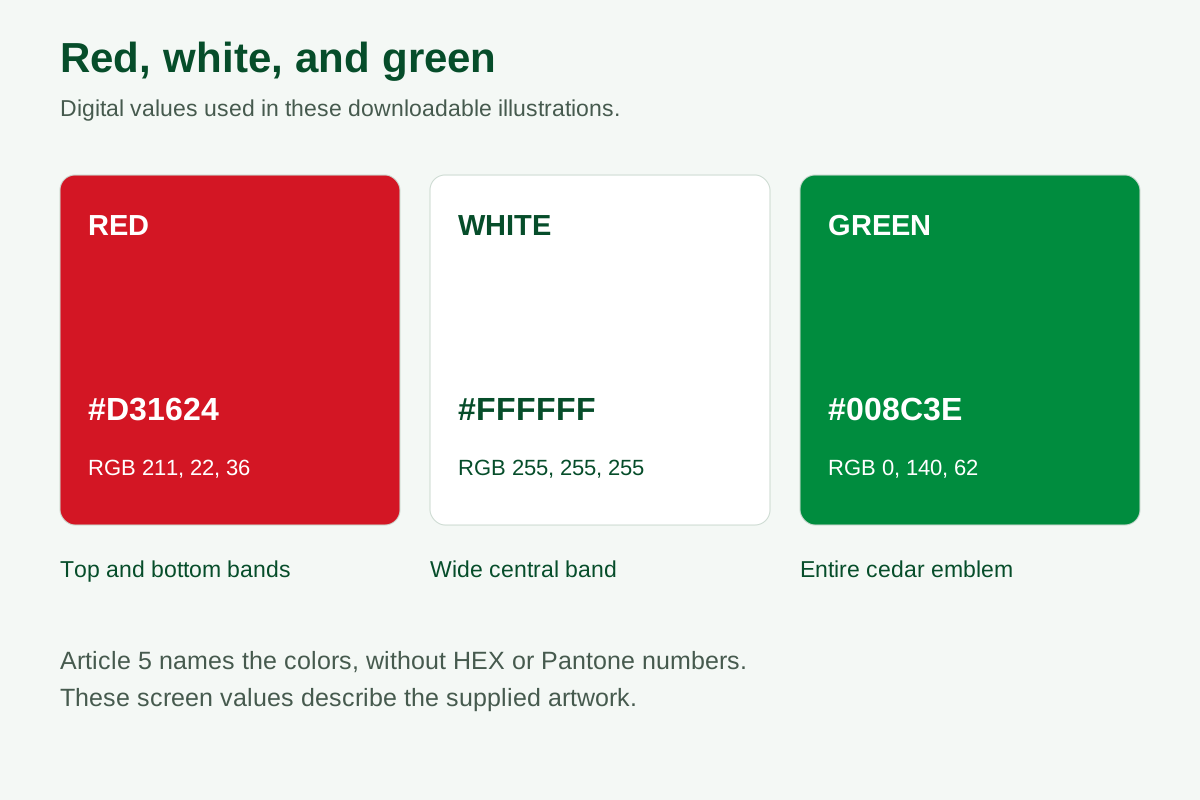
The supplied files use red #D31624, white #FFFFFF, and green #008C3E. These are artwork values rather than constitutional color coordinates.
Original GKBook color reference for the supplied digital artwork.Download image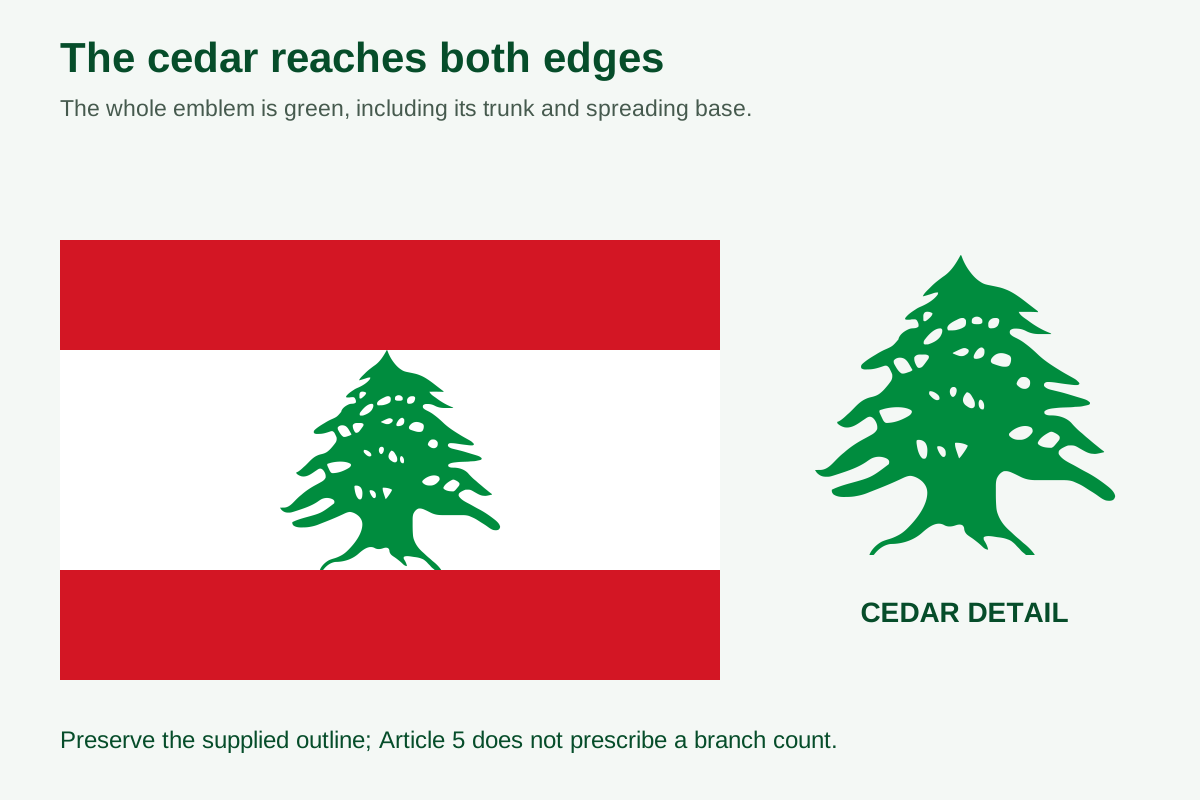
A green cedar stands in the center of the white band. Its top reaches the upper red stripe and its base reaches the lower one.
GKBook layout; cedar adapted from public-domain Wikimedia Commons/CIA artwork.Download image
Examples of 90 by 60 centimeters and 150 by 100 centimeters use the same customary 3:2 length-to-height ratio.
GKBook layout; cedar adapted from public-domain Wikimedia Commons/CIA artwork.Download image
A short timeline separates the earlier white cedar flag, the French-color mandate flag, the November 1943 independence movement, and the December 7 constitutional amendment.
GKBook layout; cedar adapted from public-domain Wikimedia Commons/CIA artwork.Download image
The horizontal design has an upright cedar. A 90-degree clockwise rotation turns the bands vertical and rotates the cedar with the complete flag.
GKBook layout; cedar adapted from public-domain Wikimedia Commons/CIA artwork.Download image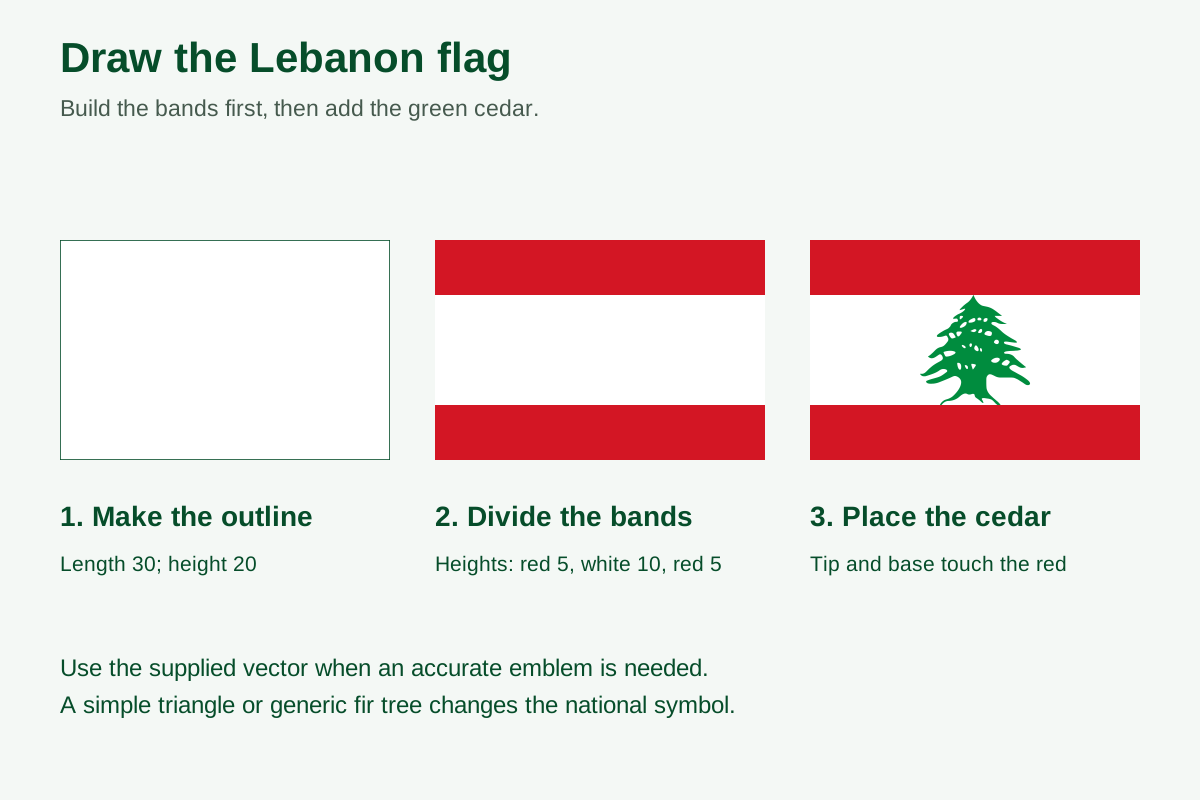
Three steps: draw a 3:2 rectangle, add red-white-red bands with a double-height white center, and place the green cedar in the white band.
GKBook layout; cedar adapted from public-domain Wikimedia Commons/CIA artwork.Download image
Flag Day is November 21, Independence Day is November 22, and the constitutional amendment defining the flag is dated December 7, 1943.
Original GKBook explanatory illustration.Download image
Lebanon has a double-height white center and a cedar; Austria has equal bands; Latvia has a narrow white center between carmine bands.
GKBook layout; cedar adapted from public-domain Wikimedia Commons/CIA artwork.Download imageFrequently asked questions
What does Lebanon’s flag look like?
It has red, white, and red horizontal bands, with a green cedar tree in the wide white center. The white band is twice as high as each red band.
What is the flag’s usual ratio?
The customary ratio is 2:3 height:length, equivalent to 3:2 length:height. The separate 1:2:1 ratio describes the three band heights.
What tree is on the Lebanese flag?
It is the cedar of Lebanon, associated with Cedrus libani. The flag uses a stylized cedar emblem rather than a photograph of a tree.
What does the cedar symbolize?
The evergreen cedar is associated with endurance, immortality, and Lebanon’s historical identity.
What do red and white mean?
Common official explanations connect red with sacrifice and white with mountain snow, purity, and peace.
What are the flag’s HEX codes?
The supplied files use red #D31624, white #FFFFFF, and green #008C3E. These identify the digital artwork, not numerical color requirements in Article 5.
Should the cedar’s trunk be brown?
The constitutional description calls for a green cedar. These modern flag files make the whole tree green, including the trunk and base.
Should the cedar touch the red bands?
Yes. Its tip touches the upper red section and its base touches the lower red section, spanning the white band vertically.
Does the cedar have an official number of branches?
Article 5 does not prescribe a branch count or a measured drawing of each branch. Use a consistent established flag emblem.
When was the current flag adopted?
The constitutional amendment defining the present flag is dated December 7, 1943. The design had emerged during the November independence events.
Who designed Lebanon’s flag?
Henri Pharaon is closely associated with the design. Historical accounts also describe a shared parliamentary process and an early drawing attributed to Saadi al-Munla.
When is Lebanon’s Flag Day?
Flag Day is November 21. Independence Day is the next day, November 22.
Is November 22 the flag’s constitutional adoption date?
No. November 22 is Independence Day. The Article 5 amendment describing the flag is dated December 7, 1943.
What was the flag before 1943?
The mandate-era design used the French blue-white-red tricolor with a cedar in its white section. It is a historical flag, not the present national design.
How do I draw the Lebanon flag?
Draw a 30-by-20 rectangle, use band heights of 5, 10, and 5, and place the green cedar in the white center with its tip and base touching the red–white boundaries.
How does it differ from Austria’s flag?
Lebanon has a double-height white center and a green cedar. Austria’s plain red-white-red flag has three equal-height bands and no cedar.
What happens when the flag is rotated vertically?
A whole-flag 90-degree rotation turns the bands vertical and the cedar sideways. Follow the venue’s official display arrangement for a ceremony.
When is the flag flown at half-staff?
The published presidential protocol provides for mourning display at the middle of the pole under a notice from the Presidency of the Council of Ministers.
What is the Lebanon flag emoji?
It is 🇱🇧, made from regional indicator letters L and B: U+1F1F1 and U+1F1E7. Its appearance depends on the platform.
Which download should I use?
Use the SVG for scalable artwork or the 3600-by-2400 PNG for a fixed-size image. Keep the complete flag’s 3:2 length-to-height ratio when resizing.
Explore all general-knowledge topics and the A-to-Z lists.


We Value Your Opinion Comments